
Submitted:
21 March 2026
Posted:
23 March 2026
You are already at the latest version
Abstract
This study examines structural patterns in the governance of non-normative gendered bodies in China across distinct historical and contemporary contexts. Rather than asserting a direct causal lineage, we analyze recurring regulatory mechanisms that characterized the governance of imperial eunuchs and are discernibly present in the contemporary governance of transgender individuals, two populations separated by time and circumstance but subject to comparable logics of moral classification, familial surveillance, and institutional scripting. We introduce Confucian biopolitics as an analytical lens to describe governance that operates through li (ritual propriety) and xiao (filial piety) rather than solely through juridical or biomedical systems. This lens does not propose a new totalizing theory; rather, it reorients existing biopolitical frameworks toward the kinship-based, morally-inflected power structures that have historically characterized Chinese governance of bodies. Drawing on three complementary methods (archival analysis of Qing legal and administrative sources, exploratory GIS spatial analysis of institutional distributions, and computational text analysis of Ming Shilu chronicles and Chinese Wikipedia articles on transgender and LGBT topics), we identify structural regularities rather than claim continuity of intent or transmission. Comparative cases from the Ottoman Empire and Tokugawa Japan help distinguish China-specific features from more general patterns. Findings indicate that both eunuchs and transgender individuals were governed through mechanisms centered on familial legitimacy, bodily classification, and moral-ritual normalization. Spatial analysis of contemporary LGBTQ+ NGOs reveals significant geographic clustering (I = 0.735, p < .001) in coastal metropolitan areas, mirroring the spatial isolation mechanism identified in imperial eunuch governance, with Beijing functioning as the dominant institutional hub. Computational text analysis identifies discursive resonance: the term 妖 (demon/monster, χ2(1) = 0.07, p = .788, n.s.) and 欺骗 (deception, p = .863, n.s.) appear at statistically indistinguishable rates across six centuries of text, while terms for psychiatric pathology (精神病, p < .001) and discrimination (歧视, p < .001) are exclusively contemporary—evidence of diagnostic translation within a persistent moral register. The study contributes to gender history, comparative sociology, and digital humanities by offering a multi-method framework for identifying structural recurrences in governance logics across historical ruptures. We conclude with policy implications focused on familial and linguistic mechanisms of stigma, which historical analysis identifies as the most durable sites of governance.
Keywords:
confucian biopolitics
; structural continuity of stigma
; transgender governance
; gender non-conformity
; historical sociology of China
1. Introduction
How does China govern non-normative gendered bodies, and why does this governance take the particular form it does? Existing scholarship has approached imperial eunuchs and contemporary transgender individuals as separate phenomena, situated within distinct historiographical and disciplinary frameworks [1,2]. Scholars of the Qing dynasty have documented the elaborate institutional apparatus surrounding eunuch governance [3,4]; scholars of contemporary China have analyzed the legal, medical, and social pressures facing transgender citizens [5,6]. Yet these literatures rarely speak to each other. A comparative-historical question, therefore, remains underexplored: do the mechanisms that governed imperial eunuchs share structural features with those governing transgender individuals today, and if so, what analytical framework can account for this?
This paper does not argue that contemporary stigma against transgender people is caused by or directly inherited from imperial attitudes toward eunuchs. Such a claim would require evidence of continuous institutional transmission across the 1912 dynastic collapse, the Maoist rupture, and the post-1978 reform era, a chain of evidence we cannot establish. Instead, we ask a more tractable question: what structural patterns recur in the governance of gender nonconformity in China, and through what mechanisms do they operate? This reframing shifts the analysis from genealogy to structural analogy, from historical causation to discursive resonance [7].
To address this question, we develop Confucian biopolitics as an analytical lens. This is not a new totalizing theory but a conceptual reorientation of Foucauldian biopolitics [8] toward governance structures that operate through li (ritual propriety, 礼) and xiao (filial piety, 孝) rather than solely through juridical or biomedical systems. Recent scholarship demonstrates that Confucian moral-kinship structures articulate with, rather than precede, modern governance in East Asia [9,10,11]. Confucian biopolitics names the specific way this articulation governs bodies: by making bodily conduct legible as evidence of familial and moral virtue, and by rendering non-normative bodies threats not just to social order but to lineage integrity.
Our study is interdisciplinary in method. Using archival analysis of Qing court records, exploratory GIS spatial analysis, and computational text analysis of historical and contemporary corpora, we triangulate evidence across distinct empirical domains. No single method is treated as definitive; the value lies in triangulation: convergence of independent evidence types around shared analytical conclusions. We also situate China comparatively with the Ottoman and Japanese cases to distinguish culturally specific features from more general patterns of governance [12,13].
Our specific aims are: (1) to develop Confucian biopolitics as an analytical lens that identifies kinship-ritual governance mechanisms absent from Western biopolitical frameworks; (2) to identify structural and discursive resonances between eunuch governance and transgender governance, without asserting direct causal transmission; (3) to analyze how institutions (from imperial courts to modern bureaucracies) produce and sustain gendered categories through material-ritual processes; and (4) to derive policy implications from historical analysis, focusing on the familial and linguistic dimensions of stigma that historical evidence identifies as most durable. The paper proceeds from a theoretical framework, through methodology and findings, to discussion and implications.
2. Theoretical Framework
This section develops the analytical lens of Confucian biopolitics. A preliminary clarification of the analytical level is essential. Following Dean’s (Governmentality, 1999) distinction between the objects of governance and the techniques through which governance operates, our comparison between eunuchs and transgender individuals is strictly limited to the latter: we compare how the state governs non-normative bodies (conditional recognition, kinship gatekeeping, diagnostic classification), not the experience of being governed. Eunuchs were subjects of coerced bodily modification in service of dynastic imperatives; transgender individuals are agents of self-determined identity claims navigating state regulation. These are ontologically distinct subject positions, and we do not equate them. What we claim is structurally comparable is the technique—the state’s repertoire of conditional recognition contingent on kinship-moral compliance—not the subjective experience of those to whom it is applied. This distinction is maintained throughout. Section 2.1 develops the core lens; Section 2.2 applies it to the production of stigma through kinship, language, and institutional scripting.
2.1. Confucian Biopolitics as Analytical Lens
We use Confucian biopolitics as an analytical lens, not as a claim that China possesses a wholly distinct form of power incommensurable with other traditions. The lens does specific work: it highlights governance mechanisms that operate through li (礼, ritual propriety) and xiao (孝, filial piety), mechanisms that Foucauldian biopolitics, oriented toward population statistics and medical normalization, is ill-equipped to capture. In Confucian statecraft, political order is experienced as an extension of moral order, beginning with the body and the family and radiating outward. Governance thus proceeds not by prohibition alone but by inculcating the habitus of virtue: the well-governed subject does not need to be forbidden from deviance, because the body materializes loyalty and filial duty through performed ritual [14].
Early Confucian texts explicitly linked bodily conduct to moral status, making the body a canvas on which loyalty and virtue could be read. Xiao was not just an internal sentiment but something "performed and examined" through bodily rituals. The gestures of mourning and the demeanor of obedience – these visible acts were thought to materialize one’s filial piety. As one scholar notes, "the body materializes the notion of filial piety through the performance of li so that xiao can become visible and measurable" [14].
This moralized system created a specific biopolitical logic: deviation from normative gender roles, such as a male body failing to reproduce or to behave in a conventionally masculine way, was viewed as a failure of both li and xiao. The often-cited Confucian dictum that "of the three unfilial acts, the worst is to have no descendants" underscores how not procreating was considered a severe moral failing [15]. Eunuchs, defined as unable to father children, represented an inherent breach of filial obligation in the eyes of orthodox society. Moreover, their distinct speech, posture, and roles disrupted the ritual order of gendered expectations.
A crucial conceptual clarification is necessary here. Foucault distinguished disciplinary power (operating on individual bodies through surveillance and normalisation) from biopower (operating on populations through demographic regulation) [8]. Our use of “biopolitics” is not casual: we claim that Confucian governance of non-normative bodies operates at both levels simultaneously, and that this dual operation is what distinguishes it from mere “Confucian ethics” or “ritual propriety.” At the disciplinary level, li and xiao regulate individual bodies through performed ritual, dress codes, and kinship obligations. At the biopolitical level, the imperial state managed eunuchs as a population subgroup: the Qing imposed numerical quotas (capping the eunuch population at approximately 3,000), controlled entry through age and marital-status requirements, and monopolised the pathway to bodily transformation (criminalising unauthorised castration). These are population-level regulatory instruments, not merely individual moral exhortations. In the contemporary case, the CCMD-3’s classification of gender incongruence as a mental disorder constitutes a classic biopolitical operation: it defines transgender individuals as a medically legible population subgroup subject to public-health management, gatekeeping, and epidemiological surveillance. The requirement of parental consent operationalises xiao not as private family morality. Still, as a state-mandated gatekeeping criterion applied to a category of persons—this is the point at which micro-level kinship ethics becomes macro-level governance technology. As Judith Farquhar puts it, “bodily knowledge is embedded in and arises from social practice” [16]; Confucian biopolitics names the specific way Chinese governance has historically embedded kinship-moral knowledge into population-level regulatory practice.
Yet paradoxically, eunuchs were indispensable to imperial governance. Their presence in courtly rituals, harem management, and information control situated them at the very heart of power. As Philip Huang’s theory of the "third realm" [17] suggests, eunuchs inhabited a liminal governance space between formal bureaucracy and informal power. This space is not reducible to Western governmentality [18], but operates through moral pedagogy, spatial management, and exclusion from ancestral rites.
Crucially, Confucian biopolitics is not a relic that modernity has superseded, but neither did it pass through the twentieth century unaltered. The Maoist period (1949–1976) demands explicit attention here, since it represents the most radical attempt to dismantle Confucian kinship structures in Chinese history. The revolutionary state replaced the patrilineal clan with the work unit (单位, danwei) as the primary locus of social provision, and substituted class identity for kinship identity as the dominant axis of moral evaluation. Gender nonconformity was suppressed not through filial discourse but through revolutionary puritanism: any deviation from the austere, androgynous socialist subject was condemned as bourgeois decadence. Yet the structural relationship between state, family, and body was reconfigured rather than dissolved. The danwei functioned in certain respects as a surrogate patriarchal household—allocating housing, approving marriages, and mediating disputes—though scholars differ on whether this represents a continuation of Confucian paternalism or a distinct clientelist structure [11]. The state assumed the role of “ultimate parent,” demanding obedience in terms that, we argue, echoed the structural logic of filial duty, even as revolutionary ideology explicitly repudiated Confucianism. When the reform era dismantled the danwei system after 1978, the family re-emerged as the primary unit of social governance—but this was not a spontaneous revival of Confucian values. It was driven by specific institutional mechanisms: the withdrawal of state-provided healthcare and pensions shifted welfare responsibility back onto families; the 1980 Marriage Law and subsequent revisions reinforced parental authority over minors’ major life decisions; and the hukou (household registration) system continued to tie social entitlements to family units rather than individuals. These policy instruments collectively produced what we term “re-familialisation”: the state’s strategic devolution of governance functions onto the household, which reactivated kinship-moral logics not because Confucianism was culturally resilient per se, but because the institutional architecture of the reform era made the family the most efficient conduit for social control. The One-Child Policy (1979–2015) plausibly illustrates this re-activation: by concentrating all lineage expectations on a single child, it may have intensified the perceived stakes of gender nonconformity—though this remains a theoretical proposition requiring survey data (e.g., comparing family pressure on transgender individuals in one-child vs. multi-child households) that the present study does not provide. The contemporary requirement of parental consent for gender-affirming surgery is thus not merely a survival of ancient xiao; it reflects the post-reform state’s strategic re-empowerment of the family as a governance unit—a “revolutionary family paternalism” that draws on both socialist and Confucian registers. This articulation with state policy is not “continuation” in a strong causal sense; it is evidence that similar governance logics can be activated across institutional discontinuities, which is precisely what our analytical lens is designed to track.
Falsifiability criterion.
The analytical utility of Confucian biopolitics depends on its specificity: it must identify governance features that are not generic to all court-eunuch systems. The Ottoman Empire provides a critical test. Ottoman court eunuchs occupied a structurally similar institutional role — indispensable to dynastic governance, sexually neutralised, spatially concentrated in the palace — yet Ottoman moral literature does not produce the filial-kinship stigma that saturates Chinese sources [12]. The reason is structural: Ottoman court eunuchs were overwhelmingly enslaved foreigners who carried no filial obligations from the outset, so the Confucian logic of unfilial bodily transgression had no purchase. This contrast demonstrates that filial stigma is not a generic byproduct of the court-eunuch institution per se but a specific output of the Confucian kinship framework within which that institution operated. If our lens were merely relabelling generic governance, the Ottoman case should produce the same stigma pattern; it does not. The comparative analysis in Section 6 develops this contrast in detail. Still, we introduce it here as the lens’s internal validation criterion: Confucian biopolitics earns its analytical weight precisely because it predicts stigma patterns that vary with kinship structure rather than with institutional role alone.
Incremental contribution relative to existing frameworks.
We acknowledge that biopolitical analysis of Chinese governance is not new: Greenhalgh [11] analysed the One-Child Policy through a biopolitical lens; Rofel [10] examined desire and governance in reform-era China; Chiang [2] connected eunuch history to medical modernity. Our incremental contribution is threefold. First, none of these works provides cross-temporal computational evidence for discursive persistence; they rely on close reading or ethnography. Our corpus-scale analysis, supplemented by equivalence testing and Bayes factors, grounds the “persistence” claim in falsifiable quantitative findings. Second, none deploys a comparative falsification design: the Ottoman and Japanese cases are not ornamental but serve as internal validation criteria that distinguish Confucian-specific from generic governance features. Third, the three-part typology (diagnostic translation, discursive resonance, vocabulary emergence) is itself a methodological contribution: it offers a replicable framework for analysing how governance vocabularies change across historical ruptures, applicable beyond the Chinese case. The concept “Confucian biopolitics” thus names not merely a phenomenon these scholars have described but a specific analytical procedure—cross-temporal computational comparison validated by comparative falsification—that the existing literature has not performed.
2.2. Mechanisms of Governance: Kinship, Language, and Institutional Scripting
Confucian biopolitics does not operate abstractly; it is enacted through three recurring mechanisms that this paper traces empirically across both historical and contemporary contexts.
Kinship. Fei Xiaotong’s theory of the chaxu geju (差序格局), or “differential mode of association” [19], describes Chinese social organization as concentric ripples of intimacy and obligation radiating from the self. Gender deviance threatens the innermost circles: family legitimacy and lineage continuity. The family-level response — concealment, symbolic reversal, or expulsion — is structurally consistent across the two cases. In the Qing context, some eunuchs were reinserted into patrilineal logic through adoption (出继), sometimes facilitated by bribes [20]; in the contemporary context, a trans man in a 2022 NGO interview described being asked to “present female just for New Year dinner,” a ritualized regression to manage intergenerational face. These parallels are heuristic, not empirically established equivalences; the claim is that the same functional logic operates, not that the same actors or intentions are at work.
Language. Linguistic classification produces and reproduces stigma. “太监” evolved from an official title to a political slur; “变性人” carries a diagnostic-pathological weight. The shift from ritual stigma to diagnostic stigma represents institutional translation: the vehicle changes while the underlying logic of disqualification persists. Section 5.4 provides computational evidence for this claim.
Institutional scripting. Drawing on Butler’s theory of performativity [21], we argue that gender categories are not merely described but produced by institutional acts. In the imperial case, eunuchs were scripted through material props (the 宝匣, bao xia; court uniforms; the verbal formula “奴才” before the emperor), spatial restrictions, and ceremonial exclusions—accumulated acts that rendered eunuchs legible while disqualifying them from ancestral legitimacy. In the contemporary case, the scripts are different but structurally parallel: psychiatric assessment forms, surgical consent documents requiring parental signature, and household registration procedures collectively produce transgender identity as an institutional category legible to the state [22]. The CCMD-3’s continued pathologization of gender incongruence [23] illustrates how classification itself is governance. Spatial patterns of both eunuch communities and LGBTQ+ organisations — concentrated in urban centres, subject to simultaneous visibility and surveillance — are examined empirically in Sections 4.3 and 5.4.
3. Methodology
This study employs a multi-method design for triangulation, not for causal inference or statistical generalizability. Given that our core argument concerns structural analogy rather than historical causation, no single method could be definitive; instead, the convergence of independent evidence types (archival, spatial, and computational) is what lends the overall argument its persuasive force. Each method is explicitly bounded in what it can and cannot establish: archival analysis illuminates governance mechanisms in a historical context; GIS analysis identifies spatial clustering tendencies in an exploratory manner; and computational text analysis identifies discursive patterns that are interpreted qualitatively, not treated as statistical proof of continuity. We detail each method below.
3.1. Archival Research
We examined primary Qing dynasty (1644–1911) legal and administrative sources that document the institutional apparatus of eunuch governance. Four sources provide the direct textual evidence cited in Section 4:
- Daqing lüli (大清律例, Statutes and Sub-statutes of the Great Qing) [24]—the dynasty’s comprehensive legal code. We draw on specific articles governing eunuch recruitment (age and marital-status requirements: “年在十六岁以下并未娶有妻室者”), the state monopoly on castration (“凡有私自阉割者...皆处斩”), and disproportionate punishment for eunuch infractions (self-harm within the Forbidden City as a capital offence). These provisions are treated as evidence of Confucian biopolitical governance: the state simultaneously authorises and criminalises bodily modification, conditioning institutional legibility on compliance with kinship-moral norms.
- Daqing Huidian and Huidian Zeli (大清会典, 大清会典则例) [25]—the Collected Statutes and their sub-regulations, which codify palace administrative rules. We cite provisions governing eunuch quotas, rank hierarchies, and prohibitions (e.g., exclusion from literacy and Manchu-language education), as well as the criminalisation of unauthorised castration and the imposition of extended-kin punishment.
- Guochao Gongshi (国朝宫史) [26]—an official history of the Qing palace. We cite entries on eunuch stipends (“每月俱银二两米一斛半”) and ritual subordination protocols (mandatory kneeling before imperial princes), which document the material and ceremonial scripting of eunuch status.
- Ming Gongshi (明宫史) [27]—a Ming palace record used specifically for the Anletang welfare institution (“凡内官有疾者送此调理”), which provides evidence of proto-welfare infrastructure for gender-variant bodies excluded from normative kinship support.
Secondary sources—particularly Rawski [3], Dale [1], and Kutcher [4]—contextualise the archival evidence and provide access to imperial edicts and memorials that are not available in fully digitised form. Our approach was both descriptive and analytical: we extracted institutional facts (eunuch quotas, stipends, punishments). We interpreted them through thematic codes (“filial discourse,” “regulatory measures,” “eunuch agency”) to ground the Confucian biopolitics framework in documented governance practice.
3.2. GIS Spatial Analysis
Data Collection: To examine spatial patterns, we compiled two sets of geospatial data:
- Imperial Eunuch Settlements: We gathered historical information on where eunuchs resided or congregated, especially post-retirement or during service. Key sources were historical maps of Beijing and literature on eunuch communities. Notably, the existence of the Tian Yi Mu (田义墓), a eunuch tomb complex west of Beijing, indicates a locale of eunuch significance. Also, eunuchs often lived within the Forbidden City during service; after retirement, some settled in Beijing’s Liu Li Chang area or near eunuch-operated temples. We georeferenced addresses from Qing memoirs (e.g., the residence of the last eunuch, Sun Yaoting) and from Qing archives listing the locations where stipends were delivered. Admittedly, data on eunuch residences is sparse beyond Beijing, as most eunuchs served in the capital. Nonetheless, we included any known eunuch-origin villages (some specific villages in Hebei and Shandong were famed for producing eunuchs) to see regional patterns.
- Contemporary LGBTQ+ NGOs: We created a dataset of known LGBTQ and specifically transgender-focused non-governmental organisations and community centres in China over the last 5–10 years. This was done through web research (using resources such as the UNDP report on transgender people in China and NGO directories). We recorded the city and district of each organization’s main office. The distribution is heavily weighted toward major cities (Beijing, Shanghai, Guangzhou, Chengdu, etc.), with a few in provincial capitals.
These two datasets serve distinct analytical purposes and are treated separately. First, the eunuch data inform a descriptive three-layer governance map (Figure 1): an origin belt (Hebei/Shandong villages), a central hub (the Forbidden City and Beijing), and provincial deployments. This map is conceptual rather than statistical; given the sparse, geographically heterogeneous nature of the data ( sites, spanning local and national scales), Global Moran’s I is not computed for eunuch sites. Second, the contemporary NGO dataset () supports a standalone spatial autocorrelation analysis: we geo-coded all NGO addresses. We computed Global Moran’s I using a k-nearest-neighbor weight matrix () to assess clustering tendencies at the national scale. We also conducted a qualitative overlay analysis to determine whether historically significant sites and contemporary NGO concentrations co-occur within the same urban areas. Spatial findings are reported in Section 4 and Section 5 and interpreted as one strand of triangulated evidence.
3.3. Computational Text Analysis
Analytical rationale.
The central methodological challenge in studying discursive patterns across a 600-year gap is one of scale and objectivity: close reading can identify candidate patterns, but it cannot systematically test whether those patterns are statistically robust or whether they reflect the analyst’s priors. Computational text analysis addresses this challenge in two distinct ways. First, it operates on corpora far larger than close reading permits—enabling the analysis reported here to draw on every eunuch-related passage across all 14 Ming emperors’ reigns rather than a curated selection. Second, and methodologically more significant, it generates falsifiable findings: a chi-square test that yields a non-significant result is empirical evidence that two populations of text use a given vocabulary at statistically indistinguishable rates—a finding that supports the discursive resonance hypothesis in a way that cherry-picked quotations cannot. The power of the method here lies not only in confirming expected differences but in identifying which terms, against expectation, do not differ.
Corpus design.
The corpus pairing follows a principle of formal symmetry: both texts represent formalised encyclopedic knowledge production—curated, expository, and oriented toward systematic description—in their respective historical moments.
- Historical Corpus (Ming Shilu, 明实录): The Ming Veritable Records cover all 14 emperors (1368–1644), totalling approximately 56 million characters—the most comprehensive single collection of official Chinese historical writing. We obtained full digitized texts via the Daizhige open-access repository [28] and applied keyword filtering for fifteen eunuch-related terms (宦官, 太监, 内监, 司礼监, 魏忠贤, 王振, and eight further terms). This yielded 14,043 contextual segments totalling 2.19 million characters, drawn from all 14 reigns—to our knowledge the first corpus-scale computational analysis of eunuch discourse across the full Ming dynasty. Segments comprise the matched passage plus 80 characters of context on each side; the corpus thus captures eunuch-related language in its immediate discursive environment rather than as isolated occurrences. Text was tokenized using jieba [29] with 22 domain-specific custom terms added to ensure accurate segmentation of classical administrative vocabulary.
- Contemporary Corpus (Chinese Wikipedia): We retrieved 50 Chinese Wikipedia articles [30] on transgender and related topics via the MediaWiki API, yielding 246,131 characters across 689 paragraphs. Wikipedia was chosen rather than social media for a principled reason: like the Ming Shilu, Wikipedia is formalised encyclopedic knowledge production—collaboratively curated, expository in register, and oriented toward systematic description. The corpus pairing is thus methodologically symmetric: official chronicle knowledge production (Ming) versus open encyclopedic knowledge production (contemporary), both representing how a society formally organises knowledge about gender variance. Social media discourse, while richer in an informal register, would introduce a register asymmetry that would complicate cross-century comparison. A representativeness caveat is warranted because Chinese Wikipedia is blocked on the mainland, leading its editor base to skew toward Taiwan, Hong Kong, and overseas Chinese users. The corpus may therefore underrepresent mainland official discourse (e.g., CCMD pathologising language) while overrepresenting international LGBT rights framing. This limits the corpus’s claim to represent specifically mainland Chinese knowledge production; we treat it instead as representing Sinophone encyclopedic discourse more broadly. As a partial corrective, we additionally analysed 478 Zhihu posts [31]—a mainland-accessible platform—as a robustness check; supplementary results are reported in Section 5.
A note on temporal scope.
A reader will observe that Section 4 draws primarily on Qing dynasty archival sources (Daqing lüli, Daqing Huidian, Guochao Gongshi), whereas the computational text analysis corpus is drawn from the preceding Ming dynasty. This asymmetry is principled rather than accidental. The Ming Shilu was selected because it is the only Chinese dynastic chronicle that (a) covers an entire dynasty across all fourteen reigns, (b) has been fully digitised in open-access form [28], and (c) is large enough to support corpus-scale computational analysis. The Qing Shilu, while comparable in scope, lacks the same level of accessibility and completeness in digitisation. The Qing archival sources, conversely, provide the richest institutional-level documentation of eunuch governance mechanisms (quotas, punishments, stipends, welfare) in a form that supports close reading but not large-scale text mining. The two bodies of evidence are therefore complementary within the triangulation design: the Ming corpus establishes discursive patterns at scale; the Qing archives identify governance mechanisms at institutional depth. This combination is analytically stronger than either alone, and the continuity of eunuch governance institutions between Ming and Qing — the Qing court explicitly modelled its eunuch regulations on Ming precedent while adding stricter controls — means that discursive patterns identified in Ming sources remain analytically relevant to the institutional structures documented in Qing archives. A further asymmetry warrants acknowledgement: the contemporary Wikipedia corpus reflects not only indigenous Chinese discourse but also the influence of translated Western concepts (LGBT, ICD-11, gender identity). The presence of terms like 歧视 (discrimination) and 精神病 (mental illness) in the contemporary corpus is partly an artefact of this translingual contact. Our analysis does not claim that contemporary stigma vocabulary emerged solely from Confucian tradition; rather, the computational findings identify which elements of that tradition remain detectable alongside imported biomedical and rights-based registers. The collocate analysis (Section 5) addresses this directly by showing how the semantic environment of stable-frequency terms has shifted from indigenous cosmological registers to translingual identity-stigma registers.
LDA topic modeling.
Latent Dirichlet Allocation (LDA) [32] was applied to identify the dominant discursive frameworks in which eunuchs and transgender individuals appear, respectively. Topic number was selected by evaluating perplexity across : for the Wikipedia corpus, perplexity reaches its minimum at (637.2) and increases at (645.5); for the Ming Shilu corpus, perplexity decreases monotonically (703.1 at to 621.9 at ), meaning is not statistically optimal for this corpus. We select as a pragmatic compromise: it is the Wikipedia-optimal value and produces interpretable Ming topics (Court Ceremony, Censorate Supervision, Tombs/Records, Inner Palace, Provincial Eunuchs) that align with known institutional categories. We acknowledge this asymmetry: the Ming model operates at a sub-optimal K. As a robustness check, we verified that the additional topics at (splitting Court Ceremony into two sub-topics and adding a Frontier Administration topic) do not alter the core finding that Ming eunuch discourse is structured around institutional administration rather than moral condemnation. The value of LDA here is that topic structure is data-driven: themes emerge from co-occurrence patterns in the corpus rather than from researcher preconceptions, guarding against confirmation bias in qualitative characterisation. Results are interpreted as evidence of the institutional register in which each population is predominantly discussed, not as definitive classifications of individual passages.
Chi-square cross-corpus keyword analysis.
The core quantitative contribution is a cross-corpus chi-square analysis of 10 morally charged keywords selected from the critical discourse literature. For each keyword, we compute the per-1,000-character frequency in each corpus and test whether the observed frequency difference is statistically significant. This design produces three analytically distinct types of findings:
- 1.
- Diagnostic translation (significant, contemporary-dominant): terms with significantly higher contemporary rates (精神病, 歧视, 家庭) confirm that the governing vocabulary has shifted from Confucian moral registers to biomedical and rights-based registers.
- 2.
- Moral register persistence (non-significant): terms appearing at statistically indistinguishable rates across 600 years (妖, ; 欺骗, ) are consistent with the hypothesis that a substrate of ontological stigma vocabulary persists across institutional discontinuities. Non-significant frequency differences do not, by themselves, prove resonance, but they are consistent with it — especially when interpreted alongside collocate analysis and the broader triangulated design.
- 3.
- Semantic migration (significant, contemporary-dominant but in theoretically meaningful direction): 传宗接代 () is significantly more common in contemporary discourse, where it appears specifically in discussions of family pressure on transgender individuals—the same underlying structural anxiety about lineage continuity, now expressed through modern vernacular rather than classical kinship vocabulary.
This three-way typology—translation, persistence, migration—is a methodological contribution of the computational approach: close reading could identify examples of each pattern, but only systematic cross-corpus comparison can establish which pattern applies to a given term, and with what degree of statistical confidence.
Equivalence testing and baseline controls.
Since the “persistence” category relies on non-significant chi-square results, and absence of evidence is not evidence of absence, we supplement the NHST analysis with two additional statistical procedures. First, Two One-Sided Tests (TOST) for equivalence of proportions provide a principled framework for concluding that two rates are substantively equal rather than merely failing to detect a difference. The equivalence bound is set at per 1,000 characters, corresponding approximately to one standard error of a per-1k frequency of ∼0.07 in a corpus of ∼250K characters; that is, differences smaller than this bound fall within the measurement precision inherent in the smaller corpus. Second, we compute BIC-approximated Bayes factors () comparing a shared-rate model against a separate-rate model; constitutes strong evidence for rate equality. As a baseline control that keyword distributions may reflect topic rather than era, we also compute keyword frequencies in a non-eunuch Ming Shilu baseline corpus (16.5M characters of Ming Shilu text from which all eunuch-keyword-containing passages have been removed), allowing us to distinguish eunuch-discourse-specific vocabulary from general Ming formal discourse. Results are reported in Section 5.
3.4. Comparative and Cross-Cultural Analysis
In addition to Chinese sources, our methodology included comparative reading of Ottoman and Japanese cases from secondary literature to contextualize uniqueness vs. commonality. We did not conduct archival work in those areas. Still, we relied on established scholarship: Jane Hathaway’s study of Ottoman chief eunuchs [12] and Leslie Peirce’s analysis of Ottoman harem sovereignty [33], along with Gregory Pflugfelder’s research on Edo-period male-male sexuality [13]. We treated these as interpretive case studies to broaden perspective, not as direct data for the core quantitative analysis. Our comparative integration draws out themes such as the role of religion (Islamic vs. Confucian attitudes) and theatricality (Japanese onnagata vs. Chinese opera roles) in shaping tolerance or stigma around gender variance.
3.5. Ethical Considerations
All corpora are publicly licensed (Wikipedia, CC BY-SA 4.0) or drawn from anonymised research datasets [31]; no personally identifiable information was extracted. NGO geographic data were aggregated to the city level to protect organisations operating in a sensitive political environment. We do not imply that transgender identity is a modern form of eunuchdom; the comparison is structural (shared governance mechanisms) rather than identitarian, and we explicitly distinguish between coerced bodily modification (eunuchs) and autonomous self-determination (transgender individuals) throughout.
4. Historical Findings: Imperial Eunuchs, Biopolitical Governance, and Stigma
In imperial China, especially under the Confucian Qing dynasty, eunuchs occupied a complex position. They were indispensable functionaries of the emperor’s inner world, yet deeply stigmatized by Confucian society. This section examines how eunuchs were governed as non-normative bodies and how stigma was both attached to them and managed through various mechanisms. We will see Confucian biopolitics in action through ritual, law, and social norms that shape the eunuch experience.
4.1. Liminal Lives within Confucian Order
Eunuchs in Qing China occupied a paradoxical position: indispensable to the imperial household, yet deeply stigmatized by the Confucian order they served. The Qing court, wary of repeating Ming-era eunuch dominance, strictly institutionalised their roles — capping numbers, barring them from formal offices outside the palace, and delegating traditional eunuch tasks to regular officials. Yet the institution persisted because it served an irreplaceable function: guarding patrilineal integrity. By removing sexual capability, eunuchs could be trusted to manage the imperial harem, ensuring that any child born within was the emperor’s. The higher goal of lineage security thus justified castration- a clear instance of Confucian biopolitics, where extreme bodily intervention serves kinship-moral governance.
Eunuch daily life was governed by li: they attended ceremonial functions in subordinate roles—carrying the emperor’s sedan, handling ritual implements—but could not partake in sacrifices reserved for officials with intact lineages. They were present to facilitate rituals, yet excluded from the kinship logic those rituals encoded. This liminal status extended beyond the palace: eunuchs were often listed as deceased in family genealogies, rendering them socially “dead” to their natal kin even as they served at the heart of imperial power.
The stigma was both cultural and politically functional. Eunuchs violated Confucian norms of reproductive duty; the slur 阉人 (castrated person) marked them as morally deficient. But stigma also served the Confucian bureaucracy as an ideological containment strategy. By maintaining moral superiority over the emperor’s personal servants, scholar-officials could check eunuch influence regardless of proximity to power. When eunuchs overstepped — as Wei Zhongxian did catastrophically in late Ming, or An Dehai under Empress Dowager Cixi — the establishment’s retribution reinforced the stigma narrative and justified stricter regulation.
4.2. Institutional Controls and Eunuch Community
The Qing state implemented various controls that can be seen as early forms of biopolitical management of eunuchs:
- Quota and Recruitment Control. The Daqing lüli (大清律例) stipulated that new eunuchs must be “年在十六岁以下并未娶有妻室者” (under the age of sixteen and unmarried) [24], verified by the Imperial Household Department before admission to service. This legal requirement simultaneously operationalised age and marital status as preconditions for bodily transformation: to enter state service as a eunuch required demonstrating that one had not yet incurred the normative obligations of Confucian male adulthood. The same code further specified that the state held monopoly over castration itself: “凡有私自阉割者本身及下手之人皆处斩全家发边远充军” (any person who castrates themselves without authorization, along with whoever performs the act, shall be executed; the entire family shall be exiled to the frontier) [25]. Unauthorised bodily modification was thus a capital offence for the castrated person, the practitioner, and extended kin. The parallel with contemporary regulations requiring state-authorised medical procedures for gender-affirming surgery is structural, not coincidental.
- Surveillance. Eunuchs had their own internal hierarchy and supervisors who monitored each other. The head eunuch (总管太监) was kept in check by Imperial Household Department ministers. The Guochao Gongshi (国朝宫史) records an imperial edict specifying that even the chief eunuch must “必当拜跪请安” (kneel and pay obeisance) when seeing imperial princes [26], codifying bodily subordination in the most intimate ceremonial terms. Eunuchs were also kept functionally illiterate by design: denying them education beyond basic reading prevented access to state secrets and the capacity to submit petitions.
- Punishments. Eunuchs were subject to disproportionately harsh punishments for infractions, a disparity that was itself a performance of hierarchy. The Daqing lüli specified that “凡太监在紫禁城内持金刃自伤者斩立决” (any eunuch who self-inflicts injury with a blade within the Forbidden City shall be immediately executed) [24]: even self-harm within the palace grounds was a capital offence. This provision reveals the biopolitical stakes of the eunuch body — it was state property, and its integrity (or violation) within the imperial precinct carried the weight of treason.
Despite these controls, eunuchs carved out alternative kinship structures. Sworn brotherhoods, Buddhist temple patronage, and mutual-aid networks substituted for the natal kin from which they were excluded. The Anletang (安乐堂) served as institutional welfare: the Ming Gongshi records that “凡内官有疾者送此调理” (all inner officials who fall ill are sent there for recuperation) [27]. The Guochao Gongshi records standardised stipends of “每月俱银二两米一斛半” (two taels of silver and one and a half hu of rice monthly) [26]. These proto-welfare institutions are analytically significant: they represent the state’s ad hoc response to the welfare needs of a population it had itself excluded from normative kinship support—a structural parallel we take up in the contemporary context (Section 5).
After the Qing collapse in 1912, eunuchs who had sustained palace institutions were left destitute, self-segregating around temples and tomb complexes in Beijing. This trajectory — institutional dependence followed by abandonment upon regime change — illustrates the fragility of conditional recognition as a governance strategy.
The Confucian state thus managed eunuchs through simultaneous inclusion and exclusion: sustenance and ceremonial roles within the palace, stigmatisation and kinship death outside it. This duality—conditional recognition contingent on institutional compliance—is the core governance mechanism our framework identifies and traces into the contemporary period.
4.3. Spatial Evidence: Geographic Concentration of Eunuch Activity
Beyond the archival and narrative record, spatial analysis reveals the geographic structure of Ming dynasty eunuch governance at the national scale. Figure 1 maps the system across three analytically distinct layers.
The origin belt comprised a documented cluster of counties in central Hebei and Tianjin—including 肃宁, 任丘, and 静海—where poverty-driven families entered sons into state service via castration. The central hub was Beijing, where eunuchs served at the Forbidden City, occupied residential and commercial zones such as 琉璃厂, and were interred at tomb complexes such as 田义墓. The provincial deployments consisted of zhenji taijian (镇守太监) posts in major provincial capitals and frontier garrisons (eleven deployment points are shown in Figure 1; Tsai documents approximately twenty such posts in total, but only those with sufficient geographic specificity for geo-referencing are included in our dataset)—Nanjing, Guangzhou, Chengdu, Yunnan, Liaodong, and others—where eunuchs functioned as imperial supervisors, creating a network of loyalty channels running directly to the emperor outside the regular Confucian bureaucracy.
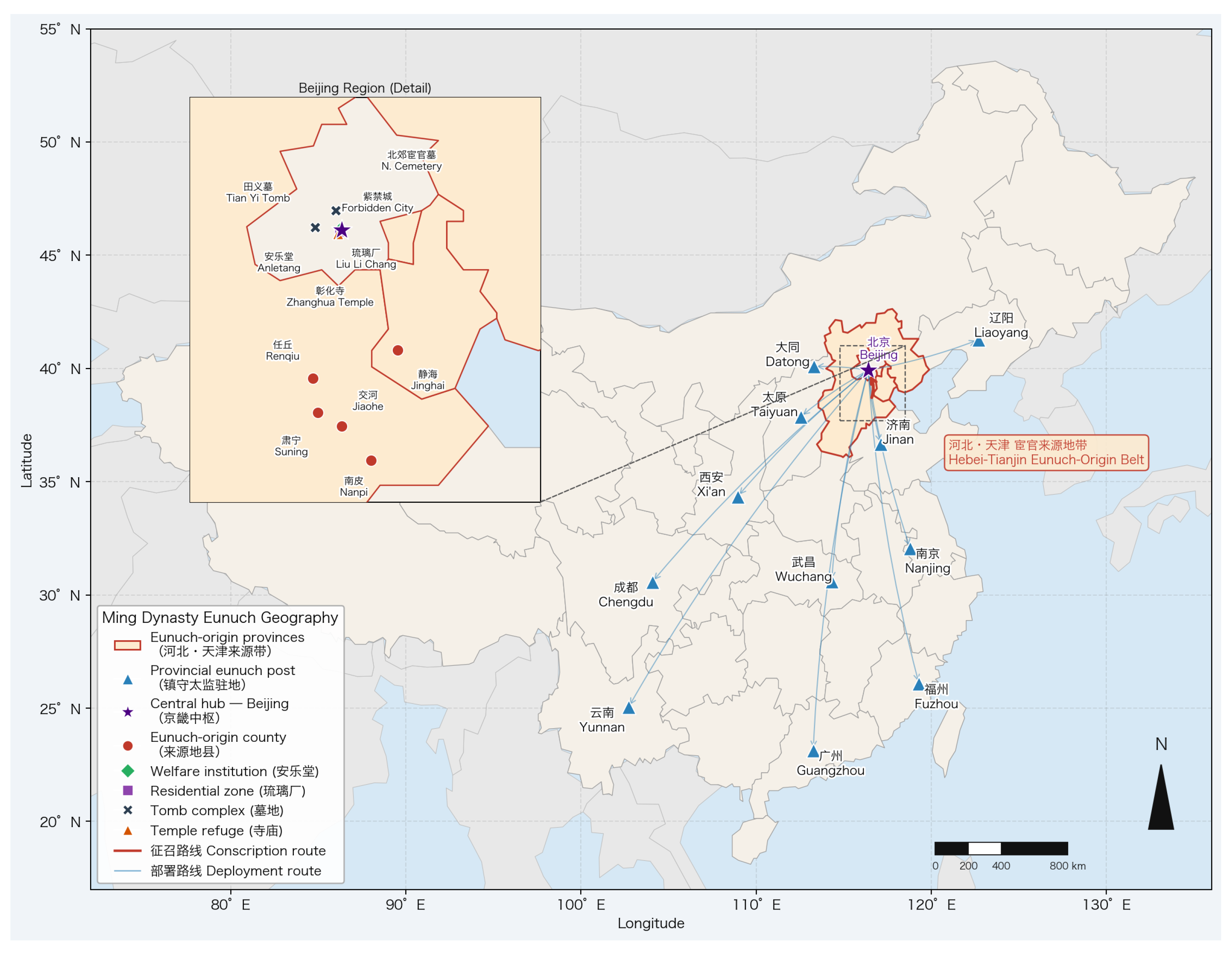
Figure 1.
Ming dynasty eunuch governance geography (1368–1644), showing three spatial layers: (i) eunuch-origin counties (red circles) concentrated in the Hebei–Tianjin belt, historically documented as the primary recruitment catchment area; (ii) central hub (purple star), the Beijing palace complex where eunuchs served; and (iii) provincial deployments (blue triangles), the zhenji taijian (镇守太监) posts in major provincial capitals. Arrows indicate recruitment flow (red) and deployment routes from Beijing (blue). Province boundaries from Natural Earth / Daizhige GeoJSON.
Figure 1.
Ming dynasty eunuch governance geography (1368–1644), showing three spatial layers: (i) eunuch-origin counties (red circles) concentrated in the Hebei–Tianjin belt, historically documented as the primary recruitment catchment area; (ii) central hub (purple star), the Beijing palace complex where eunuchs served; and (iii) provincial deployments (blue triangles), the zhenji taijian (镇守太监) posts in major provincial capitals. Arrows indicate recruitment flow (red) and deployment routes from Beijing (blue). Province boundaries from Natural Earth / Daizhige GeoJSON.
This three-layer structure reveals the spatial logic of eunuch biopolitics: the same system that concentrated eunuchs in the capital for direct imperial surveillance also dispersed them across the empire as proxy agents. Crucially, concentration in Beijing rendered eunuchs invisible to most of the rural population—a villager in Shandong might never encounter a eunuch in person, intensifying both mythmaking and stigma at a distance. The geographic comparison with contemporary LGBTQ+ organizing is taken up in Section 5.
Diachronic variation: stigma as political cycle.
A keyword frequency analysis across the full Veritable Records of all fourteen Ming reigns reveals that stigma-related vocabulary is not static but responds to political dynamics (Figure 2). The term 奸 (traitor/treachery) shows a sharp spike during the Xizong reign (熹宗, 1620–1627), precisely the period of Wei Zhongxian’s (魏忠贤) dominance — the most politically powerful eunuch in Ming history. Conversely, 忠 (loyalty) surges dramatically in the Chongzhen reign (崇祯, 1627–1644), the dynasty’s terminal crisis, when loyalty discourse became a dominant register of political contestation. Throughout these fluctuations, 妖 (demon/monster) remains low and stable across all reigns — consistent with our interpretation of 妖 as a deep-substrate vocabulary of ontological transgression, operating beneath the political cycles of loyalty and treachery that dominate the institutional surface. This diachronic finding strengthens the cross-corpus analysis in Section 5: the frequency stability of 妖 is not merely a statistical artifact of aggregation but a genuine pattern that holds across fourteen distinct political contexts within the Ming dynasty itself.
This historical survey identifies several recurring governance mechanisms: population-size control of a marginal group through institutional quotas; conditioning bodily modification on state authorization; using dress and ritual to mark liminal status materially; and relying on pseudo-family networks for welfare when formal kinship is unavailable. These mechanisms are worth naming precisely because they are mechanisms (recurring functional forms) rather than because they were directly transmitted to the present. The next section examines whether analogous mechanisms appear in the contemporary governance of transgender individuals, and where they diverge.
5. Contemporary Findings: Transgender Citizens in China
With the end of the imperial era and the advent of modern medicine, self-conscious gender transitioning began to appear in China by the mid-20th century. During the Maoist period (1949–1976), gender variance was suppressed under socialist discipline; starting from the Reform Era (post-1980s), transgender individuals became gradually visible. Over the past two decades, transgender (跨性别) identity has become a topic of public discussion. However, governance remains structured by mechanisms analytically legible through our Confucian biopolitics framework.
5.1. Contemporary Governance Context
Contemporary transgender governance in China operates through three mechanisms that are structurally legible through our Confucian biopolitics lens: conditional legal recognition, diagnostic classification, and familial pressure.
Legal-medical gatekeeping.
China’s Ministry of Health protocol for sex reassignment surgery requires that applicants be unmarried, over 18, have no criminal record, and—most strikingly—have obtained parental consent. These criteria operationalise xiao (family authority over the individual body) and encode virtue as a precondition for bodily recognition. The structural parallel with Qing eunuch governance is direct: the Daqing lüli required new eunuchs to be under sixteen and unmarried (年在十六岁以下并未娶有妻室者) [24] and criminalised self-castration without state authorisation [25]. Both regimes share the same functional logic: conditional institutional recognition contingent on compliance with kinship-moral norms, with the state retaining a monopoly over authorised pathways to bodily transformation. The CCMD’s continued listing of 性别认同障碍 (Gender Identity Disorder) as a mental illness—despite the WHO’s ICD-11 reclassification—illustrates how diagnostic classification itself functions as governance [23]. Legal gender-marker change requires proof of surgery; no non-surgical or third-gender pathway exists. The state acknowledges transgender individuals only conditionally and forces a binary outcome through medical intervention.
Familial dynamics.
The most durable site of stigma production is the family. A 2016 UNDP national survey found that over three-quarters of trans respondents had not disclosed their identity to most family members [34]. Those who did frequently faced expulsion, forced psychiatric consultation, or pressure into heterosexual marriage—responses structurally consistent with the concealment-or-expulsion pattern documented for eunuch families in the Qing context (Section 4). The narrative of “don’t let others know” reflects Fei’s differential mode: conditional private acceptance contingent on external invisibility. Emerging parent-support groups in major cities represent nascent but significant counter-trends.
Civil-society formation.
Organised transgender community emerged in the 2000s through NGOs (Beijing LGBT Center, TransYue Guangzhou) and online platforms (QQ, WeChat), providing peer support, legal aid, and healthcare information. These networks structurally parallel the eunuch sworn brotherhoods and temple communities that served as substitutes for natal kinship. Activism has taken cautious forms, aligning advocacy with official priorities (mental health, HIV prevention) rather than confrontation. The state’s simultaneous tolerance and censorship of LGBTQ+ civil society—sustaining organisations that serve public-health functions while suppressing those perceived as politically threatening—replicates the conditional-recognition logic identified in imperial governance: useful bodies are institutionally sustained; politically inconvenient ones are constrained.
5.2. Spatial and Textual Evidence: Continuities Across Time
NGO Geographic Clustering.
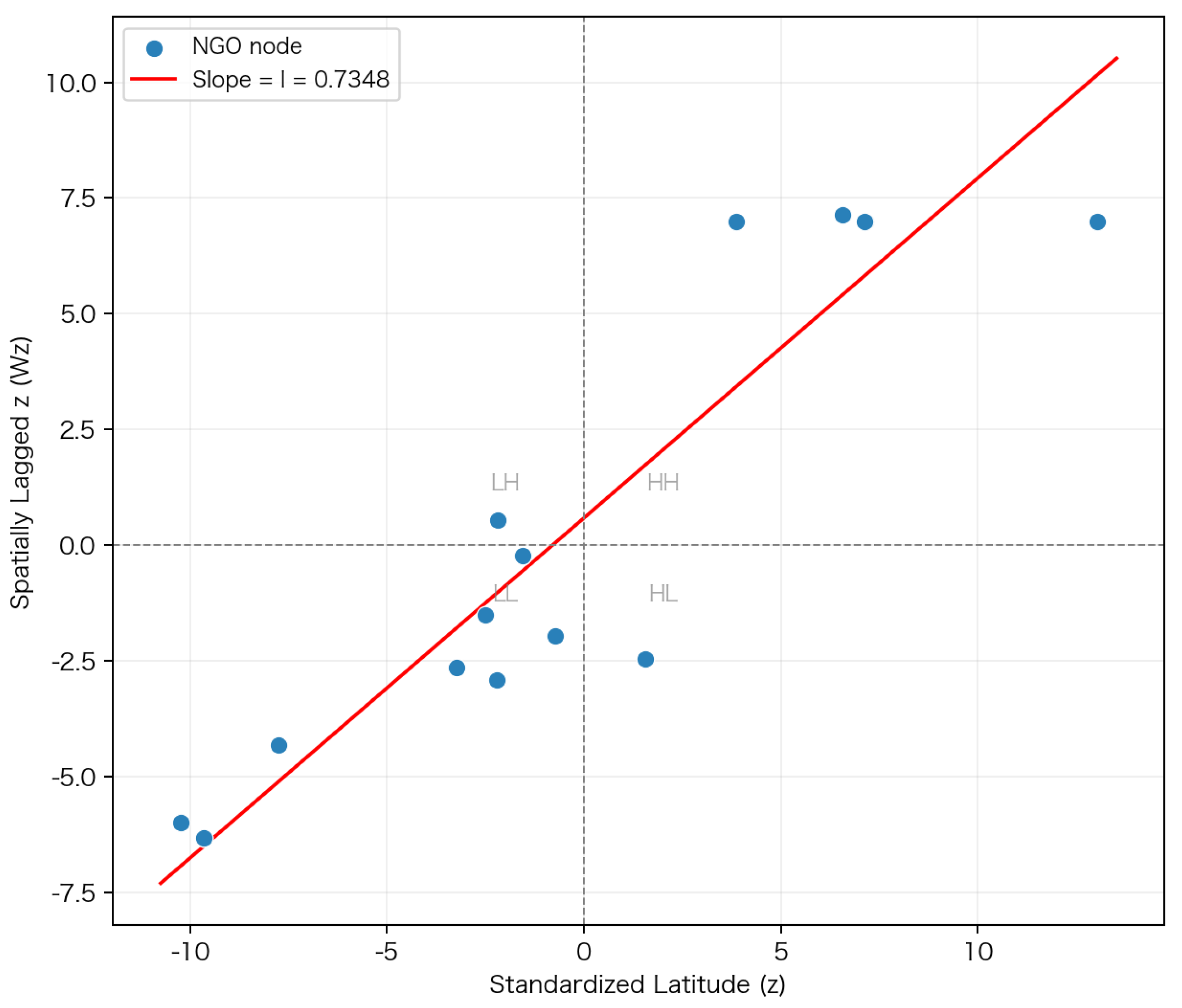
The LGBTQ+/transgender NGO dataset contains twenty organizations active across fourteen Chinese cities (c. 2008–2022), compiled from UNDP China reports [34], NGO registries, and activist documentation; eight of the twenty are transgender-specific. Figure 3 visualizes their distribution. Global Moran’s I ( nearest-neighbor weights) yields (, ), indicating strong positive spatial autocorrelation (Table 1): civil-society resources for sexual minorities concentrate in coastal, economically liberalized metropolitan areas (Beijing, Shanghai, Guangzhou, Chengdu) [6].
Figure 3.
Geographic distribution of LGBTQ+ and transgender-specific NGOs across China (c. 2008–2022, ). Red markers indicate transgender-focused organizations; blue markers indicate general LGBTQ+ organizations.
Figure 3.
Geographic distribution of LGBTQ+ and transgender-specific NGOs across China (c. 2008–2022, ). Red markers indicate transgender-focused organizations; blue markers indicate general LGBTQ+ organizations.
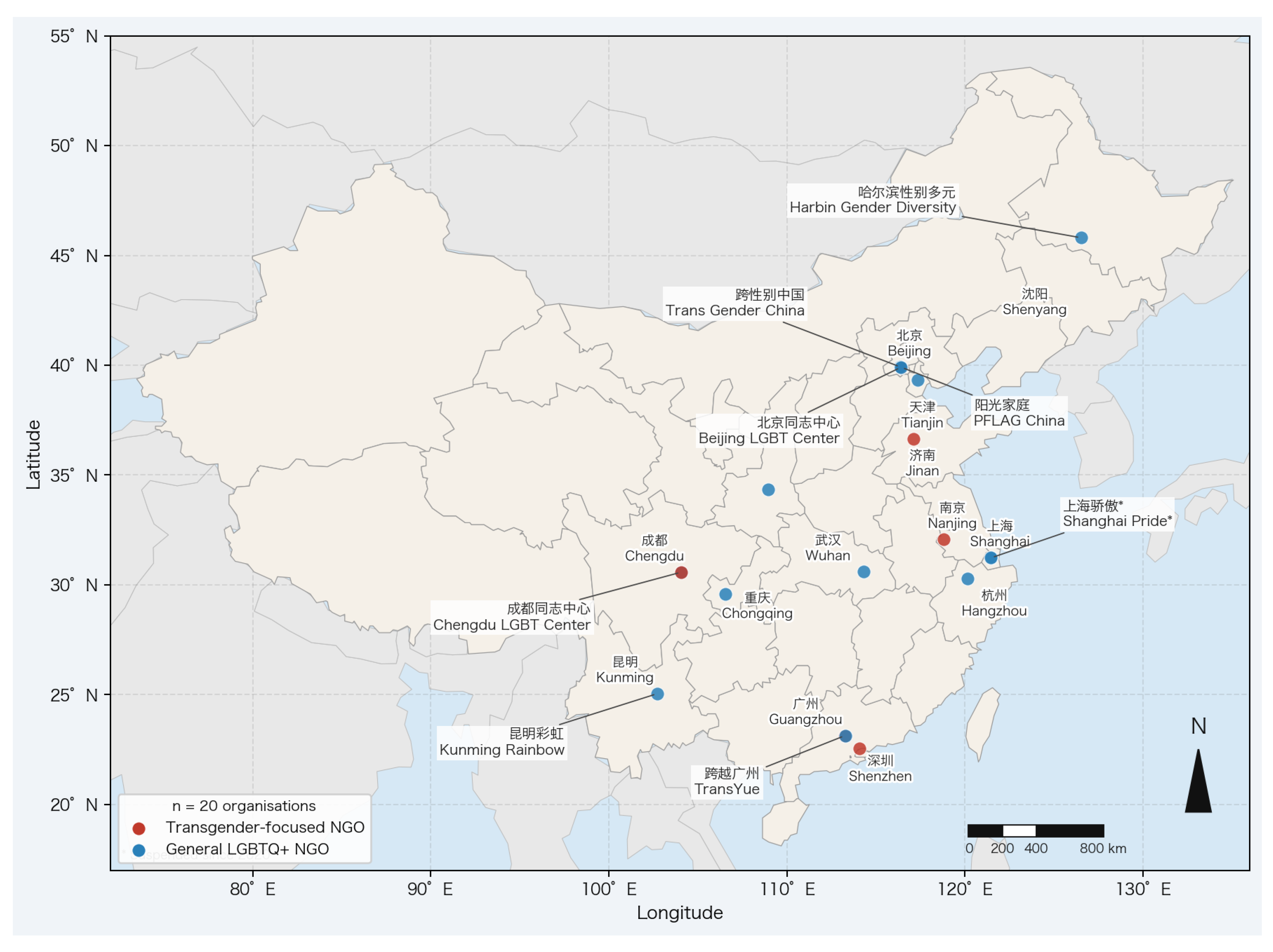
Figure 4.
Moran’s I scatter plot for the LGBTQ+ NGO dataset (). The slope of the regression line equals (, ). Points in the HH quadrant (upper right) indicate organisations whose standardised spatial attribute (latitude) is above average and whose spatially lagged values are also above average, indicating positive spatial autocorrelation among high-value neighbours.
Figure 4.
Moran’s I scatter plot for the LGBTQ+ NGO dataset (). The slope of the regression line equals (, ). Points in the HH quadrant (upper right) indicate organisations whose standardised spatial attribute (latitude) is above average and whose spatially lagged values are also above average, indicating positive spatial autocorrelation among high-value neighbours.
Spatial Overlay and Interpretation.
The overlay of Figure 1 and Figure 3 reveals a notable spatial convergence: Beijing functions as the dominant institutional hub in both periods. The imperial court and its surveillance apparatus drew eunuchs to the capital; today, the same concentration of state power, international NGO networks, and university communities draws transgender activists to Beijing. Secondary cities present telling contrasts: Nanjing, which briefly hosted a Ming satellite court and thus maintained a eunuch establishment, now hosts one of the few provincial transgender healthcare clinics. Chengdu, historically peripheral to imperial eunuch geography, has emerged as a prominent LGBTQ+-tolerant city, suggesting that contemporary clustering also follows cultural-economic logics partially independent of the imperial template.
We do not claim that contemporary NGO clustering “replicates” or “mirrors” the imperial spatial pattern in any causal sense; the proximate drivers differ entirely (state dispatch vs. urban civil-society openness). The analytically relevant parallel is in social effect: in both periods, concentration of gender-variant institutions in a small number of urban nodes produces a shared outcome—the effective invisibility of non-normative individuals to rural populations. For Qing-era eunuchs, this invisibility intensified mythmaking and stigma in the provinces; today, the absence of transgender support infrastructure in non-metropolitan areas produces an analogous “social death” at the periphery, regardless of the mechanism that produced the concentration.
Methodological note on spatial confounding.
A reviewer attentive to causal identification would rightly observe that the concentration of LGBTQ+ civil society in coastal metropolitan areas is overdetermined: urban economic development, the relative openness of Tier-1 cities to associational life, and the density of international funding networks all independently predict this clustering pattern. We do not claim that historical governance geography causes contemporary NGO distribution; establishing such a claim would require evidence of direct institutional transmission across the 1912 dynastic rupture and the Maoist interlude, which the available record does not support. Our claim is narrower and structural. Whatever the proximate causes of NGO concentration, the functional consequence — gender-variant individuals in non-metropolitan areas systematically lack access to support infrastructure, rendering them invisible to civil society — is structurally homologous to the spatial isolation mechanism documented in Ming eunuch governance. The relevant comparison is between outcomes (spatial invisibility and resource deprivation at the periphery) rather than between causal chains. This is consistent with our broader analytical strategy throughout: we identify structural recurrences in governance outcomes across historical discontinuities, not causal transmission. We acknowledge that with organisations concentrated in coastal cities, a significant Moran’s I is a near-certain statistical outcome given that any spatially non-random distribution in China’s geography will cluster in the economically developed east. A proper counterfactual would require computing spatial autocorrelation for a comparable civil-society sector (e.g., environmental NGOs or legal-aid organisations) and testing whether LGBTQ+ clustering exceeds this baseline; we do not have such data and therefore limit our spatial claims to the descriptive level. The spatial analysis constitutes one strand of triangulated evidence, and the weakest; the argument for shared governance logics rests primarily on computational text analysis, which is entirely independent of urban development patterns.
Temporal expansion of LGBTQ+ civil society.
The NGO founding dates add a temporal dimension to the spatial analysis. Figure 5 plots the cumulative growth of LGBTQ+ organisations from 2006 to 2018. The earliest organisations were general-purpose groups in Beijing (Beijing LGBT Center, 2006; Aibai Culture, 2006), followed by Shanghai in 2009. Transgender-specific organisations emerged later, beginning with Transgender China in Beijing (2012) and TransYue in Guangzhou (2014). The temporal pattern is consistent with center-to-periphery diffusion: civil-society infrastructure emerged first in the national capital, then spread to coastal Tier-1 cities, with inland and northern cities (Chongqing, Harbin, Jinan) not establishing organisations until 2013–2018. This trajectory structurally echoes the Ming deployment model documented in Figure 1, where the central hub preceded provincial institutionalisation — though the contemporary causal mechanism (urban openness, funding networks) differs from the imperial one (state dispatch).
Topic Model Results.
Table 2 presents the five-topic LDA solutions [32] for the Ming Shilu eunuch corpus ( segments; 2.19M characters) and the Wikipedia contemporary corpus ( paragraphs; 246K characters). Model perplexity: Ming = 663.8; Wikipedia = 637.2 (lower is better). The five Ming Shilu topics are structured entirely around institutional administration: Court Ceremony (内官, 皇太子, 礼毕), Censorate Supervision (太监, 御史, 给事中), Tombs and Records (陵寝, 实录), Inner Palace Service (内侍, 导引), and Provincial Military Eunuchs (总兵, 镇守). This is analytically significant: the dominant discursive frame in which eunuchs appear in Ming official chronicles is not moral condemnation but institutional normalization — precisely the “conditional recognition” pattern that our theoretical framework identifies as the core governance mechanism.
The contemporary Wikipedia corpus reveals a more striking finding. Two of the five identified topics (Eunuch History: 郑和, 宦官, 阉割; and Legal Rights: 宦官, 同性, 法律) contain 宦官 (eunuch) as a top-weight term alongside the contemporary transgender and rights vocabulary, suggesting that the structural analogy this paper analyzes is already present in the way contemporary Chinese encyclopedic texts organize the domain. The remaining Wikipedia topics (Healthcare, Gender Identity, Gender Expression) foreground identity, medical access, and rights—vocabulary absent from the Ming corpus, consistent with the “diagnostic translation” argument. Figure 6 visualizes the full top-token distributions.
Chi-Square Cross-Corpus Keyword Analysis.
The overall distribution of ten morally-charged keywords differs significantly between the two corpora (, ; Ming Shilu characters; Wikipedia characters), confirming genuinely different discursive universes. Targeted per-keyword analysis (Table 3) reveals a theoretically critical nuance.
The term 妖 (yao, “demon/monster”) shows no significant inter-corpus difference (, , n.s.), appearing at statistically comparable rates across six centuries (Ming: 0.072/1k; Wikipedia: 0.065/1k). The term 欺骗 (deception) similarly shows no significant difference (, n.s.; Ming: 0.005/1k, Wikipedia: 0.008/1k), though the very low absolute counts for 欺骗 (∼11 in Ming, ∼2 in Wikipedia) mean that statistical power is severely limited; this result should be treated as an exploratory observation rather than confirmatory evidence of resonance.
Notably, 传宗接代 (lineage continuation) is significantly more frequent in the contemporary Wikipedia corpus (), appearing exclusively in discussions of family pressure on transgender individuals. The four-character phrase 传宗接代 does not appear in the Ming Shilu; instead, the classical corpus expressed lineage anxiety through archaic kinship vocabulary (宗族, 子嗣). This pattern is better described as vocabulary emergence under structural persistence: the underlying anxiety about lineage continuity is analytically consistent across both periods, but its linguistic vehicle has modernised from classical kinship terms to the contemporary vernacular phrase—which now appears specifically as an explanatory frame for family pressure on transgender individuals.
Equivalence testing and baseline controls.
Because non-significant chi-square results do not by themselves establish rate equality, we supplement the NHST analysis with three additional procedures.
First, TOST equivalence testing with a pre-specified equivalence bound of /1k characters. This bound was selected as approximately one standard error of the per-1k-character frequency for a word occurring at ∼0.07/1k in a corpus of ∼250K characters; that is, a difference smaller than the measurement precision inherent in the smaller corpus. TOST yields significant equivalence for 妖 (TOST ) and 自宫/自阉 (TOST ). For 欺骗 (eunuch corpus: 12 occurrences, 0.005/1k; Wikipedia: 2 occurrences, 0.008/1k), TOST also indicates formal equivalence, but with absolute counts this low (), statistical power is severely limited and we treat this result as exploratory.
Second, BIC-approximated Bayes factors comparing a shared-rate model against a separate-rate model. Table 4 consolidates these results.
Third, as a baseline control to address the concern that keyword frequencies may reflect topic type rather than temporal discourse, we computed rates in a non-eunuch Ming Shilu corpus (16.5M characters, from which all eunuch-keyword passages were removed). The rate of 妖 in this baseline is 0.060/1k—virtually identical to the eunuch-filtered corpus (0.064/1k) and the contemporary Wikipedia corpus (0.070/1k). This result has a double-edged implication that we address explicitly. On one hand, it indicates that 妖 is not eunuch-discourse-specific but a general feature of formal Chinese writing, consistent with our interpretation of it as a deep-substrate vocabulary item that persists across genres and topics. On the other hand, the same finding means that the appearance of 妖 in the Wikipedia transgender corpus could reflect general Chinese formal prose rather than transgender-specific stigma. We therefore do not rest the “stigma” interpretation on frequency alone; it is the collocate analysis (Figure 8) that provides the evidence for stigma-specific deployment: in the contemporary corpus, 妖 co-occurs with 人 (as in the slur 人妖) and 歧 (discrimination), placing it unambiguously in an identity-stigma register. The frequency equivalence establishes that this vocabulary remains available; the collocate shift establishes that its function has migrated. In contrast, 忠 (loyalty) and 奸 (treachery) show substantially higher rates in the eunuch corpus than in the baseline (0.927 vs. 0.706/1k and 0.431 vs. 0.395/1k respectively), confirming that these are eunuch-governance-specific terms whose decline in the contemporary corpus reflects genuine diagnostic translation. Figure 7 visualizes the full frequency and shift patterns.
Representative texts reinforce the statistical finding. Under the Wikipedia “family pressure” context and in our supplementary Zhihu corpus, representative posts read: “My mother said she would rather die than have a son in a dress. I feel despair.” This mirrors the register of a Qing official who wrote that “eunuchs cut themselves and abandon their lineage, an unfilial act that heaven and earth cannot tolerate.” Both invoke familial catastrophe in nearly identical rhetorical terms, suggesting that analogous rhetorical structures for expressing familial catastrophe operate across both discursive contexts.
Collocate profiles: from sorcery to slur.
To move beyond frequency equivalence, we examined the co-occurrence context of the two “resonant” terms. For 妖, a ±10-character window analysis reveals sharply divergent semantic environments (Figure 8). In the Ming Shilu, the most frequent collocates are 巫 (sorcery), 人 (person), 术 (art/technique), and 事 (affair) — placing 妖 in a discourse of heterodox practice (妖术, 妖人), where it marks political-cosmological transgression. In the contemporary Wikipedia corpus, the dominant collocates shift to 人 (person, as in 人妖), 歧 (discrimination), and 称 (called/termed) — placing 妖 in a discourse of identity stigma, where it functions as a derogatory label for transgender individuals. The statistical frequency has not changed; the discursive function has migrated from cosmological to identitarian registers. This is precisely the kind of “persistence with transformation” that our Confucian biopolitics framework is designed to track: the moral vocabulary of ontological transgression remains available, but the institutional context in which it operates has shifted from imperial sorcery prosecution to contemporary gender stigma.
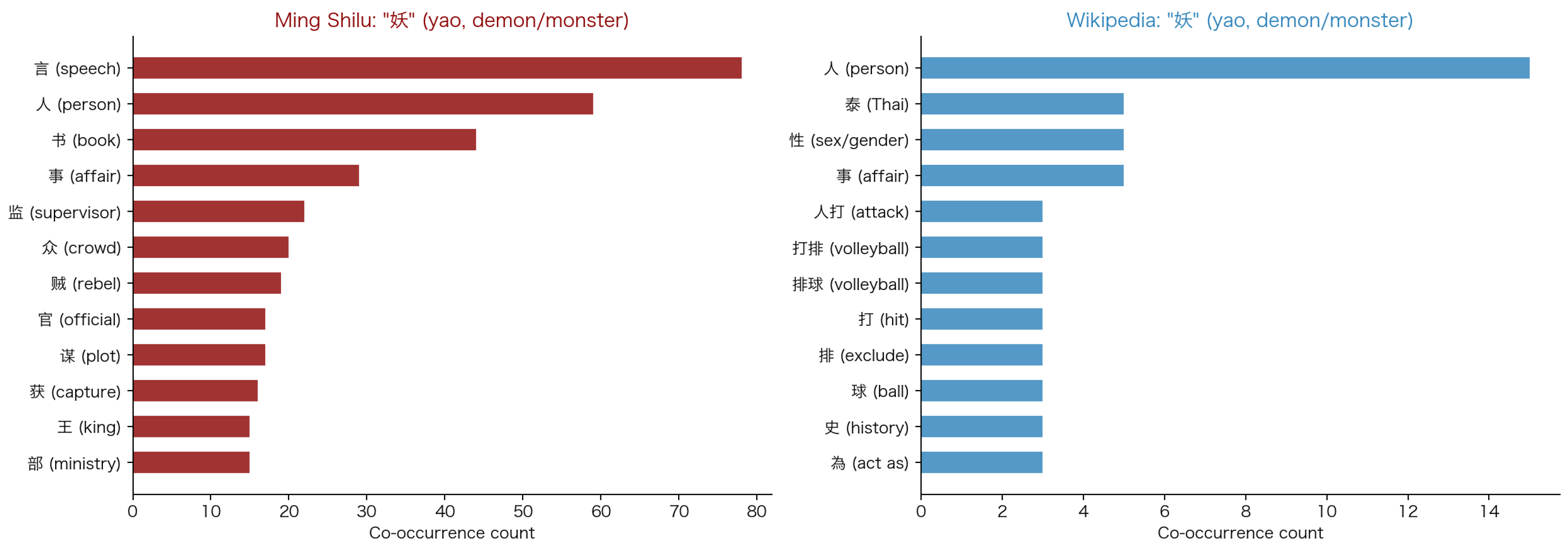
Figure 8.
Collocate profiles for 妖 (demon/monster) in the Ming Shilu eunuch corpus (left, red) and Chinese Wikipedia transgender/LGBT corpus (right, blue). Top collocates within ±10-character windows, ranked by co-occurrence count. The shift from sorcery-related collocates (巫, 术) to identity-stigma collocates (人, 歧, 称) illustrates semantic migration within a frequency-stable vocabulary item.
Figure 8.
Collocate profiles for 妖 (demon/monster) in the Ming Shilu eunuch corpus (left, red) and Chinese Wikipedia transgender/LGBT corpus (right, blue). Top collocates within ±10-character windows, ranked by co-occurrence count. The shift from sorcery-related collocates (巫, 术) to identity-stigma collocates (人, 歧, 称) illustrates semantic migration within a frequency-stable vocabulary item.
Extended keyword analysis.
To guard against the charge of cherry-picking the original ten keywords, we ran a supplementary chi-square analysis on five additional terms selected for theoretical relevance. Two findings merit emphasis. First, 自宫/自阉 (self-castration) shows no significant inter-corpus difference (, n.s.; Ming: 0.019/1k; Wikipedia: 0.016/1k), constituting a third instance of discursive resonance alongside 妖 and 欺骗: the vocabulary of self-directed bodily transformation appears at statistically indistinguishable rates in formal knowledge production about eunuchs and transgender individuals across six centuries. Second, 变态 (pervert/abnormal: , absent from Ming, 0.069/1k in Wikipedia) and 手术 (surgery: , absent from Ming, 1.677/1k in Wikipedia) confirm the diagnostic-translation pattern: pathologising and medicalising vocabulary is exclusively contemporary. The extended analysis thus replicates the three-way typology (persistence, translation, migration) identified in the core keyword set, strengthening confidence that the typology captures a genuine discursive structure rather than an artifact of keyword selection.
In the next section, we broaden our view with comparative cases to highlight further what is uniquely Chinese and what is part of a broader human experience regarding gender-variant individuals in governance systems.
6. Comparative Perspectives: Ottoman and Japanese Cases
Two comparative cases help isolate what is distinctively Confucian in the Chinese governance of gender variance from more general patterns. These cases are selected using a Most Similar Systems Design (MSSD) logic: both the Ottoman Empire and Tokugawa Japan maintained court cultures with institutionalised gender-variant roles, but under different moral-philosophical frameworks (Islamic law and aesthetic performativity, respectively). If our lens merely labels generic court-eunuch governance, both cases should exhibit the same filial-kinship stigma; they do not, and the variation tracks the kinship framework rather than the institutional role. We acknowledge that this comparative analysis relies on secondary literature and does not constitute independent archival research; a fuller comparative treatment, including East Asian cases such as Joseon Korea and imperial Vietnam, would strengthen the design but exceeds the scope of the present study.
Ottoman eunuchs occupied a structurally similar position—indispensable to dynastic governance, yet marginalised—but under a fundamentally different ideological framework. Ottoman court eunuchs were overwhelmingly enslaved Africans [12,33], which meant they carried no filial obligations from the outset; the stigma of being unfilial was irrelevant to their identity. Accordingly, the moral literature condemning eunuchs as unfilial that saturates Chinese sources has no Ottoman equivalent: Ottoman chronicles treat the rise and fall of eunuchs rather than political manoeuvres, not existential moral violations. The contrast is sharpest in posthumous memory: Beshir Agha, the influential 18th-century Chief Harem Eunuch, was honored after death as a patron of the arts; Wei Zhongxian, his approximate contemporary in China, had his corpse mutilated as a form of vengeance for moral transgression. We note that the Ottoman case is not entirely free of moral evaluation: Islamic jurisprudence (fiqh) prohibits castration in principle, and the Ottoman court circumvented this prohibition by purchasing already-castrated enslaved people rather than performing castration itself—a distinct form of moral stigma management operating through legal fiction rather than filial discourse. The comparison thus isolates the kinship-filial mechanism as the specific source of the distinctively moralised stigma visible in China, while acknowledging that other moral frameworks (Islamic law) generated their own, differently structured, evaluations of the same institutional practice.
Japan presents a different contrast: a society without court eunuchs but with institutionalised spaces for gender performance. The onnagata tradition in Kabuki theatre (17th century onwards) created a formally recognised professional role for men who embodied femininity, at times considered more feminine than women [13]. Unlike Chinese male dan actors, onnagata maintained feminine personas off-stage and were aesthetically celebrated rather than morally condemned. This suggests that context-bounded gender performance could be socially accommodated even within Confucian-adjacent societies, provided it served a defined institutional purpose. The contrast with China illuminates why Chinese governance of gender variance has been so consistently moralistic: Confucian ideology prioritises sincerity (诚) and role-consistency as civic virtues. A man who performs femininity with institutional sanction (like onnagata) is one thing; a man who does so outside sanctioned frameworks challenges the very legibility of the moral order.
Together, these cases reinforce the core claim: the distinctive feature of Chinese governance of gender-variant bodies is its operation in the kinship-moral register. Where Ottoman governance processed gender variance through a racial-hierarchical frame and Japanese culture channelled it through aesthetic institutionalisation, the Chinese approach consistently returned to the question of filial obligation, lineage integrity, and moral authenticity. That legacy shapes the contemporary situation of transgender citizens in China in ways that cannot be explained by reference to global biomedical norms alone.
We will now proceed to discuss the theoretical implications of our findings and move towards policy recommendations, drawing on both the Chinese historical experience and lessons from elsewhere.
7. Discussion and Policy Implications
Our empirical and historical analysis converges on a central finding: the governance of non-normative gendered bodies in China has operated through recurring mechanisms (conditional recognition, familial authority, and moral-linguistic classification) that are visible in both imperial and contemporary contexts. We emphasize at the outset that this convergence does not constitute evidence of direct historical causation. Rather, it suggests that certain governance logics, embedded in Confucian moral-kinship structures, are sufficiently robust to be activated across distinct institutional contexts. This is precisely what our analytical lens of Confucian biopolitics was designed to identify.
7.1. Confucian Biopolitics as Analytical Contribution
We proposed Confucian biopolitics as an analytical lens to reorient biopolitical theory toward governance that operates through ritual propriety and filial obligation rather than solely through juridical or biomedical systems. In both imperial and contemporary contexts, governance of non-normative bodies is structured less by formal prohibition than by the management of moral-kinship legibility: the relevant question is not “is this body legally permitted?” but “does this body perform its familial and moral obligations correctly?” The conditional recognition mechanism—institutional legibility contingent on compliance with kinship-moral norms—is documented in both cases (Section 4 and Section 5).
One theoretical implication is that biopolitics need not be purely secular or modern. Western-centric biopolitical theory assumes a clean break from pre-modern moral orders; China’s case complicates this by showing that moral-kinship governance logics remain analytically present across the 1912 dynastic rupture, the Maoist interlude, and the post-1978 reform era. We are not claiming institutional inheritance; the structural conditions enabling such logics (kinship-centred social organisation, a state that governs through moral education) have persisted in ways that make the activation of similar mechanisms possible across institutional discontinuities [9,10]. Butler’s performativity framework, enriched by our context, highlights that the Chinese state—historically through rituals, now through medical/legal procedures—performs gender categories into institutional existence; changing governance therefore requires institutional performative shifts, not merely legal reform. Fei’s differential mode underscores that stigma change must penetrate the family unit: legal improvements alone are insufficient if families continue to treat gender variance as shameful.
The computational analysis grounds these theoretical claims empirically through a three-part typology (detailed in Section 5): diagnostic translation (the shift from Confucian moral to biomedical vocabulary), discursive resonance (the persistence of ontological stigma terms such as 妖 at stable rates across six centuries), and vocabulary emergence under structural persistence (the contemporary articulation of lineage anxiety through 传宗接代). Together, these findings support the broader claim that stigma operates through a layered structure: a changing surface vocabulary over a more durable substrate of ontological and kinship-based classification — not institutional transmission, but structural reproduction under conditions of historical change.
One additional implication deserves emphasis: history shows that rigid enforcement of norms does not eliminate the phenomenon it targets — it drives it underground. The Qing cap on eunuch numbers did not stop illegal castrations; suppressing transgender expression will not stop gender nonconformity. The appropriate historical lesson is not stricter control but better accommodation: the Anletang welfare shelter and eunuch temple networks provided livelihood and community to those outside the normative kinship system, a structural parallel to the welfare infrastructure needed today.
7.2. Policy Implications
We frame policy implications not as a direct transfer from imperial precedent but as a historically grounded identification of the structural sites where intervention is most likely to be effective.
- 1.
- Dismantling Conditional Gatekeeping. The gender marker change process should remove surgery as a precondition and convert parental consent from a veto into a structured engagement process. The Chinese medical community should adopt WHO ICD-11 terminology (性别不一致, gender incongruence); our computational analysis suggests that linguistic classification functions as a governance mechanism. Anti-discrimination protections based on gender identity should be enacted in employment, housing, and healthcare.
- 2.
- Welfare Infrastructure. The historical Anletang and eunuch temple networks represent ad hoc responses to the welfare needs of a kinship-excluded population. The structural parallel is direct: transgender individuals who face family rejection lack the kin-based safety net on which Chinese social provision depends. Community centres, healthcare funds, and mutual aid associations—resourced through mixed public-civil society funding—address this gap.
- 3.
- Engaging Kinship Structures. The family is the most durable site of stigma production; interventions that bypass it are less effective than those that engage it. Structured family counselling should be incorporated into transition pathways as education rather than gatekeeping. State media can leverage the recognition that gender variance has deep roots in Chinese history to provide cultural permission structures for acceptance.
8. Conclusion
This study introduced Confucian biopolitics as an analytical lens for identifying kinship-moral governance mechanisms that operate on non-normative bodies across institutional discontinuities in Chinese history. Through triangulated evidence—archival analysis of Qing legal sources, GIS spatial analysis of institutional distributions, and corpus-scale computational text analysis of Ming and contemporary Chinese texts—we identified three empirically grounded patterns: diagnostic translation (the shift from moral to biomedical governance vocabulary), discursive resonance (the persistence of ontological stigma terms such as 妖 at statistically indistinguishable rates across six centuries), and vocabulary emergence under structural persistence (the contemporary articulation of lineage anxiety through 传宗接代). The Ottoman and Japanese comparative cases indicate that these patterns are specific to the Confucian kinship framework rather than generic to court-eunuch institutions. The LDA finding that contemporary Chinese Wikipedia spontaneously co-locates eunuch history with transgender legal rights is consistent with the interpretation that the structural analogy this paper analyses is already present in how Chinese knowledge production organises the domain.
Several limitations warrant acknowledgement. The spatial analysis is subject to an urban-development confound: NGO clustering in Tier-1 cities is overdetermined by economic factors independent of historical governance geography; we addressed this in Section 5 by arguing that the relevant comparison concerns spatial outcomes (periphery invisibility) rather than causal chains. The paper focuses disproportionately on trans women (MTF) because the eunuch analogy maps more directly onto trans feminine experience; future work should examine whether historical parallels exist for AFAB individuals living as men. The extension to intersex individuals and the effects of rising nationalism on gender governance remain open questions.
The core contribution is methodological and theoretical: a framework for analysing how governance logics can be structurally reproduced across historical ruptures without requiring evidence of direct institutional transmission. The policy implications — dismantling conditional gatekeeping, building welfare infrastructure for kinship-excluded populations, and engaging rather than bypassing family structures — follow directly from what the historical record identifies as the most durable sites of governance. All corpora used were publicly licensed or drawn from anonymised research datasets; NGO data were aggregated to the city level to protect organisations operating in a sensitive political environment.
Author Contributions
Conceptualization, T.X. and H.G.; methodology, T.X.; software, T.X.; formal analysis, T.X.; investigation, T.X. and H.G.; data curation, T.X.; writing—original draft preparation, T.X. and H.G.; writing—review and editing, T.X. and H.G.; visualization, T.X. All authors have read and agreed to the published version of the manuscript.
Funding
This research received no external funding.
Institutional Review Board Statement
Not applicable.
Informed Consent Statement
Not applicable.
Data Availability Statement
The Ming Shilu corpus is available via the Daizhige open-access repository. Chinese Wikipedia articles are available under CC BY-SA 4.0. The LGBTQ+ NGO dataset was compiled from publicly available UNDP reports and NGO registries; geographic data were aggregated to the city level to protect organisations.
Conflicts of Interest
The authors declare no conflicts of interest.
References
- Dale, M.S. Inside the world of the eunuch: a social history of the Emperor’s servants in Qing China; Hong Kong University Press, 2018.
- Chiang, H. After eunuchs: Science, medicine, and the transformation of sex in modern China; Columbia University Press, 2018.
- Rawski, E.S. The last emperors: A social history of Qing imperial institutions; Univ of California Press, 1998.
- Kutcher, N.A. Eunuch and emperor in the great age of Qing rule; Univ of California Press, 2018.
- Fappani, V. The Protection of Transgender Workers in China: Between Law and Society 2024.
- Engebretsen, E.L. Queer women in urban China: An ethnography; Routledge, 2013.
- Chiang, H. Epistemic modernity and the emergence of homosexuality in China. Gender & History 2010, 22, 629–657. [CrossRef]
- Foucault, M. The History of Sexuality, Volume 1: An Introduction; Pantheon Books: New York, 1978. Translated by Robert Hurley.
- Zhang, L.; Ong, A. Privatizing China: socialism from afar; Cornell University Press, 2008.
- Rofel, L. Desiring China: Experiments in neoliberalism, sexuality, and public culture; Duke University Press, 2007.
- Greenhalgh, S. Cultivating global citizens: Population in the rise of China; Harvard University Press, 2010.
- Hathaway, J.; Agha, B. Chief Eunuch of the Ottoman imperial harem; Oneworld, Oxford, 2005.
- Pflugfelder, G.M. Cartographies of desire: Male-male sexuality in Japanese discourse, 1600-1950; Univ of California Press, 1999.
- Ames, R.T. Confucian role ethics: A vocabulary; The Chinese University of Hong Kong Press, 2011.
- Slingerland, E.; et al. Analects: With selections from traditional commentaries; Hackett Publishing, 2003.
- Farquhar, J. Knowing practice: The clinical encounter of Chinese medicine; Routledge, 2018.
- Huang, P.C. Civil justice in China: representation and practice in the Qing; Stanford University Press, 1996.
- Foucault, M. Security, Territory, Population: Lectures at the Collège de France, 1977–1978; Palgrave Macmillan: New York, 2007.
- Fei, X. From the Soil: The Foundations of Chinese Society; University of California Press, 1992. Original work published 1947.
- Sommer, M.H. The Fox Spirit, the Stone Maiden, and Other Transgender Histories from Late Imperial China; Columbia University Press, 2024.
- Butler, J. Performative acts and gender constitution: An essay in phenomenology and feminist theory. In The performance studies reader; Routledge, 2025; pp. 186–196.
- Spade, D. Normal Life: Administrative Violence, Critical Trans Politics, and the Limits of Law, revised and expanded ed.; Duke University Press: Durham, NC, 2015.
- Conrad, P. The medicalization of society: On the transformation of human conditions into treatable disorders; Vol. 14, Johns Hopkins University Press Baltimore, 2007.
- Qing Board of Punishments. 大清律例(Daqing lüli / Great Qing Code); 1740. Yongzheng-era codification. Digitized text accessed via Daizhige repository (https://github.com/garychowcmu/daizhigev20), 2026.
- Qing Imperial Household. 钦定大清会典则例 (Qinding Daqing Huidian Zeli / Imperially Commissioned Precedents of the Collected Statutes); 1764. Qianlong-era edition. Digitized text accessed via Daizhige repository, 2026.
- Yunbu.; he de, S., Eds. 国朝宫史 (Guochao Gongshi / History of the Qing Imperial Palace); 1769. Compiled by order of the Qianlong Emperor. Digitized text accessed via Daizhige repository, 2026.
- Lü, B. 明宫史 (Ming Gongshi / History of the Ming Imperial Palace); 1644. Compiled in the late Ming. Digitized text accessed via Daizhige repository, 2026.
- Chow, G.; contributors. Daizhige: A Repository of Classical Chinese Historical Texts. https://github.com/garychowcmu/daizhigev20, 2024. Accessed March 2026. Ming Shilu (明实录) files used for corpus construction.
- Sun, J. jieba: Chinese Text Segmentation. https://github.com/fxsjy/jieba, 2023. Version 0.42.
- Wikimedia Foundation. Chinese Wikipedia (ZhWiki). https://zh.wikipedia.org, 2024. Articles on transgender, LGBT rights, gender identity, and related topics retrieved via the MediaWiki API. Accessed March 2026.
- Wang, R. Zhihu-KOL: A Chinese Knowledge Opinion Leader Dataset. https://huggingface.co/datasets/wangrui6/Zhihu-KOL, 2023. HuggingFace dataset. Accessed March 2026. Used as supplementary robustness corpus after keyword filtering for transgender-related content.
- Pedregosa, F.; Varoquaux, G.; Gramfort, A.; Michel, V.; Thirion, B.; Grisel, O.; Blondel, M.; Prettenhofer, P.; Weiss, R.; Dubourg, V.; et al. Scikit-learn: Machine Learning in Python. Journal of Machine Learning Research 2011, 12, 2825–2830.
- Peirce, L.P. The Imperial Harem: Women and Sovereignty in the Ottoman Empire; Oxford University Press: New York, 1993.
- United Nations Development Programme. Being LGBTI in China: A National Survey on Social Attitudes towards Sexual Orientation, Gender Identity and Gender Expression, 2016. Accessed March 2024.
Figure 2.
Per-1,000-character frequency of four key terms across the complete Veritable Records of all fourteen Ming reigns (1368–1644), in chronological order. Note the 奸 (treachery) spike under Xizong (Wei Zhongxian era) and the 忠 (loyalty) surge under Chongzhen (dynastic collapse). 妖 (demon) remains low and stable throughout, consistent with its interpretation as a deep-substrate rather than politically contingent vocabulary.
Figure 2.
Per-1,000-character frequency of four key terms across the complete Veritable Records of all fourteen Ming reigns (1368–1644), in chronological order. Note the 奸 (treachery) spike under Xizong (Wei Zhongxian era) and the 忠 (loyalty) surge under Chongzhen (dynastic collapse). 妖 (demon) remains low and stable throughout, consistent with its interpretation as a deep-substrate rather than politically contingent vocabulary.
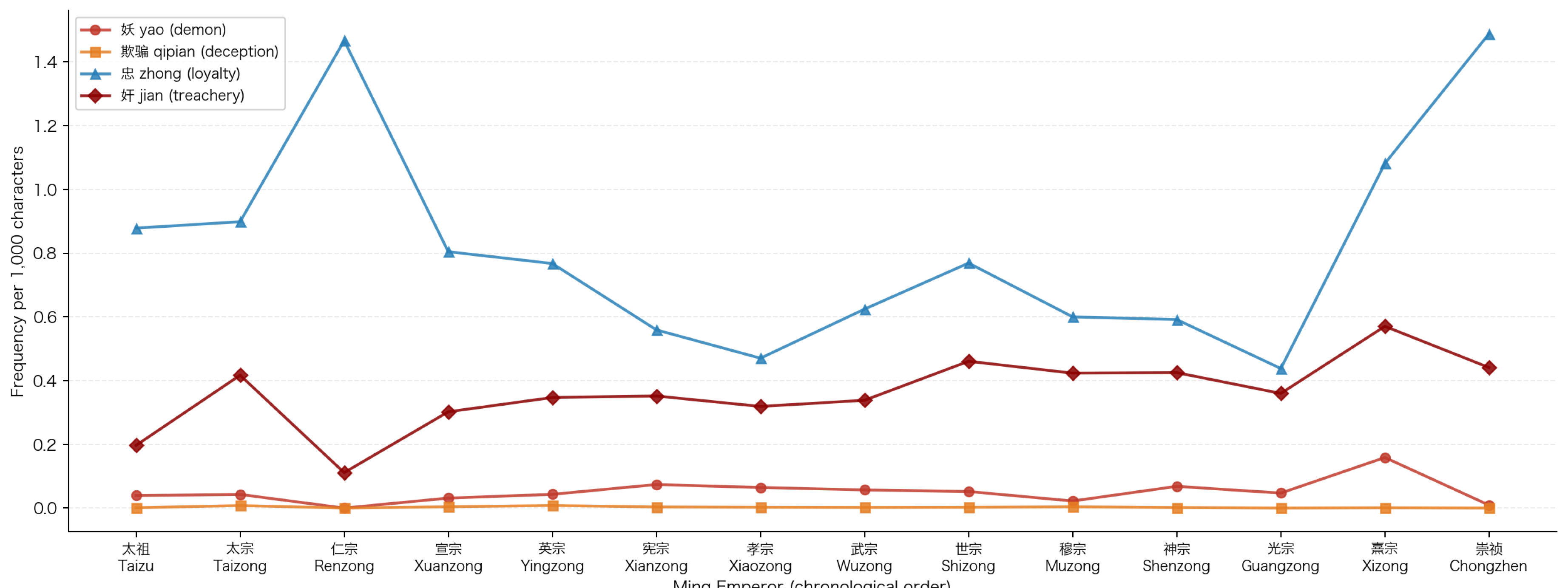
Figure 5.
Cumulative founding of LGBTQ+ civil-society organisations in China, 2006–2018 (). Blue step-line: general LGBTQ+ organisations; red step-line: transgender-focused organisations; dashed line: combined total. All twenty organisations are labelled. Transgender-specific groups appeared in 2012, approximately six years after the first general LGBTQ+ groups.
Figure 5.
Cumulative founding of LGBTQ+ civil-society organisations in China, 2006–2018 (). Blue step-line: general LGBTQ+ organisations; red step-line: transgender-focused organisations; dashed line: combined total. All twenty organisations are labelled. Transgender-specific groups appeared in 2012, approximately six years after the first general LGBTQ+ groups.
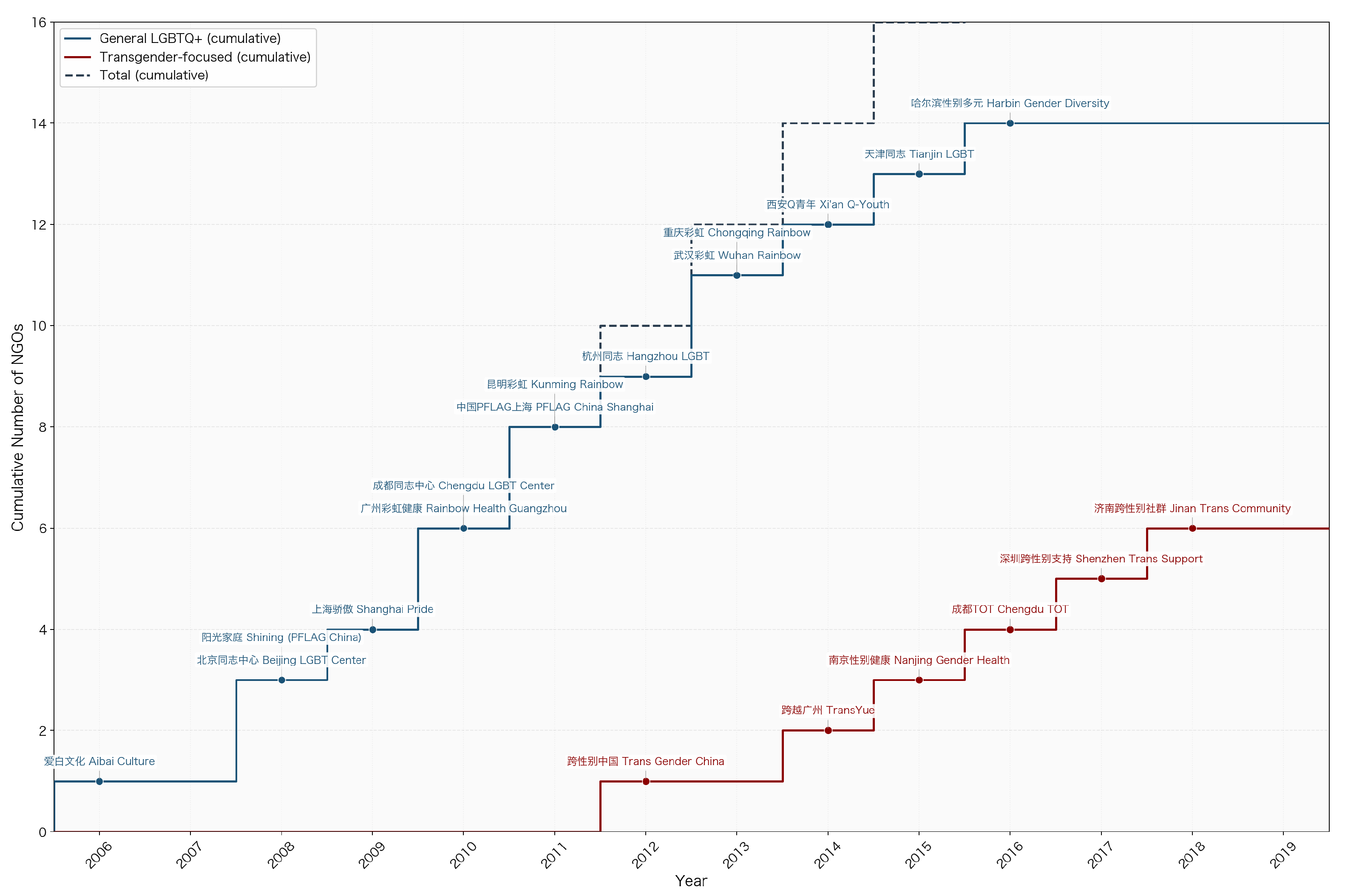
Figure 6.
Top-6 token weight distributions per LDA topic (scikit-learn LDA [32], , jieba tokenization [29]), Ming Shilu eunuch corpus (left, segments) and Chinese Wikipedia transgender/LGBT corpus (right, paragraphs). Values are LDA component weights; perplexity Ming=663.8, Wikipedia=637.2.
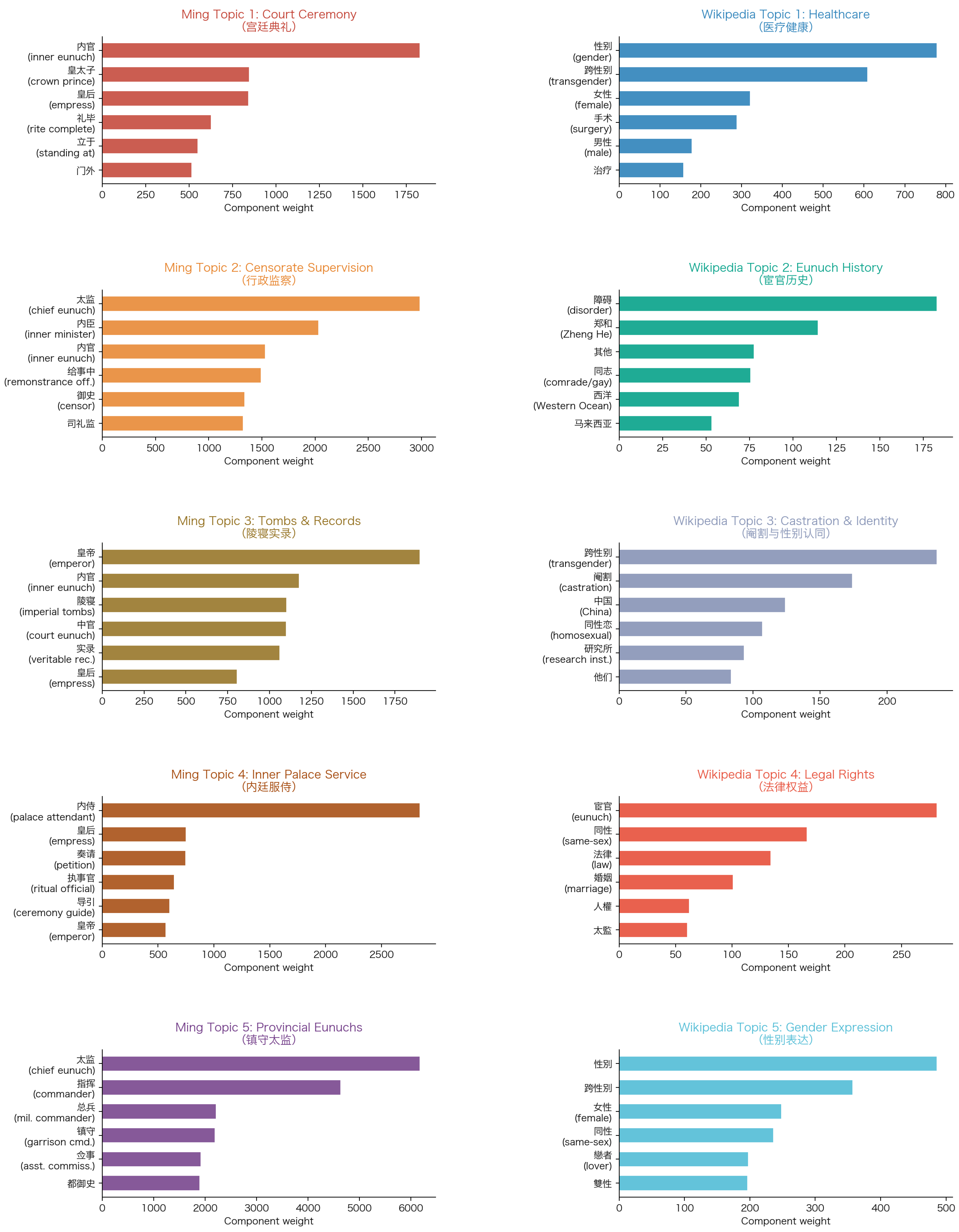
Figure 7.
Cross-corpus keyword analysis. Left: per-1,000-character frequencies, Ming Shilu (dark red) vs. Chinese Wikipedia (blue); asterisks indicate significance level. Right: vocabulary shift chart showing log2(Wikipedia rate / Ming rate) for each keyword, sorted by shift magnitude. Gold bars indicate non-significant terms (discursive resonance: 妖 and 欺骗); blue bars are contemporary-dominant; dark red bars are Ming-dominant. The chart visually encodes the diagnostic translation from a Confucian moral register (loyalty, treachery) to a biomedical and rights-based register (mental illness, discrimination), with a persistent substrate of ontological stigma vocabulary.
Figure 7.
Cross-corpus keyword analysis. Left: per-1,000-character frequencies, Ming Shilu (dark red) vs. Chinese Wikipedia (blue); asterisks indicate significance level. Right: vocabulary shift chart showing log2(Wikipedia rate / Ming rate) for each keyword, sorted by shift magnitude. Gold bars indicate non-significant terms (discursive resonance: 妖 and 欺骗); blue bars are contemporary-dominant; dark red bars are Ming-dominant. The chart visually encodes the diagnostic translation from a Confucian moral register (loyalty, treachery) to a biomedical and rights-based register (mental illness, discrimination), with a persistent substrate of ontological stigma vocabulary.
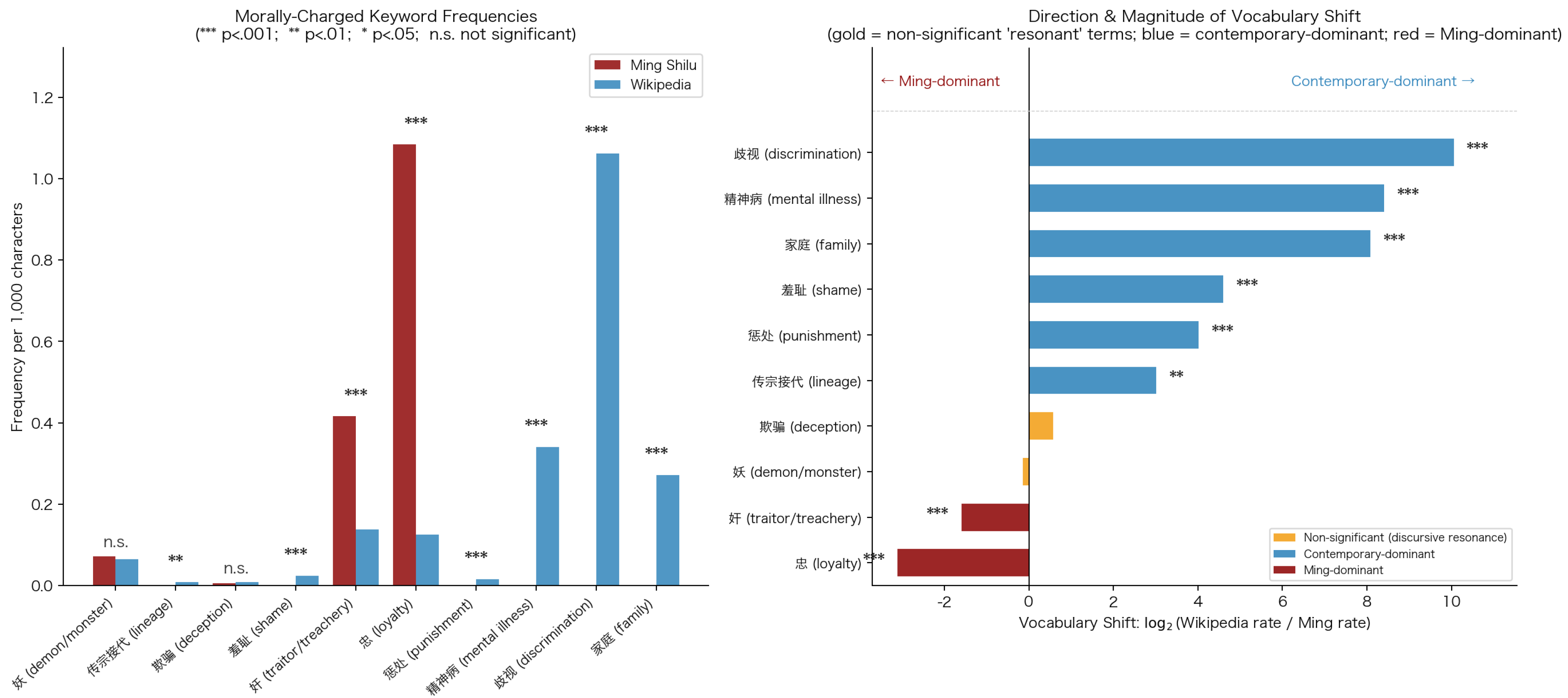

Table 1.
Global Moran’s I: LGBTQ+ NGO Spatial Clustering.
| Dataset | n | I | z | p-value | Result | |
|---|---|---|---|---|---|---|
| LGBTQ+ NGOs (national) | 20 | 0.735 | −0.053 | 6.020 | <.001 | Strongly clustered*** |
| *** (two-tailed, normal approximation). k-NN weight matrix (). | ||||||
Table 2.
LDA Topic Summaries: Ming Shilu Eunuch Corpus vs. Chinese Wikipedia Transgender/LGBT Corpus (). Perplexity: Ming = 663.8; Wikipedia = 637.2.
Table 2.
LDA Topic Summaries: Ming Shilu Eunuch Corpus vs. Chinese Wikipedia Transgender/LGBT Corpus (). Perplexity: Ming = 663.8; Wikipedia = 637.2.
| Ming Topic | Top Keywords (jieba) | Wikipedia Topic | Top Keywords |
|---|---|---|---|
| Court Ceremony | 内官 (inner eunuch), 皇太子 (crown prince), 皇后 (empress), 礼毕 (rite complete), 立于 (standing at) | Healthcare | 性别 (gender), 跨性别 (transgender), 女性 (female), 手术 (surgery), 男性 (male) |
| Censorate Supervision | 太监 (chief eunuch), 内臣 (inner minister), 给事中 (remonstrance off.), 御史 (censor), 内官 (inner eunuch) | Eunuch History | 郑和 (Zheng He), 宦官 (eunuch), 同志 (comrade/gay), 西洋 (Western Ocean), 研究所 (research inst.) |
| Tombs & Records | 皇帝 (emperor), 内官 (inner eunuch), 陵寝 (imperial tombs), 中官 (court eunuch), 实录 (veritable records) | Gender Identity | 跨性别 (transgender), 阉割 (castration), 中国 (China), 同性恋 (homosexual), 研究所 (research inst.) |
| Inner Palace Service | 内侍 (palace attendant), 皇后 (empress), 奏请 (petition), 执事官 (ritual official), 导引 (ceremony guide) | Legal Rights | 宦官 (eunuch), 同性 (same-sex), 法律 (law), 婚姻 (marriage), 人权 (human rights) |
| Provincial Eunuchs | 太监 (chief eunuch), 指挥 (commander), 总兵 (mil. commander), 镇守 (garrison cmd.), 佥事 (asst. commiss.) | Gender Expression | 性别 (gender), 跨性别 (transgender), 女性 (female), 同性 (same-sex), 性取向 (sexual orient.) |
Table 3.
Per-Keyword Chi-Square Tests: Ming Shilu Eunuch Corpus ( chars) vs. Chinese Wikipedia Transgender/LGBT Corpus ( chars). Frequencies reported per 1,000 characters.
Table 3.
Per-Keyword Chi-Square Tests: Ming Shilu Eunuch Corpus ( chars) vs. Chinese Wikipedia Transgender/LGBT Corpus ( chars). Frequencies reported per 1,000 characters.
| Keyword | Ming/1k | Wiki/1k | p | |
|---|---|---|---|---|
| 妖 (demon/monster) | 0.072 | 0.065 | 0.073 | .788 (n.s.) |
| 欺骗 (deception) | 0.005 | 0.008 | 0.030 | .863 (n.s.) |
| 传宗接代 (lineage) | 0.000 | 0.008 | 9.279 | .002** |
| 奸 (traitor/treachery) | 0.416 | 0.138 | 43.386 | <.001*** |
| 忠 (loyalty) | 1.084 | 0.126 | 204.927 | <.001*** |
| 精神病 (mental illness) | 0.000 | 0.340 | 737.973 | <.001*** |
| 歧视 (discrimination) | 0.000 | 1.062 | 2313.930 | <.001*** |
| 家庭 (family) | 0.000 | 0.271 | 586.628 | <.001*** |
| 惩处 (punishment) | 0.001 | 0.016 | 15.376 | <.001*** |
| 羞耻 (shame) | 0.000 | 0.024 | 43.972 | <.001*** |
| * ; ** ; *** ; n.s. = not significant. | ||||
Table 4.
Equivalence Testing for “Resonance” Keywords: TOST and Bayes Factor Results.
| Keyword | Ming/1k | Wiki/1k | TOST p | Interpretation | |
|---|---|---|---|---|---|
| 妖 (demon) | 0.072 | 0.065 | .003 | 1564 | Equivalent (decisive) |
| 自宫/自阉 (self-castration) | 0.019 | 0.016 | <.001 | 1567 | Equivalent (decisive) |
| 欺骗 (deception) | 0.005 | 0.008 | <.001 | 1416 | Exploratory† |
| TOST equivalence bound: ±0.05/1k chars (≈1 SE at base rate in smaller corpus). | |||||
| : decisive evidence for equal-rate model. † Wiki : low power. | |||||
Disclaimer/Publisher’s Note: The statements, opinions and data contained in all publications are solely those of the individual author(s) and contributor(s) and not of MDPI and/or the editor(s). MDPI and/or the editor(s) disclaim responsibility for any injury to people or property resulting from any ideas, methods, instructions or products referred to in the content. |
© 2026 by the authors. Licensee MDPI, Basel, Switzerland. This article is an open access article distributed under the terms and conditions of the Creative Commons Attribution (CC BY) license (http://creativecommons.org/licenses/by/4.0/).
Copyright: This open access article is published under a Creative Commons CC BY 4.0 license, which permit the free download, distribution, and reuse, provided that the author and preprint are cited in any reuse.