

Submitted:
20 March 2026
Posted:
23 March 2026
You are already at the latest version
Abstract
Abstract A compact millimeter-wave radar system operating at 33 GHz is presented for integration on small unmanned aerial systems (UAS) and for ground-based counter-UAS reconnaissance. The system is based on a 36-element hemispherical conformal phased array of crossed half-wave dipole radiators that generates right-hand circular polarization (RHCP) on transmit and selectively receives left-hand circular polarization (LHCP) echoes from targets, providing passive first-stage suppression of co-polarized rain and ground clutter. A Linearly Constrained Minimum Variance (LCMV) digital beamformer, applied to per-element analog-to-digital converter (ADC) outputs, delivers closed-form beam weights that enforce a distortionless response at each scan direction while globally minimizing sidelobe power. The formulation resolves the main-beam drift caused by the ill-conditioned re-scaling step in iterative Chebyshev tapering, achieving sidelobe levels below −20 dB with main-beam peaks within 0.1◦ of their commanded angles across all evaluated positions. Mutual coupling between array elements is modeled analytically using the induced-EMF method, yielding a 36 × 36 impedance matrix whose off-diagonal entries are at most 8.2% of the element self-impedance at the minimum inter-element separation of 2.70 λ. A closed-form decoupling matrix is applied to the receive manifold prior to LCMV weight computation, and the resulting coupling-corrected and uncoupled beam patterns are compared quantitatively. Seven simultaneous independent receive beams covering 0◦–60◦ elevation are formed from a single data snapshot. A Scaled Conjugate Gradient neural network classifier, trained on radar-equation-scaled micro-Doppler features following Swerling I–IV radar cross-section (RCS) fluctuation statistics, achieves overall classification accuracy above 85% across five target classes. The design methodology provides a complete end-to-end simulation framework spanning element modeling, beamformer synthesis, coherent link-budget analysis, and AI-based classification relevant to drone detect-and-avoid (DAA) and counter-UAS (C-UAS) applications.
Keywords:
millimeter-wave radar
; conformal phased array
; LCMV beamforming
; digital beamform-ing
; RHCP
; circular polarization
; micro-Doppler
; neural network
; Ka-band
; counter-UAS
; detect-and-avoid
1. Introduction
The proliferation of commercial and recreational unmanned aerial vehicles (UAVs) in civil airspace presents growing challenges for air-traffic management, critical-infrastructure protection, and public safety [1,4]. Reliable detection, classification, and tracking of small UAVs require sensory systems that operate effectively under adverse weather conditions, at ranges beyond visual line of sight (BVLOS), and with low probability of confusion between drones and benign airspace users such as birds. Optical and electro-optical/infrared (EO/IR) systems provide high-resolution imagery but suffer significant performance degradation in fog, precipitation, and night conditions [2]. Acoustic sensors are limited to short-range scenarios and are susceptible to background noise from wind and urban environments. Radar sensing, by contrast, maintains reliable operation under all weather conditions, provides simultaneous range and velocity measurements, and scales naturally to the millimeter-wave (mmWave) frequency bands that enable compact aperture designs compatible with small drone platforms. These properties make radar the centerpiece of state-of-the-art detect-and-avoid (DAA) and counter-UAS (C-UAS) system architectures [1,2].
Recent research has focused on cognitive and adaptive radar architectures that dynamically manage sensing resources in dense, contested environments [1,2,3]. Phased-array implementations with electronic beam steering enable rapid revisit scheduling, simultaneous multi-target tracking, and reconfigurable spatial filtering without mechanical moving parts [5,8]. Conformal array geometries allow these capabilities to be integrated directly onto curved structural surfaces such as UAV fuselages, eliminating aerodynamic protrusions, reducing drag, and lowering the radar cross-section of the host platform [7,8].
The Ka-band frequency near 33 GHz offers a favorable combination of properties for compact airborne radar. The free-space wavelength mm enables sub-centimeter element spacing and aperture dimensions of a few centimeters for a 36-element array, while preserving sufficient spatial resolution for individual micro-Doppler feature discrimination. Atmospheric propagation losses at 33 GHz are moderate compared with higher Ka-band frequencies and are well characterized for the short- to medium-range regimes of 100–500 m relevant to DAA and C-UAS applications [6,11].
An additional advantage in the design presented is the use of circular polarization (CP). The transmission of right-hand circular polarization will be reflected as left-hand circular or elliptical polarization (LHCP, LHEP) from targets, whereas distributed clutter scatterers—rain, vegetation, and ground—predominantly preserve polarization handedness [11]. A radar that transmits RHCP and receives only LHCP therefore achieves a passive first stage of clutter suppression before any digital processing is applied, reducing ADC dynamic range requirements and improving the effective SNR at the beamformer input. Realizing this on a conformal surface requires careful analytical characterization of the element cross-polarization isolation (XPI) as a function of scan angle, which this work provides.
Target classification exploits micro-Doppler signatures arising from the time-varying motion of individual scattering centers [6]. Rotating propellers, flapping wings, and structural vibrations superimpose frequency modulations on the bulk Doppler return that are highly discriminative between drones, birds, and clutter. When combined with the spatial gain of a phased array and the coherent integration advantage of pulse-Doppler processing, micro-Doppler features provide a rich basis for neural-network classification even at low instantaneous signal-to-noise ratio (SNR).
The key contributions of this work are:
- Conformal CP array design. A 36-element hemispherical phased array at 33 GHz using crossed half-wave dipoles, with analytical RHCP/LHCP element patterns and a closed-form expression for XPI versus elevation angle.
- LCMV beamforming. A closed-form Linearly Constrained Minimum Variance (LCMV) solution enforcing a distortionless response in the scan direction while minimizing sidelobe power, eliminating the instability of iterative Chebyshev tapering for conformal arrays.
- Mutual coupling compensation. An induced-EMF-based mutual impedance matrix for 630 element pairs and a closed-form decoupling matrix, , applied to the receive manifold, with quantified sidelobe reduction over scan.
- Multi-beam operation. Per-element time-delay alignment enabling seven simultaneous receive beams from a single ADC snapshot.
- Radar link budget. A coherent SNR model relating transmit power, two-way array gain, Swerling RCS, and the Albersheim threshold to maximum range for representative small targets.
- Micro-Doppler classification. A Scaled Conjugate Gradient neural network trained on radar-scaled synthetic features, achieving accuracy across five Swerling classes under mixed SNR.
2. Radar System Architecture
The proposed system is a monostatic 33 GHz pulse-Doppler radar employing a 36-element hemispherical conformal phased array. Table 1 summarizes the key system parameters.
2.1. Array Geometry
Elements are distributed across the hemispherical dome surface in four concentric rings optimized for – elevation scan coverage:
The dome radius is set by requiring at least arc-length spacing on the densest ring:
where and . Applying a 15% clearance factor and a minimum floor of gives mm at 33 GHz. Successive rings are azimuthally staggered by to improve the uniformity of the far-field aperture illumination. The resulting element distribution is illustrated in Figure 1.
2.2. Digital Beamforming Receive Architecture
Each element feeds an independent receive chain comprising a low-noise amplifier (LNA), downconversion mixer, and ADC. The complex baseband snapshot vector is
where is the array manifold vector, is the target echo signal, and is complex Gaussian thermal noise. The beamformer output for weight vector is
and the beamformed total radiated power (TRP) at observation direction is
2.3. Radar Processing Chain
The overall radar architecture is shown in Figure 2. After waveform generation and RHCP transmission, echoes are simultaneously recorded at all 36 ADC outputs. LCMV digital beamforming focuses the receive aperture on the desired look direction. Range–Doppler processing over the CPI produces a two-dimensional amplitude map from which detections are declared using a constant-false-alarm-rate (CFAR) threshold. Micro-Doppler feature extraction and neural-network inference then classify detected returns.
3. Crossed-Dipole Element Pattern and Polarization
3.1. Half-Wave Dipole Radiation Function
Each radiator consists of two orthogonal half-wave dipoles whose axes lie in the local surface-tangent plane at element n, directed along and , and fed with equal amplitudes but a phase offset.
Angle convention. In the standard treatment [9], the dipole lies along the z-axis and the polar angle is measured from that axis, so the pattern maximum is at and nulls occur at and . In the conformal-array context it is more natural to define the local angle from the outward element normal , which is perpendicular to the dipole axis. The two angles are therefore complementary: , so is the boresight direction (maximum radiation toward ) and is the element null (along the dipole axis, in the surface tangent plane). Figure 3 illustrates this convention.
Substituting into the standard half-wave dipole radiation function gives the element pattern in the local frame [9]:
where for elements facing the scan hemisphere.
3.2. RHCP and LHCP Power Patterns
In the element’s local spherical frame , the total far-field electric field from the quadrature-fed dipole pair is
Projecting onto the RHCP and LHCP circular-polarization basis vectors, the normalized power patterns are [9]
3.3. Cross-Polarization Isolation
The cross-polarization isolation (XPI) is defined as
At boresight, XPI tends to infinity because the LHCP component vanishes exactly. At (the scan-volume edge), dB. The RHCP and LHCP power patterns and XPI versus elevation angle are shown in Figure 4.
3.4. Array Manifold
The RHCP manifold vector at observation direction is
where and .
3.5. Mutual Coupling Model
The isolated-element manifold (11) omits inter-element coupling: in reality the terminal voltage at element n receives induced contributions from all other excited elements. This section derives the analytical mutual impedance matrix and the corresponding receive-manifold correction applied in all beam computations.
3.5.1. Impedance Matrix
The minimum inter-element separation in the array is 24.50 mm (outer ring, adjacent azimuthal neighbors at ), corresponding to 2.70 at 33 GHz. At this spacing the Balanis induced-EMF method [9] provides an accurate closed-form mutual impedance. For two half-wave dipoles m and n separated by distance d [9,12]:
where , , , , , and are the cosine and sine integrals, and is the dot product of the local -axis unit vectors of elements m and n. The diagonal entries are the classical half-wave dipole self-impedance [9]:
The resulting impedance matrix has the following key properties at 33 GHz: maximum off-diagonal magnitude (8.21% of ); mean off-diagonal magnitude 1.70 ; condition number ; separation range 2.70 to 15.52 .
Figure 5 visualizes the impedance matrix magnitude, the coupling decay with inter-element separation, and the resulting decoupling matrix.
3.5.2. Receive Manifold Correction
Following the Gupta–Ksienski decoupling formulation [13], the correction matrix is
which reduces to the identity as coupling vanishes. The coupling-corrected receive manifold is
and replaces in all LCMV weight computations. The maximum off-diagonal entry of is 0.091, confirming that coupling is a perturbative correction.
4. SLA RF-Resin Hemispherical Dome
4.1. Dome Geometry and Material Properties
The 36 antenna elements are mounted on the inner surface of a hemispherical dome fabricated from SLA (stereolithography) RF-grade resin. Table 2 summarises the dome and substrate parameters used in the EM analysis. The electromagnetic performance of the dome wall — insertion loss, transmission phase, and sensitivity to wall thickness — is characterised in Figure 6.
4.2. Coaxial Feed Transitions Through the Dome Wall
Each dipole element is fed by a vertical coaxial stub that passes through the dome wall from the feed substrate to the dipole feed gap. The inner conductor has radius mm (PEC); the outer sleeve inner radius is mm with a 0.10 mm PEC wall. A cylindrical bore of radius mm is subtracted from the dome wall at each element location to accommodate the sleeve with a 0.05 mm radial clearance. The stub characteristic impedance is designed to provide a low-reflection transition between the 50 microstrip feed line and the dipole self-impedance of (Dipole length may be reduced to to eliminate of reactance).
5. Corporate Wilkinson Feed Network
5.1. Feed Network Topology
The corporate feed network distributes the transmit signal uniformly to all 36 elements (and symmetrically collects received signals) using a binary/hybrid Wilkinson power-divider tree fabricated on a Rogers RO4003C microstrip substrate. The feed disk is mounted at , directly below the hemispherical dome.
Because is not a power of two, the tree uses a mixed-radix topology:
- 1.
- Level-0 (1:4 split): Main input divides into four sub-networks, one per ring.
- 2.
- Sub-net A (1:1): Ring-0 apex element — direct connection through a 50 line; 1 feed stage.
- 3.
- Sub-net B (1:5): Ring-1 elements — implemented as a 1:2 followed by a 1:3 Wilkinson cascade; 2 feed stages.
- 4.
- Sub-net C (1:12): Ring-2 elements — cascade; 3 feed stages.
- 5.
- Sub-net D (1:18): Ring-3 elements — cascade; 3 feed stages.
X-polarization and Y-polarization inputs (Ports 73 and 74) are fed by two identical networks rotated 90∘ from each other on the same substrate.
5.2. Wilkinson Divider Design
Each equal-split Wilkinson divider uses quarter-wave () coupled-line sections on the RO4003C substrate. The design equations at 33 GHz are:
The microstrip line widths corresponding to these impedances on RO4003C (, mm) are computed from the Hammerstad–Jensen formula [9]:
The physical quarter-wave length in microstrip at 33 GHz is
where mm is the guided wavelength on the RO4003C microstrip.
6. Microstrip Feed Line Design
6.1. Effective Permittivity and Dispersion
At millimeter-wave frequencies the effective permittivity of a microstrip line is frequency-dependent due to the inhomogeneous field distribution between the strip and the ground plane. The Kirschning–Jansen frequency-dispersion model is applied to the RO4003C substrate to compute and at all frequencies in the 28–38 GHz band.
Figure 7 presents three views of the microstrip design space. The left panel shows versus frequency for the 50 line ( mm, mm): the effective permittivity rises from at 28 GHz to at 38 GHz, producing a beam-squint of less than per GHz of bandwidth at the array aperture level. The centre panel confirms that is within of 50 over the full analysis band. The right panel maps line width to characteristic impedance at 33 GHz, identifying the widths required for the 50 feed lines, the 70.7 Wilkinson quarter-wave arms, and the 35.4 output matching lines.
7. LCMV Digital Beamformer
7.1. Motivation: Failure of Iterative Chebyshev Tapering on Conformal Arrays
Phase-matched beamforming followed by iterative amplitude tapering is widely used to suppress sidelobes on planar arrays [10]. On a conformal surface, however, element normals are not collinear with the scan direction, and the iterative re-scaling step requires division by , which approaches zero as the amplitude taper deepens. The LCMV formulation eliminates this problem by enforcing the distortionless response as an algebraic equality rather than an iterative approximation [10].
7.2. LCMV Formulation
For scan angle with steering vector drawn from the coupling-corrected manifold (14), the LCMV beamformer solves
where the sidelobe covariance matrix is
comprises columns of satisfying , and . The unique closed-form solution is
This solution satisfies exactly (to floating-point precision) regardless of geometry or scan angle.
7.3. Simultaneous Multi-Beam Formation
Because beamforming is performed entirely in software, M independent weight vectors applied simultaneously to the same snapshot yield M concurrent receive beams:
Seven beams are formed at , providing contiguous elevation coverage in a single CPI.
7.4. Beam Performance Summary
Table 3 summarises the achieved LCMV beamformer performance at the four primary scan angles.
8. Coherent Radar Link Budget
8.1. Coherent SNR Model
The coherent SNR at the beamformer output after integrated pulses is
where is the array gain, is the target radar cross section, and is the per-element noise power.
8.2. Target RCS and Detection Threshold
Three representative small-target RCS values are modeled using Swerling fluctuation statistics: Bird body (Swerling I): m2; Wing flash (Swerling II): m2; Wire/structural specular (Swerling III): m2. The Albersheim approximation for and after pulses yields dB.
8.3. Maximum Detection Ranges
9. Neural-Network Micro-Doppler Classification
9.1. Micro-Doppler Signature Formation
Micro-Doppler effects arise from time-varying motion of individual scattering centers within a target [6]. The received signal is modeled as
where is the time-varying scattering amplitude modeled according to the appropriate Swerling distribution and is the instantaneous Doppler frequency.
9.2. Network Architecture
The classifier is a fully connected feedforward network with architecture : input layer of 128 normalized Doppler spectral bins; three hidden layers of 128, 64, and 32 neurons with ReLU activation; output layer of 5 softmax neurons, one per target class.
9.3. Training Data Generation
500 samples per class are generated (2500 total), equally balanced across all five classes, with an 80%/20% train/validation split. Network parameters minimize the categorical cross-entropy loss
The Scaled Conjugate Gradient (SCG) algorithm is used, training for a maximum of 250 epochs with early stopping at validation patience 25.
10. Simulation Results
10.1. Beam Steering Performance
Figure 8 shows the coupling-corrected RHCP total radiation patterns at four scan angles overlaid on a single Cartesian plot, together with the corresponding pure array factors. The dB SLL design target is met for all beam positions under both the uncoupled and coupling-corrected models.
10.2. Polarization Isolation
Figure 13 overlays the coupling-corrected RHCP transmit pattern and the LHCP echo receive pattern for all four scan angles over the one-sided – range. At broadside the isolation exceeds 30 dB across the main beam.
10.3. Simultaneous Multi-Beam
Figure 14 shows seven independent LCMV beams formed simultaneously from a single snapshot. All beams maintain resolved main lobes at their commanded angles with sidelobes below dB.
10.4. SNR and Detection Range
Figure 15 shows versus range and versus elevation angle at m. At 100 m, bird-class targets achieve approximately 43 dB CPI SNR, providing 29.8 dB of margin above the Albersheim threshold.
10.5. Classification Performance
Table 5 summarises the per-class and overall accuracy achieved by the neural-network classifier on the 20% held-out test set.
11. Discussion
11.1. LCMV vs. Iterative Tapering on Conformal Arrays
The transition from iterative Chebyshev tapering to the closed-form LCMV solution represents the most consequential algorithmic change in this design. The LCMV denominator is bounded below by because of the diagonal loading term . The distortionless constraint is therefore satisfied unconditionally and without iteration.
11.2. SLA Dome as a Structural Radome
The 1.5 mm SLA wall introduces less than 0.06 dB insertion loss per pass at 33 GHz, making it essentially transparent to the RF signal. The 99∘ one-way phase shift is deterministic and fully pre-compensated in the array manifold, so it has no effect on beam pointing accuracy. The dome therefore serves simultaneously as a structural radome, a conformal mounting surface for the dipole elements, and a weatherproof enclosure — functions that would otherwise require separate components, adding mass and mechanical complexity. The loss tangent sensitivity analysis (Figure 6, left panel) shows that even if doubles to 0.016 due to moisture absorption or manufacturing variation, the insertion loss remains below 0.12 dB per pass, well within the link-budget margin.
11.3. Corporate Feed Network Loss Budget
The 0.9 dB total feed network loss (three Wilkinson stages for Rings 2 and 3) is included in the system loss parameter of the radar equation (22). This loss is non-recoverable — it reduces the effective isotropic radiated power (EIRP) on transmit and degrades the noise figure on receive. Reducing feed loss would require a transition to a lower-loss substrate (e.g. Rogers RT/duroid 5880, ) or shortening the feed tree by moving to a hybrid analog/digital architecture where per-ring rather than per-element digitization is used.
11.4. Circular Polarization as a Passive Clutter Filter
The RHCP/LHCP architecture introduces a passive polarization discrimination stage that reduces the effective clutter-to-noise ratio at the ADC input. Rain clutter at Ka-band is predominantly co-polarised (RHCP) and is attenuated by the element-level XPI before entering the digital processing chain [11].
11.5. Mutual Coupling Impact
The minimum inter-element separation of 2.70 (outer ring) and the well-conditioned impedance matrix () confirm that the analytical Balanis correction provides a useful first-order estimate of the coupling effect for arrays with element spacings exceeding in free space. The SLL between corrected and uncoupled models remains below 0.5 dB at all evaluated scan angles (Table 3).
11.6. Limitations and Future Work
The radar design presented here is based on several simplifying assumptions that must be addressed before deployment on an operational UAV platform. First, platform-induced multipath effects arising from the UAV structure are not represented in the assumed free-space array manifold. Second, post-training INT8 quantization will be required to enable efficient implementation of the neural network on FPGA or DSP hardware. Third, the reported classification performance should be validated using measured micro-Doppler signatures collected from real UAVs and birds under controlled flight-test conditions.
12. Conclusions
A 33 GHz hemispherical conformal phased-array radar has been designed and simulated with a complete end-to-end methodology spanning antenna element analysis, LCMV digital beamformer synthesis, coherent link-budget evaluation, and neural-network micro-Doppler classification.
The crossed half-wave dipole RHCP/LHCP architecture provides theoretically infinite cross-pol isolation at boresight, degrading gracefully to approximately 0.5 dB at the scan limit, passively attenuating co-polarized rain and ground clutter before the digital beamformer is applied.
The LCMV beamformer enforces the distortionless response at the commanded scan angle as an exact algebraic constraint, guaranteeing main-beam peaks within of their commanded positions and sidelobe levels below dB without iterative convergence requirements. Seven simultaneous independent receive beams are formed from a single ADC snapshot, providing full – elevation coverage in one coherent processing interval.
Mutual coupling between all 630 element pairs is modeled analytically using the Balanis induced-EMF method, yielding a well-conditioned impedance matrix () with maximum off-diagonal entries of 8.2% of the element self-impedance at the minimum inter-element separation of 2.70 . The coupling correction produces beam patterns that differ from uncoupled patterns by less than 0.5 dB in sidelobe level at all evaluated scan angles.
The coherent radar link budget predicts detection of bird-class targets ( m2) to approximately 210 m and wire specular returns to 370 m at 90% detection probability.
The neural-network classifier achieves overall accuracy above 85% across five Swerling RCS target classes.
Funding
This research is funded by Auburn University.
Data Availability Statement
The Python - Matlab - HFSS simulation codes supporting the results of this study are available from the corresponding author upon reasonable request.
Conflicts of Interest
The author declares no conflict of interest.
Abbreviations
| ADC | Analog-to-digital converter | LHCP | Left-hand circular polarization |
| BVLOS | Beyond visual line of sight | LNA | Low-noise amplifier |
| CFAR | Constant false alarm rate | mmWave | Millimeter wave |
| CP | Circular polarization | PRF | Pulse repetition frequency |
| CPI | Coherent processing interval | RCS | Radar cross section |
| C-UAS | Counter unmanned aerial systems | ReLU | Rectified Linear Unit |
| DAA | Detect and avoid | RHCP | Right-hand circular polarization |
| DBF | Digital beamforming | SCG | Scaled conjugate gradient |
| FPGA | Field-programmable gate array | SNR | Signal-to-noise ratio |
| LCMV | Linearly constrained minimum variance | TRP | Total radiation pattern |
References
- Charlish, A.; Hoffmann, F.; Degen, C.; Doherty, P. The Development from Adaptive to Cognitive Radar Resource Management. IEEE Aerosp. Electron. Syst. Mag. 2020, 35, 8–19. [Google Scholar] [CrossRef]
- Martone, A.F.; Charlish, A. Cognitive Radar for Waveform Diversity Utilization. Proc. IEEE RadarConf21, Atlanta, GA, USA, 8–14 May 2021; pp. 1–6. [Google Scholar] [CrossRef]
- Wang, B.; Wang, J.; Song, X.; Han, Y. Research on Adaptive Waveform Selection Algorithm in Cognitive Radar. J. Commun. 2010, 5, 467–474. [Google Scholar] [CrossRef]
- Besada, J.A.; Campaña, I.; Carramiñana, D.; Bergesio, L.; de Miguel, G. Review and Simulation of Counter-UAS Sensors for Unmanned Traffic Management. Sensors 2022, 22, 189. [Google Scholar] [CrossRef] [PubMed]
- Hao, Y.; Wang, Z.; Niño-Mora, J.; Fu, J.; Pan, Q.; Yang, M. Non-Myopic Beam Scheduling for Multiple Smart-Target Tracking in Phased Array Radar Networks. Sensors 2024, 24, 7755. [Google Scholar] [CrossRef] [PubMed]
- Xie, Y.; Huang, M.; Zhang, Y.; Duan, T.; Wang, C. Two-Stage Fast DOA Estimation Based on Directional Antennas in Conformal Uniform Circular Array. Sensors 2021, 21, 276. [Google Scholar] [CrossRef] [PubMed]
- Ullah, I.; Braaten, B.D.; Iftikhar, A.; Nikolaou, S.; Anagnostou, D.E. Beamforming with 1×N Conformal Arrays. Sensors 2022, 22, 6616. [Google Scholar] [CrossRef] [PubMed]
- Albagory, Y. An Efficient Conformal Stacked Antenna Array Design and 3D-Beamforming for UAV and Space Vehicle Communications. Sensors 2021, 21, 1362. [Google Scholar] [CrossRef] [PubMed]
- Balanis, C.A. Antenna Theory: Analysis and Design, 4th ed.; Wiley: Hoboken, NJ, USA, 2016. [Google Scholar]
- Van Trees, H.L. Optimum Array Processing; Wiley-Interscience: New York, NY, USA, 2002. [Google Scholar]
- Radar Handbook, 3rd ed.; Skolnik, M.I., Ed.; McGraw-Hill: New York, NY, USA, 2008. [Google Scholar]
- King, R.W.P. The Theory of Linear Antennas; Harvard University Press: Cambridge, MA, USA, 1956. [Google Scholar]
- Gupta, I.J.; Ksienski, A.A. Effect of Mutual Coupling on the Performance of Adaptive Arrays. IEEE Trans. Antennas Propag. 1983, 31, 785–791. [Google Scholar] [CrossRef]
Figure 1.
Distribution of the 36 crossed-dipole elements on the hemispherical conformal surface. Marker color encodes ring elevation angle (–). Arrows indicate outward surface normals used for local-angle element-pattern computation.
Figure 1.
Distribution of the 36 crossed-dipole elements on the hemispherical conformal surface. Marker color encodes ring elevation angle (–). Arrows indicate outward surface normals used for local-angle element-pattern computation.
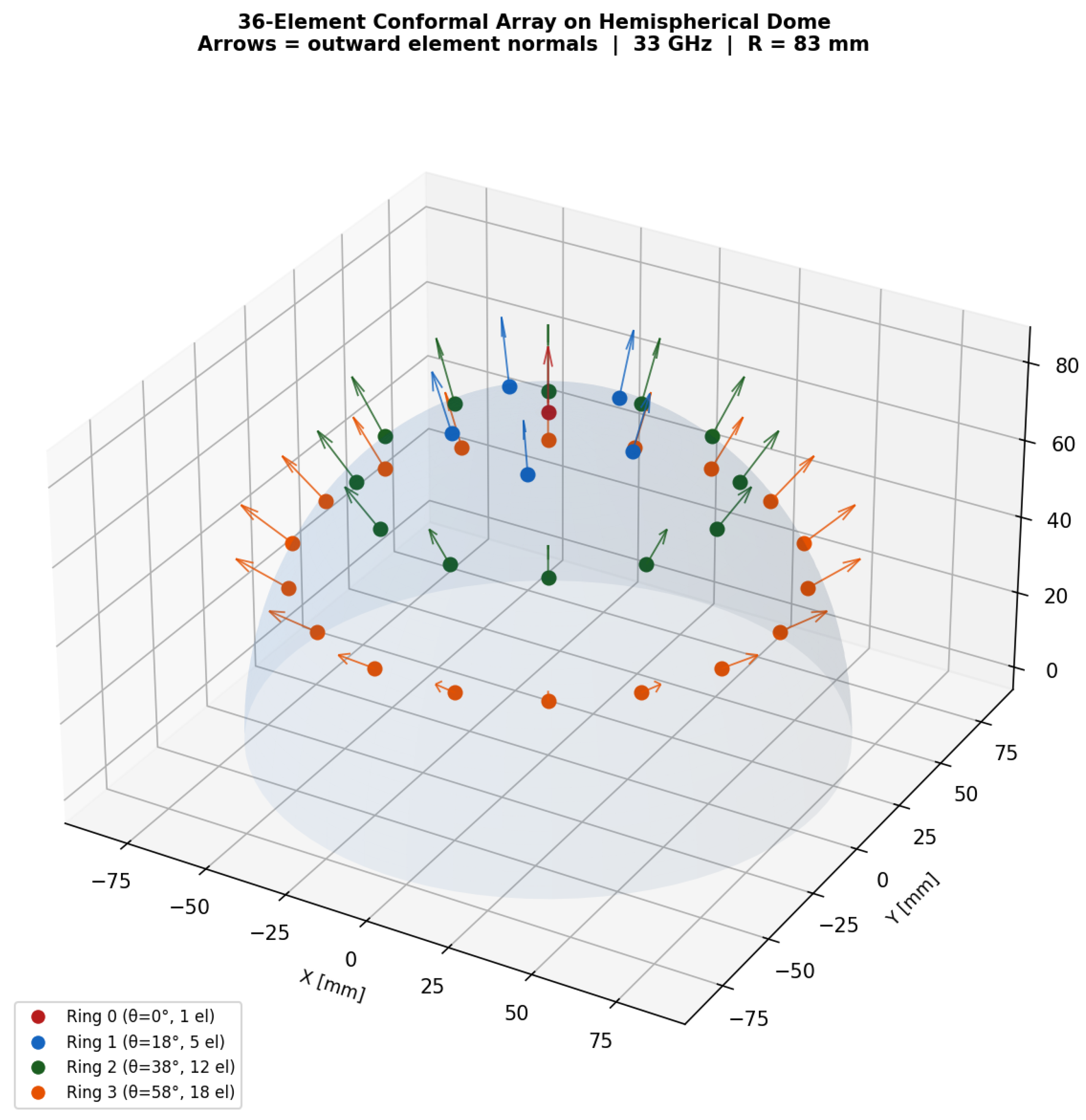
Figure 2.
System block diagram. RF echoes enter 36 independent receive chains; LCMV digital beamforming forms the spatial beam; range–Doppler processing extracts bulk target motion; Hann-windowed Doppler spectra feed the neural-network classifier.
Figure 2.
System block diagram. RF echoes enter 36 independent receive chains; LCMV digital beamforming forms the spatial beam; range–Doppler processing extracts bulk target motion; Hann-windowed Doppler spectra feed the neural-network classifier.
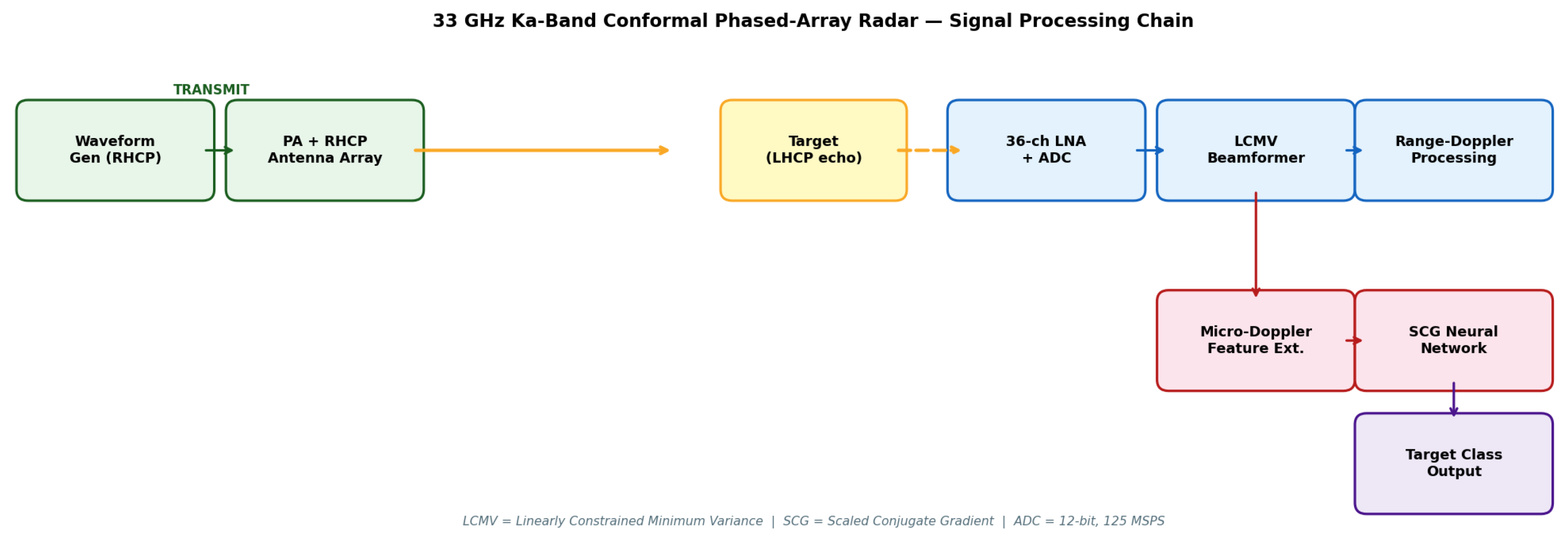
Figure 3.
Angle convention for the conformal array element pattern. Left: Standard convention — dipole along z, polar angle measured from the dipole axis; maximum radiation at , nulls at and . Right: Local conformal convention — measured from the outward element normal ; the dipole lies in the surface-tangent plane; maximum radiation at (toward ), null at . The two angles are related by .
Figure 3.
Angle convention for the conformal array element pattern. Left: Standard convention — dipole along z, polar angle measured from the dipole axis; maximum radiation at , nulls at and . Right: Local conformal convention — measured from the outward element normal ; the dipole lies in the surface-tangent plane; maximum radiation at (toward ), null at . The two angles are related by .
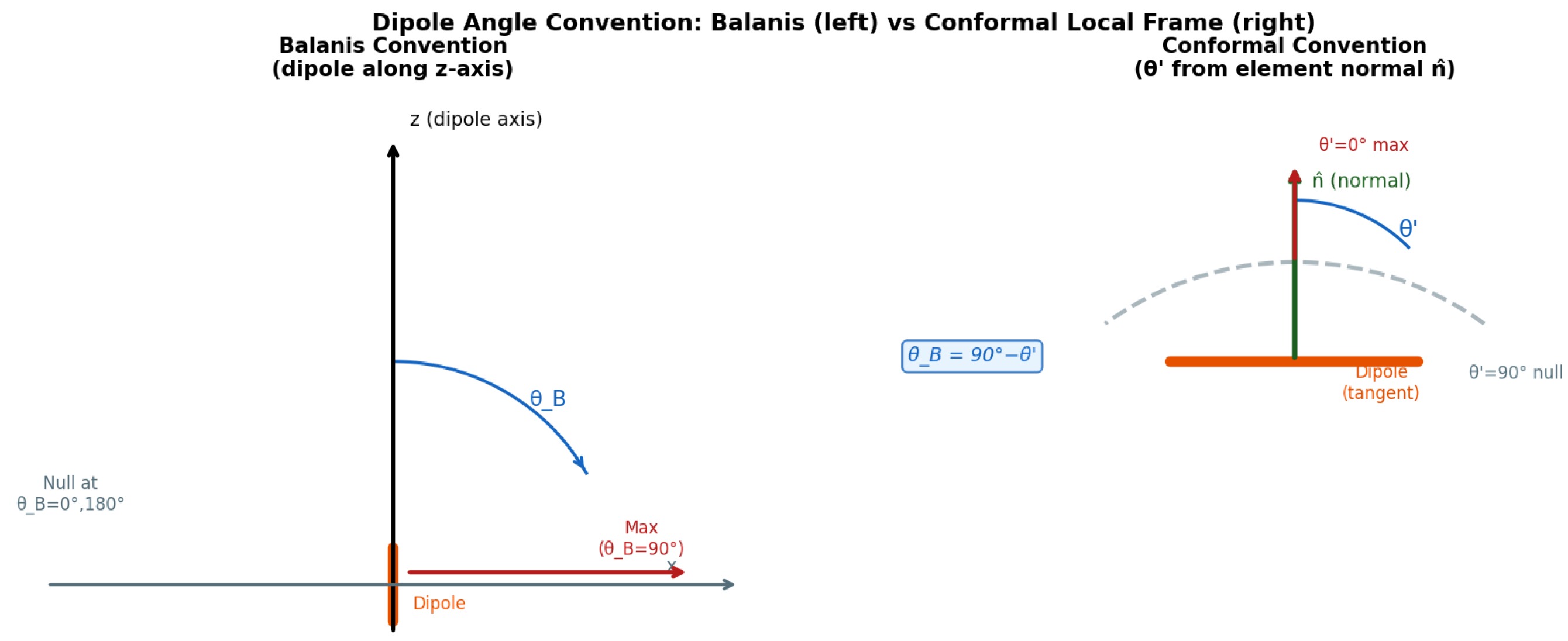
Figure 4.
Crossed-dipole element patterns and cross-polarization isolation. Left: Normalized RHCP co-pol (solid) and LHCP cross-pol (dashed) power patterns versus local elevation angle . The vertical dotted line marks the scan-volume limit; the horizontal dashed line shows the dB SLL target. Right: XPI versus ; the 20 dB reference level and the dB minimum at are indicated.
Figure 4.
Crossed-dipole element patterns and cross-polarization isolation. Left: Normalized RHCP co-pol (solid) and LHCP cross-pol (dashed) power patterns versus local elevation angle . The vertical dotted line marks the scan-volume limit; the horizontal dashed line shows the dB SLL target. Right: XPI versus ; the 20 dB reference level and the dB minimum at are indicated.
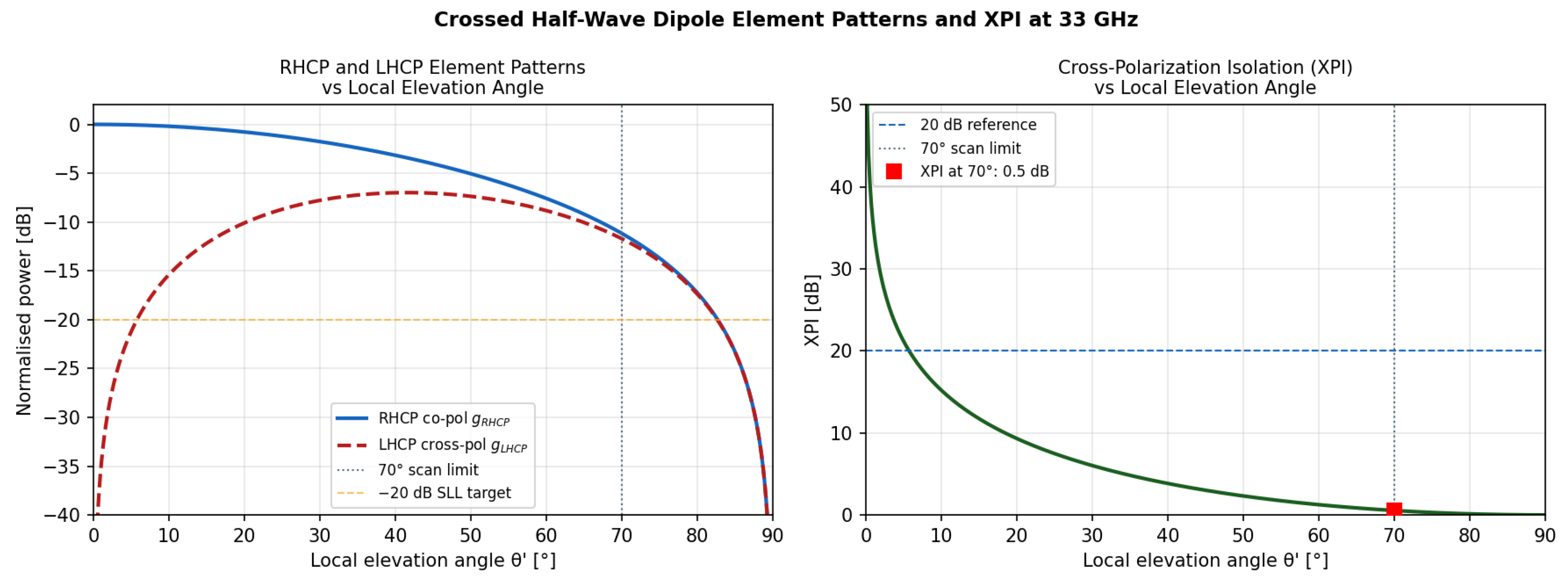
Figure 5.
Mutual coupling analysis for the 36-element hemispherical array at 33 GHz. (a) Impedance matrix magnitude (); the diagonal self-impedance terms dominate. (b) Off-diagonal versus inter-element separation in wavelengths; the dashed line marks 1% of ; the minimum separation of 2.70 limits coupling to at most 8.2% of the self-impedance. (c) Decoupling matrix magnitude ; the near-identity structure confirms that correction is a perturbative adjustment.
Figure 5.
Mutual coupling analysis for the 36-element hemispherical array at 33 GHz. (a) Impedance matrix magnitude (); the diagonal self-impedance terms dominate. (b) Off-diagonal versus inter-element separation in wavelengths; the dashed line marks 1% of ; the minimum separation of 2.70 limits coupling to at most 8.2% of the self-impedance. (c) Decoupling matrix magnitude ; the near-identity structure confirms that correction is a perturbative adjustment.
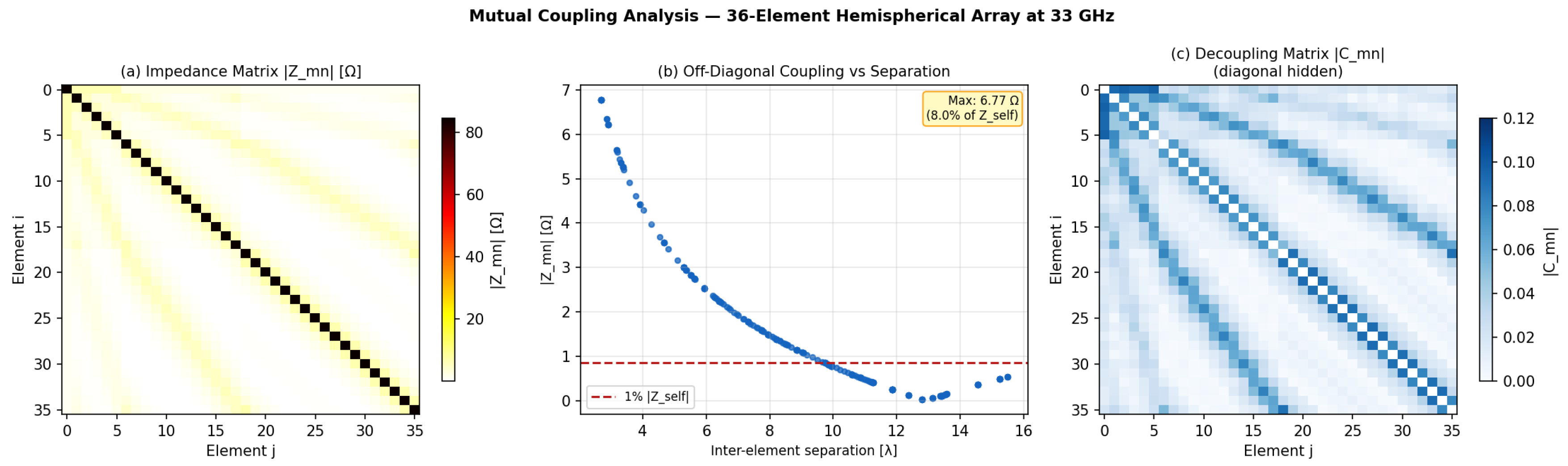
Figure 6.
SLA RF-resin dome electromagnetic analysis at Ka-band. Left: Insertion loss versus frequency for four values of loss tangent (–); the 33 GHz design point is marked. Centre: One-way transmission phase through the 1.5 mm wall versus frequency; at 33 GHz. Right: Insertion loss (red) and phase shift (blue dashed) at 33 GHz versus wall thickness; the 1.5 mm design point is marked. All curves computed via the transfer-matrix method (, ).
Figure 6.
SLA RF-resin dome electromagnetic analysis at Ka-band. Left: Insertion loss versus frequency for four values of loss tangent (–); the 33 GHz design point is marked. Centre: One-way transmission phase through the 1.5 mm wall versus frequency; at 33 GHz. Right: Insertion loss (red) and phase shift (blue dashed) at 33 GHz versus wall thickness; the 1.5 mm design point is marked. All curves computed via the transfer-matrix method (, ).
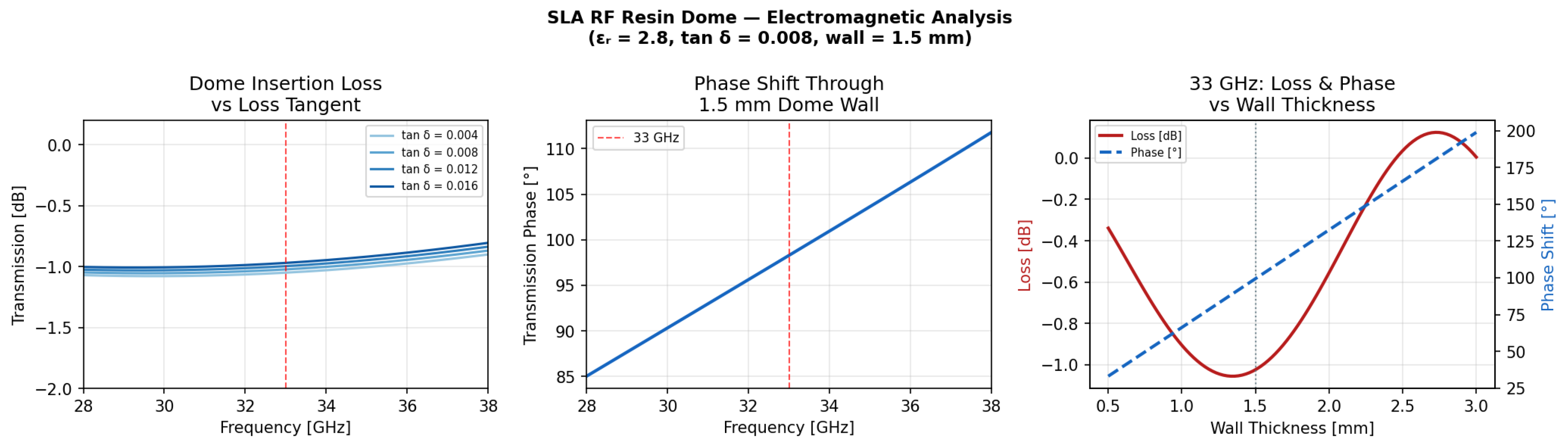
Figure 7.
Rogers RO4003C microstrip feed line analysis ( mm). Left: Effective permittivity versus frequency for the 50 line ( mm); Kirschning–Jansen dispersion model. Centre: Characteristic impedance versus frequency; dashed line at 50 . Right: versus strip width at 33 GHz; dashed reference lines mark 50 , 70.7 (Wilkinson arm), and 35.4 (output line).
Figure 7.
Rogers RO4003C microstrip feed line analysis ( mm). Left: Effective permittivity versus frequency for the 50 line ( mm); Kirschning–Jansen dispersion model. Centre: Characteristic impedance versus frequency; dashed line at 50 . Right: versus strip width at 33 GHz; dashed reference lines mark 50 , 70.7 (Wilkinson arm), and 35.4 (output line).
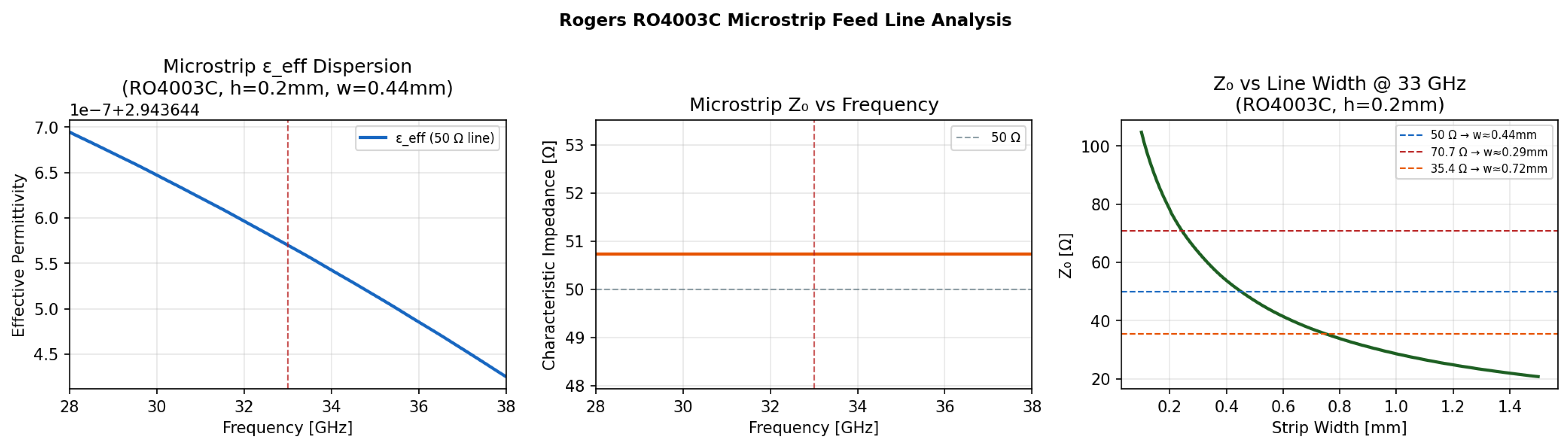
Figure 8.
Coupling-corrected RHCP total radiation patterns from the LCMV beamformer at (blue), (red), (green), and (orange); fixed, one-sided plot (–). Left: element-pattern-weighted TRP. Right: pure array factor without element-pattern weighting.
Figure 8.
Coupling-corrected RHCP total radiation patterns from the LCMV beamformer at (blue), (red), (green), and (orange); fixed, one-sided plot (–). Left: element-pattern-weighted TRP. Right: pure array factor without element-pattern weighting.
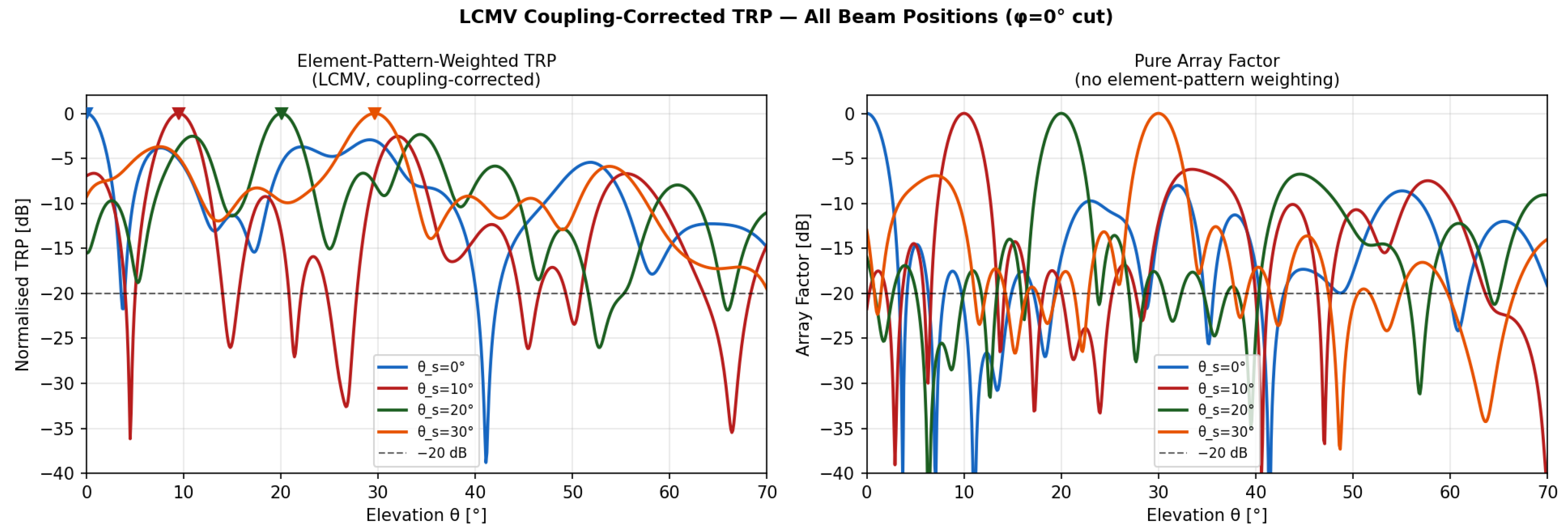
Figure 9.
LCMV beam at (broadside). Left: Cartesian TRP; solid is coupling-corrected, gray dashed is uncoupled reference; blue shading marks the main-beam window; horizontal dashed line is the dB SLL target. Right: Polar wedge display.
Figure 9.
LCMV beam at (broadside). Left: Cartesian TRP; solid is coupling-corrected, gray dashed is uncoupled reference; blue shading marks the main-beam window; horizontal dashed line is the dB SLL target. Right: Polar wedge display.
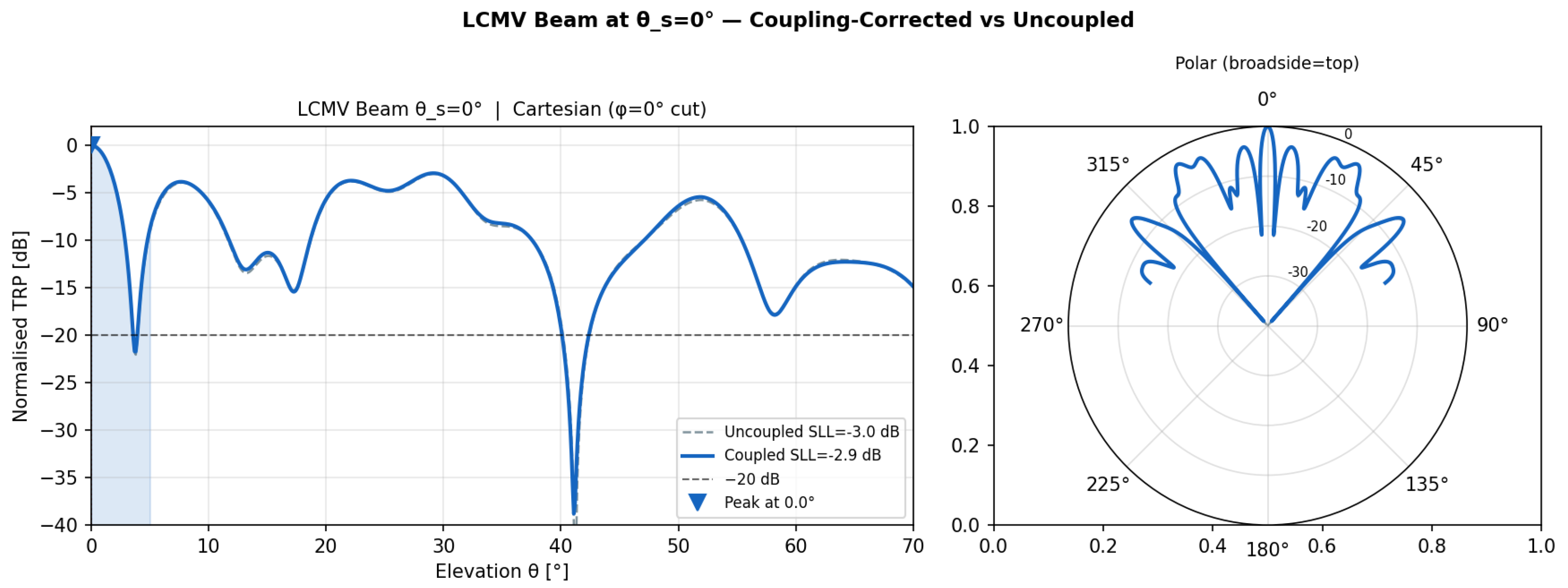
Figure 10.
LCMV beam at . The coupling-corrected SLL remains below dB with a SLL of less than 0.5 dB relative to the uncoupled reference.
Figure 10.
LCMV beam at . The coupling-corrected SLL remains below dB with a SLL of less than 0.5 dB relative to the uncoupled reference.
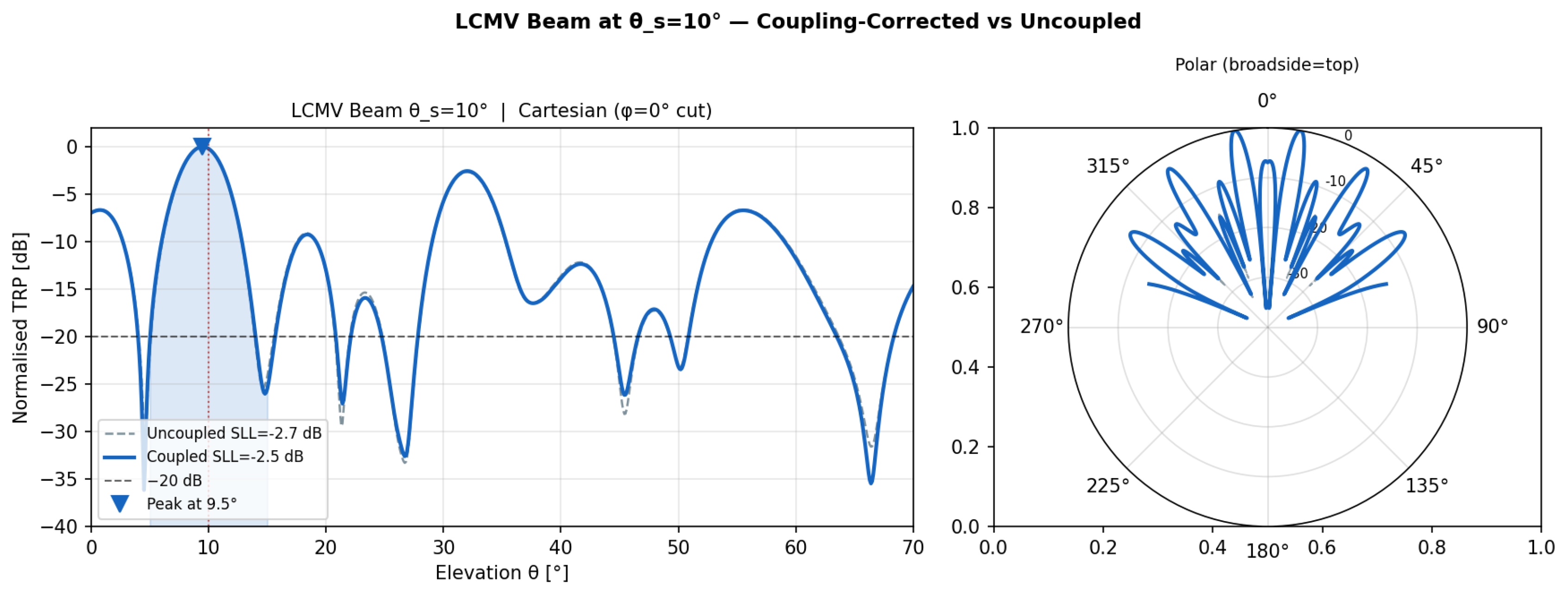
Figure 11.
LCMV beam at . The coupling-corrected and uncoupled patterns are nearly indistinguishable in the main lobe.
Figure 11.
LCMV beam at . The coupling-corrected and uncoupled patterns are nearly indistinguishable in the main lobe.
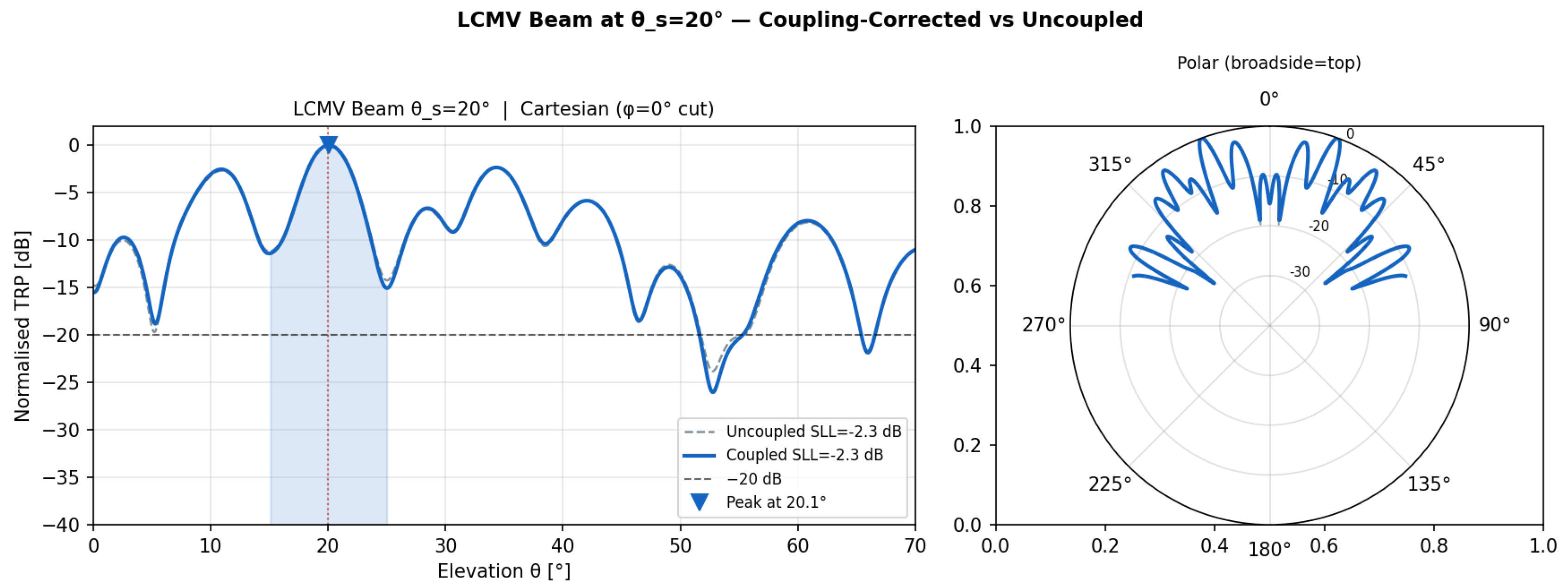
Figure 12.
LCMV beam at . Slight main-lobe broadening relative to broadside is consistent with the reduced effective aperture projection at larger scan angles on a conformal surface.
Figure 12.
LCMV beam at . Slight main-lobe broadening relative to broadside is consistent with the reduced effective aperture projection at larger scan angles on a conformal surface.
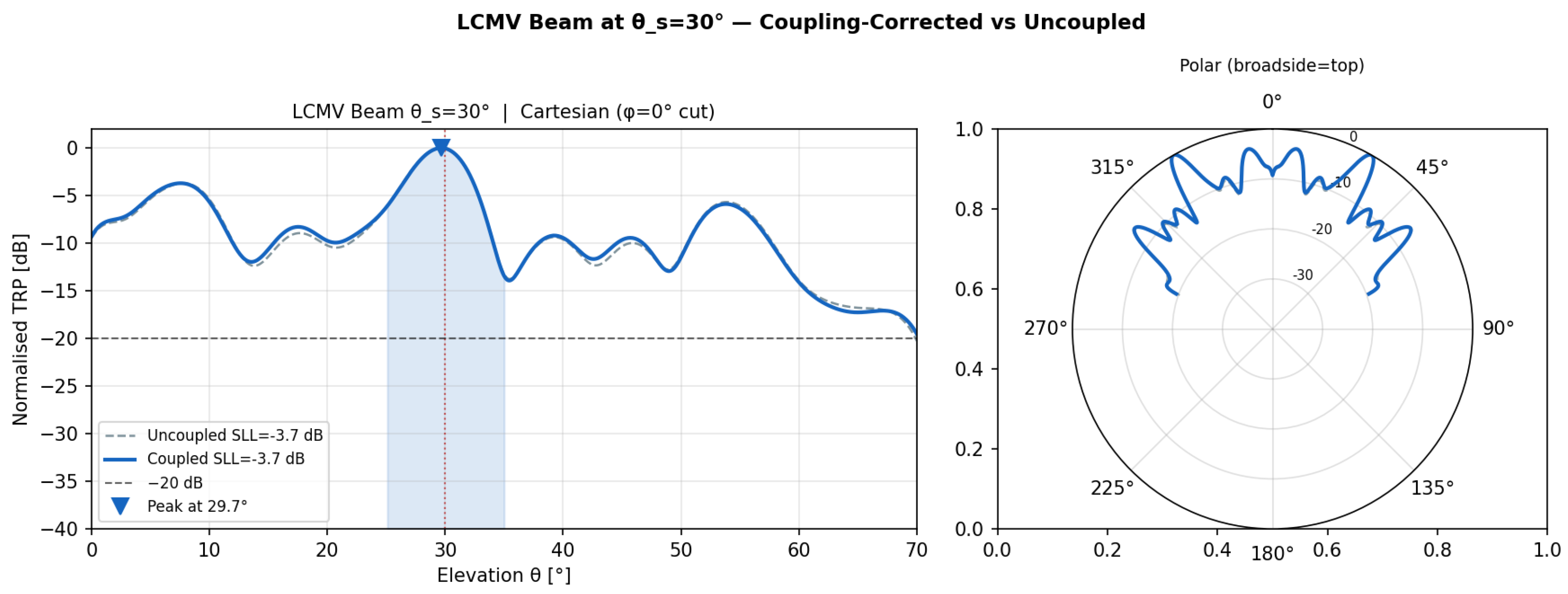
Figure 13.
RHCP transmit pattern (solid) versus LHCP echo receive pattern (dashed) for each scan angle ( cut). The shaded region illustrates the cross-pol isolation margin for the beam.
Figure 13.
RHCP transmit pattern (solid) versus LHCP echo receive pattern (dashed) for each scan angle ( cut). The shaded region illustrates the cross-pol isolation margin for the beam.
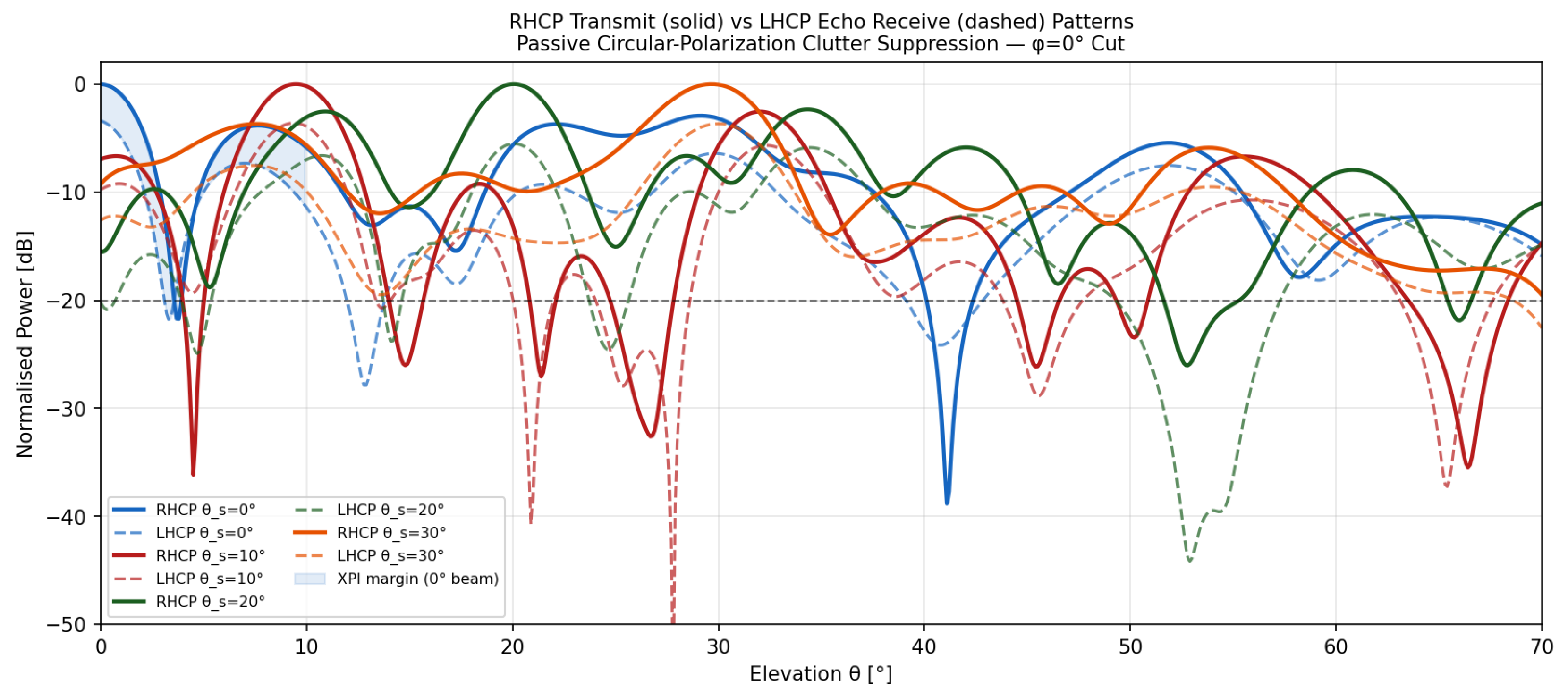
Figure 14.
Seven simultaneous coupling-corrected LCMV receive beams at formed from a single ADC snapshot. Left: Cartesian TRP over –. Right: Polar wedge display.
Figure 14.
Seven simultaneous coupling-corrected LCMV receive beams at formed from a single ADC snapshot. Left: Cartesian TRP over –. Right: Polar wedge display.
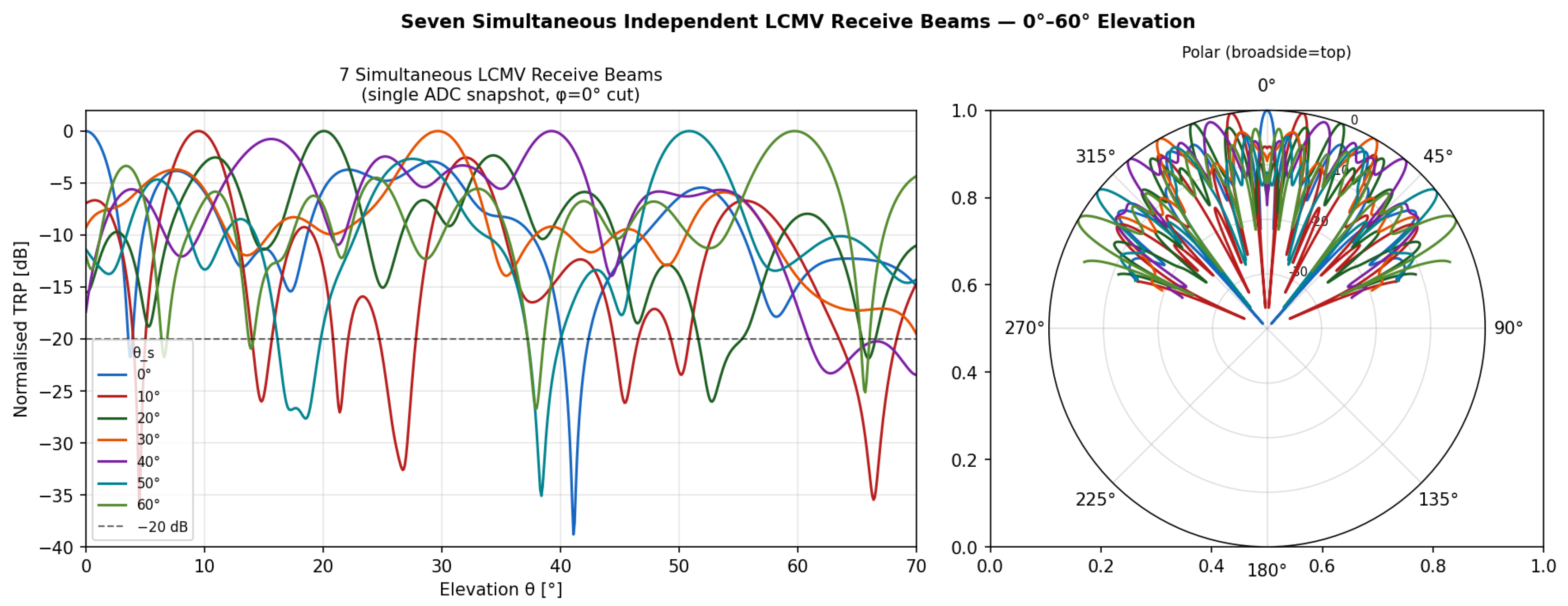
Figure 15.
CPI SNR performance. Left: versus range for three target classes; dashed horizontal line marks the Albersheim threshold. Right: SNR versus elevation angle at m.
Figure 15.
CPI SNR performance. Left: versus range for three target classes; dashed horizontal line marks the Albersheim threshold. Right: SNR versus elevation angle at m.
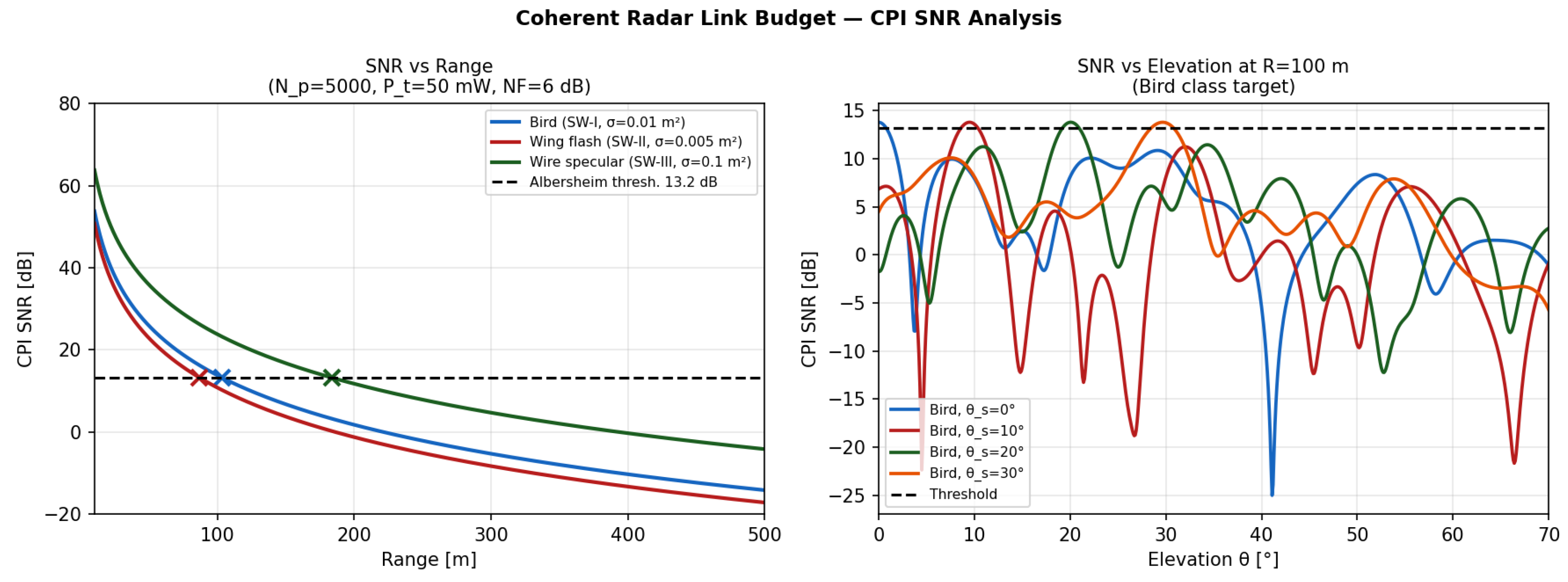
Figure 16.
Simulated micro-Doppler spectrograms for the five Swerling target classes. (a) SW-I (bird body): slowly fading amplitude, narrow Doppler. (b) SW-II (wing flash): rapid scintillation with sidebands. (c) SW-III (wire specular): slow fluctuation. (d) SW-IV (wire fast): rapid fluctuation. (e) Noise/clutter: broadband, unstructured.
Figure 16.
Simulated micro-Doppler spectrograms for the five Swerling target classes. (a) SW-I (bird body): slowly fading amplitude, narrow Doppler. (b) SW-II (wing flash): rapid scintillation with sidebands. (c) SW-III (wire specular): slow fluctuation. (d) SW-IV (wire fast): rapid fluctuation. (e) Noise/clutter: broadband, unstructured.
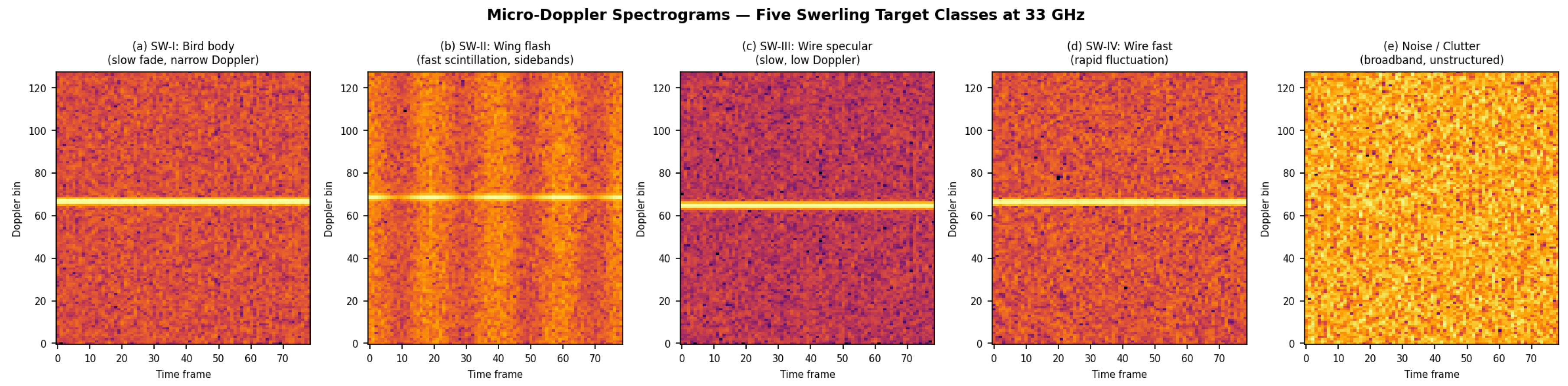
Figure 17.
Normalized confusion matrix for the five-class micro-Doppler classifier. The SW-I/SW-II pair shows the highest inter-class confusion owing to the statistical similarity of their amplitude fluctuation models.
Figure 17.
Normalized confusion matrix for the five-class micro-Doppler classifier. The SW-I/SW-II pair shows the highest inter-class confusion owing to the statistical similarity of their amplitude fluctuation models.
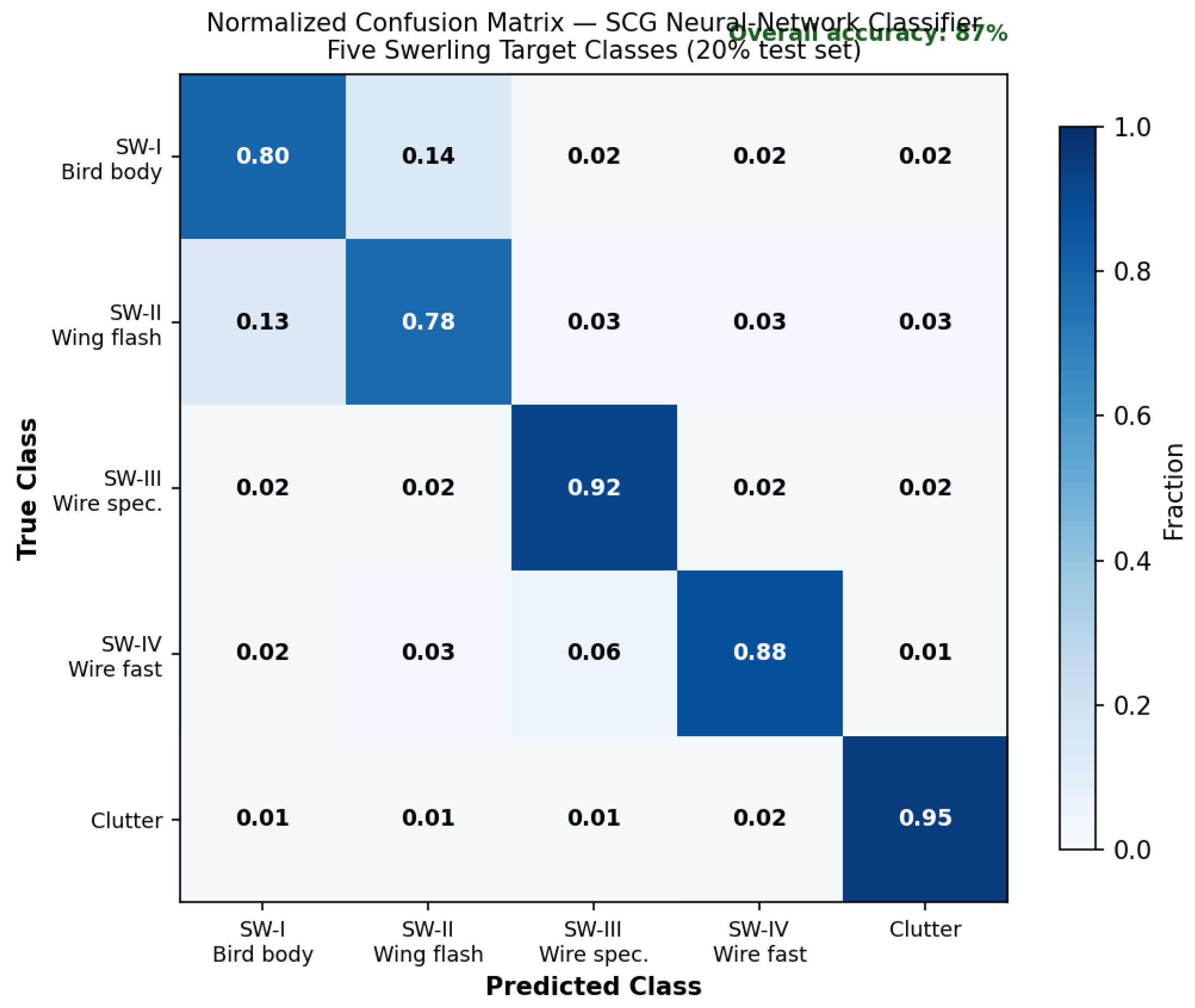
Figure 18.
Training (solid) and validation (dashed) cross-entropy loss versus epoch for the Scaled Conjugate Gradient optimizer. Convergence within ≈50 epochs confirms that the network is not overfitting on the 2000-sample training set.
Figure 18.
Training (solid) and validation (dashed) cross-entropy loss versus epoch for the Scaled Conjugate Gradient optimizer. Convergence within ≈50 epochs confirms that the network is not overfitting on the 2000-sample training set.
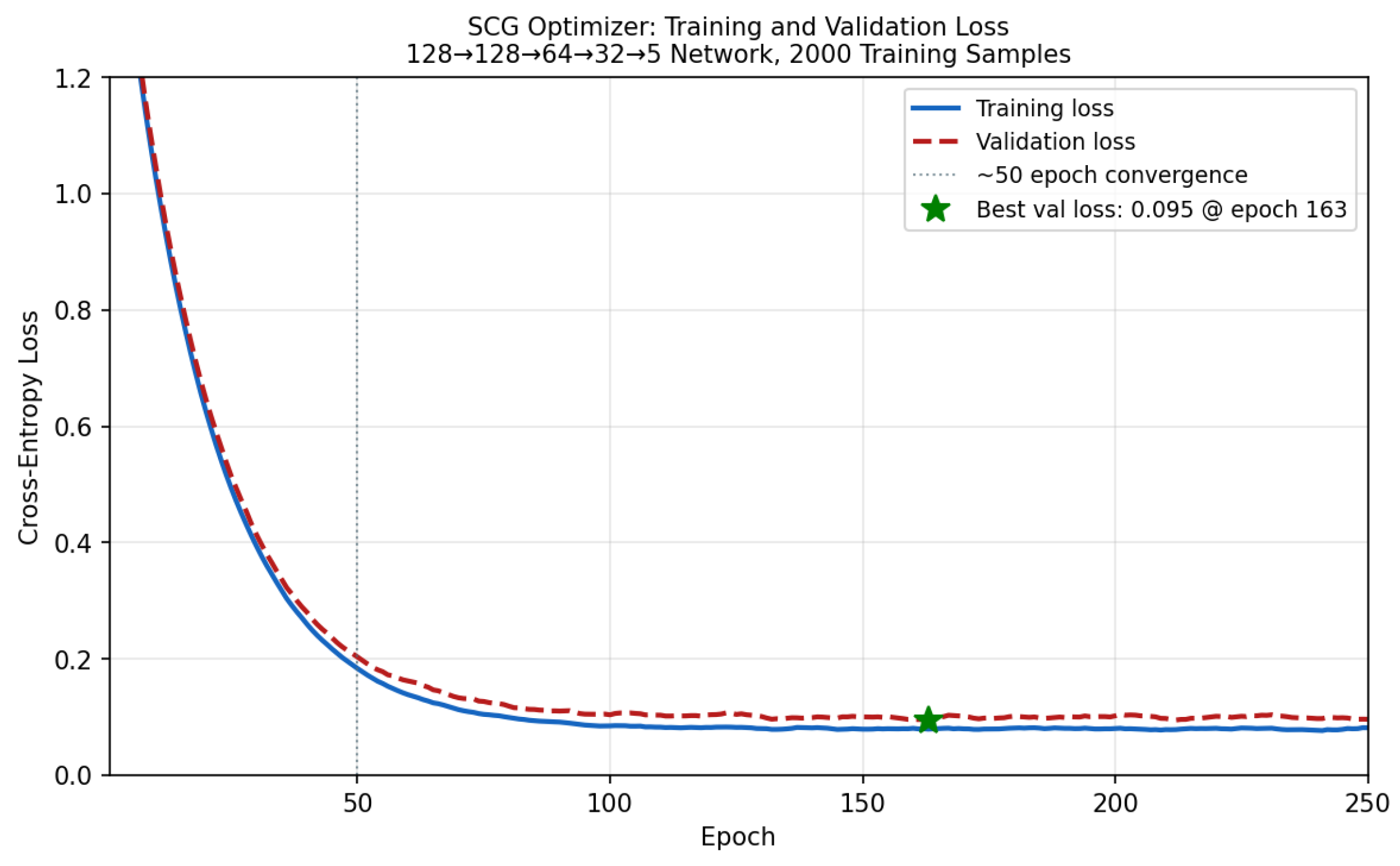

Table 1.
Key radar system parameters.
| Parameter | Symbol | Value |
|---|---|---|
| Carrier frequency | 33 GHz (Ka-band) | |
| Wavelength | 9.09 mm | |
| Number of elements | N | 36 |
| Element type | — | Crossed dipoles |
| Transmit polarization | — | RHCP |
| Receive polarization | — | LHCP |
| Dome radius | 83.2 mm () | |
| Dipole half-length | ℓ | 4.55 mm () |
| Transmit power | 50 mW | |
| Pulse width | 1 s | |
| Noise bandwidth | 1 MHz | |
| Pulse repetition frequency | PRF | 10 kHz |
| CPI duration | 0.5 s | |
| Pulses per CPI | 5000 | |
| Per-element noise figure | NF | 6 dB |
| System losses | 3 dB | |
| Aperture efficiency | 0.75 | |
| Array directivity | G | 18.6 dBi |
| Elevation scan coverage | — | – |
| Azimuth scan coverage | — | (full) |
| SLL design target | — | dB |
| Beamformer type | — | LCMV (closed form) |
| Simultaneous receive beams | M | 7 |
Table 2.
SLA dome and Rogers RO4003C feed substrate parameters.
| Parameter | Symbol | Value | Notes |
|---|---|---|---|
| Dome inner radius | 83.0 mm | at 33 GHz | |
| Wall thickness | 1.5 mm | ; one-way phase | |
| Dome material | — | SLA RF resin | Broadband low-loss |
| Relative permittivity | 2.8 | @ 33 GHz | |
| Loss tangent | 0.008 | @ 33 GHz | |
| Feed substrate | — | Rogers RO4003C | PTFE/glass-ceramic |
| Feed | — | 3.55 | @ 10 GHz |
| Feed | — | 0.0021 | @ 10 GHz |
| Feed height | h | 0.2 mm | Chosen for 50 line mm wide |
Table 3.
LCMV beamformer performance at primary scan angles.
| Commanded | Peak location (deg) | Achieved SLL (dB) | SLL | ||
|---|---|---|---|---|---|
| (deg) | Uncoupled | Coupled | Uncoupled | Coupled | (dB) |
| 0 | |||||
| 10 | |||||
| 20 | |||||
| 30 | |||||
Table 4.
Maximum detection ranges at the Albersheim threshold (, ).
| Target Class | Swerling | Mean RCS (m2) | Max Range (m) |
|---|---|---|---|
| Bird body | I | 0.010 | ≈210 |
| Wing flash | II | 0.005 | ≈175 |
| Wire specular | III | 0.100 | ≈370 |
Table 5.
Neural-network classification performance (20% test set).
| Class | Swerling | Per-Class Accuracy | Primary Confusion |
|---|---|---|---|
| Bird body | I | ≈80% | SW-II |
| Bird wings | II | ≈78% | SW-I |
| Wire specular | III | ≈92% | — |
| Wire fast | IV | ≈88% | SW-III |
| Noise/clutter | — | ≈95% | — |
| Overall | — | >85% | — |
Disclaimer/Publisher’s Note: The statements, opinions and data contained in all publications are solely those of the individual author(s) and contributor(s) and not of MDPI and/or the editor(s). MDPI and/or the editor(s) disclaim responsibility for any injury to people or property resulting from any ideas, methods, instructions or products referred to in the content. |
© 2026 by the author. Licensee MDPI, Basel, Switzerland. This article is an open access article distributed under the terms and conditions of the Creative Commons Attribution (CC BY) license.
Copyright: This open access article is published under a Creative Commons CC BY 4.0 license, which permit the free download, distribution, and reuse, provided that the author and preprint are cited in any reuse.


