

Submitted:
15 June 2026
Posted:
16 June 2026
You are already at the latest version
Abstract
A source-level mechanism for halo-like galactic scaling is analysed. The matter action is supplemented by a current-dependent scalar built from the translational and rotational current sectors. Its Hilbert variation gives an anisotropic contribution to the stress-energy tensor, while the constant part fixes the vacuum term. For a stationary axisymmetric system, the normalized vorticity flux selects one spatial direction and leaves the transverse two-plane to be warped by a single scalar. If this transverse warp approaches a nonzero negative asymptotic value, the active source scales as $r^{-2}$ and produces an asymptotically flat rotation curve. Weak transition profiles are used to display the source and rotation curves, and positivity of the active source restricts the allowed transition sharpness. With a universal current-transition threshold, areal-slope matching at the transition radius gives the baryonic Tully-Fisher normalization. Observable consequences include disk-aligned lensing anisotropy, residual dependence on baryonic angular momentum, and suppressed halo-like scaling in systems without coherent rotation.
Keywords:
dark matter
; MOND
; galaxy rotation curves
; Tully-Fisher relation
; anisotropic stress
; Alena Tensor
1. Introduction
Galaxy rotation curves exhibit a well-known asymptotic behaviour: the circular velocity tends to approach a constant value at large radii, and the asymptotic velocity obeys the baryonic Tully-Fisher relation [1,2] , where is the baryonic mass. These observations are usually interpreted either in terms of dark matter halos, with the NFW profile as the standard cold-dark-matter reference [3,4], or in terms of modified low-acceleration dynamics, starting from MOND [5,6,7]. Later developments and current issues are reviewed in [8], while the broader dark-sector setting is summarized in [9]. The observed radial acceleration relation provides an additional empirical benchmark for rotationally supported galaxies [10].
An alternative possibility is that the observed phenomenology is generated by additional structure within the matter energy-momentum tensor. Non-trivial exchange and effective dark-sector behaviour within stress-energy descriptions have been considered in related contexts [11]. The construction used below keeps only the current and rotational sector of matter. The rotationally extended stress-energy tensor is taken from the variational Alena Tensor source [12]. The reduced Rainich-Codazzi description in [13] is used only as comparison language for the anisotropic source type.
The calculation is carried out for one explicit branch metric. A normalized vorticity flux selects a spatial direction, and the transverse two-plane is warped by one scalar. The corresponding current scalar is varied in curved spacetime, so the source entering the Einstein equation is fixed before the halo collar is evaluated. In the weak-field regime the resulting active component gives flat rotation curves and MOND-like scaling [14]. The interpretation is close in spirit to models in which halo phenomenology is produced by stress-energy components rather than by new particle species [15].
The purpose of this Letter is to isolate the minimal source mechanism. First, the current action and its Hilbert tensor are written explicitly. Second, the Einstein tensor of the one-field halo collar is computed and its large-radius scaling is displayed. Third, the baryonic Tully-Fisher normalization is reduced to a local transition rule in which the asymptotic branch slope is matched to the baryonic areal-radius slope at an acceleration-selected radius. The result is a source-level construction of the halo component and its transition normalization.
2. Current Scalar and Branch Action
The branch metric is denoted by , and the sign convention is . The action is taken in the form
Here A and P are constants, and the current scalar is written as
The scalar is the translational-current coefficient. The quantity is the normalized rotational response, and is the corresponding response coefficient. In the current notation the translational current may be written as , with . The rotational part is the vorticity-response contribution to the same matter current sector. In the reduced branch calculation no independent dark component is introduced; the current dependence of (2) fixes the additional Hilbert source.
The metric variation of is defined by
The boundary term is not used below. Since , the variation of (1) gives
Using (2), this becomes
where
and
If the constant is parametrized as , then (6) gives . The phenomenological density normalization below uses the usual gravitational coupling, . In the unexcited current sector, and (5) reduces to the vacuum equation with cosmological constant. Since (1) is diffeomorphism invariant, the source (7) is covariantly conserved on the current-sector equations. The reduced collar calculation therefore evaluates a conserved variational source, not an externally prescribed density profile.
The tensor (7) contains the current and rotational response. The first part of (2) gives the translational contribution, while the variation of gives the anisotropic rotational contribution. In the continuum reading of the Alena Tensor source [12], this sector contains the rotational energy flux and the vortex stress. The reduced calculation below uses only the one-field radial branch generated by this variational source.
3. Branch Metric and Halo Collar
The stationary axisymmetric reference metric is written as
Here N, A, B, and are metric functions; the symbol A in this section is independent of the constant A in (1). The associated orthonormal coframe is , , , and . In the halo region the normalized vorticity flux selects the branch direction, so , , and the transverse plane is spanned by and . The subscript on only separates the branch vector from the metric coefficient N in (8).
The anisotropic branch metric is taken as
The corresponding line element is
This is the one-field branch used in the asymptotic calculation. The metric (9) is used to compute the active anisotropic source associated with (7). Test-particle and photon observables are read from the weak physical field sourced by this tensor. In the weak-branch reduction the active component computed from (9) enters the Poisson source of that physical field. If the two transverse coefficients in (10) do not share the same large-radius scaling, the remaining part is a shear inside the transverse plane.
The reduced flow closure fixes the anisotropy through the normalized shear-vorticity scalar,
Here is the vorticity-flux scale, is the vorticity amplitude, and is the corresponding shear component. The sign is fixed by the oriented shear-vorticity response. Equation (11) is used only as the one-field closure for , while the positive-density branch is selected below. The source tensor is the tensor (7).
For an asymptotically flat rotation curve one has . The leading terms in the numerator of (11) and the normalization then have the same radial order in the large-radius disk regime. The asymptotic branch is therefore
The corresponding asymptotic transverse slope and the weak positive-branch amplitude are denoted by
The sign of is fixed below by the active source.
4. Einstein Tensor of the Halo Collar
The large-radius calculation is isolated by the halo collar
Put . With the curvature-sign convention used in (5), the mixed Einstein tensor of (14) is
Equivalently, for the warp scalar,
The flat collar is recovered for . If (12) holds, then is subleading and
The trace-free part is
The cosmological term in (5) contributes an isotropic mixed tensor and leaves (22) unchanged.
The sign branch is chosen so that in the halo regime after subtraction of the constant vacuum term. Equation (21) then gives , or equivalently and . With the normalization stated above, the active density scale satisfies
For , this gives the usual scaling. In the weak-branch reduction, (23) is the active contribution associated with the current source.
5. Weak-Branch Profiles and Rotation Curves
The weak branch is parametrized by and
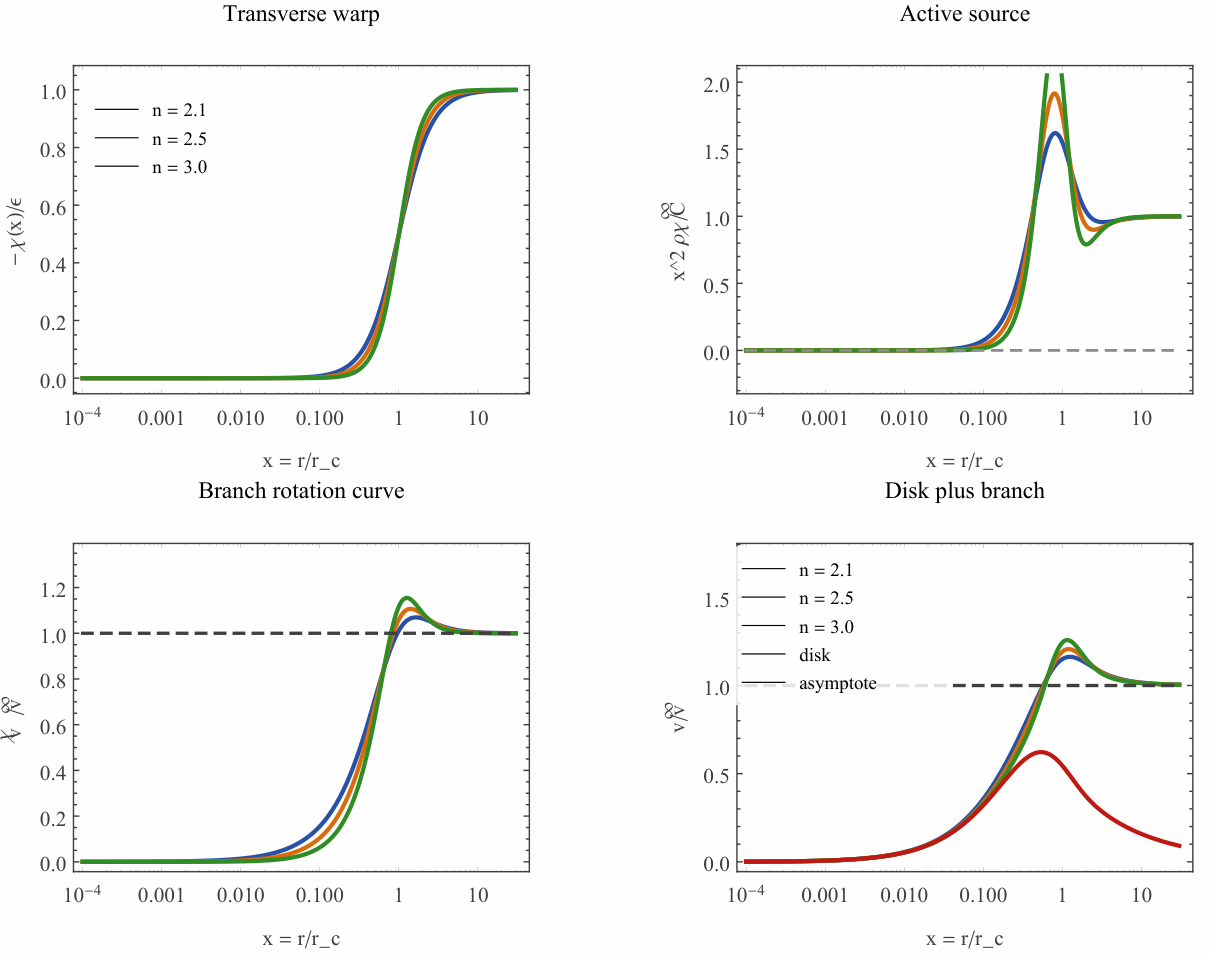
Using (18) to first order in , with primes on f denoting derivatives with respect to x, the normalized active source is
The branch contribution to the circular velocity is then
Equations (25) and (26) are the quantities shown in Figure 1.
The same calculation gives the large-radius behaviour
The normalization is
For , (28) corresponds to , so the weak-branch expansion is sufficient for galactic velocities.
For a flat curve, the corresponding spherical-equivalent density is
For and this gives
The active energy density fixed by (30) is macroscopic on galactic scales. For a representative outer-disk baryonic density , the ordinary kinetic rotational energy density is much smaller. The branch source is therefore not identified with the ordinary post-Newtonian gravitomagnetic correction.
6. Rotational Transport Interpretation
The branch amplitude has a natural transport interpretation. For stationary axisymmetric systems the rotational Killing vector is , and the corresponding Killing current is
Conservation of the matter tensor with respect to the transport metric gives
In axisymmetric coordinates this reduces to
where g denotes the physical transport metric, and and denote the radial and meridional angular-momentum fluxes carried by the rotational stress sector. A stream potential is introduced by
The angular expansion is
On the galactic plane only odd multipoles contribute to the radial flux. The lowest non-vanishing mode is
Assuming the standard large-radius hierarchy, higher modes decay faster than the lowest odd contribution [16]. Similar hierarchies occur in gravitational transport settings [17]. In the weak-field large-radius regime,
Thus a finite asymptotic transport amplitude gives the same scaling as the active source in (23).
The coefficient is related to the radial angular-momentum flux by
Using (36) and (38),
Approximately constant angular-momentum fluxes are standard in rotating astrophysical systems [18,19]. Large-scale redistribution by torques and correlated stresses also appears in cosmological disk settings [20,21]. If the transport operates on the local orbital timescale [22], then gives . This scaling fixes the transport amplitude to which the branch response is matched at the transition.
7. BTFR as Transition Closure
The empirical baryonic Tully-Fisher relation is written as
In the branch picture the first normalization is (28). The remaining input is local. Under a universal current-transition threshold, the asymptotic branch slope is matched to the baryonic areal-radius slope at the transition radius. For the baryonic transition geometry
the transverse scale is matched at the level of the proper-radial areal slope. The matching condition is
For a weak exterior monopole,
Equations (44) and (45) give
Thus (28) gives
The transition radius is selected by the current threshold
In the weak monopole-dominated closure used below, the same selection is parametrized by the baryonic acceleration invariant
The branch transition is imposed at
If the baryonic field is monopole-dominated at , then
Equations (47) and (51) imply
Thus the BTFR normalization is reduced to the areal-slope matching (44) and the current-transition selection (48). The acceleration scale is the transition scale of the current sector. If it is universal, (52) has the same structure as (42). In the transport language, the same transition constrains the product of the asymptotic transport amplitude and the branch response. If the response coefficient is universal, (41) fixes the mass dependence of the asymptotic transport amplitude. For of the galactic low-acceleration order, comparable to in (42), the transition radius from (51) is galactic for ordinary disk masses, while (28) keeps . The weak branch is therefore consistent with the normalization range used above.
8. Observational Consequences
The following consequences are tied to the source geometry rather than to a global rotation-curve fit. The primary geometric signature is the disk-aligned anisotropic lensing component. The dynamical residuals are expected to enter through the transition radius, baryonic angular momentum, and disk structure. Systems without a coherent rotating branch provide the corresponding suppression tests.
8.1. Disk-Aligned Lensing Anisotropy
The branch metric (9) produces a flattened effective source aligned with the baryonic disk. In CDM, halo triaxiality can also produce anisotropic shear with sensitivity to baryonic alignment and projection. A systematics-corrected 3.8 detection of galaxy-scale halo flattening aligned with galaxy light was reported in [23]. In MOND-like disk models, lensing anisotropy can arise from the baryonic disk and the phantom-matter distribution; inclination-dependent disk-lensing effects were calculated in [24]. In the present source reading the relevant quantity is the Ricci focusing generated by (7).
For a leading-order null lensing vector of the weak optical field, the cosmological term in (5) drops out of the Ricci focusing. The source projection is
The prediction is therefore a weak-lensing quadrupole tied to the vorticity-selected transverse plane. At fixed , the leading projection gives an anisotropic shear contribution scaling with disk inclination as , with the orientation following the disk-plane geometry. Inclination-dependent stacking in Euclid or LSST data would test the source geometry encoded in (22).
8.2. Transition Radii and RAR Residuals
The transition radius in (24) is expected to correlate with disk structure. Higher modes in (37) decay faster and may couple to scales such as , the bar corotation radius, or the stellar-to-gas transition radius.
SPARC data constrain this picture. The RAR scatter after fitting individual galaxies is about dex [25], and no strong galaxy-to-galaxy variation in the critical acceleration scale is found in [26]. A proportional scaling between and disk structure can preserve the mean RAR while allowing secondary residuals. Non-monotonic features in the plane [27] would correspond to a locally non-trivial branch profile.
The predicted partial correlation is between RAR residuals and disk geometry at fixed and . In the present closure the residuals may enter through deviations from the monopole limit in (45), through disk-dependent corrections to (49), or through a non-universal transport response. A universal MOND interpolation depending only on provides the corresponding baseline without this secondary dependence [25,26]. In CDM the analogous residuals are usually associated with concentration, feedback, and assembly history.
8.3. Baryonic Angular Momentum and UDG Systems
Because (41) relates the asymptotic amplitude to , the main secondary parameter at fixed is expected to be the baryonic specific angular momentum . Illustris and EAGLE simulations find weak correlation between stellar disc spin and host halo spin [28,29], with angular-momentum retention discussed in [28]. The disk-scale distinction is therefore observationally relevant.
The BTFR shows no strong correlation between residuals and galaxy structural parameters at fixed [30]. This can be compatible with a tight transport response if the branch follows the observed Fall relation [31]. The Fall relation has larger scatter than the BTFR [32], and its residuals are sensitive to gas fraction [31]. A useful residual test is
In the usual CDM interpretation, BTFR residuals are primarily associated with halo concentration variations [33].
Systems with low coherent baryonic angular momentum are expected to have a reduced branch contribution. UDGs with suppressed or absent halo-like scaling, including NGC 1052-DF2 [34,35], NGC 1052-DF4 [36], and FCC 224 [37], are natural candidates for this low- tail. Some UDG morphologies have been associated with halo spin in simulations [38]. Recent EAGLE results indicate that UDG sizes are driven by high spin in the star-forming gas rather than by high halo spin [39]. The kinematic proxy measured by integral-field spectroscopy [40] can therefore be compared directly with the halo-like velocity excess. The MUSE separation between rotation-supported and dispersion-dominated UDGs in [37] gives an existing test case.
8.4. Non-Disk Systems and Clusters
The galactic normalization is tied to a coherent disk-transport branch. On BCG and cluster scales the effective acceleration scale is higher than the galactic RAR scale by a factor of order seventeen [41]. Kinematic, lensing, and X-ray thermodynamic mass profiles give the cluster comparison in [42]; cluster mass profiles based on lensing and X-ray data are also discussed in [43,44]. The baryonic component of clusters is dominated by a hot quasi-isotropic intracluster medium, so the disk branch (9) is not expected to set the cluster scale.
NGC 1052-DF2 was confirmed as a galaxy whose stellar velocity dispersion is consistent with its baryonic mass alone [34,35]. Similar claims have been made for NGC 1052-DF9 [45]. Formation channels involving strong interactions or collisions can disrupt disk structure [46]. Such systems should not sustain the transport channel entering (33), even if a formal low-acceleration radius can be assigned to the baryonic field.
8.5. High-Redshift Disk State
The branch amplitude should build up as a quasi-stationary transport channel is established. Dynamically immature systems with low , disturbed morphology, or young mean stellar age may therefore show negative BTFR residuals at fixed . Dynamically cold or giant disks have already been observed at [47,48], and no strong BTFR evolution to was reported in [49]. A compact parametrization is
A partial correlation between and at fixed is a direct test.
8.6. Weak-Lensing Measurements
Weak-lensing measurements already provide a qualitative comparison class. Early galaxy-galaxy lensing analyses reported evidence for halo flattening aligned with galaxy light [50]. Later SDSS work emphasized systematic contaminants and found weaker evidence [51]. The systematics-corrected detection in [23] is consistent with a flattened source aligned with the baryonic component. These measurements do not isolate the vorticity-selected plane in (9), but they motivate the inclination-dependent test described above.
9. Discussion and Limitations
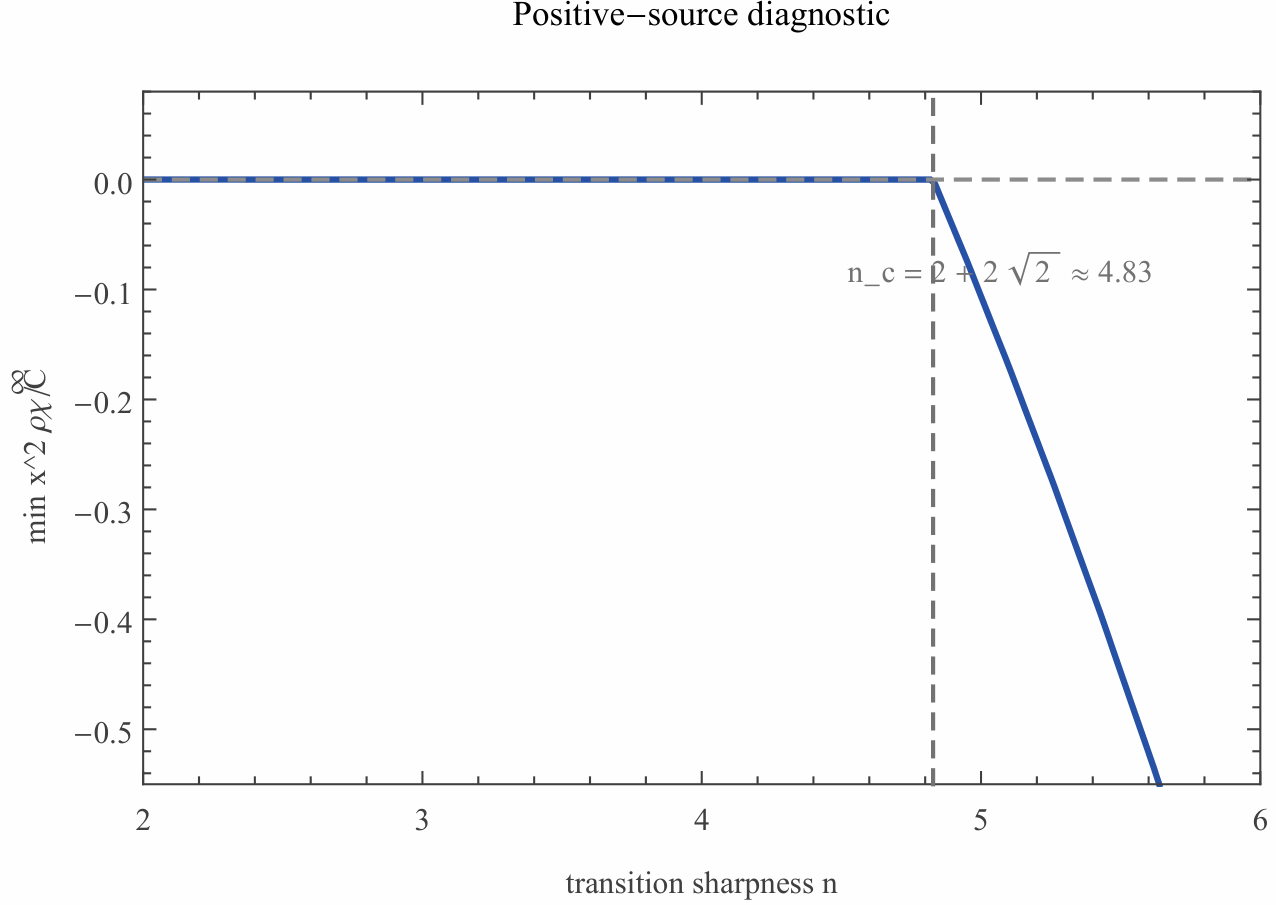
The calculation isolates the asymptotic weak-field branch of a rotational-current source. The scalar (2) gives, after Hilbert variation, the source tensor (7). Its constant part fixes the cosmological term through (6), and its current-dependent part supplies the anisotropic source in (5). The halo collar computation shows that an asymptotically constant transverse warp gives an active source with trace-free type (22). The weak-branch profiles in Figure 1 display the corresponding rotation curves, while Figure 2 shows that positivity restricts the transition sharpness.
The normalization has been written as a local transition closure. The positive branch is an areal-slope deficit, and (44) identifies this deficit with the baryonic transition geometry through the proper-radial areal slope. The compactness condition (46) is the weak-field monopole limit of the slope matching, while (48) selects the radius at which the branch freezes into its asymptotic collar value. With a universal transition scale, (52) follows in the monopole-dominated regime. The present Letter isolates the asymptotic one-field branch. The remaining disk problem concerns the radial completion of , the vorticity flux, and the large-radius transport amplitude.
The astrophysical setting is compatible with known mechanisms of angular-momentum redistribution in disks [52]. Correlated stresses and torques in the baryonic component provide the transport channel, while the branch geometry supplies the active source geometry. Relativistic local spin-vorticity and transport treatments give the corresponding comparison class [53,54].
The next step is the radial branch problem for realistic disks, including the transition implied by (11), the energy conditions of (7), and joint fits to rotation curves and weak lensing. The most direct observational tests are disk-aligned lensing anisotropy, residual dependence on and gas fraction, suppression in systems without coherent rotation, and the scaling of the transition radius across disk structural classes.
References
- Ruan, D.; Brooks, A.M.; Cruz, A.; Peter, A.H.; Keller, B.W.; Quinn, T.; Wadsley, J.; Adams, E.A. Predictions for detecting a turndown in the baryonic Tully–Fisher relation. Monthly Notices of the Royal Astronomical Society 2025, 541, 2180–2196. [CrossRef]
- Kourkchi, E.; Tully, R.B.; Courtois, H.M.; Dupuy, A.; Guinet, D. Cosmicflows-4: the baryonic Tully–Fisher relation providing 10 000 distances. Monthly Notices of the Royal Astronomical Society 2022, 511, 6160–6178. [CrossRef]
- Navarro, J.F.; Frenk, C.S.; White, S.D.M. The Structure of Cold Dark Matter Halos. The Astrophysical Journal 1996, 462, 563–575. [CrossRef]
- Navarro, J.F.; Frenk, C.S.; White, S.D.M. A Universal Density Profile from Hierarchical Clustering. The Astrophysical Journal 1997, 490, 493–508. [CrossRef]
- Milgrom, M. A modification of the Newtonian dynamics as a possible alternative to the hidden mass hypothesis. The Astrophysical Journal 1983, 270, 365–370. [CrossRef]
- Milgrom, M. A modification of the Newtonian dynamics: Implications for galaxies. The Astrophysical Journal 1983, 270, 371–383. [CrossRef]
- Milgrom, M. A modification of the Newtonian dynamics: Implications for galaxy systems. The Astrophysical Journal 1983, 270, 384–389. [CrossRef]
- Salucci, P. Issues in the Investigations of the Dark Matter Phenomenon in Galaxies: Parcere Personis, Dicere de Vitiis. Universe 2025, 11, 67. [CrossRef]
- Abdalla, E.; Marins, A. The dark sector cosmology. International Journal of Modern Physics D 2020, 29, 2030014. [CrossRef]
- McGaugh, S.S.; Lelli, F.; Schombert, J.M. Radial Acceleration Relation in Rotationally Supported Galaxies. Physical Review Letters 2016, 117, 201101. [CrossRef]
- Zhai, Y.; De Cesare, M.; Van De Bruck, C.; Di Valentino, E.; Wilson-Ewing, E. A low-redshift preference for an interacting dark energy model. Journal of Cosmology and Astroparticle Physics 2025, 2025, 010. [CrossRef]
- Ogonowski, P. The halo effect and quantum vortices. Not so dark with Alena Tensor. Physica Scripta 2026, 101, 155002. [CrossRef]
- Ogonowski, P. Self-Reconstructing Codazzi Defects, CP1 Quantization, and the Minimal Standard-Model Carrier, 2026, [arXiv:physics.gen-ph/2606.12693].
- Eappen, R.; Kroupa, P. Scaling relations of early-type galaxies in MOND. Galaxies 2025, 13, 22. [CrossRef]
- Domènech, G.; Ganz, A. Connecting relativistic MOND theories with mimetic gravity. Journal of Cosmology and Astroparticle Physics 2025, 2025, 059. [CrossRef]
- Yoo, J.; Magi, M.; Huterer, D. Cosmic dipoles from large-scale structure surveys. Phys. Rev. D 2025, 112, 123013. [CrossRef]
- Kratter, K.; Lodato, G. Gravitational instabilities in circumstellar disks. Annual Review of Astronomy and Astrophysics 2016, 54, 271–311. [CrossRef]
- Hopkins, P.F.; Quataert, E. An analytic model of angular momentum transport by gravitational torques: from galaxies to massive black holes. Monthly Notices of the Royal Astronomical Society 2011, 415, 1027–1050. [CrossRef]
- Krumholz, M.R.; Burkhart, B.; Forbes, J.C.; Crocker, R.M. A unified model for galactic discs: star formation, turbulence driving, and mass transport. Monthly Notices of the Royal Astronomical Society 2018, 477, 2716–2740. [CrossRef]
- Yang, H.; Liao, S.; Fattahi, A.; Frenk, C.S.; Gao, L.; Guo, Q.; Shao, S.; Wang, L.; Wright, R.J.; Zeng, G. APOSTLE–AURIGA: effects of stellar feedback subgrid models on the evolution of angular momentum in disc galaxies. Monthly Notices of the Royal Astronomical Society 2024, 535, 1394–1405. [CrossRef]
- Trapp, C.W.; Kereš, D.; Hopkins, P.F.; Faucher-Giguère, C.A.; Murray, N. Angular momentum transfer in cosmological simulations of Milky Way-mass discs. Monthly Notices of the Royal Astronomical Society 2024, 533, 3008–3026. [CrossRef]
- Hafen, Z.; Stern, J.; Bullock, J.S.; Gurvich, A.B.; Yu, S.; Faucher-Giguère, C.A.; Fielding, D.B.; Anglés-Alcázar, D.; Quataert, E.; Wetzel, A.; et al. Hot-mode accretion and the physics of thin-disc galaxy formation. Monthly Notices of the Royal Astronomical Society 2022, 514, 5056–5073. [CrossRef]
- Schrabback, T.; Hoekstra, H.; Van Waerbeke, L.; Van Uitert, E.; Georgiou, C.; Asgari, M.; Côté, P.; Cuillandre, J.C.; Erben, T.; Ferrarese, L.; et al. Tightening weak lensing constraints on the ellipticity of galaxy-scale dark matter haloes. Astronomy & Astrophysics 2021, 646, A73. [CrossRef]
- Harvey-Hawes, C.; Galoppo, M. A Novel Test for MOND: Gravitational Lensing by Disk Galaxies. The Astrophysical Journal 2025, 994, 167. [CrossRef]
- Li, P.; Lelli, F.; McGaugh, S.; Schombert, J. Fitting the radial acceleration relation to individual SPARC galaxies. Astronomy & Astrophysics 2018, 615, A3. [CrossRef]
- Lelli, F.; McGaugh, S.S.; Schombert, J.M.; Pawlowski, M.S. One law to rule them all: the radial acceleration relation of galaxies. The Astrophysical Journal 2017, 836, 152. [CrossRef]
- Mercado, F.J.; Bullock, J.S.; Moreno, J.; Boylan-Kolchin, M.; Hopkins, P.F.; Wetzel, A.; Faucher-Giguère, C.A.; Samuel, J. Hooks & Bends in the radial acceleration relation: discriminatory tests for dark matter and MOND. Monthly Notices of the Royal Astronomical Society 2024, 530, 1349–1362. [CrossRef]
- Zjupa, J.; Springel, V. Angular momentum properties of haloes and their baryon content in the Illustris simulation. Monthly Notices of the Royal Astronomical Society 2017, 466, 1625–1647. [CrossRef]
- Yang, H.; Gao, L.; Frenk, C.S.; Grand, R.J.; Guo, Q.; Liao, S.; Shao, S. The galaxy size to halo spin relation of disc galaxies in cosmological hydrodynamical simulations. Monthly Notices of the Royal Astronomical Society 2023, 518, 5253–5259. [CrossRef]
- Lelli, F.; McGaugh, S.S.; Schombert, J.M.; Desmond, H.; Katz, H. The baryonic Tully-Fisher relation for different velocity definitions and implications for galaxy angular momentum. Monthly Notices of the Royal Astronomical Society 2019, 484, 3267–3278. [CrossRef]
- Piña, P.E.M.; Posti, L.; Fraternali, F.; Adams, E.A.; Oosterloo, T. The baryonic specific angular momentum of disc galaxies. Astronomy & Astrophysics 2021, 647, A76. [CrossRef]
- McGaugh, S.S.; Schombert, J.M.; Bothun, G.D.; De Blok, W. The baryonic tully-fisher relation. The Astrophysical Journal Letters 2000, 533, L99–L102. [CrossRef]
- Desmond, H.; Wechsler, R.H. The Tully–Fisher and mass–size relations from halo abundance matching. Monthly Notices of the Royal Astronomical Society 2015, 454, 322–343. [CrossRef]
- Van Dokkum, P.; Danieli, S.; Cohen, Y.; Merritt, A.; Romanowsky, A.J.; Abraham, R.; Brodie, J.; Conroy, C.; Lokhorst, D.; Mowla, L.; et al. A galaxy lacking dark matter. Nature 2018, 555, 629–632. [CrossRef]
- Danieli, S.; van Dokkum, P.; Conroy, C.; Abraham, R.; Romanowsky, A.J. Still missing dark matter: KCWI high-resolution stellar kinematics of NGC1052-DF2. The Astrophysical Journal Letters 2019, 874, L12. [CrossRef]
- van Dokkum, P.; Danieli, S.; Abraham, R.; Conroy, C.; Romanowsky, A.J. A second galaxy missing dark matter in the NGC 1052 group. The Astrophysical Journal Letters 2019, 874, L5. [CrossRef]
- Buzzo, M.L.; Forbes, D.A.; Romanowsky, A.J.; Haacke, L.; Gannon, J.S.; Tang, Y.; Hilker, M.; Ferré-Mateu, A.; Janssens, S.R.; Brodie, J.P.; et al. A new class of dark matter-free dwarf galaxies?-I. Clues from FCC 224, NGC 1052-DF2, and NGC 1052-DF4. Astronomy & Astrophysics 2025, 695, A124. [CrossRef]
- Benavides, J.A.; Sales, L.V.; Abadi, M.G.; Marinacci, F.; Vogelsberger, M.; Hernquist, L. Origin and evolution of ultradiffuse galaxies in different environments. Monthly Notices of the Royal Astronomical Society 2023, 522, 1033–1048. [CrossRef]
- Zheng, H.; Liao, S.; Gao, L.; Jiang, F. Ultradiffuse Galaxies in the EAGLE Simulation. The Astrophysical Journal 2026, 997, 15. [CrossRef]
- Buttitta, C.; Iodice, E.; Doll, G.; Hartke, J.; Hilker, M.; Forbes, D.A.; Corsini, E.M.; Rossi, L.; Arnaboldi, M.; Cantiello, M.; et al. Looking into the faintEst WIth MUSE (LEWIS): Exploring the nature of ultra-diffuse galaxies in the Hydra-I cluster-II. Stellar kinematics and dynamical masses. Astronomy & Astrophysics 2025, 694, A276. [CrossRef]
- Tian, Y.; Ko, C.M.; Li, P.; McGaugh, S.; Poblete, S.L. A distinct radial acceleration relation across the brightest cluster galaxies and galaxy clusters. Astronomy & Astrophysics 2024, 684, A180. [CrossRef]
- Li, P.; Tian, Y.; Júlio, M.P.; Pawlowski, M.S.; Lelli, F.; McGaugh, S.S.; Schombert, J.M.; Read, J.I.; Yu, P.C.; Ko, C.M. Measuring galaxy cluster mass profiles into the low-acceleration regime with galaxy kinematics. Astronomy & Astrophysics 2023, 677, A24. [CrossRef]
- Allen, S.W.; Evrard, A.E.; Mantz, A.B. Cosmological parameters from observations of galaxy clusters. Annual Review of Astronomy and Astrophysics 2011, 49, 409–470. [CrossRef]
- Umetsu, K. Cluster–galaxy weak lensing: K. Umetsu. The Astronomy and Astrophysics Review 2020, 28, 7. [CrossRef]
- Keim, M.A.; van Dokkum, P.; Shen, Z.; Danieli, S.; Pasha, I. A Third Galaxy Missing Dark Matter along a Trail of Galaxies in the NGC 1052 Field. arXiv preprint arXiv:2603.15860 2026. [CrossRef]
- van Dokkum, P.; Shen, Z.; Keim, M.A.; Trujillo-Gomez, S.; Danieli, S.; Dutta Chowdhury, D.; Abraham, R.; Conroy, C.; Kruijssen, J.D.; Nagai, D.; et al. A trail of dark-matter-free galaxies from a bullet-dwarf collision. Nature 2022, 605, 435–439. [CrossRef]
- Rizzo, F.; Vegetti, S.; Powell, D.; Fraternali, F.; McKean, J.; Stacey, H.; White, S. A dynamically cold disk galaxy in the early Universe. Nature 2020, 584, 201–204. [CrossRef]
- Wang, W.; Cantalupo, S.; Pensabene, A.; Galbiati, M.; Travascio, A.; Steidel, C.C.; Maseda, M.V.; Pezzulli, G.; De Beer, S.; Fossati, M.; et al. A giant disk galaxy two billion years after the Big Bang. Nature Astronomy 2025, 9, 710–719. [CrossRef]
- Übler, H.D.; Genzel, R.; Wisnioski, E.; Schreiber, N.M.F.; Shimizu, T.T.; Price, S.H.; Tacconi, L.J.; Belli, S.; Wilman, D.J.; Fossati, M.; et al. The Evolution and Origin of Ionized Gas Velocity Dispersion from z∼2.6 to z∼0.6 with KMOS3D. arXiv preprint arXiv:1906.02737 2019. [CrossRef]
- Hoekstra, H.; Yee, H.K.; Gladders, M.D. Properties of galaxy dark matter halos from weak lensing. The Astrophysical Journal 2004, 606, 67–77. [CrossRef]
- Mandelbaum, R.; Hirata, C.M.; Broderick, T.; Seljak, U.; Brinkmann, J. Ellipticity of dark matter haloes with galaxy–galaxy weak lensing. Monthly Notices of the Royal Astronomical Society 2006, 370, 1008–1024. [CrossRef]
- Sellwood, J. The lifetimes of spiral patterns in disc galaxies. Monthly Notices of the Royal Astronomical Society 2011, 410, 1637–1646. [CrossRef]
- Becattini, F.; Singh, R. On the local thermodynamic relations in relativistic spin hydrodynamics. The European Physical Journal C 2025, 85, 1338. [CrossRef]
- Kiamari, M.; Sadooghi, N.; Sedighi Jafari, M. Relativistic magnetohydrodynamics of a spinful and vortical fluid: Entropy current analysis. Physical Review D 2024, 109, 036024. [CrossRef]
Figure 1.
Dimensionless weak-branch profiles for the current-induced halo collar. The transition profile is shown for . The active source approaches , and the corresponding branch rotation curve approaches . The last panel adds a standard exponential disk with and .
Figure 1.
Dimensionless weak-branch profiles for the current-induced halo collar. The transition profile is shown for . The active source approaches , and the corresponding branch rotation curve approaches . The last panel adds a standard exponential disk with and .
Disclaimer/Publisher’s Note: The statements, opinions and data contained in all publications are solely those of the individual author(s) and contributor(s) and not of MDPI and/or the editor(s). MDPI and/or the editor(s) disclaim responsibility for any injury to people or property resulting from any ideas, methods, instructions or products referred to in the content. |
© 2026 by the authors. Licensee MDPI, Basel, Switzerland. This article is an open access article distributed under the terms and conditions of the Creative Commons Attribution (CC BY) license (http://creativecommons.org/licenses/by/4.0/).
Copyright: This open access article is published under a Creative Commons CC BY 4.0 license, which permit the free download, distribution, and reuse, provided that the author and preprint are cited in any reuse.


