

Submitted:
19 March 2026
Posted:
23 March 2026
You are already at the latest version
Abstract
Exercise adaptation and training maladaptation arise from overlapping metabolic, redox, inflammatory, endocrine, and tissue-remodeling processes, so the translational question is not whether biomarkers change, but when, where, and for which decision they become informative. This narrative review synthesizes biomarkers across the recovery-overload continuum and proposes a decision-linked framework organized around five coupled layers: stimulus architecture, signaling and release biology, sampling matrix and pre-analytics, bout-relative kinetics, and the monitoring decision to be supported. Current evidence indicates that no single biomarker reliably separates productive remodeling from delayed recovery, tissue strain, non-functional overreaching, or early maladaptation. Classical chemistry remains useful for bounded tasks, especially delayed tissue strain and stress reactivity; cfDNA appears promising for rapid load sensitivity; targeted metabolite panels are strongest for recovery phenotyping; and circulating RNAs and extracellular-vesicle cargo add mechanistic depth but remain constrained by pre-analytical fragility and incomplete standardization. Biomarkers should therefore be interpreted as temporally staggered layers rather than isolated peaks, with greater concern assigned to persistent cross-window elevation than to a transient rise. Progress will depend on sparse, purpose-specific panels, transparent analytical standards, and prospective validation against symptoms, performance, and established measures across sex, hormonal, circadian, and training contexts.
Keywords:
exercise adaptation
; recovery monitoring
; overload
; overreaching
; biomarkers
; multi-omics
; metabolomics
; cell-free DNA
; circulating RNA
; extracellular vesicles
1. Introduction
Exercise adaptation begins as a controlled disturbance of homeostasis in which mechanical, metabolic, redox, immune, and endocrine signals are mobilized to drive remodeling across skeletal muscle and extra-muscular tissues [1,2,3]. Redox-responsive signaling and exercise-induced hormesis help explain why these perturbations can culminate in adaptation rather than net disruption [4,5,6,7,8,9]. The translational challenge is therefore not simply to document molecular movement, but to determine how these signals resolve across recovery and when they become informative for monitoring decisions.
That challenge is difficult because adaptation, delayed recovery, tissue strain, functional overreaching, and early maladaptation arise from overlapping biology rather than discrete pathways [10,11,12]. Consensus work on training load, injury risk, and illness risk supports viewing these states as a continuum rather than a binary threshold [13,14,15,16]. The same shifts in membrane disruption, inflammatory signaling, endocrine stress, or substrate turnover may reflect productive remodeling in one context and accumulating biological cost in another [17,18,19]. This overlap explains why isolated biomarkers rarely function as stand-alone classifiers of training status [20,21,22].
Recent multi-omic studies have sharpened mechanistic resolution by showing that exercise responses are distributed across tissues, timescales, and regulatory programs [23,24,25,26]. Human training studies, consortium protocols, and translational syntheses extend this signal across longer adaptation windows, multiple tissues, and applied monitoring contexts [27,28,29,30,31,32,33]. Yet most reviews still organize the field mainly by molecule class or platform, leaving the key translational gap unresolved: when is a marker informative, in which matrix, at what bout-relative time, and for which monitoring question [34,35,36,37,38,39,40]?
Accordingly, this narrative review does not simply catalogue exercise-responsive molecules; it proposes a decision-linked interpretive framework for minimally invasive biomarkers across the recovery-overload continuum. The specific aim is to clarify which biomarker classes are informative, in which matrix, at what time, for which monitoring decision, and under what validation logic. Three propositions guide the review: overload is better interpreted as progressive loss of signal resolution than as threshold crossing; biomarker utility depends on temporal and mechanistic complementarity rather than platform novelty; and validation should be judged by improvement in bounded monitoring decisions rather than association with load alone. Although the primary emphasis is athlete monitoring, the framework may also inform exercise medicine and rehabilitation, where repeated exercise exposure and incomplete recovery must be interpreted in a time-sensitive, context-dependent manner.
2. Interpreting Exercise Biomarkers: A Decision-Linked Systems Framework
Interpreting exercise biomarkers requires more than linking molecules to physiology; it requires linking them to stimulus architecture, release biology, sampling conditions, and the recovery environment in which adaptation unfolds. Because similar signals can accompany both productive remodeling and accumulating strain, interpretation depends on kinetics, matrix, and the bounded decision being supported. The framework proposed here is intended not only as a conceptual synthesis, but as an operational scaffold for sampling design, panel construction, and prospective validation. Unlike platform-centered reviews that mainly ask whether a molecule is exercise responsive, this framework asks when a marker becomes interpretable, in which matrix, and for which decision. The literature synthesis prioritized human repeated-measures studies with clear bout-relative timing, defined sampling matrices, and direct translational relevance to athlete monitoring; details are provided in Appendix A.
The analytical premise of the review is that a measured biomarker reflects a transformation chain between exercise dose and circulating readout. Mechanical tension, calcium flux, energetic strain, hypoxia, catecholamine signaling, glucocorticoid tone, and immune trafficking converge on nodes such as AMPK, PGC-1α, mTORC1, NF-κB, and Nrf2 [1,2,3]. These signaling networks shape downstream remodeling outcomes such as substrate switching and mitochondrial adaptation [4,5,6], while broader redox-responsive and hormetic signaling influences how those responses are resolved [7,8,9].
A second interpretive step is matrix conversion. Biomolecules may enter plasma directly or circulate within protein complexes and extracellular vesicles [41]. They may later appear in saliva or urine [36,37] with different delays and analytical liabilities [42,43,44]. The same training bout can therefore generate substantially different readouts depending on matrix, collection device, and processing delay [38,39,40]. Interpretation also shifts according to whether the goal is same-day load quantification [45,46,47,48] or later mechanistic phenotyping [49,50,51].
Throughout the manuscript, biomarker families are interpreted through five coupled layers: stimulus architecture, signaling and release biology, sampling matrix and pre-analytics, biomarker-domain kinetics, and the decision endpoint to be informed. This framework (Figure 1) is used to compare biomarkers against bounded monitoring tasks such as acute load sensitivity, delayed tissue strain, recovery sufficiency, and early maladaptation rather than against the unrealistic expectation of universal diagnostic thresholds.
From a practical perspective, the proposed framework can be operationalized by matching marker choice and sampling time to a prespecified decision rather than to platform availability alone. When the monitoring objective is acute training-load quantification, early rapidly responsive markers such as cfDNA or selected salivary stress signals are most informative. For delayed tissue-strain or recovery assessment, markers with slower kinetics, such as CK or targeted metabolite profiles, are better prioritized within 24-48 h windows. When the objective is to interpret recovery status or emerging maladaptation, persistent multi-domain patterns integrating kinetics, symptomatology, and performance become more informative than isolated signals. The framework is therefore intended to guide purpose-specific marker selection and sampling logic rather than to define universal biomarker thresholds.
2.1. Common Translational Criteria Used Across Biomarker Families
Across subsequent sections, biomarker families are compared using the same appraisal lens: Which biological layer is being sampled? How rapidly does the signal rise and resolve? Which matrix best captures it under realistic field conditions? Which pre-analytical liabilities most threaten interpretation? And which bounded decision, if any, does the biomarker improve beyond established measures? Applying this common lens helps prevent platform-driven description and keeps the review anchored to practical inference rather than molecular novelty alone.
Terms such as moderate maturity, emerging maturity, or limited readiness are therefore used comparatively rather than diagnostically. A biomarker may be useful for one narrow task, such as same-day load sensitivity, yet weak for delayed recovery classification or early maladaptation screening. Making that distinction explicit is essential for fair comparison across classical chemistry, metabolite panels, cfDNA, circulating RNAs, and extracellular-vesicle cargo.
3. Recovery-Overload Continuum as Progressive Loss of Signal Resolution
Adaptation and maladaptation are best interpreted as positions along a continuum running from resolved perturbation to delayed recovery, functional overreaching, non-functional overreaching, and overtraining-like maladaptation. Across these states, the underlying biology - metabolic strain, redox signaling, immune activation, endocrine stress, and tissue remodeling - overlaps substantially [10,15,16]. Recent syntheses in resistance exercise and broader overtraining contexts support the same interpretation [52,53,54]. What changes most is not pathway identity, but the timing, persistence, and coordination of signals.
This shared biology makes isolated biomarkers intrinsically difficult to interpret. A rise in CK, cfDNA, cytokines, or redox-sensitive metabolites may reflect useful remodeling after a novel bout, transient delayed recovery, or accumulating tissue cost [55,56,57]. The repeated-bout effect deepens the ambiguity because prior exposure can blunt membrane leakage while preserving transcriptional and cellular adaptation [58,59]. Lower amplitude therefore does not necessarily imply lower biological work.
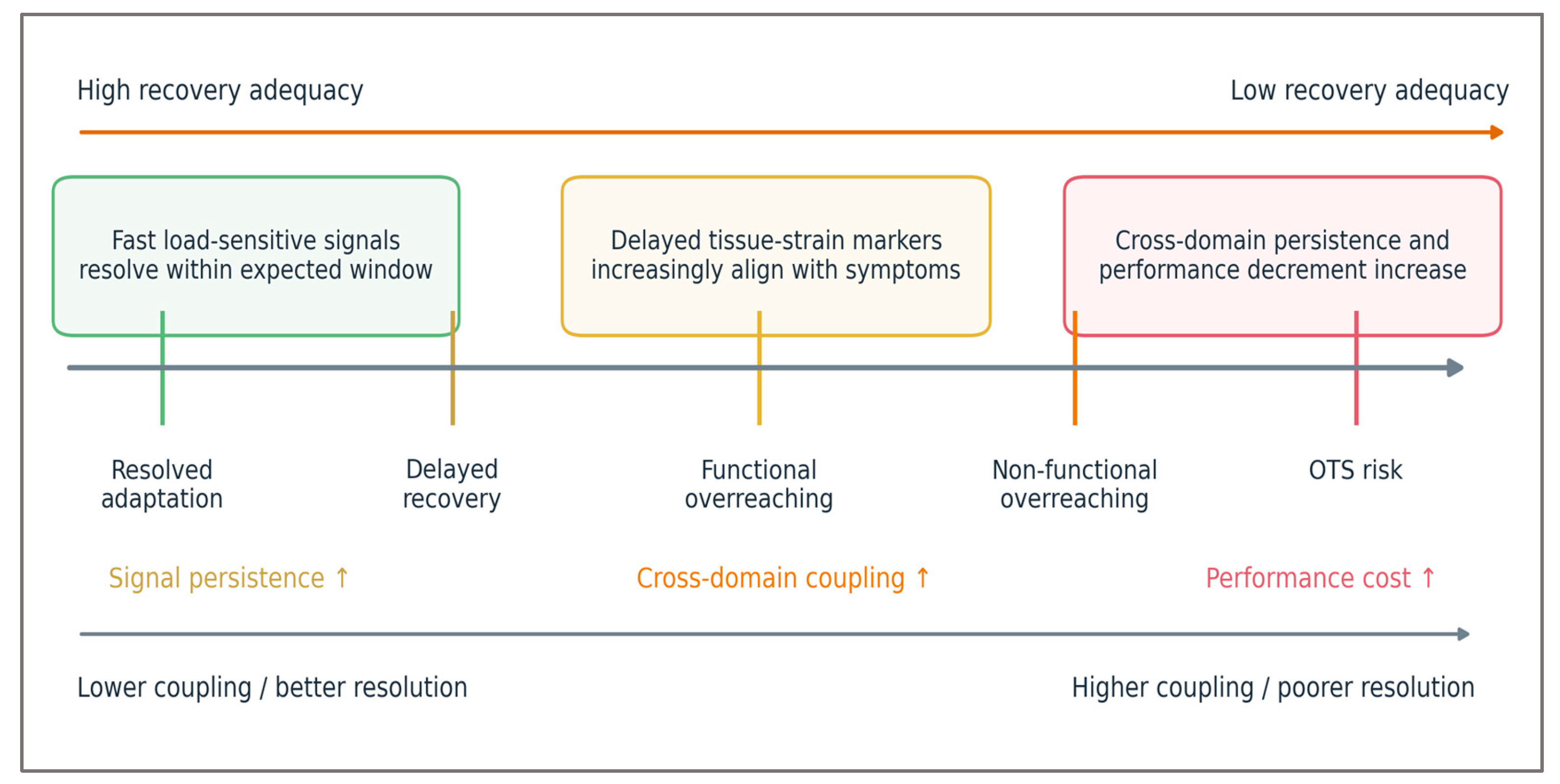
Operationally, the shift toward overload is better conceptualized as progressive loss of signal resolution rather than as accumulation of a single analyte. In a resolved state, fast load-sensitive signals rise and normalize on schedule, delayed tissue-strain markers show limited spillover, and cross-domain coupling remains low. As recovery deteriorates, signals emerge at the wrong time, persist beyond their expected window, and become increasingly concordant with symptoms, performance decrement, and repeated-session carryover. The most informative warning sign is therefore not an isolated peak, but the persistence, mistiming, and cross-domain coherence of multiple signals across successive windows [17,18,19]. Earlier overtraining literature anticipated this interpretive problem [11,12], and recent systematic review evidence in team athletes reaches a similar conclusion [22].
Figure 2.
Axis-based representation of the recovery-overload continuum as progressive loss of signal resolution. The schematic is conceptual rather than diagnostic and positions states from resolved perturbation and productive recovery on the left toward delayed recovery, functional overreaching, non-functional overreaching, and overtraining-like maladaptation on the right. The upper arrow indicates declining recovery adequacy from left to right, whereas the lower arrow indicates increasing cross-domain coupling, signal persistence, symptom concordance, and performance cost across the continuum.
Figure 2.
Axis-based representation of the recovery-overload continuum as progressive loss of signal resolution. The schematic is conceptual rather than diagnostic and positions states from resolved perturbation and productive recovery on the left toward delayed recovery, functional overreaching, non-functional overreaching, and overtraining-like maladaptation on the right. The upper arrow indicates declining recovery adequacy from left to right, whereas the lower arrow indicates increasing cross-domain coupling, signal persistence, symptom concordance, and performance cost across the continuum.
4. Interpretive Limits of Single Biomarkers in Exercise Monitoring
If Section 3 explains why biology along the recovery-overload continuum remains intrinsically overlapping, the operational consequence is straightforward: single-marker monitoring fails for predictable reasons. Recent workload-monitoring syntheses continue to highlight CK, lactate dehydrogenase, myoglobin, cortisol, testosterone, the testosterone:cortisol ratio, C-reactive protein, and selected cytokines because they are easy to collect and easy to explain [20,21,22]. Earlier sport-medicine literature on CK and related metabolic markers helps explain why this appeal persists despite limited interpretive specificity [60,61]. In hypertrophy-oriented or strength-focused settings, the ambiguity is amplified when biomarker interpretation is decoupled from the nutritional and supplement context shaping the desired remodeling response [62].
CK remains the clearest example. It is widely used as a proxy for muscle damage, yet its concentrations are strongly influenced by sex, muscle mass, ethnicity, training history, eccentric load, and sampling time. Some athletes show large post-exercise increases with little functional impairment, whereas others demonstrate meaningful performance decrements with comparatively modest CK responses [55,58,59]. Methodological reviews on CK monitoring underscore the same problem [60,61].
Endocrine and immune markers have parallel limitations. Cortisol reflects training load, but also sleep restriction, caloric stress, and circadian phase [63,64]. Salivary alpha-amylase is sensitive to autonomic state, yet also to sampling method and oral conditions [65,66]. Cytokines and leukocyte shifts may capture important biology, but their meaning is inseparable from exercise modality, tissue damage burden, recovery timing, and the broader nutritional context in which stress reactivity is interpreted [67,68,69].
Population thresholds are therefore seductive and usually blunt. A value that appears abnormal in one athlete may be entirely ordinary in another, whereas a modest within-athlete deviation can be meaningful if it appears at the wrong time, in the wrong matrix, and alongside the wrong companion signals. Most apparent contradictions in the single-marker literature can be traced to one of three problems: biological dispersion between athletes, mismatch between marker kinetics and the sampling window, or interpretive drift in which a stress-reactive signal is asked to classify tissue strain or adaptation status. The operational unit of interpretation should therefore be the athlete in context [17,18,19], not the molecule in isolation or a threshold borrowed from a different population or sampling routine [20,22].
5. Sampling Matrices and Pre-Analytical Constraints
A biomarker does not mean the same thing in every fluid. Different matrices capture different biological layers, impose different pre-analytical constraints, and permit different sampling frequencies [36,37]. Matrix choice should therefore be treated as part of study design rather than as a late operational convenience [20].
5.1. Blood and Plasma
Blood and plasma remain the most information-dense matrices for exercise monitoring [20,21]. They support established clinical chemistry, endocrine assays, cytokines, untargeted and targeted metabolomics, cfDNA, circulating RNA analyses, and EV isolation [24,28,37]. This richness makes blood the default choice when mechanistic breadth matters more than sampling burden.
The cost of this richness is analytical fragility. Posture, tourniquet time, hemolysis, centrifugation delay, freeze-thaw history, and even the type of collection tube can distort interpretation [38,70,71]. Emerging markers such as cfDNA and EV cargo are especially vulnerable to these pre-analytical choices [39,40], which means analytical sophistication cannot compensate for poor specimen handling.
5.2. Urine
Urine is attractive because it is non-invasive, repeatable, and already operational in many athletic environments [36,37]. It is particularly well suited to metabolomic profiling because it contains rich downstream biochemical information [42,43,44]. Exercise-metabolomics studies and reviews reinforce this practical advantage [72,73].
Its limitations are equally important. Hydration, urine concentration, diet, time of day, and recent exertion can all influence the measured profile [36,42,43,44]. Recent rowing studies show both the promise and the caution required [74,75]. Urinary metabolomics can reveal exercise-responsive signatures associated with tissue strain and metabolic stress, but those signatures remain context sensitive and not yet ready for universal cut-points [76,77].
5.3. Saliva
Saliva offers perhaps the most practical route to high-frequency, low-burden monitoring [36,37]. Salivary cortisol and testosterone have long been used in sport and stress research [64,65]. Because salivary stress-sensitive signals are strongly context dependent, their interpretation should be aligned with broader energy-availability and chrono-nutritional context rather than read in isolation [78]. Alpha-amylase and IgA extend this matrix toward autonomic and mucosal immune monitoring [66,79].
However, salivary readouts are exquisitely sensitive to flow rate, oral health, recent food intake, hydration status, and assay method [36,37]. Saliva is therefore often most useful as part of a layered panel - particularly for rapid stress-sensitive or mucosal measures - rather than as a stand-alone substitute for blood chemistry [68].
5.4. Extracellular Vesicle-Enriched and Hybrid Sampling Strategies
From a translational perspective, EVs are promising but not yet mature. Isolation strategy, pre-clearing steps, storage conditions, and characterization criteria can all change what the investigator believes the biology says [39,40]. Until reporting discipline and inter-laboratory comparability improve, EV-enriched fractions should be treated primarily as mechanistic enrichment tools rather than as routine field-ready biomarkers [41].
Taken together, sampling matrices do not merely represent alternative collection media but distinct biological filters that determine which layer of the exercise response becomes visible. Blood provides the highest analytical breadth but imposes strict pre-analytical discipline, whereas urine and saliva offer greater feasibility for repeated field monitoring at the cost of additional contextual variability. Consequently, matrix selection should be treated as a design decision aligned with the biological layer of interest, the required sampling frequency, and the practical constraints of the monitoring environment.
6. Established Biomarker Domains: Utility and Interpretive Boundaries
The expansion of omics platforms should not produce a false dichotomy between classical and modern biomarkers. Recent translational reviews have argued persuasively that established chemistry and hematological indices remain clinically interpretable, inexpensive, and operationally accessible [20,21,22]. Earlier sport-medicine literature reached similar conclusions for CK and related metabolic markers [60,61].
Muscle-damage-associated markers such as CK, lactate dehydrogenase, and myoglobin are best understood as indicators of membrane disruption and tissue strain rather than as direct readouts of adaptation. Their value increases in eccentric, novel, or high-mechanical-load settings [55,58,59], particularly when aligned with symptoms, force loss, or objective performance decrement [56,57]. Where hypertrophy-oriented adaptation is the practical target, these markers should also be interpreted against the nutritional and supplement context supporting remodeling rather than as stand-alone indicators of productive adaptation [62].
Endocrine and immune variables occupy a different interpretive domain. Cortisol, testosterone, selected cytokines, leukocyte subsets, and mucosal immune markers can inform stress load, readiness, and recovery sufficiency [63,65]. Cytokine and leukocyte changes add immune context [67,68,69]. These variables become most useful when interpreted longitudinally against individualized baselines, standardized sampling routines, and the accompanying behavioral or biomechanical context [80].
Accordingly, classical biomarkers retain translational value when they answer restricted questions such as whether tissue strain has accumulated, whether recovery remains incomplete, or whether a stress-sensitive signal has shifted beyond the athlete's usual range [20,22]. They lose value when they are treated as omnibus classifiers of adaptation, recovery, and overload simultaneously [17,18,19].
7. Emerging Omics-Derived Biomarker Families
The promise of omics is not numerical scale per se, but layer-specific biological resolution across release mechanisms and time. Within the present framework, the major omics families address different ambiguities: targeted metabolites are most useful for biochemical state discrimination in early-to-intermediate or delayed windows; cfDNA for rapid same-day biological cost; circulating RNAs for regulatory interpretation when classical chemistry or metabolite signals are discordant; and extracellular-vesicle cargo for mechanistic enrichment of inter-tissue communication. Translational maturity, however, remains uneven. At present, targeted metabolite panels and cfDNA offer the clearest restricted use cases, whereas circulating RNAs and extracellular-vesicle cargo are better treated as adjunct mechanistic layers than as routine monitoring tools.
7.1. Metabolites and Metabolic Fingerprints
Metabolomics is especially attractive because exercise rapidly reorganizes substrate use, redox handling, amino acid flux, lipid turnover, and purine metabolism [44,72,76,77]. Current translational evidence is strongest for targeted or semi-targeted repeated-measures panels designed to answer bounded questions about acute load, substrate stress, or delayed recovery [74,75]. By contrast, untargeted datasets are primarily discovery-generating and can become unstable when fasting state, hydration, sex, or exercise timing are incompletely controlled [71,73,81]. Annotation confidence, normalization strategy, and batch handling add further instability [82,83,84]. Annotation resources such as HMDB and reference metabolome datasets improve interpretability [43,85], but they cannot compensate for weak sampling logic or poor analytical discipline. Accordingly, targeted panels are closer to practice, whereas untargeted workflows still require external validation before operational use.
7.2. Circulating Cell-Free DNA and Fragmentomics
cfDNA is one of the most compelling emerging biomarkers in exercise physiology because its temporal behavior is unusually rapid. Intense or exhaustive exercise produces a sharp rise in circulating cfDNA that often peaks immediately or shortly after the bout and declines far sooner than CK or C-reactive protein [45,46,47,48]. Exercise-associated cfDNA probably reflects a mixture of neutrophil extracellular trap formation, apoptosis, necrosis, and possibly mitochondrial DNA release [49,50,51], which helps explain both its acute load sensitivity and its dependence on sampling conditions.
These kinetics make cfDNA particularly attractive as a fast load-sensitive signal. Within the present framework, its likely value is not to replace tissue-strain markers, but to solve a different interpretive problem: capturing the immediate biological cost of a session before delayed markers become informative. At the same time, lessons from liquid-biopsy science underscore that concentration is only one layer of meaning [49,50,51]. Fragment size and tissue origin materially influence interpretation [48,49,50,51], while sample handling and processing delays add a second layer of pre-analytical noise [38]. Compared with metabolite panels, cfDNA often offers cleaner temporal contrast but weaker stand-alone tissue attribution, which is why its strongest near-term use case is as the fast layer within a staggered multi-marker panel rather than as a delayed-recovery classifier.
7.3. Circulating microRNAs and Long Non-Coding RNAs
Circulating microRNAs and long non-coding RNAs are attractive because they may provide access to regulatory biology that classical leakage markers only approximate. Acute exhaustive exercise and endurance training modify selected circulating miRNAs [86,87,88], and sport-specific training-cycle studies suggest additional sensitivity in athletes [89,90]. Emerging work on lncRNAs adds a further regulatory layer [91,92].
Yet current translational maturity remains limited by candidate-specific reproducibility, normalization strategy, small-cohort discovery designs, and heterogeneous timing. At present, circulating RNAs are best interpreted as regulatory enrichments layered onto classical chemistry or metabolite data rather than as stand-alone monitoring solutions. Their near-term translational role is therefore more likely adjudicative than screening-oriented: most useful when layered onto discordant classical or metabolic profiles to explain why a response pattern emerged, not when asked to classify overload on their own.
7.4. Extracellular Vesicle Cargo
If circulating RNAs represent one regulatory layer, extracellular vesicle cargo offers a multiplexed extension of the same logic. Exercise rapidly increases circulating vesicle release [93], and these particles can transport proteins, lipids, metabolites, and nucleic acids involved in inter-tissue communication and systemic adaptation [41,94].
The translational limitation is standardization. Extracellular-vesicle biology is mechanistically rich, but isolation strategy, pre-clearing steps, storage conditions, characterization quality, and cargo quantification still vary enough to constrain inter-study comparability [39,40]. At present, EV-based approaches are best viewed as discovery-enabling and mechanism-refining tools rather than routine stand-alone monitoring platforms [41]. This makes EV cargo conceptually attractive for studying multi-tissue adaptation, yet currently less robust than cfDNA or targeted metabolites for routine field deployment, first-line monitoring, or prospective panel validation.
7.5. Integrative Multi-Omics Models
From a translational perspective, maximal dimensionality is rarely the goal. The principal value of multi-omics lies in identifying smaller sets of biologically complementary markers with clearer kinetics and stronger interpretive specificity. Multi-omics should therefore function as a reduction strategy, not an end-state platform: it should discover combinations of fast load-sensitive, delayed tissue-strain, and regulatory signals that add non-redundant information beyond classical monitoring. Current evidence thus supports the greatest operational maturity for bounded use of classical chemistry, targeted metabolite panels, and cfDNA [30,31], with lower maturity for circulating RNAs and extracellular-vesicle cargo until reproducibility, pre-analytical standardization, and prospective validation improve [82,84].
The most credible multi-omics models will be those that move deliberately from discovery space to operational space: first identify candidate clusters, then reduce them to sparse, kinetically complementary panels, and finally test whether those reduced panels improve interpretation relative to simpler baselines. Under that standard, complexity is justified only when it clarifies decisions, not when it merely expands datasets. In practical monitoring, this operational layer can also incorporate orthogonal biomechanical descriptors - such as gait-event-resolved timing or asymmetry profiles - when they help distinguish useful adaptation from accumulating tissue strain or altered movement strategy [33,94].

Table 1.
Candidate biomarker families across the recovery-overload continuum, emphasizing current translational maturity, interpretive value, and principal practical cautions within a decision-linked framework.
Table 1.
Candidate biomarker families across the recovery-overload continuum, emphasizing current translational maturity, interpretive value, and principal practical cautions within a decision-linked framework.
| Family | Representative signals |
Typical time scale |
Current maturity and main interpretive value |
Best application / main caution |
|---|---|---|---|---|
|
Fast load-sensitive signals |
cfDNA; selected salivary stress markers; rapid metabolic changes | Minutes to a few hours |
Moderate maturity for immediate biological cost; limited tissue specificity alone | Same-day load readout; not a delayed-recovery classifier |
|
Delayed tissue-strain signals |
CK; myoglobin; muscle-damage-linked metabolites; selected inflammatory proteins | 6-48 h | Moderate maturity for tissue burden and incomplete recovery; large inter-individual variability | Eccentric or unusual load; interpret within athlete over 24-72 h |
|
Regulatory signals |
Circulating miRNAs; lncRNAs; EV cargo |
Hours to days |
Low-to-emerging maturity; closer to regulatory adaptation but analytically fragile | Mechanistic enrichment in repeated-measures research; not stand-alone |
|
Integrated phenotype signals |
Metabolomic fingerprints; combined multi-marker signatures | Context dependent |
Moderate promise when tightly timed and metadata-rich; overfitting risk in small cohorts | Panel reduction/ classification; external validation required |
Notes: Time scales are approximate bout-relative windows and may shift with exercise mode, sampling matrix, training history, and recovery context. Translational maturity is expressed comparatively and refers to current readiness for repeated field monitoring rather than universal diagnostic validity. Representative signals are illustrative rather than exhaustive. cfDNA = cell-free DNA; CK = creatine kinase; EV = extracellular vesicle; lncRNA = long non-coding RNA; miRNA = microRNA.
8. Temporal Architecture and Bout-Relative Sampling Windows
In exercise biomarker research, timing is part of the signal rather than ancillary metadata. A sample described only as post-exercise is biologically ambiguous because it may reflect immediate sympathetic activation and cfDNA release [45,48], intermediate metabolic redistribution [24,74], or later membrane leakage and recovery biology [55,86].
Different biomarker families therefore occupy partially distinct temporal windows. cfDNA and selected salivary stress-sensitive signals rise early and resolve quickly [47,48]. Metabolite fingerprints often dominate the early-to-intermediate window [74]. Delayed tissue-strain markers such as CK become more informative later [55], whereas regulatory layers such as circulating RNAs or extracellular-vesicle cargo may extend interpretive resolution into subsequent recovery phases [89,93]. Collapsing these windows into a single convenience sample is one reason otherwise promising biomarkers appear inconsistent across studies. Repeated, purpose-specific sampling usually yields more biological information than a single untimed draw.
Chronobiology adds a second temporal structure that is often underestimated. Time of day influences exercise capacity, muscle metabolism, mitochondrial function, hormonal background, and recovery kinetics [35,95,96], so the same numerical value may not carry the same biological meaning in morning and late-day samples. Exercise-timing and circadian studies therefore support explicit control, or at least transparent reporting, of clock time in biomarker research. Figure 3 schematizes these partially overlapping bout-relative kinetic windows.
To complement the kinetic-overlap view shown above, Figure 4 translates the same temporal logic into a simplified, sampling-oriented timeline that highlights when major biomarker families are most informative in practice.
9. Sources of Biological and Methodological Heterogeneity
Biomarkers fail in practice not only because the biology is complex, but because context is routinely stripped away before interpretation begins. Sex, menstrual status, and training history shape biomarker responses [34,97]. Nutritional state, low energy availability, chrono-nutritional organization, and related female-athlete physiology add further biological variation [78,98,99].
A related challenge is transferability. Panels derived in tightly controlled male or single-sport cohorts may lose performance when moved to different training modes, age ranges, recovery environments, or biologically characterized female cohorts [34,97,99]. The longstanding under-representation of women in sport and exercise medicine research makes this transfer problem especially persistent [100,101]. External validity in this field should therefore be treated as a mechanistic test, not a statistical courtesy: if the same panel changes meaning across contexts, the problem is not only calibration but biological incompleteness.
This issue is especially consequential for women. Menstrual phase, hormonal milieu, contraceptive status, and energy availability are not nuisance variables to be adjusted away post hoc [34,97]. Emerging redox and proteomic data in female athletes show that these factors can alter phenotype at the level of mechanism [98,99].
High-dimensional platforms amplify these vulnerabilities. Omics technologies can detect patterns invisible to conventional assays, but they are unusually sensitive to batch effects, incomplete metadata, unstable normalization, and underpowered discovery cohorts [70,71,82]. Multiple-testing artifacts and weak statistical control can further distort interpretation [81,83,84]. In this setting, pre-analytics and statistics are inseparable from biological inference.
10. Design Principles for Decision-Linked Multi-Marker Panels
In practice, panels should be assembled according to four design rules: temporal complementarity, mechanistic non-redundancy, matrix feasibility, and decision specificity. Temporal complementarity prevents all markers from sampling the same biological window; mechanistic non-redundancy reduces the risk of repeatedly measuring the same process; matrix feasibility determines whether the panel can be implemented at the required sampling frequency; and decision specificity forces the investigator to define in advance what action a given pattern should trigger. Without these constraints, panel design becomes an exercise in accumulation rather than inference [20,21]. Recent multi-omics-to-personalized-training and digital-monitoring frameworks make the same point from a systems perspective [32,33]. A translational panel should therefore be judged not by how many analytes it contains, but by whether it improves a bounded monitoring decision.
Panel construction should begin with the decision to be supported rather than with the platform available. Acute load quantification, delayed recovery surveillance, tissue-strain detection, mechanistic phenotyping, and early maladaptation screening are distinct inferential tasks [20,21]. Personalized multi-omics and low-burden field-monitoring frameworks likewise argue against collapsing them into a single biomarker solution [32,33]. A useful panel is therefore complementary rather than maximal: each component should represent a different biological layer, occupy a deliberate time window, and reduce uncertainty that would otherwise remain unresolved. The validation target should be specified at the same stage as panel construction.
A practical panel usually requires at least three interpretive layers. The first is a rapidly responsive load-sensitive layer, such as cfDNA or a selected salivary stress marker [48], sampled immediately or within the first few hours after a bout. The second is a delayed tissue-strain layer, such as CK, myoglobin, or a targeted metabolite pattern linked to muscle damage [74], sampled 24-48 h later. The third is a contextual or regulatory layer consisting of circulating RNAs, extracellular-vesicle cargo, or athlete-specific metadata [89,91,93] that helps explain why a given response pattern emerged and whether it is resolving as expected. Panels become translationally stronger when the chosen markers are mechanistically non-redundant, temporally staggered, explicitly tied to a predefined decision, and sparse enough to remain implementable under real monitoring conditions.
Matrix selection should follow the same logic. Blood is preferable when mechanistic breadth or assay flexibility is required; saliva when repeated low-burden sampling is operationally decisive; urine when metabolic fingerprinting and recovery surveillance are the primary aims. The goal is not maximal information density in the abstract, but complementarity between matrix, kinetics, mechanistic layer, and decision domain. Table 2 translates this logic into practical panel examples, suggested sampling windows, and intended operational interpretations.
A concrete example is a 72-h team-sport monitoring workflow anchored to within-athlete baselines. A minimal operational panel could include plasma cfDNA and salivary cortisol or alpha-amylase collected immediately post-session, CK plus a targeted metabolite panel collected at 24 h, and soreness together with a simple neuromuscular test such as countermovement jump at 24 and 48 h. The intended inference is not generic fatigue, but whether load cost appears to be resolving on schedule or whether cross-domain persistence suggests delayed recovery. Operationally, the logic can be reduced to a simple sequence: when the fast post-bout layer rises as expected but delayed biochemical, symptom, and performance signals normalize within their anticipated window, the session is most consistent with productive loading; when the fast layer remains elevated at the next exposure or delayed tissue-strain markers stay high alongside soreness or force loss, interpretation should shift toward incomplete recovery; when that cross-domain persistence recurs across successive sessions or microcycles, concern should escalate toward early maladaptation and trigger review of workload and recovery context rather than reliance on any single threshold. When return-to-running or tissue-strain surveillance is part of the decision context, a simple asymmetry-oriented biomechanical screen can provide useful orthogonal context for the biochemical panel [94].
10.1. Testable Predictions and Minimal Validation Pathway
The framework advanced in this review yields several falsifiable predictions that can guide future monitoring studies. First, temporally discordant profiles should be more informative than absolute concentration alone: an early load-sensitive signal that remains elevated into the next exposure, or a delayed tissue-strain marker that appears earlier or later than expected, should carry greater concern than an isolated peak within its expected window. Second, cross-domain coupling should increase as recovery adequacy declines: when fast signals, delayed tissue-strain markers, symptoms, and performance decrement begin to move together across repeated sessions, the probability of delayed recovery or emerging maladaptation should rise. Third, multi-marker panels should outperform single biomarkers only when their components are mechanistically non-redundant and temporally staggered; panels built from markers sampling the same biological layer should add complexity without materially improving inference. Fourth, within-athlete trajectories should outperform population thresholds for repeated monitoring tasks, especially when sex, hormonal milieu, circadian timing, and training history are explicitly modeled rather than treated as residual noise.
These predictions imply a minimal prospective validation design. At minimum, athletes should be followed longitudinally across repeated sessions or microcycles with one fast window (immediately post-bout or 1-3 h), one delayed window (24-48 h, with optional 72 h follow-up), and a predefined decision endpoint such as same-day load classification, delayed recovery detection, tissue-strain surveillance, or early maladaptation flagging. Interpretation should be blinded or rule-based, benchmarked against symptoms, simple performance measures, and established clinical chemistry, and then externally replicated in an independent cohort. A result would support the framework if temporally matched, sparse, decision-specific panels improve these bounded judgments more than single markers or untimed high-dimensional profiles. Conversely, the framework would be weakened if untimed or mechanistically redundant panels perform equally well across contexts, or if population thresholds consistently outperform within-athlete trajectories under repeated monitoring conditions.
11. Validation Requirements and Current Limitations
11.1. Validation and Reporting Standards
Validation is the point at which many attractive biomarker claims fail translational scrutiny. Discovery alone is insufficient. Future studies should prioritize repeated-measures longitudinal designs, explicit characterization of the exercise stimulus, justified bout-relative sampling windows, transparent matrix handling, and normalization strategies that match the biology under study [20,21]. Human exercise-omics consortia have also shown the value of dense, protocol-defined sampling and standardized metadata [28,29]. A candidate panel should do more than correlate with load; it should improve interpretation relative to established measures, remain stable under realistic pre-analytics, and demonstrate external validity across cohorts, training modes, and recovery contexts. The decisive question is not whether a panel is statistically associated with load, but whether it improves a bounded action or judgment.
A useful translational validation pathway can be viewed as four sequential tests. First, analytical validity asks whether the marker can be measured reproducibly under realistic pre-analytical conditions. Second, kinetic validity asks whether the signal behaves consistently within the intended bout-relative sampling window. Third, contextual validity asks whether interpretation remains stable across sex, hormonal milieu, training mode, circadian timing, nutritional state, and recovery environment. Fourth, decision validity asks whether the marker or panel improves an actionable judgment beyond symptoms, performance testing, and established chemistry. Many candidate biomarkers appear promising at one stage yet remain unproven at the next, which is one reason discovery enthusiasm often outpaces implementation. A panel that fails any earlier step should not be advanced to routine monitoring simply because its multivariate classification performance looks attractive in a small cohort.
Validation must also be analytically domain-specific. Circulating RNA studies should meet MIQE-consistent expectations [70]. Metabolomics studies should document sample handling and signal identification [71,81], as well as batch control, missing-data strategy, and multiple-testing procedures [82,83,84]. Extracellular vesicle studies should align with MISEV [40], and all high-dimensional workflows should distinguish clearly between discovery, internal validation, external confirmation, and downstream decision utility. Predefined analysis plans, transparent feature selection, and careful treatment of missingness are especially important in settings where the ratio of variables to participants is unfavorable.
What the field requires is not an ever-expanding inventory of candidate molecules, but a smaller number of well-justified panels with known kinetics, explicit pre-analytical boundaries, mechanistic anchors, and clearly defined decision domains. A translational panel should answer a bounded question, specify its expected kinetic window, tolerate realistic pre-analytics, and show that it changes interpretation or action rather than simply adding molecular detail.
In practical terms, prospective validation of a decision-linked framework should move beyond cross-sectional associations and test whether rule-based, purpose-specific panels improve bounded monitoring decisions over time. A minimally adequate design should combine within-athlete baselines, at least one fast and one delayed sampling window, predefined decision end points, blinded or rule-based interpretation, and external replication in an independent cohort. Validation should then ask whether the selected panel improves inference relative to symptoms, performance measures, and established clinical chemistry, and whether that added value remains stable across training modes, sexes, hormonal contexts, and recovery environments.
Table 3 summarizes these analytical, contextual, and validation requirements in a practical reporting framework for translational exercise biomarker studies.
11.2. Current Limitations of the Evidence Base
This review is narrative rather than systematic and does not attempt a formal meta-analysis. That choice fits the aim of building an interpretive framework across highly heterogeneous studies, but it limits quantitative comparison across biomarkers, matrices, populations, and sampling windows. The review also prioritizes minimally invasive markers and field-relevant monitoring questions, so biopsy-derived signals, imaging outcomes, and highly specialized laboratory approaches are discussed only insofar as they inform translational interpretation. No formal risk-of-bias instrument or certainty-grading scheme was applied; accordingly, judgments about translational maturity should be read as interpretive syntheses of mechanistic, analytical, and practical considerations rather than as evidence-certainty ratings. Within this context, the proposed framework should be interpreted as a decision-guiding model that now requires prospective empirical validation in athlete monitoring, exercise medicine, and rehabilitation settings.
A second limitation is the evidence base itself. Many candidate omics-derived signals remain supported by small, protocol-specific cohorts with incomplete external validation, and their meaning may shift across sex and hormonal milieu, sport type, circadian timing, energy availability, and recovery environment. These constraints reinforce the central argument of this review: decision-grade panels must be validated longitudinally against practical end points before routine adoption, and RNA- or EV-based layers should currently be interpreted as adjunctive rather than definitive.
12. Conclusions and Research Priorities
Exercise adaptation and training maladaptation differ less by the presence of any single molecular signal than by the timing, persistence, coordination, and context of overlapping metabolic, redox, immune, endocrine, and tissue-remodeling responses. Biomarker meaning is therefore not a property of the molecule alone, but of the molecule in the right matrix, at the right time, for the right decision.
The field does not primarily need more exercise-responsive molecules; it needs fewer, better-timed, better-validated decisions. The most defensible translational path is purpose-specific multi-marker monitoring anchored to explicit sampling windows, within-athlete baselines, and prespecified actions. Classical chemistry, targeted metabolite panels, cfDNA, and selected regulatory signals should be treated as complementary layers whose value depends on kinetic fit, pre-analytical discipline, and added decision utility beyond symptoms, performance, and established measures across sex, hormonal milieu, circadian timing, training history, and recovery context. Near-term progress will depend on sparse panels, transparent decision rules, and prospective longitudinal validation rather than on ever larger catalogues of responsive analytes. This logic is relevant not only to high-performance sport, but also to exercise medicine and rehabilitation, where the core task is to distinguish productive remodeling from delayed recovery and accumulating biological cost.
Appendix A. Literature Identification Strategy and Review Scope
This article was developed as a narrative review intended to integrate mechanistic,
methodological, and translational evidence related to exercise-responsive biomarkers and their
interpretation across the recovery–overload continuum. The objective was conceptual synthesis
rather than exhaustive systematic aggregation of all exercise-responsive molecules. Accordingly, the
decision-linked framework proposed in this review should be understood as an interpretive model
derived from the integration of existing evidence rather than as a formally validated diagnostic
system.
Literature identification was performed iteratively using PubMed, Scopus, and Web of Science
and was complemented by backward and forward citation tracking of key review articles, consensus
statements, methodological papers, and foundational mechanistic studies. For transparency, the
review scope prioritized literature published from January 2000 to February 2026, while earlier landmark articles were retained selectively when they were necessary for historical context or
mechanistic framing.
Searches combined three concept blocks using Boolean operators: (i) exercise exposure and
recovery state; (ii) biomarker class or omics platform; and (iii) sampling matrix, kinetics, or
monitoring context. Representative combinations included (exercise OR training OR athlete
monitoring) AND (recovery OR overload OR overreaching OR overtraining) AND (biomarker* OR
metabolomics OR ʺcell-free DNAʺ OR cfDNA OR ʺcirculating RNAʺ OR microRNA OR lncRNA OR
ʺextracellular vesicle*ʺ) AND (blood OR plasma OR serum OR urine OR saliva OR ʺminimally
invasive samplingʺ).
Additional focused searches were undertaken for pre-analytical issues, biomarker kinetics, sex
and hormonal context, circadian timing, energy availability, workload-monitoring relevance, and
validation or reporting standards. The review primarily considered English-language literature from
the broader exercise physiology, molecular exercise biology, and biomarker-methodology fields.
Primary human studies, consensus statements, methodological guidance documents, and
translational monitoring studies were prioritized when they informed one or more of the following
dimensions: bout-relative timing and kinetic behavior; sampling matrix considerations and preanalytical
constraints; linkage between biomarker signals and performance, recovery status, or
symptoms; and feasibility for repeated monitoring in applied sport or exercise settings.
Mechanistically informative non-human or tissue-level studies were used selectively when they
helped clarify release biology, inter-tissue signaling, or interpretive kinetics relevant to translational
inference.
Because the aim of the review is conceptual integration rather than quantitative synthesis, no
formal risk-of-bias assessment, study-count flow diagram, or meta-analytic aggregation was
performed. Judgments regarding translational maturity of biomarker domains therefore reflect
interpretive synthesis of mechanistic evidence, methodological considerations, and practical
monitoring relevance.
Author Contributions
Conceptualization: D.C.M., C.D.P., A.P., C.D.Pa., L.P., I.E.S., B.N., V.P., A.V. and A.Po.; Methodology: D.C.M., C.D.P., A.P., C.D.Pa., L.P., I.E.S., B.N., V.P., A.V. and A.Po.; Software: D.C.M., C.D.P., A.P., C.D.Pa., L.P., I.E.S., B.N., V.P., A.V. and A.Po.; Validation: D.C.M., C.D.P., A.P., C.D.Pa., L.P., I.E.S., B.N., V.P., A.V. and A.Po.; Formal analysis: D.C.M., C.D.P., A.P., C.D.Pa., L.P., I.E.S., B.N., V.P., A.V. and A.Po.; Investigation: D.C.M., C.D.P., A.P., C.D.Pa., L.P., I.E.S., B.N., V.P., A.V. and A.Po.; Resources: D.C.M., C.D.P., A.P., C.D.Pa., L.P., I.E.S., B.N., V.P., A.V. and A.Po.; Data curation: D.C.M., C.D.P., A.P., C.D.Pa., L.P., I.E.S., B.N., V.P., A.V. and A.Po.; Writing—original draft preparation: D.C.M., C.D.P., A.P., C.D.Pa., L.P., I.E.S., B.N., V.P., A.V. and A.Po.; Writing—review and editing: D.C.M., C.D.P., A.P., C.D.Pa., L.P., I.E.S., B.N., V.P., A.V. and A.Po.; Visualization: D.C.M., C.D.P., A.P., C.D.Pa., L.P., I.E.S., B.N., V.P., A.V. and A.Po.; Supervision: D.C.M., C.D.P., A.P., C.D.Pa., L.P., I.E.S., B.N., V.P., A.V. and A.Po.; Project administration: D.C.M., C.D.P., A.P., C.D.Pa., L.P., I.E.S., B.N., V.P., A.V. and A.Po.; Funding acquisition: D.C.M., C.D.P., A.P., C.D.Pa., L.P., I.E.S., B.N., V.P., A.V. and A.Po. All authors contributed equally to this work; C.D.P., A.P., C.D.Pa., L.P., I.E.S., B.N., V.P., A.V. and A.Po made an equal contribution to the first author. All authors have read and agreed to the published version of the manuscript.
Funding
This research received no external funding.
Institutional Review Board Statement
Not applicable.
Informed Consent Statement
Not applicable.
Data Availability Statement
No new data were created or analyzed in this study. Data sharing is not applicable to this article.
Conflicts of Interest
The authors declare no conflict of interest.
Abbreviations
| cfDNA | Cell-free deoxyribonucleic acid |
| CK | Creatine kinase |
| CRP | C-reactive protein |
| EV | Extracellular vesicle |
| HIIT | High-intensity interval training |
| IgA | Immunoglobulin A |
| LDH | Lactate dehydrogenase |
| lncRNA | Long non-coding RNA |
| MC | Menstrual cycle |
| MISEV | Minimal Information for Studies of Extracellular Vesicles |
| MSI | Metabolomics Standards Initiative |
| RNA | Ribonucleic acid |
| AMPK | AMP-activated protein kinase |
| mTORC1 | Mechanistic target of rapamycin complex 1 |
| NF-κB | Nuclear factor kappa B |
| Nrf2 | Nuclear factor erythroid 2-related factor 2 |
| PGC-1α | Peroxisome proliferator-activated receptor gamma coactivator 1-alpha |
Appendix A. Literature Identification Strategy and Review Scope
This article was developed as a narrative review intended to integrate mechanistic, methodological, and translational evidence related to exercise-responsive biomarkers and their interpretation across the recovery–overload continuum. The objective was conceptual synthesis rather than exhaustive systematic aggregation of all exercise-responsive molecules. Accordingly, the decision-linked framework proposed in this review should be understood as an interpretive model derived from the integration of existing evidence rather than as a formally validated diagnostic system.
Literature identification was performed iteratively using PubMed, Scopus, and Web of Science and was complemented by backward and forward citation tracking of key review articles, consensus statements, methodological papers, and foundational mechanistic studies. For transparency, the review scope prioritized literature published from January 2000 to February 2026, while earlier landmark articles were retained selectively when they were necessary for historical context or mechanistic framing.
Searches combined three concept blocks using Boolean operators: (i) exercise exposure and recovery state; (ii) biomarker class or omics platform; and (iii) sampling matrix, kinetics, or monitoring context. Representative combinations included (exercise OR training OR athlete monitoring) AND (recovery OR overload OR overreaching OR overtraining) AND (biomarker* OR metabolomics OR "cell-free DNA" OR cfDNA OR "circulating RNA" OR microRNA OR lncRNA OR "extracellular vesicle*") AND (blood OR plasma OR serum OR urine OR saliva OR "minimally invasive sampling").
Additional focused searches were undertaken for pre-analytical issues, biomarker kinetics, sex and hormonal context, circadian timing, energy availability, workload-monitoring relevance, and validation or reporting standards. The review primarily considered English-language literature from the broader exercise physiology, molecular exercise biology, and biomarker-methodology fields.
Primary human studies, consensus statements, methodological guidance documents, and translational monitoring studies were prioritized when they informed one or more of the following dimensions: bout-relative timing and kinetic behavior; sampling matrix considerations and pre-analytical constraints; linkage between biomarker signals and performance, recovery status, or symptoms; and feasibility for repeated monitoring in applied sport or exercise settings. Mechanistically informative non-human or tissue-level studies were used selectively when they helped clarify release biology, inter-tissue signaling, or interpretive kinetics relevant to translational inference.
Because the aim of the review is conceptual integration rather than quantitative synthesis, no formal risk-of-bias assessment, study-count flow diagram, or meta-analytic aggregation was performed. Judgments regarding translational maturity of biomarker domains therefore reflect interpretive synthesis of mechanistic evidence, methodological considerations, and practical monitoring relevance.
References
- Coffey, V.G.; Hawley, J.A. The molecular bases of training adaptation. Sports Med. 2007, 37, 737–763. [Google Scholar] [CrossRef] [PubMed]
- Egan, B.; Zierath, J.R. Exercise metabolism and the molecular regulation of skeletal muscle adaptation. Cell Metab. 2013, 17, 162–184. [Google Scholar] [CrossRef] [PubMed]
- Hawley, J.A.; Hargreaves, M.; Joyner, M.J.; Zierath, J.R. Integrative biology of exercise. Cell 2014, 159, 738–749. [Google Scholar] [CrossRef] [PubMed]
- Granata, C.; Jamnick, N.A.; Bishop, D.J. Training-induced changes in mitochondrial content and respiratory function in human skeletal muscle. Sports Med. 2018, 48, 1809–1828. [Google Scholar] [CrossRef]
- Furrer, R.; Handschin, C. Molecular aspects of the exercise response and training adaptation in skeletal muscle. Free Radic. Biol. Med. 2024, 223, 53–68. [Google Scholar] [CrossRef]
- Powers, S.K.; Radak, Z.; Ji, L.L.; Jackson, M.J. Reactive oxygen species promote endurance exercise-induced adaptations in skeletal muscles. J. Sport Health Sci. 2024, 13, 780–792. [Google Scholar] [CrossRef]
- Gomez-Cabrera, M.C.; Domenech, E.; Vina, J. Moderate exercise is an antioxidant: upregulation of antioxidant genes by training. Free Radic. Biol. Med. 2008, 44, 126–131. [Google Scholar] [CrossRef]
- Powers, S.K.; Nelson, W.B.; Hudson, M.B. Exercise-induced oxidative stress in humans: cause and consequences. Free Radic. Biol. Med. 2011, 51, 942–950. [Google Scholar] [CrossRef]
- Ji, L.L.; Kang, C.; Zhang, Y. Exercise-induced hormesis and skeletal muscle health. Free Radic. Biol. Med. 2016, 98, 113–122. [Google Scholar] [CrossRef]
- Meeusen, R.; Duclos, M.; Foster, C.; Fry, A.; Gleeson, M.; Nieman, D.; Raglin, J.; Rietjens, G.; Steinacker, J.; Urhausen, A.; et al. Prevention, diagnosis, and treatment of the overtraining syndrome: joint consensus statement of the European College of Sport Science and the American College of Sports Medicine. Med. Sci. Sports Exerc. 2013, 45, 186–205. [Google Scholar] [CrossRef]
- Budgett, R. Fatigue and underperformance in athletes: the overtraining syndrome. Br. J. Sports Med. 1998, 32, 107–110. [Google Scholar] [CrossRef]
- Kreher, J.B.; Schwartz, J.B. Overtraining syndrome: a practical guide. Sports Health 2012, 4, 128–138. [Google Scholar] [CrossRef]
- Soligard, T.; Schwellnus, M.; Alonso, J.-M.; Bahr, R.; Clarsen, B.; Dijkstra, H.P.; Gabbett, T.; Gleeson, M.; Hagglund, M.; Hutchinson, M.R.; et al. How much is too much? (Part 1) International Olympic Committee consensus statement on load in sport and risk of injury. Br. J. Sports Med. 2016, 50, 1030–1041. [Google Scholar] [CrossRef]
- Schwellnus, M.; Soligard, T.; Alonso, J.-M.; Bahr, R.; Clarsen, B.; Dijkstra, H.P.; Gabbett, T.; Gleeson, M.; Hagglund, M.; Hutchinson, M.R.; et al. How much is too much? (Part 2) International Olympic Committee consensus statement on load in sport and risk of illness. Br. J. Sports Med. 2016, 50, 1043–1052. [Google Scholar] [CrossRef] [PubMed]
- Borresen, J.; Lambert, M.I. The quantification of training load, the training response and the effect on performance. Sports Med. 2009, 39, 779–795. [Google Scholar] [CrossRef]
- Impellizzeri, F.M.; Marcora, S.M.; Coutts, A.J. Internal and external training load: 15 years on. Int. J. Sports Physiol. Perform. 2019, 14, 270–273. [Google Scholar] [CrossRef] [PubMed]
- Halson, S.L. Monitoring training load to understand fatigue in athletes. Sports Med. 2014, 44, S139–S147. [Google Scholar] [CrossRef]
- Saw, A.E.; Main, L.C.; Gastin, P.B. Monitoring the athlete training response: subjective self-reported measures trump commonly used objective measures: a systematic review. Br. J. Sports Med. 2016, 50, 281–291. [Google Scholar] [CrossRef]
- Kellmann, M.; Bertollo, M.; Bosquet, L.; Brink, M.; Coutts, A.J.; Duffield, R.; Erlacher, D.; Halson, S.L.; Hecksteden, A.; Heidari, J.; et al. Recovery and performance in sport: consensus statement. Int. J. Sports Physiol. Perform. 2018, 13, 240–245. [Google Scholar] [CrossRef] [PubMed]
- Haller, N.; Behringer, M.; Reichel, T.; Wahl, P.; Simon, P.; Kruger, K.; Zimmer, P.; Stoggl, T. Blood-based biomarkers for managing workload in athletes: considerations and recommendations for evidence-based use of established biomarkers. Sports Med. 2023, 53, 1315–1333. [Google Scholar] [CrossRef]
- Haller, N.; Reichel, T.; Zimmer, P.; Behringer, M.; Wahl, P.; Stoggl, T.; Kruger, K.; Simon, P. Blood-based biomarkers for managing workload in athletes: perspectives for research on emerging biomarkers. Sports Med. 2023, 53, 2039–2053. [Google Scholar] [CrossRef]
- Soler-Lopez, A.; Moreno-Villanueva, A.; Gomez-Carmona, C.D.; Pino-Ortega, J. The role of biomarkers in monitoring chronic fatigue among male professional team athletes: a systematic review. Sensors 2024, 24, 6862. [Google Scholar] [CrossRef]
- Pillon, N.J.; Gabriel, B.M.; Dollet, L.; Smith, J.A.B.; Puig, L.S.; Botella, J.; Bishop, D.J.; Krook, A.; Zierath, J.R. Transcriptomic profiling of skeletal muscle adaptations to exercise and inactivity. Nat. Commun. 2020, 11, 470. [Google Scholar] [CrossRef] [PubMed]
- Contrepois, K.; Wu, S.; Moneghetti, K.J.; Hornburg, D.; Ahadi, S.; Tsai, M.-S.; Metwally, A.A.; Wei, E.; Lee-McMullen, B.; Quijada, J.V.; et al. Molecular choreography of acute exercise. Cell 2020, 181, 1112–1130.e16. [Google Scholar] [CrossRef]
- Robinson, M.M.; Dasari, S.; Konopka, A.R.; Johnson, M.L.; Manjunatha, S.; Esponda, R.R.; Carter, R.E.; Lanza, I.R.; Nair, K.S. Enhanced protein translation underlies improved metabolic and physical adaptations to different exercise training modes in young and old humans. Cell Metab. 2017, 25, 581–592. [Google Scholar] [CrossRef]
- Mănescu, D.C. Training Load Oscillation and Epigenetic Plasticity: Molecular Pathways Connecting Energy Metabolism and Athletic Personality. Int. J. Mol. Sci. 2026, 27, 792. [Google Scholar] [CrossRef]
- Beiter, T.; Zügel, M.; Hudemann, J.; Schild, M.; Fragasso, A.; Burgstahler, C.; Krüger, K.; Mooren, F.C.; Steinacker, J.M.; Nieß, A.M. The acute, short-, and long-term effects of endurance exercise on skeletal muscle transcriptome profiles. Int. J. Mol. Sci. 2024, 25, 2881. [Google Scholar] [CrossRef]
- MoTrPAC Study Group. Temporal dynamics of the multi-omic response to endurance exercise training. Nature 2024, 629, 174–183. [Google Scholar] [CrossRef] [PubMed]
- Jakicic, J.M.; Kohrt, W.M.; Houmard, J.A.; Miller, M.E.; Radom-Aizik, S.; Rasmussen, B.B.; Ravussin, E.; Serra, M.; Stowe, C.L.; Trappe, S.; et al.; MoTrPAC Study Group The Molecular Transducers of Physical Activity Consortium (MoTrPAC): human studies design and protocol. J. Appl. Physiol. 2024, 137, 473–493. [Google Scholar] [CrossRef] [PubMed]
- Muniz-Santos, R.; Sanches, I.C.; de Moraes, W.M.A.M.; de Oliveira Carvalho, C.R.; Casarini, D.E. From microcosm to macrocosm: the -omics, multiomics, and sportomics approaches in exercise and sports. OMICS 2023, 27, 499–518. [Google Scholar] [CrossRef]
- Bedrac, L.; Stastny, P.; Tufano, J.J.; Bilsborough, J.; Kistler, B.M.; Helge, E.W.; Botek, M. Towards precision sports nutrition for endurance athletes: a scoping review of application of omics and wearables technologies. Nutrients 2024, 16, 3943. [Google Scholar] [CrossRef] [PubMed]
- Khoramipour, K.; Maroto-Izquierdo, S.; Lista, S.; Santos-Lozano, A.; Suzuki, K. From multi-omics to personalized training: the rise of enduromics and resistomics. Sports Med. Open 2025, 11, 52. [Google Scholar] [CrossRef] [PubMed]
- Mănescu, A.M.; Mănescu, D.C. Self-Supervised Gait Event Detection from Smartphone IMUs for Human Performance and Sports Medicine. Appl. Sci. 2025, 15, 11974. [Google Scholar] [CrossRef]
- Elliott-Sale, K.J.; Minahan, C.L.; de Jonge, X.A.K.J.; Ackerman, K.E.; Sipila, S.; Constantini, N.W.; Lebrun, C.M.; Hackney, A.C. Methodological considerations for studies in sport and exercise science with women as participants: a working guide for standards of practice for research on women. Sports Med. 2021, 51, 843–861. [Google Scholar] [CrossRef]
- Gabriel, B.M.; Zierath, J.R. Circadian rhythms and exercise - re-setting the clock in metabolic disease. Nat. Rev. Endocrinol. 2019, 15, 197–206. [Google Scholar] [CrossRef] [PubMed]
- Lindsay, A.; Costello, J.T. Realising the potential of urine and saliva as diagnostic tools in sport and exercise medicine. Sports Med. 2017, 47, 11–31. [Google Scholar] [CrossRef]
- Jesuthasan, A.; Ali, A.; Lee, J.K.W.; Rutherfurd-Markwick, K. Assessment of changes in physiological markers in different body fluids at rest and after exercise. Nutrients 2022, 14, 4685. [Google Scholar] [CrossRef]
- Enders, K.; Hillen, B.; Haller, N.; Brahmer, A.; Weber, V.; Simon, P.; Neuberger, E.W.I. Pre-analytical pitfalls: how blood collection tubes influence exercise-induced cell-free DNA concentrations. Exp. Physiol. 2025, 110, 1087–1098. [Google Scholar] [CrossRef]
- Witwer, K.W.; Buzas, E.I.; Bemis, L.T.; Bora, A.; Lasser, C.; Lotvall, J.; Nolte-'t Hoen, E.N.M.; Piper, M.G.; Sivaraman, S.; Skog, J.; et al. Standardization of sample collection, isolation and analysis methods in extracellular vesicle research. J. Extracell. Vesicles 2013, 2, 20360. [Google Scholar] [CrossRef]
- Théry, C.; Witwer, K.W.; Aikawa, E.; Alcaraz, M.J.; Anderson, J.D.; Andriantsitohaina, R.; Antoniou, A.; Arab, T.; Archer, F.; Atkin-Smith, G.K.; et al. Minimal information for studies of extracellular vesicles 2018 (MISEV2018): a position statement of the International Society for Extracellular Vesicles and update of the MISEV2014 guidelines. J. Extracell. Vesicles 2018, 7, 1535750. [Google Scholar] [CrossRef]
- Nederveen, J.P.; Warnier, G.; Di Carlo, A.; Nilsson, M.I.; Tarnopolsky, M.A. Extracellular vesicles and exosomes: insights from exercise science. Front. Physiol. 2021, 11, 604274. [Google Scholar] [CrossRef]
- Bouatra, S.; Aziat, F.; Mandal, R.; Guo, A.C.; Wilson, M.R.; Knox, C.; Bjorndahl, T.C.; Krishnamurthy, R.; Saleem, F.; Liu, P.; et al. The human urine metabolome. PLoS ONE 2013, 8, e73076. [Google Scholar] [CrossRef]
- Wishart, D.S.; Guo, A.; Oler, E.; Wang, F.; Anjum, A.; Peters, H.; Dizon, R.; Sayeeda, Z.; Tian, S.; Lee, B.L.; et al. HMDB 5.0: the Human Metabolome Database for 2022. Nucleic Acids Res. 2022, 50, D622–D631. [Google Scholar] [CrossRef] [PubMed]
- Qi, S.; Li, X.; Yu, J.; Yin, L. Research advances in the application of metabolomics in exercise science. Front. Physiol. 2024, 14, 1332104. [Google Scholar] [CrossRef]
- Breitbach, S.; Tug, S.; Simon, P. Circulating cell-free DNA: an up-coming molecular marker in exercise physiology. Sports Med. 2012, 42, 565–586. [Google Scholar] [CrossRef]
- Atamaniuk, J.; Vidotto, C.; Tschan, H.; Bachl, N.; Stuhlmeier, K.M.; Muller, M.M. Increased concentrations of cell-free plasma DNA after exhaustive exercise. Clin. Chem. 2004, 50, 1668–1670. [Google Scholar] [CrossRef]
- Haller, N.; Helmig, S.; Taenny, P.; Petry, J.; Schmidt, S.; Simon, P. Increases in circulating cell-free DNA during aerobic running depend on intensity and duration. Int. J. Sports Physiol. Perform. 2017, 12, 455–462. [Google Scholar] [CrossRef] [PubMed]
- Yamamoto, R.; Asano, H.; Tamaki, R.; Saito, Y.; Hosokawa, A.; Watari, H.; Umazume, T. Dynamics and half-life of cell-free DNA after exercise: insights from a fragment size-specific measurement approach. Diagnostics 2025, 15, 109. [Google Scholar] [CrossRef] [PubMed]
- Tomaskovic, A.; Strepp, T.; Stoggl, T.L.; Neuberger, E.W.I.; Simon, P.; Haller, N. Acute and chronic effects of a high-intensity interval training shock microcycle on cell-free DNA: a randomized controlled trial. Sports Med. Open 2025, 11, 132. [Google Scholar] [CrossRef]
- Schwarzenbach, H.; Hoon, D.S.B.; Pantel, K. Cell-free nucleic acids as biomarkers in cancer patients. Nat. Rev. Cancer 2011, 11, 426–437. [Google Scholar] [CrossRef]
- Thierry, A.R.; El Messaoudi, S.; Gahan, P.B.; Anker, P.; Stroun, M. Origins, structures, and functions of circulating DNA in oncology. Cancer Metastasis Rev. 2016, 35, 347–376. [Google Scholar] [CrossRef]
- Bell, L.; Ruddock, A.; Maden-Wilkinson, T.; Rogerson, D. Overreaching and overtraining in strength sports and resistance training: a scoping review. J. Sports Sci. 2020, 38, 1897–1912. [Google Scholar] [CrossRef]
- Grandou, C.; Wallace, L.; Impellizzeri, F.M.; Allen, N.G.; Coutts, A.J. Overtraining in resistance exercise: an exploratory systematic review and methodological appraisal of the literature. Sports Med. 2020, 50, 815–828. [Google Scholar] [CrossRef]
- Mănescu, D.C.; Plăstoi, C.D.; Petre, R.L.; Mărgărit, I.R.; Mănescu, A.M.; Pîrvan, A. Metabolic Overdrive in Elite Sport: A Systems Model of AMPK–mTOR Oscillation, NAD+ Economy, and Epigenetic Drift. Int. J. Mol. Sci. 2026, 27, 1817. [Google Scholar] [CrossRef] [PubMed]
- Peake, J.M.; Neubauer, O.; Della Gatta, P.A.; Nosaka, K. Muscle damage and inflammation during recovery from exercise. J. Appl. Physiol. 2017, 122, 559–570. [Google Scholar] [CrossRef] [PubMed]
- Philippou, A.; Maridaki, M.; Halapas, A.; Koutsilieris, M. Systemic cytokine response following exercise-induced muscle damage in humans. Clin. Chem. Lab. Med. 2009, 47, 777–782. [Google Scholar] [CrossRef] [PubMed]
- Baumert, P.; Lake, M.J.; Drust, B.; Stewart, C.E.; Erskine, R.M. Polygenic mechanisms underpinning the response to exercise-induced muscle damage in humans: in vivo and in vitro evidence. J. Cell Physiol. 2022, 237, 2862–2876. [Google Scholar] [CrossRef]
- Clarkson, P.M.; Hubal, M.J. Exercise-induced muscle damage in humans. Am. J. Phys. Med. Rehabil. 2002, 81, S52–S69. [Google Scholar] [CrossRef]
- Hyldahl, R.D.; Hubal, M.J. Lengthening our perspective: morphological, cellular, and molecular responses to eccentric exercise. Muscle Nerve 2014, 49, 155–170. [Google Scholar] [CrossRef]
- Baird, M.F.; Graham, S.M.; Baker, J.S.; Bickerstaff, G.F. Creatine kinase- and exercise-related muscle damage implications for muscle performance and recovery. J. Nutr. Metab. 2012, 2012, 960363. [Google Scholar] [CrossRef]
- Brancaccio, P.; Maffulli, N.; Limongelli, F.M. Creatine kinase monitoring in sport medicine. Br. Med. Bull. 2007, 81–82, 209–230. [Google Scholar] [CrossRef] [PubMed]
- Mănescu, A.M.; Hangu, S.Ș.; Mănescu, D.C. Nutritional Supplements for Muscle Hypertrophy: Mechanisms and Morphology—Focused Evidence. Nutrients 2025, 17, 3603. [Google Scholar] [CrossRef] [PubMed]
- Nieman, D.C.; Wentz, L.M. The compelling link between physical activity and the body's defense system. J. Sport Health Sci. 2019, 8, 201–217. [Google Scholar] [CrossRef]
- Hellhammer, D.H.; Wust, S.; Kudielka, B.M. Salivary cortisol as a biomarker in stress research. Psychoneuroendocrinology 2009, 34, 163–171. [Google Scholar] [CrossRef]
- Papacosta, E.; Nassis, G.P. Saliva as a tool for monitoring steroid, peptide and immune markers in sport and exercise science. J. Sci. Med. Sport 2011, 14, 424–434. [Google Scholar] [CrossRef] [PubMed]
- Granger, D.A.; Kivlighan, K.T.; el-Sheikh, M.; Gordis, E.B.; Stroud, L.R. Salivary alpha-amylase in biobehavioral research. Ann. N. Y. Acad. Sci. 2007, 1098, 122–144. [Google Scholar] [CrossRef]
- Pedersen, B.K.; Hoffman-Goetz, L. Exercise and the immune system: regulation, integration, and adaptation. Physiol. Rev. 2000, 80, 1055–1081. [Google Scholar] [CrossRef]
- Walsh, N.P.; Gleeson, M.; Pyne, D.B.; Nieman, D.C.; Dhabhar, F.S.; Shephard, R.J.; Oliver, S.J.; Bermon, S.; Kajeniene, A. Position statement. Part one: Immune function and exercise. Exerc. Immunol. Rev. 2011, 17, 6–63. [Google Scholar] [PubMed]
- Simpson, R.J.; Kunz, H.; Agha, N.; Graff, R. Exercise and the regulation of immune functions. Prog. Mol. Biol. Transl. Sci. 2015, 135, 355–380. [Google Scholar] [CrossRef]
- Bustin, S.A.; Benes, V.; Garson, J.A.; Hellemans, J.; Huggett, J.; Kubista, M.; Mueller, R.; Nolan, T.; Pfaffl, M.W.; Shipley, G.L.; Vandesompele, J.; Wittwer, C.T. The MIQE guidelines: minimum information for publication of quantitative real-time PCR experiments. Clin. Chem. 2009, 55, 611–622. [Google Scholar] [CrossRef]
- Sumner, L.W.; Amberg, A.; Barrett, D.; Beale, M.H.; Beger, R.; Daykin, C.A.; Fan, T.W.-M.; Fiehn, O.; Goodacre, R.; Griffin, J.L.; et al. Proposed minimum reporting standards for chemical analysis. Chemical Analysis Working Group (CAWG) Metabolomics Standards Initiative (MSI). Metabolomics 2007, 3, 211–221. [Google Scholar] [CrossRef] [PubMed]
- Schranner, D.; Kastenmüller, G.; Schönfelder, M.; Rist, M.J.; Wackerhage, H.; Ekman, R.; Mook-Kanamori, D.O.; Suhre, K.; Adamski, J.; Wachsmuth, C.; et al. Metabolite concentration changes in humans after a bout of exercise: a systematic review of exercise metabolomics studies. Sports Med. Open 2020, 6, 11. [Google Scholar] [CrossRef] [PubMed]
- Heaney, L.M.; Deighton, K.; Suzuki, T. Non-targeted metabolomics in sport and exercise science. J. Sports Sci. 2019, 37, 959–967. [Google Scholar] [CrossRef]
- Wu, J.; Ding, J.; Zhao, Z.; Wang, B.; Cheng, Y.; Li, Y.; Wang, L.; Bo, S.; Luo, A.; Zhang, C.; Yi, Y. Urinary metabolites variation after high-intensity rowing training and potential biomarker screening for exercise-induced muscle damage. Int. J. Mol. Sci. 2025, 26, 7897. [Google Scholar] [CrossRef]
- Cheng, Y.; Yi, Y.; Shi, X.; Bo, S. Urinary metabolomic changes and potential exercise-induced muscle damage biomarkers identification in trained young males following acute intermittent rowing training. Biosensors 2025, 15, 803. [Google Scholar] [CrossRef]
- Lewis, G.D.; Farrell, L.; Wood, M.J.; Martinovic, M.; Arany, Z.; Rowe, G.C.; Souza, A.; Cheng, S.; McCabe, E.L.; Yang, E.; et al. Metabolic signatures of exercise in human plasma. Sci. Transl. Med. 2010, 2, 33ra37. [Google Scholar] [CrossRef]
- Kelly, R.S.; Kelly, M.P.; Kelly, P. Metabolomics, physical activity, exercise and health: a review of the current evidence. Biochim. Biophys. Acta Mol. Basis Dis. 2020, 1866, 165936. [Google Scholar] [CrossRef]
- Stoian, M.; Mănescu, D.C. Training–Fuel Coupling (TFC): A Molecular Sports Nutrition Framework for Energy Availability, Chrono-Nutrition, and Performance Optimization. Nutrients 2026, 18, 693. [Google Scholar] [CrossRef]
- Yoshizawa, J.M.; Schafer, C.A.; Schafer, J.J.; Farrell, J.J.; Paster, B.J.; Wong, D.T.W. Salivary biomarkers: toward future clinical and diagnostic utilities. Clin. Microbiol. Rev. 2013, 26, 781–791. [Google Scholar] [CrossRef]
- Mănescu, A.M.; Tudor, A.C.; Dinciu, C.C.; Hangu, S.Ș.; Mărgărit, I.R.; Tudor, V.; Mănescu, C.O.; Ciomag, R.V.; Rădulescu, M.L.; Hangu, C.; et al. Interpretable Machine Learning on Simulation-Derived Biomechanical Features for Hamstrings–Quadriceps Imbalance Detection in Running. Sports 2025, 13, 439. [Google Scholar] [CrossRef] [PubMed]
- Xia, J.; Sinelnikov, I.V.; Han, B.; Wishart, D.S. Using MetaboAnalyst 3.0 for comprehensive metabolomics data analysis. Curr. Protoc. Bioinformatics 2016, 55, 14.10.1–14.10.91. [Google Scholar] [CrossRef] [PubMed]
- Beger, R.D.; Dunn, W.; Schmidt, M.A.; Gross, S.S.; Kirwan, J.A.; Cascante, M.; Brennan, L.; Wishart, D.S.; Oresic, M.; Hankemeier, T.; et al. Metabolomics enables precision medicine: a white paper, community perspective. Metabolomics 2016, 12, 149. [Google Scholar] [CrossRef] [PubMed]
- Benjamini, Y.; Hochberg, Y. Controlling the false discovery rate: a practical and powerful approach to multiple testing. J. R. Stat. Soc. B 1995, 57, 289–300. [Google Scholar] [CrossRef]
- Broadhurst, D.; Kell, D.B. Statistical strategies for avoiding false discoveries in metabolomics and related experiments. Metabolomics 2006, 2, 171–196. [Google Scholar] [CrossRef]
- Psychogios, N.; Hau, D.D.; Peng, J.; Guo, A.C.; Mandal, R.; Bouatra, S.; Sinelnikov, I.; Krishnamurthy, R.; Eisner, R.; Gautam, B.; et al. The human serum metabolome. PLoS ONE 2011, 6, e16957. [Google Scholar] [CrossRef]
- Baggish, A.L.; Hale, A.; Weiner, R.B.; Lewis, G.D.; Systrom, D.; Wang, F.; Wang, T.J.; Chan, S.Y. Dynamic regulation of circulating microRNA during acute exhaustive exercise and sustained aerobic exercise training. J. Physiol. 2011, 589, 3983–3994. [Google Scholar] [CrossRef]
- Nielsen, S.; Akerstrom, T.; Rinnov, A.; Yfanti, C.; Scheele, C.; Pedersen, B.K.; Laye, M.J. The miRNA plasma signature in response to acute aerobic exercise and endurance training. PLoS ONE 2014, 9, e87308. [Google Scholar] [CrossRef]
- Sapp, R.M.; Shill, D.D.; Roth, S.M.; Hagberg, J.M. Circulating microRNAs in acute and chronic exercise: more than mere biomarkers. J. Appl. Physiol. 2017, 122, 702–717. [Google Scholar] [CrossRef]
- Podgorska, D.; Ciesla, M.; Plonka, A.; Bajorek, W.; Czarny, W.; Krol, P.; Podgorski, R. Changes in circulating microRNA levels as potential indicators of training adaptation in professional volleyball players. Int. J. Mol. Sci. 2024, 25, 6107. [Google Scholar] [CrossRef] [PubMed]
- Podgorski, R.; Ciesla, M.; Podgorska, D.; Bajorek, W.; Plonka, A.; Czarny, W.; Trybulski, R.; Krol, P. Plasma microRNA-320a as a potential biomarker of physiological changes during training in professional volleyball players. J. Clin. Med. 2022, 11, 263. [Google Scholar] [CrossRef]
- Molon, A.; Podgorska, D.; Plonka, A.; Bajorek, W.; Czarny, W.; Krol, P.; Podgorski, R.; Ciesla, M. Upregulation of HOTTIP and its potential role in monitoring exercise adaptation. Int. J. Mol. Sci. 2025, 26, 8086. [Google Scholar] [CrossRef]
- Domańska-Senderowska, D.; Laguette, M.-J.N.; Jegier, A.; Cięszczyk, P.; September, A.V.; Brzeziańska-Lasota, E. MicroRNA profile and adaptive response to exercise training: a review. Int. J. Sports Med. 2019, 40, 227–235. [Google Scholar] [CrossRef]
- Fruhbeis, C.; Helmig, S.; Tug, S.; Simon, P.; Kramer-Albers, E.-M. Physical exercise induces rapid release of small extracellular vesicles into the circulation. J. Extracell. Vesicles 2015, 4, 28239. [Google Scholar] [CrossRef]
- Mănescu, A.M.; Grigoroiu, C.; Smîdu, N.; Dinciu, C.C.; Mărgărit, I.R.; Iacobini, A.; Mănescu, D.C. Biomechanical Effects of Lower Limb Asymmetry During Running: An OpenSim Computational Study. Symmetry 2025, 17, 1348. [Google Scholar] [CrossRef]
- Sato, S.; Basse, A.L.; Schonke, M.; Chen, S.; Samad, M.; Altintas, A.; Laker, R.C.; Dalbram, E.; Barres, R.; Baldi, P.; Treebak, J.T.; Zierath, J.R.; Sassone-Corsi, P. Time of exercise specifies the impact on muscle metabolic pathways and systemic energy homeostasis. Cell Metab. 2019, 30, 92–110.e4. [Google Scholar] [CrossRef] [PubMed]
- Ezagouri, S.; Zwighaft, Z.; Sobel, J.; Baillieul, S.; Doutreleau, S.; Ladeuix, B.; Golik, M.; Verges, S.; Asher, G. Physiological and molecular dissection of daily variance in exercise capacity. Cell Metab. 2019, 30, 78–91.e4. [Google Scholar] [CrossRef] [PubMed]
- McNulty, K.L.; Elliott-Sale, K.J.; Dolan, E.; Swinton, P.A.; Ansdell, P.; Goodall, S.; Thomas, K.; Hicks, K.M. The effects of menstrual cycle phase on exercise performance in eumenorrheic women: a systematic review and meta-analysis. Sports Med. 2020, 50, 1813–1827. [Google Scholar] [CrossRef]
- Jeppesen, J.S.; Caldwell, H.G.; Lossius, L.O.; Melin, A.K.; Gliemann, L.; Bangsbo, J.; Hellsten, Y. Low energy availability increases immune cell formation of reactive oxygen species and impairs exercise performance in female endurance athletes. Redox Biol. 2024, 75, 103250. [Google Scholar] [CrossRef]
- Tanabe, K.; Kamemoto, K.; Kawaguchi, Y.; Fushimi, K.; Wong, S.Y.; Ikegami, N.; Sakamaki-Sunaga, M.; Hayashi, N. Proteomics of appetite-regulating system influenced by menstrual cycle and intensive exercise in female athletes: a pilot study. Sci. Rep. 2024, 14, 4188. [Google Scholar] [CrossRef]
- Costello, J.T.; Bieuzen, F.; Bleakley, C.M. Where are all the female participants in sports and exercise medicine research? Eur. J. Sport Sci. 2014, 14, 847–851. [Google Scholar] [CrossRef]
- Ose, B.M.; Eisenhauer, J.; Roepe, I.; Herda, A.A.; Vopat, B.G.; Vopat, L.M. Where are all the female participants in sports and exercise medicine research? A decade later. Am. J. Sports Med. 2025, 53, 2022–2028. [Google Scholar] [CrossRef] [PubMed]
Figure 1.
Decision-linked systems framework for translational exercise biomarker interpretation. The framework aligns five coupled layers—stimulus architecture, intracellular signaling, release biology, matrix and pre-analytics, and kinetics/decision endpoint—and anchors each layer with representative examples (e.g., session mode and density, AMPK/PGC-1α/mTORC1 signaling, cfDNA shedding and EV/RNA packaging, hemolysis and tube choice, and bounded decisions such as same-day load or delayed tissue strain). The left-to-right flow emphasizes movement from exercise dose to interpreted monitoring decision, whereas the colored panels denote conceptual layers rather than discrete biological compartments. Contextual modifiers such as circadian phase, sex or hormonal status, training history, energy availability, illness, medication, and baseline variability act across all layers. Biological meaning emerges when these layers are matched explicitly rather than inferred from a molecule alone.
Figure 1.
Decision-linked systems framework for translational exercise biomarker interpretation. The framework aligns five coupled layers—stimulus architecture, intracellular signaling, release biology, matrix and pre-analytics, and kinetics/decision endpoint—and anchors each layer with representative examples (e.g., session mode and density, AMPK/PGC-1α/mTORC1 signaling, cfDNA shedding and EV/RNA packaging, hemolysis and tube choice, and bounded decisions such as same-day load or delayed tissue strain). The left-to-right flow emphasizes movement from exercise dose to interpreted monitoring decision, whereas the colored panels denote conceptual layers rather than discrete biological compartments. Contextual modifiers such as circadian phase, sex or hormonal status, training history, energy availability, illness, medication, and baseline variability act across all layers. Biological meaning emerges when these layers are matched explicitly rather than inferred from a molecule alone.
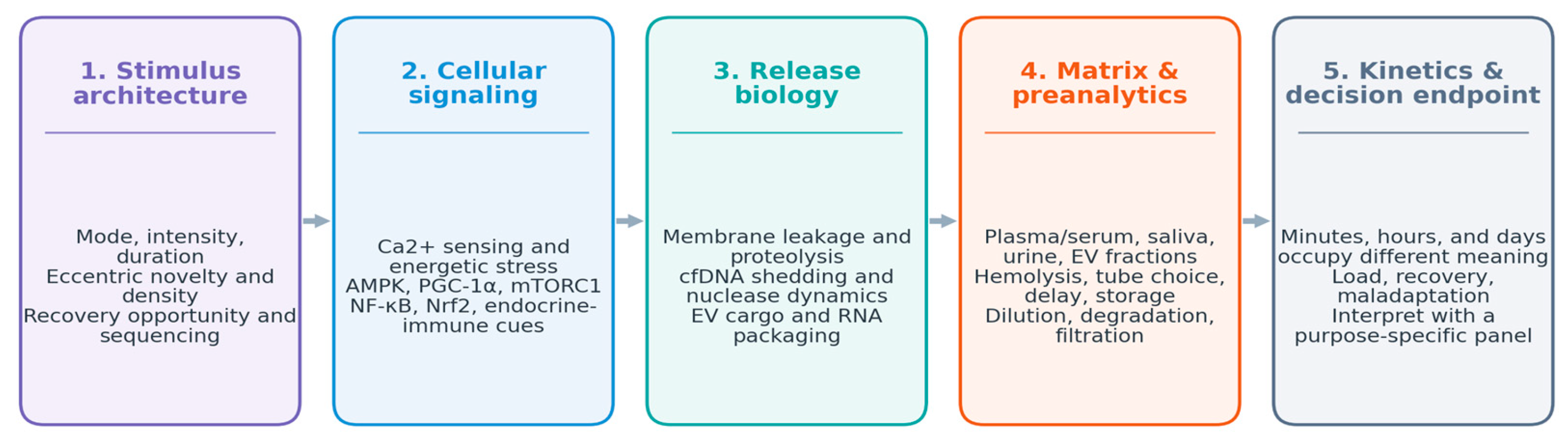
Figure 3.
Approximate kinetic windows of major biomarker families after a training bout. The figure highlights representative early (0–3 h), intermediate (3–24 h), and delayed (24–72 h) windows for major biomarker domains. Blue denotes cfDNA, orange salivary stress-sensitive signals, green metabolite fingerprints, red circulating RNAs/EV cargo, and purple delayed tissue-strain markers such as CK or myoglobin. The y-axis represents relative signal prominence normalized conceptually across domains rather than absolute concentration, and the window labels at the top indicate approximate periods of dominant interpretive utility. The curves are conceptual rather than universal and are intended to emphasize that bout-relative timing, matrix, and monitoring purpose determine biomarker meaning.
Figure 3.
Approximate kinetic windows of major biomarker families after a training bout. The figure highlights representative early (0–3 h), intermediate (3–24 h), and delayed (24–72 h) windows for major biomarker domains. Blue denotes cfDNA, orange salivary stress-sensitive signals, green metabolite fingerprints, red circulating RNAs/EV cargo, and purple delayed tissue-strain markers such as CK or myoglobin. The y-axis represents relative signal prominence normalized conceptually across domains rather than absolute concentration, and the window labels at the top indicate approximate periods of dominant interpretive utility. The curves are conceptual rather than universal and are intended to emphasize that bout-relative timing, matrix, and monitoring purpose determine biomarker meaning.
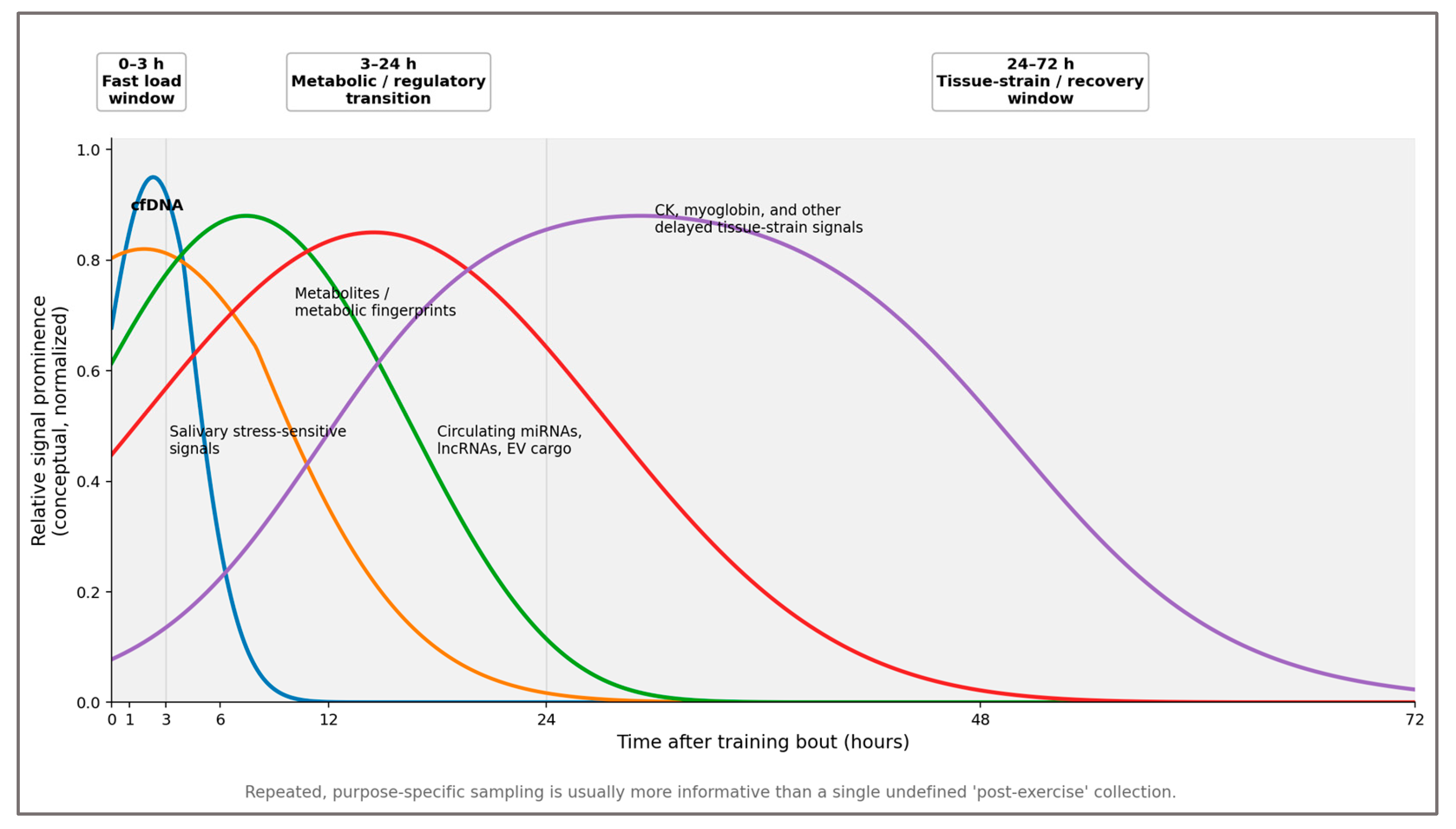
Figure 4.
Complementary sampling-oriented timeline of representative biomarker families after a training bout. In contrast to the conceptual overlap curves in Figure 3, this schematic restates the same kinetic logic as an operational view of when different biomarker families are most informative for monitoring across early (0–3 h), intermediate (3–24 h), and delayed (24–72 h) windows. Horizontal bar length indicates approximate periods of greatest decision utility, not fixed analytical cut-points, and the color coding matches Figure 3 (blue cfDNA, orange salivary stress signals, green metabolites, red circulating RNAs/EV cargo, purple delayed tissue-strain markers). The windows are illustrative rather than universal and are intended to support decision-linked sampling design.
Figure 4.
Complementary sampling-oriented timeline of representative biomarker families after a training bout. In contrast to the conceptual overlap curves in Figure 3, this schematic restates the same kinetic logic as an operational view of when different biomarker families are most informative for monitoring across early (0–3 h), intermediate (3–24 h), and delayed (24–72 h) windows. Horizontal bar length indicates approximate periods of greatest decision utility, not fixed analytical cut-points, and the color coding matches Figure 3 (blue cfDNA, orange salivary stress signals, green metabolites, red circulating RNAs/EV cargo, purple delayed tissue-strain markers). The windows are illustrative rather than universal and are intended to support decision-linked sampling design.
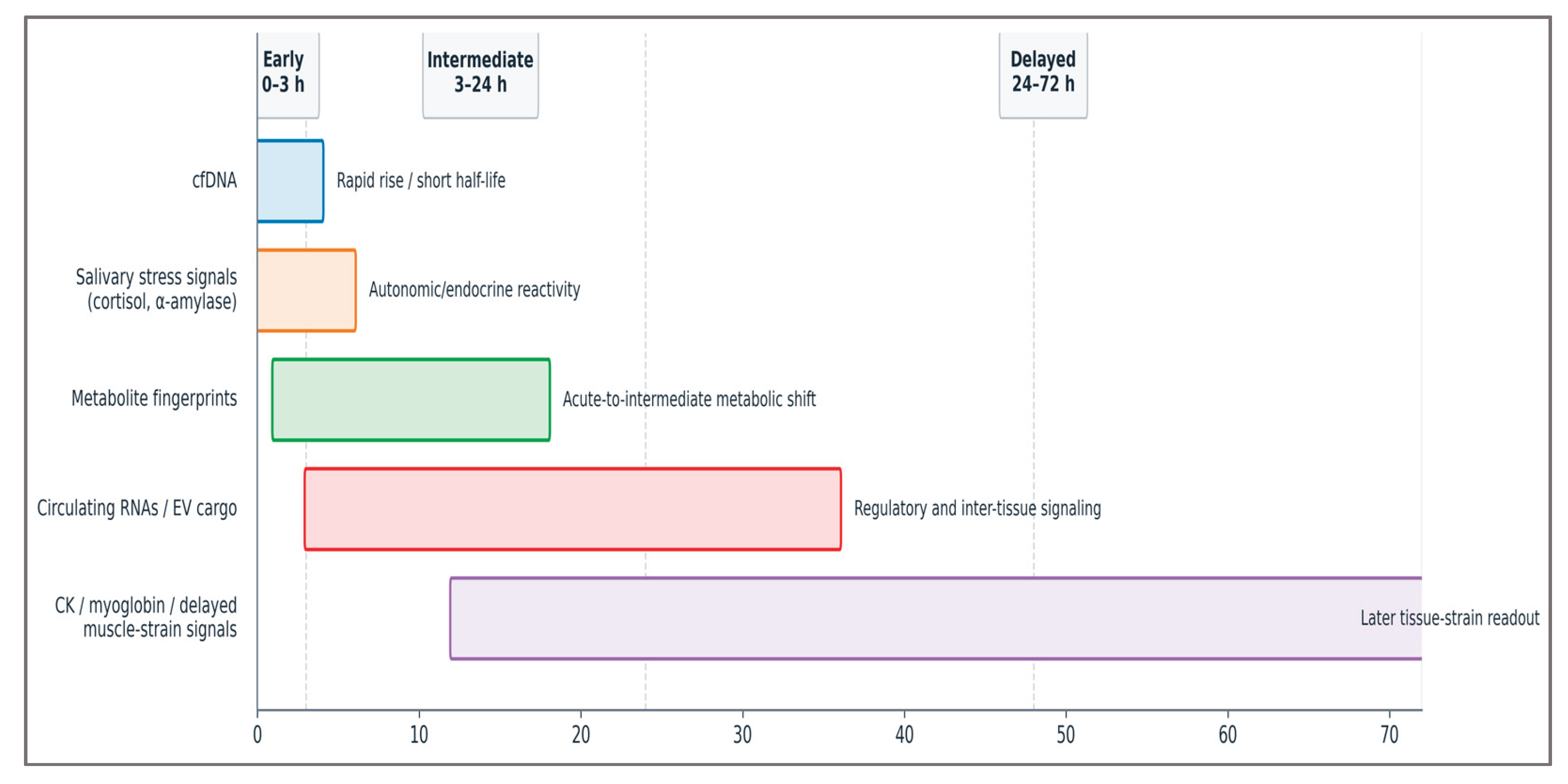
Table 2.
Purpose-specific examples of practical, decision-linked multi-marker panels, with suggested sampling windows and the specific operational interpretation each panel is intended to support.
Table 2.
Purpose-specific examples of practical, decision-linked multi-marker panels, with suggested sampling windows and the specific operational interpretation each panel is intended to support.
| Decision goal | Minimal panel | Suggested sampling window | Operational interpretation |
|---|---|---|---|
|
Acute training-load readout |
Plasma cfDNA + salivary cortisol or alpha-amylase |
Immediately post-bout and 1-3 h |
Same-day biological cost and stress reactivity; not a delayed tissue-status readout |
|
Delayed recovery / tissue-strain surveillance |
CK or myoglobin + targeted metabolite panel + soreness/performance metric |
24 h, with optional 48-72 h follow-up |
Escalate concern when delayed biochemical strain coexists with symptoms or force loss |
|
Adaptive signaling profile |
Selected miRNAs/lncRNAs +/- EV cargo + classical chemistry anchor |
Same day plus 24-48 h repeated measures |
Adds regulatory context to explain whether the pattern is resolving; analytically demanding |
|
Research-grade precision profiling |
Chemistry + metabolomics + cfDNA + RNA + metadata |
Multi-time-point across bout and microcycle |
Discovery and validation platform for smaller operational panels; vulnerable to cost and overfitting |
Notes: The panels are illustrative examples intended for standardized repeated-measures monitoring anchored to within-athlete baselines. Suggested windows should be aligned with matrix-specific kinetics and the practical sampling context. The symbol +/- indicates that EV cargo is optional rather than mandatory. Symptoms and performance should be interpreted alongside biochemical signals rather than replaced by them.
Table 3.
Minimal reporting priorities for translational exercise biomarker studies.
| Domain | Minimum expectation | Why it matters |
|---|---|---|
| Exercise stimulus | Report modality, intensity, duration, eccentric load, training status, and recovery interval | Without stimulus definition, biomarker meaning collapses |
| Sampling logic | State exact bout-relative collection times and time of day | Timing is part of the biology, not just logistics |
| Matrix handling | Describe collection device/tube, processing delay, centrifugation, storage, freeze-thaw history, and normalization | Pre-analytics can create or erase apparent biomarkers |
| Participant context | Report sex/hormonal status, age, diet or fasting, sleep, illness/medication use, and energy availability | Context explains heterogeneity and improves reproducibility |
| Analytical transparency | Specify assay platform, QC, missing-data handling, batch control, and multiple-testing control | High-dimensional results are uninterpretable without analytical discipline |
| Validation | Separate discovery from confirmation and benchmark against classical markers or performance outcomes | Panels must demonstrate added value, not novelty alone |
|
Mechanistic anchor |
State whether the signal is intended to represent acute load, tissue strain, regulatory adaptation, or inter-tissue communication | Prevents over-interpretation and improves panel design |
Notes: These priorities are cumulative rather than alternative and apply to both classical and omics-based biomarker studies. Domain-specific standards may additionally require MIQE-, MISEV-, or MSI-consistent reporting. QC = quality control.
Disclaimer/Publisher’s Note: The statements, opinions and data contained in all publications are solely those of the individual author(s) and contributor(s) and not of MDPI and/or the editor(s). MDPI and/or the editor(s) disclaim responsibility for any injury to people or property resulting from any ideas, methods, instructions or products referred to in the content. |
© 2026 by the authors. Licensee MDPI, Basel, Switzerland. This article is an open access article distributed under the terms and conditions of the Creative Commons Attribution (CC BY) license (http://creativecommons.org/licenses/by/4.0/).
Copyright: This open access article is published under a Creative Commons CC BY 4.0 license, which permit the free download, distribution, and reuse, provided that the author and preprint are cited in any reuse.


