

Submitted:
20 March 2026
Posted:
23 March 2026
You are already at the latest version
Abstract
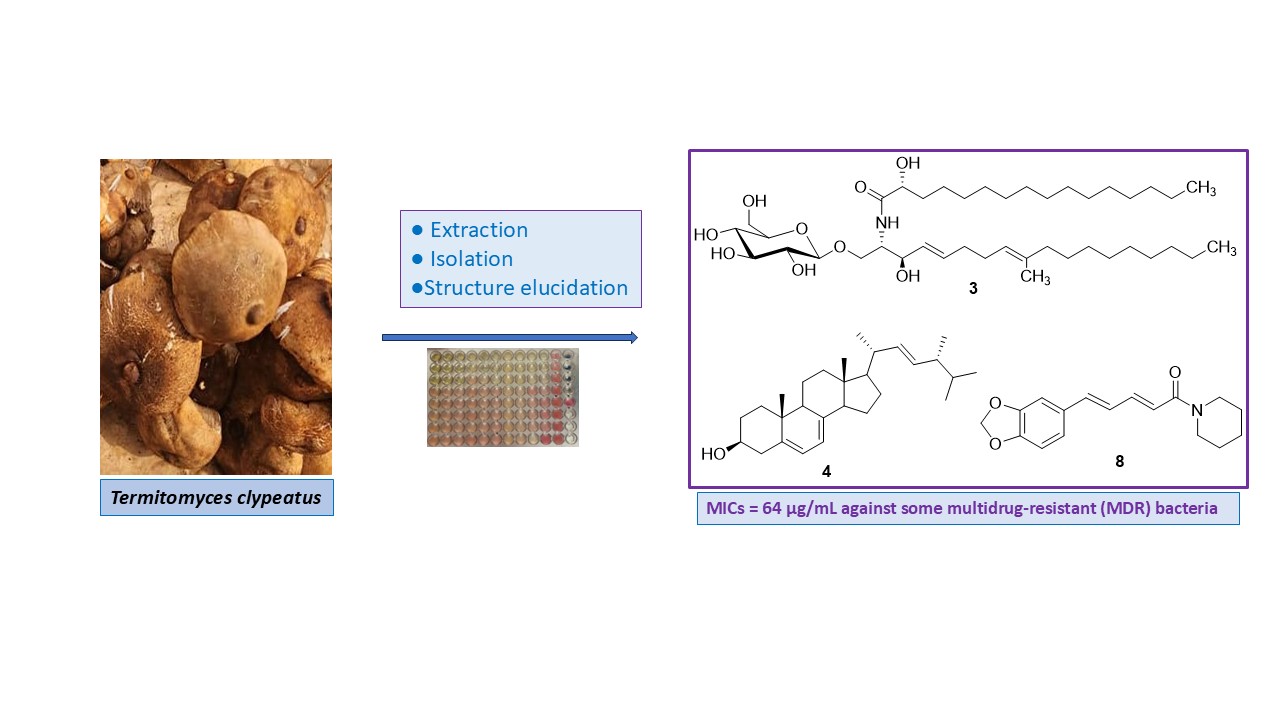
Background/Objectives: Microbial resistance to antibiotics has become a major global public health problem, threatening the effectiveness of current therapeutic strategies. The present study seeks to investigate natural compounds originating from fungal sources for their ability to interfere with efflux pump–mediated resistance in multidrug-resistant (MDR) bacteria, with the overarching goal of uncovering new candidates for antimicrobial therapeutic development. A chemical investigation of the ethanol extract of Termitomyces clypeatus was carried out to isolate and identify its constituents. Methods: Structural elucidation of the isolated metabolites was achieved through 1D and 2D NMR spectroscopy supported by mass spectrometric data. The crude extract and the purified compounds were then evaluated for their antibacterial activities individually, in the presence of an efflux pump inhibitor, and in combination with three antibiotics, using standardized microdilution assays. Results: Chromatographic separation of the extract yielded eleven known compounds including three sphingolipids: (9Z,12Z)-N-(1,3,4-trihydroxyoctadecan-2-yl)octadeca-9,12-dienamide (1), 2-hydroxy-N-(1,3,4-trihydroxyoctadecan-2-yl)hexadecanamide (2), and cerebroside B (3); four steroids: ergosterol (4), cerevisterol (5), ergosterol peroxide (6), and 5α,6α-epoxy-(22E,24R)-ergosta-8(14),22-diene-3β,7α-diol (7); one alkaloid: piperine (8); one carbohydrate: D-mannitol (9); and two phthalates: dimethyl phthalate (10) and bis(2-ethylhexyl) terephthalate (11). GC–MS analysis led to the identification of eight fatty acid derivatives (12–19). Sub-fraction A, along with compounds 3, 4, and 8 exhibited notable antibacterial activity against some tested strains with MIC values of 64 μg/mL. These compounds were identified as substrates of bacterial efflux pumps, and their presence enhanced the antibacterial effects of ciprofloxacin, doxycycline, and amikacin. Conclusion: The findings of the present work indicate that Termitomyces clypeatus contains antibacterial compounds with potential therapeutic value, both as standalone agents and as adjuvants that enhance the activity of conventional antibiotics.
Keywords:
Termitomyces clypeatus
; antibacterial activity
; efflux pumps
; antibiotics association
1. Introduction
Infectious diseases are a global burden, and rising pathogen resistance has substantially reduced the effectiveness of antibiotic therapy [1,2]. In 2019, an estimated 13.7 million deaths were attributed to infectious diseases, of which 7.7 million were linked to bacterial pathogens, encompassing both resistant and susceptible isolates . Multidrug resistance has become a critical public health concern. The World Health Organization (WHO) estimates that, if current trends continue, deaths attributable to antimicrobial resistance could rise to 10 million per year by 2050 [6]. With an estimated 60% of the world’s population depending on traditional medicine for primary healthcare, the therapeutic value of natural substances underscores the continued relevance of traditional practices. The use of natural products has gained considerable attention because of their effectiveness, cultural resonance, safety profile, broad availability, and deep roots in ancestral knowledge [7]. Termitomyces clypeatus, a wild edible mushroom, is traditionally recommended by several healers for the treatment of various ailments, including measles, yellow fever, and some gastrointestinal infectious diseases [8,9]. Studies have reported that Termitomyces clypeatus possesses antioxidant, immunomodulatory, anticancer, antitumor, and antibacterial activities [10]. As part of our ongoing search for potentially bioactive metabolites from African fungi [11,12,13,14,15], we report in the present study the isolation and identification of compounds from the ethanol extract of Termitomyces clypeatus as well as their antibacterial potential against multidrug-resistant bacteria.
2. Results
2.1. Isolation and Identification of Compounds
Gas chromatography–mass spectrometry (GC–MS) was used to identify constituent of sub-fraction A. Eight compounds (12–19) were identified based on their retention times (RT), molecular formulas, and molecular weights (MW) (Table 1). The identified compounds include: hexadecanoic acid methyl ester (12), hexadecanoic acid ethyl ester (13), 9,12-octadecadienoic acid methyl ester (14), 9-octadecanoic acid methyl ester (15), octadecanoic acid methyl ester (16), 9,12-octadecadienoic acid ethyl ester (17), 9,12-octadecadienoic acid (18), and octadecanoic acid ethyl ester (19) (Figure 2).
Further separation and purification of the remaining sub-fractions led to isolation of eleven compounds. The isolated metabolites were identified as: (9Z,12Z)-N-(1,3,4-trihydroxyoctadecan-2-yl)octadeca-9,12-dienamide (1), 2-hydroxy-N-(1,3,4-trihydroxyoctadecan-2-yl)hexadecanamide (2) [16], cerebroside B (3) [17], ergosterol (4) [13,18] , cerevisterol (5) [19], ergosterol peroxide (6) [20], 5α,6α-epoxy-(22E,24R)-ergosta-8(14),22-diene-3β,7α-diol (7) [21], piperine (8) [22], D-mannitol (9) [23], dimethyl phthalate (10) [24] , and bis(2-ethylhexyl) terephthalate (11) [25] (Figure 1). Although the spectrometric and spectroscopic data of metabolite 1 match with those reported in the literature for ceramide IIIA (N-linoleoyl-4-OH-sphinganine), a synthetic compound produced by lipase-catalysis, essential constituents in cosmetic formulations and dermatological applications [26], this is the first report on its isolation from natural source. Compound 2 was previously identified in the hydrolysate formed from the action of acid sphingomyelinase on sphingomyelin by MALDI TOF mass spectrometry [27]. To the best of our knowledge, its spectroscopic data are described here for the first time.
2.2. Antibacterial Activity of Extracts and Compounds
The antibacterial activity of the crude ethanolic extract, the ethyl acetate and n-butanol fractions, sub-fraction A, and several isolated compounds was evaluated against ten MDR Gram-negative bacteria, including Pseudomonas aeruginosa, Klebsiella pneumoniae, Escherichia coli, Providencia stuartii, and Enterobacter aerogenes. The MIC and MBC values are displayed in Table 2, Table 3 and Table 4. The crude extract and the ethyl acetate as well as the n-butanol fractions showed no remarkable activity against the tested strains. In contrast, sub-fraction A derived from the ethyl acetate fraction exhibited notable antibacterial activity, with MIC values ranging from 32 to 256 µg/mL against 50% of the tested bacteria. It demonstrated excellent activity against Klebsiella pneumoniae KP55 (MIC = 64 µg/mL) and very good activity against Pseudomonas aeruginosa (PA01, PA124) and Providencia stuartii P2636 (MIC = 128 µg/mL). The high MBC values suggest a primarily bacteriostatic effect.
Among the isolated metabolites, compounds 4-7 showed notable to low activity against the tested microorganisms. Compounds 3, 4, and 5 displayed moderate activity against Escherichia coli ATCC 10536, with MICs of 64 µg/mL for compounds 3 and 4, and 32 µg/mL for compound 5, while exhibiting low activity (MIC 128–256 µg/mL) against other strains. Compound 9 demonstrated moderate to low activity, with the best inhibition observed against Enterobacter aerogenes EA3 (MIC = 64 µg/mL). Compound 10 showed no significant antibacterial activity against the tested strains.
3.3. Effect of Samples in Presence of Efflux Pumps Inhibitors
To evaluate whether the test samples act as substrates or inhibitors of bacterial efflux pumps, the MIC values of selected compounds were determined in the presence of the efflux pump inhibitor PAβN against the same Gram-negative bacteria (Table 5). No significant change in activity was observed for sub-fraction A in the presence of PAβN. However, the antibacterial activity of compound 4 improved against 50% of the tested strains, with an AIF of up to 8 against Klebsiella pneumoniae KP55 and Enterobacter aerogenes EA27. Similarly, the activity of compound 3 increased against 60% of the bacteria, with an AIF of up to 64 against Enterobacter aerogenes EA3. Compound 9 also showed enhanced activity against 50% of the strains, with a maximum improvement factor of 32 against Escherichia coli ATCC 10536 and Providencia stuartii PS2636.
3.4. Determination of the Antibiotic-Potentiating Effects of the Samples
To determine the suitable concentrations of samples for combination studies with antibiotics, a preliminary assay was conducted on Escherichia coli AG100. Sub-fractions A, B, C, and D, as well as compounds 3, 4, and 9, showed the greatest potentiation of antibiotic activity at sub-inhibitory concentrations (MIC/2 and MIC/4; data not shown). Based on these results, the selected samples were further tested in combination with antibiotics at MIC/2 and MIC/4. The results are summarized in Table 6 and Table 7.
All the sub-fractions enhanced the activity of the tested antibiotics. For ciprofloxacin, sub-fractions B-D achieved 100% potentiation across all tested bacteria, reducing the MIC from 512 to 4 µg/mL. For doxycycline, sub-fraction B was the most effective, producing 80% potentiation with a maximum improvement factor of 16 against Pseudomonas aeruginosa PA124 and Enterobacter aerogenes EA3 at both MIC/2 and MIC/4. Amikacin showed a more modest enhancement, with sub-fraction B increasing its activity by 40%, achieving an improvement factor of 8 against Pseudomonas aeruginosa PA124.
The isolated compounds exhibited variable effects. The activity of ciprofloxacin was enhanced by up to 40%, with an improvement factor of 2 at MIC/2 in combination with compound 4 against Providencia stuartii PS2636. The activity of doxycycline was potentiated by 40%, with an improvement factor of 16 against Enterobacter aerogenes when combined with compound 8. However, the activity of amikacin increased by 20% in the presence of compound 4, with an improvement factor of 2 at both MIC/2 and MIC/4 against Pseudomonas aeruginosa PA124.
3. Discussion
The chemical investigation of T. clypeatus led to the isolation and identification of 19 compounds and we noticed that similar metabolites have been characterized in fungi of the genus Termitomyces [28]. Since cerebroside B (3), was previously from T. albuminosus [28] and was recently identified by LC-MS/MS from T. clypeatus [29,30], it could be considered as the chemotaxonomic marker of mushrooms of the genus Termitomyces. It is important to point that the steroids cerevisterol (5), ergosterol peroxide (6), and 5α,6α-epoxy-(22E,24R)-ergosta-8(14),22-diene-3β,7α-diol (7) were already isolated from a Termitomyces species, notably T. microcarpus [31] while ergosterol was obtained from T. heimii [32,33]. Piperine is the main constituent of the medicinal plant Piper nigrum that has gained attention of the chemistry and physiology communities mostly due to its wide range of biological activities [34]. It was also shown to be produced by endophytic fungi Colletotrichum gloeosporioides [35] and Periconia sp [36] harboured in Piper nigrum and Piper longum, respectively. Several synthetic routes for this compound have also been developed [34]. Although phthalates, such as compounds 10 and 11, are considered as contaminants, some have been isolated from natural sources including plants, fungi, and bacteria [37]. Furthermore, the biosynthesis of phthalates in filamentous fungi has already been studied. Through the shikimic acid pathway, D-glucose is converted to phthalic acid which is esterified to afford the corresponding phthalate [38].
The antibacterial assays of the extracts, fractions and sub-fractions from T. clypeatus revealed that sub-fraction A exhibited higher activity than the crude extract and the AcOEt fraction. This enhanced activity may be attributed to several factors, primarily the removal of interfering matrix components such as pigments, tannins, and lipids, which can reduce the solubility and bioavailability of the crude extract [39]. Secondly, the fractionation process enables the isolation of individual compounds from the crude extract, thereby reducing potential inhibitory or antagonistic interactions among constituents [40]. Finally, sub-fraction A may contain a higher proportion of bioactive compounds, contributing to its enhanced antibacterial activity [41]. The antibacterial activity of compound 3 is consistent, and this in accordance with previous studies which showed that cerebrosides exhibit notable activity against Escherichia coli strains [42]. Compounds 4-7 are steroid derivatives, and metabolite 4 showed the highest antibacterial activity. This difference may be explained by the higher polarity of compounds 5, 6 and 7, which likely hinders their ability to penetrate the outer membrane of Gram-negative bacteria. Gram-negative bacteria possess an outer membrane rich in lipopolysaccharides, which serves as a barrier to the entry and diffusion of polar molecules [43]. The antibacterial activity of compound 8 is also consistent with previously reported findings [44]. Compound 9, in contrast, exhibited no significant antibacterial activity against the tested strains; however, literature reported indicate that it may exert indirect effects by inhibiting bacterial biofilm formation [45]. These findings confirm the antibacterial potential of both the extracts and the isolated compounds from T. clypeatus.
Since active efflux is the main resistance mechanism in Gram-negative bacteria, we evaluated the antibacterial activity of sub-fractions and some isolated compounds in the presence of the efflux pump inhibitor PAβN. The results indicated that PAβN did not significantly enhance the activity of sub-fraction A. In contrast, compounds 3, 4, and 8 showed improved activity when combined with PAβN. Beyond inhibiting Resistance-Nodulation-Division (RND) efflux pumps, PAβN is also known to increase membrane permeability, thereby enhancing the likelihood of the compounds reaching their targets. The lack of activity enhancement in some cases may be due to the presence of alternative efflux pumps that are not inhibited by PAβN [46]. Furthermore, hydrophobic compounds are often substrates of RND efflux pumps, such as AcrAB-TolC in Escherichia coli and MexAB-OprM in Pseudomonas aeruginosa [47]. If the molecules are unable to cross the inner bacterial membrane and remain confined to the periplasmic space, the efflux pumps cannot be effectively inhibited, resulting in limited antibacterial activity [48,49].
4. Materials and Methods
4.1. General Experimental Procedures
The High-resolution mass spectra were recorded on an Agilent 6545 QTOF-MS spectrometer (Agilent GmbH, Waldbronn, Germany) equipped with a HRESI source, a LockSpray interface, and a suitable external calibrant. LC-MS spectra were obtained using a 1260 Infinity HPLC-System by Agilent Technologies coupled to a Quadrupole-ESI-MS (G612B, Agilent InfinityLab LC/MSD Series). The GC-MS was performed on a Shimadzu Ultra Model QP-2010 GC coupled with MS. The GC was equipped with a capillary column (30 m × 0.25 mm i.d., film thickness 0.25 μm) and HP-5 MS (5% phenylmethyl siloxane) at a helium flow rate of 1.61 mL/minute with the temperature 40 °C to 280 °C for 10 minutes at a rate of 20 °C/min. The ion source was maintained at 250 °C and 70 eV electron energy. Methanol was added to the extracts before injecting 1 μL into the column. The exact name and molecular weight of unknown compounds were found by comparing their mass spectrum with the reference spectra available in the GC/MS Library. NMR spectra were recorded in deuterated solvents (acetone-d6, CD3OD, DMSO-d6, and pyridine-d5) on a Bruker Avance-III (1H NMR, 600 MHz; 13C NMR, 150.9 MHz) spectrometer equipped with a 5 mm TCI cryoprobe. All chemical shifts (δ) are reported in ppm relative to the residual solvent signals and coupling constants (J) are given in Hz. Column chromatography was performed using silica gel 60 (Merck, Darmstadt/Germany) (0.063–0.200 mm and 0.04–0.063 mm) and Sephadex LH-20. The following solvent systems were used: MeOH for Sephadex column chromatography and mixtures of hexane-EtOAc and EtOAc-MeOH for silica gel column chromatography. Thin-layer chromatography (TLC) was performed on Merck precoated silica gel 60 F254 aluminum foil. The plates were revealed using a UV lamp (254–365 nm) and 10% H2SO4 reagent followed by heating at 90oC.
The flash chromatography was used during the initial separation of the EtOAc and n-BuOH fractions, using the Büchi column (460 x 25 mm) and silica gel GF254. Once filled with the stationary phase and the fixed extract, the column was connected to a vacuum pump, Büchi V-700, and the elution system solvent consisted of n-hexane-EtOAc and EtOAc-MeOH mixtures in increasing polarity.
4.2. Fungal Material
The mushroom Termitomyces clypeatus R. Heim (Lyophyllaceae) was collected in Bafoussam (Western Region of Cameroon) in October 2021 and identified by Professor Njouonkou André-Ledoux, mycologist at the University of Bamenda.
4.3. Extraction and Isolation
The air-dried and pulverized fungal material (T. clypeatus) (6 kg) was macerated in ethanol 95% (15 L) at 25 °C for 24 hours (3 times) to give after evaporation to dryness, 725.76 g of crude extract. An amount of 722.51 g of this extract was suspended in distilled water (500 mL) and successively partitioned with EtOAc (3 × 500 mL) and n-BuOH (3 × 500 mL). The solutions were evaporated under reduced pressure to afford 344.42 g and 24.32 g of each fraction, respectively. A part of the EtOAc fraction (341.67 g) was subjected to silica gel (0.2–0.5 mm) flash chromatography eluted from n-hexane–EtOAc 5% to EtOAc–MeOH 20% to give five main sub-fractions (A–E). The different sub-fractions collected were grouped according to the elution solvents: A [101.42 g, n-hexane-EtOAc 95:5 (v:v)], B [16.46 g, n-hexane-EtOAc 80:20 (v:v)], C [16.80 g, n-hexane-EtOAc 40:60 (v:v)], D [13.48 g, n-hexane-EtOAc 0:100 (v:v)], and E [4.39 g, EtOAc-MeOH 90:10 (v:v)]. The sub-fraction A (101.42 g) was oily yellow and was qualitatively investigated using the GC-MS technique to determine its constituents. To identify the exact name and molecular weight of the different compounds, the spectra obtained were compared to the Wiley GC/MS Library, Mass Finder Library, and Adams Library. Compounds 12-19 were identified.
From sub-fraction B (16.46 g), white flakes were recrystallized with MeOH to afford compound 4 (520 mg). The filtrate was further subjected to the silica gel CC (0.063–0.200 mm) eluted with n-hexane–EtOAc (90:10 to 70:30) to afford six main sub-fractions: B1 [2.30 g, n-hexane-EtOAc 90:10], B2 [4.86 g, n-hexane-EtOAc 90:10 to 85:15], B3 [1.60 g, n-hexane-EtOAc 85:15], B4 [0.9 g, n-hexane-EtOAc 85:15], B5 [2.80 g, n-hexane-EtOAc 80:20], and B6 [1.20 g, n-hexane-EtOAc 70:30]. The sub-fraction B2 (4.80 g) was subjected to silica gel CC using n-hexane–EtOAc (82:18) to afford compounds 4 (9 mg) and 6 (13 mg). The filtration of sub-fraction C (23.80 g), afforded compound 1 (240 mg) and the filtrate obtained was purified by silica gel CC eluted with n-hexane–EtOAc (80:20 to 60:40) to yield five sub-fractions based on comparative TLC: C1 [3.94 g, n-hexane-EtOAc 80:20], C2 [7.38 g, n-hexane-EtOAc 80:20, 75:25], C3 [4.91 g, n-hexane-EtOAc 75:25], C4 [1.60 g, n-hexane-EtOAc 70:30], and C5 [0.35 g, n-hexane-EtOAc 60:40]. The sub-fraction C1 was filtrated and washed with n-hexane-EtOAc 40:60 to give compound 2 (27 mg) as a white powder. Sub-fraction C3 was subjected to the silica gel CC using n-hexane–EtOAc (75:25) to yield compounds 5 (10 mg) and 7 (20 mg) while sub-fraction C4 was subjected to the silica gel CC using n-hexane–EtOAc (78:22) to afford compound 11 (3 mg). Compounds 10 (10 mg) and 8 (91 mg) were obtained from the sub-fraction C5 by Sephadex LH-20 CC [CH2Cl2-MeOH 1:1 (v/v)]. Sub-fraction E (4.39 g) was purified by silica gel CC using n-hexane–EtOAc (15:85) to EtOAc–MeOH (85:15) to afford five main sub-fractions: E1 [0.58 g, n-hexane-EtOAc 15:85], E2 [1.03 g, n-hexane-EtOAc 00:100], E3 [1.54 g, EtOAc–MeOH 95:5], E4 [0.31 g, EtOAc–MeOH 90:10], and E5 [0.18 g, EtOAc–MeOH 85:15]. Compound 3 (200 mg) crystallized from sub-fraction E2 while compound 9 (18 mg) crystallized in sub-fractions E5.
(9Z,12Z)-N-(1,3,4-trihydroxyoctadecan-2-yl)octadeca-9,12-dienamide (1): White powder; Molecular formula: C36H69NO4 ; HR-ESI (-) m/z 624.5200 [M + HCOO]- (cald for C37H70NO6-: 624,5209), HR-ESI (+) m/z 580.5291 [M + H]+ (cald for C36H70NO4+: 580.5299); 1H NMR (600 MHz, DMSO-d6) δ 7.50 (d, J = 8.9 Hz, 1H, NH), 5.32 (m, 2H, H-9’/H-13’), 5.30 (m, 2H, H-10’/ H-12’), 4.54 (s, 1H, OH-3), 4.46 (s, 1H, OH-1), 4.21 (s, 1H, OH-4), 3.79 (m, 1H, H-2), 3.48 (m, 1H, H-1a) ; 3.45 (m, 1H, H-1b), 3.36 (m, 1H, H-3), 3.31 (m, 1H, H-4), 2.71 (t, J = 6.9 Hz, 2H, H-11’), 2.03 (d, J = 9.6 Hz, 2H, H-2′), 1.99 (m, 4H, H-8’/H-14’), 1.41 (m, 2H, H-3’), 0.83 (t, J = 6.7 Hz, 6H, Me-18/Me-18’); 13C NMR (150 MHz, DMSO-d6) δ 172.3 (C-1’), 130.2 (C-9’/C-13’), 128.2 (C-10’/C-12’), 74.6 (C-3), 71.2 (C-4), 61.1 (C-1), 52.5 (C-2), 36.0 (C-2’), 31.4 (C-16’), 29.9-29.0 (C-5 to C-17, C-4’ to C-7’, C-15’), 27.2 (C-8’/C-14’), 25.8 (C-3’), 25.7 (C-11’), 22.6 (C-17’), 14.4 (C-18/C-18’).
2-hydroxy-N-(1,3,4-trihydroxyoctadecan-2-yl)hexadecanamide (2): White powder; Molecular formula: C34H69NO5; LC-ESI-MS m/z 592.30 [M+K-H2O]+, m/z 429.40 [M − C13H27 + Na − H2O]+, m/z 383.35 [M − C15H31O + K]+, m/z 325.00 [M − C16H32NO2 + Na]+; 1H NMR (600 MHz, Pyridine-d5) δ 5.15 (m, 1H, H-2), 4.65 (dd, J = 7.9, 3.7 Hz, 1H, H-2’), 4.53 (dd, J = 11.0, 4.8 Hz, 1H, H-1a), 4.45 (dd, J = 10.9, 4.8 Hz, 1H, H-1b), 4.40 (t, J = 5.7 Hz, 1H, H-3), 4.30 (t, J = 7.9 Hz, 1H, H-4), 2.26 (m, 1H, H-5a), 2.23 (m, 1H, H-3’a), 2.04 (m, 1H, H-3’b), 194 (m, 1H, H-5b), 1.92 (m, 2H, H-6), 1.69 (m, 2 H, H-4’), 0.85 (o, 6H, H-18/H-16’), 13C NMR (150 MHz, Pyridine-d5) δ 175.2 (C-1’), 76.4 (C-3), 72.7 (C-2’), 72.2 (C-4), 61.7 (C-1), 52.7 (C-2), 35.4 (C-3’), 33.8 (C-5), 29.9-29.4 (C-7 to C-16, C5’ to C15’), 26.4 (C-6), 25.6 (C-4’), 22.7 (C-17), 14.1 (C-18/C-16’).
Cerebroside B (3): White powder; Molecular formula: C41H78NO9; LC-ESI-MS m/z 728.200 [M+H]⁺; 1H-NMR (CD3OD, 600 MHz): δ 5.75 (m, 1H, H-5), 5.51 (dd, J = 15.5, 7.4 Hz, 1H, H-4), 5.16 (tt, J = 5.5, 2.4, 1H, H-8), 4.29 (d, J =7.8 Hz, 1H, H-1’’), 4.15 (o, 2H, H-1a/H-3), 4.01 (m, 2H, H-2/2’), 3.89 (m, 1 H, H-6’’a), 3.72 (dd, J = 6.7, 5.5 Hz, 1H, H-1b), 3.69 (m, 1 H, H-6’’b), 3.37 (m, 1 H, H-3’’), 3.30 (m, 1H, H-4’’), 3.29 (m, 1H, H-5’’), 3.21 (dd, J = 9.2, 7.8 Hz, 1H, H-2’’), 2.10 (m, 2H, H-7), 2.07 (m, 2H, H-6), 2.00 (t, J = 7.6, 2H, H-10), 1.72 (t, J = 1.3 Hz, 1H, H-3’a), 1.61 (d, J = 1.3 Hz, 3H, H-19), 1.57 (t, J = 1.3 Hz, 1H, H-3’b), 1.43 (m, 2H, H-4’), 0.92 (t, J = 6.9 Hz, 6H, Me-18 and Me-16’); 13C-NMR (CD3OD, 150 MHz): δ 175.8 (C-1’), 135.3 (C-9), 133.2 (C-5), 129.7 (C-4), 123.4 (C-8), 103.3 (C-1’’), 76.6 (C-5’’), 76.4 (C-3’’), 73.6 (C-2’’), 71.6 (C-2’), 71.4 (C-3), 70.1 (C-4’’), 68.3 (C-1), 61.2 (C-6’’), 53.3 (C-2), 39.4 (C-10), 37.3 (C-7), 34.5 (C-3’), 32.4 (C-6), 29.4- 27.7 (C-11 to C-17/C-5’ to C-15’), 24.8 (C-4’), 14.7 (C-19), 13.1 (C-18/C-16).
Ergosterol (4): White powder; 1H-NMR (CDCl3, 600 MHz): δ 5.59 (dd, J = 5.7, 2.5 Hz, 1H, H-6), 5.40 (dd, J = 5.6, 2.8 Hz, 1H, H-7), 5.23 (m, 1H, H-23), 5.20 (m, 1H, H-22), 3.65 (m, 1H, H-3), 2.48 (m, 1H, H-4a), 2.30 (m, 1H, H-4b), 2.09 (dd, J = 4.8, 2.5, 1H, H-12), 2.05 (m, 1H, H-20), 1.99 (d, J = 2.3 Hz, 1H, H-9), 1.91 (m, 2H, H-1), 1.90 (d, J = 2.3 Hz, 1H, H-14), 1.89 (m, 1H, H-2a), 1.87 (m, 1H, H-24), 1.71 (m, 1H, H-11), 1.68 (m, 2H, H-15), 1.59 (m, 1H, H-2b), 1.49 (m, 1H, H-25), 1.32 (m, 2H, H-16), 1.27(m, 1H, H-17), 1.05 (d, J = 6.6 Hz, 3H, Me-21), 0.96 (s, 3H, Me-18), 0.93 (d, J = 6.8 Hz, 3H, Me-28), 0.85 (d, J = 6.8 Hz, 6H, Me-26/ Me-27), 0.65 (s, 3H, Me-19), 13C-NMR (CDCl3, 150 MHz): δ 141.4 (C-8), 139.8 (C-5), 135.6 (C-22), 132.0 (C-23), 119.6 (C-6), 116.3 (C-7), 70.5 (C-3), 55.7 (C-17), 54.5 (C-14), 46.2 (C-9), 42.8 (C-24/13), 40.7 (C-4), 40.5 (C-20), 39.1 (C-12), 38.4 (C-1), 37.0 (C-10), 33.1 (C-25), 32.0 (C-2), 28.3 (C-16), 23.0 (C-15), 21.1 (C-11/C-21), 20.0 (C-26), 19.7 (C-27), 17.6 (C-28), 16.3 (C-19), 12.1 (C-18).
Cerevisterol (5): White powder; 1H-NMR (CDCl3, 600 MHz): δ 5.24 (dd, J = 15.3, 7.4 Hz, 1H, H-23), 5.17 (dd, J = 15.3, 8.3 Hz, 1H, H-22), 5.08 (dt, J = 5.0, 2.3 Hz, 1H, H-7), 3.76 (tq, J = 10.7, 5.1 Hz, 1H, H-3), 3.37 (m, 1H, H-6), 2.00 (m, 1H, H-20), 1.96 (m, 1H, H-12a), 1.93 (m, 1H, H-9), 1.89 (m, 1H, H-4a), 1.85 (m, 1H, H-24), 1.80 (m, 1H, H-14), 1.67 (m, 1H, H-16), 1.61 (m, 1H, H-2a), 1.50 (m, 1H, H-4b), 1.48 (m, 2H, H-15), 1.46 (m, 1H, H-25), 1.44 (m, 1H, H-11a), 1.40 (m, 1H, H-11b), 1.30 (m, 1H, H-1), 1.25 (m, 1H, H-12b), 1.26 (m, 1H, H-17), 1.23 (m, 1H, H-2b), 1.00 (d, J = 6.6 Hz, 3H, H-21), 0.90 (s, 3H, H-19), 0.89 (d, J = 6.9 Hz, 3H, H-28) 0.81 (d, J = 6.4 Hz, 6H, H-26/ H-27),0.55 (s, 3H, H-18); 13C-NMR (CDCl3, 150 MHz): δ 140.1 (C-8), 135.8 (C-22), 132.3 (C-23),119.9 (C-7), 74.4 (C-5), 72.5 (C-6), 66.4 (C-3), 55.7 (C-17), 54.6 (C-14), 43.4 (C-13), 42.7 (C-9), 42.4 (C-24), 40.6 (C-4), 40.4 (C-20), 39.5 (C-12), 37.1 (C-10), 32.90 (C-1/ C-25), 31.6 (C-2), 28.2 (C-16), 23.0 (C-15), 21.7 (C-11), 21.4 (C-21), 19.9 (C-26), 19.6 (C-27), 18.1 (C-19), 17.7 (C-28) 12.5 (C-18).
Ergosterol peroxyde (6): White powder; 1H-NMR (CDCl3, 600 MHz): δ 6.53 (d, J = 8.5 Hz, 1H, H-7), 6.26 (d, J = 8.5 Hz, 1H, H-6), 5.24 (dd, J = 15.2, 7.7 Hz, 1H, H-23), 5.16 (dd, J = 15.4, 8.3 Hz, 1H, H-22), 3.99 (tt, J = 11.5, 5.1 Hz, 1H, H-3), 2.14 (m, 1H, H-4a), 2.13 (ddd, J = 13.8, 5.0, 2.0 Hz, 1H, H-10), 2.03 (m, 1H, H-20), 1.97 (m, 1H, H-12a), 1.96 (m, 1H, H-1a), 1.94 (m, 1H, H-4b), 1.87 (m, 1H, H-24), 1.85 (m, 1H, H-2a), 1.72 (m, 1H, H-1b), 1.60 (m, 1H, H-11a), 1.59 (m, 1H, H-9), 1.58 (d; J= 4.0 Hz, 1H, H-14), 1.56 (m, 1H, H-2b), 1.53 (m, 1H, H-15a), 1.48 (m, 1H, H-25), 1.43 (m, 1H, H-11b), 1.36 (m, 2H, H-16), 1.24 (m, 1H, H-12b/H-15b), 1.23 (m, 1H, H-17), 1.02 (d, J = 6.6 Hz, 3H, Me-21), 0.93 (d, J = 6.9 Hz, 3H, Me-28), 0.90 (s, 3H, Me-19), 0.86 (s, 3H, Me-18), 0.84 (d, J = 6.4 Hz, 6H, Me-26 and Me-27); 13C-NMR (CDCl3, 150 MHz): δ 135.4 (C-6), 135.2 (C-22), 132.3 (C-23), 130.8 (C-7), 82.2 (C-5), 79.4 (C-8), 66.5 (C-3), 56.1 (C-17), 51.6 (C-14), 51.0 (C-9), 44.5 (C-13), 42.8 (C-24), 39.8 (C-20), 20.9 (C-21), 39.3 (C-12), 36.9 (C-4/ C-10), 34.7 (C-1), 33.1 (C-25), 30.1 (C-2), 28.7 (C-16), 23.4 (C-15), 20.6 (C-11), 19.9 (C-26), 19.6 (C-27), 18.2 (C-19), 17.6 (C-28), 12.8 (C-18).
5α,6α-epoxy-(22E,24R)-ergosta-8(14),22-diene-3β,7α-diol (7): White powder; 1H-NMR (CD3OD, 600 MHz): δ 5.25 (m, 2H, H-22/H-23), 4.43 (d, J = 3.4 Hz, 1H, H-7), 3.77 (tt, J = 11.3, 4.6 Hz, 1H, H-3), 3.08 (d, J = 3.4 Hz, 1H, H-6), 2.66 (m, 1H, H-15a), 2.45 (ddd, J = 10.5, 7.0, 3.4 Hz, 1H, H-9), 2.26 (m, 1H, H-15b), 2.00 (m, 1H, H-20), 1.96 (m, 1H, H-12a), 1.91 (m, 1H, H-2a), 1.87 (m, 1H, H-24), 1.75 (m, 1H, H-16a), 1.65 (m, 1H, H-4a), 1.63 (m, 1H, H-1a), 1.56 (m, 1H, H-2b), 1.55 (m, 1H, H-4b), 1.52 (m, 1H, H-11a), 1.49 (m, 1H, H-25), 1.46 (m, 1H, H-11b), 1.45 (m, 1H, H-16b), 1.43 (m, 1H, H-1b), 1.25 (m, 1H, H-17), 1.23 (m, 1H, H-12b), 1.05 (d, J = 6.5, 3H, Me-21), 0.96 (d, J = 6.8, 3H, Me-28), 0.92 (s, 3H, Me-18), 0.90 (s, 3H, Me-19), 0.88 (d, J = 6.8, 3H, Me-26), 0.86 (d, J = 6.8, 3H, Me-27); 13C-NMR (CD3OD, 150 MHz): δ 151.4 (C-14), 135.5 (C-22), 131.9 (C-23), 125.1 (C-8), 67.8 (C-3), 66.7 (C-5), 64.4 (C-7), 61.2 (C-6), 56.7 (C-17), 42.9 (C-24), 42.7 (C-13), 40.7 (C-4), 39.3 (C-20), 39.1 (C-9), 36.4 (C-12), 35.6 (C-10), 32.9 (C-25), 32.0 (C-1), 30.4 (C-2), 27.0 (C-16), 24.2 (C-15), 20.4 (C-21), 19.1 (C-26), 18.8 (C-11), 18.7 (C-27), 17.1 (C-18), 16.8 (C-28), 15.4 (C-19).
Piperine (8): Yellow oil; 1H-NMR (CD3OD, 600 MHz): δ 7.32 (dd, J = 14.6, 10.7 Hz, 1H, H-3), 7.10 (d, J = 1.7 Hz, 1H, H-7), 6.96 (dd, J = 8.1, 1.7 Hz, 1H, H-12), 6.89 (m, 1H, H-4), 6.84 (s, 1H, H-5), 6.80 (d, J = 8.0 Hz, 1H, H-11), 6.63 (d, J = 14.6 Hz, 1H, H-2), 5.97 (s, 2H, H-9), 3.64 (m, 4H, H-13/ H-17), 1.70 (qd, J = 6.0, 5.1 Hz, 2H, H-15), 1.60 (m, 4H, H-14/ H-16); 13C-NMR (CD3OD, 150 MHz): δ 167.7 (C-1), 149.8 (C-8), 149.7 (C-10), 144.6 (C-3), 140.2 (C-5), 132.4 (C-6), 126.4 (C-4), 123.9 (C-12), 120.6 (C-2), 109.4 (C-11), 106.7 (C-7), 102.7 (C-9), 48.1 (C-17), 44.5 (C-13), 27.8 (C-14), 26.9 (C-16), 25.6 (C-15).
D-mannitol (9): White powder; 1H-NMR (CD3OD, 600 MHz): δ 3.83 (dd, J = 11.1, 3.6 Hz, 2H, H-1a), 3.79 (d, J = 8.1 Hz, 2H, H-3), 3.71 (ddd, J = 8.1, 6.0, 3.6 Hz, 2H, H-2), 3.65 (dd, J = 11.2, 6.0 Hz, 2H, H-1b); 13C-NMR (CD3OD, 150 MHz): δ 71.5 (C-2), 69.8 (C-3), 63.7 (C-1).
Dimethyl phthalate (10): Yellow oil; 1H-NMR (CD3OD, 600 MHz): δ 7.75 (dd, J = 5.7, 3.3 Hz, 2H, H-3/ H-4), 7.64 (dd, J = 5.7, 3.3 Hz, 2H, H-2/H-5), 3.90 (s, 6H, Me-2′/Me-2′′); 13C-NMR (CD3OD, 150 MHz): δ 169.6 (C-1′/C-1′′), 133.3 (C-1/C-6), 132.5 (C-2/C-5), 129.9 (C-3/C-4), 53.2 (C-2′/C-2′′).
Bis (2-ethylhexyl) terephthalate (11): White powder; 1H-NMR (CD3OD, 600 MHz): δ 8.07 (s, 4H, H-2, H-3, H-5, H-6), 4.25 (dd, J = 5.7, 2.7 Hz, 4H, H-8/ H-8′), 1.72 (m, 2H, H-9/H-9′), 1.50 (m, 4H, H-12/12′), 1.46 (m, 4H, H-10/10′), 1.34 (m, 4H, H-14/14′), 1.31 (m, 4H, H-11/11′), 0.93 (t, J = 7.5 Hz, 6H, H-13/13′), 0.87 (dt, J = 15.3, 7.1 Hz, 6H, H-15/15′); 13C-NMR (CD3OD, 150 MHz): δ 166.7 (C-7/7′), 135.1 (C-1/4), 130.2 (C-2/C-3/C-5/C-6), 68.2 (C-8/8′), 39.9 (C-9/9′), 31.3 (C-10/10′), 29.7 (C-11/11′), 24.6 (C-12/12′), 23.3 (C-14/14′), 14.0 (C-13/13′), 11.0 (C-15/15′).
4.4. Antibacterial Activity
4.4.1. Culture Media and Chemicals
Para-iodonitrotetrazolium chloride (≥ 97% purity, INT) was used as the bacterial growth indicator and the efflux pump inhibitor was phenylalanine arginine β-naphthylamide (PAβN). Dimethyl sulfoxide (DMSO) served to dissolve extracts and products. Four antibiotics from four families, namely chloramphenicol, doxycycline (DOX), amikacin (AMK), and levofloxacin (LEV) were used. Mueller-Hinton agar was used for the activation of bacteria; Mueller-Hinton broth was used for microdilution as a nutrient medium for bacteria. Eosin-Methylene Blue (EMB), MacConkey, and cetrimide agars were used to ensure the purity of strains and isolates of Escherichia coli, Klebsiella pneumonia, and Pseudomonas aeruginosa, respectively. The chemicals were obtained from Sigma-Aldrich (St. Quentin Fallavier, France).
4.4.2. Microorganisms
The Gram-negative bacteria tested involved both reference strains and clinical isolates of Escherichia coli (ATCC 10536, AG100), Klebsiella pneumoniae (ATCC 11296, KP55), Pseudomonas aeruginosa (PA01, PA124), Enterobacter aerogenes (EA3, EA27), and Providencia stuartii (PS2636, NEA16). Their phenotypic and genotypic characteristics have been previously described [50].
4.4.3. Minimal Inhibitory and Bactericidal Concentrations
The bacterial inoculum was prepared following the method described by Mbaveng et al. (2015) [51] and adjusted to the turbidity of a standard 0.5 McFarland solution (1.5 × 10⁸ CFU/mL). Test samples and the reference drug chloramphenicol were dissolved in 100 µL DMSO and brought to the desired volume with Mueller–Hinton broth (MHB). Plant extracts and fractions were prepared at 8192 µg/mL, sub-fractions and purified compounds at 1024 µg/mL, and antibiotics at 512 µg/mL. Minimal inhibitory concentrations (MICs) and minimal bactericidal concentrations (MBCs) were determined using a 96-well broth microdilution method combined with the rapid INT colorimetric assay. Chloramphenicol was used as a positive antibacterial control, while 2.5% DMSO in MHB and MHB alone were used as negative controls. The MIC was defined as the lowest concentration of a sample that completely inhibited bacterial growth after 18–24 hours of incubation at 37 °C. The MBC was defined as the lowest concentration that did not induce a colour change upon the addition of INT following an additional 48 hours of incubation. All experiments were performed in triplicate and repeated three times.
4.4.4. Effect of Efflux Pumps on the Antibacterial Activity of the Samples
Test samples and chloramphenicol were also evaluated in the presence of the efflux pump inhibitor (EPI) PAβN at 30 μg/mL, following the method described by Kuete et al. (2011) [52]. The ratio of MIC (sample alone) to MIC (sample + PAβN), referred to as the activity improvement factor (AIF), was used to quantify the fold enhancement of antibacterial activity in the presence of PAβN.
4.4.5. Antibiotic Potentiating Effect
The effect of combining the test samples with antibiotics was evaluated against five MDR bacterial strains. Initially, extracts were tested at sub-inhibitory concentrations (MIC/2, MIC/4, MIC/8, and MIC/16) in a preliminary assay on Escherichia coli AG100. This allowed the selection of appropriate sub-inhibitory concentrations (MIC/2 and MIC/4) for subsequent combination testing. The antibiotic-resistance modulating factor (AMF) was calculated as the ratio of the MIC of the antibiotic alone to the MIC in combination with the plant extract. Potentiation was considered significant when AMF ≥ 2 [53].
5. Conclusions
This study aimed to characterize compounds from the ethanol extract of T. clypeatus and evaluate their antibacterial potential against multidrug-resistant (MDR) bacteria. Chemical investigation of the ethyl acetate fraction led to the isolation and identification of 19 compounds. Sub-fraction A, as well as compounds 3, 4, and 8, exhibited notable antibacterial activity against the tested strains. These compounds are substrates for bacterial efflux pumps, and their use enhanced the activity of ciprofloxacin, doxycycline, and amikacin. Overall, T. clypeatus and its bioactive constituents represent a promising source of antibacterial molecules, effective both alone and in combination with antibiotics against MDR Gram-negative bacteria.
Supplementary Materials
Mass spectrometric and NMR spectra of compounds 1 and 2 are available as Supplementary Material.
Author Contributions
Conceptualization, J.R.N.K.; methodology, J.R.N.K., J.B.T.K., J.B., N.E., P.E., S.L.K.T., I.C.; validation, N.E., P.E., B.T., X.S.-N, R.B.T.; formal analysis, J.R.N.K., B.T., R.M., J.B.T.K., J.B., N.E., P.E., S.L.K.T., I.C.; investigation, J.R.N.K., B.T., I.C.; resources, B.K.P., T.O., L.A.T., S.S.-N., R.B.T.; writing—original draft preparation, J.R.N.K..; writing—review and editing, R.M., J.B.T.K., J.B., N.E., P.E., S.L.K.T., B.T., B.T.T., B.K.P., T.O., L.A.T., I.C., X.S.-N., R.B.T.; supervision, X.S.-N, R.B.T. All authors have read and agreed to the published version of the manuscript.
Funding
The authors are grateful to the Alexander von Humboldt Foundation (AvH), Bonn, Germany for the financial support (3.4-CMR-Hub). This work was supported by the Rhineland Palatinate Natural Products Research Center at JGU Mainz.
Acknowledgments
The authors are grateful to the Research Unit of Microbiology and Antimicrobial Substances (URMSA, UR3), Faculty of Science, University of Dschang, for technical support with antimicrobial testing.
Conflicts of Interest
The authors declare no conflicts of interest.
References
- Falagas, M.E.; Bliziotis, I.A.; Tam, V.H. Intraventricular or Intrathecal Use of Polymyxins in Patients with Gram-Negative Meningitis: A Systematic Review of the Available Evidence. Int J Antimicrob Agents 2007, 29, 9–25. [CrossRef]
- Rice, L.B. Antimicrobial Resistance in Gram-Positive Bacteria. Am J Infect Control 2006, 34, S11-19; discussion S64-73. [CrossRef]
- Ferraz, M.P. Antimicrobial Resistance: The Impact from and on Society According to One Health Approach. Societies 2024, 14, 187. [CrossRef]
- Ferraz, M.P. Antimicrobial Resistance: The Impact from and on Society According to One Health Approach. Societies 2024, 14, 187. [CrossRef]
- Ikuta, K.S.; Swetschinski, L.R.; Robles Aguilar, G.; Sharara, F.; Mestrovic, T.; Gray, A.P.; Davis Weaver, N.; Wool, E.E.; Han, C.; Gershberg Hayoon, A.; et al. Global Mortality Associated with 33 Bacterial Pathogens in 2019: A Systematic Analysis for the Global Burden of Disease Study 2019. The Lancet 2022, 400, 2221–2248. [CrossRef]
- Ahmed, S.K.; Hussein, S.; Qurbani, K.; Ibrahim, R.H.; Fareeq, A.; Mahmood, K.A.; Mohamed, M.G. Antimicrobial Resistance: Impacts, Challenges, and Future Prospects. Journal of Medicine, Surgery, and Public Health 2024, 2, 100081. [CrossRef]
- Sharaf, O.M.; Al-Gamal, M.S.; Ibrahim, G.A.; Dabiza, N.M.; Salem, S.S.; El-ssayad, M.F.; Youssef, A.M. Evaluation and Characterization of Some Protective Culture Metabolites in Free and Nano-Chitosan-Loaded Forms against Common Contaminants of Egyptian Cheese. Carbohydrate Polymers 2019, 223, 115094. [CrossRef]
- Hari, P.A.; Usha, B. Ethnomycology of Termitomyces R. Heim in Nepal. J. Yeast Fungal Res. 2016, 7, 28–38. [CrossRef]
- Mahamat, O.; André-Ledoux, N.; Chrisopher, T.; Mbifu, A.A.; Albert, K. Assessment of Antimicrobial and Immunomodulatory Activities of Termite Associated Fungi, Termitomyces Clypeatus R. Heim (Lyophyllaceae, Basidiomycota). Clin Phytosci 2018, 4, 28. [CrossRef]
- Hussein, J.M.; Tibuhwa, D.D.; Tibell, S. Phylogenetic Position and Taxonomy of Kusaghiporia Usambarensis Gen. et Sp. Nov. (Polyporales). Mycology 2018, 9, 136–144. [CrossRef]
- Teponno, R.B.; Noumeur, S.R.; Helaly, S.E.; Hüttel, S.; Harzallah, D.; Stadler, M. Furanones and Anthranilic Acid Derivatives from the Endophytic Fungus Dendrothyrium Variisporum. Molecules 2017, 22, 1674. [CrossRef]
- Noumeur, S.R.; Teponno, R.B.; Helaly, S.E.; Wang, X.-W.; Harzallah, D.; Houbraken, J.; Crous, P.W.; Stadler, M. Diketopiperazines from Batnamyces Globulariicola, Gen. & Sp. Nov. (Chaetomiaceae), a Fungus Associated with Roots of the Medicinal Plant Globularia Alypum in Algeria. Mycol Progress 2020, 19, 589–603. [CrossRef]
- Kuete, J.R.N.; Fadeyi, O.G.; Olou, B.A.; Kenmoe, F.W.T.; Tsakem, B.; Teponno, R.B.; Tapondjou, L.A.; Kouam, S.F.; Yorou, N.S. Two Hispidin Dimers from Piptoporellus Baudonii (Fomitopsidaceae) with Anticancer Activity. Phytochem. Lett. 2025, 65, 19–23. [CrossRef]
- Fadeyi, O.G.; Olou, B.A.; Tchuenguem, R.T.; Tsakem, B.; Sinda, P.V.K.; Teponno, R.B.; Tapondjou, L.A.; Dzoyem, J.P.; Yorou, N.S. Antimicrobial and Antioxidant Activities of a Brown Wood Rotting Mushroom Piptoporellus bAudonii from Benin (Tropical Africa). ABC 2024, 14, 145–170. [CrossRef]
- Tsakem, B.; Tchamgoue, J.; Kinge, R.T.; Tiani, G.L.M.; Teponno, R.B.; Kouam, S.F. Diversity of African Fungi, Chemical Constituents and Biological Activities. Fitoterapia 2024, 178, 106154. [CrossRef]
- Gao, J.M.; Yang, X.; Wang, C.Y.; Liu, J.K. Armillaramide, a New Sphingolipid from the Fungus Armillaria Mellea. Fitoterapia 2001, 72, 858–864. [CrossRef]
- Sitrin, R.D.; Chan, G.; Dingerdissen, J.; DeBrosse, C.; Mehta, R.; Roberts, G.; Rottschaefer, S.; Staiger, D.; Valenta, J.; Snader, K.M. Isolation and Structure Determination of Pachybasium Cerebrosides Which Potentiate the Antifungal Activity of Aculeacin. J Antibiot (Tokyo) 1988, 41, 469–480. [CrossRef]
- Alexandre, T.R.; Lima, M.L.; Galuppo, M.K.; Mesquita, J.T.; Do Nascimento, M.A.; Dos Santos, A.L.; Sartorelli, P.; Pimenta, D.C.; Tempone, A.G. Ergosterol Isolated from the Basidiomycete Pleurotus Salmoneostramineus Affects Trypanosoma Cruzi Plasma Membrane and Mitochondria. J Venom Anim Toxins Incl Trop Dis 2017, 23, 30. [CrossRef]
- Piccialli, V.; Sica, D. Four New Trihydroxylated Sterols from the Sponge Spongionella Gracilis. J. Nat. Prod. 1987, 50, 915–920. [CrossRef]
- Huong, L.M.; Nghi, D.H.; Ha, T.H.; Hang, T.N.; Chi, H.K.; Toan, M.N.; Hofrichter, M. Cytotoxic and Antibacterial Compounds from Fermented Broth of Phellinus Adamantinus. J. Chem. 2010, 48, 544–548.
- Luo, X.; Li, F.; Shinde, P.B.; Hong, J.; Lee, C.-O.; Im, K.S.; Jung, J.H. 26,27-Cyclosterols and Other Polyoxygenated Sterols from a Marine Sponge Topsentia Sp. J Nat Prod 2006, 69, 1760–1768. [CrossRef]
- Nikitin, S. Structure Elucidation and Complete Assignment of 1H and 13C NMR Data of Piperine. 2020. [CrossRef]
- Nyemb, J.N.; Magnibou, L.M.; Talla, E.; Tchinda, A.T.; Tchuenguem, R.T.; Henoumont, C.; Laurent, S.; Mbafor, J.T. Lipids Constituents from Gardenia Aqualla Stapf & Hutch. Open Chemistry 2018, 16, 371–376. [CrossRef]
- Garg, B.; Bisht, T.; Ling, Y.-C. Sulfonated graphene as highly efficient and reusable acid carbocatalyst for the synthesis of ester plasticizers. RSC Adv. 2014, 4, 57297-57307.
- Grymel, A.; Latos, P.; Matuszek, K.; Erfurt, K.; Barteczko, N.; Pankalla, E.; Chrobok, A. Sustainable Method for the Synthesis of Alternative Bis(2-Ethylhexyl) Terephthalate Plasticizer in the Presence of Protic Ionic Liquids. Catalysts 2020, 10, 457. [CrossRef]
- Zhang, X.; Ma, Y.; Ouyang, B.; Wang, Y.; Wang, F. Efficient Lipase-Catalyzed Synthesis of Ceramide III Series Compounds in an Eco-Friendly Solvent. Molecular Catalysis 2024, 558, 114006. [CrossRef]
- Huang, Y.; Yang, J.; Shen, J.; Chen, F.F.; Yu, Y. Sphingolipids Are Involved in N-Methyl-N’-Nitro-N-Nitrosoguanidine-Induced Epidermal Growth Factor Receptor Clustering. Biochem Biophys Res Commun 2005, 330, 430–438. [CrossRef]
- Paloi, S.; Kumla, J.; Paloi, B.P.; Srinuanpan, S.; Hoijang, S.; Karunarathna, S.C.; Acharya, K.; Suwannarach, N.; Lumyong, S. Termite Mushrooms (Termitomyces), a Potential Source of Nutrients and Bioactive Compounds Exhibiting Human Health Benefits: A Review. JoF 2023, 9, 112. [CrossRef]
- Qi, J.; Ojika, M.; Sakagami, Y. Neuritogenic Cerebrosides from an Edible Chinese Mushroom. Part 2: Structures of Two Additional Termitomycesphins and Activity Enhancement of an Inactive Cerebroside by Hydroxylation. Bioorg Med Chem 2001, 9, 2171–2177. [CrossRef]
- Xing, L. Biosynthesis of Cerebroside by Termitomyces clypeatusUsing Serine as a Precursor. Nutr. Food Sci. 2019, 2.
- Njue, A.W.; Omolo, J.O.; Cheplogoi, P.K.; Langat, M.K.; Mulholland, D.A. Cytotoxic Ergostane Derivatives from the Edible Mushroom Termitomyces Microcarpus (Lyophyllaceae). Biochem. Syst. Ecol. 2018, 76, 12–14. [CrossRef]
- Ray, R.; Saha, S.; Paul, S. Two Novel Compounds, Ergosterol and Ergosta-5,8-Dien-3-Ol, from Termitomyces Heimii Natarajan Demonstrate Promising Anti-Hepatocarcinoma Activity. J. Trad. Chin. Med. Sci. 2022, 9, 443–453. [CrossRef]
- Ray, R.; Saha, S.; Pyne, N.; Pal, A.; Paul, S. Neoergosterol-Rich Mushroom Extract, Resourced from Wild Edible Mushroom Termitomyces Heimii Natarajan, Induces Robust Apoptosis against Lung Cancer. S. Afr. J. Bot. 2024, 170, 229–249. [CrossRef]
- Bauer, A.; Nam, J.-H.; Maulide, N. A Short, Efficient, and Stereoselective Synthesis of Piperine and Its Analogues. Synlett 2019, 30, 413–416. [CrossRef]
- Chithra, S.; Jasim, B.; Sachidanandan, P.; Jyothis, M.; Radhakrishnan, E.K. Piperine Production by Endophytic Fungus Colletotrichum Gloeosporioides Isolated from Piper Nigrum. Phytomedicine 2014, 21, 534–540. [CrossRef]
- Verma, V.C.; Lobkovsky, E.; Gange, A.C.; Singh, S.K.; Prakash, S. Piperine Production by Endophytic Fungus Periconia Sp. Isolated from Piper Longum L. J Antibiot (Tokyo) 2011, 64, 427–431. [CrossRef]
- Thiemann, T. Isolation of Phthalates and Terephthalates from Plant Material—Natural Products or Contaminants? CHEM 2021, 8, 1–36. [CrossRef]
- Tian, C.; Ni, J.; Chang, F.; Liu, S.; Xu, N.; Sun, W.; Xie, Y.; Guo, Y.; Ma, Y.; Yang, Z.; et al. Bio-Source of Di-n-Butyl Phthalate Production by Filamentous Fungi. Sci Rep 2016, 6, 19791. [CrossRef]
- Dahlin, J.L.; Nissink, J.W.M.; Strasser, J.M.; Francis, S.; Higgins, L.; Zhou, H.; Zhang, Z.; Walters, M.A. PAINS in the Assay: Chemical Mechanisms of Assay Interference and Promiscuous Enzymatic Inhibition Observed during a Sulfhydryl-Scavenging HTS. J. Med. Chem. 2015, 58, 2091–2113. [CrossRef]
- Caesar, L.K.; Cech, N.B. Synergy and Antagonism in Natural Product Extracts: When 1 + 1 Does Not Equal 2. Nat. Prod. Rep. 2019, 36, 869–888. [CrossRef]
- Anifowose, S.O.; Salih, A.M.; Oladejo, M.K.; Rady, A.; Al Mosallam, M.S.; Aljohi, H.A.; Almansour, M.I.; Alkahtani, S.H.; Alanazi, I.O.; Al-Dahmash, B.A. Bioactivity-Guided Fractionation and Mechanistic Insights into Aristolochia Ringens Root Extract-Induced G1 Phase Arrest and Mitochondria-Mediated Apoptosis in Human Colon Adenocarcinoma Cells. Pharmaceuticals 2025, 18, 1250. [CrossRef]
- Bao, N.; Yin, Y.; Wang, P. An Antimicrobial Cerebroside from the Liposoluble Constituent of Cervus Nippon Antler Velvet Layer. PJZ 2018, 50. [CrossRef]
- Plésiat, P.; Nikaido, H. Outer Membranes of Gram-negative Bacteria Are Permeable to Steroid Probes. Molecular Microbiology 1992, 6, 1323–1333. [CrossRef]
- Murase, L.S.; Perez De Souza, J.V.; Meneguello, J.E.; Palomo, C.T.; Fernandes Herculano Ramos Milaré, Á.C.; Negri, M.; Dias Siqueira, V.L.; Demarchi, I.G.; Vieira Teixeira, J.J.; Cardoso, R.F. Antibacterial and Immunological Properties of Piperine Evidenced by Preclinical Studies: A Systematic Review. Future Microbiol. 2023, 18, 1279–1299. [CrossRef]
- Price, K.E.; Orazi, G.; Ruoff, K.L.; Hebert, W.P.; O’Toole, G.A.; Mastoridis, P. Mannitol Does Not Enhance Tobramycin Killing of Pseudomonas Aeruginosa in a Cystic Fibrosis Model System of Biofilm Formation. PLoS ONE 2015, 10, e0141192. [CrossRef]
- Li, X.-Z.; Plésiat, P.; Nikaido, H. The Challenge of Efflux-Mediated Antibiotic Resistance in Gram-Negative Bacteria. Clin Microbiol Rev 2015, 28, 337–418. [CrossRef]
- Jang, S. AcrAB-TolC, a Major Efflux Pump in Gram Negative Bacteria: Toward Understanding Its Operation Mechanism. BMB Rep 2023, 56, 326–334. [CrossRef]
- Andrade, J.C.; Morais Braga, M.F.B.; Guedes, G.M.M.; Tintino, S.R.; Freitas, M.A.; Quintans, L.J.; Jr.; Menezes, I.R.A.; Coutinho, H.D.M. Cholecalciferol, Ergosterol, and Cholesterol Enhance the Antibiotic Activity of Drugs. International Journal for Vitamin and Nutrition Research 2018, 88, 244–250. [CrossRef]
- Lamers, R.P.; Cavallari, J.F.; Burrows, L.L. The Efflux Inhibitor Phenylalanine-Arginine Beta-Naphthylamide (PAβN) Permeabilizes the Outer Membrane of Gram-Negative Bacteria. PLoS ONE 2013, 8, e60666. [CrossRef]
- Ngakam, R.; Matieta, V.Y.; Kengne Fonkou, G.; Mapie Tiwa, S.; Megaptche, J.F.; Nayim, P.; Mbaveng, A.T.; Kuete, V. Antibacterial Potential and Modes of Action of Methanol Extracts of Flowers and Leaves of Vernonia Glabra (Steetz) Vatke (Asteraceae) against Multidrug-Resistant Gram-Negative Bacteria Overexpressing Efflux Pumps. Invest. Med. Chem. Pharmacol. 2024, 7, 1–10. [CrossRef]
- Mbaveng, A.T.; Sandjo, L.P.; Tankeo, S.B.; Ndifor, A.R.; Pantaleon, A.; Nagdjui, B.T.; Kuete, V. Antibacterial Activity of Nineteen Selected Natural Products against Multi-Drug Resistant Gram-Negative Phenotypes. SpringerPlus 2015, 4, 823. [CrossRef]
- Kuete, V.; Alibert-Franco, S.; Eyong, K.O.; Ngameni, B.; Folefoc, G.N.; Nguemeving, J.R.; Tangmouo, J.G.; Fotso, G.W.; Komguem, J.; Ouahouo, B.M.W.; et al. Antibacterial Activity of Some Natural Products against Bacteria Expressing a Multidrug-Resistant Phenotype. Int J Antimicrob Agents 2011, 37, 156–161. [CrossRef]
- Kova, J.; Gavari, N.; Bucar, F.; Moina, S.S. Antimicrobial and Resistance Modulatory Activity of Alpinia Katsumadai Seed Phenolic Extract, Essential Oil and Post-Distillation Extract. 2014.
Figure 1.
Structures of compounds 1-11 isolated from T. clypeatus.
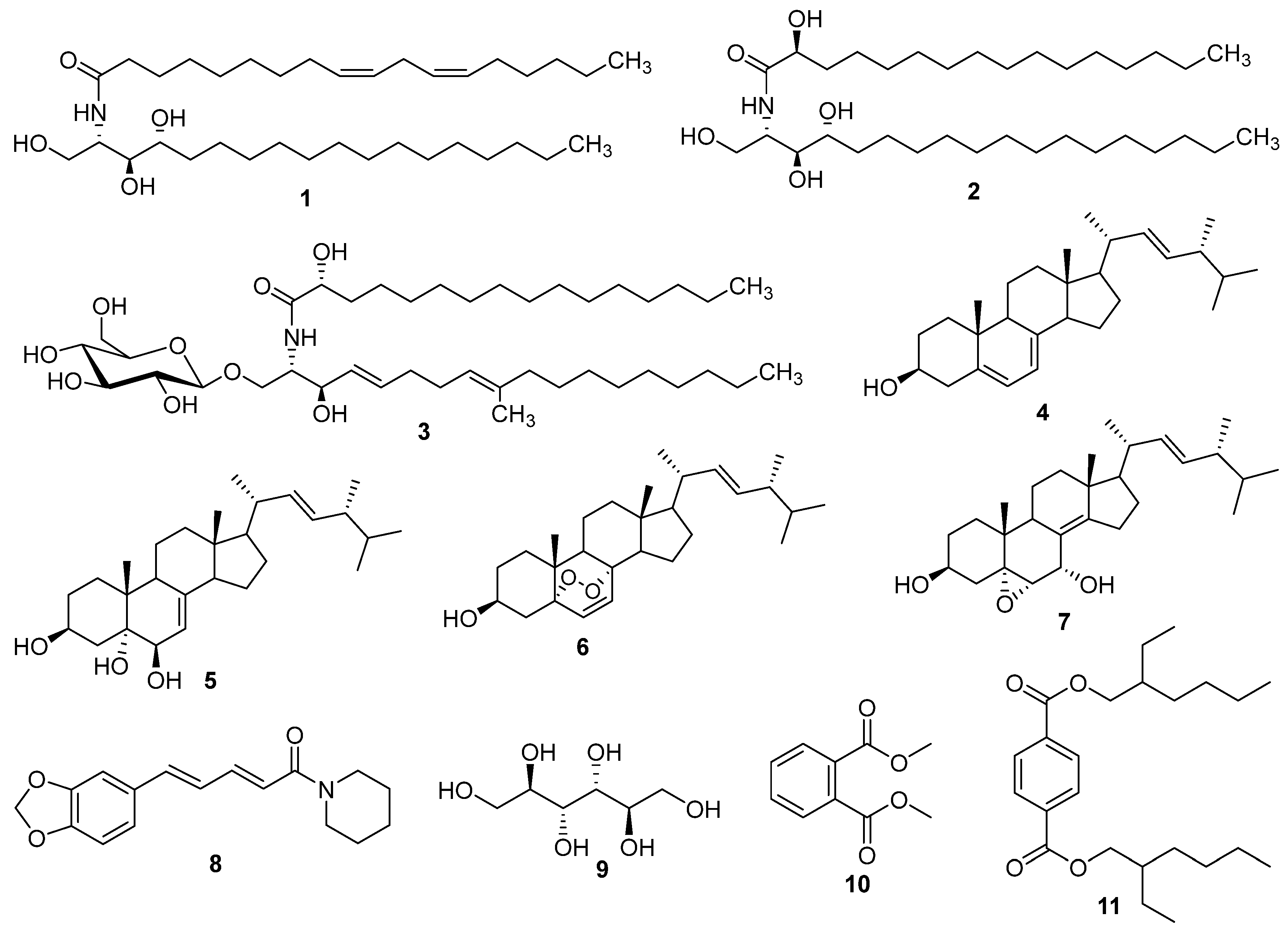
Figure 2.
Mass spectra of identified compounds 12-19 of T. clypeatus.
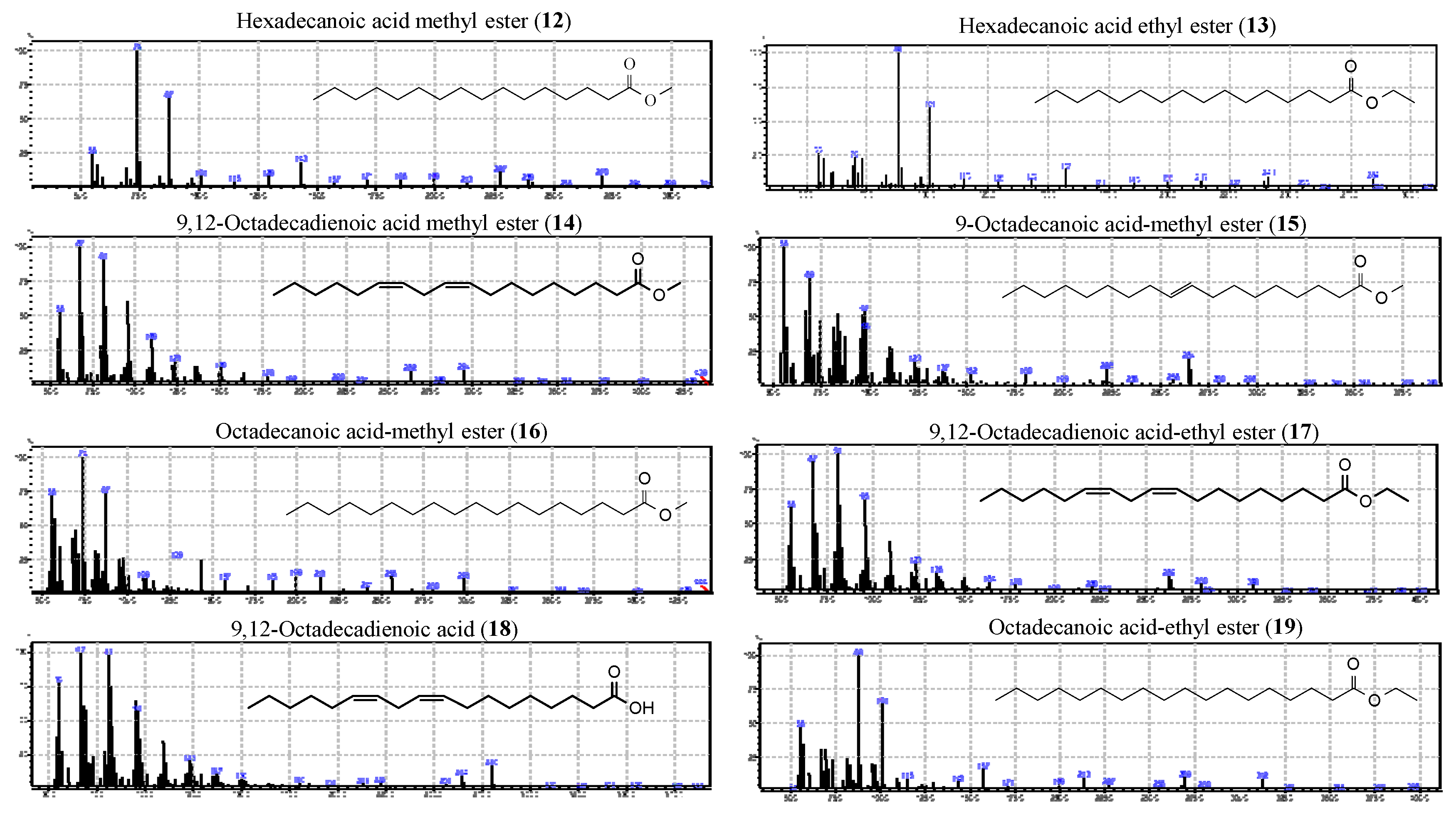

Table 1.
Structures of compounds 12-19 identified by GC-MS in sub-fraction A of T. clypeatus.
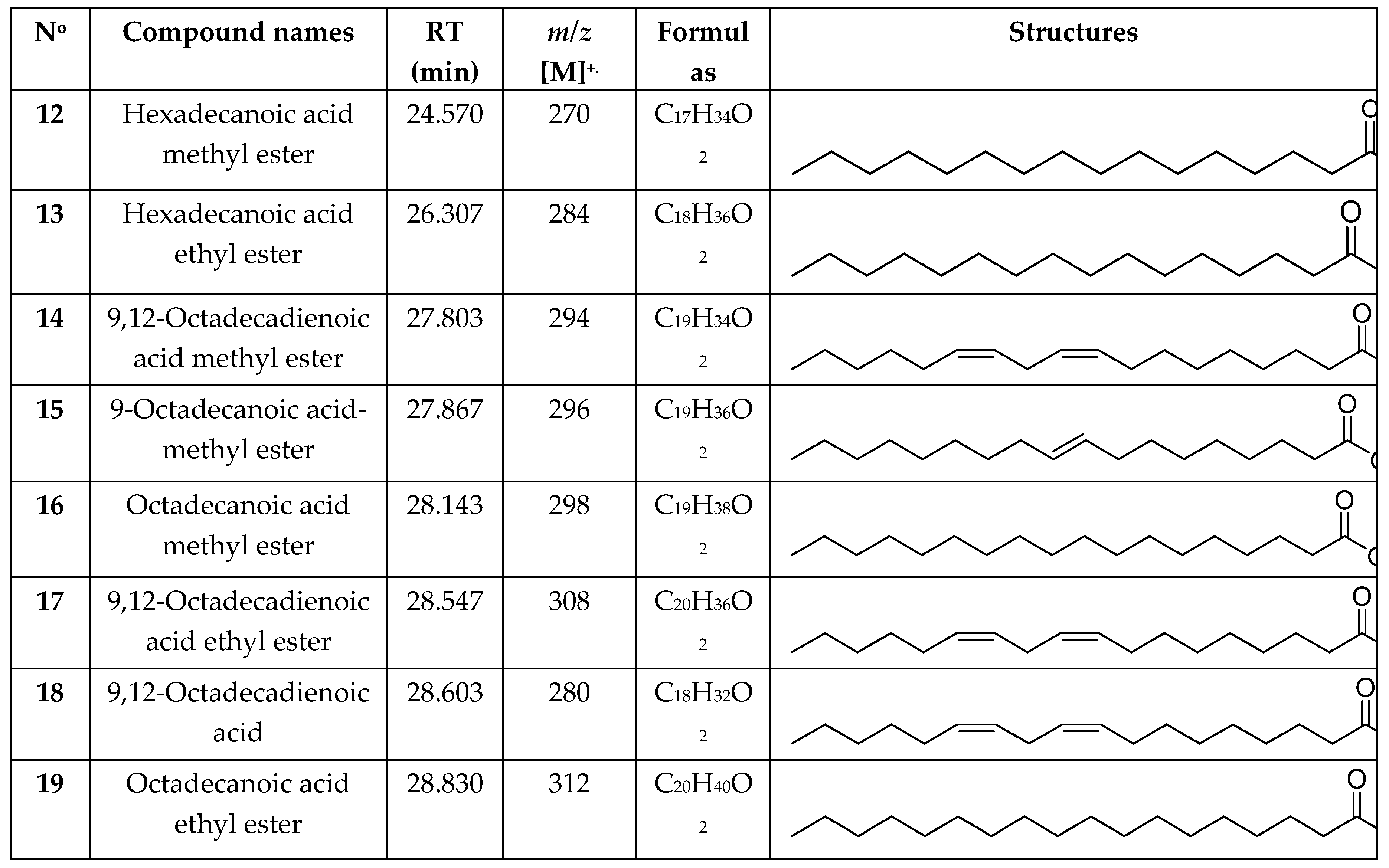 |
Table 2.
Antibacterial activities of extract, fractions and sub-fraction A from Termitomyces clypeatus.
Table 2.
Antibacterial activities of extract, fractions and sub-fraction A from Termitomyces clypeatus.
| Bacteria and strains | EtOH extract | EtOAc fraction | n-BuOH fraction | Sub-fraction A | |||||||||
| MIC | MBC | R | MIC | MBC | R | MIC | MBC | R | MIC | MBC | R | ||
|
Pseudomonas aeruginosa |
PA01 | >2048 | - | - | 1024 | >2048 | - | 2048 | >2048 | - | 128 | >256 | - |
| PA124 | >2048 | - | - | 512 | >2048 | - | >2048 | - | - | 128 | >256 | - | |
|
Klebsiella pneumoniae |
KP55 | >2048 | - | - | >2048 | - | - | >2048 | - | - | 64 | >256 | - |
| ATCC11296 | >2048 | - | - | >2048 | - | - | >2048 | - | - | 256 | 256 | 1 | |
|
Escherichia coli |
AG100 | 2048 | 2048 | 1 | 1024 | >2048 | - | 2048 | >2048 | - | >256 | - | - |
| ATCC10536 | >2048 | - | - | >2048 | - | - | >2048 | - | - | >256 | - | - | |
| Providencia stuartii | PS2636 | 2048 | >2048 | - | 1024 | >2048 | - | 2048 | >2048 | - | 128 | >256 | - |
| NEA16 | >2048 | - | - | >2048 | - | - | >2048 | - | - | >256 | - | - | |
| Enterobacter aerogenes | EA3 | >2048 | - | - | >2048 | - | - | >2048 | - | - | >256 | - | - |
| EA27 | 2048 | >2048 | - | 2048 | 2048 | - | >2048 | - | - | >256 | - | - | |
R: MBC/MIC ratio; -: not determined; MIC: minimum Inhibitory concentration; MBC: minimum bactericidal concentration.
Table 3.
Antibacterial activities of compounds 3-6.
| Bacteria and strains | 3 | 4 | 5 | 6 | |||||||||
| MIC | MBC | R | MIC | MBC | R | MIC | MBC | R | MIC | MBC | R | ||
|
Pseudomonas aeruginosa |
PA01 | 256 | 256 | 1 | 128 | 256 | 2 | >256 | - | - | >256 | - | - |
| PA124 | 128 | 256 | 2 | 128 | - | - | >256 | - | - | >256 | - | - | |
|
Klebsiella pneumoniae |
KP55 | >256 | - | >256 | - | - | >256 | - | - | >256 | - | - | |
| ATCC11296 | 256 | >256 | - | 256 | >256 | - | 128 | 256 | 2 | >256 | - | - | |
| Escherichia coli | AG100 | 128 | >256 | - | 256 | 256 | 1 | 256 | >256 | - | >256 | - | - |
| ATCC10536 | 64 | 64 | 1 | 64 | >256 | - | 32 | 128 | 4 | 128 | 256 | 2 | |
| Providencia stuartii | PS2636 | 128 | - | - | 128 | 128 | 1 | >256 | - | - | 256 | 256 | 1 |
| NEA16 | 256 | >256 | - | 256 | >256 | - | >256 | - | - | >256 | - | - | |
| Enterobacter aerogenes | EA3 | 256 | >256 | - | 128 | >256 | - | 256 | 256 | 1 | >256 | - | - |
| EA27 | >256 | - | - | 256 | >256 | - | >256 | - | - | >256 | - | - | |
R: MBC/MIC ratio; -: not determined; MIC: minimum concentration; MBC: minimum bactericidal concentration.
Table 4.
Antibacterial activities of compounds 7, 8, and 9.
| Bacteria and strains | 7 | 8 | 9 | Chloramphenicol | |||||||||
| MIC | MBC | R | MIC | MBC | R | MIC | MBC | R | MIC | MBC | R | ||
|
Pseudomonas aeruginosa |
PA01 | >256 | - | - | >256 | >256 | - | >256 | - | - | 32 | 64 | 2 |
| PA124 | >256 | - | - | 256 | >256 | - | 256 | >256 | - | 8 | 128 | 32 | |
|
Klebsiella pneumoniae |
KP55 | >256 | - | - | >256 | >256 | - | >256 | - | - | 64 | 128 | 2 |
| ATCC11296 | >256 | - | - | 256 | 256 | 1 | >256 | - | - | 16 | 32 | 2 | |
| Escherichia coli | AG100 | 256 | 256 | 1 | 256 | 256 | 1 | 256 | >256 | - | 2 | 16 | 8 |
| ATCC10536 | 256 | >256 | - | >256 | >256 | - | 256 | 256 | 1 | 32 | 32 | 1 | |
| Providencia stuartii | PS2636 | >256 | - | - | 128 | 256 | 2 | >256 | - | - | 16 | >128 | - |
| NEA16 | >256 | - | - | >256 | >256 | - | >256 | - | - | 64 | >128 | - | |
| Enterobacter aerogenes | EA3 | >256 | - | - | 64 | 128 | 2 | >256 | - | - | 32 | 128 | 4 |
| EA27 | >256 | - | - | >256 | >256 | - | >256 | - | - | 32 | >128 | - | |
R: MBC/MIC ratio; -: not determined; MIC: minimum concentration; MBC: minimum bactericidal concentration.
Table 5.
Minimal inhibitory concentrations of samples from T. clypeatus in absence and presence of PaβN.
Table 5.
Minimal inhibitory concentrations of samples from T. clypeatus in absence and presence of PaβN.
| Bacteria and strains | A | 3 | 4 | 8 | Chloramphenicol | ||||||||||
|
MIC alone |
MIC +PAβN | R |
MIC alone |
MIC +PAβN | R |
MIC alone |
MIC +PAβN | R |
MIC alone |
MIC +PAβN | R |
MIC alone |
MIC +PAβN | R | |
| PA01 | 1024 | >2048 | / | 256 | / | / | 128 | 32 | 4 | >256 | / | / | 32 | 32 | 1 |
| PA124 | 512 | >2048 | / | 128 | 512 | 4 | 128 | 64 | 2 | 256 | 128 | 2 | 64 | 64 | 1 |
| KP55 | >2048 | / | / | >256 | / | / | >256 | 32 | >8 | >256 | 256 | 1 | 128 | 16 | 8 |
| ATCC11296 | 256 | >2048 | / | 256 | 32 | 8 | 256 | 64 | 4 | 256 | 256 | 1 | 64 | 16 | 4 |
| AG100 | 1024 | >2048 | / | 128 | 32 | 4 | 256 | 256 | 1 | 256 | 32 | 8 | 128 | 64 | 2 |
| ATCC10536 | >2048 | 16 | >128 | 64 | 4 | 16 | 64 | 32 | 2 | >256 | 8 | >32 | 256 | 256 | 1 |
| PS2636 | 1024 | 256 | 4 | 128 | 4 | 32 | 128 | 128 | 1 | 128 | 4 | 32 | 128 | 8 | 16 |
| NEA16 | >2048 | / | / | 256 | / | / | 256 | 128 | 2 | >256 | / | / | 128 | 64 | 2 |
| EA3 | >2048 | / | / | 256 | 4 | >64 | 128 | 32 | 4 | 64 | 4 | 16 | 64 | 4 | 16 |
| EA27 | >2048 | / | / | >256 | 128 | >2 | 256 | 32 | 8 | >256 | / | / | 32 | 16 | 2 |
PA01 and PA124 (Pa); KP55 and ATCC11296 (Kn); AG100 and ATCC10536 (Ec); PS2636 and NEA16 (Ps); EA3 and EA27 (Ea); MIC: Minimum Inhibitory Concentration; MIC with PAβN: Minimum Inhibitory Concentration in the presence of PAβN; R: MIC alone/ MIC with PAβN ratio.
Table 6.
Antibiotic potentiating effect of sub-fractions.
| ATBs | Sub-fractions | Concentrations | MIC of antibiotics in the presence of extract (AMF) | PSP (%) | ||||
| Kp55 | AG100 | PS2636 | PA124 | EA3 | ||||
| CIP | 0 | ˃512 | ˃512 | 256 | 512 | ˃512 | ||
| A | MIC/2 | 512 (-) | ˃512 (-) | 128 (2) | 512 (1) | 256 (~2) | 40 | |
| MIC/4 | ˃512 (-) | ˃512 (-) | 128 (2) | 512 (1) | 512 (~1) | 20 | ||
| B | MIC/2 | ˂4 (128) | ˂4 (128) | ˂4 (256) | ˂4 (128) | ˂4 (128) | 100 | |
| MIC/4 | ˂4 (128) | ˂4 (128) | ˂4 (256) | ˂4 (128) | ˂4 (128) | 100 | ||
| C | MIC/2 | ˂4 (128) | ˂4 (128) | ˂4 (256) | ˂4 (128) | ˂4 (128) | 100 | |
| MIC/4 | ˂4 (128) | ˂4 (128) | ˂4 (256) | ˂4 (128) | ˂4 (128) | 100 | ||
| D | MIC/2 | ˂4 (128) | ˂4 (128) | ˂4 (256) | ˂4 (128) | ˂4 (128) | 100 | |
| MIC/4 | ˂4 (128) | ˂4 (128) | ˂4 (256) | ˂4 (128) | ˂4 (128) | 100 | ||
| DOX | 0 | 16 | ˂4 | 32 | 64 | 64 | ||
| A | MIC/2 | ˂4 (4) | ˂4 (1) | 32 (1) | 128 (0.5) | 8 (8) | 40 | |
| MIC/4 | 8 (2) | ˂4 (1) | ˂4 (8) | 64 (1) | 8 (8) | 60 | ||
| B | MIC/2 | ˂4 (4) | ˂4 (1) | ˂4 (8) | ˂4 (16) | ˂4 (16) | 80 | |
| MIC/4 | ˂4 (4) | ˂4 (1) | ˂4 (8) | ˂4 (16) | ˂4 (16) | 80 | ||
| C | MIC/2 | ˂4 (4) | ˂4 (1) | ˂4 (8) | ˂4 (16) | ˂4 (16) | 0 | |
| MIC/4 | ˂4 (4) | ˂4 (1) | ˂4 (8) | ˂4 (16) | ˂4 (16) | 20 | ||
| D | MIC/2 | ˂4 (4) | ˂4 (1) | ˂4 (8) | ˂4 (16) | ˂4 (16) | 40 | |
| MIC/4 | ˂4 (4) | ˂4 (1) | ˂4 (8) | ˂4 (16) | ˂4 (16) | 20 | ||
| AMK | 0 | ˂4 | 16 | ˂4 | 32 | ˂4 | ||
| A | MIC/2 | ˂4 (1) | 16 (1) | ˂4 (1) | 8 (4) | ˂4 (1) | 20 | |
| MIC/4 | ˂4 (1) | 16 (1) | ˂4 (1) | 64 (0.5) | ˂4 (1) | 0 | ||
| B | MIC/2 | 8 (0.5) | ˂4 (4) | 32 (0.125) | ˂4 (8) | ˂4 (1) | 40 | |
| MIC/4 | 16 (0.25) | ˂4 (4) | 32 (0.125) | ˂4 (8) | 8 (0.5) | 40 | ||
| C | MIC/2 | ˂4 (1) | 32 (0.5) | ˂4 (1) | ˂4 (8) | 16 (0.25) | 20 | |
| MIC/4 | ˂4 (1) | 32 (0.5) | 32 (0.125) | ˂4 (8) | 16 (0.25) | 20 | ||
| D | MIC/2 | 8 (0.5) | 16 (1) | 16 (0.25) | ˂4 (8) | 16 (0.25) | 20 | |
| MIC/4 | 16 (0.25) | 64 (0.25) | 16 (0.25) | ˂4 (8) | 16 (0.25) | 20 | ||
MIC: Minimal inhibitory Concentration; AMF: Activity modulating Factors; PSP (%): percentage of strain where potentiation effect was observed; ATBs: Antibiotics; CIP: Ciprofloxacin; DOX: Doxycycline; AMK: Amikacin.
Table 7.
Antibiotic potentiating effect of compounds 3, 4, and 8.
| ATBs | Compounds | Concentration | MIC of antibiotics in the presence of extract (AMF) | PSP (%) | ||||
| Kp55 | AG100 | PS2636 | PA124 | EA3 | ||||
| CIP | 0 | ˃512 | ˃512 | 256 | 512 | ˃512 | ||
| 3 | MIC/2 | ˃512(-) | ˃512(-) | 512(0.5) | 512(1) | 256(~2) | 20 | |
| MIC/4 | ˃512(-) | ˃512(-) | 512(-2) | 512(1) | 256(~2) | 20 | ||
| 4 | MIC/2 | 256(2) | ˃512(-) | 128(2) | 512(1) | 512(~1) | 40 | |
| MIC/4 | ˃512(-) | ˃512(-) | 128(2) | 512(1) | 512(~1) | 20 | ||
| 8 | MIC/2 | ˃512(-) | ˃512(-) | 256(1) | 512(1) | 256(~2) | 20 | |
| MIC/4 | ˃512(-) | ˃512(-) | 256(1) | 512(1) | 512(~1) | 0 | ||
| DOX | 0 | 16 | ˂4 | 32 | 64 | 64 | ||
| 3 | MIC/2 | 64(0.25) | 32(0.125) | 64(0.5) | 64(1) | 64(1) | 0 | |
| MIC/4 | 32(0.5) | 64(0.06) | 64(0.5) | 64(1) | 8(8) | 20 | ||
| 4 | MIC/2 | ˂4(4) | ˂4(1) | 32(1) | 64(1) | 64(1) | 20 | |
| MIC/4 | ˂4(4) | 8(0.5) | 32(1) | 64(1) | 16(4) | 40 | ||
| 8 | MIC/2 | 32(0.5) | 16(0.25) | 16(2) | 64(1) | ˂4(16) | 40 | |
| MIC/4 | 32(-2) | 32(-8) | 16(2) | 64(1) | 64(1) | 20 | ||
| AMK | 0 | ˂4 | 16 | ˂4 | 32 | ˂4 | ||
| 3 | MIC/2 | 8(0.5) | 32(0.5) | ˂4(1) | 64(0.5) | ˂4(1) | 0 | |
| MIC/4 | 8(0.5) | 32(0.5) | ˂4(1) | 64(0.5) | ˂4(1) | 0 | ||
| 4 | MIC/2 | ˂4(1) | 32(0.5) | ˂4(1) | 16(2) | ˂4(1) | 20 | |
| MIC/4 | ˂4(1) | 32(0.5) | ˂4(1) | 16(2) | ˂4(1) | 20 | ||
| 8 | MIC/2 | 16(0.25) | 32(0.5) | ˂4(1) | 64(0.5) | ˂4(1) | 0 | |
| MIC/4 | 8(0.5) | 32(0.5) | ˂4(1) | 32(1) | ˂4(1) | 0 | ||
MIC: Minimal inhibitory Concentration; AMF: Activity modulating Factors; PSP (%): percentage of strain where potentiation effect was observed; ATBs: Antibiotics; CIP: Ciprofloxacin; DOX: Doxycycline; AMK: Amikacin.
Disclaimer/Publisher’s Note: The statements, opinions and data contained in all publications are solely those of the individual author(s) and contributor(s) and not of MDPI and/or the editor(s). MDPI and/or the editor(s) disclaim responsibility for any injury to people or property resulting from any ideas, methods, instructions or products referred to in the content. |
© 2026 by the authors. Licensee MDPI, Basel, Switzerland. This article is an open access article distributed under the terms and conditions of the Creative Commons Attribution (CC BY) license (http://creativecommons.org/licenses/by/4.0/).
Copyright: This open access article is published under a Creative Commons CC BY 4.0 license, which permit the free download, distribution, and reuse, provided that the author and preprint are cited in any reuse.