

Submitted:
19 March 2026
Posted:
23 March 2026
You are already at the latest version
Abstract
Consciousness remains one of the most persistent problems in philosophy and cognitive science. Despite substantial advances in neuroscience, no consensus exists regarding how physical processes give rise to subjective experience. This paper proposes an evolutionary hypothesis according to which consciousness emerges from the interaction of three fundamental dimensions: neural integration of sensory information, the continuous influence of internal bodily states, and the capacity to simulate and anticipate possible scenarios. Within this framework, conscious experience is interpreted not as a mere byproduct of neural processing but as the phenomenological manifestation of a biological system capable of integrating multiple streams of information to construct a model of the organism situated in its environment. The paper develops the thesis that human consciousness can be understood as the result of an evolutionary simulation system that integrates external perception and internal bodily states within a phenomenal field structured around a bodily located self. Once established, this system may have exceeded its original adaptive functions, supporting complex forms of self-reflection, symbolic language, and cumulative culture. The proposal is also intended as an analysis of how contemporary cognitive science constructs explanatory models of consciousness, connecting neural mechanisms, embodied processes, and evolutionary function.
Keywords:
consciousness
; phenomenal field
; predictive processing
; narrative self
; evolutionary cognition
; extended mind
; cultural cognition
1. Introduction
Understanding how conscious experience relates to biological and cognitive processes remains a central challenge not only for philosophy of mind but also for the philosophy of cognitive science (Nagel, 1974; Chalmers, 1995). Contemporary research in neuroscience, psychology, and computational modeling increasingly relies on theoretical frameworks that attempt to explain how complex cognitive systems integrate perception, bodily regulation, and predictive mechanisms. From the perspective of philosophy of science, an important task is to clarify the explanatory structure, conceptual commitments, and empirical implications of such frameworks.
The goal of this paper is therefore not only to propose a theoretical account of consciousness, but to examine how scientific models in cognitive science explain the emergence and organization of conscious experience.
- Philosophical Perspective on Scientific Models.
While the problem of consciousness is often framed as a metaphysical or phenomenological puzzle, it is equally a problem about the explanatory frameworks used in contemporary science. Cognitive science and neuroscience increasingly rely on theoretical models—such as global workspace architectures, predictive processing frameworks, and information integration theories—to explain how biological systems generate organized fields of experience.
From the perspective of philosophy of science, these proposals can be understood as competing explanatory models that attempt to integrate neural mechanisms, embodied interaction, and environmental dynamics within a unified account of conscious experience. Examining how such models structure explanation, integrate evidence, and generate theoretical understanding is therefore essential for understanding the scientific study of consciousness.
The framework developed in this paper should be read in this spirit: as an attempt to clarify how integrative explanatory models in cognitive science can account for the emergence and organization of conscious experience.
Rather than attempting to solve the metaphysical problem of consciousness directly, this paper analyzes a theoretical model concerning the emergence of conscious experience within biological systems. The aim is to examine how a particular explanatory framework — grounded in evolutionary considerations and contemporary cognitive science — can account for the organization of subjective experience and generate empirically testable expectations about the structure of cognition.
Recent developments in predictive processing, embodied cognition, and the study of interoception have suggested that conscious experience may be closely related to the integration of multiple informational streams within the brain. These approaches describe cognition as a process in which organisms continuously construct and update models of their environment and of their own bodily states in order to guide action and maintain adaptive regulation. From this perspective, consciousness may be interpreted not as an isolated phenomenon but as part of a broader architecture of biological information processing.
This paper proposes that conscious experience can be understood as the phenomenological manifestation of an evolutionary simulation system. According to this hypothesis, consciousness emerges from the interaction of three fundamental dimensions: the neural integration of sensory information originating in the external environment, the continuous influence of internal bodily signals associated with interoception, and the capacity of the nervous system to simulate and anticipate possible scenarios before action. These mechanisms together generate a structured phenomenal field centered on a bodily situated self.
The goal of the paper is not merely to introduce a speculative account of consciousness but to clarify the explanatory role of such a model within cognitive science. In particular, the analysis seeks to show how the proposed framework connects evolutionary considerations, contemporary neuroscience, and theories of predictive cognition into a unified explanatory structure. By examining the conceptual organization of the model and its empirical implications, the paper aims to contribute to ongoing philosophical discussions concerning explanation and theory construction in the cognitive sciences.
The paper proceeds as follows. Section 2 reviews the classical formulation of the problem of consciousness and the explanatory gap. Section 3 situates the discussion within contemporary predictive and embodied approaches to cognition. Section 4 develops the evolutionary simulation hypothesis proposed in this work. Subsequent sections explore its implications for the organization of conscious experience, the emergence of selfhood, and the externalization of cognitive processes through symbolic systems. Finally, the paper examines the empirical implications and conceptual limitations of the framework, identifying directions for future research in the philosophy of cognitive science.
1.1. The Problem of Consciousness
The most influential contemporary formulation of this difficulty is David Chalmers’ distinction between the “easy problems” and the “hard problem” of consciousness (Chalmers, 1995). The easy problems concern the explanation of cognitive functions such as discrimination, information integration, behavioral control, and reportability. Although technically complex, these problems appear tractable within standard scientific frameworks.
The hard problem, however, concerns the emergence of subjective experience itself. Why should information processing be accompanied by experience at all? Why do neural processes not occur entirely “in the dark,” without any accompanying phenomenal life?
Various theoretical approaches have attempted to address this question. Some accounts attempt to reduce consciousness to specific neural mechanisms or patterns of information integration (Dehaene, 2014; Baars, 1988; Tononi and Koch, 2016). Other approaches emphasize the importance of predictive processing and hierarchical generative models in explaining perception and cognition (Friston, 2010; Clark, 2016). Still others focus on the construction of self-models within the brain as a basis for subjective experience (Metzinger, 2003).
Despite these advances, none of these frameworks has produced a widely accepted explanation of why subjective experience exists in the first place. As a result, the problem of consciousness continues to occupy a central place in contemporary philosophy of mind (Nagel, 1974; Chalmers, 1995).
Accordingly, the problem of consciousness can also be understood as a problem about the explanatory structures through which cognitive science attempts to model the emergence of conscious experience.
1.2. Evolutionary Framing of the Problem
While the ontological question of how experience arises from physical processes remains fundamental, an additional question deserves equal attention: why biological organisms capable of subjective experience emerged in the first place.
From an evolutionary perspective, traits that persist across generations typically provide some form of adaptive advantage. If consciousness is not merely an incidental byproduct of neural activity but instead a functional feature of biological systems, it becomes reasonable to ask what role it might play in the regulation of behavior and interaction with the environment.
Several contemporary approaches already hint at this possibility. For example, Antonio Damasio has emphasized the role of bodily regulation and interoceptive processes in the emergence of conscious awareness (Damasio, 2010). Similarly, predictive processing frameworks describe the brain as a system that constantly generates and updates models of the environment in order to minimize prediction error (Friston, 2010). Within such frameworks, perception itself can be understood as a form of controlled hallucination constrained by sensory input (Clark, 2016).
These perspectives suggest that consciousness may be related to the brain’s capacity to integrate multiple streams of information into coherent models of the organism and its environment. However, the phenomenological dimension of this integration — the fact that it is experienced from a particular point of view — remains insufficiently explored.
1.3. The Central Hypothesis of This Work
The hypothesis developed in this paper is that consciousness can be understood as the phenomenological manifestation of an evolutionary simulation system.
More specifically, the proposal advanced here is that conscious experience emerges from the interaction of three fundamental dimensions:
- the neural integration of sensory information originating in the external environment;
- the continuous influence of internal bodily states, including interoceptive and affective signals;
- the capacity of the nervous system to simulate and anticipate possible scenarios prior to action.
From this perspective, conscious experience should not be interpreted as a simple byproduct of neural processing. Instead, it reflects the operation of a biological system capable of integrating multiple streams of information in order to construct a model of the organism situated within its environment.
This model is not merely computational. It is structured as a phenomenal field organized around a bodily located point of view. The organism does not merely process information about the world; it experiences the world from its own perspective as an embodied agent.
Within this framework, consciousness functions as the experiential domain in which the organism integrates perception, bodily states, memory, and predictive simulation. Such integration allows the system to evaluate possible courses of action before they are executed, providing a potentially significant adaptive advantage in complex and uncertain environments.
1.4. Scientific Models and Explanatory Frameworks
Although the present work advances a theoretical account of consciousness, its broader aim is to examine how scientific models of consciousness function as explanatory frameworks within cognitive science. Contemporary debates about consciousness are not only disputes about the nature of experience, but also about the structure and explanatory power of competing models. Theories such as Global Workspace Theory, Integrated Information Theory, and predictive processing propose different architectures through which neural, bodily, and environmental processes become integrated into coherent experiential fields.
From the perspective of philosophy of science, these theories can be understood as attempts to construct explanatory models linking observable biological processes to the phenomenology of conscious experience. Such models differ not only in their empirical commitments but also in the form of explanation they provide—whether mechanistic, functional, or information-theoretic. Examining these explanatory structures is therefore essential for understanding how consciousness is theorized within contemporary scientific practice.
The hypothesis developed in this paper—that consciousness operates as an evolutionary simulation system integrating internal and external information—should therefore be interpreted not merely as a metaphysical proposal about the nature of mind, but as a contribution to the analysis of explanatory models in the sciences of cognition. In this sense, the paper participates in a broader philosophical investigation into how scientific models represent, integrate, and explain complex biological phenomena (Craver, 2007; Bechtel, 2008; Godfrey-Smith, 2006).
1.5. Structure of the Paper
The remainder of this paper develops this hypothesis in a series of steps.
Section 2 examines the structure of conscious experience through the concept of the phenomenal field and the role of a bodily located perspective. Section 3 analyzes the integration of external sensory input and internal bodily signals, introducing the concept of an “internal lens” through which experience is interpreted. Section 4 discusses the role of memory, emotion, and bodily regulation in shaping the continuity of experience and the emergence of the self.
Section 5 examines the neural mechanisms underlying the integration of perceptual and internal information, drawing on contemporary neuroscience and predictive processing theories. Section 6 develops the central evolutionary hypothesis of consciousness as a system of scenario simulation. Section 7 explores how temporal integration of experience gives rise to the narrative self.
Sections 8 through 11 extend this framework to the broader evolutionary and cultural context of human cognition, including the emergence of language, writing, and cumulative culture, as well as the externalization of cognitive processes in symbolic systems.
Finally, the paper concludes by examining potential objections and limitations of the proposed framework and by outlining directions for future investigation.
Taken together, the argument developed here aims to situate consciousness within a broader evolutionary and cognitive architecture in which perception, bodily regulation, and simulation interact to generate the structured phenomenal field characteristic of human experience.
In this sense, the present work should be understood as a contribution to the analysis of explanatory models of consciousness within contemporary cognitive science. The following section therefore revisits the problem of consciousness from the perspective of how such models attempt to explain the emergence and organization of conscious experience.
2. The Problem of Consciousness
The scientific and philosophical investigation of consciousness confronts a fundamental explanatory challenge: understanding how physical processes occurring in biological systems give rise to subjective experience. Although neuroscience has achieved remarkable success in identifying the neural mechanisms underlying perception, memory, and decision-making, explaining how these mechanisms generate the qualitative dimension of experience remains an open problem.
At its most basic level, the difficulty lies in the apparent gap between objective descriptions of physical processes and the subjective character of lived experience. Neural activity can be described in terms of electrochemical interactions, patterns of activation, and information processing. Yet such descriptions appear to leave something unexplained: the fact that these processes are accompanied by a first-person perspective.
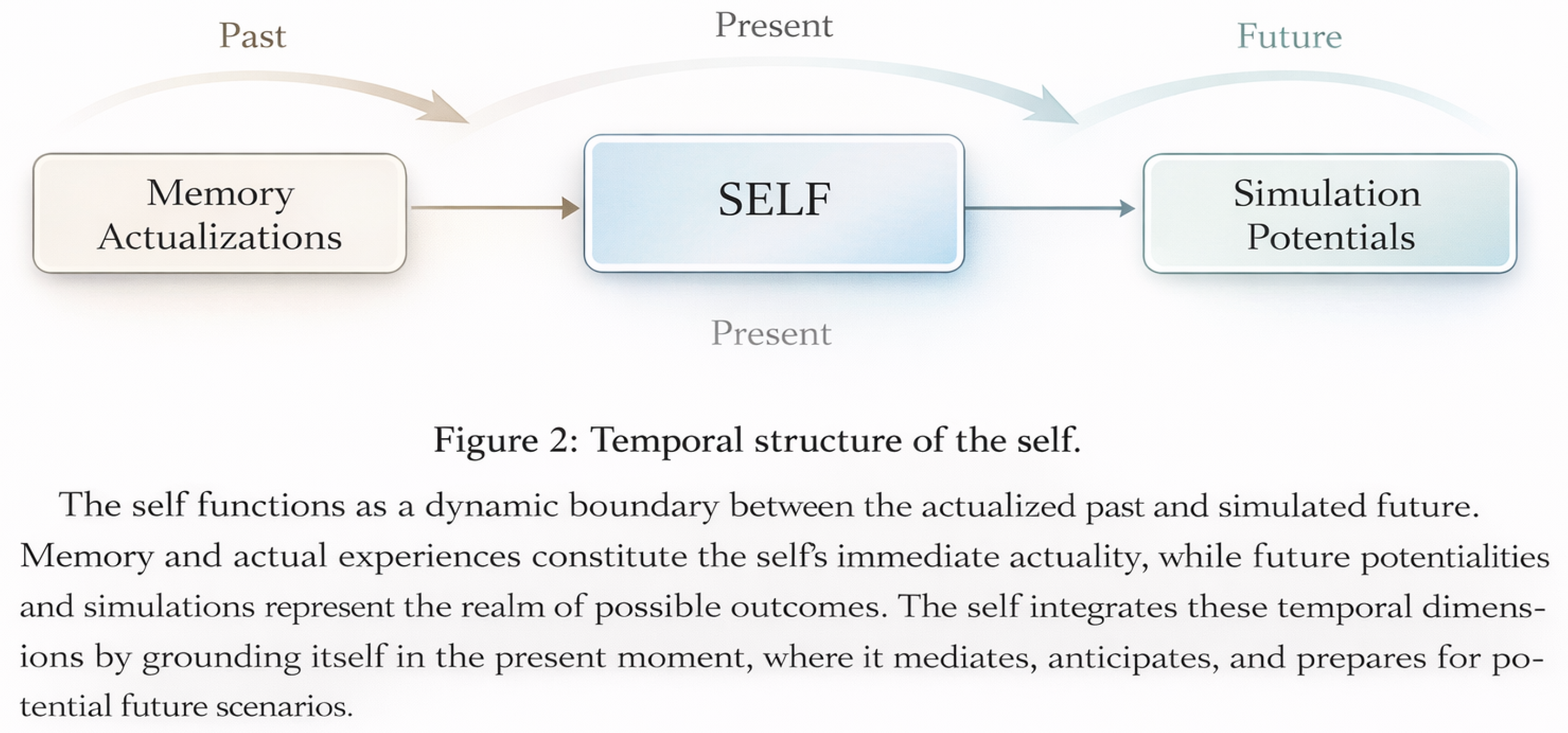
Within this framework, the self may be interpreted as the dynamic boundary between potentiality and actuality. Drawing on the classical distinction between potentiality (dynamis) and actuality (energeia) articulated by Aristotle in Metaphysics Book IX (Aristotle, 1924), the present identity of an organism emerges at the intersection between what it has already become through past actions and experiences and what it may still become through simulated possibilities. Past experiences persist through memory and continuously shape the organism’s internal interpretive structure, while imagined futures arise through its capacity for simulation. The self therefore occupies the temporal frontier where past actualizations and future potentials converge in the present moment of conscious experience.
2.1. The Explanatory Gap
This difficulty has been widely discussed in philosophy of mind as the explanatory gap between physical processes and subjective experience (Levine, 1983). Even if a complete physical account of neural mechanisms were available, it is not obvious that such an account would explain why those mechanisms should be accompanied by conscious experience.
Thomas Nagel famously captured this intuition in his discussion of subjective perspective, arguing that conscious organisms possess a distinctive experiential character: there is something it is like to be that organism (Nagel, 1974). This formulation highlights the irreducibly first-person character of experience. Objective scientific descriptions, by contrast, are formulated from a third-person perspective.
The tension between these two perspectives has generated extensive philosophical debate. Some philosophers have argued that subjective experience involves intrinsic qualitative properties often referred to as qualia. These properties are taken to represent the felt qualities of experience: the redness of red, the bitterness of coffee, or the sensation of pain.
Others have questioned whether the concept of qualia provides a useful explanatory framework. Daniel Dennett, for example, has argued that the notion of ineffable intrinsic properties may reflect conceptual confusion rather than a genuine ontological feature of the mind (Dennett, 1991). From this perspective, what appears to be a mysterious qualitative dimension may instead emerge from complex cognitive processes that organize perception, memory, and interpretation.
Despite these disagreements, the persistence of the explanatory gap continues to motivate philosophical reflection on the nature of consciousness.
2.2. Competing Theoretical Approaches
These theories may be interpreted not only as competing hypotheses about consciousness but also as alternative explanatory models within the scientific study of cognition.
Contemporary research on consciousness has produced several influential theoretical frameworks that attempt to explain how subjective experience might arise from neural processes.
One influential proposal is the Global Workspace Theory (GWT), which suggests that conscious experience arises when information becomes globally available across distributed cognitive systems (Baars, 1988; Dehaene, 2014). According to this model, consciousness functions as a broadcasting mechanism that allows information processed in specialized neural modules to be integrated and accessed by multiple cognitive systems.
Another prominent framework is Integrated Information Theory (IIT), which proposes that consciousness corresponds to the degree to which a system integrates information within its causal structure (Tononi and Koch, 2016). Within this view, consciousness is treated as a fundamental property of systems capable of generating highly integrated informational states.
More recently, predictive processing approaches have emphasized the brain’s role as a hierarchical inference machine that continuously generates predictions about sensory input (Friston, 2010; Clark, 2016). In these models, perception results from the interaction between top-down predictions and bottom-up sensory signals. Although predictive processing frameworks provide powerful accounts of perception and action, their relationship to the phenomenology of conscious experience remains a topic of ongoing debate.
These theories have significantly advanced the scientific study of consciousness by identifying candidate mechanisms for information integration, global availability, and predictive modeling. However, they do not fully resolve the deeper philosophical question of why these mechanisms should be accompanied by subjective experience.
2.3. Explanatory Structures in Theories of Consciousness
Beyond their empirical claims, competing theories of consciousness differ in the kinds of explanations they offer. Some approaches emphasize mechanistic explanations, seeking to identify neural mechanisms whose organized activity produces conscious experience. Others adopt functional or informational frameworks, describing consciousness in terms of patterns of integration, global availability, or predictive modeling.
From the standpoint of philosophy of science, these differences reflect distinct explanatory strategies within contemporary cognitive science. Mechanistic accounts aim to identify organized systems of interacting components responsible for particular phenomena, while informational approaches often emphasize systemic properties emerging from patterns of integration across distributed networks (Craver, 2007; Bechtel, 2008).
Understanding these theories as explanatory models clarifies the role they play within scientific practice. Rather than merely proposing alternative metaphysical interpretations of consciousness, they offer structured frameworks linking neural dynamics, embodied interaction, and cognitive organization to observable behavioral and phenomenological outcomes.
2.4. The Evolutionary Reformulation of the Problem
Given the persistence of these difficulties, it may be useful to reconsider how the problem of consciousness is framed.
Much philosophical discussion has focused on the ontological question of how subjective experience emerges from physical processes. While this question remains important, it can be complemented by a second line of inquiry grounded in evolutionary theory.
Instead of asking only how physical processes produce experience, we may also ask why biological organisms capable of subjective experience evolved in the first place.
From an evolutionary perspective, biological traits typically persist because they contribute to the adaptive success of organisms. If consciousness is not merely an incidental byproduct of neural complexity, it is reasonable to suppose that it plays some functional role in the regulation of behavior.
This perspective shifts the focus from the metaphysical origin of experience to its potential biological function. Consciousness may be understood not simply as an inexplicable accompaniment of neural activity, but as part of a broader system that integrates sensory information, internal bodily states, and memory in order to guide action in complex environments.
Such a system would allow organisms to evaluate possible courses of action before executing them. Rather than reacting solely to immediate stimuli, the organism could simulate potential outcomes and select actions accordingly.
This capacity for internal simulation and anticipatory evaluation may provide a powerful adaptive advantage, particularly in environments characterized by uncertainty and rapidly changing conditions.
The hypothesis explored in this work begins precisely from this possibility. Consciousness, on this view, may represent the experiential dimension of an evolutionary architecture designed to integrate perception, bodily regulation, and predictive simulation into a unified model of the organism situated in the world.
3. Phenomenal Field and the Perspective of the Self
One of the most fundamental structural characteristics of conscious experience is that it always occurs from a particular point of view. Experience is never presented in a neutral or disembodied manner. Instead, it is organized around a perspective that is implicitly anchored in the body of the experiencing subject.
Human beings do not encounter the world as detached observers. Rather, the world is experienced from within a situated perspective: objects appear as located in relation to the perceiver, events unfold relative to the subject’s position, and actions are experienced as possibilities available to the organism. This perspectival structure is not an optional feature of consciousness but one of its defining characteristics.
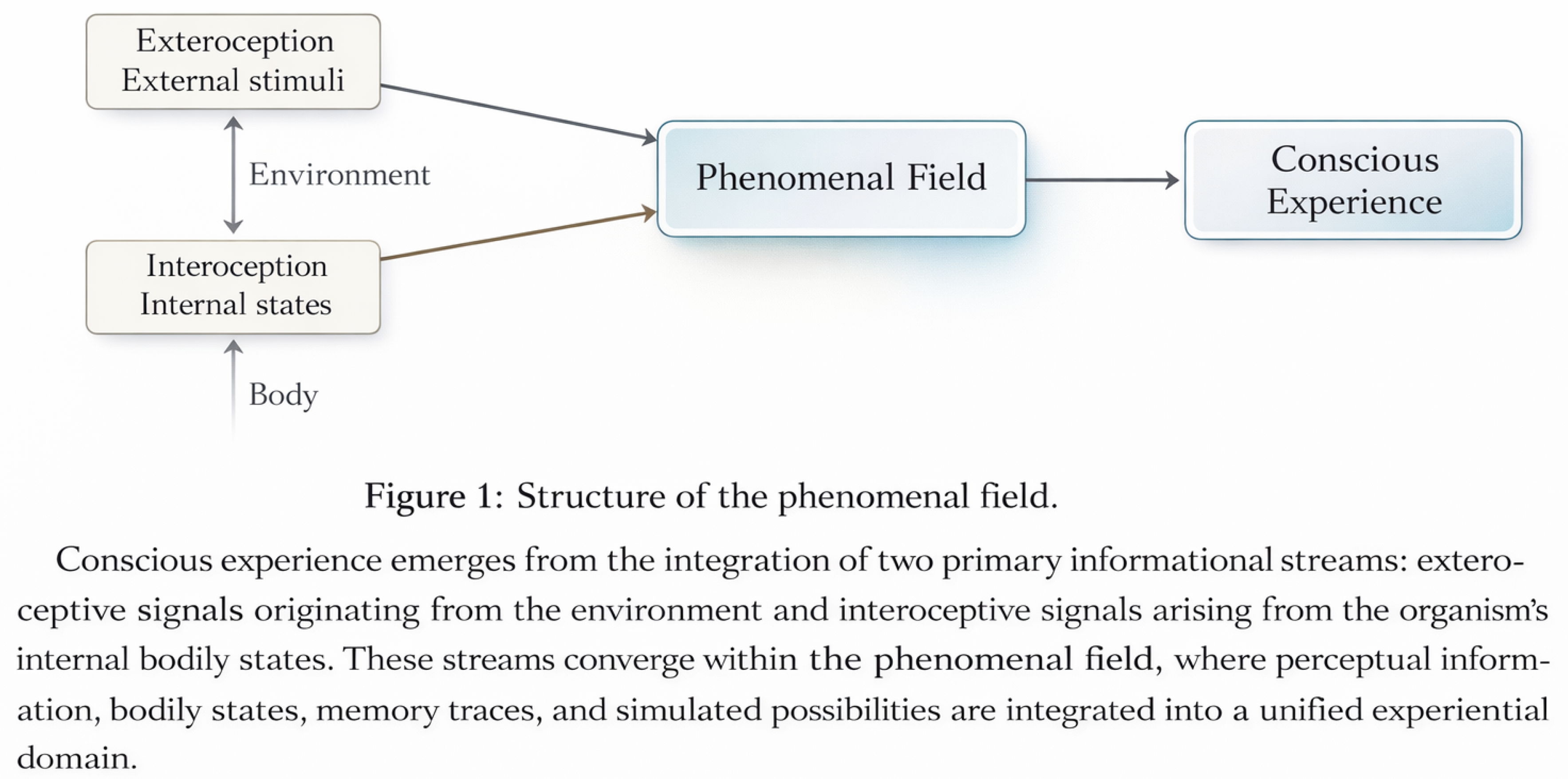
The phenomenal field of experience emerges from the integration of two primary informational sources: exteroception and interoception. Exteroceptive signals arise from sensory systems that capture environmental stimuli, while interoceptive signals originate within the organism’s own body and internal processes, including physiological states, affective responses, and internally generated representations such as memories and simulations. The concept of a phenomenal field refers to the structured domain in which conscious experience appears to the subject (Velmans, 2009). Contemporary neuroscience further emphasizes the importance of interoceptive signals in shaping conscious experience and bodily self-awareness (Damasio, 2010; Craig, 2009). Conscious experience therefore unfolds through the dynamic integration of internal bodily states and externally derived sensory information within a unified phenomenal field.
Figure 1.
caption.
3.1. The Structure of the Phenomenal Field
The domain within which conscious contents appear can be described as the phenomenal field. The phenomenal field refers to the totality of experiential contents present to the subject at a given moment. These contents include perceptual stimuli, recalled memories, emotional states, bodily sensations, and ongoing cognitive evaluations.
Importantly, the phenomenal field is not merely a collection of independent sensations. Rather, it constitutes an integrated structure in which multiple experiential components are organized into a coherent experiential space. Within this space, sensory perceptions, bodily feelings, and cognitive interpretations are continuously interwoven.
This structural unity of experience has long been recognized in phenomenological traditions of philosophy, which emphasize that consciousness presents itself as a structured field rather than a mere aggregation of sensory elements. Contemporary cognitive science increasingly supports this view by showing that perception results from the integration of multiple sensory and cognitive processes operating simultaneously.
Thus, conscious experience should be understood not simply as a passive reception of stimuli, but as an organized experiential domain in which different streams of information are integrated into a coherent representation of the organism’s situation in the world.
3.2. Embodiment and the Situated Perspective
A defining feature of the phenomenal field is that it is organized around a bodily perspective. The subject does not merely perceive objects in the world; the subject also implicitly experiences itself as an entity situated within that world.
Perception therefore always includes a form of implicit self-location. Objects appear as being “in front of,” “behind,” “near,” or “far from” the perceiver. Actions are experienced relative to the body’s capabilities and limitations. Even the simplest perceptual experiences already presuppose a spatially situated organism.
Philosophical and neuroscientific research increasingly emphasizes the importance of embodiment in shaping conscious experience. According to embodied cognition approaches, perception and cognition cannot be understood independently of the bodily systems through which organisms interact with their environment (Varela et al., 1991; Thompson, 2007).
Within this perspective, the body functions not merely as a vehicle for sensory input but as a fundamental organizing principle of experience. The structure of the phenomenal field reflects the organism’s embodied relationship with the world.
3.3. The Emergence of the Self-Model
The existence of a perspectival structure within experience suggests that conscious systems must maintain some form of internal representation of the organism itself. In order to interpret sensory input relative to the body, the nervous system must possess mechanisms capable of tracking the organism’s position, state, and potential actions.
Several contemporary theories propose that the brain continuously constructs internal models of the organism in order to regulate behavior and guide interaction with the environment. Thomas Metzinger has argued that conscious experience involves the activation of a self-model that represents the organism as an agent situated in the world (Metzinger, 2003). According to this view, the self is not a fixed entity but a dynamic representational structure generated by the brain.
Similarly, Antonio Damasio has proposed that the sense of self emerges from neural processes that integrate representations of bodily states with ongoing perceptual activity (Damasio, 2010). In his framework, bodily regulation and interoceptive signals play a central role in the construction of conscious awareness.
Within the present framework, the phenomenal field can be interpreted as the experiential domain in which such organism-centered models become phenomenologically manifest. Conscious experience reflects the operation of neural mechanisms that continuously integrate sensory input with representations of the organism’s own body.
Figure 2.
caption.
3.4. The Internal Dimension of Experience
Although perceptual experience is often associated primarily with external stimuli, conscious experience always includes an internal dimension. Bodily sensations, affective states, and background moods continuously accompany perception and influence how external stimuli are interpreted.
This internal dimension of experience includes signals arising from the body’s physiological regulation, such as hunger, fatigue, tension, or calmness. It also includes emotional states that shape the evaluation of environmental stimuli, transforming identical events into perceived threats, opportunities, or neutral occurrences.
From a neuroscientific perspective, these signals are often described in terms of interoception, the perception of internal bodily states. Interoceptive processes contribute to the organism’s capacity to maintain homeostasis and regulate behavior in response to internal needs (Damasio, 2010).
The continuous interaction between external perception and internal bodily signals plays a crucial role in shaping the organization of the phenomenal field. Conscious experience is therefore not merely the representation of the external environment but the integrated expression of both the organism and its surroundings.
Understanding this dual structure of experience is essential for explaining how conscious systems organize perception, action, and evaluation. As the following sections will argue, the integration of external and internal streams of information forms the basis for a broader architecture of simulation and anticipation that may underlie the evolutionary emergence of consciousness.
4. Two Streams of Experience: Environment and Organism
The organization of conscious experience suggests that the phenomenal field arises from the interaction between multiple sources of information. At a minimum, two major informational streams can be distinguished: signals originating in the external environment and signals originating within the organism itself. Conscious experience emerges from the continuous integration of these two domains.
This dual structure reflects the fact that organisms must simultaneously monitor their surroundings and regulate their internal physiological states. Survival depends both on detecting environmental conditions and on maintaining internal homeostasis. The nervous system therefore integrates information concerning the external world with signals reflecting the organism’s internal condition.
4.1. Exteroception: Information from the Environment
The first stream corresponds to stimuli originating in the external environment. These signals are received through sensory systems such as vision, hearing, touch, smell, and taste. Through these channels, organisms detect objects, events, and spatial relations in their surroundings.
From a neurobiological perspective, sensory systems translate environmental stimuli into neural signals that can be processed by distributed networks in the brain. These networks allow organisms to construct representations of the external environment and to guide action accordingly.
Perception is therefore not merely a passive reception of stimuli but an active process of information organization. Contemporary models of perception increasingly emphasize that the brain continuously generates predictions about sensory input and updates them in response to incoming signals (Friston, 2010; Clark, 2016). Within such frameworks, perception is understood as the result of an ongoing interaction between sensory evidence and internal predictive models.
Nevertheless, the information provided by exteroceptive systems remains fundamentally oriented toward the environment. Through these systems, the organism acquires information about objects, movements, threats, and opportunities present in the external world.
4.2. Interoception: The Internal State of the Organism
In addition to exteroceptive signals, conscious experience is also shaped by information originating within the organism itself. These internal signals include bodily sensations, physiological regulation, emotional states, and affective responses.
Contemporary neuroscience describes this internal dimension of experience in terms of interoception, that is, the perception of the physiological condition of the body (Damasio, 2010; Craig, 2002). Interoceptive signals provide continuous information about processes such as heart rate, respiration, hunger, fatigue, and visceral sensations.
These signals are essential for maintaining homeostasis and guiding adaptive behavior. Emotional experiences, for example, often arise from the brain’s interpretation of internal bodily states and their relation to external circumstances.
Importantly, interoceptive information does not remain confined to background physiological regulation. Instead, it contributes directly to the phenomenology of conscious experience. Feelings, moods, and bodily sensations continuously accompany perception and influence how external stimuli are interpreted.
Recent theoretical work has emphasized the central role of interoceptive inference in shaping conscious awareness. According to these approaches, the brain not only predicts external sensory input but also generates predictive models of internal bodily states (Friston, 2010; Seth, 2013). Conscious experience may therefore reflect the integration of both exteroceptive and interoceptive predictive processes.
4.3. Integration within the Phenomenal Field
Although exteroceptive and interoceptive signals can be analytically distinguished, they do not operate independently within conscious experience. Instead, they are continuously integrated within the phenomenal field.
Perception of the external environment always occurs alongside bodily states, emotional responses, and cognitive expectations. An identical environmental stimulus may therefore be experienced differently depending on the organism’s internal condition.
For example, a situation that appears threatening when the organism is already in a state of physiological arousal may appear neutral or insignificant when the organism is calm. Similarly, memories and expectations can influence how incoming stimuli are interpreted and evaluated.
These observations suggest that conscious perception cannot be understood solely in terms of external sensory input. Instead, it reflects the dynamic interaction between information about the external world and signals reflecting the organism’s internal condition.
4.4. The Internal Lens
For analytical purposes, the present work introduces the concept of the internal lens to describe the ensemble of internal states that modulate conscious experience.
The internal lens refers to the set of factors through which the organism interprets incoming information. These factors include emotional states, bodily conditions, memories, prior experiences, and expectations about possible outcomes.
Through the operation of this internal lens, perception becomes inherently interpretive rather than purely reactive. External stimuli are not simply registered by the nervous system; they are filtered, evaluated, and contextualized in relation to the organism’s current internal state and experiential history.
In this sense, the phenomenal field can be understood as the result of a continuous interaction between two informational streams: signals arriving from the environment and signals reflecting the internal condition of the organism. The internal lens mediates this interaction, shaping how the organism experiences and interprets the world.
This framework suggests that conscious experience is not simply a mirror of the external environment. Instead, it represents the dynamic integration of environmental information with the organism’s internal history and physiological condition.
The next section examines how memory, emotional regulation, and the organism’s experiential history contribute to the formation and evolution of this internal lens.
Within this framework, the internal lens can be interpreted as the dispositional structure that organizes the organism’s field of experiential potential. It does not merely filter perception but shapes the set of possible experiential configurations available to the organism at any given moment. Memories, emotional dispositions, embodied states, and learned expectations collectively define this field of potential states, from which particular experiential configurations become actualized in conscious awareness.
From this perspective, conscious experience may be interpreted as the ongoing process through which an organism continuously transforms a structured field of perceptual and latent possibilities into actual lived configurations. The phenomenal field integrates exteroceptive inputs from the environment with interoceptive signals arising from the organism’s own body and internal cognitive processes. Through memory and simulation, past actualizations and future potentials are continuously reorganized within the present moment of experience. Consciousness therefore emerges as the dynamic interface where perception, memory, embodiment, and simulation converge to actualize the organism’s experiential world.
5. The Internal Lens and the History of the Organism
The internal lens should not be understood as a single neural structure or localized cognitive mechanism. Rather, it is best interpreted as a dynamic configuration of internal states that accompany and modulate the organism’s ongoing experience. This configuration reflects the organism’s physiological condition, emotional dispositions, and accumulated experiential history.
Because the internal lens is shaped by processes unfolding across time, it embodies the history of the organism’s interaction with its environment. Each moment of experience is therefore influenced not only by present stimuli but also by the traces of past experiences that have been incorporated into the nervous system.
5.1. Memory and the Persistence of Experience
Among the most important components of the internal lens are memory traces. Experiences leave lasting modifications in neural structures through processes of synaptic plasticity, allowing past interactions with the environment to influence the interpretation of future events.
The idea that memory is encoded through modifications of synaptic connections has a long history in neuroscience, often associated with Hebbian learning mechanisms in which repeated co-activation of neurons strengthens their connections (Hebb, 1949; Kandel, 2014). Through such mechanisms, patterns of past experience become embedded in the architecture of the nervous system.
As a result, present experience cannot be understood merely as an immediate response to environmental stimuli. Instead, it is shaped by neural structures that embody the organism’s previous interactions with the world. Perception therefore involves an interpretive dimension: sensory input is evaluated and organized in light of prior experience.
In this sense, the phenomenal field always contains an implicit temporal depth. What appears as immediate perception is in fact the outcome of a long history of neural adaptation and experiential learning.
5.2. Emotion and Affective Modulation
Emotional processes constitute another crucial component of the internal lens. Emotions influence how stimuli are evaluated, shaping the organism’s responses to environmental conditions.
From a neurobiological perspective, emotions can be understood as regulatory mechanisms that coordinate physiological states, behavioral tendencies, and cognitive evaluations. Antonio Damasio has argued that emotional processes play a fundamental role in guiding decision-making and organizing conscious experience (Damasio, 2010).
Through emotional modulation, identical environmental stimuli may acquire very different meanings depending on the organism’s internal state. A situation that appears threatening when the organism is already in a state of anxiety may appear neutral or even inviting under different emotional conditions.
This affective modulation ensures that perception is not merely informational but evaluative. Conscious experience does not simply represent the environment; it also reflects the organism’s current relation to that environment in terms of potential threats, opportunities, and goals.
5.3. Bodily States and the Background of Experience
In addition to memory and emotion, ongoing bodily states contribute continuously to the configuration of the internal lens. Sensations such as fatigue, tension, hunger, calmness, or physiological arousal form part of the background conditions within which perception occurs.
These bodily signals provide continuous feedback concerning the organism’s internal condition and its capacity to act in the environment. As a result, bodily regulation plays a crucial role in shaping the phenomenological tone of experience.
Recent theoretical approaches emphasize that the brain not only predicts external sensory input but also generates predictive models of internal bodily states (Friston, 2010; Seth, 2013; Barrett and Simmons, 2015). Through these predictive processes, the organism maintains a dynamic model of its own physiological condition.
Within this framework, bodily signals become an integral component of conscious experience rather than merely background physiological processes. The phenomenal field thus reflects both the organism’s perception of the external world and its internal physiological condition.
5.4. Continuity and the Emergent Self
Taken together, memory, emotion, and bodily regulation form the dynamic structure of the internal lens. Through their continuous interaction, past experiences are reinterpreted in light of present conditions, while present perception is shaped by accumulated history.
This process produces a form of experiential continuity that contributes to the emergence of the self. The self, in this view, need not be understood as a fixed metaphysical substance. Instead, it can be interpreted as an emergent phenomenon arising from the ongoing integration of perception, memory, and bodily regulation.
Several contemporary theories of consciousness adopt a similar perspective. For example, Daniel Dennett has described the self as a “center of narrative gravity” emerging from the temporal organization of experience (Dennett, 1991). Likewise, Metzinger’s self-model theory suggests that the sense of self arises from representational processes that integrate information about the organism’s body and environment (Metzinger, 2003).
Within the framework proposed here, the internal lens provides the mechanism through which the organism’s past becomes continuously integrated into present experience. The phenomenal field therefore reflects not only the organism’s immediate interaction with its environment but also the accumulated history of those interactions.
Understanding this temporal dimension of experience is essential for explaining how conscious systems maintain continuity across time. As the following section will argue, the neural mechanisms underlying this integration play a crucial role in enabling the organism to construct coherent models of its environment and anticipate possible future scenarios.
6. Neural Integration of Experience
Phenomenological interpretations of consciousness must ultimately be compatible with empirical findings in neuroscience. Although phenomenology provides valuable insights into the structure of subjective experience, any comprehensive theory of consciousness must also account for the neural mechanisms that make such experience possible.
Contemporary neuroscience increasingly suggests that conscious experience does not depend on a single localized brain region. Instead, it emerges from large-scale neural networks that integrate information across multiple cortical and subcortical structures.
In this sense, neural integration should be understood not merely as a biological mechanism but as part of a broader explanatory model connecting neural dynamics to the organization of conscious experience.
6.1. Distributed Neural Architecture
Early attempts to identify a specific neural “seat” of consciousness often focused on particular cortical regions. However, accumulating evidence indicates that conscious experience is best understood as the result of distributed neural activity rather than the function of any single structure.
Sensory stimuli are initially processed through specialized pathways associated with different sensory modalities. Visual information, for example, is processed primarily in occipital and temporal regions, while auditory information is processed in temporal cortical areas. Yet conscious perception does not arise solely within these modality-specific regions.
Instead, conscious experience appears to require the integration of information across multiple neural systems. Perception, memory, emotional evaluation, and motor preparation must all be coordinated in order to produce coherent experience and adaptive behavior.
Research on large-scale brain dynamics supports the view that consciousness depends on the coordinated activity of distributed neural networks capable of integrating information across the brain (Dehaene, 2014). Within this framework, conscious states correspond to patterns of neural activity that achieve sufficient integration and global accessibility across cortical systems.
6.2. Integration and Global Availability
Several influential theories of consciousness emphasize the importance of neural integration and information sharing across distributed brain networks.
Global Workspace Theory (GWT), originally proposed by Baars and later developed in neuroscientific form by Dehaene and colleagues, suggests that conscious experience occurs when information becomes globally available across multiple cognitive systems (Baars, 1988; Dehaene, 2014). According to this model, conscious access involves the broadcasting of information to widespread neural populations that can utilize it for decision-making, planning, and behavioral control.
Another influential approach is Integrated Information Theory (IIT), which proposes that consciousness corresponds to the degree of information integration within a system’s causal structure (Tononi and Koch, 2016; Tononi, 2008). While IIT differs from GWT in its theoretical commitments, both approaches emphasize that conscious experience depends on the integration of information across complex neural networks.
From the perspective developed in this paper, these theories highlight an essential feature of conscious systems: the capacity to integrate diverse sources of information into unified states that guide behavior.
6.3. Plasticity and the Encoding of Experience
Neural plasticity plays a crucial role in shaping the organization of these integrative networks. Through processes of synaptic modification, the nervous system continuously adapts in response to experience.
At a broader informational level, this plasticity suggests a useful analogy between biological inheritance and the organization of mental life. The structural characteristics of the organism’s body are largely encoded in genetic information stored in DNA, while the organization of the mind emerges from patterns of information distributed across synaptic connections in neural networks. Unlike genetic information, which typically changes slowly across evolutionary timescales, synaptic organization remains highly plastic, allowing experience to continuously reshape neural connectivity throughout the organism’s lifetime. Mechanisms of synaptic plasticity, long recognized as central to learning and memory, provide the biological substrate through which lived experience becomes incorporated into the structure of the mind (Hebb, 1949; Kandel, 2006).
Synaptic plasticity allows connections between neurons to be strengthened or weakened depending on patterns of activation. Classical formulations of this principle are often associated with Hebbian learning, according to which neurons that fire together tend to strengthen their connections (Hebb, 1949; Kandel, 2014).
Through such mechanisms, the nervous system incorporates traces of past experience into its structural organization. Learning and memory therefore become embedded in neural circuitry, influencing how future stimuli are processed and interpreted.
This capacity for plastic modification allows the brain to encode the organism’s history of interaction with its environment. As a result, perception is always shaped by the cumulative effects of prior experiences.
6.4. Neural Integration and the Internal Lens
Within the framework proposed in this paper, neural plasticity provides the biological substrate through which the internal lens influences present experience. The internal lens, understood as the ensemble of internal states shaped by memory, emotion, and bodily regulation, corresponds to patterns of neural organization that have developed through the organism’s history.
When new sensory information arrives, it is processed within neural networks whose structure already reflects this history. Consequently, perception is not merely the direct registration of external stimuli but the result of interactions between incoming signals and previously established neural patterns.
Conscious experience therefore emerges from the ongoing integration of multiple informational sources:
- sensory stimuli originating in the external environment,
- signals reflecting the organism’s internal bodily state,
- memory patterns encoded in distributed neural networks.
The brain continuously combines these sources of information in order to construct coherent representations of the organism’s situation in the world. These representations allow the organism not only to interpret present conditions but also to anticipate potential future states of the environment.
As the next section will argue, this capacity for integration and anticipation may form the basis of a broader evolutionary architecture in which consciousness functions as a system for simulating possible scenarios prior to action.
7. Consciousness as an Evolutionary Simulation System
The hypothesis developed here can therefore be interpreted as a theoretical model describing how biological systems may generate organized simulations that guide perception, anticipation, and decision-making.
If conscious experience results from the integration of perception, internal bodily states, and memory, an important evolutionary question arises: why would biological systems develop such an integrative capacity?
From an evolutionary standpoint, traits that persist across generations typically provide some form of adaptive advantage. The emergence of neural systems capable of integrating diverse sources of information therefore invites the question of what functional role such systems might play in the regulation of behavior.
One plausible hypothesis is that consciousness is closely related to the organism’s capacity to simulate possible scenarios prior to action. In complex and unpredictable environments, organisms that can anticipate potential outcomes before acting gain a significant adaptive advantage over organisms whose behavior is limited to immediate stimulus-response reactions.
7.1. The Adaptive Value of Simulation
Simulation allows organisms to evaluate possible courses of action without directly undergoing their consequences. Rather than relying solely on real-time interaction with the environment, the organism can internally model potential situations and assess their likely outcomes.
Such a capacity is especially valuable in environments where mistakes can be costly. The ability to internally represent and evaluate alternative actions allows organisms to avoid dangerous situations, identify opportunities, and select more advantageous behavioral strategies.
From this perspective, conscious experience may represent the experiential dimension of a biological system that evolved to support internal modeling of possible future states. By constructing representations of the organism in relation to its environment, the nervous system can explore hypothetical scenarios before committing to action.
7.2. Predictive Processing and Internal Modeling
Contemporary theories of brain function increasingly emphasize the predictive nature of neural processing. According to predictive processing frameworks, the brain continuously generates hypotheses about incoming sensory input and updates these hypotheses in response to prediction errors (Friston, 2010; Clark, 2016).
Within this view, perception itself can be understood as a form of controlled inference. The brain does not passively receive sensory signals; rather, it actively constructs models that attempt to explain those signals.
Predictive processing therefore provides a natural theoretical framework for understanding how biological systems might generate internal simulations. The same neural mechanisms that allow organisms to predict incoming sensory input may also allow them to simulate possible future states of the environment.
These predictive models integrate information about past experience, present perception, and internal bodily conditions in order to generate expectations about future events. In this sense, prediction and simulation may be understood as two closely related aspects of a single underlying cognitive architecture.
7.3. The Phenomenal Domain of Simulation
Within the framework proposed in this paper, consciousness corresponds to the phenomenal domain in which such integrative simulations become accessible to the organism.
The phenomenal field can therefore be interpreted as the experiential space in which predictive models, sensory input, and internal states converge. When these processes achieve sufficient integration, they generate coherent experiential representations of the organism’s situation in the world.
These representations are not static snapshots of the environment. Rather, they are dynamic constructions that incorporate expectations, memories, emotional evaluations, and bodily signals. The resulting experiential field allows the organism to interpret current conditions while simultaneously anticipating potential developments.
This interpretation resonates with theories that describe conscious systems as maintaining internal models of the organism and its environment. For example, Metzinger’s self-model theory suggests that conscious experience arises from representational structures that model the organism as an agent embedded in the world (Metzinger, 2003). Similarly, Damasio emphasizes the role of bodily representation in generating conscious awareness (Damasio, 2010).
Within the present framework, these modeling processes acquire an additional functional dimension: they support the simulation of possible future scenarios.
7.4. Anticipation and Decision-Making
The ability to simulate potential futures provides organisms with a powerful mechanism for guiding behavior. Rather than reacting reflexively to immediate stimuli, conscious systems can evaluate alternative possibilities and select actions based on predicted outcomes.
This anticipatory capacity allows the organism to integrate information across time. Past experiences inform present interpretation, while present conditions are evaluated in relation to possible future consequences.
In this sense, conscious experience may function as a decision-support system that integrates perception, memory, and bodily regulation within a unified simulation architecture.
Rather than being a mere byproduct of neural complexity, consciousness may therefore represent an adaptive mode of information organization that allows organisms to anticipate and navigate future possibilities.
The following section explores how this simulation capacity becomes extended across time through the emergence of narrative structures that integrate past, present, and anticipated future events into a coherent experiential trajectory.
7.5. Testability and Model Evaluation
Interpreting consciousness as an evolutionary simulation system also raises questions about the empirical evaluation of such a model. In the philosophy of science, explanatory models are typically assessed not only by their conceptual coherence but also by their capacity to generate empirically testable predictions and to integrate disparate domains of evidence.
The simulation hypothesis proposed here suggests several lines of empirical investigation. If conscious experience functions as a system for anticipatory modeling, one would expect systematic relationships between neural predictive mechanisms, embodied states, and the organization of phenomenal experience. Evidence from predictive processing, interoceptive integration, and neural simulation mechanisms may therefore provide indirect support for this framework.
More broadly, the value of the model lies in its capacity to unify multiple strands of research—neural integration, embodied cognition, predictive processing, and evolutionary function—within a single explanatory architecture. Evaluated in this way, the hypothesis functions as a theoretical model whose plausibility depends on its explanatory integration and empirical fertility within the cognitive sciences (Bechtel, 2008; Godfrey-Smith, 2006).
8. Emergence of the Narrative Self
The simulation architecture proposed in the previous sections does not operate solely in relation to the organism’s present interaction with the external environment. In order to anticipate future scenarios, the organism must also maintain representations of itself that extend across time. Prediction requires continuity: a system capable of evaluating future outcomes must integrate past experiences with current perception.
This temporal dimension of experience plays a crucial role in the emergence of what can be described as the narrative self. Rather than existing as a static entity, the self can be understood as a process through which experiences are organized into a temporally structured flow.
8.1. Temporal Integration of Experience
Conscious organisms do not experience events as isolated moments disconnected from one another. Instead, perception unfolds within a continuous stream in which past experiences inform present interpretation and present conditions shape expectations about the future.
This temporal integration allows organisms to maintain coherence across successive moments of experience. Memories provide information about previous interactions with the environment, while current perception provides information about the organism’s present situation.
Through the integration of these temporal dimensions, the organism can construct expectations about potential future developments. Consciousness therefore operates not only as a representation of the present but also as a system for organizing experience across time.
8.2. The Narrative Organization of the Self
The temporal organization of experience has led several philosophers to describe the self in narrative terms. Daniel Dennett, for example, famously proposed that the self can be understood as a “center of narrative gravity” emerging from the interpretive processes through which experiences are organized and explained (Dennett, 1991).
Within this perspective, the self is not a metaphysical substance but a dynamic structure produced by ongoing processes of interpretation and integration. Experiences are continuously incorporated into a developing narrative that situates the organism within a trajectory extending from past to future.
Importantly, the narrative self does not necessarily require explicit linguistic narration. Even in the absence of language, organisms may integrate experiences across time in ways that produce a coherent sense of continuity.
The narrative dimension of the self therefore reflects a fundamental feature of conscious systems: their ability to organize experiences into temporally extended patterns.
8.3. Memory, Projection, and Mental Time Travel
The ability to integrate past and future within present experience has often been described as a form of mental time travel. Through memory, organisms can reconstruct aspects of past situations. Through simulation, they can project themselves into possible future scenarios.
Research in cognitive science suggests that similar neural systems may underlie both episodic memory and future-oriented simulation. The same mechanisms that allow individuals to recall past experiences may also enable them to imagine potential future events.
This capacity provides a powerful adaptive advantage. By recalling previous situations and simulating possible outcomes, organisms can evaluate alternative courses of action without directly experiencing their consequences.
Within the framework developed in this paper, the narrative self emerges from the integration of these temporally extended processes. Memory, present perception, and predictive simulation become unified within a single experiential structure.
8.4. The Phenomenal Field as Narrative Space
If conscious experience integrates past memories, present perception, and anticipated futures, then the phenomenal field may be understood as the experiential space within which this temporal integration occurs.
Rather than representing only the organism’s immediate sensory environment, the phenomenal field also contains traces of past experience and anticipations of future possibilities. These elements interact continuously within the stream of consciousness.
Through this interaction, organisms experience their lives not as disconnected events but as unfolding trajectories. Actions acquire meaning within a broader temporal context that includes remembered past experiences and anticipated future outcomes.
From this perspective, the narrative self represents the temporal extension of the simulation architecture described in the previous section. Consciousness becomes the experiential medium through which organisms integrate perception, memory, and anticipation into a coherent trajectory of experience.
The following section examines how this temporally structured form of consciousness may have evolved across species and how increasing cognitive complexity contributed to the emergence of the distinctive features of human conscious experience.
9. Evolutionary Continuity of Consciousness
If consciousness results from neural systems capable of integrating perception, memory, and simulation, then it becomes plausible that complex forms of consciousness emerged gradually through evolutionary processes. Rather than appearing suddenly in human beings, consciousness may represent the progressive elaboration of biological mechanisms that support experiential integration.
From this perspective, the emergence of human consciousness should be understood within the broader context of the evolution of nervous systems. As neural architectures increased in complexity, organisms gained enhanced capacities for integrating sensory input, regulating internal bodily states, and generating internal representations of their environment.
9.1. Gradual Emergence of Integrative Cognitive Systems
The evolutionary history of nervous systems reveals a progressive increase in the capacity to integrate information across multiple sensory and motor systems. Early nervous systems primarily coordinated simple sensorimotor responses, allowing organisms to react to environmental stimuli.
Over evolutionary time, however, neural architectures became increasingly capable of integrating information across different domains of experience. The emergence of centralized nervous systems and complex cortical structures allowed organisms to combine sensory information with internal bodily regulation and memory.
This gradual increase in integrative capacity likely contributed to the emergence of increasingly complex forms of conscious experience. Rather than appearing as a binary property that organisms either possess or lack, consciousness may be better understood as a continuum reflecting different levels of neural integration and representational complexity.
9.2. Evidence from Comparative Cognition
Research in comparative cognition provides growing evidence that many non-human species possess cognitive capacities consistent with significant degrees of experiential integration. Various animals display forms of learning, planning, problem solving, and social interaction that suggest the presence of sophisticated internal representations.
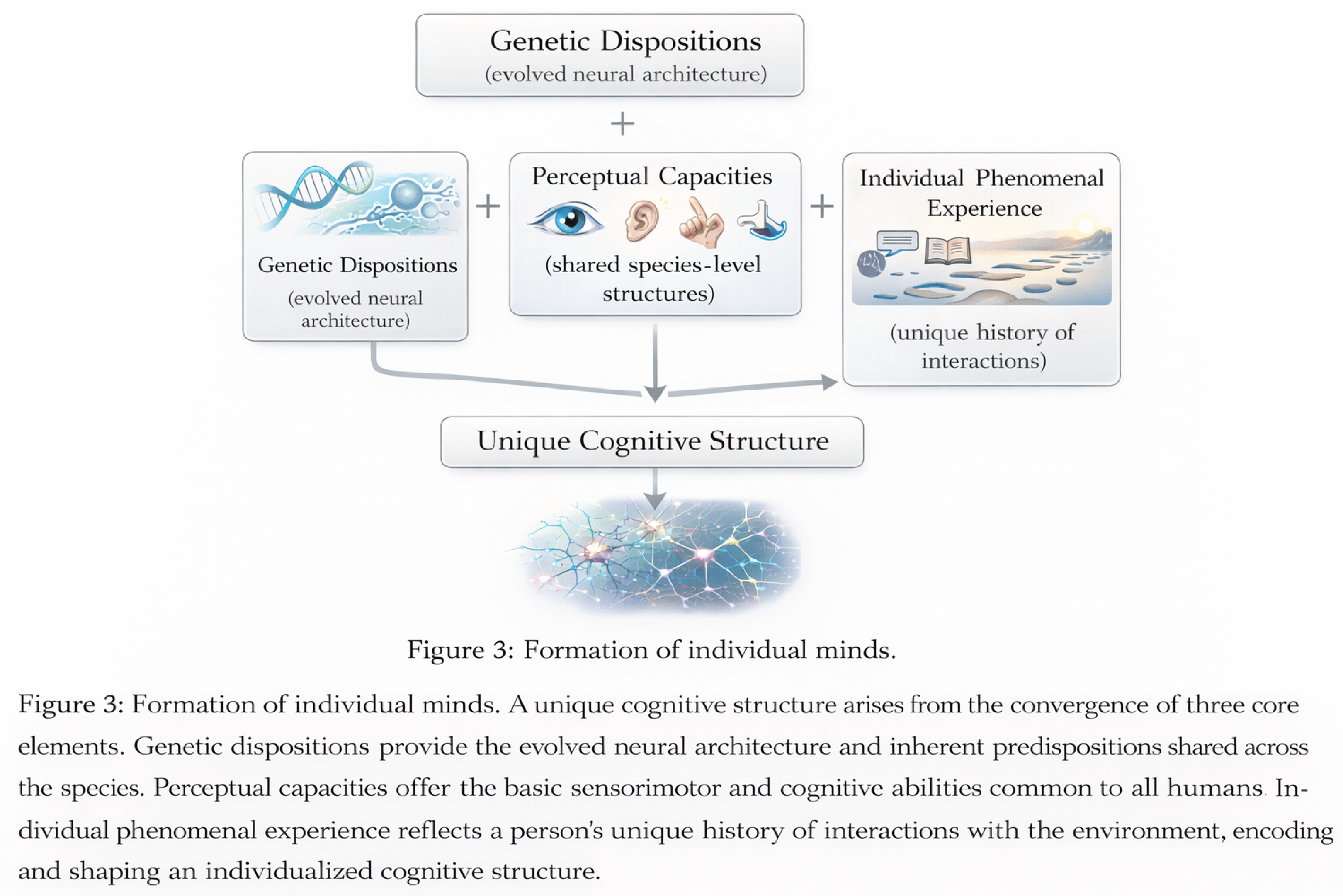
Although organisms of the same species share similar biological structures and cognitive capacities, the development of individual consciousness follows unique trajectories shaped by distinct experiential histories. Each organism inherits genetic dispositions and perceptual capacities, yet the specific configuration of experiences encountered throughout life produces a singular cognitive structure. In this sense, the divergence of individual minds may be compared to evolutionary differentiation. Just as geographic barriers can lead populations to diverge over time, distinct experiential environments gradually produce unique configurations of consciousness (Darwin, 1859).
For example, many mammals and birds demonstrate the ability to remember past events, adapt their behavior in response to changing environmental conditions, and anticipate potential outcomes of their actions. Some species even appear capable of rudimentary forms of future-oriented cognition, suggesting the presence of simulation-like mechanisms.
These findings challenge views that treat human consciousness as entirely discontinuous with the cognitive capacities of other animals. Instead, they support the hypothesis that the mechanisms underlying consciousness evolved gradually across species (Tomasello, 2014).
Figure 3.
caption.
9.3. Increasing Complexity in Simulation Capacities
Within the framework proposed in this paper, one of the key evolutionary developments underlying consciousness is the increasing sophistication of neural systems capable of generating internal simulations.
Simple organisms may rely primarily on reactive behavioral mechanisms, responding directly to environmental stimuli. More complex organisms, however, appear capable of constructing internal models that allow them to anticipate possible outcomes before acting.
As simulation capacities become more sophisticated, organisms gain the ability to integrate larger amounts of information across time and across different sensory modalities. Memory, emotional evaluation, and internal bodily signals become incorporated into increasingly complex predictive models of the environment.
These developments likely contributed to the emergence of more elaborate forms of conscious experience.
9.4. From Biological Integration to Human Consciousness
Human consciousness may therefore represent a particularly complex manifestation of a broader evolutionary trajectory. Rather than constituting an entirely new phenomenon, it reflects the expansion of integrative and predictive capacities already present in earlier organisms.
What distinguishes human consciousness is not the existence of these mechanisms but the degree of their development. Human brains support extremely rich forms of simulation, temporal integration, and symbolic representation.
These capacities allow humans to construct detailed models of both the physical and social environment, to imagine alternative futures, and to coordinate behavior within complex cultural systems.
In this sense, human consciousness can be understood as the product of evolutionary expansions in the capacity for experiential integration, predictive simulation, and temporal organization.
The following section examines how the emergence of language and symbolic communication further transformed these cognitive capacities, enabling the development of cumulative culture and the externalization of cognition.
10. Language, Writing, and Cumulative Culture
Although human consciousness has deep evolutionary roots, human cognition appears to surpass that of other species in its capacity for symbolic communication. While many animals display sophisticated forms of perception, learning, and social behavior, the human species has developed symbolic systems that allow experiences and knowledge to be represented, transmitted, and accumulated across generations.
This capacity for symbolic communication transforms the cognitive landscape in which human consciousness operates. Language enables individual experiences to be encoded in symbolic form and shared with others, allowing knowledge to circulate within social groups rather than remaining confined to individual memory.
10.1. Symbolic Communication and Human Cognition
Language provides a powerful mechanism through which experiences can be represented and communicated. Through linguistic symbols, individuals can describe events that are distant in space and time, refer to abstract concepts, and coordinate complex forms of social interaction.
The emergence of symbolic communication has been widely discussed as a defining feature of human cognition. Terrence Deacon, for example, has argued that symbolic reference fundamentally transformed the evolution of human cognitive capacities by enabling new forms of social learning and conceptual representation (Deacon, 1997).
Similarly, Michael Tomasello has emphasized that human cognition is deeply shaped by the capacity for shared intentionality, which allows individuals to coordinate attention, intentions, and goals through communicative interaction (Tomasello, 2014). Language therefore does not merely transmit information; it supports the development of collective cognitive structures within human communities.
10.2. Writing and the Externalization of Memory
While spoken language already allows information to circulate within social groups, the invention of writing introduced an additional transformation in the organization of human cognition.
Writing allows information to be preserved outside the biological nervous system. Once experiences, ideas, or observations are recorded in symbolic form, they can persist beyond the lifespan of individual organisms and become available to future generations.
This externalization of memory radically expands the temporal horizon of cognition. Knowledge no longer depends solely on individual recollection or oral transmission but can be stored in stable material artifacts such as manuscripts, books, and digital media.
Merlin Donald has argued that the emergence of external symbolic storage systems represents a major transition in cognitive evolution, allowing human societies to accumulate increasingly complex bodies of knowledge across generations (Donald, 1991).
10.3. Cultural Accumulation
The capacity to store and transmit information through symbolic systems enables a process often described as cumulative culture. In cumulative cultural evolution, innovations produced by one generation can be preserved, refined, and extended by subsequent generations.
This process allows human societies to develop technologies, institutions, and conceptual frameworks that far exceed what any individual could construct independently. Scientific knowledge, legal systems, artistic traditions, and technological infrastructures all emerge through long-term processes of cultural accumulation.
Within this framework, human consciousness becomes embedded in a broader network of symbolic structures that shape how individuals perceive and interpret the world. Cultural knowledge provides interpretive frameworks that guide perception, reasoning, and decision-making.
10.4. Distributed Cognition and the Extended Mind
The emergence of external symbolic systems has led some philosophers to argue that human cognition cannot be understood solely in terms of processes occurring inside the brain.
Clark and Chalmers famously proposed the extended mind hypothesis, according to which cognitive processes may extend beyond the boundaries of the biological organism to include external artifacts that participate in information processing (Clark and Chalmers, 1998).
From this perspective, notebooks, written texts, diagrams, and digital technologies can function as components of cognitive systems. These artifacts store information, support reasoning, and allow individuals to manipulate representations that would otherwise exceed the capacity of biological memory.
Within the framework developed in this paper, the emergence of language and writing can be interpreted as an expansion of the simulation architecture underlying consciousness. External symbolic systems provide additional resources for constructing, storing, and manipulating models of the world.
Human consciousness therefore operates simultaneously at two interconnected levels:
- the biological level of individual organisms, where perception, memory, and bodily regulation generate the phenomenal field;
- the symbolic level of shared cultural structures, where language and external artifacts participate in the organization of cognition.
This dual structure of human cognition suggests that conscious experience is not only biologically grounded but also culturally scaffolded. The following section examines how the emergence of such cognitive capacities may have extended the original adaptive functions of consciousness beyond their evolutionary origins.
11. Extrapolation of Adaptive Functions
If consciousness originally emerged as part of an adaptive system for simulation and decision-making, its later development may have extended far beyond the evolutionary pressures that initially shaped it. Once neural architectures capable of integrating perception, memory, bodily regulation, and predictive simulation became established, these mechanisms could be applied to domains not directly tied to immediate survival.
Evolutionary biology provides numerous examples of traits that, once established, develop far beyond the specific ecological pressures that originally selected them. Morphological structures such as elaborate horns, antlers, or continuously growing teeth may become exaggerated to the point that they impose significant energetic or physiological costs on the organism. In some cases, these traits must be actively regulated or worn down in order to prevent harm to the organism itself. Such examples illustrate how biological systems can evolve structures whose development exceeds their original adaptive function.
A similar dynamic may occur in the evolution of cognitive systems. Neural mechanisms initially selected for practical functions such as pattern detection, environmental prediction, and behavioral coordination may, once sufficiently developed, support cognitive capacities that extend far beyond their original adaptive context.
11.1. From Adaptive Simulation to Cognitive Expansion
The simulation architecture described in previous sections likely evolved to support the organism’s ability to anticipate environmental conditions and evaluate possible courses of action. In uncertain environments, organisms capable of internally modeling potential outcomes before acting gain substantial adaptive advantages.
However, once a neural system capable of generating rich internal simulations emerges, the same mechanisms may be recruited for additional cognitive purposes. Predictive systems that originally served to guide action may begin to generate hypothetical scenarios, counterfactual possibilities, and abstract conceptual structures.
From this perspective, imagination can be interpreted as an extension of predictive simulation mechanisms beyond their original function in behavioral regulation. The same neural architecture that allows organisms to anticipate environmental outcomes may also allow them to explore purely hypothetical worlds.
11.2. Cultural Domains of Simulation
Human cognitive life provides many examples of domains in which simulation capacities operate independently of immediate adaptive demands. Artistic creation, mythological narratives, religious symbolism, philosophical reflection, and scientific theorizing all involve the construction of complex internal models that extend far beyond the organism’s immediate environment.
In these domains, simulation becomes detached from direct behavioral regulation and instead supports exploratory forms of cognition. Humans imagine alternative worlds, construct theoretical frameworks for explaining natural phenomena, and generate abstract models that may not have immediate practical applications.
These cultural domains can therefore be understood as extensions of the simulation architecture that originally evolved for adaptive decision-making. Once simulation capacities reach sufficient levels of complexity, they allow organisms to engage in forms of cognition that explore conceptual spaces far removed from immediate ecological pressures.
11.3. Exaptation and the Emergence of a Cognitive “Superorgan”
Evolutionary theory provides conceptual tools for understanding such developments. Traits originally selected for one function may later be co-opted for new uses, a process known as exaptation (Gould and Lewontin, 1979). Under this view, features that initially evolved for practical biological functions may later support entirely different forms of activity.
Human cognitive evolution may represent a striking example of this process. Neural systems that originally evolved to support environmental prediction and action selection appear to have developed into a highly elaborate cognitive architecture capable of symbolic reasoning, cultural transmission, and cumulative knowledge production.
In this sense, the human brain may be understood as a form of evolutionary elaboration analogous to certain exaggerated morphological traits observed in other species. Once the underlying biological mechanisms reached sufficient complexity, they enabled capacities that extend far beyond the immediate requirements of survival.
Language, writing, and symbolic systems represent key stages in this expansion. Through language, internally generated simulations can be communicated and shared among individuals. Through writing, these simulations can be stored outside the biological nervous system and accumulated across generations. Cultural knowledge thus becomes an external layer of cognitive structure that amplifies the simulation capacities of individual minds.
Human consciousness may therefore be understood as the experiential interface of a cognitive system whose evolutionary origins lie in adaptive mechanisms of perception, prediction, and action. Yet once this system reached sufficient complexity, it enabled forms of cognition that extend far beyond the organism’s original ecological niche.
The following section examines how the externalization of cognition through symbolic artifacts further transformed this architecture, allowing cognitive processes to extend beyond the boundaries of the individual brain.
12. Externalization of Cognition and the Extended Mind
The development of symbolic systems introduces an additional transformation in the organization of human cognition. Once linguistic and written representations become available, cognitive processes are no longer confined to neural activity occurring within individual organisms. Instead, they increasingly involve interactions with external symbolic structures that participate directly in information processing.
When ideas are recorded in external media such as manuscripts, books, diagrams, or digital archives, part of the cognitive work involved in memory, reasoning, and problem solving occurs outside the biological brain. These artifacts function as stable repositories of information that can be consulted, manipulated, and recombined by individuals and communities.
12.1. Symbolic Artifacts as Cognitive Supports
External symbolic artifacts provide powerful cognitive supports that extend the capacities of biological memory and reasoning. Written texts, mathematical notation, visual diagrams, and digital databases allow individuals to store and manipulate information that would otherwise exceed the limitations of biological cognition.
Through these artifacts, cognitive processes become partially externalized. Instead of relying exclusively on internal memory, individuals can offload information onto external media that preserve and organize knowledge across time.
This transformation significantly expands the scale and complexity of cognitive activity. Scientific reasoning, for example, often depends on diagrams, symbolic notation, and written records that allow researchers to construct and evaluate complex models of natural phenomena.
12.2. Distributed Cognitive Systems
The increasing reliance on symbolic artifacts suggests that human cognition should not be understood solely as a process occurring within individual brains. Instead, cognitive processes often emerge from interactions between biological agents and the external structures with which they engage.
Clark and Chalmers famously proposed the extended mind hypothesis, according to which cognitive processes may extend beyond the biological boundaries of the organism to include external artifacts that function as components of cognitive systems (Clark and Chalmers, 1998). Under this view, notebooks, written documents, and digital tools can play roles functionally equivalent to internal memory or reasoning processes.
Similarly, research in distributed cognition emphasizes that complex cognitive tasks frequently involve coordinated interactions among multiple individuals and external symbolic structures (Hutchins, 1995). Navigation systems, scientific research programs, and technological infrastructures all exemplify cognitive processes distributed across networks of agents and artifacts.
12.3. Cultural Memory and Collective Cognition
The externalization of cognition through symbolic artifacts also transforms the temporal structure of knowledge. Once information is recorded in durable external media, it can persist beyond the lifespan of individual organisms and become accessible to future generations.
This process enables the emergence of cultural memory. Knowledge accumulated through the experiences of many individuals can be preserved, refined, and expanded over time. Scientific theories, philosophical traditions, legal systems, and technological knowledge all arise through long-term processes of collective cognitive development.
Merlin Donald has argued that the emergence of external symbolic storage systems constitutes a major transition in cognitive evolution, allowing human societies to construct shared knowledge systems that vastly exceed the capacities of individual minds (Donald, 1991).
12.4. The Expansion of the Simulation Architecture
Within the framework proposed in this paper, the emergence of external symbolic systems can be interpreted as an expansion of the simulation architecture underlying consciousness. If conscious systems evolved as mechanisms for integrating perception, memory, and predictive simulation, then symbolic artifacts provide additional resources for constructing and manipulating such simulations.
External representations allow individuals to construct models of phenomena that are too complex to be fully represented within biological memory. Scientific diagrams, mathematical models, and written theories all function as tools for extending the organism’s capacity to simulate possible states of the world.
Human cognition thus becomes distributed across a multi-layered system that includes neural processes, bodily states, and external symbolic structures. Consciousness remains grounded in the biological organism, but the cognitive processes it supports increasingly extend into the cultural and technological environment.
In this sense, the evolution of symbolic systems does not replace the biological foundations of consciousness. Rather, it amplifies and reorganizes the simulation architecture that originally evolved to guide action within natural environments.
The following section examines potential objections and limitations of this framework, addressing questions concerning the ontological status of conscious experience and the relationship between biological and cultural forms of cognition.
13. Objections and Limitations
The hypothesis proposed in this work does not claim to provide a definitive solution to all aspects of the problem of consciousness. Instead, it offers a framework for understanding how conscious experience might emerge from evolutionary processes that integrate perception, bodily regulation, memory, and predictive simulation.
Like any theoretical proposal concerning consciousness, however, the present framework faces important conceptual and empirical limitations. Recognizing these limitations is essential for clarifying the scope of the argument and identifying directions for future research.
13.1. The Ontological Status of Qualitative Experience
One major unresolved question concerns the ontological status of qualitative experience itself. Even if conscious experience can be described as the result of neural integration and predictive simulation, it remains legitimate to ask why such processes should be accompanied by subjective experience.
This question is closely related to what David Chalmers famously described as the hard problem of consciousness (Chalmers, 1995). Explaining how neural systems integrate information and generate predictive models does not necessarily explain why these processes should be accompanied by phenomenology.
From this perspective, the present framework may be interpreted primarily as a functional and evolutionary account of consciousness rather than a complete metaphysical explanation of subjective experience. The theory clarifies how conscious systems might operate and why they might have evolved, but it does not fully resolve the deeper ontological question of why experience exists at all.
13.2. The Hard Problem Revisited
Closely related to the previous point is the broader philosophical debate concerning the relationship between functional organization and phenomenal experience. Some theorists argue that sufficiently complex functional architectures may be sufficient to explain consciousness, while others maintain that phenomenology cannot be reduced to functional or computational descriptions.
The framework developed in this paper remains largely neutral on this metaphysical dispute. Its central claim is that consciousness can be understood as the experiential dimension of a biological architecture designed for the integration of perception, internal regulation, and predictive simulation.
Whether such architectures are sufficient to explain the existence of subjective experience itself remains an open philosophical question.
13.3. The Question of Animal Consciousness
Another important issue concerns the degree of continuity between human consciousness and the experiences of other species. The evolutionary framework proposed here suggests that consciousness likely emerged gradually as neural systems capable of integrating perception, memory, and simulation became increasingly complex.
However, determining the precise distribution and nature of consciousness across species remains a difficult empirical problem. While many animals display cognitive capacities that suggest some degree of experiential integration, the subjective character of such experiences is inherently difficult to investigate.
Comparative studies of animal cognition provide valuable clues, but they cannot fully resolve the question of what conscious experience may be like for non-human organisms.
13.4. Methodological Limits of the Proposed Framework
Finally, the framework developed in this paper is primarily theoretical in nature. It integrates insights from philosophy, neuroscience, and evolutionary theory in order to propose a conceptual model of consciousness as a simulation-based architecture.
Further empirical work is required to evaluate how well this framework corresponds to the actual organization of neural systems. Advances in neuroscience, cognitive science, and computational modeling may help clarify the mechanisms through which perception, bodily regulation, memory, and prediction interact to produce conscious experience.
Recognizing these limitations does not weaken the proposal presented here. Rather, it situates the hypothesis within an ongoing interdisciplinary effort to understand consciousness across multiple levels of analysis.
The next section concludes the paper by summarizing the main theoretical contributions of the proposed framework and outlining its broader implications for the study of mind and cognition.
13.5. Potentiality and Actualization in Conscious Experience
Conscious experience unfolds as a temporal process in which potential states of the organism are continuously transformed into actual experiential events. At any given moment, the organism contains a wide range of latent possibilities shaped by memory, bodily states, affective dispositions, and predictive simulations. Only a small subset of these possibilities becomes actualized in lived experience.
Each conscious moment therefore represents the selective realization of one configuration within a broader field of potential experiential states. The present moment is not an isolated event but the actualization of possibilities structured by the organism’s past experiences and anticipations of the future. In this sense, consciousness may be interpreted as the dynamic interface through which the organism continuously converts potential experiential configurations into actual lived states.
14. Methodological Implications for Cognitive Science
The framework developed in this paper has implications not only for theories of consciousness but also for how scientific models are constructed in cognitive science. Contemporary research increasingly relies on integrative models that connect neural processes, bodily states, environmental interactions, and cognitive functions within unified explanatory structures.
From this perspective, the simulation-based account proposed here illustrates how models can serve as conceptual tools for integrating multiple explanatory levels. Rather than reducing consciousness to a single neural mechanism, the framework treats conscious experience as an emergent phenomenon arising from the coordinated activity of distributed systems operating across neural, bodily, and environmental domains.
In the philosophy of science, such integrative models are often evaluated in terms of their explanatory scope, coherence, and capacity to organize diverse empirical findings into a unified theoretical framework (Craver, 2007; Godfrey-Smith, 2006). The present proposal aims to contribute to this kind of integrative modeling by providing a conceptual structure through which the evolution, neural realization, and functional role of consciousness can be understood within a single explanatory architecture.
15. Empirical Implications
The framework proposed in this paper also suggests empirically investigable implications. If conscious experience emerges from the dynamic actualization of simulated possibilities within an organism’s integrated cognitive system, then processes involving memory activation, perceptual interpretation, and bodily states should systematically influence the organization of conscious experience.
Rather than treating consciousness as a passive representational interface, the present account interprets it as an active process through which stored dispositions, perceptual inputs, and internally generated possibilities are reorganized into the presently experienced phenomenal field. From this perspective, several lines of empirical investigation become relevant.
15.1. Memory and the Organization of Experience
If conscious experience arises through the dynamic reorganization of stored dispositions, then memory processes should play a central role in shaping perceptual interpretation and experiential structure.
Research on constructive memory suggests that remembering is not a simple retrieval of stored information but an active reconstructive process that interacts with perception and imagination (Schacter, 2012). From this perspective, memory activation should systematically influence how perceptual inputs are interpreted and integrated into ongoing conscious experience.
Accordingly, experimental manipulations that activate specific memory networks should be expected to influence perceptual interpretation and experiential organization.
15.2. Autobiographical Structure and Individual Consciousness
A second implication concerns the role of autobiographical memory in shaping conscious awareness. If experience emerges through the dynamic organization of stored dispositions, then the structure of consciousness should reflect the organism’s individual history.
Studies of episodic and autobiographical memory emphasize the role of personal memory systems in organizing conscious awareness and self-representation (Damasio, 2010; Tulving, 2002). These findings suggest that conscious experience depends on historically structured cognitive systems whose organization reflects the organism’s perceptual and experiential trajectory.
Within the present framework, this implies that the structure of conscious experience is inherently shaped by organism-specific histories of perception, memory, and embodiment.
15.3. Individuation of Conscious Experience
A further implication concerns the fundamentally individualized character of conscious experience. Since conscious awareness emerges from the dynamic organization of organism-specific dispositions, each conscious system develops a distinct experiential structure shaped by its particular history of interactions with the environment.
Memories, expectations, and motivational structures are therefore not interchangeable across cognitive systems but are rooted in the specific developmental trajectory of each organism. This implies that conscious experience is intrinsically individualized rather than arising from a universal phenomenal substrate shared across systems.
15.4. Implications for Panpsychist Accounts
This feature presents a potential challenge to panpsychist accounts that attribute fundamental phenomenal properties to matter in general (Strawson, 2006; Goff, 2017). If conscious experience depends on the historically structured organization of cognitive systems, then its individuation appears to arise from the dynamic organization of those systems rather than from universally distributed phenomenal properties.
From this perspective, consciousness may be better understood as an emergent organization of historically structured cognitive processes rather than as a fundamental property present throughout the physical world.
Taken together, these considerations indicate that the framework developed in this paper is not merely conceptual but also capable of generating empirically investigable hypotheses concerning the role of memory, embodiment, and organism-specific history in shaping the structure of conscious experience.
16. The Research Program
The ideas developed in this paper form part of a broader research program on modular cognitive architectures and internal simulation models of cognition. For an overview of this framework, see also (Melo, 2025).
Framed in this way, the proposal functions as a research program in the philosophy of cognitive science, aiming to clarify how explanatory models of consciousness can integrate evolutionary function, neural organization, and experiential structure.
17. Conclusions
This paper proposed an evolutionary framework for understanding the emergence and development of consciousness. Rather than treating consciousness as an inexplicable anomaly within biological systems, the argument developed here situates conscious experience within a broader architecture of perception, bodily regulation, memory, and predictive simulation.
The analysis began by examining the structural characteristics of conscious experience, emphasizing that experience unfolds within a phenomenal field organized around a bodily perspective. This phenomenological structure reflects the integration of two primary streams of information: signals originating in the external environment and signals arising from the internal physiological condition of the organism. Through this integration, organisms construct coherent representations of their situation in the world.
Building on this foundation, the paper introduced the concept of the internal lens, describing how memory, emotional states, and bodily regulation shape the interpretation of incoming stimuli. These internal processes ensure that perception is not merely reactive but interpretive, continuously influenced by the organism’s experiential history.
The central hypothesis of the paper is that consciousness emerged as part of an evolutionary architecture designed to support internal simulation of possible scenarios prior to action. Neural systems capable of integrating perception, bodily signals, and memory allow organisms to anticipate potential outcomes and evaluate alternative behavioral strategies. Within this framework, conscious experience corresponds to the phenomenal domain in which these integrative simulations become available to the organism.
Over evolutionary time, increasing neural complexity enabled progressively richer forms of simulation and temporal integration. This development contributed to the emergence of the narrative self, through which experiences are organized across past, present, and anticipated future states.
The evolution of symbolic communication introduced an additional transformation in the organization of cognition. Language and writing allowed internally generated simulations to be externalized and shared within social groups. Through these symbolic systems, knowledge could accumulate across generations, giving rise to cumulative cultural evolution.
External symbolic artifacts further extended the scope of cognitive processes beyond the biological brain. Written texts, diagrams, and technological media function as components of distributed cognitive systems, amplifying the organism’s capacity to construct and manipulate models of the world.
Taken together, these developments suggest that human consciousness is best understood not as a single isolated phenomenon but as the product of multiple interacting processes operating across biological, cognitive, and cultural levels. Neural integration provides the biological foundation of conscious experience; predictive simulation provides its functional role in guiding behavior; and symbolic systems extend its cognitive reach across individuals and generations.
While this framework does not claim to resolve all philosophical questions concerning the nature of subjective experience, it offers a coherent account of how consciousness may have emerged and expanded through evolutionary and cultural processes. Understanding consciousness therefore requires integrating insights from neuroscience, evolutionary theory, philosophy of mind, and the study of cultural cognition.
From this perspective, consciousness can be interpreted not merely as a representational system but as the dynamic process through which the organism continuously transforms potential states into actual experiential configurations. The internal lens structures the field of possibilities available to the organism, while simulation mechanisms explore and organize these possibilities. Conscious awareness emerges precisely at the point where these latent possibilities become actualized in lived experience, generating the continuous flow that characterizes subjective life.
Philosophical Significance for Scientific Explanation
Beyond its implications for theories of consciousness, the present framework contributes to ongoing discussions in the philosophy of science concerning the explanatory role of models in contemporary biology and cognitive science. By interpreting consciousness as an evolutionary simulation system, the proposal illustrates how complex biological phenomena may be understood through integrative explanatory models linking neural mechanisms, embodied interaction, and adaptive function.
In this sense, the framework developed here is intended not merely as a theory about the nature of conscious experience, but as a case study in how scientific models are constructed to explain multi-level phenomena within the life sciences. Examining such models—how they integrate evidence, generate predictions, and organize theoretical understanding—remains a central task for the philosophy of science.
References
- Nagel, T. 1974. What is it like to be a bat? The Philosophical Review 83: 435–450. [Google Scholar] [CrossRef]
- Chalmers, D.J. 1995. Facing up to the problem of consciousness. Journal of Consciousness Studies 2: 200–219. [Google Scholar]
- Damasio, A. 2010. Self Comes to Mind: Constructing the Conscious Brain. Pantheon. [Google Scholar]
- Friston, K. 2010. The free-energy principle: a unified brain theory? Nature Reviews Neuroscience 11: 127–138. [Google Scholar] [CrossRef] [PubMed]
- Clark, A. 2016. Surfing Uncertainty: Prediction, Action, and the Embodied Mind. Oxford University Press. [Google Scholar]
- Craver, C.F. 2007. Explaining the Brain: Mechanisms and the Mosaic Unity of Neuroscience. Oxford University Press. [Google Scholar]
- Bechtel, W. 2008. Mental Mechanisms: Philosophical Perspectives on Cognitive Neuroscience. Routledge. [Google Scholar]
- Godfrey-Smith, P. 2006. Theory and Reality: An Introduction to the Philosophy of Science. University of Chicago Press. [Google Scholar]
- Aristotle. Metaphysics; Oxford University Press, 1924. Book IX (Theta).
- Levine, J. 1983. Materialism and Qualia: The Explanatory Gap. Pacific Philosophical Quarterly 64: 354–361. [Google Scholar] [CrossRef]
- Dennett, D.C. 1991. Consciousness Explained. Little, Brown. [Google Scholar]
- Baars, B. 1988. A Cognitive Theory of Consciousness. Cambridge University Press. [Google Scholar]
- Dehaene, S. 2014. Consciousness and the Brain: Deciphering How the Brain Codes Our Thoughts. Viking. [Google Scholar]
- Tononi, G., and C. Koch. 2016. Consciousness: Here, There and Everywhere? Philosophical Transactions of the Royal Society B 370. [Google Scholar] [CrossRef] [PubMed]
- Velmans, M. 2009. Understanding Consciousness. Routledge. [Google Scholar]
- Craig, A.D.B. 2009. How Do You Feel — Now? The Anterior Insula and Human Awareness. Nature Reviews Neuroscience 10: 59–70. [Google Scholar] [CrossRef] [PubMed]
- Varela, F., E. Thompson, and E. Rosch. 1991. The Embodied Mind. MIT Press. [Google Scholar]
- Thompson, E. 2007. Mind in Life. Harvard University Press. [Google Scholar]
- Metzinger, T. 2003. Being No One: The Self-Model Theory of Subjectivity. MIT Press. [Google Scholar]
- Craig, A.D. 2002. How do you feel? Interoception: the sense of the physiological condition of the body. Nature Reviews Neuroscience 3: 655–666. [Google Scholar] [CrossRef] [PubMed]
- Seth, A. 2013. Interoceptive inference, emotion, and the embodied self. Trends in Cognitive Sciences 17: 565–573. [Google Scholar] [CrossRef] [PubMed]
- Hebb, D.O. 1949. The Organization of Behavior. Wiley. [Google Scholar]
- Kandel, E.R. 2014. Principles of Neural Science. McGraw-Hill. [Google Scholar]
- Barrett, L.F., and W.K. Simmons. 2015. Interoceptive predictions in the brain. Nature Reviews Neuroscience 16: 419–429. [Google Scholar] [CrossRef] [PubMed]
- Tononi, G. 2008. Consciousness as Integrated Information: a Provisional Manifesto. Biological Bulletin 215: 216–242. [Google Scholar] [CrossRef] [PubMed]
- Kandel, E.R. 2006. Search of Memory: The Emergence of a New Science of Mind. W. W. Norton. [Google Scholar]
- Darwin, C. 1859. On the Origin of Species. John Murray. [Google Scholar]
- Tomasello, M. 2014. A Natural History of Human Thinking. Harvard University Press. [Google Scholar]
- Deacon, T.W. 1997. The Symbolic Species: The Co-evolution of Language and the Brain. W.W. Norton. [Google Scholar]
- Donald, M. 1991. Origins of the Modern Mind. Harvard University Press. [Google Scholar]
- Clark, A., and D.J. Chalmers. 1998. The Extended Mind. Analysis 58: 7–19. [Google Scholar] [CrossRef]
- Gould, S.J., and R.C. Lewontin. 1979. The Spandrels of San Marco and the Panglossian Paradigm. Proceedings of the Royal Society B 205: 581–598. [Google Scholar]
- Hutchins, E. 1995. Cognition in the Wild. MIT Press. [Google Scholar]
- Schacter, D.L. 2012. Constructive Memory: Past and Future. Dialogues in Clinical Neuroscience 14: 7–18. [Google Scholar] [CrossRef] [PubMed]
- Tulving, E. 2002. Episodic Memory: From Mind to Brain. Annual Review of Psychology 53: 1–25. [Google Scholar] [CrossRef] [PubMed]
- Strawson, G. 2006. Realistic Monism: Why Physicalism Entails Panpsychism. Journal of Consciousness Studies 13: 3–31. [Google Scholar]
- Goff, P. 2017. Consciousness and Fundamental Reality. Oxford University Press. [Google Scholar]
- Melo, E.J.d.S. 2025. A Modular Cognitive Architecture for Assisted Reasoning: The Nemosine Framework. arXiv arXiv:2512.04500. [Google Scholar] [CrossRef]
Disclaimer/Publisher’s Note: The statements, opinions and data contained in all publications are solely those of the individual author(s) and contributor(s) and not of MDPI and/or the editor(s). MDPI and/or the editor(s) disclaim responsibility for any injury to people or property resulting from any ideas, methods, instructions or products referred to in the content. |
© 2026 by the author. Licensee MDPI, Basel, Switzerland. This article is an open access article distributed under the terms and conditions of the Creative Commons Attribution (CC BY) license.
Copyright: This open access article is published under a Creative Commons CC BY 4.0 license, which permit the free download, distribution, and reuse, provided that the author and preprint are cited in any reuse.