

Submitted:
19 March 2026
Posted:
20 March 2026
You are already at the latest version
Abstract
Obesity is a chronic inflammatory, multifactorial disease characterized by excessive fat accumulation driven by an imbalance between energy intake and energy expenditure. Despite the implementation of public health strategies and individual therapeutic interventions, overweight and obesity affect more than two billion people worldwide. While the distinction between preclinical (PCO) and clinical obesity (CO) has been conceptually established, tools capable of translating this distinction into clinical diagnostics remain lacking. Current approaches typically use quality-of-life questionnaires as outcome measures rather than diagnostic criteria. In this study, we proposed a novel diagnostic framework in which the SF-36 Role-Physical (RP) domain functions as a screening tool to identify CO. We integrated anthropometric criteria (BMI, waist circumference), organ dysfunction (comorbidities), and objectively defined physical limitations (RP domain cutoffs). Results demonstrated that stratifying patients based on this functional model successfully isolated a phenotype characterized by a distinct pro-inflammatory profile. Individuals classified as having CO exhibited significantly increased IL-6 and IL-17A levels compared to PCO and overweight groups, providing biological validation that the SF-36 RP domain can effectively distinguish pathological adiposity from simple weight gain.
Keywords:
clinical obesity
; diagnostic criteria
; sf-36 questionnaire
; physical limitations
1. Introduction
Obesity is a chronic inflammatory disease recognized by the World Health Organization (WHO), defined by excessive body fat accumulation that contributes to a heightened risk of comorbidities such as type 2 diabetes, cardiovascular disease, and osteoarthritis [1]. Its prevalence has risen dramatically over the past decades, with more than two billion adults worldwide currently classified as overweight or obese, posing a major public heath challenge [1]. Historically, the Body Mass Index (BMI) has been used as a diagnostic criterion; however, it has significant limitations, including its inability to distinguish between fat and lean mass and its failure to capture the physical and metabolic dysfunctions associated with excess adiposity [2].
A recent proposal published by Rubino and colleagues (2025) conceptualizes obesity as a chronic, progressive, and multifactorial disease, characterized not only by excessive fat accumulation but also by its metabolic, functional, and structural consequences on the body. It is important to distinguish between two diagnostic stages: preclinical obesity (PCO) and clinical obesity (CO) [3]. PCO is defined by increased adiposity, often identified through a BMI ≥ 30 kg/m² and elevated WC, without overt clinical symptoms. At this stage, early cellular and tissue alterations may be present, but organ structure and function remain intact, reflecting an elevated, yet potentially, risk and highlighting the need for preventive monitoring [3]. In contrast, CO represents a more advanced phase, in which excess adipose tissue leads to detectable organ dysfunction and clear clinical manifestations. These include physical signs and symptoms, the presence of comorbidities and limitations in daily activities, and impaired quality of life [3]. Therefore, the diagnosis of obesity should encompass not only anthropometric measurements but also instruments capable of assessing its functional impact on an individual’s health.
While this proposal marks a substantial step forward by reframing obesity as a disease defined by its clinical consequences rather than body size alone, it does not provide clear guidance on how to operationalize this diagnostic shift in routine clinical practice or primary care. Crucially, while the SF-36 questionnaire has been extensively used in obesity literature, it has been historically restricted to monitoring quality-of-life outcomes, but not as a prospective diagnostic filter to differentiate PCO from CO.
Developed as part of the Medical Outcomes Study, the SF-36 is widely validated internationally, with reliability (α ≈ 0.90), and comprises eight domains, including functional capacity and physical limitations [4]. Its use enables the assessment of subjective limitations imposed by obesity on daily life, particularly within the physical component [5]. In Brazil, the SF-36 was translated, culturally adapted, and validated in clinical populations in the 1990s, demonstrating satisfactory psychometric tests [6]. Later studies expanded this validation to the general population and established regional normative data [7]. Importantly, among patients with obesity, SF-36 scores in physical domains are significantly lower compared to the general population, confirming the instrument’s sensitivity to the functional limitations associated with excess adiposity [8,9].
Despite its widespread use, the application of the SF-36 remains limited when it comes to objectively differentiating preclinical obesity from clinical obesity. This distinction is critical, as functional impairment captured by the Role-Physical (RP) domain emerges as a defining feature of clinical obesity, allowing its identification even among individuals with similar anthropometric profiles. Addressing this unmet need, the present study applies the SF-36 questionnaire to individuals with BMI > 30 kg/m² and elevated waist circumference, integrating predefined RP domain cutoffs with anthropometric and clinical criteria to identify obesity-related functional limitation. Furthermore, the effectiveness of this diagnostic strategy was supported by the quantification of systemic inflammatory cytokines characteristic of obesity, providing biological validation of the proposed approach. By offering a simple, rapid, and reproducible method to identify clinical obesity beyond anthropometry alone, this study contributes to bridging the gap between emerging diagnostic concepts and their practical application in clinical practice.
2. Patients, Materials and Methods
This prospective observational study was approved by the Research Ethics Committee of the School of Medicine at Sao Paulo State University (process number 6,767,461/2024) and was conducted from March 2024 to April 2025. All participants provided written informed consent.
Volunteers aged 18-65 years were recruited from university and outpatient settings thought convenience sampling. Exclusion criteria included recent use of antibiotics, anti-inflammatory drugs, immunosuppressants, laxatives, or hypoglycemic agents, as well as the presence of severe chronic inflammatory diseases under active treatment, to minimize potential interference with functional, metabolic, and psychological assessments. These criteria align with international recommendations aiming at reducing confounding bias when applying self-report instruments, such as the SF-36, particularly in populations with overweight or obesity and associated comorbidities [4,10].
The assessment of the participants was conducted in three stages according to the framework (Figure 1). The first stage involved anthropometric screening, following the criteria established by the WHO [1]. BMI and WC were used to classify individuals as eutrophic (BMI: 18.5-24.9 kg/m²), overweight (BMI: 25-29.9 kg/m²; WC > 80 cm for women; WC > 94 cm for men), or obesity (BMI ≥30 kg/m²; WC > 88 cm for women; WC > 102 cm for men). WC was measured in the horizontal plane using a non-extensible tape, positioned at the midpoint between the lower margin of the last palpable rib and the top of the iliac crest. Measurements were taken with participants standing at the end of a normal expiration.
Subsequently, participants identified with obesity underwent a structured anamnesis (stage 2, organ dysfunction), which included closed-ended questions regarding the presence of comorbidities commonly associated with adipose tissue dysfunction, such as type 2 diabetes, systemic arterial hypertension, dyslipidemia, sleep apnea, and cardiovascular diseases. The anamnesis also incorporated subjective questions addressing lifestyle factors and disease, as well as the comorbidity onset relative to weight gain. Participants’ answers were used to inform the clinical reasoning for functional diagnosis (Figure 1).
The final stage involved the assessment of physical limitations (Figure 1) using the Brazilian version of the SF-36 questionnaire, which was translated, culturally adapted, and validated by Ciconelli et al. [6], and subsequently standardized across different Brazilian regions and population profiles [7]. The SF-36 was selected for its comprehensive yet brief structure, alignment with current guidelines for health-related quality-of-life assessment, and strong psychometric properties. The instrument comprises eight multi-item domains: physical functioning (PF), role-physical (RP), role-emotional (RE), vitality (VT), mental health (MH), social functioning (SF), bodily pain (BP), and general health (GH). In our analysis, the role-physical (RP) domain, which analyses the ability to perform daily activities (ambulatory tasks, climbing stairs, lifting items) was the focus.
The questionnaire was self-administered in printed form following standardized instructions, with supervision provided to ensure comprehension and response integrity. For participants with illiteracy or functional illiteracy, the questionnaire was administered through individual interviews. The average completion time was less than 10 minutes. Participants were instructed to base their responses on their usual experiences over the preceding four weeks, in accordance with SF-36 administration guidelines, to minimize the influence of acute or atypical events and to enhance the reliability and discriminant validity of the instrument [4,5].
Patients with severe comorbidities, decompensated psychiatric disorders or cognitive dysfunction were excluded as a pragmatic measure to reduce the risk of response bias, such as the social desirability bias, (and symptom interference) that were not directly related to the obesity [10,11]. Previous evidence indicates that individuals with obesity may underestimate physical limitations due to fear of judgment or stigma, underscoring the importance of controlling for these biases to ensure that Role-Physical (RP) domain scores accurately reflect functional impairment related to adiposity rather than extraneous psychological or social factors [12].
For outcome evaluation, responses to each item were standardized and subsequently transformed into a 0-100 scale, in which 0 represents the worst and 100 the best perceived health status. Each SF-36 domain was analyzed independently using a two-step procedure, as previously described [4,6,13]. The first step involved data weighting, followed by calculation of the raw score in the second step, using the formula (obtained score – lower limit) x 100/ score range. In the formula, the lower limit and score range are fixed (Table 1).
Based on the three predefined criteria framework (Figure 1), patients were classified as having CO if they met the following conditions: a BMI > 30 kg/m² accompanied by an increased WC; an RP score < 50, or a score between 50 and 75 in the presence of comorbidities associated with excess weight and a self-reported causal relationship with weight gain, in accordance with the definition proposed by Rubino and colleagues (2025) [3]. Note that while preclinical obesity is defined largely by anthropometry without functional loss, clinical obesity is strictly defined by the presence of functional impairment (RP criteria) or weight-related comorbidities.
To further characterize the systemic inflammatory profiles associated with the different obesity phenotypes and to complement the clinical evaluation and SF-36 functional assessments, we conducted a quantitative analysis of some circulating inflammatory cytokines. This complementary approach was designed to detect early subclinical immune dysregulation and to assess whether patients classified as having clinical obesity exhibited inflammatory patterns consistent with organ dysfunction as previously described in the literature [14,15,16].
Approximately 5 mL of peripheral blood was collected from each participant into serum separator tubes containing a clot activator and subsequently centrifuged at 3,500 rpm for 5 minutes. Serum concentrations of IL-6, IL-17A, and TNF were determined by flow cytometry using the BD™ Cytometric Bead Array kit (BD Biosciences, Franklin Lakes, NJ, USA). Data acquisition was performed on a FACSCanto II flow cytometer, and results were expressed after conversion of mean fluorescence intensity into pg/mL.
All analyses were performed using the R software (version 4.4.2) at a two-tailed alpha level of 0.05 for statistical significance [17]. Finally, to determine the independent association between the CO phenotype and the inflammatory markers, Robust Linear Regression models were employed, using the MASS package [18]. This method was specifically chosen to mitigate the influence of outliers and to adjust for potential confounding variables, specifically age and ethnicity, given the demographic heterogeneity between groups. Significance was set at p < 0.05.
In the preparation of this manuscript, artificial intelligence and machine learning–based tools were used to support the literature search (Consensus), assist with grammatical revisions, and to perform additional general text corrections. All scientific content, data interpretation, and final editorial decisions were carried out by the authors, who take full responsibility for the accuracy, originality, and integrity of this work.
3. Results and Discussion
The final sample consisted of 108 individuals stratified into four groups based on the proposed diagnostic model: 45 eutrophic (control), 27 overweight, 11 with PCO, and 25 with CO. Demographically, the control group showed a predominance of self-declared Caucasian individuals, whereas the overweight and obesity groups presented a higher proportion of self-declared Afro-descendant individuals, a trend particularly evident among men with obesity (Table 2).
A central finding of this study is the validation of the SF-36 RP domain as a discriminatory tool for the identification of clinical obesity within a diagnostic framework that complemented the recent proposal of The Lancet Commission. In accordance with this framework, which emphasizes functional impairment beyond excess adiposity, individuals with BMI > 30 kg/m² and elevated waist circumference were classified as having clinical obesity when an RP score < 50 was observed, even in the absence of previously documented comorbidities.
Furthermore, for patients with existing weight-associated comorbidities, we utilized a cutoff of RP < 75. This more conservative threshold allowed us to capture milder, yet clinically relevant, functional detriments exacerbated by chronic disease, aligning with recent trends to redefine obesity by its clinical repercussions rather than isolated anthropometric values.
By applying our diagnostic framework (Figure 1), for the CO classification, we successfully stratified the cohort into distinct functional phenotypes. As expected by the study design, the CO group presented significantly lower scores in the RP domain (p < 0.05) compared to all other groups (Figure 2).
As shown in Figure 2 and Table 3, the impairment in the CO group was not limited to the physical role; these patients exhibited the lowest mean scores across most SF-36 domains, specifically Physical Functioning (74.79 ± 17.03), Vitality (40.42 ± 19.67), and General Health (54.25 ± 17.26), confirming that the RP-based selection criteria captured a group with broad systemic compromise. The RP domain, used as a functional marker for the diagnosis of clinical obesity, presented significantly lower scores in the CO group (p < 0.05), reinforcing the presence of physical limitation due to excess adiposity.
However, the critical validation of this functional grouping is not the score itself, but its correlation with the biological profile. The functional aspect observed in the CO group was biologically mirrored by a distinct inflammatory profile (Table 4). Statistical analysis using Robust Linear Regression showed that the CO group was characterized by a profoundly unbalanced cytokine profile, clearly distinct from overweight and PCO. The CO group was the only one to exhibit a marked pro-inflammatory shift, evidenced by a massive increase in IL-6 (β = 18.59, p < 0.001) and a concomitant rise in IL-17 (β = 2.58, p < 0.001), whereas no significant IL-6 elevation was detected in the overweight or PCO groups.
The Robust Linear Regression model showed that the classification of Clinical Obesity remained a significant independent predictor of IL-6 and IL-17A levels when controlling age and ethnicity (Table 4). This suggests that the pro-inflammatory profile is central to the metabolic phenotype of Clinical Obesity rather than an artifact of demographic factors.
These findings provide a biological basis for the functional diagnosis proposed. The data suggests that the transition from a preclinical state to clinical obesity is marked not just by weight gain, but by the onset of a systemic inflammatory state (driven by IL-6 and IL-17A) that manifests physically as functional impairment (RP < 50).
4. Discussion
The present study proposes and validates a framework for the diagnosis of clinical obesity in the context of the recent new definition of obesity. Demographically, the final sample of the control group was predominantly composed of self-declared Caucasian patients, whereas the other groups showed a higher proportion of self-declared Afro descendant individuals. Although this demographic pattern was not the primary focus of the study, it underscores the importance of considering ethnic and social determinants in the characterization of obesity phenotypes.
The primary finding of the study is the validation of the SF-36 RP domain as a diagnostic tool for distinguishing PCO from CO, which complements the recent proposal of The Lancet Commission [3]. This functional stratification is supported by literature indicating that the combination of high BMI and increased WC is linked to poorer physical performance and adverse outcomes [19,20,21]. Consequently, an RP score below 50 signifies a level of impairment where adiposity is no longer just a morphological trait but a limiting factor for quality of life [19]. In this context, this cutoff operationalizes the shift from “excess weight” to “disease”. Therefore, an RP score below 50 signifies a substantial level of physical limitation which demands clinical attention, positioning it as a critical marker for defining CO where adiposity-related functional compromise is evident. The cutoff adopted for individuals with weight-related comorbidities (RP < 75) was intentionally conservative, enabling the detection of milder yet clinically relevant decrements in physical functioning that are exacerbated by chronic conditions. The results showed that the impairment in the CO group was not restricted to the RP dimension. The lower scores in the other domains, also associated with limited physical functioning, support the notion that the RP-based criterion successfully identifies a group with systemic compromise.
The multidimensional deterioration of quality of life suggests that the adiposity, at this stage, is not only morphological but also a limiting factor for daily activities. However, the importance of validation of this framework was not only in functional scores but also in biological parameters.
The selective elevation of IL-6 in the CO group, which did not happen in the overweight and PCO groups, is consistent with current evidence positing IL-6 as a central effector of obesity-related low-grade systemic inflammation [14,15,16,22]. While TNF levels showed no significant differences across groups, this mirrors recent observations that IL-6 may be a more sensitive marker than TNF for metabolic inflammation [15,23]. Moreover, the increased expression of IL-17A also confirms the severity of the inflammatory state and its association with cardiometabolic risk in high-adiposity individuals [16]. The rise in IL-6 and IL-17 in the CO group parallels profiles described in obesity phenotypes, where the chronic inflammation is associated to functional limitation, reinforcing that the CO category captures a biologically
These findings provide a biological basis for the functional diagnosis proposed by the framework. The data suggests that the transition from a PCO state to CO is marked not just by weight gain, but by the onset of a systemic inflammatory state (driven by IL-6 and IL-17A) that manifests physically as functional impairment (RP < 50).
5. Conclusion
While anthropometric measures remain fundamental for initial screening, a critical diagnostic gap persists: their inability to capture the complex pathophysiology of obesity. This study addresses this limitation by validating the SF-36 Role-Physical (RP) domain as a decisive tool to bridge this gap between morphological adiposity and Clinical Obesity.
Our findings provide biological evidence to support a functional diagnostic model. We demonstrated that patients identified by functional limitation possess a unique pro-inflammatory phenotype, suggesting that this simple metric can serve as an additional detection tool for systemic organ dysfunction.
Clinically, this integrated approach is a practical, low-cost methodological innovation. This allows healthcare professionals to identify patients at functional risk objectively, which includes the SF-36 RP score in addition to traditional anthropometry. Thus, it advances the diagnosis from a purely physical evaluation to a person-centered assessment to facilitate the stratification and management of obesity as a multifactorial functional disease entity.
Author Contributions
Conceptualization, Luiza Machado and Gislane Oliveira; Data curation, Luiza Machado, Larissa Cordeiro, Gislane de Oliveira, Edison Vidal and Gislane Oliveira; Formal analysis, Luiza Machado, Larissa Cordeiro, Edison Vidal and Gislane Oliveira; Funding acquisition, Gislane Oliveira; Investigation, Luiza Machado and Edison Vidal; Methodology, Luiza Machado, Larissa Cordeiro, Edison Vidal and Gislane Oliveira; Project administration, Gislane Oliveira; Resources, Gislane de Oliveira and Gislane Oliveira; Software, Luiza Machado and Gislane de Oliveira; Supervision, Gislane Oliveira; Validation, Luiza Machado; Visualization, Gislane Oliveira; Writing – original draft, Luiza Machado; Writing – review & editing, Edison Vidal and Gislane Oliveira.
Funding
This study was financed in part by the Brazilian National Council for Scientific and Technological Development (CNPq), process number #313190/2021-6 (Fellowship for GLVO), and by the São Paulo Research Foundation (FAPESP), process numbers #2023/11597-0 (Fellowship for LDM).
Institutional Review Board Statement
The study was conducted in accordance with the Declaration of Helsinki, and approved by the Sao Paulo State University Research Ethics Committee (Protocol code No. 6,767,461/2024; date of approval).
Informed Consent Statement
Informed consent was obtained from all subjects involved in the study.
Data Availability Statement
The original contributions presented in this study are included in the article/supplementary material. Further inquiries can be directed to the corresponding author(s).
Acknowledgments
We would like to thank Larissa Ragozo, Mariana Romão and Vanessa Aguiar for technical support in flow cytometry.
Conflicts of Interest
The authors declare no conflicts of interest.
References
- WHO Consultation on Obesity (1999: Geneva S.; Organization W.H. Obesity :preventing and managing the global epidemic : report of a WHO consultation; World Health Organization, 2000; ISBN 978-92-4-120894-9.
- Sweatt, K.; Garvey, W.T.; Martins, C. Correction: Strengths and Limitations of BMI in the Diagnosis of Obesity: What Is the Path Forward? Curr Obes Rep 2024, 13, 831. [Google Scholar] [CrossRef] [PubMed]
- Rubino, F.; Cummings, D.E.; Eckel, R.H.; Cohen, R.V.; Wilding, J.P.H.; Brown, W.A.; Stanford, F.C.; Batterham, R.L.; Farooqi, I.S.; Farpour-Lambert, N.J.; et al. Definition Diagnostic Criteria of Clinical Obesity. The Lancet Diabetes & Endocrinology 2025, 13, 221–262. [Google Scholar] [CrossRef] [PubMed]
- Ware, J.E.; Sherbourne, C.D. The MOS 36-Item Short-Form Health Survey (SF-36). Conceptual Framework and Item Selection. Med Care 1992, 30, 473–483. [Google Scholar] [CrossRef] [PubMed]
- Lins, L.; Carvalho, F.M. SF-36 Total Score as a Single Measure of Health-Related Quality of Life: Scoping Review. SAGE Open Med 2016, 4, 2050312116671725. [Google Scholar] [CrossRef] [PubMed]
- Ciconelli, R.M.; Ferraz, M.B.; Santos, W.; Meinão, I.; Quaresma, M.R. Tradução para a língua portuguesa e validação do questionário genérico de avaliação de qualidade de vida SF-36 (Brasil SF-36). Rev. bras. reumatol 1999, 143–150. [Google Scholar]
- Laguardia, J.; Campos, M.R.; Travassos, C.; Najar, A.L.; dos Anjos, L.A.; Vasconcellos, M.M. Brazilian Normative Data for the Short Form 36 Questionnaire, Version 2. Rev. bras. epidemiol. 2013, 16, 889–897. [Google Scholar] [CrossRef] [PubMed]
- Tamura, L.S.; Cazzo, E.; Chaim, E.A.; Piedade, S.R. Influence of Morbid Obesity on Physical Capacity, Knee-Related Symptoms and Overall Quality of Life: A Cross-Sectional Study. Rev Assoc Med Bras (1992) 2017, 63, 142–147. [Google Scholar] [CrossRef] [PubMed]
- Karlsen, T.-I.; Tveitå, E.K.; Natvig, G.K.; Tonstad, S.; Hjelmesæth, J. Validity of the SF-36 in Patients with Morbid Obesity. Obes Facts 2011, 4, 346–351. [Google Scholar] [CrossRef] [PubMed]
- Kolotkin, R.L.; Meter, K.; Williams, G.R. Quality of Life and Obesity. Obes Rev. 2001, 2, 219–229. [Google Scholar] [CrossRef] [PubMed]
- Fontaine, K.R.; Barofsky, I. Obesity and Health-Related Quality of Life. Obes Rev 2001, 2, 173–182. [Google Scholar] [CrossRef] [PubMed]
- Sarwer, D.B.; Polonsky, H.M. The Psychosocial Burden of Obesity. Endocrinol Metab Clin North Am 2016, 45, 677–688. [Google Scholar] [CrossRef] [PubMed]
- Adorno, M.L.G.R.; Brasil-Neto, J.P. Avaliação da qualidade de vida com o instrumento SF-36 em lombalgia crônica. Acta ortop. bras. 2013, 21, 202–207. [Google Scholar] [CrossRef] [PubMed]
- Tylutka, A.; Walas, Ł.; Zembron-Lacny, A. Level of IL-6, TNF, and IL-1β and Age-Related Diseases: A Systematic Review and Meta-Analysis. Front. Immunol. 2024, 15. [Google Scholar] [CrossRef] [PubMed]
- Ion, R.-M.; Sibianu, M.; Hutanu, A.; Beresescu, F.G.; Sala, D.T.; Flavius, M.; Rosca, A.; Constantin, C.; Scurtu, A.; Moriczi, R.; et al. A Comprehensive Summary of the Current Understanding of the Relationship between Severe Obesity, Metabolic Syndrome, and Inflammatory Status. Journal of Clinical Medicine 2023. [Google Scholar] [CrossRef] [PubMed]
- Polak-Szczybyło, E.; Tabarkiewicz, J.; Polak-Szczybyło, E.; Tabarkiewicz, J. IL-17A, IL-17E and IL-17F as Potential Biomarkers for the Intensity of Low-Grade Inflammation and the Risk of Cardiovascular Diseases in Obese People. Nutrients 2022, 14. [Google Scholar] [CrossRef] [PubMed]
- R Core Team. R A Language and Environment for Statistical Computing. R Foundation for Statistical Computing. - References - Scientific Research Publishing. 2024. Available online: https://www.scirp.org/reference/referencespapers?referenceid=3887298 (accessed on December 2025).
- Venables, B.; Ripley, B. Modern Applied Statistics With S; Springer, 2002. [Google Scholar]
- Başhan, İ.; Bakman, M. The Comparison of Body Mass Index and Waist Circumference to Assess Health-Related Quality of Life. TJFMPC 2021, 15, 230–235. [Google Scholar] [CrossRef]
- Seo, D.-C.; Choe, S.; Torabi, M.R. Is Waist Circumference ≥ 102/88 Cm Better than Body Mass Index ≥ 30 to Predict Hypertension and Diabetes Development Regardless of Gender, Age Group, and Race/Ethnicity? Meta-Analysis. Preventive Medicine 2017, 97, 100–108. [Google Scholar] [CrossRef] [PubMed]
- The Performance of Anthropometric Tools to Determine Obesity: A Systematic Review and Meta-Analysis | Scientific Reports. Available online: https://www.nature.com/articles/s41598-020-69498-7 (accessed on 10 November 2025).
- Kern, L.; Mittenbühler, M.J.; Vesting, A.J.; Ostermann, A.L.; Wunderlich, C.M.; Wunderlich, F.T.; Kern, L.; Mittenbühler, M.J.; Vesting, A.J.; Ostermann, A.L.; et al. Obesity-Induced TNFα and IL-6 Signaling: The Missing Link between Obesity and Inflammation—Driven Liver and Colorectal Cancers. Cancers 2018, 11. [Google Scholar] [CrossRef] [PubMed]
- Jung, S.H.; Park, H.S.; Kim, K.-S.; Choi, W.H.; Ahn, C.W.; Kim, B.T.; Kim, S.M.; Lee, S.Y.; Ahn, S.M.; Kim, Y.K.; et al. Effect of Weight Loss on Some Serum Cytokines in Human Obesity: Increase in IL-10 after Weight Loss. J Nutr Biochem 2008, 19, 371–375. [Google Scholar] [CrossRef] [PubMed]
Figure 1.
Diagnostic framework for clinical obesity. The flowchart depicts the sequential criteria used to classify participants as eutrophic, overweight, preclinical obesity, or clinical obesity. Anthropometric screening was based on body mass index (BMI) and waist circumference (WC), according to WHO guidelines. Assessment of organ dysfunction included the presence of obesity-related comorbidities and their self-reported association with weight gain. Physical limitations were evaluated using the Role-Physical (RP) domain of the SF-36 questionnaire. An RP score < 50 indicated severe physical role limitation. An RP score between 50 and 75 indicated moderate physical limitation and, when combined with evidence of organ dysfunction, resulted in classification as clinical obesity. Classification as CO also occurred when an SF-36 score between 50 and 75 was observed in at least one additional domain. .
Figure 1.
Diagnostic framework for clinical obesity. The flowchart depicts the sequential criteria used to classify participants as eutrophic, overweight, preclinical obesity, or clinical obesity. Anthropometric screening was based on body mass index (BMI) and waist circumference (WC), according to WHO guidelines. Assessment of organ dysfunction included the presence of obesity-related comorbidities and their self-reported association with weight gain. Physical limitations were evaluated using the Role-Physical (RP) domain of the SF-36 questionnaire. An RP score < 50 indicated severe physical role limitation. An RP score between 50 and 75 indicated moderate physical limitation and, when combined with evidence of organ dysfunction, resulted in classification as clinical obesity. Classification as CO also occurred when an SF-36 score between 50 and 75 was observed in at least one additional domain. .
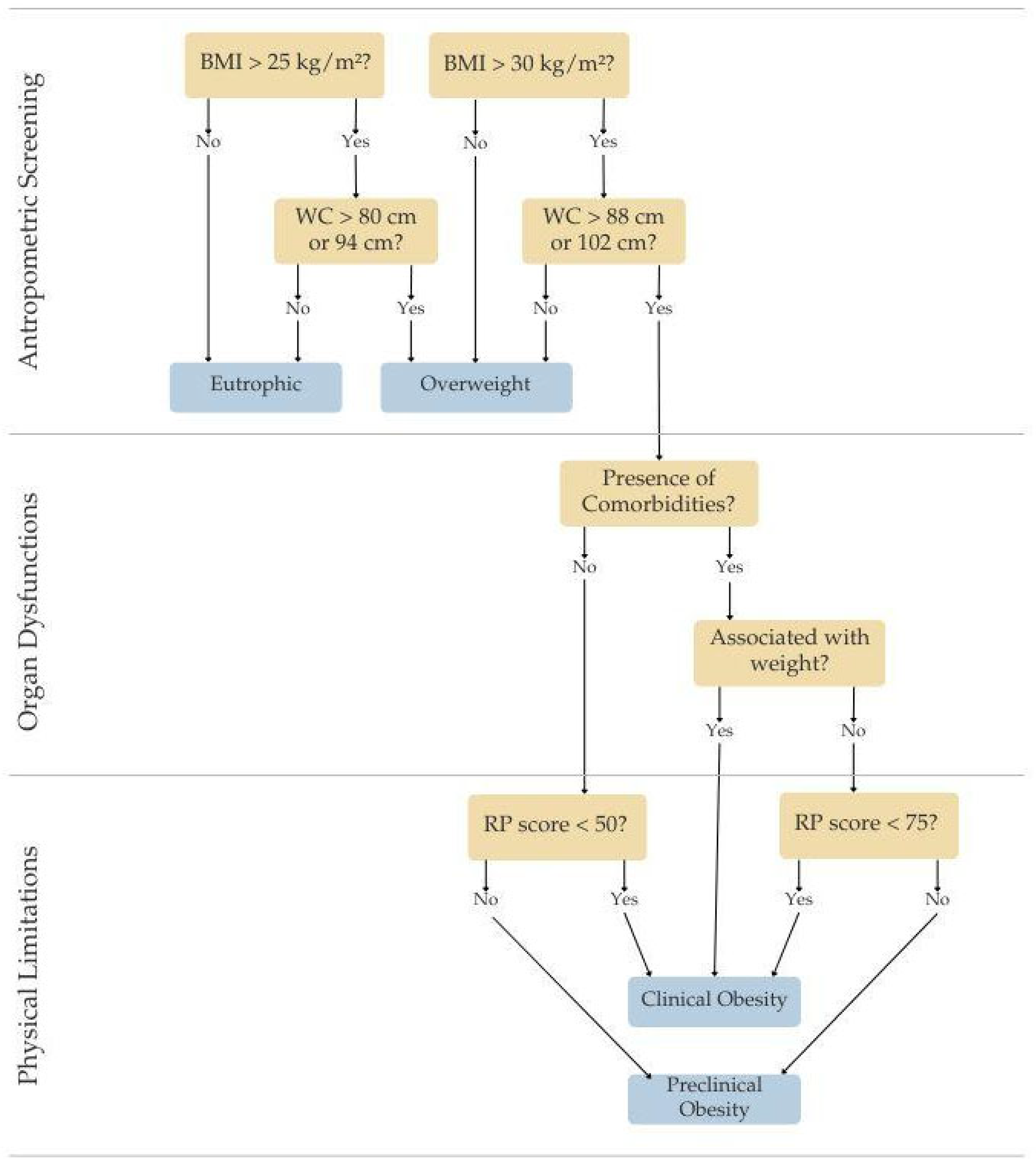
Figure 2.
Calculated scores of SF-36 domains: Physical Functioning (PF), Role-Emotional (RE), Vitality (VT), Mental Health (MH), Social Functioning (SF), Bodily Pain (BP), General Health (GH) and Role-Physical (RP). Results are expressed as mean ± standard error of the mean (SEM). A parametric ANOVA test with multiple comparisons was applied. Control (n = 45); Overweight (n = 27); Preclinical Obesity (11) and Clinical Obesity (CO, n = 25).
Figure 2.
Calculated scores of SF-36 domains: Physical Functioning (PF), Role-Emotional (RE), Vitality (VT), Mental Health (MH), Social Functioning (SF), Bodily Pain (BP), General Health (GH) and Role-Physical (RP). Results are expressed as mean ± standard error of the mean (SEM). A parametric ANOVA test with multiple comparisons was applied. Control (n = 45); Overweight (n = 27); Preclinical Obesity (11) and Clinical Obesity (CO, n = 25).
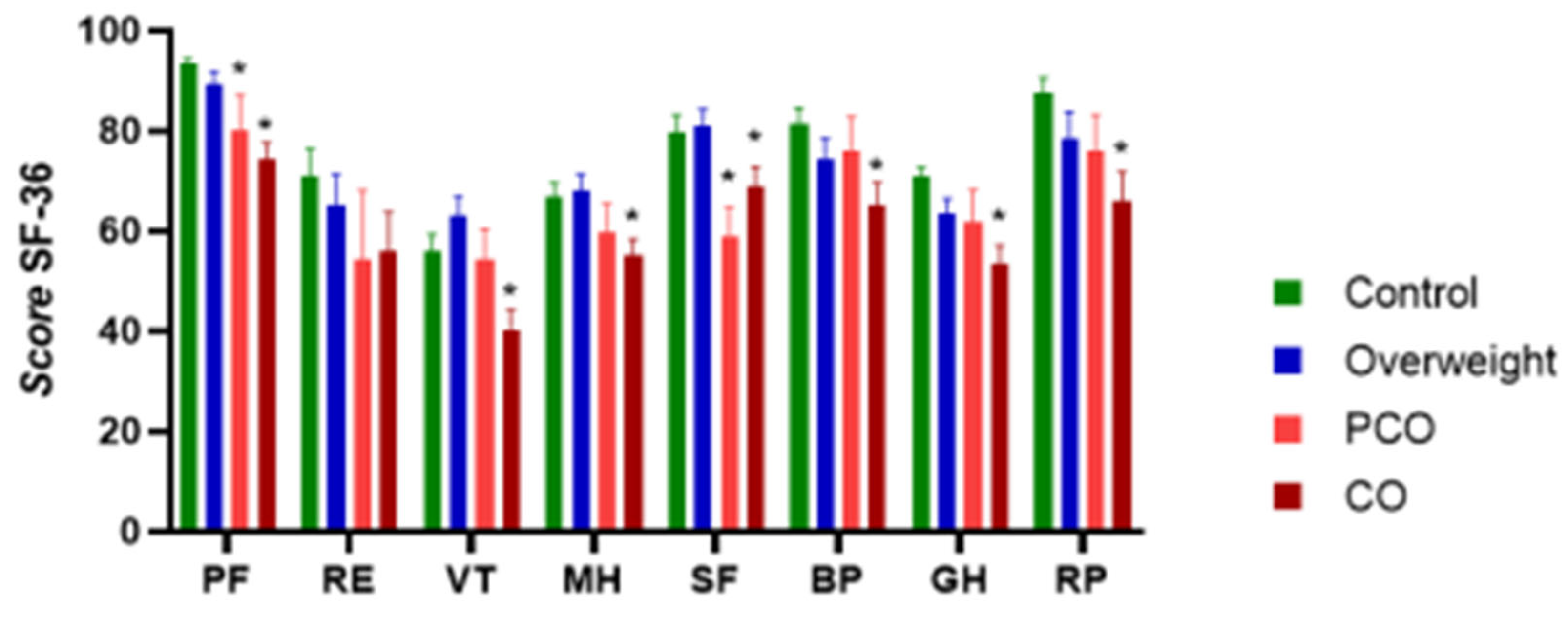

Table 1.
Limits and ranges for each domain of the SF-36 questionnaire.
| Parameter | Question | Limit | Variation |
| Physical Functioning | 3 | 10 | 20 |
| Role-Physical | 4 | 4 | 4 |
| Role-Emotional | 5 | 3 | 3 |
| Vitality | 09 (items a, e, g, i) | 4 | 8 |
| Mental Health | 09 (items b, c, d, f, h) | 5 | 25 |
| Social Functioning | 06 and 10 | 2 | 8 |
| Bodily Pain | 07 and 08 | 2 | 10 |
| General Health | 01 and 11 | 5 | 20 |
Table 2.
Demographic and anthropometric data by nutritional status.
|
Control (n=45) |
Overweight (n=27) |
PCO (n=11) |
CO (n=25) |
Overall (n=108) |
|
| Ethnicity | |||||
| African descent | 13 (28.9%) | 15 (55.6%) | 6 (54.5%) | 11 (44.0%) | 45 (41.7%) |
| Caucasian | 32 (71.1%) | 12 (44.4%) | 5 (45.5%) | 14 (56.0%) | 63 (58.3%) |
| Age - range (years) | |||||
| 19 to 29 | 32 (71.1%) | 9 (33.3%) | 7 (63.6%) | 7 (28.0%) | 55 (50.9%) |
| 30 to 39 | 6 (13.3%) | 10 (37.0%) | 0 (0%) | 9 (36.0%) | 25 (23.1%) |
| 40 to 49 | 4 (8.9%) | 2 (7.4%) | 1 (9.1%) | 4 (16.0%) | 11 (10.2%) |
| 50 to 59 | 2 (4.4%) | 5 (18.5%) | 3 (27.3%) | 5 (20.0%) | 15 (13.9%) |
| 60 to 65 | 1 (2.2%) | 1 (3.7%) | 0 (0%) | 0 (0%) | 2 (1.9%) |
Table 3.
Results of Robust Linear Regression of SF-36 domains on the classification of participants as overweight, preclinically obese, or clinically obese.
Table 3.
Results of Robust Linear Regression of SF-36 domains on the classification of participants as overweight, preclinically obese, or clinically obese.
| Variables | Simple Model | ||
| Beta | 95% CI | P | |
| RP | |||
| Overweight vs Control | -7.65 | -19.84, 4.55 | 0.22 |
| PCO vs Control | -11.67 | -28.52, 5.18 | 0.17 |
| CO vs Control | -19.83 | -32.32, -7.33 | <0.001 |
| PF | |||
| Overweight vs Control | -2.80 | -8.61, 3.01 | 0.34 |
| PCO vs Control | -8.54 | 16.57, -0.51 | 0.04 |
| CO vs Control | -17.13 | -23.09, -11.18 | <0.001 |
| RE | |||
| Overweight vs Control | -8.18 | -26.75, 10.39 | 0.39 |
| PCO vs Control | -18.55 | -44.21, 7.11 | 0.16 |
| CO vs Control | -17.12 | -36.15, 1.91 | 0.08 |
| VT | |||
| Overweight vs Control | 5.69 | -4.72, 16.09 | 0.29 |
| PCO vs Control | -1.08 | -15.45, 13.30 | 0.88 |
| CO vs Control | -17.34 | -28.00, -6.68 | <0.001 |
| MH | |||
| Overweight vs Control | 0.62 | -8.54, 9.78 | 0.89 |
| PCO vs Control | -5.30 | -17.96, 7.36 | 0.42 |
| CO vs Control | -12.20 | -21.59, -2.81 | 0.01 |
| SF | |||
| Overweight vs Control | -1.39 | -9.65, 6.86 | 0.74 |
| PCO vs Control | -22.20 | -33.60, -10.80 | <0.001 |
| CO vs Control | -12.80 | -21.26, -4.35 | 0.00 |
| BP | |||
| Overweight vs Control | -7.18 | -16.88, 2.52 | 0.15 |
| PCO vs Control | -4.57 | -17.98, 8.83 | 0.51 |
| CO vs Control | -16.07 | -26.01, -6.13 | 0.00 |
| GH | |||
| Overweight vs Control | -6.59 | -14.08, 0.90 | 0.09 |
| PCO vs Control | -8.63 | -18.98, 1.72 | 0.12 |
| CO vs Control | -18.07 | -25.75, -10.40 | <0.001 |
Table 4.
Results of Robust Linear Regression of cytokines on the classification of participants as overweight, preclinically obese, or clinically obese.
Table 4.
Results of Robust Linear Regression of cytokines on the classification of participants as overweight, preclinically obese, or clinically obese.
| Variables | Simple Model | ||
| Beta | 95% CI | P | |
| TNF | |||
| Overweight vs Control | -0.02 | -0.04, 0.00 | 0.08 |
| PCO vs Control | -0.02 | -0.05, 0.01 | 0.24 |
| CO vs Control | 0.00 | -0.02, 0.02 | 0.75 |
| IL-6 | |||
| Overweight vs Control | 0.74 | -0.74, 2.23 | 0.29 |
| PCO vs Control | 0.63 | -1.53, 2.80 | 0.54 |
| CO vs Control | 18.59 | 17.04, 20.14 | <0.001 |
| IL-17 | |||
| Overweight vs Control | -0.00 | -0.00, 0.00 | 0.72 |
| PCO vs Control | 0.00 | 0.00, 0.00 | 0.01 |
| CO vs Control | 2.58 | 2.58, 2.58 | <0.001 |
Disclaimer/Publisher’s Note: The statements, opinions and data contained in all publications are solely those of the individual author(s) and contributor(s) and not of MDPI and/or the editor(s). MDPI and/or the editor(s) disclaim responsibility for any injury to people or property resulting from any ideas, methods, instructions or products referred to in the content. |
© 2026 by the authors. Licensee MDPI, Basel, Switzerland. This article is an open access article distributed under the terms and conditions of the Creative Commons Attribution (CC BY) license (http://creativecommons.org/licenses/by/4.0/).
Copyright: This open access article is published under a Creative Commons CC BY 4.0 license, which permit the free download, distribution, and reuse, provided that the author and preprint are cited in any reuse.


