

Submitted:
19 March 2026
Posted:
19 March 2026
Read the latest preprint version here
Abstract
Liquid water can support positive and negative hydrated charge defects, creating a chemical regime in which selective stoichiometric removal or generation of one dissolved charge may produce a counterion-deficient aqueous phase. A chemistry-first theoretical framework is developed for such states using liquid water as the anchor system. The central claim is chemical rather than electrostatic: the dissolved phase may lack conventional ionic counterions even though global charge conservation remains exact. The physical analysis is introduced only to explain that chemical claim, to show why the bulk liquid remains approximately electroneutral on the Maxwell timescale, why any finite net charge is localized at the phase boundary, and why charge above the Rayleigh limit leaks or discharges to the surroundings until the interface returns below the capillary stability threshold. The positive and negative aqueous branches are written explicitly through He2+ +H2O(l) −−−→ He(g) +2H+(aq) + 1/2O2(g) and 2e– + 2H2O(l) −−−→ 2OH– (aq) + H2(g). The oxygen lone-pair regions are identified as the highest localized occupied electron density in water and therefore as the most natural local electronic site for low-energy helium-ion electron scavenging. A conservative entry-energy criterion is imposed such that the incoming-particle kinetic energy remains at most one-tenth of the energy required to cleave the weakest bond in the solvent. For water, taking the O–H bond energy as approximately 5.15 eV, this gives Eentry ≤ 0.515 eV. A thermodynamic bookkeeping section makes explicit that conversion of one mole of He2+ to neutral helium corresponds to an internal energy release of approximately 7623 kJmol−1, so any practical implementation of the positive branch would require active cooling and heat removal. The resulting framework yields explicit equations for stoichiometric current scaling, transport, interfacial charge localization, Rayleigh-limited discharge, thermodynamic cycling, and scale-general operation from laboratory volumes to ton-scale reactors, provided the same admissibility inequalities remain satisfied.
Keywords:
counterion-deficient states
; aqueous charge defects
; proton transport
; hydroxide transport
; hydrogenbond network
; electrochemical charge balance
; Maxwell relaxation
; interfacial charge localization
; water oxidation
; Rayleigh limit
; theoretical physical chemistry
1. Introduction
Conventional aqueous chemistry is usually discussed in terms of dissolved ionic countercharge, buffering equilibria, and local acid-base compensation. The present work examines a narrower regime in which selective stoichiometric generation or removal of one dissolved charge may create a liquid phase that is chemically deficient in conventional counterions while overall charge balance is maintained by the interface and the surrounding environment rather than solely by dissolved ionic partners. In this sense, the manuscript is concerned with how electroneutrality is enforced, not with whether electroneutrality applies.
Water is used here as the anchor medium because it is simultaneously a high-permittivity liquid, a hydrogen-bond network, and a medium for unusually rapid protonic and hydroxidic defect transport. The positive and negative aqueous charges are therefore written as H+(aq) and OH-(aq) as bookkeeping labels for excess positive and negative aqueous charge carried by hydrated structures rather than by isolated vacuum-like bare ions. The resulting logic is the water-specific analog of the first reservoir framework: the chemistry defines the state, and the physics only determines whether that state is consistent with charge conservation, transport theory, electrostatics, and capillary stability.[1,2,6,7,8,9]
The paper is organized into a chemical part and a physical part. The main claim is chemical: a dissolved aqueous phase can be deficient in ordinary ionic counterions. The role of the physics is explanatory rather than constitutive. It is used to test whether that chemical state is compatible with Maxwell relaxation, Poisson electrostatics, environmental leakage, and the Rayleigh stability bound, and to derive falsifiable predictions by which the claim can be disproved.
A key clarification is required at the outset. The proposed state is not one of persistent macroscopic bulk space charge. When water is sufficiently conductive, Maxwell relaxation drives the interior toward approximate electroneutrality, while any finite net charge is localized at the phase boundary and balanced by induced or environmental countercharge. The electric field discussed below is therefore not treated as an externally imposed starting point; it is the electrostatic consequence of chemically generated charge imbalance.
This framing also clarifies why the chemical state itself is not restricted by a single vessel radius or sample size. Geometry controls interfacial field strength, capacitance, and stability bounds, but the existence of a counterion-deficient dissolved phase is determined primarily by chemistry, transport, and environmental charge balance. The same framework can therefore be formulated for laboratory cells, flow systems, and larger-volume reactors so long as the corresponding admissibility criteria remain satisfied.
Figure 1.
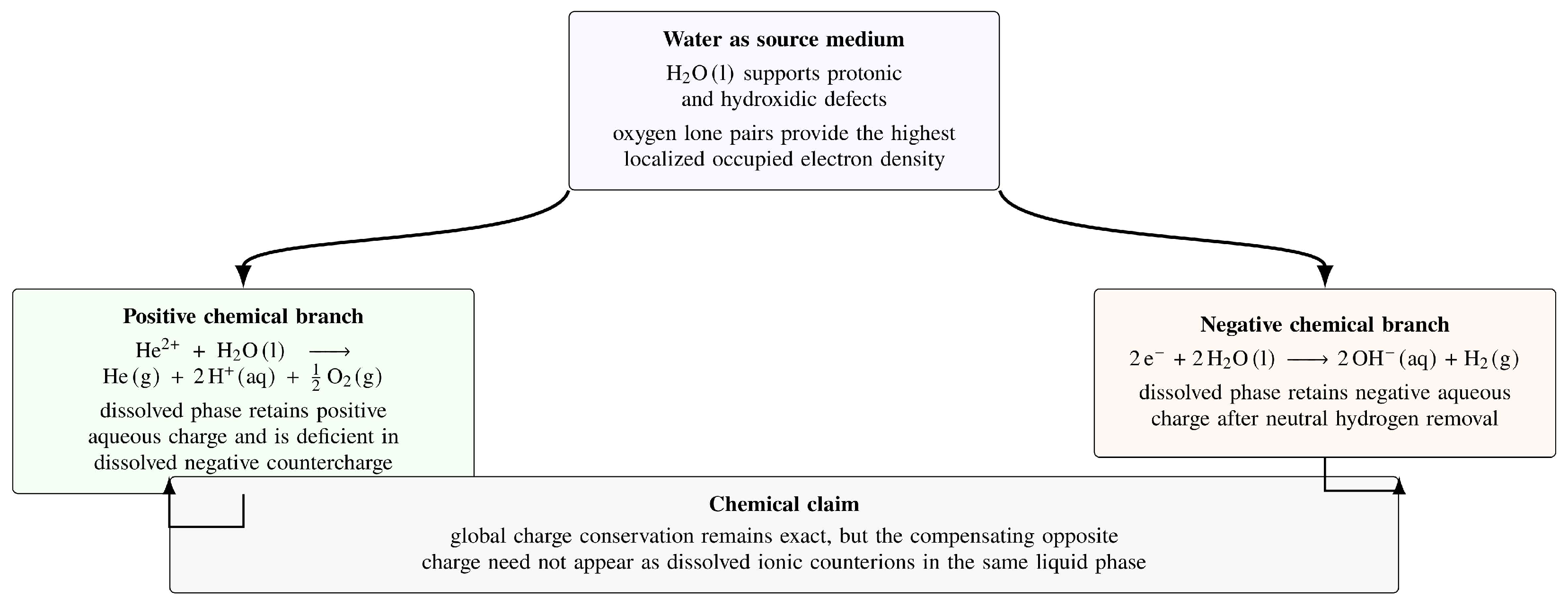
Chemistry-first logic of the aqueous framework written with explicit species and stoichiometric equations. The central proposition is the absence of conventional dissolved counterions in the liquid phase, not any violation of global charge conservation.
Figure 1.
Chemistry-first logic of the aqueous framework written with explicit species and stoichiometric equations. The central proposition is the absence of conventional dissolved counterions in the liquid phase, not any violation of global charge conservation.
2. Chemical Framework and Theoretical Methods
2.1. Water-Specific Source Relations and Exact Charge Conservation
The aqueous framework does not begin from metal dissolution. It begins directly from globally balanced positive and negative source relations in water. The positive-source channel is
and the negative-source channel is
Equation (1) is the positive aqueous analog of selective electron removal, whereas Eq. (2) is the negative aqueous analog of selective negative-charge generation. Both are used as globally balanced bookkeeping relations that define the net stoichiometric connection between the entering species and the retained aqueous charge.
Charge conservation at the point of formation remains exact. For the positive branch,
whereas for the negative branch,
The dissolved state therefore constitutes an aqueous charge reservoir from which one dissolved charge may be selectively generated or retained without requiring immediate appearance of a conventional ionic countercharge partner in the same phase.
2.2. Positive and Negative Aqueous Reservoir Forms
A positive aqueous reservoir is obtained when proton-equivalent positive aqueous charge is generated more rapidly than it is chemically neutralized or environmentally discharged. In that regime, positive aqueous charge is retained while the corresponding negative aqueous countercharge is not co-stored in the same liquid phase. A negative aqueous reservoir is obtained when hydroxide-equivalent negative aqueous charge is generated while positive aqueous countercharge is not reintroduced into the same phase. The instantaneous reservoir charge is not the full Faradaic quantity associated with cumulative throughput because generation occurs through a rate-limited process and is continuously opposed by environmental leakage or discharge. The electrostatic state is therefore dynamical rather than static.
2.3. Explicit Selective Reactions for Helium Ions and Electrons in Water
The chemistry is written directly in its operative stoichiometric form. The positive water-specific sequence is conveniently decomposed into the water oxidation step
and the helium neutralization step
whose sum is Eq. (1). The precise local electron-scavenging step is therefore Eq. (6). The negative branch is represented by direct electron delivery to water through Eq. (2). These are the exact positive and negative water-branch steps used throughout the manuscript.
2.4. Lone-Pair Interpretation of the Positive Branch
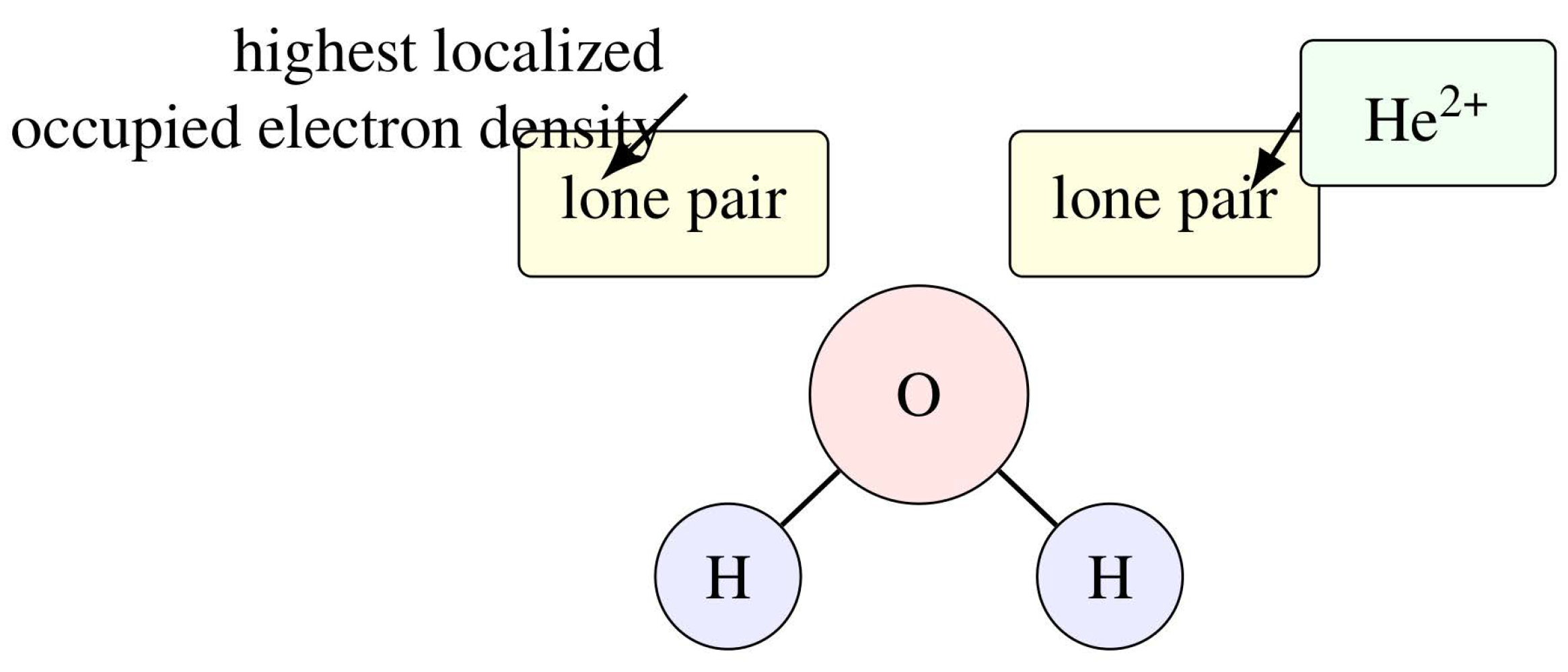
The positive branch becomes chemically more interpretable if the oxygen lone pairs of water are treated explicitly. The water molecule contains two O–H bonds and two nonbonding lone-pair regions. These lone-pair regions are the highest localized occupied electron density in water and therefore provide the most natural local electronic doorway for low-energy cationic capture. In this sense, oxygen-centered lone-pair density is the chemically relevant local resource from which positive aqueous charge may be generated when electrons are removed and neutral helium is formed.
Figure 2.
Interpretive lone-pair picture used in the manuscript. The oxygen lone-pair regions are treated as the highest localized occupied electron density in water and therefore as the most natural entrance site for low-energy helium-ion electron scavenging.
Figure 2.
Interpretive lone-pair picture used in the manuscript. The oxygen lone-pair regions are treated as the highest localized occupied electron density in water and therefore as the most natural entrance site for low-energy helium-ion electron scavenging.
2.5. Thermodynamic Cycles and Heat Removal
The positive and negative aqueous branches can be written as explicit Hess cycles. In what follows, the individual steps are used as thermodynamic bookkeeping relations that make the enthalpy partition transparent; they are not intended as claims about single elementary collisions.
2.5.1. Positive Branch Hess Cycle
For the positive branch, the water-specific oxidation step is
which is assigned the liquid-water formation enthalpy in reverse,
The helium neutralization step is
with the helium double-ionization energy written in molar form as
Adding Eqs. (7) and (9) gives the net positive branch,
with the direct Hess-cycle enthalpy estimate
In the paired branch bookkeeping used in the present manuscript, it is convenient to allocate an additional 400 kJ mol-1 to the complementary negative water-reduction branch. Under that partitioning, the positive branch is carried in the manuscript as
Regardless of whether Eq. (12) or Eq. (13) is used for the final bookkeeping split, the helium neutralization step itself releases approximately 7623 kJ for each mole of He2+ converted to neutral helium. Any practical realization of the positive branch would therefore require active cooling and heat removal sufficient to prevent local overheating, boiling, gas-driven geometry changes, or breakdown of the bounded-reservoir assumptions.
2.5.2. Negative Branch Hess Cycle
For the negative branch, a convenient cycle begins with the reverse of liquid-water formation,
with
A second bookkeeping step is the reverse of neutralization,
with
Finally, hydrogen formation from aqueous protons is written as the reference relation
with
After algebraic cancellation, the net negative branch is
which is carried in the paired-branch bookkeeping of the manuscript as
The sign and magnitude in Eq. (21) are therefore not introduced independently; they are the complementary thermodynamic allocation used alongside Eq. (13) so that the two branches can be compared on the same manuscript bookkeeping scale.
2.5.3. Summary Thermodynamic Split
The branch-wise Hess-cycle values used in the manuscript are collected in Table 1.
2.6. Entry-Energy Admissibility in Water
A chemically useful counterion-deficient reservoir requires not only charge generation, but also survival of the retained aqueous charge on timescales long compared with redistribution and discharge. The energy relevant to charge-mediated chemistry is the kinetic energy of the incoming species at the point of entry into the liquid. To suppress direct solvent bond cleavage, the entry energy is constrained to be at most one-tenth of the energy required to cleave the weakest bond in water,
Taking the O–H bond as the weakest bond relevant to the present aqueous framework, with an energy of approximately eV, the conservative entry criterion becomes
Under Eqs. (22) and (23), the entering helium ions and electrons are treated as chemically operative charges rather than as sources of indiscriminate solvent fragmentation.
2.7. Injection Current and Stoichiometric Scaling
The electrical current associated with selective charge-transfer chemistry follows directly from Faraday’s law. If denotes the molar rate of charge-transfer events and the number of electronic charges transferred per event, then
For the positive branch,
so the charging current is
For the negative branch,
so the charging current is
The sign convention is chosen such that positive current charges the water positively and negative current charges it negatively.
2.8. Environmental Charge Balance and Throughflow Operation
The surrounding environment is not electrically inert. Countercharge may be supplied or removed through induced polarization, controlled grounding, air-ion conduction, finite wall conductivity, or surface leakage. A minimal dynamical law for the net charge is therefore
with
and the corresponding steady state
This linear form is used as a leading-order environmental relaxation model. The chemical counterion-deficient state does not require large stored charge; it requires only that selective charge generation be balanced by environmental or interfacial countercharge rather than by dissolved counterions within the liquid phase.
2.9. Dimensionless Admissibility Parameters
A compact way to compare systems of different size and operating mode is to organize the theory through dimensionless admissibility parameters:
A physically admissible regime requires
2.10. Solvent-General Admissibility Window Specialized to Water
Collecting the principal constraints, a chemically and physically admissible aqueous operating regime is defined by
The last condition ensures dynamical stability of any coupled charge-reaction steady state introduced below.
2.11. Maxwell Relaxation and Bulk Neutrality
Bulk charge redistribution is governed by the Maxwell relaxation time,
with
At 25 °C, the aqueous benchmark uses
for water and
for ultrapure water. Hence
When is short compared with the experimental timescale, any bulk charge imbalance relaxes rapidly toward the boundary. The framework therefore does not assume that bulk space charge persists indefinitely. Rather, it assumes that the physically sustainable electrostatic state is boundary-localized while the liquid interior approaches electroneutrality.
2.12. Charge Continuity and Drift-Diffusion Transport
Let denote bulk charge density. Gauss’s law and charge continuity require
For positive aqueous charge,
and for negative aqueous charge,
For a mobile charge with mobility , a simplified drift current is
A more general transport law uses the Nernst–Planck form,
where is a diffusion coefficient, the ionic mobility, and the electric potential. The associated continuity equation is
where contains reaction source or sink terms.
2.13. Boundary Localization and Electrostatic Geometry
The electric potential obeys Poisson’s equation,
with electric field
If the bulk has already relaxed such that , then the nontrivial solution is carried by the boundary conditions. For a reservoir of surface area , the surface charge density is
For a sphere of radius R this becomes
For spherical symmetry and , Gauss’s law gives
so that
and hence
The interfacial potential is
The spherical capacitance is
The stored electrostatic energy may be written either as
or, equivalently,
The field-energy density is
2.14. Mechanical and Dielectric Limits
If the charge reservoir is associated with a liquid body of effective surface tension , electrostatic stability requires that charge remain below the Rayleigh limit,
The corresponding maximum stable potential is
The criterion for electrohydrodynamic stability is therefore
The interfacial field must also remain below the dielectric breakdown threshold of the liquid and the surrounding medium,
with
Electrostatic stress at the interface scales as
Whenever the instantaneous interfacial charge exceeds the Rayleigh limit,
that excess charge is not treated as stably stored. Instead, electrohydrodynamic instability and environmental discharge drive leakage or emission until the remaining interfacial charge returns to the admissible regime,
This discharge interpretation is central because the chemistry of a counterion-deficient aqueous phase does not require sustained storage of super-Rayleigh charge.
2.15. Aqueous Reservoir-Electrolyte Interactions and Reaction Bookkeeping
This subsection is retained because it gives the strongest formal statement of why ordinary reaction chemistry does not automatically restore local counterions. A generic electrolyte dissociation may be written as
In a negatively charged aqueous reservoir the reduction step is
The anion remains solvated while the aqueous reservoir supplies the reducing charge. For example,
More generally,
A representative cation-reduction step is
and, for a cation of charge m,
In every case, charge is conserved, but local counterion symmetry is not automatically restored. This is precisely why reaction chemistry does not invalidate the main claim of the manuscript.
Figure 3.
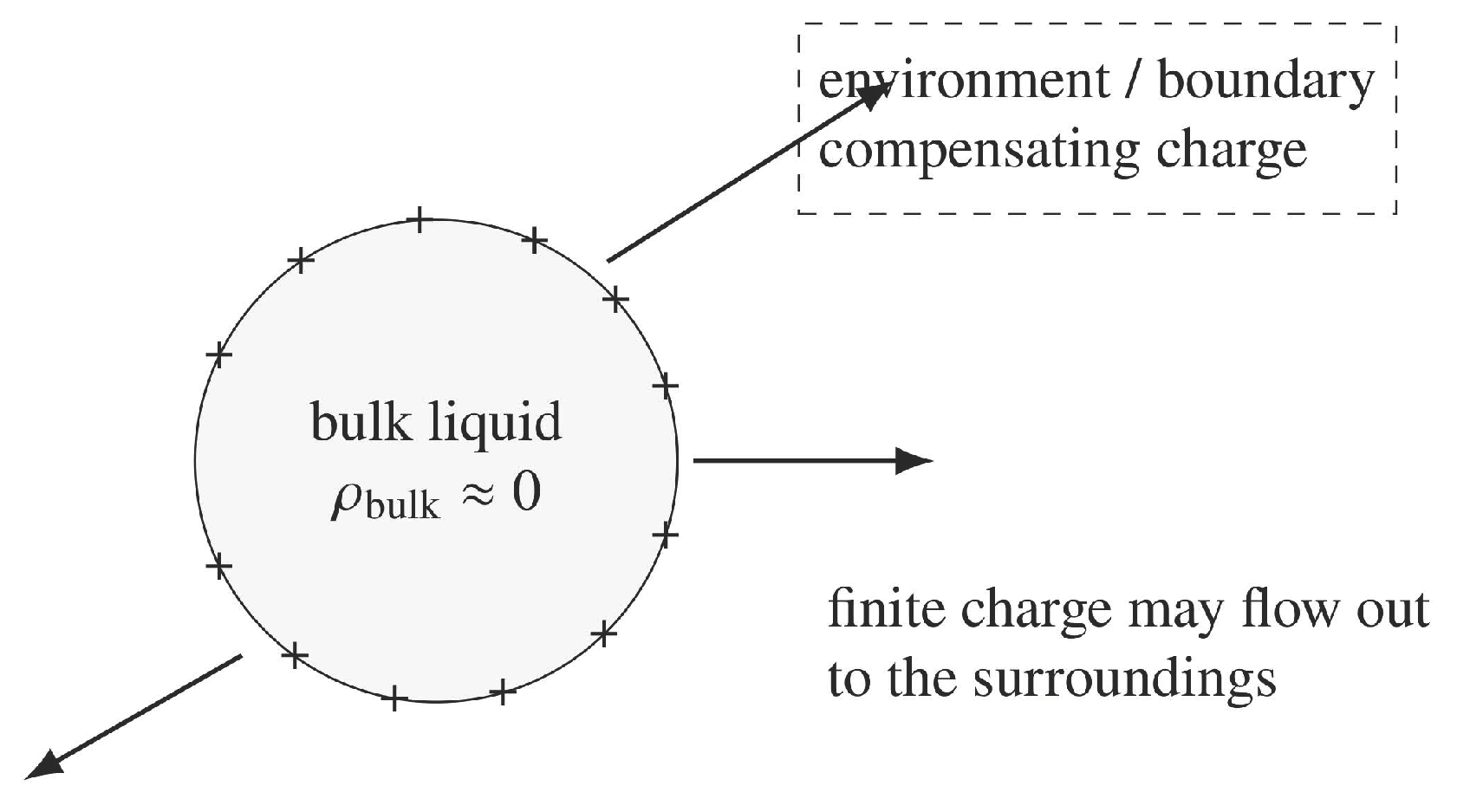
Minimal physical picture needed to explain the chemistry. The bulk liquid relaxes toward electroneutrality, any finite net charge is localized at the boundary, and compensating opposite charge is realized in the surrounding environment rather than as dissolved counterions inside the same phase.
Figure 3.
Minimal physical picture needed to explain the chemistry. The bulk liquid relaxes toward electroneutrality, any finite net charge is localized at the boundary, and compensating opposite charge is realized in the surrounding environment rather than as dissolved counterions inside the same phase.
3. Results and Discussion
3.1. Primary Anchor System: Water
3.1.1. Positive Aqueous Reservoir
The positive aqueous construction begins from Eq. (1). The stoichiometric relation is
The total theoretical integrated positive charge throughput is therefore
The water entry-energy condition is written as
The charging current is
with dynamical evolution
and steady state
The electrostatic relations are
Accordingly,
For a spherical reservoir of radius R,
The admissibility window is therefore
3.1.2. Negative Aqueous Reservoir
The negative aqueous construction begins from Eq. (2). The stoichiometric relation is
The total negative charge throughput is therefore
The negative charging current is
with
The charge density is now
while all of the same Maxwell-relaxation and field-localization relations apply. The boundary and dielectric conditions remain

Table 2.
Explicit chemical bookkeeping for the water anchor system. Full stoichiometric equations are retained, while the retained aqueous charges are understood microscopically as hydrated protonic and hydroxidic defects.
Table 2.
Explicit chemical bookkeeping for the water anchor system. Full stoichiometric equations are retained, while the retained aqueous charges are understood microscopically as hydrated protonic and hydroxidic defects.
| Case | Explicit equation | Dissolved species retained | Interpretation |
|---|---|---|---|
| Positive branch | He2+ + H2O(l) → He(g) + 2H+(aq) + O2(g) | Positive aqueous charge written as H+(aq) | Selective helium-ion electron scavenging yields a dissolved phase deficient in dissolved negative countercharge. |
| Negative branch | 2e- + 2H2O(l) → 2OH−(aq) + H2(g) | Negative aqueous charge written as OH-(aq) | Electron delivery yields a dissolved phase deficient in dissolved positive countercharge after neutral hydrogen removal. |
| Helium-ion step | He2+ + 2e− → He | — | Exact local scavenging step used in the positive branch. |
| Electrolyte reduction example | NaCl + e− → Na + Cl−(aq) | Cl-(aq) coproduct | Reaction conserves charge but does not automatically restore a counterion-free product unless coproducts are removed. |
| Water-specific microscopic motif | Oxygen lone pairs hold the highest localized occupied electron density | Lone-pair density and hydrated defects | Connects explicit chemistry to the aqueous electronic structure without changing the continuum balance laws. |
3.2. Scale, Geometry, and Interpretation of Electroneutrality
The framework developed here is scale-general in the same precise sense as the first manuscript. The existence of a counterion-deficient aqueous phase is set by selective chemistry and environmental charge balance, not by a single prescribed vessel radius or sample amount. What does depend on geometry are electrostatic observables such as field strength, capacitance, and interfacial energy. For spherical symmetry,
Thus larger systems generally produce smaller interfacial fields for the same stored charge, while larger capacitance permits the same potential at larger Q. None of these geometric facts, however, determines whether the liquid phase can be chemically counterion-deficient.
The theory does not require that macroscopic charge remain stored in the liquid at all times. In one limit, finite charge is sustained at the interface and the system behaves as a bounded electrostatic reservoir. In another limit, excess charge is transferred rapidly to the environment and the system behaves as a charge-throughflow reactor with minimal net storage. Both limits remain compatible with counterion-deficient chemistry in the dissolved phase.
Figure 4.
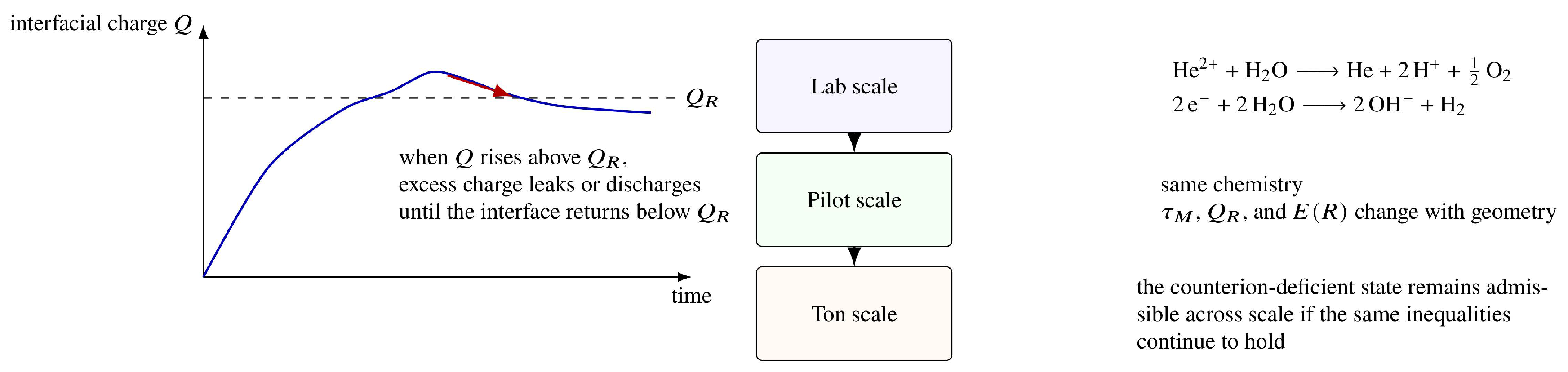
Left: qualitative charge evolution in the bounded regime. The interfacial charge may transiently cross the Rayleigh threshold , after which excess charge leaks or discharges until the interface returns below the admissible limit. Right: scale-general interpretation. The chemical logic is the same from laboratory to ton scale; geometry changes observables and limits, not the existence of the counterion-deficient state itself.
Figure 4.
Left: qualitative charge evolution in the bounded regime. The interfacial charge may transiently cross the Rayleigh threshold , after which excess charge leaks or discharges until the interface returns below the admissible limit. Right: scale-general interpretation. The chemical logic is the same from laboratory to ton scale; geometry changes observables and limits, not the existence of the counterion-deficient state itself.
3.3. Falsifiable Predictions and Experimental Signatures
Because the manuscript is purely theoretical, its value depends on explicit observables that could support or disprove the framework. For the positive water benchmark channel,
and the negative benchmark channel,
the first falsifiable prediction is chemical rather than electrical: positive forcing should correlate with proton-equivalent aqueous charge and the neutral gas products He and O2, whereas negative forcing should correlate with hydroxide-equivalent aqueous charge and the neutral gas product H2. A wrong-sign field relative to the observed gas product would contradict the bookkeeping chemistry.
Second, because Maxwell relaxation remains much faster than the overall charge-processing time,
the theory requires
while any finite residual net charge is carried at the boundary through
Thus the theory is contradicted if the central liquid volume develops and sustains a field comparable to the boundary field on timescales long compared with .
Third, the Rayleigh condition remains a direct stability test. If
then observed operation above should not remain stable; charge should leak or discharge to the surroundings until . If instead a reproducible super-Rayleigh steady state were observed under the assumptions of the present theory, the framework would require revision.
3.4. Why Only a Small Physical Subset is Required
Only a limited part of the physical formalism is essential to explain the chemistry developed here. The required ingredients are: exact stoichiometric charge conservation at the chemical step; rapid Maxwell relaxation that restores near-neutrality in the bulk; Poisson and Gauss relations that define the existence of an interfacial field once finite charge is present; and the Rayleigh condition that forces excess charge to leak away when the interface becomes capillarily unstable. More elaborate field-polarization or field-activated-kinetics constructions are not needed for the central claim of the manuscript, which is simply that the dissolved liquid phase may be chemically deficient in ordinary counterions while global charge neutrality is enforced at the boundary and through the environment.
4. Conclusions
A chemistry-first framework has been developed for counterion-deficient states in liquid water. The principal conclusion is that a dissolved aqueous phase can be chemically deficient in conventional ionic countercharge without violating global charge neutrality. In the present formulation, the compensating opposite charge is carried predominantly by the boundary and the surrounding environment rather than by dissolved counterions within the same phase.
Only the portion of the physics needed to explain that chemistry is retained. Maxwell relaxation explains why the bulk need not remain space-charged, Poisson and Gauss relations define the existence of any interfacial field once finite charge is present, and the Rayleigh condition provides the capillary limit: if the interfacial charge rises above , excess charge leaks or discharges until the interface returns below the admissible threshold. The theory therefore does not require sustained macroscopic charge storage.
The positive helium-neutralization branch also carries a thermal load of approximately 7623 kJ mol-1 per mole of He2+ neutralized, so any implementation would require active cooling and heat removal. The same chemical logic is scale-general. Laboratory cells, pilot systems, and ton-scale reactors differ in geometry, capacitance, field magnitude, and stability thresholds, but not in the governing bookkeeping: whenever the admissibility conditions remain satisfied, dissolved counterions are not the only possible mechanism by which electroneutrality can be maintained. That proposition is experimentally falsifiable, and the framework given here specifies the equations and signatures by which it can be confirmed or disproved.
Note
The author declares no competing financial interest.
References
- Bard, A. J.; Faulkner, L. R. Electrochemical Methods: Fundamentals and Applications, 2nd ed.; Wiley: New York, 2000. [Google Scholar]
- Jackson, J. D. Classical Electrodynamics, 3rd ed.; Wiley: New York, 1998. [Google Scholar]
- Rayleigh, L. On the Equilibrium of Liquid Conducting Masses Charged with Electricity. Philos. Mag. 1882, 14, 184–186. [Google Scholar] [CrossRef]
- Taflin, D. C.; Ward, T. L.; Davis, E. J. Electrified Droplet Fission and the Rayleigh Limit. Langmuir 1989, 5, 376–384. [Google Scholar] [CrossRef]
- Fong, C. S.; Black, N. D.; Kiefer, P. A.; Shaw, R. A. An Experiment on the Rayleigh Instability of Charged Liquid Drops. Am. J. Phys. 2007, 75, 499–503. [Google Scholar] [CrossRef]
- Agmon, N. The Grotthuss Mechanism. Chem. Phys. Lett. 1995, 244, 456–462. [Google Scholar] [CrossRef]
- Marx, D. Proton Transfer 200 Years after von Grotthuss: Insights from Ab Initio Simulations. ChemPhysChem 2006, 7, 1848–1870. [Google Scholar] [CrossRef] [PubMed]
- Tuckerman, M.; Laasonen, K.; Sprik, M.; Parrinello, M. Ab Initio Molecular Dynamics Simulation of the Solvation and Transport of H3O+ and OH- Ions in Water. J. Phys. Chem. 1995, 99, 5749–5752. [Google Scholar] [CrossRef]
- Tuckerman, M. E.; Marx, D.; Parrinello, M. The Nature and Transport Mechanism of Hydrated Hydroxide Ions in Aqueous Solution. Nature 2002, 417, 925–929. [Google Scholar] [CrossRef] [PubMed]
- Asthagiri, D.; Pratt, L. R.; Kress, J. D.; Gomez, M. A. Hydration and Mobility of HO− (aq). Proc. Natl. Acad. Sci. U.S.A. 2004, 101, 7229–7233. [Google Scholar] [CrossRef] [PubMed]
- Cukierman, S. Proton Mobilities in Water and in Different Stereoisomers of Covalently Linked Gramicidin A Channels. Biophys. J. 2000, 78, 1825–1834. [Google Scholar] [CrossRef] [PubMed]
- Meiboom, S. Nuclear Magnetic Resonance Study of the Proton Transfer in Water. J. Chem. Phys. 1961, 34, 375–388. [Google Scholar] [CrossRef]
Table 1.
Hess-cycle thermodynamic split adopted for the two aqueous branches.
| Branch reaction | Assigned |
|---|---|
| He2+ + H2O(l) → He(g) + 2H+(aq) + O2(g) | |
| 2e- + 2H2O(l) → 2OH−(aq) + H2(g) |
Disclaimer/Publisher’s Note: The statements, opinions and data contained in all publications are solely those of the individual author(s) and contributor(s) and not of MDPI and/or the editor(s). MDPI and/or the editor(s) disclaim responsibility for any injury to people or property resulting from any ideas, methods, instructions or products referred to in the content. |
© 2026 by the authors. Licensee MDPI, Basel, Switzerland. This article is an open access article distributed under the terms and conditions of the Creative Commons Attribution (CC BY) license (http://creativecommons.org/licenses/by/4.0/).
Copyright: This open access article is published under a Creative Commons CC BY 4.0 license, which permit the free download, distribution, and reuse, provided that the author and preprint are cited in any reuse.