

Submitted:
19 March 2026
Posted:
19 March 2026
You are already at the latest version
Abstract
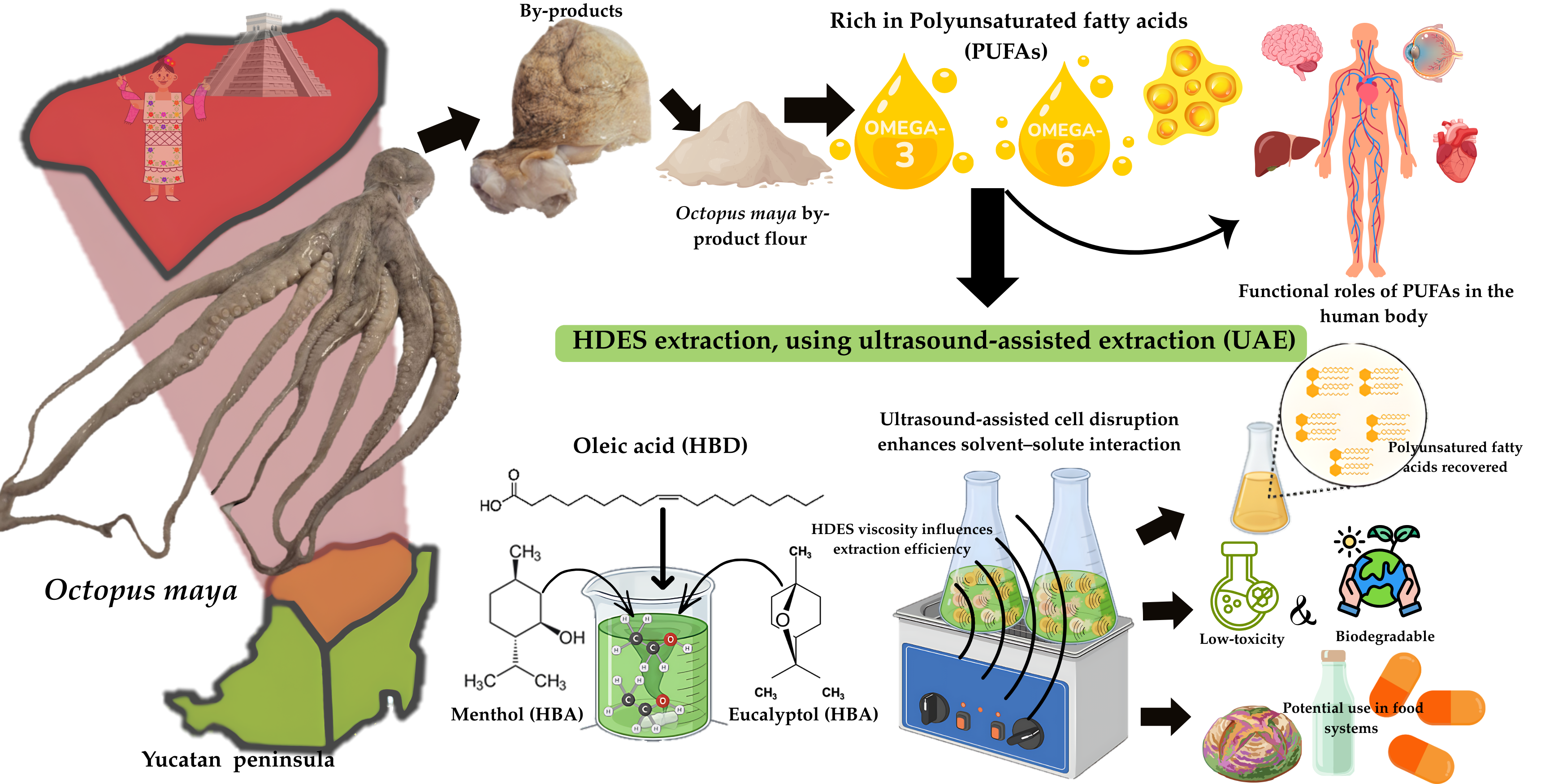
This study evaluated the use of HDES for omega-3 recovery from mantles (by-products) of O. maya, an endemic species of the Yucatán Peninsula. A 2×3×2 factorial design was applied to assess the effect of: (1) the hydrogen bond acceptor (HBA) of the HDES (menthol or eucalyptol), with oleic acid as the hydrogen bond donor; (2) the molar ratio (MR) (1:1, 1:2, or 2:1); and (3) ultrasound-assisted extraction time (30 or 60 min) in omega-3 content, determined by UV–Vis spectrophotometry, viscosity and color characterization. Samples with the highest omega-3 content were selected and their composition was confirmed by FTIR, Raman spectroscopy and gas chromatography. Significant differences (p < 0.05) were observed better with HBA and MR factors (menthol or eucalyptol) in omega-3 content; the highest omega-3 values (0.63–0.83%), were obtained with eucalyptol-based HDES (while menthol-based systems showed lower contents (≤0.70%), suggesting better extraction performance for eucalyptol. All extracts showed Newtonian behavior with viscosities between 0.011 and 0.036 Pa·s, with eucalyptol formulations presenting the lowest values (0.011–0.023 Pa·s). Fatty acid pro-filing showed greater affinity for polyunsaturated fatty acids, mainly omega-6 (23.45–27.91%), and lower affinity for saturated fatty acids such as palmitic and stearic acids, indicating that HDES are a sustainable alternative for the selective extraction.
Keywords:
Octopus maya
; Hydrophobic Deep Eutectic Solvents (HDES)
; viscosity
1. Introduction
Octopus maya is an endemic species of the Yucatan Peninsula that generates approximately 16,000 jobs and an annual income of up to USD 36 million [1,2,3]. Octopus production in the region, which includes common octopus and is predominantly composed of Octopus maya (75%), has shown variable trends over the past decade, with steady growth prior to 2018, a marked decline during the pandemic period, and a gradual recovery in subsequent years, reaching a production volume of 25,462 tons in 2025 [4].
The processing of Octopus maya in packing facilities and gourmet restaurants generates by-products such as tentacle tips and mantles (the correct term for the heads), which are not utilized and are often discarded, leading to environmental contamination of water, soil, and air. This occurs mainly through unpleasant odors generated during microbial or enzymatic degradation due to the release of NH₃ and H₂S [5]. However, these by-products represent a potential source of high-value biomolecules, including proteins (collagen, 77.5 g/100 g DW) and polyunsaturated fatty acids (PUFA), particularly omega-6 (110 mg/100 g WW) and omega-3 (144 mg/100 g WW), such as eicosapentaenoic acid (EPA, 20:5 n−3) and docosahexaenoic acid (DHA, 22:6 n−3), present in Octopus maya [6]. These compounds are essential lipids in the human diet and health due to their anti-inflammatory properties, their role in reducing the risk of cardiovascular diseases (CVD), their contribution to visual health, and their involvement in the proper functioning of key organs such as the brain, liver, and heart. Calder et al. [7] reported that an adequate omega-3 intake for the general population is 250 mg/day, which may help prevent the development of neurodegenerative diseases such as Parkinson’s and Alzheimer’s. However, to observe these biological effects, the dietary intake ratio of omega-6 (ω-6) to omega-3 (ω-3) should be maintained between 1:1 and 5:1, providing at least 250 mg/day of ω-3 through the diet or supplementation [8,9].
To achieve this ratio in supplements, it is necessary to obtain ω-6 and ω-3 fatty acids from different marine products or by-products using various extraction methods. Most used methods are: 1) supercritical fluid extraction, due to its selectivity, but with high operational costs [10]; 2) Soxhlet and 3) Bligh & Dyer extraction, due to their high extraction efficiency and selectivity toward lipophilic compounds, but with organic solvents use [11,12]. Organic solvents are volatile and nonpolar compounds that enable efficient and selective extraction of lipophilic compounds; however, their toxicity, flammability, and emission of volatile organic compounds pose risks to human health and the environment [13,14].
Some solvents considered to have lower toxicity, such as ethanol, acetone, and ethyl acetate, have been used in different combinations and concentrations (0.3/0.3/0.3, 0.5/0.5/0, or 1/0/0) within the Bligh & Dyer approach to optimize the extraction of total lipids (TL) and PUFA (ω-3) from Octopus vulgaris by-products as an alternative to conventional solvents [15]. The PUFA (ω-3) identified in octopus are mainly located in muscle tissues and cell membranes in the form of triacylglycerols and phospholipids, which can hinder their interaction with the solvent and result in lower extraction yields [16].
In addition, the ultra-sound-assisted extraction (UAE) disrupt the cell walls of the biomass through cavitation, resulting in improved solute–solvent interactions due to increased solvent penetration into the cells, leading to higher extraction efficiency, reduced extraction time, and lower solvent consumption [17]. But this method relies on the use of solvents, related to toxicity and sustainability remain. Consequently, there has been increasing interest in the development of green and biodegradable ex-traction alternatives to replace them, in line with the 12 principles of green chemistry being the use of natural deep eutectic solvents (NADES) the alternative [14,18].
Natural deep eutectic solvents (NADES), a subclass of deep eutectic solvents (DES), generally used for the extraction of hydrophilic compounds, have emerged as an alternative group of low-toxicity, biodegradable, and stable solvents with modifiable physicochemical properties. These systems consist of a mixture of two or more natural components, involving a hydrogen bond donor (HBD) and a hydrogen bond acceptor (HBA) at a specific molar ratio. When subjected to temperatures above 40 °C and agitation, the components interact and form a stable liquid through hydrogen bonding and Van der Waals interactions, resulting in a melting point lower than that of the individual components and stability at room temperature [19,20,21].
Most NADES reported in the literature exhibit predominantly hydrophilic properties, commonly formulated from an organic salt such as choline chloride (HBA) combined with a hydrophilic HBD, including sugars (e.g., fructose) or organic acids (e.g., lactic acid). These systems are often prepared with varying proportions of water as a polar component and have been used to extract compounds such as polyphenols, flavonoids, terpenes, and catechins [22]. However, the hydrophilic nature of NADES limits their ability to extract lipophilic (nonpolar) compounds such as PUFA, making hydrophobic deep eutectic solvents (HDES) a suitable alternative for lipid extraction.
In HDES, HBAs may be ionic, such as quaternary ammonium salts, or non-ionic, including monoterpenes. Phenols, carboxylic acids, alcohols, and glycols are commonly employed and may act as either HBA or HBD, as is the case for menthol, organic acids, and thymol [23]. HDES are characterized by their affinity for nonpolar compounds, low water solubility, density, and viscosity. For HDES formulated with terpenes such as menthol and thymol combined with decanoic acid, densities of 0.896 and 0.918 g cm⁻³ and viscosities of 0.012 and 0.011 Pa·s, respectively, have been reported [24,25]. These properties allow improved penetration of the solvent into the cell wall, which may be associated with enhanced solute extraction capacity.
Terpenes are natural compounds found in plant essential oils, composed of two isoprene units (C₁₀) that may form aromatic rings or saturated cyclic structures, conferring hydrophobic character and affinity for nonpolar compounds [24,26]. An HDES formulated with menthol and lidocaine at a 1:1 molar ratio has been reported as a potential alternative for the extraction of EPA (172.04 μg g⁻¹ DW of biomass) and DHA (602.79 μg g⁻¹ DW of biomass) from mussels [27]. Menthol and thymol combined with carvacrol (a phenolic monoterpene) have also been applied for total lipid extraction from fish (TL = 87%) and mollusks (TL = 43–47%) [28], and HDES-based methodologies have additionally been explored for lipid extraction from seeds. Furthermore, Strieder et al. [29] reported terpene-based HDES formulations using eucalyptol (1,8-cineole), a volatile and colorless monoterpene cyclic ether present in essential oils of plants such as eucalyptus and sage, demonstrating their capacity to extract hydrophobic compounds from almond and peanut by-products, with extraction yields of 20% and 25%, respectively.
In this context, terpenes have emerged as key compounds for HDES formulation due to their nonpolar nature and suitability for lipid extraction. Menthol and eucalyptol have shown affinity for lipophilic matrices and solubilization capacity in long-chain organic acids such as oleic acid. In addition, previous studies have reported that terpene-based HDES are biodegradable, exhibit low toxicity, and present low viscosity, properties that favor solvent penetration into the cell wall and interaction with hydrophobic biomolecules, making these HDES suitable alternatives for PUFA recovery. Based on this perspective, the present study applied eucalyptol and menthol combined with oleic acid at different molar ratios, using ultrasound-assisted extraction (UAE) to enhance the extraction of PUFA from Octopus maya by-products. The viscosity of the HDES, color parameters, fatty acid profile determined by gas chromatography, and omega-3 content were evaluated. The presence of lipid compounds was confirmed by FTIR and Raman spectroscopy, and the extraction performance of the HDES was assessed as an alternative to organic solvents for the recovery of lipid compounds from Octopus maya by-products.
2. Materials and Methods
2.1. Solvents and Reagents
Menthol (crystals, 100%), oleic acid (≥99%), eucalyptol (99%), ethanol (99.9%), methanol, and chloroform of analytical grade were purchased from commercial suppliers (B.MEDINA). The omega-3 (100% Norwegian salmon oil as declared on the label, Natural Health II®) standard used to construct the calibration curve was obtained from a local pharmacy (Costco, Mérida, Yucatán, Mexico).
2.2. Octopus maya Sample Collection
The Octopus maya specimens were captured along the coast of the state of Yucatán, Mexico, during the 2023–2024 fishing season, as part of the project “Plataforma tecnológica pulpo maya para el desarrollo de productos de alto valor agregado 6559”. They were Frozen to further analysis.
2.3. Processing of Octopus maya By-Product Samples
From this section onward the term by-products refer exclusively to the mantles (heads) of Octopus maya.
Specimens were randomly selected, and the by-product (mantle) was removed by cutting at the base of the arms. The by-products were washed, blended, and stored in 250 g Ziploc® bags at −20 °C for 72 h. After this period, the samples were freeze-dried for 96 hours at −84 °C using a freeze-dryer (Freezone, LABCONCO®, Kansas City, MO, USA) 2.5 L Benchtop. The freeze-dried material was then ground using a blender and sieved through a #35 stainless steel mesh (Fisher Scientific, Boston, MA, USA) with a pore size of 500 μm to obtain a uniform particle size fraction. The resulting by-product flours were stored in airtight containers and kept in a desiccator at room temperature to prevent moisture uptake and ensure sample stability.
2.4. Conventional Oil Extraction (COE)
Oil extraction was performed following the methodology described by Kuo et al. [30], with modifications. Briefly, 10 g of freeze-dried Octopus maya by-product flour were mixed with 100 mL of ethanol and homogenized using a high-speed disperser (ULTRA-TURRAX® T 18 digital, IKA Works Inc., Staufen, Germany) at 15,000 rpm for 1 min. The mixture was subjected to ultrasound-assisted extraction (UAE) for 30 min using an ultrasonic bath (BRANSON®, model 351, 42 kHz, Danbury, CT, USA). The sample was then centrifuged at 4,500 rpm for 30 min at 4 °C to sediment residual solid material. The organic phase (ethanol) was collected into tubes and centrifuged again under the same conditions to ensure the removal of remaining impurities. To separate the lipid phase, the extracts were concentrated using a rotary evaporator (Laborota V-700, Heidolph Instruments GmbH & Co. KG, Schwabach, Germany) at 300 mbar and 60 °C using a water bath.
The extracts were stored at −20 °C until further analysis.
2.5. Preparation of HDES
HDES were prepared following the methodology described by Ramírez-Sucre et al. [31], with modifications. Oleic acid (282.46 g/mol) was used as the hydrogen bond donor (HBD), while menthol (156.27 g/mol) and eucalyptol (154.25 g/mol) were used as hydrogen bond acceptors (HBA) at molar ratios of 1:1, 1:2, and 2:1 (mol/mol). HDES composed of oleic acid (O) and menthol (M) were heated to 40 °C (manufacturer’s recommendation) under continuous stirring until a homogeneous mixture was obtained, whereas HDES formulated with eucalyptol (E) were stirred at room temperature until complete homogenization of both components was achieved.
2.6. Fatty acid Extraction Using HDES Under UAE
To evaluate the effect of the hydrogen bond acceptor (HBA), molar ratio (MR), and extraction time (ET) of Ultrasound Assisted Extraction (UAE) on the omega-3 (ω-3) content recovered from Octopus maya by-products using HDES, a 2×3×2 factorial design with duplicates was established. The factor levels were HBA (M or E), MR (1:1, 1:2, or 2:1), and ET (30 or 60 min), as shown in Table 1.
PUFA extraction using HDES was performed following the methodology described by Ramírez-Sucre et al. [31], with modifications. Ten grams of HDES were mixed with 1 g of Octopus maya by-product flour. The mixture was subjected to ultrasound-assisted extraction (UAE) using an ultrasonic bath (BRANSON®, model 351, 42 kHz, Danbury, CT, USA) for 30 or 60 min, according to the experimental design. The samples were centrifuged at 4,500 rpm for 15 min at 4 °C, and the supernatant was recovered. The extracts were stored at 4 °C for further analysis.
2.7. Viscosity of HDES Extracts
The viscosity of HDES extracts obtained from Octopus maya by-products was determined using a controlled-stress rheometer (Discovery Hybrid Rheometer DHR-2, TA Instruments, New Castle, DE, USA) equipped with a parallel plate geometry (40 mm diameter) and a gap of 1050 μm, following the methodology described by Ramírez-Sucre and Baigts-Allende [32]. Flow behavior was evaluated through viscosity curves (Pa·s) as a function of shear rate (0.001 to 100 s⁻¹) at a constant temperature of 25 °C.
2.8. Color of HDES Extracts
Color difference (ΔE) of the HDES before and after exposure to the extraction method was determined by a spectrophotometer (CM-5, Konica Minolta Sensing Inc., Osaka, Japan). The color parameters L* (lightness), a* (red-green), and b* (yellow-blue) were measured and reported by scale CIELAB, and color difference (ΔE) was calculated as the following equation:
Where ΔL* = L* − L0*, Δa* = a* − a0*, Δb* = b* − b0*. L0, a0, and b0 are the color values of the HDES before extraction, while L*, a*, and b* are the color values of the HDES after being exposed to the extraction method UAE with by-products of Octopus maya [33].
2.9. Determination of ω-3 by UV–Vis Spectrophotometry
The determination of ω-3 in HDES extracts was performed according to the methodology described by Oliveira et al. [34], with modifications, by measuring absorbance at a wavelength of 202 nm. A five-point calibration curve (50, 100, 200, 300, 600, and 1200 μg/mL) was prepared using omega-3 (100% Norwegian salmon oil Natural Health II®) diluted in a chloroform:methanol (2:1, v/v) solution. Each calibration point was measured using a spectrophotometer UV–Vis (THERMO SCIENTIFIC®, Genesys 140). The calibration curve showed a correlation coefficient (R²) of 0.961, with the corresponding equation Y= 1191.3x − 257.41, where Y represents the omega-3 content (%) and X corresponds to the absorbance measured at 202 nm.
Based on the UV–Vis spectrophotometric results for ω-3 quantification, the four samples with the highest ω-3 content were selected for fatty acid profile characterization and were additionally analyzed by Fourier transform infrared spectroscopy (FTIR) and Raman spectroscopy.
2.10. Fatty Acid Profiling by Gas Chromatography (GC)
Fatty acid characterization was performed according to the test method described in the NMX-F-490-1999-NORMEX standard. Sample methylation was carried out by adding sodium hydroxide in methanol to a flask containing glass beads, which was connected to a Friedrich condenser and placed in a water bath at 70 °C. The mixture was maintained under reflux for 12 min from the appearance of the first drop. Subsequently, boron trifluoride (BF₃) in methanol was added, and reflux was continued for an additional 2 min. Heptane was then added, and the mixture was refluxed for 1 min.
After completion of the reaction, the flask was removed, temporarily capped, and cooled with water. A saturated sodium chloride (NaCl) solution was added to promote phase separation. The upper phase was transferred to a 2 mL vial and sealed. The methylated sample was then injected into a PerkinElmer gas chromatograph equipped with a flame ionization detector (FID). A 1 μL injection was performed in split mode (40:1). A DB-23 capillary column (60 m × 0.25 mm × 0.25 μm) was used. The injector temperature was set at 220 °C, the oven temperature was programmed from 60 °C to 250 °C, at 25°C/min, and the FID temperature was maintained at 275 °C.
Quantification of the fatty acids [palmitic acid (C16:0), stearic acid (C18:0), oleic acid (C18:1 n-9), linoleic acid (C18:2 n-6), linolenic acid (C18:3 n-3), Omega-3 (ω-3), Omega-6 (ω-6) and Omega-9 (ω-9)] was performed using the normalization method described in NMX-F-490-1999-NORMEX, and results were reported as fatty acid percentage (%).
2.11. Fourier Transform Infrared Spectroscopy (FTIR)
Functional group characterization of the HDES extracts was performed following the methodology described by Áviles-Betanzos et al. [35], with modifications. The analysis was conducted using a spectrometer (Nicolet iS5, Thermo Fisher Scientific Inc., Madison, WI, USA) equipped with an attenuated total reflection (ATR) accessory with a germanium crystal. Spectral scans were recorded over a range of 4000 to 500 cm⁻¹ using 64 background scans and a resolution of 8 cm⁻¹ in transmittance mode (%).
2.12. RAMAN Spectroscopy
Raman spectroscopy was employed to evaluate the structural composition of the HDES extracts exhibiting the highest ω-3 concentrations. Raman spectra were acquired using a Renishaw InVia Confocal spectrometer (Wotton-under-Edge, Gloucestershire, UK) over a spectral range of 200–3200 cm⁻¹. A red laser (633 nm) was used as the excitation source, operating at 100% of its total power (17 mW), with an exposure time of 20 seconds [36].
2.13. Statistical Analysis
All measurements were performed in duplicate for each HDES extract to determine ω-3 content by UV–Vis spectrophotometry, viscosity, and color. Results are reported as mean values ± standard deviation. The effects of the studied factors on ω-3 content, viscosity, and color were evaluated by analyzing the experimental design data using Design of Experiments (DOE) in Minitab® software (version 18). FTIR and Raman spectra were visualized and processed using OriginLab® software, version 2025b, SR1 (No_H_234).
3. Results and Discussion
3.1. Viscosity of HDES Extracts
The flow behavior of the HDES is shown in Figure 1, while the average viscosity values and their standard deviations at a shear rate of 10 s⁻¹ are summarized in Figure 2. The viscosities of the HDES extracts ranged from 0.011 to 0.036 Pa·s, showing Newtonian behavior in all cases within the analyzed range. Significant differences (p < 0.05) were also observed among treatments due to the studied factors: hydrogen bond acceptor (HBA), HBA:HBD molar ratio, and extraction time.
The results indicate that HDES extracts formulated with eucalyptol showed lower viscosities (p < 0.05) compared with menthol-based HDES. The eucalyptol formulations EO(1:2)30 and EO(1:2)60 presented values of 0.023 ± 0.002 Pa·s and 0.021 ± 0.001 Pa·s, respectively, which correspond to the highest viscosities among the eucalyptol-based HDES. In contrast, the formulations EO(2:1)30 and EO(2:1)60 showed the lowest viscosity values, with 0.011 ± 0 Pa·s and 0.012 ± 0.001 Pa·s, respectively.
In contrast to the eucalyptol formulations, menthol-based systems were characterized by higher viscosity values. For example, the formulations MO(2:1)60, MO(2:1)30, and MO(1:1)30 showed viscosities ranging from 0.032 to 0.036 Pa·s. The lowest viscosity recorded for menthol-based systems was observed for sample MO(1:2)30, with a value of 0.027 Pa·s. However, this sample did not show significant differences (p < 0.05) compared with its eucalyptol counterpart EO(1:2)30 (0.023 Pa·s).
The viscosity ranges observed in this study fall within values like those previously reported by Adeoye et al. [37], who evaluated the viscosity of pure HDES formulated with menthol and fatty acids at a fixed molar ratio (1:1). In that study, an increase in viscosity was associated with the alkyl chain length of the fatty acid. Reported viscosities were 0.012, 0.016, and 0.018 Pa·s for octanoic (C8:0), decanoic (C10:0), and dodecanoic (C12:0) acids, respectively. However, those authors characterized HDES in their pure form, without subjecting them to an extraction process. In this context, the viscosities of the eucalyptol-based systems were similar to these previously mentioned, whereas menthol-based systems showed higher viscosity values (≤ 0.037 Pa·s), an effect attributed to both, the number of carbon atoms in oleic acid (C18:1) and intrinsic viscosities of the HBA systems. Therefore, the present study examined the flow behavior of HDES after an extraction process, considering different HBA types (menthol and eucalyptol), molar ratios (1:1, 1:2, and 2:1), and extraction times (30 and 60 min).
On the other hand, Dabbagh et al. [38], reported that hydrogen bonding interactions play an important role in the viscosity of HDES. In their study, based on molecular dynamics simulations, they examined the molecular properties of HDES formulations composed of fatty acids (valeric, enanthic, and pelargonic acids) as hydrogen bond donors (HBD) and menthol as the hydrogen bond acceptor (HBA), at three HBD:HBA molar ratios (1:2, 1:1, and 2:1).
From these simulations, the authors observed that increasing the molar proportion of fatty acids resulted in lower viscosities. This behavior was attributed to changes in the network of intermolecular interactions between fatty acids and menthol. This finding is consistent with the behavior observed experimentally in the menthol-based HDES extracts of the present study. In this case, a higher oleic acid content (1:2) led to lower viscosity values (0.027–0.029 Pa·s), whereas lower oleic acid content (2:1) resulted in higher viscosities (0.032–0.036 Pa·s).
The similarities in viscosity behavior suggest that intermolecular hydrogen bonding interactions, resulting from the molecular structure of the HDES components, may influence viscosity.
On the other hand, Trenzado et al. [24], reported that viscosity is related to the transport capacity between the solute and the solvent. In general, high viscosity may limit the extraction of a compound because it restricts the movement of molecules within the system. In contrast, lower viscosity, often associated with shorter chains and/or a higher molar proportion of fatty acids in an HDES system [37,38], can favor a better solute–solvent interaction. This occurs because the solvent can more easily penetrate the biological matrix, improving the efficiency of the extraction process.
This behavior may have implications for extraction efficiency, since formulations with a higher molar proportion of fatty acid (oleic acid), which show lower viscosity, could promote better interaction between the solvent and the lipids present in the matrix, potentially allowing improved recovery of polyunsaturated fatty acids (PUFAs). It should also be noted that the viscosity values obtained for the HDES extracts showed Newtonian behavior (Figure 1), with viscosities below 0.04 Pa·s. Such values may facilitate solvent transport within the biological matrix and favor the extraction process.
The analysis of the experimental design revealed that, among the studied factors, the hydrogen bond acceptor (HBA) and the two-way interaction (HBA × MR) showed a significant effect (p < 0.05) on the viscosity of the HDES (Table 3).
3.2. Color of HDES Extracts
The color parameters L*, a*, and b* of the HDES extracts obtained from by-products of Octopus maya, as well as the control samples of pure HDES without an extraction process, are presented in Table 2.
In general, all HDES showed greenish tones (−3.6 < a* < −1.8) and yellowish tones (10 < b* < 17.5), with high luminosity values (82 < L* < 96).
The luminosity of the pure HDES was very high; for example, formulation EO(2:1) showed L* values of up to 96.52 ± 0.16, while a* and b* values were −1.84 ± 0.01 and 5.63 ± 0.01, respectively. This behavior was observed for all pure HDES.
In contrast, the HDES extracts obtained from O. maya by-products showed a decrease in luminosity (82 < L* < 94) and a significant increase (p < 0.05) in yellow tones (8 < b* < 18). Samples exposed to ultrasound-assisted extraction (UAE) for 30 min showed the lowest luminosity value compared with those extracted for 60 min and with the pure HDES. For example, samples extracted for 30 min presented values 82< L* < 88, whereas samples extracted for 60 min showed 92 < L* < 94. Likewise, the a* and b* parameters were significantly affected (p < 0.05). For instance, pure HDES showed −3 < a* < −1.8 and 5 < b* < 10, while HDES extracts from by-products showed −4 < a* < −2 and 8 < b* < 18.
The b* parameter reached a value of up to 17.42 ± 0.19 in sample EO(2:1)60. This increase in yellow coloration was particularly observed in HDES exposed to 60 min of extraction. This effect may be associated with lipid oxidation [39], or the degradation of compounds previously released due to prolonged exposure to UAE and possible temperature increases [40].
On the other hand, HDES extracts obtained after 60 min of UAE showed lower total color change values compared with those extracted for 30 min (6 < ΔE < 8 and 8 < ΔE < 12, respectively). The samples that showed significant differences (p < 0.05) in ΔE were MO(2:1)30 and EO(1:2)30, both with ΔE = 11.8 ± 0.068, where the L* and b* parameters contributed most to the overall color change. In contrast, the samples extracted for 60 min did not show significant differences (p < 0.05), except for sample MO(2:1)60, which showed the lowest color change (ΔE = 6.33 ± 0.015).
The analysis of the experimental design showed significant effects (p < 0.05) for triple interactions (HBA × MR × ET) on the color parameters L* and b*. In addition, the a* parameter showed two significant two-way interactions (HBA × MR) and (HBA × ET). The effects of these factors are presented in Table 3.
3.3. ω-3 Concentration in HDES Extracts (UV–Vis)
The concentration of ω-3 in HDES extracts obtained from by-products of Octopus maya, analyzed by UV–Vis spectrophotometry, showed significant differences (p < 0.05) among some treatments (Figure 3). The formulation EO(1:1)30 presented the highest ω-3 value (0.83% ± 0.15). However, no significant differences were found compared with other eucalyptol-based treatments, which showed values ranging from 0.66 to 0.70%, indicating that these formulations have a similar capacity for ω-3 extraction. In general, all menthol-based HDES showed lower ω-3 contents (0.4 < % ω-3 < 0.70). This behavior suggests that eucalyptol-based formulations have a good extraction capacity, which may be associated with their chemical composition and physicochemical properties.

Table 3.
Effect of the hydrogen bond acceptor (HBA), molar ratio (MR), and UAE extraction time (ET), the effect of their double and triple interactions on the response variables at a 95% confidence level (p<0.05).
Table 3.
Effect of the hydrogen bond acceptor (HBA), molar ratio (MR), and UAE extraction time (ET), the effect of their double and triple interactions on the response variables at a 95% confidence level (p<0.05).
| Response variables | P values | ||||||
| Individual factors | Double interactions | Triple interactions | |||||
| HBA | MR (mol/mol) | ET (min) | HBA x MR | HBA x ET | MR x ET | HBA x MR x ET | |
| ω-3 (%) | 0.007 | 0.067 | 0.524 | 0.009 | 0.003 | 0.617 | 0.019 |
| Viscosity (Pa.s) | <0.001 | 0.240 | 0.867 | <0.001 | 0.506 | 0.280 | 0.252 |
| L* | 0.061 | <0.001 | <0.001 | <0.001 | 0.331 | <0.001 | <0.001 |
| a* | 0.387 | <0.001 | 0.041 | <0.001 | 0.004 | 0.060 | 0.112 |
| b* | 0.351 | <0.001 | <0.001 | 0.095 | 0.574 | 0.184 | 0.047 |
| ∆E | 0.641 | 0.033 | <0.001 | 0.018 | 0.023 | 0.006 | 0.005 |
Note: Statistically significant effects (p < 0.05) are shown in bold.
In this context, eucalyptol or 1,8-cineole (1,3,3-trimethyl-2-oxabicyclo[2.2.2]octane) is a monoterpene with a rigid and compact bicyclic structure composed mainly of carbon and oxygen atoms and lacking –OH groups. This characteristic prevents the formation of hydrogen bonds, limits intermolecular interactions, and contributes to a low melting point, allowing it to remain liquid at room temperature [41]. This property favors the formation of HDES with low viscosity.
Lower viscosity facilitates solvent mobility and promotes better interaction with the lipid matrix, which may improve extraction capacity. In this study, the highest ω-3 concentrations obtained with eucalyptol-based HDES corresponded to the lowest viscosity values (0.012–0.023 Pa·s), compared with menthol-based formulations (0.027–0.036 Pa·s). In this context, lower viscosity (ηₘₑₙₜₕₒₗ > ηₑucalyptol) appears to play an important role in the recovery of bioactive compounds by improving extraction efficiency (%ω-3ₘₑₙₜₕₒₗ = 0.41–0.70% < %ω-3ₑᵤ𝒸ₐₗᵧₚₜₒₗ = 0.41–0.83%).
These experimental results are like those reported by Strieder et al. [29], who designed and characterized HDES formulated with eucalyptol as the HBA and oleic acid, tetradecanol, menthol, or camphor as the HBD for the recovery of fatty acids from almond and peanut milk by-products. Although the authors did not directly report the extraction capacity of the eucalyptol–oleic acid formulations, they noted that the low viscosities observed (0.004–0.005 Pa·s) were associated with improved extraction of fatty acids.
On the other hand, menthol-based formulations showed lower ω-3 concentrations compared with eucalyptol-based HDES, with greater variability (0.41–0.70%). This behavior may be attributed to the molecular structure of menthol (2-isopropyl-5-methylcyclohexanol), a cyclic monoterpene that contains a hydroxyl group (–OH) capable of forming hydrogen bonds. These interactions favor the formation of intermolecular networks that, in the pure state, lead to a stable crystalline organization. However, when menthol is mixed with another component (such as fatty acids), its melting point decreases, forming a stable liquid with higher viscosity [42].
In addition, Similarly, Bagović et al. [43] reported that menthol tends to form more viscous HDES. In their study, they formulated several HDES to evaluate their physicochemical properties and found that menthol–linoleic acid and menthol–thymol showed higher viscosities (0.027 and 0.029 Pa·s, respectively) compared with menthol–camphor and menthol–octanoic acid systems. These values viscosity are like those obtained in the present study for menthol-based HDES, which also showed the lowest ω-3 concentrations. This behavior may be related to the higher viscosity of these systems, which could limit solvent mobility and hinder its penetration into the lipid matrix, thereby reducing the efficiency of ω-3 extraction. In this context, HDES formulated with eucalyptol showed a better capacity for ω-3 extraction, which may be attributed to their lower viscosity. Even though the sample with eucalyptol extracted a higher amount of total omega-3, which would be expected to increase its viscosity, gas chromatography showed lower proportions of saturated fatty acids (palmitic, stearic, among others), thereby decreasing the viscosity of the system (Section 3.5).
After analyzing the experimental design, one triple interaction (HBA × MR × ET) and two double interactions (HBA × MR) and (HBA × ET) among the factors studied (hydrogen bond acceptor, molar ratio, and UAE time) showed significant effects on the ω-3 content of HDES extracts obtained from Octopus maya by-products (Table 3).
Based on the results showing the highest ω-3 content obtained by UV–Vis spectrophotometry, the HDES extracts selected for characterization by Fourier Transform Infrared Spectroscopy (FTIR), Raman spectroscopy, and fatty acid profiling were MO(1:1)30, MO(1:2)30, EO(1:1)30, and EO(1:2)30. Since the selected samples shared the same extraction time, a 2×2 factorial design was applied, in which the evaluated factors were the hydrogen bond acceptor (HBA: menthol or eucalyptol) and the molar ratio (MR: 1:1 or 1:2).
3.4. FTIR and Raman Characterization of HDES Extracts from Octopus maya By-Products
The FTIR spectra of the HDES extracts MO(1:1)30, MO(1:2)30, EO(1:1)30, and EO30(1:2) were measured over a wavelength range of 4000 to 500 cm⁻¹. Each spectrum was divided into four regions to identify the functional groups and molecular composition of the extracts. In addition, Raman spectra were obtained to support the identification of bonds within the skeletal structures. The FTIR and Raman spectra of each HDES are shown in Figure 4 and Figure 5, respectively.
HDES formulated with menthol (MO(1:1)30and MO(1:2)30) showed broad bands in the region of 3600–3100 cm⁻¹, which correspond to the –OH stretching vibrations of menthol [37,44], although carboxylic acids can also exhibit it. In contrast, this broad peak was not detected in eucalyptol-based HDES, which can be attributed to the absence of a hydroxyl group in the eucalyptol molecule. This behavior has also been reported by Strieder et al. [29], who observed a broad band at 3383 cm⁻¹ in menthol-based HDES, whereas no stretching bands in this region were detected in eucalyptol–oleic acid formulations.
On the other hand, unsaturations in the HDES extracts were identified in the FTIR spectra through well-defined stretching peaks at 3010 cm⁻¹ for MO(1:1)30, MO(1:2)30, and EO(1:2)30, and at 2998 cm⁻¹ for EO(1:1)30. These peaks correspond to –CH=CH– double bonds (asymmetric stretching) of the extracted unsaturated fatty acids ω-3, ω-6, ω-9, or ω-9 oleic acid (HBA) of the HDEs system [45]. These signals were confirmed in the Raman spectra, which showed stretching bands at 3012–3008 cm⁻¹ (–C=C–H), deformation bands at 1657–1658 cm⁻¹ (C=C), and deformation bands at 1271–1273 cm⁻¹ (=C–H), indicating the presence of ω-3 fatty acids [46,47]. These peaks can be specifically attributed to the compounds recovered by the HDES from Octopus maya by-products, since studies such as Adeoye et al. [37], who formulated HDES based on menthol and short-chain fatty acids, and Strieder et al. [29], who prepared HDES with eucalyptol and oleic acid, did not report bands at these wavenumber in their FTIR spectra. It is important to note that those studies analyzed HDES in their pure form and not after an extraction process.
Meanwhile, saturated fats correspond to well-defined peaks in the FTIR spectra at wavenumber of 2920 and 2852 cm⁻¹ (–CH₃) [45], which were confirmed by the intensity of these peaks in the Raman spectra at 2932 and 2852 cm⁻¹ [46]. These bands with high intensity are attributed to the presence of oleic acid, since its alkyl chain is mainly composed of saturated bonds. These peaks are consistent with those reported for HDES formulated with fatty acids. Adeoye et al. [37] identified stretching bands in the region of 2840 to 3000 cm⁻¹ attributed to C–H bonds of alkanes in HDES formulated with menthol and short-chain fatty acids. Their study described that the shifts and intensity changes observed at wavenumbers at 2840 to 3000 cm⁻¹ arise from hydrogen bond interactions between the hydrogen of the carboxyl group (–COOH) of the fatty acid and the oxygen of the hydroxyl group (–OH) of menthol, resulting in the formation of the HDES.
This finding may explain that the formation of well-defined peaks in the region of 2850 to 3000 cm⁻¹ could also be related to interactions between oleic acid and menthol or eucalyptol.
Another functional group identified in the FTIR spectra was the carbonyl group (–C=O), which showed well-defined bands in 1707–1709 cm⁻¹. These bands are attributed to ester functional groups mainly from lipids and fatty acids or free fatty acids [45].
In the Raman spectra of the eucalyptol-based HDES, shifts in the C=O wavenumber was observed, which may indicate the presence of ω-3 ethyl esters [47]. However, Strieder et al. [29], reported that stretching bands in the region of 1700–1710 cm⁻¹ in FTIR spectra of HDES formulated with eucalyptol and oleic acid may also result from the formation of hydrogen bonds between the HDES components.
Similarly, Adeoye et al. [37] observed that FTIR spectra of short-chain fatty acids showed a C=O stretching band at 1707 cm⁻¹, that represent associated carbonyls related to fatty acids intermolecular interactions, which shifted to 1710 cm⁻¹ when HDES based on menthol with short-chain fatty acids were analyzed. A similar behavior was observed in the present study, where HDES formulated with menthol and eucalyptol showed defined C=O bands in this spectral region. This suggests the preservation of the carbonyl group of oleic acid and its participation in interactions within the HDES system.
3.5. Fatty Acid Profile of Octopus maya By-Products
The fatty acid profile of Octopus maya by-products obtained using HDES and the conventional method (Figure 6) showed significant differences (p < 0.05) among experiments for each group of identified fatty acids. In general, the extract obtained by the conventional method with ethanol showed higher contents of palmitic acid, stearic acid, and ω-3 compared with the HDES extracts.
In the case of saturated fatty acids (palmitic acid (C16:0) and stearic acid (C18:0)), the oil extracted by the conventional method (COE) showed significantly higher values (19.16 ± 0.49 and 15.55 ± 0.12%, respectively). In contrast, the HDES extracts showed values in the ranges of 6% < C16:0 < 8% and 2% < C18:0 < 3%. This suggests that HDES have lower affinity for saturated aliphatic chains, whereas the conventional extraction method, being non-selective, extracts different types of fatty acids. In this context, the results indicate that HDES act as selective solvents, limiting the extraction of saturated fatty acids, which are generally of lower interest from a nutritional and functional perspective in the food and pharmaceutical industries [48].
On the other hand, the content of oleic acid (C18:1 n-9) predominated in the HDES extracts, which is part of the solvent formulation. However, the oil extracted by the conventional method (COE) showed a content of 3.87 ± 0.59%, a value close to that reported by Gullian et al. [49] in their analysis of the fatty acid profile of Octopus maya, where a conventional extraction method was used (5.74% of C18:1 n-9). In contrast, the results for C18:1 n-9 in the HDES extracts ranged from 52 to 60%. Since no separation step was performed, the reported percentage includes both the oleic acid extracted from Octopus maya by-products and the oleic acid present in the HDES formulation itself.
Regarding polyunsaturated fatty acids, the formulated HDES systems showed greater affinity for linoleic acid (C18:2 n-6) and ω-6 than for linolenic acid (C18:3 n-3) and ω-3. Menthol-based formulations showed a higher extraction capacity for C18:2 n-6 and ω-6 in similar amounts (27.78–27.91%), as observed in the formulation MH30(1:1), which reached a value of 27.78 ± 0.09% for both C18:2 n-6 and ω-6. In contrast, the COE extract showed a lower content of C18:2 n-6 (0.55 ± 0.2%) but a higher total percentage of ω-6 (19.95 ± 0.78%). This result is associated with the ω-6 fatty acids that include linoleic acid itself, as well as others such as γ-linolenic acid (GLA) and arachidonic acid (AA) [50]. Therefore, in the extracts obtained by COE, the ω-6 value reflects the combined contribution of all these fatty acids. By comparison, the similarity between the values of linoleic acid and ω-6 observed in the HDES extracts suggests that ω-6 is mainly dominated by linoleic acid, indicating a greater affinity of these HDES systems for this specific fatty acid. These results suggest that HDES may act as potential solvents for the selective extraction of linoleic acid from Octopus maya.
On the other hand, the total ω-3 content was clearly higher in the oil extracted by the conventional method (COE), with a value of 19.95 ± 0.78%. This value includes eicosapentaenoic acid (EPA), docosahexaenoic acid (DHA), and alpha-linolenic acid (ALA (C18:3 n-3)) [50]. The latter showed a value of 0.05%, suggesting that approximately 19.9% could correspond mainly to EPA and DHA, and to a much lesser extent to DPA (docosapentaenoic acid (C22:5 n-3)). According to Torrinha et al. [6], this fatty acid is present in very small amounts in Octopus maya (4.3 mg/100 g of C22:5 n-3). These polyunsaturated fatty acids are essential in the human diet and are of great interest to the food industry [9].
In contrast, the HDES extracts obtained from the by-products showed ω-3 values ranging from 1.02 to 1.25%, which correspond to the same range observed for ALA. This suggests that the ω-3 fraction may consist mainly of ALA, which could have greater affinity for HDES solvents. The HDES formulations that showed the highest ω-3 content were MO(1:1)30 = 1.25%, MO(1:2)30 = 1.23%, and EO(1:2)30 = 1.17% (n ± 0.01), with no statistically significant differences among them, indicating similar extraction capacity.
It is important to note that EO(1:2)30 showed the highest ω-3 values with both determination methods (GC and UV–Vis). In contrast, the formulation EO(1:1)30, which exhibited the highest ω-3 values in the spectrophotometric analysis, showed the lowest value in the chromatographic analysis.
These differences between chromatographic and spectrophotometric values may be attributed to the analytical techniques used in each method. Gas chromatography allows the individual separation of each fatty acid, measuring the exact concentration of each peak. In contrast, UV–Vis spectroscopy measures the overall response of functional groups (double bonds characteristic of PUFA), which may result in lower accuracy in the estimation of ω-3 values [51,52].
The results obtained in this study indicate that HDES can extract fatty acids from Octopus maya by-products, showing higher affinity for unsaturated fatty acids, reflecting a selective behavior of the HDES solvent. A similar behavior was described by Anstiss et al. [27], who reported that HDES formulated with menthol–lidocaine favors the recovery of ω-3 fatty acids (EPA and DHA) from mussels (Perna canaliculus). The authors attributed this behavior to the molecular affinity between the HDES and ω-3 fatty acids, compounds that, in addition to their non-polar character, contain a carboxyl group capable of participating in specific interactions, such as hydrogen bonding, which enhances interaction and extraction capacity.
Furthermore, Topal et al. [28] noted that the affinity of HDES for fatty acids depends on the interactions between the components of the HDES system. The authors observed that menthol–carvacrol and menthol–thymol combinations showed good extraction capacity for total lipids in fish, which are rich in neutral fats (triacylglycerols and sterols). However, these systems did not show good extraction yields in mussels, where polar lipids (phospholipids) predominate. This behavior was attributed to the non-polar properties of these HDES, which limit their affinity toward polar lipid compounds. This indicates that the appropriate selection of HDES components is important to improve extraction capacity. This observation is consistent with the results obtained in the present study, where the evaluated solvents favored the extraction of unsaturated fatty acids over saturated ones, reinforcing that the composition of HDES can provide selectivity toward specific lipid compounds.
The experimental design analysis showed that the double interaction between the factors hydrogen bond acceptor and molar ratio (HBA × MR) had a significant effect (p < 0.05) on each fatty acid group: C16:0 (palmitic acid), C18:0 (stearic acid), C18:1 n-9 (oleic acid), C18:2 n-6 (linoleic acid), C18:3 n-3 (linolenic acid), as well as ω-3, ω-6, and ω-9 (Table 4)
4. Conclusions
In this study, it was observed that hydrophobic deep eutectic solvents (HDES) formulated from oleic acid in combination with menthol or eucalyptol can be used as an alternative for the extraction and valorization of fatty acids from Octopus maya by-products. The viscosity of the HDES played an important role in the recovery of fatty acids, since lower viscosity allowed better interaction between the solvent and the Octopus maya by-product matrix, resulting in greater fatty acid extraction.
It was also observed that the composition of the HDES (HBA/HBD) is related to the affinity for the type of fatty acids extracted, suggesting that the selection of its components is an important factor when designing extraction systems aimed at specific bioactive compounds.
Overall, these results provide information on the potential of hydrophobic HDES as tunable and sustainable solvents for the valorization of marine by-products and open perspectives for future research focused on optimizing their physicochemical properties and their application in selective fatty acid extraction processes. Additionally, the obtained lipid extracts could be considered functional ingredients with potential applications in food matrices, highlighting the relevance of these systems for the development of value-added products
Author Contributions
Conceptualization, M.O.R-S, I.M.R-B, and D.A-G; methodology, M.O.R-S, I.M.R-B, J.V.C-R, D.A-G and I.L-A; software, M.O.R-S, D.A-G and J.V.C-R; validation, M.O.R-S, I.M.R-B and J.V.C-R; formal analysis, M.O.R-S and D.A-G; investigation, M.O.R-S, D.A-G and I.L-A; resources, M.O.R-S; data curation, M.O.R-S; writing—original draft preparation, D.A-G; writing—review and editing, M.O.R-S, I.M.R-B, J.V.C-R and T.C-C; visualization, M.O.R-S; supervision, M.O.R-S; project administration, M.O.R-S; funding acquisition, M.O.R-S. All authors have read and agreed to the published version of the manuscript.
Funding
Scholarship No. 4019459 granted to Daniela Aguilar-González, financed by SECIHTI and the project “Plataforma tecnológica pulpo maya para el desarrollo de productos de alto valor agregado 6559”.
Acknowledgements
Rossana Faride Vargas Coronado for her technical assistance in FTIR and Raman spectra data acquisition.
Conflicts of Interest
The authors declare no conflicts of interest.
References
- Gobierno de México; Secretaría de Agricultura y Desarrollo Rural. El pulpo: la pesquería más importante de Yucatán inició este 1° de agosto . 2024. Available online: https://www.gob.mx/agricultura/yucatan/articulos/el-pulpo-la-pesqueria-mas-importante-de-yucatan-inicia-este-1o-de-agosto?idiom=es.
- Pineda-Suazo, D.; Escobedo-Hinojosa, W.; Fabian-Canseco, L. E.; Gallardo, P.; Moguel-Ojeda, C.; Caamal-Monsreal, C.; Sánchez-Arteaga, A.; Rosas, C. Evaluation of Octopus maya enzyme activity of the digestive gland and gastric juice . Biology Open 2024, 13(9), bio060429. [Google Scholar] [CrossRef] [PubMed]
- Rosas, C.; Markaida, U.; López Rocha, J. Octopus maya, the Mayan Octopus . In Octopus Biology and Ecology; Rosa, R., Gleadall, I., Pierce, G., Villanueva, R., Eds.; Elsevier, 2024; pp. 97–119. [Google Scholar] [CrossRef]
- Gobierno del Estado de Yucatán. Costa yucateca cierra exitosa temporada de pulpo . Comunicado de prensa. 2025. Available online: https://www.yucatan.gob.mx/saladeprensa/ver_nota.php?id=10213.
- Rasmiya Begum, S. L.; Himaya, S. M. M. S.; Imthiyas, M. S. M.; Afreen, S. M. M. S. Fish Waste: Understanding the pollution potential and sustainable mitigation strategies. In Fish Waste to Valuable Products; Springer Nature Singapore: Singapore, 2024; pp. 427–440. [Google Scholar] [CrossRef]
- Torrinha, Á.; Cruz, R.; Gomes, F.; Mendes, E.; Casal, S.; Morais, S. Octopus lipid and vitamin E composition: Interspecies, interorigin, and nutritional variability . Journal of Agricultural and Food Chemistry 2014, 62, 8508–8517. Available online: https://pubs.acs.org/doi/10.1021/jf502502b. [CrossRef]
- Calder, P. C.; Cawood, A. L.; James, C.; Page, F.; Putnam, S.; Minihane, A. M. An overview of national and international long chain omega-3 polyunsaturated fatty acid intake recommendations for healthy populations. Nutrition Research Reviews 2025, 1–33. [Google Scholar] [CrossRef]
- Banaszak, M.; Dobrzyńska, M.; Kawka, A.; Górna, I.; Woźniak, D.; Przysławski, J.; Drzymała-Czyż, S. Role of Omega-3 fatty acids eicosapentaenoic (EPA) and docosahexaenoic (DHA) as modulatory and anti-inflammatory agents in noncommunicable diet-related diseases–Reports from the last 10 years. Clinical Nutrition ESPEN 2024, 63, 240–258. [Google Scholar] [CrossRef]
- Gutierres, D.; Pacheco, R.; Reis, C. P. The Role of Omega-3 and Omega-6 Polyunsaturated Fatty Acid Supplementation in Human Health. Foods 2025, 14(19), 3299. [Google Scholar] [CrossRef]
- Shalfoh, E.; Ahmad, M. I.; Binhweel, F.; Shaah, M. A.; Senusi, W.; Hossain, M. S.; Alsaadi, S. Fish waste oil extraction using supercritical CO2 extraction for biodiesel production: Mathematical, and kinetic modeling. Renewable Energy 2024, 220, 119659. [Google Scholar] [CrossRef]
- De Jesus, S. S.; Ferreira, G. F.; Moreira, L. S.; Wolf Maciel, M. R.; Maciel Filho, R. Comparison of several methods for effective lipid extraction from wet microalgae using green solvents . Renewable Energy 143 2019, 130–141. [Google Scholar] [CrossRef]
- Rahman, N.; Hashem, S.; Akther, S.; Jothi, J. S. Impact of various extraction methods on fatty acid profile, physicochemical properties, and nutritional quality index of Pangus fish oil. Food Science & Nutrition 2023, 11(8), 4688–4699. [Google Scholar] [CrossRef]
- David, E.; Niculescu, V. C. Volatile organic compounds (VOCs) as environmental pollutants: occurrence and mitigation using nanomaterials. International journal of environmental research and public health 2021, 18(24), 13147. [Google Scholar] [CrossRef]
- Martins, R.; Barbosa, A.; Advinha, B.; Sales, H.; Pontes, R.; Nunes, J. Green extraction techniques of bioactive compounds: a state-of-the-art review. Processes 2023, 11(8), 2255. [Google Scholar] [CrossRef]
- Méndez, L.; Rodríguez, A.; Aubourg, S. P.; Medina, I. Low-toxicity solvents for the extraction of valuable lipid compounds from octopus (Octopus vulgaris) waste. Foods 2023, 12(19), 3631. [Google Scholar] [CrossRef] [PubMed]
- Gaspar, L.; Ricardo, F.; Melo, T.; Domingues, P.; Domingues, M. R.; Calado, R.; Rey, F. Lipidomics of common octopus'(Octopus vulgaris) arm muscle using untargeted high-resolution liquid chromatography-mass spectrometry. Journal of Food Composition and Analysis 2023, 115, 104871. [Google Scholar] [CrossRef]
- Saini, R. K.; Prasad, P.; Shang, X.; Keum, Y. S. Advances in lipid extraction methods—a review. International Journal of Molecular Sciences 2021, 22(24), 13643. [Google Scholar] [CrossRef]
- Ivanković, A.; Dronjić, A.; Martinović Bevanda, A.; Talić, S. Review of 12 Principles of Green Chemistry in Practice . International Journal of Sustainable and Green Energy 2017, 6(3), 39–48. [Google Scholar] [CrossRef]
- Devi, M.; Moral, R.; Thakuria, S.; Mitra, A.; Paul, S. Hydrophobic deep eutectic solvents as greener substitutes for conventional extraction media: examples and techniques. ACS omega 2023, 8(11), 9702–9728. [Google Scholar] [CrossRef]
- Martel-Martín, S.; Di Pietro, M. E.; Gutiérrez, A.; Aguilar, N.; Bol-Arreba, A.; Aparicio, S.; Mele, A. A paradigm for natural eutectic solvents based on fatty acids: Molecular interactions and toxicological considerations. Journal of Molecular Liquids 2024, 414, 126148. [Google Scholar] [CrossRef]
- Ristivojević, P.; Krstić Ristivojević, M.; Stanković, D.; Cvijetić, I. Advances in extracting bioactive compounds from food and agricultural waste and by-products using natural deep eutectic solvents: A circular economy perspective. Molecules 2024, 29(19), 4717. [Google Scholar] [CrossRef]
- Trusheva, B.; Petkov, H.; Chimshirova, R.; Popova, M.; Dimitrova, L.; Zaharieva, M. M.; Bankova, V. Insight into the influence of natural deep eutectic solvents on the extraction of phenolic compounds from poplar type propolis: Composition and in vitro biological activity. Heliyon 2024, 10(7). [Google Scholar] [CrossRef]
- Makoś, P.; Słupek, E.; Gębicki, J. Hydrophobic deep eutectic solvents in microextraction techniques–A review. Microchemical journal 2020, 152, 104384. [Google Scholar] [CrossRef]
- Trenzado, J. L.; Benito, C.; Atilhan, M.; Aparicio, S. Hydrophobic Deep eutectic Solvents based on cineole and organic acids. Journal of Molecular Liquids 2023, 377, 121322. [Google Scholar] [CrossRef]
- Aguilar, N.; Benito, C.; Martel-Martin, S.; Gutiérrez, A.; Rozas, S.; Marcos, P. A.; Aparicio, S. Insights into Carvone: Fatty Acid Hydrophobic NADES for Alkane Solubilization. Energy & Fuels 2024, 38(24), 23633–23653. [Google Scholar] [CrossRef]
- Rozas, S.; Zamora, L.; Benito, C.; Atilhan, M.; Aparicio, S. A study on monoterpenoid-based natural deep eutectic solvents. Green Chemical Engineering 2023, 4(1), 99–114. [Google Scholar] [CrossRef]
- Anstiss, L.; Weber, C. C.; Baroutian, S.; Shahbaz, K. Menthol-based deep eutectic solvents as green extractants for the isolation of omega-3 polyunsaturated fatty acids from Perna canaliculus. Journal of Chemical Technology & Biotechnology 2023, 98(7), 1791–1802. [Google Scholar] [CrossRef]
- Topal, T.; Card, A.; Mackenzie, A. D.; Lagutin, K.; Marshall, S. N.; Cumming, A. H.; Killeen, D. P. Hydrophobic natural deep eutectic solvents for marine lipid extraction. Journal of the American Oil Chemists' Society 2024, 101(3), 361–367. [Google Scholar] [CrossRef]
- Strieder, M. M.; Bragagnolo, F. S.; Mendiola, J. A.; Rostagno, M. A.; Ibáñez, E. Screening and characterization of 1, 8-cineole-based solvents as an alternative to hexane for obtaining nonpolar compounds from plant-based milk coproducts. ACS Sustainable Chemistry & Engineering 2024, 12(43), 16052–16063. [Google Scholar] [CrossRef]
- Kuo, C. H.; Liao, H. Z.; Wang, Y. H.; Wang, H. M. D.; Shieh, C. J.; Tseng, C. Y. Highly efficient extraction of EPA/DHA-enriched oil from cobia liver using homogenization plus sonication. European Journal of Lipid Science and Technology 2017, 119(10), 1600466. [Google Scholar] [CrossRef]
- Ramírez-Sucre, M. O.; Avilés-Betanzos, K. A.; López-Martínez, A.; Rodríguez-Buenfil, I. M. Evaluation of polyphenol profile from citrus peel obtained by natural deep eutectic solvent/ultrasound extraction. Processes 2024, 12(10), 2072. [Google Scholar] [CrossRef]
- Ramírez-Sucre, M. O.; Baigts-Allende, D. K. Efecto del tratamiento térmico en el comportamiento reológico de salsas de chile habanero (Capsicum chinense) adicionadas con gomas guar y xantana. Agrociencia 2016, 50(7), 837–847. Available online: https://www.scielo.org.mx/scielo.php?pid=S1405-31952016000700837&script=sci_arttext.
- Abo-Elwafa, G. A.; Hashim, A. F.; Afifi, S. M.; Ahmed, M.; Youssef, A. M. Simplified visual colorimetric method for edible oil oxidation detection using Agarose-Polyvinyl alcohol (AGR/PVA) colorimetric biofilms. Journal of Food Measurement and Characterization 2025, 1–17. [Google Scholar] [CrossRef]
- Oliveira, C.; Santos, J.; Sousa, R. G. UV Spectrophotometry applied to the quantification of omega-3, -6 and -9 in fresh tissues of wild and farmed tambaqui. International Journal for Innovation Education and Research 2020, 8(12), 183–195. [Google Scholar] [CrossRef]
- Avilés-Betanzos, K. A.; Cauich-Rodríguez, J. V.; Ramírez-Sucre, M. O.; Rodríguez-Buenfil, I. M. Optimization of Spray Drying Conditions for a Capsicum chinense Leaf Extract Rich in Polyphenols Obtained by Ultrasonic Probe/NADES. ChemEngineering 2024, 8(6). [Google Scholar] [CrossRef]
- Pech-Pisté, R.; Pérez-Aranda, C.; Balam, A.; Vargas-Coronado, R.; Cauich-Rodríguez, J. V.; Avilés, F. Piezoimpedance of carbon nanotube yarns coupled with Raman spectroscopy and its implementation for sensing polymerization kinetics. Carbon 2023, 213, 118246. [Google Scholar] [CrossRef]
- Adeoye, D. O.; Gano, Z. S.; Ahmed, O. U.; Shuwa, S. M.; Atta, A. Y.; Iwarere, S. A.; Daramola, M. O. Synthesis and characterisation of menthol-based hydrophobic deep eutectic solvents. Chemistry Proceedings 2023, 14(1), 98. [Google Scholar] [CrossRef]
- Dabbagh Hosseini Pour, M.; Jahanbin Sardroodi, J.; Hadidi, N.; Pazuki, G. Molecular dynamics and COSMO-RS model of menthol–fatty acid deep eutectic solvents: thermodynamic, structural, and dynamics insights. Scientific Reports 2025, 15(1), 41849. [Google Scholar] [CrossRef]
- Guruk, M.; Fickers, P.; Selli, S.; Erten, H. Investigation of the antioxidant effect of two thiols,γ-glutamyl cysteine and glutathione, in sunflower oil under accelerated storage. Authorea Preprints 2023. [Google Scholar] [CrossRef]
- Rojas, M. L.; Kubo, M. T.; Caetano-Silva, M. E.; Augusto, P. E. Ultrasound processing of fruits and vegetables, structural modification and impact on nutrient and bioactive compounds: a review. International Journal of Food Science and Technology 2021, 56(9), 4376–4395. [Google Scholar] [CrossRef]
- Hoch, C. C.; Petry, J.; Griesbaum, L.; Weiser, T.; Werner, K.; Ploch, M.; Wollenberg, B. 1, 8-cineole (eucalyptol): A versatile phytochemical with therapeutic applications across multiple diseases. Biomedicine & Pharmacotherapy 2023, 167, 115467. [Google Scholar] [CrossRef]
- Cherniakova, M.; Varchenko, V.; Belikov, K. Menthol-based (deep) eutectic solvents: a review on properties and application in extraction. The Chemical Record 2024, 24(2), e202300267. [Google Scholar] [CrossRef]
- Bagović Kolić, M.; Železnjak, M.; Markov, K.; Gaurina Srček, V.; Cvjetko Bubalo, M.; Radošević, K.; Radojčić Redovniković, I. Physicochemical and Biological Properties of Menthol and Thymol-Based Natural Deep Eutectic Solvents. Molecules 2025, 30(8), 1713. [Google Scholar] [CrossRef]
- Nandiyanto, A. B. D.; Oktiani, R.; Ragadhita, R. How to read and interpret FTIR spectroscope of organic material. Indonesian journal of science and technology 2019, 4(1), 97–118. [Google Scholar] [CrossRef]
- Vongsvivut, J.; Miller, M. R.; McNaughton, D.; Heraud, P.; Barrow, C. J. Rapid discrimination and determination of polyunsaturated fatty acid composition in marine oils by FTIR spectroscopy and multivariate data analysis. Food and bioprocess technology 2014, 7(8), 2410–2422. [Google Scholar] [CrossRef]
- Ahmmed, F.; Killeen, D. P.; Gordon, K. C.; Fraser-Miller, S. J. Rapid quantitation of adulterants in premium marine oils by Raman and IR spectroscopy: A data fusion approach. Molecules 2022, 27(14), 4534. [Google Scholar] [CrossRef] [PubMed]
- Ahmmed, F.; Gordon, K. C.; Killeen, D. P.; Fraser-Miller, S. J. Detection and quantification of adulteration in krill oil with Raman and infrared spectroscopic methods. Molecules 2023, 28(9), 3695. [Google Scholar] [CrossRef] [PubMed]
- Lawrence, G. D. Saturated Fats: Time to Assess Their Beneficial Role in a Healthful Diet. Dietetics 2024, 3(4), 452–462. [Google Scholar] [CrossRef]
- Gullian-Klanian, M.; Terrats-Preciat, M.; Pech-Jiménez, E. C.; Cutz De Ocampo, J. Effect of frozen storage on protein denaturation and fatty acids profile of the red octopus (Octopus maya). Journal of Food Processing and Preservation 2017, 41(4), e13072. [Google Scholar] [CrossRef]
- Swetha, N.; Mathanghi, S. K. Towards sustainable omega-3 fatty acids production–A comprehensive review on extraction methods, oxidative stability and bio-availability enhancement. Food Chemistry Advances 2024, 4, 100603. [Google Scholar] [CrossRef]
- Rohman, A.; Irnawati; Windarsih, A.; Riswanto, F. D. O.; Indrayanto, G.; Fadzillah, N. A.; Bakar, N. K. A. Application of chromatographic and spectroscopic-based methods for analysis of Omega-3 (Ω-3 Fas) and Omega-6 (Ω-6 Fas) fatty acids in marine natural products. Molecules 2023, 28(14), 5524. [Google Scholar] [CrossRef]
- García-García, P.; Ospina, M.; Señoráns, F. J. Tisochrysis lutea as a source of omega-3 polar lipids and fucoxanthin: Extraction and characterization using green solvents and advanced techniques. Journal of Applied Phycology 2024, 36(4), 1697–1708. [Google Scholar] [CrossRef]
Figure 1.
Viscosity as a function of shear rate for HDES extracts obtained from Octopus maya by-products, compared with salmon oil. (a) Viscosity behavior of extracts formulated with menthol; (b) viscosity behavior of extracts formulated with eucalyptol.
Figure 1.
Viscosity as a function of shear rate for HDES extracts obtained from Octopus maya by-products, compared with salmon oil. (a) Viscosity behavior of extracts formulated with menthol; (b) viscosity behavior of extracts formulated with eucalyptol.
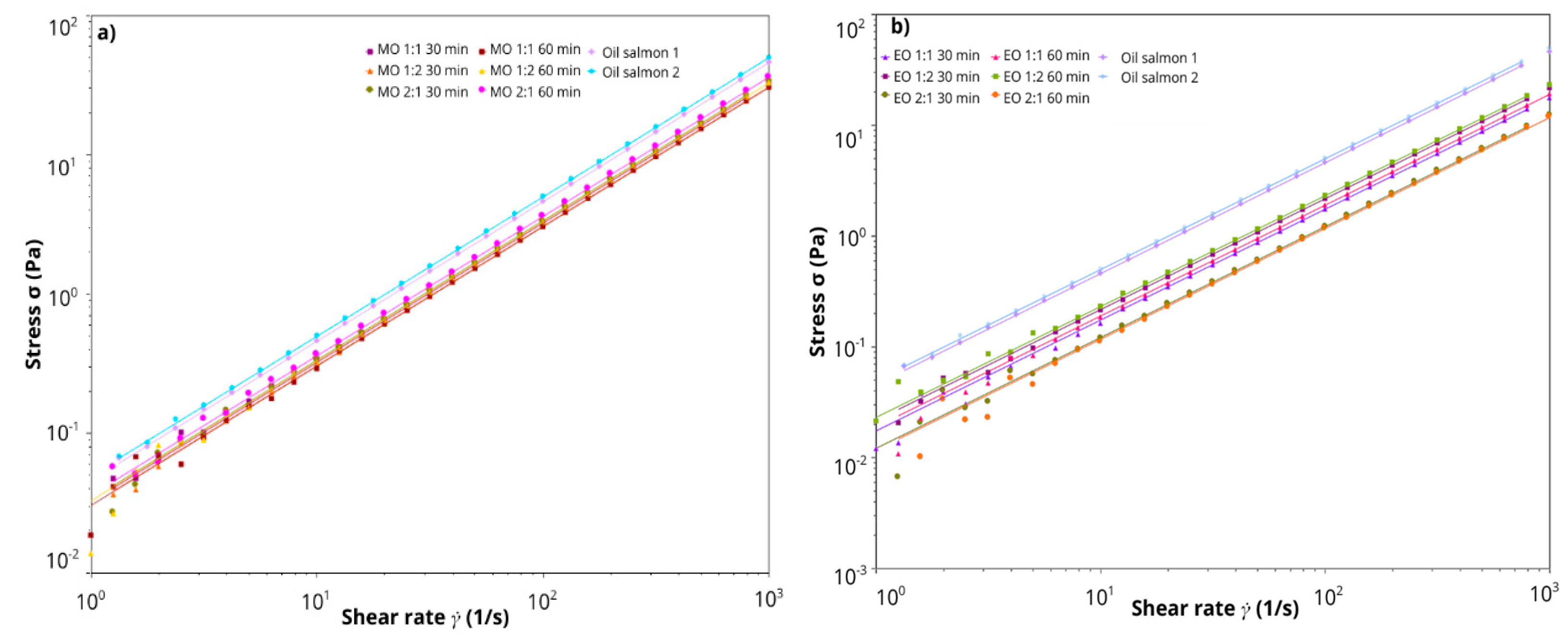
Figure 2.
Viscosity at shear rate 10 s-1 expressed in Pa.s from HDES extracts of by-products Octopus maya. M: Menthol; E: Eucalyptol; O: Oleic acid. Molar ratio HBA:HBD. Values are expressed as mean ± standard deviation (SD, n = 2). Different letters indicate statistically significant differences (LSD, p < 0.05).
Figure 2.
Viscosity at shear rate 10 s-1 expressed in Pa.s from HDES extracts of by-products Octopus maya. M: Menthol; E: Eucalyptol; O: Oleic acid. Molar ratio HBA:HBD. Values are expressed as mean ± standard deviation (SD, n = 2). Different letters indicate statistically significant differences (LSD, p < 0.05).
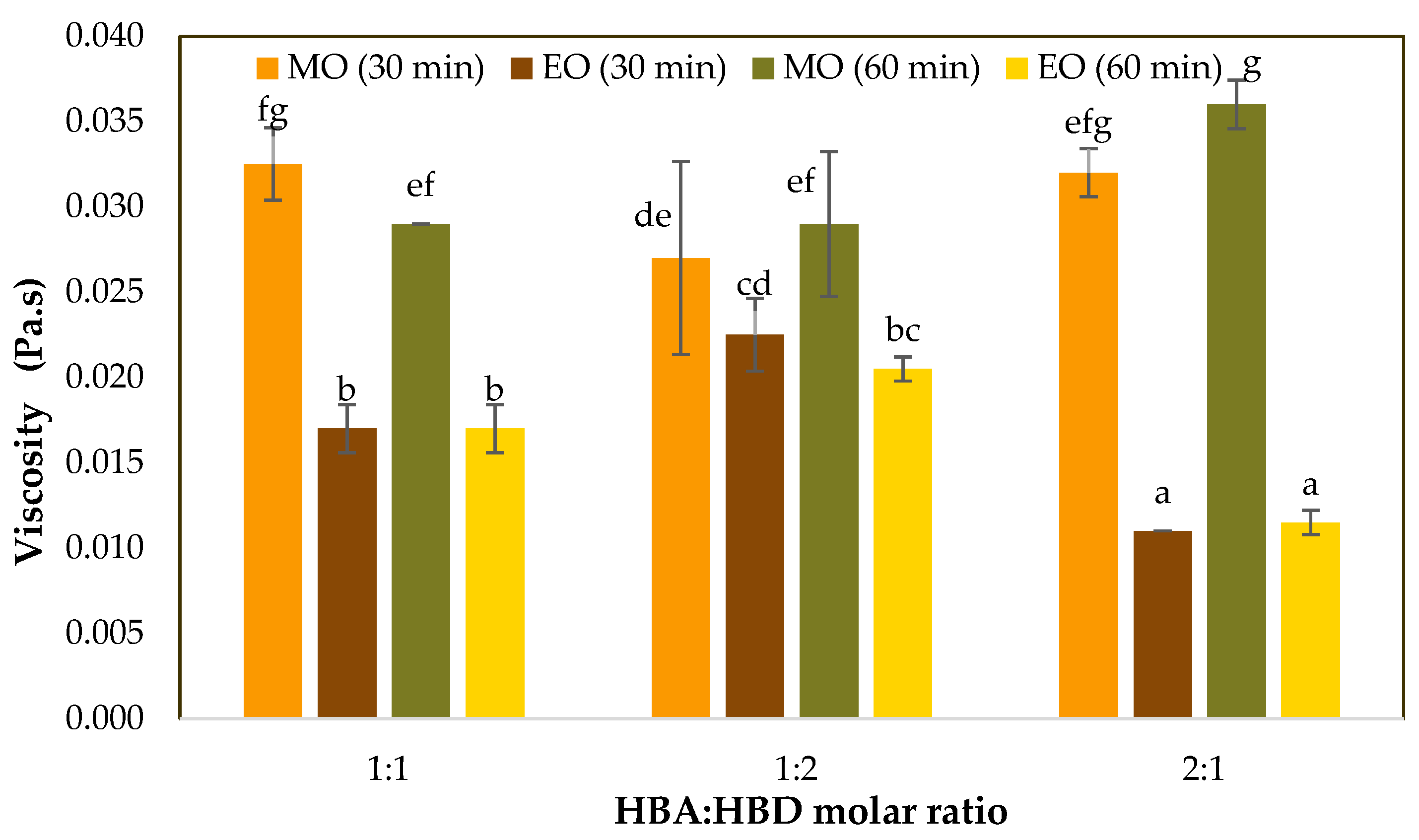
Figure 3.
Content ω-3 obtained in extracts of HDES of by-products Octopus maya evaluated by spectrophotometer UV-Vis and expressed in %. M= Menthol; E= Eucalyptol; O= oleic acid; in different HBA:HBD molar ratio. Values are expressed as mean ± standard deviation (SD, n = 2). Different letters indicate statistically significant differences (LSD, p < 0.05).
Figure 3.
Content ω-3 obtained in extracts of HDES of by-products Octopus maya evaluated by spectrophotometer UV-Vis and expressed in %. M= Menthol; E= Eucalyptol; O= oleic acid; in different HBA:HBD molar ratio. Values are expressed as mean ± standard deviation (SD, n = 2). Different letters indicate statistically significant differences (LSD, p < 0.05).
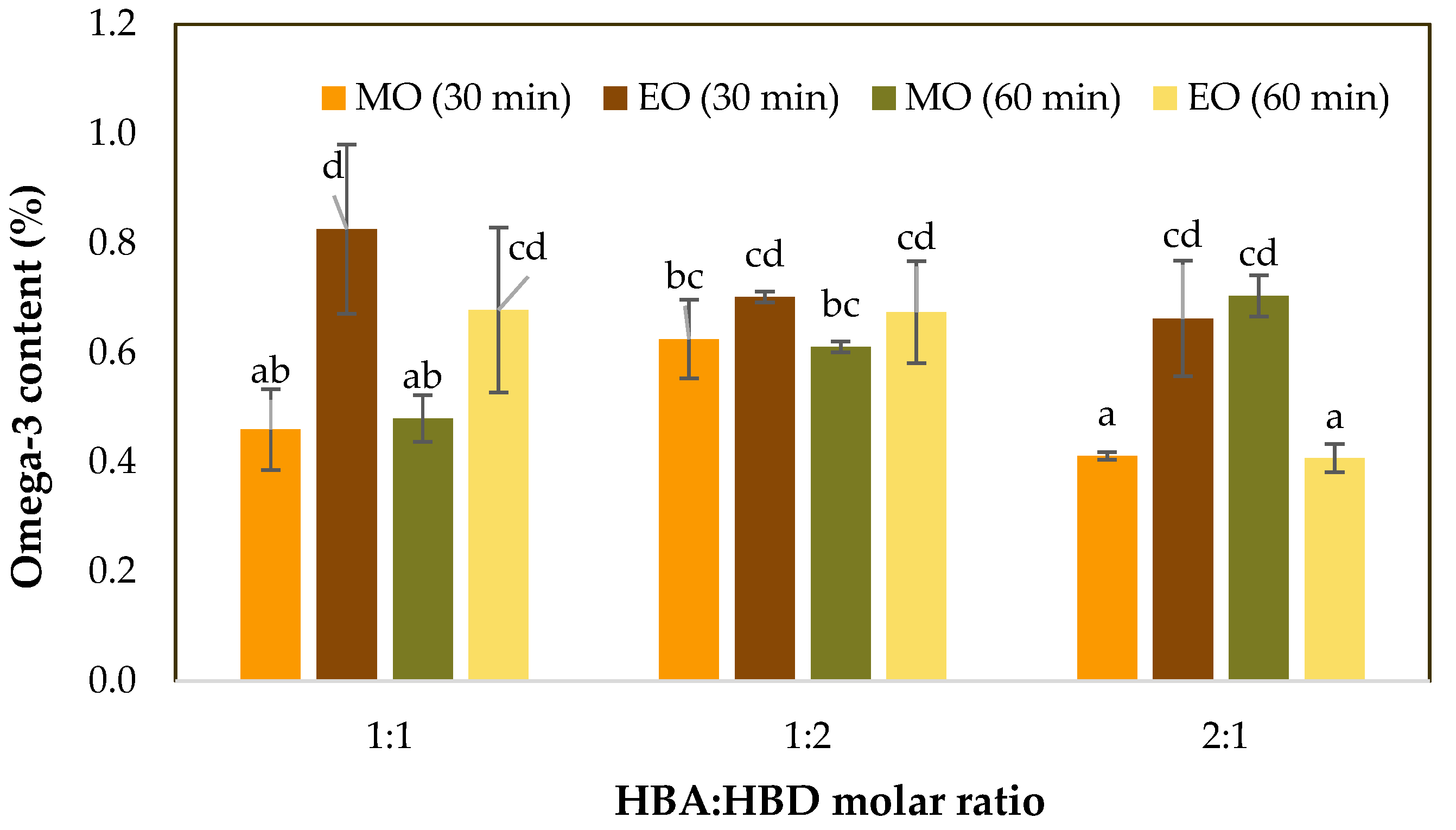
Figure 4.
FTIR spectra of 30 min HDES extracts with the highest ω-3 content, according to the UV–Vis spectrophotometric analysis. MO: menthol–oleic acid; EO: eucalyptol–oleic acid. The numbers shown at each peak correspond to the wavenumber at which the signal was observed.
Figure 4.
FTIR spectra of 30 min HDES extracts with the highest ω-3 content, according to the UV–Vis spectrophotometric analysis. MO: menthol–oleic acid; EO: eucalyptol–oleic acid. The numbers shown at each peak correspond to the wavenumber at which the signal was observed.
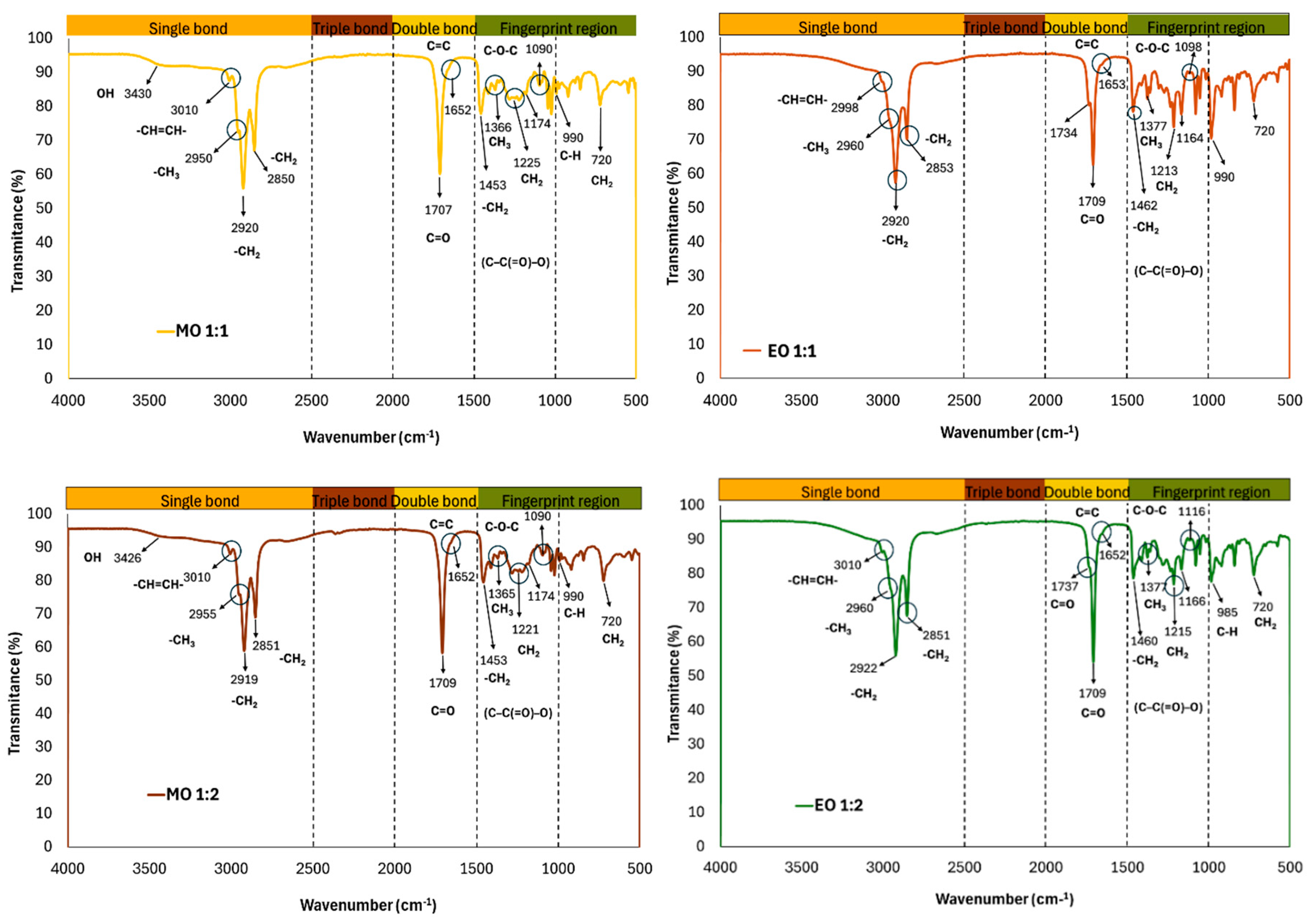
Figure 5.
Raman spectra of 30 min HDES extracts with the highest ω-3 content, as determined by UV–Vis spectrophotometric analysis. MO: menthol–oleic acid; EO: eucalyptol–oleic acid. The numbers shown on each peak indicate the corresponding Raman shift at which the vibrational bands were detected.
Figure 5.
Raman spectra of 30 min HDES extracts with the highest ω-3 content, as determined by UV–Vis spectrophotometric analysis. MO: menthol–oleic acid; EO: eucalyptol–oleic acid. The numbers shown on each peak indicate the corresponding Raman shift at which the vibrational bands were detected.
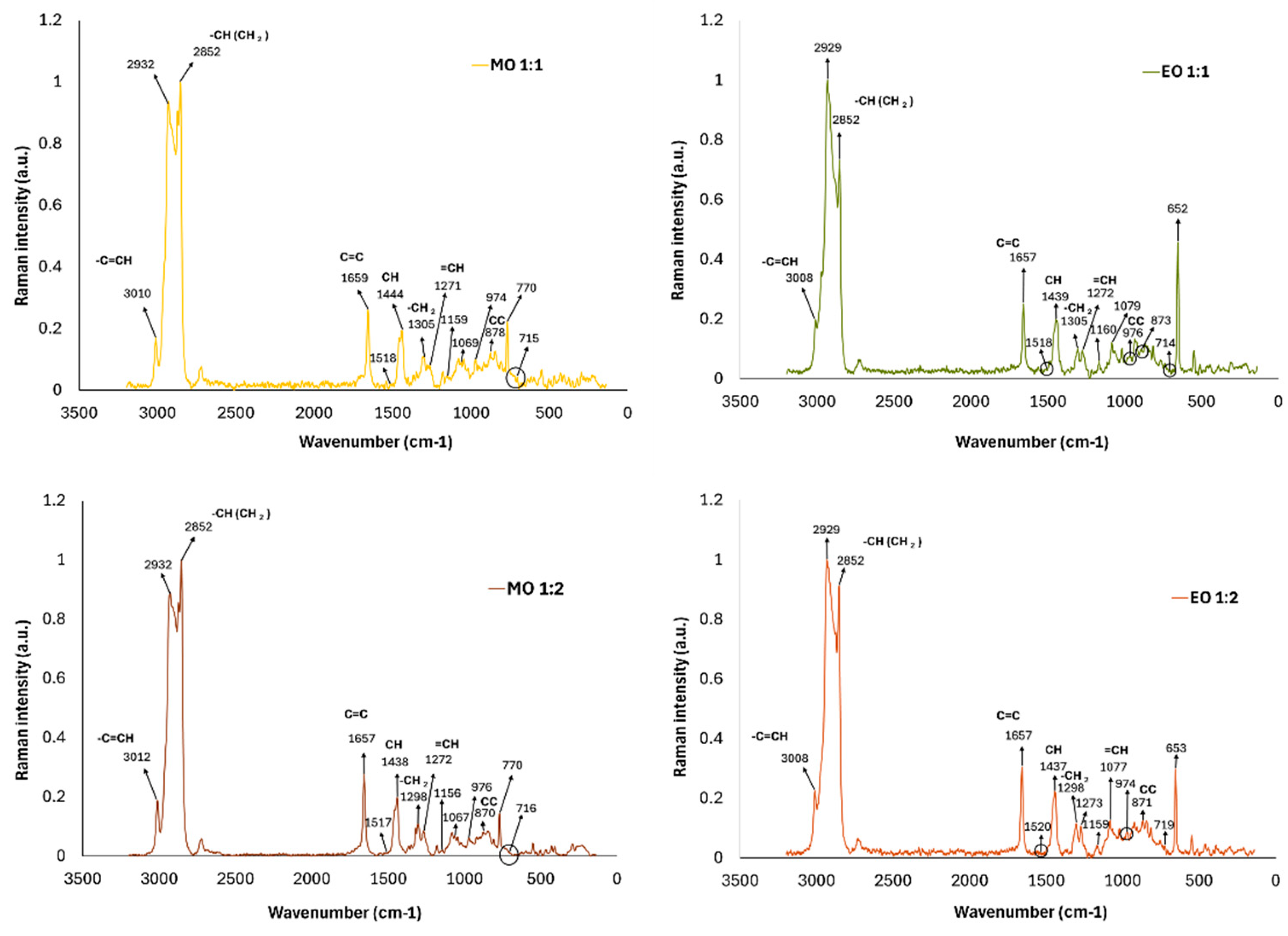
Figure 6.
Fatty acid profile expressed as percentage (%) in extracts of HDES of by-products Octopus maya and conventional method (ethanol). Values are reported as mean ± standard deviation (SD, n = 2). Different letters indicate statistically significant differences (LSD, p < 0.05) among each fatty acid group. Note: C16:0 (palmitic acid); C18:0 (stearic acid); C18:1 n-9 (oleic acid); C18:2 n-6 (linoleic acid); C18:3 n-3 (linolenic acid). MO: mentol-oleic acid; EO: eucalyptol-oleic acid; COE: Conventional Oil Extraction.
Figure 6.
Fatty acid profile expressed as percentage (%) in extracts of HDES of by-products Octopus maya and conventional method (ethanol). Values are reported as mean ± standard deviation (SD, n = 2). Different letters indicate statistically significant differences (LSD, p < 0.05) among each fatty acid group. Note: C16:0 (palmitic acid); C18:0 (stearic acid); C18:1 n-9 (oleic acid); C18:2 n-6 (linoleic acid); C18:3 n-3 (linolenic acid). MO: mentol-oleic acid; EO: eucalyptol-oleic acid; COE: Conventional Oil Extraction.
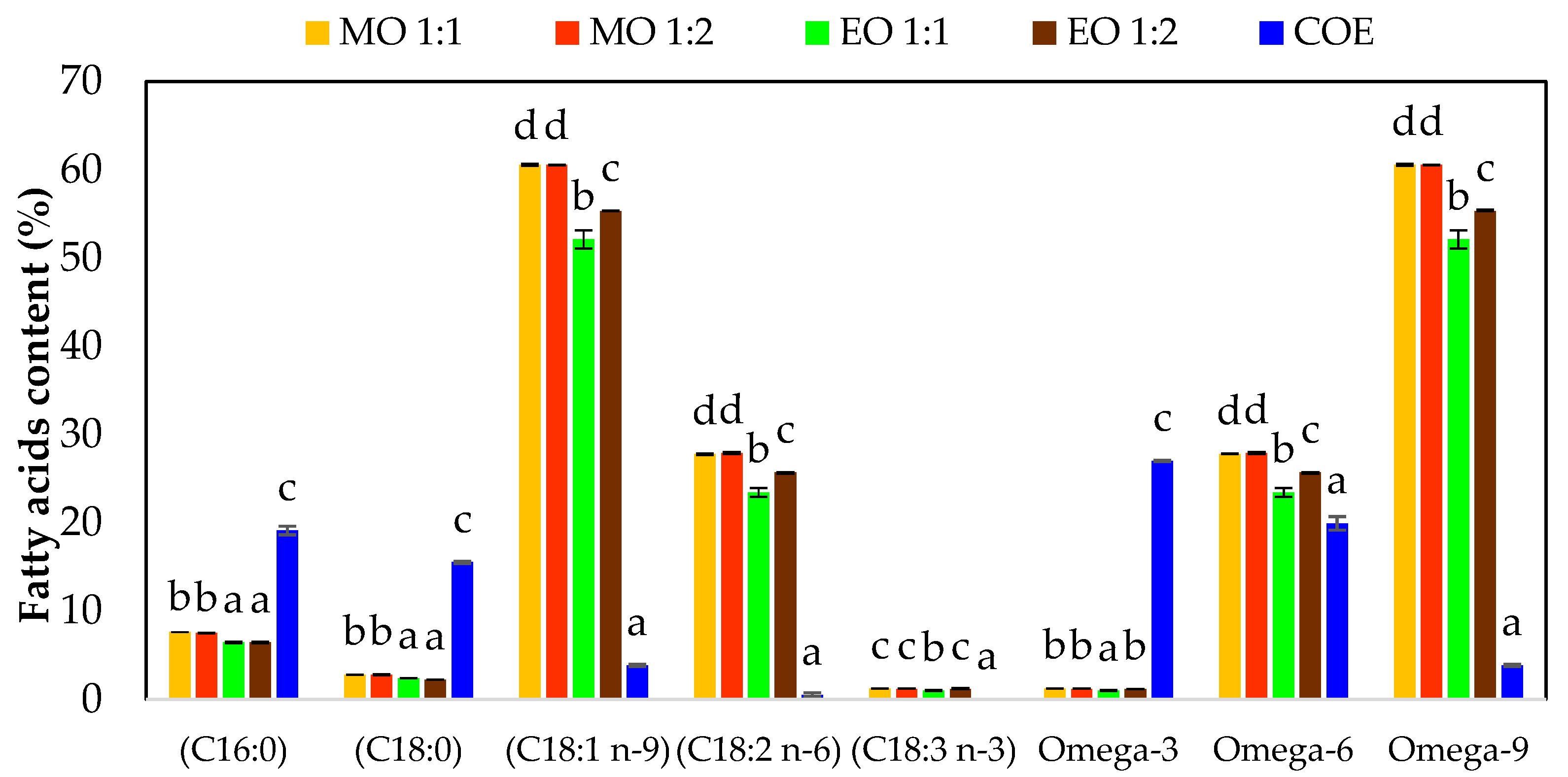
Table 1.
Proposed experimental design. Factors: hydrogen bond acceptor (HBA), molar ratios, and UAE extraction time, and response variables.
Table 1.
Proposed experimental design. Factors: hydrogen bond acceptor (HBA), molar ratios, and UAE extraction time, and response variables.
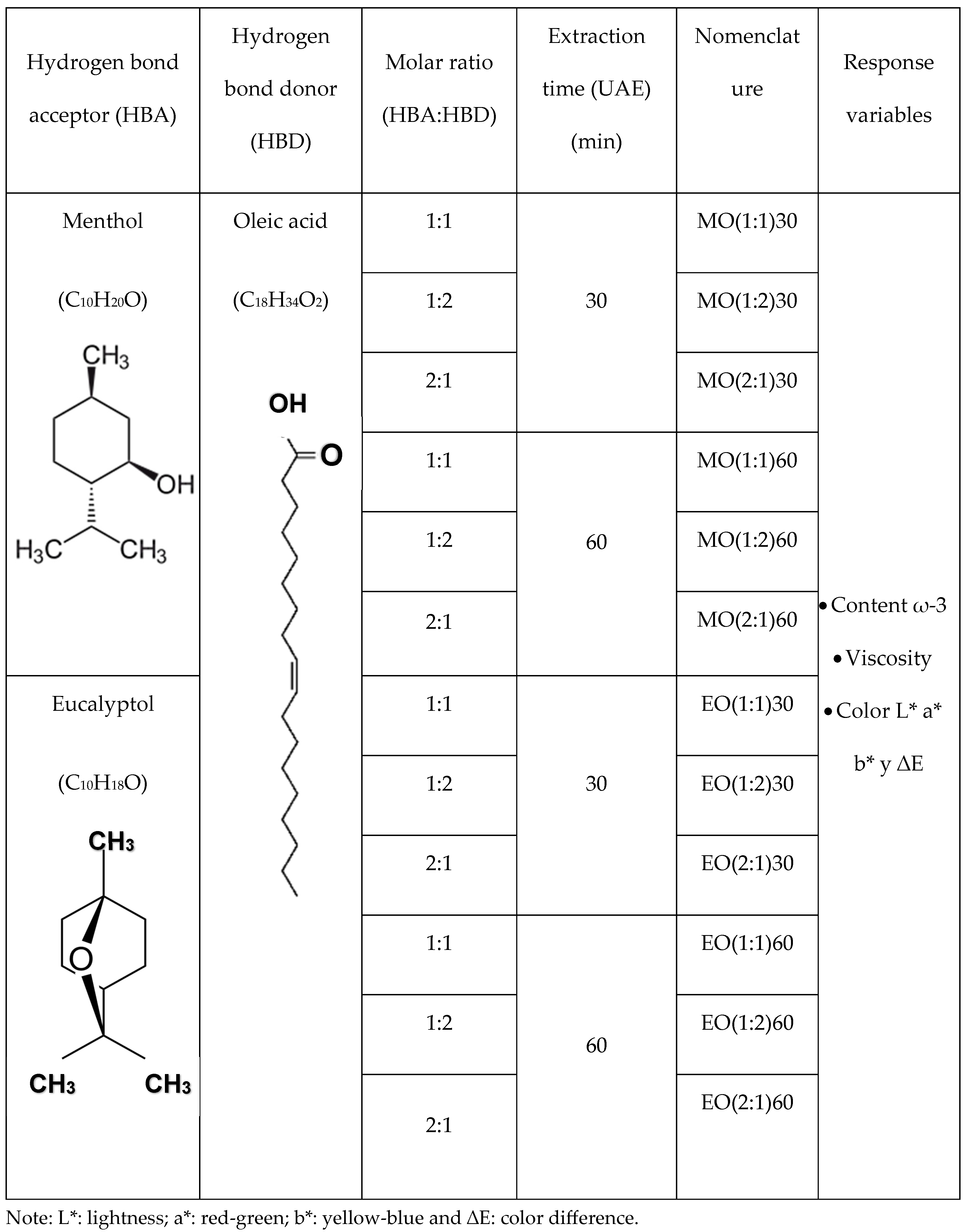 |
Table 2.
Color values of HDES extracts from Octopus maya by-products and pure HDES. Luminosity (L), a (green − / red +), and b* (blue − / yellow +) values are shown, along with a column of reference colors.
Table 2.
Color values of HDES extracts from Octopus maya by-products and pure HDES. Luminosity (L), a (green − / red +), and b* (blue − / yellow +) values are shown, along with a column of reference colors.
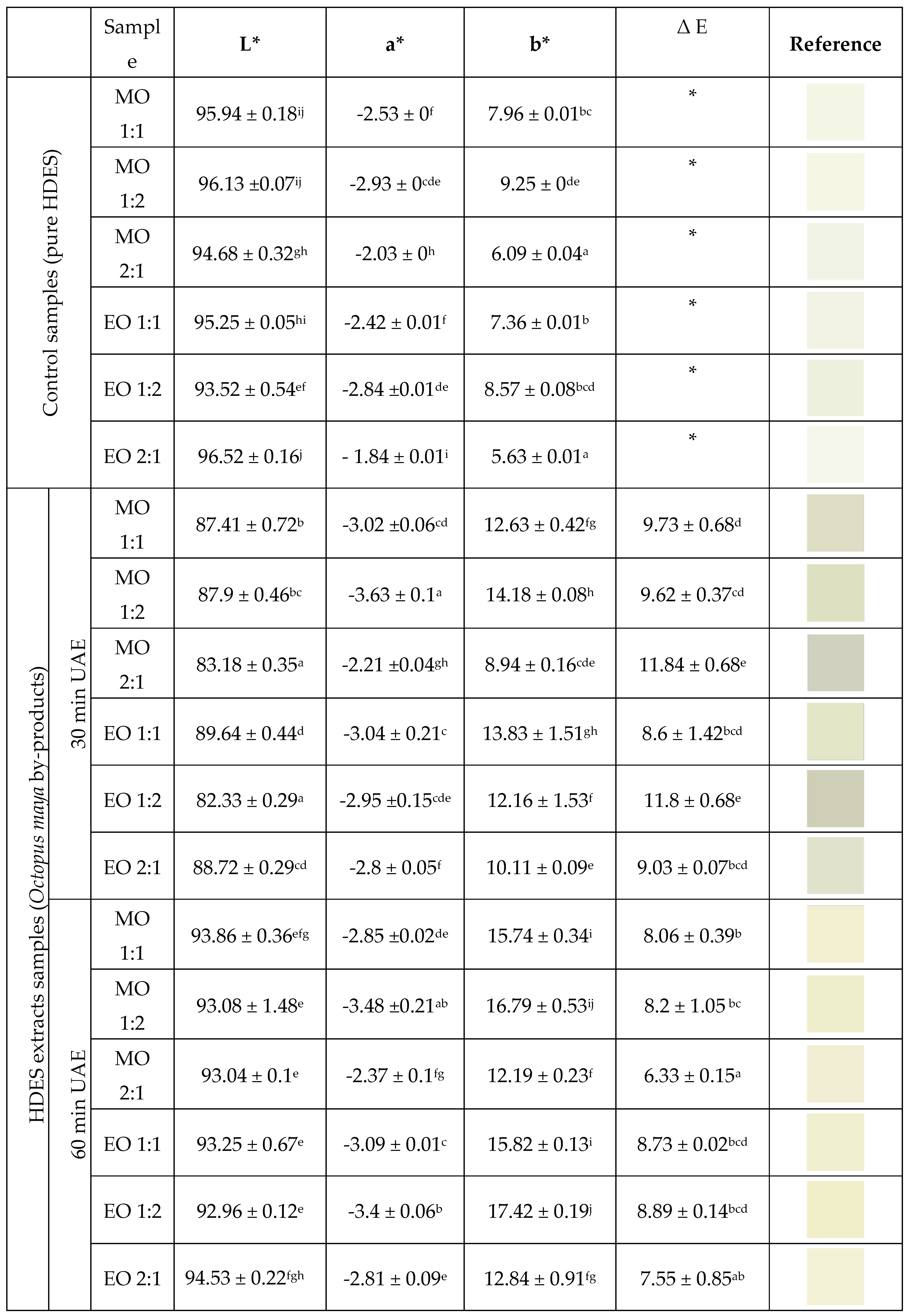 |
Note: Different letters in the same column indicate a significant statistical difference (LSD, p < 0.05); values are means ± SD (n=2). *Reference value. Colors were obtained using an online color converter https://www.e-paint.co.uk/convert-lab.asp. The color differences observed among HDES extracts could be associated with variations in their chemical composition and solvent–solute interactions. Changes in the L*, a*, and b* parameters may reflect the selective extraction of lipophilic compounds and the presence of unsaturated fatty acids. Additionally, the development of yellowish tones might be related to the formation of oxidation products, which is commonly observed in lipid systems rich in polyunsaturated fatty acids.
Table 4.
Effect on the fatty acids group of the hydrogen bond acceptor (HBA), molar ratio (MR) and their double interactions (HBA x MR) at a 95% confidence level (p<0.05).
Table 4.
Effect on the fatty acids group of the hydrogen bond acceptor (HBA), molar ratio (MR) and their double interactions (HBA x MR) at a 95% confidence level (p<0.05).
| Response Variables | P value | ||
| Individual factors | Double interactions | ||
| HBA | MR | HBA x MR | |
| C16:0 | <0.001 | 0.444 | 0.444 |
| C18:0 | <0.001 | 0.034 | 0.092 |
| C18:1 n-9 | <0.001 | 0.012 | 0.012 |
| C18:2 n-6 | <0.001 | 0.003 | 0.005 |
| C18:3 n-3 | 0.005 | 0.050 | 0.028 |
| ω – 3 | 0.005 | 0.050 | 0.028 |
| ω – 6 | <0.001 | 0.003 | 0.005 |
| ω – 9 | <0.001 | 0.012 | 0.012 |
Note: Statistically significant effects (p < 0.05) are shown in bold.
Disclaimer/Publisher’s Note: The statements, opinions and data contained in all publications are solely those of the individual author(s) and contributor(s) and not of MDPI and/or the editor(s). MDPI and/or the editor(s) disclaim responsibility for any injury to people or property resulting from any ideas, methods, instructions or products referred to in the content. |
© 2026 by the authors. Licensee MDPI, Basel, Switzerland. This article is an open access article distributed under the terms and conditions of the Creative Commons Attribution (CC BY) license (http://creativecommons.org/licenses/by/4.0/).
Copyright: This open access article is published under a Creative Commons CC BY 4.0 license, which permit the free download, distribution, and reuse, provided that the author and preprint are cited in any reuse.


