

Submitted:
18 March 2026
Posted:
23 March 2026
You are already at the latest version
Abstract
Forests are increasingly exposed to interacting biotic and abiotic stressors, including invasive insects, emerging pathogens, and climate-driven disturbances. Understanding how trees resist or tolerate these stressors is therefore essential for sustaining forest health and ecosystem services. This review synthesizes current knowledge on forest resistance to insects and pathogens, revisiting classical concepts of resistance, tolerance, and resilience and examining how they operate under contemporary environmental change. We integrate insights from plant–insect–pathogen interactions, phenological dynamics, and multitrophic ecological processes to develop a conceptual framework describing how host traits, environmental conditions, and biotic antagonists jointly determine resistance outcomes. European ash (Fraxinus excelsior) is used as a model system to illustrate these processes in the context of two major invasive threats: ash dieback caused by Hymenoscyphus fraxineus and the emerald ash borer (Agrilus planipennis). Evidence from genetic, physiological, and chemical studies indicates that resistance in ash is polygenic and often expressed as reduced susceptibility or tolerance rather than complete immunity. Recent findings further suggest the existence of cross-resistance mechanisms that may simultaneously influence responses to fungal pathogens and insect pests. Climate change, environmental stress, and host-associated microbiomes may further modify these interactions and shape long-term resistance dynamics. Finally, we discuss implications for resistance breeding and adaptive forest management, emphasizing the importance of maintaining genetic diversity and ecosystem heterogeneity to enhance forest resilience under accelerating global change.
Keywords:
forest health
; host resistance
; tree tolerance
; phenological synchrony
; plant–herbivore interactions
; habitat preferences
1. Introduction
Forests occupy approximately 32% of the Earth’s land surface and provide essential ecosystem services, including carbon sequestration, biodiversity conservation, climate regulation, and the provision of timber and non-timber resources [1]. Maintaining forest health under accelerating global change has become one of the central challenges in forest science and management. Among the multiple stressors affecting forests, insects and pathogens play a particularly important role, as their impacts are often amplified by climate change, altered disturbance regimes, and increasing biological invasions [2].
The concepts of forest resistance, tolerance, and resilience have long been used to describe how trees and forest ecosystems respond to biotic stressors. Classical frameworks, such as Manion’s decline model [3] and Painter’s resistance categories [4], have provided a foundation for understanding host–pest interactions by distinguishing predisposing, inciting, and contributing factors, as well as mechanisms such as antixenosis, antibiosis, tolerance, and phenological escape. However, these concepts were largely developed in the context of relatively stable climatic conditions and long co-evolutionary histories between trees and their associated insects and pathogens [5].
In recent decades, the rapid spread of invasive pests and pathogens has challenged the applicability of traditional resistance frameworks [2]. Non-native organisms frequently bypass established host defences, interact with native stressors, and generate novel multi-stressor scenarios. At the same time, climate change modifies phenology, host physiology, and defence allocation, often disrupting synchrony across trophic levels [2]. As a result, resistance in long-lived forest trees is increasingly expressed not as complete immunity but as reduced susceptibility, delayed damage progression, or enhanced survival under sustained pressure [6]. Understanding these more subtle and dynamic expressions of resistance is critical for predicting forest trajectories and informing adaptive management [7].
European ash (Fraxinus excelsior L. (Oleaceae)) represents one of the most informative model systems for examining forest resistance to biotic stressors under contemporary conditions. Throughout Europe, ash populations have been severely affected by ash dieback (ADB), caused by the invasive fungus Hymenoscyphus fraxineus (T. Kowalski) Baral, Queloz & Hosoya (Helotiaceae, Leotiomycetidae) [8]. Despite widespread mortality, long-term observations consistently reveal a small proportion of trees that remain healthy or only weakly affected, indicating the presence of heritable, polygenic resistance [8]. More recently, the westward spread of the emerald ash borer (EAB), (Agrilus planipennis Fairmaire, 1888 (Coleoptera: Buprestidae)) has introduced an additional and unprecedented stressor to European ash, raising concerns about cumulative impacts and potential collapse of recovering populations. So far, nobody knows whether, and to what extent, European ash is resistant/tolerant to EAB and ADB invasions over the long term [9,10,11].
The ash system offers a unique opportunity to integrate classical resistance theory with emerging insights from genomics, metabolomics, microbiome research, and invasion biology. Evidence now suggests that resistance to ash dieback may be linked to cross-resistance against emerald ash borer, mediated by constitutive and induced defense traits in phloem tissues. At the same time, environmental context, host-associated microbial communities, and climate-driven stress interactions appear to modulate resistance outcomes, emphasizing the need for a systems-level perspective.
This review aims to critically synthesize current knowledge on forest resistance to insects and pathogens, with a particular focus on how classical concepts apply under conditions of invasive species pressure and climate change. Using European ash as a central case study, we (i) revisit established theoretical frameworks of resistance and tolerance, (ii) examine mechanistic evidence from tree–insect–pathogen interactions, and (iii) discuss implications for resistance breeding, forest management, and conservation. By linking theory with empirical evidence from one of Europe’s most intensively studied forest decline systems, this review seeks to clarify how forest resistance can be understood and applied in a rapidly changing world.
Forest resistance to insects and pathogens emerges from complex interactions among host genetic traits, biotic stressors, and environmental conditions. Using European ash (Fraxinus excelsior) as a model system, this review synthesizes classical resistance concepts together with recent insights from studies of ash dieback (Hymenoscyphus fraxineus) and emerald ash borer (Agrilus planipennis). The conceptual framework highlights how host genotype, phenology, defense mechanisms, climate stress, and microbiome interactions jointly shape outcomes ranging from susceptibility to tolerance and survival. Understanding these integrated processes is essential for developing resistance breeding and adaptive forest management strategies under climate change.
2. Materials and Methods
A structured literature review was conducted to synthesize current knowledge on forest resistance to insects and pathogens, with particular attention to mechanisms of tree defence, host–pest interactions, and resistance in European ash (Fraxinus excelsior). Scientific publications were identified through systematic searches in the databases Web of Science, Scopus, and Google Scholar.
Searches were performed using combinations of the following keywords: forest resilience, tree resistance, tree defence, plant tolerance, herbivory, plant–insect interactions, forest pathogens, ash dieback, Hymenoscyphus fraxineus, emerald ash borer, and Agrilus planipennis. Additional relevant publications were identified through reference lists of key articles and reviews.
The review primarily included peer-reviewed journal articles, review papers, and selected book chapters addressing mechanisms of tree resistance, insect–plant interactions, forest pathology, and resistance breeding in forest trees. Priority was given to publications written in English and published during the last decade, although earlier foundational studies describing key theoretical concepts (e.g., classical resistance frameworks and forest health models) were also included when relevant.
The collected literature was evaluated to identify major conceptual frameworks, mechanisms of resistance and tolerance, and emerging research directions. Particular emphasis was placed on studies addressing interactions between invasive pests and pathogens, climate-related stressors, and host genetic variation, which together form the basis of the conceptual synthesis presented in this review.
3. Results
3.1. Forest Resistance, Tolerance, and Resilience
Forest ecosystems are shaped by continuous exposure to biotic and abiotic stressors, and their persistence depends on the capacity to resist disturbance, tolerate damage, and recover functionality. Resilience is commonly understood as an integrative property encompassing resistance (the ability to withstand disturbance with minimal change), tolerance (the capacity to sustain damage while maintaining growth or survival), and recovery (the speed and trajectory of post-disturbance regeneration). While these components are conceptually distinct, they often overlap in long-lived forest trees, where responses to stress unfold over decades [12].
Structural and compositional complexity, including species diversity, age heterogeneity, and vertical stratification, enhances forest resilience by stabilizing ecosystem processes and buffering against environmental fluctuations. At the individual tree level, resistance and tolerance are influenced by genotype, physiological status, and environmental context, including soil properties, water availability, and stand structure. These factors collectively determine whether stress exposure results in transient damage, chronic decline, or mortality [13].
Importantly, in modern forest landscapes affected by climate change and biological invasions, resistance rarely manifests as complete avoidance of damage. Instead, survival often depends on partial resistance or tolerance mechanisms that slow disease progression, reduce pest performance, or allow trees to compensate for tissue loss [14].
3.2. Forest Health and Decline: Revisiting Manion’s Framework
Manion’s forest decline model provides a useful conceptual structure for understanding how multiple stressors interact to influence forest health. The model distinguishes among predisposing factors (e.g., climate, site conditions, host genotype), inciting factors (acute abiotic or biotic stress events), and contributing factors (secondary pests and pathogens that accelerate decline). This framework remains highly relevant for interpreting contemporary forest disturbances, particularly those involving interactions between drought stress, insect outbreaks, and pathogenic fungi [3].
Under rapid climate change, however, the boundaries between these categories have become increasingly blurred. Abiotic stressors such as drought not only predispose trees to attack but may also directly impair defense mechanisms, while invasive insects and pathogens can simultaneously act as inciting and contributing factors. As a result, forest decline is often driven by feedback loops rather than linear cause–and–effect chains. Understanding resistance, therefore, requires integrating physiological stress responses with ecological interactions across multiple trophic levels. [13,15].
3.3. Mechanisms of Plant Resistance: From Painter’s Categories to Forest Trees
Painter’s classification of plant resistance mechanisms—antixenosis, antibiosis, and tolerance—has been widely applied in crop protection and remains conceptually valuable for forest systems. Antixenosis refers to traits that deter pest colonization or feeding, antibiosis involves direct negative effects on pest survival or development, and tolerance describes the ability of plants to withstand damage with limited fitness consequences [4,11,14].
In forest trees, tolerance often plays a disproportionately important role due to their long lifespan and capacity for compensatory growth. Even severe defoliation or partial cambial damage may not result in immediate mortality, particularly in deciduous species. However, tolerance is not cost-free and may involve trade-offs with growth, reproduction, or resistance to other stressors.
In addition to these classical mechanisms, “phenological escape” represents an important form of ecological resistance, whereby asynchrony between vulnerable plant stages and damaging insect life stages reduces herbivory or infection. This mechanism is highly sensitive to climatic conditions and may either enhance or erode resistance depending on how climate change alters developmental timing in hosts and antagonists [5,11].
3.4. Phenology, Climate Change, and Shifting Resistance Outcomes
Phenological synchrony between trees and their herbivores or pathogens strongly influences resistance outcomes. The timing of budburst, leaf expansion, and tissue maturation affects both resource quality and the expression of defensive compounds [16]. Small shifts in phenology can therefore determine whether insect larvae encounter nutrient-rich, weakly defended tissues or tougher, chemically defended ones.
Climate change has altered phenological patterns across Europe, often advancing spring development in trees and insects at different rates. In some systems, this has reduced outbreak risk by increasing phenological mismatch, while in others it has enhanced pest performance. These contrasting outcomes highlight that phenological resistance is context-dependent and cannot be generalized across regions or species [16,17]. As climate variability increases, resistance based on timing alone may become less reliable, reinforcing the importance of constitutive and inducible defenses [17].
3.5. Mutual Adaptations and Multitrophic Interactions
Plants and phytophagous insects have co-evolved for millions of years, resulting in a dynamic balance between plant defense strategies and insect counter-adaptations. Tree defenses include physical barriers (e.g., bark structure, sclerenchyma cells), chemical defenses (e.g., terpenoids, phenolics), and both constitutive and inducible responses. Induced defenses, such as traumatic resin duct formation or hypersensitive reactions, allow trees to allocate resources efficiently in response to attack but may be constrained under chronic stress [18,19].
Insects employ a range of extrinsic and intrinsic strategies to overcome these defenses, including selective host choice, detoxification, sequestration of plant compounds, and associations with microbial symbionts. Bark beetle–fungus complexes exemplify how insects can exploit microbial partners to weaken host defenses and facilitate colonization [20].
Beyond direct plant–insect interactions, tritrophic relationships play a critical role in forest resistance. Trees can indirectly defend themselves by attracting natural enemies of herbivores through the emission of volatile organic compounds or the production of extrafloral nectar. While such interactions can reduce herbivore pressure, their effectiveness depends on ecological context and may be disrupted by habitat simplification or climate change.
4. European Ash as a Model System for Forest Resistance to Insects and Pathogens
European ash (Fraxinus excelsior L.) provides a uniquely informative model for examining forest resistance to biotic stressors under contemporary environmental change. Unlike many classical forest–pest systems shaped by long-term coevolution, ash populations in Europe are currently exposed to two invasive species – the fungal pathogen Hymenoscyphus fraxineus, causing ash dieback (ADB), and the emerald ash borer (Agrilus planipennis, EAB). This combination allows evaluation of resistance mechanisms under conditions of novel host–enemy interactions, cumulative stress, and climate-driven modification of defense expression.
Crucially, the ash case study illustrates that resistance in long-lived forest trees rarely manifests as complete immunity. Instead, survival is typically associated with reduced susceptibility, delayed disease progression, or enhanced tolerance, consistent with the broader resistance frameworks discussed in Section 3.
4.1. Molecular, Chemical, and Anatomical Mechanisms of Resistance to ADB
Since the onset of the ash dieback epidemic, extensive monitoring across Europe has consistently identified a small but persistent fraction of ash trees that remain healthy or only weakly affected despite prolonged exposure to high pathogen pressure. The frequency of such trees is generally estimated at 1–5%, although local values may be higher. These observations provide compelling evidence that natural resistance and tolerance to ADB exist within European ash populations [10,12,22,23].
Resistance to Hymenoscyphus fraxineus is heritable and polygenic, involving multiple traits rather than single major resistance genes. This aligns with expectations for long-lived forest trees, where durable resistance is more likely to emerge from quantitative trait variation than from complete pathogen exclusion. Phenological traits, stem and bark defence responses, and variation in secondary metabolites all contribute to reduced disease severity. Importantly, resistance is often expressed as shorter lesion lengths, slower pathogen spread, and prolonged crown vitality rather than complete absence of infection, highlighting the central role of tolerance mechanisms [24,25].
Recent advances in genomics and transcriptomics have substantially improved the understanding of the mechanistic basis of ADB resistance. Genome-wide association studies and transcriptomic analyses have identified candidate genes linked to pathogen recognition, signal transduction, cell wall modification, and defence regulation, supporting the view that resistance is governed by complex regulatory networks rather than single defence pathways. For example, Stocks et al. (2019) [10] investigated the genomic basis of resistance to ash dieback using genome-wide association analysis of more than 1,200 European ash trees from multiple populations. The study identified thousands of SNPs associated with variation in disease damage, including candidate genes involved in pathogen recognition, defence signalling, ubiquitination processes, and stress responses. Several loci were linked to genes previously associated with plant immunity, such as resistance (R) genes and regulators of salicylic acid signalling pathways. Genomic prediction models based on these markers were able to predict tree health status with relatively high accuracy, demonstrating that resistance to ash dieback is a polygenic trait. These findings suggest that natural selection and genomic-assisted breeding approaches could facilitate the development of ash populations with increased resistance to the disease [10].
At the chemical level, metabolomic studies have revealed that variation in secondary metabolites, particularly phenolic compounds and iridoid glycosides, is associated with disease outcomes [26]. Interestingly, lower concentrations of certain iridoid glycosides have been correlated with increased resistance, suggesting trade-offs among defence strategies and potential allocation conflicts between chemical defence, growth, and tolerance. Such trade-offs are a recurring theme in forest resistance and emphasize that higher concentrations of defence compounds do not necessarily translate into greater resistance [26].
Recent metabolomic analyses have also revealed important differences in constitutive chemical defences among Fraxinus species with varying susceptibility to ash dieback. Using untargeted metabolite profiling of phloem and leaf tissues, Tolio et al. (2026) identified numerous secondary metabolites associated with resistance to H. fraxineus, particularly flavonoids and coumarins [27]. Compounds such as quercitrin and fraxetin showed clear variation among susceptible and tolerant European ash genotypes as well as Asian ash species that co-evolved with the pathogen. These metabolites were especially differentiated in phloem tissue, suggesting that the chemical composition of this tissue may play an important role in limiting pathogen colonization. The study highlights metabolomics as a promising approach for identifying biochemical markers of resistance that could support screening and breeding programmes in ash.
Anatomical traits, particularly those associated with bark and phloem tissues, also contribute to resistance. The capacity to limit lesion expansion following stem inoculation correlates with crown condition in the field, reinforcing the importance of stem-level defences in a disease that ultimately leads to crown dieback. Together, these findings demonstrate that resistance to ash dieback emerges from coordinated molecular, chemical, and anatomical responses operating across multiple levels of biological organization [26,27,28].
These patterns are consistent with Manion’s forest decline framework, in which pathogen pressure interacts with host genotype and environmental conditions. Trees possessing favourable defence traits may withstand infection for extended periods, thereby avoiding the transition from inciting to contributing factors of decline [28,29].
4.2. Resistance of Ash to Emerald Ash Borer
In contrast to ash dieback, European ash lacks a shared evolutionary history with the EAB, raising concerns about potentially high susceptibility. However, comparative studies among ash species indicate that resistance to wood-boring insects is mediated by a combination of constitutive phloem chemistry, inducible defence responses, and anatomical traits that constrain larval development [30].
Genome-wide analyses have further revealed that tolerance to EAB in ash is associated with numerous loci linked to defence signalling and secondary metabolism pathways, supporting the view that resistance to wood-boring insects is polygenic rather than controlled by single genes [30]. Genome-scale comparisons across the genus Fraxinus also indicate that resistance to EAB has evolved convergently in multiple lineages and involves genes related to phenylpropanoid metabolism, defence signalling, and programmed cell death pathways [11].
Although large-scale field data on EAB impacts in Fraxinus species remain limited, experimental studies suggest that intraspecific variation in resistance does exist. Larval performance differs among ash genotypes, indicating that European ash populations may harbour traits conferring partial resistance or tolerance. These traits likely involve variation in phloem phenolic profiles, defence-related proteins, and inducible responses activated during larval feeding.
Advances in genomic resources are further improving our ability to identify resistance mechanisms in ash. Huff et al. (2022) developed a high-quality reference genome for green ash (Fraxinus pennsylvanica Marsh.), a North American species severely affected by EAB. The chromosome-scale genome assembly and extensive gene annotation provide valuable tools for studying genetic diversity, adaptive traits, and host defence pathways. Such genomic resources facilitate genome-wide association studies and genomic selection approaches aimed at identifying resistant genotypes and supporting restoration programmes for threatened ash populations [32].
Studies of ash–EAB interactions indicate that both constitutive and inducible defence mechanisms contribute to host resistance. Comparative proteomic analyses have shown that resistant Asian ash species possess higher baseline levels of defence-related proteins associated with oxidative stress responses and phenolic metabolism [33]. In addition, experimental activation of jasmonate signalling increases phenolic concentrations in ash phloem and significantly reduces emerald ash borer larval survival and growth, demonstrating the importance of inducible defence pathways in host resistance [34].
Experimental infestation studies further demonstrate that European ash can support EAB development but typically exhibits lower larval performance than highly susceptible North American ash species, suggesting intermediate resistance and potential variation among genotypes [35]. Together, these findings demonstrate that resistance to EAB involves a combination of constitutive biochemical defences, inducible chemical responses, and species-specific defence traits that influence insect performance and host susceptibility.
Progress in understanding resistance mechanisms to EAB highlights the importance of multiple interacting defence traits operating at physiological, biochemical, and ecological levels. Comparative studies indicate that resistant Asian ash species possess a suite of constitutive and inducible defence mechanisms that limit larval establishment and development, including higher levels of phenolic compounds, rapid wound responses, and enhanced oxidative defence systems. These traits likely evolved through long-term co-evolution between Asian ash species and the beetle in its native range, whereas North American and European ash species lack many of these adaptations and are therefore more susceptible. However, variation in defence traits within susceptible species suggests that resistance could be enhanced through the selection of tolerant genotypes. Recent experimental work further demonstrates that European ash genotypes with increased tolerance to ash dieback can also exhibit reduced emerald ash borer performance, providing evidence for shared defence mechanisms and potential cross-resistance between fungal pathogens and insect herbivores [9,11,35,36].
4.3. Cross-Resistance and Shared Defence Pathways
One of the most significant recent insights emerging from the ash pathosystem is the demonstration of cross-resistance between ADB and EAB. Traditionally, plant resistance mechanisms have been considered relatively specialized, targeting specific pathogens or herbivores. However, increasing evidence suggests that some defence traits can operate across multiple types of antagonists. In ash, experimental studies have shown that genotypes displaying reduced susceptibility to Hymenoscyphus fraxineus also support lower larval performance of Agrilus planipennis, providing rare empirical evidence that resistance traits may function across taxonomic kingdoms, linking fungal pathogens and insect herbivores through shared defence mechanisms.
Mechanistically, cross-resistance appears to be mediated largely by constitutive differences in host chemistry and defence-related traits rather than by pathogen-induced responses alone. As discussed in previous sections, resistance to ash dieback involves complex molecular, chemical, and anatomical mechanisms, including variation in phenolic metabolites, defence-related proteins, and regulatory pathways controlling stress responses. Similarly, resistance to emerald ash borer is associated with constitutive phloem chemistry, inducible defence pathways such as jasmonate signalling, and structural traits that influence larval establishment and development. The overlap between these defence systems suggests that some biochemical traits, particularly those associated with phenylpropanoid metabolism and secondary metabolite production, may function as broad-spectrum defence factors capable of reducing susceptibility to multiple biotic stressors.
Experimental evidence supporting this hypothesis has recently been provided by Gosser et al. (2023), who investigated whether European ash genotypes resistant to ash dieback also exhibit resistance to emerald ash borer. These data provide direct evidence that defence mechanisms operating against fungal pathogens can also affect insect herbivores [9].
From a conceptual perspective, cross-resistance highlights the importance of integrated defence syndromes in long-lived forest trees. Rather than relying on narrowly specialized resistance mechanisms, trees may employ coordinated networks of molecular, biochemical, and anatomical defences that influence interactions with multiple stressors simultaneously. Such integrated defence systems are particularly important under current environmental conditions, where forests increasingly face combinations of invasive pathogens, insect outbreaks, and climate-related stress [9,11,36,37,38].
For resistance breeding and conservation strategies, these findings are highly consequential. Selection of genotypes resistant to ash dieback may simultaneously enhance resilience to emerald ash borer, potentially slowing population decline and increasing the likelihood of long-term recovery of ash populations. Recognizing and exploiting such cross-resistance mechanisms could therefore play an important role in developing integrated approaches to forest health management and restoration [39].
4.4. Climate Change, Microbiomes, and Multi-Stressor Interactions
Resistance to both ADB and EAB must be interpreted within the broader context of climate change and interacting stressors. Environmental factors such as drought, heat stress, and altered phenological patterns can weaken host defence expression and increase vulnerability to secondary pests and pathogens. As a result, trees that might otherwise tolerate infection or herbivory may transition to declining states when exposed to multiple stressors simultaneously. The interaction between abiotic stress, fungal infection, and insect infestation is therefore expected to intensify under future climatic scenarios.
Field observations already demonstrate that ash trees can experience overlapping pressure from both invasive pathogens and insect pests. In Eastern Europe (Ukraine), ash dieback and emerald ash borer infestations have been documented occurring simultaneously within the same stands and even on individual Fraxinus excelsior trees, illustrating how these two invasive agents can interact in natural forest ecosystems [40]. Such observations highlight the importance of studying host resistance in the context of multiple biotic threats rather than treating pathogens and insects as independent disturbances.
An emerging dimension of ash resistance involves host-associated microbial communities. Endophytic and epiphytic fungi may influence disease progression through competition, antagonism, or modulation of host defence pathways. Although this field remains relatively underexplored for ash, early evidence suggests that microbial community composition may differ between resistant and susceptible trees and could influence pathogen colonization dynamics [41,42]. Integrating microbiome analyses with host genomics, metabolomics, and ecological studies offers promising opportunities to identify functional resistance markers and to develop innovative strategies for enhancing tree resilience.
Recent research also emphasizes that resistance traits may depend on complex ecological contexts. For example, studies of ash decline in North America have highlighted the role of interacting stressors, including drought, stand structure, and pest pressure, in shaping host vulnerability and recovery potential [43]. Such findings reinforce the view that forest resistance should be interpreted as an emergent property of ecological systems rather than a fixed trait of individual trees.
4.5. Implications for Forest Resistance Theory
The European ash system provides an important model for understanding how forest resistance operates under conditions of biological invasion and environmental change. Evidence accumulated over the past decade demonstrates that resistance to invasive pathogens and insects is rarely absolute but instead reflects a continuum ranging from susceptibility to tolerance and partial resistance. In ash, this variation arises from complex interactions among genetic traits, defence chemistry, anatomical structures, and environmental conditions.
Recent genomic and experimental studies have significantly improved our understanding of resistance mechanisms in ash species. Genome-wide association studies have revealed that resistance to ash dieback in Fraxinus excelsior is controlled by numerous loci associated with pathogen recognition and defence signalling pathways [10]. Comparative genomic analyses across ash species further indicate that resistance traits may have evolved convergently and involve genes linked to phenylpropanoid metabolism and stress responses [11]. Advances in genomic resources, including high-quality reference genomes for ash species, now provide powerful tools for identifying resistance markers and supporting breeding programmes [32].
Importantly, recent experimental studies have demonstrated that defence mechanisms may operate across different types of antagonists. European ash genotypes exhibiting increased tolerance to ash dieback have been shown to support reduced performance of the emerald ash borer, indicating the presence of cross-resistance mediated by shared biochemical defence pathways and variation in phloem chemistry [9]. Together with field observations of overlapping pest and pathogen impacts, these findings suggest that trees may rely on integrated defence syndromes capable of influencing interactions with multiple biotic stressors.
Recent conceptual work further supports this interpretation by proposing that resilience in ash may depend on generalized defensive traits that provide protection against a broad spectrum of antagonists rather than highly specialized resistance mechanisms [9,11,28,44,45]. These traits may include constitutive secondary metabolite profiles, defence-related signalling pathways, and physiological responses that influence both pathogen colonization and insect herbivory. Such generalized defence strategies may allow long-lived forest trees to cope with multiple and often unpredictable stressors across their lifespan, particularly under rapidly changing environmental conditions (Table 1).
From a theoretical perspective, these findings challenge traditional views that resistance mechanisms are narrowly specialized against individual pathogens or herbivores. Instead, they highlight the importance of coordinated defence networks that operate across molecular, biochemical, and ecological levels. Such defence syndromes may represent an important adaptive strategy for forest trees that must withstand complex disturbance regimes involving interacting pests, pathogens, and climatic stress.
Understanding these integrated resistance mechanisms has important implications for forest management and conservation. Breeding programmes aimed at increasing resistance to ash dieback may simultaneously enhance resilience to emerald ash borer and other emerging stressors. Consequently, strategies that maintain genetic diversity, promote structural complexity in forest stands, and preserve naturally tolerant individuals will be critical for supporting the long-term persistence and recovery of ash populations.
5. Future Research Directions
Despite significant progress in understanding forest resistance to insects and pathogens, several important questions remain unresolved. Addressing these gaps will be essential for improving predictions of forest health dynamics and for developing effective resistance breeding and management strategies under changing climatic conditions.
Integrating multi-stressor interactions. Most studies still examine tree responses to individual pests or pathogens in isolation. Future research should increasingly focus on interactions among multiple biotic stressors and abiotic drivers, including drought, heat stress, and nutrient limitations. Understanding how these factors jointly influence host resistance, pest performance, and pathogen virulence will be crucial for predicting forest decline and resilience under climate change.
Mechanisms of cross-resistance. Recent evidence from European ash suggests that resistance to ash dieback may also reduce susceptibility to emerald ash borer. However, the physiological and genetic mechanisms underlying such cross-resistance remain poorly understood. Further research integrating metabolomics, transcriptomics, and controlled pest assays could reveal whether shared defence pathways provide broad-spectrum protection against multiple antagonists.
Role of host-associated microbiomes. Microbial communities associated with tree tissues, including endophytes and rhizosphere microorganisms, may influence disease resistance and stress tolerance. Future studies should investigate how these microbiomes interact with host defence systems and whether they contribute to resistance against invasive pests and pathogens.
Linking genetic resistance with environmental variability. Resistance traits identified in controlled experiments may perform differently under natural environmental conditions. Long-term field studies and multi-site trials are needed to evaluate genotype × environment interactions and to determine how climate variability influences the expression and durability of resistance traits.
Advances in genomic and predictive approaches. Emerging genomic tools, including genome-wide association studies and genomic prediction models, offer new opportunities to accelerate resistance breeding. Integrating these approaches with ecological and phenotypic data could improve the identification of candidate resistance traits and support the development of more resilient forest tree populations.
Integrating resistance breeding with adaptive forest management. Finally, future research should focus on how resistance breeding can be combined with silvicultural strategies that enhance ecosystem resilience, such as mixed-species stands, structural diversity, and the conservation of naturally resistant individuals. Such integrative approaches will be essential for sustaining forest ecosystems under accelerating environmental change..
6. Conclusions
Forest resistance to insects and pathogens is an emergent, context-dependent property arising from interactions among host traits, biotic antagonists, and environmental conditions. Classical concepts of resistance, tolerance, and resilience remain highly relevant, but their interpretation must be adapted to contemporary forest disturbance regimes characterized by climate change and the increasing spread of invasive pests and pathogens. As illustrated in Figure 1, resistance in long-lived forest trees rarely takes the form of complete immunity; instead, it is more commonly expressed as reduced susceptibility, delayed damage progression, or enhanced survival under sustained stress.
The European ash (Fraxinus excelsior) system exemplifies these dynamics and provides a powerful model for re-evaluating forest resistance theory. Despite extensive mortality caused by ash dieback, a small but persistent fraction of ash trees exhibits heritable, polygenic resistance or tolerance. The recent emergence of emerald ash borer as an additional stressor has revealed that some defence traits may confer cross-resistance to antagonists from different taxonomic groups, highlighting the importance of shared defence pathways and integrated resistance syndromes. These findings challenge traditional views of narrowly specialized resistance and emphasize the need to consider multitrophic interactions and trade-offs among defence mechanisms.
Climate change further complicates resistance outcomes by altering phenology, weakening defence expression under drought stress, and intensifying interactions among abiotic stressors, pathogens, and insect pests. Resistance based solely on phenological escape or single defence traits is therefore unlikely to remain reliable under future conditions. Instead, durable forest resistance will depend on maintaining genetic diversity, supporting quantitative resistance, and preserving ecological context at both tree and stand levels.
From an applied perspective, resistance breeding should be viewed as a long-term strategy to enhance adaptive capacity rather than as a short-term solution to specific threats. The European ash case demonstrates that selecting for polygenic resistance and tolerance can contribute to population persistence and may simultaneously reduce vulnerability to multiple stressors. However, breeding efforts must be integrated with adaptive forest management practices, including mixed-species and mixed-age stands, conservation of naturally resistant individuals, and management approaches that reduce chronic stress in forest ecosystems.
Finally, emerging research on host-associated microbiomes, metabolite-mediated defences, and gene–environment interactions offers promising opportunities for advancing our understanding of forest resistance. Integrating these approaches within a systems framework, as outlined in Figure 1, will be essential for developing effective conservation, breeding, and management strategies. In an era of accelerating global change, embracing the complexity of forest resistance is not a limitation but a prerequisite for sustaining forest health and resilience.
Author Contributions
Conceptualization, V.M. and K.D.; methodology, V.M.; formal analysis, V.M.; investigation, V.M., T.M., and K.D.; writing—original draft preparation, V.M.; writing—review and editing, V.M., T.M., and K.D.; supervision, K.D.; project administration, K.D. All authors have read and agreed to the published version of the manuscript.
Funding
Kateryna Davydenko was supported by the Swedish Research Council FORMAS, project no. 2023-01065; the Carl Tryggers Foundation, project no. CTS 23:2906 and the Swedish Foundation for Strategic Research, project no. UKR24-0013.
Data Availability Statement
The datasets generated during and/or analyzed during this study are available from the corresponding author upon reasonable request.
Conflicts of Interest
The authors declare no conflicts of interest.
References
- Myers, N. The world’s forests: problems and potentials. Environmental Conservation 1996, 23(2), 156–168. [Google Scholar] [CrossRef]
- Santini, A.; Ghelardini, L.; De Pace, C.; Desprez-Loustau, M. L.; Capretti, P.; Chandelier, A.; Stenlid, J. Biogeographical patterns and determinants of invasion by forest pathogens in Europe. New Phytologist 2013, 197(1), 238–250. [Google Scholar] [CrossRef] [PubMed]
- Manion, P.D. Decline as a phenomenon in forests: pathological and ecological considerations. In Effects of Atmospheric Pollutants on Forests, Wetlands and Agricultural Ecosystems; Springer Berlin Heidelberg: Berlin, Heidelberg, 1986; pp. 267–275. [Google Scholar]
- Painter, R.H. Insect Resistance in Crop Plants; The Macmillan Company, 1951. [Google Scholar]
- Larsson, S. Resistance in trees to insects—an overview of mechanisms and interactions. In Mechanisms and deployment of resistance in trees to insects; Wagner, M.R., et al., Eds.; Kluwer Academic Publishers: Printed in the Netherland 2002, 2002; pp. 1–29. [Google Scholar]
- Sniezko, R.A.; Liu, J.J. Prospects for developing durable resistance in populations of forest trees. New Forests 2023, 54(4), 751–767. [Google Scholar] [CrossRef]
- Naidoo, S.; Slippers, B.; Plett, J.M.; Coles, D.; Oates, C.N. The road to resistance in forest trees. Frontiers in Plant Science 2019, 10, 273. [Google Scholar] [CrossRef] [PubMed]
- Carroll, D.; Boa, E. Ash dieback: from Asia to Europe. Plant Pathology 2024, 73(4), 741–759. [Google Scholar] [CrossRef]
- Gossner, M.M.; Perret-Gentil, A.; Britt, E.; Queloz, V.; Glauser, G.; Ladd, T.; Eisenring, M. A glimmer of hope–ash genotypes with increased resistance to ash dieback pathogen show cross-resistance to emerald ash borer. New Phytologist 2023, 240(3), 1219–1232. [Google Scholar] [CrossRef]
- Stocks, J.J.; Metheringham, C.L.; Plumb, W.J.; Lee, S.J.; Kelly, L.J.; Nichols, R.A.; Buggs, R.J.A. Genomic basis of resistance to ash dieback in European ash. Nat. Ecol. Evol. 2019, 3, 1686–1696. [Google Scholar] [CrossRef]
- Kelly, L.J.; Plumb, W.J.; Carey, D.W.; Mason, M.E.; Cooper, E.D.; Crowther, W.; Whittemore, A.T.; Rossiter, S.J.; Koch, J.L.; Buggs, R.J.A. Convergent molecular evolution among ash species resistant to the emerald ash borer. Nat. Ecol. Evol. 2020, 4, 1116–1128. [Google Scholar] [CrossRef]
- Pagán, I.; García-Arenal, F. Tolerance of plants to pathogens: a unifying view. Annual review of phytopathology 2020, 58(1), 77–96. [Google Scholar] [CrossRef]
- Ennos, R.A. Resilience of forests to pathogens: an evolutionary ecology perspective. Forestry: An International Journal of Forest Research 2015, 88(1), 41–52. [Google Scholar] [CrossRef]
- Ibáñez, I.; Acharya, K.; Juno, E.; Karounos, C.; Lee, B.R.; McCollum, C.; Tourville, J. Forest resilience under global environmental change: Do we have the information we need? A systematic review. PLoS One 2019, 14(9), e0222207. [Google Scholar] [CrossRef]
- Linnakoski, R.; Kasanen, R.; Dounavi, A.; Forbes, K.M. Forest health under climate change: effects on tree resilience, and pest and pathogen dynamics. Frontiers in Plant Science 2019, 10, 1157. [Google Scholar] [CrossRef]
- van Asch, M.; Visser, M.E. Phenology of forest caterpillars and their host trees: the importance of synchrony. Annu. Rev. Entomol 2007, 52(1), 37–55. [Google Scholar] [CrossRef]
- Desprez-Loustau, M.L.; Vitasse, Y.; Delzon, S.; Capdevielle, X.; Marais, B.; Kremer, A. Are plant pathogen populations adapted for encounter with their host? A case study of phenological synchrony between oak and an obligate fungal parasite along an altitudinal gradient. Journal of Evolutionary Biology 2010, 23(1), 87–97. [Google Scholar] [CrossRef] [PubMed]
- Shikano, I. Evolutionary ecology of multitrophic interactions between plants, insect herbivores and entomopathogens. Journal of Chemical Ecology 2017, 43(6), 586–598. [Google Scholar] [CrossRef] [PubMed]
- Van der Putten, W.H.; Vet, L.E.; Harvey, J.A.; Wäckers, F.L. Linking above-and belowground multitrophic interactions of plants, herbivores, pathogens, and their antagonists. Trends in ecology & evolution 2001, 16(10), 547–554. [Google Scholar] [CrossRef]
- Franceschi, V.R.; Krokene, P.; Christiansen, E.; Krekling, T. Anatomical and chemical defences of conifer bark against bark beetles and other pests. New Phytol 2005, 167, 353–376. [Google Scholar] [CrossRef]
- Thorogood, R.; Mustonen, V.; Aleixo, A.; et al. Understanding and applying biological resilience, from genes to ecosystems. npj Biodiversity 2023, 2, 16. [Google Scholar] [CrossRef]
- McKinney, L.V.; Nielsen, L.R.; Hansen, J.K.; Kjær, E.D. Presence of natural genetic resistance in Fraxinus excelsior (Oleaceae) to Chalara fraxinea (Ascomycota): An emerging infectious disease. Heredity 2011, 106, 788–797. [Google Scholar] [CrossRef]
- Enderle, R.; Stenlid, J.; Vasaitis, R. An overview of ash (Fraxinus spp.) and the ash dieback disease in Europe. CABI Rev. 2019, 1–12. [Google Scholar] [CrossRef]
- Hebel, I.; Haas, R.; Dounavi, A. Genetic variation of common ash (Fraxinus excelsior L.) populations from provenance regions in southern Germany by using nuclear microsatellites. Forest Ecology and Management 2006, 225, 382–394. [Google Scholar] [CrossRef]
- Doonan, J.M.; Budde, K.B.; Kosawang, C.; Lobo, A.; Verbylaite, R.; Brealey, J.C.; Nielsen, L.R. Multiple single-trait GWAS and supervised machine learning reveal the genetic architecture of Fraxinus excelsior tolerance to ash dieback in Europe. Plant Cell Environ. 2025, 48, 3793–3809. [Google Scholar] [CrossRef] [PubMed]
- Sidda, J.D.; Song, L.; Parker, J.L.; Studholme, D.J.; Sambles, C.; Grant, M. Diversity of secoiridoid glycosides in leaves of UK and Danish ash provide new insight for ash dieback management. Scientific reports 2020, 10(1), 19566. [Google Scholar] [CrossRef] [PubMed]
- Tolio, B.; Sherwood, P.; Marčiulynienė, D.; et al. Constitutive Metabolite Profiling of European and Asian Fraxinus with Varying Susceptibility to Ash Dieback. J Chem Ecol 2026, 52, 8. [Google Scholar] [CrossRef]
- Showalter, D.N.; Raffa, K.F.; Sniezko, R.A.; Herms, D.A.; Liebhold, A.M.; Smith, J.A.; Bonello, P. Strategic development of tree resistance against forest pathogen and insect invasions in defense-free space. Front Ecol Evol 2018, 6(SEP). [Google Scholar] [CrossRef]
- Manion, P.D. No. 634.963 M278 1991; Tree disease concepts. Prentice-Hall, Inc., 1991.
- Hale, C.E.; Jordan, M.A.; Iriarte, G.; Broders, K.; Storer, A.J.; Nalam, V.J.; Marshall, J.M. Genome-wide SNP identification in Fraxinus linking genetic characteristics to tolerance of Agrilus planipennis. Ecology and evolution 2021, 11(21), 14775–14788. [Google Scholar] [CrossRef]
- Zhao, C.; Alvarez Gonzales, M.A.; Poland, T.M.; Mittapalli, O. Core RNAi machinery and gene knockdown in the emerald ash borer (Agrilus planipennis). J. Insect Physiol. 2015, 72, 70–78. [Google Scholar] [CrossRef]
- Huff, M.; Seaman, J.; Wu, D.; Zhebentyayeva, T.; Kelly, L.J.; Faridi, N.; Nelson, C.D.; Cooper, E.; Best, T.; Steiner, K.; Koch, J.; Romero-Severson, J.; Carlson, J.E.; Buggs, R.; Staton, M. A high-quality reference genome for Fraxinus pennsylvanica for ash species restoration and research. Mol. Ecol. Resour. 2022, 22, 1284–1302. [Google Scholar] [CrossRef]
- Whitehill, J.G.A.; Popova-Butler, A.; Green-Church, K.B.; Koch, J.L.; Herms, D.A.; Bonello, P. Interspecific proteomic comparisons reveal ash phloem genes potentially involved in constitutive resistance to the emerald ash borer. PLoS ONE 2011, 6, e24863. [Google Scholar] [CrossRef]
- Whitehill, J.G.A.; Rigsby, C.; Cipollini, D.; Herms, D.A.; Bonello, P. Decreased emergence of emerald ash borer from ash treated with methyl jasmonate is associated with induction of general defense traits and the toxic phenolic compound verbascoside. Oecologia 2014, 176, 1047–1059. [Google Scholar] [CrossRef]
- Showalter, D.N.; Saville, R.J.; Orton, E.S.; Buggs, R.J.; Bonello, P.; Brown, J.K. Resistance of European ash (Fraxinus excelsior) saplings to larval feeding by the emerald ash borer (Agrilus planipennis). Plants People Planet 2020, 2, 41–46. [Google Scholar] [CrossRef]
- Villari, C.; Herms, D.A.; Whitehill, J.G.; Cipollini, D.; Bonello, P. Progress and gaps in understanding mechanisms of ash tree resistance to emerald ash borer, a model for wood-boring insects that kill angiosperms. New Phytol. 2016, 209, 63. [Google Scholar] [CrossRef] [PubMed]
- Hartung, J.; Fussi, B.; Vendramin, G.G. Development of novel polymorphic microsatellite markers for Fraxinus excelsior and their transferability to related species. Tree Genetics & Genomes 2022, 18, 19. [Google Scholar] [CrossRef]
- Schertler, E.; Queloz, V.; Monteleone, F.; Eisenring, M.; Heinzelmann, R. Resistance and tolerance mechanisms of common ash (Fraxinus excelsior) against the ash dieback pathogen Hymenoscyphus fraxineus: Latest advances and knowledge gaps. Forestry 2025, 1–15. [Google Scholar] [CrossRef]
- Sniezko, R.A.; Nelson, C.D. Resistance breeding against tree pathogens. In Forest microbiology; Academic Press, 2022; pp. 159–175. [Google Scholar]
- Davydenko, K.; Skrylnyk, Y.; Borysenko, O.; Menkis, A.; Vysotska, N.; Meshkova, V.; Olson, Å.; Elfstrand, M.; Vasaitis, R. Invasion of Emerald Ash Borer Agrilus planipennis and Ash Dieback Pathogen Hymenoscyphus fraxineus in Ukraine—A Concerted Action. Forests 2022, 13, 789. [Google Scholar] [CrossRef]
- Zhang, B.; Koski, T.-M.; Wang, H.; Chen, Z.; Li, H.; Mogouong, J.; Bushley, K.E.; Xing, L.; Sun, J. The Role of Phenylpropanoids and the Plant Microbiome in Defences of Ash Trees Against Invasive Emerald Ash Borer. Plant, Cell & Environment 2025, 48, 5680–5698. [Google Scholar] [CrossRef]
- Ali, S.; Tyagi, A.; Bae, H. Plant Microbiome: An Ocean of Possibilities for Improving Disease Resistance in Plants. Microorganisms 2023, 11, 392. [Google Scholar] [CrossRef]
- Marzano, M.; Hall, C.; Dandy, N.; LeBlanc Fisher, C.; Diss-Torrance, A.; Haight, R.G. Lessons from the Frontline: Exploring How Stakeholders May Respond to Emerald Ash Borer Management in Europe. Forests 2020, 11, 617. [Google Scholar] [CrossRef]
- Johnson, T.; Whitehill, J. A phoenix glimmers within the ashes: generalized defensive traits suggest hope for plants under attack by invasive pests. New Phytologist 2023, 240(3), 912–914. [Google Scholar] [CrossRef]
- Naidoo, S.; Slippers, B.; Plett, J.M.; Coles, D.; Oates, C.N. The Road to Resistance in Forest Trees. Front. Plant Sci. 2019, 10, 273. [Google Scholar] [CrossRef]
Figure 1.
Conceptual framework illustrating forest resistance to insects and pathogens under changing environmental conditions, using European ash (Fraxinus excelsior) as a model system. Resistance outcomes emerge from interactions among host genotype, phenology, constitutive and induced defenses, invasive biotic stressors (pathogens and insects), and environmental modifiers such as climate change and site conditions. Host-associated microbial communities and defense-related metabolites further modulate these interactions, contributing to reduced susceptibility, tolerance, or survival rather than complete immunity. The framework highlights feedbacks, trade-offs, and potential cross-resistance mechanisms relevant for adaptive forest management and resistance breeding.
Figure 1.
Conceptual framework illustrating forest resistance to insects and pathogens under changing environmental conditions, using European ash (Fraxinus excelsior) as a model system. Resistance outcomes emerge from interactions among host genotype, phenology, constitutive and induced defenses, invasive biotic stressors (pathogens and insects), and environmental modifiers such as climate change and site conditions. Host-associated microbial communities and defense-related metabolites further modulate these interactions, contributing to reduced susceptibility, tolerance, or survival rather than complete immunity. The framework highlights feedbacks, trade-offs, and potential cross-resistance mechanisms relevant for adaptive forest management and resistance breeding.
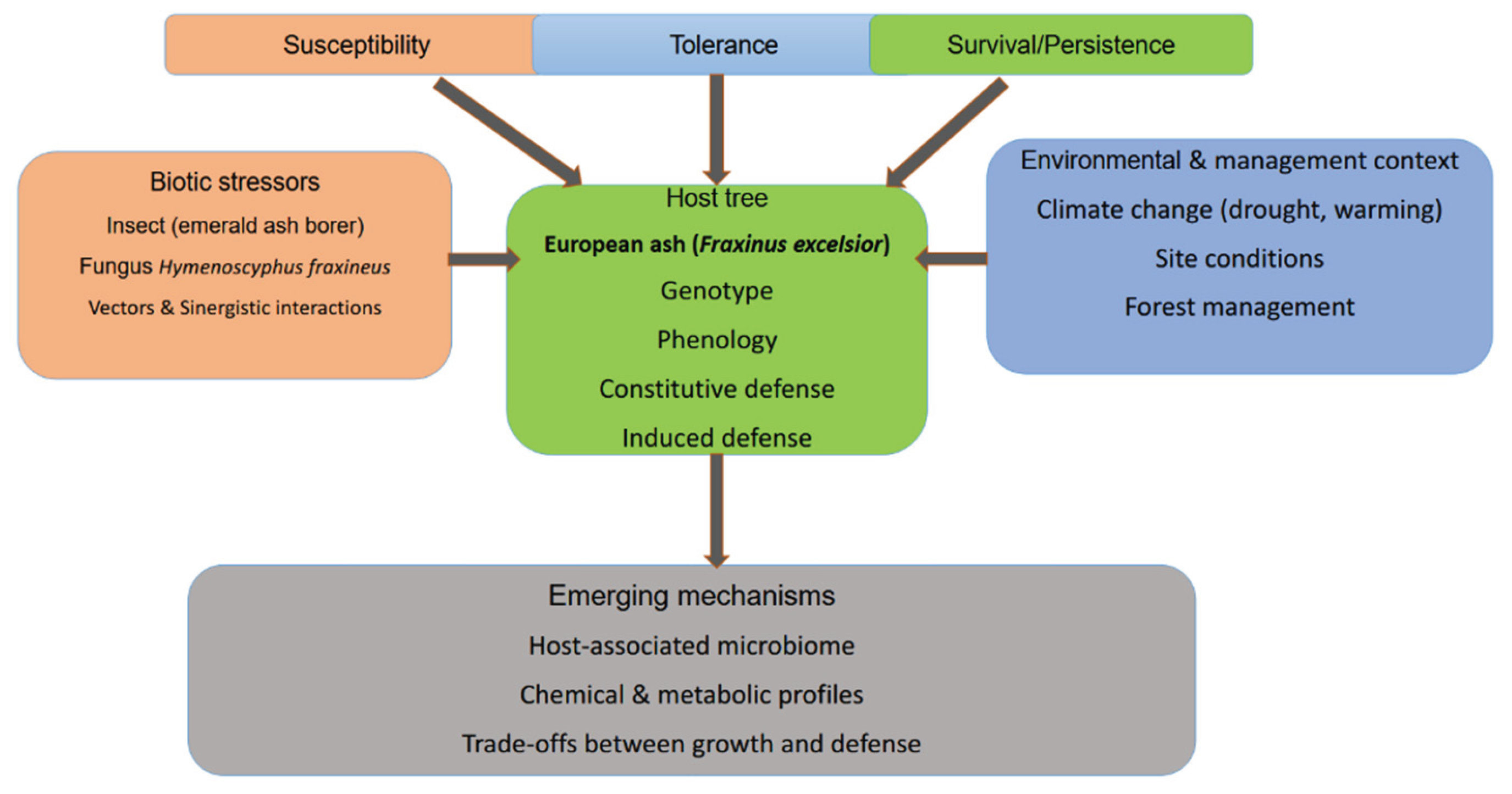

Table 1.
Major mechanisms contributing to resistance of ash species (Fraxinus spp.) to ash dieback caused by Hymenoscyphus fraxineus and emerald ash borer (Agrilus planipennis), integrating genomic, biochemical, physiological, and ecological evidence.
Table 1.
Major mechanisms contributing to resistance of ash species (Fraxinus spp.) to ash dieback caused by Hymenoscyphus fraxineus and emerald ash borer (Agrilus planipennis), integrating genomic, biochemical, physiological, and ecological evidence.
| Resistance mechanism | Biological level | Role in resistance | Examples |
| Genetic variation and polygenic resistance | Genomic | Multiple loci involved in pathogen recognition, defence signalling, and stress responses | Genome-wide association studies in Fraxinus excelsior identify numerous SNPs associated with ADB resistance |
| Convergent evolution of defence traits | Evolutionary / genomic | Resistance traits shared across ash species through adaptation to herbivory | Comparative genomics across Fraxinus species reveals defence-related genes linked to phenylpropanoid metabolism |
| Constitutive defence proteins | Proteomic / biochemical | Baseline defence proteins and oxidative stress responses limit EAB larval development | Resistant Asian ash species show higher levels of defence-related proteins in phloem |
| Secondary metabolites (phenolics, flavonoids, coumarins) | Chemical / metabolomic | Defence compounds influence pathogen colonization and insect herbivory | Metabolomic differences in phloem and leaves among resistant and susceptible ash genotypes |
| Inducible defence signalling (jasmonate pathway) | Physiological / biochemical | Activation of defence pathways increases phenolic concentrations and reduces insect performance | Methyl jasmonate treatments reduce EAB larval survival |
| Anatomical defence traits | Structural | Bark and phloem characteristics limit lesion expansion and larval feeding | Reduced lesion spread and altered phloem structure in tolerant ash genotypes |
| Host-associated microbiomes | Microbial / ecological | Endophytic fungi and microbial communities may influence pathogen development and host defence | Differences in microbiome composition between resistant and susceptible trees |
| Cross-resistance mechanisms | Integrated defence system | Shared defence traits affect both fungal pathogens and insect herbivores | Reduced EAB larval performance on ash genotypes resistant to ash dieback |
| Multi-stressor interactions | Ecological | Combined effects of climate stress, pathogens, and insects influence resistance outcomes | Simultaneous ADB and EAB infestations observed in European forests |
| Genomic resources for resistance breeding | Applied / genomic | Reference genomes facilitate identification of resistance markers and breeding strategies | High-quality genome of Fraxinus pennsylvanica supports resistance research |
Disclaimer/Publisher’s Note: The statements, opinions and data contained in all publications are solely those of the individual author(s) and contributor(s) and not of MDPI and/or the editor(s). MDPI and/or the editor(s) disclaim responsibility for any injury to people or property resulting from any ideas, methods, instructions or products referred to in the content. |
© 2026 by the authors. Licensee MDPI, Basel, Switzerland. This article is an open access article distributed under the terms and conditions of the Creative Commons Attribution (CC BY) license (http://creativecommons.org/licenses/by/4.0/).
Copyright: This open access article is published under a Creative Commons CC BY 4.0 license, which permit the free download, distribution, and reuse, provided that the author and preprint are cited in any reuse.


