
Submitted:
18 March 2026
Posted:
19 March 2026
You are already at the latest version
Abstract
Economic growth faces threats from environmental risks that intensify with rising population density and depletion of natural resources. People can either exploit these resources or manage them wisely for the benefit of their communities and future generations. They may choose to support economic development projects alongside environmental conservation initiatives, and decide where to live based on environmental conditions and economic prospects. The extent to which collaborative attitudes, social inclusion, awareness, and public participation can influence the equilibrium of complex socio-economic and environmental systems is only partially understood. Much of our knowledge stems from specific projects that facilitated popular participation. A complex model suggests that in a heterogeneous society where environmentally conscious consumers coexist with unaware ones, the strength of the conscientious group willing to invest in sustainable projects could determine the system's ultimate fate. Internal societal dynamics related to its composition may drive the socio-economic system and environment toward unexpected shifts and loops. The results highlight that sustainability transitions cannot be driven by economic or technological interventions alone.
Keywords:
sustainability
; complex dynamics
; environmental resources
; socio-economic development
; conscious behavior
; society composition
1. Introduction
The economy, society, and environment are interconnected in water management and improving quality of life. Financial resources to achieve the goal of safely managing water and sanitation by 2030 can enter the sector through taxation and government investment, customer tariffs and user charges, or grants provided by aid agencies. The largest sources of financial resources in the water and sanitation sectors are tariffs and user charges, even though funds raised for safe water management and sanitation are often too low to ensure efficient water management, particularly in developing countries [1]. Customers financially support water management and choose where to live based on environmental conditions and economic prospects. People may choose to either exploit or wisely manage environmental resources for the benefit of their community and future generations.
Population growth and economic development intensify the demand for resources such as water and energy. Adoption of resource conservation practices is influenced by various factors, including social norms, collective identity, and popular engagement. Climate has an influence on the environment as well as economic and social development [2] and makes the comprehension of their complex interaction urgent.
Governments and civil society share co-responsibility for effective governance and efficient water management [3]. Research has shown that individuals often conform to majority judgments, even when these are clearly incorrect [4], People tend to evaluate their own behavior against that of others, which can either incentivize or discourage resource-saving depending on the prevailing habits of the reference group [5]. Norms are unwritten rules or expectations shared within a community or society regarding appropriate and acceptable behaviors [6]. They guide and influence people's actions and interactions, helping to maintain order and social cohesion. Active social participation in the decision-making process plays a significant role as an alternative to conventional information-based methods in promoting resource-saving behavior, although those engaging in wasteful behavior may resist such influences [7]. Actively engaging and informing stakeholders is essential for the success of environmental and educational management initiatives [8,9,10]. The structure of social norms and their effectiveness in promoting resource conservation has been widely explored. Both injunctive norms (what most others approve or disapprove of) and descriptive norms (what most others do), can significantly influence individual behavior towards resource conservation [11]. Identification with a social group can influence individual behavior, as individuals tend to conform to the norms of the group to which they feel they belong [12]. [13] demonstrated that the use of inclusive language in a group can increase resource reuse, reducing water and energy consumption. [14] suggested that social behavior can translate into significant energy savings. [6] found that the sense of belonging to a social group can have a lasting impact on water-saving behavior.
Activism and research dissemination may gain the consent of the population [15,16] and attempt to influence legal battles for sustainable economic development [17].
Moving from the local to the global context, large-scale political decisions and social dynamics also come into play and may be relevant in directing the change in environmental awareness.
In the global economic landscape, investing in prevention and adaptation through loss-and-damage funding may prevent these costs from outpacing economic growth by 2050 [18]. The risk perceived by investors and therefore their willingness to invest in pro-environment firms is influenced and influences climate mitigation pathways [19]. Furthermore, the involvement of low and middle-income countries in decision-making processes is crucial to ensure fair and inclusive participation in the allocation of financial resources [20].
While there is a broad consensus on the opportunities for public participation in pro-environmental decision-making [7], methods for planning and evaluating collaboration are still being studied and rarely consider members of society as heterogeneous. Neglecting internal public dissent, different environmental concerns, values, perspectives and conflicting interests, leads to the risk of treating people as erroneously ‘static’. Agents within organizations are classified based on their interaction with knowledge: those who accept knowledge and those who accept and use it. [21] use epidemic models to describe the diffusion of knowledge, capturing the dynamic nature of knowledge dissemination and utilization, and the relevance of knowledge dissemination, for the development of technology management capacity (TMC).
[22] point out that if consumption decisions depend on social interactions, environmental and climate policies should account for these.
A new dynamic model was developed, based on the hypothesis that social development generates opportunities for economic growth [23]. Complex models reveal multiple dynamics of socio-economic and environmental systems highlighting factors that allow the system to shift from one state to another [24]. The Wealth-Population-Environmental Resources (WPER) [24] demonstrates how investments in infrastructure that exploit local natural resources attract people to communities. However, economic growth is threatened by environmental risks, which increase with population density and the depletion of environmental resources. The bidirectional interaction between population and environment is modelled through a predator-prey dynamic. In the new dynamic model two groups with different attitude toward resources coexist and interact, one is more wisely oriented to conserve environmental resources and invest in environmental restoration projects solutions for environmental crises, the other group is less oriented toward sustainable resource management and tends to exploit common environmental resources. Unlike previous WPER-based models, the composition of society is treated as a state variable that dynamically co-evolves with economic wealth and environmental resources. The model analyses patterns toward equilibria generated by top-down institutional initiatives, initial society composition, and available environmental resources. This study demonstrates the possibility that internal dynamics linked to social composition may drive the socio-economic system and the environment to unexpected shifts and loops.
2. Materials and Methods
A system of four differential equations is written to describe the joint evolution of economic and environmental resources, along with population density and composition. The mathematical model consisting of four differential equations is a nonlinear complex system describing the time variation of environmental and economic resources, conscious population and consumers. Equations are described in Appendix. For the first time, in a complex model for environmental, economic and social dynamics, society is modelled as heterogeneous, assuming the coexistence and interaction of two major groups within society. The first group is committed to environmental resource conservation, while the second tends to exploit resources in an unsustainable manner, neglecting the needs of future generations. The interaction between these two groups is based on their mutual influence. Members of one group can switch to the other, leading to changes in average environmental resource exploitation and conservation. The composition of society varies with economic and environmental resource availability because of migration and immigration. The size of both: conscious population and consumers is limited by environmental resources availability and wellness. Spread of knowledge, awareness and consciousness play a role in dynamic population group rearrangement. Wealth (w) increases according to the specific growth rate r, both p1 and p2 contributing equally to its production. Wealth is threated by the risk of environmental extreme events and decreases if part of the income is invested in projects to reduce risk and conserve or restore natural resources. Group p1 only invest is these projects at specific rate s. According to a mathematical biology approach, both: conscious population p1 and consumer p2 have their own growth and mortality rates. The growth rates are u1 for p1 and u2 for p2. A higher growth rate for p1 is associated with effective dissemination campaign, educational projects, promotion of active collaboration between experts/scientist and common people). This means that cultural background, initiatives favoring participation in pro-environmental projects, knowledge, awareness and a sense of responsibility can result in a higher growth rate for p1 than for p2, while conversely, ignorance, lack of responsibility and involvement in community affairs can favor the growth of p2.
The composition of society determines the percentage of income invested in restoration or conservation of environmental resources. The strength of those willing to invest in such projects, and their ability to influence others toward a more sustainable consumption system, is a key factor in the system’s dynamics.
Finally, environmental investments are converted into environmental resources according to specific yield that represents the effectiveness of the investment through technology, know-how, effective policies and decision-making systems. In summary, composition of society as a result of policies to disseminate and promote active participation, changes with available environmental and economic resources, which in turn are influenced by participation and engagement from below. The government can create more or less opportunities for participation in the sustainable transition, and this top-down approach determines the yield of any investment in sustainability, whereas the amount of investment is affected by society composition.
To account for the development of technology management capacity (TMC), an epidemic model is used to describe the spread of knowledge [21].
The differential equations are solved for different initial conditions in various scenarios, obtaining trajectories of the system that show its natural tendency to reach a sustainable stable condition or not as the initial status changes. The scenarios analyzed are characterized by different investment policies in technical solutions to conserve and improve environmental resources. The four-dimensional trajectories, which represent the solution of the system, are projected over the wealth-environmental resources plane to visualize: achievable steady states, their stability, and the initial conditions that lead the system to converge to a specific steady solution or limit cycles.
3. Results
Trajectories of complex systems may be diverted far from unstable solutions, converge toward stable solutions, or may oscillate in a closed loop pattern. Stable solutions represent scenarios where the system maintains steadily a balance between the tendency to exploit resources and the commitment to sustain and increase environmental and economic resources. Saddle nodes are critical points where even small changes in the state variables (resource levels or societal composition) can trigger significant shifts in the system's behavior, potentially diverting its trajectory away from a sustainable stable condition towards a catastrophic shift. Trajectories are diverted by saddle nodes either towards the non-trivial stable solutions of the system or towards the trivial solution where resources and population all diminish to zero. There are scenarios where closed-loop trajectories form in response to the mutual influence of subgroups p1 and p2, altering society's composition and resource availability. The results demonstrate how different initial conditions may lead the system to converge towards distinct steady states or cyclic states. Saddle nodes act as critical junctures where small changes in state variables like resource levels or societal makeup can significantly shift the system's behavior, potentially steering it away from a sustainable equilibrium and precipitating a catastrophic collapse.
The complex and elated dependent variables model are presented in dimensionless form in Appendix. Dependent variables range from zero to their reference capacity, and model coefficients indicate the reciprocal weight of different processes (population growth, wellness increase, investment) within the complex dynamics. The focus is on internal dynamics leading to stable equilibria, catastrophic shifts, or limit cycles. Trajectories in a four-dimensional space (wealth (w), environmental resources (e) and population subgroups (p1 and p2)) are projected on the w-e plane (the plane of economic an environmental resources) .
Different trajectories are obtained by varying the initial conditions, specifically 0<w<1 and 0<e<1 and p1=0.5, p2=0.5. The social subgroups p1 and p2 determine society's composition and, influence the availability of resources. Group p1 invests in projects to maintain environmental resources and thus decreases the economic resources available. Group p2 primarily consumes environmental resources. The conscious population p1 may influence the behavior of consumer p2 and vice versa. Both groups may change size due to migration inside and outside society depending on resource availability.
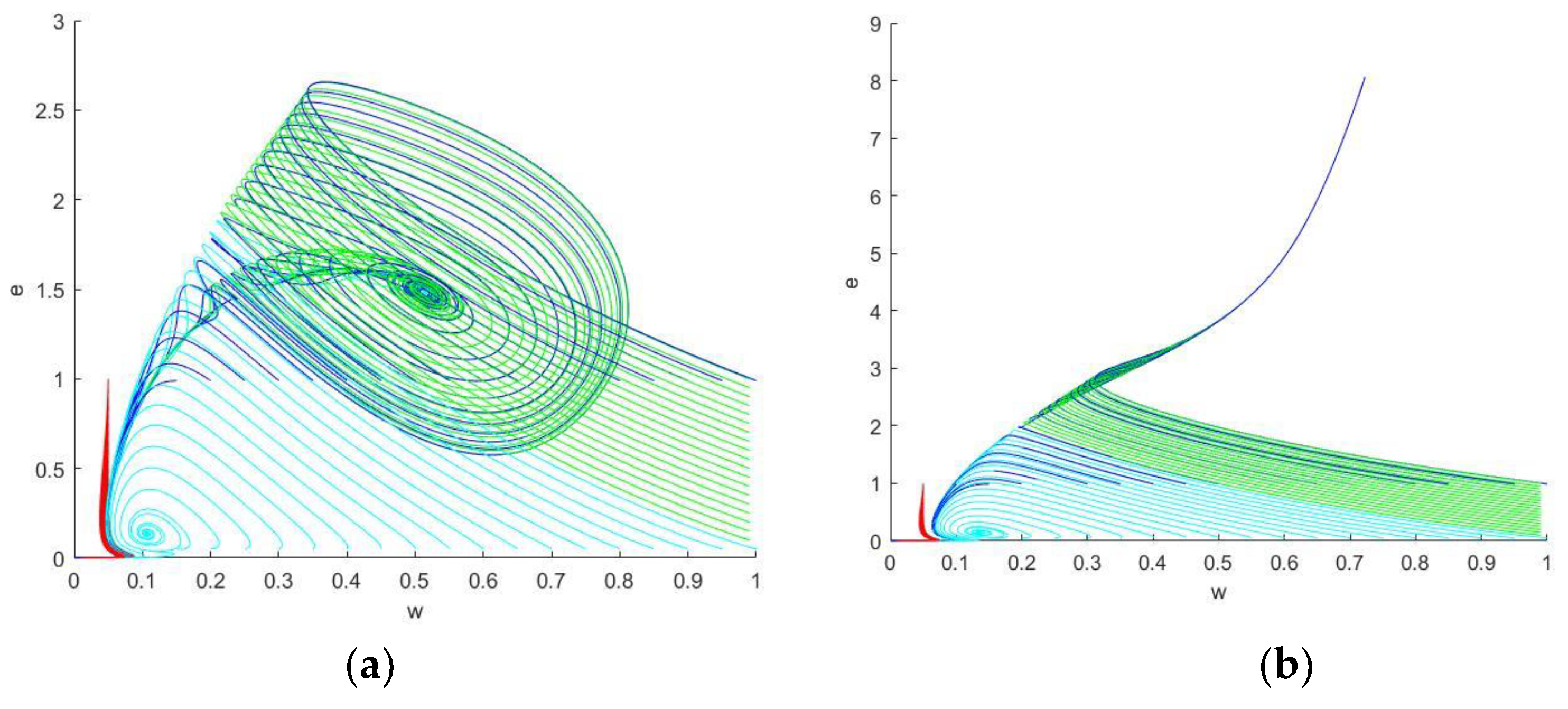
Three scenarios are developed by varying the ratio of financial investment in nature-based solutions to the rate of wealth production (s/r). Wealth is generated by p1 and p2, but p1 only reinvest in restoration or conservation initiatives. The percentage of domestic product to be allocated to environmental initiatives (which is here expressed by the ratio s/r) could be ascribed to government practice to create decision-making potential, to involve and empower conscious individuals (p1), and to build public participation in sustainable transition dynamics. The growth rate u1 of conscious population p1 may be interpreted as the result of effective dissemination projects and spreading of knowledge. In Figure 1, Figure 2 and Figure 3 the ratio of financial investment in nature-based solutions to wealth produced is s/r=0.4, 1 and 2 respectively; in left panels the growth rate of conscious population p1 is always u1= 0.2, on the right, u1=0.7, meaning that dissemination campaign, sensibilization of population toward a conscious use of resources, commitment in pro-environment investment is more effective. The growth rate of “consumer” is always u2=0.7 therefore, on left panels u2>u1, on right panels u2=u1.
Low financial rate of investment in pro-environment projects (Figure 1: s/r=0.4), leads many trajectories toward catastrophic shifts where economic and environmental resources are exhausted, only scenarios where resources are sufficiently high at the beginning of the simulation (blue and part of green trajectories) evolve toward a stable non-trivial solution. If the growth rate of people willing to invest in pro-environment projects is promoted (Figure 1, right), the system may reach a stable steady state, even with scarce financial and environmental initial resources. This suggests that building willingness to contribute to environmental restoration can be an effective strategy. This holds true even under disadvantaged economic conditions (red curves) or compromised environmental conditions (light blue curves), provided that a significant portion of society supports it.
In Figure 2 the rate of contribution to environment conservation and/or restoration relative to financial rate of income is increased to s/r=1.0. As in Figure 1, slow (left) and rapid (right) growth of consciousness and related change in society composition and system dynamics are compared (left plot: u2=0.2, right plot u2=0.7).
When the growth rate of conscious population is lower than the growth rate of consumer (Figure 2 left) the system ends up in a closed loop, just a few trajectories lead to a catastrophic shift. Most trajectories demonstrate that environmental and economic resources continuously oscillate in response to fluctuating society composition. In this scenario, politics and dialogue play a key role, since both sub-groups influence the complex interplay of environment, economy, and population. In Figure 2 (right) the growth rate of those who pay more attention to the environment and are willing to pay for that is higher than in Figure 2 left and as a result, trajectories converge to the stable non-trivial steady state, unless both, economic and environmental resources are initially too low (red and light blue trajectories close to the origin of the axes).
Further increasing the rate of investment in the environment relative to wealth generated (Figure 3, r/s=2 does not improve the projected state of the system. When initial financial availability is too low, investing in the environment implies the risk of potential indebtedness (Figure 3 left and right, red trajectories). When the initial economic conditions preclude development, despite the population's willingness to invest, only external factors such as investment by external agents can help the system to avoid catastrophic shifts.
4. Discussion and Conclusions
A dynamic model predicts the stability of the complex system of society, environment and economy. It is used to analyse equilibria, the effect of knowledge dissemination, public engagement, and the effectiveness of opportunities for people to endorse political decisions in different socio-economic and environmental contexts. The coexistence of consumers with different levels of awareness, ways of thinking, and attitudes toward participation may determine power asymmetries within the system, further influencing its dynamics and outcomes. [25]. This study introduces a novel approach by simultaneously analyzing the dynamics of two distinct social groups alongside environmental and economic resource dynamics. This represents a significant innovation to the Wealth-Population-Environmental Resources (WPER) model.
The two groups are characterized by their contrasting attitudes towards environmental resources. One group is more inclined to adopt policies favouring conservation and regeneration of environmental resources, the other is culturally oriented towards resource exploitation. These groups interact and influence each other within the system. The model accounts for demographic changes, allowing for both emigration (people leaving the system) and immigration (new people entering the system) from both groups. This dynamic process continuously alters the composition of society. The drivers of demographic growth or decay are welfare and resources availability. The introduction of two interacting social groups in the complex society-environment-economy dynamic represents the main innovation brought to the WPER model [24].
The model identifies welfare and resource availability as the primary drivers of demographic growth or decline. By incorporating these factors, it provides a more comprehensive understanding of the complex interplay between society, environment, and economy. In a catastrophic shift, it is the evolution of the three macro-areas or the crisis in one of the three that triggers an irreversible transformation.
This is the case with mass migration, the depletion of resources due to ill-advised development policies, climate change, and land use. Notably, the time scale for analysing catastrophic shifts is much longer than that for consumer attitude peer influence, although further research into how short-term dynamics may influence long-term shifts would be valuable.
Results demonstrate that the system's fate is determined by initial conditions, including the amount of available resources and the actors involved, along with societal awareness, which can be influenced by knowledge dissemination. This enhanced model provides a more comprehensive understanding of the complex interplay between society, environment, and economy, potentially leading to more accurate predictions and informed policy decisions.
The topic of social interactions that lead consumers to influence each other has been explored since long time [5]. In a system of social interactions with socially-embedded preferences [22], an agent experiences higher utility from consuming a good as its popularity among peers increases. Agents do not risk finding themselves in a progressively degrading environment with limited economic and environmental resources if they can express preferences. Some authors consider social and political-social interaction through taxation simultaneously [22]. However, the consequences of consumption on the environment, of environmental conditions on economic development opportunities, and of the latter on social density and composition are often ignored within this context.
In the dynamic model proposed here, the availability of resources limits the possibility to express preferences. The results of dynamic modeling highlight the important role of knowledge dissemination, information campaigns, and projects with popular participation in impacting the ecosystem and welfare. Engaging communities and promoting pro-environmental norms can significantly alter a society's composition and consequently shift the system's equilibrium.
The model outcome demonstrates how commonality of purpose, proselytizing, and group membership can have an impact on the equilibrium of the complex system. There are correspondences in reality: [11] explored how social expectations incentivize positive environmental behavior, showing the significant influence of social norms on individual behavior towards resource conservation. [13] demonstrated that inclusive language within a group can increase resource reuse, thereby reducing water and energy consumption. The link between social attitude to sustainable use of resources and environmental conservation is evidenced by [6] that examined the persistent effects of norm-based messaging on water conservation, highlighting the importance of sustained social influence.
The dynamic model also suggests that the political direction defining the percentage of economic resources devoted to the environment, as well as external financing, play a fundamental role. Both factors can drive the ecosystem towards more or less advantageous equilibria. The equilibrium is defined by the steady state of economic, environmental, and demographic resources.
This dynamic modeling highlights two major tenets: 1) Effective pro-environmental actions must be accompanied by a change in society's composition. 2) Effectiveness depends on initial conditions and the rate of investments. In cases of insufficient standing resources and know-how, external aid may be necessary, but it must exceed a threshold that accounts for society's composition to be effective. Consistently, [18] argue the need to transform climate funds from an insurance-based approach to one based on reliable data and analysis, investing in prevention and adaptation.
Ultimately, an integrated approach decoding and interpreting real-world experiences can help predict complex dynamics before they become irreversible, prevent catastrophic shifts, and address current economic and environmental challenges driven by human forces that may destabilize systems. Dynamic modeling supports political and economic decision-making by predicting and distinguishing between potentially effective and unsustainable actions based on the economy and societal composition, when internal dynamics crucially influence the stability of complex systems' equilibria.
Author Contributions
“Conceptualization, P.P. and N.U.; methodology, P.P. and N.U.; software, P.P. and N.U..; formal analysis, P.P.; investigation, P.P. and N.U.; writing—original draft preparation, P.P. and N.U.; writing—review and editing, P.P. and N.U.; supervision, N.U..; funding acquisition, N.U. All authors have read and agreed to the published version of the manuscript.” Please turn to the CRediT taxonomy for the term explanation. Authorship must be limited to those who have contributed substantially to the work reported.
Appendix
The development and implementation of the system of differential equations (the dynamic model) that describe the complex interplay between population, economy, and environmental resources are based on the following assumptions:
Society is divided into two main groups: those committed to conserving environmental resources and those inclined to exploit resources unsustainably. In the case study presented here, the initial condition is p1=0.5, p2=0.5 for society's composition.
Members of one group can switch to the other because of social influence, increasing awareness and dissemination of knowledge.
Group members can switch sides due to social influence, increased awareness, and knowledge dissemination.
The population's (both groups) growth depends on environmental resources and economic wealth and by by their respective attitudes towards environmental conservation or exploitation, because environmental resources are finite and can be depleted in case of unsustainable exploitation.
Conservation efforts and investments in environmental restoration can restore or maintain resource availability.
Economic wealth is generated through the exploitation of environmental resources but it may also be allocated to pro-environment projects.
The buildup of environmental consciousness and willingness to pay for sustainable resource management increase with the rate of knowledge transmission in technology management system. According to [21], the spread of knowledge and awareness about environmental conservation follows an epidemic model, influencing the population's behavior and attitudes.
The effectiveness of knowledge dissemination depends on the interaction between individuals.
The model considers the bidirectional interaction between population and environmental resources through a predator-prey dynamic [24].
The summarized assumptions above form the building blocks of the complex nonlinear system composed of four differential equations introduced below in dimensionless form.
In tables A1 and A2 are listed functions and variables within Equations 1 to 4.

Table A1.
Dimensionless Functions and Their Physical Meaning.
| Economic growth generated by the population | |
| Investment in pro-environment projects implemented by p1 in the equation of wealth variation; the same contribution results in a gain of resources in the equation of water resource variation, minus a yield factor | |
| Economic losses due to risk factors | |
| Logistic equation for the dynamics of population p1 | |
| Logistic equation for the dynamics of population p2 | |
| Equation concerning the mortality of population p1 | |
| Equation concerning the mortality of population p2 | |
| Immigration attracted by the presence of natural resources, affecting population p1. | |
| Immigration attracted by the presence of natural resources, affecting population p2 | |
| Rate of knowledge transmission according to [21] under the precondition of two kind of agents. Here consciousness and willing to act pro-environment is assimilated to knowledge, that is, the rate of the development of sustainable environmental management capability. | |
| Equation describing environmental degradation caused by a p2 strategy and improved by a p1 strategy | |
| Degradation of natural resources due to waste by p2 | |
| k is carrying capacity of the population, calculated as a function of both w and e (Gatto, 1985) |
Table A2.
Relevant variables and reference values.
| Symbol | Definition | Value |
| Generated income non dimensioal rate | ||
| Investment related to NBS | 0.2 in Fig. 1 0.5 in Fig. 2 1.0 in Fig. 3 |
|
| Economic losses associated to environmental risk | ||
| Fraction of investment related to environment | ||
| Environmental risk factor | ||
| y | Efficiency of NBS | in Fig.1 Fig.2 Fig.3 from 2.0 to 3.5 in Fig.4 |
| Population using NBS at the initial time | ||
| Population 1 growth rate | ||
| Population 1 migration rate | ||
| Transmission of knowledge between p1 and p2 | ||
| Population 2 growth rate | ||
| Population 2 migration rate | ||
| f | Water consumption | |
| ω | Half saturation constant | 0.1 |
| Population mortality rate | ||
| Half saturation constant e | ||
| Half saturation constant w | ||
| Knowledge transmission rate among individuals | ||
| fraction of consumption of p1 relative to p2 | ||
| Waste caused by p2 |
In the following table, the coefficients used in the differential equations are listed, along with their descriptions and the numerical values employed in the equations.
References
- WHO - World Health Organization. Strong systems and sound investments: evidence on and key insights into accelerating progress on sanitation, drinking-water and hygiene. The UN-Water global analysis and assessment of sanitation and drinking-water (GLAAS) 2022 report. Geneva, 2022. Available online: https://www.who.int/publications/i/item/9789240065031.
- Dafermos, Y.; Nikolaidi, M.; Galanis, G. Climate change, financial stability and monetary policy. Ecological Economics 2018, 152, 219–234. [Google Scholar] [CrossRef]
- Kolker, J; Brocklehurst, C. To solve the water crisis, follow the money. PLOS Water 2025, 4(6), e0000357. [Google Scholar] [CrossRef]
- Asch, S. E. Studies of independence and conformity: I. A minority of one against a unanimous majority. Psychological Monographs: General and Applied 1956, 70(9), 170. [Google Scholar] [CrossRef]
- Festinger, L. A Theory of Social Comparison Processes. Human Relations 1954, 7(2), 117–140. [Google Scholar] [CrossRef]
- Bernedo, M.; Ferraro, P. J.; Price, M. The persistent impacts of norm-based messaging and their implications for water conservation. Journal of Consumer Policy 2014, 37, 437–452. [Google Scholar] [CrossRef]
- OECD. Innovative Citizen Participation and New Democratic Institutions: Catching the Deliberative Wave; OECD Publishing: Paris, 2020. [Google Scholar] [CrossRef]
- Marie, Fujitani. Participatory adaptive management leads to environmental learning outcomes extending beyond the sphere of science. Sci. Adv 2017, 3, e1602516. [Google Scholar] [CrossRef]
- Bodin, Örjan. Collaborative environmental governance: Achieving collective action in social-ecological systems. Science 2017, 357, eaan 1114. [Google Scholar] [CrossRef] [PubMed]
- Pörtner. Overcoming the coupled climate and biodiversity crises and their societal impacts. Science 2023, 380, eabl 4881. [Google Scholar] [CrossRef] [PubMed]
- Cialdini, R. B.; Reno, R. R.; Kallgren, C.A. A focus theory of normative conduct: Recycling the concept of norms to reduce littering in public places. Journal of Personality and Social Psychology 1990, 58(6), 1015–1026. [Google Scholar] [CrossRef]
- Abrams, D.; Hogg, M. A. Social identification, self-categorization and social influence. European Review of Social Psychology 1990, 1(1), 195–228. [Google Scholar] [CrossRef]
- Goldstein, N. J.; Cialdini, R. B.; Griskevicius, V. A room with a viewpoint: Using social norms to motivate environmental conservation in hotels. Journal of Consumer Research 2008, 35(3), 472–482. [Google Scholar] [CrossRef]
- Allcott, H.; Mullainathan, S. Behavior and energy policy. Science 2010, 327(5970), 1204–1205. [Google Scholar] [CrossRef] [PubMed]
- Tollefson, J. Inside the race to harvest energy from the sea. Nature 2022. [Google Scholar] [CrossRef]
- Diouf Sarr, A. Senegal bets on small-scale farmers to revive agriculture; Nature, 2022. [Google Scholar] [CrossRef]
- Tollefson, J. Outrage over Trump team's climate report spurs researchers to fight back. Nature 2025, 644(8077). [Google Scholar] [CrossRef]
- Clarke, RH; Wescombe, NJ; Huq, S; Khan, M; Kramer, B; Lombardi, D. Climate loss-and-damage funding: a mechanism to make it work. Nature 2023, 623(7988), 689–692. [Google Scholar] [CrossRef] [PubMed]
- Battiston, S.; Mandel, A.; Monasterolo, I.; Schütze, F.; Visentin, G. Accounting for finance is key for climate mitigation pathways. Science 2021, 372, 918–920. [Google Scholar] [CrossRef] [PubMed]
- Kuhl, L. How to prioritize climate adaptation projects; Nature, 2023. [Google Scholar] [CrossRef]
- Wu, W.; Yu, B.; Wang, J. Dynamic models of technology management capability development based on knowledge diffusion. Journal of Systems Engineering and Electronics 2011, 22(2), 228–237. [Google Scholar] [CrossRef]
- Konc, T.; Savin, I.; van den Bergh, J. The Social Multiplier of Environmental Policy: Application to Carbon Taxation. Journal of Environmental Economics and Management 2020. [Google Scholar] [CrossRef]
- Bettencourt, L.M.A.; Lobo, J.; Helbing, D.; Kuhnert, C.; West, G.B. Growth, innovation, scaling, and the pace of life in cities. Proc. Natl. Acad. Sci. 2007, 104(17), 7301–7306. [Google Scholar] [CrossRef] [PubMed]
- Ursino, Nadia. Dynamic models of socio-ecological systems predict catastrophic shifts following unsustainable development. Science of the Total Environment 2019 654, 890–894. [Google Scholar] [CrossRef] [PubMed]
- Cooke, B.; Kothari, U. Participation: The New Tyranny? Zed Books, 2001. [Google Scholar]
Figure 1.
Results characterized by a ratio of financial investment in nature-based solutions to wealth produced (s/r=0.4); (a) the trend of economic wealth (w) and water resources (e) is shown for values of the coefficient u1= 0.2; (b) the curves' trends for the coefficient u1=0.7.
Figure 1.
Results characterized by a ratio of financial investment in nature-based solutions to wealth produced (s/r=0.4); (a) the trend of economic wealth (w) and water resources (e) is shown for values of the coefficient u1= 0.2; (b) the curves' trends for the coefficient u1=0.7.
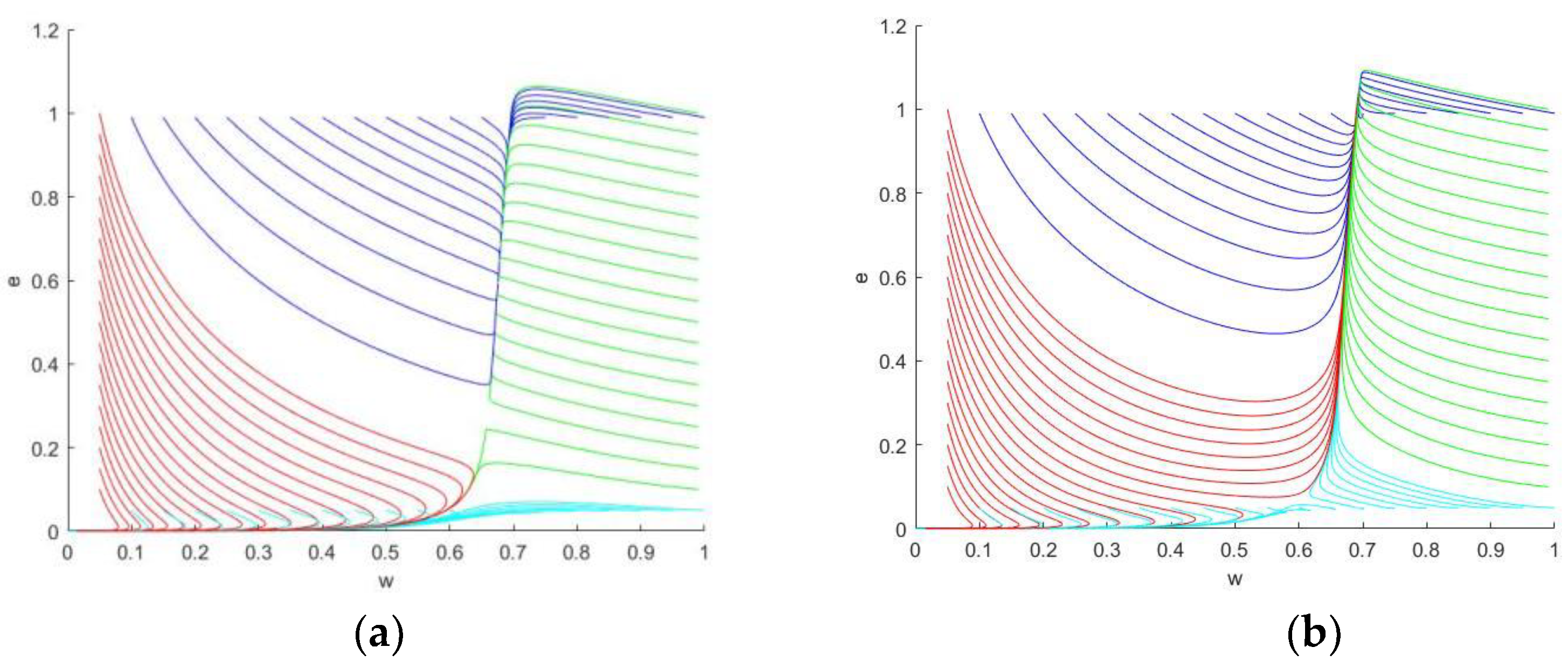
Figure 2.
Results characterized by a ratio of financial investment in nature-based solutions to wealth produced (s/r=1.0); (a) the trend of economic wealth (w) and water resources (e) is shown for values of the coefficient u1= 0.2; (b) the curves' trends for the coefficient u1=0.7.
Figure 2.
Results characterized by a ratio of financial investment in nature-based solutions to wealth produced (s/r=1.0); (a) the trend of economic wealth (w) and water resources (e) is shown for values of the coefficient u1= 0.2; (b) the curves' trends for the coefficient u1=0.7.
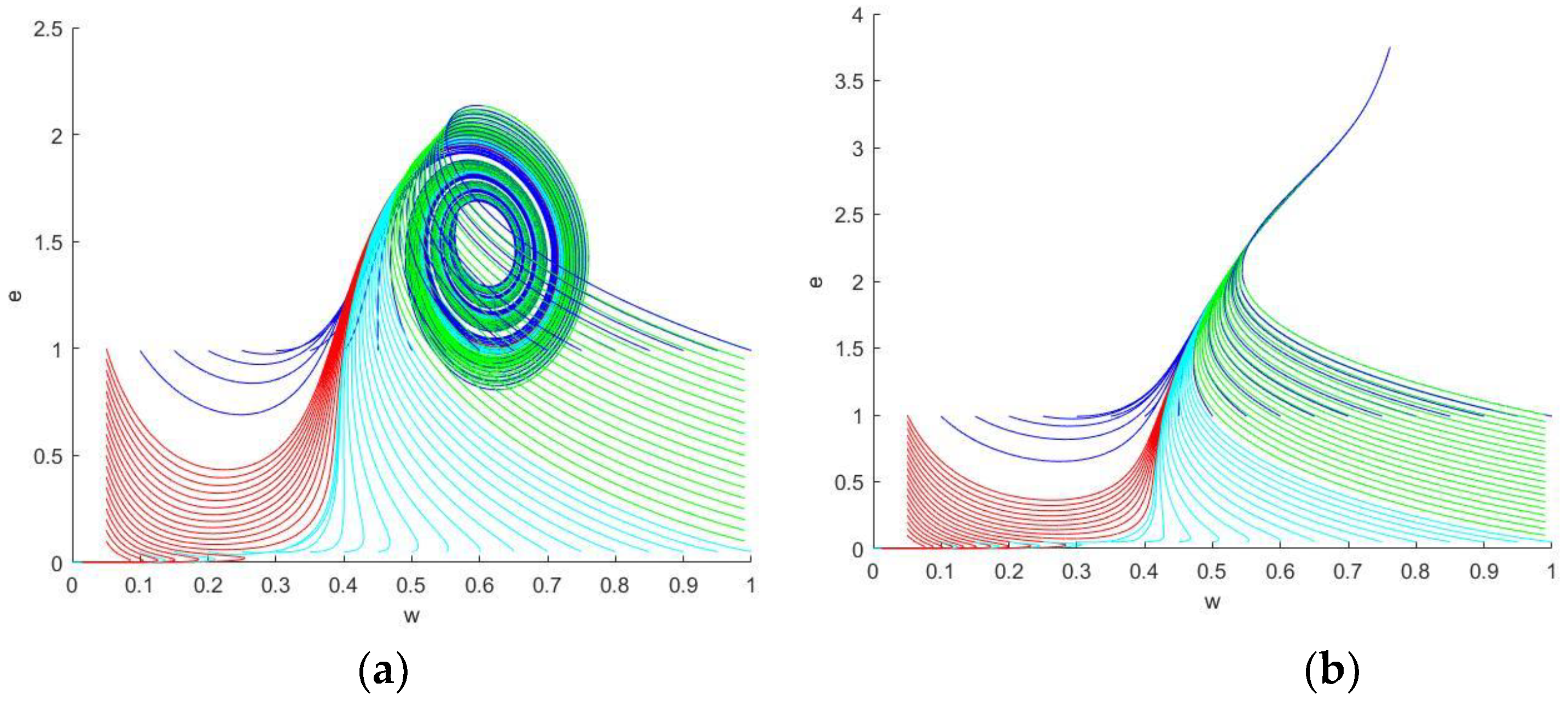
Figure 3.
Results characterized by a ratio of financial investment in nature-based solutions to wealth produced (s/r=1.0); (a) the trend of economic wealth (w) and water resources (e) is shown for values of the coefficient u1= 0.2; (b) the curves' trends for the coefficient u1=0.7.
Figure 3.
Results characterized by a ratio of financial investment in nature-based solutions to wealth produced (s/r=1.0); (a) the trend of economic wealth (w) and water resources (e) is shown for values of the coefficient u1= 0.2; (b) the curves' trends for the coefficient u1=0.7.
Disclaimer/Publisher’s Note: The statements, opinions and data contained in all publications are solely those of the individual author(s) and contributor(s) and not of MDPI and/or the editor(s). MDPI and/or the editor(s) disclaim responsibility for any injury to people or property resulting from any ideas, methods, instructions or products referred to in the content. |
© 2026 by the authors. Licensee MDPI, Basel, Switzerland. This article is an open access article distributed under the terms and conditions of the Creative Commons Attribution (CC BY) license (http://creativecommons.org/licenses/by/4.0/).
Copyright: This open access article is published under a Creative Commons CC BY 4.0 license, which permit the free download, distribution, and reuse, provided that the author and preprint are cited in any reuse.


