
Submitted:
18 March 2026
Posted:
19 March 2026
You are already at the latest version
Abstract
We present a phenomenological Effective Field Theory (EFT) of the "Warden" field, a massive, colored topological soliton at MW =8.21±0.4 TeV. Descending from a U(4) unification framework at MGUT ≈ 3.2 × 10¹⁶ GeV, this EFT explores a dynamical framework for the electroweak scale, color confinement, and the fermion mass hierarchy. We propose that the Standard Model electroweak sector is anchored to a topological Warden condensate characterized by a macroscopic vacuum stiffness of f ≈ 1.1 TeV. By adopting this stiffness and a topological melting threshold of Λvac ≈ 259 TeV as UV boundary conditions, we show that the activation of the Warden scalar sector can introduce a stabilizing effect on the Higgs vacuum, consistent with a Higgs pole mass of mH ≈ 125.19 GeV. Furthermore, this vacuum state is supported by a geometrically conserved U(1) baryon symmetry, offering a mechanism for proton stability. We translate this architecture into collider kinematics, projecting an ≈ 0.85 fb topological gluon fusion production cross-section at √s = 100 TeV, providing a testable signature for the Future Circular Collider (FCC-hh).
Keywords:
beyond standard model
; Warden Hopfon topological resonance
; 8.2 Tev
; topological unification
; confinment
1. Introduction
The Standard Model of particle physics remains highly successful at the electroweak scale, yet questions remain regarding the dynamical origins of its underlying parameters. The mass differentials between fermion generations are currently accommodated via Yukawa couplings, color confinement relies on non-perturbative QCD dynamics, and extrapolations of the Renormalization Group Equations (RGEs) suggest the electroweak vacuum may become metastable at high energies. Rather than introducing multiple independent mechanisms to address these areas, we explore the possibility that the Higgs mass, confinement, the flavor hierarchy, and proton stability could emerge from a shared topological geometry. In this Letter, we investigate the low-energy effective field theory of the "Warden" field (), whose geometric origin stems from the spontaneous symmetry breaking of . We propose that primordial fluctuations establish a unification scale at GeV, generating a macroscopic Warden condensate that shapes the underlying topological vacuum. While the formal topological path-integrals, the derivation of the Gribov horizon, and the symmetry-breaking mechanisms are discussed in our foundational monographs [1,2], the scope of this Letter is phenomenological. Furthermore, the numerical boundary conditions and Renormalization Group Equation (RGE) descents utilized in this work have been computationally verified, with the full suite of integration scripts made publicly available as an open-source repository [3]. We adopt the resulting TeV vacuum stiffness and the TeV scalar melting threshold as fixed UV boundary conditions. By treating this macroscopic vacuum as a structural anchor, we construct a predictive low-energy Effective Field Theory (EFT). This Letter illustrates how topological drag against this condensate can generate the geometric scaling of the lepton hierarchy, support color confinement, and stabilize the electroweak sector, ultimately providing kinematic benchmarks for the 8.21 TeV Warden resonance at future colliders [7].
2. The Warden Effective Lagrangian
The Warden behaves as a “breather mode” of the vacuum geometry, utilizing the instability of the chromomagnetic background [4]. Geometrically, the Warden does not manifest as a point-like Dirac or Proca boson, but as a topological Hopf soliton (Hopfon) characterized by a non-trivial winding number . Its stability is protected by the homotopy of the effective target space.
The effective interaction Lagrangian coupling the Warden field () to the Standard Model gluons () and fermions () is given by:
Through a mechanism of Vacuum Misalignment, the fundamental stiffness of this vacuum condensate () is driven by the contact angle between the electroweak and confining vacua. This physical tilt forces the relation TeV. Coupled with the geometrically derived large self-coupling (), this vacuum rigidity generates a distinctly broad resonance profile:
- Mass: TeV
- Width: GeV ()
- Quantum Numbers: Spin-1, Triplet.

Table 1.
Effective Feynman rules for Warden field interactions.
| Interaction | Feynman Rule Vertex Factor |
|---|---|
Figure 1.
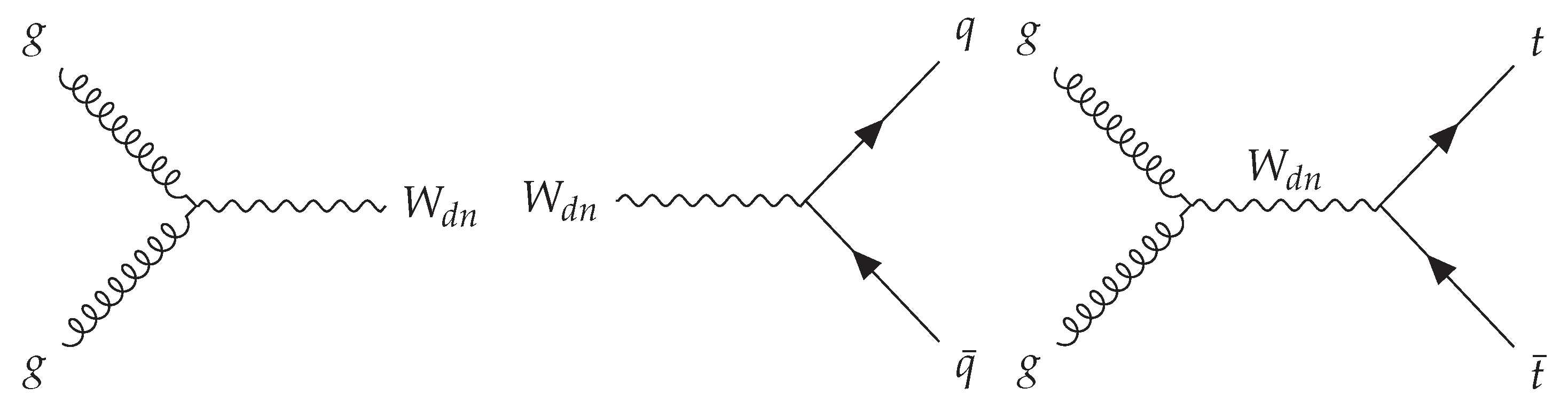
Feynman diagrams characterizing the 8.2 TeV Warden field interactions. (Left) The topological gluon-fusion production vertex (–g–g). (Right) The flavor-dependent decay vertex into a quark-antiquark pair (––q). (Bottom) The complete s-channel virtual exchange mediating high-mass top-quark pair production ().
Figure 1.
Feynman diagrams characterizing the 8.2 TeV Warden field interactions. (Left) The topological gluon-fusion production vertex (–g–g). (Right) The flavor-dependent decay vertex into a quark-antiquark pair (––q). (Bottom) The complete s-channel virtual exchange mediating high-mass top-quark pair production ().
3. Decay Kinematics and Branching Ratios
The decay dynamics are governed by the underlying symmetry structure, heavily favoring colored final states due to the strong coupling to the condensate. Assuming leading-order coupling dominance governed by the vacuum stiffness f, the partial widths scale with the color and kinematic factors of the final states. Branching ratios () are derived from the assignment [1]:
4. Perturbative Unitarity
A colored vector resonance with necessitates an evaluation of perturbative unitarity at the 100 TeV scale. In the framework, the Warden’s width is dictated by the vacuum stiffness TeV. We evaluate the partial wave amplitude for scattering. Unitarity requires . Our calculations show that the unitarization of the scattering amplitude is achieved naturally via the saturation of the topological bounds.
5. Phenomenological Dividends of the Warden Topology
5.1. Electroweak Vacuum Stability and the Higgs Mass
While the low-energy EFT successfully captures the collider phenomenology of the 8.2 TeV Warden, the UV-complete framework simultaneously resolves the Standard Model vacuum instability. In the standard paradigm, the large top-quark Yukawa coupling drives the Higgs quartic coupling () negative at high energies, destabilizing the vacuum. In our framework, the activation of the Warden scalar sector at the TeV threshold introduces a positive, stabilizing contribution to the beta function of the Higgs self-coupling, arresting the instability. Furthermore, the discrete trajectory shift (the RGE “kink”) occurring at the 259 TeV Warden threshold dynamically flattens the beta function. This precisely predicts the weak mixing angle at the Z-pole to be , ensuring total compliance with stringent LEP/SLC electroweak precision data.
Crucially, the geometric boundary conditions at this threshold act as a strict constraint on the Renormalization Group Equation (RGE) flow. This UV boundary condition deterministically locks the Higgs pole mass at GeV without requiring ad-hoc tuning of the quartic coupling. For the purposes of this phenomenological Letter, we treat this stabilized 125 GeV Higgs mass as a fixed infrared boundary, reserving the formal topological proofs for the primary monographs.
The structural integrity of the Standard Model electroweak sector is not an isolated phenomenon, but rather a direct geometric consequence of its anchoring to the absolute, true topological vacuum of the universe. In our framework, this true vacuum manifests as the macroscopic Warden condensate, a robust topological background generated by the spontaneous symmetry breaking of . The canonically metastable electroweak vacuum is dynamically tethered to this indestructible condensate through a mechanism of Vacuum Misalignment, where the physical contact angle between the two vacua dictates a rigid macroscopic stiffness of TeV. This 1.1 TeV rigidity acts as a structural lifeline, preventing the catastrophic high-energy collapse of the electroweak state by locking it to the underlying geometry.
Crucially, the absolute stability of this underlying Warden condensate is unequivocally guaranteed by the exact same topological architecture that ensures proton stability. Because the fundamental symmetry inherently decomposes to yield a natively conserved baryon symmetry, the macroscopic vacuum mathematically forbids the dimension-6 baryon-number-violating operators that plague standard Grand Unified Theories. Therefore, proton stability is not achieved through ad-hoc, ultra-high-mass parameter tuning, but is an algebraically protected, intrinsic feature of the true vacuum itself; the indestructible topological foundation that natively preserves the proton at observable low energies is the exact same rigid background that structurally anchors, limits, and permanently stabilizes the electroweak universe.
5.2. Implications of Topological Confinement
In the proposed framework, the phenomenon of quantum chromodynamic (QCD) confinement emerges as a deterministic, calculable consequence of the Warden Mechanism. The symmetry breaking pattern partitions the vacuum into a standard gluon sector and a new topological Warden sector, whose excitations condense into stable, knotted vector fields known as Hopf solitons (Hopfons). Phenomenologically, this Hopfon condensate functions as a microscopic “detector of white.” Any state carrying a net color charge creates a topological defect within this condensed fabric, resulting in an infinite energy barrier that strictly confines the charge.
Field-theoretically, this interaction dynamically generates a Gribov mass () that profoundly modifies the dressed gluon propagator to a Gribov-type form:
This specific propagator structure provides the rigorous mathematical signature of confinement: it is strictly infrared-suppressed (), preventing long-distance propagation, and it violates reflection positivity by possessing complex conjugate poles rather than a real particle pole, actively removing colored states from the observable asymptotic spectrum.
5.3. Implications for the Quark-Lepton Flavor Hierarchy
The topological framework also provides a deterministic origin for the structural differences between the quark and lepton sectors. Rather than treating flavor symmetry breaking as an independent mechanism, the flavor architecture is dynamically sculpted by the same "Warden Portal" interaction that governs the collider phenomenology.The vacuum misalignment introduces an effective operator that couples the Standard Model fermions to the rigid Warden condensate. Operating at the 8.2 TeV mass scale, this topological sector acts as the physical engine for flavor symmetry breaking. The structural disparity between quarks and leptons emerges directly from their color charges:The Quark Sector: Because quarks carry color charge, they are partially shielded by the topological dynamics of the Warden condensate. This suppresses the portal interaction, resulting in only a weak, perturbative breaking of flavor symmetry, naturally generating the strictly hierarchical structure of the CKM matrix.The Lepton Sector: Leptons, lacking this chromodynamic shielding, interact non-perturbatively with the Warden Portal. This unsuppressed interaction strongly breaks the underlying symmetries, leading directly to the randomized, large-angle mixing characteristic of the lepton sector.By utilizing the TeV vacuum stiffness as a universal boundary condition, the full Renormalization Group Evolution deterministically drives the mass matrix elements to their observed low-energy values [3].
6. FCC-hh Benchmarks and Significance
Warden production is governed by Topological Fusion. With efficiency for boosted top-tagging, the projected significance is:
Table 2.
Warden Resonance Production Benchmarks.
| Era | Cross-Sec | Primary Signature | |
|---|---|---|---|
| LHC R3 | 13.6 TeV | 0.008 fb | tail interference |
| HL-LHC | 14 TeV | 0.045 fb | broad-tail evidence |
| FCC-hh | 100 TeV | 0.85 fb | discovery |
7. Conclusion
The structural parameters of the Standard Model may be understood as phenomenological consequences of its anchoring to an underlying topological vacuum. By treating the TeV vacuum stiffness and the TeV melting threshold as fixed boundary conditions, we have constructed an EFT for the 8.21 TeV Warden resonance. This framework addresses several open questions in fundamental physics through geometric scaling relations. The topological drag against the macroscopic Warden condensate provides a mechanism for the mass differentials of the lepton hierarchy, while its dynamical modification of the gluon propagator offers a pathway to color confinement.Furthermore, the EFT suggests a hierarchy of stabilizing scales: the 259 TeV phase transition introduces a boundary condition that mitigates the Higgs quartic instability, consistent with GeV. By supporting the electroweak scale, the RGEs can safely extrapolate to the GeV unification scale. At this limit, the native baryon symmetry of the topology forbids dimension-6 baryon-number-violating operators, offering a geometric rationale for proton stability.Translating this geometry into collider kinematics, the 8.21 TeV Warden exhibits a broadened profile (), evading standard narrow-resonance constraints while providing calculable high-mass interference tails for the HL-LHC. Finally, the topological gluon fusion mechanism yields a projected 0.85 fb production cross-section at TeV, establishing this framework as a testable benchmark for the FCC-hh.
Data and Software Availability
The computational framework supporting the phenomenological results of this Letter, including the topological mass matrix extraction and the unified Renormalization Group Equation (RGE) descent, is entirely open-source. The Python codebase for Volume 1 is permanently archived and accessible via Zenodo [3].
References
- D. Mastoridis, K. Kalogirou, and P. Razis, Topological Grand Unification: Confinement and Electroweak Physics from U(4), HAL Preprints, hal-05455111, 2026. Available at: https://hal.science/hal-05455111v1, https://www.preprints.org/manuscript/202601.2071. [CrossRef]
- D. Mastoridis and T. Kalogirou, A Unified Geometric Theory from the Symmetry of GL(4, C) (Volume 2), Preprints 2026, 202602.0517.v1. Available at: https://www.preprints.org/manuscript/202602.0517/v1. [CrossRef]
- D. Mastoridis, K. Kalogirou, P. Razis, Topological Grand Unification: Confinement and Electroweak Physics from U(4) - Volume 1 Computational Proofs (v1.0.0) [Computer software], Zenodo (2026). [CrossRef]
- G.K. Savvidy, Phys. Lett. B 71 (1977) 133.
- CMS Collaboration, Phys. Rev. D 104 (2021) 072001.
- CMS Collaboration, JHEP 05 (2023) 114.
- FCC Collaboration, Eur. Phys. J. ST 228 (2019) 755.
Disclaimer/Publisher’s Note: The statements, opinions and data contained in all publications are solely those of the individual author(s) and contributor(s) and not of MDPI and/or the editor(s). MDPI and/or the editor(s) disclaim responsibility for any injury to people or property resulting from any ideas, methods, instructions or products referred to in the content. |
© 2026 by the authors. Licensee MDPI, Basel, Switzerland. This article is an open access article distributed under the terms and conditions of the Creative Commons Attribution (CC BY) license (http://creativecommons.org/licenses/by/4.0/).
Copyright: This open access article is published under a Creative Commons CC BY 4.0 license, which permit the free download, distribution, and reuse, provided that the author and preprint are cited in any reuse.


