

Submitted:
18 March 2026
Posted:
19 March 2026
You are already at the latest version
Abstract
The effects of thermal and non-thermal pretreatments combined with different drying methods on the drying kinetics, physicochemical properties, and bioactive compounds of the Chilean wild mushroom Morchella conica were investigated. Fresh samples were subjected to hot-air drying (HAD, 60 °C), freeze-drying (FD), and a hybrid process (FD–HAD), applied directly or after pretreatments including thermal pre-drying (55 and 75 °C), ultrasound (US, 10 and 20 min), and high hydrostatic pressure (HPP, 600 MPa). Drying curves were successfully fitted using the Weibull model (R² > 0.987). The highest drying rates were observed in HAD combined with thermal and ultrasound pretreatments, whereas the FD–HAD process significantly reduced the total drying time. Freeze-drying preserved color (ΔE < 2) and minimized shrinkage (< 8%), while HAD resulted in darker samples and greater structural deformation. Water activity decreased below 0.30 in most treatments, ensuring microbiological stability, with the lowest values observed for HPP–FD and US 20 min–FD (0.10–0.11). Thermal pretreatments enhanced total phenolic content, whereas FD preserved antioxidant capacity. Principal component analysis explained 68.9% of the total variance and revealed distinct quality profiles among drying methods. These findings indicate that combining moderate pretreatments with freeze-drying or hybrid drying processes improves the technological efficiency and functional quality of Morchella conica.
Keywords:
Morchella conica
; drying kinetics modeling
; freeze-drying
; ultrasound-assisted drying
; high hydrostatic pressure
; phenolic compounds
; antioxidant capacity
1. Introduction
Wild edible mushrooms of the genus Morchella, commonly known as morels, are highly valued for their sensory characteristics and their high content of bioactive compounds such as polysaccharides, phenolic acids, free amino acids, and volatile compounds [1,2]. Due to these properties, their use has expanded in the food, pharmaceutical, and cosmetic industries due to their functional and nutraceutical potential [3,4].
In Chile, Morchella conica stands out for its high nutritional and gastronomic value. However, its availability is limited by its marked seasonality and high perishability [5]. Currently, this mushroom is commercialized fresh, frozen, or dehydrated, with the latter providing greater stability and added value [6]. Despite having reached high prices in the international market, a significant decrease in exports was reported in 2024, highlighting the need to develop new technological strategies for its processing and valorization [7].
Drying is one of the most widely used techniques to extend the shelf life of mushrooms. However, the drying method and the pretreatments applied significantly influence the sensory, structural, and functional quality of the final product [8,9]. Each technique presents advantages and limitations: hot-air drying is economical and widely used but may cause degradation of thermolabile compounds, whereas freeze-drying better preserves cellular structure and bioactive compounds, although it involves higher costs and longer processing times [10,11]. In this context, hybrid strategies such as the combination of freeze-drying with convective drying have been proposed as effective alternatives to balance product quality and energy efficiency [12,13], while also contributing to extending the shelf life of dehydrated mushrooms [14,15].
In addition to drying methods, pretreatments can play a key role in improving mass transfer and preserving functional attributes. Among the most commonly applied thermal pretreatments are blanching and pre-drying at moderate temperatures (55-75 °C), which can inactivate oxidative enzymes and reduce microbial load [16,17]. In recent years, emerging technologies such as ultrasound (US), pulsed electric fields, and high hydrostatic pressure (HPP) have been extensively explored as non-thermal pretreatments capable of improving drying efficiency, reducing environmental impact, and preserving bioactive compounds [18,19]. In fresh mushrooms, these technologies can also reduce microbial contamination and inactivate enzymes responsible for browning reactions [8,20]. However, inappropriate application of these treatments may negatively affect product quality, leading to nutrient losses, sensory changes, or reduced rehydration capacity [21,22].
Ultrasound primarily acts through mechanical effects associated with acoustic cavitation, generating microchannels that facilitate water removal and enhance mass transfer during drying. In mushrooms such as Oudemansiella raphanipes, Cantharellus cibarius, and Lentinula edodes, the combination of ultrasound with different drying methods has significantly reduced drying time and improved the retention of phenolic compounds [9,18,20].
High hydrostatic pressure (HPP) technology involves subjecting food products to pressures ranging from 100 to 800 MPa for a specific period of time. This process induces structural modifications in cellular tissues, reducing turgor pressure and increasing cell permeability, thereby facilitating moisture transfer during drying [21,23]. Recently, HPP has been applied as a pretreatment in drying processes of various plant matrices, including fruits, legumes, and nuts, improving parameters such as drying rate, texture, color, and antioxidant content [22,24,25]. In edible mushrooms, this technology has been mainly used for the extraction of bioactive compounds, enzymatic inactivation, and microbial control, showing promising results for refrigerated storage stability [26,27].
Despite the growing interest in wild edible mushrooms in Chile, research on Morchella conica has mainly focused on ecological aspects, distribution, and sustainable harvesting practices. However, limited information is available regarding the impact of combined pretreatments and drying methods on the nutritional, physicochemical, and functional quality of this species.
Therefore, the aim of this study was to evaluate the effect of five pretreatments (thermal pre-drying at 55 °C and 75 °C for 30 min, ultrasound for 10 and 20 min, and high hydrostatic pressure at 600 MPa for 5 min) combined with three drying methods (hot-air drying at 60 °C, freeze-drying, and a hybrid process combining freeze-drying followed by convective drying) on the drying kinetics, physicochemical properties, and bioactive compound content of Chilean Morchella conica. This research aims to contribute to the sustainable utilization of native fungal biodiversity and to provide new technological strategies for its commercial valorization.
2. Materials and Methods
2.1. Raw Materials
Fresh fruiting bodies of the wild mushroom Morchella conica were supplied by an agro-industrial processing and export company located in Chillán, Ñuble Region, Chile. The samples were stored at 4 °C and processed within 24 h after harvest.
The mushrooms were manually sorted and homogenized according to their size and then randomly divided into eight experimental groups (300 ± 1 g each) corresponding to the following pretreatments: thermal pre-drying at 55 °C and 75 °C (HT), ultrasound treatment for 10 and 20 min (US), and high hydrostatic pressure (HPP). Three additional groups without pretreatment were used as controls. After pretreatment, all samples were subjected to different drying methods: hot-air drying (HAD) at 60 °C, freeze-drying (FD), and a combined freeze-drying and hot-air drying process (FD–HAD).
2.2. Thermal and Non-Thermal Pretreatments
High-Temperature Pre-Drying (HT)
Samples were subjected to hot-air pre-drying at 55 °C and 75 °C for 30 min using a drying cabinet (Memmert FD 115, Germany), following a previously described methodology [28].
Ultrasound Pretreatment (US)
Approximately 100 ± 3 g of mushrooms were placed in beakers containing distilled water at a solid–liquid ratio of 1:10 (w/v) and treated in an ultrasonic bath (Branson Ultrasonic MTCPX1800H-E, Danbury, CT, USA) operating at 40 kHz. The temperature was maintained at 25 ± 1 °C using the temperature control system integrated in the ultrasonic equipment [30]. Two treatment times were applied: 10 and 20 min.
High Hydrostatic Pressure (HPP)
Approximately 300 ± 3 g of mushrooms were subjected to a high hydrostatic pressure (HPP) pretreatment according to the procedure described in [25]. Samples were packaged in low-density polyethylene bags and processed in a 5 L high-pressure industrial unit (Hiperbaric S.A., Burgos, Spain) at 600 MPa for 5 min at 25 ± 1 °C.
2.3. Drying Methods
After applying the pretreatments, the samples were subjected to different dehydration methods. Samples without pretreatment were used as control groups for each drying method.
2.3.1. Hot-Air Drying (HAD)
Samples were dehydrated in a drying cabinet (Memmert S30H, Germany) at 60 ± 1 °C, following the methodology described in [30], with minor modifications. Approximately 30 ± 1 g of sample were used for each experiment. Weight loss during drying was monitored using an electronic balance (Precisa XB, ±0.01 g precision). Samples were weighed every 10 min during the first two hours, every 30 min during the following three hours, and every 60 min thereafter until constant weight was reached.
2.3.2. Freeze-Drying (FD)
Samples were frozen at −80 °C using an ultra-low temperature freezer (OPERON Co., Seoul, South Korea) for 12 h prior to freeze-drying. The frozen samples were then lyophilized using a laboratory-scale freeze dryer (Liofilizador-3KG, Friologic, Santiago, Chile) at a pressure of 0.021 mbar and a condenser temperature of −55 °C until constant weight was achieved. The weight loss during the freeze-drying process was determined using 30 ± 1 g of samples, with a weighing system installed inside the vacuum chamber and monitored using an Arduino Uno microcontroller connected to a computer, as described in [31].
2.3.3. Hybrid Freeze-Drying and Hot-Air Drying (FD–HAD)
All pretreated samples were first subjected to a partial freeze-drying stage. The freeze-drying time for each treatment was determined based on the reduction in drying rate obtained from the FD drying curves of each sample [14]. Subsequently, samples were transferred to the hot-air dryer and dried at 60 ± 1 °C for 3 h, with weight measurements taken every 30 min [13].
Finally, the moisture content (MC) of all dried samples was determined to establish the final moisture percentage for each treatment (15 treated samples) and for the untreated controls (three samples). All experiments were conducted in triplicate.
2.4. Analytical Methods
The following parameters were evaluated to assess the effect of pretreatments and drying methods.
2.4.1. Drying Parameters
Moisture Ratio (MR)
The moisture ratio (MR) was calculated from the variation of the moisture content (M) as a function of drying time (t) for all samples, according to Equation (1).
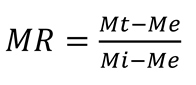
where MR is the moisture ratio, Mi is the initial moisture content (kg water/kg dry matter), Mt is the moisture content at a specific drying time (kg water/kg dry matter), and Me is the equilibrium moisture content (kg water/kg dry matter).
Drying Kinetics Model
Drying kinetics were described using the Weibull model, following the approach proposed in [32] (Equation 2).
where C/C0 represents the fraction of change of a component relative to its initial value, k is a parameter related to the drying rate, and n is the dimensionless shape parameter of the model.
Drying Rate (DR)
The drying rate (DR) (kg water/kg dry solids·s) was calculated based on the variation of moisture content during the drying process according to Equation (3).
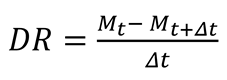
where Mt is the moisture content at time t (kg water/kg dry solids), Mt+Δt is the moisture content at time t + Δt (kg water/kg dry solids), and Δt is the drying time interval (s).
2.4.2. Rehydration Ratio (RR)
The weight of dried samples was considered the initial weight (m0). The rehydration test was conducted using 5 ± 0.5 g of dried mushrooms immersed in water at 60 °C at a solid-to-liquid ratio of 1:20 (w/w). Samples were removed, drained, and weighed every 30 min for 5 h using a digital electronic balance (Precisa XB, ±0.01 g precision). The rehydration ratio (RR) was calculated according to Equation (4) [28].
2.4.3. Physical Parameters
Shrinkage Ratio (% SR)
The shrinkage ratio was determined by measuring the length of fresh and dried mushrooms using a Vernier caliper. Measurements were performed for all samples after each drying treatment, and the shrinkage ratio was calculated according to Equation (5) [13].
Water Activity (Aw)
Water activity was determined using a digital hygrometer (Aqualab 4TE, Decagon Devices Inc., USA). Prior to measurement, samples were stabilized at 20 °C for 15 min. The dried samples were ground and placed in the sample chamber until a stable reading was obtained [33].
Color Analysis
Color parameters L* (lightness), a* (red–green coordinate), and b* (yellow–blue coordinate) were measured using a colorimeter (Konica Minolta CM-5, Osaka, Japan). The total color difference (ΔE) between fresh and dried samples was calculated according to Equation (6) [34].
where L*, a*, and b* represent the color parameters of dried samples, while L0*, a0*, and b0* correspond to the values of fresh mushrooms.
Browning Index (BI)
The browning index (BI) was calculated according to the equations proposed in [35] (Equation (7)).
2.4.4. Proximate Composition Analysis
The proximate composition of fresh and dried samples, including moisture, protein, crude fiber, lipid, ash, and total carbohydrate contents, was determined according to AOAC methods [36]. Total carbohydrates were calculated by difference according to Equation (8):
Carbohydrates (%) = 100 − (moisture + protein + lipid + ash + crude fiber).
The combined fraction of fiber and carbohydrates (F + C) was calculated as the sum of crude fiber and total carbohydrate contents to represent the structural carbohydrate fraction of the samples. All analyses were performed in triplicate and results were expressed on a dry weight basis (dw).
2.4.5. Total Phenolic Content and Antioxidant Activity
Total phenolic content (TPC) was determined using the Folin–Ciocalteu method described in [37]. Results were expressed as gallic acid equivalents (GAE) g/100 g dry weight (dw). Absorbance was measured at 760 nm using a spectrophotometer (UV–VIS SP 8001, Greenville, USA).
Antioxidant activity was evaluated using DPPH (2,2-diphenyl-1-picrylhydrazyl) and FRAP (Ferric Reducing Antioxidant Power) assays. The DPPH assay was performed according to the method described in [30], with modifications. Absorbance was measured at 515 nm, and results were expressed as µM TE/100 g dw.
The FRAP assay was conducted according to the method described in [38], with minor modifications. Absorbance was measured at 595 nm, and results were expressed as µM TE/g.
2.5. Statistical Analysis
All treatments and analyses were performed in triplicate. Data were expressed as mean ± standard deviation (SD) and analyzed using one-way analysis of variance (ANOVA) at a 95% confidence level. When significant differences were detected (p < 0.05), mean comparisons were performed using the least significant difference (LSD) test.
Experimental moisture ratio (MR) data were fitted to the Weibull model. The goodness-of-fit of the model was evaluated using the coefficient of determination (R2) and the mean square error (MSE). Differences in the drying rate constant (k) obtained from the Weibull model were assessed using Student’s t-test.
In addition, Principal Component Analysis (PCA) was performed to explore the relationships between drying treatments and quality parameters, including drying time, color attributes, rehydration ratio, shrinkage, water activity, moisture content, crude fiber + carbohydrates, bioactive compounds, and antioxidant activity. PCA was conducted using standardized data (mean = 0, variance = 1), and the first two principal components were used for interpretation and graphical representation through biplots.
All statistical analyses, including ANOVA, Weibull model fitting, and PCA, were performed using Statgraphics Centurion (version 16; Statgraphics Technologies Inc., The Plains, VA, USA) and XLSTAT (Addinsoft, New York, NY, USA). Graphical representations of the data were generated using Origin 2022 (OriginLab Corporation, Northampton, MA, USA).
3. Results and Discussion
3.1. Drying Kinetics and Weibull Model of Morchella conica Under Different Pretreatments and Drying Methods
Pretreatments were applied as an additional strategy to improve the preservation of physical and nutritional properties of the samples, as well as to achieve technological advantages such as reduced drying time and lower processing costs [19,39]. The drying kinetics of untreated and pretreated Morchella conica samples are presented in Figure 1, which shows the moisture ratio (MR) as a function of drying time for the different drying methods.
For HAD (Figure 1A), HT treatments showed curves with a lower initial slope compared to the control, but they reached a moisture ratio (MR) value below 0.1 in a shorter time. Drying accelerated during the final stage at 75 °C compared to 55 °C. Tianhai et al. [40] obtained similar results for M. sextelata when drying at temperatures of 45, 55, and 65 °C, suggesting that this behavior could be due to partial protein denaturation and the collapse of cellular membranes, which reduces the retention of bound water and shortens the residual moisture stage.
The US treatment showed a particular effect, because immersion in distilled water during the treatment increased the initial weight of the samples before being subjected to the three drying methods (Figure 1), directly affecting the drying kinetics. This phenomenon was more evident in the US 20 min treatment. This suggests that the mechanical effect and cavitation induced by ultrasound may generate changes in the microstructure of Morchella conica, such as the formation and enlargement of microscopic channels [41]. As a result, the capacity of the tissue to absorb water from the pretreatment medium is enhanced under ultrasonic action. This behavior has also been reported in shiitake mushroom slices [20], mulberry leaves [41], and apples [42]. However, the action of US and HPP on the sample microstructure (cavitation or pressure) favored a more constant diffusion of water during the drying process [18,23]. These results also agree with those reported by George et al. [43] and Zhang et al. [44] for ginger and button mushroom slices, respectively, where non-thermal pretreatments resulted in shorter drying times and improved porosity.
For FD (Figure 1B), US 20 min showed a higher initial MR than the control; however, the final drying time for both US treatments was shorter than that of the control sample, which agrees with the results obtained by Li et al. [29] for shiitake mushrooms. In contrast, both HT treatments showed a lower initial MR than the other pretreatments, indicating that the thermal treatment may facilitate the release of free moisture during the early stages of sublimation. The shortest drying time (13 h) was observed for HT 75 °C, followed by 14 h for HPP. These results are consistent with those reported by Xu et al. [28] when applying high-temperature pre-drying to Lentinula edodes, as well as by Yuan et al. [22] when applying HHP to dried jujube slices.
The combined drying method (FD–HAD) (Figure 1C) achieved the shortest total drying time compared to the other drying methods. The first FD stage drastically reduced the initial moisture content, and the subsequent HAD stage completed the drying process. Marçal et al. [45] indicated that the combination of several technologies improves drying efficiency and the quality of edible mushrooms. The shortest drying time was observed for HT 75 °C (11 h), with a faster decrease in MR from the beginning and a shorter final stage. Xu et al. [28] explained that this behavior may be due to the thermal pretreatment causing protein denaturation and membrane alteration, releasing bound water that remains retained for longer in other treatments.
The results of the Weibull model parameters fitted to the moisture ratio (MR) data, together with the statistical coefficients, are presented in Table 1.
The results obtained from the Weibull model showed a good fit for describing the drying kinetics of Morchella conica, with R2 > 0.987 and low MSE values for all treatments (Table 1). The values of the model rate parameter k varied depending on the combination of pretreatment and drying method. Significant differences in k values were observed among pretreatments, and the HAD treatment pretreated with HPP presented the highest value.
For the FD and FD–HAD drying treatments, the control samples showed the highest efficiency in water removal, followed by the HT 75 °C pretreatment. In general, these results agree with several studies reported for plant products, where the Weibull model has demonstrated good performance in describing moisture loss during drying processes, such as in yam slices, maqui berries, and apple slices [46,47,48].
Regarding the shape parameter (n), different drying behaviors were observed depending on the drying method. For HAD, n values were lower than 1 (0.692–0.866), indicating a progressive decrease in drying rate during the process, which is characteristic of convective hot-air drying. In contrast, for FD and FD–HAD, n values were higher than 1 (1.07–1.51), suggesting an initially faster moisture removal followed by a slower stage, which is consistent with the drying behavior observed in processes involving sublimation of ice during freeze-drying.
Similarly, recent studies in edible mushrooms such as Pleurotus eryngii confirm that empirical models, particularly Weibull and Page, allow differentiation of the efficiency of different drying methods and their impact on the final quality of the product [49]. The application of the Weibull model to Morchella conica not only confirms its applicability to fungal matrices but also reinforces its use as a comparative tool through the parameter k, associated with drying rate, in relation to other drying methods and products reported in the literature.
Figure 2 shows the drying rate (DR), calculated using Equation (3), for pretreated and untreated Morchella conica samples. The DR values were not constant and varied significantly depending on the drying method and the pretreatment applied.
For HAD (Figure 2A), a typical decreasing drying rate profile was observed. The HPP pretreatment showed the highest initial DR value, indicating rapid moisture removal during the early stages of the process. This result suggests that HPP altered the cellular structure of the mushroom tissue, facilitating water migration. In contrast, US and HT pretreatments showed moderate improvements, although lower than those observed for HPP.
For FD (Figure 2B) and FD–HAD (Figure 2C), US 20 min and HPP showed higher surface moisture content and an increased drying rate during the initial stage of drying. According to Llavata et al. [23], this behavior may be attributed to the structural modifications induced by cavitation and high pressure, which enhance water diffusion and increase the drying rate.
In general, all pretreatments showed that their combination with FD improved the drying process, which is consistent with the findings reported by Coşkun et al. [19]. However, HT 75 °C showed the highest drying rate, followed by HT 55 °C, HPP, and US 10 min. This behavior indicates that thermal pretreatments may optimize drying efficiency when applied before hybrid drying processes, representing effective strategies to accelerate moisture removal and reduce the total drying time.
These findings are consistent with several studies on mushrooms pretreated with ultrasound, where changes in drying rate have been attributed to modifications in cellular microstructure caused by cavitation [18,20,29,50]. Similarly, Xu et al. [28] reported that thermal pretreatments applied before FD and HAD in Lentinula edodes accelerated moisture removal, which agrees with the higher DR observed in the present study for HT 75 °C.
Furthermore, Hou et al. [13], Hu et al. [14], and Moutia et al. [15] demonstrated that combined drying methods can improve process efficiency compared to individual drying techniques, a trend that was also observed in the present results. Regarding HPP, no previous studies were found applying this pretreatment to edible mushrooms prior to drying. However, studies conducted on jujube slices, aloe vera cubes, and cashew slices reported higher drying rates when HPP was used as a pretreatment compared to untreated samples. This effect has been attributed to cellular structure modifications caused by pressure, which reduce turgor pressure and enhance permeability and mass transfer [22,25,51]. A similar behavior was observed in Morchella conica in the present study.
3.2. Influence of Different Pretreatments and Drying Methods on the Physical Properties of Morchella conica
Figure 3 presents the moisture content (MC), shrinkage ratio (SR), and water activity (Aw) of untreated and pretreated Morchella conica samples. Detailed physicochemical data are available in Supplementary Table S1.
The results (Figure 3A) show the residual moisture content (MC) of the dried mushrooms, which ranged between 2.33 and 9.31%, significantly lower than that of the fresh samples (87.33%) (P < 0.05). These differences reflect the influence of both the drying method and the pretreatments on the final moisture retention of the dried product. In particular, treatments such as US 20 min and HPP combined with FD achieved residual moisture contents below 3%, which is considered optimal for microbiological preservation and product stability. This behavior is consistent with the results reported by Zhang et al. [52] for Morchella esculenta dehydrated by HAD and FD. Similarly, Liao et al. [53] studied the effects of different drying methods (HAD, microwave-assisted HAD, FD, and natural drying) in Morchella sextelata, concluding that drying methods themselves can cause variations in the final moisture content of the products. Additionally, several authors [21,54,55] indicated that the selection of pretreatments should consider not only drying efficiency but also the structural effects on food matrices, which may influence their physicochemical properties.
Figure 3B shows that the shrinkage ratio (SR%) observed in the treatments applied to Morchella conica varied significantly depending on the pretreatment and drying strategy used. Several studies have shown that SR during mushroom drying is a critical parameter that directly affects physical quality and consumer sensory perception [56,57]. For HAD, the values ranged between 29.96% and 34.70%, which are comparable to the 29.63% reported by Alfiya et al. [57] for Pleurotus ostreatus subjected to combined HAD and microwave drying, where shrinkage was attributed to free water loss and structural collapse of cell walls. In contrast, FD produced the lowest SR values (4.46–8.10%), in agreement with Chen et al. [58] for Lentinula edodes, who observed that drying at moderate temperatures or by sublimation minimizes structural contraction. The combined FD–HAD method produced intermediate SR values (11.92–15.26%), confirming that the initial FD stage helps preserve the cellular structure before HAD is applied. Interestingly, treatments such as HPP–HAD (31.31–31.79%) showed a slight reduction in SR compared to the HAD control, suggesting that high pressure may partially stabilize the cell wall structure, a phenomenon also described by Liu et al. [59] in microwave-assisted drying of L. edodes.
On the other hand, the reduction in water activity (Aw) observed in all treatments (Figure 3C) confirms the effectiveness of dehydration in M. conica compared with the fresh sample (≈1.00), with significant differences (P < 0.05). Most treatments reached Aw values below 0.30, a threshold considered safe against microbial growth and enzymatic activity [22,60,61,62]. However, significant differences among treatments were observed, which can be attributed to structural changes induced by the pretreatments. In the case of HPP–HAD and US 10 min–FD, the relatively high Aw values (0.40–0.50) could be explained by the retention of moisture within microcavities generated during the pretreatments. Studies in fruits have reported that the rapid compression and decompression during HPP can create internal cavities and trap water when subsequent drying is slow, as in HAD [63]. Similarly, short ultrasound treatments may produce partial cavitation, generating microchannels insufficient to allow efficient water migration toward the surface, resulting in higher final Aw values [41].
In contrast, the lowest Aw values were observed for HPP–FD and US 20 min–FD (0.10–0.11). These results suggest that sublimation of the free water released by HPP during FD facilitates a more complete moisture removal, reaching minimal Aw levels. Similar results have been reported in fruits such as jujube and common beans [22,64]. In the case of ultrasound, a longer treatment time (20 min) intensified cavitation effects and promoted the formation of more homogeneous microchannels, improving mass transfer and resulting in deeper dehydration [29,65]. Overall, the differential behavior of HPP and US on Aw indicates that the effectiveness of non-thermal pretreatments depends not only on the technology used but also on the intensity and duration of the treatment. While for HPP the drying method combination is decisive, for US the critical factor is treatment duration. This finding highlights the potential of both pretreatments to modulate drying kinetics and microbiological stability of Morchella conica, although their optimization requires balancing pretreatment conditions and the subsequent drying method.
Another important quality attribute of edible mushrooms is color, as it represents a key parameter for evaluating sensory properties and strongly influences consumer perception and purchase intention [53]. Table 2 shows the effects of pretreatments and drying methods on the color and browning degree of Morchella conica.
In the evaluation of dried edible mushrooms, high L* values and low ΔE values are generally considered desirable because they indicate a lighter appearance and a smaller deviation from the original color of the fresh product [9]. The results show that the drying method had a significant effect on the chromatic parameters of Morchella conica, with the following trend for L*: FD > FD–HAD > HAD, indicating lower surface color degradation for FD-treated samples.
This trend agrees with the findings of Liao et al. [53], who observed that freeze-drying preserved the cellular structure of Morchella sextelata and reduced Maillard reactions responsible for browning when compared with hot-air drying. These authors also reported that the application of two consecutive drying methods can shorten the dehydration time, thus reducing browning caused by prolonged heating. In addition, Zhang et al. [65] reported that non-thermal techniques such as high hydrostatic pressure (HPP) can help preserve the sensory characteristics of Agaricus bisporus due to their lower oxidative impact.
On the other hand, the chromatic coordinates a* and b* showed notable increases after the HPP–HAD treatment, indicating a shift toward reddish and yellowish tones accompanied by a reduction in lightness (L*). This behavior is consistent with the results reported by Liao et al. [53] for Morchella sextelata, where thermal treatments produced increases in a* and b* values associated with non-enzymatic browning reactions and changes in carotenoid pigments. Similarly, Wang et al. [34] reported that drying methods such as microwave or infrared drying also increase a* values due to localized heating effects. Comparable changes have been widely reported in vegetables subjected to HPP treatments [22,23]. These chromatic changes are mainly attributed to cell membrane disruption and the exposure of pigments previously encapsulated within cellular structures, which intensifies color perception and reduces luminosity.
Quantitatively, ΔE values ranged approximately between 1.5 and 6.1 depending on the treatment, with higher values observed for HAD and lower values for FD. The lowest ΔE values were observed for HPP–FD–HAD and US 10 min–FD, indicating that these combinations better preserved the original appearance of the mushroom. Comparable results have been reported for Morchella esculenta by Jiajia et al. [56] and for Pleurotus ostreatus by Villalobos-Pezos et al. [66]. These studies demonstrated that freeze-drying more effectively preserves the visual appearance of mushrooms, producing lower ΔE values and maintaining a color closer to that of fresh samples when compared with conventional thermal drying methods.
Finally, the browning index (BI) was lowest for HPP–FD and HT 75 °C–FD–HAD, confirming that drying methods involving lower thermal stress reduce the formation of brown pigments. These findings are consistent with studies on Pleurotus ostreatus, where both vacuum drying and freeze-drying significantly reduced enzymatic and non-enzymatic oxidation [67]. Conversely, the highest BI values were recorded for HAD treatments, which agrees with Jiajia et al. [56] and Liao et al. [53], who attributed this effect in Morchella spp. to prolonged exposure to high temperatures, intensifying the formation of melanoidins.
Pretreatments also influenced these parameters. Treatments such as HPP and ultrasound (US) showed intermediate BI values, which may be related to microstructural changes and the release of pigments, as reported by Li et al. [29] for Pleurotus eryngii. Therefore, the selection of both the drying method and the pretreatment strategy is crucial for preserving the visual quality of Morchella conica, particularly in applications where color is a determining factor for consumer acceptability and commercial value.
3.3. Influence of Pretreatments and Drying Methods on the Rehydration Properties of Morchella conica
Rehydration data (%RR) represent the ability of dried Morchella conica mushrooms to recover their structure and original mass after immersion in water. This parameter is particularly important because it reflects the degree of structural damage caused during the drying process.
Figure 4 shows the rehydration kinetics of dried Morchella conica samples subjected to different pretreatments and drying methods.
During the rehydration evaluation, the results show that FD was the most effective drying method, reaching maximum water absorption values of approximately 1350 g water/5 g dry sample, which were significantly higher than those obtained for FD–HAD (~700 g/5 g dry sample) and especially for HAD (~200 g/5 g dry sample).
Within the HAD treatment (Figure 4A), thermal pretreatments significantly improved the rehydration ratio, particularly HT 75 °C, which reached 175.6% at 1.5 h, indicating lower structural collapse. Xu et al. [28] reported that this pretreatment accelerated the drying process and reduced texture loss in shiitake mushrooms, resulting in improved rehydration capacity compared with the HAD control. However, even with this improvement, the rehydration values remained significantly lower than those reported for FD in other studies, confirming that thermal stress limits water absorption due to structural collapse of the cellular matrix.
For pretreatments combined with FD (Figure 4B), US 20 min and HPP showed the highest RR values (>230%), confirming the beneficial effect of additional microchannels generated within the structure. In contrast, FD–HAD (Figure 4C) showed intermediate values following the trend FD > FD–HAD > HAD, since the initial FD stage preserves the structure better than HAD alone, while the subsequent hot-air stage may cause partial structural collapse compared with FD alone.
In FD–HAD, US 20 min and HPP were the most effective pretreatments, reaching RR values greater than 210% at 1.5 h. These findings agree with previous studies on shiitake mushrooms [34] and Pleurotus ostreatus [66], where FD preserved the porous structure more effectively and allowed faster water absorption. Similarly, Jiajia et al. [56] reported in Morchella esculenta that FD ensures the highest water absorption capacity compared with HAD or solar drying, while Rorato et al. [67] observed in Agaricus bisporus that FD combined with vacuum techniques enhances rehydration quality.
3.4. Influence of Pretreatments and Drying Methods on the Proximate Composition of Morchella conica
The main macronutrients of Morchella conica varied significantly (p < 0.05) depending on the drying method and the pretreatments applied, as shown in Table 3. These variations are mainly associated with concentration effects caused by water removal during dehydration, as well as structural modifications induced by thermal and non-thermal treatments that can alter the stability and extractability of nutritional components. Similar trends have been reported in edible mushrooms and other plant matrices subjected to drying processes, where dehydration not only concentrates macronutrients but may also promote structural changes in cellular tissues that affect their final composition [15,34,68]. The fresh sample, used as the reference (letter a), presented protein, lipid, and ash contents of 30.83, 2.99, and 12.20 g/100 g dw, respectively, while the combined fraction of fiber and carbohydrates (F + C) reached 53.99 g/100 g dw, representing the main structural component of the mushroom.
Regarding protein content, the fresh raw material showed 30.82 g/100 g dw, remaining relatively stable after the drying treatments, although significant differences were observed among treatments. The highest values were found in FD–HAD treatments, particularly in the control and HT 55 °C samples (up to 35.86 g/100 g dw), whereas FD treatments remained within a narrow range (30.53–31.92 g/100 g dw). In contrast, HAD showed greater variability (28.77–33.26 g/100 g dw) depending on the pretreatment applied. These results agree with those reported by Zhang et al. [52] in Morchella sextelata, where protein content ranged between 29 and 34 g/100 g dw under different drying methods. Similarly, Liao et al. [53] confirmed that this macronutrient exhibits high stability during dehydration processes. In addition, studies on Agaricus bisporus and Pleurotus ostreatus reported that freeze drying and non-thermal technologies preserve the protein profile better than hot-air drying [66,69,70].
Regarding lipid content, the fresh material presented 2.99 g/100 g dw, while dried samples ranged between 1.48 and 5.51 g/100 g dw. In general, Morchella conica maintains a low lipid content, which is characteristic of edible mushrooms. The highest lipid values were observed in HPP–FD and HPP–FD–HAD treatments, whereas the lowest values were recorded in FD–HAD control samples. These variations can be attributed to concentration effects and structural modifications that may facilitate lipid extraction or quantification after drying. Similar trends have been reported for several edible mushroom species, where lipid contents typically remain below 6 g/100 g dw [3,71].
For ash content, which reflects the mineral fraction of the mushroom, values ranged between 6.31 and 15.67 g/100 g dw in dried samples, while the fresh sample presented 12.20 g/100 g dw. The highest values were mainly observed in HAD treatments, which may be related to concentration effects caused by convective drying. In contrast, some treatments involving ultrasound and FD showed lower values, which may reflect structural modifications or mineral redistribution during dehydration. These values fall within the typical range reported for Morchella species and other wild edible mushrooms [3].
Concerning fiber content, the fresh sample contained 15.17 g/100 g dw, while all drying treatments increased this fraction, reaching up to 31.68 g/100 g dw in HPP–HAD, followed by HPP–FD–HAD (28.53 g/100 g dw). Pretreatments with ultrasound (US 10–20 min) also favored an increase in fiber content, reaching values of up to 26.89 g/100 g dw, whereas HT 75 °C–FD (16.55 g/100 g dw) showed relatively lower values. This behavior suggests that certain treatments may modify cell wall permeability and favor the concentration of structural polysaccharides after drying. Similar results were reported by Zhang et al. [52] in Morchella sextelata, where combined drying methods tended to concentrate the fiber fraction.
Regarding carbohydrate content, the fresh material presented 38.81 g/100 g dw, while significant reductions were observed after drying, particularly in HPP–HAD (9.47 g/100 g dw) and US 20 min–FD–HAD (13.15 g/100 g dw). In contrast, the highest values were recorded in US 20 min–FD (31.52 g/100 g dw) and Control–FD (27.56 g/100 g dw), confirming that freeze drying is the most effective technique for preserving carbohydrates. This behavior is consistent with findings reported by Zhang et al. [52] and Liao et al. [53] in Morchella sextelata, where FD maintained higher levels of soluble sugars compared with HAD.
The combined fraction of fiber and carbohydrates (F + C) represented the major component of the proximate composition, with values ranging between 35.23 and 54.91 g/100 g dw. This fraction mainly includes structural polysaccharides characteristic of fungal cell walls, such as chitin, β-glucans, and other non-starch polysaccharides, which are known to contribute to the nutritional and functional properties of edible mushrooms [71]. Higher F + C values were observed in samples treated with ultrasound pretreatments, particularly US–HAD and US–FD, whereas lower values were detected in HAD control samples.
Overall, the results demonstrate that the macronutrient composition of Morchella conica is sensitive to the drying method applied. Freeze drying (FD) emerges as the most effective technique for preserving proteins and carbohydrates, while some pretreatments such as HPP and ultrasound favor the concentration of structural fiber. These findings are consistent with recent reviews [23,45], which highlight the potential of combining innovative pretreatments with appropriate drying technologies to maintain the nutritional quality of edible mushrooms.
3.5. Influence of Pretreatments and Drying Methods on Bioactive Compounds of Morchella conica
Figure 5 presents the effect of pretreatments and drying methods on the bioactive compounds of Morchella conica, including total phenolic content (TPC), antioxidant activity determined by DPPH, and ferric reducing antioxidant power (FRAP) in fresh and dried samples. Detailed bioactive compound data are provided in Supplementary Table S2.
3.5.1. Total Phenolic Content (TPC)
The initial TPC of the raw material (1230.29 mg GAE/100 g dw) showed a differential response depending on the drying method and pretreatment applied. In particular, HAD at 55 °C increased the TPC to 2675.83 mg GAE/100 g dw, whereas increasing the temperature to 75 °C reduced it to 2236.46 mg GAE/100 g dw. These results suggest that moderate heat promotes the release of bound phenolic compounds from the cellular matrix, while excessive temperatures may induce partial degradation of phenolic structures. Similar trends were reported by Gąsecka et al. [72] in Leccinum spp. and Hericium spp., where moderate thermal treatments enhanced phenolic extractability.
Ultrasound pretreatments exhibited a time-dependent effect. Under HAD conditions, US 10 min moderately increased TPC (1648.77 mg GAE/100 g dw), whereas extending the treatment to 20 min reduced phenolic content to levels similar to the control (1252.38 mg GAE/100 g dw). This behavior supports the dual nature of acoustic cavitation described by Llavata et al. [23], where ultrasound may increase metabolite extractability through cell disruption but can also promote oxidative degradation when treatment intensity or duration is excessive.
Freeze drying (FD) generally preserved or even increased phenolic content (Control: 1601.78 mg GAE/100 g dw; US 10 min: 2261.87 mg GAE/100 g dw), confirming that low-temperature dehydration minimizes phenolic degradation and helps maintain antioxidant compounds during drying. Similar observations have been reported in edible mushrooms and plant matrices, where freeze drying effectively preserves phenolic compounds due to the absence of high thermal stress and oxidation reactions [9,30]. However, significant reductions were observed for US 20 min (902.55 mg GAE/100 g dw), suggesting that excessive cavitation may destabilize phenolic compounds before drying. This phenomenon has been described for ultrasound-assisted treatments, where intense or prolonged cavitation can promote oxidation or degradation of phenolic compounds [23].
Treatments involving HPP combined with FD and FD–HAD showed intermediate values (1197.56–1301.27 mg GAE/100 g dw). This behavior may be attributed to the ability of high hydrostatic pressure to induce structural modifications in cellular tissues while avoiding significant thermal degradation, thereby helping to preserve bioactive compounds during subsequent processing. Similar effects have been reported for pressure-treated food matrices, where HPP promotes cell permeability and facilitates the retention or release of phenolic compounds without the thermal damage associated with conventional processing [73,75].
3.5.2. Antioxidant Activity (DPPH)
Antioxidant activity measured by DPPH also increased substantially compared with the fresh material (6307.84 µM TE/100 g dw). HAD treatments at 55 °C and 75 °C reached values of 18562.2 and 19727.7 µM TE/100 g dw, respectively, indicating enhanced radical scavenging capacity associated with heat-induced release of antioxidant compounds, consistent with the findings of Izham et al. [75]. The effect of ultrasound was again dependent on treatment duration. While US 10 min under HAD produced 18017.6 µM TE/100 g dw, extending the treatment to 20 min reduced antioxidant activity to 6887.97 µM TE/100 g dw, suggesting that prolonged ultrasonic exposure may accelerate oxidative reactions or degradation of antioxidant molecules [9,23].
The FD control sample showed the highest antioxidant activity of the study (20345.6 µM TE/100 g dw), confirming previous observations by Villalobos-Pezos et al. [30] in Cyttaria espinosae, where freeze drying effectively preserved antioxidant compounds by preventing thermal degradation. In contrast, the combined FD–HAD process with ultrasound resulted in markedly lower antioxidant capacity (5280.81–4967.36 µM TE/100 g dw), suggesting potential antagonistic effects between cavitation-induced structural disruption and subsequent thermal exposure.
HPP treatments showed intermediate antioxidant activity (8392.8–9559.64 µM TE/100 g dw). This behavior is consistent with previous studies indicating that high hydrostatic pressure generally preserves antioxidant compounds rather than substantially enhancing their activity in food matrices. For example, Pérez-Lamela et al. [73] reported that HPP treatments maintain the stability of phenolic compounds due to the absence of thermal degradation, while Tepsongkroh et al. [74] observed that high-pressure pretreatments applied to Volvariella volvacea can modify cellular structures and facilitate the release of antioxidant compounds without causing significant degradation. These results are particularly relevant since the application of high hydrostatic pressure as a pretreatment prior to drying has rarely been explored in edible mushrooms and, to the best of our knowledge, has not been previously reported for Morchella species.
Ferric reducing antioxidant power (FRAP)
Regarding reducing power (FRAP), the fresh material showed 1411.86 µM TE/g dw, which increased significantly after HAD at 55 °C (3198.32 µM TE/g dw) but decreased at 75 °C (2264.0 µM TE/g dw). This pattern indicates that moderate heat promotes the release of reducing compounds, whereas excessive temperatures favor their degradation, in agreement with Gąsecka et al. [72]. Ultrasound pretreatments under HAD produced values of 2030.42 µM TE/g dw (10 min) and 1753.58 µM TE/g dw (20 min), reflecting the same time-dependent trend reported for Cantharellus cibarius by Sun et al. [18].
Freeze drying combined with pretreatments generated substantially higher FRAP values, particularly HT 55 °C (8553.37 µM TE/g dw) and US 20 min (8722.07 µM TE/g dw). However, the highest values of the entire study were obtained for HPP–FD (13,138.5 µM TE/g dw) and HPP–FD–HAD (13,186.0 µM TE/g dw), greatly exceeding the other treatments. The high antioxidant capacity observed in FD treatments agrees with the results reported by Uçar and Karadağ [69], who demonstrated that freeze drying preserves phenolic compounds and antioxidant activity in Pleurotus ostreatus by minimizing thermal degradation during dehydration.
Overall, the results demonstrate that Morchella conica responds differently depending on the drying technology and pretreatment applied. Moderate HAD temperatures and FD effectively enhance or preserve phenolic compounds and antioxidant activity, whereas HPP particularly improves reducing power. Similar patterns have been reported for other edible mushrooms such as Pleurotus spp., Leccinum spp., and Cyttaria espinosae, where drying technologies and pretreatments significantly influence the retention of phenolic compounds and antioxidant capacity [34,66,72]. In addition, the influence of emerging technologies such as ultrasound and high-pressure processing on the stability and extractability of bioactive compounds has been widely reported in food matrices [23,73]. These findings confirm that the interaction between drying technology and innovative pretreatments determines the balance between the release and degradation of bioactive compounds.
3.6. Principal Component Analysis (PCA)
Principal component analysis (PCA) was performed to evaluate the relationships among drying treatments and quality parameters of Morchella conica (Figure 6). The first two principal components explained 68.9% of the total variance, with PC1 accounting for 53.5% and PC2 for 15.4%, indicating that most of the variability in the dataset can be explained within this two-dimensional space.
PC1 was mainly associated with visual and compositional quality attributes, including browning index (BI, 0.39), color change (ΔE, 0.39), shrinkage (SR%, 0.40), and the combined fraction of fiber and carbohydrates (F+C, 0.39), together with total phenolic content (TPC, 0.23). In contrast, drying time (–0.38) and rehydration ratio (RR%, –0.36) were negatively correlated with this component. This relationship suggests that treatments resulting in longer drying times tended to exhibit higher rehydration capacity but lower accumulation or release of certain bioactive compounds.
The second principal component (PC2) was dominated by moisture content (0.67) and water activity (Aw, 0.57), followed by a moderate negative contribution of TPC (–0.27). This axis mainly differentiates treatments according to their degree of dehydration and microbiological stability, as lower moisture and Aw values are typically associated with improved shelf stability in dried foods.
Cluster analysis applied to the PCA results (Figure 6) revealed three distinct groups of treatments with differentiated quality profiles. Cluster 0, which included most freeze-drying treatments (Control FD, HT 55 °C FD, HT 75 °C FD, US 20 min FD, HPP FD and Control FD–HAD), was located in the positive region of PC1 and was characterized by high values of TPC and FRAP combined with low moisture and Aw levels. These results highlight the strong ability of freeze drying to preserve bioactive compounds while ensuring microbiological stability.
In contrast, Cluster 1 comprised the hot-air drying treatments (Control HAD, HT 55 °C HAD, HT 75 °C HAD, US 10 min HAD, US 20 min HAD and HPP HAD), which were distributed in the negative region of PC1. This cluster was mainly associated with longer drying times and higher rehydration capacity, indicating that HAD treatments were more strongly related to technological and structural attributes rather than antioxidant preservation.
Finally, Cluster 2 consisted primarily of hybrid drying treatments (HT 55 °C FD–HAD, HT 75 °C FD–HAD, US 10 min FD–HAD, US 20 min FD–HAD, HPP FD–HAD) together with US 10 min FD. This group occupied an intermediate position between the previous clusters and showed balanced characteristics in terms of visual quality parameters (BI, ΔE, SR), stability indicators (Aw and moisture content), and functional compounds (TPC and FRAP). This suggests that hybrid drying strategies may represent a compromise between antioxidant preservation and technological performance.
The PCA results obtained in this study are consistent with previous findings reported for edible mushrooms. Previous studies have shown that different drying methods significantly influence structural, physicochemical, and antioxidant properties in dried mushrooms, leading to distinct quality profiles depending on the processing technology applied. In multivariate analyses, parameters related to antioxidant activity, color changes, and structural properties often contribute strongly to the main principal components, allowing a clear differentiation between drying treatments [66,69,72].
4. Conclusions
This study evaluated the influence of thermal and non-thermal pretreatments combined with different drying methods on the drying kinetics, physicochemical properties, nutritional composition, and bioactive compounds of the wild Chilean mushroom Morchella conica. The results demonstrated that both pretreatments and drying technologies significantly affected drying efficiency and final product quality.
Hot-air drying combined with thermal pretreatments accelerated the drying process but resulted in greater structural shrinkage and color changes. In contrast, freeze-drying preserved structural integrity, color, and rehydration capacity while maintaining higher levels of carbohydrates and antioxidant compounds. Ultrasound pretreatments showed a time-dependent effect, whereas high hydrostatic pressure notably enhanced the reducing antioxidant capacity when combined with freeze-drying.
Principal component analysis confirmed clear differences among drying technologies, with freeze-dried samples associated with higher antioxidant activity and better physicochemical stability. Overall, the results highlight freeze-drying and hybrid drying strategies as promising approaches for improving the technological processing and functional quality of Morchella conica.
Supplementary Materials
The following supporting information can be downloaded at the website of this paper posted on Preprints.org.
Author Contributions
Conceptualization, Y.T.-P.; Funding acquisition, Y.T.-P.; Methodology, Y.T.-P., C.V.-S., H.F.-M., M.M.C.-P., and R.A.Q.-L; Investigation and formal analysis, Y.T.-P., and R.A.Q.-L; Writing—Original draft preparation, Y.T.-P.; Writing—Review and Editing, Y.T.-P., O.M.-F., O.G.-F, J.M.B.-M., and R.A.Q.-L; Supervision, O.M.-F. All authors have read and agreed to the published version of the manuscript.
Funding
This research was funded by the Agencia Nacional de Investigación y Desarrollo (ANID), Chile, through the FONDECYT Postdoctoral Project No. 3230148 (2023).
Institutional Review Board Statement
Not applicable.
Informed Consent Statement
Not applicable.
Data Availability Statement
The original contributions presented in this study are included in the article/supplementary material. Further inquiries can be directed to the corresponding author(s).
Acknowledgments
The authors gratefully acknowledge the support of the Agencia Nacional de Investigación y Desarrollo (ANID), Chile, through the FONDECYT Postdoctoral Project No. 3230148. The authors also thank the Research Group Control, Toxicology and Food Safety (GI 172122/VC) at Universidad del Bío-Bío (Chile), the Instituto de Ciencia y Tecnología de los Alimentos (ICYTAL), Universidad Austral de Chile (Chile), and the Departamento de Acuicultura y Recursos Agroalimentarios, Universidad de Los Lagos (Chile) for their collaboration and support in the development of the experimental methodology and for providing laboratory facilities for the physicochemical and nutritional analyses performed in this study.
Conflicts of Interest
The authors declare no conflict of interest.
References
- Taşkın, H.; Süfer, Ö.; Attar, ŞH.; Bozok, F.; Baktemur, G.; Büyükalaca, S.; Kafkas, NE. Total phenolics, antioxidant activities and fatty acid profiles of six Morchella species. J. Food Sci. Technol. 2021, 58, 692–700. [Google Scholar] [CrossRef]
- Deng, G.; Li, J.; Liu, H.; Wang, Y. Volatile compounds and aroma characteristics of mushrooms: A review. Crit. Rev. Food Sci. Nutr. 2024, 64, 13175–13192. [Google Scholar] [CrossRef]
- Tietel, Z.; Masaphy, S. True morels (Morchella)—nutritional and phytochemical composition, health benefits and flavor: a review. Crit. Rev. Food Sci. Nutr. 2018, 58, 1888–901. [Google Scholar] [CrossRef]
- Acar, İ.; Blando, F.; Gul, B.; Greco, A.; Mukemre, M.; Uzun, Y.; Dalar, Y. The phenolic profile and biological activities of the wild-edible mushrooms Helvella leucopus and Morchella pulchella. Food Meas. 2021, 15, 555–566. [Google Scholar] [CrossRef]
- Jaime-Moya, I.; Gómez, C. Morchella (Morchella spp.): El hongo de los bosques norpatagónicos de la Región de Aysén; Instituto Forestal: Coyhaique, Chile, 2018; Volume Documento de Divulgación No. 45, p. p. 25. ISBN 978-956-318-147-0. [Google Scholar]
- Leal, P.; Carrasco, A. Antecedentes para la producción de Morchella en Chile. PortalFrutícola. 2018. Available online: https://www.portalfruticola.com/noticias/2018/05/23/antecedentes-para-la-produccion-de-morchella (accessed on 5 March 2026).
- Poblete Hernández, P.; Catelicán Vera, L. Productos Forestales No Madereros; Instituto Forestal: Chile, 2025; Volume Boletín No. 44, p. 30. ISBN 978-956-318-147-0. [Google Scholar]
- Castellanos-Reyes, K.; Villalobos-Carvajal, R.; Beldarrain-Iznaga, T. Fresh Mushroom Preservation Techniques. Foods 2021, 10, 2126. [Google Scholar] [CrossRef]
- Wang, T.; Ma, J.; Chen, H.; Li, Y. Drying kinetics and quality evaluation of Oudemansiella raphanipes treated with ultrasound-assisted hot air drying. J. Food Process. Preserv. 2023, 47, e4648. [Google Scholar] [CrossRef]
- Popa, M.; Tausan, I.; Draghici, O.; Soare, A.; Oancea, S. Influence of Convective and Vacuum-Type Drying on Quality, Microstructural, Antioxidant and Thermal Properties of Pretreated Boletus edulis Mushrooms. Molecules 2022, 27, 4063. [Google Scholar] [CrossRef] [PubMed]
- Chen, C.; Xu, H.; Wang, Y.; Liu, Y. Drying methods impact on color, texture and bioactives in mushrooms: A review. Foods 2023, 12, 1220. [Google Scholar] [CrossRef]
- Zhang, L.; Qiao, Y.; Wang, C.; Liao, L.; Liu, L.; Shi, D.; An, K.; Hu, J.; Xu, Q. Effects of Freeze Vacuum Drying Combined with Hot Air Drying on the Sensory Quality, Active Components, Moisture Mobility, Odors, and Microstructure of Kiwifruits. J. Food Qual. 2019, 1–11. [Google Scholar] [CrossRef]
- Hou, H.; Lu, X.; Du, H.; Chen, X.; Fang, D.; Fan, X.; Hu, Q.; Zhao, L. Effects of pre-cutting treatments and combination drying with different orders on drying characteristics and physicochemical properties of Lentinula edodes. J. Sci. Food Agric. 2021, 101, 2063–2071. [Google Scholar] [CrossRef]
- Hu, L.; Bi, J.; Jin, X.; Qiu, Y.; van der Sman, R.G.M. Study on the rehydration quality improvement of shiitake mushroom by combined drying methods. Foods 2021, 10, 769. [Google Scholar] [CrossRef]
- Moutia, I.; Lakatos, E.; József Kovács, A. Impact of Dehydration Techniques on the Nutritional and Microbial Profiles of Dried Mushrooms. Foods 2024, 13, 3245. [Google Scholar] [CrossRef]
- Daud, N.F.S.; Said, F.M.; Mohyiddin, I.M.; Mohamad, S.F.S.; Zin, N.H. M.; Zakil, F.A.; Muhamad, S.S. Investigating the impact of blanching and salt treatment on the drying kinetics of oyster mushrooms. Bioresour. Technol. Rep. 2024, 27, 101943. [Google Scholar] [CrossRef]
- Maikon da Rocha, E.; Avila, S.; de Lima, J.J.; Scheffer de Andrade Silva, R.; Miranda Bacila, D.; Mathias, A.L.; Jorge, R.M.M. Avaliação da eficácia do branqueamento e condições ideais de temperatura e tempo para minimizar o escurecimento de cogumelos comerciais. Scientia Plena 2024, 20, 6. [Google Scholar] [CrossRef]
- Sun, M.; Xu, Y.; Ding, Y.; Gu, Y.; Zhuang, Y.; Fan, X. Effect of Ultrasound Pretreatment on the Moisture Migration and Quality of Cantharellus cibarius Following Hot Air Drying. Foods 2023, 12, 2705. [Google Scholar] [CrossRef]
- Coşkun, N.; Sümeyye, S.; Yassine, J.; Bordiga, N.; Karav, S. The Impact of Freeze Drying on Bioactivity and Physical Properties of Food Products. Appl. Sci. 2024, 14, 9183. [Google Scholar] [CrossRef]
- Yuan-Yuan, Z.; Jian-Yong, Y.; Jin-Feng, B.; Qin-Qin, C.; Mo, Z.; Biao, Z. Improving of texture and rehydration properties by ultrasound pretreatment for infrared-dried shiitake mushroom slices. Dry. Technol. 2019, 37, 352–362. [Google Scholar] [CrossRef]
- Dziki, D. Recent trends in pretreatment of food before freeze-drying. Processes 2020, 8, 1661. [Google Scholar] [CrossRef]
- Yuan, L.; Lao, F.; Shi, X.; Zhang, D.; Wu, J. Effects of cold plasma, high hydrostatic pressure, ultrasound, and high-pressure carbon dioxide pretreatments on the quality characteristics of vacuum freeze-dried jujube slices. Ultrason. Sonochem. 2022, 90, 106219. [Google Scholar] [CrossRef] [PubMed]
- Llavata, B.; García-Pérez, J.; Simal, S.; Cárcel, J. Innovative pre-treatments to enhance food drying: a current review. Curr. Opin. Food Sci. 2020, 35, 20–26. [Google Scholar] [CrossRef]
- Chiozzi, V.; Agriopoulou, S.; Varzakas, T. Advances, Applications, and Comparison of Thermal (Pasteurization, Sterilization, and Aseptic Packaging) against Non-Thermal (Ultrasounds, UV Radiation, Ozonation, High Hydrostatic Pressure) Technologies in Food Processing. Appl. Sci. 2022, 12, 2202. [Google Scholar] [CrossRef]
- Santos, N.C.; Almeida, R.L.J.; da Silva, G.M.; Fonseca, J.; Alcântara, M.; Tavares, M.; França, A.; André, A.; Almeida, M.; Brito, A. Impact of high hydrostatic pressure (HHP) pre-treatment drying cashew (Anacardium occidentale L.): drying behavior and kinetic of ultrasound-assisted extraction of total phenolics compounds. Food Meas. 2023, 17, 1033–1045. [Google Scholar] [CrossRef]
- Navarro-Baez, J.E.; Martínez, L.M.; Welti-Chanes, J.; Buitimea-Cantúa, G.V.; Escobedo-Avellaneda, Z. High Hydrostatic Pressure to Increase the Biosynthesis and Extraction of Phenolic Compounds in Food: A Review. Molecules. 2022, 27, 1502. [Google Scholar] [CrossRef] [PubMed]
- Zhang, C.; Xie, Y.; Liu, D.; Liu, R.; Han, J. Effects of Drying Process and High Hydrostatic Pressure on Extraction of Antioxidant Ergothioneine from Pleurotus citrinopileatus Singer. Foods 2024, 13, 878. [Google Scholar] [CrossRef]
- Xu, L.; Fang, X.; Wu, W.; Chen, H.; Mu, H.; Gao, H. Effects of high-temperature pre-drying on the quality of air-dried shiitake mushrooms (Lentinula edodes). Food Chem. 2019, 285, 406–413. [Google Scholar] [CrossRef]
- Li, X.; Li, J.; Wang, R.; Rahaman, A.; Zeng, X.A.; Brennan, C.S. Combined effects of pulsed electric field and ultrasound pretreatments on mass transfer and quality of mushrooms. LWT 2021, 150, 112008. [Google Scholar] [CrossRef]
- Villalobos-Pezos, M.; Muñoz-Fariña, O.; Ah-Hen, K.S.; Garrido Figueroa, M.-F.; García-Figueroa, O.; González-Esparza, A.; González-Pérez de Medina, L.; Bastías-Montes, J.M. Effects of Drying Treatments on the Physicochemical Characteristics and Antioxidant Properties of the Edible Wild Mushroom Cyttaria espinosae Lloyd (Digüeñe Mushroom). J. Fungi. 2025, 11, 13. [Google Scholar] [CrossRef]
- Tamarit-Pino, Y.; Bastías-Montes, J.M.; Segura-Ponce, L.A.; Díaz-Álvarez, R.E.; Guzmán-Meza, M.F.; Quevedo-León, R.A. Effect of electrohydrodynamic pretreatment on drying rate and rehydration properties of Chilean sea cucumber (Athyonidium chilensis). Food Bioprod. Process. 2020, 123, 284–295. [Google Scholar] [CrossRef]
- Quevedo, R.; Díaz, O.; Valencia, E.; Pedreschi, F.; Bastías, J.M.; Siche, R. Differences between the order model and the weibull model in the modeling of the enzymatic browning. Food Bioprocess Technol. 2016, 9, 1961–1967. [Google Scholar] [CrossRef]
- Zhang, C.; Quek, S.Y.; Fu, N.; Su, Y.; Kilmartin, P.A.; Chen, X. D. Storage stability and in vitro digestion of microencapsulated powder containing fermented noni juice and probiotics. Food Biosci. 2020, 37, 100740. [Google Scholar] [CrossRef]
- Wang, Q.; Li, S.; Han, X.; Ni, Y.; Zhao, D.; Hao, J. Quality evaluation and drying kinetics of shiitake mushrooms dried by hot air, infrared and intermittent microwave–assisted drying methods. LWT 2019, 107, 236–242. [Google Scholar] [CrossRef]
- Nasiri, M.; Barzegar, M.; Sahari, M.A.; Niakousari, M. Application of Tragacanth gum impregnated with Satureja khuzistanica essential oil as a natural coating for enhancement of postharvest quality and shelf life of button mushroom (Agaricus bisporus). Int. J. Biol. Macromol. 2018, 106, 218–226. [Google Scholar] [CrossRef]
- AOAC. Official Methods of Analysis of AOAC International, 21st ed.; AOAC International: Rockville, MD, USA, 2019. [Google Scholar]
- Leiva-Portilla, D.J.; Rodríguez-Núñez, K.E.; Rodríguez-Ramos, F.J.; Delgadillo Acevedo, Á.; Uribe, E. Impact on Physicochemical Composition and Antioxidant Activity of the Wild Edible Mushroom Cyttaria espinosae Subjected to Drying. Chem. Biodivers. 2020, 17, e2000642. [Google Scholar] [CrossRef]
- Pirce, F.; Vieira, T.M.F.S.; Augusto-Obara, T.R.; Alencar, S.M.; Romero, F.; Scheuermann, E. Effects of convective drying assisted by ultrasound and osmotic solution on polyphenol, antioxidant and microstructure of murtilla (Ugni molinae Turcz) fruit. J. Food Sci. Technol. 2021, 58, 138–146. [Google Scholar] [CrossRef]
- Abbaspour-Gilandeh, Y.; Kaveh, M.; Fatemi, H.; Aziz, M. Combined Hot Air, Microwave, and Infrared Drying of Hawthorn Fruit: Effects of Ultrasonic Pretreatment on Drying Time, Energy, Qualitative, and Bioactive Compounds’ Properties. Foods 2021, 10, 1006. [Google Scholar] [CrossRef]
- Tianhai, L.; Xiang, W.; Weiwei, L.; Yingying, X.; Yang, Y.; Haixia, W. The Effects of Different Postharvest Drying Temperatures on the Volatile Flavor Components and Non-Volatile Metabolites of Morchella sextelata. Horticulturae 2024, 10, 812. [Google Scholar] [CrossRef]
- Tao, Y.; Wang, P.; Wang, Y.; Kadam, S.U.; Han, Y.; Wang, J.; Zhou, J. Power ultrasound as a pretreatment to convective drying of mulberry (Morus alba L.) leaves: Impact on drying kinetics and selected quality properties. Ultrason. Sonochem. 2016, 31, 310–318. [Google Scholar] [CrossRef]
- Oliveira, F.I.; Gallão, M.I.; Rodrigues, S.; Fernandes, F.A.N. Dehydration of Malay apple (Syzygium malaccense L.) using ultrasound as pre-treatment. Food Bioprocess Technol. 2011, 4, 610–615. [Google Scholar] [CrossRef]
- George, J.M.; Sowbhagya, H.B.; Rastogi, N. K. Effect of high pressure pretreatment on drying kinetics and oleoresin extraction from ginger. Dry. Technol. 2018, 36, 1107–1116. [Google Scholar] [CrossRef]
- Zhang, Z.; Liu, Z.; Liu, C.; Li, D.; Jiang, N.; Liu, C. Effects of ultrasound pretreatment on drying kinetics and quality parameters of button mushroom slices. Dry. Technol. 2016, 34, 1791–1800. [Google Scholar] [CrossRef]
- Marçal, S.; Sousa, A.S.; Taofiq, O.; Antunes, F.; Morais, A.M.; Freitas, A.C.; Barros, L.; Ferreira, I.C.; Pintado, M. Impact of postharvest preservation methods on nutritional value and bioactive properties of mushrooms. Trends Food Sci. Technol. 2021, 110, 418–431. [Google Scholar] [CrossRef]
- Ju, H.Y.; Zhao, S.H.; Mujumdar, A.S.; Fang, X.M.; Gao, Z.J.; Zheng, Z.A.; Xiao, H.W. Energy efficient improvements in hot air drying by controlling relative humidity based on Weibull and Bi-Di models. Food Bioprod. Process. 2018, 111, 20–29. [Google Scholar] [CrossRef]
- Issis, Q.F.; Antonio, V.G.; Elsa, U.; Valeria, V.; Nicole, C.; Jacqueline, P. Vacuum drying application to maqui (Aristotelia chilensis [Mol] Stuntz) berry: Weibull distribution for process modelling and quality parameters. J. Food Sci. Technol. 2019, 56, 1899–1908. [Google Scholar] [CrossRef]
- Dai, J.W.; Xiao, H.W.; Zhang, L.H.; Chu, M.Y.; Qin, W.; Wu, Z.J.; Han, D.D.; Li, Y.L.; Liu, Y.W.; Yin, P.F. Drying characteristics and modeling of apple slices during microwave intermittent drying. J. Food Process Eng. 2019, 42, e13212. [Google Scholar] [CrossRef]
- Wang, D.; Wang, Y.; Pandiselvam, R.; Su, D.; Xu, H. Comparative analysis of drying methods on Pleurotus eryngii: Impact on drying efficiency, nutritional quality, and flavor profile. Food Bioprocess Technol. 2024, 17, 4598–4616. [Google Scholar] [CrossRef]
- Carrión, C.; Mulet, A.; García-Pérez, J.V.; Cárcel, J.A. Ultrasonically assisted atmospheric freeze-drying of button mushroom. Drying kinetics and product quality. Dry. Technol. 2018, 36, 1814–1823. [Google Scholar] [CrossRef]
- Swami Hulle, N.R.; Rao, P.S. Effect of High Pressure Pretreatments on Structural and Dehydration Characteristics of Aloe Vera (Aloe barbadensis Miller) Cubes. Dry. Technol. 2016, 34, 105–118. [Google Scholar] [CrossRef]
- Zhang, Y.; Xie, Y.; Wang, F.; Ming, C.; Li, Y.; Xingyi, L. Effects of different drying methods on the quality characteristics of Morchella. Trans. Chin. Soc. Agric. Eng. 2024, 40, 111–119. [Google Scholar] [CrossRef]
- Liao, Y.; Xin, M.; Dong, H.; Liu, Y.; Li, L.; Guo, X.; Cheng, S.; Chen, G. Comparison of different drying processes of Morchella sextelata: Changes in volatile and non-volatile components, color and texture. Food Chem. X 2025, 25, 102220. [Google Scholar] [CrossRef] [PubMed]
- Xu, X.; Zhang, L.; Feng, Y.; Zhou, C.; Yagoub, A.E.G.A.; Wahia, H.; Ma, H.; Zhang, J.; Sun, Y. Ultrasound freeze-thawing style pretreatment to improve the efficiency of the vacuum freeze-drying of okra (Abelmoschus esculentus (L.) Moench) and the quality characteristics of the dried product. Ultrason. Sonochem. 2021, 70, 105300. [Google Scholar] [CrossRef]
- Pimenta Inada, K.O.; Nunes, S.; Martínez-Blázquez, J.A.; Tomás-Barberán, F.A.; Perrone, D.; Monteiro, M. Effect of high hydrostatic pressure and drying methods on phenolic compounds profile of jabuticaba (Myrciaria jaboticaba) peel and seed. Food Chem. 2020, 309, 125794. [Google Scholar] [CrossRef]
- Jiajia, M.A.; Minghui, D.; Xinyao, Q.; Qianshuo, S.; Meijuan, J.; Yuning, W. Effects of different drying methods on the quality characteristics and rehydration performance of Morchella esculenta. Trans. Chin. Soc. Agric. Eng. 2024, 40, 288–297. [Google Scholar] [CrossRef]
- Alfiya, P.V.; Rajesh, G.K.; Murali, S.; Delfiya, D.S.A. Experimental evaluation of hot air-assisted continuous microwave drying of oyster mushroom (Pleurotus ostreatus). Heat Transfer 2025, 54, 4207–4222. [Google Scholar] [CrossRef]
- Chen, R.; Xu, L.; Zhang, S.; Duan, Y.; Zhu, C.; Zhao, P.; Liu, C.; Jia, F.; Zhang, X.; Liu, J.; Han, Y. Optimizing slicing to boost quality in hot air-dried shiitake mushroom. LWT 2025, 228, 118026. [Google Scholar] [CrossRef]
- Liu, Z.; Luo, J.; Zhang, J.; Liu, W.; Li, H.; Hu, L.; Wang, D.; Hengchao, E.; Sun, Z.; Xia, Y.; Weng, R. Advantages of Multiphase Microwave Drying (MMD) Technology in Shiitake Mushroom Processing: Dual Optimization of Efficiency and Quality. Food Bioprocess Technol. 2025, 18, 8751–8770. [Google Scholar] [CrossRef]
- Maoloni, A.; Cardinali, F.; Milanović, V.; Reale, A.; Boscaino, F.; Di Renzo, T.; Ferrocino, I.; Rampanti, G.; Garofalo, C.; Osimani, A.; Aquilanti, L. Impact of Different Drying Methods on the Microbiota, Volatilome, Color, and Sensory Traits of Sea Fennel (Crithmum maritimum L.) Leaves. Molecules 2023, 28, 7207. [Google Scholar] [CrossRef]
- Labuza, T.P.; Altunakar, B. Water activity prediction and moisture sorption isotherms. In Water Activity in Foods: Fundamentals and Applications; Barbosa-Cánovas, G.V., Fontana, A.J., Schmidt, S.J., Labuza, T.P., Eds.; Blackwell Publishing: Ames, IA, USA, 2007; pp. 109–154. [Google Scholar]
- Tamarit-Pino, Y.; Batías-Montes, J.M.; Segura-Ponce, L.A.; Guzmán-Meza, M.F.; Quevedo-León, R.A. Shelf-life prediction and quality changes in dried Chilean sea cucumber (Athyonidium chilensis) during accelerated storage. J. Food Process. Preserv. 2020, 44, e14644. [Google Scholar] [CrossRef]
- Deng, L.Z.; Mujumdar, A.S.; Zhang, Q.; Yang, X.H.; Wang, J.; Zheng, Z.A.; Xiao, H.W. Chemical and physical pretreatments of fruits and vegetables: Effects on drying characteristics and quality attributes—a comprehensive review. Crit. Rev. Food Sci. Nutr. 2017, 59, 1408–1432. [Google Scholar] [CrossRef]
- Belmiro, R.H.; Tribst, A.A.L.; Cristianini, M. Impact of high pressure processing in hydration and drying curves of common beans (Phaseolus vulgaris L.) Innov. Food Sci. Emerg. Technol. 2018, 47, 279–285. [Google Scholar] [CrossRef]
- Zhang, K.; Pu, Y.Y.; Sun, D.W. Recent advances in quality preservation of postharvest mushrooms (Agaricus bisporus): A review. Trends Food Sci. Technol. 2018, 78, 52–61. [Google Scholar] [CrossRef]
- Villalobos-Pezos, M.; Muñoz-Fariña, O.; Ah-Hen, K.S.; Garrido-Figueroa, M.F.; García-Figueroa, O.; González-Esparza, A.; González-Pérez de Medina, L.; Bastías-Montes, J.M. Optimization of Phenolic Content Extraction and Effects of Drying Treatments on Physicochemical Characteristics and Antioxidant Properties of Edible Mushroom Pleurotus ostreatus (Jacq.) P. Kumm (Oyster Mushroom). Antioxidants. 2024, 13, 1581. [Google Scholar] [CrossRef]
- Rorato, A.C.; Longhi, D.A.; Biz, A.P.; Muniz, V.R.G.F. Enhancing quality of dried Agaricus bisporus: Advanced techniques in vacuum impregnation and freeze-drying. Dry. Technol. 2025, 43, 653–667. [Google Scholar] [CrossRef]
- Kibar, B. Influence of different drying methods and cold storage treatments on the postharvest quality and nutritional properties of P. ostreatus mushroom. Turk. J. Agric. For. 2021, 45, 565–579. [Google Scholar] [CrossRef]
- Uçar, T.M.; Karadağ, A. The effects of vacuum and freeze-drying on the physicochemical properties and in vitro digestibility of phenolics in oyster mushroom (Pleurotus ostreatus). LWT 2021, 148, 111764. [Google Scholar] [CrossRef]
- Kalač, P. A review of chemical composition and nutritional value of wild-growing and cultivated mushrooms. J. Sci. Food Agric. 2013, 93, 209–218. [Google Scholar] [CrossRef]
- Heleno, S.A.; Barros, L.; Martins, A.; Ferreira, I.C.F.R. Nutritional value, bioactive compounds and antioxidant properties of edible mushrooms. Food Chem. 2015, 160, 27–34. [Google Scholar] [CrossRef]
- Gąsecka, M.; Siwulski, M.; Mleczek, M.; Budka, A.; Niedzielski, P. The effect of drying temperature on bioactive compounds and antioxidant activity of Leccinum scabrum (Bull.) Gray and Hericium erinaceus (Bull.) Pers. LWT 2018, 96, 420–425. [Google Scholar] [CrossRef]
- Pérez-Lamela, C.; Franco, I.; Falqué, E. Impact of High-Pressure Processing on Antioxidant Activity during Storage of Fruits and Fruit Products: A Review. Molecules. 2021, 26, 5265. [Google Scholar] [CrossRef]
- Tepsongkroh, B.; Thaihuttakij, C.; Supawong, S.; Jangchud, K. Impact of high pressure pre-treatment and hot water extraction on chemical properties of crude polysaccharide extract obtained from mushroom (Volvariella volvacea). Food Chem. X 2023, 19, 100864. [Google Scholar] [CrossRef]
- Izham, I.; Avin, F.; Raseetha, S. Systematic review: heat treatments on phenolic content, antioxidant activity, and sensory quality of Malaysian mushroom: Oyster (Pleurotus spp.) and Black Jelly (Auricularia spp.) Front. Sustain. Food Syst. 2022, 6, 882939. [Google Scholar] [CrossRef]
Figure 1.
Moisture ratio (MR) (kg water/kg dry matter ± SD) curves of Morchella conica without pretreatment (Control), pretreated with HT (55 and 75 °C), US (10 and 20 min), and HPP, and dehydrated by HAD (A), FD (B), and FD–HAD (C). Error bars represent the standard deviation of the mean values. Abbreviations: HT, high-temperature pretreatment; US, ultrasound; HPP, high hydrostatic pressure; HAD, hot air drying; FD, freeze drying.
Figure 1.
Moisture ratio (MR) (kg water/kg dry matter ± SD) curves of Morchella conica without pretreatment (Control), pretreated with HT (55 and 75 °C), US (10 and 20 min), and HPP, and dehydrated by HAD (A), FD (B), and FD–HAD (C). Error bars represent the standard deviation of the mean values. Abbreviations: HT, high-temperature pretreatment; US, ultrasound; HPP, high hydrostatic pressure; HAD, hot air drying; FD, freeze drying.
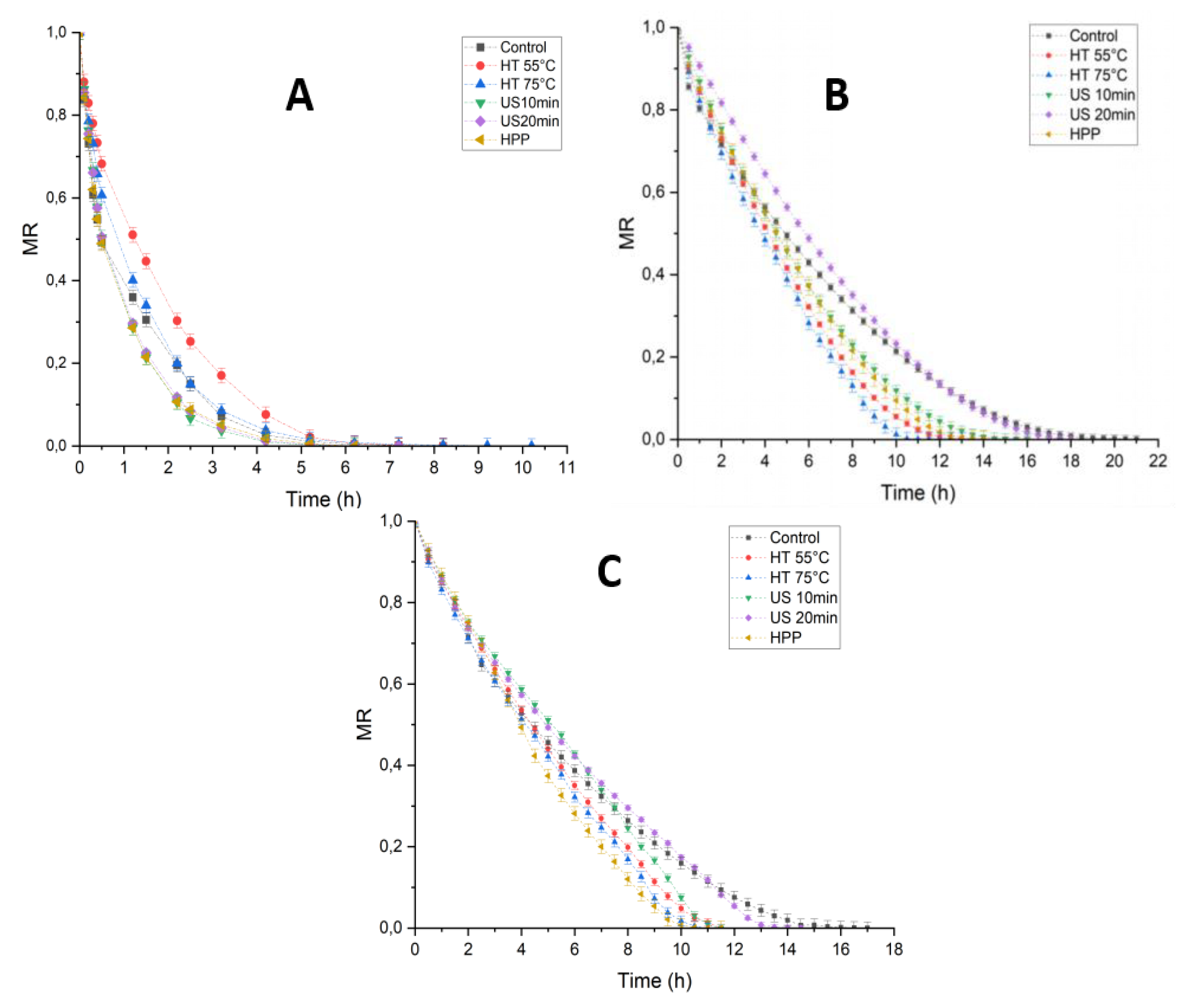
Figure 2.
Drying rate (DR) [(kg water/kg solids·s) ± SD] curves of Morchella conica without pretreatment (Control), pretreated with HT (55 and 75 °C), US (10 and 20 min), and HPP, and dried by HAD (A), FD (B), and FD–HAD (C). Error bars represent the standard deviation of the mean values. Abbreviations: HT, high-temperature pretreatment; US, ultrasound; HPP, high hydrostatic pressure; HAD, hot air drying; FD, freeze drying.
Figure 2.
Drying rate (DR) [(kg water/kg solids·s) ± SD] curves of Morchella conica without pretreatment (Control), pretreated with HT (55 and 75 °C), US (10 and 20 min), and HPP, and dried by HAD (A), FD (B), and FD–HAD (C). Error bars represent the standard deviation of the mean values. Abbreviations: HT, high-temperature pretreatment; US, ultrasound; HPP, high hydrostatic pressure; HAD, hot air drying; FD, freeze drying.
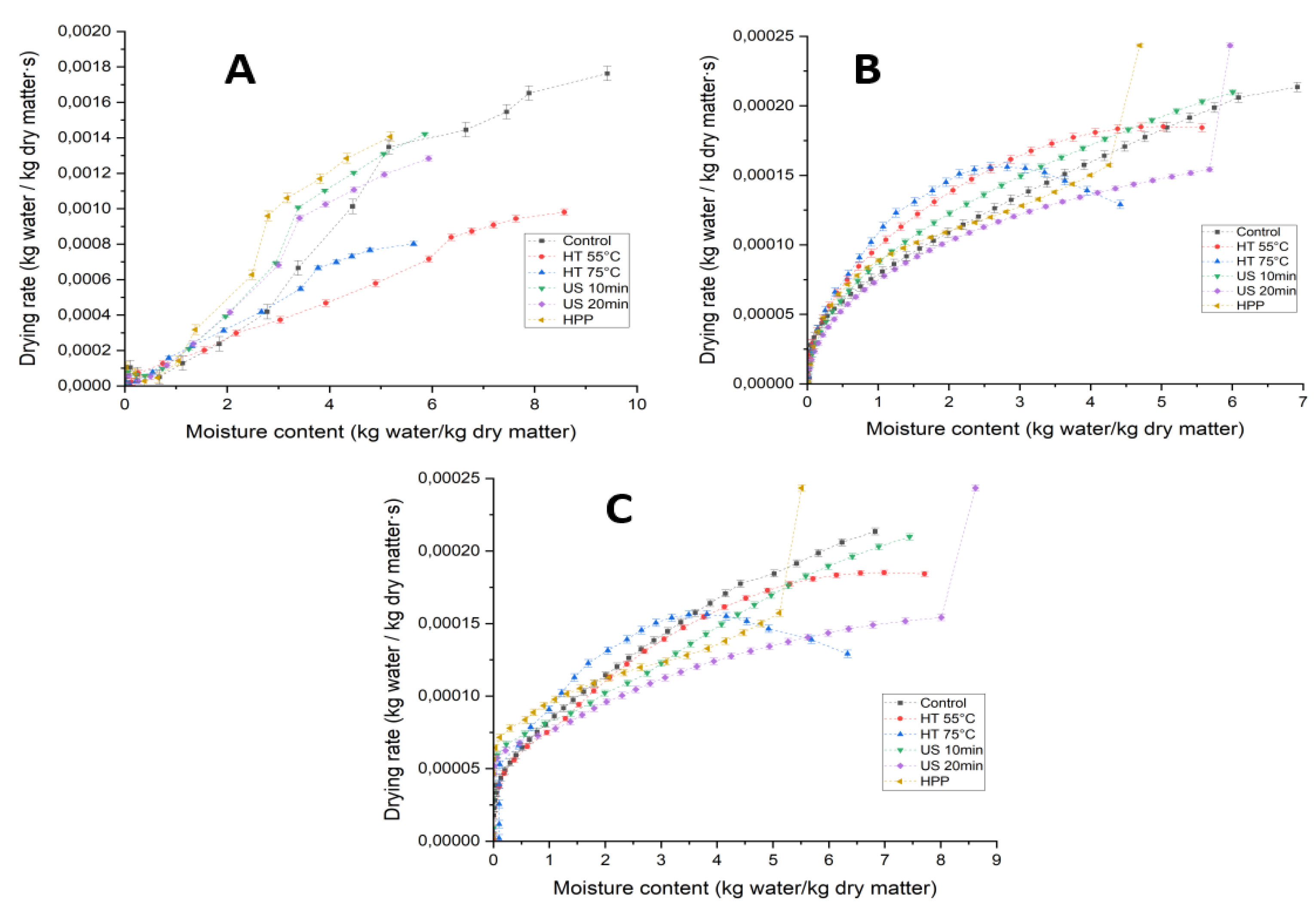
Figure 3.
Moisture content (MC) (g/100 g ± SD) (A), shrinkage ratio (SR) (% ± SD) (B), and water activity (Aw) (± SD) (C) of Morchella conica without pretreatment (Control) and pretreated with HT (55 and 75 °C), US (10 and 20 min), and HPP, and dried using HAD, FD, and FD–HAD. Error bars represent the standard deviation of the mean values. Abbreviations: HT, high-temperature pretreatment; US, ultrasound; HPP, high hydrostatic pressure; HAD, hot air drying; FD, freeze drying.
Figure 3.
Moisture content (MC) (g/100 g ± SD) (A), shrinkage ratio (SR) (% ± SD) (B), and water activity (Aw) (± SD) (C) of Morchella conica without pretreatment (Control) and pretreated with HT (55 and 75 °C), US (10 and 20 min), and HPP, and dried using HAD, FD, and FD–HAD. Error bars represent the standard deviation of the mean values. Abbreviations: HT, high-temperature pretreatment; US, ultrasound; HPP, high hydrostatic pressure; HAD, hot air drying; FD, freeze drying.
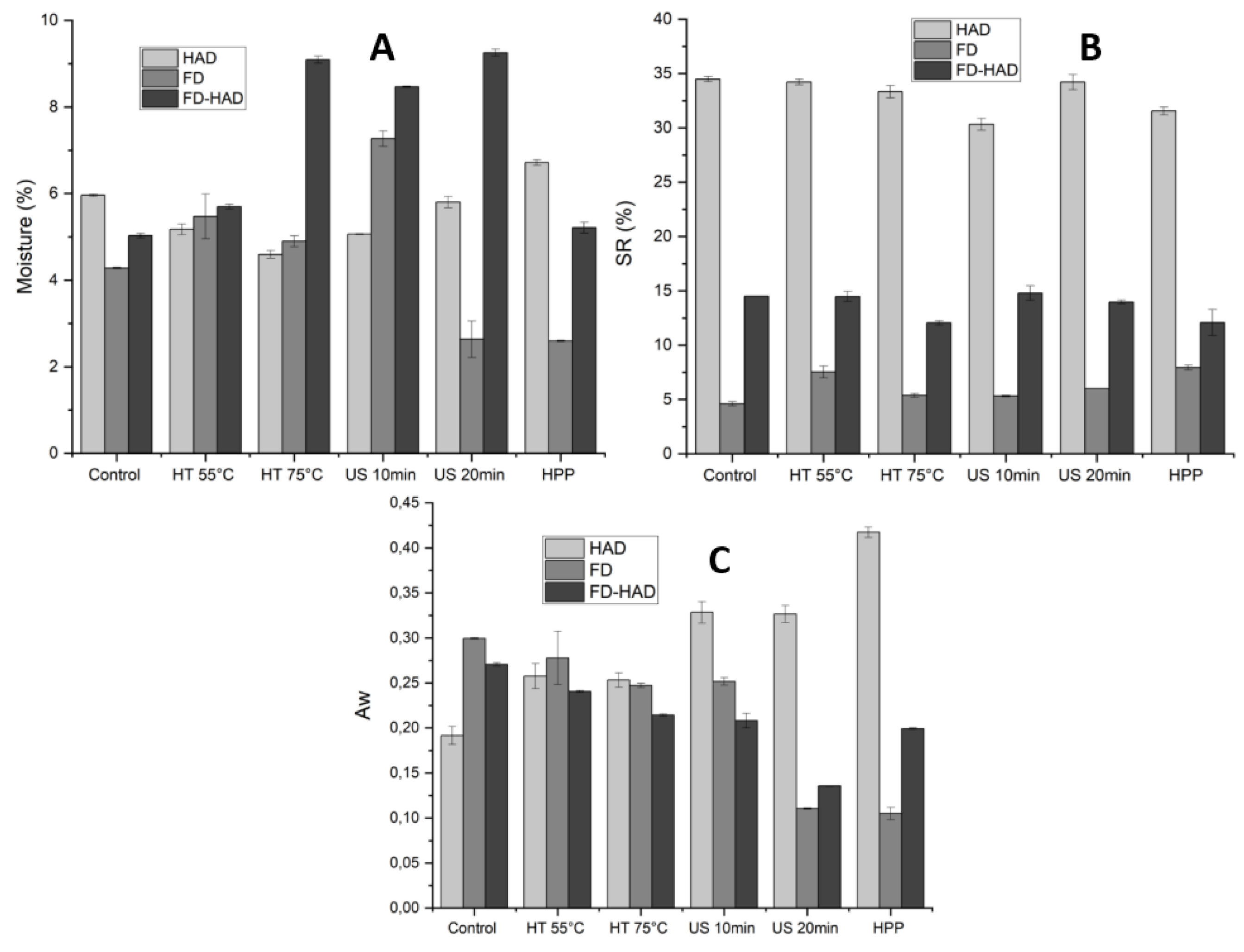
Figure 4.
Effect of drying methods HAD (A), FD (B), and FD–HAD (C) on the rehydration ratio (RR) of Morchella conica without pretreatment (Control) and pretreated with HT (55 and 75 °C), US (10 and 20 min), and HPP. Rehydration was carried out in water (60 °C for 5 h). Results are expressed as RR (g water/5 g dry Morchella conica ± SD). Error bars represent the standard deviation of the mean values. Abbreviations: HT, high-temperature pretreatment; US, ultrasound; HPP, high hydrostatic pressure; HAD, hot air drying; FD, freeze drying.
Figure 4.
Effect of drying methods HAD (A), FD (B), and FD–HAD (C) on the rehydration ratio (RR) of Morchella conica without pretreatment (Control) and pretreated with HT (55 and 75 °C), US (10 and 20 min), and HPP. Rehydration was carried out in water (60 °C for 5 h). Results are expressed as RR (g water/5 g dry Morchella conica ± SD). Error bars represent the standard deviation of the mean values. Abbreviations: HT, high-temperature pretreatment; US, ultrasound; HPP, high hydrostatic pressure; HAD, hot air drying; FD, freeze drying.
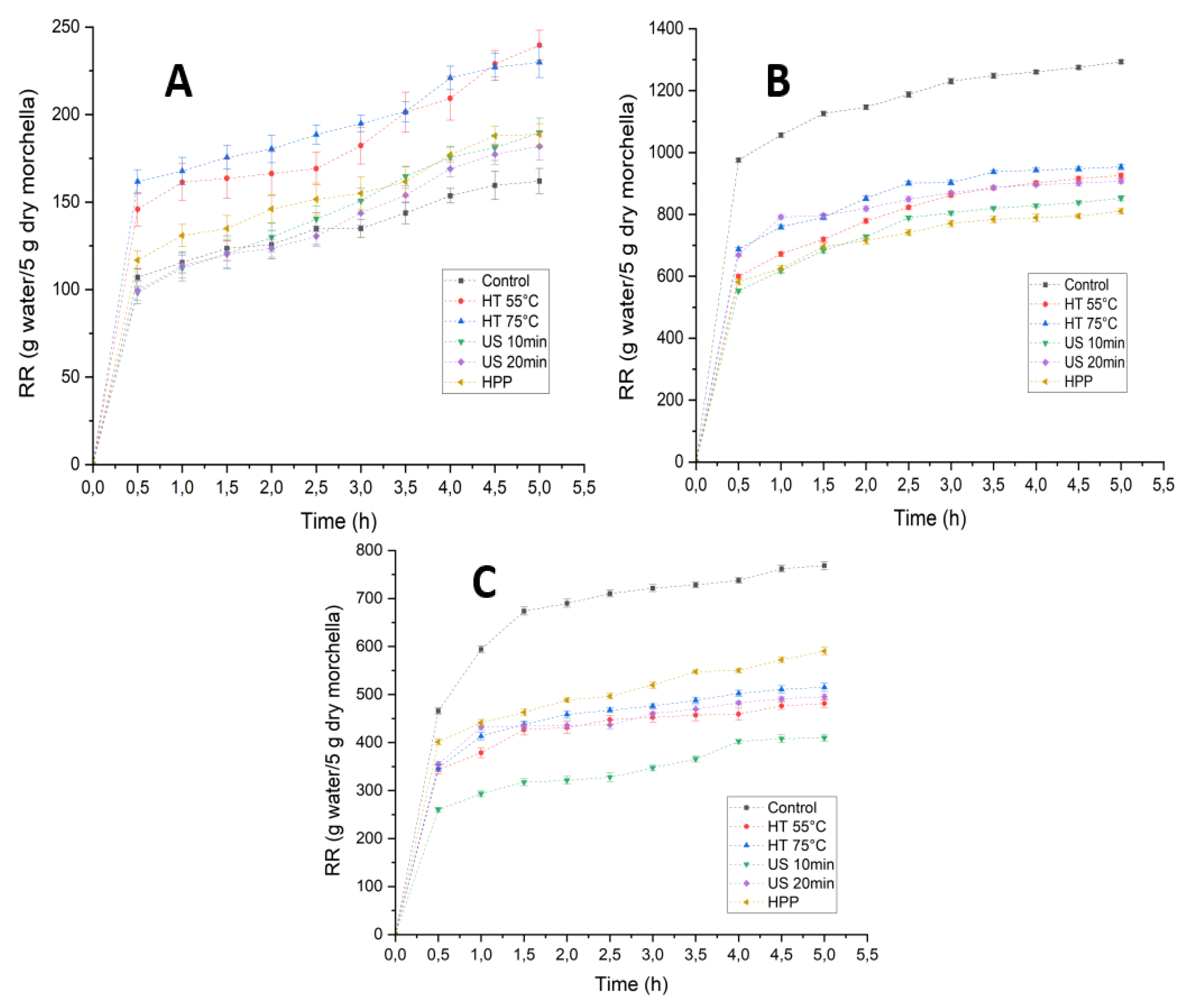
Figure 5.
Total phenolic content (TPC) (mg GAE/100 g dw ± SD) (A), antioxidant activity by DPPH (µM TE/100 g dw ± SD) (B), and ferric reducing antioxidant power (FRAP) (µM TE/g dw ± SD) (C) of Morchella conica fresh (RM), untreated (Control) and pretreated with HT (55 and 75 °C), US (10 and 20 min), and HPP, followed by HAD, FD, and FD–HAD drying methods. Error bars represent standard deviation. Abbreviations: HT, high-temperature pretreatment; US, ultrasound; HPP, high hydrostatic pressure; HAD, hot air drying; FD, freeze drying.
Figure 5.
Total phenolic content (TPC) (mg GAE/100 g dw ± SD) (A), antioxidant activity by DPPH (µM TE/100 g dw ± SD) (B), and ferric reducing antioxidant power (FRAP) (µM TE/g dw ± SD) (C) of Morchella conica fresh (RM), untreated (Control) and pretreated with HT (55 and 75 °C), US (10 and 20 min), and HPP, followed by HAD, FD, and FD–HAD drying methods. Error bars represent standard deviation. Abbreviations: HT, high-temperature pretreatment; US, ultrasound; HPP, high hydrostatic pressure; HAD, hot air drying; FD, freeze drying.
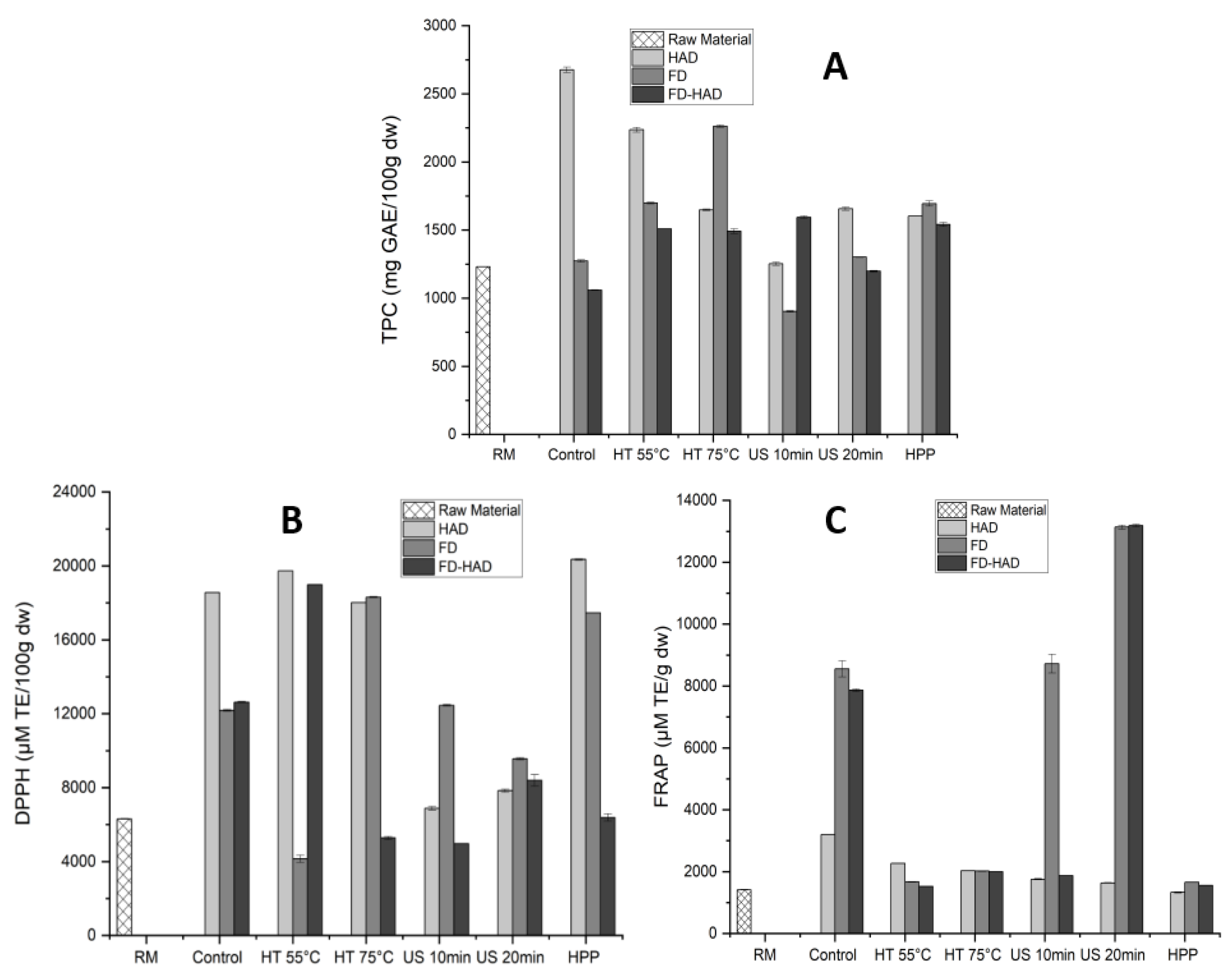
Figure 6.
PCA biplot showing the distribution and clustering of Morchella conica samples subjected to different pretreatments and drying methods. Samples without pretreatment (Control) and those pretreated with HT (55 and 75 °C), US (10 and 20 min), and HPP were dried using HAD, FD, and FD–HAD. Arrows indicate the contribution of the evaluated quality parameters to the principal components. Abbreviations: HT, high-temperature pretreatment; US, ultrasound; HPP, high hydrostatic pressure; HAD, hot-air drying; FD, freeze-drying.
Figure 6.
PCA biplot showing the distribution and clustering of Morchella conica samples subjected to different pretreatments and drying methods. Samples without pretreatment (Control) and those pretreated with HT (55 and 75 °C), US (10 and 20 min), and HPP were dried using HAD, FD, and FD–HAD. Arrows indicate the contribution of the evaluated quality parameters to the principal components. Abbreviations: HT, high-temperature pretreatment; US, ultrasound; HPP, high hydrostatic pressure; HAD, hot-air drying; FD, freeze-drying.
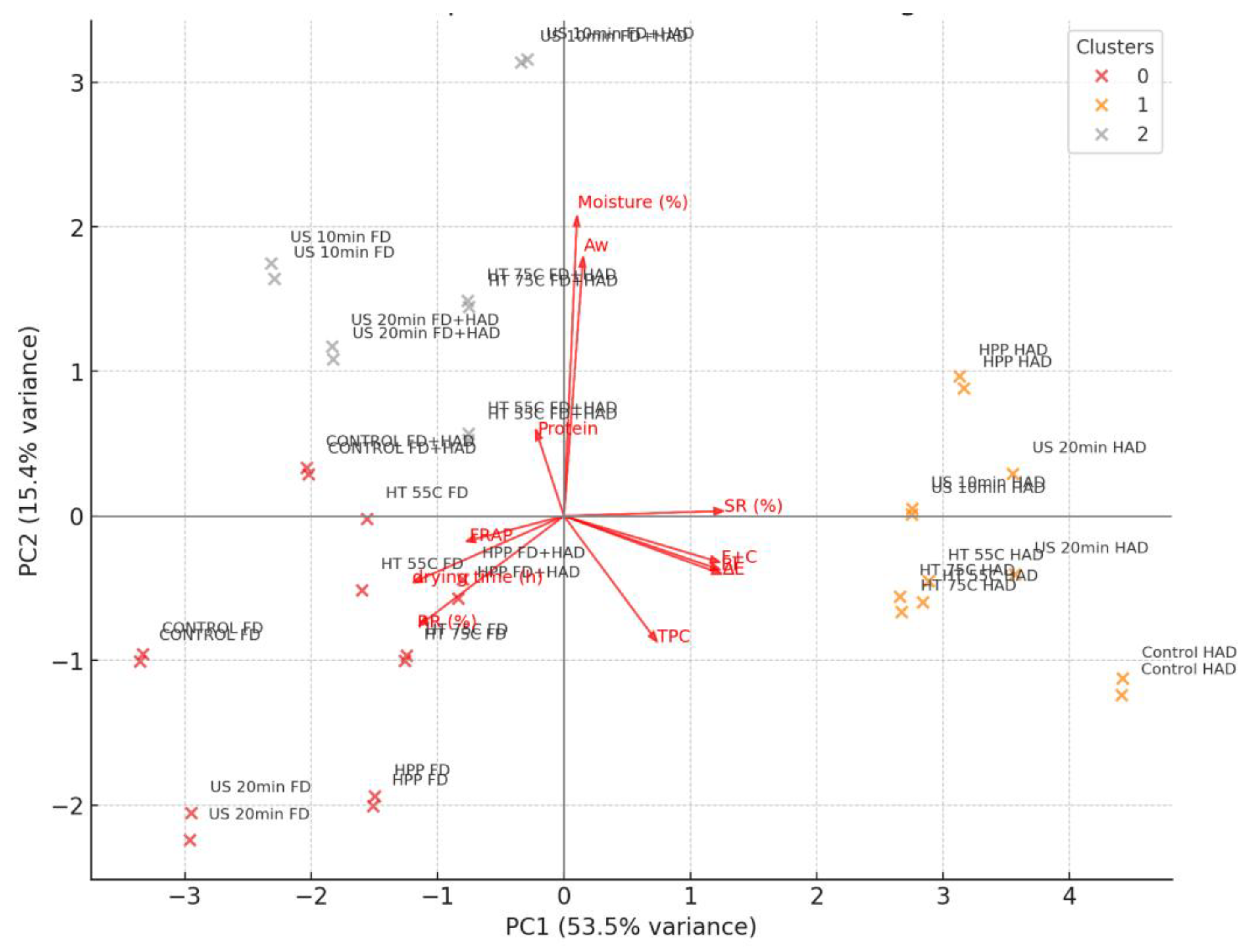

Table 1.
Weibull model parameters fitted to moisture ratio (MR) data of Morchella conica subjected to different pretreatments and drying methods.
Table 1.
Weibull model parameters fitted to moisture ratio (MR) data of Morchella conica subjected to different pretreatments and drying methods.
| Treatment | k | n | R2 | MSE |
|---|---|---|---|---|
| Control HAD | 1.028±0.05a | 0.692 | 0.996 | 0.0009 |
| HT 55 °C HAD | 0.643±0.05b | 0.866 | 0.997 | 0.0008 |
| HT 75 °C HAD | 0.857±0.05c | 0.822 | 0.999 | 0.0003 |
| US 10 min HAD | 1.146±0.05d | 0.856 | 0.999 | 0.0001 |
| US 20 min HAD | 1.120±0.05e | 0.823 | 0.999 | 0.0002 |
| HPP HAD | 1.168±0.05f | 0.789 | 0.999 | 0.0002 |
| Control FD | 0.127±0.05g | 1.074 | 0.993 | 0.0011 |
| HT 55 °C FD | 0.103±0.05h | 1.383 | 0.997 | 0.0008 |
| HT 75 °C FD | 0.122±0.05i | 1.351 | 0.994 | 0.0014 |
| US 10 min FD | 0.096±0.05jo | 1.338 | 0.998 | 0.0005 |
| US 20 min FD | 0.061±0.05k | 1.400 | 0.998 | 0.0005 |
| HPP FD | 0.094±0.05hjo | 1.364 | 0.995 | 0.0010 |
| Control FD-HAD | 0.125±0.05gi | 1.178 | 0.996 | 0.0008 |
| HT 55 °CFD-HAD | 0.098±0.05hjmno | 1.374 | 0.993 | 0.0013 |
| HT 75 °C FD-HAD | 0.114±0.05ghjl | 1.333 | 0.991 | 0.0018 |
| US 10 min FD-HAD | 0.078±0.05jkmo | 1.418 | 0.987 | 0.0024 |
| US 20 min FD-HAD | 0.099±0.05hjno | 1.262 | 0.991 | 0.0016 |
| HPP FD-HAD | 0.089±0.05hjmno | 1.518 | 0.997 | 0.0007 |
k: Ratio parameter; n: form factor parameter; R2: coefficient of determination; MSE: mean square error. k values are means ± SD (n = 3). Different letters within the same column indicate significant differences among treatments (p < 0.05). Abbreviations: HT, high-temperature pretreatment; US, ultrasound; HPP, high hydrostatic pressure; HAD, hot air drying; FD, freeze drying.
Table 2.
Effects of different pretreatments and drying methods on color change and Browning Index (BI) of Morchella conica subjected to HT (55 and 75 °C), US (10 and 20 min), and HPP pretreatments, followed by drying using HAD, FD, and FD–HAD, compared with untreated samples (control).
Table 2.
Effects of different pretreatments and drying methods on color change and Browning Index (BI) of Morchella conica subjected to HT (55 and 75 °C), US (10 and 20 min), and HPP pretreatments, followed by drying using HAD, FD, and FD–HAD, compared with untreated samples (control).
| Treatment | L* | a* | b* | ΔE | BI |
|---|---|---|---|---|---|
| Fresh | 23.75±0.07a | 1.51±0.01a | 8.81±0.01a | - | 49.40±0.29a |
| Control HAD | 18.05±0.01b | 2.23±0.02b | 10.73±0.01b | 6.10±0.01a | 93.51±0.09b |
| HT 55 °C HAD | 18.80±0.01c | 2.76±0.01c | 8.27±0.08c | 5.18±0.01b | 66.66±0.74c |
| HT 75 °C HAD | 18.93±0.01d | 2.56±0.02d | 9.43±0.02d | 5.02±0.01c | 75.88±0.19d |
| US 10 min HAD | 18.81±0.01c | 2.51±0.01e | 9.01±0.14e | 5.04±0.07c | 72.17±1.27e |
| US 20 min HAD | 18.60±0.08e | 2.82±0.01f | 9.91±0.02f | 5.41±0.00d | 83.31±0.28f |
| HPP HAD | 18.90±0.01d | 3.01±0.10g | 9.16±0.03g | 5.08±0.04c | 75.24±0.62d |
| Control FD | 24.16±0.01f | 0.17±0.01h | 7.94±0.01h | 1.64±0.02efg | 38.86±0.03gh |
| HT 55 °C FD | 24.03±0.01ghi | 0.19±0.01hi | 7.98±0.01h | 1.60±0.01efgh | 39.39±0.09hi |
| HT 75 °C FD | 24.08±0.01fhi | 0.21±0.01hij | 7.99±0.01h | 1.57±0.04ehi | 39.45±0.12hi |
| US 10 min FD | 23.98±0.01g | 0.22±0.01hij | 8.03±0.04h | 1.54±0.02hi | 39.88±0.26i |
| US 20 min FD | 23.77±0.04aj | 0.26±0.01j | 7.73±0.04i | 1.66±0.03fg | 38.64±0.31gh |
| HPP FD | 24.01±0.02gh | 0.23±0.01ij | 7.60±0.14jk | 1.79±0.09j | 37.38±0.83j |
| Control FD-HAD | 23.95±0.07g | 0.39±0.01k | 7.77±0.01i | 1.54±0.01hi | 38.98±0.07ghi |
| HT 55 °CFD-HAD | 24.25±0.07k | 0.45±0.01l | 7.68±0.01hil | 1.63±0.05efg | 38.04±0.15gj |
| HT 75 °C FD-HAD | 24.12±0.01if | 0.46±0.00l | 7.56±0.01j | 1.67±0.02g | 37.65±0.05j |
| US 10 min FD-HAD | 23.75±0.07a | 0.42±0.01kl | 7.66±0.01hjk | 1.58±0.00efhi | 38.79±0.20gh |
| US 20 min FD-HAD | 23.73±0.01a | 0.44±0.01kl | 7.65±0.01hjk | 1.57±0.00ehi | 38.87±0.09gh |
| HPP FD-HAD | 23.85±0.07j | 0.46±0.01l | 7.73±0.04hj | 1.51±0.00i | 39.14±0.32hi |
Values are means ± standard deviations (n = 3) and expressed on dry weight basis. Different letters indicate significant differences (P < 0.05) by columns among treatments within each column. Abbreviations: HT, high-temperature pretreatment; US, ultrasound; HPP, high hydrostatic pressure; HAD, hot air drying; FD, freeze drying.
Table 3.
Proximate composition (g/100 g dry weight) of Morchella conica fresh and dried samples subjected to different pretreatments (HT, US, HPP) and drying methods (HAD, FD and FD–HAD).
Table 3.
Proximate composition (g/100 g dry weight) of Morchella conica fresh and dried samples subjected to different pretreatments (HT, US, HPP) and drying methods (HAD, FD and FD–HAD).
| Treatment | Protein (g/100 g) | Lipids (g/100 g) | Ash (g/100 g) | Fiber (g/100 g) | Carbohydrates (g/100 g) | F + C (g/100 g) |
|---|---|---|---|---|---|---|
| Fresh | 30.83 ± 0.29ᵃ | 2.99 ± 0.20ᵃ | 12.20 ± 0.82ᵃ | 15.18 ± 1.47ᵃ | 38.81 ± 0.16ᵃ | 53.99 ± 1.31ᵃ |
| Control HAD | 32.71 ± 0.71ᵇ | 3.81 ± 0.29ᵇ | 15.67 ± 0.08ᵇ | 21.63 ± 0.11ᶜ | 13.96 ± 0.40ᶠ | 35.59 ± 0.50ᶠ |
| HT 55 °C HAD | 33.27 ± 0.25ᵇ | 2.17 ± 0.20ᶜ | 12.16 ± 0.45ᵃ | 21.85 ± 0.10ᶜ | 20.46 ± 0.10ᵉ | 42.32 ± 0.00ᵉ |
| HT 75 °C HAD | 32.63 ± 0.12ᵇ | 3.79 ± 0.06ᵇ | 12.48 ± 0.08ᵃ | 20.14 ± 0.05ᶜ | 21.97 ± 0.18ᵉ | 42.12 ± 0.14ᵉ |
| US 10 min HAD | 28.77 ± 1.15ᶜ | 3.06 ± 0.04ᵃᵇ | 7.35 ± 0.49ᵈ | 25.48 ± 0.28ᵇ | 25.46 ± 1.96ᵈ | 50.95 ± 1.67ᵇ |
| US 20 min HAD | 29.87 ± 0.57ᶜ | 3.65 ± 0.11ᵇ | 6.70 ± 0.16ᵈ | 26.89 ± 0.11ᵇ | 21.61 ± 0.73ᵉ | 48.51 ± 0.84ᶜ |
| HPP HAD | 31.19 ± 0.11ᵃᵇ | 3.58 ± 0.07ᵇ | 11.09 ± 0.11ᵃ | 31.69 ± 0.27ᵃ | 9.48 ± 0.13ᵍ | 41.16 ± 0.15ᵉ |
| Control FD | 31.84 ± 0.45ᵃᵇ | 2.52 ± 0.51ᵃ | 11.60 ± 0.60ᵃ | 18.04 ± 0.51ᶜ | 27.57 ± 1.04ᶜ | 45.60 ± 1.56ᵈ |
| HT 55 °C FD | 31.93 ± 0.43ᵃᵇ | 3.16 ± 0.39ᵃᵇ | 11.06 ± 0.18ᵃ | 17.84 ± 0.01ᶜ | 25.36 ± 0.21ᵈ | 43.20 ± 0.22ᵉ |
| HT 75 °C FD | 31.45 ± 0.08ᵃᵇ | 3.05 ± 0.12ᵃᵇ | 14.55 ± 0.34ᵇ | 16.56 ± 0.25ᵈ | 24.84 ± 0.79ᵈ | 41.40 ± 0.54ᵉ |
| US 10 min FD | 31.30 ± 0.08ᵃᵇ | 3.27 ± 0.09ᵃᵇ | 7.67 ± 0.44ᵈ | 26.63 ± 0.19ᵇ | 17.35 ± 0.80ᶠ | 43.99 ± 0.61ᵉ |
| US 20 min FD | 30.54 ± 0.34ᵃ | 4.72 ± 0.14ᶜ | 6.63 ± 0.49ᵈ | 21.39 ± 0.53ᶜ | 31.53 ± 0.24ᵇ | 52.92 ± 0.29ᵇ |
| HPP FD | 31.25 ± 0.20ᵃᵇ | 5.39 ± 0.49ᶜ | 8.60 ± 0.16ᵈ | 22.38 ± 0.41ᶜ | 27.22 ± 0.12ᶜ | 49.59 ± 0.53ᶜ |
| Control FD-HAD | 35.87 ± 0.52ᵇ | 1.48 ± 0.30ᵈ | 14.70 ± 0.41ᵇ | 23.57 ± 0.18ᶜ | 22.44 ± 0.07ᵉ | 46.01 ± 0.11ᵈ |
| HT 55 °C FD-HAD | 35.87 ± 0.52ᵇ | 2.52 ± 0.51ᵃ | 11.60 ± 0.60ᵃ | 18.04 ± 0.51ᶜ | 20.90 ± 0.07ᵉ | 38.93 ± 0.58ᶠ |
| HT 75 °C FD-HAD | 33.21 ± 0.03ᵇ | 3.74 ± 0.00ᵇ | 15.00 ± 0.22ᵇ | 26.63 ± 0.19ᵇ | 17.35 ± 0.80ᶠ | 43.99 ± 0.61ᵉ |
| US 10 min FD-HAD | 32.08 ± 0.33ᵇ | 1.73 ± 0.06ᵈ | 6.31 ± 0.09ᵈ | 24.28 ± 0.10ᶜ | 19.39 ± 0.46ᵉ | 43.67 ± 0.36ᵉ |
| US 20 min FD-HAD | 33.43 ± 0.34ᵇ | 4.05 ± 0.09ᵇ | 6.31 ± 0.02ᵈ | 25.51 ± 0.62ᵇ | 13.15 ± 0.39ᶠ | 38.67 ± 0.23ᶠ |
| HPP FD-HAD | 28.51 ± 0.06ᶜ | 5.51 ± 0.13ᶜ | 10.30 ± 0.29ᵃ | 28.53 ± 0.06ᵃᵇ | 13.21 ± 0.53ᶠ | 41.74 ± 0.47ᵉ |
Values are means ± standard deviations (n = 3) and expressed on dry weight basis. Different lowercase letters within the same column indicate significant differences among treatments according to ANOVA followed by LSD test (p < 0.05). Abbreviations: HT, high-temperature pretreatment; US, ultrasound; HPP, high hydrostatic pressure; HAD, hot air drying; FD, freeze drying.
Disclaimer/Publisher’s Note: The statements, opinions and data contained in all publications are solely those of the individual author(s) and contributor(s) and not of MDPI and/or the editor(s). MDPI and/or the editor(s) disclaim responsibility for any injury to people or property resulting from any ideas, methods, instructions or products referred to in the content. |
© 2026 by the authors. Licensee MDPI, Basel, Switzerland. This article is an open access article distributed under the terms and conditions of the Creative Commons Attribution (CC BY) license (http://creativecommons.org/licenses/by/4.0/).
Copyright: This open access article is published under a Creative Commons CC BY 4.0 license, which permit the free download, distribution, and reuse, provided that the author and preprint are cited in any reuse.


