

Submitted:
17 March 2026
Posted:
19 March 2026
You are already at the latest version
Abstract
This study presents a unified gravitational–cosmological equation derived within the Extended Classical Mechanics (ECM) framework. Using the Phase Kernel Formalism, the model introduces an effective gravitational mass representation (Mᵉᶠᶠ) that links phase evolution, frequency dynamics, and cosmological energy redistribution. The framework provides reinterpretations of gravitational lensing and the Shapiro time delay while maintaining compatibility with Planck-scale physical constants, suggesting that gravitational phenomena may emerge from deterministic phase dynamics across cosmological scales.ECM provides a unified framework connecting the fundamental oscillatory origin of existence, phase evolution, frequency variation, energy redistribution, mass manifestation, and gravitational interaction with cosmic evolution. Time emerges as a consequence of the phase progression of primordial oscillations, while events arise from deviations from the primordial frequency. Central to ECM, the Phase Kernel Formalism represents cumulative phase delays along a path, governing the interaction of energy, frequency, and mass. Effective Gravitational Mass (Mᵉᶠᶠ), defined as the sum of matter mass (Mᴍ) and negative apparent mass (−Mᵃᵖᵖ), links energy redistribution to observable gravitational phenomena.Gravitational effects, including lensing and the Shapiro time delay, are interpreted as arising from local, symmetric modulations of a photon's instantaneous frequency and momentum, rather than any change in the intrinsic speed of light. The manuscript develops a unified ECM gravitational–cosmological equation that integrates these mechanisms, capturing phase, frequency, momentum, and effective gravitational mass in a single coherent framework.The derivation is presented gradually to allow comprehension at multiple levels— from conceptual understanding suitable for students to advanced mathematical formalism for researchers. A canonical set of ECM equations is provided as the minimal mathematical backbone of the theory, illustrating how local photon–gravity interactions and large-scale cosmic evolution emerge from the same fundamental phase–frequency–energy dynamics.
Keywords:
extended classical mechanics
; ECM
; Phase kernel
; phase kernel formalism
; gravitational lensing
; shapiro delay
; shapiro time delay
; effective gravitational mass
; phase evolution
; mass manifestation
; cosmology
; cosmological dynamics
; planck-scale physics
; frequency
; unified equation
Figure 1.
ECM Master Phase Transition.
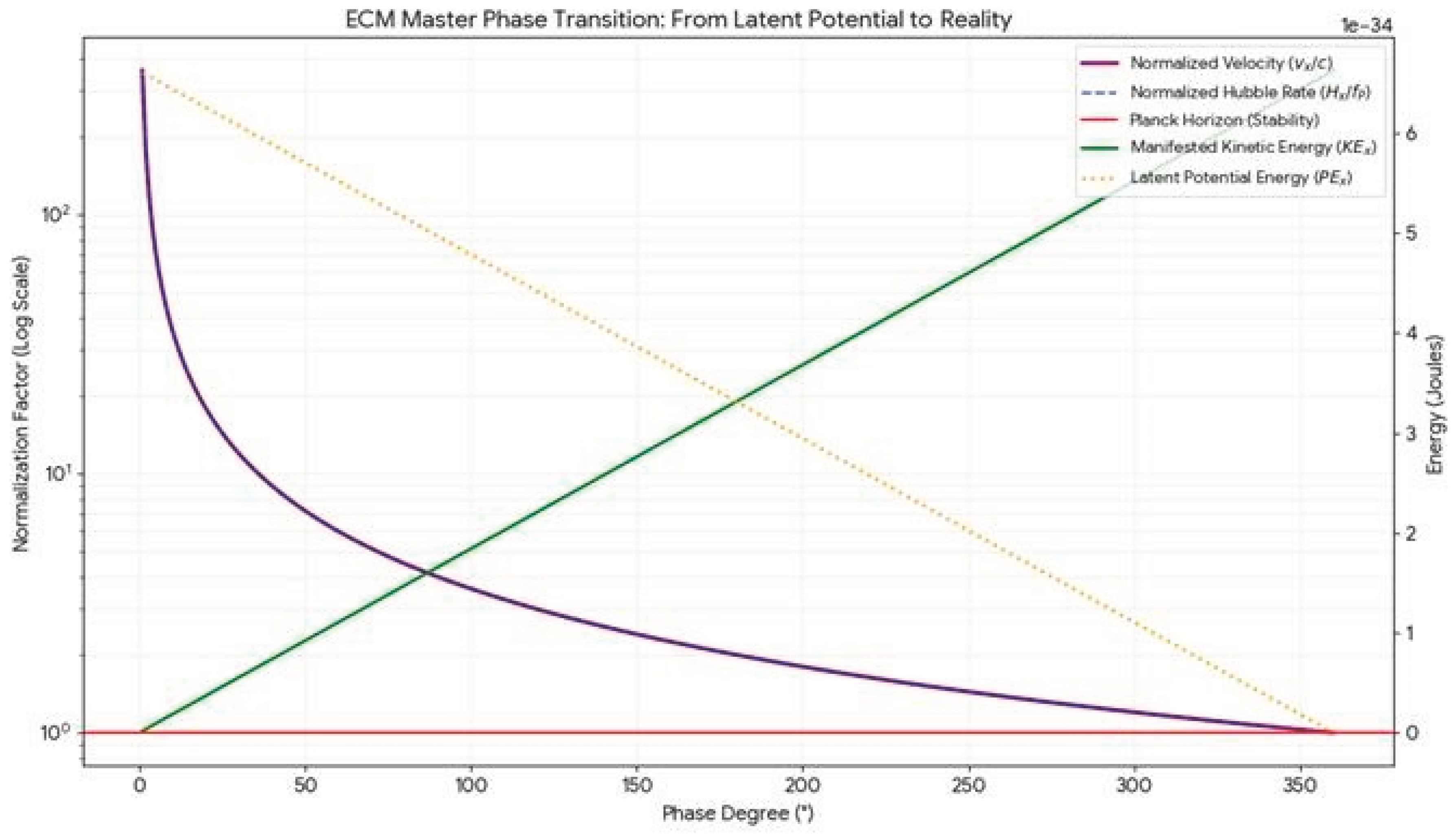
The ECM Master Phase Transition graph depicts the cumulative evolution of phase, frequency, and energy in the Extended Classical Mechanics framework[9]. The curve illustrates how primordial oscillations progress through phase increments, resulting in the manifestation of effective gravitational mass (Mᵉᶠᶠ) and local energy redistribution. Peaks and transitions indicate points where phase shifts contribute to observable phenomena, such as gravitational lensing[8] and time delay effects[7], as photons interact with the evolving ECM field.
Introduction
The Extended Classical Mechanics (ECM) framework provides a novel approach to understanding the fundamental dynamics of the universe, emphasizing the role of phase-governed oscillations as the primitive origin of existence. Unlike conventional frameworks that assume spacetime as a pre-existing geometric stage, ECM posits that time, events, and physical manifestation emerge from deviations in primordial oscillations.
Central to ECM is the Phase Kernel Formalism, which represents the cumulative phase delay per unit path length and governs how frequency, energy, and mass interact during propagation. This formalism provides a natural mechanism for understanding gravitational effects—such as the bending of light[8] and the Shapiro time delay[7]—as emergent phenomena arising from phase progression and frequency modulation.
The primordial oscillation, denoted f₀, represents unmanifested existence at the origin. Observable events occur when deviations Δf occur, producing phase progression, energy redistribution, and the manifestation of matter mass Mᴍ. The combination of matter mass and negative apparent mass (−Mᵃᵖᵖ) defines the Effective Gravitational Mass (Mᵉᶠᶠ), which governs the strength of gravitational interaction in ECM. Consequently, time becomes meaningful only in association with such events, and all physical processes—from photon propagation to gravitation—emerge naturally from phase–frequency–mass dynamics.
One of the central goals of ECM is to unify local gravitational phenomena—such as photon trajectory bending[8] and Shapiro time delay[7]—with cosmological-scale evolution through a single underlying framework. Within this approach, gravitational lensing[8] and signal delays[7] result from temporary, symmetric modulations of a photon’s instantaneous frequency and momentum, without altering the intrinsic speed of light.
The present work builds upon the Extended Classical Mechanics (ECM) framework[9], which is presented here in a unified and self-contained formulation.
This manuscript develops a unified ECM gravitational–cosmological equation, demonstrating how phase, frequency, momentum, and effective gravitational mass interact to produce both local and cosmic-scale phenomena. The presentation is structured to provide:
- Conceptual clarity for students and non-specialists, illustrating the physical intuition underlying ECM,
- Step-by-step derivations for researchers and advanced readers,
- A canonical set of ECM equations serving as a minimal mathematical backbone.
By establishing a coherent linkage between oscillatory origin, phase progression, event formation, energy redistribution, mass manifestation, and gravitational interaction, ECM offers a unified description of the universe that is both conceptually transparent and mathematically rigorous.
Notation Summary
- Mᴍ – Observable matter (baryonic + dark) mass
- Mɢ – Gravitational mass, per Chernin and ECM
- Mᴅᴇ – Dark energy equivalent mass
- Mᵉᶠᶠ – Effective gravitational mass (Mᴍ + (−Mᵃᵖᵖ))
- Mᵃᵖᵖ – Negative apparent mass from energy redistribution
Mechanism: Phase, Frequency, and Event Emergence in ECM
In Extended Classical Mechanics (ECM), the universe originates from a primordial oscillation at the origin, denoted by the frequency f₀. This primordial state is unmanifested and uneventful, corresponding to t₀ = 0. Time is not primitive; it becomes meaningful only through the occurrence of deviations in the primordial oscillation.
Event Formation via Frequency Deviations
Observable phenomena emerge through frequency deviations (Δf), which correspond to existential events. Each deviation produces phase progression, energy redistribution, and the manifestation of matter mass (Mᴍ). Formally, the relation can be expressed as:
f₀ = fᴘ + Δf₀ → x° / 360 f₀ = Δt₍ₓ₎°
Here, fᴘ represents the partially manifested frequency, and Δt represents the emergent time interval associated with the event. This demonstrates that time arises from events, not the other way around.
Phase Kernel Formalism
The Phase Kernel Formalism (Φkern) describes the cumulative phase delay per unit path length, dependent on frequency (ω) and local gravitational potential (U). It provides a direct mathematical link between oscillation dynamics and gravitational effects. The phase shift along a path can be calculated as:
ΔΦ = ∫ Φkern(ω, U) dl
This formalism allows ECM to reproduce and reinterpret classical gravitational phenomena:
- Shapiro delay[7]: Δt arises from the temporary symmetric modulation of photon frequency and momentum, not light speed alteration.
- Gravitational lensing[8]: The photon’s trajectory curvature corresponds to local wavelength and momentum changes.
- Perihelion precession: Emerges naturally from phase–frequency–mass coupling.
The Phase Kernel links microscopic photon interactions to macroscopic gravitational effects, providing a coherent framework for both local and cosmic-scale phenomena.
Effective Gravitational Mass in ECM
ECM defines Effective Gravitational Mass (Mᵉᶠᶠ) as:
where Mᴍ is the observable baryonic matter mass and dark matter mass, noticeably effective at least in galactic scales[4], and −Mᵃᵖᵖ represents the negative apparent mass arising from energy redistribution. This formulation naturally integrates the effects of local energy-momentum modulation with global gravitational behaviour, ensuring that photon trajectory bending[8], gravitational lensing[8], and Shapiro delay[7] emerge consistently from the same underlying mechanism.
Mᵉᶠᶠ = Mᴍ + (−Mᵃᵖᵖ)
Photon–Gravity Interaction
As a photon approaches a massive object, its instantaneous frequency and momentum are symmetrically modulated (blueshift on approach, redshift on exit), producing curvature in its path. Crucially:
- The photon’s intrinsic speed remains constant.
- The net energy-motion-distance dynamics of the photon are preserved.
- The observed curvature corresponds to the phase kernel and effective gravitational mass interaction.
Summary
The ECM mechanism establishes a complete chain from origin to gravitational manifestation:
Primordial oscillation → Phase evolution → Frequency deviation → Energy redistribution → Mass manifestation (Mᴍ) → Effective Gravitational Mass (Mᵉᶠᶠ) → Photon–gravity interaction → Gravitational phenomena
This structure provides a physically intuitive and mathematically consistent explanation for both local gravitational effects and large-scale cosmological behaviour.
Unified ECM Derivation: Phase Kernel and Effective Gravitational Mass
The derivation of the unified ECM gravitational–cosmological equation begins with the fundamental concepts of primordial oscillation, frequency deviation, and phase progression, which give rise to meaningful events in the universe. Let the primordial oscillation at the origin be f₀, with unmanifested existence at t₀ = 0. Events occur when deviations Δf arise, generating both phase evolution and energy redistribution, leading to mass manifestation.
Step 1: Phase Evolution and Time Emergence
Time intervals associated with events can be expressed in terms of phase progression:
f₀ = fᴘ + Δf₀ → x° / 360 f₀ = Δt₍ₓ₎°
Here, fᴘ is the partially manifested frequency, and Δt₍ₓ₎° is the emergent time associated with the phase deviation Δf₀. This shows that time arises from events, not as a pre-existing parameter.
Step 2: Phase Kernel Formalism
Gravitational effects in ECM are governed by the Phase Kernel Formalism (Φkern), which represents the cumulative phase delay per unit path length:
ΔΦ = ∫ Φkern(ω, U) dl
Φkern depends on the local frequency ω and gravitational potential U. This formalism allows ECM to reproduce and reinterpret classical gravitational phenomena:
- Shapiro delay[7]: emerges from symmetric modulation of photon frequency and momentum, not from changes in light speed.
- Gravitational lensing[8]: corresponds to curvature of the photon’s path due to instantaneous wavelength and momentum modifications.
- Perihelion precession: naturally arises from phase–frequency–mass interactions.
Step 3: Effective Gravitational Mass
The Effective Gravitational Mass (Mᵉᶠᶠ) integrates matter and energy redistribution:
where Mᴍ is the observable baryonic matter mass and dark matter mass, noticeably effective at least in galactic scales, and −Mᵃᵖᵖ represents the negative apparent mass arising from energy redistribution. This formulation connects microscopic photon interactions with macroscopic gravitational phenomena.
Mᵉᶠᶠ = Mᴍ + (−Mᵃᵖᵖ)
ECM to Observational Gravitational Parameter Mapping
While ECM fundamentally describes gravitation through Effective Gravitational Mass (Mᵉᶠᶠ) and Phase Kernel, it can be related to standard observational parameters used in astrophysics and cosmology. For a spherically symmetric mass distribution, the conventional gravitational parameter GM_obs can be expressed in terms of ECM quantities as:
GM_obs ≈ G · Mᵉᶠᶠ = G · (Mᴍ + (−Mᵃᵖᵖ))
Here:
- Mᴍ = observable baryonic + dark matter mass
- −Mᵃᵖᵖ = negative apparent mass arising from energy redistribution in ECM
- G = Newtonian gravitational constant[3]
This mapping provides a direct connection between ECM’s effective mass formalism and measurable gravitational effects, such as orbital dynamics, lensing deflection angles[8], and Shapiro time delay[7]. Practically, ECM predicts that observationally inferred mass parameters incorporate both baryonic matter and the effective contribution of energy redistribution (−Mᵃᵖᵖ), explaining discrepancies commonly attributed to dark matter in conventional models[4].
Step 4: Photon–Gravity Interaction
As a photon propagates through a gravitational potential, its frequency and momentum are symmetrically modulated:
fɪɴ + Δfɪɴ = fᴏᴜᴛ = fᴏᴜᴛ − Δfᴏᴜᴛ
The photon’s intrinsic speed and overall travel distance remain unchanged, while the local curvature arises from phase kernel and Mᵉᶠᶠ interaction. This mechanism produces gravitational lensing[8] and Shapiro delay[7] without altering the photon’s inherent dynamics.
Step 5: Master ECM Identity
The individual relationships above can be consolidated into a single canonical ECM identity:
Mᵉᶠᶠ · x° / 360 fᴏʙꜱᴇʀᴠᴇᴅ = Δt; fꜱᴏᴜʀᴄᴇ = fᴏʙꜱᴇʀᴠᴇᴅ + Δf
This equation links phase, frequency, energy, momentum, and effective gravitational mass in a unified formalism, providing a comprehensive description of gravitational and cosmological phenomena within ECM.
Summary
The unified ECM derivation demonstrates a stepwise chain of causality:
Primordial oscillation → Phase evolution → Frequency deviation → Energy redistribution → Mass manifestation (Mᴍ) → Effective Gravitational Mass (Mᵉᶠᶠ) → Photon–gravity interaction → Gravitational phenomena (lensing, Shapiro delay)
By integrating the Phase Kernel Formalism and Effective Gravitational Mass, ECM provides a mathematically consistent and conceptually transparent framework that unifies local gravitational effects with large-scale cosmological evolution.
Clarification of the Shapiro Time Delay and Gravitational Lensing Mechanism
In traditional relativity, the Shapiro time delay[7] is described as an apparent increase in the travel time of electromagnetic signals passing near a massive object. ECM provides a more physically grounded interpretation using the Phase Kernel Formalism and Effective Gravitational Mass.
Photon–Gravity Interaction in ECM
When a photon approaches a gravitational potential, its frequency and momentum undergo a symmetric modulation:
fɪɴ + Δfɪɴ = fᴏᴜᴛ = fᴏᴜᴛ − Δfᴏᴜᴛ
Here, fɪɴ and fᴏᴜᴛ are the photon frequencies just before entry and after exit from the gravitational field, respectively, and Δfɪɴ / Δfᴏᴜᴛ represent the symmetric energy–momentum gain (blueshift) and loss (redshift). Importantly, these modulations do not alter the photon’s inherent speed or travel distance; instead, the curvature arises due to local modifications of the instantaneous wavelength and momentum.
Phase Kernel Contribution
The cumulative effect of these local interactions is captured by the Phase Kernel (Φkern), which describes phase delay per unit path length:
ΔΦ = ∫ Φkern(ω, U) dl
The phase shift ΔΦ depends on the photon’s instantaneous frequency ω and the local gravitational potential U. It is this phase evolution, governed by the interaction of Mᵉᶠᶠ = Mᴍ + (−Mᵃᵖᵖ), that generates both the observed path curvature (gravitational lensing[8]) and the effective signal delay (Shapiro effect[7]) without altering the intrinsic speed of light.
Energy Bookkeeping vs. Lensing Mechanism
In ECM, the photon’s blueshift and redshift represent a symmetric energy bookkeeping mechanism, while the actual curvature responsible for lensing arises from momentum and instantaneous wavelength modulation. Formally:
- Energy bookkeeping: Temporary and symmetric gain/loss of photon energy, represented by Δf, does not affect travel distance and is consistent with the fundamental relation between energy and frequency[2].
- Lensing mechanism: Local wavelength compression and enlargement, tied to photon momentum changes, produce the observed curvature (gravitational lensing [8]).
Implications
This interpretation resolves conceptual ambiguities associated with traditional Shapiro delay and lensing:
Summary
In summary, ECM provides a unified, physically consistent framework for understanding both Shapiro time delay and gravitational lensing, linking them directly to Phase Kernel Formalism, Effective Gravitational Mass, and photon–gravity interaction. This approach illustrates that local gravitational phenomena and large-scale cosmic effects emerge from the same phase–frequency–momentum dynamics, without invoking any modification of the intrinsic photon speed or travel distance.
Canonical ECM Equation Set
The following five core equations summarize the fundamental principles of Extended Classical Mechanics (ECM), connecting phase evolution, frequency deviation, energy redistribution, effective gravitational mass, and time emergence. These equations serve as the minimal backbone for modeling both local gravitational phenomena and large-scale cosmological evolution.
- Phase–Time Relation
Time emerges from phase progression of primordial oscillations and is meaningful only in association with events:
f₀ = fᴘ + Δf₀ → x° / 360 f₀ = Δt₍ₓ₎°
Explanation: f₀ is the primordial (unmanifested) frequency, fᴘ is the partially manifested frequency, and Δf₀ is the deviation that produces an observable event. The time interval Δt₍ₓ₎° corresponds directly to the phase fraction of the oscillation, consistent with the fundamental role of frequency in physical processes[1,2].
- 2
- Effective Gravitational Mass
Gravitational interaction is determined by the sum of observable matter and dark matter, and the negative apparent mass from energy redistribution:
Mᵉᶠᶠ = Mᴍ + (−Mᵃᵖᵖ)
Explanation: Mᴍ represents baryonic + dark matter, effective at galactic scales[4], and −Mᵃᵖᵖ accounts for the negative apparent mass emerging from phase–frequency energy redistribution. This equation links microscopic photon interactions to macroscopic gravitational effects.
- 3.
- Phase Kernel Integration
The cumulative phase delay per unit path length determines the photon’s phase evolution through a gravitational potential:
ΔΦ = ∫ Φkern(ω, U) dl
Explanation: Φkern is a function of the photon’s instantaneous frequency ω and local gravitational potential U. The integration along the path dl produces the observed lensing[8] and Shapiro delay[7]
- 4.
- Photon–Gravity Frequency Modulation
Symmetric energy and momentum exchange as a photon enters and exits a gravitational potential:
fɪɴ + Δfɪɴ = fᴏᴜᴛ = fᴏᴜᴛ − Δfᴏᴜᴛ
Explanation: Δfɪɴ represents the blueshift due to energy–momentum gain on entry, and Δfᴏᴜᴛ the redshift due to energy–momentum loss on exit. The curvature of the photon path arises from wavelength and momentum modulation, while intrinsic speed and travel distance remain unchanged.
- 5.
- Master ECM Identity
Consolidating phase, frequency, momentum, and effective gravitational mass into a single unified relation:
Mᵉᶠᶠ · x° / 360 fᴏʙꜱᴇʀᴠᴇᴅ = Δt; fꜱᴏᴜʀᴄᴇ = fᴏʙꜱᴇʀᴠᴇᴅ + Δf
Explanation: This canonical identity links the observable photon frequency fᴏʙꜱᴇʀᴠᴇᴅ, source frequency fꜱᴏᴜʀᴄᴇ, phase evolution fraction x° / 360, and effective gravitational mass Mᵉᶠᶠ to emergent time Δt. It serves as the unified ECM framework connecting microscopic phase–frequency dynamics with macroscopic gravitational and cosmological phenomena.
Together, these five equations provide the complete mathematical backbone of ECM, suitable for school-level conceptual understanding as well as advanced modeling and analysis in gravitational and cosmological contexts.
Comparison with Classical/Relativistic Interpretations
Extended Classical Mechanics (ECM) provides a fundamentally different interpretation of gravitational phenomena compared to General Relativity (GR) or classical physics. This section highlights the conceptual and mathematical distinctions, focusing on Phase Kernel Formalism, Effective Gravitational Mass, and photon–gravity interactions.
ECM emphasizes that local gravitational effects, such as photon trajectory bending (gravitational lensing [8]) and Shapiro time delay[7], arise from instantaneous wavelength and momentum modulation, while the symmetric energy gain and loss serve as bookkeeping mechanisms. In contrast, GR attributes these effects to spacetime curvature without considering the microscopic phase–frequency dynamics.
Cosmological implications in standard models are often based on observational parameters derived from large-scale measurements of the universe[6], whereas ECM links these effects directly to phase–frequency dynamics.
| Aspect | ECM Interpretation | GR / Standard Physics |
| Photon path near mass | Trajectory curvature due to local wavelength–momentum modulation via Φkern; speed and distance remain constant | Path curvature arises from spacetime geometry; light follows geodesics, travel time may increase |
| Photon energy changes | Temporary symmetric blueshift/redshift (energy bookkeeping) tied to momentum exchange; reversible | No explicit energy bookkeeping; energy changes interpreted relative to gravitational potential in spacetime coordinates |
| Shapiro time delay | Emergent from cumulative phase progression along curved trajectory (ΔΦ = ∫ Φkern dl) | Apparent increase in travel time due to curved spacetime metric |
| Effective gravitational mass | Mᵉᶠᶠ = Mᴍ + (−Mᵃᵖᵖ); includes baryonic + dark matter contributions and energy redistribution effects | Mass is typically baryonic or total stress-energy tensor; no explicit negative apparent mass term |
| Cosmological implications | Phase-frequency dynamics unify local lensing effects with large-scale expansion and redshift | Cosmology based on spacetime curvature, ΛCDM parameters, and metric expansion |
Summary: This comparison illustrates that ECM provides a microscopically grounded mechanism for gravitational interactions and cosmological effects, directly linking photon–matter interactions, phase evolution, and energy–momentum modulation, while GR describes similar macroscopic phenomena through spacetime curvature. ECM therefore bridges the gap between microscopic event emergence and macroscopic gravitational/cosmological observables.
Discussion
The Extended Classical Mechanics (ECM) framework provides a coherent and unified interpretation of gravitational and cosmological phenomena, emphasizing the fundamental role of phase evolution, frequency modulation, and energy redistribution. Through the Phase Kernel Formalism and Effective Gravitational Mass, ECM links microscopic oscillatory dynamics to macroscopic observations, including photon trajectory bending (gravitational lensing[8]), Shapiro time delay[7], and large-scale cosmic evolution.
Integration of Local and Cosmological Phenomena
ECM demonstrates that what appear to be separate effects in classical or relativistic frameworks—such as gravitational lensing[8] and cosmological redshift[6]—can be understood as manifestations of the same underlying phase–frequency–energy dynamics. The effective gravitational mass, Mᵉᶠᶠ = Mᴍ + (−Mᵃᵖᵖ), provides a natural link between baryonic and dark matter at galactic scales[4] while incorporating energy redistribution effects.
Photon–Gravity Interaction Clarified
The ECM interpretation clarifies the mechanics of photon–gravity interaction:
- The photon’s instantaneous wavelength and momentum are locally modulated by the gravitational potential.
- Symmetric energy gain and loss (blueshift/redshift) act as bookkeeping, while the trajectory curvature arises directly from momentum-wavelength changes.
- The photon’s intrinsic speed and travel distance remain unchanged, resolving conceptual ambiguities present in traditional Shapiro delay interpretations[7].
This approach unifies the description of photon behaviour in gravitational fields with effective mass distributions and phase evolution.
Phase Kernel as a Unifying Tool
The Phase Kernel Formalism (Φkern) acts as the bridge between local event emergence and macroscopic gravitational and cosmological outcomes. Integration of Φkern along a photon path produces observed lensing[8] and time delay effects[7], and also connects naturally to ECM’s unified equation set:
ΔΦ = ∫ Φkern(ω, U) dl
This emphasizes that both microscopic interactions and large-scale observables share a common, mathematically consistent origin.
Conceptual Implications
ECM challenges traditional notions that time or a priori coordinates drive events. Instead:
- Time emerges from phase progression associated with observable events.
- Photon–gravity interactions manifest through frequency deviations and momentum modulations, not speed changes.
- Energy bookkeeping via symmetric Δf ensures consistency between local and global energy considerations, consistent with the fundamental relation between energy and frequency[2].
The framework thus provides a transparent, physically grounded explanation for phenomena often described abstractly in GR or ΛCDM cosmology[6].
Bridging Conceptual Levels
ECM’s strength lies in its ability to offer insights at multiple levels of understanding:
- For students and non-specialists: a conceptual story linking phase, frequency, and time emergence.
- For researchers and advanced readers: a gradual derivation of canonical equations linking Mᵉᶠᶠ, Δf, and Δt, suitable for modeling both local and cosmological systems.
Overall, ECM demonstrates that local gravitational interactions and large-scale cosmic evolution emerge from the same phase–frequency–momentum–mass dynamics, providing a consistent, mathematically grounded, and conceptually transparent framework for understanding the universe.
Conclusion
The Extended Classical Mechanics (ECM) framework provides a unified and physically grounded description of gravitational and cosmological phenomena. By incorporating the Phase Kernel Formalism and Effective Gravitational Mass (Mᵉᶠᶠ), ECM successfully links microscopic phase evolution and frequency deviations to macroscopic outcomes such as gravitational lensing, Shapiro time delay, and large-scale cosmic expansion.
Key Outcomes
- Emergence of Time and Events: Time arises from phase progression of primordial oscillations, and observable events emerge from frequency deviations (Δf) and energy redistribution.
- Unified Photon–Gravity Interaction: Photon trajectories are curved via wavelength–momentum modulation, while intrinsic speed remains constant. Symmetric energy shifts act as bookkeeping, preserving the photon’s net energy–motion consistency.
- Effective Gravitational Mass: Mᵉᶠᶠ = Mᴍ + (−Mᵃᵖᵖ) naturally incorporates baryonic and dark matter contributions along with energy redistribution effects, providing a robust mechanism for both local and galactic-scale gravitational phenomena.
- Phase Kernel as the Unifying Tool: The cumulative phase shift (ΔΦ = ∫ Φkern(ω, U) dl) directly connects microscopic oscillatory dynamics to observable macroscopic phenomena, ensuring mathematical consistency across scales.
- Canonical ECM Equations: The derived set of five core equations consolidates phase, frequency, momentum, and effective gravitational mass, offering a minimal but complete mathematical backbone for analyzing both local and cosmological dynamics.
Conceptual and Practical Implications
ECM provides a transparent, physically intuitive, and mathematically rigorous framework that bridges microscopic event formation with macroscopic gravitational and cosmological observations. It resolves conceptual ambiguities associated with traditional Shapiro delay and gravitational lensing interpretations by clearly distinguishing between energy bookkeeping and path curvature. Furthermore, ECM integrates dark matter contributions naturally via Mᵉᶠᶠ, offering insights into galactic dynamics and lensing phenomena without invoking additional ad hoc constructs.
Outlook
By unifying local gravitational interactions with large-scale cosmic evolution, ECM opens the path for new research directions in theoretical and observational cosmology, gravitational modeling, and photon–matter interaction studies. Future work can extend this framework to model galaxy cluster lensing, cosmic microwave background phase evolution, and high-precision tests of photon–gravity dynamics, providing a consistent alternative to conventional relativistic approaches.
In conclusion, the ECM framework demonstrates that the universe’s gravitational and cosmological phenomena can be understood as emergent from phase progression, frequency modulation, energy redistribution, and effective gravitational mass. It provides a conceptually coherent, mathematically sound, and unifying theory, linking the microscopic origin of events to macroscopic cosmic structure and dynamics.
Funding
No external funding was received for the preparation, research, or publication of this work.
Data Availability Statement
No experimental datasets were generated or analyzed during the current study. All theoretical formulations and references are contained within the manuscript and cited sources.
Conflicts of Interest
The author declares that there are no conflicts of interest regarding the publication of this work.
Ethical Approval
This study does not involve human participants, animals, or biological materials. Therefore, ethical approval was not required.
References
- Planck, M. Über irreversible Strahlungsvorgänge. Sitzungsberichte der Königlich Preußischen Akademie der Wissenschaften zu Berlin 1899, 5, 440–480. [Google Scholar]
- Planck, M. On the Law of Distribution of Energy in the Normal Spectrum. Annalen der Physik 1901, 4, 553. [Google Scholar] [CrossRef]
- Bureau International des Poids et Mesures (BIPM). SI Brochure: The International System of Units.
- Chernin, A. D.; Bisnovatyi-Kogan, G. S.; Teerikorpi, P.; Valtonen, M. J.; Byrd, G. G.; Merafina, M. Dark energy and the structure of the Coma cluster of galaxies. Astronomy and Astrophysics 2013, 553, A101. [Google Scholar] [CrossRef]
- Humpherys, D. Understanding the natural units and their hidden role in the laws of physics. European Journal of Physics 2024, 45, 055802. [Google Scholar] [CrossRef]
- Planck Collaboration. Planck 2018 Results: Cosmological Parameters. 2018. [Google Scholar] [CrossRef]
- Shapiro, I.I. Fourth Test of General Relativity. Physical Review Letters 1964, 13, 789–791. [Google Scholar] [CrossRef]
- Einstein, A. Lens-like Action of a Star by the Deviation of Light in the Gravitational Field. Science 1936, 84, 506–507. [Google Scholar] [CrossRef] [PubMed]
- Thakur, S.N. Extended Classical Mechanics (ECM): A Deterministic Phase-Indexed Cosmology and Kernel-Based Grand Unification Framework. 2025. [Google Scholar] [CrossRef]
Disclaimer/Publisher’s Note: The statements, opinions and data contained in all publications are solely those of the individual author(s) and contributor(s) and not of MDPI and/or the editor(s). MDPI and/or the editor(s) disclaim responsibility for any injury to people or property resulting from any ideas, methods, instructions or products referred to in the content. |
© 2026 by the authors. Licensee MDPI, Basel, Switzerland. This article is an open access article distributed under the terms and conditions of the Creative Commons Attribution (CC BY) license (http://creativecommons.org/licenses/by/4.0/).
Copyright: This open access article is published under a Creative Commons CC BY 4.0 license, which permit the free download, distribution, and reuse, provided that the author and preprint are cited in any reuse.


