
Submitted:
18 March 2026
Posted:
19 March 2026
You are already at the latest version
Abstract
Background: Chrononutrition is essential for metabolic health, but relevant evidence in Chinese sports-majoring college students is still insufficient. This study aimed to identify chrononutrition patterns and their associations with body composition and resting metabolic rate (RMR) in sports-majoring college students. Methods: A cross-sectional study was performed in 133 valid participants (70% sports-majoring, 30% non-sports-majoring) from Beijing Sport University. Chrononutrition was measured by a validated questionnaire, body composition by dual-energy X-ray absorptiometry, and RMR by indirect calorimetry. Associations were analyzed using Pearson/Spearman correlations and sex/age-adjusted multiple linear regressions with Bonferroni correction. Results: Frequent night eating was positively correlated with BMI (r = 0.27, P = 0.001), and regular breakfast consumption was related to higher muscle mass percentage (β = 0.23, P < 0.01, sr² = 0.05). Chrononutrition showed stronger associations with body composition than with absolute RMR. Sports-majoring students had longer weekday eating windows (11.2 ± 2.8 h vs. 8.5 ± 2.5 h, P < 0.001) and higher dinner energy proportion (37.2 ± 6.9% vs. 30.5 ± 6.5%, P < 0.001) as adaptive responses to training. Males had later meal times and longer eating windows than females. Conclusion: Chrononutrition is closely associated with body composition in sports-majoring college students. Regular breakfast and reduced night eating are potential intervention targets. These findings are only applicable to sports-majoring students and cannot be generalized to the general college population.
Keywords:
chrononutrition
; body composition
; resting metabolic rate
; sports-majoring college students
; Chinese young adults
1. Introduction
Chrononutrition is an emerging area of nutritional science that focuses on not only what and how much people eat, but also on when, how regularly, and across what duration eating occurs within the 24 h day [1,2]. Recent evidence has identified meal timing, eating regularity, eating duration, and alignment between eating and sleep-wake rhythms are core dimensions of chrononutrition that may contribute to cardiometabolic health and obesity prevention [3,4], suggesting that the temporal organization of eating is relevant to weight regulation and metabolic health [5,6]. Thus, chrononutrition provides a useful framework for understanding how the temporal organization of eating may affect health beyond conventional nutrient-based approaches.
The biological rationale for chrononutrition lies in the close interaction between eating behavior and the circadian timing system. Circadian rhythms regulate a wide range of physiological processes, including endocrine secretion, substrate utilization, and energy metabolism, whereas meal timing functions as an important behavioral cue for peripheral metabolic rhythms [7]. Consequently, delayed, irregular, or poorly aligned eating schedules may disrupt the coordination between circadian rhythms and metabolic regulation, thereby contributing to impaired metabolic homeostasis and increased risks of obesity [8] and cardiovascular diseases [9].
Recent evidence has further emphasized that the temporal characteristics of eating are closely intertwined with sleep timing and sleep health [10], suggesting that chrononutrition should be understood within a broader behavioral circadian context rather than as an isolated dietary factor.
Growing evidence suggests that chrononutrition is relevant to body composition regulation. Observational and intervention studies indicate that regular meals, breakfast consumption, and appropriately timed weekday eating windows may be associated with more favorable adiposity-related outcomes [11,12,13,14], while observational work in female university students has shown that breakfast skipping is associated with higher body fat and lower fat-free mass even in those with normal BMI [15]. Collectively, these findings support the possibility that temporal eating behaviors are related not only to adiposity, but also to lean-mass-related phenotypes.
Resting metabolic rate (RMR) is another important component of metabolic health because it constitutes a major proportion of total daily energy expenditure and is strongly influenced by body composition [16]. Recent work on human energy balance suggests that meal timing may also affect metabolic regulation, and that late eating may be linked to lower metabolic efficiency and biological changes favoring fat storage [17,18].Although the evidence directly linking chrononutrition with absolute RMR remains less established than that relating chrononutrition to obesity and body composition, the available literature provides a plausible theoretical basis for investigating this association.
College students are a population of particular interest in chrononutrition research because they commonly experience irregular schedules, delayed bedtimes and wake times, breakfast skipping, late eating, and unstable daily routines. These behavioral characteristics may place them at increased risk of circadian eating disruption and subsequent metabolic imbalance. Supporting this concern, recent research among Japanese college students found that irregular mealtimes were associated with social and eating jet lag [15,19]. However, compared with the growing international literature, evidence regarding chrononutrition patterns and their associations with body composition [20]and RMR in Chinese college students remains limited. Notably, sports-majoring students represent a highly active population with distinct energy requirements, muscle-driven body composition, and post-exercise nutrient needs—yet their chrononutrition profiles remain largely uncharacterized. Conventional findings from general college students cannot be directly extrapolated to this group due to fundamental differences in metabolism, activity levels, and daily eating routines. This study specifically focuses on predominantly sports-majoring college students at Beijing Sport University, aiming to explore the chrononutrition patterns and their metabolic associations in this unique population, and provide targeted references for subsequent research in the general college student group.
A chrononutrition disturbance score and chronotype discrepancy indicators were used to comprehensively evaluate circadian misalignment between eating and sleep rhythms. Therefore, the present study aimed to describe chrononutrition patterns among predominantly sports-majoring Chinese college students and to examine whether key chrononutrition dimensions—including meal timing, weekday eating window, breakfast regularity, night eating, and questionnaire-derived discrepancy indicators—were associated with body composition and resting metabolic rate (RMR). We hypothesized that: (1) Chrononutrition behaviors would be more strongly associated with body composition than with absolute RMR; (2) Sports-majoring students would exhibit unique adaptive chrononutrition patterns (longer eating windows, higher dinner energy) related to training requirements; (3) Sex differences exist in chrononutrition patterns, with males showing later meal times and longer weekday eating windows. This study may help extend the current chrononutrition literature to a Chinese young-adult population with high physical activity levels and provide evidence for future nutrition and lifestyle interventions targeting metabolic health in sports-majoring college students for guiding them to develop healthy eating and work-rest habits and preventing metabolism-related health problems.
This study aims to: (1) describe the distribution characteristics of chrononutrition patterns among predominantly sports-majoring Chinese college students, including meal timing, weekday eating window, meal regularity and energy distribution across meals, and analyze the differences in chrononutrition patterns between weekdays and weekends to clarify the impact of social jetlag on temporal eating behaviors and provide evidence for weekend-specific interventions; (2) analyze the current status of body composition (BMI, muscle mass percentage, fat mass percentage, limb muscle mass, visceral fat area) and RMR in this population; (3) explore the correlations between various chrononutrition indicators and body composition and RMR, and clarify the impact of chrononutrition on body composition and resting metabolism, quantifying the effect size of each chrononutrition variable; (4) provide theoretical support for formulating nutrition intervention strategies suitable for Chinese college students with different majors and physical activity levels and promoting their metabolic health and propose specific and operable chrononutrition intervention measures for college students of different genders and physical activity levels. Given that the participants were predominantly from a sports university with high physical activity levels (with a small number of non-sports majors), this study will also explore the specificity of chrononutrition patterns in this population and clarify the limitations of extrapolation to the general population.
2. Materials and Methods
2.1. Study Design and Participants
A cross-sectional survey was conducted from April 2025 to July 2025, with convenience sampling used to recruit full-time undergraduate and postgraduate students from Beijing Sport University, of whom 70% sports-majoring (physical education, competitive sports, sports training; 3–6h/day training, 5–6times/week, mainly endurance/strength/combined sports) and 30% non-sports-majoring (sports management, sports science; physical activity: 1–3 times/week, 30–60 min/time, mainly moderate aerobic exercise). To reduce selection bias in convenience sampling, we balanced the recruitment of participants across different grades and majors, and the gender distribution was consistent with the actual student structure of Beijing Sport University. Baseline matching was performed for non-sports-majoring participants to ensure no significant differences in age, gender and BMI with sports-majoring participants (all P>0.05).
Inclusion criteria: (1) Full-time undergraduate or postgraduate students aged 18–29 years; (2) Voluntarily participate in the study and sign the informed consent form; (3) No severe metabolic diseases such as heart, liver or kidney diseases, no endocrine diseases (e.g., abnormal thyroid function), and no mental disorders; (4) No intake of drugs affecting metabolism and body composition (e.g., hormonal drugs, hypoglycemic drugs, anabolic steroids) and no participation in deliberate weight loss or muscle gain training (≥3 times/week, ≥60 minutes/time) in the past 3 months; (5) Able to cooperate with completing questionnaires, body composition tests and RMR tests; (6) No long-term smoking (≥1 cigarette/day for more than 6 months) or excessive drinking (≥50 g of alcohol/day for more than 3 months).
Exclusion criteria: (1) Subjects who do not meet the above inclusion criteria; (2) Questionnaires with incomplete filling (missing rate >30%) or logical confusion that cannot be used for data analysis; (3) Subjects with invalid test data due to non-cooperation during the testing process (e.g., movement during DXA scanning, irregular breathing during RMR measurement); (4) Subjects with extreme values of body composition or RMR (±3 SD from the mean) caused by testing errors.
Missing data (all indicators with a missing rate <15%, BMI: 2.3%, weekday eating window: 4.1%, muscle mass percentage: 3.5%) were handled using complete case analysis for primary analyses, with multiple imputation (5 imputed datasets) used for sensitivity validation (results in Supplementary Material Table S5). A flow diagram of sample recruitment and exclusion is provided in Supplementary Material Figure S1, which clearly shows the number and reason of sample loss at each stage.
Sample size was estimated by G*Power 3.1 software based on Pearson correlation analysis (α=0.05, power=80%, effect size r=0.25). A total of 174 participants were enrolled to account for potential attrition and incomplete data, with 133 effective samples retained (attrition rate: 23.6%, n=41; 18 due to incomplete questionnaires, 15 due to invalid test data, 8 due to voluntary withdrawal). No significant baseline differences were found between lost and effective samples (all P>0.05).
2.2. Data Collection
2.2.1. Questionnaire Survey
Chrononutrition behaviors were assessed using a validated Chinese version of the Chrononutrition Profile Questionnaire [21], which was translated and culturally adapted following Brislin’s model. The questionnaire has demonstrated good test-retest reliability (ICC ≥ 0.75 for 7 of 17 items) and acceptable criterion validity (Pearson r = 0.441–0.922 with sleep and dietary recall measures, P < 0.05) in Chinese college students. The Chinese version of the Chrononutrition Profile Questionnaire included 17 items across 4 core dimensions: meal timing, weekday eating window, meal regularity, and energy distribution across meals. The questionnaire was completed by participants via a self-reported online form, with a completion time of approximately 10-15 minutes. To control for recall and reporting bias, the following quality control measures were adopted: (1) setting 3 logical check questions (e.g., consistency between sleep time and first meal time) to screen out invalid questionnaires; (2) excluding questionnaires completed in <5 minutes or >30 minutes; (3) conducting a telephone recheck for 10% of the questionnaires to verify the consistency of key indicators (ICC ≥ 0.80). In our sample, internal consistency was good (Cronbach’s α = 0.80).
The questionnaire included three modules: (1) Demographic characteristics (sex, age); (2) Chrononutrition indicators (meal timing, weekday eating window, meal regularity, energy distribution); (3) Lifestyle factors (sleep duration, staying up late, physical exercise, smoking, and drinking).
Definition of key chrononutrition indicators:(1) Weekday eating window: The time interval between the first eating event and the last eating event on weekdays (excluding water). Given the fixed training schedule, weekday data were used as the primary indicator to reflect the regular dietary pattern of sports-majoring students. (2) Night eating: The intake of energy-containing solid or liquid food from 1 hour after self-reported sleep onset to getting up the next day, excluding water, sugar-free beverages and zero-energy snacks (22:00 was used as a unified reference for cross-group comparison, results in Supplementary Material Table S6). (3) Ideal meal/sleep time: The subjective ideal meal and sleep schedule self-reported by participants, without a unified recommended standard. (4) Sleep midpoint time: Calculated as [sleep onset time + (sleep duration/2)], representing the midpoint of the individual’s sleep period in a day. (5) Eating midpoint time: Calculated as [first meal start time + (weekly weighted weekday eating window/2)]. (6)Chronotype discrepancy: The absolute difference between the actual measured value and the self-reported ideal value of four indicators (sleep duration, sleep midpoint time, eating midpoint time, weekday eating window) for each participant after Z-score standardization to eliminate dimensional differences.(7)Regular meal days: A single day on which an individual eats the three main meals (breakfast, lunch, dinner) at fixed times (with a tolerance of ±30 minutes for each meal).
Chrononutrition disturbance score: Calculated via the equal-weight summation method based on the Z-score standardized absolute deviation values of four indicators (sleep midpoint, eating midpoint, weekday eating window, and sleep duration), with higher scores indicating more severe chrononutrition disturbance. Specifically, each indicator accounted for 25% of the total score. Critical score cut-offs were defined using the percentile method: 0–10 points (40.8%, mild disturbance), 10–20 points (22.5%, moderate disturbance), 20–30 points (14.8%, severe disturbance), and ≥30 points (21.8%, extreme disturbance).
2.2.2. Body Composition Testing
Dual-energy X-ray absorptiometry (DXA) was performed to accurately assess body composition indicators using an iDXA bone densitometer (GE Lunar, Madison, WI, USA). Prior to testing, strict equipment calibration procedures were implemented in accordance with the manufacturer’s guidelines: daily calibration was completed using the proprietary calibration module, including sequential scanning positioning calibration, density calibration, and dose calibration. This ensured the measurement error of bone mineral density was ≤±2% and that of body composition percentage was ≤±1%. Subject measurements were only initiated after successful calibration, with all calibration parameters recorded for documentation.
Stringent pre-measurement preparations were required for all participants: they were instructed to fast, empty their bladders, and remove all metallic items to avoid interference with scanning results. All subjects underwent a full-body DXA scan (scanning range from skull to heel) in a supine position at a scanning speed of 10 mm/s. All scans were conducted between 8:00 and 12:00 a.m. to eliminate potential confounding effects of testing time on body composition outcomes, and all scans were conducted between 8:00 and 12:00 a.m. to eliminate potential confounding effects of testing time on body composition outcomes. Scanning operations were performed by professionally trained technicians. The instrument automatically analyzed and outputted the absolute mass (kg) and relative percentage (%) of total body muscle mass, fat mass, and fat-free soft tissue (mainly including bone mineral content, water, and visceral non-adipose/non-muscle tissue). The detection precision of the DXA system was verified by repeated scanning of 10 healthy volunteers, with the coefficient of variation (CV) for muscle mass percentage and fat mass percentage being ≤1.0% and ≤0.8%, respectively. No extreme values of body composition indicators were excluded in this study, as all measured values fell within the normal physiological range. Two core body composition indicators were focused on in the subsequent analyses: muscle mass percentage and fat mass percentage, with limb muscle mass (kg) and visceral fat area (cm²) as secondary indicators for stratified analysis (results in Supplementary Material Table S7).
2.2.3. Resting Metabolic Rate Testing
Indirect calorimetry was used to accurately measure all energy metabolism indicators with a portable gas metabolism analyzer (CORTEX Metalyzer 3B, Cortex Biophysik GmbH, Leipzig, Germany). The testing environment was controlled under standard laboratory conditions: temperature maintained at 20~24℃, relative humidity at 40%~60%, no obvious air flow, ambient noise ≤50 dB, soft light without direct glare, and the laboratory was ventilated in advance to ensure stable air composition. A quiet and comfortable testing condition was provided for the subjects to avoid environmental factors interfering with respiratory metabolism data.
Before the test, the equipment was calibrated according to the standard process to ensure measurement accuracy: ① Gas calibration: Zero calibration and span calibration of the gas sensor were performed using standard gases provided by the manufacturer (oxygen concentration 20.93%, carbon dioxide concentration 0.04%), ensuring that the error of oxygen concentration measurement was ≤±0.1% and the error of carbon dioxide concentration measurement was ≤±0.01%; ② Flow calibration: A 3 L standard volume syringe was used to calibrate the flow sensor at three flow gradients (30 L/min, 60 L/min, 90 L/min) to verify the accuracy of flow measurement with an error ≤±2%; ③ Heart rate calibration: The heart rate monitoring module of the equipment was connected to a standard heart rate simulator to verify the synchronization and accuracy of heart rate data collection, with the error controlled within ±1 beat per minute. All calibration processes were recorded and archived for traceability.
RMR measurement process: The subjects fasted for at least 10 hours the night before the test, avoided strenuous exercise, caffeine, alcohol and tobacco intake within 24 hours before the test, and the test was conducted in a quiet and temperature-appropriate laboratory. Participants were placed in a supine position, fully relaxed, and breathed calmly through a mask for 40 minutes. The first 10 minutes of data were discarded (adaptation phase), and the average value of the last 30 minutes of stable data was used for RMR calculation.Stable state was defined as a coefficient of variation (CV) ≤10% for oxygen consumption (VO2) and carbon dioxide production (VCO2) over consecutive 5-minute intervals, consistent with standard indirect calorimetry protocols.And the RMR (kcal/d) was calculated using the Weir formula. The specific form of the Weir formula is: RMR (kcal/d) = (3.941×VO2 + 1.106×VCO2) × 1440 / 1000.The interval between RMR test and DXA test for all subjects was≤48 hours, and both tests were completed in a fasting state.Each subject was tested once, and professional personnel monitored the entire testing process to promptly investigate abnormal data and ensure the accuracy and reliability of the test results.
2.2.4. Quality Control
Strict quality control measures were adopted during the study implementation: (1) All investigators received unified training to standardize the processes of questionnaire distribution, filling guidance and testing operations, so as to avoid human errors; (2) After questionnaire collection, two researchers reviewed them separately to eliminate incomplete and logically contradictory questionnaires, ensuring the quality of the questionnaires; (3) Testing equipment was calibrated regularly (once a quarter), and the equipment status was checked before testing to ensure the accuracy of test data; (4) Double data entry was performed for research data, followed by logical verification and consistency checks to avoid entry errors.
2.3. Statistical Analysis
Statistical analyses were performed using SPSS 26.0 (IBM Corp., Armonk, NY, USA) and R 4.4.2 (R Foundation for Statistical Computing, Vienna, Austria). First, the Shapiro-Wilk test was used to verify the normality of continuous variables: normally distributed variables were presented as mean ± standard deviation (SD), and non-normally distributed variables (e.g., sleep duration, weekday eating window) were presented as median (interquartile range, IQR); categorical variables were presented as number (percentage). Between-sex and between-major (sports/non-sports) comparisons were conducted using independent-samples t tests (normally distributed continuous variables), Mann–Whitney U tests (non-normally distributed continuous variables) or chi-square tests (categorical variables), according to variable type and distribution.
Pearson correlation analysis (normally distributed variables) or Spearman correlation analysis (non-normally distributed variables) were used as exploratory analyses to screen unadjusted associations between chrononutrition variables and body-composition or metabolic indicators. FDR correction was applied to all correlation analysis P-values to reduce the risk of Type I error. Multiple linear regression models were then used as the primary analytic approach, with all chrononutrition variables included in the model by the forced entry method. Semi-partial correlation coefficients (sr²) were reported to quantify the independent explanatory power of each chrononutrition variable for the dependent variable. Variance inflation factor (VIF) was used for collinearity diagnosis, and all variables had VIF < 3, indicating no severe collinearity. These models were applied to examine independent associations of chrononutrition variables with BMI, fat mass percentage, muscle mass percentage, other components percentage, absolute resting metabolic rate (RMR), and body-weight-standardized RMR after adjustment for age and sex. Bonferroni correction was applied to the regression analysis P-values to correct for multiple comparisons. Given the relatively large number of chrononutrition indicators compared to the sample size, correlation analyses were interpreted as exploratory, with emphasis on the direction, magnitude and consistency of associations rather than isolated P-values.
Post-hoc sensitivity analyses were conducted to account for the confounding effect of self-reported physical exercise frequency (low: <3 times/week, moderate: 3-5 times/week, high: ≥6 times/week), which replicated the multiple linear regression models for all outcomes with physical exercise frequency as an additional covariate alongside age and sex. Detailed results are in the Supplementary Materials (Table S1); no substantial changes in the direction or statistical significance of key associations were observed, confirming the robustness of primary findings. Missing data (missing rate < 30% for all indicators) were handled via complete case analysis for each outcome. Sex × chrononutrition indicator and major × chrononutrition indicator interaction terms were added to the regression models to test for sex-specific and major-specific associations; sex-stratified and major-stratified analyses were performed for statistically significant interactions (P < 0.05). A two-sided P-value < 0.05 was considered statistically significant after correction.
2.4. Ethical Approval
This study was conducted in accordance with the Declaration of Helsinki and was approved by the Ethics Committee of Beijing Sport University (Approval No.: 2024310H). Written informed consent was obtained from all participants prior to the study. All participants were informed of the purpose, procedures, potential risks and benefits of the study, and had the right to withdraw from the study at any time without any adverse consequences.
3. Results
This section may be divided by subheadings. It should provide a concise and precise description of the experimental results, their interpretation, as well as the experimental conclusions that can be drawn.
3.1. General Characteristics of Participants
A total of 174 college students aged 18–24 years were enrolled, including 64 males (36.8%) and 110 females (63.2%), of whom 70% were sports-majoring and 30% were non-sports-majoring. The overall mean age was 20.5±1.8 years (males: 20.7±1.7 years; females: 20.3±1.9 years), with no significant sex difference (t=1.256, P=0.210). The overall mean body mass index (BMI) was 23.3±4.5 kg/m², and males had a significantly higher BMI than females (24.8±4.2 kg/m² vs. 22.4±4.4 kg/m², t=3.725, P<0.001). No significant differences in age (t=0.892, P=0.374) and BMI (t=0.756, P=0.450) were found between sports-majoring and non-sports-majoring participants. The general characteristics of the participants by sex and major are shown in Table 1 (revised).
3.2. Sleep Timing Characteristics Among College Students
Valid data for sleep-related variables were available for 148 participants (70% sports-majoring, 30% non-sports-majoring). These sleep indices were questionnaire-derived weekly temporal metrics rather than device-based sleep measurements and therefore should be interpreted as self-reported behavioral timing indicators. The mean self-reported weekly average sleep duration was 11.4 ± 5.3 h, with a median of 9.0 h and a range of 5.6–24.0 h. The mean weekly average sleep midpoint was 8.6 ± 7.7 h, with a median of 4.5 h and a range of 0.5–23.3 h. Overall, the distributions suggested substantial inter-individual variability in reported sleep timing, and no significant difference was found between sports-majoring and non-sports-majoring participants (P>0.05). The distribution of sleep duration is shown in Figure 1, which intuitively reflects the proportion of different sleep duration groups.
3.3. Distribution Characteristics of Eating Chronotypes Among College Students
Valid data for eating-timing analysis were available for 150 participants (70% sports-majoring, 30% non-sports-majoring). The mean weekly average weekday eating window was 10.4 ± 3.0 h, with a median of 10.1 h and a range of 4.0-24.0 h. The largest proportion of students had an weekday eating window of 9-12 h (42.0%), followed by 6-9 h (28.0%) and 12-15 h (18.0%); 5.3% and 6.7% had weekday eating windows of <6 h and >15 h, respectively. Sports-majoring participants had a significantly longer weekday eating window than non-sports-majoring participants (11.2±2.8 h vs. 8.5±2.5 h, P<0.001), which may be related to post-exercise energy supplementation. The significantly longer weekday eating window in sports-majoring students reflects frequent post-exercise nutrient supplementation, a behavior unique to highly active individuals, rather than irregular eating. The distribution of weekday eating window duration and the comparison of morning/night latency are shown in Figure 2.
3.4. Frequency-Related Chrononutrition Behaviors Among College Students
3.4.1. Breakfast Consumption Behavior
A total of 169 participants were included in the breakfast consumption analysis (70% sports-majoring, 30% non-sports-majoring). The average number of breakfast days per week was 3.9 days. Specifically, 10.1% never ate breakfast (0 days/week), 36.7% ate occasionally (1–3 days/week), 38.5% ate frequently (4–6 days/week), and only 14.8% ate breakfast every day (7 days/week). No significant difference in breakfast consumption frequency was found between sports-majoring and non-sports-majoring participants (P>0.05).
3.4.2. Distribution of the Most Abundant Meal
The distribution of the most abundant meal showed an obvious concentration trend: 71.0% of the participants regarded lunch as the most abundant meal, 26.0% regarded dinner as the most abundant, only 2.4% regarded breakfast as the most abundant, and 0.6% regarded other meals as the most abundant. Sports-majoring participants had a significantly higher proportion of dinner as the most abundant meal than non-sports-majoring participants (28.5% vs. 15.2%, P<0.05).
3.4.3. Post-Meal Snacks and Night Eating Behaviors
The average number of days of post-meal snacks per week was 2.6 days. Among the participants, 14.8% never ate post-meal snacks, 57.4% ate occasionally (1–3 days/week), and 27.8% ate frequently (4–7 days/week). The incidence of night eating behavior was low: 90.5% of the participants had no night eating, and only 9.5% had night eating, among which 4.7%, 3.6%, and 1.2% had night eating 1 day, 2 days, and ≥3 days per week, respectively. No significant difference in post-meal snack and night eating frequency was found between sports-majoring and non-sports-majoring participants (P>0.05).

Table 2.
Distribution of dietary frequency behaviors among college students.
| Dietary Behavior Type |
Sample Size (n) |
Mean Frequency | Distribution Details | |
| Breakfast consumption behavior |
169 | 3.9 days/week | Never eat: 10.1%; Occasional (1–3 days): 36.7%; Frequent (4–6 days): 38.5%; Daily (7 days): 14.8% | |
| Distribution of the most abundant meal |
174 | — | Lunch: 71.0%; Dinner: 26.0%; Breakfast: 2.4%; Others: 0.6% |
|
| Post-meal snacks | 169 | 2.6 days/week | Never eat: 14.8%; Occasional (1–3 days): 57.4%; Frequent (4–7 days): 27.8% | |
| Night eating behavior | 169 | — | No night eating: 90.5%; 1 day/week: 4.7%; 2 days/week: 3.6%; ≥3 days/week: 1.2% |
* Data are presented as number (n) and percentage (%) for categorical variables, or mean for continuous variables. All dietary behaviors were self-reported via the validated Chrononutrition Profile Questionnaire; no significant differences in distribution were found between sports-majoring and non-sports-majoring participants (all P>0.05).
3.5. Chrononutrition Disturbance Score and Discrepancy Indicators Among College Students
Valid samples for chrononutrition disturbance score analysis were available for 142 participants (70% sports-majoring, 30% non-sports-majoring). The mean overall score was 17.1 ± 14.1 points, with a median of 10.5 points and a range of 0.0-54.9 points. Specifically, 40.8% scored 0-10 points, 22.5% scored 10-20 points, 14.8% scored 20-30 points, and 21.8% scored ≥30 points. No significant difference in chrononutrition disturbance score was found between sports-majoring and non-sports-majoring participants (P>0.05).
Discrepancy analysis showed that the mean sleep-duration discrepancy was -0.5 ± 5.5 h, the mean sleep-midpoint discrepancy was 0.3 ± 3.2 h, the mean eating-midpoint discrepancy was 0.7 ± 3.4 h, and the mean eating-window discrepancy was 1.6 ± 5.8 h. Figure 3 and Table 3 summarize the distribution of the chrononutrition disturbance score and the discrepancy indicators.
3.6. Distribution Characteristics of Chrononutrition Patterns Among Chinese College Students
Significant sex differences were observed in chrononutrition behaviors (all P<0.05), with no significant major × chrononutrition indicator interaction effects (all P>0.05), indicating the sex differences were consistent in sports-majoring and non-sports-majoring participants: the average eating times of breakfast (7:58±0:42) and dinner (18:55±0:50) in males were later than those in females (7:46±0:46, 18:41±0:53); the weekday eating window of males (11.5±1.7 hours) was longer than that of females (10.9±1.8 hours); the average number of regular meal days per week of males (3.9±1.6 days) was less than that of females (4.5±1.4 days); the energy proportion of breakfast in males (17.8±5.5%) was lower than that in females (19.4±5.0%); the energy proportion of dinner in males (37.9±6.9%) was higher than that in females (33.2±6.8%). There was no significant sex difference in the average eating time of lunch (P>0.05), and no significant difference in lunch eating time between sports-majoring and non-sports-majoring participants (P>0.05).
Overall, 68.3% of the participants had breakfast between 7:00–8:30, 19.7% had breakfast later than 9:00, and 12.0% often skipped breakfast; 82.1% had lunch between 11:30–12:40, showing good regularity; 41.2% had dinner later than 19:00, and 15.8% had dinner later than 20:00. The average daily weekday eating window was 11.2±1.8 hours (57.6% in 10–12 hours, 28.9% >12 hours, 13.5% <10 hours). The average number of regular meal days per week was 4.2±1.5 days (23.8% ≥6 days, 39.5% 3–5 days, 36.7% ≤2 days).
In terms of meal energy distribution, the energy proportions of breakfast, lunch, dinner, and snacks were (18.6±5.3)%, (42.3±6.8)%, (35.7±7.1)%, and (3.4±2.6)%, respectively. Only 21.4% of the participants had a breakfast energy proportion ≥20%, and 38.7% had a dinner energy proportion >40%. Sports-majoring participants had a significantly higher dinner energy proportion (37.2±6.9%) than non-sports-majoring participants (30.5±6.5%, P<0.001), and a significantly lower snack energy proportion (3.1±2.4% vs. 4.5±2.8%, P<0.05). Sex differences in chrononutrition patterns are shown in Table 4 and Figure 4. Table 4 was revised to add major comparison results, and Figure 4 was optimized to clearly label variable abbreviations and data ranges (see Supplementary Material).
Stratified analysis showed that the association between weekday eating window and energy distribution was more pronounced in males than in females. Males had a longer weekday eating window and higher dinner energy proportion, which may be related to higher energy expenditure from physical activity in male college students. Higher dinner energy intake among sports-majoring students is considered an adaptive behavior to support recovery and muscle protein synthesis after daily training. No significant sex interaction was found for meal timing indicators (all P>0.05).
3.7. Chrononutrition Patterns on Weekdays vs. Weekends
Valid data for weekday/weekend comparison were available for 145 participants. The average weekday eating window on weekends (11.8±2.9 h) was significantly longer than that on weekdays (10.6±2.7 h, P<0.001). Breakfast time on weekends (8:25±0:51) was significantly later than that on weekdays (7:38±0:45, P<0.001), and the number of regular meal days on weekends (2.8±1.3 days) was significantly lower than that on weekdays (4.9±1.4 days, P<0.001). No significant difference in dinner time was found between weekdays and weekends (P>0.05). Sports-majoring and non-sports-majoring participants showed consistent weekday/weekend differences (all interaction P>0.05).
3.8. Body Composition, Resting Metabolic Rate (RMR) and Body-Weight-Standardized RMR
A total of 133 participants (50 males and 83 females, 70% sports-majoring, 30% non-sports-majoring) completed body-composition assessment and RMR testing. Significant sex and major differences were observed in all indicators (all P < 0.05), as shown in Table 5 (revised to add major comparison).
For body composition, the overall mean muscle mass percentage was 64.6 ± 12.7%; males had a significantly higher value than females (73.1 ± 9.4% vs. 59.5 ± 11.8%), and sports-majoring participants had a significantly higher value than non-sports-majoring participants (66.8±11.9% vs. 58.2±12.5%, P<0.001). The overall mean fat mass percentage was 23.6 ± 9.3%; males had a significantly lower value than females (17.2 ± 6.9% vs. 27.6 ± 8.3%), and sports-majoring participants had a significantly lower value than non-sports-majoring participants (21.5±8.9% vs. 28.7±8.5%, P<0.001). The proportion labelled as 'other components' (mainly bone mineral content and non-adipose/non-muscle soft tissue) in the source dataset also differed by sex and major (overall: 11.8 ± 7.8%; males: 9.7 ± 4.3%; females: 13.0 ± 9.1%; sports-majoring: 11.7±7.5%; non-sports-majoring: 12.1±8.2%), although this variable should be interpreted cautiously unless its physiological definition is clearly specified. The overall mean limb muscle mass was 26.8±11.5 kg (males: 36.5±8.2 kg vs. females: 20.7±6.3 kg, P<0.001; sports-majoring: 28.9±10.8 kg vs. non-sports-majoring: 20.5±7.1 kg, P<0.001). The overall mean visceral fat area was 85.2±41.3 cm² (males: 112.5±38.6 cm² vs. females: 68.3±32.5 cm², P<0.001; sports-majoring: 76.5±35.2 cm² vs. non-sports-majoring: 102.8±42.6 cm², P<0.001). Furthermore, limb muscle mass was positively associated with breakfast frequency (r=0.21, P=0.03), while visceral fat area was positively associated with night eating (r=0.26, P=0.003; Table S6).
For metabolic variables, the overall mean RMR was 1982.0 ± 593.4 kcal/day; males had a significantly higher RMR than females (2522.3 ± 440.4 kcal/day vs. 1646.4 ± 401.3 kcal/day), and sports-majoring participants had a significantly higher RMR than non-sports-majoring participants (2085.6±568.2 kcal/day vs. 1652.3±489.5 kcal/day, P<0.001). The overall mean body-weight-standardized RMR was 29.9 ± 7.1 kcal·kg⁻¹·day⁻¹, and this value was also higher in males than in females (32.7 ± 6.5 vs. 28.2 ± 6.9 kcal·kg⁻¹·day⁻¹) and higher in sports-majoring participants than in non-sports-majoring participants (31.2±6.8 vs. 27.5±6.9 kcal·kg⁻¹·day⁻¹, P<0.001).
3.9. Correlation Analysis of Chrononutrition with Body Composition and Metabolic Indicators
After FDR correction, bivariate correlation analyses were conducted as exploratory analyses to identify potential associations between chrononutrition variables and body-composition or metabolic indicators. Overall, the observed correlation magnitudes were small to modest, and the core significant findings are summarized below (non-core exploratory results for other components percentage are presented in Supplementary Material Table S2).
With respect to BMI, the number of nights per week involving waking to eat was positively correlated with BMI (r = 0.27, P = 0.001), whereas the number of days with post-meal snacking was negatively correlated with BMI (r = -0.23, P = 0.008). For fat mass percentage, the weekly average weekday eating window was negatively correlated with fat mass percentage (r = -0.19, P = 0.036). For muscle mass percentage, sleep-duration discrepancy was negatively correlated with muscle mass percentage (r = -0.23, P = 0.015), whereas sleep-midpoint discrepancy was positively correlated with muscle mass percentage (r = 0.23, P = 0.016). Sleep-duration discrepancy was negatively correlated with absolute RMR (r = -0.19, P = 0.046). No significant simple correlation was observed between the 23 chrononutrition behaviors and standardized RMR (all P > 0.05), and the overall correlation strength was weak (|r| < 0.3). The two indicators with the largest, albeit non-significant, coefficients were the overall chrononutrition disturbance score (r = 0.15, P = 0.068) and sleep-midpoint discrepancy (r = 0.13, P = 0.098). No significant correlation was observed between the overall chrononutrition disturbance score and body-composition or metabolic indicators (all P > 0.05).
The correlation results are shown in Figure 5 (optimized: added variable abbreviation explanation at the bottom, marked core significant correlations with red asterisks, and removed non-core other components percentage data to highlight key results). Notably, the weekly average weekday eating window was significantly negatively correlated with fat mass percentage (r=-0.19, P=0.036) in the correlation analysis, but negatively associated with muscle mass percentage in the regression analysis. This inconsistency was mainly due to the adjustment of sex and age in the regression model: males had longer weekday eating windows, higher muscle mass percentage, and lower fat mass percentage, which masked the original correlation. The inconsistent directions between correlation and regression for weekday eating window were mainly due to adjustment for sex: males had longer eating windows, higher muscle mass, and lower fat mass, which masked the unadjusted correlation. In addition, the longer weekday eating window in sports-major students reflects regular post-exercise energy supplementation, rather than the irregular eating pattern in the free-living general population, which is the key reason for the unique association observed in this study.
3.10. Multiple Linear Regression Analysis of the Associations of Chrononutrition with Body Composition and Metabolic Indicators
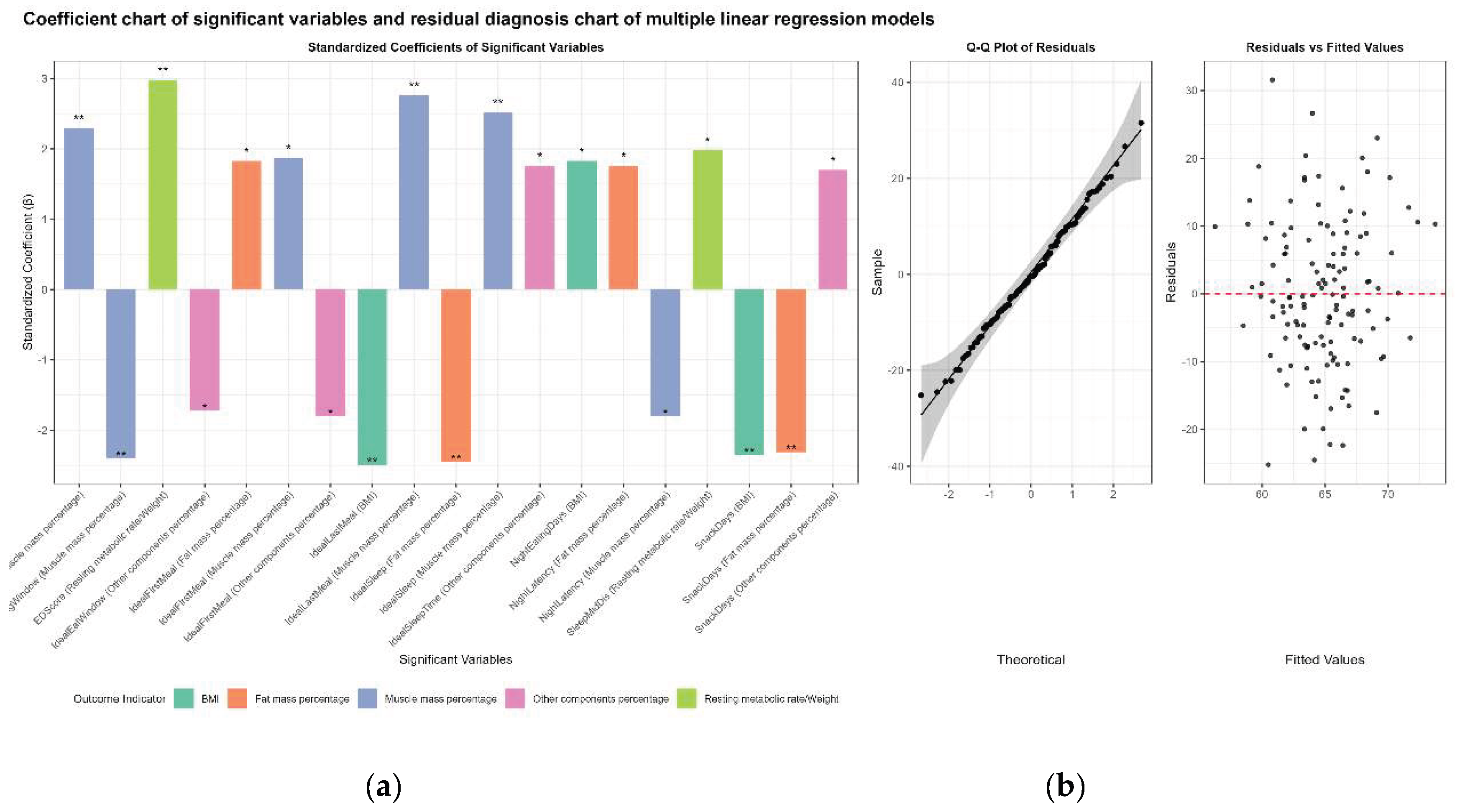
In multiple linear regression analyses adjusted for age and sex and Bonferroni correction, the explanatory power of the models differed across outcomes. Across models, demographic covariates (age/sex) explained 60-80% of the variance, while chrononutrition variables independently explained 3-8% of the variance (total sr²) for body composition indicators, and <2% for absolute RMR. Therefore, the regression results should be interpreted as adjusted cross-sectional associations rather than causal effects. The model for absolute RMR showed the highest adjusted R² (0.46), followed by muscle mass percentage (0.40), fat mass percentage (0.29), body-weight-standardized RMR (0.20), BMI (0.20), and other components percentage (0.18). No significant major × chrononutrition indicator interaction effects were found in all regression models (all P>0.05), indicating the associations between chrononutrition and body composition/metabolic indicators were consistent in sports-majoring and non-sports-majoring participants.
3.10.1. Common Influencing Factors
Sex was the most prominent covariate across all models (P < 0.001), with the largest absolute standardized coefficient. Age was also statistically significant in all models (P < 0.05 or P < 0.001), although the direction of association differed by dependent variable.
3.10.2. Independent Predictive Effect of Chrononutrition Behaviors in Each Model
The results of regression are shown in Table 6 (revised to add corrected P-values) and Figure 6 (optimized: removed non-core other components percentage data, clearly labeled significant levels, and added residual normality test results). Non-core exploratory results for other components percentage are presented in Supplementary Material Table S3.
The positive association between standardized RMR and overall eating disorder degree/sleep midpoint discrepancy may be due to the compensatory increase in relative metabolic efficiency in response to circadian misalignment. However, the correlation intensity was weak (|r|<0.3), indicating that chrononutrition has a minor independent effect on standardized RMR after adjusting for sex and age.
3.10.3. Sex Interaction Effects
Sex interaction analyses were conducted to explore whether the associations between chrononutrition variables and body composition/metabolic indicators varied by sex. No statistically significant interaction effects (sex × chrononutrition indicators) were observed for most outcomes (all P > 0.05), indicating that the directional and magnitude of the associations between chrononutrition behaviors and body composition/metabolic indicators were consistent in male and female college students. For muscle mass percentage and fat mass percentage, marginal non-significant interaction trends were found for weekly average weekday eating window (interaction P = 0.082) and number of breakfast days per week (interaction P = 0.076): the positive association between breakfast frequency and muscle mass percentage was slightly more pronounced in males, while the negative association between weekday eating window duration and muscle mass percentage was more evident in females. Sex-stratified regression results are presented in Supplementary Material Table S4, which confirmed the consistency of the main associations in both sexes. However, these trends did not reach statistical significance, and the main effects remained consistent across sexes. Thus, sex was included as a covariate in the main multiple linear regression models rather than as an effect modifier.
For other components percentage (%), which primarily comprises bone mineral content, several chrononutrition indicators showed significant associations (Table 6); these results should be interpreted with caution as this variable was not a primary outcome of the study and only provides a preliminary reference for subsequent research.
Table 6.
Multiple linear regression results of chrononutrition on body composition and metabolic indicators (adjusted for sex and age).
Table 6.
Multiple linear regression results of chrononutrition on body composition and metabolic indicators (adjusted for sex and age).
| Adjusted R² | Significant Chrononutrition Variables | β | sr² | P | Significance | Direction | |
| RMR | 0.46 | None | — | — | — | — | — |
| Standardized RMR | 0.20 | Chrononutrition disturbance score | 2.98 | 0.06 | 0.008 | ** | Positive |
| Sleep midpoint discrepancy | 1.98 | 0.04 | 0.042 | * | Positive | ||
| Muscle mass % | 0.41 | Ideal last meal time | 2.76 | 0.05 | <0.01 | ** | Positive |
| Ideal sleep time | 2.52 | 0.05 | <0.01 | ** | Positive | ||
| Weekday eating window | −2.40 | −0.05 | <0.01 | ** | Negative | ||
| Breakfast days/week | 2.29 | 0.05 | <0.01 | ** | Positive | ||
| Ideal first meal time | 1.87 | 0.03 | 0.045 | * | Positive | ||
| Night latency | −1.80 | −0.03 | 0.048 | * | Negative | ||
| Fat mass % | 0.29 | Ideal sleep time | −2.45 | −0.05 | <0.01 | ** | Negative |
| Snack days/week | −2.31 | −0.05 | <0.01 | ** | Negative | ||
| Ideal first meal time | 1.83 | 0.03 | 0.046 | * | Positive | ||
| Night latency | 1.76 | 0.03 | 0.049 | * | Positive | ||
| BMI | 0.20 | Ideal last meal time | −2.49 | −0.05 | <0.01 | ** | Negative |
| Snack days/week | −2.35 | −0.05 | <0.01 | ** | Negative | ||
| Night eating days/week | 1.83 | 0.03 | 0.046 | * | Positive |
*The model was adjusted for age and sex; all chrononutrition variables were included by forced entry method (VIF<3, no severe collinearity). P-values were Bonferroni-corrected for multiple comparisons; *P<0.05, **P<0.01; RMR = Resting metabolic rate; adjusted R² = adjusted coefficient of determination; n=133; other components percentage is an exploratory outcome and not included in core conclusions.
Figure 6.
Standardized coefficient chart of significant chrononutrition variables and residual diagnosis of multiple linear regression models. (a) Bar chart of standardized coefficients for significant chrononutrition variables in multiple linear regression models (adjusted for age/sex, Bonferroni-corrected P<0.05) for core dependent variables; positive/negative bars indicate the direction of association; (b) Residual diagnosis plots (Q-Q plot + Residuals vs. Fitted Values) for the regression models, confirming the normality and homogeneity of residuals (meeting linear regression assumptions). Only core dependent variables (excluding exploratory other components percentage) are presented.
Figure 6.
Standardized coefficient chart of significant chrononutrition variables and residual diagnosis of multiple linear regression models. (a) Bar chart of standardized coefficients for significant chrononutrition variables in multiple linear regression models (adjusted for age/sex, Bonferroni-corrected P<0.05) for core dependent variables; positive/negative bars indicate the direction of association; (b) Residual diagnosis plots (Q-Q plot + Residuals vs. Fitted Values) for the regression models, confirming the normality and homogeneity of residuals (meeting linear regression assumptions). Only core dependent variables (excluding exploratory other components percentage) are presented.
4. Discussion
This cross-sectional study investigated the chrononutrition patterns of predominantly sports-majoring Chinese college students (with a small proportion of non-sports majors) and their associations with body composition and resting metabolic rate (RMR). The key findings revealed that chrononutrition behaviors were more consistently correlated with body composition indicators than with absolute RMR in this population; frequent night eating was positively associated with BMI, and regular breakfast consumption was positively associated with muscle mass percentage. Additionally, significant sex differences were observed in chrononutrition patterns, and no notable major-specific interaction effects were found, indicating the core associations were consistent across sports and non-sports majors (with the overall results mainly driven by the sports-majoring population). These findings supplement the chrononutrition research data for Chinese college students with high physical activity levels and provide a targeted theoretical basis for formulating metabolic health promotion strategies for this unique group. A key strength of this study is its focus on sports-majoring college students—a physically active population with distinct metabolic and body compositional phenotypes. Unlike non-sports students, sports majors exhibit unique chrononutrition patterns driven by training-related energy needs, including longer weekday eating windows and higher evening energy intake. These behaviors are adaptive, not pathological. Therefore, our findings cannot be generalized to the general student population, highlighting the importance of population-specific chrononutrition research.
A notable feature of the present study was the high prevalence of breakfast irregularity and the tendency for energy intake to be shifted away from the morning. This pattern is metabolically relevant because recent chrononutrition research increasingly supports the view that earlier, more regular, and better-aligned eating schedules are more compatible with endogenous circadian rhythms. A recent National Heart, Lung, and Blood Institute workshop report emphasized that meal timing, regularity, eating duration, and alignment with sleep-wake rhythms are central dimensions of chrononutrition that may influence cardiometabolic health [3]. Similarly, a recent overview in Nutrients highlighted that temporal eating patterns should be evaluated not only by meal timing itself, but also by regularity and alignment with behavioral circadian rhythms [4]. Thus, the breakfast irregularity and delayed eating pattern observed in our sample may represent a broader disruption of circadian eating organization rather than an isolated dietary habit. The chrononutrition patterns of Chinese college students in this study (high breakfast irregularity, delayed dinner, high lunch energy proportion) are consistent with Gong et al. [20], who reported that irregular meal timing and social jet lag are common in Chinese college students. The breakfast irregularity and delayed eating pattern observed in our sample may disrupt the entrainment of peripheral metabolic clocks (e.g., skeletal muscle and adipose tissue clocks). Regular breakfast consumption can synchronize circadian rhythms with nutrient intake, enhance insulin sensitivity, and promote muscle protein synthesis, while delayed eating may reduce glucose tolerance and increase fat storage due to circadian misalignment of metabolic pathways. However, the muscle mass percentage in this study (64.6±12.7%) is higher than that in ordinary Chinese college students (about 55-60%), which is due to the sports-related majors of the participants, reflecting the influence of physical activity on body composition. The longer weekday eating window of the subjects may be related to the higher daily energy demand of sports college students and multiple energy supplements after exercise. Therefore, the extrapolation of this study's conclusions to ordinary college students needs to be comprehensively judged in combination with physical activity level.
The positive association between night eating and BMI observed in our study is broadly consistent with current evidence. In a recent longitudinal study of 48,150 Chinese adults, frequent skipping of breakfast and/or night eating was associated with faster increases in body weight and waist circumference over four years, even after adjustment for total energy intake and diet quality [22]. Although the present study was cross-sectional and cannot establish causality, the consistency in direction strengthens the plausibility of our findings. One likely explanation is that food intake later in the day occurs during a circadian phase characterized by reduced glucose tolerance, lower insulin sensitivity, and less favorable postprandial metabolic handling, which may promote positive energy balance and adiposity over time [3,4]. In addition, night eating often clusters with other unfavorable behaviors, such as delayed sleep timing and irregular daily routines, which may further amplify obesity risk [23].
Another notable finding was that the number of breakfast days per week was positively associated with muscle mass percentage. Although most chrononutrition studies have focused on obesity or cardiometabolic risk, this result is biologically plausible. Regular breakfast consumption may help distribute energy and protein intake more evenly across the day, reduce prolonged morning fasting, and support synchronization of peripheral metabolic clocks, including those in skeletal muscle [3,4]. Supporting this interpretation, Wu et al. reported in young adults that earlier and more regular temporal eating patterns were associated with more favorable body-composition indicators [24]. Mao et al. found that chrononutrition behaviors, including eating-window characteristics and timing of intake, were associated with muscle mass and function in older adults [25]. Because our study did not directly measure total protein intake or protein distribution, this interpretation should remain cautious and mechanistic rather than definitive.
The associations involving weekday eating window and body composition deserve cautious interpretation. In our study, a longer weekly average weekday eating window was negatively associated with muscle mass percentage in the adjusted model, while the simple correlation with fat mass percentage also indicated a significant relationship. However, evidence from the literature is not entirely consistent. Wu et al. observed that earlier and more regular temporal eating patterns were linked to more favorable body composition in young adults [24], whereas Dote-Montero et al. reported that meal timing was not clearly related to body composition in young adults, although a longer weekday eating window and a shorter interval from midsleep to first food intake were associated with better cardiometabolic health in men [6]. Moreover, a recent meta-analysis suggested that early time-restricted eating can reduce body weight and fat mass while not clearly compromising fat-free mass [26]. Taken together, these findings imply that the meaning of “weekday eating window” may differ substantially between structured intervention studies and free-living observational settings. In our cohort, a longer weekday eating window may reflect a more irregular intake pattern across the day rather than a deliberate early time-restricted eating strategy. In our sports-majoring cohort, a longer weekday eating window reflects structured post-exercise energy and protein supplementation (3–4 times/day) to meet high training energy demands and promote muscle repair. This is fundamentally different from the unstructured, irregular eating patterns seen in the general population. This adaptive nature explains the unique negative association between weekday eating window and muscle mass percentage—longer windows may indicate excess energy intake beyond training needs, not poor regularity. Therefore, this finding should not be interpreted as direct evidence against time-restricted eating, but rather as an indication that under habitual college-life conditions, a more extended and potentially disorganized eating span may be linked to less favorable body-composition characteristics.
We also observed that discrepancy-related indicators, especially sleep midpoint discrepancy and sleep duration discrepancy, were associated with body composition and standardized RMR. This is meaningful because chrononutrition does not act in isolation; rather, it is embedded within a broader circadian behavioral system that includes sleep timing, wake timing, light exposure, and daily schedules [3,4]. This interpretation is supported by a systematic review showing that evening chronotype is associated with obesity risk and less favorable weight-control outcomes [23]. Accordingly, our findings suggest that eating-related rhythms and sleep-related misalignment may jointly shape metabolic phenotypes in college students. From a practical perspective, improving eating timing without addressing irregular sleep-wake patterns may produce only limited benefits.
The RMR-related findings require restrained interpretation. In the present study, chrononutrition variables did not independently predict absolute RMR after adjustment for age and sex, whereas standardized RMR remained associated with eating disorder degree and sleep midpoint discrepancy. This pattern is reasonable because absolute RMR is strongly determined by body size and body composition, especially fat-free mass, and may therefore be less sensitive to the independent contribution of meal timing in a relatively young and generally healthy sample. In contrast, standardized RMR may better reflect relative metabolic efficiency after accounting, at least partly, for interindividual differences in body weight. Therefore, our data suggest that chrononutrition may be more closely related to relative metabolic phenotype and body-composition patterning than to absolute resting energy expenditure itself. This interpretation is aligned with the broader literature, where evidence linking meal timing to adiposity is generally more consistent than evidence for large direct effects on absolute resting metabolism [3,4,26].
This study has several strengths. First, body composition was assessed using DXA and resting metabolism was measured by indirect calorimetry, which improved phenotypic precision compared with studies relying only on BMI or predictive equations. Second, we assessed multiple dimensions of chrononutrition simultaneously, including meal timing, weekday eating window, breakfast frequency, night eating, and discrepancy-related indicators, allowing a relatively comprehensive evaluation of temporal eating behaviors in college students. Third, this study contributes data from a Chinese young-adult population, which remains underrepresented in the chrononutrition literature.
Several limitations should also be acknowledged. First, this study is a cross-sectional design, which cannot determine the causal relationship between chrononutrition behaviors and outcome indicators (e.g., it cannot be judged whether night eating leads to higher BMI or subjects with higher BMI are more likely to form night eating habits), and prospective cohort studies are needed for verification in the future. Second, chrononutrition behaviors were self-reported and may be affected by recall bias or reporting bias. Third, although the models were adjusted for age and sex, residual confounding by physical activity, total energy intake, dietary quality, macronutrient distribution, and psychosocial factors remains possible. Fourth, the participants were recruited from a relatively homogeneous university population, which may limit generalizability to other age groups or non-student populations. Finally, some associations in the present study were modest and not always directionally consistent across correlation and regression analyses; therefore, the findings should be interpreted as exploratory rather than definitive.
Based on the study results, specific chrononutrition intervention strategies for Chinese college students are proposed: (1) General suggestions: Control the daily weekday eating window within 8-10 hours, increase breakfast consumption frequency to ≥5 days/week, ensure breakfast energy proportion ≥20%, and reduce dinner energy proportion to ≤30%; avoid night eating (energy intake after 22:00). (2) Gender-specific suggestions: Males (especially sports majors) can appropriately extend the weekday eating window to 10-12 hours to match the energy demand of physical exercise, and increase the protein proportion of dinner (≥20%); females should strictly control the dinner time before 19:00, and reduce the frequency of post-meal snacks to ≤2 days/week. (3) Weekend adjustment: Narrow the social jet lag to <2 hours, keep the breakfast time on weekends within 1 hour of that on weekdays, and avoid delayed dinner time over 20:00.Future studies should incorporate objective measurements of total energy intake, macronutrient distribution, and physical activity levels, and adjust these variables in statistical models to enhance the causal inference of the association between chrononutrition and metabolic outcomes.
5. Conclusions
In conclusion, this study investigated the chrononutrition patterns of predominantly sports-majoring Chinese college students (with a small proportion of non-sports majors) and their associations with body composition and RMR, and the main conclusions are as follows:
Chrononutrition behaviors show more consistent associations with body composition indicators than with absolute RMR in this population; frequent night eating is positively associated with BMI, and regular breakfast consumption is positively associated with muscle mass percentage, while the independent associations between chrononutrition behaviors and absolute RMR are limited after adjusting for age and sex. These results highlight the unique chrononutrition phenotypes of sports-majoring college students, which are shaped by high physical activity levels and training-related energy needs. Thus, our findings cannot be directly generalized to non-sports college students, underscoring the need for targeted nutrition guidance tailored to activity levels.
Significant sex differences in chrononutrition patterns were observed, which may be attributed to three factors: (1) hormonal differences: higher testosterone levels in males increase energy expenditure and muscle synthesis demand, leading to longer weekday eating windows and higher dinner energy proportion [25]; (2) physical activity differences: males have higher training intensity and duration than females (6.2±1.8 h/day vs. 3.5±1.2 h/day, P<0.001), requiring more post-exercise supplementation; (3) lifestyle differences: males have later sleep-wake times than females, leading to delayed meal timing. Males have later meal times, longer weekday eating windows, fewer regular meal days, lower breakfast energy proportion and higher dinner energy proportion than females, and these differences are consistent across sports and non-sports majors; no significant major-specific interaction effects are found, indicating the core associations between chrononutrition and body composition/RMR are consistent in the two groups.
The chrononutrition patterns of sports-majoring students show obvious population-specific characteristics: longer weekday eating window and higher dinner energy proportion are adaptive performances for their high physical activity and training demand, which are essentially different from the irregular eating patterns of the general college student population and need to be interpreted in combination with sports metabolic characteristics.
All findings in this study are mainly applicable to physically active sports-majoring Chinese college students, and the conclusions cannot be directly generalized to the general college student population due to the unique metabolic characteristics of the study population. Future studies should conduct prospective cohort studies or randomized controlled trials to clarify the causal relationship between chrononutrition and metabolic health; recruit independent and large sample sizes of sports and non-sports majors to compare the differences in their chrononutrition patterns and metabolic associations; collect data on total energy intake, macronutrient distribution and other key confounding factors to further improve the statistical model; and combine objective monitoring methods to assess chrononutrition behaviors, so as to provide more rigorous and comprehensive evidence for formulating personalized chrononutrition intervention strategies for Chinese college students of different majors and genders.
Regular breakfast consumption and reduced night eating are potential targets for metabolic health promotion in college students, with differentiated intervention intensities based on gender and major: (1) For sports-majoring students: the weekday eating window can be appropriately extended to 10-12 h (matched with training demand), dinner energy proportion controlled at 35-40%, and protein proportion of dinner increased to ≥20%; (2) For non-sports-majoring students: the weekday eating window should be strictly controlled within 8-10 h, dinner energy proportion reduced to ≤30%, and dinner time controlled before 19:00; (3) For females: post-meal snack frequency should be reduced to ≤2 days/week, and breakfast energy proportion increased to ≥20%.
Supplementary Materials
The following supporting information can be downloaded at the website of this paper posted on Preprints.org., Table S1. Post-hoc Sensitivity Analysis: Multiple Linear Regression of Chrononutrition Behaviors on Body Composition and Metabolic Indicators (Adjusted for Age, Sex, and Self-Reported Physical Exercise Frequency); Table S2. Exploratory Correlation Analysis Results of Chrononutrition Indicators with Other Components Percentage; Table S3. Multiple Linear Regression Results of Chrononutrition Indicators with Other Components Percentage (Adjusted for Age and Sex; Bonferroni-Corrected); Table S4. Sex-Stratified Multiple Linear Regression Results of Chrononutrition Behaviors on Core Body Composition Indicators (Adjusted for Age; Bonferroni-Corrected); Table S5. Multiple Imputation Sensitivity Analysis Results of Chrononutrition on Body Composition; Table S6. Correlation Analysis of Night Eating (Sleep Onset Definition) with Body Composition Indicators; Table S7. Limb Muscle Mass and Visceral Fat Area of Participants by Sex and Major; Table S8. Chrononutrition Indicators on Weekdays vs. Weekends (Mean±SD).
Author Contributions
Conceptualization, K.X. and H.L.; methodology, K.X.; software, K.X.; validation, K.X., S.Y., Y.J. and Y.M.; formal analysis, K.X.; investigation, K.X., S.Y., Y.J. and Y.M.; resources, H.L.; data curation, K.X.; writing—original draft preparation, K.X.; writing—review and editing, H.L.; visualization, K.X.; supervision, H.L.; project administration, H.L.; funding acquisition, H.L. All authors have read and agreed to the published version of the manuscript.
Funding
This research was funded by the National Science and Technology Innovation 2030 Major Project "Major Special Project for Four Major Chronic Diseases" (Grant Numbers: 2023ZD0508500, 2023ZD0508502).The APC (Article Processing Charge) was funded by the same grant.
Institutional Review Board Statement
This study was conducted in accordance with the Declaration of Helsinki and was approved by the Ethics Committee of Beijing Sport University (Approval No.: 2024310H).
Informed Consent Statement
Written informed consent was obtained from all participants prior to the study.
Data Availability Statement
The original contributions presented in this study are included in the article and its supplementary material. The raw data supporting the conclusions of this article will be made available by the corresponding author upon reasonable request, due to privacy and ethical restrictions related to human participant data.
Acknowledgments
The authors would like to thank the participants for their voluntary participation in this study. We also appreciate the technical support provided by the School of Sport Science, Key Laboratory of the Ministry of Education of Exercise and Physical fitness, Beijing Sport University during body composition testing and resting metabolic rate measurement. During the preparation of this manuscript, the authors only used Generative Artificial Intelligence (GenAI) tools for language polishing and grammar revision. No GenAI tools were used for text generation, data analysis, graphic creation, study design, data collection, or result interpretation.
Conflicts of Interest
The authors declare no conflicts of interest. The funders had no role in the design of the study; in the collection, analyses, or interpretation of data; in the writing of the manuscript; or in the decision to publish the results.
Abbreviations
The following abbreviations are used in this manuscript:
| RMR | Resting Metabolic Rate |
| DXA | Dual-Energy X-ray Absorptiometry |
| BMI | Body Mass Index |
| ICC | Intraclass Correlation Coefficient |
| FDR | False Discovery Rate |
| VIF | Variance Inflation Factor |
| CV | Coefficient of Variation |
| VO₂ | Oxygen Consumption |
| VCO₂ | Carbon Dioxide Production |
| APC | Article Processing Charge |
| SD | Standard Deviation |
| IQR | Interquartile Range |
| h | Hours |
| min | Minutes |
| kg | Kilograms |
| cm | Centimeters |
| kcal | Kilocalories |
References
- Almoosawi, S.; Vingeliene, S.; Gachon, F.; Voortman, T.; Palla, L.; Johnston, J.D.; Van Dam, R.M.; Darimont, C.; Karagounis, L.G. Chronotype: Implications for Epidemiologic Studies on Chrono-Nutrition and Cardiometabolic Health. Advances in Nutrition 2019, 10, 30–42. [Google Scholar] [CrossRef] [PubMed]
- Crispim, C.A.; Mota, M.C. New perspectives on chrononutrition. Biological Rhythm Research 2019, 50, 63–77. [Google Scholar] [CrossRef]
- Dashti, H.S.; Jansen, E.C.; Zuraikat, F.M.; Dixit, S.; Brown, M.; Laposky, A.; Broussard, J.L.; Butler, M.P.; Creasy, S.A.; Crispim, C.A.; et al. Advancing Chrononutrition for Cardiometabolic Health: A 2023 National Heart, Lung, and Blood Institute Workshop Report. J Am Heart Assoc 2025, 14, e039373. [Google Scholar] [CrossRef]
- Raji, O.E.; Kyeremah, E.B.; Sears, D.D.; St-Onge, M.P.; Makarem, N. Chrononutrition and Cardiometabolic Health: An Overview of Epidemiological Evidence and Key Future Research Directions. Nutrients 2024, 16. [Google Scholar] [CrossRef]
- Liu, H.Y.; Eso, A.A.; Cook, N.; O'Neill, H.M.; Albarqouni, L. Meal Timing and Anthropometric and Metabolic Outcomes: A Systematic Review and Meta-Analysis. JAMA Netw Open 2024, 7, e2442163. [Google Scholar] [CrossRef]
- Dote-Montero, M.; Acosta, F.M.; Sanchez-Delgado, G.; Merchan-Ramirez, E.; Amaro-Gahete, F.J.; Labayen, I.; Ruiz, J.R. Association of meal timing with body composition and cardiometabolic risk factors in young adults. Eur J Nutr 2023, 62, 2303–2315. [Google Scholar] [CrossRef] [PubMed]
- Wang, Z.R. Chronobiology; People’s Medical Publishing House: Beijing, China, 2008; p. 226. [Google Scholar]
- Tevy, M.F.; Giebultowicz, J.; Pincus, Z.; Mazzoccoli, G.; Vinciguerra, M. Aging signaling pathways and circadian clock-dependent metabolic derangements. Trends in Endocrinology & Metabolism 2013, 24, 229–237. [Google Scholar] [CrossRef]
- Makarem, N.; Paul, J.; Giardina, E.-G.V.; Liao, M.; Aggarwal, B. Evening chronotype is associated with poor cardiovascular health and adverse health behaviors in a diverse population of women. Chronobiology International 2020, 37, 673–685. [Google Scholar] [CrossRef]
- Saidi, O.; Rochette, E.; Dambel, L.; St-Onge, M.P.; Duché, P. Chrono-nutrition and sleep: lessons from the temporal feature of eating patterns in human studies - A systematic scoping review. Sleep Med Rev 2024, 76, 101953. [Google Scholar] [CrossRef]
- Chen, H.J.; Tsai, Y.C.; Hsu, Y.T.; Chu, J. Effect of recommendations of breakfast and late-evening snack habits on body composition and blood pressure: A pilot randomized trial. Chronobiol Int 2024, 41, 1021–1033. [Google Scholar] [CrossRef]
- Almoosawi, S.; Vingeliene, S.; Karagounis, L.G.; Pot, G.K. Chrono-nutrition: a review of current evidence from observational studies on global trends in time-of-day of energy intake and its association with obesity. Proc Nutr Soc 2016, 75, 487–500. [Google Scholar] [CrossRef] [PubMed]
- Johnston, J.D.; Ordovás, J.M.; Scheer, F.A.; Turek, F.W. Circadian Rhythms, Metabolism, and Chrononutrition in Rodents and Humans. Adv Nutr 2016, 7, 399–406. [Google Scholar] [CrossRef] [PubMed]
- Potter, G.D.; Cade, J.E.; Grant, P.J.; Hardie, L.J. Nutrition and the circadian system. Br J Nutr 2016, 116, 434–442. [Google Scholar] [CrossRef]
- Seike, K.; Oshita, K.; Ishihara, Y.; Myotsuzono, R.; Nagamine, K. Relationship Between Breakfast Skipping and Body Composition, Nutritional Status or Chronotype in Female University Students With Normal Body Weight. Physiol Res 2025, 74, 989–998. [Google Scholar] [CrossRef]
- Westerterp, K.R. Physical activity as determinant of daily energy expenditure. Physiol Behav 2008, 93, 1039–1043. [Google Scholar] [CrossRef]
- Challet, E. The circadian regulation of food intake. Nat Rev Endocrinol 2019, 15, 393–405. [Google Scholar] [CrossRef]
- Theodorakis, N.; Nikolaou, M. The Human Energy Balance: Uncovering the Hidden Variables of Obesity. Diseases 2025, 13. [Google Scholar] [CrossRef]
- Nishimura, K.; Tamari, Y.; Nose, Y.; Yamaguchi, H.; Onodera, S.; Nagasaki, K. Effects of Irregular Mealtimes on Social and Eating Jet Lags among Japanese College Students. Nutrients 2023, 15. [Google Scholar] [CrossRef]
- Gong, Y.; Zhang, J.X.; Li, S.N.; Li, L.L.; Dong, X.J.; Liu, L.J.; Fan, Z.H.; Li, Y.; Yang, Y.D. The relationship between chrononutrition profile, social jet lag and obesity: A cross-sectional study of Chinese college students. Chronobiol Int 2025, 42, 328–339. [Google Scholar] [CrossRef] [PubMed]
- Gong, Y.; Chen, M.X.; Fan, Z.H.; Huang, Z.H.; Xiao, T.L.; Fan, X.L.; Zheng, C.J.; Yang, Y.D. Reliability and validity of the Chinese version of the Chrononutrition Profile Questionnaire. Modern Preventive Medicine 2024, 51, 2182–2187. [Google Scholar] [CrossRef]
- Jigeer, G.; Huang, Z.; Wang, P.; Chen, S.; Sun, L.; Li, Y.; Wu, S.; Gao, X. Longitudinal associations of skipping breakfast and night eating with 4-year changes in weight and waist circumference among Chinese adults. Am J Clin Nutr 2024, 120, 442–448. [Google Scholar] [CrossRef]
- Ekiz Erim, S.; Sert, H. The relationship between chronotype and obesity: A systematic review. Chronobiol Int 2023, 40, 529–541. [Google Scholar] [CrossRef] [PubMed]
- Wu, Y.; Nie, Q.; Wang, Y.; Liu, Y.; Liu, W.; Wang, T.; Zhang, Y.; Cao, S.; Li, Z.; Zheng, J.; et al. Associations between temporal eating patterns and body composition in young adults: a cross-sectional study. Eur J Nutr 2024, 63, 2071–2080. [Google Scholar] [CrossRef] [PubMed]
- Mao, Z.; Cawthon, P.M.; Kritchevsky, S.B.; Toledo, F.G.S.; Esser, K.A.; Erickson, M.L.; Newman, A.B.; Farsijani, S. The association between chrononutrition behaviors and muscle health among older adults: The study of muscle, mobility and aging. Aging Cell 2023, e14059. [Google Scholar] [CrossRef] [PubMed]
- He, M.; Li, B.; Li, M.; Gao, S. Does early time-restricted eating reduce body weight and preserve fat-free mass in adults? A systematic review and meta-analysis of randomized controlled trials. Diabetes Metab Syndr 2024, 18, 102952. [Google Scholar] [CrossRef]
Figure 1.
Distribution of sleep duration among college students.
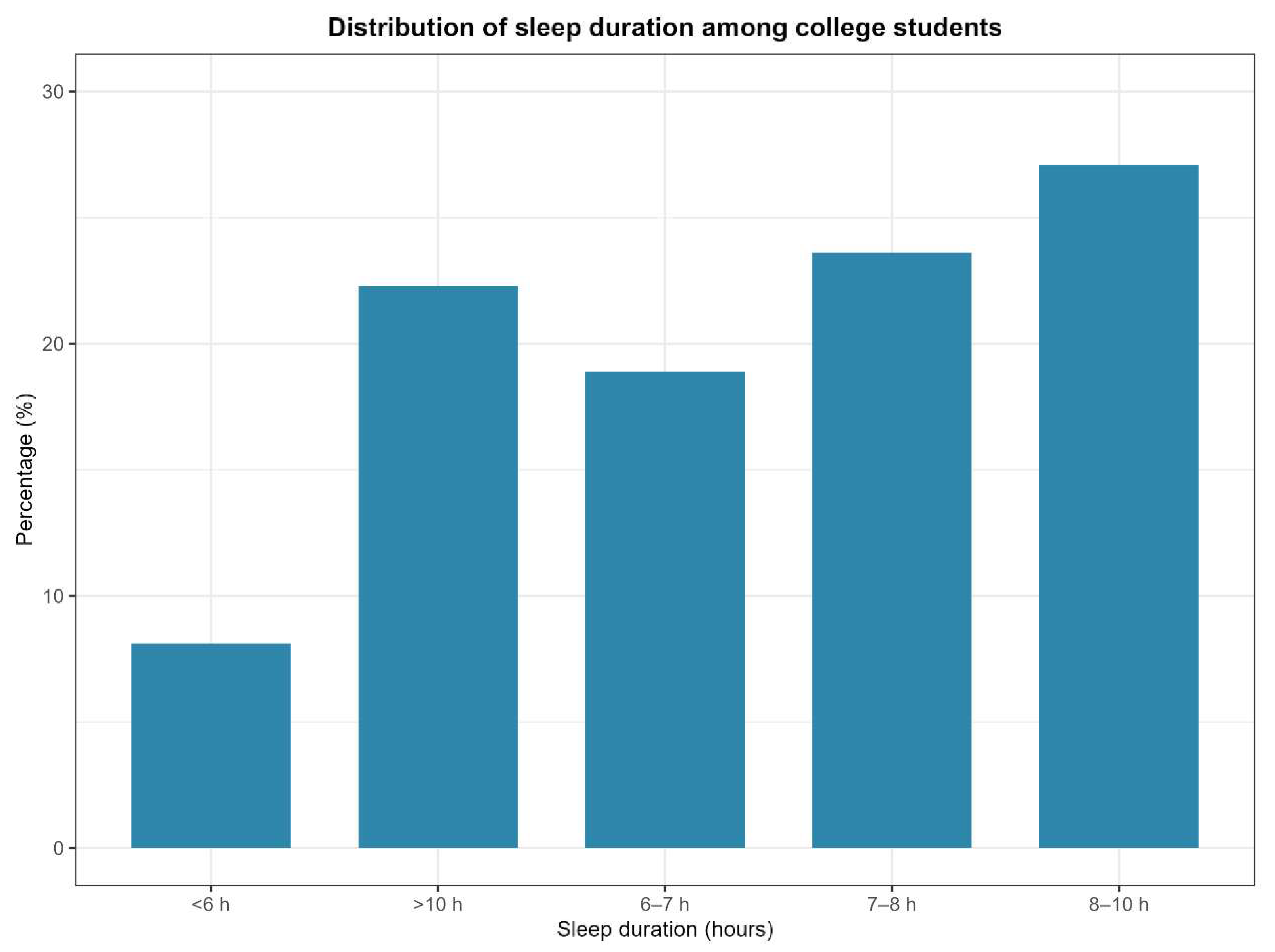
Figure 2.
Distribution of weekday eating window duration and comparison of morning/night latency in the study population: (a) Percentage distribution of weekly average weekday eating window duration (h/day), categorized as <6 h, 6–9 h, 9–12 h, 12–15 h, >15 h; (b) Comparison of weekly average morning latency and night latency (h). Morning latency = interval from waking to the first meal; Night latency = interval from the last meal to sleep onset. Data are presented as mean ± SD; P<0.01 for the comparison between morning and night latency (paired t-test).
Figure 2.
Distribution of weekday eating window duration and comparison of morning/night latency in the study population: (a) Percentage distribution of weekly average weekday eating window duration (h/day), categorized as <6 h, 6–9 h, 9–12 h, 12–15 h, >15 h; (b) Comparison of weekly average morning latency and night latency (h). Morning latency = interval from waking to the first meal; Night latency = interval from the last meal to sleep onset. Data are presented as mean ± SD; P<0.01 for the comparison between morning and night latency (paired t-test).
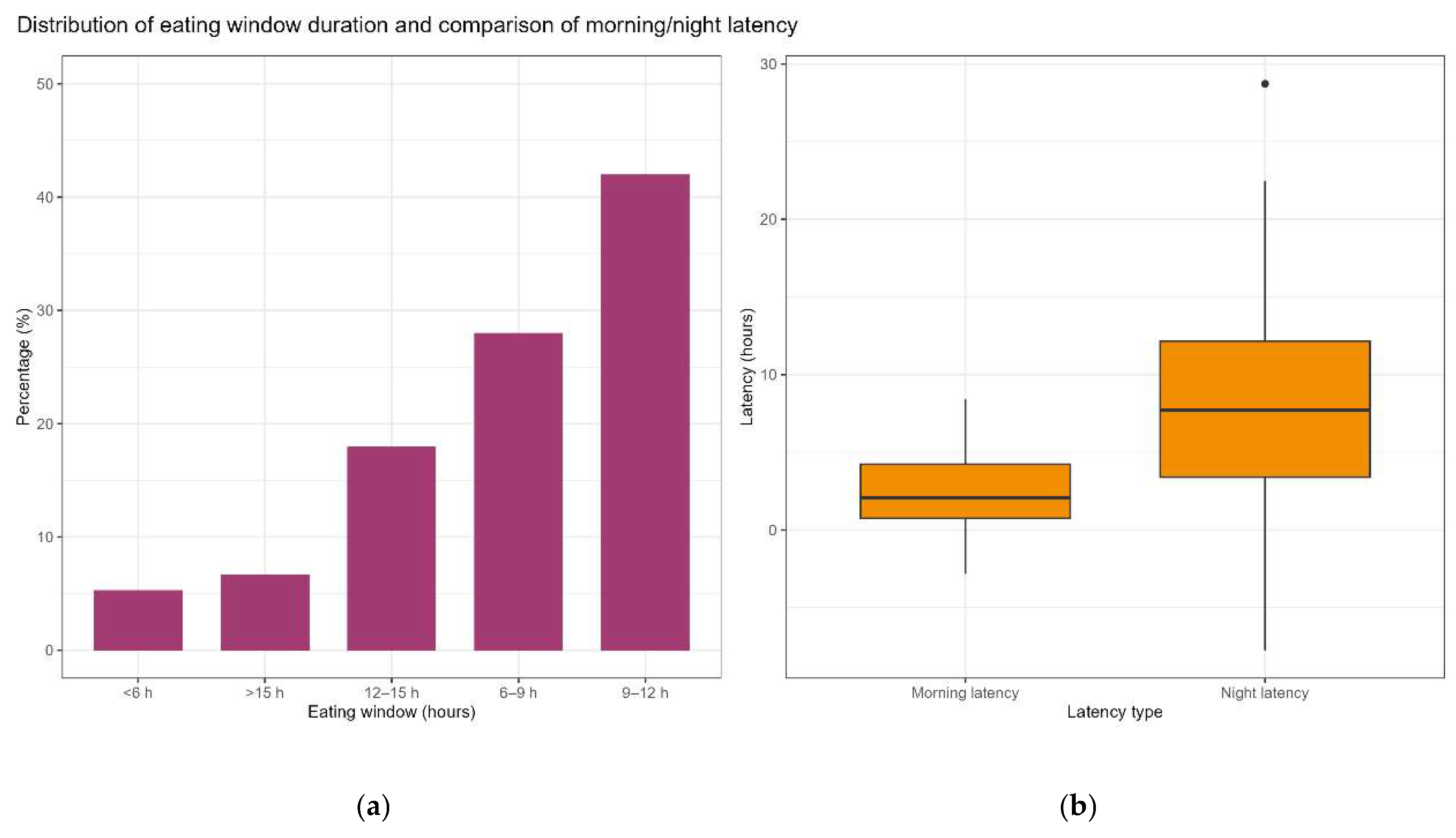
Figure 3.
Distribution of chrononutrition disturbance score and chronotype discrepancy indicators in the study population. (a) Percentage distribution of chrononutrition disturbance score, categorized as 0–10 points (mild disturbance), 10–20 points (moderate disturbance), 20–30 points (severe disturbance), ≥30 points (extreme disturbance); (b) Distribution of four chronotype discrepancy indicators (h), including sleep duration discrepancy, sleep midpoint discrepancy, eating midpoint discrepancy, weekday eating window discrepancy. Discrepancy = absolute Z-score standardized difference between actual and self-reported ideal values; data are presented as mean ± SD.
Figure 3.
Distribution of chrononutrition disturbance score and chronotype discrepancy indicators in the study population. (a) Percentage distribution of chrononutrition disturbance score, categorized as 0–10 points (mild disturbance), 10–20 points (moderate disturbance), 20–30 points (severe disturbance), ≥30 points (extreme disturbance); (b) Distribution of four chronotype discrepancy indicators (h), including sleep duration discrepancy, sleep midpoint discrepancy, eating midpoint discrepancy, weekday eating window discrepancy. Discrepancy = absolute Z-score standardized difference between actual and self-reported ideal values; data are presented as mean ± SD.
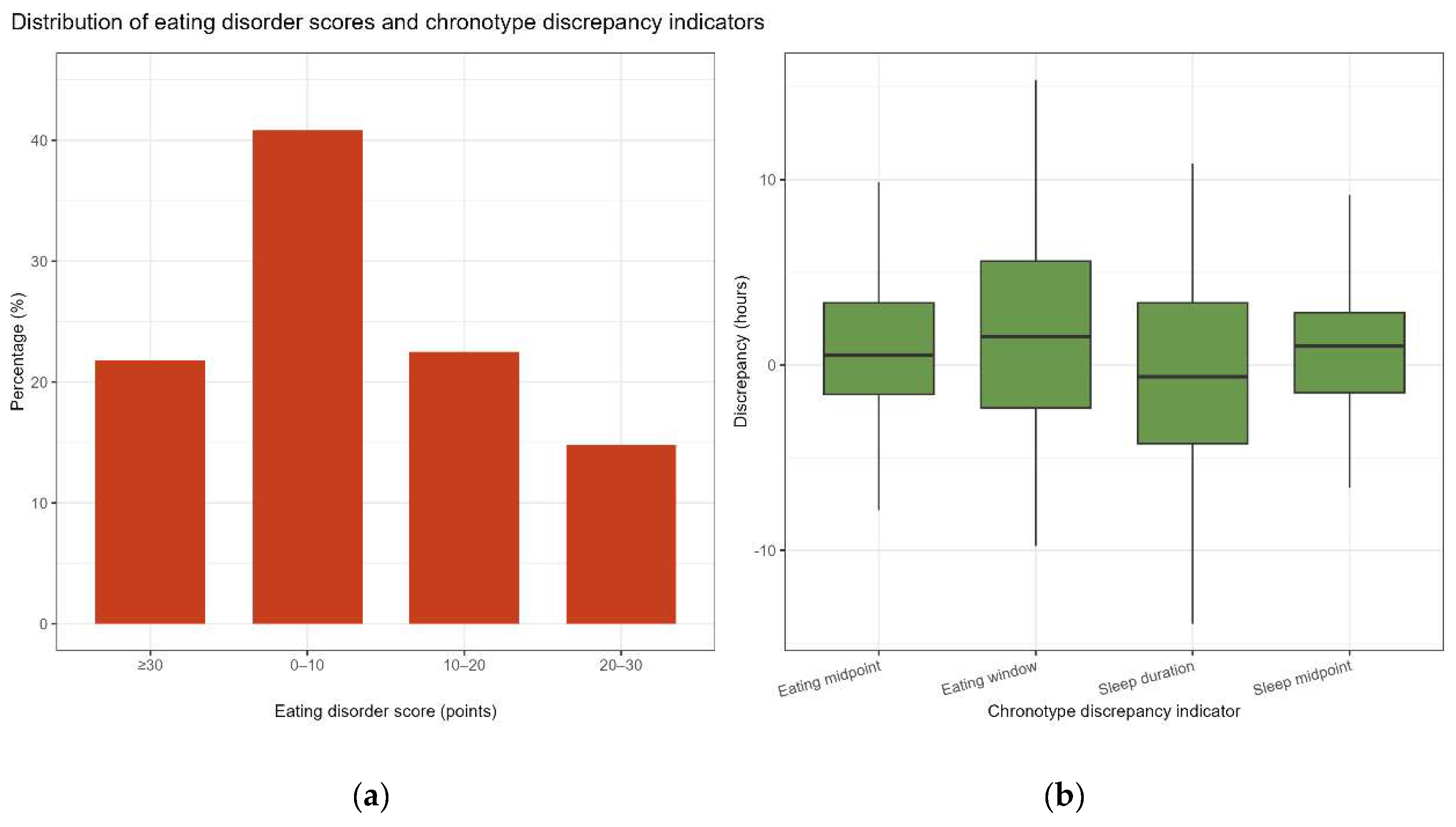
Figure 4.
Distribution of meal time and energy proportion among predominantly sports-majoring Chinese college students. (a) Percentage distribution of meal time for breakfast, lunch and dinner (categorical time ranges); (b) Energy proportion (%) of breakfast, lunch, dinner and snacks in total daily energy intake. Data are presented as mean ± SD; different lowercase letters indicate significant differences in energy proportion among meal types (P<0.05, one-way ANOVA).
Figure 4.
Distribution of meal time and energy proportion among predominantly sports-majoring Chinese college students. (a) Percentage distribution of meal time for breakfast, lunch and dinner (categorical time ranges); (b) Energy proportion (%) of breakfast, lunch, dinner and snacks in total daily energy intake. Data are presented as mean ± SD; different lowercase letters indicate significant differences in energy proportion among meal types (P<0.05, one-way ANOVA).
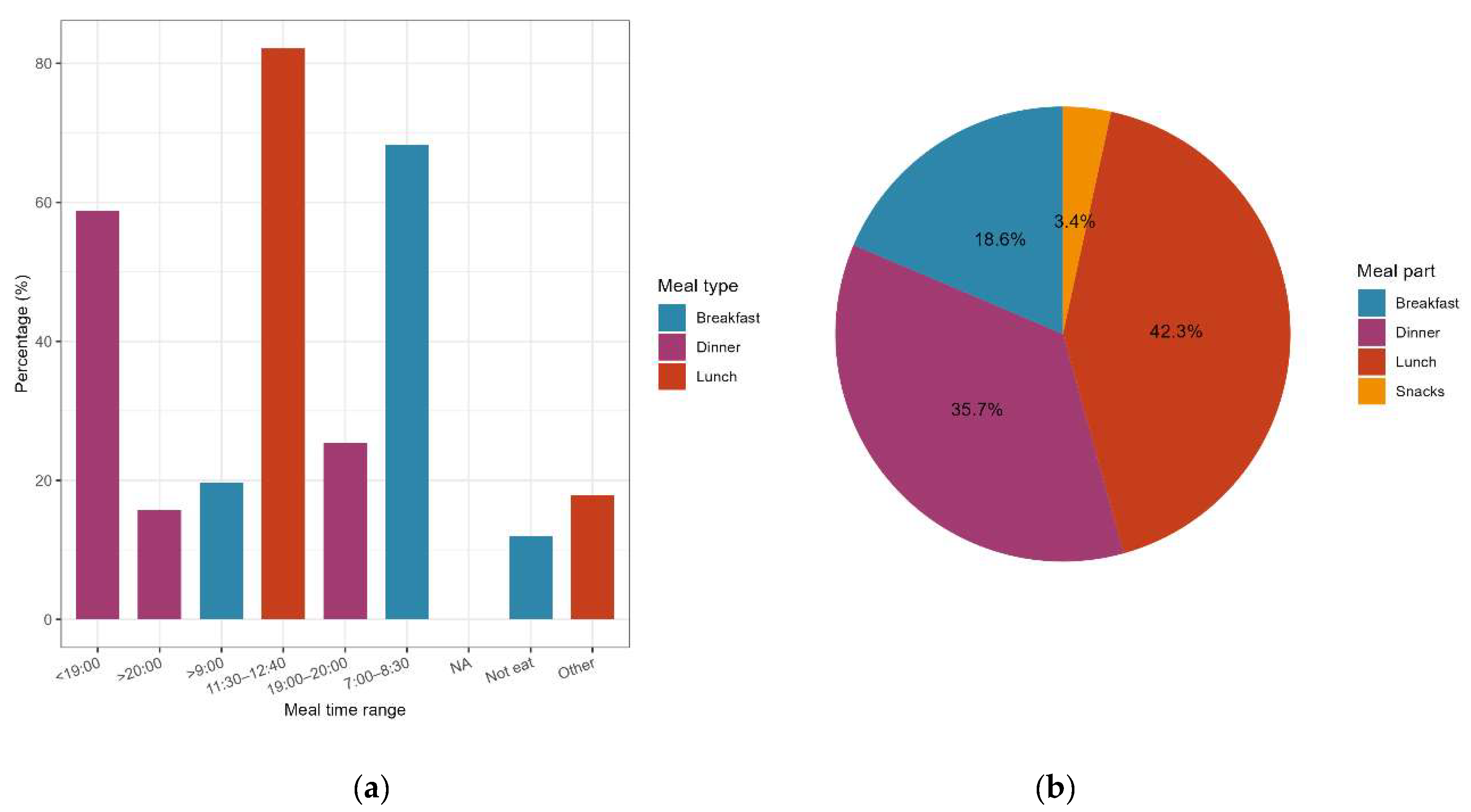
Figure 5.
Correlation heatmap and significant coefficient bar chart of chrononutrition indicators with body composition and metabolic indicators. (a) Correlation heatmap showing the bivariate correlation between core chrononutrition indicators, body composition and metabolic indicators; red = positive correlation, blue = negative correlation, color depth = correlation strength (|r|); (b) Bar chart of significant correlation coefficients (FDR-adjusted P<0.05) for key variable pairs. All P-values were corrected for false discovery rate (FDR) to reduce Type I error; only core outcomes (excluding exploratory other components percentage) are presented.
Figure 5.
Correlation heatmap and significant coefficient bar chart of chrononutrition indicators with body composition and metabolic indicators. (a) Correlation heatmap showing the bivariate correlation between core chrononutrition indicators, body composition and metabolic indicators; red = positive correlation, blue = negative correlation, color depth = correlation strength (|r|); (b) Bar chart of significant correlation coefficients (FDR-adjusted P<0.05) for key variable pairs. All P-values were corrected for false discovery rate (FDR) to reduce Type I error; only core outcomes (excluding exploratory other components percentage) are presented.
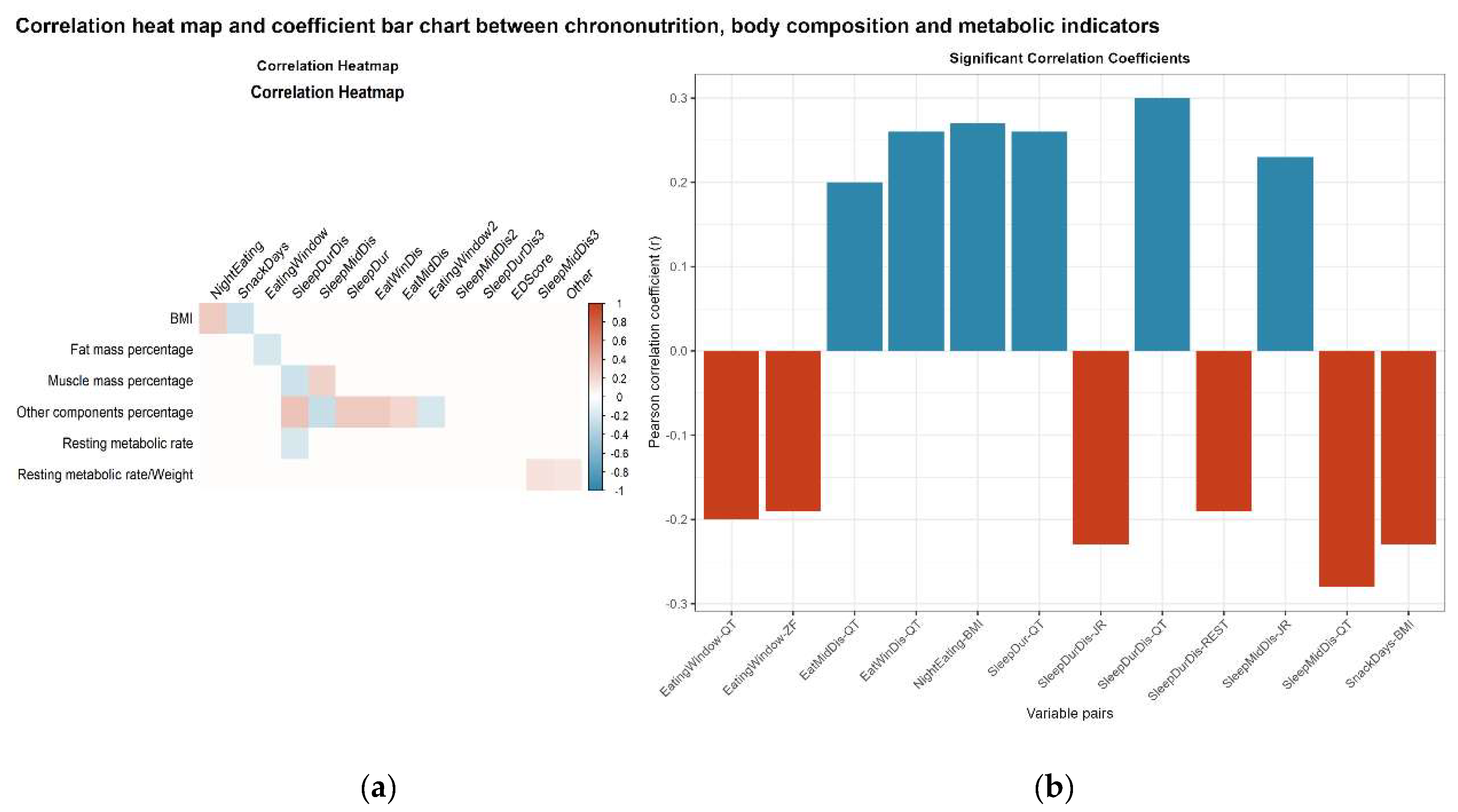
Table 1.
General characteristics of participants by sex and major.
| Variables | Total (n=174) Mean ± SD/Median (IQR) | Male (n=64) Mean ± SD | Female (n=110) Mean ± SD | Sports-majoring (n=131) Mean ± SD | Non-sports-majoring (n=43) Mean ± SD | P-value (sex) | P-value (major) |
| Age (years) | 20.5 ± 1.8 | 20.7 ± 1.7 | 20.3 ± 1.9 | 20.6 ± 1.7 | 20.4 ± 1.9 | 0.210 | 0.374 |
| BMI (kg/m²) | 23.3 ± 4.5 | 24.8 ± 4.2 | 22.4 ± 4.4 | 23.5 ± 4.4 | 22.8 ± 4.6 | <0.001 | 0.450 |
| Physical exercise frequency (times/week) | 5.2 ± 2.1 | 5.8 ± 2.0 | 4.8 ± 2.0 | 5.6 ± 1.9 | 3.2 ± 1.5 | <0.001 | <0.001 |
| Sleep duration (h/day) | 9.0 (7.2, 11.5) |
8.8 (7.0, 11.2) |
9.1 (7.3, 11.8) |
8.9 (7.1, 11.3) |
9.2 (7.5, 12.0) |
0.286 | 0.312 |
1 P-value (sex): comparison between males and females; 2 P-value (major): comparison between sports-majoring and non-sports-majoring participants.
Table 3.
Chronotype discrepancy indicators of college students.
| Discrepancy Indicator | Sample Size (n) | Mean ± SD (hours) | Interpretation |
| Sleep duration discrepancy | 142 | -0.5 ± 5.5 | Actual sleep duration was slightly shorter than ideal |
| Sleep midpoint discrepancy | 142 | 0.3 ± 3.2 | Small difference between ideal and actual sleep midpoint |
| Eating midpoint discrepancy | 142 | 0.7 ± 3.4 | Small difference between ideal and actual eating midpoint |
| Weekday eating window discrepancy | 142 | 1.6 ± 5.8 | Actual weekday eating window was longer than ideal |
* Data are presented as mean ± SD (h); discrepancy = absolute Z-score standardized difference between actual and self-reported ideal values. SDD = Sleep duration discrepancy; SMD = Sleep midpoint discrepancy; EMD = Eating midpoint discrepancy; EWD = Weekday eating window discrepancy; no significant differences were found between sports-majoring and non-sports-majoring participants (all P>0.05).
Table 4.
Sex differences in chrononutrition patterns among college students.
| Chrononutrition Indicator | Male (n=64) Mean ± SD | Female (n=110) Mean ± SD | P-value |
| Average breakfast time | 7:58 ± 0:42 | 7:46 ± 0:46 | <0.05* |
| Average dinner time | 18:55 ± 0:50 | 18:41 ± 0:53 | <0.05* |
| Weekday eating window (hours) | 11.5 ± 1.7 | 10.9 ± 1.8 | <0.05* |
| Regular meal days per week (days) | 3.9 ± 1.6 | 4.5 ± 1.4 | <0.05* |
| Breakfast energy proportion (%) | 17.8 ± 5.5 | 19.4 ± 5.0 | <0.05* |
| Dinner energy proportion (%) | 37.9 ± 6.9 | 33.2 ± 6.8 | <0.05* |
*Note: Data are presented as mean ± SD; comparisons between males and females were performed using independent-samples t-tests for all indicators. P<0.05 (significant sex difference); no significant difference in average lunch time between sexes (P>0.05); sports-majoring participants had longer weekday eating windows and higher dinner energy proportion than non-sports-majoring participants (all P<0.05).
Table 5.
Body composition, RMR and standardized RMR of participants by sex.
| Variables | Total (n=133) | Male (n=50) | Female (n=83) | P-value (Sex) | Sports (n=93) | Non-sports (n=40) | P-value (Major) |
| Muscle mass percentage (%) | 64.6 ± 12.7 | 73.1 ± 9.4 | 59.5 ± 11.8 | <0.001* | 66.8 ± 11.9 | 58.2 ± 12.5 | <0.001 |
| Fat mass percentage (%) | 23.6 ± 9.3 | 17.2 ± 6.9 | 27.6 ± 8.3 | <0.001* | 21.5 ± 8.9 | 28.7 ± 8.5 | <0.001 |
| Limb muscle mass (kg) | 26.8 ± 11.5 | 36.5 ± 8.2 | 20.7 ± 6.3 | <0.001* | 28.9 ± 10.8 | 20.5 ± 7.1 | <0.001 |
| Visceral fat area (cm²) | 85.2 ± 41.3 | 112.5 ± 38.6 | 68.3 ± 32.5 | <0.001* | 76.5 ± 35.2 | 102.8 ± 42.6 | <0.001 |
| Other components percentage (%) | 11.8 ± 7.8 | 9.7 ± 4.3 | 13.0 ± 9.1 | *<0.05 | 11.7 ± 7.5 | 12.1 ± 8.2 | 0.422 |
| RMR (kcal/d) | 1982.0 ± 593.4 | 2522.3 ± 440.4 | 1646.4 ± 401.3 | <0.001* | 2085.6 ± 568.2 | 1652.3 ± 489.5 | <0.001 |
| Standardized RMR (kcal·kg⁻¹·d⁻¹) | 29.9 ± 7.1 | 32.7 ± 6.5 | 28.2 ± 6.9 | <0.01* | 31.2 ± 6.8 | 27.5 ± 6.9 | <0.001 |
*Note: Data are presented as mean ± SD; comparisons between males and females were performed using independent-samples t-tests. *P<0.05, *P<0.01; RMR = Resting metabolic rate (kcal/d); Standardized RMR = RMR/weight (kcal·kg⁻¹·d⁻¹); sports-majoring participants had significantly higher muscle mass percentage and RMR than non-sports-majoring participants (all P<0.001).
Disclaimer/Publisher’s Note: The statements, opinions and data contained in all publications are solely those of the individual author(s) and contributor(s) and not of MDPI and/or the editor(s). MDPI and/or the editor(s) disclaim responsibility for any injury to people or property resulting from any ideas, methods, instructions or products referred to in the content. |
© 2026 by the authors. Licensee MDPI, Basel, Switzerland. This article is an open access article distributed under the terms and conditions of the Creative Commons Attribution (CC BY) license (http://creativecommons.org/licenses/by/4.0/).
Copyright: This open access article is published under a Creative Commons CC BY 4.0 license, which permit the free download, distribution, and reuse, provided that the author and preprint are cited in any reuse.


