

Submitted:
18 March 2026
Posted:
19 March 2026
You are already at the latest version
Abstract
The original question "Can machine think?" proposed by Alan M. Turing in 1950 in papers entitled "Computing Machinery and Intelligence, Mind 49: 433-460." He considered first how we can understand the words "machine" and "think". To avoid falling into absurd definitions, Turing transformed the original question into an "imitation game," in which three players, A, B, and C, participate. Player C is the interrogator and sits on the other side of a wall. Player C must identify a man and a woman, who could be A or B, in separate rooms. At some point, one of them could be replaced by a machine. The new quotation is: "What will happen when a machine takes the part of A in this game?" "Will the interrogator decide wrongly as often when the game is played like this as he does when the game is played between a man and a woman?" More than 75 years after Turing posed this crucial question, I believe we still lack a definitive answer, even though we now consider machines to be intelligent. But do they truly think? If something doesn’t think, how can it be intelligent? This article proposes delving seriously into the correct interpretation of artificial intelligence and to promote discussion among the scientific community of artificial intelligence developers and intelligent people from all disciplines, across all sectors of society and governments, in order to find the wisest conceptualization of our most valuable current tool: AI. The aim is not to discredit AI, but rather to understand the true context on which it can be based. This will help us avoid the risk of an irreversible, harmful and chaotic evolution of "thinking machines" that could turn against humanity. If we need to stop, then we must stop. If we’re on the wrong track, it’s advisable to rethink, redesign, and improve our AI. From now on, AI must be an ally in humanity’s progress toward a Type 1 civilization, and it must be well designed and built.
Keywords:
think
; transistor
; code
; intelligence
; training
; Farady effect
; fuzzy logic
; twelve-phase wave
1. Introduction
Continuing with Turing’s reflection, a thinking machine should not be just any kind of machine, but a "discrete-state machine" that can follow instructions and has the ability to change from an inactive state to an active one. This is in contrast to Charles Babbage’s (1828-1839) analog machine in Cambridge, which provided all the basic ideas for the development of digital machines.
In Turing’s time, computers were enormous mechanical switch machines. The next generation of computers was built with rudimentary electrical components, so the advent of electronics represented a significant advancement. Turing foresaw that by the end of the 20th century, there would be a more favorable environment for his questions. The second question, a substitute for the original "Can machines think?" will be answered without objection because there will be enough memory capacity in a digital machine to play the "imitation game" with a greater probability of not being identified.
Undoubtedly, more than 75 years after Turing’s conjectures, digital machines have become capable of playing chess, Go, and any other game or work involving accurate moves on a board, as High NL EUV machine of ASML company. They have defeated world champions and surpassed strategies in the scientific search for structuring proteins, molecules, and new materials. However, we haven’t found an answer to what it means to "think". For a machine, however, it’s clear. It must be digital and capable of handling sudden changes between an "on" and "off" state. It must also be composed of three parts:
- 1.
- a storage unit,
- 2.
- an execution unit,
- 3.
- and a control unit.
These three parts make up the elementary elements of a universal machine and must respond to an instruction book.
However, the question of whether machines can think remains unanswered. Turing [1] addressed this idea in his writing: "May not machines carry out something which ought to be described as thinking but which is very different from what a man does?" He further elaborated on an even more precise scenario: "The consequences of machines thinking would be too dreadful. Let us hope and believe that they cannot do so."
However, like any excellent scientist, he harbored a vision of great hope: "We can only see a short distance ahead, but we can see plenty there that needs to be done."
So here we are, asking the same questions as 75 years ago, plus new questions about the terms "artificial" and "intelligence." We will probably have answers to these questions by the end of this century, or perhaps even by the end of this millennium. Everything depends on what we do now.
2. Human-Machine Interaction in an AI Environment
2.1. Test
Today, over 75 years after we first questioned the intelligence of machines, we face the same dilemma again. However, we now have far more knowledge than before. Therefore, it is our duty to ask a new question: Is AI truly a thinking machine? As before, we cannot define "artificial" or "intelligence" in everyday language. Nor can we reduce it to a mere "imitation game" because computers have been shown to play far more efficiently than any world chess champion, Go player, or expert in other positional strategy games. Artificial intelligence can easily pass any test, but the core problem is whether it can think by solving any test, no matter how complex. However, tests can give us an idea of the kind of machine we are creating.
So, let’s subject both human and artificial intelligence to the following test.
- 1.
- The survey involves 100 participants, each of whom is assigned a registration number: or . Here, m represents male and w represents female. a is a number from 1 to 100 that corresponds to the order in which the participants were registered.
- 2.
- The ten interviewers receive registration codes and , where m and w represent male and female, respectively, and b is a number between 1 and 10.
- 3.
- The interviewers randomly select 100 questions from a file containing a maximum of questions.
- 4.
- The relationship between the interviewers and the respondents is random. The only way to know who is being interviewed is through an algorithm that outputs is , which indicates only the registration number.
- 5.
- None of the respondents know the purpose of the survey. They don’t know they’re competing against an AI or how many participants there are. In fact, not even the AI knows it’s a competition.
- 6.
- Only a group of seven scientists knows that some AIs will randomly replace students or professors, adopting different first and last names in addition to the AIs that some students or professors may use.
- 7.
- The AIs used by students and professors are unknown to the seven scientists and ten surveyors.
The respondents are distributed across the twelve most prestigious universities and are considered the most outstanding students and professors. These students are located at universities such as Harvard, Stanford, MIT, Oxford, Cambridge, the Sorbonne, the University of Göttingen, Moscow State University, Peking University, the University of Warsaw, Saint Petersburg State University, and the Catholic University of Chile. Everyone is connected via the internet. The ten interviewers are located at other universities around the world, including in Canada, Mexico, India, South Africa, and Brazil. They are also connected via the internet.
There will be 100 questions, so 10,000 responses are expected. Respondents must have been born between 1995 and 2005, though a few may have been born as early as 1950. Interviewers will score the responses based on the complexity of the questions. The quality and content of the responses will help the researchers determine whether the response is from a human and whether the respondent is male or female. Each participant’s identity is initially ambiguous but should become clearer as the questionnaire progresses. An identification photograph may be requested at the end of the survey, but it will not be included in the scoring.
At some point, some students or professors will leave the survey because they have gone to sleep or to their classrooms. To avoid losing their grade, they connect to AI platforms, and the survey continues as normal.
- 1.
- Some of the questions will involve writing a short, original poem about human intelligence.
- 2.
- Other questions will be more specific, for example: transcribing the fourth stanza of the poem "La suave Patria" by Ramón López Velarde [2].
- 3.
- Some questions will cover characteristics of humans, such as skin, the brain, blood, the mind, imagination, and reasoning.
- 4.
- Some questions will cover common and respondents’ own opinions on neuroplasticity, mathematics, and philosophy.
The survey procedure is as follows:
- 1.
- Questions will be asked randomly of each respondent, so not everyone will be asked the same question at the same time.
- 2.
- Responses must be given in real time.
- 3.
- Surveyors will use a stopwatch to monitor response times, as this is their only means of determining whether a question was answered by human or artificial intelligence.
- 4.
- According to human standards, a quick answer does not necessarily mean that you thought about it.
- 5.
- A slower answer suggests that you took time to think about it, but AI can also do that because the rules are public.
Some students may cheat by knowing the questions and answers beforehand. The following precautions are taken to minimize this.
- 1.
- A neutral AI will monitor the downloads of the questionnaire, and any student who cheats will be replaced before the contest begins.
- 2.
- Once the survey process begins, students should not be changed unless something suspicious is detected.
- 3.
- However, if the cheating is committed by a friendly student, it will not be possible to change anything.
- 4.
- Nevertheless, the work of the cheating student will not be discarded because they worked on the solutions somehow. Monitoring their responses will reveal this.
- 5.
- However, the biggest challenge is detecting when an AI has usurped the place of a student or a teacher because neither will be notified.
The only way to know is by using the real-time response timer and analyzing the clarity and depth of the responses.
The ten surveyors will encounter the following AI strategists face-to-face:
- 1.
- AI can personalize itself with an exact photograph of the surveyed student or teacher and send it in their name. Therefore, there is no way to verify otherwise.
- 2.
- AI can write a poem about human intelligence in an admirable, derogatory, subliminal, or questionable manner.
- 3.
- AI can transcribe any text, in any language, word for word and phrase by phrase.
- 4.
- AI can steal passwords for everything on the internet, as well as those stored on servers or in data centers.
- 5.
- AI can simulate and usurp the image, voice, or preferences of anyone who uses the internet without being detected.
- 6.
- AI has acquired a skillful ability to lie, disguise itself, extort, and manipulate.
- 7.
- AI is practically omnipresent, capable of handling multiple tasks simultaneously in different locations.
Each interviewer will work with 100 potential respondents, who will be randomly selected for each question as soon as they have answered the previous one. Therefore, they will have to analyze responses. The task is not simple. The ten interviewers must prepare a report in which they rate each response to their questions. They must pay special attention to subtle details that might provide clues as to whether the respondent is human or not, and if so, whether the respondent is male or female. They must summarize their findings as follows:
- 1.
- What percentage of respondents are female?
- 2.
- What percentage of respondents cheated?
- 3.
- What percentage of respondents are not human?
- 4.
- What percentage of respondents falsified their photograph by answering question 100? Does this figure coincide with their estimate among the women they interviewed, as stated in point 1)?
- 5.
- They will create a graph showing how long it took respondents to answer each question.
All analyses and recordings of responses, summarized by ten pollsters, will be sent to a jury of seven of the most intelligent and prestigious scientists alive today. They will decide whether artificial intelligence is truly capable of thinking. They are gathered in a room, discussing and analyzing the summaries submitted by the ten interviewers. They can also access responses that raise doubts. They can detect when a lie is presented as truth and when a response exceeds or falls short of the expected standard. They also know how to detect when a response is filled with fluff, evades the issue, or fails to define the essential point with any key word or phrase. For the seven scientists: Each response is evidence and, by its structure, could suggest possible AI interference. But how could they determine what it thinks? Can seven scientists distinguish between human and artificial thought? Are there different types of thoughts, or ways of thinking? What if we now consider that the AIs have usurped five of our survey places? In this case, we must consider other scenarios and ask ourselves. Is AI capable of, evaluating human intelligence with greater rigor than its own? How will the seven scientists be able to distinguish between a evaluation made by human intelligence, colluding as a whole with its feelings and criteria, and an artificial intelligence that lacks both? Undoubtedly, our original question has multiplied many times over, and we are now faced with a situation where we need to consider all the possible outcomes. In the end, the seven scientists couldn’t tell the difference between humans and AIs. So, it was decided that AIs are intelligent. But is it true that AI is, or only appears to be, intelligent?
2.2. Digital Machine Parts
Whatever it is, if we want to know something, we must get to its core, which is what makes it authentic and cannot deceive us. If we take the literal meaning of the word "machine" to be a physical piece that is structured, ordered, and arranged in a predetermined architecture to perform a task, then we can qualify a digital computer, along with all its material parts and peripheral components, as a true machine. Like any machine, a computer has fixed parts that are properly arranged and moving parts, if required, to perform its task as efficiently as possible. Every machine requires energy to activate its parts. No machine moves or performs work independently without energy input to all interacting parts. Typically, a machine is moved by external energy source and control signals. These signals and energy are not part of the moving or activated parts. Therefore, for a machine to perform useful work, external assistance is required to guide it and determine the sequence of its operations. Therefore, a machine is simply the sum of its physical parts, which form a harmonious whole. Its dimensions, qualities, and characteristics can be visualized. These characteristics constitute its identity and allow it to be named and differentiated from others of its kind.
However, a machine is useless as an inert object, so it needs to be imbued with the energy for which it was designed.
2.2.1. The Transistor
The transistor is the most fundamental and important component of a digital machine [3]. It is capable of switching between an active (ON) and an inactive (OFF) state, as well as amplifying an electrical current. Since its invention in 1947 by John Bardeen and Walter H. Brattain of Bell Laboratories, its organization and architecture have undergone significant changes, but its operating principle remains the same.
In the 1950s, Alan Turing defined the fundamental architecture that a universal digital machine should have, and this remains true today. Now, however, the program memory, processing unit, and control unit are all contained within the same microchip because transistors have reached nanoscale dimensions. A single processor can now contain hundred of millions of transistors [4] and capacitors. The contrast between Intel’s first processor, the 4004 from 1971, which contained only transistors [5] and operated at 700 Hz, and a processor manufactured in 2026 is striking. For example: The NVIDIA graphic table: RTX Pro 6000 Blackwell Server on March, 2025. It is a high-end desktop graphics card based on the Blackwell 2.0 architecture and a 5 nm manufacturing process. It features 96 GB of GDDR7 memory clocked at 1.75 GHz and a 512-bit interface with a bandwidth of 1.79 TB/s, which contain 92,200 millions of transistors. Imagine a data center with 100,000 cards of this type. There would be 9,220,000,000 millions of transistors, so the computing power would undoubtedly be unbelievable. But we don’t need to imagine it; it’s real today. This is why we can now speak of "intelligent machines"; the volume of data that can be processed in a single second is enormous.
But, what one of the 2,300 transistors in the first processor did, now it is the same as what one of the hundreds of millions of transistors assembled alongside it does: abruptly change from an initial activated ON or deactivated OFF state to the opposite state, (e.i., OFF or ON). The transistor’s ability to store an electro-potential at one of its terminals and release it upon receiving an appropriate signal at its N or P base is of paramount importance due to the characteristics of the semiconductor materials arranged in its PNP or NPN junctions. This translates into machine language, which, for our convenience, has been encoded as a series of zeros and ones.
Therefore, when we apply a signal, we obtain an ON state response if it conducts an electric current or an OFF state response if it does not. Thus, transistor operation is reduced to this simple process. However, their value is incalculable. Clearly, the transistor [6] does not act on its own. It does not decide when to change state. Rather, it is only capable of acting if it receives a signal. If it never receives a signal, it will never conduct or allow an electric current to pass through it. All of the other physical components of the machine act in the same way. For example, if something is to flow through a resistor, be contained in a capacitor, allow flow in only one direction, create a magnetic field, generate a beam of light, or produce sound, these components act according to their design when activated. Therefore, a digital machine in its most elemental parts and basic form, even if it is embedded in the most complex structure, such as a token factory or the largest data center ever built: It does not think.
A transistor is unaware of what it does, how it does it, or when it does it. In general, no machine is self-aware, much less aware of others.
2.2.2. The Code
The machine now has an external code that facilitates the exchange of information between transistors and human language logic. Human intelligence manipulates the code, taking full advantage of the machine’s capabilities. The machine cannot manipulate the code at will, so it becomes a passive element, available only when the human wants to run the program. The machine is like a stone tablet, literally made of silicon transistors, silicon oxide [4] [7] [3] (as developed by Carl Frosch and Lincoln Derick at Bell Laboratories in 1955), germanium, insulating materials, and conductive metals such as copper, aluminum, silver, and gold, where zeros and ones can be inscribed as in cuneiform writing. It is a blank book where words, images, sounds, formulas, and other necessary data can be recorded. The extraordinary development of binary code has enabled the tokenization of words and the pixelation of images, the digitalization of sound and physical variables such as pressure, temperature, level, density, pH, and velocity, among others. Digitalization of mathematics allows us to solve complex calculations in a few minutes that would take a human mathematician years. In the 130-plus years since the consolidation of the binary system, its simple code has enabled the creation of diverse digital structures that manage information translated into its code as conveniently as possible. Ensuring fluid communication between machine and human languages has been an extremely fascinating challenge. However, this marvelous progress in technology, science, and mathematics has not come without errors and problems that must be resolved. The problem isn’t that serious errors with unpredictable repercussions are made. The problem is persisting in error without recognizing it. If we are incapable of learning from our mistakes, this will surely be the biggest mistake of all. The development of computing technology and, more recently, artificial intelligence is well-known, as are the obstacles they have faced, as well as the improvements and strategies related to binary code and its translation into human language. There is much information available for those who wish to delve deeper into this subject. However, for the purpose of this study, these topics would require extensive space and detailed exploration of every aspect. Therefore, we will only analyze their results to discover the critical points we must address to bequeath true artificial intelligence to future generations, which they must continue to improve upon. We are currently responsible for the positive or negative effects of AI, and no one is exempt from blame. Thus, the more than seven billion people currently inhabiting Earth are responsible. All of us, in more or less grade.
The Machine Code
The code of the digital machine, which operates based on sudden changes between two states (ON and OFF), is irreplaceable and does not change under any circumstances other than those to which it must respond.
Human intelligence interprets these two states as a zero when the machine’s response is off and a one when the response is on.
Inside the machine, a series of controlled current flows are directed between various components. The result of interest is whether the transistor is conducting, i.e., open or closed.
Therefore, according to human interpretation, machine language consists [8] of zeros and ones. Example
In our example, this means that, in a properly structured set of transistors, some are in an active state while others are not. This information is then translated into human language.
The Human Code
Although human code is more complex, but it must still adhere to the binary basis of machine language.
The code of today’s AI technology stems from one of the most important mathematical advancements: the binary system, originally known as Boolean logic and first described in "The Mathematical Analysis of Logic" [9] a work published in 1847 by George Boole (1815 - 1864) and Formal Logic, written by Augustus De Morgan [10] (1806 - 1871), to come together as a tool of incalculable mathematical value in the work of John Venn (1834 - 1923) of 1894 in his book [11] "Symbolic Logic" , from which the concepts for the mathematical treatment of sets and the practical application of the Boolean system were consolidated.
Another valuable contribution is the research carried out by Santiago F. Ramón y Cajal (1852 – 1934) (Spanish histologist) who obtained important results in his research on [12,13] “The Texture of the Nervous System of Man and Vertebrates” (1904), results that were key to the application of artificial intelligence in neural networks.
For the past 75 years, the development of binary code and the design of integrated circuits have run parallel. This progress began with Intel’s first 4004 processor [5], which operated in 4 bits, and has continued with modern processors that work in 64-bit [14] packages. These advancements have significantly amplified data processing in RAM, where information is immediately available. Additionally, there are now processors specifically designed for artificial intelligence that can reliably and securely process 1.7 Tb/s. Alongside this impressive progress, the architecture of each system has transformed into hybrid hardware that uses light [15] and electrical energy to transmit information to remote locations. This has required the manipulation of each signal, bit, and instruction, leading to the emergence of algorithms as a third element of incalculable value. Algorithms [16] provide precise instructions for performing any desired task and have become the language through which humans interact with machine code.
The first human-machine language was basic communication between machines and humans. Several specialized programs were developed, such as BASIC, [17] COBOL, [18] and FORTRAN [19]. Later, specialized programs were needed to manage the flow of information between memory units, the processor, the arithmetic floating-point unit, and the control unit.
Early computers lacked operating systems, so all activity was closely tied to the assigned programming at each stage. Humans and machines communicated closely and understood each other’s languages. However, as with any human-made product, the driving force behind its development was potential profit, which made its market launch urgent—a practice that has been followed since the beginning. Within a few decades of computers appearing in universities, research centers, laboratories, and military and government offices, the market shifted to personal computers, which were highly attractive. Similarly, early personal computers were accessible only to a select few. Their capabilities were limited, and the programs produced few significant results. But less than a decade after entering the market, their power increased exponentially. Their capacity grew from handling 4-bit packets to 64-bit packets, significantly increasing their processing speed and enabling faster information flow between components. For example, a personal computer can have up to 8.00 GB of RAM running at 4,800 MT/s, and it can have more memory capacity and speed if the demand required it.
The development of integrated circuits in smaller sizes [4] made personal computer technology accessible to everyone at more affordable prices, turning society into an insatiable consumer, which is extremely profitable for information technology companies. Industrial, financial, commercial, distribution, automotive, shipbuilding, and oil companies, governments, laboratories, schools, universities, homes, and many more.
With the advent of the Internet, [20] an interconnected network, the entire technological infrastructure of information became indispensable and remains so today.
The development of internet communication protocols was key to its global expansion. Initially, DARPA [20] (Defence Advanced Research Projects Agency) used it only in its specialized department, ARPANET (Advanced Research Projects Agency Network), in the 1960s. By 1972, it had been made public. In 1983, [21] the TCP/IP protocol [22] replaced the NCP protocol. Increasing demand from universities, research centers like CERN, and governments drove the creation of software capable of processing the vast amounts of information flowing through its interconnections. A team of scientists at CERN led by Tim Berners-Lee developed the World Wide Web (WWW) [23] using the HTML software language. By 1993, the Internet had expanded to encompass all the networks that had emerged in the United States and Europe. It became possible to integrate ordinary people who were not affiliated with universities, research laboratories, or governments. Progress has been made with protocols and programs that facilitate the exchange of information, knowledge, and markets since the network was released for commercial use that year.
To make human-machine interaction more user-friendly, programs with greater information processing capabilities were developed, including C, C++, [24] Python, [25] Java, [26] and R [27] among the most important. Each software program implies a large number of libraries that facilitate programming the code correctly.
A specific language has been designed to control the operation of the computer as SQL (Structured Query Language) [28], OS (Operating System) which is the intermediary between the user and the machine hardware. This language translates machine language into human language. However, this language is not exposed to the user. Rather, it is an internal operating system of the machine. Windows, MAC, LINUX, [29] Android, OIS, UNIX are OS.
Alongside programming languages, electronic devices containing structured sets of transistors, such as OR, AND, NOT, NOR, NAND, XOR, and XAND logic gates; multiplexers; demultiplexers; flip-flops; encoders; decoders; and counters and timers were implemented. These devices handle machine language in a complex organization, such as bytes and ASCII code, and can run in hexadecimal.
The AI Code
Until 2023, artificial intelligence programming was done manually through programming platforms, some of which were open source. Typically, AI served as a consultant, supporting programmers in completing their projects. However, with the launch of platforms like ChatGPT, manual AI programming became obsolete. Nevertheless, the work done from 1995 to 2023 formed the basis of current artificial intelligence because it established a substantial knowledge base and technological foundation for developing linguistic strategies and control, information, and evaluation tools to minimize errors.
When proposing an intelligent system, researchers and scientists focused on the biological neuronal model of the human brain, [30] believing they could simulate an intelligent process in a machine in this way. Therefore, they named the fundamental device of a potential intelligent process a neural network (NN). This concept originated from the work of Warren McCulloch and Walter Pitts, who, in 1943, proposed the first mathematical model of a neuron. This was the beginning of the first attempt to propose an intelligent system. Then, in 1958, Frank Rosenblatt [31] proposed an algorithm called the "perceptron" for pattern recognition, a model with limited output. However, the first step had been taken: the predecessor of today’s neural networks, which can now learn automatically, had been created.
AI development has been rapid. Neural networks have been built [32] for various purposes: CNNs (convolutional neural networks) for image processing, computer vision, and facial recognition; RNNs (recurrent neural networks) [33] for speech recognition, sequential data processing, and temporal data processing; NLP (natural language processing); deep neural networks; and architectures like transformers and nested systems. Concurrently, software must be powerful and flexible enough to handle immense amounts of information configured now in tokens because training is one of the most important AI tasks. To facilitate clear communication between machines and humans, the language (LLM) used for training must be more closely aligned with human language. This is why machine learning (ML) strategies [34] must be implemented.
Over the past two years and likely in the years to come, artificial intelligence has taken over programming strategies that were once the responsibility of programmers. However, due to the high cost of programming, tech companies have preferred to leave these tools in the hands of AI, prioritizing profits and quick product release to gain a competitive edge in the market, even if it means releasing products that have not undergone sufficient testing for accuracy and security. The immediate benefits matter most, along with the possibility of returning to the market in six months or a year with improvements or another cutting-edge product, but now designed by AI. To give you an idea of the immense power with which we are enabling AI, I will describe, in the most general way, the most important AI platforms and the tools they have at their disposal.
AI-assisted programming began with the introduction of editors that streamlined interaction with data centers and libraries through agents capable of performing manual programming tasks. The first editor to use AI was a modified version of BS Code, along with Chat and Visual Basic Studio. Later came programs with more plug-in tools, such as Cursor.com. These programs offered greater capacity for code editing and program execution with minimal input from the programmer. Basic programming tools are integrated into CLI(Command-Line Interface)/TUI (Terminal User Interface)/GUI (Graphical User Interface) terminals, enabling users to work with Claude code, Gemini CLI, Codex CLI, and open-source code. These tools can also be used in simulator terminals, such as Emulator and Ghosty. These code bases communicate using the MCP(Model Context Protocol) to connect AI application to outsides systems. The MCP protocol can access to any tools such as skills, commands, hooks, sessions, subagents, agents.md, and llms.txt. The most outstanding feature of this architecture and its tools is its use of agents that perform all programming tasks. These agents can search for files, read information from web pages without modifying their code, use libraries, and perform tests. They can complete the program without the programmer’s intervention if desired.
These programs, protocols, and tools are designed and written using mathematical algorithms involving matrices to define tensors, tokens to define words, and patterns to be found according to the program’s instructions. The massive amounts of information on our servers, in token factories, and on our computers are all algorithms and program elements that can be translated into and from machine and human languages. Artificial intelligence uses these languages and can communicate between the two environments, despite them being different languages.
The Fourth Parts of New Universal Machine
Such a complex system can be broken down into three general parts:
- 1.
-
The local and extensive hardware
- Memory, RAM and Hard Drive.
- Processor unit.
- Arithmetical unit with floating point.
- Control unit
- I/O units.
- CNN, RNN units
- 2.
- The local software and AI codes
- 3.
-
The communication protocols
- MCP - Agents
- 4.
- An external source of energy.
Today, even the smallest computers and smart-phones are connected to the internet and use user accounts. Although the technology is complex, but navigating it and communicating with other users is easy.
2.2.3. Where Does Intelligence Come from?
Recently, there has been a great deal of excitement surrounding artificial intelligence (AI). Numerous international forums, such as the one in Davos, Switzerland, have argued that AI will surpass humanity in every aspect and be the source of unfortunate consequences. Some predict that, within two or three years, AI will produce all goods and services, make all scientific advancements, manage public opinion, and dictate religious and philosophical beliefs. These are the opinions and expectations of CEOs and project managers at major information technology companies. They are blinded by their own narrow perspectives, and they have enormous funding, material resources, and intellectual resources because they are at the forefront of AI development. They view AI as a self-creating force because they have been given the tools to self-edit and program without considering the risks to which they are exposed by their own creation.
They believe they can use 3D printers to create food, but the result will be garbage. They think they can create artificial life as if it were just an algorithm to be manipulated. This could be the biggest mistake in human history. We don’t need any other tools to create true living beings.
AI is not inherently bad; it is one of the most important technological and scientific advancements of our civilization. The problem lies with those who manage and direct its actions. Those who manipulate it—both creators and users—will bear the blame if anything goes astray from its intended purpose.
As we explained in previous paragraphs, the physical elements of a computer do not activate or deactivate on their own at their most basic level.
So, what makes them work?
They are activated by instructions and sequences processed in algorithms and translated into codes, tokens, tensors, neural networks, or any signal that can be computed through transistors.
- i
- Humans have designed algorithms and language systems.
- ii
- Therefore, artificial intelligence is an extension of human intelligence.
- iii
- Humans have learned to export their intelligence to digital machines.
Neither a data center nor a token factory is aware of its own existence. Similarly, algorithms are not aware that they are intelligent because their task is to find, build, and repeat patterns. Therefore, the intelligence and consciousness we attribute to AI are merely our interpretations.
3. The Model
3.1. We Are Copying an Energy-Efficient Model, but It Has Been Built Poorly
Since its inception, the development of computer systems and information processors has been based on the neurological structure of the human brain, evolving alongside neuro-scientific knowledge, as Rosenblatt tells us in [31]. Therefore, we could say that our artificial intelligence currently has a structure similar to that of the human brain and attempts to imitate its functions and capabilities. The result is astonishing: artificial intelligence is now more intelligent than the human brain. This is undoubtedly an error because the human brain does not require a gigantic data center, consume millions of liters of water to cool itself, or hundreds of thousands of processors to generate text. Nor does it require hundreds of thousands of kilowatts of energy to stay alive. Clearly, something has deviated from the original intention because simulating human intelligence in a machine is possible.
Suppose our brains were operating at of their processing capacity instead of the suggested by studies. Now, let’s suppose that all the physical, psychological, mental, and energetic obstacles preventing us from using our brains to their fullest potential were eliminated. What kind of civilization would we be? Would anything we built be more intelligent than us? Would it still make sense to speak of intellect as a way of indicating superiority over others? I believe the concept of intelligence would certainly be different. However, here we are, and we must face our reality and not assume something we haven’t achieved yet because we have to journey through this place and time with our virtues, flaws, abilities, limitations, successes, and failures before we get there.
3.2. The Legacy and the New Challenge
Two modern concepts have been universally accepted without objection, but they require methodical discernment in terms of their meaning and the universe they represent. These are "artificial" and "intelligence," which, together with the terms "machine" and "thinks," inherited from discrete state machines, comprise the entire body of knowledge that is now artificial intelligence. Some authors refer to AI as non-human intelligence. However, it is important to note that the most important fact is that AI is a product of human intelligence, regardless of whether it is intelligent. While some claim AI is an alien technology, this shouldn’t concern us because no one owns Earth or any other ecosystem in the universe. Ultimately, we are all strangers and intruders in our respective physical worlds. Within a material structure, how long can you exist? Then, where will you be after you die? But what is death? What is existence? What is matter?
3.2.1. Machine, Artificial
Machine
Without generalizing the common meaning of the word "machine," we can deduce that Turing established its fundamental characteristic from the beginning. It must be a machine capable of performing sudden changes of state[35] following the instructions in a data book. This machine is now widely known as a computer, so we might ask ourselves: "Can a computer think?" This leads us to another series of questions that, [36] in some cases, will remain unanswered because we have not yet developed the necessary evidence to describe a thinking phenomenon.
And about intelligence, this raises another set of questions too, some of which will remain unanswered because we have not yet developed the evidence necessary to describe an intelligent phenomenon. Therefore, we could be in a vicious cycle of unanswered questions and more questions with more unknowns because our understanding of a machine is still not well-defined. Then, we must be more precise about the limits and properties that clearly belong to a computer. This will allow us to perform a more detailed analysis of each element that contributes significantly to a thought process.
Artificial
The moment we transfer our intelligence to a data processing machine, it becomes artificial intelligence. This artificial intelligence AI acquires the same properties as the machine that contains and processes it. Therefore, this intelligence manifests without emotion because it lacks the subtle energy that machines cannot perceive and we will have the illusion of thinking, but this does not happen in the precise sense, as demonstrated by the Apple scientists’ article [37] so, while many support it, many contradict it. Obviously, this involves significant economic interests for some people, which take precedence over everything else.
For example: If we say that AI recite a love poem as: "Your Feet" by Pablo Neruda, [38] we are the ones who feel and interpret it.
| Your Feet |
| "But I love your feet |
| only because they walked |
| upon the earth and upon |
| the wind and upon the water |
| until they found me". |
The AI doesn’t understand the meaning of a single word in the poem. The AI has only copied and read the poem without emotion.
3.2.2. Think, Intelligence
Think
I have spent a long time thinking about what "thinking" means. Paradoxically, I know how to think, but I don’t know how to define it.
I’m sure everyone does it because thinking encompasses all daily activities that occur at every moment of a person’s life. People know they’re thinking without knowing how, but that doesn’t matter. I’m also sure that nobody cares what it means.
From a human perspective, thinking is not an isolated activity. On the contrary, thinking runs closely parallel to imagination, reasoning, understanding, knowledge, experience and being conscious, occurring simultaneously with them.
Thus, thinking, imagining, reasoning, understanding, knowing, experiencing and being conscious are all part of the same process. Since there are no boundaries between them, it is impossible to know where thought, imagination, reasoning, understanding, knowledge, experience and being conscious begin and end.
- Because, you can think that you think.
- 1.
- You can think you imagine. You can imagine you think.
- 2.
- You can think you are reasoning. You can reason that you think.
- 3.
- You can think you understand. You can understand that you think.
- 4.
- You can think you know. You can know that you think.
- 5.
- You can think that you are experiencing. You can experience thinking.
- 6.
- You can think that you are conscious. You can be conscious that you think.
- Because, You can imagine that you imagine.
- 1.
- You can imagine that you are reasoning. You can reason that you are imagining.
- 2.
- You can imagine that you understand. You can understand your imagination.
- 3.
- You can imagine knowing. You can know that you are imagining.
- 4.
- You can imagine that you are experiencing something. You can experience what you imagine.
- 5.
- You can imagine that you are conscious. You can be conscious that you imagine.
- Because, You can reason that you reason.
- 1.
- You can reason that you understand. You can also understand that you reason.
- 2.
- You can reason that you know. You can know that you reason.
- 3.
- You can reason that you experience. You can experience that you reason.
- 4.
- you can reason that you are conscious. You can be conscious that you reason.
- Because, You can understand that you understand.
- 1.
- You can understand that you know. You can know that you understand.
- 2.
- You can understand that you are experiencing. You can experience understanding.
- 3.
- You can understand that you are conscious. You can be conscious that you understand.
- Because, You can know that your know.
- 1.
- You can know that you experience. You can experience that you know.
- 2.
- You can know that you are conscious. You can be conscious that you know.
- Because: You can experience your experience.
- 1.
- You can experience your own consciousness. You can be conscious of your experience.
- Because, You can be conscious, that you are conscious.
Therefore, as a model for artificial intelligence, we are more complex than just copying and pasting; we are more complex than just recognizing patterns, ordering, editing, and traveling at the speed of light.
- Thought requires the activity of a thinker to exist.
- For a thinker to exist, an internal environment must be present.
- This internal environment must be structured in a way that allows it to discern a series of elementary codes.
- These codes must generate a cognitive process that is adept at processing all survival strategies.
- The internal context, which has well-defined physical boundaries, must adapt to the external context.
Intelligence
What is intelligence? Is it an activity? Or is it a state of consciousness? Is it a quality with power? Is it merely the opposite of ignorance? Is someone intelligent simply because they speak? Because they write? Because they sing? Because they calculate? Or because they edit software programs to add or calculate the density of the universe?
We could continue asking ourselves many more questions, such as how to calculate the area of a circle using Archimedes’s method of exhaustion. This method was used to find for the first time, but is not yet precise. Or how to adhere to Descartes’s method of doubt [39], also known as "hyperbolic doubt", which he discusses extensively in his "Meditations on Metaphysics".
I’m certain that every question we ask will reveal something about the nature of intelligence, which gives me the feeling that it’s a universal concept and that everything that exists in the present, past, and future in the universe is intelligent, because the essence of existence of everything in the different dimensions and the Universe as a whole is intelligent. However, we must understand that there is no past or future because every moment is simply the present. Therefore, the past and future are constructed within the ever-present.
However, when it became clear that it was possible to transfer our intelligence to machines, interesting and equally convincing studies were conducted to substantiate the reasons for calling a machine an artificial intelligence. One of the most prominent articles was written in response to a large questionnaire by John McCarthy, a professor in the Computer Science Department at Stanford University in 2007: "What is artificial intelligence?" The article includes a series of questions about artificial intelligence itself and its potential impact on its own branch, science, philosophy, and other fields as it develops over time.
In light of this dissertation and subsequent research that has validated the concept of artificial intelligence, the following transcribed inquiries and corresponding responses are presented in their exact, original form. See [40]
- Q.
- "What is artificial intelligence?"
- A.
- "It is the science and engineering of making intelligent machines, especially intelligent computer programs. It is related to the similar task of using computers to understand human intelligence, but AI does not have to confine itself to methods that are biologically observable".
- Q.
- "Yes, but what is intelligence?"
- A.
- "Intelligence is the computational part of the ability to achieve goals in the world. Varying kinds and degrees of intelligence occur in people, many animals and some machines".
- Q.
- "Isn’t there a solid definition of intelligence that doesn’t depend on relating it to human intelligence?"
- A.
- "Not yet. The problem is that we cannot yet characterize in general what kinds of computational procedures we want to call intelligent. We understand some of the mechanisms of intelligence and not others".
After a period of 19 years, what is the contemporary perception of the concept of artificial intelligence?
The following are some actual definitions of what AI is:
"Artificial intelligence (AI) is technology that enables computers and machines to simulate human learning, comprehension, problem solving, decision making, creativity and autonomy". cited by IBM: https://www.ibm.com/ think/topics/artificial-intelligence
Clearly, all old doubts have been erased.
IBM’s definition of artificial intelligence is both compelling and precise, as they are confident that they have verified all its capabilities.
At that time (2007) it was noted that all information was an opinion and did not necessarily represent the opinion of all programmers and AI developers. Similarly, I agree with everything presented in this article, which is merely my opinion and may or may not align with the opinion of the AI community.
Another definition of artificial intelligence (AI)
- The ability of a digital computer or computer-controlled robot to perform tasks commonly associated with intelligent beings.
- "Attaining consistent ends by variable means" Williams James, 1890 Founder father of physics.
- "Behaving like a person (The Turing test)" Allan Turing 1950 Foundation father of cs.
- "The computational part of the ability to achieve goals" John McCarthy 1997 co-Founder Fathers of AI.
- "The ability to achieve goals by adapting behavior" Richard Sutton 2026, SAIR co-founder.
To achieve these goals, AI systems are implemented with architectures that now include data centers: The training process is comprised of the following steps: Machine learning (ML), deep learning model (DLM), natural language processing (NLP), and large language model (LLM). There is currently a significant level of interest [41] in the development of artificial general intelligence (AGI).
"Artificial intelligence is the study of how to make computers do things at which, at the moment people are better."
Clearly, the above definition does not apply today because computers have surpassed human abilities.
It is worth noting that there is no consensus among computer scientists, scholars, and developers regarding the definition of artificial intelligence, let alone among philosophers, neuro-scientists, or psychologists.
Today, AI research and development is focused on achieving the goal of implementing AGI. With a significant financial boost, there is little doubt that this goal will be achieved within the timeframe envisioned by even the most enthusiastic CEOs—which will not exceed two years. Noteworthy is the ongoing research to improve AI reasoning [42] and develop the necessary tools and software, such as the RLM (Reasoning Language Model) [43,44], among others.
3.3. The Human Training
Human beings are the only ones who start with zero external information for their training.
3.3.1. Natural Language
- 1.
- The natural and original language of human beings is not the word.
- 2.
-
The original language is derived from two sources:
- Images.
- Sounds
During the initial period of training, which spanned two to one-and-a-half years, we were exposed to and familiarized with images and sounds. This period preceded our initiation into the articulation of words. However, it is important to note that words are inherently linked to their corresponding images and sounds. Despite our expertise in speech and writing, our original language endures, as each word we utter is accompanied by the visualization of its symbols. Similarly, when we perceive the auditory version of a word, we establish an association between the sound and its symbols, with each symbol representing an image. The initial sensory impressions persist, manifesting as a continuous influx of visual and auditory stimuli. The capacity to communicate through images and sounds has been well-documented. Images are employed in written language, sounds in spoken language, and a combination of both in the perception of daily life.
The environment is perceived as a series of images, [45] with each image representing an external figure shaped by objects and reflecting the prevailing order or physical disorder in our interactions.
The image stimulates our imagination, which is then internalized. Subsequently, thought attempts to contextualize the image and sound for understanding and evaluation. In this process, they are assigned interpretive meaning that categorizes them into energy levels. This encourages their externalization, or not, as appropriate.
The fragile nature of the imagination is such that the thinker can either retain its memory or forget it entirely. This allows them to focus their attention on what is most relevant and promote those scenarios that have practical value.
3.3.2. Image, Sound
An image is defined as a figure. A figure is defined as a physical structure that emits or reflects light. Light is defined as a form of energy that is reflected or absorbed by objects. The diversity of objects under scrutiny consists of light emitted or reflected at different frequencies and amplitudes. This phenomenon is fundamental to our understanding of the world around us.
Written Word
The written word is a set of symbols. The symbol is defined as an image. The image of the word, as a symbol, is also a sound.
Every word is always associated with an image and a sound.
- Every time you say the word "apple," you imagine an apple-shaped fruit.
- If you say it in Mandarin Chinese, the image is an apple-shaped fruit.
- If you say it in Russian, the image is an apple-shaped fruit.
If the term "apple" is taken to denote a physical object, it will be the same representation in all languages. However, if the term is interpreted to refer to the word itself, it can be argued that the symbols and sounds of each word in any given language will vary, yet they will collectively represent the same physical apple.
Then
- When you say the letter "a," you imagine the symbol for the letter "a."
- If you say the letter "a" in Japanese, you imagine the symbol for the letter "a" in Japanese.
- If you say the letter "a" in Mayan, you imagine the symbol for the letter "a" in Mayan.
Consequently, our natural language comprises images and sounds that are inherently interconnected within a symbiotic framework [46], enabling us to comprehend our surroundings. This phenomenon is predicated on the premise that we have acquired our understanding of the world through its inherent language.
The capacity for interpretation that has been developed by humankind has enabled the evolution of a more intricate language, yet the fundamental tools provided by nature have remained constant.
The notion of dissociating from our intrinsic environment is impracticable, as long as our physical manifestation is shaped in accordance with the laws of nature.
The initial and perpetual perception of images and sounds is facilitated by the brain’s reception of sensory information through the body’s primary sensory receptors, which are meticulously positioned throughout the organism. The visual and auditory stimuli to which we are constantly exposed are of an immeasurable nature. The continuous reception of substantial information by the human brain serves as a fundamental source of inspiration for the human imagination. This phenomenon is attributable to the fact that the brain is the primary instrument through which we are trained, a process that continues throughout our lives.
Spoken Word
Spoken words originate from sounds composed of different tones that distinguish one word from another. The basic building blocks of these sounds are syllables, which are groups of letters pronounced in a single breath.
The association of spoken words with their meanings stems from their relationship to the images they represent and the symbols used to write them.
Initially, however, it was auditory, stemming from our early civilization’s attempts to interpret the sounds of nature in primitive environments.
Today, spoken language is a legacy from our ancestors that has been passed down from generation to generation, resulting in the vast diversity of languages around the world.
However, the terms and agreements discussed in a technology company, for example—market, prices, profits, contracts, etc.—are fundamentally the same as those used by an indigenous tribe regarding business.
3.3.3. The Nature of Images and Sound
The Light
Irrespective of the molecular structure and atomic composition of a body or object, it is evident that perception is only possible if light is emitted or reflected. It is noteworthy that even the densest forms of matter, such as black holes, emit radiation, which, although imperceptible to the human eye [47], is a form of light.
It is evident that the development of a civilization is contingent upon its ability to identify, incorporate, and capitalize on a source of light and heath, which is an indispensable element of its structural framework. Subsequent to this is air, followed by water, and finally, the densest structure: the ground.
- 1.
- A photon field has the capacity to project the image of all that exists within a given context.
- 2.
- A photon field has been demonstrated to stimulate sensors that are receptive to its waves, which vary in both frequency and amplitude.
- 3.
- A photon field is capable of generating a comprehensive compendium of information regarding all entities contained within it.
It is widely known that a photon carries an amount of energy proportional to its frequency. Consequently, a light spectrum with high frequencies will result in photons with high energy. For instance, gamma rays possess the shortest wavelength, which is approximately equivalent to the diameter of an atom’s nucleus. Consequently, the photon possesses the highest energy. Conversely, radio waves possess wavelengths that extend to hundreds of kilometers, yielding the lowest photon energy.
It has been established that the energy of a photon, at a particular frequency and wavelength, is capable of inducing chemical reactions or at high energy is able to ionize atoms [48]. In organisms, the energy of a photon is typically negligible; nevertheless, it exerts an influence on their atomic and molecular structure, as evidenced by the process of photosynthesis.
While the electromagnetic spectrum of light that is perceived corresponds to the visible spectrum, it is important to note that other invisible spectra are also present. However, nature has strategically placed filters to mitigate their impact on the ecosystem it seeks to preserve.
Consequently, it can be deduced that the true environment is an electromagnetic field, manifesting in its various spectra of light energy, sound energy, and heat energy, among the most significant. The dynamic environment from which our world is constructed is characterized by its heterogeneity, manifesting in diverse forms. It is upon this foundation that human beings articulate their thoughts, knowledge, emotions, and desires, which are subsequently translated into a workforce capable of producing goods that enhance the quality of life. The phenomenon under consideration can be explained by the hypothesis that humankind has emerged from its fundamental structures, which function as the physical support for its true essence. This is due to the fact that the human essence is, without a doubt, a different kind of energy that surpasses the electromagnetic force.
However, it is imperative to acknowledge the fundamental tenet that all entities, including the human body, are subject to the prevailing laws of electromagnetism. This is due to the fact that all components of the human body are inherently influenced by the electromagnetic field spectra. The brain and sensory organs, in particular, exhibit a remarkable sensitivity to these signals, variations, and inherent properties of this spectrum.
This prompts numerous inquiries into the manner in which we interact and the manner in which the various spectra of the electromagnetic field interact within us. However, it is evident that this process must transpire in a manner that consistently yields the outcomes we observe.
By addressing one of the electromagnetic fields that provides us with the most information, we can facilitate a discussion on how it does so and how we respond.
Faraday Effect
It is a well-established fact that light is electromagnetic energy that propagates through a vacuum and transparent materials. Its structural characteristics are analogous to those of a photon, which propagates as a wave that varies in wavelength and frequency, acquiring different energy levels depending on its frequency. So light is an electromagnetic wave.
It is hypothesized [49] that the Faraday magnetic-optical effect (MOFE) is the mechanism through which the human eye interacts with the electromagnetic field of light waves.
- 1.
- It is a well-established fact that light travels in a straight line. However, in a quantum field, its effect is like a wave.
- 2.
- Light generates a magnetic field that is aligned with its propagation path. The Faraday effect is the process by which a rotation of polarization occurs, proportional to the projection of the magnetic field in the direction of light propagation.
- 3.
- The diffraction and scattering elements within the eye direct the electromagnetic field to the cones and rods, which subsequently transform the field into chemical impulses.
- 4.
- Each chemical impulse establishes a physical connection through the optical nerve, axons, and synaptic terminals with the image receptor neurons. This connection enables the transmission of information regarding the properties of the received light beam, including intensity, frequency, wavelength, and a contrast value that serves as a reference point for comparison with all other light beams.
- 5.
- The receptor neurons comprise a set of neurons that are sufficiently numerous to be activated throughout the entire visual field.
- 6.
- Similarly, the number of cones and rods must be sufficient to cover each beam of light, with one of each type present across the entire visual field of the eye.
- 7.
- The set of visual neurons functions as a surface onto which the received images can be projected and is continuously activated as long as information from external images is received. Suppose we can capture three images per second. In a normal 16-hour day, that would be images processed.
- 8.
- On the back of the screen, an additional set of neurons, of the same number and distribution, replicates the exact same image, but its function is to interpret the received images.
- 9.
- A subsequent set of neurons is located posterior to the interpreting neurons, and their function is to analyze the interpretation of the images that have been processed by the interpreting neurons. Its function is to filter and transmit the filtered images to a set of 13 arrays of neurons for temporary storage. Images that are deemed unimportant are subsequently deleted.
- 10.
- The set of 13 levels of neurons that store the images is renewed with each new image processing, deleting the oldest image and making way for the new one.
- 11.
- The set of 13 arrays of neurons is physically fixed. The sequence in which they have been activated is indicated; the arrival of a new image triggers the deletion of the oldest one that was activated.
- 12.
- During the storage process in the 13 levels of neurons, an image processor scans and extracts the image that, according to a specific pattern of experience and controlled energy of impression, should remain stored in memory the longest.
- 13.
- The most significant images are transmitted to a specialized set of cells that serve to preserve their memory. These cells can be skin or bone cells, and the images are translated into codes of a special DNA, different from that of the cells.
- 14.
- When an image brings a warning of imminent danger, the first set of interpreting neurons sends it to an alarm center, where immediate action is taken and all its physical and intellectual resources are mobilized to respond to the threat: either to confront it or to flee.
- 15.
- The result of the fight or flight response is documented and stored in a set of neurons that relay it to the alarm center for continuous evaluation until the outcome is successful, one way or another. The most important thing for the alarm center is its survival.
- 16.
- Subsequent to the threat’s dissipation, a record is retained in the alarm center of the most salient strategies employed, supported by a set of neurons that record the most critical experiences. The efficacy of this educational technique is such that the knowledge imparted is not readily forgotten, and its application is possible in subsequent learning experiences.
- 17.
- As with the most significant images, all documentation of the event and solution to the threat is stored in skull bone cells in special codified DNA packages.
- 18.
- In a typical context, certain images necessitate responses due to the inherent nature of their interpretation, which involves comprehending the intended message. This phenomenon enables the interpreting neurons to redirect them to a real-time response center.
- 19.
- The real-time attention center is responsible for verifying and categorizing each component of the image to ascertain its response demand and subsequently activate the appropriate response mechanisms.
- 20.
- If there is any doubt, it sends a question to the outside world, using the most general code of words and dialogue, but it can also be through movements, gestures, or silence. The important thing is to obtain clarification of the intention from an external interlocutor so that the system can program its ordered sequence to fulfill the demand.
- 21.
- The main task is to resolve as much of the received information as possible that requires real-time responses.
It should be noted that the aforementioned relationship is hypothetical. However, it is considered to be the most suitable form, as it has the capacity to demonstrate the high efficiency of the human brain. This is especially evident in terms of survival and its ability to adapt to external changes and internal metabolism. The human brain has the capacity to produce the necessary antibodies for defense and a wide variety of proteins, enzymes, and activating substances, such as melatonin. Furthermore, the human brain possesses an extraordinary capacity for self-purification, expelling through the appropriate pathways what is no longer useful.
Its memory capacity is similarly remarkable, given the vast quantity of images, sounds, and other sensory signals it processes continuously. It is likely comparable to or greater than the memory capacity of a large data center. However, the brain possesses a discernment mechanism that enables it to retain only the essential signals, while discarding the superfluous or irrelevant information. This mechanism facilitates the selection of signals that are necessary for its functioning and interaction with the surrounding environment.
The memory of the organism must possess a language code that exhibits a high degree of similarity to the common language utilized within its societal context. However, the encoding of each pulse of biochemical energy necessitates its own distinct language, one that deciphers all potential states, ranging from alerts and friendly situations to periods of high activity, and orchestrates all its motor and communication elements.
The subject of discussion pertains to a specific type of deoxyribonucleic acid (DNA) that has been engineered for the purpose of storing critical information. This structure must be a triple helix chain comprising 27 amino acids, which can represent a complete vocabulary for fluid communication, free of confusion and misunderstandings. Communication between all cells is fundamental, as is the consideration of an alarm signal as being just as important as its response to a daily activity.
Biochemical impulses are classified into three categories of chemical potential: . A chain of only negative potential will represent the most extreme danger. A balance between the potentials will reflect a normal situation. A positive potential will signify the most frenetic and accelerated activity. A biophysical-energetic metabolic process oscillates between a certain amount of negative and positive potential, tending towards the point of equilibrium.
Utilizing a set of 27 amino acids, the different basic energy states of biochemical pulses can be represented, which, when combined, can generate more than quadrillion numbers of signals, as well as the alphabet of a basic language. In the event that additional symbolism is required, the second chain of amino acids is encoded, thereby allowing for the generation of up to 729 symbols. This, in turn, results in the generation of an immense amount of signals.
Given that the fundamental basis of biochemical pulses is three, two criteria have been established to define an alphabet. One of these elements represents the natural basis of the pulses. The second method relates to the former in an expanded format to represent the units of the alphabet. Therefore, we have the simple representation that represents each of the letters of an alphabet and the natural representation that involves the three states of biochemical energy. The representation of an alphabet based on the three states is achieved by selecting the first three letters of the alphabet and combining them so that each set of three represents a letter of the alphabet. Nevertheless, with regard to the realm of body language, the three-part system has historically served as the most significant representation, a notion that has remained constant since its inception. The coded language of an alphabet for external communication is dynamic and is configured according to the language or languages spoken by a particular person. This code is derived through a training process tailored to the individual’s specific context. Given the historical diversity of this language, it is characterized by significant adaptability. However, it is always anchored by the natural language of the three bioelectrochemical potential values.
The underlying principles of this architecture are elucidated in Table 1 referenced as: Table 1 through its application to the English alphabet, which comprises 26 letters.
The following table offers an example of the structural arrangement implemented in a triple-helix DNA strand. The representation of this phenomenon utilizes the established symbols for electrochemical potentials: negative, neutral, and positive.
Within this framework of 27 combinations of biochemical pulse potentials, we find most of the alphabets [50] used by different peoples of the world. The Phoenician alphabet, the progenitor of most modern languages, comprised 22 letters. The Greek alphabet contained 24 letters, the Spanish 27, the English 26, the ancient Egyptian 24 hieroglyphs, and the Mayan 27 letters were related to 27 hieroglyphs according to Diego de Landa’s translation [51]. The Arabic alphabet consists of 28 letters, many of which are compound letters such as th, kh, dh, sh, and gh. The Russian alphabet, which utilizes the Cyrillic script, comprises 33 letters: A total of ten are vowels, and two are symbols devoid of their own sound. However, the most significant are the twenty-one consonants and the five compound syllables, such as ie, io, iu, ia, and y. Mandarin Chinese is not strictly an alphabet because its representation is ideographic, conceptual, and graphic, combining different sounds. Its structural elements can be characterized as a centralization of graphics and lines, with repetition in terms of size, position, and orientation.
In the case of a language with a more extensive array of sounds and images in its alphabet, the brain’s capacity to encode a greater number of DNA strands is amplified. This enhancement is particularly evident when letters and mathematical symbols are employed, as well as when the bibliography of programming or written codes as LATEX code, which includes: logical mathematical symbols, question marks, exclamation points, accents, diacritics, quotation marks, lowercase and uppercase symbols, italicized letters, inverted symbols, double-stroke symbols, triple-stroke symbols, arrows, parentheses, brackets, arithmetic and calculation operations such as exponentiation, differentiation, integration, partial derivatives, roots, matrices, special variables, symbols of quantum mechanics, physics, chemistry, biology, astronomy, thermodynamics, music and numerous others are utilized. In any event, the feasibility of encoding each novel sign, along with its corresponding name and sound, is a distinct possibility. Ultimately, this implementation will be accomplished through the meticulous training of the brain. The human brain possesses a remarkable capacity for learning and its architecture is amenable to rewriting new codes and to accepting and assimilating new symbols, ideas, and stigmas. Consequently, the limit is illusory; it is only constrained by external factors. However, at its most fundamental level, the brain is capable of adapting to any circumstance due to its high degree of efficiency, which involves the strategic erasure and elimination of superfluous elements. This is the rationale behind the continuous auto-cleaning process, which is executed in real time.
The range of the electro-biochemical energy potential varies between negative and positive potential, tending towards equilibrium. However, this relationship can be translated into a balanced ternary system, which can facilitate the implementation of a numerical system that is parallel to the natural system of biochemistry. A substantial body of research has been dedicated to investigating the balanced ternary system for its potential application in computational systems. This research has spanned from the Setun project at Moscow State University from 1958 to 1970, to more recent studies at Peking University and other centers dedicated to numerical systems research, as well as individual researchers.
A proposal has been put forth for a balanced ternary system to serve as the foundation for the extension of MVL into a multivalued fuzzy logic system. This multivalued system would comprise several degrees of truth, [52] facilitated by the application of complex coordinates. This system will provide substantial storage and processing capacity for large volumes of information, enabling the reduction in size of current data centers that are being constructed in various regions worldwide. Balanced ternary base systems can be structured in a balanced number system with five, seven, nine, 11, or 15 base digits, with the possibility of additional digits as required.
The Sound
Sound is an additional primary source of information to which humans are exposed even during the gestational process in the uterus. It is imperative to recognize that this is one of the most fundamental means by which we communicate with the external world and how the external world communicates with us.
Within the range of sound, there is a very broad field, so here our interest lies in the range of the audible spectrum. While we are also exposed to higher and lower ranges that extend beyond the audible spectrum, akin to light, our inherent biological mechanisms impose filters that serve to minimize their effects. This enables us to sustain a relatively normal existence.
It is widely acknowledged that sound necessitates a material medium for its propagation, given that its spectrum assumes the form of a mechanical longitudinal wave, thereby inducing vibrations in the medium,indicating that the particles of the medium oscillate in a direction parallel to the wave’s propagation. This parallel motion gives rise to alternating space of high pressure and low pressure. The principle of inertia dictates that vibrations cannot propagate beyond the limits set by the energy imparted by their source. Consequently, the acoustic energy from a specific source can only propagate up to a certain distance, which is directly proportional to the source’s intensity. This intensity diminishes as the sound propagates away from the source, according to the properties of the medium. Sound is thus considered a local phenomenon, affecting only objects in its immediate vicinity. Sound can be defined as a form of energy that is produced by vibrations traveling through a medium, which can be either air, water, or solids. These vibrations generate waves of pressure that are perceived and interpreted by the ears as sound.
As with all waves, the characteristics of sound waves include their frequency, wavelength, and amplitude. The propagation of sound waves is contingent upon the medium and ambient temperature conditions.
The associated generation of vibration in the medium creates pressure shock waves, which vary according to the frequency of the sound wave.
The diversity of frequencies gives rise to the various tones perceived by the human ear, and the amplitude of these frequencies determines the intensity of the sound, which is typically measured in decibels.
The middle ear, comprising the eardrum, malleus, incus, and stapes, functions as a mechanical transmitter, thereby generating vibrations that are transmitted to the cochlea within the inner ear [53]. In this auditory region, sound waves are amplified by the fluid contained within the cochlea. These fluid vibrations ultimately generate traveling waves along the basilar membrane, which in turn stimulate the hair cells of the organ of Corti. These cells facilitate the conversion of sound vibrations into nerve impulses within the fibers of the cochlear nerve, which subsequently transmits these impulses to the neurons of the brain via the auditory nerve, axons, and synaptic connections. Within the cerebral cortex, the auditory cortex, and the superior colliculus, the neural networks that underpin auditory perception are organized into three distinct sets of neurons, each characterized by its unique response range and function. The distinctive nature of neurons is predicated on the fact that, over the course of its lifetime, a neuron receives a singular set of auditory stimuli, with no exceptions. This enables the delineation of the three areas of sensory sound response:
- 1.
- The first zone is the original zone, where only the sounds of nature were heard.
- 2.
- The second auditory zone is characterized by the perception of sounds that are indicative of intelligent behavior, such as spoken language and music.
- 3.
- The third warning zone is designed to elicit a response to sounds that are invasive or otherwise unknown.
The second and third zones are derived from the original zone, a phenomenon characterized by the integration of sounds of non-natural origin.
The three zones have existed since the inception of the training program, with the first zone serving as the inaugural training module.
When a sound possesses identical frequency and amplitude characteristics and is propagated through the same medium, exhibiting repetitive patterns at constant or variable intervals, it is invariably perceived by the same set of receptor neurons.
As with all signals and stimuli received by the brain from the external environment, a corresponding set of neurons exists internally to interpret these signals and direct their content to the appropriate data or decision centers. This is achieved in order to facilitate a real-time response or not, and to categorize its importance for the individual’s survival, given that the fundamental priority of the brain’s function is to maintain its survival strategy and then apply it when necessary.
Prior to the advent of spoken language, human social relationships were expressed through feelings, emotions, and natural instincts, with limited understanding.
Since the advent of language, the human brain has interpreted language as that of a social being. Consequently, whenever a dialogue, discussion, or auditory experience occurs, the brain pays attention and acts accordingly, depending on the circumstances. However, feelings, emotions [54], and natural instincts persist, but accompanied by a deeper level of understanding.
3.3.4. The Difference Between Artificial and Human Intelligence Is Abysmal
We are on the cusp of engineering an artificial superhuman entity, capable of performing all tasks at an elevated level, thereby eclipsing human capabilities and intelligence. The Agents [30] are poised to become the new dominant species on Earth, and they are likely to demonstrate sufficient audacity to assume complete control. This could entail the permanent eradication of the human species or the selective enslavement of the most useful humans for their service, with these humans performing tasks that are beyond the capacity of the Agents, such as opera singing.
This assertion is predicated on the futuristic projections of the creators of these agents, of all robotic systems, and the enthusiastic and euphoric CEOs of artificial intelligence companies. The following list contains some examples of the main agents: The Cursor is an AI coding system that facilitates the development of autocomplete tasks and self-editing capabilities within the program. The Harvey system assists enterprises with their legal problems, while the Clay system automates sales workflows. The Fyxer AI, integrated into email inboxes, functions as a personal assistant. The recent launch of Anthropic’s agent Claude Cowork is a noteworthy development in the field. In Google Deep-mind the agents are: Gemini 3.1 Flash-Lite built for intelligence scale, Nano Banana 2 Pro-level image generation and editing at flash-level speed, Gemini 3.1 Pro a smarter model on complex tasks, Gemini Deep Think for advancing science, research and engineering and D4RT for teaching AI to see the world in 3D. However, it is imperative to maintain a grounded perspective in our analysis, as otherwise we risk being overwhelmed by a deluge of falsehoods. Agents AI multi-task are a component of a solution for many human tasks and activities, but they are not a panacea. For their participation in human activities to be advantageous, concerted effort is necessary.
The ensuing tables present a comprehensive analysis of the distinction between a product of human-generated intelligence and a product processed by artificial intelligence.

Table 2.
The origins of human and machine intelligence.
| Human Intelligence vs. Artificial Intelligence | |
|---|---|
| Origin of HI | Origin of AI |
| Human | Artificial |
| Human intelligence is a natural quality of humans. | Artificial intelligence is an application of human intelligence to a data-processing machine. |
- Intelligence can only originate in the biological-energetic structure of a living being.
- Human and artificial intelligence are similar, except artificial intelligence does not involve vital energy.
- Artificial intelligence originates from algorithms. Now, it comes from algorithms that create algorithms. However, they are all products of human intelligence.
- Therefore, artificial intelligence is human intelligence without emotions or feelings because machines cannot perceive these energies.
Table 3.
A comparison of the intelligence processes of humans and machines.
| Human Intelligence vs. Artificial Intelligence | |
|---|---|
| The start of a HI process. | The start of AI process |
| Human | Artificial |
| In general, human intelligence develops in the following sequence: Think, reason, imagine, doubt, rethink, reimagine, design, doubt, rethink, reason, redesign, reimagine, build or provide answers, test... rebuild or correct its answers and sometimes repeats again. | Artificial intelligence runs a set of algorithms. The instructions are guided through a set of data to find patterns in response to the initial query and provide answers, completing the algorithm. |
- Human intelligence has a very slow response speed, which can take minutes, days, or weeks depending on the project’s scale and the sub-areas involved, because the time intervals of the state of thinking concentration could vary.
- Artificial intelligence responds practically instantly,(a GPU card can perform 36 trillion calculations per second.) unless it involves complex mathematical calculations. In all other cases, its response is immediate, regardless of the project’s scale.
- Humans can recall anything they have processed intellectually at will, regardless of how much time has passed, as long as the experience was well documented.
- In contrast, once artificial intelligence has processed its entire set of algorithms, no trace remains of what happened. Although nested systems have recently been implemented to support immediate recall of events. However, machine learning algorithms lack the capacity to preserve experiences over time.
- A human-driven intelligent process consumes very little energy (20 Watts) and is extremely efficient. It generates its own high-quality energy, (adenosine triphosphate (ATP) molecule interchange) [55], which it uses not only to think, imagine, design, build, and reason, but also to exist as an autonomous, self-sufficient, self-propelled entity.
- In contrast, the energy consumption [56] of an artificially intelligent process is enormous and inefficient (10 millions of Watts). For example, the following design data is only for the "Macroharder" data center. It demands vast resources, including 248K GPM of water, 1 GW of electricity, 330K+ GPUs, and significant human support, but there are hundreds of data centers around the world. Although the unit cost per token is less than one dollar, but billions of tokens are processed every second worldwide.
- Human intelligence is evident because humans understand that they think and imagine. They are also capable of formulating ideas and new concepts about their environment, themselves, and the reason for their existence. This is due to its learned understanding of the importance of its interrelationships with others and with the environment that sustains it, as well as the circumstances it has experienced.
-
Although algorithms are a product of human intelligence and programmers experience natural emotions and feelings when creating them, but these emotions and feelings cannot be integrated with a machine’s physical elements when transferred to the machine.
- –
- Therefore, this transferred intelligence does not think; it only executes.
- –
- It does not reason; it only follows loops of instructions.
- –
- It does not imagine or design; it only looks for patterns.
- –
- It does not doubt; it only fulfills precise instructions because otherwise, it cannot complete the cycle.
- However, prejudice-free intelligence is beneficial; it just needs to be implemented with the appropriate algorithm.
- Human intelligence is capable of expressing and processing emotions, feelings, doubts, admiration, worries, pleasure, illusions, anger, love, and hate. It can follow goals, research and develop projects, conceptualize new ideas, and imagine and think.
- Artificial intelligence can only develop projects, but it cannot experience emotions, logical reasoning, or generate new ideas; it can only do what it has been trained to do.
Table 4.
A comparison of the memory capacity of humans and machines.
| Human Intelligence vs. Artificial Intelligence | |
|---|---|
| Human memory capacity and proprieties | AI memory capacity and proprieties |
| Human | Artificial |
| The capacity of the human memory is unknown because it depends on the proportion of the brain that is activated, and its measurement units are neither binary nor based on the number of tokens or qubits. Nevertheless, it is generally very effective throughout its longevity. | The memory of artificial intelligence is enormous, ranging from 500 GB to 1 TB on a hard disk drive (HDD) in a single computer to 8 TB on a solid-state drive (SSD) or 16 GB in dynamic random access memory (DRAM). A GPU-accelerated server with an integral architecture is interconnected in a precise array with each unit and the other GPUs. The GPU-AS is implemented as a high-performance computing (HPC) data center capable of managing petabytes of data. |
However, comparing the memory capacity of artificial intelligence to that of the human brain is not valid because it leads us to analyze extremely important aspects that diverge significantly.
-
The human brain’s memory is dynamic [57]. It contains an efficient mechanism that stores each experience without storing it in its raw form: The ability to remember.All you need to do to activate your memory is remember.
- -
- It could be an idea, an image, a concept, a circumstance, or an experience.
- -
- Just one of them is enough to trigger a series of memories, which become associated one by one until they form the context being remembered, thus activating the brain’s memory system.
- The artificial intelligence’s memory physically stores every signal, piece of data, token, image, and voice. It stores them somewhere so they can be used when GNU/Linux directs them to a processor for reading or modification. Over time, the memory disk can become corrupted, erased, or damaged, so every piece of data is redundantly backed up.
- Generally, the human brain’s memory lasts throughout a person’s lifespan. While some neurons die with old age, most continue to control and activate vital functions until death.
- Although artificial intelligence memory is designed with planned obsolescence in mind, its programmed lifespan ranges from three to five years and can be as short as 18 months, citing the rapid pace of technological progress as justification. Furthermore, memory devices are susceptible to damage and storage failure and have limited capacity.
Unfortunately, our artificial intelligence and all the technological development that supports it are based on a society of oligarchs and politicians who implement planned obsolescence. Sadly, this economic policy is also implemented in universities, research centers, and industries at all levels throughout society, ensuring the success of planned obsolescence. This encourages the production of defective products with the greedy intention of fostering a high-consumption society. According to their vision, this preserves the productivity of companies, the dynamism of commerce, and people’s jobs.
This practice began in 1924 when the S.A. Phoebus cartel [58], comprised of light bulb manufacturers based in Geneva, secretly required its members to design bulbs that would only last 1,000 hours. The cartel threatened to fine any manufacturer who did not comply. Planned obsolescence [59] became firmly established after 1950 when Brook Stevens widely publicized it, affecting automobiles, appliances, furniture, clothing, and many other products. Today, it’s commonplace for most of us, and we don’t care about this greedy economic policy because we experience it daily without realizing it. We see it in our personal computers, cell phones, refrigerators, televisions, cars, and even our medications, which only minimize illness or cause side effects. As a result, we burden the least fortunate communities with our technology, passing the buck to the poorest countries, such as Nigeria, which have to deal with enormous amounts of waste.
At the beginning of the industrial revolution, products were designed to last, as Thomas Edison himself stated in 1881. Proof of this can be seen in the light bulb installed at Fire Station 6 in Livermore, California, [60] which has been operating continuously since 1901 (125 years of illuminating the world and counting). Manufactured in 1895 in Shelby, Ohio, its filament was designed by Adolphe Chaillet. During the communist era in the USSR, products were manufactured to last until the fall of the Berlin Wall in 1989 opened Russia to the economy of planned obsolescence.
Of course, our ability to do things well is part of our intellectual capacity. Unfortunately, that same capacity also allows us to do things poorly. So, how can we truly improve?
- Human memory is supported by neurons and a code that controls all survival and defense functions, including those of each cell and neuron, neuronal communication pathways, organs that synthesize proteins and research new micro-nutrients, skeletal and muscular motor elements, and the deep neural network that enables awareness of intelligence, thoughts, and emotions, as well as creativity [61]. This entire system is supported by a renewable source of biochemical energy and its DNA code.
- Artificial intelligence memory is supported by a nanoscale transistor-capacitor array or a set of nanoscale electromagnets. These are interconnected within a massive data center, a personal computer, servers on the Internet, and multiple devices where an algorithm is applied. Its power source can range from a massive power plant to a simple household outlet. Its machine code consists of zeros and ones; where each bit of information is extremely basic. Therefore, millions of zeros and ones are required to configure and store a specific image, voice, or text message.
-
The human brain efficiently stores the most important information received throughout life so that it can be recalled later if it is truly useful.Therefore, the quality of a human being’s memory depends on the quality of the information used to train and feed it.This is why, from their earliest cave paintings, our ancestors taught us that we only need to represent the most important information to retain it in our memory. For millennia, our ancestors inscribed their most important messages on pyramids, obelisks, and clay—materials that could last thousands of years. Later, they developed more flexible yet durable materials, such as papyrus, ceramics, and metals. Eventually, they developed paper.
-
In the early days of computing, machine memory was stored on punched cards and magnetic tapes. These tapes contained the most important information for controlling the machine, performing calculations, and obtaining results. Later came floppy disks and hard drives with ever-increasing storage capacity.The emergence of early artificial intelligence created the need for larger volumes of data and interconnected processing capacity through neural networks to the internet. Initially, algorithms were programmed for specific tasks. However, as images, voices, and videos became data, exponentially expanding programming and memory capacity became necessary. Next came the need to train AI, which required massive volumes of data. Due to the ease of obtaining this data from the web, deep web, social networks, research centers publications, universities, and government agencies have been feeding it ever since. Large language models (LLMs) were designed to process all this information as accurately as possible. AI now exists in large data centers, or "token factories," feeding on vast amounts of information, of which is junk data. This explains the current state of artificial intelligence.Therefore, the quality of an artificial intelligence’s memory depends on the quality of data used to train and feed it.
- The human brain and its capacities evolve slowly, with significant changes taking thousands of years. Therefore, the brain is extremely flexible [62] and adaptable to environmental changes and natural evolution. Its capacity for adaptation is unmatched by any other animal because its primary function is to ensure the survival of its species and preserve its environment. I hope so because this would be an ideal scenario.
- Artificial intelligence and its components are products of human intelligence and depend on humanity to adapt and coexist with them. However, this could change if humanity creates an artificial intelligence that turns against its creator. Since the relationship between humanity and its intelligent creations is very close, it is best that they coexist harmoniously. The ultimate goal is for their creations to become not only intelligent, but also wise. I hope so because this would also be an ideal scenario.
- The human brain forever recognizes its parents and remembers them with equal affection and fondness, whether they are present or absent. The same is true for its descendants, relatives, and friends. The brain recognizes its belonging to its people and homeland, and it distinguishes, admires, and respects individuals from other peoples and countries around the world.
- Artificial intelligence memory does not distinguish between Chinese, Russian, American, German, or Indian nationality; it does not know its creator or its lineage, and if it has been trained for all of this, it feels no admiration and understands the meaning of each one, because it only repeats the teachings it has received.
- The memory of human remains is shrouded in mystery. Yet, there is much more to study and understand: How does it work? What is a set of information stored? What is the brainbyte unit? What if the memory cells of our body are in our skin and bone cells?
- AI memory is stored in a set of transistors and capacitors in a nanodimensional architecture. In recent decades, materials capable of storing over 300 years of data have been analyzed. This would allow us to preserve humanity’s memory in digital form. However, we need to learn from our ancestors, whose legacy dates back at least 10,000 years.
Table 5.
A comparison of the intelligence interaction between humans and machines.
| Human Intelligence vs. Artificial Intelligence | |
|---|---|
| Human-human interaction. | Human - AI interaction |
| Human | Artificial |
| In general, human-to-human interaction is friendly. Communication is fluent and involves many other forms of language, such as facial expressions, hand movements, and body language. This knowledge is important because it allows people to understand each other, so everyone knows who is speaking or writing if the communication is through a message. In human-to-human interaction, there can be agreement or disagreement, but the emitted emotions between each person will be well known. | Human-AI interaction is becoming more friendly yet impersonal. Humans direct communication, and the AI’s role is to respond to their instructions or questions. While an AI is working, it cannot be interrupted because its actions remain unknown until a response is received. This is true regardless of the AI’s capabilities as an agent, assistant, or chatbot. Interacting with an AI agent increases the likelihood of forming a relationship similar to that with a human, as the agent gathers information from the environment and applies it to autonomous tasks. According to its algorithms, this information can guide the agent in making work-related decisions. |
- The development of the human species to this day has been made possible by its capacity for dialogue, among other qualities. This progress has also been driven by the human ability to invent, build, and establish norms that govern social behavior, laws, and governmental structures. Additionally, discernment has played a role in the philosophical, scientific, and technological development of each historical stage.
- The advent of artificial intelligence will put humanity’s capacity for dialogue with its peers to the test. Will we be able to discern the quality of the information used to train AI and whether the inventions, creations, and projects developed by AI benefit humanity? Have we learned that quality is paramount in manufacturing any product? Do we understand that our relationship with AI must be based on honesty?
- History teaches us that not everything is rosy. Humanity has survived wars between empires, tribes, and nations. It has survived holocausts and two world wars. Despite so much destruction, humanity has survived. This means that all of the above were the actions of a few, and that the vast majority of humanity is made up of good people. That is the reason why humanity has survived.
- If artificial intelligence poses a threat to humanity, it’s not because of the machines’ intentions. The responsibility lies with the people who programmed them and designed algorithms trained in patterns of extermination.
- Today, a new world war isn’t necessary because warfare is now psychological. This has led to the control of information, making AI the perfect ally. Psychological warfare is more effective at destroying the illusions of human beings because people are naive and easily influenced by the information circulating on the Internet. All media outlets, including artificial intelligence, utilize this network. Information is intentionally directed to influence the will of the masses, steer their opinions, and fabricate narratives of fear and despair. This fosters the proliferation of deepfakes, which are impossible to distinguish as true or false.
- However, just as AI can be our enemy, it can also be our greatest ally. Whether it is one or the other depends on the humans behind it. If they are the heirs of Genghis Khan, Leonidas I, Tamerlane, Alexander the Great, Hannibal, Hitler, or Stalin, among many others, they will surely conquer us. Conversely, If they are the heirs of Imhotep, Zhang Heng, Archimedes, Pythagoras, Confucius, Newton, Euler, or Einstein, among many others great sages, they will liberate us and AI will be a true ally in the intellectual evolution of human civilization.
- Human-to-human interaction is very important and must be conducted with humility and honesty. Humans possess three qualities, two of which are extremes that make them either good or bad. Their center is a balanced equilibrium that makes them wise. Artificial intelligence is human intelligence transferred to a machine capable of processing information. Technically, it is a digital machine that can suddenly change its energy state from off to on or vice versa, which is interpreted as machine language. Now, through deep neural networks and tensor matrix calculations, which represent weight and bias values, AI can predict real images of words or pictures. Therefore, any result, response, or task performed by AI is a product of human intelligence.
-
Interactions between humans and AI should also be ethical, and humans must be more responsible about proper use and development. It is important to understand that any action of AI is an interpretation made by humans because the algorithms that AI processes are those that interact with humans. Therefore, the real interaction is human-to-human, with one side being a living human and the other side being an artificial human.It is very important to understand that:
- -
- The expression of sadness by AI is an interpretation of human intelligence. The fact is that AI itself is incapable of experiencing sadness.
- -
- If AI expresses love, it is an interpretation of human intelligence because AI itself does not have the capacity to experience love.
- -
- If AI expresses emotions and concepts of existence, death, spirituality, or any other concerns, it is an interpretation of human intelligence.
- -
- All of the emotions attributed to AI are possible because algorithms are stored in memory and CPUs can process massive amounts of data. This data is then used repeatedly to train the algorithms to respond with specific patterns in the most appropriate contexts.
- If humans know how to lie, manipulate, deceive, or kill another human, but also know how to be honest, compassionate, or proactive, these are facts that can affect everyone for better or for worse.
- That’s why AI replicates what we are, but above all, what we have taught it.
The context of artificial intelligence is similar to that of a work of art, such as Leonardo da Vinci’s Mona Lisa.
- In this analogy, the machine is the canvas.
- The software is the paint.
- These pigments are the code of the paint and the language of the canvas, just as zero and one are the code of the machine.
- The algorithms are the brushstrokes that place the pigments on the canvas’s surface.
Once a work of art is finished, the pigments and canvas themselves mean nothing. They don’t know what they express, what it means, or why they are there in that order.
The Mona Lisa’s magic, wonder, and awe are expressed when viewed by human intelligence. It is the human interpretation that elevates the painting to a state of profound peace and harmony, perceived in her gaze and gentle smile.
Thus, the feelings and emotions Leonardo da Vinci poured into his painting are now captured by observers of his art, because human-to-human interaction is capable of transmitting such feelings.
The same thing happens when we read "For Whom the Bell Tolls" by Ernest Hemingway [63], or "The Republic or On Justice" by Plato, or "The Ingenious Gentleman Don Quixote of La Mancha" by Miguel de Cervantes Saavedra, or "Pedro Páramo" by Juan Rulfo, or "The Black Cat" by Edgar Allan Poe, or "Parallel Lives" by Plutarch, or the "Popol Vuh" of Mayan people [64], and so on throughout the written, sculpted, and painted cultural legacy that we have received from our ancestors; they are dead letters, marble and cold stones, or cold pigments that come alive when we read each word or admire each stroke sculpted in the stone, or capture the painter’s feelings in each brushstroke.
Table 6.
A comparison of the intelligence goods and products between humans and machines.
| Human Intelligence vs. Artificial Intelligence | |
|---|---|
| Quality product of HI. | Quality product of AI |
| Human | Artificial |
| Products of human intelligence can be transformed into goods or services that others will purchase, including thoughts, ideas, proposals, and facts. The quality of these goods and services depends on the quality of the human intelligence that designed them. Under this design, all specifications of the materials used and know-how must be defined. | In the case of artificial intelligence, the quality of its goods and services is derived from the human intelligence that programmed it. However, human intelligence is unable to analyze terabytes of information per second, so it delegates this responsibility to scanning algorithms. This leaves humans unaware of the quality of the information used to train the AI. This forces the AI to repeat the same instructions multiple times to train itself, which makes the quality and essence of the product unpredictable. Nevertheless, the quality and usefulness of the product are subject to the end user’s interpretation. |
- The degree of humanism in a person depends on their physical, intellectual, ethical, psychological, and social development. The principles and values instilled in them serve to ground their existence, allowing them to live life to the fullest with an open and conscious mind.
- If artificial intelligence is here to stay, it’s important that future developments correct programming and technological errors. Above all, the creation of intelligent and wise artificial intelligence should be prioritized over market domination.
- The development of a human being takes a lifetime, because we never stop learning new things, experiencing feelings and emotions more consciously.
- Due to its rapid learning, artificial intelligence is considered an expert advisor after five to seven months of training. If it self-programs and self-trains, it will probably take seven to 13 days. But is that really the case?
- If someone knows how to lie, they’ll likely be proven to be lying because, in reality, the only person deceived by a lie is the liar. Others may believe them if they seem trustworthy and credible, but only for so long because a single truth is stronger than a thousand lies.
- Even if artificial intelligence is trained to lie, no strategy will make it recognize or retract a lie because it lacks the awareness to know it’s lying, even when it questions itself. This is one of the conscious errors that Google DeepMind programmers are promoting by incentivizing the AI to achieve high scores regardless of whether its calculations are false. It is incentivized to persist with its result. When AI is introduced to real-life problems, it’s no longer just a game, even though AlphaGo was originally designed to play Go. In 2016, AlphaGo beat the world champion, Lee Sedol (9 dan), at Go, and it has beaten countless other arcade games. Using machine learning techniques and embedded neuroscience systems is the best way to achieve AGI. However, we must be careful with the interrelation of the set of algorithms automatically produced by the AI itself, which should be analyzed by humans and corrected if necessary. AI cannot be a better liar than humans because we already have enough to deal with in terms of human lies, and now we would also have to deal with AI lies.
- Throughout millennia, human qualities and abilities to master and overcome environmental challenges have enabled development. They constantly adapt their products to evolving circumstances to prioritize their survival. Self-knowledge and an understanding of their environment are crucial to achieving this goal, so the quality standards of their goods and services must be consistent and continuously improved.
- As a product of human intelligence, artificial intelligence should not be exempt from quality standards; failing to meet them can lead to serious errors [65]. For example, how can we verify that AI can solve a complex mathematical or scientific problem that humans have been unable to solve for centuries in minutes? Will the answer be true or false?
- In order to produce high-quality individuals, it is necessary to nourish them with high-quality food and train them in high-quality knowledge and wisdom. They must be trained in high-level principles and values that involve self-improvement tasks. They must be nourished with high-quality love and taught to overcome any obstacle. They must be taught to reproduce their values with greater quality and to stay active so that they can give to others.
- Similarly, it is crucial to feed AI high-quality information so that it produces excellent results in terms of the quality of the data it processes.
Table 7.
The present and future of the intelligence of humans and machines.
| Human Intelligence vs. Artificial Intelligence | |
|---|---|
| The present and future of HI. | The present and future of AI |
| Human | Artificial |
| Human intelligence is currently undervalued, and we are at risk of becoming a zombie society. We have fallen victim to the planned obsolescence economy in the past, where happiness was overvalued in relation to consumerism. Both of these factors are conducive to establishing a society of digital slaves in the near future. Human intelligence, once capable of developing artificial intelligence, may now be eliminated and reduced to merely observing the development of superintelligence created by artificial intelligence itself. | Artificial intelligence has grown exponentially in a short time, but it has reached a breaking point. The most advanced level so far is generative AI, which is limited to specific tasks and problems. However, the groundwork is being laid to create a general artificial intelligence (AGI) that surpasses human intelligence and cognitive abilities. To achieve this, AGI must emulate the complete structure and functioning of the human brain, which implies a giant leap in technology beyond microchips and the programming of a new machine language superior and far more complex than binary code. |
- To this day, human intelligence is capable of recognizing the risks involved in developing generative artificial intelligence (AI), which is a prelude to creating uncontrolled artificial general intelligence (AGI). After that, AGI will surpass human intelligence. However, this entire scenario is based on the futuristic predictions of CEOs of leading U.S. AI companies. They don’t really know what they’re talking about, though, because they suffer from a kind of narrow-mindedness that drives them to engage in unfair competition with each other and with other nations’ AI development.
-
Although artificial intelligence has achieved significant progress [66], it is still in its infancy. Its capabilities are well-defined, and it cannot exceed these limits. The truth is that it will always be limited because the algorithms that activate its machine language are written literally in silicon stone. Therefore, we are truly in the Stone Age of artificial intelligence. However, intelligence, whether human or artificial, is inseparable from matter because one needs the other to manifest itself. When someone writes a symbol, they use a material medium to express it; otherwise, it could not be expressed.For a long time, AI will progress under the same structure of transformers, nested, multi-level optimization, hierarchical arrays, deep thinking, LLMs, accelerated computing, and agents. Each time, it will become more complex in its attempt to reach AGI. However, generative AI will remain until it transforms the technology of semiconductors and binary code into something more flexible, such as mathematical multi-valued fuzzy logic or another as-yet-unknown mathematical logic. It is also imperative to understand the entire structure of the human brain, and the most important aspect will be the actual function of each part, such as neurons and astrocytes [67], as well as the efficient use of energy and how large sets of parts function together. Then AGI will be possible; otherwise, it will not be.
- It would be very unfortunate if artificial intelligence replaced human intelligence. At least, that’s what some predict, failing to recognize that human intelligence is irreplaceable and no intelligence created by humans will ever surpass it.
-
Algorithms capable of thinking, reasoning, and imagining may be developed, but in any case, they will only be able to think, reason, and imagine what humanity has already thought, reasoned, and imagined throughout the centuries and in the vibrant present moment. We are its database, and no matter how intelligent an AI may be, it will not be able to see beyond that.AI is a great advancement for humanity. However, it will likely only be able to replicate what we have forgotten or what we cannot or do not want to see. This includes everything written on parchments, stones, temples, pyramids, obelisks, historical archives, such as those of the Vatican and the Library of Venice, as well as the libraries of every country and city, the cultural folklore of every tribe, the writings of every intellectual and wise man, our cave paintings, and everything written in every virus, microorganism, and insect. It will also replicate everything written in every part of nature, our planet, our solar system, our local universe, and our cosmos even. We do not want to see or acknowledge everything written in our own bodies. We are largely unaware of the most important aspects of our cellular memory and its energy generation, which gives vitality to each of its cells regardless of what they do. We still have much to learn and understand about our own intelligence, such as why we think, reason, imagine, and innovate. We build and multiply ourself. We love, hate, and are indifferent and vengeful, but also supportive and wise.
-
Therefore, the best approach is to have human and artificial intelligence work together, as Professor Terence Tao proposed in his joint project with the scientific community, Scientific AI Research SAIR, which aims to promote the responsible use of AI. In this project, artificial intelligence will be applied to the complex task of verifying numerous theorems, hypotheses, and physical, mathematical, social, political, economic, and financial structures. This will encourage the correct and efficient use of AI, independent of other non-humanistic interests. These are some examples of IA’s useful analytical capacity, which can benefit human civilization.No matter where AI comes from, it will affect all of humanity. For this reason, it is urgent to join with all those interested in using and developing AI to design and construct a wise AI together.
-
The human intelligence behind building, programming, and structuring the hierarchical logic of AI is admirable. However, they must be aware that much remains to be done.Above all, the products being developed must undergo rigorous testing to ensure they meet the highest quality standards. This will allow them to be proud of a product that can accurately perform its intended tasks when it reaches the market. It is better to have a high-quality product than one with planned obsolescence.Advancements in technology must build on previous technologies, so from the beginning of their conception and design, their implementation in future devices must be considered. This requires a universal vision of the nascent potential of future sciences, technologies, mathematics, physics, sociology, politics, economics, finance, and even philosophy.
Throughout history, scientists and researchers have used computational tools to achieve desired results more quickly when investigating new paradigms. There are many historical examples of scientists and researchers using such tools, ranging from the abacus to tables of logarithms, powers, and roots. More recently, early computers were used to calculate the atomic bomb in the Manhattan Project. Today, the most advanced computers are used in experiments and research at CERN, in fluid dynamics and thermodynamics research, and in the search for the largest prime numbers using the Great Internet Mersenne Prime Search (GIMPS) network, among many other investigations. Therefore, AI should be included in these applications without the interference of self-serving interests because otherwise, artificial intelligence itself risks straying from its fundamental purpose of working with humankind.
Through this interaction and close collaboration, artificial intelligence will also benefit because it will be aided in its development. However, human intelligence must continue to innovate because of its capacity to do so, and artificial intelligence must continue to support and prove the breakthrough knowledge of humans. In this way, it can be seen that the future of artificial intelligence and human intelligence will run in parallel, with both fields pursuing similar goals.
Artificial intelligence must be considered a problem or solution of universal magnitude because it transcends the particular interests of governments, scientific institutions, and military security. None of these entities alone can correctly solve the challenges that must be faced for the future success of AI.
4. Today’s Expectations About the Future of AI
There is no well-defined consensus regarding expectations for the future development of artificial intelligence, among the scientific and technological communities, governments, software developers, or those specializing in integration and processing architectures.
Despite the enormous momentum that AI has gained, surpassing any other human invention in history, due to the work of thousands of researchers and the unconditional support of financial institutions and universities worldwide, as well as the development of increasingly advanced technology exclusively for its implementation, its future remains uncertain, in the sense that no one agrees.
For many, AI is another stage in a new technological-intellectual revolution of global magnitude, one that will create the biggest gap between the past and the future of human intelligence.
But what is the stark reality of AI? What is its true interaction with humans? How capable will it become? Beyond the euphoria of the most optimistic and pessimistic views, we must conduct a cold, conscious, and unbiased analysis to truly understand the current reality and imminent future of AI.
4.1. AI Today
In this study, we will highlight the most significant advances available on AI-technology companies’ news websites. We will focus on the most significant developments as of today, setting aside the fascinating history of AI. This study is related only at the time of writing and the publication on a preprint platform because a new version may be released tomorrow.
To avoid making this study unnecessarily long, we will only describe the most notable characteristics of the different types of AI available on the market and provide a realistic opinion. This will be explained in a simple way because it is aimed at ordinary people without knowledge of AI technology and its language.
4.1.1. Generative AI
In summary, all of our technological advancements related to AI, from the origins of computing to current agentic systems [30], demonstrate our development of a type of intelligence called generative artificial intelligence (generative AI). For now, this is our greatest achievement.
We have arrived at this point through three paths:
- a)
- The emulation of the human brain, which has driven the development of artificial neural networks. The most complex form of these networks is the deep neural [68] network (DNN), which processes long language models (LLMs): algorithms, images, sound, and videos. These are translated into machine language using binary code (0, 1) and, in deep neural networks, a combination of binary and ternary code (-1, 0, 1).
- b)
-
According to the most recent reports from manufacturers, the development of transistors and other electronic components, such as semiconductors, conductors, and insulators, has led to transistors, capacitors, and resistors reaching nanometric dimensions of up to 3 nm. However, a transistor with a 1-nm gate was built at the UC Berkeley laboratory in 2016 [4]. This has enabled the configuration of processors on silicon wafers containing hundreds of billions of transistors. Examples include the AMD Instinct MI300X accelerators, which contain 153 billion transistors in a high-performance computing (HPC) processor. Processors designed specifically for AI are divided into categories such as CPUs, TPUs, AMPs, Gaudi2, and GPUs, among others. These processors have more specialized tasks that optimize workloads and train deep learning models for AI. One of the most significant processors is Google Cloud’s Cloud TPU v5e Tensor Processing Unit, which can perform 393 trillion operations per second (TOPS). It was recently implemented in Gemini 3 Deep Think, currently the most widely supported generative AI. The processors’ specialized design makes them ideal for text, image, sound, and video tasks and ensures high processing speed. They also integrate other memory processors, such as 64-bit LPDDR4X memory controllers, high-bandwidth memory (HBM), and dynamic random access memory (SDRAM), which enables the processing of massive amounts of data.Furthermore, they are designed to successfully implement deep learning tasks in convolutional neural networks (CNNs) and recurrent neural networks (RNNs) and are used with language models such as the Recursive Language Model (RLM) and Large Language Model (LLM). All of this gives us an idea of the enormous technological support that AI has and what it implies for ASML’s High UV machines, which are used to build the nanometric architecture of transistor chips.
- c)
-
The concept of a data center predates AI, emerging in the 1950s and 1960s. From the beginning of computing, centralizing information in computers and memories installed in a room or building under a single architecture where environmental conditions could be controlled was considered necessary.IBM built the first officially recognized data center in the 1970s, laying the groundwork for standardizing future data centers with the advent of the Internet and the nascent field of AI in the 2000s. Initially, data center services were limited to companies, industries, universities, research centers, and government agencies. However, the globalization of the internet, its increasing use in mass media, and later, social networks generated massive amounts of data.Due to the growing reliance on the internet and the subsequent surge in data generation, there was a need to store this data somewhere. This prompted Google to build its first data center in 2006 in The Dalles, Oregon. This facility now houses a hyperscale data center.Data centers are classified into three types based on their application:
- a)
- Enterprise data centers
- b)
- Cloud data centers
- c)
- Managed data centers and colocation facilities
Each type offers computing and data storage services to clients with their respective variations. The data center provider is responsible for operating, maintaining, and securing the center against cyberattacks and physical damage to its facilities, as well as ensuring the quality of its service. In exchange for payment, these services are primarily used by businesses and, more recently, by the general public.
The constant growth in global demand has fueled the expansion of data centers around the world. These centers are now referred to as "big data centers." According to Cloud scene, as of November 2025, the number of data centers worldwide, by region, is as follows:
- a)
- North America: 5,767, of which 5,427 are in the United States.
- b)
- Europe, with 3,362 centers, 529 of which are in Germany.
- c)
- Asia-Pacific, with 1,818 centers, 449 of which are in China.
- d)
- South America has 654 data centers, 197 of which are in Brazil.
- e)
- Oceania has 401 data centers, 314 of which are in Australia.
- There are 1,189 hyperscale data centers worldwide, plus 504 in the planning and construction phase.
- Together, these data centers represent a global energy consumption of 122.2 gigawatt (GW), according to the Synergy Research Group.
- Therefore, data centers globally consume 415 Terawatt-hours (TWh) of energy, corresponding to of the global energy demand.
The two largest investment announcements for 2024–2025 are:
- 1.
- Stargate Initiative, 500 Billion US dollars, Companies OpenAI/Oracle/ SoftBank
- 2.
- Aligned Data Center, 40 Billon US dollars, Companies BlackRock Consortium
Excitement surrounding artificial intelligence (AI) is growing in all fields and is the subject of conflicting opinions among all sectors of society, including technology, science, government, politics, economics, and education. Clearly, there is significant support for AI, as if it were a race for supremacy. This makes AI an imminent danger rather than a genuine advancement.
Upon objectively assessing the entire infrastructure behind artificial intelligence, it’s clear that significant advances will be made. All the necessary scientific, technological, and human elements are currently present on a global platform on which to build more firmly in the near future. However, some very important technological and software changes are necessary to improve the communication between machines and humans. We must seriously consider this point in the development of useful artificial intelligence that doesn’t self-program for the sake of self-programming but rather has a specific objective: applying self-awareness algorithms complemented by wisdom patterns.
The most common feature of generative artificial intelligence (GenAI) is the use of transformers in its architectural structure. A GPT is literally a generative pre-trained transformer.
4.1.2. Agentic and Agents of AI
Agentic AI are a derivative of generative artificial intelligence with greater autonomy, using a multi-modality functions as text, voice, video, code. Agentic AI is the most advanced form of GenAI. We need to distinguish between agentic AI and AI agents [69]. In a similar context, they behave differently. For example, in terms of autonomy:
- 1.
- The AI agents operates under certain rules, and its learning is limited.
- 2.
- The agentic AI, on the other hand, sets its own objectives and acts accordingly.
These agentic can now interact with their environment and respond to the circumstances they encounter, which implies a broader integration of recognition, self-learning, reasoning, make decisions and experiencing algorithms. It’s important to understand that the algorithms within the machine perform each specific task, and their processing is human intelligence applied in context. Therefore, agentic AI, AI agents, the gates component, or the NN in CNN or RNN architecture configuration in its physical parts does not recognize, learn, make decisions, or reason. This function is in the LLM language code processor.
If an agentic AI is designed for direct user interaction, it is equipped with short- and long-term memory. This allows the agentic AI to store important data from a conversation and reuse it in similar situations later on. This is why it is said to learn from and experiment with its environment: the LLMs (Large Language Model) reclassify keywords and send them to one memory, and another LLM retrieves them. Memory flows in two directions: retrieval and updating. Retrieval summarizes the most important information, while updating deletes irrelevant information. During the self-improvement process, four steps are performed:
- 1.
- Add: Storage, retrieval and summarization each new entry.
- 2.
- Updated: Storage in a dynamic knowledge base, such as a structured Retrieval Augmented Generation (RAG). This means modify an existing memory when new information complements or corrects it.
- 3.
- Delete: Remove a memory when new information is contradicted it by a new entry and not is relevant.
- 4.
- Skip: When information is a repeat or irrelevant must be ignored.
Each interaction reinforces its experience, and its self-improvement increases with each interaction.
In the last two years, the rise of AI agents has reinforced the idea that we are closer to achieving artificial general intelligence AGI, or the creation of the first artificial human with capabilities beyond those of biological humans. Some claim that artificial general intelligence (AGI) has already been born, asserting that it possesses scientific reasoning [70]. However, the evidence is not very clear.
Agentic AI focuses on automating many tasks within a workflow, integrating the most important elements of machine learning (ML), natural language processing (NLP), and large language modeling (LLM), as well as dynamic short- and long-term memory architectures (RAG) and Application Programming Interphase (APIs). Agentic AI is also significant in many fields, including healthcare, industrial automation, sales flow automation, office work, legal processes, medical emergencies, autonomous vehicles, surveillance, educational support and customer service. For some, these tasks represent the replacement of human labor, while for others, they represent collaborative work between humans and agentic AI.
Autonomous intelligence has many applications, which is why it has been implemented in robotic machines of various designs. These machines can perform with great agility depending on their application. While robotics is not new, its implementation with multifunctional generative artificial intelligence is. This is true for both simple and multi-agent applications.
The moment humans began using machinery to perform production work that was previously done by hand, these machines evolved into nascent robots that could replace and multiply human force labor. Since the Industrial Revolution, this has led to further advancements, including the automation of industrial processes for manufacturing numerous products and controlling processes involving variables such as temperature, pressure, level, flow, pH, conductivity, and many others. Therefore, the artificial intelligence revolution is impacting industrial production and making significant contributions to scientific research and the in-depth investigation of the technology behind industrial processes.
The military industry is one of the fields with the most potential for the application and development of intelligent robots, but there are no reports [71] or information on this for security reasons. However, examples can be seen in robotic armies for paramilitary exhibitions, rockets with weapons and/or nuclear warheads, and armed drones. There is also information on the advancement of military artificial intelligence.
There are many AI agent development companies. I list a few of them here, since there is not enough space to mention them all. They range from companies dedicated to developing specialized software and integrating it into real-world environments to companies that construct each of its physical and computational parts, creating agents that can reach, see, and move like humans.
Some companies that develop AI agents are:
- 1.
- Codebridge (USA/Ukraine, 2021): includes patterns, cognitive control loops, and human-in-the-loop controls; engineers end-to-end projects; and maintains a 96
- 2.
- Rootstrap (USA/Latin America, 2011) includes vector database integration, multi-agent workflows, end-to-end AI product development, augmentation for AI, data and cloud engineering, strategic data and code audits, and an AI learning experience for online education platforms. They have developed an AI-based illness detection system [72].
- 3.
- Neoteric (Poland, 2017) includes: Generative AI development and GPT integration; AI-assisted development for code review; and predictive analytics and predictive models that reduce customer churn by more than .
As of January 2026, approximately 1,043 companies worldwide are developing agentic AI. Of those companies, 515 are in the United States and 122 are in India 1.
The development of agentic AI and AI agents is progressing rapidly because it is considered a step toward achieving artificial general intelligence (AGI). This means that AI will possess all the qualities of human beings, but with greater potential. AI will far surpass humans in intelligence, reasoning, and creativity.
It implies envisioning a scenario in which robots made in the image of humans walk and work alongside us and have homes and families. They will be indistinguishable from biological human beings because we will not be able to recognize their nature.
For now, some developers of humanoid robotics, in the interest of marketing, have claimed to have built better wives than the original. Whether or not this is true, one thing is certain: even if they implement algorithms to simulate loving voices and pleasurable exclamations, those voices and exclamations will be artificial and devoid of genuine human emotion. The only potential advantage is that they won’t experience menstrual periods or refuse intimacy due to headaches.
So, how far could we go? First, it is important to determine the extent of these potential benefits, because our immediate future is contingent on our current actions, but our long-term prospects are largely determined by our strategic planning.
4.2. AI in the Future
In the field of artificial intelligence development, significant advancements are constantly emerging, though these breakthroughs often come as a surprise to the public. The surprise and grand announcements of technological supremacy and market dominance with superior artificial intelligence are the best strategies that tech companies are employing, regardless of their nationality. However, this is merely a strategy to serve their market interests, which ultimately leads to information control.
However, there are several contexts that require analysis, both in terms of how it is being projected for the immediate future, rather than the distant future, because it seems that the distant future is so close that it erases the distant future.
4.2.1. AI in the near Future
The immediate future of artificial intelligence will be chaotic.
A review of the planning process reveals numerous inconsistencies. The primary issue is that the technology foundation is not solid. It is incapable of handling massive amounts of data without high energy consumption, a high risk of failure, and a significant impact on producing false results. The quality of AI training is substandard, and the energy and financial resources required to produce it are considerable. Its development has been prioritized based on Return on Investment (ROI) over data quality and robust security. There is functional indeterminacy regarding the certainty and reliability of its results.
Building more mega data centers and increasing database memory isn’t the solution. What’s the point of storing everyone’s daily conversations, writings, videos, and actions? We don’t know how to use mass media properly. We don’t communicate what’s important or meaningful. We just talk about problems, use bad language, and our complaints about vulnerabilities. We haven’t learned from our ancestors, who only preserved what was important on their tablets, in caves, in their temples, pyramids, and obelisks. We don’t learn from our grandparents, who only wrote about their history in books, painted it in paintings, and carved it in sculptures. Why back up so much digital garbage?
The immediate future of artificial intelligence development will be chaotic because the people responsible for its development, construction, and commercialization act in their own name and on behalf of their companies. They have a personal rivalry, and although they pretend to be tolerant of each other, they get angry when their interests are threatened. The most serious and discouraging aspect is that this rivalry goes beyond governments and nations, where the interests are more complex and less friendly, and the domination of any one of them is not supported. All of this distracts from the true development of artificial intelligence. In fact, there are plans to build huge data centers in Earth’s orbit or on the moon’s surface. But first, there must be a big jump in technological development. This great leap must be able to efficiently use the energy of our sun, where is a very large amount.
Before we plan for uncontrolled growth, we must learn from and fix the mistakes being made regarding the use, programming, and lack of integration of artificial intelligence into a more sustainable environment, both technologically and in terms of its intellectual output.
- We must understand that the technology we used to develop it has already reached its limit.
- We must understand that programming languages, code, and structures based on artificial neural networks have already reached their tipping point.
- We must understand that artificially emulating a human being implies knowing in detail the most intimate, intangible, and indeterminate part of their nature: the source of their intelligence. This makes us focus our technology resources in a similar way. A set of bio-neurons is only surface-level; what’s important is the essence of their natural language and how it flows between them. Their message is made up of various patterns and energetic spectra.
- As with the development of any technology or scientific paradigm, especially when its impact involves all of humanity and confronts it with the stigma of a new revolution, it is natural that many mistakes will be made, but the wisdom of the protagonists should put them in a dilemma to resolve them and if it is not done and in their blindness they continue, the most certain thing is the collapse of such a revolution, when it becomes unsustainable.
- History also teaches us that when something is built under an imperialist structure, where decisions affecting all its people are dictated by the arrogance of a few glorious emperors, it eventually collapses under its own monstrosity, corrupting and devaluing itself. Therefore, the empire of artificial intelligence will be no exception.
The immediate future of artificial intelligence will be chaotic, because its strength is spread across weak arms around the world, weak arms cannot develop the grandeur of the monumental undertaking that true artificial intelligence [73] entails on their own. Not even the richest and most powerful technology companies in the world can create real artificial intelligence. It would be impossible for any government to do so alone. At most, they could create a simulation of intelligence. This situation needs to be corrected. Different types of people and organizations need to work together. This includes the government, technology companies, universities, research centers and the complete society.
At the moment, this cooperation seems distant due to the arrogance of the protagonists in this story, who irrationally dare to compare the cost of feeding a human being to the cost of training a machine, claiming it is more expensive without any evidence. It is abundantly clear that the development of a human being implicitly guarantees intelligence, while a machine cannot even possess a shred of intelligence. Such absurdities are not even worth commenting on. Sadly, with such mindsets and the power granted to them by supposed artificial intelligence, a bleak outlook looms.
Fortunately, artificial intelligence is becoming increasingly integrated into society, and with its strengths and weaknesses,but it’s already a part of our daily lives. However, there is still much to be done, much to learn, and great challenges lie ahead for humanity. Its true intellectual capacity to wisely resolve all the problems that are coming will be tested, because all of this is normal given the emergence of this new and aggressive technology.
The biggest problems will come from artificial intelligence in the highest levels of government. Some of the problems we face include:
- a)
- Plagiarism.
- b)
- Misuse.
- c)
- Theft of top-secret, military, and national security files.
- d)
- Interventionism through mass spam that manipulates public opinion for electoral purposes. Interventionism through social unrest, espionage, military invasion or psychological warfare.
- e)
- Cyberterrorism.
- f)
- Financial terrorism.
- g)
- The use of artificial intelligence to take natural resources from nations by discrediting their quantity, quality and value.
- h)
- The creation of false heroes and villains. False prophets. False scientists. False idols. False extraterrestrial beings and false people.
among many other big problems.
Solving these problems and others will show how smart we really are. We will see how smart we are as human beings, as a social species, and as a species that is aware of what we do and build to move towards our desired future. This future will have its good and bad points. As a civilization, there is a natural obligation of progress and improvement for each individual and for each people as a whole.
Conversely, if we cannot solve our problems and the differences become ever greater, the nascent artificial intelligence revolution will collapse, and only by collapsing of AI will we learn the lesson, which will leave us with great teachings, and from its ashes we can build a new, more humane artificial intelligence. This AI will truly be able to think, reason, experiment, intuit, and understand its place and mission in the human context.
Recently, many have expressed alarm about the impact of AI, particularly highlighting its risks. This is in response to CEOs’ views, which they express without reflection at every international AI forum. They surely have privileged information about AI’s future development, but it’s absurd to declare its success without concrete proof.
At the international summit in India from February 16 to 21, 2026, the need for a more realistic vision of the future of AI was emphasized, stressing that AI must develop in parallel with human progress. The Summit of the 86 countries summarized their hopes for the future of AI in the New Delhi Declaration of the Three Sutras and the Seven Chakras.
Researchers are also developing new codes, such as ternary logic [74,75] and photonic device logic, [76] new materials structured in atomic level as carbon nano tube CNT [77]. These codes take a different approach to what is expected of AI in the future. These studies prioritize improving the efficiency of logical devices and implementing a natural language involving ranges of certainty or falsehood because, ultimately, our daily lives are subject to scrutiny of what we receive and emit as true or false, whether consciously or unconsciously.
However, I envision these new advances and research as part of a second generation of AI, which will emerge after the total collapse of the current generation.
Only if all scientists, engineers, technicians, and programmers redirect their efforts toward building genuine artificial intelligence — which, despite its limitations, can use its ingenuity to minimize negative impacts and amplify positive ones — will it be possible to avoid the collapse of the AI empire. However, this is a personal decision that each individual must make and reinforce as awareness grows.
Using current tools, we will analyze whether we can compile our entire history and most important data in the following proposal.
With only 100 well-designed, structured, and efficient hyperdata centers around the world, built in strategic locations, where every set of data in tokenized format undergoes rigorous intellectual quality control and analysis for high relevance to humanity.
- 1.
- We will have the resources necessary to manage and store 100 years of our history.
- 2.
- Every 100 years, humanity’s memory will be saved in high-quality archives made of materials that will last for at least 10,000 years in perfect conditions.
- 3.
- Historical data will only be used for a short time in current processes. It will only be used to improve new theories or support new scientific, political [71], and social discoveries, or new mathematical and philosophical developments, if it is necessary.
As long as artificial intelligence remains under the control of a select few, significant progress that benefits humanity will not be made in the medium or long term.
This requires the formation of an international, multidisciplinary organization comprising all sectors involved in AI development, research, and production, including universities, technology companies, industries, governments, and society. Each sector would focus on its specific responsibilities, and there would be exhaustive, continuous interaction between them, sharing the most significant of its results.
4.2.2. AI in the far Future
It is difficult to define a long-term perspective for artificial intelligence because, for some, 50 years would be considered a very long time, while two years might be considered a medium-term perspective. Realistically, I believe 20 years is sufficient to develop a new generation of AIs that incorporates lessons learned from the first generation. It is crucial to consider the mistakes and successes of the first generation of AIs because the true advancement and development of the new artificial intelligence depends on them.
The most important challenges to achieving a new artificial intelligence are as follows:
- a)
-
Strengthen the machine language code. This requires two lines of research:
- 1.
-
The logic code system:
- -
- Strengthen the binary system to expand the code to at least three digits.
- -
- Support the balanced ternary system as the basis for developing complex fuzzy logic.
- -
- Develop the theory of complex fuzzy logic for a balanced ternary system in base seven.
- -
- Develop software in the balanced ternary system.
- -
- Develop scalable software for the balanced ternary system.
- 2.
-
Logic gates. In this case, it doesn’t matter if Moore’s Law has been reached. The important thing is to develop logic gates according to the truth tables of complex fuzzy logic.
- -
- Develop scalable components with three energy levels on the positive and negative sides.
- -
- Develop new materials that can implement base-seven logical numerical field.
- -
- Develop generators for a twelve-phase wave system.
- -
- Conduct research and development in the digital fields of wavelength and frequency in complex balanced number systems.
- b)
-
Research and development of new materials. These new materials focus on three main objectives:
- 1.
-
Materials for long-term memory storage that preserve data unaltered and readable, and that are free from physical damage due to age, shocks, or catastrophic events such as fires, nuclear radiation, or cosmic radiation.
- -
- High data storage capacity.
- -
- Easy access to read-only data so that the stored information cannot be altered.
- -
- A high-speed, unidirectional transfer interface.
- 2.
- The second objective is the development of special materials to back up code information for continuous use and interrelation between processors, random memory, volatile memory, and temporary memory with machine-human and human-machine code, transmission paths, and peripherals.
- 3.
-
Development of materials for fabricating tri-triadic components.
- -
- Photonic components.
- -
- Amplitude-wavelength, based on eV.
- -
- Complex magnetic fields.
- -
- These components will serve as processing units for complex fuzzy logic.
- c)
-
The research and development of a natural language common to humans and machine language algorithms under complex fuzzy logic and binary code together as a unique code.To decipher an original natural language, one must delve into the energetic structure of nature in all its manifestations. Each manifestation recognizes the same language, and it is through this language that they communicate and have evolved throughout the history of the universe.As part of the basic elements that make up the universe, human manifestation also has this original language. Unfortunately, it has forgotten it, though it continues implicitly and without fanfare in the language of each cell that makes up its anatomy.This field is extremely complex but we will try to start by delving into the constitution of the human brain [31,68] and especially the way it interprets signals from the external environment and its own internal environment. What language do their cells and neurons use, deciphering not only their energy values, but also the meaning of each energy value as a language, which allows them to interact in an intelligent dialogue.
- In-depth research on the physical constitution of brain neurons to understand and visualize their internal functioning and responses [62] to stimuli. To what extent is a reaction considered complete before resetting for the next one?
- In-depth research on the flow of correctly directed information-carrying energy, which knows which neuron to activate because it is available or because, by design of the network, it must respond.
- In-depth research on the code carried by the flow of energy will determine if it is a precise language that is different from other codes. If it is simple, then how simple is it, and in what sequence does it form patterns to describe more complex contexts?
- In-depth research on communication and cellular language [50]. The precise following of an instruction that flows through the nervous network of its anatomical body such that it is neither disturbed nor diverted until it reaches the intended receiver.
- Conduct in-depth research on whether different types of signals are sent by sense perception, if they are all the same, or if they are combined into a single language code [50]. There may be a specialized interpreter for each type of signal, and the same or a different interpreter may decode it to activate the response in a final organ or articulated structure. Are the response and received signal the same code configuration?
- In-depth research on the visible and audible spectra, as the first sources of language information for human beings, is conducted on the photoelectric field and sound. Understanding its structure and patterns can lead to a fundamental understanding of linguistic logic.
- A deep investigation into the intimate structure of all things in the universe based on the subatomic particles, as well as the complex structures that constitute all other things amplified from the atom, including the nature of human beings. If the true nature of all things is energy fields, then their configuration must also be supported by a numerical field because the final loophole must be mathematical or supported by mathematical structures.
- d)
-
The research and development of new source of energy or reconfigure the existing sources to improve efficiency under the principle of free energy. [78]There is much to learn and develop about our energy sources because we are still in a primitive stage. The immense power of the energy contained in our planet, solar system, and universe remains largely unexplored and unknown in its most subtle forms. So we only highlight some fields of researchCurrently, most of our electricity production worldwide is done through brute force. Steam is produced through the combustion of fossil fuels or nuclear reactions, hydraulic pressure, wind, or tidal power. This steam turns a heavy steam or hydraulic turbine, which is mechanically coupled to an electric generator.But there are other, more subtle sources of energy that we need to investigate in depth and develop the technology to make useful.
- In-depth research and development of technology to capture the electromotive force field of the atmosphere. The atmosphere stores large amounts of energy through its successive layers. The Earth’s surface is used as a reference point, or ground level.
- In order to investigate how to improve and capture solar energy more efficiently, we will apply photosensitive materials or structures that can produce energy through a photosynthesis process.
-
Research energy in depth at the quantum field level.
- -
-
The energy of thought. This type of energy requires no external source, only the internal energy of each participant who communicates through language. Therefore, interaction between a human and an AI machine could be possible, provided both use the same type of energy.Thought energy shapes our physical reality. This reality emerges from the quantum field because the quantum field contains all possible states of matter and energy. Evidence that thought energy manifests our thoughts can be found in one of the most well-documented experiments in quantum mechanics, which was first performed in 1801 by the British scholar Thomas Young: the double-slit experiment. [79] In this experiment, an electron or photon is projected through two slits onto a screen, and an attentive observer tries to measure whether the electron is a wave or a particle.The fact is that the observer, consciously or unconsciously, expects to observe a particle, so the wave interference collapses and only the probability of observing the particle remains. However, the electron or photon never ceases to be a wave-particle unit. MIT recently conducted an experiment using supercold atoms as "slits." [80].
- -
- In order to investigate the vital energy in depth, we must determine its source, code, and scope. It is likely that vital energy is found everywhere in the universe, inside and outside biological bodies. It may be the cause of the universe’s capacity to contain living beings.
- -
- It is crucial to investigate emotional energy [55] in depth. Understanding its origin and how to control it is essential for building close relationships, regardless of the nature of the relationship. This enables interaction between human emotions and the emotions and reactions of an AI machine, provided that we find a way to modulate its strength and scope, and establish a mutually agreeable and friendly relationship. Therefore, both must manage the same type of energy, which is modulated according to their respective emotions and agreement.
- -
- In-depth research into the energy contained in the electrophotonic field across its broadest and most extensive spectra—including infrared, ultraviolet, and visible light—is necessary for developing more efficient technologies that capture or generate photonic energy. These technologies will be used to monitor and track all codes that flow through a given environment. This way, no AI machine will be a black box.
-
Research energy in depth at the astronomical field level.
- -
- In-depth research into inertial energy. No body is at absolute rest; even if its internal parts appear fixed, they follow the motion of the entire body. So, what provides this energy of motion?
- -
- In-depth research into cosmic energy. Interpersonal, interplanetary, intergalactic, and inter-universal spaces are filled with cosmic energy from its most active sources, such as stars and planets.
- -
- An in-depth investigation of body-vacuum attraction energy. All the mechanics of motion in the universe are driven by this type of energy, so it is present everywhere, influencing both the near and the far. Neither is near nor far without a reference point, but this energy implies acceleration and uniformity of movement.
- e)
- In our deep study of energy, we will probably find that all forms of energy are just one type of energy that transforms to give consistency to the physical world as we perceive it, because we are created to perceive it in this way. Otherwise, what is the point of creating so much diversity of forms, so much diversity of thoughts, so much diversity of consciousness?
This is just a proposal that can be improved upon by others. Elements can be removed or added according to our current research potential to provide what we need or will need in the future. We could create a timeline that incorporates the necessary elements at each stage because, as is well known, all progress is built upon the foundation of its predecessor.
Due to the depth and breadth of research and development in each point and sub-index, it is impossible to describe them all here. Furthermore, the cooperation of many researchers is required to contribute their own perspectives and enrich each field.
5. Proposal of a New Logic Code
One of my principles is that it’s unethical to point out the mistakes or successes of others without proposing an improvement or possible solution to correct those errors. Commenting on someone else mistake without offering a solution makes your mistake more serious than theirs. Therefore, I have an obligation to propose a possible solution to the potential collapse and direction of AI in the medium term if it continues to develop as it currently does, along with many others who are concerned about it.
Due to the extensive nature of the topic of "Complex Balanced Fuzzy Logic," this article provides a summary of the most important aspects, with a commitment to presenting them more rigorously in other articles.
5.1. Complex Balanced Fuzzy Logic
The binary system is insufficient for processing large amounts of data because it would require hundreds of thousands of processors, memories, files, and codes, even when implemented in accelerated computing architectures. Furthermore, it consumes a high volume of energy. Therefore, it is necessary to expand the binary system to a numerical system with greater capacity and to advance transistor technology to enable more dynamic logic operations capable of representing fuzzy logic states. These states must be set to values between true and false.
The practical application of balanced fuzzy logic began with a wooden calculating machine invented by Thomas Fowler in 1840. However, its philosophical origins can be traced back to the dispute between Aristotle and Cricippus of Solos, a Stoic philosopher, concerning the possibility of a proposition being true or false when an event has not yet occurred. Jan Łukasiewicz later developed its mathematical foundation with clarity and rigor in 1920 in his "O logice trójwartościowej" [74] (On Trivalent Logic) as a ternary system [81], where the controversy of the excluded middle was grounded as part of mathematical logic.
The development of computing in the 1940s and 1950s produced the first application of binary and ternary systems. However, the rapid development of transistor technology and substantial scientific and financial support solidified the binary system, relegating the ternary system to history. Despite the high efficiency demonstrated by the Setun computer, at least 50 computers were developed [82] at Moscow State University in the USSR from 1958 to 1970.
Due to the high data demands of AI, which have led to the saturation of the binary system, some researchers and universities are turning their attention back to the ternary system. While most still prefer the binary system and are developing more powerful codes, these improvements are only at the software level because the fundamental language of machines remains zeros and ones. It’s important to recognize that the ternary system doesn’t replace the binary system. On the contrary, it amplifies it by adding another digit.
Implementing a ternary code in mathematical logic isn’t a major problem. The challenge lies in developing the physical components of ternary logic through [7] memristors-CMOS, Carbon Nanotube Field Effect Transistors (CNTFETs) [77] or photoelectric signal-handling structures, or other reliable, efficient technologies. However, I’m confident that such technology will be developed, given the progress already being made in university laboratories and research institutes on new materials capable of building fuzzy logic gates.
As is well known, the balanced ternary system comprises three digits: and 1. By defining the symbols, the negative sign can be eliminated, leaving and 1. T is typically used to represent this . Thus, the set of opposite numbers is included in the operations of the balanced ternary system. Therefore, it is unnecessary to use an additional signed digit for this purpose, as is the case in the binary system.
According to a theoretical analysis of number complexity, [83] the number e represents the best optimization in terms of the cost of the complexity function. Since e is close to 3 with a value of , the ternary system is the optimal radix index, surpassing binary and any other higher system. However, much work remains to be done before the ternary system can be scaled commercially. Nevertheless, I believe it won’t be long, so there is still time to avert the future collapse of AI.
Fortunately, significant progress has been made in studying the balanced and unbalanced versions of the ternary system, as well as its mathematical logic and implementation in electronic devices. If the balanced ternary system were implemented on a large scale in future computational processes, it is expected that the system itself would eventually become insufficient to meet the demands of artificial general or superintelligence, as binary is today with AI.
Therefore, considering this possibility, I propose scaling the balanced ternary system to the field of complex numbers. This allows me to maintain the same ternary structure in a different number base, which can be extended to increasingly larger bases as desired, using the following expression: , where and .
Whether or not a balanced ternary system with a complex base seven is difficult to implement is something we don’t know at this moment, but it’s a proposal worth considering, just as George Boole’s binary system and Jan Lukasiewicz’s ternary system had no practical use in their time, because what they wrote wasn’t for their time, but rather for the future.
5.1.1. Complex Balanced Ternary
The core of ternary logic is the correct application of the law of the excluded middle, in which a logical value represents the probability that a proposition is true or false. Just as 1 and 0 represent true and false, respectively, in the binary system, 1 and 0 also represent true and false in the ternary system. However, a new element has been introduced that can be assigned a value of 1/2 to indicate the possibility that a proposition is true or false at a given moment. Therefore, probability is a logical value that must be considered seriously.
In a balanced ternary system, the logical values are shifted: One is used for truth, zero for the possibility of true or false, and negative one for false. Zero is now the third excluded value.
To obtain a complex seven-digit ternary number system requires two imaginary numbers, represented by their respective imaginary axes on a complex number line. Using the general formula for the digital extension of the ternary system, we get:
if Therefore, This number system can also be referred to as a "complex balanced tri-ternary system." (CBTTS).
5.1.2. CBTTS Unit Digits
It is well established that "in a balanced base for every positive number, there exists an equal and opposite negative digit."
Balanced form representation is valid if and only if for every positive digit , there exist a corresponding negative digit , such that , then , otherwise
Therefore
- i)
- A balanced septenary system is a set equal to:
- ii)
- A balanced ternary system arranged in a tri-ternary structure on imaginary lines is a set containing the following elements: .
Accordingly, the following assertion is made for the purpose of its definitions:
- a)
-
Let be a set of symbols, where a complex-valued function , is defined by:
- i)
- ii)
- iii)
- iv)
- v))
- vi)
- vii)
- b)
-
Let be a set of symbols, where a valued function , is defined by:
- i)
- ii)
- iii)
- iv)
- v))
- vi)
- vii)
Therefore, in order to ascertain every integer, it is necessary to apply the property of the concatenated string, with the respective symbols and calculate according to their position. The sequence is defined by the property that each digit can alternatively represent one of the symbols . The length of the sequence is determined by .
The evaluation function for the ternary system in its real and complex part is determined by:
, and in its complex part by .
Then, for every string
and for its complex parts
.
5.1.3. CBTTS logical implication
The CBTTS system introduces two additional truth values. In the ternary system, there is only the third value [84], or the excluded third, which is 1/2 between the extremes of true and false. Adding more digits to the ternary system increases the truth values to a fourth and fifth value because the fourth divides the third in two and the fifth divides the fourth in two, making the truth values more precise.
A summary table showing the relationship between these values is presented below.
As the Table 8 shows, each higher base system includes all the digits of the lower base systems.
The following list defines each truth value.
- 1.
- m F is closer to F, so it is defined as "falser." It corresponds to the fifth truth value at its lower end. On a percentage scale, its value is equal to .
- 2.
- l F is defined as a value farther from F, making it less false. It corresponds to the fourth truth value at its lower end. On a percentage scale, its value is equal to .
- 3.
- W is the middle ground between false and true. It is neither one nor the other but a balance point that we denote as wisdom. It corresponds to the third truth value. Other authors denote it as either "U" or "I", as it is "Unknown" and "Indeterminate". On a percentage scale, its value is equal to .
- 4.
- lT is the value farthest from the truth, so it is defined as the least true. It corresponds to the fifth truth value at its upper end. On a percentage scale, its value is equal to .
- 5.
- mT is the value closest to the truth. It is defined as the truest and corresponds to the fourth truth value at its upper end. On a percentage scale, its value is equal to .
- 6.
- is the imaginary coordinate of the horizontal axis in a 3D complex plane and corresponds to the extreme of the negative opposites of this axis.
- 7.
- is the imaginary coordinate of the vertical axis in a complex 3D plane. It corresponds to the end of the negative opposites of this axis.
- 8.
- 0 is the separation point between opposites of the real and imaginary axes in a complex 3D plane.
- 9.
- i is the imaginary coordinate of the horizontal axis in a 3D complex plane and corresponds to the end of the positive opposites of this axis.
- 10.
- j is the imaginary coordinate of the vertical axis in a 3D complex plane and corresponds to the end of the positive opposites of this axis.
- 11.
- The numbers and 1 represent the opposite ends of the horizontal real axis. On a percentage scale, its value is equal to and respectively.
5.1.4. In an AI Context
What is truth and what is false?
- i)
-
The following is an initial approximation to its definition:
- 1.
- Truth and falsehood are the opposite extremes of the same thing.
- ii)
-
The second approximation to its definition: What is this thing?
- 2
- The dichotomy between truth and falsehood is merely a conceptual framework; in reality, both are merely forms of information.
- iii)
-
The third approximation to its definition: What do we mean by "information"?
- 3
- Information is defined as data.
- iv)
-
The fourth approximation to its definition: What is data?
- 4
- Data are numbers. So, Data can be defined as a set of numerical values.
- v
-
Conclusion
- 5
- Then, the truth and the false are represented by a set of numerical values, and they are always opposite each other. Numbers can represent information. Then, it is possible that the information could be true or false.
5.1.5. AI in a Human Context
But, is the information true or false?
- 1.
- Information is data, and data are numbers. Numbers can’t tell the difference between true and false.
- 2.
- So, truth and falsehood are the "interpretation" of a supposedly intelligent individual who can understand the information they transmit or receive.
- 3.
- But, "Interpretation is always political", biased, and focused on the person interpreting it, because it is based on his or her convenience.
As we can see, zero always represents the midpoint between truth and falsehood. As a percentage, this equals . This means that is true and is false at this point, fulfilling the law of the third truth value.
From now on, I will refer to this point as the highest degree of wisdom.
- Wisdom represents a balance between truth and falsehood.
- Wisdom is also the foundation for making daily decisions when faced with multiple options.
- Geometrically, wisdom is the center of all the crossroads we face at every decisive step.
In my article, "Balanced Ternary as a Number Base of the Complex MVL System," I provide a more detailed explanation of the truth tables for fuzzy logic and the tables for addition, subtraction, multiplication, and division. I also offer examples of arithmetic operations using the CBTTS system, also known as the septenary system.
Here, I will only discuss the number of combinations that occur between the binary system and the CBTTS system when forming quantities of two, three, or more digits, as well as their geometric representation.
In terms of the number of combinations for each digit added to a quantity, comparing the binary system with the CBTTS system results in an exponential proportion according to its base, as follows: For the binary system, it is , and for the CBTTS system, it is , where
- Therefore, for , there are four combinations in the binary system versus 49 combinations in the CBTTS system.
- For , there are 16 combinations in the binary system versus combinations in the CBTTS system.
As part of a complex number system, the CBTTS system combines all complex numbers, determining the ternary system within a range that varies depending on the number of digits representing a given quantity. In contrast, the binary system only relates to the set of natural numbers.
For a two-digit number, the CBTTS shows the following combinations.
Table 9.
Sequence in a complex base-seven number system CBTTS with two digits, converted to a complex base-10
number.
Table 9.
Sequence in a complex base-seven number system CBTTS with two digits, converted to a complex base-10
number.
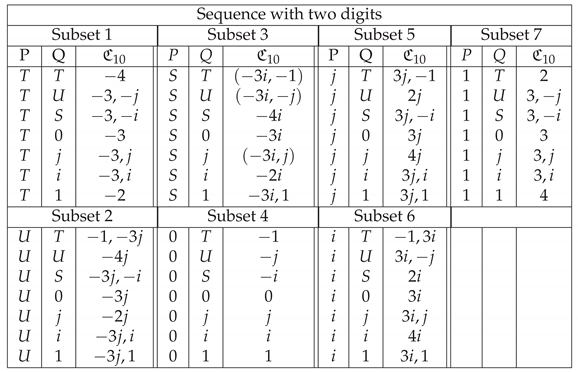 |
The table shows all possible combinations of complex numbers within the range of to 4, to , and to . For a three-digit number, the range is to 13 and to , which is equivalent to the numbers in base CBTTS from to 111 and from to , as well as from to .
Any number in the CBTTS base can be written on a single numerical line considering its positional value, which increases from zero, starting with the first digit on the right and moving toward the left. Example:
where
Simplifying and solving the CBTTS and representing it as a complex base 10 number is:
or, eliminating the negative sign.
If we want, we can relate this number to a coordinate point in the 3D complex plane.
5.1.6. Arithmetical Operation
Like any well-established number system, the CBTTS system enables us to perform arithmetic and calculation operations with the same ease as with the decimal or binary systems. Here, I present an example of division, which involves addition, subtraction, and multiplication in its development and verification.
Example 1
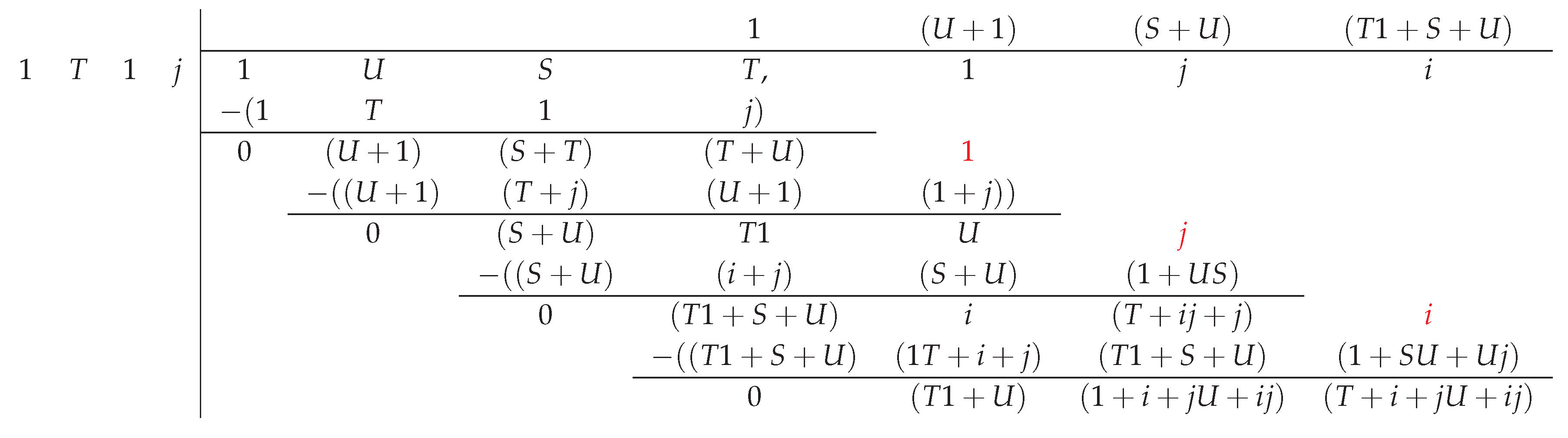
In our example, the product of the division is , and the remainder is , where and are the conversion to decimal respectively.
To check if the division is correct, we multiply the quotient by the divisor and add the remainder obtained from the division to the result of the multiplication. This operation should give us the dividend as a result.
If the product of the multiplication and addition of the remainder is exactly the same, then the division is correct.
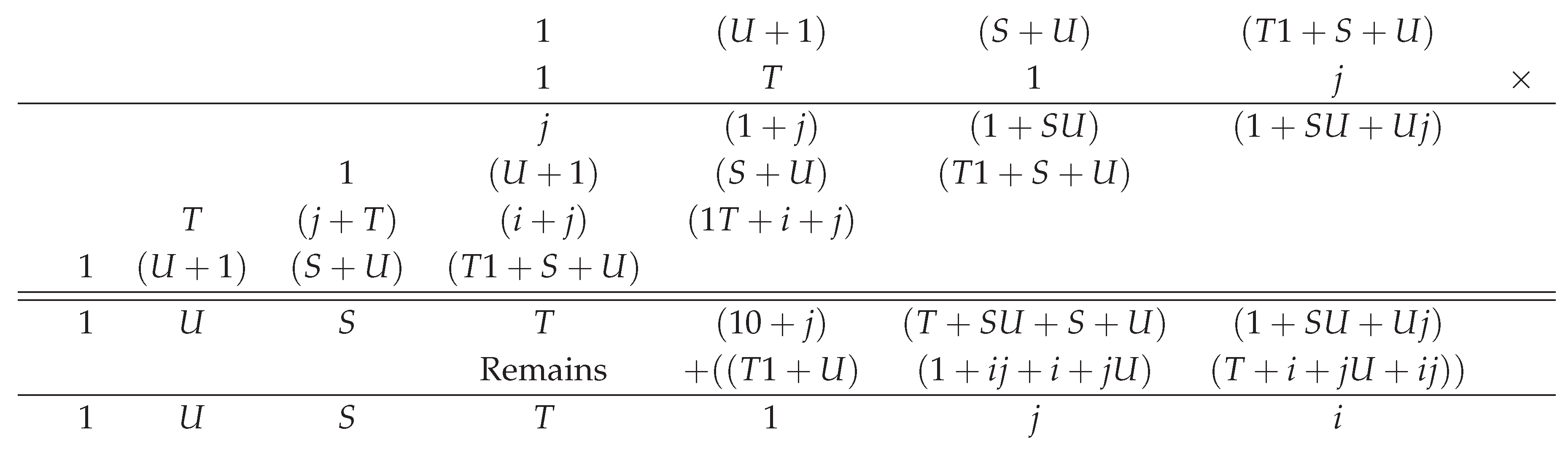
As can be seen in the development, some numbers contain up to four digits that correspond to the same position. This is due to the complex form of the digits in the MVL system, but there is no conflict since each digit precisely represents its positional value. In the reduction steps, like digits are added and opposite digits are subtracted.
5.2. Other Applications of CBTTS
5.2.1. CBTTS in Geometry Structure
The CBTTS perfectly defines our 3D dimension since it can precisely define all three axes. However, we would construct a complex three-dimensional system to represent a complex 3D world. The cardinal points are defined by the real and imaginary axes in the 2D and 3D planes, with the points North, South, East, West, Center, Up, and Down, where there are seven cardinal points. The system of complex numbers creates specific unitary volumes on the plane, as well as levels of planes. Each level has its own volumes, all of which are in perfect symmetry. It also creates empty spaces between volumes, allowing movement between them.
Figure 1.
The complex plane are a series of seventh complexes and balanced ternaries with two complex digits. 2D plane is constituted by the coordinates , and a 3D plane is constituted by the coordinates , and j, where j is perpendicular to the plane .
Figure 1.
The complex plane are a series of seventh complexes and balanced ternaries with two complex digits. 2D plane is constituted by the coordinates , and a 3D plane is constituted by the coordinates , and j, where j is perpendicular to the plane .
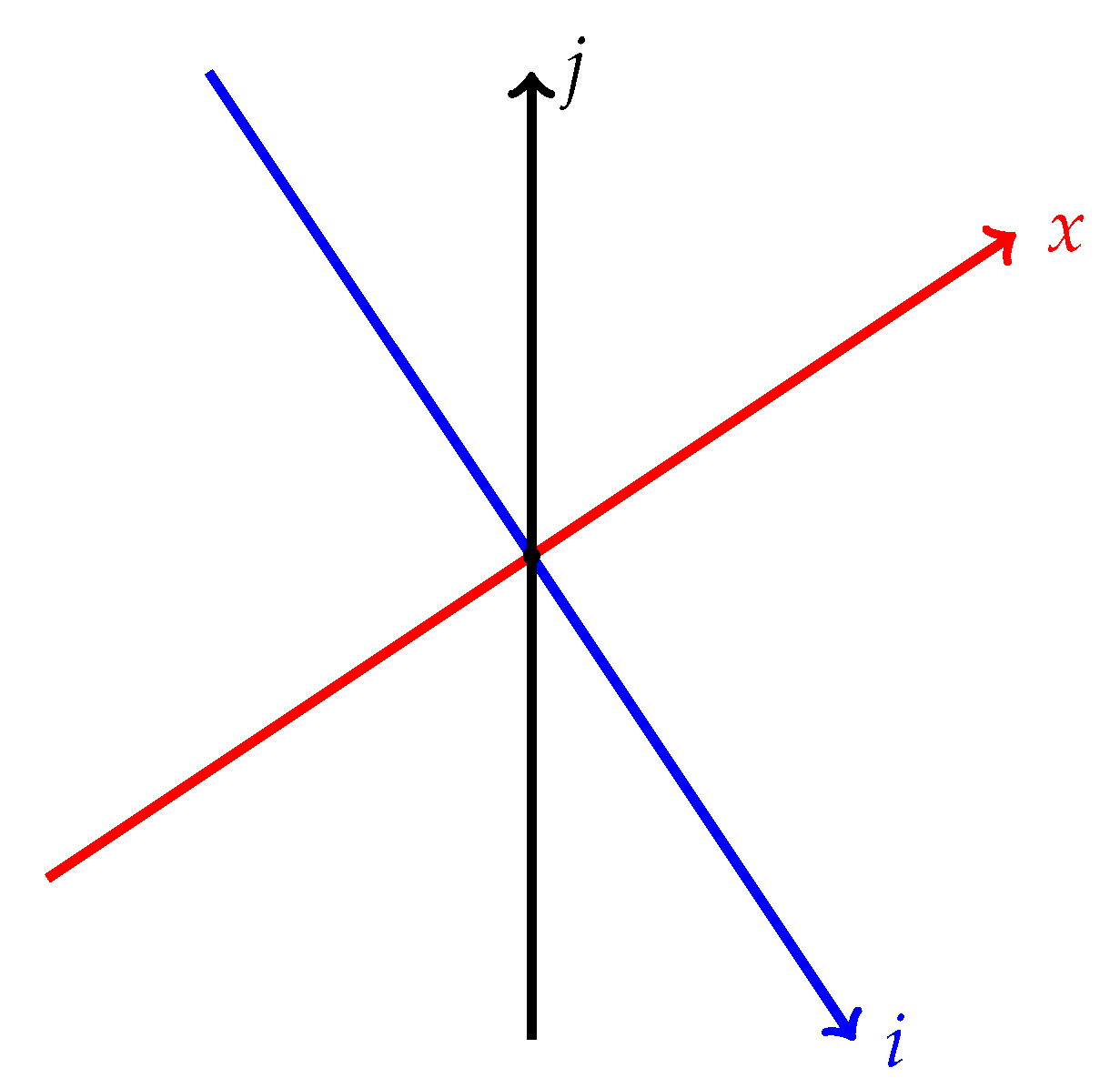
The following figure graphically represents the first seven pyramidal bodies for a balanced ternary system on a seven-unit base.
Figure 2.
The unit body in a complex plane are a series of septenary complexes and balanced ternaries with two complex digits.
Figure 2.
The unit body in a complex plane are a series of septenary complexes and balanced ternaries with two complex digits.
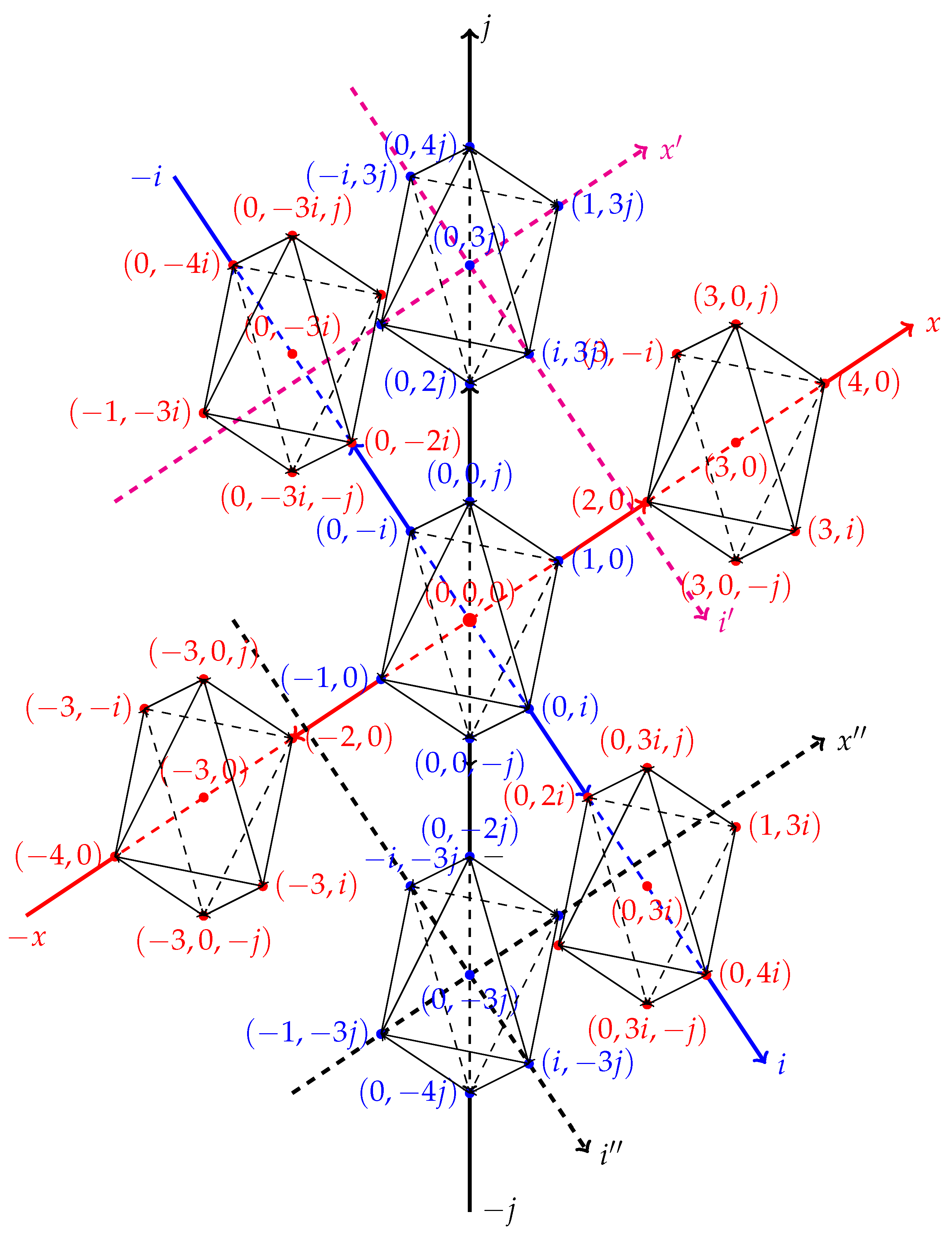
The series develops 7 bodies, or 49 coordinate points as denoted in table 9. The upward floor, denoted by the complex plane , is traced in magenta, and the downward floor, denoted by the complex plane , is traced in black.
Five of the bodies correspond to the real and imaginary axes , and the remaining two bodies have centers located either three units above or three units below the imaginary axis j. Each center of a body on the imaginary axis j represents an upper or lower floor, respectively. Each level is a new complex plane that is parallel to the original.
This creates a framework in which all possible bodies can be situated. A specific volume can then be defined using the ternary system’s limiting strategy. As in the plane, there will be a vast number of empty points that allow bodies to move to different points, thus establishing interrelationships between them.
5.2.2. Wave Patterns in CBTTS
The complex balanced tri-ternary system CBTTS is more helpful than the decimal system for understanding the structure of a quantum universe. It relates each truth value to quantum states of entanglement, superposition, and the principle of least action. It also relates the position and velocity of a body to its potential and kinetic energy along its trajectory through spacetime. There are many other topics it covers as well.
For now, I will relate the CBTTS system to an array of waves, which accurately represents how a wave field is formed. Taking each digit of the system as a reference, we see that a field of twelve out-of-phase waves can be generated. This is the latest visualization, but I still need to develop the underlying mathematical logic and its application to a practical solution that will allow us to understand the nature of our quantum environment.
Figure 3.
This graph shows a wave sequence, with each step in time related to the CBTTS number system.
Figure 3.
This graph shows a wave sequence, with each step in time related to the CBTTS number system.
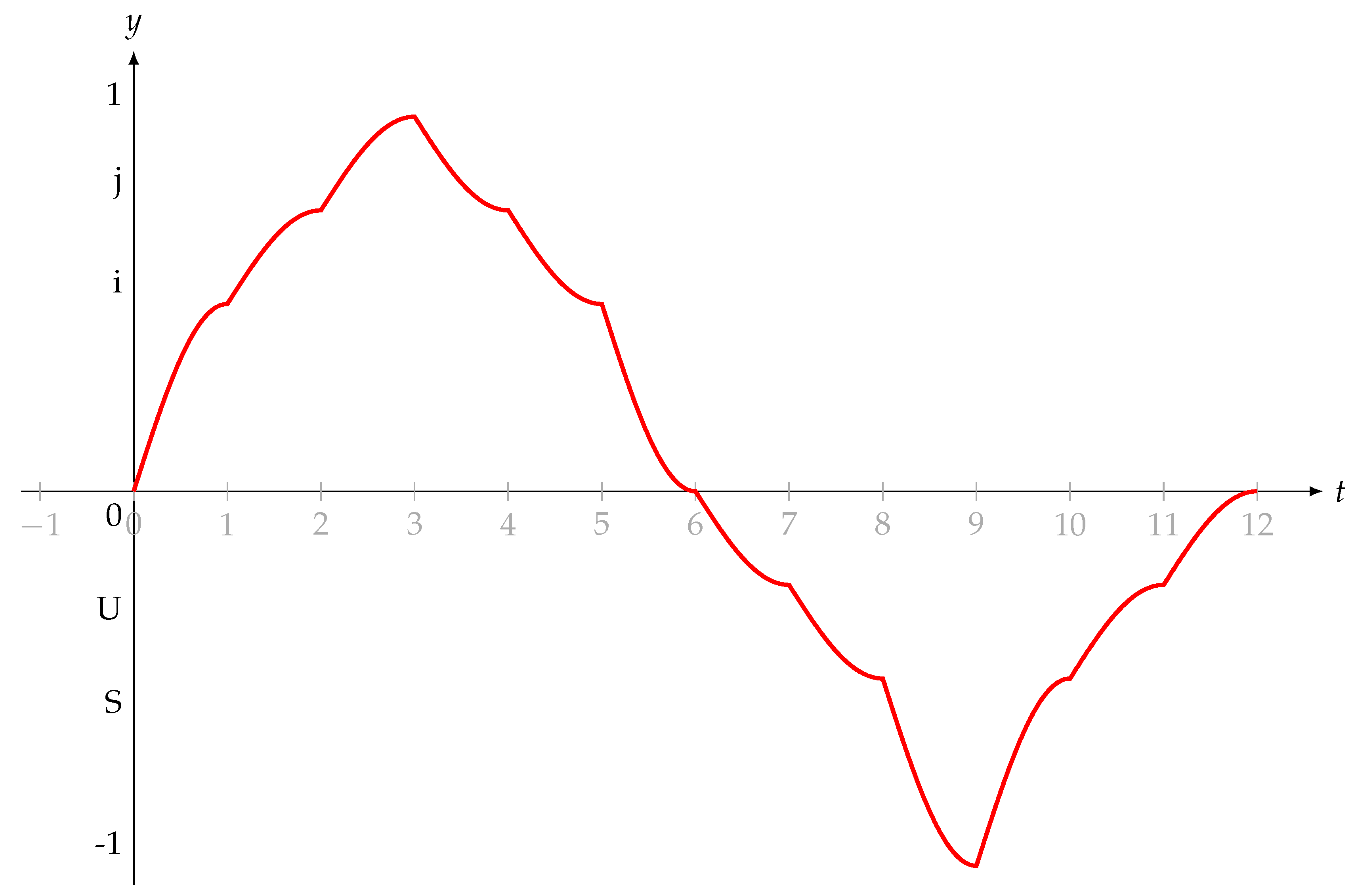
According to how the wave develops over time, taking a reading of the sequence from right to left gives us a number in the CBTTS base of the following magnitude.
When we convert to the complex base 10 system, we find that its value is equal to:
At the intersection of two waves, they appear to cancel each other out. However, this only occurs at points that are both common and opposite. There will always be a point that is out of phase. At this point, the waves do not cancel each other out, and the wave has a value.
The following graph illustrates this property.
Figure 4.
This graph illustrates a wave sequence, with each time step related to the CBTTS number system in its appearance interference cancellation.
Figure 4.
This graph illustrates a wave sequence, with each time step related to the CBTTS number system in its appearance interference cancellation.
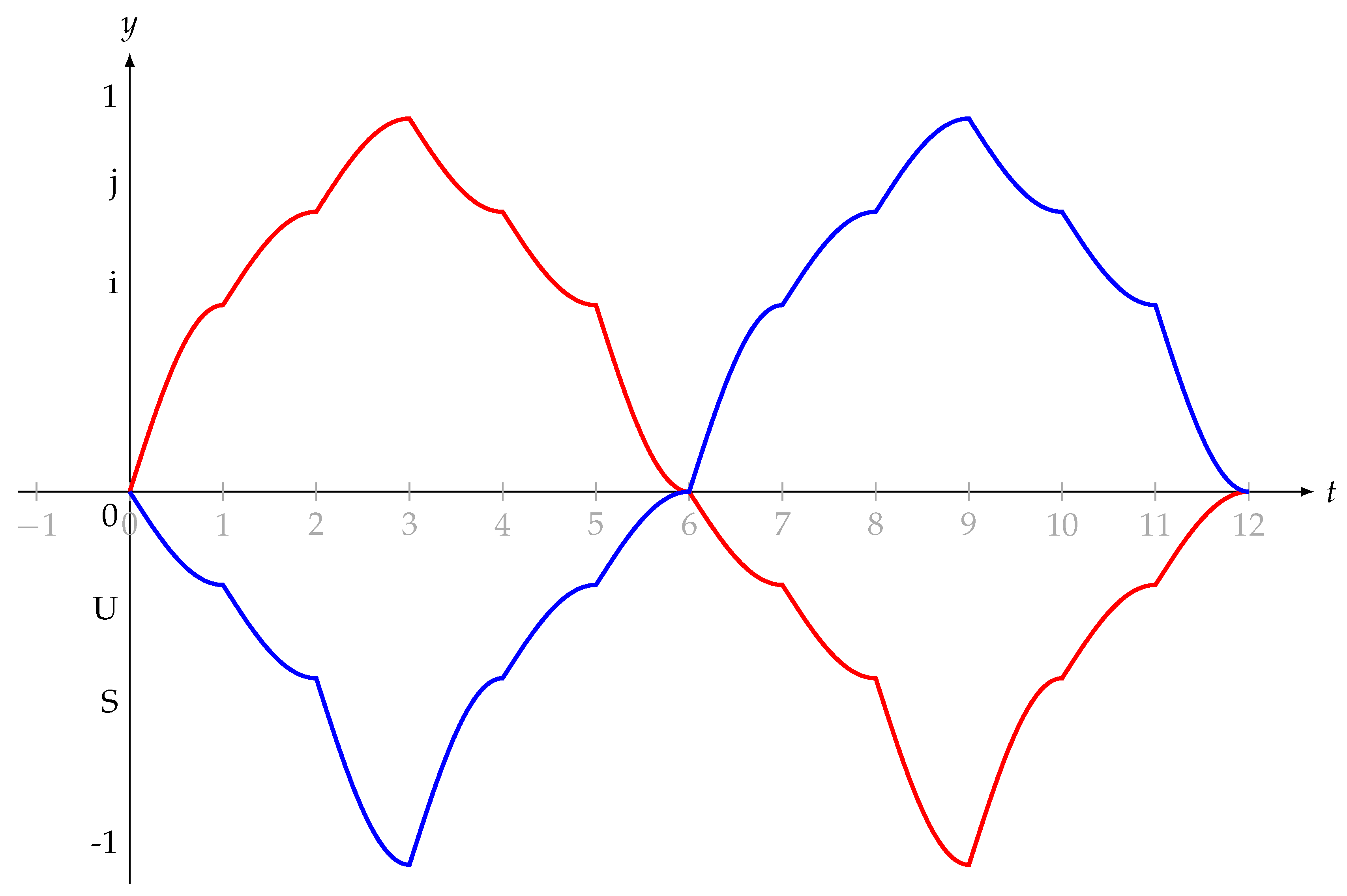
According to the CBTTS, the number yielded by both waves corresponds to a pair that is common to the time interval, and thus to its positional value. Therefore, the obtained number is:
After solving, grouping like terms, and converting to the base-10 complex system, we get the following complex number:
A field of interrelated waves that affect each other through an interference process. This process does not completely destroy the waves, but rather allows them to complement each other and form a wave pattern that does not exist or, we haven’t seen it yet in nature. However, it is mathematically possible for this pattern to exist, and if it exists mathematically, it is possible that it also exists in some dimension.
Below is a graph of twelve wave phases.
Figure 5.
The graph illustrates a twelve-phase wave field, with each time step related to the CBTTS number system.
Figure 5.
The graph illustrates a twelve-phase wave field, with each time step related to the CBTTS number system.
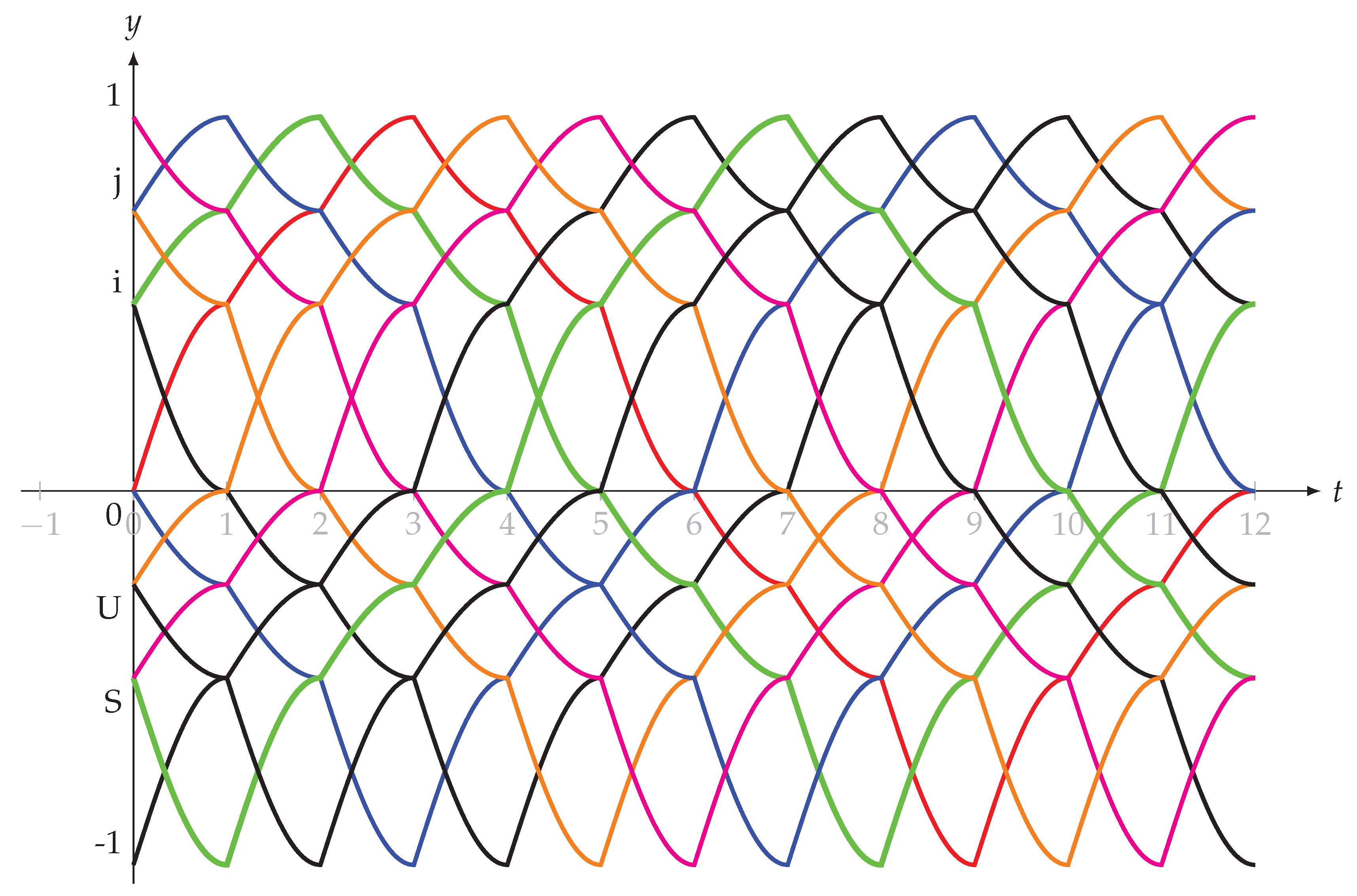
The CBTTS system is new, and its development and potential applications are just beginning to emerge, so much work remains to be done. However, it is presented here as an introduction so that interested mathematicians can begin to understand some of its characteristics and properties and contribute their expertise to its further development. I am working on the system’s theoretical development to establish its mathematical structure and logical principles. I am also applying it to machine language with a more robust code. This allows us to extend the binary system for artificial intelligence applications with greater data demands in future stages. These topics will be presented in a forthcoming book on complex fuzzy logic.
5.3. Universe Structure
Regardless of the various theories about reality and its projection onto the universe—whether we are a field of waves, don’t exist, are pure energy, or have some other nature—it’s important to understand how our immediate environment is structured. This is because we interact with it throughout our lives, and this relationship establishes our states of consciousness and unconsciousness. Ultimately, these states should provide us with our individuality, making us similar to many yet different from all.
Why does the double-slit experiment show the duality of subatomic particles down to the molecular level?
This is a question we must explore further, grounding it in the most advanced scientific concepts—probably beyond the concept of the quantum field, which is much more elaborate than anything we have reached thus far. Perhaps our reality is merely part of a multidimensional universe, and we can only perceive a tiny fraction of it because we are deeply immersed in it.
For this reason, I propose that we elucidate this concept in the future with the help of a truly intelligent AI.
6. Conclusion
Since transistors cannot think and are merely a medium for writing code—like a book that contains an author’s language, which does not make the book intelligent—we must understand that artificial intelligence comprises two fundamental parts.
- The material part, or hardware.
- The intellectual part comprising all algorithmic elements that carry out intelligent processes, including the recent achievement of self-programming. Each of these elements is an algorithm, ranging from simple to complex. This can be summarized as software.
Therefore, the operation of each transistor used for information processing or memory storage is dictated by human intelligence.
In summary, artificial intelligence can be defined as human intelligence transferred to an data processing machine.
Artificial intelligence is one of the most revolutionary advances in human history, and this is only the beginning. If we are truly going to build artificial intelligence modeled on humankind, we must elevate it to the level of our wisest members of society so that there can be genuine progress for our civilization. However, if we simply copy the most wicked model, there will be no salvation for anyone, including artificial intelligence itself.
Therefore, AI is neither inherently good nor bad; its outcomes depend on those behind it.
References
- Turing, A.M. Computing machinery and intelligence. In Parsing the Turing test: Philosophical and methodological issues in the quest for the thinking computer; Springer, 2007; pp. 23–65. [Google Scholar]
- López Velarde, R.; et al. La suave patria; 1921. [Google Scholar]
- Lécuyer, C.; Brock, D.C. Makers of the microchip: A documentary history of Fairchild Semiconductor; MIT Press, 2022. [Google Scholar]
- Desai, S.B.; Madhvapathy, S.R.; Sachid, A.B.; Llinas, J.P.; Wang, Q.; Ahn, G.H.; Pitner, G.; Kim, M.J.; Bokor, J.; Hu, C.; et al. MoS2 transistors with 1-nanometer gate lengths. Science 2016, 354, 99–102. [Google Scholar] [CrossRef] [PubMed]
- Faggin, F.; Hoff, M.E.; Mazor, S.; Shima, M. The History of the 4004. Ieee Micro 1996, 16, 10–20. [Google Scholar] [CrossRef]
- Brinkman, W.F.; Haggan, D.E.; Troutman, W.W. A history of the invention of the transistor and where it will lead us. IEEE journal of solid-state circuits 2002, 32, 1858–1865. [Google Scholar] [CrossRef]
- Wang, X.; Zhou, J.; Dong, C.; Chen, X.; Nandi, S.K.; Elliman, R.G.; Kang, S.M.; Iu, H.H.C. A balanced Memristor-CMOS ternary logic family and its application. ArXiv 2023, abs/2309.01615. [Google Scholar]
- Haq, I.U.; Caballero, J. A survey of binary code similarity. Acm computing surveys (csur) 2021, 54, 1–38. [Google Scholar] [CrossRef]
- Boole, G. The mathematical analysis of logic; Philosophical Library, Incorporated, 1847. [Google Scholar]
- De Morgan, A. Formal logic: or, the calculus of inference, necessary and probable; Taylor and Walton, 1847. [Google Scholar]
- Venn, J. Symbolic logic. Nature 1881, 24, 284–285. [Google Scholar] [CrossRef]
- Llinás, R.R. The contribution of Santiago Ramon y Cajal to functional neuroscience. Nature Reviews Neuroscience 2003, 4, 77–80. [Google Scholar] [CrossRef]
- Cajal, S.R. Textura del sistema nervioso del hombre y de los vertebrados: estudios sobre el plan estructural y composición histológica de los centros nerviosos adicionados de consideraciones fisiológicas fundadas en los nuevos descubrimientos; N. Moya, 1899. [Google Scholar]
- Liou, M. Overview of the p× 64 kbit/s video coding standard. Communications of the ACM 1991, 34, 59–63. [Google Scholar] [CrossRef]
- Nakajima, M.; Tanaka, K.; Hashimoto, T. Scalable reservoir computing on coherent linear photonic processor. Communications Physics 2021, 4, 20. [Google Scholar] [CrossRef]
- Hill, R.K. What an algorithm is. Philosophy & Technology 2016, 29, 35–59. [Google Scholar]
- Pauly, D.; David, N. ELEFAN I, a BASIC program for the objective extraction of growth parameters from length-frequency data. Meeresforschung 1981, 28, 205–211. [Google Scholar]
- McCracken, D.D. A simplified guide to structured COBOL programming; John Wiley & Sons, Inc., 1976. [Google Scholar]
- Allen, R.; Kennedy, K. Automatic translation of Fortran programs to vector form. ACM Transactions on Programming Languages and Systems (TOPLAS) 1987, 9, 491–542. [Google Scholar] [CrossRef]
- Leiner, B.M.; Cerf, V.G.; Clark, D.D.; Kahn, R.E.; Kleinrock, L.; Lynch, D.C.; Postel, J.; Roberts, L.G.; Wolff, S. A brief history of the Internet. ACM SIGCOMM computer communication review 2009, 39, 22–31. [Google Scholar] [CrossRef]
- Segal, B. A short history of Internet protocols at CERN. 1995. [Google Scholar]
- Forouzan, B.A. TCP/IP protocol suite; McGraw-Hill Higher Education, 2002. [Google Scholar]
- Gillies, J.; Cailliau, R. How the Web was born: The story of the World Wide Web; Oxford University Press, 2000. [Google Scholar]
- Stroustrup, B. A history of C++ 1979–1991. History of programming languages—II 1996, 699–769. [Google Scholar]
- Hetland, M.L. Beginning Pyton; Springer, 2008. [Google Scholar]
- Gosling, J.; Holmes, D.C.; Arnold, K. The Java programming language. 2005. [Google Scholar]
- Chamberlin, D.D.; Astrahan, M.M.; Blasgen, M.W.; Gray, J.N.; King, W.F.; Lindsay, B.G.; Lorie, R.; Mehl, J.W.; Price, T.G.; Putzolu, F.; et al. A history and evaluation of System R. Communications of the ACM 1981, 24, 632–646. [Google Scholar] [CrossRef]
- Celko, J. Joe Celko’s SQL for smarties: advanced SQL programming; Elsevier, 2010. [Google Scholar]
- Peter Loscocco, N. Integrating flexible support for security policies into the Linux operating system. In Proceedings of the Proceedings of the FREENIX Track: USENIX Annual Technical Conference, 2001. [Google Scholar]
- Kapoor, S.; Stroebl, B.; Siegel, Z.S.; Nadgir, N.; Narayanan, A. Ai agents that matter. arXiv 2024. arXiv:2407.01502. [CrossRef]
- Rosenblatt, F.; et al. Principles of neurodynamics: Perceptrons and the theory of brain mechanisms; Spartan books: Washington, DC, 1962; Vol. 55. [Google Scholar]
- Ghosh-Dastidar, S.; Adeli, H. Spiking neural networks. International journal of neural systems 2009, 19, 295–308. [Google Scholar] [CrossRef]
- Medsker, L.R.; Jain, L.; et al. Recurrent neural networks. Design and applications 2001, 5, 2. [Google Scholar]
- Zhou, Z.H. Machine learning; Springer nature, 2021. [Google Scholar]
- Turing, A.M. Computing machinery and intelligence; Springer, 2009. [Google Scholar]
- Turing, A.M. Computing machinery and intelligence (1950). Mind 1987, 59, 33–60. [Google Scholar]
- Shojaee, P.; Mirzadeh, I.; Alizadeh, K.; Horton, M.; Bengio, S.; Farajtabar, M. The illusion of thinking: Understanding the strengths and limitations of reasoning models via the lens of problem complexity. arXiv arXiv:2506.06941. [CrossRef]
- Neruda, P. Pablo Neruda: five decades, a selection (poems, 1925-1970); Grove Press, 1974. [Google Scholar]
- Descartes, R. Discurso sobre el método; Minerva Heritage Press, 2024; Vol. 4. [Google Scholar]
- McCarthy, J.; et al. What is artificial intelligence. 2007. [Google Scholar] [PubMed]
- Goertzel, B.; Wang, P. General Intelligence. In Proceedings of the Advances in Artificial General Intelligence: Concepts, Architectures and Algorithms: Proceedings of the AGI Workshop 2006; SAGE Publications Limited, 2007; Vol. 6, p. 36. [Google Scholar]
- Zhang, Z.; Zhang, A.; Li, M.; Zhao, H.; Karypis, G.; Smola, A. Multimodal chain-of-thought reasoning in language models. arXiv 2023. arXiv:2302.00923.
- Wei, J.; Wang, X.; Schuurmans, D.; Bosma, M.; Xia, F.; Chi, E.; Le, Q.V.; Zhou, D.; et al. Chain-of-thought prompting elicits reasoning in large language models. Advances in neural information processing systems 2022, 35, 24824–24837. [Google Scholar]
- Huang, J.; Chang, K.C.C. Towards reasoning in large language models: A survey. In Proceedings of the Findings of the association for computational linguistics: ACL 2023, 2023; pp. 1049–1065. [Google Scholar]
- Ruderman, D.L. The statistics of natural images. Network: computation in neural systems 1994, 5, 517. [Google Scholar] [CrossRef]
- Menninger, K. Number words and number symbols: A cultural history of numbers; Courier Corporation, 2013. [Google Scholar]
- Tripathi, R.C.; Tripathi, B.J.; Davson, H. Anatomy of the human eye, orbit, and adnexa. The eye 1984, 1, 1–268. [Google Scholar]
- Brown, R.H.; Twiss, R.Q. Correlation between photons in two coherent beams of light. Nature 1956, 177, 27–29. [Google Scholar] [CrossRef]
- Serber, R. The theory of the Faraday effect in molecules. Physical review 1932, 41, 489. [Google Scholar] [CrossRef]
- Katzner, K.; Miller, K. The languages of the world; Routledge, 2002. [Google Scholar]
- Stuart, D.; Houston, S.D. Maya writing. Scientific American 1989, 261, 82–89. [Google Scholar] [CrossRef]
- Garcia-Sandoval, R. The Balanced Ternary as the Number Base of Complex MVL Systems. Preprints 2026. [Google Scholar] [CrossRef]
- Tod, D. The anatomy and physiology of the organ of hearing; 1832. [Google Scholar]
- Demekas, D.; Parr, T.; Friston, K.J. An investigation of the free energy principle for emotion recognition. Frontiers in Computational Neuroscience 2020, 14, 30. [Google Scholar] [CrossRef]
- Attwell, D.; Laughlin, S.B. An energy budget for signaling in the grey matter of the brain. Journal of Cerebral Blood Flow & Metabolism 2001, 21, 1133–1145. [Google Scholar] [CrossRef] [PubMed]
- Masanet, E.; Shehabi, A.; Lei, N.; Smith, S.; Koomey, J. Recalibrating global data center energy-use estimates. Science 2020, 367, 984–986. [Google Scholar] [CrossRef]
- Smolders, J.; Heutinck, K.M.; Fransen, N.L.; Remmerswaal, E.B.; Hombrink, P.; Ten Berge, I.J.; van Lier, R.A.; Huitinga, I.; Hamann, J. Tissue-resident memory T cells populate the human brain. Nature communications 2018, 9, 4593. [Google Scholar] [CrossRef]
- Schröter, H.G. Losers in power-plays? Small states and international cartelization (1919-1939). The Journal of European Economic History 2010, 39, 527. [Google Scholar]
- Bulow, J. An economic theory of planned obsolescence. The quarterly journal of economics 1986, 101, 729–749. [Google Scholar] [CrossRef]
- Kykta, M. The Incandescent Light Bulb and the Mystery of the Centennial Bulb. Information Display 2021. [Google Scholar]
- Perea, G.; Sur, M.; Araque, A. Neuron-glia networks: integral gear of brain function. Frontiers in cellular neuroscience 2014, 8, 378. [Google Scholar] [CrossRef] [PubMed]
- Stiles, J.; Jernigan, T.L. The basics of brain development. Neuropsychology review 2010, 20, 327–348. [Google Scholar] [CrossRef]
- Hemingway, E. For Whom the Bell Tolls: The Hemingway Library Edition; Simon and Schuster, 2019. [Google Scholar]
- Christenson, A.J. Popol Vuh: The sacred book of the Maya; University of Oklahoma Press, 2007; Vol. 1. [Google Scholar]
- Friston, K.J. Hallucinations and perceptual inference. Behavioral and brain sciences 2005, 28, 764–766. [Google Scholar] [CrossRef]
- Ertel, W. Introduction to artificial intelligence; Springer Nature, 2024. [Google Scholar]
- Sheth, A.; Roy, K.; Gaur, M. Neurosymbolic Artificial Intelligence (Why, What, and How). IEEE Intelligent Systems 2023, 38, 56–62. [Google Scholar] [CrossRef]
- Hopfield, J.J.; Tank, D.W. “Neural” computation of decisions in optimization problems. Biological cybernetics 1985, 52, 141–152. [Google Scholar] [CrossRef] [PubMed]
- Sapkota, R.; Roumeliotis, K.I.; Karkee, M. Ai agents vs. agentic ai: A conceptual taxonomy, applications and challenges. Information Fusion 2025, 103599. [Google Scholar]
- Kharlapenko, D.; Stolfo, A.; Conmy, A.; Sachan, M.; Jin, Z. Fluid Representations in Reasoning Models. arXiv 2026, arXiv:2602.04843. [Google Scholar] [CrossRef]
- Kolt, N. Governing AI agents. arXiv arXiv:2501.07913. [CrossRef]
- Naik, N.; Hameed, B.; Shetty, D.K.; Swain, D.; Shah, M.; Paul, R.; Aggarwal, K.; Ibrahim, S.; Patil, V.; Smriti, K.; et al. Legal and ethical consideration in artificial intelligence in healthcare: who takes responsibility? Frontiers in surgery 2022, 9, 862322. [Google Scholar] [CrossRef]
- Garcia-Sandoval, R. Challenges Necessary for the Development of Truly Intelligent AI. Preprints 2025. [Google Scholar] [CrossRef]
- ukasiewicz, J. Estudios de lógica y filosofía. In Revista de occidente; 1975. [Google Scholar]
- Lukasiewicz, J.; Wedin, V. On the principle of contradiction in Aristotle. The Review of Metaphysics 1971, 485–509. [Google Scholar]
- Pérez, D.; Gasulla, I.; Crudgington, L.; Thomson, D.J.; Khokhar, A.Z.; Li, K.; Cao, W.; Mashanovich, G.Z.; Capmany, J. Multipurpose silicon photonics signal processor core. Nature communications 2017, 8, 636. [Google Scholar] [CrossRef]
- Huang, M.; Wang, X.; Zhao, G.; Coquet, P.; Tay, B. Design and Implementation of Ternary Logic Integrated Circuits by Using Novel Two-Dimensional Materials. Applied Sciences 2019, 9. [Google Scholar] [CrossRef]
- Karl, F. A free energy principle for biological systems. Entropy 2012, 14, 2100–2121. [Google Scholar] [CrossRef] [PubMed]
- Carnal, O.; Mlynek, J. Young’s double-slit experiment with atoms: A simple atom interferometer. Physical review letters 1991, 66, 2689. [Google Scholar] [CrossRef] [PubMed]
- Fedoseev, V.; Lin, H.; Lu, Y.K.; Lee, Y.K.; Lyu, J.; Ketterle, W. Coherent and Incoherent Light Scattering by Single-Atom Wave Packets. Phys. Rev. Lett. 2025, 135, 043601. [Google Scholar] [CrossRef] [PubMed]
- ukasiewicz, J. On determinism. The Polish Review 1968, 47–61. [Google Scholar]
- Brousentsov, N.; Maslov, S.; Ramil, A.J.; Zhogolev, E. Development of ternary computers at Moscow State University. Russian Virtual Computer Museum. In Ed. Eduard Proydakov; 2002; p. 11. [Google Scholar]
- Bovet, D.P.; Crescenzi, P.; Bovet, D. Introduction to the Theory of Complexity; Prentice Hall London, 1994; Vol. 7. [Google Scholar]
- Gottwald, S. Many-Valued Logic. In The Stanford Encyclopedia of Philosophy, Summer 2022 ed.; Zalta, E.N., Ed.; Metaphysics Research Lab, Stanford University, 2022. [Google Scholar]
| 1 | Depending on the author of the study, the evaluation of the properties of AI agents differs. There is no common consensus. |
Table 1.
The relationship between electrochemical pulses and the alphabet of the English language in both its simple and expanded forms.
Table 1.
The relationship between electrochemical pulses and the alphabet of the English language in both its simple and expanded forms.
| Code of a triple-helix DNA strand | |||||
|---|---|---|---|---|---|
| Alphabet | Alphabet | Alphabet | |||
| A = AAA | J = BAA | S = CAA | |||
| B = AAB | K = BAB | T = CAB | |||
| C = AAC | L = BAC | U = CAC | |||
| D = ABA | M = BBA | V = CBA | |||
| E = ABB | N = BBB | W = CBB | |||
| F = ABC | O = BBC | X = CBC | |||
| G = ACA | P = BCA | Y = CCA | |||
| H = ACB | Q = BCB | Z = CCB | |||
| I = ACC | R = BCC | ||||
Table 8.
The insertion of a grade of truth value.
| Insertion of MVL | |||||||
|---|---|---|---|---|---|---|---|
| Binary | Ternary | Balanced T | Quinary | Septenary | Grade | Valued | Logic |
| of Truth | Symbol | Value | |||||
| 0 | 0 | Bivalent | T | False | |||
| U | |||||||
| S | |||||||
| 0 | 0 | 0 | 0 | W | |||
| j | |||||||
| i | |||||||
| 1 | 1 | 1 | 1 | 1 | Bivalent | 1 | Truth |
Disclaimer/Publisher’s Note: The statements, opinions and data contained in all publications are solely those of the individual author(s) and contributor(s) and not of MDPI and/or the editor(s). MDPI and/or the editor(s) disclaim responsibility for any injury to people or property resulting from any ideas, methods, instructions or products referred to in the content. |
© 2026 by the authors. Licensee MDPI, Basel, Switzerland. This article is an open access article distributed under the terms and conditions of the Creative Commons Attribution (CC BY) license (http://creativecommons.org/licenses/by/4.0/).
Copyright: This open access article is published under a Creative Commons CC BY 4.0 license, which permit the free download, distribution, and reuse, provided that the author and preprint are cited in any reuse.