

Submitted:
17 March 2026
Posted:
18 March 2026
You are already at the latest version
Abstract
Background/Objectives: Invasive pulmonary mold infections (IPMI) are critical complications in immunocompro-mised patients, contributing significantly to morbidity and mortality. Diagnosing pathogens like Aspergillus and Mucorales remains challenging due to non-specific clinical presentations and the limitations of traditional culture methods. This review provides an up-to-date synopsis of IPMI diagnostic tools, focusing on their diagnostic perfor-mance, turnaround time (TAT), and cost-effectiveness.
Methods: We conducted a narrative review of current literature regarding clinical evaluation, radiographic findings (Computerized Tomography), invasive diagnostics (Bronchoalveolar Lavage and biopsy), and non-invasive assays, including next-generation sequencing (NGS) and volatile organic compounds (VOCs).
Results: Chest CT remains a vital first step, though classic signs like the "halo" or "reversed halo" are neither sensitive nor specific. Traditional diagnostics are limited by low sensitivity and delayed results. While plasma microbial cell-free DNA (mcfDNA) NGS offers rapid TAT (24–48 hours) and high specificity, its suboptimal sensitivity for Aspergillus (< 50%) and high cost remain significant barriers. Investigational VOC "breath tests" show promising sensitivity (77%–96%) but lack standardization.
Conclusions: Future research must prioritize the standardization of non-invasive microbiologic testing modalities, particularly those with rapid TAT such as bedside "breath tests" and high-throughput NGS. Furthermore, the de-velopment of clinical algorithms that balance cost-effectiveness with timely pathogen diagnosis based on the patient’s degree of immunosuppression is essential to improve survival in high-risk populations.
Keywords:
invasive pulmonary mold infections
; aspergillus
; mucorales
; diagnostic performance
; cost-effectiveness
; next-generation sequencing
; galactomannan
; volatile organic compounds
1. Introduction
Despite advances in antifungal therapy, Invasive pulmonary mold infections (IPMI) remain among the most severe infectious complications in hematopoietic cell transplant (HCT), and organ transplant (OT) recipients, patients with hematologic malignancies (HM), and patients receiving immunosuppressive agents, contributing substantially to morbidity and mortality [1,2]. Aspergillus species and the Mucorales are the leading culprit pathogens, while Fusarium and Scedosporium species are less common but commonly associated with antifungal resistance and poorer outcomes [3,4,5]. Mortality rates remain high across all IPMI, reaching up to 90% in certain clinical scenarios [3].
Defects in neutrophil function and, less so, cell-mediated immunity are the major risk factors for IPMI [2,4,6]. In immunocompromised patients, the absence of typical signs and symptoms such as fever, cough, and dyspnea can delay diagnosis [2,7]. Certain radiographic findings, including the “halo” and “air-crescent” signs suggestive of invasive pulmonary aspergillosis (IPA) and the “reverse halo” sign or pleural effusions suggestive of mucormycosis, may assist in diagnosis [6,8,9] (Figure 1). However, these findings are not always present (thus, not sensitive) and can overlap with other IPMI and opportunistic pulmonary syndromes (thus, not specific). Traditional microbiologic diagnostic methods, including fungal stains, cytology, and bronchoalveolar lavage (BAL) or tissue culture, although widely available, are limited by low sensitivity, need for invasive sampling, dependence on organism burden, and delayed turnaround times (TAT) [5,7].
Non-culture-based fungal diagnostics, like serum galactomannan (GM), β-D-glucan (BDG), and mold-specific polymerase chain reaction (PCR), have improved early detection of certain IPMIs, but need to be interpreted carefully due to variable specificity and potential cross-reactivity [10,11,12]. Next-generation sequencing (NGS) and plasma microbial cell-free DNA-based assays in plasma and BAL allow for rapid, noninvasive and culture-independent identification of invasive molds. However, clinical validation remains limited, and cost and availability pose important barriers to widespread use [1,13,14,15].
In this narrative review, we present an up-to-date synopsis of diagnostic tools for IPMI in immunocompromised hosts, focused on diagnostic performance, turnaround time (TAT), and cost considerations for conventional and novel tests.
2. Clinical Evaluation
Diagnosing IPMI is almost impossible by clinical exam alone. Identifying host risk factors is the first, and often the most important step. Prolonged neutropenia has been most strongly associated as an independent risk, with several other “immunomodulating” agents, such as Bruton’s tyrosine kinase (BTK) and JAK inhibitors that have emerged as predisposing factors to IPMI through poorly understood off-target effects [9,15]. Patients with prolonged intensive Care Unit (ICU) stay are also at risk for IPMI, especially IPA, even without any other classic risk factors. Early symptoms and signs of IPMI are usually mild and nearly always nonspecific, overlapping with other infections and underlying HM, such as cough (usually dry), fever and malaise [1,2,4,7,13]. Chest pain can occur with tissue infarction. The physical exam is also, in general, just as unrevealing, although sometimes can reveal skin [16] or oral (hard palate eschar from invasive sinusitis in the setting of mucormycosis) [17] lesions, suggesting disseminated mold infection. It should be noted that all details of medical history are important because in many patients, underlying medical problems can confound the differential diagnosis and management decisions, and, along with frequent thrombocytopenia make invasive testing risky or not feasible.
3. Radiographic Findings
Computerized tomography (CT) of the chest is far more sensitive than chest X-ray (CXR) results fast (within hours), and, although costly (up to >$4,000 depending on the type and protocol used), is widely available, even outside referral hospitals, and indicated as the first step in all patients with suspected IPMI for the following reasons: a) It can identify pulmonary lesions as the cause of the patient symptoms; b) It can guide the areas to undergo BAL or even biopsy.
The term “halo sign” describes a pulmonary nodule surrounded by ground glass attenuation, whereas the “vessel occlusion sign” refers to the interruption of a pulmonary artery branch within a lesion. Both signs reflect angioinvasion with surrounding hemorrhage, and can be observed in IPMI, especially IPA (Figure 1). Cavities, and especially the “air crescent” sign are also considered suggestive of IPA but can be present in other fungal and bacterial infections. The reverse halo sign, a rounded area of GGO surrounded by a ring of consolidation, and the “bird’s sign”, a reverse halo with intersecting internal strands, are caused by central necrosis and are considered diagnostic of angioinvasive mucormycosis, especially in neutropenic patients (Figure 1).
In one study, multiple nodules and pleural effusion(s) differentiated IPA from PM [18]. In another, more recent report, large consolidative lesions and absence of airway invasion, as well as the reversed halo sign differentiated PM from IPA [19] (Figure 1). Nonetheless, in patients with uncontrolled diabetes, PM can also present with endobronchial, exophytic lesions [17]. Notably, chest CT with angiography can reliably rule out IPMI by absence of vessel infarction [20,21,22].
It should be again noted that such signs are non-specific, and may also occur in other lung diseases such as bacterial infections, organizing pneumonia or tuberculosis. Furthermore, in non-neutropenic immunocompromised patients, the classic signs seen on chest CT are frequently absent, and diagnostic imaging can be more challenging; in such cases, chest CT may be supplemented by other imaging techniques, when clinically indicated [23]. In ICU patients, diffuse infiltrates or ARDS-like changes can mask the underlying diagnosis, making CT interpretation more challenging [9]. PET CT is increasingly used for staging and monitoring the response of IPMI to treatment, but its use for infection surveillance is not routinely recommended.
4. Invasive Diagnostics
The “gold standard” for diagnosis of IPMI requires invasive bronchoscopy with tissue biopsy, though this cannot be performed safely in patients who are at high risk for respiratory decompensation or major bleeding. If unable to obtain tissue specimens, the next highest quality microbiologic evidence for IPMI would be acquired via bronchoscopy with bronchoalveolar lavage (BAL). A “probable” diagnosis of IPMI can be made if BAL fungal tests are positive in the right host with the right radiographic findings [23]. Use of respiratory specimens other than BAL, like sputum, or endotracheal aspirate, may be pursued, but obtaining adequate quantity and quality specimens are essential, given high risk of detecting colonization and overall lower diagnostic yield [9,23]. Molecular methods (fungal PCR or next generation sequencing (NGS)) from respiratory samples usually have better sensitivity than cultures and faster TAT [5,10,14], however lack of PCR platform standardization still leads to variable accuracy across laboratories. It is also difficult to know if a positive result represents true infection or non-pathogenic airway colonization, especially for Aspergillus spp [9]. A multiplex PCR panel for Aspergillus, Mucorales, Nocardia and Pneumocystis is commercially available in the US (Viracor-Eurofins, Table 1). One study showed poor sensitivity (31%) but high specificity (97%) for aspergillosis [24]. In the same study, specificity for the Mucorales and Nocardia was 100% (no confirmed false positives), but neither were identified by the standard of care, despite compatible clinical syndromes, therefore the sensitivity could not be calculated. Another study [25] looked at panfungal and Mucorales PCR assays in several biological samples, including tissue from biopsy and BAL was 100% sensitive and 91% specific. Therefore, we believe there is utility of PCR for fungi and Nocardia in BAL and tissue, which, when positive, can provide invaluable information, with BAL PCR positivity often preceding blood testing [5]. However, we agree that further studies are needed to determine the diagnostic yield and negative predictive value of such (an) assay(s).
Next-generation sequencing (NGS) of plasma microbial cell-free DNA (mcfDNA) testing can detect a wide range of organisms directly from plasma or BAL [1,13]. These tests are very promising, but are expensive, not widely available, and can yield false positives from contamination, colonization, or transient DNAemia [13,14]. The utility of BAL NGS is, therefore, still largely under development. The greatest advantage of NGS is rapid turn-around time (TAT) (Table 1). Traditional methods (such as culture, histopathology, and antigen detection) still play a critical role, but are slow and often insensitive.
Galactomannan is a key component of Aspergillus spp. cell wall, and its detection in the blood has, in the right clinical setting, excellent specificity and sensitivity for invasive aspergillosis. Likewise, detection of Galactomannan (GM) in BAL is often indicative of an IPMI, especially from Aspergillus, but test specificity is dependent on the host (with highest specificity in HM patients). Furthermore, GM can be false positive, even with very high values, from other reasons (cross-reactivity with other mannans) including heavy Candida colonization [26] or food aspiration [27]. It should be noted that, unlike BAL GM, there is no role in testing beta-D-glucan levels in the BAL, a test that is largely non-specific for fungal infections and also has very poor reproducibility [28].
Targeted “Universal PCR” in BAL or tissue has been better studied, and is most helpful when stains are positive, but growth is absent (for example, in the setting of antimicrobial treatment [29]). It takes longer than NGS (5-10 vs. 2-3 business days, Table 1) but is less costly, and depending on the libraries built for NGS, can be potentially more sensitive given targeted DNA primers. For tissue samples with visualized hyphae but without corresponding microbiological studies or culture growth, another option for mold identification is immunohistochemistry with mold-specific antibodies at the Centers for Disease Control (CDC).
Cytology testing is another important, yet often overlooked component of BAL diagnostics. In addition to helping diagnose malignancy, which is sometimes on the differential (especially with lymphangitic spread that can mimic atypical pneumonia or cavitated tumors), it can also provide a diagnosis of mold infections, since the Gomori Methenamine Silver (GMS) stain used in histopathology is more sensitive than the Calcifluor stain at the microbiology laboratory [7]. In addition, cytology can supplement direct fluorescent antibody testing for Pneumocystis, identify viral cytopathic changes (HSV, CMV) or highlight larvae in Strongyloides hyperinfection, which are often important considerations on the differential diagnosis for atypical pulmonary infection in immunocompromised hosts.
5. Non-Invasive Diagnostics
Culture provides a definitive diagnosis and allows for antifungal susceptibility testing with potential resistance profiles [9,23]. However, conventional non-invasive sampling for organism growth is limited to blood cultures, which rarely yield mold. The majority of molds do not grow from blood, as most filamentous fungi do not circulate in a viable form nor can they survive in standard broth media [30]. Exceptions are Fusarium and Scedosporium, which are capable of producing conidia in the bloodstream [9,23]. Detection of these molds in blood cultures generally reflects disseminated disease, often in severely immunocompromised hosts [31].
With regards to non-culture diagnostics, serum GM and BDG are helpful but largely imperfect. GM, a polysaccharide released from the cell wall of Aspergillus spp. during hyphal growth, can be used as a species-specific biomarker for IPA. The assay has been validated for use in serum and BAL, although detection in other tissues (e.g., plasma, CSF) may also support the diagnosis of IPA when compatible with clinical and radiologic findings [9,23]. Diagnostic thresholds consistent with probable infection include a GM index of ≥1.0 in serum, plasma, BAL fluid, or CSF, or a serum or plasma index ≥0.7 combined with a BAL index ≥0.8 [23]. The test’s sensitivity varies widely, ranging from 20% to 90%, depending on host factors, fungal burden, and specimen type; however, exposure to mold active antifungal agents substantially reduces assay sensitivity [9,23].
GM is quite specific for Aspergillus, but false positives can occur with certain antibiotics or foods, and results are less reliable in non-neutropenic patients [11]. It should be noted that with recent modifications in antibiotic manufacturing, especially piperacillin/tazobactam, the risk for false positive cross-reactivity from antibiotics is considered minimal [32]. In the largest meta-analysis of GM diagnostic performance today, its sensitivity and specificity among patients with hematologic malignancies were 92 and 90% respectively. Sensitivity increased to 99% with either positive GM or noninvasive (serum) PCR for Aspergillus, and specificity was 95% and 98% with two positive GM or positive GM and PCR, respectively, indicating potential utility for repeat or combined blood testing [33].
The BDG assay is a panfungal antigen test that detects a cell wall polysaccharide present in most pathogenic fungi (including Pneumocystis), with the exceptions of Cryptococcus, Blastomyces, and the Mucorales [9,11,12,23]. As such, it is not specific for diagnosing IPMI, nor for any specific fungal pathogen. As another caveat, BDG is almost always (falsely) positive after IVIg administration, and can also be falsely elevated in hemodialysis or bacterial sepsis [12].
Aspergillus PCR assays constitute a robust diagnostic tool for both screening and confirmation of IPA as they are both sensitive and specific [9]. They have the unique ability to detect Aspergillus at both the genus and species levels with some platforms may also offer the potential to identify mutations associated with triazole resistance making them potentially valuable in settings where azole resistance is prevalent [23]. Current evidence supports their use on serum, plasma, whole blood, and BAL fluid, with the strongest data derived from studies in patients with hematologic malignancies and those undergoing HCT [9,23]. Diagnostic criteria consistent with probable infection include two or more consecutive positive PCR tests from plasma, serum, or whole blood, two or more positive replicate tests from BAL fluid, or at least one positive blood based PCR in combination with one positive BAL PCR [23]. As previously mentioned, the combined use of PCR and GM can substantially increase the diagnostic yield of non-invasive testing when IPA is suspected.
Beyond aspergillosis, blood PCR can be used to diagnose mucormycosis. In a prospective study including several susceptible hosts (mostly with HM, but also SOT and diabetes) with suspected mucormycosis, the Mucorales quantitative PCR assay, demonstrated 85.2% sensitivity and 89.9% specificity for the diagnosis of proven or probable mucormycosis [9,34].
One promising and rapidly evolving methodology to diagnose IMI and other elusive infectious syndromes is noninvasive NGS in plasma. Two tests are commercially available in the US: The NexGen Assay for the detection of fungi/mycobacteria/Nocardia spp. (Viracor-Eurofins), and the “Karius” microbial cell-free DNA metagenomic NGS assay (Karius Inc., CA) that can detect any of >1000 DNA pathogens in blood (Karius Spectrum-KS) or BAL (Karius Focus-KF), including almost all medically important molds. Whereas clinical data on NexGen is limited to an ongoing open-label, investigator-initiated study, several studies recently summarized have highlighted the utility of KS in diagnosing IMI, but also the assay’s notable shortcomings [35]. Although the specificity for positive KS results is excellent (nearly 100% across studies) [35,36,37], its sensitivity for the most common IPMI, IPA has been consistently reported <50% [35,36,37], whereas sensitivity is higher for mucormycoses, as high as 100% in a recent case series [37]. In the aforementioned study, the denominators of proven/probable IPA (host + clinical criteria but also +GM) could include cases with false +GM; however, cfDNA NGS in plasma likely has suboptimal sensitivity for the detection of Aspergillus, and potentially other less angioinvasive than the Mucorales molds. The reasons for these observations are still unclear, but likely related to the structure of mold DNA, variable angioinvasion and burden of disease, and the need for computational algorithms to remove human (=other eukaryotic) DNA and exclude lab contamination of the specimen with Aspergillus. These limitations do not apply to the same extent to the more angioinvasive Mucorales, although the sensitivity of cfDNA NGS in plasma for diagnosis of early or more localized Mucormycoses may also be lower in real-life. cfDNA NGS testing in BAL is expected to have higher sensitivity for pulmonary IMI [36], pending publication of additional high-quality, peer-reviewed data.
The main advantages of cfDNA NGS, especially in plasma as a non-invasive diagnostic modality are rapid TAT (2-3 business days), high specificity, and persistent detection in the setting of antimicrobial use. An important limitation is the cost (>$2,000 with minor institutional variations depending on contractual agreements).
Several novel technologies are under investigation for the noninvasive diagnosis of fungal pneumonia. One of the most promising is gas chromatography mass spectrometry (GC MS)-analysis of volatile organic compounds (VOCs) produced by the metabolic activity of infecting fungi in exhaled breath (“breath test”), allowing for rapid, noninvasive detection of respiratory fungal and bacterial pathogens [1,9]. In observational studies, GC MS analysis of exhaled metabolites demonstrated sensitivity ranging from 77% to 96% and specificity of 78% to 97% for IPA, particularly in transplant recipients and other immunocompromised hosts [38,39]. The methodology is under development for the detection of other molds, too [1,40,41,42]. As of now, the technology is investigational and requires specialized laboratory equipment, but the ultimate goal is implementation of a portable device that can be used at the bedside. For the time being, its specific diagnostic yield, TAT, and cost-effectiveness remain unknown.
6. Conclusions and Future Directions
Major advances have been made in the last few years in the care of immunocompromised patients at risk for IPMI, focusing on three main areas: 1. Advanced diagnostics, especially fungal biomarkers; 2. Implementation of sensitive imaging, mainly high-resolution CT, with or without angiogram protocols to detect angioinvasion, and PET scan; 3. Introduction of novel, broad-spectrum and relatively non-toxic antifungals. Nevertheless, IPMI remain an area of major concern in infectious diseases, mainly associated with their high mortality rates, and challenges in timely and accurate diagnosis. Unfortunately, IPMI are still often surprisingly diagnosed at autopsy [26,43,44], highlighting the need to better understand host risk factors and enhance our capacity for accurate, non-invasive diagnostic modalities with short TAT.
Therefore, future research is needed to focus on a) the development of such novel diagnostic methods b) further characterization of the specificity, sensitivity, predictive values and cost-effectiveness of costly, high throughput NGS assays with rapid TAT; c) development and validation of specific diagnostic algorithms that factor into clinical decision-making the cost of different (serial) tests and the ideal time-to-pathogen diagnosis, across different hosts and urgency to diagnose (e.g plan for imminent added immunosuppression as in allo-HCT candidates) clinical scenarios.
Author Contributions
Conceptualization, Audrey Mahajan and Dimitrios Farmakiotis; methodology, Spyridon Papadimatos, Andreas Tziotis, Panos Arvanitis, Audrey Mahajan and Dimitrios Farmakiotis; validation, Spyridon Papadimatos, Andreas Tziotis, Audrey Mahajan and Dimitrios Farmakiotis; data curation, Spyridon Papadimatos and Andreas Tziotis; visualization, Spyridon Papadimatos, Andreas Tziotis and Panos Arvanitis; project administration, Spyridon Papadimatos and Andreas Tziotis; writing—original draft preparation, Spyridon Papadimatos, Andreas Tziotis and Panos Arvanitis; writing—review and editing, Spyridon Papadimatos, Andreas Tziotis, Panos Arvanitis, Audrey Mahajan and Dimitrios Farmakiotis; supervision, Audrey Mahajan and Dimitrios Farmakiotis. All authors have read and agreed to the published version of the manuscript.
Funding
This research was funded by the National Cancer Institute/National Institutes of Health, grant number U01CA287008.
Institutional Review Board Statement
Not applicable.
Informed Consent Statement
Not applicable.
Data Availability Statement
No new data were created or analyzed in this study..
Conflicts of Interest
Dimitrios Farmakiotis has received research support from Astellas, Viracor-Eurofins, Merck, Astrazeneca; Audrey Mahajan has received research support from Astrazeneca and Karius. All other authors have nothing to disclose.
Abbreviations
The following abbreviations are used in this manuscript:
IPMI Invasive pulmonary mold infections
HCT Hematopoietic cell transplant
OT Organ transplant
HM Hematologic malignancies
IPA Invasive pulmonary aspergillosis
BAL Bronchoalveolar lavage
TAT Turnaround time
GM Galactomannan
BDG Beta-D-glucan
PCR Polymerase chain reaction
NGS Next-generation sequencing
ICU Intensive care unit
CT Computed tomography
CXR Chest X-ray
PET Positron emission tomography
GGO Ground-glass opacity
GMS Gomori methenamine silver
HSV Herpes simplex virus
CMV Cytomegalovirus
CDC Centers for Disease Control and Prevention
VOCs Volatile organic compounds
GC-MS Gas chromatography–mass spectrometry
IVIg Intravenous immunoglobulin
ARDS Acute respiratory distress syndrome
PM Pulmonary mucormycosis
References
- Azar MM, Turbett S, Gaston D, Gitman M, Razonable R, Koo S; et al. A consensus conference to define the utility of advanced infectious disease diagnostics in solid organ transplant recipients. Am J Transplant. 2022;22:3150-69. [CrossRef]
- Murali S, Marks A, Heeger A, Dako F, Febbo J. Pneumonia in the immunocompromised host. Semin Roentgenol. 2022;57:90-104. [CrossRef]
- Tong X, Liu T, Jiang K, Wang D, Liu S, Wang Y; et al. Clinical characteristics and prognostic risk factors of patients with proven invasive pulmonary aspergillosis: A single-institution retrospective study. Front Med. 2021;8:756237. [CrossRef]
- Jung J, Kim MY, Lee HJ, Park YS, Lee SO, Choi SH; et al. Comparison of computed tomographic findings in pulmonary mucormycosis and invasive pulmonary aspergillosis. Clin Microbiol Infect. 2015;21:684.e11-8. [CrossRef]
- Scherer E, Iriart X, Bellanger AP, Dupont D, Guitard J, Gabriel F; et al. Quantitative PCR (qPCR) detection of Mucorales DNA in bronchoalveolar lavage fluid to diagnose pulmonary mucormycosis. J Clin Microbiol. 2018;56:e00289-18. [CrossRef]
- Azoulay E, Russell L, Van de Louw A, Metaxa V, Bauer P, Povoa P; et al. Diagnosis of severe respiratory infections in immunocompromised patients. Intensive Care Med. 2020;46:298-314. [CrossRef]
- Fernández-Cruz A, Magira E, Heo ST, Evans S, Tarrand J, Kontoyiannis DP. Bronchoalveolar lavage fluid cytology in culture-documented invasive pulmonary aspergillosis in patients with hematologic diseases: Analysis of 67 episodes. J Clin Microbiol. 2018;56:e00962-18. [CrossRef]
- Georgiadou SP, Sipsas NV, Marom EM, Kontoyiannis DP. The diagnostic value of halo and reversed halo signs for invasive mold infections in compromised hosts. Clin Infect Dis. 2011;52:1144-55. [CrossRef]
- Azar MM. A diagnostic approach to fungal pneumonia: An infectious diseases perspective. Chest. 2024;165:559-72. [CrossRef]
- Gali V, Al-Ghanamah R, Finnigan K, Kalchiem-Dekel O, Kamboj M, Hohl TM; et al. Evaluating the clinical utility of Aspergillus, Mucorales, and Nocardia bronchoalveolar PCRs for the diagnosis of invasive pulmonary infections in patients with hematological malignancies. J Clin Microbiol. 2025;63:e01355-24. [CrossRef]
- Szvalb AD, Malek AE, Jiang Y, Bhatti MM, Wurster S, Kontoyiannis DP. Serum (1,3)-beta-D-glucan has suboptimal performance for the diagnosis of Pneumocystis jirovecii pneumonia in cancer patients and correlates poorly with respiratory burden as measured by quantitative PCR. J Infect. 2020;81:443-51. [CrossRef]
- Morjaria S, Frame J, Franco-Garcia A, Geyer A, Kamboj M, Babady NE. Clinical performance of (1,3) beta-D glucan for the diagnosis of Pneumocystis pneumonia (PCP) in cancer patients tested with PCP polymerase chain reaction. Clin Infect Dis. 2019;69:1303-9. [CrossRef]
- Bergin SP, Chemaly RF, Dadwal SS, Hill JA, Lee YJ, Haidar G; et al. Plasma microbial cell-free DNA sequencing in immunocompromised patients with pneumonia: A prospective observational study. Clin Infect Dis. 2024;78:775-84. [CrossRef]
- Arvanitis M, Ziakas PD, Zacharioudakis IM, Zervou FN, Caliendo AM, Mylonakis E. PCR in diagnosis of invasive aspergillosis: A meta-analysis of diagnostic performance. J Clin Microbiol. 2014;52:3731-42. [CrossRef]
- Pechacek J, Lionakis MS. Invasive fungal infections as a complication of new therapies. Annu Rev Med. 2025. [CrossRef]
- Farmakiotis D, Ciurea AM, Cahuayme-Zuniga L, Kontoyiannis DP. The diagnostic yield of skin biopsy in patients with leukemia and suspected infection. J Infect. 2013;67:265-72. [CrossRef]
- Farmakiotis D, Kontoyiannis DP. Mucormycoses. Infect Dis Clin North Am. 2016;30:143-63. [CrossRef]
- Chamilos G, Marom EM, Lewis RE, Lionakis MS, Kontoyiannis DP. Predictors of pulmonary zygomycosis versus invasive pulmonary aspergillosis in patients with cancer. Clin Infect Dis. 2005;41:60-6. [CrossRef]
- Jang HM, Kim MY, Lim SY, Chang EJ, Bae S, Jung J; et al. CT findings for differentiating pulmonary mucormycosis from invasive pulmonary aspergillosis prior to invasive procedure such as a biopsy or surgery: A 22-year single-center experience. Mycoses. 2025;68:e70115. [CrossRef]
- Stanzani M, Sassi C, Lewis RE, Tolomelli G, Bazzocchi A, Cavo M; et al. High resolution computed tomography angiography improves the radiographic diagnosis of invasive mold disease in patients with hematological malignancies. Clin Infect Dis. 2015;60:1603-10. [CrossRef]
- Stanzani M, Sassi C, Lewis R, Sartor C, Rasetto G, Cavo M; et al. Early low-dose computed tomography with pulmonary angiography to improve the early diagnosis of invasive mould disease in patients with haematological malignancies: A pilot study. J Infect. 2021;83:371-80. [CrossRef]
- Lewis RE, Stanzani M, Morana G, Sassi C. Radiology-based diagnosis of fungal pulmonary infections in high-risk hematology patients: Are we making progress? Curr Opin Infect Dis. 2023;36:250-6. [CrossRef]
- Donnelly JP, Chen SC, Kauffman CA, Steinbach WJ, Baddley JW, Verweij PE; et al. Revision and update of the consensus definitions of invasive fungal disease from the European Organization for Research and Treatment of Cancer and the Mycoses Study Group Education and Research Consortium. Clin Infect Dis. 2020;71:1367-76. [CrossRef]
- Smith CB, Shi X, Liesman RM, Thomas LA, Bahr NC, Brownback KR. Evaluation of the diagnostic accuracy and clinical utility of fungal profile plus polymerase chain reaction assay in pulmonary infections. Open Forum Infect Dis. 2022;9:ofac646. [CrossRef]
- Pandey M, Xess I, Singh G, Kumar R, Mahapatra M, Jyotsna VP; et al. Conventional PCR as a reliable method for diagnosing invasive mucormycosis in resource-limited settings. J Med Microbiol. 2021;70. [CrossRef]
- Kitmiridou D, Aung SN, Farmakiotis D. Disseminated mucormycosis with positive Aspergillus galactomannan. Case Rep Infect Dis. 2018;2018:4294013. [CrossRef]
- Knipe RS, Alba GA, Harvey Barnes JM, Hariri LP. Case 15-2022: A 57-year-old man with persistent cough and pulmonary opacities. N Engl J Med. 2022;386:1933-44. [CrossRef]
- Rose SR, Vallabhajosyula S, Velez MG, Fedorko DP, VanRaden MJ, Gea-Banacloche JC; et al. The utility of bronchoalveolar lavage beta-D-glucan testing for the diagnosis of invasive fungal infections. J Infect. 2014;69:278-83. [CrossRef]
- Kubiak J, Morgan A, Kirmaier A, Arnaout R, Riedel S. Universal PCR for bacteria, mycobacteria, and fungi: A 10-year retrospective review of clinical indications and patient outcomes. J Clin Microbiol. 2023;61:e00952-23. [CrossRef]
- Kirn TJ, Weinstein MP. Update on blood cultures: How to obtain, process, report, and interpret. Clin Microbiol Infect. 2013;19:513-20. [CrossRef]
- Amaya S, Giovannini-Sanguineti G, Lopez C, Alonso CD, Riedel S. Disseminated Lomentospora prolificans infection in a neutropenic patient with acute monocytic leukemia: A clinical and diagnostic challenge. ASM Case Rep. 2025;1:e00093-25. [CrossRef]
- Vergidis P, Razonable RR, Wheat LJ, Estes L, Caliendo AM, Baden LR; et al. Reduction in false-positive Aspergillus serum galactomannan enzyme immunoassay results associated with use of piperacillin-tazobactam in the United States. J Clin Microbiol. 2014;52:2199-201. [CrossRef]
- Arvanitis M, Anagnostou T, Mylonakis E. Galactomannan and polymerase chain reaction-based screening for invasive aspergillosis among high-risk hematology patients: A diagnostic meta-analysis. Clin Infect Dis. 2015;61:1263-72. [CrossRef]
- Millon L, Caillot D, Berceanu A, Bretagne S, Lanternier F, Morio F; et al. Evaluation of serum Mucorales polymerase chain reaction (PCR) for the diagnosis of mucormycoses: The MODIMUCOR prospective trial. Clin Infect Dis. 2022;75:777-85. [CrossRef]
- Allos H, John TM, Stewart AG. Microbial cell-free DNA for diagnosis of bacterial and fungal infection in the immunocompromised host — what do we know? Curr Opin Infect Dis. 2025. [CrossRef]
- Huygens S, Schauwvlieghe A, Wlazlo N, Moors I, Boelens J, Reynders M; et al. Diagnostic value of microbial cell-free DNA sequencing for suspected invasive fungal infections: A retrospective multicenter cohort study. Open Forum Infect Dis. 2024;11:ofae252. [CrossRef]
- Sim BZ, Mah JK, Heldman MR, Stanly KL, Hanson KE, Caliendo AM; et al. Plasma microbial cell-free DNA metagenomic sequencing for diagnosis of invasive fungal diseases among high-risk outpatient and inpatient immunocompromised hosts. Clin Infect Dis. 2025;81:1008-14. [CrossRef]
- Koo S, Thomas HR, Daniels SD, Lynch RC, Fortier SM, Shea MM; et al. A breath fungal secondary metabolite signature to diagnose invasive aspergillosis. Clin Infect Dis. 2014;59:1733-40. [CrossRef]
- Ghosh C, Leon A, Koshy S, Aloum O, Al-Jabawi Y, Ismail N; et al. Breath-based diagnosis of infectious diseases: A review of the current landscape. Clin Lab Med. 2021;41:185-202. [CrossRef]
- Chambers ST, Syhre M, Murdoch DR, McCartin F, Epton MJ. Detection of 2-pentylfuran in the breath of patients with Aspergillus fumigatus. Med Mycol. 2009;47:468-76. [CrossRef]
- Li ZT, Zeng PY, Chen ZM, Guan WJ, Wang T, Lin Y; et al. Exhaled volatile organic compounds for identifying patients with chronic pulmonary aspergillosis. Front Med. 2021;8:720119. [CrossRef]
- Acharige MJT, Koshy S, Ismail N, Aloum O, Jazaerly M, Astudillo CL; et al. Breath-based diagnosis of fungal infections. J Breath Res. 2018;12:027108. [CrossRef]
- Lewis RE, Cahyame-Zuniga L, Leventakos K, Chamilos G, Ben-Ami R, Tamboli P; et al. Epidemiology and sites of involvement of invasive fungal infections in patients with haematological malignancies: A 20-year autopsy study. Mycoses. 2013;56:638-45. [CrossRef]
- Tsikala-Vafea M, Cao W, Olszewski AJ, Donahue JE, Farmakiotis D. Fatal mucormycosis and aspergillosis in an atypical host: What do we know about mixed invasive mold infections? Case Rep Infect Dis. 2020;2020:8812528. [CrossRef]
Figure 1.
A-C: IPA. A: Multifocal consolidations in the setting of high-dose steroids, serum GM >assay cut-off, autopsy showed angioinvasive septate narrow-angled hyphae, consistent with IPA; B: Enlarging nodule with “halo sign” in a neutropenic patient with acute myeloid leukemia, positive serum bDG, BAL PCR and plasma cfDNA positive for A. fumigatus; C: Nodule with “halo sign” in a neutropenic patient with aplastic anemia, positive BAL Galactomannan and plasma cfDNA positive for A. flavus/oryzae. D, E: Invasive pulmonary mucormycosis in neutropenic patients. D: “Reversed Halo” sign with rapid progression off treatment, negative BAL and tissue biopsies. cfDNA in plasma was positive for Rhizopus delemar and autopsy showed angioinvasive aseptate broad-angled hyphae consistent with mucormycosis; E: Large consolidation with BAL growth of Syncephalastrum species. F: Pulmonary phaeohyphomycosis with BAL growth of Verruconis galopava (“black” mold), and response to different anti-mold agents correlating with its minimal inhibitory concentrations (MIC).
Figure 1.
A-C: IPA. A: Multifocal consolidations in the setting of high-dose steroids, serum GM >assay cut-off, autopsy showed angioinvasive septate narrow-angled hyphae, consistent with IPA; B: Enlarging nodule with “halo sign” in a neutropenic patient with acute myeloid leukemia, positive serum bDG, BAL PCR and plasma cfDNA positive for A. fumigatus; C: Nodule with “halo sign” in a neutropenic patient with aplastic anemia, positive BAL Galactomannan and plasma cfDNA positive for A. flavus/oryzae. D, E: Invasive pulmonary mucormycosis in neutropenic patients. D: “Reversed Halo” sign with rapid progression off treatment, negative BAL and tissue biopsies. cfDNA in plasma was positive for Rhizopus delemar and autopsy showed angioinvasive aseptate broad-angled hyphae consistent with mucormycosis; E: Large consolidation with BAL growth of Syncephalastrum species. F: Pulmonary phaeohyphomycosis with BAL growth of Verruconis galopava (“black” mold), and response to different anti-mold agents correlating with its minimal inhibitory concentrations (MIC).
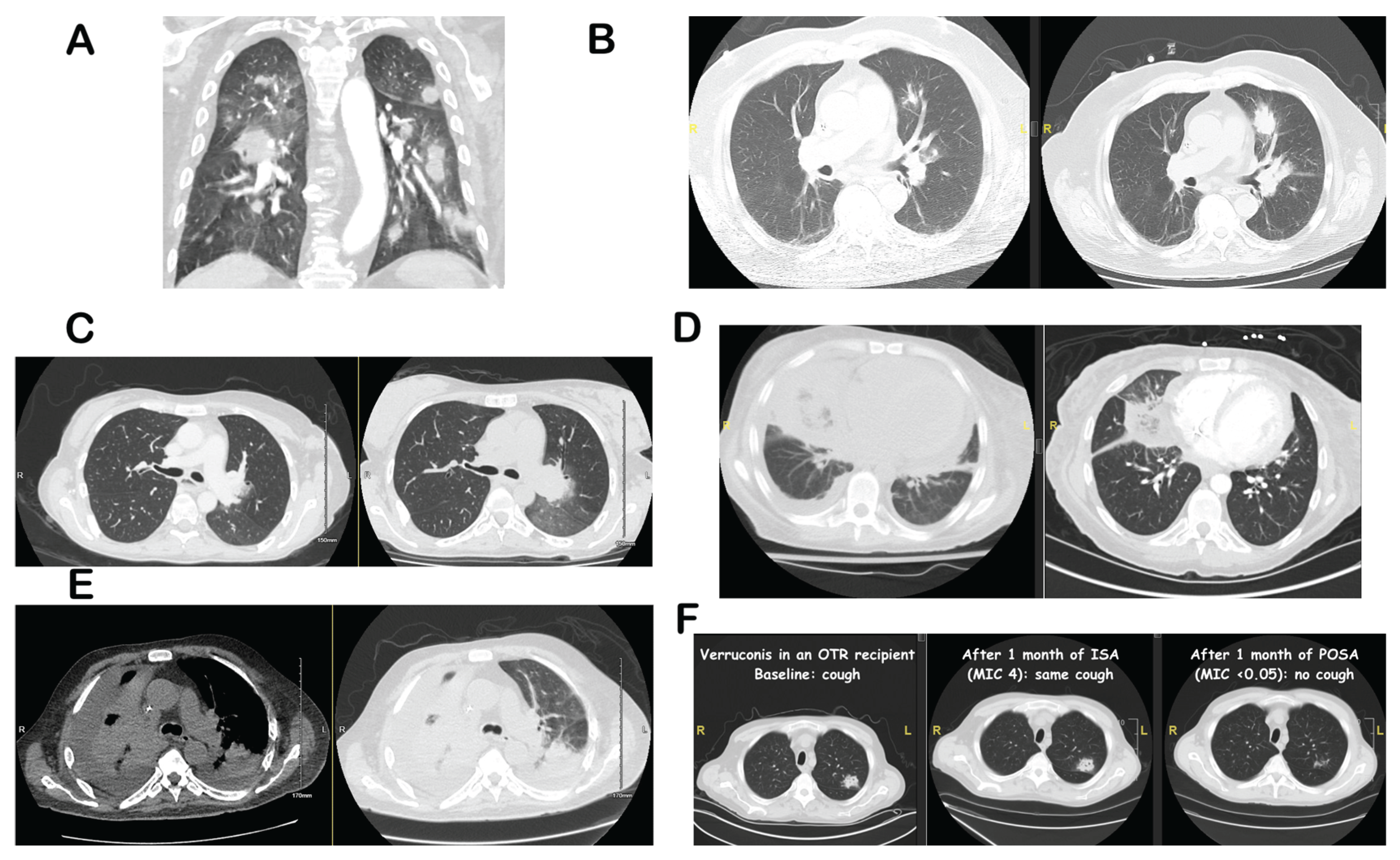

Table 1.
Diagnostic Modalities for Invasive Pulmonary Mold Infections in Immunocompromised Patients.
Table 1.
Diagnostic Modalities for Invasive Pulmonary Mold Infections in Immunocompromised Patients.
| Category | Test / Modality | Specimen | Typical TAT | Sensitivity (%) | Specificity (%) | Approximate Cost (USD, 2024–2025)* |
|---|---|---|---|---|---|---|
| Microscopy & Histopathology | Direct stains (GMS, PAS, calcofluor) | BAL, sputum, tissue | Minutes–hours | <50 | High when tissue invasion present | ~$10–30 per specimen |
| Microscopy & Histopathology | Histopathology (FFPE or fresh tissue) | Biopsy | Hours–1 day | Variable (sampling dependent) | High for tissue invasion; demonstrates angioinvasion | ~$100–200 per biopsy (pathology technical fee) |
| Culture-Based Diagnostics | Fungal culture | BAL, sputum, tissue, sterile fluids | 1–7 days (up to 21 days for slow growers) | ~50 overall; <30 in respiratory IPA | ~100 (species-level identification) | ~$30–60 per culture set |
| Culture-Based Diagnostics | Blood culture for molds | Blood | 1–7 days | Low overall; higher for Fusarium/Scedosporium | High; usually indicates disseminated disease | ~$60–120 per set (aerobic/anaerobic bottles) |
| Culture-Based Diagnostics | MALDI-TOF MS (from culture) | Culture isolate | Minutes once colony available | Same as culture yield | ~100 (species-level identification) | Incremental ~$5–15 per isolate (reagent cost) |
| Targeted Molecular / Tissue-Based Tests | PCR + sequencing (species-level) | FFPE or fresh tissue | 1–3 days | High when fungal elements seen on histology | High; useful for non-distinct morphology or culture-negative disease | ~$250–400 per assay |
| Non–Culture Biomarkers | Serum galactomannan (GM) | Serum, plasma | 1–3 days | 20–90 (host- and specimen-dependent) | ~80–90 | ~$100–200 per test |
| Non–Culture Biomarkers | BAL galactomannan | BAL fluid | 1–3 days | Up to ~90 | ~90 | ~$120–220 per test |
| Non–Culture Biomarkers | (1→3)-β-D-glucan (BDG) | Serum | Same day–1 day | ~60–80 (highest in hematologic/HSCT) | ~70–90; reduced in ICU due to false positives | ~$400–450 per test |
| Fungal PCR (Pathogen-Specific) | Aspergillus PCR | Serum, plasma, whole blood, BAL | 1–2 days | 70–100 | 85–95 | ~$200–350 per assay |
| Fungal PCR (Pathogen-Specific) | Mucorales PCR | Serum, BAL, tissue | 1–2 days | ~85 | ~89–90 | ~$200–350 per assay |
| Broad Molecular & Advanced Diagnostics | Broad-range fungal PCR | Tissue, sterile fluids | 1–3 days | 50–70 | High; adjunct when microscopy positive but cultures/PCR negative | ~$250–450 per assay |
| Broad Molecular & Advanced Diagnostics | Plasma microbial cell-free DNA sequencing / mNGS | Plasma (± BAL, tissue) | 24–48 hours | 40–70 | 80–90 | ~$1,800–2,500 per test |
| Emerging Noninvasive Technologies | Exhaled VOCs by GC–MS | Exhaled breath | Minutes–hours | 77–96 (IPA and CPA) | 78–97 | Research only; estimated reagent cost ~$200–400 per run |
| Imaging | High-resolution CT (HRCT) chest | Imaging | Immediate | High for typical angioinvasive patterns | Limited; findings often nonspecific in non-neutropenic hosts | ~$130–200 (Medicare technical payment) to >$500 list price |
*Approximate direct test costs in US dollars based on 2024–2025 cash prices, manufacturer information, and fee-schedule estimates where available; values illustrate relative order of magnitude rather than provide exact charges. Actual costs vary between institutions, health systems, countries, and payers and may differ substantially from the amounts billed to or paid by patients and insurers.
Disclaimer/Publisher’s Note: The statements, opinions and data contained in all publications are solely those of the individual author(s) and contributor(s) and not of MDPI and/or the editor(s). MDPI and/or the editor(s) disclaim responsibility for any injury to people or property resulting from any ideas, methods, instructions or products referred to in the content. |
© 2026 by the authors. Licensee MDPI, Basel, Switzerland. This article is an open access article distributed under the terms and conditions of the Creative Commons Attribution (CC BY) license (http://creativecommons.org/licenses/by/4.0/).
Copyright: This open access article is published under a Creative Commons CC BY 4.0 license, which permit the free download, distribution, and reuse, provided that the author and preprint are cited in any reuse.


