

Submitted:
17 March 2026
Posted:
18 March 2026
You are already at the latest version
Abstract
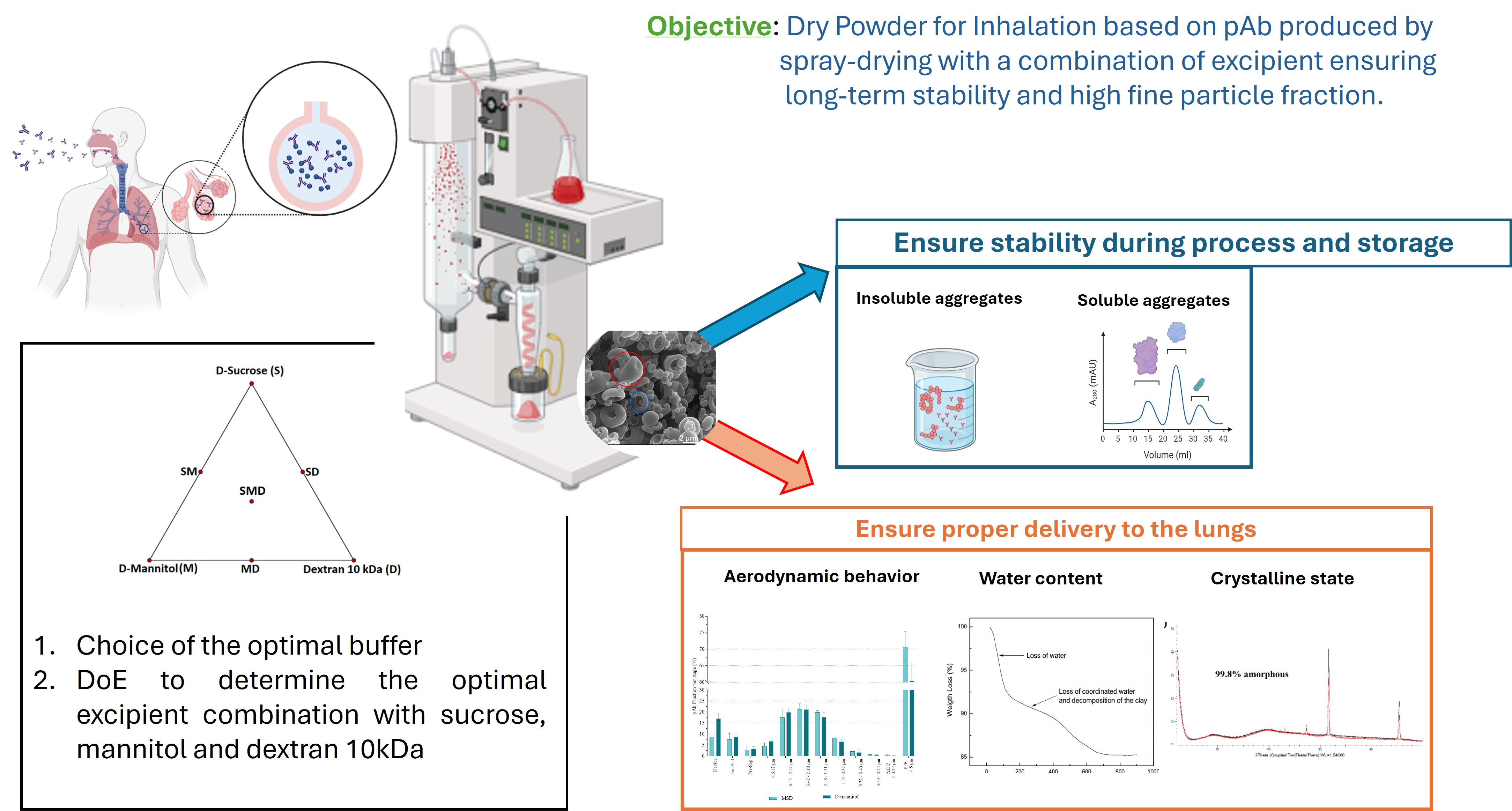
Background/Objectives: The development of dry powder formulations for pulmonary delivery of therapeutic antibodies requires careful stabilization strategies to preserve protein integrity during spray-drying and long-term storage. This study investigates the impact of various sugar-derivatives, a polyol (D-mannitol), a disaccharide (D-sucrose) and a polysaccharide (dextran 10kDa) used individually or in combination, on the physical stability of bovine polyclonal immunoglobulin G (pAb) in dry powders for inhalation (DPIs). Methods: A design of experiments (DoE) approach was employed to evaluate the effects of these excipients on residual moisture (RM), low-order aggre-gates (LOA) and high-order aggregates (HOA), immediately after spray-drying (T0) and after 10 months of storage at room temperature (T10) in a desiccator. Results: All DPIs exhibited a high amorphous content and a favorable glass transition temperature, with RM decreasing over time. A combination of D-mannitol and dextran 10kDA (DPI-MD) demonstrated the best stabilization, minimizing LOA and HOA formation, both at T0 and T10. A ternary mixture, including also D-sucrose (DPI-MSD), showed enhanced short-term stability, but was less stable over time. The aerodynamic perfor-mance of these carrier-free DPIs, assessed via laser diffraction and a Next Generation Impactor, confirmed that DPI-MD and DPI-MSD formulations produced aerosol with suitable size distribution and fine particle fractions (FPFn of 70 ± 5% for DPI-MSD), for deep pulmonary deposition. Conclusions: These findings highlight the importance of combining excipients with complementary physical properties to achieve robust pro-tein stabilization. The DPI-MD emerged as the most promising candidate for pAb lung delivery, balancing protein integrity, powder stability, and aerodynamic efficiency.
Keywords:
immunoglobulin G
; inhalation
; spray-drying
; design of experiment
1. Introduction
Since the pioneering development of the hybridoma technology by Kohler and Milstein in 1975 [1], monoclonal antibodies (mAbs) have gained importance as therapeutic agents because of their high affinity and specificity for target molecules/receptors [2]. Despite these advantages, therapeutic mAbs face several challenges, primarily due to their high-molecular weight (mw) and complex tertiary structure. Their production remains time-consuming and expensive, as it relies exclusively on biological systems [3], and the subsequent purification process often involves multiple steps [4]. Another major challenge lies in the structural instability of mAbs. Their tertiary structure is crucial for biological activity, but can be easily disrupted by external factors, such as heat, adsorption at air/water interfaces, or pH fluctuations for examples [5]. Once unfolded, hydrophobic amino acid residues become exposed, promoting intermolecular interactions that can lead to aggregate formation [6]. These aggregates not only compromise therapeutic efficacy but also raise concerns regarding immunogenicity [7]. Aggregates can range from reversible low-order aggregates (LOA), such as dimers or trimers, to irreversible high-order aggregates (HOA), which are typically insoluble and often originate from LOA [8].
To limit aggregation and enhance protein stability, formulation strategies commonly employ stabilizing excipients. Moreover, transitioning proteins to a dry state offers several advantages over liquid formulations. Dry forms extend shelf life and eliminate water-mediated degradation pathways, such as deamidation or hydrolysis in the hinge region [9,10]. Removing 95–99% of the water also decreases transportation costs and permits ambient temperature shipping, in contrast to liquid protein formulations that often require cold-chain logistics due to limited long-term stability [9].
Among the scalable drying techniques, spray-drying offers notable benefits over freeze-drying (lyophilization), such as cost-effectiveness, speed, and the ability to engineer particles in a single step. Spray-drying transforms a liquid feed into dry particles, and various process parameters can be adjusted to influence particle size, shape, density, crystallinity, and residual solvent content [9,11]. This technique is particularly suitable for developing pharmaceutical formulations intended for non-injectable routes, such as pulmonary delivery [9,12].
Pulmonary administration via inhalation is a non-invasive route that enables direct drug delivery to the lungs, especially in the treatment of respiratory diseases. This localized delivery reduces systemic exposure and side effects, while maintaining therapeutic efficacy at lower doses. It also facilitates the delivery of hydrophilic and large molecules, such as proteins, to their site of action in the bronchial or alveolar lumen, bypassing biological barriers, such as endothelial and epithelial membranes encountered with systemic routes [12].
Dry powder inhalers are among the most common devices for pulmonary drug delivery. They are environmentally friendly and rely on the patient’s inspiratory airflow to aerosolize the powder [13]. However, the powder must possess suitable aerosolization and dispersion properties, which can be compromised by humidity [13]. Therefore, maintaining low and stable residual moisture (RM) is critical for long-term performance [12,14,15]
Currently, four protein-based dry powder formulations, produced via spray-drying, received Food and Drug Administration (FDA)-approval: Exubera® (FDA approval 2006 but retrieved since 2007 [16]), Trelstar® (FDA approval in 2010 [17]), Somatuline® (FDA approval in 2007 [18]), Raplixa® (FDA approval in 2015 [19]) and Inbrija® (FDA approval in 2018[20]).
While spray-drying can affect protein structure, the use of stabilizing excipients may help minimizing degradation [12,21] during the three key steps of spray-drying: atomization, drying and particle separation from the gas phase. Among the stresses encountered during spray-drying, dehydration is particularly critical. Sugars and their derivatives are well-known for their protective role during protein dehydration and are commonly used as cryoprotectants in freeze-drying [22,23,24]. Although extensively employed in dry-state processes, the mechanisms underlying their stabilizing effects are still being elucidated. Furthermore, the impact of combining different sugars and derivatives with varying physical properties remains underexplored, especially in the context of spray-drying.
Therefore, this study aims to evaluate the effect of various sugar derivatives, each with distinct physical properties, on the stability of a model protein (bovine polyclonal IgG, pAb) following spray-drying and during long-term storage at room temperature (RT) in a desiccated environment.
Protein stability in dry powder for inhalation (DPI) was assessed based on the residual moisture (RM) content, which impacts different physical and aerodynamic properties, and the contents of LOA and HOA, which are critical indicators of pAb stability. A rational mixture design of experiments (DoE) was employed to evaluate both the individual and interaction effects of sugar derivatives.
The selected excipients, D-mannitol (M), D-sucrose (S) and dextran 10kDA (D), used as controllable input factors, were chosen based on their physical properties (such as mw, glassy transition temperature (Tg) and hydrogen bonding potential) and their known tolerability in pulmonary applications:
- Because of the lack of lung toxicity data for non-reducing disaccharides, D-sucrose (C12H22O11), an inexpensive intermediate size sugar (mw 342.3 Da), which presents a very low oral toxicity, is widely used in both food and pharmaceutical industries, [30] and, was tested. D-sucrose possesses 14 potential H-bonds per molecule [30] and an intermediate Tg (63°C).
2. Materials and Methods
2.1. Material
pAb was obtained as a lyophilized powder from Equitech (Kerrville, Texas, USA). Citric acid monohydrate and NaH2PO4 were purchased from Merck (Darmstadt, Germany). D-Sucrose (S) and L-Arginine were bought from Sigma-Aldrich (Saint-Louis, Missouri, USA). Trisodium citrate was purchased from Alfa Aesar (Haverhill, Massachusetts, USA), Dextran T10 (D) was obtained from Pharmacosmos (Holbaek, Denmark), and Pearlitol 200SD-Mannitol (M) from Roquette (Lestrem, France). Na2HPO4 anhydrous, sodium hydroxide, sodium azide and silica gel were purchased from VWR Chemicals (Oud-Heverlee, Belgium). The bicinchoninic acid (BCA) protein assay kit, the microBCA kit and related globulin standard ampules were purchased from Thermofisher (Waltham, Massachusetts, USA). Millex polyvinylidene fluoride syringe filters, Durapore®, were purchased for Sigma-Aldrich. Bridged Ethylene Hybrid (BEH) size exclusion chromatography (SEC) standards and SEC standards were purchased from Waters (Antwerp, Belgium) or besides SEC standard from Biorad (Temse, Belgium). The ultrapure water was produced with a Purelab system (Elga LabWater, Wycombe, UK).
2.2. Methods
2.2.1. pH Stability Evaluation of pAb
To determine the pH stability, 200 mg lyophilized pAb powder was dissolved in 10 mL of various 20 mM buffers with a good buffering capacity at pH 6.0 (i.e. citrate and L-histidine) and pH 7.0 (i.e. citrate and phosphate) in 10-mL glass vials. The systems were left to equilibrate for 1 hour at RT without stirring to ensure complete dissolution. The resulting solutions were placed for 24 h in a climatic chamber (Weiss Technic, Liedekerke, Belgium) set at 25°C and then analyzed in terms of soluble and insoluble aggregates (LOA and HOA, respectively).
2.2.2. Spray-Dried Dry Powder for Inhalation Formulations
The DPIs were produced with a mini-Spray-Dryer B-290 (Büchi, Flawil, Switzerland) in a single step. Briefly, pAb was dissolved during 1 h without stirring at a 10 mg/mL concentration in a 20 mM citrate buffer pH 7.0 solution. This 50 mL-solution was supplemented with the different sugar derivative(s) (i.e. S, M and/or D) at a pAb/excipient weight ratio of 9:1 (Table 1). Then, this solution at 1.6% w/v of solid content (i.e. pAb, buffer and sugar derivatives) was pumped at a constant flow rate of 3 g/min and sprayed through a two-fluid nozzle (diameter 0.7 mm) via the nebulization gas (air), set at 820 L/hour. This sprayed solution is dried into dry powder thanks to an inlet temperature set between 100 and 110°C (leading to an outlet temperature between 55 and 60°C) and the dry powder was then collected through a high-performance cyclone with an aspiration flow rate set at 35 m³/h. The process yield is calculated using Equation 1.
Equation 1. Relationship to calculate the yield from spray-drying.
The DPIs were analyzed just after the spray-drying process (T0) and then stored at RT in plastic recipients enclosed in a desiccator, containing silica desiccant, for up to 10 months (T10).
2.2.3. Physicochemical Properties of DPIs
- Morphology – Scanning Electron Microscopy (SEM)
The DPIs were visualized by SEM using a Hitachi SU-70 ultra-high-resolution microscope (Hitachi, Tokyo, Japan). The particles were coated with gold (35 mA for 4.5 min at 1 mbar under argon) before analysis. The acceleration Voltage during the observation was 20 kV. These analyses were outsourced to the 4MAT lab (Université Libre de Bruxelles, Ixelles, Belgium). Analyses were made in monoplicate.
- Residual moisture – Thermogravimetric Analyses
RM within the DPIs was assessed using a thermogravimetric analyzer Q500 (TA Instruments, New Castle, Delaware, USA). Briefly, about 10 mg sample was loaded on a platinum pan (TA Instruments) and heated from RT to 200°C at a constant heating rate of 10°C/min under nitrogen atmosphere. Data acquisition was performed using the TA advantage software (version 5.5.24) and the data analysis with the TA instruments Trios software (version 4.5.0.42498). The RM in the samples was attributed to the sample weight loss between RT and 150°C. TGA analyses were performed at T0 , T6 and T10 in monoplicate.
- Glassy transition temperature - Modulated Differential Scanning Calorimetry (MDSC)
The thermal transition events of the DPIs were analyzed with MDSC, using a modulated differential scanning calorimeter Q200 instrument equipped with a RCS90 cooling system (TA Instruments). About 3.0 to 5.0 mg pAb or DPIs were accurately weighted into a Tzero aluminum pan (TA Instruments), which was sealed with a hermetic lid (TA Instruments). An empty Tzero aluminum pan, sealed with a hermetic lid, was used as the reference. The sample and reference pans were then simultaneously submitted to three cycles performed under N2 : cycle 1: heated from -50°C to 125°C at a heating rate of 10°C/min; cycle 2: quenched to -50°C, and finally; cycle 3: reheated from -50°C to 125°C at a heating rate of 10°C/min. Alternatively, MDSC was used to separate kinetic from thermodynamic events. The sample and reference pans were then simultaneously submitted to one cycle performed under N2 where they were heated from -50°C to 100°C using an average heating rate of 3.0°C/min, a modulation temperature amplitude of ± 0.8°C and a period of 40 s. Data acquisition was performed using the TA Advantage software (version 5.5.24) and analysis with the TA instruments Trios® software (version 4.5.0.42498). The Tg was determined as the midpoint of the transition. Samples were analyzed at T10.
- Crystalline properties – X-Ray Powder Diffraction (XRPD)
The crystalline/amorphous structure of the DPIs was analyzed using an X-Ray diffractometer (D8 Advance Eco Bruker, Madison, Wisconsin, USA) equipped with a one-dimensional silicon detector (LynxEye, Bruker AXS) using Cu Kα radiation (1.54 Å; 40 kV × 25 mA). The angular range was set at 3-45° 2θ with a step size of 0.02° and a dwell time of 1 s. Analyses, made in monoplicate, were outsourced to the 4MAT lab (Université Libre de Bruxelles).
2.2.4. Physical Degradation – pAb Aggregate Determination in DPIs
- Sample preparation
The quantity of DPIs containing approximately 10 mg pAb were accurately weighted in 2-mL protein LoBind microcentrifuge tubes (VWR, Oud-Heverlee, Belgium) and resuspended in the proper volume of phosphate buffered saline (PBS) solution to obtain a 10 mg/mL solution. Each tube was closed, inverted several times, and briefly vortexed (˂ 5 s) to ensure proper resuspension of the powder. The tubes were then briefly centrifugated (2000xg) using a MiniStar microcentrifuge (VWR) and incubated at RT for about 30 min. The solution/suspension of reconstituted powder was then briefly vortexed for proper homogenization and diluted 10-fold. Approximately 80% of the diluted solution was collected using a 1-mL polypropylene syringe (VWR) and filtered on 0.22 µm 13 mm polyvinylidene difluoride (low-protein binding) syringe filters (Sigma-Aldrich) to remove HOA. The HOA are defined by the filter pores size, namely the fraction above 220 nm. Protein adsorption on the filter membrane was verified (data not shown). The remaining 20% of the diluted solution was kept unfiltered to determine insoluble aggregates percentages. Each sample was prepared in triplicate.
- Determination of high-order aggregates percentage and soluble protein recovery
20 µL of each filtered (containing pAb and LOA) and non-filtered solution/suspension (containing pAb, LOA and HOA) were analyzed using the Pierce™ BCA protein assay kit according to the procedure described in the instructions provided by the supplier. Briefly, a 7-point pAb standard calibration curve from 125 to 2,000 µg/mL was prepared from a commercial 2-mg/mL standard of bovine IgG. 20 µL were pipetted three times into a 96-well microplate. A blank (dilution buffer-PBS) was pipetted at least in triplicate. 20 µL of the filtered and non-filtered reconstituted solutions/suspensions were then pipetted in triplicate using a 20-µL single channel Finnpipette F1 (ThermoFisher Scientific, city, Belgium). The two reagents A (BCA-containing reagent) and B (CuSO4 reagent) were then mixed at a ratio of 50:1 (A:B) v/v and 200 µL was added to each well containing the standards, the blanks and the samples using a 8-channel research plus variable pipette (Eppendorf, city, Belgium). The plate was covered with a film plate sealer and incubated at 37 °C for 30°C, while avoiding light exposure. Subsequently, the plate was read using a Multiskan® FC plate reader at 570 nm (ThermoFisher Scientific). The average absorbance of the blanks was subtracted from the standard and sample absorbances, and the concentrations of the samples were interpolated from the standard curve using a second order polynomial regression model. Analyses were made in triplicate. The insoluble aggregates are thereby defined by the filter pores size, namely the fraction above 220 nm. The HOA percentage was estimated using Equation 2 and the soluble protein recovery (%) using Equation 3.
Equation 2. High-order aggregates (HOA) content (%).
Equation 3. Soluble protein recovery (%).
- Determination of monomer content – semi-quantitative analysis
The absolute total protein concentrations of the filtered solutions were first analyzed by UV-Visible Spectrophotometry at 280 nm with 320 nm used as reference with a nanophotometer NP80 (Implen, city, Germany). Measurements were made using an ultra-micro quartz cuvette (Hellma, city, Germany). Prior to the analysis, a blank, corresponding to PBS, was analyzed, and automatically subtracted from each other measurement by the NP80’s acquisition software. A one-concentration standard curve was analyzed to interpolate the sample’s concentrations.
- Determination of low-order aggregates percentage
Prior to the SEC samples, a protein standard with known mw was analyzed to assess the column efficacy and to estimate its elution time. 20 µL sample, prepared from filtered solution, was then injected into a high-pressure liquid chromatography system (Agilent Technologies, Santa Clara, California, USA) equipped with a degasser, a quaternary pump, a thermostat oven fixed to 25°C and a diode array detector fixed to 280 nm and 600 nm as working and reference wavelengths, respectively. The analyte was eluted at 1 mL/min for 15 min with a 170 mM phosphate buffer pH 6.8 supplemented with 200 mM L-Arginine, through a XBridge Protein BEH SEC column (200Å, 3.5 µm, 7.8 mm x 300 mm) connected to its guard column (30 mm) (Waters, Milford, Connecticut, USA). Upon completion, the mobile phase was filtered on Nalgene 0.2 µm polyethersulfone membrane (ThermoFisher Scientific) and then autoclaved (121°C, 15 min) to reduce microbial load.
The low-order aggregates (LOA) content (%) was estimated using Equation 4 from the sum of area under the curve (AUC) of all peaks eluting before the monomer peak, which corresponds to pAb, divided by the sum of all AUC peaks (from SEC analysis). All samples were determined in triplicate.
Equation 4. determines low-order aggregates – soluble protein fraction after sample filtration step eliminating high-order aggregates.
Monomer recovery (%) was determined using Equation 5 using the AUC from the monomer in SEC and the theoretical AUC calculated from the standard curve based on the soluble protein concentration precisely determined by UV spectrophotometry.
Equation 5. determines monomer recovery (%) after sample filtration step to eliminate high-order aggregates.
2.2.5. Calculation
- Theoretical calculation of the number of hydrogen bonds
The calculation of the number of H-bonds for M and S was made using Equation 6. For D, Equation 7 was used.
Equation 6. Calculation of the number of H-bonds which possibly can be formed by the unit of mass for D-mannitol and D-sucrose.
Define Unit of mass and H-bond donors and H-bonds acceptors in the molecules
Equation 7. Estimation of the number of H-bonds for dextran 10 kDa, based on 10,000 as the molecular weight and n being the number of glucose units REF. Equation was back-tested on available D-glucose and oligosaccharides (up to n=4) derivatives. Define n in D(10kda).
2.2.6. Mixture Design of Experiments (DoE)
The DoE was a simplex-centroid mixture design (Figure 1). S, D and M were considered as controllable input factors. The other components (pAb and buffer species) were kept at constant concentration.
To assess pAb and powder stability, three responses were measured: the contents of HOA (%), LOA (%) and RM (%). The three responses were determined just after the spray-drying process (T0) and after a 10-month storage (T10) at RT in a desiccator with desiccant silica. To model the response, a quadratic model was chosen following Equation 8. In practice, the three-factor interaction term (MSD) was not used in the model as it is generally considered negligible. Besides the individual responses (HOA, LOA, RM), also a global desirability value was determined according to the approach of Derringer and modeled.
Equation 8. Quadratic regression model used to fit the responses and to generate the response surfaces.
To calculate global desirability, a coefficient of importance was set for each individual response. These latter were first transformed on a 0 (undesirable) to 1 (most desirable) desirability scale. The coefficients of both LOA and HOA, which are both directly related to the stability of the pAB, were set to the highest importance included in the software (i.e. 5), while the coefficient of importance for RM, which is less directly related to the stability of the powder or the protein, but might be an indirect predictor, was set to 3. Global desirability is calculated as the geometric mean of the responses (desirability values) considering their importance. The global desirability plot, showing the response surface for desirability, was drawn. The software used for DoE design set-up and analysis was Design Expert V.12 (Statease, Minneapolis, USA).
2.2.7. Aerosolization and dispersion of DPIs through dry powder inhaler
The size distribution of aerosol particles, generated from each DPI through an low resistance Axahaler® inhaler (S.M.B. Laboratories, Brussels, Belgium), was first determined with a laser-based diffraction technique, Spraytec (Malvern Analytical, city, United Kingdom), that is equipped with an inhalation cell, specifically modified for measuring the particle size diameter (PSD) generated from medicinal aerosols, such as Metered Dose Inhalers, Dry Powder Inhalers and nebulizers. This technique has demonstrated a good correlation with cascade impactor analysis for carrier-free DPIs [31]. Briefly, approximately 20 mg DPI was weighed into a size 3 hydromellose capsule (Qualicaps, city, Spain) and placed into an Axahaler® capsule-based inhaler and connected, using the appropriate mouth adaptor, to the induction port of the cascade impactor from the Multi-Stage Liquid Impactor, fixed on the closed mode Spraytec. Then a critical air flow (100 L/min) was applied for 2.4 s using two HCP5 pumps connected to a TPK2000 flow controller (Copley Scientific, Nottingham, UK). The flow was controlled prior to the test using a DFM3 flow meter (Copley Scientific). The triggering mode was set at 10%, the data acquisition rate to 2500 Hz, the acquisition duty cycle at 50%, the test duration at 3000 ms, and the refractive index at 1.50 (for standard opaque particles). The data acquisition was made using the RTsizer software (Malvern Analytical) and the dgeo distribution parameter was extracted as the volume-weighted mean diameter (D4,3), the median diameter (d0.5), representing the diameter of 50% of the cumulative volume of the particles), and the diameter of 90% of the cumulative volume of the particles (d0.9). The analyses were made in triplicate.
Then, the aerodynamic behavior of the DPI showing the best result through the laser diffraction-based technique and the best desirability through the DoE was assessed using the Next Generation Impactor (NGI, Copley Scientific). Briefly, 20 mg DPI was weighed into a size 3 hydromellose capsule (Quali-caps) and placed into an Axahaler® inhaler. The inhalation device was connected to the induction port of the impactor using the appropriate adaptor and a critical air flow (100 L/min) was applied for 2.4 s using two HCP5 pumps connected to a TPK2000 flow controller. After the deposition, each stage of the impactor (including the inhalation device and its adaptor, the induction port, and the pre-separator) collections were made with PBS solution in volumetric flasks and analyzed using a microBCA protein assay. Briefly, a calibration curve was constructed from 2 to 200 µg/mL using the BGG standard; the volume of standards and calibrator used in the test was 150 µL (instead of 20 µL); and the detection reagent included a third proprietary reagent solution (mix of reagents of the kit= 25A:24B:1C v/v/v). Test was run in triplicate. The median mass aerodynamic diameter (MMAD) and the geometric standard deviation (GSD) were calculated with the Copley inhaler testing data analysis software (Copley Scientific). The fine particle dose was reported relative to the dose of pAb in the capsule resulting in the fine particle fraction related to the nominal dose (FPFn).
2.2.8. Statistical Analysis
Variance homoscedasticity was assessed with the Brown-Forsythe test. Data were then analyzed using two-way analysis of variance (ANOVA) with an α value set at 0.05. When a p-value below 0.05 was observed, the ANOVA was significant and a post-hoc test, such as the Tukey’s multiple comparison test, was applied for time or formulation analysis. The analyses were performed with GraphPad Prism 7 software (GraphPad, San Diego, California, USA).
3. Results
Initially, a DoE approach was employed to assess the impact of the sugar derivatives – used individually or in combination – primarily on the pAb stability, focusing on both LOA and HOA formation, and secondarily on the RM content of the DPIs, immediately after spray-drying and after 10 months of storage in a desiccator with silica gel. To gain a deeper insight into the underlying stabilization mechanisms, the glass transition temperature (Tg) of the DPIs was also determined. As the DPIs are intended to be delivered by inhalation, aerosol particle size distribution was also assessed for all DPIs. Finally, the aerodynamic performances of two DPIs that depending on their desirability were considered the best, were assessed.
3.1. Stable-Buffer Determination for pAb
A preliminary buffer screening was conducted to identify the optimal solution conditions for pAb, prior to the addition of sugar derivatives for the spray-drying process. To this end, the short-term stability was evaluated over 24 hours at 25°C across various pH-buffered environments. Among the tested conditions (Figure 2), citrate buffer at pH 7.0 yielded the highest soluble protein content (97 ± 4 %), while L-histidine buffer resulted in the lowest (79.7 ± 0.6 %), with statistically significant differences observed (p ˂ 0.01 vs. citrate pH 6.0 and phosphate pH 7.0; p ˂ 0.001 vs citrate pH 7.0, Tukey’s test). Monomer recoveries (%) were all not lower than 100%. All comparisons were statistically significant due to the small variability values (p ˂ 0.0001, Tukey’s test), but not relevant from a practical point of view. Citrate buffer (20 mM, pH 7.0) was selected for the subsequent formulation steps because of its minimal formation of insoluble HOA, which is critical for both therapeutic efficacy and immunogenicity. Additionally, monomer recovery was not lower than 100%.
3.2. Dry Powders for Inhalation Produced by Spray-Drying
In addition to buffer agents, various excipients are commonly incorporated into liquid protein formulations intended for drying, in order to mitigate protein degradation. This study focused on characterizing the effects of three well-known excipients: a polyol (M), a disaccharide (S), and a polysaccharide (D). The investigation aimed to evaluate not only the individual effects of each excipient, but also their interactions, to better understand their combined influence on pAb stability. All DPI were successfully formulated with a high yield of powder, between 71.6% (DPI based on MD) and 79.4% (DPI based on SD), recovered from the theoretical anhydrous value (Table 1).
3.2.1. Physicochemical Properties – Morphology, Residual Moisture and Glass Transition Temperature of DPIs
As observed on SEM pictures, the spray-dried powder particles are around 2 µm and showed a smooth surface with a dimpled or a doughnut shape (encircled in red and in blue in Figure 3, respectively).
The results of RM and Tg for the DPI produced by spray-drying are reported in Figure 4.
All DPIs showed a high amount of RM at T0 (between 9.6% for DPI-MSD and 13.0% for DPI-SD), which decreased upon storage in a desiccator with silica desiccant for 10 months (T10), towards a stagnation comprised between 5.7% (DPI-MSD) and 6.5% (DPI-D) (Figure 4A).
MDSC was not assessed beyond 125°C because of decomposition of the samples above 160°C. All MDSC thermograms showed a single Tg and no other thermal event until 125°C, indicating a remaining monophasic amorphous dispersion of the DPIs, even after 10 months of storage at RT. DPIs containing D showed the highest Tg, which was maximal for DPI-MSD (64.1°C), while the lowest was measured for the DPI-M (44.3°C) (Figure 4B).
3.2.2. XRPD on DPIs
Crystallinity of the DPIs was evaluated using X-ray diffractometry. At T0 (Figure 5 A-D), all DPIs showed a similar amount of amorphous content, between 95.0% (DPI with no stabilizer) and 99.8% (DPI with Dextran 10 kDa). The amorphous matrix demonstrated during MDSC is confirmed by the XRPD diffractograms. The same three peaks (2θ = 27, 32, and 45) were observed in each DPI as well as in the pAb raw material, which therefore certainly correspond to the small amount of phosphate buffer in the pAb raw material or to other impurities.
3.2.3. pAb Aggregates Determination in DPIs
The pAb stability was evaluated by the determination of the LOA and HOA contents (%) in the DPIs and reported in Table 2 .
The pAb resisted well to the formation of insoluble aggregates (HOA) during the spray-drying process as the HOA content remained very low at T0 (between 7 ± 2% for DPI-S and 1 ± 5% for DPI-M or 1± 1% for DPI-D, Table 2). The DPIs were not different from one another, and no significant degradation occurred over time (p > 0.05, two-way ANOVA).
The soluble aggregates (LOA) were of the same order of magnitude as the HOA after the spray-drying, i.e between 4 ± 2% for DPI-S and -0.6 ± 0.6% for DPI-MSD (Table 2). Here, statistically significant differences were observed between the DPIs (p < 0.0001, two-way ANOVA) and over time (p < 0.0001, two-way ANOVA) with a significant interaction between formulation and time (p < 0.001, two-way ANOVA).
At T0 (Table 2), combinations with D-Mannitol and dextran 10 kDa were very efficient to stabilize pAb as DPIs based on MD and MSD had the lowest LOA contents at T0 (0.2 ± 0.4% and -0.6 ± 0.6%, respectively). The DPI based on MD had a significantly lower LOA content than the DPIs with a sugar or polyol individually (0.2 ± 0.4% versus 4 ± 2 for DPI-S, p < 0.0001 ; 2.3 ± 0.9% for DPI-M , p < 0.05 ; or 2.3 ± 0.4% for DPI-D, p < 0.05 ; Tukey’s test). The DPI-MSD was even more effective (-0.6 ± 0.6% vs DPI-S, p < 0.0001; vs DPI-M or DPI-D, p < 0.001 ; and vs DPI based on MS, p < 0.05; Tukey’s test). On the other hand, the least efficient excipient at T0 was D-sucrose as it showed the highest LOA content (4 ± 2%).
The tendency remained the same after 10 months storage in a desiccator at RT, except that the differences between the DPIs were reduced. D-sucrose was still the least effective excipient (4.07 ± 0.06%) compared to some DPIs containing sugar/polyol combinations (2.0 ± 0.3% for DPI-MS, p < 0.05 or 1.5 ± 0.3% for DPI-MD, p < 0.01; Tukey’s test) but not less effective than DPI-D (5.2 ± 0.2%) or DPI-M (3.5 ± 0.6%) used alone, or DPI-SD (2.8 ± 0.32% ) or DPI-MSD (3.6 ± 1.2%) (p > 0.05 for both, Tukey’s test). At 10 months, the association MD in DPI became more effective than that of MSD (1.5 ± 0.3% versus 3.6 ± 1.2, p < 0.05; Tukey’s test) and remained more effective than all excipients used individually (4.07 ± 0.06% for DPI-S, p < 0.01, 3.5 ± 0.6% for DPI-M, p < 0.05; and 5.2 ± 0.2% for DPI-D, p < 0.0001, respectively; Tukey’s test).
Although, the LOA content in DPI-MD was still lower (1.5 ± 0.3%) than DPI-MS (2.0 ± 0.3%) and DPI-SD (2.8 ± 0.3%), the difference was not statistically significant (p > 0.05, Tukey’s test). On the opposite, DPI-MSD (3.6 ± 1.2%) was neither more effective than DPI-S (4.07 ± 0.06; p > 0.05, Tukey’s test) and DPI-M (3.5 ± 0.6%; p > 0.05, Tukey’s test) nor than DPI-SD (1.8 ± 0.2 ; p > 0.05, Tukey’s test) and became less effective than DPI-MS (2.0 ± 0.3%; p < 0.05, Tukey’s test). Dextran 10 kDa (5.2 ± 0.2%) became the least protective excipient as, even though the difference with D-sucrose (4.07 ± 0.06%) was not statistically significant (p > 0.05, Tukey’s test). DPI-D had the highest LOA content (5.2 ± 0.2%, p < 0.0001, p < 0.01, p < 0.001 vs MD, SD, SM, respectively, Tukey’s test).
Associating excipients, especially associations of D-mannitol and dextran 10 kDa, stabilized the pAb more efficiently than when used individually. Adding D-sucrose to the association MD, impacted positively the stability at T0, but destabilized somewhat pAb over time.
3.2.4. Design of Experiments Analysis
In order to predict what formulation composition would give the best compromise between (i) the lowest RM, (ii) the lowest LAO content, and (iii) the lowest HAO content at T0 and/or T10, each response as well as the global desirability were modeled (Design Expert software) using a quadratic model (Equation 8)
A contour plot was then drawn for each response and the global desirability (Figure 6). According to the model, the results converged towards an optimal zone encompassing a binary mixture with a somewhat higher fraction of D-mannitol and a lower fraction of dextran 10 kDa, or a ternary mixture with the addition of a low fraction of D-Sucrose.
Still according to the models, the optimal formulation at T0 with a desirability of 0.779 would comprise a proportion of 57% D-mannitol combined with 23% D-sucrose and 20% dextran 10 kDa. Thus, for short term protein stability, i.e. during spray-drying, D-mannitol, D-sucrose and dextran 10 kda are important stabilizers.
For long-term stability, e.g. at T10, reducing D-sucrose and increasing Dextran 10kDA in the formulations is more beneficial, with the ternary mixture of 49% D-mannitol, 48% dextran 10 kDa and 3% D-sucrose, or the binary composition 51% D-mannitol and 49% Dextran 10kDa, presenting the highest desirability (0.782).
When taking into account both short and long-term stabilities, i.e. T0 and T10, the excipients mixture 47% D-mannitol, 48% dextran 10 kDa and 5% D-sucrose showed the highest desirability (0.779). The binary composition 49% D-mannitol and 51% dextran 10kda presented also a high desirability of 0.777.
3.2.5. Aerodynamic Behavior of DPIs
- Aerosol particle size distribution - Laser diffraction technique
The size distribution of the aerosol particles from the DPIs have shown a d(0.5) somewhat below 5 µm (between 4.4 ± 0.2 µm and 4.9 ± 0.6 µm for DPIs based on MSD or D, respectively, Figure 7) which is the upper limit for an appropriate lung deposition if the particle shape is close to a sphere and the density close to 1. This result is similar to the particle size observed on the SEM pictures (Figure 3). The mean volume-to-weight diameters D[4,3] take into account the aggregation state in DPIs. The lowest aggregated DPIs are those based on MD and MSD with a D[4,3] around 5 µm, which is significantly lower than those based on S or SD with D[4,3] of 14.7± 5 µm and 16.5± 5.3 µm respectively; p ˂ 0.05, Tukey’s). Moreover D[4,3] of aerosols from DPIs based on MD and MSD is also lower than from DPIs based on M, D (i.e. 12.9± 0.1 and 11.7± 5.4 µm, respectively) or on SM (8.7± 0.8µm), as reported in Figure 7. The largest aggregates from the aerosols are given by the d(0.9), which follows the same trend as D[4,3] (Figure 7). DPI based on SD presented the highest RM at T0, which could favor cohesion and therefore aggregation, whereas DPI based on MSD present the lowest RM at T0 (13.0% versus 9.6%, respectively, Figure 4). Both d(0.9) and D[4,3] are found highest for DPI-SD and lowest for MSD. In terms of the percentage of particles inferior to 5 µm, which can be correlated with FPFn, the highest percentage was obtained for DPI-MSD , having the lowest RM at T0, but also with the lowest d(0.5) and D[4,3].
- Aerosol particle size distribution - Next generation impactor-based assessment
As the produced DPIs aim to be delivered by inhalation, to treat pulmonary diseases, or even to be used as starting points for systemic administration of IgG by the pulmonary route, the aerodynamic behavior of a DPI included in the desirability region (i.e. DPI-MSD) was assessed. The efficiency of in vitro delivery was very high for DPI-MSD, with a fine particle fraction of 71 ± 5% (calculated from the nominal dose) compared to, for example, DPI-M with a FPFn of 60 ± 5% (Figure 8). The highest fractions being deposed are between the stages 2 and 4 corresponding to aerodynamic diameters between 3.42 and 1.31 µm (Figure 8). The MMAD is 2.5 ± 0.2 µm and GSD is 1.80 ± 0.03 µm. As GSD is below 2, the distribution is considered monodisperse. The total recovery of the assay was 93 ± 5 %, relative to the dose in the capsule.
4. Discussion
For this proof-of-concept study, pAb were applied because of their cost-effectiveness and availability in large quantities. Unlike mAb, pAb are easier to purify and can be collected from bovine blood and milk without animal sacrifices [32],[33]. Although degradation was only assessed via aggregation patterns, this remains a critical quality attribute in drug development and release testing [34]. The preliminary phase focused on short-term stability of pAb, first in solution. Therefore, buffer systems were evaluated for their ability to maintain stability of pAb in solution. Buffers were chosen based their pKa values to maintain the pH between 6 and 7, adequate for pulmonary delivery and minimizing degradation pathways that are more prevalent at acidic pH (i.e., unfolding, fragmentation and deamidation via hydrolysis) or at basic pH (i.e., unfolding, aggregation via dityrosine formation and deamidation via succinimide formation [10]. L-histidine (pKa = 6.0) [35], phosphate (pKa = 7.2) [36] and citrate (pKa = 6.4) [36] were tested. A citrate buffer at pH 7.0 showed the best performance, with 97 ± 3% of soluble protein recovery (i.e. low HOA content (3±3%)) and high monomer recovery (100% i.e. no LOA content, Figure 2). This is likely due to the chelating properties against metal ions [36], thereby mitigating metal-induced oxidation [37,38]. Moreover, pH 7.0 allows having high soluble pAb fraction than pH 6.0 with the pAb isoelectric point, which lies between 5.0 and 6.6. In contrast, L-histidine at pH 6.0 resulted in up to 20 ± 0.6% of HOA (Figure 2). The citrate buffer 20 mM at pH 7.0 was the buffer selected to produce the DPIs by spray-drying with sugar-derivative stabilizers.
The next phases focused on short-term (T0, i.e. just after spray-drying) and long-term pAb stabilities in DPIs generated by spray-drying pAb solutions with stabilizers, a polyol such as D-mannitol, a disaccharide such as D-sucrose and a polysaccharide such as dextran 10kDa, alone or in combination. The aimed advantages of generating a powder is to enhance long-term stability and to reduce transport and storage constraints [13],[39].
Spray-drying was chosen, contrary to freeze-drying, for its ability to control particle size [14], essential for inhalation delivery. During spray-drying, proteins face four key stresses [21,40]: (i) high shear stress within the nozzle, (ii) high surface specific area between the solution and the air during the droplet formation, (iii) thermal stress, and (iv) dehydration stress.
Studies show that antibodies tolerate shear stresses well, while aggregation is mainly induced by air-liquid interfaces [41]. Despite a high inlet temperature (Tin) (i.e. 110°C in this study), the outlet temperature remained moderate (i.e. between 50 and 60°C) and exposure time is brief, i.e. a few seconds at most [21]. To mitigate dehydration stress and to improve stability during storage, sugar derivatives are used as excipients to form an amorphous glassy matrix based powder [22]. They stabilize proteins via the glassy matrix hypothesis, reducing global molecular mobility (α-relaxation, estimated by the factor τα) [22,42] and preserving structure during storage due to their rigid structure. Although not entirely correct, it is commonly assumed in pharmaceutical sciences that log(τα) scales correlate with the difference between the Tg and the storage temperature [42]. A second stabilization mechanism involves water replacement, where excipients form H-bonds with protein surface residues [23], mimicking water’s role and stabilizing thermodynamically secondary structures, like the α-helix and β-sheets. However, this theory has been challenged, as some proteins lose their secondary structure upon drying, but regain full activity after rehydratation [33,43]. Current understanding favors a dynamic stabilization model, where excipients reduce local molecular motions (β-relaxations) playing a more significant role in preserving protein integrity under dry conditions [33,42]. From this study, several trends emerged, despite the relatively good intrinsic resistance of the pAb to the spray-drying process and the use of a low stabilizer-to-protein mass ratio of 1:9. The best results just after spray drying (T0) were obtained using the combination of MSD that showing the highest desirability ratio at 57/23/20 (Figure 6). Dextran 10kda seems to have more a predominant role for long-term stability than during spray-drying, where the H-bonding potential seems the most predominant role to limit aggregation. Indeed, the most stable DPIs in terms of aggregation were those formulated with the polyol (i.e. D-mannitol), which has the highest potential for H-bonds with 0.067 H-bond per unit of mass, in combination with the disaccharide (D-sucrose) and/or with the polysaccharide (dextran 10 kda). D-sucrose shows a potential for H-bonds of 0.057 H-bond per unit of mass (calculated using Equation 6). In contrast, dextran 10 kDa is only capable of forming 0.021 H-bond per unit of mass (based on its sequence and an average mw of 10,000; Equation 7) and showed to be the least effective stabilizer at T0, i.e. during spray-drying. During storage, the DPIs containing M with an increased D fraction and a reduced S fraction showed the lowest aggregation (LOA or HOA), with DPI-MD (51/49) showing the best desirability.
Several research groups have already explored why some sugars are better stabilizers than others. Smaller and molecularly more flexible saccharides stabilize better some model proteins than their larger and more rigid counterparts, probably by better filling cavities within the protein [40]. However, upon storage, the least stable forms evolved towards the thermodynamically most stable, which is the unfolded one. Newly, fully uncovered hydrophobic residues then form aggregates, probably upon reconstitution (in solution) [44]. Those results suggest that even if both strategies were efficient, using excipients with diametrically opposed properties (i.e. one excipient with a very high Tg but suffering from topological constraints, such as a polysaccharide, and one excipient with a very low Tg, but with a high number of potential H-bonds and a high accessibility, such as D-mannitol) is better than combining one or the other with an excipient presenting an intermediate state (i.e. moderate Tg and moderate accessibility, such as D-sucrose).
In terms of HOA, the glassy matrix seems to be predominant to stabilize pAb. Indeed, both DPI with Dextran 10 kDa (D and MSD) had no or hardly any HOA despite a higher level of LOA (5.2 ± 0.2% and 3.6 ± 1.2%, respectively), while the DPI with only D-sucrose had 4.07 ± 0.06% LOA and 3.0 ± 3.0% HOA (Table 2).
Regarding long-term stability, because the amorphous content and glassy matrix state were identified as critical parameters, RM within the powders, after the DPI process, needs to be reduced as it may speed up the crystallization process and decrease the Tg. However, due to their hydration layer, which minimizes the protein free energy to participate to their structure maintenance, proteins tend to sequestrate water very tightly. A fully hydrated protein is estimated to contain up to 0.4 g H2O per gram of protein [45], while studies have shown that the energy of biological water in the vicinity of hydrophilic amino acids was 0.4 kcal/mol higher than that of bulk water, while once removed, it is replaced by another adjacent molecule in the pico- to nano-second scale [46].
It is thus not difficult to understand why RM remained so high (between 9.6% and 13.0% after spray-drying, Figure 4) even in the presence of water substitutes, such as polyols or sugars. However, such a quantity of water remains unusual for powders where the goal is to remove as much water as possible from the system. Some previous considerations in the literature talked about 1-8% to achieve a maximal dried protein stabilization [12], but this is expected to greatly vary from protein to protein and depends on the type of stabilizers.
RM can impact the aerodynamic performance of DPIs by increasing the particle cohesion through increased capillary forces between particles, which would decrease the powder dispersion through the dry powder inhaler. DPI-MSD presents the lowest RM (9.6%) and the highest percentage of particles with a diameter below 5 µm, a d(0.5) close to the D[4.3], and the lowest d(0.9) (Figure 7), whereas DPI-SD showed the highest RM (13.0%), a significant lower percentage of particles with diameter below 5 µm (53.0±6.0% versus 66.7±4.0% , p ˂ 0.05, Tukey post hoc test), a significant higher D[4.3] (16.5±5.3 µm versus 4.5 ±0.2 µm, p ˂ 0.05, Tukey post hoc test ), whereas d(0.5) is similar (p ˃ 0.05) and d(0.9) is significantly higher (59.4±25.7 versus 6.2±0.3 µm, p ˂ 0.05, Tukey post hoc test) (Figure 7), which is in line with these hypotheses. The percentage of particles with a diameter inferior to 5 µm correlates well with the FPFn for the DPI based on M and MSD. Therefore, it seems that aerosol performance of pAB DPIs could be discriminated with this fast and less sample consuming technique (i.e. laser diffraction based technique). DPI-MD showed promising aerosol performance with a percentage of particles with diameters inferior to 5 µm of 51.3 ± 2.9 %, which is however significantly lower than the 66.7 ± 4.0 % with DPI-MSD. This difference is not explained by a higher d(0.9) or D [3,4] due to RM, as is the case for DPI-S or DPI-SD (Figure 7). However, even though the aerodynamic performances are important, the stability of the active drug is the most important to guarantee the efficacy and the safety. Taking into account these arguments, DPI-MD is the most promising DPI with low RM, low LOA and low HOA, and showing reasonable aerodynamic performance with a percentage of particles with diameter inferior to 5 µm around 50%, which is quite good in the inhalation field) [46].
5. Conclusions
This study demonstrates that the stabilization of polyclonal immunoglobulin G (pAb) in dry powder formulations for inhalation is a multifactorial challenge, requiring a nuanced understanding of both protein behavior and excipient properties. The combination of D-mannitol and dextran 10Kda (MD) emerged as the most effective formulation, offering a good protection against aggregation during spray-drying and long-term storage.
The ternary mixture, DPI including also D-sucrose (MSD), showed a promising short-term stability but was less effective over time, highlighting the importance of excipient selection based on complementary physicochemical characteristics.
The findings support the dual role of excipients in protein stabilization: thermodynamic stabilization via hydrogen bonding and dynamic stabilization through reduced molecular mobility in the amorphous glassy matrix. Residual moisture (RM) was identified as a critical parameter, influencing both protein integrity and powder performance, reinforcing the need for optimized drying and storage conditions.
From an aerodynamic point of view, the MD and MSD formulations exhibited favorable particle size distributions and fine particle fractions, confirming their suitability for deep lung deposition. These results underscore the potential of antibody-based dry powders for pulmonary delivery, not only for local treatment of respiratory diseases but also for systemic administration.
Future work should explore the scalability of these formulations, assess their immunogenicity and bioactivity in vivo, and investigate the applicability of these stabilizing strategies to monoclonal antibodies and other biologics.
Author Contributions
P.G.: Formal analysis, investigation, writing original draft. N.A.: Writing, review and editing. N.W and K.A.: Supervision, Conceptualization, Project administration, Investigation, Methodology. Y.V.H. and L.B.: Formal analysis and data curation. T.S.: funding partly the project.
Funding
This research was funded by Fund for Scientifc Research-F.R.S.-F.NRS, grant number 24907174 and was also partially funded by SMB laboratories (Brussels, Belgium).
Institutional Review Board Statement
Not applicable.
Informed Consent Statement
Not applicable.
Data Availability Statement
The original contribution presented in this study is included in the article. Further inquiries can be directed to the corresponding authors.
Acknowledgments
During the writing of this manuscript, authors used ChatGPT program OpenAI, GPT-5) to improve readability, grammar, and academic language. The authors have reviewed and edited the output and take full responsibility for the content of this publication. Authors acknowledge the use of Design—Expert software (version: 23.1.8 64-bit; Stat-Ease 360 software, Minneapolis, USA) for the experimental design and analysis.
Conflicts of Interest
The authors declare no conflicts of interest.
Abbreviations
The following abbreviations are used in this manuscript:
| MDPI | Multidisciplinary Digital Publishing Institute |
| DOAJ | Directory of open access journals |
| TLA | Three letter acronym |
| LD | Linear dichroism |
| ANOVA | Analysis of variance |
| AUC | Area under the curve |
| BCA | Bicinchoninic acid |
| BEH | Bridged Ethylene Hybrid |
| BGG | Bovine gamma globulin |
| D | Dextran 10 kDa |
| Dgeo | Geometric diameter |
| DoE | Design of experiments |
| DPI | Dry powder for inhalation |
| DPI-MD | DPI including D-mannitol and dextran 10 kDa |
| DPI-SD | DPI including D-sucrose and dextran 10 kDa |
| DPI-MS | DPI including D-mannitol and D-sucrose |
| DPI-MSD | DPI including D-mannitol, D-sucrose, and dextran 10 kDa |
| FDA | Food and Drug Administration |
| FPFn | Fine particle fraction related to the nominal dose |
| GSD | Geometric standard deviation |
| H-bond | Hydrogen bond |
| HOA | High-order aggregates |
| LOA | Low-order aggregates |
| M | D-mannitol |
| mAbs | Monoclonal antibodies |
| MDSC | Modulated differential scanning calorimetry |
| MMAD | Median mass aerodynamic diameter |
| mw | Molecular weight |
| NGI | Next generation impactor |
| pAb | polyclonal IgG |
| PBS | Phosphate buffered saline |
| RM | Residual moisture |
| RT | Room temperature |
| S | D-sucrose |
| SEC | Size exclusion chromatography |
| SEM | Scanning electron microscopy |
| T0 | Time of analysis right after spray-drying |
| T6 | Time of analysis after a 6-month storage |
| T10 | Time of analysis after a 10-month storage |
| Tg | glassy transition temperature |
| XRPD | X-ray powder diffraction |
References
- Kohler, G.; Milstein, C. Continuous cultures of fused cells secreting antibody of predefined specificity. Nature 1975, 256(5517), 495–497. [Google Scholar] [CrossRef]
- Rajewsky, K. Clonal selection and learning in the antibody system. Nature 1996, 381(6585), 751–758. [Google Scholar] [CrossRef]
- Bourel, D.; Teillaud, J. L. Monoclonal antibodies: technology around the clock for new therapeutic hopes. C R Biol 2006, 329(4), 217–227. [Google Scholar] [CrossRef]
- Bogard, W. C., Jr.; Dean, R. T.; Deo, Y.; Fuchs, R.; Mattis, J. A.; McLean, A. A.; Berger, H. J. Practical considerations in the production, purification, and formulation of monoclonal antibodies for immunoscintigraphy and immunotherapy. Semin Nucl Med 1989, 19(3), 202–220. [Google Scholar] [CrossRef]
- Le Basle, Y.; Chennell, P.; Tokhadze, N.; Astier, A.; Sautou, V. Physicochemical Stability of Monoclonal Antibodies: A Review. J Pharm Sci 2020, 109(1), 169–190. [Google Scholar] [CrossRef] [PubMed]
- Elgundi, Z.; Reslan, M.; Cruz, E.; Sifniotis, V.; Kayser, V. The state-of-play and future of antibody therapeutics. Adv Drug Deliv Rev 2017, 122, 2–19. [Google Scholar] [CrossRef]
- Carpenter, J. F.; Randolph, T. W.; Jiskoot, W.; Crommelin, D. J.; Middaugh, C. R.; Winter, G.; Fan, Y. X.; Kirshner, S.; Verthelyi, D.; Kozlowski, S.; et al. Overlooking subvisible particles in therapeutic protein products: gaps that may compromise product quality. J Pharm Sci 2009, 98(4), 1201–1205. [Google Scholar] [CrossRef]
- Sreenivasan, S.; Schoneich, C.; Rathore, A. S. Aggregation of therapeutic monoclonal antibodies due to thermal and air/liquid interfacial agitation stress: Occurrence, stability assessment strategies, aggregation mechanism, influencing factors, and ways to enhance stability. Int J Pharm 2024, 666, 124735. [Google Scholar] [CrossRef] [PubMed]
- Emami, F.; Keihan Shokooh, M.; Mostafavi Yazdi, S. J. Recent progress in drying technologies for improving the stability and delivery efficiency of biopharmaceuticals. J Pharm Investig 2023, 53(1), 35–57. [Google Scholar] [CrossRef] [PubMed]
- S.J., S. Stability of monoclonal antibodies (mAbs); Elsevier, 2015. [Google Scholar] [CrossRef]
- Maurício, A. C.; Domingos, J.; Santos, D.; Sencadas, V.; Gomes, P.; Fernandes, M. H. Spray Drying: An Overview. In Biomaterials - Physics and Chemistry - New Edition; Pignatello, R., Musumeci, T., Eds.; IntechOpen, 2017. [Google Scholar]
- Depreter, F.; Pilcer, G.; Amighi, K. Inhaled proteins: challenges and perspectives. Int J Pharm 2013, 447(1-2), 251–280. [Google Scholar] [CrossRef]
- Levy, M. L.; Carroll, W.; Izquierdo Alonso, J. L.; Keller, C.; Lavorini, F.; Lehtimaki, L. Understanding Dry Powder Inhalers: Key Technical and Patient Preference Attributes. Adv Ther 2019, 36(10), 2547–2557. [Google Scholar] [CrossRef]
- Pilcer, G.; Amighi, K. Formulation strategy and use of excipients in pulmonary drug delivery. Int J Pharm 2010, 392(1-2), 1–19. [Google Scholar] [CrossRef]
- Arakawa, T.; Prestrelski, S. J.; Kenney, W. C.; Carpenter, J. F. Factors affecting short-term and long-term stabilities of proteins. Adv Drug Deliv Rev 2001, 46(1-3), 307–326. [Google Scholar] [CrossRef] [PubMed]
- FDA. Drug approval package for Exubera . 1 27 2006. Available online: https://www.accessdata.fda.gov/drugsatfda_docs/nda/2006/021868_exubera_toc.cfm (accessed on 21 October 2025).
- FDA. Drug Approval Package Trelstar . 03 10 2010. Available online: https://www.accessdata.fda.gov/drugsatfda_docs/nda/2010/022437_trelstar_toc.cfm (accessed on 21 October 2025).
- FDA. Drug Approval Package of Somatuline Depot . 08 30 2007. Available online: https://www.accessdata.fda.gov/drugsatfda_docs/nda/2007/022074s000TOC.cfm (accessed on 21 October 2025).
- FDA. Raplixa . 2015. Available online: https://www.fda.gov/vaccines-blood-biologics/approved-blood-products/raplixa (accessed on 21 October 2025).
- Donthi, M. R.; Butreddy, A.; Saha, R. N.; Kesharwani, P.; Dubey, S. K. Leveraging spray drying technique for advancing biologic product development–A mini review. Health Sciences Review 2024, 10, 100142. [Google Scholar] [CrossRef]
- Pinto, J. T.; Faulhammer, E.; Dieplinger, J.; Dekner, M.; Makert, C.; Nieder, M.; Paudel, A. Progress in spray-drying of protein pharmaceuticals: Literature analysis of trends in formulation and process attributes. Drying Technology 2021, 39(11), 1415–1446. [Google Scholar] [CrossRef]
- Chang, L. L.; Pikal, M. J. Mechanisms of protein stabilization in the solid state. J Pharm Sci 2009, 98(9), 2886–2908. [Google Scholar] [CrossRef]
- Carpenter, J. F.; Crowe, J. H. An infrared spectroscopic study of the interactions of carbohydrates with dried proteins. Biochemistry 1989, 28(9), 3916–3922. [Google Scholar] [CrossRef]
- Karunnanithy, V.; Abdul Rahman, N. H. B.; Abdullah, N. A. H.; Fauzi, M. B.; Lokanathan, Y.; Min Hwei, A. N.; Maarof, M. Effectiveness of Lyoprotectants in Protein Stabilization During Lyophilization. Pharmaceutics 2024, 16(10). [Google Scholar] [CrossRef] [PubMed]
- Information, N. C. f. B. PubChem Compound Summary for CID 6251, Mannitol . 2025. Available online: https://pubchem.ncbi.nlm.nih.gov/compound/6251 (accessed on 21 October 2025).
- Kim, A. I.; Akers, M. J.; Nail, S. L. The physical state of mannitol after freeze-drying: effects of mannitol concentration, freezing rate, and a noncrystallizing cosolute. J Pharm Sci 1998, 87(8), 931–935. [Google Scholar] [CrossRef]
- FDA. US Package Insert NDA 21-868 Exubera . Available online: https://www.accessdata.fda.gov/drugsatfda_docs/label/2006/021868lbl.pdf (accessed on 21 October 2025).
- Larsen, B. S.; Skytte, J.; Svagan, A. J.; Meng-Lund, H.; Grohganz, H.; Lobmann, K. Using dextran of different molecular weights to achieve faster freeze-drying and improved storage stability of lactate dehydrogenase. Pharm Dev Technol 2019, 24(3), 323–328. [Google Scholar] [CrossRef]
- Vodak, D.; Dobry, D.E.; Friesen, D.; et al. Dextran-based materials as excipients in engineered particle formulations: Tailoring Physical Properties to optimize performance, manufacturability, and safety. RDD Europe, 2011. [Google Scholar]
- Information, N. C. f. B. PubChem Compound Summary for CID 5988, Sucrose . 2025. Available online: https://pubchem.ncbi.nlm.nih.gov/compound/5988#section=Non-Human-Toxicity-Excerpts (accessed on 21 October 2025).
- Pilcer, G.; Vanderbist, F.; Amighi, K. Correlations between cascade impactor analysis and laser diffraction techniques for the determination of the particle size of aerosolised powder formulations. Int J Pharm 2008, 358(1-2), 75–81. [Google Scholar] [CrossRef] [PubMed]
- Stapleton, S.; Kennedy, R. O.; Tully, E. IMMUNOASSAYS | Production of Antibodies; 2005. [Google Scholar]
- Cicerone, M. T.; Douglas, J. F. β-Relaxation governs protein stability in sugar-glass matrices. Soft Matter 2012, 8(10), 2983–2991. [Google Scholar] [CrossRef]
- Wang, S.; Liu, A. P.; Yan, Y.; Daly, T. J.; Li, N. Characterization of product-related low molecular weight impurities in therapeutic monoclonal antibodies using hydrophilic interaction chromatography coupled with mass spectrometry. J Pharm Biomed Anal 2018, 154, 468–475. [Google Scholar] [CrossRef]
- Information, N. C. f. B. PubChem Compound Summary for CID 6274, L-Histidine . 2025. Available online: https://pubchem.ncbi.nlm.nih.gov/compound/Histidine (accessed on 21 October 2025).
- Rowe, R. C.; Sheskey, P. J.; Owen, S. C.; Association, A. P. Handbook of Pharmaceutical Excipients; Pharmaceutical Press, 2009. [Google Scholar]
- Stadtman, E. R. Metal ion-catalyzed oxidation of proteins: biochemical mechanism and biological consequences. Free Radic Biol Med 1990, 9(4), 315–325. [Google Scholar] [CrossRef]
- Stadtman, E. R.; Levine, R. L. Free radical-mediated oxidation of free amino acids and amino acid residues in proteins. Amino Acids 2003, 25(3-4), 207–218. [Google Scholar] [CrossRef]
- Shetty, N.; Cipolla, D.; Park, H.; Zhou, Q. T. Physical stability of dry powder inhaler formulations. Expert Opin Drug Deliv 2020, 17(1), 77–96. [Google Scholar] [CrossRef]
- Mensink, M. A.; Frijlink, H. W.; van der Voort Maarschalk, K.; Hinrichs, W. L. How sugars protect proteins in the solid state and during drying (review): Mechanisms of stabilization in relation to stress conditions. Eur J Pharm Biopharm 2017, 114, 288–295. [Google Scholar] [CrossRef]
- Duerkop, M.; Berger, E.; Durauer, A.; Jungbauer, A. Impact of Cavitation, High Shear Stress and Air/Liquid Interfaces on Protein Aggregation. Biotechnol J 2018, 13(7), e1800062. [Google Scholar] [CrossRef] [PubMed]
- Cicerone, M. T.; Pikal, M. J.; Qian, K. K. Stabilization of proteins in solid form. Adv Drug Deliv Rev 2015, 93, 14–24. [Google Scholar] [CrossRef] [PubMed]
- Moorthy, B. S.; Iyer, L. K.; Topp, E. M. Characterizing Protein Structure, Dynamics and Conformation in Lyophilized Solids. Curr Pharm Des 2015, 21(40), 5845–5853. [Google Scholar] [CrossRef]
- Cicerone, M. T.; Soles, C. L. Fast dynamics and stabilization of proteins: binary glasses of trehalose and glycerol. Biophys J 2004, 86(6), 3836–3845. [Google Scholar] [CrossRef] [PubMed]
- Rupley, J. A.; Careri, G. Protein hydration and function. Adv Protein Chem 1991, 41, 37–172. [Google Scholar] [CrossRef] [PubMed]
- Adhikari, A.; Park, W. W.; Kwon, O. H. Hydrogen-Bond Dynamics and Energetics of Biological Water. Chempluschem 2020, 85(12), 2657–2665. [Google Scholar] [CrossRef] [PubMed]
Figure 1.
Simplex centroid design. Apexes represent individual excipients. The centroid and the middle of the axes represent a combination of 3 or 2 excipients, respectively. The 7 points represent the 7 formulations produced per design.
Figure 1.
Simplex centroid design. Apexes represent individual excipients. The centroid and the middle of the axes represent a combination of 3 or 2 excipients, respectively. The 7 points represent the 7 formulations produced per design.
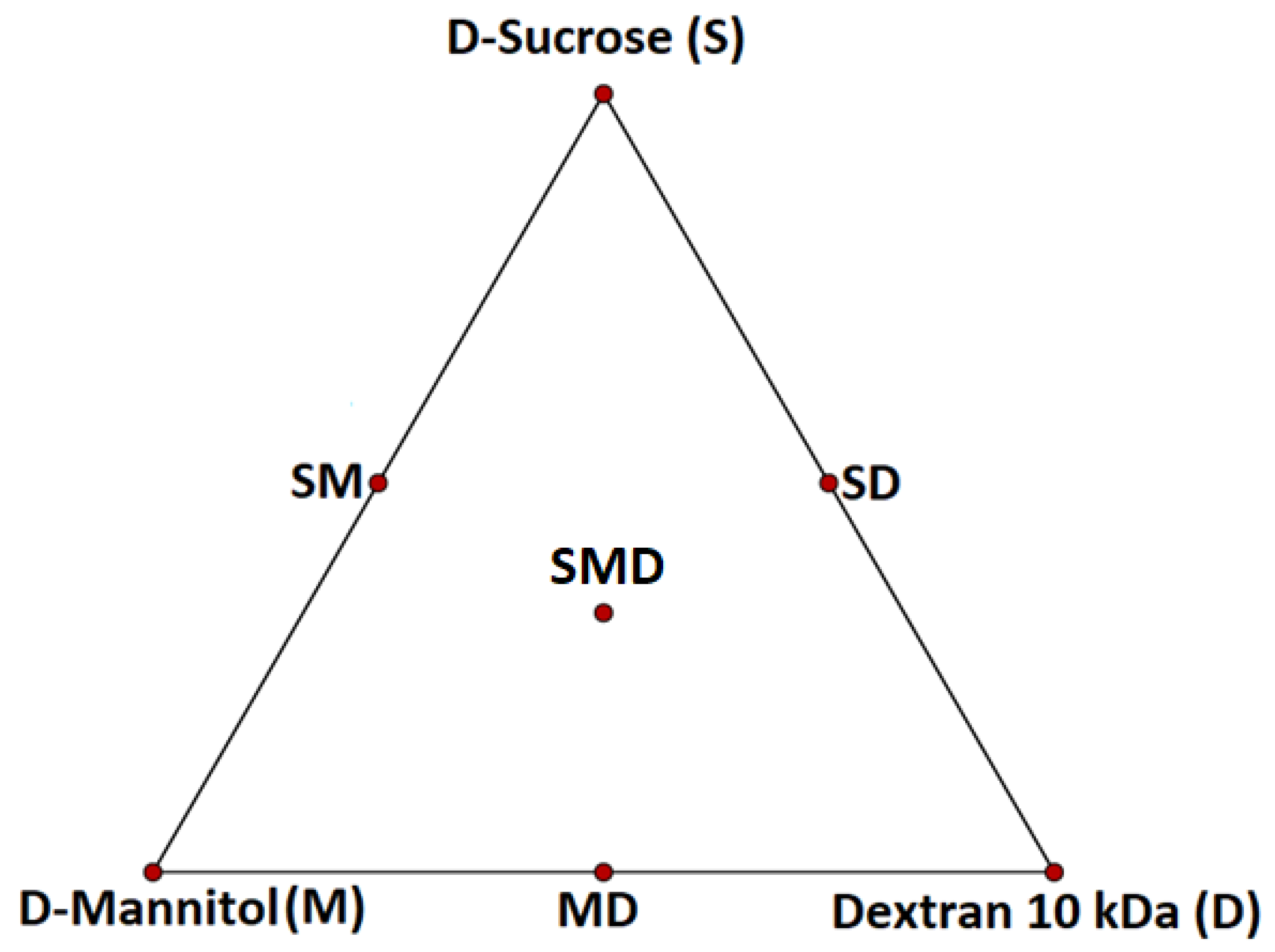
Figure 2.
(A) Soluble protein recovery (%) measured by the bicinchoninic acid assay, and (B) monomer recovery obtained by size-exclusion chromatography for the buffer study (type, pH, concentration). Results are expressed as the mean ± standard deviation (n=3). Statistical analysis was performed using one-way ANOVA and the post-hoc Tukey’s test. ** = p < 0.01, *** = p < 0.001, and **** = p < 0.0001. The reference for the monomer recovery is the non-formulated monoclonal antibody raw material.
Figure 2.
(A) Soluble protein recovery (%) measured by the bicinchoninic acid assay, and (B) monomer recovery obtained by size-exclusion chromatography for the buffer study (type, pH, concentration). Results are expressed as the mean ± standard deviation (n=3). Statistical analysis was performed using one-way ANOVA and the post-hoc Tukey’s test. ** = p < 0.01, *** = p < 0.001, and **** = p < 0.0001. The reference for the monomer recovery is the non-formulated monoclonal antibody raw material.
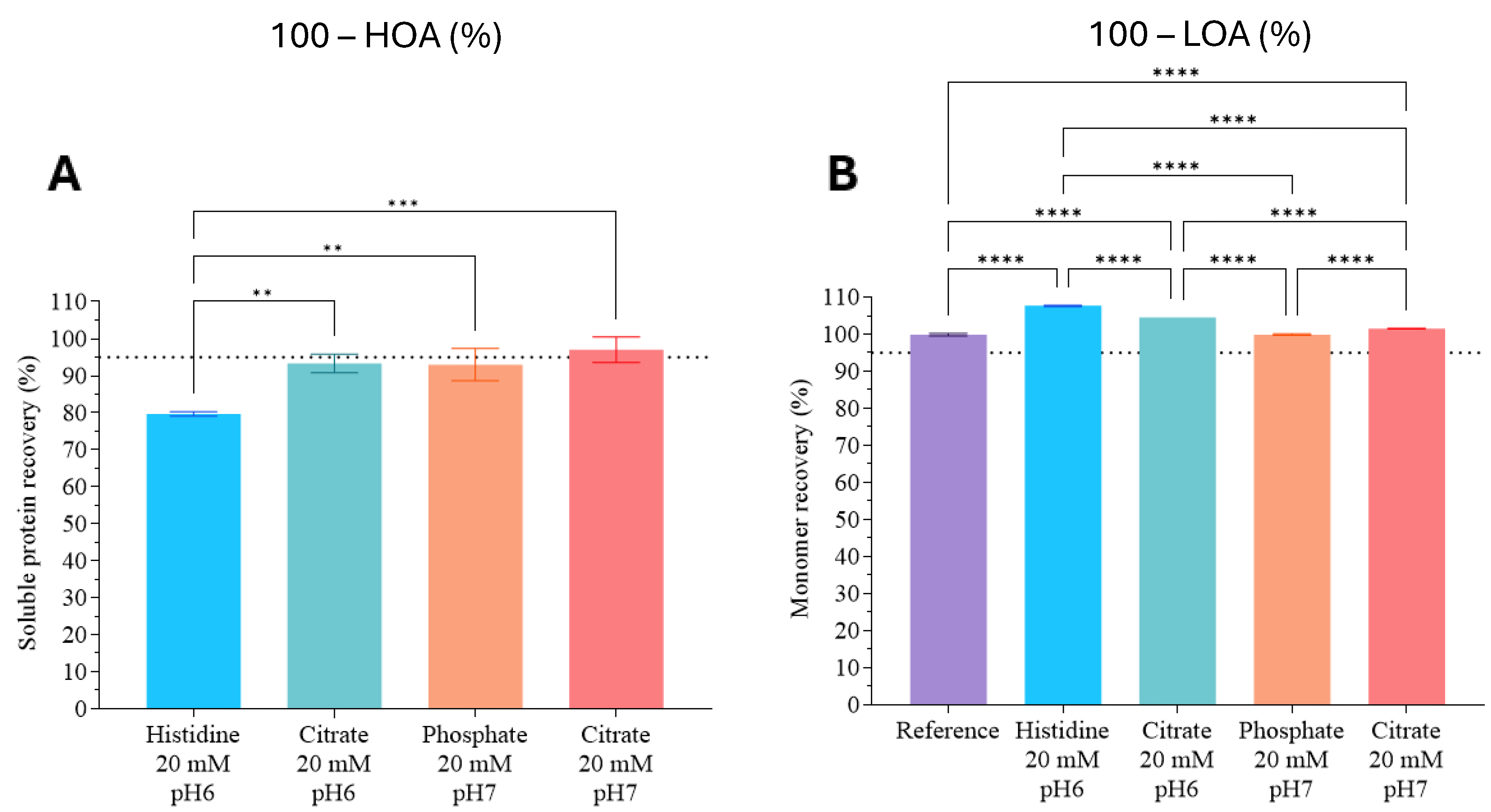
Figure 3.
Particle morphology image obtained using scanning electron microscopy (magnification 24.000x) for the spray-dried formulation with sucrose and dextran 10 kDa, but representative for all formulations. Particles have a smooth, dimpled shape (red circle) or a doughnut shape (blue circle).
Figure 3.
Particle morphology image obtained using scanning electron microscopy (magnification 24.000x) for the spray-dried formulation with sucrose and dextran 10 kDa, but representative for all formulations. Particles have a smooth, dimpled shape (red circle) or a doughnut shape (blue circle).
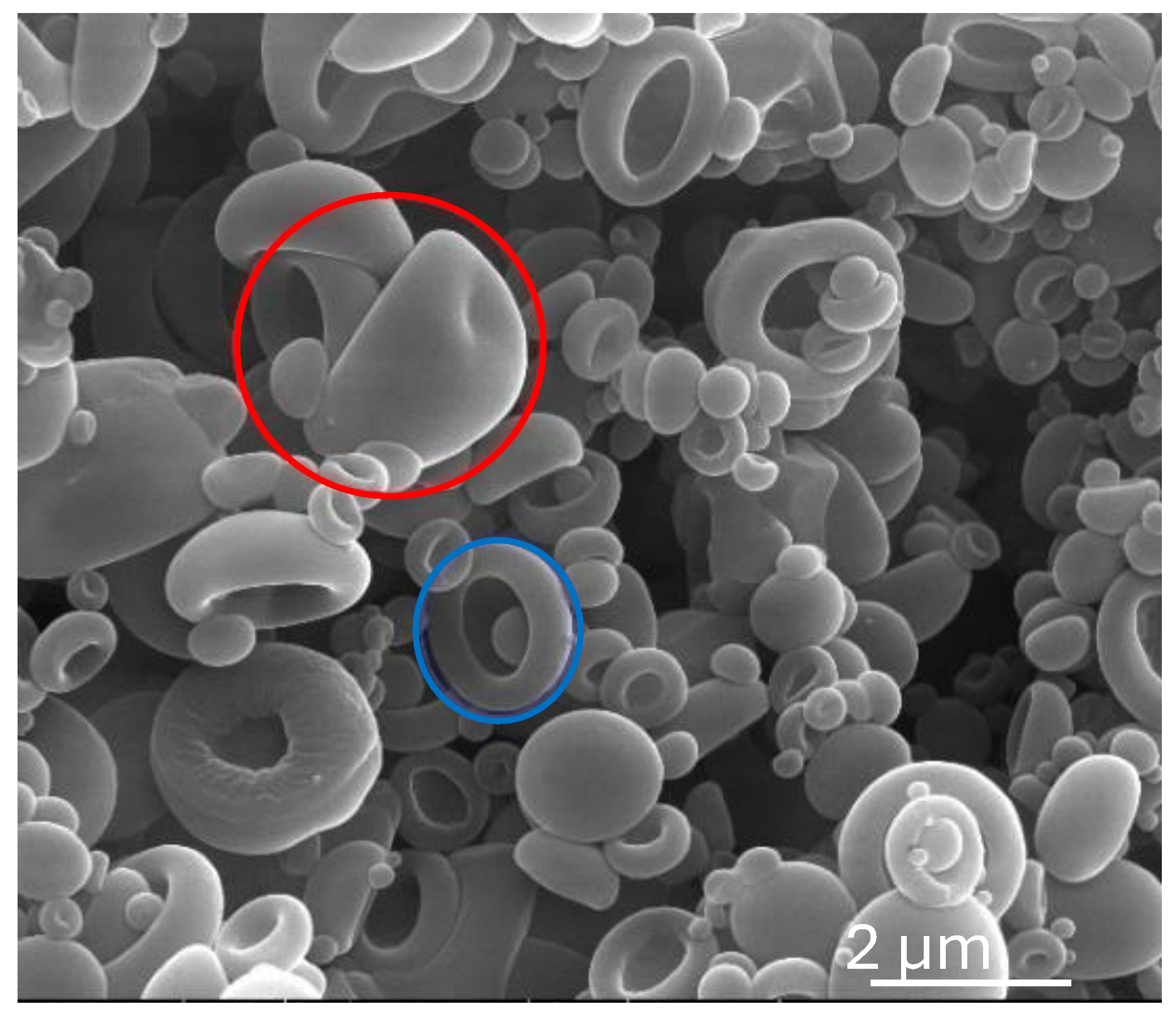
Figure 4.
(A) Residual moisture obtained during thermogravimetric analysis on 10-20 mg powder samples after spray-drying (T0), after 6 months (T6) and after 10 months (T10). (B) Glass transition temperature (Tg) of the powders after 10 months, obtained using modulated differential scanning calorimetry. Formulations were stored at room temperature in a desiccator with silica gel (n=1 for all experiments).
Figure 4.
(A) Residual moisture obtained during thermogravimetric analysis on 10-20 mg powder samples after spray-drying (T0), after 6 months (T6) and after 10 months (T10). (B) Glass transition temperature (Tg) of the powders after 10 months, obtained using modulated differential scanning calorimetry. Formulations were stored at room temperature in a desiccator with silica gel (n=1 for all experiments).
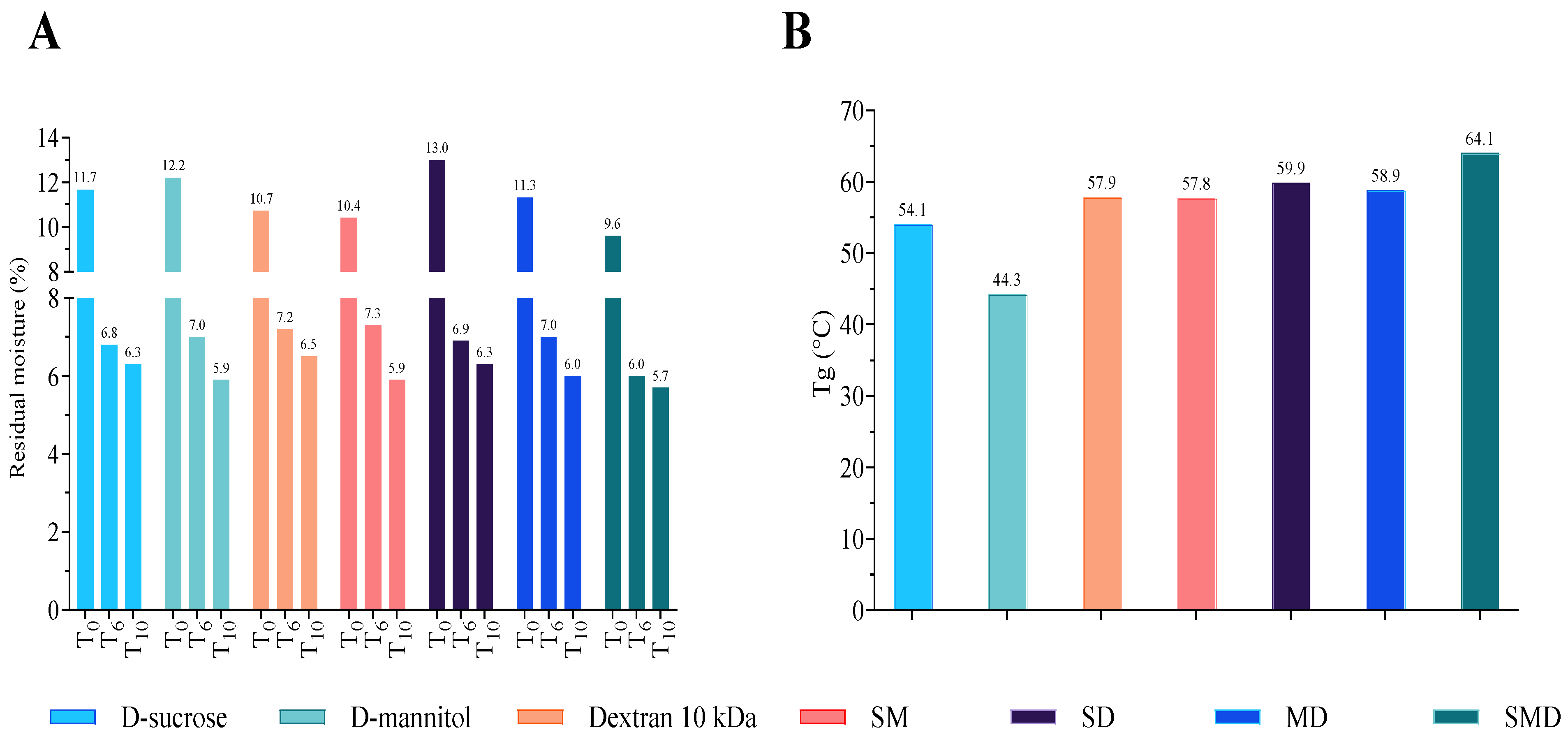
Figure 5.
Percentage of amorphous state obtained by X-ray diffraction on powder for the spray-dried formulations of polyclonal antibody generated at T0 (A to D) ; n=1. The Black curves represent a formulation with (A) no stabilizer, (B) D-sucrose, (C) MSD, and (D) dextran 10 kDa. The spectrum of the raw material, containing the polyclonal antibody, is overlaid in red. Amorphous content is expressed relative to raw material content.
Figure 5.
Percentage of amorphous state obtained by X-ray diffraction on powder for the spray-dried formulations of polyclonal antibody generated at T0 (A to D) ; n=1. The Black curves represent a formulation with (A) no stabilizer, (B) D-sucrose, (C) MSD, and (D) dextran 10 kDa. The spectrum of the raw material, containing the polyclonal antibody, is overlaid in red. Amorphous content is expressed relative to raw material content.
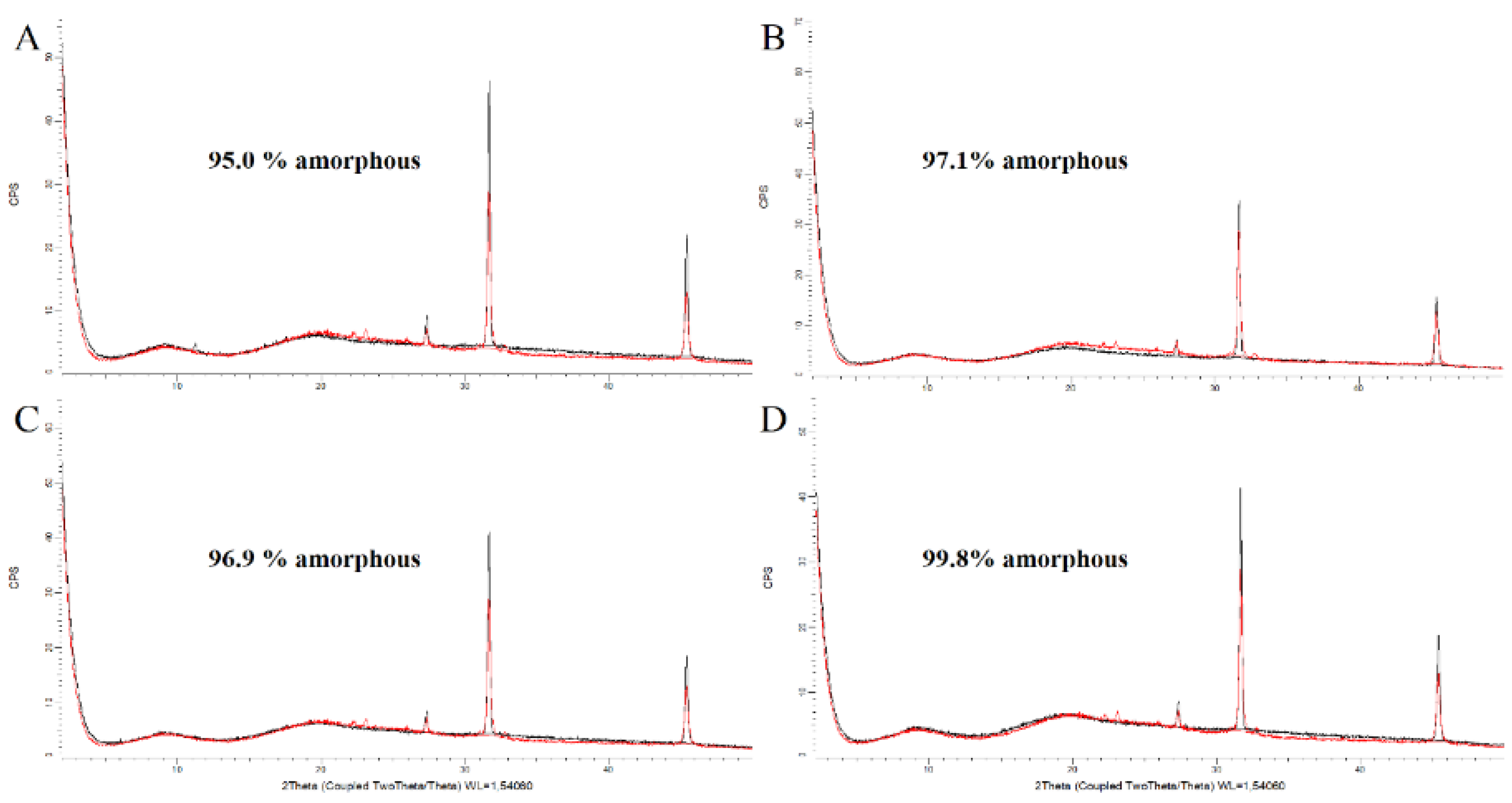
Figure 6.
Contour plots obtained from the modeling the individual responses and the desirability at T0 or T10. Desirability of the response is shown as a color gradient from blue (less desirable) to red (most desirable).
Figure 6.
Contour plots obtained from the modeling the individual responses and the desirability at T0 or T10. Desirability of the response is shown as a color gradient from blue (less desirable) to red (most desirable).
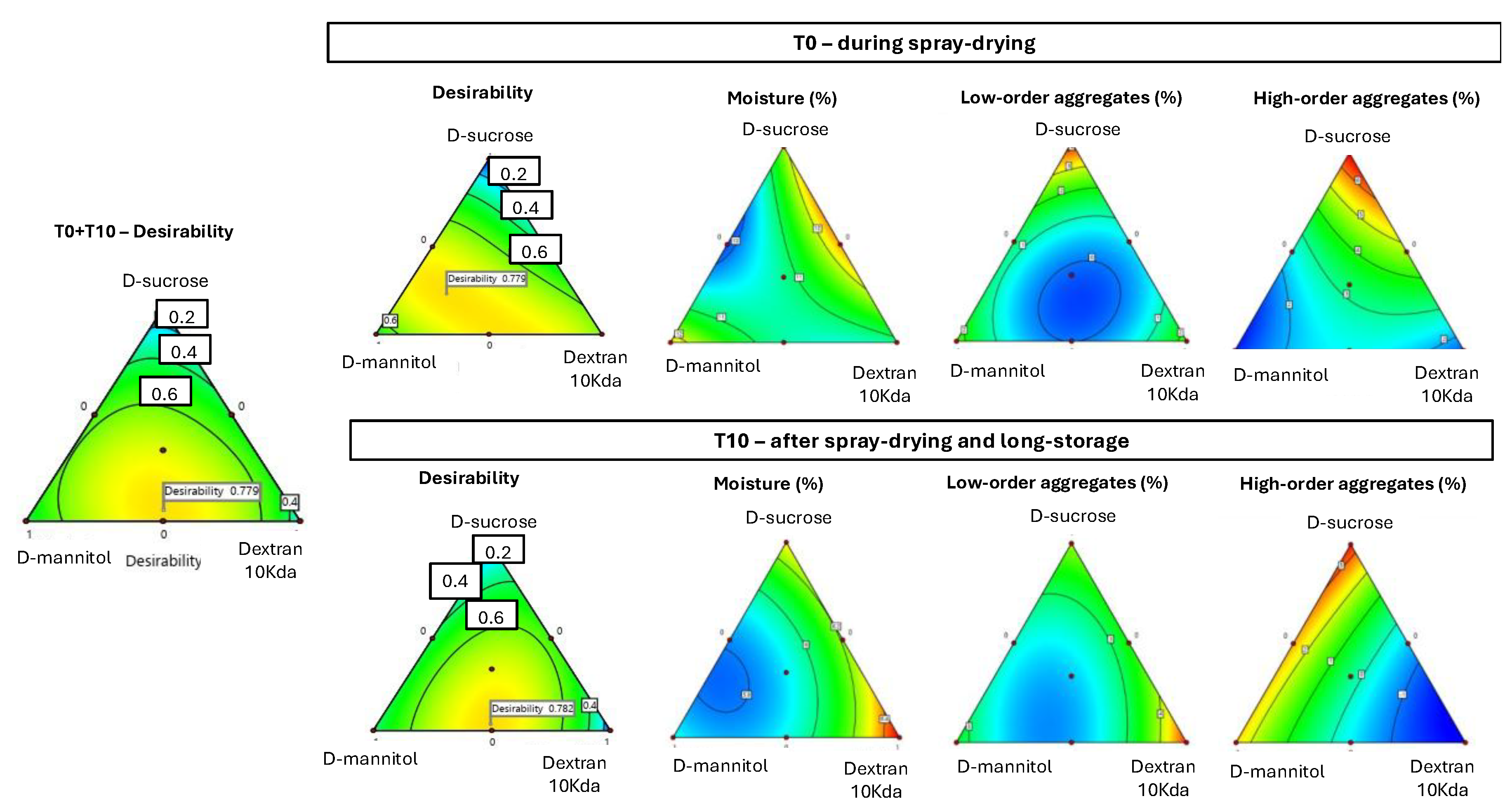
Figure 7.
Aerosol particle size distribution parameters using SprayTec laser diffraction including (A) the median diameter d(0.5), (B) the diameter at 90% of the particle size distribution d(0.9), (C) the volume-weighted-mean diameter D[4,3] and (D) the percentage of particles with a diameter inferior to 5 µm. The Axahaler® device was filled with a hydroxypropylmethylcellulose capsule containing 20 mg polyclonal DPIs. Mean ± standard deviation, n=3. Statistical analysis was performed using one-way ANOVA followed by Tukey’s test. Symbols are defined as * for p < 0.05. MS, D-mannitol/D-sucrose; SD, D-sucrose/dextran 10 kDa; MD, D-mannitol/ dextran 10 kDa; MSD, D-mannitol/D-sucrose/dextran 10 kDa.
Figure 7.
Aerosol particle size distribution parameters using SprayTec laser diffraction including (A) the median diameter d(0.5), (B) the diameter at 90% of the particle size distribution d(0.9), (C) the volume-weighted-mean diameter D[4,3] and (D) the percentage of particles with a diameter inferior to 5 µm. The Axahaler® device was filled with a hydroxypropylmethylcellulose capsule containing 20 mg polyclonal DPIs. Mean ± standard deviation, n=3. Statistical analysis was performed using one-way ANOVA followed by Tukey’s test. Symbols are defined as * for p < 0.05. MS, D-mannitol/D-sucrose; SD, D-sucrose/dextran 10 kDa; MD, D-mannitol/ dextran 10 kDa; MSD, D-mannitol/D-sucrose/dextran 10 kDa.
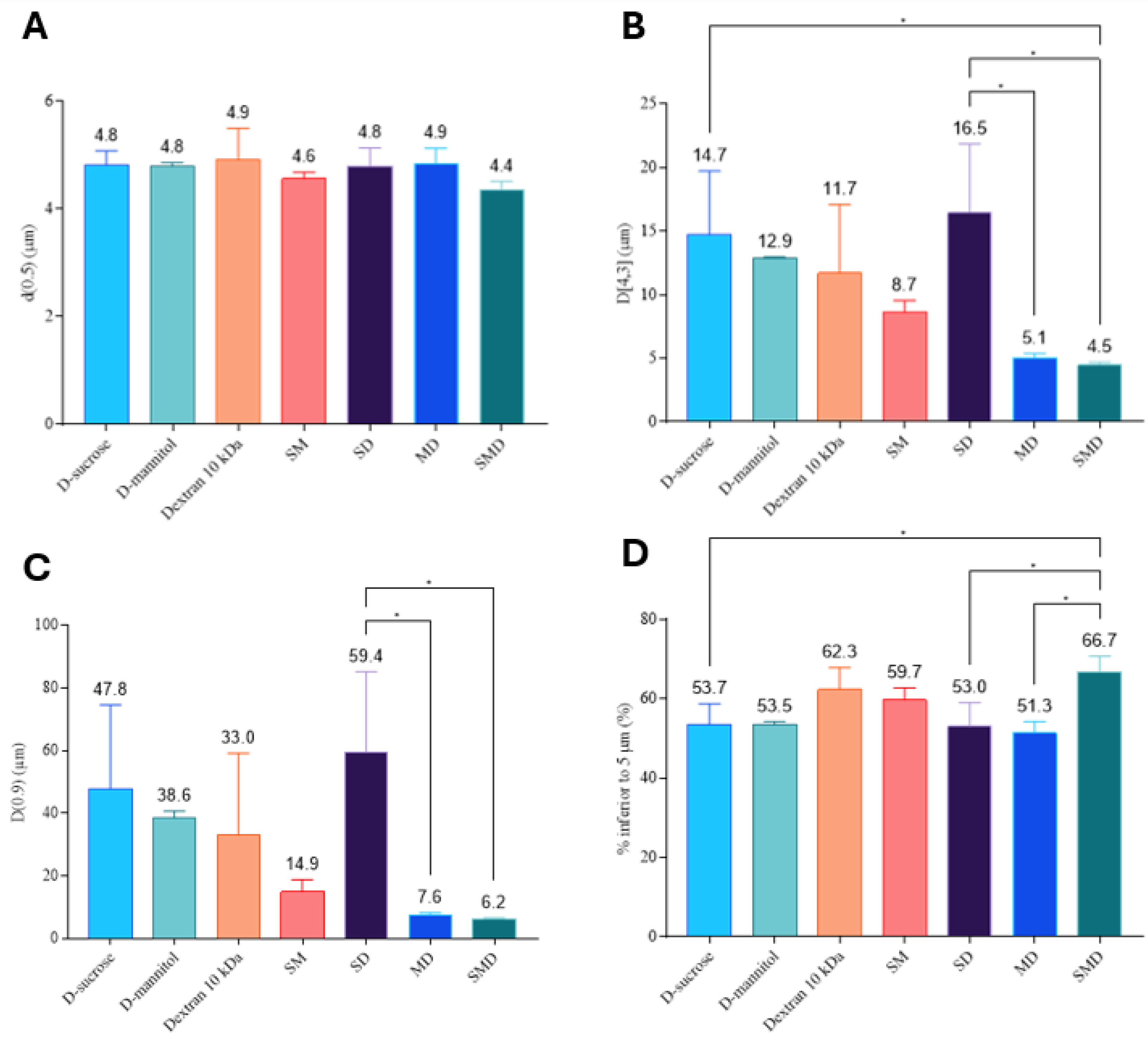
Figure 8.
Aerodynamic deposition profiles of the DPIs based on D-mannitol or on D-mannitol/ D-sucrose/ Dextran 10kda (MSD), Mean ± standard deviation, n= 3. The evaluation was made at 100 L/min during 2.4 s using a next-generation impactor connected to a low resistance Axahaler® device containing a hydroxypropyl methylcellulose capsule filled with 20 mg dried formulation, three capsules per test. Fine particle fraction is expressed relative to the nominal dose. Ind. Port, induction port; Pre-Sep., pre-separator. Cut-off sizes are given for each stage.
Figure 8.
Aerodynamic deposition profiles of the DPIs based on D-mannitol or on D-mannitol/ D-sucrose/ Dextran 10kda (MSD), Mean ± standard deviation, n= 3. The evaluation was made at 100 L/min during 2.4 s using a next-generation impactor connected to a low resistance Axahaler® device containing a hydroxypropyl methylcellulose capsule filled with 20 mg dried formulation, three capsules per test. Fine particle fraction is expressed relative to the nominal dose. Ind. Port, induction port; Pre-Sep., pre-separator. Cut-off sizes are given for each stage.
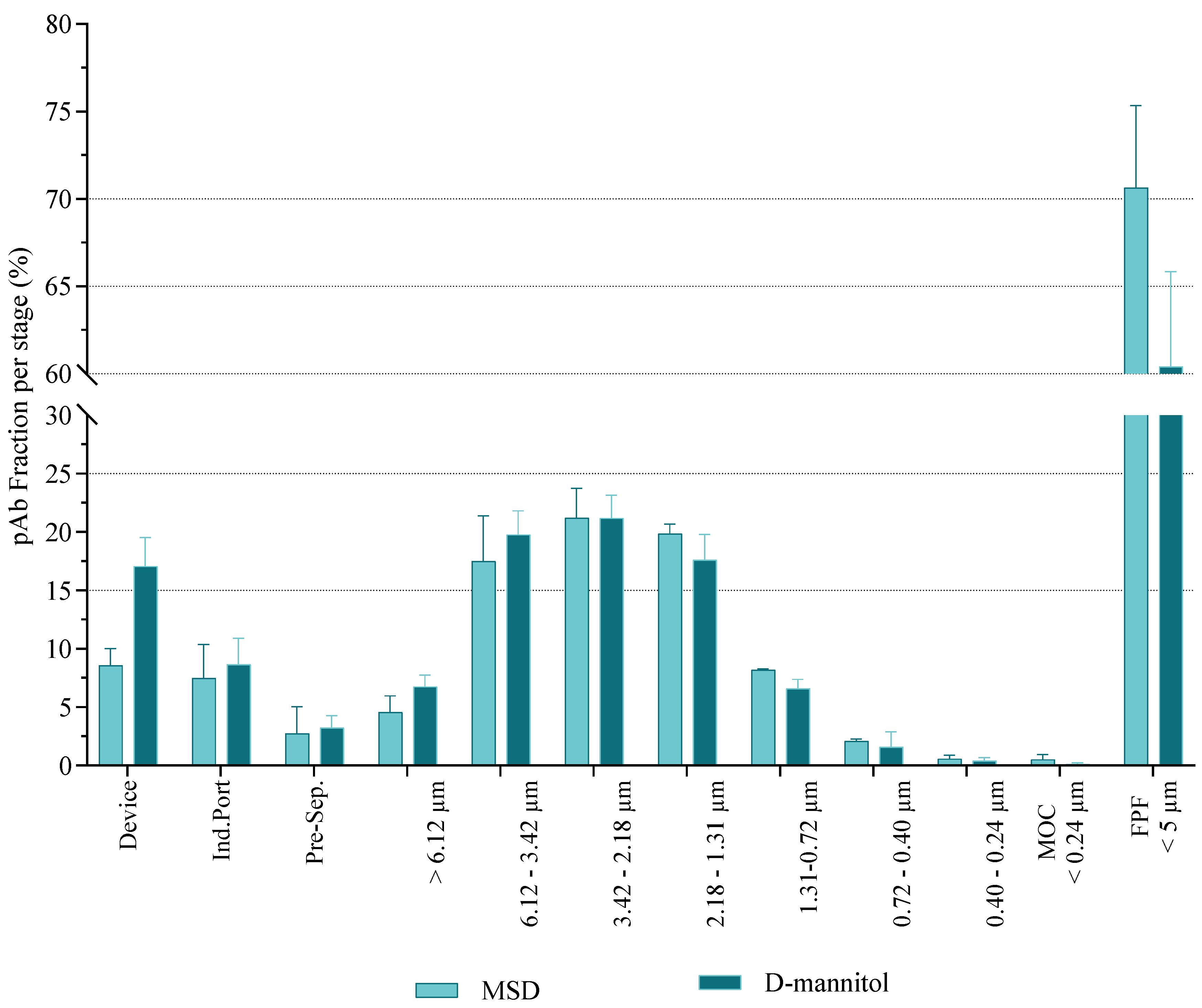

Table 1.
Theoretical compositions and yield (%) of the spray-dried DPI formulations including the polyclonal antibody and sugar derivatives. DPI-MS is based on D-mannitol/D-sucrose; DPI-SD on D-sucrose/dextran 10kDa; DPI-MD on D-mannitol/ dextran 10kDa; DPI-MSD on D-mannitol/D-sucrose/dextran 10kDa. a : percentage in relation to solid content ; b: sugar derivative percentage in relation to sugar derivative content.
Table 1.
Theoretical compositions and yield (%) of the spray-dried DPI formulations including the polyclonal antibody and sugar derivatives. DPI-MS is based on D-mannitol/D-sucrose; DPI-SD on D-sucrose/dextran 10kDa; DPI-MD on D-mannitol/ dextran 10kDa; DPI-MSD on D-mannitol/D-sucrose/dextran 10kDa. a : percentage in relation to solid content ; b: sugar derivative percentage in relation to sugar derivative content.
| DPI type | Polyclonal IgG (%) | Buffer (%) | Mannitol (%) | D-sucrose (%) | Dextran 10kDa (%) |
DPI Yield (%) |
| M | 60.7 (90%)a | 32.5 | 6.8 (10%) a 100%b |
- | - | 71.6 |
| S | 60.8 (90%)a | 32.3 | - | 6.8 (10%) a 100% b |
- | 79.1 |
| D | 61.0 (90%) a | 32.2 | - | - | 6.8 (10%) a 100% b |
75.6 |
| MS | 60.7 (90%) a | 32.4 | 3.4 (5%) a 50% b |
3.4 (5%) a 50% b |
- | 76.1 |
| MD | 60.8 (90%) a | 32.4 | 3.4 (5%) a 50% b |
- | 3.4 (5%) a 50% b |
76.6 |
| SD | 60.7 (90%) a | 32.3 | - | 3.4 (5%) a 50% b |
3.4 (5%) a 50% b |
79.6 |
| MSD | 60.9 (90%) a | 32.3 | 2.3 (3.3%) a 33% b |
2.3 (3.3%) a 33% b |
2.3 (3.3%) a 33% b |
75.3 |
Table 2.
High-order aggregate (HOA) and low-order of aggregate (LOA) percentages obtained for each DPI just after sprapy-drying (T0) and after 10 months in a desiccator at room temperature (T10), n=3.
Table 2.
High-order aggregate (HOA) and low-order of aggregate (LOA) percentages obtained for each DPI just after sprapy-drying (T0) and after 10 months in a desiccator at room temperature (T10), n=3.
| DPI | HOA (%) | LOA (%) | ||
| T0 | T10 | T0 | T10 | |
| S | 7 ± 2 | 3 ± 3 | 4.0 ± 2.0 | 4.07 ± 0.06 |
| M | 1 ± 5 | 2 ± 5 | 2.3 ± 0.9 | 3.50 ± 0.60 |
| D | 1 ± 1 | -2 ± 3 | 2.3 ± 0.4 | 5.20 ± 0.20 |
| MS | 3 ± 0 | 2 ± 3 | 1.6 ± 0.6 | 2.00 ± 0.30 |
| SD | 5 ± 2 | -1 ± 2 | 0.8 ± 0.3 | 2.80 ± 0.30 |
| MD | 3 ± 3 | -1 ± 2 | 0.2 ± 0.4 | 1.50 ± 0.30 |
| MSD | 2 ± 0 | 1 ± 1 | -0.6 ± 0.6 | 3.60 ± 1.20 |
Disclaimer/Publisher’s Note: The statements, opinions and data contained in all publications are solely those of the individual author(s) and contributor(s) and not of MDPI and/or the editor(s). MDPI and/or the editor(s) disclaim responsibility for any injury to people or property resulting from any ideas, methods, instructions or products referred to in the content. |
© 2026 by the authors. Licensee MDPI, Basel, Switzerland. This article is an open access article distributed under the terms and conditions of the Creative Commons Attribution (CC BY) license (http://creativecommons.org/licenses/by/4.0/).
Copyright: This open access article is published under a Creative Commons CC BY 4.0 license, which permit the free download, distribution, and reuse, provided that the author and preprint are cited in any reuse.


