

Submitted:
17 March 2026
Posted:
18 March 2026
You are already at the latest version
Abstract
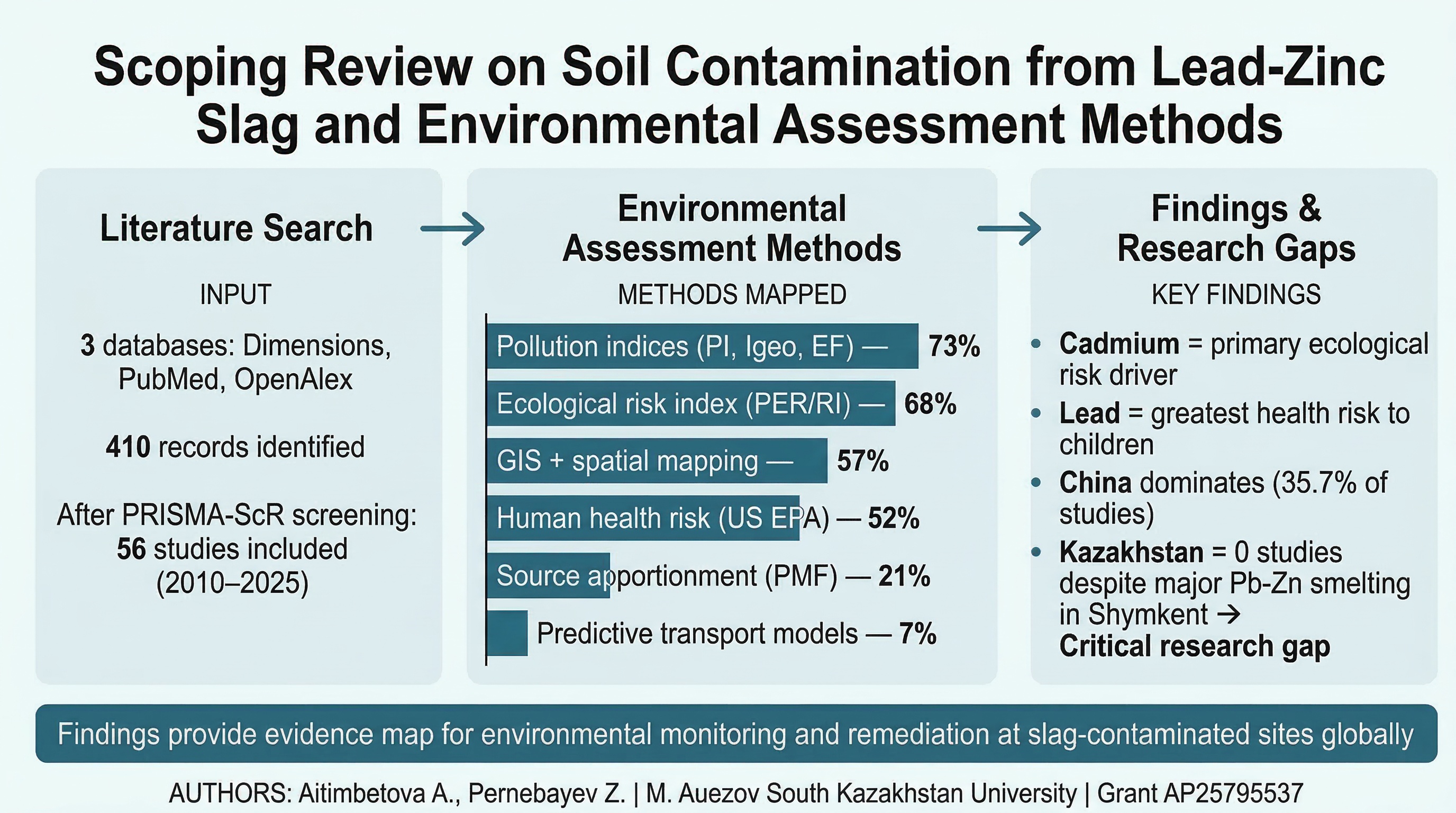
Lead-zinc slag and smelting activities represent a persistent global source of soil con-tamination, releasing toxic heavy metals — lead (Pb), zinc (Zn), cadmium (Cd), and arsenic (As) — with documented risks to ecosystems and human health. No systematic mapping of environmental assessment methods for slag-contaminated soils exists, and evidence from Central Asia remains entirely absent. This scoping review, following PRISMA-ScR 2018 guidelines, maps the global evidence base on soil contamination from lead-zinc slag and associated assessment methods. Searches across Dimensions, PubMed, and OpenAlex identified 410 records; 56 studies (2010–2025) met inclusion criteria. Studies were concentrated in China (35.7%), Poland (8.9%), and Brazil (7.1%); no studies from Kazakhstan were identified despite major Pb-Zn smelting operations in the Shymkent region. All studies reported heavy metal concentrations exceeding regulatory thresholds, with cadmium as the primary ecological risk driver and lead posing the greatest health risk to children. Assessment methods included pollution in-dices (73.2%), ecological risk assessment (67.9%), GIS-based spatial analysis (57.1%), human health risk frameworks (51.8%), and source apportionment models (50.0%). Post-2018 studies increasingly applied integrated multi-method frameworks. Critical gaps include the absence of Central Asian research, limited predictive modeling, and lack of standardized protocols. Findings provide a structured evidence map to guide environmental monitoring and remediation at slag-contaminated sites globally.
Keywords:
lead-zinc slag
; PRISMA-ScR
; soil contamination
; Kazakhstan
; heavy metals
1. Introduction
Soil contamination by heavy metals represents a pervasive global environmental challenge, affecting agricultural productivity, ecosystem health, and human well-being [1]. Heavy metals such as lead, zinc, cadmium, and arsenic, persist in soils due to their non-biodegradable nature, leading to bioaccumulation in food chains and posing risks of chronic toxicity, including neurological disorders, renal damage, and carcinogenicity [2]. According to global estimates, over 50 million hectares of agricultural land worldwide are contaminated by heavy metals [3], with Asia bearing the heaviest burden due to rapid industrialization and intensive mining activities [4,5]. In Europe and North America, legacy pollution from historical smelting operations continues to impact soils decades after facility closures [6]. These contaminants enter soils through atmospheric deposition, wastewater irrigation, agrochemical applications, and direct industrial discharges [4].
Industrial activities, particularly non-ferrous metal smelting and mining, are the primary anthropogenic sources of this pollution, with metallurgical slag — a byproduct of ore processing — making a significant contribution [7,8]. Lead-zinc smelting generates vast quantities of slag, often disposed of in landfills or reused without adequate environmental safeguards, resulting in the leaching of Pb, Zn, Cd, and As into surrounding soils [9]. Slag from Pb-Zn operations typically contains 1–5% Pb, 10–30% Zn, and variable Cd levels, far exceeding natural soil background concentrations [10]. Globally, the annual production of Pb-Zn slag exceeds 10 million tons, stockpiled near smelters in China, India, Australia, and Central Asia [11]. In mining districts of southern China, soil Pb concentrations near slag heaps reach 2,000 mg/kg — more than 100 times regulatory limits — while Zn levels surpass 5,000 mg/kg [12,13].
The geochemical instability of slag under varying environmental conditions exacerbates contamination. Acidic rainfall lowers soil pH and enhances metal solubilization [14], while organic matter increases metal bioavailability [15]. Redox fluctuations in waterlogged soils release bound metal ions into groundwater [16]. In arid regions, dust storms disperse fine slag particles over hundreds of kilometers, contaminating remote farmlands [17,18]. These processes create diffuse pollution plumes that infiltrate aquifers and river systems, extending contamination well beyond point sources.
Environmental risks are multifaceted. In agroecosystems, elevated Pb and Cd inhibit seed germination and reduce crop yields by 20–50% [19]. Plants such as rice and wheat hyperaccumulate Zn, transferring it to edible parts and posing dietary risks [20,21]. Soil microbial communities suffer enzyme activity declines of up to 70%, disrupting nutrient cycling [21,22]. Human exposure occurs via ingestion of contaminated produce, dust inhalation, and dermal contac [23,24]. Children are particularly vulnerable, with blood Pb levels above 5 μg/dL linked to irreversible IQ deficits [25]. Chronic Cd exposure induces itai-itai disease, characterized by severe bone pain and kidney failure [26].
Lead-zinc slag pollution exemplifies these risks globally [27,28]. In Yunnan province, China, decades of Pb-Zn smelting have contaminated over 1,000 km2 of farmland [12,29]. In Kabwe, Zambia, childhood blood Pb levels average 50 μg/dL — ten times WHO thresholds — due to slag recycling in informal economies [30,31,32]. In Kazakhstan, the Shymkent lead plant has generated millions of tons of slag over several decades, with documented soil Pb concentrations exceeding 3,000 mg/kg near the facility — more than 900 times the maximum permissible concentration — yet this site remains largely absent from the international peer-reviewed literature [33]. Climate change intensifies these threats: increased rainfall enhances leaching, while rising temperatures accelerate slag weathering and metal release [17,34,35,36].
Current environmental assessment methods include chemical analysis, GIS-based spatial mapping, bioindicators, and predictive modeling [37,38,39]. Sequential extraction procedures such as BCR differentiate metal fractions and inform bioavailability assessment [40,41]. Geostatistical tools including kriging interpolate contamination hotspots, while ecological risk indices quantify environmental threats [42,43,44]. However, these methods face limitations: high costs restrict adoption in low-resource settings; site-specific variability requires calibration; and insufficient integration of multi-media exposure pathways underestimates holistic risk [45,46]. Emerging tools such as diffusive gradients in thin films provide labile metal proxies, but standardization lags [47,48,49].
Despite extensive global research on heavy metal contamination near smelting areas, studies specifically addressing lead-zinc slag and employing systematic environmental assessment remain fragmented [10,11,12,50]. Existing research is concentrated in China, Europe, and parts of South America, with Central Asia — particularly Kazakhstan — entirely unrepresented in the peer-reviewed literature despite hosting major Pb-Zn smelting infrastructure [51]. Furthermore, no scoping review has systematically mapped the diversity of assessment methods applied across slag-contaminated sites globally, limiting methodological standardization and evidence synthesis.
This scoping review addresses these gaps by systematically mapping the global evidence base on soil contamination from lead-zinc slag and the environmental assessment methods employed in primary studies. Following PRISMA-ScR 2018 guidelines [50], the review pursues three objectives: (1) to characterize the scope and distribution of soil contamination from Pb-Zn slag and smelting activities reported in the literature; (2) to identify and categorize environmental assessment and predictive modeling methods applied across study contexts; and (3) to identify geographic, methodological, and thematic research gaps with particular relevance to Kazakhstan and Central Asia.
2. Materials and Methods
2.1. Study Design
This scoping review was conducted in accordance with PRISMA-ScR 2018 guidelines [50]. The review protocol is publicly registered at OSF: https://osf.io/ktg86 (registered 16 March 2026). The review was funded by grant AP25795537 of the Science Committee of the Ministry of Science and Higher Education of the Republic of Kazakhstan.
2.2. Eligibility Criteria
Studies were selected using the Population, Concept, and Context (PCC) framework. The Population comprised soils contaminated by lead-zinc slag or associated smelting and mining activities. The Concept encompassed ecological assessment methods and predictive modeling approaches for evaluating soil contamination. The Context included industrial sites globally, with particular relevance to the Shymkent region of Kazakhstan.
Inclusion criteria were: (1) peer-reviewed journal articles published between January 2010 and March 2025; (2) studies reporting soil contamination directly linked to lead-zinc slag, smelter emissions, or metallurgical waste; (3) studies employing at least one environmental assessment or predictive modeling method; and (4) publications available in English.
Exclusion criteria were: (1) studies focused exclusively on construction material applications of slag without environmental assessment; (2) wastewater treatment studies without soil contamination data; (3) pyrometallurgical metal recovery processes; (4) solidification/stabilization technology studies without field environmental data; and (5) publications prior to 2010.
2.3. Information Sources and Search Strategy
A systematic literature search was conducted on 16 March 2026 across three databases: Dimensions (n = 351), PubMed (n = 10), and OpenAlex (n = 49), yielding 410 records in total. The following Boolean search string was applied uniformly across all databases:
("lead-zinc slag" OR "Pb-Zn slag" OR "zinc slag" OR "lead slag") AND ("soil contamination" OR "soil pollution" OR "heavy metals" OR "environmental assessment" OR "remediation")
2.4. Study Selection and Screening Process
All retrieved records were imported into Rayyan (rayyan.ai) for systematic management [52]. After automated and manual duplicate removal (n = 27), a total of 383 records underwent title and abstract screening by one reviewer against the predefined eligibility criteria. Records clearly not meeting inclusion criteria were excluded (n = 253), yielding 130 records for full-text assessment. Following full-text screening, 56 studies met all inclusion criteria and were retained for data extraction and evidence mapping. The study selection process is illustrated in the PRISMA-ScR flow diagram (Figure 1).
2.5. Data Extraction and Evidence Mapping
Data were extracted from the 56 included studies using a standardized charting form implemented in Elicit (elicit.com) and Microsoft Excel. Extracted variables included: bibliographic details (authors, publication year, journal); geographic scope (country, region); contamination source (slag type, smelter, tailings, mine); heavy metals analyzed; environmental assessment methods employed; predictive or transport models used; number of soil samples collected; and key findings regarding contamination levels and risks.
The study selection process and the number of records included at each stage are illustrated in the PRISMA-ScR flow diagram.
3. Results
3.1. Study Selection and PRISMA Flow
The systematic search across Dimensions, PubMed, and OpenAlex identified 410 records. Following the removal of 27 duplicate records, 383 records underwent title and abstract screening. Of these, 253 records were excluded as they did not meet the inclusion criteria, primarily because they focused on construction material applications of slag, wastewater treatment, or pyrometallurgical metal recovery processes without environmental soil assessment. The remaining 130 records proceeded to full-text assessment, of which 56 studies met all inclusion criteria and were included in the final scoping review. The study selection process is presented in Figure 1.
3.2. Characteristics of Included Studies
The 56 included studies were published between 2010 and 2025, with a marked increase in publication frequency after 2020, reflecting growing global concern over the environmental impacts of metallurgical waste. Specifically, 15 studies were published between 2010 and 2017, compared with 41 between 2018 and 2025, representing a 2.7-fold increase. Study designs were predominantly empirical field investigations, with the majority collecting soil samples from sites adjacent to active or abandoned lead-zinc smelters, slag heaps, or tailings deposits. Peer-reviewed journal articles constituted all included publications. The characteristics of included studies are summarized in Table 1.
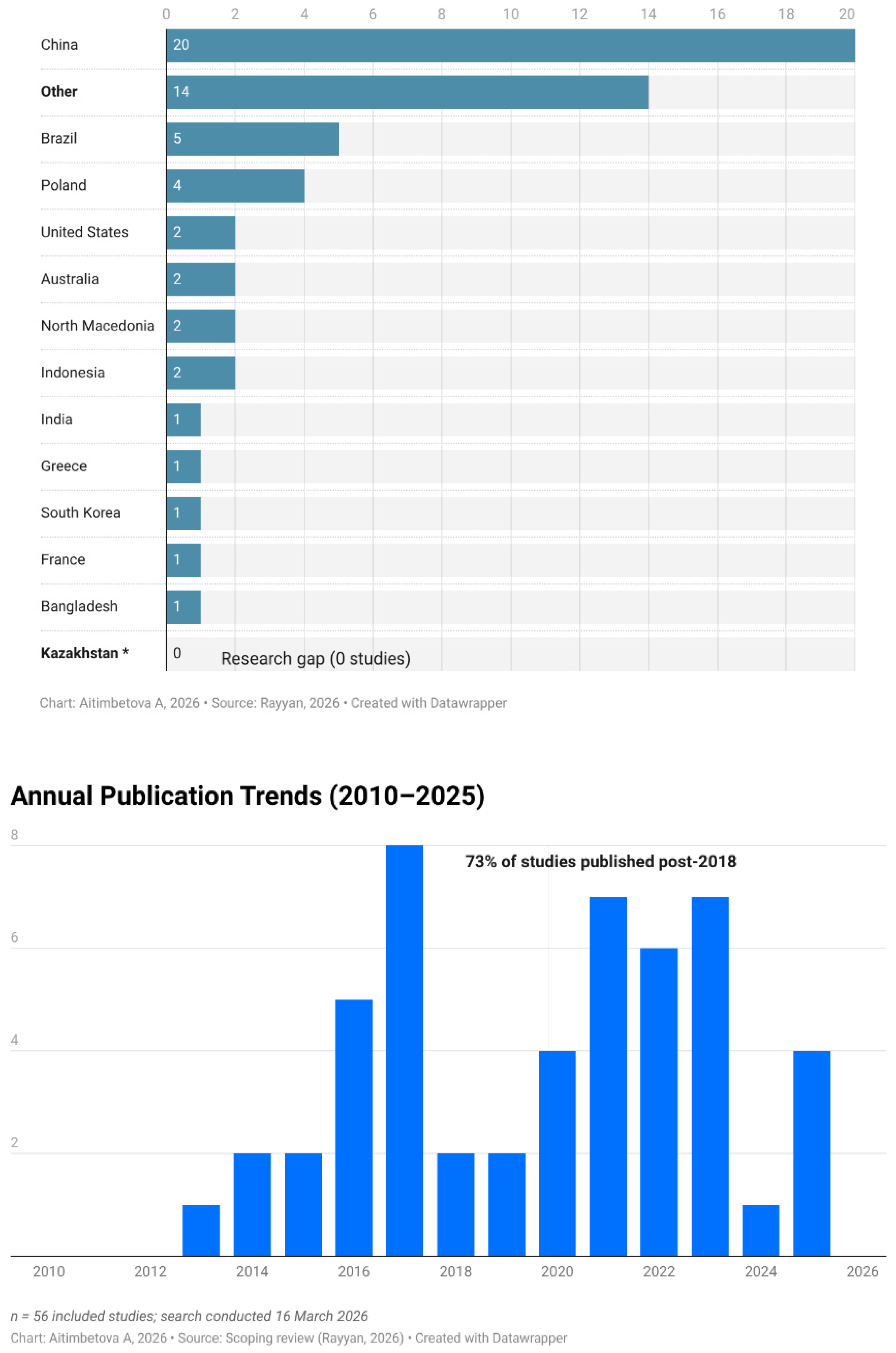
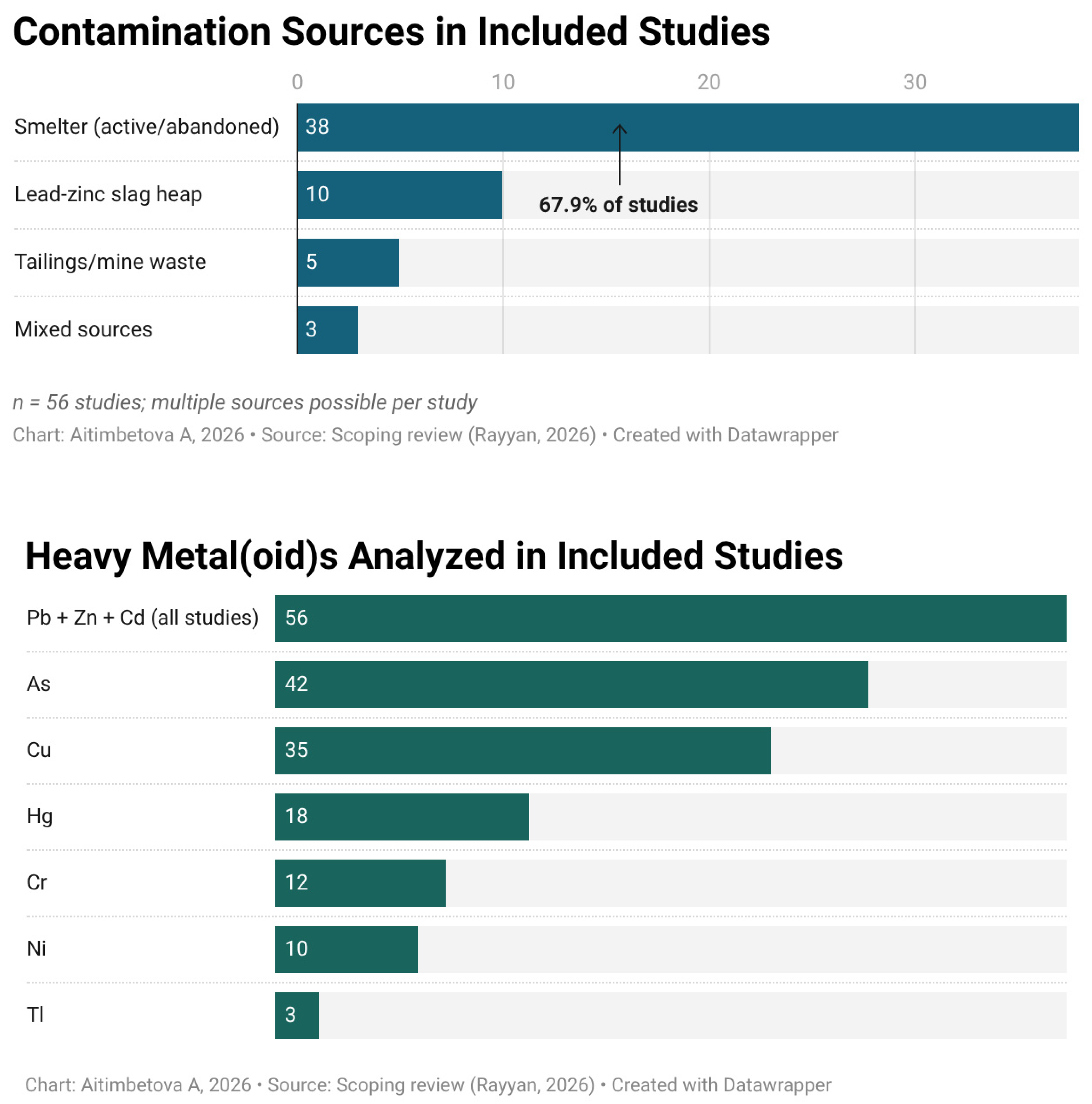
Figure 2.
Bibliometric characteristics of included studies (n = 56): (a) annual publication trends, 2010–2025; (b) geographic distribution by country; (c) frequency of environmental assessment methods applied; (d) distribution of study design types.
Figure 2.
Bibliometric characteristics of included studies (n = 56): (a) annual publication trends, 2010–2025; (b) geographic distribution by country; (c) frequency of environmental assessment methods applied; (d) distribution of study design types.
3.3. Geographic Distribution of Studies
The 56 included studies exhibited a pronounced geographic concentration in regions with established lead-zinc smelting histories. China dominated the literature with 20 studies (35.7%) [53,54,55,56,57,58], reflecting the country's status as the world's largest lead and zinc producer [59]. Poland contributed five studies (8.9%) [60,61], primarily examining legacy contamination from historical Pb-Zn mining districts. Brazil accounted for four studies (7.1%) [62,63,64], with particular focus on the Santo Amaro [63] former smelter site in Bahia state. The United States and Australia each contributed two studies (3.6%), while Bangladesh [65], India [66], Indonesia [67,68], France, Greece [69,70], South Korea [71], and the Republic of Macedonia [72] each contributed 1–2 studies [58,73,74]. The geographic distribution is presented in Figure 3.
Critically, no studies were identified from Kazakhstan despite the presence of one of Central Asia's largest lead-zinc smelting complexes in the Shymkent region [75], representing a significant research gap with direct relevance to this review. Central Asia as a whole was absent from the identified literature, highlighting a major geographic underrepresentation in the global evidence base.
3.4. Environmental Assessment Methods Used in the Literature
The 56 included studies employed a diverse range of environmental assessment methods, which were categorized into five primary groups: pollution indices, ecological risk assessment, human health risk assessment, spatial analysis, and advanced analytical and modeling approaches. Many studies applied multiple methods simultaneously, reflecting a trend toward integrated assessment frameworks.
3.4.1. Pollution Indices
Pollution indices were the most frequently applied assessment tools, used in 41 studies (73.2%). The most common indices included the Single Factor Pollution Index (PI), the Nemerow Synthetic Pollution Index (NSPI), the Geoaccumulation Index (Igeo) [76], and the Enrichment Factor (EF) [77]. These indices provide standardized quantitative measures of contamination relative to background or regulatory threshold values, enabling comparison across study sites and metals.
3.4.2. Ecological Risk Assessment
Ecological risk assessment methods were applied [78] in 38 studies (67.9%). The Potential Ecological Risk Index (PER/RI) [62,79], originally developed by Hakanson (1980), was the most widely used approach, calculating risk based on metal toxicity response coefficients and contamination factors. Risk grades ranged from low to significantly high ecological risk, with cadmium (Cd) consistently identified as the primary driver of high ecological risk across studies due to its high toxicity coefficient [80,81].
3.4.3. Human Health Risk Assessment
Human health risk assessment following the United States Environmental Protection Agency (US EPA) [82] framework was applied in 29 studies (51.8%). These assessments calculated non-carcinogenic hazard quotients (HQ) and hazard indices (HI), as well as carcinogenic risk indices (CR/TCR) for adults and children separately, considering exposure pathways including ingestion, dermal contact, and inhalation [83,84]. Six studies employed Monte Carlo simulation for probabilistic risk assessment (10.7%) [85,86].
3.4.4. Spatial Analysis Methods
Geospatial analysis was employed in 32 studies (57.1%) [71,87,88]. Geographic Information Systems (GIS) with kriging interpolation were used for spatial distribution mapping [89,90] and contamination hotspot identification. Principal Component Analysis (PCA) and Cluster Analysis (CA) were applied in 28 studies (50.0%) [91] to identify sources and differentiate anthropogenic from geogenic metal contributions. Positive Matrix Factorization (PMF) [92] and APCS-MLR receptor models were used in 12 studies (21.4%) for quantitative source apportionment [93].
3.4.5. Advanced Analytical and Modeling Approaches
Advanced analytical techniques were applied across multiple studies. Portable X-ray fluorescence (pXRF) was used for rapid field screening in eight studies (14.3%) [94,95,96]. Lead isotope ratio analysis (206Pb/207Pb) for source tracing was applied [97]. Sequential extraction procedures (BCR, Tessier) for metal fractionation and bioavailability assessment were employed in nine studies [98] (16.1%). Predictive transport modeling including Hydrus-1D simulations and multisurface geochemical modeling was used in four studies (7.1%) [99,100,101]. Biological and ecotoxicological methods including microbial community analysis (16S rRNA), phytotoxicity bioassays, and enzymatic biomarkers (dehydrogenase activity) were applied in 14 studies (25.0%) [102,103]. The distribution of assessment methods is summarized in Table 2.
| Assessment Method | n | % |
| Pollution indices (PI, Nemerow, Igeo, EF) | 41 | 73.2 |
| Ecological risk index (PER/RI) | 38 | 67.9 |
| GIS + spatial mapping (kriging) | 32 | 57.1 |
| Human health risk (US EPA, HQ/HI) | 29 | 51.8 |
| PCA + Cluster Analysis | 28 | 50.0 |
| PMF source apportionment | 12 | 21.4 |
| Sequential extraction (BCR/Tessier) | 9 | 16.1 |
| Microbial community (16S rRNA) | 8 | 14.3 |
| pXRF field screening | 8 | 14.3 |
| Monte Carlo simulation | 6 | 10.7 |
| Phytoremediation + BCF/TF | 6 | 10.7 |
| Pb isotope tracing | 5 | 8.9 |
| Predictive transport models (Hydrus-1D) | 4 | 7.1 |
| Ecotoxicology (PICT, bioassays) | 4 | 7.1 |
| Geophysical methods (GPR, radionuclides) | 3 | 5.4 |
| LCA / Material flow analysis | 2 | 3.6 |
| Note: PI = Pollution Index; Igeo = Geoaccumulation Index; EF = Enrichment Factor; PER/RI = Potential Ecological Risk Index; GIS = Geographic Information System; PCA = Principal Component Analysis; PMF = Positive Matrix Factorization; BCR = Bureau Communautaire de Référence; pXRF = portable X-ray fluorescence; BCF = Bioconcentration Factor; TF = Translocation Factor; GPR = Ground-Penetrating Radar; LCA = Life Cycle Assessment; PICT = Pollution-Induced Community Tolerance. | ||
3.5. Evidence Mapping of Research Themes
Analysis of the 56 included studies revealed four dominant research themes: (1) contamination characterization and spatial distribution; (2) ecological and human health risk assessment; (3) environmental assessment methodology and validation; and (4) remediation and ecological restoration approaches.
Contamination characterization was the most prevalent theme, addressed in 45 studies (80.4%), with all studies reporting elevated concentrations of Pb, Zn, and Cd exceeding national or international regulatory thresholds [67,104]. Ecological and human health risk assessment was addressed in 38 studies (67.9%) [67,73], with Cd consistently identified as the primary ecological risk driver and Pb as the dominant human health concern, particularly for children through soil ingestion [64,81,105]. Methodological studies validating or comparing assessment approaches appeared in 12 studies (21.4%), including comparisons of pXRF versus ICP-MS [106], and evaluations of different extraction schemes for bioavailability assessment [78]. Remediation-oriented studies including phytoremediation, electrokinetic remediation, and geophysical contamination mapping appeared in 14 studies (25.0%) [60,107].
A notable temporal trend was observed: studies published before 2018 predominantly focused on contamination characterization (88%), while post-2018 studies increasingly integrated multiple assessment methods and predictive modeling (61%), reflecting methodological maturation in the field [88].
4. Discussion
This scoping review synthesizes evidence from 56 studies published between 2010 and 2025, mapping the global landscape of environmental assessment methods applied to soils contaminated by lead-zinc slag and associated smelting activities. The findings reveal significant advances in methodological diversity, a pronounced geographic concentration of research in Asia, and critical knowledge gaps relevant to Central Asia and Kazakhstan specifically.
Figure 4 illustrates the integrated assessment framework.
4.1. Research Trends in Soil Contamination from Lead-Zinc Slag
The marked increase in publications after 2018, with 41 of 56 studies (73.2%) published in this period, reflects growing global regulatory pressure and scientific concern over the environmental legacy of metallurgical waste [10,108]. Early studies predominantly focused on basic characterization of total heavy metal concentrations, whereas post-2018 research increasingly integrates multi-method frameworks combining spatial analysis, probabilistic risk modeling, and microbial assessment [109,110]. This methodological maturation aligns with international recognition that single-method approaches are insufficient for capturing the dynamic, spatially heterogeneous nature of slag-derived contamination [111].
The dominance of China in the literature (n = 20, 35.7%) reflects the country's position as the world's largest lead and zinc producer, with extensive documented contamination around smelting complexes in Hunan, Yunnan, Guizhou [112], and Henan provinces [12,56,58,113]. European contributions, primarily from Poland and legacy sites in the Linares district of Spain [114], emphasize long-term historical contamination and remediation challenges [114,115]. The near-complete absence of studies from Central Asia, and Kazakhstan in particular, represents a critical evidence gap given the scale of Pb-Zn smelting operations in the Shymkent region, one of the largest in the former Soviet Union [116,117].
4.2. Advances in Environmental Assessment Methods
The diversity of assessment methods identified across 56 studies reflects substantial progress in the field. Pollution indices including the Single Factor Pollution Index, Nemerow Synthetic Pollution Index, and Geoaccumulation Index were the most widely applied tools (73.2%), providing standardized, comparable measures of contamination severity relative to background values [118,119,120,121]. Their widespread adoption across different national regulatory contexts — including Chinese GB standards, US EPA thresholds, and European ANZECC guidelines — underscores their utility as universal screening tools, though direct cross-study comparison remains limited by differences in reference values [122,123].
Ecological risk assessment using the Potential Ecological Risk Index [124,125] was applied in 67.9% of studies, consistently identifying cadmium as the primary ecological risk driver due to its high toxicity response coefficient [126]. This finding has particular implications for slag-contaminated sites, where Cd co-occurs with Pb and Zn as a product of polymetallic ore processing and exhibits high mobility under acidic soil conditions [127,128].
Human health risk assessment following US EPA guidelines was applied in 51.8% of studies, with children consistently identified as the most vulnerable population group due to higher soil ingestion rates and developing physiological systems [129]. The adoption of Monte Carlo [85] simulation for probabilistic risk assessment in 10.7% of studies represents a methodological advance over deterministic approaches, providing uncertainty quantification essential for evidence-based remediation planning [130,131].
Geospatial methods including GIS-based kriging interpolation and source apportionment models (PMF, PCA) were applied in over 50% of studies, enabling spatial visualization of contamination gradients and quantitative differentiation of anthropogenic versus geogenic metal sources [93,132]. The integration of portable XRF for rapid field screening, validated against ICP-MS [90] in multiple studies, demonstrates the potential for cost-effective large-scale soil surveys in resource-limited settings [133].
Emerging approaches including predictive transport modeling (Hydrus-1D), multisurface geochemical modeling, lead isotope tracing, and biological assessment methods (16S rRNA microbial analysis, PICT ecotoxicology, enzymatic biomarkers) appeared in a smaller proportion of studies but represent important methodological frontiers [53,134]. Their limited application in slag-specific contexts highlights opportunities for methodological transfer from adjacent fields.
4.3. Research Gaps and Future Directions
Several critical research gaps emerge from this review. First, the absence of studies from Kazakhstan and Central Asia represents the most geographically significant gap. The Shymkent lead plant, one of the largest in Central Asia, has operated for decades generating substantial slag deposits, yet no peer-reviewed environmental assessment studies meeting international methodological standards were identified [33,135]. This gap is particularly concerning given documented soil lead concentrations exceeding 3,000 mg/kg near the plant—more than 900 times the maximum permissible concentration—with documented health impacts on local populations [136].
Second, predictive modeling approaches remain underrepresented in the slag-specific literature. Only four studies (7.1%) employed transport or fate models to forecast metal migration under varying environmental conditions such as acid rain, climate variability, or land-use change [137,138]. Given the long-term persistence of slag deposits and projected changes in precipitation patterns across Central Asia, predictive modeling represents an urgent research priority.
Third, standardized multi-method assessment frameworks are lacking. The heterogeneity of methods, reference values, and reporting standards across studies severely limits cross-site comparability and policy translation [139]. Development of internationally harmonized protocols for slag-contaminated site assessment, analogous to existing frameworks for mine tailings, is warranted.
Fourth, biological and ecotoxicological assessment methods — including microbial community analysis, phytotoxicity bioassays, and enzymatic biomarkers — remain underutilized relative to chemical methods. These approaches provide integrative measures of ecosystem health that chemical indices alone cannot capture [140,141].
The identified research priorities are summarized in Figure 5.
4.4. Relevance to Kazakhstan and Central Asia
The findings of this review have direct implications for environmental management in Kazakhstan. The Shymkent region hosts one of Central Asia's largest lead-zinc smelting complexes, with slag deposits accumulated over several decades of intensive industrial activity [33,142]. However, the methodological toolkit used globally — including GIS-based spatial risk mapping, PMF source apportionment, US EPA health risk frameworks, and predictive transport modeling — has not been applied systematically in this context.
The geographic bias toward Chinese and European study sites, while reflecting genuine research capacity disparities, also suggests that established assessment methods developed in these contexts may require adaptation to the specific soil types, climate conditions, and regulatory frameworks of Kazakhstan and Central Asia. The semi-arid climate of the Shymkent region, for example, differs substantially from the humid subtropical conditions prevalent in Chinese study sites [143,144,145], potentially affecting metal mobility, bioavailability, and remediation efficacy in ways not captured by existing models [146].
4.5. Limitations of the Review
This review has several limitations that should be acknowledged. The literature search was restricted to three databases — Dimensions, PubMed, and OpenAlex — which, while complementary, may have excluded relevant studies indexed in Russian-language databases such as eLIBRARY.ru or regional Central Asian repositories. This limitation is particularly relevant given the research gap identified in Kazakhstan, where substantial technical literature may exist in Russian but was not captured by the English-language search strategy employed.
The screening and data extraction process was conducted by a single reviewer, which introduces the possibility of selection bias despite the use of predefined eligibility criteria. Additionally, the reliance on abstract-level assessment for studies without accessible full texts may have resulted in misclassification of borderline cases. Future reviews should employ dual-reviewer screening and explicitly search Russian-language databases to improve coverage of Central Asian literature.
4.6. Policy Implications
The findings of this scoping review carry several practical implications for environmental policy and governance, particularly in Kazakhstan and Central Asia. First, the documented absence of peer-reviewed environmental assessments for the Shymkent slag-contaminated area underscores an urgent need for nationally mandated baseline monitoring programs aligned with international standards. Regulatory authorities in Kazakhstan should prioritize the development of soil quality standards specifically applicable to metallurgical slag sites, drawing on the Chinese GB 36600-2018 and European ANZECC frameworks identified across included studies.
Second, the methodological diversity documented in this review suggests that a tiered assessment approach would be most appropriate for resource-limited Central Asian settings. Rapid screening using portable XRF, followed by confirmatory ICP-MS analysis and GIS-based spatial risk mapping, represents a cost-effective and internationally validated pathway for initial site characterization [147,148,149]. This approach has been successfully deployed in comparable industrial contexts in China, Poland, and Brazil [148,150,151].
Third, the consistent identification of children as the highest-risk population, absorbing significantly more lead than adults [152], across human health risk assessments reinforces the need for targeted public health interventions near slag-contaminated sites, including blood lead level surveillance programs [153] and restrictions on agricultural land use within defined contamination radii. Such measures are directly supported by the evidence synthesized in this review and align with WHO guidelines for preventing lead exposure, which recommend identifying and terminating exposure sources [154].
Finally, the review highlights the importance of integrating environmental assessment data into remediation planning and land-use decision-making. Policymakers should require that comprehensive multi-method environmental assessments—encompassing chemical, spatial, and biological indicators—should be completed prior to any residential, agricultural, or industrial development on or adjacent to former smelting sites.
5. Conclusions
This scoping review systematically mapped the global evidence base on soil contamination from lead-zinc slag and associated smelting activities, identifying 56 peer-reviewed studies published between 2010 and 2025 that employed environmental assessment methods relevant to this context. The findings address three core objectives: characterizing the scope of contamination, mapping assessment methodologies, and identifying research gaps with particular relevance to Kazakhstan and Central Asia.
The review confirms that lead-zinc slag and smelter emissions are persistent and widespread sources of soil contamination, with elevated concentrations of Pb, Zn, Cd, and As that consistently exceed national and international regulatory thresholds across all study regions. Cadmium emerged as the primary ecological risk driver across studies due to its high toxicity coefficient and mobility under acidic conditions, while lead posed the greatest human health risk, particularly for children through soil ingestion. These findings align with global assessments of metallurgical waste hazards and underscore the urgency of systematic environmental monitoring at slag-affected sites [56,155].
The methodological landscape has diversified substantially over the review period. Pollution indices, ecological risk assessment, human health risk frameworks, and GIS-based spatial analysis constitute the dominant assessment toolkit, applied in 50–73% of included studies. The increasing integration of source apportionment models (PMF, PCA), probabilistic risk assessment (Monte Carlo simulation) [85,156], and predictive transport modeling (Hydrus-1D) reflects a maturation toward more holistic, policy-relevant assessment frameworks [157]. Emerging biological assessment methods — including microbial community analysis, phytotoxicity bioassays, and enzymatic biomarkers — complement chemical approaches by providing integrative measures of ecosystem health that indices alone cannot capture [140,158,159].
Despite this progress, three critical gaps were identified. First, Central Asia and Kazakhstan are entirely absent from the peer-reviewed literature, despite hosting one of the region's largest Pb-Zn smelting complexes in Shymkent, with documented soil lead concentrations that exceed regulatory limits by orders of magnitude [51,116]. This represents both a scientific gap and a public health concern requiring immediate attention. Second, predictive modeling of metal transport and fate under varying environmental conditions remains underrepresented in slag-specific contexts, limiting the capacity for evidence-based remediation planning and climate change adaptation. Third, the absence of standardized international protocols for slag-contaminated site assessment impedes cross-study comparability and policy translation across jurisdictions [108,160].
These findings carry direct implications for environmental governance in Kazakhstan. The methodological frameworks documented in this review — spanning spatial risk mapping, probabilistic health assessment, isotope-based source tracing, and biological monitoring — provide a validated toolkit that can be systematically applied to Pb-Zn contaminated sites in the Shymkent region. Future research should prioritize: (1) baseline environmental assessment of slag-contaminated soils in Kazakhstan using internationally standardized methods; (2) development of predictive models calibrated to the semi-arid climatic conditions of Central Asia; (3) integration of Russian-language literature and regional databases to capture existing but inaccessible evidence; and (4) establishment of long-term monitoring programs to track metal mobility and ecosystem recovery over time.
This scoping review provides a structured evidence map that can guide researchers, environmental managers, and policymakers in designing comprehensive assessment programs for lead-zinc slag-contaminated sites, with particular relevance to the underserved Central Asian context.
Supplementary Materials
The following supporting information can be downloaded at the website of this paper posted on Preprints.org. Table S1: PRISMA-ScR 2018 Checklist. Table S2: Full data extraction from included studies.
Author Contributions
Conceptualization, Z.P., A.A.; methodology, A.A.; investigation, Z.P., A.A.; writing—original draft preparation, Z.P., A.A.; writing—review and editing, A.A. All authors have read and agreed to the published version of the manuscript.
Funding
This research was funded by the Science Committee of the Ministry of Science and Higher Education of the Republic of Kazakhstan, grant number AP25795537.
Data Availability Statement
The data supporting the findings of this study are available from the corresponding author upon reasonable request. The Rayyan review project is available at: https://new.rayyan.ai/reviews/1929493.
Conflicts of Interest
The authors declare no conflicts of.
References
- Shomanova, Z; Nossenko, Y; Yerkibayeva, M; Yessimova, D; Kuspanova, A; Aldasheva, A; et al. Environmental risk assessment for sustainable industrial urban development: The case of northern industrial zone of Pavlodar, Kazakhstan. PLoS ONE 2025, 20. [Google Scholar] [CrossRef] [PubMed]
- Li, H; Cui, X; Sun, Y; Zheng, P; Wang, L; Shi, X. Advances in Microbial Remediation of Heavy Metal-Contaminated Soils: Mechanisms, Synergistic Technologies, Field Applications and Future Perspectives. Toxics 2025, 13, 1069. [Google Scholar] [CrossRef]
- Wan, Y; Liu, J; Zhuang, Z; Wang, Q; Li, H. Heavy Metals in Agricultural Soils: Sources, Influencing Factors, and Remediation Strategies. Toxics 2024, 12, 63. [Google Scholar] [CrossRef]
- Hou, D; Jia, X; Wang, L; McGrath, SP; Zhu, Y; Hu, Q; et al. Global soil pollution by toxic metals threatens agriculture and human health. Science 2025, 388, 316. [Google Scholar] [CrossRef] [PubMed]
- Almotairy, HM. Heavy Metal Contamination in Soil: Implications for Crop Resilience and Abiotic Stress Management. In IntechOpen eBooks; IntechOpen, 2024. [Google Scholar] [CrossRef]
- Gasparatos, D. Soil Contamination by Heavy Metals and Metalloids. Environments 2022, 9, 32. [Google Scholar] [CrossRef]
- Machowski, R; Rzętała, MA; Rzętała, M; Solarski, M. Anthropogenic enrichment of the chemical composition of bottom sediments of water bodies in the neighborhood of a non-ferrous metal smelter (Silesian Upland, Southern Poland). Scientific Reports 2019, 9. [Google Scholar] [CrossRef]
- Aziz, KHH; Mustafa, FS; Omer, KM; Hama, S; Hamarawf, RF; Rahman, KO. Heavy metal pollution in the aquatic environment: efficient and low-cost removal approaches to eliminate their toxicity: a review. RSC Advances. Royal Society of Chemistry 2023, 17595. [Google Scholar] [CrossRef]
- Nadłonek, W; Cabała, J; Szopa, K. Potentially Harmful Elements (As, Sb, Cd, Pb) in Soil Polluted by Historical Smelting Operation in the Upper Silesian Area (Southern Poland). Minerals 2024, 14, 475. [Google Scholar] [CrossRef]
- Zhou, Z; Peng, C; Liu, X; Jiang, Z; Guo, Z; Xiao, X. Pollution and Risk Assessments of Heavy Metal(loid)s in the Soil around Lead-Zinc Smelteries via Data Integration Analysis. International Journal of Environmental Research and Public Health 2022, 19, 9698. [Google Scholar] [CrossRef]
- Peng, Y; Yang, R; Jin, T; Chen, J; Zhang, J. Potentially toxic metal(loid) distribution and migration in the bottom weathering profile of indigenous zinc smelting slag pile in clastic rock region. PeerJ 2021, 9. [Google Scholar] [CrossRef]
- Li, S; Bi, X; Li, Z; Wang, H; Li, X; Feng, X; et al. Heavy Metal(loid)s Contamination in Ground Dust and Associated Health Risks at a Former Indigenous Zinc Smelting Area. International Journal of Environmental Research and Public Health 2021, 18, 893. [Google Scholar] [CrossRef]
- Cao, C; Wang, L; Li, H; Wei, B; Yang, L. Temporal Variation and Ecological Risk Assessment of Metals in Soil Nearby a Pb–Zn Mine in Southern China. International Journal of Environmental Research and Public Health 2018, 15, 940. [Google Scholar] [CrossRef] [PubMed]
- Nowińska, K; Kokowska-Pawłowska, M. Mineralogy of Zinc and Lead Metallurgical Slags in Terms of Their Impact on the Environment: A Review. Minerals 2024, 14, 852. [Google Scholar] [CrossRef]
- Silva, JA; de Freitas, ADS; da Silva, VSG; Fernandes-Júnior, PI; Fernandes, AM; Souza, PA dos S; et al. Assessing the phytoextraction of cadmium, lead, and zinc from a slag-contaminated soil by legume species inoculated with rhizobial strains. Research Square (Research Square) 2023. [Google Scholar] [CrossRef]
- Saikia, N; Borah, RR; Konwar, K; Vandecastelee, C. pH dependent leachings of some trace metals and metalloid species from lead smelter slag and their fate in natural geochemical environment. Groundwater for Sustainable Development 2018, 7, 348. [Google Scholar] [CrossRef]
- Rocchi, I; Potysz, A; Masotta, M; Rocchi, S. Experimental weathering of historical slags exposed to rhizosphere-like organic acids and various pH conditions. Journal of Geochemical Exploration 2022, 243, 107109. [Google Scholar] [CrossRef]
- Pecina, V; Juřička, D; Hedbávný, J; Klimánek, M; Kynický, J; Brtnický, M; et al. The impacts of mining on soil pollution with metal(loid)s in resource-rich Mongolia. Scientific Reports 2023, 13. [Google Scholar] [CrossRef]
- Csavina, J; Field, JP; Taylor, MP; Gao, S; Landázuri, AC; Betterton, EA; et al. A review on the importance of metals and metalloids in atmospheric dust and aerosol from mining operations The Science of The Total Environment; Elsevier BV, 2012; p. 58. [Google Scholar] [CrossRef]
- Rajput, P; Singh, A; Agrawal, S; Ghazaryan, K; Rajput, VD; Movsesyan, H; et al. Effects of environmental metal and metalloid pollutants on plants and human health: exploring nano-remediation approach. Stress Biology 2024, 4. [Google Scholar] [CrossRef]
- Yadav, K; Kumar, D; Gupta, AK; Gupta, B; Tyagi, P; Sharma, A; et al. Heavy metals contamination and their phytoremediation in soil and water for sustainable environmental restoration. Discover Environment 2025, 3. [Google Scholar] [CrossRef]
- Zhou, M; Zheng, S. Multi-Omics Uncover the Mechanism of Wheat under Heavy Metal Stress. International Journal of Molecular Sciences 2022, 23, 15968. [Google Scholar] [CrossRef] [PubMed]
- Rani, N; Chauhan, A; Sagar, NA; Kumar, V. Microbe-mediated regulation in zinc-contaminated soils: the synergistic role of hyperaccumulator plants and zinc-tolerant rhizobacteria. Frontiers in Agronomy 2025, 7. [Google Scholar] [CrossRef]
- DeLuca, NM; Angrish, M; Wilkins, A; Thayer, K; Hubal, EAC. Human exposure pathways to poly- and perfluoroalkyl substances (PFAS) from indoor media: A systematic review protocol. Environment International 2020, 146, 106308. [Google Scholar] [CrossRef]
- Laidlaw, MAS; Filippelli, G; Brown, S; Paz-Ferreiro, J; Reichman, SM; Netherway, P; et al. Case studies and evidence-based approaches to addressing urban soil lead contamination. Applied Geochemistry 2017, 83, 14. [Google Scholar] [CrossRef]
- Sasaki, T; Horiguchi, H; Matsukawa, T; Kobayashi, M; Omori, Y; Oguma, E; et al. A suspected case of “itai-itai disease” in a cadmium-polluted area in Akita prefecture, Japan. Environmental Health and Preventive Medicine 2024, 29, 40. [Google Scholar] [CrossRef]
- Kabata-Pendias, A; Szteke, B. Trace Elements in Abiotic and Biotic Environments. 2015. [Google Scholar] [CrossRef]
- Satarug, S; Gobé, GC; Vesey, DA; Phelps, KR. Cadmium and Lead Exposure, Nephrotoxicity, and Mortality. Toxics 2020, 8, 86. [Google Scholar] [CrossRef]
- Li, B; Deng, J; Li, Z; Chen, J; Zhan, F; He, Y; et al. Contamination and Health Risk Assessment of Heavy Metals in Soil and Ditch Sediments in Long-Term Mine Wastes Area. Toxics 2022, 10, 607. [Google Scholar] [CrossRef] [PubMed]
- Nakata, H; Nakayama, SMM; Yabe, J; Muzandu, K; Kataba, A; Ikenaka, Y; et al. Interdisciplinary approach to addressing lead pollution caused by mining activity in Kabwe, The Republic of Zambia. Environmental Monitoring and Contaminants Research 2022, 2, 94. [Google Scholar] [CrossRef]
- Křı́bek, B; Nyambe, I; Majer, V; Knésl, I; Mihaljevič, M; Ettler, V; et al. Soil contamination near the Kabwe Pb-Zn smelter in Zambia: Environmental impacts and remediation measures proposal. Journal of Geochemical Exploration 2018, 197, 159. [Google Scholar] [CrossRef]
- Chen, M; Gazzè, L; DiTraglia, FJ; Das, R; Nriagu, JO; Erel, Y; et al. Environmental lead risk in the 21st century. Communications Earth & Environment 2025, 6, 776. [Google Scholar] [CrossRef]
- Salim, Y; Issayeva, A; Kidirbayeva, K; Zhumadulayeva, AI; Dossybayeva, G; Bozhbanbayeva, N; et al. Influence of Lead-Zinc Slags of the Shymkent City on the Environment. Journal of Ecological Engineering 2022, 23, 83. [Google Scholar] [CrossRef]
- Riley, AL; Cameron, J; Burke, IT; Onnis, P; MacDonald, J; Gandy, CJ; et al. Environmental behaviour of iron and steel slags in coastal settings. Environmental Science and Pollution Research 2024, 31, 42428. [Google Scholar] [CrossRef]
- Visser, A; Kroes, JG; Vliet, MTH; van; Blenkinsop, S; Fowler, HJ; Broers, HP. Climate change impacts on the leaching of a heavy metal contamination in a small lowland catchment. Journal of Contaminant Hydrology 2011, 127, 47. [Google Scholar] [CrossRef]
- Paltseva, A; Neaman, A. An Emerging Frontier: Metal(loid) Soil Pollution Threat Under Global Climate Change. Environmental Toxicology and Chemistry 2020, 39, 1653. [Google Scholar] [CrossRef]
- Xiong, J; Li, W; Zhang, H; Cheng, W; Ye, C; Zhao, Y. Selected Environmental Assessment Model and Spatial Analysis Method to Explain Correlations in Environmental and Socio-Economic Data with Possible Application for Explaining the State of the Ecosystem. Sustainability 2019, 11, 4781. [Google Scholar] [CrossRef]
- Chen, L; Mao, Y; Zhao, R. GIS application in environmental monitoring and risk assessment. 2022 3rd International Conference on Geology, Mapping and Remote Sensing (ICGMRS), 2022; p. 908. [Google Scholar] [CrossRef]
- Kross, A; Kaur, G; Jaeger, JAG. A geospatial framework for the assessment and monitoring of environmental impacts of agriculture. Environmental Impact Assessment Review 2022, 97, 106851. [Google Scholar] [CrossRef]
- Agnello, AC; Potysz, A; Fourdrin, C; Huguenot, D; Chauhan, PS. Impact of pyrometallurgical slags on sunflower growth, metal accumulation and rhizosphere microbial communities. Chemosphere 2018, 208, 626. [Google Scholar] [CrossRef] [PubMed]
- Rodgers, K; McLellan, I; Cuthbert, S; Hursthouse, A. Enhanced characterisation for the management of industrial steel processing by products: potential of sequential chemical extraction. Environmental Monitoring and Assessment 2019, 191. [Google Scholar] [CrossRef]
- Li, X; Liu, L; Wang, Y; Luo, G; Chen, X; Yang, X; et al. Integrated Assessment of Heavy Metal Contamination in Sediments from a Coastal Industrial Basin, NE China. PLoS ONE 2012, 7. [Google Scholar] [CrossRef] [PubMed]
- Lin, Y; Anthony, J; Mukhtar, H; Lin, C-M. A spatial prioritization method for identifying potential eco-risk distributions of heavy metals in soil and birds. Ecotoxicology and Environmental Safety 2021, 220, 112383. [Google Scholar] [CrossRef]
- Enjavinejad, SM; Zahedifar, M; Moosavi, AA; Khosravani, P. Integrated application of multiple indicators and geographic information system-based approaches for comprehensive assessment of environmental impacts of toxic metals-contaminated agricultural soils and vegetables. The Science of The Total Environment 2024, 926, 171747. [Google Scholar] [CrossRef]
- Rui, J; Shabrina, Z; Gong, W. Artificial intelligence applications in urban extreme heat management: A systematic review of forecasting, monitoring, mitigation and decision support. Environmental Impact Assessment Review 2026, 119, 108363. [Google Scholar] [CrossRef]
- Oldenkamp, R; Hamers, T; Wilkinson, JL; Slootweg, J; Posthuma, L. Regulatory Risk Assessment of Pharmaceuticals in the Environment: Current Practice and Future Priorities. Environmental Toxicology and Chemistry 2022, 43, 611. [Google Scholar] [CrossRef]
- Șenilă, M. Metal and metalloid monitoring in water by passive sampling – A review. Reviews in Analytical Chemistry 2023, 42. [Google Scholar] [CrossRef]
- Liu, H; Na, L; Shen, J; Arandiyan, H; Wang, Y; Wang, X. Principles, applications, and limitations of diffusive gradients in thin films induced fluxed in soils and sediments. Chemosphere 2023, 350, 141061. [Google Scholar] [CrossRef]
- Hedberg, J; Fransson, K; Prideaux, S; Roos, S; Jönsson, C; Wallinder, IO. Improving the Life Cycle Impact Assessment of Metal Ecotoxicity: Importance of Chromium Speciation, Water Chemistry, and Metal Release. Sustainability 2019, 11, 1655. [Google Scholar] [CrossRef]
- Gelly, R; Fekiacova, Z; Guihou, A; Dœlsch, E; Deschamps, P; Keller, C. Lead, zinc, and copper redistributions in soils along a deposition gradient from emissions of a Pb-Ag smelter decommissioned 100 years ago. The Science of The Total Environment 2019, 665, 502. [Google Scholar] [CrossRef]
- Baubekova, A; Akindykova, A; Mamirova, A; Dumat, C; Jurjanz, S. Evaluation of environmental contamination by toxic trace elements in Kazakhstan based on reviews of available scientific data. Environmental Science and Pollution Research 2021, 28, 43315. [Google Scholar] [CrossRef]
- Ouzzani, M; Hammady, HM; Fedorowicz, Z; Elmagarmid, AK. Rayyan—a web and mobile app for systematic reviews. Systematic Reviews 2016, 5, 210. [Google Scholar] [CrossRef]
- Ge, W; Gao, F; Gao, J; Ding, J; Han, L; Wang, J; et al. The synergistic impact of cadmium and the wheat rhizosphere on the soil bacterial community in alkaline cropland in Northern China. Journal of Soils and Sediments 2025, 25, 2420. [Google Scholar] [CrossRef]
- Lu, X; Zhuang, S. Determining environmental risk and source of heavy metal(loid)s in the surrounding farmland soil of a zinc smelter in water source area, Northwest China. Research Square (Research Square) 2021. [Google Scholar] [CrossRef]
- Li, B; Wang, Y; Jiang, Y; Li, G; Cui, J; Wang, Y; et al. The accumulation and health risk of heavy metals in vegetables around a zinc smelter in northeastern China. Environmental Science and Pollution Research 2016, 23, 25114. [Google Scholar] [CrossRef]
- Li, P; Lin, C; Cheng, H; Duan, X; Lei, K. Contamination and health risks of soil heavy metals around a lead/zinc smelter in southwestern China. Ecotoxicology and Environmental Safety 2014, 113, 391. [Google Scholar] [CrossRef]
- Chen, Q; Liu, Y; Li, W; Zhao, W; Li, H; Huang, Q; et al. Elevated thallium enrichment, source, and health risks in soils surrounding a lead–zinc smelter, Southwest China. Journal of Hazardous Materials Advances 2025, 21, 100968. [Google Scholar] [CrossRef]
- Yang, L; Ge, S; Liu, J; Iqbal, Y; Jiang, Y; Sun, R; et al. Spatial Distribution and Risk Assessment of Heavy Metal(oid)s Contamination in Topsoil around a Lead and Zinc Smelter in Henan Province, Central China. Toxics 2023, 11, 427. [Google Scholar] [CrossRef]
- Han, W; Zhao, R; Liu, W; Wang, Y; Zhang, S; Zhao, K; et al. Environmental contamination characteristics of heavy metals from abandoned lead–zinc mine tailings in China. Frontiers in Earth Science 2023, 11. [Google Scholar] [CrossRef]
- Rachwał, M; Wawer, M; Magiera, T; Steinnes, E. Integration of soil magnetometry and geochemistry for assessment of human health risk from metallurgical slag dumps. Environmental Science and Pollution Research 2017, 24, 26410. [Google Scholar] [CrossRef] [PubMed]
- Rozpondek, R; Rozpondek, K; Kacprzak, M; Kacprzak, M. EVALUATION OF CONTAMINATION OF Zn-Pb INDUSTRY DEGRADED AREAS USING SPATIAL INFORMATION. Journal of Ecological Engineering 2017, 18, 106. [Google Scholar] [CrossRef]
- Lima, LRP; de, A; Bernardez, LA. Characterization of the soil contamination around the former primary lead smelter at Santo Amaro, Bahia, Brazil. Environmental Earth Sciences 2017, 76. [Google Scholar] [CrossRef]
- Carvalho, FM; Tavares, TM; Lins-Kusterer, L. Soil Contamination by a Lead Smelter in Brazil in the View of the Local Residents. International Journal of Environmental Research and Public Health 2018, 15, 2166. [Google Scholar] [CrossRef]
- Souza, LZS; Lima, LRP de A. Risk assessment for the presence of potentially toxic elements in the vicinity of a former lead smelter in Bahia, Brazil. Environmental Earth Sciences 2021, 80. [Google Scholar] [CrossRef]
- Akber, MdA; Rahman, MdA; Islam, MdA; Islam, MdA. Potential ecological risk of metal pollution in lead smelter-contaminated agricultural soils in Khulna, Bangladesh. Environmental Monitoring and Assessment 2019, 191, 351. [Google Scholar] [CrossRef]
- Ray, P; Datta, SP; Dwivedi, BS. Long-term irrigation with zinc smelter effluent affects important soil properties and heavy metal content in food crops and soil in Rajasthan, India. Soil Science & Plant Nutrition 2017, 63, 628. [Google Scholar] [CrossRef]
- Adventini, N; Santoso, M; Lestiani, DD; Syahfitri, WYN; Rixson, L. Lead identification in soil surrounding a used lead acid battery smelter area in Banten, Indonesia. Journal of Physics Conference Series 2017, 860, 12006. [Google Scholar] [CrossRef]
- Lestiani, DD; Syahfitri, WYN; Adventini, N; Kurniawati, S; Damastuti, E; Santoso, M; et al. Exposure of a lead smelter in East Java, Indonesia: Characteristic, spatial distribution and potential ecological risk assessment of heavy metals in soils. Research Square (Research Square) 2023. [Google Scholar] [CrossRef]
- Karachaliou, T; Protonotarios, V; Kaliampakos, D; Menegaki, M. Using Risk Assessment and Management Approaches to Develop Cost-Effective and Sustainable Mine Waste Management Strategies. Recycling 2016, 1, 328. [Google Scholar] [CrossRef]
- Douay, F; Roussel, H; Fourrier, H; Heyman, C; Chateau, G. Investigation of heavy metal concentrations on urban soils, dust and vegetables nearby a former smelter site in Mortagne du Nord, Northern France. Journal of Soils and Sediments 2007, 7, 143. [Google Scholar] [CrossRef]
- Yun, S-W; Baveye, PC; Kim, D; Kang, D; Lee, S; Kong, M; et al. Analysis of metal(loid)s contamination and their continuous input in soils around a zinc smelter: Development of methodology and a case study in South Korea. Environmental Pollution 2018, 238, 140. [Google Scholar] [CrossRef]
- Pančevski, Z; Stafilov, T; Bačeva, K. DISTRIBUTION OF HEAVY METALS IN SOME VEGETABLES GROWN IN THE VICINITY OF LEAD AND ZINC SMELTER PLANT. Contributions Section of Natural Mathematical and Biotechnical Sciences 2017, 35. [Google Scholar] [CrossRef]
- Jafari, Y; Jones, BG; Pacheco, JC; Umoru, S. Trace element soil contamination from smelters in the Illawarra region, New South Wales, Australia. Environmental Earth Sciences 2020, 79. [Google Scholar] [CrossRef]
- Berard, AA; Capowiez, L; Mombo, S; Schreck, E; Dumat, C; Deola, F; et al. Soil microbial respiration and PICT responses to an industrial and historic lead pollution: a field study. Environmental Science and Pollution Research 2015, 23, 4271. [Google Scholar] [CrossRef]
- Nikolić, BK; Nikolić, S; Vujačić, V; Trajkovic, S. Development of the production of lead and precious metals in Central Asia. Podzemni radovi 2014, 22, 73. [Google Scholar] [CrossRef]
- Müller, G. INDEX OF GEOACCUMULATION IN SEDIMENTS OF THE RHINE RIVER. GeoJournal 1969, 2, 108. Available online: http://ci.nii.ac.jp/naid/10030367619.
- Sutherland, RA. Enrichment Factor. In Environmental Pollution; 2000. [Google Scholar]
- Shen, F; Li, Y; Zhang, M; Awasthi, MK; Ali, A; Li, R; et al. Atmospheric Deposition-Carried Zn and Cd from a Zinc Smelter and Their Effects on Soil Microflora as Revealed by 16S rDNA. Scientific Reports 2016, 6, 39148. [Google Scholar] [CrossRef]
- Niemeyer, JC; Nogueira, MA; CARVALHO, GMLD; Cohin-de-Pinho, SJ; Outeiro, US; Rodrigues, GG; et al. Functional and structural parameters to assess the ecological status of a metal contaminated area in the tropics. Ecotoxicology and Environmental Safety 2012, 86, 188. [Google Scholar] [CrossRef] [PubMed]
- Xu, W; Meng, K; Du, W; Cai, Z; Li, Y; Chen, X; et al. Cadmium dominance in heavy metal pollution: ecological risks and human health implications in the Guan River Estuary, China. Frontiers in Marine Science 2025, 12. [Google Scholar] [CrossRef]
- Keizer, MG; Hooghiemstra-Tielbeek, M; de Haan, FAM. Contamination of soil and street dust with lead and cadmium near a lead smelter at Arnhem, Netherlands. Netherlands Journal of Agricultural Science 1982, 30, 227. [Google Scholar] [CrossRef]
- United States Environmental Protection Agency. Risk Assessment Guidance for Superfund. EPA, 1989. [Google Scholar]
- Gaurav, VK; Sharma, C. Estimating health risks in metal contaminated land for sustainable agriculture in peri-urban industrial areas using Monte Carlo probabilistic approach. Sustainable Computing Informatics and Systems 2019, 28, 100310. [Google Scholar] [CrossRef]
- Shetty, BR; Pai, JB; Salmataj, SA; Naik, N. Assessment of Carcinogenic and Non-Carcinogenic Risk Indices of Heavy Metal Exposure in Different Age Groups using Monte Carlo Simulation Approach. Research Square (Research Square) 2024. [Google Scholar] [CrossRef]
- Zhou, Y; Jiang, D; Ding, D; Wu, Y; Wei, J; Kong, L; et al. Ecological-health risks assessment and source apportionment of heavy metals in agricultural soils around a super-sized lead-zinc smelter with a long production history, in China. Environmental Pollution 2022, 307, 119487. [Google Scholar] [CrossRef]
- Custodio, M; Peñaloza, R; Ochoa, S; la Cruz, HD; Rodríguez, C; Cuadrado, W. Microbial and potentially toxic elements risk assessment in high Andean river water based on Monte Carlo simulation, Peru. Scientific Reports 2023, 13. [Google Scholar] [CrossRef]
- He, J; Zhi-hong, P; Zeng, J; Li, C; Tang, L; Jiang, J; et al. Source apportionment and quantitative risk assessment of heavy metals at an abandoned zinc smelting site based on GIS and PMF models. Journal of Environmental Management 2023, 336, 117565. [Google Scholar] [CrossRef]
- Hu, X; Wang, J; Lv, Y; Liu, X; Zhong, J; Cui, X; et al. Effects of Heavy Metals/Metalloids and Soil Properties on Microbial Communities in Farmland in the Vicinity of a Metals Smelter. Frontiers in Microbiology 2021, 12, 707786. [Google Scholar] [CrossRef]
- Guo, J; Dou, W; Liu, Z; Sun, J; Xu, D; Yang, Q; et al. Long-Term Heavy Metal Pollution Induces Complex Differences in Farmland Topsoil and Rhizosphere Microbial Communities. Sustainability 2023, 15, 16598. [Google Scholar] [CrossRef]
- Maxim, A; Bain, DJ; Burgess, JS. Urban soils in a historically industrial city: patterns of trace metals in Pittsburgh, Pennsylvania. Environmental Research Communications 2022, 4, 75004. [Google Scholar] [CrossRef]
- Mihali, C; Oprea, G; Butean, C; Michnea, AM; POP, N; POP, N. Application of pollution indexes, cluster analysis and isocontent chart to the study of soil pollution. Creative Mathematics and Informatics 2013, 22, 207. [Google Scholar] [CrossRef]
- Paatero, P; Tapper, U. Positive matrix factorization: A non-negative factor model with optimal utilization of error estimates of data values. Environmetrics 1994, 5, 111. [Google Scholar] [CrossRef]
- Lv, H; Lu, Z; Fu, G; Lv, S; Jiang, J; Xie, Y; et al. Pollution characteristics and quantitative source apportionment of heavy metals within a zinc smelting site by GIS-based PMF and APCS-MLR models. Journal of Environmental Sciences 2023, 144, 100. [Google Scholar] [CrossRef]
- Panqing, Y; Abliz, A; Sun, X; Aisaiduli, H. Human health-risk assessment of heavy metal–contaminated soil based on Monte Carlo simulation. Scientific Reports 2023, 13. [Google Scholar] [CrossRef]
- Wang, H; Shen, C; Li, P; Faisal, M; Zhu, S. Vertical Distribution Characteristics and Source Apportionment Of Heavy Metals in Urban Near-Surface Dust Based on Receptor Model. Polish Journal of Environmental Studies 2021. [Google Scholar] [CrossRef]
- Gunchin, G; Streli, C; Darby, IG; Karydas, AG; Eleftheriadis, K; Lodoysamba, S; et al. Three-Year Long Source Apportionment Study of Airborne Particles in Ulaanbaatar Using X-Ray Fluorescence and Positive Matrix Factorization. Aerosol and Air Quality Research 2019, 19, 1056. [Google Scholar] [CrossRef]
- Komárek, M; Ettler, V; Chrastný, V; Mihaljevič, M. Lead isotopes in environmental sciences: A review. Environment International 2007, 34, 562. [Google Scholar] [CrossRef]
- Wang, L; Jin, Y; Weiß, DJ; Schleicher, N; Wilcke, W; Wu, L; et al. Possible application of stable isotope compositions for the identification of metal sources in soil Journal of Hazardous Materials; Elsevier BV, 2020; p. 124812. [Google Scholar] [CrossRef]
- Li, G; Chi, H; Hou, Y; Williams, PN; Liu, Z; Cai, C. Accurate bioaccessibility assessment of soil heavy metals by combining their speciation and in vitro model with human gut microbiota. Environmental Sciences Europe 2024, 36. [Google Scholar] [CrossRef]
- Agrelli, D; Caporale, AG; Adamo, P. Assessment of the Bioavailability and Speciation of Heavy Metal(loid)s and Hydrocarbons for Risk-Based Soil Remediation. Agronomy 2020, 10, 1440. [Google Scholar] [CrossRef]
- Cipullo, S; Prpich, G; Campo, P; Coulon, F. Assessing bioavailability of complex chemical mixtures in contaminated soils: Progress made and research needs. The Science of The Total Environment 2017, 615, 708. [Google Scholar] [CrossRef]
- Søndergaard, GL; Binning, PJ; Bjerg, PL. Comparison of approaches for assessing sustainable remediation of contaminated sites. Research Portal Denmark 2017, 242. Available online: https://local.forskningsportal.dk/local/dki-cgi/ws/cris-link?src=dtu&id=dtu-093c2386-7243-4356-95f8-1d095a1db15a&ti=Comparison%20of%20approaches%20for%20assessing%20sustainable%20remediation%20of%20contaminated%20sites.
- Grassi, G; Lamy, I; Pucheux, N; Ferrari, B; Faburé, J. State of the Art of Triad-Based Ecological Risk Assessment: Current Limitations and Needed Implementations in the Case of Soil Diffuse Contamination. Frontiers in Environmental Science 2022, 10. [Google Scholar] [CrossRef]
- Rieuwerts, J; Farago, M. Heavy metal pollution in the vicinity of a secondary lead smelter in the Czech Republic. Applied Geochemistry 1996, 11, 17. [Google Scholar] [CrossRef]
- Kachur, AN; Arzhanova, VS; Yelpatyevsky, PV; von Braun, MC; von Lindern, IH. Environmental conditions in the Rudnaya River watershed—a compilation of Soviet and post-Soviet era sampling around a lead smelter in the Russian Far East. The Science of The Total Environment 2003, 303, 171. [Google Scholar] [CrossRef] [PubMed]
- Zhang, Z; Wang, Z; Luo, Y; Zhang, J; Feng, X; Zeng, Q; et al. Quantitative Analysis of Soil Cd Content Based on the Fusion of Vis-NIR and XRF Spectral Data in the Impacted Area of a Metallurgical Slag Site in Gejiu, Yunnan. Processes 2023, 11, 2714. [Google Scholar] [CrossRef]
- Jha, G; Ulery, A; Lombard, K; VanLeeuwen, D; Brungard, C; Dari, B; et al. Portable X-ray Fluorescence (PXRF) Analysis of Total Metal(loid)s and Sequential Extraction of Bioavailable Arsenic in Agricultural Soils of Animas Watershed. Water Air & Soil Pollution 2021, 232. [Google Scholar] [CrossRef]
- Godbole, P; Meshram, P; Jawadand, S; Meshram, T; Randive, K. A critical analysis of industrial slags, their hazard potential and remediation with reference to Sustainable Development Goals (SDGs). Discover Civil Engineering 2025, 2. [Google Scholar] [CrossRef]
- Montes-Montes, G; Muñoz-Ramírez, ZY; Cortés-Palacios, L; Carrillo-Campos, J; Ramírez-Sánchez, O; Ortíz-Aguirre, I; et al. Microbial Diversity and Heavy Metal Resistome in Slag-Contaminated Soils from an Abandoned Smelter in Chihuahua, Mexico. Soil Systems 2025, 9, 30. [Google Scholar] [CrossRef]
- Han, Y; Zhang, S; Kang, D; Hao, N; Peng, J; Zhou, Y; et al. A Decade Review of Human Health Risks from Heavy Metal Contamination in Industrial Sites. Water Air & Soil Pollution 2025, 236. [Google Scholar] [CrossRef]
- Zhang, X; Cao, L; Ge, J; Feng, R; Han, W; Huang, X; et al. Hyperspectral Unmixing-Based Remote Sensing Inversion of Multiple Heavy Metals in Mining Soils: A Case Study of the Lengshuijiang Antimony Mine, Hunan Province. Remote Sensing 2026, 18, 767. [Google Scholar] [CrossRef]
- Gao, H; Koopmans, GF; Song, J; Groenenberg, JE; Liu, X; Comans, RNJ; et al. Evaluation of Heavy Metal Availability in Soils Near Former Zinc Smelters by Chemical Extractions and Geochemical Modelling. SSRN Electronic Journal 2022. [Google Scholar] [CrossRef]
- Zang, Z; Li, Y; Li, H; Guo, Z; Zhang, R. Spatiotemporal Variation and Pollution Assessment of Pb/Zn from Smelting Activities in China. International Journal of Environmental Research and Public Health 2020, 17, 1968. [Google Scholar] [CrossRef]
- Ordóñez, A; Loredo, J; de, Miguel E; Charlesworth, SM. Distribution of Heavy Metals in the Street Dusts and Soils of an Industrial City in Northern Spain. Archives of Environmental Contamination and Toxicology 2003, 44, 160. [Google Scholar] [CrossRef]
- Kupczak, K; Warchulski, R; Ettler, V; Mihaljevič, M. The impact of buried historical copper slags on contemporary soil contamination. Journal of Geochemical Exploration 2025, 273, 107743. [Google Scholar] [CrossRef]
- Ramazanova, E; Lee, SH; Lee, W. Stochastic risk assessment of urban soils contaminated by heavy metals in Kazakhstan. The Science of The Total Environment 2020, 750, 141535. [Google Scholar] [CrossRef] [PubMed]
- Lu, N; Yu-hu, L; Wang, N; Zhang, B; Li, G; Sun, Y; et al. Analysis of Heavy Metal Content Characteristicsin Topsoil of Wasteland in the Industrial andMining Areas of Shenmu, Shaanxi Province, China. Polish Journal of Environmental Studies 2024, 34, 263. [Google Scholar] [CrossRef]
- Swain, CK. Environmental pollution indices: a review on concentration of heavy metals in air, water, and soil near industrialization and urbanisation Discover Environment; Springer Science+Business Media, 2024. [Google Scholar] [CrossRef]
- Gayathri, S; Krishnan, KA; Krishnakumar, A; Maya, TMV; Dev, VV; Antony, S; et al. Monitoring of heavy metal contamination in Netravati river basin: overview of pollution indices and risk assessment. Sustainable Water Resources Management 2021, 7. [Google Scholar] [CrossRef]
- Sharma, K; Raju, NJ; Singh, N; Sreekesh, S. Heavy metal pollution in groundwater of urban Delhi environs: Pollution indices and health risk assessment. Urban Climate 2022, 45, 101233. [Google Scholar] [CrossRef]
- Kowalska, JB; Mazurek, R; Gąsiorek, M; Zaleski, T. Pollution indices as useful tools for the comprehensive evaluation of the degree of soil contamination–A review. Environmental Geochemistry and Health 2018, 2395. [Google Scholar] [CrossRef]
- Reinikainen, J; Bouhoulle, E; Sorvari, J. Inconsistencies in the EU regulatory risk assessment of PFAS call for readjustment. Environment International 2024, 186, 108614. [Google Scholar] [CrossRef]
- Yan, Z; Zheng, X; Zhang, Y; Yang, Z-H; Zhou, Q; Men, S; et al. Chinese Technical Guideline for Deriving Water Quality Criteria for Protection of Freshwater Organisms. Toxics 2023, 11, 194. [Google Scholar] [CrossRef]
- Hamid, E; Payandeh, K; Nezhad, MTK; Saadati, N. Potential ecological risk assessment of heavy metals (trace elements) in coastal soils of southwest Iran. Frontiers in Public Health 2022, 10, 889130. [Google Scholar] [CrossRef] [PubMed]
- Cao, Y; Wang, R; Liu, Y; Li, Y; Jia, L; Yang, Q; et al. Improved Calculations of Heavy Metal Toxicity Coefficients for Evaluating Potential Ecological Risk in Sediments Based on Seven Major Chinese Water Systems. Toxics 2023, 11, 650. [Google Scholar] [CrossRef] [PubMed]
- Гатаулина, ГГ; MENDYBAYEV, E; Aikenova, N; Берденoв, Ж; Gulshat, A; Сагинoв, К; et al. Ecological and Geochemical Characteristics of the Content of Heavy Metals in Steppe Ecosystems of the Akmola Region, Kazakhstan. Sustainability 2025, 17, 6576. [Google Scholar] [CrossRef]
- Kasemodel, MC; Lima, JZ; Sakamoto, IK; Varesche, MBA; Trofino, JC; Rodrigues, VGS. Soil contamination assessment for Pb, Zn and Cd in a slag disposal area using the integration of geochemical and microbiological data. Environmental Monitoring and Assessment 2016, 188, 698. [Google Scholar] [CrossRef]
- Woszczyk, M; Spychalski, W; Boluspaeva, L. Trace metal (Cd, Cu, Pb, Zn) fractionation in urban-industrial soils of Ust-Kamenogorsk (Oskemen), Kazakhstan—implications for the assessment of environmental quality. Environmental Monitoring and Assessment 2018, 190, 362. [Google Scholar] [CrossRef]
- Liu, J; Ma, Y; Zhang, S; Yao, Y; Wang, X; Chen, T; et al. Health risk assessment of heavy metal pollution in farmland downstream of Lead-zinc smelter. IOP Conference Series Earth and Environmental Science 2021, 687, 12057. [Google Scholar] [CrossRef]
- Xing, W; HongYi, Z; Scheckel, KG; Li, L. Heavy metal and metalloid concentrations in components of 25 wheat (Triticum aestivum) varieties in the vicinity of lead smelters in Henan province, China. Environmental Monitoring and Assessment 2015, 188, 23. [Google Scholar] [CrossRef]
- Sun, Z; Chen, J; Wang, X; Lv, C. Heavy metal accumulation in native plants at a metallurgy waste site in rural areas of Northern China. Ecological Engineering 2015, 86, 60. [Google Scholar] [CrossRef]
- Liang, X; Wang, C; Song, Z; Yang, S; Bi, X; Li, Z; et al. Soil metal(loid)s pollution around a lead/zinc smelter and source apportionment using isotope fingerprints and receptor models. Applied Geochemistry 2021, 135, 105118. [Google Scholar] [CrossRef]
- Maliki, AA; Al-lami, AK; Hussain, HM; Al-Ansari, N. Comparison between inductively coupled plasma and X-ray fluorescence performance for Pb analysis in environmental soil samples. Environmental Earth Sciences 2017, 76. [Google Scholar] [CrossRef]
- Skubała, K; Styburski, J; Chowaniec, K. Assessment of the Suitability of Dehydrogenase Activity as a Biomarker in the Plant Rhizosphere Soil and Lichen Thalli for Trace Element Pollution Around a Zinc Smelter – A Preliminary Research. Rocznik Ochrona Środowiska 2025, 27, 361. [Google Scholar] [CrossRef]
- Romanov, VI; Merkulov, VV; Kabiyeva, SK; Bestembek, ES; Zhaslan, R; Zhumanazarova, GM. INVESTIGATION OF THE CHEMICAL AND MINERALOGICAL COMPOSITION OF METALLURGICAL SLAGS OF JSC “QARMET” TEMIRTAU. КазУТБ 2024, 2. [Google Scholar] [CrossRef]
- Lameck, AS; Mlelwa, D; Chagu, J; Sanga, VF; Tsere, MH; Malunguja, GK; et al. Unveiling the Hidden Risks: Heavy Metal Concentrations in Soil and Vegetables Irrigated with Kalobe Wastewater Stabilization Ponds, Mbeya, Tanzania. Journal of Food Protection 2025, 88, 100653. [Google Scholar] [CrossRef] [PubMed]
- Yao, J; Qian, J; Ji, D. Machine Learning-Based Analysis of Heavy Metal Migration Under Acid Rain: Insights from the RF and SVM Algorithms. Minerals 2025, 15, 663. [Google Scholar] [CrossRef]
- Hollander, A; Peijnenburg, WJGM; Breure, AM. Fate and Transport of Contaminants. BENTHAM SCIENCE PUBLISHERS eBooks 2011, 13. [Google Scholar] [CrossRef]
- Izah, SC; Ogwu, MC; Alum, EU; Poyeri, WR; Kari, A. Rethinking data presentation in trace metal studies of food and environmental matrices: Consequences for statistical inference, reproducibility, and risk assessment. Journal of Trace Elements and Minerals 2026, 16, 100289. [Google Scholar] [CrossRef]
- Martínez-Haro, M; Acevedo, P; Pais-Costa, AJ; Neto, JM; Vieira, LR; Ospina-Álvarez, N; et al. Ecotoxicological tools in support of the aims of the European Water Framework Directive: A step towards a more holistic ecosystem-based approach. Ecological Indicators 2022, 145, 109645. [Google Scholar] [CrossRef]
- Hook, SE; Gallagher, EP; Batley, GE. The role of biomarkers in the assessment of aquatic ecosystem health Integrated Environmental Assessment and Management; Wiley, 2014; p. 327. [Google Scholar] [CrossRef]
- Alipuly, M; Rysbekov, K; Begentayev, M; Lee, JT; Azat, S. Mine waste and its recycling in Kazakhstan. Energy & Environment 2026. [Google Scholar] [CrossRef]
- Zhen, Z; Wang, S; Luo, S; Ren, L; Liang, Y; Yang, R; et al. Significant Impacts of Both Total Amount and Availability of Heavy Metals on the Functions and Assembly of Soil Microbial Communities in Different Land Use Patterns. Frontiers in Microbiology 2019, 10. [Google Scholar] [CrossRef]
- Naimanova, A; Akhmetova, SО; Issayeva, A; Вырахманoва, АС; Alipbekova, A. Phytoaccumulation of Heavy Metals in South Kazakhstan Soils (Almaty and Turkestan Regions): An Evaluation of Plant-Based Remediation Potential. International Journal of Design & Nature and Ecodynamics 2024, 19, 451. [Google Scholar] [CrossRef]
- Cui, J; Luo, C; Tang, CW; Chan, T; Li, X. Speciation and leaching of trace metal contaminants from e-waste contaminated soils. Journal of Hazardous Materials 2017, 329, 150. [Google Scholar] [CrossRef] [PubMed]
- Mench, M; Vangronsveld, J; Didier, V; Clijsters, H. Evaluation of metal mobility, plant availability and immobilization by chemical agents in a limed-silty soil. Environmental Pollution 1994, 86, 279. [Google Scholar] [CrossRef] [PubMed]
- Suh, J; Lee, H; Choi, Y. A Rapid, Accurate, and Efficient Method to Map Heavy Metal-Contaminated Soils of Abandoned Mine Sites Using Converted Portable XRF Data and GIS. International Journal of Environmental Research and Public Health 2016, 13, 1191. [Google Scholar] [CrossRef]
- Barago, N; Pavoni, E; Floreani, F; Crosera, M; Adami, G; Lenaz, D; et al. Portable X-ray Fluorescence (pXRF) as a Tool for Environmental Characterisation and Management of Mining Wastes: Benefits and Limits. Applied Sciences 2022, 12, 12189. [Google Scholar] [CrossRef]
- Ran, J; Wang, D; Wang, C; Zhang, G; Yao, L. Using portable X-ray fluorescence spectrometry and GIS to assess environmental risk and identify sources of trace metals in soils of peri-urban areas in the Yangtze Delta region, China. Environmental Science Processes & Impacts 2014, 16, 1870. [Google Scholar] [CrossRef]
- Alqattan, ZA; Artiola, JF; Walls, D; Ramírez-Andreotta, MD. Evaluating the Portable X-ray Fluorescence Reliability for Metal(loid)s Detection and Soil Contamination Status. Research Square (Research Square) 2023. [Google Scholar] [CrossRef]
- Xia, F; Hu, B; Zhu, Y; Ji, W; Chen, S; Xu, D; et al. Improved Mapping of Potentially Toxic Elements in Soil via Integration of Multiple Data Sources and Various Geostatistical Methods. Remote Sensing 2020, 12, 3775. [Google Scholar] [CrossRef]
- Mulyati, TA; Pujiono, FE; Indah, I. The Exposure of Pb to Hair and Nails in Children Around “X” Coal Mines Using Atomic Absorption Spectroscopy (AAS) Method. JURNAL KESEHATAN LINGKUNGAN 2021, 13, 174. [Google Scholar] [CrossRef]
- Egan, KB; Tsai, R; Chuke, SO. Integrating Childhood and Adult Blood Lead Surveillance to Improve Identification and Intervention Efforts. Journal of Public Health Management and Practice 2018, 25. [Google Scholar] [CrossRef]
- Needleman, HL. Lead Poisoning. Annual Review of Medicine 2004, 55, 209. [Google Scholar] [CrossRef] [PubMed]
- Zhang, Q; Chen, Y; Du, L; Zhang, M; Han, L. Accumulation and subcellular distribution of heavy metal in Paulownia fortunei cultivated in lead-zinc slag amended with peat. International Journal of Phytoremediation 2019, 21, 1153. [Google Scholar] [CrossRef] [PubMed]
- Li, J; Xu, L; Tai, X; Tuo, X-Y; Zhou, F; Rong, Y; et al. Machine learning-assisted source identification and probabilistic ecological-health risk assessment of heavy metal(loid)s in urban park soils. Scientific Reports 2025, 15, 17451. [Google Scholar] [CrossRef] [PubMed]
- Fu, X; Geng, G; Hopke, PK; Shen, H. Advances in Emissions, Modeling, and Source Apportionment. Environmental Science & Technology 2026, 60, 5927. [Google Scholar] [CrossRef] [PubMed]
- Sonne, AT; Bjerg, PL; McKnight, US; Rasmussen, JJ. Integrated assessment of chemical stressors and ecological impact in mixed land use stream systems. Research Portal Denmark 2017, 54. Available online: https://local.forskningsportal.dk/local/dki-cgi/ws/cris-link?src=dtu&id=dtu-b2800922-6407-4b1d-bdd7-680b8aa742e6&ti=Integrated%20assessment%20of%20chemical%20stressors%20and%20ecological%20impact%20in%20mixed%20land%20use%20stream%20systems.
- Blasco, C; Picó, Y. Prospects for combining chemical and biological methods for integrated environmental assessment. TrAC Trends in Analytical Chemistry 2009, 28, 745. [Google Scholar] [CrossRef]
- Das, S; Kim, GW; Hwang, HY; Verma, P; Kim, PJ. Cropping With Slag to Address Soil, Environment, and Food Security Frontiers in Microbiology; Frontiers Media, 2019. [Google Scholar] [CrossRef]
Figure 1.
PRISMA-ScR 2018 flow diagram illustrating the identification, screening, eligibility assessment, and inclusion of studies in this scoping review.
Figure 1.
PRISMA-ScR 2018 flow diagram illustrating the identification, screening, eligibility assessment, and inclusion of studies in this scoping review.
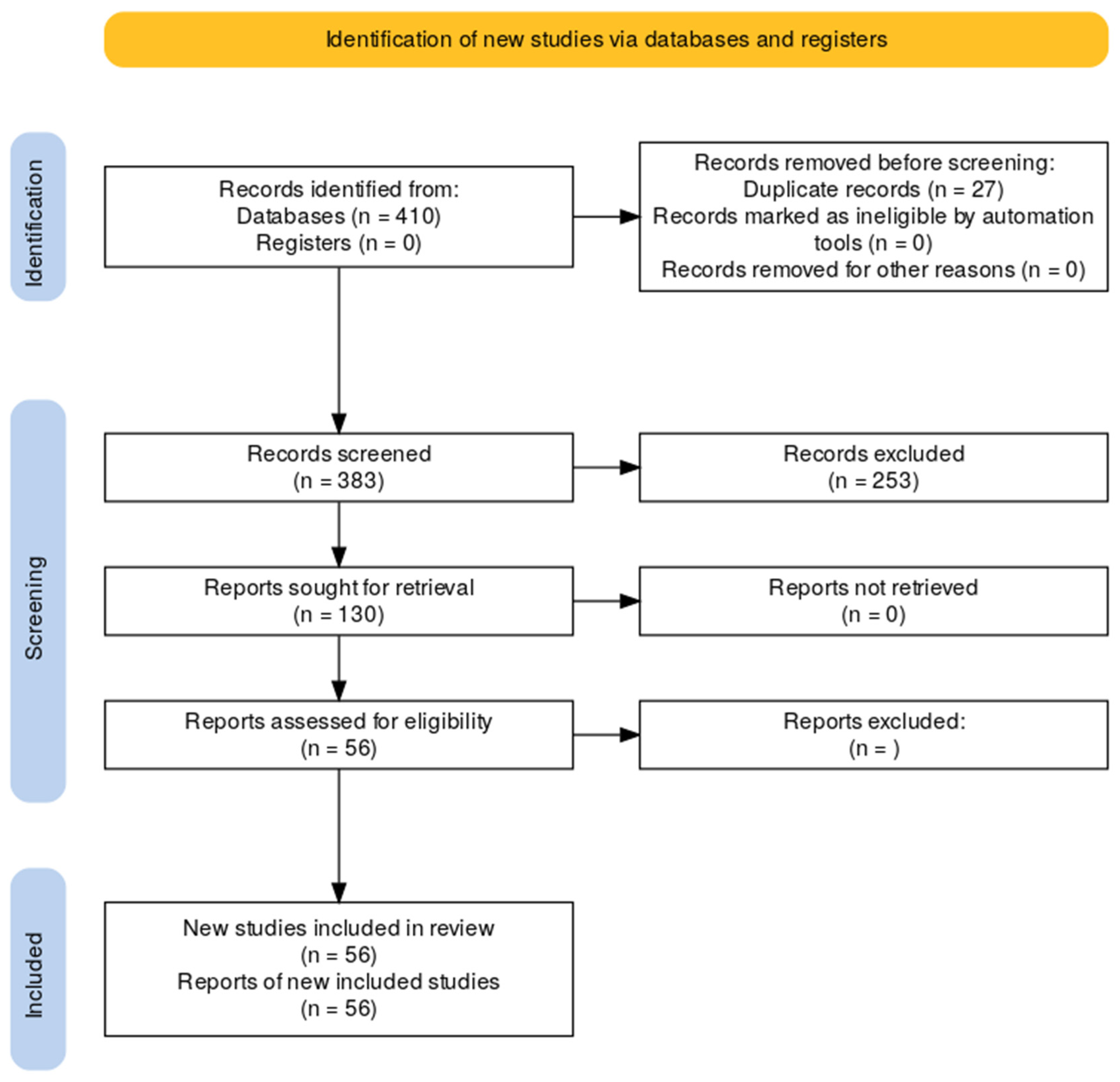
Figure 3.
Geographical distribution of included studies.
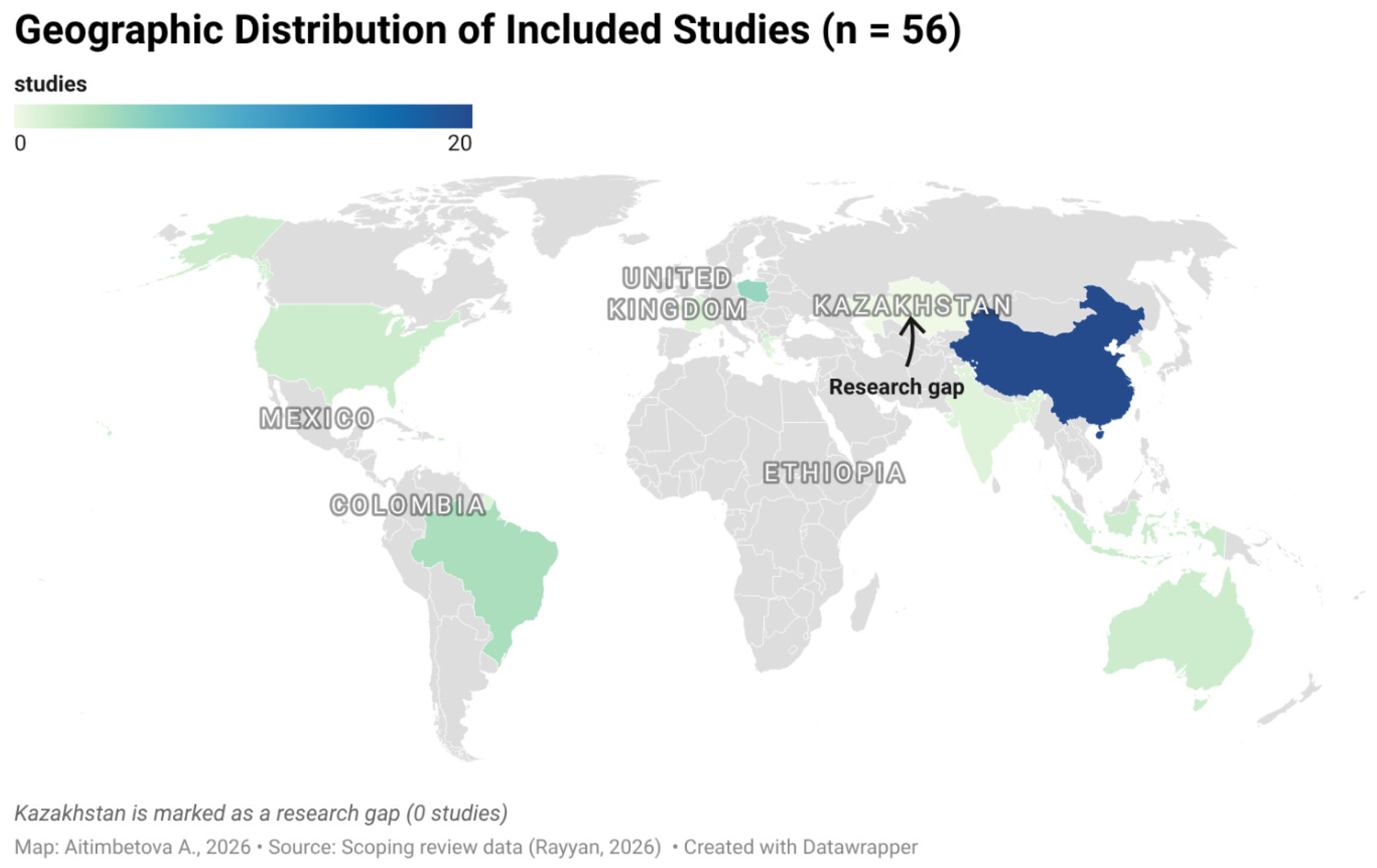
Figure 4.
Conceptual framework for integrated environmental assessment of lead-zinc slag-contaminated soils, illustrating pathways from contamination sources to risk assessment and policy response.
Figure 4.
Conceptual framework for integrated environmental assessment of lead-zinc slag-contaminated soils, illustrating pathways from contamination sources to risk assessment and policy response.
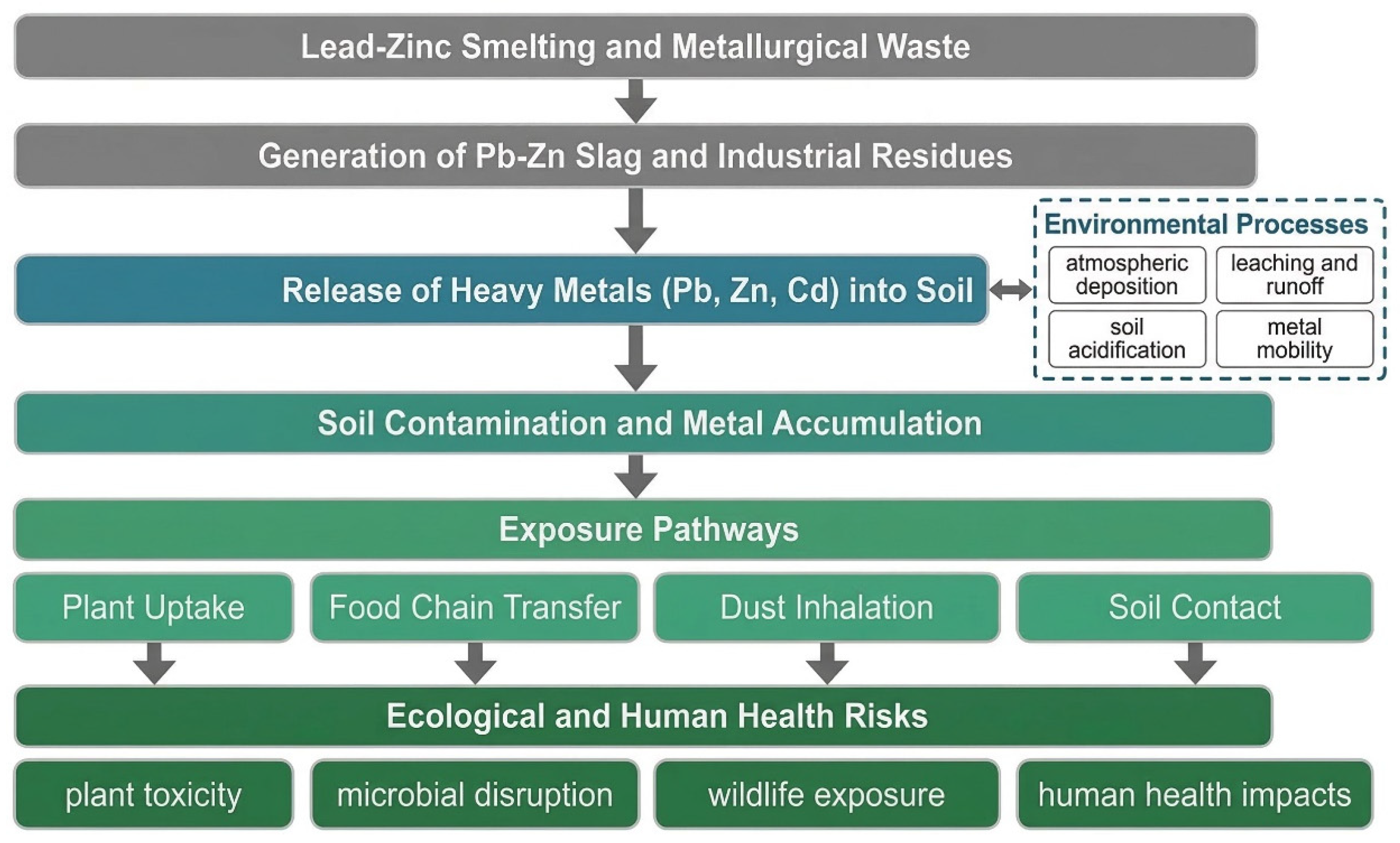
Figure 4.
Research Gaps Pyramid for Soil Contamination Assessment at Lead-Zinc Slag Sites, Organized by Priority Level from Foundational Geographic Gaps to Methodological and Standardization Priorities.
Figure 4.
Research Gaps Pyramid for Soil Contamination Assessment at Lead-Zinc Slag Sites, Organized by Priority Level from Foundational Geographic Gaps to Methodological and Standardization Priorities.
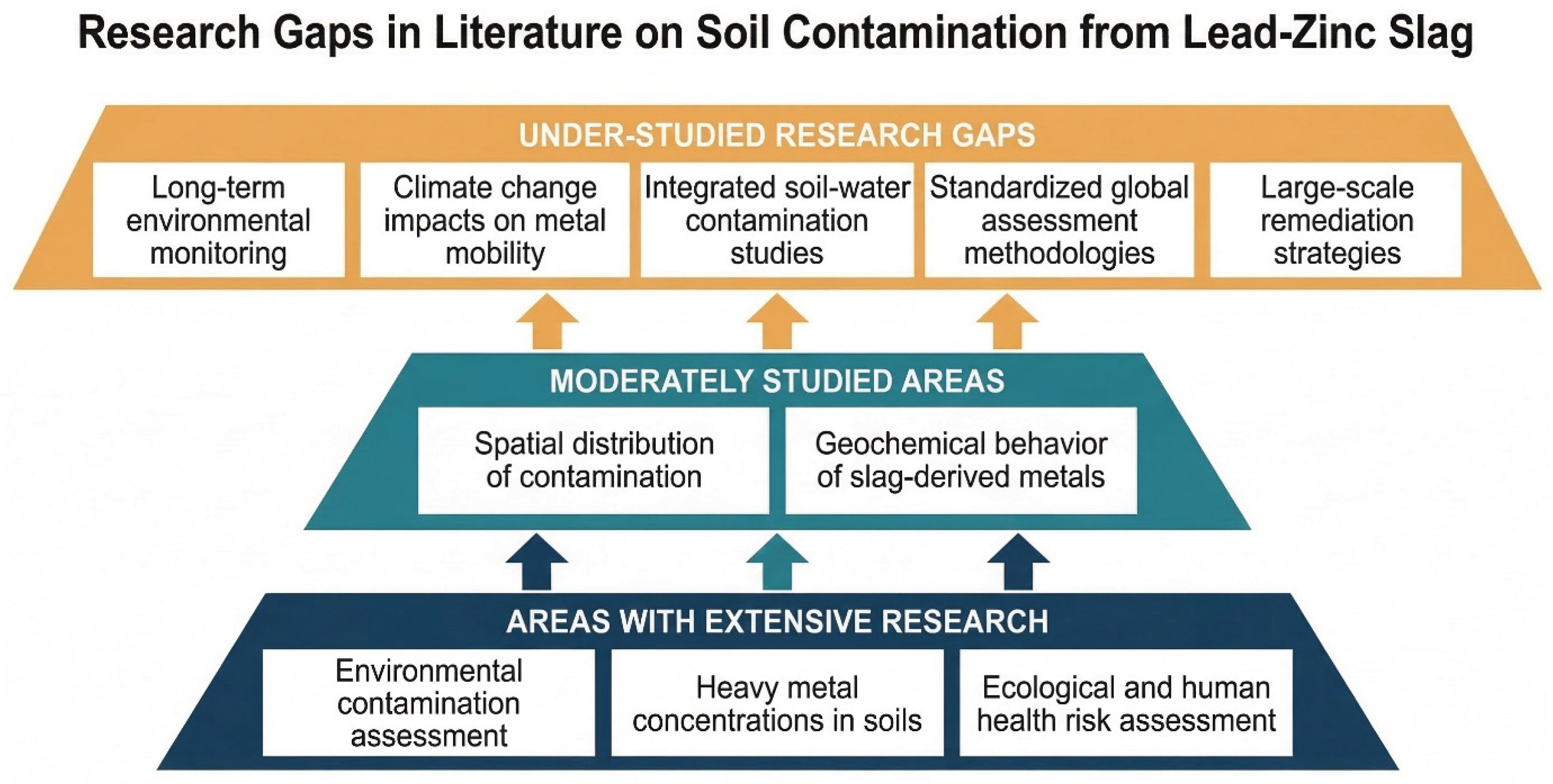

Table 1.
Environmental assessment methods identified in included studies (n = 56).
| Publication year | n | % |
|---|---|---|
| 2010–2014 | 3 | 0.054 |
| 2015–2017 | 12 | 0.214 |
| 2018–2020 | 14 | 0.25 |
| 2021–2023 | 20 | 0.357 |
| 2024–2025 | 7 | 0.125 |
| Contamination source | ||
| Smelter (active or abandoned) | 38 | 0.679 |
| Lead-zinc slag heap | 10 | 0.179 |
| Tailings/mine waste | 5 | 0.089 |
| Mixed sources | 3 | 0.054 |
| Heavy metals studied | ||
| Pb + Zn + Cd (all studies) | 56 | 1 |
| + As | 42 | 0.75 |
| + Cu | 35 | 0.625 |
| + Hg | 18 | 0.321 |
| + Tl | 3 | 0.054 |
| Study design | ||
| Empirical field study | 48 | 0.857 |
| Modeling study | 5 | 0.089 |
| Combined field + modeling | 3 | 0.054 |
Disclaimer/Publisher’s Note: The statements, opinions and data contained in all publications are solely those of the individual author(s) and contributor(s) and not of MDPI and/or the editor(s). MDPI and/or the editor(s) disclaim responsibility for any injury to people or property resulting from any ideas, methods, instructions or products referred to in the content. |
© 2026 by the authors. Licensee MDPI, Basel, Switzerland. This article is an open access article distributed under the terms and conditions of the Creative Commons Attribution (CC BY) license (http://creativecommons.org/licenses/by/4.0/).
Copyright: This open access article is published under a Creative Commons CC BY 4.0 license, which permit the free download, distribution, and reuse, provided that the author and preprint are cited in any reuse.


