

Submitted:
17 March 2026
Posted:
18 March 2026
You are already at the latest version
Abstract
The energy transition faces challenges associated with the integration of variable renewa-ble energy sources, the management of uncertainty, and the increasing complexity of en-ergy systems. In this context, artificial intelligence (AI) has gained a significant role, and more recently, generative AI has begun to be explored as a tool for the analysis and mod-eling of these systems. This study was conducted through a Scoping Review following the PRISMA-ScR guidelines, with the aim of mapping the current state of knowledge regard-ing the use of generative AI in the energy transition. The literature search was carried out in the IEEE Xplore, Scopus, Web of Science, and Springer Nature databases, applying pre-viously defined inclusion and exclusion criteria. Peer-reviewed studies published between 2020 and 2026 were included, forming a final corpus of 12 studies analyzed using a qual-itative and descriptive approach. The results show that generative AI is being applied across multiple areas of the energy transition. Key applications include the generation of alternative energy scenarios, the creation of synthetic data for model training and valida-tion, probabilistic uncertainty analysis, and the design of complex energy configurations in systems with high renewable penetration. Additional contributions involve forecasting and optimizing solar and wind resources, analyzing energy consumption patterns, plan-ning integrated and bioenergy systems, predictive maintenance of solar infrastructure, and improving energy storage and operational resilience in smart grids. Three main ap-plication areas were identified: scenario and data generation, optimization and opera-tional processes, and decision-support for intelligent energy systems. However, limita-tions remain, including limited real-world validation, data dependency, computational scalability challenges, and the lack of regulatory frameworks. The protocol was registered in the Open Science Framework (OSF) under code: 10.17605/OSF.IO/BYM7A.
Keywords:
generative artificial intelligence
; energy transition
; energy systems
; renewable energy
; deep generative models
1. Introduction
The transformation of energy systems constitutes one of the main technological and strategic challenges of recent decades, driven by the need to reduce emissions, integrate variable renewable energy sources, and ensure the security and resilience of electricity supply. This process, commonly referred to as the energy transition, involves structural changes not only in generation technologies but also in the planning, design, operation, and governance of increasingly complex and interconnected energy systems [1,2,3]. In this context, the integration of non-conventional renewable sources, the digitalization of the electricity sector, and the incorporation of intelligent technologies are part of the processes associated with the recent evolution of energy systems [4,5].
Digitalization has acquired a central role, and artificial intelligence (AI) has consolidated itself as a relevant tool to support the management of complex and dynamic energy systems [6,7,8]. Various AI approaches, including machine learning and deep learning, have been applied to tasks such as demand forecasting, renewable generation prediction, power grid optimization, microgrid management, and the detection of operational faults [9,10,11,12]. These applications fall within the broader paradigm of data-driven energy modeling and AI-driven optimization approaches, which have gained relevance in recent years [1,8]. However, much of this development has focused on specific predictive tasks, which may limit the ability to comprehensively represent the uncertainty and variability inherent in energy systems dominated by intermittent renewable sources [10,12].
In recent years, generative artificial intelligence has emerged as an extension of deep learning aimed at modeling the underlying distribution of data and generating new plausible instances, such as scenarios, system configurations, or synthetic time series. This paradigm includes models such as generative adversarial networks (GANs), variational autoencoders (VAEs), flow-based models, and large language models (LLMs), which have expanded the traditional capabilities of AI across different domains [10,13,14,15]. These generative approaches have also introduced new research challenges related to explainability, transparency, and interpretability of AI-driven decision-making processes [15,16].
In the energy domain, generative AI has begun to be applied to renewable scenario generation, probabilistic analysis of energy forecasting, the creation of synthetic data for model training, and support for the design and planning of complex energy systems [2,11,17]. In addition, large language models and transformer-based architectures have been explored as assistance tools for technical analysis and decision-making in the electricity sector, as well as for integrating heterogeneous datasets and supporting intelligent digital twins in smart grids [14,18,19]. Recent studies also highlight how generative models can enhance energy forecasting, demand-response strategies, anomaly detection, and data augmentation in renewable energy systems and smart environments [20].
Within the framework of the energy transition, recent literature has begun to document the incorporation of generative models in systems characterized by high uncertainty, strong interdependence among technical components, and multiple possible evolution pathways. These studies describe applications aimed at scenario analysis, the evaluation of alternative energy configurations, and support for the design of resilient systems in environments with high renewable penetration [1,2,20,21]. At the same time, the rapid expansion of generative AI technologies has raised new concerns regarding their energy consumption and environmental impact, emphasizing the need to evaluate both their benefits and sustainability implications within digitalized energy infrastructures [22].
Nevertheless, the available evidence remains dispersed across different application domains and methodological approaches and has not yet been systematized from the specific perspective of generative artificial intelligence within the context of the energy transition. Given the emerging and heterogeneous nature of this field of study, it is appropriate to adopt a scoping review approach that allows mapping the extent, nature, and characteristics of the existing literature. Within this framework, the present study aims to identify and organize the scientific evidence on the application of generative artificial intelligence (concept) in energy systems and sectors related to the energy transition (population and context), in order to characterize trends, areas of application, and research gaps.
2. Materials and Methods
2.1. Study Design
The present study was conducted as a Scoping Review with the aim of mapping the current state of knowledge, identifying emerging trends, application domains, and research gaps related to the use of generative artificial intelligence in the energy transition. The review was conducted following the methodological guidelines of PRISMA-ScR [23], which enabled a transparent structuring of the identification, selection, and synthesis process of the scientific evidence. The review protocol was previously registered in the Open Science Framework (OSF) on February 26, 2026, in order to ensure methodological transparency and traceability (10.17605/OSF.IO/BYM7A).
Given the exploratory nature of this type of review, the study was not intended to quantitatively evaluate the performance of generative models nor to perform statistical comparisons among technical metrics. Instead, it aimed to characterize the existing research landscape and conceptually organize the field of study.
2.2. Conceptual Framework and Eligibility Criteria
The research question was structured under the Population Concept Context (PCC) framework, recommended for scoping reviews. The population or area of interest consisted of energy systems and sectors related to the energy transition. The central concept corresponded to generative artificial intelligence, including deep generative models and architectures capable of producing synthetic data, simulations, or optimized designs applied to the energy domain. The context comprised scientific publications in the fields of energy, engineering, and computer science.
Peer-reviewed studies published in English between 2020 and 2026 that explicitly addressed applications of generative AI in energy systems or processes related to the energy transition were included. Studies focused exclusively on conventional machine learning without a generative component, duplicate publications, documents outside the energy domain, and studies without full-text access were excluded.
The period 2020–2026 was selected due to the recent emergence of generative artificial intelligence as a field applied to the energy sector. The restriction to the English language was based on its predominance in international scientific production in engineering and energy. The exclusive inclusion of peer-reviewed articles was adopted to ensure methodological quality and academic rigor in the analyzed evidence.
2.3. Information Sources and Search Strategy
The literature search was conducted in the scientific databases IEEE Xplore, Scopus, Web of Science, and Springer Nature on December 17, 2025, with the aim of identifying publications related to the use of generative artificial intelligence in the field of renewable energy and the energy transition. The search strategy was designed by combining terms associated with generative artificial intelligence models and energy systems using Boolean operators.
The search strategy was structured using the following Boolean string: (“generative AI” OR “large language model*” OR “foundation model*”) AND (“energy transition” OR “renewable energy” OR “clean energy” OR “low-carbon energy” OR “decarbonization”) AND (“energy system*” OR “power system*” OR “smart grid*” OR “energy planning” OR “energy management”).
Subsequently, selection filters were applied to delimit the study corpus. In particular, only publications from the last five years (2020–2026) were considered in order to capture the most recent state of research in generative artificial intelligence applied to energy systems. Likewise, only studies related to renewable energy and the energy transition that explicitly addressed applications of generative artificial intelligence were selected.
Additionally, only review articles published in scientific journals and available in open-access format were included, ensuring the availability of the full text in PDF format for analysis. The retrieved records were compiled and managed using the Mendeley software, which allowed the identification and removal of duplicate articles before initiating the screening and study selection process according to the PRISMA-ScR protocol.
2.4. Study Selection Process
The selection process was conducted in two consecutive stages. In the first stage, titles and abstracts were screened to identify potentially eligible studies. In the second stage, the full-text review was performed to verify compliance with the previously established inclusion and exclusion criteria.
The evaluation was carried out independently by two reviewers. Discrepancies arising during the selection process were resolved through discussion and consensus between both researchers.
The complete process of identification, screening, eligibility, and inclusion was documented using a flow diagram in accordance with PRISMA-ScR.
2.5. Data Extraction and Synthesis
For each included study, a structured information extraction matrix was designed. Data were collected regarding the type of publication, year of publication, energy domain addressed, generative AI approach used, stage of the energy system considered, and the main contribution of the study.
Data extraction was conducted independently by two researchers using a matrix previously piloted on an initial sample of studies. Discrepancies were discussed until consensus was reached, and the matrix was iteratively adjusted when necessary.
The information was analyzed using a qualitative and descriptive approach and organized into synthesis tables that enabled the identification of common patterns, emerging trends, and research gaps. The findings derived from this process are presented in Chapter 3.
The studies were grouped according to energy domain, type of generative model, and stage of the energy system addressed, enabling a structured thematic synthesis.
2.6. Methodological Considerations
Consistent with the nature of scoping reviews, no formal assessment of risk of bias or comparative analysis of technical metrics among models was performed. These methodological decisions respond to the exploratory objective of the study, focused on mapping the field and identifying research opportunities rather than quantitatively evaluating effectiveness.
3. Results
The literature search identified a total of 533 records. After removing 111 duplicates, 417 titles and abstracts were screened, of which 51 were excluded for not meeting the eligibility criteria. A total of 366 full-text articles were assessed, and 354 studies were excluded due to reasons such as the absence of a generative component, a focus outside the energy domain, or lack of full-text access. Finally, 12 studies met the inclusion criteria and were incorporated into the synthesis. The process is presented in the PRISMA-ScR flow diagram (Figure 1).
According to the PRISMA-ScR methodology applied, 12 scientific articles addressing the use of generative artificial intelligence in different components of the energy transition process were included. The selected studies present a diversity of methodological approaches, energy sectors, and generative AI techniques, which allows for the construction of a broad mapping of the current state of the evidence.
3.1. General Characterization of the Study Corpus
The publications analyzed span the period from 2020 to 2026, reflecting the recency of the content and the emerging nature of research on generative artificial intelligence applied to the energy transition. The characterization of the studies included in the review, considering their application domain, energy sector, generative AI technique, type of study, and data source, is presented in Table 1.
Within a technological framework, the studies encompass various generative AI approaches, including deep generative models, intelligent agents, and language models. Overall, the corpus covers different stages of the energy cycle—planning, design, operation, and decision-making. Additionally, it includes multiple domains such as solar energy, bioenergy, energy storage, and intelligent energy systems [2,21,24,25,26,27,31].
3.2. Application Areas of Generative AI in the Energy Transition
3.2.1. Energy Forecasting and Scenario Generation
[2] analyze the emerging role of generative AI in renewable forecasting and system optimization, while [31] highlight its contribution to the sustainability and efficiency of solar resources through the generation of advanced scenarios. Additionally, studies have examined the use of generative models in the design and planning of future energy systems, demonstrating how these approaches enable the evaluation of multiple configurations under uncertainty [26]. Similarly, [33] employ generative AI to strengthen spatiotemporal resilience and support low-carbon transformation strategies in intelligent energy systems.
3.2.2. Analysis of Energy Consumption and Behavior
Through the analysis, two studies focused on this topic were identified. On the one hand, [24] use generative models to analyze consumption patterns and generate synthetic data that facilitate the understanding of energy demand. On the other hand, [25] examines the contribution of generative and language models, such as ChatGPT, to consumption analysis and decision-making oriented toward energy efficiency. Both studies highlight the potential of generative AI to integrate technical and human dimensions, expanding the scope of traditional energy analysis approaches.
Additionally, [27] analyze the use of advanced artificial intelligence tools to optimize the integration of renewable energy into power grids, highlighting the potential of data-driven models to improve the stability and efficiency of intelligent energy systems.
3.2.3. Design and Planning of Energy Systems
Generative AI is applied to the design of bioenergy systems to explore complex configurations and optimize resource use [29]. Similarly, Thirupathi et al. (2026) analyze the use of generative models in intelligent and resilient renewable systems, highlighting their capacity to integrate multiple technical variables from data to deployment. Finally, [26] examine the early evaluation of technological and architectural alternatives using generative AI as a co-design tool for future energy systems.
3.2.4. Operation and Predictive Maintenance
This section considers two studies. First, [28] propose the use of generative AI agents for the predictive maintenance of solar systems, demonstrating improvements in early fault detection and operational efficiency. Likewise, [32] analyze the application of generative AI in solar battery storage systems aimed at improving performance and reliability.
Complementarily, [21] study the use of generative artificial intelligence in industrial photovoltaic systems to improve operational safety and risk management in solar installations, highlighting its usefulness for anticipating potential failures and optimizing operational strategies.
These studies demonstrate the role of generative AI in strengthening the operational resilience of critical energy infrastructures.
3.2.5. Governance for Decision-Making
One study specifically addresses aspects of security, governance, and decision-making. In this case, [25] indicates the use of generative and language models as cognitive support tools in the energy sector, considering both opportunities and challenges associated with their integration into complex systems. Although this axis includes fewer studies, its inclusion highlights the need for further research on the organizational and governance aspects of generative AI in the energy transition.
To synthesize the main results identified in the literature, Table 2 summarizes the contributions and limitations reported in the analyzed studies, allowing the identification of methodological contributions, application areas, and research gaps in the use of generative artificial intelligence within the energy transition.
3.3. Trends and Challenges of Generative AI
The cross-sectional analysis of the 12 studies reveals clear trends, including a shift from traditional predictive approaches toward generative models, the increasing use of synthetic data, and the integration of generative AI throughout the entire energy cycle [24,26,27,29,31].
Currently, there have been advances in this type of research; however, the literature reveals relevant gaps and challenges in the application of generative artificial intelligence to the energy transition. Among the main challenges are the limited validation in real-world environments and scalability issues when models are applied to complex energy systems [30,32]. Likewise, the absence of clear regulatory and governance frameworks hinders the adoption of generative artificial intelligence, creating challenges in terms of transparency and accountability in decision-making processes [25].
3.4. Synthesis of the Role of Generative AI in the Energy Transition
The 12 studies included describe applications of generative artificial intelligence across different stages of the energy cycle, particularly in the planning, design, operation, and maintenance of systems with high renewable penetration. Predominant approaches are oriented toward the generation of alternative energy scenarios, probabilistic modeling of uncertainty, and the development of optimized technical configurations for complex environments.
Across the literature, three main axes are identified:
- Use of generative models for simulation and synthetic data generation;
- Integration into optimization processes and predictive maintenance; and
- Support for technical and strategic decision-making in intelligent energy systems.
Recurring challenges are also identified, particularly those related to empirical validation, scalability in real-world systems, data quality, and the absence of specific regulatory frameworks. Overall, the evidence allows generative AI to be mapped as an emerging approach with diversified applications, although it remains in a consolidation phase within the energy transition.
To synthesize the main application areas identified in the literature, Table 3 presents a classification of generative artificial intelligence applications in energy systems, organized according to their domain of use and the techniques employed.
4. Discussion
4.1. Interpretation of the Main Findings
The results of this scoping review indicate that generative artificial intelligence is becoming established as a technology with a cross-cutting role in the energy transition, as it intervenes in multiple stages of the energy cycle, including planning, design, operation, and decision-support processes [26,27,31,34,35]. This cross-cutting nature is explained by the ability of generative models to manage uncertainty, variability, and complexity—characteristics inherent to energy systems with high penetration of renewable energy sources [33,36,37,38].
A relevant finding is that most studies do not use generative AI as a direct substitute for physical models or classical methods, but rather as a complementary tool that expands the space of possible solutions, enabling the exploration of alternative scenarios and non-trivial configurations [29,30,39]. This characteristic is evident in applications such as energy forecasting, system design, and predictive maintenance [21,28], which is consistent with recent literature on artificial intelligence applications in renewable energy forecasting and system optimization [40].
4.2. Implications for the Energy Transition
From a systemic perspective, the findings suggest that generative artificial intelligence can significantly contribute to addressing key challenges of the energy transition, particularly those associated with renewable resource variability, planning uncertainty, and the need for operational resilience [27,31,34,38]. In the case of renewable resource variability, generative models make it possible to capture and reproduce complex and nonlinear patterns in the availability of resources such as solar energy, generating synthetic series and alternative scenarios that reflect diverse operational conditions. This enables the evaluation of system performance under realistic fluctuations, beyond historical averages or deterministic assumptions, a capability also highlighted in broader reviews on AI applications in renewable energy systems [35,36].
Regarding planning uncertainty, generative AI introduces a methodological shift by enabling the simultaneous exploration of multiple system evolution pathways, rather than relying on a limited number of predefined scenarios. By generating sets of plausible scenarios, these models facilitate the evaluation of investment, expansion, and operational decisions under different future contexts, thereby strengthening the robustness of long-term energy planning [26,39].
Likewise, in terms of operational resilience, the reviewed literature shows that generative AI can support the early identification of vulnerable system configurations and the evaluation of responses to extreme events or operational failures. By simulating adverse scenarios and previously unobserved behaviors, these approaches contribute to designing more adaptive operational strategies and improving the recovery capacity of energy systems [32,37].
Finally, generative AI facilitates the integration of energy technologies by supporting the design and coordination of hybrid systems that combine renewable generation, storage, and demand. Through the generation of alternative configurations and the joint evaluation of multiple components, these models enable the optimization of decentralized energy infrastructures and improve coherence among the different layers of the system [29,34].
4.3. Relationship with Existing Literature
Compared with previous reviews focused on conventional machine learning techniques, the results of this scoping review reveal a progressive and structural shift toward generative artificial intelligence approaches, driven by recent advances in deep architectures and large language models [25,31,34,35]. While traditional machine learning approaches were primarily oriented toward specific predictive tasks such as point estimation of energy variables or classification of system states, the more recent literature substantially expands the role of artificial intelligence within energy systems.
In particular, the analyzed studies show that generative AI enables a transition from an approach centered on predicting individual outcomes to one focused on exploring sets of possible solutions, scenarios, and configurations. This capability is reflected in applications such as the generation of synthetic energy scenarios for planning, the co-design of complex energy systems, and support for strategic decision-making processes, where evaluating multiple alternatives under uncertainty is essential [26,27,30].
4.4. Practical and Decision-Making Implications
From a practical perspective, the findings have direct and substantial implications for energy planners, as well as for system designers and operators. In particular, generative artificial intelligence can strengthen strategic and long-term planning processes by enabling the generation of multiple alternative energy scenarios that explicitly incorporate uncertainty associated with renewable resource variability, demand evolution, and system operating conditions (Erdiwansyah et al., 2025; Mousavi et al., 2025; Xiang et al., 2024).
In the operational domain, its application in predictive maintenance and performance optimization contributes to improving the reliability of critical infrastructures and reducing downtime (Annapareddy & Seenu, 2023; Briceño et al., 2025; Haputhanthri et al., 2025). These results are aligned with recent studies highlighting the growing role of artificial intelligence techniques for predictive maintenance and operational optimization in renewable energy systems (James et al., 2024; Silva et al., 2024).
Similarly, machine learning and generative techniques are increasingly applied to optimize renewable energy production, manage hybrid systems, and improve decision-making in complex energy infrastructures [43,44,45].
However, the use of generative and language models as decision-support tools raises challenges related to transparency, explainability, and governance, particularly in critical energy systems [21,25]. These concerns are increasingly highlighted in the literature addressing security, interpretability, and governance challenges associated with AI deployment in renewable energy systems.
4.5. Study Limitations
This study presents limitations inherent to its approach as a scoping review. First, no quantitative critical evaluation of the performance of the included models was conducted, since the objective was to map trends and application areas rather than evaluate methodological quality. Second, the search was restricted to publications in English indexed in specific databases (IEEE Xplore, Scopus, Web of Science, and Springer Nature), which may have excluded relevant literature published in other languages or sources. Likewise, the analysis period was limited to studies published between 2020 and 2026, consistent with the emerging nature of the topic. Finally, the methodological heterogeneity of the included studies makes direct comparisons and broad generalizations difficult. These limitations are consistent with the exploratory nature of the review and reinforce the need for more specific complementary studies.
4.6. Future Research Directions
The findings suggest several future research directions. First, greater empirical validation of generative models in real operational environments is required, especially in large-scale energy systems [28,32]. Second, it is essential to develop governance and regulatory frameworks that accompany the adoption of generative AI in critical energy infrastructures [21,25,45].
Other promising research directions include the integration of generative AI with energy markets, the evaluation of ethical and security risks, and the study of its interaction with human actors in decision-making processes. In addition, further research is needed on the use of generative models for synthetic data generation, digital twins, and intelligent information systems applied to renewable energy infrastructures. Overall, these research directions will help consolidate the role of generative AI as a responsible tool in the energy transition.
5. Conclusions
This scoping review enabled a systematic mapping of the recent state of research on generative artificial intelligence in the context of the energy transition, highlighting its application across different stages of the energy system, including planning, design, operation, and decision support. The analyzed studies show that generative approaches are primarily used for scenario generation, uncertainty management, the design of complex energy systems, and the strengthening of operational resilience, reflecting a progressive shift from conventional predictive models toward more flexible and exploratory paradigms. Furthermore, the results reveal that, although the literature on generative AI in the energy sector remains at an emerging stage, there is a thematic convergence around its capacity to address the inherent complexity of modern energy systems. However, relevant gaps are also identified, particularly regarding validation in real-world environments, model scalability, and the need for clear governance frameworks, which opens opportunities for future research aimed at consolidating its practical application in the energy transition. Generative AI is emerging as a key tool to support the analysis and management of transforming energy systems.
Supplementary Materials
The following supporting information can be downloaded at the website of this paper posted on Preprints.org, PRISMA-ScR checklist used for reporting the scoping review.
Author Contributions
Author Contributions: Conceptualization, A.Z. and J.B.; methodology, A.Z.; investigation, A.Z.; formal analysis, A.Z.; data curation, A.Z.; visualization, A.Z.; writing—original draft preparation, A.Z. and J.B.; writing—review and editing, A.Z. and J.B.; validation, J.B.; supervision, J.B.; project administration, J.B.; funding acquisition, J.B. All authors have read and agreed to the published version of the manuscript.
Funding
This research was funded by Universidad Tecnológica Indoamérica through the project “Análisis del uso de la inteligencia artificial generativa en contextos de formación y operación profesional”, grant number IIDI-059-2026. The APC was funded by Universidad Tecnológica Indoamérica.
Acknowledgments
During the preparation of this manuscript, the authors used ChatGPT 5.2 to support grammar refinement, language clarity, and style consistency. The authors reviewed, edited, and took full responsibility for the content of this publication.
Conflicts of Interest
The authors declare no conflicts of interest.
References
- M. A. Adewoyin, O. Adediwin, and A. J. Audu, “Artificial Intelligence and Sustainable Energy Development: A Review of Applications, Challenges, and Future Directions,” International Journal of Multidisciplinary Research and Growth Evaluation., vol. 6, no. 2, pp. 196–203, 2025. [CrossRef]
- Erdiwansyah, R. Mamat, Syafrizal, M. F. Ghazali, F. Basrawi, and S. M. Rosdi, “Emerging role of generative AI in renewable energy forecasting and system optimization,” Sustainable Chemistry for Climate Action, vol. 7, Dec. 2025. [CrossRef]
- D. I. Alvarez, F. González-Ladrón-de-Guevara, J. Rojas Espinoza, D. Borge-Diez, S. P. Galindo, and C. Flores-Vázquez, “The Evolution of AI Applications in the Energy System Transition: A Bibliometric Analysis of Research Development, the Current State and Future Challenges,” Energies (Basel)., vol. 18, no. 6, Mar. 2025. [CrossRef]
- V. Meza Jimenez and E. Perez, “The Role of Artificial Intelligence in Latin America’s Energy Transition,” 2022.
- T. R. Razak, M. H. Ismail, M. Y. Darus, H. Jarimi, and Y. Su, “Artificial Intelligence in Renewable Energy: A Systematic Review of Trends in Solar, Wind, and Smart Grid Applications,” Research and Reviews in Sustainability, vol. 1, no. 1, pp. 1–22, Aug. 2025. [CrossRef]
- S. Algburi et al., “The role of artificial intelligence in accelerating renewable energy adoption for global energy transformation,” Unconventional Resources, vol. 8, Oct. 2025. [CrossRef]
- D. Rolnick et al., “Tackling Climate Change with Machine Learning,” ACM Comput. Surv., vol. 55, no. 2, Feb. 2023. [CrossRef]
- A. Safari, M. Daneshvar, and A. Anvari-Moghaddam, “Energy Intelligence: A Systematic Review of Artificial Intelligence for Energy Management,” Applied Sciences (Switzerland), vol. 14, no. 23, Dec. 2024. [CrossRef]
- N. E. Benti, M. D. Chaka, and A. G. Semie, “Forecasting Renewable Energy Generation with Machine Learning and Deep Learning: Current Advances and Future Prospects,” Sustainability (Switzerland), vol. 15, no. 9, May 2023. [CrossRef]
- J. Dumas, A. W. D. Lanaspeze, B. Cornélusse, and A. Sutera, “A deep generative model for probabilistic energy forecasting in power systems: normalizing flows,” Sep. 2021, [Online]. Available: http://arxiv.org/abs/2106.09370.
- Y. Gao, S. Miyata, and Y. Akashi, “Multi-step solar irradiation prediction based on weather forecast and generative deep learning model,” 2022.
- T. Zhang and G. Strbac, “Novel Artificial Intelligence Applications in Energy: A Systematic Review,” Energies (Basel)., vol. 18, no. 14, Jul. 2025. [CrossRef]
- Goodfellow et al., “Generative adversarial networks,” Commun. ACM, vol. 63, no. 11, pp. 139–144, Oct. 2020. [CrossRef]
- S. Majumder et al., “Exploring the capabilities and limitations of large language models in the electric energy sector,” Joule, vol. 8, no. 6, pp. 1544–1549, Jun. 2024. [CrossRef]
- P. M. Kumarage and M. Saarela, “Explainable Generative AI: A Two-Stage Review of Existing Techniques and Future Research Directions,” AI, vol. 7, no. 1, p. 31, Jan. 2026. [CrossRef]
- R. Alsaigh, R. Mehmood, and I. Katib, “AI explainability and governance in smart energy systems: A review,” Front. Energy Res., vol. 11, Jan. 2023. [CrossRef]
- E. Ginzburg-Ganz, E. D. Horodi, O. Shadafny, U. Savir, R. Machlev, and Y. Levron, “Statistical Foundations of Generative AI for Optimal Control Problems in Power Systems: Comprehensive Review and Future Directions,” Energies (Basel)., vol. 18, no. 10, May 2025. [CrossRef]
- Ruan et al., “Applying Large Language Models to Power Systems: Potential Security Threats,” Jan. 2024, [Online]. Available: http://arxiv.org/abs/2311.13361.
- G. Antonesi, T. Cioara, I. Anghel, V. Michalakopoulos, E. Sarmas, and L. Toderean, “From Transformers to Large Language Models: A systematic review of AI applications in the energy sector towards Agentic Digital Twins,” 2025.
- D. Vamvakas, I. Papaioannou, C. Tsaknakis, T. Sgouros, and C. Korkas, “Generative AI for Sustainable Smart Environments: A Review of Energy Systems, Buildings, and User-Centric Decision-Making,” Energies (Basel)., vol. 18, no. 23, Dec. 2025. [CrossRef]
- C. P. Briceño, M. Rojas, I. Mendez, P. Ponce, and Q. Mei, “Harnessing Generative AI for Photovoltaic Systems to Enhance Safety Features of Tailored Industrial Solar Solutions,” 2025, pp. 213–235. [CrossRef]
- Balogun Barnabas Friday and Dhakir Abbas Ali, “Balancing Innovation and Sustainability: Assessing the Impact of Generative AI on Energy Consumption,” International Journal of Innovative Research and Development, vol. 13, no. 9, Sep. 2024. [CrossRef]
- A. C. Tricco et al., “A scoping review on the conduct and reporting of scoping reviews,” BMC Med. Res. Methodol., vol. 16, no. 1, Feb. 2016. [CrossRef]
- R. Velmurugan, J. Sudarvel, R. Bhuvaneswari, and R. Thirumalaisamy, “A Study of Generative AI for Energy Consumption Behavior Analysis,” in Enhancing Renewable Energy Systems With Generative AI, Ramirez, J. Reyes Juárez, Kumar, Abhishek, Rathore, and Pramod, Eds., 2026, ch. 9.
- N. L. Rane, “Contribution of ChatGPT and Other Generative Artificial Intelligence (AI) in Renewable and Sustainable Energy,” Journal of Advances in Artificial Intelligence, vol. 2, no. 1, pp. 1–26, 2024. [CrossRef]
- A. Glaws et al., “Designing Future Energy Systems With Generative AI,” Comput. Sci. Eng., vol. 27, no. 4, pp. 8–18, 2025. [CrossRef]
- S. Benchikh, T. Jarou, and R. Lamrani, “Enhancing renewable energy systems with advanced artificial intelligence solutions,” SCT Proceedings in Interdisciplinary Insights and Innovations, vol. 2, p. 319, May 2024. [CrossRef]
- D. Haputhanthri et al., “Generative AI Agents for Hyper Predictive Maintenance of Solar Energy Systems,” in IECON Proceedings (Industrial Electronics Conference), IEEE Computer Society, 2025. [CrossRef]
- P. Selvakumar, A. Das, and T. C. Manjunath, “Generative AI for Bioenergy System Design,” in Enhancing Renewable Energy Systems With Generative AI, Ramirez, J. Reyes Juárez, Kumar, Abhishek, Rathore, and Pramod, Eds., 2026, ch. 5.
- Thirupathi, S. Nitya, and K. Sathwik Reddy, “Generative AI for Intelligent, Resilient, and Sustainable Renewable Energy Systems From Data to Deployment,” in Enhancing Renewable Energy Systems With Generative AI, Ramírez, J. Reyes Juárez, Kumar, Abhishek, Rathore, and Pramod, Eds., 2026, ch. 5.
- R. Mousavi et al., “Revolutionizing solar energy resources: The central role of generative AI in elevating system sustainability and efficiency,” Appl. Energy, vol. 382, Mar. 2025. [CrossRef]
- V. N. Annapareddy and A. Seenu, “Generative AI in Predictive Maintenance and Performance Enhancement of Solar Battery Storage Systems,” International Journal of Humanities Education, 2023.
- H. Dui, Q. Zeng, and M. Xie, “Generative AI-based spatiotemporal resilience, green and low-carbon transformation strategy of smart renewable energy systems,” Frontiers of Engineering Management, vol. 12, no. 4, pp. 1220–1235, Dec. 2025. [CrossRef]
- A. Y. H. Saif-Alyousfi and T. R. Alshammari, “Artificial intelligence adoption and private investment in renewable energy: Evidence from firm-level data across developed and emerging economies,” Energy Strategy Reviews, vol. 64, Mar. 2026. [CrossRef]
- H. Xiang, X. Li, X. Liao, W. Cui, F. Liu, and D. Li, “Artificial Intelligence in Renewable Energy Systems: Applications and Security Challenges,” Apr. 10, 2025, Multidisciplinary Digital Publishing Institute (MDPI). [CrossRef]
- F. Ghazi Bishaw, M. Khairi Ishak, and T. Hassan Atyia, “Review Artificial Intelligence Applications in Renewable Energy Systems Integration,” pp. 566–582, 2024.
- C. Silva, V. S. Pereira, J. Baptista, and T. Pinto, “Artificial Intelligence and Energy,” Energies (Basel)., vol. 18, no. 18, Sep. 2025. [CrossRef]
- O. Erhinyodavwe, O. Eyide, M. Enudi, J. Anirejuoritse Mene, and O. S. Okuyade, “Artificial Intelligence (AI) Generative Design and Machine Language Application in Solar and Wind Energy,” INTERNATIONAL JOURNAL OF APPLIED & ADVANCED ENGINEERING RES, vol. 05, no. 5, 2024.
- Figliola, M. Barberio, A. Del Razo Montiel, and P. Rienzo, “Generative Artificial Intelligence (AI) and Sustainable-Aided Design: Opportunities and Challenges,” pp. 409–419, 2025. [CrossRef]
- James, “Generative AI for Predictive Maintenance in Renewable Energy: Wind Turbines, Solar Farms, and Beyond,” 2025.
- Alsayegh and T. Masood, “Leveraging generative AI for knowledge-driven information retrieval in the energy sector,” MATEC Web of Conferences, vol. 401, p. 10008, 2024. [CrossRef]
- Z. Lin et al., “Leveraging Generative AI for Renewable Energy: Photovoltaic Panel Semantic Segmentation Case Study,” vol. 36, 2023.
- S. Khan et al., “Machine learning for renewable energy advancements: Prospects and emerging techniques,” Energy Reports, vol. 15, Jun. 2026. [CrossRef]
- S. Chatterjee, P. W. Khan, and Y. C. Byun, “Recent advances and applications of machine learning in the variable renewable energy sector,” Energy Reports, vol. 12, pp. 5044–5065, Sep. 2024. [CrossRef]
- V. Zinoviev, D. Koeva, P. Tsankov, and R. Kutkarska, “Review of Artificial Intelligence Applications in the Digital Energy and Renewable Energy Infrastructures,” Energies (Basel)., vol. 19, no. 5, p. 1250, 2026. [CrossRef]
Figure 1.
Identification of studies via databases and registers.
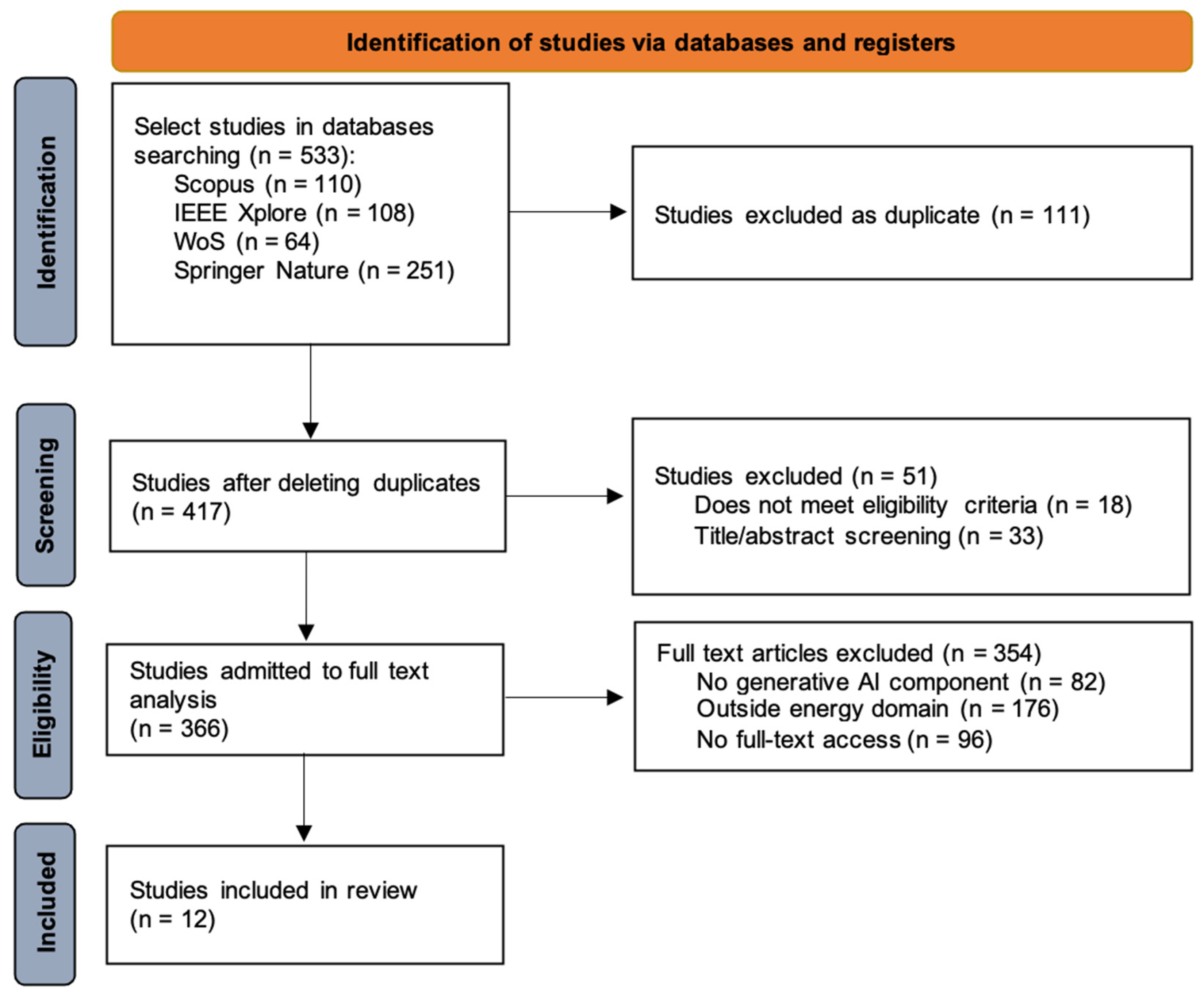

Table 1.
General characterization of the studies included in the review.
| Article | Application Domain | Energy Sector | Generative AI Technique | Study Type | Data Source |
|---|---|---|---|---|---|
| [24] | Consumption analysis | Final energy consumption | Generative models | Analytical / modeling | Energy consumption databases |
| [25] | Decision support | Renewable energy systems | Language models (ChatGPT) | Conceptual / review | Scientific literature |
| [26] | System design | Integrated energy systems | Generative design models | Conceptual | Simulated scenarios |
| [2] | Forecasting and optimization | Solar and wind energy | GANs, diffusion models | Review | Historical generation data |
| [27] | Performance improvement | Renewable generation | Hybrid generative models | Review | Scientific literature |
| [28] | Predictive maintenance | Solar photovoltaic energy | Generative AI agents | Modeling / simulation | Sensor and operational data |
| [29] | System design | Bioenergy | Generative design models | Modeling | Energy process data |
| [30] | System resilience | Renewable grids | Multimodal generative AI | Review | Scientific literature |
| [31] | Storage optimization | Energy storage systems | Predictive generative models | Analytical | Battery performance data |
| [32] | Resilience planning | Smart grids | Spatiotemporal generative models | Modeling | Spatial and temporal data |
| [21] | Security and reliability | Industrial photovoltaic systems | Security generative models | Case study | Operational data |
| [11] | System efficiency | Solar energy | Generative optimization models | Review | Scientific literature |
Table 2.
Main contributions and limitations of the analyzed studies.
| Article | Main Contribution | Limitations / Identified Gaps |
|---|---|---|
| [24] | Models patterns of energy consumption behavior using generative AI | Limited validation in real-world scenarios |
| [25] | Explores the potential of language models for energy planning and decision-making | Lack of quantitative evaluation |
| [26] | Proposes the use of generative AI for the design of future energy systems | Conceptual framework at an early stage |
| [2] | Demonstrates improvements in renewable forecasting and system optimization | Heterogeneous methodologies |
| [27] | Identifies opportunities to improve the performance of renewable systems using AI | Limited comparison between technologies |
| [28] | Improves fault prediction and maintenance planning in solar systems | Dependence on high-quality data |
| [29] | Optimizes bioenergy system configurations using generative models | Limited sectoral scope |
| [30] | Links generative AI with the resilience of intelligent energy systems | Limited empirical evidence |
| [31] | Improves reliability and lifetime of energy storage systems | Applicability restricted to certain technologies |
| [32] | Supports resilience planning in renewable energy grids | High computational complexity |
| [21] | Improves security and reliability design in industrial photovoltaic systems | Limited scalability |
| [11] | Demonstrates improvements in efficiency and sustainability of solar systems | Mainly conceptual approach |
Table 3.
Classification of generative AI applications in energy systems.
| Application Category | Description | Generative AI Techniques Used | Representative Studies |
|---|---|---|---|
| Energy forecasting and scenario generation | Use of generative models to simulate the variability of renewable resources and generate alternative energy scenarios that improve system planning and operation | GANs, deep generative models | [2,31] |
| Analysis of energy consumption and behavior | Application of generative AI to analyze consumption patterns, generate synthetic data, and support energy efficiency strategies and demand management | Generative data models, LLMs | [24,25] |
| Design and planning of energy systems | Use of generative models to explore alternative configurations of energy systems, optimize technological architectures, and support the design of complex energy infrastructures | Generative design models, deep generative models | [26,29,30] |
| Operation and predictive maintenance | Application of generative AI to detect potential failures, optimize maintenance, and improve the operational performance of energy infrastructures | Generative agents, predictive generative models | [28,32] |
| Security and resilience of energy systems | Use of generative AI to improve operational resilience, assess vulnerabilities, and strengthen the security of complex energy systems | Spatiotemporal generative models | [21,33] |
| Optimization and sustainability of renewable systems | Application of generative AI to improve efficiency, sustainability, and management of renewable-based energy systems | Hybrid generative models | [11,27] |
Disclaimer/Publisher’s Note: The statements, opinions and data contained in all publications are solely those of the individual author(s) and contributor(s) and not of MDPI and/or the editor(s). MDPI and/or the editor(s) disclaim responsibility for any injury to people or property resulting from any ideas, methods, instructions or products referred to in the content. |
© 2026 by the authors. Licensee MDPI, Basel, Switzerland. This article is an open access article distributed under the terms and conditions of the Creative Commons Attribution (CC BY) license (http://creativecommons.org/licenses/by/4.0/).
Copyright: This open access article is published under a Creative Commons CC BY 4.0 license, which permit the free download, distribution, and reuse, provided that the author and preprint are cited in any reuse.