

Submitted:
17 March 2026
Posted:
18 March 2026
You are already at the latest version
Abstract
The sixth-generation (6G) mobile networks are envisioned to deliver seamless 3D coverage from ground to sky and vice versa. In parallel, aerial corridors are emerging to elevate ground-based transportation into the air, enabling smart air mobility for unmanned aerial vehicles (UAVs). The convergence of this intelligent transportation system (ITS) with 6G introduces new challenges: how to ensure reliable, efficient connectivity within aerial corridors, and how these corridors can serve as foundational sky infrastructure to advance the 6G ecosystem. This paper presents the first comprehensive survey on aerial corridors. It conceptualizes the aerial corridor as a tube-shaped, multi-lane, bidirectional structure to manage drone-based roles, including user equipment (UE), base stations (BS), and communication relays. To support this vision, key enablers such as air-to-ground channel modeling and integrated sensing and communication (ISAC) are investigated. The proposed infrastructure aligns with the IMT-2030 vision, supporting machine-type communication, ubiquitous connectivity, and immersive services in regulated aerial space.
Keywords:
6G
; aerial corridors
; UAV communications
; UTM
; ISAC
; A2G channel modeling
1. Introduction
The 6th generation (6G) mobile network includes a vast extension of its coverage in three-dimensional (3D) space, aiming at the goal of offering ubiquitous communications from the ground up to the highest heights. Additionally, the increasing use of Advanced/Urban Air Mobility (AAM/UAM) which includes Unmanned Aerial Vehicles (UAVs) in regular daily operations to support essential activities, including logistics and surveillance, will also depend on the establishment of a high-capacity, seamless, reliable communication infrastructure to support the operation of intelligent transportation systems in the skies as envisioned by 6G.
In order to address the anticipated rapid growth in aerial traffic, Aerial Corridors are being identified as structured flight paths to be used for effective Unmanned Aircraft Traffic Management (UTM). However, the existing body of literature generally considers aerial corridors as primarily geographical limitations to be utilized for navigation purposes and for collision avoidance purposes only.
This paper introduces a new perspective on aerial corridors by viewing these corridors as critical routes for establishing 6G communication infrastructure in the skies and proposes that existing aerial corridors provide an optimal framework for placing 6G communication nodes and establishing network architectures, and examines how aerial corridors may also contribute to the optimization of networks and ensure the continuous delivery of vital communications to support AAM/UAM operations.
The rest of this survey is organized as follows. Section 2 provides an overview of UAV communications and key enabling technologies in the context of 6G networks. Section 3 presents the geometric framework and design methodologies for aerial corridors, covering multi-lane architectures, fluid-flow-based path planning, and urban corridor planning. Section 4 describes the communication infrastructure deployed within corridors, the classification of UAV operational roles, and the communication scenarios that govern their interaction. Section 5 addresses channel modeling for UAV corridors, highlighting the distinct propagation characteristics that arise from structured flight geometries. Section 6 presents a case study demonstrating the connectivity and handover performance benefits of corridor-aligned trajectories. Section 7 discusses key enabling technologies for 6G aerial corridors. Section 8 evaluates system performance through analytical and simulation results. Section 9 identifies open challenges and future research directions. Finally, Section 10 concludes this work.
2. UAV Communication and Network Technologies for 6G
Unmanned aerial vehicles (UAVs) are a key pillar for expanding the coverage, capacity, and reliability of wireless communications, as mobile networks move towards 6G. Specifically, the integration of UAVs into 6G networks is expected to open up a wide range of new applications, ranging from emergency services to infrastructure monitoring. Specialized solutions are needed to control air traffic and provide reliable and high-performance communications between UAVs and ground infrastructure to fully realize this potential. In this context, the concept of aerial communication corridors emerges as an attractive approach for structuring and optimizing UAV networks.
The aim of this chapter is to provide an in-depth overview of the most recent state-of-the-art research on UAVs and UAV communication. We begin with a general overview of UAV communications and their applications in 6G systems before moving on to key technologies that enable high-performance aerial corridors, including UAV-assisted channel echolocation, integrated sensing and communication (ISAC), and reconfigurable intelligent surfaces (RIS). The objective of this critical analysis is to provide a strong basis for understanding and assessing the latest advances in UAV communications.
2.1. Overview of UAV Communications and Their Applications in 6G Networks
UAVs are emerging as a critical component of emerging 6G networks, with the potential to significantly expand the coverage, capacity, and reliability of wireless communications. The comprehensive review in [1] addresses the latest advancements, limitations, and prospects in UAV-assisted wireless communications as we move from 5G to 6G. Mozaffari et al. [2] emphasizes the importance of connected UAVs as an integral component of 6G networks, enabling novel use cases such as augmented virtual reality, telemedicine, and autonomous systems. In the context of 6G networks, UAVs are considered as critical components of space-air-ground integrated networks (SAGIN), operating as airborne base stations for coverage extension and relaying [3]. Furthermore, UAVs are seen as a significant technology enablers for AI-native devices with high mobility (up to 1000 km/h) in 6G networks, which is essential and critical for supporting future transportation corridors [4]. As UAV networks develop, energy efficiency and impact on the environment become more critical, with research focusing on green and sustainable UAV communication solutions for 6G [5]. Overall, UAVs are considered as crucial shapers of future 6G wireless networks, with the capability to serve as relay nodes, airborne base stations, even mobile intelligent surfaces [6].
2.2. Basic Communication Technologies for UAVs
A number of important technologies are being employed to improve UAVs communication. An overview of the most recent technologies and measurements is given in [7]. Channel sounding is essential for measuring RF channels between UAVs and base stations. Another key enabler for UAV networks is integrated sensing and communication (ISAC), which facilitates effective resource sharing and improved situational awareness in [8]. Also, the authors in [9] remark that, for a variety of application scenarios, including airborne corridors, ISAC signals shall be adaptable, adjustable and configurable. In [10], researchers are looking at potential, problems, and trends in the use of intelligent metasurfaces in ISAC systems for unmanned aerial vehicles. Additionally, reconfigurable intelligent surfaces (RIS) are acknowledged as a promising technology for enhancing UAV networks and other non-terrestrial communications in [11].
2.3. The Role of Reconfigurable Intelligent Surfaces (RIS) in UAV Communications
Reconfigurable Intelligent Surfaces (RIS) are a revolutionary technology for 6G networks and are becoming a key improvement factor for UAV communications. A thorough analysis by [12] focuses at how RIS has developed from theory to implementation, but it also emphasizes the need for more study in important areas like channel sounding for RIS-assisted UAV communication. In RIS-assisted non terrestial networks, UAVs are acknowledged as essential high-altitude vehicles that offer improved and adaptable coverage [13]. Important topics like channel modeling, adaptive transmission technique design, and trajectory optimization are covered in a thorough analysis of IRS-assisted UAV communications in [14]. Additionally, the investigation of potential, difficulties, and underlying technologies for RIS-enabled UAV sensing and communications is discussed in [15], as well as how RIS-assisted UAVs can strengthen the multi-access computing environment [16]. Last but not least, a comprehensive review of RIS for 6G communications by [17] further highlights the potential of RIS in enhancing UAV communications and applications.
2.4. Applications, Challenges and Future Directions for UAVs
As UAV technology advances, numerous applications in a range of industries are emerging. The study in [18] discusses recent developments, trends, and future uses of UAVs for power line inspections in the energy industry. UAVs are also utilized in search and rescue operations; [19] talks about their advantages, challenges, and possible advancements. In the transportation sector, personal aerial vehicles are starting to show promise for urban aerial mobility, but possible challenges need to be properly taken into account [20]. Studies examining the state of the art, challenges, and future advancements in RIS-borne UAV communication [21] are part of the ongoing research on IRS-assisted UAV communications for 6G networks [22]. Researchers are, also, investigating the possibility of using RIS augmentation techniques to improve physical layer security since security is a crucial concern in UAV-assisted networks [23]. Overall, there is still a lot of interest in the integration of UAVs and RIS into future wireless networks, especially in the context of IoT and vehicular communications[24].
From fundamental communication technologies and system architectures to new applications and future directions, the executed literature analysis shows how much progress has been made in the development of UAV-enabling networks in 6G. To fully exploit the promise of these technologies, however, there are still major obstacles and unresolved research difficulties - including the need for structured and regulated mobility, i.e. aerial corridors. More research is specifically needed to explore aerial corridors as structured frameworks for organizing UAV operations in 6G networks. This survey focuses on aerial corridors and their key enabling technologies, investigating how these structured airspace environments can be designed and implemented to support reliable, high-density UAV operations within the 6G ecosystem, while providing new insights into the specific characteristics and operational requirements of aerial corridors.
3. Aerial Corridor Architecture and Design
The integration of aerial corridors into the 6G sky infrastructure requires comprehensive design frameworks that address both technical and operational challenges. Current research has produced diverse approaches to corridor implementation, each addressing different aspects of airspace organization and urban planning. The following sections examine these methodologies and their comparative advantages for creating structured aerial transportation networks.
3.1. Corridor Concept and Geometric Framework
An aerial corridor represents a structured, three-dimensional airspace volume designed to organize and manage UAV traffic flows within defined geometric boundaries. Unlike unstructured airspace operations where UAVs follow arbitrary paths, aerial corridors establish tube-shaped pathways with multiple parallel lanes and altitude levels, creating organized aerial highways that enable predictable, high-density operations.
The fundamental corridor structure, as illustrated in Figure 1, consists of cylindrical volumes with clearly defined entry and exit points, lateral boundaries, vertical altitude floors, and directional traffic lanes. This geometric framework transforms chaotic three-dimensional flight patterns into manageable, lane-based traffic flows while maintaining safety separation through structured spatial organization.
From a 6G infrastructure perspective, aerial corridors offer strategic advantages by creating predictable UAV traffic patterns and designated airspace volumes where communication infrastructure can be optimally positioned and configured.
3.2. Design Approaches
Recent advances in corridor design have produced multiple complementary approaches that can be integrated to create comprehensive frameworks for aerial infrastructure. The geometric foundation follows the multi-lane methodology of Challa et al. [25], which employs a two-stage design process. In the first stage, corridor cross-sections are optimized to accommodate multiple parallel lanes while in the second step minimize the total corridor width and reduce aerodynamic interference among UAVs.
The spatial arrangement of corridors makes use of the fluid-flow concepts presented by Asslouj et al. [26], in which physics-inspired modeling is used to shape airspace. This method creates corridor pathways by solving Laplace partial differential equations and maps urban obstacles using LiDAR geographical data. The resulting streamlines produce natural corridor trajectories that preserve ideal flow characteristics while securely avoiding buildings and no-fly zones.
For airspace partitioning, a propoosed architecture adopts the finite-state approach of Rastgoftar et al. [27], which divides the available airspace into keep-in and keep-out subspaces. Keep-out zones enclose buildings and restricted areas, while the navigable keep-in subspace is organized into discrete channels that form the corridor network. This partitioning enables systematic corridor placement and simplifies the complexity of three-dimensional path planning.
The multi-floor structure extends corridor design vertically, creating independent networks at different altitude layers. Each floor operates autonomously while maintaining inter-floor coordination for vertical transitions. Lane-based traffic organization, as demonstrated in large-scale UAS management systems [28], transforms complex four-dimensional deconfliction into manageable one-dimensional scheduling problems. This structured approach supports thousands of simultaneous flights while maintaining computational efficiency and safety requirements.
The integrated corridor architecture combines these elements to create tube-shaped pathways that serve as aerial highways. Each corridor maintains defined geometric boundaries, incorporates multiple traffic lanes, and follows optimized routes that respect urban topology and regulatory constraints.

Table 1.
Comparison of Corridor Design Components
| Design Component | Purpose in Corridor | Key Benefits |
|---|---|---|
| Multi-lane cross-section optimization | Defines corridor width, lane count, and structural capacity | Reduces aerodynamic interference and provides dense parallel traffic support. [25] |
| Fluid-flow PDE shaping | Generates smooth 3D paths around buildings via flow-field PDEs | Enables safe navigation in dense urban environments. [26] |
| Finite-state airspace partitioning | Creates keep-in / keep-out regions using finite-state abstractions | Simplifies planning, ensures compliance and safety. [27] |
| Multi-floor vertical stacking | Introduces vertically layered corridor floors to separate UAV flows | Increases throughput and reduces conflicts between heterogeneous UAV classes . [27,28] |
| Lane-based scheduling | Applies lane discipline to corridor movement | Turns 4D deconfliction into simpler lane-based scheduling. [28] |
3.3. Urban Corridor Planning
The implementation of aerial corridors in urban environments requires systematic planning methodologies that address spatial constraints, traffic demand, and obstacle avoidance. Unlike traditional airspace management, corridor planning involves complex geometric optimization problems that must balance multiple objectives including path efficiency, capacity maximization, and safety requirements. This section examines the planning approaches and computational challenges involved in designing corridor networks for urban UAV operations.
Airspace network design approaches are focused on designing effective corridor architectures that reduce congestion while increasing throughput capacity. Stuive et al. [29] propose a complete methodology for urban UAV traffic management that includes congestion modeling during the airspace design phase. Specifically, their technique optimizes the corridor layout using graph-theoretic methods, taking into account aspects such as traffic demand patterns, obstacle avoidance needs, and the interconnection efficiency between metropolitan zones. The resulting transportation network design includes numerous alternate paths between origin-destination pairs, allowing for dynamic traffic redistribution during peak demand periods.
Although these approaches are vital, the complexity of air corridor planning in urban contexts creates major computational hurdles that require the application of advanced optimization techniques. In [30] is found that corridor planning issues have NP-hard computational complexity, especially when several objectives are included, such as path length minimization, conflict avoidance, and capacity maximization. Nevertheless, results indicate that hierarchical decomposition methodologies can efficiently manage complexity by separating strategic corridor network design from tactical traffic flow optimization, resulting in scalable solutions for vast urban contexts.
The design methodologies presented in this section collectively establish a multi-dimensional framework for aerial corridor implementation, addressing geometric optimization, airspace partitioning, and urban planning constraints. Although each approach contributes distinct advantages - ranging from aerodynamic efficiency to computational tractability - their integration yields corridor architectures that are both physically structured and operationally scalable. This geometric and organizational foundation is a prerequisite for the deployment of communication infrastructure and the definition of UAV operational roles, which are examined in the following section.
4. Corridor Network Infrastructure and UAV Operations
Since the geometric framework and design principles of aerial corridors have been established in the previous section, the focus now shifts to the communication infrastructure and operational framework that bring these corridors to life. A well-designed corridor geometry is necessary but not sufficient - reliable, high-density UAV operations require a robust network architecture, clearly defined UAV roles, and well-specified communication protocols. This section presents the research on 6G network infrastructure deployed within aerial corridors, classifies the UAV platforms operating in this environment, and examines the communication scenarios that govern their interaction with both ground infrastructure and each other.
4.1. Network Architecture
The network architecture defines the integration framework between aerial corridors and the corresponding communication infrastructure. Specifically, the considered designs focus on corridor interconnection, ground network interfaces, and the implementation of communication technologies which provide dependable UAV operations inside corridor limits.
Regarding the architectural foundation, it leverages a modular, hierarchical methodology, providing a framework of standardized structural elements essential for network deployment[31]. A key advantage of this modularity is the facilitated adjustment of system-wide coordination protocols in response to evolving corridor geometries and fluctuating traffic loads. Additionally, this structure enables the application of process-centric coverage techniques that dynamically recalibrate network performance based on UAV operational specifications and current corridor utilization metrics.
To operationalize this modular architecture and ensure continuous reliability, the unified network concept integrates multiple platform types into a cohesive communication architecture[32]. AI-driven control mechanisms coordinate resource allocation and cross-layer optimization to maintain network performance across corridor segments. As a result, this approach enables seamless handovers as UAVs transition between different corridor sections and altitude layers.
To further secure this dependable operation, communication infrastructure deployment within corridors implements redundancy strategies that ensure reliable UAV operations under varying traffic loads[33]. The architecture employs alternating-redundancy configurations for radio-repeater networks positioned along corridor segments. Continuous-time Markov modeling characterizes system availability under different failure scenarios, enabling optimized placement strategies that balance reliability requirements with deployment costs.
Finally, grid-based spatial organization facilitates network scalability by transforming traditional coordinate systems into efficient database operations[34]. This approach enables rapid position queries and routing decisions, particularly beneficial in dense communication environments where conventional coordinate-based methods become computationally intensive. The hierarchical grid structure aligns with corridor geometry to simplify network management and resource allocation processes.
Table 2.
Layers of the 6G Corridor Network Architecture
| Layer | Description | Core Functions | Enabling Technologies |
|---|---|---|---|
| Physical Corridor Layer | Tube-shaped geometry with lanes and altitude floors | Defines constraints and allowable 3D flight volumes | PDE shaping. LiDAR-based environment mapping [26] |
| Infrastructure Layer | Airborne relays, mmWave BSs, redundant repeaters | Provides coverage, reliability, U2I links | Reliability modeling and AI-based placement [33,35,36] |
| Control Layer | 6G control plane & UTM integration | Manages handover, resource allocation, airspace rules | AI-based cross-layer orchestration [32] |
| Service Layer | Application-level mission interface | Supports mission-specific QoS and heterogeneous UAV operations | Dynamic routing and priority-based scheduling [37,38,39] |
| Integration Layer | Connection to ground networks, HAPS, LEO | Backhaul and wide-area connectivity | SAT–UAV–terrestrial integration [31] |
4.2. UAV Roles
The operational framework specifies distinct UAV classifications based on their core functional contributions within the corridor ecosystem. These defined roles are critical as they dictate platform-specific communication necessities, required trajectory patterns, and the necessary integration protocols with the underlying 6G infrastructure.
Infrastructure UAVs function as airborne network components, extending communication coverage and providing essential relay services within the established corridor networks. These platforms operate effectively as mobile base stations or communication relays, maintaining relatively stable spatial positions to guarantee continuous network connectivity for transiting service vehicles. Their deployment is governed by strategic positioning algorithms designed to maximize area coverage while simultaneously minimizing potential interference with active traffic flows.
In contrast, Service UAVs include diverse assets such as delivery drones, passenger transportation vehicles, and monitoring platforms that utilize the corridors for precise point-to-point missions. These operational platforms must adhere strictly to prescribed corridor routes, maintain required separation standards, and comply with established communication protocols. Consequently, their operational behaviors exhibit significant variability, ranging from predictable scheduled passenger services to demand-driven delivery operations necessitating dynamic routing and path planning.
The airspace network design addresses the challenge of integrating these diverse operations through systematic corridor allocation[40]. Access to designated corridors is assigned to different vehicle types based on a rigorous assessment of their performance characteristics, mission criticality levels, and local traffic density forecasts. This strategic segregation serves to substantially mitigate conflict potential while optimizing the efficient utilization of the airspace by multiple user categories.
Coordination mechanisms between differing UAV roles rely fundamentally on standardized communication protocols and systems that ensure shared situational awareness. An underlying grid-based routing framework significantly enhances this coordination by establishing common reference systems for highly accurate position reporting and trajectory planning [34]. This combined approach notably facilitates real-time conflict detection and resolution processes, ensuring sustained operational efficiency across a heterogeneous fleet of UAVs.
Table 3.
Representative UAV Roles Within the Corridor Ecosystem
| UAV Role | Primary Function | Typical Mobility Pattern | Key Communication Requirements |
|---|---|---|---|
| Infrastructure UAV | Airborne network component providing relay or base-station functionality within the corridor, supporting coverage extension and redundancy | Quasi-static or slowly drifting positions at selected corridor locations, deployment optimized for coverage and reliability | High-availability backhaul links, robust U2I connectivity, support for control-plane anchoring and user-plane relaying, as in corridor infrastructure design by Kabashkin et al. [33] |
| Service UAV | Mission-oriented platforms such as delivery drones, passenger vehicles, and monitoring UAVs executing point-to-point tasks | Follow prescribed corridor lanes and altitude floors, mix of scheduled and on-demand trajectories with dynamic routing based on demand and congestion | Reliable U2I connectivity for navigation and control, U2U links for local deconfliction, and support for systematic corridor allocation and routing as in airspace and grid-based network designs [34,40] |
| Emergency / Safety UAV | Specialized platforms for search and rescue, incident response, and operations in critical areas | May deviate from standard traffic patterns under priority rules while remaining coordinated with corridor structure and UTM constraints | Priority access to control channels, resilient links under degraded conditions, and integration with platforms for critical-area operations and SAR missions [19,41] |
4.3. Communication Scenarios
The communication infrastructure within specified aerial corridors involves several different types of interaction, which are essential for coordinating UAV operations and integrating them with ground systems. Crucially, these distinct interaction scenarios define the precise communication protocols, the necessary network coverage, and the performance metrics required to ensure highly reliable operation within the corridor framework.
Direct UAV-to-UAV communication within aerial corridors is vital for establishing immediate coordination between aircraft operating in close proximity. Moreover, this internal corridor communication capability facilitates critical, real-time safety functions, including maintaining required separation distances, actively avoiding collisions, and performing cooperative maneuvers during transitions such as lane changes or altitude adjustments. A significant benefit is that the communication protocols also enable distributed decision-making, thereby lessening the operational reliance on centralized control systems.
UAV-to-Infrastructure communication establishes the necessary link between aircraft utilizing the corridor and the ground-based network elements. This scenario specifically includes interactions with base stations, central control facilities, and the traffic management systems responsible for overseeing corridor operations. As a result, this infrastructure connectivity is crucial for enabling essential functions such as the transmission of flight plan updates, the dissemination of vital weather information, and the execution of emergency coordination procedures.
Table 4.
Communication Scenarios and Requirements in UAV Corridors
| Scenario | Description | Critical Requirements | Representative Technologies / Studies |
|---|---|---|---|
| U2U communication | Direct links between UAVs within the same or adjacent corridor segments, used for separation assurance, collision avoidance, and cooperative maneuvers (lane changes, altitude transitions) | Ultra-low latency, high reliability, and strong interference mitigation in dense airspace; support for distributed decision-making without full reliance on centralized control | 5G/6G NR sidelink and mmWave beamforming for U2U links in drone corridors, as analyzed by Ellis et al. [42] |
| U2I communication | Links between corridor UAVs and infrastructure (base stations, control centers, UTM systems) for flight plan updates, weather data, and operational commands | Seamless handover along 3D paths, robust control-plane signaling, and sufficient capacity for mission data in dense urban environments | Strategic mmWave BS deployment along corridors and ray-tracing based placement optimization as in Singh et al. [35]. Corridor-optimized cellular design in [36] |
| UAV-as-Infrastructure (A2G Downlink) | Airborne UAVs acting as mobile base stations or relays within the corridor, providing downward coverage extension to ground users and IoT devices | Stable backhaul links, high-availability U2G connectivity, coverage continuity during handover between corridor segments | Infrastructure UAV deployment and relay design for air mobility corridors [33] |
| Emergency communication | Fallback and priority channels activated during infrastructure failures, severe congestion, or safety-critical incidents | Redundant communication paths, priority access mechanisms, security and robustness under stressed conditions, and integration with contingency management platforms | Secure 5G network architectures for nationwide drone corridors [43] and safety platforms for critical-area UAS operations [41] |
| Ground-to-air communication | Interfaces between corridor operations and terrestrial networks, supporting passenger connectivity, cargo tracking, and monitoring data relay | Support for heterogeneous QoS (best-effort user data vs. critical telemetry), balanced performance between UAVs and ground users, and stable uplink/downlink along the corridor | Corridor-specific BS configuration and antenna optimization balancing UAV and ground-user performance [36,44] |
Emergency communication protocols are critical scenarios that mandate the implementation of robust backup communication paths and specialized priority access mechanisms. These protocols are essential for ensuring the continuity of operations during unforeseen events such as major infrastructure failures or extreme high-traffic conditions that would otherwise severely compromise standard communication procedures.
Ground-to-air communication scenarios address the vital interface between corridor operations and the broader terrestrial networks. Specifically, these interactions enable critical applications such as providing passenger connectivity for transport services, facilitating cargo tracking for delivery operations, and supporting data relay for monitoring missions. Consequently, the underlying communication architecture must be designed to accommodate diverse Quality-of-Service (QoS) requirements across these varied application types.
To ensure the high QoS demanded by these complex scenarios, particularly in dense urban environments where U2I and Ground-to-Air links are crucial- the strategic deployment of the network is essential [35]. This work investigates the placement of mmWave base stations along corridor routes. Ray-tracing analysis is subsequently utilized to determine optimal positioning strategies that meet QoS requirements along the three-dimensional (3D) flight paths. Furthermore, the configuration of the antenna arrays significantly impacts coverage feasibility, with larger arrays enabling single base stations to cover entire corridor segments.
5. Channel Modeling for Corridors
UAV-enabled ITS and communication systems are increasingly deployed in regulated aerial corridors, which are structured airspaces designed to ensure safe, repeatable, and high-density operations of UAVs. Unlike open Air-to-Ground (A2G) scenarios, UAV corridors impose strict constraints on trajectories, altitudes, and lateral boundaries. As a result, the wireless propagation environment becomes highly geometry-dependent, characterized by constrained maneuverability, quasi-deterministic motion patterns, and frequent interactions with corridor-edge scatterers such as buildings, road infrastructure, and vegetation. Traditional A2G channel models, which assume wide-open flight regions or random UAV trajectories, do not fully capture these effects. Therefore, accurate channel modeling in UAV corridors requires revisiting both large-scale and small-scale channel characteristics while accounting for their structured spatial layout.
5.1. Related Work on A2G Channel Modeling
A2G channel modeling has evolved rapidly with contributions spanning measurements, geometry-based analysis, simulation, and learning-driven approaches. Giuliani et al. introduced generative neural networks for spatially consistent A2G channel synthesis, illustrating the promise of learning-based generative modeling [45]. Measurement campaigns such as Saboor et al. show that UAV trajectories, particularly low-altitude zig-zag or vertical paths, significantly impact MIMO channel properties and communication performance, motivating trajectory-aware models [46].
Flight fluctuations and hardware impairments also impact channel characteristics. Banagar and Dhillon proposed a unified model incorporating UAV wobbling and transceiver imperfections, revealing their combined distortion effects on A2G fading. Meanwhile, Jiang et al. investigated near-field A2G channels when RIS is deployed, illustrating new challenges at the intersection of RIS and UAV communications [47]. Xin et al. highlighted multi-modal fusion (radio + vision) for channel prediction, representing an emerging trend toward environment-aware modeling through 3D scene reconstruction [48]. In drone sensing under the context of ISAC, Yuan et al. analyzed UAV radar cross-section statistics and found Rician behavior, contributing to sensing-oriented A2G channel characterization [49].
While these studies offer diverse and valuable insights, they primarily consider free-space, built-up, or hybrid A2G environments, not the constrained geometries characteristic of UAV corridors. This gap motivates dedicated corridor-specific channel modeling.
5.2. Channel Characterization and Modeling for UAV Corridors
Wireless channels under UAV corridors differ from classical A2G channels due to three distinctive characteristics: (i) restricted flight volumes, (ii) quasi-linear or structured trajectories, and (iii) persistent lateral boundaries that generate deterministic and repeatable multipath behavior. These aspects influence large-scale models, LoS probability, fading behavior, and Doppler dynamics.
This section presents a new systematic framework for characterizing and modeling the wireless channel in UAV corridor environments. We first analyze the key propagation characteristics observed along structured UAV trajectories, and then derive modeling principles suitable for system-level evaluation and analytical studies.
5.2.1. Characterization
The UAV corridor scenario is defined as a constrained aerial trajectory, typically following a predefined path at approximately constant altitude, where ground infrastructure nodes are spatially distributed along the flight direction. Due to the structured motion and controlled geometry, the channel exhibits distinct non-stationary yet highly correlated spatial behavior.
For the large-scale characteristics, the fading behavior is primarily governed by distance-based path loss, LoS dominance, and gradual variation of shadowing along the trajectory. As the UAV follows a corridor-like path, the link distance evolves smoothly, resulting in a predictable variation of received power. The LoS component is typically dominant. As a result, the Rician K-factor tends to remain relatively high except in localized regions where scattering contributions become temporarily significant.
Importantly, the association mechanism (e.g., strongest total received power) may cause link switching between infrastructure nodes located at the beginning, middle, and end of the corridor. These handover events introduce discrete transitions in channel statistics, where a case study will be conducted in the latter section.
The small-scale channel characteristics mainly include delay, angular, and Doppler domains. For corridor trajectories, delays of multipath components evolve smoothly as the UAV approaches and departs from serving nodes on the ground. The root-mean-square (RMS) delay spread typically exhibits a convex behavior, reaching a minimum near the closest approach points and increasing when multipath components gain relative strength. In contrast, lateral or vertical perturbations (e.g., random 3D motion) can introduce stronger delay variability and additional secondary paths. However, in pure corridor motion, delay dispersion remains moderate and largely geometry-driven. The angle-of-arrival (AoA) distribution remains relatively concentrated under motion in the aerial corridor. The Doppler spread is governed by the projection of UAV velocity onto the propagation directions of multipath components. Random 3D trajectory deviations can significantly increase Doppler spread due to broader angular distributions, but corridor-constrained motion leads to more stable temporal dispersion.
5.2.2. Modeling Principles
Channel modeling for UAV corridors can be approached with multiple methods, each offering distinct trade-offs between physical interpretability, accuracy, and computational complexity. In the following, we outline four principal modeling paradigms applicable to aerial corridor environments: geometry-based stochastic modeling (GBSM), ray tracing, measurement-driven modeling, and AI-based modeling.
GBSM describes the propagation channel using simplified geometries combined with statistically parameterized multipath components. In aerial corridors, this approach is particularly appealing because it preserves a degree of physical interpretability while remaining computationally efficient for large-scale simulations. In a UAV corridor scenario, a GBSM should explicitly distinguish between two interacting geometries: the geometry that contains ground scatterers and the geometry that defines the UAV corridor. The scatterer containment geometry specifies the spatial region where reflectors are distributed, such as building facades, roadside structures, or ground surfaces, and determines the potential multipath components. The corridor geometry constrains the UAV trajectory and governs how the UAV samples this scattering environment over space and time. The observed channel characteristics, including delay, angular, and Doppler evolution, naturally arise from the interaction between these two geometries, with association dynamics further modifying the effective propagation structure along the trajectory.
Ray tracing models the UAV corridor channel by explicitly computing multipath components from precise 3D environment geometry, taking also into account material properties. Given the corridor layout and infrastructure positions, deterministic propagation paths are derived directly from physical optics. The temporal evolution of delay, angle, and Doppler characteristics emerges naturally from UAV motion within the fixed environment. Ray tracing, therefore, provides high physical fidelity but remains computationally intensive and environment-specific.
Measurement-based modeling derives channel characteristics directly from channel sounding campaigns. By collecting channel impulse responses (CIRs) along representative trajectories, large-scale and small-scale parameters are extracted and statistically characterized. The resulting models reflect real propagation behavior within the measured environment, although their generalizability depends on the diversity and representativeness of the collected data.
AI-based modeling learns the correlation between UAV position, environment descriptors, and channel characteristics from data generated by measurements or simulations. Instead of explicitly modeling propagation mechanisms, machine learning algorithms infer the spatial and temporal evolution of channel parameters along the corridor. While this approach can capture complex nonlinear behavior and enable real-time prediction, it relies heavily on training data quality and offers limited physical interpretability compared to geometry-driven methods.
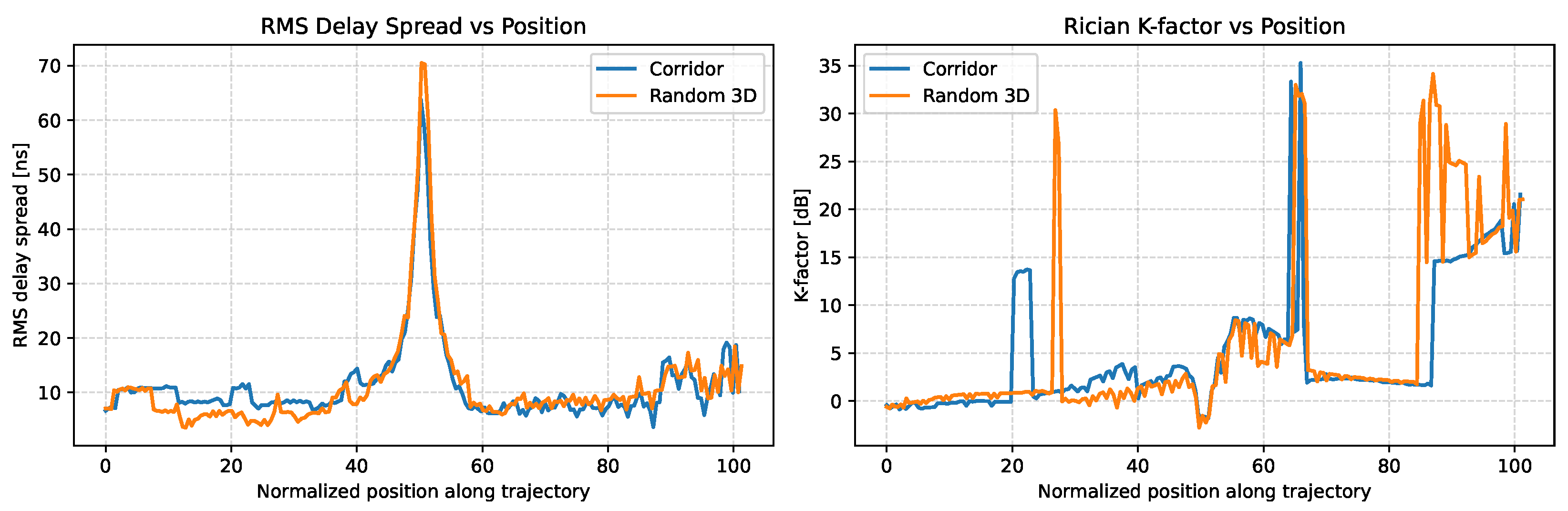
As an example of the particularities of UAv corridors on the radio channel structure, we compare the RMS delay spread and the Ricean K-factor obtained along a straight corridor trajectory and an alternative non-corridor restricted trajectory with the same endpoints. Using a deterministic ray-tracing model of a street-canyon-like environment (two parallel rows of buildings and ground reflections), we extract the time-varying channel impulse response along each path. As shown in Figure 3, the RMS delay spread values do not significantly differentiate between the two scenarios. However, the K-factor variation in the corridor scenario appears smoother and more predictable, exhibiting strong spatial correlation and small number of changes primarily when shadowing conditions vary along the predefined route. This phenomenon becomes more intense as the flight randomness of the non-corridor constrained UAV increases.
Figure 2.
A simple A2G communication scenario between a typical ground user and UAVs moving along a straight aerial corridor, compared with UAVs operating outside corridor constraints.
Figure 2.
A simple A2G communication scenario between a typical ground user and UAVs moving along a straight aerial corridor, compared with UAVs operating outside corridor constraints.
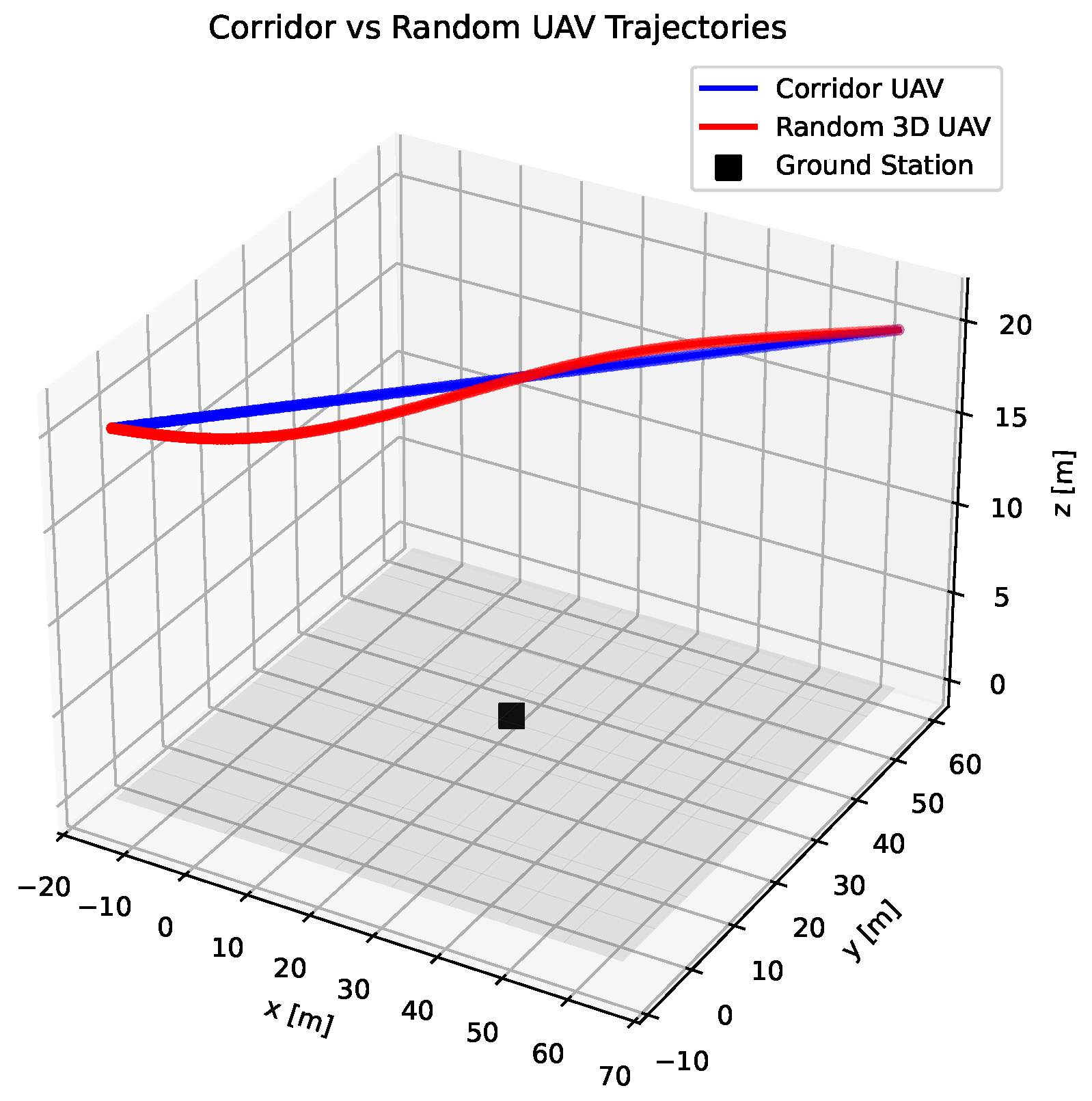
Figure 3.
Comparison of channel features for corridor vs. non-corridor UAV movement a) RMS delay spread, and b) Ricean K-Factor
Figure 3.
Comparison of channel features for corridor vs. non-corridor UAV movement a) RMS delay spread, and b) Ricean K-Factor
6. Case Study: Impact of Aerial Corridors on Connectivity and Handover Performance
The primary objective of aerial corridors is to facilitate safe navigation and traffic management during large-scale UAV deployments. The deployment of aerial corridors also helps to simplify collisions, airspace monitoring, and integration with Unmanned Aircraft System Traffic Management (UTM) systems. However, beyond safe navigation, UAVs operating in corridors also require Ultra-Reliable and Low-Latency Communication (URLLC) services for their continuous command-and-control and safety-critical data exchange.
Meeting URLLC requirements cannot be achieved solely through navigation-centric corridor design. Communication reliability is strongly influenced by flight geometry, infrastructure placement, and urban blockage, especially in dense environments. Therefore, the aerial corridors must be designed jointly with communication considerations, either by (i) aligning corridors with existing infrastructure or (ii) co-designing infrastructure deployment and corridor geometry. This section presents a basic case study to illustrate why structured, connectivity-aware corridors outperform unconstrained UAV trajectories, even in the presence of fixed altitude and mission length.
We consider a simplified urban environment with randomly distributed buildings and rooftop-mounted Base Stations (BSs), as shown in Figure 4. A single UAV mission is considered using three trajectories of equal length and fixed altitude. The trajectories vary only in lateral alignment relative to the BSs, allowing a direct assessment of corridor-aware connectivity.
- Trajectory C1 (corridor-aligned, Blue) is constructed to follow the region where the spatial density of reachable BSs is maximized along the flight direction, representing a deliberately designed aerial corridor.
- Trajectory C2 (moderately offset, Orange) is laterally displaced from C1 while preserving the same length and altitude.
- Trajectory C3 (highly offset, Yellow) deviates further from the corridor region and traverses areas with weaker infrastructure support.
All trajectories follow identical navigation constraints, where the differences arise only from corridor placement.
6.1. Evaluation Setup and Metrics
The urban area is modeled as a rectangular region with length L and lateral limits . The UAV flies at a fixed altitude . Each trajectory is divided into uniformly spaced waypoints , each representing the UAV position at a sampling instant.
where is uniformly distributed over , while remains constant and depends on the particular corridor.
Each city iteration generates randomly-placed non-overlapping buildings, whrere every building k is modeled as an 3D rectangle
where footprint dimensions and are sampled from uniform ranges representing heterogeneous building sizes. In contrast, building heights follow a Rayleigh distribution with scale parameter , as suggested by the International Telecommunication Union (ITU) [50].
A set of Base Stations (BSs) is deployed on the rooftops of buildings within the considered urban region. Each BS is assigned to a host building whose footprint center is . To avoid unrealistic clustering, BS locations are selected with a minimum horizontal separation. Additionally, the BS position is placed at the horizontal center of the building and slightly above the rooftop height,
where is the height of the host building and denotes a small antenna offset above the rooftop.
For each waypoint i and BS j, the LoS condition is checked by tracing the straight 3D path between and and testing whether it intersects any building area between waypoint i and BS j. If the path crosses any building, the link is Non-LoS (NLoS); otherwise, it is labelled as LoS.
The 3D distance between waypoint i and BS j is . Depending on whether the link is LoS or NLoS, different Path-Loss (PL) expressions are used to represent favorable and obstructed propagation conditions,
The Reference Signal Received Power (RSRP) is obtained from the transmit power and PL as . At each waypoint, the UAV associates with the BS providing the maximum received power,
The serving-link Signal-to-Noise ratio (SNR) is then computed by comparing the received power of the serving BS with the thermal noise level N,
6.1.1. Handover Modeling
Mobility is modeled using a standard A3-type handover rule (a neighbor cell becomes better than the serving cell by a specific offset) with hysteresis H and time-to-trigger . Let denote the serving BS at waypoint i and define the best instantaneous candidate
A handover occurs only if the candidate signal remains stronger than the current serving BS by at least H for consecutive waypoints,
When the condition is satisfied, the serving BS is updated, and the handover counter is increased. Finally, an outage is declared when the serving RSRP drops below a predefined threshold ,
The outage fraction along the trajectory is
All results are averaged over independent Monte Carlo realizations. For each trajectory, we report the mean SNR profile along the path and the trade-off between average RSRP, outage probability, and number of handovers.
6.2. Performance Analysis
For the simulations, we consider the previously described dense urban region, where a UAV mission follows three trajectories with the same altitude and length but different alignment relative to the surrounding base stations. The simulation parameters are summarized in Table 5.
Figure 5 illustrates the serving-cell SNR along the flight distance, including the mean and standard deviation across multiple iterations. The corridor-aligned trajectory C1 consistently maintains both higher SNR and lower variability than the offset paths. On average, C1 achieves 15.55 dB, while C2 and C3 drop to 10.76 dB and 3.63 dB, respectively. The larger deviations in C2 and C3 indicate frequent blockages and deep fades. In contrast, C1 maintains more stable links due to better visibility (LoS availability) to nearby base stations. These findings confirm that corridor alignment improves both signal strength and reliability.
The joint connectivity−mobility trade-off is shown in Figure 6. Each point in this figure represents a full mission realization characterized by mean received power, outage probability, and handovers. From the figure, we can clearly distinguish three operating regions, with the C1 path achieving the strongest signal, an average RSRP of -81.29 dBm, and a very low outage of 0.029. As the UAV moves away from the corridor, coverage degrades, and C2 drops to -86.08 dBm with an outage of 0.044. Similarly, C3 shows the worst performance with an average RSRP of -93.21 dBm and an outage of 0.072.
Interestingly, the handover behavior follows the opposite trend. The corridor path produces more handovers (6.98 on average) than C2 (5.72) and C3 (4.81). However, these additional handovers occur between strong neighboring cells and represent controlled connectivity transitions rather than link recovery. In contrast, the offset paths show fewer handovers because the UAV stays connected to weak cells for longer periods, resulting in more frequent outages rather than stable mobility.
Overall, the results show that aerial corridors should not be seen only as navigation paths but as communication-aware infrastructure. Aligning UAV trajectories with the network layout/infrastructure turns random blockages into predictable handovers, increasing received power, reducing outages, and improving connection stability, all of which are essential for URLLC-type aerial operations.
7. Key Enabling Technologies for UAV Corridors
Apart from the geometric layout and network architecture, the establishment of Aerial Corridors as a Sky Infrastructure in 6G is contingent upon a number of critical enabling technologies that can provide efficient, intelligent, and scalable operations within the structured airspace. This chapter provides a review of four such technologies; Integrated Sensing and Communication (ISAC), Reconfigurable Intelligent Surfaces (RIS), Artificial Intelligence and Machine Learning (AI/ML) and Non-Terrestrial Networks (NTN), detailing how these technologies contribute to the performance and functional capabilities of aerial corridors.
7.1. Integrated Sensing and Communication
Integrated Sensing and Communication (ISAC), is a revolutionary technology that can be a key enabling factor for Aerial Corridor Operations in 6G Networks. Instead of utilizing two separate systems, a single waveform can transmit data and gather information about the environment at the same time; providing a unified approach to both sensing and communication. In aerial corridors, the dual function of an ISAC system can provide significant value due to the structured and predictable nature of corridor trajectories that allow ISAC systems to utilize prior knowledge of UAV position and flight patterns to enhance both the sensing capability and communication reliability over what would be possible in unstructured air space [51,52].
7.1.1. Core Capabilities
ISAC offers three main capabilities for use in aerial corridors. The first is real-time environmental observation by continuously collecting data on the state of the air space environment and the movement of weather and other dynamic obstacles [53,54]. The second capability is a single unified platform which simplifies and decreases the cost of deploying such a system as opposed to using multiple sensors and communications platforms separately [55]. The third capability is the tight coupling of sensing and communication in ISAC to enable coordination protocols and/or capabilities that are not possible with conventional systems. Advances in recent years have addressed specific propagation issues in an aerial environment via hybrid models of channels that isolate or segregate target, clutter and interference components; these provide improved accuracy in predicting both communication quality and sensing performance over various sections of the corridor [56,57].
7.1.2. Corridor-Specific Applications
Real-time sensing-assisted trajectory planning, via the use of a mobile radar system, as well as multi-UAV target tracking are two of the many ways in which ISAC can dynamically optimize corridors in the sky. As such, it is able to adaptively create new flight trajectories based on current environmental conditions,as sensed by its own radar system [51,55]. Furthermore, as demonstrated through several studies using different frequency bands, multi-frequency versions of ISAC have shown to be particularly effective at providing both coverage and high resolution sensing via sub-6 GHz and mmWave respectively; these frequencies provide for very stable and accurate tracking of multiple UAVs in all weather conditions, including those of poor visibility[58]. In contrast to other types of radar systems, ISAC will be able to track targets via both a communication-based position system and radar like sensors. This will allow for increased redundancy and better accuracy when it comes to the detection of potential collisions among UAVs in structured airspace.
Additional corridor-enabling functions are security and resource coordination. Dual identity mapping provided by ISAC is used to combine the digital communication identity (the ID used for communication) and the physical sensing identity (used to detect other aircraft), which provides a fast method for detecting spoofing attacks and unauthorized aircraft while minimizing beam alignment delay [59]. Advanced beamforming techniques create nulls in interference directions, while maintaining the ability to maintain communications and sensing capability over multiple corridor segments. When global coverage coordination is required among corridor segments, ISAC enables unified management of all layers of the space-air-ground environment, with sensing feedback regarding atmospheric conditions, which is used for adaptive resource allocation[60].
7.2. Reconfigurable Intelligent Surfaces
Reconfigurable intelligent surfaces (RIS) are an innovative technology that is now considered for aerial corridor operation in 6G wireless networks. In contrast to all other technologies that react to existing channel conditions, RIS can modify the wireless propagation environment by controlling the amount of signal that is transmitted and its phase through programmable passive components [12]. For aerial corridors, the capabilities provided by RIS address two of the main challenges of aerial corridors - signal blockage/path loss/coverage gap created due to urban obstacles and the structured geometry of corridor route. The combination of RIS with UAVs allows for the creation of dynamically adaptive beam-forming that is aligned with the trajectory of the corridor and therefore optimizes the propagation path to follow the geometric structure of the corridor as opposed to having to make complex decisions based on the arbitrary movement of the UAV.
7.2.1. Coverage Enhancement in Structured Airspace
To enhance the service area of traditional ground-based infrastructures when they are limited by terrain, such as mountains and rivers, RIS-equipped surfaces deployed along corridors provide focused coverage enhancement. The concept of using RIS-equipped surfaces on buildings or low-altitude UAVs to reflect signals toward high-altitude corridor traffic is particularly applicable to the scenario of urban air mobility with multiple layers of airspace [61]. A layering concept that takes advantage of the vertically layered structure in corridors can be used for this purpose; RIS elements can be placed to support a specific altitude layer while also minimizing interference from other altitude layers. When a multi-frequency implementation of RIS is used, it can take advantage of both the broader coverage provided by sub-6 GHz frequency bands and the higher capacity links provided by millimeter-wave frequencies in critical corridor locations, like entry/exit points and intersection areas [62].
7.2.2. Trajectory-Aligned Beamforming
The fact that corridors have predictable flight paths allows for many of the optimization techniques used with RIS that would not be possible in unstructured airspace. Instead of constantly adjusting to random movement of a UAV, RIS phase shifts can be pre-programmed for each geometry of the corridor and then update to the schedule of the aircraft moving through the corridor [63]. The use of this method of aligning trajectories will reduce control signals required and allow proactively for beamforming at locations along the corridor where the position of the UAV is anticipated. For an Infrastructure UAV that is at quasi-static position within a corridor, RIS provides a stable high-quality link for both communications and sensing. For Service UAVs moving through a corridor (transit), RIS provides smooth handoffs between corridor segments as it maintains a consistent level of signal quality along the structured flight path.
7.3. Artificial Intelligence and Machine Learning
The use of artificial intelligence and machine learning is able to provide autonomous decision making, as well as adaptive optimization necessary to manage large-scale aerial corridor operations. Machine Learning and artificial intelligence are both capable of processing a wide variety of data, including current traffic conditions, weather conditions, and mission priorities in order to make optimal routing decisions, and develop conflict avoidance methods [64]. In addition to processing a wide variety of data types, AI driven systems are also capable of taking advantage of the known geometric structure of corridors within structured airspace to improve the efficiency of path planning, decrease computational complexity and allow for proactive rather than reactive traffic management. A number of deep reinforcement learning studies have been conducted which demonstrate an ability to learn optimal control policies that optimize safety, efficiency, and energy usage among heterogeneous unmanned aerial vehicle (UAV) fleets operating under corridor constraints.
7.3.1. Intelligent Corridor Management
Advanced AI methods are creating new capabilities in corridor navigation by utilizing learning-based methods that take advantage of structural characteristics in airspace. Using a multi-agent framework and Deep Reinforcement Learning (DRL), collision avoidance in structured airspace is addressed through models that characterize conflicts based on 3-D Reciprocal Velocity Obstacles (RVO). The proposed approach achieves 100% conflict resolution success, while maintaining smooth trajectories and minimizing deviations from the assigned flight paths [65]. As corridors create a structured environment, AI can convert extremely complex four-dimensional deconfliction issues into relatively simple decisions for neural networks.
Convolutional Neural Networks (CNN) have been used to predict transportation traffic density in a given region of a corridor, which has allowed UAVs to make pro-active decisions to route around traffic congestion in real time [66].
In addition to predictive traffic density, AI-enabled Traffic Management (TM) systems are providing strategic deconfliction and dynamic airspace allocation for high-density corridor operations. Machine learning-based optimization is addressing the trade-offs required in flight plan approvals and conflicts resolution while simultaneously optimizing for fairness, environmental sustainability, and operational efficiency [64].
For low-altitude corridors, AI is integrating multiple domains of sensing, communication and corridor management into single, integrated frameworks to provide coordinated control of swarms [67]. Large Language Models (LLMs) are providing advanced techniques for adaptive mission planning that transform operator level missions and objectives into specific routing configurations within corridors.
7.4. Non-Terrestial Networks
Non-terrestrial networks; satellite, High Altitude Platform Station (HAPS), and aerial relay systems will extend network coverage, over terrestrial infrastructure limits, to enable continuous network access along aeronautical corridors. Terrestrial base stations are limited by their physical location as well as the line of sight restrictions in an urban environment. Due to their height, NTN base stations can provide wide area coverage at the same altitude as corridor traffic [68]. Thus, NTN will allow UAVs to operate in a continuous manner through the entire length of the corridor, with no communication denied segments. Since the aeronautical corridors have a very structured and predictable layout, NTN base station resources can be pre-planned and managed according to the traffic pattern in each segment of the corridor thereby providing better spectral efficiency and less handovers.
7.4.1. Corridor Backbone Infrastructure
HAPS are well suited to serve as backbone infrastructure for corridor-based UAV networks, as they operate in stationary or quasi-stationary positions, provide extensive coverage areas, and enable lower-latency communication links compared to satellite-based communication systems [69]. At the altitude that HAPS operate, the number of handoffs is greatly reduced, providing continuous connectivity for high-speed corridor traffic. In addition, HAPS do not require the inter-platform coordination challenges that exist when using LEO satellite constellations. Due to this combination of coverage, reliability, and operational efficiency, HAPS may enable scalable and reliable corridor control. Consequently, for aerial corridors requiring global connectivity or transitions from urban to remote environments, integrated terrestrial–NTN architectures can provide seamless handovers as UAVs move along the corridor. In such scenarios, UAVs transition from terrestrial network coverage in densely populated areas to NTN-only connectivity in underserved or remote regions [68].
7.4.2. Adaptive Connectivity and Resource Management
NTN integration will enable a dynamic distribution of available resources in response to traffic demands in the corridor and weather/airborne environmental conditions. Centralized control of Space (Satellite), Air (HAPS/Balloon), and Ground (Fiber) network segments through software defined networking (SDN), enables operators to dynamically allocate resources across NTN platforms, based upon real-time corridor usage [68]. For corridors with time varying traffic patterns, such as, delivery routes that have peak traffic periods, or seasonal variations, the NTN platform(s) can adjust their beam configuration and bandwidth allocations to meet the expected traffic load. Real time sensing of the atmospheric conditions, and inter-layer interference enables an adaptive coordination among the different layers of the network, to optimize performance for latency sensitive applications, while minimizing energy consumption for the NTN platforms with limited power budgets.
7.5. Implementation Considerations
Aerial corridors in 6G are enabled by a range of advanced technologies, whose integration may introduce several cross-cutting challenges across multiple technical domains during their implementation. Channel State Information (CSI) is one of the most significant cross-domain implementation challenges of ISAC, RIS and NTN systems because the three dimensional movement of UAVs creates CSI variations in both space and time, (micro)Doppler frequency shifts and frequent LOS changes making it difficult to estimate CSI accurately [53,70] . In addition to CSI, computational complexity is another key issue that affects all of these technologies. This is especially true for real-time optimization problems that should be solved jointly or simultaneously and include multiple objectives such as ISAC beamforming, RIS phase shift configurations, and AI-driven network traffic management. To meet the strict latency requirements imposed by the safety-critical nature of corridor operations, effective coordination among the many distributed system components that constitute a corridor - such as terrestrial base stations, aerial relays, RIS panels, and NTN platforms - is essential. In order to support the decentralized decision-making required by each component, robust backhaul connectivity must be ensured, along with distributed optimization mechanisms that allow the system to coordinate decisions and achieve its overall operational objectives.
In addition to the above mentioned challenges, technology specific trade-offs have also shaped how these technologies are implemented. For example, ISAC systems have the tradeoff of balancing the accuracy of sensing against the quality of communications. Resource allocation techniques have been developed to optimize this balance in terms of the sensing and communications processes of ISAC systems. As a result, improvements in the sensing and communications processes of ISAC systems lead to improved sensing and communications performance. However, these improvements come at the expense of increased signal processing requirements and the need of AI-based optimization to manage the interdependencies between the sensing and communications processes of ISAC systems [52]. RIS-supported systems benefit from their ability to operate passively, and therefore consume less power and weigh less than other systems.
However, in order for RIS systems to operate efficiently, they must be controlled coordinately and the phases of each panel must be adjusted in real-time based on the motion of the platform. Control signaling latency limits the amount of time available for responding to the changing corridor environment. AI and Machine Learning (ML) based approaches require large amounts of training data that reflect a wide variety of operational scenarios and are typically computationally intensive (during training) and require long periods of off-line computation. However, since the structure of aerial corridors is well-defined, they reduce the complexity of the state space and enable the use of Transfer Learning (TL) among different sections of a corridor. Ensuring that AI/ML-based systems are reliable, interpretable, and fail-safe is essential for supporting safety-critical autonomous decision-making [65].
NTN systems introduce additional challenges related to coordinating spectrum usage among the terrestrial and non-terrestrial segments of a system. While HAPS systems offer advantages in terms of latency and beam stability compared to satellite systems, they face several operational challenges, including maintaining station keeping and obtaining regulatory approvals. Conversely, LEO constellations provide global coverage but require complex handover management due to the continuous movement of satellites overhead [69]. Therefore, future implementations will require comprehensive optimization frameworks that consider the interdependencies between these technologies and do so in a joint manner as opposed to optimizing each technology independently.
Table 6 summarizes the key characteristics, benefits, and challenges of each enabling technology for aerial corridor operations.
8. Performance Analysis
This section focuses on the literature that evaluates the performance of UAV communications and networking in aerial corridor environments, i.e., analytical models, simulations, and system-level studies that quantify connectivity, reliability, interference, and scalability. The goal of this section is to synthesize the main methodologies used in the literature and highlight how corridor-structured airspace influences network behavior compared with unconstrained UAV operations. In particular, the surveyed works analyze metrics such as coverage probability, signal-to-noise ratio (SNR), outage probability, handover dynamics, and interference patterns under dense aerial traffic conditions. By examining these studies collectively, the section aims to identify common modeling assumptions, key performance bottlenecks, and the benefits of structured flight paths for communication-aware UAV mobility. Importantly, the literature indicates that corridor-aligned trajectories can transform random connectivity fluctuations into more predictable link dynamics and controlled handover events, enabling more stable connectivity and improved support for URLLC-type aerial services. Going one step further, an original simulation-based comparative study is performed to assess the communication and sensing performance of UAV deployments operating with and without the use of aerial corridors.
In [71], the authors exploited the one-dimensional (1D) binomial point process (BPP) to model for the first time the spatial locations of the UAV-BSs in the aerial corridor. The UAV corridor was modeled as a finite line above the ground. Subsequently a comprehensive SNR-based performance analysis in terms of coverage probability, average rate, and energy efficiency was conducted under three association strategies, namely, the nth nearest-selection scheme, the random selection scheme, and the joint transmission coordinated multi-point (JT-CoMP) scheme. The numerical results revealed that there exists an optimal value of UAV-BSs in the cooperation set that yields the best trade-off between the coverage performance and energy efficiency.
By extending beyond the SNR-based performance analysis, in [72], the study conducted joint energy and SINR-based coverage analysis for RF-powered IoT networks supported by UAV corridors. By exploiting the 1D BPP, the authors derived exact expressions for energy coverage probability and tight approximations for overall coverage performance under shadowing conditions. The study revealed that an optimal number of deployed UAV-BSs () exists that maximizes joint coverage probability, and that devoting more time to energy harvesting reduces the need for dense UAV-BS deployment while creating trade-offs with communication performance.
The research in [73] proposed a secure 5G network architecture for nationwide drone corridors, focusing on the integration of cellular networks with UAV operations. Their approach involved adding separate antenna sets for aerial coverage while maintaining conventional antennas for ground coverage, utilizing mmWave frequency bands for both control and data traffic. The study emphasized optimization of uplink communication from drone swarms using non-orthogonal multiple access (NOMA) and physical layer security enhancements through precoding techniques with channel information about interference sources.
In [43], the authors extended their previous work by developing comprehensive security and reliability solutions for 5G drone corridors. This study derived optimum antenna uptilt angles to minimize outage probability and investigated the placement of intelligent reflector surfaces in urban environments to improve multipath scattering and spatial multiplexing gains. The research also addressed trajectory optimization for safety and demonstrated how 3GPP standard-based subframe blanking methods can minimize interference from ground reflections of RF radiation from downtilted antennas.
The work in [42] analyzed interference in UAV-to-UAV communications within drone corridors and proposed millimeter wave beamforming as an interference mitigation strategy. Using 5G New Radio sidelink communications at 28 GHz with 2x2 uniform planar antenna arrays, they examined three scenarios with parallel corridors spaced 100-300 m apart. Their results demonstrated that mmWave beamforming substantially outperformed conventional transmissions, achieving average SINR improvements of 7.88 dB across scenarios, with individual scenario improvements ranging from 7.55 dB to 7.90 dB, effectively enabling higher UAV densities in shared airspace.
The work in [36] developed a high-dimensional Bayesian optimization methodology for cellular base station antenna configuration to serve both ground users and UAVs in designated aerial corridors. Their study examined corridors of 900 m length and 40 m width at heights of 140-160 m, with an average of 70 UAVs per corridor operating in the 2 GHz spectrum. The research demonstrated substantial performance improvements, achieving coverage probability increases from 0.505 (baseline) to 0.985 (corridor-optimized), with median SINR gains exceeding 20 dB and outage probability reductions from nearly 50% to just 2%. Critically, these aerial improvements were achieved with minimal ground user degradation-UAV data rates improved by 96% while ground user rates decreased by only 3%
The work in [74] provides crucial experimental validation of UAV corridor analytical models, representing the only study with empirical verification among the reviewed papers. Using both BPP and finite homogeneous Poisson point process (HPPP) spatial modeling, the research validates theoretical frameworks through air-to-ground measurement campaigns. The study demonstrates that corridor-assisted networks significantly outperform 2D ball deployments and establishes that shadowing conditions strongly affect receiver association policies and performance.
8.1. Identified Trade-Offs
Multiple studies identified fundamental trade-offs in UAV corridor design:
- Energy vs. SINR Coverage : [72] found that devoting more time to energy harvesting reduces the need for dense UAV-BS deployment but affects communication performance.
- UAV vs. Ground User Performance : [36] noted that optimizing for UAVs can conflict with ground user performance due to differing antenna tilt requirements, though corridor-specific designs offer better trade-offs than uniform UAV distributions.
- Deployment Height Effects: [71] revealed that the energy efficiency under the nearest selection scheme outperforms Coordinated Multi-point for lower deployment heights.
8.2. Communication and Sensing in UAV-to-Ground Networks: Performance Comparison
As a 6G key enabling technology, joint communication and sensing has attracted a lot of research attention in UAV networks. However, the spatial setup for deploying UAVs plays a crucial role in the performance of communication and sensing-assisted UAV-to-ground networks. While the most widely adopted spatial model for deploying UAVs is a finite disc located above the ground [77], many recent works have justified the exploitation of UAV corridors for the spatial deployment of UAVs. Although, the 1D BPP was exploited for modeling the UAVs in finite line segments [71,72,74] as the best choice for maintaining a balanced trade-off between accuracy and analytical tractability, recently, in [78] the authors proposed the 3D BPP as a reasonable point process for modeling the spatial locations of UAVs in ISAC-enabled UAV-to-ground networks. Accordingly, the spatial location of UAVs is modeled as a 3D BPP in 3D cylinders.
Triggered by the aforementioned, in this subsection, a new performance comparison between two UAV-assisted networks which enable both communication and sensing capabilities is conducted in terms of communication and sensing performance. The performance comparison is conducted between two stochastic geometry-based spatial models for the UAV spatial deployment: i) The UAV-UEs are assumed to be deployed in a conventional disc model located above the ground and ii) the UAV-UEs are assumed to be deployed in a finite 3D cylindrical corridor located above the ground. Accordingly, for both spatial models, assume a receiving BS located at the origin (0,0,0), equipped with an omnidirectional antenna.
For the UAV corridor spatial model, let UAV-UEs be deployed in a 3D cylindrical corridor centered at (0,0,h) forming a 3D BPP, with h denoting the corridor deployment height. The corridor has length L and radius R. For the disc spatial model, assume that the UAV-UEs are deployed in a disc of radius centered at (0,0,h). Accordingly, in order to maintain the spatial deployment density equal between the two geometrical models, assume UAV-UEs deployed in the disc forming a 2D BPP, where denote the area of the disc and the volume of the cylinder, respectively and denotes round to the closest positive integer number. For both spatial models, the BS is assumed to perform sensing with a random target UAV-UE whereas the nearest UAV-UE from the BS is selected for reverse link communication with the BS. Accordingly, during the sensing functionality, the BS suffers from backscattering interference caused by the UAV-UEs. During the communication, the UAV-UEs are assumed to be active and interference to the receiving BS. Accordingly, we define the communication/sensing coverage probability as the probability that the communication/sensing SIR at the receiving BS exceeds a predefined communication/sensing SIR threshold. Notably, the calculation of sensing SIR is based on the radar equation. In the following, simulation results are presented to evaluate and compare the performance achieved by the two spatial models in UAV-assisted communication and sensing-enabled networks. For the simulation results, unless stated otherwise, the following key parameters have been considered: , meters, meters, meters, and Nakagami .
In Figure 7, the communication coverage probability versus the SIR threshold is illustrated under different values of path-loss factor for i) a UAV corridor spatial model and ii) a disc spatial model for UAV-UEs. A first observation is that as the propagation conditions become worse (from to ), the communication coverage performance becomes better for both spatial models. This is because the propagation conditions of the interfering UAV-UEs, which primarily determine the SIR, become worse which in turn reduces interference power at the receiving BS and increases the received SIR. A second observations is that the communication coverage performance is almost the same for both spatial models and under both values of . This is because of the fact that the aggregate interference power at the receiving BS for the two spatial models is close.
In Figure 8, the sensing coverage probability versus the SIR threshold is illustrated under different values of path-loss factor for the two cases of UAV-UE spatial modeling. A key observation is that the sensing coverage performance is degraded for both spatial models as we move to worse propagation conditions. This is mainly because of the RCS-based mechanism Indeed, if the BS senses a target UAV-UE, there is a non-negligible probability that strong interference caused by backscattering be caused by UAV-UEs closer than the desired target UAV-UE. Due to a close distance between the BS and the UAV-UEs causing backscattering interference, the path loss conditions are favorable for the interferers, which increases the received aggregate interference power at the BS. However, an insightful observation can be drawn: The geometry of the UAV corridor spatial model allows for a better sensing performance as compared to the one under the disc spatial model, under bot values of . The result is more profound for the more demanding values of sensing SIR threshold. The insight i) justifies the exploitation of the UAV corridors for ISAC and ii) enhances the motivation for exploiting UAV corridors in 6G UAV-assisted networks.
9. Challenges and Future Work
Sections 2–8 established the technical foundation for aerial corridors as 6G sky infrastructure by reviewing UAV communication technologies and enablers, defining the corridor geometry and multi-lane architecture, detailing the corridor network layers and UAV roles, and analyzing corridor-specific communication scenarios, channel behavior, connectivity–handover performance through a representative case study and performance evaluation. Building on this corridor-centric system view,where reliability, seamless mobility, and robust operation in dense, structured airspace emerge as key design goals, this section shifts from “how corridors are designed and enabled” to “what remains open and requires investigation”. Future research directions will also be presented that could advance aerial corridors toward a fully intelligent 6G sky infrastructure. The challenges examined in this paper arise directly from the structure, predictability, and management requirements inherent to aerial corridors. These challenges relate to the complexity of corridor design, limitations in channel modeling, the management of connectivity and handovers, the evaluation of ISAC performance, and, finally, the security of aerial corridor operations.
9.1. Technical Challenges
Each of the following challenges highlights the open research problems that emerge specifically from the operational environment of the aerial corridors:
- Corridor design challenges: After analyzing the existing design frameworks for aerial corridors, several challenges become evident. First, most current approaches - such as fluid-flow, finite-state, and multi-floor models - are largely static in nature, meaning they cannot easily adapt to real-time changes such as severe weather conditions or emergency situations. Another significant challenge concerns corridor design in urban environments, where constraints are more complex. When optimization must simultaneously consider multiple objectives, i.e., path length, capacity, and collision avoidance, the problem becomes computationally demanding and is generally classified as NP-hard.
- Channel modeling challenges: Regarding Channel modeling, as the existing models are constructed for free space or random trajectories, they are unable to focus on the constrained corridor geometry. The sharp changes in the channel statistics due to handover events, are also a challenge, as current models have limited support of this operation and cannot describe them sufficiently. Furthermore, each modeling approach has its restrictions; GBSM does not support corridor-specific configurations, ray-tracing is site-specific, and AI-based model have restricted interpretability.
- Connectivity challenges and Handover: Ensuring reliable connectivity and seamless handovers in aerial corridors introduces several critical issues. A primary challenge is the coexistence of Infrastructure, Service and Emergency UAVs, which leads to heterogeneous QoS requirements that have not been handled efficiently. Moreover, the case study revealed an interesting paradox: the corridor produces more handovers but better performance, because these handovers occur when the signal is still strong. Finally, while the case study is SNR-based and assumes no interference, extending the analysis to more realistic scenarios that explicitly account for interference remains an open challenge.
- Security challenges: As far as security is concerned, the corridor predictability inherently leads to the creation of hotspots, which are prime targets for jamming and spoofing. In addition to this, "security as availability" is a central concept meaning that even without an attacker, the corridor topology can create Denial-of-Service (DoS)-like behavior due to interference. Equally important is the need for latency-bounded security mechanisms, rapid key management, and secure context transfer during handovers. Finally, "safe-degradation by design" is essential to ensure that the corridor remains within safe operational limits even under attack.
-
Communication and sensing challenges: Moving beyond the identified security issues, Sec. 8 revealed several key technical challenges regarding the design and performance evaluation of UAV corridor-assisted networks:
- 1.
- Sec. 8 revealed that UAV corridors constitute a promising spatial model for enhancing ISAC performance. However, the conducted analysis was based on the 3D BPP. More realistic point processes are expected for modeling UAV distributions within aerial corridors. In this context, the Mattern hard-core point process represents a more suitable choice when maintaining a minimum safety distance between UAVs is required.
- 2.
- The proposed framework serves as a baseline scheme. Further investigation is required by considering technical characteristics such as the UAV’s antenna patterns, the UAVs’ trajectories and the LoS conditions of the UAVs in order to draw further meaningful insights. Accordingly, we can investigate the circumstances under which the sensing performance in UAV corridor-assisted networks is more superior as compared to other conventional spatial models.
- 3.
- Although the framework proposed in Section 8 maintains computational tractability, the integration of additional 6G key enabling technologies - such as reconfigurable intelligent surfaces (RIS) and joint communication, sensing, and energy harvesting - is expected to further strengthen the foundation and motivation for the deployment of UAV corridor-assisted networks.
- 4.
- Optimization of communication and sensing performance in UAV corridor-assisted networks by jointly optimizing the number of UAVs, the deployment height as well as the length and radius of the corridor, remains a key open technical challenge.
9.2. Future Research Directions
One of the key future directions is the development of corridor-aware models. As the precise trajectory within the aerial corridor is a prior knowledge, the prediction of the signal variations, like Doppler effect or delays, is possible at every point along the route. Consequently, this leads to the integration of more accurate stochastic models that are trajectory-conditioned. Therefore, future models have to include handovers, in order to handle abrupt changes. To this end, to make all of this a reality, it is necessary to carry out targeted measurements with drones in real conditions and at different heights, with the objective of collecting the necessary data to validate theoretical models.
Furthermore, the optimization of aerial corridors can be directly aligned with the placement of RIS along the corridors. As previously mentioned, the UAV routes are known in advance and as a result, these surfaces can dynamically adapt signal reflection to follow UAV motion along each lane. In this way, dead zones and interference between different flight lanes are eliminated, without additional energy consumption. Ultimately, the aerial corridor functions as a smart tunnel where the environment itself assists in transmitting the signal rather than blocking it.
Following this, the utilization of Digital Twins offers a promising solution for the intelligent management of aerial corridors. By combining this virtual copy of the aerial corridor with Artificial Intelligence, the whole ecosystem can predict issues before they occur. As a result, not only multiples UAVs trajectories can be changed automatically, but handovers can also be triggered on time, based on historical movement patterns. Therefore, this shift toward a predictive approach is essential to support future 6G networks.
The next step for the expansion of aerial corridors, into the rural and maritime environments will involve the development of non-terrestrial networks. High altitude platforms can provide coverage for remote areas, as do LEO satellites that offer global connectivity. The combination of ground antenna, high-altitude platforms and satellite systems will allow seamless handovers across different network layers-from ground to space. Eventually this multi-layered integration will establish a global aerial infrastructure which would mirror the terrestrial road network.
10. Conclusion
This paper has presented Aerial Corridors as a complete and integrated strategy for developing the Aerial Corridors as a fundamental base of infrastructure for 6G Sky Networks. In other words, the paper showed how it is possible to see aerial corridors not only as specific geographic areas in which an aircraft can fly but also as a structured airspace from which to develop new-generation communication systems suitable for both the next generation of Advanced Air Mobility (AAM) and Urban Air Mobility (UAM).
The suggested Corridor Architecture as described in this document is a tube shaped, multi-lane, structure that was developed using many geometric principles discussed in the recent literature. In addition to the use of the geometric principles used to generate flow paths to guide vehicles through the corridor with smooth trajectories and around urban obstacles, the finite-state airspace can be partitioned into two areas; a keep-in zone where vehicles are permitted to fly and a keep-out zone where they are prohibited from flying. Vehicles may also be stacked vertically, allowing them to travel at different altitudes as shown in previous corridor architectures. This structured method of designing corridors has been proven to reduce the complexity of the originally defined four dimensional traffic de-confliction problem to manageable lane based scheduling problems, thus providing scalability to support thousands of simultaneous aircraft operations.
In addition to demonstrating unique wireless propagation characteristics of Aerial Corridors, Channel Modeling also identified that flight volumes and linear flight trajectories found in corridors will cause more predictable multipath effects for the same aerial corridor. These predictable multipath effects create consistent Rician K-factors and lower delay spreads when compared to random or arbitrary flight paths. The case study we presented also show that flight paths aligned with an aerial corridor can significantly improve connectivity (received signal strength was improved by about 12 dB; outage probability was decreased from 7.2% to 2.9%) when compared to offset flight paths.
We addressed the fundamental operational challenges by examining four major technologies. The first is ISAC which serves as a common sensor and communications platform for the real time identification of obstacles and the identity of the aircraft. The second is the use of RIS which allows trajectory aligned beam forming at low power levels. The third is the application of AI and Machine Learning that utilize the predictable geometric configuration of corridors to provide efficient conflict resolution and traffic prediction. The fourth is the use of NTN platforms to provide seamless coverage of corridors through the integration of HAPS and Satellite Communications. Our performance studies confirm the advantages of using these technologies and show improvements in coverage from 0.505 to 0.985 and SINR increases of over 20 dB.
Although these advances represent important steps toward providing the necessary infrastructure for Aerial Transportation, there are still many challenges that need to be resolved. These include the ability to acquire channel state information while in motion, coordinating the distributed components of the systems in real time, and addressing the tradeoffs associated with each of the individual technologies. Future work should therefore focus on developing adaptable corridor geometries, enhancing the security frameworks for corridors and standardizing the interfaces between the various technologies that make up a corridor based 6G infrastructure so that it is compatible with all types of heterogeneous platforms.
As Advanced Air Mobility transitions from a concept to operational reality, Aerial Corridors will become the critical infrastructure that connects the land based services to the air based transportation networks. The framework described in this paper provides researchers, engineers, and policy makers a basis for the design, development and optimization of corridor based 6G infrastructure that will support the next generation of Intelligent Aerial Transportation Systems that meet the requirements of the IMT-2030 objectives.
Author Contributions
Conceptualization, S.A. and K.M.; Methodology, S.A., A.S. and Z.C.; Software, S.A., A.S. and H.K.A.; Formal analysis, H.K.A.; Investigation, S.A., F.K. and A.S.; Data curation, S.A., A.S. and Z.C.; Writing—original draft, S.A. and F.K.; Writing—review & editing, S.A., A.S., H.K.A. and K.M.; Visualization, S.A., A.S. and H.K.A.; Supervision, K.M.; Project administration, K.M. All authors have read and agreed to the published version of the manuscript.
Acknowledgments
This work is supported by the European Commission and the EU Horizon SNS Joint Undertaking (SNS JU) 2023 research and innovation programme, under the iSEE-6G project (Grant Agreement No. 101139291).
Conflicts of Interest
The authors declare no conflicts of interest.
AI-Assisted Content Disclosure
Generative AI tools were used to improve the clarity and readability of this manuscript, as well as for the creation of the conceptual illustration in Figure 1. The authors provided domain-specific guidance, technical constraints, and iterative refinements to ensure accuracy, consistency, and relevance to the proposed system model.
Abbreviations
The following abbreviations are used in this manuscript:
| 1D | One-Dimensional |
| 2D | Two-Dimensional |
| 3D | Three-Dimensional |
| 6G | Sixth-Generation |
| A2G | Air-to-Ground |
| AAM | Advanced Air Mobility |
| AI | Artificial Intelligence |
| AoA | Angle-of-Arrival |
| BPP | Binomial Point Process |
| BS | Base Station |
| CIR | Channel Impulse Response |
| CNN | Convolutional Neural Network |
| CSI | Channel State Information |
| DRL | Deep Reinforcement Learning |
| GBSM | Geometry-Based Stochastic Modeling |
| HAPS | High Altitude Platform Station |
| HPPP | Homogeneous Poisson Point Process |
| IoT | Internet of Things |
| ISAC | Integrated Sensing and Communication |
| ITS | Intelligent Transportation System |
| ITU | International Telecommunication Union |
| JT-CoMP | Joint Transmission Coordinated Multi-Point |
| KPI | Key Performance Indicator |
| LEO | Low Earth Orbit |
| LLM | Large Language Model |
| LoS | Line-of-Sight |
| MIMO | Multiple-Input Multiple-Output |
| ML | Machine Learning |
| NLoS | Non-Line-of-Sight |
| NOMA | Non-Orthogonal Multiple Access |
| NTN | Non-Terrestrial Network |
| PDE | Partial Differential Equation |
| PL | Path-Loss |
| QoS | Quality-of-Service |
| QUBO | Quadratic Unconstrained Binary Optimization |
| RCS | Radar Cross-Section |
| RF | Radio Frequency |
| RIS | Reconfigurable Intelligent Surface |
| RMS | Root-Mean-Square |
| RSRP | Reference Signal Received Power |
| RVO | Reciprocal Velocity Obstacle |
| SAGIN | Space-Air-Ground Integrated Network |
| SAR | Search and Rescue |
| SDN | Software Defined Networking |
| SINR | Signal-to-Interference-plus-Noise Ratio |
| SNR | Signal-to-Noise Ratio |
| STPA-Sec | System-Theoretic Process Analysis for Security |
| TL | Transfer Learning |
| TM | Traffic Management |
| U2I | UAV-to-Infrastructure |
| U2U | UAV-to-UAV |
| UAM | Urban Air Mobility |
| UAV | Unmanned Aerial Vehicle |
| UE | User Equipment |
| URLLC | Ultra-Reliable and Low-Latency Communication |
| UTM | Unmanned Aircraft Traffic Management |
References
- Mahbub, M.; Saym, M.M.; Jahan, S.; Paul, A.K.; Vahid, A.; Hosseinalipour, S.; Barua, B.; Yeh, H.G.; Shubair, R.M.; Taleb, T. A holistic survey of UAV-assisted wireless communications in the transition from 5G to 6G: State-of-the-art intertwined innovations, challenges, and opportunities. Journal of Network and Computer Applications 2025, 237, 104131. [Google Scholar] [CrossRef]
- Mozaffari, M.; Lin, X.; Hayes, S. Toward 6G with Connected Sky: UAVs and Beyond. IEEE Communications Magazine 2021, 59, 74–80. [Google Scholar] [CrossRef]
- Alsabah, M.; Naser, M.A.; Mahmmod, B.M.; Abdulhussain, S.H.; Eissa, M.R.; Al-Baidhani, A.; Noordin, N.K.; Sait, S.M.; Al-Utaibi, K.A.; Hashim, F. 6G Wireless Communications Networks: A Comprehensive Survey. IEEE Access 2021, 9, 148191–148243. [Google Scholar] [CrossRef]
- Jawad, A.T.; Maaloul, R.; Chaari, L. A comprehensive survey on 6G and beyond: Enabling technologies, opportunities of machine learning and challenges. Computer Networks 2023, 237, 110085. [Google Scholar] [CrossRef]
- JIANG, X.; SHENG, M.; ZHAO, N.; XING, C.; LU, W.; WANG, X. Green UAV communications for 6G: A survey. Chinese Journal of Aeronautics 2022, 35, 19–34. [Google Scholar] [CrossRef]
- Othman, W.M.; Ateya, A.A.; Nasr, M.E.; Muthanna, A.; ElAffendi, M.; Koucheryavy, A.; Hamdi, A.A. Key Enabling Technologies for 6G: The Role of UAVs, Terahertz Communication, and Intelligent Reconfigurable Surfaces in Shaping the Future of Wireless Networks. Journal of Sensor and Actuator Networks 2025, 14. [Google Scholar] [CrossRef]
- Mao, K.; Zhu, Q.; Wang, C.X.; Ye, X.; Gomez-Ponce, J.; Cai, X.; Miao, Y.; Cui, Z.; Wu, Q.; Fan, W. A Survey on Channel Sounding Technologies and Measurements for UAV-Assisted Communications. IEEE Transactions on Instrumentation and Measurement 2024, 73, 1–24. [Google Scholar] [CrossRef]
- Zhang, J.; Lu, W.; Xing, C.; Zhao, N.; Al-Dhahir, N.; Karagiannidis, G.; Yang, X. Intelligent integrated sensing and communication: a survey. In Science China Information Sciences 2025; Publisher Copyright: © The Author(s), 2024; Volume 68. [Google Scholar] [CrossRef]
- Wei, Z.; Qu, H.; Wang, Y.; Yuan, X.; Wu, H.; Du, Y.; Han, K.; Zhang, N.; Feng, Z. Integrated Sensing and Communication Signals Toward 5G-A and 6G: A Survey. IEEE Internet of Things Journal 2023, 10, 11068–11092. [Google Scholar] [CrossRef]
- Magbool, A.; Kumar, V.; Wu, Q.; Di Renzo, M.; Flanagan, M.F. A Survey on Integrated Sensing and Communication With Intelligent Metasurfaces: Trends, Challenges, and Opportunities. IEEE Open Journal of the Communications Society 2025, 6, 7270–7318. [Google Scholar] [CrossRef]
- Ye, J.; Qiao, J.; Kammoun, A.; Alouini, M.S. Nonterrestrial Communications Assisted by Reconfigurable Intelligent Surfaces. Proceedings of the IEEE 2022, 110, 1423–1465. [Google Scholar] [CrossRef]
- Putranto, P.; Hamza, A.A.; Mabrouki, S.; Armi, N.; Dayoub, I. Reconfigurable Intelligent Surfaces for 6G and Beyond: A Comprehensive Survey from Theory to Deployment. 2025. [Google Scholar] [CrossRef]
- Worka, C.E.; Khan, F.A.; Ahmed, Q.Z.; Sureephong, P.; Alade, T. Reconfigurable Intelligent Surface (RIS)-Assisted Non-Terrestrial Network (NTN)-Based 6G Communications: A Contemporary Survey. Sensors 2024, 24. [Google Scholar] [CrossRef]
- Mohsan, S.A.H.; Li, Y. IRS-assisted UAV Communications: A Comprehensive Review. arXiv 2023, arXiv:2306.15838. [Google Scholar] [CrossRef]
- Zhao, Y.; Yuan, Y.; Jian, M. RIS-Enabled UAV Communications and Sensing: Opportunities, Challenges, and Key Technologies. 2024. [Google Scholar] [CrossRef]
- Ahmed, M.; Soofi, A.A.; Raza, S.; Khan, F.; Ahmad, S.; Khan, W.U.; Asif, M.; Xu, F.; Han, Z. Advancements in RIS-Assisted UAV for Empowering Multiaccess Edge Computing: A Survey. IEEE Internet of Things Journal 2025, 12, 6325–6346. [Google Scholar] [CrossRef]
- Hasan, S.R.; Sabuj, S. A Comprehensive Review on Reconfigurable Intelligent Surface for 6G Communications: Overview, Deployment, Control Mechanism, Application, Challenges, and Opportunities. 2023. [Google Scholar] [CrossRef]
- Mendu, B.; Mbuli, N. State-of-the-Art Review on the Application of Unmanned Aerial Vehicles (UAVs) in Power Line Inspections: Current Innovations, Trends, and Future Prospects. Drones 2025, 9. [Google Scholar] [CrossRef]
- Lyu, M.; Zhao, Y.; Huang, C.; Huang, H. Unmanned Aerial Vehicles for Search and Rescue: A Survey. Remote Sensing 2023, 15. [Google Scholar] [CrossRef]
- Phadke, A.; Majumdar, N. Towards Personal Aerial Vehicles for Urban Air Mobility Transportation: Examining Considerations and Potential Challenges. 2025. [Google Scholar] [CrossRef] [PubMed]
- Hamid, H.; Begh, G. IRS assisted UAV communications for 6G networks: a systematic literature review. Wireless Networks 2025, 31, 779–807. [Google Scholar] [CrossRef]
- Rahmatov, N.; Baek, H. RIS-carried UAV communication: Current research, challenges, and future trends. ICT Express 2023, 9, 961–973. [Google Scholar] [CrossRef]
- Ahmed, M.; Amin Soofi, A.; Raza, S.; Li, Y.; Khan, F.; Ullah Khan, W.; Asif, M.; Han, Z. A Comprehensive Survey on RIS-Enhanced Physical Layer Security in UAV-Assisted Networks. IEEE Internet of Things Journal 2025, 12, 32538–32562. [Google Scholar] [CrossRef]
- Eskandari, M.; Savkin, A.V. Integrating UAVs and RISs in Future Wireless Networks: A Review and Tutorial on IoTs and Vehicular Communications. Future Internet 2024, 16. [Google Scholar] [CrossRef]
- Challa, V.R.; Gupta, M.; Ratnoo, A.; Ghose, D. Multiple Lane UAV Corridor Planning for Urban Mobility System Applications. In Proceedings of the 2021 International Conference on Unmanned Aircraft Systems (ICUAS), 2021; pp. 1003–1009. [Google Scholar] [CrossRef]
- Asslouj, A.E.; Uppaluru, H.; Ramezani, M.; Atkins, E.; Rastgoftar, H. A Fixed Air Corridor Model for UAS Traffic Management in Urban Areas. IEEE Transactions on Aerospace and Electronic Systems 2024, 60, 5651–5662. [Google Scholar] [CrossRef]
- Rastgoftar, H.; Emadi, H.; Atkins, E.M. A Finite-State Fixed-Corridor Model for UAS Traffic Management. IEEE Transactions on Intelligent Transportation Systems 2024, 25, 2322–2330. [Google Scholar] [CrossRef]
- Sacharny, D.; Henderson, T.C.; Marston, V.V. Lane-Based Large-Scale UAS Traffic Management. IEEE Transactions on Intelligent Transportation Systems 2022, 23, 18835–18844. [Google Scholar] [CrossRef]
- Stuive, L.; Gzara, F. Airspace network design for urban UAV traffic management with congestion. Transportation Research Part C: Emerging Technologies 2024, 169, 104882. [Google Scholar] [CrossRef]
- He, X.; Li, L.; Mo, Y.; Sun, Z.; Qin, S.J. Air Corridor Planning for Urban Drone Delivery: Complexity Analysis and Comparison via Multi-Commodity Network Flow and Graph Search. Transportation Research Part E: Logistics and Transportation Review 2025, 193, 103859. [Google Scholar] [CrossRef]
- Feng, W.; Wang, Y.; Chen, Y.; Ge, N.; Wang, C.X. Structured Satellite-UAV-Terrestrial Networks for 6G Internet of Things. IEEE Network 2024, 38, 48–54. [Google Scholar] [CrossRef]
- Toka, L.; Konrad, M.; Pekar, A.; Biczók, G. Integrating the Skies for 6G: Techno-Economic Considerations of LEO, HAPS, and UAV Technologies. IEEE Communications Magazine 2024, 62, 44–51. [Google Scholar] [CrossRef]
- Kabashkin, I.; Iskakov, D.; Topilskiy, R.; Tlepiyeva, G.; Sultanov, T.; Sansyzbayeva, Z. Communication Infrastructure Design for Reliable UAV Operations in Air Mobility Corridors. Drones 2025, 9. [Google Scholar] [CrossRef]
- Zhai, W.; Han, B.; Li, D.; Duan, J.; Cheng, C. A low-altitude public air route network for UAV management constructed by global subdivision grids. PLOS ONE 2021, 16, 1–14. [Google Scholar] [CrossRef]
- Singh, S.; Bhattacherjee, U.; Ozturk, E.; Güvenç, Ä.; Dai, H.; Sichitiu, M.; Bhuyan, A. Placement of mmWave Base Stations for Serving Urban Drone Corridors. In Proceedings of the 2021 IEEE 93rd Vehicular Technology Conference (VTC2021-Spring), 2021; pp. 1–6. [Google Scholar] [CrossRef]
- Benzaghta, M.; Geraci, G.; López-Pérez, D.; Valcarce, A. Cellular Network Design for UAV Corridors via Data-Driven High-Dimensional Bayesian Optimization. IEEE Transactions on Wireless Communications 2025, 24, 7530–7545. [Google Scholar] [CrossRef]
- Rodrigues, P.; Askar, S.; Sudhamsu, G.; Rani, P.; Jalalnezhad, M. Multi-UAV traffic management using predicted control. In Aerospace Systems; 2025. [Google Scholar] [CrossRef]
- Haba, R.; Mano, T.; Ueda, R.; Ebe, G.; Takeda, K.; Terabe, M.; Ohzeki, M. Routing and Scheduling Optimization for Urban Air Mobility Fleet Management using Quantum Annealing. arXiv 2024, arXiv:quant. [Google Scholar] [CrossRef]
- Moraga, Ã.; de Curtò, J.; de Zarzà, I.; Calafate, C.T. AI-Driven UAV and IoT Traffic Optimization: Large Language Models for Congestion and Emission Reduction in Smart Cities. Drones 2025, 9. [Google Scholar] [CrossRef]
- Stuive, L.; Gzara, F. Airspace network design for urban UAV traffic management with congestion. Transportation Research Part C: Emerging Technologies 2024, 169, 104882. [Google Scholar] [CrossRef]
- De Luca, V.; Pascarelli, C.; Colucci, M.; Afrune, P.; Corallo, A.; Avanzini, G. A Platform for Safe Operations of Unmanned Aircraft Systems in Critical Areas. Engineering 2025, 49, 314–331. [Google Scholar] [CrossRef]
- Ellis, C.; Zhang, M.; Marojevic, V. Interference Analysis and Mitigation for UAV Communications in Drone Corridors. In Proceedings of the 2023 26th International Symposium on Wireless Personal Multimedia Communications (WPMC), 2023; pp. 1–6. [Google Scholar] [CrossRef]
- Bhuyan, A.; Güvenç, Ä.; Dai, H.; Sichitiu, M.L.; Singh, S.; Rahmati, A.; Maeng, S.J.; Ozturk, E.; Chowdhury, M.M.U. Advances in Secure 5G Network for a Nationwide Drone Corridor. In Proceedings of the 2022 IEEE Aerospace Conference (AERO), 2022; pp. 1–8. [Google Scholar] [CrossRef]
- Maeng, S.J.; Güvenç, Ä. UAV Corridor Coverage Analysis With Base Station Antenna Uptilt and Strongest Signal Association. IEEE Transactions on Aerospace and Electronic Systems 2024, 60, 5621–5630. [Google Scholar] [CrossRef]
- Giuliani, A.; Nikbakht, R.; Geraci, G.; Kang, S.; Lozano, A.; Rangan, S. Spatially Consistent Air-to-Ground Channel Modeling via Generative Neural Networks. IEEE Wireless Communications Letters 2024, 13, 1158–1162. [Google Scholar] [CrossRef]
- Saboor, A.; Cui, Z.; Colpaert, A.; Vinogradov, E.; Joseph, W.; Pollin, S. Trajectory-Aware Air-to-Ground Channel Characterization for Low-Altitude UAVs Using MaMIMO Measurements. arXiv arXiv:2510.23465.
- Jiang, H.; Shi, W.; Zhang, Z.; Pan, C.; Wu, Q.; Shu, F.; Liu, R.; Chen, Z.; Wang, J. Large-Scale RIS Enabled Air-Ground Channels: Near-Field Modeling and Analysis. IEEE Transactions on Wireless Communications 2025, 24, 1074–1088. [Google Scholar] [CrossRef]
- Xin, Z.; Liu, Y.; Xing, J.; Huang, J.; Bian, J.; Zhang, Y. A Novel Multimodal Fusion Sensing-Based Channel Prediction Method for UAV Communications. IEEE Internet of Things Journal 2025, 12, 3948–3960. [Google Scholar] [CrossRef]
- Yuan, Z.; Yu, L.; Wang, Z.; Li, C.; Dallmann, T.; Fan, W. Experimental Analysis and Modeling of Monostatic AAV RCS for ISAC Channels. IEEE Antennas and Wireless Propagation Letters 2025, 24, 222–226. [Google Scholar] [CrossRef]
- Series, P. Propagation data and prediction methods required for the design of terrestrial broadband radio access systems operating in a frequency range from 3 to 60 GHz. Recommendation ITU-R P.1410-6 2023.
- Liu, F.; Cui, Y.; Masouros, C.; Xu, J.; Han, T.X.; Eldar, Y.C.; Buzzi, S. Integrated Sensing and Communications: Toward Dual-Functional Wireless Networks for 6G and Beyond. IEEE Journal on Selected Areas in Communications 2022, 40, 1728–1767. [Google Scholar] [CrossRef]
- González-Prelcic, N.; Furkan Keskin, M.; Kaltiokallio, O.; Valkama, M.; Dardari, D.; Shen, X.; Shen, Y.; Bayraktar, M.; Wymeersch, H. The Integrated Sensing and Communication Revolution for 6G: Vision, Techniques, and Applications. Proceedings of the IEEE 2024, 112, 676–723. [Google Scholar] [CrossRef]
- Song, Y.; Zeng, Y.; Yang, Y.; Ren, Z.; Cheng, G.; Xu, X.; Xu, J.; Jin, S.; Zhang, R. An Overview of Cellular ISAC for Low-Altitude UAV: New Opportunities and Challenges. IEEE Communications Magazine 2025, 63, 88–95. [Google Scholar] [CrossRef]
- Fei, Z.; Wang, X.; Wu, N.; Huang, J.; Zhang, J.A. Air-Ground Integrated Sensing and Communications: Opportunities and Challenges. IEEE Communications Magazine 2023, 61, 55–61. [Google Scholar] [CrossRef]
- Qi, Q.; Chen, X.; Khalili, A.; Zhong, C.; Zhang, Z.; Ng, D.W.K. Integrating Sensing, Computing, and Communication in 6G Wireless Networks: Design and Optimization. IEEE Transactions on Communications 2022, 70, 6212–6227. [Google Scholar] [CrossRef]
- Liu, T.; Guan, K.; He, D.; Mathiopoulos, P.T.; Yu, K.; Zhong, Z.; Guizani, M. 6G Integrated Sensing and Communications Channel Modeling: Challenges and Opportunities. IEEE Vehicular Technology Magazine 2024, 19, 31–40. [Google Scholar] [CrossRef]
- Zhang, Z.; He, R.; Ai, B.; Yang, M.; Zhang, X.; Qi, Z.; Yuan, Y. Channel Measurements and Modeling for Dynamic Vehicular ISAC Scenarios at 28 GHz. IEEE Transactions on Communications 2025, 73, 6884–6897. [Google Scholar] [CrossRef]
- Meng, K.; Wu, Q.; Xu, J.; Chen, W.; Feng, Z.; Schober, R.; Swindlehurst, A.L. UAV-Enabled Integrated Sensing and Communication: Opportunities and Challenges. IEEE Wireless Communications 2024, 31, 97–104. [Google Scholar] [CrossRef]
- Cui, Y.; Feng, Z.; Zhang, Q.; Wei, Z.; Xu, C.; Zhang, P. Toward Trusted and Swift UAV Communication: ISAC-Enabled Dual Identity Mapping. IEEE Wireless Communications 2023, 30, 58–66. [Google Scholar] [CrossRef]
- Gu, Y.; Xu, T.; Feng, K.; Ouyang, Y.; Du, W.; Tian, X.; Lei, T. ISAC towards 6G Satellite–Terrestrial Communications: Principles, Status, and Prospects. Electronics 2024, 13. [Google Scholar] [CrossRef]
- Xiong, K.; Leng, S.; Chen, L.; Zhang, D.; Huang, C.; Yuen, C. RIS-Aided Trajectory Optimization in Layered Urban Air Mobility. IEEE Internet of Things Journal 2025, 12, 2188–2202. [Google Scholar] [CrossRef]
- Ayub, M.S.; Saadi, M.; Koo, I. Optimization of RIS-Assisted 6G NTN Architectures for High-Mobility UAV Communication Scenarios. Drones 2025, 9. [Google Scholar] [CrossRef]
- Xiong, K.; Wang, R.; Leng, S.; Che, W.; Huang, C.; Yuen, C. RIS-empowered Topology Control for Distributed Learning in Urban Air Mobility. arXiv 2024, arXiv:2403.05133. [Google Scholar] [CrossRef]
- Chagas, F.S.; Ruseno, N.; Koyuncu, E.; Arntzen Bechina, A.A. Integrating AI for Autonomous UAV Traffic Management in Drone Logistic Operations: Challenges, Approaches, and Future Directions. IFAC-PapersOnLine 11th IFAC Conference on Manufacturing Modelling, Management and Control MIM 2025 2025, 59, 1191–1196. [Google Scholar] [CrossRef]
- Zhong, G.; Liu, Y.; Du, S.; Wang, F.; Zhou, J.; Zhang, H. 3D RVO-enhanced multi-agent deep reinforcement learning for collision avoidance in urban structured airspace. Aerospace Science and Technology 2025, 164, 110378. [Google Scholar] [CrossRef]
- Ahmad, T.; Morel, A.; Cheng, N.; Palaniappan, K.; Calyam, P.; Sun, K.; Pan, J. Future UAV/Drone Systems for Intelligent Active Surveillance and Monitoring. ACM Comput. Surv. 2025, 58. [Google Scholar] [CrossRef]
- Luo, G.; Li, J.; Zhang, Q.; Feng, Z.; Yuan, Q.; Lin, Y.; Zhang, H.; Cheng, N.; Zhang, P. Toward Low-Altitude Airspace Management and UAV Operations: Requirements, Architecture and Enabling Technologies. IEEE Wireless Communications 2026, 33, 45–55. [Google Scholar] [CrossRef]
- Wang, F.; Zhang, S.; Yang, H.; Quek, T.Q. Non-Terrestrial Networking for 6G: Evolution, Opportunities, and Future Directions. Engineering 2025, 54, 56–68. [Google Scholar] [CrossRef]
- Svistunov, G.; Akhtarshenas, A.; López-Pérez, D.; Giordani, M.; Geraci, G.; Yanikomeroglu, H. Bridging Earth and Space: A Survey on HAPS for Non-Terrestrial Networks. arXiv 2025, arXiv:2510.19731. [Google Scholar] [CrossRef]
- Meng, X.; Liu, F.; Masouros, C.; Yuan, W.; Zhang, Q.; Feng, Z. Vehicular Connectivity on Complex Trajectories: Roadway-Geometry Aware ISAC Beam-Tracking. IEEE Transactions on Wireless Communications 2023, 22, 7408–7423. [Google Scholar] [CrossRef]
- Armeniakos, H.K.; Maliatsos, K.; Bithas, P.S.; Kanatas, A.G. A stochastic geometry-based performance analysis of a UAV corridor-assisted IoT network. Frontiers in Communications and Networks 2024, 5–2024. [Google Scholar] [CrossRef]
- Armeniakos, H.K.; Bithas, P.S.; Maliatsos, K.; Kanatas, A.G. Joint Energy and SINR Coverage Probability in UAV Corridor-Assisted RF-Powered IoT Networks. IEEE Communications Letters 2024, 28, 2904–2908. [Google Scholar] [CrossRef]
- Bhuyan, A.; Güvenç, İ.; Dai, H.; Sichitiu, M.L.; Singh, S.; Rahmati, A.; Maeng, S.J. Secure 5G Network for a Nationwide Drone Corridor. In Proceedings of the 2021 IEEE Aerospace Conference (50100), 2021; pp. 1–10. [Google Scholar] [CrossRef]
- Armeniakos, H.K.; Nikolaidis, V.; Bithas, P.S.; Maliatsos, K.; Kanatas, A.G. Performance Analysis and Experimental Validation of UAV Corridor-Assisted Networks. IEEE Transactions on Communications 2026, 74, 3830–3844. [Google Scholar] [CrossRef]
- Li, M.; Tao, X.; Li, N.; Wu, H.; Xu, J. Secrecy Energy Efficiency Maximization in UAV-Enabled Wireless Sensor Networks Without Eavesdropper’s CSI. IEEE Internet of Things Journal 2022, 9, 3346–3358. [Google Scholar] [CrossRef]
- Ha, D.; Jeong, S.; Kang, J.; Kang, J. Secrecy Energy Efficiency Maximization for Secure Unmanned-Aerial-Vehicle-Assisted Simultaneous Wireless Information and Power Transfer Systems. Drones 2023, 7. [Google Scholar] [CrossRef]
- Chetlur, V.V.; Dhillon, H.S. Downlink Coverage Analysis for a Finite 3-D Wireless Network of Unmanned Aerial Vehicles. IEEE Transactions on Communications 2017, 65, 4543–4558. [Google Scholar] [CrossRef]
- Armeniakos, H.K.; Bithas, P.S.; Tegos, S.A.; Kanatas, A.G.; Karagiannidis, G.K. Stochastic Geometry for Modeling and Analysis of Sensing and Communications: A Survey. IEEE Communications Surveys & Tutorials 2026, 28, 2691–2724. [Google Scholar] [CrossRef]
Figure 1.
Multi-layer aerial corridor concept over an urban environment. Dedicated flight corridors are organized at different altitude layers to support heterogeneous UAV applications, including cargo delivery, emergency response, medical logistics, infrastructure inspection, and passenger transport. Selected corridors are interconnected to enable vertical transitions, coordinated traffic management, and safe coexistence of multiple aerial services within shared urban airspace.
Figure 1.
Multi-layer aerial corridor concept over an urban environment. Dedicated flight corridors are organized at different altitude layers to support heterogeneous UAV applications, including cargo delivery, emergency response, medical logistics, infrastructure inspection, and passenger transport. Selected corridors are interconnected to enable vertical transitions, coordinated traffic management, and safe coexistence of multiple aerial services within shared urban airspace.
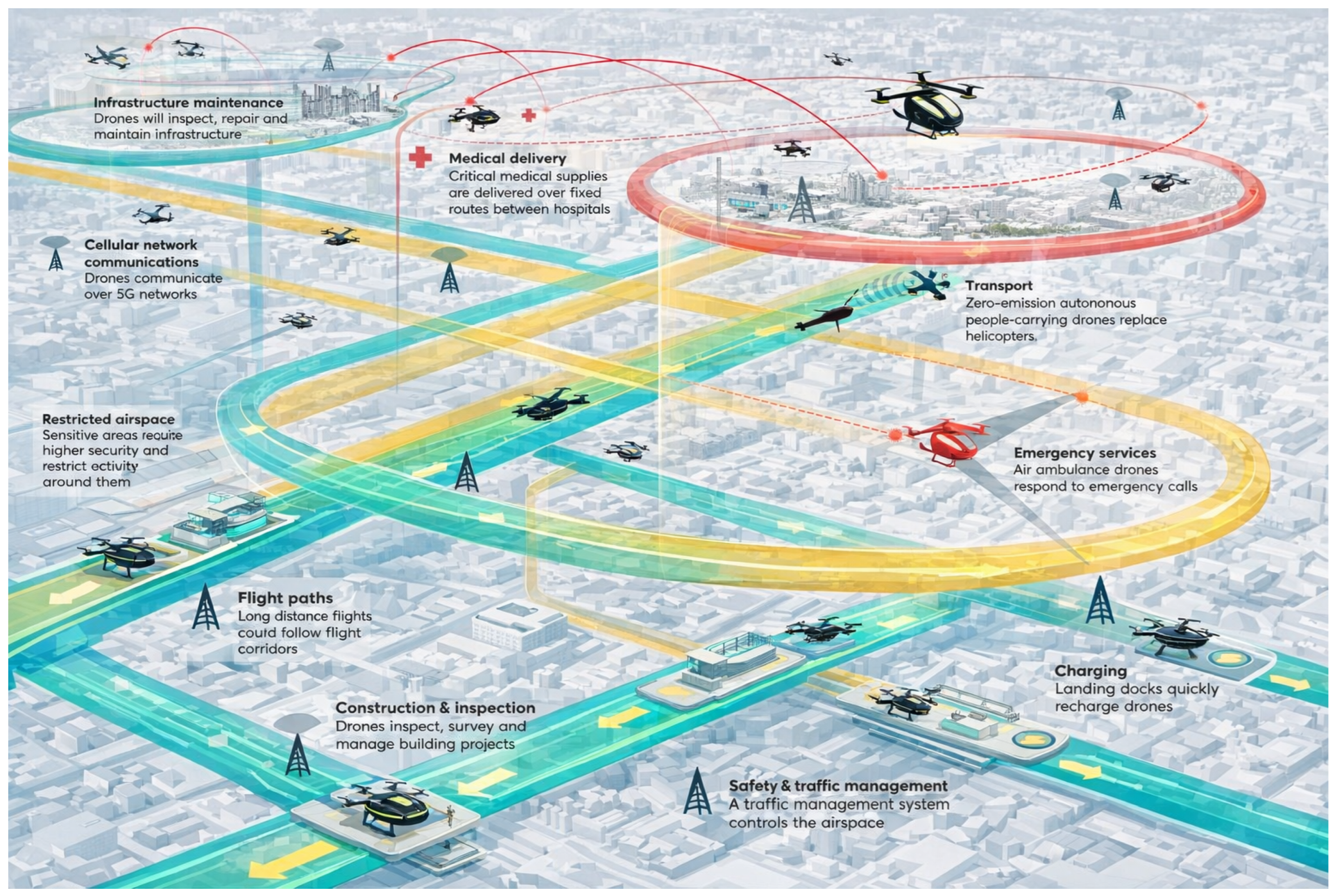
Figure 4.
Urban aerial-corridor case study layout used for the Monte Carlo evaluation.
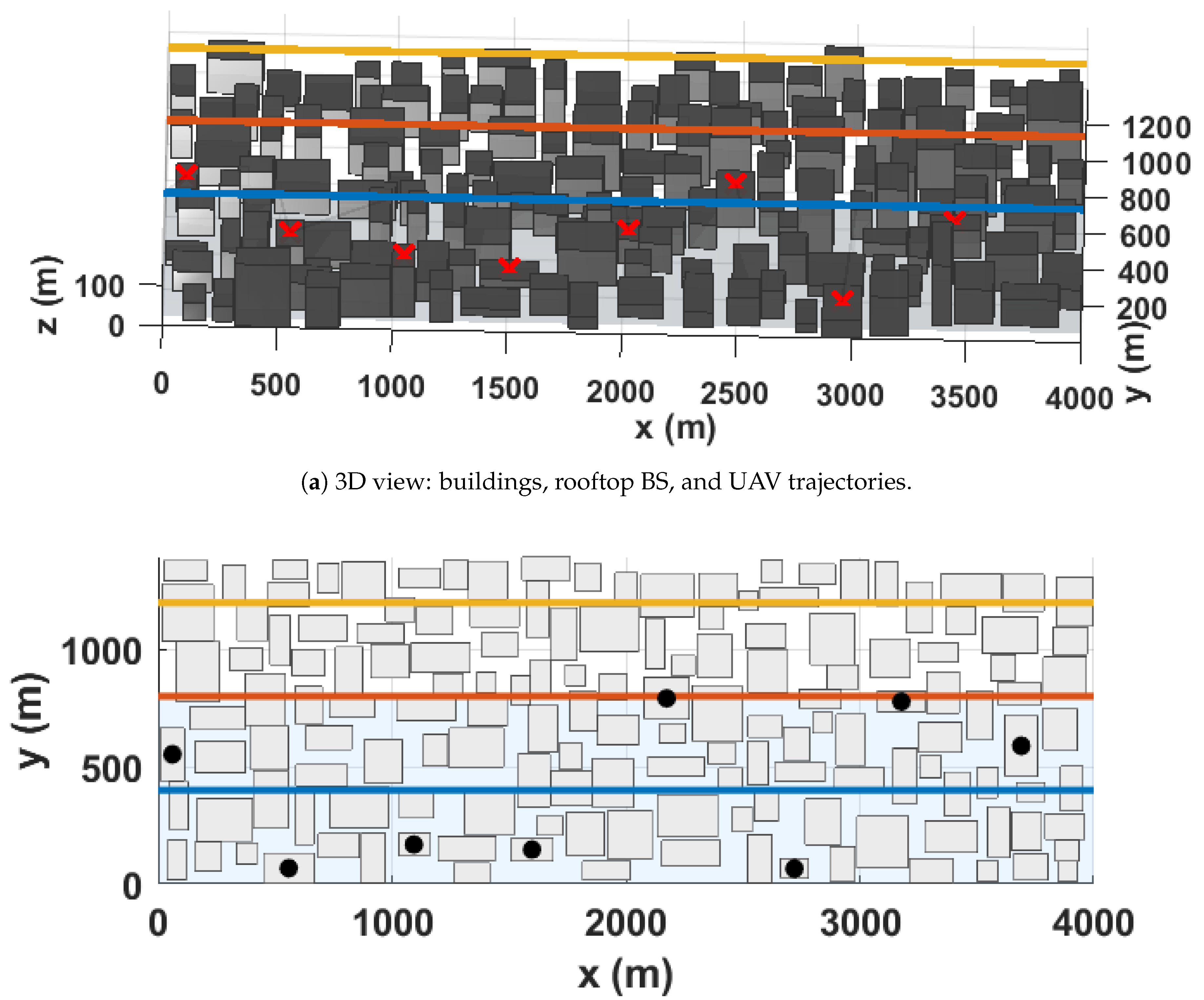
Figure 5.
Serving-cell SNR evolution along the trajectory for the three aerial paths (C1–C3). Solid lines denote the mean SNR, while shaded regions indicate ± one standard deviation.
Figure 5.
Serving-cell SNR evolution along the trajectory for the three aerial paths (C1–C3). Solid lines denote the mean SNR, while shaded regions indicate ± one standard deviation.
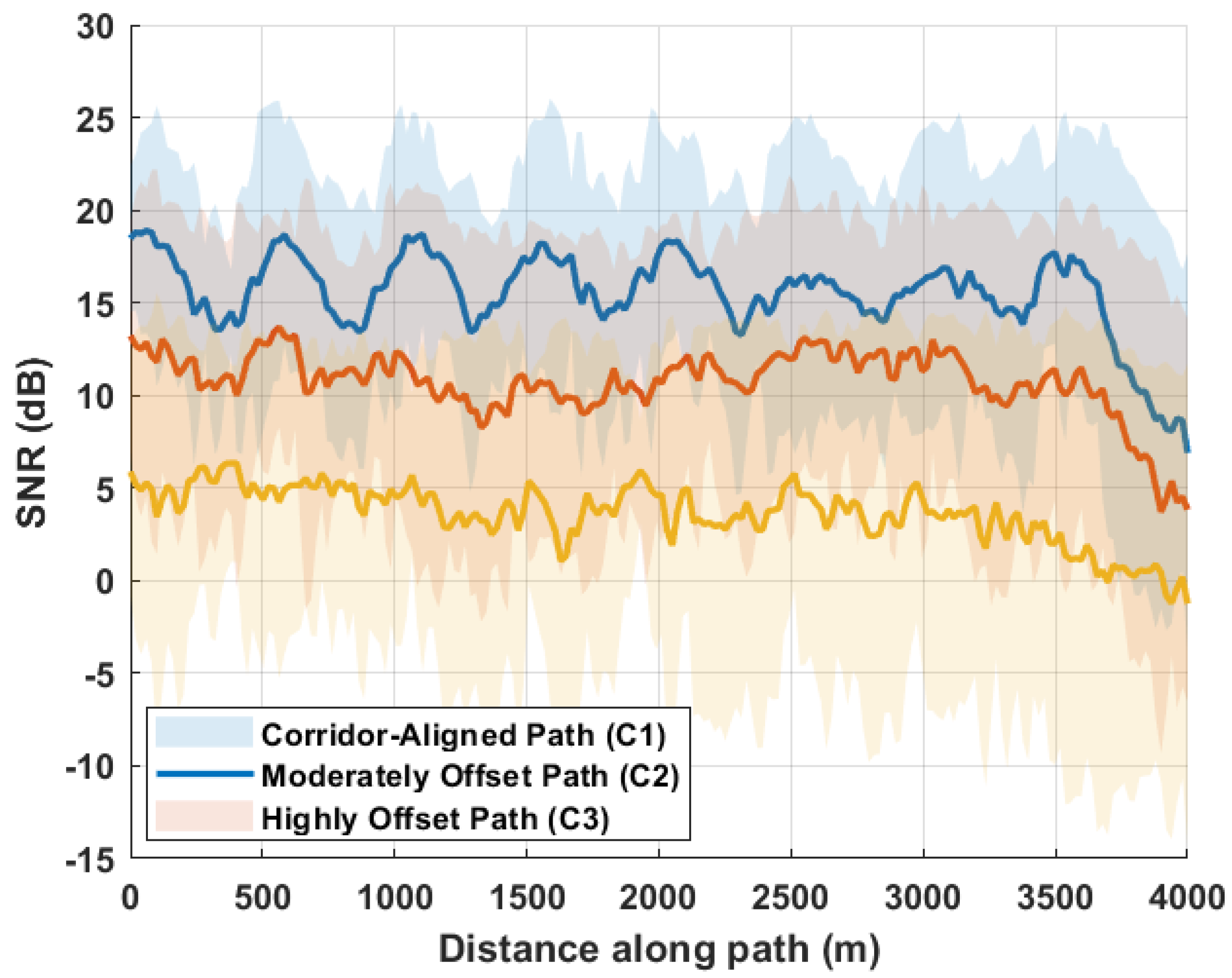
Figure 6.
Trade-off between mean RSRP, outage fraction, and handovers for trajectories C1–C3.
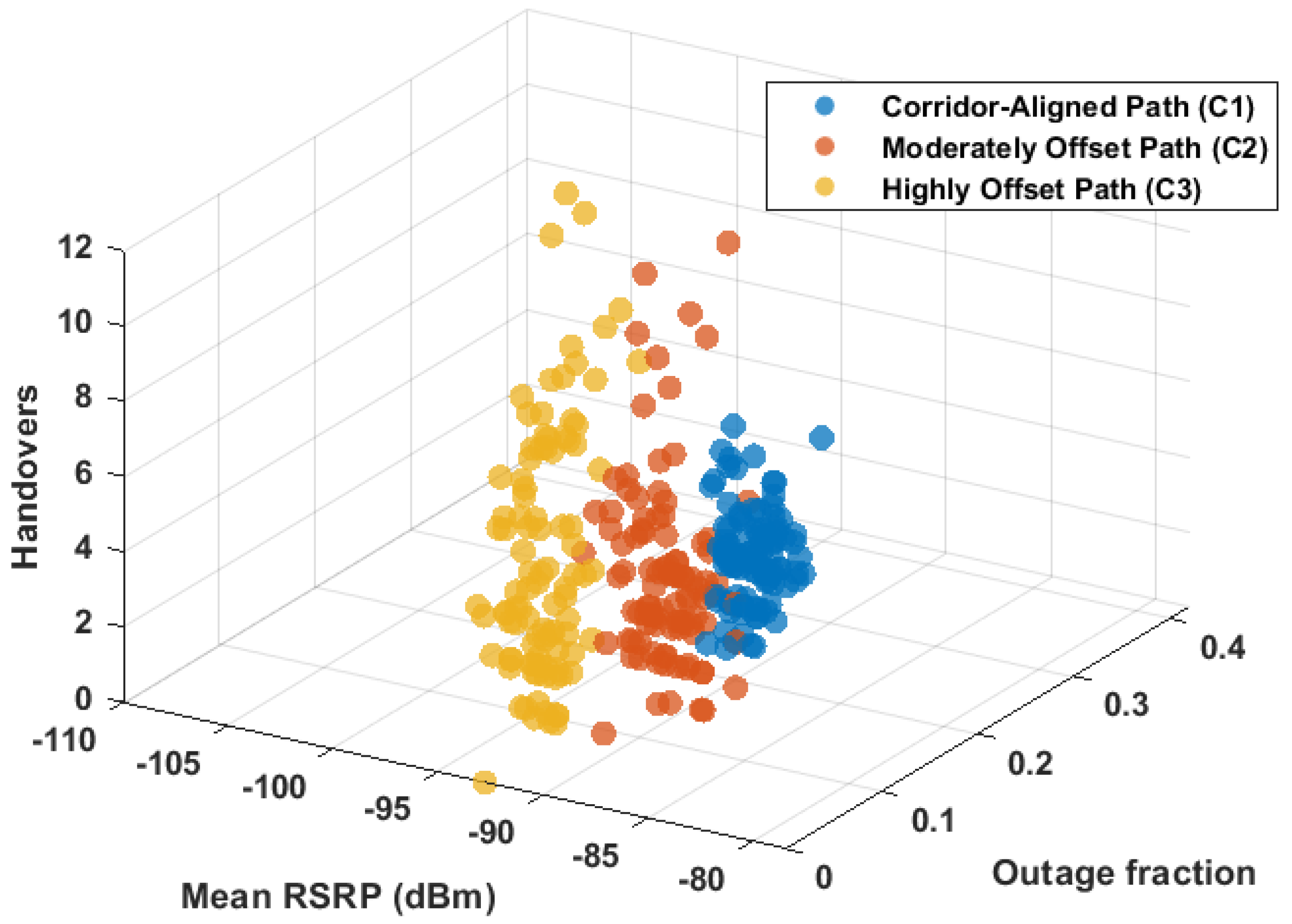
Figure 7.
Communication coverage probability versus communication SIR threshold for different values of path-loss factor .
Figure 7.
Communication coverage probability versus communication SIR threshold for different values of path-loss factor .
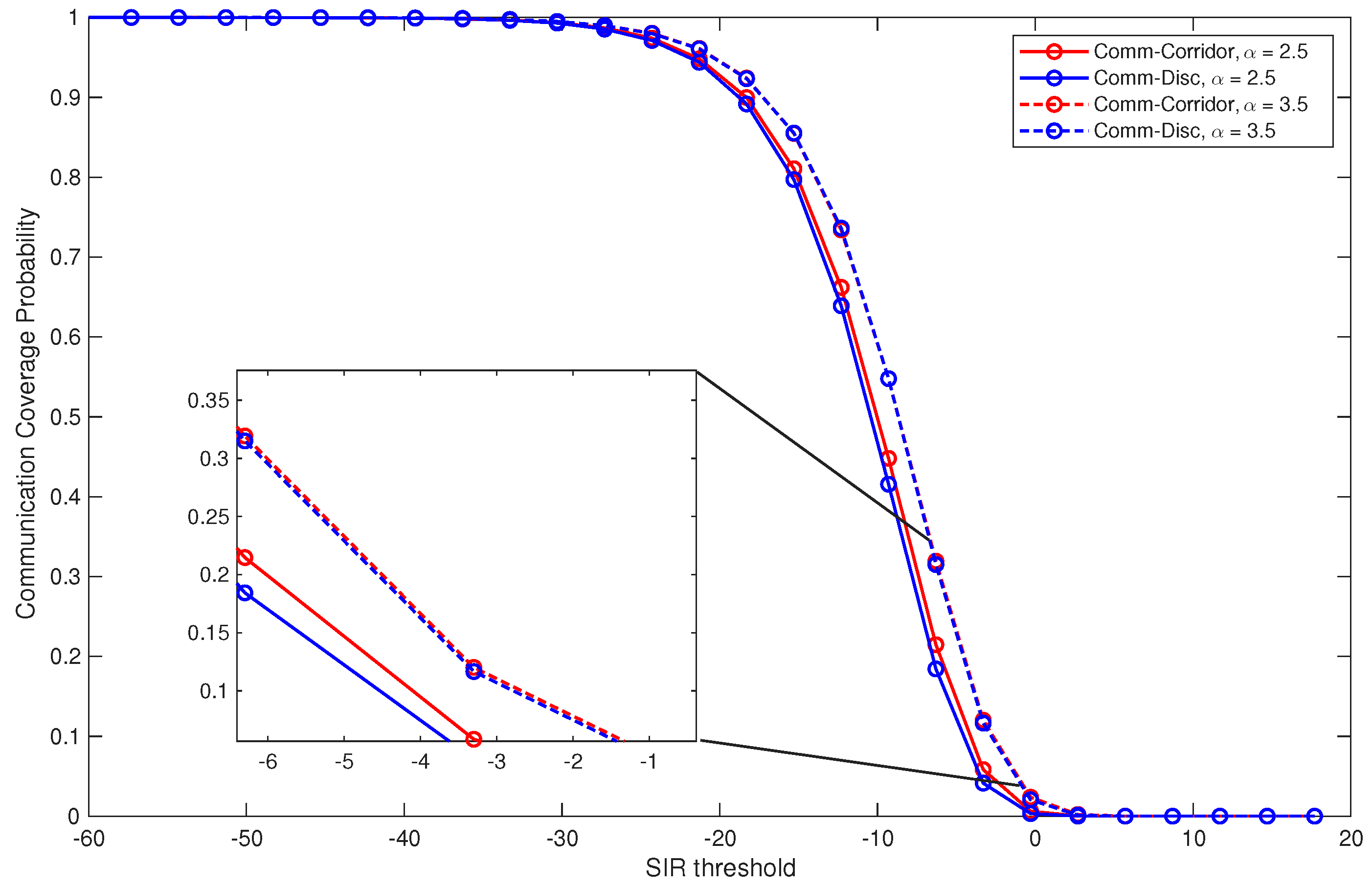
Figure 8.
Sensing coverage probability versus sensing SIR threshold for different values of path-loss factor .
Figure 8.
Sensing coverage probability versus sensing SIR threshold for different values of path-loss factor .
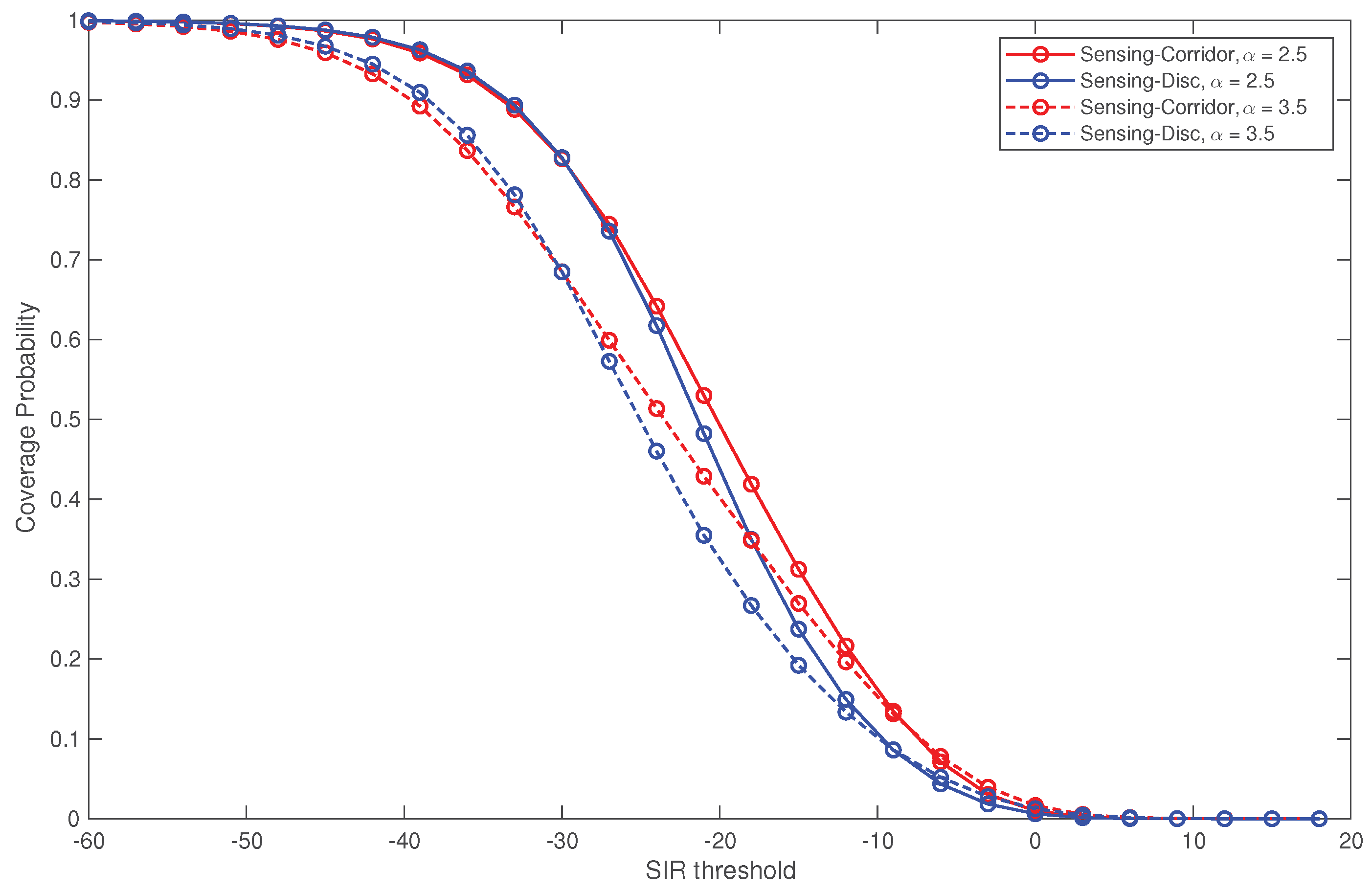
Table 5.
Simulation parameters for the aerial corridor case study.
| Symbol | Value | Symbol | Value |
|---|---|---|---|
| 30 dBm | T | 300 | |
| L | 4000 m | [0,1400] m | |
| 100 m | 200 | ||
| 8 | 80 | ||
| 3 m | 50 m | ||
| 80–260 m | dBm | ||
| H | 5 dB | 3 |
Table 6.
Comparison of Key Enabling Technologies for Aerial Corridors
| Technology | Primary Function | Corridor-Specific Benefits | Implementation Considerations | Refs |
|---|---|---|---|---|
| ISAC | Unified sensing and communication | Real-time obstacle detection, dual identity verification, exploitation of predictable trajectories | Sensing-communication trade-offs, Doppler effects under 3D mobility | [51,58,59] |
| RIS | Passive signal control and beamforming | Coverage enhancement in layered airspace, trajectory-aligned beamforming, low-power deployment | Phase shift optimization, control signaling latency, CSI acquisition | [12,61,63] |
| AI/ML | Autonomous decision-making and optimization | Conflict resolution in structured airspace, predictive traffic density estimation, adaptive routing | Training data requirements, interpretability, generalization to novel scenarios | [64,65,66] |
| NTN | Extended coverage beyond terrestrial limits | Seamless connectivity across diverse terrain, corridor backbone infrastructure (HAPS), global reach | Spectrum coordination, propagation delay, beam tracking under mobility | [68,69] |
Disclaimer/Publisher’s Note: The statements, opinions and data contained in all publications are solely those of the individual author(s) and contributor(s) and not of MDPI and/or the editor(s). MDPI and/or the editor(s) disclaim responsibility for any injury to people or property resulting from any ideas, methods, instructions or products referred to in the content. |
© 2026 by the authors. Licensee MDPI, Basel, Switzerland. This article is an open access article distributed under the terms and conditions of the Creative Commons Attribution (CC BY) license (http://creativecommons.org/licenses/by/4.0/).
Copyright: This open access article is published under a Creative Commons CC BY 4.0 license, which permit the free download, distribution, and reuse, provided that the author and preprint are cited in any reuse.


