

Submitted:
17 March 2026
Posted:
18 March 2026
You are already at the latest version
Abstract
Tourism is a complex economic activity shaped by distinct local resources: culture, nature, industrial heritage, urban ambiance, place-based uniqueness, and geographical accessibility. The simultaneous governance and management of economic growth motives, preservation of the cultural heritage base, and respect for nature and ecological quality calls for an evidence-based and multi-faceted policy analysis that seeks to achieve a sustainable development among conflicting policy objectives. The present paper seeks to explore the feasibility of a sustainable balance for various heterogeneous cultural heritage areas in Europe (‘urban pilot regions’), with particular attention for sustainable local development characterized by circular economic objectives and an ecological balance strategy based on the principle of stakeholders’ co-creation. To that end, an extensive survey experiment was administered in the urban regions concerned, in which a wide range of management issues/questions related to environmental preferences and perceptions were posed to stakeholders and visitors. The data were analyzed by means of a novel respondent-oriented multivariate statistical tool, viz. Generalized Q-Analysis, which is suitable for handling big databases with many respondents. The paper shows that the application of the Generalized Q-Analysis to common survey data enriches the results from the application of the usual Q-Analysis. Furthermore, the study also highlights that, based on the views of the surveyed visitors, the tourist areas concerned are quite different from each other in attracting specific types of visitors. Functional specialization seems to be, therefore, an important anchor point for effective governance of urban tourism.
Keywords:
tourism paradox
; circularity
; co-creation
; urban cultural tourism
; heritage sites
; sustainable development
; Q-analysis
; generalized Q-analysis
1. Introduction
Tourism is becoming a global sector with increasing economic significance. Europe is one of the most popular tourist destinations in the world. It houses an enormous variety of cultural, historical, ecological and natural assets. This continent is the home of a rich cultural-historical heritage and attracts each year a massive volume of tourist visitors from all over the globe. Its great attractiveness makes it also vulnerable, however, because a large influx of visitors may erode the environmental or social support basis of attractive tourist destinations (see e.g., Arikan et al., 2016). This ‘tourist paradox’ mirrors not only a global tension between man and nature or culture; crowding phenomena also manifest themselves locally in Europe, certainly in urban areas or destinations where tourist attractions have a high degree of ecological vulnerability. Finding a balance between conflicting objectives in the tourist sector calls for an evidence-based approach, in which tourism plans are developed and implemented with a view to environmental quality and liveability, a local or regional circular economy, and preservation of eco-cultural heritage. This calls for an analytical approach where views, expectations, perceptions and realities are empirically examined, against the background of local or urban sustainable development objectives and governance of economic, environmental and cultural resources.
Tourism is a multi-faceted and place-based global economic activity that relies on several distinct user-oriented resources: nature, culture, urban ambiance, social capital, psychological experience options, geographical accessibility or place-based uniqueness (see e.g., Suzuki et al., 2021; Li et al., 2023a,b; Romao, 2024). Tourism is also an important growth engine for many places or regions in the world. The awareness of the tourism paradox has prompted the rise of the concept of sustainable tourism (see e.g., Harris et al., 2012; Rasoolimanesh et al., 2023), which is nowadays often positioned in the context of a territorial (or local) circular economy and of a regeneration (or adaptive reuse) of often less-known or more isolated cultural tourism assets (Rodriguez et al., 2020; Bosone et al., 2021).
The concept of a circular region is related to a city/territory in which the strategic circular economy (CE) model of sustainable production and consumption is adopted, “closing the loops” of urban metabolism in terms of flows of materials, water, energy and waste (see e.g., Bocken et al., 2006, De Jesus & Mendonca 2018, Geissdorfer et al., 2017 or Ghisellini et al., 2016). Circular cities and regions are those in which ideally no waste and other negative environmental externalities are generated and retained, while environmental productivity is enhanced through waste reuse, reduction of raw materials extraction, repair, recycling, refurbishment, etc. A circular territorial system is one in which spatial metabolisms are “closed”, thus enabling economic growth to be decoupled from resource consumption (Kirchherr et al., 2017, Marin & De Meulder 2018, Murray et al., 2017, Korhonen et al., 2018). Circular cities are productive cities, reducing costs of materials as well as costs of production processes through synergies, increasing the quality and quantity of outputs, while reducing the costs of negative environmental externalities. This enhanced local ‘productivity’ may be seen as a multidimensional anchor point, with relevant impacts on human and ecosystems health, and balanced economic growth (more independent from resources availability and prices volatility). A circular economy strategy calls clearly for concerted actions. Some examples of such circular action plans in various cities (London, Brussels and Paris) are presented in Figure 1.
The next concept, viz. cultural heritage (CH) regeneration and adaptive reuse, plays a key role for the achievement of a circular city-region (see e.g., Fusco Girard & Gravagnuolo 2017; Fusco Girard et al., 2023; Gravagnuolo et al., 2019; Gravagnuolo et al., 2021). It reduces inter alia soil consumption by re-generating existing buildings and sites on the basis of new functions, and valorizes the embedded energy of built constructions, including historic heritage buildings and sites. CH can have positive impacts on local economies and jobs and may enhance the attractiveness of cities for residents, visitors and enterprises (Throsby 1999; CHCfE 2015). It generates positive social impacts by improving quality of places – and thus quality of life and wellbeing – by favouring place attachment and local environmental care through its symbolic values, while it also contributes to local communities’ bonds and a favourable civic attitude. Appropriate evaluation criteria for balanced cultural heritage planning are in particular originating from fields like architecture, history, ecology and culture, and are usually based on usability and integrity motives (see also Kalman 1980; Fusco Girard et al., 2021).
It is widely accepted that the circularity of economic, social and environmental processes can be enhanced through CH regeneration and adaptive reuse (Saleh and Ost 2023). However, the costs of heritage regeneration are high, so that a careful evaluation is needed to create evidence of net positive impacts of heritage investments and their contribution to sustainable development, from the perspective of a CE and ‘closed urban metabolism’ (e.g., reuse, decoupling, refurbishment, closed loops, recycling, or conservation of use values).
Against this background, this paper sets out to develop and test empirically a set of criteria and indicators for integrated urban metabolism assessment and governance of cultural tourism, including flows of materials, water, energy and waste, but also social, cultural and economic aspects to assess the contribution of cultural heritage regeneration and adaptive reuse to the realization of circular cities and regions. It does so by exploring the sustainability potential and interest in various tourist pilot regions in Europe, with a particular view to the preferences and perceptions of classes of stakeholders or visitors.
A new methodological approach based on integration of multidimensional statistical analysis and metabolism assessment using empirical actor-oriented surveys is applied to assess the impacts of cultural heritage adaptive reuse on circular urban or regional development planning in various pilot regions in Europe. The new multivariate statistical tool developed and applied here is termed Generalized Q-Analysis. The standard Q-method, developed by Stephenson (1953), seeks to trace the commonalities and differences in the actors’ – or stakeholders’ – priority rankings of a set of empirical statements. The application of the latter conventional technique will be the first step in our analysis. Next, we test the Generalized Q-method (see for details Dentinho et al., 2023) for our large data set; this tool allows the enlargement of the number of ranked combined statements based a structured combination of the rankings of simple statements. We use in our empirical analysis both a Q-method and a Generalized Q-method for the same questionnaire data; we will shortly describe these tools, and then apply both variants of the Q-analysis to complement and test the evidence of our findings for the tourism areas concerned.
This study is organized as follows. After this introductory section, we will explain, in Section 2, both the Q-Analysis and the Generalized Q-Analysis techniques. Section 3 then synthesizes the data collected in the different regions in Europe. Next, Section 4 shows the results of the standard Q-Analysis, while Section 5 presents and interprets the evidence of the Generalized Q-Analysis. Section 6 highlights the conclusions.
2. Pattern Recognition Analysis of Participant Groups: Q-Analysis
2.1. Introduction Q-Analysis
Governance of sustainable local development calls for an evidence-based consideration of interest of local stakeholders. In this context, a Q-methodology serves as a useful operational approach for uncovering subjective perspectives, enabling stakeholders to articulate their viewpoints on a particular matter. This method allows – generally speaking – for the identification of stakeholder groups that may converge or diverge in their opinions (Van Staa & Jedeloo 2009; Van Exel & de Graaf 2005; Webler et al., 2009; Watts & Stenner 2012; McKeown & Thomas 2013; Kamal et al., 2014; Moon & Blackman 2014; Fuentes-Sanchez et al., 2021). In a Q-study, participants, or stakeholders, are tasked with ranking a set of statements pertaining to the study's subject based on their individual preferences or opinions. A Q-methodology finds its suitability in investigating patterns in opinions, experiences, and interpersonal dynamics. It primarily focuses on capturing prevailing viewpoints and personal positions concerning a specific subject or issue.
The objective of a Q-study is to extract distinct lines of thought and strategic ideas, rather than necessarily measuring in a completely representative way their prevalence in a population. A Q-analysis employs multivariate factor analysis to pinpoint clusters (factors) representing cohorts of individuals who share similar perspectives and sentiments about the subject under study. In cases involving multiple stakeholder groups, the composition of these factors offers insights into which stakeholder groups align or diverge in their views (Raadgever et al., 2008). Importantly, it is worth noting that a Q-methodology does not aim to represent or estimate population statistics. Instead, its purpose is to sample a broad spectrum of expressed views, without making claims about the percentage of people holding these views (Cross, 2005, p. 208). Examples of recent applications of Q-analysis can be found inter alia in Pascariu et al. (2023); Dentinho et al. (2021, 2023a). In the meantime, an extended and generalized Q-analysis has been developed by Dentinho et al. (2023b). This new statistical tool will concisely be described in Subsection 2.2.
2.2. From Conventional to Generalized Q-Analysis
The aim of this section is to present the Generalized Q-method that allows the enlargement of the number of ranked combined statements on a topic of concern based on the structured combination of the ranking of simple statements, assuming respondents are consistent in their sequential rankings of simple statements. A Generalized Q-method has significant benefits, because: (i) it allows the expansion of the number of respondents overcoming redundancy of many respondents in the usual Q-method; (ii) it facilitates the naming of the extracted components that are representative responses, and (iii) it tests the consistency of the responses. This will now be explained in greater detail.
2.3. Conventional Q-Analysis
Q-Analysis is a powerful research technique used in the social sciences to analyse the commonalities and differences in the stakeholders’ points of view on a topic of their concern. It was developed by Stephenson (1953) and frequently used in studying educational attitudes (Gawron, 2016); in autoethnographic analysis (Ellis, 2004; Pepeka et al., 2022); in studies on credibility (Metzger & Flanagin 2013); in a healthcare survey study (Churruca et al., 2021), in job satisfaction analysis (Guastello et al., 2019), in urban sustainability (Fuentes et al., 2022), and in several other fields that use a Q-method to transform subjective evaluations into objective statistical results.
The standard Q-method involves: (1) the collection of statements on a topic of concern; (2) the ranking of disagreement in an approximated normal distribution; (3) the transposition of collected data defining stakeholders as variables and statements as observations; (4) the implementation of Principal Component Analysis to reduce the responses profiles into synthesized and orthogonal responses; and (5) the analysis of synthesized orthogonal responses relating them with the typology of statements and with the stakeholder features.
There are three main limitations inherent in the traditional Q-method. First, it assumes that respondents can rank simultaneously many statements which, according to Miller (1956), is not plausible nor empirically justified. Second, the number of nonredundant respondents (variables) is limited by the number of statements (observations), thus constraining the number of respondents and their relative representativity. Finally, the traditional Q-method does not provide objective information to name the extracted attitudes and hence the results can lead to different interpretations (Brown 1993).
2.4. Generalized Q- Analysis
The Generalized Q-Analysis tries to overcome the main limitations of the traditional Q-method by working with graded combined statements based on combinations of basic statements ranked by small groups, assuming that respondents are consistent in their sequence of choices.
If there are (q) questions with (r) alternative responses each, we will have (q*r) basic statements where the (r) responses can be ranked for each one of (q) questions. In the traditional Q-Analysis respondents had to rank the (q*r) basic statements. In the Generalized Q-Analysis respondents make (q) rankings of (r) responses, but we get (q^r) combined and ranked responses. This generalized Q-Analysis is much richer in scope than the traditional one and will also be used in the present paper. This method will be elucidated through a step-by-step presentation featuring an application to cultural tourism in European heritage sites.
3. Data
The visitors’ survey has targeted randomly adult visitors (aged 18 and above) to cultural sites in various locations across Europe, resulting in a total of 899 responses, with 840 of them being non-redundant and useful for further analysis. The resulting size of the surveys in each urban pilot region is given in brackets. The responses were obtained from the following urban pilot areas: the Cultural Park of the Rio Martin in Teruel province, Aragon region, Spain (165/164); the area of Vulture and Alto Bradano in Basilicata region, Italy (97/97); the Cultural Route of Stephan the Great at the cross-border area of Moldova and
North East Romania (236/195); historic rural villages in Larnaka region, Cyprus (174/174); Karlsborg village in Västra Götaland Region, Sweden (49/40); the Mark village in Västra Götaland Region, Sweden (49/49); and historic rural villages in Vojvodina region, Serbia (138/121).
Regarding the percentage representation of various regions, the relative size breakdown is as follows: Aragon, Spain (20%); Basilicata, Italy (12%); Moldova and North East Romania cross border area (23%); Larnaka, Cyprus (21%); Västra Götaland Region, Karlsborg village, Sweden (5%); Västra Götaland Region Mark village, Sweden (5%); and Vojvodina, Serbia (14%).
In terms of the overall respondents’ profiles, approximately 13% are residents in the areas in which the survey was administered, 41% are ‘proximity travellers’, and 47% are external tourists originating from outside the area or country. The respondents appear to have an average age of 44 years with a standard deviation of about 12. The gender distribution is 43% male, 56% female, and 1% without declared gender. Regarding the educational level, 2% of the visitors have completed only primary education, 31% have secondary education, 47% have higher education, and 19% hold a postgraduate degree. In terms of the visitors’ occupation, 44% are employees, 7% have liberal professions, 2% are researchers, 5% are industrial employees, 8% are self-employed, 7% are entrepreneurs, 12% are retired, 7% are students, and 4% are primarily care-takers for their families.
The survey was structured into distinct sections, starting with demographic data and motivations for visiting the heritage site. Then, specific aspects of the experience in the pilot region were assessed, asking the level of satisfaction with regards to: Cultural experience, Transformative travel experience1, European value of cultural heritage,
Environmental sustainability, Destination managerial sustainability, Overall satisfaction of the visit, Quality of services offered at the cultural tourism destination. The specific aspects were assessed on a numerical scale of 7 degrees, where -3 was assumed as the lowest satisfaction level, 0 as the neutral point (not satisfied nor unsatisfied), and +3 as the maximum satisfaction level.
Regarding the visitors’ motivation for traveling, 35% appeared to travel for leisure, 5% for business, 19% for cultural experiences, 21% for nature-related activities, 10% to visit friends, 8% to visit their own properties, and 1% had no explicit motives for traveling. The average duration of the visits appeared to be 3 days, with a high standard deviation of 3. When it comes to travel companions, 5% of the respondents travel alone, 14% with partners, 21% with friends, 27% with family, 7% with colleagues, and 26% with a combination of friends, relatives, and colleagues. Respondents became aware of these specific places through various marketing channels: the internet (29%), brochures (9%), tourist centres (13%), exploring the area (17%), social media (19%), or because a historical or social connection to the place (17%).
As for the tourists’ suggestions for improving the attractiveness or sustainable nature of the sites concerned, 5% mentioned smart working, 4% referred to theatres, 16% mentioned nature-related activities, 5% declared spiritual experiences, 4% were interested in virtual tours, 15% sought unconventional guides, 13% expressed interest in craft activities, 7% wished to meet locals, and 13% advocated for the reinforcement of local traditions. Additionally, 4% suggested green hotels, and 1% mentioned volunteer work.
Table 1 presents the average and standard deviation of the evaluations provided by the 840 non-redundant responses. Since the numerical evaluation classes range from (-3 = Strongly Disagree) to (3 = Strongly Agree), it seems plausible that the classifications are generally positive, with higher scores for Cultural, Transformative, and General Experience, and lower scores regarding environmental sustainability and quality that, nevertheless, show higher differences between respondents.
4. Empirical Results of Standard Q-Analysis
As mentioned above, the conventional Q-method is a technique used to identify commonalities and differences in stakeholders' rankings of a set of statements. The recently developed Generalized Q-method (Dentinho et al., 2023a,b) allows for an expansion in the number of combined ranked statements, which are achieved through the structured combination of rankings of individual statements. In this study, we utilize the same questionnaire data, briefly describe it, and apply both variants of the Q-analysis to complement the evidence. In all cases, as mentioned, the first step in our Q-Analysis is the application of a Principal Component Analysis.
4.1. Conventional Q-Analysis
Q-Analysis does not focus on average evaluations but rather on identifying commonalities and differences in evaluations or opinions. The standard Q-Analysis examines the 840 rankings of 46 visitors’ statements with the aim to discern what is shared and distinct within these rankings. It is important to note that due to the limited number of only 46 simple statements expressed by 840 responses, the analysis primarily serves as an exploratory analysis of the data commonalities. The explained variance of the successive components is depicted in Figure 2, including rotated and non-rotated factors.
Figure 2 illustrates that the 840 rankings can be condensed into 46 components (related to the visitors’ attitudes). The first component accounts for 21% of the questionnaire responses, the second for 7%, the third for 4%, and so on, with the seventh component representing 3%, followed by approximately 2% for subsequent components.
4.2. Naming of Components
Grouping the first 4 rotated component scores into 7 clusters using a hierarchical clustering technique with a Euclidean Distance Matrix and the Ward aggregation rule enables the identification of the main characteristics of each cluster. Examining Figure 3 allows for the highlighting of the primary statements associated with each component:
- Component 1 favours Cultural Experience, Managerial Sustainability, and Quality, but does not support the Transformative Experience, EU Perspectives, Environmental Sustainability, and General Satisfaction.
- Component 2 emphasizes Cultural Experience, Environmental Sustainability, General Satisfaction, and Quality but is less supportive to Managerial Sustainability, Transformative Experience, and EU Perspectives.
- Component 3 maintains a more balanced evaluation across all dimensions.
- Component 4 values Quality, Satisfaction, and Managerial Sustainability, but dismisses all other evaluation dimensions.
Next, we will correlate the component scores with the areas under consideration by performing a regression analysis on the Component Scores described above. Table 2 presents the regression results of the Component Scores on the Visited Places. These outcomes suggest that:
- Basilicata is associated with Component 1, which favours Cultural Experience, Managerial Sustainability, and Quality, but opposes Transformative Experience, EU Perspectives, Environmental Sustainability, and General Satisfaction.
- Aragon and Karlsborg are linked to Component 2, which emphasizes Cultural Experience, Environmental Sustainability, General Satisfaction, and Quality, but criticizes Managerial Sustainability, Transformative Experience, and EU Perspectives.
- Larnaka and Karlsborg are associated with Component 3, which maintains a balanced evaluation across all dimensions.
- Larnaka and Vojvodina are related to Component 4, which values Quality, Satisfaction, and Managerial Sustainability, but disregards the other evaluation dimensions.
On the basis of the outcomes in Table 2, we will now provide a detailed interpretation of the regression results, which reveal how the Component Scores (C1, C2, C3, and C4) are associated with the successive visited places.
- Component C1:
- The regression analysis shows that the Basilicata pilot area (Italy) is significantly associated with Component 1, exhibiting a positive regression coefficient of approximately 0.153. This indicates that individuals who visit the Basilicata pilot area tend to give more favourable evaluations in terms of Cultural Experience, Managerial Sustainability, and Quality. Conversely, visitors to Basilicata tend to have less favourable evaluations on Transformative Experience, EU Perspectives, Environmental Sustainability, and General Satisfaction, as indicated by the negative coefficients for these dimensions. In essence, the Basilicata pilot area of Vulture and Alto Bradano stands out as a destination where visitors highly value aspects related to Cultural Experience, Managerial Sustainability, and Quality, while other dimensions may not receive as much attention or positive assessment.
- Component C2:
- The analysis reveals that both the Aragon pilot area (Spain) and Karlsborg village (Sweden) are strongly associated with Component 2, with positive coefficients of approximately 0.298 and 0.165, respectively. This suggests that visitors to these places put a significant emphasis on Cultural Experience, Environmental Sustainability, General Satisfaction, and Quality. However, visitors to Aragon and Karlsborg tend to provide lower ratings for Managerial Sustainability, Transformative Experience, and EU Perspectives, as indicated by the negative coefficients. This implies that the Aragon pilot area and Karlsborg village are destinations where cultural and environmental aspects are highly valued, but managerial aspects and transformative experiences may not be perceived as positively by visitors
- Component C3:
- The regression analysis indicates that both Larnaka rural villages (Cyprus) and Karlsborg village (Sweden) are positively associated with Component 3. This component represents a more balanced evaluation across all dimensions. It suggests that these destinations offer experiences that are perceived consistently across different facets.
- Component C4:
- ∙
- VGR Kar (Västra Götaland Region, Karlsborg village, Sweden) appears to be significantly associated with Component 4, exhibiting a positive coefficient of approximately 0.187. This implies that visitors to VGR Kar attribute a high value to Quality, Satisfaction, and Managerial Sustainability. However, visitors to VGR Kar tend to give lower evaluations for Transformative Experience, EU Perspectives, Environmental Sustainability, and General Satisfaction, as is shown by the negative coefficients for these dimensions. Essentially, VGR Kar is a destination where the quality of the experience and managerial sustainability are highly appreciated by visitors, but other aspects may not receive as much attention or positive appraisal.
In summary, this analysis provides valuable insights into how different components of visitors' evaluations are associated with specific destinations, shedding light on the varying priorities and perceptions of visitors to these places. Moreover, it underscores the importance of a human-centered smart data monitoring and management system for sustainable cultural tourism able to retrieve and assess the visitors’ preferences and satisfaction, as it can aid in aligning the tourist experience supply side with visitor preferences and contributing to the overall sustainability of cultural tourism destinations.
5. Empirical Results of Generalized Q-Analysis
5.1. Generalized Q-Analysis
The Generalized Q-Analysis conducted on the 840 rankings of 46 statements or visitors’ expressions begins by reducing statistically the rankings of the 46 phrases into 21, which are organized into 7 groups of 3 phrases each. This reduction is achieved using Principal Component Analysis to extract three components representing the valuations of each of the seven groups of statements presented in Table 3, with an average of 0 (values are standardized) and a rather varied standard deviation.
These groups are labelled as follows: Experience, Transformative, EU Perspective, Environmental Sustainability, Managerial Sustainability, Satisfaction, and Quality.
Next, the Generalized Q-Analysis seeks to estimate the combined valuations for the 2,187 possible combinations (3^7) of the 3 phrases selected from the 7 groups. The 840 valid responses, considered as variables in the Generalized Q-Analysis, can then be associated with the 2,187 combined valuations treated as observations. Application of the Principal Component Analysis appears to result in the identification of 14 representative components synthesizing the perspectives of the 840 respondents.
Subsequently, the analysis estimates combined valuations for the 2187 possible combinations (3^7) of the 3 phrases selected from the 7 groups. The 840 valid responses, considered as variables in the Q-Analysis, can then be associated to the 2,187 combined valuations treated as observations. The Principal Component Analysis results then in the identification of 14 representative components synthesizing the perspectives of 840 respondents. In Figure 4, the explained variance of the Generalized Q-Analysis is depicted. It is evident that, perhaps due to the wide diversity of places and respondents under consideration, it is challenging to find a common perspective that can account for a higher percentage of the variance.
The aim of this exercise is, on one hand, to identify and name the various components, and on the other hand, to explore the factors that influence the similarities and differences between these components or attitudes regarding the different tourist regions.
5.2. Naming to Generalized Q-Analysis Components
For a systematic naming procedure, Table 4 is divided into two sections. The first 14 lines of the table display the Regression Coefficients of Component Scores on Dummies (D1 to D21) for Composed Topics. Following these, the subsequent lines establish the connections between the 45 questionnaire topics and the 21 variables used in the Generalized Q-Analysis.
The interpretation of Table 4 is crucial, as it enables us to assign useful and interpretable names to the fourteen components derived from the evaluations of the 840 respondents. In this context, Table 4 plays a dual role: first, it provides the information needed to name Dummies 1 to 21, and second, it facilitates the identification and naming of these components.
- Component 1 demonstrates a favorable view towards most statements, with exceptions including the development of tourism activities by locals, promotion of tourism worker skills, and ensuring safety and wellness-focused tourism.
- Component 2, in contrast, generally contains a negative view towards most statements, with the exception of those related to the preservation of green areas and rural landscapes.~
- Component 3 tends to agree with most phrases but does not align with the concept of belonging to Europe.
- Component 4 disagrees with most statements but shows a preference for friendly people and a connection with nature.
- Component 5 aligns with most of the phrases but opposes the concept of authenticity and atmosphere.
- Component 6 maintains a neutral stance towards most statements, but opposes the willingness to return or recommend.
- Component 7 generally opposes most statements, but favors the idea of linkages with Europe.
- Component 8 is in favour of most statements, but does not support aspects related to waste management, green certification, and overall destination satisfaction.
- Component 9 primarily focuses on the willingness to donate.
- Component 10, in contrast to Component 1, emphasizes the significance of tourism activities by locals, tourism worker skills, and ensuring safety.
- Component 11 opposes several ideas, including landscape conservation, the promotion of less known places, social responsibility, and services for special needs.
- Component 12 does not endorse aspects related to quality of shops, public places, transportation, roads, and visitor information.
- Component 13 does not align with the roles of culture and nature.
- Lastly, Component 14 exhibits a dislike for availability of cultural events. This structured analysis of Table 3 provides a comprehensive understanding of the components and their respective associations with the evaluated statements and topics, offering valuable insights into the varied common respondent attitudes towards various internal aspects of tourism and sustainability.
6. Explanation and Interpretation
Table 5 displays the coefficients of the regression analysis of the component scores on Visited Places as well as several control variables. Several interesting patterns and policy relevant lessons emerge from this empirical analysis:
- Visitors to the Aragon pilot area exhibit a preference for specific factors. They favour the development of tourism activities by locals, the promotion of tourism worker skills, ensuring safety, and wellness-oriented tourism (C1). Additionally, they value good waste management, green certification, and express satisfaction with the places they visit (C8). They also align with the importance of culture and nature (C13). However, they show reluctance towards willingness to donate (C9).
- Tourists in the Basilicata pilot area exhibit distinct preferences. They highly appreciate the places they visit (C8) and emphasize the significance of culture and nature (C13). Nevertheless, they are less inclined to prioritize tourism activities by locals, tourism worker skills, and safety (C10).
- Visitors to Karlsborg village in Sweden have clear and distinct preferences. They strongly favour the development of tourism activities by locals, the promotion of tourism worker skills, safety, and wellness-oriented tourism (C1). They also have a strong sense of belonging to Europe (C3). However, they do not emphasize the presence of friendly people or a connection with nature (C8). Moreover, they express disagreement with donations (C9) and favour aspects related to quality of shops, public places, transportation, roads, and visitor information (C12). Additionally, they have reservations regarding the role of culture and nature in tourism (C13)Tourists in Mark village in Sweden share specific preferences. They favour the development of tourism activities by locals, the promotion of tourism worker skills, ensuring safety, and wellness-oriented tourism (C1). They also appreciate the preservation of green areas and rural landscapes (C2) and acknowledge the role of culture and nature in tourism (C13). Additionally, they have a sense of belonging to Europe (C3). However, they are against the idea of linkages with Europe (C7).
- Visitors to the Vojvodina pilot area share special preferences. They align with the preservation of green areas and rural landscapes (C2) and have a sense of belonging to Europe (C3). However, they do not emphasize the friendliness of people (C8).
- Tourists in the Moldova/Romania cross-border area exhibit certain tendencies. They agree with the preservation of green areas and rural landscapes (C2) but are reluctant to express a willingness to return or recommend (C6). They are also opposed to the idea of linkages with Europe (C7) and do not perceive people as friendly (C8). Moreover, they do not acknowledge the existence of tourism activities by locals, tourism worker skills, and safety.
- The Larnaka pilot area in Cyprus demonstrates unique characteristics. It exhibits implicit values which are highly significant in Components 1 to 5 and also in Components 9, 12, and 13. Larnaka visitors seem to have less favourable opinions on the capacity of the destination to promote tourism worker skills, ensuring safety, and wellness-oriented tourism, as well as the preservation of green areas and rural landscapes. They disagree with the presence of friendly people and a connection with nature but agree with the concept of authenticity and atmosphere. We observe that not so many control variables were found to be statistically significant. Traveling with friends had a positive impact on the regression of Component 1, while traveling with family strengthened the explanation of Component 2. Visiting alone reinforced the results of Component 3, but being of another gender was associated with a negative impact on Component 4. Proximity to the destination also had a negative influence on Component 5, but moving to holidays and leisure activities reinforced Component 6. Control variables that contributed to Component 10 were related to schooling, while Component 13 was influenced by the frequency of visits, agreement with donations (C9), preferences for shops, public places, transportation, roads, and visitor information (C12), as well as the importance of culture and nature for tourism (C13).
7. Conclusions
Governance of tourist areas – especially under conditions of tourist crowding and ecological stress – is a major policy challenge nowadays. The present study has tested the validity of a new survey analysis tool, viz. Generalized Q-Analysis. Based on 840 valid questionnaires, our study was able to identify the primary components or attitudes of respondents regarding seven case study areas in Europe. The conclusion highlights that, in addition to variations in tourism destinations, there are indeed differences in the attitudes of visitors, as identified in this study. Future research may explore into further understanding and justifying these attitudes by considering variations in cultural and natural contexts (external factors).
In particular, the results highlight the nuanced preferences of visitors across different destinations, providing valuable information about their attitudes towards specific elements. Remarkably, control variables, though present, exert limited influence on these attitudes. Factors such as travel companions and destination proximity show varying impacts.
This study showed specifically the prominent factors influencing the perceived attractiveness of cultural heritage destinations from several perspectives, including cultural, social and environmental factors. Cultural and natural heritage may definitely contribute to the regeneration of less-known and remote areas making them attractive cultural and eco-tourism destinations. However, the balance between tourism services and preservation of authenticity and place atmosphere needs to be maintained to ensure longer-term sustainable regional development through cultural tourism. From the perspective of circular cities and regions development, less-known and remote cultural heritage sites may play a central role, enhancing less exploited resources (“wasted” heritage) through human-centred and environmentally sustainable approaches (Gravagnuolo et al., 2021).
To conclude, this study on sustainable governance of attractive tourist areas, based on a sample of 840 valid questionnaires, underscores the presence of diverse visitor attitudes across seven case study areas. These distinctions go beyond basic location-specific variations and suggest the potential influence of unique cultural and natural contexts, all within the framework of human-centred smart data monitoring and management. Consequently, further research can explore deeper these attitudes within specific contexts so as to provide a more profound and evidence-based understanding of the value of heritage sites in Europe, as seen through the lenses of visitors and stakeholders.
Acknowledgments
This study on Be.CULTOUR (‘Beyond Cultural Tourism’) has received funding from the European Union’s Horizon 2020 research and innovation programme (grant agreement no. 101004627). Karima Kourtit acknowledges support from the HORIZON-CL2-2022 TRANSFORMATIONS-01 Programme for the WISER project, under grant agreement No. 101094546.
References
- Arikan, I., Ünsever, I., & Halioui, S. (2016), Importance of Tourism Paradox, Tourism Equinox and Tourism Detox for Urban Environments, Acta Economica et Touristica. [CrossRef]
- Bosone, M., Nocca, F., & Fusco Girard, L. (2021, July). The circular city implementation: Cultural heritage and digital technology. In International Conference on Human-Computer Interaction (pp. 4062). Cham: Springer International Publishing.
- Cross, R. M. (2005). Exploring Attitudes: The Case for Q methodology. Health Education Research, 20(2), 206–213. [CrossRef]
- Dentinho, T. P., Kourtit, K., & Nijkamp, P. (2021). Regional Science Perspectives on Global Sustainable Development – An Exploration of Multidimensional Experts' Views by means of Qanalysis. Romanian Journal of Regional Science, 15(1), 1–32.
- Dentinho, T., Kopczewska, K., de Francesco, F., Pascariu, G. C., Kourtit, K., Nijkamp, P., KurowskaPysz, J., Merques, J. L., Vinuela, A., & Türk, U. (2023a). Sustainable Development Goals and Resilience: Places, People, Preferences. In G. C. Pascariu, R. Tiganasu, K. Kourtit, & P. Nijkamp (Eds.), Resilience and Regional Development: New Roadmaps. Edward Elgar.
- Dentinho, T., Kourtit, K., & Nijkamp, P. (2023b). Generalized Q Analysis as a New Tool in Social Science Research – A Pedagogical Introduction. Eastern Journal of European Studies, 14(2). [CrossRef]
- Fuentes-Sánchez, A., Dentinho, T. P., Arroz, A. M., & Gabriel, R. (2021). Urban Sustainability: Q.
- Method Application to Five Cities of the Azorean Islands. Revista Portuguesa de Estudos Regionais, 57, 33-56.
- Fusco Girard, L., Kourtit, K., & Nijkamp, P. (Eds.). (2023). The Future of Livable Cities. Springer, Berlin.
- Gravagnuolo, A., Fusco Girard, L., Kourtit, K., & Nijkamp, P. (2021), Adaptive Re-use of Urban Cultural Resources: Contours of Circular City Planning. City, Culture and Society, 26, September 2021, 100416. [CrossRef]
- Harris, R., Williams, P., & Griffin, T. (Eds.). (2012). Sustainable Tourism. Routledge, London.
- Kamal, S., Kocór, M., & Grodzinska-Jurczak, M. (2014). Quantifying Human Subjectivity Using Q Method: When Quality Meets Quantity. Qualitative Sociology Review, 10, 60–79. [CrossRef]
- Li, H., Pan, J., Hui, J., Liu, J., & Nijkamp, P. (2023a). The Geography of Social Media Platform Attention for Tourist Attractions. Eastern Journal of European Studies, 14, 135-158. [CrossRef]
- Liu, J., Su, Y., Ran, L., & Nijkamp, P. (2023b). The Influence of Individual Authenticity Experience on Tourists’ Behavioural Intentions. Asia Pacific Journal of Tourism Research, 28(11), 1279-1294.
- Martins, M., & Santos, L. (2022), Transformational Marketing and Transformational Travel, Journal of Tourism Futures, 8(3), 397-401. [CrossRef]
- McKeown, B., & Thomas, D. (2013). Q-Methodology. London: Sage.
- Moon, K., & Blackman, D. (2014). A Guide to Understanding Social Science Research for Natural Scientists. Conservation Biology, 28, 1167-1177. [CrossRef]
- Nandasena, R., Morrison, A.M., & Coca-Stefaniak, J.A. (2022), Transformational Tourism, Journal of Tourism Futures, 8(3), 282-297. [CrossRef]
- Pascariu, G., Kourtit, K., & Nijkamp, P. (2023). Regional Science Knowledge Needs for the Recovery of the Ukrainian Spatial Economy: A Q-Analysis. Regional Science Policy & Practice, 15(1), 75-94. [CrossRef]
- Raadgever, G. T., Mostert, E., & Giesen, N. C. van de. (2008). Identification of Stakeholder Perspectives on Future Flood Management in the Rhine Basin Using Q Methodology. Hydrology and Earth System Sciences, 12, 1097-1109. [CrossRef]
- Rasoolimanesh, S. M., Ramakrishna, S., Hall, C. M., Esfandiar, K., & Seyfi, S. (2023). A Systematic Scoping Review of Sustainable Tourism Indicators in Relation to the Sustainable Development Goals. Journal of Sustainable Tourism, 31(7), 1497-1517. [CrossRef]
- Rodríguez, C., Florido, C., & Jacob, M. (2020). Circular Economy Contributions to the Tourism Sector: A Critical Literature Review. Sustainability, 12(11), 4338. [CrossRef]
- Romao, J. (2024). Economic Geography of Tourism, Springer, Tokyo.
- Stephenson, W. (1953). The Study of Behaviour: Q-technique and its Methodology. University of Chicago Press.
- Throsby, D., & Petetskaya, K. (2021), Heritage-led Urban Rehabilitation: Evaluation Methods and an Application in Jeddah, Saudi Arabia, City, Culture and Society, 29, June 2022, 100465. [CrossRef]
- Van Exel, J., & De Graaf, G. (2005). Q-methodology: A Sneak Preview. Available from http://qmethod.org/articles/vanExel.pdf (accessed February 6, 2015).
- Van Staa, A., Jedeloo, S., Latour, J., & Van Exel, J. (2008). Using Q-methodology to Explore Preferences for Care of Adolescents with Chronic Disorders: 4 Profiles. Pediatrics, 121(Suppl.), S154S155. [CrossRef]
- Watts, S., & Stenner, P. (2012). Doing Q Methodological Research: Theory, Method & Interpretation, London, Sage.
- Webler, T., Danielson, S., & Tuler, S. (2009). Using Q Method to Reveal Social Perspectives in Environmental Research. Social and Environmental. Greenfield, Massachusetts: Research Institute.
- Wolf, I.D, Ainsworth, G., & Crowley, J. (2017), Transformative Travel as a Sustainable Market Niche for Protected Areas: A New Development, Marketing and Conservation Model, Journal of Sustainable Tourism, 25 (11), 1650-1673. [CrossRef]
| 1 | Transformative travel experience refers to the opportunity to enjoy learning and educational activities in the cultural tourism destination, to establish meaningful human relationships between locals and visitors, or to connect with nature, people and places in a way that influences visitor’s culture, beliefs and behaviours. Recent tourism literature focuses increasingly on transformative (or transformational) travel (Wolf et al., 2017 ; Martins and Santos 2022 ; Nandasena et al., 2022). |
Figure 1.
Circular action plans in London, Brussels and Paris. Source: Authors' own images with AI-tools.
Figure 1.
Circular action plans in London, Brussels and Paris. Source: Authors' own images with AI-tools.
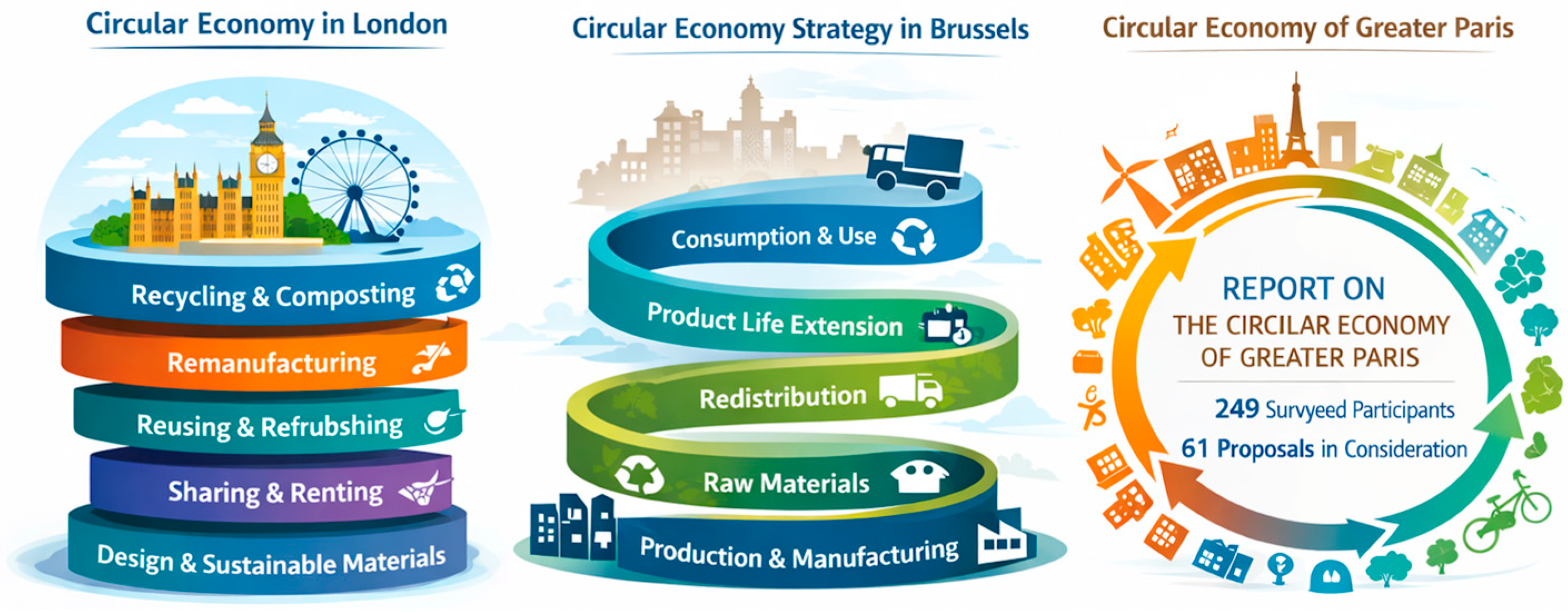
Figure 2.
Explained variance of the components from the Q-Analysis.
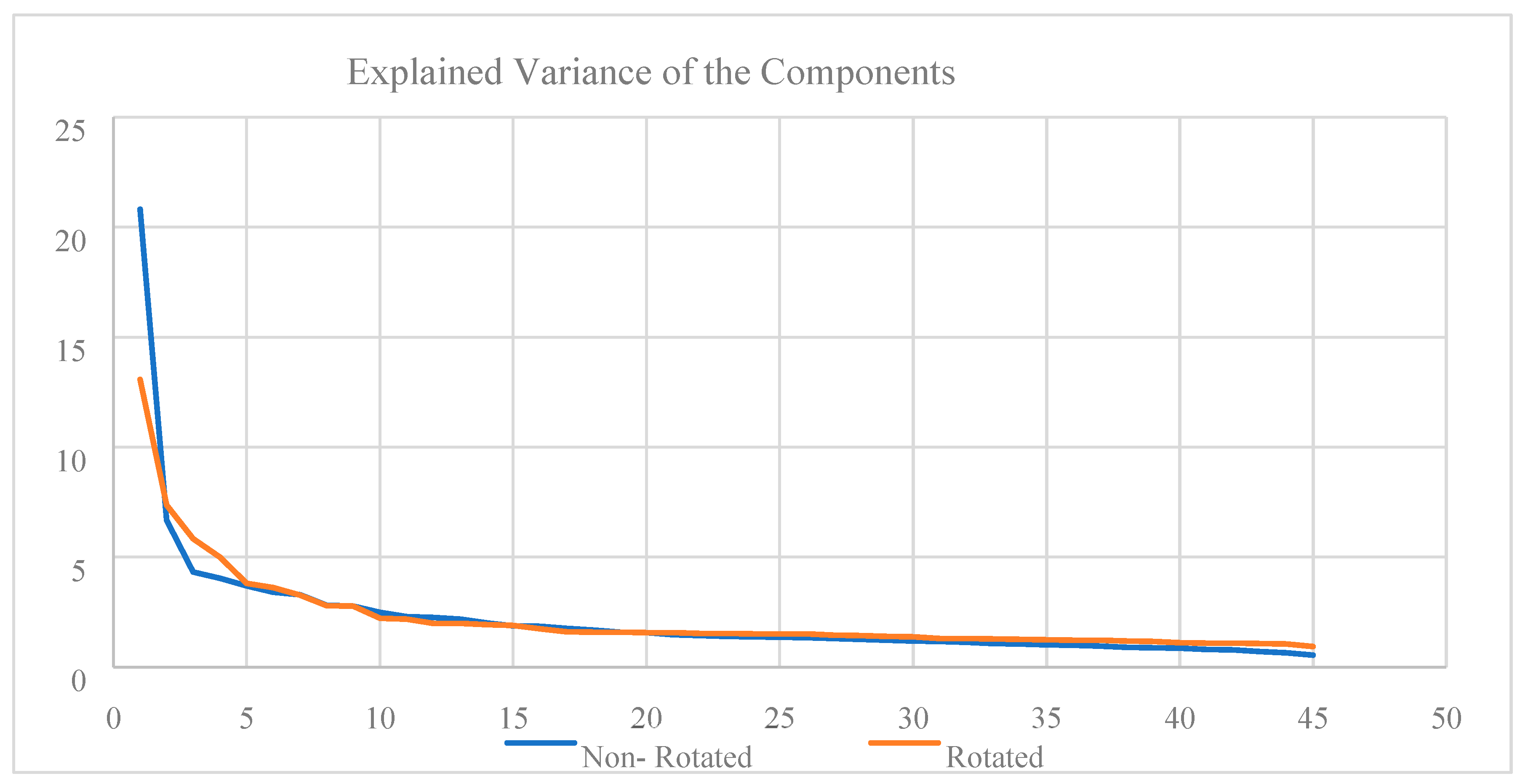
Figure 3.
Features of the Components.
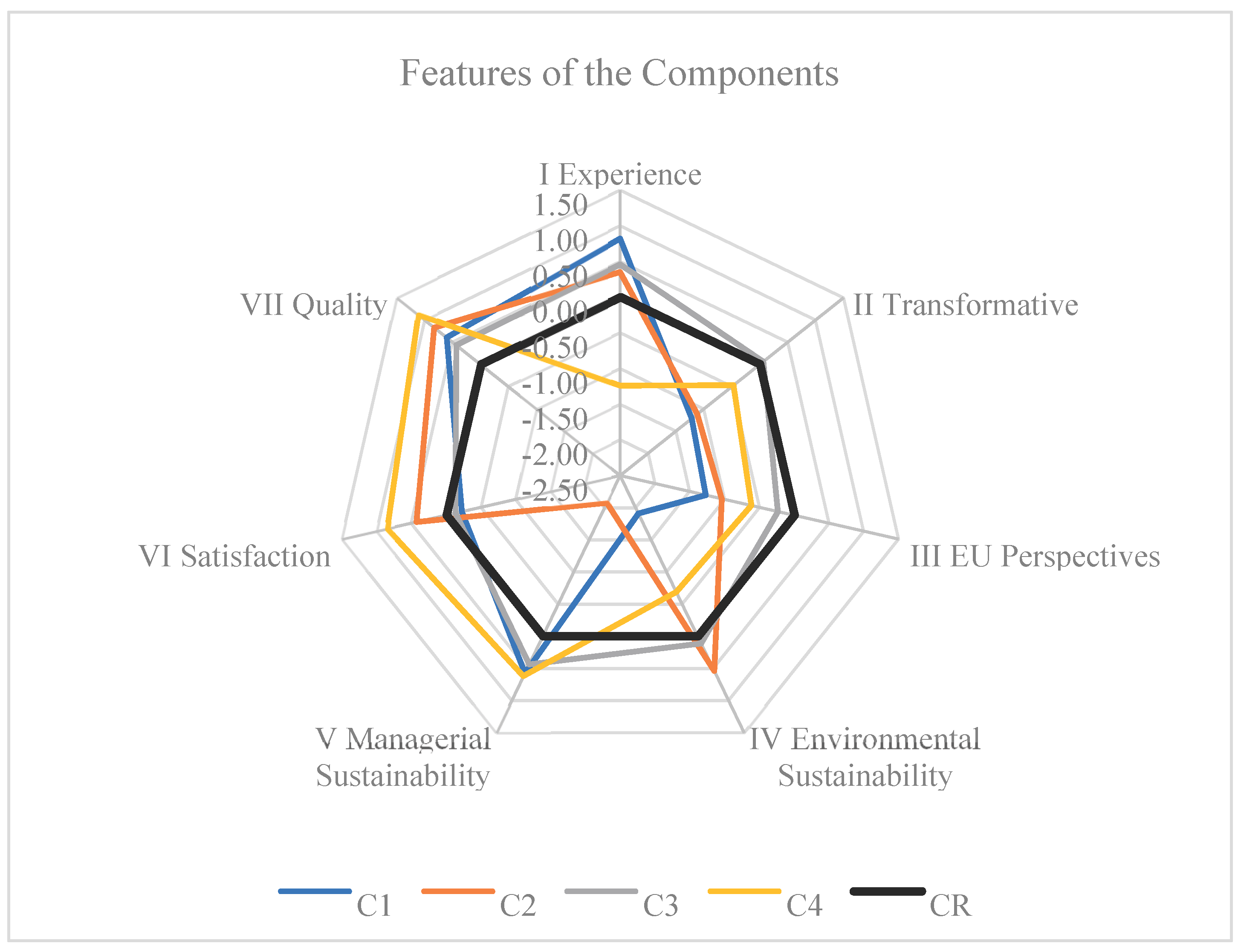
Figure 4.
Explained Variance of the Components in the Generalized Q- Analysis.
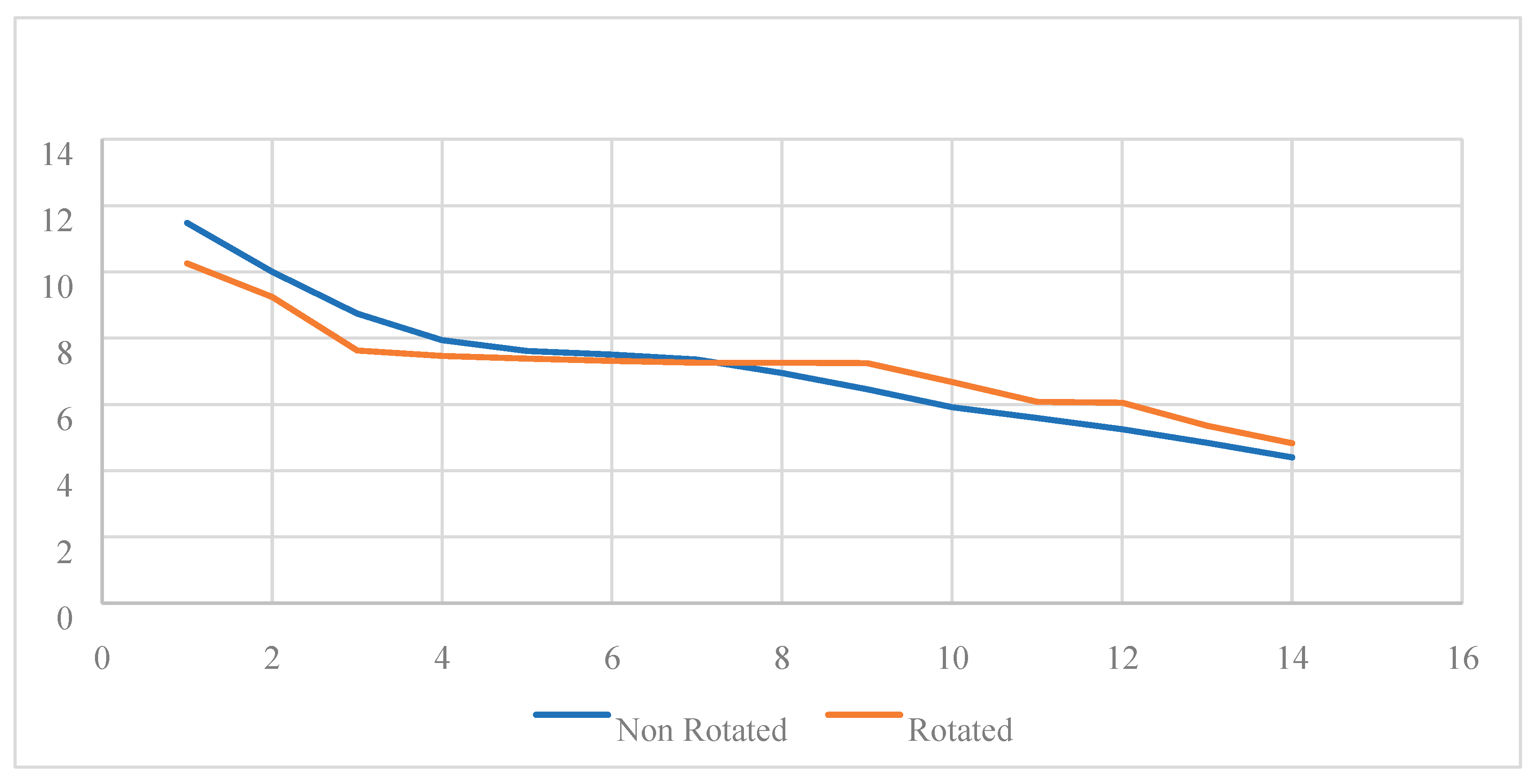

Table 1.
Average evaluation of travel experience and sustainability of destination area.
| Sets | Travel Experience and Sustainability of Destination | Average | Deviation |
| Experience | Cultural and natural heritage | 2,24 | 0,96 |
| Cultural events | 1,66 | 1,06 | |
| Tailor-made visit | 1,75 | 1,06 | |
| Satisfaction of the travel experience | 1,94 | 1,03 | |
| Transformative | Authenticity | 1,72 | 1,03 |
| Atmosphere | 2,02 | 0,98 | |
| Friendly people | 1,22 | 1,35 | |
| Connection with nature | 1,71 | 1,08 | |
| Learning | 1,72 | 1,03 | |
| Transformative experience | 1,30 | 1,12 | |
| Satisfaction of the transformative experience | 1,70 | 1,02 | |
|
EU View |
Interest in European heritage sites | 1,52 | 1,13 |
| Sense of belonging to European culture | 1,03 | 1,15 | |
| Interest in learning more about linkages of local heritage with EU history | 1,64 | 1,11 | |
|
Environmental Sustainability |
Sustainable transport means | 0,18 | 1,50 |
| Energy efficiency and use of renewable energy sources | 0,61 | 1,23 | |
| Freshwater consumption in tourism services | 0,49 | 1,12 | |
| Plastic-free and recycling-based policies in tourism services | 0,68 | 1,25 | |
| Preservation of green areas, fauna and flora | 1,24 | 1,11 | |
| Rural landscape maintenance | 1,12 | 1,13 | |
| Waste management | 0,69 | 1,33 | |
| Green certification/label of tourism services | 0,44 | 1,10 | |
| Satisfaction of the destination sustainability | 0,94 | 1,09 | |
|
Managerial Sustainability |
Local and traditional food | 1,49 | 1,15 |
| Local and traditional craft | 1,37 | 1,15 | |
| Conservation/reuse of local heritage and landscape | 1,29 | 1,12 | |
| Less known places promotion | 1,24 | 1,14 | |
| Social corporate responsibility/human rights policies in tourism activities | 0,87 | 1,13 | |
| Tourism activities run by local people/families | 1,49 | 1,07 | |
| Tourism workers skills | 1,63 | 1,04 | |
| Services for people with special needs | 0,69 | 1,24 | |
| Safety | 1,87 | 1,08 | |
| Satisfaction of destination management | 1,40 | 1,10 | |
| Satisfaction | General satisfaction | 1,88 | 0,98 |
| Satisfaction compared to other similar places | 1,68 | 1,01 | |
| Satisfaction compared to expectations | 1,75 | 0,99 | |
| Willingness to come back | 1,95 | 1,07 | |
| Willingness to recommend | 2,17 | 0,98 | |
| Willingness to contribute/donate | 1,09 | 1,25 | |
| Quality | Accomodation services | 1,31 | 1,08 |
| Restaurants and food | 1,53 | 1,14 | |
| Sport and wellness | 1,07 | 1,06 | |
| Shops | 1,02 | 1,10 | |
| Public places | 1,31 | 1,06 | |
| Transports and roads | 0,75 | 1,42 | |
| Information to visitors | 1,21 | 1,20 |
Table 2.
Regression Results of the Component Scores on the Visited Places (with Romania-Moldova as the reference region).
Table 2.
Regression Results of the Component Scores on the Visited Places (with Romania-Moldova as the reference region).
| M- | R | R2 | Z | Sig. | Intercept | Aragon | Basilicata | Larnaka | VGR Kar | VGR Mark | Vollvodin |
| C1 | ,325a | ,105 | 16,34 | <,001 | ,266*** | ,064** | ,153*** | -,105*** | -,072* | -,062* | -,012 |
| C2 | ,575 | ,331 | 68,66 | <,001 | ,103*** | ,298*** | ,056*** | -,001 | ,165*** | ,101 | ,004 |
| C3 | ,457 | ,209 | 36,70 | <,001 | ,072*** | ,008 | ,069 | ,235*** | ,108*** | ,042 | ,009 |
| C4 | ,310a | ,096 | 14,80 | <,001 | -,049** | 056 | 043 | 187*** | ,037 | -,005 | ,113*** |
Table 3.
Standardized Average Responses from the Surveys.
| Components of Initial Questions | Average | Std.Deviation | |
| 1 | Experience1 | 0,0000 | 0,6668 |
| 2 | Experience2 | 0,0000 | 0,6422 |
| 3 | Experience3 | 0,0000 | 0,6769 |
| 4 | Transformative1 | 0,0000 | 0,7894 |
| 5 | Transformative2 | 0,0000 | 0,7802 |
| 6 | Transformative3 | 0,0000 | 0,7121 |
| 7 | European1 | 0,0000 | 0,8040 |
| 8 | European2 | 0,0000 | 0,7867 |
| 9 | European3 | 0,0000 | 0,7995 |
| 10 | Envvironmental1 | 0,0000 | 0,7718 |
| 11 | Envvironmental2 | 0,0000 | 0,7479 |
| 12 | Envvironmental3 | 0,0000 | 0,7554 |
| 13 | Managerial1 | 0,0000 | 0,8247 |
| 14 | Managerial2 | 0,0000 | 0,7506 |
| 15 | Managerial3 | 0,0000 | 0,7807 |
| 16 | Satisfaction1 | 0,0000 | 0,7899 |
| 17 | Satisfaction2 | 0,0000 | 0,7556 |
| 18 | Satisfaction3 | 0,0000 | 0,7145 |
| 19 | Quality1 | 0,0000 | 0,7972 |
| 20 | Quality2 | 0,0000 | 0,7574 |
| 21 | Quality3 | 0,0000 | 0,7134 |
Table 4.
Regression Coefficients of Component Scores on Dummies (D1 to D21) of Composed Topics and Component Scores.
Table 4.
Regression Coefficients of Component Scores on Dummies (D1 to D21) of Composed Topics and Component Scores.
| D1 | D2 | D3 | D4 | D5 | D6 | D7 | D8 | D9 | D10 | D11 | D12 | D13 | D14 | D15 | D16 | D17 | D18 | D19 | D20 | D21 | ||
| Group of Topics | Experience | Transform | European | Environment | Managerial | Satisfaction | Quality | |||||||||||||||
| C1 (10%) | 1,2 | 1,6 | 1,4 | 1,2 | 1,3 | 1,2 | 1,2 | 1,9 | 1,4 | 1,2 | 1,1 | 0,5 | 1,2 | 0,5 | -0,1 | 1,2 | 1,6 | 1,3 | 1,2 | 0,2 | -0,5 | |
| C2 (9%) | 0,3 | 0,1 | 0,6 | 0,3 | 0,9 | 0,4 | 0,3 | -0,2 | 0,2 | 0,3 | 0,4 | 1,4 | 0,3 | -0,6 | 0,5 | 0,3 | 0,7 | -0,5 | 0,3 | -0,2 | -0,3 | |
| C3 (8%) | 1,5 | 1,4 | 1,1 | 1,5 | 1,6 | 1,6 | 1,5 | 0,2 | -0,8 | 1,5 | 1,5 | 1,1 | 1,5 | 1,4 | 1,8 | 1,5 | 1,3 | 1,5 | 1,5 | 1,1 | 1,1 | |
| C4 (7%) | -1,2 | -1,2 | -1 | -1,2 | -0,8 | 0,9 | -1,2 | -1,4 | -1,2 | -1,2 | -1,2 | -0,9 | -1,2 | -1,3 | -1,3 | -1,2 | -0,9 | -0,6 | -1,2 | -1,2 | -1,4 | |
| C5 (7%) | 1,7 | 1,5 | 1,4 | 1,7 | -0,4 | 1 | 1,7 | 1,2 | 1,4 | 1,7 | 2 | 2,4 | 1,7 | 1,5 | 1,2 | 1,7 | 1,2 | 1,1 | 1,7 | 1,6 | 1,3 | |
| C6 (7%) | 0,5 | 0,6 | 0,4 | 0,5 | 1 | 0,9 | 0,5 | 0,7 | 1 | 0,5 | 0,6 | 0,8 | 0,5 | 1,1 | 1,3 | 0,5 | -1,4 | -0,2 | 0,5 | -0,3 | -0,5 | |
| C7 (7%) | -1,2 | -0,9 | -0,8 | -1,2 | -1,6 | -1,3 | -1,2 | 0,5 | -1,4 | -1,2 | -1,1 | -0,5 | -1,2 | -0,9 | -0,5 | -1,2 | -1 | -1,1 | -1,2 | -1,3 | -1,2 | |
| C8 (7%) | 1,5 | 1,5 | 1,4 | 1,5 | 1,2 | 1,4 | 1,5 | 1,4 | 1,4 | 1,5 | -0,9 | 0,4 | 1,5 | 1,4 | 1,6 | 1,5 | 1,3 | 1,3 | 1,5 | 1,5 | 1,5 | |
| C9 (7%) | 0 | 0,2 | 0 | 0 | -0,3 | -0,7 | 0 | -0,2 | 0 | 0 | 0 | 0,6 | 0 | -1,1 | -0,3 | 0 | 0,1 | 1,7 | 0 | -0,2 | -0,2 | |
| C10 (7%) | -0,5 | -0,3 | -0,3 | -0,5 | -1,2 | -0,9 | -0,5 | -0,7 | -0,1 | -0,5 | -0,4 | -1,2 | -0,5 | 0,2 | 1,1 | -0,5 | 0,5 | 0,1 | -0,5 | -1,2 | -1,3 | |
| C11 (6%) | 0,7 | 0,6 | 0,5 | 0,7 | 0,5 | 0,9 | 0,7 | 1,2 | 1 | 0,7 | 0,9 | -0,2 | 0,7 | -0,9 | 0,6 | 0,7 | 0 | 0 | 0,7 | 1 | 1,2 | |
| C12 (6%) | 0,5 | 0,5 | 0,5 | 0,5 | 0,4 | 0,7 | 0,5 | 0,5 | 0,6 | 0,5 | 0,5 | 0,5 | 0,5 | 0,3 | 0,1 | 0,5 | 0,5 | 0,5 | 0,5 | -1,3 | 0,9 | |
| C13 (5%) | 0,1 | 0 | -2 | 0,1 | 0,2 | 0,3 | 0,1 | 0,3 | 0,3 | 0,1 | 0,1 | 0,4 | 0,1 | 0 | 0,2 | 0,1 | 0,5 | 0,1 | 0,1 | 0 | -0,1 | |
| C14 (5%) | 1 | -1,3 | -0,1 | 1 | 1 | 1 | 1 | 1,4 | 1,1 | 1 | 1 | 0,9 | 1 | 1,1 | 1,1 | 1 | 1,2 | 1,4 | 1 | 0,9 | 0,8 | |
| Cultural and natural | 0,1 | 0,2 | 0,9 | |||||||||||||||||||
| Cultural events | 0,1 | 0,9 | 0,2 | |||||||||||||||||||
| Tailor made visit | 0,7 | 0,5 | -0,1 | |||||||||||||||||||
| Satisfaction of experience | 0,8 | -0,1 | 0,3 | |||||||||||||||||||
| Authenticity | 0 | 0,8 | 0,1 | |||||||||||||||||||
| Atmosphere | 0,1 | 0,8 | 0 | |||||||||||||||||||
| Friendly people | 0 | 0 | 0,9 | |||||||||||||||||||
| Connection with nature | 0,5 | 0,2 | 0,4 | |||||||||||||||||||
| Learning | 0,7 | -0,1 | 0,1 | |||||||||||||||||||
| Transformative experience | 0,7 | 0 | 0,1 | |||||||||||||||||||
| Satisfaction transformation | 0,7 | 0,1 | -0,3 | |||||||||||||||||||
| European heritage | 0,8 | -0,2 | -0,6 | |||||||||||||||||||
| Belonging to Europe | 0,8 | -0,5 | 0,4 | |||||||||||||||||||
| Linkages with Europe | 0,7 | 0,7 | 0,2 | |||||||||||||||||||
| Sustainable transport means | 0,6 | 0,2 | -0,1 | |||||||||||||||||||
| Energy efficiency | 0,7 | 0 | 0,1 | |||||||||||||||||||
| Fresh water consumption | 0,6 | -0,1 | 0 | |||||||||||||||||||
| Plastic free | 0,7 | 0,1 | 0,1 | |||||||||||||||||||
| Preservation of green areas | 0 | -0,1 | 0,8 | |||||||||||||||||||
| Rural landscape | 0 | 0,2 | 0,7 | |||||||||||||||||||
| Waste management | 0 | 0,6 | 0,2 | |||||||||||||||||||
| Green certification | 0,1 | 0,7 | -0,1 | |||||||||||||||||||
| Satisfaction of destination | 0,1 | 0,6 | 0,4 | |||||||||||||||||||
| Local and traditional food | 0,8 | 0 | 0 | |||||||||||||||||||
| Local and traditional craft | 0,8 | 0,1 | -0,1 | |||||||||||||||||||
| Conservation of landscape | 0,2 | 0,5 | 0,2 | |||||||||||||||||||
| Less known places promotion | 0,1 | 0,5 | 0,1 | |||||||||||||||||||
| Social responsibility | -0,1 | 0,7 | -0,1 | |||||||||||||||||||
| Tourism activities by locals | 0,2 | -0,1 | 0,6 | |||||||||||||||||||
| Tourism workers skills | 0 | 0 | 0,6 | |||||||||||||||||||
| Services for special needs | 0 | 0,6 | 0 | |||||||||||||||||||
| Safety | -0,1 | 0 | 0,6 | |||||||||||||||||||
| Satisfaction of management | -0,1 | 0,1 | 0,4 | |||||||||||||||||||
| General satisfaction | 0,7 | 0,1 | -0,1 | |||||||||||||||||||
| Satisfaction compared | 0,8 | 0 | 0 | |||||||||||||||||||
| Satisfaction & expectations | 0,7 | 0 | 0 | |||||||||||||||||||
| Willingness to come back | 0,1 | 0,8 | 0 | |||||||||||||||||||
| Willingness to recommend | 0 | 0,8 | 0 | |||||||||||||||||||
| Willingness to donate | -0,1 | 0 | 1 | |||||||||||||||||||
| Accommodation services | 0,7 | 0 | 0,2 | |||||||||||||||||||
| Restaurants and food | 0,8 | 0,1 | -0,1 | |||||||||||||||||||
| Sport and wellness | 0,2 | 0 | 0,9 | |||||||||||||||||||
| Shops | 0,5 | 0,4 | 0,1 | |||||||||||||||||||
| Public places | 0,3 | 0,5 | 0,2 | |||||||||||||||||||
| Transports and roads | 0 | 0,8 | -0,2 | |||||||||||||||||||
| Information to visitors | -0,3 | 0,5 | 0,5 | |||||||||||||||||||
Table 5.
Coefficients of the Regressions of the Components Scores on the Visited Places, and control variables (Larnaka is the reference region).
Table 5.
Coefficients of the Regressions of the Components Scores on the Visited Places, and control variables (Larnaka is the reference region).
| Constant | Aragon | Basilicata | Karlsborg | Mark | Voljvodina | Moldova | ||||||||||
| R | S | B | p | B | p | B | p | B | p | B | p | B | p | B | p | |
| C1 (10%) | ,292 | <,001 | ,069 | 839 | -,443 | ,001 | ,001 | ,993 | -,298 | <,001 | -,179 | ,007 | -,027 | ,600 | ,028 | ,570 |
| C2 (9%) | ,222 | <,001 | -,151 | ,654 | -,099 | ,063 | ,025 | ,655 | -,168 | ,009 | -,189 | ,005 | -,275 | <,001 | -,228 | <,001 |
| C3 (8%) | ,138 | <,001 | ,606 | ,060 | -,161 | ,002 | -,009 | ,897 | -,274 | ,000 | -,309 | ,000 | -,094 | ,059 | -,135 | ,004 |
| C4 (7%) | ,125 | <,001 | ,016 | ,961 | -,102 | ,044 | -.078 | ,136 | -,243 | <,001 | -,076 | ,228 | -,014 | ,772 | -,087 | ,063 |
| C5 (7%) | ,093 | ,004 | ,074 | ,820 | -,032 | ,536 | -,055 | ,300 | ,065 | ,290 | ,014 | ,832 | -,019 | ,700 | ,047 | ,315 |
| C6 (7%) | ,081 | ,034 | -,337 | ,302 | -,070 | ,174 | -,095 | ,073 | ,062 | ,316 | -,079 | ,217 | -,077 | ,126 | -,163 | <,001 |
| C7 (7%) | ,075 | ,082 | ,084 | ,795 | -,085 | ,097 | -,071 | ,179 | -,053 | ,392 | -,164 | ,011 | -,054 | ,278 | -,103 | ,030 |
| C8 (7%) | ,095 | ,003 | ,525 | ,103 | -,221 | <,001 | -,123 | ,019 | -,220 | <,001 | -,227 | <,001 | -,179 | <,001 | -,168 | <,001 |
| C9 (7%) | ,174 | <,001 | -,183 | ,552 | -,219 | <,001 | -,003 | ,956 | -,250 | <,001 | -,160 | ,009 | -,043 | ,368 | -013 | ,777 |
| C10 (7%) | ,089 | ,166 | -,450 | ,152 | -,043 | ,385 | -,118 | ,021 | -,046 | ,440 | -,077 | ,215 | -,086 | ,076 | -,096 | ,035 |
| C11 (6%) | ,077 | ,058 | -,155 | ,604 | -,024 | ,605 | ,079 | ,102 | -,038 | ,507 | -,078 | ,138 | -,040 | ,380 | -,033 | ,442 |
| C12 (6%) | ,156 | <,001 | -,418 | ,141 | ,042 | ,346 | ,081 | ,079 | -,150 | ,005 | -,009 | ,872 | -,035 | ,418 | -,038 | ,350 |
| C13 (5%) | ,124 | <,001 | ,181 | ,506 | -,131 | ,002 | -,151 | <,001 | -,184 | <,001 | -,276 | <,001 | -,112 | ,007 | -,108 | ,006 |
| C14 (5%) | ,064 | ,306 | ,179 | ,504 | -,016 | ,699 | -,033 | ,452 | -,068 | ,180 | -,086 | ,105 | -,063 | ,127 | ,012 | ,757 |
Disclaimer/Publisher’s Note: The statements, opinions and data contained in all publications are solely those of the individual author(s) and contributor(s) and not of MDPI and/or the editor(s). MDPI and/or the editor(s) disclaim responsibility for any injury to people or property resulting from any ideas, methods, instructions or products referred to in the content. |
© 2026 by the authors. Licensee MDPI, Basel, Switzerland. This article is an open access article distributed under the terms and conditions of the Creative Commons Attribution (CC BY) license (http://creativecommons.org/licenses/by/4.0/).
Copyright: This open access article is published under a Creative Commons CC BY 4.0 license, which permit the free download, distribution, and reuse, provided that the author and preprint are cited in any reuse.


