

Submitted:
17 March 2026
Posted:
18 March 2026
You are already at the latest version
Abstract
Today, the transformation of energy systems is at the core of climate change mitigation. This transformation brings substantial implications for citizens. Coal-to-renewable energy transitions require new workforce skills while affecting regional economies and communities. Thus, a broader interdisciplinary approach integrating energy justice and participatory methods into energy transition research is required to clarify these socio-technical transformations. To address this gap, this article conducts a systematic review of just energy transition literature, focusing on studies where participation plays a methodological or conceptual role. Based on a systematic review of 42 articles, our findings show that participation enables stakeholders and policymakers to widen the energy policy discussion to account for plural values and procedural justice concerns of stakeholders involved in a complex socio-ecological system. This inquiry is timely, as energy practitioners, policymakers, and scholars increasingly seek to operationalize justice within energy transition frameworks. However, the review reveals a discrepancy between the widespread acknowledgment that just transition processes must be participatory and inclusive, and their limited realization in practice. These findings underscore the need for greater methodological experimentation with deliberative forms of participation, broader inclusion of stakeholder groups, and the development of context-sensitive guidelines to operationalize justice in energy transitions.
Keywords:
just transition
; energy justice
; stakeholder participation
; participatory methods
1. Introduction
The transformation of energy systems is an integral part of current climate change mitigation strategies, essential for a global shift towards a low-carbon society. However, this is a socio-technical transformation which may have substantial implications for citizens. The transition from coal to renewable energy sources such as wind and solar will require new skills, reshaping labor markets and potentially generating just or unjust outcomes for regional economies and communities. The origins of the just energy transition concept dates to the union movements of the 1960s in the North American energy sector, when the term “labor environmentalism” was first introduced in a dispute over uranium mining [1]. Initially, the concept mainly reflected the concerns of the industrial transformation and the workers’ rights. In the 1990s, the concept was applied in a broader context, with the formation of Just Transition Coalition [2]. What follows is the inclusion of the “just transition” concept in the International Trade Union Confederation (ITUC)’s statement in the Kyoto Conference in 1997 [3], and the subsequent achievement of unions in the appearance of the concept in the Preamble to the Paris Agreement [4]. Since the publishing of the ILO Guidelines [5], the United Nations’ International Labor Organization (ILO) has been working on just transition policies and green jobs.
Following these developments, a broader consideration of justice principles (recognition, distribution and processes) in the transition to a low-carbon society is increasingly called for by government and civil society actors [6]. In this regard, defining and operationalizing “just transition” is a complex task. It requires integration of energy justice frameworks, environmental justice literature and energy democracy concerns, which may not always resonate with each other [7,8]. The need for including multiple dimensions in approaching indicators, assessment tools and methods correspond to the different demands of just energy transition, such as being temporal and intersectional [9]. In this regard, scholars have increasingly questioned the neutral and technical framing of indicator-based approaches in sustainability assessments. For instance, Purvis and Genovese [10] argue that indicators should not merely be seen as technical tools for measuring progress, but as inherently political artifacts that shape narratives, power dynamics, and epistemological assumptions. Their critique invites a shift from doing things better (i.e., improving the technical precision of indicators) to doing things differently—redefining what is valued and how transformation is conceptualized. They suggest alternative methods such as dissensus-based deliberation, storytelling, gamification, modeling and system thinking as more suitable for fostering critical engagement with the principles of justice in sustainability transitions. Besides, as pointed out by Droubi et al., the energy democracy as a process, defined as “the strengthening and realization of the right of participation of the individual and of the collective in decision-making on energy policies, in pursuit of more equitable and sustainable energy outcomes” [7], requires a reconciliation of the concepts of energy democracy and participation with the concept of justice. In recent sustainability transition studies, there have been increasing calls to improve understanding on how to better design, implement and evaluate policies to achieve just transitions through participatory tools and processes [11].
Hence, considering its multiple layers, the aim of this paper is to review the methods, tools and processes for participating in just energy transitions, in order to contribute to the development of an institutional framework and policy guidelines in implementing future energy transitions in a just way. This quest is timely in a sense that policymakers are in search of understanding the notion of justice in sustainability transitions by considering the interplay between various dimensions of justice and justice concepts [11]. This article aims to improve understanding on the state-of-the art of participatory approaches supporting just energy transition processes. It presents a systematic literature review of selected studies in which participation is a key element to the assessment of the transition at stake, either as a methodology or as a conceptual theme, with regards to specified justice criteria. The review targets to answer the following questions:
- (1)
- What are the themes and issue areas that have been covered in recent research publications on this topic (e.g., justice, values, the visions for just energy transition, legal and political context)?
- (2)
- Who are the main stakeholder groups considered and how are they identified? What are the methods of engagement, and the engagement/participation level of each stakeholder group?
- (3)
- Which participatory methods are used in this area of study? What are the stated benefits and challenges of using participatory methods in operationalizing just energy transition?
- (4)
- What are the assessment criteria, indicators and other tools employed to study just energy transitions? What are the dimensions in approaching indicators, assessment tools and methods corresponding to the different demands of just energy transition processes?
2. Methods
This article is based on a systematic literature review and the following thematic analysis of the sample of articles using the NVivo software. Articles were retrieved from Web of Science and Scopus databases, which allowed the identification of an initial set of 510 articles published until November 2023. The steps of screening, eligibility and exclusion criteria at each step is visualized in Figure 1. The PRISMA Model (the Preferred Reporting Items for Systematic reviews and Meta- Analyses) was used in carrying out the screening of the articles [12]. After the screening step, 42 articles were included in the review sample. focusing on stakeholder participation, participatory methods and indicator formation in just energy transition research.
The selected articles were thematically analyzed using the NVivo software, starting with a deductive approach to coding based on the themes derived from the literature on energy justice frameworks [9,13,14]. Thematic or semantic analysis method is widely employed, starting with its development in social psychology and today, more prevalently in the field of ecological economics, in order to analyze common themes in the literature review [15,16]. Although the initial codes served as the basis to analyze and structure the data in the articles, our approach to qualitative analysis allowed inductive coding as well, which reflects a ground-up approach to derive the codes reflecting the themes in the data. The common themes were identified and categorized under broader themes. The assessment tools, criteria, indicators, methods and stakeholders referred to in the sample of articles are also identified for a reflective bottom-up analysis of their relevance and interaction in just energy transition research. Analyzing common themes in the article sample in their participatory and stakeholder-focused approaches to the just energy transition, together with an in-depth reflection into the collection of assessment criteria, indicators and methodologies employed, was considered sufficient for the aim of this article. Results are presented in the following subsections for general characterization and analysis, covering addressed themes, assessment criteria and indicators used to measure just transitions, as well as participatory methods employed and stakeholders engaged in the reviewed studies.
3. Results
3.1. General Characterization of the Selected Literature
This section provides a general characterization of the selected sample of articles according to different elements such as the type of just transition addressed, geographical distribution and scope, publication outlet and year of publication. The overarching topic of just energy transition is common to all papers in the sample, but depending on the main focus and type of fuels or energy systems referred to, articles were grouped in different categories as depicted in Figure 2. The largest share of articles employed a generic notion of “just energy transition”, with 42% of the publications being focused on generic processes of transition to low-carbon energy and decarbonization. This is followed by 30% of articles that were focused specifically on a just transition from coal. Just transition to renewables (14%), just transition from oil and gas (9%) and power system transitions (5%) are the remaining types of specific just energy transition categories found in the sampled literature.
Figure 3 shows the geographical distribution of the reviewed studies. Poland, United Kingdom and Spain are the most represented countries in the sample, with five case studies each. They are followed by Germany, Netherlands, the United States (four case studies each) and Norway (three case studies). There are nine articles which have more than one country represented in the study. These articles are either a comparative analysis between specified countries, or they may refer to multinational analysis based on a panel of data from multiple countries. In terms of the geographical scope, 10% of the reviewed articles have a multinational perspective. Nevertheless, the majority of articles (69%) describe cases of local scope, with 19% addressing energy transition cases at a national level.
Figure 4 and Figure 5 reveal the publication sources where articles were published and the trend in the number of yearly publications on the topic. While it is clear that the journal of Energy Research and Social Science has distinctively the majority of the articles in the sample (nine articles), followed by the journals Local Environment, Sustainability and Energies (three articles each) and Journal of Environmental Policy and Planning and Climate Policy (two articles each), the sample is represented with twenty more different journals, which reflects the diversity of outlets of the published research on the topic.
Most of the reviewed articles were published in 2022 (38%), 2021 (26%) and 2023 (14%), which indicates the novelty and an increasing interest on this topic in the reviewed literature. We can infer that the just transition studies with a focus on stakeholder participation, and on the relevant assessment tools and indicators for just transition, has been gradually gaining momentum since 2016.
3.2. Just Transition Themes and Issue Areas
The sample was analyzed in detail with NVivo software, starting with a deductive approach to coding based on the themes derived from the literature [9,13,14]. The building themes in the adopted energy justice framework are distributional justice, procedural justice and recognition justice. Our approach also allowed for inductive coding where a bottom-up analysis of the recurrent themes in the sample was performed through an in-depth reading of the articles. Exact phrases including the topics/codes, as well as excerpts of articles relevant for these topics/themes, were assigned under the sub-themes listed in Table 1. Subsequently, the topics/codes were grouped into broader themes that are listed in the second column of Table 1. Themes are listed in their prevalence, i.e., justice as a broader theme is the one that is employed the most with its sub-themes listed in the left-hand side. The main broader themes found, according to their prevalence, include justice, values, visions and political & legal context.
Figure 6 illustrates the most frequent words in the qualitative analysis, which is the result of the word frequency query based on the codes from both deductive and inductive analysis.
A conclusion among the sample of papers, regarding the theme of “dimensions and types of justice”, is that carbon reduction, which is the key goal of energy transition, is not enough for sustaining justice. There are cases where low carbon technologies can create injustices [2]. Huang &Liu [17] state that reducing carbon emissions would not necessarily make renewable technologies socially just unless justice issues in the ongoing process of energy transitions are not accounted for carefully. Moreover, such transformations in global energy systems have a potential to create new, or reinforce old, inequalities and injustices. It is emphasized in the majority of the articles that justice norms are to be integrated into transition governance. This integration is made possible through reconsideration of the value systems and institutions in transition processes. Lack of institutions reinforces injustices [18]. Nicola & Schmitz [19] conclude that pre-existing inequalities will be reinforced rather than rectified when there is a mistrust for the institutions and local/national governments for change/transformation. Institutions empower citizens as co-producers of values [20].
Sanchez & Linde [21] also point out that the reduction in the supply of fossil fuels does not inherently bring out just and equitable transition. They argue that this happens since markets cannot bring out equitable distribution in line with global climate goals without policy intervention. The gap between the criteria for just energy transition that are determined with the norms of equity and justice and the indicators that reflect the market dynamics poses a risk for sustaining just transition. Sanchez & Linde [21] argue that “basing a phase-out on an incomplete assessment of indicators poses risk to just transition”, in terms of development needs and procedural justice. They consider as relevant the sequencing and the criteria for countries in phasing out of coal. The risk of coming up with inadequate indicators based on sound criteria (the so-called “criteria and indicators gap” as Sanchez &Linde [21] name it) is a procedural justice problem. These authors look at the criteria for countries sequencing out of oil extraction and its justice implications. The difference between indicators and criteria is relevant because when the criteria miss the relevant metrics, it means that it is not operationalized. The reasons for that can be the complexity of the indicator, availability of data and the value judgements involved [21].
The consideration of the methods employed in energy transitions in an institutional framework is another common theme among the sample of articles. The preferred assessment tools reflect the visions for operationalizing just energy transitions, that is why it is coded under the broader theme of the “Visions for Just Energy Transition” in Table 1. As argued by Moles-Grueso & Stojilovska [20], the success of the just energy transitions is jeopardized by current methods and approaches when participation is employed in a narrow way merely as a mechanism to facilitate opposition to top-down decisions. Grueso & Stojilovska state that “although increased citizen engagement is acknowledged as necessary constituent of diverse conceptualizations of energy justice, energy citizenship and environmental justice; these concepts have been instrumentalized in scholarly, policy-related, and participatory decision-making processes, disregarding the key role of pluralistic knowledge in building up societal resilience” [20]. Thus, it is crucial to first conceptualize and then to improve participation as a value-generating institution to operationalize their role in empowering citizens’ value formation.
There are ways to instrumentalize the participation by stakeholders, which characterizes the current methods and approaches. First of all, citizens view instrumentalization as a barrier and this approach may hinder their participation. Secondly, the idea of instrumentalization includes stigmatization of stakeholders for their knowledge deficits. Thus, although participation has a substantial potential and power for transformation, both as a method and as a policy process, participatory methods alone may not bring about justice as participatory processes also have the risk of being manipulated. Yet, the successful transition requires participation, and the recognition of plural epistemologies is needed for meaningful participation [22,23,24,25,26].
The less common broad theme found in the sample of reviewed articles is “Political and Legal Context”. Afewerki & Karlsen [24] point out that the legitimacy of the just transition comes from multi-scalar policy and participation. The governance of just transition is shaped by politics and institutions, at national and local scale. For instance, authoritarian regimes create more injustices for just energy and other domain transitions [17]. The authors focused on the adaptability and responsiveness of transition governance mechanisms in authoritarian regimes, and through a mechanism that they call effective indirect participation, the governance of just transition yields more just results. Indirect participation is the term that Huang & Liu [17] advanced to describe the imperfect forms of stakeholder participation in cases where the broader political system in the context does not allow for participation to be properly implemented (such as in the cases of authoritarian regimes). Even in the cases where authoritarian regimes do not allow for participatory mechanisms to be implemented, indirect participation of stakeholders and the voices they raise through various media, such as social media, contribute to just outcomes related to the energy transition [17]. Developing participatory methods as institutions is a concrete way to enact practices of energy justice within a more democratized energy system [27].
3.3. Participatory Methods and Stakeholder Groups
This section addresses the research goal of characterizing the role of stakeholder participation and the participatory methods used in the reviewed just transition case studies. A summary of the variety and number of methods employed in the sample of articles is given in Figure 7 and Figure 8.
In classifying participatory methods, a key distinction emerges between deliberative and non-deliberative approaches, based on the depth of interaction and degree of collective reasoning they facilitate [28,29,30,31]. Deliberative methods are defined by interactive, dialogic engagement, where diverse stakeholders come together to exchange arguments, reflect critically, and ideally co-produce knowledge or recommendations [24,32,33]. These methods—such as deliberative forums, participatory workshops, citizen juries, or to some extent, focus groups—emphasize mutual learning, reasoned argumentation, and often consensus building. In contrast, non-deliberative methods, including semi-structured interviews, surveys, questionnaires, and participant observation primarily rely on one-way communication where participants provide input individually, without group-level deliberation [33].
As observed in Figure 7, semi-structured interviews are the dominant participatory method observed in the reviewed studies, with 27 of the articles in the sample employing this approach. This is followed by desktop research, with 11 of the articles in the sample deploying this method, which means that a non-participatory approach was primarily used in those cases. The articles which employ participatory methods usually employ multiple participatory methodologies in their case studies, as reflected in Figure 7. In the articles employing mixed-methods one may encounter desktop research as a supporting methodology (26% of the sample)- Figure 8 illustrates that the majority of reviewed articles describing the use of participatory methods are characterized as non-deliberative participatory methods (85%), followed by deliberative participatory methods with stakeholder identification (10.6%) and deliberative participatory methods with random selection (4.3%). Although semi-structured interviews offer valuable, in-depth insights into stakeholder perspectives, they are typically conducted in isolation, without fostering dialogue among participants or enabling negotiation of shared values or decisions. As such, they fall under consultative rather than truly deliberative categories in widely accepted typologies [33]. Interviews are episodic, non-iterative, and do not support the interactive dynamics necessary for meaningful participation in complex governance contexts such as just energy transitions. They risk reducing participants to informants, rather than empowering them as co-creators of policy [35,36,37]. This classification has important methodological implications. While interviews are useful for understanding individual narratives and framings, they are insufficient on their own to meet the criteria of deep, inclusive, and procedural participation [33,35]. They lack the capacity to build shared ownership, resolve conflicts, or generate collective imaginaries—all of which are essential in participatory governance processes aiming for equity and justice. The existence of deliberation points to a more thorough engagement with the stakeholders in the ladder of participation, in which there are shallower forms of participation such as passive participation, participation for consultation [28,31,36].
Another relevant feature considered in the systematic review was the identification of interested parties typically engaged in the reviewed case studies of energy transition processes. The stakeholder groups referred to in the sample were classified under 22 stakeholder categories, from academia and local communities, to artists and local businesses (Table 2). Appendix A provides details on the stakeholder categorization analysis, including the alternative terms used in the sample that refer to these consolidated categories (Table A.2).
Analyzing the total coverage of different stakeholder groups by the type of methods employed, it is concluded that the semi-structured interview method has covered a larger diversity of stakeholder categories, with a total of 19 different stakeholder groups (out of the 22). The fact that this method is employed in 27 of the articles in the sample is one of the primary reasons for this wide engagement. On the other hand, it was observed that other participatory methods less frequently employed also reported the interaction with a broad class of stakeholders. An example is the “participant observation” method, which was employed only in four articles, while mentioning the engagement of 11 different stakeholder groups. Among the four articles that employed focus groups, the engagement with 10 different categories of stakeholder groups was made. In the two articles that employed surveys, the engagement with 10 different classes of stakeholder groups was observed. Regarding the two articles that employed public meetings, the engagement with eight different classes of stakeholder groups registered. In the articles that employed a narrative approach, participatory network mapping, Delphi method, participatory action research, multicriteria mapping and preference ranking methodologies, the engagement with 2, 3, 2, 2 and 9 different classes of stakeholder groups were made respectively. Citizens’ jury methodology is employed in two articles in the sample, while having an engagement with five stakeholder groups.
Stakeholder engagement/participation level is a key variable of interest in the present systematic literature review. Table 2 shows the importance of examining the participatory methods employed in just transition processes and the extent to which different methods have engaged a diversity of stakeholders in the process. Reflection on this topic provides information supporting the design of future transition processes with respect to the breadth and depth of engagement with the stakeholders through the deployment of different participatory methodologies. This distribution reflects not only methodological choices but also broader trends in inclusion and exclusion in participatory processes related to just energy transitions. It reveals a tendency toward involving community members in deliberative processes while policy and organizational actors were more commonly engaged through non-deliberative mechanisms. Overall, non-deliberative participatory methods tend to have engaged a broader variety of stakeholder groups compared to deliberative methods, in the reviewed case studies. While deliberative methods are typically designed to foster deeper interaction and mutual learning across diverse stakeholder groups, a narrower set of stakeholders was found in the selected articles. Notably, certain groups show zero engagement in both deliberative and non-deliberative methods. These stakeholders—such as mining communities or local businesses—were only present in cases using non-participatory approaches. The limited representation of these stakeholder groups points to the importance of accounting for representativeness issues when promoting participation in just transition processes explicitly focusing on labor and affected communities.
3.4. Assessment Tools, Criteria and Indicators Employed in Just Transition
The systematic review allowed us to identify 95 just transition indicators mentioned in the collection of cases. Based on Heffron & McCauley [38] and Mundaca et al. [39], these are classified under two broad categories to reflect their environmental justice dimension: “distributive justice” and “procedural justice” (Table 3).
In this framework, distributional justice refers to the equitable allocation of costs and benefits across the society and other species in the natural environment, and relates to the values and principles according to which costs and benefits are allocated [11,13,18]. Procedural justice, on the other hand, focuses on the fairness and other values of the institutions, procedures and practices of decision-making, judicial processes, as well as on the extent that these are inclusive [11]. Self-governance, inclusion and interactive participation are the core concepts in this type of justice, as it looks at who participates in decision-making processes and the benefits from it, as well as how to deliver more inclusive participation [11,13]. In just transition frameworks, there is usually a third broad category of justice named “recognition justice”, which is related to respect and diversity in the processes of decision-making with regards to the questions “who is involved and how should we recognize them?” [13,18]. For the purpose of our classification, recognition justice is embodied in procedural justice assessment tools and indicators. Recognition of the diverse stakeholders is assumed as one of the core components of sustaining procedural justice.
Distributive justice assessment criteria and indicators found in the literature were subdivided into four subcategories, reflecting the distribution of: i) environmental, ii) economic, iii) social & political, and iv) energy transition outcomes. With the term outcome, one may infer the distribution of costs and benefits. On the other hand, procedural justice assessment criteria and indicators were divided into three subcategories, in order to reflect different stages of the just transition process: i) problem scoping and identification, iii) definition and assessment of measures and instruments, iii) implementation and monitoring solutions.
The extended table for the reflective classification of the assessment criteria and indicators can be found in Appendix B. This appendix includes Table A3, which is a comprehensive dataset of 95 just transition indicators, each detailed with data requirements, temporal application (e.g., ex-ante or ex-post analysis), spatial and contextual relevance. In the extended table, we captured the information regarding the indicators’ spatial and temporal dimensions, as well as the links with the participatory methods. Table 4 presents a summary with the set of assessment criteria and indicators most frequently mentioned in the reviewed case studies. The first conclusion from the analysis of results is that there is no evident set of dominating indicators in each category and across the articles sample. The diversity of indicators and assessment criteria used in each case point to the absence of a common framework which renders the comparison of just transition outcomes difficult across cases. The results also suggest that only 8 out of 26 just transition indicators that reflect procedural justice have no reference to the participatory methods. This means that the 30% of the procedural justice indicators may not be linked to the participatory methods. This ratio is more than twice higher for the distributive justice indicators, according to papers analysis out of 47 indicators from a total of 69 distributive justice indicators (i.e., 68.11%) show no link to participatory methods.
4. Lessons Learned and Insights for Future Research
Building on the findings presented above, this section reflects on key gaps and tensions in the design and implementation of participatory processes in just energy transitions. Although interest in participatory approaches within just transition research is clearly gaining momentum, no consistent trends have emerged regarding their extensive implementation in practice. Most reviewed case studies rely prominently on semi-structured interviews, indicating a need for greater methodological experimentation with deliberative participatory methods in order to engage a wider range of stakeholder groups in the co-creation of knowledge—particularly for understanding transition-related challenges, capturing plural values, and defining socially accepted indicators and assessment criteria for just transition outcomes. These efforts build upon and align with the theoretical frameworks and visions articulated in key policy sources, which emphasize inclusive, deliberative participation as fundamental to just transition processes [11]. Our systematic review revealed that while a wide range of stakeholder groups are nominally included across cases, their engagement is often limited in depth, particularly in deliberative settings. Moreover, certain stakeholder groups—such as workers or local businesses— may have remained underrepresented, despite their central relevance to just transition goals. This raises awareness on the importance of inclusiveness and representativeness criteria in the implementation of participatory approaches. The review also highlighted a strong association between participatory methods and procedural justice indicators, while distributive justice remains less grounded so far in participatory assessment tools. These results indicate that the integration of stakeholder perspectives may have been uneven across justice dimensions, and that dominant methodological choices may reproduce existing exclusions.
In the following paragraphs, two interrelated dichotomies are discussed to unpack conceptual and practical challenges: justice versus democracy [7], and criteria versus indicators [21]. These dichotomies serve not only as analytical tools but also as entry points for raising further questions. In fact, this section aims not to offer definitive answers, but to identify the limitations of current approaches and to pose critical questions for future research and policy design in just energy transitions.
The first dichotomy is justice versus democracy. There is a growing literature on the top-down characteristics of the notion of environmental justice, making the processes for achieving justice at odds with democratic and participatory principles [7]. In our systematic review it was evident that participation (direct or indirect) is important for the legitimacy of just transition, together with multi-scalar policies. Moreover, the broad set of indicators associated with participatory methods in the literature review challenges the assumed tension between justice and democracy. In several cases, participatory approaches are not limited to procedural inclusion but are also reflected in the way justice is defined, implemented, and evaluated. This suggests that democratic processes and justice outcomes are not necessarily in conflict, but can be mutually reinforcing when designed through inclusive, multi-level frameworks.
Secondly, there is a dichotomy between values or criteria and indicators. The gap between criteria and indicator poses a risk for the just transition, as Sanchez & Linde [21] point out. In this context, criteria are the conditions that need to be met in order to adhere to a principle. In terms of the principle “to achieve just transition,” criteria can take the form of broad value statements or more narrow, measurable goals. For instance, a criterion such as “Just transition will focus on historical injustices” reflects a broad and inclusive perspective that encompasses social, ecological, economic, and political dimensions. In contrast, a criterion like “Just transition will decrease unemployment” presents a more specific objective, which can more easily be translated into an indicator. This distinction illustrates the gap between normative aspirations and their operationalization, posing a challenge for developing comprehensive and measurable justice frameworks. Here lies the gap between the criteria and indicator, as some of the criteria, though being relevant and important, have shortcomings in being operationalized into an indicator. In order for just transitions not to be jeopardized by current methods and approaches, the transformative potential of participation needs to be taken into consideration [20].
A notable contribution of our analysis is the identification of the association between just transition indicators and participatory methods. This linkage underscores the extent to which justice assessment frameworks incorporate thus far stakeholder involvement, a core tenet of procedural justice [11,13]. Our findings reveal that approximately 70% of procedural justice indicators found in the review are explicitly linked to participatory processes, in contrast to only 32% of distributive justice indicators. This disparity highlights an ongoing gap in operationalizing participation across the full spectrum of justice concerns and suggests that greater integration of participatory approaches is necessary, particularly for distributive justice assessments. Recognizing this gap can guide future research and policymaking towards more inclusive, transparent, and legitimate just energy transitions.
To that end, our framework for classifying stakeholders, indicators and assessment criteria in just transition included a potential link with participatory methods. Moreover, the categorization of frequently used indicators and assessment criteria in recent studies includes temporal, spatial dimensions as well as the indicators’ participatory potential. These dimensions are as important due to the different long and short-run justice concerns [40]. Formerly, the just transition literature was focused upon economic metrics such as unemployment rate, focused mainly on short run timeframes. Yet, consideration of long run impacts is mostly voiced by the stakeholders in participatory processes. This is one of the outcomes of the current review. Long-term concerns, on the other hand, reflect the interaction of economic, social and environmental dimensions [24]. For example, in the case of Ruhr, Germany, where the transition from coal was achieved a relatively long time ago, the lack of willingness to accept environmental outcomes delayed distributional justice [41]. Thus, a broader set of indicators and assessment criteria are to be operationalized for achieving justice in energy transitions. This is expected to be enabled with the consideration of different dimensions and gaps arising from the performed systematic review.
5. Conclusions
In this paper, we have conducted a systematic literature review to reflect on the just energy transition literature in which participation is relevant (either as a methodology of the paper or as a conceptual theme) to the assessment of the transition at stake, with regards to specified justice criteria.
Our review was structured around four guiding questions concerning the thematic focus of just energy transition scholarship, the identification and engagement of stakeholder groups, the application and implications of participatory methods, and the criteria and indicators used to assess justice dimensions within transition processes. First of all, we have identified the most prominent just transition themes that have been covered in the literature, based on our sample. We have used qualitative methods and NVivo software, and via deductive and inductive coding, we have grouped the themes in the literature under four categories: Justice, Values, The Visions for Just Energy Transition and Political and Legal Context. Secondly, we identified the stakeholder groups in the sample and grouped them based on the use of participatory methods, in order to provide an indication of the engagement/ participation level for each stakeholder group. Thirdly, we identified the methods used in the studies, with the benefits and challenges of using participatory methods in operationalizing just energy transitions. Lastly, we identified the assessment tools, criteria, indicators and processes employed to study just energy transitions with various dimensions such as spatial and temporal. Our findings show that participatory methods are predominantly employed to analyze environmental justice and energy policy strategies at the local level, with semi-structured interviews arising as the most frequently used method. This calls for opportunities to explore a wider set of deliberative methods which typically allow for a higher level of participatory impact, iteration and interactive engagement of stakeholder groups. Out of 95 criteria and indicators to assess just transition, 26 of them reflect procedural justice and 69 of them reflect distributive justice. The participatory methods employed in the case studies were effective in operationalizing ca. 70% of all identified procedural justice indicators, whereas this ratio is ca. 30% for the distributional justice indicators. This highlights a significant potential for participatory approaches to enhance justice outcomes in energy transitions. Future policy frameworks should embrace this participatory dimension to integrate plural values, address long-term impacts, and ensure broader societal legitimacy. We conclude that participation has potential to enable stakeholders and policymakers to widen the energy policy discussion to account for plural values and procedural justice concerns of stakeholders involved in complex socio-ecological systems.
Author Contributions
Conceptualization, B.G.A., P.F. and N.V.; Methodology, B.G.A., P.F. and N.V.; Validation, P.F. and N.V.; Formal Analysis, B.G.A.; Investigation, B.G.A.; Resources, B.G.A.; Data Curation, B.G.A.; Writing – Original Draft Preparation, B.G.A.; Writing – Review & Editing, P.F. and N.V.; Visualization, B.G.A.; Supervision, P.F. and N.V.; Funding Acquisition, B.G.A., P.F. and N.V.
Funding
Authors acknowledge the support of FCT I.P. through the funding of scholarship UI/BD/153685/2022, CENSE UID/PRR/04085/2025 and CHANGE LA/P/0121/2020.
Conflicts of Interest
The authors declare no conflict of interest.
Appendix A. Definitions and Categorizations for Methods and Stakeholders

Table A1.
Classification of stakeholder groups involved per method/tools in the reviewed sample.
| Classification | Methods & Tools | Stakeholder * | Reference |
|---|---|---|---|
| Non-Deliberative Participatory Methods | Survey | National government (2) | [19,26] |
| NGO (2) | [19,26] | ||
| Academia (2) | [19,26] | ||
| Media (1) | [19] | ||
| International organizations (1) | [19] | ||
| Cooperatives (1) | [67] | ||
| Workers (1) | [19] | ||
| Local government (1) | [19] | ||
| Trade unions (1) | [19] | ||
| Community (1) | [26] | ||
| Semi- structured interview | NGO (13) | [19,23,26,41,43,44,45,47,51,61,64,65,66,70] | |
| Academia (12) | [19,22,23,41,42,47,56,61,64,66,69,70] | ||
| Community (11) | [20,22,23,26,48,54,56,61,66,68] | ||
| Local government (10) | [19,22,23,24,41,43,47,64,65,70] | ||
| Industry (10) | [22,23,24,26,41,61,63,65,66,69] | ||
| National government (9) | [19,22,24,26,42,43,45,61,66] | ||
| Policymakers (8) | [23,44,45,48,58,61,64,68] | ||
| Experts (8) | [44,45,49,56,61,64,68,69] | ||
| Trade unions (6) | [19,23,24,45,65,69] | ||
| Entrepreneurs (6) | [20,23,43,47,61,70] | ||
| International organizations (3) | [19,24,61] | ||
| Workers (3) | [19,43,58] | ||
| Cooperatives (3) | [22,51,67] | ||
| Activists (3) | [42,45,47] | ||
| Citizens (2) | [20,51] | ||
| Organizational representatives (2) | [20,69] | ||
| Grassroots (2) | [42,54] | ||
| Artists (1) | [23] | ||
| Media (1) | [19] | ||
| Participant Observation | Community (4) | [20,42,54,66] | |
| Activists (2) | [42,54] | ||
| National government (2) | [42,66] | ||
| Grassroots (2) | [42,54] | ||
| Academia (2) | [42,66] | ||
| Citizens (1) | []202 | ||
| Entrepreneurs (1) | [20] | ||
| Organizational representatives (1) | [20] | ||
| NGO (1) | [66] | ||
| Indigenous communities (1) | [66] | ||
| Industry (1) | [66] | ||
| Deliberative Participatory Methods (random selection) | Focus Group | Community (3) | [54,56,66] |
| Academia (2) | [56,66] | ||
| Industry (2) | [65,66] | ||
| NGO (2) | [65,66] | ||
| Trade unions (1) | [65] | ||
| Experts (1) | [56] | ||
| Activists (1) | [54] | ||
| Grassroots (1) | [54] | ||
| Local government (1) | [65] | ||
| National government (1) | [66] | ||
| Policymakers (1) | [48] | ||
| Citizens’ assembly | Community (1) | [57] | |
| NGO (1) | [60] | ||
| International organizations (1) | [60] | ||
| Academia (1) | [60] | ||
| Activists (1) | [60] | ||
|
Deliberative Participatory Methods (stakeholder identification) |
Delphi model | Academia (1) | [27] |
| Community (1) | [27] | ||
| Stakeholder workshop | National government (1) | [26] | |
| NGO (1) | [26] | ||
| Academia (1) | [26] | ||
| Industry (1) | [26] | ||
| Community (1) | [26] | ||
| Participatory action research | Academia (1) | [27] | |
| Community (1) | [27] | ||
| Multi-criteria analysis and preference ranking | Policymakers (1) | [61] | |
| Industry (1) | [61] | ||
| Entrepreneurs (1) | [61] | ||
| Experts (1) | [61] | ||
| Academia (1) | [61] | ||
| NGO (1) | [61] | ||
| Community (1) | [61] | ||
| International organizations (1) | [61] | ||
| National government (1) | [61] | ||
| Participatory network mapping | Organizational representatives (1) | [25] | |
| Trade unions (1) | [25] | ||
| NGO (1) | [25] | ||
| Non-Participatory Methods | Desktop research | Community (5) | [13,17,46,52,55] |
| National government (4) | [17,21,40,52,53] | ||
| Workers (2) | [40,52] | ||
| Indigenous communities (2) | [50,59] | ||
| Industry (2) | [52,53] | ||
| Local government (2) | [17,52] | ||
| Citizens (1) | [52] | ||
| Local business (1) | [52] | ||
| Academia (1) | [53] | ||
| Mining community (1) | [52] | ||
| Entrepreneurs (1) | [52] | ||
| Cooperatives (1) | [53] | ||
| NGO (1) | [53] | ||
| Organizational representatives (1) | [17] | ||
| Policymakers (1) | [62] |
Notes: * Numbers in brackets refer to the number of times the specified stakeholder is referred to in the articles using the specified method & tool.
Table A2.
Categorization of stakeholder groups.
| Stakeholder Groups | Examples |
|---|---|
| Workers | Miners, mine workers, employees and workers in energy and other sectors |
| Community | Residents, households, consumers, community, community members, villagers |
| Citizens | Citizens, taxpayers |
| Trade unions | Labor organizations, trade unions |
| National government | Government, national government |
| Local government | Regional authorities |
| Local business | Local suppliers |
| Mining community | Inhabitants of mining regions |
| Entrepreneurs | Designers, entrepreneurs, investors, SMEs, buyers |
| Industry | National and international businesses, companies, supply side, energy producers, travel agencies, IT companies/sector, public companies, private enterprises, firms |
| NGO | Non-Governmental Organizations, civil society, opinion shapers, think tanks |
| Organizational representatives | Initiatives that do not fall under NGOs, unions, companies and government, other environmental agencies |
| International organizations | International, multilateral organizations and/or donors such as OECD, ILO, World Bank, UN |
| Policymakers | Local, national or international level |
| Indigenous communities | Indigenous communities |
| Academia | Experts affiliated to the university, academics, students, researchers, scientists |
| Cooperatives | Alternative forms of economy, cooperatives of energy and other cooperatives, energy communities |
| Artists | Artists, creative workers, sometimes classified under activists |
| Experts | Energy experts, research companies, commentators, engineers, project managers |
| Media | Press, newspaper, journalists, social media |
| Activists | Climate activists, local activists |
| Grassroots | Grassroot organizations |
Appendix B. Just Transition Assessment Tools Table
Table A3.
Overview of just transition assessment tools across different dimensions of justice.
| Just Transition Assessment Tools [38,39] |
Definition of assessment tools (units of measurement) | Type of assessment tool and information needed for measurement | Spatial Dimension | Articles | ||||
|---|---|---|---|---|---|---|---|---|
|
Distributive Justice Equitable or utilitarian distribution of social and economic benefits and burdens within and across different generations, divided in 4 subcategories to represent allocation of Environmental, Economic, Social and Energy outcomes in the form of costs and benefits. |
||||||||
|
Distribution of Environmental Outcomes (Costs & Benefits) | ||||||||
| GHG emission intensity of oil resources | Measured as the kilograms of CO2 emitted per dollar of GDP (Gt CO2 eq, % change in Gt CO2 eq), total GHG emission dynamics | Quantitative, GHG emission data | Local, National | [21,62] | ||||
| CO2 emission from coal power plants | CO2 emission from coal power plants | Quantitative, GHG emission data | Local, National | [23] | ||||
| GHG emission per capita | Mt CO2/person | Quantitative, GHG emission data (local and national) | Local, National | [62] | ||||
| Cumulative GHG emissions | CO2 production increase and cumulative GHG emissions (Gt CO2 eq, % change in Gt CO2 eq) | Quantitative, GHG emission data (local and national), national accounts | Local, National | [21,26,63] | ||||
| Carbon contribution to climate change | CO2 share in GHG emissions (Gt CO2 eq, % change in Gt CO2 eq) | Quantitative, GHG emission data (local and national) | Local, National | [63] | ||||
|
Distribution of Economic Outcomes (Costs& Benefits) Equitable or utilitarian distribution of economic benefits and burdens within and across different generations. | ||||||||
| Number of municipal strategies to protect jobs | Number of municipal strategies to protect jobs after a transition from coal, derived from municipal policy documents and interviews with local actors (number) | Quantitative, derived from local policy and strategy documents | Local | [43] | ||||
| JT fund allocation at the national levels | in million euro (as % share from EU -27 total) | Quantitative; energy statistics | National | [23] | ||||
| Socioeconomic compensation | Minimum economic compensation for closure of a conventional coal-fired power plant (EURO) | Quantitative; energy statistics | National | [55] | ||||
| Electricity prices | Household electricity prices (EURO/KW h) | Quantitative; energy statistics | National, Local | [62] | ||||
| Average daily employment in coal mining | Average daily employment in coal mining (No. workers) | Quantitative; energy statistics | Local | [58] | ||||
| Household natural gas prices | Household natural gas prices (EURO/KW h) |
Quantitative; energy statistics | National, Local | [62] | ||||
| Number of enterprises affected | Number of enterprises affected (No.) | Quantitative, sector-level data in workforce is employed | Local | [43] | ||||
| Accrued wealth from past production | Accrued wealth from past production (M EURO) | Quantitative; suggested indicator | National | [21] | ||||
| Developmental efficiency | Countries’ mismanagement of resource rents (%) | Quantitative; suggested indicator | National | [21] | ||||
| Compensation for tax revenue loss | Make up for lost tax revenues (%) | Quantitative; National accounts | National, Local | [43] | ||||
| Losses due to the closing of the thermal power plant | Losses due to the closing of the thermal power plant (in economy and in employment - sector level). Initial impact of closure. By sectors (EURO) | Quantitative, sector-level data in national accounts is employed | National | [55] | ||||
| Workforce dependence | Employment rate in thermal power plant versus in other sectors, percentage of total employment (direct and indirect employment in the sector). Employment in coal sector | Quantitative, sector-level data in workforce is employed | Local | [19,21,23] | ||||
| Electricity revenue | Revenue generated from electricity (EURO, % of GDP) | Quantitative; energy statistics | National | [26] | ||||
| Unemployment rates | Unemployment rates in coal regions (%), direct and indirect effects on (un)employment | Quantitative, Workforce statistics | Local | [41,52,55] | ||||
| Oil rents | (% of GDP) | Quantitative; energy statistics | National | [21] | ||||
| Potential reserves | Economic value of reserves being left in the ground (% of GDP) | Quantitative; energy statistics (suggested indicator) | National | [21] | ||||
| Least-cost of oil resources | Least-cost of oil resources (EURO) | Quantitative; energy statistics (suggested indicator) | National | [21] | ||||
| GNI or GDP per capita | PPP in dollars (Dollars) | Quantitative; National accounts | National | [21,62] | ||||
| Income level - GDP | Income level - GDP (EURO) | Quantitative; National accounts | National | [21,63] | ||||
| Income level without oil and gas incomes | GDP excluding gas (EURO) | Quantitative; energy statistics (suggested indicator) | National | [21] | ||||
| GDP Growth | Change in GDP (%) | Quantitative; National accounts | National | [63] | ||||
| Economic health | Combined indicator (combination of unemployment rate, GDP growth and loss of jobs) | Quantitative; unemployment, GDP and jobs statistics at national level employed | National | [40,63] | ||||
| Increase/decrease in R&D and innovation potential | The potential of a coal power plant closure on innovations and R&D (% change) | Qualitative data; derived from interviews with experts | National | [70] | ||||
| Coal dependency | coal share in energy mix (%), imports of coal (% of total energy imports) | Quantitative; energy statistics | National | [63] | ||||
| Revenue generated by tax | Additional revenue generated by tax after the transition. Also measures the distributional impact of tax on consumers. (% of income) | Quantitative data; tax revenue calculation | National | [65] | ||||
| Coal rents | Revenues generated from coal (% of total energy revenue) | Quantitative, coal prices | Local | [63] | ||||
|
Distribution of Social and Political Outcomes (Costs& Benefits) | ||||||||
| HDI | Human Development Index is a statistical composite index of life expectancy, education and per capita income indicators (index 0-1) | Quantitative; National accounts | National | [21,62,63] | ||||
| Equity and justice potential of energy agendas | investment from coal, carbon pricing, cap-and-trade, renewable energy (% of total energy investment) | Qualitative data; derived from desktop research and policy analysis | Local | [13] | ||||
| Performance results of regions with regard to compliance to justice dimensions (procedural, distributive, restorative, recognition) | Inadequate efforts, poor attempts, initial success, successful performance (ordinal scale 1-4) | Qualitative data; derived from interviews with experts and communities | Local | [23] | ||||
| Substance abuse (in closing mining regions) | Opioid-related overdose in closing mining regions (No. of opioid overdose cases) | Quantitative data; derived from interviews with experts | Local | [69] | ||||
| Development level | Country development level (dimensionless) | Qualitative data; derived from interviews with experts and communities (suggested indicator) | National | [21] | ||||
| Energy poverty | 5 indicators of energy poverty (energy poverty in terms of affordable heating, in terms of inability to pay energy bills, in terms of abnormally low absolute energy expenditures, in terms of very high share of energy expenditures in income, in terms of inability to renovate house) (composite indicator) | Quantitative; energy statistics | Local, National | [62] | ||||
| Environmental justice | Number of cases of distributional and procedural injustices in energy transitions (by country and by regime type- full democracies, flawed democracies, hybrid regimes, authoritarian regimes). Includes considerations for damages, human rights, indigenous people, and local communities, suggested (No) | Quantitative; measured by quantification of damage cases for environmental justice | Local | [21] | ||||
| Coordination for JT | Number of links and of potential links between JT organizations and their goals, number of most represented JT agency/organization (No) | Quantitative; data is derived from interviews with experts and locals | Local | [25] | ||||
| Trust | Level of trust (%) mistrust level of, mistrust to local and national authorities (%) | Quantitative; data is derived from interviews with experts and locals | Local | [19] | ||||
| Housing | Number of dwellings (number) | Quantitative; data is derived from national statistical offices. | Local | [52] | ||||
| Demographics | Population change in coal regions pre- and post- transition (%). Population in coal region (% change) | Quantitative; data is derived from national statistical offices. | Local, National | [19,52] | ||||
| Inclusion | Inclusion of affected communities in key decision-making process (yes/no) | Quantitative data; derived from interviews with experts | Local | [42] | ||||
| Inclusion of indigenous communities | Indigenous share of ownership of energy resources (%) | Quantitative; local land use data | Local, National | [50] | ||||
| Type of justice promoted by the JT policies | Inner and outer rings of justice (distributive, recognition, procedure) (dimensionless) | Qualitative data; derived from interviews with experts and communities | Local | [13,40] | ||||
| Indigenous control of lands | Indigenous control and benefits compared to community by location where the renewable energy projects are implemented (% ownership) | Quantitative; local land use data | Local | [50] | ||||
| Key topics and indicators from policy documents and agendas linked to CC, ET, EP agendas | Key topics and indicators from policy documents and agendas linked to CC, ET, EP agendas (dimensionless) | Qualitative data; derived from desktop research and policy analysis | National | [53] | ||||
| Coal Resistance | Sites of resistance to coal / number of coal conflicts (number) | Quantitative | Local | [58] | ||||
| Cases of injustice | Number of cases of distributional and procedural injustices in energy transitions (by country and by regime type- full democracies, flawed democracies, hybrid regimes, authoritarian regimes) (No) | Quantitative | International | [17,49] | ||||
|
Distribution of Energy Outcomes (Costs& Benefits) | ||||||||
| Existence of energy alternatives | Availability of alternative sources of energy to replace fossil fuels (number of alternatives) (No.) | Quantitative data; derived from interviews with experts | National | [21] | ||||
| Cumulative oil production | Barrels per capita (mb/day/person) | Quantitative; energy statistics | National | [21] | ||||
| Oil production per day | (mb/day) | Quantitative; energy statistics | National | [21] | ||||
| Active coal power plants | Number and capacity (No.; MW) | Quantitative; energy statistics | National | [23] | ||||
| Availability of alternatives | Availability of alternative energy sources to replace fossil fuels (MW, %) | Quantitative; energy statistics | National | [21] | ||||
| Energy intensity | Energy intensity (EJ/$GDP) | Quantitative; energy statistics | National | [62] | ||||
| Overall use of energy | Overall use of energy Total Primary Energy Supply (TPES) (EJ/year) | Quantitative; energy statistics | National | [62] | ||||
| Scheduled year of coal phase-out | Target year (year) | Quantitative; energy statistics | Local | [23] | ||||
| Total primary energy supply | TPES by Exo joules (1 EJ= 10^18J) per year (EJ/a) country and global level | Quantitative; energy statistics | National | [58] | ||||
| Share of coal in the total primary energy supply | country and global level (%) | Quantitative; energy statistics | National | [58] | ||||
| Capacity due to be retired in the next milestones | MW, and also % of total regional capacity | Quantitative; energy statistics | Local | [23] | ||||
| Willingness-to-transition from supply-side | Willingness of fossil fuel producers to implement cuts, suggested (%) | Quantitative data; derived from interviews with experts | National | [21] | ||||
| Dependency on coal | Calculated by the economic indicators and societal dependence (i.e., Community ties to coal) economic dependence and workforce dependence (%) | Both qualitative and quantitative | Local | [21,63] | ||||
| Existence of policy alternatives | Existence of policies to encourage the purchasing of electric vehicles (number of alternatives) | Quantitative data; derived from interviews with experts | National | [65] | ||||
| Barriers and Opportunities for creating alternative energy communities | Number of barriers (lack of knowledge and awareness, and lack of trust from consumers) and opportunities connected with the creation of PEDs (No.) | Quantitative data; derived from interviews with experts | National | [22] | ||||
| Number of charging stations installed | Number of charging stations installed (No.) | Quantitative | Local | [65] | ||||
| Primary energy consumption by source | Primary energy consumption by source (% share) | Quantitative; energy statistics | National | [44] | ||||
| Share of renewable energy in final energy consumption | Share of renewable energy in final energy consumption (share %) | Quantitative; energy statistics | National | [62] | ||||
| Coal share | Coal share in energy mix (%) | Quantitative | National | [21,63] | ||||
| Energy visions for future | Different ontologies regarding energy futures. İmaginaries rather than incommensurable ontologies. Socio-technical imaginaries shared by stakeholders. (dimensionless) |
Qualitative data; derived from interviews with experts and communities |
Local | [44,59] | ||||
|
Procedural Justice Indicators of procedural justice focus on the adherence to due process and fair treatment of individuals under the law, as well as the procedural aspects of the transition, i.e., the stakeholder involvement process, methods, information shared and effectiveness. | ||||||||
|
Problem Scoping and Identification Procedural justice aspects related to problem scoping and identification process, including goals and priorities. | ||||||||
| Stakeholder influence & effectiveness | Stakeholders’ level of perceived influence and effectiveness over transition policies (%). Level of influence on other actors. | Quantitative data; derived from interviews with experts and communities | Local | [19,57] | ||||
| Preferred modes of participation | Preferred modes of participation and deliberation by stakeholders (dimensionless) | Qualitative data; derived from interviews with experts | Local | [51,57] | ||||
| JT challenges/barriers | Inhibitors of JT processes, barriers limiting intra-sectional, cross-sectional corporation (dimensionless) | Qualitative data; derived from interviews with experts and communities | Local | [26,70] | ||||
| Perceived injustice | Perceived injustice of closure of coal power plants (dimensionless) | Qualitative data; derived from interviews with experts | Local | [19,51,68] | ||||
| Creating JT skills | Number of skills developed (No.) | Quantitative data; derived from interviews with experts | Local | [64] | ||||
| Perceived scale of action and of responsibility for JT actors | The responsibilities perceived and allocated between stakeholder groups, the role of the IT leader (dimensionless) | Qualitative data; derived from interviews with experts and communities | Local | [53,64,70] | ||||
| Expected stakeholders and their relevance level | Key actors mapped in JT discourses and their relevance level (dimensionless) | Qualitative data; derived from interviews with experts and communities | Local, National | [52] | ||||
| Level of self-determination | Perception of communities regarding values and institutions impacting the legitimation of energy justice/ projects (dimensionless) | Qualitative data; derived from interviews with experts and communities | Local | [42] | ||||
| The spectrum of co-design | (as levels from 0 to 3: contextually disconnected design, participatory methods, co-production and co-creation, transformative exchange through decentralizing power). By conducting a retrospective analysis of methods of co-design in the Humanitarian Engineering and Energy in Displacement project based on methods identified in the interview, they come up with a spectrum to evaluate different methods used for co-design in terms of their decision-making power and funder influence. meta-indicator (cardinal 0-1) | Quantitative data; derived from interviews with experts and communities | Local | [56] | ||||
| Typologies of cooperatives | Typologies for cooperatives involved in JT. The governance structures of cooperatives enabling JT are classified based on 5 criteria: mobilizing the public, bridging government and citizens, providing expertise, initializing change, enabling the integration to sustainability (dimensionless) | Qualitative data; derived from interviews with experts and communities | Local | [67] | ||||
| JT priorities | Social priorities related to energy justice by each stakeholder, low carbon energy transition also perceptions regarding JT, difficulties in orchestrating the individual agendas to meet collective action. Level of consensus for principles of fair and inclusive transitions (dimensionless) | Qualitative data; derived from interviews with experts | Local | [19,23,27,61] | ||||
| The Scope | The scope of Green New Deal Agendas (international, decolonial…) (dimensionless) | Qualitative data; derived from interviews with experts and communities | International | [53,64] | ||||
| Stakeholder interest | Stakeholder decommissioning concerns/ opportunities, stakeholder interests in the due process, level of acceptance (dimensionless) | Qualitative data; derived from interviews with experts and communities | Local | [51,52] | ||||
| Effectiveness of participation | Stakeholder (perceived) influence level on the JT procedures | Qualitative data; derived from interviews with experts and communities |
Local | [42,52] | ||||
|
Definition and Assessment of Measures and Instruments Procedural justice aspects related to defining and assessing the measures and instruments. | ||||||||
| Stakeholder support | Support for stakeholders (no support, compensation or grandfathering, structural adjustment, holistic adaptive support) (dimensionless) | Qualitative data; derived from interviews with experts and communities | Local, National | [41] | ||||
| Strategic framing of JT policies | Strategic framing based on issue, scale and place (dimensionless) | Qualitative data; derived from interviews with experts | National | [68] | ||||
| Institutional capacity | Potential for nation states to adapt to global coal phase-out targets (dimensionless) | Qualitative data; derived from interviews with experts and communities | National | [21,63] | ||||
| Forms of ecologies of participation | *not measuring directly or indirectly JT performance, yet an indicator about the participatory methods/participation. Based on systemic diversities and inequalities of energy participation. (dimensionless) | Qualitative data; derived from interviews with experts and communities | International | [46] | ||||
| JT political narratives | Narratives characterizing the political discourse around JT (dimensionless) | Qualitative data; derived from interviews with experts and communities | Local | [49] | ||||
| JT narrative and practice gap | Divide or misalignment between vision and implementation; communities’ framing and official framing of the energy transition (dimensionless) | Qualitative data; derived from interviews with experts and communities | Local | [20,47] | ||||
| Stakeholder agreement | Level of agreement of stakeholders regarding the solutions and the support given by the stakeholders for implementing the measures (dimensionless) | Qualitative data; derived from interviews with experts | Local | [47] | ||||
| The Success of SLC Awards | Multidimensional performance measures for the awards of SLC-Social License for Closure (a framework proposed by authors as complementary to Social License to Closure, in order to better reflect the social risks associated with mine closure) (dimensionless) | Both qualitative and quantitative | Local | [52] | ||||
| Future imaginaries | Future narratives and sociotechnical imaginaries mismatch/match related to energy transitions. Stakeholders have different narratives: expected, desired and strategic futures. Based on whether these narratives of stakeholders opposed or disconnected from one another, the future imaginaries can be classified as: fossil fuel dependent future the petro-masculine imaginary, ecological fix imaginary, decentralized and privatized regional or sub-regional grids, the dystopic but realistic citizen imaginary (dimensionless) | Qualitative data; derived from interviews with experts and communities | Local | [44,45,48,60,66] | ||||
|
Implementation and Monitoring of Solutions Procedural justice aspects related to the implementation and monitoring of the proposed solutions. | ||||||||
| Policy response | Response to the JT policies (reactive, mixed, proactive) (dimensionless) | Qualitative data; derived from interviews with experts | National | [24] | ||||
| Corporate governance response | The gap between activities planned and implemented by mining companies in transition period (No.) | Quantitative and qualitative data; derived from corporate ESG and sustainability reports | Corporate-level | [52] | ||||
| Consensus | Consensus and reconciliation rate for JT principles and actions among different stakeholder groups (results may vary between consensus, no consensus and indifferent) (dimensionless) | Qualitative data; derived from interviews with experts and communities | Local | [27,50,65] | ||||
References
- Greener Jobs Alliance. A trade union guide to just transition. 2018. Available online: http://www.greenerjobsalliance.co.ul/courses/a-trade-union-guide-to-just-transition-background/atradeunion-guide-to-just-transition/.
- Newell, P.; Mulvaney, D. The political economy of the ‘just transition. The Geographical Journal 2013, 179(2), 132–140. [Google Scholar] [CrossRef]
- Galgoczi, B. Phasing out Coal – A Just Transition Approach. SSRN Electronic Journal 2019. [Google Scholar] [CrossRef]
- UNFCCC. The Paris Agreement. 2018. Available online: https://unfccc.int/documents/184656.
- ILO. Guidelines for a just transition towards environmentally sustainable economies and societies for all. 2015. Available online: https://www.ilo.org/publications/guidelines-just-transition-towards-environmentally-sustainable-economies.
- Silveria, A.; Pritchard, P. Justice in the transition to a low-carbon economy. University of Cambridge Institute for Sustainability Leadership (CISL), Working Paper 04/2016. 2016. Available online: https://www.cisl.cam.ac.uk/system/files/documents/justice-in-the-transition-to-a-low-carbon-economy.pdf.
- Droubi, S.; Heffron, R. J.; McCauley, D. A critical review of energy democracy: A failure to deliver justice? Energy Research & Social Science 2022, 86, 102444. [Google Scholar] [CrossRef]
- Schlosberg, D. Defining environmental justice: Theories, movements, and nature; Oxford University Press, 2007. [Google Scholar]
- Upham, D. P.; Sovacool, P. B.; Ghosh, D. B. Just transitions for industrial decarbonisation: A framework for innovation, participation, and justice. Renewable and Sustainable Energy Reviews 2022, 167, 112699. [Google Scholar] [CrossRef]
- Purvis, B.; Genovese, A. Better or different? A reflection on the suitability of indicator methods for a just transition to a circular economy. Ecological Economics 2023, 212, 107938. [Google Scholar] [CrossRef]
- EEA. What does a just transition to sustainability look like and how do we deliver? European Environment Agency. Copenhagen, 2024. Available online: https://www.eea.europa.eu/en/newsroom/news/what-does-a-just-transition.
- Page, M. J.; McKenzie, J. E.; Bossuyt, P. M.; Boutron, I.; Hoffmann, T. C.; Mulrow, C. D.; Moher, D. The PRISMA 2020 statement: An updated guideline for reporting systematic reviews. BMJ 2021, 372, n71. [Google Scholar] [CrossRef]
- Finley-Brook, M.; Holloman, E. Empowering Energy Justice. International Journal of Environmental Research and Public Health 2016, 13(9), 926. [Google Scholar] [CrossRef]
- McCauley, D.; Ramasar, V.; Heffron, R. J.; Sovacool, B. K.; Mebratu, D.; Mundaca, L. Energy justice in the transition to low carbon energy systems: Exploring key themes in interdisciplinary research. Applied Energy 2019, 233–234, 916–921. [Google Scholar] [CrossRef]
- Walker, S.; Cook, M. The contested concept of sustainable aviation. Sustainable Development 2009, 17(6), 378–390. [Google Scholar] [CrossRef]
- Braun, V.; Clarke, V. Thematic analysis. In APA handbook of research methods in psychology, Vol. 2. Research designs: Quantitative, qualitative, neuropsychological, and biological; Cooper, H., Camic, P. M., Long, D. L., Panter, A. T., Rindskopf, D., Sher, K. J., Eds.; American Psychological Association, 2012; Vol. 2, pp. 57–71. [Google Scholar] [CrossRef]
- Huang, P.; Liu, Y. Toward just energy transitions in authoritarian regimes: Indirect participation and adaptive governance. Journal of Environmental Planning and Management 2021, 64(1), 1–21. [Google Scholar] [CrossRef]
- Jenkins, K.; McCauley, D.; Heffron, R.; Stephan, H.; Rehner, R. Energy justice: A conceptual review. Energy Research & Social Science 11 2016, 174–182. [Google Scholar] [CrossRef]
- Nicola, S.; Schmitz, S. Discordant agendas on a just transition in Romanian coal mining areas: The case of the Jiu Valley. Moravian Geographical Reports 2022, 30(4), 257–269. [Google Scholar] [CrossRef]
- Moles-Grueso, S.; Stojilovska, A. Towards spatializing consumer energy sustainability. Empirical findings about the policy and practice of energy conservation and poverty in Barcelona and North Macedonia. Journal of Environmental Policy & Planning 2022, 24(4), 407–420. [Google Scholar] [CrossRef]
- Sanchez, F.; Linde, L. Turning out the light: Criteria for determining the sequencing of countries phasing out oil extraction and the just transition implications. Climate Policy 2023, 1–15. [Google Scholar] [CrossRef]
- Hearn, A. X.; Castaño-Rosa, R. Towards a Just Energy Transition, Barriers and Opportunities for Positive Energy District Creation in Spain. Sustainability 2021, 13(16), 8698. [Google Scholar] [CrossRef]
- Schuster, A.; Zoll, M.; Otto, I. M.; Stölzel, F. The unjust just transition? Exploring different dimensions of justice in the lignite regions of Lusatia, Eastern Greater Poland, and Gorj. Energy Research & Social Science 2023, 104, 103227. [Google Scholar] [CrossRef]
- Afewerki, S.; Karlsen, A. Policy mixes for just sustainable development in regions specialized in carbon-intensive industries: The case of two Norwegian petro-maritime regions. European Planning Studies 2022, 30(11), 2273–2292. [Google Scholar] [CrossRef]
- Boyle, E.; Ó Gallachóir, B.; Mullally, G. Participatory network mapping of an emergent social network for a regional transition to a low-carbon and just society on the Dingle Peninsula. Local Environment 2022, 27(12), 1431–1445. [Google Scholar] [CrossRef]
- Baker, E.; Nock, D.; Levin, T.; Atarah, S. A.; Afful-Dadzie, A.; Dodoo-Arhin, D.; Ndikumana, L.; Shittu, E.; Muchapondwa, E.; Sackey, C. V.-H. Who is marginalized in energy justice? Amplifying community leader perspectives of energy transitions in Ghana. Energy Research & Social Science 2021, 73, 101933. [Google Scholar] [CrossRef]
- Revez, A.; Dunphy, N.; Harris, C.; Mullally, G.; Lennon, B.; Gaffney, C. Beyond Forecasting: Using a Modified Delphi Method to Build Upon Participatory Action Research in Developing Principles for a Just and Inclusive Energy Transition. International Journal of Qualitative Methods 2020, 19, 160940692090321. [Google Scholar] [CrossRef]
- Crocker, D. A. Deliberative Participation in Local Development. Journal of Human Development 2007, 8(3), 431–455. [Google Scholar] [CrossRef]
- Chilvers, J. Deliberative and Participatory Approaches in Environmental Geography. In A Companion to Environmental Geography; Castree, N., Demeritt, D., Liverman, D., Rhoads, B., Eds.; 2009. [Google Scholar] [CrossRef]
- Beierle, T. C. Public participation in environmental decisions: An evaluation framework using social goals (Discussion Paper 99-06). Resources for the Future. 1998. Available online: https://media.rff.org/documents/RFF-DP-99-06.pdf.
- Videira, N.; Antunes, P.; Santos, R.; Lobo, G. Public and stakeholder participation in European water policy: A critical review of project evaluation processes. European Environment 2006, 16(1), 19–31. [Google Scholar] [CrossRef]
- Abelson, J.; Forest, P. G.; Eyles, J.; Smith, P.; Martin, E.; Gauvin, F. P. Deliberations about deliberative methods: Issues in the design and evaluation of public participation processes. Social Science & Medicine 2003, 57(2), 239–251. [Google Scholar] [CrossRef] [PubMed]
- Rowe, G.; Frewer, L. J. Public participation methods: A framework for evaluation. Science, Technology, & Human Values 2000, 25(1), 3–29. [Google Scholar] [CrossRef]
- Irvin, R. A.; Stansbury, J. Citizen participation in decision making: Is it worth the effort? Public Administration Review 2004, 64(1), 55–65. [Google Scholar] [CrossRef]
- Cornwall, A. Unpacking ‘participation’: Models, meanings and practices. Community Development Journal 2008, 43(3), 269–283. [Google Scholar] [CrossRef]
- Arnstein, S. R. A ladder of citizen participation. Journal of the American Institute of Planners 1969, 35(4), 216–224. [Google Scholar] [CrossRef]
- Reed, M. S. Stakeholder participation for environmental management: A literature review. Biological Conservation 2008, 141(10), 2417–2431. [Google Scholar] [CrossRef]
- Heffron, R. J.; McCauley, D. What is the ‘Just Transition’? Geoforum 2018, 88, 74–77. [Google Scholar] [CrossRef]
- Mundaca, L.; Busch, H.; Schwer, S. ‘Successful’ low-carbon energy transitions at the community level? An energy justice perspective. Applied Energy 2018, 218, 292–303. [Google Scholar] [CrossRef]
- Arora, A.; Schroeder, H. How to avoid unjust energy transitions: Insights from the Ruhr region. Energy, Sustainability and Society 2022, 12(1), 19. [Google Scholar] [CrossRef]
- Oei, P.-Y.; Brauers, H.; Herpich, P. Lessons from Germany’s hard coal mining phase-out: Policies and transition from 1950 to 2018. Climate Policy 2020, 20(8), 963–979. [Google Scholar] [CrossRef]
- Barragan-Contreras, S. J. Procedural injustices in large-scale solar energy: A case study in the Mayan region of Yucatan, Mexico. Journal of Environmental Policy & Planning 2022, 24(4), 375–390. [Google Scholar] [CrossRef]
- Bujdosó, Z.; Bordás, A.; Hegyi, B.; Piskóti-Kovács, Z.; Vaszkó, C.; Nagy, R.; Kovács, G. The involvement of stakeholders in the decarbonization process in the coal region of Northern Hungary. Europa XXI 2022, 42. [Google Scholar] [CrossRef]
- Carvalho, A.; Riquito, M.; Ferreira, V. Sociotechnical imaginaries of energy transition: The case of the Portuguese Roadmap for Carbon Neutrality 2050. Energy Reports 2022, 8, 2413–2423. [Google Scholar] [CrossRef]
- Cha, J. M.; Pastor, M. Just transition: Framing, organizing, and power-building for decarbonization. Energy Research & Social Science 2022, 90, 102588. [Google Scholar] [CrossRef]
- Chilvers, J.; Pallett, H.; Hargreaves, T. Ecologies of participation in socio-technical change: The case of energy system transitions. Energy Research & Social Science 2018, 42, 199–210. [Google Scholar] [CrossRef]
- Crowther, A.; Petrova, S.; Evans, J. Between vision and implementation: The exclusionary disjuncture of domestic heat decarbonisation in Greater Manchester. Local Environment 2023, 1–17. [Google Scholar] [CrossRef]
- Haarbosch, S. W.; Kaufmann, M.; Veenman, S. A Mismatch in Future Narratives? A Comparative Analysis Between Energy Futures in Policy and of Citizens. Frontiers in Sustainable Cities 2021, 3, 654162. [Google Scholar] [CrossRef]
- Hermwille, L.; Schulze-Steinen, M.; Brandemann, V.; Roelfes, M.; Vrontisi, Z.; Kesküla, E.; Anger-Kraavi, A.; Trembaczowski, Ł.; Mandrysz, W.; Muster, R.; Zygmunt-Ziemianek, A. Of hopeful narratives and historical injustices – An analysis of just transition narratives in European coal regions. Energy Research & Social Science 2023, 104, 103263. [Google Scholar] [CrossRef]
- Hoicka, C. E.; Savic, K.; Campney, A. Reconciliation through renewable energy? A survey of Indigenous communities, involvement, and peoples in Canada. Energy Research & Social Science 2021, 74, 101897. [Google Scholar] [CrossRef]
- Kluskens, N.; Vasseur, V.; Benning, R. Energy Justice as Part of the Acceptance of Wind Energy: An Analysis of Limburg in The Netherlands. Energies 2019, 12(22), 4382. [Google Scholar] [CrossRef]
- Kozłowska-Woszczycka, A.; Pactwa, K. Social License for Closure—A Participatory Approach to the Management of the Mine Closure Process. Sustainability 2022, 14(11), 6610. [Google Scholar] [CrossRef]
- Mahoney, K.; Gouveia, J. P.; Lopes, R.; Sareen, S. Clean, green and the unseen: The CompeSA framework | Assessing Competing Sustainability Agendas in Carbon Neutrality Policy Pathways. Global Transitions 2022, 4, 45–57. [Google Scholar] [CrossRef]
- Normann, S. Time is our worst enemy:“ Lived experiences and intercultural relations in the making of green aluminum. Journal of Social Issues 2022, 78(1), 163–182. [Google Scholar] [CrossRef]
- Prado-Domínguez, A. J.; González-Laxe, F.; Escourido-Calvo, M.; Martín-Bermúdez, F. Initial Impact and Socioeconomic Compensation for the Closure of a Coal-Fired Power Plant in a Local Entity. Sustainability 2021, 13(13), 7391. [Google Scholar] [CrossRef]
- Robinson, B. L.; Halford, A.; Gaura, E. From Theory to Practice: A review of co-design methods for humanitarian energy ecosystems. Energy Research & Social Science 2022, 89, 102545. [Google Scholar] [CrossRef]
- Ross, A.; Van Alstine, J.; Cotton, M.; Middlemiss, L. Deliberative democracy and environmental justice: Evaluating the role of citizens’ juries in urban climate governance. Local Environment 2021, 26(12), 1512–1531. [Google Scholar] [CrossRef]
- Roy, B.; Schaffartzik, A. Talk renewables, walk coal: The paradox of India’s energy transition. Ecological Economics 2021, 180, 106871. [Google Scholar] [CrossRef]
- Schelly, C.; Gagnon, V.; Arola, K.; Fiss, A.; Schaefer, M.; Halvorsen, K. E. Cultural imaginaries or incommensurable ontologies? Relationality and sovereignty as worldviews in socio-technological system transitions. Energy Research & Social Science 2021, 80, 102242. [Google Scholar] [CrossRef]
- Shehabi, A.; Al-Masri, M. Foregrounding citizen imaginaries: Exploring just energy futures through a citizens’ assembly in Lebanon. Futures 2022, 140, 102956. [Google Scholar] [CrossRef]
- Siciliano, G.; Wallbott, L.; Urban, F.; Dang, A. N.; Lederer, M. Low-carbon energy, sustainable development, and justice: Towards a just energy transition for the society and the environment. Sustainable Development 2021, 29(6), 1049–1061. [Google Scholar] [CrossRef]
- Streimikiene, D.; Kyriakopoulos, G. L.; Lekavicius, V.; Siksnelyte-Butkiene, I. Energy Poverty and Low Carbon Just Energy Transition: Comparative Study in Lithuania and Greece. Social Indicators Research 2021, 158(1), 319–371. [Google Scholar] [CrossRef] [PubMed]
- Svobodova, K.; Owen, J. R.; Harris, J.; Worden, S. Complexities and contradictions in the global energy transition: A re-evaluation of country-level factors and dependencies. Applied Energy 2020, 265, 114778. [Google Scholar] [CrossRef]
- Swennenhuis, F.; Mabon, L.; Flach, T. A.; De Coninck, H. What role for CCS in delivering just transitions? An evaluation in the North Sea region. International Journal of Greenhouse Gas Control 2020, 94, 102903. [Google Scholar] [CrossRef]
- Tomás, M.; García-Muros, X.; Alonso-Epelde, E.; Arto, I.; Rodríguez-Zúñiga, A.; Monge, C.; González-Eguino, M. Ensuring a just energy transition: A distributional analysis of diesel tax reform in Spain with stakeholder engagement. Energy Policy 2023, 177, 113558. [Google Scholar] [CrossRef]
- Velasco-Herrejón, P.; Bauwens, T.; Calisto Friant, M. Challenging dominant sustainability worldviews on the energy transition: Lessons from Indigenous communities in Mexico and a plea for pluriversal technologies. World Development 2022, 150, 105725. [Google Scholar] [CrossRef]
- Wagemans, D.; Scholl, C.; Vasseur, V. Facilitating the Energy Transition—The Governance Role of Local Renewable Energy Cooperatives. Energies 2019, 12(21), 4171. [Google Scholar] [CrossRef]
- Weller, S. A. Just transition? Strategic framing and the challenges facing coal dependent communities. Environment and Planning C: Politics and Space 2019, 37(2), 298–316. [Google Scholar] [CrossRef]
- Young, T.; Baka, J.; He, Z.; Bhattacharyya, S.; Lei, Z. Mining, loss, and despair: Exploring energy transitions and opioid use in an Appalachian coal community. Energy Research & Social Science 99 2023, 103046. [Google Scholar] [CrossRef]
- Żak-Skwierczyńska, M. Energy Transition of the Coal Region and Challenges for Local and Regional Authorities: The Case of the Bełchatów Basin Area in Poland. Energies 2022, 15(24), 9621. [Google Scholar] [CrossRef]
Figure 1.
PRISMA model process: Identification of articles via databases.
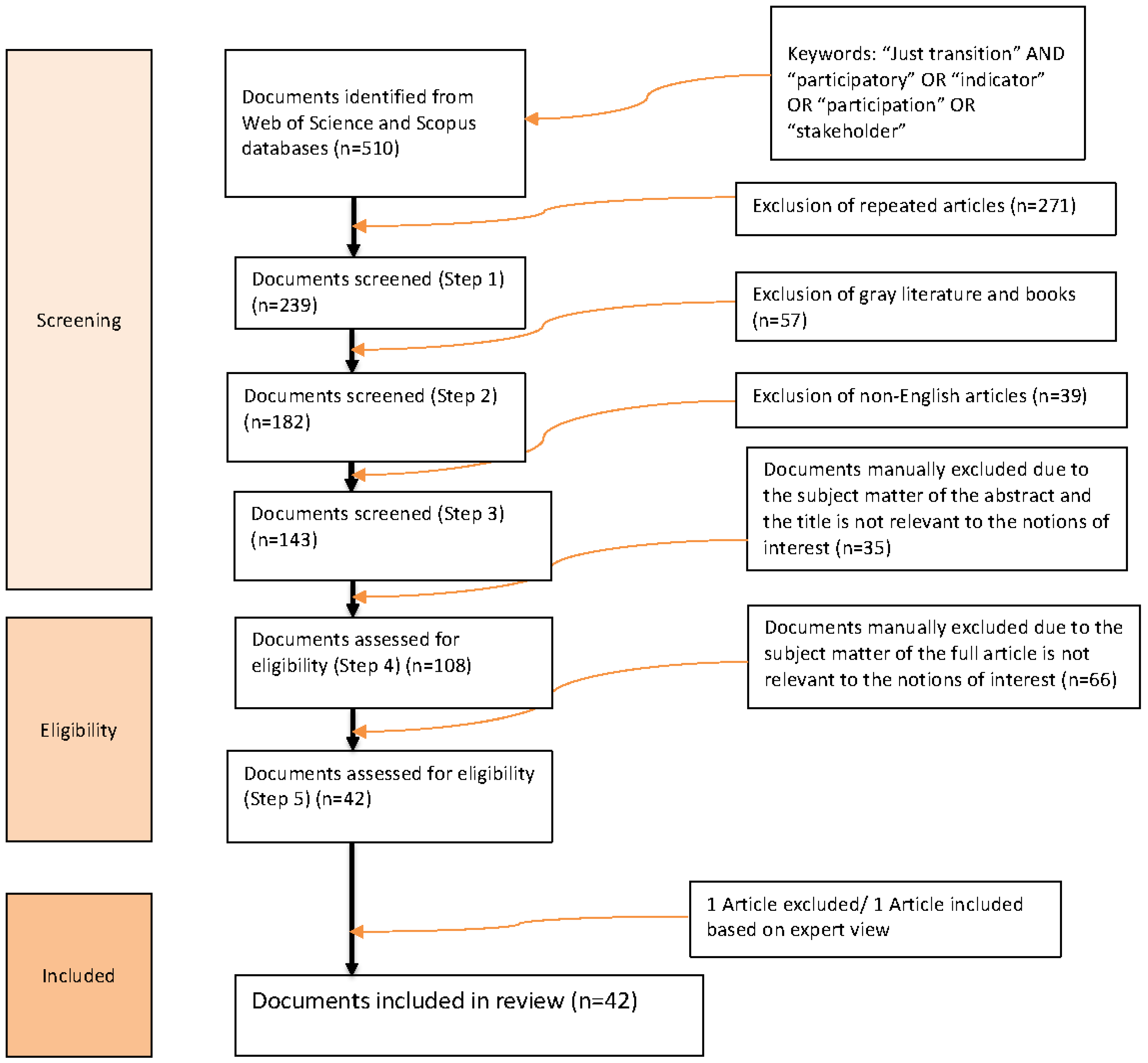
Figure 2.
Key focus of the just energy transition studies in the reviewed articles (N=42).
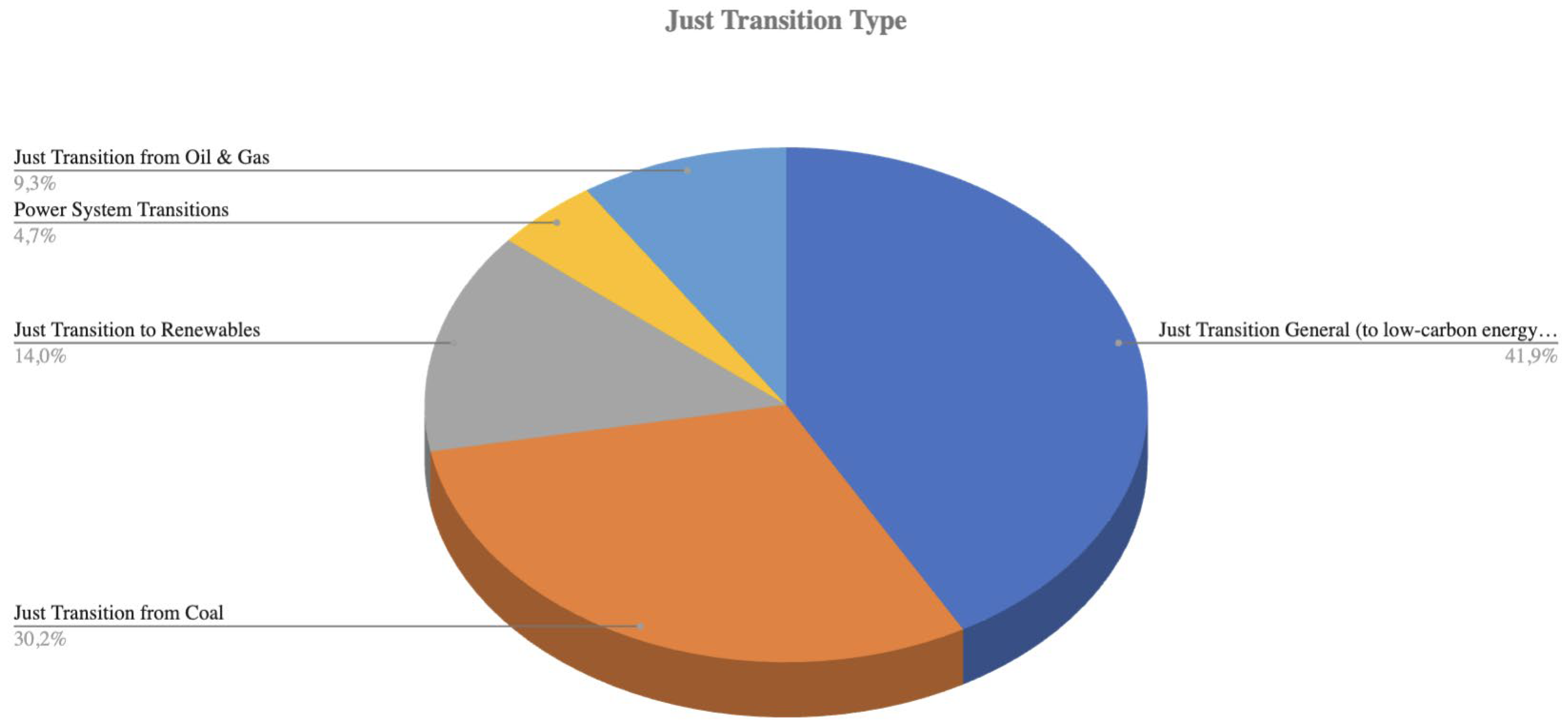
Figure 3.
Map of geographical distribution of reviewed articles (N=42).
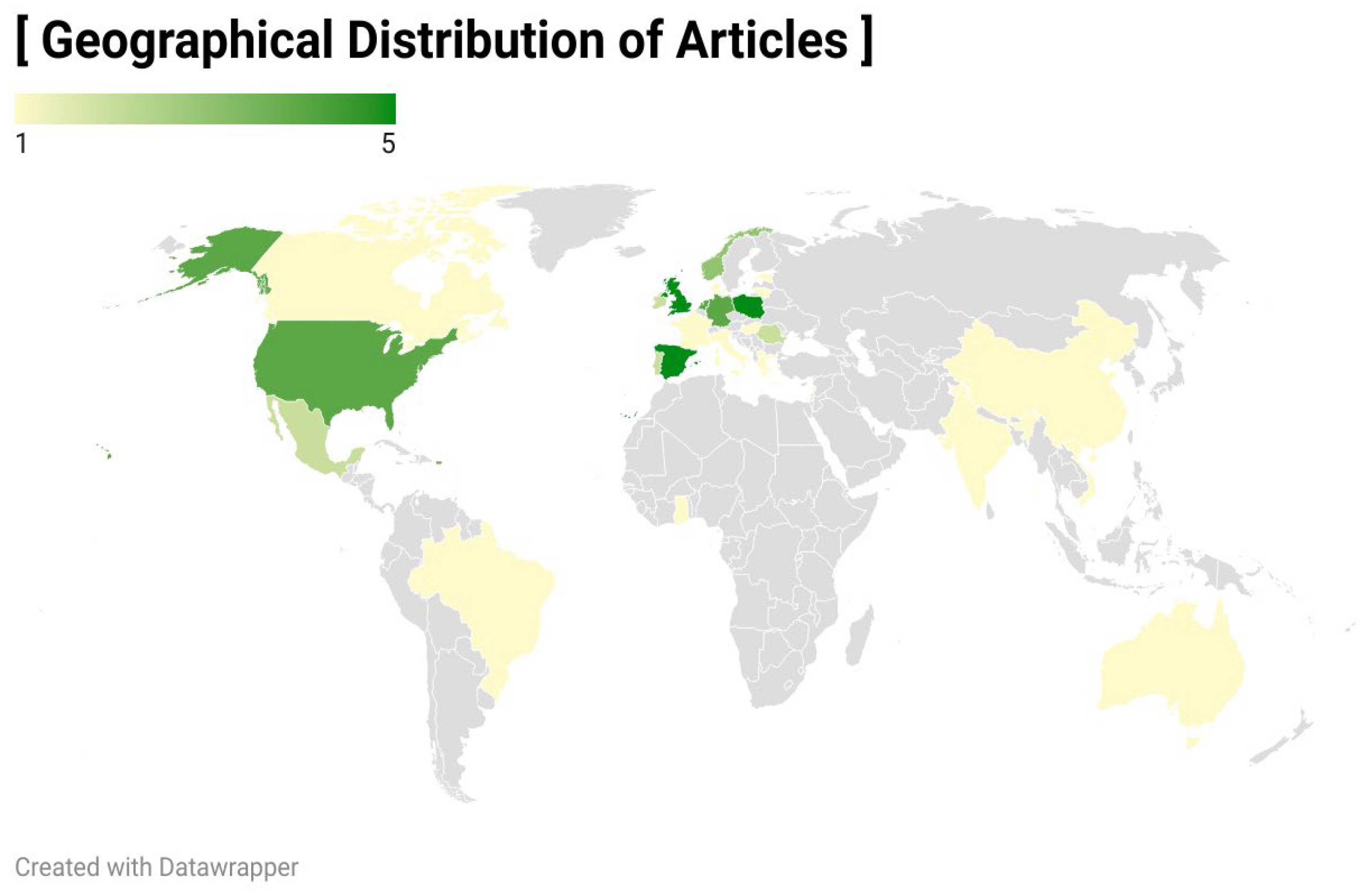
Figure 4.
Number of reviewed articles per journal (N=42).
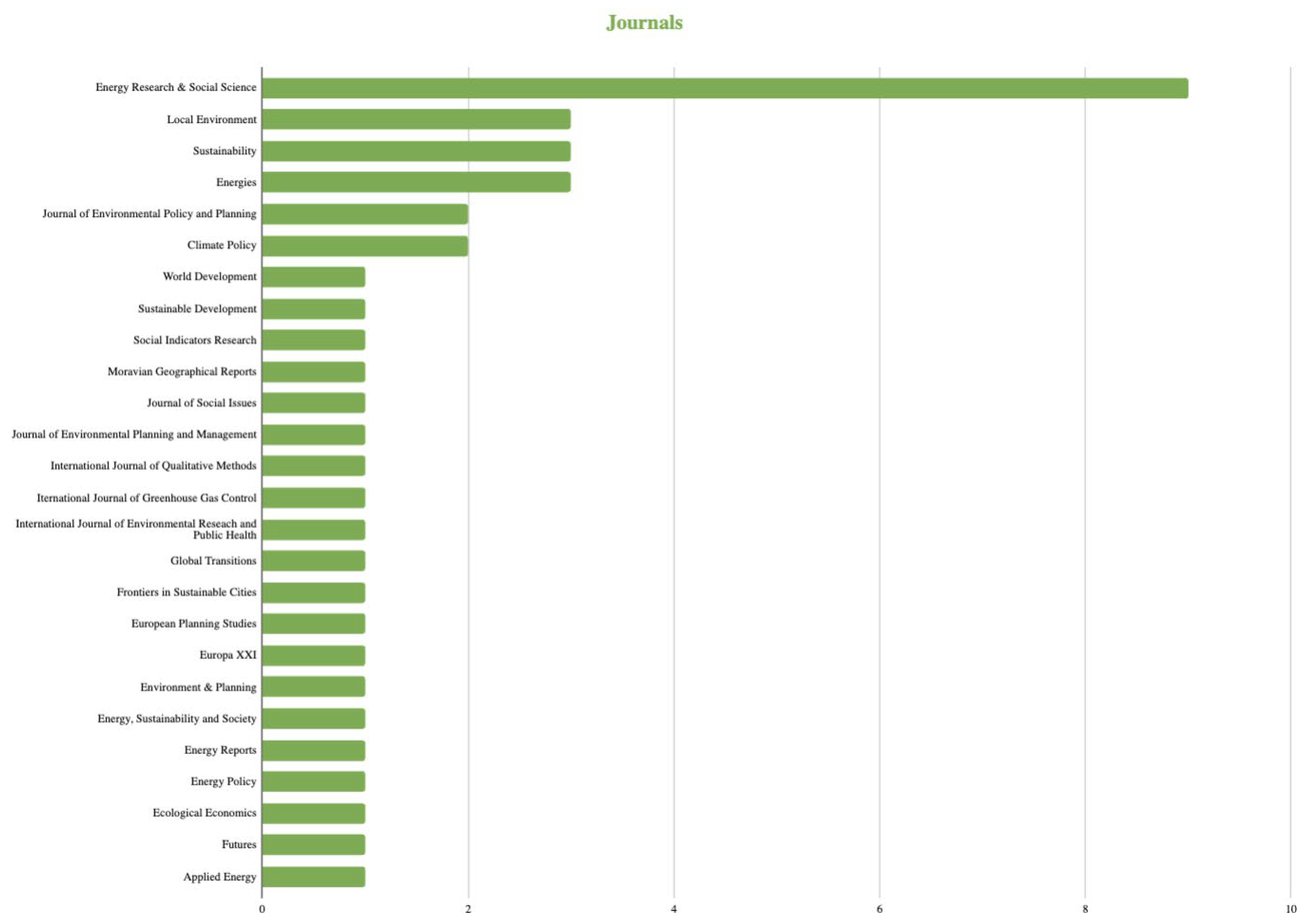
Figure 5.
Number of reviewed articles per year of publication (N=42).
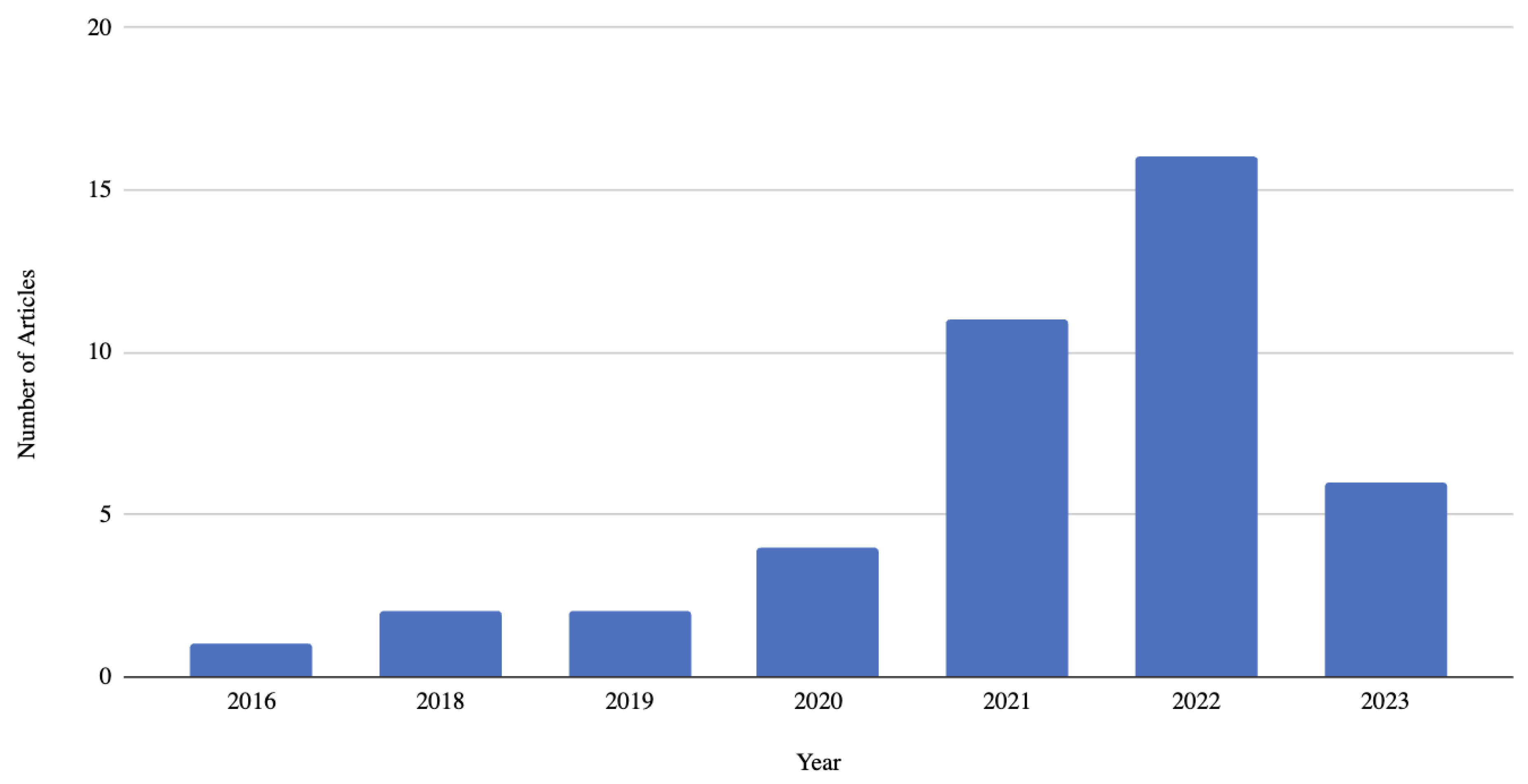
Figure 6.
Word frequency visualization for the codes.
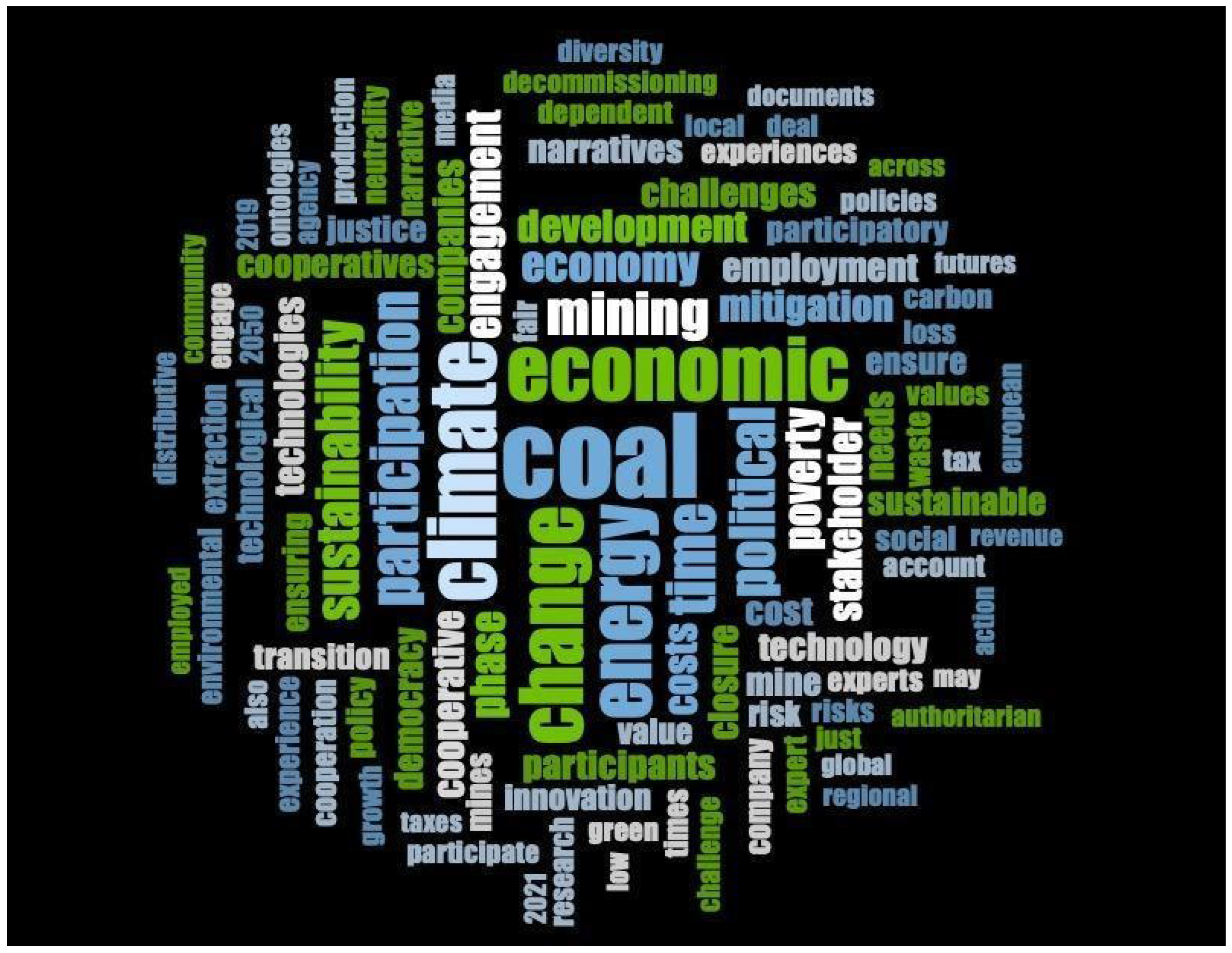
Figure 7.
Methods employed in the reviewed sample of articles.
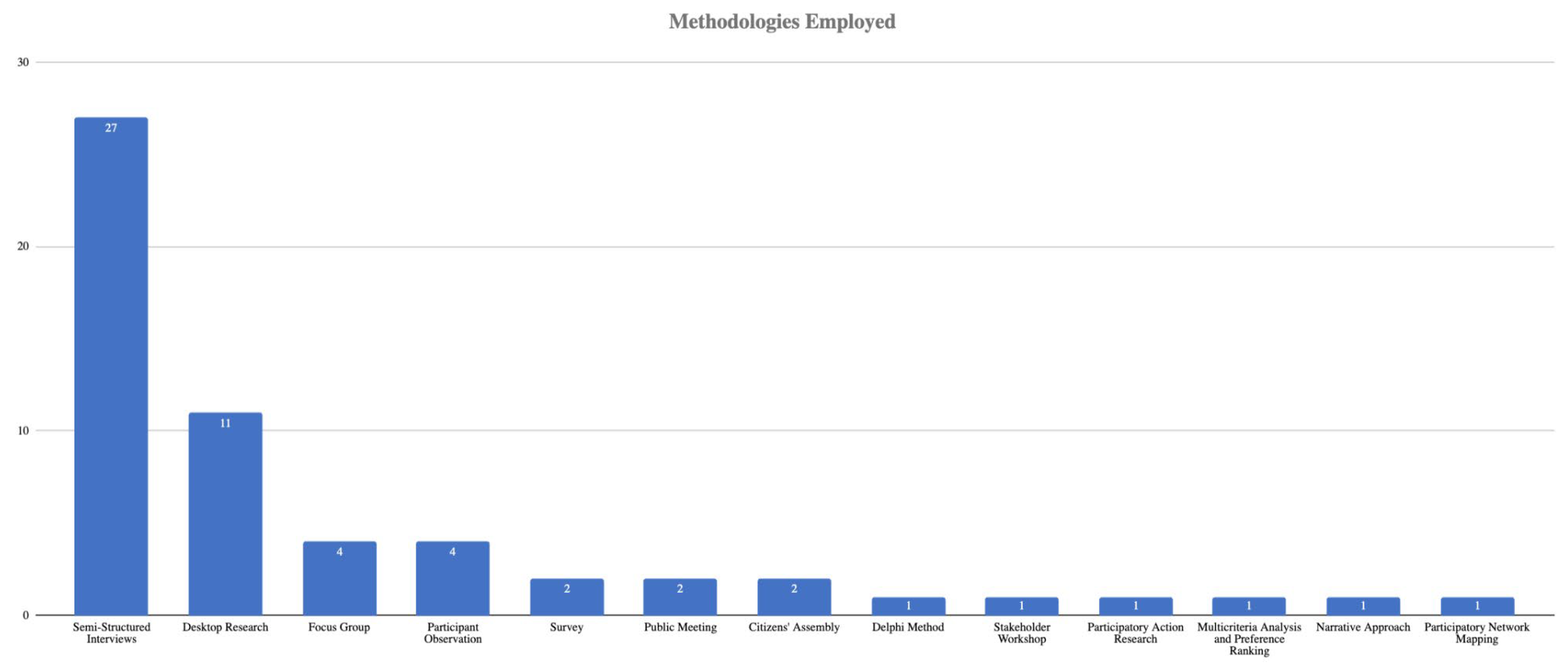
Figure 8.
Distribution of types of participatory methods in the sample.
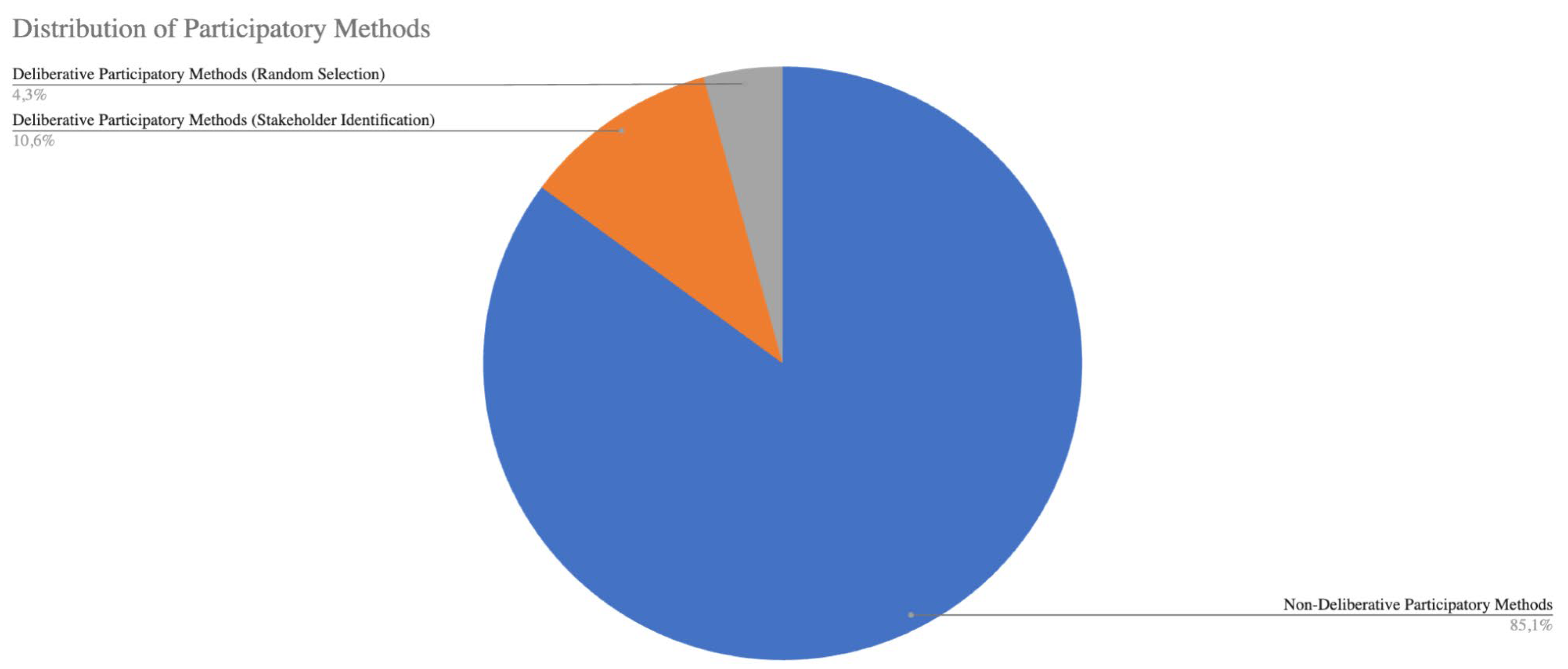
Table 1.
Summary of Codes and Themes.
| Codes | Themes |
|---|---|
| ♦Types of justice ♦Conceptual framework for justice ♦Procedural justice ♦Distributional justice ♦Recognition justice ♦Energy justice ♦Indicators for justice ♦Embodiment of justice ♦Social justice ♦Justice framework | Dimensions and types of justice |
| ♦Plurality ♦Inclusivity ♦Institutions ♦Stakeholder elicitation ♦Leadership ♦Everyday meaning ♦Quantification ♦Legitimacy ♦Accountability ♦Diversity ♦Visions ♦Value-action gap ♦Transparency ♦Elicitation of values ♦Inclusivity ♦Psychology ♦Complexity ♦Guidance ♦Incommensurability ♦Plural values ♦Engagement ♦Expert views ♦Fairness ♦Quantification ♦Influence ♦Institutions ♦Interdependency ♦Self-sufficiency ♦Self-determination ♦Self-sufficiency ♦Social acceptance ♦Solidarity ♦Interconnection ♦Narratives ♦Non-financial disclosure ♦Sense of belonging ♦Rule of law ♦Instrumentalization | Values |
| ♦Forms of participation (direct & indirect etc.) ♦Cooperatives ♦Worldviews ♦Innovation ♦Indigenous people ♦Marginalized people ♦Reconciliation ♦Energy futures ♦Jobs ♦Potentials of Just Transitions ♦Participation ♦Transformative capacity ♦Renewables ♦Challenges of Just Transitions ♦Societal change ♦Spatialization ♦Stakeholder collaboration ♦Empowerment ♦Technocratic view of JT ♦Transformative capacity ♦Transition pathways ♦Corporate management ♦Imaginaries, ♦Sociotechnical imaginaries ♦Epistemologies ♦Ontologies ♦Dependency ♦2050 ♦Decarbonization goals ♦Self-determination ♦Alternative ♦Assessment tools ♦Narratives ♦Space, geographical space ♦Bottom-up versus top-down ♦Circular economy ♦Citizen alienation ♦Citizen power ♦Climate change governance ♦Community engagement ♦Consultation ♦Corporate Social Responsibility ♦Economic visions ♦Decentralization ♦Degrowth ♦Greenwashing ♦Health ♦Decommissioning ♦Dependency ♦Energy citizenship ♦Energy futures ♦Energy governance ♦Sustainability ♦Energy security, energy poverty ♦Extractivism |
The Visions for Just Energy Transition |
| ♦Agency ♦Power ♦Governance ♦Policy document ♦Political regimes ♦Taxation ♦Labor, unions, workers ♦Consumer protection ♦Decision-making power ♦Democracy ♦Energy policy ♦Green Deal ♦Hierarchy ♦Leadership ♦JT funds ♦Participatory policymaking ♦Political power ♦Political struggle ♦Power inequalities ♦Power relations ♦Representative democracy |
Political and Legal Context |
Table 2.
Number of stakeholder groups involved with the different methods in the reviewed cases.
|
Stakeholder Groups |
Number of times each stakeholder group was involved in the reviewed sample | |
|---|---|---|
| In case studies using deliberative participatory methods | In case studies using non-deliberative participatory methods | |
| Community | 8 | 17 |
| Academia | 7 | 4 |
| NGO | 6 | 16 |
| National governments | 3 | 13 |
| Industry | 4 | 11 |
| Local government | 1 | 11 |
| Experts | 2 | 8 |
| Entrepreneurs | 1 | 7 |
| Policymakers | 2 | 8 |
| Trade unions | 2 | 7 |
| Activists | 2 | 5 |
| Grassroots | 1 | 4 |
| Organizational representatives | 1 | 3 |
| Workers | 0 | 4 |
| International organizations | 2 | 4 |
| Citizens | 0 | 3 |
| Cooperatives | 0 | 4 |
| Indigenous communities | 0 | 1 |
| Media | 0 | 2 |
| Mining communities | 0 | 0 |
| Local businesses | 0 | 0 |
| Artists | 0 | 1 |
Table 3.
Classification of Just Transition Assessment Criteria & Indicators.
| Broad Justice Categories | Just Transition Assessment Criteria & Indicators Categories | Definition of the Category |
|---|---|---|
|
Distributive Justice Assessment Criteria & Indicators Equitable or utilitarian distribution of social and economic benefits and burdens within and across different generations |
Distribution of Environmental Outcomes (Costs& Benefits) | Equitable or utilitarian distribution of environmental benefits and burdens within and across different generations. |
| Distribution of Economic Outcomes (Costs& Benefits) | Equitable or utilitarian distribution of economic benefits and burdens within and across different generations. | |
| Distribution of Social and Political Outcomes (Costs& Benefits) | Equitable or utilitarian distribution of social benefits and burdens within and across different generations. | |
| Distribution of Energy Outcomes (Costs& Benefits) | Equitable or utilitarian distribution of energy benefits and burdens within and across different generations. | |
|
Procedural Justice Assessment Criteria & Indicators Criteria and indicators of procedural justice focus on the adherence to due process and fair treatment of individuals under the law, as well as the procedural aspects of the transition, i.e., the stakeholder involvement process, methods, information shared and effectiveness. |
Problem Scoping and Identification | Procedural justice aspects related to problem scoping and identification process, including goals and priorities. |
| Definition and Assessment of Measures and Instruments | Procedural justice aspects related to defining and assessing the measures and instruments. | |
| Implementation and Monitoring of Solutions | Procedural justice aspects related to the implementation and monitoring of the proposed solutions. |
Table 4.
Examples of most frequent Just Transition Assessment Criteria & Indicators in the reviewed sample (N=42).
Table 4.
Examples of most frequent Just Transition Assessment Criteria & Indicators in the reviewed sample (N=42).
| Just Transition Assessment Criteria & Indicators Categories | Assessment Criteria & Indicators Examples (number of articles in the sample employing the specified indicator) |
|---|---|
| Distributive Justice Assessment Criteria & Indicators | |
| Distribution of Environmental Outcomes (Costs & Benefits) | • Cumulative GHG emissions (3) • GHG emission intensity of oil resources (2) |
| Distribution of Economic Outcomes (Costs & Benefits) | • Unemployment rate (3) • Workforce dependence (3) • GDP (per capita and cumulative) (2 for each) • GDP Growth (1) |
| Distribution of Social and Political Outcomes (Costs& Benefits) | • HDI (3) • Demographic change (2) • Cases of injustice (2) |
| Distribution of Energy Outcomes (Costs& Benefits) | • Dependency on coal (2) • Coal share (2) • Energy visions for future (2) |
| Procedural Justice Assessment Criteria & Indicators | |
| Problem Scoping and Identification | • JT priorities (4) • Perceived injustice (3) • Perceived scale of action and of responsibility of JT actors (3) • JT challenges& barriers (2) |
| Definition and Assessment of Measures and Instruments | • Future imaginaries (5) • JT practice and narrative gap (2) • Institutional capacity (2) • Stakeholder support (1) • Forms of ecologies of participation (1) |
| Implementation and Monitoring of Solutions | • Consensus (3) • Corporate governance response (1) • Policy response (1) |
Disclaimer/Publisher’s Note: The statements, opinions and data contained in all publications are solely those of the individual author(s) and contributor(s) and not of MDPI and/or the editor(s). MDPI and/or the editor(s) disclaim responsibility for any injury to people or property resulting from any ideas, methods, instructions or products referred to in the content. |
© 2026 by the authors. Licensee MDPI, Basel, Switzerland. This article is an open access article distributed under the terms and conditions of the Creative Commons Attribution (CC BY) license (http://creativecommons.org/licenses/by/4.0/).
Copyright: This open access article is published under a Creative Commons CC BY 4.0 license, which permit the free download, distribution, and reuse, provided that the author and preprint are cited in any reuse.


