
Submitted:
17 March 2026
Posted:
18 March 2026
You are already at the latest version
Abstract
The transformation of transport is necessary not only for climate protection, but also to increase competitiveness, develop modern technologies in transport, and improve the well-being and quality of life of the population. This article discusses the current state of the transformation of transport and infrastructure to low-emission and ze-ro-emission within EU member states and, in particular, their SMART cities. This arti-cle discusses the challenges, modern technologies, disadvantaged groups, and the overall concept of transformation with the aim of designing the most effective strategy for transport transformation at the SMART cities level. The potential relationship be-tween the position of EU member states in the Climate Change Performance Index ranking and Greenhouse Gas Emissions in the EU is identified and analyzed. The re-sults are reflected at the SMART cities level, confirming that proactive states achieve faster and more effective transport transformation. The conclusion of the article de-fines research trends aimed at improving the level of transport transformation and challenges related to successful transformation at the SMART cities level.
Keywords:
EGD
; low-emission
; zero emission
; sustainable transport
; smart city transport
1. Introduction
While transforming transportation and the necessary infrastructure in and outside cities can contribute to climate change protection, Specific-Measurable-Achievable-Relevant-Timed (SMART) city governance often overlooks key environmental and technological considerations. European Union (EU) leaders, businesses and ordinary citizens agree that the transformation of transport is one of the biggest changes that is absolutely necessary. However, the long-term neglect of this issue is evident in the differences in the views of people and businesses on SMART transport in cities. Although the EU's plan is supposed to be environmentally friendly, more accessible and sustainable transport, these ideals are often not fulfilled. With a few exceptions (see e.g. [1,2]), only a limited number of large-scale studies and surveys have been conducted on the perception of the need for a more sustainable transport transformation for citizens. In a systematic analysis, EU authorities [1,2] found that the willingness to make a change in transport depends on the approach of the leadership of individual member states and city governments. More progressive and proactive states have a higher level of need and willingness of citizens and companies to change compared to states that are not proactive, do not promote change in transport and do not provide information to citizens. Given the absence of channels for expressing passive dissatisfaction (which is typical of non-proactive and non-progressive states), it is difficult for government entities, if they exist at all, to monitor, evaluate and improve the functioning of SMART transport in cities. In essence, this issue represents a fundamental environmental issue in a democratic society that needs to be addressed accordingly.
The EU and research have been concerned with sustainability since the first publication of the Brundtland Report in 1987 [3]. Research and policy have generally focused primarily on economic sustainability, but not on technological, environmental and social sustainability [4,5,6,7,8]. This discrepancy is also evident in the development of SMART transport in cities, where technological, environmental and social aspects have not yet been sufficiently explored. Economic development, not only in transport, has received much attention in recent decades, while environmental and technological aspects have not. More than 94% of all studies on SMART cities are devoted to economic or social aspects [9]. While only less than 6% of studies deal with environmental aspects and almost no research is devoted to technological aspects [10].
With the necessity of changes in the field of environmental protection and climate change, including the European Green Deal (EGD), the need to monitor and investigate sustainable, low-emission and technological transformation of transport in cities is one of the key aspects of success. Given the research and development of new technologies, it is essential for cities and society as a whole to monitor governing bodies with a legal mandate and responsibility for the successful implementation of this progress [9].
The development of sustainable transport infrastructure and modern transport is influenced by the technological sophistication of a given state, its attitude towards environmental protection and climate change, but also by the social status of its inhabitants [11,12,13,14]. While technological sophistication is defined by the types of vehicles used, fuels and the necessary infrastructure, the level of the environment is assessed on the basis of immissions and emissions [11,12]. Social inequality is the most elusive variable, as it is characterized by social exclusion and marginalization of disadvantaged groups. Both of these indicators are very difficult to measure. Social exclusion is influenced by several factors, such as lack of resources and services, insufficient or zero social capital or externalities in the neighborhood [15,16].
While the concept and solution of transforming transport into low-emission and sustainable lacks consensus and clarity, as the solution depends on individual member states [1], there is a large group of scientists who agree on the need to develop and transform transport, especially in cities, with an effort to transform cities, if they are not yet, into SMART cities [17,18,19]. SMART city platform architects often promise to improve urban life through innovative technologies with the aim of creating an efficient and fulfilling life for all groups of citizens and businesses [14]. However, this goal usually fails due to a misunderstanding of the SMART city concept, different expectations of citizens and businesses, and a failure to connect technologies into a functional whole. For the transformation process in SMART cities to be effective, it is necessary to understand the sustainability and climate protection initiative, its goals, and the transport technologies that can achieve these goals. Another necessary and indispensable factor is the human factor. It is necessary to include the adaptation of governments, citizens, and businesses to the changes.
Scholars studying sustainable transport processes define a multi-component system that includes the interaction of the EU, government, citizens, companies, the environment, materials, vehicles and/or cars, and various methods and technologies, so as to achieve the complexity of the issue [20,21].
From the perspective of the successful implementation of low-emission SMART transport in SMART cities, the participation of citizens and businesses is a vital aspect of civic, democratic and sustainable societies [22] and it is necessary that people living in SMART cities fully use all the possibilities offered by modern technologies, have access to information and be part of decision-making processes in cities.
The issue of transport in SMART cities has received a lot of attention in recent years, not only because of EGD [2,23,24,25,26]. Research [24,26] found that the success of Public Private Partnership (PPP) models in the field of SMART city transport infrastructure development has these 5 critical areas - political-legal, technological-technical, economic-financial, social and environmental aspects. Transport in SMART cities is so complex that it goes beyond the area of so-called Industry 4.0 and SMART transport, but it is necessary to develop it into Industry 5.0 with the inclusion of human, sustainability and environmental actors [3]. SMART elements in transport are already visible today, for example, Reddy et al. [23] in their research use intelligent elements for pedestrian crossings based on detection algorithms and real time data, or Xia et al. [25] in their study investigates behavioral analysis in transport using fuzzy approaches.
1.1. Paper Objectives
This article systematically assesses the challenges of transforming transport and infrastructure in SMART cities and highlights the opportunities of new technologies, justifies the importance and relevance of managing these digitalization processes, and outlines potential directions for future research in transport management in SMART cities that would ensure improved sustainable and low-emission transport for all citizens and businesses without social exclusion. The transformation of transport, infrastructure and technologies is a key factor of competitive advantage for SMART cities, enabling them to effectively respond to the needs of sustainable low-emission transport for all.
1.2. Paper Outline
This paper is structured as follows: It begins by formulating the key argument presented in this paper and outlining some of the fundamental benefits of transforming urban transport into low-emission, climate-friendly transport. While modern technologies have the real potential to provide enormous benefits in terms of improving the quality of life and protecting against climate change, they operate as a double-edged sword. On the one hand, they expand access to modern technologies in transport and infrastructure in the context of SMART cities for a large part of EU member states and their citizens, which is likely to improve their use and benefits of these technologies. For example, they reduce pollution levels in cities due to minimal emissions [27,28,29,30]. On the other hand, these technologies are denied to a subgroup of disadvantaged states and especially disadvantaged groups of the population in these states, which leads to the rejection of modern ecological transport by public administration and residents, the trivialization of the issues of climate change and environmental protection, a "technological gap" and social exclusion. This study focusses on these gaps, illustrated by examining the availability of transport technologies and the impact of public administration approaches on the transformation of transport towards low-emission transport. The article includes successful applications of modern transport technologies in SMART cities concepts in the EU. It highlights a systems perspective on climate-SMART urban transport and the importance of establishing a single governing body responsible for monitoring, evaluating and improving the performance of SMART cities. The conclusion summarizes recommendations for such a governing body and potentially for public administration.
2. Climate Change, SMART Cities and Transport Transformation
The link between climate justice and SMART cities is unclear [31] and further research, particularly in the area of SMART cities in relation to digital equity and sustainability, is needed. The aim of the study [31] is to highlight the impact of technological gaps on climate justice within SMART city societies, including transport in SMART cities. Addressing these gaps is important for several reasons: First, in order to create sustainable, low-emission transport in a SMART city that is accessible to all, it is essential to clarify the various constraints that citizens and businesses face when travelling in a SMART city environment. Second, planning and designing infrastructure and transport in SMART cities is not feasible without overcoming these specific constraints within a SMART city society. Third, it is essential to address issues related to disadvantaged residents of SMART cities, otherwise the transformation of transport will lead to greater social exclusion of this group of residents [32,33]. Fourth, the limitations and transformations of citizens' transport and technological capabilities often have consequences within the entire SMART city. The actions of residents are conditioned by social, political and economic conditions and resources. Opportunities, in this case technological, are available to the private sector in the position of a producer and public administration in the position of a creator of legal norms, conditions and subsidy programs for these technologies. For these reasons, the public administration's approach to the given issue is key for society.
Although it is difficult to assess the environmental impact of transport and transport infrastructure at the city level, it is often argued that they have a key value for climate protection [24,34,35,36]. For example, modern transport technologies and the Internet of Things can help reduce greenhouse gas emissions by reducing energy consumption by replacing resource-intensive activities such as travel to conferences with virtual means, or by streamlining existing services [37]. Energy savings through to transport technologies and infrastructure and Information and Communication Technologies (ICT) in SMART cities have been demonstrated, for example, in the synergy and energy distribution of the transport system in SMART cities [38], energy savings from buildings used to operate nearby infrastructure [39], or by creating an intelligent transport system that focuses only on city trips and saves per-km energy, finance and nature [40].
Assessing the full impact and potential of ICT and modern technologies in transport and infrastructure in the development of SMART cities remains a challenge and is likely to remain so in the future, as new technologies based on Artificial Intelligence (AI), for example, are emerging, leading to relatively high electricity consumption [41].
Although the potential of modern transport technologies in the fight against climate change seems enormous, the availability of this technology is paramount. Currently, almost 100% of the EU population has access to electricity, but 10% of the population is in energy poverty (e.g., they cannot heat their homes in winter or use electrical appliances), and 5% of the working-age population (16-74) has never used the internet. This situation varies from region to region [42], e.g. almost all residents of the Nordic countries use the internet, while almost 14% of Croatia's population did not have access to the internet in 2024 (data for 2025 is not yet available). This inequality is also evident in other countries, such as Greece, Portugal, and Bulgaria. In the EU, Light Goods Vehicles (LGVs) are 83% diesel and 14% partially sustainable fuel (Compressed Natural Gas - CNG, Liquefied Petroleum Gas - LPG, Liquefied Natural Gas - LNG, full electric and hybrid) [2]. Not everyone can therefore fully enjoy all the benefits offered by the transformation of transport into modern, sustainable, and low-emission transport; there are still significant differences between countries and within countries in terms of access to ICT, modern transport technologies, and infrastructure, and their use. At the same time, there are huge differences in the potential for transport electrification between developed and developing countries and megacities [43].
Some groups of people also have greater difficulty accessing not only ICT but also transportation than other groups, which is reflected in technological gaps related to gender, geographic location, and income. EU research [44] has found that a quarter of EU residents of working age have only basic education. The term "technology gap" or "technology capital value" [45] is commonly used to describe inequalities in access to and/or use of technology between households, regions, and countries. This issue has been discussed since the 1990s. The term is often used in academic articles and transnational discussions on differences in access to technology, highlighting the uneven distribution of technology, its resources, and skills among different populations [46]. The most frequently mentioned differences are those between the first and second levels, with the first level concerning access to the technology in question, which in the context of low-emission transport means access to sustainable and low-emission transport vehicles—cars, planes, trains, but also public transport. The second level concerns the skills, participation, and effectiveness of users in handling transport technologies, such as electric cars in combination with smartphones, e.g., for navigation to the nearest available parking space at the destination. Gender inequality related to information, communication, and transport technologies is a significant challenge, not only in developing countries [47]. The gender technology gap is defined as unequal access to and use of ICT and transport technologies between the genders. Among other things, this inequality results in the exclusion of women from education [48]. Women in the EU who have a master's degree mainly study education, arts and humanities, social sciences, journalism, and information [49]. The consequences of technological exclusion are further exacerbated by the fact that education is perceived in the EU as a fundamental requirement for personal fulfilment, social engagement, political representation, and employment opportunities [3]. Given that technological skills are essential for both the professional and academic spheres (the share of female professors in the EU was 29% in 2022, with the vast majority of female professors teaching behavioural sciences, humanities, other or law studies [50], any systematic inequality in these skills becomes a question of social sustainability – a problem that also affects developing countries [51].
Reducing commuting and promoting alternative low-emission vehicles are currently considered key factors in climate protection [52]. The possibility of working from home (“home office”) is limited by the nature of employees' work. According to research [53], only 10% of employees can work from home, and only part-time, not every day. The greatest boom in working from home has been seen in the public sector, where administrative staff were forced to work remotely during the COVID-19 pandemic. This trend in administration continues today.
In conclusion, it is important to mention that some residents and companies do not want to use modern, sustainable, and low-emission transport and infrastructure. The reasons vary, but most often they include a negative attitude towards modern technologies, fear of information collection by modern technologies, or nostalgia for the use of existing technologies [54,55,56,57].
2.1. Behavioral Influence
People's behavior towards technology, vehicles, and infrastructure can threaten technologies that protect the environment and climate. Regardless of the country [58,59,60], it is often the case that as more energy-efficient technologies become available, there are rebound effects due to increased use of modern technology and, as a result, an overall increase in energy consumption.
The rebound effect is technically explained as the actions of a company, institution, or public administration aimed at reducing the consumption of resources, typically energy, time, or money, or a combination of all these resources, which has the secondary effect of overusing the resources in question and is therefore ineffective [61]. This phenomenon has been present in the population for several centuries, usually during the expansion of new technologies and products, but official attention from the professional community has been focused on this phenomenon since 2005 [61]. This phenomenon is most often explained in terms of a market economy, where the development and popularity of technology or products leads to more efficient production at lower costs, which in turn leads to a secondary phenomenon, namely increased demand and consumption of the technology or product.
Rebounding effects are currently a typical example of serious problems that can overshadow the climate resilience of SMART cities [62]. Since SMART cities are inhabited by people, it is necessary to take into account human psychology, which does not always correspond to logic and can negatively influence people's primary inclination towards a more environmentally friendly lifestyle through consumerism [63]. Human behavior, and especially human decision-making, depends on the rules of heuristics. These heuristics can distort systematic thinking, conscious, analytical, and reflective processes [64]. Heuristics are influenced by upbringing, environment, and an individual's primary settings. The combination of these factors then gives rise to an individual's behavior. An individual's behavior has its limits, habits, and trigger responses, which are influenced by the above factors. This area is dealt with by the field of environmental psychology, which is currently receiving increasing attention [65,66].
A tool related to individual environmental behavior (referred to in psychology as affordance) that promotes environmentally friendly behavioral change is the use of nudging and default settings [51]. Individuals act based on techniques explained in the field of decision-making, especially in the field of more advanced decision-making methods, with the aim of achieving a result that users are left with when they refrain from making an explicit choice [62]. A typical example of this behavior is the following situation: deficiencies in public transport, such as automated ticket vending systems, where integrated and user-friendly automated ticket vending systems can be introduced to streamline the process of boarding public transport. This may include contactless payment methods, mobile applications, or chip cards, which will make it more convenient for individuals to use public transport without having to purchase tickets each time [51]. This fare payment system is currently available in some SMART cities in the EU (e.g., Ostrava [67] and Helsinki [68]).
2.2. Technological Divides
Differences in technological skills, known as the digital divide, have far-reaching implications for the entire EU. This phenomenon is caused by a combination of the constant use of cognitive abilities (e.g., memory, critical thinking, decision-making), which decline with age, and the technological level of the country [69,70,71,72]. Smartphones and their applications, cars with automatic transmission and other mother vehicles currently improve human cognitive functions, but physical abilities decline with age [73,74].
The boom in modern technologies and infrastructure, not only in transport, brings with it technological challenges to which consumers respond with a delay. Young people, who are flexible and experiencing cognitive growth, are the quickest to develop new skills, while the older generation lags behind in adopting new technologies and infrastructure for many reasons. The most common reasons are fear of new technology, loss of skills, cognitive decline, and the need for constant updating. For these reasons, there is an increase in the number of people who find it difficult to use new technologies or refuse to use them altogether [51].
The transition to climate-friendly transport in Europe has been agreed upon as part of EGD, but individual member states are approaching this issue individually. In the EU, a large-scale study conducted in 2024 [75] found that renewable sources account for 12% of total transport. There is huge variation between member states, with Croatia having less than 1% renewable energy in transport and Greece 4%, while in Sweden renewable energy accounts for 40%.
3. Climate-Neutral Transport in SMART Cities
This chapter contains data at the level of individual EU countries for two reasons. Firstly, data on the level of climate protection and measures adopted and transport transformations are only available for individual member states. The second reason is the fact, which can be seen later in the chapter, that there is a visible relationship between a country's approach to transport transformation and the actual transformation not only at the national level, but also at the level of individual regions and SMART cities.
The second part of the chapter is devoted to specific SMART cities and their innovations and modern technologies used to protect the climate.
3.1. Approach of EU Member States
Transport emissions represent around 25% of the EU's total greenhouse gas emissions. The emissions increased every year; the regulation is necessary. This is the reason why one of the key parts of EGD is transport. EGD priority is sustainable and environmental transport. The EGD proposals cover all modes of transport, whether passenger or freight. The main goal in the field of transport is to become a climate-neutral continent by 2050. Given that in some areas modern low-emission transport accounts for less than 1% (e.g., Croatia [75]), a major transformation will be necessary. This should be achieved by reducing transport emissions by 90% compared to current levels. To reach this goal, it's important to let people know that some countries are so progressive that they'll be able to hit this target way earlier (like Sweden and Finland [75]). The areas that European cities can influence are as follows: high-speed rail and road transport. While high-speed rail is usually planned at the level of states and larger territorial units (e.g., EU NUTS regions), individual regions and cities can take action in the area of road transport to meet the EGD's low-emission targets. According to the EGD, by 2035, emissions from cars must be reduced by 55% and from vans by 50%, and from 2035 onwards, new cars must be fully emission-free (i.e., they must be electric or hydrogen-powered using currently available technologies) [76]. In order to achieve this change, it is necessary to prioritize the construction of infrastructure for this type of transport. Individual cities and regions can only create this within their administrative territory. Outside the above-mentioned administrative units, this issue is the responsibility of the state and its administration. In 2024, low-emission vehicles accounted for 12% of all vehicles in the EU [75]. According to EU research, the infrastructure for charging these vehicles, the speed of charging, and the inability of apartment dwellers to charge their vehicles in parking spaces in front of their homes appear to be problematic. This trend, i.e., not buying a car with an alternative drive system due to its charging, especially among people living in apartments, is already evident from a study from 2024 [1], which confirmed that the vast majority of owners of alternative fuel vehicles own their own homes, where they charge their cars.
As mentioned above, 12% of alternative sources were used in transport in 2024. There are significant differences between countries; for example, the Czech Republic had a 6% share of alternative vehicles in 2024, while Sweden had 35% [75]. Detailed information is provided in Table 1. It is necessary to mention the methodology used to determine the monitored values; Carbon Dioxide (CO2) monitoring is usually the most commonly used indicator. Road transport accounts for 77% of CO2 emissions from transport in the EU. Nitrogen Dioxide (NO2), Particulate Matter 10 (PM10) emissions and Carbon Monoxide (CO) concentrations are also monitored [2]. In connection with EGD, the Climate Change Performance Index (CCPI) ranking is often mentioned [77]. The CCPI is an international country rating system that includes several indicators used to assess a country's approach to climate protection. The indicators cover renewable energy, emissions, energy use, and climate policy. Not only current indicators are evaluated, but also the ability of countries to adapt to low-emission and zero-emission processes, technological innovation, and integration into the everyday lives of citizens.
To investigate the relationship between a country's level of transport and infrastructure transformation and its position in the CCPI ranking, this study used data from the CCPI ranking for EU member states and the Transport and Environment Indicators for 2023 (most actual available dataset distributed via European Environment Agency (EEA) [78] calculated by the EU [79]. The following indicators were used to assess the level of transformation of the country: Greenhouse Gas Emission (GHG) (% consisting of GHG per Capita and GHG 2030 Target, 2023); renewable energy (% of total energy consumption, 2023); alternative vehicle propulsion (% of total passenger transport, 2023); CO2 (% emissions from production in the EU economy, 2023). Furthermore, population size was included in the analysis as a control factor to assess how demographic aspects could influence the level of transformation of a country's transport and infrastructure to low-emission [80].
Effective governance ensures that all processes are consistently integrated and aligned with the overall EGP objectives. By implementing effective management decisions, EU Member States can create a more conducive environment for transformation, helping to improve the satisfaction of residents and businesses, reduce the level of fear and misinformation about alternative vehicle propulsion, and encourage active participation in the transport transformation process. In this way, properly managing the transport transformation not only increases the efficiency of transport and its infrastructure, but also contributes to its sustainability and competitiveness in the long term, and potentially ensures a higher ranking in the CCPI ranking.
Data for this study was collected from the latest available sources to analyze the relationship between the level of transport transformation in the EU and the performance of individual member states. Specifically, the study uses the CCPI 2023 index, which provides insights into GHG, renewable energy and alternative vehicle propulsion. In addition, data on transport and environment were obtained from the EEA, focusing on the latest rankings of EU member states in the areas of transport and environmental protection. These datasets allow a comprehensive assessment of how transformation indicators correlate with the ranking of EU member states and their environmental status.
The study adopted a mixed methodological approach, combining empirical and theoretical analyses, with the aim of providing a comprehensive assessment of the impact of the level of transport transformation in the EU on the environmental performance of individual EU member states and their position in international rankings, which present the perceived level of transport innovation and the level of environmental protection of a given unit on the international stage.
The empirical analysis included correlation analysis to identify statistically significant correlations between the level of transformation in a country's transport (measured by the EEA's Transport and Environment indicators) and the countries' position in the CCPI ranking. The indicators examined were GHG, renewable energy, alternative vehicle propulsion and CO2. The country's population was also included as a control factor to assess whether demographics affect transformation processes.
The regression analysis showed that the position of EU member states in the CCPI ranking is significantly related to certain EEA transport and environmental indicators, in particular the use of alternative fuels and CO2 emissions. These indicators have a significant impact on the transformation rate of EU member states, but the coefficient of determination (adjusted R-squared) of the regression analysis showed that these factors only explain part of the differences in the transformation rate, while other important factors such as proactive government action, quality of research and subsidy programs for residents may also be significant.
The results of the study were presented in figures (see Figure 1, Figure 2 and Figure 3) and tables (see Table 2, Table 3, Table 4 and Table 5), which visually display the results of the correlation and regression analysis, as well as a brief summary of the data. These data show that the positions of EU member states in international rankings are closely related to the level of EU transport and infrastructure transformation. This suggests that investments in infrastructure transformation and technological accessibility are important for strengthening the competitiveness of individual member states and for ensuring an improvement in the state of the environment in a global context.
The rank, i.e., the position of EU member state in the CCPI ranking, is significantly correlated with the GHG index (p < 0.05), but not with population (p > 0.05). After performing the regression analysis, the following results were obtained.
The best model is obtained when the ranking value, i.e. the position of an EU member state in the CCPI ranking, is predicted based on the GHG indicator relating to gases in the atmosphere that trap heat and cause the greenhouse effect and global warming (% consisting of GHG per Capita and GHG 2030 Target, 2023). This suggests that these indicators have a significant impact on the ranking value.
Since the adjusted R-squared value of 0.430 is not entirely low, as the position of EU member states in the CCPI ranking depends on other factors that were not included in this analysis. A summary of the results of the correlation analysis is given in Table 4.
A summary of the results from the regression analysis is provided in Table 5.
The “Greenhouse Gas Emission” indicator is statistically significantly predicted by the position of EU member states in the CCPI ranking. However, considering the mean value of the adjusted coefficient of determination (R-squared) (0.430), it can be concluded that other important factors could be included in this analysis. These may include indicators such as the quality of infrastructure, the charging network of alternative drives within the infrastructure, or subsidy programs for alternative drives for residents and businesses.
Based on the research results, it was found that the position of EU member states in the CCPI ranking is related to the EU transport and environmental indices. The position in the CCPI ranking can be predicted based on the GHG indicator (% consisting of GHG per Capita and GHG 2030 Target, 2023). This indicator has a moderate impact on the ranking of EU member states. Managing the transformation processes of transport and infrastructure to reduce emissions is therefore a relevant and important research direction that affects environmental protection in the global assessment system. Flexible management allows member states to adapt to constantly evolving technologies and ensures that individual member states cooperate to achieve a common goal – “European Green Deal”. The views of scientists on managing the transformation of transport and infrastructure highlight different but interrelated aspects.
A key part of transport transformation is understanding the transport behavior of citizens and businesses, to which public authorities should then respond proactively so that the shift to low-emission transport is desired and positively perceived by society. EU research [1] has found that the average distance traveled by an active person (aged 15-84) is 34.8 km per day. As a rule, the average resident makes more than two trips per day. Only 10% of journeys are made by public transport and 18% on foot (usually within 2 km).
Proactive EU countries have noticed this trend and supported the transition to low-emission transport, public transport, and walking or cycling (in some cities also in the form of bike sharing). Sweden is a typical leader in climate protection in the EU. In addition to transforming its means of transport, it also pays great attention to the infrastructure itself. In 2025, Sweden reduced its emissions by 66% compared to 2010 [81]. Swedish public transport is completely emission-free [82]. In addition to bus, train, and sea transport, this also includes air transport. Fully electric aircraft are currently being tested. In the field of rail transport, high-speed and hyperloop transport is being developed. In the field of passenger and freight transport, the road network is currently being transformed into the eRoadArland system, which charges electric vehicles directly while driving. Sweden wants to be fully climate neutral by 2045. Helsinki is expected to be climate neutral much sooner, given the rapid development of technology and support from public authorities. Sweden prides itself on keeping its citizens informed and involved in the SMART cities concept, including partial decision-making in various areas. Thanks to this approach, citizens are more receptive to change and more proactive in their actions. Environmental protection is part of their identity; they perceive it as a necessity and are informed about it in all aspects of life, which is why they are quick to accept the transformation of transport with the aim of improving the climate.
At the opposite end of the EEA [75] ranking are Croatia, Lithuania, and Greece. According to the European Commission [83], the factors common to the above-mentioned countries that are slowing down the transformation of transport are high purchase prices, lower purchasing power, insufficient charging infrastructure, lack of or weak government incentives, preference for used gasoline and diesel cars, and high electricity prices. The strongest factor, although not perceived as such by the public, is the unresponsive approach of the government and public administration to the transformation of transport and infrastructure to low-emission. In the countries mentioned above, the government provides little or no information to citizens about the need for change in transportation, climate protection, and the benefits that alternative transportation will bring. Incentives, subsidy programs, electricity price reductions and other mechanisms that could help with the transformation of transport are minimal or non-existent. Citizens, who generally do not have sufficient financial resources, therefore do not see the possibility of purchasing an alternative vehicle, or they see the cost of such a vehicle as too high in relation to the benefits for citizens.
3.2. Application of Low-Emission Transport in EU SMART Cities
Digital inequalities, i.e., denying access to technology to disadvantaged groups, make it difficult to navigate SMART cities and pose a challenge for all SMART city groups [51]. This orientation also includes the process of moving effectively through the urban landscape with the help of digital tools (e.g., individuals can use a comprehensive SMART city system to access public transportation schedules, find real-time transportation information, or locate nearby healthcare services through mobile technology [51].
From the perspective of transport sustainability and climate protection, not only in cities, the task of balancing differences and achieving social justice in SMART cities involves creating conditions that motivate all citizens of a given city to actively change, support, and participate. Otherwise, the prefix "smart" before the name of cities loses any meaningful purpose [51].
The transformation of transport and infrastructure to low-emission modes often requires not only a proactive approach by the state, but also by individual SMART cities (this applies in particular to areas with progressive city leadership and the involvement of citizens and businesses in decision-making in various areas within the SMART city). A typical representative of this group is the city of Ostrava in the Czech Republic (approx. 300,000 inhabitants). Although the Czech Republic ranks fourth worst in the EU in terms of the transition to low-emission transport, Ostrava is one of Europe's leaders in low-emission public transport linked to the SMART city concept (e.g., the option to pay fares by payment card directly at terminals in vehicles or navigation via the transport company's app [84]. Ostrava is also expanding the electrification and development of tram transport to other areas of the city, has a very strong charging network for electric cars, as well as several charging stations for hydrogen cars. Using the municipal authority app, it is also possible to find the nearest parking space in the destination area.
Sweden is currently a leader in sustainable transport and the creation of infrastructure in SMART cities for alternative propulsion systems. The capital city of Stockholm is the most progressive. Swedish public transport there is almost completely emission-free and will be fully emission-free by 2030 [82]. In the area of passenger and freight transport, a wider network of electrified roads is being built, which will recharge electric vehicles while driving (eRoadArlanda). As a rule, this is the right-hand lane on these roads. From 2025, only fully electric or gas-powered vehicles will be allowed to drive in the city centre [85]. With the introduction of this measure, there has been a massive increase in the number of cycle paths and charging stations for alternative fuels in the city centre. Stockholm is now investing in the Stockholm Local Transition (STOLT) urban project, which is building zero-emission microcars that will be used by ordinary citizens for travel around the city [86].
In addition to shared bicycles, shared electric scooters are currently among the modern, fast, and low-emission modes of transport in SMART cities. However, not all residents can use these modes of transport. For disadvantaged groups, such as people without smartphones who cannot unlock a scooter or bike, or mothers with children in strollers, this type of transport is impossible.
Studies [87,88] agree that the key aspect of the successful transformation of transport to low-emission transport in European SMART cities is functional legislation and proactive behaviour on the part of city leaders. In the case of the top five cleanest cities in the EU (in 2024 – Stockholm, Amsterdam, Vienna, Berlin and Helsinki), this mainly involves the introduction of zones in wider city centres that only low-emission cars can enter, the development of smart applications to help ordinary citizens get around the city, the development of cycle paths in city centres, and transportation for disadvantaged groups of residents in city centres. In this case, disadvantaged residents include not only those with health and mental disabilities, but also those who are economically and socially disadvantaged (e.g., mothers with small children who cannot use bicycles for transportation). In these cases, SMART cities are developing their own means of zero-emission transport (outside of traditional public transport). These include shared cars (usually electric cars), autonomous cars, or zero-emission microcars, such as those being developed in Stockholm.
4. Concluding Remarks
Transport transformation is such a complex issue that it must be viewed in context and at various levels of governance. First, it is necessary to define the key areas that need to be addressed at EU and the member state level (Table 6) and, at the same time or subsequently, after the successful implementation of the relevant challenges, it is necessary to address local/regional challenges at the SMART cities level (Table 7).
The following table, which evaluates the opinions of academics and the results obtained from research, presents the challenges associated with the transformation of transport and directions for further research (see Table 6).
Ensuring the transformation of transport and infrastructure to a low-emission one is one of the key challenges and priorities of the EGD. In this context, the quality of transport does not only relate to environmental protection, but also to the competitiveness of EU member states, energy efficiency and sustainable transport management in EU member states. Transport transformation affects quality through several interconnected dimensions: enabling more sustainable and low-emission travel, increasing the availability and diversity of public transport, and supporting innovative technologies that reduce emissions but are affordable. Moreover, quality is closely linked to the technological competences of residents and businesses, the adaptability of legal norms, and the strategic integration of technologies into transport processes. Successful management of transport transformation must therefore ensure that technological tools are not implemented in isolation, but rather aligned with transport objectives and supported by systemic institutional changes. This integrated approach is essential to achieving improvements in transport quality in a technologically evolving environment.
Studies conducted in other European and global contexts reveal similar patterns and confirm the importance of transport transformation for improving environmental performance and strengthening EU competitiveness. For example, Tromaras et al. [89] emphasized that European transport must be optimized by 2035, without adopting the necessary transformations, including low-emission transport and infrastructure development, the EU will be uncompetitive, according to the authors, and the resulting emissions from transport will cause an acceleration of global warming. Similarly, Pyra [90] emphasized that the decarbonization process of the road transport sector is necessary for EU member states not only for EGD, but also for competitiveness and the inclusion of innovations and new technologies in the transport sector. In his research, he focuses on simulating the decarbonization process for Poland. These findings are consistent with this study, where indicators such as GHG and partly CO2 showed a significant correlation with the position of EU member states in the CCPI ranking.
Furthermore, Ortega et al. [91] and Amadori et al. [92] argue that countries with strong digital policies and transport transformation investments outperform others in terms of competitiveness, research, innovation and international cooperation. This supports the conclusion that transport transformation is not just a local challenge, but also a global strategic imperative for efficient and sustainable transport.
In order to effectively manage the transformation of transport processes, it is essential to further explore the related issues and opportunities at the regional level (SMART cities). These studies will not only help to optimize the transport transformation processes, but also to ensure that the transport system in the EU is ready to face the current challenges and opportunities. Only by thoroughly analyzing the management aspects can the successful transformation of transport and infrastructure through technology and innovation be achieved.
In the area of regional transport, especially in SMART cities, different aspects are necessary than at the national level, since it is precisely in SMART cities and their surroundings that the actual transformation of transport and infrastructure will take place, while at the EU and member state level, only framework measures are being implemented. The challenges of transforming transport to low-emission or zero-emission modes are listed in Table 7.
Transport in SMART cities and their surroundings should be one of the priorities not only for city authorities, but also for national and EU governments, as without transport transformation, there will be a permanent decline in quality of life, worsening air quality, and greater climate change in a shorter time frame. At the same time, it is important to realize that transport not only affects the environment, but also the competitiveness of the economy and technological progress, which is why the transformation of transport should be carried out quickly, efficiently, and functionally across the EU as a whole, and not just in certain countries.
Funding
This research received no external funding.
Data Availability Statement
Data are contained within the article.
Acknowledgments
The author wish to thank the Univesity of Pardubice for the support of this article.
Conflicts of Interest
The authors declare no conflicts of interest.
Abbreviations
The following abbreviations are used in this manuscript:
| SMART | Specific-Measurable-Achievable-Relevant-Timed |
| EU | European Union |
| EGD | European Green Deal |
| PPP | Public Private Partnership |
| ICT | Information and Communication Technologies |
| LGVs | Light Goods Vehicles |
| CNG | Compressed Natural Gas |
| LPG | Liquefied Petroleum Gas |
| LNG | Liquefied Natural Gas |
| CO2 | Carbon Dioxide |
| NO2 | Nitrogen Dioxide |
| PM10 | Particulate Matter 10 |
| CO | Carbon Monoxide |
| CCPI | Climate Change Performance Index |
| EEA | European Environment Agency |
| GHG | Greenhouse Gas Emission |
References
- Study on new mobility patterns in European cities: Final report. Task A, EU wide passenger mobility survey. Available online: https://data.europa.eu/doi/10.2832/728583 (accessed on 2025-15-30).
- Study on new mobility patterns in European cities: Final report. Task B, Targeted survey on urban logistics. Available online: https://data.europa.eu/doi/10.2832/40173 (accessed on 2025-12-30).
- Åhman, H. Social Sustainability—Society at the Intersection of Development and Maintenance. Local Environ. 2013, 18, pp. 1153–1166.
- Boström, M. A Missing Pillar? Challenges in Theorizing and Practicing Social Sustainability: Introduction to the Special Issue. Sustain. Sci. Pract. Policy, 2012, 8, pp. 3–14.
- Colantonio, A. Urban Social Sustainability Themes and Assessment Methods. Proc. Inst. Civ. Eng. Urban Des. Plan. 2010, 163, pp. 79–88.
- Cuthill, M. Strengthening the ‘Social’ in Sustainable Development: Developing a Conceptual Framework for Social Sustainability in a Rapid Urban Growth Region in Australia. Sustain. Dev. 2010, 18, pp. 362–373.
- Nilipour, A. Introduction to Social Sustainability. In Social Sustainability in the Global Wine Industry: Concepts and Cases; Forbes, S.L., De Silva, T.-A., Gilinsky, A., Jr., Eds.; Springer International Publishing: Cham, Switzerland, 2020; pp. 1–14; ISBN 978-3-030-30413-3.
- Vallance, S.; Perkins, H.C.; Dixon, J.E. What Is Social Sustainability? A Clarification of Concepts. Geoforum 2011, 42, pp. 342–348.
- Colding, J.; Nilsson, C.; Sjoberg, S. Smart Cities for All? Bridging Digital Divides for Socially Sustainable and Inclusive Cities. Smart Cities 2024, 7, pp. 1044-1059.
- Chen, T.; Ramon Gil-Garcia, J.; Gasco-Hernandez, M. Understanding Social Sustainability for Smart Cities: The Importance of Inclusion, Equity, and Citizen Participation as Both Inputs and Long-Term Outcomes. J. Smart Cities Soc. 2022, 1, pp. 135–148.
- Steininger, K. W.; Posch, A., Thaller, A.; Romirer, C.; Maier, R.; Flei, E.; Ja, G.; Nabernegg, S.; Plakolb, S.; Heinfellner, H.; Thaller, O.; Schulev-Steindl, E. Knowledge integration in policy development and assessment for sustainable passenger transport transformation. Transportation Research Part D-Transport and Environment 2024, 128. [CrossRef]
- Tsakalidis, A.; Gkoumas, K.; Pekar, F. Digital Transformation Supporting Transport Decarbonisation: Technological Developments in EU-Funded Research and Innovation. Sustainability 12, 9. [CrossRef]
- Nilsson, C.; Levin, T.; Colding, J.; Sjöberg, S.; Barthel, S. Navigating Complexity with the Four Pillars of Social Sustainability. Sustain. Dev. 32, 6, pp. 5929-5947.
- Pasolini, G.; Buratti, C.; Feltrin, L.; Zabini, F.; De Castro, C.; Verdone, R.; Andrisano, O. Smart City Pilot Projects Using LoRa and IEEE802.15.4 Technologies. Sensors 2018, 18, 1118.
- McKenzie, K.B.; Scheurich, J.J. Equity Traps: A Useful Construct for Preparing Principals to Lead Schools That Are Successful With Racially Diverse Students. Educ. Adm. Q. 2004, 40, pp. 601–632.
- Dempsey, N.; Bramley, G.; Power, S.; Brown, C. The Social Dimension of Sustainable Development: Defining Urban Social Sustainability. Sustain. Dev. 2011, 19, pp. 289–300.
- Puzio, E; Drozdz, W; Kolon, M. The Role of Intelligent Transport Systems and Smart Technologies in Urban Traffic Management in Polish Smart Cities. Energies 2025, 18, 2580. [CrossRef]
- Mehta, V.; Mapp, G.; Gandhi, V. The Investigation of Queuing Models to Calculate Journey Times to Develop an Intelligent Transport System for Smart Cities. Future Internet 2025, 17 (7), 302. [CrossRef]
- Venes, H.; Rosa, R. de A.; Siman, R. R. The Impacts of Municipal Solid Waste Collection and Transport Technologies in Smart Cities: Trends and Challenges. Int. J. Environ. Sustain. Dev. 2025, 24 (2). [CrossRef]
- Rovnak, M.; Kalistova, A.; Stofejova, L.; Benko, M.; Salabura, D. Management of Sustainable Mobility and the Perception of the Concept of Electric Vehicle Deployment. Polish Journal of Management Studies, 2022, 25(2), pp. 266–281. [CrossRef]
- Arpad, I.; Kiss, J. T.; Beller, G.; Kocsis, D. Investigation of the impact of EU and governmental measures on the spread and the energy supply of electromobility in Hungary. Environmental Progress & Sustainable Energy 2021, 40(4), e13575. [CrossRef]
- Rashidfarokhi, A.; Yrjänä, L.; Wallenius, M.; Toivonen, S.; Ekroos, A.; Viitanen, K. Social Sustainability Tool for Assessing Land Use Planning Processes. Eur. Plan. Stud. 2018, 26, pp. 1269–1296.
- Reddy, K. H. K.; Singh, R. K. B.; Ray, T. G. An Intelligent Edge-AI Assisted Smart Pedestrian Crossings Framework for Smart Transport System of Smart Cities. In 2025 Ieee International Conference on Advanced Visual and Signal-Based Systems, Avss; IEEE Conference on Advanced Video and Signal Based Surveillance-AVSS; IEEE: New York, 2025. [CrossRef]
- Gunawan, I.; Tiep, N.; Hallo, L. Public-Private Partnerships (PPPs) for Smart Transport Infrastructure Development: A Promising Approach and Potential Risks. In Proceedings of the 8th International Conference on Sustainable Urban Development, Icsud 2022; Ha, V. T., Nguyen, H. N., Linke, H. J., Eds.; Advances in 21st Century Human Settlements; Springer-Verlag Singapore Pte Ltd: Singapore, 2024; pp. 19–36. [CrossRef]
- Xia, X.; Lei, S.; Chen, Y.; Hua, S.; Gan, H. Highway Smart Transport in Vehicle Network Based Traffic Management and Behavioral Analysis by Machine Learning Models. Comput. Electr. Eng. 2024, 114, 109092. [CrossRef]
- Hoang, L. N.; Tiep, N.; Anh, T. N. Public-Private Partnership Models for Smart Transport Infrastructure Development. In Proceedings of the 8th International Conference on Sustainable Urban Development, Icsud 2022; Ha, V. T., Nguyen, H. N., Linke, H. J., Eds.; Advances in 21st Century Human Settlements; Springer-Verlag Singapore Pte Ltd: Singapore, 2024; pp 37–50. [CrossRef]
- Hastunc, M.; Senol, M.; Abbasoglu, S. Comparison of Electric and Internal Combustion Engine Vehicles from an Economic Perspective in Developing Islands. Transp. Res. Record 2025, 2679 (1), pp. 2147–2165. [CrossRef]
- Joshua, R. K. A.; Subramanian, K. A. Comparative Performance and Emission Analysis of Internal Combustion Engine and Battery Electric Vehicle under Modified Indian Drive Cycle. Process Saf. Environ. Protect. 2024, 190, pp. 211–220. [CrossRef]
- Vieira, V.; Baptista, A.; Cavadas, A.; Pinto, G. F.; Monteiro, J.; Ribeiro, L. Comparison of Battery Electrical Vehicles and Internal Combustion Engine Vehicles-Greenhouse Gas Emission Life Cycle Assessment. Appl. Sci.-Basel 2025, 15 (6), 3122. [CrossRef]
- Seo, J. Deriving Comparable Energy Consumption Factors for Battery Electric and Internal Combustion Engine Vehicles Using Propulsion and Braking Phase Analysis. Int. J. Automot. Technol. 2025. [CrossRef]
- Obringer, R.; Nateghi, R. What Makes a City ‘Smart’ in the Anthropocene? A Critical Review of Smart Cities under Climate Change. Sustain. Cities Soc. 2021, 75, 103278.
- Rose, E.; Witten, K.; MccCreanor, T. Transport Related Social Exclusion in New Zealand: Evidence and Challenges. Kotuitui 2009, 4 (3), pp. 191–203. [CrossRef]
- Hildebrand, M. Urban Mobility in a Social Justice Approach: An invitation to an Alternative Perspective. Rev. INVI 2021, 36 (102), pp. 20–53. [CrossRef]
- Wang, X.; Valenzuela, E. A.; You, C.; Nguyen, V.-T.-V.; Sun, L.; Miranda-Moreno, L. F. The Future of Urban Cycling: A Predictive Framework for Climate Change. Transport. Res. Part D-Transport. Environ. 2025, 143, 104722. [CrossRef]
- Grundel, I.; Trygg, K. Transformative Planning Capacities in the Transformative Change of Mobility Systems. Raumforsch. Raumordn. 2025, 83 (6), pp. 493–505. [CrossRef]
- Mahadevia, D.; Mukhopadhyay, C.; Lathia, S.; Gounder, K. The Role of Urban Transport in Delivering Sustainable Development Goal 11: Learning from Two Indian Cities. Heliyon 2023, 9 (9), e19453. [CrossRef]
- Coroamă, V.C.; Bergmark, P.; Höjer, M.; Malmodin, J. A Methodology for Assessing the Environmental Effects Induced by ICT Services: Part I: Single Services. In Proceedings of the 7th International Conference on ICT for Sustainability, Bristol, UK, 21–26 June 2020; Association for Computing Machinery: New York, NY, USA, 2020; pp. 36–45.
- Calvillo, C. F.; Sanchez-Miralles, A.; Villar, J. Synergies of Electric Urban Transport Systems and Distributed Energy Resources in Smart Cities. IEEE Trans. Intell. Transp. Syst. 2018, 19 (8), pp. 2445–2453. [CrossRef]
- Wang, S. J.; Moriarty, P. Energy Savings from Smart Cities: A Critical Analysis. In Innovative Solutions for Energy Transitions; Yan, J., Yang, H. X., Li, H., Chen, X., Eds.; Energy Procedia; Elsevier Science Bv: Amsterdam, 2019; Vol. 158, pp. 3271–3276. [CrossRef]
- Chen, Y.; Ardila-Gomez, A.; Frame, G. Achieving Energy Savings by Intelligent Transportation Systems Investments in the Context of Smart Cities. Transport. Res. Part D-Transport. Environ. 2017, 54, pp. 381–396. [CrossRef]
- Dwivedi, Y.K.; Hughes, L.; Kar, A.K.; Baabdullah, A.M.; Grover, P.; Abbas, R.; Andreini, D.; Abumoghli, I.; Barlette, Y.; Bunker, D.; et al. Climate Change and COP26: Are Digital Technologies and Information Management Part of the Problem or the Solution? An Editorial Reflection and Call to Action. Int. J. Inf. Manag. 2022, 63, 102456.
- Individuals who have never used the internet. Available online: https://ec.europa.eu/eurostat/databrowser/view/tin00093/default/table?lang=en (accessed 2026-02-13).
- Fan, J.-L.; Wang, J.-X.; Li, F.; Yu, H.; Zhang, X. Energy Demand and Greenhouse Gas Emissions of Urban Passenger Transport in the Internet Era: A Case Study of Beijing. J. Clean. Prod. 2017, 165, pp. 177–189.
- Educational attainment statistics. Available online: https://ec.europa.eu/eurostat/statistics-explained/index.php?title=Educational_attainment_statistics (accessed 2026-02-13).
- Carlson, A.; Isaacs, A. M. Technological Capital: An Alternative to the Digital Divide. J. Appl. Commun. Res. 2018, 46 (2), pp. 243–265. [CrossRef]
- Comim, F.; Qizilbash, M.; Alkire, S. The Capability Approach: Concepts, Measures and Applications; Cambridge University Press: Cambridge, UK, 2008; ISBN 978-1-139-46986-9.
- Acilar, A.; Sæbø, Ø. Towards Understanding the Gender Digital Divide: A Systematic Literature Review. Glob. Knowl. Mem. Commun. 2021, 72, pp. 233–249.
- Cooper, J. The Digital Divide: The Special Case of Gender. J. Comput. Assist. Learn. 2006, 22, pp. 320–334.
- In focus: women in master’s and PhD studies in the EU. Available online: https://ec.europa.eu/eurostat/web/products-eurostat-news/w/edn-20250303-2 (accessed 2026-02-13).
- Share of female professors, in the Netherlands and EU countries | Rathenau Instituut. Available online: https://www.rathenau.nl/en/science-figures/personnel/women-science/share-female-professors-netherlands-and-eu-countries (accessed 2026-02-13).
- Colding, J.; Nilsson, C.; Sjoberg, S. Smart Cities for All? Bridging Digital Divides for Socially Sustainable and Inclusive Cities. Smart Cities 2024, 7, pp. 1044-1059. [CrossRef]
- Colding, J.; Barthel, S.; Ljung, R.; Eriksson, F.; Sjöberg, S. Urban Commons and Collective Action to Address Climate Change. Soc. Incl. 2022, 10, pp. 103–114.
- Nilsson, M. 9 av 10 i LO-yrken Kaninte Jobba Hemifrån. Available online: https://ka.se/2021/03/04/9-av-10-i-lo-yrkenkan-inte-jobba-hemifran (accessed 2025-30-12).
- Fast, S.; McLeman, R. Attitudes Towards New Renewable Energy Technologies in the Eastern Ontario Highlands. J. Rural Community Dev. 2012, 7 (3), pp. 106–122.
- Breder, M. S.; Hofmann, A.; Bucksteeg, M.; Weber, C. Economic Analysis of Behavioral Aspects of Electromobility with a Focus on Consumers - A Review. Energy Strateg. Rev. 2025, 62, 101953. [CrossRef]
- Quezada, C. R.; Vecchio, G.; Waintrub, N. Women’s attitudes towards electromobility. Rev. Urban. 2024, 51, 75881. [CrossRef]
- Kehagia, F.; Karagiotas, I.; Giotaki, S. Evaluating Preferences towards Electromobility in Greece. Future Transp. 2024, 4 (3), pp. 856–873. [CrossRef]
- Garus, A.; Alonso Orena, B.; Alonso Raposo, M.; Mourtzouchou, A.; Cordera Pinera, R.; Lima Azevedo, C.; dell’Olio, L.; Seshadri, R.; Moraes Monteiro, M.; Ciuffo, B. Estimation of Environmental Rebound Effect Induced by Shared Automated Passenger Transport Service in a Mid-Size European City via Microsimulation. Transp. Res. Record 2024, 2678 (8), pp. 966–978. [CrossRef]
- Yang, S.; Duan, Z.; Jiang, X. Spatial Dynamics and Influencing Factors of Carbon Rebound Effect in Tourism Transport: Evidence from the Yangtze-River Delta Urban Agglomeration. J. Environ. Manage. 2023, 344, 118431. [CrossRef]
- Patwary, A. L.; Yu, T. E.; English, B. C.; Hughes, D. W.; Cho, S.-H. Estimating the Rebound Effect of the US Road Freight Transport. Transp. Res. Record 2021, 2675 (6), pp. 165–174. [CrossRef]
- Sorrell, S. The Rebound Effect: Definition and Estimation; Evans, J., Hunt, L. C., Eds.; Elgar Original Reference; Edward Elgar Publishing Ltd: Cheltenham, 2009; pp. 199–233.
- Colding, J.; Barthel, S.; Sörqvist, P.Wicked Problems of Smart Cities. Smart Cities 2019, 2, pp. 512–521.
- Holmgren, M.; Kabanshi, A.; Langeborg, L.; Barthel, S.; Colding, J.; Eriksson, O.; Sörqvist, P. Deceptive Sustainability: Cognitive Bias in People’s Judgment of the Benefits of CO2 Emission Cuts. J. Environ. Psychol. 2019, 64, pp. 48–55.
- Evans, J.S.B.T. Reflections on Reflection: The Nature and Function of Type 2 Processes in Dual-Process Theories of Reasoning. Think. Reason. 2019, 25, pp. 383–415.
- Kuehner, C.; Hueffmeier, J.; Zacher, H. Environmental Sustainability at Work: It’s Time to Unleash the Full Potential of Industrial and Organizational Psychology. Ind. Organ. Psychol. 2025, 18 (4), pp. 466–506. [CrossRef]
- van Valkengoed, A. M.; Perlaviciute, G.; Steg, L. Representing the Drivers of Lifestyle Change in Integrated Assessment Models Using Theories from Environmental Psychology: Introducing the Motivation, Agency, and Past Behaviour (MAP) Framework. Environ. Res. Commun. 2025, 7 (3), 032001. [CrossRef]
- Cestujeme s bezkontaktní platební kartou. Available online: https://www.dpo.cz/pro-cestujici/aktuality/info-prirucky/2356-cestujeme-s-kartou.html (accessed 2025-12-27).
- Smart City Sweden. Available online: https://smartcitysweden.com/focus-areas/mobility/public-transport/ (accessed 2025-12-27).
- Lapa, T.; Martinho, T.; Reis, C. First and Second-Level Digital Divides and Cultural Capital: Framing Digital Lives of Seniors in Portugal and Europe. In Human Aspects of It for the Aged Population, Itap 2023, Pt Ii; Gao, Q., Zhou, J., Eds.; Lecture Notes in Computer Science; Springer International Publishing Ag: Cham, 2023; Vol. 14043, pp 489–504. [CrossRef]
- Schmoelz, A.; Geppert, C.; Schwarz, S.; Svecnik, E.; Koch, J.; Bieg, T.; Freund, L. Assessing the Second-Level Digital Divide in Austria: A Representative Study on Demographic Differences in Digital Competences. Digit. Educ. Rev. 2023, No. 44, 61–75.
- Mishra, S.; Smoreda, Z.; Fiore, M. Second-Level Digital Divide: A Longitudinal Study of Mobile Traffic Consumption Imbalance in France. In Proceedings of the Acm Web Conference 2022 (www’22); Assoc Computing Machinery: New York, 2022; pp 2532–2540. [CrossRef]
- Vicente, M. R.; Alvarez-Rodriguez, C.; Suarez-Alvarez, A. An Old Familiar Song? Assessing the Artificial Intelligence Divide among the Regions of the European Union and Its Connections with Digital Divides. Telecommun. Policy 2025, 49 (8), 103030. [CrossRef]
- Cao, J.; Zhou, Z.; Zhou, J. Older Adults’ Disorientation in Smartphones: Exploring the Role of Spatial Ability and Quantifying Cognitive Similarity Between Perceived and Physical Information Structure. Int. J. Hum.-Comput. Interact. 2025, 41 (17), 10980–10995. [CrossRef]
- Coni, A.; Van Ancum, J. M.; Bergquist, R.; Mikolaizak, A. S.; Mellone, S.; Chiari, L.; Maier, A. B.; Pijnappels, M. Comparison of Standard Clinical and Instrumented Physical Performance Tests in Discriminating Functional Status of High-Functioning People Aged 61-70 Years Old. Sensors 2019, 19 (3), 449. [CrossRef]
- Use of renewable energy for transport in Europe. European Environment Agency. Available online: https://www.eea.europa.eu/en/analysis/indicators/use-of-renewable-energy-for (accessed 2025-12-27).
- Delivering the European Green Deal. Brussels: European Commission. Available online: https://commission.europa.eu/topics/climate-action/delivering-european-green-deal_en (accessed 2025-12-27).
- European Union – Climate Performance Ranking 2025. Available online https://ccpi.org/country/eu/ (accessed 2025-12-26).
- EEA Greenhouse gases – data viewer. European Environment Agency. Available online: https://www.eea.europa.eu/en/analysis/maps-and-charts/greenhouse-gases-viewer-data-viewers (accessed 2025-12-28).
- Emissions of greenhouse gases and air pollutants. Available online: https://ec.europa.eu/eurostat/web/environment/information-data/emissions-greenhouse-gases-air-pollutants (accessed 2025-12-28).
- Demography of Europe – 2023 Edition. Eurostat. Available online: https://ec.europa.eu/eurostat/web/interactive-publications/demography-2023 (accessed 2025-12-28).
- Green Mobility – Can Sweden take the lead? Available online: https://www.2030sekretariatet.se/greening-mobility-can-sweden-take-the-lead/ (accessed 2025-12-27).
- Public transport. Available online:https://smartcitysweden.com/focus-areas/mobility/public-transport/ (accessed 2025-12-27).
- Regional Insights into Electric Vehicle Adoption Across Europe: New Data from Eurostat | European Alternative Fuels Observatory. Available online: https://alternative-fuels-observatory.ec.europa.eu/general-information/news/regional-insights-electric-vehicle-adoption-across-europe-new-data (accessed 2026-02-23).
- Dopravní podnik Ostrava. Available online: https://www.dpo.cz/ (accessed 2025-12-26).
- Stockholm - zóna s nulovými emisemi. Available online:https://urbanaccessregulations.eu/countries-mainmenu-147/sweden-mainmenu-248/stockholm-zero-emission-zone (accessed 2026-02-25).
- Stockholm Invests in Small, Emission-Free Light Electric Vehicles - Another Step Towards the Clean Air Zone | Closer. Available online: https://closer.lindholmen.se/en/news/stockholm-invests-small-emission-free-light-electric-vehicles-another-step-towards-clean-air (accessed 2026-02-25).
- The top European Cities with the Greenest Transportation. Available online:https://www.smartcityexpo.com/the-top-european-cities-with-the-greenest-transportation/ (accessed 2026-02-25).
- Kowalska-Pyzalska, A. Perspectives of Development of Low Emission Zones in Poland: A Short Review. Frontiers in Energy Research 2022, 10, 898391. [CrossRef]
- Tromaras, A.; Aggelakakis, A;, Hoppe, M.; Trachsel, T.; Anoyrkati, E. Future Technologies in the EU Transport Sector and Beyond: An Outlook of 2020-2035. In: Data Analytics: Paving the Way to Sustainable Urban Mobility, 2019, 879, pp. 722–729. Springer International Publishing Ag. [CrossRef]
- Pyra, M. Simulation of the Progress of the Decarbonization Process in Poland’s Road Transport Sector. Energies 2023, 16(12), 4635. [CrossRef]
- Ortega, A.; Gkoumas, K.; Tsakalidis, A.; Pekar, F. Low-Emission Alternative Energy for Transport in the EU: State of Play of Research and Innovation. Energies 2021, 14(22), 7764. [CrossRef]
- Amadori, K.; Jouannet, C.; & Zhao, X. Towards Zero-Emission in Air Transportation in Scandinavia. In: Aiaa Scitech 2023 Forum, AIAA 2023-1909. [CrossRef]
Figure 1.
Correlation Analysis Results No. 3. Source: own research.
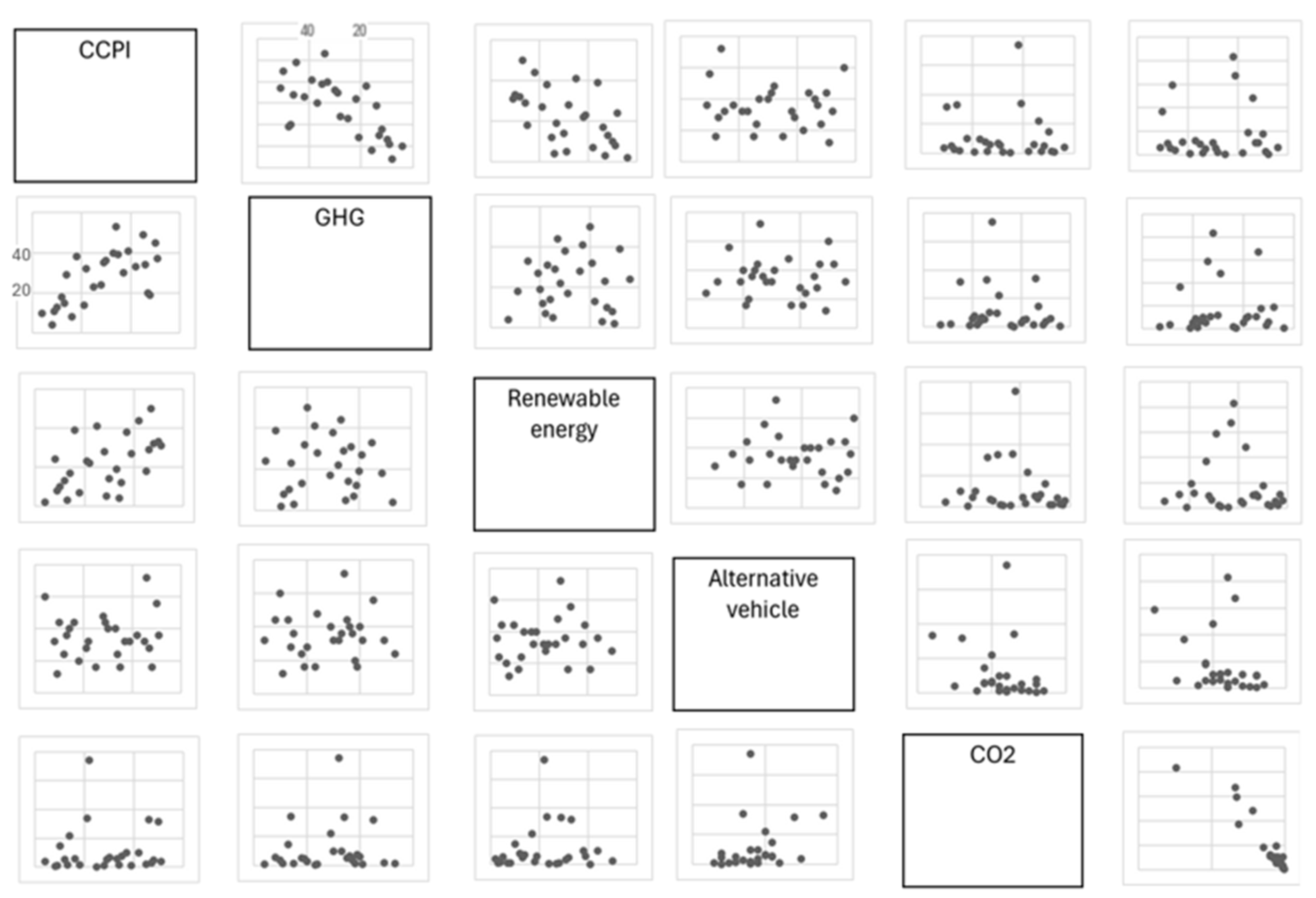
Figure 2.
Regression Analysis Results No. 1. Source: Compiled by author.
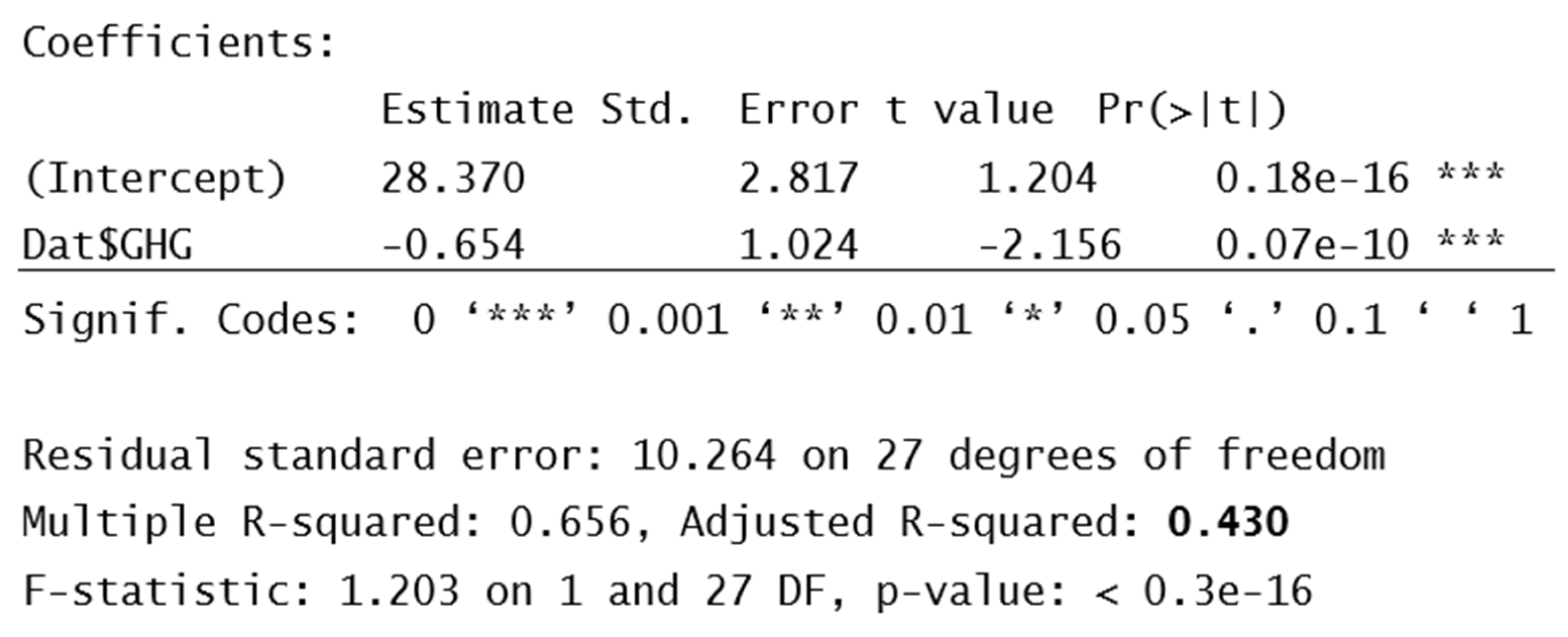
Figure 3.
Regression Analysis Results No. 2. Source: Compiled by author.
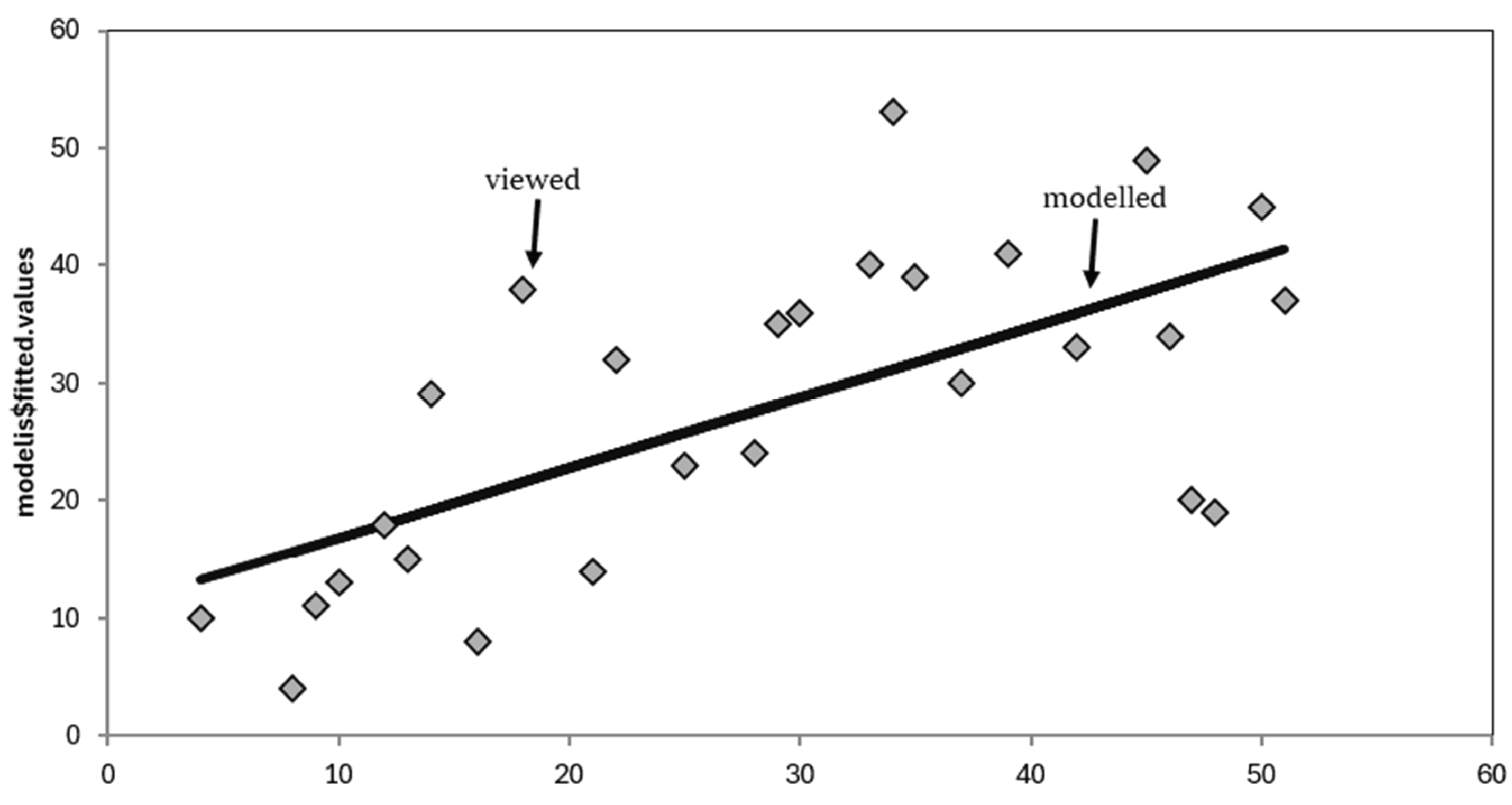

Table 1.
Share of energy from renewable sources used in transport by country. Source: source: own research modifying accord to [75].
Table 1.
Share of energy from renewable sources used in transport by country. Source: source: own research modifying accord to [75].
| Country | 2023 | 2024 | Country | 2023 | 2024 |
| Sweden Norway Finland |
33.65% 27.73% 20.64% |
34.95% 27.29% 21.91% |
Slovakia | 9.18% | 9.51% |
| Luxembourg | 9.15% | 9.95% | |||
| Estonia | 9.06% | 8.43% | |||
| Netherlands Austria |
13.43% 13.21% |
16.99% 13.49% |
Romania | 8.23% | 7.47% |
| Bulgaria | 8.09% | 8.03% | |||
| Belgium Spain Germany Portugal |
12.09% 11.96% 11.86% 11.16% |
12.43% 12.18% 11.58% 11.50% |
Ireland | 7.58% | 8.60% |
| Hungary | 7.57% | 7.52% | |||
| Cyprus | 7.28% | 7.57% | |||
| Lithuania | 7.23% | 7.96% | |||
| EU-27 Denmark |
10.84% 10.80% |
11.32% 11.55% |
Poland | 5.99% | 6.53% |
| Czechia | 5.65% | 6.02% | |||
| Malta | 10.75% | 10.86% | Greece | 3.94% | 3.81% |
| Italy | 10.25% | 10.72% | Latvia | 1.36% | 6.42% |
| France | 10.03% | 10.72% | Croatia | 0.92% | 0.89% |
| Slovenia | 10.02% | 9.59% |
Table 2.
Correlation Analysis Results No. 1. Compiled by author.
| CCPI ranking | GHG |
Renewable energy |
Alternative vehicle |
CO2 | Population | |
| CCPI ranking |
1.00 | 0.66 | 0.54 | 0.07 | 0.04 | -0.02 |
| GHG | 0.66 | 1.00 | -0.05 | 0.03 | 0.09 | -0.01 |
| Renewable energy | 0.54 | -0.05 | 1.00 | 0.02 | 0.09 | 0.09 |
| Alternative vehicle | 0.07 | 0.03 | 0.02 | 1.00 | 0.27 | 0.31 |
| CO2 | 0.04 | 0.09 | 0.09 | 0.27 | 1.00 | 0.94 |
| Population | -0.02 | -0.01 | 0.09 | 0.31 | 0.94 | 1.00 |
Table 3.
Correlation Analysis Results No. 2. Compiled by author.
| CCPI ranking | GHG |
Renewable energy |
Alternative vehicle |
CO2 | Population | |
| CCPI ranking |
0.1824 | 0.0000 | 0.0000 | 0.0000 | 0.0000 | |
| GHG | 0.1824 | 0.0000 | 0.0000 | 0.0000 | 0.0000 | |
| Renewable energy | 0.0000 | 0.0000 | 0.0000 | 0.0000 | 0.0000 | |
| Alternative vehicle | 0.0000 | 0.0000 | 0.0000 | 0.0000 | 0.0000 | |
| CO2 | 0.0000 | 0.0000 | 0.0000 | 0.0000 | 0.1789 | |
| Population | 0.0000 | 0.0000 | 0.0000 | 0.0000 | 0.1789 |
Table 4.
Summary of the Results of the Correlation Analysis. Compiled by author.
| Results | Commentary |
| Significant correlation between indicators and EU member states' ranking in the CCPI (p < 0.05) |
This result suggests that EU transport and environmental performance indicators, as measured by the GHG index, are significantly correlated with EU member states' positions in the CCPI. This suggests that greenhouse gas emissions and the level of reductions contribute to environmental protection and the transformation of transport and infrastructure to low-emission ones within EU member states. |
| No correlation with population (p > 0.05) |
The absence of an effect of population size suggests that country size is not a key factor in determining the ranking of EU member states in the CCPI ranking. This highlights that investments in and technologies for transforming transport and infrastructure are more important than demographic indicators. |
Table 5.
Summary of the Results of the Regression Analysis. Compiled by author.
| Results | Commentary |
| The best regression model includes the Greenhouse Gas Emission (GHG) indicator: |
The Greenhouse Gas Emission rate is significant because it is related to the level of sustainable drives in cars and industry, the proactive steps taken by member states in terms of sustainability and environmental protection, and the level of technological innovation. |
| Adjusted R-squared value (0.430) |
This median value indicates that GHG indicators explain about 43% of the variance in the ranking of EU member states in the CCPI. |
Table 6.
Challenges of Transformation of Transport and Infrastructure to Low/Zero-Emission and Direction for Future Research. Compiled by author.
Table 6.
Challenges of Transformation of Transport and Infrastructure to Low/Zero-Emission and Direction for Future Research. Compiled by author.
| No. |
Direction of Operational Challenges |
Possible Research Directions |
| 1. | Adaptation of Legislation of EU Member States | Research is needed to explore how individual EU member states can adapt their legislative frameworks to more effectively integrate new technologies and transform transport and infrastructure. This includes process optimization and developing new competences between government and responsible authorities. |
| 2. | Creating Transformation Strategies |
It is important to develop and evaluate transport transformation strategies that encompass all transport processes including infrastructure. Research could help identify best practices and effective methods for implementing transport transformation in a way that benefits all EU member states. |
| 3. | Restructuring of Transport Infrastructure |
Transport and infrastructure restructuring processes require efficient management of resources, including financial and human resources. Research could explore how to better utilize available resources, transform infrastructure for alternative fuel vehicles, including charging stations, and ensure that technology implementation is economically sustainable. |
| 4. | Increasing the Availability of Information and Technology |
It is important for public administration to inform ordinary citizens and companies about technological innovations in the field of transport, about the protection and improvement of the environment, and the long-term sustainability of transport, including infrastructure. Research should focus on the efficiency and availability of information to residents and businesses of EU member states. |
| 5. | Subsidy Programs for Renewable and Low-emission Sources in Transport |
It is important to identify ways to provide support to residents and businesses to implement new transportation technologies. This could include subsidy programs, tax breaks for residents and businesses, consulting, or other incentives. |
Table 7.
Challenges of Transformation of Transport and Infrastructure to Low/Zero-Emission at the Regional Level (SMART cities). Compiled by author.
Table 7.
Challenges of Transformation of Transport and Infrastructure to Low/Zero-Emission at the Regional Level (SMART cities). Compiled by author.
| No. |
Direction of Operational Challenges |
Possible Research Directions |
| 1. | Increasing of Public Awareness | The public needs to be informed about the possibilities and opportunities offered by low-emission and zero-emission transport, infrastructure transformation, and the integration of the entire concept into a functional whole of SMART cities/transport. |
| 2. | Proactive Approach of Local Public Administration |
In order for citizens and businesses to accept the proposed changes, it is necessary for public authorities to be proactive and to act as pioneers in the field of transport in their cities. The use of low-emission transport by public authorities should be frequently presented to citizens through various media. |
| 3. | Construction of Necessary Infrastructure |
The public administration should find suitable locations for building charging stations for low-emission vehicles (mainly electric and hydrogen cars). It should carry out the construction, inform citizens, and subsidize charging during the initial period (until there are enough users of the charging stations). |
| 4. | Subsidy Programs for Renewable and Low-emission Sources in Transport |
Especially in the early stages of transformation, it is important to encourage residents and local businesses to switch to alternative transport. This could take the form of subsidy programs for local businesses, subsidized charging at public stations, or the introduction of zero local parking fees for residents who use low-emission vehicles. |
| 5. | Support for Disadvantaged Groups |
Disadvantaged citizens should be properly informed, have access to advice, and be able to use low-emission transport. Shared electric cars or vouchers for so-called electric taxis for transport, e.g., to the doctor, appear to be relevant. |
Disclaimer/Publisher’s Note: The statements, opinions and data contained in all publications are solely those of the individual author(s) and contributor(s) and not of MDPI and/or the editor(s). MDPI and/or the editor(s) disclaim responsibility for any injury to people or property resulting from any ideas, methods, instructions or products referred to in the content. |
© 2026 by the authors. Licensee MDPI, Basel, Switzerland. This article is an open access article distributed under the terms and conditions of the Creative Commons Attribution (CC BY) license (http://creativecommons.org/licenses/by/4.0/).
Copyright: This open access article is published under a Creative Commons CC BY 4.0 license, which permit the free download, distribution, and reuse, provided that the author and preprint are cited in any reuse.


