
Submitted:
16 March 2026
Posted:
17 March 2026
You are already at the latest version
Abstract
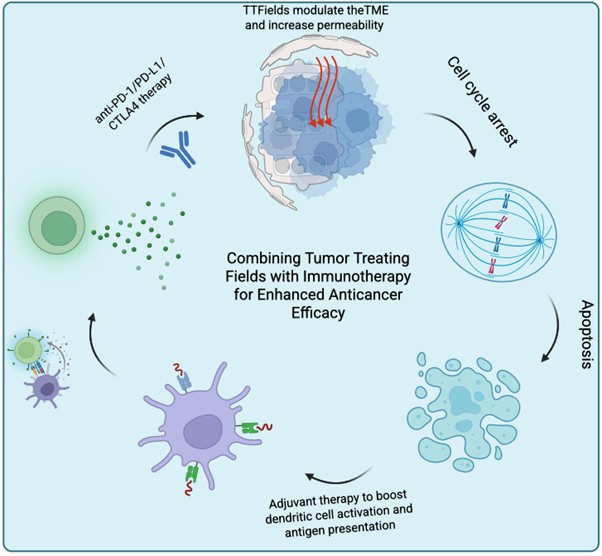
Tumor Treating Fields (TTFields) represent a novel, non-invasive therapeutic modality in oncology that employs low-intensity, intermediate-frequency alternating electric fields to disrupt mitotic processes and induce cancer cell death. This review integrates mechanistic, preclinical, and emerging clinical evidence supporting the integration of TTFields with immunotherapeutic strategies in pancreatic ductal adenocarcinoma (PDAC). Although immunotherapy has transformed the treatment landscape across multiple malignancies, its efficacy in PDAC remains limited due to the tumor’s dense stroma, immunosuppressive microenvironment, and low immunogenicity. Preclinical investigations suggest that TTFields may potentiate immune-based therapies by enhancing antigen presentation, modulating the tumor microenvironment, and attenuating mechanisms of immune resistance. We highlight studies evaluating TTFields in combination with immune checkpoint inhibitors, adoptive cellular therapies, and cancer vaccines, emphasizing their potential synergistic effects in PDAC. Clinically, the phase II PANOVA-2 trial demonstrated feasibility and encouraging survival outcomes with TTFields in combination with gemcitabine and nab-paclitaxel, providing the rationale for the ongoing phase III PANOVA-3 trial and the phase II PANOVA-4 trial which combines TTFields with chemotherapy and atezolizumab. Additional clinical experiences in glioblastoma and non-small cell lung cancer further substantiate the broader applicability of TTFields as an immunomodulatory adjunct. Remaining challenges include optimizing treatment sequencing, identifying predictive biomarkers, and managing TTFields-associated toxicities. Collectively, current evidence positions TTFields as a promising strategy to augment immunotherapy in PDAC, warranting further translational and clinical investigation to establish its role in reshaping therapeutic paradigms.
Keywords:
tumor treating fields
; pancreatic ductal adenocarcinoma
; immunotherapy
; combined therapy
Copyright: This open access article is published under a Creative Commons CC BY 4.0 license, which permit the free download, distribution, and reuse, provided that the author and preprint are cited in any reuse.


