

Submitted:
15 March 2026
Posted:
17 March 2026
You are already at the latest version
Abstract
Urban canyons, integral components of the built environment, significantly influence microclimatic conditions and thermal comfort. This review investigates their combined effects with green infrastructure on thermal comfort, offering a comprehensive framework for optimizing urban design and greening strategies. Urban canyon orientation determines solar exposure and its interaction with prevailing wind patterns, affecting ventilation and heat dissipation. The urban canyon aspect ratio influences shading and airflow regulation, while their sky view factor moderates radiative cooling and daylight availability. Urban greening—encompassing street trees, green roofs, and vertical green walls—complements urban geometry by reducing air temperatures, enhancing evapotranspiration, and modifying local wind dynamics. Tree shading can reduce the physiological equivalent temperature in urban canyons, mitigating extreme heat stress. Key vegetative parameters, such as leaf area index and canopy density, are critical for quantifying cooling contributions. Key findings underscore the role of higher aspect ratios in enhancing shading and ventilation while they emphasize the critical influence of street orientation and sky view factor on microclimatic regulation. Vegetation emerges as a vital component, with tree shading contributing substantially to cooling effects and reducing physiological equivalent temperature. The beneficial synergistic interaction between urban geometry and vegetation optimizes thermal comfort. Tailored strategies based on urban canyon typologies balance urban development with environmental sustainability. The proposed framework provides actionable strategies for designing resilient and thermally optimized urban spaces, promoting climate-adaptive urban planning by addressing the dual challenges of the urban heat island and thermal discomfort in cities.
Keywords:
urban canyons
; aspect ratio
; sky view factor
; thermal comfort
; urban microclimate
; urban greening
; vegetation-based cooling
1. Introduction
As urban areas expand, a combination of urban geometry, dense construction materials, limited vegetation, anthropogenic heat emissions, atmospheric pollution, and modified surface and air dynamics patterns contribute to elevated temperatures relative to rural counterparts. This phenomenon, known as the Urban Heat Island (UHI) effect [1,2,3,4,5], has significant implications for thermal comfort, exacerbating discomfort and health risks, and increasing energy demands, especially during extreme heat events [6,7,8].
Thermal comfort is defined as “the condition of mind that expresses satisfaction with the thermal environment” [9] and it represents a subjective evaluation based on multiple environmental and personal factors. In outdoor spaces, thermal comfort is influenced by a wide spectrum of parameters, including air temperature, mean radiant temperature (MRT), wind speed, humidity, clothing insulation, and metabolic rate [10,11,12,13,14]. However, relying solely on quantitative measures is insufficient to comprehensively capture outdoor thermal comfort. While microclimatic variables profoundly influence thermal sensation, they fail to fully account for the divergence between objective measurements and subjective comfort perceptions. Increasingly, psychological adaptation—including factors such as perceived naturalness, individual expectations, prior experiences, duration of exposure, perceived control, and environmental stimulation—plays a critical role in shaping thermal comfort [15,16]. This complex balance between environmental factors and human comfort thresholds is essential in the design of urban spaces that prioritize public health and well-being. Understanding these dynamics is vital for formulating urban design strategies that mitigate heat stress and enhance the livability of outdoor spaces.
Urban morphology encompasses the spatial arrangement, height, and density of built structures and critically shapes local microclimatic conditions. Dense, compact urban configurations restrict airflow and hinder surface heat dissipation, thereby amplifying the UHI effect and diminishing the effectiveness of natural cooling processes such as wind-driven ventilation and convective heat loss. A prevalent feature in these compact environments is the urban canyon, defined by narrow streets bordered by tall building structures (Figure 1) [17,18,19,20]. The geometry of urban canyons is typically characterized by the height-to-width ratio (H/W), also known as the aspect ratio, (AR), which defines the relationship between the vertical height of surrounding buildings and the horizontal width of the street [18,20,21,22]. A higher aspect ratio signifies a deeper canyon with reduced sky exposure, limiting solar radiation penetration, and modifying wind dynamics. Additionally, geometric parameters such as street orientation and the sky view factor (SVF)—which measures the fraction of visible sky within the canyon—are critical for evaluating the potential for radiative cooling and solar heat gain. These factors play a decisive role in shaping local microclimatic conditions and directly influence thermal comfort in urban environments [19,20,22,23,24,25,26].
Urban greening, such as the strategic incorporation of trees, green roofs, and vertical gardens, offers a natural solution to mitigate the thermal challenges posed by urban canyon geometry [27,28,29,30]. Vegetation plays a pivotal role in moderating urban microclimates through shading, evapotranspiration, and influencing local wind dynamics. In deep urban canyons, where solar access is restricted, greenery improves thermal comfort by lowering air temperature and providing localized cooling through shade and enhanced ventilation. In canyons with higher SVF, vegetation helps mitigate heat accumulation by intercepting solar radiation and reducing the radiant heat load on surfaces. Thus, urban greening complements urban geometry by balancing microclimatic conditions and improving thermal comfort in densely built environments. The effectiveness of urban greening, however, depends on several factors such as tree species, canopy density, planting configuration, and the surrounding built environment [14,18,27,28,32,33].
The interaction between vegetation and urban canyon characteristics—such as AR, SVF, and ground surface properties—strongly influences thermal comfort and cooling potential. For example, in narrow canyons with low SVF, shading effects are amplified, whereas tree height and density can significantly modify airflow and thermal conditions at the pedestrian level. Given these complexities, a detailed understanding of how vegetation integrates with specific urban canyon geometries is essential for optimizing greening strategies. Recognizing this intricate relationship between urban geometry and green infrastructure (GI) is crucial for developing sustainable urban planning approaches. By carefully designing green elements to align with urban canyon characteristics, planners can improve thermal comfort, mitigate the urban heat island effect, and create more resilient, climate-adaptive urban spaces [33,34,35,36,37,38,39].
This study conducts an in-depth bibliographic review to achieve two primary objectives: (a) quantify the influence of urban canyon geometry and vegetation on thermal comfort and microclimate regulation in densely built environments, and (b) provide a framework for optimizing urban design and greening strategies through the integration of urban geometry and vegetation to enhance thermal conditions. To achieve its objectives, the review focuses on three critical dimensions. Firstly, it attempts to quantify the impact of urban canyon geometry on microclimate and outdoor thermal comfort. This involves analyzing the influence of critical geometric parameters—including AR (or H/W), street orientation, and SVF—on the local microclimate, solar radiation exposure, and thermal comfort at the pedestrian level. Secondly, it strives to evaluate and quantify the role of vegetation in the regulation of microclimate and thermal comfort. In this respect, the review examines the effectiveness of various urban greening strategies, such as street trees, green roofs (GRs), and vertical gardens, in enhancing thermal comfort and mitigating the UHI effect. Key vegetation attributes leaf area index (LAI), leaf area density (LAD), and planting configuration are analyzed to quantify their cooling contributions through shading, evapotranspiration, and wind modulation. Thirdly, the review investigates synergistic interactions between urban geometry and vegetation, exploring the interplay between urban canyon geometries and vegetation in optimizing thermal comfort. The review aims to establish an optimization framework for identifying the most effective urban design and greening strategies across different canyon typologies, balancing the need for high-density development with environmental sustainability and improved human comfort in outdoor spaces.
The key innovative aspects of this study can be summarized as follows. At first, the review provides a comprehensive synthesis of urban geometry and vegetation interactions. Geometric factors (such as AR, street orientation, and SVF) and vegetation characteristics (e.g., LAI, canopy density, and planting configurations) jointly offer a holistic view of how urban form and greening strategies interact to regulate microclimatic conditions. In addition, the review provides a quantification of combined effects on microclimate regulation and thermal comfort, with the quantification of how geometric parameters and vegetation jointly impact thermal comfort and cooling potential being a significant contribution. Finally, the review offers a framework for optimizing urban design and greening strategies, presenting an evidence-based framework for optimizing the integration of urban canyon geometries and vegetation to enhance thermal comfort.
Peer-reviewed articles and case studies were selected from reputable sources for this review based on a number of criteria. To cover urban canyon geometries, studies were selected for their detailed examination of how key geometric parameters—such as AR, street orientation, and SVF—influence microclimate regulation and thermal comfort in urban canyons. For the integration of urban geometry and vegetation, studies exploring the synergistic interactions between urban form and greening strategies were emphasized, particularly those offering frameworks for optimizing microclimate through integrated design approaches. Finally, to capture a broad range of climate and regional diversity, studies from various climatic regions (especially hot, dry, wet, and temperate environments) were included to assess the interplay between urban form and vegetation across different urban contexts.
2. Role of Urban Canyon Geometry
Urban canyons are fundamental geometric units representing two-thirds of urban areas and they significantly affect microclimate, energy balance, air quality, pollutants dispersion, and thermal comfort conditions in the urban environment [6,10,40]. The energy balance within urban canyons is primarily governed by the absorption, reflection, and re-emission of solar radiation by the surfaces of buildings and streets. Due to the vertical orientation of surfaces in urban canyons, solar radiation is often trapped, leading to increased heat retention and contributing to the UHI effect [18,19,41]. The geometry of urban canyons, referring to characteristics such as AR or orientation, plays a crucial role in determining the distribution of shortwave and longwave radiation and, subsequently, the thermal behavior of the canyon [17]. Additionally, anthropogenic heat emissions from vehicles, air conditioning units, and industrial activities further enhance the heat fluxes within urban canyons, affecting both microclimate and air quality [24,42]. Understanding these heat fluxes is essential for the design of sustainable urban environments, where mitigation strategies can be implemented to reduce heat stress and energy consumption. Figure 2 provides a graphical summary of the primary energy fluxes within the built environment. In addition to illustrating these flows, Figure 2 highlights the key impacts of human activities, with distinct areas categorized based on different land use types.
Understanding the urban energy balance is crucial for comprehending the mechanisms that drive the development of urban climate and microclimate and of the urban heat island effect as well. The following two main equations are used in the scientific literature to express the main heat flux sources [18,44,45,46,47,48,49].
where is the net radiation (all waves), is the anthropogenic heat, is the turbulent sensible heat flux, is the turbulent latent heat flux, is the heat stored in the urban structure, represents possible horizontal advection fluxes, is the incoming shortwave radiation, is the outgoing shortwave radiation, is the incoming longwave radiation, and is the outgoing longwave radiation. These equations describe how the balance between the net radiation and anthropogenic heat is maintained by the turbulent sensible and latent heat fluxes, along with the heat stored in the urban structure and any possible horizontal advection . The advection term is often considered insignificant for systems within a homogeneous environment [46,50].
2.1. Aspect Ratio
The physical dimensions of the canyon are usually described by its length, its height, and its width. The canyon length (L) is defined as the distance measured along the canyon between two major street intersections or the distance between two cross streets that enclose the canyon [5]. The canyon heigh (H) is defined as the average height of the buildings that line both sides of the street canyon. When there are buildings of different height, H is typically taken as the average height of the two opposing building facades [10]. The canyon width (W) is the horizontal distance between the facades of the buildings on either side of the street canyon [18], which includes the width of the street defining the canyon. These canyon characteristics are shown in Figure 3.
is the street orientation [54].
The AR of an urban canyon is a key concept in urban climatology that describes the geometric relationship between the height of the buildings and the width of the street within an urban canyon. Referring to Figure 3, the AR in the context of urban canyon equals the ratio of the canyon height (H) to the canyon width (W) [10,18,19,20]. A high AR indicates narrow streets with tall buildings, while a low AR indicates wide streets with short buildings. AR is a critical dimensionless quantity, typically expressed as H/W, that describes the geometry of the urban canyon and influences various environmental and energy factors such as air flow inside the canyon, solar radiation, sunlight penetration, air temperature inside the canyon, air quality and thermal comfort, and pollutant dispersion [44,55,56].
Based on AR (or equivalently H/W) values, a canyon can be characterized as shallow, uniform or medium, and deep [6,57,58,59,60]. Shallow urban canyons have H/W values below 0.5, uniform or medium urban canyons have H/W values close to unity without any significant openings in their walls, while deep urban canyons have H/W values equal to 2 or higher. An urban canyon’s length (L) and high (H) can provide a further sub-classification [57,58,59,60]: short urban canyon have length-to-height ratios (L/H) equal to about 3, medium urban canyons have L/H values equal to about 5, and long urban canyons have L/H values equal to about 7.
AR serves as a fundamental parameter in urban planning and sustainable urban design, as it governs microclimatic dynamics and environmental conditions within street canyons. Its influence extends to air temperature regulation, solar radiation distribution, airflow characteristics, and pollutant dispersion processes. Urban geometry, typified by AR, modulates wind patterns and pollutant behavior, with significant implications for air quality and thermal comfort [59,61]. High AR values in deep urban canyons, characterized by tall buildings and narrow widths, create sheltered microenvironments where reduced wind speeds hinder ventilation, fostering the accumulation of heat and pollutants near ground level. Such configurations frequently induce robust recirculation zones or vortices that further entrap pollutants. In contrast, shallow canyons, with lower AR values, facilitate enhanced wind penetration, improving ventilation efficiency and mitigating pollutant stagnation through weaker or absent recirculation zones [18,61,62,63]. In addition, AR values profoundly affect solar radiation penetration. Deep canyons restrict direct sunlight due to prolonged shadowing from tall structures, resulting in cooler but dimly lit environments that necessitate increased reliance on artificial lighting. Conversely, shallow canyons enable greater solar radiation access, elevating daytime surface temperatures and enhancing natural illumination, thereby reducing the energy demand for artificial lighting [19,46,64,65]. The intricate balance between solar gain, shading, and thermal comfort conditions emphasizes the crucial role that ARs play in urban design, highlighting their importance in creating sustainable and livable urban environments.
Table 1 provides a comprehensive summary of case studies examining the influence of urban canyon ARs on climatic conditions and thermal comfort. Each case study outlines the canyon’s geometry, applied methodology (experimental or theoretical), affected parameters, and key (quantitative) findings.
Table 1 highlights critical insights into the interplay between urban geometry and thermal behavior. On the interaction between solar radiation and heat storage, low AR canyons (H/W equal to 1) experience elevated daytime temperatures compared to canyons with higher AR (H/W ranging from 2 to 3) due to greater solar radiation penetration. This intensified absorption and storage of heat by building facades and ground surfaces amplify ambient temperatures during the day. Regarding nocturnal cooling efficiency, lower AR canyons cool more effectively at night, as their larger SVF enhances longwave radiation emission and radiative cooling, complemented by improved ventilation. On the interaction of wind flow and shading, higher AR canyons improve pedestrian thermal comfort, particularly in the summer, by facilitating airflow and providing substantial shading. However, variations in the L/H ratio have limited influence on pedestrian-level thermal conditions. Regarding UHI dynamics, the UHI effect is exacerbated as the H/W ratio decreases. Optimal configurations (with H/W equal to 1 and L/W equal to 2) strike a balance between shading, ventilation, and heat retention, moderating urban air temperatures effectively. Regarding urban-rural temperature differentials, air temperatures in urban canyons exceed rural surroundings by approximately 5% in deep canyons and 15% in shallow canyons. Finally, on the inverse AR-temperature relationship, high ARs diminish solar radiation penetration and increase shading, resulting in reduced air temperatures within the canyon.
2.2. Orientation
Among the geometric parameters, the orientation of urban canyons—referring to the direction that streets and building facades face—has a significant impact on solar exposure, which in turn influences wind patterns and outdoor thermal comfort [96,97,98,99]. The orientation dictates the intensity and distribution of solar radiation that urban surfaces receive, thereby influencing temperature fluctuations, airflow patterns, shading, and the overall thermal environment within the canyon. This, in turn, affects the thermal balance and microclimatic conditions inside the urban canyon. All in all, the orientation of buildings and streets, plays a crucial role in shaping the microclimate of urban areas.
A thorough understanding of orientation effects is crucial for the design of urban spaces that optimize thermal comfort, especially in the context of global climate change and accelerating urbanization [6,76,100,101]. The importance of street orientation in evaluating outdoor thermal comfort is influenced by two primary factors. East-West (E-W) oriented streets are exposed to extended periods of sunlight, especially in the summer, resulting in elevated temperatures and urban heat island effect enhancement. Additionally, North-South (N-S) oriented streets align with dominant wind directions, enhancing airflow and aiding in the dissipation of heat accumulated throughout the day [88].
Streets with varying orientations experience distinct shading and solar exposure patterns throughout the day and across different seasons [94,102,103]. In the northern hemisphere, the sun’s trajectory results in N-S oriented streets being shaded during the morning and afternoon in the summer, while E-W oriented streets remain fully exposed to sunlight. At solar noon, N-S streets receive full sun exposure, whereas only a small portion of E-W streets is shaded. Streets with intermediate orientations, such as Northwest-Southeast (NW-SE) and Northeast-Southwest (NE-SW), consistently have shaded areas throughout the day. Generally, N-S and intermediate orientation streets benefit from increased shading during the summer months and reduced shading during the winter, in contrast to E-W streets, which experience minimal shading throughout the year [94].
Table 2 provides an overview of the most representative case studies demonstrating the impact of urban canyon orientation on outdoor thermal comfort conditions for different climatic conditions.
Several noteworthy insights may be drawn from the studies tabulated in Table 2. Street orientation emerges as the most influential factor, contributing approximately 46.42% to the overall impact on thermal comfort. This dominant role of orientation underscores its centrality in urban planning. The efficiency of shading is shown by the fact that N-S oriented canyons with an AR of 1.5 or greater provide 40 to 80% shading, outperforming diagonal orientations (NW-SE and NE-SW), which offer only 30 to 50% shading annually. Regardless of orientation, wide streets (with an H/W of 0.5) exhibit heightened thermal stress, with E-W streets being particularly problematic due to limited wall shading, even at high AR values (e.g., H/W equal to 4). On the cooling advantage of N-S orientation, high AR N-S streets (with a H/W over 2) deliver improved thermal comfort by moderating PET peaks, shortening stress periods, and enabling mutual shading, thereby reducing cooling demands. During the summer, orientations experience increasing solar gain in the following order: East (E), West/Northwest (W/NW), Southeast/Northeast (SE/NE), Southwest/North (SW/N), and South (S). E-W streets exhibit reduced solar gains, but this advantage diminishes in narrow streets with tall buildings. On the relationship of comfort dynamics to orientation and depth, in medium-wide canyons, NW-SE orientations yield the most comfortable year-round conditions. For deep canyons, the south side of E-W canyons is preferable in the summer, while the southwest side of NW-SE canyons excels in the winter. A careful examination of comfort hours showed that N-S canyons offer the highest proportion of comfort hours (31 to 46%), followed by NW-SE (23 to 46%) and NE-SW (23 to 38%). E-W canyons are the least favorable, necessitating additional shading measures. Finally, there is a notable correlation between the mean physiological equivalent temperature (mPET) and microclimatic factors like solar radiation. This correlation is particularly strong for N-S oriented canyons, emphasizing the need to account for orientation in thermal comfort assessments.
Summarizing the optimal conditions for different orientations, the N-S axis is preferred for buildings taller than six stories, as it provides the best thermal comfort and minimizes physiological stress. The NW-SE axis is suitable for buildings above six stories and neighborhood canyons with buildings up to six stories. The NE-SW axis is optimal for taller buildings (above 10 stories) with wider streets (20 meters). Finally, the E-W axis requires robust shading solutions like trees or arcades to maintain comfort in public spaces.
2.3. Sky View Factor
The SVF, is a dimensionless parameter that quantifies the fraction of the visible sky hemisphere that can be seen from a specific point in an urban environment, particularly within an urban canyon. Mathematically, it is expressed as the ratio of the visible sky area to the total hemispherical area when viewed from the ground level and its values range from 0 to 1. An SVF value of 1 indicates an entirely open space with no obstructions while an SVF value of 0 indicates a fully obstructed view, where the sky is completely blocked by surrounding structures or vegetation [10,18,109,110].
SVF is a critical variable in urban climatology as well as in energy applications in the urban environment. SVF affects the amount of solar radiation reaching the ground and the ability of the surface to emit longwave to the sky, thus influencing energy balance, air flow patterns, the UHI effect and urban microclimate [19,23,52]. Moreover, SVF plays a crucial role in influencing human thermal comfort by modulating the balance of longwave and shortwave radiation within urban environments [52,111].
SVF presents significant impacts on the energy balance and thermal regulation, daylight availability, airflow patterns, and outdoor thermal comfort of the urban environment.
Regarding the energy balance and thermal regulation, SVF critically determines the thermal dynamics within urban canyons by controlling solar radiation reaching the ground and the efficiency of radiative cooling. In urban canyons with low SVF (characterized by narrow streets and dense building configurations), reduced daytime solar exposure is counteracted by limited longwave radiation escape at night, resulting in heat retention and elevated nocturnal temperatures, which amplify the UHI effect. Conversely, high SVF areas, with greater sky exposure, enable efficient nighttime heat loss, supporting cooling processes and mitigating UHI impacts [10,18,19,24,45].
Regarding daylight availability, SVF is a critical determinant of natural light penetration within urban canyons. Low SVF values (typically associated with high-rise buildings and narrow streets) obstructs sunlight, significantly reducing daylight availability. This limitation increases dependence on artificial lighting during daytime hours, driving up energy consumption. Furthermore, insufficient natural light adversely impacts circadian rhythms, psychological well-being, and the overall quality of life for urban residents. Optimizing SVF in urban planning is thus essential for enhancing daylight access, reducing energy demand, and improving urban livability [52,112].
Regarding air flow patterns, SVF significantly influences wind flow dynamics within urban canyons, where it interacts with the built environment to modify local wind speeds and patterns. In urban canyons characterized by a low SVF (indicative of narrow street canyons flanked by tall buildings), wind flow is often impeded due to the physical obstruction posed by these structures [18,19,113].
Finally, outdoor thermal comfort in urban environments is strongly influenced by the SVF, as it governs both the radiant temperature and mean air temperature within urban canyons. Areas with lower SVF typically experience elevated temperatures, particularly during the night, due to the reduced capacity for radiative cooling of surfaces. This thermal retention leads to a warmer microclimate, making SVF a critical parameter in the design of thermally comfortable urban spaces [18,19,20].
SVF is evaluated using two principal methodologies extensively detailed in the literature [48,52,114,115]: digital 3D modeling and fisheye lens imaging. Digital 3D modeling, which employs three-dimensional representations of the urban form to quantify structural parameters such as building geometry and street configurations, provided high accuracy for static urban features. However, this method fails to account for dynamic elements like vegetation, limiting its applicability for comprehensive analyses. Fisheye lens imaging captures hemispherical photographs encompassing both the built environment and surrounding vegetation. This approach is particularly advantageous for seasonal SVF analyses, as it accounts for temporal variations in vegetation cover and environmental conditions. By integrating these dynamic factors, fisheye lens imaging delivers a more holistic and temporally sensitive perspective, making it indispensable for studies where the interaction between vegetation and urban morphology significantly impacts microclimatic conditions.
Table 3 synthesizes the critical findings from case studies investigating the role of SVF in shaping outdoor thermal comfort and urban microclimates.
Insights from Table 3 underscore the interdependencies among SVF, energy balance, and climatic parameters such as air temperature, relative humidity (RH), and wind speed. Regarding outdoor thermal comfort, strong positive correlations exist between SVF and thermal indices like PET and MRT, demonstrating consistent trends across diverse urban locations. Low SVF areas with high shading are more thermally comfortable in the summer but less so in the winter, whereas moderate SVF ensures balanced comfort year-round. Low SVF combined with dense vegetation enhances biometeorological conditions, while high SVF near buildings exacerbates thermal discomfort. Finally, high SVF areas amplify heat stress on hotter days but may offer improved comfort on cooler days, highlighting its dual role in thermal dynamics.
Turning to the issue of impacts on urban microclimate, SVF shows strong correlations with air temperature, particularly during clear, calm nights, and near the annual average. Higher SVF values generally lead to increased daytime air temperatures but lower nighttime temperatures, emphasizing its role in diurnal thermal regulation. In canyons with low aspect ratios (e.g., H/W equal to 0.5), air temperature and MRT initially decline with decreasing SVF but increase beyond a threshold. While RH shows limited correlation with SVF in some studies, others identify a quadratic relationship influenced by specific street canyon geometries. Optimizing SVF is essential for achieving consistent air temperature moderation throughout the day and night. Finally, factors such as site coverage, outdoor distance, and layout complexity strongly influence the interaction between mean ground SVF and diffuse irradiance.
3. Role of Greenery
Urban greening is increasingly recognized as an effective strategy for mitigating adverse thermal conditions in urban canyons. Incorporating vegetation into urban infrastructure—such as through street trees, GRs, green walls, vertical gardens, and pocket parks—plays a pivotal role in moderating microclimates and enhancing thermal comfort. Vegetative elements act as natural regulators by providing shade and solar control, facilitating evapotranspiration, mitigating air pollution, and influencing local wind patterns, which collectively contribute to the reduction of heat accumulation in densely built environments [27,28,29,30,32]
Research has shown that strategic urban greening can significantly lower surface temperatures, reduce the UHI effect, improve thermal comfort, and create more habitable outdoor spaces for city dwellers [1,129,130,131,132]. Vegetation serves as a natural moderator of urban microclimates, primarily through mechanisms such as shading, enhancing evapotranspiration, and altering local wind dynamics [133]. By intercepting solar radiation, vegetation reduces the amount of heat absorbed by urban surfaces, while evapotranspiration dissipates heat, thereby cooling the surrounding air [134]. Furthermore, the presence of trees and green surfaces can modify wind flow patterns, promoting ventilation that can further alleviate heat stress in densely built environments [130,135,140,141,142,143,144,145,146,147,148,149,150,151,152,153,154,155].
3.1. Key Structural Parameters of Vegetation for Canopy Characterization
The most significant vegetation canopy morphological parameters used to quantify the impact of vegetation on outdoor thermal comfort conditions include LAI and leaf area density (LAD). LAI is a dimensionless quantity that describes the amount of leaf area per unit ground surface area [136,137] and equals.
where, the total leaf area refers to the one-sided or total surface area of all leaves within a given ground area, depending on how it is measured, and the ground surface area is the horizontal area of the ground beneath the vegetation. LAI is a critical parameter in ecological, meteorological, and environmental sciences as it directly influences various processes such as photosynthesis, transpiration, and energy exchange between the land surface and atmosphere.
LAD is defined as the total one-sided leaf area (in m²) within a given volume of vegetation (in m³) [34,138]. It provides a vertical profile of how leaf area is distributed across different layers of the canopy, which influences radiation penetration, energy exchange, and microclimatic conditions within urban environments.
The relationship between LAI and LAD can be expressed by integrating the LAD across the vertical extent (height) of the plant canopy [34,139].
where, H is the total height of the canopy.
Further to LAI and LAD, tree heigh, trunk heigh, and crown diameter are additional parameters that could be considered as regards tree canopies [138].
3.2. Synergistic Effects of Urban Canyon Geometry and Green Infrastructure for Optimizing Thermal Comfort
The interaction between urban canyon geometry and GI presents a highly effective approach for enhancing thermal comfort in dense urban environments. Strategic integration of green elements—such as trees, GRs, and vertical gardens—within specific urban canyon configurations leverages synergistic effects to optimize shading, modulate airflow, and enhance evapotranspiration. These interactions provide critical opportunities for mitigating heat stress and creating more livable and sustainable urban spaces [31,32,100,135,157].
Table 4 presents a selection of the most representative case studies, illustrating the key characteristics and synergistic interactions between urban geometry parameters (AR, orientation, and SVF) and vegetation in optimizing the microclimate and enhancing thermal comfort.
Based on the main findings of the case studies shown in Table 4, a number of synergistic effects are identified. On how AR can act synergistically with vegetation, urban canyons with higher aspect ratios (H/W equal to 2) can achieve a balance between sufficient shading and ventilation through the strategic use of moderately dense tree cover. This configuration minimizes overheating while maintaining adequate air circulation, critical for pedestrian comfort. As for thermal comfort in narrow canyons (H/W less than 1.0), dense vegetation, such as trees with high LAI and wide crowns, provides effective cooling through shading and evapotranspiration. However, in deeper canyons, excessive shading may obstruct airflow, necessitating careful vegetation placement to optimize both cooling and ventilation. As AR increase though, the resultant wind turbulence and reduced light availability create less favorable conditions for vegetation growth, particularly for species requiring higher light exposure. This necessitates selecting resilient plant species capable of thriving in low-light, high-turbulence environments.
Regarding the synergy of orientation and vegetation, streets aligned along the E-W axis, which experience prolonged solar exposure, benefit significantly from dense-canopied trees planted strategically along the southern side. This configuration achieves PET reductions comparable to fully shaded streets, demonstrating the critical role of vegetation in mitigating thermal stress. To enhancing comfort in N-S streets which inherently experience lower thermal stress, planting trees with higher LAI can enhance shading and reduce heat stress. This strategy proves particularly effective in areas with intense solar exposure during midday.
On the synergy of SVF and vegetation, in deep canyons with low sky view factors (SVF), trees with tall trunks and sparse lower foliage effectively balance moderate shading with sufficient ventilation. This approach maintains air circulation while offering relief from direct unlight. To maximize shading in shallow canyons with high SVF, dense tree foliage, which significantly reduces PET and air temperatures, offers benefits. By obstructing direct shortwave radiation and minimizing reflected and emitted heat, vegetation in these settings provides comprehensive thermal comfort.
3.3. Challenges and Critical Aspects of Using Green Infrastructure
GI is increasingly recognized for its potential to mitigate UHI, improve air quality, enhance thermal comfort, reduce urban noise, and bolster urban resilience. However, its integration into urban canyons—a setting defined by restrictive geometries, dense land use, and entrenched infrastructure—presents significant challenges. These environments require innovative, resource-efficient, and context-specific solutions to ensure the feasibility and sustainability of GI. Taking into account the interaction between urban canyon geometry and vegetation, a number of key challenges emerge.
Space limitations and density constraints is one such challenge. Urban canyons often lack sufficient space for traditional green solutions such as parks or expansive GRs, particularly in areas dominated by vertical development. Narrow streets and closely spaced buildings further limit light and airflow, critical for plant growth. While compact solutions like GRs, GWs, and modular planters offer space-efficient alternatives, their localized benefits are often less impactful than larger vegetated areas. Maximizing the ecological and social contributions of GI in such confined spaces requires integrating multifunctional systems, such as coupling vegetation with renewable energy or stormwater management, to align with sustainable urban living principles [31,159].
Water scarcity poses an additional critical challenge to GI, particularly in arid and semi-arid regions where irrigation is essential to sustain vegetation. Conventional water-intensive methods often undermine the ecological benefits of GI by exacerbating resource constraints. Innovative water conservation strategies—such as rainwater harvesting, dew and fog collection, graywater reuse, and condensate recovery from HVAC systems—are increasingly essential. Employing drought-resistant plant species and efficient irrigation systems can further enhance resilience, ensuring GI remains viable in water-limited environments while supporting long-term urban sustainability [31,160,161,162,163].
The high installation and maintenance costs associated with the installation and upkeep of GI often hinder its adoption in urban canyons. Implementing features such as GRs and permeable pavements demands specialized materials, structural adaptations, and skilled labor, resulting in substantial initial investments. Additionally, ongoing maintenance activities—irrigation, pruning, pest control, and system repairs—requires sustained the allocation of resources, raising concerns about long-term feasibility. Strategic planning, cost-effective designs, and durable materials are crucial to making GI financially viable and accessible in dense urban contexts [164,165,166].
Retrofitting GI into established urban infrastructure frameworks presents additional challenges. Urban canyons often lack the structural capacity to support additional loads or water retention systems, and integration may disrupt existing utilities such as drainage, electrical, and communication networks. Effective implementation demands adaptive engineering and flexible design systems, alongside strategic planning that ensures compatibility with existing infrastructure. Collaborative, interdisciplinary approaches are key to overcoming these obstacles, fostering resilient urban greening initiatives [31,167].
GI in urban canyons must achieve a delicate balance between aesthetic enhancement and functional performance. Features such as GRs and GWs can simultaneously improve visual appeal, regulate temperature, purify air, and manage stormwater. However, prioritizing aesthetics can sometimes compromise ecological efficiency or demand higher maintenance, straining sustainability. Designing adaptable systems that meet environmental standards while maintaining visual appeal requires input from landscape architects, engineers, and urban planners to ensure solutions are both practical and harmonious with urban aesthetics [31,166,168].
4. Conclusions
This review study has presented an evidence-based framework for optimizing urban design and greening strategies to enhance thermal comfort in urban canyons. By integrating urban geometry and vegetation, the proposed framework offers a scientifically grounded approach to mitigate heat stress, improve pedestrian comfort, and reduce energy demands.
Regarding the role of urban geometry, higher aspect ratios (H/W over 2), optimal street orientations (such as N-S), and adjusted SVF values are essential for balancing shading, ventilation, and microclimatic regulation. These parameters provide a foundation for geometry-aware urban design. There are synergies, such as the interplay between urban geometry and vegetation which amplifies cooling efficiency, with targeted strategies being tailored to specific street orientations, aspect ratios, and SVF conditions. The integration of higher ARs with moderate tree density balances shading and ventilation, while dense vegetation in narrow canyons maximizes cooling. Tailored solutions, such as dense-canopied trees for E-W streets and low-density foliage for deep canyons, exemplify the importance of context-specific design for thermal optimization.
The framework presented in this study bridges urban planning and environmental sustainability, offering actionable insights for creating resilient, thermally optimized urban spaces in diverse contexts. At the same time, it highlights the need for interdisciplinary approaches to integrate design, climate responsiveness, and ecological functionality in future urban developments.
Funding
This research received no external funding.
Informed Consent Statement
Not applicable.
Data Availability Statement
No new data were created or analyzed in this study. Data sharing is not applicable to this article.
Acknowledgments
We extend our gratitude to the authors and publishers of previously published works for granting permission to reproduce their figures in this manuscript.
Conflicts of Interest
The authors declare no conflict of interest.
Abbreviations
The following abbreviations are used in this manuscript:
| AR | Aspect Ratio |
| ART | Aspect Ratio of Trees |
| BD | Building Density |
| CFD | Computational Fluid Dynamics |
| E | East |
| E-W | East-West |
| FAR | Floor Area Ratio |
| HRP | Heat Reduction Potential |
| HVAC | Heating, Ventilation and Air Conditioning |
| GCR | Green Coverage Ratio |
| GI | Green Infrastructure |
| GR | Green Roof |
| GW | Green Wall |
| H/W | Height-to-Width Ratio |
| LAD | Leaf Area Density |
| LAI | Leaf Area Index |
| L/H | Length-to-Height Ratio |
| LST | Land Surface Temperature |
| mPET | Mean Physiological Equivalent Temperature |
| MRT | Mean Radiant Temperature |
| N | North |
| N-S | North-South |
| NE-SW | Northeast-Southwest |
| NW-SE | Northwest-Southeast |
| PET | Physiological Equivalent Temperature |
| PMV | Predicted Mean Vote |
| RH | Relative Humidity |
| S | South |
| SE/NE | Southeast/Northeast |
| SVF | Sky View Factor |
| SW/N | Southwest/North |
| UHI | Urban Heat Island |
| UTCI | Universal Thermal Climate Index |
| VGS | Vertical Greenery System |
| W | West |
| W/NW | West/Northwest |
References
- Gago, E. J.; Roldan, J.; Pacheco-Torres, R.; Ordóñez, J. The city and urban heat islands: A review of strategies to mitigate adverse effects. Renewable and Sustainable Energy Reviews 2013, 25, 749–758. [Google Scholar] [CrossRef]
- Vardoulakis, E.; Karamanis, D.; Fotiadi, A.; Mihalakakou, G. The urban heat island effect in a small Mediterranean city of high summer temperatures and cooling energy demands. Solar Energy 2013, 94, 128–144. [Google Scholar] [CrossRef]
- Bagiorgas, H. S.; Mihalakakou, G. On the influence of the urban heat island on the cooling load of a school. Journal of Atmospheric and Solar-Terrestrial Physics 2016, 138–139, 179–186. [Google Scholar] [CrossRef]
- Mohammed, A.; Khan, A.; Khan, H. S.; Santamouris, M. On the cooling energy impacts of combined urban heat mitigation strategies in subtropical urban building environment. Energy and Buildings 2024, 309, 113918. [Google Scholar] [CrossRef]
- Oke, T. R.; Mills, G.; Christen, A.; Voogt, J. A. Urban climates; Cambridge University Press, 2017. [Google Scholar] [CrossRef]
- Jamei, E.; Rajagopalan, P.; Seyedmahmoudian, M.; Jamei, Y. Review on the impact of urban geometry and pedestrian level greening on outdoor thermal comfort. Renewable and Sustainable Energy Reviews 2016, 54, 1002–1017. [Google Scholar] [CrossRef]
- Santamouris, M. Cooling the cities – A review of reflective and green roof mitigation technologies to fight heat island and improve comfort in urban environments. Solar Energy 2015, 103, 682–703. [Google Scholar] [CrossRef]
- Khaire, J. D.; Madrigal, L. O.; Lanzarote, B. S. Outdoor thermal comfort in built environment: A review of studies in India. Energy & Buildings 2024, 303, 113758. [Google Scholar] [CrossRef]
- International Organization for Standardization (2005). ISO 7730: Ergonomics of the thermal environment – Analytical determination and interpretation of thermal comfort using calculation of the PMV and PPD indices and local thermal comfort criteria. 2005. Available online: https://www.iso.org/standard/39155.html.
- International Organization for Standardization (2005). ISO 7730: Ergonomics of the thermal environment – Analytical determination and interpretation of thermal comfort using calculation of the PMV and PPD indices and local thermal comfort criteria. [CrossRef]
- Gaitani, N.; Mihalakakou, G.; Santamouris, M. On the use of bioclimatic architecture principles in order to improve thermal comfort conditions in outdoor spaces. Building and Environment 2007, 42(1), 317–324. [Google Scholar] [CrossRef]
- Fanger, P. O. (1972). Thermal comfort. McGraw-Hill.
- Givoni, B. Givoni, B. (1976). Man, climate and architecture (2nd ed). Applied Science Publishers.
- Erell, E.; Pearlmutter, D.; Williamson, T. Urban microclimate: Designing the spaces between buildings; Routledge, 2015. [Google Scholar]
- Klemm, W.; Heusinkveld, B. G.; Lenzholzer, S.; Jacobs, M. H.; Van Hove, B. Psychological and physical impact of urban green spaces on outdoor thermal comfort during summertime in the Netherlands. Building and Environment 2015, 83, 120–128. [Google Scholar] [CrossRef]
- Nikolopoulou, M.; Steemers, K. Thermal comfort and psychological adaptation as a guide for designing urban spaces. Energy and Buildings 2003, 35(1), 95–101. [Google Scholar] [CrossRef]
- Arnfield, A. J. Two decades of urban climate research: A review of turbulence, exchange of energy and water and the urban heat island. International Journal of Climatology 2003, 23(1), 1–26. [Google Scholar] [CrossRef]
- Oke, T. R. Street design and urban canopy layer climate. Energy and Buildings 1988, 11(1–3), 103–113. [Google Scholar] [CrossRef]
- Oke, T. R. Canyon geometry and the nocturnal urban heat island: Comparison of scale model and field observations. Journal of Climatology 1981, 1(3), 237–254. [Google Scholar] [CrossRef]
- Ali-Toudert, F.; Mayer, H. Numerical study on the effects of aspect ratio and orientation of an urban street canyon on outdoor thermal comfort in hot and dry climate. Building and Environment 2006, 41(2), 94–108. [Google Scholar] [CrossRef]
- Johansson, E. Influence of urban geometry on outdoor thermal comfort in a hot dry climate: A study in Fez, Morocco. Building and Environment 2006, 41(10), 1326–1338. [Google Scholar] [CrossRef]
- Emmanuel, R.; Rosenlund, H.; Johansson, E. Urban shading—a design option for the tropics? A study in Colombo, Sri Lanka. International Journal of Climatology 2007, 27(14), 1995–2004. [Google Scholar] [CrossRef]
- Venhari, A. A.; Tenpierik, M.; Taleghani, M. The role of sky view factor and urban street greenery in human thermal comfort and heat stress in a desert climate. Journal of Arid Environments 2019, 166, 68–7. [Google Scholar] [CrossRef]
- Grimmond, C. S. B.; Oke, T. R. Heat storage in urban areas: Local-scale observations and evaluation of a simple model. Journal of Applied Meteorology and Climatology 1999, 38(7), 922–940. [Google Scholar] [CrossRef]
- Taleghani, M.; Tenpierik, M.; van den Dobbelsteen, A. Energy performance and thermal comfort of courtyard/atrium dwellings in the Netherlands in the light of climate change. Renewable Energy 2014, 63, 486–497. [Google Scholar] [CrossRef]
- Johnson, G. T.; Watson, I. D. The determination of view-factors in urban canyons. Journal of Applied Meteorology and Climatology 1984, 23(2), 329–335. [Google Scholar] [CrossRef]
- Shashua-Bar, L.; Hoffman, M. E. Vegetation as a climatic component in the design of an urban street: An empirical model for predicting the cooling effect of urban green areas with trees. Energy and Buildings 2000, 31(3), 221–235. [Google Scholar] [CrossRef]
- Alexandri, E.; Jones, P. Temperature decreases in an urban canyon due to green walls and green roofs in diverse climates. Building and Environment 2008, 43(4), 480–493. [Google Scholar] [CrossRef]
- Bowler, D. E.; Buyung-Ali, L.; Knight, T. M.; Pullin, A. S. Urban greening to cool towns and cities: A systematic review of the empirical evidence. Landscape and Urban Planning 2010, 97(3), 147–155. [Google Scholar] [CrossRef]
- Mihalakakou, G.; Souliotis, M.; Papadaki, M.; Menounou, P.; Dimopoulos, P.; Kolokotsa, D.; Paravantis, J. A.; Tsangrassoulis, A.; Panaras, G.; Giannakopoulos, E.; Papaefthimiou, S. Green roofs as a nature-based solution for improving urban sustainability: Progress and perspectives. Renewable and Sustainable Energy Reviews 2023, 180, 113306. [Google Scholar] [CrossRef]
- Norton, B. A.; Coutts, A. M.; Livesley, S. J.; Harris, R. J.; Hunter, A. M.; Williams, N. S. Planning for cooler cities: A framework to prioritise green infrastructure to mitigate high temperatures in urban landscapes. Landscape and Urban Planning 2015, 134, 127–138. [Google Scholar] [CrossRef]
- Coutts, A. M.; Harris, R. J.; Phan, T.; Livesley, S. J.; Williams, S. G.; Tapper, N. J. Thermal infrared remote sensing of urban heat: Hotspots, vegetation, and an assessment of techniques for use in urban planning. Remote Sensing of the Environment 2016, 186, 637–651. [Google Scholar] [CrossRef]
- Morakinyo, T. E.; Lam, Y. F. Simulation study on the impact of tree-configuration, planting pattern and wind condition on street-canyon’s micro-climate and thermal comfort. Building and Environment 2016, 103, 262–275. [Google Scholar] [CrossRef]
- Morakinyo, T. E.; Kong, L.; Ka-Lun Lau, K.; Yuan, C.; Ng, E. A study on the impact of shadow-cast and tree species on in-canyon and neighborhood’s thermal comfort. Building and Environment 2017, 115, 1–17. [Google Scholar] [CrossRef]
- Park, C. Y.; Leeb, D. K.; Krayenhoff, E. S.; Heo, H. K.; Hyun, J. H.; Oh, K.; Park, T. Y. Variations in pedestrian mean radiant temperature based on the spacing and size of street trees. Sustainable Cities and Society 2019, 48, 101521. [Google Scholar] [CrossRef]
- Morakinyo, T. E.; Ouyang, W.; Ka-Lun Lau, K.; Rena, C.; Ng, E. Right tree, right place (urban canyon): Tree species selection approach for optimum urban heat mitigation – development and evaluation. Science of the Total Environment 2020, 719, 137461. [Google Scholar] [CrossRef]
- Lin, B.-S.; Cho, Y.-H.; Hsieh, C.-I. Study of the thermal environment of sidewalks within varied urban road structures. Urban Forestry & Urban Greening 2021, 62, 127137. [Google Scholar] [CrossRef]
- Chen, T.; Pan, H.; Lu, M.; Hang, J.; Lama, C. K. C.; Yuan, C.; Pearlmutter, D. Effects of tree plantings and aspect ratios on pedestrian visual and thermal comfort using scaled outdoor experiments. Science of the Total Environment 2021, 801, 149527. [Google Scholar] [CrossRef] [PubMed]
- Morakinyo, T. E.; Ka-Lun Laua, K.; Ren, C.; Ng, E. Performance of Hong Kong’s common trees species for outdoor temperature regulation, thermal comfort and energy saving. Building and Environment 2018, 137, 157–170. [Google Scholar] [CrossRef]
- Landsberg, H. E. The urban climate, 1st ed.; Academic Press, 1981; Vol. 28. [Google Scholar]
- Santamouris, M. Analyzing the heat island magnitude and characteristics in one hundred Asian and Australian cities and regions. Science of The Total Environment 2015, 512–513, 582–598. [Google Scholar] [CrossRef] [PubMed]
- Offerle, B.; Grimmond, C. S. B.; Fortuniak, K. Heat storage and anthropogenic heat flux in relation to the energy balance of a central European city center. International Journal of Climatology 2005, 25(10), 1405–1419. [Google Scholar] [CrossRef]
- Vurro, G.; Carlucci, S. Contrasting the features and functionalities of urban microclimate simulation tools. Energy & Buildings 2024, 311, 114042. [Google Scholar] [CrossRef]
- Nunez, M.; Oke, T. R. The energy balance of an urban canyon. Journal of Applied Meteorology 1977, 16(1), 11–19. [Google Scholar] [CrossRef]
- Marciotto, E. R.; Oliveira, A. P.; Hanna, S. R. Modeling study of the aspect ratio influence on urban canopy energy fluxes with a modified wall-canyon energy budget scheme. Building and Environment 2010, 45(11), 2497–2505. [Google Scholar] [CrossRef]
- Ali-Toudert, F. Exploration of the thermal behaviour and energy balance of urban canyons in relation to their geometrical and constructive properties. Building and Environment 2021, 188, 107466. [Google Scholar] [CrossRef]
- Kim, S. W.; Brown, R. D. Development of a micro-scale heat island (MHI) model to assess the thermal environment in urban street canyons. Renewable and Sustainable Energy Reviews 2023, 184, 113598. [Google Scholar] [CrossRef]
- Nunez, M. The energy balance of an urban canyon. Doctoral dissertation, The University of British Columbia, 1974. Available online: https://open.library.ubc.ca/soa/cIRcle/collections/ubctheses/831/items/1.0100105.
- Arnfield, A. J; Grimmond, C. S. B. An urban canyon energy budget model and its application to urban storage heat flux modeling. Energy and Buildings 1998, 27(1), 61–68. [Google Scholar] [CrossRef]
- Hang, J.; Wang, D.; Zeng, L.; Ren, L.; Shi, Y.; Zhang, X. Scaled outdoor experimental investigation of thermal environment and surface energy balance in deep and shallow street canyons under various sky conditions. Building and Environment 2022, 225, 109618. [Google Scholar] [CrossRef]
- Miao, C.; Yu, S.; Hu, Y.; Zhang, H.; He, X.; Chen, W. Review of methods used to estimate the sky view factor in urban street canyons. Building and Environment 2020, 168, 106497. [Google Scholar] [CrossRef]
- Unger, J. Connection between urban heat island and sky view factor approximated by a software tool on a 3D urban database. International Journal of Environmental Pollution 2009, 36(1–3), 59–80. [Google Scholar] [CrossRef]
- Battista, G.; Evangelisti, L.; Guattari, C.; De Lieto Vollaro, R. On the influence of geometrical features and wind direction over an urban canyon applying a FEM analysis. Energy Procedia 2015, 81, 11–21. [Google Scholar] [CrossRef]
- Fischereit, J. The simple urban radiation model for estimating mean radiant temperature in idealised street canyons. Urban Climate 2021, 35, 100694. [Google Scholar] [CrossRef]
- Samsonov, T. E.; Konstantinov, P. I.; Varentsov, M.I. Object-oriented approach to urban canyon analysis and its applications in meteorological modeling. Urban Climate 2015, 13, 122–139. [Google Scholar] [CrossRef]
- Carrasco-Hernandez, R.; Smedley, A. R. D.; Webb, A. R. Using urban canyon geometries obtained from Google Street View for atmospheric studies: Potential applications in the calculation of street level total shortwave irradiances. Energy and Buildings 2015, 86, 340–348. [Google Scholar] [CrossRef]
- Ahmad, K.; Khare, M.; Chaudhry, K. K. Wind tunnel simulation studies on dispersion at urban street canyons and intersections—a review. Journal of Wind Engineering and Industrial Aerodynamics 2005, 93(9), 697–717. [Google Scholar] [CrossRef]
- Afiq, W. M. Y.; Azwadi, C. S. N.; Saqr, K. M. Effects of buildings aspect ratio, wind speed and wind direction on flow structure and pollutant dispersion in symmetric street canyons: A review. International Journal of Mechanical and Materials Engineering 2012, 7(2), 158–165. Available online: https://www.researchgate.net/publication/256839331_Effects_of_buildings_aspect_ratio_wind_speed_and_wind_direction_on_flow_structure_and_pollutant_dispersion_in_symmetric_street_canyons_A_review.
- Vardoulakis, S.; Fisher, B. E. A.; Pericleous, K.; Gonzalez-Flesca, N. Modelling air quality in street canyons: a review. Atmospheric Environment 2003, 37(2), 155–182. [Google Scholar] [CrossRef]
- Shishegar, N. Street design and urban microclimate: Analyzing the effects of street geometry and orientation on airflow and solar access in urban canyons. Journal of Clean Energy Technologies 2013, 1(1), 52–56. [Google Scholar] [CrossRef]
- Hunter, L. J.; Johnson, G. T.; Watson, I. D. An investigation of three-dimensional characteristics of flow regimes within the urban canyon. Atmospheric Environment: Part B. Urban Atmosphere 1992, 26(4), 425–432. [Google Scholar] [CrossRef]
- Tiwary, A.; Robins, A.; Namdeo, A.; Bell, M. Air flow and concentration fields at urban road intersections for improved understanding of personal exposure. Environment International 2011, 37(5), 1005–1018. [Google Scholar] [CrossRef] [PubMed]
- Soulhac, L.; Salizzoni, P.; Cierco, F.-X.; Perkins, R. The model SIRANE for atmospheric urban pollutant dispersion; Part I, presentation of the model. Atmospheric Environment 2011, 45(39), 7379–7395. [Google Scholar] [CrossRef]
- Arnfield, A. J. Street design and urban canyon solar access. Energy and Buildings 1990, 14(2), 117–131. [Google Scholar] [CrossRef]
- Mills, G. The radiative effects of building groups on single structures. Energy and Buildings 1997, 25(1), 51–61. [Google Scholar] [CrossRef]
- Eliasson, I. Urban nocturnal temperatures, street geometry and land use. Atmospheric Environment 1996, 30(3), 379–392. [Google Scholar] [CrossRef]
- Tong, Ν.Υ.O.; Leung, D.Y.C. Effects of building aspect ratio, diurnal heating scenario, and wind speed on reactive pollutant dispersion in urban street canyons. Journal of Environmental Sciences 2012, 24(12), 2091–2103. [Google Scholar] [CrossRef]
- Chatzidimitriou, A.; Yannas, S. Street canyon design and improvement potential for urban open spaces; the influence of canyon aspect ratio and orientation on microclimate and outdoor comfort. Sustainable Cities and Society 2017, 33, 85–101. [Google Scholar] [CrossRef]
- Chen, G.; Wang, D.; Wang, Q.; Li, Y.; Wang, X.; Hang, J.; Gao, P.; Ou, C.; Wang, K. Scaled outdoor experimental studies of urban thermal environment in street canyon models with various aspect ratios and thermal storage. Science of The Total Environment 2020, 726, 138147. [Google Scholar] [CrossRef] [PubMed]
- Parreira Muniz-Gäal, L.; Cotrim Pezzuto, C.; Henriques de Carvalho, M. F.; Moreira Mota, L. T. Urban geometry and the microclimate of street canyons in tropical climate. Building and Environment 2020, 169, 106547. [Google Scholar] [CrossRef]
- Karimimoshaver, M.; Khalvandi, R.; Mohammadm, M. The effect of urban morphology on heat accumulation in urban street canyons and mitigation approach. Sustainable Cities and Society 2021, 73, 103127. [Google Scholar] [CrossRef]
- Chen, G.; Charlie Lam, C. K.; Wang, K.; Wang, B.; Hang, J.; Wang, Q.; Wang, X. Effects of urban geometry on thermal environment in 2D street canyons: A scaled experimental study. Building and Environment 2021, 198, 107916. [Google Scholar] [CrossRef]
- Hang, J.; Chen, G. Experimental study of urban microclimate on scaled street canyons with various aspect ratios. Urban Climate 2022, 46, 101299. [Google Scholar] [CrossRef]
- Ren, S.; Stroud, C. Impacts of urban canyon aspect ratio and roof albedo on heat fluxes and temperatures in four urban centers. Urban Climate 2022, 44, 101189. [Google Scholar] [CrossRef]
- Emmanuel, R.; Johansson, E. Influence of urban morphology and sea breeze on hot humid microclimate: The case of Colombo, Sri Lanka. Climate Research 2006, 30(3), 189–200. Available online: http://www.jstor.org/stable/24869247. [CrossRef]
- Giannopoulou, K.; Santamouris, M.; Livada, I.; Georgakis, C.; Caouris, Y. The impact of canyon geometry on intra urban and urban: suburban night temperature differences under warm weather conditions. Pure and Applied Geophysics 2010, 167, 1433–1449. [Google Scholar] [CrossRef]
- Bourbia, F.; Boucheriba, F. Impact of street design on urban microclimate for semi arid climate (Constantine). Renewable Energy 2010, 35(2), 343–347. [Google Scholar] [CrossRef]
- Bourbia, F.; Awbi, H. B. Building cluster and shading in urban canyon for hot dry climate: Part 2: Shading simulations. Renewable Energy 2004, 29(2), 291–301. [Google Scholar] [CrossRef]
- Geros, V.; Santamouris, M.; Karatasou, S.; Tsangrassoulis, A.; Papanikolaou, N. On the cooling potential of night ventilation techniques in the urban environment. Energy and Buildings 2005, 37(3), 243–257. [Google Scholar] [CrossRef]
- Georgakis, Ch.; Santamouris, M. Experimental investigation of air flow and temperature distribution in deep urban canyons for natural ventilation purposes. Energy and Buildings 2006, 38(4), 367–376. [Google Scholar] [CrossRef]
- Takebayashi, H.; Moriyama, M. Relationships between the properties of an urban street canyon and its radiant environment: Introduction of appropriate urban heat island mitigation technologies. Solar Energy 2012, 86(9), 2255–2262. [Google Scholar] [CrossRef]
- Abreu-Harbich, L. V.; Labaki, L. C.; Matzarakis, A. Thermal bioclimate in idealized urban street canyons in Campinas, Brazil. Theoretical and Applied Climatology 2014, 115(1–2), 333–340. [Google Scholar] [CrossRef]
- Matzarakis, A.; Rutz, F.; Mayer, H. Modelling radiation fluxes in simple and complex environments: Basics of the RayMan model. International Journal of Biometeorology 2010, 54(2), 131–139. [Google Scholar] [CrossRef]
- Andreou, E. The effect of urban layout, street geometry and orientation on shading conditions in urban canyons in the Mediterranean. Renewable Energy 2014, 63, 587–596. [Google Scholar] [CrossRef]
- Deng, J.Y.; Wong, N.H. Impact of urban canyon geometries on outdoor thermal comfort in central business districts. Sustainable Cities and Society 2020, 53, 101966. [Google Scholar] [CrossRef]
- Bruse, M. ENVI-met website. 2004. Available online: http://www.envimet.com.
- Bakarman, Μ. A.; Chang, J. D. The influence of height/width ratio on urban heat island in hot-arid climates. Procedia Engineering 2015, 118, 101–108. [Google Scholar] [CrossRef]
- Achour-Younsi, S.; Kharrat, F. Outdoor thermal comfort: Impact of the geometry of an urban street canyon in a Mediterranean subtropical climate – Case study Tunis, Tunisia. Procedia – Social and Behavioral Sciences 2016, 216, 689–700. [Google Scholar] [CrossRef]
- Sun, C.; Lian, W.; Liu, L.; Dong, Q.; Han, Y. The impact of street geometry on outdoor thermal comfort within three different urban forms in severe cold region of China. Building and Environment 2022, 222, 109342. [Google Scholar] [CrossRef]
- Khalvandi, R.; Karimimoshaver, M. The optimal ratio in the street canyons: Comparison of two methods of satellite images and simulation. Building and Environment 2023, 229, 109927. [Google Scholar] [CrossRef]
- Cardenas-Jiron, L. A.; Graw, K.; Gangwisch, M.; Matzarakis, A. Influence of street configuration on human thermal comfort and benefits for climate-sensitive urban planning in Santiago de Chile. Urban Climate 2023, 47, 101361. [Google Scholar] [CrossRef]
- Mohite, S.; Surawar, M. Impact of urban street geometry on outdoor pedestrian thermal comfort during heatwave in Nagpur city. Sustainable Cities and Society 2024, 108, 105450. [Google Scholar] [CrossRef]
- Nasrollahi, N.; Namazi, Y.; Taleghani, M. The effect of urban shading and canyon geometry on outdoor thermal comfort in hot climates: A case study of Ahvaz, Iran. Sustainable Cities and Society 2021, 65, 102638. [Google Scholar] [CrossRef]
- Abdollahzadeh, N.; Biloria, N. Outdoor thermal comfort: Analyzing the impact of urban configurations on the thermal performance of street canyons in the humid subtropical climate of Sydney. Frontiers of Architectural Research 2021, 10(2), 394–409. [Google Scholar] [CrossRef]
- Yahia, M. W.; Johansson, E. Influence of urban planning regulations on the microclimate in a hot dry climate: the example of Damascus, Syria. Journal of Housing and the Built Environment 2013, 28, 51–65. [Google Scholar] [CrossRef]
- Kleerekoper, L.; Van Escha, M.; Baldiri Salcedo, T. How to make a city climate-proof, addressing the urban heat island effect. Resources, Conservation and Recycling 2012, 64, 30–38. [Google Scholar] [CrossRef]
- Santamouris, M. Heat island research in Europe: The state of the art. Advances in Building Energy Research 2007, 1(1), 123–150. [Google Scholar] [CrossRef]
- Vartholomaios, A. Classification of the influence of urban canyon geometry and reflectance on seasonal solar irradiation in three European cities. Sustainable Cities and Society 2021, 75, 103379. [Google Scholar] [CrossRef]
- Givoni, B. (1989). Urban design in different climates (WCAP-10, WMO/TD-No. 346). World Meteorological Organization.
- Santamouris, M. (Ed.) (2013). Energy and climate in the urban built environment (eBook ed.). Routledge. [CrossRef]
- Santamouris, M.; Xirafi, F.; Gaitani, N.; Spanou, A.; Saliari, M.; Vassilakopoulou, K. Improving the microclimate in a dense urban area using experimental and theoretical techniques – The Case of Marousi, Athens. International Journal of Ventilation 2012, 11(1), 1–16. [Google Scholar] [CrossRef]
- Fouda, Y. E. The role of physical planning procedures and architectural aspects in maintaining urban form sustainability. International Journal of Sustainable Building Technology and Urban Development 2014, 5(1), 84–98. [Google Scholar] [CrossRef]
- Knowles, R. L. The solar envelope: Its meaning for energy and buildings. Energy & Buildings 2003, 35(1), 15–25. [Google Scholar] [CrossRef]
- Krüger, E.; Pearlmutter, D.; Rasia, F. Evaluating the impact of canyon geometry and orientation on cooling loads in a high-mass building in a hot dry environment. Applied Energy 2010, 87(6), 2068–2078. [Google Scholar] [CrossRef]
- Andreou, E. Thermal comfort in outdoor spaces and urban canyon microclimate. Renewable Energy 2013, 55, 182–188. [Google Scholar] [CrossRef]
- Narimani, N.; Karimi, A.; Brown, R. D. Effects of street orientation and tree species thermal comfort within urban canyons in a hot, dry climate. Ecological Informatics 2022, 69, 101671. [Google Scholar] [CrossRef]
- Shashua-Bar, L.; Hoffman, M. E. Quantitative evaluation of passive cooling of the UCL microclimate in hot regions in summer, case study: urban streets and courtyards with trees. Building and Environment 2004, 39(9), 1087–1099. [Google Scholar] [CrossRef]
- Srivanit, M.; Jareemit, D. Modeling the influences of layouts of residential townhouses and tree-planting patterns on outdoor thermal comfort in Bangkok suburb. Journal of Building Engineering 2020, 30, 101262. [Google Scholar] [CrossRef]
- Scarano, M.; Mancini, F. Assessing the relationship between sky view factor and land surface temperature to the spatial resolution. International Journal of Remote Sensing 2017, 38(23), 6910–6929. [Google Scholar] [CrossRef]
- Oke, T. R.; Johnson, G. T.; Steyn, D. G.; Watson, I. D. Simulation of surface urban heat islands under ‘ideal’ conditions at night part 2: Diagnosis of causation. Boundary-Layer Meteorology 1991, 56, 339–358. [Google Scholar] [CrossRef]
- Svensson, M. K. Sky view factor analysis – implications for urban air temperature differences. Meteorological Applications 2004, 11(3), 201–211. [Google Scholar] [CrossRef]
- Freewan, A.A.Y. Impact of external shading devices on thermal and daylighting performance of offices in hot climate regions. Solar Energy 2014, 102, 14–30. [Google Scholar] [CrossRef]
- Moonen, P.; Defraeye, T.; Dorer, V.; Blocken, B.; Carmeliet, J. Urban physics: Effect of the micro-climate on comfort, health and energy demand. Frontiers of Architectural Research 2012, 1(3), 197–228. [Google Scholar] [CrossRef]
- Grimmond, C. S. B.; Potter, S. K.; Zutter, H. N.; Souch, C. Rapid methods to estimate sky view factors applied to urban areas. International Journal of Climatology 2001, 21(7), 903–913. [Google Scholar] [CrossRef]
- Song, Y.; Zhang, T.; Qi, F. A correction method for calculating sky view factor in urban canyons using fisheye images. Building and Environment 2024, 262, 111834. [Google Scholar] [CrossRef]
- Guo, C.; Buccolieri, R.; Gao, Z. Characterizing the morphology of real street models and modeling its effect on thermal environment. Energy & Buildings 2019, 203, 109433. [Google Scholar] [CrossRef]
- Li, G.; Ren, Z.; Zhan, C. Sky view factor-based correlation of landscape morphology and the thermal environment of street canyons: A case study of Harbin, China. Building and Environment 2020, 169, 106587. [Google Scholar] [CrossRef]
- Yan, H.; Fan, S.; Guo, C.; Wu, F.; Zhang, N.; Dong, L. Assessing the effects of landscape design parameters on intra-urban air temperature variability: the case of Beijing, China. Building and Environment 2014, 76, 44–53. [Google Scholar] [CrossRef]
- Yuan, C.; Chen, L. Mitigating urban heat island effects in high-density cities based on sky view factor and urban morphological understanding: a study of Hong Kong. Architectural Science Review 2011, 54(4), 305–315. [Google Scholar] [CrossRef]
- Correa, E.; Ruiz, M. A.; Canton, A.; Lesino, G. Thermal comfort in forested urban canyons of low building density. An assessment for the city of Mendoza, Argentina. Building and Environment 2012, 58, 219–30. [Google Scholar] [CrossRef]
- Charalampopoulos, I.; Tsiros, I.; Chronopoulou-Sereli, A.; Matzarakis, A. Analysis of thermal bioclimate in various urban configurations in Athens, Greece. Urban Ecosystems 2013, 16, 217–233. [Google Scholar] [CrossRef]
- Lin, T. P.; Matzarakis, A.; Hwang, R. L. Shading effect on long-term outdoor thermal comfort. Building and Environment 2010, 45(1), 213–221. [Google Scholar] [CrossRef]
- Yang, F.; Qian, F.; Lau, S. S. Urban form and density as indicators for summertime outdoor ventilation potential: A case study on high-rise housing in Shanghai. Building and Environment 2013, 70, 122–137. [Google Scholar] [CrossRef]
- Chatzipoulka, C.; Compagnon, R.; Nikolopoulou, M. Urban geometry and solar availability on façades and ground of real urban forms: Using London as a case study. Solar Energy 2016, 138, 53–66. [Google Scholar] [CrossRef]
- Krüger, E. L.; Minella, F. O.; Rasia, F. Impact of urban geometry on outdoor thermal comfort and air quality from field measurements in Curitiba, Brazil. Building and Environment 2011, 46(3), 621–634. [Google Scholar] [CrossRef]
- He, X.; Miao, S.; Shen, S.; Li, J.; Zhang, B.; Zhang, Z.; Chen, X. Influence of sky view factor on outdoor thermal environment and physiological equivalent temperature. International Journal of Biometeorology 2015, 59, 285–297. [Google Scholar] [CrossRef] [PubMed]
- Baghaeipoor, G.; Nasrollahi, N. The effect of sky view factor on air temperature in high-rise urban residential environments. Journal of Daylighting 2019, 6(2), 42–51. [Google Scholar] [CrossRef]
- Li, N.; Yang, J.; Tang, X. Spatiotemporal scale-dependent effects of urban morphology on meteorology: A case study in Beijing using observations and simulations. Building and Environment 2023, 240, 110383. [Google Scholar] [CrossRef]
- Kandelan, S. N.; Yeganeh, M.; Peyman, S.; Panchabikesan, K.; & Ursula Eicker, U. Environmental study on greenery planning scenarios to improve the air quality in urban canyons. Sustainable Cities and Society 2022, 83, 103993. [Google Scholar] [CrossRef]
- Ng, E.; Chen, L.; Wang, Y.; Yuan, C. A study on the cooling effects of greening in a high-density city: An experience from Hong Kong. Building and Environment 2012, 47, 256–271. [Google Scholar] [CrossRef]
- Shashua-Bar, L.; Tsiros, I. X.; Hoffman, M. E. A modeling study for evaluating passive cooling scenarios in urban streets with trees. Case study: Athens, Greece. Building and Environment 2010, 45(12), 2798–2807. [Google Scholar] [CrossRef]
- Cohen, P.; Potchter, O.; Matzarakis, A. Daily and seasonal climatic conditions of green urban open spaces in the Mediterranean climate and their impact on human comfort. Building and Environment 2012, 51, 285–295. [Google Scholar] [CrossRef]
- Oke, T. R. The micrometeorology of the urban forest. Philosophical Transactions of the Royal Society of London. Series B, Biological Sciences 1989, 324(1223), 335–349. [Google Scholar] [CrossRef]
- Gillner, S.; Vogt, J.; Tharang, A.; Dettmann, S.; Roloff, A. Role of street trees in mitigating effects of heat and drought at highly sealed urban sites. Landscape and Urban Planning 2015, 143, 33–42. [Google Scholar] [CrossRef]
- Ng, E.; Chen, L.; Wang, Y.; Yuan, C. Outdoor thermal comfort in built environment: A review of studies in India. Energy & Buildings 2012, 303, 113758. [Google Scholar] [CrossRef]
- Ali-Toudert, F.; Mayer, H. Effects of asymmetry, galleries, overhanging façades and vegetation on thermal comfort in urban street canyons. Solar Energy 2007, 81(6), 742–754. [Google Scholar] [CrossRef]
- Chen, J. M.; Rich, P. M.; Gower, S. T.; Norman, J. M.; Plummer, S. Leaf area index of boreal forests: Theory, techniques, and measurements. Journal of Geophysical Research 1997, 102(D24), 29429–29443. [Google Scholar] [CrossRef]
- Xiao, Q.; Fan, X.; Guo, Y.; Li, S.; He, W.; Deng, Y.; Xiao, Z.; Wang, P.; Wu, C. Tree form characteristics as criteria for tree species selection to improve pedestrian thermal comfort in street canyons: Case study of a humid subtropical city. Sustainable Cities and Society 2024, 105, 105339. [Google Scholar] [CrossRef]
- Bruse, M.; Fleer, H. Simulating surface-plant-air interactions inside urban environments with a three-dimensional numerical model. Environmental Modeling & Software 1998, 13(3–4), 373–384. [Google Scholar] [CrossRef]
- Shashua-Bar, L.; Hoffman, M. E. Geometry and orientation aspects in passive cooling of canyon streets with trees. Energy and Buildings 2003, 35(1), 61–68. [Google Scholar] [CrossRef]
- Perini, K.; Magliocco, A. Effects of vegetation, urban density, building height, and atmospheric conditions on local temperatures and thermal comfort. Urban Forestry & Urban Greening 2014, 13(3), 495–506. [Google Scholar] [CrossRef]
- Ouldboukhitine, S.-E.; Belarbi, R.; Sailor, D. J. Experimental and numerical investigation of urban street canyons to evaluate the impact of green roof inside and outside buildings. Applied Energy 2014, 114, 273–282. [Google Scholar] [CrossRef]
- Taleb, H.; Taleb, D. Enhancing the thermal comfort on urban level in a desert area: Case study of Dubai, United Arab Emirates. Urban Forestry & Urban Greening 2014, 13(2), 253–260. [Google Scholar] [CrossRef]
- Wang, Y.; Akbari, H. The effects of street tree planting on Urban Heat Island mitigation in Montreal. Sustainable Cities and Society 2016, 27, 122–128. [Google Scholar] [CrossRef]
- Mohammad, P.; Aghlmand, S.; Fadaei, A.; Gachkar, S.; Gachkar, D.; Karimi, A. Evaluating the role of the albedo of material and vegetation scenarios along the urban street canyon for improving pedestrian thermal comfort outdoors. Urban Climate 2021, 40, 100993. [Google Scholar] [CrossRef]
- Segura, R.; Scott Krayenhoff, E.; Martilli, A.; Badia, A.; Estruch, C.; Sergi Ventura, S.; Villalba, G. How do street trees affect urban temperatures and radiation exchange? Observations and numerical evaluation in a highly compact city. Urban Climate 2022, 46, 101288. [Google Scholar] [CrossRef]
- Cui, D.; Zhang, Y.; Li, X.; Yuan, L.; Ming Mak, C.; Kwok, K. Effects of different vertical façade greenery systems on pedestrian thermal comfort in deep street canyons. Urban Forestry & Urban Greening 2022, 72, 127582. [Google Scholar] [CrossRef]
- Li, Z.; Zhang, H.; Juan, Y.-H.; Lee, Y-T; Wen, C.-Y.; Yang, A.-S. Effects of urban tree planting on thermal comfort and air quality in the street canyon in a subtropical climate. Sustainable Cities and Society 2023, 91, 104334. [Google Scholar] [CrossRef]
- Motie, M. B.; Yeganeh, M.; Bemanian, M. Assessment of greenery in urban canyons to enhance thermal comfort & air quality in an integrated seasonal model. Applied Geography 2023, 151, 102861. [Google Scholar] [CrossRef]
- Zheng, X.; Hu, W.; Luo, S.; Chen, J.; Zhu, Z.; Bai, Y.; Wang, W.; Pan, L. A scaled outdoor experimental study of the urban thermal environment in street canyons with green walls under various weather conditions. Sustainable Cities and Society 2024, 105, 105310. [Google Scholar] [CrossRef]
- Yang, F.; Lau, S.; Qian, F. Thermal comfort effects of urban design strategies in high-rise urban environments in a sub-tropical climate. Architectural Science Review 2011, 54(4), 285–304. [Google Scholar] [CrossRef]
- Correa, E.; Ruiz, M. A.; Canton, A.; Lesino, G. Thermal comfort in forested urban canyons of low building density. An assessment for the city of Mendoza, Argentina. Building and Environment 2012, 58, 219–230. [Google Scholar] [CrossRef]
- Srivanit, M.; Hokao, K. Evaluating the cooling effects of greening for improving the outdoor thermal environment at an institutional campus in the summer. Building and Environment 2013, 66, 158–172. [Google Scholar] [CrossRef]
- Zhang, L.; Zhan, Q.; Lan, Y. Effects of the tree distribution and species on outdoor environment conditions in a hot summer and cold winter zone: A case study in Wuhan residential quarters. Building and Environment 2018, 130(15), 27–39. [Google Scholar] [CrossRef]
- Teoh, M.-Y.; Shinozaki, M.; Saito, K.; Said, I. Developing climate-led landscapes and greenery in urban design: a case study at Ipoh, Malaysia. Journal of Asian Architecture and Building Engineering 2022, 21(4), 1640–1656. [Google Scholar] [CrossRef]
- Lobaccaro, G.; Acero, J. A. Comparative analysis of green actions to improve outdoor thermal comfort inside typical urban street canyons. Urban Climate 2015, 14(2), 251–267. [Google Scholar] [CrossRef]
- Hunter, A. M.; Williams, N. S. G.; Rayner, J. P.; Aye, L.; Hes, D.; Livesley, S. J. Quantifying the thermal performance of green façades: A critical review. Ecological Engineering 2014, 63, 102–113. [Google Scholar] [CrossRef]
- Park, K.; Jun, C.; Baik, J.; Kim, H.-J. Urban canyon design with aspect ratio and street tree placement for enhanced thermal comfort: A comprehensive thermal comfort assessment accounting for gender and age in Seoul, Republic of Korea. Buildings 14(8), 2517. [CrossRef]
- Jim, C. Y. Green-space preservation and allocation for sustainable greening of compact cities. Cities 2004, 21(4), 311–320. [Google Scholar] [CrossRef]
- Pirouz, B.; Palermo, S. A.; Turco, M. Improving the efficiency of green roofs using atmospheric water harvesting systems (an innovative design). Water 2021, 13(4), 546. [Google Scholar] [CrossRef]
- Hosseinkhani, O.; Kargari, A. Production of high-quality drinking water from chillers and air conditioning units’ condensates using UV/GAC/MF/NF hybrid system. Journal of Cleaner Production 2022, 368, 133177. [Google Scholar] [CrossRef]
- Berland, A.; Shiflett, S. A.; Shuster, W. D.; Garmestani, A. S.; Goddard, H. C.; Herrmann, D. L.; Hopton, M. E. The role of trees in urban stormwater management. Landscape and Urban Planning 2017, 162, 167–177. [Google Scholar] [CrossRef] [PubMed]
- Litvak, E.; McCarthy, H. R.; Pataki, D. E. A method for estimating transpiration of irrigated urban trees in California. Landscape and Urban Planning 2017, 158, 48–61. [Google Scholar] [CrossRef]
- Perini, K.; Rosasco, P. Cost-benefit analysis for green façades and living wall systems. Building and Environment 2013, 70, 110–121. [Google Scholar] [CrossRef]
- Domingo, D.; Palka, G.; Hersperger, A. M. Effect of zoning plans on urban land-use change: A multi-scenario simulation for supporting sustainable urban growth. Sustainable Cities and Society 2021, 69, 102833. [Google Scholar] [CrossRef]
- Roy, S.; Byrne, J.; Pickering, C. A systematic quantitative review of urban tree benefits, costs, and assessment methods across cities in different climatic zones. Urban Forestry & Urban Greening 2012, 11(4), 361–370. [Google Scholar] [CrossRef]
- Berardi, U. Clarifying the new interpretations of the concept of sustainable building. Sustainable Cities and Society 2013, 8, 72–78. [Google Scholar] [CrossRef]
- Manso, M.; Castro-Gomes, J. Green wall systems: A review of their characteristics. Renewable and Sustainable Energy Reviews 2015, 41, 863–871. [Google Scholar] [CrossRef]
Figure 1.
Typical urban canyons in New York City (photographs by the authors).
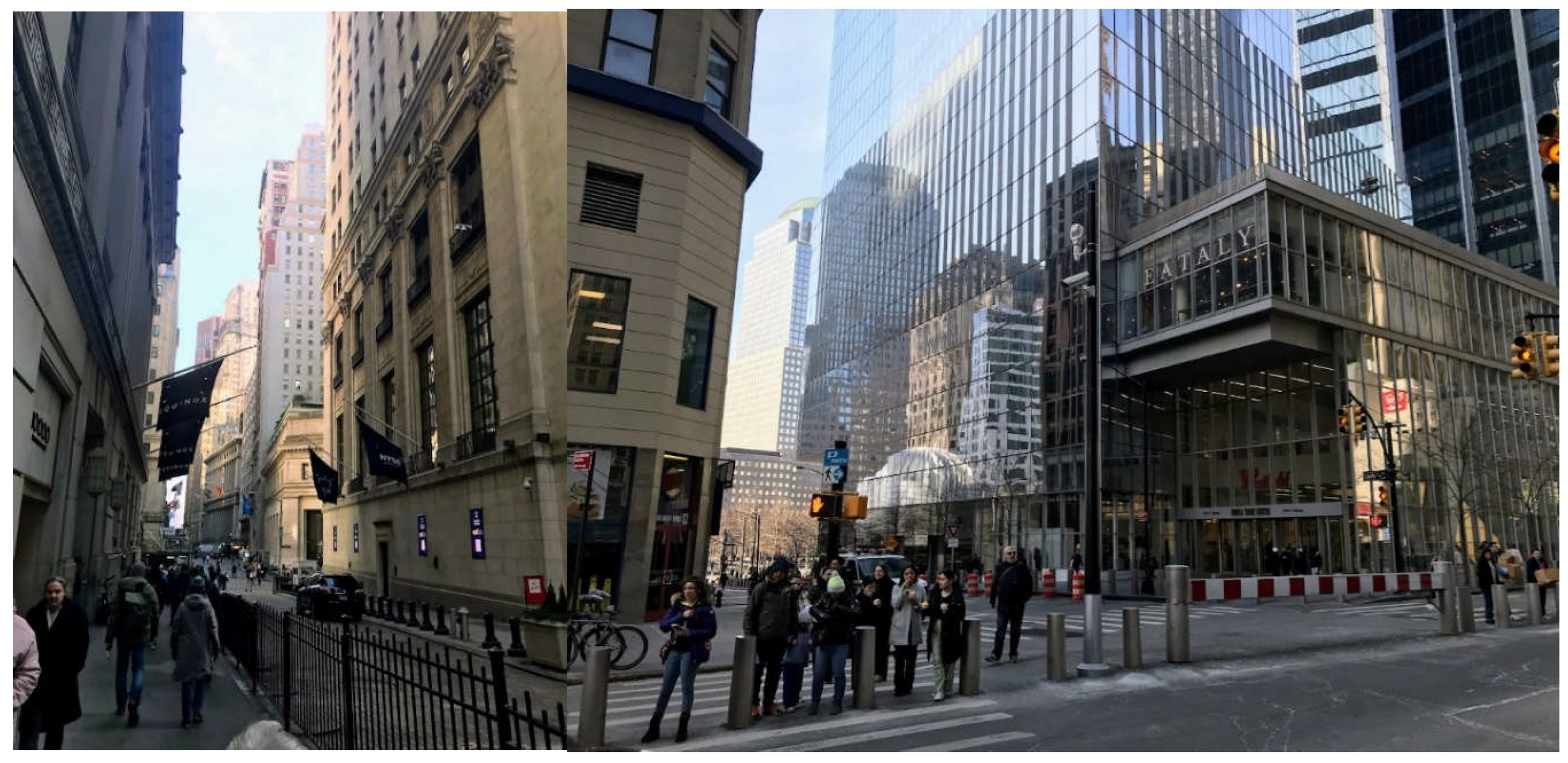
Figure 2.
Heat fluxes within the urban environment [43].
Figure 2.
Heat fluxes within the urban environment [43].
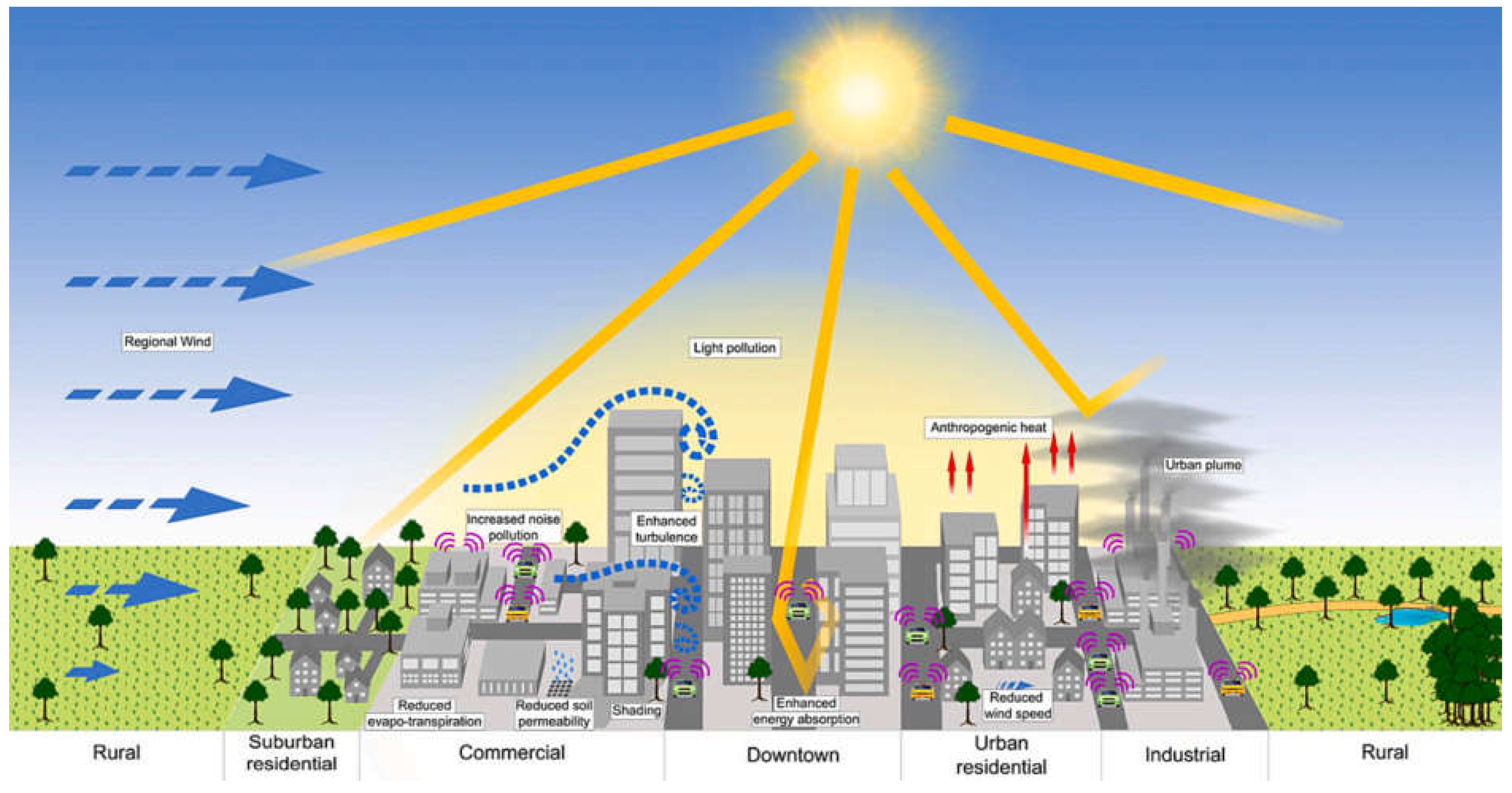
Figure 3.
A representation of the geometry of an urban canyon (H is the building height, W is the canyon width, and
Figure 3.
A representation of the geometry of an urban canyon (H is the building height, W is the canyon width, and
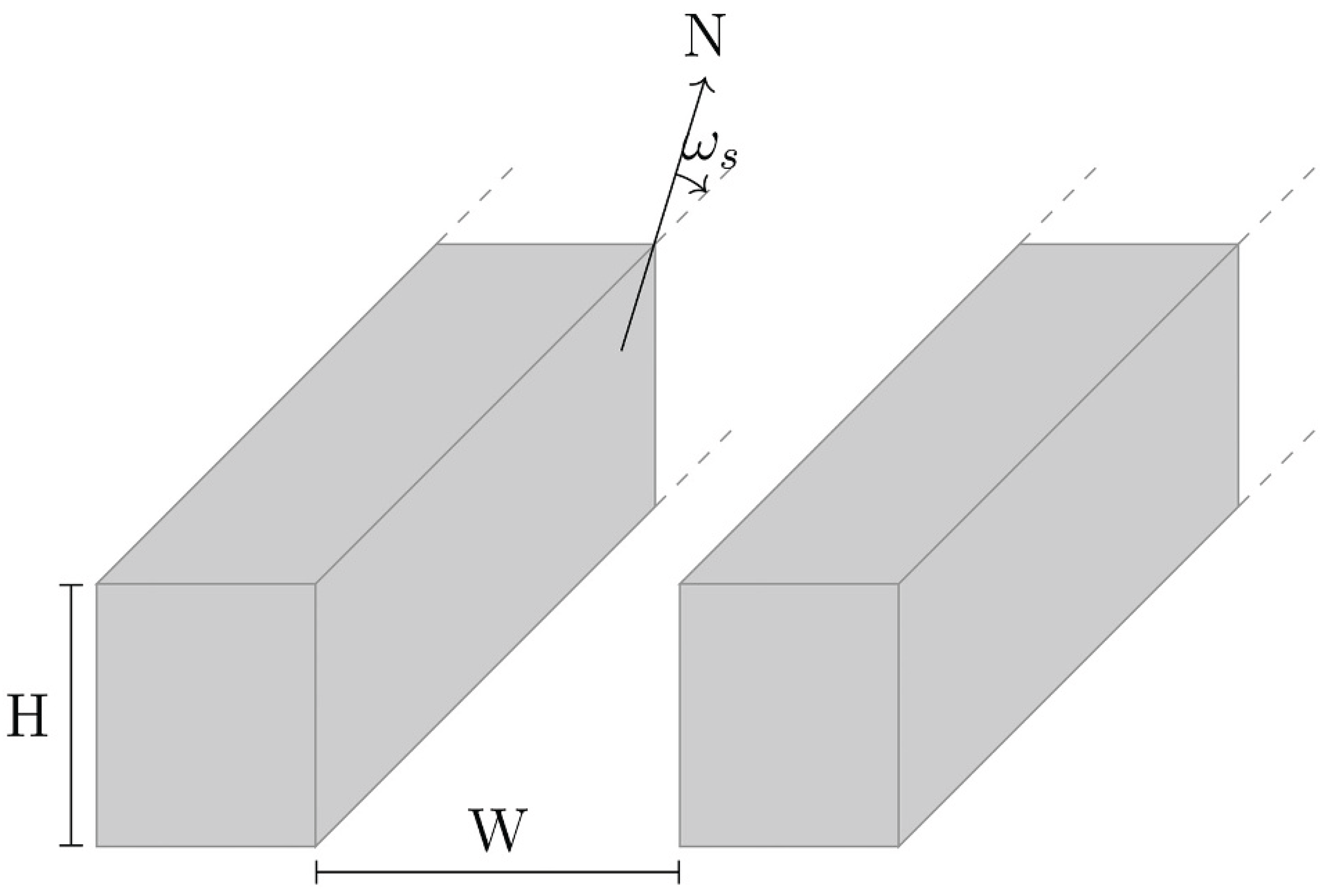

Table 1.
Impact of AR on outdoor thermal comfort and urban microclimate.
| Reference | Case study location | Aspect ratio (H/W) and other canyon characteristics | Methodology | Affected parameters (Objectives) | Main Results |
|---|---|---|---|---|---|
| [66] | Goteborg, Sweden | H/W equaled 1.4, sky view factor equaled 0.5. Canyon buildings were residential, symmetrical, and made of bricks. | Experimental investigation | Air temperature was measured in the canyon and in the open urban area for a period of 3 years | No great temperature differences were found between the canyon and the open urban area at least at the center of the city |
| [20] | Ghardaia, Algeria | Different canyons with H/W equal to 0.5, 1, 2, and 4 for a north-south and an east-west orientation. Northeast-southwest and northwest-southeast orientations were considered for H/W equal to 2. | Simulation with 3-dimensional numerical ENVI-met models | Thermal comfort | A comparative analysis of all scenarios indicated that the timing and duration of extreme heat stress events were heavily influenced by AR and street orientation. Both geometric urban factors could effectively mitigate extreme heat stress when combined appropriately. |
| [45] | São Paulo, Brazil | Sensitivity analyses were performed for two cases: (a) H/W equal to 0.5, 1, 2, 3, 4, 5, 7 and 10, and (b) Nine different canyon orientations with an aspect ratio equal to 1 | Simulation where an urban canopy layer model was coupled with a one-dimensional second-order turbulence closure model | Energy fluxes and urban air temperatures | The AR of the urban canyons greatly influenced the energy fluxes and temperatures in the urban areas |
| [67] | Seven idealized street canyons for simulation | ARs values from 0.5 to 8, two different air velocities 2.5 and 6.5 m/s, and various diurnal heating scenarios | Simulation with a computational fluid dynamics (CFD) numerical model coupled with photochemistry calculating transport equations for NO, NO2 and O3 | NO, NO2, and O3 pollutant concentrations | Different diurnal heating scenarios significantly influenced the exchange of reactive gases between street canyons and the air above. Additionally, higher building ARs and stronger ambient wind speeds generally lead to increased entrainment of O3 concentrations into street canyons along windward walls, regardless of diurnal heating conditions. |
| [53] | Theoretical case studies | Three different urban canyon ARs were considered for the case studies: 0.5, 1, and 43. Canyon orientations of 0, 45, and 90 degrees were used for each AR. | Simulation with a 3D CFD numerical model. Model results were validated through wind tunnel experiments. | Vertical velocity profiles | Air velocity values remained unaffected by the AR of the canyon. Furthermore, a shift in wind direction led to an increase in air velocity values, ranging from approximately zero to 2.5 m/s, despite an incoming air velocity of 2 m/s. |
| [68] | Central area of Thessaloniki, Greece | Experimental investigation was conducted in 18 street canyons for the winter and summer periods. ARs fluctuated between 0.6 and 3.3 and were divided into four groups: very wide (0.6 to 0.7), medium wide (1 to 1.1), medium deep (1.7) and very deep (2.8 to 3.3). Different orientations were considered. | Experimental investigation and simulations with ENVI-met | Outdoor thermal comfort conditions (PET) | During summer midday, variations in canyon orientation could result in comfort index differences of up to 22 °C, while differences in aspect ratio could cause variations of up to 4 °C. During the winter, these respective differences were equal to 4 and 7 °C. |
| [69] | Guangzhou, China | Scaled models of urban canyons with H/W of 1, 2 and 3 (height equal to 1.2 m and width varying from 0.3 to 1.2 m), and different thermal storage capacity (hollow concrete buildings and buildings filled with sand for higher capacity) | Experimental measurements | Outdoor air temperature profiles | During the day, street canyons with a lower H/W (equal to 1) tended to be warmer than those with higher ratios (H/W between 2 and 3) because a greater proportion of solar radiation is absorbed by the exposed wall and ground surfaces. At night, wider street canyons often cool down more rapidly due to enhanced longwave radiation emission from the larger surface area and improved night-time ventilation, which facilitates heat loss |
| [70] | Campinas, Sao Paulo, Brazil | 36 scenarios were simulated for winter and summer conditions for avenue canyons (H/W smaller than 0.5), regular canyons (H/W equal to 1), and deep canyons (H/W over 2). Short canyons (L/H less than 3), medium canyons (L/H equal to 5), and long canyons (L/H over 7) were also considered. | Simulation with ENVI-met | Air temperature, wind speed, and pedestrian thermal comfort | Canyons with a higher H/W enhanced wind speed and provided more shading from buildings, leading to improved thermal comfort for pedestrians, particularly during the summer. Furthermore, increasing the L/H did not significantly impact thermal comfort at the pedestrian level. |
| [71] | A typical urban area with residential buildings | Two scenarios with four configurations were simulated based on shallow (H/W less than 0.5) and deep (H/W over 3) street canyons | Simulation with CFD calculations in ANSYS-CFX 18 | Wind velocity, air temperature, urban heat island intensity | The configurations with H/W equal to 1 and L/W equal to 2 were the most effective for reducing air temperature and controlling UHI effects |
| [72] | Guangzhou, China | Five different H/W ratios were considered: 0.5, 1, 2, 3, and 6. Each ratio included six street canyons, except for the case where H/W was 6, which included four. | Experimental investigation. | Air temperature, west and east wall temperatures within 2D urban canyons | As H/W increased, no significant changes were observed in the canyon air temperature. Additionally, the temperatures of the east and west walls for H/W equal to 2, 3, and 6 were lower (ranging from 26.1 to 26.9 °C) and had a smaller diurnal temperature range (between 11.7 and 18.4 °C). H/W values of 0.5 and 1 had temperatures of 26.7 to 28.7 °C and diurnal temperature range (DTR) of 16.0 to 26.1 °C. |
| [73] | Guangzhou, China | Street canyons with different aspect ratios (H/W equal to 1, 2, 3, and 6) | Experimental investigation | Surface temperature values, wind velocities, short and long wave radiation fluxes. | Compared to H/W equal to 1, H/W values of 2, 3, and 6 resulted in an increase in daily total wave radiation by 11.41%, 14.41%, and 19.40%, respectively. Furthermore, during the daytime, surface temperature showed a negative correlation with the AR, whereas at night, the correlation was positive. |
| [74] | Toronto, Chicago, New York City, and Detroit (North America) | Three scenarios were considered for each case study, with H/W equal to 0.5, 2, and 8 | Simulation with numerical model coupled with energy balance | Air temperature and urban heat fluxes | During the daytime, a significant reduction in heat flux and air temperature occurred only in very large Urban Canyons Aspect Ratios (UCAR). In addition, an increase in the value of UCAR intensified UHI. However, no clear correlation was found between UCAR and the temperature of individual grid cells. |
| [75] | Colombo, Sri Lanka | One rural and five urban canyons were selected for the experiment with H/W varying between 0.1 and 1.2 | Experimental investigation | Air and surface temperature, wind speed, and humidity | Maximum temperatures showed a tendency to decrease with higher H/W and closer proximity to the sea. Additionally, a nocturnal UHI effect was observed at all urban sites. Finally, the temperature differences between sunlit and shaded surfaces in urban areas reached up to 20 °C, underscoring the importance of shade in urban canyons. |
| [21] | Fez, Morocco | Measurements were conducted in a deep canyon (H/W equal to 9.7) and a shallow canyon (H.W equal to 0.6) | Experimental investigation | Climatic parameters and thermal comfort | The following were found: (a) Daytime air temperatures varied significantly between deep and shallow canyons; (b) At night, deep canyons retained higher air temperatures than shallow ones; (c) Deep canyons exhibited a daytime cooling effect but formed heat islands at night; and (d) In hot, dry climates, very deep canyons are ideal—however, in regions with cold seasons, such as Fez, urban design should include wider streets or open spaces to ensure sufficient solar access. |
| [76] | Athens, Greece | Air temperature measurements were conducted within three deep urban canyons (H/W equal to 3, 2.1, and 1.7), during the nighttime in the summer and autumn. | Experimental investigation | Air temperature, nocturnal urban heat island intensity | Reducing the AR from 3 to 1.7 led to higher median cooling rates (1.1 and 1.85 °C), maximum cooling rates (0.57 and 0.86 °C), and minimum cooling rates (1.5 and 2.8 °C). |
| [77] | Constantine City, Algeria | Street canyons in a very dense urban structure area with H/W between 1 to 6.7. | Experimental investigation | Air temperature, ground surface temperature, and UHI intensity | A significant air temperature difference between the urban canyons and the neighboring rural areas was found of approximately 3 to 6 °C |
| [78] | North Africa | H/W varied from 0.5 to 4 with several selected orientations | Experimental investigation; measurements of temperature and shading simulations | Solar shading, air temperature in the canyon | Correlations were proposed between urban canyon geometry and microclimate, which can be beneficial in creating urban design guidelines that dictate street dimensions and orientations for urban planners |
| [79] | Athens, Greece | 10 urban canyons in the city center with H/W fluctuating between 1 and 2.5 | Experimental investigation; measurements of air temperature, wind speed and direction. | Night ventilation energy performance of a standard room in an urban setting, considering both air-conditioned and naturally ventilated conditions, with single-sided and cross-ventilation during the night | The effectiveness of the studied techniques was considerably diminished due to the rise in air temperature and the drop in wind speed within the canyons |
| [80] | Athens, Greece | An urban canyon at the center of Athens with H/W equal to 3.3 (7 meters in width, 40 meters in length, and 23 meters in height). Its orientation was 327.8 degrees from the north. | Experimental investigation, with measurements of air temperature, surface temperature, wind speed and direction. The air flow rate was measured in a ventilated building inside the canyon. | Natural ventilation in the urban canyon | The effectiveness of natural ventilation (both single-sided and cross-ventilation) in buildings situated within urban canyons, was significantly compromised. In the particular canyon studied, the airflow rate for single-sided and cross-ventilation configurations was reduced by 82% and 68%, respectively, compared to an undisturbed location. |
| [81] | Osaka, Japan | Two actual urban canyons were examined with H/W varying between 1 and 1.5 | Simulation with a simple urban canyon model that was used assuming uniform heigh for buildings | Net solar radiation gains in the canyon (roofs, walls, street) | AR was one of the most important parameters affecting solar radiation gains inside the canyon |
| [82] | Campinas, Brazil | The model canyon had a length of 500 m, with widths of 9, 21, and 44 m. Its height increased incrementally by 2.5 m, ranging from 5 to 40 m. Several orientations were considered. | A 3D street canyon model was created using RayMan Pro software [84] to simulate the impact of urban design on the thermal comfort conditions | Thermal comfort in urban canyons | Urban design factors like width, height, and orientation significantly impacted the thermal conditions within street canyons. Additionally, compared to other configurations, a NE-SW orientation was particularly effective in reducing PET during the day. |
| [84] | Tinos island, Greece | Two urban canyons were investigated: one traditional, with a rather high H/W (between 4 and 2), and one more modern, with a lower H/W (between 0.7 to 0.9). Parametric simulations were conducted for various orientations and H/W ratios, which varied among 0.6, 0.8, 1 1.3, 2 and 3. | Experimental investigation and simulation for analyzing shading. | Shading conditions and solar access | Across all H/W ratios, summer solar access ranked as follows: (E) < (W/NW) < (SE/NE) < (SW/N) < (S). Thus, E-W axis streets were most effective in reducing solar gains during summer. However, this advantage decreased significantly with higher H/W, as taller buildings and narrower streets limited its effectiveness. |
| [85] | Nanjing city, China | 64 urban canyon scenarios were simulated with different aspect ratios and orientations | Simulations with ENVI-met [87] and Rayman Pro [84] | Outdoor thermal comfort conditions | There was an inverse relationship between the street aspect ratio and the air temperature (Ta). This occurred because an increased aspect ratio can lead to reduced solar access and improved shading within the canyon, consequently lowering Ta. |
| [87] | Riyadh, Saudi Arabia | Two urban canyons were studies: a traditional deep canyon (H/W equal to 2.2) and a modern shallow canyon (H/W equal to 0.42) in a hot and arid climate. Both canyons run roughly in a northeast-southwest direction and were flanked by residential buildings. | Experimental investigation with measurements carried during the summer. Ambient air temperatures were measured within the canyon, and at roof level. The surface temperature of walls, roofs, and streets was also measured. | UHI and thermal comfort conditions | The UHI effect intensified as the H/W ratio decreases. Additionally, the air temperatures in deep and shallow canyons exceeded those in rural areas by 5% and 15%, respectively. Finally, the significant temperature rise in shallow canyons was due to extensive surface exposure to intense solar radiation. |
| [88] | Tunis, Tunisia | Different H/W were studied, from 4 to 0.25 | Simulation with ENVI-met. | Outdoor thermal comfort in a Mediterranean subtropical climate (hot, dry summer and cool, rainy winter) | A high H/W could provide favorable thermal comfort conditions during the summer. As the H/W increased, comfort levels improved, for example, comparing two scenarios with H/W values equal to 4 and 0.25 revealed a 8.48 °C difference in the Universal Thermal Climate Index (UTCI). |
| [89] | Harbin, China | Shallow (H/W less than 1), medium (H/W between 1 and 1.5), and deep canyons (H/W over 1.5) were studied | Measurements and simulations | Outdoor thermal comfort conditions (PET) in a severe cold climate of northeast China | In severe cold climates, shallow to medium canyons with H/W between 0.5 and 1.5 are more advantageous. Furthermore, deeper canyons with H/W greater than 1.5 were not recommended due to their insufficient solar absorption. |
| [90] | Tehran. Iran | 27 canyons were simulated with H/W from 0.6 to 2.5 to determine the optimal H/W for minimizing the effect of UHI on the microclimate. | Numerical simulations using ANSYS and thermal satellite images | Air temperature and UHI effect | ARs between 1 and 1.5 resulted in the lowest and most consistent temperatures under varying physical conditions |
| [91] | Santiago, Chile | The basic model consisted of an urban canyon with an H/W of 1 and a SVF of 0.3. Additional simulations were conducted for various urban canyon configurations, including H/W ratios of 0.5, 1.5. and 2.5, as well as several orientations. | Simulations with Rayman Pro | Thermal comfort conditions (PET) | The pattern observed indicated that, in the winter, heat stress increased as AR decreased, while in the summer, performance was stabilized with H/W values greater than 1.5. |
| [92] | Nagpur, India | Four urban canyons with a wide spectrum of aspect ratios reaching up to 1.6 and with different orientations and SVF | Measurements and simulations with Rayman Pro (climatic parameters) | Thermal comfort conditions (PMV, UTCI, and PET), and impact on microclimate | A significant correlation was found between the mPET index and microclimatic factors, which are affected by solar radiation. In addition, the impact of AR on outdoor thermal comfort conditions was strongly related to the orientation of the street canyon, being particularly notable for N-S orientation and not significant for E-W orientation. |
| [93] | Ahvaz, Iran | Six urban canyons were examined with H/W varying from 0.2 to 0.6. | Simulations with RayMan (PET), site micrometeorological measurements, and questionnaire survey | Outdoor thermal comfort in a hot climate | Decreasing H/W resulted in higher PET values |
| [94] | Western Sydney, Australia | Four representative case studies featured narrow and semi-wide streets (H/W from 0.5 to 2) | Simulations with ENVI-met | Outdoor thermal comfort (PET) in a humid subtropical climate | Varying the AR from 0.5 to 1 increased comfort hours by 30.59%, ranking second in its impact on thermal comfort after orientation. |
| [95] | Damascus, Syria | Three urban areas with H/W rations equal to 0.31 (lowest), 0.83 (moderate), and 2.95 (highest) were studied | Simulations with ENVI-met | Outdoor thermal comfort (PET) in a hot dry climate | In deep urban canyons, the interplay between aspect ratio, orientation, and vegetation significantly influenced surface temperatures and thermal comfort. Conversely, in streets with detached buildings, the impact of orientation and aspect ratio was minimal, while vegetation had a strong effect on both surface temperatures and comfort levels. |
Table 2.
Impact of orientation on outdoor thermal comfort and urban microclimate.
| Reference | Case study location | Orientation and other canyon characteristics | Methodology | Affected parameters (Objectives) | Main Results |
|---|---|---|---|---|---|
| [79] | North Africa | Several canyon geometries were applied, with street orientations varying in steps of 15° from north to east and H/W varying from 0.5 to 4 | Experimental investigation with measurements of temperature and shading simulations | Solar shading, air temperature in the canyon | A N-S street orientation with an H/W of 1.5 or greater could achieve street shading between 40% to 80% of the total area. Additionally, diagonal orientations (NW–SE and NE–SW) only provided 30% to 50% shading year-round. |
| [20] | Ghardaia, Algeria | Two primary solar orientations (N-S and E-W) were selected and analyzed across different H/W (0.5, 1, 2, 4). Intermediate orientations (NE–SW and NW–SE) were evaluated for an H/W of 2. | Simulation with a 3D numerical ENVI-met model | Outdoor thermal comfort (PET) in a hot and dry climate | Wide streets (H/W equal to 0.5) faced high thermal stress, with E-W streets being slightly worse. Furthermore, E-W streets were harder to cool due to minimal wall shading, even at H/W equal to 4. Finally, N-S streets with a H/W over 2 provided better thermal conditions, with lower PET peaks and shorter high-stress periods. |
| [104] | Sede-Boqer, Negev desert, Israel. | Different urban canyon geometries were tested varying street axis orientations aligned and perpendicular to the prevailing wind | Simulations for calculating the cooling load of a building | Energy consumption for cooling in a dry climate | High AR N–S streets could enable buildings to shade each other’s façades and windows, leading to a reduction in cooling demands. On the other hand, wide streets oriented along an E–W axis, with buildings facing north and south, maintained relatively low cooling loads even in the absence of mutual shading. |
| [105] | Tinos Island, Greece | Two urban canyons in a traditional and a modern urban area. N-S, E-W, NA-SW, and NW-SE orientations were selected for the simulations while the H/W ratio varied between 0.6 and 3. | Simulations with Rayman Pro (PET) | Outdoor thermal comfort and microclimate | The most favorable thermal comfort conditions were found in covered streets followed by the north-facing sidewalk on E-W streets. Additionally, N-S streets offered better comfort for H/W ratios of 0.8, 1.0, and 1.3. For ARs of 2.0 and 3.0, thermal comfort in N-S streets was comparable to that in diagonal streets. |
| [85] | Tinos island, Greece | Two urban canyons were investigated with the same street axes orientation. Parametric simulations were conducted for various street orientations (N-S, E-W, NE-SW, and NW-SE. Several ARs were tested. | Experimental investigation and simulation for analyzing shading | Shading conditions and solar access | Across all H/W ratios, summer solar access ranked as follows: (E) < (W/NW) < (SE/NE) < (SW/N) < (S). Thus, E-W axis streets were the most effective in reducing solar gains during summer. However, this advantage decreased significantly with higher H/W values, as taller buildings and narrower streets limited its effectiveness. |
| [89] | Tunis Tunisia | N-S, W-E, NE-SW and NW – SE orientations with H/W ratio values varying from 4 to 0.25 | Simulation with ENVI-met | Outdoor thermal comfort Mediterranean subtropical climate (hot, dry summer, and cool, rainy winter). | For all H/W configurations, streets oriented in the N-S direction tended to provide the highest degree of comfort, whereas those oriented in the W-E direction offered the least favorable conditions. |
| [69] | Central area of Thessaloniki, Greece. | Experimental investigation was conducted in 18 street canyons for the winter and the summer periods. Different orientations were considered (NWSE, NESW, EW, and NS). ARs fluctuated between 0.6 and 3.3. | Experimental investigation and simulations with ENVI-met | Thermal comfort conditions of pedestrian (PET) | The following were found: (a) Medium-wide canyons with NWSE orientations provided the most comfortable conditions year-round; (b) In medium-deep canyons, the SW side of NWSE orientations was most favorable in the summer; (c) During the winter, the NW side of NE-SW canyons was most comfortable at midday (around 17 °C) and showed the highest daily maximum PET; and (d) In very deep canyons, the shaded south side of EW canyons was ideal in the summer. In the winter, the SW side of NWSE canyons was most comfortable at midday (15.7 °C), while the west side of NS canyons recorded the highest daily maximum PET. |
| [94] | Ahvaz, Iran | Six urban canyons with predominant street orientations NNE-SSW and WNW-ESE. Among the studied sites, three were oriented NNE-SSW or near NS, while the other three were aligned WNW-ESE or near EW. H/W varied from 0.2 to 0.6. | Simulations with RayMan-(PET) as well as site micrometeorological measurements and questionnaire survey | Outdoor thermal comfort in a hot climate | Canyons with orientations closer to NS exhibited lower air temperature and MRT. In the NS-oriented canyons, the west-facing sidewalks showed reduced MRT and PET values in the morning, while the east-facing sidewalks experienced lower values in the afternoon. |
| [95] | Western Sydney, Australia | Four representative case studies featuring narrow and semi-wide streets with two main orientations: N-S and E-W, both with a 9-degree deviation. H/W varied from 0.5 to 2. | Simulations with ENVI-met | Outdoor thermal comfort in a humid subtropical climate | The orientation of street canyons was the most significant factor, accounting for 46.42% of the influence on PET.. |
| [90] | Harbin, China | Basic orientations studied were N-S, W-E (for branches) and NW-SE for shallow, medium, and deep canyons | Measurements and simulations | Outdoor thermal comfort conditions (PET) in a severe cold climate of northeast China | For a N-S canyon orientation, it was found that medium and shallow canyons provided better thermal comfort. For an E-W canyon orientation, AR values of 1 to 1.5 offered optimal thermal comfort. For a NW-SE canyon orientation, poor winter comfort was due to reduced morning and evening solar radiation. Finally, for a NE-SW canyon orientation, higher afternoon solar exposure necessitated more shading in summer but helped the canyon remain warmer in the winter. |
| [106] | Isfahan, Iran | The existing orientation was 76 degrees (E-NE). For simulations, orientation was altered to (N-S) and (E-W) (0 and 90 degrees). Several scenarios were applied: 60 (NE-SW), 150 (NW-SE), 120 and 60 degrees. | Simulations with ENVI-met and RayMan (PET). Validation with field measurements and questionnaires. | Outdoor thermal comfort (PET) in a hot and dry climate | An orientation of 150 degrees was optimal for thermal comfort, as it provided effective shading and significantly lowered MRT. |
| [92] | Santiago, Chile | The basic model included an urban canyon of H/W equal to 1 and an SVF equal to 0.3. Further simulations were conducted for various urban canyon configurations. The selected axes for solar orientation were E-W, N-S, NE-SW, and NW-SE, with H/W rations equal to 2.5, 1.5, and 0.5. | Simulations with Rayman Pro | Thermal comfort conditions (PET) | Preferred street orientations were N-S, NW-SE, NE-SW, and E-W. The N-S axis was best for buildings above six stories. The NW-SE axis was second-best for buildings above six stories, but it was also suitable for urban canyons of different scales with buildings up to six stories. The NE-SW axis was optimal for buildings above 10 stories with a street width of 20 m. Finally, the E-W axis required strong shade protection, such as trees or arcades, to protect public spaces. |
| [93] | Nagpur, India | Four urban canyons with N-S and E-W orientations and a wide spectrum of ARs | Measurements and simulations with Rayman Pro (climatic parameters) | Thermal comfort conditions (PMV, UTCI, and PET), and impact on microclimate | Outdoor thermal comfort conditions were strongly influences by the orientation of the street canyon, being particularly notable for the N-S orientation but negligible for the E-W orientation. Furthermore, a N-S oriented street with a high H/W resulted in the least physiological stress for the longest part of the day. |
| [107] | Tel-Aviv, Israel | Two canyon type courtyards were selected with H/W ratios equal to 0.6 and 0.48 and orientations close to N-S | Simulations and parametric analysis, and comparison with measured values | Microclimatic parameters and cooling effect of green areas. | The impact of orientation on air cooling in N-S oriented wooded clusters was found to be only marginally more effective than in E-W-oriented clusters. In a cluster with a H/W ratio of 1 and high wall albedo, the N-S orientation was approximately 0.64 °C cooler than the E-W orientation. |
| [108] | Bangkok, Thailand | One street canyon with a H/W ratio of 1.1 and N-S, NW-SE and NE-SW orientations | Simulations with ENVI-met BioMET and measurements for validation | Outdoor thermal comfort (PET) | N-S canyons offered the most comfort hours (31 to 46%), followed by NW-SE (23 to 46%) and NE-SW (23–38%) orientations. Additionally, E-W canyons provided the least favorable conditions and require further study. |
Table 3.
Impact of SVF on outdoor thermal comfort and urban microclimate.
| Reference | Case study location | Climatic & Urban environment characteristics/SVF Methodology | Main Objectives | Main Results |
|---|---|---|---|---|
| [111] | Goteborg, Sweden | A total of 17 stations were examined, including 16 in an urban and one in an open area. The fisheye photographic method was used to derive SVFs at different heights above ground level. | The impact of SVF on the urban air temperature was examined and analyzed with regression analysis. | There was a relatively strong correlation between SVF and air temperature during clear, calm nights. This relationship was evident not only in specific case studies but also on an annual average basis. |
| [78] | Constantine City (Algeria) | Street canyons were considered, in a very dense urban structure area with different geometric configurations. Fisheye photographs were taken at each station at a height of approximately 1.5 m above ground. | Examine air temperature within the canyons | A notable air temperature difference was observed of about 3 to 6 °C between the urban canyons and the surrounding rural areas. Furthermore, it was noted that higher SVF values generally corresponded to higher recorded air temperatures with few exceptions. |
| [89] | Tunis Tunisia | Three factors were considered for the urban canyons in a Mediterranean subtropical climate: AR, SVF, and street orientations. Fisheye photographs were taken. | Outdoor thermal comfort conditions were examined | Of the morphological indicators examined, H/W and SVF stood out as having a significant influence on external thermal comfort |
| [109] | Bari, South Italy | The study location was in a mediterranean climate with hot dry summers and mild winters. Geometric methods and SVF maps were generated using a 3D database within a geographical information system (GIS). | The relation between SVF and land surface temperature (LST) was investigated | A positive correlation between LST and SVF was established, with the trends being nearly identical for images taken by the same sensor but differing for those at varying resolutions. The differences were caused by micro-scale factors, such as the thermal properties of building materials, anthropogenic heat, humidity, pollutants, etc. |
| [23] | Isfahan, Iran | The climate was arid with hot and dry summers and cold winters. The fisheye photographic method was used. SVF and thermal comfort (PET) were computed by entering these fisheye photos and additional meteorological data into RayMan. | Field measurements were used to examine the relationship between SVF and various micrometeorological variables | Regression analysis revealed that SVF had the least impact on air temperature, while it significantly influenced mean radiant temperature and surface temperature. Additionally, a positive and significant correlation was found between SVF and PET. |
| [116] | Barcelona (Spain), Berlin (Germany), London (UK), New York (US), Nanjing (China), and Paris (France). | Six street models were studied, representing the core urban morphology (characteristic street patterns) of the six cities. SVF was computed by using fisheye lens photography of the urban street canyons as well as other relevant meteorological data. | The study used simplified street models to represent the typical urban morphology of the six major cities. Each model included a central main street with intersecting secondary streets. | SVF was negatively correlated with BD, the closing ratio (which measures the extent to which the street canyon or urban space is enclosed by buildings), and the symmetry ratio (indicating the geometric balance or symmetry of the street canyon). Conversely, SVF showed a positive correlation with the opening ratio (which is the opposite to closing ratio and represents the proportion of open space or gaps between buildings relative to the total area within a street canyon or urban space). |
| [117] | Harbin, China | The study area was in the Dwa climatic zone (Köppen climate classification), with dry summers and cold winters (some of the lowest temperatures in the region.). The SVF was determined using fisheye lens photography of urban street canyons, along with measurements of meteorological parameters. | SVF was used as an index to adjust and analyze the landscape morphology. The study focused on understanding the relationship between SVF and the thermal environment of a typical street canyon in Harbin. | The following were found for typical street canyons with an AR of 0.5: (a) Both temperature and mean radiant temperature initially decreased and then rose as the SVF decreases; (b) RH showed an initial increase followed by a decline; and (c) There was a statistically significant quadratic relationship between SVF and the temperature, RH, and MRT within the street canyon. |
| [94] | Ahvaz, Iran | Six urban canyons were examined in a hot and arid climate in Koppen Geiger classification (designated as BWh). Measurements, and simulations with ENVI-met and Rayman. | The impact of SVF on outdoor thermal comfort conditions was investigated | There was a strong correlation among SVF and both PET and MRT across various locations, with Pearson correlation coefficients at noon ranging between 0.75 and 0.93. Furthermore, no significant correlation was found between SVF and RH at any of these sites. Finally, shading had no significant effect on air temperature (Ta), leading to a lack of correlation between Ta and SVF. |
| [48] | Austin, Texas, USA | The case study area exhibited significant variation in building heights, with open and green spaces scattered throughout. Fisheye lens photography was used. | The influence of urban geometry and of the most important meteorological parameters on the urban thermal environment and microclimate was investigated in this case study | The investigated urban geometry factors, such as SVF, floor area ratio (FAR), and Building Coverage Ratio (BCR), affected the microscale thermal environment in urban street canyons. Building on these results, a model was developed to estimate the microscale UHIs, which influenced the microscale thermal environment. |
| [93] | Nagpur, India | The study focused on tropical wet and dry climate according to the Köppen climate classification. Four urban canyons with orientations N-S and E-W and a wide spectrum of Ars were studied with fisheye lens photography used for the SVF. | Impact of thermal comfort conditions (PMV, UTCI, and PET), on microclimate | The minimum SVF played a significant role in both studied street orientations by blocking solar radiation. Additionally, as a combination of AR, trees, and other built structures, SVF can be adjusted without changing the AR. |
| [118] | Beijing, China | The study considered an urban area in the humid continental monsoon climate. Fisheye lens photography was used for SVF. Climatic parameters (air temperature) were measured for day and night, summer and winter. | Multiple regression was used to analyze the impact of landscape design parameters on urban air temperature variability | It was found that (a) Greater building area correlated with higher air temperatures; (b) Increased vegetation cover correlated with lower air temperatures; (c) Site geometry significantly influenced temperature regulation; (d) Daytime air temperature rose with higher SVF; and (e) Nighttime air temperature decreased with higher SVF. |
| [119] | Hong Kong | The study was carried out in a humid-subtropical climate. 3D GIS technology was used for SVF. | The study addressed the impact of SVF on UHI. A parametric study established a connection between SVF and two key planning parameters: site coverage ratio and building height. | A 10% increase in the average SVF could lead to a decrease in air temperature by approximately 0.48 °C. Urban planners can strategically manage site coverage ratio and building height to enhance the SVF, thereby reducing UHI effects in densely populated urban areas. |
| [120] | Mendoza, Argentina | The study climate was semi-arid, characterized by hot summers, mild winters, and low annual rainfall. The nighttime UHI effect reached up to 10 °C during all seasons. Fisheye lens photography was used for SVF. | Thermal comfort and energy balance were calculated | The absorbed solar radiation and the re-emitted radiation were the key components influencing the energy budget in thermal comfort calculations. These variables were affected by (a) the SVF, which is shaped by the arrangement of urban elements, buildings, and green spaces, and (b) the thermophysical properties of materials, which dictated surface temperatures. |
| [121] | Athens, Greece. | The mediterranean climate of the study area is characterized by hot, dry summers and mild, wet winters. Selected urban areas for the analysis featured various configurations of trees and buildings. | The study addressed the impact of SVF, environmental layout, and vegetation coverage on outdoor thermal comfort conditions (PET). | Sites with lower SVF values and dense vegetation provided better human biometeorological conditions. Additionally, higher SVF values and nearby buildings were associated with less favorable conditions. Finally, significant correlations were observed between SVF values and various biometeorological indices. |
| [122] | Huwei, central Taiwan | The climate of the study area was subtropical with hot, humid summers and mild winters, with significant rainfall throughout the year. Six measurement locations were examined with fisheye photographs for SVF. Across the six locations, the SVF varied significantly, ranging from a heavily shaded location (SVF equal to 0.04) to a minimally shaded location (SVF equal to 0.808). | The study addressed the impact of shading on the long-term thermal environment by assessing the comfort levels of local residents using 10 years of meteorological data. | Locations with minimal shading (high SVF) were uncomfortable in the summer, while highly shaded locations (low SVF) were uncomfortable in the winter. Locations with moderate shading provided the longest periods of thermal comfort throughout the year. |
| [123] | Shanghai, China | The study area had a humid subtropical climate. Extensive field measurements were carried out. | The study considered the microscale impacts of urban form and density (including buildings and greenery) on outdoor ventilation potential by utilizing empirical data gathered from extensive field measurements. | A 10% increase in SVF could lead to a 7 to 8% rise in wind velocity ratio. |
| [124] | London, UK | Three areas high, medium, and low building densities were selected in central, west, and north London. | The study examined the connections between urban geometry factors and solar availability indicators over various time periods. The seasonal solar performance of urban form façades and ground surfaces was also examined. | The mean ground SVF and diffuse irradiance were strongly affected by mean outdoor distance, site coverage, directionality, and layout complexity. Additionally, for façades, key factors included layout complexity, building height variation, and directionality. Finally, the factors influencing mean direct irradiance varied by season, driven by solar altitude angles—lower in January and higher in July. |
| [125] | Curitiba, Brazil | The study area climate was temperate oceanic with dry winters. Measurements of climatic parameters along with fisheye images were taken at each monitoring point in order to calculate the SVF. | The study aimed to study the impact of SVF (as an urban geometry indicator) on pedestrian thermal comfort conditions | On hotter days, areas with higher SVF, meaning less sky obstruction, tended to cause greater heat discomfort. However, these same areas could offer comfort on cooler days. Furthermore, no significant correlation between the diurnal urban heat island effect and SVF was observed. Finally, a relatively strong correlation (with a Pearson correlation coefficient of 0.71) was found, indicating that SVF is a significant factor in air temperature variations. |
| [126] | Beijing, China | The study area had a typical humid continental monsoon climate | The study targeted the impact of SVF on outdoor thermal conditions and PET in Beijing’s central business district | Compared to less shaded areas, highly shaded areas (SVF less than 0.3) experienced fewer instances of hot conditions during the summer while enduring extended periods of cold discomfort in the winter. Moderately shaded areas (with an SVF between 0.3 and 0.5) and slightly shaded areas (SVF over 0.5) on the other hand tended to have a more balanced thermal perception, with less extreme variations between hot and cold conditions. |
| [127] | Atisaz in Tehran, Iran | The area had a semi-arid climate with hot, dry summers, cool winters, and significant urban heat island effects. Measurements and simulations with ENVI-met were carried out. Four categories of SVF were considered (with the indicated value ranges in parentheses): open space (0.75<SVF<1), semi-open space (0.5<SVF<0.75), semi-dense space (0.25<SVF< 0.5), and dense space (SVF<0.25). | The study targeted the impact of SVF on air temperature | The following were found: (a) Before and after warm hours, air temperature increased as SVF decreased (negative correlation); (b) During warm hours, higher SVF values correlated with positively higher air temperatures; (c) Open spaces with high SVF had higher temperatures, while shaded, low-SVF spaces remained cooler; (d) A weak SVF-air temperature correlation was noted at 9 am; and (e) Optimizing SVF was a key to achieving balanced day and night temperatures. |
| [128] | Beijing, China | The study area had a humid continental monsoon climate. Seven building indicators were considered, including average building height (BH), average BD, ratio of building surface area to plan area (λB), FAR, SVF, frontal area index (FAI), and building shading (BS). | The study aimed to examine the relationship between urban morphology and urban microclimate across various spatial scales (30 m to 1 km) and temporal scales (diurnal and seasonal). | The influence of morphological indicators on annual wind speed weakened with spatial scale, while their effect on air temperature (Ta) and RH initially decreased and then increased. Additionally, morphological factors most strongly affected meteorological parameters (Ta, wind speed, and RH) at the 30 m scale, with SVF being the dominant factor. Finally, urban microclimate effects varied diurnally as vegetation impacted air temperature more at night, and SVF was especially critical at night in the winter. |
Table 4.
Synergistic interactions between urban geometry parameters and vegetation.
| Reference | Case study location | Urban geometry and vegetation | Main Objectives | Main Results |
| [158] | Seoul, South Korea | Simulations were based on an AR of 1.5 and a tree spacing of 6 m, resembling real-world conditions. Additionally, the study explored various ARs (H/W equal to 0.5, 1, and 2) and a denser tree spacing of 2 m to assess their impact on thermal comfort and microclimate. | Thermal comfort and microclimatic parameters calculations with ENVI-met (PMV) | The following were found: (a) An urban canyon with an AR of 1.5 and 2 m tree spacing showed the lowest temperature, MRT, and PMV; (b) A 2 m tree spacing at an AR of 2.0 would likely enhance thermal comfort further, as both PMV and MRT improved with this AR; and (c) At an AR of 1.5 and 2 m tree spacing, temperatures were lowest at a value of 35.91 °C (12:00 pm, 0 degrees wind) and 36.09 °C (90 degrees wind). |
| [156] | Bilbao (Basque Country, Spain) | Three types of canyons were selected: (a) B/T of 0.8 and H/W of 3.5 (low-rise), (b) B/T of 0.6 and H/W of 1.5 (mid-rise), and (c) B/T of 0.4 and H/W of 1.3 (high-rise), where B/T represents the ratio of building surface to the total area of the canyon. For each type of canyon, seven vegetation scenarios were considered: S0 (current situation), S1 (finishing materials of ground surfaces), S2 (grass), S3 (grass and trees), S4 (GRs), S5 (grass and GRs), and S5 (grass, GRs and trees). | Thermal comfort and microclimatic parameters calculations with ENVI-met (PET) | High ARs increased shadowing but could also limit ventilation, impacting surface temperature, MRT, and the PET index. Additionally, H/W and ground surface materials significantly affected the intensity and duration of discomfort periods (PET over 23 °C). Finally, greening combined with appropriate ARs was essential for mitigating thermal stress in different canyon configurations. |
| [32] | Port Phillip, Melbourne, Australia | Two street canyons (A & B) were considered: (a) Street A was oriented east-west, wide (30 m), with low-rise buildings (two stories, 6 m), an H/W of 0.2, and scattered small trees unlikely to develop large canopies; (b) Street B was also oriented east-west, narrow (5 m), with low-rise buildings (two stories, 6 m), and an H/W of 1.2. No other urban GI was present. | Developed a five-step framework for prioritizing GI to improve urban microclimate | The following were proposed: (a) For street canyon A, plant wide, dense-canopy trees at higher frequency, particularly on the sun-exposed southern side; (b) For street canyon B, install a GW or narrow hedge on the north-facing wall to improve thermal comfort; (c) Street trees effectively lowered surface temperatures in canyons with H/W less than 0.8, but their cooling effect diminished as H/W exceeded 0.8; (d) In narrow canyons with sufficient light, green walls, facades, and ground-level vegetation should be prioritized over trees due to space limitations; and (e) Higher H/W ratios reduced light availability and increased wind turbulence, challenging plant survival. |
| [138] | Wuhan, central China | Eight street canyon geometries were considered by varying two orientations (N-S, E-W) and four H/W ratio values (1, 1.5, 2, and 3.0). The morphological parameters of street trees included LAD (0.2 to 3 m²/m³), tree height (8 to 12 m), trunk height (greater than 3 and less than or equal to 3 m), and tree crown diameter (4 to 8 m). | Thermal comfort calculations (PET) with various combinations of urban geometry and tree forms were carried out. The study developed a framework for tree species selection, considering tree characteristics and canyon geometry, e.g., Ars and orientations. | Optimal geometry and vegetation combinations included an E-W and N-S orientation. For the E-W orientation: (a) An H/W equal to 1 indicated dense LAD, necessitating a high priority for vegetation, with tree planting on both sides; (b) An H/W of 1.5 indicated dense or moderate LAD; (c) an H/W of 2 indicated dense or moderate LAD, with medium priority for vegetation, and tree planting on both sides; and (d) an H/W of 3 indicated by dense LAD, requiring a low priority for vegetation, with a focus on tree planting on the northern side. For the N-S orientation: (a) A H/W of 1 indicated dense LAD, with a high priority for vegetation, with tree planting on both sides; (b) A H/W of 1.5 indicated dense LAD, with medium priority for vegetation, and tree planting on both sides; (c) A H/W of 2 indicated dense or moderate LAD; and (d) A H/W of 3 indicated dense or moderate LAD, low priority, with a focus on tree planting on the western side. |
| [105] | Tinos Island, Greece | A traditional and a modern urban canyon in two different urban areas were studied. N-S, E-W, NA-SW, and NW-SE orientations were selected for the simulations, while H/W varied between 0.6 and 3. Street trees were used for the simulations. | Outdoor thermal comfort and microclimate simulations with ENVI-met | Trees had a stronger influence on reducing PET values on E-W streets, particularly on the south-facing side. Additionally, planting large trees (5 m in diameter) closely spaced along E-W streets created a cooling effect similar to that of covered streets. Finally, on N-S streets, trees still improved thermal comfort, but the effect was less dramatic due to thermal conditions being already adequate. |
| [34] | Hong Kong | The base scenario modeled four street canyons with varying ARs (ARB of 1, 2, 3, and 4), along with trees of three different ARs (ART of 1.7, 3.3 and 5). The modeled trees all had the same LAI of 3 but varied in LAD, distributed across three different tree heights (5, 10, and 15 m). Each tree had a consistent crown diameter of 3 m and a trunk height of 2 m. Sensitivity analysis was carried out for an ARB of 2 and an ART of 3.3, meaning that treed were 10 m tall with a 3 m crown width. LAI was set to 3, but the effect of LAI being equal to 1, 2, 4, 5, and 6 was also investigated. | Outdoor thermal comfort (PET) and microclimate simulations with ENVI-met | It was found that trees, irrespective of their configuration, lowered thermal sensation from “very hot” to “hot” across all street canyon ARs. Additionally, the enhancement in thermal comfort, indicated by PET, diminished as the street canyon aspect ratio increased. Finally, variations in tree aspect ratios influenced the PET reduction, suggesting that the distribution of LAD at varying tree heights played a more significant role in improving thermal comfort than the height of the tree trunk height or LAI. |
| [35] | Hong Kong | Four different configurations were considered for the simulations: open area without trees, open area with trees, street canyon without trees, and street canyon with trees. Four ARs were evaluated, combining the selected building heights with typical street widths. All streets were modeled with a symmetrical N-S orientation and a length of 60 m. | Outdoor thermal comfort (PET) and microclimate were simulated with ENVI-met | The following findings were observed: (a) Trees should be included in deep canyons, although their impact on thermal comfort diminishes due to stronger shadowing; (b) Less dense canopies are suitable for deep canyons, while denser canopies are more effective in shallow canyons; (c) In deep canyons, tall trees with low LAI can balance thermal comfort and ventilation; (d) For shallow canyons and open spaces, medium-height trees with high LAI and wide crowns are ideal; (e) Tree species influence thermal comfort differently during the day and night, depending on configuration and the street layout; and (f) Taller trees with varying LAI provide distinct thermal comfort benefits depending on the street width and canyon geometry. |
| [36] | Seoul, South Korea | Studies street canyons were narrow and wide with an E-W orientation, featuring pedestrians on the northern sidewalks. Vegetation included trees of varying size (small, medium, large, and very large). | Simulations for calculating MRT were carried out. MRT was assessed by examining how tree size and spacing influence solar shading and longwave radiation exchange. | It was found that MRT decreased significantly with narrower tree spacing, especially for smaller trees. Additionally, on the south-facing side of E-W streets, tree size impacted thermal comfort more than street size. Furthermore, MRT reduction was primarily due to trees blocking direct shortwave radiation, lowering reflected and emitted radiation from walls and sidewalks. Finally, optimal tree spacing enhanced pedestrian thermal comfort: smaller trees required closer spacing for shading, while larger trees remained effective with wider spacing. |
| [108] | Bangkok, Thailand | Street canyons with an H/W of 1.1; N-S, NE–SW, and NW–SE orientations; and a SVF of 0.592 were studied | Outdoor thermal comfort (PET) was simulated with ENVI-met. Measurements were used for validation. | In hot and humid climates, shading from trees and buildings played a crucial role in the design, lowering PET values by as much as 8.6 °C for trees and 14.2 °C for buildings. Additionally, the introduction of tree planting notably increased the number of thermal comfort hours in avenue canyons (i.e., with an H/W ratio smaller than 0.5 as noted previously), especially in those with aspect ratios between 0.5 and 0.7. Furthermore, canyons with a N-S orientation yielded the most comfort hours (31 to 46%), followed by those with NW-SE and NE-SW orientations. Finally, tree planting had a substantial positive impact on outdoor thermal comfort in avenue canyons, improving conditions by up to 82%, though the effect was less pronounced in regular canyons. |
| [37] | Hong Kong | A total of 54 generic tree forms were integrated with 10 distinct urban morphology types characterized by their SVF | Thermal comfort (PET) was simulated with ENVI-met | Tree species regulated temperature differently, with daytime cooling effects of 0.3 to 1 °C and nighttime effects of 0 to 2 °C, depending on the tree form and the SVF. Additionally, the heat reduction potential (HRP) of trees ranged from +5% to –20%, with negative values indicating reduced heat and improved thermal comfort. Finally, in areas with lower SVF, tree HRP declined due to shading competition from nearby buildings, with effectiveness varying by species. |
| [38] | Taipei City, Taiwan | Street canyon: H/W= 1, with buildings on both sides standing 40 meters tall. The sidewalks on both sides of the street are each 2 meters wide. Orientations: NS and EW. Vegetation: Different LAI trees were considered |
Outdoor thermal comfort (PET) and microclimate. Simulations with ENVI-met | (a) Increasing tree LAI from low to high reduced mean Tmrt by 5.5 °C and PET by 3.2 °C on E-W roads, and by 3.0 °C and 1.7 °C on N-S roads. (b) E-W roads benefited more from high LAI trees than N-S roads. (c) Adding a planting strip in the middle of the road had minimal impact, reducing Tmrt (<1.7 °C) and PET (<1.2 °C). (d) On cold, windy days, high LAI trees can provide insulation, creating a warmer environment. (e) High LAI trees should be prioritized to mitigate thermal effects of road orientation and improve pedestrian comfort. |
| [39] | Guangzhou, China | Street canyons with H/W values equal to 1, 2, and 3 were studied. The primary vegetation factors considered were tree crown coverage and planting density (). | Thermal comfort simulations and measurements (PET) were carried out | The following findings were observed: (a) With a planting density of 1, large crown trees lowered daytime PET by up to 4 °C in streets with H/W of 1 and 2, enhancing thermal comfort; (b) Small crown trees had a warming effect on PET but a cooling effect on the index of thermal stress (ITS) in streets with H/W ratios of 2 and 3; (c) Both tree types showed an increase in nocturnal PET and ITS in streets with an aspect ratio of H/W equal to 2; (d) Lowering tree density from 1 to 0.5 increased PET and ITS during the day for large crown trees, diminishing thermal comfort in wider streets (H/W = 1, 2); and (e) Narrow streets had lower illuminance, PET, and ITS due to the stronger shading effect of walls. |
| [40] | Hong Kong | Street canyon orientation included NW-SE and EW. To investigate tree species selection under the 30% GCR condition, nine scenarios were evaluated. Eight of those scenarios focused on a single tree species, chosen from the eight most common species in Hong Kong. The final scenario incorporated a mixture of tree species to examine their collective impact on thermal comfort and energy efficiency. Finally, an SVF-based tree selection scenario used SVF to guide tree species selection for urban planting. | Thermal comfort (PET) and energy efficiency were simulated with ENVI-met | Vegetation helped reduce temperatures both horizontally and vertically (up to a height of 20 m). The cumulative cooling effect ranged from 5.3 °C at 7% GCR to 7–11 °C at 30% GCR. Differences in the 30% GCR scenarios emphasized the significance of tree species. Additionally, LAI was the most influential factor in achieving thermal and energy savings, followed by trunk height, tree height, and crown diameter. Finally, in areas with low SVF, trees with low foliage density and high trunk height were advised, while in open areas with shallow canyons and high SVF, trees with dense foliage were recommended. |
Disclaimer/Publisher’s Note: The statements, opinions and data contained in all publications are solely those of the individual author(s) and contributor(s) and not of MDPI and/or the editor(s). MDPI and/or the editor(s) disclaim responsibility for any injury to people or property resulting from any ideas, methods, instructions or products referred to in the content. |
© 2026 by the authors. Licensee MDPI, Basel, Switzerland. This article is an open access article distributed under the terms and conditions of the Creative Commons Attribution (CC BY) license (http://creativecommons.org/licenses/by/4.0/).
Copyright: This open access article is published under a Creative Commons CC BY 4.0 license, which permit the free download, distribution, and reuse, provided that the author and preprint are cited in any reuse.


