
Preprint
Article

This version is not peer-reviewed.

Effect of Oral Supplementation with Lactobacillus reuteri CLP4 on Growth Performance, Carcass Traits, Organ Weights, Cecal Microbiology, Tibial Mineralization, Blood Indicators and Nitrogen and Phosphorus Excretion in Broilers

Submitted:

13 March 2026

Posted:

17 March 2026

You are already at the latest version

Abstract

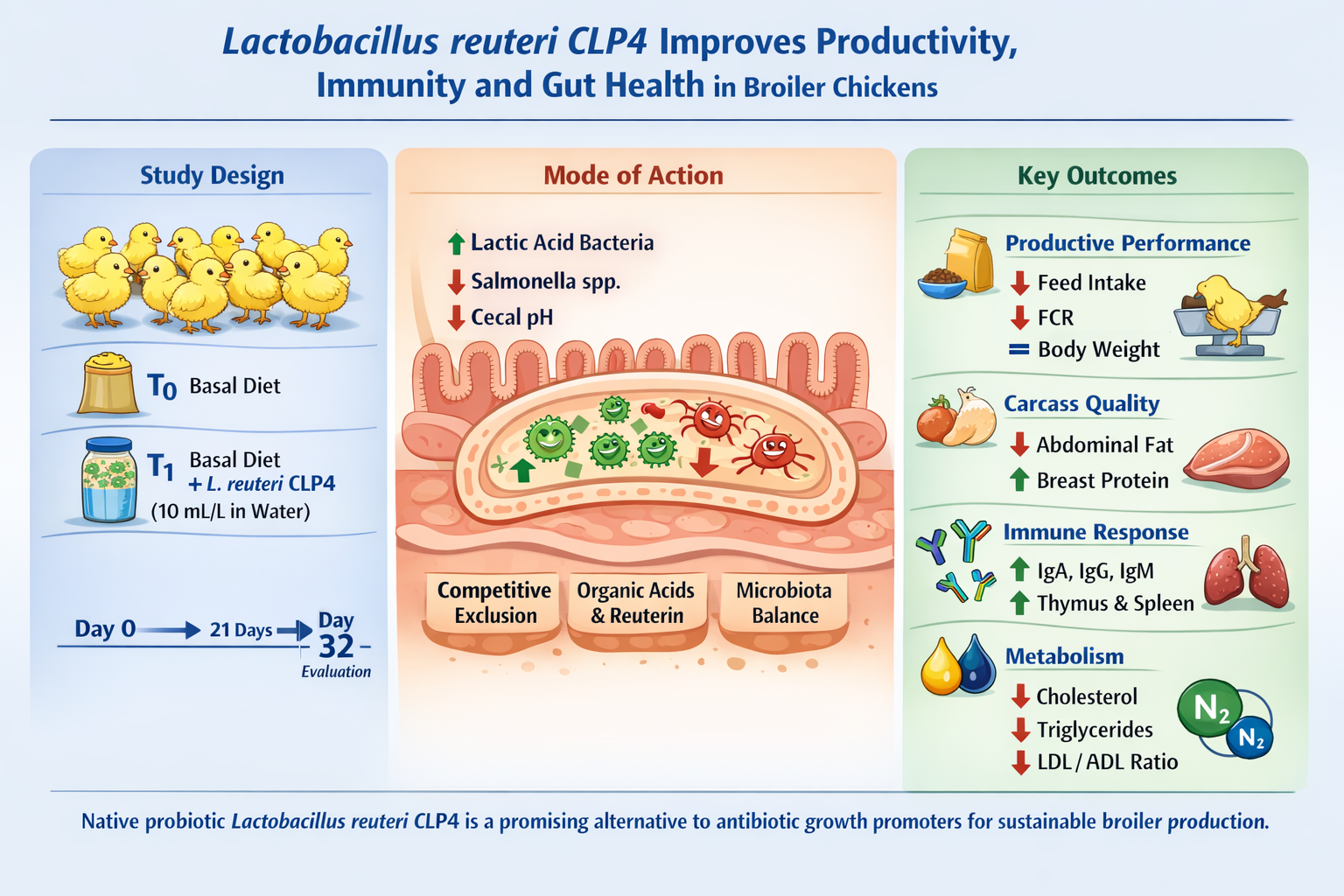
In recent years, the poultry industry has actively sought more sustainable feed additives to address the various challenges of intensive production. To evaluate the oral effect with Lactobacillus reuteri CLP4 on performance, carcass traits, organ weights, cecal microbiology, tibial mineralization, blood indicators, and nitrogen and phosphorus excretion in broilers, 800 one-day-old unsexed Ross 308® chicks were randomly assigned to two treatments: a basal diet (T0; BD) without additives and BD+Lactobacillus reuteri CLP4 (T1) in the drinking water during the period from 0 to 21 days old. T1 decreased feed intake and feed conversion ratio without affecting body weight or viability of broilers. Likewise, it diminished abdominal fat and improved breast protein content. The probiotic also increased the relative weights of the thymus, spleen, liver, and pancreas, decreased the population of Salmonella spp. and cecal pH, and promoted the growth of lactic acid bacteria. Moreover, T1 improved serum immunoglobulin concentrations and decreased harmful serum lipids and nitrogen excretion, although without modifying the moisture, calcium, and phosphorus content of the tibia or phosphorus excretion. Oral supplementation with Lactobacillus reuteri CLP4 enhances productivity, breast protein, immune function, atherogenic index, cecal competitive exclusion, and reduces the environmental nitrogen load in broiler production.
Keywords: 
;  ;  ;  ;  ;  ;  

1. Introduction

In broiler chicken production, the expression of genetic potential and meat yields are closely related to intestinal health [1]. It is known that this organ is immature in the early life stages of birds and is exposed to colonization by pathogenic microorganisms, especially in intensive production systems [2,3]. In previous decades, to reduce or prevent this problem, the use of antibiotics as growth-promoting additives (AGP) was introduced in animal feeding and management systems [4]. However, despite the advantages of their use, such as improved productive performance and reduced bird mortality, their indiscriminate use has been associated with microbial resistance, cross-resistance, dysbiosis, thinning of the intestinal wall, and the accumulation of residues in edible tissues and the environment, which directly affects consumers [5,6].
For this reason, many countries have limited and subsequently banned the use of AGPs in production systems [7]. Consequently, companies, producers, and nutritionists have had to seek effective strategies for AGPs that exhibit antimicrobial, immunomodulatory, antioxidant, anti-inflammatory, and antidiarrheal properties [8]. In this sense, there is still great interest in new generation probiotics, prebiotics, postbiotics, symbiotics, organic acids and phytogenics, with new nutraceutical properties and more adaptable to the production conditions of broiler chickens [5,9]. Among these alternatives, probiotics are considered one of the most effective and viable strategies, as they can reduce the negative effects of stress, maintain the balance of the intestinal microbiota, modulate the immune system and antioxidant status, enhance intestinal histomorphometry, improve nutrient absorption, and therefore productive animal performance [10].
In this sense, Lactobacillus is one of the most widely used bacterial genera in the development, evaluation and application of probiotics in animals [11]. Several of its species and different strains are used in studies related to the subject and in the manufacture of single- or multi-strain probiotic products [12]. Among them, Lactobacillus reuteri is a species naturally found in the intestines of mammals and birds, known for producing metabolites such as lactic acid and reuterin [13]. In this sense, Wang et al. [14] reported that supplementation with Lactobacillus reuteri XC1 improved feed efficiency of broiler chickens for 42 days old. Similarly, Sureshkumar et al. [15] demonstrated that oral administration of Lactobacillus reuteri 3D8 reduced populations of Escherichia coli and Salmonella spp., which improved the growth performance of broilers. Recently, our laboratory isolated several bacterial strains from the cecal contents of Creole roosters in Zamorano, Honduras. These strains were characterized using biochemical and molecular techniques as well as in vitro tests evaluating growth under different temperatures, pH levels, NaCl2 concentrations, and bile salt concentrations, along with antimicrobial activity and antibiotic sensitivity tests [16]. Based on these results, Lactobacillus reuteri CLP4 was selected as a probiotic candidate for the in vivo experiment. Therefore, the objective of this study was to evaluate the effects of oral administration with L. reuteri CLP4 on growth performance, carcass traits, organ weights, cecal microbiology, tibial mineralization, blood indicators, and nitrogen and phosphorus excretion in broilers.

2. Materials and Methods

All the procedures adopted in carrying out this experiment were approved by Animal Care and Committee of Zamorano University, Honduras, and conducted in accordance with the Guidelines for Experimental Animals (approval number: M21015).

2.1. Experimental Location

The research was carried out at the Poultry Research and Teaching Center at the Zamorano University14°00′36″N 87°00′40″W, located in the Yegüare Valley, km 32, municipality of San Antonio de Oriente, Francisco Morazán, Honduras. The poultry unit is located at 800 m above sea level, with an average annual rainfall of 1,125 mm, and an average temperature of 27 °C.

2.2. Probiotic Biopreparation

For this study, the results of isolation (from the cecal content of Creole roosters fed without antibiotic growth promoters), selection, in vitro characterization [16] and deposited in GenBank (https://www.ncbi.nlm.nih.gov/nuccore/2418192458) of the Lactobacillus reuteri CLP4 strain were considered. The bacteria were inoculated at 10% (v/v) in a biopreparation developed by Betancur et al. [17] and placed on the orbital table for 48 h at 150 rpm, the concentration of the strain used was 108 CFU/mL.

2.3. Experimental Design, Animals, and Treatments

A total of 800 one-day-old, unsexed Ross 308® chicks were randomly distributed into 2 treatments, 8 replicates per treatment, and 50 chickens per replicate. The treatments consisted of a basal diet (T0; BD) without additives and DB+10 mL/L in the drinking water of a probiotic biopreparation with Lactobacillus reuteri CLP4 (T1) during the period of 0-21 days old. The diets were formulated based on the nutritional requirements of Aviagen [18] and the recommendations of Martínez and Valdivié [19] for unsexed broiler chickens were considered, with a three-phase feeding system (starter, 0-10 days; grower, 11-24 days; and finisher, 25-32 days) Table 1.

2.4. Indicators of Drinking Water Quality

To eliminate residual chlorine and ensure the viability of the probiotic strain (Lactobacillus reuteri CLP4) during the 21-day period, 6 mg/L of sodium thiosulfate was added to the drinking water. After 20 min, it was verified that the residual chlorine levels were undetectable, measured by colorimetry with a CN66-F kit (HACH, Loveland, CO, USA), with a measurement range of 0.1 to 3.4 mg/L. Water quality parameters, such as temperature (26.40 °C), pH (7.10), electrical conductivity 101.14 (S/cm), total dissolved solids (85.07 ppm) and salinity (0.08 ppm) were analyzed using a multiparameter meter, model WD-35604-00 (Oakton Electronic, Vernon Hills, IL, USA), with an accuracy of ±0.01 at pH, ±0.5°F/O, and ±1% (full scale) for EC, TDS, and SALT parameters. Moreover, water turbidity (0.00 NTU) was measured using the standardized method of nephelometry with a SperDirect turbidimeter 860,040 (Sper scientific, Scottsdale, AZ, USA) with an accuracy of ±5%. The presence and/or absence of total coliforms (absence) and fecal coliforms (absence) was performed by counting on plates using 3MTMPetrifilmTM (3M, Saint Paul, MN, USA). All analyses were done five times.

2.5. Experimental Conditions

Each replication consisted of pens that were randomly distributed within the house, a deep wood chip bed was used and 12 birds/m2. Feed and water were offered ad libitum in hopper feeders and nipple waterers, respectively. The following photoperiod distribution was used 0–7 d of age, 23L:1D was used and 8–32 d, 20L:4D was used. The temperature and ventilation inside the house were controlled by gas brooders, curtain management, and fans. The barn was disinfected as per environmental quality standards of Poultry Research and Training Center Protocol, 24 h before the chicks entered the experimental area. No medications or therapeutic veterinary care was used throughout the experimental stage. The birds were vaccinated against Newcastle disease, Gumboro disease, and infectious bronchitis.

2.6. Growth Performance

The indicators of the broiler's growth performance were determined in the periods of 0-10; 11-21, 22-32 and 0-32 days of age. Viability was determined by living animals among those existing at the beginning of the experiment. The feed intake was calculated using the offer-and-reject method. The feed conversion ratio was calculated as the amount of feed ingested, for a gain of 1 kg of BW. The initial and final individual weight of each stage was taken using a Mettler Toledo IBOA224-15NP (Jiangsu, China) industrial scale with an accuracy of ±2 g.

2.7. Yield, Organ Weights, Chemical Composition and Colorimetry of the Breast

At 32 d of age, 6 broilers (3 males and 3 females) were selected for each experimental replicate, for a total of 48 broilers per treatment. The broilers fasted for 12 h. The average BW of each treatment was considered to randomly select the broilers for slaughter. Broilers were euthanized by a certified veterinarian using the mechanical cervical dislocation (stunning) method, and once the birds were unconscious, the exsanguination technique was used. The carcasses were suspended by the legs for 2 min during bleeding. Then, the carcasses were immersed in a scalder with a temperature of 60 °C for 3 min and a water flow of 1 L/bird/min. Afterward, a circular plucker was used for 10 s. Evisceration was carried out manually.
To determine the relative weight of edible portions and organs were extracted and weighed: carcass, bone-in breast, breast skin, leg, leg skin, abdominal fat, digestive organs (proventriculus without content, gizzard without content, small intestine, and cecum), immune organs (bursa of Fabricius, spleen and thymus) and viscera (liver without gallbladder, heart, and pancreas). Edible portions were weighed using a Mettler Toledo IBOA224-15NP balance (Jiangsu, China) with an accuracy of ±2 g and for organs with lower absolute weight, a BLAZE BL balance, model 100-01-BK, with an accuracy of ±0.01 g (Dalman Enterprises Ltd., Wycombe, Buckinghamshire, UK) was used.
Also, 8 breast meat samples (250 g) were randomly taken from 4 male and 4 female chickens for each treatment. The samples were then stored in plastic bags at a temperature of −15 °C until their subsequent laboratory analysis. The chemical composition and colorimetry of the breast was determined in the previously selected samples at the Zamorano Food Analysis Laboratory. The skinless breast meat was thawed and ground to a paste with a homogenizing blender. Then, in the samples, the content of moisture, fat, ash, and protein were prescribed, as per the methodology described by AOAC [20].
Furthermore, 1 g of ground meat was weighed, and 10 mL of distilled water was added. Afterward, the sample was homogenized for 2 min with a vortex and with a Bantex model 300A digital potentiometer, calibrated with buffer solutions (pH 4–7), and then, the meat pH was determined. Colorimetry in raw and skinless thawed breast meat was determined (8 samples for each treatment). Five grams of muscle pieces were placed inside the equipment, and each muscle was sampled twice with it. Coordinates L∗ (luminosity), a∗ (red index), and b∗ (yellow index) were evaluated as per a sphere spectrophotometer Minolta CR-400/410 Chroma Meter (Konica Minolta Sensing Inc., Osaka Japan).

2.8. Cecal Microbiology and pH

The left caeca contents of 8 birds per treatment (4 females and 4 males) were randomly selected, and the mucosa was scraped with a scalpel for microbiological culture. The caeca content of each sample was placed in a sterile centrifuge tube, weighed, and diluted with an aqueous solution of Butterfield’s buffered phosphate at 1:10 (w/v). The diluted caeca contents were homogenized, and serial dilutions (1/10) were prepared up to 105 dilutions. Subsequently, 0.1 mL aliquots of each dilution were taken and spread on plates on a surface of MRS Agar (Neogen Acumedia, Lansing, MI, USA) supplemented with methylene blue (0.016 g/1000 mL), and kept at 37 °C, with a pH of 5.6, for 48 h, in anaerobiosis (Gas Pak System, BBL, Cockeysville, MD, USA). Violet Red Bile Glucose agar plates for Enterocateriaceae, and Violet Red Bile Lactose MUG Agar for coliform and Escherichia coli counts (Liofilchem, Teramo, Italy), were incubated at 35 °C for 24 h. Also, for fecal Clostridium spp., reinforced Agar was used (Liofilchem, Roseto degli Abruzzi, Italy), incubated at 35±2 °C for 40 h. Lactic acid bacteria counts were calculated as 10 CFU/g by colony morphology on MRS+MB Agar. Gram staining and catalase tests were conducted for each colony type, as described previously. An LX400 light microscope (Fremont, CA, USA) was used for the morphological characterization of the bacterial colonies. The cecal pH was determined using an Oakton® model 700 digital pH meter (Oakton Instruments, Vernon Hills, IL, USA). Following the manufacturer’s instructions, the pH meter was calibrated with buffer solutions of pH 1.68, 4.01, 7.00, 10.01, and 12.45.

2.9. Blood Count, Immunoglobulins and Serum Lipid Profile

On day 32, a hematological examination was performed on 8 (4 females and 4 males) fasting broilers per treatment. The blood was removed (15 mL) by puncture of the left-wing vein and deposited in tubes with anticoagulants. In blood plasma, erythrocytes and leukocytes were determined by automatic counting in a Neubauer Chamber model 68058-15 (Electron, Microscopy, Sciences, Hatfield, PA, USA) using 2B methyl violet as a diluent. Additionally, platelets were quantified in the Neubauer Chamber model 68058-15 (Electron, Microscopy, Sciences, Hatfield, PA, USA) using ammonium oxalate solution. Hemoglobin was determined according to the hemotest method. The protocols for the quantification of the immunoglobulins IgG, IgA, and IgM were followed according to the manufacturers’ instructions labeled on the ELISA kits (Nanjing Jiancheng Bioengineering Institute, Nanjing, China). For the serum lipid profile, total cholesterol, triglycerides, high-density lipoproteins (HDL), and low-density lipoproteins (LDL) were determined by enzymatic colorimetric methods, using kits and an ultraviolet spectrophotometer Humalyzer 2000 (Oktoberfest, Germany). The atherogenic index was calculated according to the ratio LDL/HDL. All analyses were performed according to the user manual at the certified Clinical Analysis Laboratory of Paredes y Asociados, Tegucigalpa, Honduras.

2.10. Tibia and Litter Minerals

At chicken slaughter, 8 tibia (4 females and 4 males) samples were taken for each treatment to determine ash, Ca, and P. Also, 150 g of litter were randomly taken from under the drinkers of 8 pens of each treatment to quantify moisture, N, and P content. To determine moisture, Ca, and N content, the AOAC 2001.11 methodology was used, and P extraction was performed using the AOAC 965.09 method and determined according to molybdenum blue colorimetry.

2.11. Statistical Analysis

The data were processed using the unpaired Student's t test, according to a completely randomized design. Previously, the normality of the data was verified by the Kolmogorov-Smirnov test and the uniformity of the variance by the Bartlett test. Viability was determined by comparison of proportions. SPSS statistical software version 26.0.1.2019 was used.

3. Results

3.1. Growth Performance

Table 2 shows the effect of Lactobacillus reuteri CLP4 in drinking water on the growth performance of Ross 308® broiler chickens. The probiotic, used until 21 days old, decreased (P<0.05) feed intake by 17.39, 33.26, and 50 g and feed conversion ratio by 0.09, 0.05, and 0.05, respectively, compared to the control treatment without additives. The experimental treatments did not change body weight or viability during the entire experimental period (P>0.05).

3.2. Carcass Traits

The effect of oral administration of Lactobacillus reuteri CLP4 on carcass traits is shown in Table 3. The probiotic did not modify (P>0.05) carcass yield, breast, breast-skin, leg, or leg skin, except for abdominal fat, which decreased (P<0.05) with this treatment. Furthermore, this bacterial strain (Lactobacillus reuteri CLP4) increased (P<0.05) the percentage of breast protein, without changes in moisture, ash, pH, or colorimetry (P>0.05).

3.3. Organ Weights

The experimental group containing Lactobacillus reuteri CLP4 increased (P<0.05) the relative weight of the thymus and spleen as immune organs and the liver and pancreas as viscera, without influencing (P>0.05) the relative weight of the digestive organs, bursa of Fabricius and heart of broiler chickens at 32 days old (Table 4).

3.4. Cecal Microbiology and pH

Table 5 shows that oral administration of Lactobacillus reuteri CLP4 stimulated (P<0.05) the population of cecal LAB and significantly decreased (P<0.05) the Salmonella spp. count and cecal pH. However, this probiotic did not alter (P>0.05) the quantification of total coliforms, Enterobacteriaceae, E. coli, or Clostridium spp. in the cecum of broilers.

3.5. Hematological Parameters

Table 6 shows that Lactobacillus reuteri CLP4 used in drinking water for up to 21 days old improved (P<0.05) the concentration of serum immunoglobulins (IgM, IgG and IgA) and decreased the concentration of harmful lipids, such as total cholesterol, triglycerides, LDL and the LDL/HDL ratio, although there were no changes (P>0.05) for HDL and the blood count of broilers (32 days).

3.6. Tibia and Litter Minerals

The group with the bacterial strain Lactobacillus reuteri CLP4 did not modify (P>0.05) the moisture, Ca, and P content in the tibia of broiler chickens (32 days; Table 7). However, this probiotic (Lactobacillus reuteri CLP4) decreased N excretion (P < 0.05) in the birds' litter, although it did not alter the moisture content or P excretion (P<0.05; Table 7).

4. Discussion

One of the aims was to validate whether this probiotic candidate (L. reuteri CLP4) had the same response in vivo, since in vitro it demonstrated an antimicrobial effect and growth under harsh conditions that mimic the gastrointestinal tract of broiler chickens, such as temperature, pH, and bile salts [14]. Thus, the present study demonstrated that oral supplementation of the biopreparation with Lactobacillus reuteri CLP4 in the drinking water during the first 21 days old, which are the most critical days for these animals, reduced feed conversion ratio by 4.05% compared to the control group, due to a significant decrease in feed intake (3.57%; Table 2), without compromising weight gain or viability. This demonstrates that this probiotic strain isolated from the gastrointestinal tract of Creole roosters can improve feed efficiency due to a direct impact on gut health. Probiotics, especially Lactobacillus species, have the ability to colonize the gastrointestinal tract and reduce microbial dysbiosis, thereby improving intestinal immune status, antioxidant capacity, and competitive exclusion of pathogens, which in turn promotes nutrient absorption [21,22]. There is ample scientific evidence that probiotics derived from Lactobacillus reuteri strains can improve intestinal mucosal histomorphometry, digestive enzyme production, and absorption surface, thereby promoting efficient use of energy and nutrients from the diet [23,24]. In this regard, Bhogoju et al. [24] reported that Lactobacillus reuteri decreased feed intake by 7% and reduced feed conversion ratios in broiler chickens by 6–7% compared to the control. Similarly, oral supplementation with Lactobacillus reuteri strain Pg4 decreased feed intake by 3.90% and improved feed conversion ratio by 5% in 42-day-old broiler chickens [25]. Moreover, use of Lactobacillus reuteri SL001 for 42 days improved body weight, feed intake, and feed conversion ratio. The authors attributed their results to the fact that lactobacilli produce bacteriocins and organic acids, which inhibit the growth and reproduction of pathogenic bacteria in the intestine, as well as promote the growth of beneficial bacteria that improve nutrient absorption and feed efficiency [14].
As shown in Table 3, supplementation with L. reuteri CLP4 decreased abdominal fat deposition (10%) without affecting the edible portions of broiler chickens. This effect could be attributed to the fact that this probiotic bacterial strain (L. reuteri CLP4) can modulate lipid metabolism, which in poultry is primarily hepatic, thus improving the serum lipid profile with lower concentrations of triglycerides (TG) and VLDL [26,27], as observed in this experiment and suggesting a shift in energy redistribution towards lean muscle rather than fat deposition. In this sense, Musa et al. [28] informed that this simple lipid (TG) and lipoprotein (LDL) have a high statistical correlation with abdominal fat deposition in broilers. Also, from a practical standpoint, the reduction of abdominal fat is beneficial for poultry slaughterhouses because it is an undesirable component [29]. Similar results were reported by Wang et al. [14]. who observed no notable changes in carcass yield or edible portions when Lactobacillus reuteri XC1 was administered orally, except that the percentage of abdominal fat decreased slightly compared to the control group. Likewise, a mixture of 12 Lactobacillus strains reduced abdominal fat, but only after 28 days old [30]. Other studies using Lactobacillus reuteri strains did not report positive results in reducing abdominal fat percentage in broiler chickens [28] possibly because these studies were conducted up to day 42 old, when fat deposition tends to be greater with age due to changes in the expression of liver genes that regulate lipogenesis and lipolysis [31].
Interestingly, Lactobacillus reuteri CLP4 strain increased the percentage of breast protein (1.13%). A study comparing diets with different nutrient densities indicated that breast protein is directly related to amino acid availability and muscle protein synthesis, primarily lysine and methionine [32]. Although few studies have evaluated the effect of probiotics on breast protein, Khaksefidi and Rahimi and Bentahar et al. [33,34] reported that probiotic strains improved breast protein content in broiler chickens by 0.98% and 1.14%, respectively. The authors attributed these results to improved nutrient absorption and amino acid assimilation, which benefited the synthesis of structural proteins and contributed to the higher protein content in the meat. These results (Table 3) suggest that this probiotic strain (L. reuteri CLP4) influenced the nutritional quality of chicken meat, possibly due to feed efficiency and modulation of nutrient distribution and metabolism [35,36,37]. However, other probiotics did not alter the composition of the breast meat, thus further studies are needed to confirm these results [38].
The data in Table 4 reveal that oral supplementation with Lactobacillus reuteri CLP4 increased the relative weight of the thymus (0.05%) and spleen (0.02%) as immune organs in broiler chickens, although no changes were observed in the bursa of Fabricius. These organs participate in the immune response against pathogens through the maturation and differentiation of B and T lymphocytes [39]. Variations in the relative weight of these hematopoietic organs have been associated with various stress factors, the presence of pathogens, and the use of functional additives such as probiotics [40,41]. These additives can induce mild hyperplasia in these organs, associated with increased immune activity, but without pathological alterations in the birds [42]. In this sense, Lefter et al. [43] informed that the use of Lactobacillus salivarius increased the relative weight of the spleen, without altering the primary lymphoid organs. Also, Melese et al. [44] related the oral use of L. reuteri DSM 20016T and P. pentosaceus DSM 20,206 with increased immune organ activity and productive indicators in broiler chickens. However, other authors found no changes in these organs when Lactobacillus reuteri was administered orally to broiler chickens despite improvements in main production indicators [13]. Furthermore, Yang et al. [45] had associated the increase in relative spleen weight with inflammatory responses induced by Salmonella typhimurium infection. These scientific contradictions demonstrate that it is necessary to consider other biological indicators to assert that these variations in lymphoid organs signify higher productive differentiation.
Furthermore, oral administration with Lactobacillus reuteri CLP4 in drinking water increased relative liver weight by 0.19% compared to the control group (Table 4). The liver is the largest glandular organ in birds; it plays an essential role in bile secretion, xenobiotic detoxification, hormone metabolism, and degradation of metabolic waste products [46]. In broiler chickens challenged with aflatoxin B1, probiotics reduce relative liver weight by mitigating toxin-induced hepatocellular damage [47]. However, in apparently healthy birds, an increase in the relative weight of this organ and its metabolic rate within normal physiological parameters could be associated with greater synthesis of lipids and proteins [48], with emphasis on de novo lipogenesis, plasma proteins and lipoproteins (mainly VLDL), respectively. This result could contribute to the improvements observed in feed conversion ratio (Table 2), breast protein content, and abdominal fat percentage (Table 3). Nevertheless, Lefter et al. [43] found no changes in relative liver weight or in the productive indicators of broiler chickens when using microencapsulated Lactobacillus salivarius.
Similarly, the L. reuteri CLP4 strain increased the relative weight of the pancreas (0.05%; Table 4). This organ plays a fundamental role in the digestive process by secreting a set of enzymes (proteases, lipases and amylases) essential for the breakdown of dietary components, although its secretory function undergoes changes depending on the chemical and physical characteristics of the diets; however, few studies have evaluated the effect of probiotics administered in drinking water on the functionality of this organ [49]. It appears that a greater pancreatic weight within non-pathological parameters suggests improved exocrine function, which could explain the increased efficiency of broilers when this probiotic (L. reuteri CLP4) was administered orally. In this regard, Olnood et al. [50] reported an increase (0.05–0.07%) in pancreatic weight when using probiotics in the feed and drinking water in broilers; however, the authors did not find a scientific explanation for this increase. Other authors did not identify changes in the relative weight of the viscera when using beneficial microorganisms, although they reported improvements in the productive performance of the chickens [51,52]. Further biochemical and physiological studies are needed to confirm that this probiotic has effects on pancreatic function in this animal model (chickens).
In vitro results demonstrated that Lactobacillus reuteri CLP4 had a marked antimicrobial effect against several common pathogenic bacteria in the poultry industry [16]. Therefore, another objective was to demonstrate whether this effect could be observed in vivo when the bacterial strain (L. reuteri CLP4) was administered orally to broiler chickens. The group receiving the probiotic showed a 15.64% increase in the cecal lactic acid bacteria population (Table 5), demonstrating that this bacterial strain colonizes the cecum or promotes the growth of other native bacterial strains. This resulted in a significant reduction of cecal pH of 7.38%. Although the production of short-chain fatty acids was not determined, several studies have associated an increase in the population of lactic acid bacteria with a higher production of SCFAs [53], which causes a reduction of intestinal pH, creating a hostile environment for the growth of pathogenic bacteria sensitive to acid pH such as Salmonella [54,55]. It is known that Lactobacillus reuteri can produce antimicrobial compounds such as reuterin, bacteriocins, and hydrogen peroxide, metabolites that contribute to the competitive exclusion and control of pathogenic microorganisms in the gastrointestinal tract [55,56,57,58]. Numerous studies have linked the antimicrobial effect of beneficial bacterial strains to the productive performance of broiler chickens. Siddique et al. [59] reported that the use of Lactobacillus reuteri and Enterococcus faecium promoted chicken growth due to decreased Salmonella spp. counts and favorable changes in intestinal morphometry. Furthermore, Shokryazdan et al. [52] found that the use of several strains of Lactobacillus salivarius increased populations of beneficial bacteria, such as lactobacilli and bifidobacteria, and decreased enterobacteria counts, which resulted in a growth-promoting effect in broiler chickens. Moreover, Olnood et al. [50] reported that treatments with L. johnsonii stimulated the growth of lactic acid bacteria in the ileum and cecum and consequently caused a decrease in the number of Enterobacteriaceae in the cecum of broiler chickens at 21 days old.
Hematological parameters are used as complementary analyses to diagnose bacterial, viral, parasitic, or fungal infections, as well as intoxication, dehydration, or blood clotting problems in animals [60]. Some additives can module leukocytosis, an immune response to eliminate exogenous material and/or potentially toxic and allergenic compounds [61]. In this study, the oral administration with Lactobacillus reuteri CLP4 did not alter the main blood count indicators (Table 6). This suggests that this probiotic strain did not induce systemic hematological variations and appears to be safe under the conditions of this study, a fact also confirmed by the viability of the broilers (97.33%; Table 2). On the other hand, a study using a combination of probiotics and IgY reduced the inflammatory process and PCV values in broilers exposed to lipopolysaccharides [62]. The authors attributed these results to the antimicrobial and immunomodulatory effect of the probiotics, which decrease the hematological alterations associated with the systemic inflammatory process.
In the present experiment, the probiotic group modulated humoral immunity by increasing serum levels of IgA, IgG, and IgM in broilers (Table 6). IgA is known to be crucial for intestinal mucosal immunity, IgG is the main antibody for systemic immunity, and IgM is a key first responder to infection [57,58,63]. These results suggest that Lactobacillus reuteri CLP4 has a marked immunostimulatory effect in broiler chickens under the experimental conditions of this study. Chai et al. [13] reported that Lactobacillus reuteri SL001 increased the concentration of the main immunoglobulins (IgA, IgM, and IgG) in broilers, promoting a better productive response. Similarly, another study with L. acidophilus BCRC 16,092 increased immunoglobulin synthesis in broiler chickens [64]. However, Cakir et al. [65] did not find a positive response in body weight, feed intake, carcass yield, or serum immunoglobulin concentration. Apparently, the antimicrobial and immunological effects of probiotics will depend on the strain used, concentration, health status, diet, water quality, challenges, production conditions, age, animal, and production category [16].
On the other hand, oral administration with Lactobacillus reuteri CLP4 showed a hypolipidemic effect in broiler chickens, due to the significant reduction in serum concentrations of total cholesterol (7.28%), triglycerides (46.87%), LDL (8.33%), and the atherogenic index (LDL/HDL; 23.88%). These results coincide with those reported by Chai et al. [13] who observed that Lactobacillus reuteri SL001 improved the serum lipid profile in broiler chickens, decreasing excess harmful lipids (total cholesterol, triglycerides, and LDL) and increasing HDL. Similarly, Chen et al. [66] demonstrated that oral supplementation with Lactobacillus agilis BCRC 10,436 and Lactobacillus reuteri BCRC 17,476 significantly decreased the concentration of serum cholesterol. The hypocholesterolemic effect of probiotics may be mediated by multiple mechanisms, including the direct assimilation of cholesterol by bacteria, the enzymatic deconjugation of bile salts by bacterial bile salt hydrolase, which increases their excretion and reduces cholesterol reabsorption, cholesterol uptake in the bacterial cell wall, conversion of cholesterol to coprostanol in the intestine, and the possible modulation of hepatic 3-hydroxy-3-methylglutaryl-CoA reductase activity [26,67]. A meta-analysis reported that the probiotics Lactobacillus reuteri and Lactobacillus plantarum may be highly correlated with a decrease in total cholesterol and low-density lipoprotein (LDL) concentrations [68], resulting in an improved atherogenic index. Although there are no physiological reference values for the atherogenic index in broiler chickens, the reduction of LDL [69], which is rich in esterified cholesterol, may be associated with less abdominal fat deposition and greater productive efficiency, as observed in the present study.
As shown in Table 7, L. reuteri CLP4 did not significantly affect tibial ash, calcium, or phosphorus content. However, Mutuş et al. [70] reported that two probiotic strains increased ash and phosphorus content in the tibia of broilers. Also, Javid et al. [71] found that the use of probiotics and prebiotics improved tibial ash percentage, although there were no differences in robustness index or diaphysis diameter. Other study showed that the inclusion of probiotics increased the ash and calcium content of the tibia of broiler chickens challenged with Salmonella, but only until 21 days old [72]. These findings suggest that, while L. reuteri CLP4 strain modulated the antimicrobial and immune response and decreased cecal pH, which influenced improvements in feed efficiency, it did not appear to modify metabolism or bone mineral retention in broilers at 32 days old.
Furthermore, nitrogen (N) and phosphorus (P) excretion and its consequences in intensive broiler chicken production are major concerns for poultry companies because several reports demonstrate their direct impact on environmental degradation, with emphasis on eutrophication of aquatic systems, ammonia emissions, greenhouse gases, soil and groundwater pollution [73]. Several strategies have been proposed to reduce nitrogen excretion in poultry litter, including the use of exogenous enzymes, low crude protein diets supplemented with synthetic amino acids, zeolites, and alternatives to antibiotic growth promoters such as probiotics [74]. In this regard, Lactobacillus reuteri CLP4 significantly decreased nitrogen excretion (Table 7); this effect may be associated with improved nitrogen utilization efficiency and enhanced dietary amino acid retention, which could contribute to higher muscle protein deposition, as demonstrated in the protein content of the breast (Table 3). These findings suggest that this probiotic strain could potentially contribute to reduced ammonia generation and environmental pollution, both inside and outside poultry houses, thereby supporting more sustainable poultry production systems. Such et al. [75]. reported that the use of probiotics and high-fiber diets can reduce nitrogen excretion in broiler chickens due to the modulation of short-chain fatty acid production and the reduction of intestinal pH, which can alter microbial activity and nitrogen metabolism in the large intestine, thus a more acidic cecal pH (Table 5) can benefit the incorporation of nitrogen into microbial proteins and decrease nitrogen losses in the excreta [76]. However, another study no changes in fecal nitrogen content when orally supplementing with Bacillus subtilis-based probiotics, suggesting that these effects depend on the microbial strain, dosage, and experimental conditions [77]. Therefore, further research is required to elucidate the mechanisms through which probiotics derived from different microorganisms influence nitrogen retention and ammonia emissions from poultry litter.
Oral administration with L. reuteri CLP4 did not alter phosphorus excretion in broiler litter, consistent with the results for tibial phosphorus content (Table 7). Excess phosphorus can directly affect environmental sustainability by promoting the growth of aquatic plants and algae, and negatively impacting aquatic life and microbial community ecology [78,79]. The dietary use of phytase enzymes is the most effective strategy for mitigating phosphorus excretion in poultry. These enzymes hydrolyze phytate from plants, releasing absorbable orthophosphate, which reduces the dietary inclusion of inorganic phosphates [80]. Studies confirm that the combination of phytases with probiotics improves phosphorus utilization and intestinal health, contributing to lower fecal losses of this mineral [81]. Under the experimental conditions of this study, basal diets (starter, grower, and finisher) were formulated with phytase enzymes (Table 1), suggesting that this exogenous enzyme (phytase) was sufficient to optimize phosphorus utilization.

5. Conclusions

Oral administration of a probiotic biopreparation containing Lactobacillus reuteri CLP4 at 10 mL/L in drinking water during the period from 0 to 21 days old, improved feed efficiency and breast protein content and diminished abdominal fat yield. It also stimulated lactic acid bacteria populations, while reducing cecal pH and Salmonella spp. counts. The probiotic increased the relative weight of some immune organs and serum immunoglobulin concentrations, and decreased both the atherogenic index and environmental nitrogen excretion in broiler production.

Author Contributions

Conceptualization, E.G.M., M.C.A. and Y.M.; methodology, E.G.M., M.C.A. and Y.M.; software, E.G.M., M.C.A. and Y.M.; validation, E.G.M., M.C.A. and Y.M.; formal analysis, E.G.M., M.C.A. and Y.M.; investigation, E.G.M., M.C.A. and Y.M.; resources, M.C.A. and Y.M.; data curation, E.G.M., M.C.A. and Y.M.; writing—original draft preparation, E.G.M., M.C.A., R.A. and Y.M.; writing—review and editing, M.C.A. and Y.M.; visualization, M.C.A. and Y.M.; supervision M.C.A. and Y.M.; project administration, M.C.A. and Y.M.; funding acquisition, M.C.A. and Y.M. All authors have read and agreed to the published version of the manuscript.

Funding

This scientific work was financed by the Master of Sustainable Tropical Agriculture and Nippon funds, Zamorano University, Honduras.

Institutional Review Board Statement

The Department of Science and Agricultural Production of the University of Zamorano, Honduras reviewed and approved all the standardized procedures performed in this experiment (reference number: MATs2021).

Data Availability Statement

The data presented in this study are available on request from the corresponding authors.

Acknowledgments

The authors have reviewed and edited the output and take full responsibility for the content of this publication.

Conflicts of Interest

The authors declare no conflicts of interest.

References

  1. Barekatain, R.; Kluenemann, M. Intestinal Permeability, Microbiota Composition, and Expression of Genes Related to Intestinal Barrier Function of Broiler Chickens Fed Different Methionine Sources Supplemented at Varying Concentrations. Poultry Science 2023, 102, 102656. [Google Scholar] [CrossRef] [PubMed]
  2. Cheng, Y.-C.; Krieger, M.; Korves, A.-M.; Camarinha-Silva, A. The Chicken Gut Microbiome in Conventional and Alternative Production Systems. J Animal Sci Biotechnol 2025, 16, 153. [Google Scholar] [CrossRef] [PubMed]
  3. Li, L.; Ye, J.; Yu, M.; Jiang, J.; Guo, X.; Yu, W.; Rong, K. Dynamic Changes in the Avian Gut Microbiome in Response to Diverse Lifestyles. Ibis 2025, 167, 331–344. [Google Scholar] [CrossRef]
  4. Smoglica, C.; Farooq, M.; Ruffini, F.; Marsilio, F.; Di Francesco, C.E. Microbial Community and Abundance of Selected Antimicrobial Resistance Genes in Poultry Litter from Conventional and Antibiotic-Free Farms. Antibiotics 2023, 12, 1461. [Google Scholar] [CrossRef]
  5. Rahman, M.R.T.; Fliss, I.; Biron, E. Insights in the Development and Uses of Alternatives to Antibiotic Growth Promoters in Poultry and Swine Production. Antibiotics 2022, 11, 766. [Google Scholar] [CrossRef]
  6. Yaqoob, M.U.; Wang, G.; Wang, M. An Updated Review on Probiotics as an Alternative of Antibiotics in Poultry — A Review. Anim Biosci 2022, 35, 1109–1120. [Google Scholar] [CrossRef] [PubMed]
  7. Abd El-Hack, M.E.; El-Saadony, M.T.; Salem, H.M.; El-Tahan, A.M.; Soliman, M.M.; Youssef, G.B.A.; Taha, A.E.; Soliman, S.M.; Ahmed, A.E.; El-kott, A.F.; et al. Alternatives to Antibiotics for Organic Poultry Production: Types, Modes of Action and Impacts on Bird’s Health and Production. Poultry Science 2022, 101, 101696. [Google Scholar] [CrossRef]
  8. Basiouni, S.; Tellez-Isaias, G.; Latorre, J.D.; Graham, B.D.; Petrone-Garcia, V.M.; El-Seedi, H.R.; Yalçın, S.; El-Wahab, A.A.; Visscher, C.; May-Simera, H.L.; et al. Anti-Inflammatory and Antioxidative Phytogenic Substances against Secret Killers in Poultry: Current Status and Prospects. Veterinary Sciences 2023, 10, 55. [Google Scholar] [CrossRef]
  9. Yue, T.; Lu, Y.; Ding, W.; Xu, B.; Zhang, C.; Li, L.; Jian, F.; Huang, S. The Role of Probiotics, Prebiotics, Synbiotics, and Postbiotics in Livestock and Poultry Gut Health: A Review. Metabolites 2025, 15. [Google Scholar] [CrossRef]
  10. Naeem, M.; Bourassa, D. Probiotics in Poultry: Unlocking Productivity Through Microbiome Modulation and Gut Health. Microorganisms 2025, 13. [Google Scholar] [CrossRef]
  11. Johnson, A.; Miller, E.A.; Weber, B.; Figueroa, C.F.; Aguayo, J.M.; Johny, A.K.; Noll, S.; Brannon, J.; Kozlowicz, B.; Johnson, T.J. Evidence of Host Specificity in Lactobacillus johnsonii Genomes and Its Influence on Probiotic Potential in Poultry. Poultry Science 2023, 102, 102858. [Google Scholar] [CrossRef]
  12. Siddique, A.; Azim, S.; Ali, A.; Adnan, F.; Arif, M.; Imran, M.; Ganda, E.; Rahman, A. Lactobacillus Reuteri and Enterococcus Faecium from Poultry Gut Reduce Mucin Adhesion and Biofilm Formation of Cephalosporin and Fluoroquinolone-Resistant Salmonella enterica. Animals 2021, 11, 3435. [Google Scholar] [CrossRef]
  13. Chai, C.; Guo, Y.; Mohamed, T.; Bumbie, G.Z.; Wang, Y.; Zeng, X.; Zhao, J.; Du, H.; Tang, Z.; Xu, Y.; et al. Dietary Lactobacillus Reuteri SL001 Improves Growth Performance, Health-Related Parameters, Intestinal Morphology and Microbiota of Broiler Chickens. Animals 2023, 13, 1690. [Google Scholar] [CrossRef]
  14. Wang, L.; Feng, Y.; Zhang, X.; Wu, G. Effect of Probiotic Lactobacillus reuteri XC1 Coexpressing Endoglucanase and Phytase on Intestinal pH and Morphology, Carcass Characteristics, Meat Quality, and Serum Biochemical Indexes of Broiler Chickens. R. Bras. Zootec. 2019, 48, e20180273. [Google Scholar] [CrossRef]
  15. Sureshkumar, S.; Lee, H.C.; Lee, S.; Jung, S.K.; Kim, D.; Oh, K.B.; Yang, H.; Jo, Y.J.; Lee, S.; Byun, S.J. Preliminary Study to Investigate the Effect of Lactobacillus reuteri Administration on Growth Performance, Immunological, Gut Microbiome and Intestinal Mucosa of Chicken. Braz. J. Poult. Sci. 2022, 24, eRBCA. [Google Scholar] [CrossRef]
  16. Melara, E.G.; Avellaneda, M.C.; Rondón, A.J.; Rodríguez, M.; Valdivié, M.; Martínez, Y. Characterization of Autochthonous Strains from the Cecal Content of Creole Roosters for a Potential Use as Probiotics. Animals 2023, 13, 455. [Google Scholar] [CrossRef] [PubMed]
  17. Betancur, C.; Martínez, Y.; Tellez-Isaias, G.; Avellaneda, M.C.; Velázquez-Martí, B. In Vitro Characterization of Indigenous Probiotic Strains Isolated from Colombian Creole Pigs. Animals (Basel) 2020, 10, 1204. [Google Scholar] [CrossRef] [PubMed]
  18. Aviagen Ross Broiler: Nutrition Specifications - All Plant Protein-Based Feeds 2022.
  19. Martínez, Y.; Valdivié, M. Efficiency of Ross 308 Broilers under Different Nutritional Requirements. Journal of Applied Poultry Research 2021, 30, 100140. [Google Scholar] [CrossRef]
  20. AOAC Official Methods of Analysis; 18th ed.; Association of Official Analytical Chemist: Gaithersburg, MD, USA, 2006.
  21. Yadav, S.; Jha, R. Strategies to Modulate the Intestinal Microbiota and Their Effects on Nutrient Utilization, Performance, and Health of Poultry. J Animal Sci Biotechnol 2019, 10, 1–11. [Google Scholar] [CrossRef]
  22. Liao, S.F.; Nyachoti, M. Using Probiotics to Improve Swine Gut Health and Nutrient Utilization. Animal Nutrition 2017, 3, 331–343. [Google Scholar] [CrossRef]
  23. Zhang, L.; Zhang, R.; Jia, H.; Zhu, Z.; Li, H.; Ma, Y. Supplementation of Probiotics in Water Beneficial Growth Performance, Carcass Traits, Immune Function, and Antioxidant Capacity in Broiler Chickens. Open Life Sciences 2021, 16, 311–322. [Google Scholar] [CrossRef]
  24. Bhogoju, S.; Khwatenge, C.N.; Taylor-Bowden, T.; Akerele, G.; Kimathi, B.M.; Donkor, J.; Nahashon, S.N. Effects of Lactobacillus reuteri and Streptomyces coelicolor on Growth Performance of Broiler Chickens. Microorganisms 2021, 9, 1341. [Google Scholar] [CrossRef]
  25. Yu, B.; Liu, J.R.; Chiou, M.Y.; Hsu, Y.R.; Chiou, P.W.S. The Effects of Probiotic Lactobacillus reuteri Pg4 Strain on Intestinal Characteristics and Performance in Broilers. Asian Australas. J. Anim. Sci 2007, 20, 1243–1251. [Google Scholar] [CrossRef]
  26. Yulianto, A.B.; Lokapirnasari, W.P.; Najwan, R.; Wardhani, H.C.P.; Rahman, N.F.N.; Huda, K.; Ulfah, N. Influence of Lactobacillus casei WB 315 and Crude Fish Oil (CFO) on Growth Performance, EPA, DHA, HDL, LDL, Cholesterol of Meat Broiler Chickens. Iran J Microbiol 2020, 12, 148–155. [Google Scholar] [CrossRef]
  27. Al-Shawi, S.G.; Dang, D.S.; Yousif, A.Y.; Al-Younis, Z.K.; Najm, T.A.; Matarneh, S.K. The Potential Use of Probiotics to Improve Animal Health, Efficiency, and Meat Quality: A Review. Agriculture 2020, 10, 452. [Google Scholar] [CrossRef]
  28. Musa, H.H.; Chen, G.H.; Cheng, J.H.; Yousif, G.M. Relation between Abdominal Fat and Serum Cholesterol, Triglycerides, and Lipoprotein Concentrations in Chicken Breeds. Turkish Journal of Veterinary & Animal Sciences 2007, 31, 375–379. [Google Scholar]
  29. Martínez, Y.; Valdivié, M.; Martínez, O.; Estarrón, M.; Córdova, J. Utilization of Pumpkin (Cucurbita Moschata) Seed in Broiler Chicken Diets. Cuban Journal of Agricultural Science 2010, 44, 387–392. [Google Scholar]
  30. Kalavathy, R.; Abdullah, N.; Jalaludin, S.; Ho, Y.W. Effects of Lactobacillus Cultures on Growth Performance, Abdominal Fat Deposition, Serum Lipids and Weight of Organs of Broiler Chickens. British Poultry Science 2003, 44, 139–144. [Google Scholar] [CrossRef] [PubMed]
  31. Lan, R.; Wei, L.; Yu, H.; Jiang, P.; Zhao, Z. Age-Related Changes in Hepatic Lipid Metabolism and Abdominal Adipose Deposition in Yellow-Feathered Broilers Aged from 1 to 56 Days. Animals 2023, 13, 3860. [Google Scholar] [CrossRef]
  32. Baker, D.H.; Batal, A.B.; Parr, T.M.; Augspurger, N.R.; Parsons, C.M. Ideal Ratio (Relative to Lysine) of Tryptophan, Threonine, Isoleucine, and Valine for Chicks during the Second and Third Weeks Posthatch. Poultry Science 2002, 81, 485–494. [Google Scholar] [CrossRef] [PubMed]
  33. Khaksefidi, A.; Rahimi, Sh. Effect of Probiotic Inclusion in the Diet of Broiler Chickens on Performance, Feed Efficiency and Carcass Quality. Asian Australas. J. Anim. Sci 2005, 18, 1153–1156. [Google Scholar] [CrossRef]
  34. Bentahar, M.C.; Benabdelmoumene, D.; Dahmouni, S.; Qadi, W.S.M.; Bengharbi, Z.; Benbouziane, B.; Mediani, A.; Jam, F.A.; Zainudin, M.A.M. Impact of Novel Probiotic Strains Isolated from Algerian Fermented Butter and Green Tea Waste on Broilers’ Production Quality. Sci Rep 2025, 15, 44179. [Google Scholar] [CrossRef]
  35. Popova, T. Effect of Probiotics in Poultry for Improving Meat Quality. Current Opinion in Food Science 2017, 14, 72–77. [Google Scholar] [CrossRef]
  36. Tang, X.; Liu, X.; Liu, H. Effects of Dietary Probiotic (Bacillus Subtilis) Supplementation on Carcass Traits, Meat Quality, Amino Acid, and Fatty Acid Profile of Broiler Chickens. Front. Vet. Sci. 2021, 8, 767802. [Google Scholar] [CrossRef]
  37. Sławińska, A.; Siwek, M.; Żylińska, J.; Bardowski, J.; Brzezińska, J.; Gulewicz, K.A.; Nowak, M.; Urbanowski, M.; Płowiec, A.; Bednarczyk, M. Influence of Synbiotics Delivered in Ovo on Immune Organs Development and Structure. folia biol (krakow) 2014, 62, 277–285. [Google Scholar] [CrossRef]
  38. Kim, H.-W.; Cramer, T.; Ogbeifun, O.O.E.; Seo, J.-K.; Yan, F.; Cheng, H.-W.; Kim, Y.H.B. Breast Meat Quality and Protein Functionality of Broilers with Different Probiotic Levels and Cyclic Heat Challenge Exposure. Meat and Muscle Biology 2017, 1. [Google Scholar] [CrossRef]
  39. Lillehoj, H.S.; Kim, D.K.; Bravo, D.M.; Lee, S.H. Effects of Dietary Plant-Derived Phytonutrients on the Genome-Wide Profiles and Coccidiosis Resistance in the Broiler Chickens. BMC Proc 2011, 5, S34. [Google Scholar] [CrossRef] [PubMed]
  40. Kim, W.H.; Lillehoj, H.S. Immunity, Immunomodulation, and Antibiotic Alternatives to Maximize the Genetic Potential of Poultry for Growth and Disease Response. Animal Feed Science and Technology 2019, 250, 41–50. [Google Scholar] [CrossRef]
  41. Senthilkumar, D.; Rao, S.; Satyanarayana, M.L.; Kumar, P.G.P.; Anitha, N. Ameliorative Efficacy of Citrus Oil in Aflatoxin Induced Changes in Lymphoid Organs in Broilers-A Pathomorphological Evaluation. Indian Journal of Animal Research 2018, 52, 1462–1468. [Google Scholar] [CrossRef]
  42. Hidayat, M.N.; Malaka, R.; Agustina, L.; Pakiding, W. Effect of Probiotic Lactobacillus Paracasei on Hematology and Relative Weight of Lymphoid Organs of Broiler. IOP Conf. Ser.: Earth Environ. Sci. 2020, 492, 012127. [Google Scholar] [CrossRef]
  43. Lefter, N.A.; Gheorghe, A.; Habeanu, M.; Ciurescu, G.; Dumitru, M.; Untea, A.E.; Vlaicu, P.A. Assessing the Effects of Microencapsulated Lactobacillus salivarius and Cowpea Seed Supplementation on Broiler Chicken Growth and Health Status. Front. Vet. Sci. 2023, 10, 1279819. [Google Scholar] [CrossRef]
  44. Melese, K.; Alemu, T.; Desalegn, A. Probiotic Effects of Lactobacillus reuteri and Pediococcus pentosaceus on Growth Performance, Blood Biochemistry, and Antibody Response in Broiler Chickens. Braz J Microbiol 2025, 56, 1333–1343. [Google Scholar] [CrossRef]
  45. Yang, X.; Fang, H.; Hu, D.; Chen, P.; Pan, L.; Wang, K.; Ni, Y. Compound of Lactobacillus reuteri and Candida rugosa Supplementation Alleviates Intestinal Barrier Lesion via Improving the Gut Microbiota in Broilers Infected with Salmonella Typhimurium. Poultry Science 2025, 104, 105417. [Google Scholar] [CrossRef]
  46. Zaefarian, F.; Abdollahi, M.R.; Cowieson, A.; Ravindran, V. Avian Liver: The Forgotten Organ. Animals 2019, 9. [Google Scholar] [CrossRef]
  47. Śliżewska, K.; Cukrowska, B.; Smulikowska, S.; Cielecka-Kuszyk, J. The Effect of Probiotic Supplementation on Performance and the Histopathological Changes in Liver and Kidneys in Broiler Chickens Fed Diets with Aflatoxin B1. Toxins 2019, 11, 112. [Google Scholar] [CrossRef] [PubMed]
  48. Ghasemi-Sadabadi, M.; Ebrahimnezhad, Y.; Khaliq, M. The Effects of Yeasture® at Different Rearing Stages on Intestinal Microflora and Blood Biochemical Parameters in Male and Female Broiler Chickens. Res. Opin. Anim. Vet. Sci. 2016, 6, 144–150. [Google Scholar] [CrossRef]
  49. Vertiprakhov, V.G.; Grozina, A.A.; Fisinin, V.I.; Surai, P.F. Adaptation of Chicken Pancreatic Secretory Functions to Feed Composition. World’s Poultry Science Journal 2023, 79, 27–41. [Google Scholar] [CrossRef]
  50. Olnood, C.G.; Beski, S.S.M.; Iji, P.A.; Choct, M. Delivery Routes for Probiotics: Effects on Broiler Performance, Intestinal Morphology and Gut Microflora. Animal Nutrition 2015, 1, 192–202. [Google Scholar] [CrossRef]
  51. Xu, Y.; Chen, B.; Ding, X.; Liu, B.; Wang, Y.; Fu, A.; Zhan, X. Early Life Supplementation of Lactobacillus reuteri 21 Promotes Broiler Intestinal Proliferation and Differentiation through Indole-3-Carboxaldehyde. Poultry Science 2025, 104, 105918. [Google Scholar] [CrossRef]
  52. Shokryazdan, P.; Faseleh Jahromi, M.; Liang, J.B.; Ramasamy, K.; Sieo, C.C.; Ho, Y.W. Effects of a Lactobacillus salivarius Mixture on Performance, Intestinal Health and Serum Lipids of Broiler Chickens. PLoS ONE 2017, 12, e0175959. [Google Scholar] [CrossRef] [PubMed]
  53. Wang, J.; Yao, L.; Su, J.; Fan, R.; Zheng, J.; Han, Y. Effects of Lactobacillus plantarum and Its Fermentation Products on Growth Performance, Immune Function, Intestinal pH, and Cecal Microorganisms of Lingnan Yellow Chicken. Poultry Science 2023, 102, 102610. [Google Scholar] [CrossRef]
  54. Mookiah, S.; Sieo, C.C.; Ramasamy, K.; Abdullah, N.; Ho, Y.W. Effects of Dietary Prebiotics, Probiotic and Synbiotics on Performance, Caecal Bacterial Populations and Caecal Fermentation Concentrations of Broiler Chickens. J Sci Food Agric 2014, 94, 341–348. [Google Scholar] [CrossRef]
  55. Shi, S.; Qi, Z.; Sheng, T.; Tu, J.; Shao, Y.; Qi, K. Antagonistic Trait of Lactobacillus reuteri S5 against Salmonella enteritidis and Assessment of Its Potential Probiotic Characteristics. Microbial Pathogenesis 2019, 137, 103773. [Google Scholar] [CrossRef]
  56. El-Mokhtar, M.A.; Hassanein, K.M.; Ahmed, A.S.; Gad, G.F.; Amin, M.M.; Hassanein, O.F. Antagonistic Activities of Cell-Free Supernatants of Lactobacilli against Extended-Spectrum β-Lactamase Producing Klebsiella pneumoniae and Pseudomonas aeruginosa. Infection and Drug Resistance 2020, 13, 543–552. [Google Scholar] [CrossRef] [PubMed]
  57. Delgado, S.; Sánchez, B.; Margolles, A.; Ruas-Madiedo, P.; Ruiz, L. Molecules Produced by Probiotics and Intestinal Microorganisms with Immunomodulatory Activity. Nutrients 2020, 12, 391. [Google Scholar] [CrossRef] [PubMed]
  58. Kogut, M.H. The Effect of Microbiome Modulation on the Intestinal Health of Poultry. Anim. Feed Sci. Technol. 2019, 250, 32–40. [Google Scholar] [CrossRef]
  59. Siddique, A.; Ali, R.; Ali, A.; Andleeb, S.; Nimatullah; Mohiuddin, M.; Akbar, S.; Imran, M.; Syoc, E.V.; Yue, M.; et al. Indigenous Probiotics Lactobacillus reuteri and Enterococcus faecium Exhibit Positive Growth Performance and Disease Prevention against Extended-Spectrum Cephalosporin and Fluoroquinolones Resistant. Salmonella enterica in Broiler Chicks 2023.
  60. Nwaigwe, C.U.; Ihedioha, J.I.; Shoyinka, S.V.; Nwaigwe, C.O. Evaluation of the Hematological and Clinical Biochemical Markers of Stress in Broiler Chickens. Vet World 2020, 13, 2294–2300. [Google Scholar] [CrossRef]
  61. Ghasemi, R.; Zarei, M.; Torki, M. Adding Medicinal Herbs Including Garlic (Allium Sativum) and Thyme (Thymus Vulgaris) to Diet of Laying Hens and Evaluating Productive Performance and Egg Quality Characteristics. American Journal of Animal Veterinary Sciences 2010, 5, 151–154. [Google Scholar] [CrossRef]
  62. Rehan, I.F.; Youssef, M.; Abdel-Rahman, M.A.M.; Fahmy, S.G.; Ahmed, E.; Ahmed, A.S.; Maky, M.A.; Diab, H.M.; Shanab, O.; Alkahtani, S.; et al. The Impact of Probiotics and Egg Yolk IgY on Behavior and Blood Parameters in a Broiler Immune Stress Model. Front. Vet. Sci. 2020, 7, 145. [Google Scholar] [CrossRef]
  63. Shahir, M.H.; Afsarian, O.; Ghasemi, S.; Tellez, G. Effects of Dietary Inclusion of Probiotic or Prebiotic on Growth Performance, Organ Weight, Blood Parameters and Antibody Titers against Influenza and Newcastle in Broiler Chickens. International J. of Poultry Science 2014, 13, 70–75. [Google Scholar] [CrossRef]
  64. Wu, X.Z.; Wen, Z.G.; Hua, J.L. Effects of Dietary Inclusion of Lactobacillus and Inulin on Growth Performance, Gut Microbiota, Nutrient Utilization, and Immune Parameters in Broilers. Poultry Science 2019, 98, 4656–4663. [Google Scholar] [CrossRef] [PubMed]
  65. Cakιr, S.; Midilli, M.; Alp, M.; Ylιmaz, H.; Muglal, O.H.; Turan, N.; Kocabaglι, N. Effects of Dietary Probiotic and Prebiotic Supplementation on Growth Performance and Serum IgG Concentration of Broilers. South African Journal of Animal Science 2008, 38, 21–27. [Google Scholar] [CrossRef]
  66. Chen, C.Y.; Chen, S.W.; Wang, H.T. Effect of Supplementation of Yeast with Bacteriocin and Lactobacillus Culture on Growth Performance, Cecal Fermentation, Microbiota Composition, and Blood Characteristics in Broiler Chickens. Asian-Australas J Anim Sci 2017, 30, 211–220. [Google Scholar] [CrossRef]
  67. Ghasemi-Sadabadi, M.; Ebrahimnezhad, Y.; Shaddel-Tili, A.; Bannapour-Ghaffari, V.; Kozehgari, H.; Didehvar, M. The Effects of Fermented Milk Products (Kefir and Yogurt) and Probiotic on Performance, Carcass Characteristics, Blood Parameters, and Gut Microbial Population in Broiler Chickens. Arch. Anim. Breed. 2019, 62, 361–374. [Google Scholar] [CrossRef]
  68. Wu, Y.; Zhang, Q.; Ren, Y.; Ruan, Z. Effect of Probiotic Lactobacillus on Lipid Profile: A Systematic Review and Meta-Analysis of Randomized, Controlled Trials. PLOS ONE 2017, 12, e0178868. [Google Scholar] [CrossRef]
  69. Saei, S.; Seidavi, A.; Nosrati, M. Dietary Effects of Duckweed on Performance, Carcass Characteristics, Hematology, Immunity, Sensory Traits, and Fatty Acid Profile of Meat in Broilers. Sci Rep 2026. [Google Scholar] [CrossRef] [PubMed]
  70. Mutuş, R.; Kocabağli, N.; Alp, M.; Acar, N.; Eren, M.; Gezen, Ş.Ş. The Effect of Dietary Probiotic Supplementation on Tibial Bone Characteristics and Strength in Broilers. Poultry Science 2006, 85, 1621–1625. [Google Scholar] [CrossRef]
  71. Javid, M.A.; Masood, S.; Zaneb, H.; Rehman, H.U.; Nazir, M.M.; Waqas, M.Y.; Asif, M.; Basit, M.A.; Abbas, G.; Sufyan, A.B. Effect of Dietary Growth Promoter Supplementations on the Serum Biochemistry and Morphometric Characteristics of Tibia Bone in Broiler Chicken. Braz. J. Poult. Sci. 2022, 24, eRBCA. [Google Scholar] [CrossRef]
  72. Sadeghi, A.A. Bone Mineralization of Broiler Chicks Challenged with Salmonella Enteritidis Fed Diet Containing Probiotic (Bacillus Subtilis). Probiotics & Antimicro. Prot. 2014, 6, 136–140. [Google Scholar] [CrossRef]
  73. Yu, H.; Waqas, M.; Waqar, M.; Rahman, A.; Kazdal, S.; Sajjad, N.; Ullah, Q.; Salman, M.; Panpipat, W.; Chaijan, M.; et al. Sustainable Poultry Farming: Mitigation of Greenhouse Gas Emissions in Poultry Farming through Nutritional and Environmental Modulations. World’s Poultry Science Journal 2025, 81, 1081–1141. [Google Scholar] [CrossRef]
  74. Andretta, I.; Hickmann, F.M.W.; Remus, A.; Franceschi, C.H.; Mariani, A.B.; Orso, C.; Kipper, M.; Létourneau-Montminy, M.-P.; Pomar, C. Environmental Impacts of Pig and Poultry Production: Insights from a Systematic Review. Front. Vet. Sci. 2021, 8, 750733. [Google Scholar] [CrossRef]
  75. Such, N.; Csitári, G.; Stankovics, P.; Wágner, L.; Koltay, I.A.; Farkas, V.; Pál, L.; Strifler, P.; Dublecz, K. Effects of Probiotics and Wheat Bran Supplementation of Broiler Diets on the Ammonia Emission from Excreta. Animals 2021, 11, 2703. [Google Scholar] [CrossRef] [PubMed]
  76. Such, N.; Mezőlaki, Á.; Rawash, M.A.; Tewelde, K.G.; Pál, L.; Wágner, L.; Schermann, K.; Poór, J.; Dublecz, K. Diet Composition and Using Probiotics or Symbiotics Can Modify the Urinary and Faecal Nitrogen Ratio of Broiler Chicken’s Excreta and Also the Dynamics of in Vitro Ammonia Emission. Animals 2023, 13. [Google Scholar] [CrossRef]
  77. Jeong, J.S.; Kim, I.H. Effect of Bacillus subtilis C-3102 Spores as a Probiotic Feed Supplement on Growth Performance, Noxious Gas Emission, and Intestinal Microflora in Broilers. Poultry Science 2014, 93, 3097–3103. [Google Scholar] [CrossRef] [PubMed]
  78. Mahardhika, B.P.; Mutia, R.; Ridla, M. Efforts to Reduce Ammonia Gas in Broiler Chicken Litter with the Use of Probiotics. IOP Conf. Ser.: Earth Environ. Sci. 2019, 399, 012012. [Google Scholar] [CrossRef]
  79. Rehman, A.; Arif, M.; Sajjad, N.; Al-Ghadi, M.Q.; Alagawany, M.; Abd El-Hack, M.E.; Alhimaidi, A.R.; Elnesr, S.S.; Almutairi, B.O.; Amran, R.A.; et al. Dietary Effect of Probiotics and Prebiotics on Broiler Performance, Carcass, and Immunity. Poultry Science 2020, 99, 6946–6953. [Google Scholar] [CrossRef]
  80. Lim, C.I.; Choo, H.J.; Park, J.H. Effect of Phytase Supplementation on Performance, Fecal Excretion, and Compost Characteristics in Broilers Fed Diets Deficient in Phosphorus and Calcium. J Anim Sci Technol 2024, 66, 93–102. [Google Scholar] [CrossRef]
  81. Mohammadi Ziarat, M.; Kermanshahi, H.; Nasiri Mogaddam, H.; Majidzadeh Heravi, R. Performance of an Escherichia Coli Phytase Expressed in Lactococcus Lactis on Nutrient Retention, Bone Traits and Intestinal Morphology in Broiler Chickens. Journal of Animal Physiology and Animal Nutrition 2020, 104, 909–917. [Google Scholar] [CrossRef]

Table 1. Ingredients and nutritional contributions of diets for Ross 308® broilers.
Basal diets (%)
Ingredients Starter (0-10 days) Grower (11-21 days) Finisher (22-32 days)
Cornmeal 51.41 55.51 61.20
Soymeal 41.33 37.69 32.51
Mineral and vitamin premix1 0.20 0.20 0.20
Sodium chloride 0.25 0.25 0.25
Sodium bicarbonate 0.24 0.24 0.24
Crude palm oil 3.03 3.46 3.34
Choline chloride 0.08 0.05 0.05
DL-Methionine 0.44 0.39 0.37
L-Threonine 0.17 0.13 0.12
L-Lysine 0.28 0.22 0.23
Calcium carbonate 1.31 0.94 0.81
Monocalcium phosphate 1.12 0.78 0.54
Mycotoxin sequestrants 0.08 0.08 0.08
Phytase enzyme 0.01 0.01 0.01
Coccidiostat 0.05 0.05 0.05
Proximal composition (%)
Metabolizable energy (kcal/kg) 2975 3050 3100
Crude protein 23.00 21.5 19.50
Digestible lysine 1.32 1.18 1.08
Digestible Methionine+ cystine 1.00 0.92 0.86
Digestible threonine 0.88 0.79 0.72
Crude fiber 3.51 3.39 3.20
Calcium 0.95 0.75 0.65
Available phosphorus 0.50 0.42 0.36
Sodium 0.18 0.18 0.18
Potassium 0.18 0.18 0.18
1 Each kg contains vitamin A 11,550 IU, vitamin D3 4300 IU, vitamin E 27.5 IU, vitamin K3 3.85 mg, vitamin B1 2.75 mg, vitamin B2 9.9 mg, vitamin B6 3.85 mg, vitamin B12 22.0 Mcg, niacin 49.5 mg, pantothenic acid 15.4 mg, folic acid 1.38 mg, biotin 166 mcg; selenium 0.09 mg, iodine 0.18 mg, copper 3.00 mg, iron 36.0 mg, manganese 54.0 mg, zinc 48.0 mg, cobalt 0.12 mg.
Table 2. Effect of oral administration with Lactobacillus reuteri CLP4 on the growth of broiler chickens (0-32 days).
Experimental treatments
Items T0 T1 SEM± P value
0-10 days
Initial BW (g) 45.51 45.53 0.146 0.075
BW (g) 231.63 230.78 3.940 0.880
FI (g) 213.19 195.80 3.287 0.002
FCR 1.15 1.06 0.014 0.001
Viability (%) 100.00 100.00
11-21 days
BW (g) 925.13 927.37 10.272 0.139
FI (g) 811.73 778.47 5.885 0.001
FCR (kg/kg) 1.17 1.12 0.010 0.043
Viability (%) 98.33 98.33 0.955 0.099
22-32 days
BW (g) 1949.11 1956.82 14.809 0.718
FI (g) 1795.14 1745.14 15.423 0.038
FCR (kg/kg) 1.75 1.70 0.012 0.002
Viability (%) 98.63 98.99 0.443 0.585
0-32 days
FI (g) 2820.05 2719.41 18.593 0.030
FCR (kg/kg) 1.48 1.42 0.017 0.050
Viability (%) 97.00 97.33 1.121 0.838
BW: body weight; FI: feed intake; FCR: feed conversion ratio. n=8 samples per treatment. T0: basal diet without additives; T1: DB+Lactobacillus reuteri CLP4 during the period from 0 to 21 days old.
Table 3. Effect of oral administration with Lactobacillus reuteri CLP4 on carcass traits of broiler chickens (32 days).
Experimental treatments
Items T0 T1 SEM± P value
Yields (%)
Carcass 70.13 69.26 0.709 0.386
Breast 27.56 28.17 0.717 0.555
Breast skin 1.77 1.71 0.115 0.741
Leg 9.51 9.60 0.379 0.089
Leg skin 0.88 0.93 0.042 0.451
Abdominal fat 1.20 1.08 0.037 0.024
Chemical composition of breast (%)
Moisture 74.77 73.26 0.975 0.077
Ash 1.37 1.33 0.101 0.713
Protein 22.89 24.02 1.588 0.050
Fat 2.34 2.72 0.463 0.079
pH 5.72 5.73 0.108 0.949
L* 57.88 59.86 0.862 0.142
a* 8.63 8.32 0.230 0.371
b* 19.38 20.27 0.381 0.139
n= 48 broilers per treatment for carcass yield; n=8 samples per treatment for chemical composition and colorimetry of the breast. T0: basal diet without additives; T1: DB+Lactobacillus reuteri CLP4 during the period from 0 to 21 days old.
Table 4. Effect of oral administration with Lactobacillus reuteri CLP4 on the relative weight of the digestive, visceral, and immune organs of broiler chickens (32 days old).
Experimental treatments
Relative weight (%) T0 T1 SEM± P value
Proventriculus 0.55 0.50 0.018 0.057
Gizzard 2.20 2.30 0.072 0.334
Small intestine 3.08 3.25 0.089 0.186
Cecum 0.60 0.57 0.028 0.471
Thymus 0.35 0.40 0.008 0.017
Bursa of Fabricius 0.14 0.16 0.009 0.207
Spleen 0.09 0.11 0.006 0.007
Liver 1.83 2.02 0.058 0.024
Heart 0.50 0.51 0.022 0.707
Pancreas 0.21 0.26 0.011 0.002
n= 48 broilers per treatment. T0: basal diet without growth-promoting antibiotics; T1: DB+ T0: basal diet without additives; T1: DB+Lactobacillus reuteri CLP4 during the period from 0 to 21 days old.
Table 5. Effect of oral administration of Lactobacillus reuteri CLP4 on bacterial count and cecal pH of broiler chickens (32 days).
Experimental treatments
Items T0 T1 SEM± P value
Total coliforms (log CFU/g) 7.07 7.10 0.251 0.427
Enterobacteriaceae (log CFU/g) 7.41 7.42 0.297 0.627
Escherichia coli (log CFU/g) 7.23 7.25 0.290 0.425
Clostridium spp. (log CFU/g) 7.62 7.56 0.044 0.398
Salmonella spp. (log CFU/g) 5.46 4.23 0.087 0.050
Lactic acid bacteria (log CFU/g) 7.29 8.43 0.305 0.025
pH 6.64 6.15 0.259 0.037
n=8 samples per treatment. T0: basal diet without additives; T1: DB+Lactobacillus reuteri CLP4 during the period from 0 to 21 days old.
Table 6. Effect of oral administration with Lactobacillus reuteri CLP4 on hematological parameters of broiler chickens (32 days).
Experimental treatments
Items T0 T1 SEM± P value
Leukocytes (×103/µL) 15.52 15.44 0.195 0.263
Erythrocytes (x106/μL) 2.49 2.46 0.071 0.786
Platelets (x103/μL) 26.18 26.12 0.287 0.318
Hemoglobin (g/dL) 11.39 11.60 0.128 0.289
IgM (mg/dL) 1.95 3.06 0.355 0.050
IgG (mg/dL) 1.00 1.56 0.167 0.045
IgA (mg/dL) 0.19 0.32 0.049 0.048
Total cholesterol (mg/dL) 120.97 112.76 3.510 0.014
Triglycerides (mg/dL) 30.49 20.76 2.700 0.034
LDL (mg/dL) 49.28 45.49 1.172 0.050
HDL (mg/dL) 59.23 69.38 3.522 0.076
LDL/HDL 0.83 0.67 0.045 0.032
n=8 samples per treatment. LDL: Low density lipoprotein, HDL: High density lipoprotein. T0: basal diet without additives; T1: DB+Lactobacillus reuteri CLP4 during the period from 0 to 21 days old.
Table 7. Effect of oral administration with Lactobacillus reuteri CLP4 on the mineral content in tibia of broiler chickens (32 days) and poultry litter.
Experimental treatments
Items T0 T1 SEM± P value
Tibia
Moisture 63.62 63.64 0.926 0.988
Ca 12.41 12.40 0.328 0.993
P 4.86 4.80 0.246 0.881
Litter
Moisture 32.10 32.40 1.790 0.911
N 2.59 1.90 0.089 0.046
P 0.93 0.92 0.046 0.961
n=8 samples per treatment. T0: basal diet without additives; T1: DB+Lactobacillus reuteri CLP4 during the period from 0 to 21 days old.
Disclaimer/Publisher’s Note: The statements, opinions and data contained in all publications are solely those of the individual author(s) and contributor(s) and not of MDPI and/or the editor(s). MDPI and/or the editor(s) disclaim responsibility for any injury to people or property resulting from any ideas, methods, instructions or products referred to in the content.
Copyright: This open access article is published under a Creative Commons CC BY 4.0 license, which permit the free download, distribution, and reuse, provided that the author and preprint are cited in any reuse.