

Submitted:
15 March 2026
Posted:
17 March 2026
You are already at the latest version
Abstract
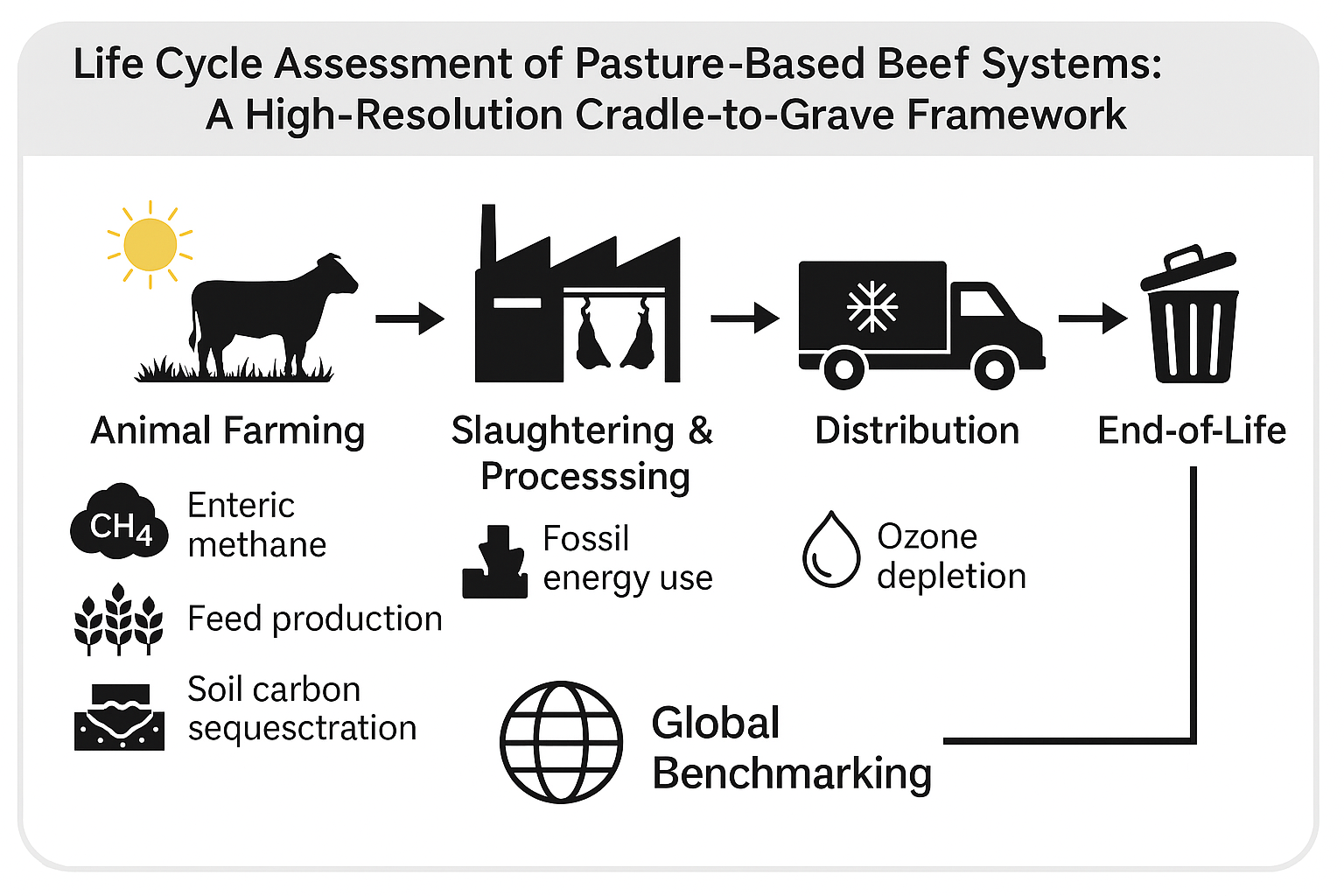
Beef production is widely recognized as a significant contributor to global greenhouse gas emissions, making robust and transparent environmental assessments essential for advancing sustainability within supply chains. This study applies a comprehensive cradle‑to‑grave Life Cycle Assessment (LCA) to evaluate the environmental performance of beef destined for export, following ISO 14040, ISO 14044 and ISO 14067 standards and the Product Category Rules for meat of mammals. Sixteen impact categories were quantified for 1 kg of vacuum‑packed beef using detailed primary data from a pasture‑based production system and a representative processing facility. The total climate change impact was 3.27×10¹ kg CO₂eq, with enteric methane and feed production jointly responsible for over 70% of overall impacts. Slaughtering and distribution were associated mainly with fossil energy use and ozone depletion, while soil carbon sequestration partially compensated biogenic emissions. The results were consistent with international benchmarks, highlighting the environmental advantages of pasture‑based systems, low fertilizer use, and stable land management. Key hotspots were identified in animal growth, feed efficiency, and manure management, with logistics also contributing notably. Overall, the study provides a high‑resolution environmental baseline that can support Environmental Product Declarations and guide targeted mitigation strategies across beef supply chains.
Keywords:
greenhouse gas emissions
; environmental product declaration
; enteric methane
; carbon sequestration
; resource use efficiency
Copyright: This open access article is published under a Creative Commons CC BY 4.0 license, which permit the free download, distribution, and reuse, provided that the author and preprint are cited in any reuse.


