

Submitted:
14 March 2026
Posted:
17 March 2026
You are already at the latest version
Abstract
Composite Laminates are now finding prominence in many high-performance industries. They offer a high strength-to-weight ratio, design flexibility, and strong resistance to environmental damage, making them superior to many traditional materials. This review examines the key factors that determine the strength and long-term durability of composite laminates and the integration of Artificial Intelligence (AI) to standardize the selection of process parameters in conventional manufacturing and characterization techniques. The discussion is structured into three main areas: failure mechanisms, advances in modeling and simulation, and standardized methods for material qualification and testing. The study summarizes current knowledge, points out research gaps, and outlines likely future directions. It emphasizes a shift from viewing composites as uniform materials to an application-focused approach that combines multi-scale physics models with data-driven machine learning. It also evaluates the role of standardized testing in ensuring reliability and addresses challenges such as barely visible impact damage and long-term fatigue. The final section predicts the future of composite design, including intelligent manufacturing, self-healing materials, and predictive analytics.
Keywords:
artificial intelligence
; multi continuum technology
; damage tolerance
; failure mechanisms
; fatigue damage
; qualification
; composite laminates
; testing
; standardization
1. Introduction
In most of the high-performance industries, composites have become an essential requirement. They have a high strength to weight ratio, are flexible in design, and have a high resistance to environmental destruction, which makes them better than most conventional materials. The review considers the most important aspects of the strength and long-term stability of composite laminates. The discussion is organized in to three key areas namely the failure mechanisms, the progress in modeling and simulation and standardized approaches in the qualification and testing of materials. The research paper will summarize the knowledge existing in the field, identify gaps in the research, and suggest probable trends in future research. It highlights the change of thinking of composites as homogeneous to a more application-oriented model combining multi-scale physics models with data-driven machine learning. It also considers the standards of standard testing in providing dependability and overcomes the issues of minimum apparent harm and extended exhaustion. The last part is a speculative forecast of the future of the composite design, which comprises intelligent manufacturing, self-healing materials, and predictive analytics. Machine Learning and AI, Mult continuum Technology (MCT), Damage Tolerance, Failure Mechanisms, Fatigue Damage, Qualification, Testing, and Standardization, ASTM, ISO Standards. The concept of the integration of materials to enhance performance is not new; the first examples of the application of such materials were laminated wood and metals that were used in ancient times. Laminated composites started to be developed in the middle of the 20th century with such materials as fibreglass and carbon fibre [1]. A composite laminate is a product that is created by piling and gluing various layers or plies of fibrous materials. The Figure 1 illustrates a laminated composite plate composed of multiple bonded laminae stacked through the thickness (z-direction). Each layer may have a different fiber orientation, represented by the parallel lines, forming a tailored stacking sequence to achieve desired mechanical properties. Two coordinate systems are shown: the global coordinate system (x–y–z), used for structural analysis of the entire laminate, and the local material coordinate system (1–2–3), defined for an individual lamina where the 1-direction corresponds to the fiber direction, 2-direction is transverse in-plane, and 3-direction is through the thickness. Since composite laminae are orthotropic, their material properties are defined in the local axes and transformed into the global system for laminate analysis using Classical Laminate Theory.
The laminate structures offer certain engineering characteristics such as; in-plane stiffness, bending stiffness and strength (Figure 2). The fact that engineers are able to tailor materials to specific requirements of an application by altering the properties and orientations of the layers allows them to do this when traditional materials cannot. These materials are lightweight yet very strong in strength-to-weight ratio and able to withstand fatigue, and corrosion and are very important in modern-day engineering [2]. They find numerous applications in the aircrafts, automobiles, sports and infrastructure [3]. Their versatility and the combination of being tailored to various performance requirements make them highly important in fields where robustness, endurance, and accuracy are essential.
The integration of AI in the production of composite laminate has been able to change the traditional hand lay-up, compression molding, filament winding, and autoclave processing production process to the modernized automated production approaches to enhance the quality, repeatability, and structural performance. Thus, there is a need for the critical review of the conventional fabrication paths, the material to be used, defects generated by the process, and methods of characterizing the process, to facilitate the integration of artificial intelligence to optimize the processes, predict defects, and ensure real-time feedback, and performance modeling. The integration of AI also facilitates the standardization of procedures, testing systems, and quality assurance systems that control the reliability of laminates in aerospace, automobile, and structural developments. The review also addresses the existing challenges such as scalability, sustainability, and data-driven and Industry 5.0-oriented composite laminate production systems and outlines future perspectives. The article presents a critical level analysis of strength and durability of composite laminates. It is aimed at going beyond just a description to interdependencies, limitations and future directions. It is divided into four broad themes, which are interrelated, including: Constituent Materials and Laminate Architectures, and is significance, the physical processes that cause failure and degradation, the modelling and simulation tools to predict performance, and the qualification and standardization processes that provide reliability. The article also, points out how there has been a change in the single-theory to comprehensive methods that are built by using advanced computational tools together with experimental and data-driven methods. It starts with the principles of composite materials and manufacturing with a crucial comparison of the major processes. It then looks at failure and durability mechanism in multi-scale perspective. The techniques of predictive modelling are discussed; the traditional techniques of analysis and finite elements are compared with the newer ones based on data. The review article further focuses on the holistic integration of the in-depth standardized testing and qualification models for real time application in laminate fabrication and characterization especially in vital industries viz., aerospace, automotive and construction industries. In the conclusion, the principal findings are brought together, gaps in the research are identified, and future directions towards the further development in the integration of AI for composite production are outlined.
2. Constituent Materials, Laminate Architectures and its Significance
The most commonly used matrix in the fabrication of composite laminates are polymers. The most prevalent among the polymer composite laminates is the Fibre-Reinforced Polymer (FRP) laminate, a polymer with polymeric base like epoxy, vinyl ester, or polyester and reinforced with a strong fibre like carbon, glass or aramid. FRP laminates are appreciated in terms of high strength to weight ratio as well as high level of corrosion resistance [4]. In more challenging situations, Metal Matrix Composites (MMCs) and Ceramic Matrix Composites (CMCs) are used. MMCs feature metal-based matrix that is strengthened with ceramic particles or fibres, which are stronger and have higher temperature resistant nature. Having a ceramic matrix and fibres, CMCs are very thermal and wear-resistant [5]. The choice and the structure of fibres and matrix determine material performance. Most of the load is carried by fibres which give it strength and rigidness with the rest of the load being carried by the matrix which spreads loads among fibres and protects them against environmental degradation [6]. Table 1 compares mechanical properties of common laminated composites, showing trade-offs in material selection. For example, carbon/epoxy laminates have very high tensile and flexural strength but lower impact resistance. In contrast, glass/polyester laminates handle impacts better but with reduced strength and stiffness [7,8].
New developments have seen the evolution of hybrid systems (e.g. fibre metal laminates (FMLs)) and hybrid natural fibre composite. FMLs are metal reinforced with fibre-reinforced composite layers, which can withstand more damage, have higher notch strength and impact resistance than the traditional FRPs, lower density, fatigue and corrosion resistance than metals [10]. Research on high-strength steel/CFRP laminates was quoted as having up to 48 % higher bending performance as compared to pure steel and superior mechanical properties made possible with controlled manufacturing. This structural design is more favourable in redistribution of stress and interfacial bonding and is, therefore, suitable in high performance applications of automotive and aerospace applications [11]. Hybrid natural fibre composite incorporates other natural fibres or a combination of natural and synthetic fibres to achieve performance that cannot be achieved when using a single fibre type. Their positive strength to weight ratio and low carbon footprint became their strong point to be reviewed [12]. Nevertheless, there are such challenges as poor adhesion between hydrophilic natural fibres and hydrophobic matrices, thermal instability, and absorption of moisture. The capability to customize properties and at the same time having a good strength to weight ratio perpetuates the research in such advanced hybrid systems.
2.1 Manual to Automated Manufacturing Process
From the literature, it is evident that the manufacturing of laminated composites is associated with different technologies each of which has its flaws and shortcomings. These two techniques are broadly dividend into open and closed moulding. Open-sided moulds are used in open moulding processes (hand layup and spray-up). In hand layup, fibre mats are laid down by hand, then wetted by pouring resin over them and then rollers are used to compact the layers [13]. This is a labour-intensive process and is only applicable in selected parts or small quantities of production where one side needs to be finished to high quality. Spray-up is sprayed, in which a spray gun deposits chopped fibres and resin onto the mould in a unit operation, allowing it to be used as a faster production method in parts where thickness accuracy is not as important. Vast experience shows, closed moulding techniques, i.e. Resin Transfer Moulding (RTM) and vacuum infusion, are applied in the production of the greater volumes and intricate formulas [14]. During RTM, dry fibres are introduced into a closed mould and the pressure is applied to inject the resin into the fibres to impregnate them completely. This results in a smooth surface on each side and low void content. During vacuum infusion, the dry fibres are placed in a mould and a vacuum bag is placed around the fibre and resin is forced through the fibre under vacuum. RTM and vacuum infusion are both controlled processes that can be used to generate high-quality components that have good mechanical performance [15]. The Figure 3 gives the schematic of the transformation in the laminate making process.
Due to continuous advancements in the composite laminate manufacturing process, the production of composite laminates has increasingly moved away towards manual processes which are labor intensive towards more highly controlled automated processes to enhance the quality, repeatability, and manufacturing efficiency. The classic processes like hand lay-up and spray-up are too dependent on human hand and consequently the alignment of fibers, the resin, and the content of voids may vary. Semi-automated methods such as vacuum bag molding and resin transfer molding (RTM) enhanced progress in the field of consolidation and minimized defects but still involved extensive manual controls. Over time with the development of digital manufacturing, completely automated processes like Automated Fiber Placement (AFP), Automated Tape Laying (ATL), filament winding and robotic resin infusion have been developed which allow the control of fiber orientation, layer thickness and curing parameters with great precision. Such movement of the manual towards the automated manufacturing boosts structural performance, minimizes waste, promotes the standardization of processes, and facilitates the interconnectedness with the AI-based monitoring and optimization systems of the next-generation composite production.
2.2 Autoclave vs. Out-of-Autoclave: Myth and Its Implications
It has been discovered that the decision of manufacturing process has a direct impact on the mechanical properties, cost and structural integrity of a composite part. One of the debates in the industry is on autoclave versus out-of-autoclave (OoA) processes. Pre-peg fibres are processed through autoclave, which is the controlled heating process and high-pressure [16]. This pressure consolidates plies, removes trapped air, and produces high fibre volume fraction (FVF) with low void content [17]. Higher consolidation pressure improves mechanical properties. Publications highlight increasing FVF can raise flexural modulus by 39% and flexural strength by 20% compared to vacuum-only curing [18]. These benefits make autoclave processing the standard for high-quality aerospace parts, though it is costly and time-intensive. Researchers observed that interest in OoA processes such as vacuum-bag only (VBO) curing and resin infusion is growing. Prior studies confirm that performance of autoclave is not always superior. In some cases, such as sailing mast production, vacuum-bagged parts have greater delamination resistance. This is linked to less distinct crack planes, which promote fibre bridging and improve damage tolerance.
Studies have also, found that the autoclave-cured parts may have slightly higher compressive modulus, their reduced wall thickness for the same weight lowers the moment of inertia [19]. As a result, the overall compressive stiffness of high-quality laminates from both processes can be similar. Prior studies confirm that the process superiority depends on the material system, structural application, and critical failure mode. Compressive stiffness is a key attribute of designs that require safety (delamination resistance), and in a design like this, a well-performed OoA process may prove to be the superior option. This highlights the importance of application-based assessment, which weighs between mechanical performance, damage tolerance and cost. Table 2 highlights the primary trade-offs of various composite manufacturing methods.
The Schematic collage of the transformation of the composite laminate manufacturing process is depicted in Figure 4. It gives an overview of the key laminate composite manufacturing pathways, and it shows the shift in the traditional to the advanced processing approaches. In Figure 4 (a), prepreg-based processing is depicted wherein the resin is impregnated into the dry fibers to create prepregs which are then put into a mold by manual lay-up or automated lay-up. Figure 4 (b) describes the Resin Transfer Molding (RTM) process in which the dry fiber preforms are loaded into a closed mold and the pressure resin is injected into the mold after which the mold is allowed to cure under both controlled heat and vacuum conditions. Figure 4 (c) gives the schematic of the establishment of a preform before consolidation. Figure 4 (d) focuses on comparing the curing methods with autoclave processing in which vacuum bagged laminates are processed under active pressure and high temperature and out-of-autoclave (OOA) in which the laminates are processed in the oven with vacuum pressure and no high external pressure. Finally, Figure 4 (e) gives the schematic of the additive manufacturing of composite, which entails heating and deposition of thermoplastic resin and continuous fiber bundles, in layer-by-layer projections using a controlled nozzle system. In general, the figure is the summary of the development of manual lay-up to automated, closed-mold, high-pressure, and digitally controlled additive manufacturing processes during producing composite laminate fabrics.
3. Mechanisms of Failure and Durability Degradation
3.1 A Multi-Scale Perspective on Failure Mechanisms
It has been pointed out in literature reviews that composite laminate failure is a multi-scale phenomenon which happens at fibre-matrix interface, a single ply (lamina) and the overall laminate. Research has established that it is a cumulative damage not an occurrence. According to previous studies, the failure mechanisms can be categorized as intralaminar (a failure that occurs within a ply) and interlaminar (between plies). Intralaminar failures also have been categorized into fibre and matrix intra-laminar failures. Fibre based failures including fibre fracture in tension or compressive buckling normally take place during longitudinal loading and define the final strength of the composite. The matrix-dominated failures, e.g. matrix cracking or fibre-matrix debonding, which appear during transverse/shear loading, are relative to the properties of a matrix, and mostly rely on them [24,25,26,27].
Literature defines that when the weakest ply (usually, 90o) approaches its strain limit and forms cracks perpendicular to the fibres, it is referred to as a First ply failure. This does not collapse instantaneously but initiates a sequence of damages that can culminate into an eventual failure. The behaviour of the laminate beyond this stage is determined by whether it is notch sensitive or not and also the interlaminar shear strength. High localized interlaminar shear and normal stresses, especially near free edges, are common initiation points for such damage [28].
3.2 Fatigue Damage under Cyclic Loading
The subject of fatigue damage of composite laminates under cyclic loading has received much research attention over the last few years because of its pivotal significance in failure of engineering components under repetitive stress variation. Numerous researches have been devoted to the investigation of the evolution of fatigue damage by means of experimental testing with the help of advanced signal processing approaches and data modelling approaches. Fatigue experiments are normally conducted on a servo-hydraulic testing system whereby specimens of a certain geometry usually containing some form of a prefabricated notch are loaded under controlled cyclic conditions. The mentioned notch serves as a stress concentrator to enable accidental crack initiation at a random position with which the behavior of fatigue crack initiation and propagation could be systematically observed. With the rise in loading cycles, microstructural degradation builds up in the material, which in the end causes crack propagation and structural failure. In order to track the fatigue damage course, scientists often use the high-frequency sensing in order to record the response signals in the process of cyclic loading. These signals are usually recorded in the time domain at high sampling rates in an attempt to record some fine variations in material behavior based on availability of many sensing paths or sensors. The differing signal amplitudes, waveforms and energy distribution can be widely linked with various levels of fatigue damages such as crack initiation, steady growth of the crack and ultimate fracture. The signals obtained, are useful datasets to conduct further analysis in order to determine parameters that are sensitive to damage. The feature extraction is an important step towards converting the raw signals into useful signals of fatigue damage. Different statistical and signal-based characteristics, including peak value, standard deviation, root mean square (RMS), crest factor, energy-related parameters and frequency-domain characteristics have broad application in the literature. These characteristics give information on the magnitude, variability, and frequency content of the signals which tends to be related to the degree of material degradation. The techniques of correlation analysis and dimensionality reduction are used frequently to determine the most important features and to abandon redundant information that helps to optimize the predictive models. Over the last few years, the combination of machine learning and statistical modeling methods has made the process of predicting fatigue damage depending on the extracted signal features incredibly more efficient. The regression-based models that have been widely reported in fatigue monitoring studies include Partial Least Squares Regression (PLSR), Principal Component Regression (PCR), Support Vector Regression (SVR), and Artificial Neural Networks (ANN). PLSR is one of these methods with specific interest since it can address multicollinearity between predictor variables and competently model complex associations between signal attributes and indicators of damage. Comparative analysis has frequently shown that PLSR is able to predict better than conventional regression models especially in cases where high dimensional signal data is being dealt with. Model optimization and model validation are the important processes of making certain the validity and the generalization ability of fatigue damage prediction models. The literature has put forth some optimization strategies that can be used to improve the performance of the model. Various methods are commonly employed to assess the significance of predictor variables with methods like Variable Importance in Projection (VIP) scores, a method employed to determine the strongest features in the predictive model. The salience of features can be used to select only the most related features, helping to reduce the complexity of the model without reducing or compromising predictive accuracy. Also, parameter tuning and cross-validation methods are commonly used to streamline the parameters of the model and avoid overfitting. Predictive models used are normally validated based on the comparison of the predicted values of damage to actual responses with independent test datasets. The coefficient of determination (R 2 ), root mean square error (RMSE) and prediction error are the performance measures that are usually employed to gauge the strength of a model. Reliable research has revealed that when optimized models are used in studies, high values of R2 are obtained which means that there is a high correlation between the prediction and observed fatigue damage. Moreover, the graphical comparisons of model predicted values and experimental values of damage are another way of confirming the model reliability. These validation processes indicate that optimized machine learning models have the capability to fulfill the complicated correlation between signal characteristics and fatigue damage developments. On the whole, experimental fatigue testing, signal processing, and optimized machine learning models have given a potent framework of fatigue damage assessment during cyclic loading. The focus on the optimization of models and strict validation is a guarantee that the developed predictive methods are strong and can be used in practice like structural health monitoring, condition-based maintenance and fatigue life prediction of engineering materials and structures. Previous work identifies that while in service, composite laminates usually undergo multiaxial cyclic loading, which imparts fatigue and causes progressive reduction of structural integrity [29]. Uniaxial fatigue loading is generally classified into three forms, viz., tensile-tensile, compressive-compressive, and tensile-compressive, the damage mechanism being dependent on the mode of loading, for example, matrix cracking, fibre buckling, and interface debonding. Interlaminar multi cracking is generally cited as the main damage mechanism in tensile-tensile fatigue. It is initiated by debonding of the fibre-resin interface and progresses laterally from macrocracks at the edges of the panels to micro cracks in the centre, where complete fibre pull-out failure may occur. Compressive-compressive fatigue develops intralaminar shear cracks, mostly in the central areas first. When cracks progress along the fibres to the edges, local fibre buckling is formed, which evolves into compressive failure [29,30,31].
Life prediction of fatigue is not an easy task. The results of the previous work have reported that the earlier models (such as the Palmgren-Miner rule) have made the linear accumulation of damage a complex phenomenon and the results lead to non-dependence of the models on the load sequence, but these simplifications are not applicable in practice since the two damage modes and load histories are non-linear [32]. The latest models solve these problems by incorporating load interaction effects. As an illustration, an exponential model has been put forward to dynamically adjust the classical model with the correlation between successive loads and changes in fatigue life under varying stress conditions. These sophisticated models minimize the error in prediction in a huge way, and this is a crucial reason why the loading history must be carried out in fatigue analysis. The Figure 5 gives the schematic flow chart for the optimization and validation for modelling the fatigue failure in a composite laminate as demonstrated by Feiting Zhang et al., in their works related to the fatigue damage monitoring of composite structures [63].
3.3 Impact Damage and Damage Tolerance
The most severe failure mechanism in laminated composite structures is impact damage, especially where the structural and aerospace and automotive parts may be hit by a foreign object or fall onto them, leading to impact damage. Laminate made of composite material unlike metallic material tends to have team-like and hardly visible damage when it is hit by low-velocity motion. This kind of damage is usually on the form of matrix cracking, fiber breakage and interlaminar delamination that severely diminishes the remaining strength and stiffening of the structure. Thus, the research topic in terms of understanding the mechanisms of impact damage and assessing the capacity of composite laminates to be damaged has appeared to be a significant area of interest. Numerical investigations and laboratory experiments are commonly used to find the impact response of laminated composites. In the figure, a plate made of composite laminated is modeled on the basis of a finite element framework whereby the plate is a multi-layered laminate as such, the stacking layers depict the anisotropy of the fiber-reinforced composites. Encastre boundary conditions are applied to the edges of the plate, that is all the degrees of freedom in a translation and rotation are restricted. This state model is a clamped boundary case which typically represents an impact experimentation, but enables the distribution of stress and damage in the laminate during impact load. The impactor is a cylindrical stiff object that is placed above the composite laminate and is aimed at the plate surface in a vertical orientation. Impactor strikes the plate at a prescribed point, creating the plate impact area which is a region where the maximum stress concentration and fissure initiation takes place. In the impact event, kinetic energy of the impactor is imparted in the laminate, which leads to localized deformation and internal damages. The stratified architecture of the composite results in complicated stress interactions between the plies that tend to open up delamination between neighboring layers. Such mechanisms of damage prove especially dangerous as they might be invisible or unseen to the surface but can seriously undermine the structural integrity of the component. The response in terms of impact and the development of damage in composite laminates is commonly predicted through numerical modeling methods, especially finite element analysis. The laminate materials are normally broken down into finite elements to define the distribution of stresses, deformation behavioral traits, and progressive damage formation due to impact loading. A refined mesh is employed in most studies around the area of impact in order to capture local stress concentrations and damage propagation. Interlaminar delamination and ply failure are highly sought after in advanced models of damage, like cohesive zone models and progressive failure criteria. Damage tolerance is the capacity of a composite structure to sustain some amount of damage without being catastrophically damaged and still have adequate load carrying capacity. In analyzing the damage tolerance of composite laminates, the damage tolerance can be determined by evaluating the effect of the occurrence of impact damage on the remaining strength, stiffness and fatigue behavior of the structure. The parameters that are commonly evaluated by the researchers to ascertain the structural reliability of composite laminates are absorbed impact energy, maximum contact force, and residual strength after impact. According to recent experimental works, the combination of experimental impact testing and numerical modeling is crucial in defining the damage tolerance behavior of composite structures. With finite element simulations, the stress distribution, as well as the evolution of damage, can be clearly visualized and observed which would be hard under experiments. These combined methods assist in streamlining the laminate stacking sequences, material design and the impact resistance of the composite parts. Therefore, to create the safer and more reliable composite structures in the engineering future, it is important that the mechanisms of impact damage and the factors influencing the damage tolerance are comprehended. The Figure 6 gives the schematic of the finite element model developed using computational techniques to predict the impact damage of the composite laminates , reproduced from the works of Y Shang et al., [64].
Composite laminates response to impact loading is one of the important performance issues because impact can be experienced during manufacturing, service or maintenance. Damage tolerance is the capacity of a composite structure to experience impact damage without experiencing any significant loss of strength or stability [33]. Research has discovered effects have the ability to lead to cracking of the matrix, fracture of the fibre and above all interply delamination. Findings show that one of the significant safety problems is the barely visible impact damage (BVID). At low-velocity, there can be no or minimal surface evidence but a lot of interior delamination, decreasing the structural integrity. The location of impact may highly affect the nature and extent of damage. E.g. an edge impact may leave a smaller visible area of damage but leave more fibre failed through the thickness. Compression after impact (CAI) tests are more sensitive to delamination and this kind of fibre damage is often undetected by it.
The literature confirms that BVID renders conventional techniques of inspection less efficient. Conversely, visual inspection may not identify such internal defects alone and this heightens the use of advanced non-destructive testing (NDT) practices. Ultrasonic C-scans, for example, can detect and measure internal delamination [34]. Prior investigations report a more challenging goal, is predictive modelling that can estimate damage type and size from impact conditions. This remains difficult due to complex local stress states. Scholars reported data-driven methods, including deep learning for automated NDT and damage classification, are emerging techniques to improve detection reliability and safety in composite structures [35]. Thus, there remains vast scope for the integration of AI and machine learning models for the prediction of impact damage in the composite laminates.
3.4 Environmental Degradation
The long-term durability of composite laminates is strongly affected by environmental conditions. Prior studies confirm the main factors that cause degradation and loss of structural integrity are temperature, moisture, and UV radiation [36].
1. Temperature effects: Prior studies confirm prolonged exposure to high temperatures can cause thermal oxidation and hydrolysis, where the polymer reacts with oxygen or water, breaking down its molecular structure. This leads to a loss of mechanical properties such as tensile and flexural strength, and in some cases, damages the reinforcing fibres through stress-corrosion [37].
2. Moisture effects: Studies have found water absorption can act as a plasticizer for the polymer matrix, lowering stiffness and strength while causing swelling. The result of this dimensional change is internal stresses which weaken the fibre-matrix interface. The polymer allows water to move at an accelerated rate along this interface as opposed to flowing through the polymer, and interfacial degradation is a major contributor to strength loss under humid or wet conditions. Studies on bio composites have indicated the significance of material formulations and surface treatments which inhibit moisture uptake, ion penetration, and biofouling and are particularly relevant in marine applications [38].
3. UV radiation: UV radiation will lower mechanical properties and destroy surfaces by breaking polymer chains (scission) and forming brittle links between chains (cross-linking). UV stabilizers and moisture-resistant polymers are used to ensure a stable performance of composite in the exposed environment in the long-term [39].
It is evident from the review of the existing literatures, that the structural performance of composite laminates that are used in structures is largely affected by environmental conditions that affect their long-term and durability. Composite materials especially polymer matrix composites degrade easily when subjected to environmental conditions. The mechanical and physical properties of the composite may be changed under these environmental conditions and result in the gradual degradation of the composite material, fiber-matrix interface, and laminate structure. Hence forecasting environmental degradation in composite laminates is now a key research field towards the reliability and life cycle of composite components. Moisture absorption is one of the most prevalent environmental degradation processes in composite laminates and particularly polymer matrix composites. When subjected to humid or wet conditions, the moisture diffuses to the matrix material and it is concentrated on the fiber- Matthew interface. The result of this process may include plasticization of the matrix, swelling, and decreasing its strength of interfacial bond. Consequently, the composite can suffer decreased stiffness, decreased strength and delaminability. Researchers tend to apply the Fickian diffusion theory to understand moisture diffusion in the laminate, thus predicting the concentration of moisture in the laminate with time and the resultant influence on the mechanical properties. Changes in temperature are also important factors as far as environmental degradation is concerned. The high temperatures can cause chemical aging of the polymer matrix at accelerated rates leading to thermal degradation and structural integrity loss. Also, when subjected to repeated thermal cycling, both fibers and the polymer may cause thermal stresses because the coefficient of thermal expansion of the fibers and polymer matrix may differ. These stresses could trigger the development of microcracks in the matrix and generate interlaminar delamination which further weakens a laminate. Thermal degradation predictive models are often based on a combination of heat transfer analysis and materials degradation model to predict the long-term behaviour of composite structure. The other environmental factor that influences composite laminates especially the ones applied in the outdoor settings is ultraviolet radiation. The long-term exposure of the polymer to UV radiation may result in photo-oxidative degeneration of the polymer matrix, which may subsequently cause surface fracture, coloration, and decline in the mechanical properties. The degradation process typically starts at the surface and moves on internally into the laminate. In order to forecast the damage caused by UV, investigators tend to rely on accelerated aging tests and empirical degradation models in which exposure time is associated with property loss. Over the past few years, statistical models as well as machine learning practices have been used more often to forecast environmental harm in composite laminates. Such methods are based on experimental data that has been gathered in different environmental settings to establish prediction models that can be used to approximate any kind of degradation trends. Regression analysis, artificial neural networks, and the support vector machines are some of the techniques that have been used to correlate the environmental exposure parameters with the changes in mechanical properties including tensile strength, modulus and fatigue life. These models have been useful in offering an effective predictive instrument of the behavior of composites in the actual service conditions over the long run. Also, the combined effects of the environmental factors in composite laminates are extensively studied with the help of multi-physics numerical simulations. In these simulations, the diffusion of moisture, thermal and mechanical loading are incorporated in a single model to study the initiation and propagation of damages. The redistribution of stress, the formation of microcracks or delamination in a complicated environmental condition is anticipated in the Finite element models that include the environmental degradation parameters. On the whole, a combined method of experimental characterization, theoretical modeling, and prediction techniques based on data is needed to predict environmental damage in composite laminates. Proper prediction of environmental degradation can help the engineers to come up with better enduring composite structures, better selection of materials and set up best maintenance plans. These predictive systems are fundamental in increasing the life cycle of the services and in making the composite material in aerospace, marine, automotive and civil engineering applications reliable.
4. Conventional, Analytical and Computational Approaches
4.1 Foundational Theories and Criteria
Investigations carried out in the past indicated that analysis and design of composite laminates was based on both analytic and computational processes. One of the important tools is Classical Laminate Theory (CLT) which utilizes micromechanical principles to predict stiffness and deformation under in-plane loads and moments [40]. CLT is an orthotropic ply stack model of the laminate, which is convenient as a tool in early design, and in the study of the fundamental behaviour of laminates.
Other past works have identified Maximum Stress and Tsai-Hill as some of the traditional criteria used in failure prediction [41]. The Maximum Stress criterion is an interactive-free approach that is based on the assumption of failure in case any of the major stresses attains its critical value. The Tsai-Hill criterion is an interactive criterion based on the von Mises yield criterion of metals and is used to consider the effects of a combination of different components of stress [42]. It is known that the two methods are used to predict first ply failure, which is a key step in the damage process of composite laminates.
4.2 The Evolving Role of Classical Models
Prior investigations report suggested that traditional models remain important, but their use in modern engineering has changed. Moreover, many theoretical failure criteria could not able to accurately predict real-world failure modes, especially those involving delamination or impact damage. Literature reviews reveal a gap between theory and practice, with certification often relying on a "building block approach" supported by extensive experimental testing.
Empirical evidence shows classical models are not obsolete; they are still valuable for preliminary design and for understanding basic laminate behaviour [43]. However, complex problems such as impact-induced delamination or failures near notches are now addressed using a combination of advanced computational tools like finite element analysis (FEA) and extensive physical testing [44]. This reflects a modern approach where simplified theory provides the foundation, and computational and experimental methods manage the challenges of real-world applications.
4.3 Advanced and Emerging Modeling Paradigms
4.3.1 The Multi-Scale Solution: Multi-continuum Technology (MCT)
Newer multi-scale approaches have been developed in order to overcome the constraints of the traditional models, which do not tend to related micro-scale failure mechanisms with macro-scale structural response mechanisms. Among them is Multi-continuum Technology (MCT) which has been designed to effectively integrate geometric scales in such a way that the microstructural information is used to make structural failure predictions [45]. MCT begins with a macro-scale finite element analysis, which is followed by an embedded algorithm to split stress and strain fields into fibre and matrix levels. This enables failure criteria to be implemented at the point of attack of damage. One of the strongest features of MCT is that it is numerically efficient. Considering that other progressive failure techniques necessitate computationally intensive, iterative coupling of structural and micromechanics models, MCT uses information about the relationship between composite and damaged constituent properties prior to the analyses of the structural calculation. It can be used in full-scale structural studies but still give detailed information on the micro-scale failure behaviour [46].
4.3.2 The Data-Driven Revolution: Machine Learning and AI
Together with the improvements in physics-based models, Machine Learning (ML), and Artificial Intelligence (AI) are becoming increasingly popular in composite design. The algorithms like Regression Neural networks are trained with huge volumes of data, either experimentally or by using finite element analysis, and applied to predict the mechanical properties and behaviour with high fidelity [47]. One of them is a reduced computation time. Instead of a finite element simulation, researchers used an ML model, which dropped time per prediction to predicting a composite laminate stress-strain curve to just 0.6 seconds [48]. This enables quick search over design possibilities and choice of best layups and material combinations. The trend is leading investigations to complements as opposed to substituting traditional methods. Models such as physics-based models such as FEA can be used to create high-fidelity datasets that train well with ML. The ML models can then deal with the high-speed design screening, whereas some FEA runs, or physical tests, are used to test final designs [49]. This is a hybrid solution that takes the rapidity of ML but the accuracy of known physics-based analysis.
4.4 Future Directions in Modeling
The future of composite modelling is most likely to be characterized by the further incorporation of all these modern tools. The current research is dedicated to the creation of more advanced material models, including the self-healing composite ones, and the incorporation of AI into defect detection and real-time optimization of the process [50,51]. The ultimate aim of the researchers and scientists is to develop a fully integrated, so-called digital twin, framework capable of approximating the complete lifecycle of a composite component, which is comprised of manufacturing and initial performance, long-term durability, and ultimate failure.
5. Qualification, Testing, and Standardization
In order to achieve the reliability, safety, and performance of composite laminates at different mechanical and environmental conditions, their qualification and certification entails stringent tests. Historically, these are processes based on standardized tests procedures established by international organizations like ASTM International and International Organization of Standardization. These standards give established parameters of measuring mechanical properties, impact resistance, fatigue behavior and environmental properties of composite materials. Nevertheless, traditional testing and qualification processes are not always fast and involve the use of large experiment data. Over the recent years, the introduction of the Artificial Intelligence (AI) and Machine Learning (ML) method has proven to be an effective tool in the context of a standardized method of testing, as it helps interpret data and make predictions in less time and better-informed decisions when qualifying and certifying composite laminates. The presence of standardized testing procedures is essential to testing the mechanical performance of composite laminates. As an example, tensile and compressive properties of polymer matrix composites are usually tested based on ASTM D3039 and ASTM D3410 respectively. The flexural behavior is normally tested under ASTM D790 and impact resistance is tested under ASTM D7136 which is a test that determines the damage behavior of composite plates under low velocity impact loading. On the same note, ISO 527 and ISO 14125 standards, which are internationally recognized standards, serve as a globally-accepted standard of procedures used to measure the mechanical properties of fiber-reinforced composites. These standard procedures guarantee uniformity and reproducibility of the different test results in disparate laboratories and industries. These standardized testing structures are being incorporated gradually with AI and ML methods to make the procedure of material qualification more efficient and more accurate. The machine learning algorithms can be used to process large datasets created on the results of ASTM and ISO tests and identify complex correlations between material parameters, manufacturing conditions, and mechanical performance. As an example, AI models have the capability to predict tensile strength, modulus, impact resistance of composite laminates using variables like fiber orientation, stacking sequence, resin properties and curing conditions. Artificial neural network (ANN), support vector machines (SVM), random forest regression, and deep learning models are algorithms with a high possibility of predicting the behavior of composite materials with high accuracy. Besides the prediction of material properties, AI and ML techniques are popular in damage detection and structural health monitoring in testing. Composite testing can be performed with massive amounts of sensor data collected with acoustic emission systems, ultrasonic testing instruments, digital image correlation algorithms, and strain gauges. The machine learning models are capable of analyzing these high-dimensional databases to identify the initial signs of damage, which include matrix cracking, fiber breakage, and delamination. Ai-driven systems enhance the efficiency of composite testing because they can automatically detect patterns of damage on the basis of experimental data and do not require interpretation of experimental data by humans. The second key area that AI and ML can be used in the mission of composite qualification is the optimization of the testing process and standardization procedures. Evaluating datasets received as a result of various ASTM and ISO standardized tests, machine learning algorithms are able to determine the most decisive parameters impacting test results. Computer-based techniques like feature importance analysis and sensitivity analysis assist the researcher to improve the experimental setups, the geometry of the specimen, and the variation of the testing results. This helps in the formulation of more stable and consistent testing procedures that is critical to the international standardization of composite materials. In addition, AI with finite element simulations and digital twin technologies have been found to improve predictive modeling of composite laminates. The hybrid modeling techniques are physics-based simulations that are integrated with machine learning algorithms to forecast the onset of damage, its propagation, and post-impact or fatigue loading residual strength. Such models are able to acquire knowledge of experimental findings of ASTM and ISO test and keep on refining predictions to provide a proper evaluation of composite behaviour under complicated loading situations. Model validation and the reliability test is still a crucial feature of AI-based qualification systems. The methods of cross-validation, statistical measures of errors and quantification of uncertainty are employed to make sure that AI solutions do not differ with experimental findings measured in standardized tests. Using verified AI models along with ASTM and ISO testing systems, the researchers will be able to implement trusted forecast models that facilitate certification, quality control, and material standardization. Altogether, the combination of AI and ML with globally accepted testing standards is a potent model of composite laminates qualification, testing, and standardization. These methods are based on data, which make the experiments cheaper, more rapidly develop materials, and more accurate in predictions without violating the existing standards in ASTM and ISO. With the steady increase in the coverage of both experimental and simulation-based data, AI-assisted techniques are likely to have a significant impact on the development of the composite material certification process and allow to facilitate more efficient and more reliable testing of high-tech composite structures.
5.1 Standardized Mechanical Testing
In reinforced plastics used in applications, such as aerospace and auto industries, composite laminates are highly qualified in safety sensitive areas so that the performance is reliable. A detailed framework is defined in aerospace by the Federal Aviation Administration (FAA) [52]. Engineers need to produce statistically determined A- and B-basis design allowable by huge test programs. These are tests conducted to determine lamina-level properties under different loading and environmental conditions [53]. The certified information lowers the risk of structural failure due to variability in materials. Qualification is also in regards to extensive testing in the case of automotive. Tensile strength and impact resistance is checked by mechanical testing. Tested using chemicals, resistance to oils, fuels and other fluids. Flammability tests are crucial in observing the safety regulations. Process control mechanisms, such as the Production Part Approval Process (PPAP) are used to ensure that suppliers are capable of delivering to both design and production quality standards in a consistent manner.
Recent reviews point out that the standardized testing is the key factor in the incorporation of AI in composites industry for reliability and safety. The standards offer a universal language to the engineers and researchers, and material data is consistent and comparable in various laboratories and material systems [53]. It is known that a thorough grasp of such standards is the most important since they determine not only the geometry and dimensions of a specimen but also the exact procedure of the test and the loading rate. Violation of these specifications may nullify the results thus undermining the integrity of the material data. The above context is that a number of important ASTM (American Society for Testing and Materials) and ISO (International Organization for Standardization) standards have been put in place and regulate the mechanical testing of composite.

| Test Purpose | Standard(s) | Properties Measured | Key Test Details |
| Tensile Strength | ASTM D3039, ASTM D638, ISO 527-4, ISO 527-5 | Tensile modulus, tensile strength, Poisson’s ratio, strain at break | Rectangular or dumbbell specimens, different dimensions for UD vs. multi-directional laminates |
| Compressive Strength | ASTM D695, ASTM D6484, ASTM D3410, ISO 14126 | Compressive modulus, compressive strength, failure stress at hole | End loading, shear loading, or notched compression (open/filled hole) |
| Impact & Damage Tolerance | ASTM D7136 (impact), ASTM D7137 (CAI), ISO 6603 | Impact resistance, compressive residual strength (CAI) | Drop-weight impact, falling dart method, or compression after damage |
| Fatigue Properties | ASTM D3479 | Fatigue life under constant-amplitude tension-tension loading | Determines fatigue life and studies microscopic damage progression |
For tensile testing, ASTM D3039, ASTM D638 Type (ii) and ISO 527 are widely used standards that specify test coupon conditions for fibre-reinforced plastics [55]. While both ASTM and ISO standards serve the same purpose, there are differences in specimen shapes, dimensions, and the method for determining characteristic values. For compression, a variety of standards exist to address different loading modes, including ASTM D695 for simple end loading, ASTM D6484 for notched compression to simulate fastener holes, and ASTM D3410 for shear loading compression [56,57,58].
Prior studies confirm the assessment of damage tolerance is standardized by the Compression after Impact (CAI) test, which is crucial for safety-critical applications. The test is a multi-phase process that includes a standardized impact event (ASTM D7136) and a subsequent compression test to determine the residual strength of the damaged laminate (ASTM D7137) [59]. The test emphasizes the need of the detailed, standardized approach in order to make sure that the material can resist the damage and remain able to operate safely. In fatigue tests, ASTM D3479 gives the guidelines on how to carry out constant-amplitude tension-tension fatigue tests to ascertain the fatigue life of polymer matrix composites [60]. The Figure 7 gives the schematic of the ASTM standard specimen dimensions for testing the composite specimens for their tensile, compression, flexural characteristics, alongside the moisture absorption properties, reproduced from the works of Sudarisman et al, [65].
6. Conclusions and Future Outlook
6.1 Key Findings
This critical review has had an effect of illustrating how strength and durability in composite laminates are multi-faceted in the domain of AI driven standardization of process parameters for composite manufacturing and characterization. Some of the main findings have been identified in the analysis:
The choice of the constituent materials and the manufacturing operations is not an issue of mere hierarchy but a fine, application-based choice. The so-called "Autoclave Myth" points out that in some applications, out-of-autoclave processes can provide even better damage resistance and similar structural performance, a fact that refutes the belief that autoclave curing is always the most desirable.
Composite laminates failure is a progressive multi-scale process. Proper knowledge on how damage develops through first ply failure and interlaminar shear cracks to catastrophic fibre fracture is critical in designing structures that are durable.
The problem of barely visible impact damage (BVID) is very dangerous and cannot be solved only through visual inspection. This has ensured that there is a great demand of advanced non-destructive testing (NDT) methods and prediction models that can definitely measure the occurrence of latent damage. It is a new phase of composite modelling, which is marked by the integration of conventional physics-based models with data-driven artificial intelligence. There are growing applications of finite element analysis to produce large and high-fidelity data that is used to train machine learning models that can be used to make rapid and accurate design exploration.
Standardized testing Standardized testing is the basis of material qualification and reliability, an overall basis of measuring essential mechanical properties, and ensuring that materials which are certified may be utilized with certainty in safety-critical applications.
6.2 Critical Research Gaps and Future Directions
The review of the existing literature has defined various gaps in research that are critical even after making a substantial progress towards the standardization of manufacturing and characterization processes in composites. The construction of more precise and holistic models of cumulative fatigue damages that could consider complicated loading backgrounds and effects of load interaction remain a subject of ongoing studies. Likewise, effective models of impact damage that can predict with accuracy the nature and extent of internal failure have not been generally availed. To overcome these issues, more studies on multi-scale modelling, more sophisticated constitutive laws and further combination of AI and ML to understand complex damage behaviours will be needed. Beyond these modelling challenges, studies have discovered that the future of composite materials is bound to be highly innovative. Currently, some of the ways in which novel materials with greater functionality like smart composites that include sensing capabilities, self-repairing composites and sustainable and bio-inspired composites, which replicate the hierarchical structures of nature are under development. It will be combined with smart, computerized production technologies, including automated fibre placement (AFP) and 3D printing that are capable of creating intricate shapes with extreme accuracy and efficiency. The combination of these technologies will not only enhance performance and eliminate cost but also allow new design paradigms, which were never possible before. There is awareness that the sphere of composite is transitioning on a mature science to dynamic and interdisciplinary sphere. The combination of material science, manufacturing engineering, and data science is a synergistic approach that will guarantee the further success of such materials. The capability to model, predict and control material behaviour at the most basic level, as well as to take advantage of the pace and scalability of data-intensive tools will help to realize the full potential of composite laminates. It will result in an alternative generation of lighter, stronger, more durable, and more sustainable composite constructions, which will remain a revolution in both aerospace and energy sectors.
Statements and Declarations
Author Contributions
Conceptualization, S.N., A.T. and P.B.A.; methodology, A.T. and S.N.; software, A.T.. and N.M.; validation, P.B.A., N.M. and S.N.; formal analysis, A.T., V.K.N., and S.N.; investigation, A.T., and V.K.N.; resources, P.B.A. and N.M.; data curation, A.T. and V.K.N.; writing—original draft preparation, A.T., and S.N.; writing—review and editing, P.B.A., N.M. and S.N.; visualization, A.T.; supervision, P.B.A., N.M., and S.N.; project administration, P.B.A., N.M., and V.K.N.; funding acquisition, P.B.A. N.M. All authors have read and agreed to the published version of the manuscript.
Funding
This research received no specific grant / funding from any funding agency in the public, commercial, or not-for-profit sectors.
Conflicts of Interest
“The authors declare no conflicts of interest.”
Abhinav T (A.T.)
Praveena B A (P.B.A.)
Nagamadhu M (N.M.)
Santhosh N (S.N.)
Vishwanath K N (V.K.N.)
References
- Diniță, A.; Ripeanu, R.G.; Ilincă, C.N.; Cursaru, D.; Matei, D.; Naim, R.I.; Tănase, M.; Portoacă, A.I. Advancements in Fibre-Reinforced Polymer Composites: A Comprehensive Analysis. Polymers 2024, 16, 2.
- Fan, Q.; Duan, H.; Xing, X. A Review of Composite Materials for Enhancing Support, Flexibility and Strength in Exercise. Alexandria Engineering Journal 2024, 94, 90–103. [CrossRef]
- Khan, F.; Hossain, N.; Mim, J.J.; Rahman, S.M.M.; Iqbal, M.J.; Billah, M.; Chowdhury, M.A. Advances of Composite Materials in Automobile Applications: A Review. Journal of Engineering Research 2025, 13, 1001–1023. [CrossRef]
- Edah, G.O.; Atiba, J.O.; Fayomi, O.S.I. Advancements in Fibre-Reinforced Polymers: Properties, Applications (A Mini Review). Next Materials 2025, 8, 100743. [CrossRef]
- Shrivastava, S.; Rajak, D.K.; Joshi, T.; Singh, D.K.; Mondal, D.P. Ceramic Matrix Composites: Classifications, Manufacturing, Properties, and Applications. Ceramics 2024, 7, 652–679. [CrossRef]
- Gaikwad, N.S.; Deshmukh, D.D.; Kakade, S.P. Fibre-Reinforced Polymer Matrix Composites for Improved Defence Armor: A Comprehensive Review. Smart Materials in Manufacturing 2025, 3, 100084.
- Mahboubizadeh, S.; Sadeq, A.; Arzaqi, Z.; et al. Advancements in Fibre-Reinforced Polymer (FRP) Composites: An Extensive Review. Discover Materials 2024, 4, 22.
- Sreemathi, S.; Wessley, G.J.J. Advancements in Metal-Fibre Composites for Aerospace and Defense Applications: A Comprehensive Review. Journal of Polymer and Composites 2025, 13, 96–108.
- Truong, G.T.; Choi, K.K. Tensile Behavior of Hybrid Composites of Carbon Fibres—Steel Wire Mesh Reinforced Polymer. Mechanics of Advanced Materials and Structures 2019, 28, 154–166.
- Hu, H.; Wei, Q.; Wang, T.; Ma, Q.; Pan, S.; Li, F.; Wang, C.; Ding, J. Theoretical Prediction Method for Tensile Properties of High-Strength Steel/Carbon Fibre-Reinforced Polymer Laminates. Polymers 2025, 17, 846.
- Diniță, A.; Ripeanu, R.G.; Ilincă, C.N.; Cursaru, D.; Matei, D.; Naim, R.I.; Tănase, M.; Portoacă, A.I. Advancements in Fibre-Reinforced Polymer Composites: A Comprehensive Analysis. Polymers 2024, 16, 2.
- Fan, Q.; Duan, H.; Xing, X. A Review of Composite Materials for Enhancing Support, Flexibility and Strength in Exercise. Alexandria Engineering Journal 2024, 94, 90–103. [CrossRef]
- Khan, F.; Hossain, N.; Mim, J.J.; Rahman, S.M.M.; Iqbal, M.J.; Billah, M.; Chowdhury, M.A. Advances of Composite Materials in Automobile Applications: A Review. Journal of Engineering Research 2025, 13, 1001–1023. [CrossRef]
- Edah, G.O.; Atiba, J.O.; Fayomi, O.S.I. Advancements in Fibre-Reinforced Polymers: Properties, Applications (A Mini Review). Next Materials 2025, 8, 100743. [CrossRef]
- Shrivastava, S.; Rajak, D.K.; Joshi, T.; Singh, D.K.; Mondal, D.P. Ceramic Matrix Composites: Classifications, Manufacturing, Properties, and Applications. Ceramics 2024, 7, 652–679. [CrossRef]
- Gaikwad, N.S.; Deshmukh, D.D.; Kakade, S.P. Fibre-Reinforced Polymer Matrix Composites for Improved Defence Armor: A Comprehensive Review. Smart Materials in Manufacturing 2025, 3, 100084. [CrossRef]
- Mahboubizadeh, S.; Sadeq, A.; Arzaqi, Z.; et al. Advancements in Fibre-Reinforced Polymer (FRP) Composites: An Extensive Review. Discover Materials 2024, 4, 22. [CrossRef]
- Sreemathi, S.; Wessley, G.J.J. Advancements in Metal-Fibre Composites for Aerospace and Defense Applications: A Comprehensive Review. Journal of Polymer and Composites 2025, 13, 96–108.
- Truong, G.T.; Choi, K.K. Tensile Behavior of Hybrid Composites of Carbon Fibres—Steel Wire Mesh Reinforced Polymer. Mechanics of Advanced Materials and Structures 2019, 28, 154–166. [CrossRef]
- Hu, H.; Wei, Q.; Wang, T.; Ma, Q.; Pan, S.; Li, F.; Wang, C.; Ding, J. Theoretical Prediction Method for Tensile Properties of High-Strength Steel/Carbon Fibre-Reinforced Polymer Laminates. Polymers 2025, 17, 846. [CrossRef] [PubMed]
- Diniță, A.; Ripeanu, R.G.; Ilincă, C.N.; Cursaru, D.; Matei, D.; Naim, R.I.; Tănase, M.; Portoacă, A.I. Advancements in Fibre-Reinforced Polymer Composites: A Comprehensive Analysis. Polymers 2024, 16, 2.
- Fan, Q.; Duan, H.; Xing, X. A Review of Composite Materials for Enhancing Support, Flexibility and Strength in Exercise. Alexandria Engineering Journal 2024, 94, 90–103. [CrossRef]
- Khan, F.; Hossain, N.; Mim, J.J.; Rahman, S.M.M.; Iqbal, M.J.; Billah, M.; Chowdhury, M.A. Advances of Composite Materials in Automobile Applications: A Review. Journal of Engineering Research 2025, 13, 1001–1023. [CrossRef]
- Edah, G.O.; Atiba, J.O.; Fayomi, O.S.I. Advancements in Fibre-Reinforced Polymers: Properties, Applications (A Mini Review). Next Materials 2025, 8, 100743. [CrossRef]
- Shrivastava, S.; Rajak, D.K.; Joshi, T.; Singh, D.K.; Mondal, D.P. Ceramic Matrix Composites: Classifications, Manufacturing, Properties, and Applications. Ceramics 2024, 7, 652–679. [CrossRef]
- Gaikwad, N.S.; Deshmukh, D.D.; Kakade, S.P. Fibre-Reinforced Polymer Matrix Composites for Improved Defence Armor: A Comprehensive Review. Smart Materials in Manufacturing 2025, 3, 100084. [CrossRef]
- Mahboubizadeh, S.; Sadeq, A.; Arzaqi, Z.; et al. Advancements in Fibre-Reinforced Polymer (FRP) Composites: An Extensive Review. Discover Materials 2024, 4, 22. [CrossRef]
- Sreemathi, S.; Wessley, G.J.J. Advancements in Metal-Fibre Composites for Aerospace and Defense Applications: A Comprehensive Review. Journal of Polymer and Composites 2025, 13, 96–108.
- Truong, G.T.; Choi, K.K. Tensile Behavior of Hybrid Composites of Carbon Fibres—Steel Wire Mesh Reinforced Polymer. Mechanics of Advanced Materials and Structures 2019, 28, 154–166. [CrossRef]
- Hu, H.; Wei, Q.; Wang, T.; Ma, Q.; Pan, S.; Li, F.; Wang, C.; Ding, J. Theoretical Prediction Method for Tensile Properties of High-Strength Steel/Carbon Fibre-Reinforced Polymer Laminates. Polymers 2025, 17, 846. [CrossRef]
- Diniță, A.; Ripeanu, R.G.; Ilincă, C.N.; Cursaru, D.; Matei, D.; Naim, R.I.; Tănase, M.; Portoacă, A.I. Advancements in Fibre-Reinforced Polymer Composites: A Comprehensive Analysis. Polymers 2024, 16, 2.
- Fan, Q.; Duan, H.; Xing, X. A Review of Composite Materials for Enhancing Support, Flexibility and Strength in Exercise. Alexandria Engineering Journal 2024, 94, 90–103. [CrossRef]
- Khan, F.; Hossain, N.; Mim, J.J.; Rahman, S.M.M.; Iqbal, M.J.; Billah, M.; Chowdhury, M.A. Advances of Composite Materials in Automobile Applications: A Review. Journal of Engineering Research 2025, 13, 1001–1023. [CrossRef]
- Edah, G.O.; Atiba, J.O.; Fayomi, O.S.I. Advancements in Fibre-Reinforced Polymers: Properties, Applications (A Mini Review). Next Materials 2025, 8, 100743. [CrossRef]
- Shrivastava, S.; Rajak, D.K.; Joshi, T.; Singh, D.K.; Mondal, D.P. Ceramic Matrix Composites: Classifications, Manufacturing, Properties, and Applications. Ceramics 2024, 7, 652–679. [CrossRef]
- Gaikwad, N.S.; Deshmukh, D.D.; Kakade, S.P. Fibre-Reinforced Polymer Matrix Composites for Improved Defence Armor: A Comprehensive Review. Smart Materials in Manufacturing 2025, 3, 100084. [CrossRef]
- Mahboubizadeh, S.; Sadeq, A.; Arzaqi, Z.; et al. Advancements in Fibre-Reinforced Polymer (FRP) Composites: An Extensive Review. Discover Materials 2024, 4, 22. [CrossRef]
- Sreemathi, S.; Wessley, G.J.J. Advancements in Metal-Fibre Composites for Aerospace and Defense Applications: A Comprehensive Review. Journal of Polymer and Composites 2025, 13, 96–108.
- Truong, G.T.; Choi, K.K. Tensile Behavior of Hybrid Composites of Carbon Fibres—Steel Wire Mesh Reinforced Polymer. Mechanics of Advanced Materials and Structures 2019, 28, 154–166. [CrossRef]
- Hu, H.; Wei, Q.; Wang, T.; Ma, Q.; Pan, S.; Li, F.; Wang, C.; Ding, J. Theoretical Prediction Method for Tensile Properties of High-Strength Steel/Carbon Fibre-Reinforced Polymer Laminates. Polymers 2025, 17, 846. [CrossRef] [PubMed]
- Diniță, A.; Ripeanu, R.G.; Ilincă, C.N.; Cursaru, D.; Matei, D.; Naim, R.I.; Tănase, M.; Portoacă, A.I. Advancements in Fibre-Reinforced Polymer Composites: A Comprehensive Analysis. Polymers 2024, 16, 2.
- Fan, Q.; Duan, H.; Xing, X. A Review of Composite Materials for Enhancing Support, Flexibility and Strength in Exercise. Alexandria Engineering Journal 2024, 94, 90–103. [CrossRef]
- Khan, F.; Hossain, N.; Mim, J.J.; Rahman, S.M.M.; Iqbal, M.J.; Billah, M.; Chowdhury, M.A. Advances of Composite Materials in Automobile Applications: A Review. Journal of Engineering Research 2025, 13, 1001–1023. [CrossRef]
- Edah, G.O.; Atiba, J.O.; Fayomi, O.S.I. Advancements in Fibre-Reinforced Polymers: Properties, Applications (A Mini Review). Next Materials 2025, 8, 100743. [CrossRef]
- Shrivastava, S.; Rajak, D.K.; Joshi, T.; Singh, D.K.; Mondal, D.P. Ceramic Matrix Composites: Classifications, Manufacturing, Properties, and Applications. Ceramics 2024, 7, 652–679. [CrossRef]
- Gaikwad, N.S.; Deshmukh, D.D.; Kakade, S.P. Fibre-Reinforced Polymer Matrix Composites for Improved Defence Armor: A Comprehensive Review. Smart Materials in Manufacturing 2025, 3, 100084. [CrossRef]
- Mahboubizadeh, S.; Sadeq, A.; Arzaqi, Z.; et al. Advancements in Fibre-Reinforced Polymer (FRP) Composites: An Extensive Review. Discover Materials 2024, 4, 22. [CrossRef]
- Sreemathi, S.; Wessley, G.J.J. Advancements in Metal-Fibre Composites for Aerospace and Defense Applications: A Comprehensive Review. Journal of Polymer and Composites 2025, 13, 96–108.
- Truong, G.T.; Choi, K.K. Tensile Behavior of Hybrid Composites of Carbon Fibres—Steel Wire Mesh Reinforced Polymer. Mechanics of Advanced Materials and Structures 2019, 28, 154–166. [CrossRef]
- Hu, H.; Wei, Q.; Wang, T.; Ma, Q.; Pan, S.; Li, F.; Wang, C.; Ding, J. Theoretical Prediction Method for Tensile Properties of High-Strength Steel/Carbon Fibre-Reinforced Polymer Laminates. Polymers 2025, 17, 846. [CrossRef] [PubMed]
- Diniță, A.; Ripeanu, R.G.; Ilincă, C.N.; Cursaru, D.; Matei, D.; Naim, R.I.; Tănase, M.; Portoacă, A.I. Advancements in Fibre-Reinforced Polymer Composites: A Comprehensive Analysis. Polymers 2024, 16, 2.
- Fan, Q.; Duan, H.; Xing, X. A Review of Composite Materials for Enhancing Support, Flexibility and Strength in Exercise. Alexandria Engineering Journal 2024, 94, 90–103. [CrossRef]
- Khan, F.; Hossain, N.; Mim, J.J.; Rahman, S.M.M.; Iqbal, M.J.; Billah, M.; Chowdhury, M.A. Advances of Composite Materials in Automobile Applications: A Review. Journal of Engineering Research 2025, 13, 1001–1023. [CrossRef]
- Edah, G.O.; Atiba, J.O.; Fayomi, O.S.I. Advancements in Fibre-Reinforced Polymers: Properties, Applications (A Mini Review). Next Materials 2025, 8, 100743. [CrossRef]
- Shrivastava, S.; Rajak, D.K.; Joshi, T.; Singh, D.K.; Mondal, D.P. Ceramic Matrix Composites: Classifications, Manufacturing, Properties, and Applications. Ceramics 2024, 7, 652–679. [CrossRef]
- Gaikwad, N.S.; Deshmukh, D.D.; Kakade, S.P. Fibre-Reinforced Polymer Matrix Composites for Improved Defence Armor: A Comprehensive Review. Smart Materials in Manufacturing 2025, 3, 100084. [CrossRef]
- Mahboubizadeh, S.; Sadeq, A.; Arzaqi, Z.; et al. Advancements in Fibre-Reinforced Polymer (FRP) Composites: An Extensive Review. Discover Materials 2024, 4, 22. [CrossRef]
- Sreemathi, S.; Wessley, G.J.J. Advancements in Metal-Fibre Composites for Aerospace and Defense Applications: A Comprehensive Review. Journal of Polymer and Composites 2025, 13, 96–108.
- Truong, G.T.; Choi, K.K. Tensile Behavior of Hybrid Composites of Carbon Fibres—Steel Wire Mesh Reinforced Polymer. Mechanics of Advanced Materials and Structures 2019, 28, 154–166. [CrossRef]
- Hu, H.; Wei, Q.; Wang, T.; Ma, Q.; Pan, S.; Li, F.; Wang, C.; Ding, J. Theoretical Prediction Method for Tensile Properties of High-Strength Steel/Carbon Fibre-Reinforced Polymer Laminates. Polymers 2025, 17, 846. [CrossRef]
- Kumpati, R.; Skarka, W.; Skarka, M.; Brojan, M. Enhanced Optimization of Composite Laminates: Multi-Objective Genetic Algorithms with Improved Ply-Stacking Sequences. Materials 2024, 17, 887. [CrossRef] [PubMed]
- Chen, Y.; Zhang, J.; Li, Z.; Zhang, H.; Chen, J.; Yang, W.; Yu, T.; Liu, W.; Li, Y. Manufacturing Technology of Lightweight Fiber-Reinforced Composite Structures in Aerospace: Current Situation and toward Intellectualization. Aerospace 2023, 10, 206. [CrossRef]
- Zhang, F.; Zhang, K.; Cheng, H.; Gao, D.; Cai, K. Fatigue Damage Monitoring of Composite Structures Based on Lamb Wave Propagation and Multi-Feature Fusion. J. Compos. Sci. 2024, 8, 423. [CrossRef]
- Shang, Y.; Ma, X.; Feng, C.; Ding, Y.; Ma, K. Study of Low-Velocity Impact Damage in Composite Laminates Based on Crack Energy. Fibers 2025, 13, 115. [CrossRef]
- Sudarisman, S.; Haniel, H.; Taufik, A.K.; Tiopan, M.; Himarosa, R.A.; Muflikhun, M.A. Tensile, Compressive, and Flexural Characterization of CFRP Laminates Related to Water Absorption. J. Compos. Sci. 2023, 7, 184. [CrossRef]
Figure 1.
Schematic of a Laminate with coordinate systems. Reproduced from R Kumpati et al., Materials, 2024, 17, 887, under the Commons Attribution (CC BY 4.0) license [61].
Figure 1.
Schematic of a Laminate with coordinate systems. Reproduced from R Kumpati et al., Materials, 2024, 17, 887, under the Commons Attribution (CC BY 4.0) license [61].
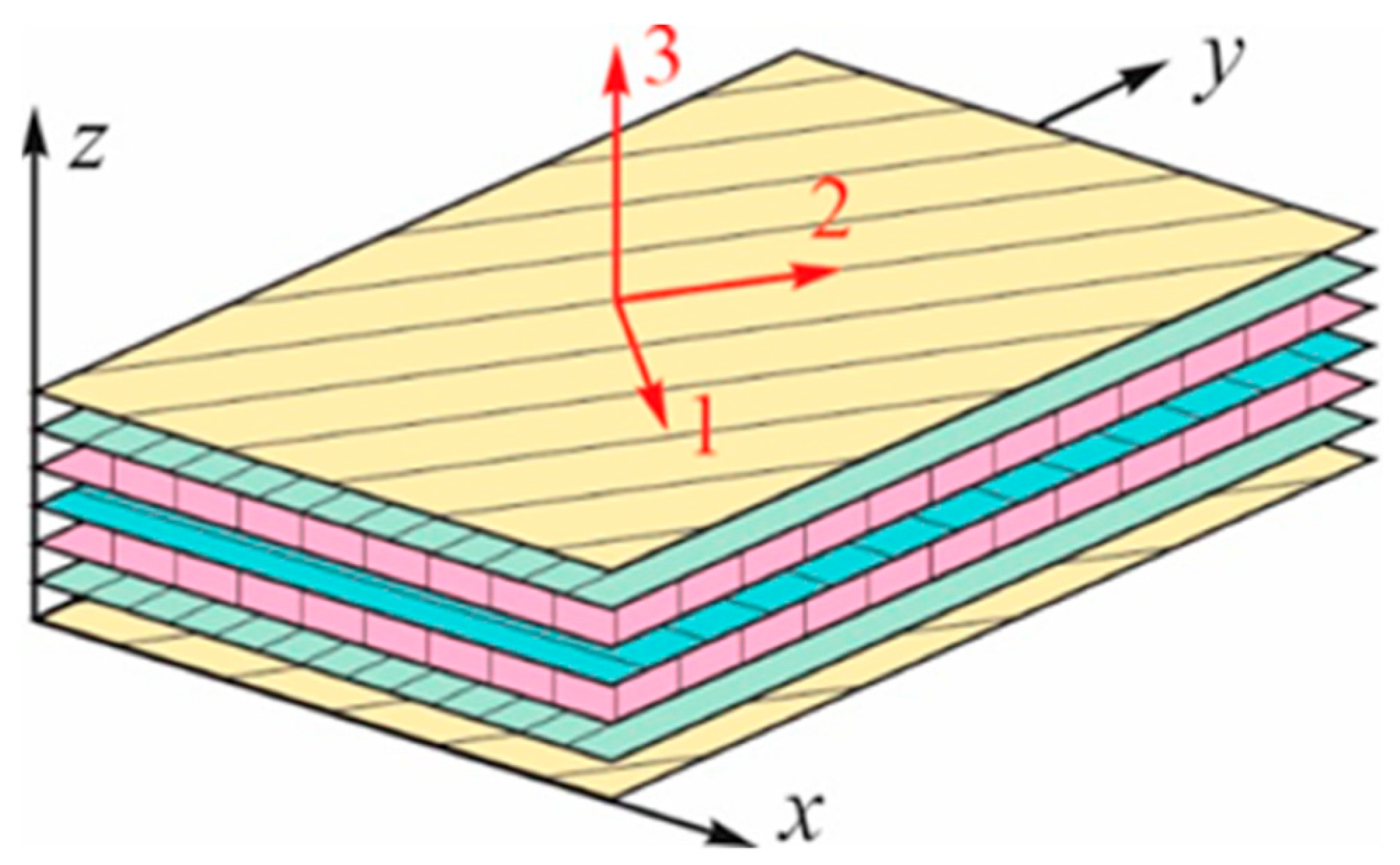
Figure 2.
Schematic of In-Plane Stiffness and Bending Stiffness in Composite Laminates.
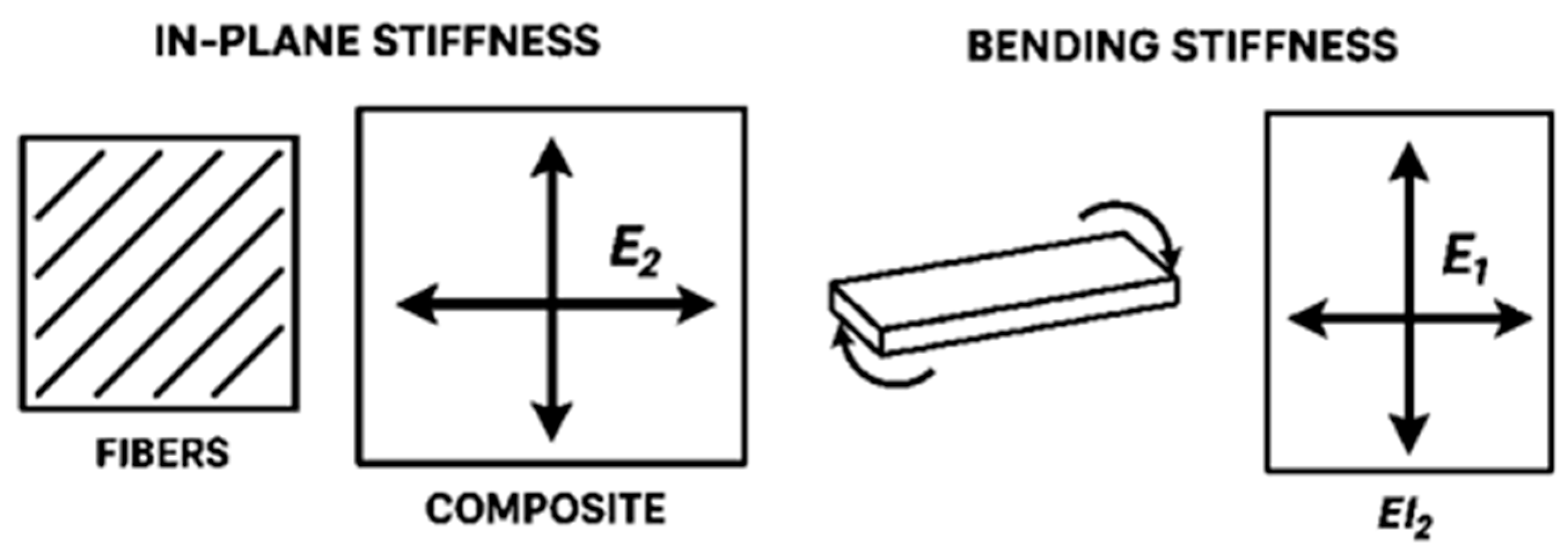
Figure 3.
Schematic of the transformation in laminate making process.
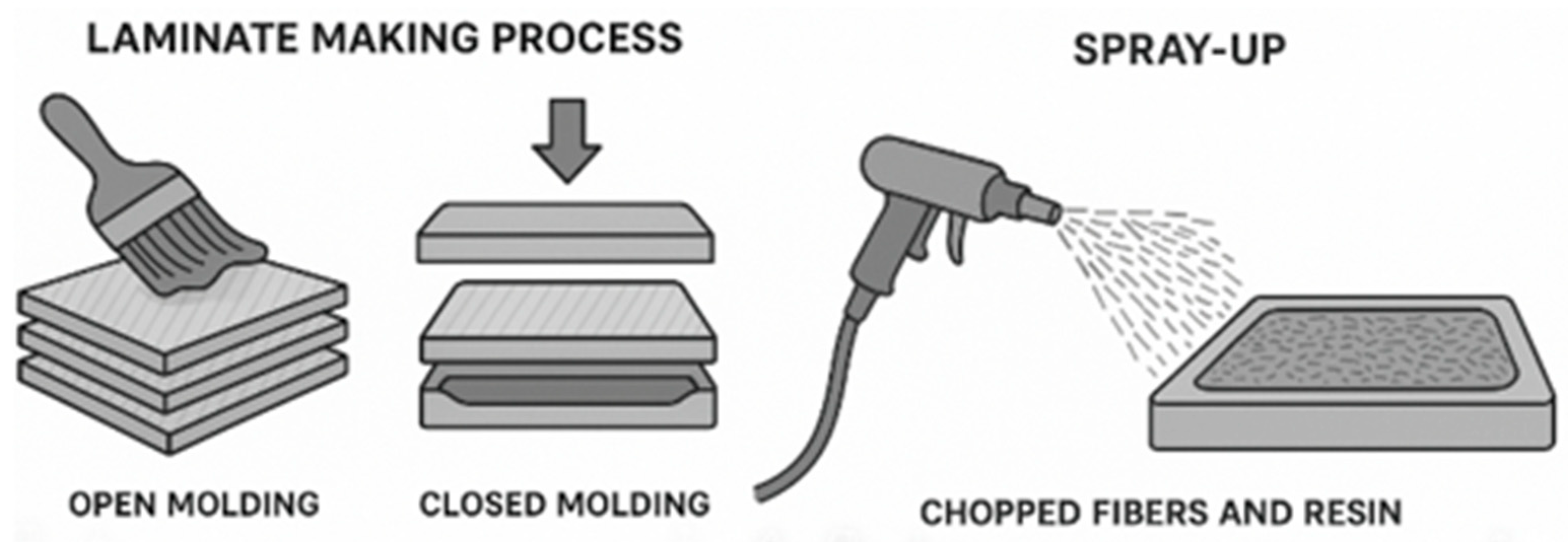
Figure 4.
Schematic of the transformation in laminate making process. Reproduced from Y Chen et al., Aerospace, 2023, 10, 206, under the Commons Attribution (CC BY 4.0) license [62].
Figure 4.
Schematic of the transformation in laminate making process. Reproduced from Y Chen et al., Aerospace, 2023, 10, 206, under the Commons Attribution (CC BY 4.0) license [62].
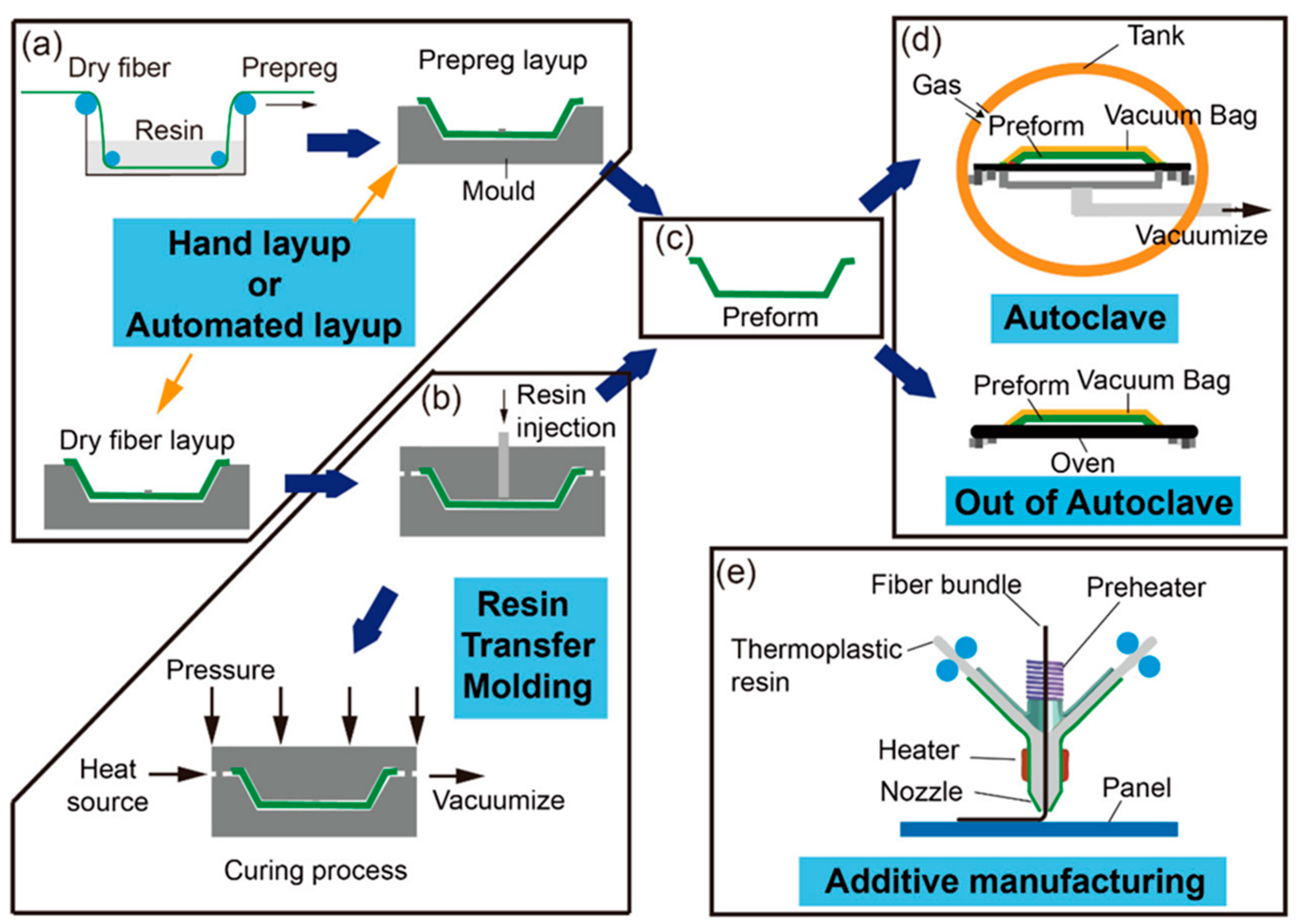
Figure 5.
Flow Chart of the model optimization and validation of the fatigue failure in the composite laminates. Reproduced from F Zhang et al., Journal of Composites Science, 2024, 8, 423, under the Commons Attribution (CC BY 4.0) license [63].
Figure 5.
Flow Chart of the model optimization and validation of the fatigue failure in the composite laminates. Reproduced from F Zhang et al., Journal of Composites Science, 2024, 8, 423, under the Commons Attribution (CC BY 4.0) license [63].
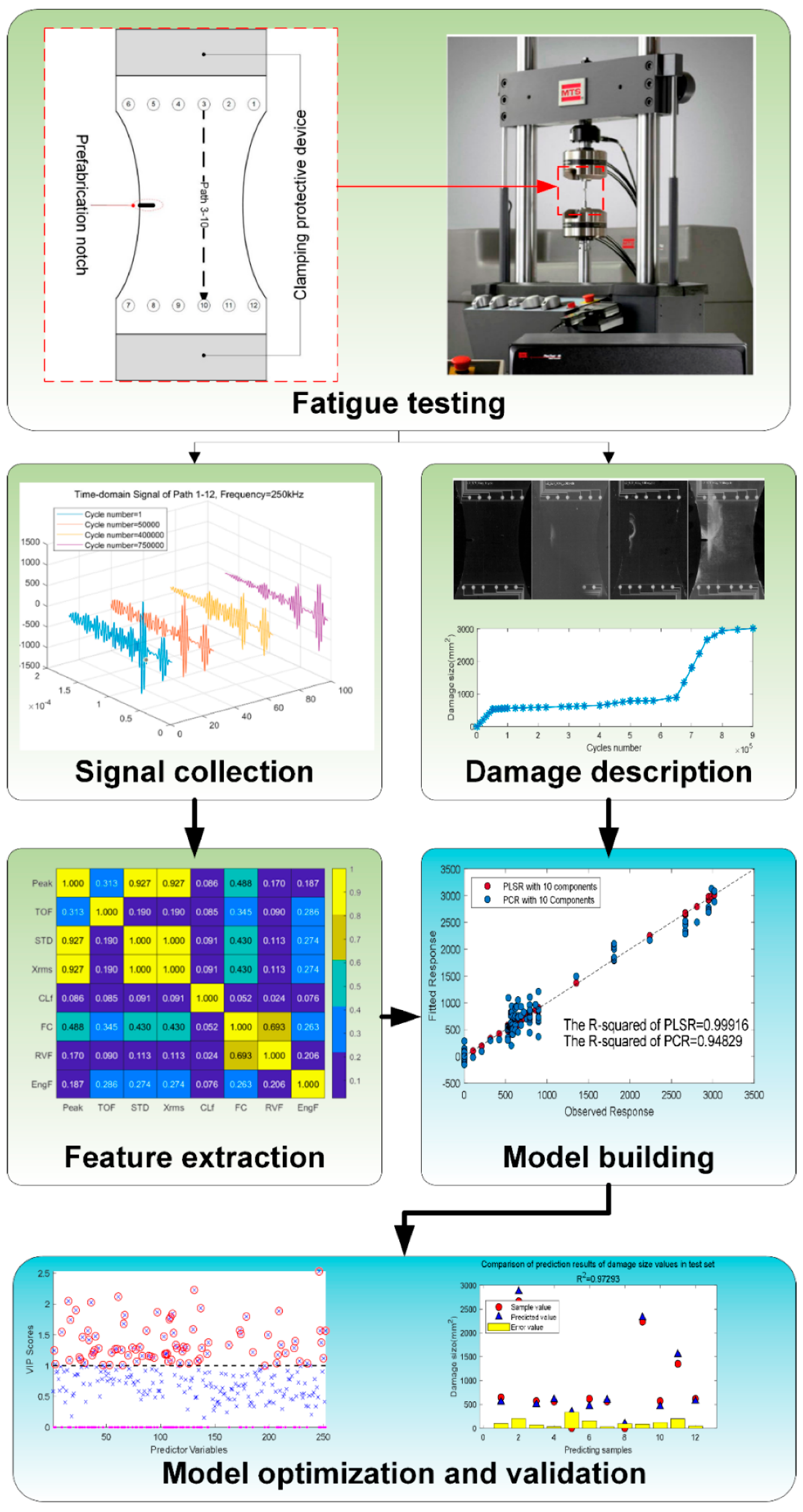
Figure 6.
Schematic of the finite element model to predict the impact damage of the composite laminates. Reproduced from Y Shang et al., Fibers, 2025, 13, 115, under the Commons Attribution (CC BY 4.0) license [64].
Figure 6.
Schematic of the finite element model to predict the impact damage of the composite laminates. Reproduced from Y Shang et al., Fibers, 2025, 13, 115, under the Commons Attribution (CC BY 4.0) license [64].
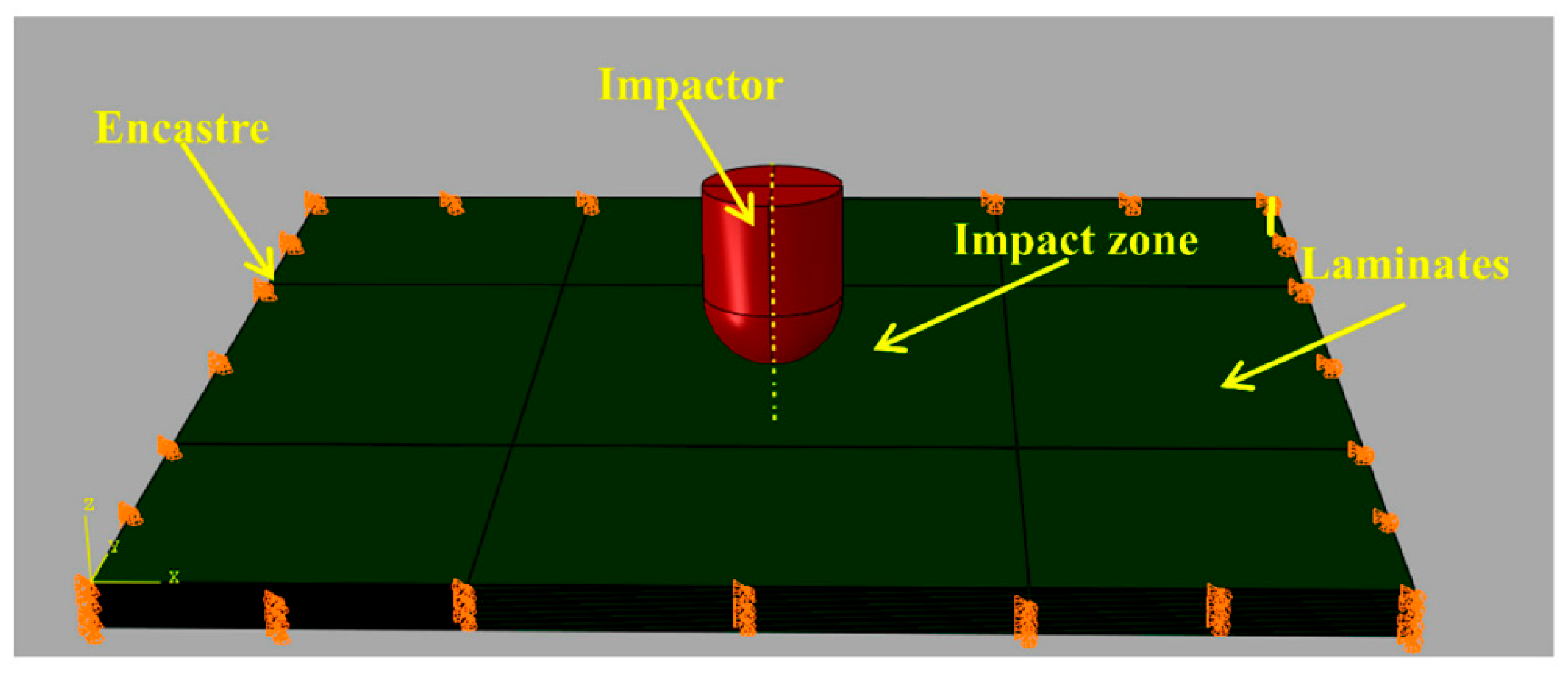
Figure 7.
Schematic of the ASTM standard test specimens (a) tensile test, (b) compression test, (c) flexural test, (d) moisture absorption test. Reproduced from Sudarisman S et al., Journal of Composites Science, 2023, 7, 184, under the Commons Attribution (CC BY 4.0) license [65].
Figure 7.
Schematic of the ASTM standard test specimens (a) tensile test, (b) compression test, (c) flexural test, (d) moisture absorption test. Reproduced from Sudarisman S et al., Journal of Composites Science, 2023, 7, 184, under the Commons Attribution (CC BY 4.0) license [65].
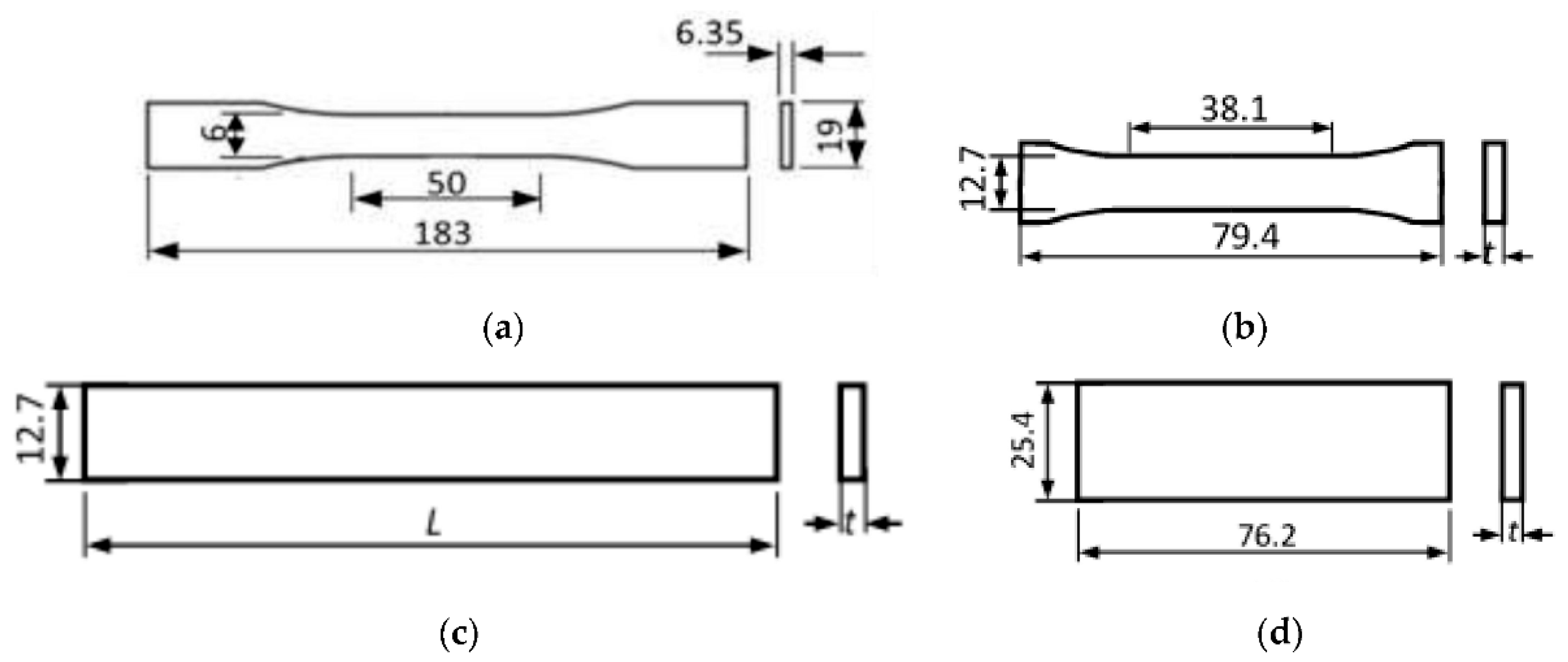
Table 1.
Mechanical Properties of Common Laminated Composites.
| Material | Tensile Strength (MPa) | Tensile Modulus (GPa) | Flexural Strength (MPa) | Impact Resistance (kJ/m²) |
| Carbon/Epoxy | 1500–2000 | 120–150 | 1000–1500 | 50–100 |
| Glass/Polyester | 400–600 | 20–30 | 300–500 | 100–200 |
| Aramid/Epoxy | 1300–1800 | 70–90 | 800–1200 | 150–300 |
| Process | Description | Advantages | Disadvantages | Typical Applications |
| Hand Layup | Manual application of resin and fibre mats to a one-sided mold | Low cost, simple, suitable for one-offs and small series | Labor-intensive, inconsistent quality, high void content | Prototypes, custom parts, low-volume components |
| Spray-up | Spraying chopped fibres and resin onto a one-sided mold | Fast, efficient, cost-effective | Irregular fibre structure, less critical thickness control | Large, non-structural parts, bathtubs |
| Vacuum Infusion | Using vacuum to draw liquid resin through a dry fibre preform in a sealed mold | High fibre content, low voids, smooth surface on both sides, cost-effective | Requires skill and careful setup, not ideal for highly complex shapes | Boat hulls, wind turbine blades, large structural panels |
| RTM | Injecting resin under pressure into a closed mold with dry fibres | High quality, excellent surface finish on both sides, repeatable for high volume | High tooling cost, complex equipment, limited part size | Automotive parts, aerospace components, moderate to high-volume parts |
| Autoclave Curing | Curing prepreg materials under high pressure and heat | Very high FVF, very low void content, superior mechanical properties | High equipment cost, complex process, limited part size and shape | Aerospace primary structures, high-performance components |
Disclaimer/Publisher’s Note: The statements, opinions and data contained in all publications are solely those of the individual author(s) and contributor(s) and not of MDPI and/or the editor(s). MDPI and/or the editor(s) disclaim responsibility for any injury to people or property resulting from any ideas, methods, instructions or products referred to in the content. |
© 2026 by the authors. Licensee MDPI, Basel, Switzerland. This article is an open access article distributed under the terms and conditions of the Creative Commons Attribution (CC BY) license (http://creativecommons.org/licenses/by/4.0/).
Copyright: This open access article is published under a Creative Commons CC BY 4.0 license, which permit the free download, distribution, and reuse, provided that the author and preprint are cited in any reuse.


