
Submitted:
13 March 2026
Posted:
16 March 2026
You are already at the latest version
Abstract
Electric vehicles (EVs) have fundamentally changed the noise, vibration, and harshness (NVH) landscape of automotive powertrains. In the absence of masking inter-nal-combustion-engine noise, harmonic components such as gear whine, electric-motor orders, and inverter-related tones become more perceptible and more critical to vehicle re-finement. This review synthesizes the current state of the art in harmonic NVH engineer-ing for electric drivetrains, focusing on the interactions between gear geometry, manufac-turing variability, electromechanical coupling, structural transfer, and human sound per-ception. Classical mechanisms of gear-mesh excitation are revisited together with emerg-ing EV-specific challenges, including long-wavelength flank deviations, ghost orders, lightweight housing dynamics, and psychoacoustic sound-quality requirements. The re-view further examines recent progress in predictive and data-driven approaches, includ-ing machine-learning-based gear-noise modeling, digital-twin concepts, and virtual NVH assessment workflows. Overall, the literature shows that harmonic NVH engineering in EVs is evolving from a conventional gear-noise problem into a multidisciplinary sys-tem-level task integrating gear dynamics, manufacturing science, structural acoustics, electric-drive control, psychoacoustics, and data-driven optimization. This review pro-vides a structured synthesis of these developments and identifies key research gaps and future directions for the next generation of refined electric drivetrains.
Keywords:
electric vehicle
; drivetrain NVH
; harmonic noise
; gear whine
; transmission error
; ghost orders
; gear microgeometry
; flank waviness
; electromechanical coupling
; structure-borne noise
; psychoacoustics
; sound quality
; sound branding
; digital twin
; machine learning
1. Introduction and Scope of the Review
1.1. Background and Motivation
Electric vehicle (EV) drivetrains have fundamentally altered the noise, vibration, and harshness (NVH) landscape of automobiles. In conventional vehicles, the broadband noise of the internal combustion engine (ICE) dominated the cabin sound field and masked many mechanically generated tonal components. In EVs, by contrast, this masking effect is largely absent, which makes even subtle tonal noises from the drivetrain clearly perceptible to passengers [1]. As a result, gear whine, a tonal noise associated with gear meshing, has emerged as one of the most important NVH issues in electric drivetrains [1,2]. Although battery electric vehicles are widely recognized for their quiet operation, this very advantage exposes sound sources that were previously of minor perceptual significance and that can now reduce perceived comfort [2]. In particular, high-frequency harmonic components that would once have been masked by ICE-related background noise have become much more noticeable in EVs and are often perceived as especially disturbing [3]. Even a relatively modest tonal component originating from a gear mesh or electric motor may attract disproportionate attention in an otherwise quiet acoustic environment [2]. This transition has forced NVH engineering to place renewed emphasis on the harmonic content of drivetrain noise.
At the center of gear-whine generation is transmission error (TE), which is defined as the small deviation between the actual and ideal meshing kinematics of a gear pair [1,4]. TE acts as a primary source of dynamic excitation at the gear mesh frequency, given by rotational speed multiplied by tooth count, and at its harmonics, thereby producing the characteristic whining sound associated with geared transmissions [1,5]. Classical gear design has long aimed to minimize TE, since an ideal involute gear pair under load with zero transmission error would, in theory, generate no mesh-induced vibration [4,6]. In real applications, however, manufacturing tolerances, tooth deflections, and unavoidable geometric imperfections ensure that some level of TE remains present, and therefore some degree of tonal excitation is practically unavoidable [4,6]. For this reason, established gear-NVH design practice has focused on optimizing macro-geometric parameters such as tooth number, module, face width, and profile modifications including tip relief and crowning in order to ensure smoother load transfer during meshing [1,4]. These measures help to distribute contact forces more uniformly and reduce abrupt stiffness variations, thereby mitigating the excitation of mesh harmonics [1,5]. Such strategies remain essential in EV gearbox design. At the same time, the NVH targets of electric vehicles are substantially more demanding than those of conventional drivetrains, and tonal components that were previously considered acceptable may become objectionable in the much quieter interior sound field of an EV [2]. This has led to growing interest in finer geometric details that were once treated as secondary design considerations.
Recent findings suggest that maximizing conventional gear accuracy alone does not necessarily lead to the most favorable acoustic outcome [4]. Müller and Gorgels (2023) reported that a pair of e-drive gears manufactured to extremely tight tolerances, resulting in nearly identical teeth, exhibited very low overall vibration levels while still producing a pronounced and highly pure tone at the mesh frequency [4]. By contrast, a gear set containing slight but well-distributed irregularities spread vibratory energy into several lower-amplitude sidebands, creating a broader-spectrum and less tonal sound that was perceived as more acceptable [4]. In other words, a highly uniform gear geometry may concentrate energy into a single narrow-band tonal component, whereas a slightly “blurred” spectrum can reduce tonal prominence. This somewhat counterintuitive observation has redirected attention toward tooth-level microgeometry and manufacturing-induced surface characteristics as acoustically relevant factors in EV drivetrain development [4,7]. Features such as flank waviness, understood as periodic undulations on the tooth surface, or minute spacing deviations between adjacent teeth may alter the spectral structure of vibration and noise. This review argues that harmonic NVH refinement in electric drivetrains can no longer be approached as a set of separate tasks. Gear design, motor excitation, structural transfer, and sound-quality assessment have to be considered together as one excitation–transfer–perception chain. These effects are especially important in EVs because the resulting tones rarely appear on their own. Instead, gear-related harmonics, electromagnetic orders, and inverter-related sidebands may converge within the same perceptually sensitive frequency region, so that spectral overlap rather than single-source amplitude becomes a dominant driver of perceived harshness.
1.2. Scope of the Review
Against this background, the present review examines the state of the art in harmonic NVH engineering for electric drivetrains, with particular emphasis on the link between gear geometry, excitation behavior, structural transfer, and perceived acoustic quality. The review covers classical gear-noise mechanisms together with more recent EV-specific challenges, including manufacturing variability, ghost orders, electromechanical coupling, lightweight housing dynamics, psychoacoustic sound-quality assessment, and predictive engineering approaches.
The primary emphasis is placed on research published between 2018 and 2026, reflecting the period in which harmonic NVH has become a central development topic in battery electric vehicles. To maintain technical continuity, selected earlier foundational studies are also included where they remain essential for understanding transmission error, mesh stiffness variation, and classical gear-noise mechanisms. The review primarily builds on peer-reviewed journal articles and conference papers, while selected industrial and technical sources are considered where they provide useful insight into emerging engineering practice.
Rather than treating gear noise, electric-motor excitation, structural transfer, and sound quality as isolated topics, this review approaches them as parts of an interconnected system problem. Accordingly, the present review does not stop at excitation generation or radiated noise alone, but follows the full chain toward perception and, ultimately, vehicle-level sound character, which is becoming an increasingly relevant element of brand differentiation in electric mobility. Its objective is to provide a structured and application-relevant synthesis that is useful both for academic research and for practical EV drivetrain development.
A key motivation for the present review is that the existing literature remains largely organized in disciplinary slices, such as gear geometry, transmission error, vibration, radiated noise, or psychoacoustic evaluation, whereas EV acoustic complaints often emerge precisely when these domains overlap. In practice, harmonic NVH problems become most critical when gear-mesh harmonics, electromagnetic orders, inverter-related sidebands, and structural resonances interact within the same perceptually sensitive frequency region.
To make this system-level logic explicit, Figure 1 summarizes the review framework adopted in this paper, tracing the causal chain from manufacturing deviations and gear geometry through excitation generation and structural transfer to acoustic radiation, psychoacoustic perception, and ultimately EV sound character.
1.3. Review Methodology
1.3.1. Review Design
This state-of-the-art review was conducted in accordance with the PRISMA 2020 statement and the PRISMA-S extension for reporting literature searches. Given the multidisciplinary nature of harmonic NVH engineering in electric drivetrains, a scoping-review logic consistent with PRISMA-ScR principles was adopted in order to systematically map the evidence base while maintaining transparent reporting of study identification, screening, eligibility assessment, and inclusion. The review was designed to capture the integrated harmonic chain extending from geometry and manufacturing variability to harmonic excitation, multi-source coupling, structural transfer, and human sound perception. This framing reflects the multidisciplinary nature of EV harmonic NVH, in which geometry, excitation, structural transfer, and perception must be considered as parts of one interconnected problem.
1.3.2. Information Sources and Search Strategy
The literature search was conducted on 22 February 2026 using the following databases: Web of Science Core Collection, Scopus, IEEE Xplore, SAE Mobilus, ScienceDirect, SpringerLink, and MDPI. Google Scholar was used only for backward and forward citation tracking. The primary search window covered publications from 2018 to 2026 and was limited to English-language sources. Earlier studies published before 2018 were included only if they were considered foundational for the topic, particularly in relation to transmission error, time-varying mesh stiffness, gear dynamics, or transfer path analysis.
The search strategy was organized around three main Boolean query blocks corresponding to the technical structure of the review. The first block addressed gear-excitation physics, including terms related to transmission error, dynamic transmission error, time-varying mesh stiffness, gear mesh frequency, microgeometry, flank waviness, and tooth-to-tooth variability. The second block focused on electromechanical and inverter-related coupling, including terms such as electromagnetic forces, torque ripple, rotor eccentricity, pulse-width modulation, switching frequency, modulation, and sidebands. The third block covered structural transfer and psychoacoustic assessment, including transfer path analysis, structure-borne noise, housing modes, loudness, sharpness, roughness, tonality, sound quality, and acoustic vehicle alerting systems. Only peer-reviewed journal articles and conference papers with verifiable bibliographic identifiers, preferably including DOI information, were retained for the structured review set.
1.3.3. Study Selection
All retrieved records were exported in RIS format and imported into Zotero for deduplication, with DOI-based matching used as the primary duplicate-identification method. The deduplicated records were screened in two stages: first by title and abstract, and then by full-text eligibility assessment. Screening was performed independently by two reviewers, and disagreements were resolved by discussion and consensus.
Studies were included if they addressed electric drivetrains, including e-axles, electric drive units, or traction-motor systems with reduction gears; contributed to at least one segment of the harmonic excitation–transfer–perception chain; and provided verifiable bibliographic information. Studies unrelated to drivetrain harmonics, lacking peer review, or providing insufficient methodological detail for meaningful synthesis were excluded. This selection logic reflects the integrated review motivation stated in the earlier manuscript version, namely that EV harmonic NVH problems emerge at the overlap between gear dynamics, electric-machine excitation, structural transfer, and perception rather than within isolated disciplinary slices.
1.3.4. Data Extraction and Evidence Classification
For each included study, the following information was extracted where available: drivetrain type, primary excitation source, frequency content, modeling approach, treatment of structural transfer, psychoacoustic metrics, and validation type. Particular attention was given to studies addressing the frequency range most relevant to tonal EV NVH, especially the approximately 3–8 kHz region in which gear whine, motor orders, and related high-frequency components may become perceptually prominent.
To support structured synthesis, the included evidence was classified into four main categories: measurement-validated studies, simulation-only studies, analytical-only studies, and review papers. This categorization was used to distinguish between different levels of validation maturity and to identify areas where the current literature remains dominated by simulation-based or conceptual work.
1.3.5. PRISMA Flow
The database search yielded 3322 records in total. After removal of 1074 duplicates, 2248 records remained for title and abstract screening. At this stage, 1641 records were excluded. Full texts of 607 studies were then assessed for eligibility. Of these, 551 were excluded due to non-drivetrain scope, insufficient harmonic relevance, limited methodological detail, duplication across sources, or lack of peer-reviewed status. A total of 56 studies were included in the final synthesis and formed the structured evidence base for the present review. The corresponding study-identification and screening procedure is illustrated in Figure 2.
After the introductory section and review methodology, the paper proceeds from physical fundamentals toward system-level interpretation and future-oriented development perspectives. Section 2 introduces the main mechanisms of harmonic gear NVH. Section 3 focuses on manufacturing variability and microgeometry-related effects, while Section 4 extends the discussion to EV-specific harmonic sources and electromechanical coupling phenomena. Section 5 examines structure-borne transfer paths and housing dynamics, and Section 6 shifts the focus toward psychoacoustics, sound quality, and sound branding. Section 7 reviews recent progress in data-driven, predictive, and digital-twin-supported NVH engineering. Building on these foundations, Section 8 discusses the main research gaps and emerging paradigm shifts that are shaping the field. The review closes in Section 9 with the overall conclusions.
2. Fundamental Mechanisms of Harmonic Gear NVH
Mechanical gears have long been recognized as a classical source of tonal noise in vehicle transmissions [6,8]. The underlying mechanism is associated with gear-mesh excitation: as the teeth engage and disengage, they generate periodic forcing at the mesh frequency, defined by the number of meshing events per second, and at its integer harmonics [1,5]. Early research established that transmission error (TE) is the principal source of this excitation.
Figure 3 schematically illustrates the role of transmission error as the primary source of gear-mesh excitation, showing both the TE waveform over the mesh cycle and its harmonic decomposition, together with the typical reduction achieved by microgeometry optimization.
Any deviation of the driven gear motion from ideal conjugate action leads to fluctuations in mesh stiffness and to localized dynamic disturbances during tooth entry and exit, which in turn produce vibration at the mesh fundamental and its harmonic orders [5,9]. These excitations can propagate through the shafts, bearings, and housing of the transmission and may ultimately radiate as audible tonal noise. For spur gears, the mesh frequency can be expressed as , where N is the number of teeth. Helical gears, which are widely used in EV reducers, distribute the contact over a longer engagement path and typically provide a higher contact ratio, which helps smooth the TE response through overlapping tooth contact [5]. Even so, helical gears are by no means immune to tonal whine; if TE remains present, harmonic noise can still become pronounced, although the spectral character may be somewhat less severe than in comparable spur-gear configurations.
Classical mitigation strategies have therefore focused on minimizing TE over the relevant operating load range. Profile modifications such as tip relief and lead crowning are applied to reduce abrupt contact transitions near the ends of the tooth under load [1,4]. When properly designed, such microgeometry modifications allow smoother mesh-in and mesh-out behavior and reduce impact-like dynamic excitation. In parallel, gear designers also select tooth counts carefully in order to avoid coincidence between mesh harmonics and structural resonances, or to shift dominant tonal components away from acoustically sensitive frequency ranges [5,10]. Increasing the contact ratio, whether through extended addenda or helical overlap, distributes the transmitted load over a larger number of simultaneously engaged teeth and thus reduces the amplitude of per-tooth mesh-stiffness variation, which in turn lowers tonal excitation [5]. These principles, described in classical gear-noise literature such as Smith (2003), remain directly relevant in the EV era, even though the acoustic targets have become much more demanding.
An important point is that gear whine is fundamentally a forced-response problem. Even an ideally manufactured gear pair will generate some harmonic excitation if the mesh stiffness is not perfectly constant over the engagement cycle. At the same time, manufacturing deviations have historically been recognized as major amplifiers of tonal behavior. Masuda et al. (1986) showed experimentally that different finishing methods lead to different vibration responses: gears produced by grinding and honing exhibited different mesh-frequency amplitudes, and honing resulted in lower peak noise due to its influence on surface micro-topography [11]. Similarly, Houser and Harianto (2001) noted that measured gear-noise spectra often contain discrete peaks that can be associated with specific tooth-quality deviations, such as periodic pitch errors [5]. These findings established an important distinction: macro-scale gear design determines the baseline harmonic behavior through contact ratio, nominal stiffness variation, and nominal TE, whereas manufacturing deviations superimpose additional modulation that can either increase or redistribute particular harmonic components. As a result, classical NVH practice relied on both optimized design and high-precision manufacturing, typically supported by DIN or ISO gear-quality standards, in order to suppress tonal whine effectively [9,12].
It is also worth distinguishing gear whine from other gear-related acoustic phenomena. Low-speed rattle and backlash-related clatter are usually non-stationary and broadband in character, and they differ fundamentally from the steady harmonic excitation considered in the present review. In the context of harmonic NVH, the gear pair is more appropriately interpreted as a periodically excited dynamic system with time-varying stiffness at the mesh frequency. Since the 1980s, numerous analytical and simulation approaches have been developed to describe this behavior, including lumped-parameter dynamic models and finite-element-based formulations [6]. Singh and Lim (1988), for example, discussed the role of gearbox housing dynamics and acoustic radiation, showing how mesh excitation may be strongly amplified by structural resonances of the casing [6]. Such foundational work established the basis for the multiphysics drivetrain simulations used today in electric-vehicle NVH development. Overall, classical gear-NVH engineering provided the core concepts and tools required to generate, interpret, measure, and mitigate harmonic vibrations in geared transmissions. Precision geometry, profile modification, and careful structural design therefore remain essential starting points in EV applications. However, as the following sections show, the harmonic NVH problem in electric drivetrains is no longer defined solely by nominal gear-mesh theory, but increasingly by micro-scale geometric variability, electromechanical coupling, and the heightened perceptual sensitivity of passengers to narrow-band high-frequency tones.
3. Manufacturing Variability and Microgeometry Effects
Even when gears are optimized at the design stage, real manufacturing processes introduce circumferential variability that can generate additional harmonic content beyond the nominal mesh orders. In particular, long-wavelength deviations, meaning errors that extend over several teeth or even over a full revolution, do not necessarily appear at the fundamental gear-mesh order itself, but instead often give rise to sideband components commonly described as ghost orders [7,8]. Unlike the primary mesh harmonics, which are directly linked to tooth count and its integer multiples, ghost frequencies arise from the non-uniform distribution of geometric deviations around the circumference [7]. Typical examples include eccentricity or runout, cumulative pitch variation, and periodic waviness on the tooth flanks. Such deviations introduce a secondary modulation of the mesh force at frequencies different from the nominal mesh fundamental, which leads to sideband structures in the vibration and noise spectrum [7,13]. This is one reason why a gearbox may satisfy conventional quality grades, which mainly target local or single-tooth deviations, while still exhibiting unexpected tonal components at non-mesh-related orders [7].
A further EV-specific design trend concerns the shift toward small-module, high-speed gearboxes. As rotational speed increases, the gear-mesh-frequency ladder and its higher harmonics move upward into frequency regions with denser structural modal content, which increases the risk of order–mode coincidence and harmonic clustering. Under such conditions, the sensitivity to microgeometry grows, and fluctuations in time-varying mesh stiffness become increasingly critical for tonal excitation. This is important from an optimization perspective, because it implies that high-speed EV gearbox refinement cannot rely only on nominal macro-geometry design, but increasingly requires robust microgeometry optimization and tolerance-aware predictive methods. In this sense, data-driven and optimization-based approaches, including surrogate-assisted or machine-learning-supported microgeometry design, are particularly relevant for high-speed EV gearboxes, where small geometric changes may produce disproportionately large differences in harmonic NVH behavior.
A particularly important future direction is robust microgeometry design for high-speed EV gearboxes. In industrial practice, it is no longer sufficient to identify a nominal optimum if that optimum collapses under realistic manufacturing variability. This shifts the focus toward Monte Carlo-based microgeometry studies, tolerance-band-dependent NVH spread, and worst-case-aware design strategies that seek not only minimum nominal excitation, but also stable acoustic behavior under production scatter.
Another cutting-edge issue is tooth-to-tooth variability, since many classical models still assume that all teeth are geometrically identical. In reality, profile deviations, waviness patterns, and phase mismatches may vary from tooth to tooth, which can lead either to tonal cancellation or to amplification of sidebands and ghost-order-related content. This makes phase structure an acoustically relevant variable rather than a negligible manufacturing detail.
This also points toward phase-aware harmonic shaping as a future research direction, including wave-based flank-topology concepts in which tooth-level phase offsets are intentionally used to redistribute or suppress tonal energy.
The role of manufacturing-related ghost orders has received increasing attention over the past decade, particularly because EV drivetrains make even weak tonal components more perceptible. Kahraman et al. (2011) provided one of the key analytical studies on ghost-noise generation in helical gears, showing that runout and systematic tooth errors can produce discrete vibration orders that are not predicted by idealized gear models [7]. Later experimental investigations confirmed that even periodic deviations at the micrometer scale may become acoustically relevant [8]. Ahmad, Brimmers, and Brecher (2020), for example, examined long-wave flank deviations and reported that they can significantly increase dynamic excitation, especially at elevated rotational speeds [8]. From a dynamic point of view, these long-wavelength deviations act as a modulation mechanism superimposed on the nominal meshing process. They modify the amplitude and phase of the mesh-related excitation in a way that is analogous to amplitude modulation in signal processing, thereby generating sidebands around the main mesh-frequency components. As rotational speed increases, these sideband frequencies may shift further into the audible range, which increases their NVH relevance in electric drivetrains [8].
A particularly important form of long-wave deviation is surface waviness, which can be understood as a mid-spatial-frequency undulation of the tooth flank, typically with a wavelength on the order of one or several tooth pitches [4]. In contrast to roughness, which is associated with smaller-scale random asperities, or form error, which describes very low-frequency shape deviations such as runout, waviness occupies an intermediate geometric regime [4]. It is often associated with process signatures and may repeat regularly from tooth to tooth or over every few teeth. One possible source is vibration of the grinding wheel during finishing, which may imprint a nearly sinusoidal pattern onto successive flanks [14]. Such repeating patterns create excitation orders that are offset from the nominal mesh frequency. For instance, if a given waviness pattern repeats every two teeth, an additional component may appear near half of the nominal mesh order. In this sense, waviness-related ghost orders are especially problematic in high-quality gears, because they are not primarily design-driven but process-driven, and therefore cannot be eliminated by classical macro-geometry optimization alone [4]. As noted by Gorgels and Finkeldey in a recent patent, the detection and quantification of waviness-related sidebands in end-of-line inspection has become increasingly important for ensuring acceptable acoustic behavior in EV gear production [15].
A periodic circumferential deviation, such as slight runout or surface waviness, modulates the mesh-related transmission error at a lower frequency, thereby generating sideband tonal components [7,8]. These ghost orders appear between the dominant mesh harmonic and its multiples. As a result, even geometrically precise gears may exhibit additional tonal peaks if subtle repetitive deviations remain present.
In response to these challenges, both metrology methods and finishing technologies have advanced considerably. Modern gear-inspection approaches, including double-flank rolling tests combined with laser-based scanning, are increasingly capable of mapping long-wave deviations over the full circumference [13]. A recent example is Gleason’s GRSL system, which integrates dual-flank composite testing with laser inspection in order to detect runout and spacing variation for each gear at production-relevant speeds [16]. Such approaches are intended to identify precursors of ghost-order-related noise before final assembly and thus support near-100% production screening. On the manufacturing side, process selection and finishing strategy also play an important role. Conventional grinding may leave periodic undulations that are correlated with tool motion, whereas honing and superfinishing can reduce or randomize such patterns [11,17]. According to the review by Tian et al. (2024), honed and superfinished gears frequently show lower tonal noise than conventionally ground gears, partly because they reduce the mid-frequency waviness associated with high-frequency hiss and ghost-order-related components [11,17]. In some reported cases, these improvements correspond to approximately 3–6 dB lower high-frequency noise relative to standard grinding processes [17].
Despite these advances, ghost orders remain difficult to predict and control. Since they are not directly tied to the nominal tooth count, they may not appear in basic simulation workflows unless measured deviations are explicitly introduced into the model [13,18]. Choi et al. (2023) demonstrated this clearly by incorporating measured macro-geometric deviations, including profile and pitch errors, into gear-contact simulations. Their results showed ghost-related resonances and performance effects that would not have been captured by an idealized nominal model [9]. This finding reflects a broader shift in EV NVH engineering: whereas nominal geometry was often sufficient for earlier-stage transmission analysis, accurate prediction of tonal behavior in electric drivetrains increasingly requires direct consideration of manufacturing variability. At the same time, the question of how to specify acceptable levels of waviness or runout remains open. Existing ISO and DIN quality systems still focus primarily on quantities such as single-pitch error and total composite error, while more explicit descriptors of waviness amplitude or spectral content remain underdeveloped [4]. In practice, this has led several manufacturers, including Klingelnberg, to introduce internal deviation-analysis procedures that focus on mid-wavelength content and correlate specific structure-borne frequency bands with perceived whine [19,20].
The manufacturing-related mechanisms discussed above are synthesized in Table 1, which summarizes the main deviation types relevant to harmonic NVH in electric drivetrains, their typical origins, spectral implications, detection methods, and possible mitigation strategies.
An important unresolved issue is population-level geometry heterogeneity, since tooth-to-tooth variability and phase effects can restructure sidebands and ghost orders in ways that are not captured by nominal geometry alone. This also implies that geometric perfection in the conventional manufacturing sense does not necessarily translate into improved perceived acoustic quality [21].
Overall, manufacturing variability and microgeometry-related deviations play a decisive role in the harmonic NVH behavior of modern electric drivetrains. Whether they arise intentionally through profile-relief strategy or unintentionally through runout, waviness, and other process-induced deviations, such effects can strongly reshape the tonal response of a gearbox. Because EV systems operate at high rotational speeds and in comparatively quiet acoustic environments, they are particularly sensitive to ghost-order-related phenomena. Effective harmonic NVH engineering must therefore combine robust design with process-aware manufacturing control. In practice, this means not only reducing deviation amplitudes, but also improving gear tolerance to unavoidable variability, for example through microgeometry choices that reduce narrow-band tonal concentration. Ongoing research is increasingly linking gear metrology with NVH prediction, thereby enabling simulation and assessment workflows that include measured deviations rather than relying exclusively on nominal geometry [13,18]. The next section therefore turns to another defining feature of electric drivetrains, namely the interaction between gear-generated harmonics and electric-machine-related excitation sources, which together create a more strongly coupled NVH problem than in conventional powertrains.
4. EV-Specific Harmonic Sources and Electromechanical Coupling
Electrification introduces additional harmonic excitation sources and coupling mechanisms that were either absent or of secondary importance in conventional drivetrains. Among these, the electric traction motor is the most significant, since it generates its own tonal vibration and noise orders through electromagnetic excitation. In electric vehicles, the motor is directly coupled to the gearbox, which means that motor-related harmonics can interact with gear dynamics, while gear-induced vibrations may also influence the electromechanical system response [2,12]. One important example is the interaction between motor torque ripple and gear-mesh excitation. Permanent-magnet synchronous motors (PMSMs), which are widely used in EV applications, generate electromagnetic forces at characteristic orders related to pole number, slotting, and inverter switching behavior. These forces may excite resonances of the stator, housing, or surrounding structural components, leading to the well-known high-frequency tonal components often referred to as motor orders [22]. When such a motor-related harmonic coincides with, or modulates, a gear-mesh-related excitation, the resulting acoustic response may exhibit amplification, beating, or other coupled phenomena. A particularly critical but still insufficiently explored issue is spectral overlap, that is, the condition in which gear-mesh harmonics, electromagnetic force orders, and inverter-related sidebands occupy the same perceptually sensitive frequency region and are further amplified by structural receptance peaks.
Recent studies have highlighted the importance of this coupled behavior. Fang and Zhang (2018), for example, investigated an EV powertrain under inverter pulse-width modulation (PWM) excitation and identified two main acoustic contributions: harmonic-order noise dominated by motor magnetic harmonics and gear-mesh-related tones, and high-frequency switching noise originating from the inverter [22]. At lower vehicle speeds, the dominant contributions to interior sound were found to come mainly from lower-order motor harmonics and the gear-mesh-related tonal content, which together shape the characteristic tonal signature of the drivetrain [22]. As speed increases, however, inverter-switching-related content may become more perceptible, especially when the switching frequency lies within or close to the upper audible range, typically around 8–16 kHz [22]. Fang and Zhang further showed that, at lower speeds, reductions in motor- and gear-related tonal amplitudes provide the greatest improvement in perceived sound quality, whereas at higher speeds the NVH focus shifts more strongly toward inverter-related noise control or toward moving the switching frequency beyond the most sensitive hearing range [22].
In integrated e-axle systems, two spectral worlds increasingly overlap: the gear-mesh-frequency (GMF) family and its harmonics, and the inverter-switching-frequency family together with its sidebands. At high rotational speeds, the GMF ladder and its higher harmonics move upward into the mid- and high-frequency range, where switching-related tonal content may already be present. In these cases, the NVH problem is more than a simple superposition of two source families. Spectral overlap, modulation, beating, and shared structural resonances can combine to produce a much stronger tonal response. This is particularly important for EV drivetrain design, because it implies that gear microgeometry optimization should not be treated as a purely mechanical problem, but increasingly as part of a coupled electromechanical NVH task [23,24].
An important open question is the relevance of coupling between gear-microgeometry-related tonal structure and inverter-switching-related tonal content even in cases where no explicit direct interaction term is present in the governing model. In practice, such coupling may still matter because both source families can populate the same spectral region, excite the same structural receptance peaks, and jointly shape the psychoacoustic outcome perceived by the occupant [22,25].
A related and increasingly important trend concerns micro-eccentricity as a manufacturing-tolerance-driven NVH amplifier rather than only a classical fault mode. Even micrometer-scale eccentricity may generate periodic radial electromagnetic forces that excite stator-shell or surrounding housing structures. Under high-speed operating conditions, the corresponding electromagnetic force harmonics may shift into the few-kilohertz range, where resonance with panel- or shell-dominated structural modes can lead to disproportionately strong tonal radiation. This is particularly relevant from an industrial perspective, since it connects manufacturing tolerance control, online eccentricity detection, and coupled electromechanical simulation within a common NVH framework. In this sense, rotor eccentricity plays a role that is conceptually parallel to tooth-to-tooth geometric variability in gears: both act as small geometric deviations that can restructure excitation spectra and trigger amplified vibroacoustic response when combined with sensitive structural transfer conditions [26,27].
Rotor eccentricity should be seen not only as a classical fault mode, but also as a tolerance-driven NVH amplifier. Even small eccentricity can generate unbalanced electromagnetic forces that align with structural modes and produce unexpectedly strong tonal responses [12].
In addition to pole-slot combinations, rotor eccentricity, and control-related harmonics, recent studies suggest that stator-winding technology, including hairpin-winding architectures, can also influence vibration transfer and structural sensitivity in electric machines, thereby affecting the tonal signature transmitted to the surrounding drivetrain structure. Another important issue is the structure-borne transfer of motor-generated excitation into the gearbox and supporting structure. In many integrated EV powertrain layouts, the stator housing is rigidly connected to the gearbox casing, which creates a direct transfer path between electromagnetic source excitation and mechanical transmission dynamics. Holehouse et al. (2019) developed an EV drivetrain model that included both motor and gear excitations and demonstrated that certain structural resonances may be driven by either source, depending on operating conditions [13]. In practical terms, this means that a housing mode may be excited primarily by gear-mesh forcing in one operating condition but predominantly by motor radial-force excitation in another. Such results underline the need for a holistic NVH treatment in which the electric motor, gearbox, housing, and even control electronics are considered as parts of a single coupled vibratory system [2,12].
A particularly illustrative example of electromechanical coupling was reported by Wang et al. (2018), who analyzed dominant whistling noises in a high-performance EV traction motor over a wide speed range [12]. At approximately 2000 rpm, a tonal component was traced to a 24th-order electromagnetic excitation associated with a 48-slot/8-pole machine, which excited a torsional mode of the stator assembly [12]. At around 8000 rpm, a different whine component emerged, this time linked to a 48th-order radial electromagnetic force exciting a breathing mode of the stator [12]. These results demonstrate that problematic tonal behavior in EV drivetrains may arise from the interaction between motor design parameters, such as pole-slot combinations, and the structural dynamics of the motor-frame-gearbox assembly. In principle, if a gear-mesh-related excitation were to align with one of these structural resonances, the overall response could become even more severe. This possibility is one reason why coordinated motor–gear design is increasingly important in EV NVH engineering.
EV powertrains also differ from conventional drivetrains in their mounting and support behavior. Although many EVs employ a relatively simple single-speed transmission, the mounting system still plays a critical role in vibration transfer. Traditional engine mounts were primarily optimized for low-frequency engine shake and isolation of combustion-related excitation, whereas EV mounts must also cope with higher-frequency tonal components generated by the motor and gearbox [15]. Rane and Deshmukh (2020) showed that mount concepts inherited from conventional powertrains may provide insufficient attenuation of high-frequency e-drive vibration, and they proposed optimized stiffness and damping combinations better suited to the specific frequency content of EV NVH [28]. At the same time, the absence of a heavy internal combustion engine often leads to lighter and sometimes more rigid powertrain packages, which may promote the transfer of tonal vibration into the vehicle body. For this reason, the control of transfer paths through mounts, subframes, and adjacent supporting structures has become an EV-specific development issue. In some cases, additional dampers or tuned absorbers are introduced on the motor housing or nearby structural components in order to reduce targeted tonal components, analogous to the use of tuned vibration absorbers in conventional vehicle subsystems [29].
A further EV-specific aspect concerns the influence of power-electronics control strategy on the acoustic response. Although inverter behavior is not a mechanical excitation source in the classical sense, it can strongly shape harmonic NVH through its effect on switching-frequency-related tonal content. High-frequency PWM operation introduces tonal components at the switching frequency and its sidebands, which may become audible under certain operating conditions [30]. To reduce this effect, manufacturers increasingly adapt inverter-control schemes either by shifting switching frequencies beyond the most sensitive part of the audible range or by randomizing them through spread-spectrum strategies in order to avoid a dominant fixed-frequency tone [30]. He et al. (2026) described a particularly interesting approach in which the inverter switching frequency is varied dynamically as a function of vehicle speed, simultaneously reducing the objectionable character of fixed-frequency whine and generating a form of speed-related acoustic feedback for the driver [31]. Such examples illustrate how the boundary between NVH mitigation and intentional sound design is becoming increasingly blurred in EV development. Similarly, motor-control strategies such as harmonic current shaping or the injection of carefully tuned dithering components may be used to spread, cancel, or redistribute tonal content. Although many of these methods remain proprietary in industrial applications, they clearly show that EV NVH engineering now includes control-oriented degrees of freedom that were not available in the same way in internal-combustion-based drivetrains. One open question is how strongly gear-microgeometry-related tones interact with inverter-switching-related content, even when the model does not include an explicit direct coupling term. In practice, such coupling may still matter because both source families can populate the same spectral region, excite the same structural receptance peaks, and jointly shape the psychoacoustic outcome perceived by the occupant [32].
Overall, EV-specific harmonic behavior is governed by the interaction between electric-motor-related excitation, power-electronics-induced tonal content, and the mechanical dynamics of the drivetrain. The combination of high motor speeds, broad torque operating ranges, and reduced acoustic masking makes EV systems particularly sensitive to reinforcement between motor orders and gear-related harmonics [12,34]. Both simulation and experimental studies indicate that this problem must be addressed as a coupled multiphysics system involving electromagnetic force generation, mechanical resonance behavior, and geometric meshing characteristics [13,31,33]. Accordingly, current development practice increasingly relies on integrated simulation environments, improved mounting concepts, and control-oriented NVH strategies in order to manage these interactions [13,15,33]. The engineering objective is not merely the independent reduction of motor noise and gear whine, but the achievement of an overall tonal balance in which coupled harmonic sources remain either inaudible or acoustically acceptable. The next section therefore turns to the structure-borne transfer of such excitations, with particular emphasis on housing dynamics and the radiation of high-frequency tonal content in EV drivetrains.
5. Structure-Borne Transfer Paths and Housing Dynamics
The propagation of vibrational energy through the drivetrain structure forms the critical link between source excitation and the sound ultimately perceived by vehicle occupants. In electric drivetrains, this link is especially important because the dominant excitation content often lies in the high-frequency range, driven by fast-rotating motors and high-order gear-mesh harmonics. At such frequencies, the structural wavelengths in typical metallic components become relatively short, which means that even compact structural elements may resonate efficiently and radiate airborne sound. For this reason, the gearbox housing and motor casing are commonly the main acoustic radiators of gear- and motor-related harmonic excitation. In many EV designs, these housings are made of lightweight aluminum alloys with relatively thin walls in order to reduce mass. Compared with the more massive and inherently damping-rich structures of conventional internal-combustion powertrains, such lightweight enclosures may be more prone to high-frequency vibration and tonal radiation [35,36].
A particularly critical EV trend is the emergence of a perceptually dominant few-kilohertz band, especially in the approximately 3–8 kHz region, where several source families may converge. In this range, inverter-related sidebands, electromagnetic harmonics, and higher GMF harmonics may overlap, while the absence of masking background noise makes the resulting tonal content especially intrusive from a psychoacoustic perspective [22,24].
One widely applied strategy for improving acoustic behavior is structural stiffening and resonance tuning. By increasing local stiffness without imposing a major mass penalty, engineers can shift structural resonances away from critical excitation orders or reduce the corresponding vibration amplitudes. Ribbing is a common example. Farshi et al. (2025) systematically investigated rib configurations for a lightweight EV gearbox housing and showed that carefully designed ribs can reduce vibration amplitudes at critical structural modes and thereby decrease radiated noise [35]. Their results indicate that the geometric design of ribs, including position, height, and thickness, can be tuned to target frequency ranges associated with gear whine [35]. A related idea has been demonstrated at the component level of the gear itself. Harris et al. (2019) reported that the design of the gear blank can influence the bending-mode behavior of the wheel body and thus the tendency toward tonal radiation, often described as gear singing [37]. By modifying the blank geometry and adding reinforcing features, they shifted structural frequencies and reduced tonal response [37]. In both cases, the underlying principle is the same: avoid or weaken coincidence between harmonic excitation and structural resonance, or reduce the effective amplification associated with highly responsive modes.
Figure 4 illustrates this logic schematically, showing how modification of gearbox housing dynamics by ribbing or damping treatment can alter the structural mode shape and reduce the resulting radiated tonal noise.
This problem is further intensified by lightweight structural design, since thinner housing and body panels may exhibit panel-dominated modes in the same few-kilohertz range. As a result, coupled vibroacoustic simulation becomes increasingly necessary, because source identification alone is insufficient when harmonic clustering and structural amplification coincide within perceptually sensitive frequency bands [35,36].
Another important direction involves damping enhancement and the use of novel material concepts. Since thin-walled lightweight structures may have limited inherent damping, additional damping treatments can be highly effective, especially in the high-frequency range. Approaches such as constrained-layer damping patches or viscoelastic layers have been investigated to absorb vibrational energy before it is radiated as sound. More recently, Amaral et al. (2023) introduced the concept of locally resonant metamaterials integrated into a gearbox housing [36]. By embedding small tuned resonant inclusions into the structure, they created frequency bandgaps in which the propagation of vibration was strongly attenuated [36]. Their prototype demonstrated that targeted high-frequency vibration transmission could be reduced without a large increase in structural mass [36]. Such approaches are attractive because they offer the possibility of frequency-selective attenuation, effectively acting as structural vibration filters for problematic tonal bands.
Isolation and transfer-path management remain equally important. Although traditional powertrain mounting systems were mainly optimized for low-frequency engine-shake isolation, EV applications increasingly require attention to higher-frequency tonal paths as well. Some drivetrain layouts therefore use elastomeric bushings or isolation interfaces at the motor–gearbox connection or at the subframe interface in order to reduce the transmission of structure-borne vibration. However, elastomeric solutions become progressively less effective at very high frequencies because of their own stiffness and dynamic limitations. This is why transfer path analysis (TPA) has become an important tool in EV NVH development: it allows engineers to identify the dominant structural routes by which vibration reaches the cabin and to intervene more selectively. In some cases, shafts themselves become relevant transmission paths. For example, if gear-related vibration is transmitted through driveshafts or half-shafts into adjacent suspension structures, tuned absorbers or modified shaft stiffness may reduce order-specific transfer [8].
Although EV harmonic NVH is often described primarily as a structure-borne problem, the literature suggests that this should not be treated as a binary distinction. Depending on drivetrain layout and operating condition, airborne contributions may also become significant, which means that EV NVH analysis increasingly requires a transfer-path framework capable of separating structure-borne and airborne routes across frequency bands [38].
From a dynamic point of view, many lightweight housing countermeasures can be interpreted as forms of structural receptance shaping, since they aim not only to reduce vibration amplitude in general, but to selectively alter the frequency-dependent transfer and amplification behavior of the housing in tonal critical bands [35,36].
Active solutions have also been investigated, although they are currently less common in production than passive design measures. Sanzenbacher et al. (2012) showed that active structural control, for example using piezoelectric actuators attached to the gearbox housing, can significantly reduce radiated noise by counteracting structural vibration directly [39]. While such concepts are not yet widespread in commercial EV drivetrains, they illustrate the potential of active control in future applications if cost and integration barriers are reduced. A more established active measure is cabin-level active noise cancellation (ANC), in which the audio system generates anti-noise to reduce persistent tonal components. Several modern premium EVs already apply ANC for drivetrain-related tonal noise. However, its effectiveness decreases at higher frequencies because phase precision and actuator bandwidth become more limiting in the kilohertz range [40]. For this reason, tonal gear-whine components above roughly 2 kHz are generally more reliably addressed through source or structural-path modifications than through cabin-level acoustic cancellation [40].
The physical mechanism of structure-borne transfer can be understood as follows. Gear-mesh forces initially excite the transmission housing primarily through the bearing locations, where local dynamic forces are introduced into the structure. From these locations, bending waves propagate through the housing walls and connected components. If one of the structural mode shapes of the housing, such as a wall-panel bending mode, lies close to a gear-mesh harmonic, a motor order, or a ghost-order-related sideband, the vibration response can increase sharply and the affected surface may radiate sound efficiently into the surrounding air [12]. Consequently, design changes that reduce modal participation or alter mode shapes can directly lower radiated sound pressure. He et al. (2014) demonstrated this relationship by showing that relatively small changes in housing geometry led to measurable reductions in radiated noise because they altered the structural dynamic response of the housing [41]. This again highlights that harmonic NVH in EVs is not only a source problem, but also a structural-path problem.
At the system level, these issues must be balanced against efficiency, weight, and packaging constraints. This trade-off has become increasingly clear in recent development programs. The Horizon 2020 ECO DRIVE project (Grant Agreement No. 858018), for example, targeted new testing and simulation methods for eco-powertrains with the aim of improving both eco-efficiency and NVH performance [42]. One of the broader conclusions emerging from such initiatives is that some traditional NVH countermeasures, especially those based on simply adding mass, are increasingly incompatible with EV design priorities such as efficiency and driving range. As a result, current development trends favor lightweight stiffening concepts, high-efficiency damping treatments, metamaterial-inspired structures, and intelligent control-oriented solutions over heavy over-dimensioned hardware [35,36]. More generally, the move toward lighter and more compact EV powertrains continues to challenge NVH engineers to suppress high-frequency structure-borne noise without sacrificing mass efficiency. This is one reason why NVH is increasingly being front-loaded into the design process, so that housing dynamics, transfer-path behavior, and tonal sensitivity can be addressed at an early stage rather than corrected only after prototype testing [12].
Modern EV NVH workflows therefore increasingly combine multibody drivetrain dynamics, electromagnetic excitation models, flexible housing FEM, acoustic radiation prediction, and psychoacoustic evaluation within one integrated process. In practical terms, this means moving from isolated source analysis toward coupled MBD–EM–FE–acoustic–perception frameworks capable of resolving not only excitation magnitude, but also tonal prominence and perceived harshness [24].
6. Psychoacoustics, Sound Quality, and Sound Branding
The assessment of harmonic NVH in electric drivetrains cannot be reduced to sound pressure level alone. In conventional powertrains, many tonal components were partly masked by broadband combustion noise and were therefore of lower perceptual importance. In electric vehicles, by contrast, the reduction of background noise makes harmonic components much more exposed, and their subjective impact depends not only on amplitude but also on spectral distribution, temporal modulation, and tonal prominence [4,5]. Accordingly, psychoacoustic evaluation has become an essential part of EV drivetrain refinement, complementing classical vibration and acoustics analysis with descriptors that are more closely related to human perception [4,5,43]. A particularly important psychoacoustic implication is that modulation and dense sideband structures may dominate perceived harshness even when the main carrier tone itself is not exceptionally strong. This is especially relevant in EV drivetrains, where ghost orders, electromagnetic sidebands, and switching-related components may create amplitude-modulated tonal structures that are perceived as more disturbing than a single steady pure tone [44,45].
Among the most relevant psychoacoustic attributes are tonality, sharpness, roughness, and overall sound quality. Tonality is particularly important because narrow-band harmonic components, such as gear whine or motor orders, can attract attention even at relatively modest sound pressure levels when they stand out clearly from the surrounding spectrum [22,40]. Sharpness is also critical because many EV drivetrain tones are concentrated in the upper mid- and high-frequency range, often within perceptually sensitive regions in which the human ear is especially responsive [5,6]. Roughness becomes important when the harmonic content is not purely tonal but modulated by manufacturing variability, inverter-related effects, or multi-source interference [5,8,9]. In practice, EV refinement depends on the combined perceptual outcome of these attributes rather than on overall sound level alone [4,5,43].
Figure 5 schematically illustrates how psychoacoustic evaluation may differentiate a baseline EV soundscape from a more refined or optimized one when multiple perceptual attributes are considered simultaneously.
In such cases, the listener does not perceive only a simple pure tone, but a more complex and often more disturbing sound impression characterized by tonal fluctuation, spectral beating, or roughness-related harshness [8,9,18]. This helps explain why some drivetrains with relatively low overall vibration or noise levels may still be judged as acoustically unpleasant, while others with slightly more distributed spectral energy may be perceived as more acceptable [18,40,46].
This also helps explain why spectral overlap is so critical in electric drivetrains. Gear-mesh harmonics, electromagnetic motor orders, and inverter-related sidebands may occupy the same frequency region and may also coincide with structural receptance peaks of the housing or surrounding vehicle structure. When this occurs, the problem is not simply the addition of separate source amplitudes. Rather, the combined spectral structure may become perceptually dominant, especially if multiple narrow-band components cluster within the same sensitive frequency band or if modulation effects increase roughness and tonal salience. In other words, the most disturbing acoustic behavior may arise not from the largest individual source, but from the combined perceptual consequence of several overlapping harmonic contributors [22,46,47].
For this reason, NVH optimization in EVs increasingly aims not only to reduce noise, but to manage the character of the remaining sound. The classical goal of tonal-noise suppression is still important, but it is now complemented by sound-quality-oriented decisions about which frequencies should be reduced most strongly, which spectral regions should remain smooth and broadband, and which tonal features are acceptable or unacceptable from a customer-perception perspective [5,22]. In some cases, the engineering goal is maximum acoustic neutrality. In others, a small amount of controlled tonal feedback may be considered desirable if it improves the perceived sense of powertrain response, technical sophistication, or vehicle identity [48].
This is the point at which psychoacoustics intersects with sound branding. EV interior soundscapes are increasingly treated as part of product experience rather than as a purely parasitic byproduct of propulsion. Reviews of electrified-vehicle interior acoustics have emphasized that electrification lowers overall SPL while simultaneously making the remaining tonal components much more influential in comfort and impression formation [44]. More recent work also indicates that different designed sound concepts can convey different degrees of perceived innovativeness, excitement, and acceptance, which underlines that sound character has become part of EV product differentiation [44].
Sound branding in this context should not be understood narrowly as the addition of artificial sound alone. It also includes the passive and structural shaping of the natural drivetrain signature. Gear microgeometry, housing dynamics, damping strategy, inverter control, and electromagnetic design all influence the tonal balance that reaches the passenger compartment. Thus, the sound character associated with a vehicle brand may emerge partly from deliberate augmentation, but also from the careful tuning of naturally occurring harmonic content [46,48]. Bodden and Belschner (2016) explicitly argued that EV sound should be intentionally engineered rather than left to chance, while reduced-order electromechanical models proposed more recently suggest that psychoacoustic targets may increasingly be embedded directly into engineering models rather than treated only in post-processing [48].
At the same time, the move toward sound-character engineering introduces new research questions. One of the most important is how objective acoustic metrics should be related to subjective impressions in a robust and reproducible way. Another concerns the extent to which users may prefer different acoustic profiles depending on market segment, driving context, or personal expectation [39,53]. A further open question is whether future EV drivetrain development should aim only to suppress undesirable tones, or whether it should also support phase-aware harmonic shaping, in which the relative balance and phase structure of multiple tonal contributors are managed to reduce perceptual prominence without necessarily minimizing each source independently [46].
A closely related issue concerns exterior sound. At low external speeds, regulatory requirements constrain EV sound emission through Acoustic Vehicle Alerting Systems (AVAS). UNECE Regulation No. 138 and FMVSS No. 141 in the United States define minimum detectability requirements for quiet road transport vehicles, which means that exterior sound must be both compliant and sufficiently detectable [49]. This creates a further psychoacoustic balancing problem: exterior sounds must support pedestrian awareness without becoming unnecessarily annoying, and current AVAS research increasingly uses psychoacoustic metrics to balance detectability, salience, and annoyance [50].
Overall, psychoacoustics has shifted harmonic NVH engineering away from a purely reduction-oriented paradigm toward a more nuanced framework of perceptual optimization. In electric drivetrains, the key challenge is no longer only how to make harmonic excitation smaller, but how to ensure that the final audible result is acceptable, refined, and consistent with the intended vehicle character. This means that future EV NVH development must increasingly combine source control, structural transfer management, and perception-based evaluation within a unified workflow. In this sense, the path from gear geometry to sound branding is not only a conceptual storyline, but a realistic description of how electric-powertrain acoustics is now being engineered in practice [4,5,48,51].
7. Data-Driven, Predictive, and Digital-Twin Approaches
The increasing availability of simulation, measurement, and production data is changing how harmonic NVH problems are tackled in electric drivetrains. Traditionally, drivetrain NVH development relied heavily on iterative prototype testing, physical troubleshooting, and repeated hardware modifications in order to identify and mitigate tonal noise issues. In contrast, current development practice increasingly makes use of data-driven methods that support earlier prediction, faster diagnosis, and more systematic optimization. In the context of EV harmonic NVH, these approaches include predictive modeling of gear whine based on manufacturing data, digital-twin-based virtual evaluation, and AI-supported diagnostic and quality-control workflows.
Recent developments in reduced-order electromechanical modeling, measured-geometry-informed simulation, and physics-informed machine learning suggest that a closed-loop manufacturing-to-perception workflow is becoming technically plausible. This transition is important, because EV NVH development must increasingly evolve from reactive troubleshooting toward proactive harmonic sound engineering [28,52]. In this context, machine learning is best seen as a way to accelerate physically informed engineering workflows, not as a substitute for physics-based understanding.
One of the clearest examples is the use of machine learning to predict tonal noise behavior from measured manufacturing features. In production, each gear may be characterized by a large number of measured parameters, including profile deviations, lead deviations, pitch variation, roughness metrics, and waviness-related descriptors. By correlating these quantities with end-of-line noise measurements, for example from gear test rigs or controlled spin tests, machine-learning models can be trained to predict the acoustic behavior of newly produced parts [28,29]. Horváth (2025) demonstrated such a predictive framework for EV gear whine by using tooth-profile deviation, pitch variation, and waviness-related features as model inputs to estimate radiated noise levels in decibels [28]. In that study, nonlinear approaches such as random forests and gradient boosting provided better predictive performance than simple linear models because they captured interactions between multiple manufacturing deviations [28]. This is particularly important in practice, since a single deviation may not be critical on its own, but may become acoustically significant when combined with other geometric features. Mey and Neufeld (2022) further strengthened this direction by introducing explainable AI methods, such as SHAP-based interpretation, in order to identify which measured features contribute most strongly to the model output [53]. This is a major practical advantage, because prediction alone is not sufficient in production environments if the model cannot also indicate likely root causes. In that sense, explainable AI provides a bridge between statistical prediction and process engineering by revealing which geometric deviations are most strongly associated with tonal-noise risk [53].
On the simulation side, digital-twin concepts are increasingly being explored for NVH-related applications. In this context, a digital twin can be understood as a high-fidelity simulation environment that remains linked to real hardware through continuously updated parameters, measured geometry, and test data. For harmonic gear NVH, this means that a simulation model may be informed by measured gear geometry and assembly conditions from a real component set and then used to predict whether that specific configuration is likely to meet noise targets [20]. Li et al. (2023) presented a digital twin of a gear test bench capable of simulating structure-borne vibration based on measured gear deviations and assembly data, while comparing the predicted response with measured results in near real time [54]. Such approaches are attractive for virtual end-of-line assessment and for what-if analysis, for example when evaluating whether a proposed rework, geometric adjustment, or process correction is likely to reduce a problematic tone. More broadly, in EV development, digital-twin frameworks offer the possibility of evaluating a large number of gear, motor, housing, and mounting variants in a virtual environment before physical prototypes are built [54].
A related data-driven direction is automatic diagnosis and condition-oriented classification based on vibration or acoustic signatures. Because EV drivetrains are relatively quiet compared with conventional vehicles, abnormal tonal patterns can often be detected more clearly and at earlier stages. This has made machine-learning-based pattern recognition increasingly relevant for both production quality control and condition monitoring. In end-of-line applications, classifiers can be trained to distinguish acceptable and acoustically critical parts based on their harmonic signatures. One example is the Klingelnberg R^300 system (2025), which uses structure-borne sound measurements during spin testing to identify gears with abnormal tonal behavior, even in cases where conventional dimensional tolerances are formally satisfied [55]. In practical terms, such systems evaluate whether ghost orders, mesh harmonics, or related spectral features exceed the expected acoustic signature derived from large datasets of previously assessed parts [55]. This type of automated classification is particularly valuable in EV gearbox production, where tonal sensitivity is high and dimensional conformity alone may not guarantee acceptable NVH behavior.
An increasingly important research direction involves hybrid approaches that combine physics-based modeling with data-driven correction or enhancement. Purely physics-based models often describe the dominant harmonic behavior well, but may miss certain effects arising from real manufacturing variability, assembly uncertainty, or process-induced geometric signatures. Data-driven corrections can be used to compensate for these limitations. A representative example is the integration of measured tooth-geometry data into contact or multibody models in order to improve correlation with measured transmission error and radiated noise [28]. Im et al. (2025), for instance, incorporated measured tooth-profile deviations into a contact-analysis framework and showed that the resulting model predictions agreed much more closely with measured TE and harmonic spectra than simulations based on idealized geometry alone [18]. Such work demonstrates that the most effective predictive workflows are often neither purely physics-based nor purely data-driven, but instead combine measured reality with mechanistic understanding.
Data-driven methods are also well suited to exploring the high-dimensional trade-offs that define EV harmonic NVH performance. In practice, acoustic behavior depends on a combination of gear geometry, manufacturing quality, motor-control strategy, structural damping, housing dynamics, and transfer-path behavior. Because these factors interact in nonlinear ways, surrogate modeling and machine-learning-based optimization can help identify favorable parameter combinations that would be difficult to derive from intuition alone [28]. This is particularly useful in EV development, where improvements in one subsystem may alter the acoustic balance of the entire drivetrain. For example, a change in gear microgeometry may interact with inverter-control settings or housing response in a way that either worsens or improves overall sound quality. Data-driven optimization is therefore not merely a tool for regression or classification, but also a means of navigating complex design spaces in a more systematic way [28].
Another emerging direction is the use of fleet-level and in-service data. Modern EVs increasingly provide access to rich operational information through onboard sensors, telemetry, and connected-vehicle architectures. Although this remains less established in the public literature than production-line prediction or laboratory-based modeling, the principle is clear: if tonal NVH behavior observed in the field can be linked to specific component batches, software versions, or operating conditions, then design feedback can be accelerated substantially. In this way, data-driven NVH engineering extends beyond the laboratory and production line into real operating environments, where large datasets can reveal trends that are difficult to observe during conventional testing alone.
Overall, data-driven and digital-twin-oriented approaches are becoming central to harmonic NVH engineering in electric drivetrains. Predictive models can now estimate tonal-noise risk from design or manufacturing data before costly downstream issues emerge [28], while automated quality-control systems can identify acoustically problematic parts before they reach the customer [55]. At the same time, digital twins and hybrid modeling strategies are enabling closer integration between test data and simulation, thereby improving both prediction fidelity and engineering interpretability [55]. Rather than replacing physical understanding, these approaches complement classical NVH theory by revealing patterns, interactions, and sensitivities that would be difficult to capture using conventional methods alone. As EV drivetrains become more tightly coupled multiphysics systems, such predictive and data-driven tools are likely to play an increasingly indispensable role in achieving the harmonic refinement expected of future electric vehicles.
The emerging engineering approaches discussed in this section are synthesized in Table 2, which compares predictive, data-driven, and control-oriented methods used for harmonic NVH assessment and optimization in electric drivetrains.
8. Research Gaps, Future Directions, and Emerging Paradigm Shifts
Despite substantial progress in harmonic NVH engineering for electric drivetrains, several important research gaps remain unresolved. One of the most significant is that the literature still tends to treat gear excitation, electric-machine harmonics, structural transfer, and psychoacoustic response as partially separated domains, even though the most critical EV NVH problems increasingly arise at their interfaces. As a result, future progress will depend not only on improving individual subsystems, but also on building more integrated frameworks that connect manufacturing variability, excitation generation, structural amplification, and perception within a single engineering workflow.
A first major research gap concerns integrated modeling. Considerable advances have been made in measured-geometry-informed gear analysis, electromagnetic excitation modeling, housing dynamics, and psychoacoustic evaluation. However, these elements are still rarely combined within a single predictive chain. One of the most underexplored methodological challenges is therefore the development of models that simultaneously include measured manufacturing deviations, electromechanical coupling with flexible housing behavior, and psychoacoustic outcome prediction. In practical terms, this means moving beyond isolated source prediction toward workflows capable of describing how small geometric or electromagnetic variations are transferred through the structure and ultimately perceived by the occupant.
A second major gap concerns the transition from nominal optimization to robust design. In many current studies, the optimization problem is still framed as the search for a nominally optimal geometry or control setting. Industrial reality, however, increasingly demands solutions that remain acoustically stable under manufacturing scatter and operating variability. This is particularly relevant for EV drivetrains, where small geometric deviations may lead to large changes in tonal prominence. As a result, future research is likely to move toward Monte Carlo-based microgeometry studies, tolerance-band-dependent NVH spread analysis, and worst-case-aware design strategies. In this sense, the next generation of harmonic NVH engineering will likely be defined less by the identification of a single optimum and more by the search for robust optima under realistic uncertainty.
A third unresolved issue concerns population-level geometry heterogeneity. Many classical gear-dynamics models still assume that all teeth are geometrically identical. Yet current evidence suggests that tooth-to-tooth variability, waviness phase mismatch, and distributed flank deviations can restructure sidebands and ghost orders in ways that are not captured by nominal geometry alone. This implies that geometric perfection in the conventional sense does not necessarily translate into improved perceived acoustic quality. Future work should therefore address tooth-level phase effects more explicitly, including the possibility that tonal energy may be redistributed, amplified, or partly cancelled depending on the relative phase structure of repeated flank deviations.
Beyond these general gaps, recent EV-focused research points to several emerging paradigm shifts that go beyond classical gear-NVH optimization.
These emerging shifts can be summarized as a transition from isolated source-specific optimization toward an integrated harmonic engineering framework that explicitly accounts for multi-source coupling, tooth-level phase behavior, high-frequency structural sensitivity, and data-driven multiphysics workflows (Figure 6).
8.1. E-Axle Integration and Multi-Source Spectral Overlap
One of the clearest emerging trends is the increasing importance of spectral overlap in integrated e-axle systems. In such architectures, gear-mesh-frequency (GMF) harmonics, electromagnetic motor orders, and inverter-switching-related sidebands increasingly occupy the same frequency space. At high rotational speeds, the GMF ladder and its higher harmonics move upward into the mid- and high-frequency range, where switching-related tonal content may already be present. Under such conditions, the resulting NVH problem is no longer well described as a simple linear superposition of independent sources. Instead, spectral overlap, beating phenomena, modulation effects, and structural amplification through shared receptance peaks may together produce disproportionately strong tonal responses.
This has an important design consequence: gear microgeometry optimization can no longer be treated as a purely mechanical problem. In integrated e-axle systems, the acoustic relevance of a given microgeometry may depend not only on TE or mesh-stiffness behavior, but also on where the resulting harmonic structure falls relative to inverter-related tones and motor-order content. Future work should therefore pay greater attention to coupled spectral design, in which mechanical and electromagnetic source families are evaluated together rather than sequentially.
8.2. High-Speed Gearbox Optimization and Robust Microgeometry Design
A second major trend is the shift toward small-module, high-speed gearboxes in electric drivetrains. As module and tooth size decrease while rotational speed increases, the GMF and its harmonics move into frequency regions with denser structural modal content, thereby increasing the risk of order–mode coincidence and harmonic clustering. Under these conditions, sensitivity to microgeometry grows, and fluctuations in time-varying mesh stiffness become increasingly critical for tonal excitation. This makes high-speed EV gearbox refinement fundamentally different from lower-speed conventional transmission design.
In this regime, optimization-assisted and data-driven microgeometry design becomes especially relevant, because small geometric changes may produce disproportionately large differences in harmonic NVH behavior. At the same time, industrial requirements are moving beyond nominal optimum seeking toward robust microgeometry design, in which the objective is not only low nominal excitation, but also low NVH spread within realistic tolerance bands. This suggests a promising research direction in the form of robust microgeometry design for high-speed EV gearboxes, combining uncertainty-aware simulation, surrogate models, and machine-learning-supported optimization.
8.3. Tooth-to-Tooth Variability, Phase Effects, and Wave-Based Flank Concepts
A particularly cutting-edge topic is the role of tooth-to-tooth variability and phase structure in harmonic NVH generation. Whereas many classical models assume identical tooth geometry, recent thinking suggests that tooth-level differences in profile shape, waviness phase, and repeated micro-topography may significantly influence whether tonal energy is concentrated, redistributed, amplified, or partly cancelled. This perspective is closely related to emerging wave-based flank-topology concepts, including approaches in which phase-shifted geometric patterns are used deliberately to suppress tonal response.
This line of thought opens a new research direction beyond classical error minimization. Rather than treating tooth-to-tooth variability only as an unwanted disturbance, future work may increasingly investigate whether controlled phase relationships can be used for phase-aware harmonic shaping, that is, the deliberate redistribution of tonal energy in order to reduce perceptual prominence even without minimizing each excitation component independently.
8.4. High-Frequency Structure-Borne Dominance in the 3–8 kHz Range
Another important paradigm shift concerns the growing dominance of few-kilohertz structure-borne noise, especially in the approximately 3–8 kHz region. In EVs, this band is particularly critical because masking background noise is weak, while inverter-related sidebands, electromagnetic harmonics, and higher GMF harmonics may all converge there. From a psychoacoustic perspective, this frequency range is often especially intrusive because tonal components remain perceptually salient and may also exhibit modulation-related harshness.
This problem is intensified by lightweight structural design. Thinner housings and body panels may exhibit local panel-dominated modes in the same frequency range, so that high-frequency excitation can be strongly amplified and efficiently radiated. As a result, source-only analysis is no longer sufficient. Future work increasingly requires coupled vibroacoustic workflows that connect multibody drivetrain dynamics, electromagnetic excitation, flexible housing FEM analysis, acoustic radiation modeling, and psychoacoustic post-processing. In practical terms, the relevant engineering chain is no longer simply source → vibration, but rather MBD → EM excitation → FEM housing → acoustic radiation → psychoacoustic filtering.
8.5. From Reactive Troubleshooting to Proactive Harmonic Sound Engineering
Taken together, these developments indicate a broader transition in EV NVH development: from reactive troubleshooting toward proactive harmonic sound engineering. Traditionally, tonal problems were often detected late and addressed by local fixes such as geometry corrections, additional damping, or control retuning. Emerging workflows suggest a different future, in which manufacturing data, measured deviations, reduced-order models, multiphysics simulation, and machine learning are combined in a closed-loop process extending from production scatter to perceived sound quality.
In this context, machine learning should be viewed primarily as an accelerator of physically informed workflows, not as a replacement for physics-based understanding. Physics-informed ML, hybrid simulation frameworks, and digital-twin-based assessment can help explore high-dimensional design spaces much more efficiently than trial-and-error development, but their greatest value lies in supporting better engineering decisions across the excitation–transfer–perception chain.
8.6. Outlook
Overall, the field is moving away from isolated source-level optimization toward integrated, high-frequency, multiphysics, and tolerance-aware design frameworks. The most important new directions are the growing relevance of electromechanical and gear-related spectral overlap, the move from nominal to robust microgeometry optimization, the recognition of tooth-level phase effects, the dominance of high-frequency structure-borne transfer in the few-kilohertz range, and the integration of physics-based and data-driven methods into unified workflows.
These developments suggest that future EV harmonic NVH engineering will be defined less by the question of how to reduce one dominant tone, and more by how to shape a coupled spectral system in a way that is structurally stable, perceptually acceptable, and robust under manufacturing variability. In that sense, the next frontier is no longer only lower noise, but better-controlled harmonic behavior across the full drivetrain-to-perception chain.
To synthesize the reviewed literature in a structured form, Table 3 summarizes representative publications on harmonic NVH in electric drivetrains, highlighting their methodological focus, principal contribution, and remaining limitations.
9. Conclusions
The transition to electrified propulsion has fundamentally redefined the NVH priorities of automotive powertrains. In the absence of masking engine noise, harmonic components such as gear-mesh whine, motor electromagnetic hum, and inverter-related tones have become much more perceptible and therefore much more important in vehicle refinement. This review has shown that harmonic NVH engineering in electric drivetrains is rooted in established gear-noise theory, yet increasingly shaped by new challenges associated with electrification, lightweight design, multiphysics coupling, and sound-quality expectations.
Several main conclusions can be drawn from the reviewed literature.
First, gear geometry remains a central determinant of tonal behavior, but the relationship between geometric quality and acoustic quality is not straightforward. While the reduction of transmission error is still a fundamental objective, the literature indicates that highly uniform gear geometry may in some cases concentrate vibratory energy into narrow-band tonal peaks. This means that EV drivetrain refinement requires more than simply maximizing conventional quality measures. Long-wavelength deviations, including waviness and runout, have emerged as particularly important because they can generate ghost orders and alter the perceived tonal structure of the radiated noise. As a result, current practice is moving toward a more nuanced interpretation of gear quality, in which manufacturing-induced spectral effects and micro-topography are considered alongside classical transmission-error minimization.
Second, EV-specific harmonic excitation cannot be understood solely from the perspective of gear meshing. Electric motors introduce their own characteristic orders through electromagnetic force generation, while inverter operation adds further tonal content at switching-related frequencies. The interaction between motor orders, gear-mesh harmonics, and structural resonances means that NVH in electric drivetrains must be treated as a coupled electromechanical problem rather than as a set of isolated sources. This has made multidisciplinary co-design increasingly important, including closer integration of motor design, gearbox design, structural dynamics, and control strategy. In this context, inverter-frequency tuning and related control-oriented measures are becoming part of NVH engineering itself rather than remaining purely within the domain of electrical drive control.
Third, the structure-borne transfer of vibrational energy remains a decisive factor in whether a tonal excitation becomes an audible problem. Lightweight EV architectures, often based on thin-walled aluminum housings and compact integrated powertrains, create both opportunities and challenges. On the one hand, reduced mass is advantageous for efficiency and range; on the other, such structures may be more susceptible to high-frequency resonance and airborne noise radiation. The reviewed studies show that ribbing strategies, tuned damping concepts, and advanced structural materials, including metamaterial-inspired solutions, can significantly improve acoustic performance when applied in a targeted manner]. These developments suggest that future progress will increasingly depend on intelligent structural design rather than on simple mass addition, especially in applications where weight efficiency remains a primary constraint.
Fourth, psychoacoustics has become an essential part of drivetrain NVH engineering. The reviewed literature makes clear that reducing sound pressure level alone is no longer sufficient for electric vehicles. The spectral distribution, tonal prominence, sharpness, and overall character of the remaining sound all influence user acceptance. For this reason, EV NVH development is increasingly extending beyond noise suppression toward sound-quality engineering and, in some cases, deliberate sound design. Manufacturers are beginning to treat the acoustic character of the drivetrain not only as a problem to be minimized, but also as a potential means of reinforcing product identity and customer perception. This shift further highlights the need for evaluation methods that better reflect human auditory response than conventional level-based metrics alone.
Fifth, data-driven and predictive approaches are rapidly becoming integral to harmonic NVH development. Machine-learning-based prediction, explainable AI, automated quality classification, and digital-twin concepts are changing how tonal issues are identified, interpreted, and mitigated. The literature shows that predictive models can estimate harmonic-noise risk from manufacturing and design data at much earlier stages, while automated production-screening systems can detect acoustically problematic components before final assembly or customer delivery. These approaches reduce dependence on purely reactive troubleshooting and make it increasingly feasible to optimize NVH together with other targets such as efficiency, cost, and manufacturability. Importantly, they do not replace physical understanding, but rather extend it by revealing interactions and sensitivities that are difficult to capture through classical analysis alone.
A further important conclusion is that future EV harmonic NVH engineering will likely be shaped by a shift from nominal optimum seeking toward robust, tolerance-aware design. In high-speed electric drivetrains, small-module gears, manufacturing scatter, tooth-to-tooth variability, and multi-source spectral overlap can produce disproportionately large changes in tonal behavior. This means that the next generation of NVH development will increasingly depend on integrated multiphysics workflows capable of combining measured geometry, electromechanical excitation, structural transfer, and psychoacoustic evaluation within a single predictive framework.
Taken together, these findings show that harmonic NVH engineering in electric drivetrains now sits at the intersection of classical gear dynamics, manufacturing science, structural acoustics, electromechanical integration, psychoacoustics, and data-driven engineering. The path from gear geometry to sound branding is therefore not merely a thematic narrative, but a reflection of how EV refinement is being redefined in practice. Future electric vehicles are likely to become not only quieter in absolute terms, but also more acoustically intentional, whether the aim is maximum calmness, refined tonal balance, or a carefully shaped brand-specific sound character. Achieving this will require continued integration across disciplines and continued attention to every stage of the excitation–transfer–perception chain. In that sense, the acoustic future of electric drivetrains will be determined as much by how sound is interpreted and managed as by how it is physically generated. In this sense, harmonic excitation in electric drivetrains is no longer viewed solely as an unwanted byproduct of electrification. Increasingly, it is treated as an engineering variable that can be minimized, redistributed, filtered, or intentionally shaped in order to achieve a desired balance between refinement, robustness, comfort, and sound character. The next frontier is therefore not just quieter electric vehicles, but better controlled acoustic behavior across the full geometry–excitation–transfer–perception chain.
Funding
Please add: “This research received no external funding” or “This research was funded by NAME OF FUNDER, grant number XXX” and “The APC was funded by XXX”. Check carefully that the details given are accurate and use the standard spelling of funding agency names at https://search.crossref.org/funding. Any errors may affect your future funding.
Data Availability Statement
No new data were created.
Conflicts of Interest
The authors declare no conflicts of interest.
Abbreviations
The following abbreviations are used in this manuscript:
References
- Horváth, K.; Zelei, A. Simulating Noise, Vibration, and Harshness Advances in Electric Vehicle Powertrains: Strategies and Challenges. World Electr. Veh. J. 2024, 15(8), 367. [Google Scholar] [CrossRef]
- Hua, X.; Thomas, A.; Shultis, K. Recent progress in battery electric vehicle noise, vibration, and harshness. Sci. Prog. 2021, 104(1), 1–20. [Google Scholar] [CrossRef] [PubMed]
- Masri, J.; Amer, M.; Salman, S.; Ismail, M. A survey of modern vehicle noise, vibration, and harshness: A state-of-the-art (EVs, HEVs, ICEVs). Ain Shams Eng. J. 2024, 15(10), 102957. [Google Scholar] [CrossRef]
- Müller, H.; Gorgels, C. Aspects of gear noise, quality, and manufacturing technologies for electromobility. Gear Technol. 2023, 40(6), 60–64. [Google Scholar]
- Smith, J.D. Gear Noise and Vibration, 2nd ed.; CRC Press: Boca Raton, FL, USA, 2003. [Google Scholar]
- Singh, R.; Lim, T.C. A review of gear housing dynamics and acoustics literature. NASA Report NAG3-773, 1988. [Google Scholar]
- Kahraman, A.; Singh, A.; Vijayakar, S.M. An investigation of ghost noise in helical gear sets. J. Mech. Des. 2011, 133(12), 121004. [Google Scholar] [CrossRef]
- Ahmad, M.; Brimmers, J.; Brecher, C. Influence of long-wave deviations on the quasi-static and dynamic excitation behavior at higher speeds. Appl. Acoust. 2020, 165, 107307. [Google Scholar] [CrossRef]
- Choi, W.J.; Kim, J.; Lee, Y.; Park, K.P. Effects of manufacturing errors of gear macro-geometry on gear performance. Sci. Rep. 2023, 13, 27204. [Google Scholar] [CrossRef] [PubMed]
- Sundar, S.; Singh, R.; Jayasankaran, K.; Kim, S. Effect of tooth surface waviness on the dynamics and structure-borne noise of a spur gear pair. SAE Int. J. Passeng. Cars – Mech. Syst. 2013, 6(2), 1087–1093. [Google Scholar] [CrossRef]
- Masuda, T.; Inoue, M.; Iida, T.; Aoki, T. Prediction of gear noise considering the influence of tooth-flank finishing method. J. Vib. Acoust. Stress Reliab. Des. 1986, 108, 121–130. [Google Scholar] [CrossRef]
- Wang, S.; Jouvray, J.; Kalos, T. NVH technologies and challenges on electric powertrain. SAE Technical Paper 2018, 2018-01-1551. [Google Scholar] [CrossRef]
- Holehouse, R.; Shahaj, A.; Michon, M.; et al. Integrated approach to NVH analysis in electric vehicle drivetrains. J. Engineering 2019, 2019(17), 3842–3847. [Google Scholar] [CrossRef]
- Zhang, J.; Li, Y.; Liu, J.; Wu, X. Influence of grinding wheel vibration on gear surface waviness. CIRP Ann. 2021, 70(1), 293–296. [Google Scholar] [CrossRef]
- Gorgels, C.; Finkeldey, M. Method and measuring system for analyzing gear noise (Waviness Detection). U.S. Patent US20230003574A1, 2023. [Google Scholar]
- Horváth, K.; Feszty, D. Surface Waviness of EV Gears and NVH Effects—A Comprehensive Review. World Electric Vehicle Journal 2025. [Google Scholar] [CrossRef]
- Tian, X.; Sun, Y.; Mu, W.; Xia, L.; Han, J. High-speed and low-noise gear finishing by gear grinding and honing: A review. Chin. J. Mech. Eng. 2024, 37, 10. [Google Scholar] [CrossRef]
- Im, D.; Chung, W.J.; Lee, H.; et al. Analysis of gear transmission error in helical gears using enhanced tooth contact analysis model considering measured tooth profile errors. Sci. Rep. 2025, 15, 90010. [Google Scholar] [CrossRef]
- Klingelnberg, AG. R 300 “Gear Noise Finder” – A solution featuring single flank test, structure-borne noise test, and torsional acceleration test for fast, end-of-line gear quality control. Product Highlight. 2025. (Online: klingelnberg.com, accessed Aug 2025).
- Elder, J.T. Method of gear noise reduction by tooth compliance. WO Patent 2019200261A1, 2019. [Google Scholar]
- Guo, F.; Fang, Z. The statistical analysis of the dynamic performance of a gear system considering random manufacturing errors under different levels of machining precision. Proceedings of the Institution of Mechanical Engineers, Part K: Journal of Multi-body Dynamics 2020, 234, 18–3. [Google Scholar] [CrossRef]
- Fang, Y.; Zhang, T. Sound quality of the acoustic noise radiated by PWM-fed electric powertrain. IEEE Trans. Ind. Electron. 2018, 65(6), 4534–4541. [Google Scholar] [CrossRef]
- Souza, M.; Andreou, P.; Offner, G.; Sopouch, M.; Diwoky, F.; Haris, A.; Mohammadpour, M.; Theodossiades, S. Whistle, whine and modal implications due to the electromechanical coupling of an electric powertrain. Proceedings of the Institution of Mechanical Engineers, Part D: Journal of Automobile Engineering 2024, 239, 6245–6266. [Google Scholar] [CrossRef]
- Horváth, K.; Zelei, A. Simulating Noise, Vibration, and Harshness Advances in Electric Vehicle Powertrains: Strategies and Challenges. World Electric Vehicle Journal 2024. [Google Scholar] [CrossRef]
- Hua, X; Thomas, A; Shultis, K. Recent progress in battery electric vehicle noise, vibration, and harshness. Sci Prog. 2021, 104(1), 368504211005224. [Google Scholar] [CrossRef] [PubMed] [PubMed Central]
- Cho, S.; Jeon, K.; Kim, C. Vibration analysis of electric motors considering rotating rotor structure using flexible multibody dynamics-electromagnetic-structural vibration coupled analysis. J. Comput. Des. Eng. 2023, 10, 578–588. [Google Scholar] [CrossRef]
- Ho, T.; Chayopitak, N.; Pupadubsin, R.; Depaiwa, N.; Saito, T. Effects of Rotor Eccentricity on Interior Permanent Magnet Motor Performance in Electric Vehicles. Journal of Physics: Conference Series 2025, 2949. [Google Scholar] [CrossRef]
- Rane, G.; Deshmukh, S. Development of mount for electric powertrains – a multi degree of freedom optimization approach. 2020. [Google Scholar] [CrossRef]
- Gravel, G. Analysis of ripple on noisy gears. Gear Solutions Magazine, 8 Jan 2023. [Google Scholar]
- Henda, B.; Khedher, A. Acoustic Noise of Induction Motor Drive with Voltage-Source Inverter by Random Space Vector PWM: Simulation and Experimentation Analysis. Applied Sciences 2025, 15(9), 4646. [Google Scholar] [CrossRef]
- He, S.; Gagas, B.; Welchko, B.; Ball, K.; Gong, C. SAE Technical Paper 2026-01-0437; New inverter switching control method to enhance sound quality for electric vehicles. 2026.
- Hollstegge, P.; Wanke, A.; Doncker, R. Noise mitigation in dual three-phase internal permanent magnet machines by injection of current harmonics. The Journal of Engineering 2019. [Google Scholar] [CrossRef]
- He, S.; Li, J.; Muir, M.; et al. New integrated electromagnetic and NVH analyses for induction traction motors in hybrid and electric vehicles. 2020. [Google Scholar] [CrossRef]
- Chandrasekhar, N.; Tang, C.; Limsuwan, N.; et al. Current harmonics, torque ripple and whine noise of electric machines in electrified vehicle applications. SAE Technical Paper 2017, 2017-01-1226. [Google Scholar] [CrossRef]
- Farshi, K.; Ott, S.; Albers, A. Effect of lightweight design on the NVH behavior of an electric vehicle gearbox housing. DAGA 2024 – 50th German Annual Conf. on Acoustics, DEGA, 2024; pp. 169–172. [Google Scholar]
- Amaral, D.R.; Ichchou, M.N.; Kołakowski, P.; Fossat, P.; Salvia, M. Lightweight gearbox housing with enhanced vibro-acoustic behavior through the use of locally resonant metamaterials. Appl. Acoust. 2023, 210, 109435. [Google Scholar] [CrossRef]
- Harris, O.; Langlois, P.; Gale, A. Electric Vehicle Whine Noise – Gear Blank Tuning as an Optimization Option. In Gear Technol.; April 2019; pp. 64–73. [Google Scholar]
- Turin, I.; September, T.; Politecnico, •.; Torino, D.; Prakash, V.; Sauvage, O.; Antoni, J.; Gagliardini, L. Assessment of electric powertrain whining noise contribution under early-stage design uncertainties. In Proceedings of the 10th Convention of the European Acoustics Association Forum Acusticum, 2022. [Google Scholar] [CrossRef]
- Sanzenbacher, S.; Bouraoui, M.W.; Bertsche, B. Reducing propagation of structure-borne noise in transmissions. Proc. ISMA 2012, Leuven, Belgium, 2012; pp. 1–12. [Google Scholar]
- Kim, S.; Lee, J.; Choi, S.; Park, S. Real-time active noise control with preservation of desired sound. Appl. Acoust. 2020, 157, 106971. [Google Scholar] [CrossRef]
- He, Z.; Lin, T.; Song, J.; Wang, Z.; Que, H. Analytical and computational method of structure-borne noise and shock resistance of a gear system. J. Meas. Eng. 2014, 2(4), 215–224. [Google Scholar]
- European Commission. ECO DRIVE: Noise and Vibration in Eco-Efficient Powertrains; Horizon 2020, Marie Skłodowska-Curie Actions, Grant Agreement No. 858018; European Commission: Brussels, Belgium, 2020–2024. [Google Scholar]
- Henriksson, J. Simulation and validation of transmission error, meshing stiffness and vibration in gear systems. J. Sound Vib. 2020, 478, 115366. [Google Scholar] [CrossRef]
- Münder, M.; Carbón, C. A literature review [2000–2022] on vehicle acoustics: Investigations on perceptual parameters of interior soundscapes in electrified vehicles. 2022, 8. [Google Scholar] [CrossRef]
- Altinsoy, M. The Evaluation of Conventional, Electric and Hybrid Electric Passenger Car Pass-By Noise Annoyance Using Psychoacoustical Properties. In Applied Sciences; 2022. [Google Scholar] [CrossRef]
- Dupont, J.-B.; Saucy, H. Noise radiated by electric motors – simulation process and overview of optimization approaches. Proc. Automotive Acoustics Conference 2017, 2019; Springer; pp. 185–200. [Google Scholar]
- Tian, X.; Sun, Y.; Mu, W.; Xia, L.; Han, J. High-speed and low-noise gear finishing by gear grinding and honing: A review. Chin. J. Mech. Eng. 2024, 37, 10. [Google Scholar] [CrossRef]
- Bodden, M.; Belschner, T. Principles of active sound design for electric vehicles. INTER-NOISE 2016 Proc., Hamburg, Germany, 2016; pp. 1693–1697. [Google Scholar]
- Bavtar, G.; Çetinel, G.; Yavuz, C.; Akiner, O. Designing Audible Safety with Acoustic Vehicle Alerting System for Commercial Vehicles. International Journal for Research in Applied Science and Engineering Technology 2024. [Google Scholar] [CrossRef]
- Walton, T.; Torija, A.; Elliott, A. Development of electric scooter alerting sounds using psychoacoustical metrics. Applied Acoustics 2022. [Google Scholar] [CrossRef]
- Horvath, K. Application of Psychoacoustic Metrics in the Noise Assessment of Geared Drives. World Electr. Veh. J. 2025, 16, 611. [Google Scholar] [CrossRef]
- Horvath, K.; Kaszab, M. Data-Driven Prediction of Kinematic Transmission Error and Tonal Noise Risk in EV Gearboxes Based on Manufacturing Tolerances. Appl. Sci. 2025, 15, 10460. [Google Scholar] [CrossRef]
- Mey, O.; Neufeld, D. Explainable AI algorithms for vibration data-based fault detection: Use case adapted methods and critical evaluation. Sensors 2022, 22(23), 9037. [Google Scholar] [CrossRef]
- Li, Z.; Zhang, Z.; Zhang, X. Noise analysis and optimization of the gear transmission system for two-speed automatic transmission of a pure electric vehicle. Mech. Sci. 2021, 12, 103–117. [Google Scholar] [CrossRef]
- Klingelnberg, AG. R 300 “Gear Noise Finder” – A solution featuring single flank test, structure-borne noise test, and torsional acceleration test for fast, end-of-line gear quality control. Product Highlight. 2025. (Online: klingelnberg.com, accessed Aug 2025).
- Rane, G.; Deshmukh, S. Development of mount for electric powertrains – a multi degree of freedom optimization approach. 2020. [Google Scholar] [CrossRef]
Figure 1.
System-level review framework linking manufacturing-related gear deviations to perceived EV sound character. Operating conditions such as load, speed, and temperature influence the relationship between manufacturing variability, gear geometry, transmission error, harmonic excitation, structural transfer, acoustic radiation, psychoacoustic perception, and sound branding. The figure reflects the integrated causal chain adopted in this review, emphasizing that EV harmonic NVH is not governed by isolated source mechanisms, but by the interaction of geometrical, dynamic, structural, and perceptual factors across the drivetrain system.
Figure 1.
System-level review framework linking manufacturing-related gear deviations to perceived EV sound character. Operating conditions such as load, speed, and temperature influence the relationship between manufacturing variability, gear geometry, transmission error, harmonic excitation, structural transfer, acoustic radiation, psychoacoustic perception, and sound branding. The figure reflects the integrated causal chain adopted in this review, emphasizing that EV harmonic NVH is not governed by isolated source mechanisms, but by the interaction of geometrical, dynamic, structural, and perceptual factors across the drivetrain system.
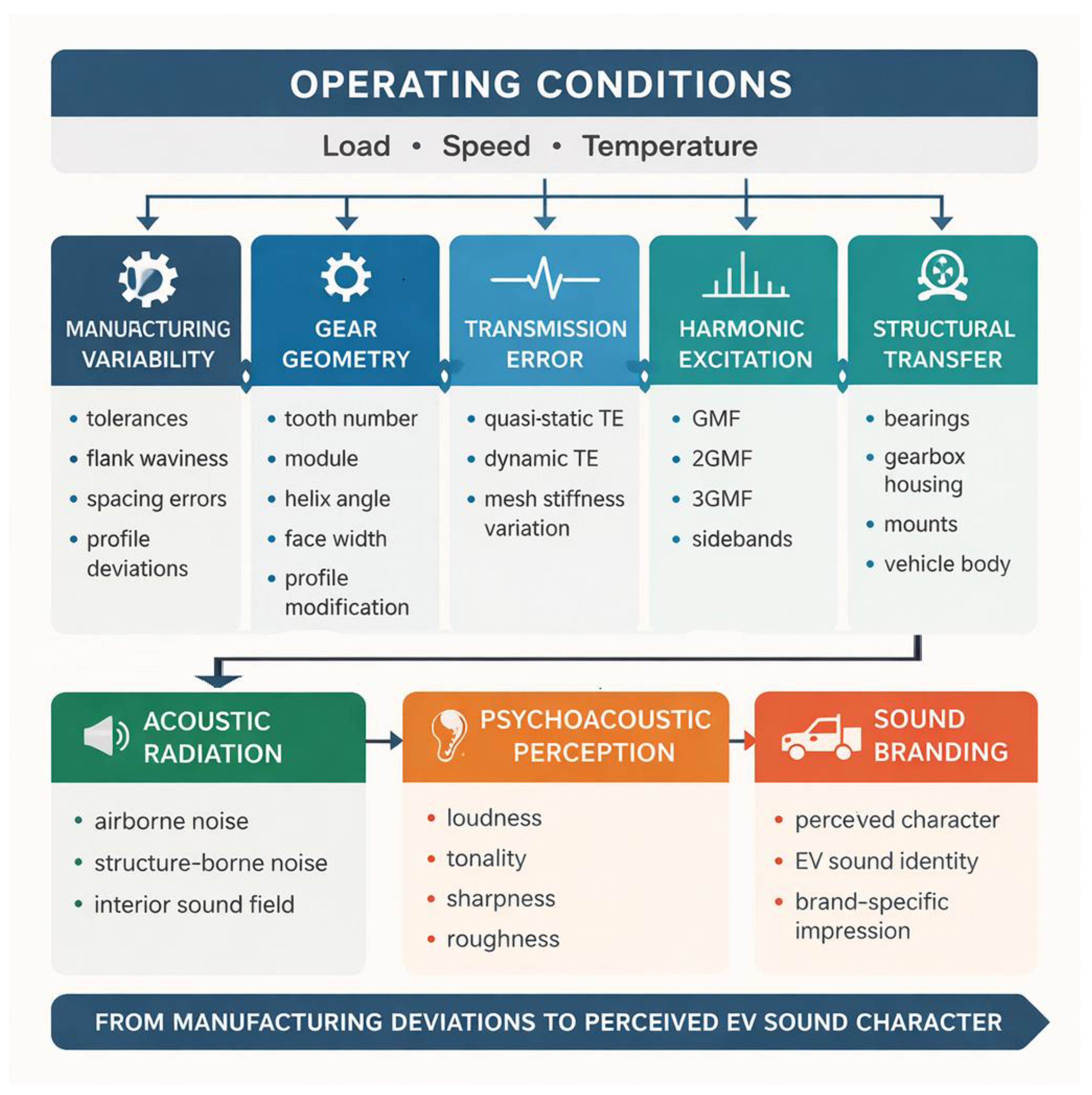
Figure 2.
PRISMA 2020 flow diagram of study identification, screening, eligibility assessment, and inclusion for the present review (search date: 22 February 2026; primary search window: 2018–2026).
Figure 2.
PRISMA 2020 flow diagram of study identification, screening, eligibility assessment, and inclusion for the present review (search date: 22 February 2026; primary search window: 2018–2026).
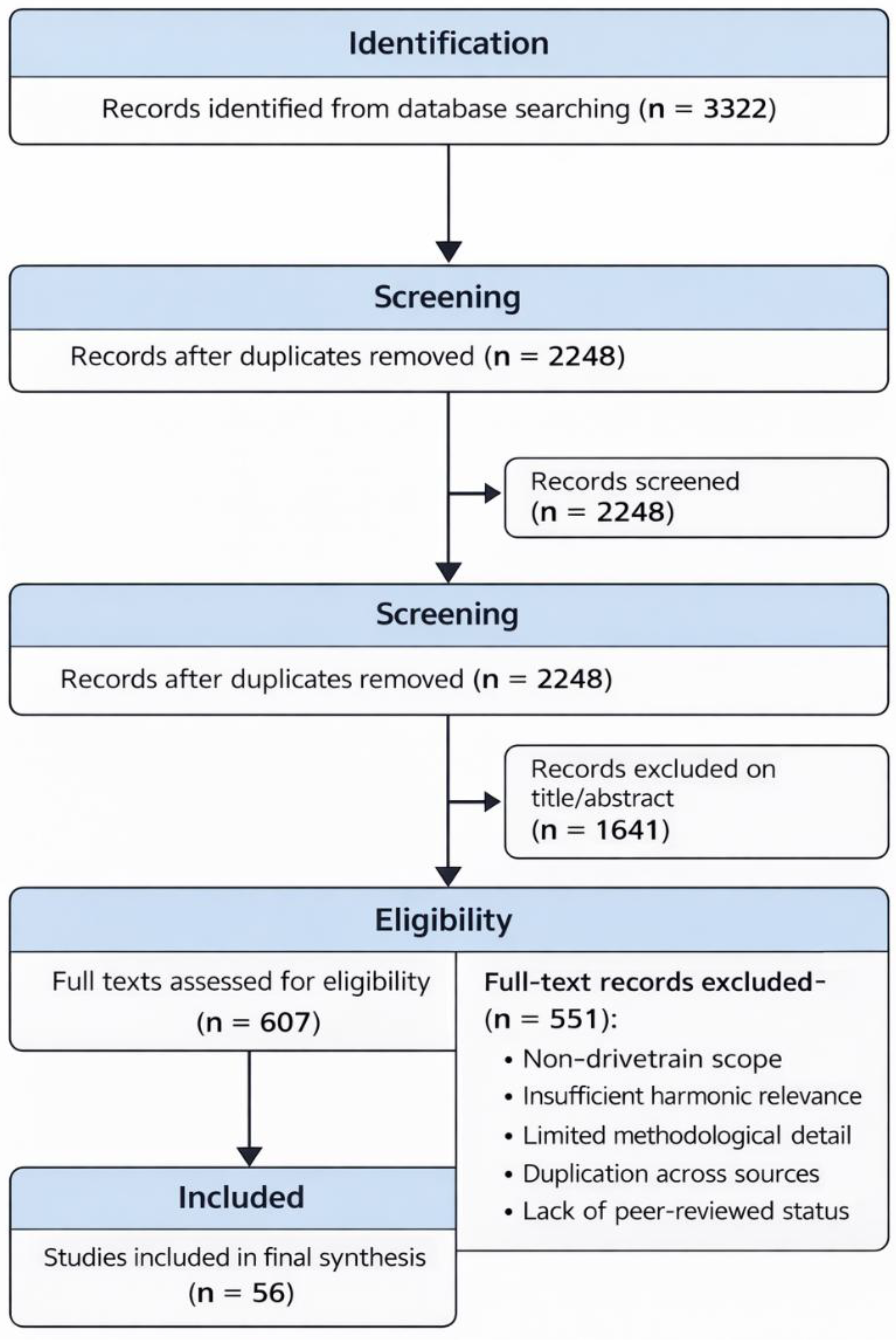
Figure 3.
Illustrative transmission error waveform and harmonic decomposition for a gear pair with and without microgeometry optimization. The upper-left panel shows a schematic TE waveform over the mesh cycle, while the upper-right panel shows the corresponding normalized harmonic content. The lower panels summarize the relative amplitudes of the dominant components before and after optimization.
Figure 3.
Illustrative transmission error waveform and harmonic decomposition for a gear pair with and without microgeometry optimization. The upper-left panel shows a schematic TE waveform over the mesh cycle, while the upper-right panel shows the corresponding normalized harmonic content. The lower panels summarize the relative amplitudes of the dominant components before and after optimization.
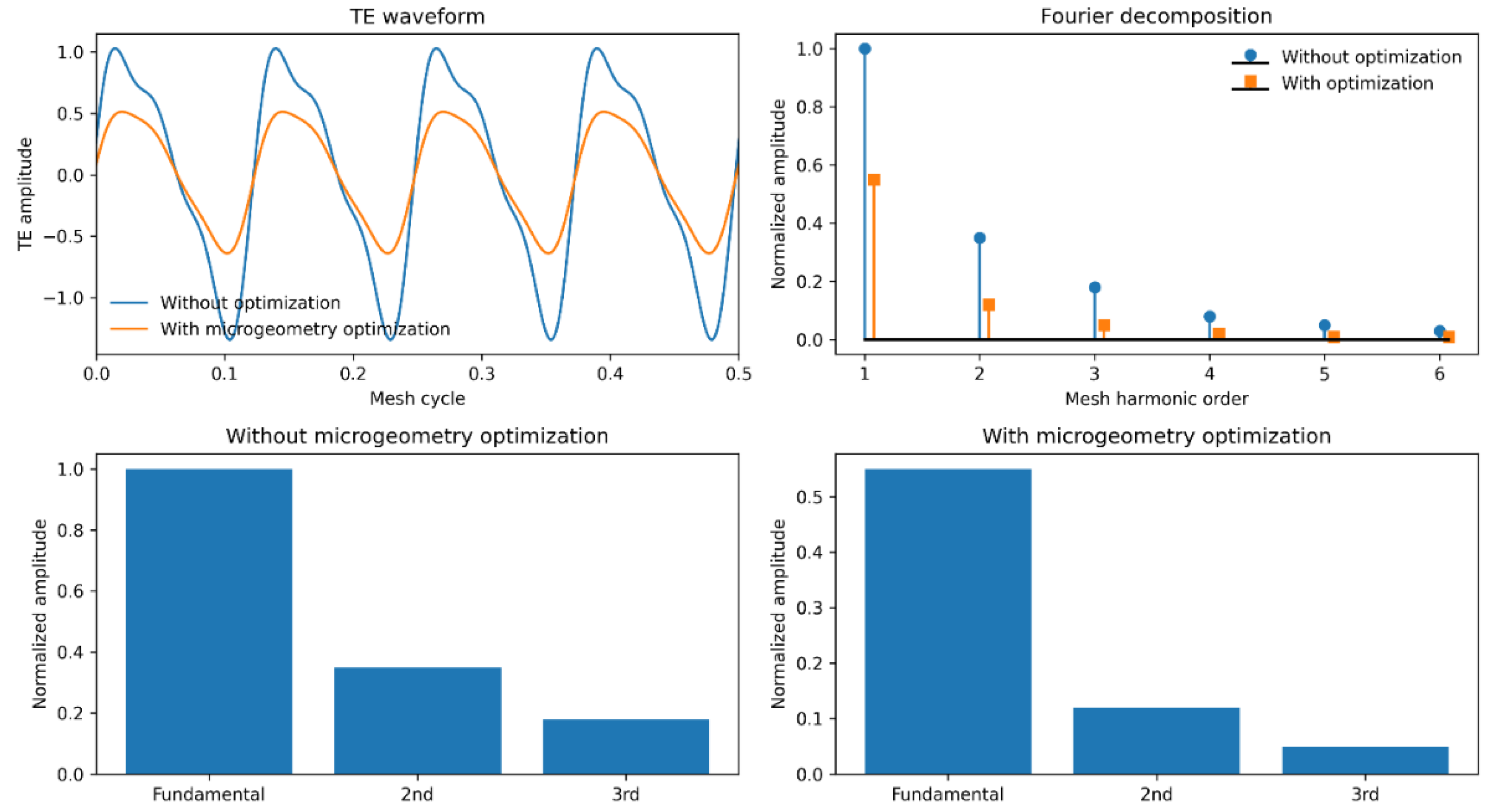
Figure 4.
Illustrative relationship between gearbox housing mode shape control and radiated noise reduction. The left panel schematically shows a representative housing vibration mode in the kilohertz range together with example rib locations, while the right panel illustrates the corresponding reduction in radiated noise that may be achieved when damping treatment or ribbing weakens the structural response at tonal critical frequencies.
Figure 4.
Illustrative relationship between gearbox housing mode shape control and radiated noise reduction. The left panel schematically shows a representative housing vibration mode in the kilohertz range together with example rib locations, while the right panel illustrates the corresponding reduction in radiated noise that may be achieved when damping treatment or ribbing weakens the structural response at tonal critical frequencies.
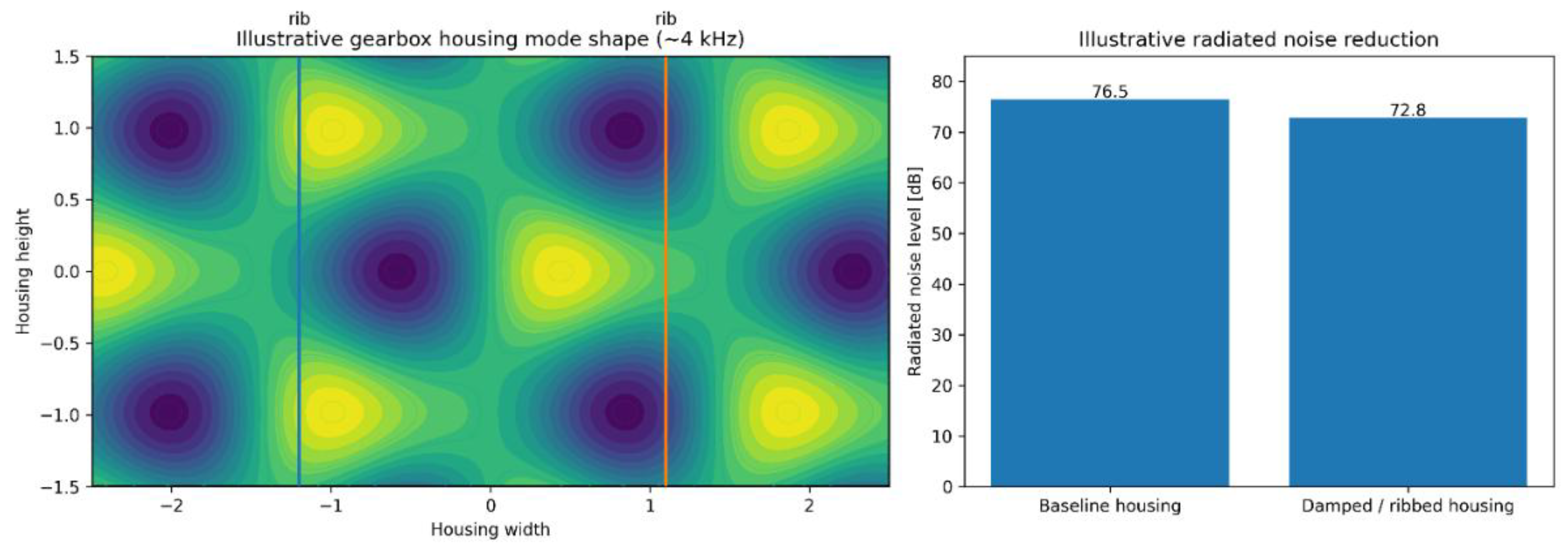
Figure 5.
Illustrative psychoacoustic comparison of baseline and optimized EV sound scenarios. The radar chart schematically contrasts representative perceptual attributes, including loudness, sharpness, tonality, roughness, fluctuation, and comfort, in order to show how drivetrain refinement may improve overall sound quality even when optimization is not reducible to a single metric.
Figure 5.
Illustrative psychoacoustic comparison of baseline and optimized EV sound scenarios. The radar chart schematically contrasts representative perceptual attributes, including loudness, sharpness, tonality, roughness, fluctuation, and comfort, in order to show how drivetrain refinement may improve overall sound quality even when optimization is not reducible to a single metric.
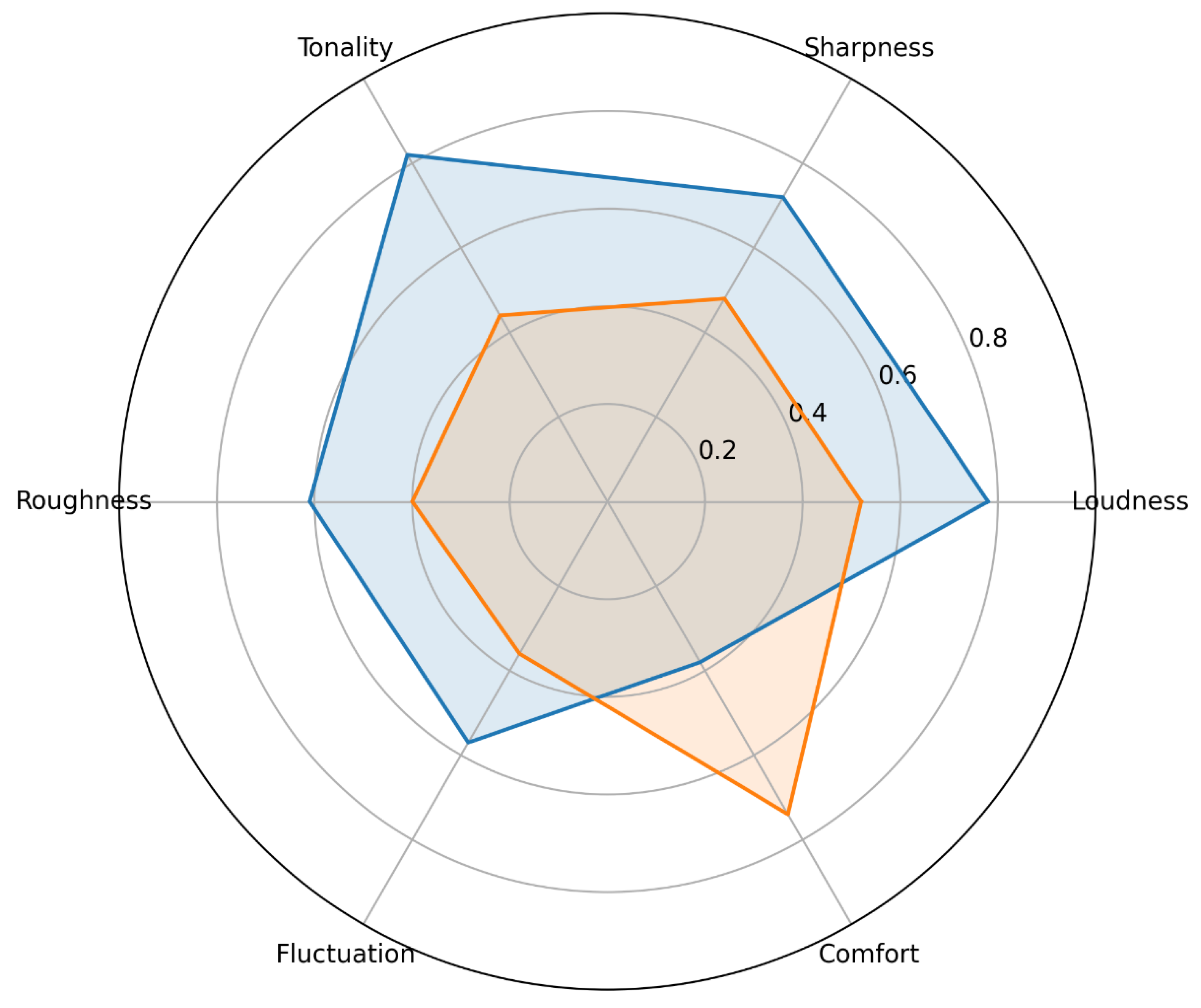
Figure 6.
Summary of the main paradigm shifts currently shaping harmonic NVH engineering in electric drivetrains. Recent work increasingly moves beyond conventional single-source optimization toward integrated treatment of electromechanical and gear-excitation coupling, tooth-specific microgeometry phase effects, high-frequency structure-borne dominance, robust design under variability, and multiphysics workflows supported by machine learning. Together, these trends point toward a more system-level and prediction-oriented NVH engineering framework for next-generation e-axles and electric powertrains.
Figure 6.
Summary of the main paradigm shifts currently shaping harmonic NVH engineering in electric drivetrains. Recent work increasingly moves beyond conventional single-source optimization toward integrated treatment of electromechanical and gear-excitation coupling, tooth-specific microgeometry phase effects, high-frequency structure-borne dominance, robust design under variability, and multiphysics workflows supported by machine learning. Together, these trends point toward a more system-level and prediction-oriented NVH engineering framework for next-generation e-axles and electric powertrains.
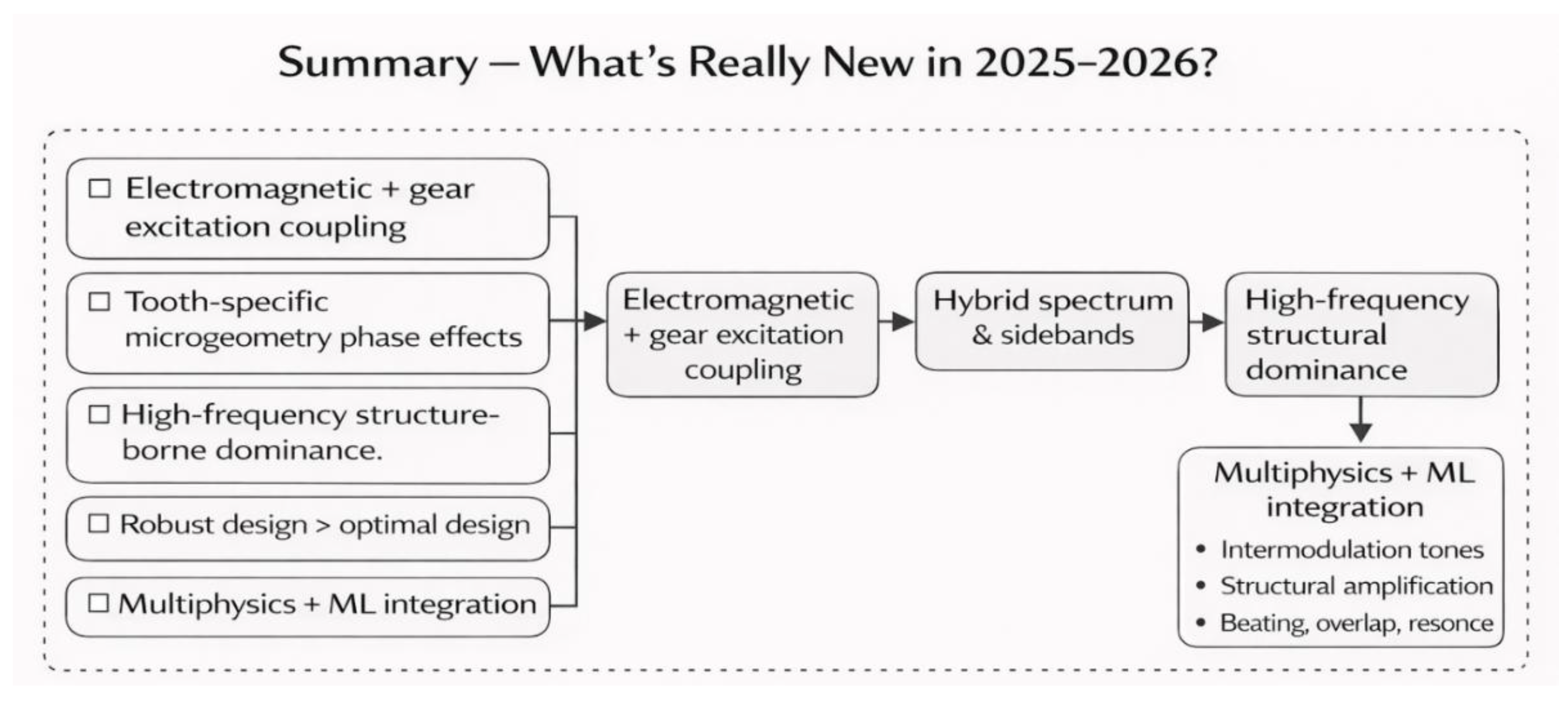

Table 1.
Typical gear manufacturing deviations relevant to harmonic NVH in electric drivetrains, their spectral consequences, detection approaches, and typical mitigation strategies.
Table 1.
Typical gear manufacturing deviations relevant to harmonic NVH in electric drivetrains, their spectral consequences, detection approaches, and typical mitigation strategies.
| Deviation type | Typical origin | Main NVH / spectral consequence | Detection / measurement approach | Typical mitigation strategy | Evidence strength |
|---|---|---|---|---|---|
| Tooth profile deviation / profile error | Hobbing, grinding, dressing condition, profile-correction mismatch, finishing variability | Increases transmission error and mesh-harmonic excitation; can raise tonal gear-whine levels and alter load transfer smoothness | Profile measurement on gear metrology systems; profile traces; TCA / measured-geometry-informed analysis | Optimize profile modification, improve finishing control, compensate systematic profile bias, validate with TE/contact analysis | Strong |
| Lead / helix deviation | Misalignment in finishing, machine/tool setup, helix-angle errors, fixturing variation | Uneven face-load distribution, local contact concentration, elevated TE under load, possible amplification of mesh orders | Lead/helix trace measurement; flank inspection; loaded contact pattern / TCA | Lead crowning, alignment correction, process-capability improvement, measured-contact validation | Strong |
| Runout / eccentricity | Centering error, datum error, clamping error, cumulative manufacturing eccentricity | Generates modulation of mesh excitation and discrete sidebands / ghost-order behavior; may cause non-mesh-related tonal peaks | Composite test, runout measurement, double-flank testing, laser-based circumference inspection | Improve datum strategy, reduce eccentricity in manufacturing and assembly, use full-circumference inspection | Strong |
| Pitch / indexing error (single and cumulative) | Tooth spacing error, indexing-chain error, tool wear, thermal drift, machine kinematic error | Produces sidebands and order spread around mesh components; can create distinct tonal irregularity even if nominal mesh order is acceptable | Pitch measurement, composite inspection, single-/double-flank tests, tooth-resolved metrology | Improve indexing accuracy, compensate process drift, tighter spacing control, correlate with EOL acoustic signature | Strong |
| Long-wave flank deviation | Machine structural vibration, tool deflection, systematic process signatures extending over several teeth / circumference | Modulates quasi-static and dynamic excitation; can significantly increase higher-speed dynamic response and generate audible sideband behavior | Full-circumference flank inspection, long-wave deviation analysis, laser/composite methods, measured-geometry simulation | Process stabilization, long-wave-specific tolerance monitoring, model-based prediction with measured deviations | Strong |
| Surface waviness (mid-spatial-frequency undulation) | Grinding-wheel vibration, finishing-pattern imprint, periodic tool/process signature | Causes ghost orders or sidebands distinct from main mesh harmonics; can be particularly problematic in quiet EV drivetrains | Waviness-capable flank metrology, spectral analysis of flank measurements, NVH correlation tests | Improve grinding/honing process, break up repetitive surface pattern, use waviness-oriented acceptance criteria | Strong–moderate |
| Surface roughness / asperity-scale texture | Finishing process, superfinishing quality, abrasive condition | More associated with higher-frequency broadband content, friction-related excitation, and fine acoustic texture than with classic low-order ghost tones | Roughness measurement, surface topography, finishing-process monitoring | Honing, superfinishing, abrasive-flow or texture-control processes | Moderate |
| Tooth thickness / tip diameter / center-distance manufacturing errors (macro-geometry variation) | Tolerance stack-up in gear manufacture and assembly | Alters PPSTE / performance robustness and can shift gear-performance metrics, which may indirectly worsen NVH robustness even if nominal design is acceptable | Monte Carlo robustness analysis, dimensional inspection, macro-geometry verification | Robust design, tolerance optimization, design-for-manufacture, statistical variation analysis | Moderate |
| Tooth flank finishing method (process-induced surface signature) | Choice of hobbing, grinding, honing, superfinishing, etc. | Changes resulting surface/error character and therefore affects vibration/noise level; finishing route can measurably alter tonal outcome | Process-route comparison, vibration/noise test, surface-topography comparison | Select lower-noise finishing route, combine geometry control with surface-texture control | Strong |
Table 2.
Emerging predictive, data-driven, and control-oriented approaches for harmonic NVH in electric drivetrains, including their typical inputs, outputs, strengths, limitations, and application stage.
Table 2.
Emerging predictive, data-driven, and control-oriented approaches for harmonic NVH in electric drivetrains, including their typical inputs, outputs, strengths, limitations, and application stage.
| Approach | Typical input data | Target output | Main strength | Main limitation | Application stage |
|---|---|---|---|---|---|
| Physics-based gear dynamics simulation | Gear geometry, mesh stiffness, bearing stiffness, housing FE model | Transmission error, vibration spectrum, radiated noise | Strong physical interpretability; widely validated in gear NVH | Often assumes ideal geometry; may miss manufacturing variability | Mature engineering tool |
| Measured-geometry-informed simulation | CMM flank data, pitch error, waviness data, assembly deviations | More accurate TE prediction, ghost-order reproduction | Captures real manufacturing variability; improves correlation with tests | Requires high-quality measurement data and complex preprocessing | Emerging industrial practice |
| Hybrid physics + data models | Simulation outputs + test data | Corrected NVH predictions, improved model accuracy | Combines physical insight with empirical correction | Model training required; interpretability may decrease | Research / early industrial adoption |
| Machine learning NVH prediction | Manufacturing parameters, metrology data, vibration features | Predicted noise level or tonal indicators | Captures nonlinear interactions between manufacturing deviations | Requires large datasets; generalization must be validated | Research / pilot industrial use |
| Explainable AI (XAI) diagnostics | ML model outputs, feature importance metrics | Root-cause identification of tonal noise | Improves interpretability and engineering usability of ML models | Still dependent on dataset quality and representativeness | Emerging |
| Digital twin NVH systems | Simulation models, sensor data, manufacturing data | Real-time NVH prediction and monitoring | Enables predictive quality control and virtual testing | High modeling complexity; integration challenges | Emerging industrial application |
| End-of-line acoustic classification | Structure-borne noise measurements, vibration spectra | Pass/fail decision for production components | Detects NVH issues not visible in dimensional inspection | Limited diagnostic insight without additional analysis | Increasing industrial adoption |
| Active vibration control | Sensors + actuators (piezo, electromagnetic, etc.) | Reduction of targeted tonal vibrations | Can attenuate specific frequencies effectively | Cost, reliability, and integration challenges | Experimental / limited application |
| Active noise cancellation (ANC) | Cabin microphones and audio system signals | Reduction of perceived tonal noise | Already feasible in production vehicles | Less effective at high frequencies (>2 kHz) | Mature but limited scope |
| Psychoacoustic sound design / augmentation | Acoustic measurements + perception models | Controlled sound character and perceived quality | Aligns NVH performance with brand identity and driver perception | Requires careful tuning to avoid annoyance | Growing industrial interest |
Table 3.
Summary of representative publications on harmonic NVH in electric drivetrains.
| Ref. | Publication | Main focus | Methodology | Key contribution | Main limitation / gap |
|---|---|---|---|---|---|
| [1] | Horváth and Zelei, 2024, WEVJ | Review of NVH advances in EV powertrains | Review / synthesis | Frames EV NVH as a system-level problem and highlights the increasing importance of tonal drivetrain sources in the absence of ICE masking | Broad review; not focused specifically on harmonic gear-NVH mechanisms alone |
| [2] | Hua et al., 2021, Science Progress | Recent progress in BEV NVH | Review | Summarizes major BEV NVH sources and confirms that electrification shifts attention toward previously masked tonal phenomena | More general EV NVH coverage than gear-specific harmonic analysis |
| [7] | Kahraman et al., 2011, J. Mech. Des. | Ghost noise in helical gear sets | Analytical / gear-dynamics investigation | Shows that runout and systematic tooth errors can generate discrete ghost-noise orders not predicted by ideal gear models | Pre-EV paper; strong mechanism insight, but not written for modern EV drivetrain integration |
| [8] | Ahmad et al., 2020, Applied Acoustics | Long-wave deviations and dynamic excitation | Simulation / experimental NVH study | Demonstrates that long-wave flank deviations significantly affect excitation and noise behavior, especially at higher speeds | Focused on deviation effects; does not by itself close the loop to full vehicle-level psychoacoustics |
| [13] | Holehouse et al., 2019, Journal of Engineering | Integrated EV drivetrain NVH analysis | Coupled electro-mechanical modeling | Shows the value of including both electrical and mechanical excitation sources in a unified EV drivetrain NVH model | More methodology-oriented than manufacturing-variability-oriented |
| [22] | Fang and Zhang, 2018, IEEE TIE | Sound quality of PWM-fed electric powertrain noise | Experimental acoustic measurement + sound-quality analysis | Separates harmonic-order noise and inverter-switching-related content; links operating condition to perceived sound quality | Focuses on acoustic perception of the electric powertrain, not directly on detailed gear-manufacturing effects |
| [35] | Farshi et al., 2025, DAGA paper | Ribbed lightweight EV gearbox housing | Vibro-acoustic structural study | Shows that rib dimensions and placement affect vibration and noise behavior of lightweight EV gearbox housings | Conference-style contribution; likely narrower validation scope than journal papers |
| [36] | Amaral et al., 2023, Applied Acoustics | Lightweight gearbox housing with metamaterials | Structural / metamaterial design study | Demonstrates that locally resonant metamaterial concepts can improve NVH while supporting lightweighting goals | Targeted concept study; production integration and broader robustness still need validation |
| [28] | Horváth, 2025, WEVJ | Predictive modeling of gear-manufacturing effects on noise | Data-driven regression / ML | Shows that manufacturing parameters can be used to predict EV drivetrain noise, supporting earlier screening and optimization | Dataset-specific; broader industrial generalization still needs expansion and external validation |
| [53] | Mey and Neufeld, 2022, Sensors | Explainable AI for vibration-based fault detection | XAI on vibration-data models | Provides interpretable AI methods that are highly relevant for trustworthy NVH diagnosis and root-cause analysis | Not EV-gear-specific; relevance is methodological rather than application-specific |
| [54] | Li, 2023, Applied Sciences | Digital-twin-based monitoring of a gear test bench | Digital twin + sensor-based monitoring | Demonstrates real-time state monitoring architecture for gear-test-bench operation, relevant to virtual EOL and predictive NVH workflows | Focuses on monitoring infrastructure; not a complete EV harmonic NVH twin on its own |
| [56] | Rane and Deshmukh, 2020, SAE | Electric powertrain mount optimization | Multi-DOF optimization approach | Highlights that EV mount design must address a different vibration content than conventional engine mounts | Mount-focused; does not address the full acoustic chain from source to perception |
| [34] | Chandrasekhar et al., 2017, SAE | Current harmonics, torque ripple, and whine in electric machines | Electric-machine NVH study | Connects current harmonics and torque ripple to whine-noise behavior in electrified applications | Primarily electric-machine focused, with less emphasis on gearbox-side manufacturing variability |
| [12] | Wang et al., 2018, SAE | EV powertrain NVH technologies and challenges | Technical overview / simulation-oriented paper | Emphasizes global NVH simulation for EVs and the importance of electromagnetic excitation sources in full-system behavior | Broad technology overview rather than detailed case-specific validation |
Disclaimer/Publisher’s Note: The statements, opinions and data contained in all publications are solely those of the individual author(s) and contributor(s) and not of MDPI and/or the editor(s). MDPI and/or the editor(s) disclaim responsibility for any injury to people or property resulting from any ideas, methods, instructions or products referred to in the content. |
© 2026 by the authors. Licensee MDPI, Basel, Switzerland. This article is an open access article distributed under the terms and conditions of the Creative Commons Attribution (CC BY) license (http://creativecommons.org/licenses/by/4.0/).
Copyright: This open access article is published under a Creative Commons CC BY 4.0 license, which permit the free download, distribution, and reuse, provided that the author and preprint are cited in any reuse.


