
Submitted:
10 March 2026
Posted:
13 March 2026
You are already at the latest version
Abstract
In art and architecture, synchronicity—the parallel emergence of related ideas without direct causal links—has long shaped the evolution of design cultures. Recently, heritage architecture across Europe has become an active stage for fashion shows, art exhibitions, and live performances, encouraging audiences to experience buildings not merely as backdrops but as performative, meaning-generating spaces. Italy offers a significant field of observation through projects positioned beside restoration. While not constituting restoration activities in a conventional sense, these interventions engage critically with existing heritage by activating processes of reuse, management, and cultural valorisation. Such strategies contribute to sustainability on multiple levels: they address architectural and conservation constraints while simultaneously supporting environmental preservation, limiting land consumption and urban sprawl, reducing waste, and broadening public access to heritage. Through the analysis of selected case studies, this paper investigates the dialogue between performance art and heritage architecture as a sustainable practice. The discussion is enriched by interviews with three professionals whose work in central Italy exemplifies innovative approaches to engaging communities with their surrounding heritage. The study argues that performative practices can operate as complementary tools to restoration, fostering new forms of cultural sustainability and expanding contemporary understandings of heritage stewardship.
Keywords:
architectural restoration
; heritage
; management
; reuse
; inclusivity
; visitors
1. Introduction
The restoration practice in the first place pays attention to the artifact and—only—then to its function. In reuse strategies, on the other hand, a certain priority is given to the use to which the architecture must be consequently adapted. So, dealing with heritage can be considered a matter of skilfully combining these two halves of the problem, the object in its material concreteness and the best compatible function [1]. It is a challenge that exceeds the domain of the individual architect and becomes a question of cultural heritage planning and management. In this regard, some operations—common nowadays—can be placed ‘beside restoration’ since they strictly involve heritage architectures and their management [2]. But does the current interest in restoration produce positive results, or does it pose risks to the fate of art-historical assets and more generally of cultural heritage? Undoubtedly, by its nature the conservation field is linked to cultural issues and economic drivers, sometimes also speculative. To attempt to answer the issue and to analyse the situation correctly, it is necessary to go back to the principles that govern and addres restoration scientifically and modernly understood. This discipline is aimed first at knowledge and then at the preservation of the ancient testimonies. As mentioned, the case of the so-called reuse appears different. It cannot be denied, however, that the very term cultural heritage, so widespread today, is in some ways ambiguous but rightly, with due caution, attributable also to economic goods. A scenario particularly true considering the role that some assets are increasingly playing in the economy of different nations, especially the ones rich in architectural heritage (Figure 1).
In recent years, the intersection between performative arts and architectural restoration has emerged as a powerful means of reactivating and reinterpreting heritage sites. Through site-specific performances, music, dance, and theatre, restored or abandoned buildings gain new layers of meaning, offering contemporary narratives that connect the past with the present [3]. This multidisciplinary approach resonates with the principles of sustainable architecture, with a synchronicity observable to-date in numerous countries, wherein cultural continuity and environmental awareness are not seen separate goals but as coexisting dimensions. By infusing heritage spaces with artistic expression, these interventions foster not only social engagement but also sustainable re-use, reducing the environmental impact of neglect or demolition [4]. Moreover, the cultural valorisation achieved through such approaches carries significant economic implications. It encourages place-based economies, attracts responsible tourism, and stimulates local craftsmanship and employment, aligning with broader models of circularity and adaptive reuse [5]. In this light, architecture becomes a living interface between memory and innovation, where sustainability is both material and cultural, and economy is reimagined as a process of shared generational and cultural values (Figure 2).
Only to mention some cases, just for the sake of brevity, a prime example is the In Situ European network, which supports site-specific artistic interventions across the continent. Many performances are conceived specifically for restored or disused spaces, such as former convents, industrial ruins, or historic fortifications. Here, performative gestures interact with the material history of the place, often highlighting architectural features or scars left by time. The region of Umbria likewise distinguishes itself through prestigious cultural events, including the Festival del Giornalismo (International Journalism Festival) of Perugia and other initiatives, which will be examined in greater detail during this discussion. In other parts of Italy, the Villae Festival at Villa Adriana and Villa d’Este in Tivoli (UNESCO World Heritage Sites) presents dance and immersive theatre within the archaeological and restored environments. These performances reanimate the historical aura of the sites and promote an emotional and sensory experience of the architectural space. Another notable case is the Rovine in Scena initiative at the Archaeological Park of Pompeii, where performative arts are employed as narrative tools within recently restored areas. By activating the space through movement, voice, and light, the performances allow visitors to engage more deeply with both the tangible and intangible aspects of the heritage. In Florence, the ex-Leopolda railway station, a restored industrial complex, hosts the Fabbrica Europa festival, a major event for contemporary performing arts. Here, the restored architecture itself becomes a key component of the stage, contributing to a layered reading of space and memory. The Tuscan event Le Notti dell’Archeologia (Nights of Archaeology) also exemplifies how performance can illuminate restored heritage sites, especially during evening hours. These events include concerts, readings and theatrical pieces that enhance the public’s emotional connection with the heritage sites. Across these examples, the performative arts do not serve merely as embellishment, but as active agents in the valorisation process. They generate new modes of perception, promote public engagement, and help foster a sense of shared ownership. When integrated within restoration strategies, they contribute to redefining heritage not as static memory, but as living space (Figure 3).
The paper focuses on architectural restoration as a pathway for the protection of the landscape in a broad sense, particularly the built landscape [6]. This includes historic botanical gardens and heritage buildings such as cloisters and parks, which embody both tangible and intangible values that deserve protection and which increasingly serve as settings for activities and performing arts. In this perspective, such contexts activate “sustainable” conservation mechanisms alongside restoration, such as adaptive reuse and valorisation. Although these practices do not constitute restoration in the strict sense, they nevertheless foster care, maintenance, and the transmission of values to future generations.
Accordingly, as an exploratory qualitative pilot study, the paper is structured around these themes through three interviews with exemplary figures who have demonstrated professional practices adjacent to, though not marginal to, restoration. Their work is significant precisely because it actively engages visitors and audiences, adopting their point of view in a bidirectional exchange of content and meaning.
2. The Interview Metodology
The following are the five interrogatives around which the conversations with the three interviewed personalities revolved. In this section each one of them is discussed with reference to the most significant open issues from which the questionnaire making up the interviews originated. Some conceptual tools and practical examples for thinking more deeply about the implications that surround choices on heritage sites conservation are articulated in the following original questionnaire devised by the Authors and submitted to a heterogeneous group of professionals in the form of written interviews.
2.1. Question 1
In this Section is intended to refer to the meaning of cultural heritage (both natural and built) and to its relation to art, restoration and reuse to further emphasis the interdisciplinary interconnection emerging from projects and recent initiatives involving heritage. The issues of contemporaneity—full of contradictions and schools of thought—must be addressed with a critical spirit that encourages knowledge exchange between academics and other figures. In this vein, restoration projects consist in conscious choices made by architects towards a building environment that must accommodate present-day requirements in spaces belonging to an earlier time.
Q1. «Combining reflections on identity and membership, scientific research, art and live exhibitions, is it possible to give visitors the opportunity to meet in heritage sites and to establish new forms of ‘kin ship’ and therefore also of mutual solidarity?».
2.2. Question 2
Taking a few steps backwards, for centuries the art world had functioned in relation to that which would remove the ‘logic of the monument’. Figurative arts, and especially, the sculptural artworks, were thought to mark a site with their visual representation and meaning, and the statue pedestal “acted as a virtual and symbolic boundary of the representation”, to cite in both cases Rosalind Krauss [7]. In the late nineteenth century this mechanism had already begun to be overcome, thanks to artists such as Auguste Rodin, until in the years of modernism the autonomy of the representational eld was definitively established. Rosalind Krauss inaugurates the discussion on sculpture starting from Lessing’s Laocoon which, although written in the eighteenth century, it is a prelude to aspects that are still central to the critical debate and played a determining role in pushing German art away from the Baroque and Rococo into Romanticism. This approach unfolds in a historical path the theoretical conditions of sculpture, intended as a medium and passing through the experience of its subversion with the elimination of the pedestal, up to the example of Vladimir Tatlin with his most famous work, the visionary monument to the Third International, up to contemporary examples such as the sculptor Jago. Nowadays, graphic identity, design, aesthetics, ethics are some of the aspects ‒ inseparable ‒ that combine to define the leitmotif and the iconic nature of an artwork; for instance, the sound-performances of Dr. Gaia G. Giorgi, strictly connected to existing spaces cured by the architect Vittoria Assembri that ‘summons’ the subtle materials and the impossibility of museumification of memories, through an immersive and trans versal experience oriented towards the generative possibilities of inter-code live poetry: they experiment vocal soundscapes, and study the relationships between text, voice, field recordings, electronic devices and architectural space, creating site-specific projects. Also, the research approach of the collective Extragarbo ‒ of which Gaia G. Giorgi herself is a member ‒ drew inspiration from the building environment, especially urban areas and well-known districts. Further contributions of a journey that questions the relationship between body and architecture, city and performance with the aim to realise specific effects, express the intended message or create a richer spatial experience of places. The most diverse forms of art, including the world of fashion, are the spokesmen for this arduous undertaking: interpreting the taste and aesthetic sense of our time, at the basis of the common feeling of a society [8].
Q2. «In a world that talks about inclusion and innovation with a transversal approach, what are the urgencies that require a paradigm shift in different sectors? What role does tradition play in this process?».
2.3. Question 3
Or even, in recent years, it is noted that ancient villas, historic urban parks—both hot topics in terms of contemporary restoration [9,10]—or real monuments have often been chosen as a stage for art exhibitions and live performances of various backgrounds [11]. Similar initiatives stimulate debate on these places, as well as reflections on valorisation and reuse, civil commitments that can be implemented with participatory and interdisciplinary processes [12,13]. Examples of how the built environment can be conceived as a continuous dialogue between ethical and aesthetic values, between ancient and modern, between building and city, or rather as the preservation and enhancement of local architectural traditions can be declined according to innovative business and safeguard strategies [14,15,16].
Q3. «Can the design of activities in and for the built environment be considered a ‘performative’ practice that traces paths, drifts and triggers virtuous mechanisms? Through these events and site-specific works, can there be incursions of the ‘prefigurable’ into the ‘memorable’?».
2.4. Question 4
Moreover, nowadays, the talented or the forerunners do not necessarily prevail while, instead, the most convincing ones do. The complexity of the topics object of the present contribution, often ends up being simplified in the effectiveness of a slogan (e.g., compatible materials, green buildings etc.). Making projects that penetrate the public’s imagination is undoubtedly a merit, but scientific research cannot be limited to this [17]. The peremptoriness of an idea must in fact take substance from important questions, especially in the elds of heritage and restoration; sectors in which negotiations, divergences and different approaches have always animated the debate at an international level [18].
Q4. «Is there only one declination of ‘sustainability’? On a cultural and social level, for instance, how can the interactions between historical heritage, design and art contribute to the creation of a concrete collective consciousness?».
2.5. Question 5
Finally, it is essential to reflect critically on the ethical implications of heritage digitalisation. The COVID-19 pandemic accelerated digital transformation processes by nearly a decade, fostering new forms of cultural engagement, sociability, and hybrid interaction between public and private sectors. Simultaneously, the exponential growth of social media platforms has reshaped the production and consumption of cultural content, often blurring the boundaries between promotion, entertainment, and commodification. While such mechanisms cannot replace the inherently experiential nature of art and architecture, they undeniably exert significant and measurable influence on perception, access and public imagination around heritage. Instances abound of unauthorised filming, performative self-promotion, or content creation within historical sites, museums, or protected monuments—sometimes without regard for the integrity, context, or dignity of the spaces themselves—emerge. Among the more widely reported cases, one might mention the unauthorised use of museum interiors—such as the episode involving influencers at the Uffizi Gallery in Florence—as emblematic instance of a broader trend in which institutions are challenged to balance openness with preservation. In that case, the Director formally requested the removal of the offending material, which had been disseminated without consent to a combined audience of nearly ten million followers. Similar controversies have arisen around irregular drone footage of archaeological sites, ‘TikTok tourism’ in fragile urban contexts, and immersive filters that digitally alter historic interiors for commercial appeal. These developments prompt urgent questions about institutional responsibility, the boundaries of digital engagement, and the need for shared ethical frameworks capable of reconciling accessibility, creativity, and respect for cultural heritage. A good use of social media platforms and digital tools for management can enable museums to broaden their reach, engage visitors, promote collections and events, cooperate with different professionals, and contribute to cultural heritage protection and valorisation [19]. The increasingly central role of online retargeting and urban video surveillance must also be considered. Both activities which, for various reasons, are intended for the acquisition of personal and biometric data aimed not only at security but at orienting user demand. The last question comes along from these quotations and is reported below.
Q5. «What new meanings does the technology-right to privacy binomial take on? What, on the other hand, are the opportunities of digital platforms as economic and public engagement tools?».
3. The Interviewees
To ensure both relevance and methodological robustness, the selection of interviewees was guid ed by interdisciplinary criteria and thematic coherence with the research framework. Rather than aiming for statistical representativeness, the process sought to identify exemplary figures under 30 whose professional trajectories embody cross-sectoral connections between architecture, music, digital media, and cultural production. The ratio behind the interview questions was shaped to highlight real-world inter sections between creative practice and heritage enhancement, thereby grounding theoretical dissertation in lived experience and contemporary innovation. Undoubtedly there are ‘geographies’ that have orient ed the choice towards personalities from the Italian territory and in particular from the Umbria region which have been awarded on an international and national level for various reasons: a graphic designer—winner of a prize from the Italian Privacy Guarantor—a prominent musician—frontman of a band internationally famous and art director of a music festival—and the founders of a startup—mentioned this year by Forbes magazine—operating in the digital services for entertainment world (Figure 4).
The aim is to underline the correlations in real practice between different disciplines, such as music, entertainment, tourism, visual identity and architecture for the promotion and protection of cultural heritage. In order, to be clearer about the choices made, related to two working groups and a professional, a brief introduction of the Interviewees is presented below. Starting from the designer Sara Vagni, class 1998 from the Department of Civil and Environmental Engineering of the University of Perugia. She was the winner of the prestigious national award Informative chiare promoted in 2021 by the Italian Data Protection Authority aimed at the creation of the graphic identity for privacy policies that was simpler, clear and immediately understandable by using symbols and icons with an inclusive character. At first glance, the Italian Data Protection Authority (Garante della Privacy) may appear to have little connection with the eld; however, there are several areas where their domains intersect. Architecture is not concerned solely with physical space, but also with the ways in which that space is inhabited and safeguarded. Privacy, therefore, becomes an integral component of the lived architectural experience. In this regard, the Data Protection Authority emerges as an indirect yet essential interlocutor for the conscious architect. The installation of surveillance systems—such as cameras in public or private buildings, courtyards, communal entrances, parking areas, and similar spaces—must comply with regulations governing the protection of personal data. For instance, architects and designers involved in the conception and realisation of spaces incorporating surveillance systems must account for the relevant legal requirements, such as the provision of appropriate signage, the limitation of camera angles, and the secure retention of recorded images. Furthermore, where an architectural installation or exhibition involves public participation, it may be necessary to manage the collection of consent regarding the use of participants’ images. Therefore, she goes on—in agreement with the other Interviewees—that the opportunities of digital platforms are evident as a new way of promoting personal image, interaction and participation, allowing everyone to express themselves on a wide range of issues. Then the MUNI group was called into question, an Italian startup founded in 2019 based in Assisi that operates in the music entertainment sector. In 2023 it was included in Forbes Italia’s 100 under 30 innovators list considering its innovative aim to give value not only to artists but also to the fans and their experience, strictly related to the architectural spaces hosting the events. This was possible through the creation of fan games: video games based not only on the daily activities of fans, but precisely, based on music industry and more generally to the spectator’s live perception. The idea behind the project was born in 2016 when Dr. Matteo Gialletti, Dr. Simone Gialletti and Dr. Lorenzo Flavi attended the faculty of economics at University of Perugia. The following year, with the entry of the fourth founding member Dr. Luca Perini, an intense activity of brainstorming, graphic development and web testing, culminated with the beta version launched in July 2021 and ended in August 2022. Year in which, moreover, the company—all composed by class 1996 people—has won the prestigious acceleration path Immediate, the first vertical enterprise accelerator in Europe in the media and entertainment sectors created by RS Productions in collaboration with Intesa Sanpaolo Innovation Center, H-Farm and Rolling Stone as media partners. Finally, the L’Umbria che Spacca team was interviewed, creators of a festival that at the beginning—more than ten years ago—was only dedicated to the regional music and that today includes the whole national scene as of the most important events in central Italy. A cultural project focused on the professional production of concerts, but also on workshops, meetings and insights that have always taken place in heritage buildings: immediately after the pandemic in the “secret garden” of the Villa del Colle del Cardinale, born as a summer residence around 1575 at the behest of Cardinal Fulvio della Corgna who, in all likelihood, commissioned the project to the architect Galeazzo Alessi, and—as is now customary—in the Giardino del Frontone built on an area previously occupied by an Etruscan necropolis and then, in the 15th century, by a defensive fort of the city, hosted the poets of the Colonia Arcadica Augusta who, at the beginning of the 18th century, outlined its current configuration. L’Umbria che Spacca was conceived, developed and promoted by the Roghers Staff Association of Social Promotion (APS), a group of about 50 girls and boys (all under 35), active in the organisation of cultural events since 2010, who have made of civic commitment and active volunteering their ag for the revitalization of the historic centre of Perugia and of the Umbria region and its values. Indeed, the last edition held from 3 to 7 July 2024 involved 8 stages, 59 concerts and 205 artists who performed during the 5 days and took place in the historic centre of Perugia, also having some heritage buildings of the University of Perugia as precious locations for concerts and different social activities [20]. «A festival of high quality, which welcomes and makes diversity coexist, in a dialogue with respect to which the University has found itself aligned, to the point of collaborating on joint initiatives and sharing its spaces» as stated by the Rector Delegate Prof. Daniele Parbuono, which brought greetings from the Magnifico Rettore Prof. Maurizio Oliviero during an interview. Aimone Romizi is not only the president of the association and the artistic director of the festival, but he is well-known for being the frontman of Fast Animals and Slow Kids, a famous Italian alternative rock band formed in Perugia in 2008, that has become one among the most representative of the genre for the Italian music scene and not only (Figure 5).
3. Results and Discussion
In this section the results of the interviews are shortly reported with some extracts and critically summed up. The aim is to outline some interdisciplinary principles for the promotion of cultural and natural heritage sites for sustainable tourism, involving their implications in terms of safeguard of architectures and monuments, territorial development and public and private partnerships. A short dissertation is below articulated, in the order, with reference to each one of the questions.
3.1. Question 1
«In general, music festivals are excellent opportunities to revive empty spaces and abandoned buildings—unused or little known by the majority of citizens—where groups of people with similar interests can face and overcome not only cultural but also linguistic barriers» as argued by the spokesman of L’Umbria che Spacca. Surely it is more intuitive to grasp this concept from the architectural point of view, in which the defined real space circumscribes this abstract idea that comes from the world of music. In addition, «cultural heritage plays a social role» is said by the Designer Vagni. The spaces in which people meet become a place of exchange of interests. At an art exhibition, especially if hosted in a building of cultural interest, you can meet people who go there for a variety of reasons: some participate because close to a specific theme treated, others simply want to visit certain sites of particular historical and artistic importance of the city usually closed to the public or enjoy art and its transversal value. In this way, spontaneously, cultural heritage therefore encourages reflection and encourages inclusion and diversity [21,22,23]. The designer, in her replies, emphasizes how public spaces, museums, and cultural centres can be a viaticum for promoting encounter and solidarity. A well-designed or reused place also stimulates the involvement and the participation of those who live there. On this, art and architecture have always been based on human need, the need for the expression of the individual as part of a society. «Art is thought translated into matter and energy», this is how the founders of MUNI express themselves on the topic. The point of view presented is that of the individual seen not only as an artist but as a user of art, declined in the musical eld. The spectators of a concert are subjected to the same stimulus ‘wanted by the artist’ and despite being different people with different thoughts and opinions find themselves taking part in the same ‘game’ in which the emotional response happens naturally. To a substantially physical phenomenon that is the emission of frequencies and vibrations, man responds with sensitivity that is at the same time offspring of senses and thought. Music becomes an imaginary square—on which the architectural context overlaps and occupies the same region of time and space simultaneously—where individuals meet and share emotions in which they recognize, finding themselves part of a community. Summing up, it can be said that art and architecture in their most varied forms allow the identification of the individual in its society and of its relationship with the wider world. Therefore, their role remains crucial despite the evolution of their different forms of interaction between the work of art and the user. Moreover, in all the interviews the desire to use exhibitions, festivals and cultural events as amplifiers for social themes emerges in a transversal way. Environmental sustainability, social inequalities and global health challenges are issues at the heart of many, which see a fertile eld of debate in these ‘squares’ full—in these terms—of intangible values in architecture refer to the non-physical, emotional, and experiential qualities of a building or space.
3.2. Question 2
«Today’s society is increasingly developing towards a feeling of inclusiveness. Art itself has the task of identifying and expressing in different forms the aesthetic taste of our time» and then «inclusiveness starts from the full knowledge of ourselves and others» are the sentences by the founders of MUNI. They start from the definition of self-knowledge because in the first place for their work the acquisition of information has played a fundamental role to outline the pro les of the users, even if often represented in a fragmentary way. The individual cedes information to be included in a collective database, and this implies a devaluation of the same. Anyway, digital communication and sharing of information in real time cannot replace a face-to-face discussion. The role of public architecture, involving in most cases heritage buildings, is to provide collective spaces intended to bring people together, to provoke interaction and dialogue. Indeed, in the digital context tradition could take action to protect the single within the community. It’s important not to underestimate the wealth of information that every day is shared and, for their conscious and responsible use, attention must be paid to all those clauses that we read and accept every day. Moreover, the interlocutors of L’Umbria che Spacca consider inclusivity among the main urgencies of our time along with other topics—often inflated—as environmental sustainability, technological and digital innovation, education and learning. They support the importance of tradition as an example and a warning for the present. «By incorporating traditional elements into contemporary practices, a bridge can be created between the past and the present, while respecting and enhancing cultural diversity and historical roots» according to the designer Vagni and more «tradition can offer inspiration, a sense of continuity and identity without becoming necessarily an obstacle to changes or to decrease social inequalities». Speaking of inclusiveness, she argues this scenario is possible when certain stereotypes can be overcome. In contemporaneity, key aspects are also the international cooperation and the intercultural dialogue, with a peculiar attention to the development of innovative technologies [24,25]. An example in architecture, in all their forms, are the dormitory suburbs with their progressive and inexorable loss of integration and, at the same time, of identity. So, even if inclusivity and innovation are part of a difficult and urgent debate, all the Interviewees see in tradition a support for the development of processes, sustainable in different respects, and a warning not to fall into mistakes or thoughts related to the past.
3.3. Question 3
«The existing built environment is taking value in the consciousness of most. The original aim for which certain buildings have been built sometimes lasts even today, while in other cases, as history allows to observe, is modified and adapted to the new needs of contemporaries». In addition, «in recent years the sensitivity towards cultural heritage potential has become stronger, so much so that—as mentioned—heritage architectures are becoming increasingly stages for art exhibitions and live performances. In some cases, the use of the building remains the same» as disserted by founders of MUNI, describing the Circo Massimo and the Arena di Verona as architectures designed to enclose a community for the purpose of entertainment and that are still used in this way. The cultural testimonies represented by architectures of this calibre must not be neglected even when they are readapted and reinterpreted. The idea shared by both MUNI and L’Umbria che Spacca interlocutors is that design of the reuse of these places has an inseparable educational value, aimed at stimulating the debate on the enhancement and re use of heritage. Even the designer Vagni supports this point of view arguing that the cultural and artistic initiatives help to highlight the importance of the enhancement and reuse of historical places, pushing the debate «beyond the only physical preservation of buildings». She also argues that with the digital advent it has been possible to reinterpret the relationship between spectator, work and context making possible a direct interaction and involvement of the users (that also goes towards inclusive sign and communication campaigns involving, for example, museums). So, to summarize, the build in the built practice must address the cultural bonds of people with a place exalting the intrinsic values of a place through a contemporary language. Always citing the designer, past time draws a lesson of the durability and capacity to adapt of things, also immaterial, that the society of everything and immediately is losing exponentially.
3.4. Question 4
Nowadays, the word sustainability is used in so many areas e.g., social, economic and ecological, only to mention some of them. It is impossible to define this paradigm in a fixed form because its content is an ethic. The founders of MUNI connote this attribute on a universal pattern, referring to one of the last books of Tom Sieg red. The term in the course of history has not been scaled down but has embraced an increasingly large dimension. In the same way, sustainability, understood as the approach that shapes human activities to achieve a constant and growing environmental and human well-being, can be understood as an infinite work. Also, the representatives of L’Umbria che Spacca share the idea that sustainability can be declined in various areas: «Focusing on the cultural one, they support the enhancement of culture and traditions». The interactions between heritage, design and art can help to create a concrete collective consciousness, also supporting the need for a continuous and inclusive commitment of all members of society. Instead, the designer Vagni declines sustainability as the impact of our actions on the environment. The creation of a collective awareness for sustainable practices promotes a sense of responsibility towards the protection and conservation of resources intended as common goods. This also applies to art and architecture, both elds that can communicate directly and concretely the principles of energy efficiency, use of sustainable materials and local traditions [26,27].
3.5. Question 5
In different ways, technology can impact on human relationships, for better or worse and it is no surprise that today communication has become more integrated and spreads faster through many channels and in the so-called ‘community’. These processes, however, increasingly imply a transfer of personal data on the net, sometimes unwittingly or carelessly. According to MUNI, companies today are driven to collect data excessively, as if these were necessary to survive. In the eld of music, but not only, the companies that manage to reconstruct the identities of the user will have the widest point of view to excel on the market. This reflection involves also biometric data and the ways in which people perceive—it is more appropriate to say are perceived by—the urban space and the digital infrastructures: the risk is that the information is increasingly controlled by fewer companies only to orient the customers’ choices to improve profits. «However, this data collection could be used in a more intelligent way to spread a collective and sustainable well-being, considering also that—and it is crucial—nowadays customers want to buy from brands that really support a cause (e.g., heritage restoration), and not just create marketing strategies». Moreover, «Digital platforms offer opportunities to create appealing content, sharing ideas and reaching a wide audience quickly and effectively» say the respondents from the L’Umbria che Spacca. Nevertheless, protection against misinformation must be ensured by promoting a safe and ethical online environment, treated as the built one. Requests for the dissemination of sensitive data and information of individuals begin to be protected and defined by laws, regulations and proper information campaigns protecting privacy always to prevent abuse of that power says the designer Vagni. Therefore, she goes on—in agreement with the other Interviewees—that the opportunities of digital platforms are evident as a new way of promoting personal image, interaction and participation, allowing everyone to express themselves on a wide range of issues.
5. Conclusions
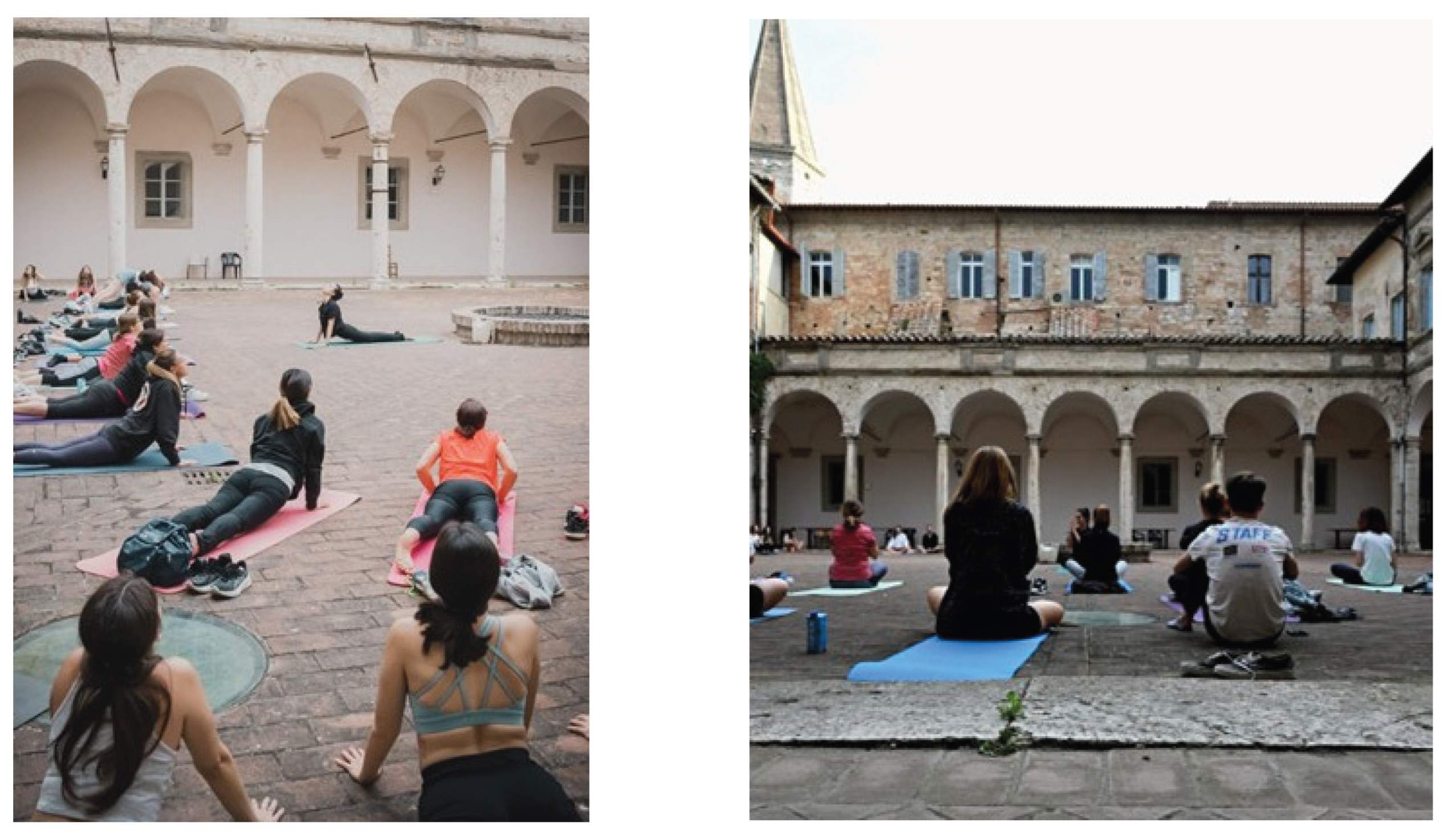
The aim of this contribution is neither prescriptive nor merely academic; rather, it is cultural in nature, as it seeks to foster a form of dialogue among the author, the interviewees, and—ideally—the readers. Accordingly, this ongoing study does not propose definitive conclusions or “safe recipes” [2] but instead aspires to stimulate the reader’s investigative spirit by offering a limited set of analytical tools and, above all, material for critical observation. In recent decades, contemporary art has increasingly selected heritage buildings or monuments—often the result of adaptive reuse—as iconic settings for live performances or museum functions. This choice represents a moment of negotiation with virtual, intangible, or even alienating spaces, while simultaneously reaffirming the “here and now” dimension of architectural context in its most concrete sense. Within this framework, several virtuous case studies are critically examined in the present dissertation to reflect on the close and complex relationships between people and their built environment. Although each situation is necessarily unique, several recurring features can be identified in the design strategies discussed. At this stage, the role of both the conservator-restorer and the contemporary architect emerges as a preliminary outcome of the research. This professional figure exerts a profound and pervasive influence on everyday life through interventions in the urban environment and the landscape—interventions that affect not only individual communities, but also the broader dynamics of civil society. Based on the theoretical and methodological framework outlined in the first part of the study, three prominent practitioners working beside restoration were therefore invited to participate in in-depth interviews. The discussion focuses on emerging forms of inhabiting heritage architecture and public space within contemporary society, addressing issues related both to human settlement and to territorial project development. In the specific context of central Italy, the entrenched image of architecture embedded in the collective—or “hive”—mind has been challenged by the interviewed professionals, who advocate for a more nuanced understanding of heritage. Heritage is not limited to anonymous buildings or remnants endowed with a stereotyped aesthetic value but constitutes a much richer and more dynamic cultural construct. Indeed, the analysis of concrete, interdisciplinary experiences suggests that heritage management and safeguarding processes can significantly benefit from engagement with the contemporary realm of performative arts (Figure 6).
The examined interventions have demonstrably contributed to the reconfiguration and revitalization of specific heritage contexts, fostering critical reflection on the sense of place and the experiential needs articulated by visitors, while consistently aligning with the broader objectives of urban development and the interests of local communities. Qualitative data from interviews indicate that these initiatives emerge from a productive convergence of diverse expertise, necessitating a deliberate engagement beyond conventional disciplinary boundaries—a form of interdisciplinary “event horizon.” This framework facilitates the simultaneous exploration of conceptual and material relationships among architecture, performative arts, and tourism, as well as their extended socio-cultural ramifications.
Although the interview cohort is composed of highly recognized professionals, its size remains necessarily limited. The present study does not seek to produce generalizable statistical evidence; rather, it emphasizes authentic, contextually grounded insights derived from the nuanced expertise of the participants. Subsequent research will expand the scope to include additional stakeholders who operate at the intersection of heritage restoration and adjacent fields, thereby opening new avenues for mediating between historical memory and prospective urban and cultural projections.
Preliminary findings underscore the centrality of ethical considerations in architectural and planning practices and highlight the importance of societal legitimization for proposed interventions. The practices observed possess a replicable potential across different contexts, enabling heritage to be both tangible and experientially inhabitable—whether through transient encounters, performative events, or ephemeral manifestations. In this perspective, contemporary architectural practice emerges as simultaneously immediate and enduring, capable of articulating the ephemeral and the eternal within the built environment.
Funding
The research was partially supported by the project EuropeanUnion ‒ NextGenerationEU under the Italian Ministry of University and Research (MUR) National Innovation Ecosystem grant ECS00000041-VITALITY. Affordable by the same financing entity, the financial support of the project Centro Internazionale per la ricerca sulle Scienze e Tecniche della Ricostruzione fisica, economica e sociale-STRIC is acknowledged.
Acknowledgments
The interviewed participants, the colleague Arch. Flavia Gabbarelli for her commitment to the ongoing research, and the cited photographers, who generously contributed their skills and professional experience and granted publication rights for the reproduced material, are sincerely acknowledged. I am also deeply grateful to Prof. Paolo Belardi for his contributions in terms of cultural insight and critical analysis of architecture, and to Prof. Vittorio Gusella for his constant scientific support and his role as a guiding reference throughout the research process. Special thanks are extended to Arch. Matilde Paolocci for her valuable assistance in the preparation of this article. Finally, I wish to acknowledge the Mayor Dott.ssa Vittoria Ferdinandi and the Municipal Administration for their institutional support and productive collaboration in the development and advancement of this research. The research was partially supported by the PRIN 2022 project “Composite and Bio-Inspired Material Design for Engineering Applications (COB-IDEA)” (Project code: 2022MF4JR).
Conflicts of Interest
The author declare no conflicts of interest.
References
- Carbonara, G. Trattato di Restauro Architettonico; UTET: Torino, Italy, 1996; Vol. 1. [Google Scholar]
- Carbonara, Giovanni. Restauro architettonico: principi e metodo; (Collana Grandi Tascabili di Architettura); Mancosu Editore: Roma, 2013; ISBN 978-8896589168. [Google Scholar]
- Belardi, P.; Marianelli, M.; Ramaccini, G.; Battistoni, M.; Ristori, M. M.; Sorignani, C. Polvese Chapels. Il senso del sacro in nove luoghi offline. IN_BO. Ricerche E Progetti Per Il Territorio. La Città E l’architettura 2022, 13(17), 106–121. [Google Scholar] [CrossRef]
- Picone, R.; Russo, V.; Romano, L.; Fiore, E.; Iaccarino, S. Knowledge, materials, and construction techniques as guiding factors in conservation interventions: An interpretative approach for the House of Arianna in the Archaeological Park of Pompeii. Heritage 2025, 8(12), 508. [Google Scholar] [CrossRef]
- Liberotti, R.; Paolocci, M. Perugia, City Walls and Green Areas: Possible Interactions Between Heritage and Public Space Restoration. Sustainability 2025, 17, 6663. [Google Scholar] [CrossRef]
- Liberotti, R.; Silvestri, V.; Gusella, V. The Church of San Bevignate: Historical Reconstruction and Infrared Thermographic Testing of Temple Order Frescoes. In International Journal of Architectural Heritage 2025, 1–18. [Google Scholar] [CrossRef]
- Krauss, R. Sculpture in expanded field; Feltrinelli: Milano, Italy, 1979. [Google Scholar]
- Li, C.; Coll-Serrano, V. Assessing the role of collaboration in the process of museum innovation. Journal of Cultural Economy 2019, 12(6), 590–606. [Google Scholar] [CrossRef]
- De Vico Fallani, M. The Ostian gardens of Dante Vaglieri. Brief remarks on the sidelines. I giardini ostiensi di Dante Vaglieri. Brevi osservazioni a margine. Bollettino di Archeologia 2014, V(2), 55–64. [Google Scholar]
- Miraglia, F.; Crova, C. Nuove frontiere nell’utilizzo delle tecnologie innovative per la conservazione del costruito storico. Tegole e coppi fotovoltaici. In L’intervento sulle superfici del costruito. Quale innovazione?, Bressanone, Italy, 38° Convegno di Studi, 27–30 giugno 2023; Arcadia Ricerche S.r.l., Imoco Industrie Grafiche: Bressanone (BZ), 2023; pp. 267–76. [Google Scholar]
- Di Matteo, P. Performance e curatela; Luca Sossella Editore: Torino, Italy, 2021. [Google Scholar]
- Jensen, A.; Thuvander, L.; Femenias, P.; Visscher, H. Sustainable building renovation ‒ strategies and processes. Construction Management and Economics 2022, 3, 157–160. [Google Scholar] [CrossRef]
- Giorgi, G.G. Dizionario Fantastico Sul paesaggio e sui suoi attraversamenti; B#S Edizioni: Gradisca d’Isonzo, Italy, 2023. [Google Scholar]
- Amer, M.; Ginzarly, M.; Renzi, M.F. Civita di Bagnoregio, Italy: towards a people-centred heritage branding approach. Journal of Heritage Tourism 2023, 18(4), 483–503. [Google Scholar] [CrossRef]
- De Gregorio, S.; De Vita, M.; De Berardinis, P.; Palmero, L.; Risdonne, A. Designing the Sustainable Adaptive Reuse of Industrial Heritage to Enhance the Local Context. Sustainability 2020, 12(21), 9059. [Google Scholar] [CrossRef]
- Belardi, P.; Gusella, V.; Liberotti, R.; Sorignani, C. Built Environment’s Sustainability: The Design of the Gypso|TechA of the University of Perugia. Sustainability 2022, 14(11), 6857. [Google Scholar] [CrossRef]
- Cascone, S.; Parisi, G.; Caponetto, R. BIM-Based Strategies for the Revitalization and Automated Management of Buildings: A Case Study. Sustainability 2024, 16, 6720. [Google Scholar] [CrossRef]
- Yoshimura, Y.; Krebs, A.; Ratti, C. Network science for museums. PLoS ONE 2024, 19(3), e0300957doi. [Google Scholar] [CrossRef] [PubMed]
- Picone, R. Universal Design and Interoperable Digital Platforms Between Conservation and New Fruition Opportunities. The Case Study of Arianna’s Domus in Pompeii. Studies in Health Technology and Informatics 2022, 297, 459–66. [Google Scholar] [CrossRef] [PubMed]
- Belardi, P.; Ramaccini, G.; Sorignani, C. University Chapel: Project for an interfaith space in Perugia at the Rectorate Gardens. In Advances in Science, Technology and Innovation; Springer, 2025; pp. 137–145. [Google Scholar] [CrossRef]
- Tomassini, E.; Centofanti, G.; Chellini, G.; García-Macías, E.; Lepori, L.; Mannella, P.; Salvatore, W.; Ubertini, F. Key findings from long-term operational modal analysis of a landmark steel arch bridge in Italy. Structures 2025, Volume 82, 110436. [Google Scholar] [CrossRef]
- Liberotti, R.; Federico Cluni, F.; Vittorio Gusella, V.; Lourenço, B. P. The Green Tape project. ‘In falso’ walls strengthening through natural FRCM innovative techniques. Engineering Structures 2025, Volume 345, Part B, 121459. [Google Scholar] [CrossRef]
- Cluni, F.; Faralli, F.; Gusella, V.; Liberotti, R. X-rays CT and mesoscale FEM of the shot-earth material. In Springer Tracts in Civil Engineering; Springer, 2023; Volume Capitolo 2. [Google Scholar] [CrossRef]
- Guarneri, M.; Ceccarelli, S.; Francucci, M.; Ferri de Collibus, M.; Ciaffi, M.; Gusella, V.; Liberotti, R.; La Torre, M. MULTI-SENSOR ANALYSIS FOR EXPERIMENTAL DIAGNOSTIC AND MONITORING TECHNIQUES AT SAN BEVIGNATE TEMPLAR CHURCH IN PERUGIA. Int. Arch. Photogramm. Remote Sens. Spatial Inf. Sci. 2023, XLVIII-M-2-2023, 693–700. [Google Scholar] [CrossRef]
- Cavalagli, N.; Gusella, V.; Liberotti, R. The role of shape irregularities on the lateral loads bearing capacity of circular masonry arches. In Lecture Notes in Mechanical Engineering; Springer, 2020. [Google Scholar] [CrossRef]
- Aliatis, I.; Bersani, D.; Campani, E.; et al. Pigments Used in Roman Wall Paintings in the Vesuvian Area. In Journal of Raman Spectroscopy 2010, 41, 1537–1542. [Google Scholar] [CrossRef]
- Quaranta, A.; Rigamonti Osorno, G.; Tassinari, G. Modeling Acute Physical Climate Risks for Business Sustainability and Catastrophe Bond Valuation. [CrossRef]
Figure 1.
Jago, “Flagella Paratus Sum”—Sono pronto al flagello—2022. Life-size marble sculpture, travelling artwork. Ponte di Castel Sant’Angelo, Rome, Italy. (Clara Fabiola Oliva, 2022).
Figure 1.
Jago, “Flagella Paratus Sum”—Sono pronto al flagello—2022. Life-size marble sculpture, travelling artwork. Ponte di Castel Sant’Angelo, Rome, Italy. (Clara Fabiola Oliva, 2022).
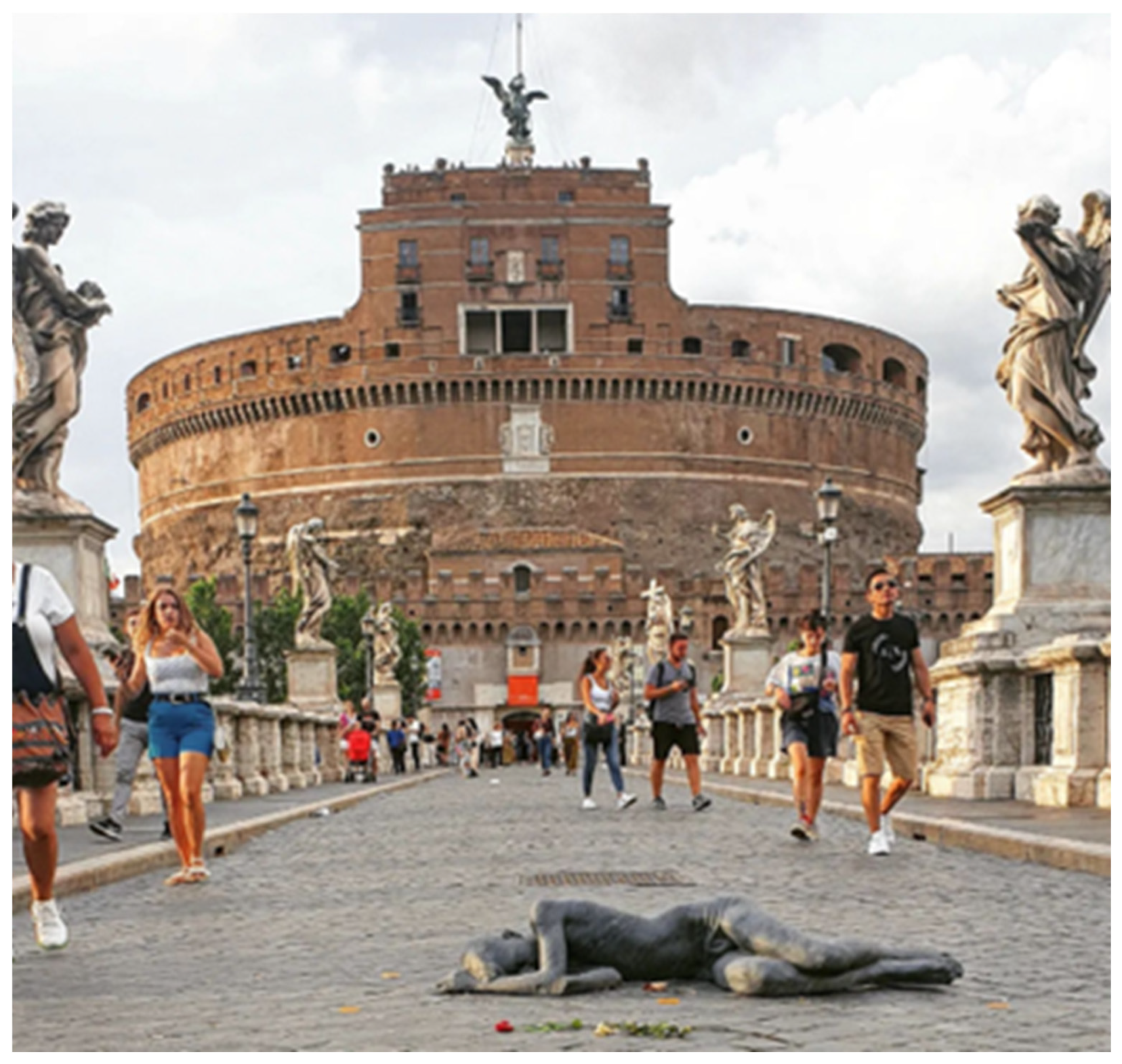
Figure 2.
Banksy, “Migrant Child”, 2019. Stencil mural on wall, Palazzo San Pantalon, Venice, Italy. (Marco Sabadin/AFP Getty Images, 2023).
Figure 2.
Banksy, “Migrant Child”, 2019. Stencil mural on wall, Palazzo San Pantalon, Venice, Italy. (Marco Sabadin/AFP Getty Images, 2023).
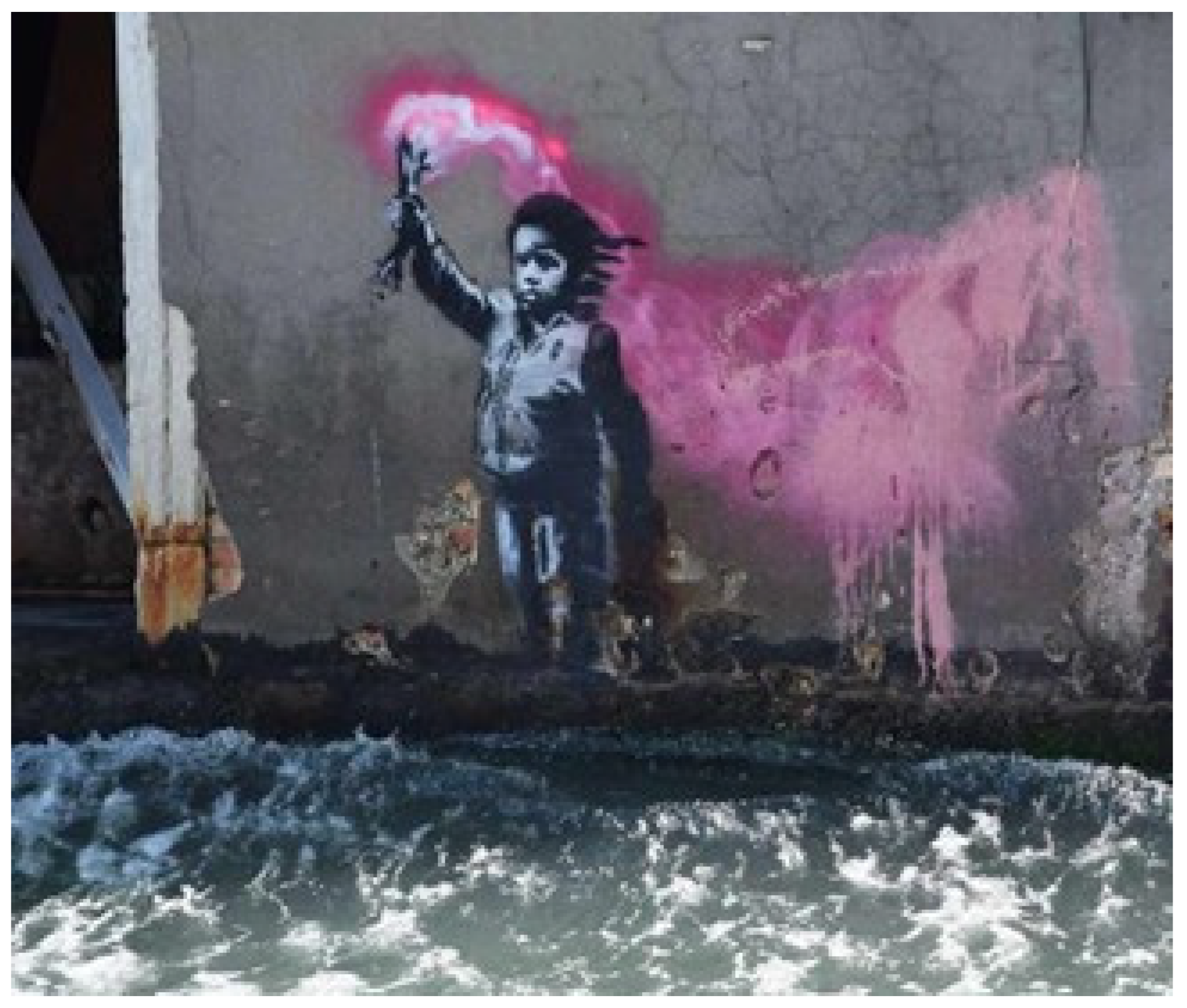
Figure 3.
Luna Di Lisio, founder of the Luna Yoga school in Perugia, during an event devoted to the dialogue between body, mind, nature, and culture, held at the Tempietto di San Michele Arcangelo, a Paleo Christian church (5th–6th century AD); in the background, the Cassero di Porta Sant’Angelo, a fortified tower forming part of Perugia’s medieval walls.
Figure 3.
Luna Di Lisio, founder of the Luna Yoga school in Perugia, during an event devoted to the dialogue between body, mind, nature, and culture, held at the Tempietto di San Michele Arcangelo, a Paleo Christian church (5th–6th century AD); in the background, the Cassero di Porta Sant’Angelo, a fortified tower forming part of Perugia’s medieval walls.
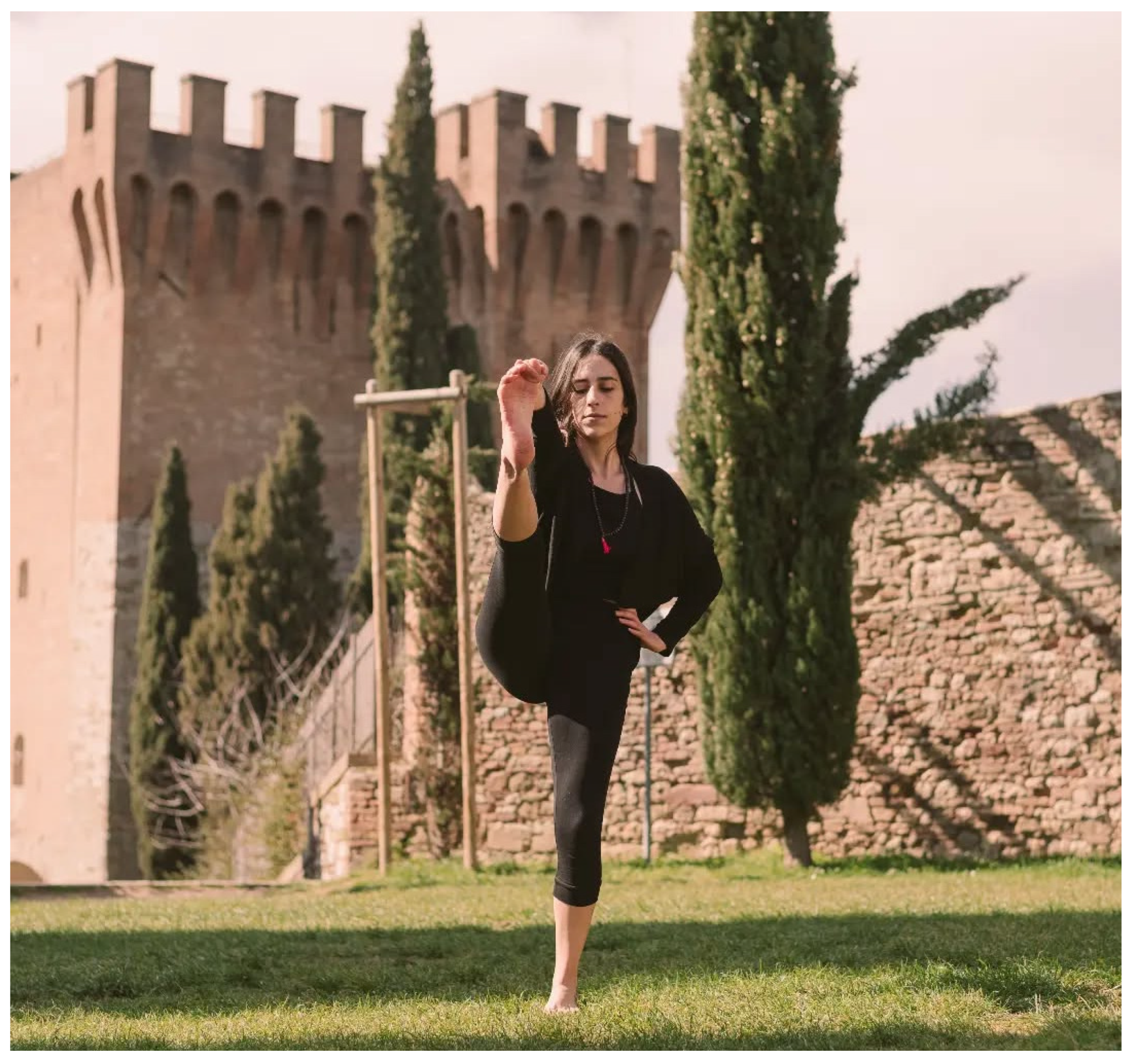
Figure 4.
Interviewed participants: lead singer of Fast Animals and Slow Kids and co-founder of the music festival L’Umbria che Spacca in the historic center of Perugia. Designer, winner of the “Informative chiare” competition promoted by the Garante per la protezione dei dati personali in 2021 for developing clearer and more accessible privacy infographics and icons. Founder of the startups MEUS and MUNI.music, which develop innovative systems for the promotion and consumption of musical events.
Figure 4.
Interviewed participants: lead singer of Fast Animals and Slow Kids and co-founder of the music festival L’Umbria che Spacca in the historic center of Perugia. Designer, winner of the “Informative chiare” competition promoted by the Garante per la protezione dei dati personali in 2021 for developing clearer and more accessible privacy infographics and icons. Founder of the startups MEUS and MUNI.music, which develop innovative systems for the promotion and consumption of musical events.
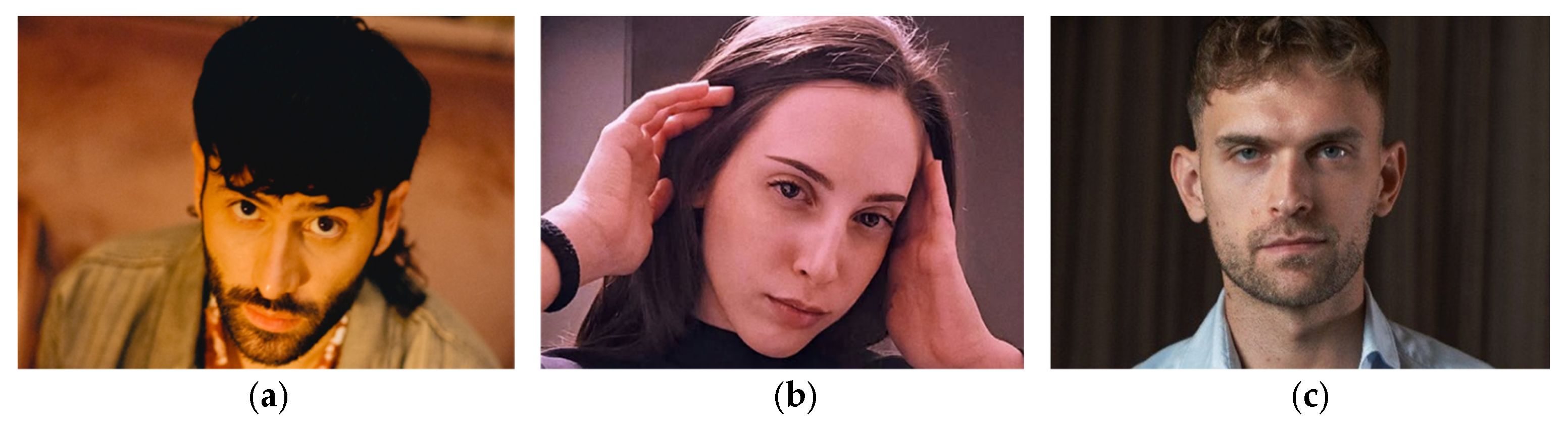
Figure 5.
The Garden Stage with the artist Adele Altro in the medieval botanical gardens of the same architectural complex, an activity during the most recent edition of the festival L’Umbria che Spacca. (Credits: Guglielmo Comez, Alessio Branda).
Figure 5.
The Garden Stage with the artist Adele Altro in the medieval botanical gardens of the same architectural complex, an activity during the most recent edition of the festival L’Umbria che Spacca. (Credits: Guglielmo Comez, Alessio Branda).
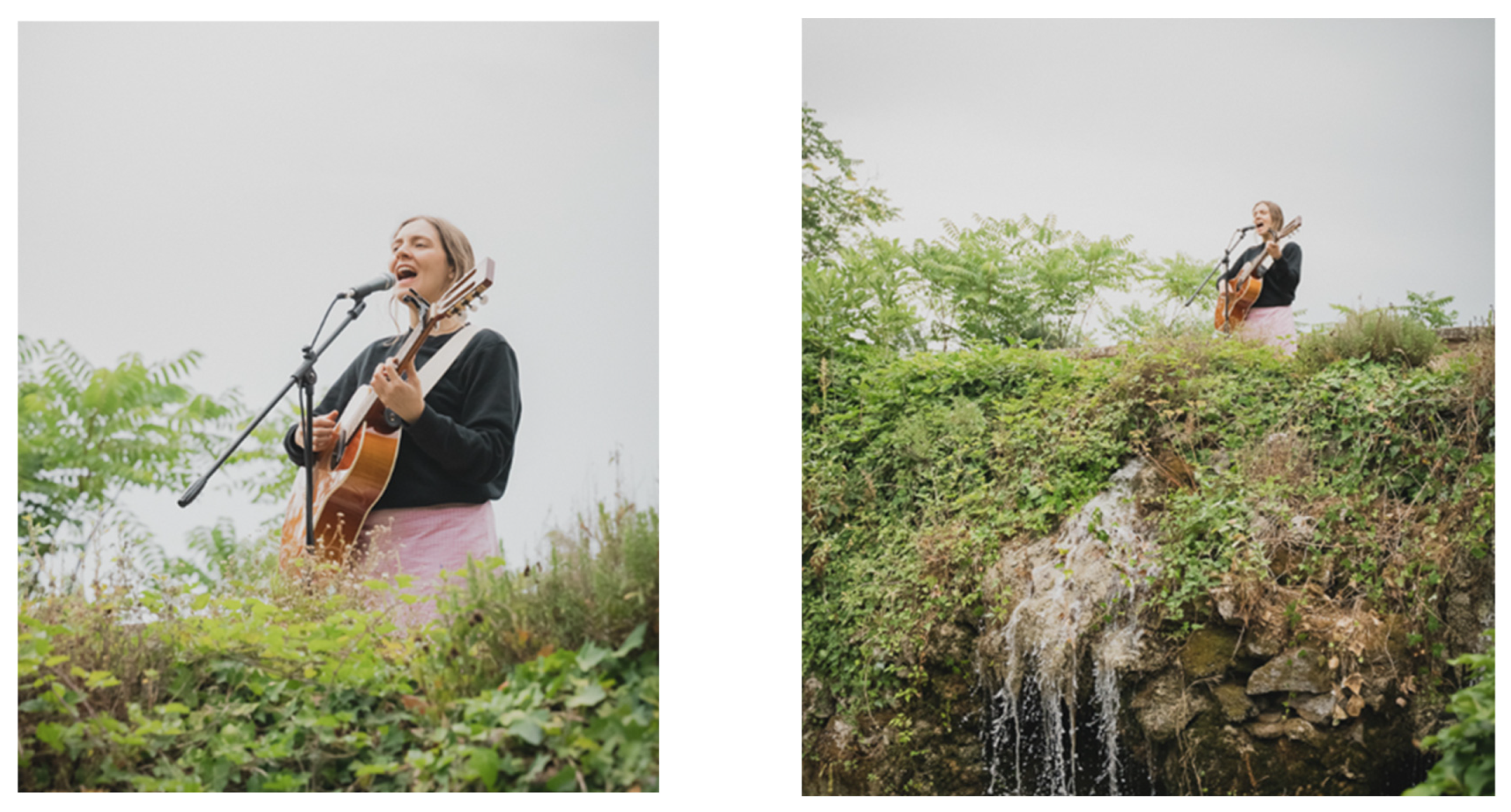
Figure 6.
Activities related to the last edition of L’Umbria che Spacca festival. Yoga and meditation course by Luna Yoga in the courtyard of the Benedictine complex of San Pietro, founded in 966 AD, and actual seat of the Dept. of Agricultural, Food and Environmental Sciences of the University of Perugia. (Credits: Guglielmo Comez, Alessio Branda).
Figure 6.
Activities related to the last edition of L’Umbria che Spacca festival. Yoga and meditation course by Luna Yoga in the courtyard of the Benedictine complex of San Pietro, founded in 966 AD, and actual seat of the Dept. of Agricultural, Food and Environmental Sciences of the University of Perugia. (Credits: Guglielmo Comez, Alessio Branda).
Disclaimer/Publisher’s Note: The statements, opinions and data contained in all publications are solely those of the individual author(s) and contributor(s) and not of MDPI and/or the editor(s). MDPI and/or the editor(s) disclaim responsibility for any injury to people or property resulting from any ideas, methods, instructions or products referred to in the content. |
© 2026 by the author. Licensee MDPI, Basel, Switzerland. This article is an open access article distributed under the terms and conditions of the Creative Commons Attribution (CC BY) license (http://creativecommons.org/licenses/by/4.0/).
Copyright: This open access article is published under a Creative Commons CC BY 4.0 license, which permit the free download, distribution, and reuse, provided that the author and preprint are cited in any reuse.


