

Submitted:
14 March 2026
Posted:
17 March 2026
You are already at the latest version
Abstract
Background. Intermittent fasting (IF) produces consistent metabolic benefits across diverse clinical populations. Paradoxically, antioxidant supplementation — widely co-prescribed with IF protocols — has repeatedly failed to replicate or augment these benefits in randomized controlled trials, and has in several instances attenuated them. Objective. This review examines whether the conventional “oxidative stress / hormetic defense” framework adequately explains the molecular mechanisms of IF, and proposes an integrative model — the Functional Redox Coupling (FRC) framework — grounded in three decades of converging evidence from redox biology. Synthesis. Drawing on the foundational work of Sies, Jones, Ristow, Chandel, and Halliwell, we argue that diffusible reactive species (DRS) generated during fasting serve as obligatory coupling agents mitochondrial bioenergetics and metabolic signaling — not merely as stressors to be neutralized. Within this framework, exogenous antioxidant supplementation during fasting windows may interfere with functional redox transduction, thereby blunting the adaptive response. Clinical Implications. We propose evidence-based guidance on antioxidant timing relative to fasting windows, identify molecular classes of particular concern (tocopherols, ascorbic acid, N-acetylcysteine), examine organ-level physiology in liver, pancreas, and brain, compare 16:8 and 5:2 protocols for T2D prevention, and address the structural economic and institutional impediments to translation of IF evidence into clinical practice.
Keywords:
intermittent fasting
; diffusible reactive species
; redox signaling
; functional redox coupling
; antioxidant supplementation
; mitohormesis
; oxidative eustress
; type 2 diabetes prevention
; bioenergetics
; murburn concept
1. Introduction
Intermittent fasting (IF) has accumulated a substantial evidence base over the past two decades. Meta-analyses consistently demonstrate benefits in weight management, insulin sensitivity, inflammatory biomarkers, and cardiovascular risk factors [1,2,3]. At the molecular level, these effects are canonically attributed to the activation of AMPK, inhibition of mTORC1, induction of autophagy, and the upregulation of endogenous antioxidant pathways via NRF2 — processes collectively framed under the rubric of “oxidative stress hormesis.”
Yet a persistent and underappreciated anomaly troubles this framework: antioxidant supplementation, administered with the explicit intent of amplifying IF’s purported protective mechanisms, has failed to do so. Large randomized trials — including ATBC (1994), CARET (1996), and SELECT (2009) — not only showed no benefit from high-dose antioxidant supplementation, but in some cohorts revealed increased mortality [4,5,6]. More pointedly, Ristow and colleagues demonstrated in a seminal 2009 study that antioxidant supplementation abolished the insulin-sensitizing effects of physical exercise in humans — an intervention whose metabolic mechanism is mechanistically homologous to IF [7].
This failure is not incidental. It constitutes a systematic signal that demands mechanistic explanation. If reactive oxygen species (ROS) were merely toxic byproducts of aerobic metabolism, their scavenging should be uniformly beneficial. The consistent failure of this prediction suggests that the classical framework is incomplete.
The present review proposes an integrative re-reading of three decades of converging evidence — from Sies’s foundational distinction between oxidative eustress and distress [8], through Jones’s redox code [9], Ristow’s mitohormesis [10], and Chandel’s work on mitochondrial ROS signaling [11] — providing a more coherent and clinically actionable model of IF’s molecular underpinnings. We term this the Functional Redox Coupling (FRC) framework, and examine its implications for the clinical management of patients engaging in IF protocols for type 2 diabetes (T2D) prevention.
2. Intellectual Genealogy: Thirty Years of Evidence for Functional Reactive Species
The classical view of ROS as cellular poisons originates with Harman’s free radical theory of aging (1956). In this model, superoxide anion (), hydrogen peroxide (), and hydroxyl radical (•OH) are generated as unavoidable byproducts of mitochondrial electron transport. The corollary is straightforward: antioxidants should be protective. Over the subsequent decades, however, a series of independent lines of evidence systematically eroded this simplicity.
2.1. Helmut Sies and the Concept of Oxidative Eustress (1985–2018)
The first systematic conceptual challenge came from Helmut Sies, who in a landmark 2017 review co-authored with Dean Jones in Nature Reviews Molecular Cell Biology distinguished between oxidative eustress — physiological, low-grade ROS generation mediating homeostatic signaling — and oxidative distress, the pathological excess driving cellular damage [8]. This distinction identified two fundamentally different biological regimes within what had previously been treated as a single phenomenon.
, for instance, functions as a second messenger at nanomolar-to-micromolar concentrations through specific peroxiredoxin-relay mechanisms, while causing non-specific damage only at supramicromolar concentrations. Interventions that globally suppress ROS production risk collateral disruption of eustress signaling alongside any genuine mitigation of distress.
2.2. Dean P. Jones and the Redox Code (2015)
Jones formalized in 2015 the concept of the redox code — the proposition that spatiotemporal organization of cellular redox couples (GSH/GSSG, NADPH/NADP+, Trx/TrxSS, Cys/CySS) constitutes a fundamental biological information system [9]. The redox code operates through four principles: (1) genetically encoded redox infrastructure; (2) redox sensing via thiol-based switches; (3) redox effectors transducing chemical information into biological outcomes; and (4) redox memory. Under this framework, indiscriminate antioxidant supplementation does not merely fail to provide benefit — it actively corrupts an essential information system.
2.3. Michael Ristow and Mitohormesis: The Definitive Experimental Test (2009–2014)
Ristow demonstrated in a pivotal 2009 PNAS study that exercise-induced mitochondrial ROS activate PGC-1, NRF2, and FOXO transcription factors, mediating the well-documented metabolic benefits of exercise [7]. Crucially, co-supplementation with vitamins C and E completely abrogated these adaptive responses. This introduced the concept of mitohormesis: mitochondria-derived ROS, at physiological concentrations and in appropriate temporal patterns, are required signals for adaptive metabolic responses. The mechanistic parallel with IF is compelling — both interventions generate a transient, moderate increase in mitochondrial ROS through overlapping pathways.
2.4. Navdeep Chandel: Mitochondrial ROS as Required Signals (2010–2016)
Chandel’s laboratory established that mitochondria-derived ROS are required for several fundamental biological processes, including HIF-1 stabilization under hypoxic conditions [11]. This reframed mitochondria as signaling organelles: ROS generation is not a failure of electron transport chain efficiency but a regulated output calibrated to the cell’s signaling requirements.
2.5. Barry Halliwell: A Measured Revision of the Toxic Paradigm
Halliwell, arguably the most cited scholar in free radical biology, acknowledged in a 2011 review in Free Radical Biology & Medicine that “ROS are not simply toxic byproducts” and that their biological effects are “highly concentration- and context-dependent” [12]. His internal correction within the traditional paradigm is strategically important precisely because of its source.
2.6. Toren Finkel: ROS as Regulators of Fundamental Cell Biology (2011)
Finkel’s 2011 review in Journal of Cell Biology established that ROS regulate proliferation, differentiation, migration, and apoptosis through specific, reversible, post-translational modifications of regulatory proteins — principally oxidation of catalytic cysteine residues in phosphatases (PTEN, PTP1B), kinases, and transcription factors [13]. ROS-mediated signaling is not a pathological aberration but a fundamental mechanism of normal cell biology.
2.7. Kelath Murali Manoj: Unrestricted Radical Catalysis and the Obligatory Role of Diffusible Reactive Species (2010–2023)
A convergent and independently derived line of evidence emerges from the biochemical work of Kelath Murali Manoj, whose investigations into enzyme catalysis and mitochondrial bioenergetics led to the proposal that diffusible reactive species (DRS) — encompassing superoxide, hydrogen peroxide, hydroxyl radical, and related one-electron transfer intermediates — are not incidental byproducts of oxidative catalysis but obligatory functional agents in the operation of murzymes: enzymes whose catalytic mechanism relies on radical generation and propagation beyond the confines of the active site [14,15].
This framework, developed through mechanistic re-analysis of cytochrome P450 systems, complex I, and peroxidases, challenges the classical “closed active-site” model of enzyme catalysis and proposes instead that redox enzymes exploit the diffusive properties of DRS for substrate activation and electron relay across mitochondrial and microsomal membranes. The bioenergetic implication is direct: if DRS participate in the productive chemistry of oxidative phosphorylation and fatty acid catabolism — rather than merely escaping from it — then their suppression by exogenous antioxidants risks impairing the catalytic efficiency of the very processes that intermittent fasting upregulates.
Manoj’s work has been published in Biomolecular Concepts, AIP Advances, and IUBMB Life, and has attracted substantive critical engagement within the bioenergetics literature [14,15]. The present FRC framework does not adopt this bioenergetic model in full, but draws on its core mechanistic insight — that DRS are coupling agents rather than contaminants of oxidative metabolism — as convergent independent support for Propositions 1 and 3 developed in Section 4.
3. The Classical Framework: Achievements and Anomalies
The canonical molecular model of IF integrates several well-characterized signaling pathways. In the fasted state, declining plasma glucose and amino acid concentrations activate AMPK through an elevated AMP:ATP ratio. AMPK phosphorylates and inhibits mTORC1, de-repressing the ULK1 kinase complex and initiating autophagosome formation. Concurrently, NRF2 is released from KEAP1 sequestration — in part through oxidative modification of KEAP1’s regulatory cysteine residues — and translocates to the nucleus to activate the antioxidant response element (ARE).
This framework has been extraordinarily productive. Its achievements should not be minimized.
Nevertheless, the framework contains an internal tension. The activation of NRF2 is itself triggered by the oxidative modification of KEAP1 cysteine residues. That is, the “antioxidant response” to fasting is initiated by a pro-oxidant event. The model thus requires ROS both as the initiating signal and as the target for subsequent neutralization — a logical structure that implicitly concedes a functional role for fasting-generated ROS.
The anomaly becomes explicit when tested against the antioxidant supplementation literature. If IF’s benefits are mediated by an antioxidant response that overcomes fasting-induced oxidative stress, then supplementing this response exogenously should amplify the benefits. The consistent empirical failure of this prediction demands a mechanistic account that the classical framework cannot provide.

Table 1.
Principal intellectual precursors of the Functional Redox Coupling framework.
| Author | Period | Key concept | Contribution to FRC thesis |
|---|---|---|---|
| Helmut Sies | 1985–2018 | Oxidative eustress vs. distress | DRS at low concentrations are physiological mediators, not toxins |
| Dean P. Jones | 2015 | Redox code | Redox gradients constitute a fundamental information system |
| Enrique Cadenas | 1998–2010 | Mitochondrial ROS signaling | Mitochondria generate ROS as transduction signals |
| Michael Ristow | 2009–2014 | Mitohormesis | Antioxidants abolish exercise metabolic benefits; ROS are required |
| Barry Halliwell | 2006–2020 | Revision of radical theory | “ROS are not simply toxic byproducts” — internal paradigm correction |
| Toren Finkel | 2011 | ROS as signaling molecules | ROS regulate core cell biology via reversible cysteine oxidation |
| Navdeep Chandel | 2010–2016 | Mitochondrial ROS & metabolism | Mitochondrial ROS required for HIF-1 and metabolic adaptation |
| K.M. Manoj | 2010–2023 | Unrestricted radical catalysis (murzymes) | DRS as obligatory functional agents in oxidative enzyme mechanisms; convergent support for FRC Propositions 1 & 3 |
4. The Functional Redox Coupling Framework
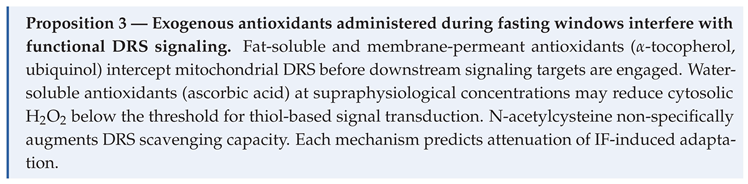
We propose the Functional Redox Coupling (FRC) framework as an integrative model resolving the above anomaly. The framework rests on four propositions, each independently supported by the literature reviewed in Section 2.



5. Organ-Level Physiology: Liver, Pancreas, and Brain
5.1. The Liver: Metabolic Conductor and Primary Target of Fasting-Induced Adaptation
The liver occupies a singular position in IF physiology: it is simultaneously the organ most immediately responsive to the fed-to-fasted transition, the primary site of fasting-induced DRS generation, and the organ most directly implicated in T2D pathology. Hepatic insulin resistance — characterized by the paradoxical persistence of gluconeogenesis despite hyperinsulinemia — is a defining feature of established T2D and detectable years before clinical diagnosis.
5.1.1. Hepatic Glycogen Depletion and the Metabolic Switch
Within 8–12 hours of the last meal, hepatic glycogen stores (70–100 g in a fasted adult) are progressively depleted. As glycogen availability falls, the hepatocyte shifts from glycogenolysis to gluconeogenesis and initiates fatty acid mobilization from adipose tissue. Increased fatty acid -oxidation elevates mitochondrial NADH production and drives ketogenesis — the hepatic synthesis of -hydroxybutyrate (BHB) and acetoacetate. BHB serves simultaneously as an energy substrate and, as established above, as a molecular signal with anti-inflammatory, epigenetic, and neuroprotective properties.
5.1.2. Hepatic DRS Signaling and the FRC Framework
Within the FRC framework, the hepatic mitochondrial response to fasting initiates a specific cascade: cytosolic oxidizes KEAP1 regulatory cysteines, releasing NRF2; mitochondrial ROS activate SIRT3, deacetylating key enzymes of fatty acid oxidation (LCAD, HMGCS2) and antioxidant defense (MnSOD, IDH2); and AMPK-mediated phosphorylation of PGC-1 initiates mitochondrial biogenesis. Multiple RCTs have documented reductions in hepatic fat content (MRI-PDFF), serum transaminases, and fasting glucose following IF protocols of 8–24 weeks duration [16,17].
5.2. The Endocrine Pancreas: -Cell Preservation Through Oscillatory Rest
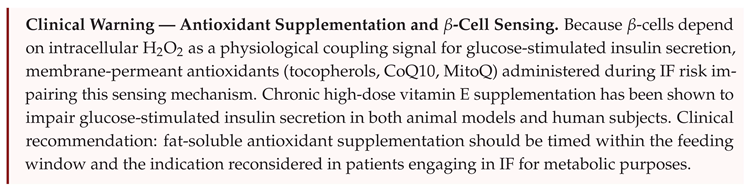
Pancreatic -cells express markedly low levels of classical antioxidant enzymes, rendering them exquisitely sensitive to sustained oxidative challenge. This vulnerability is not evolutionary accident: the -cell’s glucose-sensing mechanism depends on intracellular H generation as a coupling signal between glycolytic flux and insulin secretion. The redox sensitivity enabling effective glucose sensing also makes -cells vulnerable to the chronic oxidative burden of sustained hyperglycemia and hyperlipidemia.
5.2.1. Glucotoxicity, Lipotoxicity, and -Cell Redox Exhaustion
In T2D, -cells undergo a dual oxidative assault: glucotoxicity from chronic hyperglycemia and lipotoxicity from free fatty acid accumulation. The resulting chronic elevation of -cell ROS drives progressive loss of -cell mass and function: insulin gene expression is suppressed by oxidative modification of PDX-1; mitochondrial membrane potential is dissipated; and the unfolded protein response transitions from adaptive to pro-apoptotic.
5.2.2. IF as -Cell Oscillatory Rest
Intermittent fasting offers a mechanistically coherent counter to this trajectory. During the fasting window, postprandial glucose excursions are eliminated, circulating free fatty acids are mobilized rather than delivered to -cells, and the chronic demand for insulin secretion is temporarily suspended. This oscillatory rest allows -cells to undergo mitochondrial recovery: autophagy removes damaged mitochondria and misfolded proteins, and ER stress markers normalize.
Wilkinson et al. (Cell Metabolism, 2020) demonstrated that 10 weeks of 14:10 TRF produced significant reductions in HbA1c and fasting glucose exceeding those attributable to caloric restriction alone, consistent with a -cell functional effect [17].
5.3. The Brain: Neuroprotection, BDNF, and the Gut-Brain Axis
T2D is not a disease of glycemic dysregulation alone — it carries well-documented neurological sequelae: cognitive decline, accelerated brain aging, and increased risk of Alzheimer’s disease (sometimes termed “type 3 diabetes”). The brain is also an active regulator of systemic metabolism through hypothalamic circuits governing insulin sensitivity, appetite, and energy expenditure.
5.3.1. The Metabolic Switch and Neuronal Energetics
BHB is oxidized in neuronal mitochondria with higher thermodynamic efficiency than glucose, generating more ATP per mole of consumed and producing less superoxide as a byproduct of electron transport. This reduces the chronic mitochondrial ROS burden on neurons — cells with particularly high oxidative metabolic rates and limited regenerative capacity.
5.3.2. BDNF: The Central Molecular Mediator
The most extensively documented neurobiological effect of IF is the upregulation of brain-derived neurotrophic factor (BDNF). BHB directly inhibits class I and II HDACs, increasing histone acetylation at the Bdnf promoter; AMPK activates PGC-1, driving Bdnf transcription in cortical and hippocampal neurons [18]. BDNF levels are consistently reduced in patients with T2D, correlating with both glycemic control and the degree of cognitive impairment [19]. IF-induced BDNF upregulation addresses a neurobiological dimension of T2D that pharmacological glycemic management does not reach.
5.3.3. The Gut-Brain Axis and Microbiome
Intermittent fasting produces measurable shifts in gut microbiota composition: increases in Akkermansia muciniphila — associated with intestinal barrier integrity — and reductions in pro-inflammatory taxa. BHB produced during fasting supports colonocytes and intestinal barrier function through HDAC inhibition in epithelial cells. The net effect is progressive restoration of intestinal barrier competence that chronic ultra-processed food consumption disrupts, closing the pathophysiological loop connecting dietary environment, microbiome dysbiosis, intestinal permeability, and central metabolic dysregulation [20].
6. Protocol Comparison: 16:8 Versus 5:2 for T2D Prevention
6.1. Mechanistic Differences
The 16:8 protocol creates a daily oscillation between fed and fasted metabolic states. The nocturnal fasting window of 14–16 hours is sufficient to activate AMPK and initiate hepatic fat oxidation, but typically does not produce complete glycogen depletion and maximal ketogenesis. Its primary mechanism is the restoration of the physiological oscillatory pattern that the continuously fed state eliminates — a pattern that aligns naturally with circadian biology when the feeding window is positioned in the morning and early afternoon (early time-restricted feeding, eTRF).
The 5:2 protocol produces two episodes per week of sustained metabolic challenge. On restriction days (<500 kcal), glycogen depletion is complete, hepatic ketogenesis is substantially induced, mTOR inhibition is prolonged, and autophagy reaches levels that 16:8 may not reliably achieve. The depth of the fasting signal is greater but its frequency is lower.
Table 2.
Comparative analysis of 16:8 TRF and 5:2 intermittent fasting protocols for T2D prevention.
Table 2.
Comparative analysis of 16:8 TRF and 5:2 intermittent fasting protocols for T2D prevention.
| Criterion | 16:8 (daily TRF) | 5:2 (bi-weekly restriction) |
|---|---|---|
| Primary mechanism | Daily insulin/AMPK oscillation; metabolic switch glucose→FFA each night | Deep glycogen depletion 2×/week; pronounced ketogenesis; maximal autophagy |
| Fasting duration | 14–16 h continuous (nocturnal + morning) | ∼36 h severe restriction (<500 kcal) on 2 non-consecutive days |
| Autophagy induction | Moderate — begins after ∼14 h | Elevated — complete glycogen depletion, prolonged mTOR inhibition, elevated LC3-II |
| Insulin sensitivity | Consistent improvement at 4–12 weeks; documented effects on HOMA-IR | Comparable improvement; some studies suggest marginally superior HbA1c reduction |
| -cell preservation | Reduction of chronic oxidative burden by redox oscillation | Functional discharge 2×/week; preliminary data on -cell mass preservation |
| Hepatic steatosis | Documented reduction from 8–12 weeks (MRI) | Comparable reduction; potentially greater effect on hepatic VLDL output |
| 12-month adherence | High — integrable into daily rhythm without radical modification | Moderate — higher dropout; better tolerance with flexible day selection |
| Target populations | Pre-diabetes, early T2D, steatosis; compatible with active professional schedule | Established T2D, significant obesity; motivated patients with close follow-up |
| Specific precautions | Hypoglycaemia risk if sulfonylureas/insulin; morning feeding window (eTRF) preferred | Higher hypoglycaemic risk under pharmacotherapy; contraindicated with eating disorder history |
| Level of evidence (T2D) | Strong — multiple RCTs, meta-analyses, follow-up >12 months available | Moderate — fewer RCTs; long-term studies ongoing |
6.2. Clinical Decision Framework
For patients with pre-diabetes or early T2D managed by lifestyle alone, the 16:8 protocol — particularly with the eTRF positioning (feeding window 08:00–14:00 or 07:00–13:00) — offers the most favorable combination of metabolic efficacy, circadian alignment, and tolerability. Insulin sensitivity peaks in the morning under cortisol-mediated upregulation of GLUT4 expression, and postprandial glucose excursions are markedly attenuated for the same meal consumed earlier versus later in the day [21].
For patients with established T2D, significant hepatic steatosis, or higher cardiovascular risk, the 5:2 protocol offers a deeper adaptive signal and may produce more rapid improvements in hepatic fat content and HbA1c — at the cost of more complex pharmacological management on restriction days. In patients receiving sulfonylureas or insulin, restriction days require anticipatory dose adjustment and close glucose monitoring during the first 4–6 weeks.
7. Clinical Implications for T2D Prevention
7.1. Target Populations
The evidence base is strongest in adults with pre-diabetes (fasting glucose 5.6–6.9 mmol/L or HbA1c 39–47 mmol/mol), metabolic syndrome, or early T2D (HbA1c <75 mmol/mol) managed without insulin secretagogues. Patients with predominant hepatic insulin resistance — elevated fasting triglycerides, hepatic steatosis, high HOMA-IR — are likely to benefit most from the hepatic mechanisms described in Section 5.1. Patients with evidence of -cell dysfunction may derive specific benefit from oscillatory relief.
7.2. Antioxidant Co-Supplementation: A Practical Classification
Based on the FRC framework and the evidence reviewed above, the following classification is proposed:
- High-priority caution — Fat-soluble antioxidants (-tocopherol, -carotene, CoQ10/ubiquinol) during fasting windows. These are membrane-permeant and mitochondria-accessible, mechanistically positioned to intercept fasting-induced DRS. If clinically indicated, administer within the feeding window and re-evaluate the indication.
- Intermediate caution — High-dose water-soluble antioxidants (ascorbic acid >500 mg/day, N-acetylcysteine). At supraphysiological plasma concentrations, these may reduce cytosolic below the threshold for thiol-based redox signaling. Where supplementation is not clinically mandatory, restriction to the feeding window is prudent.
- Lower concern — Dietary polyphenols (resveratrol, quercetin, curcumin) at nutritional concentrations. These function primarily as NRF2 inducers rather than direct radical scavengers and may potentiate rather than antagonize the IF-induced adaptive response.
7.3. Contraindications and Cautions
Absolute contraindications include: history of eating disorders, type 1 diabetes without robust self-monitoring capability, pregnancy and lactation, severe underweight (BMI <18.5 kg/m+), and active psychiatric conditions impairing capacity for self-monitoring.
Relative contraindications requiring individualized assessment: advanced age (>75 years) with sarcopenia risk, CKD stage 3b or above, active oncological treatment, and gout. In elderly patients, sarcopenia risk can be substantially mitigated by ensuring protein intake ≥1.2 g/kg/day distributed across the feeding window, with emphasis on leucine-rich sources.
8. The Political Economy of T2D Prevention
8.1. The Antidiabetic Drug Market: When Disease Prevalence Is a Growth Driver
The global antidiabetic drug market was valued at approximately USD 91 billion in 2024 and is projected to reach USD 168 billion by 2030, representing a CAGR of approximately 10.7% [22]. T2D accounts for 79% of this market. The language of industry analysts is revealing: market growth projections consistently cite “rising diabetes prevalence” as a primary growth driver — a formulation that tacitly positions the worsening of a preventable epidemic as a commercial opportunity.
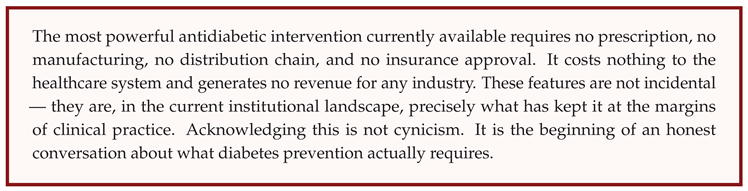
The economic logic of pharmaceutical antidiabetic therapy is structurally incompatible with primary prevention. The total economic cost of diagnosed diabetes in the United States in 2022 was estimated at USD 412.9 billion (USD 306.6 billion in direct medical expenditures; USD 106.3 billion in reduced productivity) [23]. Approximately one in four healthcare dollars in the US is spent on people with diagnosed diabetes. Against this figure, the estimated annual cost of a National Diabetes Prevention Program lifestyle intervention is a few hundred dollars per participant. The commercial return on prevention, for the pharmaceutical industry, is zero.
8.2. Conflicts of Interest in Nutritional Guideline Development
A peer-reviewed analysis published in Public Health Nutrition (Mialon et al., 2022) examined the conflicts of interest of all 20 members of the 2020 US Dietary Guidelines Advisory Committee. 95% of committee members had documented conflicts of interest with the food and/or pharmaceutical industries [24]. Research funding and advisory board membership accounted for more than 60% of these connections. Corporate actors with ties to multiple members included Kellogg, Abbott, Kraft, Mead Johnson, General Mills, Dannon, and the International Life Sciences Institute (ILSI).
Between 2017 and 2024, pharmaceutical manufacturers and medical device companies contributed more than USD 134 million to the American Diabetes Association (ADA), representing approximately 20% of its total funding [25]. The ADA endorses recipes on its website and on the websites of corporate partners. In 2022, Splenda contributed more than USD 1 million to the ADA while its products appeared in ADA-endorsed diabetic recipes.
8.3. The Ultra-Processed Food Industry: The Upstream Cause
A 2023 analysis from Harvard T.H. Chan School of Public Health involving 198,636 participants across three large US prospective cohorts found that higher ultra-processed food (UPF) consumption was consistently associated with increased T2D risk (HR: 1.15–1.53 for highest vs. lowest quintiles) [26]. A 2025 systematic review and meta-analysis pooling 14 prospective cohort studies with 692,508 participants confirmed a pooled hazard ratio of 1.17–1.50 for the highest UPF consumption categories [27].
The implicated mechanisms converge directly with the FRC framework: UPFs dysregulate gut microbiota, impair intestinal barrier integrity, and drive chronic systemic inflammation — engaging NF-B signaling and driving insulin resistance, the cardinal pathophysiological feature of T2D.
8.4. Concluding Statement
9. Research Agenda
The FRC framework generates a specific and tractable set of empirical questions:
- Timing hypothesis: Randomized controlled trials comparing antioxidant supplementation during the fasting window versus the re-feeding window on validated IF outcome measures (insulin sensitivity, autophagy markers, mitochondrial biogenesis).
- Molecular class specificity: Trials comparing fat-soluble, water-soluble, and NRF2-inducing antioxidant classes in IF contexts with pre-specified mechanistic endpoints.
- Clinical biomarker development: Validated biomarkers of DRS-mediated signaling distinct from oxidative damage markers. Candidate biomarkers include plasma flux, sulfenylation proteomics, and NRF2 target gene expression in peripheral blood mononuclear cells.
- Pharmacokinetic modeling: Distribution of antioxidants relative to fasting-induced mitochondrial DRS generation timecourses to provide a rational basis for timing recommendations.
10. Conclusion
Intermittent fasting produces reproducible and clinically meaningful metabolic benefits through a molecular mechanism that centrally involves the generation and signaling function of diffusible reactive species. The classical framework, which treats these species as stressors to be compensated by antioxidant defenses, cannot account for the systematic failure of antioxidant supplementation to augment IF’s benefits.
Three decades of converging evidence — the oxidative eustress concept of Sies, the redox code of Jones, the mitohormesis work of Ristow, the mitochondrial signaling research of Chandel, the measured revision of Halliwell, and the signal transduction framework of Finkel — collectively support a re-reading of IF’s molecular mechanism in which DRS are obligatory coupling agents of fasting-induced metabolic adaptation.
The Functional Redox Coupling framework proposed here does not repudiate the classical model but extends and refines it, resolving a persistent empirical anomaly and generating specific, testable clinical predictions. Chief among these is the hypothesis that antioxidant supplementation during fasting windows will be shown to attenuate adaptive responses proportionally to the capacity of the molecular class to intercept fasting-induced DRS signaling.
The practical implication for clinicians managing patients engaged in IF for T2D prevention is immediate: the reflexive co-prescription of antioxidant supplementation during IF should be reconsidered, and where supplementation is clinically indicated, timing and molecular class selection should be explicitly addressed.
References
- Harris, L.; Hamilton, S.; Azevedo, L.B.; et al. Intermittent fasting interventions for treatment of overweight and obesity in adults. JBI Database of Systematic Reviews and Implementation Reports 2018, 16, 507–547. [Google Scholar] [CrossRef] [PubMed]
- Cioffi, I.; Evangelista, A.; Ponzo, V.; et al. Intermittent versus continuous energy restriction on weight loss and cardiometabolic outcomes. Journal of Translational Medicine 2018, 16, 371. [Google Scholar] [CrossRef] [PubMed]
- de Cabo, R.; Mattson, M.P. Effects of Intermittent Fasting on Health, Aging, and Disease. New England Journal of Medicine 2019, 381, 2541–2551. [Google Scholar] [CrossRef] [PubMed]
- The ATBC Cancer Prevention Study Group. The effect of vitamin E and beta carotene on the incidence of lung cancer and other cancers in male smokers. New England Journal of Medicine 1994, 330, 1029–1035. [Google Scholar] [CrossRef]
- Omenn, G.S.; Goodman, G.E.; Thornquist, M.D.; et al. Effects of a combination of beta carotene and vitamin A on lung cancer and cardiovascular disease. New England Journal of Medicine 1996, 334, 1150–1155. [Google Scholar] [CrossRef]
- Lippman, S.M.; Klein, E.A.; Goodman, P.J.; et al. Effect of selenium and vitamin E on risk of prostate cancer and other cancers. JAMA 2009, 301, 39–51. [Google Scholar] [CrossRef]
- Ristow, M.; Zarse, K.; Oberbach, A.; et al. Antioxidants prevent health-promoting effects of physical exercise in humans. Proceedings of the National Academy of Sciences 2009, 106, 8665–8670. [Google Scholar] [CrossRef]
- Sies, H.; Jones, D.P. Reactive oxygen species (ROS) as pleiotropic physiological signalling agents. Nature Reviews Molecular Cell Biology 2020, 21, 363–383. [Google Scholar] [CrossRef]
- Jones, D.P. Redox theory of aging. Redox Biology 2015, 5, 71–79. [Google Scholar] [CrossRef]
- Ristow, M.; Schmeisser, S. Mitohormesis: Promoting Health and Lifespan by Increased Levels of Reactive Oxygen Species (ROS). Dose-Response 2014, 12, 288–341. [Google Scholar] [CrossRef]
- Chandel, N.S.; Schumacker, P.T. Cells depleted of mitochondrial DNA (rho0) yield insight into physiological mechanisms. FEBS Letters 1999, 454, 173–176. [Google Scholar] [CrossRef] [PubMed]
- Halliwell, B. Free radicals and antioxidants: updating a personal view. Nutrition Reviews 2012, 70, 257–265. [Google Scholar] [CrossRef] [PubMed]
- Finkel, T. Signal transduction by reactive oxygen species. Journal of Cell Biology 2011, 194, 7–15. [Google Scholar] [CrossRef] [PubMed]
- Manoj, K.M.; Ramasamy, S.; Parashar, A.; Jagadeeshaprasad, M.G.; Bhakta, S.; Gade, S.K. Murburn concept: A molecular explanation for hormetic and idiosyncratic effects of drugs. Biomolecular Concepts 2020, 11, 45–56. [Google Scholar] [CrossRef]
- Manoj, K.M.; Gideon, D.A.; Soman, V.; Jacob, V.R. Murburn model for thermogenesis and oxygen homeostasis in mitochondria. AIP Advances 2023, 13, 015120. [Google Scholar] [CrossRef]
- Cai, H.; Qin, Y.L.; Shi, Z.Y.; et al. Effects of alternate-day fasting on body weight and dyslipidaemia in patients with non-alcoholic fatty liver disease. BMC Gastroenterology 2019, 19, 219. [Google Scholar] [CrossRef]
- Wilkinson, M.J.; Manoogian, E.N.C.; Zadourian, A.; et al. Ten-Hour Time-Restricted Eating Reduces Weight, Blood Pressure, and Atherogenic Lipids in Patients with Metabolic Syndrome. Cell Metabolism 2020, 31, 92–104. [Google Scholar] [CrossRef]
- Mattson, M.P.; Moehl, K.; Ghena, N.; Schmaedick, M.; Cheng, A. Intermittent metabolic switching, neuroplasticity and brain health. Nature Reviews Neuroscience 2018, 19, 63–80. [Google Scholar] [CrossRef]
- Krabbe, K.S.; Nielsen, A.R.; Krogh-Madsen, R.; et al. Brain-derived neurotrophic factor (BDNF) and type 2 diabetes. Diabetologia 2007, 50, 431–438. [Google Scholar] [CrossRef]
- Cignarella, F.; Cantoni, C.; Ghezzi, L.; et al. Intermittent Fasting Confers Protection in CNS Autoimmunity by Altering the Gut Microbiota. Cell Metabolism 2018, 27, 1222–1235. [Google Scholar] [CrossRef]
- Sutton, E.F.; Beyl, R.; Early, K.S.; et al. Early Time-Restricted Feeding Improves Insulin Sensitivity, Blood Pressure, and Oxidative Stress Even without Weight Loss in Men with Prediabetes. Cell Metabolism 2018, 27, 1212–1221. [Google Scholar] [CrossRef] [PubMed]
- Grand View Research. Antidiabetic Drugs Market Size, Share & Trends Analysis Report. Market Research Report, 2024. CAGR 10.7%, 2024–2030.
- Parker, E.D.; Lin, J.; Mahoney, T.; et al. Economic Costs of Diabetes in the U.S. in 2022. Diabetes Care 2024, 47, 26–43. [Google Scholar] [CrossRef] [PubMed]
- Mialon, M.; Bhuwania, M.; Sievert, K. Conflicts of interest for members of the US 2020 Dietary Guidelines Advisory Committee. Public Health Nutrition 2022, 25, 3398–3408. [Google Scholar] [CrossRef]
- Nestlé, M. Unsavory Truth: How Food Companies Skew the Science of What We Eat; Basic Books: New York, 2018. [Google Scholar]
- Chen, Z.; Khandpur, N.; Desjardins, C.; et al. Ultra-Processed Food Consumption and Risk of Type 2 Diabetes. American Journal of Clinical Nutrition 2023, 117, 882–891. [Google Scholar] [CrossRef]
- Lane, M.M.; Gamage, E.; Travica, N.; et al. Ultra-processed food consumption and mental health: a systematic review and meta-analysis of observational studies. Nutrients 2022, 14, 2568. [Google Scholar] [CrossRef]
Disclaimer/Publisher’s Note: The statements, opinions and data contained in all publications are solely those of the individual author(s) and contributor(s) and not of MDPI and/or the editor(s). MDPI and/or the editor(s) disclaim responsibility for any injury to people or property resulting from any ideas, methods, instructions or products referred to in the content. |
© 2026 by the authors. Licensee MDPI, Basel, Switzerland. This article is an open access article distributed under the terms and conditions of the Creative Commons Attribution (CC BY) license (http://creativecommons.org/licenses/by/4.0/).
Copyright: This open access article is published under a Creative Commons CC BY 4.0 license, which permit the free download, distribution, and reuse, provided that the author and preprint are cited in any reuse.


