

Submitted:
11 March 2026
Posted:
12 March 2026
You are already at the latest version
Abstract
Metastatic colorectal cancer (mCRC) remains one of the leading causes of cancer-related mortality worldwide despite substantial therapeutic improvements over the past two decades. Advances in the understanding of colorectal tumor biology and oncogenic signaling, have enabled the development of biomarker-guided therapies targeting alterations in EGFR, BRAFV600E, KRAS mutations and HER2 amplifications, improving outcomes in selected patient populations. Nevertheless, the emergence of both intrinsic and acquired resistance mechanisms continue to limit the durability of these responses. Resistance to targeted therapies in mCRC arises through multiple, often convergent mechanisms, including activation of compensatory signaling pathways, pre-existing genomic heterogeneity, and therapy-driven clonal selection. The integration of molecular profiling into clinical decision-making is essential to guide treatment selection and op-timize therapeutic sequencing, ultimately enabling progress in precision oncology. Advances in genomic technologies, particularly circulating tumor DNA (ctDNA) analysis, have allowed longitudinal monitoring of tumor evolution, providing important insights into the mechanisms underlying resistance to targeted therapies. The aim of this review is to summarize the genomic landscape of mCRC and discuss current targeted therapeutic strategies in molecularly defined subgroups, with a particular focus on the mechanisms driving primary and acquired resistance.
Keywords:
metastatic colorectal cancer
; targeted therapy
; circulating tumor DNA
; precision oncology
1. Introduction
Colorectal cancer (CRC) remains the third most commonly diagnosed malignancy worldwide and the second leading cause of cancer-related death, despite substantial therapeutic advances over the past decades and declining incidence in average-age populations in high-income countries [1,2]. Approximately 20% of patients present with metastatic disease at diagnosis, while an additional 30-50% of those initially diagnosed with localized tumors eventually develop metastatic relapse [3,4]. In addition, the incidence rates in people younger than 50 years have been increasing for the last 20 years, potentially driven by early-life environmental and lifestyle exposures, highlighting the need for deeper biological insight and more effective therapeutic approaches [5].
The pathogenesis of CRC is widely considered a multistep process in which normal colonic epithelium progressively evolves through precursor lesions into invasive carcinoma. Advances in histopathological and molecular characterization of colorectal tumorigenesis have led to the identification of distinct pathways of CRC development. These include the chromosomal instability (CIN) pathway (≈70% of cases), the serrated neoplasia pathway (≈15%), and the mismatch repair–deficient (dMMR) or microsatellite instability- high (MSI-H) pathway (≈15%). Across these pathways, tumorigenesis is driven by disruption of key signaling networks, including the MAPK, Wnt/β-catenin, TGF-β, and PI3K-AKT pathways, which regulate cell proliferation, survival, and metastatic dissemination [6]. Deregulation of these cascades is primarily caused by recurrent genetic alterations in critical driver genes such as KRAS, PIK3CA, and APC, which not only promote colorectal carcinogenesis but also create therapeutic vulnerabilities that can be targeted by precision-based strategies [7,8].
Beyond the genomic alterations, CRC biology is also profoundly shaped by immune surveillance and transcriptional programs governing tumor-microenvironment interactions. Gene expression-based consensus molecular subtypes (CMS1-CMS4) capture dimensions of CRC heterogeneity that are not fully explained by DNA mutations alone, providing a deeper understanding [9]. As tumors expand, they develop a microenvironment characterized by severe hypoxia and acidosis, conditions that have been recognized as a hallmark of tumor progression. These hypoxic conditions induce the expression of hypoxia-inducible factors 1 and 2 (HIF-1 and HIF-2), which, in turn, upregulate various growth and proangiogenic factors, representing another hallmark of colon cancer that has also been targeted by antiangiogenics such as bevacizumab or aflibercept [10,11].
Building on these molecular insights, the therapeutic landscape of metastatic CRC has progressively shifted toward biomarker-driven strategies. The identification of actionable alterations, including RAS and BRAF mutations, HER2 amplification, and NTRK fusions, has enabled the development of targeted agents that have significantly improved outcomes in selected patient subsets. Anti-EGFR antibodies, BRAF-directed combinations, and HER2-targeted therapies exemplify how molecular stratification has translated into clinically meaningful benefit. However, despite these advances, responses to targeted therapies are often incomplete and rarely durable. Both primary (intrinsic) and acquired resistance inevitably emerge, limiting long-term efficacy. Resistance mechanisms in CRC are highly heterogeneous and frequently convergent, involving pre-existing subclonal alterations, activation of compensatory signaling pathways (such as MAPK or PI3K-AKT reactivation), feedback loop dysregulation, and therapy-driven clonal selection. Tumor heterogeneity, whether spatial, temporal, or molecular, further complicates treatment, allowing resistant clones to expand under therapeutic pressure [12,13]. Figure 1 summarizes the main mechanisms underlying resistance to targeted therapies in mCRC.
This review synthesizes the current understanding of genomic resistance, focusing on mechanisms of primary and acquired resistance and highlighting future directions towards a more precise and dynamic management of mCRC.
2. EGFR Inhibitors in RAS/BRAFwt mCRC Patients
The epidermal growth factor receptor (EGFR) pathway was among the earliest molecular targets successfully exploited in the treatment of CRC. The EGFR (or ERBB1) belongs to the ERBB/HER protein family, a group of transmembrane tyrosine kinase receptors. EGFR is activated upon binding of several ligands, including epidermal growth factor (EGF), transforming growth factor α (TGFα), amphiregulin, epiregulin, and heparin-binding EGF-like growth factor. Ligand binding to the extracellular domain promotes receptor homo- or heterodimerization, triggering activation of downstream signaling cascades. The principal pathways involved include the RAS-RAF-MEK-MAPK (also called ERK) and PI3K-AKT-mTOR pathways, which regulate cellular proliferation, survival, migration, and differentiation [17,18].
Two major classes of EGFR-targeted agents have been developed: monoclonal antibodies directed against the extracellular receptor domain, and small-molecule tyrosine kinase inhibitors targeting the intracellular kinase domain. Among these agents, the monoclonal antibodies cetuximab and panitumumab have been approved in combination with chemotherapy in RAS/BRAF wild-type (wt) mCRC [19]. Panitumumab is a fully human IgG2 monoclonal antibody directed against EGFR. Cetuximab, in contrast, is a chimeric IgG1 monoclonal antibody, which explains its higher potential for immunogenic reactions. In addition to inhibiting ligand-dependent receptor signaling, cetuximab can also induce antitumor activity through antibody-dependent cellular cytotoxicity (ADCC) mediated by immune effector cells. Multiple prospective and retrospective studies have demonstrated that the addition of anti-EGFR monoclonal antibodies to standard doublet chemotherapy regimens (FOLFOX or FOLFIRI) improves response rates and survival outcomes in patients with RAS/BRAFwt metastatic CRC. Maintenance strategies following induction therapy are frequently implemented to reduce cumulative toxicity while maintaining disease control. Primary tumor location has also emerged as a relevant predictive factor, with left-sided tumors deriving the greatest clinical benefit from anti-EGFR-based combinations. In contrast, right-sided tumors appear to derive less benefit from EGFR blockade and are often preferentially treated with anti-angiogenic-based strategies. Collectively, these findings have established anti-EGFR therapy combined with chemotherapy as a standard first-line option for patients with RAS/BRAFwt left-sided metastatic CRC [14].
The identification of predictive biomarkers for EGFR inhibitors in mCRC exemplifies the evolution of precision oncology in CRC. Initial patient selection strategies relied on EGFR expression assessed by immunohistochemistry. However, subsequent clinical trials demonstrated that EGFR expression alone did not reliably predict response to EGFR-targeted therapies. Succeeding molecular analyses revealed that activating mutations in KRAS, and later in NRAS, were strongly associated with primary resistance to anti-EGFR monoclonal antibodies. These findings led to the implementation of extended RAS testing as a mandatory prerequisite for treatment selection. Consequently, anti-EGFR therapies are currently restricted to patients with RAS/BRAFwt mCRC. Constitutive activation of RAS pathway, most commonly due to KRAS mutations, present in approximately 40-45% of CRCs, and less frequently NRAS mutations (5–7%), results in persistent downstream signaling independently of upstream EGFR activation. This constitutive signaling renders EGFR blockade ineffective, resulting in primary resistance to anti-EGFR monoclonal antibodies. RAS alterations may occur in KRAS exons 2, 3, and 4 and in NRAS exons 2 and 3; however, approximately 85% of cases involve mutations in KRAS exon 2, most commonly affecting codons 12 and 13. Similarly, BRAFV600E mutations, identified in 7-15% of CRC cases, drive MAPK pathway activation downstream of RAS and are associated with poor prognosis and limited benefit from anti-EGFR monotherapy, highlighting the importance of comprehensive molecular profiling before treatment selection [8,15].
During anti-EGFR therapy, acquired RAS mutations have been detected in up to 50-60% of patients who were initially classified as RASwt. This phenomenon represents one of the most common mechanisms of secondary resistance and reflects clonal selection under therapeutic pressure. In addition, right-sided primary tumors consistently derive less clinical benefit from anti-EGFR-based strategies. This reduced efficacy is thought to reflect underlying biological differences, including a higher prevalence of intrinsic resistance mechanisms and enrichment of hyperselection-positive alterations. However, recent evidence, including the PARADIGM trial, has demonstrated that in molecularly hyperselected RASwt populations identified through ctDNA profiling, anti-EGFR therapy can significantly improve overall survival compared with bevacizumab-based strategies, irrespective of tumor sidedness [20]. Increasing evidence indicates that selection based solely on KRAS and NRAS mutational status is insufficient to identify tumors truly dependent on EGFR signaling. Consequently, the concept of negative hyperselection has emerged. This approach expands molecular screening beyond RAS and BRAF testing to exclude additional genomic alterations associated with resistance, including HER2 or MET amplification, PIK3CA exon 20 mutations, MAP2K1 alterations, PTEN loss, and oncogenic kinase fusions. Clinical studies, such as PRESSING trial and PRESSING2 trial, have demonstrated that patients lacking these alterations derive significantly greater benefit from anti-EGFR therapy. These findings emphasize the importance of defining appropriate molecular panels and clinically meaningful allele-frequency thresholds in order to avoid the inclusion of tumors harboring subclonal resistance alterations [21,22].
Nevertheless, several aspects of molecular hyperselection remain unresolved. In particular, the optimal composition of hyperselection panels, the definition of clinically meaningful mutant allele fraction thresholds for MAPK pathway alterations, and the predictive relevance of additional genomic events, such as PIK3CA mutations or FGFR1 aberrations, have not yet been fully established [23,24]. Prospective clinical studies are required to establish their clinical relevance and guide more precise patient selection. Table 1 summarizes the main hyperselection panels published to date and the principal hyperselection strategies.
Growing evidence suggests that the overexpression of EGFR ligands, such as amphiregulin (AREG) and epiregulin (EREG), could be associated with enhanced sensitivity to anti-EGFR monoclonal antibodies rather than reduced responsiveness. This phenomenon appears to be driven by therapy-induced upregulation and competitive binding for EGFR receptor [8,18,29]. Ongoing studies, including the ARIEL clinical trial, are investigating whether right-sided RASwt mCRC with high AREG and EREG expression may represent a subgroup that still benefits from anti-EGFR therapy despite unfavorable primary tumor location [30,31].
One of the most frequently described mechanisms of acquired resistance involves alterations in the extracellular domain (ECD) of EGFR, which impair antibody binding. Somatic mutations including S492R, G465R, G465E, and S468R have been identified at the antibody-binding interface and can confer resistance to cetuximab and, in some cases, panitumumab. Notably, S492R has been predominantly described following cetuximab exposure and is rarely observed after treatment with panitumumab. In addition, R198/R200 methylation and the EGFR kinase domain mutation V843I have been associated with disease progression during cetuximab treatment [18,32]. Molecularly guided therapeutic strategies are being investigated to overcome these resistance mechanisms, including agents targeting distinct epitopes within the EGFR extracellular domain to bypass acquired mutations. Examples of such approaches include the oligoclonal antibody MM-151 and the monoclonal antibody necitumumab. Preclinical studies have demonstrated the antitumor activity of MM-151, an oligoclonal antibody designed to bind multiple regions within the EGFR extracellular domain [33,34]. Necitumumab may retain activity against the EGFR S468R variant, providing a rationale for genotype-guided repurposing of this agent [35,36].
Although less frequent, MET amplification represents a bypass signaling mechanism that may emerge under therapeutic pressure during EGFR blockade. Several studies have reported that MET amplification can be detected in ctDNA prior to clinical relapse, accounting for approximately 1% of cases of acquired resistance to EGFR inhibitors. Accordingly, c-MET inhibitors are currently being investigated as a strategy to overcome this resistance mechanism. The receptor tyrosine kinase c-MET, encoded by the proto-oncogene MET, activates downstream signaling pathways including PI3K-AKT and RAS-RAF-ERK following binding to hepatocyte growth factor (HGF), thereby promoting cellular proliferation and survival [18,37]. The ongoing OrigAMI-2 trial is a phase III trial evaluating the combination of chemotherapy and amivantamab, a bispecific antibody targeting MET and EFGR, as a first-line treatment for BRAF/RASwt mCRC [38].
Another emerging strategy involves the development of bispecific antibodies targeting multiple oncogenic pathways. Increasing evidence supports the presence of a subpopulation of stem-like tumor cells expressing the receptor 5 coupled to the leucine-rich G-repeat protein (LGR5), which exhibit self-renewal capacity, drive tumor growth and metastasis, and contribute to therapeutic resistance. Petosemtamab, a bispecific antibody targeting both LGR5 and EGFR, is currently under clinical investigation and exerts multiple complementary mechanisms of action. These include blockade of EGFR ligand binding, internalization and degradation of the EGFR receptor in LGR5+ cells, and Fc-mediated activation of the innate immune system through antibody-dependent cellular phagocytosis (ADCP) and enhanced ADCC. While preliminary data is promising, further validation in advanced-phase trials is required [39,40].
Malignant tumors are characterized by both spatial and temporal heterogeneity, a phenomenon particularly relevant in mCRC. Tissue biopsies used for genomic analysis may be limited by sampling bias due to their invasive nature and the difficulty of capturing multiple metastatic sites. ctDNA provides a more comprehensive representation of all tumor clones, offering broader insights than a single biopsy. mCRC clonal populations can vary due to tumor microenvironment and treatment pressures. The use of ctDNA allows us to track clonal evolution secondary to the treatments in real-time to improve precision medicine [14]. Importantly, ctDNA analysis is increasingly transitioning from a research tool to a clinically actionable biomarker that enables real-time treatment adaptation and patient selection in mCRC [41].
The rechallenge with anti-EGFR agents has emerged as a potential therapeutic option for patients with chemorefractory RASwt mCRC after a period of anti-EGFR-free therapy [42]. It has been evaluated for implementation as a third-line treatment onwards for those patients who achieved a significant initial clinical response to anti-EGFR inhibitors. The biological rationale is based on intratumorally heterogeneity and clonal evolution. During a treatment-free interval, the selective pressure is removed, potentially leading to a regression of resistant clones. This shift in clonal architecture may restore the tumor’s sensitivity to the EGFR inhibitor. To optimize patient selection, ctDNA analysis is an essential tool for monitoring the emergence and decay of specific resistance mutations, thereby quantifying the molecular landscape prior to re-exposure [41,43,44]. The decay of the mutant allele frequency (MAF) of RAS, and other resistant clones, in ctDNA during non-EGFR-based treatment, has been estimated to have a half-life ranging between 3.7 and 4.7 months. These findings suggest clonal evolution during therapy [45]. This time has been used in the past to empirically test EGFR inhibitors rechallenge, with low objective response rates (ORRs). ctDNA has demonstrated significant suitability for identifying patients eligible for rechallenge [46,47]. This concept was initially proven in 2015, demonstrating that individuals benefiting from multiple anti-EGFR treatments exhibited fluctuating levels of ctDNA RAS mutations. Subsequent trials, including CRICKET trial, retrospectively confirmed that having RASwt ctDNA at the time of rechallenge was a mandatory condition for a positive response. The multi-center phase II CRICKET evaluated a rechallenge strategy using cetuximab and irinotecan in patients with RAS and BRAFwt mCRC who had acquired resistance to first-line irinotecan- and cetuximab-based therapy [48]. Among the 28 patients who were enrolled, there was an ORR of 21%, with six patients achieving partial responses and nine experiencing disease stabilization. A retrospective analysis of baseline ctDNA revealed a correlation between the presence of RAS mutations and shorter progression-free-survival (PFS), underscoring the necessity of using ctDNA in selecting patients for this rechallenge approach. Subsequent prospective studies, notably the CHRONOS phase II, involved screening patients with tissue RASwt tumors previously treated with anti-EGFR therapy, through ctDNA [49]. ctDNA-based screening led to the exclusion of approximately 31% of patients due to the detection of resistance-associated mutations. Among the patients included in the study, 63% achieved disease control, suggesting that ctDNA-guided anti-EGFR rechallenge may represent a feasible and potentially effective strategy for patients with refractory mCRC. Available evidence suggests that low-frequency resistance mutations may not significantly compromise responses to anti-EGFR rechallenge, although the optimal allele frequency threshold remains uncertain. In a retrospective analysis, the relative frequencies of mutant alleles (rMAF) were defined as the ratio between the MAF of the resistance mutation and the highest detected MAF detected in the sample. Patients with rMAF ≤12.4% demonstrated significantly longer PFS (6.1 vs. 2.6 months; p = 0.04), and a numerically higher OS (28.3 vs. 3.7 months; p = 0.09) [50,51,52].
To overcome clonal escape and restore tumor dependency on EGFR signaling, there is current investigation to integrate ctDNA-guided molecular profiling with combination therapies targeting both EGFR and resistance-associated pathways [53]. For instance, the ongoing OrigAMI-1 trial (NCT05379595) is evaluating an enhanced rechallenge strategy using the bispecific EGFR/MET antibody amivantamab in patients with anti-EGFR–pretreated mCRC. The study incorporates ctDNA-based screening to identify resistance alterations and guide therapeutic targeting of bypass signaling pathways.
3. Drug Discovery in BRAFV600 mCRC Patients
BRAF mutations occur in approximately 8-12% of mCRC patients [54]. The V600E mutation represents 95% of all BRAF mutations and it is associated with female sex, nodal and peritoneal spread, right-sided tumors and mucinous tumors with poor differentiation. About 30% of the BRAF-mutated patients present also MSI, and they are usually mutually exclusive with KRAS mutations. BRAF mutations can be classified in three categories based on their function on BRAF dimerization. Class I mutations have activity as monomers and contain V600E, V660K, V600D, V600M, and V600R. Class II mutations are constitutively active only as dimers and include L597Q/R/S/V, G464V/E, G496A/V/R, K601 E/NT, and P367 L/S. Class III mutations require coexisting RAS activation because they have altered kinase activity, while class I and II mutations are both RAS-independent and activate the MAPK pathway. Class III mutations contain D594G, D594N, G466E, and G466V. The non-V600E mutations present a similar prognosis as RAS/BRAFwt mCRC, and some evidence suggest might benefit from anti-EGFR therapy [55].
The prognosis for BRAF-mutated mCRC has significantly improved due to the discovery of targeted therapy. Before the targeted therapy era, treatment recommendations for patients with BRAF-mutant disease were based on outcomes in subgroups of several clinical trials with a median overall survival (OS) of 11 months, and poor response to standard chemotherapy. The main BRAF inhibitors are encorafenib, vemurafenib, and dabrafenib [14]. First, BRAF blockade in monotherapy was evaluated in melanoma patients, with vemurafenib, evidencing response rates of 48% vs 5% in the dacarbazine arm [56]. Subsequently, the VE BASKET trial (NCT01524978) evaluated vemurafenib efficacy in nonmelanoma cancers observing activity in non-small cell lung cancer (NSCLC) with a response rate of 42% [57]. However, a phase I trial had evidenced that vemurafenib alone had insufficient activity in patients with BRAF V600E mCRC [58]. Emerging laboratory data suggested that it might be mediated through feedback activation of EGFR signaling, driven by the loss of ERK-dependent negative feedback [59]. It was evidenced that combination of RAF and EGFR inhibition blocked reactivation of MAPK signaling in BRAF mutant CRC cells improving efficacy in vitro and in vivo [60]. According to these findings, the CRC cohort in the VE BASKET trial was amended to include vemurafenib plus and EGFR inhibitor (cetuximab), but the results were discouraging (overall response rate 4%). Since then, several trials were conducted combining BRAF inhibitors with EGFR inhibitors, MEK inhibitors (such as trametinib, binimetinib and cobimetinib) or chemotherapy, with modest results [8,54].
The phase III BEACON trial was the largest trial that confirmed the BRAF/EGFR inhibitor as the standard of care for BRAF-V600E mCRC after at least one previous line of systemic therapy [61]. It evaluated the combination of encorafenib/cetuximab with or without binimetinib vs. irinotecan/cetuximab–based chemotherapy. Updated post hoc analysis confirmed that both the triplet and doublet arms demonstrated better ORR (26.8% for the triplet, 19.5% for the doublet and 1.8% for control), PFS (4.3 months for the triplet, 4.2 months for the doublet, and 1.5 months for control), and OS than the chemotherapy arm (9.3 months for both the triplet and the doublet and 5.9 months for control). It has been reported that tumors with stronger immune signature (for example, increased T cells) showed a trend towards increased benefit from treatment with the triplet with binimetinib [62]. Subsequently, the phase III BREAKWATER trial has evaluated the use of cetuximab and encorafenib administered either with or without chemotherapy (mFOLFOX6 or FOLFIRI) as first-line treatment. Compared to standard care, the combination of encorafenib, cetuximab and mFOLFOX6 significantly increased progression-free survival (median, 12.8 vs. 7.1 months; hazard ratio (HR) for progression or death, 0.53; P<0.001). The OS was significantly improved compared to standard of care according to the latest reported data (30.3 vs. 15.1 months; HR for death, 0.49; P<0.001) [63]. These findings have constituted a major shift in the paradigm of first-line treatment of BRAF-mutated mCRC.
On the other hand, biomarker guided research is ongoing to select those patients that could be associated with a better response to anti-BRAF/EGFR therapy. It has been proven that inactivating mutations in RNF43, a negative regulator of WNT, predicts improved response rates and survival outcomes in patients with microsatellite-stable (MSS) tumors. In patients with MSS-RNF43-mutated versus MSS-RNF43-wt tumors, a statistically significant benefit was observed in both progression-free survival (HR, 0.30; [95% confidence interval (CI), 0.12-0.75; P = 0.01) and overall survival (HR, 0.26; 95% CI, 0.10-0.71; P = 0.008) [64]. Moreover, it has been evaluated that plasmatic BRAF allele fraction (AF) has a prognostic role for survival in mCRC treated with BRAF inhibitors, acting as a surrogate of tumor burden and aggressiveness. An exploratory analysis of predictive value showed that high-BRAF AF patients could benefit more from treatment intensification with triplet therapy (BRAF, EGFR and MEK inhibitors), than low-BRAF AF patients [65]. Consistently, comprehensive molecular profiling from the BEACON trial highlighted the complex genomic landscape reporting that acquired resistance commonly converges on reactivation of the MAPK pathway through alterations such as KRAS, NRAS, MAP2K1 mutations or MET amplifications [62].
There are several trials ongoing about rechallenge with BRAF inhibitors, such as the phase II REFISH trial (NCT07178717) [66]. The aim is to evaluate the efficacy of encorafenib plus cetuximab as a rechallenge strategy. It has the same background as the anti-EGFR rechallenge, reintroduce BRAF inhibitors among patients who have previously responded to such strategy after free-interval period. The combination of clinical features such as long-lasting response, and extended time off therapy, in combination with the absence of molecular mechanism of resistance in ctDNA, and new biomarkers such as RNF43 mutation or the plasmatic BRAF AF, may help identify those patients who may achieve the greatest benefit from rechallenge [67,68].
Recent clinical trials combining immunotherapy with BRAF inhibitors in BRAFV600E mCRC, have demonstrated encouraging outcomes. In MSS BRAFV600E mCRC, a phase I/II trial (NCT04017650) using encorafenib, cetuximab, and nivolumab had promising results [69]. In a similar direction, the combination of trametinib, dabrafenib, and spartalizumab (anti-PD1) showed durable responses (NCT03668431) [70] For patients BRAFV600E-MSI mCRC there is an ongoing randomized phase II trial (NCT05217446) comparing the efficacy of the combination of pembrolizumab with encorafenib and cetuximab versus pembrolizumab alone in first line [71]. Mechanistically, BRAF/MEK inhibition works in concert with immune checkpoint blocking by inducing antigen-presenting mechanisms and activating CD8+ T cells in the tumor microenvironment [72]. While complement system and CD8+ T cell activation were linked to resistance, responders showed increased immunological activation and MAPK signaling signatures [73]. These results imply that patient selection for these combination therapies may be optimized by baseline immunological profile.
The main resistance mechanisms described after BRAF inhibitors combination therapy include MAP2K1, GNAS, ARAF, PTEN, ERBB2, MEK, and EGFR mutations, as well as KRAS, MET, and EGFR amplifications [54,74]. The analysis from ctDNA in the BREAKWATER trial revealed that acquired alterations in KRAS, NRAS, and MAP2K1 mutations, MET amplifications and BRAF exon deletions were less frequent in the encorafenib + cetuximab + mFOLFOX6 group than in the group without chemotherapy. These findings support the greater therapeutic effects of targeted therapy and cytotoxic chemotherapy in avoiding resistance mechanisms [75]. Current studies are evaluating several combinations to overcome resistance. Azanosertib (ZN-c3) is a novel, selective, orally bioavailable WEE1 inhibitor that enhances tumor growth inhibition with BRAF/EGFR inhibitors in BRAF V600E CRC xenograft models. The ongoing phase I/II trial (NCT05743036) is exploring the combination of encorafenib + cetuximab + azanosertib in BRAF-mCRC previously treated with one or two treatment regimens [76]. Another strategy is the new pan-RAF inhibitors in combination with MEK inhibitors to overcome resistance [77,78,79] For example, PF-07799933 is a next-generation, selective, brain-penetrant, pan-mutant BRAF inhibitor that has been combined with MEK inhibitors in a phase I trial [80]. In addition, BRAF degraders are based in avoiding paradoxical RAF activation, and the degraded protein can no longer incorporate into a dimeric signaling complex [81,82]. For example, CFT1946 is an oral drug that specifically binds BRAFV600X inducing the ubiquitination and degradation via E3 ubiquitin ligase complex. A phase I/II trial is ongoing to evaluate CFT1946 as monotherapy and in combination with trametinib or cetuximab in subjects with BRAF V600 mutant solid tumors [83]. There are novel BRAFV600E inhibitors that are designed to evade the paradoxical MAPK activation, named “paradox breakers” [84]. There are several in current evaluation such as plixorafenib [85]or RG6344 [86]. Finally, preclinical studies suggest that the overexpression and activation of vascular endothelial growth factor A (VEGFA) may contribute to resistance to BRAF inhibitors in CRC. The ongoing BRAVE trial (NCT06411600), is a phase II trial to evaluate the efficacy of adding bevacizumab (VEGA inhibitor) to the combination of encorafenib plus cetuximab in BRAF-V600E mCRC that have progress after one or two prior chemotherapy regimens [87].
As illustrated in Figure 2, the development of next-generation strategies, including vertical blockade and novel drug constructs, aims to preemptively address these convergent resistance pathways across different molecular subsets.
4. KRAS Inhibition in mCRC: From KRASG12C to Next-Generation Strategies
KRAS, together with HRAS and NRAS, belongs to the RAS family of small GTPases that cycle between an inactive GDP-bound state and an active GTP-bound conformation, a process regulated by GTPase-activating proteins (GAPs), such as NF1, and guanine nucleotide exchange factors (GEFs), including SOS1 [88,89]. In its active GTP-bound state, KRAS interacts with downstream effectors such as BRAF and CRAF, initiating signaling through the MAPK cascade. Oncogenic KRAS mutations impair intrinsic GTP hydrolysis, thereby stabilizing the active GTP-bound conformation and resulting in constitutive pathway activation.
KRAS is one of the most frequently mutated oncogenes in human cancer, occurring in approximately 20% of all malignancies [90]. In mCRC, KRAS mutations are detected in approximately 40-50% of the patients. The majority of pathogenic alterations occur at codons 12 or 13, most commonly resulting in G12D, G12V, and G12C mutations. KRAS was historically considered an undruggable target until the identification of a cryptic binding pocket adjacent to cysteine 12 in KRAS G12C, which enabled the development of covalent inhibitors that selectively lock the protein in its inactive GDP-bound state [91]. KRAS G12C mutations occur in approximately 3-4% of patients with mCRC. It has been associated with poorer outcomes compared with other KRAS-mutant subtypes when treated with standard chemotherapy. In fact, OS among patients with KRAS G12C tumors was 16.1 months in first-line treatment, compared to 18.3 months in patients with non-G12C KRAS-mutated tumors [92,93,94,95] KRAS G12C inhibitors, including sotorasib and adagrasib, were the first agents of this class to enter clinical development and showed remarkable efficacy as monotherapy in NSCLC. However, their activity in mCRC have been more limited, with ORR of approximately 9% for sotorasib and 19% for adagrasib [96,97,98,99,100]. This reduced efficacy is largely explained by adaptive feedback activation of EGFR signaling, a resistance mechanism analogous to that observed in BRAF-mutant CRC, where EGFR-mediated pathway reactivation compromises targeted inhibition. In KRAS G12C-mutant mCRC, EGFR activation promotes signaling through RASwt isoforms, thereby restoring downstream MAPK signaling and bypassing KRAS blockade [101]. Preclinical studies demonstrated that simultaneous inhibition of KRAS G12C and EGFR enhances antitumor activity, and clinical trials combining KRAS G12C inhibitors with anti-EGFR monoclonal antibodies such as cetuximab or panitumumab have reported response rates two- to three-fold higher than those observed with monotherapy [102,103,104,105,106]. Consistent with these findings, the phase III CodeBreaK 300 trial evidenced that the combination of sotorasib and panitumumab improved PFS and ORR compared with standard later-line treatments (regorafenib or TAS-102) in patients with refractory KRAS G12C-mutant mCRC, although overall survival data remain immature [107].
KRASG12C inhibitors are specifically designed to inhibit this allele but are not active against other prevalent KRAS mutations such as G12D or G12V [34]. Multiple mechanisms of acquired resistance to KRAS G12C inhibitors have already been described including secondary KRAS alterations such as G12D/R/V/W, G13D, Q61H, R68S, H95D/Q/R, Y96C, and high-level amplification of the KRASG12C allele. Acquired bypass mechanisms of resistance include MET amplification; activating mutations in NRAS, BRAF, MAP2K1, and RET; oncogenic fusions involving ALK, RET, BRAF, RAF1, and FGFR3; and loss of-function mutations in NF1 and PTEN [108]. Biomarker insights from paired plasma samples in the phase III CodeBreaK-300 trial identified countless mechanisms of resistance, such as alterations in TP53, DNMT3A, ERBB2, and LRP1B, and increases in KRAS copy number variations [109]. This suggests that resistance arises through multiple complex mechanisms, underscoring the complexity of resistance in KRASG12C-mutant mCRC.
Combining therapies has emerged as a key strategy to overcome primary and acquired resistance in KRAS mutated mCRC [11]. In particular, the combination of KRAS inhibitors with anti-EGFR monoclonal antibodies and other targeted agents, such as SHP2, SOS1 or MEK inhibitors, are being explored (e.g., KRYSTAL-2 and 14, CodeBreaK 101, NCT05288205, NCT06024174, NCT05578092) [54]. Downstream, CDK4/6 co-targeting (e.g., KRYSTAL-16 with palbociclib) leverages the KRAS-Cyclin-D axis, with promising preclinical data [110,111]. This approach is based on the idea of vertical pathway blockade by concurrently focusing on several proteins in the MAPK signaling cascade, it would reduce the compensatory signaling and retard the development of resistance mechanisms [112]. Other strategies, such as the combination with cytotoxic chemotherapy are being also explored. For example, the phase III CodeBreak 301 trial is investigating first-line therapy with FOLFIRI combined with the KRASG12C inhibitor sotorasib and panitumumab, while the KANDLELIT-012 trial is evaluating FOLFOX in combination with the KRASG12C inhibitor, MK-1084, and cetuximab. These approaches aim to achieve more comprehensive suppression of oncogenic signaling and delay resistance emergence by simultaneously targeting multiple levels of the signaling network [113,114].
Beyond KRAS G12C, emerging RAS-targeted therapies aim to address a wider spectrum of KRAS alterations. KRAS G12D represents the most common KRAS mutation, accounting for approximately 25-45% in mCRC [115,116,117]. Novel agents targeting this variant, such as MRTX1133, a selective, non-covalent small-molecule, have demonstrated strong antitumor activity in preclinical models. Early-phase clinical trials evaluating these agents in humans are currently underway [118,119,120]. Approaches to overcome resistance mechanisms include mutation-specific inhibitors targeting non-G12C KRAS variants, but also pan-KRAS inhibitors designed to suppress multiple KRAS mutant forms, and broader pan-RAS inhibitors [121]. Pan-RAS inhibitors are currently under clinical development. These agents aim to inhibit multiple RAS isoforms, including mutant KRAS, NRAS, and HRAS, and in some cases may also target wild-type RAS signaling. RMC-6236 (daraxonrasib) represents a demonstrative compound within this emerging class. It binds a conserved switch-pocket across RAS isoforms. Early-phase clinical updates reported promising tolerability and initial tumor responses in NSCLC and pancreatic cancer, including an ORR of ~20% in pancreatic cancer [122,123,124]. Broad KRAS-selective inhibitors have been developed to target multiple mutant KRAS isoforms while sparing KRASwt and other RAS family members, thereby potentially minimizing off-target toxicity. BI 2865, a novel non-covalent inhibitor that selectively binds the inactive conformation of KRAS, has demonstrated broad preclinical activity across a range of KRAS mutations, supporting the feasibility of pan-KRAS inhibition as a therapeutic strategy in KRAS-driven malignancies [125]. Although early clinical data are preliminary, these approaches hold promise for overcoming both intrinsic and acquired resistance in RAS-driven mCRC [112,126].
4. HER2 Inhibitors in HER2 Positive mCRC Patients
HER2, encoded by the ERBB2 gene, is a member of the ERBB family of receptor tyrosine kinases. It plays a central role in regulating cell survival, proliferation, and differentiation. Unlike other ERBB receptors, HER2 lacks a known ligand and primarily functions through heterodimerization with other ERBB family members. This mechanism result in potent activation of downstream signaling pathways, including the MAPK and PI3K-AKT cascades [8].
ERBB2 amplification, which typically results in HER2 protein overexpression, is detected in approximately 2-5% of patients with mCRC. It is observed predominantly in RAS/BRAFwt tumors and more frequently in distal locations such as rectal cancers. This alteration has been proposed, based on retrospective data, as a negative predictive biomarker of response to anti-EGFR monoclonal antibodies [127,128] However, HER2 amplification also defines a distinct molecular subgroup that may benefit from HER2-targeted therapeutic strategies [129]
HER2 overexpression or gene amplification is typically assessed using a combination of immunohistochemistry (IHC) and fluorescence in situ hybridization (FISH). A HER2 IHC score of 3+, defined as strong and complete membranous staining in ≥10% of tumor cells, is considered positive, whereas cases with an equivocal IHC score of 2+ require confirmatory FISH analysis to assess ERBB2 gene amplification [130].
Several HER2-targeted therapies have demonstrated clinical activity in HER2-positive mCRC, including monoclonal antibodies (trastuzumab, pertuzumab), tyrosine kinase inhibitors (lapatinib, tucatinib, neratinib), and antibody–drug conjugates (trastuzumab-deruxtecan) [131,132]. Dual HER2 blockade has emerged as an effective therapeutic strategy in this setting. The phase II HERACLES-A trial provided proof-of-concept evidence for this approach. It demonstrated that trastuzumab combined with lapatinib was active in heavily pretreated HER2-positive, KRASwt mCRC patients, achieving an ORR of 28%. Similarly, the phase IIa MyPathway trial reported an ORR of 32% with trastuzumab plus pertuzumab, while the phase II MOUNTAINEER study observed an ORR of 38.1% with trastuzumab and tucatinib in the same population [133]. Antibody-drug conjugates have further expanded therapeutic options in this molecular subgroup. The phase II HERACLES-B trial evaluated trastuzumab emtansine (T-DM1) in combination with pertuzumab in patients with RAS/BRAFwt, HER2-positive refractory mCRC. Although the primary endpoint was not met, PFS was comparable to previous HER2-targeted therapy studies. Notably, the phase II DESTINY-CRC01 trial demonstrated activity of trastuzumab-deruxtecan in patients with HER2-positive mCRC refractory to standard therapies, achieving an ORR of 45.3%. Responses were observed regardless of prior anti-HER2 exposure, while no activity was detected in HER2-low tumors, confirming the predictive value of HER2 amplification for response to this agent [134].
Overall, the most frequently described resistance mechanisms include activation of bypass signaling pathways involving RAS/RAF, EGFR, and MET alterations, activating mutations in the PI3K/AKT pathway, and alterations in genes such as CDK12 and NOTCH. In patients treated with trastuzumab and tucatinib, acquired HER2 mutations affecting the kinase domain and extracellular regions, including L755S, V777L, D769Y, G727A, and S310F, have also been reported. It highlights the dynamic molecular evolution under HER2-targeted therapy [135].
Emerging evidence suggests that resistance mechanisms to HER2-targeted therapies in mCRC vary depending on the therapeutic modality. In the DESTINY-CRC01 study, trastuzumab-deruxtecan retained antitumor activity even in a subset of tumors harboring activating RAS or PIK3CA mutations, many of which were likely acquired following prior anti-EGFR therapy. Although limited by sample size, these findings contrast with earlier studies of dual HER2 blockade, such as HERACLES-A and MyPathway, where baseline KRAS or PIK3CA mutations were associated with significantly reduced response rates, supporting the role of MAPK and PI3K pathway reactivation as key resistance mechanisms. The preserved activity of trastuzumab-deruxtecan may be explained by its distinct mechanism of action, which combines HER2 signaling inhibition with intracellular delivery of a cytotoxic payload [133].
To overcome potential acquired resistance mechanisms, combination strategies incorporating chemotherapy are also being investigated in HER2-positive mCRC. Preliminary first-line results with the dual HER2-targeting bispecific antibody zanidatamab (NCT06695845), which inhibits HER2 dimerization, in combination with mFOLFOX6 ± bevacizumab demonstrated a confirmed ORR of 91% (10 of 11 evaluable patients achieving partial responses), with a manageable safety profile [136]. In addition, the ongoing phase III MOUNTAINEER-03 trial is evaluating the combination of tucatinib, trastuzumab, and mFOLFOX6 as first-line therapy for patients with HER2-positive mCRC [137].The rapid expansion of the clinical trial landscape reflects the shift towards more personalized and biomarker-driven regimens.
The most relevant published and ongoing trials that are currently redefining the standard of care for molecularly selected mCRC are summarized in Table 2.
5. Discussion and Conclusions
The therapeutic landscape of mCRC has evolved from empiric cytotoxic sequencing toward a biologically stratified framework driven by actionable genomic alterations and biomarker selection of patients. Molecularly defined subgroups, including RAS/BRAFwt, BRAFV600E-mutant, KRAS-mutant, and HER2-amplified tumors, have demonstrated that oncogene-directed strategies can meaningfully improve clinical outcomes when rational drug combinations are employed. However, across molecular subsets, the durability of clinical benefit remains limited by intrinsic heterogeneity and the emergence of adaptive mechanisms of resistance. A recurrent observation across targeted therapy development in mCRC is the convergence of resistance mechanisms on common signaling pathways. Under selective pressure from EGFR, BRAF, KRAS, or HER2 inhibition, tumors frequently restore MAPK or PI3K-AKT signaling through multiple mechanisms, including downstream pathway reactivation, receptor-level alterations, bypass signaling mediated by parallel receptor tyrosine kinases such as MET or HER2, and the expansion of pre-existing resistant subclones. These patterns indicate that resistance is not stochastic but rather reflects the biological consequences of signaling redundancy under therapeutic pressure [143]. Consequently, contemporary drug development strategies increasingly aim to anticipate mechanisms of adaptive escape rather than simply suppress dominant drivers. Vertical pathway inhibition, horizontal co-targeting of compensatory signaling nodes, emerging drug designs, targeted protein degraders, and antibody-drug conjugates exemplify strategies aimed at constraining adaptive rewiring. The integration of chemotherapy backbones with targeted agents is also emerging as a rational strategy in earlier treatment lines. This approach may limit polyclonal expansion and delay molecular escape, particularly in biologically aggressive subgroups such as BRAFV600E-mutant disease, where clinically meaningful benefit has been demonstrated.
To better characterize resistance phenotypes and guide personalized treatment strategies, future research should prioritize the integration of multi-omics data, including genomic, transcriptomic, and epigenetic information, to refine biomarker discovery and patient selection [144]. Resistance in CRC is not exclusively genomic; transcriptional reprogramming, tumor microenvironment dynamics, immune contexture, and metabolic adaptation all contribute to therapeutic failure. Comprehensive molecular characterization is therefore essential to capture both genetic and non-genetic determinants of treatment response. This paradigm shift also requires reconsidering how molecular testing is integrated into both clinical research and routine practice. Rather than sequentially evaluating individual biomarkers at predefined therapeutic decision points, comprehensive tumor profiling should be performed at diagnosis. The incorporation of ctDNA further transforms precision oncology into a dynamic process. Longitudinal ctDNA analyses enable real-time monitoring of clonal evolution, detection of emerging resistance alterations, and the implementation of molecularly guided rechallenge strategies. However, several barriers remain to its full clinical implementation, including cost, limited sensitivity in low-shedding tumors, and the lack of standardized Variant Frequency (VAF) thresholds to define clinically meaningful resistance mutations. Addressing these limitations will be critical to enabling the full clinical implementation of adaptive, biomarker-driven treatment algorithms.
Ultimately, the next frontier in mCRC management lies in integrating comprehensive molecular characterization with rational combination strategies and longitudinal surveillance. Such an approach moves the field beyond static molecular categorization toward continuous biological management of disease evolution. The future therapeutic landscape in mCRC will depend on the integration of biological strong observations to biomarker discovery, allowing the delivering of the right combination, at the right time, in the right patient.
Author Contributions
Conceptualization: P.G., N. S., and F.S. All authors have read and agreed to the published version of the manuscript.
Funding
This research received no external funding.
Acknowledgments
N. Saoudi Gonzalez would like to acknowledge ESMO for supporting her fellowship at IFOM. Any views findings, conclusions, or recommendations expressed in this material are those solely of the authors and do not necessarily reflect those of ESMO. During the preparation of this manuscript, the authors used ChatGPT (OpenAI, GPT-5 version) for the purposes of refining language and structuring text. All content was reviewed and verified by the authors, who take full responsibility for the integrity of the work.
Conflicts of Interest
P. Garcia declares non-financial interests, travel support from: Rovi, Inhixia, Leo, Servier and Amgen. N. Saoudi Gonzalez reports grants from ESMO and personal fees from Amgen, MediStream, Merck, and Bayer outside the submitted work. F.S. reports personal financial interests, honoraria for advisory role, travel grants, research grants (past 5 years) from Sanofi Aventis, Amgen, Merck Serono, Servier, Bristol-Myers Squibb, Terumo, MSD, Takeda. JR reports personal speaker honoraria from Sanofi, Pfizer, Takeda, Merck and Amgen, and accommodation expenses from Pierre-Fabre, Pfizer, Servier, Amgen and Merck. I. Baraibar reports accommodation and travel expenses from Amgen, Merck, Sanofi, and Servier; and personal speaker honoraria from AstraZeneca and Amgen. C.S.T. has received a speaker honorarium from Recordati and Astra Zeneca and travel and accommodation expenses from Pierre Fabre, Novartis, and Amgen. A. G. reports accommodation and travel expenses from Merck. C. Vagui declare no conflicts of interest. J.T. reports personal financial interest in form of scientific consultancy role for Accent Therapeutics, Alentis Therapeutics, AstraZeneca, Boehringer Ingelheim, Bristol Myers Squibb, Carina Biotech, Cartography Biosciences, Chugai, Daiichi Sankyo, F. Hoffmann-La Roche, Genentech, Johnson & Johnson/Janssen, Lilly, Marengo Therapeutics, Menarini, Merus, MSD, Novartis, Ono Pharma USA, Peptomyc, Pfizer, Pierre Fabre, Quantro Therapeutics, Scandion Oncology, Scorpion Therapeutics, Servier, Sotio Biotech, Syntelios AG, Taiho, Takeda Oncology and Tolremo Therapeutics; and stocks from Alentis Therapeutics, Oniria Therapeutics, 1TRIALSP and Pangaea Oncology. E.E. reports personal financial interests as Honoraria, Consulting or Advisory Role, and Speakers’s Bureau: Agenus, Amgen, Bayer, Bristol Myers Squibb, Boehringer Ingelheim, Cure Teq AG, GlaxoSmithKline, Hoffman La Roche, Janssen, Johnson&Johnson, Lilly, Medscape, Merck Serono, MSD, Nordic Group BV, Novartis, Organon, Pfizer, Pierre Fabre, Repare Therapeutics Inc., RIN Institute Inc., Rottapharm Biotech, Sanofi, Seagen International GmbH, Servier, and Takeda.
Abbreviations
The following abbreviations are used in this manuscript:
| ADC | Antibody–drug conjugates |
| ADCC | Antibody-dependent cellular cytotoxicity |
| ADPC | Antibody-dependent cellular phagocytosis |
| AF | Alelle fraction |
| APC | Adenomatous çç Coli |
| AREG | Amphiregulin |
| CIN | Chromosomal instability |
| CMS | Consensus molecular subtypes |
| CRC | Colorectal Cancer |
| ctDNA | Circulating tumor DNA |
| mCRC | Metastatic colorectal cancer |
| dMMR | Mismatch repair-deficient |
| EGF | Epidermal growth factor |
| EGFR | Epidermal growth factor receptor |
| ERBB | Erythroblastosis oncogene B |
| EREG | Epiregulin |
| ECD | Extracellular domain |
| FISH | Fluorescence in situ hybridization |
| GEFs | Guanine nucleotide exchange factors |
| HER | Human EGFR |
| HGF | Hepatocyte growth factor |
| HIF-1 | Hypoxia-inducible factor 1 |
| HIF-2 | Hypoxia-inducible factor 2 |
| IHC | Immunohistochemistry |
| LGR5 | Leucine-rich G-repeat protein |
| MAF | Mutant allele frequency |
| MAPK | Mitogen-Activated Protein Kinase |
| MSI-H | Microsatellite instability–high |
| MSS | Microsatellite stable |
| NSCLC | Non-small cell lung cancer |
| ORR | Objective response rate |
| OS | Overall survival |
| PFS | Progression free survival |
| PI3K | Phosphoinositide 3-kinase |
| rMAF | Relative frequencies of mutant alleles |
| SOC | Standard of care |
| TGFα | Transforming growth factor α |
| TGF-β | Transforming growth factor-beta |
| T-DM1 | Trastuzumab emtansine |
| VAF | Variant Allele Frequency |
| WT | Wild-Type |
References
- Siegel, R.L.; Kratzer, T.B.; Giaquinto, A.N.; Sung, H.; Jemal, A. Cancer Statistics, 2025. CA Cancer J. Clin. 2025, 75, 10–45. [Google Scholar] [CrossRef]
- Bray, F.; Laversanne, M.; Sung, H.; Ferlay, J.; Siegel, R.L.; Soerjomataram, I.; Jemal, A. Global Cancer Statistics 2022: GLOBOCAN Estimates of Incidence and Mortality Worldwide for 36 Cancers in 185 Countries. CA Cancer J. Clin. 2024, 74, 229–263. [Google Scholar] [CrossRef]
- Eng, C.; Yoshino, T.; Ruíz-García, E.; Mostafa, N.; Cann, C.G.; O’Brian, B.; Benny, A.; Perez, R.O.; Cremolini, C. Colorectal Cancer. The Lancet 2024, 404, 294–310. [Google Scholar] [CrossRef]
- Biller, L.H.; Schrag, D. Diagnosis and Treatment of Metastatic Colorectal Cancer: A Review. JAMA 2021, 325, 669–685. [Google Scholar] [CrossRef]
- Mauri, G.; Patelli, G.; Sartore-Bianchi, A.; Abrignani, S.; Bodega, B.; Marsoni, S.; Costanzo, V.; Bachi, A.; Siena, S.; Bardelli, A. Early-Onset Cancers: Biological Bases and Clinical Implications. Cell Rep. Med. 2024, 5. [Google Scholar] [CrossRef] [PubMed]
- Kennel, K.B.; Greten, F.R. The Immune Microenvironment of Colorectal Cancer. Nat. Rev. Cancer 2025, 25, 945–964. [Google Scholar] [CrossRef] [PubMed]
- Hanahan, D. Hallmarks of Cancer—Then and Now, and Beyond. Cell 2026, 0. [Google Scholar] [CrossRef] [PubMed]
- Li, Q.; Geng, S.; Luo, H.; Wang, W.; Mo, Y.Q.; Luo, Q.; Wang, L.; Song, G. Bin; Sheng, J.P.; Xu, B. Signaling Pathways Involved in Colorectal Cancer: Pathogenesis and Targeted Therapy. Signal Transduct. Target. Ther. 2024, 9. [Google Scholar] [CrossRef]
- Guinney, J.; Dienstmann, R.; Wang, X.; De Reyniès, A.; Schlicker, A.; Soneson, C.; Marisa, L.; Roepman, P.; Nyamundanda, G.; Angelino, P.; et al. The Consensus Molecular Subtypes of Colorectal Cancer. Nat. Med. 2015, 21, 1350–1356. [Google Scholar] [CrossRef]
- Kennel, K.B.; Greten, F.R. The Immune Microenvironment of Colorectal Cancer. Nat. Rev. Cancer 2025, 25, 945–964. [Google Scholar] [CrossRef]
- Guinney, J.; Dienstmann, R.; Wang, X.; De Reyniès, A.; Schlicker, A.; Soneson, C.; Marisa, L.; Roepman, P.; Nyamundanda, G.; Angelino, P.; et al. The Consensus Molecular Subtypes of Colorectal Cancer. Nature Medicine 2015, 21, 1350–1356. [Google Scholar] [CrossRef]
- Robinson, H.R.; Hu, J.; Balmaceda, N.B.; Lentz, R.W.; Baiyee Toegel, E.; Leal, A.D.; Kim, S.S.; Messersmith, W.A.; Lieu, C.H.; Davis, S.L. Real-World Use of Anti-EGFR Therapy in Metastatic Colorectal Cancer. Journal of Clinical Oncology 2024, 42, 3552–3552. [Google Scholar] [CrossRef]
- Manzi, J.; Hoff, C.O.; Ferreira, R.; Pimentel, A.; Datta, J.; Livingstone, A.S.; Vianna, R.; Abreu, P. Targeted Therapies in Colorectal Cancer: Recent Advances in Biomarkers, Landmark Trials, and Future Perspectives. Cancers (Basel). 2023, 15, 3023. [Google Scholar] [CrossRef] [PubMed]
- El Hage, M.; Su, Z.; Linnebacher, M. Addressing Challenges in Targeted Therapy for Metastatic Colorectal Cancer. Cancers (Basel). 2025, 17. [Google Scholar] [CrossRef]
- Xie, Y.H.; Chen, Y.X.; Fang, J.Y. Comprehensive Review of Targeted Therapy for Colorectal Cancer. Signal Transduction and Targeted Therapy 2020 2020, 5, 22. [Google Scholar] [CrossRef] [PubMed]
- Napolitano, S.; Martini, G.; Ciardiello, D.; Del Tufo, S.; Martinelli, E.; Troiani, T.; Ciardiello, F. Targeting the EGFR Signalling Pathway in Metastatic Colorectal Cancer. Lancet Gastroenterol. Hepatol. 2024, 9, 664–676. [Google Scholar] [CrossRef]
- Salva de Torres, C.; Baraibar, I.; Saoudi González, N.; Ros, J.; Salva, F.; Rodríguez-Castells, M.; Alcaraz, A.; García, A.; Tabernero, J.; Élez, E. Current and Emerging Treatment Paradigms in Colorectal Cancer: Integrating Hallmarks of Cancer. International Journal of Molecular Sciences 2024, 25. [Google Scholar] [CrossRef]
- Zhou, J.; Ji, Q.; Li, Q. Resistance to Anti-EGFR Therapies in Metastatic Colorectal Cancer: Underlying Mechanisms and Reversal Strategies. Journal of Experimental & Clinical Cancer Research 2021, 40, 328. [Google Scholar] [CrossRef]
- García-Foncillas, J.; Sunakawa, Y.; Aderka, D.; Wainberg, Z.; Ronga, P.; Witzler, P.; Stintzing, S. Distinguishing Features of Cetuximab and Panitumumab in Colorectal Cancer and Other Solid Tumors. Front. Oncol. 2019, 9, 849. [Google Scholar] [CrossRef]
- Watanabe, J.; Muro, K.; Shitara, K.; Yamazaki, K.; Shiozawa, M.; Ohori, H.; Takashima, A.; Yokota, M.; Makiyama, A.; Akazawa, N.; et al. Panitumumab vs Bevacizumab Added to Standard First-Line Chemotherapy and Overall Survival Among Patients With RAS Wild-Type, Left-Sided Metastatic Colorectal Cancer: A Randomized Clinical Trial. JAMA 2023, 329, 1271–1282. [Google Scholar] [CrossRef]
- Cremolini, C.; Antoniotti, C.; Lonardi, S.; Bergamo, F.; Cortesi, E.; Tomasello, G.; Moretto, R.; Ronzoni, M.; Racca, P.; Loupakis, F.; et al. Primary Tumor Sidedness and Benefit from FOLFOXIRI plus Bevacizumab as Initial Therapy for Metastatic Colorectal Cancer. Retrospective Analysis of the TRIBE Trial by GONO. Ann. Oncol. 2018, 29, 1528–1534. [Google Scholar] [CrossRef]
- Randon, G.; Maddalena, G.; Germani, M.M.; Pircher, C.C.; Manca, P.; Bergamo, F.; Giordano, M.; Sposetti, C.; Montagna, A.; Vetere, G.; et al. Negative Ultraselection of Patients With RAS / BRAF Wild-Type, Microsatellite-Stable Metastatic Colorectal Cancer Receiving Anti–EGFR-Based Therapy. JCO Precis. Oncol. 2022. [Google Scholar] [CrossRef] [PubMed]
- Woolston, A.; Khan, K.; Spain, G.; Barber, L.J.; Griffiths, B.; Gonzalez-Exposito, R.; Hornsteiner, L.; Punta, M.; Patil, Y.; Newey, A.; et al. Genomic and Transcriptomic Determinants of Therapy Resistance and Immune Landscape Evolution during Anti-EGFR Treatment in Colorectal Cancer. Cancer Cell 2019, 36, 35–50.e9. [Google Scholar] [CrossRef]
- Bertotti, A.; Migliardi, G.; Galimi, F.; Sassi, F.; Torti, D.; Isella, C.; Corà, D.; di Nicolantonio, F.; Buscarino, M.; Petti, C.; et al. A Molecularly Annotated Platform of Patient-Derived Xenografts (“xenopatients”) Identifies HER2 as an Effective Therapeutic Target in Cetuximab-Resistant Colorectal Cancer. Cancer Discov. 2011, 1, 508–523. [Google Scholar] [CrossRef] [PubMed]
- Lonardi, S.; Rasola, C.; Lobefaro, R.; Rossini, D.; Formica, V.; Scartozzi, M.; Frassineti, G.L.; Boscolo, G.; Cinieri, S.; Di Donato, S.; et al. Initial Panitumumab Plus Fluorouracil, Leucovorin, and Oxaliplatin or Plus Fluorouracil and Leucovorin in Elderly Patients With RAS and BRAF Wild-Type Metastatic Colorectal Cancer: The PANDA Trial by the GONO Foundation. J. Clin. Oncol. 2023, 41, 5263–5273. [Google Scholar] [CrossRef] [PubMed]
- Stahler, A.; Kind, A.J.; Sers, C.; Mamlouk, S.; Müller, L.; Karthaus, M.; Fruehauf, S.; Graeven, U.; von Weikersthal, L.F.; Sommerhäuser, G.; et al. Negative Hyperselection of Resistance Mutations for Panitumumab Maintenance in RAS Wild-Type Metastatic Colorectal Cancer (PanaMa Phase II Trial, AIO KRK 0212). Clin. Cancer Res. 2024, 30, 1256–1263. [Google Scholar] [CrossRef]
- Weiss, L.; Stintzing, S.; Stahler, A.; Benedikt Westphalen, C.; von Weikersthal, L.F.; Decker, T.; Kiani, A.; Vehling-Kaiser, U.; Al-Batran, S.E.; Heintges, T.; et al. Molecular Hyperselection for Optimal Choice of First-Line Targeted Therapy Independent of Primary Tumor Sidedness: An Exploratory Analysis of the Randomized FIRE-3 Study Performed in RAS Wild-Type Metastatic Colorectal Cancer. Eur. J. Cancer 2025, 221. [Google Scholar] [CrossRef]
- Shitara, K.; Muro, K.; Watanabe, J.; Yamazaki, K.; Ohori, H.; Shiozawa, M.; Takashima, A.; Yokota, M.; Makiyama, A.; Akazawa, N.; et al. Baseline CtDNA Gene Alterations as a Biomarker of Survival after Panitumumab and Chemotherapy in Metastatic Colorectal Cancer. Nat. Med. 2024, 30, 730–739. [Google Scholar] [CrossRef]
- Oh, J.M.; Kim, S.; Tsung, C.; Kent, E.; Jain, A.; Ruff, S.M.; Zhang, H. Comprehensive Review of the Resistance Mechanisms of Colorectal Cancer Classified by Therapy Type. Front. Immunol. 2025, 16, 1571731. [Google Scholar] [CrossRef]
- Williams, C.; Emmerson, J.; Beggs, A.D.; West, N.; Bridgewater, J.A.; Graham, J.; Seymour, M.T.; Hemmings, G.; Dimbleby, C.; Murden, G.A.; et al. A Biomarker Enrichment Trial of Anti-EGFR Agents in Right Primary Tumor Location (RPTL), RAS Wild-Type (RAS-Wt) Advanced Colorectal Cancer (ACRC): ARIEL (ISRCTN11061442). Journal of Clinical Oncology 2022, 40, TPS3633. [Google Scholar] [CrossRef]
- Guernsey-Biddle, C.; High, P.; Carmon, K.S. Exploring the Potential of Epiregulin and Amphiregulin as Prognostic, Predictive, and Therapeutic Targets in Colorectal Cancer. Onco 2024, 4, 257–274. [Google Scholar] [CrossRef]
- Montagut, C.; Dalmases, A.; Bellosillo, B.; Crespo, M.; Pairet, S.; Iglesias, M.; Salido, M.; Gallen, M.; Marsters, S.; Tsai, S.P.; et al. Identification of a Mutation in the Extracellular Domain of the Epidermal Growth Factor Receptor Conferring Cetuximab Resistance in Colorectal Cancer. Nat. Med. 2012, 18, 221–223. [Google Scholar] [CrossRef] [PubMed]
- Ma, Z.; Lei, C.; Hu, S. MM-151 Overcomes Acquired Resistance to Cetuximab and Panitumumab in Colorectal Cancers Harboring EGFR Extracellular Domain Mutations. Novel Sensitizing Agents for Therapeutic Anti-EGFR Antibodies: Breaking Tolerance to Antibody-Mediated Immunotherapy: Volume 1 2023, 1, 29–34. [Google Scholar] [CrossRef]
- Tang, Y.L.; Li, D.D.; Duan, J.Y.; Sheng, L.M.; Wang, X. Resistance to Targeted Therapy in Metastatic Colorectal Cancer: Current Status and New Developments. World J. Gastroenterol. 2023, 29, 926. [Google Scholar] [CrossRef] [PubMed]
- Elez, E.; Hendlisz, A.; Delaunoit, T.; Sastre, J.; Cervantes, A.; Varea, R.; Chao, G.; Wallin, J.; Tabernero, J. Phase II Study of Necitumumab plus Modified FOLFOX6 as First-Line Treatment in Patients with Locally Advanced or Metastatic Colorectal Cancer. British Journal of Cancer 2016, 114, 372–380. [Google Scholar] [CrossRef]
- Wang, Q.; Shen, X.; Chen, G.; Du, J. Drug Resistance in Colorectal Cancer: From Mechanism to Clinic. Cancers 2022, 14. [Google Scholar] [CrossRef]
- Bardelli, A.; Corso, S.; Bertotti, A.; Hobor, S.; Valtorta, E.; Siravegna, G.; Sartore-Bianchi, A.; Scala, E.; Cassingena, A.; Zecchin, D.; et al. Amplification of the MET Receptor Drives Resistance to Anti-EGFR Therapies in Colorectal Cancer. Cancer Discov. 2013, 3, 658–673. [Google Scholar] [CrossRef]
- Arnold, D.; Cervantes, A.; Ducreux, M.P.; Han, S.-W.; Lenz, H.-J.; Muro, K.; Raghav, K.P.S.; Shen, L.; Wang, C.-Y.; Voon, P.J.; et al. OrigAMI-2: A Randomized, Phase 3 Study of Amivantamab vs Cetuximab, Both in Combination with FOLFOX or FOLFIRI, as First-Line Treatment in Left-Sided RAS/BRAF Wild-Type Metastatic Colorectal Cancer. Journal of Clinical Oncology 2025, 43. [Google Scholar] [CrossRef]
- Centonze, A.; Roura, A.-J.; Novillo-Font, M.; Giordano, C.; Hernando-Momblona, X.; Llanses, M.; Prats, P.; Sevillano, M.; Cabot, D.; Novell, M.; et al. A Plastic EMP1+ to LGR5+ Cell State Conversion as a Bypass to KRASG12D Pharmacologic Inhibition in Metastatic Colorectal Cancer. Cancer Discov. 2025, 16, 320. [Google Scholar] [CrossRef]
- Lundberg, A.S.; Geuijen, C.A.W.; Hill, S.; Lammerts van Bueren, J.J.; Fumagalli, A.; de Kruif, J.; Silverman, P.B.; Tabernero, J. Petosemtamab, a Bispecific Antibody Targeting Epidermal Growth Factor Receptor (EGFR) and Leucine-Rich G Repeat-Containing Protein-Coupled Receptor (LGR5) Designed for Broad Clinical Applications. Cancers (Basel). 2025, 17. [Google Scholar] [CrossRef]
- Parseghian, C.; Eluri, M.; Kopetz, S.; Raghav, K. Mechanisms of Resistance to EGFR-Targeted Therapies in Colorectal Cancer: More than Just Genetics. Front. Cell Dev. Biol. 2023, 11, 1176657. [Google Scholar] [CrossRef] [PubMed]
- Bianchi, A.S.; Mauri, G.; Troiani, T.; Bergamo, F.; Gori, V.; Ghezzi, S.; Bencardino, K.; Amatu, A.; Mariano, S.; Tosi, F.M.; et al. 44P Rechallenge with Anti-HER2 Regimens in Metastatic Colorectal Cancer: The Retrospective RHEA Study. Annals of Oncology 2025, 36, S27. [Google Scholar] [CrossRef]
- Leite, L.F.; Noronha, M.M.; de Menezes, J.S.A.; da Conceição, L.D.; Almeida, L.F.C.; Cappellaro, A.P.; Belotto, M.; Biachi de Castria, T.; Peixoto, R.D.; Megid, T.B.C. Anti-EGFR Therapy in Metastatic Colorectal Cancer: Identifying, Tracking, and Overcoming Resistance. Cancers (Basel). 2025, 17. [Google Scholar] [CrossRef] [PubMed]
- Siravegna, G.; Mussolin, B.; Buscarino, M.; Corti, G.; Cassingena, A.; Crisafulli, G.; Ponzetti, A.; Cremolini, C.; Amatu, A.; Lauricella, C.; et al. Clonal Evolution and Resistance to EGFR Blockade in the Blood of Colorectal Cancer Patients. Nature Medicine 2015, 21:7 21, 795–801. [Google Scholar] [CrossRef]
- Mauri, G.; Pizzutilo, E.G.; Amatu, A.; Bencardino, K.; Palmeri, L.; Bonazzina, E.F.; Tosi, F.; Carlo Stella, G.; Burrafato, G.; Scaglione, F.; et al. Retreatment with Anti-EGFR Monoclonal Antibodies in Metastatic Colorectal Cancer: Systematic Review of Different Strategies. Cancer Treat. Rev. 2019, 73, 41–53. [Google Scholar] [CrossRef]
- Sgouros, J.; Eliades, A.; Papadopoulou, K.; Korfiatis, N.; Papamichael, D.; Fountzilas, E.; Tsolaki, E.; Achilleos, A.; Tsangaras, K.; Loizides, C.; et al. Anti-EGFR Re-Challenge with Chemotherapy in RAS Wild-Type Advanced Colorectal Cancer (A-REPEAT Study): Efficacy and Correlations with Tissue and Plasma Genotyping. ESMO Gastrointestinal Oncology 2025, 7, 100120. [Google Scholar] [CrossRef]
- Martini, G.; Ciardiello, D.; Vitiello, P.P.; Napolitano, S.; Cardone, C.; Cuomo, A.; Troiani, T.; Ciardiello, F.; Martinelli, E. Resistance to Anti-Epidermal Growth Factor Receptor in Metastatic Colorectal Cancer: What Does Still Need to Be Addressed? Cancer Treat. Rev. 2020, 86. [Google Scholar] [CrossRef]
- Cremolini, C.; Rossini, D.; Dell’Aquila, E.; Lonardi, S.; Conca, E.; Del Re, M.; Busico, A.; Pietrantonio, F.; Danesi, R.; Aprile, G.; et al. Rechallenge for Patients With RAS and BRAF Wild-Type Metastatic Colorectal Cancer With Acquired Resistance to First-Line Cetuximab and Irinotecan: A Phase 2 Single-Arm Clinical Trial. JAMA Oncol. 2018, 5, 343. [Google Scholar] [CrossRef]
- Sartore-Bianchi, A.; Pietrantonio, F.; Lonardi, S.; Mussolin, B.; Rua, F.; Fenocchio, E.; Amatu, A.; Corallo, S.; Manai, C.; Tosi, F.; et al. Phase II Study of Anti-EGFR Rechallenge Therapy with Panitumumab Driven by Circulating Tumor DNA Molecular Selection in Metastatic Colorectal Cancer: The CHRONOS Trial. Journal of Clinical Oncology 2021, 39, 3506–3506. [Google Scholar] [CrossRef]
- Mascaró Baselga, P.; Salvà Ballabrera, F.; Garcia-Galea, E.; Comas, R.; Ros Montana, F.J.; Baraibar Argota, I.; Rodriguez Castells, M.; Saoudi Gonzalez, N.; Vaghi, C.; Salva de Torres, C.; et al. 728MO Predictive Value of Low-Frequency Resistance Mutations and Relative Mutant Allele Frequencies (RMAFs) in Anti-EGFR Rechallenge for RAS/BRAF Wild-Type (Wt) Metastatic Colorectal Cancer (MCRC). Annals of Oncology 2025, 36, S477–S478. [Google Scholar] [CrossRef]
- P. Mascaró Baselga1 ∙ F. Salvà Ballabrera1 ∙ E. Garcia-Galea2 ∙ R. Comas3 ∙ F.J. Ros Montana1 ∙ I. Baraibar Argota1 ∙ M. Rodriguez Castells1 ∙ N. Saoudi Gonzalez1 ∙ C. Salva de Torres1 ∙ J. Hernando Cubero4 ∙ A. Garcia Alvarez4 ∙ A. Garcia Rodriguez1 ∙… 42P Real-World Outcomes of Anti-EGFR Rechallenge in RAS/BRAF Wild-Type (Wt) Metastatic Colorectal Cancer (MCRC) - Annals of Oncology. Available online: https://www.annalsofoncology.org/article/S0923-7534(25)00257-1/fulltext (accessed on 31 January 2026).
- Ciardiello, D.; Martinelli, E.; Troiani, T.; Mauri, G.; Rossini, D.; Martini, G.; Napolitano, S.; Famiglietti, V.; Del Tufo, S.; Masi, G.; et al. Anti-EGFR Rechallenge in Patients With Refractory CtDNA RAS/BRAF Wt Metastatic Colorectal Cancer: A Nonrandomized Controlled Trial. JAMA Netw. Open 2024, 7, e245635. [Google Scholar] [CrossRef] [PubMed]
- Patelli, G.; Mauri, G.; Tosi, F.; Amatu, A.; Bencardino, K.; Bonazzina, E.; Pizzutilo, E.G.; Villa, F.; Calvanese, G.; Agostara, A.G.; et al. Circulating Tumor DNA to Drive Treatment in Metastatic Colorectal Cancer. Clinical Cancer Research 2023, 29, 4530. [Google Scholar] [CrossRef]
- Tabernero, J.; Ros, J.; Élez, E. The Evolving Treatment Landscape in BRAF-V600E–Mutated Metastatic Colorectal Cancer. American Society of Clinical Oncology Educational Book 2022, 254–263. [Google Scholar] [CrossRef]
- Jones, J.C.; Renfro, L.A.; Al-Shamsi, H.O.; Schrock, A.B.; Rankin, A.; Zhang, B.Y.; Kasi, P.M.; Voss, J.S.; Leal, A.D.; Sun, J.; et al. Non-V600 BRAF Mutations Define a Clinically Distinct Molecular Subtype of Metastatic Colorectal Cancer. J. Clin. Oncol. 2017, 35, 2624–2630. [Google Scholar] [CrossRef] [PubMed]
- Chapman, P.B.; Hauschild, A.; Robert, C.; Haanen, J.B.; Ascierto, P.; Larkin, J.; Dummer, R.; Garbe, C.; Testori, A.; Maio, M.; et al. Improved Survival with Vemurafenib in Melanoma with BRAF V600E Mutation. New England Journal of Medicine 2011, 364, 2507–2516. [Google Scholar] [CrossRef] [PubMed]
- Hyman, D.M.; Puzanov, I.; Subbiah, V.; Faris, J.E.; Chau, I.; Blay, J.-Y.; Wolf, J.; Raje, N.S.; Diamond, E.L.; Hollebecque, A.; et al. Vemurafenib in Multiple Nonmelanoma Cancers with BRAF V600 Mutations. New England Journal of Medicine 2015, 373, 726–736. [Google Scholar] [CrossRef]
- Kopetz, S.; Desai, J.; Chan, E.; Hecht, J.R.; O’Dwyer, P.J.; Lee, R.J.; Nolop, K.B.; Saltz, L. PLX4032 in Metastatic Colorectal Cancer Patients with Mutant BRAF Tumors. Journal of Clinical Oncology 2010, 28, 3534–3534. [Google Scholar] [CrossRef]
- Prahallad, A.; Sun, C.; Huang, S.; Di Nicolantonio, F.; Salazar, R.; Zecchin, D.; Beijersbergen, R.L.; Bardelli, A.; Bernards, R. Unresponsiveness of Colon Cancer to BRAF(V600E) Inhibition through Feedback Activation of EGFR. Nature 2012, 483, 7387. [Google Scholar] [CrossRef]
- Corcoran, R.B.; Ebi, H.; Turke, A.B.; Coffee, E.M.; Nishino, M.; Cogdill, A.P.; Brown, R.D.; Pelle, P. Della; Dias-Santagata, D.; Hung, K.E.; et al. EGFR-Mediated Re-Activation of MAPK Signaling Contributes to Insensitivity of BRAF Mutant Colorectal Cancers to RAF Inhibition with Vemurafenib. Cancer Discov. 2012, 2, 227–235. [Google Scholar] [CrossRef]
- Kopetz, S.; Grothey, A.; Yaeger, R.; Van Cutsem, E.; Desai, J.; Yoshino, T.; Wasan, H.; Ciardiello, F.; Loupakis, F.; Hong, Y.S.; et al. Encorafenib, Binimetinib, and Cetuximab in BRAF V600E–Mutated Colorectal Cancer. New England Journal of Medicine 2019, 381, 1632–1643. [Google Scholar] [CrossRef]
- Kopetz, S.; Murphy, D.A.; Pu, J.; Ciardiello, F.; Desai, J.; Van Cutsem, E.; Wasan, H.S.; Yoshino, T.; Saffari, H.; Zhang, X.; et al. Molecular Profiling of BRAF-V600E-Mutant Metastatic Colorectal Cancer in the Phase 3 BEACON CRC Trial. Nature Medicine 2024, 30, 3261–3271. [Google Scholar] [CrossRef] [PubMed]
- Elez, E.; Yoshino, T.; Shen, L.; Lonardi, S.; Van Cutsem, E.; Eng, C.; Kim, T.W.; Wasan, H.S.; Desai, J.; Ciardiello, F.; et al. Encorafenib, Cetuximab, and MFOLFOX6 in BRAF -Mutated Colorectal Cancer. New England Journal of Medicine 2025, 392, 2425–2437. [Google Scholar] [CrossRef] [PubMed]
- Elez, E.; Ros, J.; Fernández, J.; Villacampa, G.; Moreno-Cárdenas, A.B.; Arenillas, C.; Bernatowicz, K.; Comas, R.; Li, S.; Kodack, D.P.; et al. RNF43 Mutations Predict Response to Anti-BRAF/EGFR Combinatory Therapies in BRAFV600E Metastatic Colorectal Cancer. Nature Medicine 2022, 28, 2162–2170. [Google Scholar] [CrossRef] [PubMed]
- Ros, J.; Matito, J.; Villacampa, G.; Comas, R.; Garcia, A.; Martini, G.; Baraibar, I.; Saoudi, N.; Salvà, F.; Martin; et al. Plasmatic BRAF-V600E Allele Fraction as a Prognostic Factor in Metastatic Colorectal Cancer Treated with BRAF Combinatorial Treatments. Ann. Oncol. 2023, 34, 543–552. [Google Scholar] [CrossRef]
- Study Details | NCT07178717 | A Study to Characterize Encorafenib Plus Cetuximab as Rechallenge Treatment for BRAF V600E-Mutant Metastatic Colorectal Cancer Patients After Previous Therapy With BRAF Inhibitors-Based Combinations | ClinicalTrials.Gov. Available online: https://clinicaltrials.gov/study/NCT07178717 (accessed on 28 February 2026).
- Ros, J.; Vivancos, A.; Tabernero, J.; Élez, E. Circulating Tumor DNA, and Clinical Features to Guide Rechallenge with BRAF Inhibitors in BRAF-V600E Mutated Metastatic Colorectal Cancer. Annals of Oncology 2024, 35, 240–241. [Google Scholar] [CrossRef]
- Ji, J.; Wang, C.; Fakih, M. Rechallenge With BRAF and Anti-EGFR Inhibitors in Patients With Metastatic Colorectal Cancer Harboring BRAFV600E Mutation Who Progressed on Cetuximab and Encorafenib With or Without Binimetinib: A Case Series. Clin. Colorectal Cancer 2022, 21, 267–271. [Google Scholar] [CrossRef]
- Morris, V.K.; Parseghian, C.M.; Bahrambeigi, V.; Abdelfattah, N.; Xiao, L.; Agrawal, A.; Lin, K.; Raghav, K.P.S.; Wolff, R.A.; Dasari, A.; et al. Phase 1/2 Trial of Encorafenib, Cetuximab, and Nivolumab in Microsatellite Stable BRAFV600E Metastatic Colorectal Cancer. Cancer Cell 2025, 43, 2106–2118.e3. [Google Scholar] [CrossRef]
- Tian, J.; Chen, J.H.; Chao, S.X.; Pelka, K.; Giannakis, M.; Hess, J.; Burke, K.; Jorgji, V.; Sindurakar, P.; Braverman, J.; et al. Combined PD-1, BRAF and MEK Inhibition in BRAFV600E Colorectal Cancer: A Phase 2 Trial. Nat. Med. 2023, 29, 458–466. [Google Scholar] [CrossRef]
- Elez, E.; Kopetz, S.; Tabernero, J.; Bekaii-Saab, T.; Taieb, J.; Yoshino, T.; Manji, G.; Fernandez, K.; Abbattista, A.; Zhang, X.; et al. SEAMARK: Phase II Study of First-Line Encorafenib and Cetuximab plus Pembrolizumab for MSI-H/DMMR BRAF V600E-Mutant MCRC. Future Oncol. 2024, 20, 653–663. [Google Scholar] [CrossRef]
- Tak, E.; An, H.I.; Lee, A.S.; Han, K.; Choi, J.; Kim, H.D.; Hong, Y.S.; Kim, S.Y.; Choi, E.K.; Kim, J.E.; et al. Antitumor Effects of Immunotherapy Combined with BRAF and MEK Inhibitors in BRAF V600E Metastatic Colorectal Cancer. Cancer Immunol. Immunother. 2025, 74. [Google Scholar] [CrossRef]
- Guerrero, P.; Albarrán, V.; San Román, M.; González-Merino, C.; García de Quevedo, C.; Moreno, J.; Calvo, J.C.; González, G.; Orejana, I.; Chamorro, J.; et al. BRAF Inhibitors in Metastatic Colorectal Cancer and Mechanisms of Resistance: A Review of the Literature. Cancers (Basel). 2023, 15. [Google Scholar] [CrossRef] [PubMed]
- Pietrantonio, F.; Oddo, D.; Gloghini, A.; Valtorta, E.; Berenato, R.; Barault, L.; Caporale, M.; Busico, A.; Morano, F.; Gualeni, A.V.; et al. MET-Driven Resistance to Dual EGFR and BRAF Blockade May Be Overcome by Switching from EGFR to MET Inhibition in BRAF-Mutated Colorectal Cancer. Cancer Discov. 2016, 6, 963–971. [Google Scholar] [CrossRef] [PubMed]
- Kopetz, S.; Shah, K.; Yoshino, T.; Yaeger, R.; Eng, C.; Van Cutsem, E.; Wasan, H.S.; Desai, J.; Ciardiello, F.; Maughan, T.S.; et al. 729MO Circulating Tumour (Ct) DNA Analysis of BRAF V600E Dynamics and Changes in Genomic Landscape in Patients (Pts) with First-Line (1L) BRAF V600E-Mutant Metastatic Colorectal Cancer (MCRC) Treated in BREAKWATER. Annals of Oncology 2025, 36, S478. [Google Scholar] [CrossRef]
- Study Details | NCT05743036 | ZN-C3 in Adult Participants With Metastatic Colorectal Cancer | ClinicalTrials.Gov. Available online: https://clinicaltrials.gov/study/NCT05743036 (accessed on 28 February 2026).
- Yaeger, R.; McKean, M.A.; Haq, R.; Beck, J.T.; Taylor, M.H.; Cohen, J.E.; Bowles, D.W.; Gadgeel, S.M.; Mihalcioiu, C.; Papadopoulos, K.P.; et al. A Next-Generation BRAF Inhibitor Overcomes Resistance to BRAF Inhibition in Patients with BRAF-Mutant Cancers Using Pharmacokinetics-Informed Dose Escalation. Cancer Discov. 2024, 14, 1599–1611. [Google Scholar] [CrossRef]
- Manabe, T.; Bergo, H.C.; Li, Q.; Wang, T. Sen; Severson, P.; Miller, N.; Lee, C.; Yay Donderici, E.; Zhang, N.; Wu, W.; et al. Pan-RAF Inhibitor Exarafenib Targets BRAF Class II/III NSCLC and Reveals ARAF-KSR1 Resistance and Combination Strategies. Nature Communications 2026. [Google Scholar] [CrossRef]
- Whittaker, S.R.; Cowley, G.S.; Wagner, S.; Luo, F.; Root, D.E.; Garraway, L.A. Combined Pan-RAF and MEK Inhibition Overcomes Multiple Resistance Mechanisms to Selective RAF Inhibitors. Mol. Cancer Ther. 2015, 14, 2700. [Google Scholar] [CrossRef]
- Study Details | NCT05355701 | A Study to Learn About the Study Medicine Called PF-07799933 in People With Advanced Solid Tumors With BRAF Alterations. | ClinicalTrials.Gov. Available online: https://clinicaltrials.gov/study/NCT05355701 (accessed on 28 February 2026).
- Chapdelaine, A.G.; Ku, G.C.; Sun, G.; Ayrapetov, M.K. The Targeted Degradation of BRAF V600E Reveals the Mechanisms of Resistance to BRAF-Targeted Treatments in Colorectal Cancer Cells. Cancers (Basel). 2023, 15, 5805. [Google Scholar] [CrossRef]
- Chen, P.Y.; Bollag, G. Overcoming the Limits of Inhibition: Mutant-Selective BRAF Degraders. Cancer Res. 2026, 86, 289–291. [Google Scholar] [CrossRef]
- Study Details | NCT05668585 | A Study to Characterize the Safety, Tolerability, and Preliminary Efficacy of CFT1946 as Monotherapy and Combination Therapy in Subjects With BRAF V600 Mutant Solid Tumors | ClinicalTrials.Gov. Available online: https://clinicaltrials.gov/study/NCT05668585 (accessed on 28 February 2026).
- Koumaki, K.; Kontogianni, G.; Kosmidou, V.; Pahitsa, F.; Kritsi, E.; Zervou, M.; Chatziioannou, A.; Souliotis, V.L.; Papadodima, O.; Pintzas, A. BRAF Paradox Breakers PLX8394, PLX7904 Are More Effective against BRAFV600Ε CRC Cells Compared with the BRAF Inhibitor PLX4720 and Shown by Detailed Pathway Analysis. Biochimica et Biophysica Acta (BBA) - Molecular Basis of Disease 2021, 1867, 166061. [Google Scholar] [CrossRef]
- Schreck, K.C.; De La Fuente, M.I.; Rine, J.; Kline, I.; Shephard, S.P.; Rodon Ahnert, J.; Sherman, E.J.; Yaeger, R. FORTE: A Phase 2 Master Protocol Assessing Plixorafenib for BRAF-Altered Cancers. Journal of Clinical Oncology 2025, 43. [Google Scholar] [CrossRef]
- Renner, F.; Eckmann, J.; Handl, C.; Kratochwil, N.; Wichmann, J.; Schnetzler, G.; Keshelava, N.; Palmer, H.G.; Martinez-Quintanilla, J.; Chicote, I.; et al. Abstract 5606: The Novel Brain-Penetrant Paradox Breaker BRAF Inhibitor RG6344 Manifests Exceptional Activity in BRAF Mutant Colorectal Cancers. Cancer Res. 2025, 85. [Google Scholar] [CrossRef]
- Study Details | NCT06411600 | Combination Therapy for BRAF-V600E Metastatic CRCm | ClinicalTrials.Gov. Available online: https://clinicaltrials.gov/study/NCT06411600#study-plan (accessed on 28 February 2026).
- Lu, S.; Jang, H.; Nussinov, R.; Zhang, J. The Structural Basis of Oncogenic Mutations G12, G13 and Q61 in Small GTPase K-Ras4B. Scientific Reports 2016, 6, 21949. [Google Scholar] [CrossRef] [PubMed]
- Rubinson, D.A.; Tanaka, N.; de la Cruz, F.F.; Kapner, K.S.; Rosenthal, M.H.; Norden, B.L.; Barnes, H.; Ehnstrom, S.; Morales-Giron, A.A.; Brais, L.K.; et al. Sotorasib Is a Pan-RASG12C Inhibitor Capable of Driving Clinical Response in NRASG12C Cancers. Cancer Discov. 2024, 14, 727–736. [Google Scholar] [CrossRef] [PubMed]
- Hofmann, M.H.; Gerlach, D.; Misale, S.; Petronczki, M.; Kraut, N. Expanding the Reach of Precision Oncology by Drugging All KRAS Mutants. Cancer Discov. 2022, 12, 924–937. [Google Scholar] [CrossRef]
- Patelli, G.; Tosi, F.; Amatu, A.; Mauri, G.; Curaba, A.; Patanè, D.A.; Pani, A.; Scaglione, F.; Siena, S.; Sartore-Bianchi, A. Strategies to Tackle RAS-Mutated Metastatic Colorectal Cancer. ESMO Open 2021, 6. [Google Scholar] [CrossRef]
- Ciardiello, D.; Chiarazzo, C.; Famiglietti, V.; Damato, A.; Pinto, C.; Zampino, M.G.; Castellano, G.; Gervaso, L.; Zaniboni, A.; Oneda, E.; et al. Clinical Efficacy of Sequential Treatments in KRASG12C-Mutant Metastatic Colorectal Cancer: Findings from a Real-Life Multicenter Italian Study (CRC-KR GOIM). ESMO Open 2022, 7. [Google Scholar] [CrossRef]
- Fakih, M.; Tu, H.; Hsu, H.; Aggarwal, S.; Chan, E.; Rehn, M.; Chia, V.; Kopetz, S. Real-World Study of Characteristics and Treatment Outcomes Among Patients with KRAS p.G12C-Mutated or Other KRAS Mutated Metastatic Colorectal Cancer. Oncologist 2022, 27, 663–674. [Google Scholar] [CrossRef]
- van de Haar, J.; Ma, X.; Ooft, S.N.; van der Helm, P.W.; Hoes, L.R.; Mainardi, S.; Pinato, D.J.; Sun, K.; Salvatore, L.; Tortora, G.; et al. Codon-Specific KRAS Mutations Predict Survival Benefit of Trifluridine/Tipiracil in Metastatic Colorectal Cancer. Nat. Med. 2023, 29. [Google Scholar] [CrossRef]
- Ros, J.; Vaghi, C.; Baraibar, I.; Saoudi González, N.; Rodríguez-Castells, M.; García, A.; Alcaraz, A.; Salva, F.; Tabernero, J.; Elez, E. Targeting KRAS G12C Mutation in Colorectal Cancer, A Review: New Arrows in the Quiver. International Journal of Molecular Sciences 2024, 25. [Google Scholar] [CrossRef]
- Bekaii-Saab, T.S.; Yaeger, R.; Spira, A.I.; Pelster, M.S.; Sabari, J.K.; Hafez, N.; Barve, M.; Velastegui, K.; Yan, X.; Shetty, A.; et al. Adagrasib in Advanced Solid Tumors Harboring a KRASG12C Mutation. J. Clin. Oncol. 2023, 41, 4097–4106. [Google Scholar] [CrossRef]
- Jänne, P.A.; Riely, G.J.; Gadgeel, S.M.; Heist, R.S.; Ou, S.-H.I.; Pacheco, J.M.; Johnson, M.L.; Sabari, J.K.; Leventakos, K.; Yau, E.; et al. Adagrasib in Non-Small-Cell Lung Cancer Harboring a KRASG12C Mutation. N. Engl. J. Med. 2022, 387, 120–131. [Google Scholar] [CrossRef] [PubMed]
- Skoulidis, F.; Li, B.T.; Dy, G.K.; Price, T.J.; Falchook, G.S.; Wolf, J.; Italiano, A.; Schuler, M.; Borghaei, H.; Barlesi, F.; et al. Sotorasib for Lung Cancers with KRAS p.G12C Mutation. N. Engl. J. Med. 2021, 384, 2371–2381. [Google Scholar] [CrossRef] [PubMed]
- Yaeger, R.; Weiss, J.; Pelster, M.S.; Spira, A.I.; Barve, M.; Ou, S.-H.I.; Leal, T.A.; Bekaii-Saab, T.S.; Paweletz, C.P.; Heavey, G.A.; et al. Adagrasib with or without Cetuximab in Colorectal Cancer with Mutated KRAS G12C. N. Engl. J. Med. 2023, 388, 44–54. [Google Scholar] [CrossRef] [PubMed]
- Hong, D.S.; Fakih, M.G.; Strickler, J.H.; Desai, J.; Durm, G.A.; Shapiro, G.I.; Falchook, G.S.; Price, T.J.; Sacher, A.; Denlinger, C.S.; et al. KRASG12C Inhibition with Sotorasib in Advanced Solid Tumors. N. Engl. J. Med. 2020, 383, 1207–1217. [Google Scholar] [CrossRef]
- Ryan, M.B.; de la Cruz, F.F.; Phat, S.; Myers, D.T.; Wong, E.; Shahzade, H.A.; Hong, C.B.; Corcoran, R.B. Vertical Pathway Inhibition Overcomes Adaptive Feedback Resistance to KRASG12C Inhibition. Clin. Cancer Res. 2020, 26, 1617–1643. [Google Scholar] [CrossRef]
- Kuboki, Y.; Fakih, M.; Strickler, J.; Yaeger, R.; Masuishi, T.; Kim, E.J.; Bestvina, C.M.; Kopetz, S.; Falchook, G.S.; Langer, C.; et al. Sotorasib with Panitumumab in Chemotherapy-Refractory KRASG12C-Mutated Colorectal Cancer: A Phase 1b Trial. Nat. Med. 2024, 30, 265–270. [Google Scholar] [CrossRef]
- Saoudi Gonzalez, N.; Patelli, G.; Crisafulli, G. Clinical Actionability of Genes in Gastrointestinal Tumors. Genes 2025, 16(2025). [Google Scholar] [CrossRef]
- Klempner, S.J.; Weiss, J.; Pelster, M.; Spira, A.; Barve, M.; Ou, S.-H.I.; Leal, T.A.; Bekaii-Saab, T.; Christensen, J.G.; Kheoh, T.; et al. LBA24 KRYSTAL-1: Updated Efficacy and Safety of Adagrasib (MRTX849) with or without Cetuximab in Patients with Advanced Colorectal Cancer (CRC) Harboring a KRASG12C Mutation. Annals of Oncology 2022, 33, S1391. [Google Scholar] [CrossRef]
- Desai, J.; Alonso, G.; Kim, S.H.; Cervantes, A.; Karasic, T.; Medina, L.; Shacham-Shmueli, E.; Cosman, R.; Falcon, A.; Gort, E.; et al. Divarasib plus Cetuximab in KRAS G12C-Positive Colorectal Cancer: A Phase 1b Trial. Nat. Med. 2024, 30, 271–278. [Google Scholar] [CrossRef]
- Amodio, V.; Yaeger, R.; Arcella, P.; Cancelliere, C.; Lamba, S.; Lorenzato, A.; Arena, S.; Montone, M.; Mussolin, B.; Bian, Y.; et al. EGFR Blockade Reverts Resistance to KRASG12C Inhibition in Colorectal Cancer. Cancer Discov. 2020, 10, 1129–1139. [Google Scholar] [CrossRef]
- Fakih, M.G.; Salvatore, L.; Esaki, T.; Modest, D.P.; Lopez-Bravo, D.P.; Taieb, J.; Karamouzis, M. V.; Ruiz-Garcia, E.; Kim, T.-W.; Kuboki, Y.; et al. Sotorasib plus Panitumumab in Refractory Colorectal Cancer with Mutated KRAS G12C. N. Engl. J. Med. 2023, 389, 2125–2139. [Google Scholar] [CrossRef] [PubMed]
- Awad, M.M.; Liu, S.; Rybkin, I.I.; Arbour, K.C.; Dilly, J.; Zhu, V.W.; Johnson, M.L.; Heist, R.S.; Patil, T.; Riely, G.J.; et al. Acquired Resistance to KRAS G12C Inhibition in Cancer. New England Journal of Medicine 2021, 384, 2382–2393. [Google Scholar] [CrossRef] [PubMed]
- Salvatore, L.; Katlinskaya, Y.; Anderson, A.; Hindoyan, A.; Pati, A.; Fakih, M.; Reddy, A.; Chan, E.; Mukundan, L. Biomarkers of Emergent Resistance to Sotorasib plus Panitumumab in KRAS G12C-Mutated Metastatic Colorectal Cancer (MCRC) from the Randomized, Phase 3 CodeBreaK 300 Study. Journal of Clinical Oncology 2025, 43, 3540–3540. [Google Scholar] [CrossRef]
- Hallin, J.; Engstrom, L.D.; Hargi, L.; Calinisan, A.; Aranda, R.; Briere, D.M.; Sudhakar, N.; Bowcut, V.; Baer, B.R.; Ballard, J.A.; et al. The KRASG12C Inhibitor MRTX849 Provides Insight toward Therapeutic Susceptibility of KRAS-Mutant Cancers in Mouse Models and Patients. Cancer Discov. 2020, 10, 54–71. [Google Scholar] [CrossRef]
- Sommerhalder, D.; Thevathasan, J.; Ianopulos, X.; Volinn, W.; Hong, D. Abstract CT242: KRYSTAL-16: A Phase I/Ib Trial of Adagrasib (MRTX849) in Combination with Palbociclib in Patients with Advanced Solid Tumors with KRASG12C Mutation. Cancer Res. 2022, 82. [Google Scholar] [CrossRef]
- Navarro-Jiménez, M.; González, B.; Mulet, N.; Hierro, C.; Alonso, S. KRAS-Targeted Therapies in Colorectal Cancer: A Systematic Analysis of Mutations, Inhibitors, and Clinical Trials. npj Precision Oncology 2025, 9, 380. [Google Scholar] [CrossRef]
- Kim, T.W.; Price, T.; Grasselli, J.; Strickler, J.H.; Masuishi, T.; Kwok, G.W.; Yalcin, S.; Obiozor, C.C.; Chan, E.; Gokani, P.; et al. A Phase 3 Study of First-Line Sotorasib, Panitumumab, and FOLFIRI versus FOLFIRI with or without Bevacizumab-Awwb for Patients with KRAS G12C–Mutated Metastatic Colorectal Cancer (CodeBreaK 301). Journal of Clinical Oncology 2025, 43. [Google Scholar] [CrossRef]
- Kawazoe, A.; Kazmi, S.M.A.; Xu, R.-H.; Jemielita, T.; Hatogai, K.; Adelberg, D.E.; Tabernero, J. KANDLELIT-012: Phase 3 Study of MK-1084 (a KRAS G12C Inhibitor) plus Cetuximab and MFOLFOX6 with or without Bevacizumab for KRAS G12C-Mutant Colorectal Cancer. Journal of Clinical Oncology 2026, 44. [Google Scholar] [CrossRef]
- Buscail, L.; Bournet, B.; Cordelier, P. Role of Oncogenic KRAS in the Diagnosis, Prognosis and Treatment of Pancreatic Cancer. Nat. Rev. Gastroenterol. Hepatol. 2020, 17, 153–168. [Google Scholar] [CrossRef]
- Moore, A.R.; Rosenberg, S.C.; McCormick, F.; Malek, S. RAS-Targeted Therapies: Is the Undruggable Drugged? Nat. Rev. Drug Discov. 2020, 19, 533–552. [Google Scholar] [CrossRef]
- Neumann, J.; Zeindl-Eberhart, E.; Kirchner, T.; Jung, A. Frequency and Type of KRAS Mutations in Routine Diagnostic Analysis of Metastatic Colorectal Cancer. Pathol. Res. Pract. 2009, 205, 858–862. [Google Scholar] [CrossRef] [PubMed]
- Spira, A.I.; Papadopoulos, K.P.; Kim, D.W.; Parikh, A.R.; Barve, M.A.; Powderly, J.D.; Starodub, A.; Strickler, J.H.; Li, B.T.; Oberstein, P.E.; et al. Preliminary Safety, Antitumor Activity, and Circulating Tumor DNA (CtDNA) Changes with RMC-9805, an Oral, RAS(ON) G12D-Selective Tri-Complex Inhibitor in Patients with KRAS G12D Pancreatic Ductal Adenocarcinoma (PDAC) from a Phase 1 Study in Advanced Solid Tumors. Journal of Clinical Oncology 2025, 43, 724–724. [Google Scholar] [CrossRef]
- Wei, D.; Wang, L.; Zuo, X.; Maitra, A.; Bresalier, R.S. A Small Molecule with Big Impact: MRTX1133 Targets the KRASG12D Mutation in Pancreatic Cancer. Clin. Cancer Res. 2024, 30, 655–662. [Google Scholar] [CrossRef] [PubMed]
- Hallin, J.; Bowcut, V.; Calinisan, A.; Briere, D.M.; Hargis, L.; Engstrom, L.D.; Laguer, J.; Medwid, J.; Vanderpool, D.; Lifset, E.; et al. Anti-Tumor Efficacy of a Potent and Selective Non-Covalent KRASG12D Inhibitor. Nat. Med. 2022, 28, 2171–2182. [Google Scholar] [CrossRef]
- Corcoran, R.B. A Single Inhibitor for All KRAS Mutations. Nat. Cancer 2023, 4, 1060–1062. [Google Scholar] [CrossRef]
- Wei, X. Combination of RAS(ON) G12C-Selective and Multi-Selective Tri-Complex Inhibitors Overcomes Resistance and Prolongs Durability in Preclinical Models of KRAS G12C NSCLC.
- Holderfield, M.; Lee, B.J.; Jiang, J.; Tomlinson, A.; Seamon, K.J.; Mira, A.; Patrucco, E.; Goodhart, G.; Dilly, J.; Gindin, Y.; et al. Concurrent Inhibition of Oncogenic and Wild-Type RAS-GTP for Cancer Therapy. Nature 2024, 629, 919–926. [Google Scholar] [CrossRef]
- Arbour, K.C.; Punekar, S.; Garrido-Laguna, I.; Hong, D.S.; Wolpin, B.; Pelster, M.S.; Barve, M.; Starodub, A.; Sommerhalder, D.; Chang, S.; et al. 652O Preliminary Clinical Activity of RMC-6236, a First-in-Class, RAS-Selective, Tri-Complex RAS-MULTI(ON) Inhibitor in Patients with KRAS Mutant Pancreatic Ductal Adenocarcinoma (PDAC) and Non-Small Cell Lung Cancer (NSCLC). Annals of Oncology 2023, 34, S458. [Google Scholar] [CrossRef]
- Kim, D.; Herdeis, L.; Rudolph, D.; Zhao, Y.; Böttcher, J.; Vides, A.; Ayala-Santos, C.I.; Pourfarjam, Y.; Cuevas-Navarro, A.; Xue, J.Y.; et al. Pan-KRAS Inhibitor Disables Oncogenic Signalling and Tumour Growth. Nature 2023, 619, 7968. [Google Scholar] [CrossRef]
- Feng, J.; Xiao, X.; Xia, X.; Min, J.; Tang, W.; Shi, X.; Xu, K.; Zhou, G.; Li, K.; Shen, P.; et al. A Pan-KRAS Inhibitor and Its Derived Degrader Elicit Multifaceted Anti-Tumor Efficacy in KRAS-Driven Cancers. Cancer Cell 2025, 43, 1866–1884.e12. [Google Scholar] [CrossRef]
- Ciardiello, F.; Normanno, N. HER2 Signaling and Resistance to the Anti-EGFR Monoclonal Antibody Cetuximab: A Further Step toward Personalized Medicine for Patients with Colorectal Cancer. Cancer Discov. 2011, 1, 472–474. [Google Scholar] [CrossRef]
- Siena, S.; Sartore-Bianchi, A.; Marsoni, S.; Hurwitz, H.I.; McCall, S.J.; Penault-Llorca, F.; Srock, S.; Bardelli, A.; Trusolino, L. Targeting the Human Epidermal Growth Factor Receptor 2 (HER2) Oncogene in Colorectal Cancer. Ann. Oncol. 2018, 29, 1108–1119. [Google Scholar] [CrossRef] [PubMed]
- Siena, S.; Raghav, K.; Masuishi, T.; Yamaguchi, K.; Nishina, T.; Elez, E.; Rodriguez, J.; Chau, I.; Di Bartolomeo, M.; Kawakami, H.; et al. HER2-Related Biomarkers Predict Clinical Outcomes with Trastuzumab Deruxtecan Treatment in Patients with HER2-Expressing Metastatic Colorectal Cancer: Biomarker Analyses of DESTINY-CRC01. Nature Communications 2024, 15, 10213. [Google Scholar] [CrossRef] [PubMed]
- Lucas, F.A.M.; Cristovam, S.N. HER2 Testing in Gastric Cancer: An Update. World J. Gastroenterol. 2016, 22, 4619–4625. [Google Scholar] [CrossRef] [PubMed]
- Sartore-Bianchi, A.; Trusolino, L.; Martino, C.; Bencardino, K.; Lonardi, S.; Bergamo, F.; Zagonel, V.; Leone, F.; Depetris, I.; Martinelli, E.; et al. Dual-Targeted Therapy with Trastuzumab and Lapatinib in Treatment-Refractory, KRAS Codon 12/13 Wild-Type, HER2-Positive Metastatic Colorectal Cancer (HERACLES): A Proof-of-Concept, Multicentre, Open-Label, Phase 2 Trial. Lancet Oncol. 2016, 17, 738–746. [Google Scholar] [CrossRef]
- Siena, S.; Di Bartolomeo, M.; Raghav, K.; Masuishi, T.; Loupakis, F.; Kawakami, H.; Yamaguchi, K.; Nishina, T.; Fakih, M.; Elez, E.; et al. Trastuzumab Deruxtecan (DS-8201) in Patients with HER2-Expressing Metastatic Colorectal Cancer (DESTINY-CRC01): A Multicentre, Open-Label, Phase 2 Trial. Lancet Oncol. 2021, 22, 779–789. [Google Scholar] [CrossRef]
- Vaghi, C.; Tosi, F.; Mauri, G.; Bonazzina, E.; Amatu, A.; Bencardino, K.; Piscazzi, D.; Roazzi, L.; Villa, F.; Maggi, M.; et al. Targeting HER2 in Metastatic Colorectal Cancer: Current Therapies, Biomarker Refinement, and Emerging Strategies. Drugs 2025, 86, 37. [Google Scholar] [CrossRef]
- Raghav, K.; Siena, S.; Takashima, A.; Kato, T.; Van den Eynde, M.; Pietrantonio, F.; Komatsu, Y.; Kawakami, H.; Peeters, M.; Andre, T.; et al. Trastuzumab Deruxtecan in Patients with HER2-Positive Advanced Colorectal Cancer (DESTINY-CRC02): Primary Results from a Multicentre, Randomised, Phase 2 Trial. Lancet Oncol. 2024, 25, 1147–1162. [Google Scholar] [CrossRef]
- Hoyek, C.; Zheng-Lin, B.; Pirozzi, A.; Abidoye, O.; Eslinger, C.; Iida, N.; Nakamura, Y.; Ramaker, R.; Sonbol, M.B.; Wu, C.; et al. Acquired Gene Alterations Potentially Related to Resistance to Anti-HER2 Therapy in HER2-Positive Metastatic Colorectal Cancer (MCRC). Journal of Clinical Oncology 2025, 43, 277–277. [Google Scholar] [CrossRef]
- Rha, S.Y.; Lee, K.-W.; Lee, S.; Kang, Y.-K.; Chandana, S.; Escalante, A.; Xie, C.; Garfin, P.; Iqbal, S. 516MO-Zanidatamab + Chemotherapy in First-Line Human Epidermal Growth Factor Receptor 2 (HER2)-Positive Advanced/Metastatic Colorectal Cancer (CRC) Part 1 of a Phase 2 Study. 2024. [Google Scholar]
- Bekaii-Saab, T.S.; Van Cutsem, E.; Tabernero, J.; Siena, S.; Yoshino, T.; Nakamura, Y.; Raghav, K.P.S.; Cercek, A.; Heinemann, V.; Adelberg, D.E.; et al. MOUNTAINEER-03: Phase 3 Study of Tucatinib, Trastuzumab, and MFOLFOX6 as First-Line Treatment in HER2+ Metastatic Colorectal Cancer—Trial in Progress. Journal of Clinical Oncology 2023, 41, TPS261. [Google Scholar] [CrossRef]
- Arnold, D.; Cervantes, A.; Ducreux, M.P.; Han, S.-W.; Lenz, H.-J.; Muro, K.; Raghav, K.P.S.; Shen, L.; Wang, C.-Y.; Voon, P.J.; et al. OrigAMI-2: A Randomized, Phase 3 Study of Amivantamab vs Cetuximab, Both in Combination with FOLFOX or FOLFIRI, as First-Line Treatment in Left-Sided RAS/BRAF Wild-Type Metastatic Colorectal Cancer. Journal of Clinical Oncology 2025, 43. [Google Scholar] [CrossRef]
- Elez, E.; Yoshino, T.; Shen, L.; Lonardi, S.; Van Cutsem, E.; Eng, C.; Kim, T.W.; Wasan, H.S.; Desai, J.; Ciardiello, F.; et al. Encorafenib, Cetuximab, and MFOLFOX6 in BRAF -Mutated Colorectal Cancer. New England Journal of Medicine 2025, 392, 2425–2437. [Google Scholar] [CrossRef] [PubMed]
- Kopetz, S.; Guthrie, K.A.; Morris, V.K.; Lenz, H.J.; Magliocco, A.M.; Maru, D.; Yan, Y.; Lanman, R.; Manyam, G.; Hong, D.S.; et al. Randomized Trial of Irinotecan and Cetuximab With or Without Vemurafenib in BRAF-Mutant Metastatic Colorectal Cancer (SWOG S1406). J. Clin. Oncol. 2021, 39, 285–294. [Google Scholar] [CrossRef]
- Kim, T.W.; Price, T.; Grasselli, J.; Strickler, J.H.; Masuishi, T.; Kwok, G.W.; Yalcin, S.; Obiozor, C.C.; Chan, E.; Gokani, P.; et al. A Phase 3 Study of First-Line Sotorasib, Panitumumab, and FOLFIRI versus FOLFIRI with or without Bevacizumab-Awwb for Patients with KRAS G12C–Mutated Metastatic Colorectal Cancer (CodeBreaK 301). Journal of Clinical Oncology 2025, 43. [Google Scholar] [CrossRef]
- Rha, S.Y.; Lee, K.-W.; Lee, S.; Kang, Y.-K.; Chandana, S.; Escalante, A.; Xie, C.; Garfin, P.M.; Iqbal, S. 746P A 2-Year Follow-up of Zanidatamab (Zani) + MFOLFOX6 ± Bevacizumab (Bev) in First-Line (1L) Treatment of Patients (Pts) with Human Epidermal Growth Factor Receptor 2-Positive (HER2+) Advanced/Metastatic Colorectal Cancer (MCRC). Annals of Oncology 2025, 36, S489. [Google Scholar] [CrossRef]
- Russo, M.; Chen, M.; Mariella, E.; Peng, H.; Rehman, S.K.; Sancho, E.; Sogari, A.; Toh, T.S.; Balaban, N.Q.; Batlle, E.; et al. Cancer Drug-Tolerant Persister Cells: From Biological Questions to Clinical Opportunities. Nat. Rev. Cancer 2024, 24, 694–717. [Google Scholar] [CrossRef]
- Kirouac, D.C.; Schaefer, G.; Chan, J.; Merchant, M.; Orr, C.; Huang, S.-M.A.; Moffat, J.; Liu, L.; Gadkar, K.; Ramanujan, S. Clinical Responses to ERK Inhibition in BRAFV600E-Mutant Colorectal Cancer Predicted Using a Computational Model. NPJ Syst. Biol. Appl. 2017, 3, 14. [Google Scholar] [CrossRef]
Figure 1.
The dynamic landscape of genomic resistance and therapeutic targeted strategies in mCRC. Resistance mechanisms include activating mutations in key oncogenic pathways (MAPK and PI3K-AKT), receptor alterations (EGFR, HER2, MET), bypass signaling, and clonal evolution. To overcome these, several precision strategies are employed: anti-EGFR agents, which are being optimized through novel epitope antibodies or bispecifics to bypass receptor mutations. Targeting pathway reactivation involves BRAF inhibitors, MEK inhibitors, and KRASG12C-specific inhibitors. Furthermore, HER2-targeted strategies (tucatinib, trastuzumab-deruxtecan, zanidatamab) and MET inhibitors are used to block bypass signaling [8,14,15,16].
Figure 1.
The dynamic landscape of genomic resistance and therapeutic targeted strategies in mCRC. Resistance mechanisms include activating mutations in key oncogenic pathways (MAPK and PI3K-AKT), receptor alterations (EGFR, HER2, MET), bypass signaling, and clonal evolution. To overcome these, several precision strategies are employed: anti-EGFR agents, which are being optimized through novel epitope antibodies or bispecifics to bypass receptor mutations. Targeting pathway reactivation involves BRAF inhibitors, MEK inhibitors, and KRASG12C-specific inhibitors. Furthermore, HER2-targeted strategies (tucatinib, trastuzumab-deruxtecan, zanidatamab) and MET inhibitors are used to block bypass signaling [8,14,15,16].
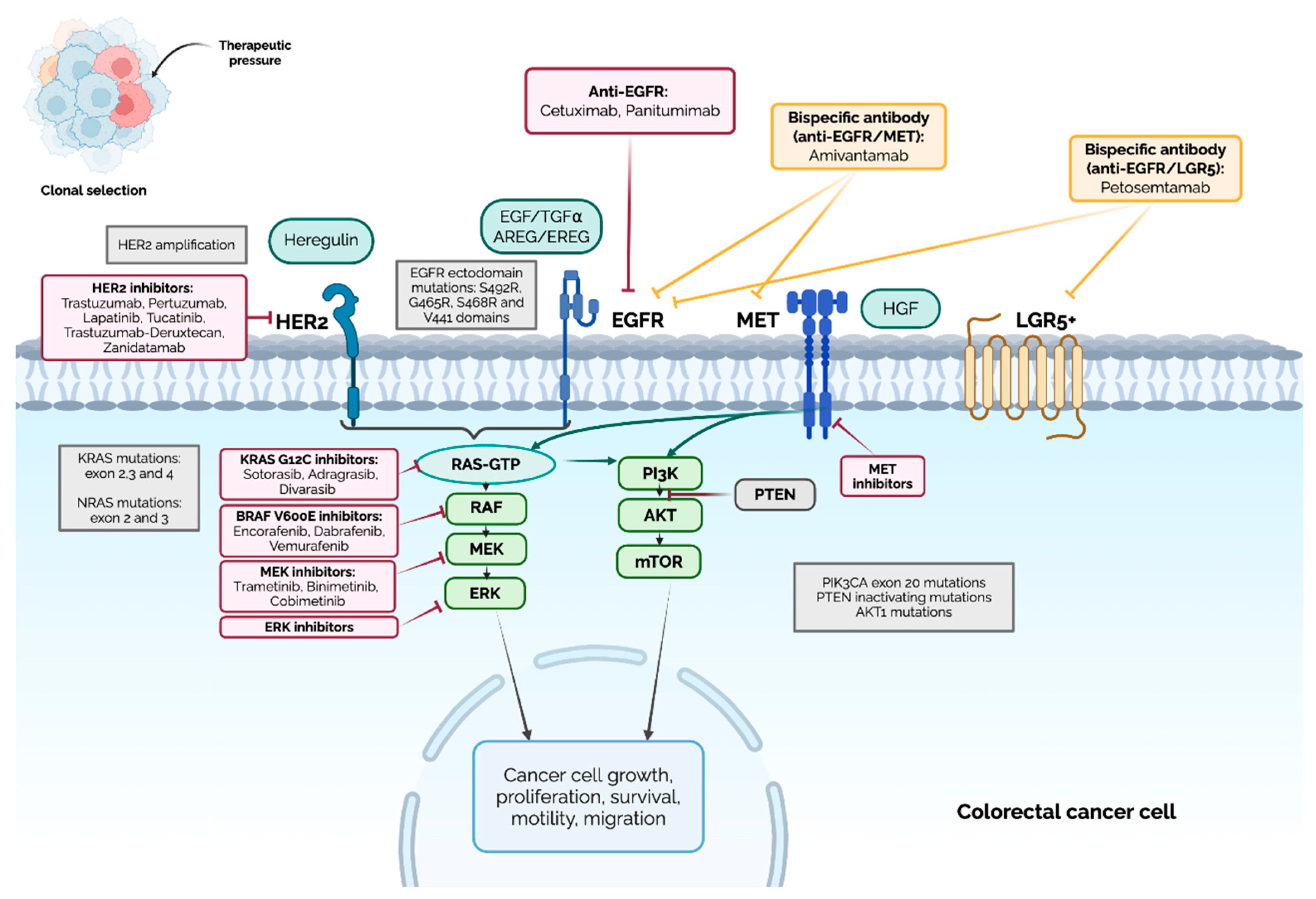
Figure 2.
Conceptual framework of emerging strategies to overcome resistance in molecularly selected metastatic colorectal cancer. The figure illustrates key therapeutic approaches currently being developed to counteract intrinsic and acquired resistance mechanisms and commented in the review. These include antibody–drug conjugates (ADCs), bispecific antibodies targeting multiple receptors, and PROTAC-based degradation strategies; vertical inhibition of the MAPK pathway at multiple nodes; integration of chemotherapy and rechallenge strategies to suppress clonal evolution; and refinement of biomarker-driven patient selection to optimize treatment sequencing and personalize combination therapies.
Figure 2.
Conceptual framework of emerging strategies to overcome resistance in molecularly selected metastatic colorectal cancer. The figure illustrates key therapeutic approaches currently being developed to counteract intrinsic and acquired resistance mechanisms and commented in the review. These include antibody–drug conjugates (ADCs), bispecific antibodies targeting multiple receptors, and PROTAC-based degradation strategies; vertical inhibition of the MAPK pathway at multiple nodes; integration of chemotherapy and rechallenge strategies to suppress clonal evolution; and refinement of biomarker-driven patient selection to optimize treatment sequencing and personalize combination therapies.
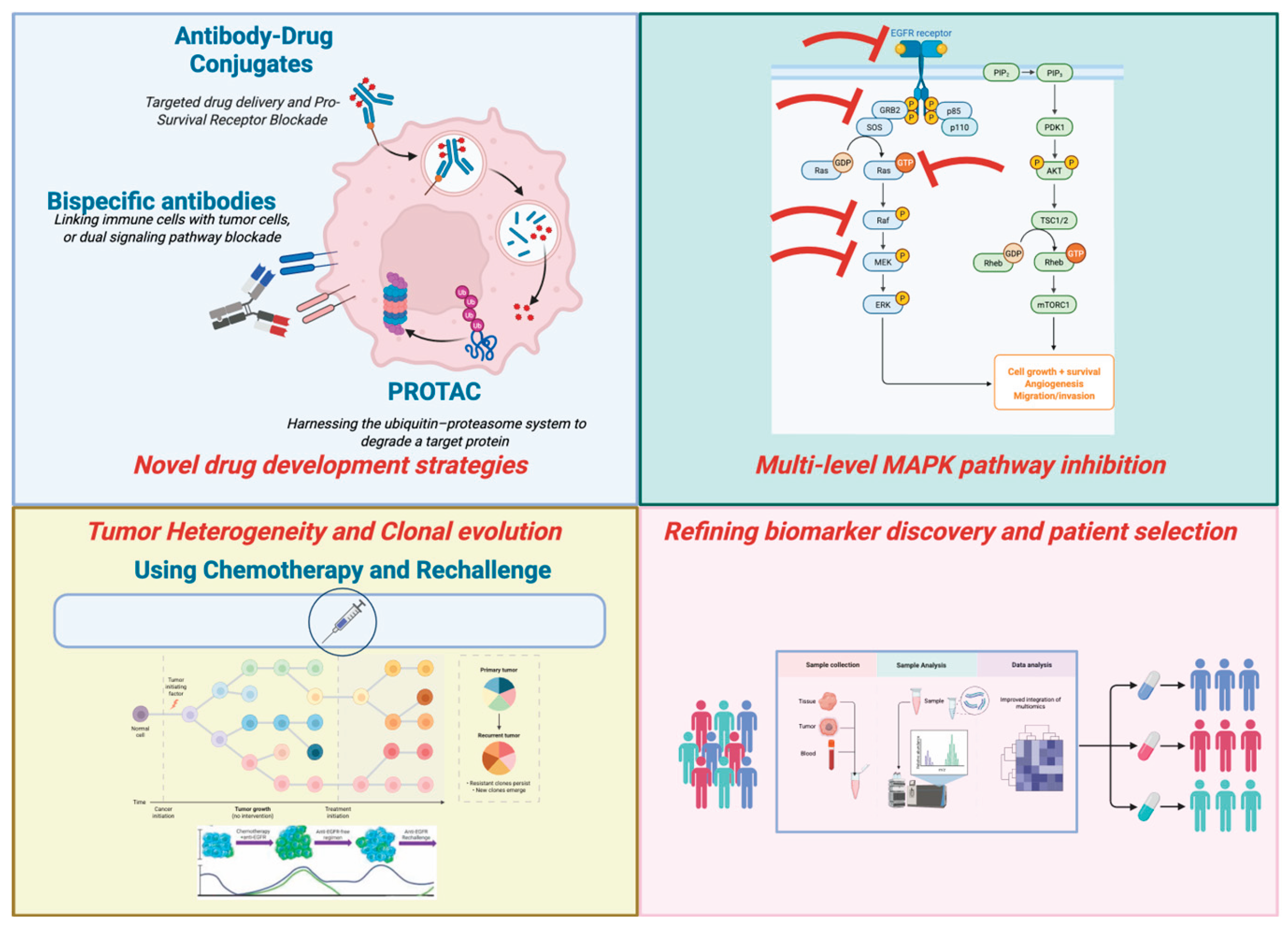

Table 1.
Main studies using hyperselection panels.
| Study | Population | Strategy of Hyperselection | mOS (months) | References |
|---|---|---|---|---|
| PRESSING [21] | 1st line anti-EGFR (n=94) RAS/BRAF WT | HER2/MET amp, PIK3CA exon 20 mut, NTRK/ROS1/ALK/RET fus, pMMR | 17.3 vs 15.2 | Cremolini et al., Ann Oncol 2017 |
| PRESSING [22] | Anti-EGFR any line (n=650) RAS/BRAF WT, MSS, POLE ED WT, PRESSING negative | NTRKmut, ERBB3, NF1mut/loss, MAP2K1/2mut, AKT2 mut, PTEN/NF1 loss; ERBB3, FGFR2, IGF1R, KRAS, ARAF, AKT1-2 amp; EGFR rearrangements | 49.9 vs 22.6 | Randon et al., JCO Precis Oncol 2022 |
| PANDA [25] | Phase II FOLFOX + Pan vs 5FU + Pan (n=147) RAS/BRAF WT, elderly population | PRESSING PANEL + MAP2K1, PTEN mut | 29.5 vs 20 | Lonardi et al., Clin Colorectal Cancer 2023 |
| PANAMA [26] | Phase III mFOLFOX6 + Pan → 5FU + Pan (n=202) RAS WT, maintenance | KRAS, NRAS, BRAF (V600E), AKT1, ERBB2, PIK3CA exon 9/20, PTEN, ALK mut; HER2/neu amp | 28.7 vs 22.2 | Stahler et al., Clin Cancer Res 2024 |
| Phase III FOLFIRI + Cet vs FOLFIRI + Bev (n=171) RAS/BRAF WT, pMMR | PRESSING1 / PRESSING2 (≈7.6% alterations in PRESSING-neg) | 38.5 vs 27.5 | Weiss et al., Eur J Cancer 2025 | |
|
FIRE-3 [27] | ||||
|
PARADIGM [28] |
Phase III FOLFOX + Pan vs FOLFOX + Bev (n=733) RAS WT (basal tissue) | PTEN/EGFR/KRAS/BRAF mut, HER2/MET amp, ALK/RET/NTRK fus, MMR | 41.4 vs 18.7 | Shitara et al., Nat Med 2024 |
* Abbreviations: Amp, amplification; Mut, mutations; pMMR, proficient mismatch repair; Pan, Panitumumab; Cet, Cetuximab; Bev, Bevacizumab; Fus, Fusion.
Table 2.
Clinical trials exploring combination of chemotherapy/immunotherapy with target therapy.
| Clinical trial | Population | Drugs | Phase | mOS (months) |
|---|---|---|---|---|
| OrigAMI-2 trial (NCT06662786) [138] | 1st line RAS/BRAF WT, unresectable or left-sided mCRC. | Amivantamab + mFOLFOX6 or FOLFIRI VS Cetuximab + mFOLFOX6 or FOLFIRI | Phase III | Ongoing |
| BREAKWATER (NCT04607421) [139] | 1st line BRAF V600E mCRC |
Encorafenib + Cetuximab +/- mFOLFOX6 or FOLFIRI vs SOC | Phase III | EC+mFOLFOX6: 30.3 vs 15.1 EC + FOLFIRI (immature data): 10.5 vs 10.3 |
| SWOG S1406 (NCT02164916) [140] | 2nd or 3rd line BRAF V600E mCRC | Irinotecan + Cetuximab +/- Vemurafenib | Phase II | 9.6 vs 5.9 |
| SEAMARK (NCT05217446) [70] | 1st line BRAFV600E and MSI mCRC | Pembroliziumab + Cetuximab + Encorafenib vs Pembrolizumab | Phase II | Ongoing |
| CodeBreak 301 (NCT06252649) [141] | 1st line KRASG12C mCRC |
Sotorasib + Panitumumab + FOLFIRI vs FOLFIRI +/- Bevacizumab | Phase III | Ongoing |
| KANDLELIT-012 (NCT06997497) [114] | 1st line KRASG12C mCRC |
MK-1084 + Cetuximab + mFOLFOX6 VS mFOLFOX6 +/- Bevacizumab | Phase III | Ongoing |
|
MOUNTAINEER-03 (NCT05253651) [137] |
1st line HER2 positive mCRC |
Tucatinib + Trastuzumab + mFOLFOX6 VS mFOLFOX6 Given +/- Cetuximab or Bevacizumab | Phase III | Ongoing |
| ZWI-ZW25-201 (NCT03929666) [142] | 1st line HER2 positive mCRC | Zanidatamab + mFOLFOX6 +/- Bevacizumab | Phase II | Ongoing (OS not reached) |
*Abbreviations: SOC, standard of care.
Disclaimer/Publisher’s Note: The statements, opinions and data contained in all publications are solely those of the individual author(s) and contributor(s) and not of MDPI and/or the editor(s). MDPI and/or the editor(s) disclaim responsibility for any injury to people or property resulting from any ideas, methods, instructions or products referred to in the content. |
© 2026 by the authors. Licensee MDPI, Basel, Switzerland. This article is an open access article distributed under the terms and conditions of the Creative Commons Attribution (CC BY) license (http://creativecommons.org/licenses/by/4.0/).
Copyright: This open access article is published under a Creative Commons CC BY 4.0 license, which permit the free download, distribution, and reuse, provided that the author and preprint are cited in any reuse.


