

Submitted:
11 March 2026
Posted:
12 March 2026
You are already at the latest version
Abstract
Exercise-derived reactive oxygen species (ROS) are required for mitochondrial and hypertrophic adaptations, creating a practical trade-off: antioxidant strategies may support short-term performance and recovery yet blunt training signals when mis-timed or over-dosed. We performed a structured narrative review informed by transparent database searches of MEDLINE, Scopus, and SPORTDiscus (2000-2025), prioritizing human intervention studies and using mechanistic evidence to interpret plausibility. Evidence was mapped by antioxidant class, dose, timing, training modality, and context. Across trials, chronic high-dose vitamins C/E taken close to key sessions are most consistently associated with attenuation of redox-sensitive signaling, whereas food-first polyphenols and selected bioactives (e.g., tart cherry/anthocyanins, pomegranate, curcumin) more often support recovery when positioned away from adaptation-critical workouts, without clear evidence of impaired training gains. N-acetylcysteine can acutely improve tolerance to repeated high-intensity exercise, but effects during prolonged training remain uncertain and appear context-dependent. We propose Redox-Adaptive Periodization, aligning antioxidant class, dose, and timing with the primary objective (adaptation vs. immediate readiness) and environmental constraints, and we outline methodological priorities to advance precision redox management.
Keywords:
exercise
; antioxidants
; hormesis
; redox signaling
; polyphenols
; vitamins C and E
; N-acetylcysteine
; recovery
; performance
; training adaptation
1. Introduction
For decades, exercise-generated reactive oxygen species (ROS) were framed as unavoidable by-products of metabolism whose damage should be “neutralized” [1,2,3,4,5]. That view is now incomplete [6,7,8]. The same oxidants that can impair macromolecules also act as indispensable signals that initiate and amplify training adaptations—mitochondrial biogenesis, angiogenesis, remodeling of excitation–contraction coupling, and, in resistance training, hypertrophic signaling [9,10,11,12,13,14,15]. This dualism explains why antioxidant supplementation has produced conflicting findings: it can ease symptoms and preserve output in the short term, yet, when used indiscriminately or at high doses around training, it may dampen redox-sensitive pathways that athletes seek to strengthen [16,17,18,19,20,21,22,23,24].
Two additional forces sustain the controversy. First, “antioxidant” is a heterogeneous category. It encompasses direct radical scavengers (e.g., vitamins C and E), thiol donors and precursors (e.g., N-acetylcysteine), mitochondrial or membrane-localized compounds (e.g., CoQ10, alpha-lipoic acid), and diverse polyphenols that modulate signaling through Nrf2, AMPK, sirtuins, and inflammatory cascades [25,26]. These effects are often indirect—via redox-sensitive transcription and kinase networks—rather than simple radical “quenching” [27,28,29,30,31]. Second, methodology varies widely across trials. Biomarkers of oxidative stress range from robust (e.g., F₂-isoprostanes) to notoriously labile (e.g., TBARS alone) [32,33,34,35,36]. Dosing, timing, background diet, training load, and environmental stress (heat, hypoxia, pollution) are often insufficiently controlled. These sources of heterogeneity can hide genuine effects, create spurious ones, or invert conclusions when context shifts [16,17,18,19,20,21,22,23,24].
Redox biology offers a unifying lens. Most adaptations follow a hormetic pattern: a moderate perturbation in cellular redox state activates transcriptional programs and enzymatic defenses; too little signal, and adaptation is muted; too much, and damage and fatigue dominate. This “dose–response” also has a lower bound: overly reducing conditions (“reductive stress”) may be maladaptive, highlighting that redox balance—rather than maximal antioxidant capacity—is the operative target [8,26,36,37,38,39,40]. From this standpoint, the central practical question is not whether antioxidants are “good” or “bad,” but when they should be used, which class fits the goal, and how dose and timing interact with training so that protective effects do not erase the signal to adapt.
This review addresses that problem for athletes and practitioners seeking evidence-based guidance. We integrate mechanistic redox biology with human intervention studies and translate the resulting synthesis into a practical framework. We therefore focus on five interlinked questions:
Q1 - how exogenous antioxidants intersect with redox-sensitive pathways that underpin endurance and resistance adaptations;
Q2 - how different antioxidant classes affect acute performance and post-exercise recovery across modalities;
Q3 - how endogenous antioxidant systems adapt to training and how supplementation interacts with those adaptations;
Q4 - which populations and contexts (training status, sex and age, dietary pattern and energy availability, heat or hypoxia, and congested competition schedules) shift the balance from benefit to risk;
Q5 - which methodological practices and biomarker panels best capture meaningful effects and should anchor future trials.
To answer these questions, we adopt a structured narrative review with transparent, reproducible methods. We prioritize human trials and use mechanistic work to interpret direction and plausibility. Evidence is organized by outcome domain—training adaptations versus acute performance/recovery—and analyzed through moderators that matter in real programs: class of antioxidant, dose, timing relative to key sessions, training phase, and environmental stress. Where meta-analysis is not appropriate, we apply structured synthesis principles and map the strength and gaps of the literature.
Our contribution is twofold. First, we provide a clear taxonomy of antioxidant strategies—isolated vitamins, thiol donors, mitochondrial-targeted agents, and food-first polyphenols—positioned against their likely mechanisms and practical windows of use. Second, we propose Redox-Adaptive Periodization (RAP), a framework that matches type, dose, and timing to the goal (drive adaptation versus secure immediate availability/performance) and the context (e.g., heat, altitude, congested fixtures). RAP reframes antioxidant use from blanket supplementation to signal management: preserve the exercise signal when adaptation is the priority; buffer selectively when performance or recovery in hostile environments is the constraint.
Finally, we identify methodological standards that can elevate the field: rigorous diet and load control, validated biomarker panels with appropriate sampling windows, and statistical approaches that accommodate non-linear dose–response relationships and inter-individual variability. Taken together, this agenda moves beyond the false dichotomy of “antioxidants: yes or no” toward precision redox management that respects the biology of hormesis while serving the realities of training and competition.
2. Methodological Approach: Evidence Sourcing and Synthesis
2.1. Review Design and Reporting
We conducted a structured narrative review to integrate mechanistic redox biology with human intervention evidence in exercise and sport [41]. The design emphasizes transparency and reproducibility while retaining the interpretive flexibility required for mechanism-informed synthesis. Because interventions, doses, timings, and outcomes are highly heterogeneous, we synthesized evidence narratively and used direction-of-effect coding (increase/decrease/no clear change/mixed [context-dependent]) supported by structured evidence tables rather than meta-analysis [42]. The objective was interpretive integration of heterogeneous evidence rather than exhaustive capture of all eligible studies or formal systematic-review synthesis.
2.2. Scope and Eligibility
The primary focus was human intervention evidence in healthy participants (≥16 years), spanning recreationally active individuals to trained athletes of any sex. Eligible interventions included single-compound supplements and food-based strategies with plausible antioxidant or redox-modulating actions (e.g., vitamins C/E, N-acetylcysteine, CoQ10, alpha-lipoic acid, and polyphenol-rich interventions such as tart cherry, pomegranate, cocoa flavanols, curcumin, and resveratrol). Outcomes were grouped a priori into two domains: (i) training adaptations (≥2 weeks of structured training; endurance and/or resistance outcomes) and (ii) acute performance and recovery (single- or few-session studies assessing performance within ≤24 h and/or recovery over ~24–72 h). Biomarkers were recorded to support interpretation but were not treated as primary endpoints unless paired with functional outcomes. English-language full texts published from January 2000 to the most recent search update (November 2025) were considered.
2.3. Information Sources and Search Strategy
We searched MEDLINE (via PubMed), Scopus, and SPORTDiscus from January 2000 to the most recent update (November 2025), restricting to human studies where filters were available. Searches combined antioxidant classes/compounds and food-based interventions with exercise/training terms and outcome keywords (performance, recovery, adaptation), and were adapted to each database’s syntax and controlled vocabulary. We complemented database searching with backward and forward citation chasing of eligible studies and relevant reviews, and used Web of Science Core Collection for targeted citation tracking. To improve capture of ongoing or unpublished trials, we screened ClinicalTrials.gov and ISRCTN. Full database-specific search strings, limits, and the update date are provided in Supplementary Table S1.
The January 2000-November 2025 window applied to the formal database search only. Foundational pre-2000 papers and a small number of highly relevant post-search references identified during citation chaining and final contextual updating were added manually and were not part of the primary search yield.
2.4. Study Selection, Synthesis, and Appraisal
Records were screened at title/abstract and full-text stages using predefined eligibility criteria. A piloted extraction framework captured population characteristics, training modality and load, intervention dose/timing/formulation, comparator details, environmental context (e.g., heat or altitude), and primary functional outcomes with their sampling windows. Internal validity was appraised pragmatically, drawing on RoB 2 for randomized trials and ROBINS-I for non-randomized interventions, to contextualize confidence in direction-of-effect conclusions [43,44]. Evidence is organized by outcome domain and antioxidant class, with key studies summarized in Table 2, Table 3 and Table 4 and interpreted through pre-specified moderators (training status, sex/age, diet/energy availability, and environmental stress). Full database-specific search strategies are provided in Supplementary Table S1, extraction fields and appraisal procedures are described in Supplementary Text S2, and risk-of-bias summaries are provided in Supplementary Table S2.
2.5. Review Positioning and Rationale
This study was conducted as a structured narrative review integrating mechanistic redox biology with human intervention evidence in exercise and sport. Although multiple antioxidant classes have been examined in human trials, substantial heterogeneity exists in intervention type, dose and formulation, timing relative to exercise, training modality and duration, baseline dietary exposure, environmental context, and biomarker selection and sampling windows.
Given this variability, quantitative pooling of outcomes was not considered appropriate, as combining mechanistically and contextually diverse endpoints could obscure meaningful differences [45,46]. Instead, evidence was synthesized narratively and organized according to predefined outcome domains (training adaptations versus acute performance and recovery) and relevant moderators (antioxidant class, dose, timing, training phase, and environmental stress).
This review was not registered in PROSPERO because it does not aim to produce pooled quantitative estimates but rather to provide an integrated, mechanism-informed synthesis of heterogeneous intervention evidence. PRISMA-style flow reporting is provided in Supplementary Figure S1 for transparency of study identification and selection; however, the review does not claim methodological equivalence with a registered systematic review [47,48].
A protocol outlining eligibility criteria and outcome domains was drafted prior to screening. Any minor refinements are documented in Supplementary Text S1. All quantitative values reported in tables were extracted directly from the cited literature; full search strategies are provided in Supplementary Table S1 and the extraction framework is provided in Supplementary Text S2.
3. Redox Signaling in Exercise: The Mechanistic Scaffold
3.1. Sources and Kinetics of Reactive Species During Exercise
Skeletal muscle generates reactive oxygen and nitrogen species (ROS/RNS) from multiple nodes: mitochondrial electron transport (complexes I/III), NADPH oxidases (notably NOX2 at the sarcolemma/T-tubules), xanthine oxidase (especially during high flow–reperfusion dynamics), nitric oxide synthases (nNOS, eNOS), and, in specific contexts, uncoupled reactions in the endothelium [49,50,51,52,53,54,55]. Hydrogen peroxide (H₂O₂) functions as a diffusible second messenger; superoxide (O₂•⁻, the superoxide radical anion) is often the first ROS formed and is rapidly dismutated to H₂O₂ by superoxide dismutase (SOD) isoforms; peroxynitrite and lipid peroxyl radicals arise under higher flux states [50,56,57,58]. Importantly, redox signaling is compartmentalized—mitochondria, cytosol, nucleus, and intermyofibrillar versus subsarcolemmal regions can experience distinct redox microdomains [59].
The time course of redox signaling is layered [62]. Exercise induces a rapid, transient rise in H₂O₂ and redox relay activity (e.g., peroxiredoxin oxidation) within minutes, followed by transcriptional responses peaking hours later and structural adaptations accruing over weeks [60,61,62]. Critically, the shape of the signal matters: brief, moderate perturbations are pro-adaptive, whereas prolonged or excessive perturbations are more likely to be damaging [56,63,64].
3.2. Redox-Sensitive Nodes That Couple Work to Adaptation
Key sensors and effectors include: AMPK/SIRT1/PGC-1α (mitochondrial biogenesis), p38 MAPK and CaMKII (activity-dependent signaling), NRF-1/2 (mitochondrial transcription), mTORC1 (protein synthesis and hypertrophy), Nrf2/Keap1 (cytoprotective gene induction), NF-κB (inflammation), and HIF-1α (hypoxic/angiogenic programming) [65,66,67,68,69,70]. Many of these are redox-tunable via cysteine switches, kinase/phosphatase balance, or altered NAD⁺/NADH ratios [56,71]. Training strengthens endogenous antioxidant capacity—SOD1/2, catalase, GPx, peroxiredoxins, thioredoxin, glutathione (GSH)—reshaping the resting redox tone and improving resilience to subsequent bouts [49,50,57].
Redox signaling as reversible cysteine-based information transfer - exercise-derived H₂O₂ functions less as a damaging oxidant and more as a spatially and temporally regulated second messenger encoded through reversible redox post-translational modifications (PTMs) [56,64,71]. Many redox-sensitive pathways are tuned via transient cysteine oxidation events—including sulfenylation, disulfide bond formation, and S-glutathionylation—which alter kinase/phosphatase balance, transcription factor activation, and protein–protein interactions [71,72]. In this framework, peroxiredoxins (Prx) and the thioredoxin (Trx) system operate not merely as antioxidant defenses but as relay nodes that transmit H₂O₂ signals to selective downstream targets while preserving compartmental specificity [61,73,74,75,76].
Implications for exercise adaptation - because these relays are transient, compartmentalized, and kinetically constrained, the magnitude and timing of oxidant exposure determine whether signaling is amplified, shaped, or prematurely terminated [56,61,63]. Adaptive remodeling therefore depends not simply on the presence of reactive species, but on preserving the fidelity of these reversible signaling events [71,73,74]. Interventions that indiscriminately flatten peak ROS may truncate relay-dependent activation of mitochondrial and anabolic pathways, whereas strategies that respect signal amplitude and timing are more likely to maintain hormetic adaptation [63,77].
These integrator nodes interact with calcium transients, mechanical load, substrate availability, and inflammatory cues [62]. This helps explain why antioxidant interventions can show modality-specific effects—redox modulation of AMPK–PGC-1α signaling is most relevant for endurance adaptation, whereas redox effects on mTORC1 and satellite-cell programs matter more for resistance training [62,65,66,67,68,77]. In the synthesis, we therefore separate chronic adaptation outcomes from acute performance/recovery outcomes and interpret findings through dose, timing, and training context (Table 2, Table 3 and Table 4).
3.3. Hormesis and the “Redox Window”
Adaptations follow a non-linear (U-shaped) curve with respect to oxidant burden. Too little ROS leads to weak signaling, whereas too much leads to macromolecular damage, fatigue, and impaired remodeling. Exogenous antioxidants can shift this curve [56,63,64,77]. Agents that blunt peak ROS at the wrong time or dose risk erasing the very signals (PGC-1α, Nrf2, satellite cell activity) that training relies on [62,66,67]. By contrast, indirect antioxidants (e.g., many polyphenols) often precondition via Nrf2 or mitochondrial stress-signaling rather than acting as simple scavengers [77,78,79,80].
Operationally, this creates two practical windows [63,77]. During adaptation-focused blocks, the priority is to preserve the transient, compartmentalized ROS pulse around key sessions (the “adaptation window”). During congested competition, travel, or extreme environments, the priority may shift toward selective buffering to protect readiness (the “buffering window”), ideally in short pulses and with agents less likely to flatten signaling [77,78]. The remainder of the review evaluates how different antioxidant classes shift athletes along this continuum.
3.4. Practical Implication
Mechanistic biology predicts context-sensitive effects [62,63]. When the goal is adaptation, preserve the signal: avoid high-dose, peri-exercise scavengers that flatten redox transients [77,78]. When the goal is availability/performance now (e.g., congested fixtures, extreme environments), targeted buffering and anti-inflammatory support may be advantageous [77,81]. These principles motivate the later RAP framework.
To consolidate the mechanistic scaffold developed, Figure 1 maps the hierarchical flow from ROS sources to relay systems, downstream redox-sensitive nodes, and phenotypic outputs. It also visualizes the typical points at which different antioxidant classes interface with this signaling architecture.
Exercise evokes brief, compartmentalized ROS pulses that act as second messengers rather than mere by-products [56,59,63,64]. Two high-flux relays—Prx/Trx and GSH—transmit these signals to integrator nodes controlling metabolism and transcription [61,73,74,75,76]. Through AMPK/SIRT1/PGC-1α and p38/CaMKII, redox transients couple workload to mitochondrial biogenesis and metabolic flexibility; Nrf2 activates cytoprotective programs; NF-κB/HIF-1α and mTORC1 integrate inflammatory/hypoxic stress with the anabolic signal [62,65,66,67,68,69,70,71]. The peripheral phenotypes in the figure represent exactly the outcomes we evaluate in the synthesis: mitochondrial capacity, endothelial function/angiogenesis, hypertrophy, and fatigue resilience.
The badges indicate antioxidant intervention points relative to the topology. Vitamins C/E operate as upstream scavengers relative to the relays—hence high peri-exercise doses can truncate the adaptive signal [77,78]. NAC (supports glutathione) can be selectively useful, in pulses, in contexts with high oxidative load (heat, altitude, congestion), but requires individual testing [77,81]. Polyphenols (support Nrf2) support a food-first approach, distant from sessions; CoQ10 supports the ETC without dampening the ROS pulse [67,79,80,81,82]. This logic underpins, in the following sections, the complementary timing and interpretation of the various results.
4. Antioxidant Taxonomy and Practical Pharmacology
Because “antioxidant” is a functional label rather than a single pharmacological class, interpreting supplementation trials requires a mechanism-first taxonomy. In applied terms, mechanism determines timing: compounds that act as upstream scavengers close to training can flatten the transient ROS pulse that initiates adaptation, whereas interventions that act indirectly (via transcriptional, vascular, or inflammatory modulation) or that are used as short pulses under defined constraints are less likely to erase the training signal [83,84,85,86]. The taxonomy below is used throughout the review and provides the logic for how evidence is organized in Table 2, Table 3 and Table 4 and operationalized in Redox-Adaptive Periodization (Table 6).
4.1. Mechanistic Classes and Where they Interface with Redox Signaling
Direct scavengers—most notably vitamins C and E—can quench reactive species and interrupt lipid peroxidation chains, but they also operate “upstream” of key redox relays (e.g., glutathione and thioredoxin systems) [87]. This positioning helps explain why repeated, peri-exercise high-dose vitamin C/E has been linked to attenuation of mitochondrial and hypertrophic signaling in some training studies, even when acute soreness is reduced [2,9,10]. In practice, correcting deficiency or low dietary intake is appropriate; routine high-dose use immediately around key sessions is harder to justify when the primary objective is adaptation [85].
Thiol donors and redox buffers occupy a different niche. N-acetylcysteine (NAC) supports cysteine availability and glutathione (GSH) synthesis and can, in some athletes, improve tolerance to repeated high-intensity work or help preserve output under high oxidative load (e.g., heat, hypoxia, congested schedules) [15,16,17]. At the same time, its effects are variable, dose-limited by gastrointestinal tolerance, and plausibly conditional on baseline redox tone—features that make it better suited to pre-tested, time-limited pulses than to continuous, ‘always-on’ supplementation across a mesocycle [17,88].
Route, exposure, and chronic use considerations - the interpretation of NAC evidence requires careful distinction between intravenous (IV) and oral administration. IV protocols provide mechanistic proof-of-concept under controlled laboratory conditions but have limited ecological validity for sport practice [88]. Oral NAC, in contrast, produces more variable systemic cysteine availability and is constrained by gastrointestinal tolerance and dose ceilings, resulting in pronounced inter-individual responder patterns [89]. While short loading phases may improve repeated high-intensity performance in selected contexts, evidence for chronic NAC use during prolonged adaptation blocks remains limited and inconclusive [17]. Accordingly, routine long-term supplementation cannot be recommended, and NAC is best conceptualized as a context-specific, pre-tested intervention when oxidative load becomes a limiting factor [17,88].
Other thiol-related or redox-cycling compounds (e.g., alpha-lipoic acid and oral glutathione) share mechanistic plausibility but currently lack the volume and consistency of athletic performance evidence observed with NAC [90,91,92].
Alpha-lipoic acid (ALA) and oral glutathione have plausible biochemical actions but comparatively limited athletic evidence; their practical role remains tentative and context-dependent [90,91,92].
Mitochondrial or membrane-localized agents (e.g., CoQ10 and mitochondria-targeted quinones such as MitoQ) are often grouped under the antioxidant umbrella, yet their primary relevance may be compartment-specific support of electron transport, redox cycling, or redox tone rather than global scavenging. This mechanistic distinction matters: compartmental targeting can, in theory, reduce ‘collateral’ dampening of cytosolic signaling, but it does not guarantee meaningful performance or adaptation gains [93,94]. Where used, these agents should be evaluated against sport-relevant endpoints and integrated into a broader nutrition and training plan rather than treated as a stand-alone solution.
4.2. Polyphenols and Other Indirect Redox Modulators
Polyphenol-rich foods and standardized extracts (anthocyanins/tart cherry, pomegranate polyphenols, cocoa flavanols, green tea catechins, curcumin, resveratrol) are frequently described as “antioxidants,” yet in vivo they often act less as direct scavengers and more as signaling modulators [95,96]. Their metabolites can influence Nrf2-mediated cytoprotective programs, endothelial function (e.g., nitric oxide bioavailability), and inflammatory cascades (e.g., NF-κB), aligning with the more consistent pattern of recovery support observed in short, competition-oriented protocols [18,19,20,21,22,23,24,25,26,95,96,97,98,99]. This also explains why a food-first approach—achieving exposure through a dietary matrix rather than stacked high-dose isolates—tends to be the most defensible default during adaptation blocks [85,95].
From a programming standpoint, polyphenols fit naturally into periodized use: maintain habitual polyphenol intake through diet across the season, and deploy time-limited concentrates around unusually damaging blocks or congested fixtures when readiness and recovery are the binding constraints [18,19,20,21,22,23,24,25,26]. The main practical risk is inadvertent ‘megadose stacking’ (multiple concentrates plus high-dose vitamins), which can shift exposure from modulatory to non-physiological boluses with uncertain effects on signaling and gastrointestinal tolerance [85,100].
4.3. Practical Pharmacology: Formulation, Safety, and Compliance
Formulation and bioavailability materially shape exposure and therefore interpretation. Vitamin E requires co-ingestion with fat; many polyphenols undergo extensive phase II metabolism and microbiome transformation; and curcumin is a classic case where formulation (phytosome, micelle, piperine co-administration) can change apparent bioavailability and interaction risk [87,95,101]. Consequently, dose–response should be interpreted in the context of the tested form, the dosing schedule, and the athlete’s background diet rather than the ingredient name alone.
Safety considerations are usually manageable but not trivial: NAC and large polyphenol boluses can provoke gastrointestinal symptoms; high-dose vitamin E may interact with anticoagulants; and melatonin should be treated primarily as a chronobiotic with timing-dependent effects on sleep and next-day alertness [87,88,95]. For competitive athletes, supplement quality control and anti-doping risk should be explicitly managed (e.g., third-party tested products), and choices should be revisited whenever medications, travel, or training constraints change [100,101,102,103,104].
Table 1 provides a compact reference for the major classes, typical trial doses, common timing patterns, and practice notes. This pharmacology-first lens is used throughout the synthesis to keep mechanistic plausibility, dosing realism, and timing aligned with the outcomes that matter in training and competition.

Table 1.
Antioxidant classes, mechanisms, typical trial doses, and practice notes.
| Class / compound |
Primary action(s) |
Typical trial dose/form | Timing patterns studied |
Bio availability notes |
Common AEs | Interaction flags |
Practice note |
|---|---|---|---|---|---|---|---|
| Vitamin C | Aqueous radical scavenger; regenerates E |
500–1000 mg/day; 0.5–1 g pre/post |
Chronic near training; acute pre-exercise |
SVCT- mediated, saturable |
GI upset at high doses |
Enhances non-heme iron absorption; high-dose use may increase kidney-stone risk | Avoid chronic peri-exercise in adaptation blocks unless correcting deficiency |
|
Vitamin E (α-tocopherol) |
Lipid chain -breaking scavenger |
200–800 IU/day | Chronic | Requires fat for absorption |
GI, rare bleeding risk at high doses | Anticoagulants | Similar caution as vitamin C; avoid high doses peri-exercise |
| NAC | Cys donor that supports glutathione (GSH); direct scavenging | 600–1200 mg acute; short courses 2–7 d |
60–90 min pre-exercise; short performance blocks | Oral bioavailability moderate; IV research-only |
GI upset, sulfur taste |
Caution with nitroglycerin (headache/ hypotension) |
Consider for repeated-bout performance or heat/hypoxia; trial in training |
|
CoQ10 (ubiquinone/ ubiquinol) |
ETC carrier; membrane antioxidant | 100–300 mg/day | Chronic | Better with fat; ubiquinol increases exposure |
GI | Warfarin interaction reported |
Mixed effects; safe/neutral in athletes |
| ALA | Mitochondrial redox cycling |
150–600 mg/day | Chronic | R-ALA more active |
GI, hypo- glycemia in sensitive |
Diabetes meds |
Sport evidence limited; small RCT suggests improved recovery during intensive microcycles; long-term training effects unclear. |
|
Anthocyanin -rich foods (tart cherry, berries) |
Nrf2 activation; anti-inflammatory; sleep support (tart cherry) | Juice /concentrate; 2×30–60 mL/day or equivalent |
3–10 d pre-competition and through competition/recovery | Food matrix matters; microbiome metabolism |
Rare GI |
Minimal | Useful for DOMS/recovery in competition weeks |
|
Pomegranate polyphenols |
Endothelial/ Anti - inflammatory |
250–500 mL juice or equivalent extract |
2–7 d and acute pre-exercise |
Polyphenol metabolites drive effects |
GI in large volumes |
None major |
May aid blood flow in endurance events |
|
Cocoa flavanols |
NO bio- availability; endothelial |
300–600 mg CF/day |
1–7 d and acute |
Processed chocolate varies widely |
Caffeine in chocolate |
None major |
Consider for submax/endurance support |
|
Curcumin (phytosome) |
NF-κB modulation; soreness |
500–1000 mg/day (std extract); lower if phytosome | 1–3 d pre-damaging work and 2–3 d post-damaging work | Low oral bioavailability; phytosome increases |
GI; piperine interactions |
Anti- coagulants |
Recovery support; avoid peri-strength if concerned about signaling (data limited) |
| Resveratrol | SIRT1/AMPK activator | 150–500 mg/day | Chronic | Low bioavailability |
GI, headaches |
CYP interactions |
Potential to blunt adaptations in older men at high doses—use cautiously |
| Astaxanthin | Membrane antioxidant | 4–12 mg/day |
Chronic | Lipid carriers aid |
Well tolerated |
— | Neutral /mixed for performance |
| Melatonin | Indirect antioxidant; sleep |
1–5 mg pre-sleep |
Nights before competition/ travel |
Chronobiotic; timing critical | Next-day sleepiness | Sedatives | Use for jet-lag/sleep with circadian guidance |
Notes: Dose ranges and timing patterns are representative of protocols used in human exercise studies and reviews discussed in this article (vitamins C/E: [18,20,21,108,109,110,115,116,117]; NAC: [88,120,121,122]; mitochondrial/membrane-localized agents: [82,91,114]; polyphenol/bioactive strategies for recovery/performance: [98,101,123,124,125,126,127,128,129,130,131]; astaxanthin/melatonin: [105,106,107]). They summarize tested exposures rather than prescriptive recommendations. Bioavailability, adverse-event, and interaction flags are included for practitioner awareness and should be cross-checked against current clinical guidance when supplements are used alongside medications.
5. Effects on Training Adaptations (Chronic Outcomes)
5.1. Endurance Adaptations
Across endurance-training RCTs (2–16 weeks), high-dose vitamin C/E near training sessions has been repeatedly associated with attenuated upregulation of mitochondrial biogenesis markers (e.g., PGC-1α expression, downstream targets) and smaller gains in oxidative enzyme activity in some studies, with others reporting neutral effects [108,109,110]. Heterogeneity stems from dose, training status, and timing. The direction of effect leans toward risk of blunting when these vitamins are used chronically and peri-exercise.
For polyphenols, chronic intake during endurance training generally shows neutral to supportive signals for performance surrogates (e.g., time-to-exhaustion, submaximal efficiency) and no consistent evidence of blunted mitochondrial signaling when timing is away from key sessions. Resveratrol represents a context-specific exception. Some trials—primarily in older men—have reported attenuated training responses, potentially reflecting interactions within AMPK–SIRT1 signaling networks that alter angiogenic or mitochondrial remodeling under certain dosing conditions. However, these findings derive from relatively small samples and specific populations characterized by distinct baseline vascular and redox profiles. Accordingly, extrapolation to young, well-trained athletes should be cautious. Rather than constituting a blanket contraindication, current evidence suggests prudence with sustained high-dose resveratrol during adaptation-focused training blocks until dose–timing–training interactions are clarified in larger trials [111].
CoQ10 and ALA have not consistently enhanced training adaptations; the balance of evidence is neutral with occasional benefits in special populations (statin users, chronic fatigue), which lie outside pure athletic cohorts [112,113,114].
A structured synthesis of chronic antioxidant interventions during endurance training is presented in Table 2.
Table 2.
Chronic antioxidant interventions during endurance training (≥2 weeks) and direction of effect on mitochondrial and performance adaptations.
Table 2.
Chronic antioxidant interventions during endurance training (≥2 weeks) and direction of effect on mitochondrial and performance adaptations.
| Antioxidant (Class) | Population (Status; n) [Ref] |
Dose & Timing |
Training Protocol (Duration; Modality) |
Primary Adaptation Outcomes |
Direction | Key Moderators |
RoB |
|---|---|---|---|---|---|---|---|
|
Vitamin C (direct scavenger) |
Trained men (n=14) [108] |
1 g/day; chronic; peri-exercise |
8 wk endurance training |
Mitochondrial biogenesis markers; endurance performance |
Decrease mitochondrial markers; performance: mixed |
High dose; proximity to sessions |
Some concerns |
|
Vitamins C/E (direct scavengers) |
Young men & women (n=54) [109] |
1000 mg C + 235 mg E/day; chronic |
11 wk endurance training |
Cellular adaptation markers; VO₂max |
Decrease cellular adaptation; VO₂max: no clear change/mixed |
Sex; training status |
Low |
| Vitamins C/E | Healthy adults [110] |
Chronic supplementation during training |
Exercise training intervention |
Metabolic/ health adaptations |
Attenuate exercise-induced metabolic benefits |
Baseline metabolic status |
Low |
|
Resveratrol (polyphenol bioactive) |
Aged men (n=27) [111] |
Chronic; during training |
Exercise training program |
VO₂max; vascular adaptations |
Attenuate training response |
Older age; AMPK/SIR 1 modulation |
Low |
|
MitoQ (mitochondria -targeted) |
Untrained middle-aged men [112] |
20 mg/day; chronic | 3 wk HIIT |
VO₂peak; peak power; CS activity |
VO₂peak: no clear change; peak power: increase |
Short intervention; untrained |
Some concerns |
|
NAC (thiol donor) |
Recreational men [113] |
Acute responses pre/post training period |
6 wk Sprint -interval training |
Redox markers; fatigue physiology |
Context- dependent (training modifies NAC effect) |
Training status; redox baseline |
Some concerns |
|
CoQ10 (mitochondrial support) |
Mixed training status [114] |
100–300 mg/day; chronic | Various endurance programs |
Performance endpoints | No clear change /mixed |
Dose hetero- geneity |
N/A |
Notes: Direction summarizes the overall direction of training-related adaptation outcomes (mitochondrial biogenesis markers, oxidative enzymes, VO₂max, or performance endpoints) as reported in the primary study, using the descriptors increase, decrease, no clear change, or mixed (context-dependent). When signaling and functional outcomes diverged, both are indicated. “Peri-exercise” denotes supplementation administered within the hours surrounding key training sessions. Risk of bias (RoB) reflects RoB 2 appraisal for randomized intervention trials; reviews were not formally appraised. HIIT = high-intensity interval training; CS = citrate synthase. Where sample size was not reported or the row summarizes evidence from reviews, n is not specified.
Table 2 illustrates a consistent pattern: chronic high-dose direct scavengers (vitamins C and E), particularly when administered near training sessions, are associated with attenuation of mitochondrial or cellular adaptation markers, although effects on whole-body performance outcomes are more variable. In contrast, mitochondria-targeted or redox-modulating compounds show largely neutral effects on core endurance adaptations within the durations studied. These findings support the principle that timing and mechanistic class, rather than the generic label “antioxidant,” determine the impact on training adaptation.
5.2. Resistance/Hypertrophy
Resistance-training studies with vitamin C/E provide mixed results. Some report smaller increases in hypertrophy-related signaling (p70S6K phosphorylation) or lean mass accretion; others show no difference in 1RM strength. When effects emerge, they trend toward attenuation of hypertrophic signaling with high-dose, peri-exercise vitamin C/E [115,116,117]. Evidence with polyphenols is sparse but largely neutral regarding hypertrophy; proprietary tea-extract blends appear largely neutral for strength gains, whereas curcumin formulations are better supported for post-exercise soreness/recovery than for enhancement of hypertrophic adaptation [118].
A structured summary of resistance-training interventions and hypertrophy-related outcomes is provided in Table 3.
Table 3.
Antioxidant supplementation during resistance training and direction of effect on hypertrophic and strength adaptations (≥6 weeks).
Table 3.
Antioxidant supplementation during resistance training and direction of effect on hypertrophic and strength adaptations (≥6 weeks).
| Antioxidant (Class) | Population (Status; n) [Ref] |
Dose & Timing |
Training Protocol (Duration; Modality) |
Primary Adaptation Outcomes |
Direction | Key Moderators |
RoB |
|---|---|---|---|---|---|---|---|
|
Vitamins C/E (direct scavengers) |
Young men & women (n=54) [115] |
1000 mg C + 235 mg E/day; chronic; peri-exercise likely |
10–12 wk heavy-load resistance training |
p70S6K signaling; lean mass; maximal strength |
Decrease signaling; hypertrophy: no clear change; strength: mixed |
High-dose; training status; timing proximity |
Low |
|
Vitamins C/E (direct scavengers) |
Elderly men, 60–81 y (n=34) [116] |
500 mg C + 117.5 mg E before & after training (per session); 12 wk | 12 wk strength training (3 sessions/week) |
Lean mass (DXA); muscle thickness (US); 1RM strength |
Decrease lean-mass gains; strength gains: no clear change | Older age; peri-exercise high-dose |
Some concerns |
|
Vitamin C/E (direct scavengers) |
Healthy men trained & untrained; (n=28) [117] |
Vitamin C 1 g/day + vitamin E 400 IU/day for 11 wk (started 4 wk before pre-testing); taken before breakfast | Eccentric training: 4 wk (2×/wk) + acute eccentric bouts pre- and post-training |
Muscle performance; redox biomarkers; hemolysis; muscle damage indices |
No clear change |
Training status; eccentric model; biomarker selection |
Some concerns |
|
Polyphenol blend (tea extracts; indirect antioxidant) |
Untrained men (n=40) [118] |
2000 mg/day proprietary polyphenol blend; 4-wk preload; continued daily during training | 4 wk supplementation + 6 wk progressive full-body RT (3 d/wk) | Lower-body 1RM strength; systemic TAC/oxidative markers | Strength gains: no clear change; TAC: increase |
Proprietary blend (tea extracts + caffeine); untrained status; industry funding |
Some concerns |
|
Vitamins C/E (direct scavengers) |
Trained men (n=23) [119] |
1000 mg C + 235 mg E/day; mornings; 10 wk |
10 wk RT + ~300 kcal/day surplus (hypertrophy-oriented) |
Fat-free mass (DXA); upper/lower body strength; VAT |
Upper-body hypertrophy /strength: small decrease; most outcomes: no clear change; VAT gain: decrease |
Energy surplus context; trained status; peri-session timing |
Some concerns |
Notes: Direction summarizes resistance-training adaptations including acute anabolic signaling (e.g., p70S6K phosphorylation), hypertrophy-related outcomes (lean mass or cross-sectional area), and maximal strength (1RM), using the descriptors increase, decrease, no clear change, or mixed (context-dependent). When acute signaling and long-term morphological outcomes diverged, both are indicated. “Peri-exercise” denotes supplementation administered within the hours surrounding resistance sessions. Risk of bias (RoB) reflects RoB 2 appraisal for randomized intervention trials; reviews were not formally appraised.
Table 3 indicates that high-dose direct scavengers (vitamins C and E) may attenuate acute anabolic signaling responses to resistance exercise, yet consistent impairment of long-term hypertrophy or strength gains has not been demonstrated. Polyphenol-based strategies, particularly when distanced from key sessions, appear largely neutral with respect to hypertrophic adaptation while potentially supporting recovery. Resistance-induced morphological adaptations therefore seem relatively robust, although caution with chronic peri-exercise high-dose scavenger use remains justified. The same logic likely extends to concurrent programs: avoid high-dose scavengers around strength-priority sessions, whereas food-first polyphenols placed away from key workouts appear compatible with both modalities.
Taken together, the chronic training literature suggests a pattern that is more coherent than the headline controversy implies. When high-dose vitamins C and E are used repeatedly and, in particular, close to training sessions, several trials report attenuation of mitochondrial or hypertrophy-related signaling, although null findings also occur and likely reflect meaningful differences in dose, timing, training status, and outcome measurement [115,116,117,119]. By contrast, food-first polyphenol strategies, especially when placed away from key sessions, appear largely compatible with adaptation and may confer ancillary benefits related to vascular function or perceived recovery. For CoQ10, alpha-lipoic acid, and astaxanthin, the balance of evidence in athletic cohorts is mostly neutral [112,113,114]. Important uncertainties remain—notably whether repeated N-acetylcysteine exposure during prolonged training influences adaptation (positively, negatively, or not at all), and whether mitochondria-targeted compounds translate mechanistic promise into meaningful training outcomes.
6. Effects on Acute Performance and Recovery
6.1. Performance Within a Session or Within 24 h
Acute performance effects are most plausible when oxidative load contributes meaningfully to fatigue within the session. N-acetylcysteine (NAC) shows one of the clearest short-term signal: in repeated high-intensity or prolonged submaximal protocols, single doses or short loading courses can improve tolerance and, in some settings, performance—consistent with improved thiol availability and glutathione-dependent buffering [120,121,122]. However, effects are not universal, and both gastrointestinal tolerance and individual responsiveness should be tested in training well before competition use.
Direct scavengers (vitamins C and E) rarely improve acute performance in adequately nourished athletes and are difficult to justify outside deficiency correction [78]. By contrast, selected polyphenol-rich strategies can yield small, context-dependent benefits, most often through vascular and perceptual pathways (e.g., cocoa flavanols or pomegranate in protocols where oxygen delivery is limiting) and, in congested schedules, through improved next-day readiness when sleep is supported.
6.2. Recovery over 24–72 h
Anthocyanin-rich interventions (tart cherry, berries) frequently reduce DOMS and preserve muscle function at 24–72 h after damaging exercise without clear evidence of impaired adaptations when used transiently around competitions. Pomegranate polyphenols and curcumin demonstrate similar recovery-support signals in eccentric/DOMS models. Sleep-supportive effects of tart cherry may further aid recovery via circadian/sleep pathways.
A structured synthesis of acute antioxidant interventions and short-term performance and recovery outcomes is presented in Table 4.
Table 4.
Acute antioxidant strategies and short-term effects on performance and recovery (≤24 h performance; 24–72 h recovery).
Table 4.
Acute antioxidant strategies and short-term effects on performance and recovery (≤24 h performance; 24–72 h recovery).
| Antioxidant (Class) | Population (Status; n) | Dose & Timing |
Protocol Type | Primary Functional Outcome |
Direction | Context Sensitivity |
RoB |
|---|---|---|---|---|---|---|---|
|
NAC (thiol donor) |
Trained Men [120] |
IV infusion pre-exercise | Prolonged submax cycling |
Time to fatigue |
Time to fatigue: increase |
Laboratory setting; IV protocol |
Some concerns |
|
NAC (oral) |
Well-trained triathletes (n=10; 8 completed) [121] |
1200 mg/day orally for 9 days (loading) |
Cycle ergometer race simulation during intense training |
Sprint performance during race simulation |
Performance: increase | Small sample; GI tolerance; inter -individual variability |
Some concerns |
|
NAC (systematic review) |
Adult males (healthy/active/athletes; 16 trials) [122] |
Acute to short-term; doses varied |
Controlled trials across multiple performance models |
Performance + laboratory biomarkers (redox, GSH, etc.) |
Mixed; overall trend toward performance improvement |
High heterogeneity; baseline redox status |
Variable/ assessed |
|
Alpha-lipoic acid (ALA) |
Resistance- and Endurance -experienced men (crossover; n=17) [91] |
Single: 150 mg immediately post-session; Short-term: 300 mg/day (150 mg 2 h pre + 150 mg immediately post) during 6 d intensified training |
Acute + short-term intensified training |
Back squat performance; muscle damage (CK, myoglobin); inflammation (IL-6); soreness |
Recovery: improve (modest) |
Timing (pre/post); training load; baseline redox status | Some concerns |
|
Tart cherry (anthocyanins) |
Endurance runners [123] |
~ 8 days preloading |
Marathon/ long-distance run |
Muscle soreness |
Recovery: improve (reduced soreness) |
Running- induced damage |
Low |
|
Tart cherry concentrate |
Semi- professional soccer (n=16) [124] |
30 mL ×2/day; 8 days |
Intermittent sprint activity |
Recovery markers; performance proxies |
Recovery: improve |
Congested match schedule |
Low |
|
Tart cherry powder (Montmorency; anthocyanins) |
Endurance-trained runners/ triathletes (men & women; n=27) [125] |
480 mg/day for ~10 d (7 d pre + day-of + 48 h post endurance challenge) |
Endurance running challenge |
Performance + recovery biomarkers (catabolism, inflammation, redox balance); soreness |
Performance: increase; stress markers: decrease |
Short-term pre-loading; formulation; training status |
Some concerns |
| Pomegranate juice | Resistance-trained men (n=17) [126] |
250 mL twice/day for 15 days + 250 mL immediately post-exercise |
Eccentric damage model (elbow flexors + knee extensors) |
Isometric strength recovery; muscle soreness |
Recovery: improve (elbow flexors); knee extensors: no clear change |
Upper vs lower limb effects |
Some concerns |
| Pomegranate juice | Elite Weightlifters [127] |
750 mL/day for 48 h pre + 500 mL 60 min pre-session |
Weightlifting training session (cross-over vs placebo) |
Soreness; RPE; muscle-damage/ inflammation biomarkers |
Recovery: improve |
High muscle-damage load; short pre-load | Some concerns |
|
Pomegranate extract |
Active Adults [128] |
Acute or short-term |
Endurance/ time-trial models |
Performance outcomes |
No clear change/ slight increase |
Vascular modulation; dose |
Some concerns |
|
Curcumin (CurcuWIN®; pre-loading) |
Physically active men & women (n=63) [102] |
CurcuWIN® daily for 8 wk: 250 mg (50 mg curcuminoids) or 1000 mg (200 mg curcuminoids) |
Downhill running (muscle- damaging) |
Isokinetic torque/power; soreness (1–72 h post) |
Recovery: improve (200 mg); no clear change (50 mg) |
Dose- dependent; model (eccentric running) |
Some concerns |
|
Curcumin (bioavailable) |
Physically active adults [129] |
Pre- and post-exercise |
EIMD protocol |
DOMS; functional recovery |
Soreness: decrease; performance: mixed |
Formulation; timing | Some concerns |
|
Turmeric formulation |
Active men [130] |
Acute dosing |
DOMS model |
Muscle pain; CK |
Soreness: decrease |
Bio- availability |
Some concerns |
|
Cocoa flavanols (systematic review) |
Mixed populations & modalities [131] |
Various doses/ durations; heterogeneous |
Multiple Exercise models (performance & recovery) |
Performance, vascular and oxidative stress outcomes (varies by study) |
Mixed | Dose/ composition; co-ingestants (e.g. caffeine); training status |
N/A (review) |
Notes: Direction summarizes short-term functional outcomes including time to fatigue, repeated-sprint ability, time-trial performance, muscle soreness (DOMS), strength recovery, and functional capacity at 24–72 h, using the descriptors increase, decrease, no clear change, or mixed (context-dependent). Where vascular or biomarker changes occurred without clear performance benefit, both are indicated. “Multi-day” denotes short loading protocols (typically 3–10 days). Risk of bias (RoB) reflects RoB 2 appraisal for randomized intervention trials; reviews were not formally appraised.
Table 4 demonstrates a clearer signal for recovery-oriented interventions than for acute performance enhancement. N-acetylcysteine shows the most consistent benefits in repeated high-intensity or fatigue-sensitive protocols, although effects are variable and responder-dependent. Polyphenol-rich strategies, particularly anthocyanin- and pomegranate-based interventions, more consistently support recovery following muscle-damaging exercise without strong evidence of acute performance enhancement. These patterns reinforce the distinction between buffering fatigue in constrained contexts and preserving redox signaling during adaptation phases.
6.3. Timing Relative to Exercise: The Redox Window
The acute literature reviewed above suggests that the effects of antioxidant supplementation are strongly timing-dependent relative to the exercise stimulus. Exercise generates a rapid ROS burst that participates in redox-sensitive signaling during the minutes and early hours after the session; within this adaptive window, indiscriminate high-dose scavenging may attenuate molecular events linked to mitochondrial biogenesis, metabolic remodeling, and training adaptation. By contrast, later phases of recovery appear more permissive for targeted antioxidant support, particularly when the goal is to reduce soreness, preserve muscle function, or maintain readiness across repeated efforts [22,23,108,109,110,115,116,117,120,121,122,123,124,125].
This timing framework helps reconcile apparently conflicting findings in the literature. Interventions that may be counterproductive when placed close to key adaptation-focused sessions can become useful when recovery is the immediate priority, especially in competition-dense schedules or under elevated physiological stress. Figure 2 summarizes this concept as a temporal redox window spanning the acute signaling phase and the later recovery/remodeling phase, emphasizing that antioxidant effects depend not only on class and dose, but also on when the exposure occurs relative to exercise [22,23,120,121,122,123,124,125].
6.4. Stressful Environments
Environmental stressors (heat, hypoxia/altitude, and high pollution exposure) can amplify oxidative and inflammatory load, increase perceived exertion, and compress recovery—conditions in which selective buffering may shift from ‘optional’ to ‘useful’. However, these stressors can also be part of the intended adaptive stimulus (e.g., altitude camps), so interventions should be periodized rather than applied chronically. The most plausible use-case is short, time-limited support during constrained weeks (travel, congested fixtures, extreme heat), preferentially with strategies that have been pre-tested for tolerance and individual benefit (e.g., NAC in repeated-bout protocols, or polyphenol-rich interventions used primarily for recovery) [132,133,134,135].
In acute settings, the clearest performance signal emerges for N-acetylcysteine in protocols that tax repeated high-intensity capacity, consistent with a role for thiol availability and glutathione-dependent buffering; effects are less consistent for single-bout time trials. In contrast, isolated vitamins C and E seldom improve acute performance in adequately nourished athletes and are difficult to justify outside deficiency correction. Polyphenol-rich foods and extracts show more consistent value for recovery: short, time-limited anthocyanin-rich protocols (e.g., tart cherry or berries) and selected bioactives (pomegranate polyphenols, curcumin) often reduce DOMS and help preserve muscle function over 24–72 h after damaging exercise, with benefits that may be amplified when sleep loss, travel, heat, or altitude increase overall stress [120,121,122,123,124,125,126,127,128,129,130].
7. Moderators and Personalization
7.1. Athlete Biology: Training Status, Sex, and Age
The same antioxidant exposure can have different consequences depending on baseline training status. Untrained or newly trained individuals typically exhibit larger redox perturbations and greater plasticity; in this context, chronic or peri-exercise high-dose scavengers are more likely to blunt redox-sensitive signaling that underpins early gains. In contrast, trained and elite athletes often show smaller redox excursions at a given absolute workload and may benefit from selective buffering in tightly constrained contexts (e.g., tournament weeks), provided that timing is chosen to avoid flattening the signal from the highest-priority sessions [23,108,109,110,111,112,113,121,124].
Sex and age further modify both redox tone and the balance between adaptation and recovery. Older adults may present with higher oxidative and inflammatory burden and sometimes show stronger recovery responses to polyphenol-rich strategies, yet they may also be more susceptible to attenuation of training responses with certain high-dose bioactives (e.g., resveratrol in older men). Female-specific evidence remains comparatively sparse; future trials should routinely document menstrual phase, hormonal contraceptive use, and iron status, as each can influence oxidative markers and recovery trajectories [111,136,137].
7.2. Nutritional Context: Baseline Diet and Energy Availability
Background diet is not a nuisance variable—it is part of the intervention context. When habitual fruit, vegetable, and polyphenol intake is adequate, isolated high-dose supplementation has less physiological justification and greater potential to behave as a pharmacological bolus. Conversely, correcting deficiency (e.g., low vitamin C status) is appropriate and should be treated as nutritional repletion rather than as a performance strategy. Wherever possible, food-first exposures should be the default during adaptation blocks, reserving concentrates for short windows with a clear rationale [85,100,136].
Energy availability is a particularly important moderator. Low energy availability can amplify oxidative and inflammatory stress, compromise immune function, and increase the perceived need for ‘recovery aids.’ However, using chronic high-dose scavengers as a substitute for adequate fueling is unlikely to resolve the underlying constraint and may still interfere with signaling. In practice, if low energy availability is suspected, the first-line intervention is nutritional and scheduling support; antioxidant strategies—if used—should be conservative, time-limited, and paired with monitoring of recovery and training tolerance [136,138,139].
7.3. External Constraints: Environment, Schedule, and Sleep Disruption
Heat, hypoxia/altitude, air pollution, congested fixtures, travel, and sleep disruption can all shift the benefit–risk balance toward targeted buffering because the limiting factor becomes immediate availability rather than long-term remodeling. In these settings, short pulses of selected strategies (e.g., NAC in proven responders; polyphenol-rich or anthocyanin-focused interventions used primarily for recovery) may help preserve readiness, but the supplementation window should not outlast the stressor window. This framing aligns with Redox-Adaptive Periodization (Table 6): preserve signaling in build phases, and permit selective buffering only during brief periods when environment or schedule makes recovery the binding constraint [132,133,134,135,140].
Taken together, these moderators explain why the literature often looks inconsistent at first glance: the same compound can help in a constrained performance week yet hinder signaling when used chronically around adaptation sessions. Probable genotype-, metabolotype-, and microbiome-related responder patterns may contribute, but evidence is not yet strong enough to support prescribing on that basis; for now, these factors belong primarily to the future-research agenda. They also motivate the methodological emphasis of the next section—validated biomarkers, appropriate sampling windows, and reporting standards that allow future trials to stratify effects by context rather than averaging away meaningful conditional responses.
8. Biomarkers and Methodology—Measuring What Matters
8.1. Biomarker Quality Matrix
Oxidative stress biomarkers are a major driver of between-study inconsistency in the antioxidant–exercise literature. Several widely used assays are non-specific (e.g., TBARS/MDA without validated methods), highly sensitive to handling, or poorly aligned with the biology of compartmentalized redox signaling. To reduce interpretive errors, biomarker selection should prioritize validated measures of oxidative damage and redox couples (e.g., F₂-isoprostanes, 8-oxo-dG, protein carbonyls, and GSH/GSSG), paired with functional outcomes and clear sampling windows [32,33,34,35,36,37,38,141].
A recurrent source of confusion is the conflation of oxidative damage with redox signaling. Damage markers—such as lipid peroxidation products, oxidized nucleotides, or protein carbonyls—reflect cumulative oxidative modification and are influenced by systemic spillover and sampling conditions. In contrast, adaptive signaling depends on transient, reversible redox events within defined cellular compartments, often mediated through cysteine-based modifications and relay systems (e.g., peroxiredoxin/thioredoxin networks). These signaling processes may not be captured by global “total antioxidant capacity” indices. Accordingly, biomarker panels should be selected to match the biological question—distinguishing between damage resolution, inflammatory modulation, and adaptive redox signaling [7,8,9,10,11,12,32,141].
Table 5 summarizes a practical quality matrix: preferred measures, common pitfalls, and minimal timing/processing standards. The central principle is alignment—biomarkers should match the question (damage vs signaling vs adaptation), the tissue of interest (systemic vs muscle-local), and the time course of the response (minutes vs hours vs 24–72 h).
8.2. Sampling Windows and Tissues
Sampling timing dictates interpretation. Immediate post-exercise values largely reflect acute flux and redox relay activation; sampling at ~3–6 h is more informative for early transcriptional programming; and 24–72 h windows better capture muscle damage, inflammatory resolution, and remodeling. When studies aim to infer training adaptation, at least one assessment beyond the acute window (e.g., next-morning signaling or enzyme activity) is preferable to single post-bout snapshots [32,38,141].
Whole-blood or plasma markers are practical but may miss muscle-local redox events; when biopsies are feasible, pairing tissue assays with standardized systemic markers improves mechanistic specificity. At minimum, studies should report pre-analytical handling (processing time, temperature, freeze–thaw cycles) because these factors can dominate biomarker variance and obscure true intervention effects [32,141].
8.3. Training-Load and Diet Control
Training load should be quantified and reported (e.g., session-RPE × duration, TRIMP, power/GPS-derived metrics), because redox and recovery responses scale with both intensity and accumulated stress. Between-group differences in load can masquerade as supplement effects if not measured and reported explicitly. Environmental stressors (heat, altitude) and recovery co-interventions (cold-water immersion, compression, sleep strategies) should be documented for the same reason [132,133,134,135,140,142].
Dietary intake should be documented or standardized in the 24–48 h before key testing sessions, with explicit reporting of baseline antioxidant and polyphenol intake, energy availability, and concurrent ergogenic aids (caffeine, nitrates) and medications (NSAIDs). Whenever feasible, protocols should include a brief ‘supplement washout’ period and clear instructions to avoid stacking additional high-antioxidant products, so that observed effects can be attributed to the intervention rather than background variability [100,136,138].
8.4. Statistics for Non-Linear Responses
Given hormesis and strong inter-individual variability, non-linear and responder-aware statistics are often more appropriate than simple group mean comparisons. Where sample sizes permit, restricted cubic splines (dose–response), Bayesian hierarchical models (individual slopes), and measurement-error thresholds for ‘responders’ can clarify conditional effects. Trials should report clinically meaningful change thresholds (MCIDs) alongside p-values, and pre-specify how baseline redox tone will be handled (e.g., stratification or covariate adjustment) [143,144].
Future trials should predefine redox phenotypes (low vs high oxidative responders) and incorporate baseline stratification. Without accounting for baseline redox tone, intervention effects risk appearing inconsistent when they are in fact conditional.
A practical biomarker selection guide is summarized in Table 5, whereas a minimum reporting checklist for future trials is provided in Supplementary Table S3.
9. A Redox-Informed Framework for Antioxidant Use in Exercise
Training adaptation and day-to-day performance are shaped not only by workload, recovery, and environmental conditions, but also by how exogenous antioxidants interact with endogenous redox signaling. Because these interactions can either reinforce or interfere with adaptive remodeling, their effects cannot be treated as uniform across training phases or stressor profiles. A redox-informed approach therefore requires that antioxidant use be aligned with the intended training outcome, the physiological state of the athlete, and the temporal dynamics of exercise-induced oxidative signals.
Figure 3 illustrates this integrative logic, situating antioxidant strategies within a coherent, context-dependent decision structure. The schematic synthesizes goal orientation, contextual stressors, and timing considerations into a practical framework for applied use.
Figure 3 translates the hormetic view of exercise redox biology into actionable rules for practice. The central principle is that transient ROS elevations during and after exercise are part of the signal that drives adaptation, so antioxidant placement should be judged primarily by training objective and timing, not by a generic assumption that more buffering is always better [22,23].
In build phases, the default is conservative: prioritize food-first intake and avoid routine peri-exercise high-dose scavengers that may flatten redox-sensitive signaling. As the priority shifts toward readiness—during taper, competition congestion, heat, altitude, or travel—time-limited pulses of selected strategies can be justified, especially when they have been pre-tested for tolerance and individual benefit [100,132,133,134,135,136,137,138,139,140].
Thus, RAP is a placement framework rather than a dosing doctrine: it aims to preserve the biology that makes training effective while allowing selective support when performance, environment, or schedule becomes the dominant constraint.
9.1. Principles
Redox-Adaptive Periodization (RAP) treats antioxidant exposure as a training variable rather than a default daily habit. The guiding premise is goal primacy: strategies that protect short-term availability can be appropriate when the immediate constraint is performance, but they should not become routine in phases where the objective is adaptation, because the exercise-induced redox signal is itself a driver of remodeling [22,23].
In build phases, the practical implication is conservative: prioritize a food-first dietary pattern, and minimize routine, high-dose direct scavengers close to key sessions so that redox-sensitive signaling is not flattened. When the dominant constraint shifts—dense competition schedules, heat, hypoxia, travel, sleep disruption, or unusually high muscle-damage loads—selective buffering can be justified, ideally in time-limited pulses and only after tolerance has been established. Across all contexts, timing matters: distancing concentrated antioxidant boluses from the hours surrounding key workouts helps preserve training signals while still allowing targeted support for recovery and readiness [132,133,134,135,136,137,138,139,140].
These principles reflect the current balance of mechanistic and intervention evidence and should be interpreted as context-sensitive guidance rather than fixed prescriptive rules.
9.2. Practical Implementation
Operationally, RAP begins by defining whether the immediate objective is adaptation or availability, then mapping the constraints most likely to magnify oxidative and inflammatory load (e.g., heat, hypoxia, travel, sleep disruption, low energy availability, or unusually high muscle-damage exposure). Strategy selection follows from that logic: during build phases, routine high-dose vitamin C/E near key sessions is generally avoided, habitual polyphenol-rich foods can be maintained, and concentrated extracts are best reserved for clearly justified windows [22,23,100,132,133,134,135,136,137,138,139,140].
During performance-focused blocks, short, time-limited pulses—such as anthocyanin-rich recovery support or, in proven responders, acute NAC in repeated-sprint or hostile-environment settings—can be used selectively, with monitoring of recovery, muscle function, sleep, and adverse effects [132,133,134,135,136,137,138,139,140]. A practical week-level illustration is provided in Supplementary Box S1.
A class-by-context summary of antioxidant positioning within RAP is provided in Table 6.
Table 6.
Redox-Adaptive Periodization (RAP): Context-based positioning of antioxidant strategies relative to training objectives and environmental constraints.
Table 6.
Redox-Adaptive Periodization (RAP): Context-based positioning of antioxidant strategies relative to training objectives and environmental constraints.
| Phase / Constraint |
Vitamins C/E (scavengers) |
NAC (thiol donor) |
Polyphenols (food-first) | Anthocyanins (tart cherry/ berries) |
Pome-granate | Curcumin | MitoQ/ CoQ10 |
Mela-tonin |
|---|---|---|---|---|---|---|---|---|
|
Build (adaptation priority) |
Avoid peri; avoid chronic high-dose | Rare | Food-first only | Not routine | Food-first | If needed, away from sessions | Likely neutral; limited data |
Sleep only |
|
Intensified block |
Avoid peri | Consider short pulse | Moderate intake | Optional | Optional | If high muscle damage | Unclear | If sleep disturbed |
|
Taper/ Competition week |
Avoid high-dose |
Trial first; pulsed if responder | Moderate | Pulse (3–10 d) |
Pulse | Short peri-damage window | Individual | If travel/late matches |
|
Heat/ Hypoxia/ Altitude |
Avoid chronic | Consider pulsed | Supportive | Useful | Supportive | Supportive | Uncertain | — |
|
Congested fixtures/ Travel |
Avoid peri | If proven responder | Yes | Yes (recovery focus) |
Yes | Yes (DOMS-heavy) | Optional | Yes |
|
Low energy availability |
Avoid chronic | Cautious | Food-first emphasis |
Supportive | Supportive | Conservative | Neutral | Monitor sleep |
Notes: RAP emphasizes antioxidant positioning relative to the biological objective of the training phase. “Avoid peri” indicates avoidance within the hours surrounding key sessions to preserve redox-sensitive signaling. “Pulse” denotes short-term use in performance- or recovery-constrained contexts. Recommendations reflect current evidence synthesis and are not prescriptive dosing guidelines [22,23,85,95,100,104,107,108,109,110,111,112,113,114,115,116,117,120,121,122,123,124,125,126,127,128,129,130,132,133,134,135,136,137,138,139,140].
Table 6 therefore treats antioxidant exposure as a modifiable training variable: preserve signaling during build phases and reserve selective buffering for constrained performance contexts.
10. Gaps and Priorities for Future Research
Although the Redox-Adaptive Periodization (RAP) framework proposes a conceptual structure for aligning antioxidant use with training objectives and environmental constraints, several important knowledge gaps remain. Addressing these limitations will be essential to translate redox-informed strategies into precise and context-sensitive recommendations for athletes and practitioners.
Future work should prioritize designs that can disentangle dose from timing, ideally through factorial trials that independently manipulate each variable relative to exercise. Studies also need to become more sex- and hormone-aware, including careful documentation of menstrual phase, contraceptive status, and age-related physiology. Perhaps most importantly, outcome selection should move beyond laboratory proxies to sport-relevant endpoints—match performance, skill execution under fatigue, and validated recovery metrics—so that mechanistic findings can be interpreted in an applied context.
Environmental stressors (heat, altitude, pollution) should be integrated into ecologically valid protocols, and mechanistic endpoints (e.g., redox proteomics, mitochondrial function assays) should be paired with functional outcomes. Given pronounced inter-individual variability, responder profiling using genotype, metabolotype, and microbiome features—supported by N-of-1 and Bayesian adaptive approaches—may be necessary to reach ‘precision’ recommendations. Finally, long-term safety, medication interactions, and direct comparisons between whole-food strategies and standardized extracts remain under-studied and should be treated as priorities rather than afterthoughts.
11. Conclusions and Key Messages
Exercise-generated ROS are not enemies to be eliminated—they are indispensable signals. Exogenous antioxidants are therefore tools whose value depends on class, dose, timing, and context. Chronic peri-exercise vitamin C/E risks blunting adaptation; food-first polyphenols and pulsed NAC can support recovery and availability during competition or environmental stress when used judiciously. The RAP framework operationalizes these principles so practitioners can preserve the signal when building and buffer when competing. Methodological rigor—validated biomarkers, timing control, and non-linear analytics—is essential to move the field toward precision redox management.
The central shift is conceptual: antioxidants are not defaults but modulators of signal timing, and their intelligent use requires alignment with the biology of adaptation.
Supplementary Materials
The following supporting information can be downloaded with this manuscript: Preprints.org. Table S1: Full database-specific search strategies, limits, and update date; Supplementary Text S2: Extraction framework and credibility appraisal; Table S2: Risk-of-bias appraisal summaries (RoB 2 and ROBINS-I); Figure S1: PRISMA-style search and selection workflow; Supplementary Text S1: Deviations from the internal screening/synthesis plan; Table S3: Minimum reporting checklist for antioxidant–exercise intervention trials; Box S1: Illustrative microcycle example for applying RAP.
Author Contributions
Conceptualization, D.C.M., A.T., A.M.M., I.R.M., C.O.M., C.P., L.P., and V.T.; Methodology, D.C.M., A.T., A.M.M., I.R.M., C.O.M., C.P., L.P., and V.T.; Software, D.C.M., A.T., A.M.M., I.R.M., C.O.M., C.P., L.P., and V.T.; Validation, D.C.M., A.T., A.M.M., I.R.M., C.O.M., C.P., L.P., and V.T.; Formal analysis, D.C.M., A.T., A.M.M., I.R.M., C.O.M., C.P., L.P., and V.T.; Investigation, D.C.M., A.T., A.M.M., I.R.M., C.O.M., C.P., L.P., and V.T.; Resources, D.C.M., A.T., A.M.M., I.R.M., C.O.M., C.P., L.P., and V.T.; Data curation, D.C.M., A.T., A.M.M., I.R.M., C.O.M., C.P., L.P., and V.T.; Writing—original draft preparation, D.C.M., A.T., A.M.M., I.R.M., C.O.M., C.P., L.P., and V.T.; Writing—review and editing, D.C.M., A.T., A.M.M., I.R.M., C.O.M., C.P., L.P., and V.T.; Visualization, D.C.M., A.T., A.M.M., I.R.M., C.O.M., C.P., L.P., and V.T.; Supervision, D.C.M., A.T., A.M.M., I.R.M., C.O.M., C.P., L.P., and V.T.; Project administration, D.C.M., A.T., A.M.M., I.R.M., C.O.M., C.P., L.P., and V.T.; Funding acquisition, D.C.M., A.T., A.M.M., I.R.M., C.O.M., C.P., L.P., and V.T. All authors contributed equally to this work and share equal credit with the first author. All authors have read and agreed to the published version of the manuscript.
Funding
This research received no external funding.
Institutional Review Board Statement
Not applicable.
Informed Consent Statement
Not applicable.
Data Availability Statement
No new datasets were generated. All data supporting this review are contained within the article, its tables, and the cited literature.
Conflicts of Interest
The authors declare no conflict of interest.
References
- Fisher-Wellman, K.; Bloomer, R.J. Acute exercise and oxidative stress: A 30 year history. Dyn. Med. 2009, 8, 1. [Google Scholar] [CrossRef]
- Powers, S.K.; Jackson, M.J. Exercise-induced oxidative stress: Cellular mechanisms and impact on muscle force production. Physiol. Rev. 2008, 88, 1243–1276. [Google Scholar] [CrossRef]
- Clarkson, P.M.; Thompson, H.S. Antioxidants: What role do they play in physical activity and health? Am. J. Clin. Nutr. 2000, 72, 637S–646S. [Google Scholar] [CrossRef]
- Sen, C.K. Oxidants and antioxidants in exercise. J. Appl. Physiol. 1995, 79, 675–686. [Google Scholar] [CrossRef]
- Davies, K.J.A.; Quintanilha, A.T.; Brooks, G.A.; Packer, L. Free radicals and tissue damage produced by exercise. Biochem. Biophys. Res. Commun. 1982, 107, 1198–1205. [Google Scholar] [CrossRef]
- Dröge, W. Free radicals in the physiological control of cell function. Physiol. Rev. 2002, 82, 47–95. [Google Scholar] [CrossRef] [PubMed]
- Jones, D.P. Redefining oxidative stress. Antioxid. Redox Signal. 2006, 8, 1865–1879. [Google Scholar] [CrossRef]
- Sies, H. Oxidative stress: A concept in redox biology and medicine. Redox Biol. 2015, 4, 180–183. [Google Scholar] [CrossRef] [PubMed]
- Rhee, S.G. Cell signaling. H2O2, a necessary evil for cell signaling. Science 2006, 312, 1882–1883. [Google Scholar] [CrossRef]
- Sies, H. Hydrogen peroxide as a central redox signaling molecule in physiological oxidative stress: Oxidative eustress. Redox Biol. 2017, 11, 613–619. [Google Scholar] [CrossRef] [PubMed]
- Finkel, T. Signal transduction by reactive oxygen species. J. Cell Biol. 2011, 194, 7–15. [Google Scholar] [CrossRef]
- Powers, S.K.; Duarte, J.; Kavazis, A.N.; Talbert, E.E. Reactive oxygen species are signalling molecules for skeletal muscle adaptation. Exp. Physiol. 2010, 95, 1–9. [Google Scholar] [CrossRef] [PubMed]
- Handschin, C.; Spiegelman, B.M. The role of exercise and PGC-1α in inflammation and chronic disease. Nature 2008, 454, 463–469. [Google Scholar] [CrossRef]
- Hood, D.A. Mechanisms of exercise-induced mitochondrial biogenesis in skeletal muscle. Appl. Physiol. Nutr. Metab. 2009, 34, 465–472. [Google Scholar] [CrossRef]
- Egan, B.; Zierath, J.R. Exercise metabolism and the molecular regulation of skeletal muscle adaptation. Cell Metab. 2013, 17, 162–184. [Google Scholar] [CrossRef]
- Peternelj, T.T.; Coombes, J.S. Antioxidant supplementation during exercise training: Beneficial or detrimental? Sports Med. 2011, 41, 1043–1069. [Google Scholar] [CrossRef]
- Gomez-Cabrera, M.C.; Domenech, E.; Viña, J. Antioxidant supplements in exercise: Worse than useless? Am. J. Physiol. Endocrinol. Metab. 2012, 302, E476–E477. [Google Scholar] [CrossRef]
- Morrison, D.; Hughes, J.; Della Gatta, P.A.; Mason, S.; Lamon, S.; Russell, A.P.; Wadley, G.D. Vitamin C and E supplementation prevents some of the cellular adaptations to endurance-training in humans. Free Radic. Biol. Med. 2015, 89, 852–862. [Google Scholar] [CrossRef] [PubMed]
- Yfanti, C.; Nielsen, A.R.; Akerström, T.; Nielsen, S.; Rose, A.J.; Richter, E.A.; Lykkesfeldt, J.; Fischer, C.P.; Pedersen, B.K. Effect of antioxidant supplementation on insulin sensitivity in response to endurance exercise training. Am. J. Physiol. Endocrinol. Metab. 2011, 300, E761–E770. [Google Scholar] [CrossRef] [PubMed]
- Cumming, K.T.; Raastad, T.; Holden, G.; Bastani, N.E.; Schneeberger, D.; Paronetto, M.P.; Mercatelli, N.; Østgaard, H.N.; Ugelstad, I.; Caporossi, D.; et al. Effects of Vitamin C and E Supplementation on Endogenous Antioxidant Systems and Heat Shock Proteins in Response to Endurance Training. Physiol. Rep. 2014, 2, e12142. [Google Scholar] [CrossRef] [PubMed]
- Suzuki, K.; Wu, C.; Ma, S. Application of Exercise/Training Models to Evaluate Food Functionality with Special Focus on Preventing Inflammation and Oxidative Stress and Enhancing Exercise Performance. Foods 2025, 14, 4025. [Google Scholar] [CrossRef]
- Dutra, M.T.; Alex, S.; Mota, M.R.; Sales, N.B.; Brown, L.E.; Bottaro, M. Effect of strength training combined with antioxidant supplementation on muscular performance. Appl. Physiol. Nutr. Metab. 2018, 43, 775–781. [Google Scholar] [CrossRef]
- Merry, T.L.; Ristow, M. Do antioxidant supplements interfere with skeletal muscle adaptation to exercise training? J. Physiol. 2016, 594, 5135–5147. [Google Scholar] [CrossRef] [PubMed]
- Taherkhani, S.; Valaei, K.; Arazi, H.; Suzuki, K. An Overview of Physical Exercise and Antioxidant Supplementation Influences on Skeletal Muscle Oxidative Stress. Antioxidants 2021, 10, 1528. [Google Scholar] [CrossRef]
- Traber, M.G.; Stevens, J.F. Vitamins C and E: Beneficial effects from a mechanistic perspective. Free Radic. Biol. Med. 2011, 51, 1000–1013. [Google Scholar] [CrossRef] [PubMed]
- Forman, H.J.; Davies, K.J.A.; Ursini, F. How do nutritional antioxidants really work: Nucleophilic tone and para-hormesis versus free radical scavenging in vivo. Free Radic. Biol. Med. 2014, 66, 24–35. [Google Scholar] [CrossRef]
- Kensler, T.W.; Wakabayashi, N.; Biswal, S. Cell survival responses to environmental stresses via the Keap1-Nrf2-ARE pathway. Annu. Rev. Pharmacol. Toxicol. 2007, 47, 89–116. [Google Scholar] [CrossRef] [PubMed]
- Ma, Q. Role of Nrf2 in oxidative stress and toxicity. Annu. Rev. Pharmacol. Toxicol. 2013, 53, 401–426. [Google Scholar] [CrossRef]
- Vargas-Mendoza, N.; Morales-González, Á.; Madrigal-Santillán, E.O.; Madrigal-Bujaidar, E.; Álvarez-González, I.; García-Melo, L.F.; Anguiano-Robledo, L.; Fregoso-Aguilar, T.; Morales-Gonzalez, J.A. Antioxidant and adaptative response mediated by Nrf2 during physical exercise. Antioxidants 2019, 8, 196. [Google Scholar] [CrossRef]
- Hardie, D.G. AMP-activated protein kinase: An energy sensor that regulates all aspects of cell function. Genes Dev. 2011, 25, 1895–1908. [Google Scholar] [CrossRef]
- Cantó, C.; Auwerx, J. PGC-1α, SIRT1 and AMPK, an energy sensing network that controls energy expenditure. Curr. Opin. Lipidol. 2009, 20, 98–105. [Google Scholar] [CrossRef]
- Halliwell, B.; Whiteman, M. Measuring reactive species and oxidative damage in vivo and in cell culture: How should you do it and what do the results mean? Br. J. Pharmacol. 2004, 142, 231–255. [Google Scholar] [CrossRef] [PubMed]
- Roberts, L.J., II; Morrow, J.D. Products of the isoprostane pathway: Unique bioactive compounds and markers of lipid peroxidation. Cell Mol. Life Sci. 2002, 59, 808–820. [Google Scholar] [CrossRef] [PubMed]
- Montuschi, P.; Barnes, P.J.; Roberts, L.J., II. Isoprostanes: Markers and mediators of oxidative stress. FASEB J. 2004, 18, 1791–1800. [Google Scholar] [CrossRef] [PubMed]
- Comporti, M.; Signorini, C.; Arezzini, B.; Vecchio, D.; Monaco, B.; Gardi, C. F2-isoprostanes are not just markers of oxidative stress. Free Radic. Biol. Med. 2008, 44, 247–256. [Google Scholar] [CrossRef]
- Janero, D.R. Malondialdehyde and thiobarbituric acid-reactivity as diagnostic indices of lipid peroxidation and peroxidative tissue injury. Free Radic. Biol. Med. 1990, 9, 515–540. [Google Scholar] [CrossRef]
- Dalle-Donne, I.; Rossi, R.; Giustarini, D.; Milzani, A.; Colombo, R. Protein carbonyl groups as biomarkers of oxidative stress. Clin. Chim. Acta 2003, 329, 23–38. [Google Scholar] [CrossRef]
- Michailidis, Y.; Jamurtas, A.Z.; Nikolaidis, M.G.; Fatouros, I.G.; Koutedakis, Y.; Papassotiriou, I.; Kouretas, D. Sampling time is crucial for measurement of aerobic exercise-induced oxidative stress. Med. Sci. Sports Exerc. 2007, 39, 1107–1113. [Google Scholar] [CrossRef]
- Radak, Z.; Chung, H.Y.; Goto, S. Exercise and hormesis: Oxidative stress-related adaptation and aging. Ageing Res. Rev. 2008, 7, 34–42. [Google Scholar] [CrossRef]
- Spanidis, Y.; et al. Exercise-induced reductive stress is a protective mechanism against oxidative stress in peripheral blood mononuclear cells. Oxid. Med. Cell. Longev. 2018, 2018, 3053704. [Google Scholar] [CrossRef]
- Grant, M.J.; Booth, A. A typology of reviews: An analysis of 14 review types and associated methodologies. Health Inf. Libr. J. 2009, 26, 91–108. [Google Scholar] [CrossRef]
- Campbell, M.; McKenzie, J.E.; Sowden, A.; Katikireddi, S.V.; Brennan, S.E.; Ellis, S.; Hartmann-Boyce, J.; Ryan, R.; Shepperd, S.; Thomas, J.; Welch, V.; Thomson, H. Synthesis without meta-analysis (SWiM) in systematic reviews: Reporting guideline. BMJ 2020, 368, l6890. [Google Scholar] [CrossRef]
- Sterne, J.A.C.; Savović, J.; Page, M.J.; Elbers, R.G.; Blencowe, N.S.; Boutron, I.; Cates, C.J.; Cheng, H.Y.; Corbett, M.S.; Eldridge, S.M.; et al. RoB 2: A revised tool for assessing risk of bias in randomised trials. BMJ 2019, 366, l4898. [Google Scholar] [CrossRef]
- Sterne, J.A.C.; Hernán, M.A.; Reeves, B.C.; Savović, J.; Berkman, N.D.; Viswanathan, M.; Henry, D.; Altman, D.G.; Ansari, M.T.; Boutron, I.; et al. ROBINS-I: A tool for assessing risk of bias in non-randomised studies of interventions. BMJ 2016, 355, i4919. [Google Scholar] [CrossRef]
- Higgins, J.P.T.; Thompson, S.G.; Deeks, J.J.; Altman, D.G. Measuring inconsistency in meta-analyses. BMJ 2003, 327, 557–560. [Google Scholar] [CrossRef] [PubMed]
- Cochrane Handbook for Systematic Reviews of Interventions, 2nd ed.; Higgins, J.P.T., Thomas, J., Chandler, J., Cumpston, M., Li, T., Page, M.J., Welch, V.A., Eds.; John Wiley & Sons: Chichester, UK, 2019. [Google Scholar] [CrossRef]
- Page, M.J.; McKenzie, J.E.; Bossuyt, P.M.; Boutron, I.; Hoffmann, T.C.; Mulrow, C.D.; Shamseer, L.; Tetzlaff, J.M.; Akl, E.A.; Brennan, S.E.; et al. The PRISMA 2020 statement: An updated guideline for reporting systematic reviews. BMJ 2021, 372, n71. [Google Scholar] [CrossRef] [PubMed]
- Page, M.J.; Moher, D.; Bossuyt, P.M.; Boutron, I.; Hoffmann, T.C.; Mulrow, C.D.; Shamseer, L.; Tetzlaff, J.M.; Akl, E.A.; Brennan, S.E.; et al. PRISMA 2020 explanation and elaboration: Updated guidance and exemplars for reporting systematic reviews. BMJ 2021, 372, n160. [Google Scholar] [CrossRef] [PubMed]
- Steinbacher, P.; Eckl, P. Impact of Oxidative Stress on Exercising Skeletal Muscle. Biomolecules 2015, 5, 356–377. [Google Scholar] [CrossRef]
- Suzuki, K.; Tominaga, T.; Ruhee, R.T.; Ma, S. Characterization and Modulation of Systemic Inflammatory Response to Exhaustive Exercise in Relation to Oxidative Stress. Antioxidants 2020, 9, 401. [Google Scholar] [CrossRef]
- Murphy, M.P. How Mitochondria Produce Reactive Oxygen Species. Biochem. J. 2009, 417, 1–13. [Google Scholar] [CrossRef]
- Meneses-Valdés, R.; Gallero, S.; Henríquez-Olguín, C.; Jensen, T.E. Exploring NADPH Oxidases 2 and 4 in Cardiac and Skeletal Muscle Adaptations—A Cross-Tissue Comparison. Free Radic. Biol. Med. 2024, 223, 296–305. [Google Scholar] [CrossRef]
- Lambeth, J.D. NOX Enzymes and the Biology of Reactive Oxygen. Nat. Rev. Immunol. 2004, 4, 181–189. [Google Scholar] [CrossRef]
- Wadley, G.D.; Nicolas, M.A.; Hiam, D.; McConell, G.K. Xanthine Oxidase Inhibition Attenuates Skeletal Muscle Signaling Following Acute Exercise but Does Not Impair Mitochondrial Adaptations to Endurance Training. Am. J. Physiol. Endocrinol. Metab. 2013, 304, E853–E862. [Google Scholar] [CrossRef]
- Förstermann, U.; Sessa, W.C. Nitric Oxide Synthases: Regulation and Function. Eur. Heart J. 2012, 33, 829–837. [Google Scholar] [CrossRef]
- Sies, H.; Jones, D.P. Reactive Oxygen Species (ROS) as Pleiotropic Physiological Signalling Agents. Nat. Rev. Mol. Cell Biol. 2020, 21, 363–383. [Google Scholar] [CrossRef] [PubMed]
- Zelko, I.N.; Mariani, T.J.; Folz, R.J. Superoxide Dismutase Multigene Family: A Comparison of the CuZn-SOD (SOD1), Mn-SOD (SOD2), and EC-SOD (SOD3) Gene Structures, Evolution, and Expression. Free Radic. Biol. Med. 2002, 33, 337–349. [Google Scholar] [CrossRef] [PubMed]
- Pacher, P.; Beckman, J.S.; Liaudet, L. Nitric Oxide and Peroxynitrite in Health and Disease. Physiol. Rev. 2007, 87, 315–424. [Google Scholar] [CrossRef]
- Go, Y.-M.; Jones, D.P. Redox Compartmentalization in Eukaryotic Cells. Biochim. Biophys. Acta 2008, 1780, 1273–1290. [Google Scholar] [CrossRef]
- Stretton, C.; Pugh, J.N.; McDonagh, B.; McArdle, A.; Close, G.L.; Jackson, M.J. 2-Cys Peroxiredoxin Oxidation in Response to Hydrogen Peroxide and Contractile Activity in Skeletal Muscle: A Novel Insight into Exercise-Induced Redox Signalling? Free Radic. Biol. Med. 2020, 160, 199–207. [Google Scholar] [CrossRef]
- Stöcker, S.; Van Laer, K.; Mijuskovic, A.; Dick, T.P. The Conundrum of Hydrogen Peroxide Signaling and the Emerging Role of Peroxiredoxins as Redox Relay Hubs. Antioxid. Redox Signal. 2018, 28, 558–573. [Google Scholar] [CrossRef] [PubMed]
- Hawley, J.A.; Hargreaves, M.; Joyner, M.J.; Zierath, J.R. Integrative Biology of Exercise. Cell 2014, 159, 738–749. [Google Scholar] [CrossRef]
- Calabrese, E.J.; Mattson, M.P. Hormesis Provides a Generalized Quantitative Estimate of Biological Plasticity. J. Cell Commun. Signal. 2011, 5, 25–38. [Google Scholar] [CrossRef]
- Holmström, K.M.; Finkel, T. Cellular mechanisms and physiological consequences of redox-dependent signalling. Nat. Rev. Mol. Cell Biol. 2014, 15, 411–421. [Google Scholar] [CrossRef]
- Hardie, D.G.; Ross, F.A.; Hawley, S.A. AMPK: A Nutrient and Energy Sensor that Maintains Energy Homeostasis. Nat. Rev. Mol. Cell Biol. 2012, 13, 251–262. [Google Scholar] [CrossRef]
- Puigserver, P.; Spiegelman, B.M. Peroxisome Proliferator-Activated Receptor-γ Coactivator 1α (PGC-1α): Transcriptional Coactivator and Metabolic Regulator. Endocr. Rev. 2003, 24, 78–90. [Google Scholar] [CrossRef] [PubMed]
- Yamamoto, M.; Kensler, T.W.; Motohashi, H. The KEAP1-NRF2 System: A Thiol-Based Sensor-Effector Apparatus for Maintaining Redox Homeostasis. Physiol. Rev. 2018, 98, 1169–1203. [Google Scholar] [CrossRef] [PubMed]
- Laplante, M.; Sabatini, D.M. mTOR Signaling in Growth Control and Disease. Cell 2012, 149, 274–293. [Google Scholar] [CrossRef] [PubMed]
- Hayden, M.S.; Ghosh, S. NF-κB, the First Quarter-Century: Remarkable Progress and Outstanding Questions. Genes Dev. 2012, 26, 203–234. [Google Scholar] [CrossRef]
- Semenza, G.L. Hypoxia-Inducible Factors in Physiology and Medicine. Cell 2012, 148, 399–408. [Google Scholar] [CrossRef]
- Paulsen, C.E.; Carroll, K.S. Cysteine-Mediated Redox Signaling: Chemistry, Biology, and Tools for Discovery. Chem. Rev. 2013, 113, 4633–4679. [Google Scholar] [CrossRef]
- Dalle-Donne, I.; Rossi, R.; Colombo, G.; Giustarini, D.; Milzani, A. Protein S-Glutathionylation: A Regulatory Device from Bacteria to Humans. Trends Biochem. Sci. 2009, 34, 85–96. [Google Scholar] [CrossRef]
- Rhee, S.G.; Woo, H.A. Multiple Functions of Peroxiredoxins: Peroxidases, Sensors and Regulators of the Intracellular Messenger H2O2, and Protein Chaperones. Antioxid. Redox Signal. 2011, 15, 781–794. [Google Scholar] [CrossRef]
- Sobotta, M.C.; Liou, W.; Stöcker, S.; Talwar, D.; Oehler, M.; Ruppert, T.; Scharf, A.N.D.; Dick, T.P. Peroxiredoxin-2 and STAT3 Form a Redox Relay for H2O2 Signaling. Nat. Chem. Biol. 2015, 11, 64–70. [Google Scholar] [CrossRef]
- Lu, J.; Holmgren, A. The Thioredoxin Antioxidant System. Free Radic. Biol. Med. 2014, 66, 75–87. [Google Scholar] [CrossRef] [PubMed]
- Lu, S.C. Regulation of Glutathione Synthesis. Mol. Aspects Med. 2009, 30, 42–59. [Google Scholar] [CrossRef] [PubMed]
- Mason, S.A.; Trewin, A.J.; Parker, L.; Wadley, G.D. Antioxidant Supplements and Endurance Exercise: Current Evidence and Mechanistic Insights. Redox Biol. 2020, 35, 101471. [Google Scholar] [CrossRef] [PubMed]
- Nikolaidis, M.G.; Kerksick, C.M.; Lamprecht, M.; McAnulty, S.R. Does vitamin C and E supplementation impair the favorable adaptations of regular exercise? Oxid. Med. Cell. Longev. 2012, 2012, 707941. [Google Scholar] [CrossRef]
- Vauzour, D.; Rodriguez-Mateos, A.; Corona, G.; Oruna-Concha, M.J.; Spencer, J.P.E. Polyphenols and Human Health: Prevention of Disease and Mechanisms of Action. Nutrients 2010, 2, 1106–1131. [Google Scholar] [CrossRef]
- Kanner, J. Polyphenols by Generating H2O2, Affect Cell Redox Signaling, Inhibit PTPs and Activate Nrf2 Axis for Adaptation and Cell Surviving: In Vitro, In Vivo and Human Health. Antioxidants 2020, 9, 797. [Google Scholar] [CrossRef]
- Pedre, B.; Barayeu, U.; Ezeriņa, D.; Dick, T.P. The Mechanism of Action of N-Acetylcysteine (NAC): The Emerging Role of H2S and Sulfane Sulfur Species. Pharmacol. Ther. 2021, 228, 107916. [Google Scholar] [CrossRef]
- Hernández-Camacho, J.D.; Bernier, M.; López-Lluch, G.; Navas, P. Coenzyme Q10 Supplementation in Aging and Disease. Front. Physiol. 2018, 9, 44. [Google Scholar] [CrossRef]
- Powers, S.K.; Radak, Z.; Ji, L.L. Exercise-induced oxidative stress: Past, present and future. J. Physiol. 2016, 594, 5081–5092. [Google Scholar] [CrossRef]
- Pingitore, A.; Lima, G.P.P.; Mastorci, F.; Quinones, A.; Iervasi, G.; Vassalle, C. Exercise and oxidative stress: Potential effects of antioxidant dietary strategies in sports. Nutrition 2015, 31, 916–922. [Google Scholar] [CrossRef]
- Kawamura, T.; Muraoka, I. Exercise-induced oxidative stress and the effects of antioxidant supplements. Antioxidants 2018, 7, 119. [Google Scholar] [CrossRef] [PubMed]
- Stoian, M.; Mănescu, D.C. Training–Fuel Coupling (TFC): A Molecular Sports Nutrition Framework for Energy Availability, Chrono-Nutrition, and Performance Optimization. Nutrients 2026, 18, 693. [Google Scholar] [CrossRef] [PubMed]
- Brigelius-Flohé, R.; Traber, M.G. Vitamin E: Function and Metabolism. FASEB J. 1999, 13, 1145–1155. [Google Scholar] [CrossRef]
- Samuni, Y.; Goldstein, S.; Dean, O.M.; Berk, M. The chemistry and biological activities of N-acetylcysteine. Biochim. Biophys. Acta Gen. Subj. 2013, 1830, 4117–4129. [Google Scholar] [CrossRef]
- Holdiness, M.R. Clinical pharmacokinetics of N-acetylcysteine. Clin. Pharmacokinet. 1991, 20, 123–134. [Google Scholar] [CrossRef] [PubMed]
- Shay, K.P.; Moreau, R.F.; Smith, E.J.; Smith, A.R.; Hagen, T.M. Alpha-lipoic acid as a dietary supplement: Molecular mechanisms and therapeutic potential. Biochim. Biophys. Acta Gen. Subj. 2009, 1790, 1149–1160. [Google Scholar] [CrossRef]
- Isenmann, E.; Trittel, L.; Diel, P. The effects of alpha lipoic acid on muscle strength recovery after a single and a short-term chronic supplementation - a study in healthy well-trained individuals after intensive resistance and endurance training. J. Int. Soc. Sports Nutr. 2020, 17, 61. [Google Scholar] [CrossRef]
- Richie, J.P., Jr.; Nichenametla, S.; Neidig, W.; Calcagnotto, A.; Haley, J.S.; Schell, T.D.; Muscat, J.E. Randomized controlled trial of oral glutathione supplementation on body stores of glutathione. Eur. J. Nutr. 2015, 54, 251–263. [Google Scholar] [CrossRef]
- Murphy, M.P.; Smith, R.A.J. Targeting antioxidants to mitochondria by conjugation to lipophilic cations. Annu. Rev. Pharmacol. Toxicol. 2007, 47, 629–656. [Google Scholar] [CrossRef] [PubMed]
- Bhagavan, H.N.; Chopra, R.K. Coenzyme Q10: Absorption, tissue uptake, metabolism and pharmacokinetics. Free Radic. Res. 2006, 40, 445–453. [Google Scholar] [CrossRef]
- Crozier, A.; Jaganath, I.B.; Clifford, M.N. Dietary phenolics: Chemistry, bioavailability and effects on health. Nat. Prod. Rep. 2009, 26, 1001–1043. [Google Scholar] [CrossRef]
- Del Rio, D.; Rodriguez-Mateos, A.; Spencer, J.P.E.; Tognolini, M.; Borges, G.; Crozier, A. Dietary (poly)phenolics in human health: Structures, bioavailability, and evidence of protective effects against chronic diseases. Antioxid. Redox Signal. 2013, 18, 1818–1892. [Google Scholar] [CrossRef]
- Mănescu, D.C.; Plăstoi, C.D.; Petre, R.L.; Mărgărit, I.R.; Mănescu, A.M.; Pîrvan, A. Metabolic Overdrive in Elite Sport: A Systems Model of AMPK–mTOR Oscillation, NAD+ Economy, and Epigenetic Drift. Int. J. Mol. Sci. 2026, 27, 1817. [Google Scholar] [CrossRef]
- Schroeter, H.; Heiss, C.; Balzer, J.; Kleinbongard, P.; Keen, C.L.; Hollenberg, N.K.; Sies, H.; Kwik-Uribe, C.; Schmitz, H.H.; Kelm, M. (-)-Epicatechin mediates beneficial effects of flavanol-rich cocoa on vascular function in humans. Proc. Natl. Acad. Sci. USA 2006, 103, 1024–1029. [Google Scholar] [CrossRef]
- Mănescu, D.C. Training Load Oscillation and Epigenetic Plasticity: Molecular Pathways Connecting Energy Metabolism and Athletic Personality. Int. J. Mol. Sci. 2026, 27, 792. [Google Scholar] [CrossRef] [PubMed]
- Maughan, R.J.; Burke, L.M.; Dvorak, J.; Larson-Meyer, D.E.; Peeling, P.; Phillips, S.M.; Rawson, E.S.; Walsh, N.P.; Garthe, I.; Geyer, H.; et al. IOC Consensus Statement: Dietary Supplements and the High-Performance Athlete. Int. J. Sport Nutr. Exerc. Metab. 2018, 28, 104–125. [Google Scholar] [CrossRef]
- Anand, P.; Kunnumakkara, A.B.; Newman, R.A.; Aggarwal, B.B. Bioavailability of Curcumin: Problems and Promises. Mol. Pharmaceutics 2007, 4, 807–818. [Google Scholar] [CrossRef] [PubMed]
- Jäger, R.; Purpura, M.; Kerksick, C.M.; et al. Eight weeks of a high dose of curcumin supplementation may attenuate performance decrements following muscle-damaging exercise. Nutrients 2019, 11, 1692. [Google Scholar] [CrossRef]
- Mănescu, A.M.; Hangu, S.Ș.; Mănescu, D.C. Nutritional Supplements for Muscle Hypertrophy: Mechanisms and Morphology—Focused Evidence. Nutrients 2025, 17, 3603. [Google Scholar] [CrossRef] [PubMed]
- Arendt, J. Melatonin: Characteristics, concerns, and prospects. J. Biol. Rhythms 2005, 20, 291–303. [Google Scholar] [CrossRef] [PubMed]
- Brown, D.R.; Gough, L.A.; Deb, S.K.; Sparks, S.A.; McNaughton, L.R. Astaxanthin in Exercise Metabolism, Performance and Recovery: A Review. Front. Nutr. 2018, 4, 76. [Google Scholar] [CrossRef]
- Brown, D.R.; et al. The Effect of Astaxanthin Supplementation on Performance and Fat Oxidation during a 40 km Cycling Time Trial. J. Sci. Med. Sport 2021, 24, 92–97. [Google Scholar] [CrossRef]
- Herxheimer, A.; Petrie, K.J. Melatonin for the Prevention and Treatment of Jet Lag. Cochrane Database Syst. Rev. 2002, (2), CD001520. [Google Scholar] [CrossRef]
- Gomez-Cabrera, M.C.; Domenech, E.; Romagnoli, M.; Arduini, A.; Borras, C.; Pallardo, F.V.; Sastre, J.; Viña, J. Oral administration of vitamin C decreases muscle mitochondrial biogenesis and hampers training-induced adaptations in endurance performance. Am. J. Clin. Nutr. 2008, 87, 142–149. [Google Scholar] [CrossRef] [PubMed]
- Paulsen, G.; Cumming, K.T.; Holden, G.; Hallén, J.; Rønnestad, B.R.; Sveen, O.; Skaug, A.; Paur, I.; Bastani, N.E.; Østgaard, H.N.; et al. Vitamin C and E supplementation hampers cellular adaptation to endurance training in humans: A double-blind randomized controlled trial. J. Physiol. 2014, 592, 1887–1901. [Google Scholar] [CrossRef]
- Ristow, M.; Zarse, K.; Oberbach, A.; Klöting, N.; Birringer, M.; Kiehntopf, M.; Stumvoll, M.; Kahn, C.R.; Blüher, M. Antioxidants prevent health-promoting effects of physical exercise in humans. Proc. Natl. Acad. Sci. USA 2009, 106, 8665–8670. [Google Scholar] [CrossRef]
- Gliemann, L.; Schmidt, J.F.; Olesen, J.; Biensø, R.S.; Peronard, S.L.; Grandjean, S.U.; Mortensen, S.P.; Nyberg, M.; Bangsbo, J.; Pilegaard, H.; et al. Resveratrol blunts the positive effects of exercise training on cardiovascular health in aged men. J. Physiol. 2013, 591, 5047–5059. [Google Scholar] [CrossRef]
- Broome, S.C.; Woodhead, J.S.T.; Merry, T.L. MitoQ supplementation augments acute exercise-induced increases in muscle PGC-1α mRNA and improves training-induced increases in peak power independent of mitochondrial content and function in untrained middle-aged men. Redox Biol. 2022, 53, 102341. [Google Scholar] [CrossRef]
- Lemminger, A.K.; Fiorenza, M.; Eibye, K.; Bangsbo, J.; Hostrup, M. High-intensity exercise training alters the effect of N-acetylcysteine on exercise-related muscle ionic shifts in men. Antioxidants 2023, 12, 53. [Google Scholar] [CrossRef]
- Deng, H.; Song, T.; Yin, M.; Xu, K.; Zhong, Y.; Bin Mohd, N.; Bin Naharudin, M.N.; Yusof, A.; Fan, X. Coenzyme Q10 supplementation increases blood concentrations but shows limited and inconsistent effects on exercise performance: A systematic review and meta-analysis. Br. J. Nutr. 2025, 1–21. [Google Scholar] [CrossRef] [PubMed]
- Paulsen, G.; Hamarsland, H.; Cumming, K.T.; Johansen, R.E.; Hulmi, J.J.; Børsheim, E.; Wiig, H.; Garthe, I.; Raastad, T. Vitamin C and E supplementation alters protein signalling after a strength training session, but not muscle growth during 10 weeks of training. J. Physiol. 2014, 592, 5391–5408. [Google Scholar] [CrossRef]
- Bjørnsen, T.; Salvesen, S.; Berntsen, S.; Hetlelid, K.J.; Stea, T.H.; Lohne-Seiler, H.; Rohde, G.; Haraldstad, K.; Raastad, T.; Køpp, U.; Haugeberg, G.; Mansoor, M.A.; Bastani, N.E.; Blomhoff, R.; Stølevik, S.B.; Seynnes, O.R.; Paulsen, G. Vitamin C and E supplementation blunts increases in total lean body mass in elderly men after strength training. Scand. J. Med. Sci. Sports 2016, 26, 755–763. [Google Scholar] [CrossRef] [PubMed]
- Theodorou, A.A.; Nikolaidis, M.G.; Paschalis, V.; Kyparos, A.; Dipla, K.; Zafeiridis, A.; Panayiotou, G.; Vrabas, I.S. No effect of antioxidant supplementation on muscle performance and blood redox status adaptations to eccentric training. Am. J. Clin. Nutr. 2011, 93, 1373–1383. [Google Scholar] [CrossRef] [PubMed]
- Beyer, K.S.; Stout, J.R.; Fukuda, D.H.; Jajtner, A.R.; Townsend, J.R.; Church, D.D.; Wang, R.; Riffe, J.J.; Muddle, T.W.D.; Herrlinger, K.A.; et al. Impact of polyphenol supplementation on acute and chronic response to resistance training. J. Strength Cond. Res. 2017, 31, 2945–2954. [Google Scholar] [CrossRef]
- Martínez-Ferrán, M.; Berlanga, L.A.; Barcelo-Guido, O.; Matos-Duarte, M.; Vicente-Campos, D.; Sánchez-Jorge, S.; Romero-Morales, C.; Munguía-Izquierdo, D.; Pareja-Galeano, H. Antioxidant vitamin supplementation on muscle adaptations to resistance training: A double-blind, randomized controlled trial. Nutrition 2023, 105, 111848. [Google Scholar] [CrossRef]
- Medved, I.; Brown, M.J.; Bjorksten, A.R.; Murphy, K.T.; Petersen, A.C.; Sostaric, S.; Gong, X.; McKenna, M.J. N-acetylcysteine enhances muscle cysteine and glutathione availability and attenuates fatigue during prolonged exercise in endurance-trained individuals. J. Appl. Physiol. 2004, 97, 1477–1485. [Google Scholar] [CrossRef]
- Slattery, K.M.; Dascombe, B.; Wallace, L.K.; Bentley, D.J.; Coutts, A.J. Effect of N-acetylcysteine on cycling performance after intensified training. Med. Sci. Sports Exerc. 2014, 46, 1114–1123. [Google Scholar] [CrossRef]
- Fernández-Lázaro, D.; Domínguez-Ortega, C.; Busto, N.; Santamaría-Peláez, M.; Roche, E.; Gutiérrez-Abejón, E.; Mielgo-Ayuso, J. Influence of N-Acetylcysteine Supplementation on Physical Performance and Laboratory Biomarkers in Adult Males: A Systematic Review of Controlled Trials. Nutrients 2023, 15, 2463. [Google Scholar] [CrossRef]
- Kuehl, K.S.; Perrier, E.T.; Elliot, D.L.; Chesnutt, J.C. Efficacy of tart cherry juice in reducing muscle pain during running: A randomized controlled trial. J. Int. Soc. Sports Nutr. 2010, 7, 17. [Google Scholar] [CrossRef] [PubMed]
- Bell, P.G.; Stevenson, E.; Davison, G.W.; Howatson, G. The effects of Montmorency tart cherry concentrate supplementation on recovery following prolonged, intermittent exercise. Nutrients 2016, 8, 441. [Google Scholar] [CrossRef]
- Levers, K.; Dalton, R.; Galvan, E.; O’Connor, A.; Goodenough, C.; Simbo, S.; Mertens-Talcott, S.U.; Rasmussen, C.; Greenwood, M.; Riechman, S.; Crouse, S.; Kreider, R.B. Effects of powdered Montmorency tart cherry supplementation on acute endurance exercise performance in aerobically trained individuals. J. Int. Soc. Sports Nutr. 2016, 13, 22. [Google Scholar] [CrossRef] [PubMed]
- Trombold, J.R.; Reinfeld, A.S.; Casler, J.R.; Coyle, E.F. The effect of pomegranate juice supplementation on strength and soreness after eccentric exercise. J. Strength Cond. Res. 2011, 25, 1782–1788. [Google Scholar] [CrossRef]
- Ammar, A.; Turki, M.; Chtourou, H.; Hammouda, O.; Trabelsi, K.; Kallel, C.; Abdelkarim, O.; Hoekelmann, A.; Bouaziz, M.; Ayadi, F. Pomegranate Supplementation Accelerates Recovery of Muscle Damage and Soreness and Inflammatory Markers after a Weightlifting Training Session. PLoS ONE 2016, 11, e0160305. [Google Scholar] [CrossRef]
- Torregrosa-García, A.; et al. Pomegranate extract supplementation improves endurance and oxidative stress markers after aerobic exercise. Nutrients 2019, 11, 721. [Google Scholar] [CrossRef]
- Nicol, L.M.; Rowlands, D.S.; Fazakerly, R.; Kellett, J. Curcumin supplementation likely attenuates delayed onset muscle soreness and decreases muscle damage after eccentric exercise. Eur. J. Appl. Physiol. 2015, 115, 1769–1777. [Google Scholar] [CrossRef]
- Amalraj, A.; Divya, C.; Gopi, S. The effects of bioavailable curcumin (Cureit) on delayed onset muscle soreness induced by eccentric continuous exercise: A randomized, placebo-controlled, double-blind clinical study. J. Med. Food 2020, 23, 545–553. [Google Scholar] [CrossRef]
- Decroix, L.; Tonoli, C.; Soares, D.D.; Meeusen, R. Cocoa flavanols and exercise performance: A systematic review. Sports Med. 2018, 48, 867–892. [Google Scholar] [CrossRef] [PubMed]
- de Melo-Marins, D.; Farinha, J.B.; Rodrigues-Krause, J.; Laitano, O.; Reischak-Oliveira, A. Redox balance during exercise in the heat in healthy adults: A systematic review. J. Therm. Biol. 2021, 99, 102943. [Google Scholar] [CrossRef]
- Debevec, T.; Millet, G.P.; Pialoux, V. Hypoxia-Induced Oxidative Stress Modulation with Physical Activity. Front. Physiol. 2017, 8, 84. [Google Scholar] [CrossRef]
- Giorgini, P.; Rubenfire, M.; Bard, R.L.; Jackson, E.A.; Ferri, C.; Brook, R.D. Air Pollution and Exercise: A Review of the Cardiovascular Implications for Health Care Professionals. J. Cardiopulm. Rehabil. Prev. 2016, 36, 84–95. [Google Scholar] [CrossRef] [PubMed]
- Stellingwerff, T.; Peeling, P.; Garvican-Lewis, L.A.; Hall, R.; Koivisto, A.E.; Heikura, I.A.; Burke, L.M. Nutrition and Altitude: Strategies to Enhance Adaptation, Improve Performance and Maintain Health: A Narrative Review. Sports Med. 2019, 49, 169–184. [Google Scholar] [CrossRef]
- Sims, S.T.; Kerksick, C.M.; Smith-Ryan, A.E.; Janse de Jonge, X.A.K.; Hirsch, K.R.; Arent, S.M.; Hewlings, S.J.; Kleiner, S.M.; Bustillo, E.; Tartar, J.L.; et al. International Society of Sports Nutrition Position Stand: Nutritional Concerns of the Female Athlete. J. Int. Soc. Sports Nutr. 2023, 20, 2204066. [Google Scholar] [CrossRef]
- Peeling, P.; McKay, A. Iron regulation and absorption in athletes: Contemporary thinking and recommendations. Curr. Opin. Clin. Nutr. Metab. Care 2023, 26, 551–556. [Google Scholar] [CrossRef] [PubMed]
- Jeppesen, J.S.; Caldwell, H.G.; Lossius, L.O.; Melin, A.K.; Gliemann, L.; Bangsbo, J.; Hellsten, Y. Low energy availability increases immune cell formation of reactive oxygen species and impairs exercise performance in female endurance athletes. Redox Biol. 2024, 75, 103250. [Google Scholar] [CrossRef] [PubMed]
- Walsh, N.P. Nutrition and Athlete Immune Health: New Perspectives on an Old Paradigm. Sports Med. 2019, 49, 153–168. [Google Scholar] [CrossRef]
- Kölling, S.; Duffield, R.; Erlacher, D.; Venter, R.; Halson, S.L. Sleep-Related Issues for Recovery and Performance in Athletes. Int. J. Sports Physiol. Perform. 2019, 14, 144–148. [Google Scholar] [CrossRef]
- Cobley, J.N.; Close, G.L.; Bailey, D.M.; Davison, G.W. Exercise redox biochemistry: Conceptual, methodological and technical recommendations. Redox Biol. 2017, 12, 540–548. [Google Scholar] [CrossRef] [PubMed]
- Impellizzeri, F.M.; Marcora, S.M.; Coutts, A.J. Internal and External Training Load: 15 Years On. Int. J. Sports Physiol. Perform. 2019, 14, 270–273. [Google Scholar] [CrossRef] [PubMed]
- Hecksteden, A.; Kraushaar, J.; Scharhag-Rosenberger, F.; Theisen, D.; Senn, S.; Meyer, T. Individual response to exercise training—A statistical perspective. J. Appl. Physiol. 2015, 118, 1450–1459. [Google Scholar] [CrossRef] [PubMed]
- Swinton, P.A.; Hemingway, B.S.; Saunders, B.; Gualano, B.; Dolan, E. A Statistical Framework to Interpret Individual Response to Intervention: Paving the Way for Personalized Nutrition and Exercise Prescription. Front. Nutr. 2018, 5, 41. [Google Scholar] [CrossRef] [PubMed]
Figure 1.
Redox Signaling Topology in Exercise. Concentric ellipses summarize redox signaling during exercise from sources (mitochondrial ETC I/III, NOX2, xanthine oxidase, NOS) [49,50,51,52,53,54,55], through relays (peroxiredoxin/thioredoxin; glutathione system) [61,73,74,75,76] to nodes (AMPK/SIRT1/PGC-1α; p38/CaMKII; Nrf2; mTORC1; NF-κB/HIF-1α) [62,65,66,67,68,69,70] and phenotypes (mitochondrial capacity; angiogenesis/endothelium; hypertrophy & fatigue resistance). Curved paths denote conceptual information flow (thicker = stronger influence). In-figure badges place antioxidant classes without blurring adaptive signaling: CoQ10 (mitochondrial support) [82], N-acetylcysteine (supports glutathione availability) (selective, pulsed) [76,81], Vitamin C/E (scavenging; avoid peri-exercise) [77,78], polyphenols (support Nrf2 signaling) (food-first, away from key sessions) [67,79,80]. Labels are positioned for full legibility; the scheme is qualitative, not quantitative. The scheme emphasizes qualitative, compartmentalized redox signaling (mitochondrial, cytosolic, and nuclear microdomains) [59] and is intended as a conceptual representation rather than a quantitative model.
Figure 1.
Redox Signaling Topology in Exercise. Concentric ellipses summarize redox signaling during exercise from sources (mitochondrial ETC I/III, NOX2, xanthine oxidase, NOS) [49,50,51,52,53,54,55], through relays (peroxiredoxin/thioredoxin; glutathione system) [61,73,74,75,76] to nodes (AMPK/SIRT1/PGC-1α; p38/CaMKII; Nrf2; mTORC1; NF-κB/HIF-1α) [62,65,66,67,68,69,70] and phenotypes (mitochondrial capacity; angiogenesis/endothelium; hypertrophy & fatigue resistance). Curved paths denote conceptual information flow (thicker = stronger influence). In-figure badges place antioxidant classes without blurring adaptive signaling: CoQ10 (mitochondrial support) [82], N-acetylcysteine (supports glutathione availability) (selective, pulsed) [76,81], Vitamin C/E (scavenging; avoid peri-exercise) [77,78], polyphenols (support Nrf2 signaling) (food-first, away from key sessions) [67,79,80]. Labels are positioned for full legibility; the scheme is qualitative, not quantitative. The scheme emphasizes qualitative, compartmentalized redox signaling (mitochondrial, cytosolic, and nuclear microdomains) [59] and is intended as a conceptual representation rather than a quantitative model.
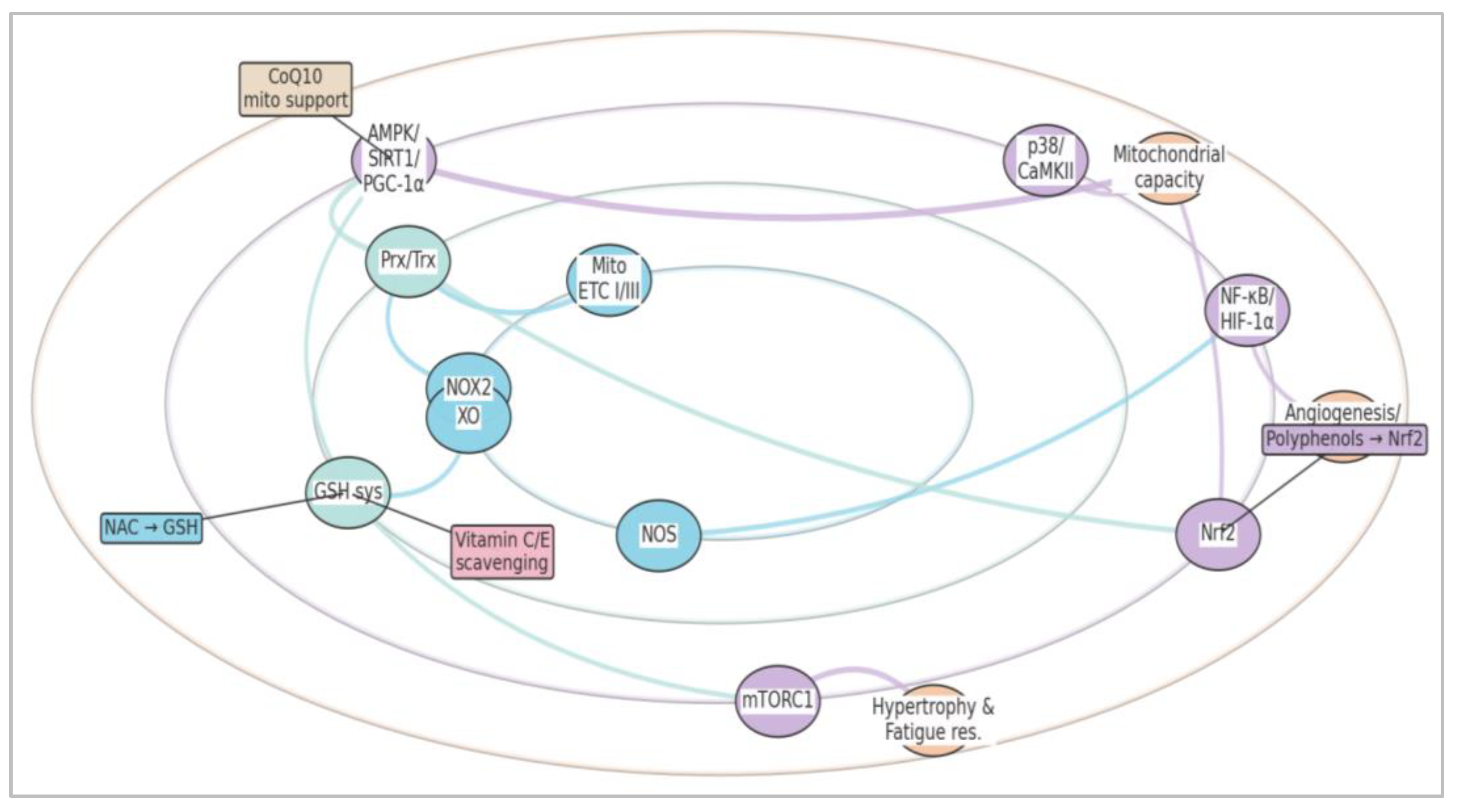
Figure 2.
Redox Window vs. Antioxidant Timing. Exercise induces a transient increase in reactive oxygen species (ROS) that functions as a signaling stimulus for molecular adaptation. The schematic depicts an early peri-exercise blunting-risk zone, a 0–6 h adaptive window, and a later 24–48 h recovery/remodeling phase. High-dose antioxidant exposure close to exercise may interfere with redox-sensitive signaling relevant to adaptation, whereas later recovery phases may provide a more appropriate context for targeted antioxidant support aimed at repair and readiness [22,23,108,109,110,115,116,117,120,121,122,123,124,125]. The scheme is conceptual and intended to guide timing interpretation rather than prescribe doses or specific compounds.
Figure 2.
Redox Window vs. Antioxidant Timing. Exercise induces a transient increase in reactive oxygen species (ROS) that functions as a signaling stimulus for molecular adaptation. The schematic depicts an early peri-exercise blunting-risk zone, a 0–6 h adaptive window, and a later 24–48 h recovery/remodeling phase. High-dose antioxidant exposure close to exercise may interfere with redox-sensitive signaling relevant to adaptation, whereas later recovery phases may provide a more appropriate context for targeted antioxidant support aimed at repair and readiness [22,23,108,109,110,115,116,117,120,121,122,123,124,125]. The scheme is conceptual and intended to guide timing interpretation rather than prescribe doses or specific compounds.
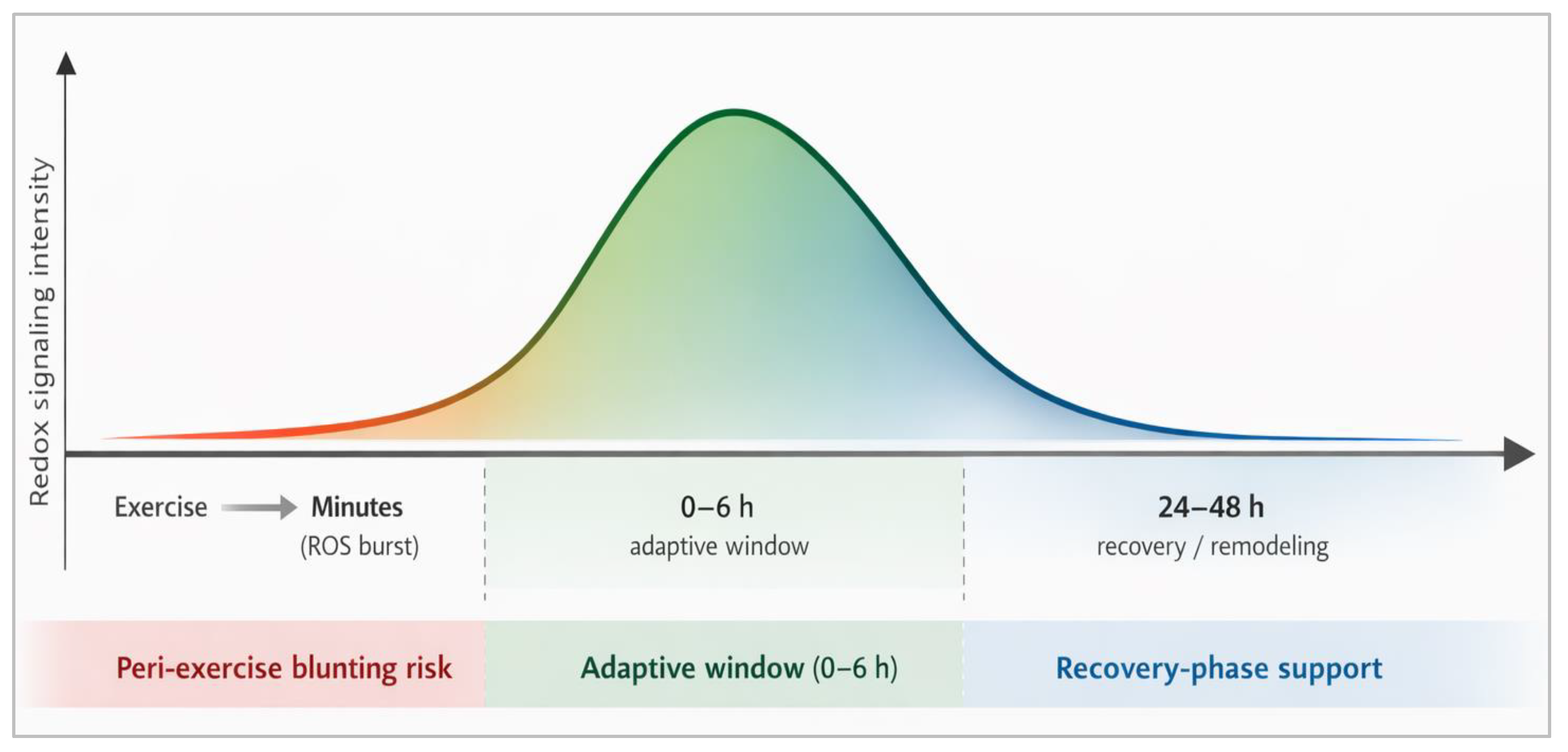
Figure 3.
Redox-Adaptive Periodization of Antioxidant Use in Exercise. Left, the adaptation signal rises when exercise-generated ROS are permitted to engage canonical pathways (AMPK/SIRT1/PGC-1α, p38/CaMKII, Nrf2) within an adaptation window (mint), and is attenuated in a blunting zone when high-dose scavengers are taken near key sessions (rose, hatched). Colored pins mark class anchors; explanatory boxes indicate recommended positioning: polyphenols (food-first, away from training), N-acetylcysteine (pulsed/needs prior trial), anthocyanins (competition-oriented support), and vitamin C/E (avoid peri-exercise). Right, the RAP compass (Redox-Adaptive Periodization) organizes context-specific decisions across phases (Build, Taper) and constraints (Heat, Altitude, Travel, Congestion): preserve redox signaling in build, then permit targeted pulses (e.g., anthocyanins, polyphenol-rich juices) when availability or performance is paramount; reserve NAC for athletes who have pre-tested tolerance/benefit; use melatonin to consolidate sleep when travel or schedule congestion threatens recovery. Abbreviations: ROS, reactive oxygen species; RAP, redox-adaptive periodization; NAC, N-acetylcysteine [22,23,85,95,100,104,107,108,109,110,115,116,117,120,121,122,123,124,125,132,133,134,135,140]. This figure presents a conceptual, hypothesis-generating framework intended to guide timing and class selection rather than prescribe doses; recommendations should be individualized to training goals, context, and tolerance.
Figure 3.
Redox-Adaptive Periodization of Antioxidant Use in Exercise. Left, the adaptation signal rises when exercise-generated ROS are permitted to engage canonical pathways (AMPK/SIRT1/PGC-1α, p38/CaMKII, Nrf2) within an adaptation window (mint), and is attenuated in a blunting zone when high-dose scavengers are taken near key sessions (rose, hatched). Colored pins mark class anchors; explanatory boxes indicate recommended positioning: polyphenols (food-first, away from training), N-acetylcysteine (pulsed/needs prior trial), anthocyanins (competition-oriented support), and vitamin C/E (avoid peri-exercise). Right, the RAP compass (Redox-Adaptive Periodization) organizes context-specific decisions across phases (Build, Taper) and constraints (Heat, Altitude, Travel, Congestion): preserve redox signaling in build, then permit targeted pulses (e.g., anthocyanins, polyphenol-rich juices) when availability or performance is paramount; reserve NAC for athletes who have pre-tested tolerance/benefit; use melatonin to consolidate sleep when travel or schedule congestion threatens recovery. Abbreviations: ROS, reactive oxygen species; RAP, redox-adaptive periodization; NAC, N-acetylcysteine [22,23,85,95,100,104,107,108,109,110,115,116,117,120,121,122,123,124,125,132,133,134,135,140]. This figure presents a conceptual, hypothesis-generating framework intended to guide timing and class selection rather than prescribe doses; recommendations should be individualized to training goals, context, and tolerance.
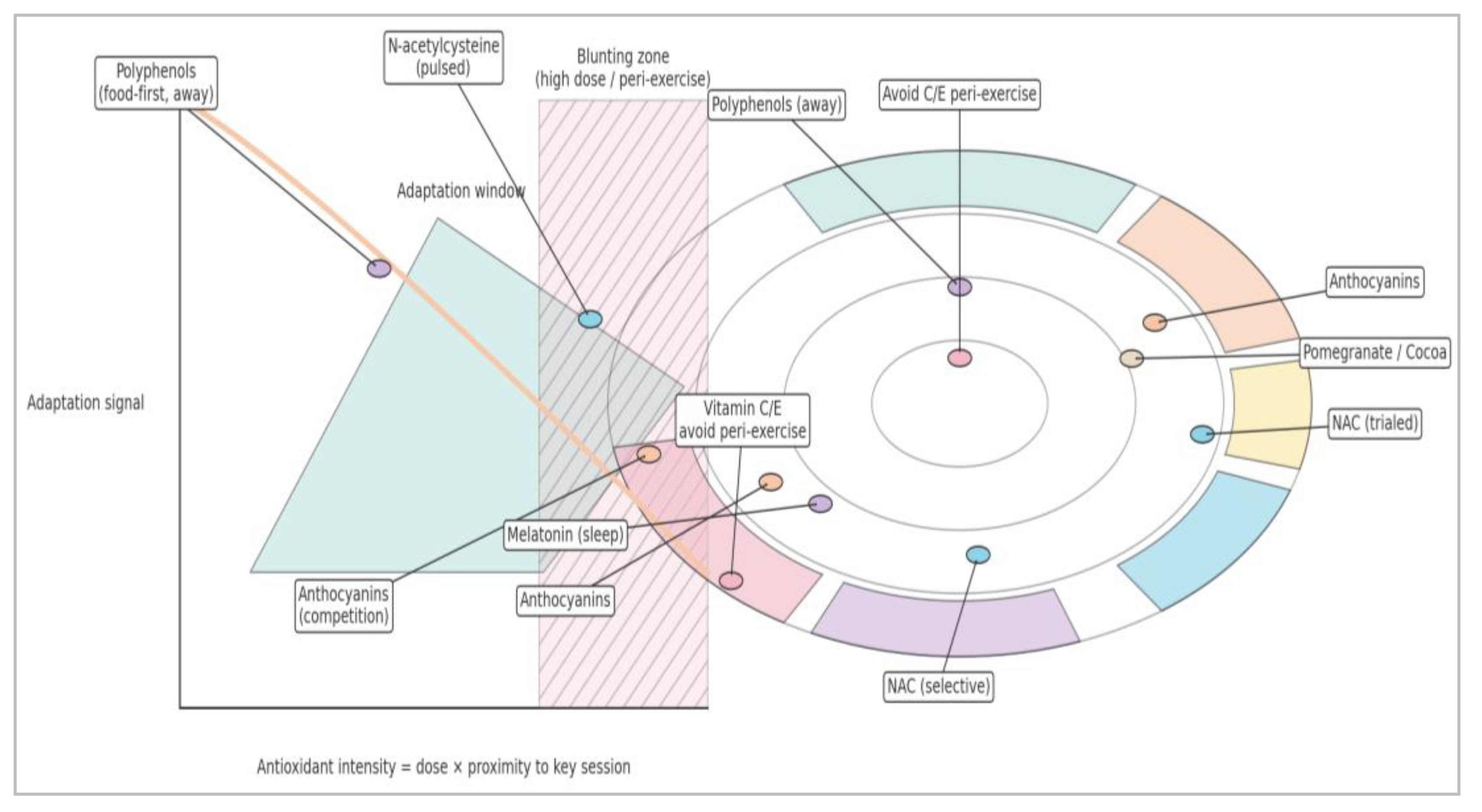
Table 5.
Biomarker quality matrix: recommended measures, common pitfalls, and interpretation notes.
| Domain | Preferred measures (higher validity) |
Use with caution / pitfalls |
Timing & interpretation notes |
|---|---|---|---|
|
Lipid peroxidation |
F₂-isoprostanes (plasma/urine) | TBARS alone; MDA without validated methods |
Urine integrates over hours; pair with sampling windows and hydration control. |
|
DNA oxidation |
8-oxo-dG (urine/plasma); comet assay with oxidative enzymes |
Single time points without baseline; assay drift |
Interpret with baseline and workload; muscle-local events may not appear in blood. |
|
Protein oxidation/nitration |
Protein carbonyls; nitrotyrosine (with validated immunoassays) |
Non-specific antibody panels; lack of standards |
Best paired with functional outcomes; avoid over-interpreting small deltas. |
|
Redox couples & thiol status |
GSH/GSSG ratio; cysteine/cystine; oxidized/reduced peroxiredoxin states |
Hemolysis; delayed processing; unreported storage |
Requires strict processing and rapid quenching; biopsies improve specificity. |
|
Antioxidant capacity / enzymes |
SOD, GPx, catalase activity (standardized); targeted redox proteomics (if available) |
TAC/FRAP as sole endpoint; non-standard units |
Enzyme activity adapts with training; interpret as adaptation markers, not damage. |
|
Damage & inflammation (EIMD context) |
CK + myoglobin (with responder handling); IL-6/IL-10 panels; soreness + function tests |
CK alone (high variability); untimed cytokines |
Align with 24–72 h recovery window; report training load and prior activity. |
Notes: Entries indicate relative methodological confidence rather than a universal hierarchy. “Preferred” identifies assays with stronger analytical specificity and clearer biological interpretability, whereas “caution” identifies measures with lower specificity, greater pre-analytical sensitivity, or weaker linkage to localized redox signaling. Results should therefore be interpreted in relation to sample matrix, timing, and handling, and global antioxidant-capacity indices should not be used alone. [7,8,9,10,11,12,32,33,34,35,36,37,38,60,61,73,74,75,76,141].
Disclaimer/Publisher’s Note: The statements, opinions and data contained in all publications are solely those of the individual author(s) and contributor(s) and not of MDPI and/or the editor(s). MDPI and/or the editor(s) disclaim responsibility for any injury to people or property resulting from any ideas, methods, instructions or products referred to in the content. |
© 2026 by the authors. Licensee MDPI, Basel, Switzerland. This article is an open access article distributed under the terms and conditions of the Creative Commons Attribution (CC BY) license.
Copyright: This open access article is published under a Creative Commons CC BY 4.0 license, which permit the free download, distribution, and reuse, provided that the author and preprint are cited in any reuse.


