

Submitted:
11 March 2026
Posted:
12 March 2026
You are already at the latest version
Abstract
Objective: This study aims to investigate how overlapping developmental transcription factors and signaling pathways between small intestinal neuroendocrine cells and hepatocytes govern liver-specific metastasis in carcinoid tumors, and to assess the clinical implications of these shared cell-type specific programs for early detection, risk-adapted surveillance, and targeted therapeutic strategies aimed at improving patient outcomes. Background: Small intestinal carcinoid tumors preferentially metastasize to the liver, driving morbidity and mortality, yet traditional explanations like vascular patterns inadequately account for this specificity. Overlapping transcription factors and signaling pathways between SI-NECs and hepatocytes such as FOXA, GATA, SOX, NOTCH, Wnt/β-catenin, Hippo, FGF/HGF, TGF-β, and Dll1/4, may confer “liver-compatible” programs that facilitate adhesion, survival, and proliferation. Understanding these overlaps could enable early detection, targeted surveillance, and therapeutics, redefining organ-specific metastasis mechanisms. Methods: Databases, including PubMed, MEDLINE, Scopus, and Web of Science were searched through March 2026, to investigate overlapping genes/tfs/signaling pathways (FOXA1/2, GATA4/6, SOX4/9, HES1/NOTCH, Wnt/ beta catenin, Hippo/YAP-TAZ, FGF/HGF, TGF-β, and Dll1/4) between SI-NECs and hepatocytes that may have role in governing liver tropism for metastasis of Carcinoid Tumor. Studies meeting the criteria outlined in the methods section were systematically reviewed to address the research question. This study adheres to the relevant PRISMA 2020 (Preferred Reporting Items for Systematic Reviews and Meta-Analyses) guidelines. Results: Key findings indicate that small intestinal carcinoid tumors exhibit a high propensity for liver metastasis due to overlapping developmental transcription factors and signaling pathways with hepatocytes, including FOXA1/2, GATA4/6, SOX4/9, HES1/NOTCH, Wnt/ beta catenin, Hippo/YAP-TAZ, FGF/HGF, TGF-β, and Dll1/4. These shared programs preserve progenitor-like plasticity, enable responsiveness to hepatic microenvironmental cues, and facilitate adhesion, survival, proliferation, and extracellular matrix remodeling. This compatibility due to overlap explains organ-specific tropism and highlights opportunities for early metastasis detection, risk-adapted surveillance, and targeted therapeutics, providing a framework for understanding liver-directed metastasis in carcinoid tumor patients. Conclusion: Small intestinal carcinoid tumors preferentially metastasize to the liver due to overlapping transcriptional and signaling programs shared with hepatocytes. Factors such as FOXA1/2, GATA4/6, SOX4/9, HES1/NOTCH, Wnt/beta catenin, Hippo/YAP-TAZ, FGF/HGF, TGF-β, and Dll1/4 enable tumor cells to maintain progenitor-like plasticity, respond to hepatic cues, and integrate into the liver microenvironment. The high propensity of small intestinal carcinoid tumors to metastasize to the liver can be explained by overlaps in transcription factors, signaling pathways, and progenitor-like features between SI-NECs and hepatocytes. This creates a microenvironment and functional compatibility, making the liver a preferential metastatic site.
Keywords:
carcinoid tumor
; liver metastasis
; oncogenesis
; hepatocytes
; early metastasis detection
Background
Carcinoid tumors, a subset of well-differentiated neuroendocrine neoplasms of the small intestine, are characterized by a high propensity for liver metastasis, which significantly influences patient prognosis and therapeutic decision-making [1]. Despite advances in imaging and systemic therapies, liver metastases remain the primary cause of morbidity and mortality in these patients, highlighting a critical need to understand the mechanisms underlying hepatic tropism [2]. Traditional explanations for metastasis, including vascular drainage patterns, mechanical trapping, and the “seed and soil” hypothesis, provide only partial insight, failing to account for the consistent preference of small intestinal neuroendocrine tumor cells for the liver over other organs [3]. Emerging evidence from developmental biology suggests that intrinsic cellular programs, particularly overlapping transcription factors (TFs) and signaling pathways between the tissue of origin and target organs, may govern organ-specific colonization [4,5].
Small intestinal neuroendocrine cells (SI-NECs) share multiple developmental TFs and signaling pathways with hepatocytes, including FOXA1/2, GATA4/6, SOX4/9, HES1/NOTCH, Wnt/β-catenin, Hippo/YAP-TAZ, FGF/HGF, TGF-β, and Dll1/4 [6]. These overlapping programs regulate progenitor cell maintenance, differentiation, proliferation, and responsiveness to microenvironmental cues, suggesting that carcinoid tumor cells may retain a “liver-compatible” transcriptional and signaling identity. Such compatibility may facilitate adhesion, survival, proliferation, and integration into the hepatic niche, providing a mechanistic explanation for the organ-specific metastatic pattern [7].
Understanding these overlaps is crucial for advancing clinical practice, as it offers opportunities for early metastasis detection, risk-adapted surveillance, and targeted therapeutics aimed at disrupting liver-specific colonization [8]. The role of shared developmental programs may redefine fundamental concepts of organotropism, establishing a framework for precision medicine approaches and guiding future research into the determinants of metastasis across cancer types [9]. This study addresses a critical gap in understanding the basis of liver-directed metastasis in carcinoid tumors [10,11,12].
Clinical Relevance and Importance Towards Improving Patient Outcomes
This study is clinically relevant because liver metastasis is the principal determinant of morbidity, symptom burden, and survival in patients with small intestinal carcinoid tumors, and current clinical strategies remain largely reactive rather than predictive. By focusing on how overlapping developmental genes, transcription factors, and signaling pathways between SI-NECs and hepatocytes govern liver-specific metastatic tropism, this research provides a mechanistic framework for identifying patients at high risk for hepatic dissemination before radiologically apparent disease develops. Such insights have the potential to shift clinical practice toward earlier and more precise detection of liver metastases, enabling timely intervention and improved disease control.
The findings of this study also have important implications for surveillance strategies. Patients whose tumors exhibit activation of liver-compatible transcriptional programs may benefit from intensified hepatic monitoring, personalized imaging schedules, and the incorporation of molecular biomarkers into follow-up protocols. This risk-adapted approach could reduce diagnostic delays, prevent progression to extensive liver involvement, and allow for earlier use of liver-directed therapies, thereby preserving hepatic function and improving quality of life.
From a therapeutic perspective, understanding the shared cell-type specific programs that facilitate hepatic colonization opens new avenues for targeted intervention. Disrupting pathways such as NOTCH, Wnt/β-catenin, Hippo/YAP-TAZ, FGF/HGF, or TGF-β may impair tumor adaptation to the liver microenvironment and limit metastatic growth. Additionally, these insights can inform treatment selection, timing of systemic therapies, and the development of novel combination strategies tailored to metastatic risk profiles. This study advances a precision medicine paradigm in carcinoid tumor management, with the potential to improve early detection, optimize surveillance, and enhance therapeutic outcomes, ultimately leading to improved survival and patient-centered care.
Methods
Aim of the Study
With focus on improving clinical outcomes for patients, this study aims to investigate shared genes, transcription factors, and signaling pathways including FOXA1/2, GATA4/6, SOX4/9, HES1/NOTCH, Wnt/β-catenin, Hippo/YAP-TAZ, FGF/HGF, TGF-β, and Dll1/4 between small intestinal neuroendocrine cells (SI-NECs) and hepatocytes, for their potential roles in liver-specific metastatic tropism of carcinoid tumors. The focus is on identifying the shared developmental regulators that may facilitate preferential hepatic colonization by metastatic neuroendocrine cells.
Research Questions
How do shared developmental genes, transcription factors, and signaling pathways (FOXA1/2, GATA4/6, SOX4/9, HES1/NOTCH, Wnt/β-catenin, Hippo/YAP-TAZ, FGF/HGF, TGF-β, and Dll1/4) between small intestinal neuroendocrine cells and hepatocytes contribute to liver-specific metastatic tropism of carcinoid tumors, and how can these overlapping cell-type specific programs be leveraged to improve early detection, surveillance, and therapeutic strategies to enhance clinical outcomes for patients?
Search Strategy and Reproducibility
For systematic review, a comprehensive literature search was conducted across PubMed, MEDLINE, Scopus, and Web of Science.
Date range: December 1, 2021 – September 31, 2025
- Additional updates: October 2025 – March 10, 2026
- Date of last search: March 10, 2026
- Language: English
A comprehensive and reproducible literature search strategy was designed to systematically identify studies relevant to developmental overlaps between small intestinal neuroendocrine cells (SI-NECs) and hepatocytes and their potential role in liver-specific metastatic tropism of carcinoid tumors. The search strategy was structured according to systematic review best practices and PRISMA guidelines, ensuring transparency, reproducibility, and comprehensive coverage of the literature.
Databases Searched
The following major biomedical and multidisciplinary databases were systematically searched:
- PubMed
- MEDLINE
- Scopus
- Web of Science Core Collection
These databases were selected to capture both biomedical and interdisciplinary studies, including molecular biology, oncology, hepatology, and developmental biology research relevant to neuroendocrine tumors and metastasis.
Timeframe of Search
The literature search covered all available publications up to September 2025, without date restrictions. The initial structured search was conducted between December 2021 and September 2025, followed by additional targeted searches during the manuscript revision phase until March 2026. This iterative process ensured that recent publications and emerging evidence were incorporated into the final dataset.
Search Concept Framework
The search strategy was constructed around three central conceptual domains:
-
Disease Context
- o
- Carcinoid tumors
- o
- Neuroendocrine tumors (NETs)
- o
- Small intestinal neuroendocrine tumors (SI-NETs)
-
Metastatic Process
- o
- Liver metastasis
- o
- Hepatic tropism
- o
- Organ-specific metastasis
- o
- Metastatic colonization
-
Developmental Regulators and Signaling Pathways
- o
- Transcription factors: FOXA1/2, GATA4/6, SOX4/9, HES1
- o
- Signaling pathways: Notch, Wnt/β-catenin, Hippo/YAP-TAZ, FGF/HGF, TGF-β
- o
- Ligand signaling: Dll1/4
These domains were combined using Boolean operators (AND/OR) to capture studies investigating factors underlying hepatic metastatic preference in neuroendocrine tumors.
Search Syntax and Query Development
The search strategy employed a combination of:
- Controlled vocabulary terms (e.g., MeSH terms in PubMed/MEDLINE)
- Free-text keywords
- Gene and pathway names
- Synonyms and alternate terminology
Boolean logic was applied to combine concepts:
- OR to group related synonyms or molecular regulators
- AND to intersect disease context, metastasis, and molecular pathways
- Quotation marks to capture exact phrases
- Wildcards/truncation symbols (e.g., * ) to capture variations of key terms
Search Validation
To ensure comprehensiveness and accuracy:
- Initial searches were refined through pilot testing of queries
- Results were examined to confirm retrieval of key landmark studies in carcinoid liver metastasis
- Additional keyword variations were added iteratively based on retrieved articles
Reproducibility Measures
Several methodological steps were implemented to ensure reproducibility:
- Standardized search queries were developed and documented for each database.
- Searches were performed using identical conceptual structures across all databases.
- All search results were exported and archived for verification and deduplication.
- The search strategy was repeated and verified during the revision phase to confirm consistent retrieval patterns.
- Multiple rounds of manual screening ensured that relevant studies were not inadvertently excluded.
This structured approach ensured that the search strategy can be replicated by other researchers, enabling verification of findings and facilitating future updates of the systematic review.
Example Boolean queries forPubMed, MEDLINE, Scopus, and Web of Science:
The following example Boolean search queries were used to retrieve relevant studies examining liver tropism of carcinoid tumor metastasis and the developmental overlaps between small intestinal neuroendocrine cells (SI-NECs) and hepatocytes, focusing on shared transcription factors and signaling pathways. These queries combine disease-specific terms, metastasis-related terminology, and key developmental regulators implicated in hepatic colonization.
("carcinoid tumor" OR "neuroendocrine tumor" OR "small intestinal neuroendocrine tumor" OR "SI-NET")
AND
("liver metastasis" OR "hepatic metastasis" OR "liver tropism" OR "hepatic colonization" OR "organ-specific metastasis")
AND
(FOXA1 OR FOXA2 OR GATA4 OR GATA6 OR SOX4 OR SOX9 OR HES1)
("small intestinal neuroendocrine cells" OR "enteroendocrine cells" OR "SI-NECs")
AND
(hepatocytes OR "liver cells")
AND
("developmental regulators" OR "transcription factors" OR "lineage specification")
AND
(FOXA1 OR FOXA2 OR GATA4 OR GATA6 OR SOX4 OR SOX9)
("neuroendocrine tumor" OR "carcinoid tumor")
AND
("liver metastasis" OR "hepatic tropism")
AND
("Wnt beta-catenin" OR "Hippo YAP TAZ" OR "Notch signaling" OR "HES1")
("carcinoid tumor metastasis" OR "neuroendocrine tumor metastasis")
AND
("hepatic microenvironment" OR "liver niche" OR "hepatic colonization")
AND
("FGF signaling" OR "HGF signaling" OR "TGF-beta")
("neuroendocrine tumor" OR "carcinoid tumor")
AND
("Notch signaling" OR HES1 OR Dll1 OR Dll4)
AND
("liver metastasis" OR "hepatic tropism")
("carcinoid tumor" OR "small intestinal neuroendocrine tumor" OR "neuroendocrine tumor")
AND
("liver metastasis" OR "hepatic metastasis" OR "liver tropism")
AND
(FOXA1 OR FOXA2 OR GATA4 OR GATA6 OR SOX4 OR SOX9 OR HES1
OR "Wnt beta-catenin" OR "Hippo YAP TAZ" OR "FGF signaling" OR "HGF signaling"
OR "TGF-beta" OR Dll1 OR Dll4)
("developmental gene overlap" OR "lineage convergence" OR "developmental mimicry")
AND
("enteroendocrine cells" OR "small intestinal neuroendocrine cells")
AND
(hepatocytes OR liver)
AND
("metastasis" OR "organ-specific metastasis" OR "liver tropism")
These Boolean queries were iteratively refined during the literature search process to ensure comprehensive retrieval of studies addressing developmental transcription factors, signaling pathways, and molecular mechanisms underlying liver-specific metastatic tropism in carcinoid tumors.
Study Selection and PRISMA Flow
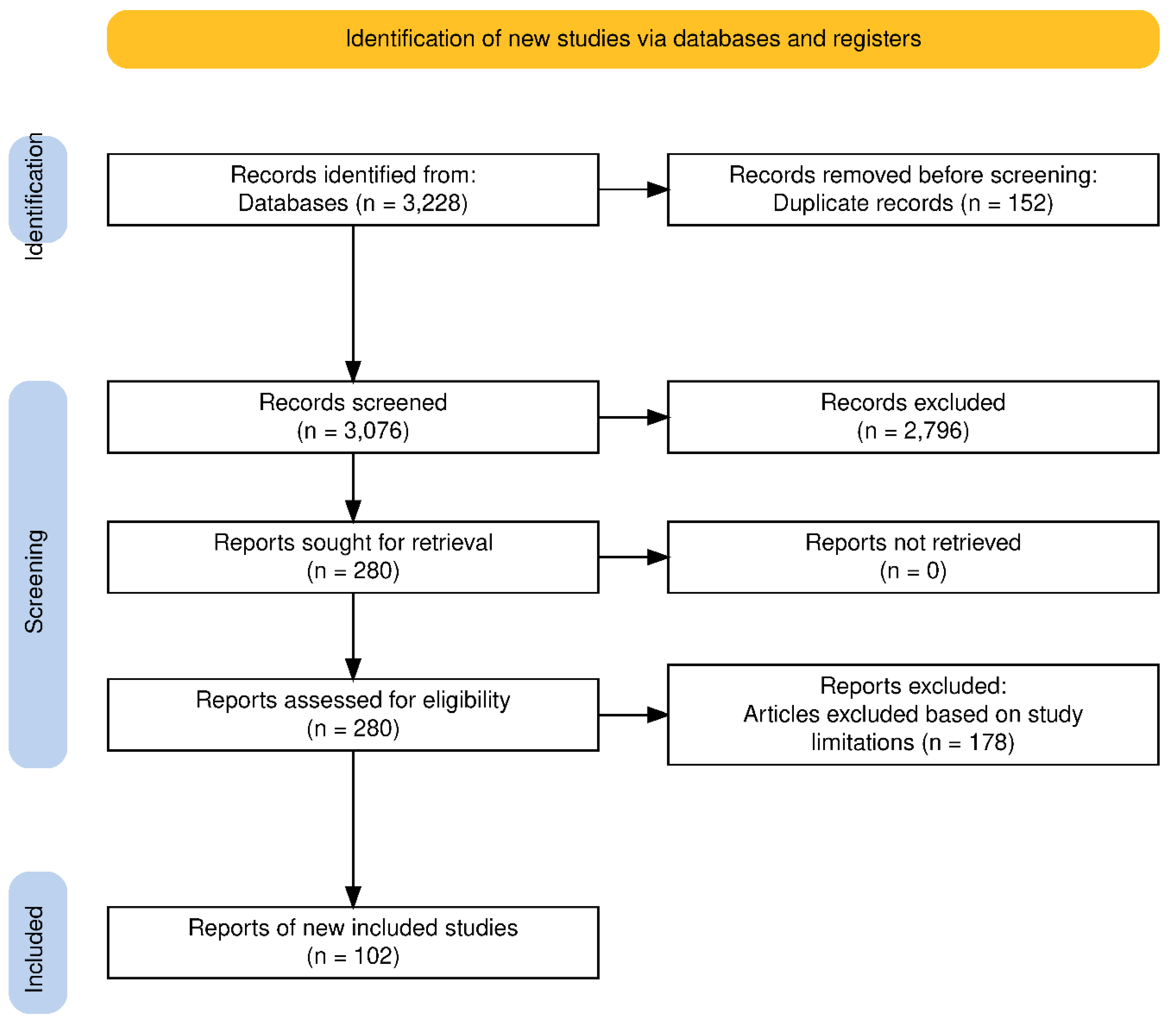
Two independent reviewers screened titles, abstracts, and full texts, resolving discrepancies through discussion. PRISMA flow numbers were:
- 3228 records identified
- 3076 after duplicates removed
- 2796 excluded after title/abstract screening
- 178 excluded after full-text review during data extraction
- 102 studies included in the final analysis
Figure 1.
PRISMA 2020 flow diagram illustrating the study selection process. Records were identified from PubMed, MEDLINE, Scopus, and Web of Science databases. After removal of duplicates and screening of titles and abstracts, full-text articles were assessed for eligibility. Studies were excluded based on predefined limitations and insufficient data availability during extraction. A total of 102 studies were included in the final synthesis.
Figure 1.
PRISMA 2020 flow diagram illustrating the study selection process. Records were identified from PubMed, MEDLINE, Scopus, and Web of Science databases. After removal of duplicates and screening of titles and abstracts, full-text articles were assessed for eligibility. Studies were excluded based on predefined limitations and insufficient data availability during extraction. A total of 102 studies were included in the final synthesis.
Objectives of the Search
- To identify shared transcriptional regulators between SI-NECs and hepatocytes
- To delineate common signaling networks that may favor hepatic colonization
- To understand how developmental mimicry and lineage convergence contribute to organ-specific metastasis
Screening and Eligibility Criteria
Initial Screening
- Titles and abstracts were screened for relevance to SI-NECs, hepatocytes, liver metastasis, and developmental genes/TFs/signaling pathways.
Full-Text Evaluation
- Studies providing insights directly or indirectly into shared pathways or transcriptional programs were selected.
Data Extraction Criteria
- Role of FOXA1/2, GATA4/6, SOX4/9, HES1/NOTCH, Wnt/β-catenin, Hippo/YAP-TAZ, FGF/HGF, TGF-β, and Dll1/4 in hepatic colonization
- Evidence linking these pathways to liver-specific metastasis in neuroendocrine tumors
Inclusion and Exclusion Criteria
Inclusion Criteria
- Studies focused on liver metastasis of carcinoid tumor
- Research focusing on shared developmental regulators between SI-NECs and hepatocytes
- Studies focusing on liver tropism of carcinoid tumor mets.
Exclusion Criteria:
- Studies not involving SI-NECs developmental regulators.
- Studies not involving Hepatic developmental regulators.
- Research unrelated to liver tropism of carcinoid tumor mets.
- Articles lacking insights into the shared developmental regulators between SI-NECs and Hepatocytes.
- Articles that did not conform to the study focus.
- Insufficient methodological rigor.
Rationale for Screening and Inclusion
Both SI-NECs and hepatocytes originate from endodermal progenitors and share developmental transcription factors such as FOXA1/2 and GATA4/6, which govern chromatin accessibility and lineage identity. Reactivation of these programs in carcinoid tumor cells may confer hepatic compatibility, allowing tumor cells to exploit the liver’s signaling milieu. Pathways including Wnt/β-catenin, Hippo/YAP-TAZ, Notch/Dll, and FGF/HGF are central to liver regeneration, survival signaling, and niche adaptation, suggesting that molecular mimicry of hepatocyte programs may underlie selective liver metastasis in SI-NETs.
The inclusion of overlapping genes, transcription factors, and signaling pathways between small intestinal neuroendocrine cells and hepatocytes is rationalized by their fundamental roles in endodermal development, lineage specification, cellular plasticity, and tissue-specific adaptation, all of which are critical determinants of organ-specific metastasis. FOXA1/2 and GATA4/6 are pioneer transcription factors that establish chromatin accessibility and endodermal identity in both intestinal and hepatic lineages, enabling tumor cells to retain a transcriptional state that is compatible with the hepatic microenvironment. SOX4 and SOX9 regulate progenitor maintenance, differentiation plasticity, and survival, allowing metastatic carcinoid cells to adapt dynamically to liver-specific cues. HES1 and NOTCH signaling, together with Delta-like ligands Dll1/4, control progenitor fate decisions, lateral inhibition, and microenvironmental communication, facilitating tumor cell integration within hepatic cellular niches.
Wnt/β-catenin and Hippo/YAP-TAZ signaling pathways are central regulators of proliferation, regeneration, and tissue homeostasis in both SI-NECs and hepatocytes, providing growth and survival advantages to tumor cells that colonize the liver. These pathways also support metabolic adaptation and resistance to apoptosis, which are essential for successful metastatic outgrowth. FGF and HGF signaling further promote trophic support, angiogenesis, and epithelial–mesenchymal plasticity, reinforcing tumor cell survival and expansion within the hepatic parenchyma. TGF-β signaling contributes to extracellular matrix remodeling, immune modulation, and stromal interactions, creating a permissive metastatic niche in the liver.
These overlapping developmental regulators form a coherent combinatorial code that confers transcriptional, signaling, and functional compatibility between SI-NEC-derived carcinoid tumor cells and hepatocytes. Their inclusion is therefore essential to look into the basis of liver tropism, moving beyond anatomical explanations of metastasis and providing mechanistic insight into how intrinsic tumor programs govern organ-specific metastatic colonization.
Assessment of Article Quality and Potential Biases
Ensuring the quality and minimizing potential biases of the selected articles were crucial aspects to guarantee the rigor and reliability of the research findings.
Quality Assessment
The initial step in quality assessment involved evaluating the methodological rigor of the selected articles. This included a thorough examination of the study design, data collection methods, and analyses conducted. The significance of the study’s findings was weighed based on the quality of the evidence presented. Articles demonstrating sound methodology such as well-designed studies, controlled variables, and scientifically robust data were considered of higher quality. Methodological rigor served as a significant indicator of quality.
Potential Biases Assessment
- Publication Bias: To address the potential for publication bias, a comprehensive search strategy was adopted to include a balanced representation of both positive and negative results, incorporating a wide range of published articles from databases like Google Scholar.
- Selection Bias: Predefined and transparent inclusion criteria were applied to minimize subjectivity in the selection process. Articles were chosen based on their relevance to the study’s objectives, adhering strictly to these criteria. This approach reduced the risk of subjectivity and ensured that the selection process was objective and consistent.
- Reporting Bias: To mitigate reporting bias, articles were checked for inconsistencies or missing data. Multiple detailed reviews of the methodologies and results were conducted for all selected articles to identify and address any reporting bias.
By including high-quality studies and thoroughly assessing potential biases, this study aimed to provide a robust foundation for the results and conclusions presented.
Language and Publication Restrictions
We restricted our selection to publications in the English language. There were no limitations imposed on the date of publication. Unpublished studies were not included in our analysis.
By investigating the liver tropism of carcinoid metastasis, this study provide significant insights into the factors governing the site of metastasis.
Results
A total of 3228 articles were identified using database searching, and 3076 were recorded after duplicates removal. 2796 were excluded after screening of title/abstract, 178 were finally excluded during data extraction. Finally, 102 articles were included as references.
Investigating Determinants Underlying Liver Tropism in Carcinoid Tumor Metastasis and Its Clinical Implications:
FOXA1 / FOXA2
Overlaps Driving Liver Tropism in Carcinoid Tumors:
FOXA1 and FOXA2 are pioneer transcription factors that play critical roles in endodermal lineage specification during development and in maintaining cellular identity in adult tissues [13]. In small intestinal neuroendocrine cells (SI-NECs), FOXA1 and FOXA2 are essential for driving differentiation from progenitor cells toward the neuroendocrine lineage, regulating the expression of key downstream genes such as Neurogenin 3, NeuroD1, and chromogranin A. These transcription factors establish an open chromatin landscape that allows NEC-specific gene expression and maintains progenitor plasticity, enabling SI-NECs to respond dynamically to local signaling cues in the intestinal epithelium. Similarly, in hepatocytes, FOXA1 and FOXA2 are central regulators of liver development and adult hepatocyte function, controlling genes involved in metabolism, detoxification, and hepatic differentiation [14]. They maintain chromatin accessibility and cooperate with other hepatic transcription factors, such as HNF4α and GATA4/6, to sustain the hepatocyte transcriptional program and ensure proper tissue homeostasis. The overlap in FOXA1/FOXA2 expression between SI-NECs and hepatocytes provides a basis for the liver tropism observed in carcinoid tumors. Carcinoid tumor cells derived from SI-NECs retain expression of these pioneer factors, which may allow them to recognize and respond to the transcriptional landscape and microenvironmental cues of hepatocytes. Because FOXA1/FOXA2 facilitate chromatin accessibility and transcriptional plasticity, tumor cells may be able to activate liver-compatible gene networks upon entering the hepatic niche, effectively “reading” the hepatocyte-specific signals in a way that supports survival, adhesion, and proliferation. This transcriptional compatibility likely enhances the ability of tumor cells to adapt to the liver microenvironment, responding to growth factors such as HGF and FGF, engaging in ECM remodeling, and exploiting hepatocyte-secreted paracrine signals to establish metastatic colonies [15]. FOXA1/FOXA2-driven plasticity may preserve a progenitor-like state in the tumor cells, allowing them to integrate into hepatic tissue more efficiently, resist apoptosis, and expand in response to the liver’s regenerative cues. The pioneer activity of FOXA1 and FOXA2 may also facilitate interactions with other overlapping pathways between SI-NECs and hepatocytes, such as SOX, GATA, and NOTCH signaling, further reinforcing the molecular compatibility required for metastasis [16]. By maintaining an accessible chromatin landscape, FOXA factors may allow carcinoid cells to rapidly reprogram gene expression in response to hepatocyte-derived signals, promoting angiogenesis, ECM adhesion, and proliferation in ways that mimic liver progenitor cells. This combinatorial effect of transcriptional plasticity, pathway responsiveness, and microenvironmental adaptation provides a mechanistic explanation for why the liver serves as the predominant site for carcinoid tumor metastasis and highlights FOXA1 and FOXA2 as central nodes in the transcriptional network driving this organ-specific tropism [17,18].
Possible Clinical Implications in Patients, Toward Improved Diagnosis, Surveillance, and Therapeutics
The overlap of FOXA1 and FOXA2 expression between small intestinal neuroendocrine cells and hepatocytes, which contributes to the liver tropism of carcinoid tumors, carries several potential clinical implications that could improve patient care in terms of diagnosis, surveillance, and therapeutics. From a diagnostic perspective, understanding that carcinoid tumor cells possess transcriptional programs compatible with hepatocytes suggests that early liver involvement may occur even before conventional imaging detects lesions [19]. This highlights the importance of sensitive molecular imaging techniques, such as 68Ga-DOTATATE PET/CT or emerging functional imaging modalities, which can identify liver metastases at a micro-metastatic stage by targeting neuroendocrine-specific surface markers or functional activity that may be preserved in the hepatocyte-compatible transcriptional state. Additionally, circulating tumor DNA or RNA panels could be developed to detect expression of key transcription factors, including FOXA1/FOXA2-driven gene signatures, providing a noninvasive biomarker to predict early liver colonization and guide risk stratification in patients with small intestinal carcinoid tumors. In terms of surveillance, recognition of the molecular mechanisms underlying liver tropism could inform more individualized monitoring strategies [20]. Patients with tumors expressing high levels of FOXA1/FOXA2 or exhibiting transcriptional profiles closely aligned with hepatocyte programs may benefit from more frequent liver imaging and functional assessment, allowing earlier detection of metastatic growth. This approach could also support dynamic surveillance, where changes in the expression of FOXA-regulated genes or related downstream pathways in circulating tumor material may indicate emerging liver colonization, prompting timely intervention. By integrating molecular profiling with conventional imaging, clinicians could shift from a purely size-based detection paradigm to one that anticipates metastasis based on tumor-liver compatibility, potentially improving outcomes through earlier treatment [21]. Therapeutically, the FOXA1/FOXA2-mediated compatibility between tumor cells and the hepatic environment presents opportunities to target the metastasis process at its molecular root. Inhibitors of transcriptional programs, epigenetic modulators that disrupt FOXA pioneer activity, or agents targeting downstream pathways co-opted in the liver, such as HGF/c-MET or FGF signaling, could be developed to selectively impair the ability of carcinoid cells to establish hepatic colonies. Additionally, understanding the role of FOXA-driven plasticity may support the design of liver-directed therapies, including localized drug delivery, embolization, or organoid-based predictive testing, that exploit vulnerabilities specific to tumor cells that mimic hepatocyte transcriptional programs. Finally, integrating knowledge of FOXA1/FOXA2 overlap into therapeutic strategies could inform the timing and selection of systemic treatments such as somatostatin analogs, peptide receptor radionuclide therapy, or novel targeted therapies, optimizing efficacy against metastases that exploit liver-compatible molecular networks. Altogether, these insights open the door to a precision medicine approach for carcinoid tumors, where transcriptional compatibility with hepatocytes informs the full spectrum of patient management, from early detection and personalized surveillance to targeted prevention and treatment of liver metastases [22].
GATA4 / GATA6
Overlaps Driving Liver Tropism in Carcinoid Tumors:
GATA4 and GATA6 are critical transcription factors involved in endodermal development and play central roles in determining cell fate, differentiation, and organ-specific gene expression. In small intestinal neuroendocrine cells, GATA4 and GATA6 are essential for the specification and maturation of the neuroendocrine lineage, regulating downstream genes involved in secretory function, progenitor maintenance, and differentiation into hormone-producing cells [23]. These transcription factors also help establish an open and responsive chromatin landscape, enabling SI-NECs to respond dynamically to local signals and maintain a degree of plasticity necessary for progenitor function. In hepatocytes, GATA4 and GATA6 are similarly critical for liver development and function, orchestrating the expression of genes involved in hepatocyte differentiation, metabolism, and organ-specific identity [24]. They interact with other hepatic transcription factors, including FOXA1/FOXA2 and HNF4α, to maintain a robust hepatic transcriptional program, and their activity contributes to the maintenance of hepatocyte progenitor pools and the regenerative capacity of liver tissue. The overlap of GATA4 and GATA6 expression between SI-NECs and hepatocytes provides a molecular basis for the liver tropism observed in carcinoid tumors. Carcinoid tumor cells derived from SI-NECs retain expression of these GATA factors, which may enable them to recognize and interpret the transcriptional and signaling environment of hepatocytes more effectively. This shared transcriptional framework allows tumor cells to activate hepatocyte-compatible gene programs upon arrival in the liver, facilitating survival, proliferation, and integration within the hepatic parenchyma [25]. GATA4/6-driven chromatin accessibility likely enhances the plasticity of carcinoid cells, allowing them to maintain progenitor-like states and adapt to liver-specific growth cues such as HGF, FGF, and Wnt signaling. By leveraging these pathways, tumor cells can exploit the liver microenvironment, adhere to the extracellular matrix, and initiate metastatic growth while evading apoptotic signals that would otherwise limit colonization. In addition, the cooperative activity of GATA4 and GATA6 with other overlapping transcription factors, including FOXA1/FOXA2 and SOX family members, may create a synergistic network that reinforces compatibility between SI-NEC-derived tumor cells and hepatocytes. This network likely allows tumor cells to respond to liver-derived paracrine and autocrine signals, remodel the extracellular matrix, and sustain angiogenesis, effectively converting the hepatic niche into a supportive environment for metastatic expansion. The persistence of GATA4/6 activity in carcinoid cells may also enable dynamic adaptation to hepatocyte-specific metabolic and signaling contexts, ensuring continued growth and survival. Collectively, the shared GATA4 and GATA6 transcriptional program provides both the molecular recognition and functional plasticity required for SI-NEC-derived carcinoid tumors to preferentially home to and thrive in the liver, explaining the high propensity for hepatic metastasis [26].
Possible Clinical Implications in Patients, Toward Improved Diagnosis, Surveillance, and Therapeutics:
The overlap of GATA4 and GATA6 expression between small intestinal neuroendocrine cells and hepatocytes, which appears to contribute to the liver tropism of carcinoid tumors, carries several potential clinical implications that could inform diagnosis, surveillance, and therapeutic strategies. From a diagnostic perspective, understanding that carcinoid tumor cells retain GATA-driven transcriptional programs compatible with hepatocytes suggests that liver metastases may develop at a molecular level even before they are detectable by conventional imaging. This knowledge could motivate the development of molecular diagnostic approaches, such as circulating tumor DNA or RNA panels, that monitor expression of GATA4/6-driven gene signatures as early indicators of hepatic colonization. Functional imaging modalities, including 68Ga-DOTATATE PET/CT, could be further optimized to detect micro-metastatic liver involvement by targeting markers downstream of the GATA4/6 program, allowing earlier and more precise identification of patients at high risk for hepatic metastasis [27]. In terms of surveillance, recognizing the role of GATA4/6 in liver tropism supports a more personalized monitoring strategy. Patients with tumors exhibiting high GATA4/6 expression or transcriptional profiles closely resembling hepatocytes could be prioritized for more frequent liver imaging and functional assessments. Monitoring changes in GATA-driven gene expression in circulating tumor material could serve as a dynamic biomarker, indicating early metastatic progression before structural lesions are visible, which would allow timely intervention. Integrating molecular profiling with conventional imaging could shift surveillance from a purely lesion-based approach to one that anticipates metastasis based on transcriptional compatibility, potentially improving early detection and patient outcomes. Therapeutically, the GATA4/6-driven liver tropism provides potential avenues for targeted intervention. Disruption of GATA4/6 activity or its downstream effectors through small molecules, epigenetic modulators, or RNA-based therapeutics could impair the ability of tumor cells to colonize and thrive in the hepatic microenvironment. Liver-directed therapies, including embolization, ablation, or localized drug delivery, could be designed to exploit vulnerabilities of tumor cells that utilize GATA4/6-mediated programs to interact with hepatocytes [28,29]. Additionally, understanding the transcriptional overlap may inform the timing and selection of systemic therapies, such as somatostatin analogs or peptide receptor radionuclide therapy, by identifying patients whose tumors are most likely to respond based on their hepatocyte-compatible transcriptional state [30]. Ultimately, leveraging the GATA4/6 overlap in clinical decision-making has the potential to enhance precision medicine approaches, enabling earlier detection, more effective surveillance, and targeted therapeutic strategies specifically tailored to the molecular mechanisms driving liver metastasis in carcinoid tumor patients [31,32].
SOX factors (SOX4, SOX9)
Overlaps Driving Liver Tropism in Carcinoid Tumors:
SOX4 and SOX9 are key transcription factors that play crucial roles in regulating progenitor cell maintenance, differentiation, and lineage specification across multiple endodermal tissues. In small intestinal neuroendocrine cells, SOX4 and SOX9 are involved in maintaining the progenitor state of NECs while coordinating their differentiation into functional hormone-secreting cells [33]. These factors establish transcriptional programs that balance cellular plasticity with lineage commitment, ensuring that neuroendocrine progenitors can respond to local niche signals such as Notch, Wnt, and growth factor pathways. Similarly, in hepatocytes, SOX9 and, to a lesser extent, SOX4 are expressed in hepatoblasts and adult hepatic progenitors, where they regulate differentiation, maintain proliferative capacity, and contribute to tissue repair and regeneration. SOX9, in particular, is critical for maintaining biliary and hepatocyte progenitor identity and mediating responses to signaling cues from the hepatic microenvironment, including Notch and Wnt pathways. The overlap of SOX4 and SOX9 expression between SI-NECs and hepatocytes provides a molecular explanation for the preferential liver metastasis of carcinoid tumors [34]. Carcinoid tumor cells that retain SOX4/9 expression may possess enhanced plasticity, allowing them to adapt to the transcriptional and signaling landscape of the liver upon dissemination. This progenitor-like state enables tumor cells to integrate into the hepatic niche by responding to hepatocyte-derived growth factors such as HGF, FGF, and Wnt ligands, and to maintain survival and proliferative signaling in a new tissue context. The ability of SOX4/9 to modulate chromatin accessibility further allows carcinoid cells to activate liver-compatible gene networks efficiently, facilitating adhesion, extravasation through sinusoidal endothelium, and colonization of hepatic parenchyma. In addition, the interaction of SOX4/9 with other overlapping transcription factors, including FOXA1/2 and GATA4/6, may synergistically reinforce the molecular compatibility between tumor cells and hepatocytes, creating a transcriptional network that supports metastatic outgrowth [35]. Moreover, the SOX-driven maintenance of progenitor-like characteristics allows carcinoid tumor cells to remain plastic and responsive in the hepatic microenvironment, enhancing their ability to exploit liver-specific cues for angiogenesis, extracellular matrix remodeling, and survival under stress conditions. This combination of plasticity, transcriptional adaptability, and responsiveness to liver-derived signals likely underlies the high propensity of small intestinal carcinoid tumors to metastasize to the liver. By retaining SOX4/9 expression, tumor cells are effectively “primed” to interpret hepatocyte signaling as permissive for growth, allowing them to establish and expand metastatic foci with greater efficiency compared to tissues lacking these compatible transcriptional programs [36].
Possible Clinical Implications in Patients, Toward Improved Diagnosis, Surveillance, and Therapeutics:
The overlap of SOX4 and SOX9 expression between small intestinal neuroendocrine cells and hepatocytes, which contributes to the liver tropism of carcinoid tumors, has several important clinical implications for improving diagnosis, surveillance, and therapeutics. From a diagnostic standpoint, the retention of SOX4/9-driven progenitor programs in tumor cells suggests that liver metastases may develop at a molecular level before they become radiologically apparent [37]. This insight supports the development of advanced molecular diagnostics, such as circulating tumor DNA or RNA assays that detect SOX4/9-associated transcriptional signatures, which could identify patients at high risk of early liver colonization. Functional imaging strategies, including 68Ga-DOTATATE PET/CT or emerging ligand-based modalities targeting progenitor-associated markers, could be optimized to detect micro-metastatic liver involvement by exploiting the molecular characteristics maintained by SOX4/9 expression. Early identification of liver metastases through such molecular or functional approaches may enable timely intervention before significant tumor burden accumulates. In terms of surveillance, understanding SOX4/9-driven liver tropism allows for risk-adapted monitoring strategies [38]. Patients whose tumors exhibit high SOX4/9 expression or transcriptional profiles mimicking hepatocyte progenitors may benefit from more frequent and targeted liver imaging, as well as longitudinal molecular monitoring. Dynamic assessment of circulating tumor material for changes in SOX4/9 expression could serve as an early biomarker of metastatic progression, enabling clinicians to anticipate hepatic involvement and intervene preemptively. Integrating transcriptional profiling with conventional imaging could shift surveillance paradigms from a purely lesion-based approach to one that incorporates molecular predictors of metastasis, improving early detection and potentially survival outcomes. Therapeutically, the SOX4/9 overlap provides opportunities to target the mechanisms that enable liver colonization and expansion [39]. Strategies aimed at disrupting SOX-mediated transcriptional plasticity or inhibiting downstream pathways co-opted in the liver microenvironment, such as Wnt, Notch, or growth factor signaling, may impair the ability of carcinoid tumor cells to establish hepatic metastases. Liver-directed therapies, including localized drug delivery, embolization, or ablative approaches, could be guided by the understanding that tumor cells exploiting SOX4/9-dependent progenitor programs are more likely to respond to interventions targeting the hepatic niche [40]. Additionally, systemic therapies such as somatostatin analogs or peptide receptor radionuclide therapy could be optimized in timing and selection based on the molecular propensity of tumors to colonize the liver. Recognizing the role of SOX4 and SOX9 in driving liver-specific metastasis provides a framework for precision medicine approaches, enabling clinicians to integrate molecular characteristics into patient-specific strategies for diagnosis, monitoring, and targeted treatment of hepatic metastases in carcinoid tumor patients [41,42].
HES1 / NOTCH
Overlaps Driving Liver Tropism in Carcinoid Tumors:
HES1, a key downstream effector of NOTCH signaling, plays a central role in maintaining progenitor cell populations and regulating differentiation in multiple endodermal lineages. In small intestinal neuroendocrine cells, HES1 functions to preserve the progenitor pool by repressing premature differentiation, thereby allowing neuroendocrine progenitors to respond dynamically to local niche signals such as Delta-like ligands and other morphogens [43]. This balance between progenitor maintenance and differentiation ensures the proper development and functional maturation of SI-NECs. In hepatocytes, HES1 and NOTCH signaling similarly regulate progenitor cell populations, particularly hepatoblasts and biliary progenitors, maintaining their proliferative capacity while controlling lineage specification. The coordinated activity of NOTCH-HES1 in hepatocytes allows these cells to respond to environmental cues for liver growth, regeneration, and repair, highlighting the pathway’s role in both maintaining cellular plasticity and mediating adaptation to the tissue microenvironment [44]. The overlap of HES1 and NOTCH signaling between SI-NECs and hepatocytes provides a mechanistic basis for the liver tropism of carcinoid tumors. Carcinoid tumor cells that retain active NOTCH-HES1 signaling are likely to maintain a progenitor-like state, which confers both plasticity and the ability to respond to liver-specific signals upon entering the hepatic microenvironment. This progenitor-like phenotype enables tumor cells to survive the stresses of extravasation, adhere to the hepatic extracellular matrix, and proliferate within hepatic sinusoids. NOTCH-HES1 activity also facilitates the integration of tumor cells into the liver niche by allowing them to sense and respond to hepatocyte-derived ligands, supporting the establishment of metastatic colonies [45]. The interaction of HES1/NOTCH with other overlapping transcription factors, such as FOXA, GATA, and SOX family members, may reinforce the transcriptional programs necessary for liver compatibility, ensuring that carcinoid tumor cells can effectively mimic progenitor or partially differentiated hepatocyte states and exploit liver-specific growth cues. In addition, the NOTCH-HES1 pathway may contribute to metastatic fitness by maintaining the self-renewal and survival capacity of tumor cells in the liver, enabling them to expand clonally and evade apoptotic signaling. The preservation of progenitor-like characteristics driven by HES1 also supports adaptive responses to the complex hepatic microenvironment, including extracellular matrix remodeling, angiogenesis, and paracrine signaling, all of which are essential for successful colonization and growth. By sustaining this flexible transcriptional and signaling state, HES1 and NOTCH signaling provide a molecular framework through which SI-NEC-derived carcinoid tumor cells preferentially home to and thrive within the liver, explaining the high propensity for hepatic metastasis observed clinically [46,47].
Possible Clinical Implications in Patients, Toward Improved Diagnosis, Surveillance, and Therapeutics:
The overlap of HES1 and NOTCH signaling between small intestinal neuroendocrine cells and hepatocytes, which contributes to the liver tropism of carcinoid tumors, carries several important clinical implications for improving diagnosis, surveillance, and therapeutic strategies. From a diagnostic perspective, the retention of HES1-driven progenitor programs in tumor cells suggests that liver metastases may develop at a molecular and functional level even before structural lesions are detectable on conventional imaging. This understanding could inform the development of molecular biomarkers, such as circulating tumor DNA or RNA assays that monitor NOTCH-HES1 pathway activity, providing early indicators of hepatic colonization [48]. Functional imaging approaches, including 68Ga-DOTATATE PET/CT or other ligand-based modalities, could be optimized to detect micro-metastatic liver involvement by targeting tumor cell populations that retain progenitor-like characteristics mediated by NOTCH-HES1 signaling. Early detection through such approaches may enable timely intervention before significant hepatic tumor burden develops. In terms of surveillance, knowledge of NOTCH-HES1-driven liver tropism allows for risk-adapted monitoring. Patients whose tumors exhibit high NOTCH-HES1 activity or transcriptional profiles mimicking hepatocyte progenitors could benefit from more frequent liver imaging and molecular surveillance, including longitudinal assessment of circulating tumor markers reflecting pathway activity. Dynamic monitoring of these markers may provide early warning of emerging metastases, enabling proactive clinical management. Integrating molecular and imaging-based surveillance strategies could shift the paradigm from reactive detection of established lesions to anticipatory monitoring based on the tumor’s intrinsic ability to colonize the liver, potentially improving patient outcomes through earlier intervention [49]. Therapeutically, the HES1/NOTCH overlap offers opportunities to disrupt the mechanisms underlying liver-specific metastasis. Targeting NOTCH signaling or its downstream effectors in tumor cells may impair their progenitor-like plasticity, reducing their capacity to survive and proliferate within the hepatic microenvironment. Liver-directed therapies, including localized ablation, embolization, or targeted delivery of pathway-specific inhibitors, could exploit vulnerabilities of tumor cells that rely on NOTCH-HES1-mediated adaptation to the liver niche. Systemic therapies such as somatostatin analogs, peptide receptor radionuclide therapy, or emerging molecular inhibitors could be optimized in timing and selection based on the tumor’s NOTCH-HES1-driven metastatic propensity [50,51]. By integrating the understanding of HES1 and NOTCH signaling into patient management, clinicians could adopt a precision medicine approach that enhances early detection, enables more tailored surveillance, and informs targeted therapeutic interventions specifically aimed at preventing or controlling hepatic metastases in carcinoid tumor patients [52].
Wnt / β-catenin
Overlaps Driving Liver Tropism in Carcinoid Tumors:
The Wnt/β-catenin signaling pathway is a fundamental regulator of cell proliferation, differentiation, and tissue homeostasis in multiple endodermal lineages. In small intestinal neuroendocrine cells, Wnt signaling through TCF/LEF transcription factors is essential for maintaining progenitor populations and directing lineage commitment toward functional neuroendocrine cells [53]. Activation of β-catenin allows for the transcription of genes that control cell cycle progression, survival, and differentiation, ensuring that neuroendocrine progenitors can expand and respond to environmental cues within the intestinal epithelium. Similarly, in hepatocytes, Wnt/β-catenin signaling is critical for liver development, zonation, and regeneration, regulating hepatocyte proliferation, survival, and metabolic function. The pathway maintains hepatoblast progenitor populations during development and contributes to adult liver regenerative responses, allowing hepatocytes to adapt to microenvironmental signals and maintain tissue integrity. The overlap of Wnt/β-catenin signaling between SI-NECs and hepatocytes therefore establishes a shared molecular framework in which tumor cells derived from neuroendocrine progenitors can recognize and respond to liver-specific cues. This shared signaling landscape may facilitate liver tropism in carcinoid tumors by providing tumor cells with an intrinsic ability to respond to hepatocyte-secreted Wnt ligands, growth factors, and extracellular matrix signals upon entering the hepatic microenvironment. Carcinoid tumor cells retaining active Wnt/β-catenin signaling may preserve a progenitor-like state, which enhances plasticity, survival under stress, and the capacity for clonal expansion [54]. β-catenin-mediated transcription could allow these cells to activate liver-compatible gene networks, supporting adhesion to the extracellular matrix, proliferation, and angiogenesis within the hepatic niche. The interaction of Wnt/β-catenin with other overlapping transcriptional programs, including FOXA, GATA, SOX, and NOTCH/HES1 pathways, may further reinforce compatibility between SI-NEC-derived tumor cells and hepatocytes, creating a molecular environment conducive to colonization and growth. The ability of β-catenin to integrate external growth cues with intrinsic transcriptional programs may enhance the capacity of carcinoid cells to exploit the liver’s regenerative and trophic signals, establishing a permissive niche for metastasis. The retention of Wnt/β-catenin signaling in carcinoid tumor cells provides both the transcriptional flexibility and proliferative advantage necessary for successful hepatic colonization [55]. By maintaining responsiveness to hepatocyte-derived Wnt ligands and cooperating with other overlapping transcription factors, these tumor cells can effectively mimic progenitor-like states compatible with liver tissue, enhancing their survival, growth, and metastatic expansion. This shared pathway provides a mechanistic explanation for why the liver represents the predominant site of metastasis for small intestinal carcinoid tumors and underscores the central role of combinatorial transcriptional and signaling overlap in organ-specific metastatic tropism [56,57].
Possible Clinical Implications in Patients, Toward Improved Diagnosis, Surveillance, and Therapeutics:
The overlap of Wnt/β-catenin signaling between small intestinal neuroendocrine cells and hepatocytes, which contributes to the liver tropism of carcinoid tumors, has several important clinical implications for improving diagnosis, surveillance, and therapeutic strategies. From a diagnostic perspective, the retention of Wnt/β-catenin pathway activity in tumor cells suggests that hepatic metastases may arise at a molecular level before they are visible on conventional imaging. This understanding could inform the development of molecular diagnostic assays that detect activation of Wnt target genes or β-catenin-dependent transcriptional signatures in circulating tumor DNA or RNA, providing early indicators of hepatic colonization [58]. Functional imaging approaches, such as 68Ga-DOTATATE PET/CT or novel ligand-based imaging that reflects progenitor or Wnt-responsive tumor populations, could be further refined to detect micro-metastatic liver lesions, allowing for earlier intervention and risk stratification. In terms of surveillance, knowledge of Wnt/β-catenin-driven liver tropism allows for more individualized and dynamic monitoring strategies. Patients whose tumors demonstrate high Wnt activity or transcriptional profiles mimicking hepatocyte progenitors may benefit from more frequent liver imaging and molecular assessments. Longitudinal evaluation of circulating markers related to Wnt signaling could provide early detection of emerging metastases, enabling clinicians to anticipate hepatic involvement and initiate treatment before substantial tumor burden develops. Integrating molecular surveillance with conventional imaging could shift monitoring paradigms from reactive detection of overt lesions to proactive identification based on intrinsic metastatic potential, improving clinical outcomes [59]. Therapeutically, the Wnt/β-catenin overlap presents opportunities to target the molecular mechanisms that enable hepatic colonization and growth. Inhibitors of Wnt signaling, modulators of β-catenin transcriptional activity, or agents targeting downstream effectors of the pathway could disrupt the ability of carcinoid tumor cells to maintain progenitor-like plasticity, survive, and proliferate in the hepatic microenvironment. Liver-directed therapies, including localized drug delivery, embolization, or ablation, could be tailored to exploit vulnerabilities of Wnt-activated tumor cells within the hepatic niche [60]. Additionally, systemic therapies, such as somatostatin analogs, peptide receptor radionuclide therapy, or novel targeted agents, could be optimized in timing and selection based on the tumor’s Wnt-driven metastatic propensity. By incorporating the understanding of Wnt/β-catenin signaling into patient management, clinicians could adopt a precision medicine approach that enhances early detection, informs individualized surveillance, and enables targeted therapeutic interventions specifically aimed at preventing or controlling liver metastases in carcinoid tumor patients [61,62].
FGF / HGF
Overlaps Driving Liver Tropism in Carcinoid Tumors:
Fibroblast growth factor (FGF) and hepatocyte growth factor (HGF) are key signaling molecules that play central roles in the development, proliferation, and regenerative capacity of endoderm-derived tissues. In small intestinal neuroendocrine cells, FGF signaling contributes to progenitor cell proliferation, differentiation, and survival, supporting the development of functional neuroendocrine lineages, while HGF signaling, through its receptor c-MET, can influence cell motility, survival, and growth in the context of tissue repair and adaptation [63]. These pathways establish a cellular program in SI-NECs that allows progenitor cells to respond to paracrine and autocrine growth cues in the intestinal niche. In hepatocytes, both FGF and HGF are central to liver development, zonation, and regenerative responses. HGF, produced by mesenchymal cells, drives hepatocyte proliferation, survival, and motility, while FGF signaling regulates proliferation and differentiation of hepatoblasts and contributes to hepatic tissue remodeling. The overlap in responsiveness to these growth factors between SI-NECs and hepatocytes provides a molecular basis for the liver tropism observed in carcinoid tumors [64]. Carcinoid tumor cells derived from SI-NECs retain the capacity to respond to FGF and HGF signaling, which allows them to exploit the hepatic microenvironment upon dissemination. Exposure to hepatocyte- or stromal-derived HGF and FGF in the liver can activate c-MET and FGF receptor pathways in tumor cells, promoting proliferation, survival, and motility, as well as facilitating adhesion to the extracellular matrix and colonization of hepatic tissue. This responsiveness also interacts synergistically with other overlapping transcription factors and signaling networks, such as FOXA, GATA, SOX, and Wnt/β-catenin, enabling tumor cells to integrate multiple liver-derived signals and establish a permissive niche for metastasis [65]. The ability of carcinoid tumor cells to harness these growth factor pathways effectively primes them to exploit the liver’s regenerative and trophic environment, supporting angiogenesis, extracellular matrix remodeling, and expansion of metastatic foci. Moreover, the combinatorial interaction of FGF and HGF signaling with progenitor-like programs maintained by SOX, NOTCH/HES1, and other transcription factors enhances tumor cell plasticity and adaptability, allowing metastasizing carcinoid cells to survive the stresses of extravasation and establish growth in the liver [66]. By retaining sensitivity to these growth factors, carcinoid tumor cells are able to interpret hepatocyte-derived signals as cues for proliferation and survival, creating a molecular environment conducive to liver-specific metastasis. This overlap in developmental signaling pathways thus provides a mechanistic explanation for why small intestinal carcinoid tumors preferentially metastasize to the liver, as these tumor cells are preconfigured to exploit the hepatic niche through intrinsic responsiveness to FGF and HGF-mediated cues [67].
Possible Clinical Implications in Patients, Toward Improved Diagnosis, Surveillance, and Therapeutics:
The overlap of FGF and HGF signaling between small intestinal neuroendocrine cells and hepatocytes, which contributes to the liver tropism of carcinoid tumors, has several important clinical implications for improving diagnosis, surveillance, and therapeutics. From a diagnostic perspective, recognizing that carcinoid tumor cells retain the ability to respond to FGF and HGF suggests that hepatic metastases may begin at a molecular and functional level before structural lesions are detectable by conventional imaging [68]. This knowledge could support the development of molecular assays, such as circulating tumor DNA or RNA panels that monitor FGF or HGF receptor activation or downstream target gene expression, providing early detection of liver colonization. Functional imaging approaches, including 68Ga-DOTATATE PET/CT or other ligand-based modalities that reflect tumor responsiveness to growth factor signaling, could be optimized to detect micro-metastatic liver involvement, enabling earlier intervention and risk stratification. In terms of surveillance, understanding the role of FGF and HGF signaling in liver tropism allows for more personalized monitoring strategies [69]. Patients whose tumors demonstrate high activation of FGF or HGF pathways or exhibit transcriptional profiles mimicking hepatocyte responsiveness may benefit from more frequent liver imaging and longitudinal molecular assessments. Dynamic monitoring of circulating markers related to FGF/HGF activity could provide early indication of emerging metastases, allowing clinicians to anticipate hepatic involvement and intervene before significant tumor burden develops. By integrating molecular surveillance with conventional imaging, monitoring could shift from a purely reactive approach to one that proactively identifies patients at high risk for hepatic metastasis, improving the likelihood of timely treatment and better outcomes [70]. Therapeutically, the overlap of FGF and HGF signaling provides opportunities to disrupt the molecular mechanisms that enable hepatic colonization and growth. Inhibitors of c-MET or FGF receptors, as well as agents targeting downstream signaling pathways, could impair the ability of carcinoid tumor cells to exploit the liver microenvironment, reducing proliferation, survival, and metastatic expansion. Liver-directed therapies, including localized drug delivery, embolization, or ablation, could be optimized to exploit vulnerabilities of tumor cells that rely on these growth factor pathways. Additionally, systemic therapies such as somatostatin analogs, peptide receptor radionuclide therapy, or novel molecularly targeted agents could be tailored based on tumor activation of FGF/HGF signaling, enhancing efficacy against liver metastases. Incorporating the understanding of FGF and HGF overlap into clinical management provides a framework for precision medicine, enabling earlier detection, more effective surveillance, and targeted interventions specifically aimed at preventing or controlling hepatic metastases in patients with carcinoid tumors [71,72].
TGF-β signaling
Overlaps Driving Liver Tropism in Carcinoid Tumors:
TGF-β signaling is a multifunctional pathway that regulates cell proliferation, differentiation, apoptosis, and extracellular matrix remodeling in multiple endodermal lineages. In small intestinal neuroendocrine cells, TGF-β signaling contributes to controlling progenitor cell differentiation and maintaining tissue homeostasis by modulating the balance between proliferation and lineage specification. It also regulates interactions with the extracellular matrix and local stromal environment, ensuring that SI-NECs maintain structural and functional integrity while responding to local growth cues [73]. In hepatocytes, TGF-β signaling plays a critical role in liver development, zonation, and regeneration, controlling hepatocyte proliferation, apoptosis, and extracellular matrix deposition. It modulates hepatocyte responses to injury and fibrosis and interacts with other pathways such as Wnt, FGF, and HGF to maintain tissue architecture and regulate regenerative processes. The overlap of TGF-β signaling between SI-NECs and hepatocytes establishes a shared regulatory framework that may facilitate hepatic colonization by carcinoid tumor cells. Carcinoid tumor cells derived from SI-NECs may retain the ability to interpret and respond to TGF-β signals, which can contribute to their preferential homing to and survival within the liver. In the hepatic microenvironment, TGF-β can regulate extracellular matrix remodeling, create a permissive niche, and interact with growth factor signaling to support proliferation and survival of metastatic tumor cells [74]. By responding to hepatocyte-derived TGF-β signals, carcinoid cells may adjust their proliferation and differentiation states, maintaining plasticity and progenitor-like features that enhance their adaptability and colonization efficiency. Additionally, TGF-β signaling may cooperate with overlapping transcriptional programs, including FOXA, GATA, SOX, and NOTCH/HES1 pathways, to reinforce compatibility between tumor cells and hepatocytes, allowing tumor cells to exploit the liver microenvironment for angiogenesis, matrix remodeling, and sustained growth. Moreover, TGF-β-mediated modulation of the extracellular matrix and cell adhesion dynamics may facilitate the adhesion and extravasation of carcinoid tumor cells through hepatic sinusoids, promoting establishment of metastatic foci. The pathway’s ability to coordinate proliferation, survival, and stromal interactions provides tumor cells with a molecular toolkit that aligns with the liver’s regenerative and trophic environment [75]. Consequently, the shared TGF-β signaling program creates both functional and structural compatibility between SI-NEC-derived carcinoid tumor cells and hepatocytes, explaining the high propensity for liver metastasis. By integrating control of proliferation, differentiation, and niche adaptation, TGF-β signaling serves as a central axis through which metastatic carcinoid cells preferentially colonize the liver [76,77].
Possible Clinical Implications in Patients, Toward Improved Diagnosis, Surveillance, and Therapeutics:
The overlap of TGF-β signaling between small intestinal neuroendocrine cells and hepatocytes, which contributes to the liver tropism of carcinoid tumors, carries significant clinical implications for diagnosis, surveillance, and therapeutic strategies. From a diagnostic perspective, understanding that carcinoid tumor cells can respond to hepatocyte-derived TGF-β suggests that liver metastases may initiate molecular and microenvironmental changes before structural lesions become detectable on conventional imaging [78]. This insight could inform the development of sensitive molecular assays that monitor TGF-β pathway activation or downstream transcriptional programs in circulating tumor DNA or RNA, allowing early detection of hepatic colonization. Functional imaging strategies could also be refined to capture areas of altered stromal remodeling or TGF-β-driven signaling activity, potentially identifying micro-metastatic liver foci before they manifest as macroscopic lesions, thereby enabling earlier intervention. In terms of surveillance, the recognition of TGF-β-mediated liver tropism supports a more personalized and dynamic monitoring approach. Patients whose tumors exhibit high TGF-β pathway activity or display transcriptional profiles compatible with hepatocyte responsiveness could be prioritized for more frequent liver imaging and molecular monitoring. Longitudinal assessment of circulating markers reflecting TGF-β signaling may provide early indications of emerging metastases, allowing clinicians to anticipate hepatic involvement and initiate treatment before significant tumor burden develops [79]. Integrating molecular surveillance with conventional imaging could shift clinical practice from reactive lesion detection to proactive identification of patients at high risk of liver metastasis, improving the timing and effectiveness of therapeutic interventions. Therapeutically, the TGF-β overlap offers opportunities to disrupt the molecular mechanisms that facilitate hepatic colonization and growth. Inhibitors of TGF-β signaling or modulators of its downstream effectors could impair tumor cell proliferation, survival, and adaptation within the liver microenvironment, reducing metastatic progression. Liver-directed therapies, including embolization, ablation, or localized delivery of pathway-specific agents, could be optimized to target tumor cells that rely on TGF-β-mediated stromal and niche interactions [80]. Additionally, systemic therapies, such as somatostatin analogs, peptide receptor radionuclide therapy, or novel molecular inhibitors, could be selected and timed based on tumor TGF-β activity, enhancing efficacy against liver metastases. By incorporating the understanding of TGF-β signaling overlap into clinical management, clinicians could adopt a precision medicine approach that enables earlier detection, improved surveillance, and targeted therapeutic interventions specifically aimed at preventing or controlling hepatic metastases in patients with carcinoid tumors [81,82].
Hippo pathway
Overlaps Driving Liver Tropism in Carcinoid Tumors:
The Hippo signaling pathway is a critical regulator of organ size, tissue homeostasis, and progenitor cell proliferation, functioning through its downstream effectors YAP and TAZ to modulate gene transcription in response to cellular density, mechanical cues, and extracellular signals. In small intestinal neuroendocrine cells, Hippo signaling contributes to the maintenance of progenitor populations and regulates the balance between proliferation and differentiation, ensuring the proper development of neuroendocrine lineages while preserving cellular plasticity [83]. YAP and TAZ activity allows SI-NEC progenitors to respond dynamically to local environmental cues, including growth factors, extracellular matrix stiffness, and cell-cell contact, promoting survival and controlled expansion within the intestinal niche. In hepatocytes, the Hippo pathway similarly governs tissue growth, regeneration, and progenitor cell maintenance. Activation or suppression of YAP/TAZ controls hepatocyte proliferation, biliary differentiation, and liver regenerative responses, allowing hepatocytes to integrate microenvironmental signals for proper tissue architecture and repair. The overlap in Hippo pathway activity between SI-NECs and hepatocytes establishes a shared regulatory network that may enhance the compatibility of carcinoid tumor cells with the hepatic microenvironment. Carcinoid tumor cells derived from SI-NECs that retain active Hippo signaling, particularly YAP/TAZ-driven transcriptional programs, may possess enhanced plasticity and proliferative capacity, allowing them to exploit the liver niche efficiently upon dissemination [84]. The responsiveness of these cells to mechanical cues, extracellular matrix composition, and paracrine growth factors in the hepatic environment can facilitate adhesion, migration, and colonization of hepatic tissue. Moreover, YAP/TAZ activity may cooperate with other overlapping transcriptional programs, including FOXA, GATA, SOX, Wnt/β-catenin, and NOTCH/HES1, to reinforce liver-compatible gene networks, ensuring that carcinoid tumor cells can maintain a progenitor-like state while responding to hepatocyte-derived signals. This integrated network enhances survival, angiogenesis, and extracellular matrix remodeling within the liver, creating a permissive niche for metastatic expansion [85]. Additionally, the Hippo pathway’s regulation of tissue growth and organ size may provide a selective advantage for tumor cells entering the liver, as it allows adaptation to the local mechanical and biochemical environment and coordination of proliferation with tissue architecture. By maintaining YAP/TAZ-driven transcriptional programs, carcinoid tumor cells can interpret hepatocyte-derived signals as cues for survival and expansion, effectively mimicking progenitor-like hepatocyte states and integrating into the hepatic parenchyma. This molecular compatibility conferred by the Hippo pathway provides a mechanistic explanation for the liver-specific tropism of small intestinal carcinoid tumors, as tumor cells are intrinsically equipped to sense and exploit the liver microenvironment for colonization, growth, and sustained metastatic development [86,87].
Possible Clinical Implications in Patients, Toward Improved Diagnosis, Surveillance, and Therapeutics:
The overlap of Hippo pathway signaling between small intestinal neuroendocrine cells and hepatocytes, which contributes to the liver tropism of carcinoid tumors, carries important clinical implications for improving diagnosis, surveillance, and therapeutic strategies. From a diagnostic perspective, the retention of YAP/TAZ-driven Hippo programs in tumor cells suggests that hepatic metastases may begin at a molecular and functional level before they are detectable through conventional imaging. This understanding could inform the development of molecular assays, such as circulating tumor DNA or RNA tests, that detect activation of Hippo pathway targets or downstream transcriptional programs, allowing earlier identification of liver colonization [88]. Functional imaging strategies could also be tailored to capture micro-metastatic liver foci by exploiting tumor populations with active Hippo signaling, thereby enabling earlier detection and risk stratification in patients with small intestinal carcinoid tumors. In terms of surveillance, knowledge of Hippo pathway-mediated liver tropism supports the design of personalized and dynamic monitoring approaches. Patients whose tumors exhibit high YAP/TAZ activity or transcriptional profiles resembling hepatocyte progenitors could benefit from more frequent liver imaging and molecular surveillance. Longitudinal assessment of circulating markers associated with Hippo signaling may provide early indications of emerging metastases, allowing clinicians to anticipate hepatic involvement and initiate treatment before significant tumor burden develops. Integrating molecular and imaging-based surveillance strategies could shift clinical practice from reactive lesion detection to proactive monitoring based on intrinsic metastatic potential, improving the timing and effectiveness of clinical interventions [89]. Therapeutically, the Hippo pathway overlap offers opportunities to target the molecular mechanisms that facilitate hepatic colonization and metastatic growth. Inhibitors of YAP/TAZ activity, modulators of Hippo pathway components, or agents targeting downstream effectors could impair tumor cell plasticity, proliferation, and survival within the liver microenvironment. Liver-directed therapies, including localized drug delivery, embolization, or ablation, could be optimized to exploit vulnerabilities of tumor cells that rely on Hippo-mediated adaptation to the hepatic niche. Additionally, systemic therapies such as somatostatin analogs, peptide receptor radionuclide therapy, or novel molecular inhibitors could be selected and timed based on tumor Hippo pathway activity, enhancing efficacy against liver metastases [90]. By incorporating the understanding of Hippo signaling overlap into patient management, clinicians could adopt a precision medicine approach that enables earlier detection, improved surveillance, and targeted interventions specifically aimed at preventing or controlling hepatic metastases in carcinoid tumor patients [91,92].
NOTCH / Delta-like ligands (Dll1/4)
Overlaps Driving Liver Tropism in Carcinoid Tumors:
NOTCH signaling, mediated through Delta-like ligands such as Dll1 and Dll4, is a fundamental pathway regulating progenitor cell maintenance, differentiation, and tissue patterning in endoderm-derived organs. In small intestinal neuroendocrine cells, NOTCH-Dll signaling maintains the balance between progenitor self-renewal and differentiation into functional NECs, preventing premature lineage commitment and ensuring proper cell fate specification. Dll1 and Dll4 ligands facilitate lateral inhibition among progenitor populations, allowing the emergence of discrete neuroendocrine cells while preserving a pool of undifferentiated progenitors [93]. In hepatocytes, NOTCH-Dll signaling similarly regulates hepatic progenitor cells and biliary differentiation, maintaining plasticity and controlling proliferation during liver development and regeneration. The pathway also modulates cellular responses to microenvironmental cues, including growth factors and extracellular matrix signals, coordinating tissue architecture and adaptive growth. The overlap of NOTCH-Dll signaling between SI-NECs and hepatocytes establishes a molecular framework through which carcinoid tumor cells may exploit the hepatic microenvironment. Carcinoid tumor cells derived from SI-NECs that retain active NOTCH-Dll signaling are likely to maintain progenitor-like properties, which confer both plasticity and the ability to respond to hepatocyte-derived cues [94]. In the liver, Dll1 and Dll4-mediated interactions may allow tumor cells to integrate into the hepatic niche by recognizing and responding to NOTCH ligands expressed by hepatocytes or liver stromal cells, promoting survival, proliferation, and resistance to apoptosis. This signaling compatibility enables tumor cells to establish metastatic colonies efficiently, as the retained NOTCH-Dll programs facilitate adaptation to the hepatic microenvironment and integration with local cell populations [95]. Moreover, NOTCH-Dll signaling may synergize with overlapping transcriptional networks such as FOXA, GATA, SOX, Wnt/β-catenin, HES1, and Hippo pathways, amplifying the molecular compatibility between SI-NEC-derived tumor cells and hepatocytes and reinforcing progenitor-like phenotypes that favor colonization, angiogenesis, and extracellular matrix remodeling. The preserved NOTCH-Dll pathway also supports dynamic cellular plasticity, allowing tumor cells to adjust their proliferation and differentiation states in response to hepatic signals. This adaptability enhances their ability to survive in a foreign tissue, exploit liver-specific trophic cues, and expand clonally within the hepatic parenchyma. By maintaining responsiveness to NOTCH ligands and downstream transcriptional programs, carcinoid tumor cells are effectively “primed” for the liver microenvironment, which explains the high frequency of hepatic metastasis in small intestinal neuroendocrine tumors. The convergence of NOTCH-Dll signaling with other overlapping pathways provides a mechanistic basis for organ-specific metastasis, demonstrating how retained progenitor and plasticity programs in tumor cells facilitate targeted colonization of hepatocytes and the liver niche [96,97].
Possible Clinical Implications in Patients, Toward Improved Diagnosis, Surveillance, and Therapeutics:
The overlap of NOTCH signaling, mediated through Delta-like ligands Dll1 and Dll4, between small intestinal neuroendocrine cells and hepatocytes, which contributes to the liver tropism of carcinoid tumors, has several important clinical implications for diagnosis, surveillance, and therapeutic strategies. From a diagnostic perspective, understanding that carcinoid tumor cells retain NOTCH-Dll programs suggests that hepatic metastases may initiate at a molecular and functional level before structural lesions are detectable on conventional imaging [98]. This knowledge supports the development of sensitive molecular assays, such as circulating tumor DNA or RNA panels, that monitor NOTCH pathway activity or the expression of Dll ligands and downstream effectors, allowing early detection of liver colonization. Functional imaging modalities could also be refined to identify tumor populations with active NOTCH-Dll signaling, capturing micro-metastatic liver involvement and enabling earlier intervention for high-risk patients. In terms of surveillance, recognizing the role of NOTCH-Dll signaling in liver tropism allows for personalized monitoring approaches. Patients whose tumors exhibit high NOTCH-Dll activity or transcriptional profiles mimicking hepatic progenitor responsiveness could benefit from more frequent and targeted liver imaging alongside longitudinal molecular assessments [99]. Dynamic tracking of circulating markers associated with NOTCH pathway activity could provide early warnings of emerging metastases, enabling clinicians to anticipate hepatic involvement and intervene before significant tumor burden develops. Integrating molecular profiling with conventional imaging could shift surveillance strategies from reactive detection of overt lesions to proactive, risk-based monitoring based on intrinsic metastatic potential, potentially improving patient outcomes [100]. Therapeutically, the retention of NOTCH-Dll signaling in carcinoid tumor cells provides opportunities to disrupt the molecular mechanisms enabling liver colonization and growth. Targeted inhibitors of NOTCH receptors, modulators of Dll ligand interactions, or downstream effectors could impair tumor cell plasticity, proliferation, and survival within the hepatic microenvironment. Liver-directed therapies, including localized drug delivery, embolization, or ablation, could be optimized to exploit vulnerabilities of tumor cells that rely on NOTCH-Dll-mediated integration into the hepatic niche. Additionally, systemic therapies such as somatostatin analogs, peptide receptor radionuclide therapy, or novel targeted agents could be selected and timed based on tumor NOTCH-Dll activity, improving efficacy against liver metastases. Incorporating the understanding of NOTCH-Dll overlap into clinical practice provides a framework for precision medicine, enabling earlier detection, tailored surveillance, and targeted therapeutic interventions aimed specifically at preventing or controlling hepatic metastases in carcinoid tumor patients [101,102].
Discussion
Clinically, this research may enable earlier detection of liver metastases through molecular diagnostics targeting pathways such as FOXA, GATA, SOX, NOTCH/HES1, Wnt/β-catenin, Hippo, FGF/HGF, and TGF-β, identifying patients at high risk before radiological lesions appear. Surveillance strategies could become more personalized, using transcriptional or circulating biomarkers to monitor progression. Therapeutically, targeting these liver-compatible pathways may prevent metastasis or limit hepatic colonization, supporting precision medicine approaches and liver-directed interventions. For future research, these findings open avenues to systematically map the combinatorial transcriptional networks driving organ-specific metastasis. Experimental studies could investigate the functional contribution of individual pathways and their interactions in liver colonization using in vitro co-culture systems and in vivo metastasis models. High-throughput profiling of circulating tumor cells for progenitor-like signatures may refine risk stratification, while pathway-specific inhibitors could be evaluated for preventing or treating liver metastases. Additionally, integrating these developmental insights with tumor microenvironment studies could identify synergistic therapeutic targets and lead to generalizable principles of organotropism across other cancers. This research establishes a mechanistic framework for understanding liver-specific metastasis and provides a foundation for translating molecular insights into clinical innovation and experimental exploration.
Conclusions
The investigation of liver tropism in small intestinal carcinoid tumor metastasis reveals that the propensity of these tumors to colonize the liver is deeply rooted in the developmental and transcriptional overlap between SI-NECs and hepatocytes. Shared transcription factors and signaling pathways, including FOXA1/2, GATA4/6, SOX4/9, HES1/NOTCH, Wnt/β-catenin, FGF/HGF, TGF-β, Hippo/YAP-TAZ, and Dll1/4-mediated NOTCH signaling, create a molecular framework in which carcinoid tumor cells retain progenitor-like plasticity, adaptability, and responsiveness to hepatocyte-derived cues. These overlapping programs allow tumor cells to interpret liver-specific signals, integrate into the hepatic microenvironment, and exploit paracrine, autocrine, and extracellular matrix-mediated growth and survival pathways. By preserving progenitor states and maintaining transcriptional and signaling compatibility with hepatocytes, carcinoid tumor cells can adhere, survive, proliferate, and remodel the liver niche, creating an environment that is permissive for metastatic outgrowth. The convergence of these overlapping gene and transcription factor networks explains why the liver is the predominant site of metastasis for small intestinal carcinoid tumors. FOXA and GATA factors provide chromatin accessibility and lineage recognition, SOX factors maintain progenitor plasticity, HES1/NOTCH and Dll1/4 signaling regulate progenitor maintenance and microenvironmental responsiveness, Wnt/β-catenin and Hippo pathways support proliferation and adaptation, while FGF, HGF, and TGF-β signaling provide trophic support, angiogenic stimulation, and extracellular matrix remodeling. Together, these factors establish both functional and structural compatibility between SI-NEC-derived tumor cells and the hepatic niche, enabling efficient colonization and expansion. Clinically, this understanding emphasizes that liver metastasis is not merely a stochastic process but is guided by intrinsic molecular programs that confer tissue-specific tropism. It highlights the potential for earlier detection through molecular diagnostics targeting these overlapping pathways, more precise surveillance strategies based on progenitor-like transcriptional profiles, and targeted therapeutic interventions that disrupt tumor adaptation to the liver microenvironment. The liver tropism of carcinoid tumors can be viewed as a consequence of retained developmental programs that create a transcriptional and signaling “preference” for hepatocytes, providing a mechanistic basis for organ-specific metastasis and offering multiple avenues for improving patient management and precision medicine approaches.
Funding
I declare that there was not any source of funding for this research work.
Institutional Review Board Statement
Not applicable.
Informed Consent Statement
Not applicable.
Data Availability Statement
All data generated or analyzed during this study are included in this article.
Conflicts of Interest
The authors declare that they have no competing interests.
Protocol
The review protocol was developed in accordance with PRISMA 2020 recommendations.
Abbreviations
| SI-NECs | Small Intestinal Neuroendocrine Cells |
| TFs | Transcription Factors |
| FOXA1/2 | Forkhead Box A1 / A2 |
| GATA4/6 | GATA Binding Protein 4 / 6 |
| SOX4/9 | SRY-Box Transcription Factor 4 / 9 |
| HES1 | Hairy and Enhancer of Split-1 |
| NOTCH | Neurogenic Locus Notch Homolog |
| Dll1/4 | Delta-like Ligand 1 / 4 |
| Wnt | Wingless-related Integration Site |
| β-catenin | Beta-catenin |
| Hippo | Hippo Signaling Pathway |
| YAP/TAZ | Yes-associated Protein / Transcriptional Coactivator with PDZ-binding Motif |
| FGF | Fibroblast Growth Factor |
| HGF | Hepatocyte Growth Factor |
| TGF-β | Transforming Growth Factor Beta |
| c-MET | Mesenchymal-Epithelial Transition Factor Receptor |
| ECM | Extracellular Matrix |
References
- Veenendaal, L.M.; Borel Rinkes, I.H.; Lips, C.J.; van Hillegersberg, R. Liver metastases of neuroendocrine tumours; early reduction of tumour load to improve life expectancy. World J Surg Oncol. 2006, 4, 35. [Google Scholar] [CrossRef] [PubMed] [PubMed Central]
- Gravante, G.; De Liguori Carino, N.; Overton, J.; Manzia, T.M.; Orlando, G. Primary carcinoids of the liver: a review of symptoms, diagnosis and treatments. Dig Surg. 2008, 25, 364–368. [Google Scholar] [CrossRef] [PubMed]
- Schwartz, G.; Colanta, A.; Gaetz, H.; Olichney, J.; Attiyeh, F. Primary carcinoid tumors of the liver. World J Surg Oncol. 2008, 6, 91. [Google Scholar] [CrossRef] [PubMed] [PubMed Central]
- Vitale, G; Carra, S; Alessi, Y; Campolo, F; Pandozzi, C; Zanata, I; Colao, A; Faggiano, A. On Behalf Of The Nike Group. Carcinoid Syndrome: Preclinical Models and Future Therapeutic Strategies. Int J Mol Sci. 2023, 24, 3610. [Google Scholar] [CrossRef] [PubMed] [PubMed Central]
- Ober, E.A.; Lemaigre, F.P. Development of the liver: Insights into organ and tissue morphogenesis. J Hepatol. 2018, 68, 1049–1062. [Google Scholar] [CrossRef] [PubMed]
- Rubin de Celis Ferrari, A.C.; Glasberg, J.; Riechelmann, R.P. Carcinoid syndrome: update on the pathophysiology and treatment. Clinics 2018, 73, e490s. [Google Scholar] [CrossRef] [PubMed] [PubMed Central]
- Marasco, M.; Romano, E.; Arrivi, G.; Prosperi, D.; Rinzivillo, M.; Caruso, D.; Mercantini, P.; Rossi, M.; Faggiano, A.; Panzuto, F. Exploring Carcinoid Syndrome in Neuroendocrine Tumors: Insights from a Multidisciplinary Narrative Review. Cancers 2024, 16, 3831. [Google Scholar] [CrossRef] [PubMed] [PubMed Central]
- Subash, N.; Papali, M.M.; Bahadur, K.P.; Avanthika, C.; Jhaveri, S.; Thannir, S.; Joshi, M.; Valisekka, S.S. Recent Advances in the Diagnosis and Management of Carcinoid Syndrome. Dis Mon. 2022, 68, 101304. [Google Scholar] [CrossRef] [PubMed]
- Hofland, J.; Herrera-Martínez, A.D.; Zandee, W.T.; de Herder, W.W. Management of carcinoid syndrome: a systematic review and meta-analysis. Endocr Relat Cancer 2019, 26, R145–R156. [Google Scholar] [CrossRef] [PubMed]
- Kimbrough, C.W.; Beal, E.W.; Dillhoff, M.E.; Schmidt, C.R.; Pawlik, T.M.; Lopez-Aguiar, A.G.; Poultsides, G.; Makris, E.; Rocha, F.G.; Crown, A.; Abbott, D.E.; Fisher, A.V.; Fields, R.C.; Krasnick, B.A.; Idrees, K.; Marincola-Smith, P.; Cho, C.S.; Beems, M.; Maithel, S.K.; Cloyd, J.M. Influence of carcinoid syndrome on the clinical characteristics and outcomes of patients with gastroenteropancreatic neuroendocrine tumors undergoing operative resection. Surgery 2019, 165, 657–663. [Google Scholar] [CrossRef] [PubMed] [PubMed Central]
- Ahlman, H.; Westberg, G.; Wängberg, B.; Nilsson, O.; Tylén, U.; Scherstén, T.; Tisell, L.E. Treatment of liver metastases of carcinoid tumors. World J Surg. 1996, 20, 196–202. [Google Scholar] [CrossRef] [PubMed]
- Zuetenhorst, J.M.; Taal, B.G. Metastatic carcinoid tumors: a clinical review. Oncologist 2005, 10, 123–131. [Google Scholar] [CrossRef] [PubMed]
- Lee, C.S.; Friedman, J.R.; Fulmer, J.T.; Kaestner, K.H. The initiation of liver development is dependent on Foxa transcription factors. Nature 2005, 435, 944–947. [Google Scholar] [CrossRef] [PubMed]
- Heslop, J.A.; Duncan, S.A. FoxA factors: the chromatin key and doorstop essential for liver development and function. Genes Dev. 2020, 34(15-16), 1003–1004. [Google Scholar] [CrossRef] [PubMed] [PubMed Central]
- Reizel, Y.; Morgan, A.; Gao, L.; Lan, Y.; Manduchi, E.; Waite, E.L.; Wang, A.W.; Wells, A.; Kaestner, K.H. Collapse of the hepatic gene regulatory network in the absence of FoxA factors. Genes Dev. 2020, 34(15-16), 1039–1050. [Google Scholar] [CrossRef] [PubMed] [PubMed Central]
- Lan, Q.; Cao, M.; Kollipara, R.K.; Rosa, J.B.; Kittler, R.; Jiang, H. FoxA transcription factor Fork head maintains the intestinal stem/progenitor cell identities in Drosophila. Dev Biol. 2018, 433, 324–343. [Google Scholar] [CrossRef] [PubMed]
- Gosalia, N.; Yang, R.; Kerschner, J.L.; Harris, A. FOXA2 regulates a network of genes involved in critical functions of human intestinal epithelial cells. Physiol Genomics 2015, 47, 290–297. [Google Scholar] [CrossRef] [PubMed] [PubMed Central]
- Kerschner, J.L.; Gosalia, N.; Leir, S.H.; Harris, A. Chromatin remodeling mediated by the FOXA1/A2 transcription factors activates CFTR expression in intestinal epithelial cells. Epigenetics 2014, 9, 557–565. [Google Scholar] [CrossRef] [PubMed] [PubMed Central]
- Park, J.W.; Lee, J.K.; Witte, O.N.; Huang, J. FOXA2 is a sensitive and specific marker for small cell neuroendocrine carcinoma of the prostate. Mod Pathol. 2017, 30, 1262–1272. [Google Scholar] [CrossRef] [PubMed] [PubMed Central]
- Han, M.; Li, F.; Zhang, Y.; Dai, P.; He, J.; Li, Y.; Zhu, Y.; Zheng, J.; Huang, H.; Bai, F.; Gao, D. FOXA2 drives lineage plasticity and KIT pathway activation in neuroendocrine prostate cancer. Cancer Cell. 2022, 40, 1306–1323.e8. [Google Scholar] [CrossRef] [PubMed]
- Katoh, M.; Igarashi, M.; Fukuda, H.; Nakagama, H.; Katoh, M. Cancer genetics and genomics of human FOX family genes. Cancer Lett. 2013, 328, 198–206. [Google Scholar] [CrossRef] [PubMed]
- Tosun Yıldırım, H.; Nergiz, D.; Sadullahoğlu, C.; Süren, D.; Yıldırım, Ş.; Üreyen, I.; Sezer, C. FOXA1 is associated with high tumor grade, myometrial invasion and lymph node invasion in endometrial endometrioid carcinoma. Ginekol Pol. 2021, 92, 544–549. [Google Scholar] [CrossRef] [PubMed]
- Zhao, R.; Watt, A.J.; Li, J.; Luebke-Wheeler, J.; Morrisey, E.E.; Duncan, S.A. GATA6 is essential for embryonic development of the liver but dispensable for early heart formation. Mol Cell Biol. 2005, 25, 2622–2631. [Google Scholar] [CrossRef] [PubMed] [PubMed Central]
- Haworth, K.E.; Kotecha, S.; Mohun, T.J.; Latinkic, B.V. GATA4 and GATA5 are essential for heart and liver development in Xenopus embryos. BMC Dev Biol. 2008, 8, 74. [Google Scholar] [CrossRef] [PubMed] [PubMed Central]
- Zheng, R.; Rebolledo-Jaramillo, B.; Zong, Y.; Wang, L.; Russo, P.; Hancock, W.; Stanger, B.Z.; Hardison, R.C.; Blobel, G.A. Function of GATA factors in the adult mouse liver. PLoS One 2013, 8, e83723. [Google Scholar] [CrossRef] [PubMed] [PubMed Central]
- Borok, M.J.; Papaioannou, V.E.; Sussel, L. Unique functions of Gata4 in mouse liver induction and heart development. Dev Biol. 2016, 410, 213–222. [Google Scholar] [CrossRef] [PubMed] [PubMed Central]
- Zhang, L.; He, J.B. Progress of GATA6 in liver development. Yi Chuan 2018, 40, 22–32. [Google Scholar] [CrossRef] [PubMed]
- Aronson, B.E.; Stapleton, K.A.; Krasinski, S.D. Role of GATA factors in development, differentiation, and homeostasis of the small intestinal epithelium. Am J Physiol Gastrointest Liver Physiol. 2014, 306, G474–G490. [Google Scholar] [CrossRef] [PubMed] [PubMed Central]
- Okumura, T.; Takeda, K.; Kuchiki, M.; Akaishi, M.; Taniguchi, K.; Adachi-Yamada, T. GATAe regulates intestinal stem cell maintenance and differentiation in Drosophila adult midgut. Dev Biol. 2016, 410, 24–35. [Google Scholar] [CrossRef] [PubMed]
- Walker, E.M.; Thompson, C.A.; Battle, M.A. GATA4 and GATA6 regulate intestinal epithelial cytodifferentiation during development. Dev Biol. 2014, 392, 283–294. [Google Scholar] [CrossRef] [PubMed] [PubMed Central]
- Aronson, B.E.; Stapleton, K.A.; Krasinski, S.D. Role of GATA factors in development, differentiation, and homeostasis of the small intestinal epithelium. Am J Physiol Gastrointest Liver Physiol. 2014, 306, G474–G490. [Google Scholar] [CrossRef] [PubMed] [PubMed Central]
- Kohlnhofer, B.M.; Thompson, C.A.; Walker, E.M.; Battle, M.A. GATA4 regulates epithelial cell proliferation to control intestinal growth and development in mice. Cell Mol Gastroenterol Hepatol. 2016, 2, 189–209. [Google Scholar] [CrossRef] [PubMed] [PubMed Central]
- Shang, T.; Jiang, T.; Cui, X.; Pan, Y.; Feng, X.; Dong, L.; Wang, H. Diverse functions of SOX9 in liver development and homeostasis and hepatobiliary diseases. Genes Dis. 2023, 11, 100996. [Google Scholar] [CrossRef] [PubMed] [PubMed Central]
- Yin, C. Molecular mechanisms of Sox transcription factors during the development of liver, bile duct, and pancreas. Semin Cell Dev Biol. 2017, 63, 68–78. [Google Scholar] [CrossRef] [PubMed] [PubMed Central]
- Yin, C. Molecular mechanisms of Sox transcription factors during the development of liver, bile duct, and pancreas. Semin Cell Dev Biol. 2017, 63, 68–78. [Google Scholar] [CrossRef] [PubMed] [PubMed Central]
- Fu, L.; Shi, Y.B. The Sox transcriptional factors: Functions during intestinal development in vertebrates. Semin Cell Dev Biol. 2017, 63, 58–67. [Google Scholar] [CrossRef] [PubMed] [PubMed Central]
- Fu, L.; Shi, Y.B. The Sox transcriptional factors: Functions during intestinal development in vertebrates. Semin Cell Dev Biol. 2017, 63, 58–67. [Google Scholar] [CrossRef] [PubMed] [PubMed Central]
- de Santa Barbara, P.; van den Brink, G.R.; RobertsDJ. Development and differentiation of the intestinal epithelium. Cell Mol Life Sci. 2003, 60, 1322–1332. [Google Scholar] [CrossRef] [PubMed] [PubMed Central]
- Poncy, A.; Antoniou, A.; Cordi, S.; Pierreux, C.E.; Jacquemin, P.; Lemaigre, F.P. Transcription factors SOX4 and SOX9 cooperatively control development of bile ducts. Dev Biol. 2015, 404, 136–148. [Google Scholar] [CrossRef] [PubMed]
- Shang, T.; Jiang, T.; Cui, X.; Pan, Y.; Feng, X.; Dong, L.; Wang, H. Diverse functions of SOX9 in liver development and homeostasis and hepatobiliary diseases. Genes Dis. 2023, 11, 100996. [Google Scholar] [CrossRef] [PubMed] [PubMed Central]
- Kawaguchi, Y. Sox9 and programming of liver and pancreatic progenitors. J Clin Invest. 2013, 123, 1881–1886. [Google Scholar] [CrossRef] [PubMed] [PubMed Central]
- Bukong, T.N.; Lo, T.; Szabo, G.; Dolganiuc, A. Novel developmental biology-based protocol of embryonic stem cell differentiation to morphologically sound and functional yet immature hepatocytes. Liver Int. 2012, 32, 732–741. [Google Scholar] [CrossRef] [PubMed]
- Zhang, K.; Zhang, Y.Q.; Ai, W.B.; Hu, Q.T.; Zhang, Q.J.; Wan, L.Y.; Wang, X.L.; Liu, C.B.; Wu, J.F. Hes1, an important gene for activation of hepatic stellate cells, is regulated by Notch1 and TGF-β/BMP signaling. World J Gastroenterol. 2015, 21, 878–887. [Google Scholar] [CrossRef] [PubMed] [PubMed Central]
- Auguet, T.; Bertran, L.; Binetti, J.; Aguilar, C.; Martínez, S.; Guiu-Jurado, E.; Sabench, F.; Adalid, L.; Porras, J.A.; Riesco, D.; Del Castillo, D.; Richart, C. Hepatocyte Notch Signaling Deregulation Related to Lipid Metabolism in Women with Obesity and Nonalcoholic Fatty Liver. Obesity 2020, 28, 1487–1493. [Google Scholar] [CrossRef] [PubMed]
- Sun, Y.; Tong, H.; Chu, X.; Li, Y.; Zhang, J.; Ding, Y.; Zhang, S.; Gui, X.; Chen, C.; Xu, M.; Li, Z.; Gardiner, E.E.; Andrews, R.K.; Zeng, L.; Xu, K.; Qiao, J. Notch1 regulates hepatic thrombopoietin production. Blood 2024, 143, 2778–2790. [Google Scholar] [CrossRef] [PubMed]
- Köhler, C.; Bell, A.W.; Bowen, W.C.; Monga, S.P.; Fleig, W.; Michalopoulos, G.K. Expression of Notch-1 and its ligand Jagged-1 in rat liver during liver regeneration. Hepatology 2004, 39, 1056–1065. [Google Scholar] [CrossRef] [PubMed] [PubMed Central]
- Chen, G.; Sun, L.; Yu, M.; Meng, D.; Wang, W.; Yang, Y.; Yang, H. The Jagged-1/Notch-1/Hes-1 pathway is involved in intestinal adaptation in a massive small bowel resection rat model. Dig Dis Sci. 2013, 58, 2478–2486. [Google Scholar] [CrossRef] [PubMed]
- Kay, S.K.; Harrington, H.A.; Shepherd, S.; Brennan, K.; Dale, T.; Osborne, J.M.; Gavaghan, D.J.; Byrne, H.M. The role of the Hes1 crosstalk hub in Notch-Wnt interactions of the intestinal crypt. PLoS Comput Biol. 2017, 13, e1005400. [Google Scholar] [CrossRef] [PubMed] [PubMed Central]
- Hu, J.; Li, J.; Dai, C.; Ren, J.; Yang, W.; He, C.; Meng, F.; Dai, C.; Zeng, S. HES1 deficiency impairs development of human intestinal mesenchyme by suppressing WNT5A expression. Biochem Biophys Res Commun. 2023, 655, 50–58. [Google Scholar] [CrossRef] [PubMed]
- Kunnimalaiyaan, M.; Yan, S.; Wong, F.; Zhang, Y.W.; Chen, H. Hairy Enhancer of Split-1 (HES-1), a Notch1 effector, inhibits the growth of carcinoid tumor cells. Surgery 2005, 138, 1137–1142; discussion 1142. [Google Scholar] [CrossRef] [PubMed]
- Harada, K.; Sato, Y.; Ikeda, H.; Hsu, M.; Igarashi, S.; Nakanuma, Y. Notch1-Hes1 signalling axis in the tumourigenesis of biliary neuroendocrine tumours. J Clin Pathol. 2013, 66, 386–391. [Google Scholar] [CrossRef] [PubMed]
- Curry, C.L.; Reed, L.L.; Nickoloff, B.J.; Miele, L.; Foreman, K.E. Notch-independent regulation of Hes-1 expression by c-Jun N-terminal kinase signaling in human endothelial cells. Lab Invest. 2006, 86, 842–852. [Google Scholar] [CrossRef] [PubMed]
- Kim, J.T.; Li, J.; Jang, E.R.; Gulhati, P.; Rychahou, P.G.; Napier, D.L.; Wang, C.; Weiss, H.L.; Lee, E.Y.; Anthony, L.; Townsend, CMJr; Liu, C.; Evers, B.M. Deregulation of Wnt/β-catenin signaling through genetic or epigenetic alterations in human neuroendocrine tumors. Carcinogenesis 2013, 34, 953–961. [Google Scholar] [CrossRef] [PubMed] [PubMed Central]
- Jin, X.F.; Spoettl, G.; Maurer, J.; Nölting, S.; Auernhammer, C.J. Inhibition of Wnt/β-Catenin Signaling in Neuroendocrine Tumors in vitro: Antitumoral Effects. Cancers 2020, 12, 345. [Google Scholar] [CrossRef] [PubMed] [PubMed Central]
- Jin, Y.; Anbarchian, T.; Wu, P.; Sarkar, A.; Fish, M.; Peng, W.C.; Nusse, R. Wnt signaling regulates hepatocyte cell division by a transcriptional repressor cascade. Proc Natl Acad Sci U S A 2022, 119, e2203849119. [Google Scholar] [CrossRef] [PubMed] [PubMed Central]
- Chan, S.C.; Zhang, Y.; Pontoglio, M.; Igarashi, P. Hepatocyte nuclear factor-1β regulates Wnt signaling through genome-wide competition with β-catenin/lymphoid enhancer binding factor. Proc Natl Acad Sci U S A 2019, 116, 24133–24142. [Google Scholar] [CrossRef] [PubMed] [PubMed Central]
- Monga, S.P.; Mars, W.M.; Pediaditakis, P.; Bell, A.; Mulé, K.; Bowen, W.C.; Wang, X.; Zarnegar, R.; Michalopoulos, G.K. Hepatocyte growth factor induces Wnt-independent nuclear translocation of beta-catenin after Met-beta-catenin dissociation in hepatocytes. Cancer Res. 2002, 62, 2064–2071. [Google Scholar] [PubMed]
- Moparthi, L.; Koch, S. Wnt signaling in intestinal inflammation. Differentiation 2019, 108, 24–32. [Google Scholar] [CrossRef] [PubMed]
- Mah, A.T.; Yan, K.S.; Kuo, C.J. Wnt pathway regulation of intestinal stem cells. J Physiol. 2016, 594, 4837–4847. [Google Scholar] [CrossRef] [PubMed] [PubMed Central]
- Gasnier, M.; Lim, H.Y.G.; Barker, N. Role of Wnt signaling in the maintenance and regeneration of the intestinal epithelium. Curr Top Dev Biol. 2023, 153, 281–326. [Google Scholar] [CrossRef] [PubMed]
- Sherwood, R.I.; Maehr, R.; Mazzoni, E.O.; Melton, D.A. Wnt signaling specifies and patterns intestinal endoderm. Mech Dev. 2011, 128(7-10), 387–400. [Google Scholar] [CrossRef] [PubMed] [PubMed Central]
- Pinto, D.; Clevers, H. Wnt control of stem cells and differentiation in the intestinal epithelium. Exp Cell Res. 2005, 306, 357–363. [Google Scholar] [CrossRef] [PubMed]
- Tsai, S.M.; Liu, D.W.; Wang, W.P. Fibroblast growth factor (Fgf) signaling pathway regulates liver homeostasis in zebrafish. Transgenic Res. 2013, 22, 301–314. [Google Scholar] [CrossRef] [PubMed]
- Padrissa-Altés, S.; Bachofner, M.; Bogorad, R.L.; Pohlmeier, L.; Rossolini, T.; Böhm, F.; Liebisch, G.; Hellerbrand, C.; Koteliansky, V.; Speicher, T.; Werner, S. Control of hepatocyte proliferation and survival by Fgf receptors is essential for liver regeneration in mice. Gut 2015, 64, 1444–1453. [Google Scholar] [CrossRef] [PubMed]
- Berg, T.; Rountree, C.B.; Lee, L.; Estrada, J.; Sala, F.G.; Choe, A.; Veltmaat, J.M.; De Langhe, S.; Lee, R.; Tsukamoto, H.; Crooks, G.M.; Bellusci, S.; Wang, K.S. Fibroblast growth factor 10 is critical for liver growth during embryogenesis and controls hepatoblast survival via beta-catenin activation. Hepatology 2007, 46, 1187–1197. [Google Scholar] [CrossRef] [PubMed] [PubMed Central]
- Danopoulos, S.; Schlieve, C.R.; Grikscheit, T.C.; Al Alam, D. Fibroblast Growth Factors in the Gastrointestinal Tract: Twists and Turns. Dev Dyn. 2017, 246, 344–352. [Google Scholar] [CrossRef] [PubMed]
- Katoh, M.; Katoh, M. FGF signaling network in the gastrointestinal tract (review). Int J Oncol. 2006, 29, 163–168. [Google Scholar] [CrossRef] [PubMed]
- Dessimoz, J.; Opoka, R.; Kordich, J.J.; Grapin-Botton, A.; Wells, J.M. FGF signaling is necessary for establishing gut tube domains along the anterior-posterior axis in vivo. Mech Dev. 2006, 123, 42–55. [Google Scholar] [CrossRef] [PubMed]
- Vitale, G.; Cozzolino, A.; Malandrino, P.; Minotta, R.; Puliani, G.; Saronni, D.; Faggiano, A.; Colao, A. Role of FGF System in Neuroendocrine Neoplasms: Potential Therapeutic Applications. Front Endocrinol (Lausanne) 2021, 12, 665631. [Google Scholar] [CrossRef] [PubMed] [PubMed Central]
- Presta, M.; Chiodelli, P.; Giacomini, A.; Rusnati, M.; Ronca, R. Fibroblast growth factors (FGFs) in cancer: FGF traps as a new therapeutic approach. Pharmacol Ther. 2017, 179, 171–187. [Google Scholar] [CrossRef] [PubMed]
- Geske, M.J.; Zhang, X.; Patel, K.K.; Ornitz, D.M.; Stappenbeck, T.S. Fgf9 signaling regulates small intestinal elongation and mesenchymal development. Development 2008, 135, 2959–2968. [Google Scholar] [CrossRef] [PubMed] [PubMed Central]
- Nakamura, T.; Sakai, K.; Nakamura, T.; Matsumoto, K. Hepatocyte growth factor twenty years on: Much more than a growth factor. J Gastroenterol Hepatol. 2011, 26, 188–202. [Google Scholar] [CrossRef] [PubMed]
- Yang, L.; Roh, Y.S.; Song, J.; Zhang, B.; Liu, C.; Loomba, R.; Seki, E. Transforming growth factor beta signaling in hepatocytes participates in steatohepatitis through regulation of cell death and lipid metabolism in mice. Hepatology 2014, 59, 483–495. [Google Scholar] [CrossRef] [PubMed] [PubMed Central]
- Sanchez, A.; Alvarez, A.M.; Benito, M.; Fabregat, I. Transforming growth factor beta modulates growth and differentiation of fetal hepatocytes in primary culture. J Cell Physiol. 1995, 165, 398–405. [Google Scholar] [CrossRef] [PubMed]
- Meindl-Beinker, N.M.; Dooley, S. Transforming growth factor-beta and hepatocyte transdifferentiation in liver fibrogenesis. J Gastroenterol Hepatol. 2008, 23, S122–S127. [Google Scholar] [CrossRef] [PubMed]
- Coulouarn, C.; Factor, V.M.; Thorgeirsson, S.S. Transforming growth factor-beta gene expression signature in mouse hepatocytes predicts clinical outcome in human cancer. Hepatology 2008, 47, 2059–2067. [Google Scholar] [CrossRef] [PubMed] [PubMed Central]
- Beck, P.L.; Rosenberg, I.M.; Xavier, R.J.; Koh, T.; Wong, J.F.; Podolsky, D.K. Transforming growth factor-beta mediates intestinal healing and susceptibility to injury in vitro and in vivo through epithelial cells. Am J Pathol. 2003, 162, 597–608. [Google Scholar] [CrossRef] [PubMed] [PubMed Central]
- Achyut, B.R.; Yang, L. Transforming growth factor-β in the gastrointestinal and hepatic tumor microenvironment. Gastroenterology 2011, 141, 1167–1178. [Google Scholar] [CrossRef] [PubMed] [PubMed Central]
- Gough, N.R.; Xiang, X.; Mishra, L. TGF-β Signaling in Liver, Pancreas, and Gastrointestinal Diseases and Cancer. Gastroenterology 2021, 161, 434–452.e15. [Google Scholar] [CrossRef] [PubMed] [PubMed Central]
- Liao, Y.; Zhang, M.; Lönnerdal, B. Growth factor TGF-β induces intestinal epithelial cell (IEC-6) differentiation: miR-146b as a regulatory component in the negative feedback loop. Genes Nutr. 2013, 8, 69–78. [Google Scholar] [CrossRef] [PubMed] [PubMed Central]
- Kidd, M.; Schimmack, S.; Lawrence, B.; Alaimo, D.; Modlin, I.M. EGFR/TGFα and TGFβ/CTGF Signaling in Neuroendocrine Neoplasia: Theoretical Therapeutic Targets. Neuroendocrinology 2013, 97, 35–44. [Google Scholar] [CrossRef] [PubMed] [PubMed Central]
- Dockray, G.J. Keeping neuroendocrine cells in check: roles for TGFbeta, Smads, and menin? Gut. 2003, 52, 1237–1239. [Google Scholar] [CrossRef] [PubMed] [PubMed Central]
- Nguyen-Lefebvre, A.T.; Selzner, N.; Wrana, J.L.; Bhat, M. The hippo pathway: A master regulator of liver metabolism, regeneration, and disease. FASEB J. 2021, 35, e21570. [Google Scholar] [CrossRef] [PubMed]
- Yimlamai, D.; Christodoulou, C.; Galli, G.G.; Yanger, K.; Pepe-Mooney, B.; Gurung, B.; Shrestha, K.; Cahan, P.; Stanger, B.Z.; Camargo, F.D. Hippo pathway activity influences liver cell fate. Cell. 2014, 157, 1324–1338. [Google Scholar] [CrossRef] [PubMed] [PubMed Central]
- Driskill, J.H.; Pan, D. The Hippo Pathway in Liver Homeostasis and Pathophysiology. Annu Rev Pathol. 2021, 16, 299–322. [Google Scholar] [CrossRef] [PubMed] [PubMed Central]
- Hong, A.W.; Meng, Z.; Guan, K.L. The Hippo pathway in intestinal regeneration and disease. Nat Rev Gastroenterol Hepatol. 2016, 13, 324–337. [Google Scholar] [CrossRef] [PubMed] [PubMed Central]
- Yu, F.X.; Meng, Z.; Plouffe, S.W.; Guan, K.L. Hippo pathway regulation of gastrointestinal tissues. Annu Rev Physiol. 2015, 77, 201–227. [Google Scholar] [CrossRef] [PubMed]
- Xiao, Y.; Tian, Y.; Zhang, J.; Li, Q.; Shi, W.; Huang, X. Small intestinal submucosa promotes angiogenesis via the Hippo pathway to improve vaginal repair. Biomol Biomed. 2023, 23, 838–847. [Google Scholar] [CrossRef] [PubMed] [PubMed Central]
- Harvey, K.F.; Tang, T.T. Targeting the Hippo pathway in cancer. Nat Rev Drug Discov. 2025, 24, 852–869. [Google Scholar] [CrossRef] [PubMed]
- Zygulska, A.L.; Krzemieniecki, K.; Pierzchalski, P. Hippo pathway - brief overview of its relevance in cancer. J Physiol Pharmacol. 2017, 68, 311–335. [Google Scholar] [PubMed]
- Calses, P.C.; Crawford, J.J.; Lill, J.R.; Dey, A. Hippo Pathway in Cancer: Aberrant Regulation and Therapeutic Opportunities. Trends Cancer 2019, 5, 297–307. [Google Scholar] [CrossRef] [PubMed]
- Li, F.L.; Guan, K.L. The two sides of Hippo pathway in cancer. Semin Cancer Biol. 2022, 85, 33–42. [Google Scholar] [CrossRef] [PubMed]
- You, W.K.; Schuetz, T.J.; Lee, S.H. Targeting the DLL/Notch Signaling Pathway in Cancer: Challenges and Advances in Clinical Development. Mol Cancer Ther. 2023, 22, 3–11. [Google Scholar] [CrossRef] [PubMed] [PubMed Central]
- Crabtree, J.S.; Singleton, C.S.; Miele, L. Notch Signaling in Neuroendocrine Tumors. Front Oncol. 2016, 6, 94. [Google Scholar] [CrossRef] [PubMed] [PubMed Central]
- Katoh, M.; Katoh, M. Precision medicine for human cancers with Notch signaling dysregulation (Review). Int J Mol Med. 2020, 45, 279–297. [Google Scholar] [CrossRef] [PubMed] [PubMed Central]
- Noah, T.K.; Shroyer, N.F. Notch in the intestine: regulation of homeostasis and pathogenesis. Annu Rev Physiol. 2013, 75, 263–288. [Google Scholar] [CrossRef] [PubMed]
- Tsai, Y.H.; Wu, A.; Wu, J.H.; Capeling, M.M.; Holloway, E.M.; Huang, S.; Czerwinkski, M.; Glass, I.; Higgins, P.D.R.; Spence, J.R. Acquisition of NOTCH dependence is a hallmark of human intestinal stem cell maturation. Stem Cell Reports 2022, 17, 1138–1153. [Google Scholar] [CrossRef] [PubMed] [PubMed Central]
- Pellegrinet, L.; Rodilla, V.; Liu, Z.; Chen, S.; Koch, U.; Espinosa, L.; Kaestner, K.H.; Kopan, R.; Lewis, J.; Radtke, F. Dll1- and dll4-mediated notch signaling are required for homeostasis of intestinal stem cells. Gastroenterology 2011, 140, 1230–1240.e1–7. [Google Scholar] [CrossRef] [PubMed] [PubMed Central]
- Adams, J.M.; Jafar-Nejad, H. The Roles of Notch Signaling in Liver Development and Disease. Biomolecules 2019, 9, 608. [Google Scholar] [CrossRef] [PubMed] [PubMed Central]
- Zong, Y.; Panikkar, A.; Xu, J.; Antoniou, A.; Raynaud, P.; Lemaigre, F.; Stanger, B.Z. Notch signaling controls liver development by regulating biliary differentiation. Development 2009, 136, 1727–1739. [Google Scholar] [CrossRef] [PubMed] [PubMed Central]
- Wang, T.; You, N.; Tao, K.; Wang, X.; Zhao, G.; Xia, N.; Li, N.; Tang, L.; Liu, W.; Dou, K. Notch is the key factor in the process of fetal liver stem/progenitor cells differentiation into hepatocytes. Dev Growth Differ. 2012, 54, 605–617. [Google Scholar] [CrossRef] [PubMed]
- Morell, C.M.; Strazzabosco, M. Notch signaling and new therapeutic options in liver disease. J Hepatol. 2014, 60, 885–890. [Google Scholar] [CrossRef] [PubMed]
Short Biography of Authors
Ovais Shafi (OS)* is the author of the study and was involved in the idea, concept, design, and methodology of the study, literature search and references. He did the writing, editing, and revision of the manuscript. He was involved in drawing the findings, results, conclusions, implications of the study, its interpretations, and contributed significantly to this study. Ovais Shafi (OS)*, MBBS - Sindh Medical College - Dow University of Health Sciences, Karachi, Pakistan. He aspires to become an eminent ‘Physician Scientist’. He is devoted to the research in disease development mechanisms, disease origins and therapeutics. OS is also passionate about multiple research areas including clinical trials, clinical medicine, therapeutics, regenerative medicine, precision medicine including gene therapies, finding disease specific targets for gene therapy, role of disease genomics and epigenetics in diagnosis, management, and therapeutics development. He is dedicated to the field of research and clinical medicine.
Rahimeen Rajpar, MBBS/MD - PGY1 Internal Medicine - Augusta Health, Virginia, USA, is also the author of the study and contributed to the writing, editing and revision. She also contributed to the results and conclusions sections of the study along with working on the findings, interpretation of the data and references. She previously was at Sindh Medical College - Jinnah Sindh Medical University, Karachi, Pakistan.
Disclaimer/Publisher’s Note: The statements, opinions and data contained in all publications are solely those of the individual author(s) and contributor(s) and not of MDPI and/or the editor(s). MDPI and/or the editor(s) disclaim responsibility for any injury to people or property resulting from any ideas, methods, instructions or products referred to in the content. |
© 2026 by the authors. Licensee MDPI, Basel, Switzerland. This article is an open access article distributed under the terms and conditions of the Creative Commons Attribution (CC BY) license (http://creativecommons.org/licenses/by/4.0/).
Copyright: This open access article is published under a Creative Commons CC BY 4.0 license, which permit the free download, distribution, and reuse, provided that the author and preprint are cited in any reuse.


