

Submitted:
11 March 2026
Posted:
12 March 2026
Read the latest preprint version here
Abstract
Jet anomaly detection in a high-energy physics is a non-stationary task that is fuelled by shifts in the domain due to pile-up and predominantly by background noise, and dynamically changing relationships between jet constituents in such a scenario, where a conventional graph neural network architecture is frequently inadequate in terms of robustness and interpretability. Physics-Self-Adaptive Multi-Agent System (PhySA-MAS) is a physics-directed, self-adaptive multi-agent architecture that proposes jet analysis as a decentralized and dynamically reconfigurable reasoning scheme. It does not use one monolithic model but instead integrates specialist agents dealing with meta-learning, relational reasoning, communication and topology control which can vary their interactions depending on event-level physics. The energy conservation constraints are incorporated in graph message passing to provide physical consistency, and a reinforcement driven topology controller rewires inter-agent communication dynamically to forces according to anomalous patterns. An additional communication strategy, anchor-peer communication, ensures the further stabilization of learning through the reduction of gradient conflict and the amplification of the signals related to anomalies, which, in combination, offers a powerful and structurally understandable alternative to fixed deep learning models.
Keywords:
jet anomaly detection
; high-energy physics
; graph neural networks
; multi-agent systems
; meta-learning
; reinforcement learning
; physics-guided learning
; pile-up mitigation
; relational reasoning
; attention mechanisms
1. Motivation
Jet anomaly detection in HEP is a difficult learning problem which exposes structural limitations of standard deep learning models. Pile-up effects and Luminosity-dependent domain shifts add non-stationarity to the problem, in violation of the assumptions of fixed distribution on which most models are trained [1,2]. At the same time, rare anomalous signatures are often being diluted by dominant Quantum Chromodynamics (QCD) background radiation which reduces the discriminative power of globally pooled representations [3,4]. Heterogeneous feature relevance across jet constituents can also lead to gradient interference in uniform aggregation [5], whereas both intrinsic event dependency of relational structure of jets and the fixed graph connectivity definition are no longer sufficient in describing dynamic hierarchical interactions. [6].
Graph neural networks (GNNs) have demonstrated great potential in the modeling of relationships, in addition to jet tagging and particle-based representations [6,7]. Similarly, weakly-supervised, or unsupervised, methods for anomaly detection have shown potential in HEP [3,8]. However, these approaches are still essentially monolithic in nature: message passing is static, communication ways are static, and architectural assumptions do not change from one event to another [6,7]. Even physics-informed approaches to learning usually use domain constraints only at the level of loss instead of built into the relational propagation [9].
These observations indicate that robustness and interpretability issues do not only arise due to parameter learning, but can also be caused by architectural rigidity. We therefore propose to reframe the problem of jet anomaly detection as a distributed reasoning process rather than a single model inference process. This is the motivation behind PhySA-MAS, we re-conceptualize the anomaly detection to a coordinated behaviour of specialized agents that adapt and reorganize based on the physics of events in a dynamic way embedding structural adaptiveness and physics-aware computation right in the architecture.
2. Overview of PhySA-MAS Architecture
In HEP, jet anomaly detection is not easy because of high-dimensional particle representations, non-stationarity caused by pile-up, dominant QCD background noise and event-dependent relational structure [1,2]. Rare anomalous signatures are usually lost in a sea of standard-model processes with overwhelming number, which translates into poor discriminative separability [3]. Conventional monolithic models such as jet images of CNN or static graph neural networks (GNNs) and ensemble methods often have problems to adapt with the dynamic luminance conditions and shifting detector response [4,5]. PhySa-MAS solves this limitation by reformulating the problem of anomaly detection as a distributed, physics-guided, prowling process in which several specialized agents work together and adapt based on event-level physics instead of using fixed inference process pipeline.
2.1. Core Concept
The basic concept behind PhySA-MAS is to incorporate the physics-awareness and structural adaptability directly into the architecture. Instead of using a big one-shot model, the framework orchestrates the actions of self-adaptive agents that adjust parameters, reason on the relationship of particles, fuse multiple outputs from different agents, and dynamically change forms of communication. By incorporating energy conservation principles and physically meaningful particle interactions directly into the relational propagation mechanism rather than enforcing physics only at the loss level, the system maintains physical consistency while selectively enhancing anomaly-relevant features [6]. This design further alleviates gradient conflicts and representation dilution commonly observed in monolithic deep networks [7].
2.2. Architecture Overview of the proposed PhySA-MAS
PhySa-MAs comprises of four tightly coupled modules as shown in Figure 1:
Figure 1.
Conceptual Flow Diagram of PhySA-MAS.
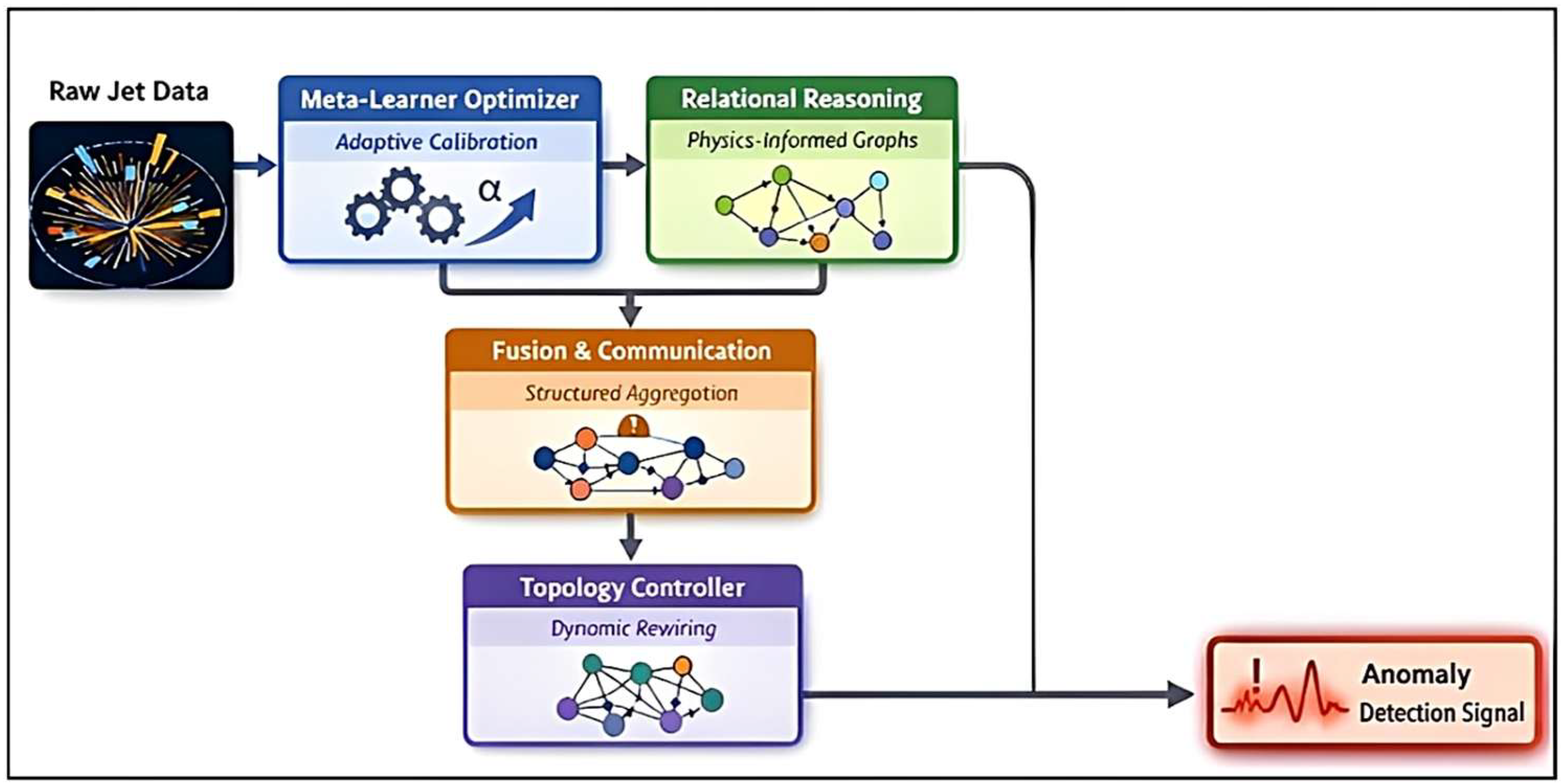
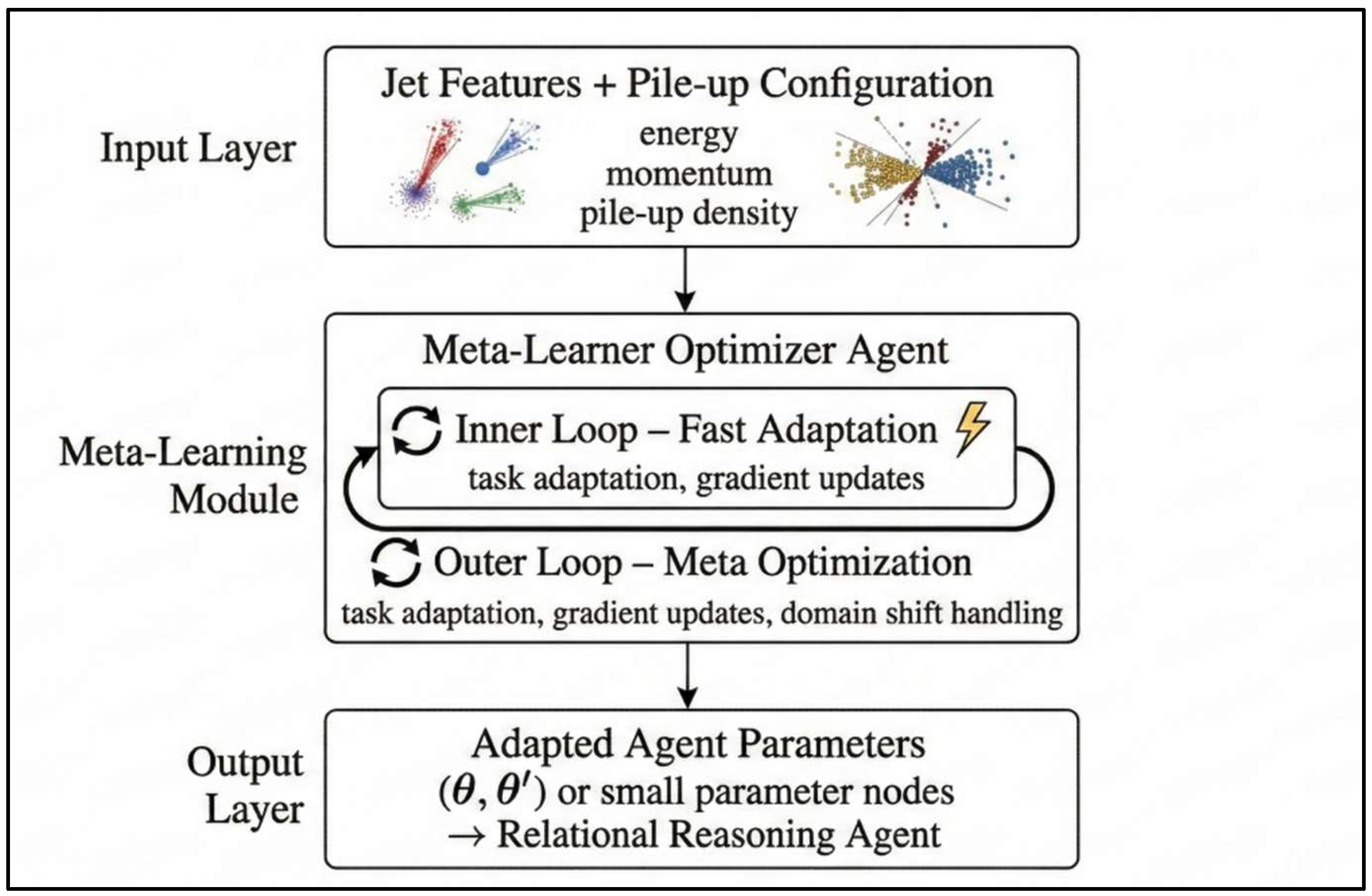
1. Meta-Learner Optimizer Agent: To overcome the effects of domain shift and pile-up variability by fast-weight adaptation based on Model-Agnostic Meta-Learning (MAML) [8]. Instead of static parameters, the agent updates model weights with inner and outer loops, depending on the current luminosity and noise level.
Figure 2.
Meta-Learner Optimizer Agent performing inner-loop fast adaptation and outer-loop meta-optimization over jet features and pile-up configurations to produce calibrated parameters for downstream relational reasoning.
Figure 2.
Meta-Learner Optimizer Agent performing inner-loop fast adaptation and outer-loop meta-optimization over jet features and pile-up configurations to produce calibrated parameters for downstream relational reasoning.
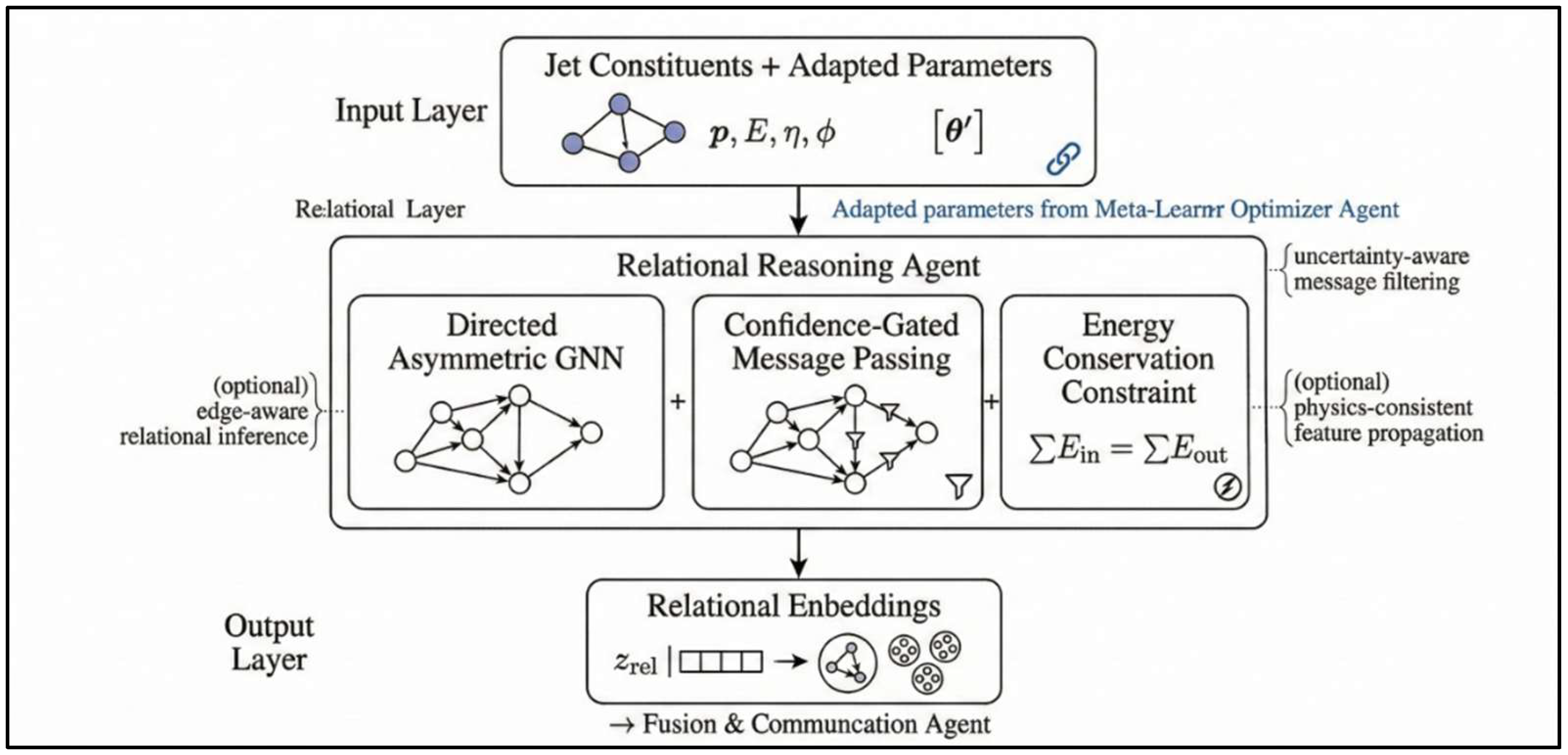
2. Relational Reasoning Agent: Overcomes limitations of Static GNN [5] by establishing a directed, asymmetric graph reasoning. It works with the physics-aware confidence gating that prune or reweights the edges based on the kinematic constraints so that message passing only happens between physically correlated clusters of particles.
Figure 3.
Relational Reasoning Agent combining directed asymmetric GNN, confidence-gated message passing, and energy conservation constraints to generate physics-consistent relational embeddings from jet constituent inputs.
Figure 3.
Relational Reasoning Agent combining directed asymmetric GNN, confidence-gated message passing, and energy conservation constraints to generate physics-consistent relational embeddings from jet constituent inputs.
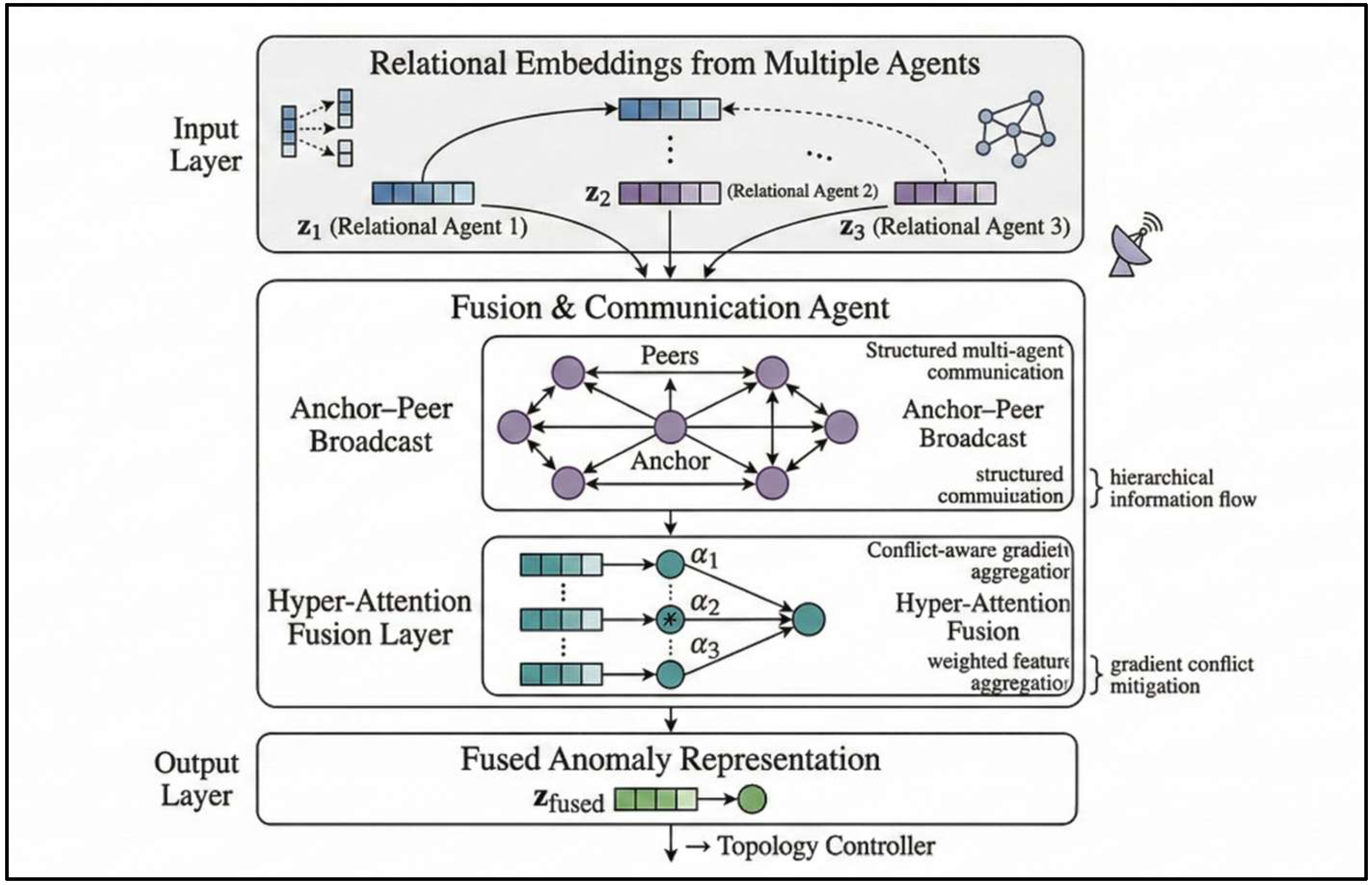
3. Fusion & Communication Agent: This agent manages how information is shared across the multi-agent system without getting "diluted". Mitigates gradient interference and signal dilution through an anchor–peer broadcast protocol governed by a hyper-attention mechanism [9]. The mechanism selectively amplifies dominant anomaly-relevant signals, while maintaining local relational consistency and stabilizing gradient flow.
Figure 4.
Fusion & Communication Agent aggregating relational embeddings from multiple reasoning agents via anchor-peer broadcast and hyper-attention fusion to produce a unified anomaly representation for the Topology Controller.
Figure 4.
Fusion & Communication Agent aggregating relational embeddings from multiple reasoning agents via anchor-peer broadcast and hyper-attention fusion to produce a unified anomaly representation for the Topology Controller.
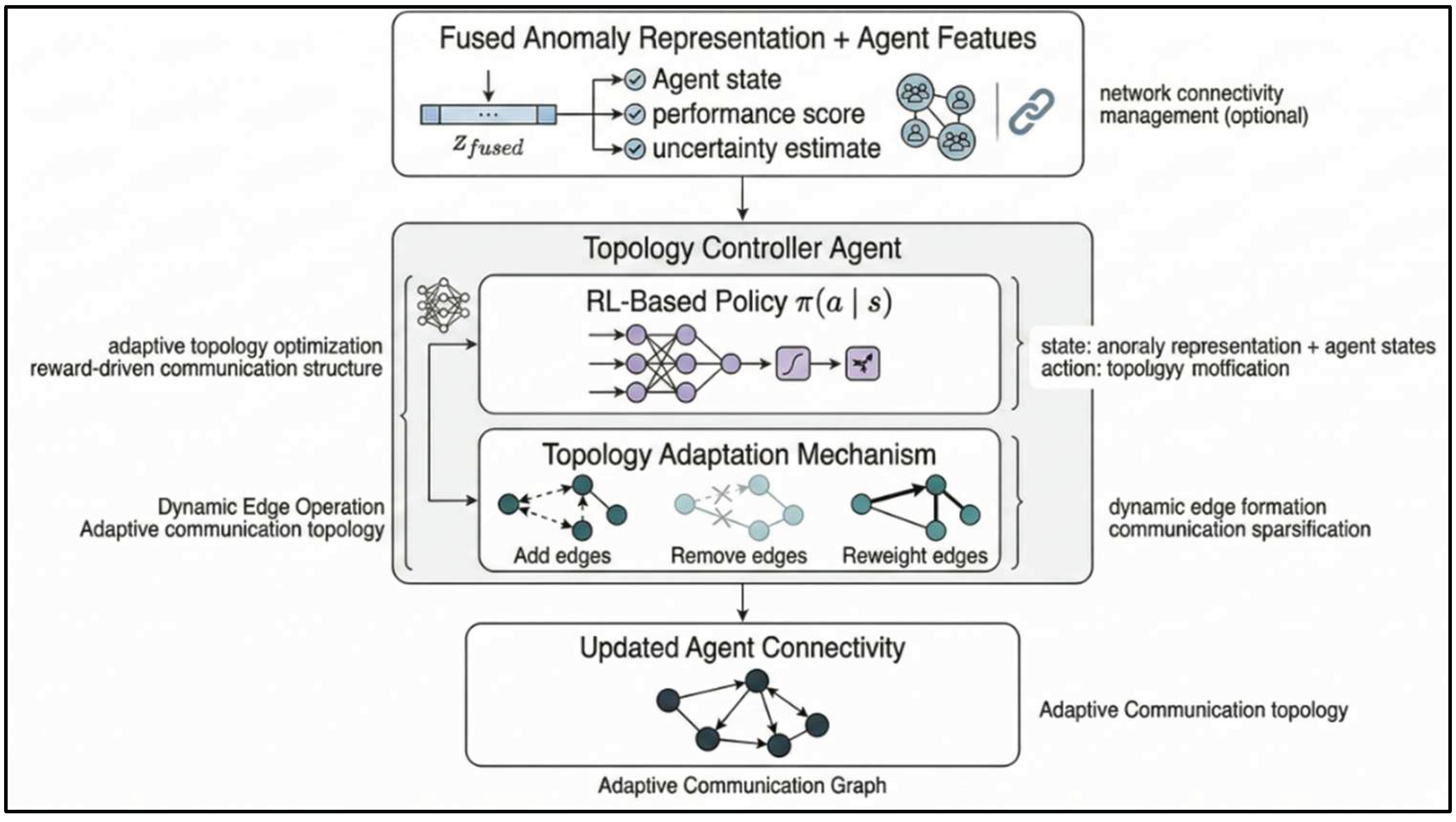
4. Topology Controller Agent: This agent is the "architect" that determines the structure of the team itself. Controls the communication between agents following an approach by self-organizing agents with reinforcement learning [10]. It generates an event-dependent policy that dynamically rewires agent connect on physical characteristics which allows dynamic reconfiguration of structures.
Figure 5.
Topology Controller Agent dynamically rewiring inter-agent communication using an RL-based policy, performing event-conditioned edge addition, removal, and reweighting to yield an adaptive communication graph.
Figure 5.
Topology Controller Agent dynamically rewiring inter-agent communication using an RL-based policy, performing event-conditioned edge addition, removal, and reweighting to yield an adaptive communication graph.
The Meta-Learner treats each jet as a task instance and employs rapid adaptation to improve robustness and maintain physical consistency [8]. The Relational Reasoning Agent builds directed constituent graphs for the hierarchical jet formation and controls the propagation using the confidence scores and constraints sensitive to conservation [5]. The Fusion & Communication Agent aggregates representations using structured attention [9], while the Topology Controller optimizes connectivity policies through reinforcement learning [10].
All four agents are a part of a closed feedback loop with calibrated parameters providing input for relational reasoning; relational outputs being fused together into a common representation of the anomaly; the fused signal providing input for topology adaptation; and updated connectivity providing input for further reasoning and fusion. This constant adaptation helps PhySa-MAS to be robust to noise, domain shifts, and complex event interactions.

Table 1.
Agent-Level Functional Design and Physics Constraints in the Proposed PhySA-MAS.
| Agent | Function | Input | Output | Physics Integration | Adaptivity |
|---|---|---|---|---|---|
| Meta-Learner Optimizer | Event-level adaptation | Raw jet features, event context | Calibrated agent parameters | Maintains energy/momentum consistency | Inner/outer-loop meta-learning |
| Relational Reasoning | Physics-informed asymmetric GNN | Node embeddings, calibrated parameters | Node messages, confidence scores | Energy conservation, directional edges | Event-aware message weighting |
| Fusion & Communication | Structured multi-agent aggregation | Node messages, confidence scores | Unified anomaly signal | Preserves local feature consistency | Anchor–peer hyper-attention |
| Topology Controller | Dynamic inter-agent graph rewiring | Fused signals, intermediate outputs | Updated agent connectivity | Physically plausible edges | RL-based edge optimization |
3. Meta-Learner Optimizer: Fast Adaptation to Pile-Up
In high-energy particle physics, pileup occurs when multiple proton-proton collisions happen simultaneously during a single bunch crossing, creating a complex background of overlapping signals [1,2]. This background is dynamic, with its density scaling with the instantaneous luminosity of the beams. For example, earlier experiments experienced an average pileup multiplicity 〈Nₚᵤ〉≈ 5 [2], Run 3 routinely reaches 〈Nₚᵤ〉≈ 60 interactions per crossing, and the upcoming High-Luminosity LHC is expected to operate with up to ~200 [4].
In jet-based anomaly detection, different pileup conditions pose essential challenges [1,2]. In poor luminosity regimes, the detector signals are relatively clean and have minimal, overlapping collisions. On the other hand, the high luminosity regimes introduce severe stochastic fluctuations in the energy density so that they can obfuscate real anomalous signatures [4]. Standard machine learning models trained according to a set luminosity assumption tend to become invalid under such distribution shifts, resulting in false positives in high noise or a failure to detect signals in cleaner regimes [5].
To tackle this variance, various meta-learning technique known as model-agnostic meta-learning (MAML) inspired fast-weight adaptation [11], can be used to effectively implement a luminosity-aware tuner. Each of the jet events or mini-batches is treated as a task under a given pileup configuration, and some parameters of the agent, such as attention scaling factors and fusion coefficients are made to be conditional on local pileup properties. The meta-learner is therefore able to learn initialization parameters that can quickly adapt to new pileup regimes through only a small number of gradient steps [11], which guarantees the robustness and pileup-aware nature of anomaly detection.
Figure 2.
Physics-Informed Meta-Learning for Adaptive Jet Anomaly Detection under Pile-Up Variations.
Figure 2.
Physics-Informed Meta-Learning for Adaptive Jet Anomaly Detection under Pile-Up Variations.
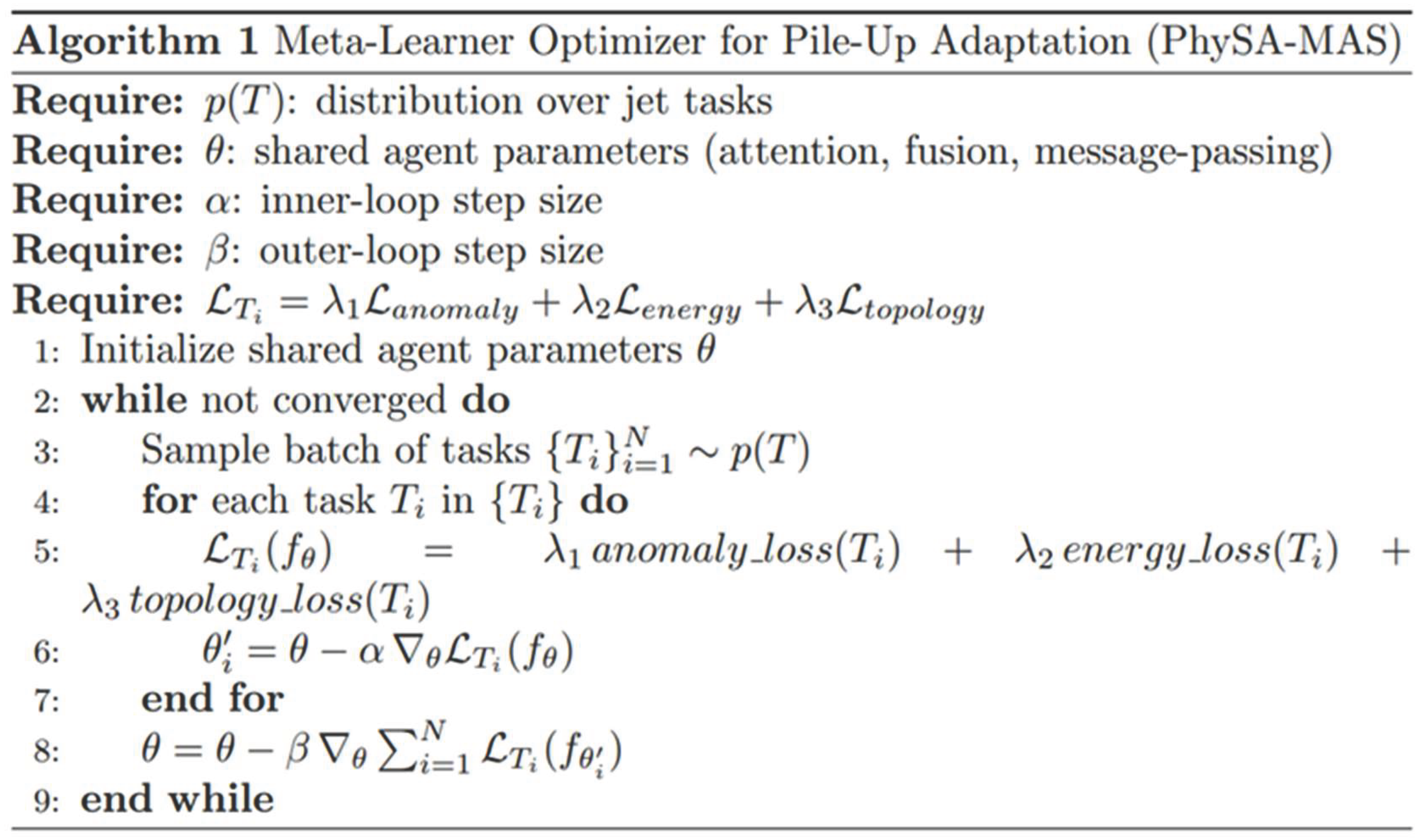
Formally, let each task correspond to a jet event or mini-batch with a specific pile up density, detector noise profile and energy contamination pattern. The model is comprised of the coordinated agents (or a subset of the agents that share common parameters) while optimization is done with respect to a physics-aware loss function with relational consistency and conservation constraints [9]. This formulation allows for the tasks to be adapted specially without losing the structural coherence in particle-based representations [6,7,16].
The MAML-based Meta-Learner agent learns quantities such that a single step of gradient descent under a new pile-up condition takes the system towards a physically consistent representation, therefore reducing false anomaly signals, resulting from detector artifacts [11].
Table 2.
Inner–Outer Loop Meta-Learning Mechanism and Its Physics-Constrained Integration within the Proposed PhySA-MAS Framework.
Table 2.
Inner–Outer Loop Meta-Learning Mechanism and Its Physics-Constrained Integration within the Proposed PhySA-MAS Framework.
| Aspect | Description | Inputs | Outputs | Physics Integration | Adaptivity |
|---|---|---|---|---|---|
| Inner-Loop Updates | Task-specific parameter updates to reduce pile-up and detector noise | Jet features, event context | Adapted agent parameters | Maintains energy/momentum consistency | Event-specific, fast updates |
| Outer-Loop Optimization | Generalization across tasks to maintain robust performance | Distribution of tasks | Updated meta-parameters | Ensures consistent physical reasoning | Global, across-luminosity |
| Integration with Relational Agent | Calibrated parameters improve downstream reasoning | Calibrated inner-loop outputs | Refined relational features | Preserves physically meaningful relationships | Adaptive to changing pile-up |
| Real-Time Application | Enables high-throughput anomaly detection | Live jet data | Rapidly adapted embeddings | Physically consistent features | Low-latency, scalable |
4. Asymmetric GNNs for Relational Reasoning
Relational modeling of jet constituents in HEP benefits from the explicit inclusion of physical hierarchies and energy conservation in graph structures [1,2,6,7]. The Relational Reasoning Agent in PhySA-MAS makes use of asymmetric graph building, confident message passing, and energy conservation regularizer to generate physics consistent and anomaly sensitive representations.
Node features for each constituent include standard kinematic variables (pT, η, φ, E) relative to the jet axis, following established practice in constituent-level jet representations. Edge features encode pairwise geometric and kinematic quantities including ΔRij and momentum fraction zij. Jet constituents are assumed to be particle-flow candidates pre-clustered via the anti-kT algorithm.
4.1. Asymmetric Graph Construction
Jet constituents are modeled as nodes in a directed graph, where edges capture asymmetric relationships such as leading-to-soft radiation influence, reflecting the hierarchical structure of jet formation [3,4]. Formally, each jet is represented as , where () contains (N) constituents. Directed edges are defined so that information flows from higher pT leading nodes to lower pT daughter nodes within a local radius (). This ensures that the core jet representation remains robust to noise from the soft sector, while preserving the causal structure of parton fragmentation.
4.2. Confidence-Gated Message Passing
Each node has a learnable confidence, which represents the degree to which it is relevant to potentially anomalous substructures [6,7]. During message passing, this score gates outgoing signals so that high-confidence nodes propagate stronger messages, while nodes dominated by pile-up, soft radiation, or detector noise are suppressed. In training, nodes that consistently improve anomaly detection gradually acquire higher confidence scores, enabling selective relational reasoning and reducing interference from irrelevant features.
4.3. Energy Conservation Regularizer (Physics Constraint)
An energy conservation regularizer is incorporated in every message-passing layer in order to implement physical consistency. At the node level, the accumulated outgoing message energies may not be more than the input energy of any node, so there is no amplification of unphysical influence. At the graph level, the overall energy sent through is made soft to be equal to the reassembled jet energy. It is a soft constraint that penalizes energy deviation measured by the energy, which directs the network to concentrate on significant energy flows, and stabilizing training [9]. The inclusion of these physics’ principles in the purely relationship propagation also helps the agent to generate more reliable anomaly detection without the need of post-hoc corrections.
These elements can be combined together to allow the Relational Reasoning Agent to reason about physics, direction-aware, and anomaly-oriented graph reasoning and to have strong embeddings in downstream multi-agent fusion and topology modules.
5. Fusion & Communication: Anchor-Peer Hyper Attention
In PhySA-MAS, Fusion & Communication Agent combines the reports of several other dedicated agents into one anomaly signal [6,7]. In contrast to more traditional models which use simple concatenation or pooling, it uses a designed Anchor-peer-Broadcast scheme to selectively boost the relevant signal and minimise conflicts on the feature heterogeneity [12,13].
5.1. Anchor-Peer Framework
The anchor-peer design differentiates between the anchor agents, the ones that give high-confidence anomaly signals and the peer agents, the ones that give contextual information. These anchors transmit their outputs to peers, which use a hyper-attention mechanism that is conditioned on event-level features, such as particle kinematics and a graph topology [12]. This is a selective aggregation, which avoids soaking up anomaly signals that are rare and thus learning becomes concentrated on the most useful interactions.
5.2. Reducing Gradient Conflict
Broadcasting is structured, which removes gradient conflict [13]. Gradient flow is guided by anchor, while peers influence each other depending on their relevance, which limits the discontinuous interference of opposing signals. This avoids overfitting to noise by stabilizing training and converting into the jet pattern anomalies. Furthermore, it is fast.
5.3. Selective Amplification of Anomaly Signals
The fusion agent selectively enhances patterns that are relevant to anomaly by conditioning peer attention to features of events. Outliers in jet substructure or anomalous energy patterns receive enhanced importance in a fused signal, and this increases the sensitivity of detection, when the background processes are dominant (e.g. in comparison to the background signal) [12,14].
5.4. Integration within PhySA-MAS
The combined output is sent to the Topology Controller, which is the completion of the multi-agent loop. This allows structural adjustment downstream and interpretability, showing what anchors and peer interactions were the most important to anomaly detection. The mechanism offers an integrated and physics-conscious mechanism, which increases the strength and sensitivity of jet abnormality recognition.
6. Self-Organizing Topology via Reinforcement Learning
6.1 Motivation
Generally, he communication graphs of interest are fixed, and this is not realistic in highly fluctuating jet events [7,10]. PhySA-MAS addresses this shortcoming by permitting the adaptation of the agent topology dynamically according to each event and enhancing its robustness, sensitivity and the exploitation of anomalies.
6.2. Topology Controller based on RL
Topology Controller Agent tries to control the inter-agent communication with the help of reinforcement learning (RL) [10,15]. It unlearns a policy and adds, removes or updates weights between agents using jet-level observables and intermediate representations. Reward functionality provides a balance between anomaly recognition capabilities, communication performance, and physical realism to provide topology adjustment to be effective and comprehensible.
6.3. Agent Re-Wiring of Anomalous Jets
There is also topological interpretation that is offered by topology adaptation. When anomalies occur, the pattern of communication is not the same as that of the background jets, and some of the agents, like relational or fusion anchors, become central to the whole process. The particular topological patterns tend to be associated with the particular classes of anomalies [10,15]. The patterns of rewiring are valuable to visualize the reasoning of the system, and then it becomes clear why certain events are identified as anomalous.
7. Training Strategy
PhySA-MAS uses a training strategy based on the curriculum to have stable learning in its multi-agent architecture [6,10]. In the first technique, the relational and fusion agents are trained with a fixed communication topology, and the network is able to learn strong representations without the additional complexity of adaptive connections. This is followed by the introduction of meta-learning adaptation, operating under controlled variations of the pile-up, favoring the adaptation of agent parameters to each event, remaining physically consistent [6,8]. Lastly, the topology learning component gets triggered, in which the Topology Controller tries adding, removing, and reweighting edges using constrained action space in order to prevent unphysical or unstable structures [10,15].
This re-arranged curriculum alleviates the instability that is typical when meta-learning is used together with reinforcement learning. PhySa-MAS does so by learning first complexity before adapting, and lastly by maximizing the structure. Consequently, PhySA-MAS is able to learn to have robust, physics-aware anomaly detection with interpretable agent interactions and stable training dynamics.
8. Predicted Benefits of Jet Anomaly Detection
PhySA-MAS offers a number of unique benefits to the jet anomaly detection:
- Quicker convergence: The anchor-peer hyper-attention mechanism of conflict-stable gradient flow synchronizes training and speeds it up by eliminating interference due to dissimilar feature importance [5].
- Event-level adaptivity and interpretability: The self-organizing agent topology, controlled by reinforcement learning, reveals important inter-agent interactions and topological structures that emerge during anomalous events. These structures provide structural insights into the reasoning process of the system [10].
Collectively, these characteristics can be used to detect anomalies with physics sensitivity, adaptability, and interpretability, as well as mitigating the weaknesses of entirely stationary, monolithic designs and providing well-behaved detection in the presence of complicated, non-stationary processes.
9. Conclusions
The idea of MAS, its adaptability and emergent intelligence reasoning capabilities can be applied to diverse problems of HEP. PhySA-MAS is a move in the direction of physics-native agentic learning, in which inductive biases, physical constraints and structural adaptivity are built into the architecture as opposed to being imposed on it externally. The framework shows how multi-agent systems can evolve in non-stationary, high-dimensional, and noisy environments as it is interpretable and physically consistent by implementing meta-learning, relational reasoning, structured fusion, and self-organizing topology.
Even though proposed to monitor jet anomalies in HEP, the concepts supporting PhySA-MAS can be generally extended to other non-stationary physics systems, such as astrophysics, computer-based plasma simulation and experimental particle detector measurements. Subsequent research looks towards the formalisation of theoretical guarantees of topology adaptation, the framework to impose more conservation laws and symmetries [9], the scaling of the system to run on real time LHC data streams. The idea is that agentic, physics-aware learning will become a workable and comprehensible method of inference in complex science with these developments.
References
- Cacciari, M.; Salam, G. P.; Soyez, G. Pileup subtraction using jet areas. Phys. Lett. B 2008, vol. 659(no. 1–2), 119–126. [Google Scholar] [CrossRef]
- Soyez, G. Pileup mitigation at the Large Hadron Collider. Phys. Rev. Lett. 2013, vol. 110(no. 16), 162001. [Google Scholar] [CrossRef] [PubMed]
- Dery, L. M. Weakly supervised anomaly detection in particle physics. JHEP 2021, vol. 2021(no. 5). [Google Scholar]
- Larkoski, A. J.; Moult, I.; Nachman, B. Jet substructure at the Large Hadron Collider: A review. Phys. Rept. 2020, vol. 841, 1–63. [Google Scholar] [CrossRef]
- Chen, T. Understanding deep learning requires rethinking generalization. ICLR, 2017. [Google Scholar]
- Komiske, P. T.; Metodiev, E. M.; Thaler, J. ParticleNet: Jet tagging via particle clouds. Phys. Rev. D 2020, vol. 101, 056019. [Google Scholar]
- Shlomi, J.; Battaglia, P.; Vlimant, J.-R. Graph neural networks in particle physics. Mach. Learn. Sci. Technol. 2020, vol. 2, 021001. [Google Scholar] [CrossRef]
- Nachman, B.; Shih, D. Anomaly detection with density estimation. Phys. Rev. D 2020, vol. 101, 075042. [Google Scholar] [CrossRef]
- Cranmer, B. Lagrangian neural networks. ICLR Workshop, 2020. [Google Scholar]
- Sutton, R. S.; Barto, A. G. Reinforcement Learning: An Introduction, 2nd ed.; MIT Press, 2018. [Google Scholar]
- Finn, C.; Abbeel, P.; Levine, S. Model-agnostic meta-learning for fast adaptation of deep networks. Proc. ICML, 2017. [Google Scholar]
- Vaswani, A. Attention is all you need. Advances in Neural Information Processing Systems 2017, vol. 30. [Google Scholar]
- Kim, H. Hypergraph attention networks. ICLR, 2020. [Google Scholar]
- Lee, J. Graph attention networks. ICLR, 2019. [Google Scholar]
- Gasse, M. Exact combinatorial optimization with graph convolutional networks. [CrossRef]
- Usman, M. Particle Multi-Axis Transformer for Jet Tagging. arXiv 2024, arXiv:2406.06638. [Google Scholar] [CrossRef]
Disclaimer/Publisher’s Note: The statements, opinions and data contained in all publications are solely those of the individual author(s) and contributor(s) and not of MDPI and/or the editor(s). MDPI and/or the editor(s) disclaim responsibility for any injury to people or property resulting from any ideas, methods, instructions or products referred to in the content. |
© 2026 by the authors. Licensee MDPI, Basel, Switzerland. This article is an open access article distributed under the terms and conditions of the Creative Commons Attribution (CC BY) license (http://creativecommons.org/licenses/by/4.0/).
Copyright: This open access article is published under a Creative Commons CC BY 4.0 license, which permit the free download, distribution, and reuse, provided that the author and preprint are cited in any reuse.


