

Submitted:
11 March 2026
Posted:
12 March 2026
You are already at the latest version
Abstract
Aquaculture plays a strategic role in food security and rural development in coastal regions. However, structural, economic, and institutional constraints affect small-scale producers in heterogeneous ways. This study analyzes how small-scale aquaculture producers in Manabí (Ecuador) perceive the main challenges affecting their activity, based on a typology comprising three production systems: Backyard, Transitional, and Commercial. A structured questionnaire was administered to 98 producers, including 20 variables assessed using a five-point Likert scale. The analysis combined non-parametric univariate tests (Kruskal–Wallis with Dunn post-hoc comparisons) and multivariate techniques to identify statistically significant differences and structured perception patterns across production systems. Significant differences were detected in variables related to biological input supply, market conditions, and structural production constraints. In particular, larvae and fingerling supply, selling prices, buyer availability, and pond surface area showed differentiated perception patterns across systems. Most differences occurred between Backyard farms and the other two production systems, while Transitional and Commercial farms displayed more similar perception profiles. Transversal constraints shared across systems included high feed costs, energy expenditure, and regulatory requirements. Principal Component Analysis identified two main perception gradients related to market and input constraints and to structural and managerial limitations. Discriminant analysis further confirmed the ability of these dimensions to differentiate production systems. These findings highlight the multidimensional nature of constraints affecting small-scale aquaculture and suggest that production systems are better interpreted as gradients of pressures rather than strictly discrete categories. The results underline the need for adaptive governance approaches combining transversal measures with system-specific interventions. Overall, the study provides empirical evidence to support the design of differentiated and context-sensitive policies aimed at strengthening the sustainable development of small-scale aquaculture in Manabí and similar territories.
Keywords:
small-scale aquaculture
; farmer perceptions
; production systems
; multivariate analysis
; governance
1. Introduction
Small-scale aquaculture increasing relevance as a strategic component of food systems and rural development in developing countries. It contributed to food security, rural employment, and local livelihoods in communities highly dependent on aquatic resources [1,2,3]. By providing a stable source of animal -protein, aquaculture complemented capture fisheries and strengthened local food system resilience [4,5].
In the coastal province of Manabí, Ecuador, small-scale aquaculture represented a key livelihood strategy linked to family farming and local value chains. Production systems were predominantly small and family-managed [6,7]. They operated with low capitalization and limited technological intensity [3,8]. These characteristics shaped exposure to price volatility, environmental pressures, and regulatory requirements [9].
Research and public policies in Ecuador concentrated mainly on marine shrimp farming. Freshwater systems based on native species received less analytical and institutional attention [10,11]. This situation created a knowledge gap regarding the structural conditions, challenges, and development pathways of small-scale freshwater aquaculture [5].
Recent research described aquaculture challenges as multidimensional. Market volatility, rising feed and energy costs, and value-chain asymmetries shaped economic viability [9,12]. Administrative procedures, sanitary standards, and access to public support influenced formalization and innovation processes [13,14]. Social factors such as labor availability and generational succession affected long-term sustainability [5]. These dimensions interacted and generated differentiated pressures across production systems.
Typological and comparative studies showed that production scale, species composition, technological intensity, and degree of formalization structured heterogeneous aquaculture realities [8,15]. System-based approaches provided analytical tools to capture this diversity and supported differentiated governance strategies [15,16].
Within this context, farmers’ perceptions emerged as a relevant analytical lens. Survey-based studies applied Likert-type instruments to assess perceived constraints, risks, and governance conditions [12,17]. Rather than relying exclusively on parametric comparisons, recent research increasingly employed non-parametric statistical tests and multivariate techniques to analyze perception-based survey data, particularly when variables are measured using ordinal Likert scales [18]. Non-parametric methods such as the Kruskal–Wallis test allow robust comparisons across groups without assuming normality, while dimensionality-reduction techniques such as Principal Component Analysis (PC) help identify structured perception gradients underlying complex survey responses. When combined with multivariate classification approaches, such as discriminant analysis, these methods allow researchers to evaluate whether production systems differ not only in individual constraints but also in their overall perception profiles. These studies aimed to capture the multidimensional nature of structural and institutional constraints and to evaluate their distribution across producer typologies. The combined use of univariate and multivariate approaches became a well-established methodological strategy in research grounded in predefined production systems [19,20]. This framework generated system-sensitive evidence relevant for governance design in territorially heterogeneous contexts.
The integration of producers’ perceptions of the multidimensional challenges of aquaculture within a previously defined typology is underdeveloped and very limited in the contexts of small-scale farmers. A structured comparison of perception profiles across production systems contributed to strengthening adaptive and differentiated governance strategies.
The objectives of this study were to identify the main challenges perceived by aquaculture producers in Manabí, to evaluate statistically significant differences in the perceived importance of these challenges across production systems using non-parametric univariate analysis, and to explore whether the multidimensional perception structure summarized through PC allowed multivariate discrimination among systems. The study aimed to generate system-specific evidence to support adaptive governance and context-sensitive policy design for small-scale aquaculture.
2. Materials and Methods
2.1. Study Area and Survey
Manabí province was selected as a case study because it is one of Ecuador’s main coastal provinces in terms of aquaculture activity and exhibits a high diversity of production systems, species composition, and degrees of formalization [6,11].
The identification of the main challenges affecting aquaculture enterprises was conducted using a participatory approach. A working group of experts was formed, consisting of three university professors with experience in aquaculture, three technicians from the sector, and three aquaculture producers [20,21]. This composition enabled the integration of scientific, technical, and experiential knowledge, as recommended in studies on aquaculture governance and sustainability [5,22]. Through joint working sessions, the group identified and agreed upon a set of challenges considered relevant for the performance and sustainability of aquaculture enterprises [12,13].
Based on this initial selection, a structured questionnaire was developed within the framework of the Alternative Species Network, jointly coordinated by the University of Córdoba (Spain), the Higher Polytechnic Agricultural School of Manabí (ESPAM), and the Quevedo State Technical University (UTEQ), the latter two located in Ecuador.
The survey included 90 questions related to productive, structural, and social aspects of aquaculture enterprises, widely described in Cueva et al. [6]. Twenty items specifically focused on assessing the perceived importance of existing challenges (Table 1). Were organized into three main groups of challenges, defined a priori by the working group during the instrument design phase, not resulting from any exploratory statistical procedure [16]. This classification was established during the questionnaire design phase by the working group, with the aim of organizing the identified challenges according to their economic, production-related, and socio-institutional nature, and of facilitating their interpretation from a systems-based perspective. This approach was consistent with previous studies that conceptualize aquaculture challenges as a multidimensional phenomenon and rely on a priori conceptual classifications to organize and interpret farmers’ perceptions, without assuming an underlying factorial structure [5,8,9].
The first group, Market Conditions and Input Costs, comprised five items related to market functioning and the costs of key production inputs: P3_LPRI, P4_FPRI, P5_SSELL, P6_FSELL and P11_FEEDC. This block encompassed aspects related to output prices, market access, and the cost of key inputs, highlighting the central role of market conditions and production costs in determining the economic viability of aquaculture enterprises, particularly in small-scale contexts [9,12].
The second group, Farm Production and Operational Constraints, consisted of nine items associated with production, technical, and operational limitations at the farm level: P1_LSUP, P2_FSUP, P9_LBUY, P13_SECUR, P14_ADMIN, P15_PONDS, P16_SUCC, P19_INFRA and P20_ENERG. This block included aspects related to the supply of biological inputs, production infrastructure, operational management, and energy consumption, capturing internal constraints that condition production efficiency and the capacity for technological adaptation in aquaculture units [3,8].
The third group, Socio-Institutional and Environmental Factors, integrated six items linked to social, institutional, and environmental factors influencing farm performance and sustainability: P7_SBUY, P8_FBUY, P10_FGBUY, P12_SUBS, P17_ENVIR and P18_REGUL. This block considered aspects related to market structure, public support, regulatory frameworks, and environmental pressures, in line with recent approaches highlighting the relevance of these dimensions for understanding the structural and long-term challenges of small-scale aquaculture [5,13,15].
The importance of each challenge was measured using a five-point Likert-type scale, ranging from 1 (low importance) to 5 (high importance). The questionnaire was pre-tested and refined to ensure clarity, avoid ambiguity, and promote consistent interpretation among respondents, following established recommendations for survey-based perception studies [23,24]. After validation, the survey was administered to a stratified and proportional sample of 98 aquaculture producers in the province of Manabí, Ecuador. The sampling design aimed to adequately represent the diversity of aquaculture production systems present in the territory. Stratified sampling has been shown to be particularly appropriate for perception studies conducted in heterogeneous small-scale aquaculture contexts [8,15]. Data collection was carried out between 2022 and 2023.
2.2. Typology of Aquaculture Enterprises in Manabi
The present study built upon a previously developed and accepted typology that identified three representative aquaculture production systems in the province of Manabí, Ecuador [6] (Figure 1).
System 1 (Backyard): This system comprised very small-scale, predominantly family-based enterprises with low capitalization, limited infrastructure, and low technological intensity [25]. Production relied largely on local resources and was mainly oriented toward local markets or household consumption, with weak integration into formal value chains. This typology is commonly referred to in the local context as backyard production, a term used to describe small household-level operations characterized by informal management practices and minimal external inputs [26,27]. Farms within this system primarily cultivated native fish species adapted to local environmental conditions, such as Chame (Dormitator latifrons), Vieja azul (Andinoacara rivulatus), Vieja Colorada (Cichlasoma festae) and Guanchiche (Hoplias microlepis) [11,28]. Conceptually, this system was associated with high vulnerability to market, environmental, and institutional constraints.
System 2 (Transition): The second system included small and medium-sized enterprises with intermediate levels of intensification and formalization [9]. These farmers combined traditional practices with the partial adoption of technical and organizational improvements and showed a greater market orientation and increasing integration into structured value chains. High-yield invasive species predominated, mainly tilapia (Oreochromis spp.) and shrimp (Litopenaeus vannamei), along with a smaller proportion of native species [5]. This system represented a transitional stage, in which productivity gains coexisted with persistent limitations related to financing, technical assistance, and regulatory compliance [5,9].
System 3 (Commercial): The third pattern encompassed more consolidated enterprises of shrimp (Litopenaeus vannamei), characterized by larger production scale, higher capitalization, and more intensive use of technologies and standardized management practices [1,12]. These enterprises were companies fully dedicated to shrimp farming and operated as formalized businesses integrated into national and international markets [3,9]. While these farms exhibited higher levels of productivity and organizational maturity, they also faced specific challenges related to higher operational costs and stricter sanitary and environmental requirements associated with intensive aquaculture production systems [10,12].
2.3. Statistical Analysis
Twenty Likert-scale variables were used to capture fish farmers’ perceptions of the main challenges affecting aquaculture. The Likert-scale data were treated as continuous variables, an approach commonly adopted in applied and social sciences when scales include five or more response categories and sample sizes are adequate [29].
Given the ordinal nature of Likert-scale responses and the presence of three independent production systems, differences in the perceived importance of each challenge were evaluated using the non-parametric Kruskal–Wallis test. This test compares the distribution of scores among groups without assuming normality or homoscedasticity, which makes it appropriate for ordinal perception data.
The Kruskal–Wallis test was applied independently to each of the twenty variables (P1–P20), using the three aquaculture production systems (Backyard, Transitional, and Commercial) as grouping factors. To account for multiple comparisons, p-values were adjusted using the Holm sequential correction, which controls the family-wise error rate. Values represent median scores of perceived importance. Pairwise differences among production systems were assessed using Dunn’s multiple comparison test with Holm-adjusted p-values.
Variables showing statistically significant differences after multiple-testing adjustment were interpreted as system-specific constraints, while variables with high scores and no significant differences were interpreted as cross-cutting constraints shared between production systems.
However, while univariate tests identify differences at the level of individual variables, they do not capture the multidimensional structure of farmers’ perception profiles. Given that aquaculture challenges are conceptually interrelated and operate simultaneously within production systems, a multivariate approach was also implemented.
To reduce the dimensionality of the perception dataset and identify the main underlying gradients structuring farmers’ responses, a Principal Component Analysis (PC) was performed on the standardized variables (P1–P20). PC transforms the original correlated variables into a smaller set of orthogonal components that capture the maximum variance in the dataset, allowing the identification of the main perception dimensions. The first principal components explaining the largest proportion of variance were retained and used as synthetic variables representing the multidimensional structure of perceived constraints.
Subsequently, a canonical discriminant analysis was conducted using the selected principal components as predictors and the three production systems (Cluster variable) as the grouping factor. This procedure allowed the evaluation of whether the reduced perception dimensions were able to statistically discriminate among aquaculture production systems.
The discriminant analysis provided canonical functions summarizing the multivariate separation among systems and identified the perception dimensions contributing most strongly to system differentiation.
All statistical analyses were performed using STATGRAPHICS Centurion XVI.I. and STATISTICA ver 12.0 (StatSoft, Inc., Tulsa, OK, USA).
3. Results
3.1. Differences in Perceived Challenges According to the Typology of Aquaculture Enterprises in Manabí
To address the study’s comparative objective, differences in the perceived importance of each challenge across the three production systems were examined using the non-parametric Kruskal–Wallis test for each Likert item (P1–P20), with Holm adjustments to control for multiple testing (Table 2). The first group of variables was related to biological input supply and input prices. In particular, difficulties in the supply of larvae and fingerlings (P1_LSUP, P2_FSUP) and their associated prices (P3_LPRI, P4_FPRI) showed clear differences among systems after Holm adjustment (p < 0.05).
A second group of variables was associated with market and commercialization conditions. Variables related to selling prices and the number of available buyers (P5_SSELL, P6_FSELL, P7_SBUY, P8_FBUY) also differed significantly across production systems, indicating that market access and price conditions are perceived differently depending on the level of market integration of each system.
Pairwise comparisons using Dunn’s test indicated that most differences were driven by contrasts between the Backyard system and the other two production systems, while Transitional and Commercial farms showed more similar perception profiles.
A third difference was related to structural farm characteristics. The variable associated with available pond surface area (P15_PONDS) also differed significantly among systems, suggesting that farm scale remains an important factor distinguishing production models.
In contrast, several variables showed homogeneous perception patterns across systems, indicating transversal constraints affecting aquaculture producers regardless of production model. In particular, feed costs (P11_FEEDC), energy consumption (P20_ENERG), and regulatory requirements (P18_REGUL) received similar assessments across the three production systems.
3.2. Multivariate Discrimination of Production Systems Based on Farmers’ Perceptions
To explore the multivariate structure of farmers’ perceptions, a Principal Component Analysis (PC) was applied to the twenty Likert variables (P1–P20). The PC in Table 3 showed that the first two principal components explained 44.18% of the total variance (PC1 = 29.84%; PC2 = 14.34%). These components were therefore retained as synthetic variables summarizing the multidimensional perception structure.
The loading matrix indicated two clearly interpretable dimensions. PC1 was mainly associated with market and biological input constraints, including access to larvae and fingerlings, the number of buyers, and selling prices. PC2 was related to structural and managerial constraints at the farm level, including generational succession, public support, infrastructure maintenance, and commercialization channels.
After Varimax rotation, the variables with the highest loadings on PC1 included P2_FSUP, P4_FPRI, P6_FSELL, P8_FBUY, P5_SSELL, and P7_SBUY. These variables captured constraints linked to biological input supply and market conditions. PC2 was primarily associated with P9_LBUY, P12_SUBS, P16_SUCC, and P19_INFRA, reflecting structural and institutional limitations affecting farm management.
Using these reduced dimensions, a discriminant analysis was conducted to evaluate whether the perception structure summarized by the PC could differentiate the three production systems (Figure 2). The discriminant model used PC1 and PC2 as predictors and the production system cluster as the grouping variable. Cross-validated classification showed an overall accuracy of 70%, indicating a moderate but meaningful capacity of perception dimensions to discriminate among aquaculture systems.
The canonical discriminant analysis confirmed a statistically significant multivariate differentiation among systems. The first discriminant function explained 82.32% of the between-group variance, with an eigenvalue of 0.956 and a canonical correlation of 0.699. The Wilks’ Lambda test confirmed the statistical significance of this function (Λ = 0.420; χ² = 54.34; df = 12; p < 0.001). These results indicate that the linear combination of perception variables summarized in this dimension effectively discriminated among production systems.
The discriminant space revealed a clear separation pattern. The centroid of the Backyard system was located at positive values along the first discriminant axis. This position indicates a perception profile strongly associated with constraints related to market access and biological input supply. In contrast, Transitional and Commercial systems appeared closer to each other along this axis, reflecting more similar perception structures.
This pattern was also visible in the discriminant plot (Figure 3), where Backyard farms formed a clearly differentiated group, while Transitional and Commercial systems partially overlapped. These results suggest that differences among production systems are better interpreted as gradients of perceived constraints rather than strictly separated categories.
The structure coefficients provided further insight into the variables contributing to system differentiation (Table 4). Seven variables showed the strongest correlations with the first discriminant function: P4_FPRI, P2_FSUP, P7_SBUY, P5_SSELL, P6_FSELL, P1_LSUP, and P8_FBUY. These variables were mainly associated with biological input supply and market conditions.
The strongest contributors were P4_FPRI (high price of fingerlings) and P2_FSUP (difficulties in fingerling supply), followed by variables related to commercialization, including P7_SBUY (limited shrimp buyers) and P5_SSELL (low shrimp selling price). Additional contributions were observed for P6_FSELL (low fish selling price), P1_LSUP (larvae supply constraints), and P8_FBUY (limited fish buyers). Overall, these results indicate that system differentiation was primarily driven by variables related to input supply and market access, highlighting the central role of commercialization conditions and biological inputs in shaping perception patterns among aquaculture producers.
4. Discussion
This study shows that the challenges affecting small-scale aquaculture in Manabí vary across production systems. Constraints do not appear as a homogeneous set of problems. Instead, structural, market, and institutional pressures combine differently depending on the production model. The analytical approach adopted in this study made it possible to identify both individual constraints and broader perception patterns. Non-parametric comparisons revealed statistically significant differences among systems, while multivariate analysis captured the overall perception structure underlying farmers’ responses.
The results reveal a clear distinction between system-specific constraints and transversal sectoral pressures. Significant differences were detected mainly in variables related to biological input supply, market conditions, and structural production factors. These results are consistent with previous studies highlighting the internal heterogeneity of small-scale aquaculture systems and the role of scale, technological intensity, and value-chain integration in shaping production constraints [8,9,15]. In particular, variables associated with seed availability, input prices, selling prices, and market access differed significantly across systems. Post-hoc comparisons showed that these differences were primarily driven by contrasts between Backyard farms and the other two production systems. Transitional and Commercial farms displayed more similar perception profiles.
In contrast, several constraints appeared consistently across systems. Feed costs, energy expenditure, and regulatory requirements were perceived as important challenges by producers regardless of production type. These results suggest that some pressures operate at the sectoral level rather than at the system level. Similar structural constraints have been widely documented in aquaculture systems, particularly in developing regions where energy prices, input costs, and regulatory compliance represent major operational challenges [3,5,12].
The multivariate analysis further clarified the structure of farmers’ perceptions. Principal Component Analysis reduced the twenty variables into two main dimensions that summarized the perception structure. The first dimension was associated with market conditions and biological input supply, while the second dimension reflected structural and managerial constraints at the farm level. These dimensions provide a simplified representation of how producers perceive the challenges affecting their activity.
The discriminant analysis confirmed that these perception dimensions are linked to the differentiation of production systems. The model showed a moderate classification accuracy (approximately 70%), indicating that perception profiles contain meaningful information about system characteristics. However, the results also revealed partial overlap between production systems. The Backyard system appeared clearly separated along the first discriminant axis, whereas Transitional and Commercial farms were positioned closer to each other.
This pattern suggests that production systems should be interpreted as gradients of constraints rather than strictly discrete categories. Similar interpretations have been proposed in recent typological studies of agricultural and aquaculture systems, where production models often share characteristics while differing in the relative importance of specific pressures [8,15]. In this context, the typology used in this study functions as an analytical framework that captures structured variation without imposing rigid boundaries between systems.
The identification of system-specific perception profiles provides useful insights for the design of differentiated management strategies. Pattern-based approaches have been increasingly applied in agri-food systems to tailor interventions to the structural characteristics of production units [20]. The results of this study support the relevance of adapting technical and governance strategies to the specific conditions faced by each production system (Table 5).
The good management practices summarized in Table 5 were derived from an integrated interpretation of the univariate and multivariate results. The structure coefficients of the canonical discriminant analysis indicated that the main variables contributing to system differentiation were primarily related to biological input supply and prices (P1_LSUP, P2_FSUP, P4_FPRI) and market conditions (P5_SSELL, P6_FSELL, P7_SBUY, P8_FBUY). These results support prioritizing interventions focused on input security and commercialization strategies, particularly for Transitional and Commercial systems. In contrast, recommendations for Backyard farms were more strongly informed by the Kruskal–Wallis results and the structural characterization of this system, especially the significance of pond surface limitations (P15_PONDS) and its low-capital, low-intensity production profile.
For Backyard farms, producers emphasized structural constraints, particularly limited pond surface area. This result reflects the small physical scale and limited expansion capacity typical of low-capitalized rural operations [3,8]. Under these conditions, incremental improvements may be more realistic than rapid intensification strategies. Interventions focusing on improved farm management, the use of native and locally adapted species, and accessible technical advisory services could strengthen system resilience. Public policies aimed at small-scale infrastructure support, seed availability, and low-cost production tools may therefore be particularly relevant for this system [4,5,13].
In Transitional farms, the perception profile was dominated by market-related variables. Selling prices and buyer availability emerged as key concerns, particularly variables associated with commercialization conditions (P5_SSELL, P6_FSELL, P7_SBUY, P8_FBUY). These farms appear more exposed to price volatility and intermediary dependence, a pattern widely discussed in aquaculture value-chain research [9,12,15]. Vulnerability in this system is therefore less associated with structural limitations and more with incomplete market integration. Strengthening managerial capacities, improving production planning, and diversifying commercialization channels could reduce this vulnerability. Policies supporting producer organizations and collective marketing strategies may also improve market access and stability.
In Commercial farms, producers expressed stronger concerns related to biological input supply and administrative requirements, particularly those associated with seed availability (P1_LSUP, P2_FSUP) and administrative management (P14_ADMIN). These factors reflect the higher operational complexity of more intensive production models. Intensified aquaculture systems are typically more sensitive to disruptions in input availability and regulatory compliance [5,13]. For this system, improved planning of biological input procurement and stronger administrative management appear particularly important. Technical advisory services and more coherent regulatory frameworks may also help improve operational efficiency and compliance.
Overall, the results indicate that uniform policy approaches are unlikely to address the diversity observed across production systems. Heterogeneous aquaculture sectors require governance strategies that combine transversal measures addressing shared structural constraints with system-specific interventions. Adaptive governance frameworks that reduce transaction costs, strengthen sector coordination, and align the actions of producers, advisors, and public authorities may therefore contribute to improving the resilience and long-term sustainability of small-scale aquaculture systems [3,5,9,13,15].
Limitations and Future Research
Producers’ perceptions provided insight into how constraints were prioritized, but they did not establish causal relationships between perceived problems and technical or economic performance. Future research could apply structural equation modelling (SEM) to explore how market, production, and institutional factors interact and influence farm outcomes. Such approaches would strengthen the empirical basis for more targeted and performance-oriented policy design, both in Manabí and in other vulnerable contexts with comparable structural conditions.
5. Conclusions
This study reported the usefulness of combining non-parametric statistical tests with multivariate analysis to examine perception-based challenges in small-scale aquaculture systems. The results confirm that the challenges faced by aquaculture producers are multidimensional and system-specific. Significant differences among systems were mainly associated with biological input supply, market conditions, and structural production constraints. These differences were largely driven by contrasts between Backyard farms and the other two systems, while Transitional and Commercial farms showed more similar perception profiles.
Two main perception dimensions emerged from the multivariate analysis. The first dimension reflected market conditions and biological input availability, while the second dimension captured structural and managerial constraints at the farm level. Each production system displayed a distinct perception profile. Backyard farms were mainly constrained by structural limitations such as limited pond surface and low investment capacity. Transitional farms were more affected by market pressures, including price volatility and dependence on intermediaries. Commercial farms emphasized biological input supply and administrative requirements, reflecting the higher complexity of more intensive production systems. Across all systems, feed costs, energy consumption, and regulatory demands emerged as transversal sectoral constraints.
The discriminant analysis showed a moderate capacity to differentiate production systems based on perception profiles, while still revealing partial overlap among systems. This pattern suggests that production systems are better interpreted as gradients of constraints rather than strictly separated categories, which aligns with recent typological approaches in aquaculture and agricultural systems research.
Overall, the differentiation among production systems was explained by the combined influence of biological inputs, market conditions, structural farm characteristics, and institutional factors. These findings highlight the need for adaptive governance strategies that combine transversal measures addressing sector-wide constraints with system-specific interventions. Finally, the analytical framework developed in this study can be applied to other small-scale aquaculture contexts characterized by structural heterogeneity. By integrating non-parametric tests with dimensionality reduction and multivariate discrimination, the approach provides a robust tool for identifying percept.
Author Contributions
Conceptualization and methodology, all authors; Formal analysis, software, data curation, data processing, A.G-M., A.G., E.B. and C.B.; Statistical analysis, A.G-M. and A.G.; Validation and investigation, A.G-M., A.G. and T.C.; Supervision, project administration, A.G., and T.C.; Data acquisition, T.C.; All authors have been involved in developing, writing, commenting, editing and reviewing the manuscript. All authors read and approved the final manuscript. All authors have read and agreed to the published version of the manuscript.
Funding
This research received no external funding.
Institutional Review Board Statement
Ethical review and approval were waived for this study because the research was based on voluntary survey responses from aquaculture producers and did not involve medical, clinical, or experimental procedures with human participants or animals. The study complied with applicable ethical standards for social research and with national regulations regarding the conduct of research activities. The research was conducted within the framework of the project “Integrated Agricultural, Agro-industrial and Natural Resource Management Program for Planning Zone 4 – Pacific for Sustainable Development” (CUP 91880000.0000.386887) funded by the Agricultural Polytechnic of Manabí “ESPAM MFL”, Ecuador.
Informed Consent Statement
Informed consent was obtained from all subjects involved in the study prior to participation in the survey. Participation was voluntary and responses were collected anonymously.
Data Availability Statement
The data presented in this study are available from the corresponding author upon reasonable request. The dataset is not publicly available due to privacy considerations related to the surveyed aquaculture producers.
Acknowledgments
The authors would like to thank the aquaculture entrepreneurs from Manabi for their collaboration.
Conflicts of Interest
The authors declare no conflicts of interest.
References
- Bostock, J.; McAndrew, B.J.; Richards, R.H.; Jauncey, K.; Telfer, T.; Lorenzen, K.; Little, D.; Ross, L.G.; Handisyde, N.; Gatward, I.; Corner, R. Aquaculture: Global status and trends. Philos. Trans. R. Soc. B Biol. Sci. 2010, 365, 2897–2912. [CrossRef]
- Troell, M.; Naylor, R.L.; Metian, M.; Beveridge, M.; Tyedmers, P.H.; Folke, C.; Arrow, K.J.; Barrett, S.; Crépin, A.-S.; Ehrlich, P.R.; Gren, Å.; Kautsky, N.; Levin, S.A.; Nyborg, K.; Österblom, H.; Polasky, S.; Scheffer, M.; Walker, B.H.; Xepapadeas, T.; de Zeeuw, A. Does aquaculture add resilience to the global food system? Proc. Natl. Acad. Sci. U.S.A. 2014, 111, 13257–13263. [CrossRef]
- Food and Agriculture Organization of the United Nations. State World Fish. Aquac. 2024: Blue Transform. Action; FAO: Rome, Italy, 2024.
- Diana, J.S. Aquaculture production and biodiversity conservation. BioScience 2009, 59, 27–38. [CrossRef]
- Troell, M.; Costa-Pierce, B.; Stead, S.; Cottrell, R.S.; Brugere, C.; Farmery, A.K.; Little, D.C.; Strand, Å.; Pullin, R.; Soto, D. Perspectives on aquaculture’s contribution to the sustainable development goals. J. World Aquac. Soc. 2023, 54, 882–905. [CrossRef]
- Cueva, T.; González-Martínez, A.; Barba, C.; Delgado-Villafuerte, C.R.; Boyer Bustamante, E.; García, A. Characterizing small-scale aquaculture enterprises in coastal Ecuador: A typological approach. Aquact. Int. 2026. Submitted.
- González-Martínez, A.; De-Pablos-Heredero, C.; González, M.; Rodriguez, J.; Barba, C.; García, A. Usefulness of discriminant analysis in the morphometric differentiation of six native freshwater species from Ecuador. Animals 2021, 11, 111. [CrossRef]
- Henriksson, P.J.G.; Tran, N.; Mohan, C.V.; Chan, C.Y.; Rodriguez, U.P. Indonesian aquaculture futures—Evaluating environmental and socioeconomic potentials and constraints. J. World Aquac. Soc. 2018, 49, 857–876. [CrossRef]
- Bush, S.R.; Belton, B.; Little, D.C.; Islam, M.S. Emerging trends in aquaculture value chain research. Aquaculture 2019, 498, 428–434. [CrossRef]
- Páez-Osuna, F. The environmental impact of shrimp aquaculture: Causes, effects, and mitigating alternatives. Environ. Manag. 2017, 60, 954–970.
- González-Martínez, A.; Lopez, M.; Molero, H.M.; Rodriguez, J.; González, M.; Barba, C.; García, A. Morphometric and meristic characterization of native chame fish (Dormitator latifrons) in Ecuador using multivariate analysis. Animals 2020, 10, 1805. [CrossRef]
- Garlock, T.M.; Asche, F.; Anderson, J.L.; Eggert, H.; Anderson, T.M.; Che, B.; Chávez, C.A.; Chu, J.; Chukwuone, N.; Dey, M.M.; Fitzsimmons, K.; Flores, J.; Guillen, J.; Kumar, G.; Liu, L.; Llorente, I.; Nguyen, L.; Nielsen, R.; Pincinato, R.B.M.; Sudhakaran, P.O.; Tibesigwa, B.; Tveteras, R. Environmental, economic, and social sustainability in aquaculture: The aquaculture performance indicators. Nat. Commun. 2024, 15, 5274. [CrossRef]
- Alexander, K.A.; Kelling, I. Social sustainability in seafood systems: A rapid review. Cambridge Prisms Coast. Futures 2023, 2, e23. [CrossRef]
- Kruk, S.R.L.; Bush, S.R.; Phillips, M. Federating ‘Aquaculture 4.0’ for data-driven social and environmental sustainability. Mar. Policy 2024, 169, 106355. [CrossRef]
- Partelow, S.; Nagel, B.; Gentry, R.; Gephart, J.; Rocha, J. Archetypes of aquaculture development across 150 countries. Aquaculture 2025, 595, 741484. [CrossRef]
- Huber, R.; Bartkowski, B.; Brown, C.; El Benni, N.; Feil, J.-H.; Grohmann, P.; Joormann, I.; Leonhardt, H.; Mitter, H.; Müller, B. Farm typologies for understanding farm systems and improving agricultural policy. Agric. Syst. 2024, 205, 103800. [CrossRef]
- Haque, A.B.M.M.; Khan, M.A.; Hossain, M.M.; Hossain, M.E.; Nahiduzzaman, M.; Islam, M.S. Improved aquaculture management practices and its impact on small-scale rural aquaculture farmers in Bangladesh. Aquaculture 2025, 594, 741459. [CrossRef]
- Hair, J.F.; Black, W.C.; Babin, B.J.; Anderson, R.E. Multivariate Data Analysis, 8th ed.; Cengage Learning: Boston, MA, USA, 2019.
- Rivas, J.; Perea, J.M.; De-Pablos-Heredero, C.; Angón, E.; Barba, C.; García, A. Canonical correlation of technological innovation and performance in sheep’s dairy farms: Selection of a set of indicators. Agric. Syst. 2019, 176, 102665. [CrossRef]
- Boyer Bustamante, E.; Barba Capote, C.; Navas González, F.J.; De-Pablos-Heredero, C.; García Martínez, A. Identifying digitalisation patterns in Spanish livestock farming through open data use: A proposal of best practice management. Smart Agric. Technol. 2026, 101806. [CrossRef]
- Urdánigo-Zambrano, J.; Torres, B.; De-Pablos-Heredero, C.; Herrera-Feijoo, R.; García, A. Open data reuse in agricultural, livestock, and environmental systems: A global scoping review with a case analysis of Ecuador. Land 2025, 15, 13. [CrossRef]
- Partelow, S. Co-evolving Ostrom’s social–ecological systems (SES) framework and sustainability science: Four key co-benefits. Sustain. Sci. 2021, 16, 399–410.
- Boateng, G.O.; Neilands, T.B.; Frongillo, E.A.; Melgar-Quiñonez, H.R.; Young, S.L. Best practices for developing and validating scales for health, social, and behavioral research: A primer. Front. Public Health 2018, 6, 149. [CrossRef]
- Hair, J.F.; Hult, G.T.M.; Ringle, C.M.; Sarstedt, M. A Primer on Partial Least Squares Structural Equation Modeling (PLS-SEM), 3rd ed.; Sage Publications: Thousand Oaks, CA, USA, 2022.
- Aréchiga-Palomera, A.; Castañeda-Chávez, M.R.; Lango-Reynoso, F.; Galaviz-Villa, I. Native fish species as an alternative for sustainable small-scale aquaculture development in rural communities. Aquac. Int. 2022, 30, 1485–1502.
- Food and Agriculture Organization of the United Nations. Aquac. Dev. 4. Ecosyst. Approach Aquac.; FAO Tech. Guidel. Responsible Fisheries No. 5, Suppl. 4; FAO: Rome, Italy, 2010.xxxx Available online: https://openknowledge.fao.org/server/api/core/bitstreams/a2864a12-5153-44b8-ae3a-d154dbf6663b/content (accessed on 3 March 2026).
- Hossain, M.B.; Lipi, J.A.; Pingki, F.H.; Sarker, M.M.; Nur, A.-A.U.; Islam, M.M. Traditional fish farming based on indigenous knowledge in homestead pond can uplift socioeconomic status of coastal rural people and sustainability. Sustainability 2023.
- López-Huerta, N.; Vega-Villa, J.; Ríos-Durán, M.G. Nutritional composition and productive potential of native fish species used in small-scale aquaculture systems in Latin America. Lat. Am. J. Aquat. Res. 2018, 46, 512–521.
- Norman, G. Likert scales, levels of measurement and the “laws” of statistics. Adv. Health Sci. Educ. 2010, 15, 625–632. [CrossRef]
Figure 1.
Representative photographs of the three aquaculture production systems identified in Manabí: (A) Backyard, (B) Transition, and (C) Commercial.
Figure 1.
Representative photographs of the three aquaculture production systems identified in Manabí: (A) Backyard, (B) Transition, and (C) Commercial.
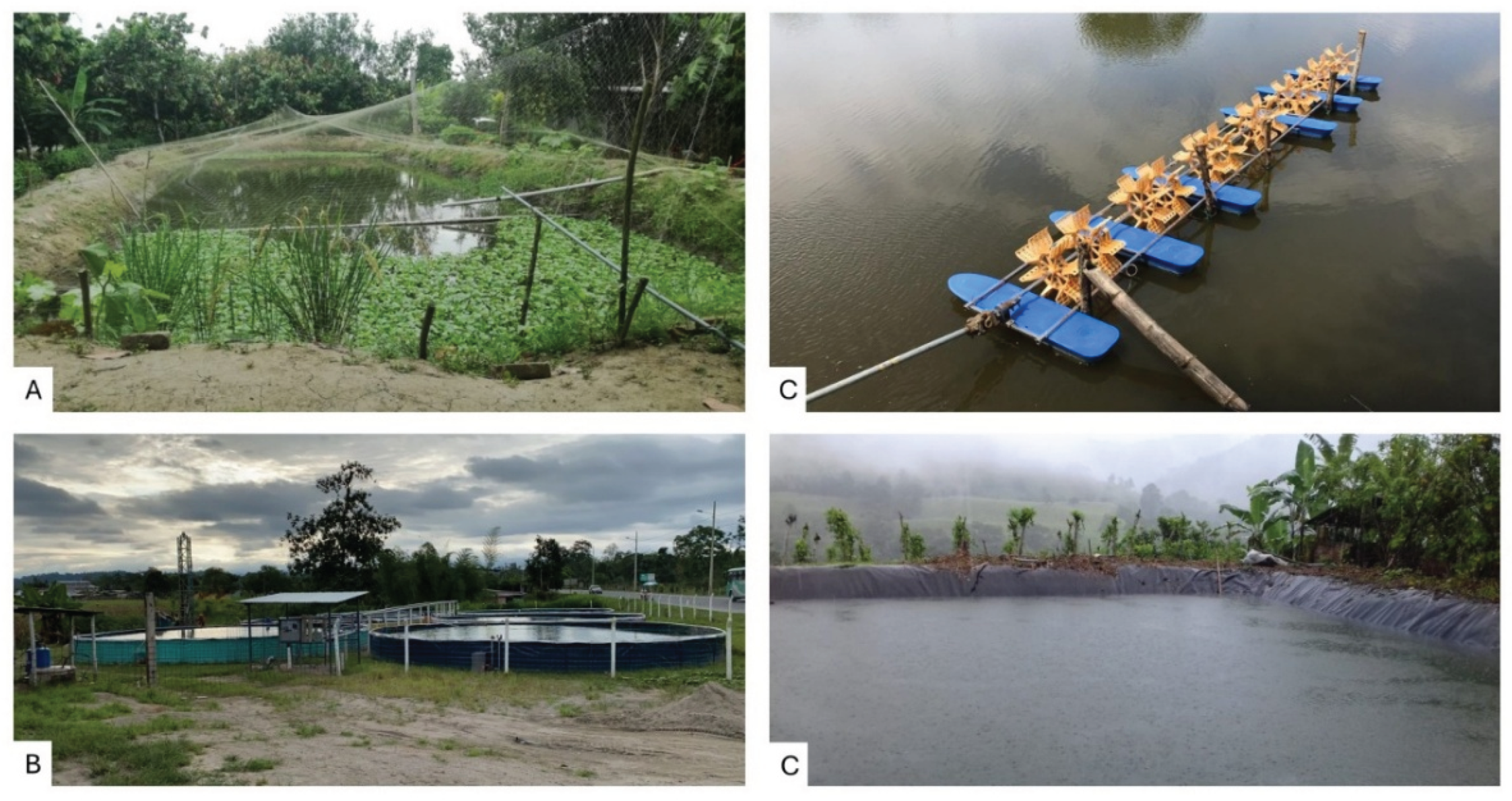
Figure 2.
Conceptual synthesis of discriminant analysis results and system-specific implications.
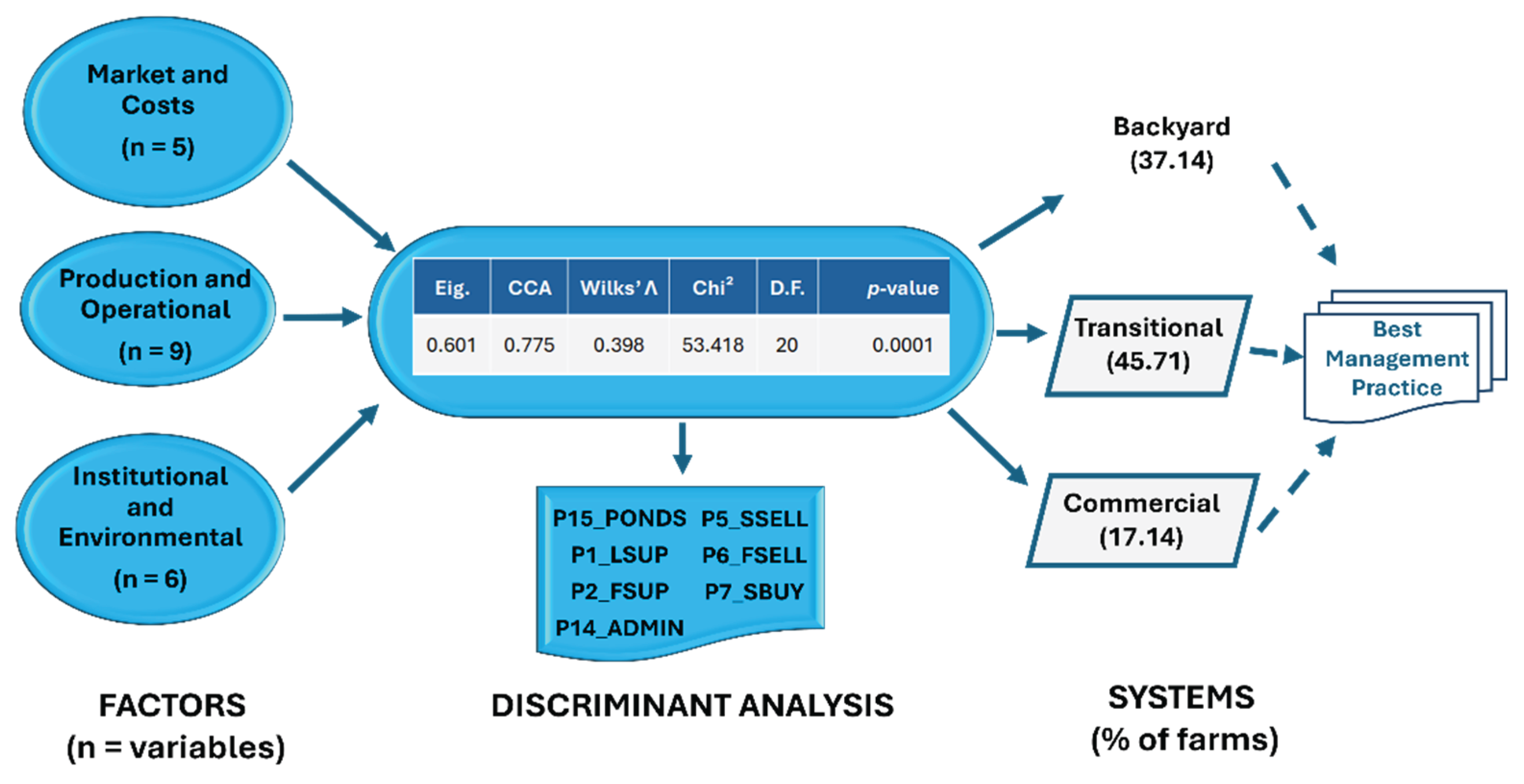
Figure 3.
Hierarchical cluster dendrogram (left) and Canonical discriminant plot (right) of aquaculture production systems based on perceived challenges.
Figure 3.
Hierarchical cluster dendrogram (left) and Canonical discriminant plot (right) of aquaculture production systems based on perceived challenges.
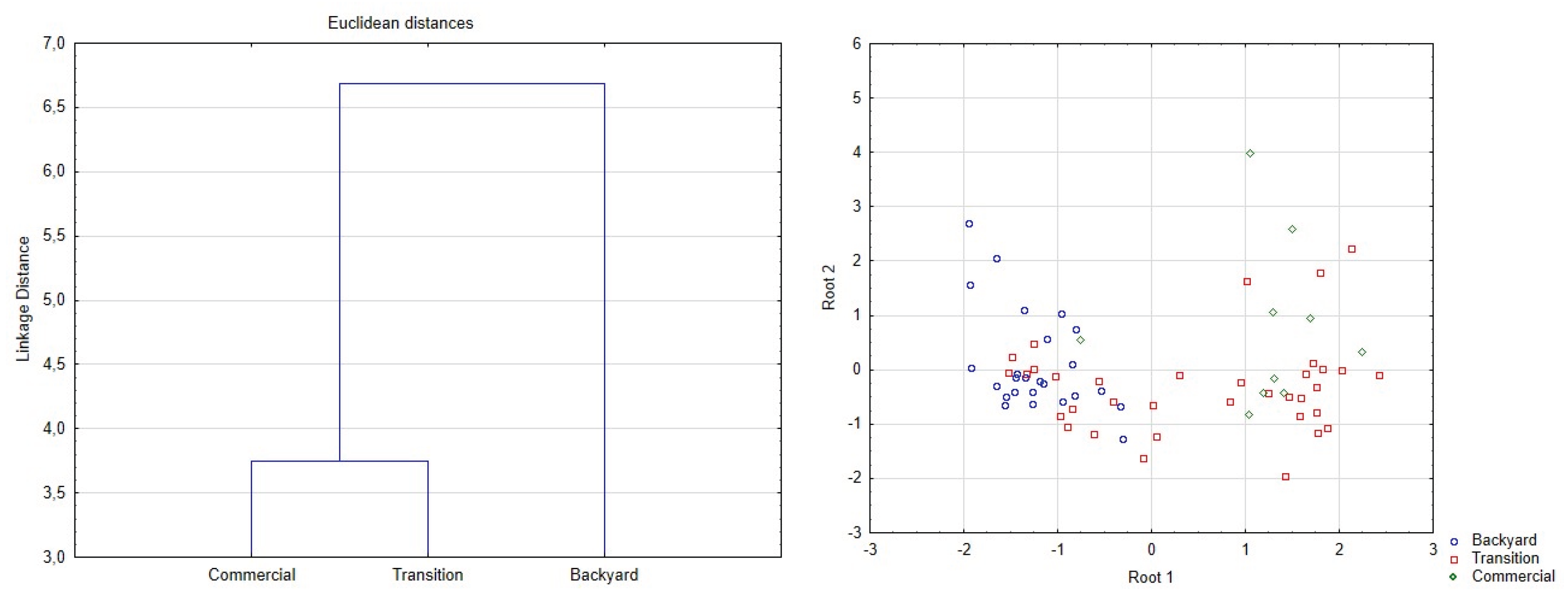

Table 1.
Definition and coding of perceived aquaculture challenge variables.
| Items | Description | Abbreviation |
|---|---|---|
| P1 | Difficulties in the supply of larvae. | P1_LSUP |
| P2 | Difficulties in the supply of fingerlings | P2_FSUP |
| P3 | High price of larvae. | P3_LPRI |
| P4 | High price of fingerlings. | P4_FPRI |
| P5 | Low selling price of shrimp. | P5_SSELL |
| P6 | Low selling price of fish. | P6_FSELL |
| P7 | Limited number of shrimp buyers. | P7_SBUY |
| P8 | Limited number of fish buyers. | P8_FBUY |
| P9 | Limited number of larvae buyers. | P9_LBUY |
| P10 | Limited number of fingerling buyers. | P10_FGBUY |
| P11 | High cost of formulated feed. | P11_FEEDC |
| P12 | Reduction or insufficiency of public subsidies. | P12_SUBS |
| P13 | Security problems related to theft. | P13_SECUR |
| P14 | Difficulties related to administrative procedures and management. | P14_ADMIN |
| P15 | Insufficient surface area of culture ponds. | P15_PONDS |
| P16 | Lack of generational succession on the farm. | P16_SUCC |
| P17 | Environmental problems affecting aquaculture activities. | P17_ENVIR |
| P18 | Sanitary and regulatory requirements applicable to the farm. | P18_REGUL |
| P19 | Difficulties in maintaining farm infrastructure. | P19_INFRA |
| P20 | High fuel and/or energy consumption. | P20_ENERG |
Table 2.
Comparison of perceived challenge scores among aquaculture production systems (median scores).
Table 2.
Comparison of perceived challenge scores among aquaculture production systems (median scores).
| Variable 1 | Systems | H | p (Holm) | ||
| Backyard | Transition | Commercial | |||
| P1_LSUP | 0.00 a | 1.00 b | 2.00 b | 30.022 | *** |
| P2_FSUP | 2.00 a | 0.00 b | 0.00 b | 30.846 | *** |
| P3_LPRI | 0.00 a | 1.00 b | 2.00 b | 21.095 | *** |
| P4_FPRI | 2.00 a | 0.00 b | 0.00 b | 28.821 | *** |
| P5_SSELL | 0.00 a | 3.00 b | 3.00 b | 28.569 | *** |
| P6_FSELL | 3.00 a | 0.00 b | 0.00 b | 27.917 | *** |
| P7_SBUY | 0.00 a | 1.00 b | 3.00 b | 26.309 | *** |
| P8_FBUY | 3.00 a | 0.00 b | 0.00 b | 24.589 | *** |
| P9_LBUY | 0.00 a | 0.00 a | 0.00 a | 12.174 | * |
| P10_FGBUY | 0.00 a | 0.00 a | 0.00 a | 2.888 | n.s. |
| P11_FEEDC | 3.00 a | 3.00 a | 3.00 a | 1.081 | n.s. |
| P12_SUBS | 1.00 a | 1.00 a | 1.50 a | 2.370 | n.s. |
| P13_SECUR | 1.00 a | 1.00 a | 1.50 a | 0.148 | n.s. |
| P14_ADMIN | 1.00 a | 1.00 a | 1.50 a | 7.431 | n.s. |
| P15_PONDS | 2.00 a | 1.00 b | 1.00 ab | 11.268 | * |
| P16_SUCC | 1.00 a | 1.00 a | 1.50 a | 8.166 | n.s. |
| P17_ENVIR | 2.00 a | 2.00 a | 2.50 a | 3.950 | n.s. |
| P18_REGUL | 2.00 a | 2.00 a | 2.50 a | 1.144 | n.s. |
| P19_INFRA | 1.00 a | 1.00 a | 2.00 a | 4.634 | n.s. |
| P20_ENERG | 3.00 a | 3.00 a | 3.00 a | 4.568 | n.s. |
1 See Table 1; 2 * p < 0.05; *** p < 0.001; n.s. not significant differences. a, b, Different letters indicate significant differences between groups.
Table 3.
Principal components (PC) loading matrix after Varimax rotation.
| Variable 1 | Loading | Eigenvalue | Explained Variance (%) | Accumulate | PC |
| P2_FSUP | -0.833 | 5.968 | 29.84 | 29.84 | 1 |
| P4_FPRI | -0.871 | ||||
| P6_FSELL | -0.886 | ||||
| P8_FBUY | -0.832 | ||||
| P5_SSELL | 0.837 | ||||
| P7_SBUY | 0.809 | ||||
| P1_LSUP | 0.677 | ||||
| P3_LPRI | 0.6 | ||||
| P9_LBUY | 0.734 | 2.867 | 14.34 | 44.18 | 2 |
| P12_SUBS | 0.653 | ||||
| P16_SUCC | 0.627 | ||||
| P19_INFRA | 0.784 | ||||
| P11_FEEDC | 0.769 | 1.879 | 9.393 | 53.569 | 3 |
| P18_REGUL | 0.692 | ||||
| P14_ADMIN | 0.77 | 1.34 | 6.7 | 60.268 | 4 |
| P15_PONDS | 0.796 | ||||
| P13_SECUR | 0.847 | 1.196 | 5.981 | 66.249 | 5 |
| P17_ENVIR | 0.533 | ||||
| P10_FGBUY | -0.799 | 1.051 | 5.255 | 71.504 | 6 |
| P20_ENERG | 0.546 |
1 See Table 1.
Table 4.
Structure coefficients of the canonical discriminant functions.
| Variable 1 | r(LD1) | r(LD2) | |r| | Ranking |
| P4_FPRI | 0.874 | 0.052 | 0.874 | 1 |
| P2_FSUP | 0.859 | 0.06 | 0.859 | 2 |
| P7_SBUY | -0.853 | -0.071 | 0.853 | 3 |
| P5_SSELL | -0.85 | -0.063 | 0.85 | 4 |
| P6_FSELL | 0.82 | -0.05 | 0.82 | 5 |
| P1_LSUP | -0.79 | 0.043 | 0.79 | 6 |
| P8_FBUY | 0.769 | -0.045 | 0.769 | 7 |
1 See Table 1.
Table 5.
Good management practices derived from perception patterns.
| System (variables) | Producers | Technical advisors | Governance / Public policy |
|---|---|---|---|
| Backyard (P15_PONDS) | Improve pond use; gradual management improvements; focus on native species | Provide simple technical guidance; low-cost technologies; support local knowledge | Small infrastructure support; seed access programs; recognition of smallholder role |
| Transitional (P5_SSELL, P6_FSELL, P7_SBUY, P8_FBUY) |
Improve marketing strategies; diversify buyers; basic farm management | Training on planning and market analysis; cost management; value chain integration | Support cooperative marketing; strengthen producer organizations; facilitate market access |
| Commercial (P1_LSUP, P2_FSUP; P14_ADMIN) | Secure biological inputs; improve administrative capacity; efficiency planning | Specialized advisory services; support regulatory compliance; operational optimization | Administrative simplification; innovation incentives; stable input supply chains |
| All farms (Transversal) | Efficient energy and input use; risk reduction strategies | Dissemination of best practices; technical coordination across systems | Adaptive governance; proportional regulation; reduction of transaction costs |
Disclaimer/Publisher’s Note: The statements, opinions and data contained in all publications are solely those of the individual author(s) and contributor(s) and not of MDPI and/or the editor(s). MDPI and/or the editor(s) disclaim responsibility for any injury to people or property resulting from any ideas, methods, instructions or products referred to in the content. |
© 2026 by the authors. Licensee MDPI, Basel, Switzerland. This article is an open access article distributed under the terms and conditions of the Creative Commons Attribution (CC BY) license (http://creativecommons.org/licenses/by/4.0/).
Copyright: This open access article is published under a Creative Commons CC BY 4.0 license, which permit the free download, distribution, and reuse, provided that the author and preprint are cited in any reuse.


