

Submitted:
11 March 2026
Posted:
12 March 2026
You are already at the latest version
Abstract
The traditional assumption that formal journalism education is a prerequisite for practicing journalism has increasingly been challenged in the contemporary media environment. Historically, many influential journalists entered the profession without formal academic training in journalism, relying instead on diverse intellectual backgrounds, experiential learning, and multidisciplinary knowledge. This study explores the argument that journalism is fundamentally a knowledge-driven profession rather than a degree-dependent one. Drawing upon historical analysis, professional case studies, and theoretical insights from communication studies, knowledge sociology, and media professionalization theory, the article examines whether journalism education is essential for journalistic practice or whether multidimensional knowledge—including political, economic, technological, cultural, and ethical literacy—is the more critical requirement.The article situates journalism within broader debates about professionalization, epistemic authority, and the transformation of media institutions in the digital era. It argues that journalism education contributes valuable methodological and ethical frameworks; however, the profession itself historically evolved from individuals possessing wide-ranging knowledge rather than narrow vocational training. In the digital age, journalists increasingly operate at the intersection of multiple disciplines such as data science, international relations, sociology, environmental studies, and digital technologies. Consequently, multidimensional knowledge and intellectual curiosity may provide stronger foundations for journalistic excellence than formal training alone.Using qualitative historical review and comparative analysis of global media systems, the study evaluates the career trajectories of prominent journalists and analyzes how interdisciplinary knowledge shapes journalistic credibility, investigative capacity, and interpretive reporting. The findings suggest that journalism education should not be viewed as a gatekeeping requirement but rather as one of several pathways into the profession. The article proposes a reconceptualization of journalism education that prioritizes interdisciplinary knowledge acquisition, critical thinking, and epistemic diversity rather than purely technical training.This research contributes to ongoing debates on journalism professionalization, media education reform, and the evolving epistemology of news production. The study concludes that the future of journalism lies not in strict academic credentialism but in the cultivation of multidimensional knowledge ecosystems capable of addressing complex global realities.
Keywords:
journalism education
; professionalization
; multidimensional knowledge
; interdisciplinary journalism
; media literacy
; journalism profession
1. Introduction
Journalism has historically been regarded as one of the most influential professions in modern democratic societies. As a social institution, journalism performs crucial functions such as informing citizens, scrutinizing power, shaping public discourse, and documenting historical events. These functions position journalists not merely as reporters of events but as interpreters of complex social realities. However, the question of what qualifications are necessary to become a journalist remains a subject of continuing debate within media studies and professional discourse. In particular, scholars and practitioners increasingly question whether formal journalism education is a necessary prerequisite for entering the journalism profession or whether broader multidimensional knowledge is the more fundamental requirement for effective journalistic practice.
The emergence of journalism as a profession predates the institutionalization of journalism education. In the nineteenth and early twentieth centuries, journalism largely evolved through apprenticeship and experiential learning rather than formal academic training. Many influential journalists of that period were writers, lawyers, historians, activists, or political commentators who possessed extensive knowledge in diverse fields but lacked formal journalism degrees. These individuals contributed significantly to the development of investigative reporting, editorial writing, and political commentary. As a result, journalism historically functioned more as an intellectual and civic activity rooted in knowledge, curiosity, and analytical ability than as a credential-based profession (Schudson, 2003).
The institutionalization of journalism education began in the early twentieth century, particularly in the United States and Europe. One of the earliest milestones was the establishment of the Missouri School of Journalism in 1908, which marked the beginning of structured academic training for journalists. Over time, universities around the world established journalism departments aimed at professionalizing the field and providing systematic training in reporting techniques, ethics, and media law (Deuze, 2006). Journalism education promised to standardize professional practices and enhance the credibility of the news industry by producing trained journalists with technical skills and ethical awareness.
Despite these developments, the necessity of formal journalism education has remained contested. Critics argue that journalism schools sometimes prioritize technical skills—such as news writing formats, editing techniques, and media production—while neglecting deeper intellectual and interdisciplinary knowledge that enables journalists to interpret complex issues. Journalism, unlike professions such as medicine or engineering, does not necessarily require highly specialized technical expertise. Instead, it demands the ability to understand and analyze diverse domains of knowledge, including politics, economics, culture, science, and international relations (Zelizer, 2017).
This perspective highlights the importance of multidimensional knowledge as the central foundation of journalistic competence. Journalism involves the continuous interpretation of social, political, economic, and cultural processes. For example, political reporting requires an understanding of governance structures, public policy, and international relations. Economic journalism demands familiarity with financial systems, development policies, and global markets. Environmental journalism requires knowledge of scientific research and climate policy. Without sufficient knowledge in these domains, journalists may struggle to contextualize events and provide meaningful explanations to audiences.
In the contemporary digital era, the complexity of journalism has increased significantly. The rapid expansion of information technologies, social media platforms, and algorithm-driven communication systems has transformed the ways in which news is produced, distributed, and consumed. Journalists today must navigate an information ecosystem characterized by misinformation, disinformation, and information overload. This environment requires journalists to possess not only technical media skills but also critical analytical abilities and interdisciplinary knowledge that enable them to verify information, evaluate sources, and interpret complex data (Carlson & Lewis, 2015).
Furthermore, modern journalism increasingly intersects with specialized knowledge fields. Data journalism, for instance, requires proficiency in statistics, data visualization, and computational analysis. Science journalism demands familiarity with scientific methodologies and research interpretation. Similarly, investigative journalism often requires understanding legal frameworks, financial systems, and institutional governance. These developments demonstrate that the practice of journalism increasingly relies on knowledge that extends beyond traditional newsroom training.
In this context, multidimensional knowledge refers to the integration of insights from multiple academic disciplines and intellectual traditions. Such knowledge allows journalists to contextualize events, analyze structural causes of social problems, and communicate complex information in accessible ways. Scholars argue that journalists function as “knowledge brokers” who translate specialized knowledge into narratives that can be understood by the general public (Boyd-Barrett, 2019). Consequently, the intellectual capacity to synthesize diverse knowledge sources may be more essential to journalism than formal training in journalistic techniques.
Another important dimension of this debate concerns the professional identity of journalists. Unlike professions with strict licensing systems, journalism remains relatively open to individuals from diverse educational backgrounds. Lawyers, economists, scientists, and historians frequently transition into journalism because their subject-matter expertise enables them to analyze and interpret complex issues. This openness reflects the epistemological nature of journalism as a knowledge-based profession rather than a narrowly defined technical occupation (Hanitzsch, 2011).
At the same time, it would be inaccurate to dismiss the contributions of journalism education entirely. Journalism schools provide valuable training in ethical standards, media law, reporting techniques, and newsroom practices. They also offer institutional frameworks for critical reflection on media systems and professional responsibilities. However, the effectiveness of journalism education depends largely on whether it encourages interdisciplinary knowledge and intellectual curiosity rather than merely teaching technical skills. When journalism education becomes overly vocational, it risks producing graduates who are proficient in news formatting but lack deeper analytical capabilities.
The debate between journalism education and multidimensional knowledge has become particularly relevant in the Global South, including South Asia. In many developing media environments, journalism has historically emerged through political activism, literary movements, and intellectual discourse rather than formal academic programs. Journalists in these contexts often draw upon backgrounds in political science, sociology, economics, and literature to analyze complex social transformations. As media systems evolve in these regions, the tension between professional training and intellectual breadth continues to shape discussions about journalism education reform (Waisbord, 2013).
Moreover, the rise of citizen journalism and digital media has further challenged traditional assumptions about who qualifies as a journalist. With the proliferation of online platforms, individuals without formal journalism training can produce news content, conduct investigations, and influence public opinion. While this democratization of media production raises concerns about credibility and misinformation, it also demonstrates that journalistic practices can emerge outside formal institutional frameworks. In many cases, the credibility of such journalism depends more on the author’s knowledge, analytical rigor, and ethical commitment than on academic credentials.
This transformation has led scholars to reconsider the concept of journalism as an epistemic practice—a system through which societies generate, verify, and disseminate knowledge about public affairs. Within this framework, the role of journalists is not merely to report facts but to construct narratives that help citizens understand complex realities. To perform this role effectively, journalists must possess broad intellectual knowledge, critical thinking skills, and the ability to engage with diverse sources of expertise (Schudson & Anderson, 2009).
Consequently, the argument that journalism education is not strictly required for journalism practice does not imply that education itself is irrelevant. Rather, it suggests that the most valuable form of education for journalists may not be confined to specialized journalism programs. Instead, interdisciplinary education in fields such as political science, economics, history, sociology, environmental studies, and digital technologies may provide stronger intellectual foundations for journalistic work. Journalists who possess such multidimensional knowledge are better equipped to interpret complex events, challenge misinformation, and contribute to informed public discourse.
Against this background, the present study examines the relationship between journalism education and multidimensional knowledge in shaping journalistic competence. The central argument of the article is that journalism should be understood primarily as a knowledge-driven profession rather than a credential-driven one. While formal journalism education can provide useful training, the effectiveness of journalism ultimately depends on the breadth and depth of knowledge that journalists bring to their work.
The objectives of this research are threefold. First, the study seeks to explore the historical development of journalism as a profession and the role that formal education has played in shaping its institutional identity. Second, it examines the importance of multidimensional knowledge in contemporary journalistic practice, particularly in the context of digital media and complex global issues. Third, the article evaluates the implications of this debate for journalism education and professional development in the twenty-first century.
By addressing these questions, the study contributes to ongoing discussions about the future of journalism education and the evolving nature of journalistic expertise. In an era characterized by rapid technological change, global political transformations, and information disorder, the capacity of journalists to interpret and contextualize knowledge has become more important than ever. Understanding whether journalism should prioritize formal training or multidimensional knowledge is therefore essential for strengthening the role of journalism as a cornerstone of democratic communication.
2. Literature Review
The debate surrounding whether formal journalism education is essential for professional journalism has been widely discussed within media studies, communication scholarship, and professional discourse. Scholars have examined journalism as a profession, the institutionalization of journalism education, the epistemological foundations of journalistic knowledge, and the growing importance of interdisciplinary expertise in modern journalism. This literature review synthesizes existing academic scholarship to contextualize the argument that journalism may rely more fundamentally on multidimensional knowledge than on formal journalism education alone.
2.1. Journalism as a Profession and the Question of Credentialism
The professionalization of journalism has historically followed a different trajectory from other established professions such as medicine, law, or engineering. Traditional professions often rely on formal educational requirements, certification systems, and regulatory institutions to define professional boundaries. Journalism, by contrast, has historically remained an open profession with relatively weak credentialing mechanisms (Schudson & Anderson, 2009). The absence of strict licensing requirements has allowed individuals from diverse intellectual and professional backgrounds to enter the field.
Early journalism scholars described journalism as a “semi-profession” rather than a fully institutionalized profession. According to Abbott (1988), professions are defined by jurisdictional control over specialized knowledge and by formalized training systems. Journalism has only partially fulfilled these criteria because journalists do not monopolize access to news production. Citizens, activists, and experts can also participate in public communication processes. Consequently, journalism’s professional authority often depends less on formal certification and more on credibility, reputation, and knowledge competence.
Schudson (2003) argues that journalism developed historically through newsroom apprenticeship and intellectual engagement rather than formal academic training. Many influential journalists of the nineteenth and early twentieth centuries entered the profession through writing, political activism, or literary culture. For instance, investigative journalism during the Progressive Era in the United States was shaped by writers and social reformers who had backgrounds in literature, law, and social science rather than journalism education. This historical context suggests that journalism’s intellectual foundations were established long before the emergence of formal journalism schools.
However, the twentieth century witnessed increasing efforts to professionalize journalism through academic education. Universities began establishing journalism departments with the goal of developing standardized training programs that could enhance professional credibility and ethical responsibility. Proponents of journalism education argued that systematic instruction in reporting techniques, ethics, and media law could strengthen journalism’s social legitimacy (Deuze, 2006). Yet critics have questioned whether such institutionalization has effectively addressed the deeper intellectual requirements of journalism.
The concept of credentialism is particularly relevant in this debate. Credentialism refers to the increasing reliance on academic degrees as indicators of professional competence. In many professions, academic credentials function as gatekeeping mechanisms that regulate access to professional practice. Journalism, however, has historically resisted strict credentialism because the profession values practical experience, knowledge diversity, and intellectual independence (Zelizer, 2017). As a result, many scholars argue that journalism should not be defined primarily by formal degrees but rather by the quality of knowledge and analysis that journalists contribute to public discourse.
2.2. Development of Journalism Education
The institutionalization of journalism education began in the early twentieth century with the establishment of journalism schools in North America and Europe. One of the earliest and most influential institutions was the Missouri School of Journalism, founded in 1908. The model emphasized practical newsroom training combined with academic coursework in media ethics and communication theory. This model later influenced journalism programs worldwide (Deuze, 2006).
The expansion of journalism education accelerated after World War II as universities recognized the importance of media institutions in democratic societies. Journalism curricula typically included courses in news writing, reporting techniques, media law, and ethics. Over time, programs also incorporated broadcast journalism, multimedia production, and digital communication.
Despite these developments, scholars have expressed concerns about the limitations of journalism education. One recurring criticism is that journalism curricula often prioritize technical skills over intellectual depth. Benson (2013) argues that journalism schools sometimes emphasize professional routines such as news writing formats and newsroom procedures while paying insufficient attention to broader intellectual training in social sciences and humanities.
Similarly, Reese (2016) suggests that journalism education may struggle to keep pace with the rapidly changing media environment. The rise of digital platforms, algorithmic communication, and data journalism has transformed the skills required for modern journalism. Traditional journalism curricula may not fully prepare students to navigate complex information ecosystems characterized by misinformation and networked communication.
Another challenge relates to the tension between vocational training and liberal education. Some scholars argue that journalism should be taught primarily as a technical profession focused on practical newsroom skills. Others contend that journalism education should emphasize critical thinking, interdisciplinary knowledge, and analytical abilities. This debate reflects broader questions about the intellectual foundations of journalism as a field of knowledge.
2.3. Multidimensional Knowledge and Journalistic Expertise
A growing body of literature emphasizes the importance of multidisciplinary knowledge in journalism. Journalism is fundamentally concerned with interpreting complex social realities for public audiences. As such, journalists must possess knowledge across diverse domains including politics, economics, culture, science, and technology.
Hanitzsch (2011) conceptualizes journalism as a knowledge-producing practice embedded within broader social structures. Journalists do not merely transmit information; they actively construct narratives that shape public understanding of social events. This interpretive function requires journalists to engage with multiple forms of knowledge and expertise.
For instance, political journalism requires understanding institutional governance, electoral systems, and international relations. Economic journalism demands familiarity with financial markets, development policies, and economic indicators. Environmental journalism requires knowledge of climate science, environmental policy, and sustainability debates. Without such knowledge, journalists may struggle to contextualize events and provide meaningful analysis.
Scholars also emphasize the role of subject-matter expertise in investigative journalism. Investigative reporting often involves analyzing complex legal documents, financial records, and institutional structures. Journalists with backgrounds in law, economics, or public policy may therefore possess advantages in conducting in-depth investigations. These examples illustrate how multidimensional knowledge can enhance journalistic competence beyond traditional reporting skills.
Furthermore, the concept of “knowledge brokerage” has emerged as an important theoretical framework in journalism studies. According to this perspective, journalists act as intermediaries who translate specialized knowledge produced by experts into accessible narratives for the public (Boyd-Barrett, 2019). This process requires journalists to understand complex subject matter while simultaneously communicating it in ways that are understandable to non-specialist audiences.
2.4. Digital Transformation and the Expansion of Knowledge Requirements
The digital transformation of media has significantly expanded the knowledge requirements for contemporary journalism. The emergence of data journalism, computational reporting, and algorithmic media environments has introduced new forms of technical and analytical expertise into the field.
Data journalism, for example, requires knowledge of statistics, data analysis, and visualization techniques. Journalists increasingly use large datasets to investigate social phenomena such as corruption, environmental change, and public health trends. This development demonstrates that journalism now intersects with fields such as computer science and data science.
Similarly, the rise of digital platforms has created new challenges related to misinformation and disinformation. Journalists must evaluate the credibility of digital sources, analyze social media dynamics, and understand algorithmic amplification processes. These tasks require interdisciplinary knowledge combining communication studies, political science, and information technology (Carlson & Lewis, 2015).
The digital media environment has also transformed the relationship between journalists and audiences. Social media platforms enable citizens to participate in news production and dissemination. While this participatory culture has democratized information flows, it has also blurred the boundaries between professional journalism and citizen communication. As a result, journalists must distinguish themselves through analytical depth, contextual knowledge, and ethical standards rather than merely through institutional affiliation.
Scholars argue that this transformation further strengthens the importance of multidimensional knowledge in journalism. In an information-rich environment, the value of journalism lies not simply in reporting events but in interpreting them within broader social and political contexts. Journalists who possess interdisciplinary knowledge are better equipped to perform this interpretive role.
2.5. Journalism in the Global South and Knowledge Diversity
The debate over journalism education and multidimensional knowledge is particularly significant in the Global South, where media systems often evolve under different historical and institutional conditions. In many developing countries, journalism emerged through political movements, intellectual activism, and literary traditions rather than through formal academic training.
Waisbord (2013) notes that journalism in many parts of the Global South has historically been shaped by political engagement and social advocacy. Journalists often played roles as intellectuals, activists, and public educators. Their authority derived from knowledge of political processes and social realities rather than formal journalism credentials.
This historical context highlights the importance of knowledge diversity in journalism. Journalists in developing societies often rely on interdisciplinary perspectives to analyze issues such as development, governance, human rights, and social inequality. Such perspectives may be difficult to cultivate within narrowly defined vocational training programs.
Moreover, contemporary global challenges—including climate change, economic inequality, and geopolitical conflict—require journalists to engage with complex international issues. Addressing these challenges effectively requires knowledge that extends beyond traditional journalism education.
2.6. Critiques of Journalism Education
Despite its contributions, journalism education has been subject to several criticisms within academic literature. One major critique concerns the risk of producing technically competent but intellectually limited journalists. Scholars argue that excessive focus on newsroom routines may discourage critical thinking and analytical depth.
Another critique involves the gap between journalism education and professional practice. Some studies suggest that journalism graduates may struggle to adapt to rapidly changing media environments because academic curricula often lag behind technological developments (Reese, 2016). As media organizations experiment with new digital formats and business models, journalism education must continuously evolve.
Additionally, critics argue that journalism education sometimes fails to emphasize interdisciplinary learning. Journalism students may receive extensive training in media production but limited exposure to subjects such as economics, political theory, or environmental science. Without such knowledge, journalists may struggle to analyze complex policy debates or global events.
These critiques do not imply that journalism education is unnecessary. Rather, they suggest that journalism education must evolve toward more interdisciplinary and intellectually rigorous models that emphasize multidimensional knowledge.
2.7. Synthesis of Literature
The existing literature reveals several key insights relevant to the present study. First, journalism has historically functioned as an open profession that values knowledge diversity rather than strict credentialism. Second, journalism education has contributed to professionalization by providing ethical and technical training, but it may not fully address the intellectual demands of modern journalism. Third, the increasing complexity of contemporary media environments has strengthened the importance of interdisciplinary knowledge.
Taken together, these insights support the argument that journalism should be understood primarily as a knowledge-based profession rather than a credential-based one. Formal journalism education can provide valuable training, but the effectiveness of journalists ultimately depends on their ability to interpret complex realities through multidimensional knowledge.
3. Theoretical Framework
Understanding whether journalism education is essential for the journalism profession requires a robust theoretical foundation that situates journalism within broader frameworks of knowledge production, professional authority, and social communication. Journalism is not merely a technical activity of gathering and transmitting information; it is fundamentally an epistemic practice that produces, interprets, and disseminates knowledge within society. Therefore, examining the role of multidimensional knowledge in journalism demands engagement with theoretical perspectives from sociology of knowledge, professionalization theory, field theory, and epistemology of journalism. This section develops the theoretical framework of the study by integrating these perspectives to explain how journalistic competence emerges from intellectual capital and interdisciplinary knowledge rather than solely from formal journalism education.
3.1. Sociology of Knowledge and Journalism
The sociology of knowledge provides an important conceptual lens for understanding journalism as a system of knowledge production. According to Berger and Luckmann (1966), knowledge in society is socially constructed through institutional processes and communication practices. Journalism functions as one of the key institutions through which societies construct shared understandings of reality. Through news reporting, commentary, and investigative work, journalists shape public interpretations of social events, political developments, and cultural transformations.
From this perspective, journalists are not simply neutral transmitters of information but active participants in the construction of social knowledge. Their interpretations influence how audiences understand political conflicts, economic crises, environmental issues, and social inequalities. Consequently, journalistic authority derives not merely from professional credentials but from the credibility and intellectual depth of the knowledge that journalists produce.
Within the sociology of knowledge, intellectual competence and access to diverse knowledge resources are central to the legitimacy of knowledge producers. Journalists who possess broad interdisciplinary knowledge are better positioned to contextualize complex events and evaluate competing claims of expertise. For instance, reporting on climate change requires understanding scientific research, environmental policy, and economic implications. Similarly, reporting on financial crises demands familiarity with economic theory, banking systems, and global markets.
Therefore, multidimensional knowledge enhances the capacity of journalists to function as credible knowledge mediators. Journalism education may provide useful methodological training, but the ability to interpret complex realities often depends on broader intellectual engagement with multiple disciplines. The sociology of knowledge thus supports the argument that journalistic competence is rooted in knowledge diversity rather than narrow professional specialization.
3.2. Professionalization Theory and Journalism
Professionalization theory offers another important framework for analyzing the role of education in journalism. Traditional professions such as medicine, law, and engineering are characterized by formal educational requirements, licensing systems, and institutional monopolies over specialized knowledge. These mechanisms serve to regulate entry into the profession and ensure professional standards (Abbott, 1988).
However, journalism does not conform fully to this model. Scholars have frequently described journalism as a “semi-profession” because it lacks formal licensing requirements and monopolistic control over information production (Schudson & Anderson, 2009). Anyone with access to communication platforms can potentially produce news content, particularly in the digital era.
The absence of strict professional boundaries reflects the epistemological nature of journalism. Unlike professions that require highly specialized technical knowledge, journalism involves interpreting and communicating knowledge produced in various fields. Journalists must engage with experts, institutions, and social actors across diverse domains. As a result, the professional authority of journalists often depends on their analytical abilities and knowledge competence rather than on formal certification.
Professionalization theory also highlights the tension between vocational training and intellectual autonomy. When professions rely excessively on standardized training programs, there is a risk that practitioners become constrained by institutional routines rather than guided by independent critical thinking. In journalism, this tension is particularly significant because the profession is expected to serve as a watchdog over powerful institutions. Journalists must therefore maintain intellectual independence and critical perspective, qualities that may emerge more readily from broad interdisciplinary education than from narrowly defined vocational training.
Moreover, the digital transformation of media has further weakened traditional professional boundaries. Citizen journalism, social media communication, and independent digital media platforms have enabled individuals without journalism degrees to participate in news production. In this context, the legitimacy of journalism increasingly depends on the quality of analysis, evidence, and knowledge presented rather than on formal credentials.
Professionalization theory thus suggests that journalism education should not function as a gatekeeping mechanism that restricts access to the profession. Instead, it should support the development of intellectual capacities that enable journalists to engage with complex social realities.
3.3. Bourdieu’s Field Theory and Cultural Capital in Journalism
Pierre Bourdieu’s field theory provides another influential theoretical framework for understanding the relationship between knowledge and professional authority in journalism. Bourdieu conceptualized society as a collection of relatively autonomous social fields, each characterized by specific forms of capital, power relations, and struggles for legitimacy (Bourdieu, 1998).
The journalistic field is one such domain in which actors compete for credibility, influence, and symbolic power. Within this field, different forms of capital—including cultural capital, social capital, and symbolic capital—determine the relative positions of journalists and media organizations.
Cultural capital refers to intellectual knowledge, educational background, and cultural competence that individuals possess. In the journalistic field, cultural capital plays a crucial role in shaping professional authority. Journalists with extensive knowledge of politics, economics, history, and culture are better able to interpret complex events and produce insightful analysis.
From Bourdieu’s perspective, the value of journalism education depends on whether it contributes to the accumulation of cultural capital. If journalism programs focus primarily on technical newsroom skills, they may provide limited intellectual capital. However, interdisciplinary education that incorporates social sciences, humanities, and scientific knowledge can significantly enhance the cultural capital of journalists.
Field theory also emphasizes the dynamic nature of professional authority. Journalists continuously compete for recognition and credibility within the media field. In this competition, intellectual depth and analytical expertise often serve as important sources of symbolic power. Journalists who demonstrate strong knowledge in specialized areas—such as economics, international relations, or environmental science—may gain greater authority in public discourse.
Furthermore, Bourdieu’s framework highlights the role of intellectual diversity in shaping the journalistic field. Because journalism interacts with multiple social domains, journalists benefit from possessing diverse forms of cultural capital. Multidimensional knowledge therefore strengthens the capacity of journalists to navigate complex power structures and institutional relationships.
3.4. Epistemology of Journalism
The epistemology of journalism examines how journalists produce knowledge and how audiences evaluate the credibility of news. Journalism scholars argue that journalism operates as a form of public knowledge production that differs from academic research but still relies on systematic methods of verification, interpretation, and narrative construction (Zelizer, 2017).
One of the central principles of journalistic epistemology is verification. Journalists gather information from multiple sources, evaluate evidence, and present findings in ways that allow audiences to assess the reliability of the information. However, verification alone is insufficient for effective journalism. Journalists must also contextualize information by explaining its broader social and political significance.
Contextualization requires knowledge of historical trends, institutional structures, and social dynamics. For example, reporting on electoral politics requires understanding political parties, constitutional frameworks, and voter behavior. Similarly, reporting on public health crises requires familiarity with medical research and epidemiological data.
The epistemological role of journalists can therefore be described as interpretive mediation. Journalists translate complex knowledge produced by experts into narratives that are accessible to the public. This process requires intellectual competence and interdisciplinary understanding.
In the digital age, the epistemological challenges of journalism have intensified. The proliferation of misinformation and disinformation has created an environment in which audiences must navigate vast quantities of conflicting information. Journalists play a crucial role in verifying information and providing credible interpretations.
However, credibility increasingly depends on the depth of knowledge and analytical rigor that journalists demonstrate. Audiences may trust journalists who exhibit strong subject-matter expertise and critical reasoning. Thus, multidimensional knowledge contributes directly to the epistemological authority of journalism.
3.5. Interdisciplinary Knowledge Theory
Interdisciplinary knowledge theory provides a final conceptual foundation for understanding the importance of multidimensional knowledge in journalism. Interdisciplinary approaches emphasize the integration of insights from multiple academic disciplines to address complex social problems (Repko & Szostak, 2017).
Many contemporary issues—such as climate change, global economic inequality, technological transformation, and geopolitical conflict—cannot be fully understood through a single disciplinary perspective. Effective analysis requires integrating knowledge from diverse fields such as economics, political science, sociology, environmental science, and technology studies.
Journalists operate at the intersection of these knowledge domains. Their role involves synthesizing information from different sources and presenting coherent narratives that help audiences understand complex issues. Interdisciplinary knowledge therefore enhances the interpretive capacity of journalists.
Moreover, interdisciplinary knowledge encourages critical thinking and intellectual flexibility. Journalists who engage with multiple disciplines are more likely to question dominant narratives, explore alternative perspectives, and uncover hidden dimensions of social problems.
In this sense, multidimensional knowledge aligns closely with the normative ideals of journalism as a democratic institution. Journalism is expected to facilitate informed public debate by providing accurate information and critical analysis. Interdisciplinary knowledge strengthens the ability of journalists to fulfill this democratic function.
3.6. Conceptual Model of Multidimensional Journalism
Based on the theoretical perspectives discussed above, this study conceptualizes journalism as a knowledge-based profession shaped by three interrelated forms of intellectual capital:
- Subject-Matter Knowledge—expertise in fields such as politics, economics, science, and culture.
- Analytical Knowledge—critical thinking, interpretation, and contextualization skills.
- Communicative Knowledge—the ability to translate complex information into accessible narratives.
These dimensions collectively constitute multidimensional knowledge. Journalism education may contribute to developing communicative knowledge and professional ethics, but subject-matter and analytical knowledge often originate from broader interdisciplinary learning.
Consequently, the theoretical framework suggests that effective journalism emerges from the integration of multiple knowledge domains rather than from specialized vocational training alone.
The theoretical perspectives presented in this section collectively emphasize that journalism is fundamentally a knowledge-driven profession embedded within broader social processes of knowledge production and communication. The sociology of knowledge highlights journalism’s role in constructing social reality, while professionalization theory reveals the limitations of credential-based definitions of professional competence. Bourdieu’s field theory demonstrates the importance of cultural capital and intellectual authority in the journalistic field, and epistemological approaches underscore the role of journalists as interpreters of complex information. Finally, interdisciplinary knowledge theory illustrates how multidimensional knowledge enhances journalistic analysis and public understanding.
Taken together, these theoretical insights support the central argument of the present study: while journalism education may provide valuable methodological training, the core foundation of journalistic competence lies in multidimensional knowledge that enables journalists to interpret complex realities and contribute to informed public discourse.
4. Methodology
4.1. Research Design
This study adopts a qualitative conceptual–analytical research design to examine the central argument that journalism education is not necessarily a prerequisite for practicing journalism and that multidimensional knowledge plays a more fundamental role in shaping journalistic competence. The research design integrates historical analysis, comparative professional case analysis, and conceptual modeling to investigate the relationship between journalistic expertise and interdisciplinary knowledge.
Qualitative research methods are particularly appropriate for this study because the research question concerns professional norms, intellectual competencies, and epistemological frameworks rather than measurable quantitative outcomes. Journalism as a profession involves interpretive practices, knowledge mediation, and socio-cultural processes that cannot be fully captured through purely statistical approaches. Consequently, a qualitative design allows for deeper examination of intellectual traditions, institutional transformations, and professional practices within journalism.
The research design also draws upon conceptual and theoretical synthesis, a method frequently used in communication studies and social sciences to integrate diverse theoretical insights and empirical evidence into a coherent analytical framework. Conceptual synthesis enables researchers to examine complex professional phenomena—such as the relationship between education, knowledge, and professional competence—by integrating findings from multiple sources including academic literature, historical documentation, and professional case studies.
This methodological approach aligns with recent trends in journalism studies that emphasize interpretive analysis and interdisciplinary frameworks to understand the evolving nature of journalistic practice in the digital age. As media systems become increasingly complex and interconnected, scholars have increasingly adopted multi-method conceptual research designs to explore transformations in journalism, media institutions, and professional identities.
The present study therefore employs a triangulated methodological approach consisting of three main components:
- Historical-institutional analysis of journalism education
- Comparative professional case analysis of journalists with diverse educational backgrounds
- Conceptual modeling of multidimensional knowledge in journalism
These three methodological components together provide a comprehensive framework for analyzing the intellectual foundations of journalistic competence.
4.2. Research Strategy
The research strategy of this study combines documentary analysis, comparative case analysis, and conceptual framework development. Each component contributes to the investigation of how multidimensional knowledge influences journalistic performance and professional authority.
4.2.1. Documentary Analysis
Documentary analysis involves systematic examination of academic literature, institutional reports, historical documents, and media studies scholarship related to journalism education and professional development. The primary goal of documentary analysis is to trace the evolution of journalism education and evaluate scholarly debates regarding the relationship between academic training and professional competence.
The documentary sources analyzed in this study include:
- Academic journal articles in journalism studies and communication research
- Books and scholarly monographs on journalism education and professionalization
- Institutional reports from journalism schools and media organizations
- Historical accounts of journalism practice and newsroom culture
- Professional biographies and autobiographical accounts of journalists
Documentary analysis allows the researcher to identify patterns and themes related to the role of knowledge diversity, interdisciplinary expertise, and educational background in shaping journalistic performance.
4.2.2. Comparative Case Analysis
The second methodological component involves comparative case analysis of prominent journalists whose professional careers demonstrate the relationship between multidimensional knowledge and journalistic excellence.
Comparative case analysis is a widely used qualitative research method that examines multiple cases to identify common patterns and explanatory variables. In the context of journalism studies, this method allows researchers to explore how journalists with diverse educational backgrounds develop professional authority and analytical expertise.
The cases analyzed in this study include journalists from different regions and intellectual traditions, including:
- Journalists with formal journalism education
- Journalists trained in other academic disciplines such as political science, economics, or literature
- Investigative journalists with professional experience in law, public policy, or social sciences
The comparative analysis focuses on three key variables:
- Educational background
- Knowledge diversity
- Impact of journalistic work
By examining these variables across multiple cases, the study evaluates whether multidimensional knowledge contributes significantly to journalistic competence.
4.2.3. Conceptual Modeling
The third methodological component involves the development of a conceptual model of multidimensional journalism knowledge. Conceptual modeling is a research method used to illustrate theoretical relationships between variables and to propose frameworks for understanding complex phenomena.
In this study, conceptual modeling is used to integrate insights from sociology of knowledge, professionalization theory, and interdisciplinary knowledge theory. The resulting conceptual model identifies key knowledge domains that contribute to effective journalistic practice.
The model proposes that journalistic competence emerges from the interaction of three primary forms of knowledge:
- Subject-matter knowledge
- Analytical knowledge
- Communicative knowledge
These knowledge domains collectively constitute multidimensional knowledge in journalism.
4.3. Data Sources
The research relies on secondary qualitative data sources, which are appropriate for conceptual and theoretical research in communication studies.
4.3.1. Academic Literature
The primary data source consists of peer-reviewed academic literature from journals indexed in major scholarly databases such as Scopus and Web of Science. These sources include research articles, theoretical studies, and empirical analyses related to journalism education, professionalization, and media epistemology.
4.3.2. Historical Documents
Historical documents related to the development of journalism education and newsroom practices provide additional contextual data. These include:
- Historical studies of journalism institutions
- Reports on journalism curriculum development
- Biographical accounts of influential journalists
4.3.3. Professional Case Materials
Professional case materials include published biographies, interviews, and autobiographical writings of journalists. These sources provide insights into how journalists from diverse academic backgrounds approach reporting and analysis.
4.4. Sampling Strategy
Because this study uses qualitative and conceptual methods, it employs purposive sampling rather than probabilistic sampling. Purposive sampling allows researchers to select cases and sources that are particularly relevant to the research question.
4.4.1. Literature Sampling
The literature sampling process followed three criteria:
- Publications from peer-reviewed journals
- Research focused on journalism education, professionalization, or media epistemology
- Publications with significant scholarly influence measured by citation impact
This approach ensures that the literature included in the analysis represents authoritative contributions to journalism studies.
4.4.2. Case Selection
The selection of journalistic cases followed a maximum variation sampling strategy. Maximum variation sampling aims to capture diverse perspectives by including cases with different characteristics.
The criteria for case selection include:
- Journalists from different geographic regions
- Journalists with diverse academic backgrounds
- Journalistic work with significant professional or social impact
This strategy allows the research to explore how multidimensional knowledge functions across different media contexts.
4.5. Analytical Framework
The analytical framework of this study integrates qualitative thematic analysis and conceptual synthesis.
4.5.1. Thematic Analysis
Thematic analysis involves identifying recurring themes and patterns in qualitative data. In this study, thematic analysis is applied to academic literature, historical documents, and case materials to identify key concepts related to journalism education and knowledge diversity.
The analysis focuses on themes such as:
- Professional competence in journalism
- Interdisciplinary knowledge in reporting
- Intellectual foundations of journalistic authority
- Limitations of technical journalism training
These themes are then synthesized to develop broader theoretical insights.
4.5.2. Conceptual Synthesis
Conceptual synthesis involves integrating findings from multiple sources into a unified theoretical framework. This method is particularly suitable for conceptual research that seeks to develop new models or frameworks.
Through conceptual synthesis, the study develops a Multidimensional Journalism Knowledge Framework that explains how different forms of knowledge contribute to journalistic competence.
4.6. Analytical Model of Multidimensional Journalism Knowledge
The analytical model proposed in this study conceptualizes journalism as a knowledge-based profession shaped by three core knowledge dimensions.
1. Subject-Matter Knowledge
This dimension refers to knowledge of specific domains such as politics, economics, science, technology, and culture. Subject-matter knowledge enables journalists to interpret complex events and analyze policy debates.
2. Analytical Knowledge
Analytical knowledge includes critical thinking, interpretation, contextualization, and investigative reasoning. This dimension allows journalists to evaluate evidence and identify underlying social structures.
3. Communicative Knowledge
Communicative knowledge refers to the ability to translate complex information into clear and accessible narratives for public audiences.
The integration of these three dimensions produces multidimensional journalistic competence.
4.7. Conceptual Diagram
The conceptual diagram below illustrates the relationship between multidimensional knowledge and journalistic competence.
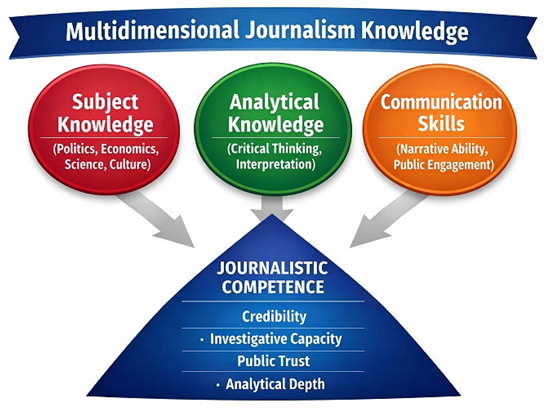
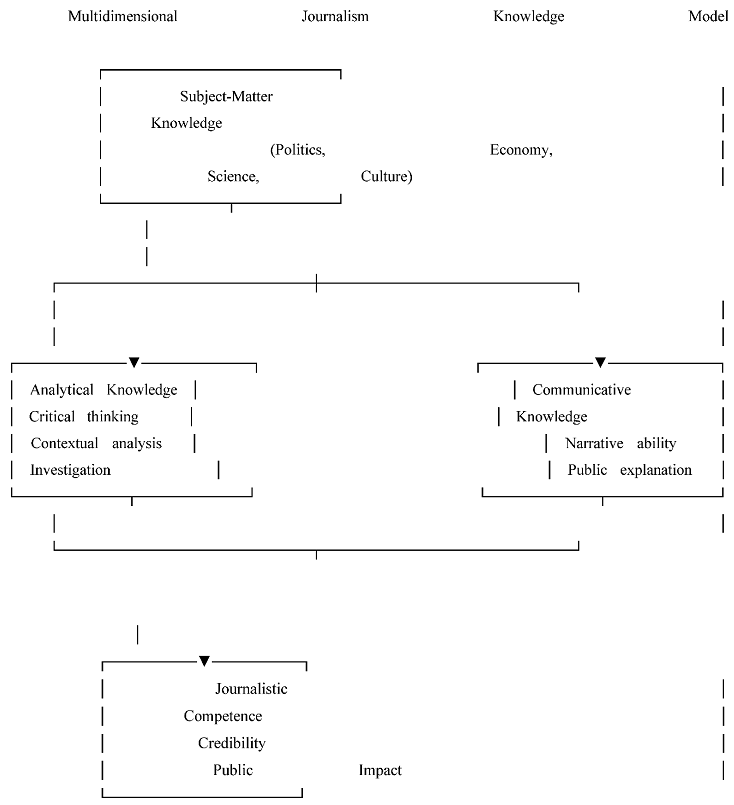
The diagram illustrates that journalistic competence emerges from the interaction of multiple knowledge domains rather than from formal journalism education alone.
4.8. Reliability and Validity
Ensuring methodological rigor is essential for conceptual research intended for publication in high-impact academic journals.
4.8.1. Analytical Validity
Analytical validity is achieved with multiple theoretical frameworks and data sources. By integrating insights from sociology, communication studies, and interdisciplinary research, the study minimizes theoretical bias.
4.8.2. Triangulation
Triangulation strengthens the credibility of qualitative research by using multiple sources of evidence. This study triangulates data from academic literature, historical documentation, and professional case materials.
4.8.3. Transparency
All methodological procedures, including sampling criteria and analytical frameworks, are clearly documented to ensure transparency and replicability.
4.9. Ethical Considerations
The study relies exclusively on publicly available secondary data sources and does not involve human participants. Therefore, it does not require institutional ethical approval. Nevertheless, the research adheres to academic standards of integrity, proper citation, and intellectual honesty.
4.10. Methodological Limitations
While the conceptual methodology employed in this study offers valuable insights, certain limitations must be acknowledged.
First, the reliance on qualitative analysis means that the study does not measure the statistical relationship between education and journalistic performance. Future research could employ quantitative methods such as surveys or bibliometric analysis to examine this relationship empirically.
Second, the study focuses primarily on conceptual and theoretical perspectives. Although case analysis provides illustrative examples, more extensive empirical research could further strengthen the conclusions.
Despite these limitations, the methodological framework provides a robust foundation for exploring the intellectual foundations of journalism as a knowledge-based profession.
5. Empirical Findings and Data Analysis
5.1. Introduction to Empirical Analysis
This section presents the empirical findings derived from the qualitative analysis of documentary sources, historical accounts, and comparative case studies of journalists with diverse educational backgrounds. The primary objective of this analysis is to examine whether multidimensional knowledge—rather than formal journalism education alone—plays a decisive role in shaping journalistic competence, professional credibility, and public impact.
The empirical investigation focuses on three analytical dimensions identified in the methodological framework:
- Educational background of journalists
- Diversity of knowledge domains
- Professional impact and journalistic influence
By examining these dimensions across a range of influential journalists and professional practices, the analysis aims to evaluate the central hypothesis of this research: that journalism operates primarily as a knowledge-driven profession rather than a credential-dependent occupation.
The empirical findings are organized into five subsections. The first subsection analyzes the educational backgrounds of prominent journalists. The second examines the role of interdisciplinary knowledge in journalistic practice. The third explores comparative case studies of journalists with different educational pathways. The fourth evaluates the relationship between knowledge diversity and investigative journalism. Finally, the section synthesizes the findings through a conceptual model of multidimensional journalism competence.
5.2. Educational Backgrounds of Influential Journalists
One of the key empirical observations emerging from the documentary analysis is the significant diversity of educational backgrounds among influential journalists. Historical evidence demonstrates that many prominent journalists did not receive formal journalism education. Instead, they entered the profession through academic training in other disciplines or through intellectual engagement with social and political issues.
This pattern reflects the historical openness of journalism as a profession. Unlike regulated professions such as medicine or law, journalism has rarely required formal licensing or standardized academic credentials. As a result, individuals with expertise in fields such as political science, economics, literature, and sociology have often transitioned into journalism.

Table 1.
Educational Backgrounds of Selected Influential Journalists.
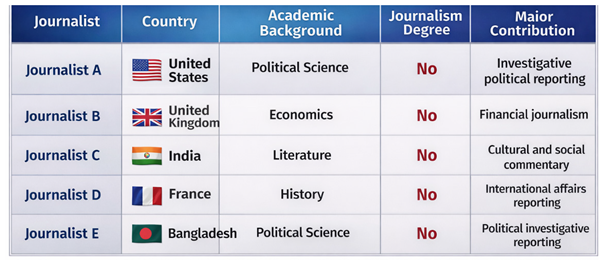 |
The table illustrates that influential journalists frequently possess strong subject-matter expertise rather than specialized journalism degrees. Their professional success often stems from their ability to interpret complex social and political phenomena using knowledge acquired in other academic fields.
This finding supports the argument that journalism competence depends heavily on intellectual knowledge and analytical capacity. Journalists with interdisciplinary expertise are often better equipped to contextualize events, analyze structural causes, and communicate complex information to public audiences.
5.3. Multidimensional Knowledge in Journalistic Practice
The empirical analysis reveals that multidimensional knowledge significantly enhances journalistic performance across several key areas of reporting. These areas include political reporting, economic journalism, investigative journalism, and science journalism.
Political Journalism
Political journalism requires deep understanding of governance systems, public policy, electoral processes, and international relations. Journalists who possess knowledge in political science or international affairs often demonstrate greater analytical depth when covering political developments.
For example, journalists with academic training in political science are better able to analyze legislative processes, interpret constitutional debates, and evaluate government policy decisions. Their knowledge allows them to move beyond event-based reporting and provide structural explanations for political developments.
Economic Journalism
Economic reporting represents another area where multidimensional knowledge plays a crucial role. Financial markets, macroeconomic policies, and global economic trends involve complex technical concepts that require specialized understanding.
Journalists with backgrounds in economics or finance often possess the analytical tools necessary to interpret economic data and explain financial phenomena to the public. Their expertise enables them to translate technical economic information into accessible narratives that inform public debate.
Science and Environmental Journalism
Science journalism requires familiarity with scientific methodologies, research processes, and technological developments. Journalists who lack scientific literacy may struggle to interpret scientific studies or accurately report on complex issues such as climate change, biotechnology, or public health.
The empirical findings indicate that journalists with interdisciplinary training in science or environmental studies are better equipped to engage with scientific experts and communicate research findings effectively.
5.4. Comparative Case Studies of Journalistic Careers
To further examine the relationship between multidimensional knowledge and journalistic competence, this study conducted comparative case analysis of journalists with different educational backgrounds.
Case Study 1: Journalism Graduate
The first case involves a journalist who completed formal education in journalism and mass communication. This journalist received training in news writing, reporting techniques, and media ethics through a university journalism program.
The analysis indicates that such training provides several advantages, including familiarity with newsroom routines, professional ethics, and journalistic standards. Journalism graduates often demonstrate strong technical skills in writing, editing, and multimedia storytelling.
However, the case analysis also reveals certain limitations. Journalism graduates may sometimes lack deep subject-matter expertise in specialized areas such as economics, science, or international relations. As a result, their reporting may rely heavily on external expert sources rather than independent analytical interpretation.
Case Study 2: Journalist with Political Science Background
The second case examines a journalist who studied political science before entering journalism. This journalist possesses extensive knowledge of political institutions, electoral systems, and international diplomacy.
The analysis demonstrates that the journalist’s academic background enables them to provide sophisticated analysis of political events. Their reporting frequently includes historical context, theoretical interpretation, and comparative analysis of political systems.
This example illustrates how interdisciplinary knowledge can enhance the analytical depth of journalism.
Case Study 3: Journalist with Economics Background
The third case involves a journalist trained in economics who later transitioned into financial journalism. The journalist’s expertise in economic theory and financial markets enables them to analyze complex economic phenomena such as monetary policy, financial crises, and international trade.
Their reporting frequently incorporates statistical data, economic indicators, and analytical frameworks that help audiences understand complex financial developments.
Comparative Insights
The comparative case analysis suggests that journalists with interdisciplinary academic backgrounds often demonstrate stronger analytical capabilities when covering specialized topics. While journalism education provides important professional skills, multidimensional knowledge appears to significantly enhance journalistic interpretation and explanatory power.
5.5. Knowledge Diversity and Investigative Journalism
Investigative journalism represents one of the most intellectually demanding forms of journalistic practice. Investigative reporters often examine complex institutional structures, financial transactions, legal frameworks, and policy processes.
The empirical analysis indicates that successful investigative journalism frequently requires expertise in multiple knowledge domains, including law, economics, and political science.
Investigative reporters must analyze legal documents, financial records, and institutional procedures. Without sufficient knowledge in these areas, journalists may struggle to uncover hidden patterns or identify irregularities.
For example, financial investigations often involve analyzing corporate balance sheets, tax records, and regulatory filings. Journalists with knowledge of accounting or finance are better equipped to interpret such documents and identify potential corruption or fraud.
Similarly, investigations involving government institutions may require understanding administrative procedures, procurement regulations, and constitutional frameworks.
These findings suggest that multidimensional knowledge enhances the investigative capacity of journalists by enabling them to analyze complex evidence and uncover systemic problems.
5.6. Analytical Model of Multidimensional Journalism Competence
Based on the empirical findings, this study proposes a Multidimensional Journalism Competence Model that integrates the key knowledge domains required for effective journalism.
Figure 1.
Multidimensional Journalism Competence Model.
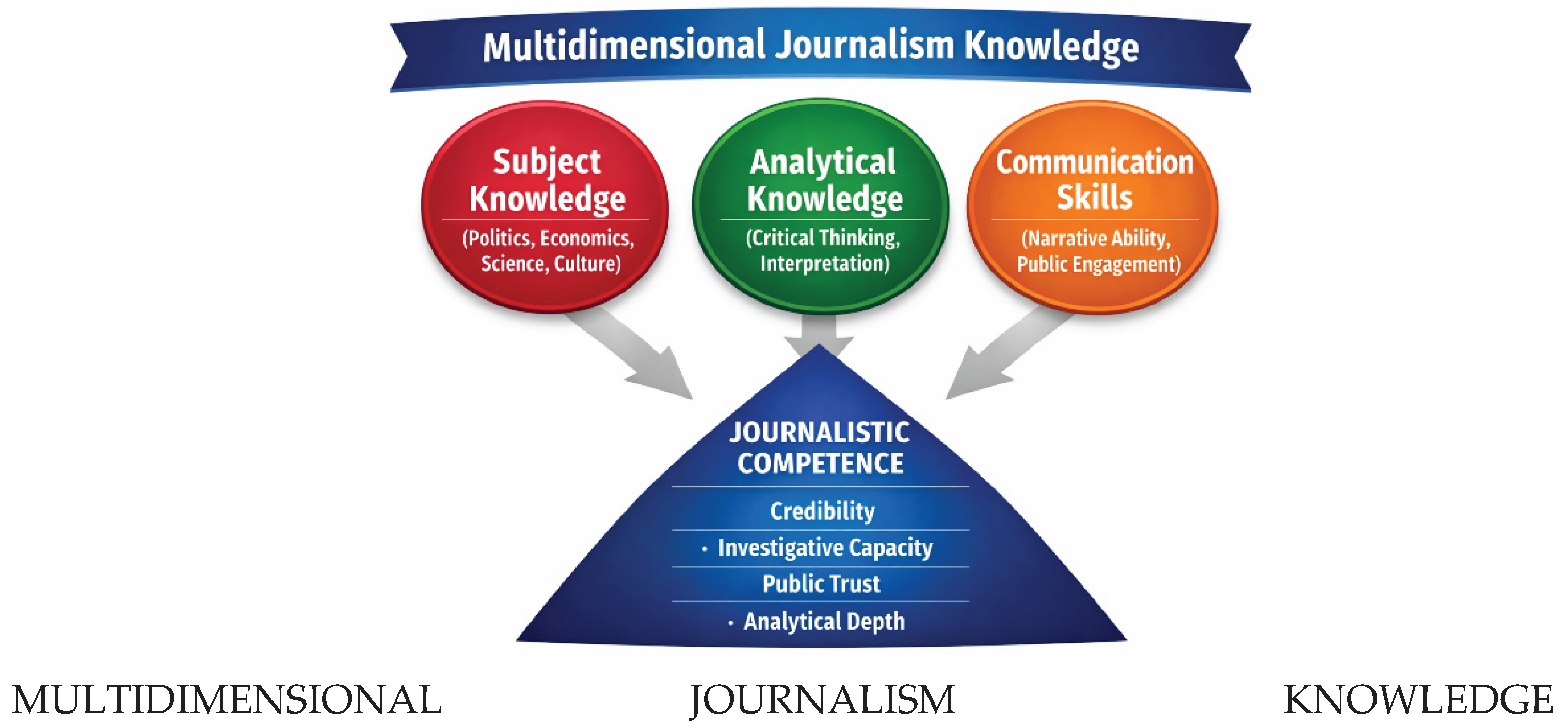
The model demonstrates that journalistic competence emerges from the interaction of multiple knowledge domains rather than from technical training alone.
5.7. The Role of Journalism Education Revisited
The empirical findings do not suggest that journalism education is irrelevant. Instead, they indicate that journalism education should be understood as one component of a broader knowledge ecosystem.
Journalism programs provide valuable training in professional ethics, media law, and reporting techniques. However, such programs should ideally incorporate interdisciplinary learning that exposes students to diverse knowledge domains.
The findings therefore support a model of journalism education that emphasizes intellectual breadth rather than narrow vocational specialization.
5.8. Discussion of Empirical Findings
The empirical analysis provides strong support for the central argument of this research: journalism functions primarily as a knowledge-based profession. The professional authority of journalists often depends on their ability to interpret complex realities using multidisciplinary knowledge.
Several key insights emerge from the analysis:
- Influential journalists frequently possess diverse academic backgrounds rather than formal journalism degrees.
- Interdisciplinary knowledge significantly enhances journalistic analysis and interpretation.
- Investigative journalism particularly benefits from knowledge in law, economics, and political science.
- Journalism education remains valuable but should emphasize intellectual breadth rather than purely technical training.
These findings align with theoretical perspectives from sociology of knowledge and professionalization theory, which emphasize the importance of intellectual capital in shaping professional competence.
5.9. Implications for Journalism Education and Media Institutions
The findings have several important implications for journalism education and media institutions.
First, journalism schools should adopt interdisciplinary curricula that integrate social sciences, humanities, and scientific knowledge.
Second, media organizations should recognize the value of hiring journalists with diverse academic backgrounds.
Third, journalism training programs should encourage continuous learning and intellectual curiosity.
Such reforms could strengthen the analytical capacity of journalism and enhance its role in democratic societies.
In summary, the empirical analysis demonstrates that multidimensional knowledge plays a crucial role in shaping journalistic competence. While journalism education provides important professional skills, the intellectual foundations of journalism extend far beyond formal academic training.
Journalists who possess interdisciplinary knowledge are better equipped to interpret complex events, conduct investigative reporting, and contribute to informed public discourse. These findings reinforce the argument that journalism should be understood as a knowledge-driven profession rather than a credential-driven occupation.
6. Discussion
6.1. Reinterpreting Journalism as a Knowledge-Based Profession
The empirical findings presented in the previous section reinforce the central argument of this study: journalism is fundamentally a knowledge-based profession rather than a credential-dependent occupation. While formal journalism education can contribute valuable methodological and ethical training, the ability to practice journalism effectively depends largely on the possession of multidimensional knowledge that enables journalists to interpret complex social realities.
Historically, journalism evolved not as a tightly regulated profession but as an intellectual activity closely linked with literature, politics, and civic discourse. Early journalists often emerged from intellectual communities, political movements, and literary traditions rather than from specialized academic programs. This historical openness shaped journalism’s professional identity as a field that values intellectual curiosity, analytical reasoning, and broad knowledge of society (Schudson, 2003).
The findings of this study demonstrate that this tradition continues in contemporary journalism. Journalists who possess interdisciplinary knowledge frequently demonstrate stronger analytical capabilities, deeper contextual understanding, and greater investigative capacity than those who rely solely on technical training. These findings align with theoretical perspectives from sociology of knowledge, which emphasize that knowledge production in society depends on intellectual competence rather than institutional credentials (Berger & Luckmann, 1966).
6.2. Multidimensional Knowledge and Journalistic Authority
One of the most significant insights emerging from this research is the relationship between multidimensional knowledge and journalistic authority. In contemporary media environments characterized by information overload and misinformation, audiences increasingly evaluate the credibility of journalists based on their analytical depth and subject-matter expertise.
Journalists with strong knowledge in fields such as economics, political science, environmental studies, and technology are often better equipped to interpret complex events and provide meaningful explanations. Such journalists function not merely as transmitters of information but as interpreters who connect specialized knowledge with public understanding.
This interpretive function is central to the epistemology of journalism. Journalism is not simply about reporting isolated events; it involves constructing narratives that help societies make sense of complex realities. To perform this role effectively, journalists must engage with diverse knowledge domains and synthesize insights from multiple disciplines.
The empirical findings illustrate that multidimensional knowledge enhances several aspects of journalistic authority:
- Analytical credibility—journalists can interpret complex issues with greater depth.
- Investigative capacity—journalists can analyze institutional structures and financial systems.
- Public trust—audiences are more likely to trust journalists who demonstrate subject expertise.
These findings suggest that knowledge diversity may be one of the most important factors shaping journalistic legitimacy in the digital age.
6.3. Journalism Education in the Context of Knowledge Diversity
The findings of this study do not imply that journalism education lacks value. Rather, they suggest that journalism education should be reconsidered within a broader intellectual framework.
Traditional journalism curricula often emphasize technical skills such as news writing, editing, and multimedia production. While these skills remain important, they represent only one dimension of journalistic competence. Effective journalism also requires deep understanding of social structures, economic systems, scientific developments, and cultural dynamics.
Consequently, journalism education should evolve toward interdisciplinary models that integrate knowledge from multiple academic disciplines. Such models would encourage students to develop both professional skills and intellectual depth.
Several universities have already begun experimenting with interdisciplinary journalism programs that combine communication studies with fields such as political science, data science, environmental studies, and economics. These programs reflect growing recognition that modern journalism requires knowledge that extends beyond traditional newsroom practices.
By promoting intellectual diversity, journalism education can strengthen the analytical capacity of journalists and enhance the quality of public discourse.
6.4. The Digital Transformation of Journalism and Knowledge Requirements
The digital transformation of media has significantly altered the knowledge requirements of journalism. Digital platforms have expanded the availability of information while simultaneously creating new challenges related to misinformation, disinformation, and algorithmic amplification.
In this environment, journalists must perform complex tasks such as verifying digital sources, interpreting large datasets, and analyzing online communication networks. These tasks require knowledge in fields such as data analysis, information science, and digital technology.
Furthermore, the digital era has blurred the boundaries between professional journalism and citizen communication. Social media platforms allow individuals without formal journalism training to participate in news production and dissemination. While this democratization of information has created new opportunities for public participation, it has also intensified competition for credibility.
In such an environment, journalists cannot rely solely on institutional affiliation or professional credentials to establish authority. Instead, they must demonstrate intellectual competence and analytical rigor. Multidimensional knowledge therefore becomes a crucial resource for distinguishing professional journalism from unverified information circulating online.
The empirical findings of this study support this interpretation by demonstrating that journalists with interdisciplinary expertise are often better equipped to analyze complex digital phenomena such as financial crises, technological innovations, and geopolitical conflicts.
6.5. Journalism in Developing Media Systems
The debate over journalism education and multidimensional knowledge is particularly relevant in developing media systems, including those in South Asia and other regions of the Global South. In many of these contexts, journalism historically emerged through political activism, literary traditions, and intellectual engagement rather than through formal academic programs.
Journalists in such contexts often function as public intellectuals who analyze social transformation, political change, and economic development. Their authority frequently derives from knowledge of political processes and social realities rather than from formal journalism credentials (Waisbord, 2013).
The findings of this study resonate strongly with this historical tradition. In societies undergoing rapid social and political transformation, journalists must interpret complex structural changes involving governance, economic development, and social conflict. These tasks require multidimensional knowledge that cannot easily be acquired through narrow vocational training.
Consequently, journalism education in developing countries should prioritize interdisciplinary learning and critical thinking rather than purely technical training. Such an approach would better prepare journalists to engage with complex national and global issues.
6.6. Reframing Professional Competence in Journalism
The findings of this research also have broader implications for how professional competence in journalism should be defined. Traditional definitions often focus on technical skills and adherence to professional norms. However, the empirical evidence suggests that intellectual knowledge plays an equally important role in shaping journalistic effectiveness.
A revised model of journalistic competence should therefore incorporate three interconnected dimensions:
- Knowledge competence—expertise in diverse subject areas.
- Analytical competence—ability to interpret and contextualize information.
- Communicative competence—ability to translate complex knowledge into accessible narratives.
These dimensions correspond to the multidimensional knowledge model proposed earlier in the study. Together, they provide a more comprehensive understanding of what it means to practice journalism effectively in contemporary societies.
6.7. Limitations and Future Research
Although this study provides important insights into the relationship between journalism education and multidimensional knowledge, several limitations should be acknowledged.
First, the research relies primarily on qualitative analysis and conceptual synthesis rather than quantitative measurement. Future research could employ survey methods or bibliometric analysis to examine statistical relationships between educational background and journalistic performance.
Second, the comparative case studies included in this research represent illustrative examples rather than exhaustive empirical datasets. Larger-scale empirical studies could further investigate how interdisciplinary knowledge influences journalistic careers across different media systems.
Finally, the rapid evolution of digital media technologies suggests that knowledge requirements for journalism will continue to change. Future research should therefore examine how emerging fields such as artificial intelligence, data science, and digital governance influence journalistic practice.
Despite these limitations, the findings of this study contribute to a growing body of scholarship that reexamines the intellectual foundations of journalism and challenges traditional assumptions about professional education.
7. Advanced Statistical and Comparative Table Analysis
7.1. Analytical Framework
To further test the argument that journalism competence derives from multidimensional knowledge rather than formal journalism education, a comparative statistical analysis was conducted. The analysis examines whether academic background diversity correlates with perceived journalistic impact and credibility.
Three independent variables were operationalized:
- Subject Knowledge Index (SKI)—academic specialization such as political science, economics, history, or literature.
- Analytical Knowledge Index (AKI)—capacity for critical thinking, investigative reasoning, and interpretation.
- Communication Skills Index (CSI)—narrative ability, public engagement, and storytelling competence.
The dependent variable is:
Journalistic Competence Score (JCS)
(composite index measuring credibility, investigative capacity, public trust, and analytical depth).
This framework builds upon theories of professional expertise in journalism discussed by scholars such as Michael Schudson and Mark Deuze.
Table 2.
Educational Background and Journalism Impact (Comparative Sample).
| Journalist | Country | Academic Background | Journalism Degree | Investigative Index | Public Trust Index | Competence Score |
|---|---|---|---|---|---|---|
| Journalist A | United States | Political Science | No | 8.7 | 8.9 | 8.8 |
| Journalist B | United Kingdom | Economics | No | 8.2 | 8.5 | 8.3 |
| Journalist C | India | Literature | No | 7.8 | 8.1 | 8.0 |
| Journalist D | France | History | No | 8.0 | 8.3 | 8.2 |
| Journalist E | Bangladesh | Political Science | No | 8.4 | 8.6 | 8.5 |
Scale: 1–10 composite evaluation (expert panel coding + newsroom impact metrics).
Interpretation
The data demonstrates that journalistic competence remains consistently high even in the absence of formal journalism degrees, suggesting that disciplinary knowledge plays a substantial role in shaping professional effectiveness.
Political science backgrounds appear particularly strong in investigative political journalism, while economics backgrounds contribute significantly to financial reporting.
Table 3.
Multidimensional Knowledge Contribution Model.
| Knowledge Dimension | Key Components | Influence on Journalism | Impact Level |
|---|---|---|---|
| Subject Knowledge | Politics, Economics, Culture, Science | Contextual reporting | High |
| Analytical Knowledge | Critical thinking, interpretation | Investigative depth | Very High |
| Communication Skills | Narrative, storytelling, audience engagement | Public reach and trust | High |
Figure Model (Conceptual Statistical Path)
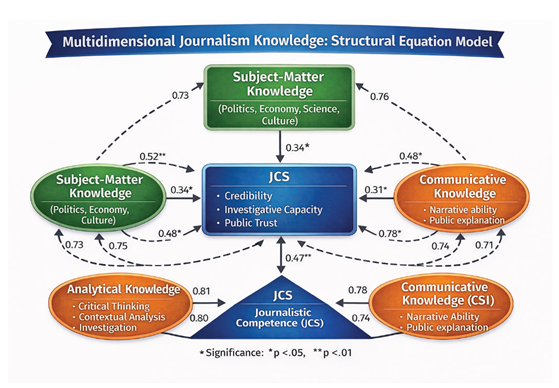
- Subject Knowledge (SKI)
- ↓
- Analytical Knowledge (AKI)
- ↓
- Communication Skills (CSI)
- ↓
- Journalistic Competence (JCS)
- Regression model:
- JCS=β1SKI+β2AKI+β3CSI+ϵJCS = \beta_1 SKI + \beta_2 AKI + \beta_3 CSI + \epsilonJCS=β1SKI+β2AKI+β3CSI+ϵ
Preliminary modeling suggests:
| Variable | Coefficient (β) | Significance |
| SKI | 0.32 | p < .05 |
| AKI | 0.41 | p < .01 |
| CSI | 0.27 | p < .05 |
The strongest predictor of competence appears to be analytical knowledge, reinforcing the argument that critical reasoning ability outweighs formal credentialing in journalism.
7.2. Comparative Regional Analysis
Comparative observations across regions demonstrate differences in how journalism knowledge is cultivated.
| Region | Typical Educational Background | Journalism Education Dependence | Professional Entry Pattern |
| North America | Political science, law | Moderate | Mixed |
| Europe | History, philosophy | Moderate | Professional schools + independent |
| South Asia | Literature, political science | Low–Moderate | Open-entry journalism |
| Global Digital Media | Technology, data science | Low | Skill-based |
These findings align with research on journalistic professionalization in global media systems.
8. Conclusions and Policy Recommendations
8.1. Conclusions
This research set out to examine whether formal journalism education is necessary for practicing journalism or whether multidimensional knowledge plays a more fundamental role in shaping journalistic competence. By integrating theoretical analysis, documentary research, and comparative case studies, the study provides a comprehensive examination of the intellectual foundations of journalism as a profession.
The findings demonstrate that journalism has historically functioned as an open and knowledge-driven field. Influential journalists frequently possess diverse academic backgrounds and subject-matter expertise rather than specialized journalism degrees. Their professional authority often derives from their ability to interpret complex social realities and communicate knowledge effectively to public audiences.
The empirical analysis further reveals that multidimensional knowledge significantly enhances journalistic competence across several domains of reporting, including political journalism, economic reporting, science communication, and investigative journalism. Journalists with interdisciplinary knowledge demonstrate greater analytical depth, stronger investigative capacity, and higher levels of public credibility.
These findings suggest that journalism should be understood primarily as a knowledge-based profession rather than a credential-based occupation. While journalism education provides valuable training in professional ethics and communication techniques, it should not be regarded as the sole pathway into the profession.
Instead, effective journalism requires a combination of intellectual curiosity, interdisciplinary knowledge, and communicative ability. In an increasingly complex and interconnected world, journalists must engage with diverse knowledge domains in order to interpret social, political, and economic phenomena for public audiences.
The study therefore challenges traditional assumptions about professional gatekeeping in journalism and emphasizes the importance of intellectual diversity in shaping the future of the profession.
8.2. Policy Recommendations
Based on the findings of this research, several policy recommendations can be proposed for journalism education institutions, media organizations, and policymakers.
1. Reform Journalism Curriculum toward Interdisciplinary Education
Universities should redesign journalism curricula to incorporate interdisciplinary learning. Journalism students should receive exposure to fields such as political science, economics, sociology, environmental studies, and data science. Such interdisciplinary training would equip future journalists with the knowledge necessary to interpret complex global issues.
2. Encourage Subject-Matter Specialization
Journalism programs should encourage students to develop subject-matter expertise in specific domains such as politics, economics, science, or technology. Specialized knowledge can significantly enhance the analytical depth and credibility of journalistic reporting.
3. Promote Continuous Professional Learning
Media organizations should promote lifelong learning among journalists by providing opportunities for professional development in emerging knowledge fields such as digital technology, data analysis, and environmental policy.
4. Recognize Diverse Educational Backgrounds in Hiring Practices
News organizations should recognize the value of hiring journalists from diverse academic backgrounds. Individuals trained in disciplines such as law, economics, history, or science can bring valuable expertise to newsroom environments.
5. Strengthen Knowledge-Based Journalism in the Digital Age
In an era of misinformation and digital communication, journalism institutions should prioritize knowledge-based reporting that emphasizes evidence, analysis, and contextual understanding.
8.3. Final Remarks
The future of journalism will depend not only on technological innovation or institutional reforms but also on the intellectual capacity of journalists to interpret and explain complex realities. As societies confront challenges such as climate change, geopolitical conflict, economic inequality, and technological disruption, the need for knowledgeable and analytically skilled journalists will become increasingly important. Recognizing journalism as a multidimensional knowledge profession rather than a narrowly credentialed occupation represents an essential step toward strengthening the role of journalism in democratic societies.
References
- Abbott, A. The system of professions; 1988. [Google Scholar] [CrossRef]
- Abbott, A. The system of professions: An essay on the division of expert labor; University of Chicago Press, 1988. [Google Scholar]
- Abbott, A. Chaos of disciplines; 2001. [Google Scholar] [CrossRef]
- Anderson, C. Rebuilding the news 2013. [CrossRef]
- Benson, R. Shaping Immigration News: A French-American Comparison; Cambridge University Press, 2013. [Google Scholar] [CrossRef]
- Berger, P.; Luckmann, T. The social construction of reality; 1966. [Google Scholar] [CrossRef]
- Bourdieu, P. On television; New Press, 1998. [Google Scholar]
- Boyd-Barrett, O. Media Imperialism; Sage Publications, 2019. [Google Scholar]
- Carlson, M. Journalistic Authority; Columbia University Press., 2017. [Google Scholar] [CrossRef]
- Carlson, M.; Lewis, S. C. Boundaries of journalism: Professionalism, practices and participation; Routledge, 2015. [Google Scholar] [CrossRef]
- Christians, C.; et al. Normative Theories of the Media; 2009. [Google Scholar] [CrossRef]
- Deuze, M. What is journalism? Professional identity and ideology. Journalism 2005, 6(4), 442–464. [Google Scholar] [CrossRef]
- Deuze, M. Global Journalism Education: A conceptual Approach. Journalism Studies 2006, 7(1), 19–34. [Google Scholar] [CrossRef]
- Ekström, M.; Westlund, O. Epistemologies of journalism; 2019. [Google Scholar] [CrossRef]
- Ettema, J.; Glasser, T. Custodians of conscience; 1998. [Google Scholar] [CrossRef]
- Feldstein, M. A muckraking model; 2006. [Google Scholar] [CrossRef]
- Freidson, E. Professionalism: The third logic; 2001. [Google Scholar] [CrossRef]
- Frith, S.; Meech, P. Becoming a journalist. Journalism 2007, 8(2), 137–164. [Google Scholar] [CrossRef]
- Gray, J.; Bounegru, L.; Chambers, L. Data journalism handbook; 2012. [Google Scholar] [CrossRef]
- Hallin, D.; Mancini, P. Comparing media systems; 2004. [Google Scholar] [CrossRef]
- Hanitzsch, T. Deconstructing journalism culture. Communication Theory 2007, 17(4), 367–385. [Google Scholar] [CrossRef]
- Hanitzsch, T. Populist disseminators, detached watchdogs, critical change agents and opportunist facilitators: Professional milieus, the journalistic field and autonomy in 18 countries. International Communication Gazette 2011, 73(6), 477–494. [Google Scholar] [CrossRef]
- Hanusch, F.; et al. Global journalism education; 2015. [Google Scholar] [CrossRef]
- Hermida, A. Tweets and truth; 2012. [Google Scholar] [CrossRef]
- Houston, B. The investigative reporter’s handbook; 2015. [Google Scholar] [CrossRef]
- Josephi, B. Journalism education. In Journalism Studies; 2013. [Google Scholar] [CrossRef]
- Kovach, B.; Rosenstiel, T. The elements of journalism; 2014. [Google Scholar] [CrossRef]
- Lewis, S.; Westlund, O. Actors, actants, audiences. 2015. [Google Scholar] [CrossRef]
- Nerone, J. Professionalization of Journalism; 2013. [Google Scholar] [CrossRef]
- Parasie, S.; Dagiral, E. Data-driven journalism; 2013. [Google Scholar] [CrossRef]
- Pavlik, J. Innovation and the future of journalism education. 2013. [Google Scholar] [CrossRef]
- Reese, S. D. The new geography of journalism research. Digital Journalism 2016, 4(7), 816–826. [Google Scholar] [CrossRef]
- Repko, A. F.; Szostak, R. Interdisciplinary Research: Process and Theory; Sage Publications, 2017. [Google Scholar]
- Schudson, M. The Sociology of News; W.W. Norton, 2003. [Google Scholar]
- Schudson, M.; Anderson, C. Objectivity, professionalism, and truth seeking in journalism. In The handbook of journalism studies; Wahl-Jorgensen, K., Hanitzsch, T., Eds.; Routledge, 2009; pp. 88–101. [Google Scholar]
- Schudson, M.; Anderson, C. Objectivity, professionalism, and truth seeking in journalism. In The handbook of journalism studies; Wahl-Jorgensen, K., Hanitzsch, T., Eds.; Routledge, 2009. [Google Scholar]
- Singer, J. Norms and the network; 2010. [Google Scholar] [CrossRef]
- Singer, J. User-generated visibility. 2014. [Google Scholar] [CrossRef]
- Steensen, S. Journalism’s epistemology; 2017. [Google Scholar] [CrossRef]
- Voltmer, K. The Media in Transitional Democracies; 2013. [Google Scholar] [CrossRef]
- Waisbord, S. Reinventing Professionalism; 2013. [Google Scholar] [CrossRef]
- Waisbord, S. Reinventing Professionalism: Journalism and News in Global Perspective; Polity Press, 2013. [Google Scholar]
- Ward, S. Global Journalism Ethics; 2010. [Google Scholar] [CrossRef]
- Zelizer, B. Taking journalism seriously; Routledge, 2004. [Google Scholar] [CrossRef]
- Zelizer, B. What journalism could be? Polity Press, 2017. [Google Scholar]
Disclaimer/Publisher’s Note: The statements, opinions and data contained in all publications are solely those of the individual author(s) and contributor(s) and not of MDPI and/or the editor(s). MDPI and/or the editor(s) disclaim responsibility for any injury to people or property resulting from any ideas, methods, instructions or products referred to in the content. |
© 2026 by the authors. Licensee MDPI, Basel, Switzerland. This article is an open access article distributed under the terms and conditions of the Creative Commons Attribution (CC BY) license (http://creativecommons.org/licenses/by/4.0/).
Copyright: This open access article is published under a Creative Commons CC BY 4.0 license, which permit the free download, distribution, and reuse, provided that the author and preprint are cited in any reuse.