

Submitted:
11 March 2026
Posted:
12 March 2026
You are already at the latest version
Abstract
cycloaddition of isatin ketonitrone 1,3-dipoles, generated from the condensation of various substituted isatins and arylhydroxylamines, with coumarins. The pentacyclic products bearing four consecutive stereocenters, including two quaternary carbon stereocenters fused in one ring structure, were smoothly acquired in moderate to high yields (22-98%) with high regio- (α and exo type) and diastereoselectivities (>20:1 dr). The synthesized compounds (>45 examples) were well characterized through different spectroscopic techniques, such as single crystal XRD, FTIR, NMR, and mass spectral analysis.
Keywords:
cycloaddition
; ketonitrone
; coumarin
; spirooindole
1. Introduction
Coumarins, a class of naturally occurring benzopyrone derivatives, are widely present in medicinal plants and isolated from 1820 [1,2,3,4,5,6,7,8]. Many of these compounds have demonstrated significantly high biological activities (anticancer, anti-HIV, antibacterial, anti-pathogen, anticoagulant and antispasmodic activities…) [9,10,11,12,13,14,15,16,17,18,19,20,21,22,23,24,25]. For examples, a famous compound warfarin (II), originated from dicoumarol (I) (Figure 1), exhibited an anticoagulant activity, and was subsequently used as a rodenticide and a drug for prevention of cerebral thrombosis [26,27]. Compounds III-V also displayed considerable chemotherapeutic efficacy against mammary cancer induced by polycyclic aromatic hydrocarbons, important soybean lipoxygenase (LOX) inhibitory activity, and significant anticancer activity against both bladder cancer and glioma, respectively [28,29,30,31]. In addition, versatile coumarin skeletons by facile chemical modification were served as key components in organic optical devices [32,33,34,35]. The chemical syntheses of coumarins have been well developed by various methods, including common condensations/lactonizations, transition-metal-catalyzed reactions, and photoinduced organocatalytic methods [36,37,38,39,40,41,42,43,44]. Meanwhile, as a kind of important synthons, coumarins could take part in various chemical reactions, which offered structurally more complex derivatives of coumarin [45,46,47,48,49,50,51,52,53,54,55,56,57,58,59,60,61,62,63,64,65,66,67,68,69,70,71]. Spirooxindoles, on the other hand, are a class of tricyclic organic molecules featuring multiple contiguous quaternary or tertiary stereocenters, commonly found in natural products and bioactive compounds [72,73,74,75,76,77,78,79,80,81,82,83,84,85,86,87,88,89,90,91,92,93,94,95]. Their unique structures and remarkable biological activities make them highly promising in the field of medicine, positioning them as one of the most potential drug candidates. For instance, the two compounds VI and VII inhibited an advanced glycation end (AGE) product formation activity (IC50=11.37 nm) [96], and the α-amylase and α-glucosidase enzyme inhibitory activity (IC50=0.28 and 0.31 mg mL-1) [97], respectively. Furthermore, the tetrahydroisoquinolinyl oxindole VIII showed a highly effective and selective histone lysine-specific demethylase 1 (LDS1) inhibitory activity (IC50= 42 nm) [98]. The spiropyrrolothiazolyl oxindole IX was discovered to exhibit in vitro activity against MCF-7 and K562-leukemia cancer cells, with IC50 values of 15.32 and 14.74 μM, respectively [99].
Among many spirooxindoles, sipropyrolidine ones are the most common type of compound, and possess the diverse and important biological activities, which have attracted widespread attention and considerable interest from organic chemists all over the world [100,101,102,103,104,105,106,107,108,109,110,111,112,113,114,115,116,117,118,119,120,121,122,123,124,125]. In the various synthetic approaches of spiropyrrolidine oxindoles, 1,3-dipolar cycloaddition of isatin-derived dipoles (azomethine ylide, azomethine imine and nitrone etc.) with dipolarophiles has been shown to be the most practical and simplest method for constructing pyrrolidine ring [126,127,128,129,130,131,132,133,134,135,136,137,138,139,140,141,142,143,144,145,146,147,148,149,150,151,152,153,154,155,156,157,158,159,160,161,162,163,164,165,166,167,168,169,170,171,172,173,174,175,176,177,178,179]. As a versatile synthon, nitrone was widely used in various organic reactions for constructing complex molecules [180,181,182,183,184,185,186,187,188,189,190,191,192,193,194,195,196,197,198,199,200,201,202,203,204,205,206,207,208,209,210,211]. Recently, we have developed a rapidly [3+2]-cycloaddition of isatin ketonitrone 1,3-dipoles with chalcones to afford novel dicyclic spiropyrrolidine oxindole derivatives in 18-98% yields and >20:1 dr values under t-BuOK (Scheme 1) [212]. Meanwhile, Michael adducts were obtained under DBU, with 18-83% yields and 1:1->20:1 dr values. As an extension of our work on 1,3-dipolar cycloaddition of isatin [126–179ketonitrones, we attempted to treat isatin ketonitrone 1a using coumarin 2a as a partner in the presence of base, which expected to give pentacyclic spiropyrolidine oxoindoles.
2. Results and Discussion
Prior to starting this research, N-Bn isatin ketonitrone 1a and ethyl coumarin 3-carboxylate 2a were selected as model substrates, as illustrated in Table 1. Initially, the reaction was performed in the presence of DBU (25 mol%) in some protic and aprotic solvents, such as H2O, EtOH, MTBE, DMF, THF and DCM. The result demonstrated that above all aprotic solvents could not afford the desired cycloadduct 3a at rt or under heating condition (entries 1-2). Fortunately, however, the protic polar solvent EtOH gave 70% yield of the desired product 3a (entry 4). The 1H NMR spectrum for 3a showed that the shifts of two proton in pyrrolidine ring were 6.39 (singlet peak) and 4.70 (singlet peak) ppm, respectively, which could confirm α-C of isatin ketonitrone 1a nucleophilically attacked the electrophilic site of the electron-efficient C=C bond in coumarin 2a, to obtain α-selective cycloadduct. Furthermore, the stereochemistry (exo-configuration) of cycloadduct 3a were indirectly proved by the single crystal X-ray diffraction of compound 3b (Figure 3). Subsequently, various alcohols, for instance MeOH, IPA, nBuOH and tBuOH were screened for improving the yield of the reaction. Regrettably, the above all alcohols afford lower yields than one of ethanol. Next, other organic and inorganic bases were screened using ethanol as a solvent. The inorganic bases (for instance tBuOK, KOH, NaOH and NaHCO3) did not work at all at rt and gave the complex results at heating or refluxing conditions. Although both EtONa and MeONa could smoothly proceed, the conversion rates of 1a were too low. In organic bases, such as DMAP, DABCO and Ph3P, the reactions were also discovered to be not take place, while in other secondary and tertiary amines (Et2NH, Bn2NH, TEA, Bn3N, nPr3N, DIPEA, tri-n-amylamine and tri-n-octylamine), the conversion rates of 1a were equally low, even if the reaction temperature was increased. Changing the amount of coumarin 2a (2.1 equiv.), the yield was almost the same compared to 1.0 equivalent of 2a. Finally, the amount of DBU and the concentration of the reaction were investigated. The higher concentration (0.2 M) could slightly increase the yield (74%). Considering the above factors, the optimal reaction condition for 1,3-dipolar cycloaddition was established as isatin ketonitrone 1a (1 equiv.), maleimide 2a (1.05 equiv.) and base DBU (0.25 equiv.) in EtOH at rt for 5 h (entry 14).
Figure 2.
X-ray crystal structure of 3b (CCDC: 2375731).
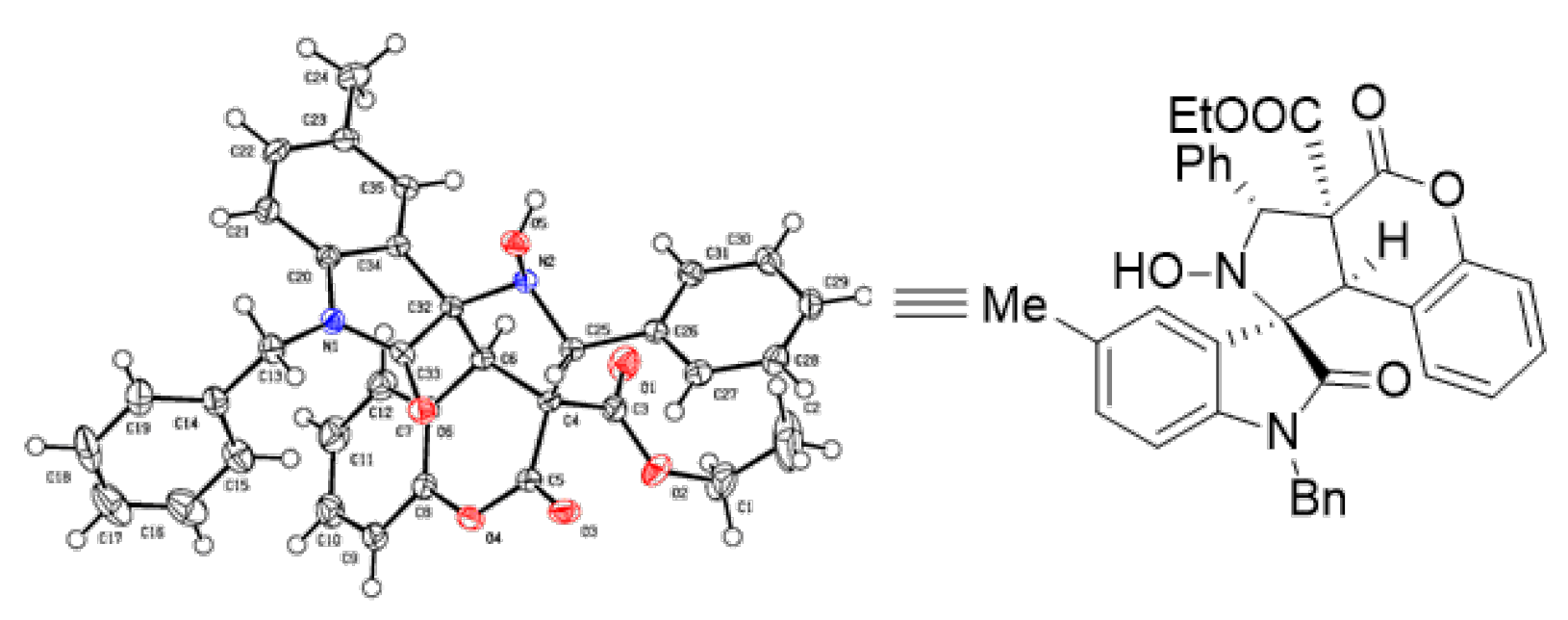
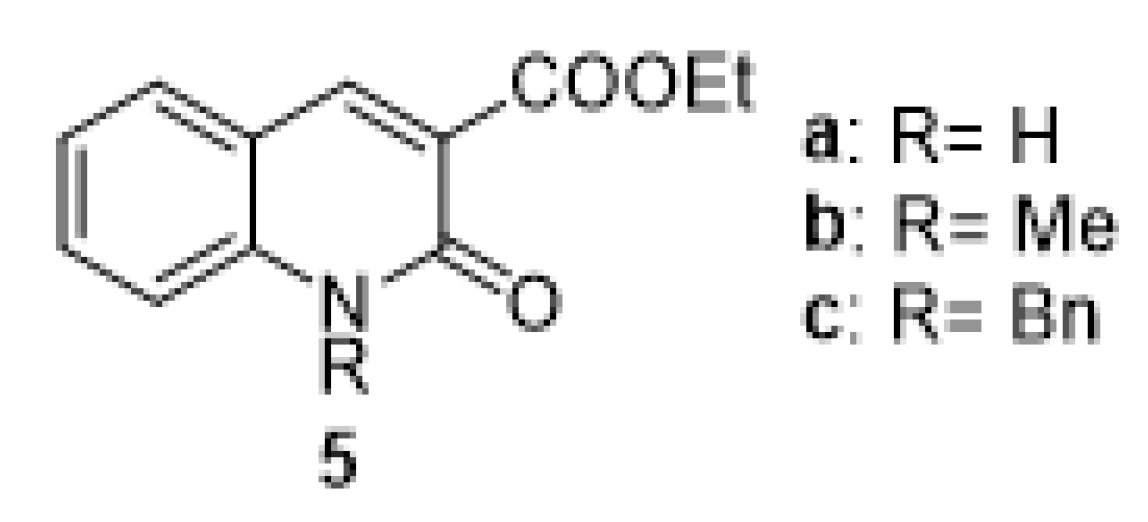
Figure 3.
Other unsuccessful like-coumarins 5.
After the optimal reaction conditions established, a wide range of different substituted isatin ketonitrones were explored for this 1,3-dipolar cycloaddition. As outlined in the Table 2, various substituent groups installed on isatin ketonitrones could be tolerated, which furnished the desired cycloadducts in 38-98% yields with >20:1 dr values, except for the cases of 3h-i, 3o and 3v. It was worth noting that the cycloaddition for the synthesis of 3a was scale up to 0.5 mmol or 5 mmol, which gave rise to the same yield. The substituent patterns on the benzene ring of isatin part of compounds 1 had a significant impact on the yields. All in all, the yields of the electron-donating groups were relative higher than that of the electron-withdrawing ones. For example, 5-methyl group installed on the benzene ring afforded the highest yield (98%) (entry 2), whereas, the strong electron-withdrawing groups (5-NO2 and 7-CF3) gave a complex mixture (entries 8 and 9). Changing the substituent groups (R= H, Me, Et, allyl and propargyl) on the nitrogen atom of isatin part of ketonitrones 1, the corresponding cycloadducts were also rendered consistently in satisfactorily yields (59-85%). Subsequently, when R2 group (R2= Ph) was replaced by various substituent phenyl gourps, the products 3p-u were generated smoothly with moderate to good yields as a single isomer. However, only a trace amount of 3o was found when R2 was a hydrogen atom possibly due to ketonitrone’s difficulty to form the active intermediate C-N-C type 1,3-dipole in the presence of DBU, even EtONa (entry 15). The similar result was also discovered in the case of 3v (entry 22). Next, in view of 3b obtained in the highest yield, these reactions were investigated using substituent phenyl instead of phenyl at the site of R2, when R1 was 5-methyl group. The results demonstrated that their yields were analogous to these of 3p-u (entries 23-29). Finally, the substrate bearing benzyl at nitrogen atom and aryl groups at the site of R2 were also underwent the 1,3-dipolar cycloaddition, which afforded commonly the inferior outcomes to the above examples, in especial 3ad and 3ae. From the above results, the yields were seemingly irrelevant to the electronic effects of substituents at the site of R2. However, when the steric bias existed on the substrate, the yield dynamically dropped off (entry 26).
In order to further explore the generality of the cycloaddition reaction, various substituted coumarins were studied. All results were illuminated in Table 3. Firstly, coumarins bearing various groups on benzene ring were employed to react with 1a, which showed that the electron effect and site of substituent played a critical impact on yields and diastereoselectivities of the reaction. For example, 8-ethoxyl coumarin could smoothly undergo the cycloaddition and obtain the yield of 86% with >20:1 dr, whereas, 7-methoxyl coumarin only gave the yield of 22%. Furthermore, when 7-methoxyl group was replaced by 7-diethylamino group, this reaction gave rise to a complex mixture. All coumarin bearing electron-withdrawing or electron-deficient group at 6-position afforded the desired products with yields of 67-82%. However, 6,8-dibromocoumarin only gave 30% yield, which was similar for the reaction result of 7-methoxylcoumarin. It was worth noting that 6-nitrocoumarin 2h was subjected to the cycloaddition with 1a in EtOH, and then the lactone ring of the cycloadduct was opened to yield the compound 4g’ with 24% yield. After many experiments, the reaction 2h with 1a was carried out in non-nucleophilic solvent t-BuOH, leading to the desired product 4g with good yield. Next, other coumarin 3-carboxylic esters 2k-n were investigated. Both i-propyl and n-butyl esters 2l-m were treated with 1a, leading to the same and slight low yield compared with 2a, whereas benzyl esters 2n could lead to a higher yield than 2a. Surprisingly, the yield for the reaction of methyl ester 2k sharply decreased, maybe because of the its unstability in the currently reactional condition. Thirdly, when the entire ethyl ester group of 2a was replaced by other groups, such as H, CN, X, Ac, Bz, carboxyl and amide, all reactions were very messy. In addition, the analogue 2-quinolinones 5 was also applied in this reaction, though the attempts were unsuccessful.
To achieve an asymmetric version of the present reaction, some chiral catalysts, such as quinine, quinidine, hydroquinidine, (S)-BINOL, (R)-BINAP, instead of DBU, were screened in the model reaction of 1a and 2a in EtOH at reflux. Unfortunately, all ligands were not suitable for this reaction (0–26% yields and 0% ee).
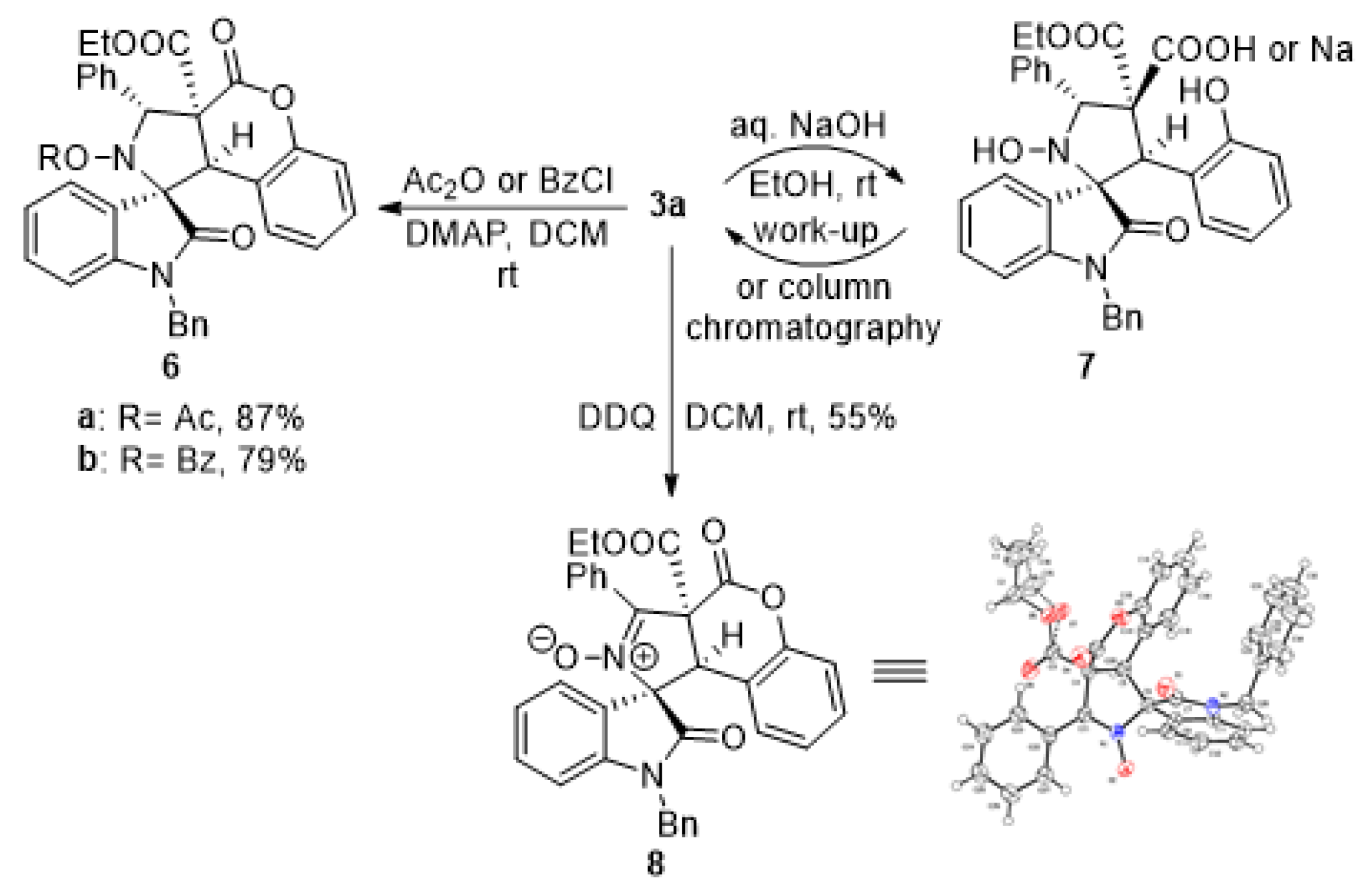
To show the synthetic utility of these spiropyrrolidine scaffolds, the derivatization of the model substrate 3a was took place. As shown in scheme 2, the hydroxyl group of 3a was protected by acetyl or benzoyl groups in the presence of DMAP, providing the compounds 6a and 6b, respectively, with 87% and 79% yields. Next, the saponification of 3a in the presence of NaOH could gave smoothly the desired carboxylic acid 7. Unexpectedly, the carboxylic acid was found to reconvert quickly into 3a by TLC, even if sodium salt of 7 was not acidified, needless to say the isolation of 7 via column chromatography (by silica gel using 0.5% TEA of EtOAc/Petroleum ether as an eluent). Exposed to DDQ in DCM, 3a was oxidized to the new nitrone 8 in 55% yield. The configuration of oxidation product 8 were undoubtedly proved by its single crystal X-ray diffraction.
Scheme 2.
Transformation of 3a and X-ray crystal structure of the compound 8 (CCDC: 2518523).
3. Materials and Methods
3.1. General Methods
All reactions were carried out without strict water-free and oxygen-free conditions. All reagents were obtained from commercial suppliers unless otherwise stated. All solvents and reagents were directly used for reactions without further purification unless otherwise stated. When the reactions preformed at the condition of MeONa, EtONa and tBuONa, solvents (DCM, DCE, dioxane and MTBE) were pre-dried with CaH2. Flash chromatography was performed using silica gel (200-300 mesh). Reactions were monitored by TLC or/and colour changes of reaction solution. Visualization was achieved under a UV lamp (254 nm and 365 nm), I2 and by developing the plates with anisaldehyde. 1H and 13C NMR were recorded on 400 and 600 MHz NMR spectrometers with tetramethylsilane (TMS) as the internal standard and were calibrated using residual undeuterated solvent as an internal reference (CHCl3: 1H NMR= 7.26, 13C NMR= 77.16; DMSO-d6: 1H NMR= 2.50, 13C NMR= 39.52). IR spectra were acquired on an FT-IR spectrometer and are reported in wavenumbers (cm-1). High-resolution mass spectra were obtained using electrospray ionization (ESI). The following abbreviations are used for the multiplicities: s: singlet, d: doublet, t: triplet, sept: septet, m: multiplet, br s: broad singlet for proton spectra. Coupling constants (J) are reported in Hertz (Hz).
3.2. Preparation of Intermediates
All N-substituted isatins were prepared by isatin (1.0 equiv.) and alkyl halides (1.5 equiv.) under NaH (2.0 equiv.) in DMF at 0oC-rt.1 All O-substituted benzyl hydroxylamine hydrochlorides were prepared by two-step reactions, including the aldoxime reaction (1 equiv. aromatic aldehydes/1.2 equiv. hydroxylamine hydrochloride/2.0 equiv. NaOAc/1:1 EtOH:H2O and the reduction of aldoxime (1.0 equiv. aromatic aldoxime/1.2 equiv. NaBH3CN/10.0 equiv. con. HCl/MeOH/0oC-rt).2 All isatin ketonitrones 1 were prepared by isatin or substituted isatins (1.0 equiv.) and O-benzyl or substituted benzyl hydroxylamine hydrochlorides (1.1 equiv.) in the condition of HOAc (2.0 equiv.) in MeOH at rt.3
All coumarins 2 to the equimolar mixture of salicyladehyde (1.0 equiv.) and malonate ester (3.2 equiv) in absolute ethanol or tetrahydrofuran was added catalytic amount of piperidine (0.35 equiv.) and resulting homogeneous mixture was refluxed for 5-8 h. Completion of the reaction was confirmed by TLC, whole reaction mixture was dispensed into crushed ice and the resulting precipitate was filtered, dried and recrystallized from methanol.4 2H-chromene-3 carbaldehydes 5 were prepared by salicyladehyde (1.0 equiv.) or acrolein (1.2 equiv.) under potassium carbonate (1.2 equiv.) in dioxane was refluxed. The mixture was stirred at rt for 27 h before it was quenched with a saturated NH4Cl solution. The aqueous solution was extracted with EtOAc. The combined organic layers were dried over Na2SO4, filtered and concentrated under reduced pressure. The residue was purified by flash column chromatography on silica gel (petroleum ether: EtOAc = 100:1 to 50:1) to furnish 5.5
3.3. General Procedure for Condition Optimization
A 10 mL tube was charged with isatin ketonitrone 1a (0.2 mmol, 1.0 equiv.) coumarin 2a (0.21-0.22 mmol, 1.05-1.1 equiv.), base (0.05-0.2 mmol, 25-100 mol%) and solvent (1-4 mL). After the reaction mixture is directly concentrated under vacuum. The residue was purified by flash silica gel chromatography eluated with EtOAc:PE (1:12 to 1:2, v/v) to afford the corresponding product 3a.
3.4. General Procedure for Typical Procedure for Cycloaddition
A 25 mL tube was charged with isatin ketonitrone 1 (0.5 mmol, 1.0 equiv.), coumarin 2 (0.525 mmol, 1.05 equiv.), DBU (0.125 mmol, 25 mol%) and EtOH/t-BuOH (2.5 mL). The reaction mixture was stirred at rt and monitor by TLC plate. fter the reaction mixture is directly concentrated under vacuum.The residue was purified by flash silica gel chromatography eluated with EtOAc:PE (1:12 to 1:2, v/v) to afford the corresponding products 3.
3.5. The Phenomenon of the Reaction and TLC
Figure 4 showed the phenmenon of the reaction for 1a and 2a under DBU and TLC of starting materials 1a/2a and product 3a.
3.6. Deriverziation of 3a
To a solution of 3a (280 mg, 0.5 mmol, 1.0 equiv.) in DCM (3 mL) was added DMAP (18 mg, 0.15 mmol, 0.3 equiv.), Ac2O (70 μL, 0.75 mmol, 1.5 equiv.) at rt. The mixture was stirred at rt for 18 h before it was quenched with a saturated NaHCO3 solution (10 mL). The aqueous solution was extracted with EtOAc (3x10 mL). The combined organic layers were dried over Na2SO4, filtered and concentrated under reduced pressure. The residue was purified by flash column chromatography on silica gel (petroleum ether: EtOAc = 8:1 to 2:1) to provide the acetate 6a in 87% yield.
To a solution of 3a (280 mg, 0.5 mmol, 1.0 equiv.) in DCM (3 mL) was added DMAP (112 mg, 1.0 mmol, 2.0 equiv.), BzCl (145 μL, 1.25 mmol, 2.5 equiv.) at rt. The mixture was stirred at rt for21 h before it was quenched with a saturated NaHCO3 solution (10 mL). The aqueous solution was extracted with EtOAc (3 x 10 mL). The combined organic layers were dried over Na2SO4, filtered and concentrated under reduced pressure. The residue was purified by flash column chromatography on silica gel (petroleum ether: EtOAc = 8:1 to 6:1) to furnish the benzoate 6b in 79% yield.
To a solution of 3a (280 mg, 0.5 mmol, 1.0 equiv.) in DCM (5 mL) was added DDQ (170 mg, 0.75 mmol, 1.5 equiv.). The mixture was stirred at rt for 3 h before it was quenched with a saturated Na2SO3 solution (15 mL). The aqueous solution was extracted with DCM (3 x 10 mL). The combined organic layers were dried over Na2SO4, filtered and concentrated under reduced pressure. The residue was washed with methanol to give the pure product 8 in 55% yield.
3.7. Data for All New Compounds
(±)-ethyl (1R,3R,3aS,9bR)-1’-benzyl-2-hydroxy-2’,4-dioxo-3-phenyl-2,3-dihydro-4H-spiro[chromeno [3,4-c]pyrrole-1,3’-indoline]-3a(9bH)-carboxylate (3a)
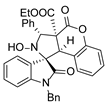
207.4 mg, 74%, a white solid, >20:1 dr, mp: 182.9-184.1oC; IR (thin film): νmax 3470, 3061, 3032, 2977, 2911, 1760, 1732, 1615, 1491, 1369, 1228, 1212, 1179, 768, 732, 610, 532 cm−1; 1H NMR (400 MHz, DMSO-d6) δ 8.54 (s, 1H), 7.82 (d, J = 6.8 Hz, 1H), 7.72 (d, J = 7.6 Hz, 2H), 7.40 (ψt, J = 7.4 Hz, 3H), 7.34-7.26 (m, 3H), 7.14-7.11 (m, 2H), 7.05 (ψt, J = 7.4 Hz, 2H), 6.90 (ψt, J = 7.4 Hz, 1H), 6.69 (d, J = 7.2 Hz, 1H), 6.53 (d, J = 7.2 Hz, 2H), 6.38 (d, J = 7.52 Hz, 1H), 5.76 (s, 1H), 4.88 (d, J = 16.4 Hz, 1H), 4.68 (s, 1H), 4.51 (d, J = 16.0 Hz, 1H), 3.61-3.49 (m, 2H), 0.65 (t, J = 7.0 Hz, 3H); 13C NMR (100 MHz, DMSO-d6): δ 175.1, 167.2, 164.6, 150.8, 144.1, 138.2, 135.7, 130.6, 128.9, 128.4, 128.2, 128.1, 127.4, 126.7, 126.4, 125.0, 124.9, 123.7, 117.5, 115.2, 109.9, 77.4, 72.4, 63.0, 59.3, 47.0, 42.6, 13.5; HRMS (ESI): m/z calcd for C34H28N2O6Na [M+Na]+ 583.1845, found 583.1836.
(±)-ethyl (1R,3R,3aS,9bR)-1’-benzyl-2-hydroxy-5’-methyl-2’,4-dioxo-3-phenyl-2,3-dihydro-4H-spiro[chromeno [3,4-c]pyrrole-1,3’-indoline]-3a(9bH)-carboxylate(3b)
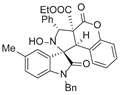
281.0mg, 98%, a white solid, >20:1 dr, mp: 185.3-186.6oC; IR (thin film): νmax 3479, 3377, 3065, 3032, 2982, 2919,1767, 1728, 1705, 1496, 1369, 1227, 1174, 808, 765, 527 cm−1; 1H NMR (600 MHz, CDCl3) δ 7.84 (d, J = 7.8 Hz, 1H), 7.60 (s, 1H), 7.40 (ψt, J = 7.6 Hz, 2H), 7.32 (t, J = 6.8 Hz, 1H), 7.27 (t, J = 7.4 Hz, 1H), 7.11 (ψt, J = 7.2 Hz, 1H), 7.09–7.06 (m, 2H), 7.04 (ψt, J = 7.8 Hz, 2H), 6.80 (ψt, J = 7.4 Hz, 1H), 6.56 (d, J = 7.8 Hz, 2H), 6.44 (d, J = 7.8 Hz, 2H), 6.11 (s, 1H), 5.01 (d, J = 16.2 Hz, 1H), 4.78 (s, 1H), 4.72 (s, 1H), 4.35 (d, J = 15.6 Hz, 1H), 3.69-3.64 (m, 1H), 3.60-3.55 (m, 1H), 2.46 (s, 3H), 0.76 (t, J = 7.2 Hz, 3H); 13C NMR (150 MHz, DMSO-d6): δ 174.4, 167.0, 164.6, 151.1, 141.8, 137.4, 135.0, 133.0, 130.8, 129.6, 128.9, 128.6, 128.2 (2C), 128.1, 127.2, 126.7, 125.8, 124.8, 124.2, 117.6, 114.9, 109.6, 72.51, 63.0, 59.1, 46.9, 43.4, 21.3, 13.3; HRMS (ESI): m/z calcd for C35H30N2O6Na [M+Na]+ 597.2002, found 597.1976.
(±)-ethyl (1R,3R,3aS,9bR)-1’-benzyl-2-hydroxy-5’-methoxy-2’,4-dioxo-3-phenyl-2,3-dihydro-4H-spiro[chromeno [3,4-c]pyrrole-1,3’-indoline]-3a(9bH)-carboxylate (3c)
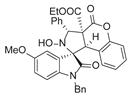
242.6 mg, 82%, a white solid, >20:1 dr, mp: 176.3-177.9oC; IR (thin film): νmax 3476, 3067,3026, 2920, 2841, 1770, 1707, 1495, 1435, 1353, 1247, 1171, 1019, 1005, 763, 704 cm−1; 1H NMR (400 MHz, DMSO-d6) δ 8.51 (s, 1H), 7.72 (d, J = 7.2 Hz, 2H), 7.40-7.38 (m, 4H), 7.31 (t, J = 7.0 Hz, 1H), 7.12 (d, J = 8.4 Hz, 2H), 7.05 (ψt, J = 7.2 Hz, 2H), 6.93 (ψt, J = 7.6 Hz, 1H), 6.88 (dd, J = 8.8, 1.6 Hz, 1H), 6.59 (d, J = 8.4 Hz, 1H), 6.51 (d, J = 7.6 Hz, 2H), 6.47 (d, J = 7.6 Hz, 1H), 5.74 (s, 1H), 4.85 (d, J = 16.0 Hz, 1H), 4.68 (s, 1H), 4.46 (d, J = 16.0 Hz, 1H), 3.85 (s, 3H), 3.62-3.46 (m, 2H), 0.65 (t, J = 7.0 Hz, 3H). 13C NMR (100 MHz, DMSO-d6): δ 174.8, 167.2, 164.6, 156.5, 150.8, 138.3, 137.4, 135.8, 130.6, 128.9, 128.8, 128.6, 128.2, 128.1, 127.7, 127.4, 126.7, 124.9, 117.4, 115.3, 114.9, 112.0, 110.4, 77.7, 72.4, 62.9, 59.3, 56.2, 47.0, 42.7, 13.5; HRMS (ESI): m/z calcd for C35H30N2O7Na [M+Na]+ 613.1951, found 613.1946.
(±)-ethyl (1R,3R,3aS,9bR)-1’-benzyl-5’-fluoro-2-hydroxy-2’,4-dioxo-3-phenyl-2,3-dihydro-4H-spiro[chromeno [3,4-c]pyrrole-1,3’-indoline]-3a(9bH)-carboxylate (3d)
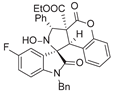
236.3 mg, 82%, a white solid, >20:1 dr, mp: 188.1-189.0oC; IR (thin film): νmax 3469, 3065, 3039, 2921, 1767, 1708, 1492, 1370, 1355, 1249, 1172, 767, 705, 609, 557 cm−1; 1H NMR (400 MHz, DMSO-d6) δ 8.59 (s, 1H), 7.77-7.71 (m, 3H), 7.42-7.38 (m, 3H), 7.32 (t, J = 6.8 Hz, 1H), 7.20-7.12 (m, 3H), 7.05 (ψt, J = 7.4 Hz, 2H), 6.94 (ψt, J = 7.4 Hz, 1H), 6.68 (dd, J = 8.2, 3.8 Hz, 1H), 6.51 (d, J = 7.6 Hz, 3H), 5.73 (s, 1H), 4.88 (d, J = 16.4 Hz, 1H), 4.73 (s, 1H), 4.50 (d, J = 16.0 Hz, 1H), 3.62-3.48 (m, 2H), 0.65 (t, J = 7.0 Hz, 3H). 13C NMR (100 MHz, DMSO-d6): δ 175.0, 167.0, 164.6, 150.8, 140.3, 138.2, 135.5, 130.7, 128.9, 128.6, 128.4, 128.3, 128.2, 127.5, 126.7, 125.0, 117.5, 117.1, 116.8, 115.0, 113.4, 113.2, 110.8 (J = 31.6 Hz), 77.7 (J = 4.0 Hz), 72.4, 62.9, 59.3, 46.8, 42.7, 13.4; 19F NMR (376 MHz, DMSO-d6): -119.7; HRMS (ESI): m/z calcd for C34H27N2O6FNa [M+Na]+ 601.1751, found 601.1757.
(±)-ethyl (1R,3R,3aS,9bR)-1’-benzyl-5’-chloro-2-hydroxy-2’,4-dioxo-3-phenyl-2,3-dihydro-4H-spiro[chromeno [3,4-c]pyrrole-1,3’-indoline]-3a(9bH)-carboxylate (3e)
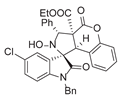
221.1 mg, 74%, a white solid, >20:1 dr, mp: 189.7-191.1oC; IR (thin film): νmax 3469, 3067, 3037, 2985, 1765, 1734, 1486, 1354, 1256, 1170, 767, 704, 693, 550 cm−1; 1H NMR (400 MHz, DMSO-d6) δ 8.63 (s, 1H), 7.91 (s, 1H), 7.91 (s, 1H), 7.20 (d, J = 7.2 Hz, 2H), 7.43-7.38 (m, 4H), 7.20 (d, J = 7.2 Hz, 2H), 7.32 (t, J = 7.2 Hz, 1H), 7.15-7.12 (m, 2H), 7.06 (ψt, J = 7.4 Hz, 2H), 6.96 (ψt, J = 7.4 Hz, 1H), 6.71 (d, J = 8.4 Hz, 1H), 6.50 (ψd, J = 6.8 Hz, 3H), 5.72 (s, 1H), 4.88 (d, J = 16.0 Hz, 1H), 4.75 (s, 1H), 4.51 (d, J = 16.4 Hz, 1H), 3.62-3.49 (m, 2H), 0.64 (t, J = 7.2 Hz, 3H). 13C NMR (100 MHz, DMSO-d6): δ 174.9, 167.0, 164.6, 150.8, 143.0, 138.1, 135.4, 130.7, 130.6, 128.9, 128.6, 128.5, 128.2, 127.9, 127.5, 126.7, 125.4, 125.0, 117.5, 115.0, 111.4, 77.6, 72.4, 63.0, 59.3, 46.8, 42.7, 13.5; HRMS (ESI): m/z calcd for C34H27N2O6ClNa [M+Na]+ 617.1455, found 617.1447.
(±)-ethyl (1R,3R,3aS,9bR)-1’-benzyl-6’-bromo-2-hydroxy-2’,4-dioxo-3-phenyl-2,3-dihydro-4H-spiro[chromeno [3,4-c]pyrrole-1,3’-indoline]-3a(9bH)-carboxylate (3f)
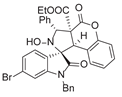
185.8 mg, 58%, a white solid, >20:1 dr, mp: 193.7-194.5oC; IR (thin film): νmax 3367, 3067, 2924, 2995, 2852, 1754, 1716, 1615, 1491, 1454, 1228, 1183, 761, 701, 698, 651, 511 cm−1; 1H NMR (600 MHz, DMSO-d6) δ 8.59 (s, 1H), 7.79 (d, J = 9.4 Hz, 1H), 7.70 (d, J = 7.8 Hz, 2H), 7.48 (dd, J = 8.1, 1.5 Hz, 1H), 7.43-7.38 (m, 3H), 7.32 (t, J = 7.5 Hz, 1H), 7.15 (t, J = 7.5 Hz, 1H), 7.14 (d, J = 7.8 Hz, 1H), 7.07 (ψt, J = 7.8 Hz, 2H), 6.98-6.95 (m, 2H), 6.53 (d, J = 7.8 Hz, 2H), 6.48 (d, J = 6.6 Hz, 1H), 5.71 (s, 1H), 4.87 (d, J = 16.2 Hz, 1H), 4.70 (s, 1H), 4.57 (d, J = 16.2 Hz, 1H), 3.60-3.45 (m, 2H), 0.65 (t, J = 7.2 Hz, 3H). 13C NMR (100 MHz, DMSO-d6): δ 175.1, 167.0, 164.6, 150.8, 145.7, 138.0, 135.4, 130.8, 129.0, 128.9, 128.5, 128.2, 127.6, 127.1, 126.7, 126.5, 125.7, 125.1, 123.4, 117.6, 114.9, 112.9, 77.2, 72.4, 63.0, 59.3, 46.7, 42.6, 13.5; δ HRMS (ESI): m/z calcd for C34H27N2O6BrNa [M+Na]+ 661.0950, found 661.0952.
(±)-ethyl (1R,3R,3aS,9bR)-1’-benzyl-5’-iodo-2-hydroxy-2’,4-dioxo-3-phenyl-2,3-dihydro-4H-spiro[chromeno [3,4-c]pyrrole-1,3’-indoline]-3a(9bH)-carboxylate (3g)
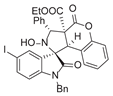
175.7 mg, 51%, a white solid, >20:1 dr, mp: 184.4-185.4oC; IR (thin film): νmax 3413, 3067, 2983, 2929, 2852, 1754, 1613, 1351, 1262, 1228, 1169, 1029, 808, 767, 701, 608, 534 cm−1; 1H NMR (600 MHz, DMSO-d6) δ 8.61 (s, 1H), 8.13 (d, J = 1.2 Hz, 1H), 7.72 (d, J = 7.2 Hz, 2H), 7.68 (dd, J = 8.4, 1.8 Hz, 1H), 7.42 (dd, J = 7.2, 1.2 Hz, 1H), 7.40 (ψt, J = 7.8 Hz, 2H), 7.32 (t, J = 7.5 Hz, 1H), 7.13 (t, J = 7.2 Hz, 1H), 7.05 (ψt, J = 7.5 Hz, 2H), 6.96 (td, J = 7.5, 0.9 Hz, 1H), 6.54 (d, J = 8.4 Hz, 1H), 6.50 (d, J = 7.2 Hz, 2H), 6.50 (ψt, J = 7.5 Hz, 1H), 5.72 (s, 1H), 4.87 (d, J = 16.2 Hz, 1H), 4.72 (s, 1H), 4.49 (d, J = 16.2 Hz, 1H), 3.59 (dq, J = 10.8, 7.2 Hz, 1H), 3.53 (dq, J = 10.8, 7.2 Hz, 1H), 0.64 (t, J = 7.2 Hz, 3H). 13C NMR (100 MHz, DMSO-d6): δ 174.6, 167.0, 164.6, 150.8, 143.9, 139.2, 138.1, 135.3, 133.4, 130.7, 128.9, 128.8, 128.5, 128.2, 127.5, 126.7, 125.0, 117.5, 115.0, 112.3, 87.1, 77.4, 72.4, 63.0, 59.3, 46.8, 42.6, 13.5; HRMS (ESI): m/z calcd for C34H27N2O6INa [M+Na]+ 709.0811, found 709.0793.
(±)-ethyl (1R,3R,3aS,9bR)-2-hydroxy-2’,4-dioxo-3-phenyl-2,3-dihydro-4H-spiro[chromeno [3,4-c]pyrrole-1,3’-indoline]-3a(9bH)-carboxylate (3j)
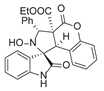
178.7 mg, 76%, a white solid, >20:1 dr, mp: 186.3-187.4oC; IR (thin film): νmax 3367, 3283, 3057, 3043, 2995, 2935, 1778, 1714, 1620, 1498, 1351, 1257, 1228, 1181, 1019, 763, 741, 598, 567 cm−1; 1H NMR (400 MHz, DMSO-d6) δ 10.27 (s, 1H), 8.40 (s, 1H), 7.71 (t, J = 8.8 Hz, 1H), 7.70 (d, J = 8.4 Hz, 2H), 7.40-7.21 (m, 6H), 7.07 (d, J = 8.0 Hz, 1H), 6.88 (ψt, J = 7.4 Hz, 1H), 6.75 (d, J = 7.6 Hz, 1H), 6.36 (d, J = 7.6 Hz, 1H), 5.70 (s, 1H), 4.55 (s, 1H), 3.59-3.47 (m, 2H), 0.64 (t, J =7.0 Hz, 3H). 13C NMR (100 MHz, DMSO-d6): δ 176.7, 167.3, 164.6, 150.8, 143.9, 138.4, 130.6, 130.3, 128.9, 128.2, 128.1, 128.0, 127.2, 125.0, 124.7, 122.9, 117.3, 115.6, 110.3, 77.5, 72.3, 62.9, 59.2, 47.0, 13.5; HRMS (ESI): m/z calcd for C27H22N2O6Na [M+Na]+ 493.1376, found 493.1339.
(±)-ethyl (1R,3R,3aS,9bR)-2-hydroxy-1’-methyl-2’,4-dioxo-3-phenyl-2,3-dihydro-4H-spiro[chromeno [3,4-c]pyrrole-1,3’-indoline]-3a(9bH)-carboxylate (3k)
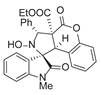
193.1 mg, 80%, a white solid, >20:1 dr, mp: 172.1-172.8oC; IR (thin film): νmax 3477, 3060, 3038, 2985, 2944, 1765, 1711, 1617, 1498, 1378, 1250, 1228, 1174, 1095, 771, 754, 699, 610, 540 cm−1; 1H NMR (400 MHz, DMSO-d6) δ 8.43 (s, 1H), 7.79 (d, J = 7.2 Hz, 1H), 7.70 (d, J = 7.2 Hz, 2H), 7.45 (t, J = 7.6 Hz, 1H), 7.38 (ψt, J = 7.2 Hz, 2H), 7.32 (ψt, J = 7.4 Hz, 1H), 7.30 (ψt, J = 7.0 Hz, 1H), 7.24 (ψt, J = 7.6 Hz, 1H), 7.06 (d, J = 8.0 Hz, 1H), 6.97 (d, J = 8.0 Hz, 1H), 6.85 (ψt, J = 7.4 Hz, 1H), 6.31 (d, J = 7.6 Hz, 1H), 5.70 (s, 1H), 4.60 (s, 1H), 3.59-3.47 (m, 2H), 2.82 (s, 3H), 0.64 (t, J = 7.0 Hz, 3H). 13C NMR (100 MHz, DMSO-d6): δ 174.8, 167.2, 164.6, 150.6, 145.3, 138.2, 130.7, 130.3, 128.9, 128.2, 128.1, 127.9, 126.4, 124.7, 124.6, 123.6, 117.4, 115.3, 109.2, 77.3, 72.3, 62.9, 59.2, 47.0, 26.0, 13.5; HRMS (ESI): m/z calcd for C28H24N2O6Na [M+Na]+ 507.1532, found 507.1527.
(±)-ethyl (1R,3R,3aS,9bR)-1’-ethyl-2-hydroxy-2’,4-dioxo-3-phenyl-2,3-dihydro-4H-spiro[chromeno [3,4-c]pyrrole-1,3’-indoline]-3a(9bH)-carboxylate(3l)
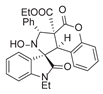
195.4 mg, 78%, a white solid, >20:1 dr, mp: 170.4-171.0oC; IR (thin film): νmax 3449, 3063, 2981, 2931, 1764, 1732, 1711, 1616, 1491, 1468, 1455, 1373, 1258, 1229, 1178, 763, 750, 610, 551 cm−1; 1H NMR (400 MHz, DMSO-d6) δ 8.44 (s, 1H), 7.77 (d, J = 7.2 Hz, 1H), 7.71 (d, J = 7.2 Hz, 2H), 7.44 (t, J = 7.6 Hz, 1H), 7.39 (ψt, J = 7.4 Hz, 2H), 7.31 (ψt, J = 7.2 Hz, 2H), 7.24 (ψt, J = 7.6 Hz, 1H), 7.06 (d, J = 8.0 Hz, 1H), 7.00 (d, J = 7.6 Hz, 1H), 6.83 (ψt, J = 7.4 Hz, 1H), 6.22 (d, J = 7.6 Hz, 1H), 5.74 (s, 1H), 4.54 (s, 1H), 3.55-3.49 (m, 3H), 3.32-3.27 (m, 1H), 0.65 (t, J = 7.0 Hz, 3H), 0.49 (t, J = 6.8 Hz, 3H). 13C NMR (100 MHz, DMSO-d6): δ 174.6, 167.2, 164.6, 150.7, 144.0, 138.3, 130.7, 130.3, 128.9, 128.2, 128.1, 127.8, 126.7, 124.8, 124.5, 123.5, 117.1, 115.1, 109.3, 77.3, 72.5, 62.9, 59.2, 47.7, 34.0, 13.5, 12.0; HRMS (ESI): m/z calcd for C29H26N2O6Na [M+Na]+ 521.1689, found 521.1683.
(±)-ethyl (1R,3R,3aS,9bR)-1’-allyl-2-hydroxy-2’,4-dioxo-3-phenyl-2,3-dihydro-4H-spiro[chromeno [3,4-c]pyrrole-1,3’-indoline]-3a(9bH)-carboxylate(3m)
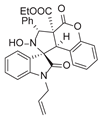
217.6 mg, 85%, a white solid, >20:1 dr, mp: 168.4-169.9oC; IR (thin film): νmax 3448, 3092, 3059, 2982, 2915, 1762, 1734, 1715, 1618, 1492, 1469, 1369, 1257, 1234, 1181, 767, 749, 732, 702, 608, 527 cm−1; 1H NMR (400 MHz, DMSO-d6) δ 8.48 (s, 1H), 7.80 (d, J = 6.8 Hz, 1H), 7.70 (d, J = 7.2 Hz, 2H), 7.41 (t, J = 8.2 Hz, 1H), 7.40 (ψt, J = 7.8 Hz, 2H), 7.31 (ψt, J = 6.8 Hz, 2H), 7.26 (ψt, J = 7.6 Hz, 1H), 7.06 (d, J = 8.0 Hz, 1H), 6.87 (d, J = 7.6 Hz, 1H), 6.85 (ψt, J = 7.6 Hz, 1H), 6.34 (d, J = 7.2 Hz, 1H), 5.72 (s, 1H), 5.38-5.29 (m, 1H), 4.70 (d, J = 10.0 Hz, 1H), 4.61 (s, 1H), 4.27 (d, J = 17.2 Hz, 1H), 4.15 (d, J = 16.4 Hz, 1H), 3.95(t, J = 17.2 Hz, 1H), 3.60-3.47 (m, 2H), 0.65 (t, J =7.0 Hz, 3H). 13C NMR (100 MHz, DMSO-d6): δ 174.7, 167.2, 164.6, 150.8, 144.3, 138.3, 131.2, 130.6, 130.4, 128.9, 128.2, 128.1, 126.3, 124.8, 124.7, 123.6, 117.4, 115.9, 115.2, 109.2, 77.4, 72.4, 62.9, 59.2, 47.2, 41.3, 13.5; HRMS (ESI): m/z calcd for C30H26N2O6Na [M+Na]+ 533.1689, found 533.1686.
(±)-ethyl (1R,3R,3aS,9bR)-2-hydroxy-2’,4-dioxo-3-phenyl-1’-(prop-2-yn-1-yl)-2,3-dihydro-4H-spiro[chromeno [3,4-c]pyrrole-1,3’-indoline]-3a(9bH)-carboxylate(3n)
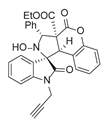
148.9 mg, 59%, a white solid, >20:1 dr, mp: 176.3-168.4oC; IR (thin film): νmax 3270, 3067, 3041, 2975, 2923, 1775, 1730, 1711, 1615, 1491, 1369, 1245, 1226, 1163, 759, 700, 612,529 cm−1; 1H NMR (600 MHz, CDCl3) δ 7.81 (ψd, J = 7.8 Hz, 3H), 7.47 (td, J = 7.8, 0.9 Hz, 1H), 7.39 (ψt, J = 7.8 Hz, 2H), 7.34 (t, J = 7.8 Hz, 1H), 7.31 (ψt, J = 7.2Hz, 1H), 7.16 (td, J = 7.1, 1.2 Hz, 1H), 7.01 (d, J = 8.4 Hz, 1H), 6.97 (d, J = 7.8 Hz, 1H), 6.75 (ψt, J = 7.5 Hz, 1H), 6.32 (d, J = 7.8 Hz, 1H), 6.05 (s, 1H), 4.74 (s, 1H), 4.72 (s, 1H), 4.31 (dd, J = 17.4, 2.4 Hz, 1H), 4.12 (dd, J = 17.4, 2.4 Hz, 1H), 3.64 (dq, J = 10.8, 7.2 Hz, 1H), 3.56 (dq, J = 10.8, 7.2 Hz, 1H), 1.92 (t, J = 2.4 Hz, 1H), 0.74 (t, J = 7.2 Hz, 3H); 13C NMR (100 MHz, CDCl3): δ 173.5, 166.8, 164.5, 150.9, 143.2, 137.2, 130.5, 129.6, 128.8, 128.2, 128.1, 127.6, 125.9, 124.1, 124.0, 123.7, 117.5, 114.5, 109.7, 77.2, 76.1, 72.6, 71.8, 63.0, 58.0, 47.2, 28.8, 13.2; HRMS (ESI): m/z calcd for C30H24N2O6Na [M+Na]+ 531.1532, found 531.1511.
(±)-ethyl (1R,3R,3aS,9bR)-2-hydroxy-2’,4-dioxo-3-(p-tolyl)-2,3-dihydro-4H-spiro[chromeno [3,4-c]pyrrole-1,3’-indoline]-3a(9bH)-carboxylate(3p)
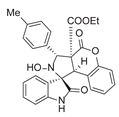
160.2 mg, 66%, a white solid, >20:1 dr, mp: 162.2-164.0oC; IR (thin film): νmax 3384, 3098, 3032, 2981, 2921, 2851, 1763, 1736, 1713, 1621, 1491, 1458, 1350, 1228, 1170, 754, 641, 583 cm−1; 1H NMR (400 MHz, DMSO-d6) δ 10.28 (s, 1H), 8.37 (s, 1H), 7.71 (d, J = 7.2 Hz, 1H), 7.56 (d, J = 8.0 Hz, 2H), 7.34 (t, J = 7.6 Hz, 1H), 7.27-7.17 (m, 4H), 7.06 (d, J = 8.4 Hz, 1H), 6.87 (ψt, J = 7.4 Hz, 1H), 6.74 (d, J = 7.6 Hz, 1H), 6.35 (d, J = 7.6 Hz, 1H), 5.65 (s, 1H), 4.53 (s, 1H), 3.58-3.51 (m, 2H), 2.30 (s, 3H), 0.65 (t, J = 7.2 Hz, 3H). 13C NMR (100 MHz, DMSO-d6): δ 176.9, 167.3, 164.6, 150.8, 143.9, 137.2, 135.3, 130.5, 130.2, 128.8, 128.7, 128.0, 127.3, 125.0, 124.6, 122.8, 117.3, 115.6, 110.3, 77.4, 72.0, 62.8, 59.1, 46.9, 21.2, 13.4; HRMS (ESI): m/z calcd for C28H24N2O6Na [M+Na]+ 507.1532, found 507.1521.
(±)-ethyl (1R,3R,3aS,9bR)-2-hydroxy-3-(4-methoxyphenyl)-2’,4-dioxo-2,3-dihydro-4H-spiro[chromeno [3,4-c]pyrrole-1,3’-indoline]-3a(9bH)-carboxylate(3q)
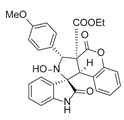
135.5 mg, 54%, a white solid, >20:1 dr, mp: 150.5-151.3oC; IR (thin film): νmax 3422, 3189, 3086, 2917, 2848, 1778, 1736, 1716, 1619, 1512, 1471, 1247, 1166, 1026, 751, 637, 558 cm−1; 1H NMR (400 MHz, DMSO-d6) δ 10.28 (s, 1H), 8.36 (s, 1H), 7.70 (d, J = 7.2 Hz, 1H), 7.58 (d, J = 8.4 Hz, 2H), 7.33 (ψt, J = 7.6 Hz, 1H), 7.27-7.19 (m, 2H), 7.06 (d, J = 8.0 Hz, 1H), 6.94 (d, J = 8.4 Hz, 2H), 6.87 (ψt, J = 7.4 Hz, 1H), 6.74 (d, J = 7.6 Hz, 1H), 6.34 (d, J = 7.6 Hz, 1H), 5.64 (s, 1H), 4.54 (s, 1H), 3.75 (s, 3H), 3.59-3.52 (m, 2H), 0.68 (t, J = 7.0 Hz, 3H). 13C NMR (100 MHz, DMSO-d6): δ 176.9, 167.3, 164.7, 159.4, 150.8, 143.8, 130.5, 130.2, 130.1, 130.0, 128.0, 127.3, 124.9, 124.6, 122.8, 117.3, 115.7, 113.6, 110.3, 77.4, 71.9, 62.9, 59.1, 55.6, 46.8, 13.5; HRMS (ESI): m/z calcd for C28H24N2O7Na [M+Na]+ 523.1481, found 523.10467.
(±)-ethyl (1R,3R,3aS,9bR)-3-(4-fluorophenyl)-2-hydroxy-2’,4-dioxo-2,3-dihydro-4H-spiro[chromeno [3,4-c]pyrrole-1,3’-indoline]-3a(9bH)-carboxylate(3r)
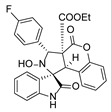
189.7 mg,78%, a white solid, >20:1 dr, mp: 205.6-206.3oC; IR (thin film): νmax 3350, 3096, 2980, 2840, 1760, 1737, 1711, 1621, 1509, 1472, 1458, 1226, 1177, 1158, 756, 643, 509 cm−1; 1H NMR (400 MHz, DMSO-d6) δ 10.31 (s, 1H), 8.47 (s, 1H), 7.72 (m, 3H), 7.34 (t, J = 7.4 Hz, 1H), 7.28-7.21 (m, 4H), 7.07 (d, J = 8.4 Hz, 1H), 6.88 (ψt, J = 7.2 Hz, 1H), 6.75 (d, J = 7.6 Hz, 1H), 6.35 (d, J = 8.0 Hz, 1H), 5.68 (s, 1H), 4.53 (s, 1H), 3.59 (q, J = 7.0 Hz, 2H), 0.69 (t, J = 7.0 Hz, 3H). 13C NMR (100 MHz, DMSO-d6): δ 176.8, 167.3, 164.7, 150.7, 143.9, 134.4 (d, J= 3.0 Hz), 130.9, 130.8 (d, J= 8.0 Hz), 130.6, 130.3, 128.0, 127.1, 125.0, 124.7, 122.9, 117.4, 115.5, 115.1, 114.9, 110.3, 77.4, 71.6, 63.0, 59.0, 46.9, 13.5; 19F NMR (376 MHz, DMSO-d6): -115.0; HRMS (ESI): m/z calcd for C27H21N2O6FNa [M+Na]+ 511.1281, found 511.1279.
(±)-ethyl (1R,3R,3aS,9bR)-3-(4-chlorophenyl)-2-hydroxy-2’,4-dioxo-2,3-dihydro-4H-spiro[chromeno [3,4-c]pyrrole-1,3’-indoline]-3a(9bH)-carboxylate(3s)
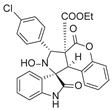
218.2 mg, 86%, a white solid, >20:1 dr, mp: 166.7-167.4oC; IR (thin film): νmax 3368, 3088, 2983, 2836, 1766, 1736, 1709, 1621, 1490, 1457, 1227, 1177, 1017, 752, 670, 579 cm−1; 1H NMR (400 MHz, DMSO-d6) δ 10.32 (s, 1H), 8.51 (s, 1H), 7.73-7.68 (m, 3H), 7.47 (d, J = 8.0 Hz, 2H), 7.34 (ψt, J = 7.8 Hz, 1H), 7.26 (ψt, J = 7.6 Hz, 1H), 7.23 (ψt, J = 7.2 Hz, 1H), 7.08 (d, J = 8.0 Hz, 1H), 6.89 (ψt, J = 7.6 Hz, 1H), 6.75 (d, J = 8.0 Hz, 1H), 6.35 (d, J = 7.6 Hz, 1H), 5.67 (s, 1H), 4.52 (s, 1H), 3.61 (q, J = 7.0 Hz, 2H), 0.68 (t, J = 7.0 Hz, 3H). 13C NMR (100 MHz, DMSO-d6): δ 176.4, 167.3, 164.7, 150.7, 143.9, 137.3, 132.8, 130.7, 130.3, 128.2, 128.0, 127.0, 125.0, 124.7, 122.9, 117.4, 115.4, 110.3, 77.4, 71.5, 63.0, 59.0, 47.0, 13.5; HRMS (ESI): m/z calcd for C27H21N2O6ClNa [M+Na]+ 527.0986, found 527.0984.
(±)-ethyl (1R,3R,3aS,9bR)-3-(4-bromophenyl)-2-hydroxy-2’,4-dioxo-2,3-dihydro-4H-spiro[chromeno [3,4-c]pyrrole-1,3’-indoline]-3a(9bH)-carboxylate(3t)
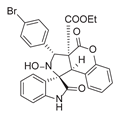
225.9 mg, 82%, a white solid, >20:1 dr, mp: 161.6-163.0oC; IR (thin film): νmax 3513, 3282, 2859, 1784, 1714, 1688, 1487, 1247, 1226, 1178, 1010, 858, 748, 665, 570 cm−1; 1H NMR (400 MHz, DMSO-d6) δ 10.32 (s, 1H), 8.51 (s, 1H), 7.72 (d, J = 7.2 Hz, 1H), 7.63 (d, J = 8.4 Hz, 2H), 7.60 (d, J = 8.4 Hz, 2H), 7.34 (ψt, J = 7.6 Hz, 1H), 7.26 (ψt, J = 7.6 Hz, 1H), 7.22 (ψt, J = 7.6 Hz, 1H),7.08 (d, J = 8.0 Hz, 1H), 6.88 (ψt, J = 7.4 Hz, 1H), 6.75 (d, J = 7.2 Hz, 1H), 6.35 (d, J = 7.6 Hz, 1H), 5.66 (s, 1H), 4.52 (s, 1H), 3.61 (q, J = 7.1 Hz, 2H), 0.68 (t, J = 7.0 Hz, 3H). 13C NMR (100 MHz, DMSO-d6): δ 176.7, 167.3, 164.7, 150.7, 143.9, 137.7, 131.2, 131.0, 130.6, 130.3, 128.0, 126.9, 125.0, 124.7, 122.9, 121.3, 117.4, 115.4, 110.3, 77.4, 71.6, 63.0, 59.0, 47.0, 13.5; HRMS (ESI): m/z calcd for C27H21N2O6BrNa [M+Na]+ 571.0481, found 571.0471.
(±)-ethyl (1R,3R,3aS,9bR)-2-hydroxy-3-(4-nitrophenyl)-2’,4-dioxo-2,3-dihydro-4H-spiro[chromeno [3,4-c]pyrrole-1,3’-indoline]-3a(9bH)-carboxylate(3u)
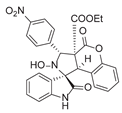
122.1 mg, 47%, a white solid, >20:1 dr, mp: 170.4-171.8oC; IR (thin film): νmax 3360, 3288, 2941, 2345, 1782, 1735, 1605, 1523, 1492, 1347, 1256, 1174, 1112, 1017, 856, 745, 608, 573 cm−1; 1H NMR (400 MHz, DMSO-d6) δ 10.37 (s, 1H), 8.69 (s, 1H), 8.30 (d, J = 8.4 Hz, 2H), 7.97 (d, J = 8.4 Hz, 2H), 7.75 (d, J = 7.2 Hz, 1H), 7.36 (ψt, J = 7.5 Hz, 1H), 7.28 (ψt, J = 7.6 Hz, 1H), 7.25 (ψt, J = 7.2 Hz, 1H), 7.11 (d, J = 8.4 Hz, 1H), 6.90 (ψt, J = 7.4 Hz, 1H), 6.77 (d, J = 7.6 Hz, 1H), 6.37 (d, J = 7.2 Hz, 1H), 5.80 (s, 1H), 4.53 (s, 1H), 3.60 (q, J = 7.0 Hz, 2H), 0.66 (t, J = 7.0 Hz, 3H). 13C NMR (100 MHz, DMSO-d6): δ 176.6, 167.3, 164.7, 150.6, 147.6, 146.1, 143.9, 130.8, 130.4, 130.0, 128.1, 126.6, 125.2, 124.8, 123.5, 123.0, 117.4, 115.2, 110.4, 77.6, 71.5, 63.2, 59.1, 47.3, 13.5; HRMS (ESI): m/z calcd for C27H21N3O8Na [M+Na]+ 538.1226, found 538.1215.
(±)-ethyl (1R,3R,3aS,9bR)-1’-benzyl-2-hydroxy-5’-methyl-2’,4-dioxo-3-(p-tolyl)-2,3-dihydro-4H-spiro[chromeno [3,4-c]pyrrole-1,3’-indoline]-3a(9bH)-carboxylate (3w)
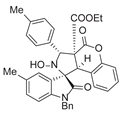
227.7 mg, 77%, a white solid, >20:1 dr, mp: 167.4-169.2oC; IR (thin film): νmax 3369, 3037, 2975, 2915, 2851, 1757, 1741, 1709, 1609, 1498, 1369, 1271, 1248, 1178, 801, 769, 623, 565 cm−1;1H NMR (400 MHz, DMSO-d6) δ 8.47 (s, 1H), 7.63 (s, 1H), 7.58 (d, J = 8.0 Hz, 2H), 7.39 (t, J = 7.2 Hz, 1H), 7.19 (d, J = 8.0 Hz, 2H), 7.12 (d, J = 8.8 Hz, 1H), 7.11 (d, J = 6.8 Hz, 2H), 7.04 (ψt, J = 7.2 Hz, 2H), 6.91 (ψt, J = 7.2 Hz, 1H), 6.56 (d, J = 8.0 Hz, 1H), 6.50 (d, J = 7.2 Hz, 2H), 6.42 (d, J = 7.2 Hz, 1H), 5.70 (s, 1H), 4.85 (d, J = 16.4 Hz, 1H), 4.64 (s, 1H), 4.46 (d, J = 16.4 Hz, 1H), 3.64-3.51 (m, 2H), 2.42 (s, 3H), 2.31 (s, 3H), 0.66 (t, J = 7.0 Hz, 3H); 13C NMR (100 MHz, DMSO-d6): δ 175.0, 167.2, 164.7, 150.8, 141.8, 137.2, 135.8, 135.2, 132.8, 130.8, 130.5, 128.8, 128.7, 128.5, 127.4, 126.7, 126.5, 125.5, 124.9, 117.4, 115.3, 109.7, 77.4, 72.2, 62.9, 59.3, 46.9, 42.6, 21.3, 13.5; HRMS (ESI): m/z calcd for C36H32N2O6Na [M+Na]+ 611.2158, found.611.2137.
(±)-ethyl (1R,3R,3aS,9bR)-1’-benzyl-2-hydroxy-3-(4-methoxyphenyl)-5’-methyl-2’,4-dioxo-2,3-dihydro-4H-spiro[chromeno [3,4-c]pyrrole-1,3’-indoline]-3a(9bH)-carboxylate (3x)
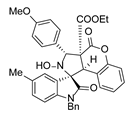
149.9 mg, 50%, a white solid, >20:1 dr, mp: 147.1-147.7oC; IR (thin film): νmax 3440, 3069, 3032, 2983, 2935, 2836, 1776, 1736, 1694, 1612, 1514, 1498, 1370, 1244, 1163, 1134, 1022, 823, 754, 699, 567 cm−1; 1H NMR (400 MHz, DMSO-d6) δ 8.46 (s, 1H), 7.63 (s, 1H), 7.60 (d, J = 8.8 Hz, 2H), 7.39 (t, J = 7.6 Hz, 1H), 7.11 (ψd, J = 7.2 Hz, 3H), 7.04 (ψt, J = 7.4 Hz, 2H), 6.95 (d, J = 8.8 Hz, 2H), 6.90 (ψt, J = 7.6 Hz, 1H), 6.56 (d, J = 8.0 Hz, 1H), 6.50 (d, J = 7.2 Hz, 2H), 6.42 (d, J = 7.6 Hz, 1H), 5.69 (s, 1H), 4.85 (d, J = 16.2 Hz, 1H), 4.65 (s, 1H), 4.47 (d, J = 16.2 Hz, 1H), 3.76 (s, 3H), 3.66-3.53 (m, 2H), 2.42 (s, 3H), 0.69 (t, J = 7.0 Hz, 3H). 13C NMR (100 MHz, DMSO-d6): δ 175.0, 167.2, 164.7, 159.4, 150.8, 141.8, 135.8, 132.8, 130.8, 130.5, 130.1, 128.8, 128.5, 127.4, 126.7, 126.5, 125.5, 124.9, 117.4, 115.3, 113.6, 109.7, 77.4, 72.1, 62.9, 59.2, 55.6, 46.8, 42.6, 21.3, 13.5; HRMS (ESI): m/z calcd for C36H32N2O7Na [M+Na]+ 627.2107, found.627.2096.
(±)-ethyl (1R,3R,3aS,9bR)-1’-benzyl-3-(4-fluorophenyl)-2-hydroxy-5’-methyl-2’,4-dioxo-2,3-dihydro-4H-spiro[chromeno [3,4-c]pyrrole-1,3’-indoline]-3a(9bH)-carboxylate (3y)
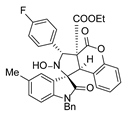
205.6 mg, 69%, a white solid, >20:1 dr, mp: 185.6-186.5oC; IR (thin film): νmax 3478, 2989, 2960, 2918, 1774, 1737, 1710, 1613, 1516, 1496, 1158, 812, 765, 610, 503 cm−1; 1H NMR (400 MHz, DMSO-d6) δ 8.57 (s, 1H), 7.74 (d, J = 7.2 Hz, 1H), 7.74 (d, J = 6.4 Hz, 1H), 7.65 (s, 1H), 7.40 (t, J = 7.6 Hz, 1H), 7.25 (ψt, J = 8.6 Hz, 2H), 7.12 (ψt, J = 7.2 Hz, 3H), 7.04 (ψt, J = 7.4 Hz, 2H), 6.92 (ψt, J = 7.6 Hz, 1H), 6.57 (d, J = 8.0 Hz, 1H), 6.50 (d, J = 7.6 Hz, 2H), 6.42 (d, J = 7.6 Hz, 1H), 5.73 (s, 1H), 4.85 (d, J = 16.4 Hz, 1H), 4.64 (s, 1H), 4.47 (d, J = 16.4 Hz, 1H), 3.68-3.55 (m, 2H), 2.42 (s, 3H), 0.70 (t, J = 7.2 Hz, 3H). 13C NMR (100 MHz, DMSO-d6): δ 174.9, 167.3, 164.7, 150.8, 141.8, 135.8, 134.3 (d, J = 2.8 Hz), 132.8, 130.9, 130.8, 130.6, 128.5, 127.4, 126.7, 126.3, 125.5, 124.9, 117.5, 115.2, 114.9, 109.7, 77.4, 71.8, 63.1, 59.2, 46.9, 42.7, 21.3, 13.5; 19F NMR (376 MHz, DMSO-d6): -114.9; HRMS (ESI): m/z calcd for C35H29N2O6FNa [M+Na]+ 615.1907, found 615.1904.
(±)-ethyl (1R,3S,3aS,9bR)-1’-benzyl-3-(2-chlorophenyl)-2-hydroxy-5’-methyl-2’,4-dioxo-2,3-dihydro-4H-spiro[chromeno [3,4-c]pyrrole-1,3’-indoline]-3a(9bH)-carboxylate (3z)
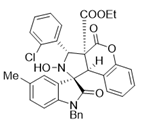
147.3 mg, 48%, a white solid, >20:1 dr, mp: 155.0-156.2oC; IR (thin film): νmax 3447, 3069, 3030, 2979, 2921, 2867, 1782, 1717, 1605, 1497, 1457, 1370, 1259, 1226, 1152, 1007, 815, 756, 695, 532 cm−1; 1H NMR (400 MHz, DMSO-d6) δ 8.44 (s, 1H), 7.89 (d, J = 7.2 Hz, 1H), 7.79 (s, 1H), 7.47 (d, J = 7.6 Hz, 1H), 7.43-7.33 (m, 3H), 7.14-7.12 (m, 5H), 6.92 (ψt, J = 7.2 Hz, 1H), 6.52 (d, J = 8.0 Hz, 1H), 6.47 (ψd, J = 6.4 Hz, 3H), 6.20 (s, 1H), 4.87 (d, J = 16.2 Hz, 1H), 4.80 (s, 1H), 4.46 (d, J = 16.2 Hz, 1H), 3.69-3.61 (m, 1H), 3.48-3.40 (m, 1H), 2.41 (s, 1H), 0.63 (t, J = 7.0 Hz, 3H). 13C NMR (100 MHz, DMSO-d6): δ 174.9, 166.1, 162.4, 151.0, 141.7, 137.3, 135.8, 135.1, 132.8, 131.7, 130.8, 130.5, 130.0, 129.5, 128.9, 128.4, 127.4, 127.1, 126.6, 126.5, 125.8, 124.7, 117.3, 115.5, 109.6, 77.4, 69.5, 63.1, 60.1, 46.9, 42.6, 21.1, 13.4; HRMS (ESI): m/z calcd for C35H29N2O6ClNa [M+Na]+ 631.1612, found 631.1602.
(±)-ethyl (1R,3S,3aS,9bR)-1’-benzyl-3-(4-chlorophenyl)-2-hydroxy-5’-methyl-2’,4-dioxo-2,3-dihydro-4H-spiro[chromeno [3,4-c]pyrrole-1,3’-indoline]-3a(9bH)-carboxylate (3aa)
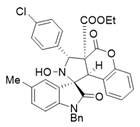
276.5 mg, 85%, a white solid, >20:1 dr, mp: 192.4-193.7oC; IR (thin film): νmax 3454, 3067, 3018, 2983, 2925, 2859, 1774, 1729, 1705, 1607, 1497, 1455, 1374, 1349, 1262, 1225, 1165, 1015, 811, 755, 629, 544 cm−1; 1H NMR (400 MHz, DMSO-d6) δ 8.60 (s, 1H), 7.72 (d, J = 8.0 Hz, 2H), 7.65 (s, 1H), 7.48 (d, J = 8.0 Hz, 2H), 7.40 (t, J = 7.6 Hz, 1H), 7.13 (ψt, J = 7.8 Hz, 3H), 7.04 (ψt, J = 7.8 Hz, 2H), 6.92 (ψt, J = 7.4 Hz, 1H), 6.57 (d, J = 8.0 Hz, 1H), 6.50 (d, J = 7.2 Hz, 2H), 6.42 (d, J = 7.6 Hz, 1H), 5.72 (s, 1H), 4.85 (d, J = 16.0 Hz, 1H), 4.63 (s, 1H), 4.47 (d, J = 16.0 Hz, 1H), 3.70-3.58 (m, 2H), 2.42 (s, 3H), 0.70 (t, J = 7.0 Hz, 3H). 13C NMR (100 MHz, DMSO-d6): δ 174.9, 167.2, 164.7, 150.8, 141.8, 137.2, 135.7, 132.8, 130.9, 130.7, 128.8, 128.5, 128.3, 127.4, 126.7, 126.2, 125.6, 125.0, 117.5, 115.1, 109.7, 77.4, 71.4, 63.1, 59.1, 47.0, 42.7, 21.2, 13.5; HRMS (ESI): m/z calcd for C35H29N2O6ClNa [M+Na]+ 631.1612, found 631.1613.
(±)-ethyl (1R,3S,3aS,9bR)-1’-benzyl-3-(4-bromophenyl)-2-hydroxy-5’-methyl-2’,4-dioxo-2,3-dihydro-4H-spiro[chromeno [3,4-c]pyrrole-1,3’-indoline]-3a(9bH)-carboxylate (3ab)
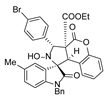
204.7 mg, 66%, a white solid, >20:1 dr, mp: 193.1-194.8oC; IR (thin film): νmax 3370, 3032, 2977, 2929, 2902, 1753, 1741, 1708, 1497, 1369, 1250, 1225, 1182, 1013, 770, 806, 770, 612, 536 cm−1; 1H NMR (400 MHz, DMSO-d6) δ 8.60 (s, 1H), 7.67-7.61 (m, 5H), 7.40 (t, J = 7.2 Hz, 1H), 7.12 (ψt, J = 7.4 Hz, 3H), 7.04 (ψt, J = 7.4 Hz, 2H), 6.92 (ψt, J = 7.6 Hz, 1H), 6.57 (d, J = 8.0 Hz, 1H), 6.51 (d, J = 7.6 Hz, 2H), 6.42 (d, J = 7.6 Hz, 1H), 5.71 (s, 1H), 4.84 (d, J = 16.0 Hz, 1H), 4.63 (s, 1H), 4.47 (d, J = 16.0 Hz, 1H), 3.70-3.59 (m, 2H), 2.42 (s, 3H), 0.70 (t, J = 7.2 Hz, 3H). 13C NMR (100 MHz, DMSO-d6): δ 174.9, 167.2, 164.7, 150.7, 141.8, 137.6, 135.7, 132.8, 131.2, 131.0, 130.9, 130.6, 128.8, 128.5, 127.4, 126.7, 126.2, 125.6, 125.0, 121.4, 117.5, 115.1, 109.7, 77.4, 71.8, 63.1, 59.1, 47.0, 42.6, 21.2, 13.5; HRMS (ESI): m/z calcd for C35H29N2O6BrNa [M+Na]+ 675.1107, found 675.1080.
(±)-ethyl (1R,3R,3aS,9bR)-1’-benzyl-2-hydroxy-5’-methyl-3-(4-nitrophenyl)-2’,4-dioxo-2,3-dihydro-4H-spiro[chromeno [3,4-c]pyrrole-1,3’-indoline]-3a(9bH)-carboxylate (3ac)
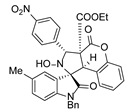
157.8 mg, 52%, a white solid, >20:1 dr, mp: 194.1-195.5oC; IR (thin film): vmax 3500, 3063, 3037, 2989, 2921, 1782, 1707, 1605, 1516, 1495, 1456, 1347, 1261, 1247, 1231, 1177, 765, 697, 544 cm−1; 1H NMR (400 MHz, DMSO-d6) δ 8.78 (s, 1H), 8.31 (d, J = 7.6 Hz, 2H), 7.99 (d, J = 8.4 Hz, 2H), 7.68 (s, 1H), 7.42 (t, J = 7.6 Hz, 1H), 7.16 (d, J = 8.8 Hz, 1H), 7.12 (ψt, J = 7.2 Hz, 2H), 7.05 (ψt, J = 7.4 Hz, 2H), 6.94 (ψt, J = 7.2 Hz, 1H), 6.59 (d, J = 8.0 Hz, 1H), 6.51 (d, J = 7.2 Hz, 2H), 6.44 (d, J = 7.6 Hz, 1H), 5.84 (s, 1H), 4.86 (d, J = 16.2 Hz, 1H), 4.64 (s, 1H), 4.49 (d, J = 16.2 Hz, 1H), 3.67-3.59 (m, 2H), 2.43 (s, 3H), 0.67 (t, J = 7.0 Hz, 3H). 13C NMR (100 MHz, DMSO-d6): δ 174.8, 167.2, 164.7, 150.7, 147.6, 146.0, 141.8, 135.7, 132.9, 131.0, 130.7, 130.0, 128.9, 128.5, 127.4, 126.7, 125.9, 125.7, 125.1, 123.5, 117.6, 114.8, 109.8, 77.5, 71.7, 69.3, 59.2, 47.3, 42.7, 21.3, 13.5; HRMS (ESI): m/z calcd for C35H29N3O8Na [M+Na]+ 642.1852, found 642.1846.
(±)- ethyl (1R,3R,3aS,9bR)-1’-benzyl-2-hydroxy-2’,4-dioxo-3-(p-tolyl)-2,3-dihydro-4H-spiro[chromeno [3,4-c]pyrrole-1,3’-indoline]-3a(9bH)-carboxylate (3ad)
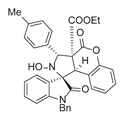
133.6 mg, 46%, a white solid, >20:1 dr, mp: 164.5-166.5oC; IR (thin film): νmax 3852, 3678, 3649, 1712, 1460, 1369, 1231, 1176, 857, 738, 620, 554 cm−1; 1H NMR (400 MHz, DMSO-d6) δ 8.48 (s, 1H), 7.81 (d, J = 6.8 Hz, 1H), 7.58 (d, J = 7.6 Hz, 2H), 7.39 (t, J = 7.4 Hz, 1H), 7.32 (ψt, J = 7.2 Hz, 1H), 7.28 (ψt, J = 7.6 Hz, 1H), 7.20 (d, J = 8.0 Hz, 2H), 7.12 (d, J = 8.0 Hz, 2H), 7.05 (ψt, J = 7.4 Hz, 2H), 6.89 (ψt, J = 7.6 Hz, 1H), 6.68 (d, J = 7.6 Hz, 1H), 6.52 (d, J = 7.6 Hz, 2H), 6.37 (d, J = 7.6 Hz, 1H), 5.71 (s, 1H), 4.87 (d, J = 16.2 Hz, 1H), 4.66 (s, 1H), 4.50 (d, J = 16.2 Hz, 1H), 3.61-3.52 (m, 2H), 2.31 (s, 3H), 0.67 (t, J = 7.2 Hz, 3H); 13C NMR (100 MHz, DMSO-d6): δ 175.1, 167.2, 164.7, 150.8, 144.1, 137.3, 135.7, 135.2, 130.6, 128.9, 128.8, 128.7, 128.4, 127.4, 126.7, 126.5, 125.0, 124.9, 123.7, 117.5, 115.2, 109.9, 77.3, 72.4, 62.9, 59.3, 47.0, 42.6, 21.2, 13.5; HRMS (ESI): m/z calcd for C35H30N2O6Na [M+Na]+ 597.2002, found 597.2014.
(±)-ethyl (1R,3R,3aS,9bR)-1’-benzyl-2-hydroxy-3-(4-methoxyphenyl)-2’,4-dioxo-2,3-dihydro-4H-spiro[chromeno [3,4-c]pyrrole-1,3’-indoline]-3a(9bH)-carboxylate (3ae)
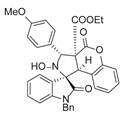
112.0 mg, 38%, a yellow solid, >20:1 dr, mp: 169.3-169.6oC; IR (thin film): νmax 3853, 3669, 3629, 3565, 1779, 1703, 1611, 1462, 1234, 1171, 1019, 855, 757, 668, 602, 516 cm−1; 1H NMR (400 MHz, DMSO-d6) δ 8.48 (s, 1H), 7.80 (d, J = 7.2 Hz, 1H), 7.61 (d, J = 8.4 Hz, 2H), 7.39 (t, J = 7.8 Hz, 1H), 7.32 (ψt, J = 7.8 Hz, 1H), 7.28 (ψt, J = 7.4 Hz, 1H), 7.12 (d, J = 8.0 Hz, 2H), 7.05 (ψt, J = 7.6 Hz, 2H), 6.96 (d, J = 8.4 Hz, 2H), 6.88 (ψt, J = 7.6 Hz, 1H), 6.68 (d, J = 7.2 Hz, 1H), 6.52 (d, J = 7.6 Hz, 2H), 6.37 (d, J = 7.6 Hz, 1H), 5.70 (s, 1H), 4.87 (d, J = 16.4 Hz, 1H), 4.67 (s, 1H), 4.50 (d, J = 16.4 Hz, 1H), 3.76 (s, 3H), 3.65-3.54 (m, 2H), 0.70 (t, J = 7.0 Hz, 3H); 13C NMR (100 MHz, DMSO-d6): δ 175.1, 167.2, 164.7, 159.4, 150.8, 144.1, 135.7, 130.6, 130.1, 130.0, 128.9, 128.4, 126.7, 126.5, 124.9, 124.9, 123.7, 117.5, 115.3, 113.6, 109.9, 77.3, 72.1, 62.9, 59.3, 55.6, 46.8, 42.6, 13.5; HRMS (ESI): m/z calcd for C35H30N2O7Na [M+Na]+ 613.1951, found 613.1949.
(±)-ethyl (1R,3R,3aS,9bR)-1’-benzyl-3-(4-fluorophenyl)-2-hydroxy-2’,4-dioxo-2,3-dihydro-4H-spiro[chromeno [3,4-c]pyrrole-1,3’-indoline]-3a(9bH)-carboxylate (3af)

181.3 mg, 63%, a yellow solid, >20:1 dr, mp: 161.1-163.6oC; IR (thin film): νmax 3852,3696, 3680, 3624, 3564, 3422, 1773, 1732, 1611, 1369, 1169, 858, 819, 757, 507 cm−1; 1H NMR (400 MHz, DMSO-d6) δ 8.59 (s, 1H), 7.82 (d, J = 8.0 Hz, 1H), 7.74 (dd, J = 8.4, 6.0 Hz, 2H), 7.40 (td, J = 8.4, 1.0 Hz, 1H), 7.32 (td, J = 7.6, 1.2 Hz, 1H), 7.32 (ψt, J = 8.0 Hz, 1H), 7.32 (ψt, J = 8.8 Hz, 2H), 7.13 (ψt, J = 7.4 Hz, 2H), 7.05 (ψt, J = 7.4 Hz, 2H), 6.90 (ψt, J = 7.4 Hz, 1H), 6.69 (d, J = 7.6 Hz, 1H), 6.53 (d, J = 7.6 Hz, 2H), 6.38 (d, J = 7.6 Hz, 1H), 5.75 (s, 1H), 4.87 (d, J = 16.0 Hz, 1H), 4.66 (s, 1H), 4.51 (d, J = 16.0 Hz, 1H), 3.65-3.58 (m, 2 H), 0.71 (t, J = 7.0 Hz, 3H); 13C NMR (100 MHz, DMSO-d6): δ 175.0, 167.2, 164.7, 150.8, 144.2, 135.7, 134.3 (d, J = 2.7 Hz), 130.9, 130.8, 130.7, 128.9, 128.4, 127.5, 126.7, 126.3, 125.0 (2C), 123.7, 117.5, 115.2, 115.1, 115.0, 109,9, 77.3, 71.8, 63.1, 59.1, 47.0, 42.6, 13.5; 19F NMR (376 MHz, DMSO-d6): -114.9; HRMS (ESI): m/z calcd for C34H27N2O6FNa [M+Na]+ 601.1751, found 601.1740.
(±)-ethyl (1R,3R,3aS,9bR)-1’-benzyl-3-(4-chlorophenyl)-2-hydroxy-2’,4-dioxo-2,3-dihydro-4H-spiro[chromeno [3,4-c]pyrrole-1,3’-indoline]-3a(9bH)-carboxylate(3ag)
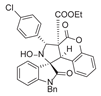
225.5mg, 76%, a white solid, >20:1 dr, mp: 183.1-184.2oC; IR (thin film): νmax 3852, 3734, 3678, 3574, 3563, 2981, 2933, 1778, 1714, 1611, 1493, 1229,1165, 1009, 862, 754, 610, 544 cm−1; 1H NMR (400 MHz, DMSO-d6) δ 8.62 (s, 1H), 7.82 (d, J = 7.2 Hz, 1H), 7.72 (d, J = 8.4 Hz, 2H), 7.48 (d, J = 8.4 Hz, 2H), 7.40 (t, J = 8.0 Hz, 1H), 7.32 (ψt, J = 7.8 Hz, 1H), 7.28 (ψt, J = 7.2 Hz, 1H), 7.13 (ψt, J = 8.2 Hz, 1H), 7.05 (ψt, J = 7.6 Hz, 2H), 6.90 (ψt, J = 7.6 Hz, 1H), 6.69 (d, J = 7.2 Hz, 1H), 6.53 (d, J = 7.6 Hz, 2H), 6.38 (d, J = 7.6 Hz, 1H), 5.74 (s, 1H), 4.87 (d, J = 16.0 Hz, 1H), 4.65 (s, 1H), 4.51 (d, J = 16.0 Hz, 1H), 3.63 (q, J = 7.0 Hz, 2H), 0.71 (t, J = 7.0 Hz, 3H). 13C NMR (100 MHz, DMSO-d6): δ 175.0, 167.2, 164.7, 150.8, 144.1, 137.2, 135.7, 132.9, 130.7, 128.9, 128.4, 128.3, 127.5, 126.7, 126.2, 125.0 (2C), 123.7, 117.5, 115.0, 110.0, 77.3, 71.8, 63.1, 59.1, 47.0, 42.6, 13.5; HRMS (ESI): m/z calcd for C34H27N2O6ClNa [M+Na]+ 617.1455, found 617.1455.
(±)-ethyl (1R,3R,3aS,9bR)-1’-benzyl-3-(4-bromophenyl)-2-hydroxy-2’,4-dioxo-2,3-dihydro-4H-spiro[chromeno [3,4-c]pyrrole-1,3’-indoline]-3a(9bH)-carboxylate (3ah)
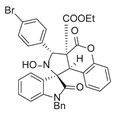
218.2 mg, 68%, a white solid; >20:1 dr, mp: 190.0-191.3oC; IR (thin film): νmax 3854, 3729, 3668, 3633, 1740, 1712, 1617, 1498, 1376, 1232, 1180, 1004, 858, 804, 736, 620 cm−1; 1H NMR (400 MHz, DMSO-d6) δ 8.62 (s, 1H), 7.82 (d, J = 7.6 Hz, 1H), 7.66 (d, J = 8.8 Hz, 2H), 7.62 (d, J = 8.8 Hz, 2H), 7.40 (t, J = 7.8 Hz, 1H), 7.32 (ψt, J = 7.6 Hz, 1H), 7.28 (ψt, J = 7.6 Hz, 1H), 7.13 (ψt, J = 8.4 Hz, 2H), 7.05 (t, J = 7.4 Hz, 2H), 6.90 (ψt, J = 7.0 Hz, 1H), 6.69 (d, J = 7.6 Hz, 1H), 6.52 (d, J = 6.8 Hz, 2H), 6.38 (d, J = 7.6 Hz, 1H), 5.72 (s, 1H), 4.87 (d, J = 16.2 Hz, 1H), 4.65 (s, 1H), 4.51 (d, J = 16.2 Hz, 1H), 3.64 (q, J = 7.0 Hz, 2H), 0.70 (t, J = 7.1 Hz, 3H); 13C NMR (100 MHz, DMSO-d6): δ 175.0, 167.2, 164.7, 150.8, 144.1, 137.6, 135.7, 131.2, 131.0, 130.7, 128.9, 128.4, 127.5, 126.7, 126.2, 125.0, 124.9, 123.7, 121.4, 117.5, 115.0, 109.9, 77.3, 71.8, 63.1, 59.1, 47.1, 42.7, 13.5; HRMS (ESI): m/z calcd for C34H27N2O6BrNa [M+Na]+ 661.0950, found 661.0924.
(±)-ethyl (1R,3R,3aS,9bR)-1’-benzyl-2-hydroxy-3-(4-nitrophenyl)-2’,4-dioxo-2,3-dihydro-4H-spiro[chromeno [3,4-c]pyrrole-1,3’-indoline]-3a(9bH)-carboxylate(3ai)
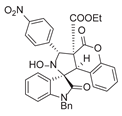
182.1 mg, 60%, a white solid, >20:1 dr, mp: 202.1-203.2oC; IR (thin film): νmax 3854, 3736, 3639, 3612, 3396, 3070, 2987, 2931, 1728, 1610, 1348, 1235, 1178, 1009, 754, 699, 610, 551 cm−1; 1H NMR (400 MHz, DMSO-d6) δ 8.79 (s, 1H), 8.31 (d, J = 8.8 Hz, 2H), 8.00 (d, J = 8.8 Hz, 2H), 7.85 (d, J = 7.2 Hz, 1H), 7.42 (t, J = 8.0 Hz, 1H), 7.34 (t, J = 7.6 Hz, 1H), 7.30 (t, J = 7.6 Hz, 1H), 7.17 (d, J = 8.0 Hz, 1H), 7.12 (d, J = 6.8 Hz, 1H), 7.06 (ψt, J = 7.4 Hz, 2H), 6.92 (ψt, J = 7.4 Hz, 1H), 6.71 (d, J = 7.6 Hz, 1H), 6.53 (d, J = 7.6 Hz, 2H), 6.40 (d, J = 7.6 Hz, 1H), 5.86 (s, 1H), 4.88 (d, J = 16.2 Hz, 1H), 4.66 (s, 1H), 4.53 (d, J = 16.2 Hz, 1H), 3.62 (q, J = 7.0 Hz, 2H), 0.69 (t, J = 7.0 Hz, 3H); 13C NMR (100 MHz, DMSO-d6): δ 175.0, 167.2, 164.7, 150.7, 147.6, 146.0, 144.2, 135.6, 130.8, 130.0, 128.9, 128.4 127.5, 126.7, 125.9, 125.1, 125.0, 123.8, 123.5, 117.6, 114.8, 110.0, 77.5, 71.8, 63.3, 59.2, 47.3, 42.7, 13.5; HRMS (ESI): m/z calcd for C34H27N3O8Na [M+Na]+ 628.1696, found 628.1690.
(±)-ethyl (1R,3R,3aS,9bR)-1’-benzyl-2-hydroxy-6-methyl-2’,4-dioxo-3-phenyl-2,3-dihydro-4H-spiro[chromeno [3,4-c]pyrrole-1,3’-indoline]-3a(9bH)-carboxylate(4a)
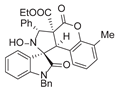
188.6 mg, 65%, a white solid; >20:1 dr, mp: 182.6-183.9oC; IR (thin film): νmax 3460, 3061, 3035, 2981, 2915, 1755, 1733, 1615, 1468, 1366, 1273, 1207, 1184, 1031, 1006, 837, 782, 752, 631, 551, 530 cm−1; 1H NMR (400 MHz, DMSO-d6) δ 8.51 (s, 1H), 7.80 (d, J = 6.8 Hz, 1H), 7.72 (d, J = 7.6 Hz, 2H), 7.40 (ψt, J = 7.6 Hz, 2H), 7.34-7.23 (m, 4H), 7.13 (t, J = 7.4 Hz, 1H), 7.05 (ψt, J = 7.5 Hz, 2H), 6.76 (ψt, J = 7.4 Hz, 1H), 6.70 (d, J = 7.2 Hz, 1H), 6.53 (d, J = 7.6 Hz, 2H), 6.19 (d, J = 7.2 Hz, 1H), 5.77 (s, 1H), 4.87 (d, J = 16.2 Hz, 1H), 4.65 (s, 1H), 4.51 (d, J = 16.2 Hz, 1H), 3.60-3.48 (m, 2H), 2.22 (s, 3H), 0.65 (t, J = 7.2 Hz, 3H); 13C NMR (100 MHz, DMSO-d6): δ 175.1, 167.2, 164.6, 149.1, 144.2, 138.3, 135.8, 131.8, 130.6, 128.9, 128.8, 128.2, 128.1, 127.4, 126.7, 126.6, 126.1, 125.9, 124.9, 124.2, 123.6, 114.8, 109.8, 77.4, 72.5, 62.9, 59.2, 47.2, 42.7, 15.9, 13.5; HRMS (ESI): m/z calcd for C35H30N2O6Na [M+Na]+ 597.2002, found 597.2003.
(±)-ethyl (1R,3R,3aS,9bR)-1’-benzyl-2-hydroxy-7-methoxy-2’,4-dioxo-3-phenyl-2,3-dihydro-4H-spiro[chromeno [3,4-c]pyrrole-1,3’-indoline]-3a(9bH)-carboxylate(4b)
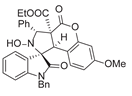
64.7 mg, 22%, a white solid, >20:1 dr, mp: 169.6-171.1oC; IR (thin film): νmax 3478, 2958, 2924, 2853, 1770, 1710, 1613, 1493, 1467, 1361, 1194, 1081, 1013, 955, 856, 747, 595, 643 cm−1; 1H NMR (400 MHz, DMSO-d6) δ 8.53 (s, 1H), 7.79 (d, J = 6.4 Hz, 1H), 7.71 (d, J = 7.2 Hz, 2H), 7.39 (ψt, J = 7.4 Hz, 2H), 7.33-7.25 (m, 3H), 7.15 (ψt, J = 7.2 Hz, 1H), 7.03 (t, J = 7.6 Hz, 2H), 6.74 (d, J = 2.0 Hz, 1H), 6.71 (d, J = 7.6 Hz, 1H), 6.57 (d, J = 7.6 Hz, 2H), 6.48 (dd, J = 8.6, 2.2 Hz, 1H), 6.24 (d, J = 8.8 Hz, 1H), 5.75 (s, 1H), 4.91 (d, J = 16.0 Hz, 1H), 4.59 (s, 1 H), 4.51 (d, J = 16.0 Hz, 1H), 3.74 (s, 3H), 3.59-3.52 (m, 2H), 0.65 (t, J = 7.0 Hz, 3H); 13C NMR (100 MHz, DMSO-d6): δ 175.2, 167.2, 164.8, 160.9, 151.8, 144.1, 138.3, 135.8, 130.5, 129.1, 128.8, 128.6, 128.2, 128.1, 127.5, 126.8, 126.5, 124.9, 123.6, 111.6, 109.8, 106.8, 102.4, 77.4, 72.3, 62.9, 59.3, 56.0, 46.7, 42.6, 13.5; HRMS (ESI): m/z calcd for C35H30N2O7Na [M+Na]+ 613.1952, found 613.1949.
(±)-ethyl (1R,3R,3aS,9bR)-1’-benzyl-6-ethoxy-2-hydroxy-2’,4-dioxo-3-phenyl-2,3-dihydro-4H-spiro[chromeno [3,4-c]pyrrole-1,3’-indoline]-3a(9bH)-carboxylate(4c)
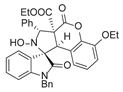
261.0 mg, 86%, a white solid, >20:1 dr, mp: 143.2-145.1oC; IR (thin film): νmax 3471, 3068, 3039, 2981, 2927, 1774, 1715, 1615, 1587, 1369, 1243, 1181, 1069, 953, 866, 754, 700, 664, 604, 540 cm−1; 1H NMR (400 MHz, DMSO-d6) δ 8.51 (s, 1H), 7.80 (d, J = 6.8 Hz, 1H), 7.71 (d, J = 7.6 Hz, 2H), 7.40 (ψt, J = 7.6 Hz, 2H), 7.31 (ψt, J = 7.8 Hz, 2H), 7.27 (t, J = 7.6 Hz, 1H), 7.14 (ψt, J = 7.2 Hz, 1H), 7.12-7.05 (m, 3H), 6.81 (ψt, J = 8.0 Hz, 1H), 6.68 (d, J = 7.2 Hz, 1H), 6.54 (d, J = 7.6 Hz, 2H), 5.91 (d, J = 7.6 Hz, 1H), 5.74 (s, 1H), 4.89 (d, J = 16.4 Hz, 1H), 4.67 (s, 1H), 4.52 (d, J = 16.4 Hz, 1H), 4.11-3.97 (m, 2H), 3.61-3.48 (m, 2H), 1.35 (t, J = 7.0 Hz, 3H), 0.65 (t, J = 7.0 Hz, 3H); 13C NMR (100 MHz, DMSO-d6): δ 175.1, 167.1, 164.4, 146.8, 144.2, 140.0, 138.3, 135.7, 130.6, 128.9, 128.8, 128.2, 128.1, 127.4, 126.6, 126.5, 124.9, 124.8, 123.7, 119.2, 115.9, 113.8, 109.9, 77.3, 72.5, 64.6, 63.0, 59.0, 47.1, 42.6, 15.0, 13.4; HRMS (ESI): m/z calcd for C36H32N2O7Na [M+Na]+ 627.2107, found 627.2110.
(±)-ethyl (1R,3R,3aS,9bR)-1’-benzyl-8-fluoro-2-hydroxy-2’,4-dioxo-3-phenyl-2,3-dihydro-4H-spiro[chromeno [3,4-c]pyrrole-1,3’-indoline]-3a(9bH)-carboxylate(4d)
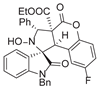
236.4 mg, 82%, a yellow solid, >20:1 dr, mp: 177.4-178.2oC; IR (thin film): νmax 3471, 3068, 3018, 2977, 2909, 1770, 1731, 1615, 1495, 1467, 1369, 1250, 1183, 1007, 874, 753, 700, 623, 542 cm−1; 1H NMR (400 MHz, DMSO-d6) δ 8.59 (s, 1H), 7.82 (d, J = 7.2 Hz, 1H), 7.70 (d, J = 7.2 Hz, 2H), 7.40 (ψt, J = 7.4 Hz, 2H), 7.35-7.26 (m, 4H), 7.22 (dd, J = 8.8, 4.8 Hz, 1H), 7.16 (ψt, J = 7.2 Hz, 1H), 7.09 (ψt, J = 7.4 Hz, 2H), 6.76 (d, J = 7.6 Hz, 1H), 6.60 (d, J = 7.6 Hz, 2H), 6.06 (d, J = 8.0 Hz, 1H), 5.74 (s, 1H), 4.90 (d, J = 16.0 Hz, 1H), 4.69 (s, 1H), 4.53 (d, J = 16.0 Hz, 1H), 3.62-3.49 (m, 2H), 0.65 (t, J = 7.2 Hz, 3H); 13C NMR (100 MHz, DMSO-d6): δ 175.0, 167.0, 164.4, 147.2 (d, J = 2.0 Hz), 144.1, 138.1, 135.8, 130.8, 128.9, 128.2, 127.6, 126.8, 126.0, 125.1, 123.8, 119.5 (d, J = 9.6 Hz), 117.8, 117.6, 116.9, 116.8, 114.5, 114.2, 110.1, 77.3, 72.4, 63.0, 58.8, 46.8, 42.7, 13.4; 19F NMR (376 MHz, DMSO-d6): -118.0; HRMS (ESI): m/z calcd for C34H27N2O6FNa [M+Na]+ 601.1751, found 601.1754.
(±)-ethyl (1R,3R,3aS,9bR)-1’-benzyl-8-chloro-2-hydroxy-2’,4-dioxo-3-phenyl-2,3-dihydro-4H-spiro[chromeno [3,4-c]pyrrole-1,3’-indoline]-3a(9bH)-carboxylate(4e)
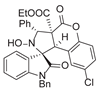
204.2 mg, 67%, a white solid, >20:1 dr, mp: 168.8-170.0oC; IR (thin film): νmax 3448, 3098, 3059, 3022, 2977, 2913, 1774, 1725, 1707, 1489, 1468, 1381, 1255, 1255, 1161, 1138, 1007, 885, 750, 701, 615, 557, 534 cm−1; 1H NMR (400 MHz, DMSO-d6) δ 8.58 (s, 1H), 7.83 (d, J = 7.2 Hz, 1H), 7.70 (d, J = 7.6 Hz, 2H), 7.46 (dd, J = 8.6, 2.6 Hz, 1H), 7.39 (ψt, J = 7.4 Hz, 2H), 7.36-7.24 (m, 3H), 7.19 (d, J = 8.8 Hz, 1H), 7.17 (ψt, J = 7.2 Hz, 1H), 7.10 (ψt, J = 7.6 Hz, 2H), 6.75 (d, J = 7.6 Hz, 1H), 6.58 (d, J = 7.6 Hz, 2H), 6.32 (d, J = 2.4 Hz, 1H), 5.73 (s, 1H), 4.91 (d, J = 16.0 Hz, 1H), 4.69 (s, 1H), 4.53 (d, J = 16.0 Hz, 1H), 3.62-3.50 (m, 2H), 0.66 (t, J = 7.2 Hz, 3H); 13C NMR (100 MHz, DMSO-d6): δ 175.0, 166.9, 164.2, 149.6, 144.1, 138.0, 135.7, 130.8, 130.6, 128.9, 128.8, 128.6, 128.2 (2C), 127.8, 127.6, 126.6, 125.9, 125.1, 123.8, 119.5, 117.2, 110.0, 77.3, 72.4, 63.1, 58.9, 46.6, 42.7, 13.4; HRMS (ESI): m/z calcd for C34H27N2O6ClNa [M+Na]+ 617.1455, found 617.1450.
(±)-ethyl (1R,3R,3aS,9bR)-1’-benzyl-8-bromo-2-hydroxy-2’,4-dioxo-3-phenyl-2,3-dihydro-4H-spiro[chromeno [3,4-c]pyrrole-1,3’-indoline]-3a(9bH)-carboxylate(4f)
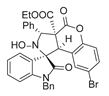
214.3 mg, 67%, a white solid, >20:1 dr, mp: 159.1-161.2oC; IR (thin film): νmax 3453, 3064, 3026, 2983, 2930, 1776, 1725, 1615, 1467, 1227, 1163, 1075, 999, 824, 749, 700, 614, 535 cm−1; 1H NMR (400 MHz, DMSO-d6) δ 8.58 (s, 1H), 7.83 (d, J = 7.2 Hz, 1H), 7.70 (d, J = 7.6 Hz, 2H), 7.58 (dd, J = 8.8, 2.0 Hz, 1H), 7.40 (ψt, J = 7.4 Hz, 2H), 7.37 (ψt, J = 8.0 Hz, 1H), 7.33-7.29 (m, 2 H), 7.17 (ψt, J = 7.2 Hz, 1H), 7.12 (s, 1 H), 7.11 (ψt, J = 7.2 Hz, 2H), 6.75 (d, J = 7.6 Hz, 1H), 6.57 (d, J = 7.6 Hz, 2H), 6.45 (d, J = 2.4 Hz, 1H), 5.73 (s, 1H), 4.91 (d, J = 16.0 Hz, 1H), 4.69 (s, 1H), 4.53 (d, J = 16.0 Hz, 1H), 3.62-3.50 (m, 2H), 0.66 (t, J = 7.0 Hz, 3H); 13C NMR (100 MHz, DMSO-d6): δ 175.0, 166.9, 164.2, 150.1, 144.1, 138.0, 135.7, 133.4, 130.8, 130.7, 128.9, 128.8, 128.2 (2C), 127.5, 126.5, 125.9, 125.1, 123.8, 119.8, 117.7, 116.5, 110.0, 77.3, 72.4, 63.1, 58.9, 46.6, 42.7, 13.4; HRMS (ESI): m/z calcd for C34H27N2O6BrNa [M+Na]+ 661.0950, found 661.0933.
(±)-ethyl (1R,3R,3aS,9bR)-1’-benzyl-2-hydroxy-8-nitro-2’,4-dioxo-3-phenyl-2,3-dihydro-4H-spiro[chromeno [3,4-c]pyrrole-1,3’-indoline]-3a(9bH)-carboxylate(4g)
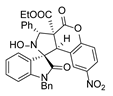
228.0 mg, 75%, a white solid, >20:1 dr, mp: 142.8-143.6oC; IR (thin film): νmax 3904, 3740, 3079, 1784, 1714, 1613, 1528, 1343, 1246, 1149, 996, 844, 742, 699 cm−1; 1H NMR (400 MHz, DMSO-d6) δ 8.66 (s, 1H), 8.23 (dd, J = 9.2, 2.8 Hz, 1H), 7.89 (dd, J = 7.0, 1.0 Hz, 1H), 7.71 (d, J = 7.6 Hz, 2H), 7.44-7.31 (m, 6H), 7.14 (d, J = 2.4 Hz, 1H), 7.11 (d, J = 7.6 Hz, 1H), 7.02 (ψt, J = 7.6 Hz, 2H), 6.82 (d, J = 8.0 Hz, 1H), 6.60 (d, J = 7.2 Hz, 2H), 5.76 (s, 1H), 4.85 (d, J = 16.0 Hz, 2H), 4.82 (s, 1 H), 4.51 (d, J = 16.0 Hz, 1H), 3.63-3.50 (m, 2H), 0.67 (t, J = 7.2 Hz, 3H); 13C NMR (100 MHz, DMSO-d6): δ 175.0, 166.6, 163.7, 155.3, 144.0, 143.5, 137.8, 135.9, 131.0, 128.9, 128.7, 128.3, 127.7, 127.0, 126.4, 125.5, 125.3, 124.0, 123.9, 119.0, 116.6, 110.2, 77.3, 72.5, 63.2, 58.7, 46.4, 42.8, 13.4; HRMS (ESI): m/z calcd for C34H27N3O8Na [M+Na]+ 628.1696, found 6281.1693.
(±)-diethyl (3R,3’R,5’R)-1-benzyl-1’-hydroxy-3’-(2-hydroxy-5-nitrophenyl)-2-oxo-5’-phenylspiro[indoline-3,2’-pyrrolidine]-4’,4’-dicarboxylate(4g’)
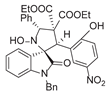
77.4 mg, 24%, a white solid, >20:1 dr, mp: 178.1-180.0oC; IR (thin film): νmax 3852, 3732, 3676, 3649, 3622, 1725, 1618, 1496, 1339, 1289, 1195, 1098, 1020, 803, 753, 702, 611 cm−1; 1H NMR (400 MHz, DMSO-d6) δ 11.02 (s, 1H), 8.32 (d, J = 2.8 Hz, 1H), 8.20 (s, 1H), 7.97 (dd, J = 9.2, 2.8 Hz, 1H), 7.71 (dd, J = 5.8, 2.2 Hz, 1H), 7.51 (d, J = 7.6 Hz, 2H), 7.35 (ψt, J = 7.4 Hz, 2H), 7.28 (t, J = 7.2 Hz, 1H), 7.18-7.11 (m, 3H), 7.05 (ψt, J = 7.4 Hz, 2H), 6.84 (d, J = 7.6 Hz, 2H), 6.75 (d, J = 9.2 Hz, 1H), 6.60 (dd, J = 6.8, 1.6 Hz, 1H), 6.46 (s, 1H), 5.85 (s, 1H), 4.90 (d, J = 15.8 Hz, 1H), 4.55 (d, J = 15.8 Hz, 1H), 3.88-3.80 (m, 1H), 3.72-3.64 (m, 1H), 3.60-3.52 (m, 1H), 3.22-3.14 (m, 1H), 0.67 (t, J = 7.0 Hz, 3H), 0.59 (t, J = 7.2 Hz, 3H); 13C NMR (100 MHz, DMSO-d6): δ 174.8, 169.2, 168.4, 162.7, 143.7, 139.3, 138.6, 136.3, 129.8, 128.6, 128.5, 128.1, 128.0, 127.9, 127.6, 127.1, 125.4, 125.1, 122.9, 122.8, 115.6, 109.0, 76.9, 70.7, 65.6, 61.7, 61.2, 43.3, 42.6, 13.5, 13.4; HRMS (ESI): m/z calcd for C36H33N3O9Na [M+Na]+ 674.2114, found 674.2107.
(±)-ethyl (1R,3R,3aS,9bR)-1’-benzyl-6,8-di-tert-butyl-2-hydroxy-2’,4-dioxo-3-phenyl-2,3-dihydro-4H-spiro[chromeno [3,4-c]pyrrole-1,3’-indoline]-3a(9bH)-carboxylate(4h)
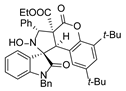
246.1 mg, 73%, a white solid, >20:1 dr, mp: 145.1-146.8oC; IR (thin film): νmax 3065, 3035, 2962, 2907, 2867, 1774, 1720, 1615, 1468, 1365, 1225, 1163, 1124, 1007, 750, 699, 631, 546 cm−1; 1H NMR (400 MHz, DMSO-d6) δ 8.53 (s, 1H), 7.82 (d, J = 6.8 Hz, 1H), 7.73 (d, J = 7.6 Hz, 2H), 7.40 (ψt, J = 7.2 Hz, 2H), 7.36-7.29 (m, 3H), 7.24 (s, 1H), 7.14 (ψt, J = 7.4 Hz, 1H), 7.01 (ψt, J = 7.4 Hz, 2H), 6.74 (d, J = 7.2 Hz, 1H), 6.45 (d, J = 7.6 Hz, 2H), 6.12 (s, 1H), 5.83 (s, 1H), 4.94 (d, J = 16.0 Hz, 1H), 4.52 (s, 1H), 4.35 (d, J = 16.0 Hz, 1H), 3.63-3.50 (m, 2H), 1.36 (s, 9H), 0.73 (s, 9H), 0.68 (t, J = 7.0 Hz, 3H); 13C NMR (100 MHz, DMSO-d6): δ 175.0, 167.4, 126.6, 164.3, 147.1, 145.4, 144.3, 138.4, 136.4, 136.1, 130.4, 128.9, 128.7, 128.2, 128.0, 127.3, 126.7, 124.9, 124.0, 123.5, 123.3, 114.5, 109.6, 77.6, 72.4, 62.7, 58.6, 48.1, 42.9, 35.1, 34.1, 31.0, 30.0, 13.6; HRMS (ESI): m/z calcd for C42H44N2O6Na [M+Na]+ 695.3097, found 695.3082.
(±)-ethyl (1R,3R,3aS,9bR)-1’-benzyl-6,8-dibromo-2-hydroxy-2’,4-dioxo-3-phenyl-2,3-dihydro-4H-spiro[chromeno [3,4-c]pyrrole-1,3’-indoline]-3a(9bH)-carboxylate(4j)
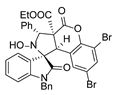
109.1 mg, 30%, a yellow solid; >20:1 dr, mp: 147.9-149.1oC; IR (thin film): vmax 3472, 3070, 3035, 2983, 2940, 1789, 1714, 1614, 1495, 1369, 1238, 1155, 1125, 1000, 862, 752, 699, 546 cm−1; 1H NMR (400 MHz, DMSO-d6) δ 8.61 (s, 1H), 7.93 (d, J = 2.0 Hz, 1H), 7.83 (d, J = 7.2 Hz, 1H), 7.69 (d, J = 7.2 Hz, 2H), 7.40 (ψt, J = 7.6 Hz, 2H), 7.39 (t, J = 7.4 Hz, 1H), 7.32 (ψt, J = 6.6 Hz, 1H), 7.31 (ψt, J = 7.0 Hz, 1H), 7.19 (ψt, J = 7.2 Hz, 1H), 7.13 (ψt, J = 7.4 Hz, 2H), 6.83 (d, J = 7.6 Hz, 1H), 6.76 (d, J = 7.2 Hz, 2H), 6.41 (d, J = 2.0 Hz, 1H), 5.73 (s, 1H), 4.91 (d, J = 16.0 Hz, 1H), 4.72 (s, 1H), 4.55 (d, J = 15.7 Hz, 1H), 3.63-3.50 (m, 2H), 0.66 (t, J = 7.2 Hz, 3H). 13C NMR (100 MHz, DMSO-d6): δ 175.0, 166.5, 163.5, 137.8, 136.0, 135.8, 130.9, 130.2, 128.9, 128.3, 127.7, 126.7, 125.6, 125.2, 123.9, 118.9, 116.5, 111.6, 110.1, 77.2, 72.5, 63.2, 58.9, 46.7, 42.8, 13.4; HRMS (ESI): m/z calcd for C34H26N2O6Br2Na [M+Na]+ 741.0035, found 741.0034.
(±)-methyl (1R,3R,3aS,9bR)-1’-benzyl-2-hydroxy-2’,4-dioxo-3-phenyl-2,3-dihydro-4H-spiro[chromeno [3,4-c]pyrrole-1,3’-indoline]-3a(9bH)-carboxylate(4k)
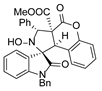
81.3 mg, 30%, a white solid, >20:1 dr, mp: 158.8-159.6oC; IR (thin film): νmax 3854, 3555, 3474, 3185, 3068, 2915, 1744, 1709, 1610, 1491, 1460, 1253, 1178, 948, 756, 705, 604, 526 cm−1; 1H NMR (400 MHz, DMSO-d6) δ 8.56 (s, 1H), 7.83 (d, J = 6.6 Hz, 1H), 7.70 (d, J = 7.6 Hz, 2H), 7.40 (ψt, J = 7.4 Hz, 3H), 7.32 (ψt, J = 7.2 Hz, 2H), 7.28 (t, J = 7.6 Hz, 1H), 7.13 (d, J = 8.4 Hz, 1H), 7.12 (d, J = 7.2 Hz, 1H), 7.05 (ψt, J = 7.6 Hz, 2H), 6.90 (ψt, J = 7.6 Hz, 1H), 6.69 (d, J = 7.6 Hz, 1H), 6.53 (d, J = 7.6 Hz, 2H), 6.38 (d, J = 7.6 Hz, 1H), 5.76 (s, 1H), 4.88 (d, J = 16.0 Hz, 1H), 4.68 (s, 1H), 4.51 (d, J = 16.0 Hz, 1H), 3.07 (s, 3H); 13C NMR (100 MHz, DMSO-d6): δ 175.1, 167.7, 164.5, 150.8, 144.1, 138.2, 135.7, 130.6, 128.9, 128.7, 128.4, 128.2, 128.1, 127.4, 126.7, 126.3, 125.0, 124.9, 123.7, 117.5, 115.1, 109.9, 77.4, 72.4, 59.5, 53.5, 46.9, 42.6; HRMS (ESI): m/z calcd for C33H26N2O6Na [M+Na]+ 569.1689, found 569.1700.
(±)-isopropyl (1R,3R,3aS,9bR)-1’-benzyl-2-hydroxy-2’,4-dioxo-3-phenyl-2,3-dihydro-4H-spiro[chromeno [3,4-c]pyrrole-1,3’-indoline]-3a(9bH)-carboxylate(4l)
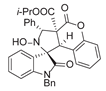
193.2 mg, 67%, a white solid, >20:1 dr, mp: 182.0-183.0oC; IR (thin film): νmax 3474, 3065, 3030, 2989, 2907, 1748, 1731, 1617, 1492, 1371, 1261, 1230, 1261, 1181, 1100, 1004, 908, 753, 701, 610, 553 cm−1; 1H NMR (600 MHz, CDCl3) δ 7.84 (d, J = 7.2 Hz, 2H), 7.79 (d, J = 6.6 Hz, 1H), 7.39 (ψt, J = 7.5 Hz, 2H), 7.31 (ψt, J = 7.2 Hz, 1H), 7.27 (td, J = 7.8, 1.2 Hz, 2H), 7.25 (td, J = 8.1, 0.9 Hz, 1H), 7.12 (ψt, J = 7.5 Hz, 1H), 7.09 (dd, J = 8.4, 0.6 Hz, 1H), 7.05 (ψt, J = 7.8 Hz, 2H), 6.79 (td, J = 7.5, 0.9 Hz, 1H), 6.58 (d, J = 7.2 Hz, 2H), 6.56 (dd, J = 7.2, 1.2 Hz, 1H), 6.42 (d, J = 7.2 Hz, 1H), 6.10 (s, 1H), 5.03 (d, J = 16.2 Hz, 1H), 4.80 (s, 1H), 4.72 (s, 1H), 4.46 (Sept, J = 6.0 Hz, 1H), 4.38 (d, J = 16.2 Hz, 1H), 0.95 (d, J = 6.0 Hz, 3H), 0.57 (d, J = 6.0 Hz, 3H); 13C NMR (150 MHz, CDCl3): δ 174.4, 166.4, 164.6, 151.1, 144.2, 137.3, 134.9, 130.4, 129.7, 129.1, 128.6, 128.2, 128.1, 127.2, 126.6, 126.0, 124.1, 124.0, 123.3, 117.6, 114.9, 109.8, 77.0, 72.4, 71.3, 59.0, 47.2, 43.4, 21.2, 20.5; HRMS (ESI): m/z calcd for C35H30N2O6Na [M+Na]+ 597.2002, found 597.1975.
(±)-n-butyl (1R,3R,3aS,9bR)-1’-benzyl-2-hydroxy-2’,4-dioxo-3-phenyl-2,3-dihydro-4H-spiro[chromeno [3,4-c]pyrrole-1,3’-indoline]-3a(9bH)-carboxylate(4m)

197.1 mg, 67%, a white solid, >20:1 dr, mp: 144.6-145.9oC; IR (thin film): νmax 3474, 3063, 3035, 2958, 2872, 1777, 1716, 1615, 1491, 1455, 1369, 1226, 1174, 1035, 753, 700, 610, 528 cm−1; 1H NMR (400 MHz, DMSO-d6) δ 8.53 (s, 1H), 7.80 (d, J = 7.2 Hz, 1H), 7.42-7.37 (m, 3H), 7.34-7.27 (m, 3H), 7.14 (d, J = 8.0 Hz, 1H), 7.13 (ψt, J = 7.2 Hz, 1H), 7.05 (ψt, J = 7.4 Hz, 2H), 6.90 (ψt, J = 7.4 Hz, 1H), 6.69 (d, J = 7.2 Hz, 1H), 6.53 (d, J = 7.2 Hz, 2H), 6.38 (d, J = 7.6 Hz, 1H), 5.76 (s, 1H), 4.88 (d, J = 16.4 Hz, 1H), 4.66 (s, 1H), 4.51 (d, J = 16.4 Hz, 1H), 3.57-3.51 (m, 1H), 3.47-3.41 (m, 1H), 1.10-0.99 (m, 4H), 0.73 (t, J = 6.8 Hz, 3H); 13C NMR (100 MHz, DMSO-d6): δ 175.1, 167.2, 164.7, 150.3, 144.1, 138.2, 135.7, 130.6, 128.9, 128.8, 128.3, 128.2, 128.1, 127.4, 126.7, 126.4, 124.9, 124.9, 123.7, 117.5, 115.1, 109.9, 77.4, 72.4, 66.5, 59.4, 47.2, 42.6, 29.8, 18.7, 13.9; HRMS (ESI): m/z calcd for C36H32N2O6Na [M+Na]+ 611.2158, found 611.2149.
(±)-benzyl (1R,3R,3aS,9bR)-1’-benzyl-2-hydroxy-2’,4-dioxo-3-phenyl-2,3-dihydro-4H-spiro[chromeno [3,4-c]pyrrole-1,3’-indoline]-3a(9bH)-carboxylate(4n)
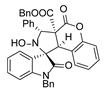
276.9 mg, 89%, a white solid, >20:1 dr, mp: 131.9-132.5oC; IR (thin film): νmax 3648, 3415, 3063, 3020, 1968, 1742, 1708, 1613, 1461, 1374, 1217, 1175, 1004, 910, 739, 695, 608, 528 cm−1; 1H NMR (400 MHz, DMSO-d6) δ 8.55 (s, 1H), 7.80 (d, J = 8.0 Hz, 1H), 7.71 (d, J = 7.2 Hz, 2H), 7.40 (t, J = 7.2 Hz, 1H), 7.37-7.30 (m, 4H), 7.29-7.27 (m, 4H), 7.13 (t, J = 8.4 Hz, 1H), 7.12 (t, J = 6.8 Hz, 1H), 7.05 (ψt, J = 7.6 Hz, 2H), 6.99-6.96 (m, 2H), 6.90 (ψt, J = 7.4 Hz, 1H), 6.69 (d, J = 7.6 Hz, 1H), 6.53 (d, J = 7.6 Hz, 2H), 6.39 (d, J = 7.6 Hz, 1H), 5.78 (s, 1H), 4.88 (d, J = 16.2 Hz, 1H), 4.70 (s, 1H), 4.64 (d, J = 12.4 Hz, 1H), 4.51 (d, J = 16.2 Hz, 1H), 4.37 (d, J = 12.4 Hz, 1H); 13C NMR (100 MHz, DMSO-d6): δ 175.1, 167.1, 164.6, 150.8, 144.1, 138.1, 135.7, 134.9, 130.7, 128.9, 128.8, 128.6, 128.4, 128.3, 128.2, 127.9, 127.4, 126.7, 126.3, 125.0, 124.9, 123.7, 117.5, 115.1, 109.9, 77.4, 72.5, 68.1, 59.4, 47.3, 42.6; HRMS (ESI): m/z calcd for C39H30N2O6Na [M+Na]+ 645.2002, found 645.1997.
(±)-ethyl (1R,3R,3aS,9bR)-2-acetoxy-1’-benzyl-2’,4-dioxo-3-phenyl-2,3-dihydro-4H-spiro[chromeno [3,4-c]pyrrole-1,3’-indoline]-3a(9bH)-carboxylate(6a)
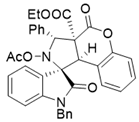
260.7 mg, 87%, a white solid, mp: 194.2-196.0oC; IR (thin film): νmax 3523, 3445, 3210, 3059, 2931, 2859, 1773, 1737, 1707, 1610, 1492, 1367, 1165, 998, 758, 697, 596,495 cm−1; 1H NMR (400 MHz, DMSO-d6) δ 7.90 (d, J = 6.4 Hz, 1H), 7.80 (d, J = 7.2 Hz, 1H), 7.43-7.31 (m, 5H),7.26 (t, J = 7.2 Hz, 1H), 7.17-7.08 (m, 4 H), 6.92 (td, J = 7.6, 0.8 Hz, 1H), 6.77 (d, J = 7.6 Hz, 1H), 6.63 (d, J = 7.2 Hz, 2H), 6.39 (d, J = 7.2 Hz, 1H), 6.03 (s, 1H), 4.86 (s, 1H), 4.84 (d, J = 16.0 Hz, 1H), 4.60 (d, J = 16.0 Hz, 1H), 3.64-3.50 (m, 2H), 1.53 (s, 3H), 0.67 (t, J = 7.0 Hz, 3H). 13C NMR (100 MHz, DMSO-d6): δ 173.5, 167.8, 166.5, 164.1, 150.8, 143.6, 136.0, 135.6, 131.4, 131.0, 129.0, 128.8, 128.4, 128.3, 127.7, 126.9, 126.5, 125.1, 123.9, 123.3, 117.7, 114.1, 110.2, 76.7, 71.3, 63.3, 59.2, 46.7, 42.8, 18.6, 13.4; HRMS (ESI): m/z calcd for C36H30N2O7Na [M+Na]+ 625.1951, found 625.1953.
(±)-ethyl (1R,3R,3aS,9bR)-2-(benzoyloxy)-1’-benzyl-2’,4-dioxo-3-phenyl-2,3-dihydro-4H-spiro[chromeno [3,4-c]pyrrole-1,3’-indoline]-3a(9bH)-carboxylate(6b)
263.0 mg, 79%, a white solid, 10:1 dr, mp: 160.4-162.1oC; IR (thin film): νmax 3847, 3648, 3567, 3511, 3237, 2975, 2929, 1766, 1715, 1610, 1459, 1233, 1167, 1017, 753, 701, 554 cm−1; 1H NMR (400 MHz, DMSO-d6) δ 7.99 (dd, J = 6.4, 2.4 Hz, 1H), 7.89 (d, J = 7.2 Hz, 2H), 7.59-7.50 (m, 3H), 7.45-7.36 (m, 5H), 7.32-7.25 (m, 3H), 7.20 (d, J = 8.0 Hz, 1H), 7.11 (ψt, J = 7.4 Hz, 1H), 6.98-6.92 (m, 3 H), 6.67 (dd, J = 5.6, 3.2 Hz, 1H), 6.57 (d, J = 7.2 Hz, 2H), 6.25 (s, 1H), 4.95 (s, 1H), 4.88 (d, J = 16.0 Hz, 1H), 4.57 (d, J = 16.0 Hz, 1H), 3.67-3.54 (m, 2H), 0.69 (t, J = 7.2 Hz, 3H). 13C NMR (100 MHz, DMSO-d6): δ 173.5, 166.5, 164.2, 163.3, 150.8, 143.5, 135.9, 135.4, 134.4, 131.4, 131.2, 129.5, 129.3, 129.0, 128.9, 128.5, 128.4, 127.6, 127.3, 126.8, 126.5, 125.1, 124.0, 123.3, 117.7, 114.0, 110.2, 76.9, 71.6, 63.4, 59.2, 46.9, 42.8, 13.4; HRMS (ESI): m/z calcd for C41H32N2O7Na [M+Na]+ 687.2107, found 687.2106.
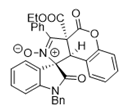
(±)-(1R,3aS,9bR)-1’-benzyl-3a-(ethoxycarbonyl)-2’,4-dioxo-3-phenyl-3a,9b-dihydro-4H-spiro[chromeno [3,4-c]pyrrole-1,3’-indoline] 2-oxide(8)
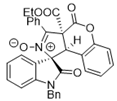
154.0 mg, 55%, a white solid, 10:1 dr, mp: 295.1-295.8oC; IR (thin film): νmax 3098, 3068, 2975, 2927, 1773, 1746, 1721, 1458, 1374, 1263, 1225, 1150, 1023, 990, 910, 860, 762, 697, 637, 544 cm−1; 1H NMR (400 MHz, DMSO-d6) δ 8.43-8.40 (m, 2H), 7.76 (d, J = 7.2 Hz, 1H), 7.55-7.51 (m, 4H), 7.46 (t, J = 7.4 Hz, 1H), 7.32 (d, J = 7.2 Hz, 1H), 7.31 (d, J = 8.0 Hz, 1H), 7.17 (ψt, J = 7.2 Hz, 1H), 7.10 (ψt, J = 7.4 Hz, 1H), 7.06 (ψt, J = 7.2 Hz, 1H), 6.90 (d, J = 8.0 Hz, 1H), 6.57 (ψd, J = 7.2 Hz, 3H), 4.93 (s, 1H), 4.86 (d, J = 16.2 Hz, 1H), 4.59 (d, J = 16.2 Hz, 1H), 4.29-4.23 (m, 1H), 4.20-4.12 (m, 1H), 0.98 (t, J = 7.0 Hz, 3H); 13C NMR (100 MHz, DMSO-d6): δ 170.7, 167.9, 161.3, 150.9, 140.4, 135.1, 132.5, 131.6, 131.4, 129.0, 128.7, 128.4, 127.8, 126.8, 126.4, 125.6, 124.5, 122.8, 117.6, 113.2,110.8, 85.9, 64.3, 60.3, 47.6, 43.3, 13.9; HRMS (ESI): m/z calcd for C34H26N2O6Na [M+Na]+ 581.1689, found 581.1683.
4. Conclusions
This section is not mandatory but can be added to the manuscript if the discussion is unusually long or complex. In summary, we have developed a rapidly [3+2]-cycloaddition of isatin ketonitrone 1,3-dipoles generated in situ with coumarins to access novel dicyclic spiropyrrolidine oxindole derivatives (45 examples) in moderate to excellent yields (22-98%). The reaction proceeded under mild conditions and were found to be high regio- and diastereoselectivities (>20:1 dr). All the synthesized exo-type spirooxindole derivatives 3/4 were confirmed by using 1H and 13C NMR, IR and HMRS technologies. The relative stereochemistry of products was explained undoubtedly by the single crystal X-ray of 3b and 8. Additionally, the transformation of spiroxindole product was realized successfully, which exhibited their good value of synthetic applications. Further exploration and application of this reaction in organic synthesis is ongoing in our laboratory.
Supplementary Materials
The following supporting information can be downloaded at the website of this paper posted on Preprints.org. Copes of NMR for all new compounds; Copes of HRMS for all new compounds; Copes of data of X-ray crystal structures for compounds 3b and 8.
Author Contributions
Writing—original draft preparation, G.Y; writing—review and editing, Q.Y., L.M.; methodology, G.Y.; conducting the experiments, Q.Y., L.M., Q.Z., Z.Z., R.Z., S.L. and Q. H.; validation, L.M., Q.Z. and Z.Z.; supervision, G.Y., C.L. and W.W.; funding acquisition, G.Y.; All authors have read and agreed to the published version of the manuscript.
Funding
This research was funded by Sichuan Jisheng Biopharmaceutical Co., Ltd., and the open project funding of Ministry of Education Key Laboratory for the Synthesis and Application of Organic Functional Molecules, Hubei University, Wuhan 430062, PR China (grant number: KLSAOFM2313), and The APC was funded by Sichuan Tongsheng Biopharmaceutical Co., Ltd.
Institutional Review Board Statement
Not applicable.
Informed Consent Statement
Not applicable.
Data Availability Statement
Not applicable.
Acknowledgments
We thank Guizhou Covalent Bond Bochuang Technology Co., Ltd., for the NMR and HRMS analysis.
Conflicts of Interest
The authors declare no conflicts of interest.
References
- Sardari, S.; Nishibe, S.; Daneshtalab, M. Coumarins, the bioactive structures with antifungal property. In Stud. Nat. Prod. Chem.; Attaur, R., Ed.; Elsevier, 2000; vol. 23, pp. 335–393. [Google Scholar]
- Estévez-Braun, A.; González, A. G. Coumarins. Nat. Prod. Rep. 1997, 14, 465–475. [Google Scholar] [CrossRef]
- Malikov, V. M.; Saidkhodzhaev, A. I.; Aripov, K. N. Coumarins: Plants, structure, properties. Chem. Nat. Compd. 1998, 34, 202–264. [Google Scholar] [CrossRef]
- Malikov, V. M.; Saidkhodzhaev, A. I. Coumarins. Plants, structure, properties. Chem. Nat. Compd. 1998, 34, 345–409. [Google Scholar] [CrossRef]
- Malikov, V. M.; Saidkhodzhaev, A. I. Coumarins: Plants, structures, properties. Chem. Nat. Compd. 1998, 34, 517–548. [Google Scholar]
- Kong, L. Coumarin chemistry. In Natural Product Chemistry Series; (in Chinese). Chemical Industry Press, 2007. [Google Scholar]
- Nan, Z.-D.; Shang, Y.; Zhu, Y.-D.; Zhang, H.; Sun, R.-R.; Tian, J.-J.; Jiang, Z.-B.; Ma, X.-L.; Bai, C. Systematic review of natural coumarins in plants (2019–2024): chemical structures and pharmacological activities. Phytochemistry 2025, 235, 114480. [Google Scholar] [CrossRef] [PubMed]
- Zhang, A.; Su, M.; Yuan, Z.; Deng, S.; Yu, L.; Wang, H. Research progress on the application of chemically synthesized coumarin derivatives. Chem. Res. Appl. (in Chinese). 2026, 38, 1–10. [Google Scholar]
- Barot, K. P.; Jain, S. V.; Kremer, L.; Singh, S.; Ghate, M. D. Recent advances and therapeutic journey of coumarins: current status and perspectives. Med. Chem. Res. 2015, 24, 2771–2798. [Google Scholar] [CrossRef]
- Sharifi-Rad, J.; Cruz-Martins, N.; López-Jornet, P.; Lopez, E. P.-F.; Harun, N.; Yeskaliyeva, B.; Beyatli, A.; Sytar, O.; Shaheen, S.; Sharopov, F.; Taheri, Y.; Docea, A. O.; Calina, D.; Cho, W. C. Natural coumarins exploring the pharmacological. Oxid. Med. Cell. Longev. 2021, 2021, 6492346. [Google Scholar] [CrossRef]
- Croce, M.; Gallo, N.; Arienzo, V.; Salvatore, A.; Antonini, G. Coumarin-induced hepatotoxicity: a narrative review. Molecules 2022, 27, 9063. [Google Scholar] [CrossRef] [PubMed]
- Sharma, V.; Sharma, A.; Wadje, B. N.; Bharate, S. B. Benzopyrone, a privileged scaffold in drug discovery: an overview of FDA-approved drugs and clinical candidates. Med. Chem. Res. 2024, 44, 2035–2077. [Google Scholar] [CrossRef]
- Hussain, M. K.; Khatoon, S.; Khan, M. F.; Akhtar, M. S.; Ahamad, S.; Saquib, M. Coumarins as versatile therapeutic phytomolecules: a systematic review. Phytomedicine 2024, 134, 155972. [Google Scholar] [CrossRef]
- Zeki, N. M.; Mustafa, Y. F. 6,7-Coumarin-heterocyclic hybrids: A comprehensive review of their natural sources, synthetic approaches, and bioactivity. J. Mol. Struct. 2024, 1303, 137601. [Google Scholar] [CrossRef]
- Aqib, M.; Khatoon, S.; Ali, M.; Sajid, S.; Assiri, M. A.; Ahamad, S.; Saquib, M.; Hussain, M. K. Exploring the anticancer potential and mechanisms of action of natural coumarins and isocoumarins. Eur. J. of Med. Chem. 2025, 282, 117088. [Google Scholar] [CrossRef] [PubMed]
- Tariq, H.; Khan, S.; Miyan, K.; Qidwai, S. N.; Ahamad, S.; Saquib, M.; Hussain, M. K. Exploring natural coumarins in antiprotozoal drug discovery: a comprehensive review. Chem. Biodiv. 2025, 22, e01964. [Google Scholar] [CrossRef]
- Liu, W.; Wu, L.; Liu, W.; Tian, L.; Chen, H.; Wu, Z.; Wang, N.; Liu, X.; Qiu, J.; Feng, X.; Xu, Z.; Jiang, X.; Zhao, Q. Design, synthesis and biological evaluation of novel coumarin derivatives as multifunctional ligands for the treatment of Alzheimer’s disease. Eur. J. Med. Chem. 2022, 242, 114689. [Google Scholar] [CrossRef]
- Dang, T.; Zhou, W.; Zhou, Y.; Meng, D.; Xu, Q.; Chen, L.; Lin, G.; Qing, B.; Sun, D.; Hou, Y.; Li, Y.N. Sesquiterpene coumarins isolated from Ferula bungeana and their anti-neuroinflammatory activities. Bioorg. Chem. 2022, 128, 106102. [Google Scholar]
- Zhang, Y.; Xu, Z.; Dou, M.; Xu, Y.; Fu, X.; Zhu, F.; Ye, H.; Zhang, J.; Feng, G. Design, synthesis, and bioactivity of novel coumarin-3-carboxylic acid derivatives containing a thioether quinoline moiety. ACS Omega 2024, 9, 50695–50704. [Google Scholar] [CrossRef]
- Szwaczko, K.; Strzyga-Łach, P.; Struga, M.; Kiernozek-Kalińska, E.; Szafrański, K.; Skiba, A.; Płazińska, A.; Skalicka-Woźniak, K.; Bielenica, A. Design, synthesis, structure–activity relationships, and preliminary anticancer properties of menthol-modified coumarin esters and 3,4-dihydrocoumarin derivatives. ACS Omega 2025, 10, 46418–46434. [Google Scholar] [CrossRef] [PubMed]
- Tataringa, G.; Tuchilus, C.; Ahmed, M.; Ahmed, S.; Bhat, A. R.; Ben Hadda, T.; Zbancioc, A.-M.; Fahelelbom, K. M. Discovery of new molecular hybrid derivatives with coumarin scaffold bearing pyrazole/oxadiazole moieties: Molecular docking, POM analyses, in silico pharmacokinetics and in vitro antimicrobial evaluation with identification of potent antitumor pharmacophore sites. Bioorg. Chem. 2024, 153, 107761. [Google Scholar]
- Mortel, S. L. R.; Macalino, S. J. Y.; Wang, M.; Tie, J.-K. In silico and in vitro studies of potential novel vitamin K epoxide reductase (VKOR) inhibitors suggest an updated structure–activity relationship. ACS Omega 2025, 10, 26694–26704. [Google Scholar] [CrossRef]
- Zhao, Y.; Peng, Z.; Wang, G. Design, synthesis, kinetic analysis, molecular docking, and mechanistic studies of novel coumarin-oxadiazole derivatives as α-glucosidase and PTP1B inhibitors. Bioorg. Med. Chem. 2025, 129, 118321. [Google Scholar] [CrossRef]
- Khanna, A.; Narang, A.; Thakur, V.; Singh, K.; Kumar, N.; Kaur, R.; Megha; Raj, A.; Devi, M.; Jyoti; Rana, R.; Sharma, A.; Kaur, H.; Singh, P.; Kaur, S.; Bedi, P. M. S. Design, synthesis, antibacterial evaluation, and molecular modelling studies of 1,2,3-triazole-linked coumarin-vanillin hybrids as potential DNA gyrase and topoisomerase IV inhibitors. Bioorg. Chem. 2025, 164, 108815. [Google Scholar] [CrossRef]
- Zakaria, B. S.; Ewes, W. A.; El-Messery, S. M.; Goda, E.F. Synthesis and antiviral activity of new 4-substituted oxycoumarins against SARS and HSV-2 viruses: mechanistic and molecular modeling study. Bioorg. Chem. 2025, 164, 108845. [Google Scholar] [CrossRef]
- Beinema, M.; Brouwers, J. R.; Schalekamp, T.; Wilffert, B. Pharmacogenetic differences between warfarin, acenocoumarol and phenprocoumon. Thromb. Haemost. 2008, 100(6), 1052–1057. [Google Scholar] [CrossRef]
- Winter, Y.; Dodel, R.; Korchounov, A.; Grond, M.; Oertel, W. H.; Back, T. Clinical and pharmacological properties of new oral anticoagulants for the prevention of cerebral thromboembolism: Factor Xa and thrombin inhibitors. World J. Neurosci. 2012, 2, 7–14. [Google Scholar] [CrossRef]
- Pattanayak, S.; Bose, P. Herniarin, a natural coumarin, inhibits mammary carcinogenesis by modulating liver X receptor-α/β-PI3K-Akt-Maf1 Pathway in sprague-dawley rats. Pharmacogn. Mag. 2019, 15, 510. [Google Scholar] [CrossRef]
- Hadjipavlou-Litina, D.; E. B., S; Militsopoulou, M.; Athanassopoulos, C. M.; Papaioannou, D.; Hadjipavlou-Litina, D.; E. B., S; Militsopoulou, M.; Athanassopoulos, C. M.; Papaioannou, D. Trioxsalen derivatives with lipoxygenase inhibitory activity. J. Enzyme Inhib. Med. Chem. 2009, 24, 1351–1356. [Google Scholar] [CrossRef] [PubMed]
- Weng, M.; Deng, Z.; Huang, S.; Lin, X.; Xu, N.; Sun, X.; Wu, W.; Lu, J.; Wang, D. Fraxetin inhibits proliferation and induces apoptosis of bladder cancer through the Akt pathway in vitro and in vivo. J. Biochem. Mol. Toxicol. 2024, 38, e23556. [Google Scholar] [CrossRef] [PubMed]
- Qu, L.; Lin, P.; Lin, M.; Ye, S.; Papa Akuetteh, P. D.; Zhou, Y. Fraxetin Inhibits the Proliferation and Metastasis of Glioma Cells by Inactivating JAK2/STAT3 Signaling. Evidence-Based Comple. Altern. Med. 2021, 2021, 5540139. [Google Scholar]
- Cui, D.; Zhang, L.; Zhang, J.; Li, W.; Chen, J.; Guo, Z.; Sun, C.; Wang, Y.; Wang, W.; Li, S.; Huang, W.; Zheng, C.; Chen, R. Hybrid local and charge-transfer material with ultralong room temperature phosphorescence for efficient organic afterglow Light-Emitting Diodes. Angew. Chem. Int. Ed. 2024, 63, e202411588. [Google Scholar] [CrossRef]
- Ueda, M.; Uehara, A.; Usui, K.; Hasegawa, M. A folded mechanochromic organic fluorophore based on thianthrene-fused coumarin. Chem. Commun. 2026, 62, 2208–2211. [Google Scholar] [CrossRef] [PubMed]
- Zhang, X.; Jiang, Y.; Wang, Y.; Li, Y.; Tang, H.; Shao, A.; Ni, J. Fluorescence monitoring of STING using a coumarin-based chemigenetic probe. New J. Chem. 2026, 50, 537–543. [Google Scholar] [CrossRef]
- Jiang, L.; Tang, L.; Mei, T.; Xiao, M.; Xiang, K.; Zhou, W.; Cai, Y.; Fan, M.; Jia, T.; Tao, Q.; Ye, L.; Bi, Z.; Zhou, C.; Wang, X.; Chen, J.; Lu, G.; Liu, Y.; Yang, R.; Su, W.; Ma, W.; Fan, Q. Coumarin-based volatile and non-volatile solid additives enable organic solar cells with 20.32% efficiency. Angew. Chem. Int. Ed. 2026, 65, e24002. [Google Scholar] [CrossRef] [PubMed]
- Kouznetsov, V. V.; Puerto-Galvis, C. E.; Villamizar, M. C. O.; Vargas-Mendez, L. Y. Insights into the metal-catalyzed alkyne hydroarylation reactions and related processes for the synthesis of coumarins. Curr. Org. Chem. 2017, 21, 949–963. [Google Scholar] [CrossRef]
- Lončarić, M.; Gašo-Sokač, D.; Jokić, S.; Molnar, M. Recent advances in the synthesis of coumarin derivatives from different starting materials. Biomolecules 2020, 10, 151. [Google Scholar] [CrossRef] [PubMed]
- Moghadam Farid, S.; Seifinoferest, B.; Gholamhosseyni, M.; Larijani, B.; Mahdavi, M. Modern metal-catalyzed and organocatalytic methods for synthesis of coumarin derivatives: a review. Org. Biomol. Chem. 2022, 20, 4846–4883. [Google Scholar] [CrossRef]
- Pitaro, M.; Croce, N.; Gallo, V.; Arienzo, A.; Salvatore, G.; Antonini, G. Coumarin-induced hepatotoxicity: a narrative review. Molecules 2022, 27, 9063. [Google Scholar] [CrossRef]
- Sharma, D.; Dhayalan, V.; Chatterjee, R.; Khatravath, M.; Dandela, R. Recent advances in the synthesis of coumarin and its derivatives by using aryl propiolates. ChemistrySelect 2022, 7, e202104299. [Google Scholar] [CrossRef]
- Patra, S.; Patra, P.; Rout, D.; Adikari, S.; Mahanty, D. S. A short review on the synthesis of oxazolo/thiazolo/imidazolocoumarins and their biological activities. Synth. Commun. 2023, 1–23. [Google Scholar] [CrossRef]
- Habibi, W.; Talbi, S.; Hamri, S.; Hafid, A.; Khouili, M. Coumarin derivatives: microwave synthesis and biological properties—a review. J. Heterocycl. Chem. 2024, 61, 2070–2096. [Google Scholar] [CrossRef]
- Firoz, H.; Ali, R.; Khan, F. A.; Kakkar, P.; Soni, R. K.; Assiri, M. A.; Ahamad, S.; Saquib, M.; Hussain, M. K. Coumarins as versatile scaffolds: innovative synthetic strategies for generating diverse heterocyclic libraries in drug discovery. J. Mol. Struct. 2026, 1352, 144426. [Google Scholar] [CrossRef]
- Abdel-Aziem, A.; Elsharabasy, S. A.; Sayed, M. T. Synthesis, reactions, and biological evaluation potential of coumarin derivatives: review. J. Heterocycl. Chem. 2026, 63, 169–194. [Google Scholar] [CrossRef]
- Nasab, N. H.; Azimian, F.; Kruger, H. G.; Kim, S. J. Acetylcoumarin in cyclic and heterocyclic-containing coumarins: synthesis and biological applications. Tetrahedron 2022, 129, 133158. [Google Scholar] [CrossRef]
- Hooshmand, S. E.; Alavioon, S. I.; Saeb, M.; Brahmachari, G.; Shiri, M. Decarboxylation and cross-coupling reactions of coumarin-3-carboxylic acid: a comprehensive review. Tetrahedron 2024, 167, 134238. [Google Scholar] [CrossRef]
- Langer, P. Adventures in coumarin chemistry. Synlett 2025, 36, 29–43. [Google Scholar] [CrossRef]
- Zuo, X.; Chen, S.; Xu, S.-W.; Chang, S.-Q.; Liu, X.-L.; Zhou, Y.; Yuan, W.-C. Highly efficient, catalyst-free, diastereoselective, diversity-oriented synthesis of dihydrocoumarin–pyrrolidine–spirooxindoles bearing three contiguous stereocenters. Synthesis 2019, 51, 2339–2350. [Google Scholar] [CrossRef]
- Huang, Q.; Fu, J.; Chang, Z.; Gan, W.; Wang, Y.J.; Han, X. Diversity-oriented synthesis of coumarin-fused cyclopentanones via a nucleophilic phosphine controlled cascade reaction. Synlett 2022, 33, 1282–1286. [Google Scholar] [CrossRef]
- Dey, S.; Das, A.; Yadav, R. N.; Boruah, P. J.; Sarkar, K.; Paul, A.; Hossain, M. F. Electron donor-acceptor complex enabled photocascade strategy for synthesis of trans-dihydrofuro [3,2-c]chromen-4-one scaffolds via radical conjugate addition of pyridinium ylide. Chem. Commun. 2024, 60, 14384–14387. [Google Scholar] [CrossRef]
- Chandrasekar, L.; Yun-Zhen, H.; Hao-Tse, C.; Yu-Chen, H.; Liu, W.-M. Synthesis of alkynyl cyclopropa[c]coumarins via propargyl sulfonium salts as C1 synthon. Org. Biomol. Chem. 2024, 22, 9219–9230. [Google Scholar] [CrossRef]
- Li, Y.-J.; Wu, Z.-L.; Gu, Q.-S.; Fan, T.; Duan, M.-H.; Wu, L.; Wang, Y.-T.; Wu, J.-P.; Fu, F.-L.; Sang, F.; Peng, A.-T.; Jiang, Y.; Liu, X.-Y.; Lin, J.-S. Catalytic intermolecular asymmetric [2π+2σ] cycloadditions of bicyclo [1.1.0]butanes: practical synthesis of enantioenriched highly substituted bicyclo [2.1.1]hexanes. J. Am. Chem. Soc. 2024, 146, 34427–34441. [Google Scholar] [CrossRef]
- Voloshkin, V. A.; Villa, M.; Martynova, E. A.; Beliš, M.; Van Hecke, K.; Ceroni, P.; Nolan, S. P. Synthesis of cyclobutane-fused chromanones via gold-mediated photocatalysis. Chem. Sci. 2024, 15, 4571–4580. [Google Scholar] [CrossRef]
- Yi, Z.-Q.; Zhang, W.; Yi, B.; Liu, C.; Xie, Y.; Li, M.; Xiong, Y.; Wu, W.; Tan, J.-P. Stereoselective synthesis of biology-oriented pentacyclic pyrrolo [2,1-a]isoquinoline scaffolds by photoredox-induced radical annulations. Org. Lett. 2025, 27, 2197–2202. [Google Scholar] [CrossRef]
- Long, C.-H.; Zuo, Y.-P.; Kong, C.-C.; Cai, Z.-N.; Qin, H.-B. Visible-light-driven [2+2] cycloaddition of coumarins with diverse olefins using a 4CzIPN photosensitizer: application to the total synthesis of (±)-lindleyanin. Org. Lett. 2025, 27, 11038–11044. [Google Scholar] [CrossRef]
- Nachimuthu, K.; Nallasivam, J. L. Palladium-catalyzed formal [3+2] cycloadditions to access spirocyclopentane-2-oxindole fused chromanones, quinolinones, and thiochromones. Chem. Asian J. 2025, 20, e00550. [Google Scholar] [CrossRef]
- Xiang, M.; Liu, G.-Y.; Liu, H.-M.; Zhou, W.-Y.; Wang, G.; Fei, F.; Jia, Y.-Q.; Shen, L.-W. The [4+2] annulation of o-acylamino-aryl MBH carbonates with coumarins: facile access to tetrahydrochromeno [4,3-b]quinolin-6-ones. New J. Chem. 2025, 49, 683–686. [Google Scholar] [CrossRef]
- Kumari, P.; Tiwari, G.; Narayana, C.; Sagar, R. Stereoselective and regioselective synthesis of chiral dihydrofurocoumarins as glycohybrids. Org. Lett. 2025, 27, 12363–12367. [Google Scholar] [CrossRef] [PubMed]
- Alizadeh, A.; Hasanpour, H. The sequential one-pot reaction of isatylidene malononitriles and 4-hydrazinocoumarin: metal catalyst-free and efficient access to coumarin-fused spiro[diazepin-5,3′-oxindole]. Synthesis 2026. [Google Scholar] [CrossRef]
- Li, N.-B.; Liu, Y.-C.; Liu, L.-H.; Wei, W.-Y.; Zhang, D.; He, W.-M.; Jia, H.-Y.; Bian, W. Visible-light-induced annulation of 4-aminocoumarins to tetrahydropyrimidine-fused coumarins and evaluation of their antitumor activities. Green Chem. 2026, 28, 1601–1606. [Google Scholar] [CrossRef]
- Tripathi, K. N.; Singh, S.; Akhtar, N.; Manna, K.; Singh, R. P. Visible-light-driven site-selective alkylation of the benzo core of coumarins. Chem. Commun. 2022, 58, 9674–9677. [Google Scholar] [CrossRef] [PubMed]
- Singh, S.; Tripathi, K. N.; Singh, R. P. Redox activated amines in the organophotoinduced alkylation of coumarins. Org. Biomol. Chem. 2022, 20, 5716–5720. [Google Scholar] [CrossRef]
- Sun, B.; Wang, Y.; Wang, J.; Chen, M.; Zhong, Z.; Wang, J.; Jin, C. Photoredox-catalyzed redox-neutral decarboxylative C-H acylations of coumarins with alpha-keto acid. Org. Lett. 2023, 25, 2466–2470. [Google Scholar] [CrossRef]
- Patra, J.; Nair, A. M.; Volla, C. M. R. Expedient radical phosphonylations via ligand to metal charge transfer on bismuth. Chem. Sci. 2024, 15, 7136–7143. [Google Scholar] [CrossRef]
- Mritunjay; Sharma, S.; Singh, P.; Gupta, A.; Singh, V.; Singh, L.; Kumar, A. DBU-catalyzed vinylogous reaction of 3-cyano-4-methylcoumarins with 3-arylsulfonyl-3-indolyloxindoles. ChemistrySelect 2024, 9, e202402133. [Google Scholar] [CrossRef]
- Sharma, P.; Singh, T.; Rawat, N.; Singh, A. Visible-light-mediated, LMCT-enabled C(sp3)-H Bond alkylation of alkanes and silanes via C-4 functionalization of coumarins. J. Org. Chem. 2025, 90, 5574–5577. [Google Scholar] [CrossRef] [PubMed]
- Rawat, N.; Sharma, P.; Nasireddy, S. R.; Vilas, A.; Singh, A. Organophotocatalyzed radical hydrophosphonylation of acrylates, α,β-unsaturated ketones, coumarins, quinoxalinones, and p-quinone methides. J. Org. Chem. 2025, 90, 8703–8711. [Google Scholar] [CrossRef]
- Topolska, A.; Przydacz, A.; Sieroń, L.; Skrzyńska, A.; Fraile, A.; Alemán, J.; Albrecht, Ł. Aminocatalytic 1,6-addition of 2-benzyl-3-furaldehyde to 3-cyano-4-styrylcoumarins: a dearomative approach for the synthesis of furan–coumarin hybrids. J. Org. Chem. 2025, 90, 14931–14942. [Google Scholar] [CrossRef] [PubMed]
- Romaniszyn, M.; Gronowska, K.; Albrecht, Ł. Remote functionalization of 4-(alk-1-en-1-yl)-3-cyanocoumarins via the asymmetric organocatalytic 1,6-addition. Adv. Synth. Catal. 2021, 363, 5116–5121. [Google Scholar] [CrossRef]
- Jia, L.; Zhang, Z. Ru(II)-catalyzed C-H alkylation of indoles at the C-3 position with coumarin-3-carboxylic acids. ChemistrySelect 2025, 10, e00281. [Google Scholar] [CrossRef]
- Hsu, C.-W.; Chen, Y.-J.; Huang, X.-R.; Shi, C.-J.; Lin, T.-I.; Yen, T.-C.; Nagare, Y. K.; Marri, G.; Chen, Y.-R.; Lin, W. Regiodivergent synthesis utilizing alkyl hex-5-en-2-ynoates and 3-homoacyl coumarins: phenol-mediated controllable phosphine-catalyzed michael and 1,7-umpolung addition. Org. Lett. 2025, 27, 12385–12390. [Google Scholar] [CrossRef]
- Cheng, D.; Ishihara, Y.; Tan, B.; Barbas, C. F. Organocatalytic asymmetric assembly reactions: synthesis of spirooxindoles via organocascade strategies. ACS Catal. 2014, 4, 743–762. [Google Scholar] [CrossRef]
- Panda, S. S.; Jones, R. A.; Bachawala, P.; Mohapatra, P. P. Spirooxindoles as potential pharmacophores. Mini-Rev. Med. Chem. 2017, 17, 1515–1536. [Google Scholar] [CrossRef]
- Bariwal, J.; Voskressensky, L. G.; Van der Eycken, E. V. Recent advances in spirocyclization of indole derivatives. Chem. Soc. Rev. 2018, 47, 3831–3848. [Google Scholar] [CrossRef]
- Deepthi, A.; Thomas, N. V.; Sathi, V. Green protocols for the synthesis of 3,3’-spirooxindoles – 2016- mid 2019. Curr. Green Chem. 2019, 6, 210–225. [Google Scholar] [CrossRef]
- Lin, Y.; Du, D. Recent advances in squaramide-catalyzed asymmetric cascade reactions for the synthesis of spirooxindoles. Chin. J. Org. Chem. (in Chinese). 2020, 40, 3214–3236. [Google Scholar] [CrossRef]
- Saeed, R.; Sakla, A. P.; Shankaraiah, N. An update on the progress of cycloaddition reactions of 3-methyleneindolinones in the past decade: versatile approaches to spirooxindoles. Org. Biomol. Chem. 2021, 19, 7768–7791. [Google Scholar] [CrossRef]
- Wang, Y.; Cobo, A. A.; Franz, A. K. Recent advances in organocatalytic asymmetric multicomponent cascade reactions for enantioselective synthesis of spirooxindoles. Org. Chem. Front. 2021, 8, 4315–4348. [Google Scholar] [CrossRef]
- Ganesh, M.; Suraj, S. Expeditious entry into carbocyclic and heterocyclic spirooxindoles. Org. Biomol. Chem. 2022, 20, 5651–5693. [Google Scholar] [CrossRef]
- Jana, M.; Mal, S. Recent update on synthesis of spiro-heterocycles in alcohol using malononitrile as a building block. Arkivoc 2022, 2022, 361–385. [Google Scholar] [CrossRef]
- Panda, S. S.; Aziz, M. N.; Stawinski, J.; Girgis, A. S. Azomethine ylides—versatile synthons for pyrrolidinyl-heterocyclic compounds. Molecules 2023, 28, 618. [Google Scholar] [CrossRef] [PubMed]
- Liandi, A. R.; Cahyana, A. H.; Alfariza, D. N.; Nuraini, R.; Sari, R. W.; Wendari, T. P. Spirooxindoles: recent report of green synthesis approach. Green Synth. Catal. 2023, 5, 1–13. [Google Scholar] [CrossRef]
- Asif, M.; Azaz, T.; Tiwari, B.; Nasibullah, M. Propagative isatin in organic synthesis of spirooxindoles through catalysis. Tetrahedron 2023, 134, 133308. [Google Scholar] [CrossRef]
- Pan, Y.-M.; He, M.-X.; Wang, Q.; Liu, H.-F.; Ren, S.-Y. Research advances in electrochemical synthesis of spirocyclic skeleton compounds. Synthesis 2023, 55, 2873–2895. [Google Scholar] [CrossRef]
- Borah, B.; Veeranagaiah, N. S.; Sharma, S.; Patat, M.; Prasad, M. S.; Pallepogu, R.; Chowhan, L. R. Stereoselective synthesis of CF3-containing spirocyclic-oxindoles using N-2,2,2-trifluoroethylisatin ketimines: an update. RSC Adv. 2023, 13, 7063–7075. [Google Scholar] [CrossRef] [PubMed]
- Helal, M. H.; Owda, M. E.; Mogharbel, A. T.; Hamzah Alessa, A.; Omer, N.; Abdelaziz, M. A.; Ibrahim, I.; Eliwa, E. M. C3-Spirooxindoles: divergent chemical synthesis and bioactivities (2018–2023). Bioorg. Chem. 2024, 143, 107091. [Google Scholar] [CrossRef]
- Borah, B.; Patat, M.; Chowhan, L. R. Organocatalytic enantioselective assembly of dispiro-bisoxindoles with vicinal stereocenters. Org. Biomol. Chem. 2024, 22, 8365–8373. [Google Scholar] [CrossRef]
- Feng, J.; Wang, Y.; Li, E. Q.; Loh, T. P. Recent developments in copper-catalyzed annulations for synthesis of spirooxindoles. Chem. Rec. 2024, 24, e202400126. [Google Scholar] [CrossRef]
- Spirooxindole: chemistry, synthesis, characterization and biological significance; Patel, G., Shah, V. R., Nguyen, T. A., Deshmukh, K., Eds.; Elsevier, 2024. [Google Scholar]
- Zhao, K.; Zhai, M.; Zhang, L.; Meng, X. Recent advances in the reaction of isatin-derived MBH carbonates, synthesis of spiro-oxindoles. Org. Biomol. Chem. 2025, 23, 1292–1308. [Google Scholar] [CrossRef]
- Hari, D. P.; Singha, T. Visible-light-mediated strain-release radical spirocyclizations: access to functionalized spirocyclobutanes. Synlett 2025, 36, 445–451. [Google Scholar] [CrossRef]
- Liu, Y.-Q.; Wu, Y.; Li, B.; Tang, X.; Chen, C. Recent advances in the organocatalytic synthesis of chiral C3-spiro-cyclopentaneoxindoles. Org. Biomol. Chem. 2025, 23, 757–773. [Google Scholar] [CrossRef] [PubMed]
- Fatima, H. N.; Ahmad, M.; Nazir, M. S.; Akram, S.; Aslam, S. Recent synthetic methodologies for pyrrolidine derivatives through multicomponent reactions. Synth. Commun. 2025, 55, 1201–1227. [Google Scholar] [CrossRef]
- Padavi, S. K.; Vasave, S. P.; Patil, D. B. Eco-friendly strategies for synthesizing spirooxindoles and pyranopyrazoles: a comprehensive review. ChemistrySelect 2026, 11, e04793. [Google Scholar] [CrossRef]
- Chen, R.; Zhang, L.; Zhao, X.; Fang, Z.; Zhang, L.; Zhang, Q.; Zhang, C.; Zhu, Y. Discovery, bioactivities and biosynthesis of spirooxindole alkaloids. Nat. Prod. Rep. 2026. [Google Scholar] [CrossRef] [PubMed]
- Kaur, A.; Singh, B.; Vyas, B.; Silakari, O. Synthesis and biological activity of 4-aryl-3-benzoyl-5-phenylspiro[pyrrolidine-2.3′-indolin]-2′-one derivatives as novel potent inhibitors of advanced glycation end product. Eur. J. Med. Chem. 2014, 79, 282–289. [Google Scholar] [CrossRef]
- Teja, C.; Babu, S. N.; Noor, A.; Daniel, J. A.; Devi, S. A.; Nawaz Khan, F. R. Cu/TEMPO catalyzed dehydrogenative 1,3-dipolar cycloaddition in the synthesis of spirooxindoles as potential antidiabetic agents. RSC Adv. 2020, 10, 12262–12271. [Google Scholar] [CrossRef]
- Yang, C.; Fang, Y.; Luo, X.; Teng, D.; Liu, Z.; Zhou, Y.; Liao, G. Discovery of natural product-like spirooxindole derivatives as highly potent and selective LSD1/KDM1A inhibitors for AML treatment. Bioorg. Chem. 2022, 120, 105596. [Google Scholar] [CrossRef]
- Lotfy, G.; Said, M. M.; El Ashry, E. S. H.; El Tamany, E. S. H.; Al-Dhfyan, A.; Abdel Aziz, Y. M.; Barakat, A. Synthesis of new spirooxindole-pyrrolothiazole derivatives: Anti-cancer activity and molecular docking. Bioorg. Med. Chem. 2017, 25, 1514–1523. [Google Scholar] [CrossRef] [PubMed]
- Liu, D.; Xu, H. C. Electrochemical rearrangement of indoles to spirooxindoles in continuous flow. Eur. J. Org. Chem. 2022, 26, e202200987. [Google Scholar] [CrossRef]
- Liu, J.; Mallick, S.; Xie, Y.; Grassin, C.; Lucas, B.; Scholermann, B.; Pahl, A.; Scheel, R.; Strohmann, C.; Protzel, C.; Berg, T.; Merten, C.; Ziegler, S.; Waldmann, H. Morphological profiling identifies the motor protein Eg5 as cellular target of spirooxindoles. Angew. Chem. Int. Ed. 2023, 62, e202301955. [Google Scholar] [CrossRef] [PubMed]
- Wang, Y.; Tian, X.; Zhang, Y.; Ren, W. Synthesis of functionalized 3,2′-pyrrolidinyl spirooxindoles via domino 1,6-addition/annulation reactions of para-quinone methides and 3-chlorooxindoles. Org. Chem. Front. 2022, 9, 615–626. [Google Scholar]
- Li, T.-H.; Du, D.-M. Asymmetric synthesis of isoxazole and trifluoromethyl-containing 3,2’-pyrrolidinyl dispirooxindoles via squaramide-catalysed [3+2] cycloaddition reactions. Org. Biomol. Chem. 2022, 20, 817–823. [Google Scholar] [CrossRef]
- Li, X.-T.; Tian, H.-Z.; Sun, X.-W. Organocatalytic aza-Michael/Mannich cascade reaction: synthesis of enantioenriched 3,3′-spirooxindole γ-lactams. J. Org. Chem. 2023, 88, 7839–7843. [Google Scholar] [CrossRef]
- Leena, S. S.; Akhir, A.; Saxena, D.; Maitra, R.; Chopra, S.; Deepthi, A. Synthesis of tryptanthrin appended dispiropyrrolidine oxindoles and their antibacterial evaluation. RSC Med. Chem. 2023, 14, 1165–1171. [Google Scholar] [CrossRef] [PubMed]
- He, J.; Mei, H.; Escorihuela, J.; Han, J. Electrochemical multicomponent cascade radical process enabling synthesis of iodomethyl spiropyrrolidinyl-oxindoles. Chin. J. Chem. 2024, 42, 1691–1698. [Google Scholar] [CrossRef]
- Jia, B.; Sun, Z.; Miao, X.; Ma, S.; Dong, Y.; Dang, G.; Zhang, X.; Ma, Y. Copper-catalyzed enantioselective synthesis of spirohydroindoles by ethoxyformylmethylene oxindole and iminoester 1,3-dipole cycloaddition: an examination of associated biological activities. ACS Omega 2024, 9, 24406–24414. [Google Scholar] [CrossRef] [PubMed]
- Wei, F.; Zhang, Y. Palladium-catalyzed cascade distal C–H methylation and cyclization for the construction of spirooxindole skeletons. Org. Lett. 2024, 26, 9221–9226. [Google Scholar] [CrossRef]
- Li, C.; Wang, Y.; Hu, D.; Zhang, B.; Yin, H.; Li, Y.-L. A Base promoted [3+2] cycloaddition of benzothiazolium salts with isoindigos to synthesis N, S-polyheterocyclic 3, 3′-bispirooxindoles. Asian J. Org. Chem. 2024, 13, e202400478. [Google Scholar] [CrossRef]
- Kanchrana, M.; Krishna, G. R.; Dey, B.; Pandey, N.; Guru, S. K.; Sangolkar, A. A.; Pawar, R.; Basavoju, S. Ionic liquid assisted green synthesis of quinoxaline based bisspirooxindoles: anticancer evaluation and molecular dynamics. ChemistrySelect 2024, 9, e202403608. [Google Scholar] [CrossRef]
- Nichinde, C.; Bhati, M.; Girase, A.; Patil, B.; Chaudhari, S.; Gamidi, R. K.; Joshi, K.; Kinage, A. K. A sequential nitro-Michael addition and reductive cyclization cascade reaction for diastereoselective synthesis of multifunctionalized 3,3’-pyrrolidinyl-spirooxindoles. Eur. J. Org. Chem. 2024, e202401121. [Google Scholar] [CrossRef]
- Tan, H.; Xiang, Y.; Huang, J.; Ren, S.; Lin, C.; Xu, Z.; Tang, D.; Chen, Z. Microwave-assisted synthesis of pyrrolidinyl-spirooxindoles via tandem 1,3-dipolar cycloaddition and oxidative dehydrogenation. Tetrahedron 2025, 169, 134379. [Google Scholar] [CrossRef]
- Bharani, S.; Ananda Rao, B.; Chowhan, L. R.; Pallepogu, R.; Prasad, M. S. Asymmetric synthesis of spiro[benzofuran-pyrrolidine]-indolinedione via bifunctional urea catalyzed [3 + 2]-annulation. Org. Biomol. Chem. 2025, 23, 914–919. [Google Scholar] [CrossRef]
- Wang, Y.; Zheng, L.; Zi, R.; Niu, Y.; Yang, S.; Hu, D.; Dong, J.-W. Diastereoselective Three-Component 1,3-Dipolar Cycloaddition: Concise Synthesis of Functionalized Tetrahydrocarboline-fused Spirooxindoles. Org. Biomol. Chem. 2025, 23, 2941–2953. [Google Scholar] [CrossRef] [PubMed]
- Lu, X.; Huang, A.; Jia, A.; Tang, S. Synthesis of 3,2′-pyrrolidinyl spirooxindole derivative via 2,3-rearrangement of ammonium ylide. J. Org. Chem. 2025, 90, 4216–4224. [Google Scholar] [CrossRef]
- Indira, M.; Reddy, P. V. G. Efficient synthesis of spirooxindole-pyrrolo [1,2-a]pyrazin-2-ones via ionic liquid-ultrasonication. ChemistrySelect 2025, 10, e202405095. [Google Scholar] [CrossRef]
- Pronina, Y.; Filatov, A.; Shmakov, S.; Selivanov, S.; Kryukova, M.; Spiridonova, D.; Ponyaev, A.; Stepakov, A.; Boitsov, V. Highly efficient synthesis of spiro [1-azabicyclo [3.2.0]heptane] frameworks via [3+2]-cycloaddition. J. Org. Chem. 2025, 90, 4926–4945. [Google Scholar] [CrossRef]
- Lavanya, M.; Sundararaj, R.; Mani, K. S.; Balu, K.; Durai, M.; Alam, P.; Sd, P.; Durai, M.; Ahn, Y. H. Computational design, synthesis, and biological assessment of some pyrrolo [3,4-c]pyrroles targeting mycobacterium tuberculosis. ChemistrySelect 2025, 10, e202405796. [Google Scholar] [CrossRef]
- Al-Jassas, R. M.; Islam, M. S.; Al-Majid, A. M.; Haukka, M.; Nafie, M. S.; Abu-Serie, M. M.; Teleb, M.; Shaaban, M. M.; Alayyaf, A. M. A.; Domingo, L. R.; Ashraf, S.; Ul-Haq, Z.; Abdel Aziz, Y. M.; Barakat, A. Marine-inspired spirooxindole PIM-1 kinase inhibitors endowed with concomitant TRKA/CDK2 inhibition for multifaceted NSCLC apoptotic induction. ChemMedChem 2025, 20, e202500028. [Google Scholar] [CrossRef] [PubMed]
- Hazra, A.; Maity, D.; Bhosale, S. S.; Hajra, S. Asymmetric synthesis of 3,3′-pyrrolidonyl spirooxindole-5′-carboxylic ester from l-tryptophan. Synthesis 2025, 57, 488–494. [Google Scholar]
- Tan, H.; Xiang, Y.; Huang, J.; Ren, S.; Lin, C.; Xu, Z.; Tang, D.; Chen, Z. Microwave-assisted synthesis of pyrrolidinyl-spirooxindoles via tandem 1,3-dipolar cycloaddition and oxidative dehydrogenation. Tetrahedron 2025, 169, 134379. [Google Scholar] [CrossRef]
- Xuan, T.; Wang, X.; Wang, Y. Asymmetric [3+2] cycloannulation of benzoxazinones for the synthesis of imidazo [5,1-c]oxazinones. Org. Lett. 2025, 27, 3134–3138. [Google Scholar] [CrossRef]
- Gao, H.; Yang, X.; Shi, L. Asymmetric oxidative rearrangement of indoles enabled by dual catalysis with in situ generated acyl hypoiodite and chiral phosphoric acid. Org. Chem. Front. 2025, 12, 3848–3855. [Google Scholar] [CrossRef]
- Zimnitskiy, N. S.; Korotaev, V. Y.; Ulitko, M. V.; Sosnovskikh, V. Y. 1-Styryl-1,3-diketones in the synthesis of spiro[oxindole-3,2′-pyrrolidines] with notable anticancer activity. Mol. Diver. 2025, 29, 5979–5992. [Google Scholar] [CrossRef]
- Cao, X.; Tao, P.; Yu, S.; Yang, S.; Li, S.-W. Asymmetric Michael-Mannich cascade reaction of azomethine ylides with isatin-derived trifluoromethyl acrylates catalyzed by a Cu(I) catalyst. Org. Chem. Front. 2026. [Google Scholar] [CrossRef]
- Lashgari, N.; Ziarani, G. M. Synthesis of heterocyclic compounds based on isatin through 1,3-dipolar cycloaddition reactions. Arkivoc 2012, i, 277–320. [Google Scholar] [CrossRef]
- Fokas, D.; Ryan, W. J.; Casebier, D. S.; Coffen, D. L. Solution-phase synthesis of a spiro[pyrrolidine-2,3’-oxindole] library via a three component 1,3-dipolar cycloaddition reaction. Tetrahedron Lett. 1998, 39, 2235–2238. [Google Scholar] [CrossRef]
- Shanmugam, P.; Viswambharan, B.; Madhavan, S. Synthesis of novel functionalized 3-spiropyrrolizidine and 3-spiropyrrolidine oxindoles from Baylis-Hillman adducts of isatin and heteroaldehydes with azomethine ylides via [3+2]-cycloaddition. Org. Lett. 2007, 9, 4095–4098. [Google Scholar] [CrossRef]
- Mehrdad, M.; Faraji, L.; Jadidi, K.; Eslami, P.; Sureni, H. A regioselective and diastereoselective synthesis of new spiro-isoxazolidines via 1,3-dipolar cycloaddition of stable isatin ketonitrone and various dipolarophiles. Monatsh. Chem. 2011, 142, 917–921. [Google Scholar] [CrossRef]
- Liu, J.; Sun, H.; Liu, X.; Ouyang, L.; Kang, T.; Xie, Y.; Wang, X. Direct construction of novel exo′-selective spiropyrrolidine bisoxindoles via a three-component 1,3-dipolar cycloaddition reaction. Tetrahedron Lett. 2012, 53, 2336–2340. [Google Scholar] [CrossRef]
- Xiao, J.-A.; Liu, Q.; Ren, J.-W.; Liu, J.; Carter, R. G.; Chen, X.-Q.; Yang, H. Highly enantioselective construction of polycyclic spirooxindoles by organocatalytic 1,3-dipolar cycloaddition of 2-cyclohexenone catalyzed by proline-sulfonamide. Eur. J. Org. Chem. 2014, 2014, 5700–5704. [Google Scholar] [CrossRef]
- Revathy, K.; Lalitha, A. An efficient green chemistry protocol for the synthesis of novel spiropyrrolizidine compounds. RSC Adv. 2014, 4, 279–285. [Google Scholar] [CrossRef]
- Pavlovskaya, T. L.; Yaremenko, F. G.; Lipson, V. V.; Shishkina, S. V.; Shishkin, O. V.; Musatov, V. I.; Karpenko, A. S. The regioselective synthesis of spirooxindolo pyrrolidines and pyrrolizidines via three-component reactions of acrylamides and aroylacrylic acids with isatins and alpha-amino acids. Beilstein J. Org. Chem. 2014, 10, 117–126. [Google Scholar] [CrossRef] [PubMed]
- Dai, W.; Jiang, X.-L.; Wu, Q.; Shi, F.; Tu, S.-J. Diastereo- and enantioselective construction of 3,3′-pyrrolidinyldispirooxindole framework via catalytic asymmetric 1,3-dipolar cycloadditions. J. Org. Chem. 2015, 80, 5737–5744. [Google Scholar] [CrossRef]
- Haddad, S.; Boudriga, S.; Akhaja, T. N.; Raval, J. P.; Porzio, F.; Soldera, A.; Askri, M.; Knorr, M.; Rousselin, Y.; Kubicki, M. M.; Rajani, D. A strategic approach to the synthesis of functionalized spirooxindole pyrrolidine derivatives: in vitro antibacterial, antifungal, antimalarial and antitubercular studies. New J. Chem. 2015, 39, 520–528. [Google Scholar] [CrossRef]
- Uma Rani, G.; Vivek Kumar, S.; Bharkavi, C.; Menéndez, J. C.; Perumal, S. One-pot access to a library of dispiro oxindole-pyrrolidine/pyrrolothiazole-thiochromane hybrids via three-component 1,3-dipolar cycloaddition reactions. ACS Comb. Sci. 2016, 18, 337–342. [Google Scholar] [CrossRef]
- Du, Y.; Yu, A.; Jia, J.; Zhang, Y.; Meng, X. Direct N-H/alpha,alpha,beta,beta-C(sp3)-H functionalization of piperidine via an azomethine ylide route: synthesis of spirooxindoles bearing 3-substituted oxindoles. Chem. Commun. 2017, 53, 1684–1687. [Google Scholar] [CrossRef]
- Lin, W.; Zhan, G.; Shi, M.; Du, W.; Chen, Y. [3 + 3] Formal cycloadditions of nitrones from isatins and azaoxyallyl cations for construction of spirooxindoles. Chin. J. Chem. 2017, 35, 857–860. [Google Scholar] [CrossRef]
- Huang, W.-J.; Chen, Q.; Lin, N.; Long, X.-W.; Pan, W.-G.; Xiong, Y.-S.; Weng, J.; Lu, G. Asymmetric synthesis of trifluoromethyl-substituted 3,3′-pyrrolidinyl-dispirooxindoles through organocatalytic 1,3-dipolar cycloaddition reactions. Org. Chem. Front. 2017, 4, 472–482. [Google Scholar] [CrossRef]
- Wu, P.; Gao, H.; Sun, J.; Yan, C.-G. 1,3-Dipolar cycloaddition reaction for diastereoselective synthesis of functionalized dihydrospiro[indoline-3,2′-pyrroles]. Chin. Chem. Lett. 2017, 28, 329–332. [Google Scholar] [CrossRef]
- Filatov, A. S.; Knyazev, N. A.; Molchanov, A. P.; Panikorovsky, T. L.; Kostikov, R. R.; Larina, A. G.; Boitsov, V. M.; Stepakov, A. V. Synthesis of functionalized 3-spiro[cyclopropa[a]pyrrolizine]- and 3-spiro [3-azabicyclo [3.1.0]hexane]oxindoles from cyclopropenes and azomethine ylides via [3+2]-cycloaddition. J. Org. Chem. 2017, 82, 959–975. [Google Scholar] [CrossRef]
- Lin, B.; Zhang, W.-H.; Wang, D.-D.; Gong, Y.; Wei, Q.-D.; Liu, X.-L.; Feng, T.-T.; Zhou, Y.; Yuan, W.-C. 3-Methyl-4-nitro-5-isatylidenyl-isoxazoles as 1,3-dipolarophiles for synthesis of polycyclic 3,3′-pyrrolidinyl-dispirooxindoles and their biological evaluation for anticancer activities. Tetrahedron 2017, 73, 5176–5188. [Google Scholar] [CrossRef]
- Yue, G.; Wu, Y.; Dou, Z.; Chen, H.; Yin, Z.; Song, X.; He, C.; Wang, X.; Feng, J.; Zhang, Z.; Zou, P.; Lu, C. Synthesis of spiropyrrolidine oxindoles via Ag-catalyzed stereo- and regioselective 1,3-diploar cycloaddition of indole-based azomethine ylides with chalcones. New J. Chem. 2018, 42, 20024–20031. [Google Scholar] [CrossRef]
- Ryu, H.; Seo, J.; Ko, H. M. Synthesis of spiro[oxindole-3,2′-pyrrolidine] derivatives from benzynes and azomethine ylides through 1,3-dipolar cycloaddition reactions. J. Org. Chem. 2018, 83, 14102–14109. [Google Scholar] [CrossRef] [PubMed]
- Zhao, H.-W.; Wang, L.-R.; Guo, J.-M.; Ding, W.-Q.; Song, X.-Q.; Wu, H.-H.; Tang, Z.; Fan, X.-Z.; Bi, X.-F. Formal [5+3] cycloaddition of vinylethylene carbonates with isatin-based α-(trifluoromethyl)imines for diastereoselective synthesis of medium-heterocycle-fused spirooxindoles. Adv. Synth. Catal. 2019, 361, 4761–4771. [Google Scholar] [CrossRef]
- Wu, W.-T.; Han, Y.; Sun, J.; Yan, C.-G. Efficient construction of pyrrolo [1′,2′:1,2]azocino [4,5-c]quinolines via cascade cycloaddition and annulation reaction. Org. Chem. Front. 2019, 6, 3530–3534. [Google Scholar] [CrossRef]
- Niu, B.; Wu, X. Y.; Wei, Y.; Shi, M. Palladium-catalyzed diastereoselective formal [5+3] cycloaddition for the construction of spirooxindoles fused with an eight-membered ring. Org. Lett. 2019, 21, 4859–4863. [Google Scholar] [CrossRef] [PubMed]
- Yang, G.; Li, S.; Wang, Q.; Chen, H.; Yang, C.; Yin, Z.; Song, X.; Zhang, L.; Lu, C.; Yue, G. K2CO3-Promoted formal [3+3]-cycloaddition of N-unsubstituted isatin N,N’-cyclic azomethine imine 1,3-dipoles with Knoevenagel adducts. Molecules 2023, 28, 1034. [Google Scholar] [CrossRef] [PubMed]
- Wang, X.; Yang, P.; Zhang, Y.; Tang, C.-Z.; Tian, F.; Peng, L.; Wang, L.-X. Isatin N,N’-cyclic azomethine imine 1,3-dipole and abnormal [3 + 2]-cycloaddition with maleimide in the presence of 1,4-diazabicyclo [2.2.2]octane. Org. Lett. 2017, 19, 646–649. [Google Scholar] [CrossRef]
- Wang, X.; Wu, L.; Yang, P.; Song, X.-J.; Ren, H.-X.; Peng, L.; Wang, L.-X. Isatin N,N’-cyclic azomethine imine 1,3-dipole and base catalyzed Michael addition with β-nitrostyrene via C3 umpolung of oxindole. Org. Lett. 2017, 19, 3051–3054. [Google Scholar] [CrossRef]
- Jin, Q.; Zhang, J.; Jiang, C.; Zhang, D.; Gao, M.; Hu, S. Self [3+4] cycloadditions of isatin N,N’-cyclic azomethine imine 1,3-dipole with N-(o-chloromethyl)aryl amides. J. Org. Chem. 2018, 83, 8410–8416. [Google Scholar] [CrossRef]
- Hu, S.; Zhang, J.; Jin, Q. DMAP-catalyzed alkylation of isatin N,N’-cyclic azomethine imine 1,3-dipoles with Morita-Baylis-Hillman carbonates. New J. Chem. 2018, 42, 7025–7029. [Google Scholar] [CrossRef]
- Moghaddam, F. M.; Eslami, m.; Siahpoosh, A.; Hoda, G. S. A diastereoselective construction of functionalized dihydro-pyridazine based spirooxindole scaffold via C-3 umpolung of isatin N,N’-cyclic azomethine imine. New J. Chem. 2019, 43, 10318–10323. [Google Scholar] [CrossRef]
- Wang, Q.-H.; Zhu, Z.-X.; Huang, T.; Wu, M.-S. Base catalyzed unexpected rearrangement of isatin-derived N,N’-cyclic azomethine imines and Michael addition to hindered vinylidene bisphosphonates: access to 3,3-disubstituted oxindole-fused pyrazolidin-3-one derivatives containing bisphosphonates. Tetrahedron 2019, 75, 416–421. [Google Scholar] [CrossRef]
- Yue, G.; Dou, Z.; Zhou, Z.; Zhang, L.; Feng, J.; Chen, H.; Yin, Z.; Song, X.; Liang, X.; Wang, X.; Rao, H.; Lu, C. Rapid abnormal [3+2]-cycloaddition of isatin N,N’-cyclic azomethine imine 1,3-dipoles with chalcones. New J. Chem. 2020, 44, 8813–8817. [Google Scholar] [CrossRef]
- Meerakrishna, R. S.; Suresh, S. S.; Athira, M.; Choutipalli, V. S. K.; Shanmugam, P. Diverse reactivity of isatin based N,N’-cyclic azomethine imine dipoles with arynes: synthesis of 1’-methyl-2’-oxospiro [indene-1,3’-indolines] and 3-aryl-3-pyrazol-2-oxindoles. New J. Chem. 2020, 44, 11593–11601. [Google Scholar] [CrossRef]
- Shi, Y.; Wang, G.; Chen, Z.; Wu, M.; Wang, J.; Trigoura, L.; Guo, H.; Xing, Y.; Sun, S. Synthesis of spiro(indoline-3,1-pyrazolo [1,2-a ]pyrazoles) by 1,3-dipolar cycloadditions of isatin N,N’-cyclic azomethine imines with alkynes. J. Heterocycl. Chem. 2020, 57, 2044–2047. [Google Scholar] [CrossRef]
- Jin, Q.; Zhang, D.; Zhang, J. A [3 + 2] cycloaddition/C-arylation of isatin N,N’-cyclic azomethine imine 1,3-dipole with arynes. RSC Adv. 2020, 10, 30620–30623. [Google Scholar] [CrossRef]
- Wang, Z.-Y.; Yang, T.; Chen, R.; Ma, X.; Liu, H.; Wang, K.-K. 1,3-Dipolar cycloaddition of isatin N,N’-cyclic azomethine imines with α,β-unsaturated aldehydes catalyzed by DBU in water. RSC Adv. 2020, 10, 24288–24292. [Google Scholar] [CrossRef]
- Kartikey, K. D. D.; Reddy, M. S.; Chowhan, L. R. Isatin N,N’-cyclic azomethine imine 1,3-dipole mediated regio and diastereoselective synthesis of isoxazole-containing spirooxindoles by an abnormal [3+2] cycloaddition. Tetrahedron Lett. 2020, 61, 152664. [Google Scholar] [CrossRef]
- Fang, Q.-Y.; Jin, H.-S.; Wang, R.-B.; Zhao, L.-M. A role for isatin azomethine imines as a dipolarophile in cycloaddition reactions. Org. Lett. 2020, 22, 7358–7362. [Google Scholar] [CrossRef]
- Abdelmouna, K.; Laghchioua, F.; Paz, F. A. A.; Mendes, R. F.; Moura, N. M. M.; Faustino, M. A. F.; Cavaleiro, J. A. S.; Kandri Rodi, Y.; Rakib, E. M.; Neves, M. G. P. M. S. Development of catalyst-free approach to synthesize novel spiro[indoline-3,1′-pyrazolo [1,2-a]pyrazoles] via 1,3-dipolar cycloaddition. J. Mol. Struct. 2023, 1272, 134170. [Google Scholar] [CrossRef]
- Li, X.; Li, W.-S.; Fu, X.; Wan, W.-J.; Wang, L.-X. A novel [4 + 3] annulation between isatin N,N’-cyclic azomethine 1,3-dipole and in situ generated nitrosoalkene for direct preparation of seven-membered heterocyclic spirooxindoles. Tetrahedron Lett. 2024, 146, 155183. [Google Scholar] [CrossRef]
- Wang, Y.; Wei, X.; Qu, J.; Wang, B. Palladium-catalyzed umpolung allylation of isatin-derived azomethine imines with vinylcyclopropanes. Eur. J. Org. Chem. 2024, 27, e202400743. [Google Scholar] [CrossRef]
- Mehrdad, M.; Faraji, L.; Jadidi, K.; Eslami, P.; Sureni, H. A regioselective and diastereoselective synthesis of new spiro-isoxazolidines via 1,3-dipolar cycloaddition of stable isatin ketonitrone and various dipolarophiles. Monatsh. Chem. 2011, 142, 917–921. [Google Scholar] [CrossRef]
- Yang, H.-B.; Wei, Y.; Shi, M. Construction of spiro[indoline]oxindoles through one-pot thermal-induced [3+2] cycloaddition/silica gel-promoted fragmentation sequence between isatin ketonitrones and electron-deficient alkynes. Tetrahedron 2013, 69, 4088–4097. [Google Scholar] [CrossRef]
- Chen, Y. R.; Zhan, G.; Du, W.; Chen, Y. C. Regioselective asymmetric formal (3+2) cycloadditions of nitrone ylides from isatins and enals. Adv. Synth. Catal. 2016, 358, 3759–3764. [Google Scholar] [CrossRef]
- Zhan, G.; Shi, M. L.; Lin, W. J.; Ouyang, Q.; Du, W.; Chen, Y. C. Direct asymmetric aza-vinylogous-type Michael additions of nitrones from isatins to nitroalkenes. Chem.–Eur. J. 2017, 23, 6286–6289. [Google Scholar] [CrossRef] [PubMed]
- Lin, W.; Zhan, G.; Shi, M.; Du, W.; Chen, Y. 3 + 3] Formal cycloadditions of nitrones from isatins and azaoxyallyl cations for construction of spirooxindoles. Chin. J. Chem. 2017, 35, 857–860. [Google Scholar] [CrossRef]
- Shi, M.; Zhan, G.; Du, W.; Chen, Y. Direct asymmetric aza-vinylogous Mannich reaction of nitrones from isatins and ketimines. Acta Chim. Sinica (in Chinese). 2017, 75, 998–1002. [Google Scholar] [CrossRef]
- Maiuolo, L.; Merino, P.; Algieri, V.; Nardi, M.; Di Gioia, M. L.; Russo, B.; Delso, I.; Tallarida, M. A.; De Nino, A. Nitrones and nucleobase-containing spiro-isoxazolidines derived from isatin and indanone: solvent-free microwave-assisted stereoselective synthesis and theoretical calculations. RSC Adv. 2017, 7, 48980–48988. [Google Scholar] [CrossRef]
- Wu, S.-Y.; Chen, W.-L.; Ma, X.-P.; Cui Liang, G.-F. S.; Mo, D.-L. Copper-Catalyzed [3+2] cycloaddition and interrupted Fischer indolization to prepare polycyclic furo [2,3-b]indolines from N-aryl isatin nitrones and methylenecyclopropanes. Adv. Synth. Catal. 2019, 361, 965–970. [Google Scholar] [CrossRef]
- Cheng, X.; Fei, W.; Luo, Z.; Li, J.; Wang, Z.; Yao, W. DABCO-catalyzed α-regio- and diastereoselective (3+2) cycloadditions of nitrone ylides from isatins and activated alkenes. Synthesis 2020, 52, 3632–3639. [Google Scholar]
- Yuan, H.; Lu, D.-L.; Liang, C.; Mo, D.-L. Synthesis of spirooxindole-benzo[d]oxazoles and dihydrobenzofurans through cycloaddition and rearrangement of N-vinyl nitrones and arynes. Adv. Synth. Catal. 2022, 364, 1409–1414. [Google Scholar] [CrossRef]
- Luo, Z.; Wang, Z.; Yao, W. DABCO-catalyzed [3+2] cycloaddition of isatin-derived nitrones and electron-deficient dienes via a 1,6-addition reaction. Synthesis 2022, 54, 4339–4346. [Google Scholar]
- Luo, M.-L.; Hou, Q.; Liu, S.-J.; Zhao, Q.; Qin, R.; Peng, C.; Han, B.; Zhan, G. One-step synthesis of hydropyrrolo [3,2-b]indoles via cascade reactions of oxindole-derived nitrones with allenoates. Org. Lett. 2022, 24, 8493–8497. [Google Scholar] [CrossRef] [PubMed]
- Yuan, H.; Wu, Y.-Z.; Fang, Y.-H.; Chen, C.-H.; Liang, C.; Mo, D.-L. Synthesis of spirooxindole-1,2-oxazinan-5-ones through 2,2,2-trifluoroethanol promoted [3 + 3] cycloaddition of N-Vinyl oxindole nitrones and oxyallyl cations. J. Org. Chem. 2023, 88, 16155–16166. [Google Scholar] [CrossRef]
- Behera, K.; Mohapatra, S.; Nayak, S.; Mohapatra, S.; Parida, S. P.; Bhattacharya, D.; Rout, U. K.; Sahoo, C. R. Transition metal- and base-free [3+2] cycloaddition: design, synthesis, and antibacterial activity of isoxazolidine derivatives. ChemistrySelect 2024, 9, e202404850. [Google Scholar] [CrossRef]
- Zou, N.; Wu, Y.-Z.; Zhong, X.-Y.; Wei, C.; Liao, L.-M.; Mo, D.-L.; Zhou, W.-J. Asymmetric [3+3] cycloaddition of N-vinyl oxindole nitrones with 2-indolylmethanols to prepare spirooxindole [1,2]oxazines. Adv. Synth. Catal. 2024, 366, 4960–4965. [Google Scholar] [CrossRef]
- Hamer, J.; Macaluso, A. Nitrones. Chem. Rev. 1964, 64, 473–495. [Google Scholar] [CrossRef]
- Delpierre, G. R.; Lamchen, M. Nitrones. Quart. Rev., Chem. Soc. 1965, 19, 329–348. [Google Scholar] [CrossRef]
- Black, D. S. C.; Crozier, R. F.; Davis, V. C. 1,3-Dipolar cycloaddition reactions of nitrones. Synthesis 1975, 205–221. [Google Scholar] [CrossRef]
- Confalone, P. N.; Huie, E. M. The [3+2] nitrone-olefin cycloaddition reaction. In Organic Reactions; John Wiley & Sons, Inc., 1988; vol. 36, p. 74. [Google Scholar]
- Zhao, B. Application of nitrones in total synthesis of natural products. Prog. Chem. (in Chinese). 2000, 12, 77–88. [Google Scholar]
- Osborn, H. M. I.; Gemmell, N.; Harwood, L. M. 1,3-dipolar cycloaddition reactions of carbohydrate derived nitrones and oximes. J. Chem. Soc., Perkin Trans. 1 2002, 2419–2438. [Google Scholar] [CrossRef]
- Hu, X.-F.; Feng, Y.-Q.; Li, X.-F. Chiral Lewis acid-catalyzed 1,3-dipolar cycloadditions between nitrones and alkenes. Chin. J. Org. Chem. (in Chinese). 2005, 25, 1–7. [Google Scholar]
- Rück-Braun, K.; Freysoldt, T. H. E.; Wierschem, F. 1,3-Dipolar cycloaddition on solid supports: nitrone approach towards isoxazolidines and isoxazolines and subsequent transformations. Chem. Soc. Rev. 2005, 34, 507–516. [Google Scholar] [CrossRef] [PubMed]
- Yang, J. Recent developments in nitrone chemistry: some novel transformations. Synlett 2012, 23, 2293–2297. [Google Scholar] [CrossRef]
- Murahashi, S.-I.; Imada, Y. Synthesis and transformations of nitrones for organic synthesis. Chem. Rev. 2019, 119, 4684–4716. [Google Scholar] [CrossRef] [PubMed]
- Yue, G.; Liu, B. Research progress on [3+n] (n≥3) cycloaddition of 1,3-dipoles. Chin. J. Org. Chem. (in Chinese). 2020, 40, 3132–3153. [Google Scholar] [CrossRef]
- Thakur, S.; Das, A.; Das, T. 1,3-Dipolar cycloaddition of nitrones: synthesis of multisubstituted, diverse range of heterocyclic compounds. New J. Chem. 2021, 45, 11420–11456. [Google Scholar] [CrossRef]
- Akulov, A. A.; Varaksin, M. V.; Mampuys, P.; Charushin, V.; Chupakhin, O. N.; Maes, B. U. W. C(sp2)–H functionalization in non-aromatic azomethine-based heterocycles. Org. Biomol. Chem. 2021, 19, 297–312. [Google Scholar] [CrossRef]
- Oudeyer, S.; Levacher, V.; Beucher, H.; Brière, J.-F. Recent advances in catalystic and technology-driven radic al addtion to N,N-disubsititued iminum species. Molecules 2023, 28, 1071. [Google Scholar] [CrossRef]
- Tamura, O. Exploration and development of nitrone chemistry. Chem. Pharm. Bull. 2024, 72, 731–746. [Google Scholar] [CrossRef]
- Tanaka, K. Recent advances in the direct N–C(sp2) nitrone synthesis from oxime. Eur. J. Org. Chem. 2024, 27, e202400202. [Google Scholar]
- Abdulla, M.; Hussain, M. K.; Ahamad, S. Trifluoromethylnitrone: a versatile building block for synthesizing trifluoromethyl-containing heterocyclic compounds. Org. Biomol. Chem. 2024, 22, 5242–5256. [Google Scholar] [CrossRef]
- Kobus, M.; Friedrich, T.; Zorn, E.; Burmeister, N.; Maison, W. Medicinal chemistry of drugs with N-oxide functionalities. J. Med. Chem. 2024, 67, 5168–5184. [Google Scholar] [CrossRef]
- Rozpara, I.; Marco-Contelles, J.; Piotrowska, D. G.; Głowacka, I. E. Phosphorylated nitrones—synthesis and applications. Molecules 2025, 30, 1333. [Google Scholar] [CrossRef]
- Yokoshima, S. Intramolecular cycloaddition of nitrones in total synthesis of natural products. Nat. Prod. Rep. 2025, 42, 1071–1090. [Google Scholar] [CrossRef] [PubMed]
- Stańska, B.; Dahyia, A.; Loska, R. Nitrones as directing groups in transition metal-catalysed C-H activation. Org. Biomol. Chem. 2026, 24, 11–37. [Google Scholar] [CrossRef] [PubMed]
- Mohapatra, S.; Prusty, K.; Bhol, S.; Panigrahi, G.; Nayak, S. Nitrone chemistry: a versatile gateway to diverse heterocycles. RSC Adv. 2026, 16, 292–331. [Google Scholar] [CrossRef]
- Zhu, Z.-Y.; Tian, P.; Chang, J.; Li, H.; Kang, Y.; Xie, P.; Yao, T.; Zhang, X. Photocatalytic (3+3) cycloaddition of arylaminocyclopropanes with nitrones: highly diastereoselective synthesis of 1,2-oxazinan-6-amine derivatives. Chem. Commun. 2025, 61, 18428–18431. [Google Scholar] [CrossRef]
- Zhang, M.; Kong, L.; Li, S.; Gao, S.; Li, X. Diastereoselective synthesis of 5,5-difluoroisoxazolidine via [3 + 2] cycloaddition between nitrones and difluoroacrylates. Tetrahedron Lett. 2025, 167, 155647. [Google Scholar] [CrossRef]
- Zaika, Y. O.; Vashchenko, B. V.; Sosunovych, B. S.; Khutorianskyi, A. V.; Yasman, P.; Ogurok, V. M.; Brovarets, V. S.; Grygorenko, O. O. [3+2] Cycloadditions of α,β-unsaturated sultams. Eur. J. Org. Chem. 2025, 28, e202500093. [Google Scholar] [CrossRef]
- Xu, C.; Wang, Y.; Xiao, M.; Tian, R.; Duan, Z. A tandem route toward isoxazolidine fused phospholene skeleton involving dearomative [3+2] cycloaddition of P-heteroarenes and nitrones. Chin. J. Chem. 2025, 43, 1161–1165. [Google Scholar] [CrossRef]
- Wang, S.; Xie, W.; Jiang, C.; Guo, C.; Chang, J.; Zhu, B. Highly regio- and diastereoselective 1,3-DC reaction of BDAs and nitrones: synthesis of the spiro[benzofuran-2,5′-isoxazolidine] framework. J. Org. Chem. 2025, 90, 8531–8541. [Google Scholar] [CrossRef]
- Wang, J.; Luo, S.; Yuan, X.; Cheng, J.; Yang, Z.; Huang, Z. Enantioselective Zn-catalyzed hydrophosphinylation of nitrones: an efficient approach for constructing chiral α-hydroxyamino-phosphine oxides. Chem. Sci. 2025, 16, 7051–7056. [Google Scholar]
- Salih, R. N.; Algso, M.; Mohammad-Salim, H. Mechanistic study of N-t-butyl nitrone and nitroethene (3 + 2) cycloaddition: a combined DFT, docking, and ADMET approach. J. Heterocycl. Chem. 2025, 62, 1328–1343. [Google Scholar] [CrossRef]
- Li, G.-X.; Xu, Z.-J.; Che, C.-M. Fe-BPsalan complex-catalyzed asymmetric 1,3-dipolar [3+2] cycloaddition of nitrones with α,β-unsaturated acyl imidazoles. J. Org. Chem. 2026, 91, 911–924. [Google Scholar] [CrossRef]
- Stanska, B.; Ostrowska, S.; Loska, R. Rhodium-catalyzed C–H annulation of aldonitrones with allyl methyl carbonate. Synlett 2026. [Google Scholar] [CrossRef]
- Toda, Y.; Soma, Y.; Horiba, N.; Koyama, M.; Iwakuma, F.; Matsumoto, S.; Sukegawa, K.; Kikuchi, A.; Suga, H. Chiral amine-urea mediated asymmetric inverse-electron-demand cycloadditions of cyclic nitrones with o-hydroxystyrenes. Org. Biomol. Chem. 2026, 24, 1006–1010. [Google Scholar] [CrossRef] [PubMed]
- Chen, S.; Ma, L.; Yue, C.; Du, B.; Lu, C.; Long, C.; Wu, W.; Li, S.; He, Q.; Yue, G. Base-controlled diastereoselective [3+2]-cycloaddition and Michael addition of isatin ketonitrones and chalcones to construct spiropyrrolidine oxoindoles and γ-substituted isatin ketonitrones. New J. Chem. 2025, 49, 16978–16988. [Google Scholar] [CrossRef]
Figure 1.
Representatives of natural and artificial coumarin and spirooxindole derivatives (I-IX).
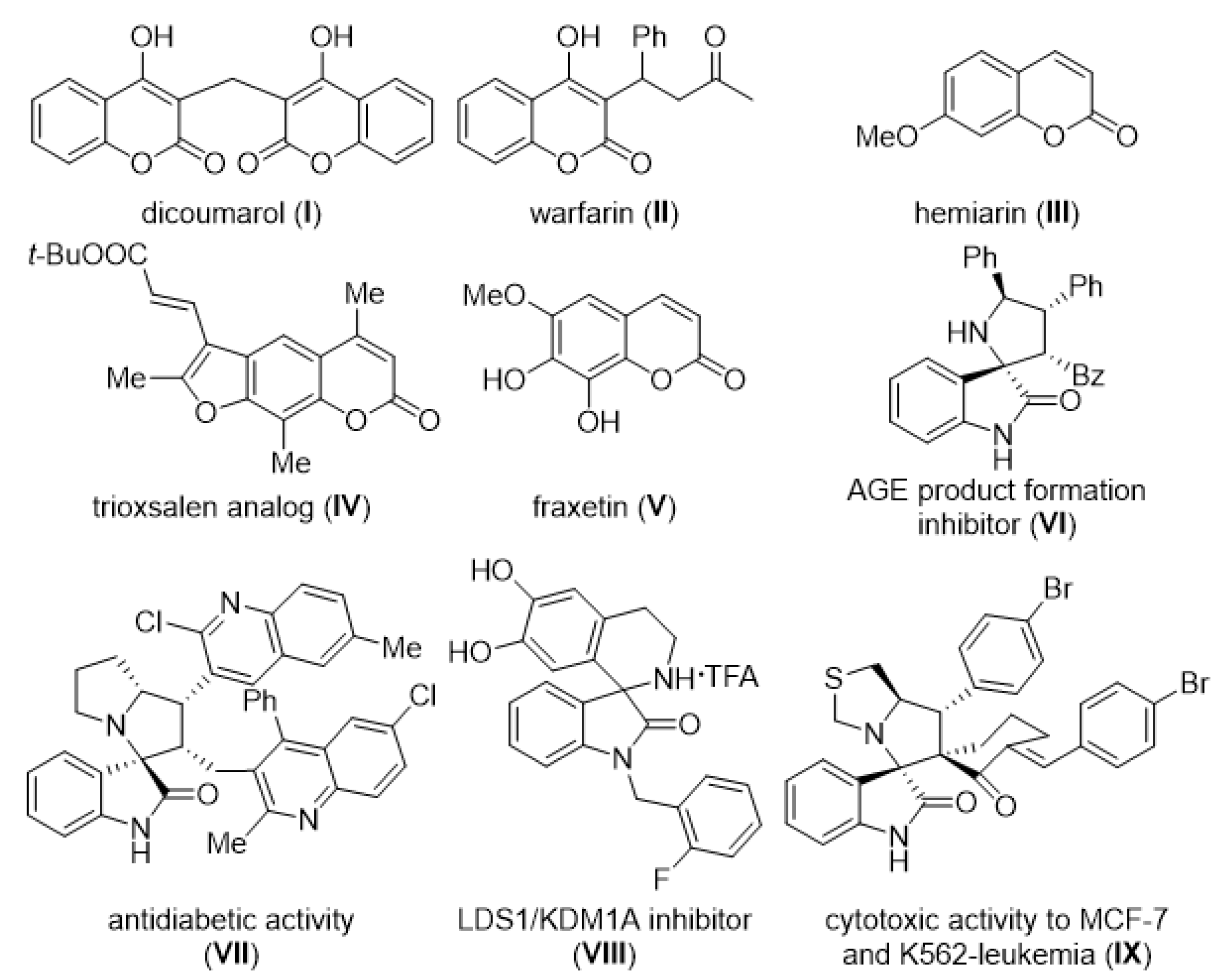
Scheme 1.
[3+2]-Cycloaddition and Michael addition of isatin ketonitrones with dipolarophiles.
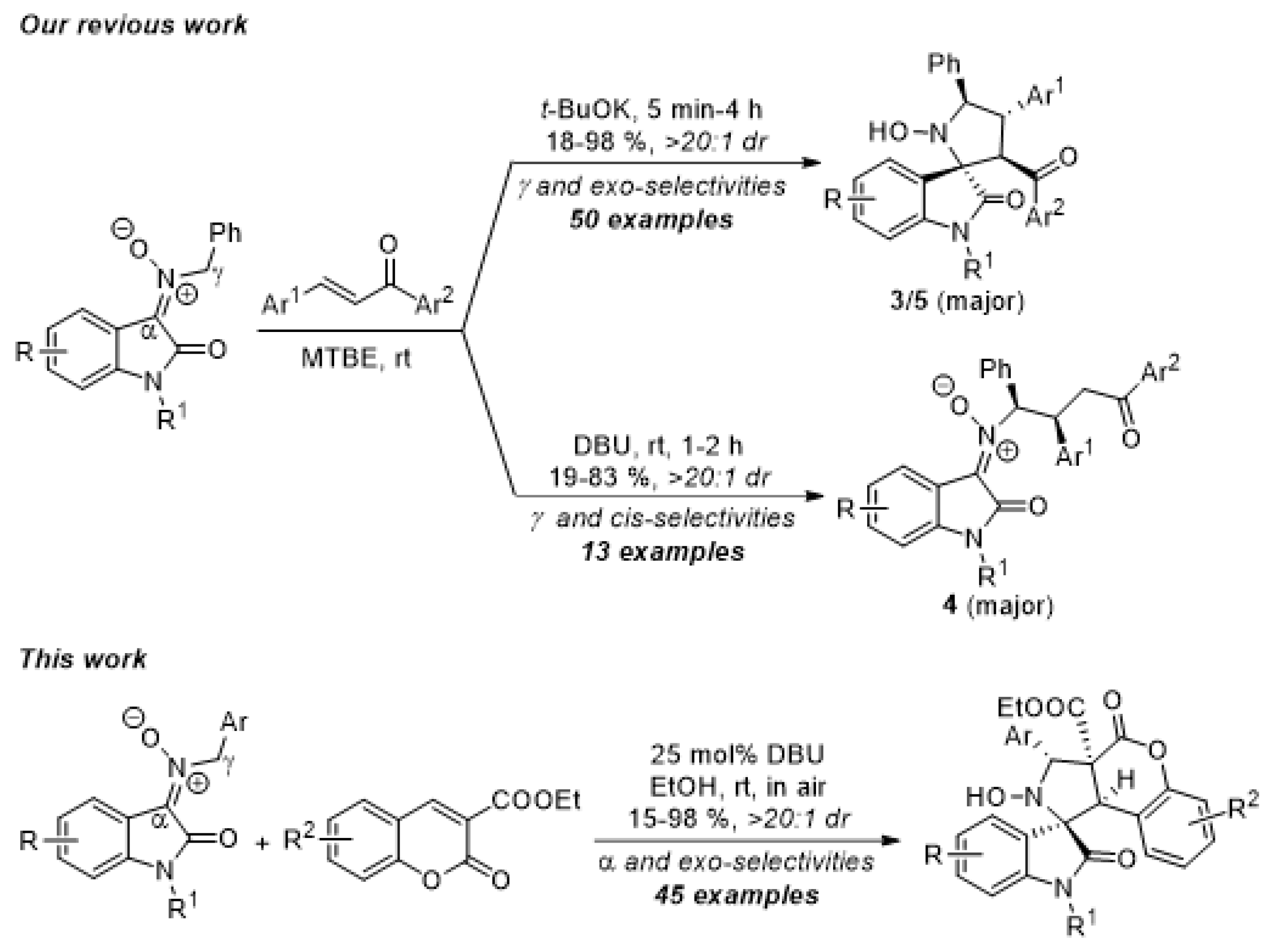
Figure 4.
before adding DBU (left) and after adding DBU (right).
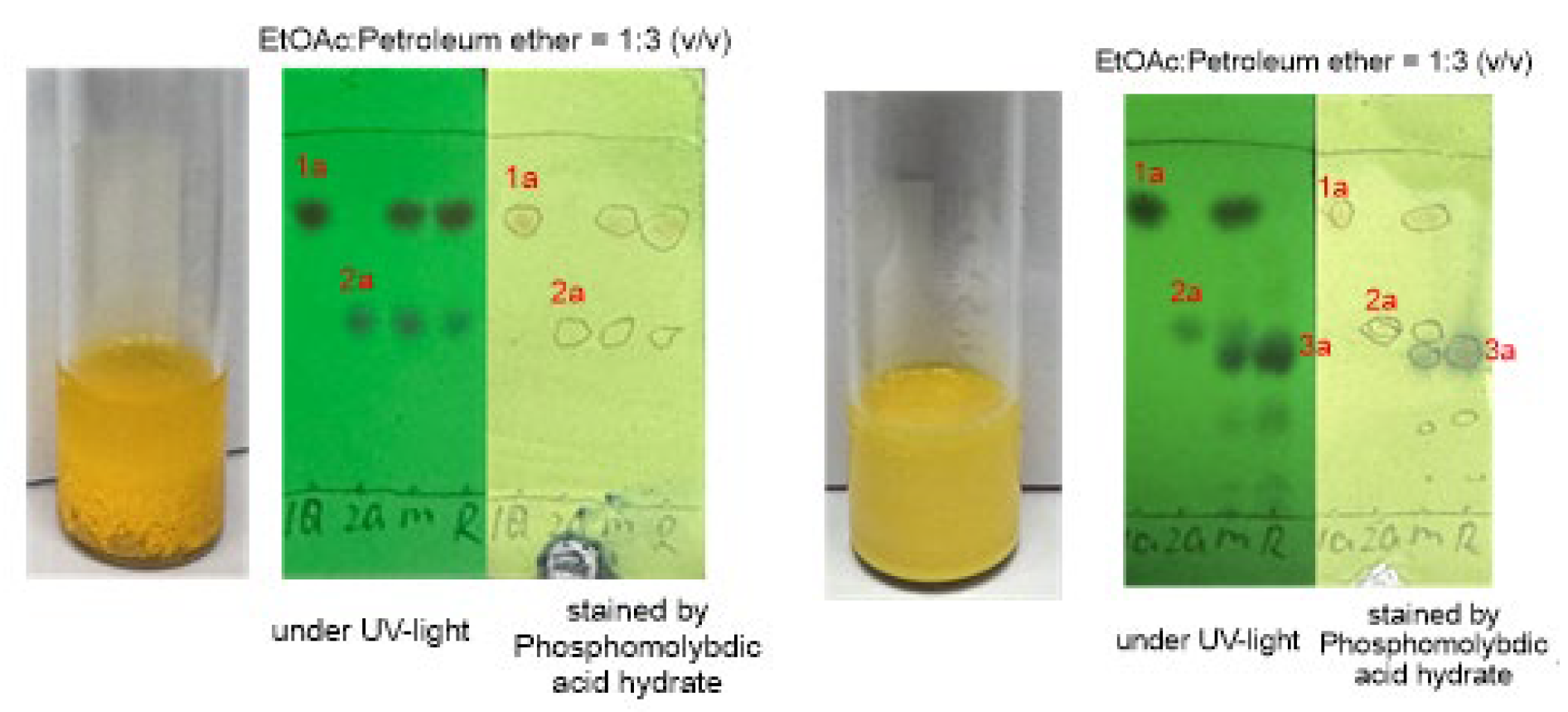

Table 1.
The condition optimization of model reaction a.
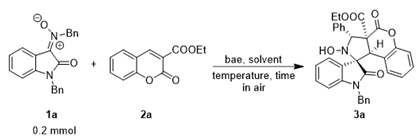
| Entry | Reaction Condition | Yield (%)b,c |
|---|---|---|
| 1 | DBU, 2a, DCM, 24 h | -d |
| 2 | DBU, 2a, DMF, 24 h | complex |
| 3 | DBU, 2a, MeOH, 4 h | 58 |
| 4 | DBU, 2a, EtOH, 5 h | 70 |
| 5 | DBU, 2a, IPA, 11 h | 60 |
| 6 | DBU, 2a, nBuOH, 9 h | 63 |
| 7 | DBU, 2a, tBuOH, 4 h | 54 |
| 8 | DABCO, 2a, EtOH, 4 h | 20e |
| 9 | DMAP, 2a, EtOH, 8 h | 24e |
| 10 | DBU, 2a, dry EtOH, 6 h | 62 |
| 11 | DBU, 2.1 eq 2a, EtOH, 14 h | 71 |
| 12 | 50 mol% DBU, 2a, EtOH, 2.5 h | 51 |
| 13 | 100 mol% DBU, 2a, EtOH, 2.5 h | 36 |
| 14 | DBU, 2a, 1.0 mL, EtOH, 5 h | 74 |
| 15 | DBU, 2a, 4.0 mL, EtOH, 9 h | 69 |
aUnless otherwise indicated, the reaction was performed at the 0.2 mmol scale in a solvent (2 mL) with base (25 mol%) at rt, and the molar ratio of 1a:2a was 1:1.05. bIsolated yield. cThe selectivity (dr>20:1 in all cases) was determined by 1H NMR. dNR: no reaction. eThe reaction was performed at reflux.
Table 2.
Synthesis of coumarin-fused spiropyrrolidine oxindoles 3 from isatin ketonitrones 1 and coumarins 2a a.
Table 2.
Synthesis of coumarin-fused spiropyrrolidine oxindoles 3 from isatin ketonitrones 1 and coumarins 2a a.
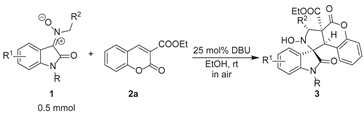
| Entry | Compound | R | R1 | R2 | Yield (%)b |
|---|---|---|---|---|---|
| 1 | 3a | Bn | H | Ph | 74 (74)c |
| 2 | 3b | Bn | 5-Me | Ph | 98 |
| 3 | 3c | Bn | 5-OMe | Ph | 82 |
| 4 | 3d | Bn | 5-F | Ph | 82 |
| 5 | 3e | Bn | 5-Cl | Ph | 74 |
| 6 | 3f | Bn | 6-Br | Ph | 58 |
| 7 | 3g | Bn | 5-I | Ph | 51 |
| 8 | 3h | Bn | 5-NO2 | Ph | -d |
| 9 | 3i | Bn | 7-CF3 | Ph | -d |
| 10 | 3j | H | H | Ph | 76 |
| 11 | 3k | Me | H | Ph | 80 |
| 12 | 3l | Et | H | Ph | 78 |
| 13 | 3m | allyl | H | Ph | 85 |
| 14 | 3n | propargyl | H | Ph | 59 |
| 15 | 3o | H | H | H | -e |
| 16 | 3p | H | H | 4-MeC6H4 | 66 |
| 17 | 3q | H | H | 4-OMeC6H4 | 54 |
| 18 | 3r | H | H | 4-FC6H4 | 78 |
| 19 | 3s | H | H | 4-ClC6H4 | 86 |
| 20 | 3t | H | H | 4-BrC6H4 | 82 |
| 21 | 3u | H | H | 4-NO2C6H4 | 47 |
| 22 | 3v | Bn | 5-Me | H | -d |
| 23 | 3w | Bn | 5-Me | 4-MeC6H4 | 77 |
| 24 | 3x | Bn | 5-Me | 4-OMeC6H4 | 50 |
| 25 | 3y | Bn | 5-Me | 4-FC6H4 | 69 |
| 26 | 3z | Bn | 5-Me | 2-ClC6H4 | 48 |
| 27 | 3aa | Bn | 5-Me | 4-ClC6H4 | 85 |
| 28 | 3ab | Bn | 5-Me | 4-BrC6H4 | 66 |
| 29 | 3ac | Bn | 5-Me | 4-NO2C6H4 | 52 |
| 30 | 3ad | Bn | H | 4-MeC6H4 | 46 |
| 31 | 3ae | Bn | H | 4-OMeC6H4 | 38 |
| 32 | 3af | Bn | H | 4-FC6H4 | 63f |
| 33 | 3ag | Bn | H | 4-ClC6H4 | 76 |
| 34 | 3ah | Bn | H | 4-BrC6H4 | 68 |
| 35 | 3ai | Bn | H | 4-NO2C6H4 | 60 |
aReaction conditions: 1a (0.5 mmol), 2a (0.525 mmol) and DBU (0.125 mmol), EtOH (2.5 mL), rt, 5-24h. bIsolated yield via column chromatography. cThe reaction was scaled up to 5 mmol and the product 3a was obtained with a quantity of 2.08g.dThe reaction gave a complex. eOnly a trace amount of the product was obtained. f The reaction was performed in tBuOH.
Table 3.
Synthesis of coumarin-fused spiropyrrolidine oxindoles 4 from istain ketonitrones 1a and coumarin 2 a.
Table 3.
Synthesis of coumarin-fused spiropyrrolidine oxindoles 4 from istain ketonitrones 1a and coumarin 2 a.
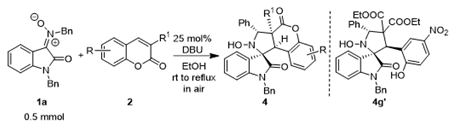
| Entry | Compound | R | R1 | Yield (%)b |
|---|---|---|---|---|
| 1 | 4a | 8-Me | COOEt | 65 |
| 2 | 4b | 7-OMe | COOEt | 22 |
| 3 | 4c | 8-OEt | COOEt | 86 |
| 4 | 4d | 6-F | COOEt | 82 |
| 5 | 4e | 6-Cl | COOEt | 67 |
| 6 | 4f | 6-Br | COOEt | 67 |
| 7 | 4g (4g’) | 6-NO2 | COOEt | 75 (24)c |
| 8 | 4h | 6,8-t-Bu2 | COOEt | 73 |
| 9 | 4i | 7-Et2N | COOEt | -d |
| 10 | 4j | 6,8-Br2 | COOEt | 30 |
| 11 | 4k | H | COOMe | 30e |
| 12 | 4l | H | COOi-Pr | 67 |
| 13 | 4m | H | COOn-Bu | 67 |
| 14 | 4n | H | COOBn | 89e |
| 15 | 4o | H | H | -d |
| 16 | 4p | H | Cl | -d |
| 17 | 4q | H | Br | -d |
| 18 | 4r | H | Bz | -d |
| 19 | 4s | H | COOH | -d |
| 20 | 4t | H | CN | -d |
| 21 | 4u | H | Ac | -d |
| 22 | 4v | H | CONHn-Bu | -d |
| 23 | 4w | H | CONn-Bu2 | -d |
aReaction conditions: 1 (0.5 mmol), 2a (0.525 mmol) and DBU (0.125 mmol), EtOH (2.5 mL), rt to reflux. bIsolated yield via column chromatography. cThe reaction gave the lactone ring-opening product 4g’ at the standard condition, while the reaction could obtain the desired product 4g using tBuOH as a solvent. dThe reaction gave a complex. eThe reaction was performed in tBuOH.
Disclaimer/Publisher’s Note: The statements, opinions and data contained in all publications are solely those of the individual author(s) and contributor(s) and not of MDPI and/or the editor(s). MDPI and/or the editor(s) disclaim responsibility for any injury to people or property resulting from any ideas, methods, instructions or products referred to in the content. |
© 2026 by the authors. Licensee MDPI, Basel, Switzerland. This article is an open access article distributed under the terms and conditions of the Creative Commons Attribution (CC BY) license (http://creativecommons.org/licenses/by/4.0/).
Copyright: This open access article is published under a Creative Commons CC BY 4.0 license, which permit the free download, distribution, and reuse, provided that the author and preprint are cited in any reuse.


