

Submitted:
11 March 2026
Posted:
12 March 2026
You are already at the latest version
Abstract
Since the pioneering work of Dean P. M. and Matthew E. K. (1970), four decades have elapsed without any consensus on the mechanism responsible for the oscillations of the plasma membrane voltage exhibited by pancreatic β-cells stimulated by glucose. In this review, the different hypothesis dealing with the cause of voltage oscillations that lead to insulin secretion pulsatility will be commented. The earliest explanation attributed the voltage oscillations (bursting) to glycolytic oscillations, taking as a reference skeletal muscle glycolysis oscillations. Later, the scientific interest moved to glucose oxidation after discovering that some mitochondrial parameters also oscillated in synchrony with membrane voltage oscillations. As [Ca2+]cyt increases resultant from membrane depolarization oscillated in synchrony with membrane bursting, it competed with metabolic oscillations (e.g. cytosolic ATP/ADP) for being the cause or the effect of insulin pulsatility; it was demonstrated that metabolic oscillations preceded [Ca2+]cyt oscillations. We are contributing with the hypothesis attributing the cause of voltage oscillations to a sequential competition of two β-cell plasma membrane channels: K+ATP channel and Cx36 hemichannel (Cx36H). Whereas increased glucose metabolism (increased ATP/ADP) closures K+ATP channels and depolarizes the plasma membrane (active phase of a bursting), Cx36Hs are opened and repolarize the membrane potential with a certain delay by inhibiting glucose metabolism (silent phase of a bursting). Repolarization, in turn, closes Cx36H and allows the recovery of glucose oxidation and beginning of a new active phase.
Keywords:
insulin pulsatility
; beta-cell metabolic oscillations
; beta-cell bioenergetic regulation
1. Basic Knowledge of Insulin Secretory Oscillations
1.1. Introduction
Pancreatic β-cells are stimulated to secrete insulin in blood (and in vitro) at glucose concentrations above 5 mM. The stimulus-secretion mechanism of insulin secretion is metabolic in nature. Glucose metabolism above 5 mM elevates the cytosolic ATP/ADP ratio and depolarizes plasma membrane electrical potential from -70 to 0 mVs. Because of depolarization, there is an increase in Ca+2 uptake due to the opening of voltage-dependent Ca2+ channels (VDCC) [1] in the plasma membrane. Finally, the increase in cytosolic [Ca+2]cyt activates de exocytotic mechanism responsible for the extracellular secretion of insulin.
Since the pioneering work of Dean P. M. and Matthews E. K. [2] describing the oscillatory behavior of β-cell voltage depolarization of the plasma membrane, the field has experienced an important increase in electrophysiological research. It is known that plasma membrane voltage oscillations are accompanied by oscillations of [Ca+2]cyt, oxygen consumption, metabolites, cofactors, and insulin secretion. Oscillation of glucose-stimulated insulin secretion is an intrinsic feature of pancreatic islets: it is not regulated by the nervous system, and it is perceptible in perfused pancreas, groups of islets, clonal β-cells, and recently transplanted pancreas [3].
However, it is yet unknown which is the origin or cause of the oscillating behavior. The importance of uncovering the precise mechanism resides in the evidence that loss of regular oscillations of insulin is an early indicator of diabetes [4]. The main purpose of this review is to summarize and compare the main concepts proposed by the different hypothesis´s to explain the oscillating behavior of glucose-induced insulin secretion.
1.2. Description and Definitions of Voltage Pulsatility
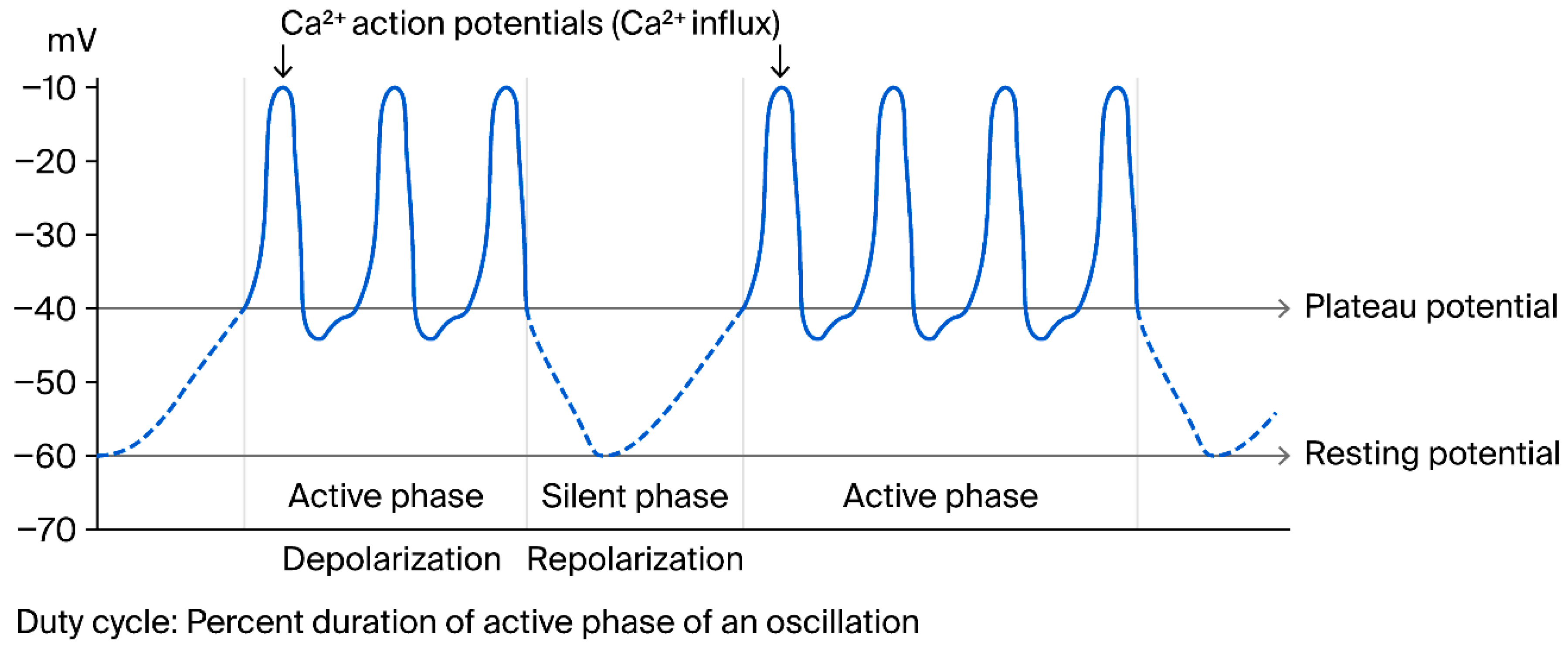
As clearly defined by Rorsman P. and Ashcroft F. M. [1], the normal pattern of voltage oscillations in β-cells of murine islets is referred to as “slow wave activity”. This activity appears between 6 and 20 mM glucose, and it consists of short-lived bursts of action potentials, superimposed on a depolarized plateau and separated by repolarized, electrically silent intervals (Figure 1). According to the authors, at 10 mM glucose the plateau phase (called active phase) lasts for 5-10 s and the interval of repolarization between two consecutive bursts, called “silent phase”, has a duration of 10-20 s. The repetitive action potentials triggered from the plateau are due to the openings of voltage dependent Ca+2 channels that mediate the entrance of positive charges carried by the ion that depolarizes further the plasma membrane from -30 to 0 mV. Increasing glucose concentrations do not affect the absolute value of the membrane potential, but the active phases lengthen whereas the silent phases shorten. Around 20 mM glucose, the action potential firing becomes continuous.
1.3. Which Oscillating β-Cell Process Is Responsible for Insulin Secretion Oscillations?
Pralong W.-F. [5] measured the kinetics of NAD(P)H and [Ca+2]cyt in cell monolayers from rat islets. They demonstrated a clear-cut difference between the lag time required for NAD(P)H and [Ca+2]cyt after a glucose stimulus: 26 and 95 s for the former and the latter, respectively, supporting the priority of metabolism on [Ca+2]cyt stimulation, although both parameters oscillated in synchrony. This study supports the idea that β-cell glycolysis oscillations might be responsible of insulin pusatility. However, Longo E. A. et al [6] showed a clear synchrony among the oscillations of insulin secretion, oxygen consumption, and [Ca+2]cyt. Although the question of pulsatility origin was not dilucidated, the synchrony of O2 consumption with insulin secretion suggests that mitochondrial metabolism might be implicated. This is further supported by the demonstrated synchrony between ATP/ADP and [Ca+2]cyt oscillations in free β-cells suspension of ob/ob mouse islets [7] and the temporal priority of ATP/ADP over [Ca+2]cyt suggests the participation of mitochondrial metabolism.
Moreover, it was also demonstrated that α-ketoisocaproic acid (KIC) also increased the NAD(P)H fluorescence before [Ca+2]cyt: 22 and 47 s, respectively, and faster than glucose. Another study [8] demonstrated that mouse islets stimulated with KIC (2.5 and 5.0 mM) generated [Ca+2]cyt oscillations synchronous throughout the islet, that were in synchrony with insulin oscillations. In contrast with previous studies, 10 mM KIC (either alone and in the presence of 5 and 10 mM glucose) did not stimulate Ca+2 oscillations [9]. In summary, the mentioned studies suggest that glucose (or KIC ?) metabolism is oscillating. The next sections will describe the proposed mechanisms proposed to explain the oscillatory nature of β-cell metabolism.
2. Insulin Secretory Oscillations Are Produced by Glycolytic Oscillations in the β-Cell
2.1. Preliminary Data
Earlier studies proposed that insulin secretion oscillations were in synchrony with glycolytic oscillations in the β-cells and were causing the former [3]. Glycolytic oscillations have been intensively studied in skeletal muscles, and it has been concluded that they are conditioned by a complex autocatalytic process of the phosphofructokinase (PFK) enzyme by several activators and inhibitors [10]. The enzyme catalyzes the phosphorylation of fructose 6-phosphate (F6P) to fructose 1,6-bisphosphate (F16BP) and is active in its tetramer configuration.
Since the pioneering work of Tornheim K.and his team [11], more recent work [12] has updated the knowledge on the catalytic and transcriptional aspects of the different known isozymes of PFK. Vertebrates express three isoforms, traditionally named as PFK-M, PKF-L, and PFK-P, according to its high abundance in muscle, liver and platelet, respectively. PFK-M is the least transcribed in human tissues. The authors [12] assert that these data have not yet been completely confirmed by proteomic studies.
2.2. Mechanism of Glycolytic Oscillations
The mechanism responsible for muscle glycolytic oscillations depends on the autocatalytic, and complex, regulation of PFK by a series of activators: NH+4, AMP, its substrate fructose-6-phosphate (F6P), its product fructose-1,6-bisphosphate (FBP16), and its allosteric effector fructose 2,6-bisphposphate (F26BP) catalyzed by PFK2; cytosolic ATP and citrate are their main inhibitors [3,13]. The role of ATP as a substrate and inhibitor of PFK depends on variations in the concentration of cytosolic ATP. According to Tornheim K. and Lowenstein J. M. [10], AMP plays a critical role in the relief of PFK inhibition by ATP potentiating the activation of PFK by F16BP.
An increase of muscle activity (contraction) requires an increase of glucose (or fatty acid) metabolism. An excess of muscle energy demand leads to a lower ATP/ADP ratio and a deprivation of G6P and F16BP; the resultant decrease of the ATP/ADP ratio leads to a small increase of AMP thanks to the equilibrium catalyzed by myokinase (2ADP = ATP +AMP) allowing a small increase of AMP concentration that is amplified in the “purine nucleotide cycle”, working in synchrony with glycolysis [14]: the authors have demonstrated that intermediates of the “purine nucleotide cycle” oscillate in synchrony with the pool of hexose’s bisphosphate generated in glycolysis. Recovery of the AMP concentration allows the activation of PFK by F16BP. The resultant increase of glycolysis increases the ATP/ADP ratio and after some time leads to the inhibition of PFK and, consequently, to the accumulation of G6P and inhibition of hexokinase and perhaps plasma membrane glucose transport. In summary, PFK has the control of glycolysis in muscle, and its activity oscillates between two extremes of activation and inhibition.
2.3. Catalytic Regulation of Recombinant Human PFK-M
PFK-M (earlier named PFK-A) was cloned and sequenced from PFK-A cDNA cloned from suspensions consisting predominantly (> 90%) of single β-cells. It shared a 96% nucleotide sequence homology with human PFK-A cDNA and was predominantly expressed in purified β-cells [15].
Kinetics from the three PFK isoforms was characterized by Fernandes P. M. et al [12]. PFK-M is the most resistant to ATP inhibition of the three PKF isoforms and it was observed above 2 mM nucleotide concentration. AMP alone has a minimal effect on the ATP titration of the enzyme catalytic activity. Whereas PFK-L and PFK-P are very strongly activated by AMP (5- and 2-fold decrease of their K0.5 for F6P, respectively), the Km for F6P of PFK-M was decreased 2-fold but the concomitant reduction of its Vm, resulted in an overall decrease in the catalytic activity. F26BP strongly activated all three PFK isoforms at different F6P concentrations but PFK-M exhibited the least activation. A caveat should be considered when taking conclusions from kinetic studies of PFK activity in extracts of islets or insulinoma beta cells because they are partially contaminated with exocrine tissue (acinar and ductal cells), and the measurements might correspond to a hybrid group of cells with different PFK isoforms [16] or to redundancy of PFK isoenzymes in the β-cells [17]. The latter assertion was clearly demonstrated in mouse islets whose membrane potential and [Ca2+]Cyt oscillations in response to glucose were unaltered by a specific knock out of PFK-M in β-cells. The authors suggested that PFK-P might be subsidiary to PFK for maintaining the glycolytic flow. In fact, the transgenic mice showed a normal IPGTT [17].
2.4. Catalytic Regulation of PFK in Pancreatic Islets and Insulinoma Cells
There are important differences in the regulation of glycolysis between β-cells and muscle cells. The latter has a plasma membrane glucose transporter (GLUT4) and a glucose phosphorylating activity (hexokinase II, HK) with different kinetic parameters and regulatory mechanisms. GLUT 4 has a Km for glucose of 5 mM [18] and HK II has Km = 0.3 for glucose [19] and is inhibited by its product, glucose-6 phosphate (G6P). β-cells express different corresponding isoforms: GLUT 2 (Km = 17 mM) (CarbóR,2023) and hexokinases: HKI (Km = 0.03 mM for glucose) and HK IV (Glucokinase, GK, Km=11 mM), not inhibited by G6P [16]. The β-cellular amount of hexokinase, measured in rat islets, has been shown to be 2- to 4-fold greater than GK [20]. Islet lactate production in rat islets is saturated around 5 mM glucose, and both lactate production and glucose utilization were suppressed by 20 mM D-mannoheptulose (MH) within 23 % and 36 %, respectively [21]. Accepting that 20 mM MH suppressed completely GK activity, the percentage of lactate production by HK with respect to the maximum glucose usage at 20 M, was around 68%; similar results (69 %) were obtained in ob/ob islets, with higher percentages of β-cells per islet. This supports the assertion that HK activity at low glucose is higher than GK.
The group of Matchinsky F. M. [22] studied the kinetic regulation of GK and HK in cell extracts of RINm5F and HIT cells, the former expressing exclusively HK I activity and the latter expressing both HK I and GK. Glycolysis was measured with [5-3H]glucose (glucose usage). RINm5F extracts showed a flat dose dependence relationship of glucose usage, and it was increased 2-or 4-fold by F26BP. The authors suggest that inhibition of PFK by ATP might lead to accumulation of G6P leading to a feedback inhibition of HK activity. By contrast, the HIT cell extracts exhibited sigmoidal dose-dependent usage, resembling the kinetics of GK. Moreover, F26BP did not modify glucose usage. An increase in the glucose concentration from 0.9 to 21 mM did not modify the G6P concentration in RIN5mF extracts, but in HIT cell extracts, an identical increase of glucose increased it by 4.7-fold. G6P concentrations were also measured in a mixture of the two cells extracts containing a similar ratio of GK/HK to the one reported in islets: the same change of the glucose concentration as above increased G6P concentration 1.7-fold. As a main conclusion, the authors assert that β-cell glycolysis is regulated by PFK at low glucose (below 5 mM?) whereas GK determines the glycolytic flow at higher glucose concentrations. They suggest that GK-dependent glycolysis might reach a steady state when G6P production by GK is in equilibrium with PFK activity.
A study by Merrins M. J. et al [23] explored whether overexpression of PFK2/FBPase2 in pancreatic islets potentiated [Ca2+]Cyt oscillations supplying its product F26BP as an activator of PFK1. Islets transduced with adenovirus carrying only the kinase or the phosphatase sequence of PFK2/FBase2 showed opposite effects on [Ca2+]Cyt oscillations: islets expressing only the kinase activity unexpectedly increased the frequency and reduced the amplitude of [Ca2+]Cyt oscillations, whereas the phosphatase sequence induced a reduction of the frequency and increased oscillations amplitude. The effects of the two truncated mutants of the PFK2/FBPase2 on the islet concentration of F26BP were not available. The authors suggested that perhaps PFK2/FBPase2 may regulate the threshold at which β-cells [Ca2+]Cyt oscillations begin. However, if below 5 mM glucose glycolysis is only anaerobic, producing lactate [21], perhaps the necessary increase of glycolysis would not be enough to produce more pyruvate for mitochondrial oxidation, and induce a sufficient elevation of ATP/ADP to close the K+ATP channels. However, in the affirmative case, it might risk hyperinsulinemia at low glucose concentrations. A previous study showed very similar oscillations of lactate release by perifused rat islets at both 5.5 and 16.7 mM glucose [24]. However, lactate production is not increased by glucose concentrations higher than 5 mM [21], and, in the upper sugar interval, ATP is thought to proceed from mitochondrial oxidation [25].
The last enzyme of glycolysis, pyruvate kinase (PK), is expressed as four isoenzymes in different tissues [26]: PK-L in gluconeogenic tissues, PK in erythrocytes, PKM1 in tissues requiring a fast and great supply of energy (muscle and brain), and PKM2 in high proliferating cells (normal and tumoral), and pancreatic islets. PKM2 activity, at variance with the other isoenzymes, is known to oscillate between two quaternary configurations, the tetrameric having the highest affinity to its substrate, phosphoenolpyruvate (PEP), compared to the dimeric one. The balance between the two configurations is regulated by several metabolites: fructose-1,6-bisphosphate (F1,6BP), product of PFK1, activates the oligomerization of PKM2 dimers into tetramers. The tetrameric isoform may be closely associated with other glycolytic enzymes and “allows a highly effective conversion of glucose into lactate” [26]. The PKM1 isoform has the highest affinity for PEP and is not allosterically regulated, neither phosphorylated.
This circumstance was used in a laborious-intensive work by Merrins M. J. et al [27]. INS-1 cells were transfected with the PKM2 gene labelled with the fusion of different mutations of the green fluorescent protein (pyruvate kinase activity reporter, PKAR). After stimulation with 11 mM glucose, their changes in emitted fluorescence were recorded by fluorescence resonance energy transfer (FRET). Glucose increased FRET very significantly and was interpreted as the reinforcement of fluorophores emission by their closer proximity in the tetrameric configuration. It was confirmed in vitro that F1,6BP increased significantly PKM2 oligomerization by western blot evaluated by FRET. PKAR-labeled INS-1 cells were perifused and stimulated by a prompt increase of glucose concentration (2 to 25 mM); in the presence of 10 mM tetraethylammonium (TEA), a K+ATP channel blocker, high glucose induced an oscillatory increase of PKAR FRET. In conclusion, glycolysis oscillations in β-cells may be determined by PFK1 or PKM2 activities.
The question that remains to be asked is how the metabolic oscillatory behavior might be transmitted to mitochondria, but it must be confirmed whether mitochondrial substrates, like α-ketoisocaproic acid (KIC), induce OxPhos oscillations of the cytosolic ATP/ADP ratio compatible with the secretory oscillations. A possible advantage of the expression of PMK2 in β-cells is that, as mentioned in the previous paragraph, this isoform seems to prioritize pyruvate to lactate rather than its mitochondrial oxidation [26] thanks to its activation (oligomerization) by F16BP, avoiding a too premature increase in the ATP/ADP ratio and a relative hyperinsulinemia at low glucose concentrations. Of course, the expression of PMK1 and the kinetic features of these two PK isoforms need to be characterized in β-cells to know which are their specific roles in the regulation of the branching point between anaerobic and aerobic glycolysis.
3. Are Insulin Secretory Oscillations Determined by Metabolic or Plasma Membrane Ionic Channels Oscillations?
The observations (commented above) that some metabolic mitochondrial parameters also oscillated after glucose-induced stimulation of insulin secretion moved the research interest from glycolysis towards oxidative phosphorylation (OxPhos). This seems consistent with the important contribution of OxPhos to increase the ATP/ADP ratio after glucose stimulation.
Gilon P. et al [28] supported the priority of [Ca2+]Cyt over metabolic oscillations in isolated islets: Simultaneous measurement of [Ca2+]cyt and insulin secretion in the same islet showed that they were synchronized at different glucose and [Ca2+]out concentrations. The greater the glucose or [Ca2+]out, the greater the oscillations frequency. In the continuous presence of diazoxide (250 µM) and KCl (30 mM), the [Ca2+]Cyt did not oscillate but resulted greatly elevated whereas the insulin secretory response responses to 10, 15, and 20 mM glucose were greatly suppressed. By contrast, in the presence of diazoxide, and a constant glucose stimulation (10 mM), temporary elevation of KCl to 30 mM induced a sustained elevation of [Ca2+]Cyt and insulin secretion. The authors concluded that insulin secretion oscillations are driven by [Ca2+]cyt oscillations.
Bertram R. et al [29], in their “dual oscillator model” (DOM) proposed the possibility of a negative feed-back of [Ca2+]Cyt on mitochondrial metabolism. They defined the putative [Ca2+]Cyt dependent mechanisms as follows: 1. [Ca2+]Cyt uniporter mediated mitochondrial uptake depolarizes the plasma membrane and therefore might contribute, in an unknown degree, to increase the mitochondrial proton motive force, favoring oxidative phosphorylation. 2. Consequently, an increased mitochondrial [Ca2+]mit might activate some mitochondrial dehydrogenases, increasing oxidative metabolism. 3. The [Ca2+]cyt accumulated during glucose stimulation is pumped by ATPases into the endoplasmic reticulum vesicles or the extracellular medium. The consequent ATP consumption might decrease the cytosolic ATP/ADP ratio, leading to the opening of K+ATP channels and hyperpolarization of β-cell plasma membrane. In other words, this might be responsible for the silent phases of plasma membrane voltage oscillations.
Larsson O. et al. [30] claim that K+ATP channels oscillations during glucose stimulation are inducing oscillations of β-cell electrical activity and [Ca2+]cyt. Glucose stimulation seems to close K+ATP channels gradually: addition of tolbutamide (100 µM) clamped [Ca2+]cyt at a high sustained level and [Ca2+]cyt oscillations were recovered after withdrawing the drug. K+ATP channel conductance in β-cells decreased at 10 mM glucose and action potentials were observed. After 1-3 minutes, action potentials firing stopped (silent phase) and abundant openings of K+ATP channels appeared: it was confirmed by their suppression with 100 µM tolbutamide that provoked a continuous firing of action potentials. A similar behavior to glucose was observed with 10 µM tolbutamide alone: the continuous firing induced by the sulfonylurea was spontaneously stopped, giving rise to K+ATP channels openings. A ten-fold increase in tolbutamide concentration completely suppressed K+ATP channel conductance and a continuous train of action potentials were observed. 20 mM glucose-induced plasma membrane voltage oscillations were immediately suppressed by sodium azide (a citocrome a3 inhibitor) and released after withdrawal of the inhibitor. The authors emphasize that temporal suppression of the sugar metabolism mimics oscillations of K+ATP channel activity by glucose, and it also suggests that repolarization between bursts is mediated by changes of glucose metabolism. This confirms an earlier study by Dryselius S. et al. [31].
Rorsman P. et al. [32] confirmed the concentration dependence of glucose on K+ATP channels conductance [30]. K+ATP channels closed by glucose metabolism (10 mM) were rescued clamping the plasma membrane of a β-cell in an islet from -40 (plateau level) to 0 mV, mediated by a time-dependent (slow) increase in K+conductance. The current was dependent on Ca2+influx and was named Kslow. However, the authors concluded that the responsible(s) channel(s) are insufficient to recover the bursting pattern without the simultaneous activation of K+ATP channels.
The glucose concentration dependent increase in electrical activity of individual β-cells seems to be due to a progressive increase of the ATP production enough to compensate for its use by ATPases to pump [Ca2+]cyt to the extracellular medium or the endoplasmic reticulum [1] without lowering their ATP/ADP ratio. This is interpreted as secondary to the stimulation of mitochondrial dehydrogenases by an increase of [Ca2+]m. However, β-cells are categorized as “fuel sensors”, as opposed to “fuel utilizer” cells that do not maintain their ATP/ADP ratio constant, because their Oxphos is not subject to ATP demand [33]. Patch-clamp measurements in β-cells have supplied information about the plasma membrane channels that might be implicated in membrane repolarization during silent intervals: large-conductance Ca2+-activated K channels (big K channels, or BK channels) and small-conductance Ca2+-activated K (SK1 to SK4) channels. The latter (S3/S4) were proposed to mediate the so called Kslow outward current which is considered the most responsible of plasma membrane repolarization during the silent phase [1].
4. Does the Experimental Strategy to Suppress [Ca2+]cyt Oscillations with Diazoxide and High KCl Concentrations Exerts off Target Effects on β-Cell Glucose Metabolism?
This strategy consists in maintaining K+ATP channels open with diazoxide and clamping the [Ca2+]cyt with an extracellular KCl concentration higher than its physiological value with the aim of investigating if metabolic oscillations persist or are also suppressed. Its metabolic and/or secretory effects found on β-cells or islets in different laboratories are commented below.
1. The dose-response curve of the total response (60 minutes) of the insulin released by glucose in the continuous presence of 30 mM KCl and 250 µM diazoxide, was different to the curve performed at 4.8 mM KCl in the absence of diazoxide: half maximal stimulation was obtained at 10 mM glucose versus 15 mM in the control experiments [34]. The dose-response curve calculated with the total insulin secreted after only 10 min of mouse islet perifusion uncovered a striking and significant suppression of insulin secretion at 3 and and 6 mM glucose. Similar results were obtained using the total insulin secreted after only 4 and 6 minutes.
2. 2 µM nimodipine (a known L-type Ca2+ channels inhibitor), decreased β-cell ATP/ADP ratio by a range of glucose concentrations stimulating insulin secretion in incubated mouse islets [35]. It also suppressed the ATP/ADP ratio stimulation induced by the combination of 10 mM glucose with 100 µM tolbutamide. The effect was attributed to a presumably decrease in ATP consumption by the resultant inhibition of insulin secretion. The authors also observed a similar suppression caused by the presence of 30 mM KCl and 100 µM diazoxide, together with 10 mM glucose in incubated islets. One should keep in mind that, mimicking the effect of VDCC inhibition, omission of extracellular Ca2+ induces the opening of connexin36 hemichannels (Cx36Hs), as discussed in the 4th paragraph [36].
3. Oscillations of insulin secretion and [Ca2+]cyt were reproduced alternating [KCl]out between 4.8 and 30 mM [37]. In the continuous presence of 30 mM KCl and 100 µM diazoxide, KCl induced a sustained increase, more than 2-fold, of [Ca2+]cyt and 12 mM glucose induced a biphasic insulin secretion with a poor second phase, smaller in islets from younger animals, and few and small oscillations. Unfortunately, the lack of the response to control islets in absence of diazoxide and 30 mM KCl were not provided to allow a statistical comparison. Like in a previous study [28], the authors concluded that insulin secretion oscillations are driven by [Ca2+]cyt oscillations.
4. Merrins M. et al. [38] deduced from the application of two different mathematical models that opening of K+ channels by diazoxide at 11.1 mM glucose is accompanied by a suppression of [Ca2+]cyt, ADP, and NAD(P)H concentrations. Experimentally, addition of 11.1 mM glucose in the continuous presence of 200 µM diazoxide induced a sustained elevation of NAD(P)H fluorescence with small oscillations. In additional presence of 30 mM KCl, NAD(P)H fluorescence was progressively decreasing, and some small oscillations were produced. The authors concluded that “the pacemaker that underlies slow islet oscillations is metabolic in origin rather than Ca2+-driven”.
5. A study of the pyruvate kinase activity reporter (PKAR), sensitive to F16BP concentration, was shown to increase its emitted fluorescence during the silent phase of electrical activity [27]. A synchronized oscillatory pattern of Perceval HR (a reporter of the ATP/ADP ratio) was observed, indicating that during the silent phase of the bursting activity β-cell metabolism is reactivated. [Ca2+]cyt and Perceval-HR oscillations were out of phase. Reducing [Ca2+]cyt with 200 µM diazoxide suppressed PKAR, flavin, and Perceval-HR oscillations but maintained all of them at a high and sustained levels. Addition of 30 mM KCl elevated [Ca2+]cyt but triggered a progressive decline of the three metabolic parameters. The authors support the tenet of the dual oscillator model (DOM): “metabolic oscillations in β-cells centrally involve glycolytic oscillations”. In our opinion, the data do not support the fact that [Ca2+]cyt favors mitochondrial metabolism.
6. Merrins M. J. et al. [39] proposed the model named “Mitocat-Mitoox” for its main role of OxPhos in the regulation of insulin secretion pusatility, controlled by ADP and supported by [Ca2+]cyt. It is based on experimental evidence proposed by Lewandowski S. L. (ADP privation) model [40], attributing a priority role to the glycolytic enzyme PK in the supply of ATP for the closure of K+ATP channels at the β-cell plasma membrane. The previous authors assert that glycolytic oscillations are propagated to mitochondria leading to two mitochondrial metabolic states separated in time.
Mitocat is the mitochondrial state corresponding to the silent phase, characterized by an initial lowering of ADP (ADP privation model of Lewandowsky et al,2020) and its progressive increase by glycolytic PK and other “metabolic coupling factors” [39] that are supposedly contributing to increase ATP production. The silent phase would end when cytosolic ATP/ADP ratio is sufficiently elevated to closure K+ATP channels. The Mitoox starts when the plasma membrane is depolarized and the influx of Ca2+ trough VDCC stimulates insulin secretion. The Mitocat-Mitoox model suggests that the extra workload (increased ATP demand) to secrete insulin increase ATP consumption over production and OxPhos slows down by ADP privation, entering in the next silent phase.
7. Corradi et al. [41] were unable to obtain experimental evidence of the closure of K+ATP channels by PK activity at the plasma membrane in INS-1832/13 cells. Authors then hold that the regulation of K+ATP channels is mainly controlled by OxPhos in mouse β-cells. The local global hypothesis, ADP privation model [40], assumes that OxPhos does not overcome the significant ADP suppression in the silent phase and ADP production must be rescued by an increased glycolysis. Does it mean that β-cell requires a transient Pasteur effect to recover cytosolic ATP to initiate the next active phase? It is known that anoxia (lack of OxPhos) does not stimulate glucose utilization in β-cells according to the Pasteur effect. [42] Supporting the priority of OxPhos over glycolysis, a PK inhibitor (10 µM PKM2-IN-1) did not recover K+ATP conductance recorded from β-cells in cell-attached configuration at 20 mM glucose. Moreover, 4 mM azide (cytochrome a3 inhibitor) [30] strongly activated K+ATP channels at 20 mM glucose and 10 µM of TEPP-46 (PK activator). To test that K+ATP conductance changes are mainly driven by OxPhos, mouse islets expressing Perceval-HR were incubated at 11 mM glucose together with 200 µM diazoxide. Their exposure to 30 mM KCl induced a drop of the ATP/ADP ratio; subsequent addition of 10 mM azide induced a stronger suppression of the ATP/ADP ratio, interpreted as due to the imbalance between ATP supply and consumption (equivalent to an excess of ATP demand).
5. Are Insulin Secretory Oscillations Regulated by the Antagonistic Roles of Two β-Cell Plasma Membrane Channels?
5.1. Proposal of the Two Channels´s Hypothesis
Our interpretation is based on the presumption that the β-cell is highly specialized for the consumption of glucose with very poor capacities for storing it as either glycogen or lipids, as supported by the lack of effect of the knockout of pyruvate carboxylase [43]. In other words, it has been programmed to transduce its rate of glucose metabolism into a proportional (hyperbolic) stimulation of its insulin secretion. As the liver cells, β-cells possess a highly active glucose transport (GLUT2) and high glucose-phosphorylating activity (GK) that provides them with a huge burden of metabolic energy. However, whereas liver cells dissipate this energy load by synthesizing glycogen and lipids, it is unknown whether β-cells possess any energy consuming process that might counteract the high energy intake after a glucose load.
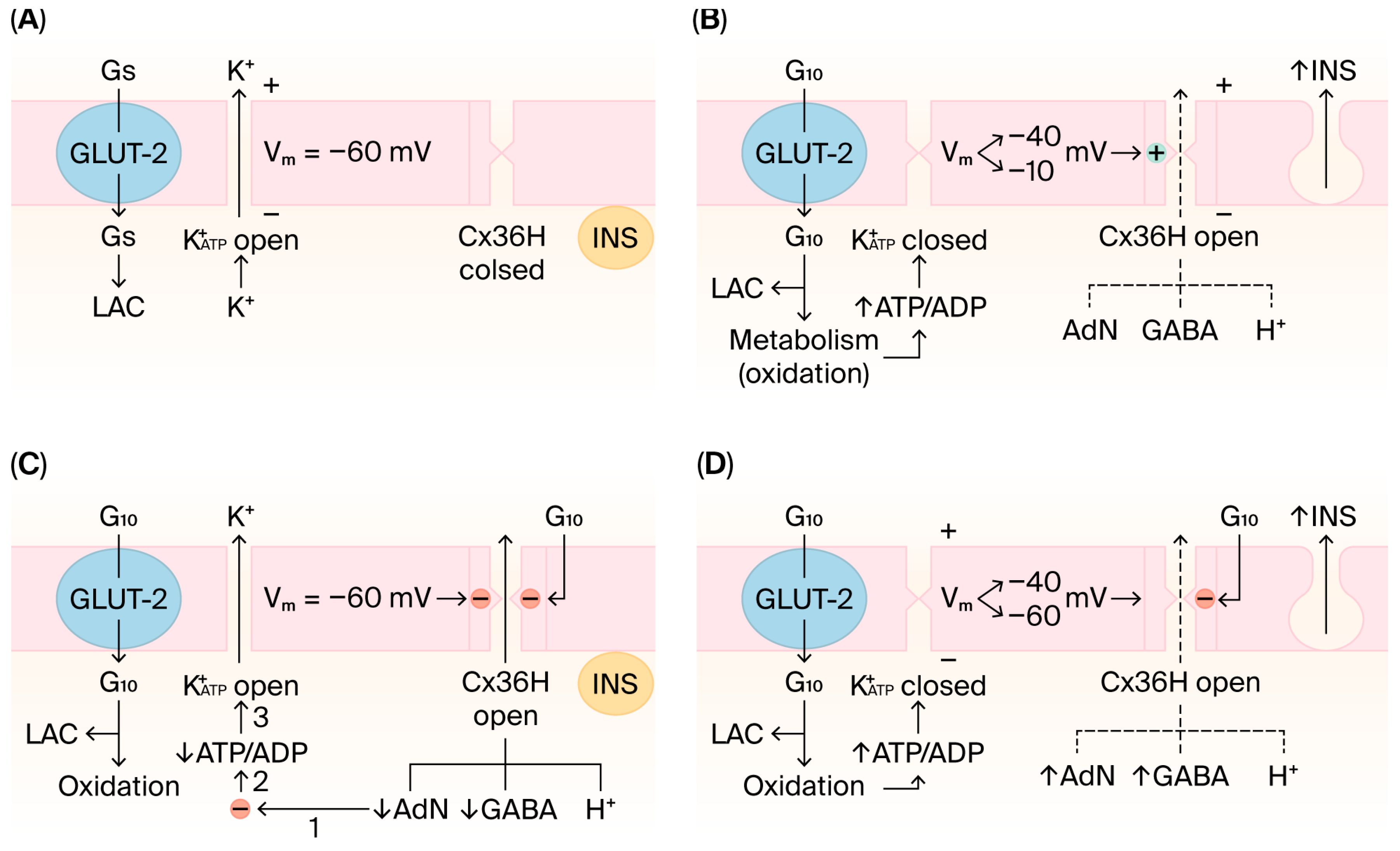
Our hypothesis for a β-cell energy dissipating process that might counterbalance the high metabolic flow of glucose is based on the known properties of the connexin36 hemichannels (Cx36Hs) at the plasma membrane, as published recently [33]. Shortly, plasma membrane Cx36Hs may be opened by glucose-induced β-cell depolarization mediated by a previous closing of K+ATP channels. Open Cx36Hs (by high KCl extracellular concentrations) have been shown to allow the release of some intracellular metabolites like adenine nucleotides, GABA, and K+ ions. That means that after depolarization by the closure of K+ATP channels, the opening of Cx36Hs might stop glucose metabolism (partial loss of clue metabolites) and repolarize β-cell plasma membrane (decrease of the ATP/ADP ratio and an increased efflux of intracellular K+). The repolarization closes in turn Cx36Hs, and the rescue of glucose oxidation leads to the active phase of the next bursting. This process seems to be sensitive to regulation by extracellular glucose in a physiological and hyperbolic range of glucose concentrations [44]: glucose closes Cx36Hs by 50% at 8 mM and exerts its maximal effect at 20 mM glucose. This effect of glucose is apparently reproduced by some, non- metabolized, glucose analogs. Would they be useful for preventing a putative deleterious effect of a high exposure of β-cells to prolonged hyperglycemia?
The observed kinetics of the inhibitory effect of glucose on Cx36Hs suggest that its antagonistic effects on K+ATP channels diminish with the increase in extracellular glucose concentration. Transduced to the observed pulsatility of the plasma membrane potential of stimulated β-cells, it seems that the observed lengthening of active phases between potential bursts might be attributed to a glucose-dependent closing of Cx36Hs. This suggests that as extracellular glucose increases, the silent phase shortens and the active phase lengthens, mimicking the plasma membrane recordings obtained from native β-cells. The higher the glucose concentration the greater the time required to empty the cytosolic pool of clue molecules and to facilitate the efflux of K+, causing a suppression of glucose metabolism and repolarization of the β-cell plasma membrane [33]
Figure 2.
Hypothetical regulatory mechanism of the pulsatility nature of insulin secretion by the antagonistic roles of two β-cell plasma membrane channels. 2A. β-cell at rest. 2B. Active phase of the membrane voltage variation (bursting) stimulated by 10 mM glucose (G10). Glucose oxidative metabolism increases ATP/ADP, closes K+ATP channels, depolarizes the plasma membrane, and induces the exocytosis of insulin. Depolarization also opens Cx36 hemichannels (Cx36) that initiate the loss of clue molecules (adenine nucleotides, GABA, H+) required for the stimulation of insulin secretion. 2C. The progressive loss of adenine nucleotides (AdN) and GABA (γ-amino butyric acid) provokes a slowdown of glucose oxidation: a decrease in ATP/ADP opens K+ATP channels, repolarizes the membrane, and a suppression of intracellular GABA blocks the coupling of the GABA shunt to the citric acid cycle. Membrane repolarization also closes Cx36Hs, allowing glucose oxidation to be restored. 2D. Recovery of glucose oxidation allows to increase ATP/ADP again to initiate the next bursting. The glucose concentration is probably determining the length of the active phase necessary to provoke a sufficient depletion of clue metabolites to open K+ATP channels: the higher the concentration, the longer the active phase duration.
Figure 2.
Hypothetical regulatory mechanism of the pulsatility nature of insulin secretion by the antagonistic roles of two β-cell plasma membrane channels. 2A. β-cell at rest. 2B. Active phase of the membrane voltage variation (bursting) stimulated by 10 mM glucose (G10). Glucose oxidative metabolism increases ATP/ADP, closes K+ATP channels, depolarizes the plasma membrane, and induces the exocytosis of insulin. Depolarization also opens Cx36 hemichannels (Cx36) that initiate the loss of clue molecules (adenine nucleotides, GABA, H+) required for the stimulation of insulin secretion. 2C. The progressive loss of adenine nucleotides (AdN) and GABA (γ-amino butyric acid) provokes a slowdown of glucose oxidation: a decrease in ATP/ADP opens K+ATP channels, repolarizes the membrane, and a suppression of intracellular GABA blocks the coupling of the GABA shunt to the citric acid cycle. Membrane repolarization also closes Cx36Hs, allowing glucose oxidation to be restored. 2D. Recovery of glucose oxidation allows to increase ATP/ADP again to initiate the next bursting. The glucose concentration is probably determining the length of the active phase necessary to provoke a sufficient depletion of clue metabolites to open K+ATP channels: the higher the concentration, the longer the active phase duration.
In our opinion, the participation of Cx36Hs provides a needed process for dissipating the excess of free energy released by glucose catabolism that is not completely countervailed by glucose anaplerosis or exocytosis (?). The proposed model of energy dissipation does not consist in a direct release of free energy (for example mitochondrial uncoupling, ATP hydrolysis, etc) but a release of high energy compounds like ATP, etc. This alternative might protect the β-cell from a deleterious release of heat (entropy) that accompanies the metabolic flux through non-equilibrium reactions during catabolism. It should be reminded that the Gibbs-Helmholtz (useful) energy (ΔF) released in catabolic reactions has two components: ΔF = ΔH -TΔS. ΔH being the variation of enthalpy (energy), proceeding from the balance between chemical bonds broken and formed in a chemical rection, that may be used for any transduction to a biological process. TΔS represents the amount of degraded energy (heat) that is not useful for any transduction process; it is the price to be payed for maintaining a non-equilibrium (unidirectional) reaction, according to the second thermodynamic principle. One wonders whether excessive and sustained lengthening of the active phases at too high glucose concentrations might damage β-cells by the excessive release of energy released by the catabolism of the sugar. In fact, there are reports supplying evidence of the contribution of altered mitochondrial function by sustained hyperglycemia in the developing of diabetes [45,46,47].
Moreover, loss of GABA also contributes to slowed glucose metabolism, and loss of cellular K+ to hyperpolarize the plasma membrane [33]. This interpretation explains why the combination of diazoxide, and high KCl inhibits β-cell glucose metabolism and contradicts the explanation of an increased ATP demand, accompanied by a counterintuitive decrease of insulin secretion. Remind also that sulfonylureas may also exert potential deleterious effects on glucose metabolism and that β-cells are “fuel sensor” and not “fuel utilizer” cells [33,48].
5.2. Contradiction Between the Dual Channel Hypothesis and Those Relying on a Direct Driving of K+ATP Regulation by β-Cell Glucose Metabolism (Glycolysis or Oxphos)
Some studies (see paragraph 4) on insulin secretion pulsatility used as a strategy to inhibit K+ATP oscillations with diazoxide to skip the physiological way of β-cell activation (depolarization), and replacing the VDCC dependent influx of Ca2+ by high KCl that also depolarizes the cell at convenience. In some of the commented studies in Paragraph 4, both diazoxide and KCl were used at very similar concentrations. These maneuvers induced a decreased response of insulin secretion, and several metabolic parameters: GABA, ATP/ADP ratio, NAD(P)H, flavin, PKAR. Those results are indicative of a metabolic slowdown that might be explained by the opening of Cx36Hs, as proposed in the dual channel hypothesis [33]. In the study by Detimary P et al. [35] nimodipine (a known L-type Ca2+ channels inhibitor) suppressed islet ATP/ADP ratio in a range of glucose concentrations. This is also explained by the known capacity of extracellular Ca2+ omission to open Cx36Hs (Pizarro-DelgadoJ,PlosOne,2015) [36].Glucose induced insulin secretion by perifused mouse islets was strongly inhibited in presence of 200 µM diazoxide and 30 mM KCl at 3 and 6 mM glucose but not at higher concentrations (Gembal,JCI,1993)[34]: it might be attributed to the protective effect of glucose partially closing Cx36Hs (Pizarro-Delgado et al.,AJP,2014)[44].
The metabolic importance of GABA for stimulation of insulin secretion, necessary to couple Krebs cycle to the GABA shunt [48], has been recently supported: introduction of a monoclonal antibody against GAD 65 (GAD65 mAb b78), the β-cell enzyme mainly responsible of the synthesis of the γ-amino acid, provoked a decrease of insulin secretion, GABA release, and ATP content in response to 20 mM glucose, and other secretagogues (KIC and D-glyceraldehyde) in incubated rat and human islets [50,51]. After 3 days of culture in the presence of GAD65mAb, perifused rat islets exhibited a decreased insulin secretion, GABA release, O2 consumption, and NAD(P)H fluorescence. Intraperitoneal injection of GAD65mAb suppressed blood insulin but not glucose levels in IPGTT in rats.
Funding
This review received no institutional funding.
Acknowledgments
All coauthors of our join manuscripts are highly acknowledged for their tight collaboration. The MDPI's Author Services are also highly acknowledged by their invaluable help drawing the Figures.
References
- Rorsman, P.; Ashcroft, F.M. Pancreatic β-Cell Electrical Activity and Insulin Secretion: Of Mice and Men. Physiol. Rev. 2018, 98, 117–214. [Google Scholar] [CrossRef]
- Dean, P.M.; Matthew, E.K. Glucose-induced electrical activity in pancreatic islet cells. J. Physiol. 1970, 210, 255–264. [Google Scholar] [CrossRef]
- Tornheim, K. Are Metabolic Oscillations Responsible for Normal Oscillatory Insulin Secretion? Diabetes 1997, 46, 1375–1380. [Google Scholar] [CrossRef]
- Hellman, B. Pulsatility of insulin release – a clinically important phenomenon. Upsala J. Med Sci. 2009, 114, 193–205. [Google Scholar] [CrossRef]
- Pralong, W.; Bartley, C.; Wollheim, C. Single islet beta-cell stimulation by nutrients: relationship between pyridine nucleotides, cytosolic Ca2+ and secretion. EMBO J. 1990, 9, 53–60. [Google Scholar] [CrossRef] [PubMed]
- Longo, E.; Tornheim, K.; Deeney, J.; Varnum, B.; Tillotson, D.; Prentki, M.; Corkey, B. Oscillations in cytosolic free Ca2+, oxygen consumption, and insulin secretion in glucose-stimulated rat pancreatic islets. J. Biol. Chem. 1997, 266, 9314–9319. [Google Scholar] [CrossRef] [PubMed]
- Nilsson, T.; Schultz, V.; Berggren, B.E.; Tornheim, K. Temporal patterns of changes in ATP/ADP ratio, glucose 6-phosphate and cytoplasmic free Ca2+ in glucose-stimulated pancreatic b-cells. Biochem. J. 1996, 314, 91–94. [Google Scholar] [CrossRef]
- Martin, F.; Sánchez-Andrés, J.V.; Soria, B. Slow [Ca2+]i oscillations induced by ketoisocaproate in single mouse pancreatic islets. Diabetes 1995, 44, 300–305. [Google Scholar] [CrossRef] [PubMed]
- Lenzen, S.; Lerch, M.; Peckmann, T.; Tiedge, M. Differential regulation of [Ca2+]i oscillations in mouse pancreatic islets by glucose, α-ketoisocaproic acid, glyceraldehyde and glycolytic intermediates. Biochim. et Biophys. Acta (BBA) - Gen. Subj. 2000, 1523, 65–72. [Google Scholar] [CrossRef]
- Tornheim, K.; Löwenstein, J.M. The purine nucleotide cycle control of phosphofructokinase and glycolytic oscillations in muscle extracts. J. Biol. Chem. 1975, 250, 6304–6314. [Google Scholar] [CrossRef]
- Yaney, G.C.; Schultz, V.; Cunningham, B.A.; Dunaway, G.A.; Corkey, B.E.; Tornheim, K. Phosphofructokinase isozymes in pancreatic islets and clonal beta-cells (INS-1). Diabetes 1995, 44, 1285–1289. [Google Scholar] [CrossRef]
- Fernandes, P.M.; Kinkead, J.; McNae, I.; Michels, P.A.; Walkinshaw, M.D. Biochemical and transcript level differences between the three human phosphofructokinases show optimisation of each isoform for specific metabolic niches. Biochem. J. 2020, 477, 4425–4441. [Google Scholar] [CrossRef]
- Sugden, P.H.; Newsholme, E.A. The effects of amnonium, inorganic phosphate and potassium ions on the activity of phosphofructokinases from muscle and nervous tissues of vertebrates and invertebrates. Biochem. J. 1975, 150, 113–122. [Google Scholar] [CrossRef]
- Tornheim, K.; Lowenstein, J.M. The purine nucleotide cycle. 3. Oscillations in metabolite concentrations during the operation of the cycle in muscle extracts. J. Biol. Chem. 1973, 248, 2670–7. [Google Scholar] [CrossRef]
- Ma, Z.; Ramanadham, S.; Kempe, K.; Hu, Z.; Ladenson, J.; Turk, J. Characterization of expression of phosphofructokinase isoforms in isolated rat pancreatic islets and purified beta cells and cloning and expression of the rat phosphofructokinase-A isoform. Biochim. Biophys. Acta 1996, 1308, 151–163. [Google Scholar] [CrossRef]
- Schuit, F.; Moens, K.; Heimberg, H.; Pipeleers, D. Cellular Origin of Hexokinase in Pancreatic Islets. J. Biol. Chem. 1999, 274, 32803–32809. [Google Scholar] [CrossRef] [PubMed]
- Marinelli, I.; Parekh, V.; Fletcher, P.; Thompson, B.; Ren, J.; Tang, X.; Saunders, T.L.; Ha, J.; Sherman, A.; Bertram, R.; et al. Slow oscillations persist in pancreatic beta cells lacking phosphofructokinase M. Biophys. J. 2022, 121, 692–704. [Google Scholar] [CrossRef]
- Carbó, R.; Rodríguez, E. Relevance of Sugar Transport across the Cell Membrane. Int. J. Mol. Sci. 2023, 24, 6085. [Google Scholar] [CrossRef] [PubMed]
- Wilson, J.E. Isozymes of mammalian hexokinase: structure, subcellular localization and metabolic function. J. Exp. Biol. 2003, 206, 2049–2057. [Google Scholar] [CrossRef]
- Bedoya, F. J.; Wilson, J. M.; Ghosh, A. K.; Finegold, D.; Matschinsky, F. M. The glucokinase sensor in human pancreatic islet tissue. Diabetes 1986, 35, 61–67. [Google Scholar] [CrossRef] [PubMed]
- Tamarit-Rodriguez, J.; Idahl, L.-Å.; Giné, E.; Alcazar, O.; Sehlin, J. Lactate production by pancreatic islets. Diabetes 1998, 47, 1219–1223. [Google Scholar] [CrossRef] [PubMed]
- Shimizu, T.; Parker, J.C.; Najafi, H.; Matschinsky, F.M. Control of Glucose Metabolism in Pancreatic β-Cells by Glucokinase, Hexokinase and Phosphofructokinase: Model Study With Cell Lines Derived From β-Cells. Diabetes 1988, 37, 1524–1530. [Google Scholar] [CrossRef] [PubMed]
- Merrins, M.J.; Bertram, R.; Sherman, A.; Satin, L.S. Phosphofructo-2-kinase/Fructose-2,6-bisphosphatase Modulates Oscillations of Pancreatic Islet Metabolism. PLOS ONE 2012, 7, e34036. [Google Scholar] [CrossRef] [PubMed]
- Chou, H.-F.; Berman, N.; Ipp, E. Oscillations of lactate released from islets of Langerhans: evidence for oscillatory glycolysis in β-cells. Am. J. Physiol. Endocrinol. Metab. 1992, 262, E800–E805. [Google Scholar] [CrossRef]
- Ashcroft, F.M.; Rorsman, P. Electrophysiology of the pancreatic β-cell. Prog. Biophys. Mol. Biol. 1989, 54, 87–143. [Google Scholar] [CrossRef]
- Mazurek, S. Pyruvate kinase type M2: A key regulator of the metabolic budget system in tumor cells. Int. J. Biochem. Cell Biol. 2011, 43, 969–980. [Google Scholar] [CrossRef]
- Merrins, M.J.; Van Dyke, A.R.; Mapp, A.K.; Rizzo, M.A.; Satin, L.S. Direct Measurements of Oscillatory Glycolysis in Pancreatic Islet β-Cells Using Novel Fluorescence Resonance Energy Transfer (FRET) Biosensors for Pyruvate Kinase M2 Activity. J. Biol. Chem. 2013, 288, 33312–33322. [Google Scholar] [CrossRef]
- Gilon, P.; Ravier, M.A.; Jonas, J.-C.; Henquin, J.-C. Control Mechanisms of the Oscillations of Insulin Secretion In Vitro and In Vivo. Diabetes 2002, 51, S144–S151. [Google Scholar] [CrossRef]
- Bertram, R.; Sherman, A.; Satin, L.S. Metabolic and electrical oscillations: partners in controlling pulsatile insulin secretion. Am. J. Physiol. Metab. 2007, 293, E890–E900. [Google Scholar] [CrossRef]
- Larsson, O.; Kindmark, H.; Brandstrom, R.; Fredholm, B.; O Berggren, P. Oscillations in KATP channel activity promote oscillations in cytoplasmic free Ca2+ concentration in the pancreatic beta cell. Proc. Natl. Acad. Sci. 1996, 93, 5161–5165. [Google Scholar] [CrossRef]
- Dryselius, S.; Lund, P.; Gylfe, E.; Hellman, B. Variations in ATP-Sensitive K+ Channel Activity Provide Evidence for Inherent Metabolic Oscillations in Pancreatic β-Cells. Biochem. Biophys. Res. Commun. 1994, 205, 880–885. [Google Scholar] [CrossRef]
- Rorsman, P.; Eliasson, L.; Kanno, T.; Zhang, Q.; Gopel, S. Electrophysiology of pancreatic β-cells in intact mouse islets of Langerhans. Prog. Biophys. Mol. Biol. 2011, 107, 224–235. [Google Scholar] [CrossRef]
- Tamarit-Rodriguez, J. A Hypothetical Energy-Dissipating Mechanism Regulated by Glucose in β-Cells Preceding Sustained Insulin Secretion. Cells 2025, 14, 1644. [Google Scholar] [CrossRef] [PubMed]
- Gembal, M.; Detimary, P.; Gilon, P.; Gao, Z.Y.; Henquin, J.C. Mechanisms by which glucose can control insulin release independently from its action on adenosine triphosphate-sensitive K+ channels in mouse B cells. J. Clin. Investig. 1993, 91, 871–880. [Google Scholar] [CrossRef] [PubMed]
- Detimary, P.; Gilon, P.; Henquin, J.-C. Interplay between cytoplasmic Ca2+ and the ATP/ADP ratio: a feedback control mechanism in mouse pancreatic islets. Biochem. J. 1998, 333, 269–274. [Google Scholar] [CrossRef] [PubMed]
- Pizarro-Delgado, J.; Deeney, J.T.; Martín-Del-Río, R.; Corkey, B.E.; Tamarit-Rodriguez, J. KCl -Permeabilized Pancreatic Islets: An Experimental Model to Explore the Messenger Role of ATP in the Mechanism of Insulin Secretion. PLOS ONE 2015, 10, e0140096. [Google Scholar] [CrossRef] [PubMed]
- Kjems, L.L.; Ravier, M.A.; Jonas, J.-C.; Henquin, J.-C. Do Oscillations of Insulin Secretion Occur in the Absence of Cytoplasmic Ca2+ Oscillations in β-Cells? Diabetes 2002, 51, S177–S182. [Google Scholar] [CrossRef]
- Merrins, M.J.; Fendler, B.; Zhang, M.; Sherman, A.; Bertram, R.; Satin, L.S. Metabolic Oscillations in Pancreatic Islets Depend on the Intracellular Ca2+ Level but Not Ca2+ Oscillations. Biophys. J. 2010, 99, 76–84. [Google Scholar] [CrossRef]
- Merrins, M.J.; Corkey, B.E.; Kibbey, R.G.; Prentki, M. Metabolic cycles and signals for insulin secretion. Cell Metab. 2022, 34, 947–968. [Google Scholar] [CrossRef]
- Lewandowski, S.L.; Cardone, R.L.; Foster, H.R.; Ho, T.; Potapenko, E.; Poudel, C.; VanDeusen, H.R.; Sdao, S.M.; Alves, T.C.; Zhao, X.; et al. Pyruvate Kinase Controls Signal Strength in the Insulin Secretory Pathway. Cell Metab. 2020, 32, 736–750.e5. [Google Scholar] [CrossRef]
- Corradi, J.; Thompson, B.; Fletcher, P.A.; Bertram, R.; Sherman, A.S.; Satin, L.S. KATP channel activity and slow oscillations in pancreatic beta cells are regulated by mitochondrial ATP production. J. Physiol. 2023, 601, 5655–5667. [Google Scholar] [CrossRef]
- Hellman, B.; Sehlin, J.; Idahl, L.A.; Täljedal, I.B. Influence of anoxia on glucose metabolism in pancreatic islets: Lack of correlation between fructose-1,6-diphosphate and apparent glycolytic flux. Diabetologia 1975, 11, 495–500. [Google Scholar] [CrossRef]
- Jensen, M.V.; Joseph, J.W.; Ilkayeva, O.; Burgess, S.; Lu, D.; Ronnebaum, S.M.; Odegaard, M.; Becker, T.C.; Sherry, A.D.; Newgard, C.B. Compensatory Responses to Pyruvate Carboxylase Suppression in Islet β-Cells. Preservation of glucose-stimulated insulin secretion. J. Biol. Chem. 2006, 281, 22342–22351. [Google Scholar] [CrossRef]
- Pizarro-Delgado, J.; Fasciani, I.; Temperan, A.; Romero, M.; González-Nieto, D.; Alonso-Magdalena, P.; Nualart-Marti, A.; Estil´les, E.; Paul, D.L.; Martín-del-Río, R. Inhibition of connexin36 hemichannels by glucose contributes to the stimulation of insulin secretion. Am. J. Physiol. Endocrinol. Metab. 2014, 306, E1354–E1366. [Google Scholar] [CrossRef] [PubMed]
- Haythorne, E.; Rohm, M.; van de Bunt, M.; Brereton, M.F.; Tarasov, A.I.; Blacker, T.S.; Sachse, G.; dos Santos, M.S.; Exposito, R.T.; Davis, S.; et al. Diabetes causes marked inhibition of mitochondrial metabolism in pancreatic β-cells. Nat. Commun. 2019, 10, 2474. [Google Scholar] [CrossRef]
- Chareyron, I.; Christen, S.; Moco, S.; Valsesia, A.; Lassueur, S.; Dayon, L.; Wollheim, C.B.; Domingo, J.S.; Wiederkehr, A. Augmented mitochondrial energy metabolism is an early response to chronic glucose stress in human pancreatic beta cells. Diabetologia 2020, 63, 2628–2640. [Google Scholar] [CrossRef]
- Jakovljevic, N.K.; Lukic, L.; Pavlovic, K.; Jotic, A.; Lalic, K.; Stoiljkovic, M.; Milicic, T.; Macesic, M.; Stanarcic, J.; Gajovic, J.S.; Lalic, N.M. Targeting Mitochondria in Diabetes. Int. J. Mol. Sci. 2021, 22, 6642. [Google Scholar] [CrossRef] [PubMed]
- Tamarit-Rodriguez, J. Metabolic Role of GABA in the Secretory Function of Pancreatic β-Cells: Its Hypothetical Implication in β-Cell Degradation in Type 2 Diabetes. Metabolites 2023, 13, 697. [Google Scholar] [CrossRef] [PubMed]
- Kamat, V.; Radtke, J.R.; Hu, Q.; Wang, W.; Sweet, I.R.; Hampe, C.S. Autoantibodies directed against glutamate decarboxylase interfere with glucose-stimulated insulin secretion in dispersed rat islets. Int. J. Exp. Pathol. 2022, 103, 140–148. [Google Scholar] [CrossRef]
- Hampe, C.S.; Kamat, V.; Bryan, C.L.; Pyle, L.; Morton, G.J.; Sweet, I.R. Deleterious Effects of a GAD65 Monoclonal Autoantibody on Islet Function. Diabetes 2025, 74, 2375–2389. [Google Scholar] [CrossRef]
Figure 1.
Simulation of variations of β-cell plasma membrane potential induced by glucose stimulation of insulin secretion.
Figure 1.
Simulation of variations of β-cell plasma membrane potential induced by glucose stimulation of insulin secretion.
Disclaimer/Publisher’s Note: The statements, opinions and data contained in all publications are solely those of the individual author(s) and contributor(s) and not of MDPI and/or the editor(s). MDPI and/or the editor(s) disclaim responsibility for any injury to people or property resulting from any ideas, methods, instructions or products referred to in the content. |
© 2026 by the authors. Licensee MDPI, Basel, Switzerland. This article is an open access article distributed under the terms and conditions of the Creative Commons Attribution (CC BY) license (http://creativecommons.org/licenses/by/4.0/).
Copyright: This open access article is published under a Creative Commons CC BY 4.0 license, which permit the free download, distribution, and reuse, provided that the author and preprint are cited in any reuse.


