

Submitted:
11 March 2026
Posted:
11 March 2026
You are already at the latest version
Abstract
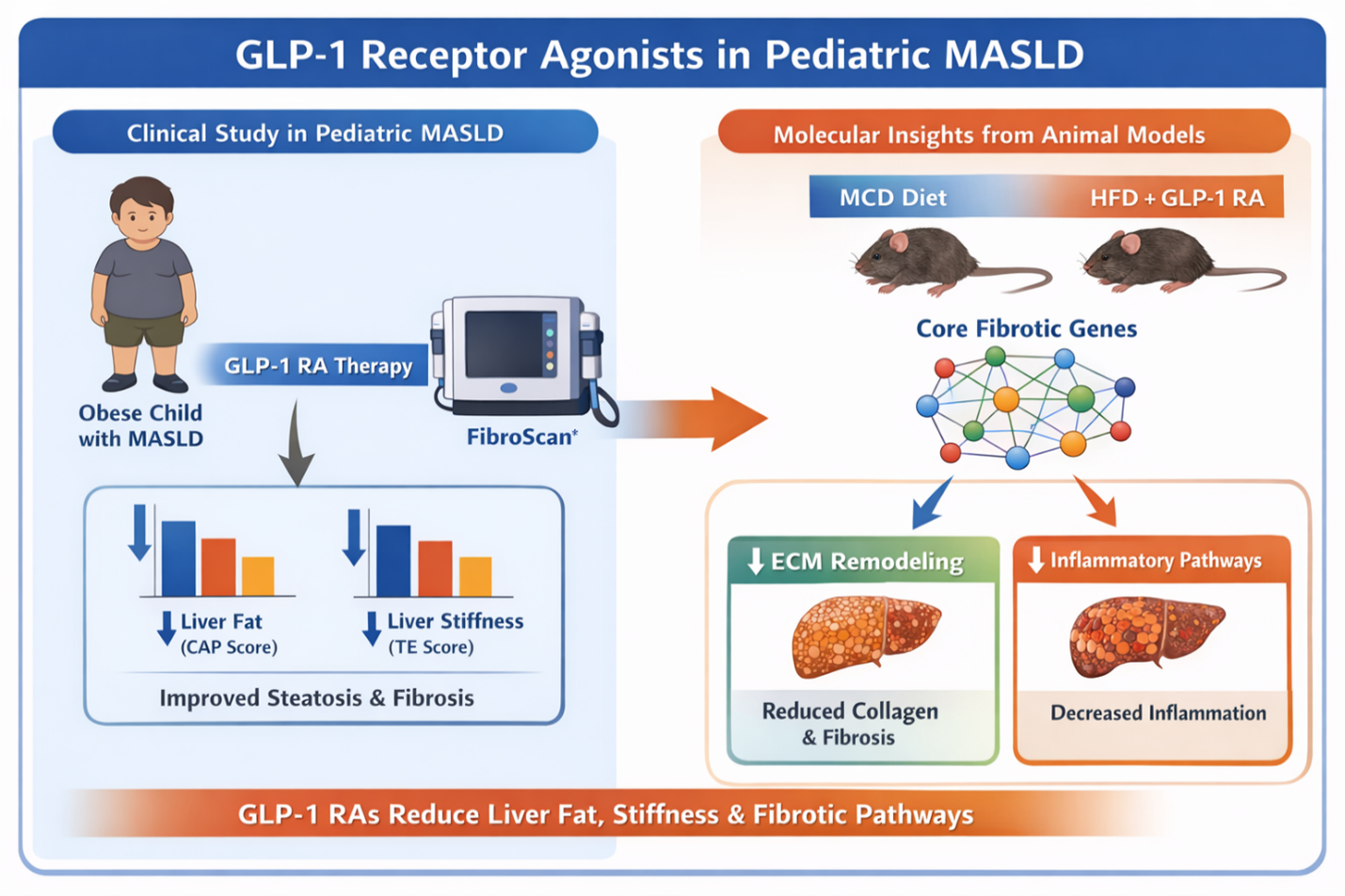
Metabolic dysfunction-associated steatotic liver disease (MASLD) is the most common chronic liver disease in children and is strongly associated with obesity and insulin resistance. In this study, we evaluated the clinical effects of GLP-1 RA therapy in a de-identified cohort of pediatric patients with MASLD and investigated potential molecular mechanisms using publicly available transcriptomic datasets from models of liver disease. Longitudinal FibroScan measurements from seven pediatric patients treated with GLP-1 RAs demonstrated significant reductions in controlled attenuation parameter scores, transient elastography scores and AST levels, indicating improvements in hepatic steatosis, liver stiffness and the liver inflammatory profile, respectively. To explore potential mechanisms underlying these observations, we analyzed transcriptomic datasets from methionine-choline deficient (MCD) and high-fat diet (HFD) mouse models of liver disease. A pattern-matching algorithm identified a core set of ten genes consistently upregulated in both models and downregulated following GLP-1 RA treatment in the HFD model. These genes are enriched in extracellular matrix remodeling, inflammatory signaling, and fibrogenic pathways associated with hepatic stellate cell activation. Collectively, these findings suggest that GLP-1 RA therapy may improve pediatric MASLD by attenuating fibrogenic and inflammatory transcriptional programs. Although limited by a small cohort size, this integrated clinical-transcriptomic approach supports further investigation of GLP-1 receptor agonists as a therapeutic strategy for pediatric MASLD.
Keywords:
pediatric
; diabetes
; obesity
; MASLD
; liver
; GLP-1 receptor agonist
; transcriptomic
; fibrosis
Copyright: This open access article is published under a Creative Commons CC BY 4.0 license, which permit the free download, distribution, and reuse, provided that the author and preprint are cited in any reuse.


