
Submitted:
10 March 2026
Posted:
11 March 2026
You are already at the latest version
Abstract
Contemporary models of resistance training often treat repetitions within a set as interchangeable, emphasize only those performed near failure, or prescribe controlled tempos that moderate effort across repetitions. These perspectives leave unclear how moment-to-moment intent and movement quality interact to determine where fatigue and adaptation are localized. We introduce the Targeted Intensity Cumulation (TIC) model, a minimal mechanistic framework in which high voluntary intent combined with high purity technique progressively concentrates mechanical and metabolic stress within target musculature across repetitions and sets. In this formulation, the rate of performance decay (e.g., as measurable by decline in concentric velocity) serves as an observable proxy for stimulus localization. The model provides a unifying account for (1) hypertrophy equivalence across repetition ranges, (2) the continuous accumulation of training stimuli, (3) exercise-specific 'performance cliffs,' and (4) cross-load performance transfer. By shifting the focus from external load to the internal state-space of intent and constraint, TIC generates testable predictions for optimizing training execution and monitoring.
Keywords:
resistance training
; hypertrophy
; intensity
; volume
; technique purity
; velocity loss
; training stimulus
1. Introduction
Resistance training is a remarkably robust intervention for human performance and health, yet its theoretical foundation remains fragmented (Schoenfeld, 2012). Historical examples abound of comparable extremes in muscle development being achieved by a wide range of methods and frequently antithetical philosophies (Schwarzenegger, 1999). These often centre on training volume and intensity: such as the number of repetitions performed within sets, the total number of sets in a training session, and the way those reps were to be performed. For example, for decades, training was frequently allotted into neat silos of “strength,” “hypertrophy,” and “endurance” based on nominal rep counts or the loading percentage of a single maximal attempt (1RM) (e.g., Weider, 1989). However, contemporary findings have challenged such distinctions. Whether a lifter performs five repetitions at a heavy load or thirty repetitions with a much lighter one, measured hypertrophic outcomes are generally comparable provided effort is equated (as measured by proximity to volitional failure) (Morton et al., 2019; Schoenfeld et al., 2017; 2021). There remains no consensus on how to best to quantify the actual stimulus of training variables. Traditional metrics like 1RM-percentages and volume-load are increasingly recognized as inadequate because they fail to account for the dynamic interactions between repetition velocity, inter-set recovery, and the escalating intensity of individual sets (Scott et al., 2016).
What is clear is that, if the physiological signals for adaptation were truly locked into specific rep ranges, then the “rep-range equivalence” observed in the data would be impossible. A reason for the confusion in the literature perhaps stems from treating the repetition as a “primitive unit” (an interchangeable, static event) or as if an interchangeable building block with which variations in set length or total number of sets are made. But repetitions need not (and cannot) be atom-like – even within a single set. Current frameworks often emphasize aggregate quantities (total volume, time under tension, proximity to failure, etc.) while treating the within-set dynamics as a “black box”. However, each repetition is not duplication, and the manner with which it is performed may be the focal point of a range of key interacting variables all affecting training stimulus, including the technique and fatigue conditions with which it is performed. However, most models ignore the evolving internal state of the lifter, treating Intent and Technique as noise to be standardized away through machines, tempo counting, metronomes, and the like. By contrast, we argue that this “noise” contains the causal signal: performance of a resistance exercise can be seen as part of a dynamic feedback loop between Intent (the psychological drive and focus) and Capacity (relevant physiological limits). Performance can decline across a set not only if effort wanes, but because capacity is progressively “boxed in” by fatigue. In short, early and late reps differ systematically, not categorically and this has potentially important implications that have been overlooked or standardized away in most studies, for treating these features as noise may obscure key causal mechanisms.
There is a style of training that can be expected to maximise this signal. Although this style of training may be intuitive to many in practice, so might its antitheses resonate with others1. To think more clearly, we formalize these ideas in a minimal model of resistance training. For brevity, we term this Targeted Intensity Cumulation (TIC) or “checkmark” training2. This describes how performance, fatigue, intent, and technique interact across repetitions, sets, and sessions. Without invoking fibre-type dichotomies or rep-range-specific adaptations, this can parsimoniously explain rep-range equivalence, variable repetition speed, steep performance drop-offs, and cross-load transfer training effects. Crucially, it points to novel, testable predictions regarding tempo control and exercise selection. The next section develops the model in stages, beginning with a minimal rep-level framework and extending it to intent, technique, supplementation, and session-level dynamics. We then summarize the model’s core predictions and contrast them with prevailing paradigms. Finally, we discuss implications for experimental design, limitations of the model, and suggestions for future theoretical work. By endogenizing intent and technique, TIC moves beyond the mere counting of repetitions to the measurement of allocation of intensity.
2. The Model
Section 2.1: A Minimal Rep-Level Model of Fatigue and Performance
In much of the empirical and coaching literature rep ranges are compared, aggregated, and prescribed as though each rep carries an equivalent and independent effect. To the extent repetitions within a set are differentiated, it is usually within proximity to volitional failure (defined as the point at which another repetition cannot be performed without form breaking down), with repetitions close to this point (or beyond it) being considered as the crucial ones that deliver training stimulus to the muscles. Disagreements between approaches then centre on where these charmed reps are located3.
However, this framing obscures a basic fact: repetitions cannot be identical events, even within the same set, at the same load, and executed by the same individual. Here we construct the simplest possible model that captures two empirically undeniable features of resistance exercise, namely, (1) performance declines within a set, even when effort is held constant, and (2) this decline is systematic and predictable, not random. To see how far we can get with these basic assumptions, we deliberately avoid introducing complications such as muscle fibre types, thresholds, or neurological special cases at this stage. Instead, we ask: What is the minimal structure required for performance to deteriorate across repetitions in a lawful way?
Consider a single set of an exercise, composed of sequential repetitions indexed by
At each repetition, the system is characterized by two internal state variables. The first is , denoting the instantaneous contractile capacity at the start of repetition . This represents the maximum force–displacement output the lifter could produce at that moment, given current physiological state. The second, represents accumulated fatigue up to repetition . This is a reduced-form variable summarizing all fatigue-relevant processes (metabolic, ionic, neural, etc.). While these are not directly observed, they govern what is observed as manifest in performance. That is, or performance on repetition . For now, can be interpreted broadly as effective muscular output relevant to adaptation, not literal mechanical work. Crucially, we assume that higher performance produces more fatigue. Formally:
That is, each repetition increases fatigue, and the amount of fatigue added is increasing in how much performance was performed on that rep: fatigue diminishes performance, but more performance increase fatigue. Note that this is a weak assumption, and one that virtually all physiological models likely share. Thus, fatigue acutely reduces future performance, which can be expressed as:
This means that the more fatigue has accumulated, the more contractile capacity is reduced before the next repetition (we do not assume linearity, only monotonicity). Observed performance is constrained jointly by the lifter’s capacity and external characteristics of the exercise, such as captured by the simple rule:
where represents the performance requirement imposed by the external load and mechanical disadvantage of the exercise. When capacity exceeds this requirement, performance is capped by the task; when capacity falls below it, performance declines, and eventual mechanical failure emerges endogenously.
Notice that, together, Equations (1)–(3) create a feedback loop (Figure 1): higher performance on a repetition induces more fatigue affecting the next repetition; greater fatigue lowers capacity on the next repetition, reducing its performance. This loop alone is sufficient to generate declining performance across repetitions.
Even without specifying functional forms, the structure implies early repetitions must occur when capacity is highest while later repetitions occur under progressively constrained conditions. We can therefore define mechanical “failure” as emerging endogenously when becomes insufficient to complete another repetition. No numbered repetition in a set is intrinsically special: later repetitions matter because of where they occur in the fatigue/capacity trajectory, not because they belong to a named rep range or threshold. This provides an interpretation of contemporary colloquial ideas as “effective reps”, “last reps to failure” and “junk volume”, as “effectiveness” is continuous. Because fatigue is tied to performance, sets with different loads but similar total effective performance can produce similar adaptation, and rep ranges can vary widely without changing the core stimulus4. Moreover, it also suggests that repetitions later in the set are no more crucial than earlier reps (or vice versa) but that both are complementary: i.e., improvements in performance of both may enhance the effectiveness of each other. This raises the question of how these reps are best executed to maximise overall training stimulus.
2.2. The Involvement of Intent
So far, we have implicitly assumed that performance simply “happens.” But flesh and blood lifters actively decide how hard to try on each repetition and in what manner. To incorporate this, we now introduce a variable to measure intent, defined as the lifter’s attempted force-velocity output on the concentric of each repetition. This captures instructions such as to “move explosively” on the concentric phase of a repetition, as, for example, exemplified in Compensatory Acceleration Training techniques. It is also consistent with observations that performance is not only constrained by the muscular fibres themselves but by the degree to which the central nervous system voluntarily exploits this capacity (Del Vecchio et al., 2019; Gandevia, 2001). Although subjective, applied intent is as critical for measurable adaptations as the objective actual kinetic outcome (Behm & Sale 1993). Crucially, intent is chosen by the lifter, not imposed by rep number. Obviously, how this intent is translated into movement is constrained: actual performance cannot exceed current capacity. Therefore
where is exercise-specific capacity (capacity with respect to the effective force-producing range of the target muscle of the exercise rather than some global force-production ability). Meanwhile, a repetition is only feasible if , such that a set ends (reaches failure) if either or non-targeted systems become limiting and prevent execution or required intent. This means that capacity is high early in a set and so performance may be limited by intent. This shifts over the course of the set as fatigue reduces the lifter’s capacity to express that intent. If intent is held constant across repetitions, then, for early reps , but for later reps, . Thus, velocity and force decline naturally across the set even if the lifter does not deliberately slow down the rep speed or alter technique. This produces variable rep speed as an emergent property, not as a target.
A key corollary is that tempo-controlled training (e.g., deliberately matching speed of different phases of the lift to counted numbers or a metronome) may be misguided. To hold speed constant as fatigue accumulates, the lifter must reduce intent () early in the set. This has two consequences. Firstly, it reduces total cumulative performance, delaying fatigue and thus reducing total effective output. Secondly, it blunts recruitment and signalling: training with suppressed intent in earlier reps and sets means high-capacity states are underutilised. In other words, tempo control sacrifices the most valuable repetitions — the ones potentially performed under maximal capacity.
Figure 2 illustrates this point by comparing two contrasting strategies. Strategy A keeps intent constant (and high), producing variable speed across reps in the set. Strategy B varies intent to keep rep speed constant. Assuming that hypertrophic stimulus to the muscle is proportional to performance (otherwise, we must question why this exercise has been selected), then for any given fatigue trajectory, Strategy A produces equal or greater cumulative effective performance and better localization of fatigue to the target musculature (when technique is held constant). Therefore, under very general fatigue dynamics, constant-intent training weakly dominates tempo-controlled training for both performance and adaptation. Formally, cumulative effective performance or total “effective stimulus” is given by . Strategy B trades higher early for a greater number of later repetitions with necessarily lower , since later repetitions occur under reduced capacity. Provided fatigue accumulation is non-decreasing in performance, such intertemporal reallocation cannot systematically increase total effective performance. Strategy A therefore weakly dominates Strategy B: it produces equal or greater cumulative performance for the same or greater degree of fatigue localization to the target musculature.
Put more simply, early in the set, capacity is high. B underutilizes this capacity by lowering or misdirecting intent, reducing both performance and fatigue accumulation early, potentially enabling more total reps to be performed (or ostensibly more “time under tension”). However, fatigue saved early only permits additional reps when capacity is already reduced and performance per rep is necessarily lower. Because fatigue is tied to performance, not rep count, additional low-performance reps do not fully compensate for high-performance reps foregone earlier. In short, more reps or time under tension does not necessarily equate to more stimulus for hypertrophy unless performance is preserved, which tempo control may undermine.
A second implication is that this model predicts studies comparing “fast reps” vs “slow reps” while enforcing constant tempos are testing a “non-ecological” control regime. In other words, based on our model mixed findings in the rep-speed literature are expected. The real question should not be whether different constant rep speeds are better or worse (evidence for this is ambiguous, see Schoenfeld et al., 2015), but whether any controlled rep-speed is superior to approaches allowing variable-speed sets executed with constant aggressive intent, which should outperform both slow-only and fast-only prescriptions5. This is not a contradiction of existing data. Rather, it is an explanation of why those data are ambiguous.
In sum, with a few realistic and simple assumptions, 2.1 and 2.2 about performance decay emerging from simple fatigue-capacity dynamics, we establish that repetitions differ in their effects systematically within a set, intent is the appropriate control variable, and that variable rep speed is not noise to be standardized but valuable information. These implications arise without any suggestion of fibre-type dichotomies, distinct endurance versus strength systems mapping onto different rep-ranges, or specific “failure” thresholds. While such refinements can be layered on later, they are not required for the core logic. The more parsimonious addition is likely the role of technique, which we turn to next, along with within session (inter-set) drop-off curves in performance, and predict lawful transfer across rep ranges and loads under training where intent is optimized to maximise training stimulus.
2.3. Technique Purity and Performance Drop-Offs
Most models of resistance training treat “the exercise” as a fixed object. Technique is standardized, constrained, or mechanized (often literally in experimental studies, via machines) to reduce variance. While this is understandable experimentally, it comes at a theoretical cost that may have created an important blind spot from our current point of view. From our perspective, what matters for stimulus is not the external movement, but which internal capacity is being depleted by repetitions. However, technique crucially determines this mapping. We now make that explicit.
We refine the fatigue variable introduced earlier by decomposing it into two components: (1) as fatigue accumulated in the target muscle(s), that is, the muscle the exercise is seeking to train (e.g., pectoralis major for wide-grip bench press, quadriceps for high-bar squats); (2) as fatigue accumulated in non-target systems, which includes synergists, stabilizers, connective tissue, neural coordination, grip, cardiorespiratory strain, etc. (e.g., rotator cuffs, biceps, triceps on the bench press; lower back or extensors on the squat). Total fatigue is the sum:
As in the previous section, each repetition requires meeting a minimum external performance requirement . A repetition can be completed if and only if current performance satisfies . Under high-purity techniques, failure typically occurs when target-muscle capacity falls below this requirement. Under low-purity techniques, failure may occur earlier due to limitations in non-target systems, even when target-muscle capacity remains sufficient.
The key question here is how much of the fatigue generated by a repetition is borne by the intended muscle. We now specify fatigue accumulation more precisely:
for the target muscle, and
for the non-target muscle/supporting factors, where is a “technique purity” parameter, in that reflects a ratio determining how tightly the movement constrains force production to the target muscle. High means fatigue is mostly localized to the target muscle (e.g., high barbell back squats performed with heels close together and elevated, knees tracking far over the toes, to target quadriceps), while low means fatigue is distributed broadly across systems (e.g., feet flat on the floor, medium-width stance, hip-hinge dominant low bar back squat).
Although we treat this as an exogenous property of the exercise and its execution, with neural drive and muscle fatigue being to some extent dissociable aspects of training (Carrol et al., 2017) realistically intent and purity may also be interconnected in important ways (Marchant, 2011), as so we recommend Appendix A for a relaxation of this assumption. There we show that α can be partially endogenized as a function of intent and mechanical constraint, yielding additional predictions about range of motion, partial repetitions, and execution strategies currently debated in the literature. For clarity of exposition, the core model treats purity as fixed, but the extension demonstrates that the framework can accommodate dynamic purity without altering the main results.
Recall that contractile capacity governs future performance. We now specify that:
That is, only fatigue induced within the target muscle reduces the capacity relevant to that exercise. Non-target fatigue may indeed feel effortful, but it does not directly reduce the muscle’s ability to generate force in its effective range. This distinction is crucial to explaining why a purer technique can produce steeper drop off slopes in performance both within and across sets. Consider two techniques performed with identical intent and load: (A) is a “high purity” technique (large ), e.g., lengthened partials, fixed bar path, stretch-focused ROM; whereas (B) is a “low-purity” technique (low ), e.g., long ROM with shifting leverage (or focused on less productive regions of the ROM), involves momentum not endogenously generated by the target muscle, or relies on technique compensations in response to fatigue to achieve later reps. Under the high purity regime, each repetition generates substantial . This means that the target-muscle capacity falls rapidly, and performance drops sharply across sets. Under low purity, fatigue is “absorbed” by many systems, enabling the target-muscle capacity to decline slowly and thus “performance” across sets decays gently6. This distinction is illustrated in Figure 3, which contrasts within-set performance trajectories under high- and low-purity techniques while holding the stopping point fixed. Although apparent performance is preserved longer under low-purity execution, cumulative stimulus to the target muscle is substantially reduced.
This predicts that when technique purity is high, the rep curve collapses sharply — and the limiting factor becomes unmistakable. Importantly, though, this does not indicate a flaw in the exercise selection or manner of execution but should be read as a diagnostic signal. Exercises that show little drop off in rep speed within a set or little decline in reps across sets are likely to be less stimulative of the target muscle. In the low-purity case, sets may feel easier to repeat and rep counts remain similar across sets. But it becomes unclear what limited performance (formally, grows large while remains relatively preserved so performance becomes constrained by shifting bottlenecks. In practice, we would expect such training transfers less cleanly across rep ranges, perhaps creating an illusion or exaggerating the degree to which different rep ranges map onto different exercise adaptations. Moreover, as the number of reps achievable is less informative than under a high purity regime, this approach may often require elaborate programming to manage fatigue, such as a greater variety of exercises and loading to target the same muscle while alleviating non-target constraints.
Why do we claim that changes in the numbers of reps achieved are less informative under the low purity regime? Whenever technique purity is high, improvements in across workouts, for example, reflect genuine increases in target-muscle capacity. These increases apply independently of load. Thus, raising the entire rep curve even at light loads systematically raises performance at moderate and heavy loads (even when the absolute reps differ greatly). This violates standard “endurance vs strength” intuitions but follows immediately from the model.
This observation raises other points. For example, during injury, heavier loads may be impossible. In many standard models, this would predict limited or only highly specific progress is possible. By contrast, in the present framework, provided technique purity remains high and intent remain maximal, then is still generated, and can still increase. Especially if the risk or exacerbation to the injury potentially caused by training is captured by the which, in practice, may be lower at lighter loads7. In other words, higher reps are not “endurance work” in this case but may represent a greater number of constrained attempts to express maximal intent per set under a reduced capacity ceiling. This explains why rep ceilings can reach (or perhaps even exceed) 35 reps per set yet still achieve hypertrophy comparable to low-rep training. We predict that, provided technique purity is considered, periods of even extremely high rep-training could also raise low-rep performance when heavier loads are reintroduced.
Another implication is that exercises and techniques that produce steep within-session drop-off slopes will show superior transfer across loads, clearer progression signals (workout over workout improvements in performance of as many reps as possible (AMRAP8) correlate with hypertrophic improvements), and be more resilient during load-restricted periods. The other side of the same coin is that studies that standardize technique in ways that reduce will underestimate the effectiveness of high-rep training and potentially obscure the role of intent.
A further prediction concerns the granularity of progressive overload. It we suppose that smaller incremental load increases will better preserve high-intent execution and technique purity over time, particularly in high-purity exercises, then TIC-training should perform especially well with smaller session-over-session increments than alternative approaches. This holds true if larger load jumps (adding more weight to the bar) are expected to cap the expression of intent earlier within sets, leading to flatter rep-velocity profiles and reduced upward shift of AMRAP curves despite equivalent nominal progression. Likewise, a smaller percentage increase in the number of reps performed in a set across sessions could represent more effective progressive overload with high intent and high purity exercises. This subtle point is worth making carefully: increasing from, say, 31 to 32 reps on an exercise requires a smaller absolute increase in underlying contractile capacity than transitioning a 1-repetition maximum (1RM) to two repetitions of that same weight. Consequently, higher-repetition protocols provide a more granular resolution for detecting incremental adaptations. However, this signal is only valid when technique purity is high; in low-purity execution, such increments may merely reflect the stochastic redistribution of fatigue across non-target systems (). Accordingly, micro-progressive overload should result in smoother vertical translation of performance curves across sessions and greater cumulative adaptation of the target musculature for a given training duration. Note that this effect is not predicted by volume- or RIR-based models, which treat load increments as largely interchangeable provided global fatigue is managed.
In sum, while intent moderates how much fatigue is accumulated in a set, this section defines technique purity as a key parameter that determines where that fatigue goes. Where fatigue goes in turn determines what adapts and by how much. Steep performance collapse in AMRAP across sets is evidence of successful targeting, not inefficiency, and improvements in AMRAP over time are a more informative signal under training that focuses on both technique purity and high intent while letting bar speed vary endogenously. Indeed, the more that intent and technique are optimized, the more meaningful even small improvements in AMRAP across workouts becomes informative and less subject to noise, potentially enabling “micro-progressive overload” to be more viable. Put differently, rep range and tempo are “surface variables”; capacity localization is casual. Together with Section 1 and Section 2, we now have a coherent explanation for micro-progressive overload, lawful rep curves, cross-load transfer, and perhaps the failure of many standard prescriptions to capture lived training reality.
2.4. Supplementation Shifts Parameters
To begin to tie this framework together with physiological and psychological realities, we next consider supplementation (creatine, caffeine, citrulline malate, beta alanine, high carb/electrolyte sports drinks). The purported effects of popular training supplements can be understood as a shift in one or more parameters in this system. Instead of treating supplements as independent “effects,” we can think of them as either increasing capacity, decreasing fatigue per unit performance, or altering recovery between reps/sets. This allows us to derive precise predictions about where in the rep curve each supplement should exert the greatest effect. Imagine the rep curve as a downward sloping line, with early reps showing high capacity and later reps corresponding to low capacity. Supplements can shift this curve in specific ways. It may shift it upward (higher capacity), rightward (slower fatigue accumulation), or change the slope (altering the “fatigue per rep” relationship)
We now formalize this. Recall the basic fatigue accumulation equation:
We introduce a supplement modifier such that:
where represents the proportionate reduction in fatigue per unit performance and corresponds to known supplement effect ( may be time-dependent, e.g., decaying over the session). Below we map popular supplements onto model parameters, summarized in Table 19 (these predictions are explained more fully in Appendix B).
2.5. Session-Level Dynamics
Thus far, we have modeled performance and fatigue dynamics within a single set. Real training, however, consists of multiple sets and multiple exercises arranged within a session. The aim here is to show that the framework developed in Section 2.1, Section 2.2, Section 2.3 and Section 2.4 extends naturally to this broader structure and yields nontrivial predictions about exercise selection, ordering, and perceived “exercise effectiveness.”
Let a set consist of repetitions . Between sets, fatigue partially dissipates. We model this by introducing a recovery function , such that:
where represent recovery fractions during the inter-set rest interval. We do not assume these are equal. In practice, non-target fatigue (e.g., cardiorespiratory strain, grip, neural arousal) often recovers more quickly than localized muscular fatigue, so typically:
This asymmetry is central to what follows. Recall from Section 2.3 that only target-muscle fatigue reduces the relevant capacity for that exercise:
Thus, even with long rest intervals, capacity across sets will decline sharply when fatigue is strongly localized (high ), and more gradually when fatigue is diffuse (low ). This immediately explains a ubiquitous but poorly theorized observation: some exercises “fall off a cliff” across sets, while others remain repeatable.
Consider again two exercises performed with identical intent and load: Exercise A (high purity), with large , e.g., stretch-focused lengthened partials, fixed bar path, minimal leverage variation; and Exercise B (low purity) characterized by small , e.g., long or suboptimal ROM with shifting mechanics, multiple synergists absorbing fatigue. From Section 2.3:
Thus, Exercise A generates large target-muscle fatigue per set, while Exercise B distributes fatigue broadly. Across sets, this implies for exercise A that there will be a rapid decline in AMRAP across sets, while AMRAP will be relatively stable across sets throughout a session for exercise B. Crucially, observed declines in AMRAP within a session focused on exercise A should not be interpreted as inefficiency or poor programming.
This general idea is depicted conceptually in Figure 4. Steep across-set collapse is seen as diagnostic of effective targeting, not a flaw, verifiable empirically if greater increases in AMRAP are found across sessions for exercise A than B through more effective capacity for application of progressive overload.
Because high-purity exercises rapidly deplete target capacity, the model predicts they should be performed earlier in a session if maximal performance is desired. Formally, suppose two exercises target the same muscle but differ in purity (). Performing the high-purity exercise first ensures it is executed when is highest. Reversing the order reduces achievable performance on the high-purity exercise without increasing its adaptive stimulus. This predicts that many empirically observed “exercise order effects” may not need to be attributed to mysterious interaction effects but consequences of fatigue localization or dispersion.
The ordering argument above implicitly assumes that fatigue is specific to the capacities being trained. We now make this explicit. Let fatigue be indexed by muscle group , such that each exercise draws on a subset of target capacities . Fatigue accumulated in one muscle group reduces only the capacity of exercises that depend on that same group. Formally, capacity for exercise depends on the sum of fatigue in its target set, . This implies that exercise order effects depend not on the number of exercises performed but on the overlap structure of their target capacities. Two high-purity exercises targeting the same muscle will strongly interfere with one another, while exercises targeting distinct muscles can be sequenced with minimal interaction (e.g., antagonistic supersets). Thus, “purity” is not an absolute property of an exercise but a relational one: it depends on which capacity is being isolated and how much overlap exists with other exercises in the session.
The shape of rep curves across sets (particularly their slope and stability) is therefore informative. Under fixed intent and rest, steep, consistent collapse across sets indicates high purity and strong localization, whereas flat curves suggest diffuse fatigue and weaker targeting. This clarification explains why sessions can productively combine multiple high-purity exercises provided they target different muscles, while multiple high-purity exercises for the same muscle must be ordered carefully or distributed across sessions. This also points to why some exercises might feel “good” or lead to reports of high “muscle-mind connection” but do not work well for accomplishing improvements in the targetted muscle over time. Exercises with low purity may feel metabolically demanding yet fail to produce steep drop-offs or clear progression signals. We would predict that such exercises can be repeatable, pump-inducing, and subjectively taxing while producing weak transfer across loads and ambiguous performance feedback. This also reflects a formalized version of the observation that lifters often subsconsciously learn to circumvent fatigue in target muscles by shifting the burden of the load onto synergistic musculature (Zatsiorsky et al., 2021). In our model terms, they generate large but modest and explains why such exercises may often require complex programming heuristics and why progress is difficult to track.
In sum, extending the model across sets reveals that exercise selection and ordering within sessions are governed by fatigue localization and recovery asymmetries. High-purity exercises are powerful but expensive, best placed early; low-purity exercises are repeatable but less informative. Session-level dynamics thus emerge from the same simple mechanisms that govern rep-level performance. On this view, we may think of fatigue generated by a rep as a high-pressure stream of water. While low-purity execution distributes stress like a leaky pipe, high-purity execution functions like a pressure washer, concentratining the entire kinetic potential of the system on a singular physiological bottleneck.
3. Discussion
Imagine watching a bodybuilder performing a set of repetitions, such as on a barbell incline press. The bar starts moving quickly, then more slowly, until eventually it near stalls. Most training advice treats those repetitions as interchangeable units: count them, average them, estimate their distance from failure, classify them into “strength” or “endurance” zones. Our model begins from a more basic observation: repetitions are not identical events. They are points along a trajectory, a sequence of related events, governed by the changing internal state of the lifter. At any moment, the body has a limited capacity to produce force, and every repetition draws down that capacity by generating fatigue. Early in a set, capacity is high; later, it is constrained. Performance declines not because the lifter “tries less” but because the system itself is being progressively limited. This simple feedback loop is obvious, familiar, and sufficient to generate the downward curve of a set.
A crucial addition to this picture is intent. Lifters do not merely execute repetitions; they attempt them. In the model, intent is treated as an attempted output. If intent is maximal (the lifter tries to move the weight as powerfully as possible) then the performance of early repetitions is limited by will, not by capacity. Over the course of a set, this relationship shifts: later repetitions become limited by reduced capacity, even as intent remains high. Variable repetition speed thus emerges naturally. Slowing down is not a failure of effort; it is a diagnostic signal. Subjectively, this transition is unmistakable. The lifter’s mind may be commanding speed, aggression, and force, which at first surges the bar until it begins to respond only with a slow creep. The slowing is not chosen. It is imposed. The model makes this experience explicit and, far from being noise, recasts this as an informative signal, potentially useful as feedback for exercise selection and execution. Enforcing constant tempos, by contrast, requires suppressing intent early in the set, wasting moments when capacity is greatest and obscuring feedback from training.
Each repetition is a movement that can concentrate fatigue in the target muscle or disperse it across many supporting systems. Where fatigue goes depends on details of how the movement is performed. We formalize this as technique purity. High-purity techniques localize fatigue, producing clear performance collapse within and across sets. Such decrements do not imply inefficiency, but are evidence that the intended muscle is being stressed directly. Low-purity techniques can feel exhausting yet leave the target capacity relatively untouched (within the context of a specific training goal), producing flatter rep curves and ambiguous adaptation. From this perspective, rep ranges lose their traditional meaning. High-rep sets can train the same capacity as low-rep sets if intent is maximal and fatigue is localized. This explains why strength and hypertrophy often transfer across loads, and why progress can continue during injury-restricted periods using very light weights. What matters is not how many repetitions are performed, but which capacity is being repeatedly challenged. This distinction helps clarify a common source of confusion in training practice: feeling tired is not the same as being trained. Low-purity movements often produce breathlessness, sweating, and generalized exhaustion — signals dominated by non-target fatigue. High-purity movements, by contrast, often culminate in a more peculiar sensation: a localized, almost “cold” inability to produce force in the target muscle, even as motivation runs hot, breathing and arousal feel recovered. The former is loud but may be uninformative; the latter is quiet but diagnostic.
The model extends naturally across sets and exercises. Targeted fatigue recovers slowly; systemic fatigue recovers quickly. Hence some exercises “fall off a cliff” across sets while others are endlessly repeatable. Exercise order effects follow directly: movements that precisely target a muscle should be done when its capacity is freshest. Even supplements fit into this framework. Creatine raises initial capacity; caffeine increases intent; buffering agents slow fatigue accumulation. Their effects appear at different points along the rep curve and interact predictably. A stimulant without buffers may accelerate collapse; together, they unlock more work precisely where constraint would otherwise emerge10.
Taken together, this model reframes resistance training as a process of targeted intensity cumulation (TIC): repeatedly attempting maximal performance with pure technique, allowing fatigue and slowing to reveal which systems are being trained. The familiar barbell, it turns out, provides for us its own quiet titration experiment in each set and workout, incrementally probing capacity and fatigue. From this perspective, the “burn” of a high-rep set is not simply endurance work, but a side effect of a slow-motion siege on a specific capacity. This is not a complex idea, but thought through formally helps explain why hypertrophy outcomes appear surprisingly invariant across rep ranges: the muscle does not count repetitions; it counts the cumulative debt of expressed intent.
3.2. Comparison to Existing Theories
Earlier models of resistance training often treated volume (i.e., sets, repetitions, or total load lifted) as the primary determinant of hypertrophy and strength. Wernbom et al. (2007), in a landmark review, challenged this emphasis by highlighting that when effort is controlled, a wide range of volumes and loading schemes can produce similar hypertrophic outcomes. Subsequent work has largely reinforced this view: Schoenfeld et al. (2017; 2021) concluded that proximity to failure, rather than any specific repetition range, is the crucial determinant of muscle growth, with low-load and high-load training producing comparable hypertrophy when sets are carried close to failure. More recent interventions in untrained women have extended these findings, showing similar gains in strength and body composition from low- versus high-load training to failure, despite large differences in the number of repetitions performed (Anderson et al., 2023; Dinyer et al. 2019).
Within this context, tools such as repetitions in reserve (RIR) and ratings of perceived exertion (RPE) can be understood as practical attempts to operationalize “effort” by steering trainees toward a target proximity to failure on most working sets (Helms et al., 2016). The underlying rationale is that training close to failure ensures high motor unit recruitment, particularly of high-threshold units, regardless of the absolute load. From a motor control perspective, this rationale aligns with the size principle of Henneman (1957) and its subsequent elaborations (Carpinelli, 2008): as required force increases, additional motor units are recruited in an orderly fashion from low- to high-threshold, and high threshold units are reliably engaged only when force demands are sufficiently high, thus requiring high demand to effectively train.
Our analysis broadly agrees with these conclusions, but recasts and extends them in three ways. In our model, the key quantity is not the number of repetitions, but the cumulative effective performance produced under high intent and localized fatigue. Sets with light loads and sets with heavy loads can both impose similar demands on the same underlying capacity, provided intent is maximal and fatigue is concentrated in the target muscle. This helps explain why both low- and high-load training to or near failure often produce similar hypertrophy: the underlying trajectory of target capacity constraint is what matters, not the nominal rep range or any specific repetition positioned within the set (or beyond it).
Second, TIC makes explicit the role of intent as a driver of motor unit recruitment. In our formalism, intent serves as a control variable that sets the attempted force–velocity profile of each repetition. When light to moderate load is lifted with maximal concentric intent, the nervous system is driven up the motor-unit hierarchy, recruiting high-threshold units that would otherwise remain in reserve at the same load. This point has been rediscovered repeatedly in practice under labels such as “speed work” or “dynamic effort” training, where explosive lifting with submaximal loads is used to improve one-repetition maximum without frequent exposure to maximal weights. TIC situates these practices within a unified framework: high-intent lifting with appropriate technique purity produces a similar recruitment profile to heavy lifting (but with different mechanical constraints and safety profiles).
Third, TIC indicates specific conditions under which the traditional “rep-range” structure may re-emerge as approximately valid. In our model, this occurs when intent is not maximal, when technique purity is low and fatigue is dispersed across non-target systems, or when the exercise itself precludes or obscures the translation of intent into performance (e.g., potentially some machines or cable exercises). Under such conditions, high-repetition sets may indeed behave more like “endurance” work, because target capacity is not driven into constraint and high-threshold units are not consistently recruited. It is easy to see by extension that performance on some exercises with near maximal weights can be severely constrained by fatigue outside of the target musculature. If the same weak links do not come into play at much lighter loadings, then training focused on lower rep ranges may not translate well into improvements at more moderate ranges. In other words, technique purity may shift in practice when the external load changes substantially. This provides a principled explanation for why classical repetition continuums sometimes appear to hold in practice and sometimes do not: their validity becomes a special case of how intent and technique purity are configured, not a property of repetition counts per se.
3.22. TIC Versus RIR and RPE Prescriptions
These points also clarify how TIC practically diverges from standard applications of RIR, RPE, and related effort-based prescriptions. In many implementations, tempo is controlled and systematically suppresses intent in early reps. These and other approaches treat rep proximity to failure as key for recruiting high-threshold units (Refalo et al., 2022). While directionally correct, this implies effectiveness as a discrete threshold rather than a continuous function of position along the capacity-fatigue trajectory. In other words, the “effective” portion of a set is implicitly located in the tail (those final repetitions near the stipulated proximity to failure). Repetitions earlier in the set are often treated as largely homogeneous “lead-in” work, to be “gotten through” until an acceptable RIR zone is reached.
Similarly, RPE targets often average effort across a set, encouraging lifters to modulate force output to match a desired global perception rather than to express maximal intent on each repetition. We predict that early reps under high capacity and maximal intent can contribute as meaningfully to cumulative stimulus, while low-intent “lead-ins” contribute less. Put differently, RIR and RPE practices risk underutilizing high-capacity states and truncating the most diagnostically and adaptively valuable portion of the set11. By contrast, TIC suggests that maximal concentric intent should be maintained throughout the set, and that variable bar speed and the emergence of the “involuntary grind” are critical signals rather than errors to be standardized away. Moreover, although RIR and RPE are often presented as scientific operationalizations of effort and enjoy broad empirical support (Helms, et al., 2016; Lea et al., 2022), their theoretical foundations remain vaguely specified and empirical evidence for their reliability at a fine-scale as approximations of intent (e.g., 5 RIR versus 4 RIR, versus 3 RIR, etc) and as reliable over time is limited. The potential issue is not that both indices are subjective, but that they are multifaceted and complexly subjective, with trainees attempting to sometimes integrate perception of multiple internal cues (discomfort, mood, motivation, expectations, etc.) and therefore exposed to a wide array of psychological vagaries. Compared to simply attempting to apply and replicate maximal intent coupled with the immediate objective feedback of performance, we suspect RIR and RPE-type approximations require unusually accurate calibration between subjective prediction and objective capacity, a condition that may be rare in practice and unstable over time and complex periodization plans.
3.23. TIC Versus Velocity-Based Prescriptions
This differs from an opposite extreme, such as exemplified by traditional Compensatory Acceleration Training (CAT)12(Hatfield, 1989), various “speed work” protocols, and perhaps Velocity-Based Training (VBT) (Weakly et al., 2021), which we believe our approach can also expand. These often emphasize either maximal intent or otherwise use objective measures of this subjective factor on performance as critical to the training method. However, these often terminate sets at the first sign of slowing or at predetermined velocity loss thresholds. TIC predicts that continuing those sets toward failure, under high intent and high technique purity, will more thoroughly recruit and fatigue high-threshold motor units, producing a deeper and more specific stimulus than either “speed-only” work or tempo-controlled, near-failure sets.
The results from Pareja-Blanco et al. (2017) support this idea. They found that the magnitude of velocity loss (our model’s indicator of capacity-depletion) dictated the structural outcome in target muscles. When they allowed a 40% velocity loss (VL40) in each set compared to a 20% loss (VL20), this achieved greater hypertrophic gains. Their results interpreted in our terms are that the VL40 training forces the lifter deeper into the “cliff” of the rep curve, maximizing the hypertrophic signal at the cost of fibre-type shifting (IIX to IIA). In this way, TIC can be seen as both a formalization and a refinement of effort-focused models. It retains the core insight that proximity to failure and high motor unit recruitment are central for adaptation, while replacing discrete rep ranges and loosely defined “effort zones” with a continuous, state-based account (in which intent, capacity, and fatigue localization jointly determine the quality of the training stimulus).
3.24. TIC, Time, and Tension
While the degree to which competing mechanisms contribute remains unclear (e.g., metabolic stress, muscular damage), the most important stimulus for hypertrophic adaptations is mechanical tension (Wackerhage et al. 2019). Time-under-tension (TUT) models propose that the primary driver of hypertrophy is the duration for which a muscle is under load during a set, often operationalized as prescribed tempos or total time per set. In practice, this has led to prescriptions such as “4–0–1–0” or “3–1–3” tempos and the recommendation that hypertrophy sets last within a certain time window, independent of intent and proximity to failure. From the perspective of TIC, the relevant tension is a dynamic product of Intent and Capacity. In other words, TUT is only meaningful insofar as it reflects time spent producing high, target-localized, fatigue-inducing performance. A long duration spent producing low force, with low intent, or with fatigue dispersed into non-target systems, does not meaningfully advance the state of the target capacity (no matter how many seconds elapse). Rather, the rate of force development depends on intent (Behm & Sale, 1993). By promoting maximal concentric intent on each repetition, TIC agrees with evidence that the motor neuron pool will thereby be exploited at its maximal discharge rates (Del Vecchio et al., 2019).
The leg extension study by Burd et al. (2012) illustrates this conflict. Participants performed leg extensions with either very slow or faster repetition durations, and mechanical work was matched between conditions. However, effort, intent, and proximity to failure were not matched or controlled; sets were terminated by protocol rather than by genuine mechanical constraint. As a result, the “high TUT” condition involved extended periods under relatively low effective tension, while the “low TUT” condition compressed similar work into shorter periods with higher instantaneous outputs. From a TIC standpoint, this does not constitute a clean test of the hypothesis that time under tension is the key stimulus. A closer analogue would have been to equate intent and carry sets close to failure in both conditions (or to compare different durations of a single isometric contraction at a constant high effort). A later study comparing leg extensions performed with radically different tempos found comparable hypertrophy using both methods (Lacerda et al. 2021).
More generally, tempo-controlled TUT protocols inherently require uneven effort allocation across the set. To keep repetition duration fixed as fatigue accumulates, lifters must reduce intent early and increase it later, or else violate the prescribed tempo. This is precisely the pattern TIC identifies as suboptimal, underutilizing high-capacity states at the beginning of the set by reallocating work to late, low-capacity repetitions where performance per rep is necessarily diminished. The result may be long sets with high nominal TUT, but relatively little time spent in the state of high, target-localized effective performance that our model treats as the true stimulus. TIC therefore suggests what matters is not “time under tension” in the abstract, but time spent under high, well-localized, fatigue-inducing tension generated with maximal intent. In practical terms, this means that a set of variable-speed repetitions performed with constant aggressive intent and high technique purity may deliver a stronger and more specific stimulus than a longer set executed at a rigid, submaximal tempo, even if the latter yields higher nominal TUT. It also clarifies why some TUT-focused studies yield ambiguous or counterintuitive results: by standardizing movement speed and matching mechanical work, they often standardize away precisely the variables — intent, proximity to failure, and fatigue localization — that TIC identifies as causal. González-Badillo et al. (2014) demonstrate that this intentionally reduced velocity significantly blunts strength adaptations. In our terms, by decoupling Intent from Capacity, the lifter fails to reach the ‘synaptic saturation’ necessary for maximal recruitment, resulting in nearly 50% less strength gain despite performing the same total mechanical work.
A related clarification applies to the popular bodybuilding notion of “constant tension.” This usually refers to techniques that restrict the range of motion to the portion where the target muscle is under the greatest effective load, and that minimize positions where joint stacking or mechanical advantage offload the muscle (e.g., avoiding full lockout at the top of a bench press where pectoral stress is reduced)13. More recently, the sports science literature has converged on similar ideas under the label of “lengthened partials,” in which repetitions are performed in the lengthened, high-tension region of the range of motion and have been shown to produce robust hypertrophic responses compared with full-range or shortened-range work (Kassiano et al., 2023). From the perspective of TIC, both “constant tension” practice and lengthened partials can be reinterpreted as techniques that raise the purity parameter and increase the marginal productivity of high intent: they allocate a greater fraction of each set’s effective performance to the joint angles and muscle lengths that most strongly drive fatigue localization in the target muscle. This reinterpretation also explains why such methods seem particularly powerful with free-weight movements that allow high intent to be expressed, whereas machines or cable setups that constrain bar path and limit acceleration may partially mute the very dynamics that TIC treats as central.
3.3. Empirical Predictions
The Targeted Intensity Cumulation (TIC) framework generates several falsifiable predictions that distinguish it from volume-based, RIR/RPE-based, and time-under-tension (TUT) approaches. These predictions focus on the shape and evolution of performance trajectories within and across sets, and across sessions rather than on total repetitions or volume alone. All predictions can be tested using standard resistance-training equipment supplemented by rep-velocity tracking (e.g., GymAware, Perch Fit), without requiring invasive physiological measures.
3.32. Intent Dominance
In general, if we were to compare RIR-based training blocks (avoiding zero RIR) with TIC-style, high-intent training of the same exercises, we would expect measures of performance curves under RIR to be less predictive of adaptation and less sensitive to technique purity. Specifically, TIC proposes that a positive relationship between within-set velocity decay and hypertrophy should emerge under high-intent conditions and attenuated or absent under tempo control conditions. To test this, studies can train participants on matched exercises, loads, and set counts under two conditions: (1) exercises performed with maximal concentric intent on every repetition with no imposed tempo (i.e., rep speed allowed to vary), and (2) exercises trained with tempo-controlled repetitions requiring moderated intent early in the set. Despite equalized load and nominal volume, the high-intent condition should produce:
- greater cumulative effective performance (indexed by integrated velocity output),
- steeper within-set velocity decay,
- and greater hypertrophic and performance gains over time (presuming that training stimulus tracks cumulative effective performance).
By contrast, TUT models should predict equal or superior outcomes for the tempo-controlled conditions due to longer time under tension, while RIR-based models would predict minimal differences so long as proximity to failure is matched.
3.33. Purity Cliffs
Patterns of velocity reduction can be remarkably stable across a range of loads and repetition ranges (Izquierdo et al. 2006). TIC predicts that the shape of these profiles are related to technique purity. If the decline in performance during and across sets is indeed diagnostic, exercises for which TIC predicts steeper performance collapse should predict greater long-term adaptation, and that the shape of these declines should be more predictive of adaptation then rep ranges. To test this, we suggest comparing high-purity exercises (e.g., lengthened partials, constrained bar paths) with low-purity exercises (e.g., multi-joint movements with shifting mechanics), under matched load, and trained over time with the application of progressive overload (e.g., targeting total AMRAP values). High purity exercises should exhibit sharper within-set velocity “cliffs”, larger AMRAP declines across sets within a session, and a greater sensitivity to exercise order when multiple exercises are deployed to target the same musculature. Varying intent across participant groups should also reveal an interaction effect whereby the superiority of purer exercises compared to impure exercises should be clearest when maximal intent is used. By contrast, approaches emphasizing intent moderation or tempo-control may interpret the flatter curves of the impure exercise as a sign of “better fatigue-management.”
3.34. Relational Order Effects
A straightforward prediction is that the impact of one exercise on another within and across sessions should hinge on exercise purity. This can be tested by varying within-session ordering of various exercises targeting the same muscle group, varying in purity. First, consider what TIC would expect if high purity and low purity exercises are combined within a session. If a pure exercise is performed before an impure one, this should show modest interference, but if an impure exercise is performed before a pure one, this should show large interference (a big drop in reps) and lower overall training stimulus to the target muscle.
Second, suppose what should result if a group of trainees are compared who train only high purity exercises in their sessions to those using less pure ones. Training multiple pure exercises in a workout will show strong interference with one another. Training multiple impure exercises within a workout should show less interference with one another. Improvements over time in a purer exercise should translate into better performance outcomes in another pure exercise, if tested, while improvements across impure exercises should be less transferable. Both short term and long-term order effects should be in opposite directions and correlate in magnitude depending on purity and target overlap, not with total prior work done. By contrast, other models may predict no difference or even favour the impure exercises if they enable greater total work to be performed in training.
3.35. Granularity of Progressive Overload
Implicit in the TIC framework is the suggestion that smaller incremental load increases will better preserve high-intent execution and technique purity over time, particularly in high-purity exercises. This is a subtle point: extreme increments in load are expected to cap the expression of intent earlier within sets, leading to flatter rep-velocity profiles and reduced upward shift of AMRAP curves over time even if there is a normal underlying progression in qualities of the target muscle. This effect is not predicted by volume- or RIR-based models, which treat load increments as largely interchangeable provided global fatigue is managed.
3.36. Set Extensions (Rest-Pause, Drop Sets)
Another testable prediction is derivable regarding rest-pause or cluster-set style training. Brief, intra-set pauses should preferentially benefit high purity exercises performed with maximal intent, by temporarily restoring the capacity to express high force and velocity, thereby pushing outward the steep portion of the rep-velocity curves. Under such conditions, the early repetitions following a pause should resemble earlier repetitions in their velocity decay profiles, rather than merely adding low-intent volume. Indeed, given the critical role of intent and based on learning theory and experiments using the pursuit rotor task, we might speculatively predict especially pronounced “reminiscence” effects (upswings in the ability to translate intent into performance) (Eysenck & Frith 1977). By contrast, for a low-purity exercise or intent-capped movements, should produce smaller gains in effective stimulus, primarily increasing repetition count without restoring high performance expression. These interaction effects are not predicted by earlier models.
3.37. Range of Motion
We can also generate predictions about range of motion and exercise performance. Because fatigue accumulates where intent is successfully expressed, techniques that concentrate high force production in mechanically disadvantaged regions of the movement should produce steeper within-set declines in rep velocity and more pronounced across set performance drop-offs. In so far as lengthened partials and constant tension repetitions localize force production and limit compensatory contributions for extraneous muscle groups, they are predicted to produce sharper rep-curve cliffs than full or other ROM variants when performed with equivalent intent. These disparities should be attenuated or absent under tempo-controlled conditions or in movements where intent cannot be effectively translated into performance. The rationale for this prediction is further developed in Appendix A.
3.4. Limitations
TIC equates cumulative, directed fatigue with acute training stimulus, but remains intentionally agnostic about how this stimulus is converted into hypertrophy, strength, or architectural change. Molecular signaling pathways (e.g., mTORC1 activation, satellite cell involvement), hormonal responses, and protein synthesis dynamics are treated as a black box downstream of the training stimulus.This abstraction is deliberate. By separating what training does from how muscle tissue responds at the molecular level, the model sidesteps ongoing debates in exercise physiology without denying their relevance. Future work may seek to link TIC-derived stimulus measures to specific biological markers or adaptive timelines, but such integration is not required to generate the behavioral and performance-level predictions outlined here.
Several of these scope choices raise the concern that the model’s conclusions may depend sensitively on particular functional forms or simplifying assumptions. Robustness to alternative specifications is demonstrated in Appendix B. Across these variations, the central qualitative results (rep-range invariance under high intent, the diagnostic value of rep-curve shape, and the dependence of stimulus on fatigue localization rather than volume per se) remain intact. Thus, the limitations discussed above primarily reflect boundaries of scope rather than fragility of inference.
The current formulation assumes that intent can be fully expressed and that fatigue accumulation can be primarily localized. This ignores boundary cases that obviously exist. For example, we presume that extended bouts of repeated plyometric jumps or other very high-intensity, low-load activities would result in systemic or extraneous fatigue that constrain intent expression before target-muscle capacity is saturated. Future extensions could model these interactions explicitly to delineate the limits of TIC predictions and to see if our model has left out important parameters needed to explain the boundary cases that might in turn change the predictions of the model as presented here.
The present thesis assumes homogeneous fatigue accumulation and recovery dynamics across individuals. In practice, lifters may differ substantially in recovery rates and responsiveness to repeated high-intent efforts. These differences are likely to manifest as systematic variation in rep-curve shape and set-to-set decay. A natural extension of the model would allow individual-specific recovery parameters (e.g., fatigue decay rates) to be estimated from empirical rep-curve data. Such personalization could enable subject-specific predictions about optimal exercise order, rest intervals, or clustering strategies, and represents a promising direction for both experimental and applied work.
4. Summary and Conclusions
Targeted Intensity Cumulation (TIC) provides a unified way of understanding resistance training across repetitions, sets, exercises, and sessions, derived from three familiar and unarguable principles: performance generates fatigue, fatigue constrains capacity, and intent governs how that capacity is expressed. High-purity technique focus stimulus in the target muscles and produce steep performance drop-offs which signal effective targeting rather than failure. By allowing speed to vary naturally as localized fatigue accumulates, they theoretically enable maximal recruitment through high concentric intent without relying on categorical rep ranges. These considerations position TIC not as a rejection of previous approaches but as a framework that clarifies their strengths and limitations. For instance, RIR and RPE can be useful for limiting exposure to extreme and risky fatigue with some types of exercises and training conditions (e.g., extreme caloric deficits) and for aligning training with productive intensity when conditions obscure the translation of intent into exercise performance. CAT and VBT may be ideal for improving speed qualities. However, when the goal is to maximize recruitment and localized fatigue of target musculature, TIC suggests that high-intent, high-purity sets carried close to mechanical failure, and interpreted via their rep-curve signatures, provide a more direct and less ambiguous route to the desired adaptations than methods that dilute or disperse effort across reps and sets. To be sure, we agree in supposing that tension is key, but unlike volume-load or simplistic TUT paradigms, TIC predicts that what matters is not the number of repetitions or time elapsed, but time spent driving target capacity into constraint through aligned intent and technique. This provides another explanation for the observed relationship (or lack thereof) between rep-range and hypertrophic outcomes as well as offering new predictions and clarifications for why and under what conditions various training techniques should be most effective (e.g., lengthened partials, constant tension, rest-pause). Appendices demonstrate that these predictions are robust across functional forms and allow purity to be endogenized without sacrificing parsimony. Ultimately, what adapts is not what moves, but what fatigues. TIC enjoins every set as a titration experiment, with performance revealing a continuous gradient of capacity interrogation rather than a binary threshold. Rep curves are not noise; they are fingerprints of capacity depletion, providing information that may enable more precise calibration of training dose and measurement. By formalizing interactions between the trinity of Intent, Purity, and Capacity, TIC promises to help bridge the gap between gym floor intuition and scientific rigor, offering a robust tool for the design and interpretation of resistance training research.
Appendix A. Endogenizing Technique Purity via Intent–Constraint Alignment
In the main text, technique purity was treated as an exogenous parameter, denoted , capturing the proportion of fatigue generated by a repetition that accrues to the target musculature rather than to non-target systems. This abstraction is useful and sufficient for most of the results derived above. However, it leaves open an important question familiar to practitioners: why does the same exercise sometimes feel highly targeted and at other times feel diffuse or “leaky,” even when load and intent are held constant?
An intuitive way to understand this extension is to imagine training effort as paint and the body as a canvas. Intent is how hard you press the brush against the surface; technique determines the shape and stiffness of the brush. A loose, floppy brush spreads paint everywhere. Pressing harder feels effortful and dramatic, but much of the paint splashes beyond the area you are trying to color. This is low purity: lots of sensation, little precision. A stiff, narrow brush, by contrast, forces paint into a confined area. Pressing harder now deepens the color exactly where intended, even if the total stroke is shorter. This is high purity. Longer strokes are not inherently worse: if the brush remains stiff and well-guided, the added motion is productive follow-through. But if extra motion allows the brush to flex and wander, intent leaks into mess rather than signal. The key insight is that effort alone does not guarantee focus. Only when intent is matched to constraint does additional effort intensify the target rather than diffuse it. In training terms, effective repetitions are not those that feel hardest, but those in which maximal intent is forced to express itself through a narrow mechanical channel.
We address this by relaxing the assumption that purity is fully exogenous. Instead, we allow realized purity to depend on the interaction between intent and movement constraints. The key idea is that high intent seeks an outlet: depending on how tightly the movement constrains force production, that intent may be cleanly expressed in the target muscle or dissipated through compensatory motion, shifting leverage, or momentum.
Formally, let baseline exercise purity be , determined by gross exercise characteristics such as joint involvement, external stability, and leverage structure. We then define time-varying realized purity as:
where is an intent–constraint alignment function, is bounded between 0 and 1, and denotes the set of movement constraints imposed by the technique (e.g., range-of-motion restrictions, fixed bar paths, external supports).
The function captures how effectively intent is channeled into the target muscle. For movements with strong constraints, increases in intent raise , as additional effort is forced into the same mechanical pathway. For loosely constrained movements, increases in intent may reduce , as excess effort escapes into compensatory degrees of freedom. Crucially, this formulation does not assume that greater range of motion necessarily reduces purity. Additional movement may either decrease or increase , depending on whether it preserves force direction (productive follow-through) or permits redistribution of effort (body English).
With this refinement, target-muscle fatigue accumulation becomes:
This extension has several implications. First, it explains why shorter, more constrained repetitions may increase the effectiveness of high-intent training by concentrating effort, even when total mechanical work is reduced. Second, it clarifies why longer repetitions sometimes enhance stimulus: when added motion maintains tension continuity and directional control, it can increase rather than diminish it. Third, it predicts that increasing intent without appropriate constraints may reduce localization, producing greater subjective effort without proportional target-muscle fatigue.
This extension does not claim that purity is determined solely by intent or range of motion, but that execution constraints can modulate how effectively intent is localized. Empirically, this predicts interaction effects rather than main effects of range of motion per se. Importantly, this modification preserves all results of the core model, demonstrating that technique manages the alignment between intent and capacity to prevent leakage of effort into non-target systems. It does not introduce new state variables, alter fatigue dynamics, or impose prescriptive rules about repetition length. Instead, it sharpens the interpretation of technique: purity is not solely a property of the exercise, but of the alignment between intent and constraint. From this perspective, debates over “full versus partial range of motion” are revealed to be secondary. What matters is whether a given movement structure allows expressed intent to accumulate fatigue where adaptation is desired.
Appendix B. Supplement Posulates
In the text, we referred to how supplements can be incorporated into the model to help make predictions about their effects on training under the TIC framework (summarized in Table 1). This appendix further explains these predictions for each supplement. Starting with the basic fatigue accumulation equation:
We introduced a supplement modifier such that:
where represents the proportionate reduction in fatigue per unit performance and corresponds to known supplement effect.
B.1. Creatine
Creatine increases phosphocreatine availability and short-term ATP regeneration. In the model, this is represented as:
Creatine therefore shifts the entire curve upward, particularly in the early portion. The predicted primary effect is an upward shift in initial capacity, with downstream effects persisting through the set as fatigue dynamics unfold. The benefit from creatine is therefore going to be most manifest in high-intensity work and in earlier sets. We predict, therefore, that, with creatine, the “first 10 reps” should rise more than the last 10 reps, for a given load, when intent is maximal across each rep.
B.2. Caffeine
Next, we consider caffeine, which has both physiological and neurochemical effects. We model caffeine as increasing effective intent , and/or reducing perceived fatigue (increasing tolerance for high performance). In equations:
This is not merely “feel-good.” It shifts performance upward in early reps and changes the way fatigue is experienced. The pattern predicted to be produced by this is that improvement should be distributed across the curve, but most pronounced in the middle-to-late reps, where perceived effort is highest. Thus, empirical studies should show that caffeine increases effective intent, raising early and mid-set performance. Whether this flattens or steepens the performance decline depends on the availability of fatigue buffers and substrates. In the absence of sufficient buffering or fuel, increased performance may accelerate fatigue accumulation, producing a steeper late-set collapse.
B3. Sports Drinks
Carbohydrates, Water, and Electrolytes primarily maintain metabolic homeostasis and buffer systemic fatigue. In the model, they reduce the fatigue coefficient:
The pattern predicted to emerge is therefore that improvement appears later in the set, with shifts the curve rightward (more reps before collapse) being observable. In short, carbohydrate and hydration effects should be small early and larger later (in contrast to creatine). These patterns could be further amplified by the addition of glycerol because improves hydration and blood volume, which may reduce systemic fatigue. The implication for the model is:
This produces an indirect effect on performance, such as better pump (metabolic accumulation) and reduced perceived effort. In general, supplement modifiers may act on total fatigue or selectively on or .
B4. Citrulline Malate
Citrulline malate improves nitric oxide availability, vasodilation, and metabolite removal. In the model, it reduces the rate of fatigue accumulation, particularly from metabolic stress.
The benefits of this supplement should then be most visible in mid-to-late reps in high rep set. The curve therefore becomes less steep in the middle segment.
B5. Beta Alanine
Beta-alanine increases carnosine, which buffers hydrogen ions. In our model, this increases tolerance to metabolic fatigue.
Thus, benefits from beta alanine should be most visible in late reps, increasing the length of the “tail” of the curve.
B6. Summary and Interactions
In sum, qualities of the rep curve should change in predictable ways depending on the supplement used. Suppose we run a training protocol using a fixed load, fixed intent, maximal effort, and measure AMRAP per set, say, in the 15-35 rep range. Then the foregoing predicts (1) creatine should increase the first 5-10 reps more than the last 5-10 reps; beta-alanine should increase the last 5-10 reps more than the first 5-10 reps; (3) citrulline should increase the middle section; (4) caffeine should increase overall reps with greatest impact on execution of the middle to late region; (5) carbs and electrolytes should extend the curve but may show threshold effects (little early impact, large later impact, in a workout). These supplements likely interact. The simplest model is additive:
However, some interactions may be multiplicative: caffeine increases intent, raising performance rises, meaning fatigue increases and the benefit of buffers (beta-alanine) becomes more visible. More generally, because some supplements increase performance while others reduce fatigue per unit performance, their interaction is multiplicative rather than additive. Increasing performance increases fatigue exposure, which increases the marginal benefit of fatigue-buffering supplements. Thus, the model predicts synergies that may not emerge under other training regimes (e.g., constant speedism in reps). For example, caffeine + beta-alanine should yield larger late-set improvements than either alone. Creatine + citrulline should shift both early and mid-segments. The distinctive feature of this framework is that supplementation effects are predicted to express themselves not merely as increases in total repetitions or volume, but as systematic and diagnostic changes in the shape of the within-set performance curve. These can be empirically tested. Another implication is that stimulant-based supplementation without concurrent buffering or fuelling may be counterproductive in high-repetition training. By increasing early performance without reducing fatigue accumulation, stimulants may hasten failure and exaggerate performance drop-offs across sets. This may help explain inconsistent findings in caffeine studies conducted under metabolically demanding protocols.
Appendix C. Robustness to Alternative Assumptions
This appendix examines the robustness of the core results to a set of alternative modeling assumptions. The purpose is not to exhaust the space of possible formulations, but to demonstrate that the qualitative implications of the model do not hinge on a narrow or fragile set of choices.
C.1 Alternative Mappings from Intent and Purity to Targeted Stimulus
In the main text, targeted stimulus to muscle during set is modeled as a function
where denotes intent and denotes exercise purity with respect to muscle .
The baseline specification assumes that is increasing in both arguments and exhibits diminishing marginal returns in at least one dimension. This captures the idea that increases in intent or purity yield progressively smaller incremental stimulus as physiological limits are approached.
Importantly, the main comparative statics do not depend on the exact functional form of . Any specification satisfying the following weak conditions yields the same qualitative predictions. These include “monotonicity” () and weak “complementarity” (). Under these conditions, higher intent amplifies the marginal effect of purity on targeted stimulus, and vice versa. This preserves the central result that high-intent, high-purity training concentrates stimulus onto the target muscle more effectively than low-intent or diffuse alternatives, even when total effort or time under load is held constant.
Additive, multiplicative, and CES-type specifications all satisfy these conditions over broad parameter ranges. Thus, the distinction between “targeted” and “systemic” fatigue generation is not an artifact of a particular functional choice.
C.2 Alternative Fatigue Accumulation Dynamics
The main model distinguishes between target-specific fatigue and systemic or non-target fatigue, allowing these to accumulate and dissipate at different rates. Target-specific fatigue constrains within-session performance more sharply, producing the empirically familiar “cliff” in repetitions despite preserved cardiorespiratory readiness.
The qualitative behavior of the model is preserved under a wide class of fatigue dynamics, including: (a) Linear accumulation with nonlinear recovery; (b) Convex accumulation with exponential decay; (c) Threshold-based fatigue activation (piecewise linear). As long as target-specific fatigue both (i) accumulates more rapidly under high-purity stimulus and (ii) recovers more slowly than systemic fatigue, several implications remain invariant. First, rest intervals can restore subjective readiness without restoring local performance capacity. Secondly, increasing systemic capacity (e.g., conditioning) does not eliminate the within-session performance cliff for high-purity exercises. Thirdly, training strategies that distribute effort across multiple targets delay — but do not remove — local exhaustion. Thus, the separation between local and systemic constraints is structural rather than parametric.
C.3 Skill Dilution and Alternative Definitions of Technique
The baseline model treats purity as a scalar measure of how narrowly force production is channeled toward the target muscle. An alternative approach would be to model technique as a vector of muscle activations subject to a conservation constraint.
Let total effort be distributed across muscles such that
with purity defined as the share .
Under this formulation, increasing purity mechanically reduces activation elsewhere. The core results continue to hold: high-purity movements accelerate fatigue accumulation in the target muscle while reducing diffuse systemic load. Importantly, this reframing clarifies that “skill dilution” is not an inefficiency per se, but a redistribution of stimulus away from the focal tissue. Just as a beam of light loses its ability to burn a surface when diffused through a prism, the “intent” of the lifter loses its effectiveness as triggering adaptation when diffused too broadly musculoskeletally.This vector-based interpretation reinforces, rather than weakens, the interpretation of purity as a choice variable that governs the concentration of adaptation.
C.4 Boundary Cases and Limiting Behavior
Two limiting cases are instructive: (1) Maximal effort applied to a highly diffuse movement produces high systemic fatigue with weak target-specific adaptation (i.e., pure intent with zero purity), and (2) Technically precise movements performed without maximal intent produce modest target stimulus and slow fatigue accumulation (high purity with low intent). Neither extreme dominates across all objectives, but the interior solution—high intent combined with sufficient purity—maximizes targeted stimulus per unit of systemic cost. This interior optimum exists under very weak regularity conditions and does not depend on the precise curvature of the underlying functions.
C.5 Summary
The central predictions of the model are robust to alternative stimulus aggregation functions, different fatigue accumulation and recovery dynamics, both scalar and vector representations of technique, and to both linear and nonlinear effort constraints Accordingly, the model’s implications should be interpreted as structural features of targeted resistance training rather than artifacts of a particular mathematical specification.
References
- Anderson, O. K.; Voskuil, C. C.; Byrd, M. T.; Garver, M. J.; Rickard, A. J.; Miller, W. M.; McNeely, T. K. D. Affective and perceptual responses during an 8-week resistance training to failure intervention at low vs. high loads in untrained women. The Journal of Strength & Conditioning Research 2023, 37(3), 546–554. [Google Scholar]
- Behm, D. G.; Sale, D. G. Intended rather than actual movement velocity determines velocity-specific training response. Journal of Applied Physiology 1993, 74(1), 359–368. [Google Scholar] [CrossRef] [PubMed]
- Burd, N. A.; Andrews, R. J.; West, D. W.; Little, J. P.; Cochran, A. J.; Hector, A. J.; Phillips, S. M. Muscle time under tension during resistance exercise stimulates differential muscle protein sub-fractional synthetic responses in men. The Journal of physiology 2012, 590(2), 351–362. [Google Scholar] [CrossRef]
- Carpinelli, R. N. The size principle and a critical analysis of the unsubstantiated training recommendations. Journal of Exercise Science & Fitness 2008, 6, 67–86. [Google Scholar]
- Carroll, T. J.; Taylor, J. L.; Gandevia, S. C. Recovery of central and peripheral neuromuscular fatigue after exercise. Journal of Applied Physiology 2017, 122(5), 1068–1076. [Google Scholar] [CrossRef]
- Del Vecchio, A.; Negro, F.; Holobar, A.; Casolo, A.; Folland, J. P.; Felici, F.; Farina, D. You are as fast as your motor neurons: speed of recruitment and maximal discharge of motor neurons determine the maximal rate of force development in humans. The Journal of physiology 2019, 597(9), 2445–2456. [Google Scholar] [CrossRef] [PubMed]
- Dinyer, T. K.; Byrd, M. T.; Garver, M. J.; Rickard, A. J.; Miller, W. M.; Burns, S.; Bergstrom, H. C. Low-load vs. high-load resistance training to failure on one repetition maximum strength and body composition in untrained women. The Journal of Strength & Conditioning Research 2019, 33(7), 1737–1744. [Google Scholar]
- Eysenck, H. J.; Frith, C.D. Reminiscence, Motivation, and Personality.; Plenum, 1977. [Google Scholar]
- Gandevia, S. C. Spinal and supraspinal factors in human muscle fatigue. Physiological reviews 2001, 81(4), 1725–1789. [Google Scholar] [CrossRef] [PubMed]
- González-Badillo, J. J.; Rodríguez-Rosell, D.; Sánchez-Medina, L.; Gorostiaga, E. M.; Pareja-Blanco, F. Maximal intended velocity training induces greater gains in bench press performance than deliberately slower half-velocity training. European journal of sport science 2014, 14(8), 772–781. [Google Scholar] [CrossRef]
- Hatfield, F. C. Power: A scientific approach; Contemporary Books, 1989. [Google Scholar]
- Helms, E. R.; Cronin, J.; Storey, A.; Zourdos, M. C. Application of the repetitions in reserve-based rating of perceived exertion scale for resistance training. Strength & Conditioning Journal 2016, 38(4), 42–49. [Google Scholar]
- Henneman, E. Relation between size of neurons and their susceptibility to discharge. Science 1957, 126(3287), 1345–1347. [Google Scholar] [CrossRef]
- Izquierdo, M.; González-Badillo, J. J.; Häkkinen, K.; Ibanez, J.; Kraemer, W. J.; Altadill, A.; Gorostiaga, E. Effect of loading on unintentional lifting velocity declines during single sets of repetitions to failure during upper and lower extremity muscle actions. International journal of sports medicine 2006, 27(09), 718–724. [Google Scholar] [CrossRef] [PubMed]
- Jones, M. T. Effect of compensatory acceleration training in combination with accommodating resistance on upper body strength in collegiate athletes. Open Access Journal of Sports Medicine 2014, 183–189. [Google Scholar] [CrossRef] [PubMed]
- Kassiano, W.; Costa, B.; Nunes, J. P.; Ribeiro, A. S.; Schoenfeld, B. J.; Cyrino, E. S. Which ROMs lead to Rome? A systematic review of the effects of range of motion on muscle hypertrophy. The Journal of Strength & Conditioning Research 2023, 37(5), 1135–1144. [Google Scholar]
- Lacerda, L. T.; Marra-Lopes, R. O.; Lanza, M. B.; Diniz, R. C. R.; Lima, F. V.; Martins-Costa, H. C.; Chagas, M. H. Resistance training with different repetition duration to failure: effect on hypertrophy, strength and muscle activation. PeerJ 2021, 9, e10909. [Google Scholar] [CrossRef] [PubMed]
- Lea, J. W.; O’Driscoll, J. M.; Hulbert, S.; Scales, J.; Wiles, J. D. Convergent validity of ratings of perceived exertion during resistance exercise in healthy participants: a systematic review and meta-analysis. Sports medicine-open 2022, 8(1), 2. [Google Scholar] [CrossRef] [PubMed]
- Marchant, D. C. Attentional focusing instructions and force production. Frontiers in psychology 2011, 1, 210. [Google Scholar] [CrossRef]
- Morton, R. W.; Sonne, M. W.; Farias Zuniga, A.; Mohammad, I. Y.; Jones, A.; McGlory, C.; Phillips, S. M. Muscle fibre activation is unaffected by load and repetition duration when resistance exercise is performed to task failure. The Journal of physiology 2019, 597(17), 4601–4613. [Google Scholar] [CrossRef]
- Oliva, S.; Marchante, F. Sergio Oliva: The Myth; Gars Publishing, 2007. [Google Scholar]
- Pareja-Blanco, F.; Rodríguez-Rosell, D.; Sánchez-Medina, L.; Sanchis-Moysi, J.; Dorado, C.; Mora-Custodio, R.; González-Badillo, J. J. Effects of velocity loss during resistance training on athletic performance, strength gains and muscle adaptations. Scandinavian journal of medicine & science in sports 2017, 27(7), 724–735. [Google Scholar]
- Refalo, M. C.; Helms, E. R.; Hamilton, D. L.; Fyfe, J. J. Towards an improved understanding of proximity-to-failure in resistance training and its influence on skeletal muscle hypertrophy, neuromuscular fatigue, muscle damage, and perceived discomfort: A scoping review. Journal of sports sciences 2022, 40(12), 1369–1391. [Google Scholar] [CrossRef] [PubMed]
- Schoenfeld, B. J.; Ogborn, D. I.; Krieger, J. W. Effect of repetition duration during resistance training on muscle hypertrophy: a systematic review and meta-analysis. Sports Medicine 2015, 45(4), 577–585. [Google Scholar] [CrossRef] [PubMed]
- Schoenfeld, B. J.; Grgic, J.; Ogborn, D.; Krieger, J. W. Strength and hypertrophy adaptations between low-vs. high-load resistance training: a systematic review and meta-analysis. The Journal of Strength & Conditioning Research 2017, 31(12), 3508–3523. [Google Scholar]
- Schoenfeld, B. J.; Grgic, J.; Van Every, D. W.; Plotkin, D. L. Loading recommendations for muscle strength, hypertrophy, and local endurance: a re-examination of the repetition continuum. Sports 2021, 9(2), 32. [Google Scholar] [CrossRef] [PubMed]
- Schwarzenegger, A. The New Encyclopedia of Modern Bodybuilding; Simon & Schuster, 1999. [Google Scholar]
- Scott, B. R.; Duthie, G. M.; Thornton, H. R.; Dascombe, B. J. Training monitoring for resistance exercise: theory and applications. Sports medicine 2016, 46(5), 687–698. [Google Scholar] [CrossRef] [PubMed]
- Wackerhage, H.; Schoenfeld, B. J.; Hamilton, D. L.; Lehti, M.; Hulmi, J. J. Stimuli and sensors that initiate skeletal muscle hypertrophy following resistance exercise. Journal of applied physiology 2019, 26, 30–43. [Google Scholar] [CrossRef] [PubMed]
- Weakley, J.; Mann, B.; Banyard, H.; McLaren, S.; Scott, T.; Garcia-Ramos, A. Velocity-based training: From theory to application. Strength & Conditioning Journal 2021, 43(2), 31–49. [Google Scholar]
- Weider, J. Joe Weider’s Ultimate Bodybuilding; Contemporary Books, 1989. [Google Scholar]
- Zatsiorsky, V. M.; Kraemer, W. J.; Fry, A. C. Science and practice of strength training, 3rd ed.; Human Kinetics, 2021. [Google Scholar]
| 1 | We are reminded here of the idiom “one man’s fallacy is another’s pet theory”. |
| 2 | Adopted here based on coinage apparently attributable to 8-time Mr Olympia Lee Haney. Drawing a checkmark or a tic (✓) usually means pressing down relatively slowly and precisely (representing the eccentric phase of a lift) followed by a rapid reversal or flick in the other direction (the concentric phase of the lift). On this view, the velocity profile of reps should resemble ECG pulses (e.g., ✓✓✓✓✓) rather than a continuous, smooth sine wave (∿∿∿∿∿∿). |
| 3 | Numerous examples can be given from popular gym culture, such as contrasting approaches that treat training beyond failure as critical and so extend sets with “forced reps”, “drop-sets”, cheating movements, assisted negatives, and so on, assistance from a training partner and so on, to those that emphasize training well-within capacity (e.g., Reps in Reserve). |
| 4 | The present formulation can readily accommodate brief intra-set pauses (e.g., rest–pause or cluster-style training) by allowing fatigue to decay during periods without active contraction. Formally, Equation (1) can be generalized to
|
| 5 | To explain why intent matters and why variable speed is an emergent property, we may use the analogy of a high-performance vehicle. The concept is that a lifter with high intent is like a driver pinning the accelerator to the floor (pedal to the metal). Early in the set, the car may be limited by only the mechanical capability of the engine at that gear. This is intent limiting performance, so maximal intent maximizes performance. Over time, the engine may begin to overheat or run out of high-octane fuel. Even with the pedal pinned down, the car slows down. This slowing down is not the driver being lazy; it is the engine’s internal state failing to meet the driver’s demand. Cueing the driver to go slow and steady on purpose (temp control), will obscure what the engine is capable of. |
| 6 | When comparing repetitions of different ranges of motion (e.g., full ROM vs. lengthened partials), the diagnostic utility of 'average' bar speed must of course be adjusted for displacement. For present purposes, relevant comparisons for monitoring capacity-depletion may include either the instantaneous peak velocity achieved at a specific mechanical bottleneck or the velocity normalized to the overlapping region of the movement. This ensures that a reduction in bar speed reflects a shift in internal state rather than a geometric artifact of the exercise variation. |
| 7 | Not an assumption of our model but realistic for some common types of injury, such as tendons injuries that become disproportionately limited at near maximal loads. |
| 8 | Importantly, AMRAP here means “as many repetitions as possible”, as distinct from the some contemporary (Cross-Fit) use of the term to mean as many reps/rounds as possible within a given timeframe. |
| 9 | Returning to the car analogy, supplements might be thought of as affecting the fuel tank of an engine. Creatine is like a larger fuel tank, letting it drive for longer before the needle hits empty, but this does not change how hot it runs. Caffeine is like a turbocharger in a combustion engine or a superheater in a steam locomotive: it forces the engine to work harder (increases intent), despite generating more heat/fatigue. The beta-alanine/citrulline works like an enhancement on the radiator and the coolant (impacting fatigue). This lets us think about synergy: if a turbocharger is added to an engine without upgrading the radiator, the car may melt (steeper late-set collapse or collapse over fewer sets). The turbo only reaches its full potential if the cooling system can handle the extra heat. And if the engine is not being driven near its limits, the benefits to performance of neither will be fully realized. |
| 10 | These examples are illustrative rather than exhaustive and are intended to clarify the model’s structure rather than provide supplementation advice. |
| 11 | Put more strongly, this is not just a matter of efficiency; it may actively undertrain the target musculature. By moderating intent early in the set, lifters may indeed “manage fatigue,” but the fatigue they manage is often systemic or non-target in character. This can be particularly problematic when technique purity is low: high RIR targets and conservative RPE prescriptions can provide cover for impure exercises, in which extraneous fatigue is generated while the target capacity is never driven into meaningful constraint. In such cases, the model predicts that rep counts and perceived effort can rise while true target-muscle stimulus remains low. This point is relevant to injury risk: RIR and RPE appear to have emerged partly as attempts to train near failure while managing fatigue accumulation. However, within TIC, injury risk is more naturally linked to loss of technique purity than proximity to failure per se. High-intent sets performance with stable, constrained technique localize fatigue and produce predictable performance collapse, whereas impure technique distribute fatigue and obscure the onset of meaningful constraints. Avoiding high levels of fatigue under the latter conditions may reduce discomfort without improving safety, while simultaneously preventing the recognition and correction of impure movement patterns. |
| 12 | It also may help support Fred Hatfield’s informal intuition that so-called “accommodating resistance” (Jones, 2014) is inferior to CAT. Both approaches attempt to alter the resistance imposed on the muscle at different parts of the lift to bring resistance in line with the strength curves of the targeted musculature. Whereas CAT does this through intent and acceleration with a constant load (higher acceleration making the muscle exert more force at regions of a lift where it would otherwise be less challenged for biomechanical reasons), accommodating resistance alters the load at different parts of a lift (e.g., with resistance bands or chains) ipso facto smoothing out speed. Hatfield maintained that the latter had a counter-productive effect on intent because it is unlike most forms of resistance our bodies evolved to perform. Our interpretation is that accommodating resistance is form of constant speedism, largely precluding the capacity for intent to translate into variable performance (e.g., bar speed) and so function as feedback. This predicts that that the superiority of TIC or CAT should emerge over time (through progressive overload). |
| 13 | Historically, this style of lifting has been emphasized by highly successful bodybuilders such as Sergio Oliva (Oliva & Marchante, 2007) and Arnold Schwarzenegger (Schwarzenegger, 1999), who advocated “constant tension” on certain exercises (such as barbell bench presses) that emphasize the stretched position of the target muscle in contrast to than fully locking out each repetition. |
Figure 1.
Minimal rep-level fatigue–performance dynamics. Performance on repetition () generates fatigue according to , which in turn reduces contractile capacity . The next repetition’s performance is then determined by the minimum of available capacity and the external task requirement : . Solid arrows indicate endogenous dynamic updates across repetitions, while the dashed arrow indicates a fixed, exogenous constraint. Failure emerges when capacity falls below the task requirement ().
Figure 1.
Minimal rep-level fatigue–performance dynamics. Performance on repetition () generates fatigue according to , which in turn reduces contractile capacity . The next repetition’s performance is then determined by the minimum of available capacity and the external task requirement : . Solid arrows indicate endogenous dynamic updates across repetitions, while the dashed arrow indicates a fixed, exogenous constraint. Failure emerges when capacity falls below the task requirement ().
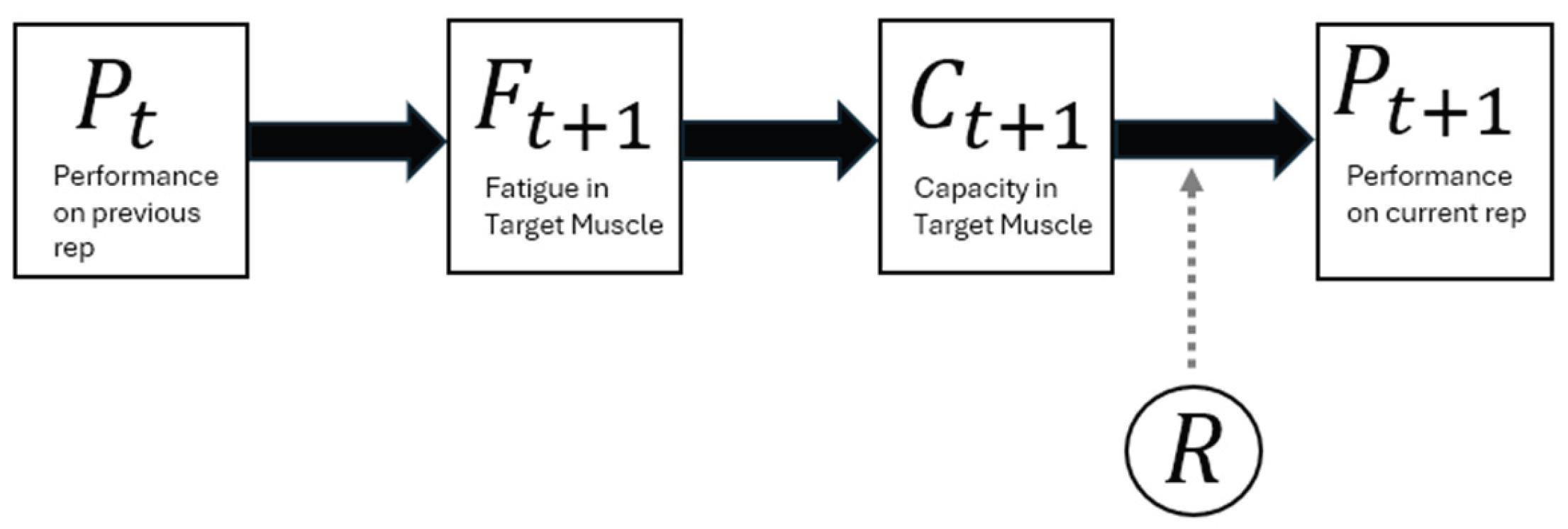
Figure 2.
Phase shift comparison between two types of training. (a) Depicts a hypothetical scenario where intent translates effectively into performance. For A, the region to the left of represents the “intent-limited” phase (), while the right represents the phase where capacity becomes more limiting (). Each lifter continues reps until they reach the performance requirement threshold (beyond which mechanical failure is implied). Lifter A fails at and lifter B fails at . Note that, as drawn, despite lifter B performing more reps, the area under the curve for lifter A (total effective stimulus) will be greater. (b) depicts where intent does not translate as effectively into performance, but higher intent can still induce more fatigue (e.g., machines, cables, or resistance bands). Under these conditions, lifter B may achieve a greater total training stimulus.
Figure 2.
Phase shift comparison between two types of training. (a) Depicts a hypothetical scenario where intent translates effectively into performance. For A, the region to the left of represents the “intent-limited” phase (), while the right represents the phase where capacity becomes more limiting (). Each lifter continues reps until they reach the performance requirement threshold (beyond which mechanical failure is implied). Lifter A fails at and lifter B fails at . Note that, as drawn, despite lifter B performing more reps, the area under the curve for lifter A (total effective stimulus) will be greater. (b) depicts where intent does not translate as effectively into performance, but higher intent can still induce more fatigue (e.g., machines, cables, or resistance bands). Under these conditions, lifter B may achieve a greater total training stimulus.
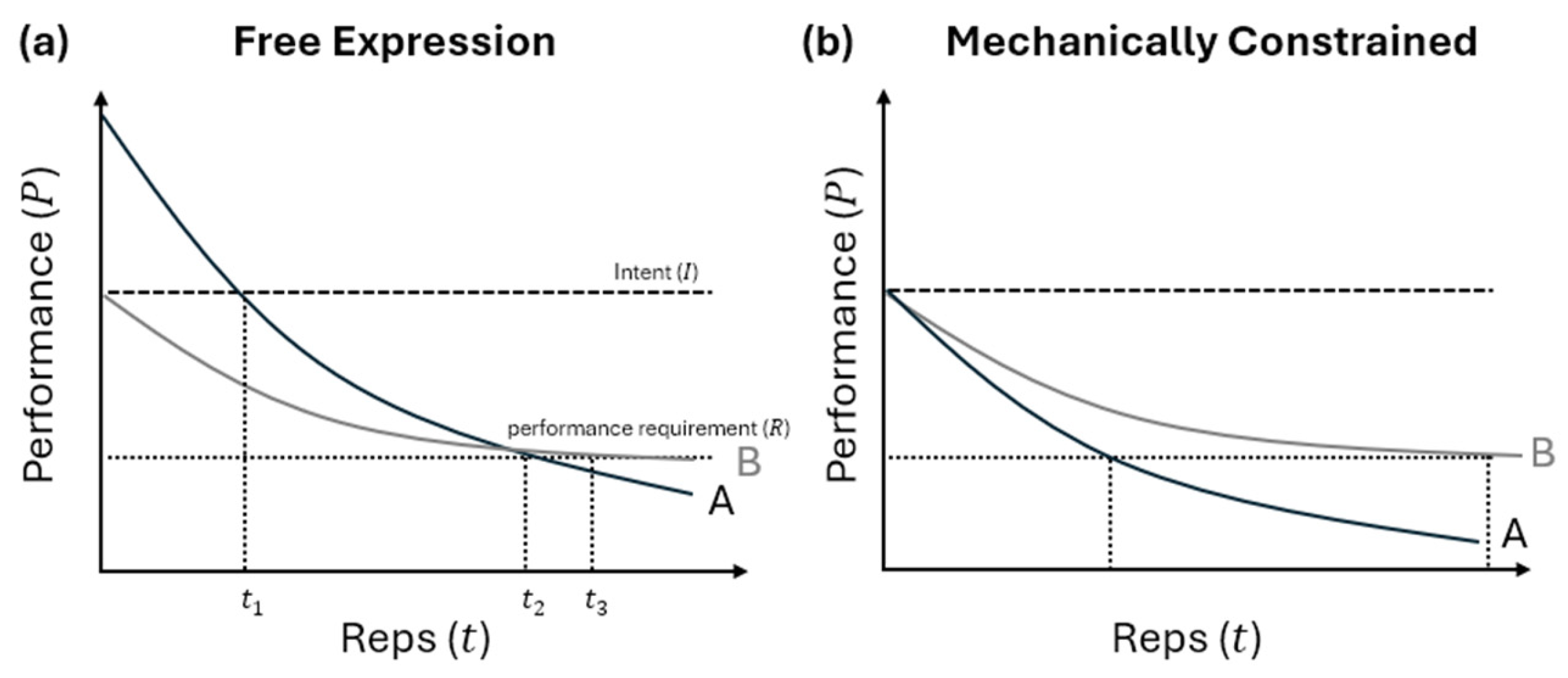
Figure 3.
Technique purity determines the allocation of fatigue and cumulative target-muscle stimulus within a set. Performance across repetitions within a set is shown for a high-purity technique (Panel A) and a low-purity technique (Panel B). Both panels condition on an equivalent set termination point (e.g., failure or prescribed stopping), abstracting away from the specific failure criterion. Shaded area under each curve represents cumulative fatigue localized to the target muscle. Under high technique purity, a larger proportion of total fatigue generated by each repetition is borne by the target muscle, leading to steeper within-set performance decline but greater cumulative target-muscle stimulus. Under low technique purity, fatigue is distributed across non-target systems, preserving apparent performance while reducing stimulus to the target muscle. Thus, steeper within-set performance collapse is a diagnostic signal of successful fatigue localization rather than inefficiency.
Figure 3.
Technique purity determines the allocation of fatigue and cumulative target-muscle stimulus within a set. Performance across repetitions within a set is shown for a high-purity technique (Panel A) and a low-purity technique (Panel B). Both panels condition on an equivalent set termination point (e.g., failure or prescribed stopping), abstracting away from the specific failure criterion. Shaded area under each curve represents cumulative fatigue localized to the target muscle. Under high technique purity, a larger proportion of total fatigue generated by each repetition is borne by the target muscle, leading to steeper within-set performance decline but greater cumulative target-muscle stimulus. Under low technique purity, fatigue is distributed across non-target systems, preserving apparent performance while reducing stimulus to the target muscle. Thus, steeper within-set performance collapse is a diagnostic signal of successful fatigue localization rather than inefficiency.
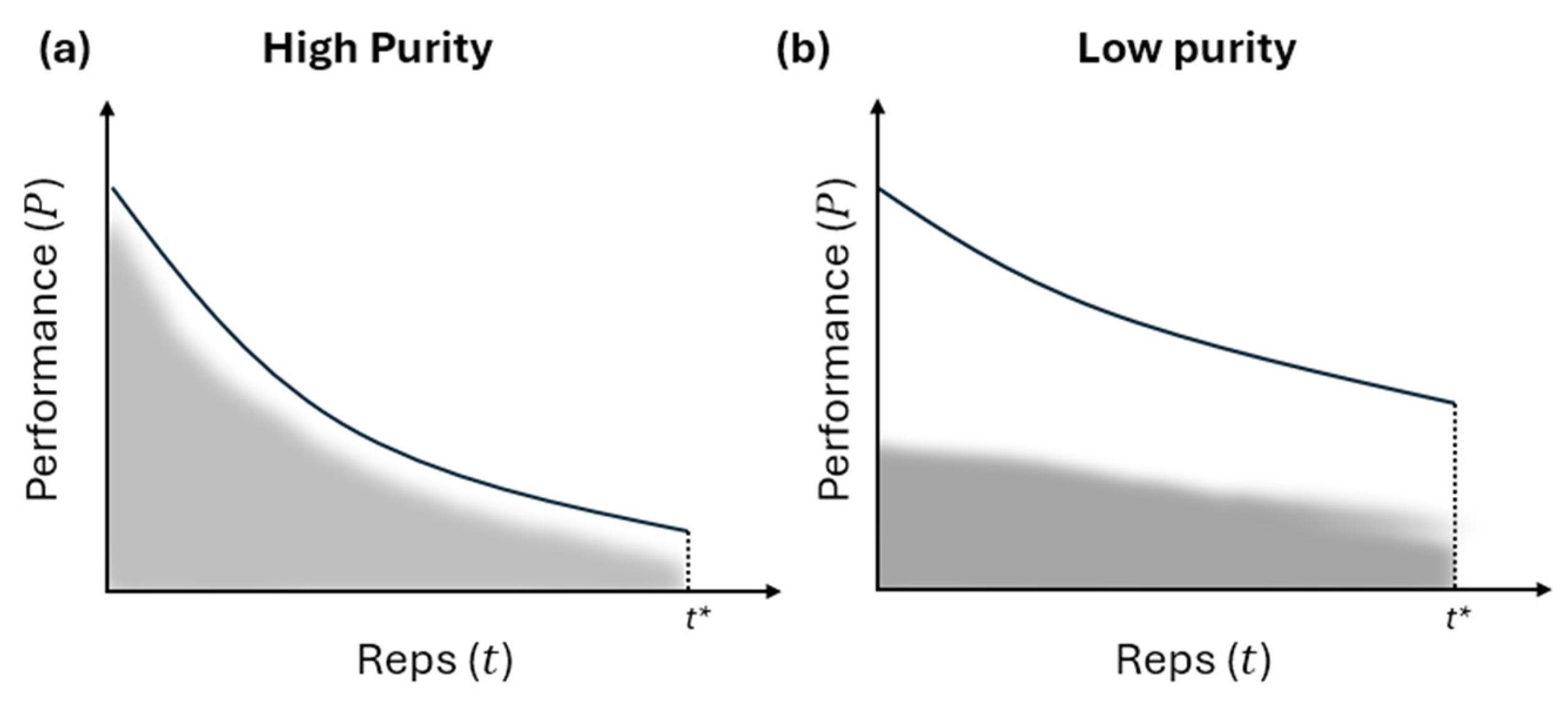
Figure 4.
Within-session fatigue profiles and across-session performance gains under high- and low-purity training. Hypothetical AMRAP across sets for high- vs low-purity exercises. High purity shows steeper within-session decline but larger upward shifts across sessions, indicating greater localized adaptation.
Figure 4.
Within-session fatigue profiles and across-session performance gains under high- and low-purity training. Hypothetical AMRAP across sets for high- vs low-purity exercises. High purity shows steeper within-session decline but larger upward shifts across sessions, indicating greater localized adaptation.
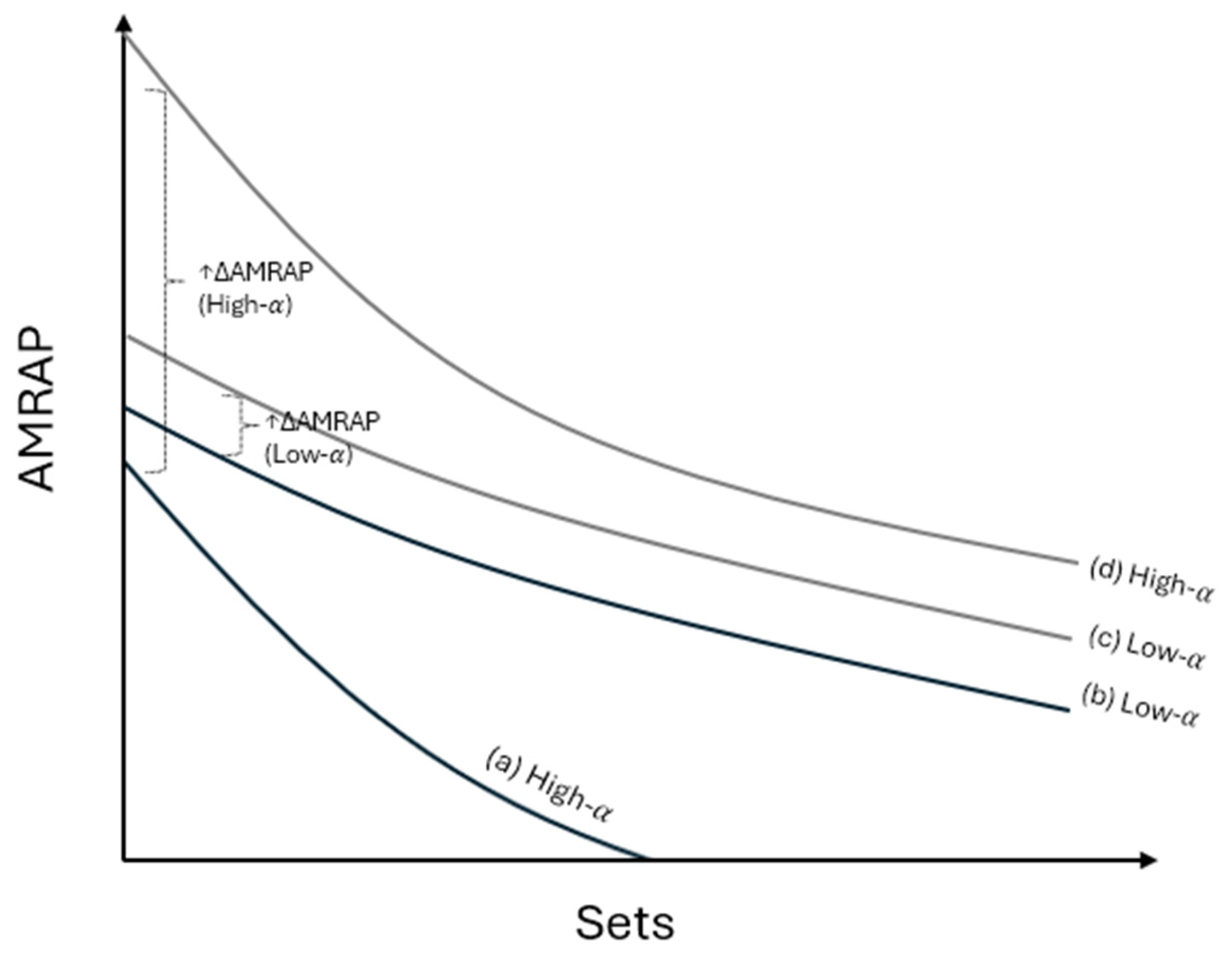

| Supplement | Primary Parameter Shift | Expected effect on the performance/rep curve | Predicted Diagnostic Change |
|---|---|---|---|
| Creatine | ↑ Initial capacity | Upward-shifted curve | Early reps (first 5–10) increase more than late reps at fixed load |
| Caffeine | ↑ Intent | Higher early curve, steeper late drop | Early/mid-set performance ↑; late collapse may steepen if unbuffered |
| Carbs / Electrolytes / Hydration | ↓ Fatigue per unit performance | Rightward shift | Minimal early effect; substantially more late reps and better multi-set endurance |
| Citrulline Malate | ↓ Metabolic fatigue (mid-set slope) | Flatter middle | Middle reps improve most; slope reduced in 10–25 rep region |
| Beta-alanine | ↑ Buffering of metabolic fatigue | Extended tail | Last 5–10 reps increase more than first 5–10 reps |
| Glycerol/hydration | ↓ Non-target/systemic fatigue | Delayed systemic limit | Better pump, lower perceived effort, improved later-set performance |
| Caffeine + Beta-alanine | ↑ Intent × ↓ Fatigue | High curve + long tail | Disproportionately large gains in middle-to-late reps (synergy) |
| Creatine + Citrulline | ↑ Capacity × ↓ Slope | Early lift + flatter middle | Early and mid-set improvements; better cross-load transfer |
| Stimulant without buffering | ↑ Intent only | Early surge, early crash | Faster failure in high-rep sets; exaggerated drop-offs |
Note. Predictions are based on stimulants general effects functioning “as advertised”, not empirical claims made here regarding their efficacy.
Disclaimer/Publisher’s Note: The statements, opinions and data contained in all publications are solely those of the individual author(s) and contributor(s) and not of MDPI and/or the editor(s). MDPI and/or the editor(s) disclaim responsibility for any injury to people or property resulting from any ideas, methods, instructions or products referred to in the content. |
© 2026 by the authors. Licensee MDPI, Basel, Switzerland. This article is an open access article distributed under the terms and conditions of the Creative Commons Attribution (CC BY) license (http://creativecommons.org/licenses/by/4.0/).
Copyright: This open access article is published under a Creative Commons CC BY 4.0 license, which permit the free download, distribution, and reuse, provided that the author and preprint are cited in any reuse.


