

Submitted:
09 March 2026
Posted:
11 March 2026
You are already at the latest version
Abstract
Velika Pasica Cave, 105 m long, 12 m deep, at an elevation of 670 m, situated in the central Slovenia (Europe) has only two to seven meters of thick roof and four permanent trickles from the epikarst zone. From this cave was described the second troglobitic beetle, Anophthalmus hirtus Sturm, 1853. It was about twenty years after the first species, Leptodirus hochenwarti Schmidt, 1832, was described from the cave Postojnska Jama (Slovenia). In the next decades nine more terrestrial species and subspecies were described from the cave belonging to groups Mollusca, Pseudoscorpiones, Collembola and Coleoptera. After 2000, intensive research of the pools and trickles revealed rich aquatic fauna, resulting in the description of four new species of Copepoda and two not yet determined epibiotic protozoans invading them. A complete list of terrestrial and aquatic fauna from the cave has never been published. To fill the gap, data from the literature as well as data from intensive field work in 2019 are presented here. Ninety three terrestrial and 36 aquatic taxa were recorded from the cave so far. Twenty nine aquatic (including two epibionts) and 18 terrestrial species are strict cave-dwelling organisms.
Keywords:
troglobionts
; stygobionts
; biodiversity
; epikarst
; habitats
; endemics
; ecology
1. Introduction
Velika 75. and is located next to the village Gornji Ig, 15 km south of Ljubljana (capital of Slovenia) at an elevation of 670 m in the Krim Massif (Figure 1). It is a short horizontal cave (105 m long), with maximum depth of 12 m at the bottom of two five m deep shafts. It is located in intensively dolomitized Jurassic limestone [1,2]. Hydrologically it is considered a dry cave with no permanent water flow [3].
The most recent studies on the hydrogeological age of the cave reveals that the very first galleries were formed more than five million years ago, at an elevation of about 300 m a. s. l. Since that time, geotectonic up-lift has raised it to the present day elevation which was actually reached about 1.8 million years ago. At that time and during the Pleistocene period there was active water flow through the cave, which alternatively filled and eroded older galleries as well as forming new ones. Active water flow stopped during the late Pleistocene (about 40 000 years ago) when the hydrologically active cave turned to a fossil one [4]. Along with geological up-lift followed a formation of deep valleys (up to 300 m deep) as a result of the erosion of two local rivers, the Iška and Borovniščica, and the Krim Massif became a kind of “biological island” separated from nearby areas hydrologically as well as by tectonic fractures which are reflected in several subterranean stenoendemic taxa confined to the Krim Massif only (on species / subspecies level) [3,5].
In 1831 a cave guide, Luka Čeč found the first ever-known troglobiotic beetle in the cave Postojnska Jama (at that time known as Adelsberg Grotte). The beetle was described in the next year as Leptodirus hochenwarti Schmidt, 1832. In 1847 more specimens of Leptodirus were found in the cave. In the same period some more troglobiotic/stygobiotic species were described from Postojnska Jama or nearby caves, namely: amphipods (Niphargus stygius (Schiodte, 1847)), isopods (Titanethes albus (Koch, 1841)) and decapods (Troglocaris anophthalmus (Kollar, 1848)) as well as several terrestrial arachnids, pseudoscorpions and beetles. It was in this period that a new branch of biology, “biospeleology” (or “speleobiology”) started, having its origin in Postojna (at that time named Adelsberg (German) and later Postumia (Italian) [6,7]. The findings of cave-dwelling species in the cave Postojnska Jama and other near-by touristic caves triggered a search for new cave-dwelling species not only in Slovenia but world-wide.
The very first mention of cave-dwelling species was actually a report of Johann Weikhard von Valvasor in his book “Die Ehre dess Hertzogthums Crain” (The Glory of the Duchy of Carniola), published in 1689. He described it as “cave dragon’s offspring”, from a spring near “Laibach, Crain” (nowadays Ljubljana, Slovenia). At that time it was not recognised as a strict cave-dwelling species. Later-on it was described as Proteus anguinus by Laurenti in 1768 [8].
Among the first localities where the search for cave-dwelling animals focussed, were already well-known touristic caves within an area at that time known as “Crain” (in German) or “Carniola” (in Italian) (present day central Slovenia): Postojnska Jama, Križna Jama, Želnjske Jame; Jama pod Predjamskim Gradom. Among them also was a small cave Velika Pasica (and some smaller nearby caves). The cave attracted occasional visitors due to proximity of the capital (Ljubljana), easy access by foot (about three hours walk from the city) and being technically rather simple to enter. The first documented visitor left his signature in the most distant chamber, about 90 m from the entrance; signed as “I. Virant 1841”. Afterwards, many visitors followed him, some of them well known specialists for different taxonomic groups, and added their signatures next to his [3,5].
Most of visitors were probably not attracted by the natural beauty of the cave but by the rush to discover new cave-dwelling species (= troglobionts) and later on for commercializing them. Anophthalmus hirtus Sturm, 1853 being the most sought after. It appeared that this species inhabited only Velika Pasica (in translation: Great Dog Cave) and some other nearby caves and was thus stenoendemic to the Krim Massif. Cave-dwelling aquatic fauna before the year 2000 was poorly studied there. There was only a record of one amphipod species (Niphargus stygius (Schiodte, 1847)) and one copepod species (Speocyclops infernus Kiefer, 1931). The situation changed afterwards when intensive studies on percolation water and adjacent pools fed it commenced [3,9].
Despite frequent visits of biospeleologists as well as specialists for certain groups of terrestrial animals in the last 180 years no comprehensive list of taxa living in the cave was compiled. The aim of this contribution is to present an up-to-date list of terrestrial and aquatic fauna found there.
2. Site Description
The cave entrance is at an elevation of 670 m (coordinates: 45o 55’ 07.72 N, 14o 29’ 35.19). It is an epikarstic cave, 105 m long; 12 m deep, with its roof between two and seven meters thick. The entrance into the cave is at the bottom of a ten m deep depression (doline). It is about 1 x 1 m in cross section, followed by about two meters of passageway. The passage extends into an entrance chamber, with a slope of about 20o – 30o inclination, which levels after about ten meters of descent. The rest of the cave is a rather simple horizontal gallery, about 4 x 6 m in cross-section, separated into three chambers by one narrow passage. It lies between the entrance chamber and the inner section, at about 30 m from the entrance, with a dimension of 0.8 m x 1 m and 0.5 m in length, situated at the level of the gallery floor (Figure 2, Figure 3 and Figure 4).
Due to the small entrance and deep entrance depression, the illuminated zone is limited to a few meters around the entrance. During the winter period, near the entrance ice cover (actually frozen soil and ice stalagmites) can be present a few meters into the cave. As the roof of the entrance room overreaches the level of the entrance, a “balloon” of relatively warm air (>8 oC) is present there all the time. The inner part of the cave is well protected with another narrow passage preventing cold air from entering interior parts of the cave. The temperature at the bottom of entrance chamber (at 1 m height) can vary on an inter-annual basis between 5 oC and 10 oC, while in the inner parts it oscillates between 8 oC and 10 oC. For other morphometric and physical details of the cave see [3].
Although the cave has no observable stream, there are four permanent drips of percolating water from the epikarst zone with discharge of a few drops per minute during the dry season to a few liters per minute during the rain or snowmelt period. During heavy rain or snowmelt some more temporary drips appear. Drip-water fills several small puddles on the bottom of the gallery. Their base is covered by mud or sinter and with a volume of a few milliliters to about ten liters of water each; only few of them being permanent. Most of the percolating water from the ceiling directly infiltrates through cracks on the floor into a near-by temporary spring located about 150 m north from the end-point of the cave and into a near-by roofed concrete reservoir with a volume of 400 m3 used in the past by local people for water supply [3]. Average year precipitation is about 1400 mm, ranging between 1064 mm to 2054 mm in the period 2000 – 2015 [10].
3. Material and Methods
Data on descriptions of new terrestrial species from the cave were collected from the literature (i.e., locus typicus) and some records from the National History Museum collection in Ljubljana.
In 2017 and 2018 terrestrial fauna were collected during a survey experiment, where pitfall traps were used with rotten meat as a bait. Traps were set on the floor of the cave for up to one week in monthly intervals. After inspection, animals were released. Additional information on terrestrial fauna was collected by the first author between 2006 and 2014 when he made photos of some terrestrial species.
An intensive survey of parietal and bottom-dwelling fauna was performed in April 2019. April was selected as the period, when hibernating species (troglophiles and trogloxenes) were still within the cave, mostly near the entrance. Over a period of two days a three-member team made a step-by-step inventory of the 105 m long gallery from the inner part of the cave towards the entrance. Specimens which could not be determined on-site were collected in vials and preserved in 70% alcohol. In parallel, most of the animals were photographed alive on-site.
Samples of leaf litter and soil, collected not far from the entrance, were taken out of the cave for an extraction of the arthropods, using Berlese funnel. Most of the animals were photographed under trinocular stereomicroscope afterwards.
Aquatic fauna were collected from small pools by pipette (a few milliliters volume) and from larger pools by a suction pump (collecting of up to five liters water) on several occasions between 2000 and 2014. Samples from the spring and the concrete reservoir were collected by hand net and drift net twice in 2012.
In the period from 2006 to 2014, continuous sampling of four permanent drips within the cave was performed and data on fauna composition, water discharge, water and air temperature were collected. Discharge and temperature data were collected by data logger (Delta-T Device Company, UK) on an hourly basis. Fauna were filtered within specially designed “Brancelj” bottles and samples were collected at approximately one month intervals (Figure 5). Mesh size in all sampling equipment was 60 µm [3,11,12]. In total, about 150 sampling visits to the cave were made between 2000 and 2014.
In the laboratory specimens were determined by the authors or were sent to specialists (see list in Acknowledgements).
4. Results
4.1. Terrestrial Fauna
Ninety three taxa have been recorded so far from the cave. Sixty one of them were determined to the species level (five of them labelled as cf. and two as gr.), 19 to the genus level and 13 to the family level (incl. as “morphotype” category). In the latter group several species were probably included, thus the actual number of species is higher (Table 1; Figure 6).
The list of terrestrial inhabitants spans from Gastropoda to Mammalia and includes 21 categories labelled as “higher taxon”. The most common are representatives of Arthropoda, extending from terrestrial Isopoda to Coleoptera (48 families), followed by Gastropoda (six families), Mammalia (three families) and Oligochaeta (one family).
Representatives of terrestrial fauna belong to four ecological categories: edaphic species, trogloxenes, troglophiles and troglobionts [13,14]. Some species/groups are difficult to address to an exact or only one ecological category. Twenty four of them are addressed as edaphic (mostly Collembola), 24 of them as trogloxene (incl. their edaphic preference), 27 as troglophiles (incl. their edaphic preference) and 18 as troglobionts. Troglobionts exhibit typical troglomorphic characters and have never been found outside caves [15]. Two terrestrial species (Ixodida = ticks) belong to epiparasites which were transferred into the cave by trogloxene mammals hibernating there and could also be considered as trogloxenes.
Nine species were described for the first time from the cave, thus it is designated as locus typicus for them (Table 1). For one species (Chthonius raridentatus Hadži, 1930) the cave was designated a paratype location, while holotype was described from a nearby cave.
4.2. Aquatic Fauna
Thirty six taxa were recorded so far in the hydrologically inactive cave, adjacent temporary spring and concrete reservoir. Twenty seven taxa were determined to the species level, five to the genus level and four to higher taxon (Table 2; Figure 7).
The list of aquatic inhabitants spans from Protozoa to Crustacea (Isopoda) and includes 12 higher taxa. The most common are representatives of Crustacea (seven families), followed by Protozoa, Rotifera and Oligochaeta (two families each). Three higher taxa (Turbellaria, Gastropoda and Polychaeta) are represented by one family each, while Nematoda includes several undetermined morphotypes with an unknown taxonomic position and number of families.
Representatives of aquatic fauna in the cave, spring and reservoir belong to three ecological categories: edaphic species, stygophiles and stygobionts [13,14]. One of them is edaphic and five are stygophile/edaphic (?) species. Twenty nine species (including two epibionts on Copepoda) are stygobionts, most of them, actually 22, drifted from the tiny fractures from the epikarst. Four species (Frauenfeldia kusceri, Hauffenia michleri, Niphargus stygius, Monolistra caeca), due to their body size, are limited to the pools and reservoir.
Four aquatic species were described for the first time from the cave, thus it is designated as locus typicus for them (Table 2). Three of them are known only from the cave and the fourth one was found also in the gravel bed of the river Iška, about 300 m below the cave. There are three more undetermined and undescribed species (two protozoans and one turbellarian) for which the cave could be locus typicus.
4.3. Biodiversity
In total, 129 taxa were so far recorded from the cave, belonging to different ecological groups. Some of them are strict epigean or edaphic species which entered the cave by accident, followed by two other groups with increasing affinity to a subterranean environment. The most specialized group are stygobionts and troglobionts, which are represented by 46 taxa (27 stygobionts and 19 troglobionts). So far, 14 new species were described from the cave (four stygobionts and ten troglobionts) and three more stygobionts are waiting to be identified.
At the family level, 129 species/taxa are included in 75 families. Most of the families include one or two species/taxa only. Among the aquatic fauna family Canthocamptidae includes 12 species, family Cyclopidae six species and among terrestrial fauna families Onychiuridae and Neanuridae includes four species each and family Carabidae three species (Table 1 and Table 2).
5. Discussion
5.1. General Comments
A complete list of terrestrial and aquatic fauna combined is available only recently for 19 caves throughout the world [16]. The lack of more complete lists is primarily because many of the caves were visited by specialists only once or only by specialist(s) for a certain group repeating visits to the same cave. For that reason it is more common to find extensive lists for a certain region or country as a sum of all troglobionts/stygobionts [17,18,19,20].
More complete are the lists for single caves (or cave systems) from North America and Europe, particularly in Slovenia and Bosnia and Herzegovina, where there is a long tradition of cave-fauna exploration [7,16]. The most intensively explored caves in Europe (and designated as “subterranean biodiversity hot spots”) are the Postojna-Planina Cave System (PPCS), Križna Jama, Logarček and Šica-Krka Cave System (Slovenia). Parallel to PPCS is Vjetrenica from Bosnia and Herzegovina, followed by Pestera de la Movile from Romania and Mammoth Cave System in the USA [16,21,22,23]. The lists of cave-dwelling species were slightly amended recently for the PPJS, Križna Jama and Vjetrenica, where PPJS hosts 116 species (71 sytgobionts and 45 troglobionts), Križna Jama 60 species (32 stygobionts and 28 troglobionts), and Vjetrenica 93 species (48 stygobionts and 45 troglobionts) [7,16,24,25]. The Lukina Jama-Trojama Cave System from Velebit Mt. (Croatia), discovered in 1992, was recently also put on the list of intensively studied caves, harboring 45 species (16 stygobionts and 25 troglobionts) [26]. Cave-dwelling species are also present in the deepest cave in the world, Krubera-Voronja Cave System (Caucasus; 2191 m deep), harbouring 16 species (2 stygobionts, 6 troglobionts) [27]. Velika Pasica completes the list with 47 species (29 stygobionts and 18 troglobionts), positioned it on the seventh place on the world scale [16]. Its position depends on complete troglobiont/stygobiont list.
All the above 19 listed caves, except for Pestera Movile and Velika Pasica, are complex ecosystems with the presence of all general cave zones. In the terrestrial parts entrance, transition and inner-cave zones are present while in the aquatic part there are epikarst, vadose, amphibious and phreatic zones. Each of those zones harbor many different habitats, some of them very specific (e.g., Pestera Movile with a hypoxic atmosphere dominated by sulphuric compounds) [28,29,30,31]. The caves are long and with several tens of meters of roof covering which supports water capacity storage and where the lowest parts reach the phreatic zone: the Mammoth Cave System (686 km long); the PPJS (34 km long); Križna Jama (8.3 km long); Vjetrenica (7.3 km long); Logarček (2.2 km long); Lukina Jama-Trojama (3.7 km long and 1431 m deep is a system of vertical shafts with sump at the bottom). Compared to these cave systems the Šica-Krka Cave System (0.8 km long) and Pestera Movile (0.3 km long) are rather short. Most of the listed caves, except the Lukina Jama-Trojama Cave System, have well developed horizontal galleries organised on several levels, interconnected with short shafts. The Pestera Movile Cave has no entrance zone as it was opened artificially [28].
At only 0.1 km long Velika Pasica with no active water flow and a thin roof is “disadvantaged” compared with large-size caves where both terrestrial and aquatic zones are well developed. In the terrestrial part of Velika Pasica all three zones exist (although in a small scale) and are comparable to other caves, while the aquatic part is truncated. The roof above the cave is only up to seven meters thick which reduces the capacity of water storage, although there are about 1400 mm of annual precipitation (rain and snow combined) [10]. During prolonged dry periods, drips from the ceiling cease or significantly reduce discharge. There are only four permanent drips and a reduced vadose zone, represented by a few temporary pools with a muddy or solid bottom, while permanent running water or a phreatic zone is completely absent. However, a limited amount of water supports rich aquatic fauna in the cave. The majority of them are epikarst stygobiotic species, permanently living in tiny fractures, voids and micropools between surface and the cave roof and walls or they belong to edaphic fauna. Capillarity in the fractured dolomitized rocks retains enough water during dry periods to keep the habitat wet enough to support epikarst fauna there. As a result of the tiny space available the body size of inhabitants rarely exceed 0.5 mm. During increased water discharge some of those animals are accidentally washed into small permanent or temporary pools on the gallery floor where after some time they die due to predation by larger species or due to drying out the pools [9]. They are representatives of “sink populations” unable to survive in other habitats [32,33].
Unlike the tiny epikarst inhabitants, Niphargus stygius, the only larger representative in the upper vadose zone (body size 15 mm +) survives dry periods in wet mud. Over several observations before pools dry-out for up to two months, small pits excavated by animals, were observed in the wet mud (Brancelj, pers. observ.). During prolonged dry periods surface layers can form deep cracks, but the mud stays permanently wet. When the pools were filled again by drip water, specimens re-appeared in a few hours/days and were very active.
5.2. Distribution of Species Within the Cave
The species distribution followed a classical pattern for terrestrial fauna - from torgloxenes/troglophiles near the entrance and transition zones to troglobionts in the inner zone [13,14,34]. Most representatives of the terrestrial fauna were present in the entrance chamber both in abundance and number of species, while the number of species and their specimens declined with distance from the entrance chamber. This distribution is correlated with available energy (particulate organic matter (POM) and dissolved organic matter (DOM) and microbial production [29]. Trogloxenes and troglophiles were rare after the narrow passage between entrance chamber and the inner part of the cave, as there POM is almost absent. Members of two trogloxene taxa (a dead adult of Trichoptera and larvae of Chyronomidae) were found only on two occasions in the inner part of the cave, about 80 m from the entrance, along with a skeleton of Rhinolophus hipposideros.
Troglobionts were present throughout whole cave length, but the majority of species were in the dark part of the entrance chamber. In the inner part only Haasia troglodytes, Triphleba aptina, Bythoxenus subterraneus and Anophtalmus hirtus were present. One specimen of Zospeum sp. was observed only once on the wet stalagmite in the inner part of the cave. The rest of the troglobionts were present only in the entrance chamber, where more organic material (including prey) is available.
Aquatic species mostly originate from the dripping water from the epikarst and are completely dependent on microbial production there. Long term filtration of epikarst water revealed no POM > 60 µm [3]. Four permanent drips constantly provided epikarst fauna in low abundance to adjacent pools. After heavy rain or snowmelt specimens are present in small pools (few milliliters to centiliters) all around the cave, and remain present until the pools dry out.
Long-term observations (between 2006 and 2014) revealed, that four drips located in a distance of 80 m, each support a unique fauna composition. Some copepod species were present in all four drips, while others only in one or two. The same observations pertained for other epikarst inhabitatnts (Protozoa, Rotifera, Oligochaeta, Ostracoda) [3]. Site-specific fauna composition is a reflection of ecological parameters within the epikarst, mainly voids size, local water storage capacity, discharge volume and pattern and connection with soil. Fauna from an intermittent spring, located about 150 m from the end point of the cave, indicates an un-accessible vadose zone as some species from the Table 2 were never recorded in the cave. However, the presence of some species from the cave in a drift from the intermittent spring indicates direct connection between both habitats (e.g., cave and temporary spring). All species, except Acanthocyclops venustus, Paracylops fimbriatus, Bryocamptus pygmaeus and Phyllognathopus vigueri collected during spring sampling, are stygobionts.
Two larger species (> 5 mm), Niphargus stygius and Monolistra caeca, were found in the reservoir. Both are common in springs, pools and streams in vadose zones in lowland caves. Their location in a hydrologically isolated area near the top of a hill (at elevation of 670 m) could be explained by intensive geological activity in the area, where the Krim Massif (and the cave) was uplifted by at least 300 m in the last five million years [4]. Their populations were probably formed at lower altitudes and were afterwards uplifted and become geographically and hydrologically isolated. The presence of Niphargus in intermittent pools within the cave suggests not only passive downward transport of animals (as drift) but also active migration upwards through small cracks. This is probably a reason why viable Niphargus population exists in two intermittent pools in the cave.
5.3. Trophic Dynamics
5.3.1. Terrestrial Fauna
Majority of terrestrial fauna from the cave belong to bacteriofags or detritiovorous. They feed on decay organic material rich with bacteria (representatives of Gatropoda, Oligochaeta, Isopoda, Diplopoda, Collembola, Acarina, Orthopetera). The top predators are represented by trogloxene Lithobiidae (Lithobius sp.), troglobiotic Pseudoscrorpions (Chthonius raridentatus, Globochthonius spelaeophilus, Neobisium (Blothrus) spelaeum), troglophile/trogloxene Araneane (with Meta menardi and Metallina merianaea as the most common) and troglobiotic/troglophile/trogloxene Coleoptera (excluding Curculionidae) (Table 1). Most of predators are present in the entrance chamber only, but some Colepotera (i.e., Anophthalmus hirtus). They are non-selective predators with direct contact with their prey (Lithobiidae, Pseudoscorpiones, Coleoptera) or opportunistic scavengers (Coleoptera). Opposite to them are representatives of Aranea, which collect their food passively by webs and are probably season-dependant on trogloxene Diptera entering the cave in autumn. Two representatives of Ixodida are epiparasites on Mammalia and are not directly involved in the food-web within the cave.
5.3.2. Aquatic Fauna
Most of representatives of aquatic fauna origin from the epikarst zone and belong to detritivores or bacteriophages. The only top predator is omnivorous Niphargus stygius (Amphipoda) (Table 2). It is opportunistic predator and scavenger which feed also by filtering sediment rich with biofilm. Two epibionts on Copepoda (Ciliata and Suctoria) are (probably) not directly involved in the food-web within the cave.
5.4. Interseasonal and Winter-Time Period Movements of Some Species
Some non-systematic observations were made on larger species of trogloxenes (representatives of Opiliones, Orthoptera, Lepidoptera, Chiroptera) present on the cave walls. The first observations were undertaken in the winter period of 2000 and afterwards several times during intensive studies on hydrological discharge and aquatic fauna composition, between May 2006 and August 2014 in the entrance chamber only [3].
Few Opiliones specimens were observed in the entrance chamber during the first visit of the cave in winter 2000, and they were absent after 2006.
Orthoptera specimens were rather common in the entrance chamber in winter time between 2000 and 2010 (estimated as about 200 specimens), but their population decreased afterwards (observed less than 100 individuals) and were almost absent in 2014. During the winter period they change their position between consecutive observations. They were distributed individually or in small groups (up to 5 individuals). Adults and juveniles were present. During warmer period they were absent from the cave.
Two representatives of Lepidoptera (Scoliopterix libatrix and Triphosa dubitata) exhibited slightly different behaviour. Specimens of both species were present only in the entrance chamber. Scoliopterix libatrix was rather rare in winter time (about 10 specimens). They remained permanently in the same location, as confirmed by the presence of rather large drops of condensed water on their wings. In contrast, the Triphosa dubitata population, occupying similar locations, was larger (about 30 specimens). Specimens probably changed their location from time to time as no drops of condensed water was observed on the wings of some specimens, while some of them had the drops. They were distributed individually or in groups of up to three individuals. At the end of the winter period several of them were dead, covered by mould. Both species were absent in the cave during the warmer periods.
A small population of bats (Rhinolophus hypposideros – up to ten and R. ferrumequinum – two specimens) were regularly observed in the entrance chamber during winter time and from time to time they changed their locations. They were absent during the warm season. The third species, Myotis emarginatus, was recorded only once in the entrance chamber in the winter period.
The European dormouse (Glis glis; polh in Slovenian) was never directly observed in the cave, but several trails were observed in the entrance chamber. However, there are several small holes (hole size from 10x10 cm to 20x10 cm) in the vicinity of the cave (in Slovenian called “polšna” = dormouse hole). In the past locals traditionally put traps at the mouth of the holes in October, to catch them. Animals are active from late April/May to late October feeding on buds, leaves, nuts and other seeds, but they then hibernate during the winter period.
Seasonal differences in terrestrial trogloxene and troglophile fauna composition, both in invertebrates as well as in vertebrates, are present both in temperate zones [35] as well as in tropical zones [36]. Among the best well-known and well-studied trogloxenes exibiting seasonal and daily dynamics, are the bats. In temperate zones they hibernate during the winter period, but some species use the caves for mating and raising their young [37,38].
5.5. Stenoendemic Species vs. Common Species
5.5.1. Terrestrial Fauna
Ten terrestrial species were described from Velika Pasica, but only one, Anophtalmus hirtus, is a strict stenoendemic for the Krim Massif. Two more species, Acherosoma largescutatum and Isotoma spelaea, could also be stenoendemic for the Krim Massif, but there is lack of data from nearby regions to confirm this. Two species, Anophthalmus schmidti motschulskyi and Typhlotrechus bilimeki hacqueti, are known from several caves in the Krim Massif and the nearby Mt. Mokrc (just across the river Iška). Another five species, described from the cave, have been recorded elsewhere in Slovenia and are considered Slovenian endemics. The remaining six troglobiotic species in Table 1 found in the cave are also present in a few caves in Bosnia and Herzegovina.
Probably three (or five) stenoendemic species evolved during the uplift of the Krim Massif within the last five million years, while the remaining troglobites, with wider distributions, are members of an older fauna.
5.5.2. Aquatic Fauna
In the epikarst above the cave each drip actually has a small local watershed (in the range of 100 m2 – 200 m2), where water drains vertically but lateral connections are rather limited [12,39]. This supports the hypothesis of “biological islands” within the epikarst where speciation occurs [12]. An example is the genus Morariopsis (Copepoda). There are three known species: M. scotenophila (Kiefer, 1930) – several locations in western Slovenia, M. dumonti Brancelj, 2000 – stenoendemic to the Krim Massif and M. kieferi Petkovski, 1959 – several locations in Herzegovina [40]. Morariopsis dumonti occurs between populations of the other two species. The evolution of stenoendemic species probably resulted from a combination of confined watersheds in the epikarst coupled with the uplift of the Krim Massif within the last five million years, which further contributed to hydrological isolation. Ancestors of either M. scotenophila or M. kieferi became “trapped” within the uplifting Krim Massif, where further speciation took place. The same principle is valid for three other aquatic stenoendemic species: Elaphoidella millennii, E. tarmani and Maraenobiotus slovenicus. Apart from the stenoendemic species there are several common species, occurring in different habitats in Slovenia and across Europe that show no morphological differences compared to other populations. However, a detailed genetic analyses is required to reveal the potential presence of cryptic species and lineages amongst them.
6. Conclusions
Velika Pasica has a high biodiversity due to geological activity in the last five million years when uplift processes formed the Krim Massif and isolated it from surrounding areas. This resulted in several stenoendemics, both in terrestrial as well as aquatic fauna. A high level on biodiversity knowledge results from about 180 years of intensive speleobiological research there, especially after 2000.
Although Velika Pasica is rather small and shallow, with truncated habitats, its troglobionts/stygobionts biodiversity is comparable with the longest horizontal caves elsewhere the world (Mammoth Cave System; PPJS, Križna Jama, Vjetrenica or deep caves (Lukina Jama-Trojama Cave, Krubera-Voronja Cave). Techniques and methods for study of terrestrial and larger aquatic fauna are rather similar world-wide. Most studies employ pit-fall traps with different types of baits, Berlese funnel and the individual picking of specimens for terrestrial fauna. Traps with some types of bait, coarse nets (with mesh size > 1 mm) or individual picking are used for aquatic fauna. In most of studies fine nets, with mesh size < 0.1 mm, are rarely used. The result is almost a complete exclusion of an important element of cave-dwelling fauna (Ostracoda, Copepoda), including that from the epikarst zone, which contribute significantly to aquatic biodiversity.
When more sampling will be done on aquatic microfauna elsewhere, Velika Pasica will lost its position among top ten caves with the highest total biodiversity, combined terrestrial and aquatic. Due to intensive studies in the cave no additional cave-dwelling species are expected.
Final conclusion: it is not important length of a cave, but persistence, sampling techniques and specialists’ interest to get a long list of cave-dwellers.
Author Contributions
Conceptualizations AB; original draft preparation AB; review and editing AB, JL,BL; visualization AB, BL; taxonomic identification AB, JL, BL; distribution samples to specialists JL; corresponding author AB. All authors have read and agreed to the published version of the manuscript.
Funding
Authors received no extra funding for research. Part of research for AB was supported by Slovenian Research Agency (ARRS; recently ARIS) through P1-0255 program. JL and BL made research voluntarily.
Institutional Review Board Statement
Not applicable.
Acknowledgments
The authors would like to express gratitude to specialist colleagues, who identified part of the collected material, namely to: Quentin Wackenheim, Rajko Slapnik and Jozef Grego for Mollusca; Beatrice Sambugar for aquatic Annelida; Kevin Hoeffner for Lumbricidae; Stefano Taiti for Isopoda; Pavel Stoev for Diplopoda; Tomi Trilar for Ixodidae; Gardini Giulio for Pseudoscorpiones; Alberto Sendra and Teo Delić for Diplura and Pauropoda; Louis Deharveng for Collembola; Gennaro Coppa for Trichoptera; Andrej Kapla for Coleoptera; Primož Presetnik for Chiroptera. Acknowledgement also to Simon Parick who revised English version of the text.
Conflicts of Interest
The authors declare no conflict of interest.
References
- (* - original description of the taxon from Velika Pasica listed in Table 1 and Table 2):
- Pleničar, M. Tolmač k Osnovni geološki karti SFRJ. List Postojna: 62. Zvezni geološki zavod Beograd (= Basic geological survey; section Postojna). 1970. [Google Scholar]
- Miler, M.; Pavšič, J. Triassic and Jurassic beds in Krim Mountain area (Slovenia). Geologija 2008, 51, 87–99. [Google Scholar] [CrossRef]
- Brancelj, A. Jama Velika Pasica – zgodovina, okolje in življenje v njej / The Velika Pasica Cave – the history, environment and life in it; Založba ZRC in Nacionalni Inštitut za Biologijo / ZRC Publishing and National Institute of Biology: Ljubljana, Slovenia, 2015; pp. 1–110. [Google Scholar]
- Mihevc, A†.; Horáček, I.; Zupan Hajna, N.; Woodhead, J.; Brancelj, A. Paleoenvironmental and neotectonic insights from the Pliocene fossil record of Velika Pasica Cave, Slovenia: implications for karst system evolution. Acta Carsol. 2025, 54, 39–55. [Google Scholar] [CrossRef]
- Kapla, A.; Vrezec, A. Cave beetle fauna (Coleoptera) of Mt. Krim (Dinaric Alps, Central Slovenia): history of research and faunistic isolation - Favna jamskih hroščev (Coleoptera) Krima (Dinaridi, osrednja Slovenija): zgodovina raziskanosti in favnistična izoliranost. Acta entomol. Slovenica 2017, 25, 123–140. [Google Scholar]
- Polak, S. Importance of discovery of the first cave beetle Leptodorus hochenwartii Schmidt, 1832. Endins 2005, 28, 71–80. [Google Scholar]
- Zagmajster, M.; Polak, S.; Fišer, C. Postojna-Planina Cave System in Slovenia, a hotspot of subterranean biodiversity and a cradle of speleobiology. Diversity 2021, 13, 271. [Google Scholar] [CrossRef]
- Sket, B. Distribution of Proteus (Amphibia: Urodela: Proteidae) and its possible explanation. J. Biogeogr. 1997, 24, 263–280. [Google Scholar] [CrossRef]
- Brancelj, A. Microdistribution and high diversity of Copepoda (Crustacea) in a small cave in central Slovenia. Hydrobiologia 2002, 477, 59–72. [Google Scholar] [CrossRef]
- ARSO (Slovenian Environment Agency). 2026. Available online: https://meteo.arso.gov.si/met/archive (accessed on 5 January 2026).
- Brancelj, A. Biological sampling methods for epikarst water. In Epikarst, Proceedings of the symposium held October 1 through 4, 2003; Shepherdstown, West Virginia, USA, Jones, W.K., Culver, D.C., Herman, J.S., Eds.; Karst Waters Institute: Charles Town, USA; Special Publish, 2004; Volume 9, pp. 99–103. [Google Scholar]
- Culver, D.C.; Brancelj, A.; Pipan, T. Epikarst communities. In Encyclopedia of caves, 3rd ed.; White, W.B., Culver, D.C., Pipan, T., Eds.; Elsevier Academic Press: London, UK, 2019; pp. 399–406. [Google Scholar] [CrossRef]
- Sket, B. Can we agree on an ecological classification of subterranean animals? J. Nat. Hist. 2008, 42, 1549–1463. [Google Scholar] [CrossRef]
- Trajano, E. Evolution of lineages. In Encyclopedia of caves; Culver, D.C., White, W.B., Eds.; Elsevier Academic Press: Amsterdam, Netherland, 2005; pp. 275–277. [Google Scholar]
- Christiansen, K. Morphological adaptations. In Encyclopedia of caves; Culver, D.C., White, W.B., Eds.; Elsevier Academic Press: Amsterdam, Netherland, 2005; pp. 386–397. [Google Scholar]
- Deharveng, L.; Bedos, A.; Pipan, T.; Culver, D.C. Global Subterranean Biodiversity: A Unique Pattern. Diversity 2024, 16, 157. [Google Scholar] [CrossRef]
- Stoch, F. La fauna cavernicola delle Prealpi Giulie Setentrionalli. Mem. Ist. It. Spel 2008, 20, 97–121. [Google Scholar]
- Ozimec, R.; Bedek, J.; Gottstein, S.; Jalžić, B.; Slapnik, R.; Štamol, V.; Bilandžija, H.; Dražina, T.; Kletečki, E.; Komerički, A.; Lukić, M.; Pavlek, M. Red book of Croatian cave-dwelling fauna; Ministry of Culture, State Institute for Nature Protection: Zagreb, Croatia, 2009; pp. 1–373. [Google Scholar]
- Kováč, Ľ.; Elhottová, D.; Mock, A.; Nováková, A.; Krištůfek, V.; Chroňáková, A.; Lukešová, A.; Mulec, J.; Košel, V.; Papáč, V.; Ľuptáčik, P.; Uhrin, M.; Višňovská, Z.; Hudec, I.; Gaál, Ľ.; Bella, P. The cave biota of Slovakia; State Nature Conservancy SR, Slovak Caves Administration: Liptovský Mikuláš, Slovakia, 2014; pp. 1–192. [Google Scholar]
- Jantarit, S.; Ellis, M. The cave fauna of Thailand.; Prince of Songkcla University: Hat Yai, Thailand, 2023; pp. 1–374. [Google Scholar]
- Culver, D.C.; Sket, B. Hotspots of subterranean biodiversity in caves and wells. J. Cave Karst Stud. 2000, 62, 11–17. [Google Scholar]
- Culver, D.C.; Sket, B. Biological monitoring in caves. Acta Carsol. 2002, 31, 55–64. [Google Scholar] [CrossRef]
- Brucker, R.W. Mammoth Cave System, Kentucky. In Encyclopedia of caves, 3rd ed.
- White, W.B.; Culver, D.C.; Pipan, T. (Eds.) Elsevier Academic Press; London, UK, 2019; pp. 669–667. [Google Scholar] [CrossRef]
- Polak, S.; Pipan, T. The subterranean fauna of Križna Jama, Slovenia. Diversity 2021, 13, 210. [Google Scholar] [CrossRef]
- Delić, T.; Pipan, T.; Ozimec, R.; Culver, D. C.; Zagmajster, M. The subterranean species of the Vjetrenica Cave System in Bosnia and Herzegovina. Diversity 2023, 15(8), 912. [Google Scholar] [CrossRef]
- Lukić, M.; Fišer, C.; Delić, T.; Bilandžija, H.; Pavlek, M.; Komerički, A.; Dražina, T.; Jalžić, B.; Ozimec, R.; Slapnik, R.; Bedek, J. Subterranean Fauna of the Lukina Jama –Trojama Cave System in Croatia: The Deepest Cave in the Dinaric Karst. Diversity 2023, 15, 726. [Google Scholar] [CrossRef]
- Sendra, A.; Reboleira, A.S.P.S. The world deepest subterranean community – Krubera-Voronja Cave (Western Caucasus). Int. J. Speleol. 2012, 41(2), 221–230. [Google Scholar] [CrossRef]
- Sarbu, S.M.; Kane, T.C.; Kinkle, B.K. A chemoautotrophically based cave ecosystem. Science 1996, 272, 1953–1955. [Google Scholar] [CrossRef] [PubMed]
- Simon, K.S. Cave ecosystems. In Encyclopedia of caves, 3rd ed.; White, W.B., Culver, D.C., Pipan, T., Eds.; Elsevier Academic Press: London, UK, 2019; pp. 223–226. [Google Scholar] [CrossRef]
- William, B. W. Entrances. In Encyclopedia of caves, 3rd ed.; White, W.B., Culver, D.C., Pipan, T., Eds.; Elsevier Academic Press: London, UK, 2019; pp. 380–386. [Google Scholar] [CrossRef]
- Brancelj, A.; Stoch, F. The ecology of aquatic cave environments. In Encyclopedia of inland waters, 2nd ed.; Mehner, T., Tockner, K., Eds.; Elsevier: Amsterdam, Netherland, 2022; pp. 449–459. [Google Scholar] [CrossRef]
- Brancelj, A.; Culver, D. C. Epikarst communities. In Encyclopedia of caves, 2nd ed.; Culver, D.C., White, W.B., Eds.; Elsevier Academic Press: Amsterdam, Netherland, 2005; Volume1, pp. 223–229. [Google Scholar]
- *Brancelj, A. Fauna of an unsaturated karstic zone in central Slovenia: two new species of Harpacticoida (Crustacea: Copepoda), Elaphoidella millennii n. sp. and E. tarmani n. sp., their ecology and morphological adaptations. Hydrobiologia 2009, 621, 85–104. [Google Scholar] [CrossRef]
- Lunghi, E.; Manenti, R. Cave communities: from surface border to the deep darkness. Diversity 2020, 12, 167. [Google Scholar] [CrossRef]
- Lunghi, E.; Manenti, R.; Ficetola, G.F. Cave features, seasonality and subterranean distribution of non-obligate cave dwellers. PeerJ 2017. [Google Scholar] [CrossRef]
- Pellegrini, T.G.; Ferreira, R.L. Are inner cave communities more stable than entrance communities in Lapa Nova show cave? Subterr. Biol. 2016, 20, 15–37. [Google Scholar] [CrossRef]
- Murray, S.W.; Kunz; Bats, T.H. Encyclopedia of caves; Culver, D.C., White, W.B., Eds.; Elsevier Academic Press: Amsterdam, Netherland, 2005; pp. 39–45. [Google Scholar]
- Zagmajster; Bats, M. Encyclopedia of caves, 3rd ed.; White, W.B., Culver, D.C., Pipan, T., Eds.; Elsevier Academic Press: London, UK, 2019; pp. 94–101. [Google Scholar] [CrossRef]
- Bakalowicz; Epikarst, M. Encyclopedia of caves, 3rd ed.; White, W.B., Culver, D.C., Pipan, T., Eds.; Elsevier Academic Press: London, UK, 2019; pp. 394–398. [Google Scholar] [CrossRef]
- *Brancelj, A. Morariopsis dumonti n. sp. (Crustacea: Copepoda: Harpacticoida) – a new species from an unsaturated karstic zone in Slovenia. Hydrobiologia 2000, 436, 73–80. [Google Scholar] [CrossRef]
- *Frauenfeld, G. Die Gattung Carychium. Sitzungsberichte der Akad. der Wissenschaften 1856, 19, 70–94. [Google Scholar]
- *Frauenfeld, G. Über einen bisher verkannten Laufkäfer, beschrieben von L. Müller; und einen neuen augenlosen Rüsselkäfer, beschrieben von F. Schmidt; ferner einige von Schmidt in Schischka neu entdeckte Höhlenthiere. Verhandlungen der kaiserlich-königlichen zoologisch-botanischen Gesellschaft in Wien (Abhandlungen) 1854, 4, 23–34. [Google Scholar]
- *Strasser, K. Neue Acherosomen. Prirodosl. Razpr. 1935, 2, 231–244. [Google Scholar]
- *Hadži, J. Contribution à la connaissance des Pseudoscorpiones cavernicoles. Glas. Acad. Serbe 1930, 140, 1–36. [Google Scholar]
- *Joseph, G. Systematisches Verzeichniss der in den Tropfstein-Grotten von Krain einheimischen Arthropoden nebst Diagnosen der vom Verfasser entdeckten und bisher noch nicht beschriebenen Arten. Schluss der Abhandlung: Efahrungen im wissenschaftlichen Sammeln und Beobachten der den Krainer Tropfsteingrotten eigenen Arthropoden. Berliner Entomol. Zeitschrift 1882, 26, 1–50. [Google Scholar]
- *Sturm, F. Deutschland Insecten. In Kosten des Verfassers, Nürenberg; Volume 1853, pp. 22–93.
- *Schmidt, F. Drei Neue Hölenkäfer aus Krain. Verhandlungen des Zoologisch-Botanischen Vereins in Wien 1860, 10, 669–672. [Google Scholar]
- *Schmidt, F. Beschreibung zweier neuer Höhentiere, eines Käfers und einer Schnecke. Verhandlungen Zoologisch-Botanischen Vereins in Wien 1855, 5, 3–4. [Google Scholar]
- *Motschulsky, V. Études Entomologiques 7; Imprimerie de la Société de Litérature Finnoise: Helsingfors, Russia, 1858; pp. 1–191. [Google Scholar]
- *Brancelj, A.; Karanović, T. A new subterranean Maraenobiotus (Crustacea: Copepoda) from Slovenia challenges the concept of polymorphic and widely distributed harpacticoids. J. Nat. Hist. 2015, 49, 45–48. [Google Scholar] [CrossRef]
Figure 1.
(a) Europe; (b) Slovenia: pentagram – Ljubljana (capital), triangle – Velika Pasica; (c) detail position of Velika Pasica: triangle – entrance to the cave; circle – Krim Mt. (1107 m high); arrow – direction to Ljubljana (capital); (d) panoramic view of the Krim Massif: arrow indicates the cave location. (Photo: A. Brancelj).
Figure 1.
(a) Europe; (b) Slovenia: pentagram – Ljubljana (capital), triangle – Velika Pasica; (c) detail position of Velika Pasica: triangle – entrance to the cave; circle – Krim Mt. (1107 m high); arrow – direction to Ljubljana (capital); (d) panoramic view of the Krim Massif: arrow indicates the cave location. (Photo: A. Brancelj).
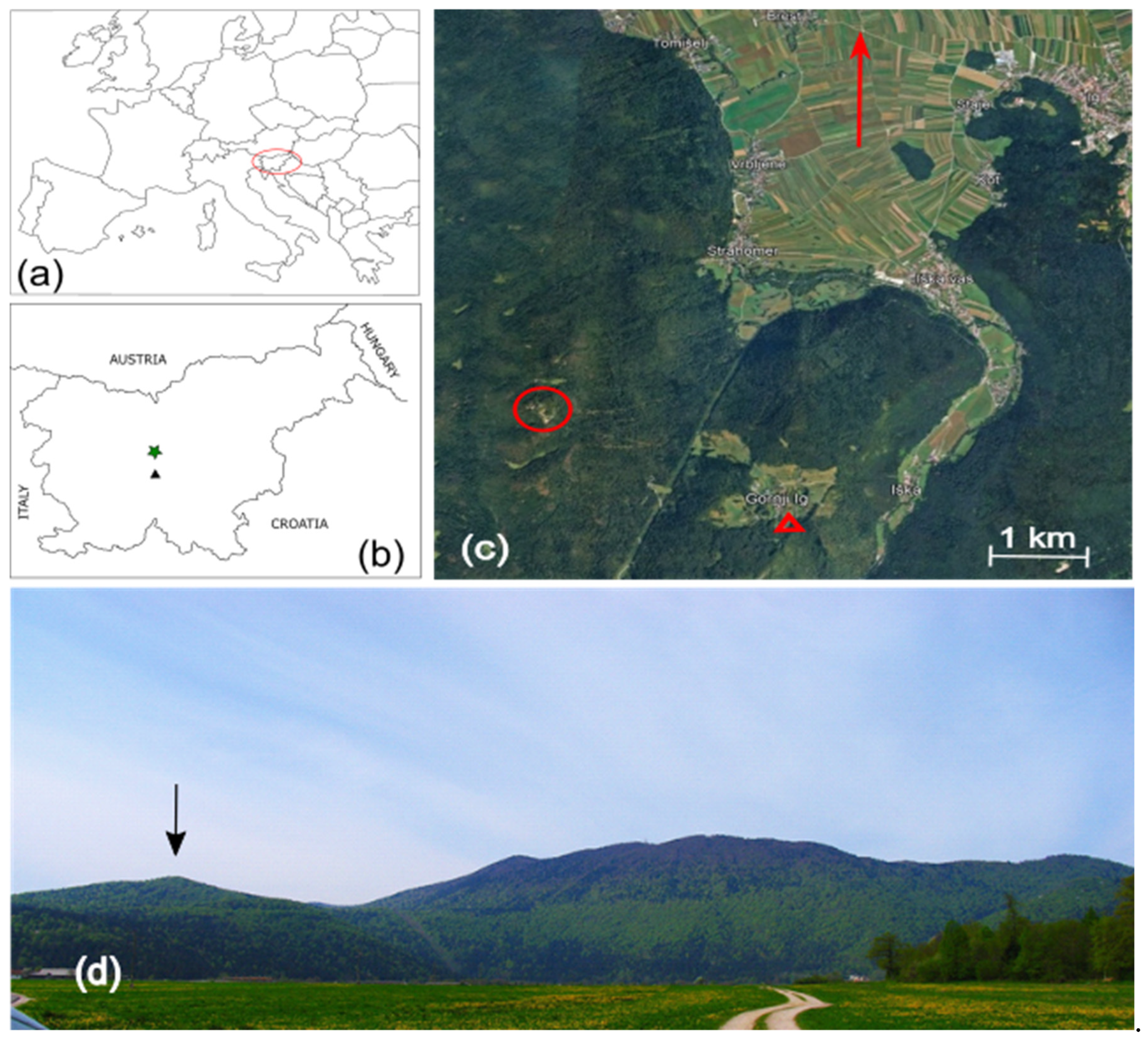
Figure 2.
Plan of Velika Pasica (Slovenia). (Cartography: A. Brancelj and P. Dular).
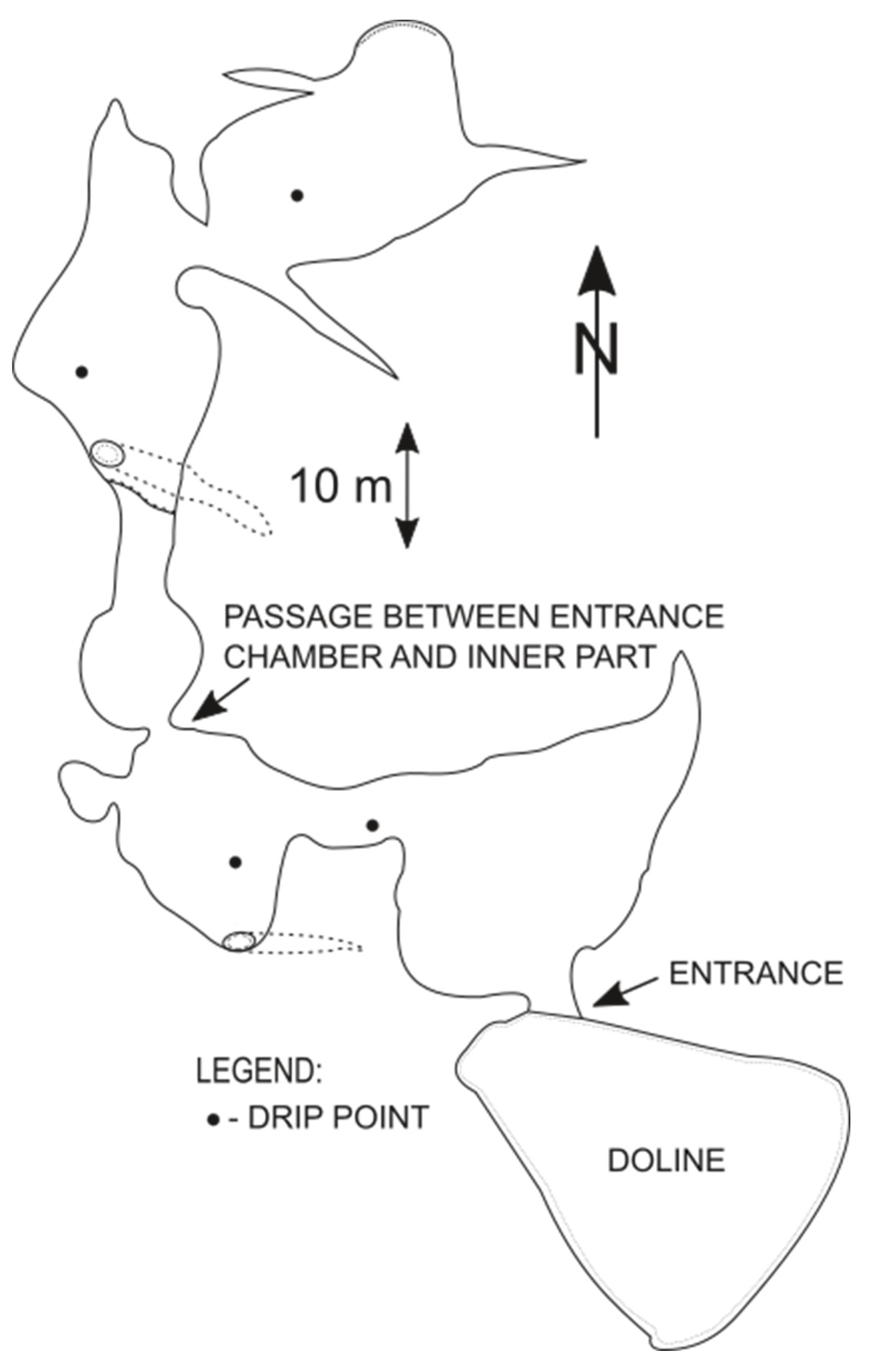
Figure 3.
Cross-section of Velika Pasica (Slovenia). (Cartography: A. Brancelj and P. Dular).
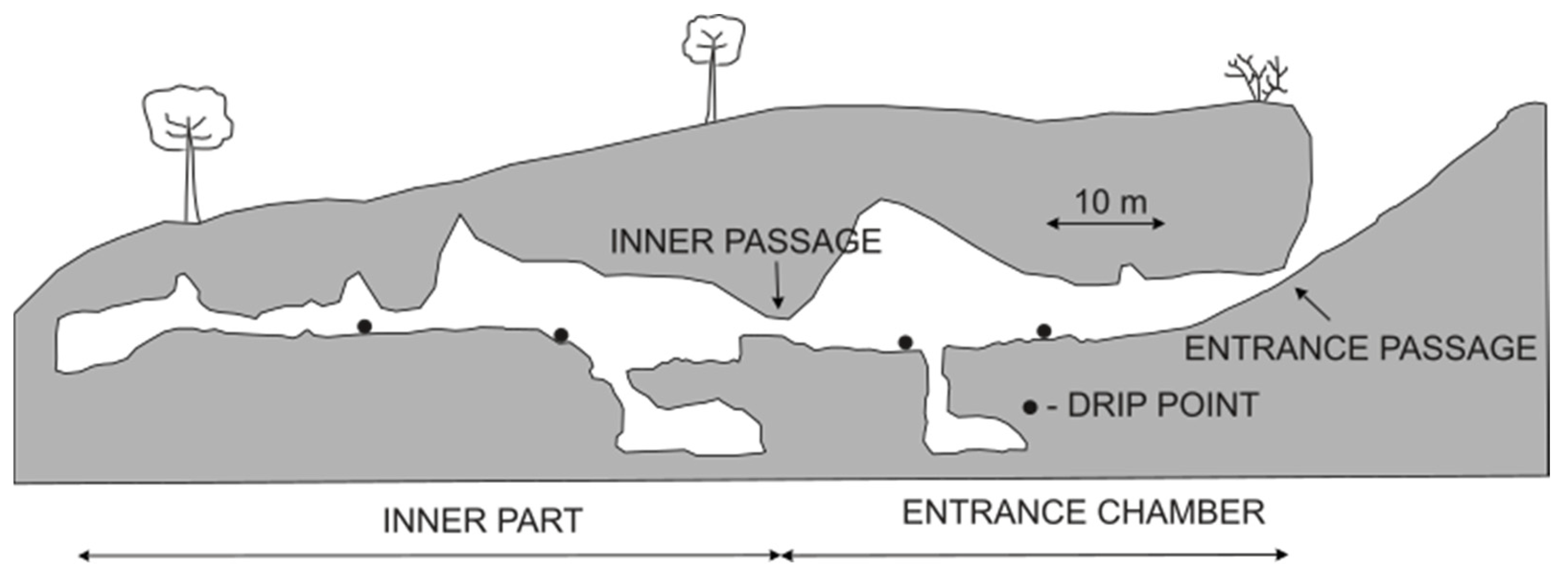
Figure 4.
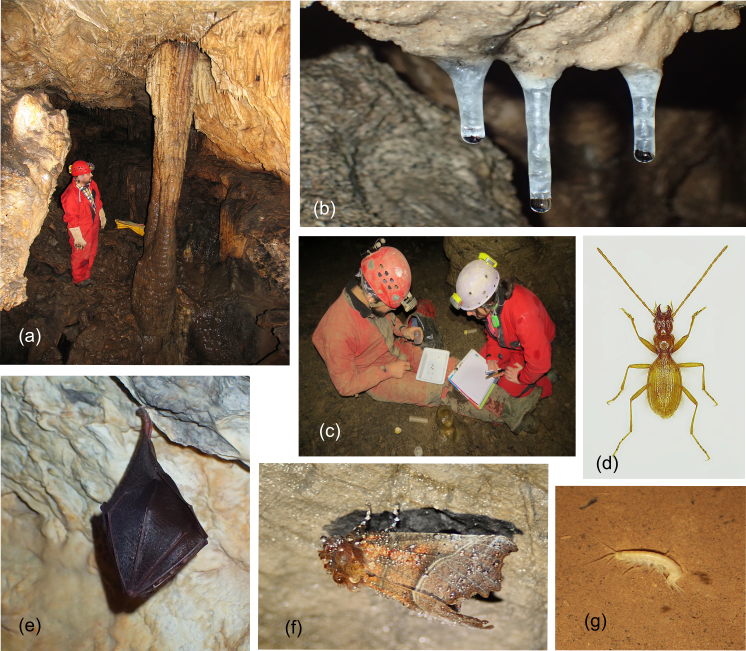
Details from Velika Pasica (Slovenia). (Photos: A. Brancelj (left); D. Tome (right)).
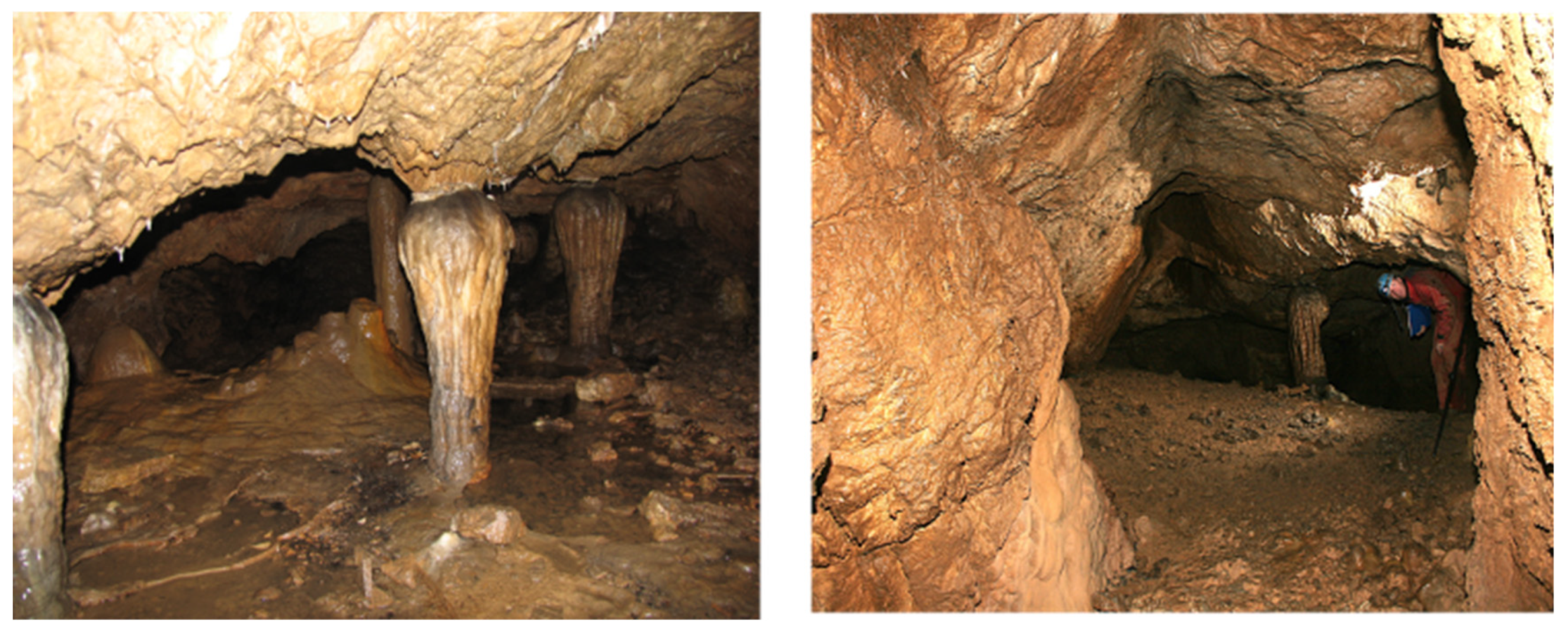
Figure 5.
A sampling station to measure discharge and water temperature and collect aquatic fauna from the epikarst. (Photo: A. Brancelj).
Figure 5.
A sampling station to measure discharge and water temperature and collect aquatic fauna from the epikarst. (Photo: A. Brancelj).
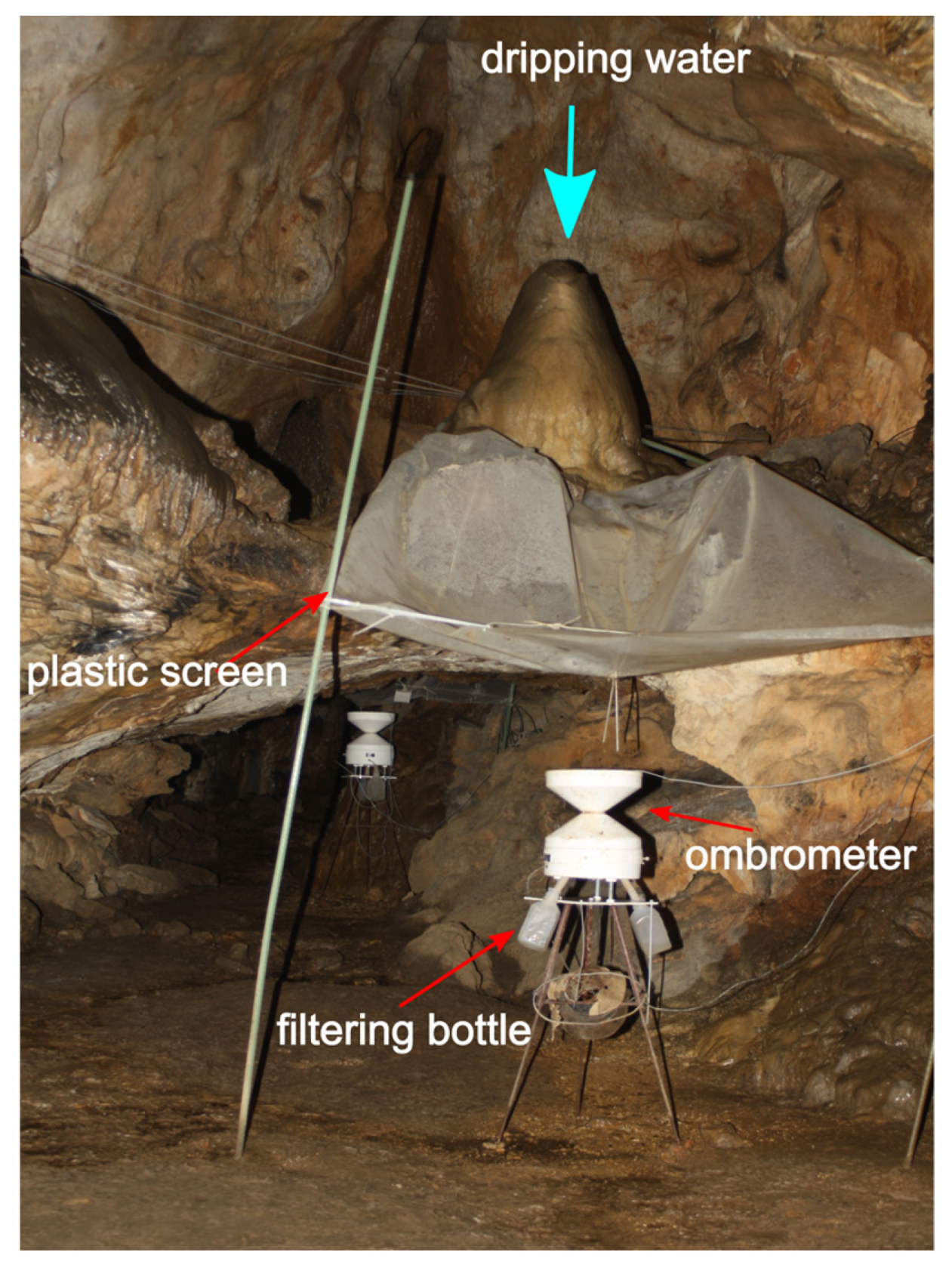
Figure 6.
Troglobionts from Velika Pasica (Slovenia). (a) Zospeum sp.; (b) Androniscus stygius; (c) Acherosoma largescutatum; (d) Brachydesmus subterraneus; (e) Globochthonius spelaeophilus; (f) Neobisium (Blothrus) spelaeum; (g) Tritomurus sp.; (h) Anophthalmus hirtus. (Photos: A. Brancelj – (b), (d), (h); T. Delić – (a); B. Lips – (c), (e), (f), (g)).
Figure 6.
Troglobionts from Velika Pasica (Slovenia). (a) Zospeum sp.; (b) Androniscus stygius; (c) Acherosoma largescutatum; (d) Brachydesmus subterraneus; (e) Globochthonius spelaeophilus; (f) Neobisium (Blothrus) spelaeum; (g) Tritomurus sp.; (h) Anophthalmus hirtus. (Photos: A. Brancelj – (b), (d), (h); T. Delić – (a); B. Lips – (c), (e), (f), (g)).
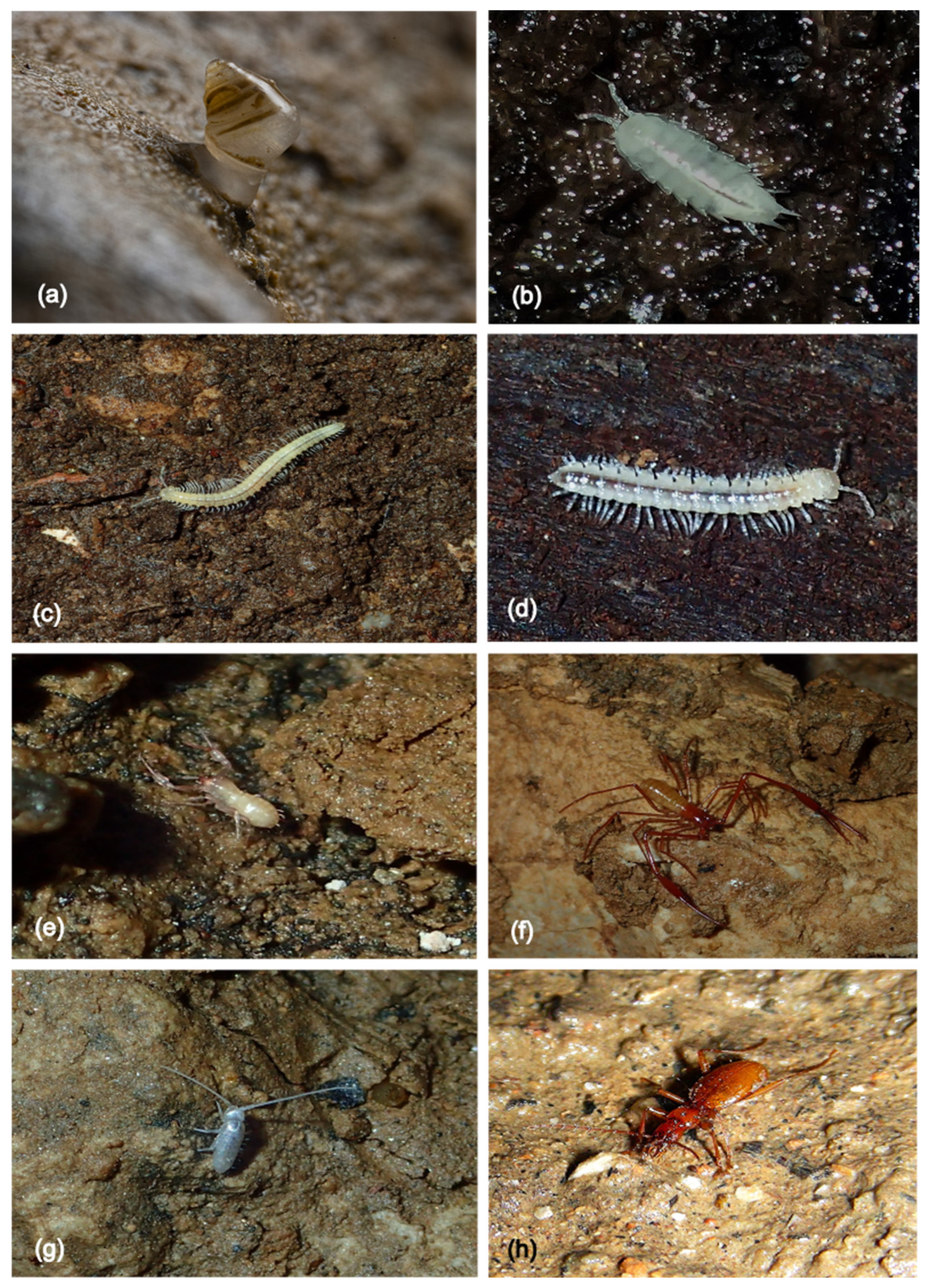
Figure 7.
Stygobionts from Velika Pasica (Slovenia). (a) Morariopsis dumonti from the epikarst heavily infested by Suctoria epibionts; (b) Niphargus stygius in a muddy pool. (Photos: A. Brancelj).
Figure 7.
Stygobionts from Velika Pasica (Slovenia). (a) Morariopsis dumonti from the epikarst heavily infested by Suctoria epibionts; (b) Niphargus stygius in a muddy pool. (Photos: A. Brancelj).
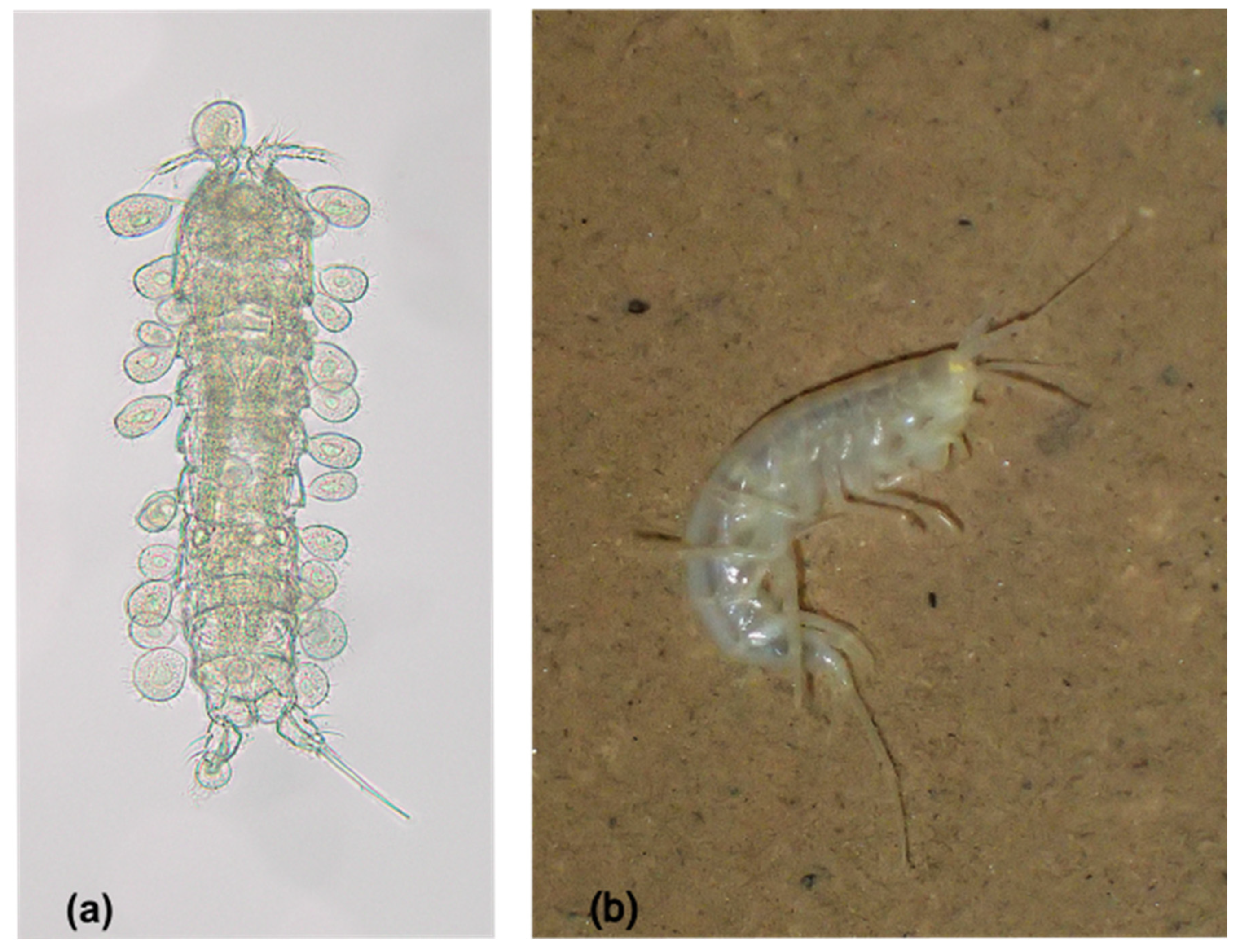

Table 1.
List of terrestrial fauna from Velika Pasica (Slovenia, Europe).Troglobiont = obligatory subterranean inhabitant; troglophile = spent part of its life in the caves, can reproduce there; trogloxene = can spent part of its life there (usually as hibernation period), searching for food out of a cave; edaphic (E) = inhabitants in soil, litter or wet moss; * - described as Zospeum spelaeum schmidti; # - only paratype. .
Table 1.
List of terrestrial fauna from Velika Pasica (Slovenia, Europe).Troglobiont = obligatory subterranean inhabitant; troglophile = spent part of its life in the caves, can reproduce there; trogloxene = can spent part of its life there (usually as hibernation period), searching for food out of a cave; edaphic (E) = inhabitants in soil, litter or wet moss; * - described as Zospeum spelaeum schmidti; # - only paratype. .
| Higher taxon | Family | Species + author | Ecological status | Loc. typ. |
|---|---|---|---|---|
| Gastropoda | Ellobiidae | Zospeum amoenum (Frauenfeld, 1856) [41] | troglobiont | X |
| Zospeum frauenfeldi (Freyer, 1855) | troglobiont | |||
| Zospeum schmidti (Frauenfeld, 1854)* [42] | troglobiont | X | ||
| Helicidae | Helicigona (Chilostoma) illyricum (Stabile, 1864) | troglophile/E | ||
| Zonitidae | Aegopis verticillus (Lamarck, 1822) | troglophile/E | ||
| Pristilomatidae | Vitrea diaphana (Studer, 1820) ) | troglophile/E | ||
| Oxychilidae | Oxychilus glaber (Ferussac, 1822) | troglophile/E | ||
| Gastrodontidae | Aegopinella nitens (Michaud, 1831) | troglophile/E | ||
| Oligochaeta | Lumbricidae | Lumbricus terrestris Linnaeus, 1758 | E | |
| Dendrobaena subrubicunda Eisen, 1878) | trogloxene/E | |||
| Isopoda | Ligiidae | Ligidium germanicum Verhoeff, 1901 | trogloxene/E | |
| Trachelipodidae | Porcellium fiumanum (Verhoeff, 1901) | trogloxene/E | ||
| Trichoniscidae | Androniscus stygius (Nemec, 1897) | troglobiont | ||
| Diplopoda | Anthogonidae | Acherosoma largescutatum Strasser, 1935 [43] | troglobiont | X |
| Haasia troglodytes (Latzel, 1884) | troglobiont | |||
| Glomeridae | Trachysphaera costata (Waga, 1857) | troglophile/E | ||
| Polydesmidae | Brachydesmus subterraneus Heller, 1858 | troglobiont | ||
| Chilopoda | Lithobiidae | Lithobius sp. | trogloxene/E | |
| Ixodida | Ixodidae | Ixodus vespertilionis Koch, 1844 | epiparasite on mammals | |
| Ixodus cf. ricinus (Linnaeus, 1758) | epiparasite on mammals | |||
| Acarina | Mesostigmata | morphotype A | troglobiont (?) | |
| morphotype B | troglophile/ E | |||
| Oribatida | about 8 morphotypes | E | ||
| Pseudoscorpiones | Chthoniidae | Chthonius raridentatus Hadži, 1930# [44] | troglobiont | X |
| Globochthonius spelaeophilus (Hadži, 1930) | troglobiont | |||
| Neobisidae | Neobisium (Blothrus) spelaeum (Schiödte, 1874) | troglobiont | ||
| Opiliones | Phalangiidae | Amilenus aurantiacus Simon, 1881 | troglophile | |
| Sironidae | Cyphophtalmus gr. duricorius Joseph, 1869 | troglophile | ||
| Araneae | Agelenidae | Tegenaria dalmatica Kulcyński, 1906 | troglophile | |
| Tegenaria sylvestris L. Koch, 1872 | trogloxene | |||
| Dysderidae | Harpactea lepida (C.L. Koch, 1838) | troglophile | ||
| Linyphiidae | Troglohyphantes excavates Fage, 1919 | troglophile | ||
| Troglohyphantes sp. | troglophile | |||
| Mimetidae | Ero sp. | trogloxene | ||
| Nesticidae | Kryptonesticus eremita (Simon, 1880) | troglophile | ||
| Nesticus cellulanus (Clerck, 1757) | troglophile | |||
| Tetragnathidae | Meta menardi (Latreille, 1804) | troglophile | ||
| Metellina merianae (Scopoli, 1763) | troglophile | |||
| Diplura | Campodeidae | Campodea cf. staphylinus Westwood, 1842 | troglobiont | |
| Pauropoda | ? | morphotype A | E | |
| Archaeognatha | ? | morphotype A | E | |
| Collembola | Arrhopalitidae | Pygmarrhopalites sp. | E | |
| Entomobryidae | Lepidocyrtus cf. curvicollis Bourlet, 1839 | E | ||
| Lepidocyrtus sp.2 | E | |||
| Pseudosinella sp. | E | |||
| Hypogastruridae | Hymenaphorura sp. | E | ||
| Hypogastrura cf. boldorii Denis, 1931 | E | |||
| Isotomidae | Folsomia ksenemani Stach, 1947 | E | ||
| Isotoma spelaea Joseph, 1882 [45] | troglobiont | X | ||
| Parisostoma notabilis (Schäffer, 1896) | E | |||
| Neanuridae | Bilobella cf. massoudi Cassagnau, 1968 | troglophile/E | ||
| Deutonura sp.1 | E | |||
| Deutonura sp.2 | E | |||
| Friesea mirabilis gr. (Tullberg, 1871) | E | |||
| Neelidae | Megalothorax sp. | E | ||
| Onychiuridae | Heteraphorura sp. | E | ||
| Onychiuroides sp. | E | |||
| Onychiurus sp. | E | |||
| Protaphorura sp. | E | |||
| Sminthuridae | morphotype A | E | ||
| Tomoceridae | cf. Tritomurus sp.1 | troglobiont | ||
| Tritomurus sp.2 | troglobiont | |||
| Orthoptera | Rhaphidophoridae | Troglophilus cavicola (Kollar, 1833) | troglophile | |
| Troglophilus neglectus Krauss, 1879 | troglophile | |||
| Trichoptera | Limnephilidae | Limnephilus rhombicus (Linnaeus, 1758) | trogloxene | |
| Stenophylax permistus McLachlan, 1895 | trogloxene | |||
| Lepidoptera | Erebidae | Scoliopterix libatrix (Linnaeus, 1758) | troglophile | |
| Geometridae | Triphosa dubitata (Linnaeus, 1758) | troglophile | ||
| Diptera | Chironomidae | Chironomidae spp. | trogloxene | |
| Culicidae | Culex sp. | trogloxene | ||
| Limoniidae | Limonia nubeculosa Meigen, 1804 | troglophile | ||
| Mycetophilidae | Mycetophiylidae sp. | trogloxene | ||
| Exechia spp. | trogloxene | |||
| Rymosia sp. | trogloxene | |||
| Phoridae | Triphleba aptina (Schiner, 1853) | troglobiont | ||
| Sciaridae | Sciaridae spp. | trogloxene | ||
| Trichoceridae | Trichoceridae spp. | trogloxene | ||
| Coleoptera | Carabidae | Anophthalmus hirtus Sturm, 1853 [46] | troglobiont | X |
| Anophthalmus schmidti motschulskyi Schmidt, 1860 [47] | troglobiont | X | ||
| Typhlotrechus bilimekii hacqueti Sturm, 1853 [46] | troglophile | X | ||
| Curculionidae | Entiminae: Peritilini | trogloxene/E | ||
| Troglorhynchus anophthalmus Schmidt, 1854 | E | |||
| Leiodidae | Aphaobius milleri (F. J. Schmidt, 1855) [48] | troglophile | X | |
| Batyschia montana Schiödte, 1848 | troglophile | |||
| Salpingidae | Vincenzellus ruficolis (Panzer, 1794) | E | ||
| Staphylinidae | Bythoxenus subterraneus Motschulsky 1858 [49] | troglobiont | X | |
| Othius punctulatus (Goeze, 1777) | trogloxene | |||
| Aleocharinae | trogloxene | |||
| Scydmaeninae: Scydmoraphes? | E | |||
| Chiroptera | Rhinolophidae | Rhinolophus ferrumequinum (Schreber, 1774) | trogloxene | |
| Rhinolophus hipposideros (Bechstein, 1800) | trogloxene | |||
| Vespertilionidae | Myotis emarginatus (Geoffroy Saint-Hilaire, 1806) | trogloxene | ||
| Rodentia | Gliridae | Glis glis (Linnaeus, 1766) | trogloxene |
Table 2.
List of aquatic fauna from Velika Pasica, nearby reservoir and temporary spring (Slovenia, Europe). (Modified from Brancelj [3]). Stygobiont = obligatory subterranean inhabitant; stygophile = can survive part of its life either in the subterranean or light-protected environment, can reproduce there; edaphic (E) = inhabitants in wet soil; ? = unknown ecological status; X? = probably new species/locus typicus; * = species collected only in the cave; # = collected from the epikarst during filtration.
Table 2.
List of aquatic fauna from Velika Pasica, nearby reservoir and temporary spring (Slovenia, Europe). (Modified from Brancelj [3]). Stygobiont = obligatory subterranean inhabitant; stygophile = can survive part of its life either in the subterranean or light-protected environment, can reproduce there; edaphic (E) = inhabitants in wet soil; ? = unknown ecological status; X? = probably new species/locus typicus; * = species collected only in the cave; # = collected from the epikarst during filtration.
| Higher taxon | Family | Species + author | Ecological status; comment | Loc. typ. |
|---|---|---|---|---|
| Protozoa / Cilliata | ? | one species; undetermined | epibiont on Maraenobiotus slovenicus; drift from spring | X? |
| Protozoa / Suctoria | ? | #one species; undetermined* | epibiont on Morariopsis dumonti; cave | X? |
| Turbellaria / Rhabdocoela | ? | #one species; undetermined* | stygobiont / E?; cave | X? |
| Nematoda | ? | #several morpho-species / undetermined | stygobiont / E?; cave | |
| Rotifera | Adinetidae | #Adineta gracilis Jansen, 1893* | stygobiont (E?); cave | |
| Habrotrichidae | #Habrotrocha sp. | stygobiont (E?); cave | ||
| Gastropoda | Hydrobiidae | Frauenfeldia kusceri (A. Wagner, 1914) | stygobiont; cave & reservoir | |
| Hauffenia michleri (Kuscer, 1932) | stygobiont; cave & reservoir | |||
| Polychaeta | Aelosomatidae | #Aelosoma sp.* | stygobiont?; cave | |
| Oligochaeta | Enchytraeidae | #Enchytraeus gr. buchholzi* | stygobiont / E?; cave | |
| #Fridericia sp. A* | stygobiont / E?; cave | |||
| #Fridericia sp. B* | stygobiont / E?; cave | |||
| Haplotaxidae | #Haplotaxis gordioides (Hartman, 1821)* | E; cave | ||
| Ostracoda | Candonidae | #Pseudocandona albicans (Brady, 1864) | stygobiont; cave & drift from spring | |
| Copepoda / #break# Cyclopoida |
Cyclopidae | Acanthocyclops venustus (Norman & Scott, 1906) | stygofile; reservoir & drift from spring | |
| Diacyclops clandestinus Kiefer, 1933 | stygobiont; drift from spring | |||
| Diacyclops languidoides (Lilljeborg, 1901) | stygobiont; drift from spring | |||
| Graeteriella unisetigera (Graeter, 1908)* | stygobiont; drift from spring | |||
| Paracyclops fimbriatus (Fischer, 1853) | stygophile; reservoir | |||
| #Speocyclops infernus (Kiefer, 1930) | stygobiont; cave & drift from spring | |||
| Copepoda / Harpacticoida | Canthocamptidae | Bryocamptus balcanicus (Kiefer, 1933)* | stygobiont; in the puddles in 2000 | |
| #Bryocamptus pyrenaicus (Chappuis, 1923) | stygobiont; cave &, drift from spring | |||
| Bryocamptus pygmaeus (G.O. Sars, 1862) | stygophile; drift from spring | |||
| #Bryocamptus typhlops (Mrazek, 1893)* | stygobiont; cave | |||
| Elaphoidella cvetkae Petkovski, 1983* | stygobiont; one specimen in a puddle in 2000 | |||
| #Elaphoidella millennii Brancelj, 2009 [33] | stygobiont; cave & drift from spring | X | ||
| #Elaphoidella tarmani Brancelj, 2009* [33] | stygobiont; cave | X | ||
| Epactophanes richardi Mrazek, 1893 | stygophile; reservoir | |||
| Maraenobiotus slovenicus Brancelj & Karanovic, 2015 [50] | stygobiont; drift from spring | X | ||
| #Moraria poppei (Mrazek ,1893) | stygobiont; cave & drift from spring | |||
| #Moraria varica (Graeter, 1910)# | stygophile; cave & drift from spring | |||
| #Morariopsis dumonti Brancelj, 2000* [40] | stygobiont; cave | X | ||
| Parastenocarididae | #Parastenocaris nolli alpina Kiefer, 1969* | stygobiont; cave | ||
| Phyllognathopoidae | Phyllognathopus vigueri (Maupas, 1892) | stygophile/E; drift from spring | ||
| Amphipoda | Niphargidae | Niphargus stygius (Schiodte, 1847) | stygobiont; cave & the reservoir & drift from spring | |
| Isopoda | Sphaeromatidae | Monolistra caecaGerstaeker, 1856 | stygobiont; reservoir |
Disclaimer/Publisher’s Note: The statements, opinions and data contained in all publications are solely those of the individual author(s) and contributor(s) and not of MDPI and/or the editor(s). MDPI and/or the editor(s) disclaim responsibility for any injury to people or property resulting from any ideas, methods, instructions or products referred to in the content. |
© 2026 by the authors. Licensee MDPI, Basel, Switzerland. This article is an open access article distributed under the terms and conditions of the Creative Commons Attribution (CC BY) license (http://creativecommons.org/licenses/by/4.0/).
Copyright: This open access article is published under a Creative Commons CC BY 4.0 license, which permit the free download, distribution, and reuse, provided that the author and preprint are cited in any reuse.