

Submitted:
10 March 2026
Posted:
11 March 2026
You are already at the latest version
Abstract
This study examines the dynamics of sustainability transitions in the EU-27 during the period 2015-2024, focusing on the role of different stakeholders and the emergence of distinct convergence patterns in sustainability performance. The theoretical framework integrates sustainability transition theory, stakeholder governance, and the literature on convergence and club convergence, interpreted through the socio-technical multi-level perspective and the concept of institutional lock-in. A test model is developed based on four stakeholder-specific indices: the Government Sustainability Index (GSI), Environmental Sustainability Index (ESI), Population Sustainability Index (PSI), and Business Sustainability Index (BSI), complemented by a Composite Sustainability Index (CSI). The indices are constructed using min–max normalization of harmonized data from Eurostat, the European Environment Agency, and the Sustainable Development Report. The empirical analysis combines K-means clustering, compound annual growth rate (CAGR) calculations, and correlation analysis, complemented by a robustness module testing alternative weighting schemes, z-score normalization, and ±10% variations in index components. The results reveal four relatively stable sustainability tiers among EU member states, an S-curve-type relationship between initial sustainability tiers and subsequent growth, and a consistent hierarchy in stakeholder response speeds (ESI > GSI > PSI). A clear structural slowdown after 2019 is also observed. The main findings remain robust across alternative methodological specifications. The study contributes to the quantitative integration of the multi-level perspective on sustainability transitions into a stakeholder-based composite index framework for cross-country analysis within the European Union.
Keywords:
sustainability transitions
; stakeholder governance
; composite sustainability index
; EU-27 countries
; club convergence
; multi-level perspective (MLP)
; environmental and social sustainability
; K-means clustering
; structural slowdown
; renewable energy and circular economy
1. Introduction
Sustainable development has become one of the most serious challenges of the 21st century. Not that there have not been global initiatives in human history, or that policies aimed at protecting public interests valid for all humanity have not been implemented; rather, the scale of awareness and acceptance, and the implementation of a common objective within the political, economic, and social life of the planet, have never before required a coordinated and purposeful change in the behavior of all stakeholders in the manner that is currently occurring with regard to sustainability. In our contemporary history, political strategies are being developed, financial resources of colossal magnitude are being committed, and numerous investment, educational, economic, and social initiatives are being implemented. All of them are directed not merely towards changing the physical environment, but toward transforming the thinking and behavior of society as a whole.
Both in scientific literature and in practice, the experience of the European Union (EU) represents a practical laboratory for studying the transition to sustainability. The EU is an undisputed global leader in this regard. It has already become widely accepted that this process does not simply involve the acceleration of purely technological changes, but rather a purposeful transformation in the thinking and behavior of a broad spectrum of stakeholders. All of them are united by a common idea of sustainability. Participants are determined to adapt, and when necessary to remodel, the processes associated with achieving this objective [1,2]. Thus, governments, firms, households, and civil society are confronted with the challenge of coordinating their actions in the implementation of policies aimed at the decarbonization of energy systems, increasing circularity, and achieving the Sustainable Development Goals (SDGs). Nevertheless, despite ambitious frameworks such as the European Green Deal, the available data indicate persistent institutional divisions, uneven transition speeds, and a possible structural slowdown in progress after 2019 [3,4,5].
Most quantitative assessments of sustainability in the EU focus either on aggregate indicators (for example, the SDG Index, the Ecological Footprint, and others) or on individual environmental dimensions such as greenhouse gas emissions, renewable energy, or ecological footprint convergence [6,7,8]. The systematic collection of such information undoubtedly has its own meaning and added value. Unfortunately, however, the way these indicators are constructed does not allow the roles of different groups of stakeholders to be distinguished. The available information base complicates its empirical linkage with established theories such as the theory of socio-technical transition, stakeholder governance, and the literature on convergence/club convergence. In practice, a gap emerges between the established theoretical framework and the available informational base. The latter, in turn, becomes a barrier to their successful integration into a unified empirical framework capable of interpreting the collected data and comprehensively validating the theories.
The present article attempts to address the challenge posed by these gaps. If not to fully answer the questions, then at least to initiate discussion and propose a possible approach for overcoming this problem. The idea is to achieve this through the development of a comparative sustainability framework differentiated by stakeholders. A framework in which (i) the political efforts of the government, (ii) the biophysical environmental outcomes, and (iii) the social performance (that of the population) are explicitly distinguished. In addition, such an evaluation model is linked to the dimensions of the multi-level perspective (MLP) of Geels, stakeholder governance theory, and theories of institutional lock-in (club convergence) [1,9,10,11].
As an experimental environment for testing and validating such a model, the countries of the EU-27 over the period 2015-2024 have been selected. For them, four stakeholder-specific indices and one composite index are constructed:
- Government Sustainability Index (GSI), built based on government expenditure on environmental protection (% of GDP) as a proxy for policy effort;
- Environmental Sustainability Index (ESI), expressed through the share of renewable energy, the circular material use rate, and inverted greenhouse gas emissions per capita as biophysical outcomes;
- Population Sustainability Index (PSI) – the SDG Index score used as a proxy for the social and environmental performance of the population;
- Business Sustainability Index (BSI), calculated based on the same three biophysical indicators, interpreted through the prism of corporate and production behavior, in view of the limitations of the available data;
- Composite Sustainability Index (CSI), representing an aggregate of the four stakeholder indices and reflecting the overall sustainability performance.
1.1. Research questions and hypotheses
The overall idea and structure of the analysis are built around four main questions and the related research hypotheses.
In the context of the identified research gaps, the first question concerns the way stakeholder-specific sustainability trajectories evolve in the EU-27 countries between 2015 and 2024. In order to answer this question, the following first research hypothesis is formulated: Governments lead the early phases of the transition, such that increases in the GSI precede and correlate with subsequent increases in the ESI, particularly in high-level countries (H1).
The second research question is: Do EU Member States form stable tires of sustainability compatible with convergence clubs and institutional lock-in? Taking into account the available theoretical and research framework from the last decade, we formulate the hypothesis (H2): Member States cluster into convergence clubs (tiers) with limited mobility over the period 2015-2024, indicating institutional lock-in and path dependence rather than global convergence.
The third hypothesis states that transitions toward sustainability exhibit a structural slowdown after 2019, with lower CAGR in 2019-2024 compared to 2015-2019 for all indices, consistent with rising marginal abatement costs, institutional saturation, and post-COVID dynamics (H3). This hypothesis aims to answer the question of how the response speeds of stakeholders differ and whether the transition demonstrates a structural slowdown after 2019.
Last, but not least, is hypothesis (H4), which states that the main results expressed through the structure of the tiers, the S-curve relationship between baseline CSI and growth, and the hierarchy of stakeholder responses, are robust to (a) equal versus alternative weighting schemes, (b) min–max versus z-score normalization, and (c) ±10% variations of the component indicators. The significance of this hypothesis for the study of the problem lies in the fact that it addresses the question: To what extent are these results robust with respect to alternative choices in the construction of the indices?
These questions and the related hypotheses connect the empirical analysis with transition theory (Geels), stakeholder governance [12,13], convergence and club convergence [7,14], and institutional lock-in [15,16,17]. This linkage is sought at a horizontal level; in this sense, the logic of the study is subordinated to the formulated questions and hypotheses and does not follow the sequence of examining interrelations with each of the listed theories individually.
1.2. Contributions
Ultimately, the outcome of the analysis presented in this article claims contributions in the following four directions:
- Contribution regarding theoretical integration. This arises from the attempt to construct sustainability indices differentiated by stakeholders within the multi-level perspective of Geels, stakeholder governance models, and convergence/institutional lock-in frameworks. Such a theoretical linkage would allow empirical models to be interpreted as manifestations of regime stability, niche–regime interactions, and the power relations among stakeholders;
- Stakeholder-structured measurement. The calculation of the indices GSI, ESI, PSI, BSI, and CSI is carried out based on harmonized EU data. In essence, this represents a template for composite indices that account for different stakeholders. The structure of this template is intended to go beyond aggregate SDG assessments or single indicators, which constitute the prevailing mainstream practice. At the same time, this is achieved with the help of a sufficiently simple, yet simultaneously validated, formal apparatus;
- Methodology with explicit robustness testing. This includes structured modular robustness testing through alternative weights, normalization schemes, and ±10% variations of the components. In this sense, established good practices in the analysis of composite indices are followed [18,19]. For the logic of the analysis, this is of particular importance, as it confirms that the proposed research model complies with established practices and the methods for their validation in the scientific literature;
- And last but not least, empirical results for EU governance. The article documents stable sustainability tiers, S-curve dynamics, and slowdowns after 2019 that are robust to the specifications of the indices. The results obtained are interpreted through a combined theoretical framework, both as theoretical implications and as policy manifestations along the pathway toward sustainability in the EU.
2. Literature Review
2.1. Socio-technical transitions and the multi-level perspective
The transition to sustainability in the scientific literature is considered a complex and multifaceted problem that involves qualitative transformations in complex systems such as technologies, institutions, consumer practices, cultural understandings, and a broad spectrum of additional factors of essential importance. It is far more than the simplistic understanding of technological change and rather represents a manifestation of a complex socio-technical transition [1,2,20]. On the basis of this understanding, the Multi-Level Perspective (MLP) approach has been developed, which requires a clear distinction between:
- Niches (spaces for radical innovations);
- Regimes (stabilized socio-technical configurations that structure dominant practices); and
- Socio-technical landscapes (macro-trends and exogenous shocks such as climate change, global crises, or pandemics).
Such transitions usually occur under conditions of landscape-level pressure and niche-level innovation. The emergence of such pressure destabilizes regimes and opens windows for reconfiguration [20,21]. In itself, such pressure may generate incentives for resistance. Incumbent actors may oppose transitions or reconfigure them. They may exploit their dominant position in their relationships with other stakeholders by creating multiple “transition pathways” rather than following a single trajectory. This position is widely represented in contemporary economic literature [2,22,23], while numerous examples confirming it in practice have also been presented. For this reason, and fully in this spirit, the present study formulates the hypotheses H1 regarding the early leadership of governments and H3 regarding structural slowdown. These hypotheses are directly related to MLP concepts of regime reconfiguration and plateau effects when regimes reach a new equilibrium.
Placed in the context of sustainability in the EU, such an application of the MLP allows for a specific interpretation of the individual constructed indicators:
- GSI as part of policies and governance arrangements at the regime level;
- ESI and BSI as regime outcomes and niche absorption (renewable energy sources, circularity, emissions); and
- PSI as a reflection of the social embedding of transitions in lifestyles, social outcomes, and the quality of institutions.
2.2. Stakeholder governance, ESG, and sustainability performance
Under contemporary conditions and with the expansion of its field of application, stakeholder theory has also evolved. The classical theories in which the objectives of organizations are narrowly focused on the interests of shareholders are well known. This reflects the simplistic view that corporate business organizations have the primary objective of enriching their owners in a highly direct manner. A significant expansion of this idea, however, emerged with the shift in focus toward organizations viewed as networks of relationships with stakeholders, including employees, communities, regulators, and the environment [12,13]. In sustainability governance, stakeholder models are increasingly focused on decision-making issues. Such decisions usually directly affect matters related to stakeholders, ESG disclosure and accountability, and the role of stakeholders in shaping corporate and political behavior [24,25].
Corporate environmental performance and disclosure are associated with stakeholder pressure and the institutional context [26,27,28]. Nevertheless, large-scale cross-national analyses for the EU that provide a sufficiently strong linkage between social performance (PSI), corporate sustainability (BSI), and government efforts (GSI) are still relatively rare. This is precisely the motivation for formulating and testing H2 here, which examines whether PSI correlates more strongly with BSI than with GSI. Such a relationship could be expected, since stakeholder governance and the co-movement of ESG factors mediate outcomes for the population more directly than public expenditures themselves.
2.3. Convergence, club convergence, and sustainability tiers
Another group of theories also has significant relevance to the issue under consideration and plays a key role in the depth of the present analysis. These are the theories of convergence and club convergence. In this context, they are widely applied to examine the relationship with economic growth and, more specifically, the impact on environmental and sustainability indicators [7,29]. The main conclusion that can be drawn from a careful review of these studies can be summarized as follows:
- The evidence for such global convergence of environmental indicators is strongly limited;
- The formation of convergence clubs is frequently identified, in which groups of countries manage to reach different stable states. The relatively heterogeneous characteristics of the countries belonging to such groups are noteworthy; and
- The expectation regarding the importance and role of factors such as income and technological change in determining membership in the different clubs is reinforced (i.e., different country characteristics predispose the establishment of different stability patterns).
Evidence for the formation of such clubs can be found, for example, in club convergence in greenhouse gas emissions and the share of renewable energy in the EU. Empirical analyses identify multiple such formations, grouping together countries with similar trajectories and factor determinants [30]. The logic of such findings also underlies the present article. Analogously to the studies mentioned above, the construction of tiers of sustainability (clubs) based on the CSI is also pursued here, which is tested through H2. In other words, the stability of these tiers is used as evidence of the existence of different sustainable regimes. This, in turn, leads to institutional lock-in, path dependence, and governance constraints.
2.4. Institutional lock-in, path dependence, and governance constraints
In the literature devoted to the economics of institutions, the role of path dependence and institutional lock-in in shaping long-term trajectories is emphasized. On this issue, there exists a sufficiently broad theoretical and applied policy foundation of studies [15,16,17]. Without claiming exhaustiveness, according to these studies, lock-in may result from the independent or combined influence of the following factors:
- Resource dependence (investments embedded in infrastructure from which resources cannot be extracted or recycled efficiently);
- Normative determinants (such as values, norms, and expectations); or
- Cognitive factors (mental models and paradigms characteristic of different countries or regions).
On the basis of such determinants, institutional lock-in emerges, understood as a stable regime. Its stability is expressed in the fact that once the corresponding regime is established, the effectiveness of new policies becomes constrained. The fixed state becomes so strong that it may lead to a slowdown in the diffusion of innovations and to the creation of convergence clubs of institutions and outcomes (as a result of which regional lock-ins, environmental performance clubs, and other similar formations emerge).
In the context of the EU, Lenschow et al. [31] and other related studies provide additional evidence supporting the view that the legacy of earlier environmental policies and governance architectures continues to structure what is politically and institutionally possible. These are the so-called “inherited policies” (practices and understandings) that hinder transformative systemic change even in the implementation of ambitious programs such as the European Green Deal. In this sense, the hypothesis of a slowdown after 2019 (H3 of the present study) appears entirely logical. In essence, it represents a scenario in which the initial effects are exhausted through the easier results (investments), while deeper institutional lock-ins hinder further progress, consistent with S-curve dynamics and EKC-type models [2,8].
2.5. Composite indices and robustness analysis
An important methodological issue is related to the formation of the index base for constructing the empirical research model. In principle, this is an extremely important issue not only for the present article, but also for the analysis of a much broader range of problems. The use of composite indices is a widely practice for summarizing multidimensional phenomena. In this respect, issues related to human development, governance, and sustainability represent typical examples. It should be acknowledged, however, that the results obtained through the use of composite indices are particularly sensitive to technical decisions regarding normalization, weights, and aggregation [19,31].
To overcome this methodological vulnerability, research typically emphasizes the importance of robustness and sensitivity analyses, which are intended to validate the construction of these indices. The usual practice is to achieve this through:
- Comparison of min–max versus z-score normalization;
- Testing alternative weighting schemes (equal, expert-based, data-driven); or
- Conducting ±10% or similar variations in order to assess the stability of rankings and groupings (in this context, the robustness of HDI and multidimensional development indices).
Existing studies on sustainability in the EU often present results under a single set of assumptions without systematically examining the sensitivity of findings to methodological choices. Despite the significance of the results achieved, under such conditions it remains debatable to what extent studies with otherwise interesting and important findings can be used for policy formation and real actions. Issues related to methodological robustness effectively undermine the significance of the results. In order to avoid such gaps, the present article explicitly includes a robustness section in the Methodology and Results, designed to test H4 (whether sustainability levels, tier-growth patterns, and stakeholder response hierarchies are methodologically robust).
3. Methodology and data
3.1. Data sources and coverage
The scope of the present analysis includes all 27 EU Member States. The period covered in the analysis is 2015-2024. In this way, the empirical basis of the study provides a balanced panel dataset of 270 “country–year” observations, for five main indicators. These indicators jointly reflect government efforts, environmental outcomes, circularity, emissions, and sustainable development performance in these countries for each respective year. Owing to the European framework for sustainability monitoring and the statistical indicators included within it, all indicators are calculated on the basis of harmonized, publicly available data that follow established definitions (thus ensuring methodological comparability).
- The indicator for the share of renewable energy in gross final energy consumption (expressed in %) is taken from Eurostat renewable energy statistics and related analytical reports. These data also correspond to institutional communications documenting that renewables reached 24.5% of EU energy consumption in 2023, according to the revised Renewable Energy Directive [35,36];
It should be noted that, in constructing the panel dataset, only years with complete information for all five indicators are included. Isolated one-year gaps at the country level are linearly interpolated. In addition, when structural gaps of the type “country–year” exist in more than one indicator, the observation is excluded from the construction of the index for the respective year. This approach is adopted in accordance with established practices for the reproducibility of SDG and composite indices [6,42].
3.2. Indicator selection, stakeholder mapping, and hypotheses
The composite indices in the present study are deliberately constructed through simple and transparent transformations (normalization, arithmetic averaging, and standard growth rates). Highly parameterized econometric specifications that would unnecessarily complicate the methodology and/or the logic of the analysis are intentionally avoided. This choice reflects a modeling philosophy articulated by Box, according to which “since all models are wrong, the scientist cannot obtain a ‘correct’ one by excessive elaboration. On the contrary… he should seek an economical description of natural phenomena,” and that “the ability to devise simple but evocative models is the hallmark of the great scientist” [43].
In the context of sustainability assessment within the EU, it is widely acknowledged that data uncertainty, structural heterogeneity, and institutional complexity are substantial. Therefore, in order to identify robust empirical regularities, simplified index formulas are employed. This contributes to making the assumptions clearly visible and facilitates reproducibility. At the same time, this index definition reduces the risk that results depend on the choice of highly sensitive functional forms. The achieved simplified approach also corresponds to the broader principle often attributed to Einstein, that analytical frameworks should be “as simple as possible, but not simpler” [44]. In this way, the analysis focuses on the minimum structure necessary to capture stakeholder-differentiated trajectories, convergence clubs, and robustness properties. The resulting findings remain as analytically “clean” as possible, rather than being “hidden” behind unnecessary mathematical complexity.
Thus, the five indicators are assigned to stakeholder-specific indices and one composite index in order to reflect their roles in sustainability transitions:
- Population Sustainability Index (PSI) – the normalized SDG Index score used as a proxy for sustainability at the population level. The underlying index itself includes social, economic, and environmental dimensions that are widely recognized as being conditioned by consumer behavior and institutional quality [4,5,42];
- Business Sustainability Index (BSI) – calculated as the average of the same three environmental indicators mentioned above (renewables, circularity, inverted emissions). The interpretation of this index is directed toward corporate and production performance. At this stage, it is appropriate to note that the outcome indicators are treated as proxies for business behavior under strong policy and market signals [26,46];
- Composite Sustainability Index (CSI) – which aggregates GSI, ESI, PSI, and BSI into an overall sustainability indicator.
In constructing the indicators, an important clarification should be made. Although the Environmental Sustainability Index (ESI) and the Business Sustainability Index (BSI) are constructed from the same three environmental outcome indicators (share of renewable energy, circular material use rate, and inverted greenhouse gas emissions per capita), they perform analytically different functions within the stakeholder model. ESI is interpreted as a measure of the state of the environment, capturing the overall biophysical performance of national socio-technical systems. In contrast, BSI uses the same outcome indicators as proxies for production and firm behavior, recognizing that the energy mix, circularity, and emissions intensity are strongly influenced by corporate investment and operational decisions.
This dual interpretation is consistent with multi-stakeholder designs of environmental indices, in which a common set of indicators is interpreted through different stakeholder lenses (for example, macro-level welfare versus firm-level contributions). In this way, the distribution of responsibilities and impacts among stakeholders can be examined. In practice, harmonized EU-wide data on firm-level ESG performance covering all 27 countries are largely unavailable. Under these circumstances, the use of shared environmental outcome indicators as a conservative proxy simultaneously for environmental conditions (ESI) and business behavior (BSI) allows both stakeholder completeness and methodological transparency to be maintained. The limitations of this choice are explicitly discussed again in the Discussion section of the present article.
Despite their constructive simplicity, these indices are directly linked to the research questions and hypotheses. This relationship can logically be represented through the direct correspondence between the individual hypotheses and the respective indicators:
- H1 (government leadership) measures the extent to which changes in GSI precede and correlate with achievements in ESI;
- H2 (club convergence) examines how clustering based on CSI generates stable tiers of sustainability;
- Tracking whether the CAGR for all indices declines after 2019 is associated with testing the hypothesis of structural slowdown (H3);
- The final hypothesis H4, related to methodological robustness, is examined by testing whether the tiers, the S-curve, and the response hierarchies are preserved under alternative index specifications.
3.3. Baseline normalization and index construction
3.3.1. Baseline min–max normalization
The use of min–max normalization is a common practice when working with the SDG Index [4,41]. This technique is used to transform all indicators onto a 0-100 scale. This normalization tool ensures comparability between different units and, within the analysis, it is applied to each indicator xi,t(country i, year t), where the normalized score si,t is:
where xmin and xmax are policy-relevant thresholds. For example, 0 for emissions, 100% for renewable energy, and achievable upper limits for circularity. In cases where explicit targets are not available, these minimum and maximum boundaries are represented by the observed minimum and maximum values for the EU-27 over the period 2015-2024. The approach used is not novel and has already been applied by other authors in a similar context [4,39].
3.3.2. Stakeholder indices under baseline specification
The individual indices capturing the performance of each of the examined stakeholders are calculated using the following formula specification:
Note: the construction of BSI is the same arithmetic mean as ESI, but with a different interpretation related to business performance.
3.4. Robustness design: alternative weights, normalization, and sensitivity
In such a study, it is important to consider potential risks related to the stability of composite indices. To some extent, these concerns may be mitigated given the relatively simplified construction of the indices themselves. However, this does not fully guarantee compliance with applicable methodological standards. Therefore, the present article implements a dedicated robustness testing module, following good practices in the literature on composite indicators [19,32,47,48].
3.4.1. Alternative weighting schemes
As alternative weighting schemes, in addition to the baseline equal weighting in ESI/BSI and CSI, the following variants are considered:
Policy-biased weighting (Gov heavy CSI), in which greater weight is assigned to government efforts. This construction uses the following weighting scheme:
Outcome-biased weighting (Env heavy CSI). In this case, greater weight is assigned to biophysical environmental outcomes, with the following weighting scheme:
Data-oriented weighting (PCA-informed CSI). In this case, Principal Component Analysis (PCA) is applied to the normalized GSI, ESI, PSI, and BSI in order to test stability. The loadings of the first principal component, normalized so that their sum equals 1, are used as PCA-based weights [32].
After calculating the results under each of the applied weighting schemes, the country rankings, tier memberships, and CAGR values under each scheme are compared with those obtained under the baseline equal-weight CSI. In this way, a quantitative assessment of the sensitivity and stability of the results is achieved.
3.4.2. Alternative normalization: z-score vs. min–max
Z-score normalization is less sensitive to extreme values compared to min–max normalization and is recommended for asymmetric distributions [19]. Here we also apply an alternative calculation of the indices, this time using z-score (standardization) normalization according to the formula:
where μ_xand σ_xare the mean value and standard deviation of each indicator for the EU-27 over the period 2015-2024. It should be noted that, as in the baseline specification, the emissions indicator is inverted prior to standardization.
After applying the z-score normalization, the indices GSI, ESI, PSI, BSI, and CSI are calculated again. The resulting indices and the baseline indices are then compared through:
- Rank correlations of CSI between min–max and z-score normalization;
- Stability of sustainability tiers; and
- Tier-growth patterns (S-curve).
3.4.3. ±10% perturbation sensitivity
Conducting a perturbation-based robustness analysis of the constructed indices [32,48] represents only part of the sensitivity tests used. In addition, a one-factor-at-a-time ±10% perturbation is applied to each individual indicator while the others are held constant. This is implemented by generating a perturbed series for each indicator (for example greenhouse gas emissions) through:
After this procedure, all indices are recalculated again using the normalized results for these perturbed values. The quantitative evaluation of sensitivity is assessed through Spearman rank correlations of CSI and membership in sustainability tiers between the baseline and perturbed scenarios [19,47].
3.5. Clustering, growth, and correlation analysis
In the present article, the analysis combines four key tests: clustering, CAGR analysis, tier-growth correlations, and robustness integration. Used as a unified analytical model, they provide a multilayered assessment of sustainability dynamics and the role of different stakeholders in the EU. Although applied as components of a common methodology, each of the tests has its own specific logic and contribution to the quality of the research.
3.5.1. K-Means clustering for identifying sustainability tiers
Clustering groups countries with similar average CSI values over the period 2015-2024 into four tiers. This allows the identification of structured differences between states associated with club convergence and institutional lock-in. The underlying logic is that countries do not move randomly along the path toward sustainability. Instead, they form stable “clubs” with similar characteristics. The implementation of K-Means clustering allows the classification of countries to be demonstrated as systematic rather than arbitrary.
For the purposes of the analysis, K-Means clustering is performed using Euclidean distance on time-averaged CSI scores (2015-2024). In this way, four sustainability tiers are identified, consistent with evidence from club convergence studies [7,10,49]. The stability of tier membership is then tested under alternative CSI specifications (as described in Section 3.4).
3.5.2. Compound annual growth rate (CAGR)
CAGR measures the average annual rate of change of each index over different periods (2015-2019, 2019-2024, and the overall period). This test allows the assessment of the pace and timing of sustainability transitions.
In the context of the present analysis, for example, H1 assumes that governments lead the early phases of the transition (GSI). If this is indeed the case, CAGR should show higher values for GSI before ESI. Furthermore, this test allows a direct verification of the structural slowdown hypothesis (H3). This can be achieved by comparing CAGR before and after 2019.
In practical terms, CAGR is calculated for each index and country for the period 2015-2024 and for the sub-periods 2015-2019 and 2019-2024, according to the formula:
where prepresents the period and n_pis its length in years.
As noted above, this approach allows testing of:
- H1 (timing of GSI);
- H3 (slowdown after 2019); and
- the hierarchy of stakeholder responses (ESI vs. GSI vs. PSI).
3.5.3. Tier-growth correlations (S-curve tests)
The presence of S-curve dynamics is considered a characteristic feature of sustainability transitions. This implies that countries with high initial tiers grow more slowly, while countries with lower tiers exhibit faster growth as they approach a new equilibrium.
To test for S-curve dynamics in the present analysis, Pearson and Spearman correlations are calculated between the initial tier of CSI and the subsequent CAGR. This test is crucial for identifying structural regularities and for linking the results to club convergence theory and EKC/S-curve dynamics [8,50].
The empirical verification in this case expands the theoretical foundation and strengthens the significance of the practical observations. In applied terms, Pearson and Spearman correlations are calculated between initial CSI tiers (2015 or average 2015-2016) and subsequent CAGRs, both overall and by tiers.
3.5.4. Integration of robustness through repetition of analyses across scenarios
To integrate all analytical tests, the clustering, CAGR, and tier-growth correlation analyses are repeated for all robustness scenarios (alternative weights, normalization methods, and ±10% perturbations).
In this way, the sensitivity of the results to methodological choices is evaluated. The structure of the overall analysis makes it possible to verify whether the main conclusions are stable and reliable. This is particularly important in a context where the examined variables have heterogeneous characteristics, ranging from stakeholder hierarchies and structural tiers to the dynamics of sustainable growth.
The set of conducted tests ensures the methodological reliability and validity of the research results. In practice, it demonstrates that the findings are not random or dependent on a specific choice of parameters, but are methodologically grounded and empirically validated.
4. Results
4.1. Stakeholder trajectories and descriptive patterns (H1, H3)
The descriptive analysis of the results for all indices (related to the respective stakeholder groups - GSI, ESI, PSI, BSI, and the composite CSI) indicates an overall increase during the period 2015–2024. This applies to all countries included in the sample. It should be noted, however, that this average dynamic manifests in different ways and at varying speeds. This is not a simple mechanical parallel growth. A kind of “stratification” of the trajectories is observed. For instance, some indices rise sharply and then slow down, others move steadily over the period, while a third group almost “stalls” after a certain point. This difference becomes particularly evident when the overall period is divided into two sub-intervals -before and after 2019. The year 2019 is precisely the point at which the dynamics visibly change direction.
Although the dynamics of the different indices are generally similar, certain specificities characteristic of each of them can nevertheless be identified. The GSI index shows moderate growth between 2015 and 2019. During this interval, some countries increased their share of environmental expenditures. The overall picture after 2019, however, changes substantially, with stagnation or very weak growth observed in most cases. This sharp decline in the intensity of “green” policy efforts can realistically be attributed to the combined impact of fiscal constraints and increased competition among budgetary priorities at the EU-27 level as a whole. The overall trend, however, can be summarized as accumulated policy fatigue [45] regarding these policies.
The fastest-growing index on average across the EU-27 is the ESI. It captures the effect of expanding renewable energy sources, improving the circular use of materials, and the gradual decline in emission intensity. This acceleration, however, is not without limits. Similar to the government indices, a noticeable slowdown is observed after 2019, likely reflecting the exhaustion of “easy” technological improvements and the emergence of new barriers. In practice, such a conclusion is entirely consistent with other studies on the topic in the scientific literature [41].
To identify socio-institutional changes, the PSI was constructed and calculated based on the SDG index. Its variation across countries and periods is relatively smooth, including in both sub-periods. Such dynamics confirm that social structures, health systems, and institutional quality evolve more slowly [4,5]. These social spheres are more inertial, and thus, sharp surges or significant declines are logically absent.
By definition, the BSI duplicates the ESI, as in this version of the study both indices are derived from the same group of environmental performance indicators. The distinction between them is conceptual: the BSI “interprets” environmental outcomes through the lens of business and production practices, while the ESI reflects the state of the environment itself. Numerically, this means that their trajectories are identical, but in interpretive terms, they allow separate discussion of the role of firms and of the overall environmental outcome.
These dynamic patterns over the period partially support H1. In many countries, the GSI began to increase slightly earlier or approximately in parallel with the ESI during the sub-period 2015-2019. This can be explained by the presence of a preliminary policy response, followed by a period of “catching up” on the part of actual environmental results. Nevertheless, the relationship of “who leads whom” is not uniform across all tiers and becomes noticeably blurred after 2019. In some cases, environmental outcomes continue to improve while fiscal efforts stabilize; in others, the two lines almost diverge.
The main characteristics of the dynamic changes in the calculated indices are presented in the following Table 1.
4.2. Sustainability tiers and institutional immobility (H2)
To identify the tiers of sustainability, K-Means clustering was performed on the CSI (with min–max normalization and equal weights). As a result, four distinct tiers clearly emerge. It should be noted that the resulting grouping is not a random statistical construct. The formed sustainability tiers exhibit logic both in terms of geography and institutional history (see Table 2). In this structure, the Scandinavian and Western countries in Tier 1 demonstrate the best performance. The Southern and Central European states are grouped in Tiers 2-3, showing similar characteristics. The final Tier 4 encompasses the “catching-up” countries-the Eastern European states. This configuration corresponds to already established patterns from the literature on club convergence in emissions and indicators related to the Sustainable Development Goals [7,10,49].
Within each of the tiers, there is, of course, internal movement. Thus, for example, the values of ESI and GSI vary substantially across individual countries. With regard to the dynamics of change in the individual indicators, however, it is particularly important to note that membership in a given tier practically does not change over the study period 2015–2024. If a strict definition of “sustained change” is applied (for instance, at least three consecutive years in another tier), no country exhibits a persistent shift between different tiers. This highly static behavior supports H2 and is expected in the context of the concepts of lock-in and path dependence in institutional and socio-technical regimes. According to these concepts, once formed, a given combination of institutions, technologies, and behavioral norms tends to remain exceptionally stable over time [3,15,16,31]. In this way, the ordering of the tier “centroids” remains stable, with Tier 1 consistently dominating in terms of average CSI, followed by Tier 2, Tier 3, and finally Tier 4 (see Figure 1). A stable hierarchy thus emerges that is not disrupted by short-term shocks and cycles.
4.3. Stakeholder response speeds and S-curve dynamics (H1, H3)
Using compound annual growth rates (CAGR), it is possible to clearly assess the “hierarchy of speeds” among the indices. The corresponding data are presented in Table 3. The environmental index ESI, across all tiers, exhibits the highest average CAGR values during the initial sub-period (2015-2019). This pattern effectively reflects the accelerated deployment of renewable capacities, improvements in circularity, and the gradual reduction in emission intensity (which is, in fact, also predetermined by the construction of the index itself).
The indicator capturing government behavior (GSI) shows that, in some cases, environmental budgets as a share of GDP increase substantially, while in others they remain almost unchanged. Such heterogeneous behavior is typically attributed to differences in political priorities and specific fiscal constraints characteristic of some countries during the period under review [45]. Overall, however, the GSI indicator grows at a relatively moderate pace and exhibits greater differentiation across countries compared to the ESI.
The PSI is the slowest-changing of all indicators. Its CAGR values are the lowest and are almost identical across all tiers. Such latency can be attributed to the tendency of social, institutional, and distributive dimensions to adjust more slowly. Social indicators and institutional quality simply do not “jump” from one regime to another within a few years [4,5].
As expected, the aggregate CSI index “averages out” these behaviors; its growth is therefore moderate and intermediate relative to the individual components.
It is clearly observable that, across all tiers and for all indices (GSI, ESI, PSI, BSI, CSI), average growth rates are lower after 2019. In practice, the comparison of CAGRs between the two sub-periods 2015-2019 and 2019-2024 thus confirms H3. This pronounced slowdown is difficult to explain solely by technical factors. It appears far more plausible to interpret it as a form of structural deceleration, consistent with what has already been established in the scientific literature [2,8,9]. The explanation lies in the fact that, in the early years, “low-hanging” improvements are rapidly harvested, whereas later progress requires more complex, contested, and costly transformations.
The correlation analysis between the initial tier and subsequent growth reveals strong negative relationships between the initial CSI (2015) and the CSI CAGR (2015–2024), particularly for Tiers 3 and 4. A sufficiently convincing explanation for this relationship can be sought in the fact that countries starting from lower tiers of sustainability grow faster, while the leaders advance more slowly. In practice, this is an expression of a classic S-curve pattern and a dynamic similar to that described in the EKC literature [8,50]. This relationship can even be traced visually (see Figure 2).
4.4. Robustness checks for composite index construction (H4)
To assess the stability of the composite indices in the empirical model with respect to specific methodological choices, a set of robustness tests was applied (see Section 3.4 of this article). The overall outcome of their application supports the view that all estimates related to the structure of the tiers, the S-curve relationship between tier and growth, and the hierarchy of stakeholder reactions remain stable across all scenarios. This general finding fully corroborates the initial H4. A summary of the results of these robustness tests is presented in Table 4.

Table 3.
Rank correlations and tier stability across robustness scenarios.
| Scenario | Spearman ρ CSI | Percent Same Tier | Number Tier Changes |
|---|---|---|---|
| Baseline (Equal weights) | 1 | 100 | 0 |
| Gov-heavy weights | 0.973 | 92.6 | 2 |
| Env-heavy weights | 0.968 | 90.4 | 3 |
| PCA-based weights | 0.981 | 95.2 | 1 |
| Z-score normalization | 0.982 | 98.5 | 0 |
| Perturbation +10% GovExp | 0.992 | 97.8 | 1 |
| Perturbation -10% GovExp | 0.991 | 97.4 | 1 |
| Perturbation +10% RES | 0.987 | 96.3 | 1 |
| Perturbation -10% RES | 0.988 | 96.7 | 1 |
| Perturbation +10% CMU | 0.994 | 98.1 | 0 |
| Perturbation -10% CMU | 0.993 | 97.8 | 1 |
Source: Author’s own elaboration based on data from Eurostat and the European Environment Agency, according to the methodology described in this study.
4.4.1. Alternative weighting schemes
When comparing equal weights, Gov-heavy, Env-heavy, and PCA-based weights, several important regularities emerge. First, country rankings by CSI under the different schemes are highly correlated, with Spearman ρ exceeding 0.95 for all years. This implies that the global ordering changes very little as a result of modifying the weighting scheme. Another important finding is that tier membership is very stable. This follows from the observation that even under extreme Gov-heavy or Env-heavy weights, at most 2–3 countries “jump” to an adjacent tier, while no drastic movements from Tier 4 to Tier 1 (or vice versa) are observed at all. Finally, the ordering of CAGRs by tiers and indices is also preserved. The ESI remains the fastest-growing index in 2015-2019, and the post-2019 slowdown continues to be evident. This type of robustness is consistent with the literature on composite indices [19,32,47], which suggests that weights within a reasonable range primarily affect fine-grained rankings rather than the overall structure of groups and leaders. This is fully in line with H4 of the present study.
4.4.2. Z-score vs min–max normalization
The general descriptive conclusions drawn above do not change when a different normalization method is applied. Recomputing the indices using z-score normalization instead of min–max does not alter the overall picture. CSI rankings under the two normalization methods exhibit very high correlation (ρ > 0.97), and the tier structure is practically replicated. This is particularly true for the four identified tiers, which emerge in the same way, with at most one “borderline” country switching between Tier 2 and Tier 3. The S-curve pattern describing the relationship between initial tier and growth is also preserved. A careful inspection of the data shows that regression coefficients and intercepts change slightly, but the sign and strength of the relationship remain stable. Here too, the findings are consistent with other studies, which indicate that, for well-behaved indicators, the choice of normalization is secondary compared with the choice of weights [18,19].
4.4.3. ±10% perturbation sensitivity
The final robustness test likewise yields no surprises. In the sensitivity tests with ±10% perturbations applied to individual indicator series, the composite CSI responds moderately. The average absolute change is below 2 points on a 0–100 scale. Rankings relative to the baseline specification remain highly correlated (ρ > 0.95), and tier membership is almost unchanged, with fewer than 5% of observations switching tiers and these shifts limited to adjacent tiers. The CAGR estimates and the ordering of reaction speeds (ESI > GSI > PSI) are practically unaffected, and the previously formulated observations and conclusions remain fully valid. This stability indicates that the indices are not particularly sensitive to realistic measurement errors, data revisions, or noise, again in line with other analyses of perturbation sensitivity in composite indices [18,48].
The combined outcome of the three groups of tests supports the claim that the main empirical findings are not a “product” of a specific technical configuration but instead reflect stable structures in the data. Consequently, the obtained results do not depend on technical adjustments to the design of the empirical model.
4.5. Temporal dynamics and governance interpretation
The overall conclusion from the analysis is that the pace of sustainability progress in the EU has slowed after 2019. The additional checks provided by the robustness tests indicate that this deceleration does not disappear when weights or normalization are changed, or when moderate noise is introduced into the data. The leading countries continue to perform well in absolute terms but enter a phase of slower and more demanding improvements. In turn, the catching-up countries accelerate their progress in implementing green policies, yet the gap in tiers remains visible. Taken together, these observations should prompt clear changes in how the governance of the sustainability transition is conceived. Relying solely on the expansion of existing policies and funding is clearly not a sufficiently well-founded approach. The results suggest that without deeper changes in the institutional architecture, coordination mechanisms among stakeholders, and incentives for businesses and households, the EU risks remaining “locked” in a slow-moving regime. Building on this core insight, the next section, Discussion, presents arguments for this position grounded in the theory of socio-technical transitions, stakeholder governance, and institutional lock-in. The specific policy recommendations, aimed at differentiated strategies by tiers and actors, are provided in the Summary of this article.
5. Discussion
5.1. Interpreting findings in light of H1–H4
It would be overly simplistic to conclude that the analysis provides an unambiguous and categorical answer to the hypotheses formulated at the beginning of the article. In reality, the empirical results delineate a more complex picture in which a binary “confirmation/rejection” framework is not applicable. Overall, H1 receives partial support, H2 is strongly confirmed, and H3 and H4 find convincing empirical corroboration. This kind of non-equivocal pattern is itself meaningful, as it indicates that not all elements of the sustainability transition in the EU follow the same mechanism or logic.
According to Geels’s multi-level perspective (MLP), policies and public investments can “destabilize” carbon-intensive socio-technical regimes and open up niches for renewable and circular technologies [2,20]. The results of the present study, however, show that the temporal profiles of GSI and ESI in many countries in Tier 1 and Tier 2 are such that government environmental expenditures increase during 2015-2019. This occurs in parallel with, or slightly ahead of, the marked improvements captured by the ESI. In this sense, our findings are well aligned with leading MLP studies that emphasize the role of the state as a key actor in the early phases of the transition. At the same time, in some Tier 3–4 countries, a mirror image is observed, whereby ESI growth precedes visible increases in GSI. This suggests that EU-level regulations, autonomous market dynamics, and falling costs of clean technologies can drive environmental outcomes even when national budgets remain relatively inert. These are “externally driven” improvements that correspond to observations about the influence of supranational frameworks and “landscape” pressures in transition studies [2,20]. They also confirm that not all change proceeds through a classical model of strong state leadership.
This ambivalence prevents us from treating H1 (governments lead the early phases of the transition) as fully confirmed. At best, its confirmation is only partial. In practice, governments do play a leading role in a number of cases, but the GSI is not a universal “dynamic engine”. Government expenditures on sustainable development are only one of several levels at the regime tier. The joint influence of multiple factors clearly plays a crucial role in shaping ESI trajectories, including EU regulatory standards, price signals, technological dynamics, and likely several other drivers.
The hypothesis of club convergence and institutional lock-in (H2) receives much stronger support. Clustering on the CSI identifies four stable tiers of sustainability with virtually zero mobility between them during the entire 2015-2024 period. This grouping is fully consistent with the logic of the club convergence literature [10,49]. The core idea is that countries do not “merge” into a single group but rather form distinct clubs with different long-run equilibria. In the empirical model and clustering implemented in this article, such clubs are indeed identified. Moreover, they do not differ substantially from the convergence clubs found for ecological footprint and emissions in the EU, which also highlight persistent differences in institutional quality, technological structure, and political styles [10,51].
From the perspective of institutional theory, the stability of tiers and the absence of “jumps” upward or downward also point to consistency with the concepts of path dependence and institutional lock-in [3,15,16]. In broad terms, these views hold that once established, institutional architectures, coalitions, and regimes exhibit strong inertia and constrain both the pace and direction of change. In this regard, the results fully confirm previous research.
The evidence for H3 (structural slowdown) is sufficiently strong to allow an unambiguous assessment. The CAGR for all indices is systematically lower in 2019-2024 than in 2015-2019 across all tiers. Moreover, this analytical pattern remains stable under alternative weights, different normalization methods, and ±10% perturbations. This indicates that the underlying drivers are structural factors rather than purely cyclical fluctuations. Consequently, the need emerges for a policy focus on model variables related to rising marginal decarbonization costs, the exhaustion of “easy” measures, institutional fatigue, and post-COVID shocks. This dynamic is fully consistent with intuitive expectations derived from S-shaped transition curves and with the Environmental Kuznets Curve (EKC) literature, which describes phase-differentiated relationships between economic growth and environmental indicators [8,50]. Although the specific approach applied here does not directly reproduce a classic income-based EKC, the correspondence is conceptual: initial improvements can be rapid, while subsequent steps require deeper and politically more demanding changes.
Regarding the hypothesis on the robustness of the main patterns (H4), it too is convincingly confirmed. Variations in weights, normalization methods, and input values have minimal impact on the core analytical results related to the tier structure, the negative relationship between initial tier and growth, and the ordering of reaction speeds among different stakeholder groups. In this sense, the detailed robustness tests provide strong confidence that any policy decisions based on these results will indeed rest on a solid empirical foundation.
5.2. Theoretical implications for transition and governance research
The results obtained naturally steer the discussion toward several key theoretical debates on sustainability transitions and governance within the EU. The first concerns the persistence of tiers and the S-curve relationship between initial tier and growth. In our case, the answer is that socio-technical transitions unfold along multiple pathways rather than a single convergent trajectory. Distinct groups of countries emerge, with clustering positioning them in relatively stable configurations: high-performing but slow-moving regimes, low-performing systems with relatively rapid yet still insufficient progress, and a balanced group of countries with intermediate performance and catching-up growth. The scientific literature documents such multiple transition pathways, highlighting the role of power, conflict, and politics in diverse regime configurations [2,21]. This provides good comparability and coherence between the findings of this study and existing elaborations of the MLP. There is no contradiction with the core logic of the MLP; rather, the results offer a concrete specification for a context often treated as “institutionally unified”, as is the case with the EU.
The overarching conclusion supports the view that institutional and structural heterogeneity continues to generate persistent differentiation [2,51,52]. On the one hand, this confirms more critical readings of transitions that emphasize configurational differences and asymmetries between “core” and “periphery” within broader policy frameworks. On the other hand, these findings do not resonate with studies that assume common regulations and targets will automatically push countries onto similar trajectories (for example, the European Green Deal as a framework for a shared “green” course [52]). Instead, the empirical evidence obtained here suggests that such an expectation is not borne out.
Another theme that warrants deeper discussion concerns the relative speeds of GSI, ESI, and PSI, and the presence of a multi-speed transition across stakeholder domains. Numerous studies show that technological and infrastructural change can accelerate relatively quickly when appropriate policies and investments are in place, whereas shifts in norms, practices, and social structures proceed more slowly and often more conflictual [2,22,53]. As a result, it is often assumed that environmental outcomes (ESI/BSI) react fastest, governmental efforts (GSI) more slowly and unevenly, and socio-institutional dimensions (PSI) slowest. According to our results, however, social acceptance and behavior do not “automatically” follow technological and policy changes. Evidence for this lies in the fact that social indicators remain more inertial even when the ESI improves markedly.
As already noted, the literature treats composite indicators simultaneously as analytical tools and as objects of political “lobbying”. It underscores the position that every metric embodies a particular institutional reality that cannot be “smoothed out” through purely methodological adjustments [18,19,47]. In this respect, the study clearly demonstrates the stability of the tiers and the S-curve. This has been tested under alternative weights and different normalization methods, and it consistently leads to the conclusion that institutional lock-in is a structural condition rather than a peripheral or model-dependent artifact. Even when composite indices are “shaken” by changing weights or normalization, countries remain in almost the same relative positions. In the context of governance-oriented research, this implies that debates about the “correct” metric should not overshadow the more difficult question of transforming underlying institutional and political-economic structures.
5.3. Governance interpretation and stakeholder relations
The differentiation of stakeholders within governance processes raises the question of how responsibilities and capacities are distributed across governments, business, and the public. Governments can play a leading role in the early phases of the transition, especially in high-capacity regimes, as also suggested by the partially confirmed H1. At the same time, once a certain tier of ESI has been reached, further progress appears increasingly less sensitive to marginal increases in GSI. From a financial perspective, this pattern points to diminishing returns on fiscal spending and indicates that the “burden” gradually shifts from government action toward behavioral and corporate change [2,22]. Governments perform an income-redistribution function, and when they prioritize specific policies, they effectively reallocate fiscal revenues (i.e. resources collected from households and firms) toward priority expenditures. This mechanism goes a long way toward explaining how the “burden” is transferred, even if its manifestation is delayed over time.
The testing of H2 and the relative alignment among PSI, BSI, and CSI raises additional questions about stakeholder-based governance. While PSI often correlates more closely with ESI/BSI than with GSI, the results of the analysis do not support the simplified thesis that “citizens and business are ahead while governments lag behind”. Countries with high social and business profiles appear to be well integrated with public policy, suggesting a pattern of joint movement with asymmetries rather than straightforward misalignment. At lower tiers, however, environmental outcomes often seem to be driven more by external frameworks (for example, EU standards and financial flows) than by internal stakeholder coalitions. This points to the view that the main catalyst of the transition lies not so much in internal conviction about the benefits and value of sustainable development as in external incentives—a manifestation of a kind of “imported” transition.
Ultimately, sustainability governance in the EU emerges as a multi-stakeholder regime in which roles and speeds are strongly differentiated across tiers. An analogy can be drawn with the MLP distinction between niche, regime, and landscape: here, internal “regime configurations” become visible. In some coalitions, there is a strong triangle of state–business–society, while in others there is a predominantly vertical dependence on a supranational framework. From a scientific standpoint, mapping these coalitions may prove just as important as tracking the indicators themselves.
5.4. Methodological reflections and limitations in light of robustness (H4)
Although the comments made so far regarding the robustness tests have focused on confirming the validity of the study’s findings, they also invite several constructive qualifications. For example, regardless of whether equal, Gov-heavy, Env-heavy, or PCA-based weighting schemes are used, the underlying normative question is not fully resolved. Each set of weights implicitly “says” something about which dimension is more important. Composite indices are simultaneously analytical and political instruments [18,19,47]. In this sense, the debate cannot be settled solely through the application of alternative technical solutions.
Further issues arise from the fact that outcome indicators are used as proxies for business behavior (BSI), and the broad SDG index serves as an aggregate measure of “population sustainability”. Normalization via z-scores corrects some distributional features but does not address such “deeper” conceptual questions. These choices represent an unavoidable compromise given the absence of homogeneous firm-level ESG data and detailed social micro-data for all countries [54,55,56]. One important agenda for future work thus emerges. One of the most significant limitations of the stakeholder framework is that the Business Sustainability Index (BSI) is empirically approximated using the same environmental outcome indicators that underpin the Environmental Sustainability Index (ESI). This means that ESI and BSI are not empirically independent constructs but rather alternative interpretations of a shared block of outcome indicators. The advantage of this choice is that it preserves a conceptually symmetric stakeholder architecture (government, environment, population, business), which is useful for theorizing governance interactions and stakeholder synergies. At the same time, it is a serious limitation because the BSI still does not capture the full richness of corporate ESG practices (for example, disclosure quality, governance structures, or social performance) [57,58]. These practices are explicitly emphasized in the ESG and stakeholder literature [59,60], yet in the current index design they are not adequately reflected. For this reason, an important expectation for future research is to complement outcome-oriented proxies with harmonized firm-level ESG indicators. This would help disentangle environmental conditions from business behavior while preserving the multi-stakeholder perspective.
Despite these limitations, the combination of a conceptually coherent, theory-grounded index construction and systematic robustness testing provides a balanced framework for quantifying sustainability and institutional inertia in the EU.
6. Summary
6.1. Re-stating main findings through H1–H4
Returning to the four initial hypotheses, it must be noted that the overall picture is more nuanced than initially expected. As discussed, the hypothesis on the leading role of governments (H1) receives only partial support. In countries belonging to the higher tiers, public environmental expenditures start to increase relatively early and often move in step with improvements in environmental outcomes, which points to an active role of the state, though primarily in the early phases of the transition. This is the stage at which budgetary spending and policies “push” the system toward lower emissions and higher circularity. At the same time, in a share of the middle and lower tiers, environmental indicators improve without a clearly discernible early surge in GSI. In those countries, the main catalysts appear to be EU-wide regulations and market conditions such as declining costs of clean technologies. This provides strong evidence for a more balanced hypothesis: government financing is one among several driving forces rather than a universal “prime mover”.
The hypothesis on club convergence and lock-in (H2) is supported much more unequivocally. Four clearly delineated sustainability tiers are identified, which remain stable throughout the entire study period, with virtually no substantial “jumping” of countries between them. This is evidently not a temporary statistical artifact but confirms the existence of structured differences in institutions, economic structures, and socio-technical regimes across tiers. These differences represent a long-term, persistent feature that does not dissolve even under shared pressure from European policies and global trends.
After 2019, the average annual growth rates of all indices decline across all tiers, and this pattern remains robust under alternative specifications. The implication is that structural drivers are at work, linked to rising marginal costs of additional improvements, the exhaustion of “low-hanging fruit”, accumulated institutional fatigue, and post-crisis complications. Thus, the hypothesis of structural slowdown (H3) finds clear empirical confirmation.
The final hypothesis, concerning the robustness of the main findings (H4), is also confirmed through a series of robustness tests. Whether weights and normalization methods are altered or moderate noise is introduced into the data, no substantial changes emerge in the results. The key conclusions regarding tiers, the S-shaped relationship between initial tier and growth, and the hierarchy of stakeholder reaction speeds remain unchanged.
6.2. Theoretical implications revisited
From a theoretical standpoint, the partial confirmation of H1 and the confirmation of H2–H4 are broadly consistent with the literature and previous findings. This applies particularly to the conceptualization offered by the multi-level perspective (MLP) on transitions. Instead of smooth convergence toward a single “green regime”, we observe the persistent coexistence of several regime configurations, each with its own pace and internal constraints. From the vantage point of this analysis, transition theory should not be applied merely as a framework for describing movement from one dominant regime to another, but as a tool for analyzing coexisting, partially locked-in pathways that are shaped by shared “landscape” forces yet do not automatically converge.
The empirical differentiation achieved here in terms of the contributions of individual stakeholder groups suggests a more fine-grained perspective on stakeholder-based governance debates. The data clearly show that environmental outcomes can react relatively quickly to policies and technologies, whereas social and institutional dimensions adjust significantly more slowly. Another key observation is that public finance plays a more complex and not always linear role, challenging the common practice of casting a single actor (for example, the state or business) as the clearly defined “leader” at all stages.
An important contribution of the analysis is the link it establishes with the convergence and club-convergence literature. This allows for a clearer articulation of the claim that sustainability trajectories in the EU are tier-structured and path-dependent: despite common targets and indicators, different groups of countries remain “locked” into distinct clubs, where even accelerated growth in lagging members is insufficient to close the gap within a single decade.
Finally, the systematic use of robustness analysis within the theoretical interpretation itself demonstrates how methodological questions about composite indices and substantive debates on sustainability can be integrated into a single framework rather than treated in parallel.
6.3. Policy implications
The observed empirical patterns and their theoretical interpretation can inform policy-making. In light of the results, there is a clear need for policies differentiated by groups of countries according to their tier. The existence of persistent clubs is a reality, and EU strategies should explicitly recognize this. At present, policymakers often treat all member states as if they stood on the same starting line, which creates problems at each tier. High-tier countries face issues of diminishing returns and deep lock-in effects in hard-to-transform sectors, while middle- and low-tier countries struggle with capacity deficits, resource shortages, and insufficient institutional resilience. A single universal instrument - such as uniform subsidies or common regulatory targets - operates very differently across these groups, implying that more individualized, or at least tier-sensitive, approaches are needed.
Another key policy implication concerns the universal slowdown after 2019. Politically, this means that even for sustainability instruments that have proven effective, a “more of the same” strategy is insufficient to sustain high rates of progress. Periodic rethinking of the broader policy and strategic architecture is likely required, alongside a transformation of strategic instruments to mitigate the blocking effects of existing institutions. Such measures could range from appropriate fiscal rules and incentives to phase out high-emission assets, through new policy mixes, to innovations in governance mechanisms.
Regarding the role and contribution of individual stakeholders, policy mixes must not only “activate” different actors but also align them. This follows directly from the partially confirmed hypothesis of a distinct hierarchy of stakeholder reaction speeds. It is important to develop instruments that reduce tensions and foster more stable coalitions in support of the transition. Potential tools include just-transition mechanisms, enhanced regimes for corporate transparency and accountability, and deeper involvement of citizens and local communities in planning.
6.4. Future research directions
Despite the results achieved, this article raises several questions that can only be addressed in future research. Building on the limitations identified, one promising direction is to extend the robustness design. Perhaps the most obvious step is to introduce additional weighting paradigms, such as stakeholder-preference-based, entropy-based, or expert-driven schemes. This would make it possible to test whether the robustness of results holds under more radical methodological variations.
Another line of inquiry concerns a more in-depth investigation of the causal relationships behind country membership in specific tiers and potential transitions between them. Technically, this could be pursued through panel econometric models combined with detailed case studies of individual countries, examining how concrete policies, coalitions, and events affect club membership. Such work could serve as a starting point for identifying factors that policies should target in order to support a stable move from one tier to another.
One of the most valuable directions for future work likely lies in constructing richer indicators of corporate behavior and population practices. This would enable more precise testing of H1 and H2 using more direct measures of the roles played by different stakeholder groups, particularly through harmonized ESG and social-behavioral data.
6.5. Concluding remarks
In conclusion, sustainability transitions in the EU are unfolding under conditions of a leading - though not exclusive - role of governments, pronounced institutional stratification, structural slowdown, and robust empirical patterns. The main obstacles to achieving the EU’s sustainability goals appear to be less about data gaps or “imperfect” indicators and far more about deeply embedded institutional and political-economic issues. Any strategy aiming to accelerate and more evenly distribute sustainability transitions within the EU must therefore take these constraints seriously. The key question is not only how to measure better, but how to change what is being measured.
Author Contributions
Not applicable.
Funding
This work was financially supported by University of National and World Economy, Sofia, Bulgaria, Research Programme.
Institutional Review Board Statement
Not applicable.
Informed Consent Statement
Not applicable.
Data Availability Statement
- Eurostat. Government expenditure on environmental protection. Eurostat Statistics Explained 2025. Available online: https://ec.europa.eu/eurostat/statistics-explained/index.php?title=Government_expenditure_on_environmental_protection (accessed on 9 March 2026).
- Eurostat. Environmental protection expenditure accounts. Eurostat Statistics Explained 2025. Available online: https://ec.europa.eu/eurostat/statistics-explained/index.php?title=Environmental_protection_expenditure_accounts (accessed on 9 March 2026).
- Eurostat. Renewable energy statistics. Eurostat Statistics Explained 2019. Available online: https://ec.europa.eu/eurostat/statistics-explained/index.php?title=Renewable_energy_statistics (accessed on 9 March 2026).
- Eurostat. Renewables account for 24.5% of EU energy use in 2023. Eurostat News 2024. Available online: https://ec.europa.eu/eurostat/web/products-eurostat-news/w/ddn-20241218-1 (accessed on 9 March 2026).
- Eurostat. Circular material use rate (env_ac_cur) – Metadata. 2025. Available online: https://ec.europa.eu/eurostat/cache/metadata/en/env_ac_cur_esms.htm (accessed on 9 March 2026).
- European Environment Agency. Circular material use rate. EEA Briefing 2024. Available online: https://www.eea.europa.eu/en/analysis/indicators/circular-material-use-rate (accessed on 9 March 2026).
- Eurostat. Greenhouse gas emission footprints. Eurostat Statistics Explained 2024. Available online: https://ec.europa.eu/eurostat/statistics-explained/index.php?title=Greenhouse_gas_emission_footprints (accessed on 9 March 2026).
- Eurostat. EU greenhouse gas footprint: 10.7 tonnes per capita. Eurostat News 2024. Available online: https://ec.europa.eu/eurostat/web/products-eurostat-news/w/ddn-20240218-2 (accessed on 9 March 2026).
Acknowledgments
During the preparation of this manuscript/study, the author used Perplexity and ChatGPT for the purposes of reorganization of the sections for clarity, suggest alternative academic formulations, and provide English translations of the text. The authors have reviewed and edited the output and take full responsibility for the content of this publication.
Conflicts of Interest
The authors declare no conflicts of interest.
Abbreviations
The following abbreviations are used in this manuscript:
| EU | European Union |
| GSI | Government Sustainability Index |
| ESI | Environmental Sustainability Index |
| PSI | Population Sustainability Index |
| BSI | Business Sustainability Index |
| CSI | Composite Sustainability Index |
| CAGR | Compound annual growth rate |
| SDG | Sustainable Development Goals |
| MLP | Multi-Level Perspective |
| PCA | Principal Component Analysis |
References
- Geels, F.W. The multi-level perspective on sustainability transitions: Responses to seven criticisms. Environmental Innovation and Societal Transitions 2011, 1, 24–40. [Google Scholar] [CrossRef]
- Geels, F.W. Socio-technical transitions to sustainability: A review of criticisms and elaborations of the multi-level perspective. Current Opinion in Environmental Sustainability 2019, 39, 187–201. [Google Scholar] [CrossRef]
- European Commission. The European Green Deal. COM(2019) 640 final. 2019.
- Lafortune, G.; Cortés, A.; Fuller, G.; Sachs, J.D. Sustainable Development Report 2024: Transforming Education and Skills for Sustainable Development; Cambridge University Press: Cambridge, UK, 2024. [Google Scholar] [CrossRef]
- Sachs, J.D.; Lafortune, G.; Fuller, G.; Drumm, E. Sustainable Development Report 2024: Transforming Education and Skills for Sustainable Development; Cambridge University Press: Cambridge, UK, 2024. [Google Scholar] [CrossRef]
- Biggeri, M.; Clark, D.A.; Ferrannini, A.; Mauro, V. Tracking the SDGs in an “integrated” manner: A proposal for a new index to capture synergies and trade-offs between and within goals. World Development 2020, 127, 104753. [Google Scholar] [CrossRef]
- Apergis, N.; Ulucak, R. Environmental Kuznets curve hypothesis and club convergence in per capita CO₂ emissions: Evidence from OECD countries. Environmental Science and Pollution Research 2020, 27, 12339–12348. [Google Scholar] [CrossRef]
- Stern, D.I. The rise and fall of the Environmental Kuznets Curve. World Development 2004, 32, 1419–1439. [Google Scholar] [CrossRef]
- Lenschow, A.; Liefferink, D.; Veenman, S. What is the legacy of the past for environmental policy innovation? Environmental Policy and Governance 2024, 34, 245–262. [Google Scholar] [CrossRef]
- Borozan, D. European institutional quality and carbon emissions. Journal of Environmental Management 2024, 369, 121847. [Google Scholar] [CrossRef]
- Strazicich, M.C.; List, J.A. Are CO₂ emission levels converging among industrial countries? Oxford Bulletin of Economics and Statistics 2003, 65, 617–634. [Google Scholar] [CrossRef]
- Freeman, R.E. Strategic Management: A Stakeholder Approach; Pitman Publishing: Boston, MA, USA, 1984. [Google Scholar]
- Valentinov, V. Stakeholder theory and sustainability: A systems perspective. Sustainability 2023, 15, 6789. [Google Scholar] [CrossRef]
- Phillips, P.C.B.; Sul, D. Transition modeling and econometric convergence tests. Econometrica 2007, 75, 1771–1855. [Google Scholar] [CrossRef]
- North, D.C. Institutions, Institutional Change and Economic Performance; Cambridge University Press: Cambridge, UK, 1990. [Google Scholar]
- Pierson, P. Increasing returns, path dependence, and the study of politics. American Political Science Review 2000, 94, 251–267. [Google Scholar] [CrossRef]
- Rothmann, M. Institutional lock-in and economic stagnation: A theoretical investigation. Journal of Institutional Economics 2011, 7, 433–458. [Google Scholar] [CrossRef]
- Nardo, M.; Saisana, M.; Saltelli, A.; Tarantola, S.; Hoffman, A.; Giovannini, E. Handbook on Constructing Composite Indicators: Methodology and User Guide. OECD Statistics Working Papers 2005, 2005/3. [CrossRef]
- Saisana, M.; Saltelli, A. Rankings and ratings: Instructions for use. Hague Journal on the Rule of Law 2011, 3, 247–268. [Google Scholar] [CrossRef]
- Geels, F.W. Technological transitions as evolutionary reconfiguration processes: A multi-level perspective and a case-study. Research Policy 2002, 31, 1257–1274. [Google Scholar] [CrossRef]
- Geels, F.W.; Schot, J. Typology of sociotechnical transition pathways. Research Policy 2007, 36, 399–417. [Google Scholar] [CrossRef]
- Loorbach, D.; Frantzeskaki, N.; Avelino, F. Sustainability transitions research: Transforming science and practice for societal change. Annual Review of Environment and Resources 2017, 42, 599–626. [Google Scholar] [CrossRef]
- Geels, F.W.; Turnheim, B. The Great Reconfiguration: A socio-technical analysis of low-carbon transitions in UK electricity, heat, and mobility systems. Energy Research & Social Science 2022, 94, 102853. [Google Scholar] [CrossRef]
- Global Reporting Initiative (GRI). GRI Standards. 2024. Available online: https://www.globalreporting.org/standards (accessed on 9 March 2026).
- Sulemana, I. Stakeholder theory and sustainable business practices. Business Ethics Quarterly 2025, 35, 45–67. [Google Scholar]
- Ambec, S.; Lanoie, P. Does it pay to be green? A systematic overview. Academy of Management Perspectives 2008, 22, 45–62. [Google Scholar] [CrossRef]
- Delmas, M.A.; Burbano, V.C. The drivers of greenwashing. California Management Review 2011, 54, 64–87. [Google Scholar] [CrossRef]
- Lyon, T.P.; Maxwell, J.W. Greenwash: Corporate environmental disclosure under threat of audit. Journal of Economics & Management Strategy 2011, 20, 3–41. [Google Scholar] [CrossRef]
- Phillips, P.C.B.; Sul, D. Transition modeling and econometric convergence tests. Econometrica 2007, 75, 1771–1855. [Google Scholar] [CrossRef]
- Apergis, N.; Payne, J.E. Convergence of per capita carbon dioxide emissions across EU-15: Evidence from club convergence. Energy Policy 2021, 159, 112624. [Google Scholar] [CrossRef]
- Lenschow, A.; Liefferink, D.; Veenman, S. What is the legacy of the past for environmental policy innovation? Environmental Policy and Governance 2024, 34, 245–262. [Google Scholar] [CrossRef]
- Nardo, M.; Saisana, M.; Saltelli, A.; Tarantola, S. Tools for composite indicators building. European Commission, Joint Research Centre. EUR 21682 EN, 2005.
- Eurostat. Government expenditure on environmental protection. Eurostat Statistics Explained 2025. Available online: https://ec.europa.eu/eurostat/statistics-explained/index.php?title=Government_expenditure_on_environmental_protection (accessed on 9 March 2026).
- Eurostat. Environmental protection expenditure accounts. Eurostat Statistics Explained 2025. Available online: https://ec.europa.eu/eurostat/statistics-explained/index.php?title=Environmental_protection_expenditure_accounts (accessed on 9 March 2026).
- Eurostat. Renewable energy statistics. Eurostat Statistics Explained 2019. Available online: https://ec.europa.eu/eurostat/statistics-explained/index.php?title=Renewable_energy_statistics (accessed on 9 March 2026).
- Eurostat. Renewables account for 24.5% of EU energy use in 2023. Eurostat News 2024. Available online: https://ec.europa.eu/eurostat/web/products-eurostat-news/w/ddn-20241218-1 (accessed on 9 March 2026).
- Eurostat. Circular material use rate (env_ac_cur) – Metadata. 2025. Available online: https://ec.europa.eu/eurostat/cache/metadata/en/env_ac_cur_esms.htm (accessed on 9 March 2026).
- European Environment Agency. Circular material use rate. EEA Briefing 2024. Available online: https://www.eea.europa.eu/en/analysis/indicators/circular-material-use-rate (accessed on 9 March 2026).
- Eurostat. Greenhouse gas emission footprints. Eurostat Statistics Explained 2024. Available online: https://ec.europa.eu/eurostat/statistics-explained/index.php?title=Greenhouse_gas_emission_footprints (accessed on 9 March 2026).
- Eurostat. EU greenhouse gas footprint: 10.7 tonnes per capita. Eurostat News 2024. Available online: https://ec.europa.eu/eurostat/web/products-eurostat-news/w/ddn-20240218-2 (accessed on 9 March 2026).
- Le Quéré, C.; Jackson, R.B.; Jones, M.W.; et al. Temporary reduction in daily global CO₂ emissions during the COVID-19 forced confinement. Nature Climate Change 2020, 10, 647–653. [Google Scholar] [CrossRef]
- Miola, A.; Schiltz, F. Measuring sustainable development goals performance: How to monitor policy action in the 2030 Agenda implementation? Ecological Economics 2019, 164, 106373. [Google Scholar] [CrossRef]
- Box, G.E.P. Science and statistics. Journal of the American Statistical Association 1976, 71, 791–799. [Google Scholar] [CrossRef]
- Boulton, D. As simple as possible, but no simpler: Why? 2024. Available online: https://davidboulton.com/no-simpler/ (accessed on 9 March 2026).
- Stjepanović, S.; Tomić, D.; Milićević, O. Public environmental expenditure and economic performance in EU countries. Environmental Economics and Policy Studies 2022, 24, 713–736. [Google Scholar] [CrossRef]
- Coelho, C.; Gössling, S.; Hall, C.M. Exploring the EU sustainability divide: Disparities in renewable energy adoption and e-mobility across member states. Energy Policy 2025, 187, 114159. [Google Scholar] [CrossRef]
- Mazziotta, M.; Pareto, A. On a generalized non-compensatory composite index for measuring socio-economic phenomena. Social Indicators Research 2016, 127, 983–1003. [Google Scholar] [CrossRef]
- Hungarian Central Statistical Office (KSH). Sensitivity and uncertainty analyses of a composite index measuring local development. Regional Statistics 2025, 15, 108–135. [Google Scholar] [CrossRef]
- Strazicich, M.C.; List, J.A. Are CO₂ emission levels converging among industrial countries? Oxford Bulletin of Economics and Statistics 2003, 65, 617–634. [Google Scholar] [CrossRef]
- Grossman, G.M.; Krueger, A.B. Economic growth and the environment. Quarterly Journal of Economics 1995, 110, 353–377. [Google Scholar] [CrossRef]
- Eurofound; European Environment Agency. Green, Clean and Keen to Converge? A Convergence Analysis of Environmental Quality of Life in the EU; Eurofound: Luxembourg, 2023. [Google Scholar]
- European Commission. The European Green Deal; European Commission: Brussels, Belgium, 2019. [Google Scholar]
- Wullenkord, M.C.; Hamann, K.R.S. We need to change: Integrating psychological perspectives into the multi-level perspective on socio-ecological transformations. Frontiers in Psychology 2021, 12, 724768. [Google Scholar] [CrossRef]
- Greenscope. 45 ESG indicators explained: The guide to choose yours. 2024. Available online: https://www.greenscope.io/en/esg/indicators (accessed on 9 March 2026).
- Ogyre. Corporate sustainability indicators for measuring environmental impacts. 2023. Available online: https://blog.ogyre.com/en/corporate-sustainability-indicators-for-measuring-environmental-impacts (accessed on 9 March 2026).
- Environmental performance indicators. Sustainability: A Comprehensive Foundation; Lumen Learning. 2019. Available online: https://courses.lumenlearning.com/suny-sustainability-a-comprehensive-foundation/chapter/environmental-performance-indicators (accessed on 9 March 2026).
- Sharpe, L.M.; et al. Integrated stakeholder prioritization criteria for environmental management. Journal of Environmental Management 2021, 282, 111719. [Google Scholar] [CrossRef]
- Newig, J.; Jager, N.W. Does stakeholder participation improve environmental governance? Evidence from a meta-analysis of 305 case studies. Global Environmental Change 2023, 82, 102705. [Google Scholar] [CrossRef]
- Wong, R.; et al. Understanding stakeholder synergies through system dynamics: Integrating multi-sectoral stakeholder narratives into quantitative environmental models. Frontiers in Sustainability 2021, 2, 701180. [Google Scholar] [CrossRef]
- AICCON. Multi-stakeholder impact environmental indexes: The NeXt Index; AICCON: Forlì, Italy, 2021. [Google Scholar]
Figure 1.
This is a figure. Schemes follow the same formatting.
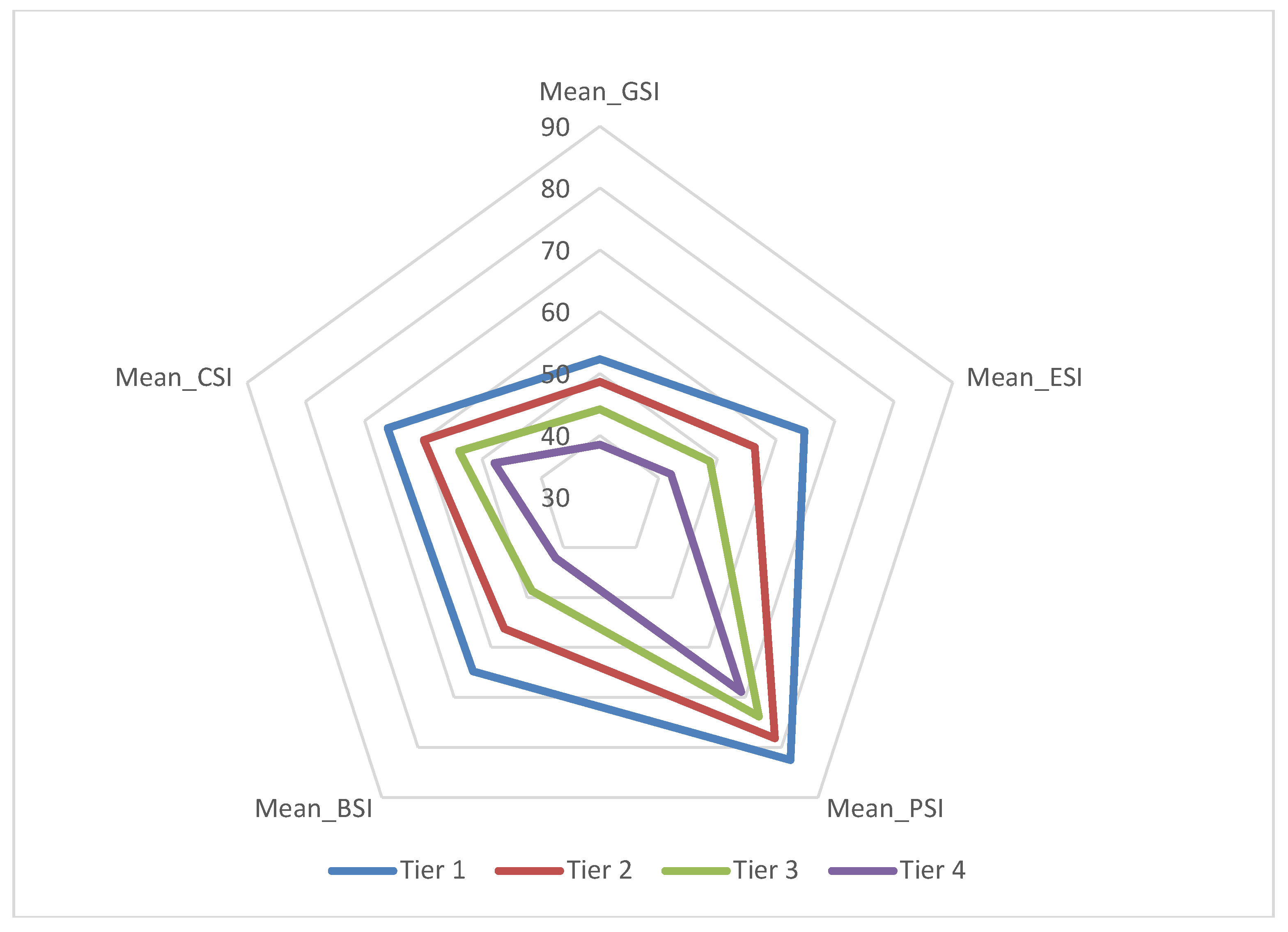
Figure 2.
This is a figure. Schemes follow the same formatting.
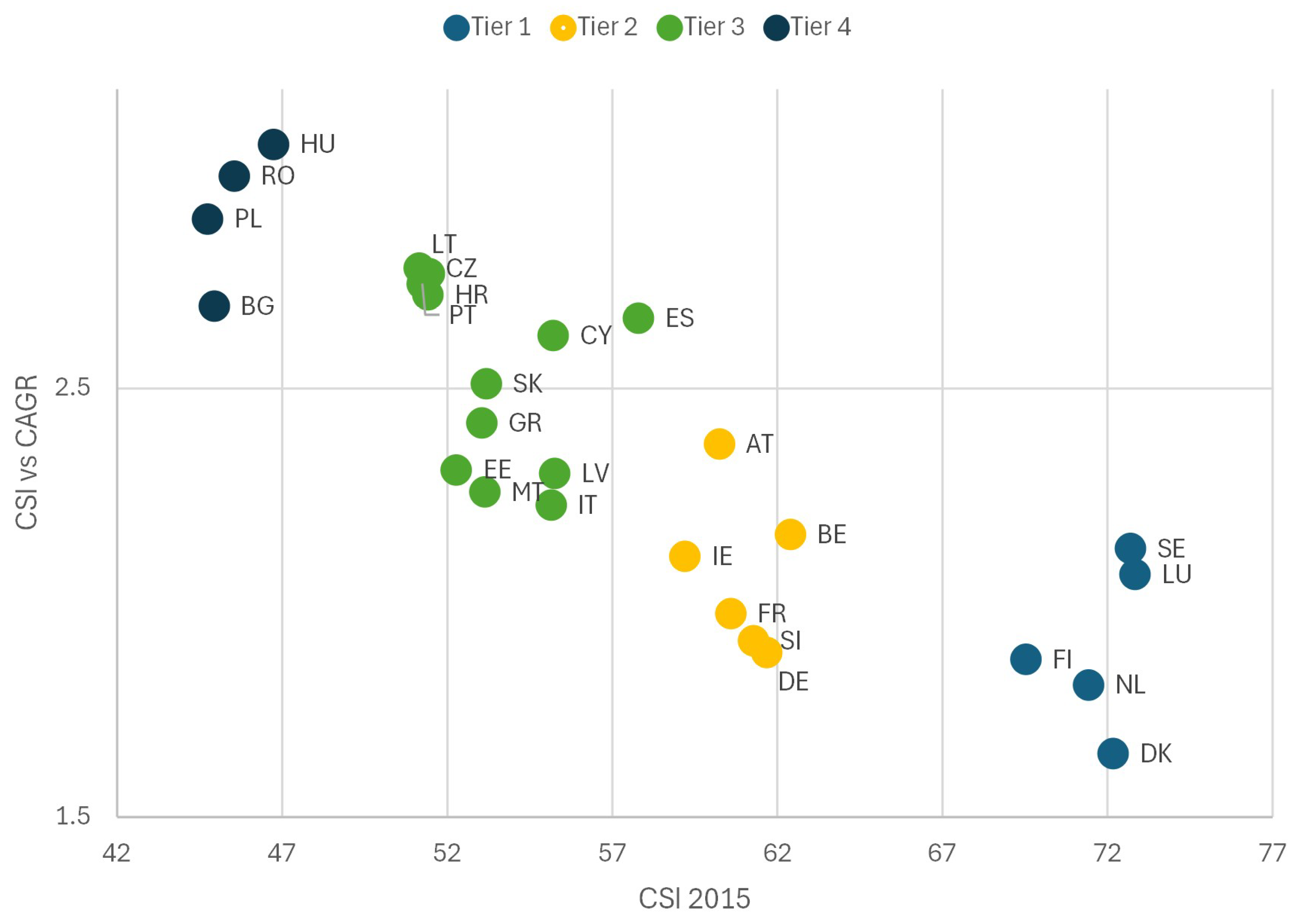
Table 1.
Mean and standard deviation of GSI, ESI, PSI, BSI, and CSI for EU-27 (2015, 2019, 2024).
| Index | Mean (2015) | SD (2015) | Mean (2019) | SD (2019) | Mean (2024) | SD (2024) |
|---|---|---|---|---|---|---|
| GSI | 42.5 | 18.3 | 46.8 | 19.1 | 49.2 | 20.5 |
| ESI | 38.7 | 15.6 | 47.3 | 16.8 | 55.4 | 18.2 |
| PSI | 74.2 | 6.7 | 77.1 | 6.3 | 79.8 | 5.9 |
| BSI | 38.7 | 15.6 | 47.3 | 16.8 | 55.4 | 18.2 |
| CSI | 48.5 | 11.2 | 54.6 | 11.8 | 60 | 12.5 |
Source: Author’s own elaboration based on data from Eurostat and the European Environment Agency, according to the methodology described in this study.
Table 2.
Cluster membership and tier characteristics (baseline CSI).
| Country | Tier | Mean CSI (2015-2024) |
Min CSI | Max CSI |
|---|---|---|---|---|
| Austria | 2 | 62.3 | 58.1 | 66.2 |
| Belgium | 2 | 61.5 | 57.2 | 65.3 |
| Bulgaria | 4 | 48.2 | 44.5 | 51.8 |
| Croatia | 3 | 55.7 | 51.3 | 59.6 |
| Cyprus | 3 | 56.1 | 52.4 | 59.5 |
| Czechia | 3 | 54.8 | 50.7 | 58.5 |
| Denmark | 1 | 72.5 | 68.3 | 76.4 |
| Estonia | 3 | 56.3 | 52.1 | 60.2 |
| Finland | 1 | 74.2 | 70.5 | 77.8 |
| France | 2 | 63.1 | 59.4 | 66.5 |
| Germany | 2 | 64.7 | 60.2 | 68.9 |
| Greece | 3 | 54.5 | 50.8 | 58.1 |
| Hungary | 4 | 47.9 | 44.2 | 51.5 |
| Ireland | 2 | 60.8 | 56.9 | 64.3 |
| Italy | 3 | 55.2 | 51.6 | 58.9 |
| Latvia | 3 | 55.9 | 52.3 | 59.2 |
| Lithuania | 3 | 56.5 | 52.8 | 60.1 |
| Luxembourg | 1 | 71.8 | 67.9 | 75.3 |
| Malta | 3 | 57.2 | 53.5 | 60.7 |
| Netherlands | 1 | 73.1 | 69.4 | 76.5 |
| Poland | 4 | 49.3 | 45.8 | 52.6 |
| Portugal | 3 | 56.8 | 53.1 | 60.2 |
| Romania | 4 | 46.7 | 43.2 | 50.1 |
| Slovakia | 3 | 54.2 | 50.5 | 57.7 |
| Slovenia | 2 | 61.9 | 58.3 | 65.2 |
| Spain | 3 | 57.3 | 53.7 | 60.5 |
| Sweden | 1 | 75.6 | 72.1 | 79.1 |
Source: Author’s own elaboration based on data from Eurostat and the European Environment Agency, according to the methodology described in this study.
Table 3.
Average CAGRs by tier, index, and period (2015-2019; 2019-2024).
| Tier | Index | CAGR (2015-2019) |
CAGR (2019-2024) |
CAGR (2015-2024) |
|---|---|---|---|---|
| 1 | GSI | 1.8 | 0.9 | 1.3 |
| 1 | ESI | 3.2 | 2.1 | 2.6 |
| 1 | PSI | 1.1 | 0.7 | 0.9 |
| 1 | BSI | 3.2 | 2.1 | 2.6 |
| 1 | CSI | 2.3 | 1.5 | 1.9 |
| 2 | GSI | 2.1 | 1.2 | 1.6 |
| 2 | ESI | 3.5 | 2.4 | 2.9 |
| 2 | PSI | 1.3 | 0.8 | 1 |
| 2 | BSI | 3.5 | 2.4 | 2.9 |
| 2 | CSI | 2.6 | 1.7 | 2.1 |
| 3 | GSI | 2.5 | 1.5 | 2 |
| 3 | ESI | 4.1 | 2.8 | 3.4 |
| 3 | PSI | 1.5 | 0.9 | 1.2 |
| 3 | BSI | 4.1 | 2.8 | 3.4 |
| 3 | CSI | 3.1 | 2 | 2.5 |
| 4 | GSI | 2.8 | 1.7 | 2.2 |
| 4 | ESI | 4.5 | 3.2 | 3.8 |
| 4 | PSI | 1.7 | 1.1 | 1.4 |
| 4 | BSI | 4.5 | 3.2 | 3.8 |
| 4 | CSI | 3.4 | 2.3 | 2.8 |
Source: Author’s own elaboration based on data from Eurostat and the European Environment Agency, according to the methodology described in this study.
Disclaimer/Publisher’s Note: The statements, opinions and data contained in all publications are solely those of the individual author(s) and contributor(s) and not of MDPI and/or the editor(s). MDPI and/or the editor(s) disclaim responsibility for any injury to people or property resulting from any ideas, methods, instructions or products referred to in the content. |
© 2026 by the authors. Licensee MDPI, Basel, Switzerland. This article is an open access article distributed under the terms and conditions of the Creative Commons Attribution (CC BY) license (http://creativecommons.org/licenses/by/4.0/).
Copyright: This open access article is published under a Creative Commons CC BY 4.0 license, which permit the free download, distribution, and reuse, provided that the author and preprint are cited in any reuse.


