

Submitted:
10 March 2026
Posted:
10 March 2026
You are already at the latest version
Abstract
Vitamin B12 is an essential water-soluble vitamin required for critical biological processes such as DNA synthesis, erythrocyte maturation, and maintenance of nervous system integrity. Deficiency of vitamin B12 can lead to serious clinical outcomes, including megaloblastic anemia, and potentially irreversible neurological damage. Conversely, hypercobalaminemia may be associated with severe disorders, including solid neoplasms, hematological malignancies and, in some cases, may result from inappropriate supplementation or immunoglobulin–B12 macro-complexes. Although current guidelines recommend total serum vitamin B12 and holotranscobalamin (holoTC) as first-line biomarkers, total serum vitamin B12 remains the most widely used test in routine clinical practice. However, since holoTC represents the biologically active fraction of vitamin B12 available for receptor-mediated cellular uptake, it appears to provide a more reliable assessment of cobalamin status, particularly in specific clinical contexts. Compared with total vitamin B12 measurement, holoTC is assessed using a more limited number of analytical methods and the majority of available kit are aligned with the WHO reference standard, thereby improving inter-assay harmonization. This review explores literature data about the role of vitamin B12 and holoTC, discussing analytical challenges and clinical interpretation, highlights the potential advantages of holoTC over total serum B12.
Keywords:
holotranscobalamin
; vitamin B12
; analytical immunoassays
; clinical issues
1. Introduction
Vitamin B12, also known as cobalamin, is an essential water-soluble vitamin, and in humans its availability depends entirely on dietary intake [1].
Cobalamin plays multiple roles in key biological processes, including DNA synthesis [2], hematopoiesis [3], myelin synthesis and maintenance [4], and fetal nervous system development [5]. Furthermore, it is indispensable for amino acid and homocysteine metabolism [6], nucleic acid methylation reactions [7], fatty acid metabolism [8], cognitive function [9], and folate activation [10].
Given its broad physiological roles, a deficiency in vitamin B12 can result in important clinical consequences, including megaloblastic anemia, cognitive impairment, and potentially irreversible neurological damage [11].
Vitamin B12 deficiency affects approximately 1–2% of the general population, rising to more than 10% in individuals over 65 years of age. This condition is especially common among high-risk groups, including older adults, individuals with insufficient intake of animal-based proteins, pregnant women, children, and patients with a history of gastrointestinal surgery [2].
However, the prevalence of cobalamin deficiency is highly dependent on the diagnostic criteria applied, including the distinction between clinical and subclinical deficiency, the biomarker threshold values used, and the specific characteristics of the studied population [12].
One of the principal challenges in diagnosing vitamin B12 deficiency is the nonspecific nature of early symptoms, which often leads to delays in detection and underscores the importance of early recognition to prevent serious complications [13].
Although clinical attention is traditionally focused on vitamin B12 deficiency, elevated serum cobalamin concentrations also warrant consideration. Persistently high levels have been associated with serious underlying disorders, including solid neoplasms, hematological malignancies, and liver disease [14]. They may also result from excessive or inappropriate intake of vitamin supplements [15], or, in some cases, reflect analytical artifacts such as immunoglobulin-B12 macro-complexes [16].
The 2024 National Institute for Health and Care Excellence (NICE) guideline (NG239) [17] recommends performing an initial diagnostic test for vitamin B12 deficiency in individuals presenting with at least one suggestive symptom associated with a risk factor. Key signs and symptoms include anemia or macrocytosis, cognitive disturbances, ophthalmic manifestations, glossitis, peripheral or central neurological signs, unexplained fatigue, and lack of response to iron therapy during pregnancy or lactation. Major risk factors include a diet low in B12, autoimmune (pernicious anemia) or familial diseases, malabsorption, chronic use of medications interfering with vitamin absorption, previous radiotherapy or gastrointestinal surgery, and recreational nitrous oxide use, which inactivates vitamin B12 by oxidizing its central cobalt atom [18].
In fact, the guideline specifies that holoTC should be preferred especially in certain clinical contexts, such as pregnancy, due to physiological fluctuations that can affect total serum B12 levels.
Over the past years, other molecules involved in the vitamin B12 metabolic pathway, such as methylmalonic acid (MMA) (Figure 1) and homocysteine (Hcy) (Figure 2), have been shown to play an essential role in identifying patients with impaired vitamin B12 status [19].
MMA reflects altered adenosylcobalamin-dependent metabolism and often rises before serum cobalamin declines [20,21], while, homocysteine, although useful as a metabolic marker, is influenced by folate and vitamin B6 status as well as renal function.
However, MMA and Hcy routine use is limited by high analytical costs and restricted availability, resulting in variable implementation across laboratories and geographic settings.
Current guidelines NICE 2024 define specific reference ranges for total vitamin B12 and holoTC. For total vitamin B12, concentrations <200 ng/L (<148 pmol/L) indicate deficiency, 200–300 ng/L (148–221 pmol/L) are considered indeterminate, and >300 ng/L (>221 pmol/L) make deficiency unlikely. For holoTC, levels <25 pmol/L suggest deficiency, 25–50 pmol/L are indeterminate, and >50 pmol/L are unlikely to reflect deficiency [17]. However, interpretative challenges remain due to the lack of harmonization among different commercial assay kits; consequently, a bias persists between methods, most likely related to differences in analytical detection principles and calibrator traceability.
This review aims to examine the roles of vitamin B12 and holotranscobalamin starting from their biochemical properties and metabolic pathways, highlighting analytical challenges, limitations, and issues in clinical interpretation. In addition, it focuses on the role of holoTC in assessing true vitamin B12 status and discusses its advantages over total serum vitamin B12.
2. Methods
This review considered articles indexed in PubMed, published between 2005 and 2025. Publications released before 2005 were included only when they provided significant historical background or methodological insight. The literature search was performed using the following terms, either alone or in various combinations: vitamin B12, holotranscobalamin (holoTC), B12 deficiency, biomarker, total serum vitamin B12, analytical limitations, and clinical application. Boolean operators (AND, OR) were applied to optimize the search strategy. Information obtained from the selected studies addressed the physiological role of vitamin B12 and holoTC, analytical techniques for their assessment, and their relevance in clinical practice.
3. Vitamin B12 and Holotranscobalamin (holoTC)
3.1. Biochemical Properties
The molecular structure of vitamin B12 (Figure 3) was elucidated by X-ray crystallographic studies, which identified the compound as a cyanide-ligated, cobalt-containing organometallic corrinoid [22]. The cobalt ion in vitamin B12 is centrally positioned within a contracted tetrapyrrole macrocycle, known as the corrin ring, composed of four reduced pyrrole units that coordinate the metal through their nitrogen atoms [23].
Variability in axial ligation contributes to the functional versatility of vitamin B12 and modulates its interaction with cobalamin-binding proteins, underscoring its essential role in selective recognition and transport by transcobalamin [26].
Transcobalamin (TC), also known as transcobalamin II [27], is a soluble 43 kDa glycoprotein encoded by the TCN2 gene and is the principal carrier responsible for delivering vitamin B12 to cells [26]. At the molecular level, TC consists of two structurally distinct domains, termed the α- and β-domains, which are connected by a flexible linker [28]. These domains share structural homology with the other cobalamin-binding proteins, such as intrinsic factor (IF) and haptocorrin (HC), also known as transcobalamin I [29], reflecting their origin from a common ancestral gene. The binding of cobalamins requires the cooperative contribution of both TC domains and results in an extremely high binding affinity, in the sub-picomolar range [24]. The TC-Cobalamin complex, referred to as holotranscobalamin (holoTC), represents the biologically active fraction of plasma vitamin B12 due to its rapid cellular uptake via receptor-mediated endocytosis [17,26].
3.2. Metabolic Aspects and Plasma Levels
Despite its involvement in a broad spectrum of essential biological processes in humans, the ability to synthesize vitamin B12 is restricted to certain bacteria and archaea [30]. Animals are unable to produce it endogenously; however, some species host symbiotic microorganisms capable of synthesizing it [31]. In humans, these bacteria reside predominantly in the colon, whereas B12 absorption occurs in the ileum. Because microbial synthesis occurs distal to the site of absorption, B12 produced by the intestinal microbiota is not bioavailable to the human host [32]. Therefore, to meet the daily requirement of approximately 2.4 μg and to prevent clinical manifestations of deficiency, vitamin B12 must be obtained through the diet [33]. After dietary intake, vitamin B12 is absorbed through an intrinsic factor-dependent mechanism and subsequently transported and converted intracellularly into its biologically active form (Figure 4). In plasma, vitamin B12 binds mainly to HC (~80%) or TC (~20-25%), the latter mediating cellular uptake [34].
Within enterocytes, vitamin B12 is converted into its biologically active coenzyme forms, adenosylcobalamin in the mitochondria and methylcobalamin in the cytosol [26,36] (Figure 5).
The literature indicates that interindividual variability in serum holoTC and vitamin B12 concentrations is only partly explained by diet and lifestyle factors and is also associated with differences in metabolic pathway and liver function [14,38]. Major dietary sources of cobalamin are of animal origin [39], however, the strength of the associations between different animal-derived food products and cobalamin, varies across food groups and remains inconsistent in the published literature [40,41,42,43].
Variations related to age and sex have been observed in various studies, but the results are heterogeneous [38,44,45,46]. These discrepancies may partly reflect differences in the demographic, clinical, and environmental characteristics of the populations analyzed.
Moreover, holoTC concentrations remain stable during pregnancy, in contrast to total vitamin B12, which declines nearly 50% over the course of gestation. This difference suggests that holotranscobalamin may be a more reliable indicator of vitamin B12 deficiency during pregnancy than total serum cobalamin [47].
3.3. Analytical Methods
Early approaches for total vitamin B12 determination relied primarily on microbiological assays based on the growth response of vitamin B12–dependent Lactobacillus species [51,52,53], in which extracted serum cobalamin served as the sole growth factor for bacterial proliferation. Although highly sensitive and traditionally considered reference methods, these assays were poorly reproducible [54], and susceptible to interference [55].
In the 1970s, radioimmunoassays (RIA) were developed [56,57], offering higher specificity and throughput than microbiological assays. These methods were later adapted for holoTC determination, involving separation of transcobalamin followed by quantification of bound vitamin B12 [58,59].
In the early 2000s, enzyme-linked immunosorbent assays (ELISA) were introduced for the quantification of both total B12 [60] and holoTC [61], representing a safer and more versatile alternative to RIA.
Subsequent methodological advances resulted in the development of automated immunoassays, which currently constitute the most widely used approach in routine clinical practice [62,63,64]. Currently available automated immunoassays for measuring total vitamin B12 and holoTC are based on competitive and sandwich assays (Figure 6), respectively.
These assays provide practical, sensitive, and robust tools for the timely assessment of vitamin B12 status; however, as shown in Table 1, discrepancies exist between methods due to differences in both the standards employed and the expected values.
More recently, liquid chromatography–tandem mass spectrometry (LC–MS/MS) has emerged as a highly specific method for the accurate, high-sensitivity quantification of total vitamin B12 [65], and other markers of cobalamin status, such as MMA [66] and Hcy [67].
Although mass spectrometry has the potential to provide a more comprehensive assessment of cobalamin status, no clinically validated method currently seems to exist for holotranscobalamin, and LC–MS/MS remains a specialized, second-line technique that is not widely used for routine vitamin B12 measurement.
Emerging technologies have led to the development of point-of-care testing (POCT) devices for total vitamin B12, which are now commercially available and offer rapid measurements outside the central laboratory.
However, these platforms generally provide lower analytical sensitivity and specificity, compared with automated laboratory immunoassays [68]. Furthermore, POCT systems are generally unable to achieve the same high analytical precision as laboratory-based methods, and consequently tend to exhibit higher coefficients of variation, limiting their use to preliminary screening rather than definitive diagnosis [69].
Novel technologies, such as optical fiber–based and nanostructured electrochemical biosensors, have been developed for holoTC detection, employing antibodies or cobalamin-binding proteins combined with optical or electrochemical transduction [70,71]. Despite their high sensitivity, compact size, label-free operation, and potential for real-time or point-of-care use, these approaches remain largely limited to experimental or preclinical settings [72].

Table 1.
Commercially available automated immunoassays for total vitamin B12 and holoTC.
| Analyte | Assay | Manufacturer | Platforms | Method | Assay range | Expected Values |
Standardization |
|---|---|---|---|---|---|---|---|
| Total B12 | Mindray Vitamin B12 Assay [73] |
Mindray Medical International Limited | Mindray CL series | CLIA | 50.0-2000.0 pg/mL |
180.0-916.0 pg/mL |
Against a commercial VB12 test (CLIA) |
| DiaSorin LIAISON Vitamin B12 [74] |
DiaSorin S.p.a. | Liaison/XL | CLIA | 55.0-1500.0 pg/mL |
107.2-653.3 pg/mL |
In-house Standard preparation |
|
|
MAGLUMI Vitamin B12 [75] |
Snibe | MAGLUMI | CLIA | 12.5-2000.0 pg/mL |
200.0-1100.0 pg/mL |
WHO IS 03/178 | |
| TOSOH AIA-PACK B12 [76] |
Tosoh Bioscience | Tosoh AIA | EIA | 50.0-2000.0 pg/mL |
230.0-1050.0 pg/mL |
In-house Standard preparation |
|
| VIDAS Vitamin B12 total [77] |
Biomeriéux | VIDAS | ELFA | 100.0-1200.0 pg/mL |
166.9-582.8 pg/mL |
WHO IS 03/178 | |
| Alinity i B12 [78] |
Abbott Diagnostics | Alinity i | CMIA | 146.0-2000.0 pg/mL |
187.0-883.0 pg/mL |
WHO IS 03/178 | |
| Atellica IM Vitamin B12 (VB12) [79] |
Siemens Healthineers | Atellica IM | CLIA | 45.0-2000.0 pg/mL |
211.0-911.0 pg/mL |
Cyanocobalamin (B12) USP Reference Standard | |
| Elecsys Vitamin B12 II [80] | Roche Diagnostics | Cobas E series | ECLIA | 150.0-2000.0 pg/mL |
232.0-1245.0 pg/mL |
WHO IS 03/178 | |
| Access Vitamin B12 [81] |
Beckman Coulter | Access/UniCel DxI | CLIA | 105.0-2100.0 pg/mL |
180.0-914.0 pg/mL |
EN ISO 17511 | |
| HoloTC | Alinity i Active-B12 (holoTC) [82] |
Abbott Diagnostics |
Alinity i | CMIA | 5.0-128.0 pmol/L |
25.1-165.0 pmol/L |
WHO IS 03/178 |
| Atellica Active-B12 [83] | Siemens Healthineers |
Atellica IM | CLIA | 4.25–146.0 pmol/L |
27.2-169.6 pmol/L |
WHO IS 03/178 | |
| Elecsys Active B12 [84] | Roche Diagnostics |
Cobas E series |
ECLIA | 3.0-150.0 pmol/L |
37.5-188.0 pmol/L |
WHO IS 03/178 | |
| Access Active-B12 (holoTC) [85] |
Beckman Coulter |
Access/UniCel DxI | CLIA | 3.0-160.0 pmol/L |
32.2-152.6 pmol/L |
EN ISO 17511 |
holoTC: holotranscobalamin; EIA: Enzyme Immunoassay; ELFA: Enzyme-Linked Fluorescent Assay; CMIA: chemiluminescent microparticle immunoassays; CLIA: chemiluminescent immunoassays; ECLIA: electrochemiluminescence immunoassays; WHO IS: World Health Organization International Standard; USP: United States Pharmacopeia; EN ISO: European Norm International Organization for Standardization.
3.3.1. Reference Materials and Assay Alignment
Although an international reference material (WHO/NIBSC 03/178) exists for total serum vitamin B12 (480 pg/mL) and holotranscobalamin (107 pmol/L) [86] not all commercially available methods are calibrated against this standard [87], thereby introducing an important source of analytical variability [68].
As reported in Table 1, total vitamin B12 assays exhibit heterogeneous traceability. Some methods are independently aligned to in-house standard preparations, others are standardized against internal reference materials produced using United States Pharmacopeia (USP)-approved materials, while additional assays are aligned to the WHO international standard or use manufacturer calibrators prepared from purified cyanocobalamin, with target values assigned spectrophotometrically according to EN ISO 17511.
In contrast to total vitamin B12, holoTC assays are currently available on only a limited number of analytical platforms (Table 1). Among these, most assays explicitly state traceability to the WHO International Standard 03/178, whereas only the Access Vitamin B12 assay (Beckman Coulter) reports traceability in accordance with EN ISO 17511, potentially supporting greater inter-assay harmonization for holoTC compared with total vitamin B12.
4. Discussion
Assessment of vitamin B12 status is a key aspect of clinical practice, particularly when deficiency is suspected. Evaluation should include potential metabolic abnormalities and genetic variants that may impair cobalamin metabolism and utilization. Total vitamin B12 deficiency can result in significant clinical consequences, including megaloblastic anemia, cognitive decline, potentially irreversible neurological damage, and metabolic disturbances. Conversely, hypercobalaminemia also requires careful interpretation, as high levels may be due to inappropriate supplementation or can also arise from analytical interference, circulating macrocomplexes formation, or underlying disorders, including paraneoplastic syndromes.
Despite numerous studies consistently demonstrating that no single biomarker possesses the necessary performance characteristics to establish deficiency in all patients, measurement of serum vitamin B12 remains the most widely used test in routine practice [68,88].
As recommended by current guidelines, vitamin B12 status is typically assessed using first-line biomarkers such as total serum vitamin B12 and holotranscobalamin, with well-defined deficiency cut-off, [68,88]. Second-line tests include MMA and Hcy which should be considered when first-line test results are inconclusive or borderline [17].
Nevertheless, this approach may be inappropriate, as several issues still exist. Vitamin B12 is a biochemically complex molecule with circulating levels that are highly variable and influenced by multiple factors, including nutritional status, particularly vitamin and protein intake, hepatic and intestinal function, and inter-individual variability, which the European Federation of Clinical Chemistry and Laboratory Medicine (EFLM) estimates at approximately 37% [89].
Moreover, several analytical variables may significantly affect the results, including inter-method variability and the use of different reference standards. Additional discrepancies arise from manufacturer-specific reference intervals, which are not interchangeable. Furthermore, reference ranges reported in the literature vary widely due to population-specific characteristics, such as age, sex, pregnancy [90], ethnicity and cultural dietary habits [68,87] and macro-B12 formation [91].
Therefore, it’s important to consider these factors, as guidelines define specific cut-off values that might not be always appropriate across different populations or analytical methods.
Evidence from studies conducted in different cohorts has consistently demonstrated this inter-method variability in total vitamin B12 cut-off values (Table 2), further limiting the accurate interpretation of clinical results.
Although WHO International Standards for total vitamin B12 and holotranscobalamin were introduced to reduce inter-method variability, considerable analytical bias remains [87], highlighting ongoing challenges in assay comparability. This is particularly evident for the many total vitamin B12 assays currently available, which frequently use internal reference materials that are not directly traceable to the WHO standard. Furthermore, although many manufacturers have adapted their calibration strategies to improve agreement between assays, the use of the WHO IS in routine practice can be limited by cost and restricted availability.
Achieving both standardization and harmonization would make results obtained with different methods comparable, ensuring consistency across laboratories, even when it is difficult to use the same reference standard. However, incomplete harmonization across different immunoassays persists and heterogeneous expected values are still observed [64,99,100]. Furthermore, it should always be noted that variations between immunoassays also exist due to differences in antibody specificity and epitope recognition, as well as the type of assay (competitive or non-competitive). These variations are also clearly evident in external quality assessment (EQA) schemes, which have consistently demonstrated persistent inter-assay bias among manufacturer-specific kits, resulting in significantly different vitamin B12 values.
Cesana et al. [101] recently demonstrated a significant bias among the most used analytical platforms for total vitamin B12 measurement. Specifically, Abbott, Siemens, and Beckman assays showed mean differences of 2.5%, 8.4%, and up to 24.4%, respectively, when compared with Roche. These findings highlight substantial inter-method variability. Consequently, applying a universal diagnostic cut-off across different analytical platforms may increase diagnostic uncertainty in clinical practice [68,101].
Conversely, holoTC represents the biologically active fraction of vitamin B12 available for receptor-mediated cellular uptake [38]. For instance, holoTC is recommended by current guidelines because it provides a more reliable measure of vitamin B12 status than total B12, particularly in specific clinical contexts such as pregnancy, and it is less influenced by biological variability or supplementation. Moreover, in patients with megaloblastic anemia, holoTC has demonstrated significantly higher diagnostic sensitivity compared to total B12 [102]. Similarly, in populations at risk of nutritional deficiency, such as vegans or vegetarians, holoTC has been shown to more accurately reflect B12 status and its associated metabolite alterations [103]. Finally, holoTC may be particularly useful for assessing the fraction of biologically active B12 in patients with paraneoplastic syndromes, solid tumors, or myeloproliferative hematologic disorders, conditions often associated with falsely elevated total B12 levels.
For holoTC, the analytical methods currently available and applicable in routine clinical practice are fewer than those used for total vitamin B12 measurement. Most assays are standardized against the WHO reference material, allowing improved harmonization of results obtained with different assay kits. Importantly, cut-off values are similar across the available methods and are consistent with the 2024 guideline recommendations, except for Roche assay (Table 1).
A relevant issue when comparing total vitamin B12 and holoTC concerns the different units in which these analytes are commonly reported (respectively mass and molar units), both across available assays (Table 2) and in literature data [104]. This discrepancy mainly affects total vitamin B12, for which most commercial kits report pg/mL (Table 1) as the primary unit of measurement, whereas clinical guidelines indicate both ng/L and pmol/L. In contrast, greater uniformity is observed for holoTC, which is always expressed in pmol/L across different assays and current guidelines. Such heterogeneity may complicate results interpretation, as unit conversion may be challenging and potentially imprecise, particularly when assessing the expected ratio between total and biologically active vitamin B12. In fact, it is important to consider that holoTC assays quantify also the protein fraction bound to transcobalamin, unlike total vitamin B12.
Although the holoTC assay is more expensive, its measurement could help prevent misdiagnosis and enable the timely beginning of appropriate therapy. Late recognition and treatment of B12 deficiency can negatively affect quality of life and increase the risk of neurological damage [17], highlighting the clinical value of using holoTC as a first-choice marker despite its higher cost, particularly in specific settings.
5. Conclusions
Overall, harmonization of total vitamin B12 assays remains incomplete, and the different methods are not interchangeable. Consequently, diagnostic cut-offs, including those recommended by NICE, cannot be universally applied. In the absence of full standardization, method-specific decision thresholds should be adopted, and results interpreted with caution, particularly near clinical decision limits.
Therefore, the clinicians should request holo-transcobalamin together with total B12 to provide a more reliable and accurate assessment of B12 status, potentially reducing diagnostic errors and inappropriate supplementation. This would prevent higher long-term healthcare costs and suboptimal patient management.
Institutional Review Board
Not applicable.
Author Contributions
Conceptualization: S.B.; writing—original draft preparation: M.M.; G.N.; S.L.; C.L.; writing—review and editing, M.M.; G.N.; S.L.; C.L.; S.B.; A.U.; supervision, S.B. and A.U. All authors have read and agreed to the published version of the manuscript.
Funding
This research received no external funding.
Informed Consent Statement
Not applicable.
Data Availability Statement
No new data were created or analyzed in this study. Data sharing is not applicable to this article.
Conflicts of Interest
All authors have no conflicts of interest or financial ties to disclose.
Abbreviations
The following abbreviations are used in this manuscript:
| AB1 | Antibody 1 |
| AB2 | Antibody 2 |
| Ado-Cbl | Adenosyl Cobalamin |
| B6 | Pyridoxine vitamine |
| B12 | Riboflavin vitamine |
| Cbl | Cobalamin |
| CBS | Cystathionine β-synthase |
| CGL | Cystathionine γ-lyase |
| CH3 | Methyl group |
| CH3-Cbl | Methylcobalamin |
| CLIA | Chemiluminescence immunoassay |
| CMIA | Chemiluminescent microparticle immunoassay |
| CoA | Coenzyme A |
| DNA | Deoxyribonucleic Acid |
| ECLIA | Electrochemiluminescence immunoassay |
| EFLM | European Federation of Clinical Chemistry and Laboratory Medicine |
| EIA | Enzyme Immunoassay |
| ELFA | Enzyme-linked Fluorescent Assay |
| ELISA | Enzyme-linked immunosorbent assays |
| EN ISO | European Norm International Organization for Standardization. |
| EQA | external quality assessment |
| f | females |
| HC | Haptocorrin |
| Hcy | Homocysteine |
| holoTC | holotranscobalamin |
| IF | Intrinsic Factor |
| IS | International Standard |
| kDa | kiloDalton |
| LC-MS/MS | liquid chromatography–tandem mass spectrometry |
| m | males |
| MAT | Methionine Adenosyle Transferase |
| MMA | Methylmalonic acid |
| MRP1 | Multidrug Resistance Protein 1 |
| MTHFR | Methylenetetrahydrofolate reductase |
| NG239 | NICE Guideline 239 |
| ng/L | nanograms/liter |
| NH2 | Amino group |
| NIBSC | National Institute for Biological Standards and Control |
| NICE | National Institute for Health and Care Excellence |
| OH | Hydroxyl group |
| PCC | Propionyl-CoA Carboxylase |
| pg/mL | picograms/milliliter |
| POCT | Point-Of-Care Testing |
| pmol/L | picomoles/liter |
| RI | Reference Intervals |
| RIA | radioimmunoassays |
| RLU | Relative Lights Units |
| SAH | S-adenosyl-homocysteine |
| SAHH | S-adenosyl-homocysteine hydrolase |
| SAM | S-adenosyl-methionine |
| TC | Transcobalamin |
| TCN2 | Transcobalamin 2 |
| THF | Tetrahydrofolate |
| USP | Unites States Pharmacopeia |
| WHO | World Health Organization |
| y.o | years old |
| ug | micrograms |
References
- Lu, T.; Paterson, A.D. Estimating effects of serum vitamin B12 levels on psychiatric disorders and cognitive impairment: A Mendelian randomization study. Commun Med 2025, 5, 316. [Google Scholar] [CrossRef]
- Green, R.; Allen, L.H.; Bjorke-Monsen, A.L.; Brito, A.; Gueant, J.L.; Miller, J.W.; Molloy, A.M.; Nexo, E.; Stabler, S.; Toh, B.H.; et al. Vitamin B(12) deficiency. Nat Rev Dis Primers 2017, 3, 17040. [Google Scholar] [CrossRef] [PubMed]
- Hariz, A.; Bhattacharya, P.T. Megaloblastic Anemia; StatPearls: Treasure Island, FL, USA, 2025. [Google Scholar]
- Calderon-Ospina, C.A.; Nava-Mesa, M.O. B Vitamins in the nervous system: Current knowledge of the biochemical modes of action and synergies of thiamine, pyridoxine, and cobalamin. CNS Neurosci Ther 2020, 26, 5–13. [Google Scholar] [CrossRef] [PubMed]
- Venkatramanan, S.; Armata, I.E.; Strupp, B.J.; Finkelstein, J.L. Vitamin B-12 and Cognition in Children. Adv Nutr 2016, 7, 879–888. [Google Scholar] [CrossRef]
- Zaric, B.L.; Obradovic, M.; Bajic, V.; Haidara, M.A.; Jovanovic, M.; Isenovic, E.R. Homocysteine and Hyperhomocysteinaemia. Curr Med Chem 2019, 26, 2948–2961. [Google Scholar] [CrossRef] [PubMed]
- Takahashi-Iniguez, T.; Garcia-Hernandez, E.; Arreguin-Espinosa, R.; Flores, M.E. Role of vitamin B12 on methylmalonyl-CoA mutase activity. J Zhejiang Univ Sci B 2012, 13, 423–437. [Google Scholar] [CrossRef]
- Yadav, D.K.; Shrestha, S.; Lillycrop, K.A.; Joglekar, C.V.; Pan, H.; Holbrook, J.D.; Fall, C.H.; Yajnik, C.S.; Chandak, G.R. Vitamin B(12) supplementation influences methylation of genes associated with Type 2 diabetes and its intermediate traits. Epigenomics 2018, 10, 71–90. [Google Scholar] [CrossRef]
- Moore, E.; Mander, A.; Ames, D.; Carne, R.; Sanders, K.; Watters, D. Cognitive impairment and vitamin B12: A review. Int Psychogeriatr 2012, 24, 541–556. [Google Scholar] [CrossRef]
- Froese, D.S.; Fowler, B.; Baumgartner, M.R. Vitamin B(12), folate, and the methionine remethylation cycle-biochemistry, pathways, and regulation. J Inherit Metab Dis 2019, 42, 673–685. [Google Scholar] [CrossRef]
- Hunt, A.; Harrington, D.; Robinson, S. Vitamin B12 deficiency. BMJ 2014, 349, g5226. [Google Scholar] [CrossRef]
- Guillerme, J.; Feugray, G.; Girot, H.; Brunel, V.; Muraine, M.Q. Preliminary evaluation of the diagnostic performance of Roche Elecsys(R) active vitamin B12 versus total vitamin B12 for vitamin B12 deficiency screening. Ann Clin Biochem 2024, 61, 55–62. [Google Scholar] [CrossRef]
- Obeid, R.; Andres, E.; Ceska, R.; Hooshmand, B.; Gueant-Rodriguez, R.M.; Prada, G.I.; Slawek, J.; Traykov, L.; Ta Van, B.; Varkonyi, T.; et al. Diagnosis, Treatment and Long-Term Management of Vitamin B12 Deficiency in Adults: A Delphi Expert Consensus. J Clin Med 2024, 13. [Google Scholar] [CrossRef]
- Andres, E.; Serraj, K.; Zhu, J.; Vermorken, A.J. The pathophysiology of elevated vitamin B12 in clinical practice. QJM 2013, 106, 505–515. [Google Scholar] [CrossRef]
- Vollbracht, C.; McGregor, G.P.; Kraft, K. Supraphysiological vitamin B12 serum concentrations without supplementation: The pitfalls of interpretation. QJM 2020, 113, 619–620. [Google Scholar] [CrossRef] [PubMed]
- Hurkmans, E.G.E.; Deneer, R.; Nijziel, M.R.; Scharnhorst, V. Unexplained Elevated Vitamin B12: Consider Macro-B12. Int J Lab Hematol 2026. [Google Scholar] [CrossRef] [PubMed]
- Vitamin B12 Deficiency in over 16s: Diagnosis and Management; National Institute for Health and Care Excellence: Clinical Guidelines: London, 2024.
- Leleu, D.; Denimal, D. A case of functional vitamin B12 deficiency after recreational nitrous oxide use. Biochem Med 2024, 34, 010801. [Google Scholar] [CrossRef] [PubMed]
- Nexo, E.; Parkner, T. Vitamin B12-Related Biomarkers. Food Nutr Bull 2024, 45, S28–S33. [Google Scholar] [CrossRef]
- Devalia, V.; Hamilton, M.S.; Molloy, A.M.; British Committee for Standards in Haematology. Guidelines for the diagnosis and treatment of cobalamin and folate disorders. Br J Haematol 2014, 166, 496–513. [Google Scholar] [CrossRef]
- Fedosov, S.N.; Brito, A.; Miller, J.W.; Green, R.; Allen, L.H. Combined indicator of vitamin B12 status: Dodification for missing biomarkers and folate status and recommendations for revised cut-points. Clin Chem Lab Med 2015, 53, 1215–1225. [Google Scholar] [CrossRef]
- Smith, A.D.; Warren, M.J.; Refsum, H. Vitamin B(12). Adv Food Nutr Res 2018, 83, 215–279. [Google Scholar] [CrossRef]
- Randaccio, L.; Geremia, S.; Demitri, N.; Wuerges, J. Vitamin B12: Unique metalorganic compounds and the most complex vitamins. Molecules 2010, 15, 3228–3259. [Google Scholar] [CrossRef]
- Bloch, J.S.; Ruetz, M.; Krautler, B.; Locher, K.P. Structure of the human transcobalamin beta domain in four distinct states. PLoS ONE 2017, 12, e0184932. [Google Scholar] [CrossRef]
- Obeid, R.; Fedosov, S.N.; Nexo, E. Cobalamin coenzyme forms are not likely to be superior to cyano- and hydroxyl-cobalamin in prevention or treatment of cobalamin deficiency. Mol Nutr Food Res 2015, 59, 1364–1372. [Google Scholar] [CrossRef] [PubMed]
- Mucha, P.; Kus, F.; Cysewski, D.; Smolenski, R.T.; Tomczyk, M. Vitamin B(12) Metabolism: A Network of Multi-Protein Mediated Processes. Int J Mol Sci 2024, 25. [Google Scholar] [CrossRef] [PubMed]
- Quadros, E.V.; Rothenberg, S.P.; Pan, Y.C.; Stein, S. Purification and molecular characterization of human transcobalamin II. J Biol Chem 1986, 261, 15455–15460. [Google Scholar] [CrossRef] [PubMed]
- Wuerges, J.; Garau, G.; Geremia, S.; Fedosov, S.N.; Petersen, T.E.; Randaccio, L. Structural basis for mammalian vitamin B12 transport by transcobalamin. Proc Natl Acad Sci USA 2006, 103, 4386–4391. [Google Scholar] [CrossRef]
- Obeid, R. High Plasma Vitamin B12 and Cancer in Human Studies: A Scoping Review to Judge Causality and Alternative Explanations. Nutrients 2022, 14. [Google Scholar] [CrossRef]
- Moravcova, M.; Siatka, T.; Krcmova, L.K.; Matousova, K.; Mladenka, P.; Oemonom. Biological properties of vitamin B(12). Nutr Res Rev 2025, 38, 338–370. [Google Scholar] [CrossRef]
- Watanabe, F.; Bito, T. Vitamin B(12) sources and microbial interaction. Exp Biol Med 2018, 243, 148–158. [Google Scholar] [CrossRef]
- Wan, Z.; Zheng, J.; Zhu, Z.; Sang, L.; Zhu, J.; Luo, S.; Zhao, Y.; Wang, R.; Zhang, Y.; Hao, K.; et al. Intermediate role of gut microbiota in vitamin B nutrition and its influences on human health. Front Nutr 2022, 9, 1031502. [Google Scholar] [CrossRef]
- Basalamah, M.A.; Ibrahim, M.O.; Qutob, M.S.; Jazar, A.S.; Bakr, E.H.; Alazzeh, A.Y.; Al-Slaihat, A.H.; Azzeh, F.S. Vitamin B12 status among asymptomatic young adult females and its association with some anthropometric and biochemical parameters: A cross-sectional study from Makkah (cobalamin deficiency in young adult females). Medicine 2023, 102, e35838. [Google Scholar] [CrossRef] [PubMed]
- Fedosov, S.N. Physiological and molecular aspects of cobalamin transport. Subcell Biochem 2012, 56, 347–367. [Google Scholar] [CrossRef] [PubMed]
- Gueant, J.L.; Gueant-Rodriguez, R.M.; Alpers, D.H. Vitamin B12 absorption and malabsorption. Vitam Horm 2022, 119, 241–274. [Google Scholar] [CrossRef] [PubMed]
- Gick, G.G.; Arora, K.; Sequeira, J.M.; Nakayama, Y.; Lai, S.C.; Quadros, E.V. Cellular uptake of vitamin B(12): Role and fate of TCblR/CD320, the transcobalamin receptor. Exp Cell Res 2020, 396, 112256. [Google Scholar] [CrossRef]
- Deme, J.C.; Hancock, M.A.; Xia, X.; Shintre, C.A.; Plesa, M.; Kim, J.C.; Carpenter, E.P.; Rosenblatt, D.S.; Coulton, J.W. Purification and interaction analyses of two human lysosomal vitamin B12 transporters: LMBD1 and ABCD4. Mol Membr Biol 2014, 31, 250–261. [Google Scholar] [CrossRef]
- Nexo, E.; Hoffmann-Lucke, E. Holotranscobalamin, a marker of vitamin B-12 status: Analytical aspects and clinical utility. Am J Clin Nutr 2011, 94, 359S–365S. [Google Scholar] [CrossRef]
- Pardo-Cabello, A.J.; Manzano-Gamero, V.; Puche-Canas, E. Vitamin B12: For more than just the treatment of megaloblastic anemia? Rev Clin Esp 2023, 223, 114–119. [Google Scholar] [CrossRef]
- Damayanti, D.; Jaceldo-Siegl, K.; Beeson, W.L.; Fraser, G.; Oda, K.; Haddad, E.H. Foods and Supplements Associated with Vitamin B(12) Biomarkers among Vegetarian and Non-Vegetarian Participants of the Adventist Health Study-2 (AHS-2) Calibration Study. Nutrients 2018, 10. [Google Scholar] [CrossRef]
- Denissen, K.F.M.; Heil, S.G.; Eussen, S.; Heeskens, J.P.J.; Thijs, C.; Mommers, M.; Smits, L.J.M.; van Dongen, M.; Dagnelie, P.C. Intakes of Vitamin B-12 from Dairy Food, Meat, and Fish and Shellfish Are Independently and Positively Associated with Vitamin B-12 Biomarker Status in Pregnant Dutch Women. J Nutr 2019, 149, 131–138. [Google Scholar] [CrossRef]
- Cifelli, C.J.; Agarwal, S.; Fulgoni, V.L., III. Association between Intake of Total Dairy and Individual Dairy Foods and Markers of Folate, Vitamin B(6) and Vitamin B(12) Status in the U.S. Population. Nutrients 2022, 14. [Google Scholar] [CrossRef]
- Huang, H.H.; Cohen, A.A.; Gaudreau, P.; Auray-Blais, C.; Allard, D.; Boutin, M.; Reid, I.; Turcot, V.; Presse, N. Vitamin B-12 Intake from Dairy but Not Meat Is Associated with Decreased Risk of Low Vitamin B-12 Status and Deficiency in Older Adults from Quebec, Canada. J Nutr 2022, 152, 2483–2492. [Google Scholar] [CrossRef] [PubMed]
- Risch, M.; Meier, D.W.; Sakem, B.; Medina Escobar, P.; Risch, C.; Nydegger, U.; Risch, L. Vitamin B12 and folate levels in healthy Swiss senior citizens: A prospective study evaluating reference intervals and decision limits. BMC Geriatr 2015, 15, 82. [Google Scholar] [CrossRef] [PubMed]
- Hinds, H.E.; Johnson, A.A.; Webb, M.C.; Graham, A.P. Iron, folate, and vitamin B12 status in the elderly by gender and ethnicity. J Natl Med Assoc 2011, 103, 870–877. [Google Scholar] [CrossRef] [PubMed]
- Sturmer, P.; Strathmann, E.A.; Liedtke, T.P.; Overmohle, C.; Rimbach, G.; Weber, K.S.; Lieb, W. Correlates of serum holo-Transcobalamin in the elderly general population. Eur J Nutr 2025, 64, 270. [Google Scholar] [CrossRef]
- Morkbak, A.L.; Hvas, A.M.; Milman, N.; Nexo, E. Holotranscobalamin remains unchanged during pregnancy. Longitudinal changes of cobalamins and their binding proteins during pregnancy and postpartum. Haematologica 2007, 92, 1711–1712. [Google Scholar] [CrossRef]
- Refsum, H.; Johnston, C.; Guttormsen, A.B.; Nexo, E. Holotranscobalamin and total transcobalamin in human plasma: Determination, determinants, and reference values in healthy adults. Clin Chem 2006, 52, 129–137. [Google Scholar] [CrossRef]
- Surendran, S.; Adaikalakoteswari, A.; Saravanan, P.; Shatwaan, I.A.; Lovegrove, J.A.; Vimaleswaran, K.S. An update on vitamin B12-related gene polymorphisms and B12 status. Genes Nutr 2018, 13, 2. [Google Scholar] [CrossRef]
- Guetterman, H.M.; Huey, S.L.; Knight, R.; Fox, A.M.; Mehta, S.; Finkelstein, J.L. Vitamin B-12 and the Gastrointestinal Microbiome: A Systematic Review. Adv Nutr 2022, 13, 530–558. [Google Scholar] [CrossRef]
- Kelleher, B.P.; Broin, S.D. Microbiological assay for vitamin B12 performed in 96-well microtitre plates. J Clin Pathol 1991, 44, 592–595. [Google Scholar] [CrossRef]
- Stuart, J.; Sklaroff, S.A. Rapid microbiological assay of serum vitamin B 12 by electronic counter. J Clin Pathol 1966, 19, 46–50. [Google Scholar] [CrossRef]
- Davis, R.E.; Moulton, J.; Kelly, A. An automated microbiological method for the measurement of vitamin B12. J Clin Pathol 1973, 26, 494–498. [Google Scholar] [CrossRef]
- Berg, T.M.; de Vries, J.A.; van Gasteren, C.J.; Meeuwissen, H.; Stevens, G.A.; Verbon, F.J. Comparative studies on the microbiological vitamin B12 assay at two laboratories. Appl Environ Microbiol 1976, 31, 459–464. [Google Scholar] [CrossRef] [PubMed]
- Kelleher, B.P.; Scott, J.M.; O’Broin, S.D. Use of beta-lactamase to hydrolyse interfering antibiotics in vitamin B12 microbiological assay using Lactobacillus leichmannii. Clin Lab Haematol 1990, 12, 87–95. [Google Scholar] [CrossRef]
- Endres, D.B.; Painter, K.; Niswender, G.D. A solid-phase radioimmunoassay for vitamin B12 in serum, with use of radioiodinated tyrosine methyl ester of vitamin B12. Clin Chem 1978, 24, 460–465. [Google Scholar] [CrossRef]
- Frenkel, E.P.; White, J.D.; Reisch, J.S.; Sheehan, R.G. Comparison of two methods for radioassay of vitamin B12 in serum. Clin Chem 1973, 19, 1357–1360. [Google Scholar] [CrossRef]
- Loikas, S.; Lopponen, M.; Suominen, P.; Moller, J.; Irjala, K.; Isoaho, R.; Kivela, S.L.; Koskinen, P.; Pelliniemi, T.T. RIA for serum holo-transcobalamin: Method evaluation in the clinical laboratory and reference interval. Clin Chem 2003, 49, 455–462. [Google Scholar] [CrossRef] [PubMed]
- Ulleland, M.; Eilertsen, I.; Quadros, E.V.; Rothenberg, S.P.; Fedosov, S.N.; Sundrehagen, E.; Orning, L. Direct assay for cobalamin bound to transcobalamin (holo-transcobalamin) in serum. Clin Chem 2002, 48, 526–532. [Google Scholar] [CrossRef] [PubMed]
- Selva Kumar, L.S.; Thakur, M.S. Competitive immunoassay for analysis of vitamin B(12). Anal Biochem 2011, 418, 238–246. [Google Scholar] [CrossRef]
- Orning, L.; Rian, A.; Campbell, A.; Brady, J.; Fedosov, S.N.; Bramlage, B.; Thompson, K.; Quadros, E.V. Characterization of a monoclonal antibody with specificity for holo-transcobalamin. Nutr Metab 2006, 3, 3. [Google Scholar] [CrossRef]
- Merrigan, S.D.; Owen, W.E.; Straseski, J.A. Performance characteristics of the ARCHITECT Active-B12 (Holotranscobalamin) assay. Clin Lab 2015, 61, 283–288. [Google Scholar] [CrossRef]
- Heil, S.G.; Bodenburg, P.; Findeisen, P.; Luebcke, S.; Sun, Y.; de Rijke, Y.B. Multicentre evaluation of the Roche Elecsys(R) Active B(12) (holotranscobalamin) electro-chemiluminescence immunoassay. Ann Clin Biochem 2019, 56, 662–667. [Google Scholar] [CrossRef]
- Ispir, E.; Serdar, M.A.; Ozgurtas, T.; Gulbahar, O.; Akin, K.O.; Yesildal, F.; Kurt, I. Comparison of four automated serum vitamin B12 assays. Clin Chem Lab Med 2015, 53, 1205–1213. [Google Scholar] [CrossRef] [PubMed]
- Zhang, R.; Ma, X.; Zou, Y.; Qiu, L.; Wang, D.; Tang, Y.; Cao, Y.; Yu, S.; Cheng, X. Total serum vitamin B12 (cobalamin) LC-MS/MS assay as an arbiter of clinically discordant immunoassay results. Clin Chem Lab Med 2023, 61, 86–92. [Google Scholar] [CrossRef] [PubMed]
- Obeid, R.; Geisel, J.; Herrmann, W. Comparison of two methods for measuring methylmalonic acid as a marker for vitamin B12 deficiency. Diagnosis 2015, 2, 67–72. [Google Scholar] [CrossRef]
- Ma, X.; Zou, Y.; Tang, Y.; Wang, D.; Zhou, W.; Yu, S.; Qiu, L. High-throughput analysis of total homocysteine and methylmalonic acid with the efficiency to separate succinic acid in serum and urine via liquid chromatography tandem mass spectrometry. J Chromatogr B Analyt Technol Biomed Life Sci 2022, 1193, 123135. [Google Scholar] [CrossRef]
- Harrington, D.J.; Stevenson, E.; Sobczynska-Malefora, A. The application and interpretation of laboratory biomarkers for the evaluation of vitamin B12 status. Ann Clin Biochem 2025, 62, 22–33. [Google Scholar] [CrossRef] [PubMed]
- Trad, F.M.; AlHamad, T.; Younes, N.; Abunasser, S.; Younes, S.; Nizamuddin, P.B.; Chaar, D.E.; Salameh, I.M.; Al-Dewik, N.I.; Laiwattanapaisal, W.; et al. Accre 8 emerging point of care CLIA system for vitamin B12 assessment compared with three established assays. Sci Rep 2025, 15, 13328. [Google Scholar] [CrossRef]
- Soares, M.S.; Vidal, M.; Santos, N.F.; Costa, F.M.; Marques, C.; Pereira, S.O.; Leitao, C. Immunosensing Based on Optical Fiber Technology: Recent Advances. Biosensors 2021, 11. [Google Scholar] [CrossRef]
- Rohilla, R.; Kaur, A.; Rani, S.; Prabhakar, N. Ultrasensitive detection of holoTC for analysis of Vitamin B12 levels using Ag(2)MoO(4) deposited PEDOT sensing platform. Biosens Bioelectron 2025, 267, 116783. [Google Scholar] [CrossRef]
- Bissen, A.; Yunussova, N.; Myrkhiyeva, Z.; Salken, A.; Tosi, D.; Bekmurzayeva, A. Unpacking the packaged optical fiber bio-sensors: Understanding the obstacle for biomedical application. Front Bioeng Biotechnol 2024, 12, 1401613. [Google Scholar] [CrossRef]
- Mindray Vitamin B12 CLIA IFU 2015.
- DiaSorin LIAISON Vitamin B12 (CLIA).
- Snibe MAGLUMI Vitamin B12 (CLIA) IFU 2022.
- TOSOH AIA-PACK B12 IFU 2024.
- VIDAS Vitamin B12 total IFU 2024.
- Abbott Alinity Vitamin B12 IFU 2017.
- Siemens Healthineers. Atellica IM Vitamin B12 (VB12) IFU 2019.
- Elecsys® Vitamin B12 II. Roche Diagnostics: Mannheim, Germany. Available online: https://elabdoc-prod.roche.com/eLD/web/global/en/products/CPS_000536 (accessed on 25 January 2026).
- Access Vitamin B12: Instruction for Use; Beckman Coulter, Inc.: Brea, CA, USA. Document n. D12001.B. Available online: https://www.beckmancoulter.com/products/part?partnumber=33000 (accessed on 25 January 2026).
- Abbott Alinity Active B12 IFU 2025.
- Active-B12 Assay (Holotranscobalamin) — Laboratory Diagnostics. Siemens Healthineers. Available online: https://www.siemens-healthineers.com/sk/laboratory-diagnostics/assays-by-diseases-conditions/anemia/active-b12-assay (accessed on 23 January 2026).
- Diagnostics Roche Elecsys®. Active B12 (holotranscobalamin) assay: Method Sheet; Roche Diagnostics. Available online: https://elabdoc-prod.roche.com/eLD/web/global/en/products/CPS_000430 (accessed on 23 January 2026).
- Coulter, B. Access Active-B12 (holotranscobalamin) assay: Instructions for Use; Document no. D12001; Beckman Coulter: Brea, CA, USA. Available online: https://www.beckmancoulter.com/products/part?partnumber=33000&utm_ (accessed on 23 January 2026).
- Thorpe, S.J.; Rigsby, P.; Roberts, G.; Lee, A.; Hamilton, M.; Craig, D. An International Standard for holotranscobalamin (holoTC): International collaborative study to assign a holoTC value to the International Standard for vitamin B12 and serum folate. Clin Chem Lab Med 2016, 54, 1467–1472. [Google Scholar] [CrossRef] [PubMed]
- Jassam, N.; Bancroft, T.; Luvai, A.; Mbagaya, W.; Barth, J.H. Vitamin B12 reference intervals on Beckman, Roche and Siemens analytical platforms. Ann Clin Biochem 2023, 60, 417–422. [Google Scholar] [CrossRef]
- Harrington, D.J. Laboratory assessment of vitamin B12 status. J Clin Pathol 2017, 70, 168–173. [Google Scholar] [CrossRef]
- EFLM Cobalamin biological variability. Available online: https://biologicalvariation.eu/api/search/by_analyte?format=html&query=Cobalamin (accessed on 28 February 2026).
- Sobczynska-Malefora, A.; Delvin, E.; McCaddon, A.; Ahmadi, K.R.; Harrington, D.J. Vitamin B(12) status in health and disease: A critical review. Diagnosis of deficiency and insufficiency - clinical and laboratory pitfalls. Crit Rev Clin Lab Sci 2021, 58, 399–429. [Google Scholar] [CrossRef]
- Wolffenbuttel, B.H.R.; Muller Kobold, A.C.; Sobczynska-Malefora, A.; Harrington, D.J. Macro-B(12) masking B(12) deficiency. BMJ Case Rep 2022, 15. [Google Scholar] [CrossRef]
- Andersen, S.L.; Hansen, A.B.; Hindersson, P.; Andersen, L.; Christensen, P.A. Vitamin B12 reference intervals. Dan Med J 2023, 70. [Google Scholar]
- Jiang, W.; Men, S.; Wen, X.; Yuan, X.; Pu, D.; Liu, X.; Jia, X.; Wang, C. A preliminary study for the establishment of a reference interval for vitamin B12 in China after performance verification of a second-generation ECLIA kit. J Clin Lab Anal 2020, 34, e23165. [Google Scholar] [CrossRef]
- Sole-Enrech, G.; San-Jose, P.; Aliste-Fernandez, M.; Cano-Corres, R.; Claver-Belver, N.; Palencia-Dominguez, J.; Teodoro-Marin, V.; Serrano-Fuentes, R.; Ustrell-Abanco, R.; Campos-Barreda, F.; et al. Vitamin B12 and folate levels in a healthy population: Establishing reference intervals. Clin Chem Lab Med 2019, 57, e173–e175. [Google Scholar] [CrossRef]
- Sobczynska-Malefora, A.; Katayev, A.; Steed, D.; O’Logbon, J.; Crook, M.; Harrington, D.J. Age- and ethnicity-related reference intervals for serum vitamin B(12). Clin Biochem 2023, 111, 66–71. [Google Scholar] [CrossRef] [PubMed]
- Alpdemir, M.; Alpdemir, M.F. Determination of Reference Range for B12 and Folate Levels According to Laboratory Data in an Adult Population. Bagcilar Med. Bull. 2020, 5, 160–165. [Google Scholar] [CrossRef]
- Gavars, D.; et al. Extraction of B12 Reference Intervals from a Large Amount of General Patient Data. Proc. Latv. Acad. Sci. Sect. B Nat. Exact Appl. Sci. 2022, 76, 333–337. [Google Scholar] [CrossRef]
- Abildgaard, A.; Knudsen, C.S.; Hoejskov, C.S.; Greibe, E.; Parkner, T. Reference intervals for plasma vitamin B12 and plasma/serum methylmalonic acid in Danish children, adults and elderly. Clin Chim Acta 2022, 525, 62–68. [Google Scholar] [CrossRef]
- Bianciardi, S.; Tesi, G.; Cerutti, H.; Cartocci, A.; Guerranti, R.; Silvestrini, C.; Gori, S.; Bandini, T.; Brogi, A.; Leoncini, R. Validation, performance, and reliability of two automated tests for vitamin B12 and folate assay. J Public Health Res 2023, 12, 22799036231217803. [Google Scholar] [CrossRef]
- Plebani, M.; Lippi, G. Standardization and harmonization in laboratory medicine: Not only for clinical chemistry measurands. Clin Chem Lab Med 2023, 61, 185–187. [Google Scholar] [CrossRef]
- Cesana, B.M.; da Molin, S.; Jassam, N.; Barth, J.H.; Buoro, S.; Tosi, M.; Zuccotti, G.; Marcovina, S.; Ferraro, S. Assessing the harmonization of current total vitamin B12 measurement methods: Relevance and implications. Clin Chem Lab Med 2025, 63, 2433–2441. [Google Scholar] [CrossRef]
- Tufail, N.; Kataria, M.; Chaudhary, A.J.; Dhillon, R.A.; Asif Naveed, M.; Mohsin, S. Comparing Holotranscobalamin and Total Vitamin B12 in Diagnosing Vitamin B12 Deficiency in Megaloblastic Anemia Patients. Cureus 2024, 16, e71278. [Google Scholar] [CrossRef]
- Niklewicz, A.; Hannibal, L.; Warren, M.; Ahmadi, K.R. A systematic review and meta-analysis of functional vitamin B12 status among adult vegans. Nutr Bull 2024, 49, 463–479. [Google Scholar] [CrossRef]
- Ozdemir, S.; Demirtas, S. Are vitamin B-12 measurements adequate for evaluating its deficiency in individuals? Asia Pac J Clin Nutr 2025, 34, 232–239. [Google Scholar] [CrossRef]
Figure 1.
Vitamin B12 and methylmalonic acid. Methylmalonic acid accumulates as a result of impaired conversion of methylmalonyl-CoA to succinyl-CoA, a reaction catalyzed by methylmalonyl-CoA mutase and dependent on vitamin B12. Image created by the authors. CoA: Coenzyme-A; PCC: Propionyl-CoA carboxylase; Ado-Cbl: Adenosyl cobalamin; MMA: Methylmalonic acid.
Figure 1.
Vitamin B12 and methylmalonic acid. Methylmalonic acid accumulates as a result of impaired conversion of methylmalonyl-CoA to succinyl-CoA, a reaction catalyzed by methylmalonyl-CoA mutase and dependent on vitamin B12. Image created by the authors. CoA: Coenzyme-A; PCC: Propionyl-CoA carboxylase; Ado-Cbl: Adenosyl cobalamin; MMA: Methylmalonic acid.
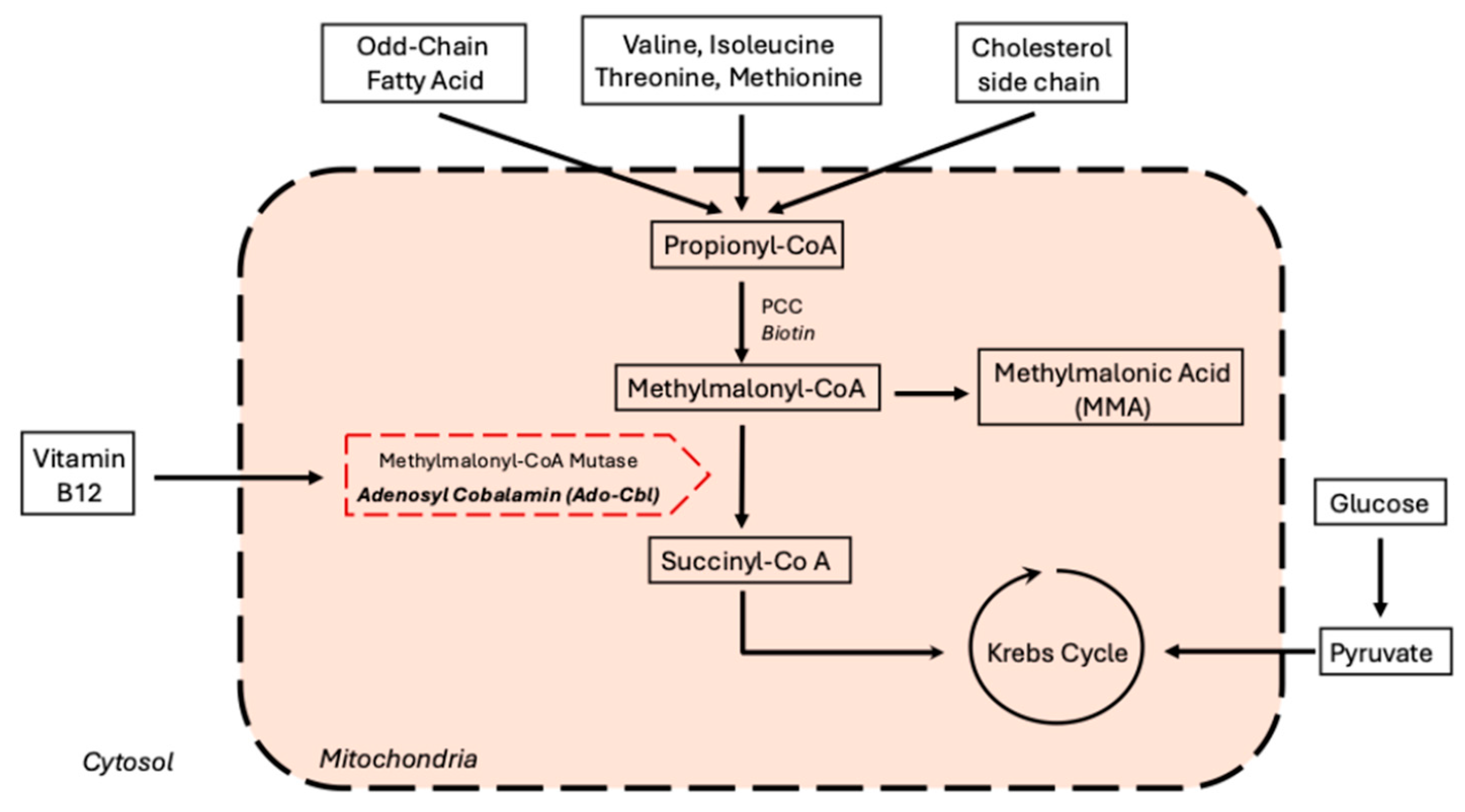
Figure 2.
Vitamin B12 and homocysteine. In the absence of vitamin B12, methionine synthase activity is impaired, leading to homocysteine accumulation and folate trapping as 5-methyltetrahydrofolate, thereby reducing the availability of tetrahydrofolate for DNA synthesis. Image created by the authors. THF: Tetrahydrofolate; Cbl: Cobalamin; SAM: S-adenosyl-methionine; SAH: S-adenosyl-homocysteine.
Figure 2.
Vitamin B12 and homocysteine. In the absence of vitamin B12, methionine synthase activity is impaired, leading to homocysteine accumulation and folate trapping as 5-methyltetrahydrofolate, thereby reducing the availability of tetrahydrofolate for DNA synthesis. Image created by the authors. THF: Tetrahydrofolate; Cbl: Cobalamin; SAM: S-adenosyl-methionine; SAH: S-adenosyl-homocysteine.
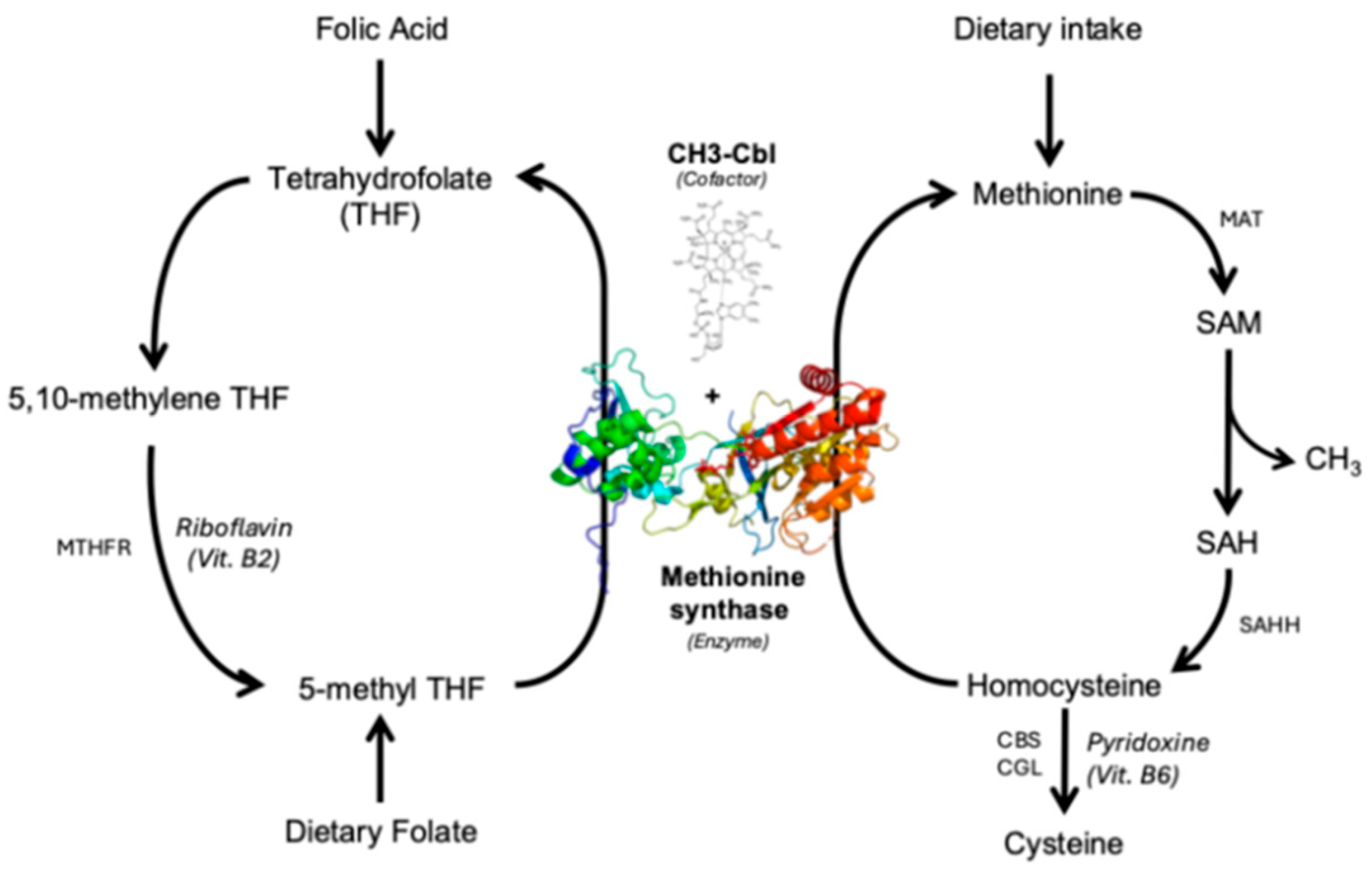
Figure 3.
Chemical structure of cobalamin (vitamin B12). The corrin macrocycle confers unique chemical and biological properties to vitamin B12 [23,24]. The central cobalt atom is coordinated by the corrin ring and axially by a nucleotide base, typically 5,6-dimethylbenzimidazole, and a variable upper ligand, which defines the different cobalamin species. Methylcobalamin and 5′-deoxyadenosylcobalamin are the biologically active coenzyme forms, while Cyanocobalamin and Hydroxocobalamin serve mainly for transport or storage [25]. Image created by the authors.
Figure 3.
Chemical structure of cobalamin (vitamin B12). The corrin macrocycle confers unique chemical and biological properties to vitamin B12 [23,24]. The central cobalt atom is coordinated by the corrin ring and axially by a nucleotide base, typically 5,6-dimethylbenzimidazole, and a variable upper ligand, which defines the different cobalamin species. Methylcobalamin and 5′-deoxyadenosylcobalamin are the biologically active coenzyme forms, while Cyanocobalamin and Hydroxocobalamin serve mainly for transport or storage [25]. Image created by the authors.
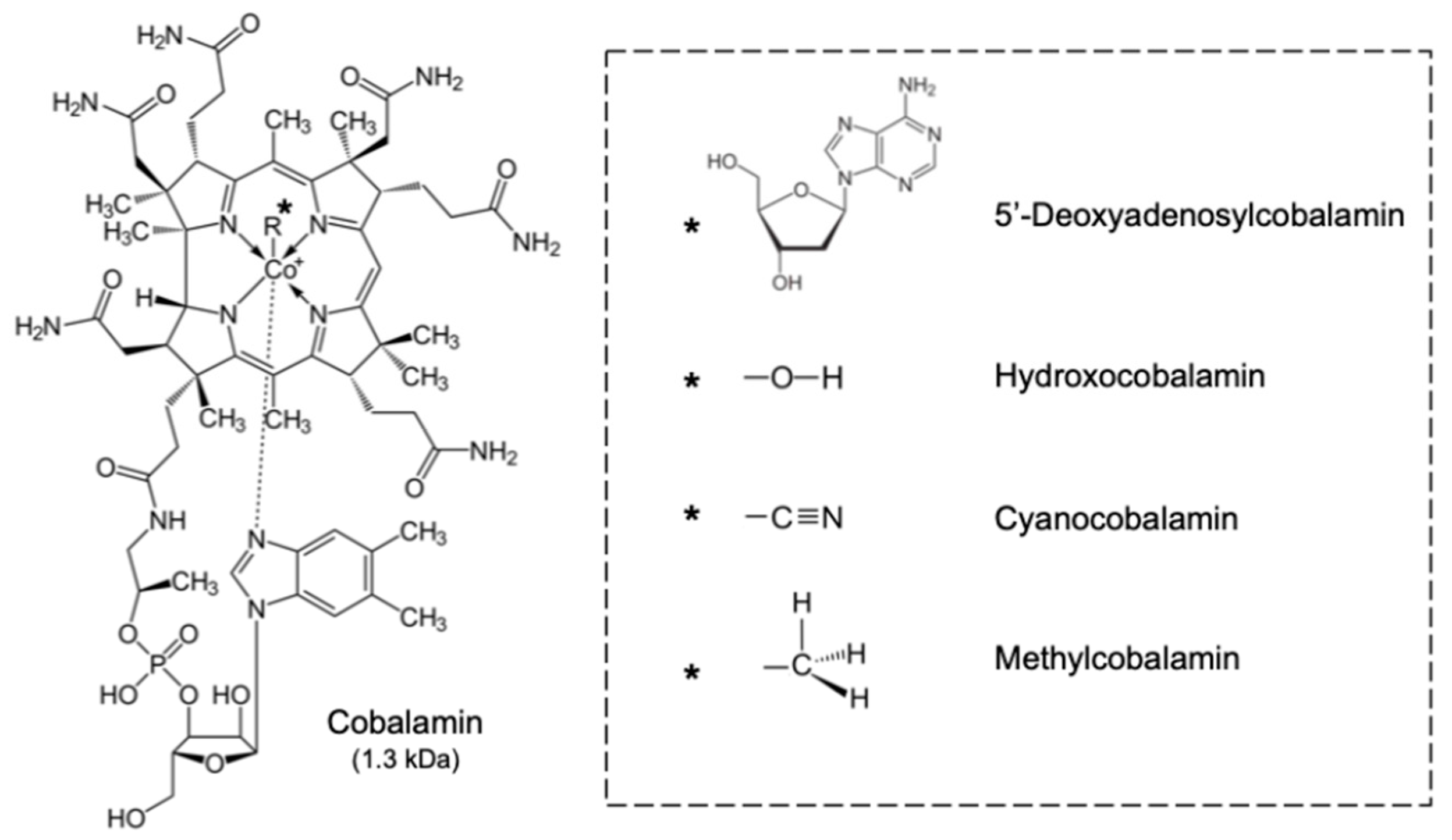
Figure 4.
Vitamin B12 metabolism. Following ingestion, vitamin B12 binds to haptocorrin (HC) in the stomach and subsequently to intrinsic factor (IF) in the duodenum, enabling receptor-mediated uptake in the terminal ileum via cubilin [35]. In enterocytes, vitamin B12 is dissociated from intrinsic factor (IF) and subsequently transported into the bloodstream; this process appears to be mediated by several membrane exporters, including multidrug resistance protein 1 (MRP1) [30]. Image created in BioRender.com. HC: Haptocorrin; IF: Intrinsic Factor; MRP1: Multidrug resistance protein 1; TC: Transcobalamin.
Figure 4.
Vitamin B12 metabolism. Following ingestion, vitamin B12 binds to haptocorrin (HC) in the stomach and subsequently to intrinsic factor (IF) in the duodenum, enabling receptor-mediated uptake in the terminal ileum via cubilin [35]. In enterocytes, vitamin B12 is dissociated from intrinsic factor (IF) and subsequently transported into the bloodstream; this process appears to be mediated by several membrane exporters, including multidrug resistance protein 1 (MRP1) [30]. Image created in BioRender.com. HC: Haptocorrin; IF: Intrinsic Factor; MRP1: Multidrug resistance protein 1; TC: Transcobalamin.
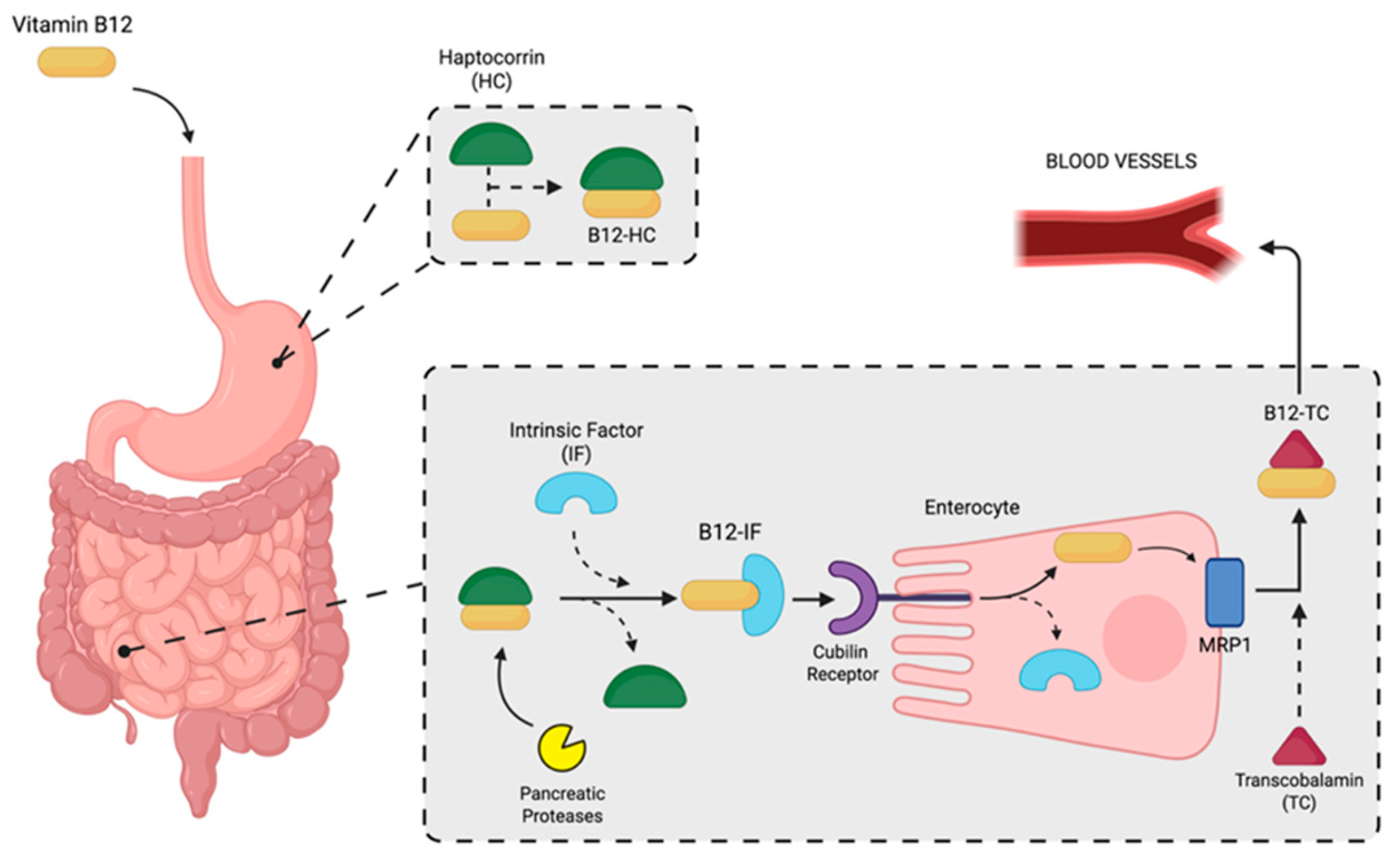
Figure 5.
HoloTC cellular uptake. The TC–vit B12 complex binds to its receptor CD320. After endocytosis, the complex enters the lysosome, where the complex is degraded and free B12 is exported to the cytosol by ABCD4 and LMBD1 [30,37]. Once released, cobalamin is processed by the chaperone proteins methylmalonic aciduria and homocystinuria type C (MMACHC) and type D (MMADHC). In the cytoplasm, vitamin B12 is converted into methylcobalamin (CH3-B12), whereas adenosylcobalamin (Ado-B12) is synthesized in the mitochondria [26,36]. Image created in BioRender.com. TC: Transcobalamin; ABCD4: ATP Binding Cassette Subfamily D Member 4; LMBD1: LMBR1 Domain-Containing Protein 1; MMACHC: methylmalonic aciduria and homocystinuria type C; MMADHC: methylmalonic aciduria and homocystinuria type D; CH3-B12: Methylcobalamin; Ado-B12: adenosylcobalamin.
Figure 5.
HoloTC cellular uptake. The TC–vit B12 complex binds to its receptor CD320. After endocytosis, the complex enters the lysosome, where the complex is degraded and free B12 is exported to the cytosol by ABCD4 and LMBD1 [30,37]. Once released, cobalamin is processed by the chaperone proteins methylmalonic aciduria and homocystinuria type C (MMACHC) and type D (MMADHC). In the cytoplasm, vitamin B12 is converted into methylcobalamin (CH3-B12), whereas adenosylcobalamin (Ado-B12) is synthesized in the mitochondria [26,36]. Image created in BioRender.com. TC: Transcobalamin; ABCD4: ATP Binding Cassette Subfamily D Member 4; LMBD1: LMBR1 Domain-Containing Protein 1; MMACHC: methylmalonic aciduria and homocystinuria type C; MMADHC: methylmalonic aciduria and homocystinuria type D; CH3-B12: Methylcobalamin; Ado-B12: adenosylcobalamin.
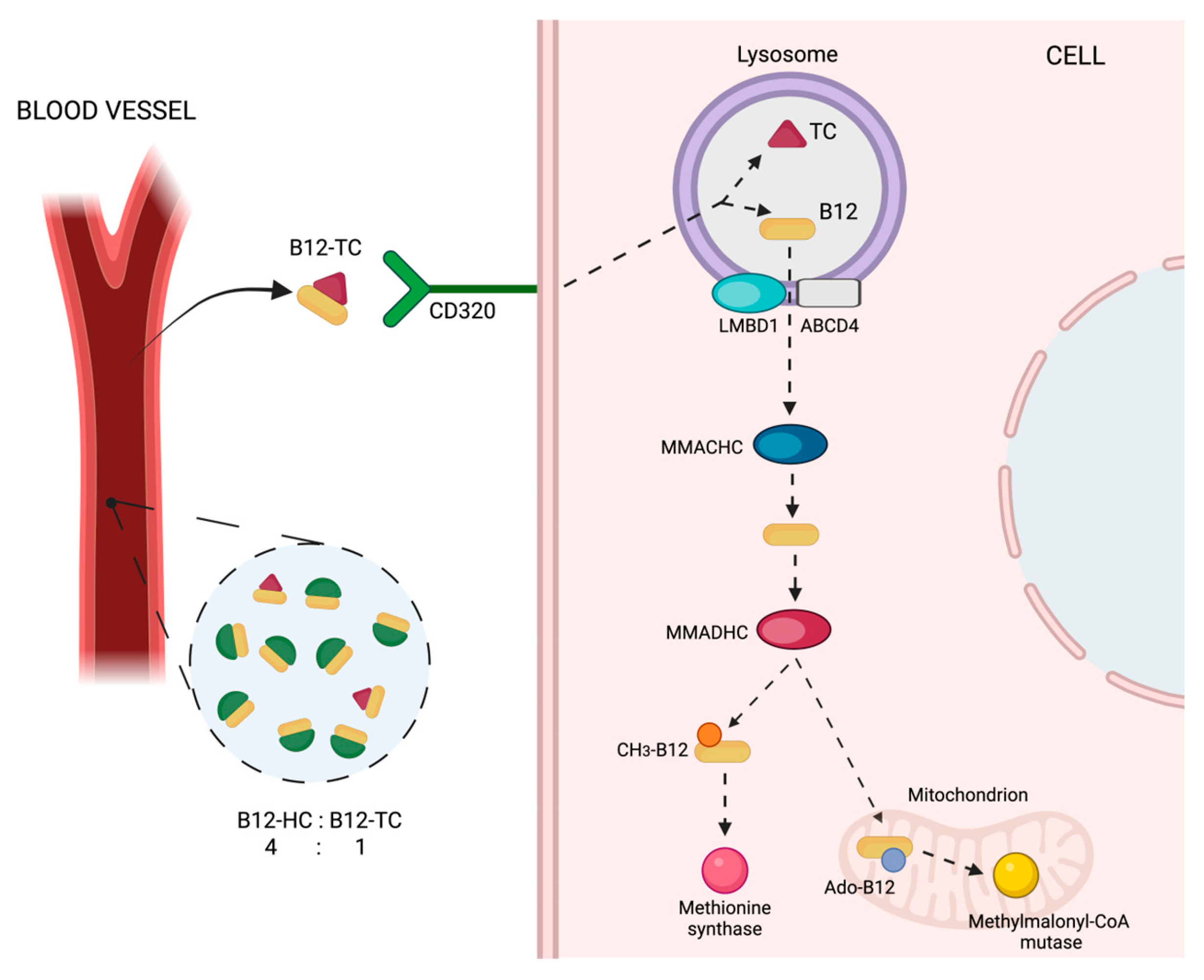
Figure 6.
Principles of automated immunoassays for vitamin B12 and holoTC. The figure illustrates the most commonly used methods for measuring total vitamin B12 (left) and holo-transcobalamin (right). In the total B12 assay, the method separates the transport proteins (haptocorrin and transcobalamin) from vitamin B12 and then allows endogenous B12 to compete with acridinium-labeled B12 for binding sites. In the holo-transcobalamin assay, the technology employs two anti-transcobalamin antibodies, forming a sandwich complex for specific quantification. TC: Transcobalamin; HC: Haptocorrin; AB1: Antibody 1 (Capture Antibody); AB2: Antibody 2 (Detection Antibody). Image created in BioRender.com.
Figure 6.
Principles of automated immunoassays for vitamin B12 and holoTC. The figure illustrates the most commonly used methods for measuring total vitamin B12 (left) and holo-transcobalamin (right). In the total B12 assay, the method separates the transport proteins (haptocorrin and transcobalamin) from vitamin B12 and then allows endogenous B12 to compete with acridinium-labeled B12 for binding sites. In the holo-transcobalamin assay, the technology employs two anti-transcobalamin antibodies, forming a sandwich complex for specific quantification. TC: Transcobalamin; HC: Haptocorrin; AB1: Antibody 1 (Capture Antibody); AB2: Antibody 2 (Detection Antibody). Image created in BioRender.com.
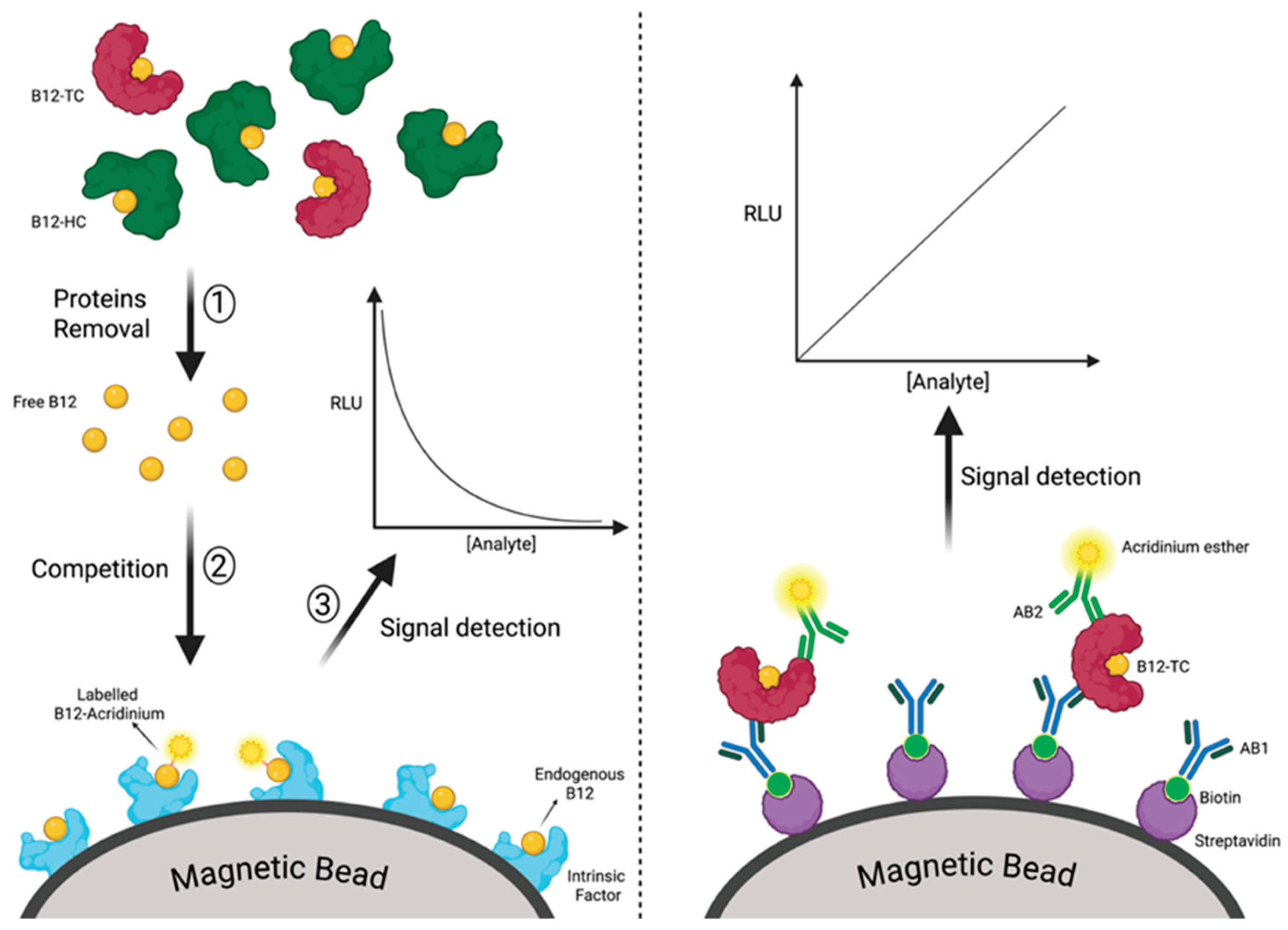
Table 2.
Inter-method and population variability of Total B12.
| Authors/Year | Individuals | Population | Platform | Literature RI | Manufacturers RI |
|---|---|---|---|---|---|
| Andersen SL et al., 2023 [92] |
41,091 Healthy donors 129 (60 m; 69 f) |
Danish Healthy adults |
Abbott Alinity Roche Cobas 6000 Siemens Atellica IM |
Healthy donors 168-553 pmol/L 202-641 pmol/L 211-551 pmol/L General population 133-541 pmol/L 172-619 pmol/L 182-553 pmol/L |
138-652 pmol/L 145-569 pmol/L 156-672 pmol/L |
| Jiang W et al., 2020 [93] |
389 (198 m; 191 f) |
Chinese Healthy adults (21-80 y.o.) |
Roche Cobas E602 | 250.8-957.1 pg/mL | 197-771 pg/mL |
| Solé-Enrech G et al., 2019 [94] |
123 (59 m; 67 f) |
Spanish Healthy adults |
Roche Cobas 8000 e801 | 150-695 pg/mL (111-513 pmol/L) | 197-771 pg/mL (145-569 pmol/L) |
| Sobczyńska-Malefora A et al., 2023 [95] |
35,988 (11,642 m; 24,346 f) |
White 18,508 Black/British Black: 10,182 Asian/British Asian: 2595 |
ARCHITECT Abbott | 0-1 years: 159-1025 pmol/L 2-5 years 276-1102 pmol/L 6-9 years 245-798 pmol/L 10-13 years 187-643 pmol/L >13 years, Black 166-805 pmol/L > 13 years, white/asian 134-511 pmol/L |
138-652 pmol/L |
| Alpdemir M. et al., 2020 [96] |
36,284 (10,795 m; 25,489 f) |
Turkish | Abbott ARCHITECT i2000sr | 97-397 pmol/L |
138-654 pmol/L |
| Gavars. et al., 2022 [97] |
132,379 | Latvian | Elecsys 2010 (2004-2012) Roche Cobas e 2010b (2012-2017) Roche Cobas e 801 (2017-2022) |
196–942 pg/mL | 180–900 pg/mL (133–664 pmol/L) 191–663 pg/mL (141–489 pmol/L) 197-771 pg/mL (146-569 pmol/L) |
| Abildgaard A. et al., 2022 [98] |
310 (158 m;152 f) (147 adults 18<65) 163 elderly >=65) |
Danish | Siemens ADVIA Centaur XPT | 0–<1 y.o.: 180–1400 pmol/L 1–<12 y.o.: 260–1200 pmol/L 12–<18 y.o.: 200–800 pmol/L 18–<65 y.o.: 200–600 pmol/L ≥ 65 y.o.: 200–600 pmol/L |
/ |
m: males; f: females; RI: reference intervals; y.o: years old.
Disclaimer/Publisher’s Note: The statements, opinions and data contained in all publications are solely those of the individual author(s) and contributor(s) and not of MDPI and/or the editor(s). MDPI and/or the editor(s) disclaim responsibility for any injury to people or property resulting from any ideas, methods, instructions or products referred to in the content. |
© 2026 by the authors. Licensee MDPI, Basel, Switzerland. This article is an open access article distributed under the terms and conditions of the Creative Commons Attribution (CC BY) license.
Copyright: This open access article is published under a Creative Commons CC BY 4.0 license, which permit the free download, distribution, and reuse, provided that the author and preprint are cited in any reuse.


