

Submitted:
09 March 2026
Posted:
10 March 2026
You are already at the latest version
Abstract
Extracellular vesicles (EVs) can disseminate replication-competent viral genomes complexed with selected host proteins, enabling stealth cell-to-cell transfer within lipid membrane-enclosed bubbles. In addition to complementing free-virion spread, EV-associated genomes can be protected from neutralizing antibodies and persist under conditions in which classical virion production decreases. Here, we propose a route-resolved framework in which interconnected cellular secretory pathways, including endoplasmic reticulum (ER) remodeling, multivesicular body (MVB) biogenesis, secretory autophagy, and plasma-membrane budding, jointly generate EV heterogeneity and create discrete opportunities for the capture, protection, and export of infectious cargo. We highlight reticulon-3 (RTN3), an ER-shaping protein, as an upstream regulator that can couple infection-induced ER microdomains to endosomal docking and autophagy-linked trafficking decisions that bias intermediates toward secretion rather than degradation. Supporting this view, transmission electron microscopy of dengue virus-infected cells reveals extensive vesicular remodeling, including irregular MVBs adjacent to the plasma membrane and autophagosome-like double-membrane structures, consistent with altered vesicular routing following RTN3 perturbation. Collectively, these route-resolved, spatially organized spatio-organelle changes support a pathomechanistic model in which RTN3-mediated ER remodeling reshapes ER-endosome-autophagy trafficking interfaces, creating regulated decision points that can be leveraged to stratify infectious EV subsets (with infectivity-linked single-vesicle and quantitative proteomics approaches) and to inform host-directed strategies that curb non-lytic viral dissemination.
Keywords:
extracellular vesicles
; infectious exosomes
; reticulon 3 (RTN3)
; dengue virus
; multivesicular bodies
; secretory autophagy
; ER contact sites
; host-pathogen interactions
Introduction
Extracellular vesicles (EVs) have moved from a niche curiosity to a central feature of host-pathogen biology. In viral infections, EVs complement classical release of free virions by transporting replication-competent viral nucleic acids, proteins, and lipids between cells as membrane-cloaked cargo [1]. Because vesicle membranes can shield labile ribonucleic acid (RNA) from extracellular nucleases and alter uptake pathways, vesicle-mediated transfer may contribute to stealth dissemination in tissues with antibodies present or where virions are rapidly cleared [2]. Notably, EVs are not a single entity but a spectrum of particles produced by distinct biogenesis pathways. Among the various cell-released vesicular structures, including apoptotic bodies and microvesicles (also called ectosomes), exosomes arise as intraluminal vesicles (ILVs) within multivesicular bodies (MVBs). They are released upon MVB fusion with the plasma membrane [3]. Microvesicles bud directly from the plasma membrane through local lipid remodeling and membrane scission. During viral infection and stress, additional EV-like particles can emerge from programmed cell death (apoptotic bodies and blebs), autophagy-linked secretion and a more recently identified class of intracellular vesicles derived from mitochondria (MDVs), expanding both EV diversity and the opportunities for viral cargo to exit cells [3,4] (Figure 1). Within the endosomal pathway, ILV formation can proceed through endosomal sorting complexes required for transport (ESCRT) machinery or through ESCRT-independent mechanisms that rely on lipid and tetraspanin organization [3]. Rab family small guanosine triphosphatases (Rab GTPases) coordinate late endosomal maturation and determine whether MVBs are directed to lysosomal degradation or to secretion. Rab7A, Rab11, Rab27A, Rab27B, and Rab35 are among the regulators that promote MVB positioning, docking, and fusion with the plasma membrane, whereas Rab5 and Rab7 also support downstream endocytic trafficking after MVB biogenesis [5,6,7]. These controls provide multiple points at which viruses can exploit vesicle fate to generate and release infectious viral exosomes. Several viruses are known to hijack ESCRT components to facilitate their budding and amplify vesicular egress. At the same time, alternative ILV biogenesis routes can also support cargo loading that is not strictly dependent on ubiquitin [8]. Tetraspanin oligomerization, sphingomyelinase-driven ceramide production, phospholipase D2 (PLD2) activity, and ADP-ribosylation factor 6 (ARF6)-dependent remodeling have all been implicated in ILV or microvesicle formation [9]. A practical consequence is that vesicle-mediated dissemination is unlikely to be blocked by inhibiting a single pathway. Instead, the relevant question becomes which steps are selectively required to package infectious viral material inside infectious exosomes. It is most likely that cargo selection and incorporation into EVs is not random. Infectious cargo must first be enriched at sites of vesicle formation and then captured by sorting factors that steer it into release-competent compartments [10]. In addition to these molecular sorting mechanisms, emerging evidence indicates that spatial membrane organization also contributes to cargo selection. In particular, membrane contact sites (MCSs) between the endoplasmic reticulum (ER) and organelles such as late endosomes, autophagosomes, multivesicular endosomes (MVEs), or the plasma membrane have been identified as important regulators of EV cargo loading and sorting [11].From this point of view, the long isoform of RTN3 has been shown to facilitate membrane contact sites between the endoplasmic reticulum and endosomes, where it contributes to endosomal maturation and cargo trafficking, suggesting a possible role in EV cargo loading [11]. The idea that direct membrane contact sites between the ER and the plasma membrane may facilitate EV or virus secretion represents an intriguing hypothesis that warrants further investigation. Furthermore, Selective loading can be mediated by protein complexes, lipid partitioning, or by adaptor proteins that bind specific RNAs or proteins. Also, several mechanisms concentrate cytosolic cargo, including recruitment by RNA-binding proteins (RBPs) and by ubiquitin ligases that act as scaffolds for capture, have been advanced [12]. These include fragile X mental retardation protein 1 (FMR1), the tripartite motif-containing ubiquitin ligase 25 (TRIM25), and lysosome-associated membrane protein 2A (LAMP2A), amongst others, which have been linked to microautophagy or chaperone-mediated routes that can intersect with EV biogenesis [13,14,15]. Autophagy provides an additional layer of selectivity and plasticity in EV production (Figure 1). Canonical autophagy generates double membrane autophagosomes that can fuse with lysosomes for degradation. In contrast, during secretory autophagy, autophagosomes are diverted toward secretion. As such, autophagosomes can merge with endosomal compartments to form amphisomes, which are hybrid organelles marked by microtubule-associated protein 1A/1B-light chain 3 (LC3) and the exosomal marker CD63 [16]. Subsequent fusion of amphisomes or autophagosomes with the plasma membrane can release EV-like particles, including LC3-associated vesicles and autophagosome-like microvesicles (ALMVs), thereby exporting cytosolic material while bypassing lysosomal degradation. This non-canonical autophagy-related mechanism expands the repertoire of EV release routes, creating additional opportunities for viruses to disseminate infection via infectious EVs [17]. A possible mechanism is that, early in infection, viral replication generates abundant RNA-protein complexes that must be stabilized and sorted rather than degraded. Autophagy-related genes (ATGs) are then recruited to the endosomal or plasma membranes via LC3-associated phagocytosis and endosomal microautophagy, thereby placing LC3-decorated membrane domains at key sorting sites [18].
LC3 recruitment at these sites can bias multivesicular bodies (MVBs) toward nonterminal maturation by limiting or delaying MVB acidification, thereby preserving cargo integrity and increasing the probability of secretion. In parallel, LC3 can act as a molecular ‘handle’ for selective sorting/loading by engaging RNA-binding proteins (RBPs) that recognize viral or proviral RNA features, suggesting that RNA selection is coupled to the identity of the LC3-marked membrane [19]. As a result, a tunable decision point between degradation and secretion can be shifted toward secretion, allowing replication-competent viral genomes to be packaged into EVs and released as protected, delivery-ready infectious EVs [16].
A key unresolved knowledge gap is the spatiotemporal location within cells at which infectious cargo is selected and committed to the exosomal release pathway. It remains unclear whether this selection occurs at defined endoplasmic reticulum (ER)-associated membrane contact sites, during early endosome maturation, or at later multivesicular body sorting stages. Defining these spatial routes and timing is essential to explain how infectious material is preferentially incorporated into exosomes rather than diverted into degradative trafficking pathways. One possibility is that replication-competent viral ribonucleoprotein complexes are specified at replication sites by RNA-binding proteins (RBPs) together with host sorting adaptors and then delivered to endosomes [20]. A second plausible model is that selection happens later at LC3-decorated MVBs. In this case, LC3-associated membranes would recruit RBPs and coordinate with endosomal trafficking machinery [19]. Such coordination could limit MVB acidification and favor secretion over degradation. It is well established that viral replication in most RNA viruses is tightly linked to ER membrane remodeling, which creates replication compartments and curvature-rich scaffolds [21]. We propose a scenario in which early membrane architecture, rather than being a passive backdrop, can shape downstream vesicle routing. We further provide evidence supporting a key role for RTN3 in coordinating ER membrane remodeling with vesicle biogenesis and trafficking, thereby influencing the formation and functional properties of extracellular vesicles during infection.
Materials and Methods
Huh7 Cell Culture, Transduction, and Infection Experiments
Huh7 hepatoma cells were cultured in Dulbecco’s Modified Eagle Medium (DMEM) (Thermo Fisher Scientific, Cleveland, OH, USA) supplemented with 1% penicillin/streptomycin (P/S) (10,000 U/mL penicillin and 10,000 µg/mL streptomycin; Gibco, REF No. 15140-122), 10 mM HEPES buffer (Gibco, REF No. 15630-080), and 10% fetal bovine serum (FBS; Gibco, Cat. No. A5256501). For transduction, 2 × 10⁵ cells were seeded in 6-well plates and transduced with lentivirus at a multiplicity of infection (MOI) of 5 in the presence of 8µg/mL polybrene. After 24 h of transduction at 37 °C with 5% CO₂, the medium was replaced with fresh complete medium, and the cells were cultured for an additional 24 h. After 48 h of transduction, cells were infected with DENV-2 (New Guinea C strain, ATCC VR-1584TM) at a multiplicity of infection (MOI) of 1. Cells were harvested at 72 h post-infection for subsequent downstream analyses.
Transmission Electron Microscopy (TEM)
Cell pellets were post-fixed in freshly prepared 1.3% (w/v) osmium tetroxide in collidine buffer containing potassium ferrocyanide for 1h at 4°C, followed by three washes (5 min each) in distilled water. Samples were then post-fixed and counterstained with 1% aqueous uranyl acetate for 30 min at room temperature in the dark, followed by three additional washes in distilled water. Specimens were dehydrated through a graded acetone series (25%, 50%, 75%, and 95% acetone in water; 30 min each), followed by two changes of 100% acetone (≥30 min each). Dehydrated samples were infiltrated in a 1:1 mixture of SPURR resin and acetone for 16–18 h, then embedded through two successive incubations in pure SPURR resin (≥2 h each). Samples were cut into small pieces, transferred into BEEM capsules, filled with fresh resin, and allowed to stand at room temperature for 16–18 h before polymerization at 60–65 °C for 20–30 h. Ultrathin sections (60–90 nm) were cut using an ultramicrotome (Leica UC7) and mounted on 200-mesh copper grids. Sections were contrasted with uranyl acetate in 50% ethanol (20–25 min) followed by lead citrate staining (5–7 min). Imaging was performed using a transmission electron microscope (Hitachi HT7800) equipped with an AMT Nanosprint II camera.
Results and Discussion
Reticulon-3 (RTN3) is an ER-shaping protein that stabilizes high-curvature tubules and can influence ER contact sites with other organelles [12]. By modulating ER topology at the origin of infection-associated membranes, RTN3 could create privileged platforms for the capture of viral ribonucleoprotein complexes and their handoff into endosomal or autophagy-mediated routes. [21].
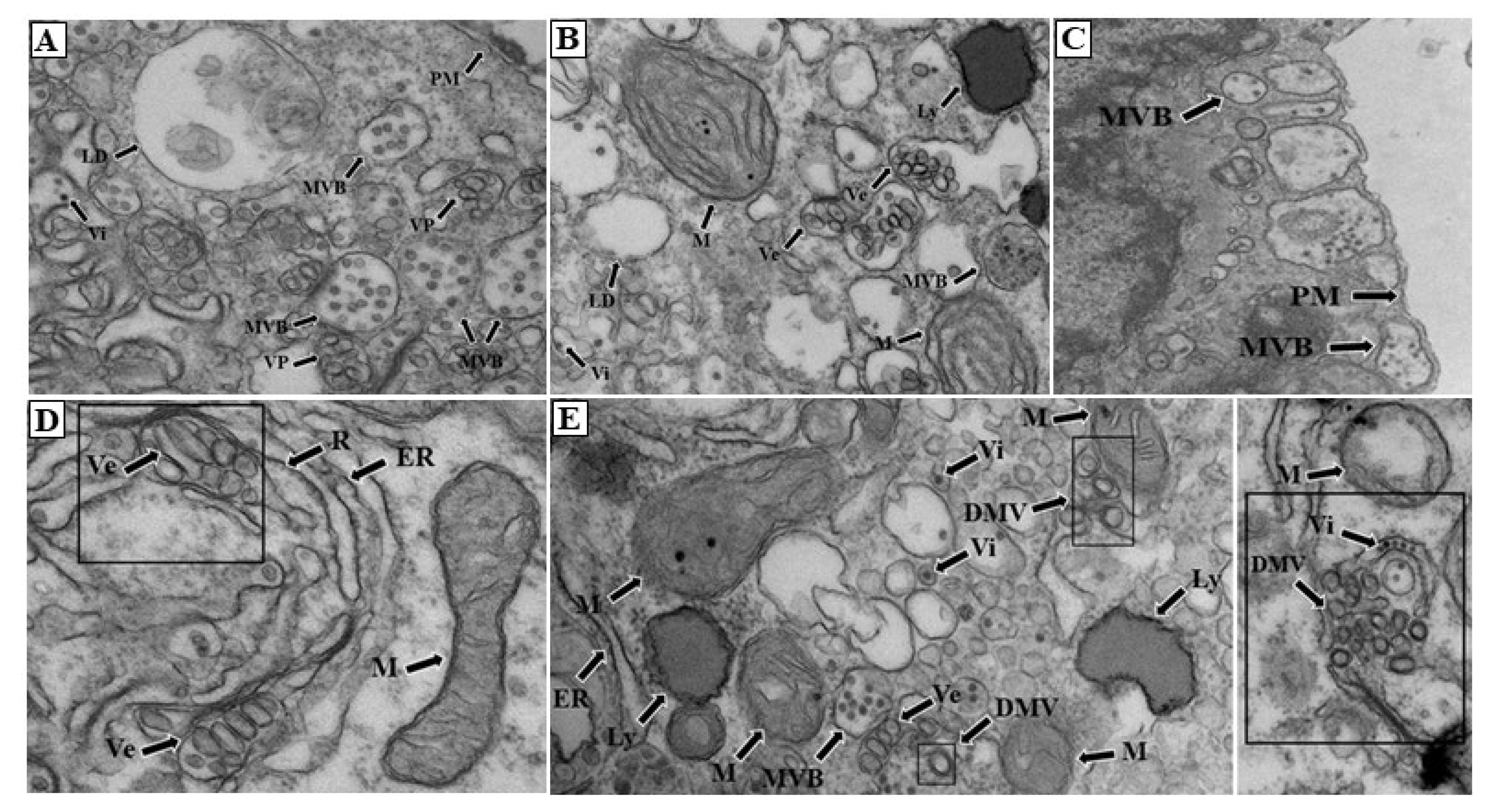
Ultrastructural phenotypes in dengue virus-infected cells support this RTN3-centered view. Transmission electron microscopy (TEM) revealed a highly vesiculated cytoplasm containing ER membranes, MVBs, lipid droplets and vesicular structures consistent with virus-induced membrane remodeling during dengue virus infection (Figure 2A). Dengue infected cells also displayed electron-dense viral particles and electron-dense lysosomal structures, suggesting active trafficking and organelle turnover (Figure 2B). Notably, RTN3 knockdown cells exhibit MVBs with irregular morphology positioned adjacent to the plasma membrane, consistent with altered docking or fusion dynamics (Figure 2C). While RTN3 knockdown impairs viral replication, it also alters membrane morphogenesis, resulting in more elongated vesicle packets per replication vesicle compared to infected cells (Figure 2D). Strikingly, an autophagosome-like double-membrane structure containing intraluminal cargo and surrounded by mitochondria and ER further supports ongoing autophagic remodeling during infection. Dengue virus infection provides a clear example of how autophagy and lipid metabolism can be coupled to infectious dissemination through extracellular vesicles (EVs) [3]. Suggestively, dengue infection induces autophagosome formation, which can support viral replication by organizing replication-associated membranes [22]. In parallel, dengue can trigger lipophagy, where lipid droplets and triglycerides are delivered to autophagic compartments and hydrolyzed into free fatty acids. These fatty acids then fuel beta-oxidation, generating adenosine triphosphate (ATP) to meet the energetic demands of replication [23,24]. As autophagosomes mature, they can intersect with multivesicular bodies (MVBs) to form amphisomes. At this stage, cargo reaches a regulated decision point. Amphisomes can proceed to lysosomal degradation or be rerouted to the plasma membrane for secretion [16]. This balance can be tuned by endosomal trafficking and MVB biogenesis, thereby linking autophagy to the release of selected proteins and nucleic acids in EVs. Recent reports also describe an ER-driven route in which autophagosome-like membranes interface with early endosomes in a Rab22A-dependent manner to generate a distinct intermediate compartment termed ‘rafeesomes’. Secretion of rafeesome-derived intraluminal vesicles (ILVs) expands current EV biogenesis models by placing ER-derived membranes upstream of an endosome-linked release pathway [25,26]. In infection, this route could provide a means to export cargo produced at ER-associated replication sites, bypassing the canonical late endosomal sorting steps. However, these intracellular organelle crosstalks extend beyond just the ER and endosomes interface. Mitochondrial-derived vesicles (MDVs) can also be induced under metabolic stress and traffic toward endosomal compartments and MVBs, carrying mitochondrial proteins, lipids, and nucleic acids [27] (Figure 2E). Their convergence with endosomal routes may broaden EV cargo diversity and modulate innate immune signaling, particularly during antiviral responses. In viral infections, this integration could couple cellular stress sensing to EV output, with consequences for cellular communication, immune responses, inflammation, and viral dissemination [28]. From a physiological and pathomechanistic perspective, these intersecting release routes create both therapeutic opportunities and tangible risks. Broad inhibition of extracellular vesicle (EV) biogenesis or secretion could unintentionally impair essential intercellular signaling and compromise tissue homeostasis. At the same time, progress is constrained by practical limitations, including the lack of definitive markers that distinguish infectious EV subpopulations from the broader EV pool, which complicates both diagnostics and targeted drug development. Emerging approaches, including single-vesicle profiling and high-resolution molecular characterization, offer a way to resolve this heterogeneity [29,30].
These methods can move the field beyond bulk EV counts by enabling assays that estimate the proportion of EVs carrying replication-competent cargo, rather than measuring total EV abundance alone. In parallel, progress will depend on route-resolved readouts combined with targeted perturbations of host regulatory targets, thereby enabling specific steps in EV release to be linked to defined outcomes (31). This distinction is important because lowering overall EV output is not equivalent to reducing the subset of EVs that carry replication-competent viral material, and these two outcomes will most definitely have different mechanistic and translational implications. Our recent reports have implicated reticulon 3 (RTN3) as a host factor that remodels endoplasmic reticulum membranes, potentially favoring the production of infectious EVs [31,32]. The next priority is to use RTN3 as a mechanistic entry point to test how altered membrane architecture influences where cargo is captured, how it is protected from degradation, and when it is diverted into secretory routes. This logic naturally extends to other host-controlled steps that govern compartment fate, including regulators of multivesicular body maturation and docking and the branch points that steer autophagy-linked intermediates toward lysosomal degradation versus secretion [16]. When these steps are perturbed one at a time and evaluated with route-resolved readouts, it should become possible to separate effects on baseline EV biology from effects that specifically amplify vesicle-mediated spread.
Several deep questions will evidently follow, and clarity at each step will refine the direction for advancing the field. Specifically, at what stage is infectious cargo first committed to secretion, and is that commitment reversible as trafficking conditions change? Which aspects of membrane identity and compartmental context determine whether cargo is degraded or exported? How do viruses modulate and fine-tune the degradation-versus-secretion balance without disrupting essential homeostatic EV communication? Additionally, can interventions be designed to act at decision points that bias fate toward inhibiting a specific secretion, rather than broadly suppressing overall EV release? Addressing these questions will require time-resolved experiments that link cellular membrane remodeling and trafficking control to cargo integrity and delivery, while keeping physiological EV functions in mind [33].
Taken together, current evidence argues for moving beyond virion-only models to a view in which infection also spreads through host secretory trafficking routes that are hijacked for viral genome export. In this framework, ER organization, RTN3-dependent membrane remodeling, and subsequent vesicle routing are mechanistically linked, helping explain why distinct extracellular vesicle (EV) populations can share similar cargo yet differ in their ability to transmit infection. The central challenge now is to pinpoint when replication-competent cargo is committed to secretion, and which trafficking steps are truly required for release. Resolving these decision points will guide the development of antivirals that complement direct-acting strategies by limiting both classical virion spread and EV-mediated, antibody-shielded dissemination.
Supplementary Materials
Not applicable.
Author Contributions
Conceptualization, R.B. and T.N.B.; investigation and data generation, R.B., C.N.A., A.N., P.L., and T.N.; writing-original draft preparation, R.B and T.N.B.; writing-review and editing, all authors; supervision, T.N.B.
Funding
Funding for this research was provided by the Natural Sciences and Engineering Research Council of Canada (NSERC) under the Discovery Grant (RGPIN-2021-03548) and the Discovery Launch Supplement (DGECR-2021-00398) granted to Terence Ndonyi Bukong.
Institutional Review Board Statement
Not applicable.
Informed Consent Statement
Not applicable.
Data Availability Statement
All data supporting the findings of this study are contained within the article.
Acknowledgments
The authors thank colleagues and core facilities at INRS for technical support.
Conflicts of Interest
The authors declare no conflict of interest.
References
- Federico, M. The Potential of Extracellular Vesicle-Mediated Spread of Self-Amplifying Rna and a Way to Mitigate It. Int J Mol Sci 2025, 26. [Google Scholar] [CrossRef]
- Kumari, S.; Banerjee, A. Extracellular Vesicles: The Double-Edged Sword in Viral Infections. mBio 2026, 17, e0331625. [Google Scholar] [CrossRef]
- Carvalho Ferraz, L.; Pereira, P.; Ferreira, J. V. Molecular Mechanisms of Extracellular Vesicle Biogenesis and Their Impact on the Design of Custom Evs. Adv Healthc Mater 2025, 14, e2501349. [Google Scholar] [CrossRef]
- Pedrioli, G.; Paganetti, P. Hijacking Endocytosis and Autophagy in Extracellular Vesicle Communication: Where the inside Meets the Outside. Front Cell Dev Biol 2020, 8, 595515. [Google Scholar] [CrossRef] [PubMed]
- Krylova, S. V.; Feng, D. The Machinery of Exosomes: Biogenesis, Release, and Uptake. Int J Mol Sci 2023, 24. [Google Scholar] [CrossRef] [PubMed]
- Butler, L. R.; Singh, N.; Marnin, L.; Valencia, L. M.; O'Neal, A. J.; Paz, F. E. C.; Shaw, D. K.; Chavez, A. S. O.; Pedra, J. H. F. The Role of Rab27 in Tick Extracellular Vesicle Biogenesis and Pathogen Infection. Parasit Vectors 2024, 17, 57. [Google Scholar] [CrossRef] [PubMed]
- Blanc, L.; Vidal, M. New Insights into the Function of Rab Gtpases in the Context of Exosomal Secretion. Small GTPases 2018, 9, 95–106. [Google Scholar] [CrossRef]
- MacDonald, C.; Buchkovich, N. J.; Stringer, D. K.; Emr, S. D.; Piper, R. C. Cargo Ubiquitination Is Essential for Multivesicular Body Intralumenal Vesicle Formation. EMBO Rep 2012, 13, 331–8. [Google Scholar] [CrossRef]
- Hyenne, V.; Labouesse, M.; Goetz, J. G. The Small Gtpase Ral Orchestrates Mvb Biogenesis and Exosome Secretion. Small GTPases 2018, 9, 445–51. [Google Scholar] [CrossRef]
- Li, S. P.; Lin, Z. X.; Jiang, X. Y.; Yu, X. Y. Exosomal Cargo-Loading and Synthetic Exosome-Mimics as Potential Therapeutic Tools. Acta Pharmacol Sin 2018, 39, 542–51. [Google Scholar] [CrossRef]
- Wu, H.; Voeltz, G. K. Reticulon-3 Promotes Endosome Maturation at Er Membrane Contact Sites. Dev Cell 2021, 56, 52–66 e7. [Google Scholar] [CrossRef]
- Bare, Y.; Defourny, K.; Bretou, M.; Van Niel, G.; Nolte-'t Hoen, E.; Gaudin, R. The Endoplasmic Reticulum as a Cradle for Virus and Extracellular Vesicle Secretion. Trends Cell Biol 2025, 35, 282–93. [Google Scholar] [CrossRef]
- Wozniak, A. L.; Adams, A.; King, K. E.; Dunn, W.; Christenson, L. K.; Hung, W. T.; Weinman, S. A. The Rna Binding Protein Fmr1 Controls Selective Exosomal Mirna Cargo Loading during Inflammation. J Cell Biol 2020, 219. [Google Scholar] [CrossRef] [PubMed]
- King, K. E.; Ghosh, P.; Wozniak, A. L. Trim25 Dictates Selective Mirna Loading into Extracellular Vesicles during Inflammation. Sci Rep 2023, 13, 22952. [Google Scholar] [CrossRef] [PubMed]
- Ferreira, J. V.; da Rosa Soares, A.; Ramalho, J.; Maximo Carvalho, C.; Cardoso, M. H.; Pintado, P.; Carvalho, A. S.; Beck, H. C.; Matthiesen, R.; Zuzarte, M.; Girao, H.; van Niel, G.; Pereira, P. Lamp2a Regulates the Loading of Proteins into Exosomes. Sci Adv 2022, 8, eabm1140. [Google Scholar] [CrossRef] [PubMed]
- Fader, C. M.; Colombo, M. I. Autophagy and Multivesicular Bodies: Two Closely Related Partners. Cell Death Differ 2009, 16, 70–8. [Google Scholar] [CrossRef]
- Mao, K.; Huo, F.; Wei, H.; Wang, F.; Xiong, S.; Fu, Y. Autophagic Extracellular Vesicles (Aevs) Are Distinct from Exosomes and Play Crucial Roles in Viral Infections. Nat Commun 2025, 17, 1095. [Google Scholar] [CrossRef]
- Wang, J.; Barr, M. M.; Wehman, A. M. Extracellular Vesicles. Genetics 2024, 227. [Google Scholar]
- Leidal, A. M.; Huang, H. H.; Marsh, T.; Solvik, T.; Zhang, D.; Ye, J.; Kai, F.; Goldsmith, J.; Liu, J. Y.; Huang, Y. H.; Monkkonen, T.; Vlahakis, A.; Huang, E. J.; Goodarzi, H.; Yu, L.; Wiita, A. P.; Debnath, J. The Lc3-Conjugation Machinery Specifies the Loading of Rna-Binding Proteins into Extracellular Vesicles. Nat Cell Biol 2020, 22, 187–99. [Google Scholar] [CrossRef]
- Diosa-Toro, M.; Prasanth, K. R.; Bradrick, S. S.; Garcia Blanco, M. A. Role of Rna-Binding Proteins during the Late Stages of Flavivirus Replication Cycle. Virol J 2020, 17, 60. [Google Scholar] [CrossRef]
- Wilson, A.; McCormick, C. Reticulophagy and Viral Infection. Autophagy 2025, 21, 3–20. [Google Scholar] [CrossRef] [PubMed]
- Wang, H.; Wang, Y.; Li, Y.; Chen, X.; Wang, X.; Wang, X.; Yu, S. The Dual Role of Autophagy in the Pathogenesis of Arboviruses with a Focus on Jev and Denv. Rev Med Virol 2025, 35, e70073. [Google Scholar] [CrossRef] [PubMed]
- Randall, G. Lipid Droplet Metabolism during Dengue Virus Infection. Trends Microbiol 2018, 26, 640–42. [Google Scholar] [CrossRef]
- Cloherty, A. P. M.; Olmstead, A. D.; Ribeiro, C. M. S.; Jean, F. Hijacking of Lipid Droplets by Hepatitis C, Dengue and Zika Viruses-from Viral Protein Moonlighting to Extracellular Release. Int J Mol Sci 2020, 21. [Google Scholar] [CrossRef] [PubMed]
- Zheng, X.; Fang, D.; Shan, H.; Xiao, B.; Wei, D.; Ouyang, Y.; Huo, L.; Zhang, Z.; Wu, Y.; Zhang, R.; Kang, T.; Gao, Y. The Assembly of Rab22a/Tmem33/Rtn4 Initiates a Secretory Er-Phagy Pathway. Cell Discov 2025, 11, 41. [Google Scholar] [CrossRef]
- Yu, L. A New Route for Ev Biogenesis. Cell Res 2023, 33, 87–88. [Google Scholar] [CrossRef]
- Horbay, R.; Syrvatka, V.; Bedzay, A.; van der Merwe, M.; Burger, D.; Beug, S. T. From Mitochondria to Immunity: The Emerging Roles of Mitochondria-Derived Vesicles and Small Extracellular Vesicles in Cellular Communication and Disease. J Extracell Vesicles 2025, 14, e70192. [Google Scholar] [CrossRef]
- Wolff, G.; Melia, C. E.; Snijder, E. J.; Barcena, M. Double-Membrane Vesicles as Platforms for Viral Replication. Trends Microbiol 2020, 28, 1022–33. [Google Scholar] [CrossRef]
- Bordanaba-Florit, G.; Royo, F.; Kruglik, S. G.; Falcon-Perez, J. M. Using Single-Vesicle Technologies to Unravel the Heterogeneity of Extracellular Vesicles. Nat Protoc 2021, 16, 3163–85. [Google Scholar] [CrossRef]
- Tran, H. L.; Zheng, W.; Issadore, D. A.; Im, H.; Cho, Y. K.; Zhang, Y.; Liu, D.; Liu, Y.; Li, B.; Liu, F.; Wong, D. T. W.; Sun, J.; Qian, K.; He, M.; Wan, M.; Zeng, Y.; Cheng, K.; Huang, T. J.; Chiu, D. T.; Lee, L. P.; Zheng, L.; Godwin, A. K.; Kalluri, R.; Soper, S. A.; Hu, T. Y. Extracellular Vesicles for Clinical Diagnostics: From Bulk Measurements to Single-Vesicle Analysis. ACS Nano 2025, 19, 28021–109. [Google Scholar] [CrossRef]
- Li, J.; Abosmaha, E.; Coffin, C. S.; Labonte, P.; Bukong, T. N. Reticulon-3 Modulates the Incorporation of Replication Competent Hepatitis C Virus Molecules for Release inside Infectious Exosomes. PLoS One 2020, 15, e0239153. [Google Scholar] [CrossRef]
- Bitazar, R.; Asaba, C. N.; Shegefti, S.; Noumi, T.; Van Grevenynghe, J.; Islam, S. T.; Labonte, P.; Bukong, T. N. Integrative Mechanistic Studies Identify Reticulon-3 as a Critical Modulator of Infectious Exosome-Driven Dengue Pathogenesis. Viruses 2025, 17. [Google Scholar] [CrossRef]
- Joshi, B. S.; de Beer, M. A.; Giepmans, B. N. G.; Zuhorn, I. S. Endocytosis of Extracellular Vesicles and Release of Their Cargo from Endosomes. ACS Nano 2020, 14, 4444–55. [Google Scholar] [CrossRef]
Figure 1.
Multifaceted routes of extracellular vesicle (EV) biogenesis and unconventional viral egress. Schematic representation of interconnected cellular pathways that contribute to extracellular vesicle (EV) biogenesis and non-lytic viral egress. (A) Direct vesicle release through plasma membrane budding, including microvesicles, apoptotic bodies, and membrane-cloaked viral particles, alongside virus-induced double-membrane vesicles. (B) Multivesicular bodies (MVBs) are spatially organized within the central cytoplasm and near multiple organelles, supporting efficient cargo loading and trafficking through Ras-related in brain 5 (Rab5), Ras-related in brain 7 (Rab7), Ras-related in brain 9 (Rab9), and Ras-related in brain 27 (Rab27)-associated routes. (C) Autophagosomes can fuse with multivesicular bodies (MVBs) to generate amphisomes, hybrid organelles often regulated by Ras-related in brain 11 (Rab11) and Ras-related in brain 27A (Rab27A), that sort autophagic and endosomal cargo toward lysosomal degradation or secretion (pink star), defining a key intersection between autophagy and endosomal EV biogenesis. (D) Apoptotic extracellular vesicles (AEVs) can be produced through a proteasome-dependent pathway within autolysosomal compartments and released from early apoptotic cells in a caspase-3–dependent manner; notably, Flaviviridae has been reported to interfere with phagosome–lysosome fusion, with potential consequences for this degradative-to-secretory balance. (E) Mitochondrial-derived vesicles (MDVs) bud from mitochondria as single-membrane or double-membrane carriers containing associated cargo (green star) and can be routed to multivesicular bodies (MVBs) via Ras-related brain 7 (Rab7)-dependent trafficking or delivered to lysosomes for degradation, thereby linking mitochondrial stress responses to EV cargo diversification. This route-resolved framework predicts that EV subpopulations emerging from endoplasmic reticulum (ER)-multivesicular body (MVB) and autophagy-linked intermediates will carry distinguishable protein and proteoform signatures. These signatures are expected to include selective enrichment of membrane-shaping and ribonucleic acid (RNA)-binding factors that stabilize replication-competent cargo and support secretion. Functional correlation of infectivity readouts with quantitative proteomics and orthogonal vesicle stratification will be essential for validating these pathway-specific predictions and defining robust molecular markers of infectious EV subsets.
Figure 1.
Multifaceted routes of extracellular vesicle (EV) biogenesis and unconventional viral egress. Schematic representation of interconnected cellular pathways that contribute to extracellular vesicle (EV) biogenesis and non-lytic viral egress. (A) Direct vesicle release through plasma membrane budding, including microvesicles, apoptotic bodies, and membrane-cloaked viral particles, alongside virus-induced double-membrane vesicles. (B) Multivesicular bodies (MVBs) are spatially organized within the central cytoplasm and near multiple organelles, supporting efficient cargo loading and trafficking through Ras-related in brain 5 (Rab5), Ras-related in brain 7 (Rab7), Ras-related in brain 9 (Rab9), and Ras-related in brain 27 (Rab27)-associated routes. (C) Autophagosomes can fuse with multivesicular bodies (MVBs) to generate amphisomes, hybrid organelles often regulated by Ras-related in brain 11 (Rab11) and Ras-related in brain 27A (Rab27A), that sort autophagic and endosomal cargo toward lysosomal degradation or secretion (pink star), defining a key intersection between autophagy and endosomal EV biogenesis. (D) Apoptotic extracellular vesicles (AEVs) can be produced through a proteasome-dependent pathway within autolysosomal compartments and released from early apoptotic cells in a caspase-3–dependent manner; notably, Flaviviridae has been reported to interfere with phagosome–lysosome fusion, with potential consequences for this degradative-to-secretory balance. (E) Mitochondrial-derived vesicles (MDVs) bud from mitochondria as single-membrane or double-membrane carriers containing associated cargo (green star) and can be routed to multivesicular bodies (MVBs) via Ras-related brain 7 (Rab7)-dependent trafficking or delivered to lysosomes for degradation, thereby linking mitochondrial stress responses to EV cargo diversification. This route-resolved framework predicts that EV subpopulations emerging from endoplasmic reticulum (ER)-multivesicular body (MVB) and autophagy-linked intermediates will carry distinguishable protein and proteoform signatures. These signatures are expected to include selective enrichment of membrane-shaping and ribonucleic acid (RNA)-binding factors that stabilize replication-competent cargo and support secretion. Functional correlation of infectivity readouts with quantitative proteomics and orthogonal vesicle stratification will be essential for validating these pathway-specific predictions and defining robust molecular markers of infectious EV subsets.
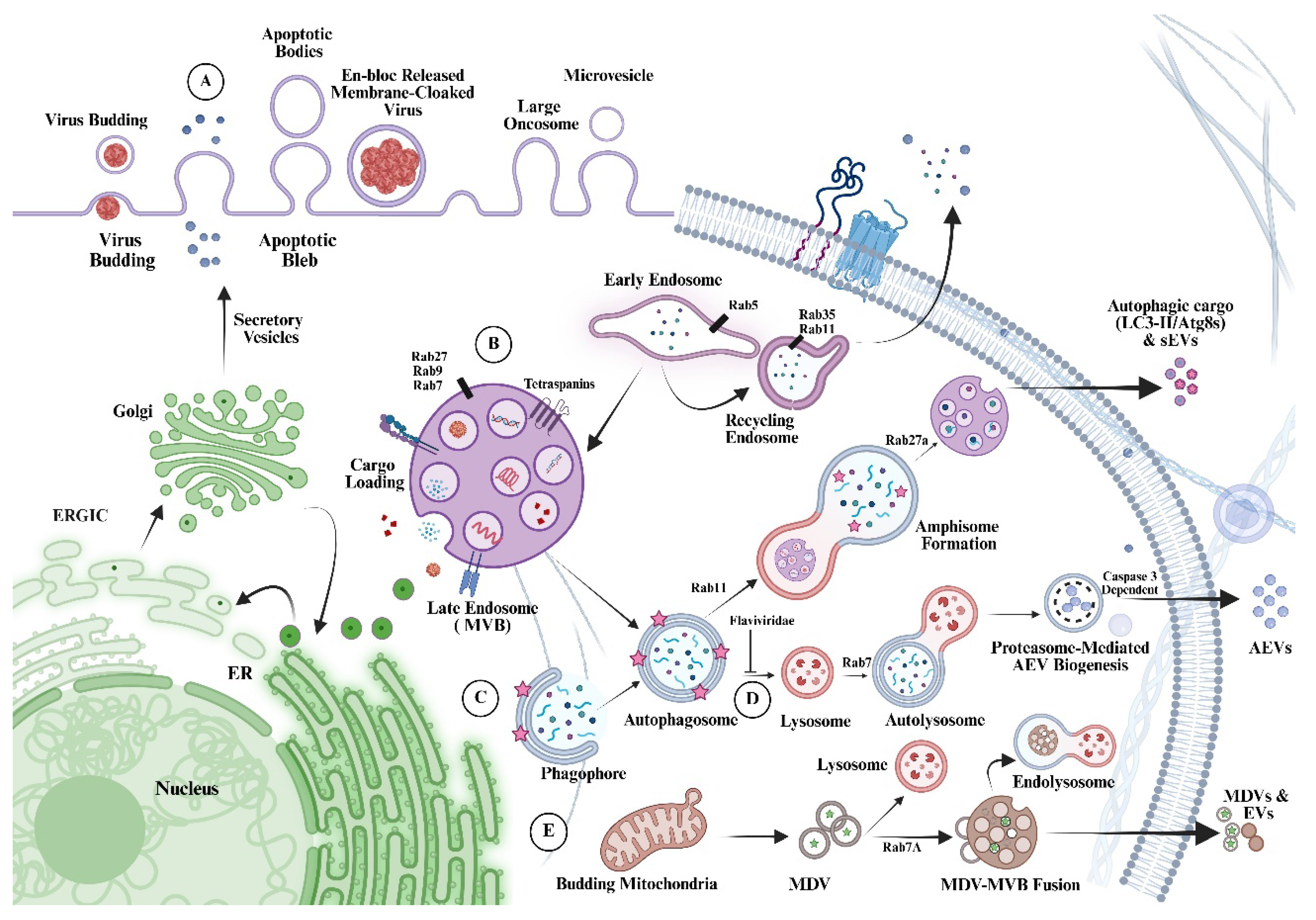
Figure 2.
Ultrastructural remodeling of the vesicular network in dengue virus-infected cells. (A) Representative transmission electron microscopy (TEM) image showing a highly vesiculated cytoplasm containing endoplasmic reticulum (ER) membranes, multivesicular bodies (MVBs) close to the plasma membrane (PM), lipid droplets (LD), vesicular structures (Ve), and virus-induced electron-dense particles (Vi), consistent with virus-induced intracellular membrane remodeling. (B) The cytoplasm displays extensive membrane rearrangement, with virus-induced electron-dense particles (Vi) and virus-induced vesicles (Ve) tightly associated with lysosomal structures (Ly), a giant mitochondrion (M), and MVB-enclosed infection-associated cargo, suggesting active vesicular trafficking and organelle remodeling. (C) TEM image showing altered MVB morphology positioned adjacent to the plasma membrane (PM) in reticulon-3 (RTN3) knockdown cells, consistent with modified vesicle docking and membrane dynamics. (D) TEM image showing RTN3 knockdown cells, elongated virus-induced replication vesicles with ribosome(R)-studded membranes visible in the surrounding rough ER.E. Examples of double membrane vesicles (DMV) found in dengue-infected cells adjacent to the mitochondria (M).
Figure 2.
Ultrastructural remodeling of the vesicular network in dengue virus-infected cells. (A) Representative transmission electron microscopy (TEM) image showing a highly vesiculated cytoplasm containing endoplasmic reticulum (ER) membranes, multivesicular bodies (MVBs) close to the plasma membrane (PM), lipid droplets (LD), vesicular structures (Ve), and virus-induced electron-dense particles (Vi), consistent with virus-induced intracellular membrane remodeling. (B) The cytoplasm displays extensive membrane rearrangement, with virus-induced electron-dense particles (Vi) and virus-induced vesicles (Ve) tightly associated with lysosomal structures (Ly), a giant mitochondrion (M), and MVB-enclosed infection-associated cargo, suggesting active vesicular trafficking and organelle remodeling. (C) TEM image showing altered MVB morphology positioned adjacent to the plasma membrane (PM) in reticulon-3 (RTN3) knockdown cells, consistent with modified vesicle docking and membrane dynamics. (D) TEM image showing RTN3 knockdown cells, elongated virus-induced replication vesicles with ribosome(R)-studded membranes visible in the surrounding rough ER.E. Examples of double membrane vesicles (DMV) found in dengue-infected cells adjacent to the mitochondria (M).
Disclaimer/Publisher’s Note: The statements, opinions and data contained in all publications are solely those of the individual author(s) and contributor(s) and not of MDPI and/or the editor(s). MDPI and/or the editor(s) disclaim responsibility for any injury to people or property resulting from any ideas, methods, instructions or products referred to in the content. |
© 2026 by the authors. Licensee MDPI, Basel, Switzerland. This article is an open access article distributed under the terms and conditions of the Creative Commons Attribution (CC BY) license (http://creativecommons.org/licenses/by/4.0/).
Copyright: This open access article is published under a Creative Commons CC BY 4.0 license, which permit the free download, distribution, and reuse, provided that the author and preprint are cited in any reuse.


