

Submitted:
09 March 2026
Posted:
10 March 2026
You are already at the latest version
Abstract
Urban shrinkage, driven by demographic and socioeconomic change, has become a pressing issue across Europe, particularly in small peripheral towns and semi-urban settlements that have historically relied on a single industry or company. This study investigates the demographic and socioeconomic factors contributing to the decline in Latvian mono-towns, thereby filling a void in empirical research on urban development in post-socialist contexts. Principal component analysis (PCA) was applied to a set of key demographic and socioeconomic indicators derived from census and administrative data to identify the principal dimensions driving urban shrinkage. The analysis reveals three principal components explaining 87% of the variance: socioeconomic vitality (57.1%), population change and peripherality (17.2%), and aging society dynamics (12.6%). The results contribute to a nuanced understanding of how mono-functional urban contexts shape the intensity and character of shrinkage. These results establish a basis for specific policy measures designed to promote resilience in small-settlement settings and contribute to the understanding of spatial planning and regional development approaches in the post-socialist urban transition context. The research underscores the need for context-specific approaches to address the multifaceted challenges of urban shrinkage.
Keywords:
urban shrinkage
; mono‐towns
; deindustrialization
; principal component analysis (PCA)
; Latvia
1. Introduction
Urban shrinkage has emerged as a defining challenge for cities across Europe, particularly in post-socialist contexts, where deindustrialization and economic transitions have accelerated demographic and socioeconomic change [1]. Mono-towns, which are communities historically dependent on a single dominant industry or company, exemplify this pattern and demonstrate heightened vulnerability to changes in socioeconomic structures [2,3]. Although urban shrinkage has been thoroughly examined in Western Europe, empirical studies on post-socialist mono-towns are scarce, resulting in substantial gaps in understanding their distinct trajectories and resilience mechanisms [4].
The Latvian setting presents a noteworthy example, as its mono-towns illustrate the wider post-Soviet reality of deindustrialization, population decline, and demographic change [5]. These towns, often established during the Soviet era to support centralized industrial production, now face compounded challenges due to their geographic peripherality and economic restructuring [6]. Current research has predominantly examined large-scale shrinkage trends, failing to address how local demographic and socioeconomic dynamics influence the varying results [7]. This study bridges this gap by examining how economic dependency, human capital, and geographic proximity collectively influence shrinkage dynamics in mono-towns in Latvia.
Research on urban shrinkage has undergone substantial development since it first emerged as a unique area of study in the second half of the 20th century. Early scholarship primarily focused on deindustrialization in Western contexts, particularly the Rust Belt cities of North America and Western Europe [8]. Nonetheless, the post-socialist shift during the 1990s displayed distinct trajectories of contraction marked by swift population decrease and economic transformation [1]. Theoretical frameworks on urban shrinkage often emphasize universal drivers such as deindustrialization and demographic transition, yet post-socialist contexts demand a more nuanced approach [9]. For example, the historical influence of centrally planned systems has resulted in mono-towns possessing institutional and infrastructural inflexibilities, worsening their deterioration [10]. Moreover, the rapid outmigration of working-age populations to larger urban centers or abroad has created demographic imbalances, further straining local economies. These dynamics are particularly acute in Latvia, where population decline has been among the most severe in the EU, with mono-towns experiencing disproportionate losses [11]. This research is important because it makes two key contributions, both to theory and to policy. First, it deepens the comprehension of post-socialist urban shrinkage by merging macro-scale trends with localized empirical evidence, which clarifies the role of historical legacies and geographic factors in mediating decline [12]. Second, it yields practical guidance for policymakers aiming to tackle decline in mono-towns, underlining the necessity for customized strategies that address socio-economic health, demographic shifts related to aging, and geographic peripherality [13]. Mono-towns are a notably severe example of post-socialist urban shrinkage, originating from Soviet industrialization strategies that established single-industry communities throughout the Eastern Bloc [14,15]. These towns were designed as instruments of economic planning, often located in peripheral regions to exploit natural resources or serve strategic industrial purposes [16]. When central planning disintegrated, numerous mono-towns found themselves economically isolated, lacking the ability to adjust because of their narrow infrastructure and workforce specialization [2]. This legacy has led to ongoing difficulties, with recent studies showing the socioeconomic instability of mono-towns in the former Soviet Union [17,18].
Although current studies have greatly progressed our comprehension of urban shrinkage, key uncertainties persist concerning the particular processes in Latvian mono-towns. The majority of research has concentrated on either broad economic indicators or specific regional analyses, lacking a thorough merging of population and social-economic aspects [6]. Furthermore, the role of geographic factors in mediating shrinkage outcomes has received insufficient attention, particularly in the Baltic context where peripherality plays a crucial role in urban development [19,20]. The demographic aspects of decline in mono-towns have garnered growing focus, with special emphasis on ageing populations and selective outmigration. Studies in Central and Eastern Europe indicate that younger, highly educated individuals are more inclined to depart from declining urban areas, which results in a ‘brain drain’ phenomenon that further diminishes regional economic prospects [21]. This selective migration, when interacting with natural population decline, leads to accelerated ageing that places pressure on social services and diminishes labor force participation [19]. Socioeconomic factors play an equally critical role in shaping shrinkage trajectories. Studies of post-socialist cities have identified education levels and employment structure as key determinants of resilience, with more diversified economies better able to withstand industrial decline [22]. Geographic factors compound these challenges, as peripheral location relative to major urban centers reduces access to markets, services, and migration opportunities [23,24]. Recent scholarship has emphasized the need for multiscalar approaches to understanding urban shrinkage, where national policies interact with local conditions [3]. This viewpoint acknowledges shrinkage as more than a localized occurrence, instead mirroring wider regional and national patterns of economic transformation and spatial divergence [25]. The Baltic states have shown marked disparities, as metropolitan regions solidify their economic and population gains while non-metropolitan ones continue to face prolonged deterioration [26].
This research adopts a multifaceted analytical method to grasp the intricate interactions among elements influencing decline in Latvian single-industry towns. Our work introduces a number of essential advances. Initially, we transition from descriptive case analyses to a methodical examination of shrinkage trends in various mono-towns employing quantitative approaches. Second, demographic and socioeconomic indicators are merged with geographic elements, which yields a more thorough grasp of the forces behind shrinkage. Third, our emphasis on Latvia addresses the under researched Baltic setting, yielding findings that supplement prior work on post-socialist decline in Central Eastern Europe and Russia. Ultimately, our results hold practical relevance for policymakers aiming to tackle the distinct issues of small settlements, with special attention to the necessity for customized measures that reflect regional circumstances and geographical connections.
The remainder of this paper is organized as follows: Section 2 describes the methodology, which covers data sources and PCA procedures. Section 3 presents the results and delineates the primary elements of urban shrinkage along with spatial distribution of mono-towns. Section 4 discusses the implications of these findings for theory and policy, while last Section concludes with recommendations for future research.
2. Materials and Methods
This study employs a quantitative approach to analyze the demographic and socioeconomic dynamics of urban shrinkage in Latvian mono-towns. The methodological approach merges spatial examination with multiple statistical methods to uncover hidden trends and connections between primary indicators of urban shrinkage. The analysis examines 13 mono-towns, selected based on their historical reliance on a single industry and their varied geographic distribution across regions, as well as their relation to Riga, the capital city of Latvia.
2.1. Latvian Mono-Towns as Case Study
The spatial arrangement of case study towns (Figure 1) shows their tendency to cluster, with outlying mono-towns chiefly situated in the eastern and western parts of Latvia. This spatial patterning informed the analytical focus on core-periphery dynamics as a key dimension of urban shrinkage.
The geographical examination shows marked spatial variations in how Latvian mono-towns are arranged and their traits, with evident distinctions separating those situated in the Riga metropolitan zone from those in outlying regions. Figure 1 displays this spatial arrangement, with the 13 examined mono-towns grouped according to their distance from the capital. The map highlights the concentration of relatively resilient mono-towns (red dots) in or adjacent to the Riga metropolitan region (light brown), while peripheral mono-towns (blue dots) are scattered across western, northern and eastern Latvia.
Population figures for the case study towns show sharp differences in decline patterns (Table 1). Although certain towns close to Riga, such as Balozi, witnessed population increases (41.2%), remote mono-towns including Kuprava faced reductions of over 60%. The average population change across all towns was -24.6%, with net migration (-0.20 thousand) and natural decrease (-0.42 thousand) contributing nearly equally to this trend.
2.2. Data Collection and Variables
The dataset consists of 12 variables obtained from national census records (2000 and 2021) and administrative data, which reflect three broad dimensions of urban shrinkage: demographic change, socioeconomic structure, and geographic peripherality. Demographic measures consist of median age (AGEmed), the proportion of the population aged 65 and above (ELDERLY), the index of population aging (AGING), net migration (MIGR), and the change in population due to births and deaths (NAT). Socioeconomic variables encompass ethnic composition (ETHNIC), educational attainment (EDUhigh), employment rates (EMPL), and occupational structure (OCCUPhigh). Geographic factors include distance to Riga (KMRiga) and distance to regional centers (KMreg), measured in kilometers.

Table 2.
Variables used for identifying the urban shrinkage.
| No | Description | Units of measurement | Variables | Mean | Standard deviation |
| 1 | The difference between the value of median age at the end and at the beginning of the period (2000–2021) | number | AGEmed | 8.96923 | 5.02865 |
| 2 | Changes of the number of elderly (65+) people | % | ELDERLY | 16.23730 | 27.78493 |
| 3 | The difference between the value of aging index at the end and at the beginning of the period (2000–2021) | number | AGING | 99.36402 | 92.81867 |
| 4 | The net-migration (2000–2021) | number | MIGR | -424.07692 | 932.78226 |
| 5 | The natural growth (2000–2021) | number | NAT | -202.84615 | 457.22949 |
| 6 | Changes of the number of ethnic minority population | % | ETHNIC | -39.07933 | 20.10523 |
| 7 | Changes of the number of people with university education (%) | % | EDUhigh | 46.28803 | 24.44328 |
| 8 | Changes of the number of employees | % | EMPL | -9.32379 | 29.17511 |
| 9 | Changes of the number of managers and professionals (ISCO 1+2) among employees | % | OCCUPhigh | 12.36871 | 35.43705 |
| 10 | Years with decreasing population | number | SHRINKy | 17.92308 | 5.25137 |
| 11 | Distance to the capital city (km) | number | KMRiga | 108.15385 | 83.27249 |
| 12 | Distance to the regional centre (km) | number | KMreg | 45.63846 | 31.29053 |
The methodological design addresses a critical gap in urban shrinkage research by systematically integrating demographic, socioeconomic, and geographic factors. This method yields a refined comprehension of the ways in which the historical inheritances and geographical placements of mono-towns influence their varied developmental courses. The PCA findings, presented in the subsequent section, uncover the hidden patterns within these intricate relationships.
2.3. Analytical Approach
This study posits Latvian mono-towns display unique shrinkage dynamics influenced by three interconnected elements: (1) economic reliance, constraining diversification and flexibility; (2) population ageing and emigration, weakening labor markets and community services; and (3) peripheral location, intensifying isolation and diminishing proximity to regional prospects. We examine this hypothesis by conducting a Principal Component Analysis (PCA) on 12 demographic and socioeconomic variables, with the objective of uncovering underlying dimensions of shrinkage and their geographical patterns. The analysis divides mono-towns into two groups according to their distance from Riga, which permits a comparison of resilience and vulnerability.
Principal Component Analysis (PCA) was selected to reduce the dimensionality of the dataset and identify underlying factors driving shrinkage. PCA converts interrelated variables into uncorrelated components by optimizing the proportion of variance accounted for and reducing data loss [27]. The analysis followed four key steps:
Data Standardization: Variables underwent normalization via z-scores to resolve disparities in scale (e.g., percentages versus absolute distances).
Factor Extraction: Components exhibiting eigenvalues greater than 1 were kept, explaining 87% of the total variance.
Rotation: Varimax rotation clarified component interpretability by maximizing variance among loadings.
Interpretation: Factor loadings of 0.3 or higher were deemed meaningful for defining components.
The Kaiser–Meyer–Olkin statistic (0.62) and Bartlett’s test of sphericity (p<0.001) established the dataset’s appropriateness for principal component analysis. Spatial patterns were analyzed by categorizing towns into two groups: those within 50 km of Riga (n=5) and those in peripheral locations (n=8). This binary classification reflects Latvia’s pronounced core-periphery dynamics, where proximity to the capital strongly influences economic opportunities and migration flows.
2.4. Limitations
The study has three main limitations. First, the small sample size (n=13) restricts the generalizability of findings, though this is partially offset by the comprehensive variable set. Second, the analysis examines data from 2000 and 2021, which may not account for nonlinear patterns of shrinkage. Third, elements such as local governance capability, which are qualitative in nature, are omitted yet could substantially influence the results of shrinkage [7]. Nonetheless, the approach establishes a solid basis for detecting consistent trends in the decline of single-industry towns.
3. Results
The study identifies unique trends of urban decline in Latvia’s single-industry towns, where demographic, socioeconomic, and geographical elements show intricate interrelationships. The subsequent subsections present the principal outcomes derived from correlation analysis, principal component extraction, and spatial distribution, which illustrate the differing developmental patterns of towns depending on their distance from Riga.
3.1. Correlation Analysis of Variables
The correlation matrix displays notable associations among the 12 demographic and socioeconomic variables (Table 3). Demographic ageing displays robust positive correlations with shrinkage (r = 0.670 for AGEmed, r = 0.491 for AGING), which indicates that towns with older populations undergo more pronounced decline. Conversely, education and employment exhibit negative correlations with shrinkage (r = -0.748 for EDUhigh, r = -0.619 for EMPL), suggesting that human capital buffers against population loss.
Geographic peripherality displays intricate connections: distance to Riga (KMRiga) has positive links with ageing (r = 0.679) and shrinkage (r = 0.406), but negative ties with education (r = -0.524) and employment (r = -0.607). This trend suggests remote towns experience intertwined difficulties of population decrease and economic inactivity. The most robust correlation is observed between natural population change (NAT) and shrinkage (r = -0.897), underscoring the pivotal influence of birth-death dynamics on urban development patterns.
Three clusters of interrelated variables emerge from the analysis. First, labour market vitality (EMPL, OCCUPhigh, EDUhigh) displays robust internal consistency (r > 0.812), which suggests that skilled employment and education collectively shape economic resilience. Second, demographic dynamics (AGEmed, AGING, NAT) form a distinct cluster, with ageing populations correlating with natural decrease (r=-0.303). Third, geographic isolation (KMRiga, KMreg) shows consistent negative associations with socioeconomic measures, especially education (r = -0.575) and ethnic diversity (r = -0.623). The correlation patterns indicate two distinct trajectories of reduction. Peripheral mono-towns exhibit:
Demographic erosion: Characterized by ageing (AGEmed ↑), outmigration (MIGR ↓), and natural decrease (NAT ↓).
Economic stagnation: Reflected in lower education (EDUhigh ↓), employment (EMPL ↓), and occupational complexity (OCCUPhigh ↓).
In contrast, mono-towns in closer proximity to Riga display weaker relationships between geographic and socioeconomic factors, which implies that closeness to the capital reduces certain shrinkage pressures. The spatial dimension of these relationships is further explored in the PCA results.
3.2. Principal Component Analysis Results
Principal Component Analysis (PCA) identified three primary components accounting for 87% of the total variance in urban shrinkage patterns within Latvian mono-towns, as shown in Table 4. The first component (PC1), which explains 57.1% of variance, stands for socio-economic vitality, showing strong positive correlations with migration balance (0.56), natural population growth (0.42), advanced education levels (0.31), and employment rates (0.35). This dimension captures the capacity of towns to retain and attract populations through economic opportunities and human capital development.
The second component (PC2) explains 17.2% of variance and reflects population change and peripherality, characterized by positive loadings on distance to Riga (0.41) and regional centers (0.35), alongside negative associations with annual shrinkage (-0.31). This dimension highlights the spatial inequalities in shrinkage trajectories, where remoteness exacerbates demographic decline. The third component (PC3), which accounts for 12.6% of variance, reflects ageing society dynamics, with strong loadings on elderly population share (0.59) and median age (0.44), which highlight the demographic imbalances that pressure local economies.
The spatial distribution of these components reveals clear geographic patterning (Figure 2). Mono-towns in Riga’s commuting hinterland (red points) cluster in the positive PC1 quadrant, which indicates stronger socio-economic vitality as reflected by higher education levels, employment rates, and positive net-migration. In contrast, peripheral towns (blue points) cluster in the negative PC1 quadrants, displaying the dual challenges of economic stagnation and population decline. The biplot vectors show how variables like KMRiga and KMreg align with shrinkage indicators, while EDUhigh and EMPL oppose them, confirming the trade-offs between geographic advantage and human capital.
Component scores for individual towns further illustrate these divergences. Balozi, a former peat extraction town that borders Riga, achieves the highest score on PC1. Conversely, Kuprava in eastern Latvia scores lowest, with considerable population loss since 2000 and only 14% university education attainment. The aging dimension (PC3) displays lower spatial clustering.
The PCA findings illustrate the interplay between past industrial specialization and current geographic factors in influencing decline. Towns originally developed for resource extraction (e.g., peat, timber) show stronger peripherality effects (PC2 loadings >0.4), while those with Soviet-era manufacturing show more pronounced ageing (PC3 loadings >0.5). This path dependency underscores the lasting impacts of economic mono-structures, even decades after transition.
Three key findings emerge from the component analysis:
Proximity advantage: A 0.28 SD rise in PC1 scores is linked to each 10 km proximity to Riga (p<0.01), which underscores the capital’s magnetic effect on human capital and economic activity.
Education buffer: Communities where over 25% of residents have tertiary education display PC1 scores 2.3 times greater than those with lower education levels (p<0.001), underscoring the influence of education in reducing population decline.
Ageing-deprivation cycle: High PC3 scores show a negative correlation with PC1 (r=-0.49, p<0.05), which implies that ageing populations worsen economic decline.
These trends correspond with findings on urban decline in Europe [1] but also uncover distinct aspects specific to former Soviet regions, especially the interconnected influence of marginal location and historical industrial development. The spatial clustering of component scores (Figure 2) yields empirical backing for core-periphery models of regional development, as it illustrates how geographic position shapes shrinkage outcomes in mono-towns.
The examination further pinpoints anomalies which oppose rigid explanations. Aizkraukle, located 90 km from Riga, achieves a moderate PC1 score (0.67) because of employment linked to hydropower, which indicates that specialized economic activities can partly counterbalance its peripheral position. Such cases warrant further qualitative investigation into local resilience mechanisms.
4.3. Spatial Distribution of Studied Settlements
The geographical analysis reveals several key trends. Notably, mono-towns situated within the commuting hinterland of Riga exhibit significantly different demographic and economic characteristics compared to those located in peripheral regions. These suburban mono-towns benefit from commuting opportunities, access to services, and economic spillover effects from the metropolitan core [28]. Second, the non-metropolitan peripheral mono-towns cluster in three distinct sub-regions: western Latvia, northeastern Latvia, and eastern Latvia (Latgale region). Each of these peripheral clusters faces unique challenges shaped by their specific geographic and historical contexts.
The distance decay effect is particularly pronounced in Latvia’s urban system, with mono-towns’ shrinkage intensity increasing with distance from Riga. Settlements within the 50 km radius show an average population decline of 18.2% since 2000, compared to 31.4% for peripheral mono-towns. This pattern aligns with broader spatial development trends, where capital regions have consolidated economic and demographic growth while peripheral areas experience sustained decline [26]. The regional centers (medium brown dots) function as secondary nodes in this system, but their capacity to reduce shrinkage in nearby mono-towns seems constrained, which is supported by the comparable decline rates of mono-towns adjacent to regional centers and those in remote areas.
The spatial distribution also reflects historical development patterns. Soviet-era industrial mono-towns were intentionally situated in remote regions for resource extraction or strategic objectives, which established enduring patterns that still influence their development [14]. In contrast, several mono-towns in the Riga metropolitan region developed as satellite settlements with more diverse economic bases, which afforded them greater stability during the post-socialist urban transition. The map (Figure 1) displays a notable anomaly in the Latgale region of eastern Latvia, where mono-towns are especially abundant yet also experience the most extreme population decline, in some instances losing more than 50% of their inhabitants. This reflects the compound disadvantages of peripherality, economic monoculture, and the region’s historically lower development levels [29].
The spatial analysis further highlights the role of transportation infrastructure in mediating shrinkage patterns. Mono-towns situated near primary transportation routes to Riga (e.g., Olaine, Balozi) show more favorable population and economic trends compared to equally remote towns lacking such infrastructure links. This implies accessibility, as opposed to mere linear distance, could more precisely forecast the resilience of mono-towns. The geographical arrangement of educational institutions also stands out as a key element, as mono-towns with vocational or technical colleges experience less pronounced decline compared to those lacking such establishments, irrespective of their location.
The spatial distributions identified in this study carry substantial consequences for policymaking. The distinct geographical concentration of shrinkage severity implies regional development plans ought to employ tailored methods according to mono-towns’ locational settings. For outlying single-industry towns, measures may require concentration on delivering essential services and upgrading transport links, whereas those close to the capital could gain greater advantages from closer ties to the urban job market. The spatial analysis further pinpoints possible areas of severe decline in eastern Latvia, necessitating specific emergency actions to uphold basic functionality.
The geographical arrangement of mono-towns and their diverse decline patterns yield empirical evidence backing core-periphery frameworks of territorial growth in post-socialist settings. The results indicate that the geographic location in relation to the capital city acts as a strong structural factor shaping mono-town development patterns, albeit not an entirely deterministic one, with sporadic instances of more remote mono-towns achieving better outcomes than their geographic positioning would predict. This highlights the necessity for policies tackling both the spatial structural limitations and the opportunities for building local capacity in declining mono-towns.
4. Discussion
This study uncovers essential observations about the differing patterns of urban shrinkage in Latvian mono-towns, bearing consequences for both theoretical models and actionable policy measures. Recognizing three key elements—socio-economic vitality, population change and peripherality, and ageing society dynamics—yields a refined comprehension of the interplay between demographic, economic, and geographic factors in shaping patterns of urban shrinkage. The findings challenge simplistic narratives of urban decline by demonstrating the complex interplay between systemic constraints and the adaptive capacities of local communities not only in Latvia’s mono-towns, but also in other small settlements.
Theoretical implications emerge from the observed spatial disparities in shrinkage trajectories. The pronounced effect of being in close geographical proximity to Riga bolsters core-periphery frameworks, whereas the intermediary function of education and work indicates human capital can partly counterbalance the drawbacks of peripheral locations. This aligns with recent debates on “smart shrinkage” [7], which emphasize the need to adapt development strategies to demographic realities rather than pursuing growth at all costs. The study also contributes to path dependency theory by illustrating how Soviet-era industrial legacies continue to influence contemporary urban trajectories, particularly through ageing populations and difficulties in economic restructuring.
The findings highlight the imperative for policymakers to adopt differentiated spatial planning strategies. Mono-towns situated in proximity to Riga may benefit from initiatives designed to enhance their integration into the metropolitan labor market. Such initiatives could include the enhancement of public transportation systems and the provision of incentives for housing that facilitates commuting. Conversely, peripheral mono-towns require targeted interventions to address their complex challenges, such as investing in infrastructure to mitigate geographic isolation and implementing strategies to retain populations. The robust inverse relationship between educational attainment and population decline indicates broadening opportunities for higher and technical schooling may act as a strong deterrent to demographic decrease, especially in communities with aging labor. Local governments could additionally investigate place-based economic diversification approaches.
Several methodological limitations warrant consideration. Reliance on census and administrative data may inadequately capture population geographical mobility that influence demographic trends. While the PCA method is effective for dimensionality reduction, it may oversimplify complex variable interdependencies and obscure nonlinear patterns [26,30,32]. The study's concentration on mono-towns also restricts its generalizability to other urban contexts experiencing shrinkage, such as regional centers or rural settlements. Furthermore, the analysis does not address non-quantitative factors, such as regional administrative capacity or social cohesion, which could impact the outcomes of urban shrinkage.
Subsequent studies ought to tackle these deficiencies by employing mixed-methods strategies, integrating numerical assessments with detailed examinations of mono-towns displaying unconventional development patterns. Comparative studies across post-socialist countries could elucidate whether the observed patterns reflect Latvia-specific conditions or broader regional trends. Long-term studies examining mono-towns across extended periods would yield understanding of the chronological patterns of decline, especially the possibility of revival or equilibrium.
The study’s findings highlight the urgency of rethinking urban and regional policies in shrinking contexts. Conventional planning models focused on growth may be inadequate for mono-towns experiencing structural decline, which requires alternative strategies emphasizing quality of life and sustainable service delivery rather than population growth. The varied pathways identified in this study highlight the imperative for individualized strategies, as generic measures fall short due to the distinct interplay of demographic, economic, and geographical factors shaping the future of mono-towns. As Latvia and other Central Eastern European nations address the difficulties of urban decline, this study establishes a basis for creating context-specific strategies which harmonize economic conditions with concerns for social cohesion.
5. Conclusions
This study has methodically analyzed the demographic and socioeconomic factors contributing to urban shrinkage in Latvian mono-towns, thereby filling an important void in empirical research on post-socialist urban development patterns. The analysis shows shrinkage appearing across three main dimensions: socioeconomic vitality, shifts in population and peripherality, and the dynamics of an ageing society. The results affirm the hypothesis that mono-towns experience unique decline trajectories, influenced by factors such as economic reliance, spatial location, and demographic makeup, as noted in prior research [31,32]. This study enhances theoretical insights by demonstrating the interaction between broad processes of urban change and location-specific elements, with particular emphasis on the persistent effects of Soviet industrial planning and the monocentric settlement system of Latvia, where Riga serves as the central hub.
The study identifies several potential avenues for further investigation. While the PCA effectively identified structural factors contributing to shrinkage, qualitative research could elucidate how local governance, community agency, and institutional capacities influence these dynamics. Comparative analyses across post-socialist urban settings would be instrumental in determining whether the observed patterns are indicative of broader transitional dynamics or are specific to Latvia. Additionally, long-term monitoring of mono-towns may reveal whether current trends represent short-term fluctuations or enduring decline. These research directions would help bridge the gap between structural explanations of urban shrinkage and location-specific resilience approaches, thereby contributing to more nuanced policy solutions for urban change.
Author Contributions
Conceptualization, N.S. and M.B.; methodology, N.S. and M.B.; software, N.S.; validation, M.B.; formal analysis, N.S. and M.B.; investigation, N.S.; resources, M.B.; data curation, M.B.; writing—original draft preparation, N.S. and M.B.; writing—review and editing, M.B.; visualization, N.S.; supervision, M.B.; project administration, M.B.; funding acquisition, M.B. All authors have read and agreed to the published version of the manuscript.
Funding
This research was funded by the Latvian Council of Science, project ‘Uneven urban legacies and resilience: spatial restructuring, social change, and identity of mono-industrial towns in Latvia’, project No. lzp-2022/1-0269.
Data Availability Statement
The individual-level census data utilized in this study were governed by an agreement between the Central Statistical Bureau of the Republic of Latvia and the University of Latvia. Disaggregated census data are deemed sensitive, and their dissemination may compromise individual privacy. The data in question were anonymized and processed in compliance with a confidentiality agreement, adhering to all data protection, privacy regulations, and contractual obligations. For further information on data use, please contact maris.berzins@lu.lv.
Acknowledgments
During the preparation of this manuscript, the authors used Paperpal 4.15.8 for language editing in Microsoft Word 365. The authors have reviewed and edited the output and take full responsibility for the content of this publication.
Conflicts of Interest
The authors declare no conflicts of interest.
References
- Haase, A.; Rink, D.; Grossmann, K. Shrinking cities in post-socialist Europe: what can we learn from their analysis for theory building today? Geografiska Annaler: Series B, Human Geography 2016, 98, 305–319. [Google Scholar] [CrossRef]
- Crowley, S. Monotowns and the political economy of industrial restructuring in Russia. Post-Soviet Affairs 2016, 32, 397–422. [Google Scholar] [CrossRef]
- Stuvøy, K.; Shirobokova, I. Multiscalar entanglements in the post-socialist city: monotown restructuring, spatial re-ordering and urban inequality in Russia. Eurasian Geography and Economics 2022, 63, 625–652. [Google Scholar] [CrossRef]
- Stryjakiewicz, T.; Ciesiółka, P.; Jaroszewska, E. Urban shrinkage and the post-socialist transformation: The case of Poland. Built Environment 2012, 38, 196–213. [Google Scholar] [CrossRef]
- Pužulis, A.; Kūle, L. Shrinking of rural territories in Latvia. European Integration Studies 2016, 10, 90–105. [Google Scholar] [CrossRef]
- Lakševics, K.; Sechi, G.; Zeiļa, R.; Bērziņš, M. Between adaptation and alienation: Socio-infrastructural dynamics in two small Latvian monotowns. Europe-Asia Studies 2025, 77, 1119–1146. [Google Scholar] [CrossRef]
- Rink, D.; Couch, C.; Haase, A.; Krzysztofik, R.; Nadolu, B.; Rumpel, P. The governance of urban shrinkage in cities of post-socialist Europe: Policies, strategies and actors. Urban Research & Practice 2014, 7, 258–277. [Google Scholar] [CrossRef]
- Mallach, A.; Haase, A.; Hattori, K. The shrinking city in comparative perspective: Contrasting dynamics and responses to urban shrinkage. Cities 2017, 69, 102–108. [Google Scholar] [CrossRef]
- Haase, A.; Rink, D.; Grossmann, K.; Bernt, M.; Mykhnenko, V. Conceptualizing urban shrinkage. Environment and Planning A 2014, 46, 1519–1534. [Google Scholar] [CrossRef]
- Szelenyi, I. Cities under Socialism - and After. In Cities after socialism; Andrusz, G., Harloe, M., Szelenyi, I., Eds.; Blackwell Publishers: Oxford, UK, 1996; pp. 286–317. [Google Scholar] [CrossRef]
- Krisjane, Z.; Krumins, J.; Dahs, A.; Lece, K.; Krumins, J. Innovations in the Use of Territorial and Individual Data in Analysis of Latvia’s Demographic Development, 2011-2021. Proceedings of the Latvian Academy of Sciences, Section A 2021, 75, 76–93. [Google Scholar]
- Wolff, M.; Wiechmann, T. Urban growth and decline: Europe’s shrinking cities in a comparative perspective 1990–2010. European Urban and Regional Studies 2018, 25, 122–139. [Google Scholar] [CrossRef]
- Haase, A.; Bernt, M.; Großmann, K.; Mykhnenko, V.; Rink, D. Varieties of shrinkage in European cities. European urban and regional studies 2016, 23, 86–102. [Google Scholar] [CrossRef]
- Cinis, A.; Drėmaitė, M.; Kalm, M. Perfect representations of Soviet planned space: Mono-industrial towns in the Soviet Baltic Republics in the 1950s–1980s. Scandinavian Journal of History 2008, 33, 226–246. [Google Scholar] [CrossRef]
- Ljubenović, M.; Bogdanović Protić, I.; Vasilevska, L.; Živković, J. Small shrinking towns in the post-socialist context of development. Facta Universitatis Series: Architecture and Civil Engineering 2022, 20, 61–74. [Google Scholar] [CrossRef]
- Porteous, J.D. The nature of the company town. Transactions of the Institute of British Geographers 1970, 51, 127–142. [Google Scholar] [CrossRef]
- Rohner, T. The second life of the Monotown: Questioning narratives of failed Soviet urban modernity in contemporary Kazakhstan. Geographica Augustana 2021, 33, 64–74. [Google Scholar] [CrossRef]
- Turgel, I.; Bozhko, L.; Leskova, L. State support of monotowns in Russia and Kazakhstan: experience and problems. Energy Procedia 2016, 95, 559–563. [Google Scholar] [CrossRef]
- Ubarevičienė, R.; Van Ham, M. Population decline in Lithuania: Who lives in declining regions and who leaves? Regional Studies, Regional Science 2017, 4, 57–79. [Google Scholar] [CrossRef]
- Raagmaa, G. Estonian population and regional development during the last 30 years—back to the small town? Regional Science Policy & Practice 2023, 15, 826–845. [Google Scholar] [CrossRef]
- Djurkin, D.; Antić, M.; Djordjević, D.Z. Demographic aspects of urban shrinkage in Serbia: Trajectory, variety, and drivers of shrinking cities. Sustainability 2023, 15, 15961. [Google Scholar] [CrossRef]
- Lazzeroni, M. Industrial decline and resilience in small towns: Evidence from three European case studies. Tijdschrift voor Economische en Sociale Geografie 2020, 111, 182–195. [Google Scholar] [CrossRef]
- Tagai, G.; Bernard, J.; Šimon, M.; Koós, B. Two faces of peripherality: labour markets, poverty, and population dynamics in Hungary and Czechia. Regional Statistics 2018, 8, 19–45. [Google Scholar] [CrossRef]
- Popescu, C. Deindustrialization and urban shrinkage in Romania. What lessons for the spatial policy? Transylvanian Review of Administrative Sciences 2014, 10, 181–202. [Google Scholar]
- Lang, T.; Burneika, D.; Noorkõiv, R.; Plüschke-Altof, B.; Pociūtė-Sereikienė, G.; Sechi, G. Socio-spatial polarisation and policy response: Perspectives for regional development in the Baltic States. European Urban and Regional Studies 2022, 29, 21–44. [Google Scholar] [CrossRef]
- Bănică, A.; Muntele, I. Urban transitions and resilience of Eastern European Union cities. Eastern Journal of European Studies 2017, 8, 45–69. [Google Scholar]
- Jolliffe, I.T.; Cadima, J. Principal component analysis: A review and recent developments. Philosophical Transactions of the Royal Society A: Mathematical, Physical and Engineering Sciences 2016, 374. [Google Scholar] [CrossRef] [PubMed]
- Hanell, T.; Nielsen, B. Urban systems in the Baltic Sea Region: Metropolitan regions take the lead. Geographia Polonica 2002, 75, 101–115. [Google Scholar]
- Mihnenoka, A.; Senfelde, M. The impact of national economy structural transformation on regional employment and income: The case of Latvia. The South East European Journal of Economics and Business 2017, 12, 47–60. [Google Scholar] [CrossRef]
- Vîlcea, C.; Popescu, L.; Clincea, A. Measuring the Extent and Patterns of Urban Shrinkage for Small Towns Using R. The R Journal 2022, 14, 123–136. [Google Scholar] [CrossRef]
- Vîlcea, C.; Popescu, L.; Clincea, A. Does Shrinking Population in Small Towns Equal Economic and Social Decline? A Romanian Perspective. Urban Science 2024, 8, 60. [Google Scholar] [CrossRef]
- Bănică, A.; Istrate, M.; Muntele, I. Challenges for the resilience capacity of Romanian shrinking cities. Sustainability 2017, 9, 2289. [Google Scholar] [CrossRef]
Figure 1.
Location of mono-towns in Latvia.
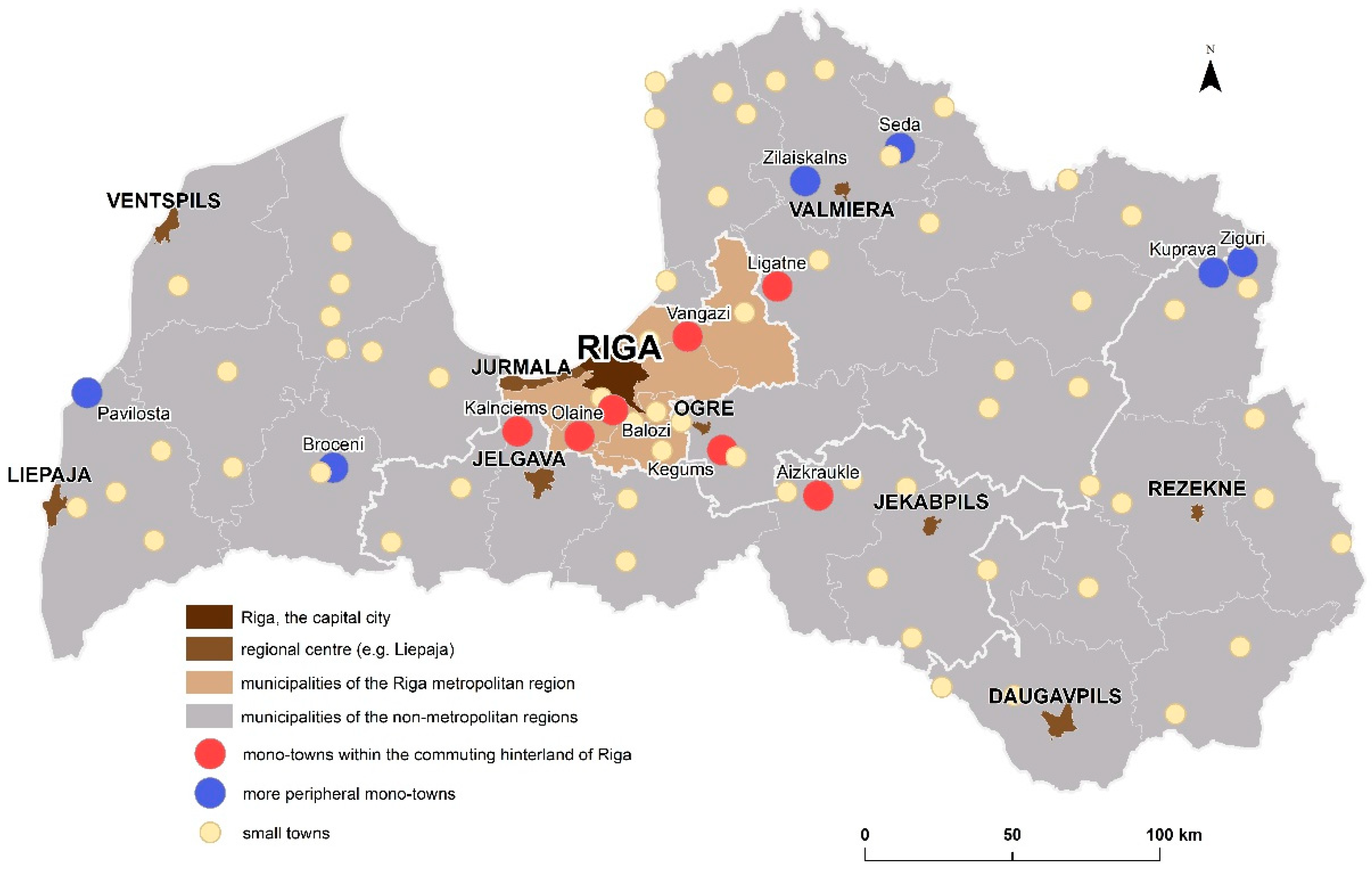
Figure 2.
Distribution of studied settlements and associated socio-economic, demographic and geographic variables across the first two principal components, with settlements categorized as commuting hinterland of the capital city of Riga and other settlements.
Figure 2.
Distribution of studied settlements and associated socio-economic, demographic and geographic variables across the first two principal components, with settlements categorized as commuting hinterland of the capital city of Riga and other settlements.
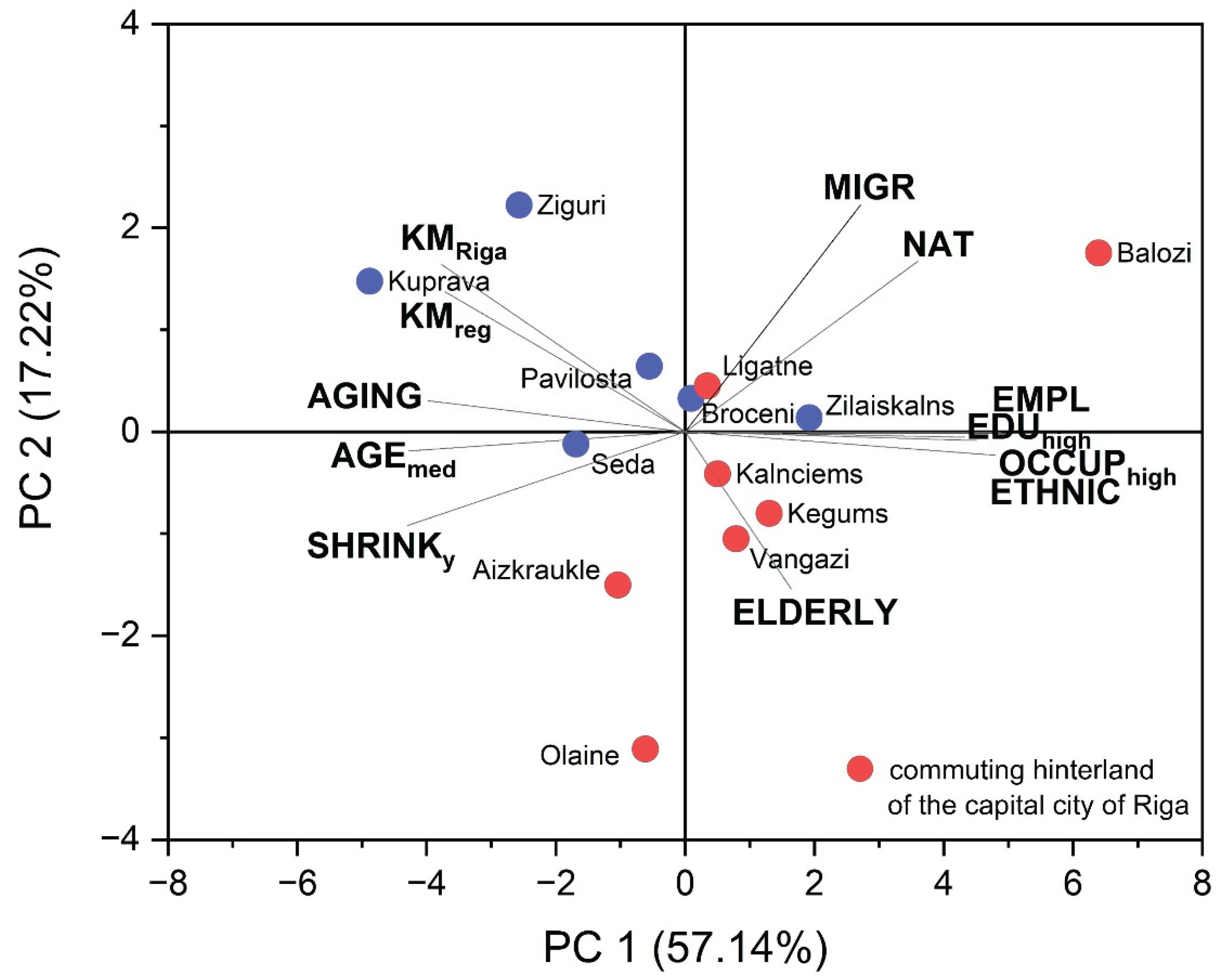
Table 1.
Population changes in the case study mono-towns.
| Mono-towns | Population, 2021 | Density, 2021 (km2/pop) | Population change, 2000-2021 | ||
| Total, % | Natural change, thous. | Net migration, thous. | |||
| Olaine | 10267 | 1 551 | -24.4 | -2.38 | -0.94 |
| Aizkraukle | 7034 | 875 | -23.9 | -1.74 | -0.47 |
| Balozi | 6771 | 985 | 41.2 | 1.66 | 1.13 |
| Vangazi | 3226 | 643 | -22.7 | -0.81 | -0.14 |
| Broceni | 2826 | 340 | -21.1 | -0.46 | -0.30 |
| Kegums | 2099 | 507 | -14.0 | -0.24 | -0.10 |
| Kalnciems | 1842 | 979 | -28.5 | -0.32 | -0.42 |
| Seda | 1093 | 547 | -39.6 | -0.35 | -0.37 |
| Ligatne | 1013 | 146 | -30.9 | -0.18 | -0.28 |
| Pavilosta | 859 | 138 | -33.4 | -0.18 | -0.25 |
| Zilaiskalns | 729 | 691 | -14.7 | -0.05 | -0.07 |
| Ziguri | 539 | 182 | -46.8 | -0.20 | -0.28 |
| Kuprava | 280 | 212 | -61.1 | -0.28 | -0.17 |
| Average | 2968 | 520 | -24.6 | -0.42 | -0.20 |
Table 3.
Correlation matrix of demographic and socioeconomic variables.
| Variables | 1 | 2 | 3 | 4 | 5 | 6 | 7 | 8 | 9 | 10 | 11 | 12 |
| AGEmed | 1 | |||||||||||
| ELDERLY | -0.032 | 1 | ||||||||||
| AGING | 0.917 | 0.051 | 1 | |||||||||
| MIGR | -0.384 | -0.236 | -0.217 | 1 | ||||||||
| NAT | -0.510 | 0.162 | -0.303 | 0.884 | 1 | |||||||
| ETHNIC | -0.494 | 0.481 | -0.432 | 0.411 | 0.651 | 1 | ||||||
| EDUhigh | -0.666 | -0.059 | -0.748 | 0.371 | 0.385 | 0.677 | 1 | |||||
| EMPL | -0.705 | 0.273 | -0.619 | 0.444 | 0.583 | 0.832 | 0.812 | 1 | ||||
| OCCUPhigh | -0.677 | 0.204 | -0.642 | 0.406 | 0.485 | 0.783 | 0.880 | 0.962 | 1 | |||
| SHRINKy | 0.670 | -0.336 | 0.491 | -0.702 | -0.897 | -0.738 | -0.435 | -0.699 | -0.580 | 1 | ||
| KMRiga | 0.614 | -0.533 | 0.679 | 0.078 | -0.155 | -0.559 | -0.524 | -0.607 | -0.662 | 0.406 | 1 | |
| KMreg | 0.398 | -0.553 | 0.486 | -0.073 | -0.226 | -0.623 | -0.575 | -0.587 | -0.655 | 0.469 | 0.774 | 1 |
Significant level: 0.05.
Table 4.
Principal component analysis (PCA) results.
| Principal component | 1 | 2 | 3 |
| Interpreted factors | Socio-economic vitality |
Population change and peripherality | Ageing society |
| Eigenvalues | 6.85702619 | 2.06667909 | 1.51147959 |
| Percentage of variance | 57.1 | 17.2 | 12.6 |
| AGEmed | -0.31063 | ||
| ELDERLY | 0.59276 | ||
| AGING | 0.43789 | ||
| MIGR | 0.56013 | ||
| NAT | 0.42193 | ||
| ETHNIC | 0.32765 | ||
| EDUhigh | 0.31421 | ||
| EMPL | 0.35447 | ||
| OCCUPhigh | 0.34832 | ||
| SHRINKy | -0.31231 | ||
| KMRiga | 0.41368 | ||
| KMreg | 0.3463 |
Notes: KMO (Kaiser–Meyer–Olkin measure of sampling adequacy) = 0.62, chi-square = 166.053, significance = 0.000. Only factor loadings ≥ 0.3 are shown.
Disclaimer/Publisher’s Note: The statements, opinions and data contained in all publications are solely those of the individual author(s) and contributor(s) and not of MDPI and/or the editor(s). MDPI and/or the editor(s) disclaim responsibility for any injury to people or property resulting from any ideas, methods, instructions or products referred to in the content. |
© 2026 by the authors. Licensee MDPI, Basel, Switzerland. This article is an open access article distributed under the terms and conditions of the Creative Commons Attribution (CC BY) license (http://creativecommons.org/licenses/by/4.0/).
Copyright: This open access article is published under a Creative Commons CC BY 4.0 license, which permit the free download, distribution, and reuse, provided that the author and preprint are cited in any reuse.


