
Submitted:
09 March 2026
Posted:
10 March 2026
You are already at the latest version
Abstract
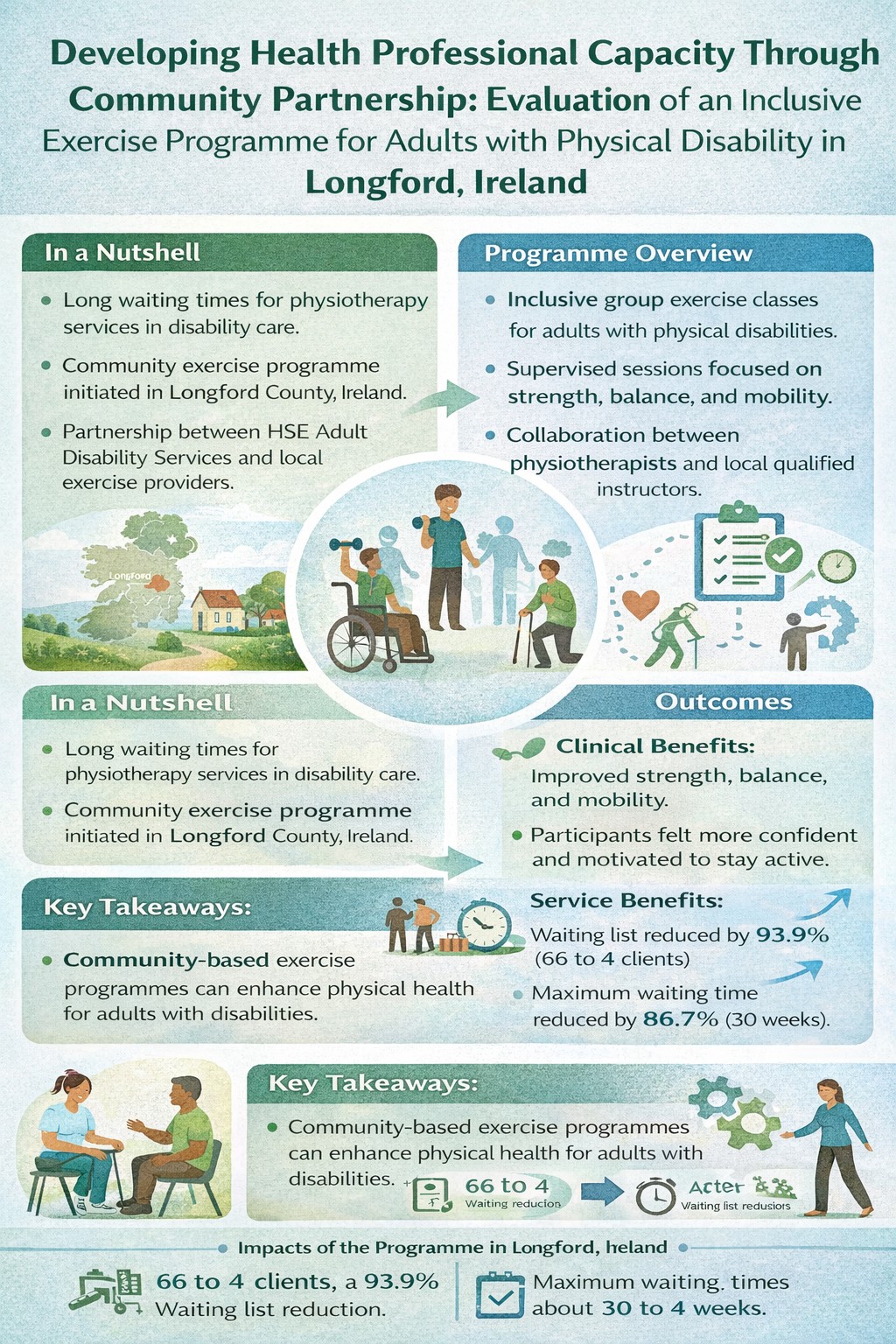
Adults with physical disabilities living in rural areas often experience limited access to structured physical activity and prolonged waiting times for rehabilitation services. Traditional one-to-one therapy models may not adequately support sustained physical activity participation while maintaining service capacity. This study evaluated the functional and service-level impact of a community-based group exercise programme implemented within a rural adult disability service. A prospective service evaluation using a repeated-measures pre–post design was conducted in County Longford, Ireland. Adults with neurological and neuromuscular conditions were signposted through HSE Adult Disability Services to an 8-week supervised group exercise programme delivered in partnership with community infrastructure. Outcome measures included the 10-Metre Walk Test, 30-Second Sit-to-Stand Test, Berg Balance Scale, and EQ-5D health status scale. Changes in functional outcomes were interpreted using established minimal clinically important difference thresholds, while service-level impact was assessed through comparison of physiotherapy waiting list volume and maximum waiting times before and after implementation. Participants demonstrated improvements in mobility, lower limb strength, balance, and self-reported health status, with several achieving clinically meaningful gains in gait speed and functional strength. At a service level, physiotherapy waiting list volume reduced by 93.9% (66 to 4 clients) and maximum waiting time decreased by 86.7% (30 to 4 weeks). Embedding structured community-based exercise pathways within rural disability services may improve functional outcomes while alleviating pressure on rehabilitation services and supporting more sustainable models of care.
Keywords:
physical disability
; community-based rehabilitation
; interprofessional education
; service evaluation
; exercise prescription
; partnership working
Copyright: This open access article is published under a Creative Commons CC BY 4.0 license, which permit the free download, distribution, and reuse, provided that the author and preprint are cited in any reuse.


