

Submitted:
09 March 2026
Posted:
10 March 2026
You are already at the latest version
Abstract
Unregulated Housing (UrH) is a widespread urban phenomenon in Morocco, largely driven by rapid population growth and accelerated urbanization. It has expanded mainly on the outskirts of cities and within housing developments that already benefit from basic infrastructure and superstructure services. In response to this challenge, public authorities have adopted several urban planning instruments, particularly the Land Management Plan (LMP). According to Law No. 12-90 on urban planning, the LMP seeks to regulate urban expansion, improve the architectural and aesthetic quality of the built environment, and preserve the overall coherence of developed areas. As a legally binding planning document, the LMP establishes strict land-use regulations, and any breach of these rules constitutes an offence. Traditionally, detecting such violations requires on-site inspections by control officers, followed by the preparation of official reports submitted to the competent legal authorities. However, recent advances in aerial image acquisition and processing technologies provide powerful tools to improve and facilitate the monitoring of urban planning compliance. This paper proposes a conceptual framework that integrates artificial intelligence with urban planning regulations to enable the automatic detection of urban planning offences using RGB orthophotos covering areas subject to a Land Management Plan, relying on deep learning techniques.
Keywords:
1. Introduction
- -
- There is a strong influence of the dominant species on the classification by ANN;
- -
- Picture taking conditions must be the same for the area of the same image;
- -
- It is an expensive method in terms of covering large study areas with dense LIDAR data.
2. Offences of Urban Planning in Morocco
2.1. African and International Approaches of Managing or Detecting Urban Planning Offences
2.1. Offences Inventory in Morocco
2.1.1. Depending on the Legal Status of the Project
- -
- In authorised projects: building activity without respecting the authorised plan.
- -
- In unauthorised projects: building activity without permission to build, illegal housing estates and illegal land division.
2.1.2. Depending on the Occupied Sites
2.1.3. Other Types of Urban Planning Offences
2.1.4. Business Process for Monitoring Urban Planning Offences
- Collecting and acquiring offences data through
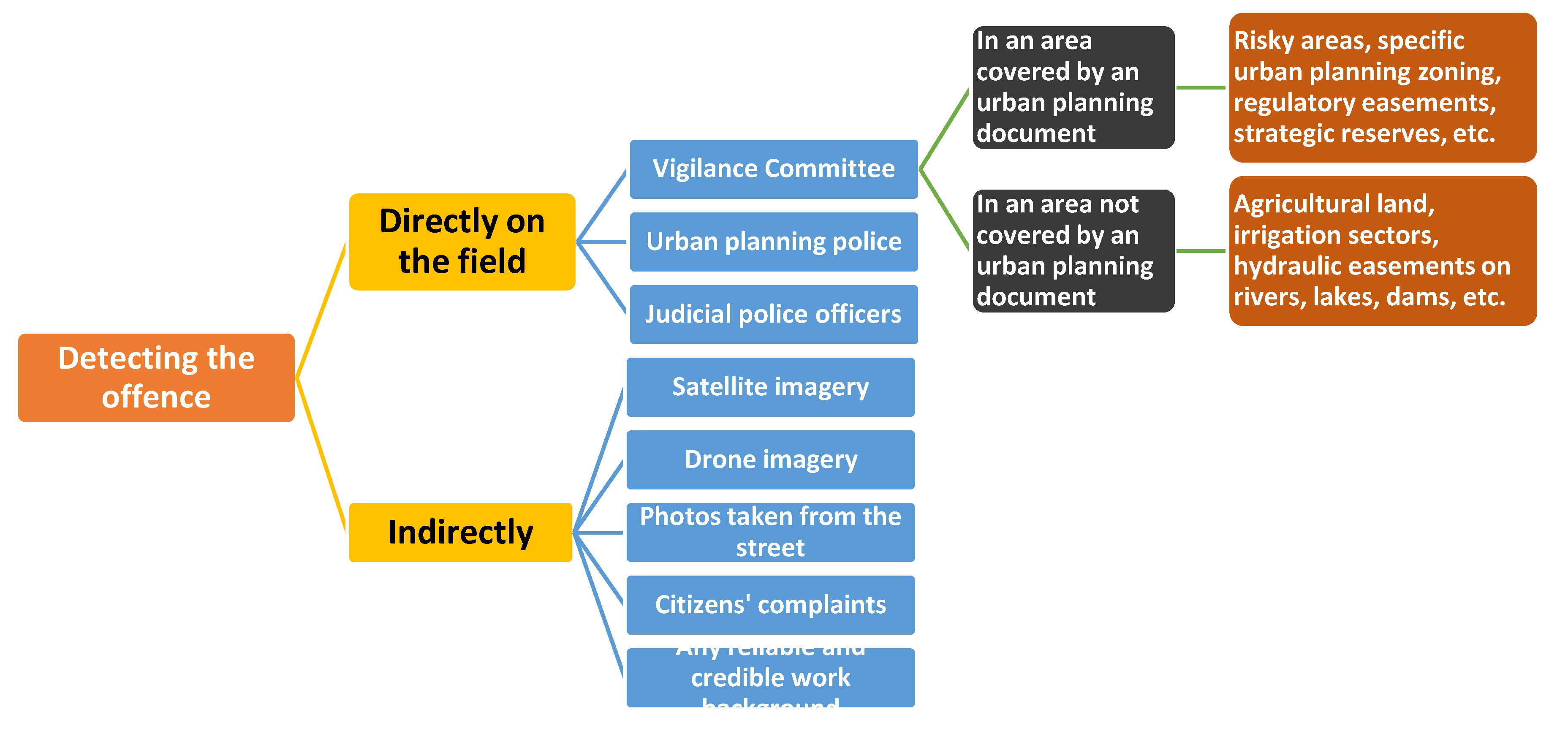
Verification Example of an Indirect Finding of an Offence Concerning Non-Conformity with the Authorised Plan
- Sources of data to use

| Source of data | Description |
|---|---|
| Drone images | in digital format or on paper, of the location of the study area including the building subject of the law-violation. |
| Land management plan (LMP) | in usable digital format (vector) or on paper. |
| Urbanization ability map (UAM) | with a zoom on the area where the law-violation is located. |
- Georeferencing of the aerial image on CAD software: with the same projection system used in the LMP: Lambert Conformal Conic projection;
- Superimposing the image, the LMP and the UAM and zooming in on the site of the infringement;
- Assessment of building compliance: In general, a building is considered compliant if it adheres to the regulations of the Land Management Plan (LMP) and the Urbanization Ability Map (UAM). Conversely, any building that does not conform to the authorized plan constitutes an urban planning offence, as it violates the rules specified in the LMP. Furthermore, because the LMP is developed in accordance with the recommendations of the UAM, both the building site and the structure itself must align with these guidelines. This includes ensuring the building is located within an urbanable zone, verifying that the foundations are appropriately reinforced, confirming the suitability of the land for construction, and assessing potential risks from natural hazards such as landslides, earthquakes, or flooding.
3. Deep Learning of Aerial Photos
4. Materials and Methods
4.1. Data and Materials
4.4.1. Types of Data for Our Work
- ○
- For large image databases: 1% of this database is already representative of the whole for use in testing. 1% for validation and 98% for training.
- ○
- For small databases: between 60% and 80% to train models, between 10 and 20% to validate and the same interval to test.
- ○
- Images can be collected by searching for existing images of the study area or by taking aerial photographs using a drone.
- ○
- The model could be tested on orthophotos of a site other than the study area.
4.4.2. Materials
4.4.3. Software
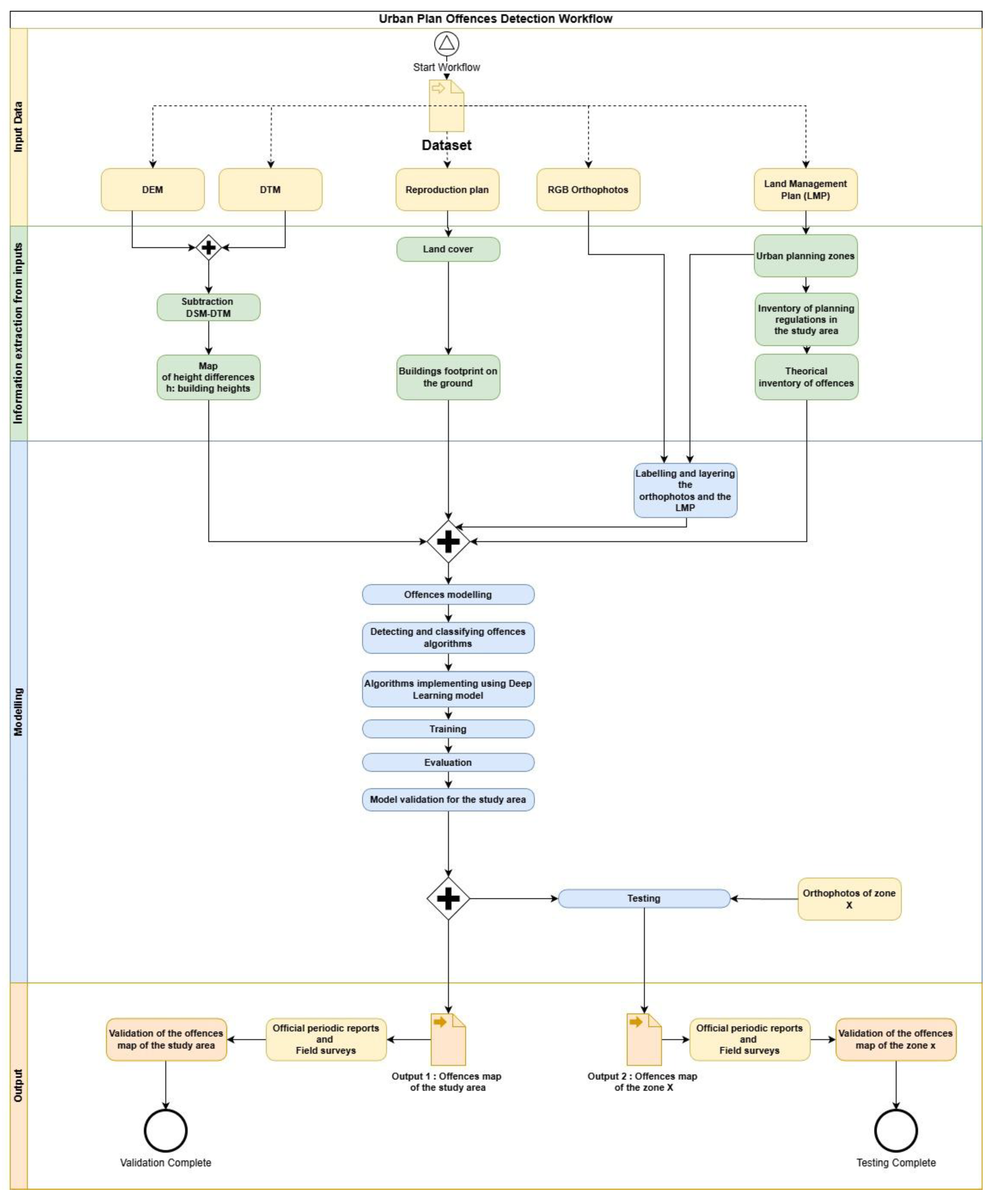
4.4.4. Technical Process of the Automatic Detection of Urban Planning Offences
5. Results
- -
- Part of input data and extracting information from it;
- -
- Part of implementation and modelling of offences;
- -
- Part of model outputs.
5.1. Part of Input Data and Extracting Information from It
- The Land Management Plan serves as the primary reference for identifying and cataloguing the urban planning regulations applicable to each zoning designation within the study area. It provides detailed specifications regarding permitted land use, occupancy conditions, and the linear and surface dimensions that must be respected by both public authorities and the population. Based on this regulatory inventory, a corresponding theoretical inventory of potential urban planning violations can be derived, with at least one type of violation associated with each planning rule and defined according to its specific requirements. For instance, cemetery easements, where all construction activities are prohibited, are typically defined by a 30-meter buffer zone; any construction within this zone constitutes a single type of violation. In contrast, regulations governing R+2 residential zones may be breached through multiple forms of non-compliance, such as the addition of extra floors beyond the permitted height or failure to respect the minimum parcel size requirements.
- Inventory of offences from official sources: This inventory is compiled using field reports from provincial monitoring committees, periodic reports from the relevant urban agencies, or through photo interpretation of time-series high-resolution aerial images. It provides insight into the most frequent types of offences occurring within the study area. It is important to distinguish this empirical inventory from the theoretical inventory, which is derived from a systematic listing of the LMP’s land management regulations and the corresponding potential violations for each regulation.
- RGB orthophotos: at the end of the above-mentioned mission, RGB orthophotos of the entire study area are obtained with high spatial resolution, in the accuracy range centimetres, thus enabling, via orthophoto processing software on a computer (e.g. AgiSoft Metashape), the generation of a mosaic, a DEM and a DTM. Subtracting these last two elements will allow us to deduce a map of the differences in altitude h of objects on the ground, in particular the height of buildings, which can be controlled according to the LMP rules.
- Reproduction plans: These are obtained through detailed surveys of all existing features within the study area and represent the ground-truth land cover with precise X and Y coordinates. Altimetric information is provided through elevation plans, which include contour lines and spot elevation points. From reproduction plans, it is possible to extract the footprint of each surface element, particularly the footprints of buildings regulated by the LMP. The LMP specifies regulatory parameters for each parcel, including the minimum parcel size and the maximum allowable number of floors. The altimetry information is based on the general levelling of Morocco (NGM).
5.2. Part of Implementation and Modelling of Offences
- This stage begins with a critical process that requires highly skilled data scientists with strong domain knowledge: the annotation of the orthophoto mosaic and, where applicable, cropped orthophoto tiles used as model inputs. Labelling may be performed manually or with the support of specialized web-based annotation tools. The primary objective of this process is to accurately identify and extract relevant objects of interest, particularly buildings, which constitute the core targets of the detection and extraction model.
- Next, we define, on the orthophotos, the urban areas submitted to the LMP regulations based on the urban zoning designation polygons stipulated on the LMP by superimposing the LMP and the orthophotos. For example, we will have polygons for continuous residential areas with 3 floors (R+3), industrial areas of the first category, non-building zones, tree planting areas, strategic reserves, roads, squares, green spaces and sports fields.
- It is useful to have several examples of the same urban zoning designation on the orthophotos; this will allow the model to be fed with a large amount of data, which will facilitate its training.
- Each polygon of an urban zoning designation must be converted into a digital and usable file (e.g. .shp or .dwg) and must be accompanied by a metadata file describing the rules of the management regulations (urban zoning designation, minimum and maximum area, setback from roads and easements, height, number of levels, etc.), with which the deep learning model must interact to detect violations on the orthophoto;
- Thus, we will have orthophotos with the LMP zoning superimposed, showing both the land use (field truth) and the regulatory use provided for by the LMP in the form of polygons. Each polygon outlines a certain number of pixels that will be exposed to different layers of the CNN model to be developed or adjusted later according to the regulatory measures of the LMP.
- It should be noted that each type of urban planning offence requires its own dedicated detection algorithm, which will subsequently be implemented within a deep learning model for design, training, evaluation, and testing. This is necessary because offences vary significantly in nature and are subject to different regulatory measures—for instance, a violation of a cemetery easement must be treated differently from an unauthorized increase in building height. The possibility of combining multiple algorithms, or grouping related algorithms, into a single integrated model will be explored at a later stage.
- What stays to be done is to identify the anomalies on the orthophotos for each zoning of the LMP superimposed on them: in other words, to check the degree of the conformity of the field truth with the regulatory measures of the LMP. When combining several infringement detection algorithms, the model must allow to look for one or more infringements through single or multiple queries (e.g. search for buildings exceeding 16m height (single query) or search for buildings exceeding 16m height with a footprint of less than 80m² (compound query));
- In the case of the multiple queries, we are talking not only about the detection of the offences, but also about their classification into a number of classes allowed by the model provided for this task.
5.3. Part of the Model Outputs
6. Discussions
- Variety and complexity of offences: The same type of offence may occur in multiple configurations, increasing the effort required to model all possible scenarios within a single or multiple models.
- Data volume requirements: Deep learning models require large amounts of high-quality data for training, evaluation, and testing.
- Data quality and noise: Preprocessing of the data is necessary to reduce noise and ensure that inputs to the model yield accurate results that closely reflect the ground truth.
- Technical and expertise-related challenges: Implementing deep learning algorithms for the detection of multiple types of offences demands advanced technical skills and domain knowledge to effectively process and analyze the data.
- Develop a comprehensive inventory of offences: Construct a clear theoretical inventory of potential violations based on the Land Management Plan (LMP), taking into account the regulatory measures for each offence. This enables precise differentiation between types of offences and informs the design of the detection algorithm.
- Ensure technical and expertise requirements: The implementation of deep learning algorithms requires sufficient technical skills, either individually or collectively within a research team, to design, implement, and optimize the models effectively.
- Preprocess and correct input orthophotos: Apply the necessary corrections to drone-captured orthophotos using specialized software to generate reliable mosaics, digital terrain models (DTMs), and digital elevation models (DEMs) that can serve as accurate inputs for the deep learning models.
- Maintain spatial-temporal consistency of datasets: Orthophotos, the LMP, topographic surveys, reproduction plans, and, if available, LiDAR data should be temporally aligned as closely as possible. This ensures that the deep learning models are trained and evaluated using consistent data. If discrepancies exist in the acquisition dates of the datasets, additional preprocessing will be required to verify and correct their consistency, which may increase processing time.
- Future practical application: Subsequent work will focus on a case study for the automatic detection of urban planning violations related to exceeding regulatory building heights within a neighborhood covered by the LMP. The approach will include:
7. Conclusions
Author Contributions
Funding
Data Availability Statement
Acknowledgments
Conflicts of Interest
Abbreviations
| AI | Artificial Intelligence |
| ANN | Artificial Neural Networks |
| BMC | Bhubaneswar Municipal Corporation |
| CAD | Computer Aided Design |
| CNN | Convolutional Neural Network |
| CPU | Central Processing Unit |
| CV | Computer Vision |
| DEM | Digital Elevation Model |
| DIHAL | Interministerial Delegation for Housing and Access to Housing |
| DL | Deep Learning |
| DSM | Digital Surface Model |
| DTM | Digital Terrain Model |
| DWG | Drawing |
| FIFA | Fédération Internationale de Football Association |
| FST | Faculty of Sciences and Techniques |
| GPS | Global Positioning System |
| GPU | Graphics Processing Unit |
| IR | Infrared |
| ISPRS | International Society for Photogrammetry and Remote Sensing |
| LIDAR | Light Detection And Ranging |
| LMP | Land Management Plan |
| MATNUHPV | Ministère de l’Aménagement du Territoire National, de l’Urbanisme, de l’Habitat et de la Politique de la Ville |
| MXD | Map Exchange Document |
| nDEM | Normalized Digital Elevation Model |
| NGM | General Levelling of Morocco |
| NIR | Near Infrared |
| NLP | Natural language processing |
| RADAR | RAdio Detection And Ranging |
| RGB | Red Green Blue |
| SHP | Shapefile |
| TIFF | Tagged Image File Format |
| UAM | Urbanization Ability Map |
| UAV | Unnamed Aerial Vehicle |
| UM6P | University Mohammed VI Polytechnic |
| UrH | Unregulated Housing |
| USMS | University of Sultan Moulay Slimane |
| ViT | Vision Transformer |
References
- AURAV. (2023). IA et urbanisme: L’urbanisme et la ville de demain vus par l’intelligence artificielle. Agence d’Urbanisme Rhône Avignon Vaucluse. https://www.aurav.org/documents/publication-iaeturbanisme.pdf.
- Agence Urbaine de Skhirate-Témara. (2022). Nouveau règlement d’aménagement. https://aust.ma/sites/default/files/2022-03/Nouveau%20re%CC%80glement%20d%27ame%CC%81nagement.pdf.
- Won, T., Song, J., Lee, B., Pyeon, M.W. & Sa, J. (2020). Application of a Deep Learning Method on Aerial Orthophotos to Extract Land Categories. Journal of the Korean Society of Surveying, Geodesy, Photogrammetry and Cartography 38, 443–453. [CrossRef]
- Saad El Imanni, H., El Harti, A., Bachaoui, E.M., Mouncif, H., Eddassouqui, F., Hasnai, M.A. & Zinelabidine, M.I. (2023). Multispectral UAV data for detection of weeds in a citrus farm using machine learning and Google Earth Engine: Case study of Morocco. Remote Sensing Applications: Society and Environment 30, 100941. [CrossRef]
- Dahmane, K. (2020). Analyse d’images par méthode de Deep Learning appliquée au contexte routier en conditions météorologiques dégradées [Doctoral dissertation, Université Clermont Auvergne]. HAL Open Science. https://theses.hal.science/tel-03022934.
- Elhousni, M., Zhang, Z. & Huang, X. (2021). Height Prediction and Refinement From Aerial Images With Semantic and Geometric Guidance. IEEE Access 9, 145638–145647. [CrossRef]
- Kwon, S.-K., Jung, H.-S., Baek, W.-K. & Kim, D. (2017). Classification of Forest Vertical Structure in South Korea from Aerial Orthophoto and Lidar Data Using an Artificial Neural Network. Applied Sciences 7, 1046. [CrossRef]
- Wu, A.N. & Biljecki, F. (2022). GANmapper: geographical data translation. International Journal of Geographical Information Science 36, 1394–1422. [CrossRef]
- Teo, T.-A. & Chen, P.-C. (2024). Building footprint extraction from aerial imagery through semantic segmentation techniques. IOP Conf. Ser.: Earth Environ. Sci. 1412, 012036. [CrossRef]
- Wang, L., Li, R., Zhang, C., Fang, S., Duan, C., Meng, X. & Atkinson, P.M. (2022). UNetFormer: A UNet-like transformer for efficient semantic segmentation of remote sensing urban scene imagery. ISPRS Journal of Photogrammetry and Remote Sensing 190, 196–214. [CrossRef]
- Ahmed, S.F., EL-Shazely, A.H. & Ahmed, W. (2025). Deep Learning for Building Footprint Extraction Using UAV-Based Orthoimages. J Indian Soc Remote Sens 53, 1243–1262. [CrossRef]
- Kamana, A.A., Radoine, H. & Nyasulu, C. (2024). Urban challenges and strategies in African cities – A systematic literature review. City and Environment Interactions 21, 100132. [CrossRef]
- Mramba, N.R. (2025). The Conception of Street Vending Business (SVB) in Income Poverty Reduction in Tanzania. ResearchGate. [CrossRef]
- Raj, B., & Jolly, J. (2020). Integrating Street vending in Urban planning. International Journal of Science, Engineering and Management (IJSEM), 5, 25–32. https://www.technoarete.org/common_abstract/pdf/IJSEM/v7/i4/Ext_27046.pdf.
- Saïd, B. & Najet, M. (2025). L’urbain informel et les paradoxes de la ville algérienne: politiques urbaines et légitimité sociale. ResearchGate. [CrossRef]
- Localtis / Banque des Territoires. (2025, May 13). Bidonvilles en France: un défi persistant, des outils pour agir. https://www.banquedesterritoires.fr/bidonvilles-en-france-un-defi-persistant-des-outils-pour-agir.
- Varol, B., Yılmaz, E.Ö., Maktav, D., Bayburt, S. & Gürdal, S. (2019). Detection of illegal constructions in urban cities: comparing LIDAR data and stereo KOMPSAT-3 images with development plans. European Journal of Remote Sensing 52, 335–344. [CrossRef]
- Shaamala, A., Yigitcanlar, T., Nili, A. & Nyandega, D. (2025). Machine Learning Applications for Urban Geospatial Analysis: A Review of Urban and Environmental Studies. Cities 165, Article number: 106139. [CrossRef]
- Li, J., Gao, J., Zhang, Z., Fu, J., Shao, G., Zhao, Z. & Yang, P. (2024). Insights into citizens’ experiences of cultural ecosystem services in urban green spaces based on social media analytics. Landscape and Urban Planning 244, 104999. [CrossRef]
- Yamashkin, S.A., Yamashkin, A.A., Zanozin, V.V., Radovanovic, M.M. & Barmin, A.N. (2020). Improving the Efficiency of Deep Learning Methods in Remote Sensing Data Analysis: Geosystem Approach. IEEE Access 8, 179516–179529. [CrossRef]
- Campbell, A., Both, A. & Sun, Q. (Chayn). (2019). Detecting and mapping traffic signs from Google Street View images using deep learning and GIS. Computers, Environment and Urban Systems 77, 101350. [CrossRef]
- Xu, Y., Xie, Z., Feng, Y. & Chen, Z. (2018). Road Extraction from High-Resolution Remote Sensing Imagery Using Deep Learning. Remote Sensing 10, 1461. [CrossRef]
- Han, K., Wang, Y., Chen, H., Chen, X., Guo, J., Liu, Z., Tang, Y., Xiao, A., Xu, C., Xu, Y., Yang, Z., Zhang, Y. & Tao, D. (2023). A Survey on Vision Transformer. IEEE Transactions on Pattern Analysis and Machine Intelligence 45, 87–110. [CrossRef]
- He, K., Zhang, X., Ren, S. & Sun, J. (2016). Deep Residual Learning for Image Recognition, in: 2016 IEEE Conference on Computer Vision and Pattern Recognition (CVPR). Presented at the 2016 IEEE Conference on Computer Vision and Pattern Recognition (CVPR), IEEE, Las Vegas, NV, USA, pp. 770–778. [CrossRef]
- Ren, S., He, K., Girshick, R. & Sun, J. (2017). Faster R-CNN: Towards Real-Time Object Detection with Region Proposal Networks. IEEE Transactions on Pattern Analysis and Machine Intelligence 39, 1137–1149. [CrossRef]
- Chen, M., Radford, A., Child, R., Wu, J., Jun, H., Luan, D. & Sutskever, I. (2020). Generative Pretraining From Pixels, in: Proceedings of the 37th International Conference on Machine Learning. Presented at the International Conference on Machine Learning, PMLR, pp. 1691–1703.
- Dosovitskiy, A., Beyer, L., Kolesnikov, A., Weissenborn, D., Zhai, X., Unterthiner, T., Dehghani, M., Minderer, M., Heigold, G., Gelly, S., Uszkoreit, J. & Houlsby, N. (2021). An Image is Worth 16x16 Words: Transformers for Image Recognition at Scale. [CrossRef]
- Carion, N., Massa, F., Synnaeve, G., Usunier, N., Kirillov, A. & Zagoruyko, S. (2020). End-to-End Object Detection with Transformers, in: Vedaldi, A., Bischof, H., Brox, T., Frahm, J.-M. (Eds.), Computer Vision – ECCV 2020, Lecture Notes in Computer Science. Springer International Publishing, Cham, pp. 213–229. [CrossRef]
- Zhu, X., Su, W., Lu, L., Li, B., Wang, X. & Dai, J. (2021). Deformable DETR: Deformable Transformers for End-to-End Object Detection. [CrossRef]
- Zheng, S., Lu, J., Zhao, H., Zhu, X., Luo, Z., Wang, Y., Fu, Y., Feng, J., Xiang, T., Torr, P.H.S. & Zhang, L. (2021). Rethinking Semantic Segmentation from a Sequence-to-Sequence Perspective with Transformers, in: 2021 IEEE/CVF Conference on Computer Vision and Pattern Recognition (CVPR). Presented at the 2021 IEEE/CVF Conference on Computer Vision and Pattern Recognition (CVPR), pp. 6877–6886. [CrossRef]
- Zhou, L., Zhou, Y., Corso, J.J., Socher, R. & Xiong, C. (2018). End-to-End Dense Video Captioning with Masked Transformer, in: 2018 IEEE/CVF Conference on Computer Vision and Pattern Recognition. Presented at the 2018 IEEE/CVF Conference on Computer Vision and Pattern Recognition, pp. 8739–8748. [CrossRef]
- Pragati, B. (2021, September 13). Train test validation split: How to & best practices [Blog post]. V7 Labs. https://www.v7labs.com/blog/train-validation-test-set.
- Doungmo, Y. (2017, August 10). Différence entre MNT, MNA, MNE et applications [Blog post]. LinkedIn. https://www.linkedin.com/pulse/diff%C3%A9rence-entre-mnt-mna-mne-et-applications-yannick-arthur-doungmo.
- Hu, P., Cheng, J., Li, P. & Wang, Y. (2023). Automatic extraction of built-up areas in Chinese urban agglomerations based on the deep learning method using NTL data. Geocarto International 38, 2246939. [CrossRef]
- Park, C., No, W., Choi, J. & Kim, Y. (2023). Development of an AI advisor for conceptual land use planning. Cities 138, 104371. [CrossRef]
- Rachele, J.N., Wang, J., Wijnands, J.S., Zhao, H., Bentley, R. & Stevenson, M. (2021). Using machine learning to examine associations between the built environment and physical function: A feasibility study. Health Place 70, 102601. [CrossRef]
- Wu, A.N. & Biljecki, F. (2023). InstantCITY: Synthesising morphologically accurate geospatial data for urban form analysis, transfer, and quality control. ISPRS Journal of Photogrammetry and Remote Sensing 195, 90–104. [CrossRef]
- Chai, J., Zeng, H., Li, A. & Ngai, E.W.T. (2021). Deep learning in computer vision: A critical review of emerging techniques and application scenarios. Machine Learning with Applications 6, 100134. [CrossRef]
| Study/Use case | Reference | Task targeted | Method/model | Used data | Limitations in the offences’s detection |
|---|---|---|---|---|---|
| Application of a Deep Learning Method on Aerial Orthophotos to Extract Land Categories | Won et al., 2020. | Extraction Classification |
Smaller VGG-Net | Spatial-temporal series of aerial orthophotos and cadastral maps | Extraction accuracy varies depending on the type of construction. Acquiring time series orthophotos for model training is costly, and they must be taken during the same season |
| Height Prediction and Refinement from Aerial Images with Semantic and Geometric Guidance | Elhousni et al., 2021. | Prediction | DenseNet 121 | 2018 Data Fusion Contest (DFC) ISPRS Vaihingen (true orthophotos) Digital Surface Model DSM Semantic labels Surface normals maps |
Prediction errors are often concentrated at the building’s edges because of rapid changes of brightness and colour, and trees where shadows create a considerable quantity of colour noise |
| Classification of Forest Vertical Structure in South Korea from Aerial Orthophoto and Lidar Data Using an Artificial Neural Network | Kwon et al., 2017. | Classification | Artificial Neural Network ANN | RGB Orthophotos Lidar point cloud |
Classification by ANN is strongly influenced by the dominant species or category Picture-taking conditions must be the same for the area covered by the same image Expensive method in terms of covering large study areas with dense LIDAR data |
| Building footprint extraction from aerial imagery through semantic segmentation techniques | Teo et al., 2024. | Extraction Semantic segmentation |
TransUNet | True aerial orthoimages Digital Surface Model DSM |
Irregular building boundaries are a problem commonly encountered in DL semantic segmentation of aerial images Difficulty to identify individual buildings, especially in high-density urban areas |
| UNetFormer: A UNet-like transformer for efficient semantic segmentation of remote sensing urban scene imagery | Wang et al., 2022. | Extraction Semantic segmentation |
UNetformer | UAVid and LoveDA datasets ISPRS Vaihingen dataset (true orthophotos) Potsdam dataset (true orthophotos) |
The decision to use the transformer as an encoder, although justified in order to obtain accurate semantic information, slows down the processing speed of the segmentation network, which affects the extraction of information on large urban scenes. |
| Criterion | Classical control | Proposed method |
|---|---|---|
| Spatial coverage | Very limited: one restricted area at a time. It depends on the weather, the topography of the field and on the agent availability. |
Very large: monitoring of vast territories (municipalities, entire regions) in a single campaign. |
| Speed / Frequency | Slow: visits are spaced out and they depend on availability of the staff, Focused on a specific geographic point or after notification. |
Very fast: possibly done several times a year, or even monthly. Large areas can be processed automatically in a short amount of time. Regular and repeatable, allowing us to compare images taken on different dates. |
| Cost | High (travel, labour, fuel). | Lower on a large area (after initial investment in images and software). |
| Resolution / Details | Very high: textures, materials, actual condition. | Medium to good: it depends on the pixel size of the camera of the drone. Details depend on the updated imagery. |
| Accuracy and reliability | Very high: direct observation, precise measurements, possibility of checking the interior of buildings or details that are invisible from above. Few false positives. | Medium to good: detects visible changes, such as new buildings or extensions, but there is a risk of false positives or negatives due to factors such as shadows, vegetation and image quality. Often requires verification on the field. |
| Detection under cover | Possible (with direct access) | Very low (obscured by trees, roofs, clouds) |
| Objectivity | Subjective factors (e.g. agent interpretation, tiredness, mood). | More objective (uses the same algorithm), but there is a possibility of training bias. |
| Ability to detect changes | Depends on the agent’s memory or previous visit. | Excellent (automatic image comparison of two times t and t-1). |
| Types of offences detected | All: unauthorised construction; change of use; internal offenses; illegal occupation; detailed information (materials and condition, non-compliance with exact heights or interior use). | Mainly visible from above: building footprints, new buildings, extensions and the occupation of public spaces. |
| Lawful evidence | Very strong evidence (direct observation, photos and an official report) may result in immediate penalties. Field inspections are risky. |
Variable: Public satellite images (e.g. Google) are accepted, but drones are often contested due to privacy concerns. AI alone is rarely sufficient without field verification. |
| Innovation | No innovation in the classical control, the task is the same every time. | Large possibilities of innovation and progress. |
| Complementarity | Essential for confirmation and details | Excellent for sorting and prioritising suspicious areas. |
Disclaimer/Publisher’s Note: The statements, opinions and data contained in all publications are solely those of the individual author(s) and contributor(s) and not of MDPI and/or the editor(s). MDPI and/or the editor(s) disclaim responsibility for any injury to people or property resulting from any ideas, methods, instructions or products referred to in the content. |
© 2026 by the authors. Licensee MDPI, Basel, Switzerland. This article is an open access article distributed under the terms and conditions of the Creative Commons Attribution (CC BY) license.


