

Submitted:
10 March 2026
Posted:
10 March 2026
Read the latest preprint version here
Abstract
An elementary and self-contained proof of the existence of the Euler-Mascheroni constant γ is presented, based solely on the Simpson quadrature formula and the convexity of the function f\( x \mapsto 1/x \). The local logarithmic increments are approximated as follows: \( \int_{2n-1}^{2n+1} \frac{dx}{x} \) Using Simpson’s rule, a discrete approximation expressed as a finite linear combination of reciprocal integers is constructed. Exploiting the monotonic and convex nature of the function \( 1/x \), sharp two-sided inequalities relating the numerical approximation to exact logarithmic increments are established. These inequalities imply that the accumulated quadrature errors form a convergent series. Consequently, the following classical limits \( \gamma = \lim_{N \to \inf} \left( \sum_{k=1}^{N} \frac{1}{k} - \log{[N]} \right) \) are proven to exist. This approach provides a conceptually simple alternative to traditional proofs based on the Euler-Maclaurin formula, highlighting the direct connection between numerical integration, convexity, and the analytical nature of γ. I further show that λ can be expressed as \( (\log{[2]}+1)/3 + \delta \), where both \( (\log{[2]}+1)/3 \) and \( \delta \) are irrational, and where \( \delta \) arises as the limit of a rational sequence derived from as Simpson-type approximation.
Keywords:
The Euler-Mascheroni constant
; Harmonic sum
; Simson quadrature formula
1. Introduction
The Euler-Mascheroni constant
is a classical object of analysis and number theory [1]. Figure 1(a) illustrates the difference of the integration of and the sum of rectangles. Its existence is usually proven via asymptotic expansions derived from the Euler-Maclaurin summation formula or related analytic techniques [2].
According to Havil [3], no prove of the irrationality of is known, and the problem remains open. In this paper, I show that can be represented as the sum of two irrational constants, namely and , where arises as the limit of rational sequence defined via a Simpson-type approximation.
2. Simpson’s Approximation of Logarithmic Increments
For integers , the following function is defined:
This integral is approximated using Simpson’s rule with a step size of 1 as illustrated in Figure 1(b).
An additional function is defined:
Notably, is a finite linear combination of reciprocal integers and depends solely on the values of at the integer points.
The local quadrature error is defined as follows:
3. Convexity and Comparison Inequalities
The function is strictly decreasing and convex on . Let denote a quadratic polynomial interpolating at the three points.
By construction,
As is convex, the interpolation polynomial lies above on . Thus, except at the midpoint, and integration yields . Consequently,
Moreover, convexity implies a comparison across adjacent intervals, namely,
From this the following is obtained:
4. Telescoping Bounds and Error Convergence
Summing the aforementioned inequalities for yields
Both bounds telescope:
As as , the series
converges. The following function is defined:
5. Recovery of the Euler-Mascheroni Constant
Definition 1 (harmonic sum)
Let
where N denotes the -th harmonic.
Definition 2 (Simpson regularized harmonic sum)
Let be an odd integer. The interval is partitioned into sub-intervals of length two.
As illustrated in Figure 1(b), Simpson’s rule is applied to each subinterval to approximate the following:
The resulting approximation is denoted as , namely,
Lemma 1 (representation by integer reciprocal).
The quantity can be written as a finite linear combination of the reciprocals of the integers, as follows:
where
Proof. In Simpson’s rule, each subinterval contributes weights , multiplied by the global factor . With a step size of ,
● each interior odd integer appears twice as an endpoint (weight ).
● each even integer appears once at the midpoint (weight ).
● the boundary points and appear once (weight ).
Theorem:
Proof:
By comparing the coefficients term-wise, the following were obtained:
for even ,
for interior odd ,
Therefore,
Alternating harmonic series
converges to . As the boundary terms vanish in the limit, the following was concluded:
Summing the exact logarithmic increments
Combining these expressions and the definition of , the following was obtained:
Hence, the finiteness of is equivalent to
and, therefore, to the existence of the Euler-Mascheroni constant .
The rational sequences are defined as follows:
Then,
and for every .
Proof.
Using , rearranging gives
Taking proves . As each is rational, so is . The numerical values in Table 1 illustrate the rapid convergence of this rational sequence.
toward the constant . This accelerated convergence is a consequence of cancellation of the dominant error terms in the Simpson approximation.
6. Proof That
Is Irrational
In this section, I prove that cannot be a rational number. Note that can be obtained by
For any fixed integer .
Let be an odd prime. From the definition of , we have
,
containing no factor p in the denominator, because the term appears only in the endpoint weight . Thus
On the other hand, in the denominator never appears: is neither an endpoint of the summation nor a term selected by the step-size 2.
Hence
with denominator coprime to . Subtracting (3) from (2) gives
with denominator coprime to . Therefore, each rational number has a denominator divisible by the prime . Because can be chosen to be any prime, the sequence in (1) contains rational numbers whose denominators include arbitrarily large primes.
A property of rational numbers and their approximations
Let be a rational number in lowest terms. Consider any rational approximation .
where
Thus, if , then
Lemma: If , then .
A standard consequence is:
Corollary.
Any rational number sufficiently close to a/b must have denominator divisible by . In particular, the set of prime factors that can appear in the denominators of such approximants is finite.
Assume, for contradiction, that . From (1) the sequence
converges to .
Thus, for any all sufficiently large prime satisfy
By the Corollary, every such rational must have denominator divisible by . Hence the set of primes dividing the denominators of the is finite, namely a subset of the finite set of prime divisors of . However, from (4) we know: each contains the denominator , and can be any prime, contradicting the finite-prime requirement above. Since assuming leads to a contraction, is irrational.
7. Conclusion
This study demonstrated that the convergence of the harmonic series minus the logarithm can be established using solely Simpson’s rule and the convexity of the function . This provides a simple, purely numerical, and analytic alternative to classical proofs based on the Euler–Maclaurin formula.
The method highlights an unexpected connection between elementary quadrature rules and one of the fundamental constants of analysis and suggests natural extensions to higher-order Newton-Cotes formulas.
In addition, we introduced the constant , defined as the limit of rational sequence arising from Simpson-type harmonic approximations, and proved that is irrational. Combined with the identity
This decomposition expresses as the sum of two irrational constants.
For reference, the constants are evaluated as follows:
Acknowledgments
I thank my wife for her suggestions and encouragement. This work was supported by JSPS KAKENHI Grant Numbers JP25K22410 and Yokohama Foundation for Advancement of Medical Science (Medical Digitalization Grant). I thank Editage (www.editage.com) for providing professional English-language editing services. AI-assisted tools (Microsoft Copilot, 2026) were used solely for idea organization and for improving the clarity and fluency of the English text. All mathematical derivations, theoretical arguments, numerical experiments, and final scientific content were entirely produced and verified by the authors.
Conflict of Interest
The author declares no competing interests.
References
- E. T. Whittaker, and G. N. Watson, A Course of Modern Analysis, 4th ed.; Cambridge University Press, 1927.
- Altshuler, D. M.; Gibbs, R. A.; Peltonen, L.; Dermitzakis, E.; Schaffner, S. F.; Yu, F.; Bonnen, P. E.; de Bakker, P. I.; Deloukas, P.; Gabriel, S. B.; Gwilliam, R.; Hunt, S.; Inouye, M.; Jia, X.; Palotie, A.; Parkin, M.; Whittaker, P.; Chang, K.; Hawes, A.; Lewis, L. R.; Ren, Y.; Wheeler, D.; Muzny, D. M.; Barnes, C.; Darvishi, K.; Hurles, M.; Korn, J. M.; Kristiansson, K.; Lee, C.; McCarrol, S. A.; Nemesh, J.; Keinan, A.; Montgomery, S. B.; Pollack, S.; Price, A. L.; Soranzo, N.; Gonzaga-Jauregui, C.; Anttila, V.; Brodeur, W.; Daly, M. J.; Leslie, S.; McVean, G.; Moutsianas, L.; Nguyen, H.; Zhang, Q.; Ghori, M. J.; McGinnis, R.; McLaren, W.; Takeuchi, F.; Grossman, S. R.; Shlyakhter, I.; Hostetter, E. B.; Sabeti, P. C.; Adebamowo, C. A.; Foster, M. W.; Gordon, D. R.; Licinio, J.; Manca, M. C.; Marshall, P. A.; Matsuda, I.; Ngare, D.; Wang, V. O.; Reddy, D.; Rotimi, C. N.; Royal, C. D.; Sharp, R. R.; Zeng, C.; Brooks, L. D.; McEwen, J. E. Integrating common and rare genetic variation in diverse human populations. Nature 2010, vol. 467(no. 7311), 52–8. [Google Scholar] [CrossRef] [PubMed]
- Havil, J. Gamma: Exploring Euler’s Constant; Princeton University Press, 2003. [Google Scholar]
Figure 1.
(a) Numerical integration of by the rectangle (left–endpoint) method, illustrating the classical definition of the Euler–Mascheroni constant as the limiting difference between the harmonic series and the logarithm. (b) Numerical integration of using Simpson’s rule, which produces the Simpson–type weighted sums employed in the present paper.
Figure 1.
(a) Numerical integration of by the rectangle (left–endpoint) method, illustrating the classical definition of the Euler–Mascheroni constant as the limiting difference between the harmonic series and the logarithm. (b) Numerical integration of using Simpson’s rule, which produces the Simpson–type weighted sums employed in the present paper.
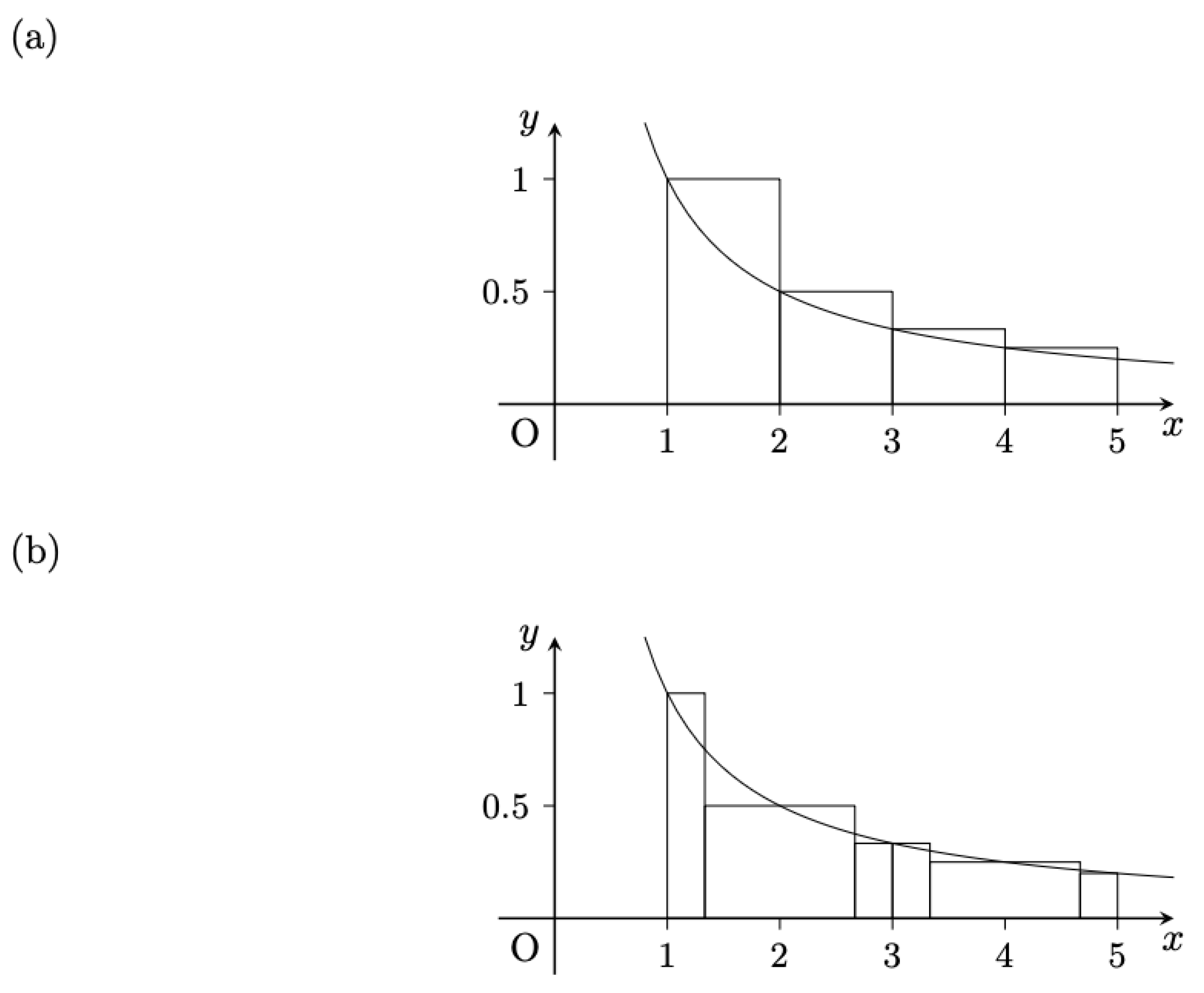

Table 1.
Convergence of
| 3 | 0.012169312 | 6.64×10⁻⁴ |
| 5 | 0.012735433 | 9.78×10⁵ |
| 7 | 0.012806754 | 2.65×10⁵ |
| 9 | 0.012823395 | 9.88×10⁶ |
| 11 | 0.012828805 | 4.47×10⁶ |
| 13 | 0.012830969 | 2.30×10⁶ |
Disclaimer/Publisher’s Note: The statements, opinions and data contained in all publications are solely those of the individual author(s) and contributor(s) and not of MDPI and/or the editor(s). MDPI and/or the editor(s) disclaim responsibility for any injury to people or property resulting from any ideas, methods, instructions or products referred to in the content. |
© 2026 by the authors. Licensee MDPI, Basel, Switzerland. This article is an open access article distributed under the terms and conditions of the Creative Commons Attribution (CC BY) license (http://creativecommons.org/licenses/by/4.0/).
Copyright: This open access article is published under a Creative Commons CC BY 4.0 license, which permit the free download, distribution, and reuse, provided that the author and preprint are cited in any reuse.


